Chandrayaan adds a little good cheer! Well done, ISRO!
December 28, 2008 — drsubrotoroyThe news that Chandrayaan-I has sent back scientific data as intended is excellent. ISRO has my warm congratulations at last! Iron is apparently very abundant in lunar rock so discovering it is not revolutionary but even so, the fact India has a successful lunar orbiter which is sending back signals and scientific data is simply delightful. It brings good cheer in a season marred by the Mumbai massacres and the clouds of war.
On November 9 2008, I had incidentally diagnosed the basis of my own earlier pessimism about Chandrayaan as follows, reproduced here again:
“I have been very pessimistic about Chandrayaan-I’s prospects and I am delighted to hear ISRO say it has been successful in placing the spacecraft in lunar orbit. I have had to wonder where, precisely, my pessimism was mistaken. The answer is that I had completely left out in my thinking the vast technological progress that has taken place in telecommunications and telemetry in the last 40 years. I had surveyed the history of similar attempts by the USSR and USA in the 1960s and that was a history littered by failures of many sorts. Let aside rocket-launch failures, the other main sources of failure were in trajectories and in communications. I have been deeply concerned that India was simply going to fall in the same pitfalls along the way. But what I neglected was that our attempt was being made forty years later and the world has seen enormous technological progress during that time, especially in telecom. The Soviet and American missions took place in the early 1960s when, for example, colour television hardly existed. Today, in 2008, ISRO seems to have managed control and guidance systems that have been up to the (very complex) task of placing the spacecraft in lunar orbit. Hats off to ISRO if it turns out they have succeeded, and cheers if they actually manage to get the scientific data they have wished to receive.
The same mistake that I made here in a field not my own is what I have myself pointed out being made in a different context regarding the current world financial crisis. Viz., I said in my September 18 2008 Business Standard article “October 1929? Not!” that the world since the 1929 stock market crash had witnessed so much technological progress that the current crisis could not be compared to the one back then.”
Hats off to all at ISRO!
Subroto Roy
An Indian Reply to President Zardari: Rewarding Pakistan for bad behaviour leads to schizophrenic relationships
December 19, 2008 — drsubrotoroyAn Indian Reply to President Zardari:
Rewarding Pakistan for bad behaviour leads to schizophrenic relationships
by
Subroto Roy
Pakistan President Asif Ali Zardari’s recent argument in the New York Times resembles closely the well-known publications of his ambassador to the United States, Mr Husain Haqqani. Unfortunately, this Zardari-Haqqani thesis about Pakistan’s current predicament in the world and the world’s predicament with Pakistan is shot through with clear factual and logical errors. These need to be aired because true or useful conclusions cannot be reached from mistaken premises or faulty reasoning.
1. Origins of Pakistan, India, J&K, and their mutual problems
Mr Zardari makes the following seemingly innocuous statement:
“…. the two great nations of Pakistan and India, born together from the same revolution and mandate in 1947, must continue to move forward with the peace process.”
Now as a matter of simple historical fact, the current entities in the world system known as India and Pakistan were not “born together from the same revolution and mandate in 1947”. It is palpably false to suppose they were and Pakistanis indulge in wishful thinking and self-deception about their own political history if they suppose this.
India’s Republic arose out of the British Dominion known as “India” which was the legal successor of the entity known previously in international law as “British India”. British India had had secular governance and so has had the Indian Republic.
By contrast, the Islamic Republic of Pakistan arose out of a newly created state in international law known as the British Dominion of Pakistan, consisting of designated territory carved out of British India by a British decision and coming into existence one day before British India extinguished itself. (Another new state, Bangladesh, later seceded from Pakistan.)
The British decision to create territory designated “Pakistan” had nothing to do with any anti-British “revolution” or “mandate” supported by any Pakistani nationalism because there was none. (Rahmat Ali’s anti-Hindu pamphleteering in London could be hardly considered Pakistani nationalism against British rule. Khan Abdul Ghaffar Khan’s Pashtun patriots saw themselves as Indian, not Pakistani.)
To the contrary, the British decision had to do with a small number of elite Pakistanis — MA Jinnah foremost among them — demanding not to be part of the general Indian nationalist movement that had been demanding a British departure from power in the subcontinent. Jinnah’s separatist party, the Muslim League, was trounced in the 1937 provincial elections in all the Muslim-majority areas of British India that would eventually become Pakistan. Despite this, in September 1939, Britain, at war with Nazi Germany, chose to elevate the political power of Jinnah and his League to parity with the general Indian nationalist movement led by MK Gandhi. (See, Francis Robinson, in William James and Subroto Roy (eds), Foundations of Pakistan’s Political Economy: Towards an Agenda for the 1990s.) Britain needed India’s mostly Muslim infantry-divisions — the progenitors of the present-day Pakistan Army — and if that meant tilting towards a risky political idea of “Pakistan” in due course, so it would be. The thesis that Pakistan arose from any kind of “revolution” or “mandate” in 1947 is fantasy — the Muslim super-elite that invented and endorsed the Pakistan idea flew from Delhi to Karachi in chartered BOAC Dakotas, caring not a hoot about the vulnerability of ordinary Muslim masses to Sikh and Hindu majority wrath and retaliation on the ground.
Modern India succeeded to the rights and obligations of British India in international law, and has had a recognized existence as a state since at least the signing of the Armistice and Treaty of Versailles in 1918-1919. India was a founding member of the United Nations, being a signatory of the 1945 San Francisco Declaration, and an original member of the Bretton Woods institutions. An idea put forward by Argentina that as of 1947 India and Pakistan were both successor states of British India was rejected by the UN (Argentina withdrew its own suggestion), and it was universally acknowledged India was already a member of the UN while Pakistan would have to (and did) apply afresh for membership as a newly created state in the UN. Pakistan’s entry into the UN had the enthusiastic backing of India and was opposed by only one existing UN member, Afghanistan, due to a conflict that continues to this day over the legitimacy of the Durand Line that bifurcated the Pashtun areas.
Such a review of elementary historical facts and the position in law of Pakistan and India is far from being of merely pedantic interest today. Rather, it goes directly to the logical roots of the conflict over the erstwhile State of Jammu and Kashmir (J&K) — a state that itself originated as an entity in the world system a full century before Pakistan was to do so and more than half a century before British India did, but which would collapse into anarchy and civil war in 1947-1949.
Britain (or England) had been a major nation-state in the world system recognized since Grotius first outlined modern international law. On March 16 1846, Britain entered into a treaty, the Treaty of Amritsar, with one Gulab Singh, and the “State of Jammu & Kashmir” came to arise as a recognizable entity in international law for the first time. (See my “History of Jammu and Kashmir” published in The Statesman, Oct 29-30 2006, available elsewhere here.)
Jammu & Kashmir continued in orderly existence as a state until it crashed into legal and political anarchy and civil war a century later. The new Pakistan had entered into a “Standstill Agreement” with the State of Jammu & Kashmir as of August 15 1947. On or about October 22 1947, Pakistan unilaterally ended that Standstill Agreement and instead caused military forces from its territory to attack the State of Jammu & Kashmir along the Mansehra Road towards Baramula and Srinagar, coinciding too with an Anglo-Pakistani coup d’etat in Gilgit and Baltistan (see my “Solving Kashmir”; “Law, Justice & J&K”; “Pakistan’s Allies”, all published in The Statesman in 2005-2006 and available elsewhere here).
The new Pakistan had chosen, in all deliberation, to forswear law, politics and diplomacy and to resort to force of arms instead in trying to acquire J&K for itself via a military decision. It succeeded only partially. Its forces took and then lost both Baramula and Kargil; they may have threatened Leh but did not attempt to take it; they did take and retain Muzaffarabad and Skardu; they were never near taking the summer capital, Srinagar, though might have threatened the winter capital, Jammu.
All in all, a Ceasefire Line came to be demarcated on the military positions as of February 1 1949. After a war in 1971 that accompanied the secession of Bangladesh from Pakistan, that Ceasefire Line came to be renamed the “Line of Control” between Pakistan and India. An ownerless entity may be acquired by force of arms — the erstwhile State of Jammu & Kashmir in 1947-1949 had become an ownerless entity that had been dismembered and divided according to military decision following an armed conflict between Pakistan and India. The entity in the world system known as the “State of Jammu & Kashmir” created on March 16 1846 by Gulab Singh’s treaty with the British ceased to exist as of October 22 1947. Pakistan had started the fight over J&K but there is a general rule of conflicts that he who starts a fight does not get to finish it.
Such is the simplest and most practical statement of the history of the current problem. The British, through their own compulsions and imperial pretensions, raised all the talk about a “Lapse of Paramountcy” of the British Crown over the “Native Princes” of “Indian India”, and of how, the “Native Princes” were required to “accede” to either India or Pakistan. This ignored Britain’s own constitutional law. BR Ambedkar pointed out with unsurpassed clarity that no “Lapse of Paramountcy” was possible even for a single logical moment since “Paramountcy” over any “Native Princes” who had not joined India or Pakistan as of August 15 1947, automatically passed from British India to its legal successor, namely, the Dominion of India. It followed that India’s acquiescence was required for any subsequent accession to Pakistan – an acquiescence granted in case of Chitral and denied in case of Junagadh.
What the Republic of India means by saying today that boundaries cannot be redrawn nor any populations forcibly transferred is quite simply that the division of erstwhile J&K territory is permanent, and that sovereignty over it is indivisible. What Pakistan has claimed is that India has been an occupier and that there are many people inhabiting the Indian area who may not wish to be Indian nationals and who are being compelled against their will to remain so ~ forgetting to add that precisely the same could be said likewise of the Pakistani-held area. The lawful solution I proposed in “Solving Kashmir, “Law, Justice and J&K” and other works has been that the Republic of India invite every person covered under its Article 370, citizen-by-citizen, under a condition of full information, to privately and without fear decide, if he/she has not done so already, between possible Indian, Iranian, Afghan or Pakistani nationalities ~ granting rights and obligations of permanent residents to any of those persons who may choose for whatever private reason not to remain Indian nationals. If Pakistan acted likewise, the problem of J&K would indeed come to be resolved. The Americans, as self-appointed mediators, have said they wish “the people of the region to have a voice” in a solution: there can be no better expression of such voice than allowing individuals to privately choose their own nationalities and their rights and responsibilities accordingly. The issue of territorial sovereignty is logically distinct from that of the choice of nationality by individual inhabitants.
2. Benazir’s assassination falsely compared to the Mumbai massacres
Secondly, President Zardari draws a mistaken comparison between the assassination last year of his wife, Benazir Bhutto, and the Mumbai massacres a few weeks ago. Ms Bhutto’s assassination may resemble more closely the assassinations in India of Indira Gandhi in 1984 and Rajiv Gandhi in 1991.
Indira Gandhi died in “blowback” from the unrest she and her younger son and others in their party had opportunistically fomented among Sikh fundamentalists and sectarians since the late 1970s. Rajiv Gandhi died in “blowback” from an erroneous imperialistic foreign policy that he, as Prime Minister, had been induced to make by jingoistic Indian diplomats, a move that got India’s military needlessly involved in the then-nascent Sri Lankan civil war. Benazir Bhutto similarly may be seen to have died in “blowback” from her own political activity as prime minister and opposition leader since the late 1980s, including her own encouragement of Muslim fundamentalist forces. Certainly in all three cases, as in all assassinations, there were lapses of security too and imprudent political judgments made that contributed to the tragic outcomes.
Ms Bhutto’s assassination has next to nothing to do with the Mumbai massacres, besides the fact the perpetrators in both cases were Pakistani terrorists. President Zardari saying he himself has lost his wife to terrorism is true but not relevant to the proper diagnosis of the Mumbai massacres or to Pakistan-India relations in general. Rather, it serves to deflect criticism and condemnation of the Pakistani state’s pampered handing of Pakistan’s terrorist masterminds, as well as the gross irresponsibility of Pakistan’s military scientists (not AQ Khan) who have been recently advocating a nuclear first strike against India in the event of war.
3. Can any religious nation-state be viable in the modern world?
President Zardari’s article says:
“The world worked to exploit religion against the Soviet Union in Afghanistan by empowering the most fanatic extremists as an instrument of destruction of a superpower. The strategy worked, but its legacy was the creation of an extremist militia with its own dynamic.”
This may be overly simplistic. As pointed out in my article “Pakistan’s Allies”, Gregory Zinoviev himself after the Bolshevik Revolution had declared that international communism “turns today to the peoples of the East and says to them, ‘Brothers, we summon you to a Holy War first of all against British imperialism!’ At this there were cries of Jehad! Jehad! And much brandishing of picturesque Oriental weapons.” (Treadgold, Twentieth Century Russia, 1990, p. 213). For more than half of the 20th century, orthodox Muslims had been used by Soviet communists against British imperialism, then by the British and Americans (through Pakistan) against Soviet communism. Touché! Blowback and counter-blowback! The real question that arises from this today may be why orthodox Muslims have allowed themselves to be used either way by outside forces and have failed in developing a modern nation-state and political culture of their own. Europe and America only settled down politically after their religious wars were over. Perhaps no religious nation-state is viable in the modern world.
4. Pakistan’s behaviour leads to schizophrenia in international relations
President Zardari pleads for, or perhaps demands, resources from the world:
“the best response to the Mumbai carnage is to coordinate in counteracting the scourge of terrorism. The world must act to strengthen Pakistan’s economy and democracy, help us build civil society and provide us with the law enforcement and counterterrorism capacities that will enable us to fight the terrorists effectively.”
Six million pounds from Mr Gordon Brown, so much from here or there etc — President Zardari has apparently demanded 100 billion dollars from America and that is the price being talked about for Pakistan to dismantle its nuclear weapons and be brought under an American “nuclear umbrella” instead.
I have pointed out elsewhere that what Pakistan seems to have been doing in international relations for decades is send out “mixed messages” – i.e. contradictory signals, whether in thought, word or deed. Clinical psychologists following the work of Gregory Bateson would say this leads to confusion among Pakistan’s interlocutors (a “double bind”) and the symptoms arise of what may be found in schizophrenic relationships. (See my article “Do President-elect Obama’s Pakistan specialists believe…”; on the “double bind” theory, an article I chanced to publish in the Journal of Genetic Psychology, 1986, may be of interest).
Here are a typical set of “mixed messages” emanating from Pakistan’s government and opinion-makers:
“We have nuclear weapons
“We keep our nuclear weapons safe from any misuse or unauthorized use
“We are willing to use nuclear weapons in a first strike against India
“We do not comprehend the lessons of Hiroshima-Nagasaki
“We do not comprehend the destruction India will visit upon us if we strike them
“We are dangerous so we must not be threatened in any way
“We are peace-loving and want to live in peace with India and Afghanistan
“We love to play cricket with India and watch Bollywood movies
“We love our Pakistan Army as it is one public institution that works
“We know the Pakistan Army has backed armed militias against India in the past
“We know these militias have caused terrorist attacks
“We are not responsible for any terrorist attacks
“We do not harbour any terrorists
“We believe the world should pay us to not use or sell our nuclear weapons
“We believe the world should pay us to not encourage the terrorists in our country
“We believe the world should pay us to prevent terrorists from using our nuclear weapons
“We hate India and do not want to become like India
“We love India and want to become like India
“We are India and we are not India…”
Etc.
A mature rational responsible and self-confident Pakistan would have said instead:
“We apologise to India and other countries for the outrageous murders our nationals have committed in Mumbai and elsewhere
“We ask the world to watch how our professional army is deployed to disarm civilian and all “non-state” actors of unauthorized firearms and explosives
“We do not need and will not demand or accept a dollar in any sort of foreign aid, military or civilian, to solve our problems
“We realize our economic and political institutions are a mess and we must clean them up
“We will strive to build a society imbued with what Iqbal described as the spirit of modern times..”
As someone who created at great personal cost at an American university twenty years ago the book Foundations of Pakistan’s Political Economy: Towards an Agenda for the 1990s, I have a special interest in hoping that Pakistan shall find the path of wisdom.
Pakistan’s New Delhi Embassy should ask for “Consular Access” to nine dead terrorists in a Mumbai morgue before asking to meet Kasab
December 13, 2008 — drsubrotoroyAfter two weeks of pointblank denials that Pakistan had anything to do with the Mumbai massacres (“the Mumbai incident”, “the Bombay event” as Pakistan’s social butterflies put it), Pakistan’s diplomats are now asking for Consular Access to Kasab, the lone captured terrorist! The cheek of it! Would they please request Consular Access instead to the nine dead terrorists who were Kasab’s companions, and who are presumably in a Mumbai morgue at present because India’s Muslims have denied them a burial? It is certain the Government of India would be relieved and delighted to hand over full custody of the mortal remains of these nine Pakistanis to representatives of His Excellency the High Commissioner of Pakistan to New Delhi for transfer back home to Pakistan.
As for Consular Access to Kasab, the Government of India will doubtless inform His Excellency that His Excellency may appreciate that in present circumstances in which the individual Kasab, not to put too fine a point on it, is singing like a canary, the Government of India deems the security of India could be jeopardised by any possibility of such a song becoming jeopardised. The Government of India will however doubtless assure His Excellency that Kasab is being well cared for in custody and has reported as such to the magistrate.
Kasab was a stupid, ignorant, misguided youth, manufactured by Pakistan’s terrorist masterminds into becoming a mass-murdering robot: Mahatma Gandhi’s India should punish him, get him to repent if he wishes, then perhaps rehabilitate him as a potent weapon against Pakistani terrorism
December 12, 2008 — drsubrotoroyThe crime of murder is that of deliberate homicide, that of mass-murder is the murder of a mass of people. There is no doubt the lone captured Mumbai terrorist, “Kasab”, has committed mass-murder, being personally responsible for the murder of probably 20 or 30 wholly innocent people he had never met. He killed them by machine-gun fire and grenades at CST/VT railway station on November 26 2008 before being shot and captured by police. He is also a co-conspirator in the mass-murders carried out by his associate at the railway station and those elsewhere in Mumbai. There is no doubt he should serve rigorous imprisonment for life in an Indian prison for his crimes.
And yet…. And yet…
If the Government of India is sensible, it needs to describe and comprehend the moral subtleties of the circumstances surrounding Kasab’s life, especially during the last year. Here was a stupid, ignorant, rather primitive youth misguided by others first into becoming a petty robber, later into becoming a terrorist-trainee in hope of advancing his career in thievery!
Bakri-Id 2008 has just occurred – it is on Bakri-Id a year ago in 2007 that Kasab reportedly first ventured into volunteering for terrorist training as a way of learning how to use firearms! It is almost certain he had never met a Hindu or an Indian in his life before then, that he knew absolutely nothing about the subcontinent’s history or politics, that he would be ignorant about who, say, Iqbal or Jinnah or Maulana Azad or Sheikh Abdullah or Mahatma Gandhi ever were. Within less than a year, that same youth had been brainwashed and trained adequately enough by Pakistan’s terrorist masterminds to become a robotic mass-murderer in Mumbai’s railway station. Now having been caught and treated humanely by his captors, he has confessed everything and even expressed a wish to write a letter to his father in Pakistan expressing remorse for his deeds.
If I was the judge trying him, I would sentence him to a minimum of twenty or thirty years rigorous imprisonment in an Indian prison. But I would add that he should be visited in jail by a few of India’s Muslim leaders, and indeed he should be very occasionally allowed out of the prison (under police supervision) in a structured program to offer Namaz with India’s Muslims in our grandest mosques. He should learn firsthand a little of the lives of India’s Muslims and of India’s people as a whole. Perhaps he will become a model prisoner, perhaps he may even want to become in due course a potent weapon against the terrorist masterminds who ruined his life by sending him to murder people in India.
It bears to be remembered that in an incredible act of Christian forgiveness, the widow of the Australian missionary Graham Staines forgave the cold-blooded murderers who burnt alive her husband and her young sons as they slept in a jeep in Orissa. The family of Rajiv Gandhi may have done the same of those who assassinated or conspired to assassinate Rajiv Gandhi. This is the land of Mahatma Gandhi, who had woven a remarkable moral and political theory out of the Jain-Buddhist-Hindu doctrine of ahimsa as well as Christian notions from Tolstoy and Thoreau of forgiving the sinner.
Of course there cannot be forgiveness where there is no remorse. Kasab’s behaviour thus far suggests he will be remorseful and repentant; there are many other thieves and murderers in the world who are not.
Subroto Roy
Reported statement of Mohammad Ajmal Amir ‘Kasab’, 21, to police after arrest: “I have resided in Faridkot, Dinalpur tehsil, Ukada district, Suba Punjab state, Pakistan since my birth. I studied up to class IV in a government school. After leaving school in 2000, I went to stay with my brother in Tohit Abad mohalla, near Yadgar Minar in Lahore. I worked as a labourer at various places till 2005, visiting my native once in a while. In 2005, I had a quarrel with my father. I left home and went to Ali Hajveri Darbar in Lahore, where boys who run away from home are given shelter. The boys are sent to different places for employment. One day a person named Shafiq came there and took me with him. He was from Zhelam and had a catering business. I started working for him for Rs120 per day. Later, my salary was increased to Rs200 per day. I worked with him till 2007. While working with Shafiq, I came in contact with one Muzzafar Lal Khan, 22. He was from Romaiya village in Alak district in Sarhad, Pakistan. Since we were not getting enough money, we decided to carry out robbery/dacoity to make big money. So we left the job.
We went to Rawalpindi, where we rented a flat. Afzal had located a house for us to loot… We required some firearms for our mission… While we were in search of firearms, we saw some LeT stalls at Raja Bazaar in Rawalpindi on the day of Bakri-id. We then realised that even if we procured firearms, we would not be able to operate them. Therefore, we decided to join LeT for weapons training. We reached the LeT office and told a person that we wanted to join LeT. He noted down our names and address and told us to come the next day. The next day, there was another person with him. He gave us Rs200 and some receipts. Then he gave us the address of a place called Marqas Taiyyaba, Muridke, and told us to go to there. It was an LeT training camp. We went to the place by bus. We showed the receipts at the gate of the camp. We were allowed inside… Then we were taken to the actual camp area. Initially, we were selected for a 21 days’ training regimen called Daura Sufa. From the next day, our training started.
The daily programme was as follows: 4.15 am — Wake-up call and thereafter Namaz; 8 am — Breakfast; 8.30 am to 10 am — Lecture on Hadis and Quran by Mufti Sayyed; 10 am to noon – Rest; Noon to 1 pm – Lunch break; 1 pm to 4 pm – Rest; 4 pm to 6 pm – PT; instructor: Fadulla; 6 pm to 8 pm – Namaz and other work; 8 pm to 9 pm – Dinner
After Daura Sufa, we were selected for another training programme called Daura Ama. This was also for 21 days. We were taken to Mansera in Buttal village, where we were trained in handling weapons. The daily programme was as follows: 4.15 am to 5 am – Wake-up call and thereafter Namaz; 5 am to 6 am – PT; instructor: Abu Anas; 8 am – Breakfast; 8.30 am to 11.30 am – Weapons training; trainer: Abdul Rehman; weapons: AK-47, Green-O, SKS, Uzi gun, pistol, revolver; 11.30 am to Noon – rest; Noon to 1 pm – Lunch break; 1 pm to 2 pm – Namaz; 2 pm to 4 pm – Rest; 4 pm to 6 pm – PT; 6 pm to 8 pm – Namaz and other work; 8 pm to 9 pm – Dinner.
After the training, we were told that we will begin the next stage involving advanced training. But for that, we were told, we had to do some khidmat for two months (khidmat is a sort of service in the camp as per trainees’ liking). We agreed. After two months, I was allowed to go to meet my parents. I stayed with my parents for a month. Then I went to an LeT camp in Shaiwainala, Muzaffarabad, for advanced training… We were taken to Chelabandi pahadi area for a training programme, called Daura Khas, of three months. It involved handling weapons, using hand grenade, rocket launchers and mortars.
The daily programme was as follows: 4.15 am to 5 am – Wake-up call and thereafter Namaz; 5 am to 6 am – PT; instructor: Abu Mawiya; 8 am – Breakfast; 8.30 am to 11.30 am – Weapons training, handling of all weapons and firing practices with the weapons, training on handling hand grenade, rocket-launchers and mortars, Green-O, SKS, Uzi gun, pistol, revolver; trainer: Abu Mawiya; 11.30 am to 12 noon – rest; Noon to 1 pm – Lunch break; 1 pm to 2 pm – Namaz; 2 pm to 4 pm – Weapons training and firing practice; lecture on Indian security agencies; 4 pm to 6 pm – PT; 6 pm to 8 pm – Namaz and other work; 8 pm to 9 pm – Dinner
There were 32 trainees in the camp. Sixteen were selected for a confidential operation by one Zaki-ur-Rehman, alias Chacha, but three of them ran away from the camp. Chacha sent the remaining 13 with a person called Kafa to the Muridke camp again. At Muridke, we were taught swimming and made familiar with the life of fishermen at sea… We were given lectures on the working of Indian security agencies. We were shown clippings highlighting atrocities on Muslims in India. After the training, we were allowed to go to our native places. I stayed with my family for seven days. I then went to the LeT camp at Muzaffarabad. The 13 of us were present for training. Then, on Zaki-ur-Rehman’s instructions, Kafa took us to the Muridke camp. The training continued for a month. We were given lectures on India and its security agencies, including RAW. We were also trained to evade security personnel. We were instructed not to make phone calls to Pakistan after reaching India.
The names of the persons present for the training are: n Mohd Azmal, alias Abu Muzahid n Ismail, alias Abu Umar n Abu Ali n Abu Aksha n Abu Umer n Abu Shoeb n Abdul Rehman (Bada) n Abdul Rehman (Chhota) n Afadulla n Abu Umar. After the training, Chacha selected 10 of us and formed five teams of two people each on September 15. I and Ismail formed a team; its codename was VTS. We were shown Azad Maidan in Mumbai on Google Earth’s site on the internet… We were shown a film on VT railway station. The film showed commuters during rush hours. We were instructed to carry out firing during rush hours — between 7 am and 11 am and between 7 pm and 11 pm. Then we were to take some people hostage, take them to the roof of some nearby building and contact Chacha, who would have given us numbers to contact media people and make demands. This was the strategy decided upon by our trainers. The date fixed for the operation was September 27. However, the operation was cancelled for some reason. We stayed in Karachi till November 23. The other teams were: 2nd team: a) Abu Aksha; b) Abu Umar; 3rd team: a) Abdul Rehman (Bada); b) Abu Ali; 4th team: a) Abdul Rehman (Chotta); b) Afadulla; 5th team: a) Abu Shoeb; b) Abu Umer.
On November 23, the teams left from Azizabad in Karachi, along with Zaki-ur-Rehman and Kafa. We were taken to the nearby seashore… We boarded a launch. After travelling for 22 to 25 nautical miles we boarded a bigger launch. Again, after a journey of an hour, we boarded a ship, Al-Huseini, in the deep sea. While boarding the ship, each of us was given a sack containing eight grenades, an AK-47 rifle, 200 cartridges, two magazines and a cellphone. Then we started towards the Indian coast. When we reached Indian waters, the crew members of Al-Huseini hijacked an Indian launch. The crew of the launch was shifted to Al-Huseini. We then boarded the launch. An Indian seaman was made to accompany us at gunpoint; he was made to bring us to the Indian coast. After a journey of three days, we reached near Mumbai’s shore. While we were still some distance away from the shore, Ismail and Afadulla killed the Indian seaman (Tandel) in the basement of the launch. Then we boarded an inflatable dinghy and reached Badhwar Park jetty. I then went along with Ismail to VT station by taxi. After reaching the hall of the station, we went to the toilet, took out the weapons from our sacks, loaded them, came out of the toilet and started firing indiscriminately at passengers. Suddenly, a police officer opened fire at us. We threw hand grenades towards him and also opened fire at him. Then we went inside the railway station threatening the commuters and randomly firing at them. We then came out of the railway station searching for a building with a roof. But we did not find one. Therefore, we entered a lane. We entered a building and went upstairs. On the third and fourth floors we searched for hostages but we found that the building was a hospital and not a residential building. We started to come down. That is when policemen started firing at us. We threw grenades at them.
While coming out of the hospital premises, we saw a police vehicle passing. We took shelter behind a bush. Another vehicle passed us and stopped some distance away. A police officer got off from the vehicle and started firing at us. A bullet hit my hand and my AK-47 fell out of my hand. When I bent to pick it up another bullet hit me on the same hand. Ismail opened fire at the officers in the vehicle. They got injured and firing from their side stopped. We waited for a while and went towards the vehicle. There were three bodies in the vehicle. Ismail removed the bodies and drove the vehicle. I sat next to him. Some policemen tried to stop us. Ismail opened fire at them. The vehicle had a flat tyre near a big ground by the side of road. Ismail got down from the vehicle, stopped a car at gunpoint and removed the three lady passengers from the car. Since I was injured, Ismail carried me to the car. He then drove the car. We were stopped by policemen on the road near the seashore. Ismail fired at them, injuring some policemen. The police also opened fire at us. Ismail was injured in the firing. The police removed us from the vehicle and took us to the same hospital. In the hospital, I came to know that Ismail had succumbed to injuries. My statement has been read to me and explained in Hindi, and it has been correctly recorded.”
Will Pakistan accept the bodies of nine dead terrorists who came from Pakistan to Mumbai? If so, let there be a hand-over at the Wagah border
December 11, 2008 — drsubrotoroyMuslim graveyards in Mumbai have evidently refused to allow the burial of the nine Pakistani terrorists killed during the Mumbai massacres. This causes a problem of international law to arise. (Had the graveyards allowed the burial, the dead would have been disposed of presumably under domestic law applicable to unclaimed bodies of dead criminals.) Now by the Hague Conventions on the Laws of War:
“1 The laws, rights, and duties of war apply not only to armies, but also to militia and volunteer corps, fulfilling the following conditions: To be commanded by a person responsible for his subordinates; To have a fixed distinctive emblem recognizable at a distance; To carry arms openly; and To conduct their operations in accordance with the laws and customs of war. In countries where militia or volunteer corps constitute the army, or form part of it, they are included under the denomination “army.”…”
On the basis of the facts presently known about the origins of the Mumbai terrorists, it appears an argument may be made that, in law, they were an unauthorized or rogue squad of Pakistani volunteers who, directly or indirectly, had received some amount of assistance by way of material or financial resources arising from Pakistan’s public exchequer. Certainly they were “unlawful combatants”, did not carry any “fixed distinctive emblem recognizable at a distance” , hid their weapons when they embarked on their unlawful activity and entered India in the manner of spies and not soldiers. Even so, all things considered, the Pakistan Government’s first act of cooperation with the Government of India should be to accept at the Wagah border the bodies of the nine dead terrorists for burial in their home-towns.
During the Kargil war of 1999, Pakistan had been greatly reluctant to accept bodies of its dead soldiers.
Let us hope that will change in this case. Misguided as they were and evil as their deeds have been, the nine dead terrorists should have their remains suitably disposed of. Doing so speaks to civilised behaviour on the part of the living.
Subroto Roy
Two cheers — wait, let’s make that one cheer — for America’s Justice Department
December 10, 2008 — drsubrotoroyAs has been outlined elsewhere here, while in the United States I became a victim of demonstrated fraud on the court (bribery and perjury) at the hands of a different State’s government attorneys. In the summer of 1992, staying with family friends at Broad Branch Terrace in Washington DC, I was told by an attorney neighbor who lived opposite of the name of Patrick Fitzgerald, the present prosecutor in the Illinois case. I think I managed to speak to Mr Fitzgerald on the phone for a few minutes and I think it was from him that I received the name of a renowned Washington attorney who did in due course provide me assistance in the complex matters involved in my case. About May 1996, several US Supreme Court Justices decried “attorney-fraud” publicly in the press, coinciding with the Clerk of that Honorable Court advising me on the phone and by letter to return to the district federal court for rectification. A decade later, one of the attorneys involved pleaded guilty in that district court to having defrauded a different client. In August 2008, an attorney with the US Justice Department in his personal capacity invited me to lay out the matter before him which has been done, and I am fully hopeful the Obama Administration’s new Attorney-General will see things through to have justice delivered in my case. There is no time limit under Fed Rule 60(b) for rectification of fraud on the court.
Subroto Roy
Congratulations to Mumbai’s Police: capturing a terrorist, affording him his Habeas Corpus rights, getting him to confess within the Rule of Law, sets a new world standard
December 10, 2008 — drsubrotoroyThe full statement to police of the single captured terrorist perpetrator of the Mumbai massacres is now available. It tells a grim story. But Mumbai’s Police, from ordinary beat constables and junior officers to the anti-terrorism top brass, come off very well both with their heroism and their commitment to the Rule of Law. In comparison to the disastrous failures of the Rule of Law in the United States and Britain since 9/11 in fighting terrorism, Mumbai’s Police may have set a new world standard.
The prisoner was several days ago afforded Habeas Corpus rights and produced before a magistrate who asked him if he was being mistreated to which he replied he was not – though there might not be any Indian equivalent of America’s “Miranda” law.
The Indian Revolution
December 8, 2008 — drsubrotoroyThe Indian Revolution
by
Subroto Roy
Prefatory Note Dec 2008: This outlines what might have happened if (a) Rajiv Gandhi had not been assassinated; (b) I had known at age 36 all that I now know at age 53. Both are counterfactuals and hence this is a work of fiction. It was written long before the Mumbai massacres; the text has been left unchanged.
“India’s revolution, when it came, was indeed bloodless and non-violent but it was firm and clear-headed and inevitably upset a lot of hitherto powerful people.
The first thing the Revolutionary Government declared when it took over in Delhi was that the rupee would become a genuine hard currency of the world economy within 18 months. This did not seem a very revolutionary thing to say and the people at first did not understand what was meant. The Revolutionaries explained: “Paper money and the banks have been abused by all previous regimes ruling in Delhi since 1947 who learnt their tricks from British war-time techniques. We will give you for the first time in free India a rupee as good as gold, an Indian currency as respectable as any other in the world, dollar, pound, yen, whatever. What you earn with your hard work and resources will be measured by a sound standard of value, not continuously devalued in secret by government misuse”.
The people were intrigued but not enlightened much. Nor did they grasp things to come when the Revolutionary Government abolished the old Planning Commission, sending its former head as envoy to New Zealand (with a long reading-list); attached the Planning Commission as a new R&D wing to the Finance Ministry; detached the RBI from the Finance Ministry; instructed the RBI Governor to bring proper work-culture and discipline to his 75,000 staff and instructed the Monetary Policy Deputy Governor to prepare plans for becoming a constitutionally independent authority, besides a possible monetary decentralization towards the States. India’s people did not understand all this, but there began to be a sense that something was up in Lutyens’ Delhi faraway.
The Revolutionary Government started to seem a little revolutionary when it called in police-chiefs of all States — the PM himself then signed an order routed via the Home Ministry that they were to state in writing, within a fortnight, how they intended to improve discipline and work-culture in the forces they commanded. Each was also asked to name three reliable deputies, and left in no doubt what that meant. State Chief Ministers murmured objections but rumours swirled about more to come and they shut up quickly. The Revolutionary Government sent a terse note to all CMs asking their assistance in implementation of this and any further orders. It also set up a “Prison Reform and Reconstruction Panel” with instructions to (a) survey all prisons in the country with a view to immediately reduce injustices within the prison-system; (b) enlarge capacity in the event fresh enforcement of the Rule of Law came to demand this.
The Revolutionary Government then asked all senior members of the judiciary to a meeting in Trivandrum. There they declared the judiciary must remain impartial and objective, not show favoritism even to members of the Revolutionary Party itself who might be in court before them for whatever reason. The judges were assured of carte blanche by way of resources to improve quality of all public services under them; at the same time, a new “Internal Affairs Department” was formed that would assure the public that the Bench and the Bar never forgot their noble calling. When a former judge and a former senior counsel came to be placed in two cells of the new prison-system, the public finally felt something serious was afoot. Late night comics on TV led the public’s mirth — “Thieves have authority when judges steal themselves”, waxed one eloquently.
The Revolutionary Government’s next step reached into all nooks and crannies of the country. A large room in the new Finance Ministry was assigned to each State – a few days later, the Revolutionary Government announced it had taken over control under the Constitution’s financial emergency provision of all State budgets for a period of six months at the outset.
Now there was an irrepressible outcry from State Chief Ministers, loud enough for the Revolutionary Government to ask them to a national meeting, this time in Agartala. When the Delhi CM sweetly complained she did not know how to get there, she got back two words “Get there”; and she did.
There the PM told the CMs they would get their budgets back some day but only after the Revolutionary Government had overseen their cleaning and restoration to financial health from their current rotten state. “But Prime Minister, the States have had no physical assets”, one bright young CM found courage to blurt out.
“That is the first good question I have heard since our Revolution began,” answered the PM. “We are going to give you the Railways to start with — Indian Railways will keep control of a few national trains and tracks but will be instructed to devolve control and ownership of all other assets to you, the States. See that you use your new assets properly”. There was a collective whoop of excitement. “During the time your budgets remain with us, get your police, transport, education and hospital systems to work for the benefit of common people, confer with your oppositions about how you can get your legislatures to work at all. Keep in mind we are committed to making the rupee a hard currency of the world and we will not stand for any waste, fraud or abuse of public moneys. We really don’t want to be tested on what we mean by that. We are doing the same with the Union Government and the whole public sector”. The Chief Ministers went home nervous and excited.
Finally, the Revolutionary Government turned to Lutyens’ Delhi itself. Foreign ambassadors were called in one by one and politely informed a scale-back had been ordered in Indian diplomatic missions in their countries, and hence by due protocol, a scale-back in their New Delhi embassies was called for. “We are pulling our staff, incidentally, from almost all international and UN agencies too because we need such high-quality administrators more at home than abroad”, the Revolutionary Foreign Minister told the startled ambassadors.
Palpable tension rose in the national capital when the Revolutionary Government announced that Members of Parliament would receive public housing of high quality but only in their home constituencies! The MPs would have to vacate their Delhi bungalows and apartments! “But we are Delhi! We must have facilities in Delhi!”, MPs cried. “Yes, rooms in nationalized hotels suffice for your legislative needs; kindly vacate the bungalows as required; we will be building national memorials, libraries and museums there”, replied the radicals in power. Tension in the capital did not subside for weeks because the old political parties all had thrived on Delhi’s social circuit, whose epicenter swirled around a handful of such bungalows. Now those old power-equations were all lost. A few MPs decided to boycott Delhi and only work in their constituencies.
When the Pakistan envoy was called with a letter for her PM, outlining a process of détente on the USSR-USA pattern of mutual verification of demilitarization, both bloated militaries were upset to see their jobs and perks being cut but steps had been taken to ensure there was never any serious danger of a coup. The Indian Revolution was in full swing and continued for a few years until coherence and integrity had been forced upon the public finances and currency of a thousand million people….”
see also
A Quick Comparison Between the September 11 2001 NYC-Washington attacks and the November 26-28 2008 Mumbai Massacres (An Application of the Case-by-Case Philosophical Technique of Wittgenstein, Wisdom and Bambrough)
December 6, 2008 — drsubrotoroyA Quick Comparison Between the September 11 2001 NYC-Washington attacks and the November 26-28 2008 Mumbai Massacres (An Application of the Case-by-Case Philosophical Technique of Wittgenstein, Wisdom and Bambrough)
by
Subroto Roy
In my book Philosophy of Economics (Routledge, 1989) and in my August 24 2004 public lecture in England “Science, Religion, Art and the Necessity of Freedom”, both available elsewhere here, I described the “case-by-case” philosophical technique recommended by Ludwig Wittgenstein, John Wisdom and Renford Bambrough. (Bambrough had also shown a common root in the work of the American philosopher Charles Sanders Peirce.) Herewith an application of the technique to a contemporary problem that shows the “family resemblance” between two modern terrorist attacks, the September 11 2001 attack on New York and Washington and the Mumbai massacres last week.
Similarity: In both, a gang of motivated youthful terrorists acted as a team against multiple targets; their willingness to accept suicide while indulging in mass-murder may have, bizarrely enough, brought a sense of adventure and meaning to otherwise empty lives.
Difference: In the 9/11 attacks, Mohammad Atta seemed to have been a single predominant leader while each of the others also had complex active roles requiring decisions, like piloting and navigating hijacked jumbo-jets. In the Mumbai massacres, the training and leadership apparently came from outside the team before and even during the operation – almost as if the team were acting like brainwashed robots under long-distance control.
Similarity: Both attacks required a long prior period of training and planning.
Difference: The 9/11 attacks did not require commando-training imparted by military-style trainers; the Mumbai massacres did.
Difference: In the 9/11 attacks, the actual weapons used initially were primitive, like box-cutters; in the Mumbai massacres, assault rifles and grenades were used along with sophisticated telecommunications equipment.
Difference: In 9/11, the initial targets, the hijacked aircraft, were themselves made into weapons against the ultimate targets, namely the buildings, in a way not seen before. In the Mumbai massacres, mass-shooting of terrorized civilians was hardly something original; besides theatres of war, the Baader-Meinhof gang and the Japanese Red Army used these in the 1970s as terrorist techniques (e.g. at Rome Airport Lod Airport; Postscript January 26 2009: I make this correction after reading and commenting on the RAND study which unfortunately did not have the courtesy of acknowledging my December 6 2008 analysis) plus there were, more recently, the Columbine and Virginia Tech massacres.
Similarity: In both cases, Hollywood and other movie scripts could have inspired the initial ideas of techniques to be used.
Similarity: In both cases, the weapons used were appropriate to the anticipated state of defence: nothing more than box-cutters could be expected to get by normal airport security; assault rifles etc could come in by the unguarded sea and attack soft targets in Mumbai. (Incidentally, even this elementary example of strategic thinking in a practical situation may be beyond the analytical capacity contained in the tons of waste paper produced at American and other modern university Economics departments under the rubric of “game theory”.)
Similarity: In both cases, a high-level of widespread fear was induced for several days or more within a targeted nation-state by a small number of people.
Similarity: No ransom-like demands were made by the terrorists in either case.
Similarity: Had the single terrorist not been captured alive in the Mumbai massacres, there would have been little trace left by the attackers.
Difference: The 9/11 attackers knew definitely they were on suicide-missions; the Mumbai attackers may not have done and may have imagined an escape route.
“Anger Management” needed? An Oxford DPhil recommends Pakistan launch a nuclear first strike against India within minutes of war
December 5, 2008 — drsubrotoroySome nine or ten years ago, Gohar Ayub Khan, as Pakistan’s foreign minister, had said the next war with India would be over in a few hours with an Indian surrender, presumably because Pakistan would immediately launch nuclear bombs. Now a leading Pakistani military scientist (who is said to have earned a doctoral degree in 1966 from Oxford University in Experimental Nuclear Physics) has apparently recommended his Government immediately launch nuclear bombs against India within minutes of a war.
[If the link does not work, as it seems not to, paste in http://dailytimes.com.pk
followed by
/default.asp?page=2008
followed by
12
followed by
05
followed by
story_5-12-2008_pg7_24
Viz., Daily Times, December 5 2008 “Nuclear missiles can be fired within minutes in case of war”.]
This is supposed to be responsible behaviour and talk from a serious nuclear weapons’ power ? Whose leadership has assured its Western mentors and allies that its nuclear arsenal is kept in a disassembled state beyond the control of all irregular forces like potential terrorists?
And there is its cricket board suggesting business go about as usual with India! While its liberal commentators go about shedding crocodile tears for victims of the systematic mass murder last week, describing it all as the “Mumbai incident” or the “Bombay event”! Almost the Bombay soiree?
There is a sheer lack of reason, a lack of reasoning, and a lack of reasonableness here, as well as widespread need among Pakistan’s terrorist and military masterminds for what is known in popular psychology these days as “Anger Management”.
India’s Muslim Voices (Or, Let us be clear the Pakistan-India or Kashmir conflicts have not been Muslim-Hindu conflicts so much as intra-Muslim conflicts about Muslim identity and self-knowledge on the Indian subcontinent)
December 4, 2008 — drsubrotoroyIndia’s Muslim Voices
(Or, Let us be clear the Pakistan-India or Kashmir conflicts have not been Muslim-Hindu conflicts so much as intra-Muslim conflicts about Muslim identity and self-knowledge on the Indian subcontinent)
by
Subroto Roy
Ill-informed Western observers, especially at purported “think tanks” and news-portals, frequently proclaim the Pakistan-India confrontation and Jammu & Kashmir conflict to represent some kind of savage irreconcilable division between Islamic and Hindu cultures.
For example, the BBC, among its many prevarications on the matter (like lopping off J&K entirely from its recently broadcasted maps of India, perhaps under influence of its Pakistani staffers), frequently speaks of “Hindu-majority India” and “Indian-administered Kashmir” being confronted by Muslim Pakistan.
And two days ago from California’s Bay Area arose into the Internet Cloud the following profundity: “What we’re dealing with now, in the Pakistani-Indian rivalry, is a true war of civilizations, pitting Muslims against Hindus…. the unfathomable depths of the Muslim-Hindu divide….”.
Even President-elect Obama’s top Pakistan-specialists have fallen for the line of Washington’s extremely strong Pakistan lobby: “Pakistan… sees itself as the political home for the subcontinent’s Muslim population and believes India’s continued control over the Muslim-majority Kashmir valley and denial of a plebiscite for its inhabitants represent a lingering desire on India’s part to undo the legacy of partition, which divided the British Indian Empire into India and Pakistan.”
The truth on record is completely different and really rather simple: for more than a century and a half, Muslims qua Muslims on the Indian subcontinent have struggled with the question of their most appropriate cultural and political identity.
The starkest contrast may be found in their trying to come to terms with their partly Arabic and partly Hindu or Indian parentage (the words Hindu, Sindhu, Indus, Indian, Sindhi, Hindi etc all clearly have the same Hellenistic root).
For example, there was Wali Allah (1703-1762) declaring “We are an Arab people whose fathers have fallen in exile in the country of Hindustan, and Arabic genealogy and Arabic language are our pride”.
But here has been Mohammad Iqbal (1877-1938), in his 1930 Allahabad speech to the Muslim League, conceiving today’s Pakistan as a wish to become free of precisely that Arab influence: “I would like to see the Punjab, NWFP, Sind and Baluchistan amalgamated into a single state… The life of Islam as a cultural force in this living country very largely depends on its centralisation in a specified territory… For India it means security and peace resulting from an internal balance of power, for Islam an opportunity to rid itself of the stamp that Arabian Imperialism was forced to give it, to mobilise its law, its education, its culture, and to bring them into closer contact with its own original spirit and the spirit of modern times.”
In an article “Saving Pakistan” published last year in The Statesman and available elsewhere here, it was suggested Iqbal’s “spirit of modern times” may be represented most prominently today by the physicist/political philosopher Pervez Hoodbhoy: in a December 2006 speech Hoodbhoy suggested a new alternative to MA Jinnah’s “Faith, Unity, Discipline” slogan: “First, I wish for minds that can deal with the complex nature of truth…. My second wish is for many more Pakistanis who accept diversity as a virtue… My third, and last, wish is that Pakistanis learn to value and nurture creativity.” He has spoken too of bringing “economic justice to Pakistan”, of the “fight to give Pakistan’s women the freedom which is their birthright”, and of people to “wake up” and engage politically. But Pakistan’s Iqbalian liberals like Hoodbhoy still have to square off with those of their compatriots who sent the youthful squad into Mumbai last week with assault rifles, grenades and heroic Arabic code-names, as well as orders to attack civilians with the ferocity of the original Muslims attacking caravans and settlements in ancient Arabia.
What the extremely strong Pakistan lobbies within the British and American political systems have suppressed in order to paint a picture of eternal Muslim-Hindu conflict is the voice of India’s nationalist Muslims, who historically have had no wish to have any truck with any idea of a “Pakistan” at all.
Most eminent among them was undoubtedly Jinnah’s fiercest critic: Maulana Abul Kalam Azad whose classic 1946 statement on Pakistan is available in his India Wins Freedom, the final version published only in 1988.
“I have considered from every possible point of view the scheme of Pakistan as formulated by the Muslim League. As an Indian, I have examined its implications for the future of India as a whole. As a Muslim, I have examined its likely effects upon the fortunes of Muslims of India. Considering the scheme in all its aspects, I have come to the conclusion that it is harmful not only for India as a whole but for Muslims in particular. And in fact it creates more problems than it solves. I must confess that the very term Pakistan goes against my grain. It suggests that some portions of the world are pure while others are impure. Such a division of territories into pure and impure is un-Islamic and is more in keeping with orthodox Brahmanism which divides men and countries into holy and unholy — a division which is a repudiation of the very spirit of Islam. Islam recognizes no such division and the prophet says “God made the whole world a mosque for me”.
Further, it seems that the scheme of Pakistan is a symbol of defeatism, and has been built on the analogy of the Jewish demand for a national home. It is a confession that Indian Muslims cannot hold their own in India as a whole, and would be content to withdraw to a corner specially reserved for them.
One can sympathise with the aspiration of the Jews for such a national home, as they are scattered all over the world and cannot in any region have any effective voice in the administration.. The conditions of Indian Muslims is quite otherwise. Over 90 million in number, they are in quantity and quality a sufficiently important element in Indian life to influence decisively all questions of administration and policy. Nature has further helped them by concentrating them in certain areas.
In such a context, the demand for Pakistan loses all force. As a Muslim, I for one am not prepared for a moment to give up my right to treat the whole of India as my domain and to shape in the shaping of its political and economic life. To me it seems a sure sign of cowardice to give up what is my patrimony and content myself with a mere fragment of it.
As is well known, Mr. Jinnah’s Pakistan scheme is based on his two nation theory. His thesis is that India contains many nationalities based on religious differences, Of them the two major nations, the Hindus and Muslims, must as separate nations have separate States, When Dr Edward Thompson once pointed out to Mr. Jinnah that Hindus and Muslims live side by side in thousands of Indian towns, villages and hamlets, Mr. Jinnah replied that this is no way affected their separate nationality. Two nations, according to M Jinnah, confront one another in every hamlet, village and town, and he, therefore, desires that they should be separated into two States.
I am prepared to overlook all other aspects of the problem and judge it from the point of view of Muslim interest alone. I shall go still further and say that if it can be shown that the scheme of Pakistan can in any way benefit Muslims I would be prepared to accept it myself and also to work for its acceptance by others. But the truth is that even if I examine the scheme from the point of view of the communal interests of the Muslims themselves, I am forced to the conclusion that it can in no way benefit them or allay their legitimate fears.
Let us consider dispassionately the consequences which will follow if we give effect to the Pakistan scheme. India will be divided into two States, one with a majority of Muslims and the other of Hindus. In the Hindustan State there will remain 35 million Muslims scattered in small minorities all over the land. With 17 per cent in UP, 12 percent in Bihar and 9 percent in Madras, they will be weaker than they are today in the Hindu majority provinces. They have had their homelands in these regions for almost a thousand years and built up well known centres of Muslim culture and civilization there.
They will awaken overnight and discover that they have become alien and foreigners. Backward industrially, educationally and economically, they will be left to the mercies to what would become an unadulterated Hindu raj.
On the other hand, their position within the Pakistan State will be vulnerable and weak. Nowhere in Pakistan will their majority be comparable to the Hindu majority in the Hindustan States. ( NB Azad could hardly imagine even at this point the actual British Partition of Punjab and Bengal, let aside the later separation of Bangladesh from West Pakistan, SR. )
In fact, their majority will be so slight that will be offset by the economical, educational and political lead enjoyed by non-Muslims in these areas. Even if this were not so and Pakistan were overwhelmingly Muslim in population, it still could hardly solve the problem of Muslims in Hindustan. Two States confronting one another, offer no solution of the problem of one another’s minorities, but only lead to retribution and reprisals by introducing a system of mutual hostages. The scheme of Pakistan therefore solves no problems for the Muslims. It cannot safeguard their rights where they are in minority nor as citizens of Pakistan secure them a position in Indian or world affairs which they would enjoy as citizens of a major State like the Indian Union.
It may be argued that if Pakistan is so much against the interest if the Muslims themselves, then why should such a large section of Muslims be swept away by its lure? The answer is to be found in the attitude of certain communal extremists among the Hindus. When the Muslim League began to speak of Pakistan, they read into the scheme a sinister pan-Islamic conspiracy and began to oppose it out of fear that it foreshadowed a combination of Indian Muslim and trans-Indian Muslim States. The opposition acted as an incentive to the adherents of the League. With simple though untenable logic they argued that if Hindus were so opposed to Pakistan, surely it must be of benefit to Muslims. An atmosphere of emotional frenzy was created which made reasonable appraisement impossible and swept away especially the younger and more impressionable among the Muslims. I have, however, no doubt that when the present frenzy has died down and the question can be considered dispassionately, those who now support Pakistan will themselves repudiate it as harmful for Muslim interests.
The formula which I have succeeded in making the Congress accept secures whatever merits the Pakistan scheme contains while all its defects and drawbacks are avoided. The basis of Pakistan is the fear of interference by the Centre in Muslim majority areas as the Hindus will be in a majority in the Centre. The Congress meets this fear by granting full autonomy to the provincial units and vesting all residuary power in the provinces. It also has provided for two lists of Central subjects, one compulsory and one optional, so that if any provincial unit so wants, it can administer all subjects itself except a minimum delegated to the Centre. The Congress scheme threescore ensures that Muslim majority provinces are internally free to develop as they will, but can at the same time influence the Centre on all issues which affect India as a whole.
The situation in India is such that all attempts to establish a centralized and unitary government are bound to fail. Equally, doomed to failure is the attempt to divide India into two States. After considering all aspects of the question, I have come to the conclusion that the only solution can be on the lines embodied in the Congress formula which allows room for development both to the provinces and to India as a whole. The Congress formula meets the fear of the Muslim majority areas to allay which the scheme of Pakistan was formed. On the other hand, it avoids the defects of the Pakistan scheme which would bring the Muslims where they are in a minority under a purely Hindu government.
I am one of those who considers the present chapter of communal bitterness and differences as a transient phase in Indian life. I firmly hold that they will disappear when India assumes the responsibility of her own destiny. I am reminded of a saying of Mr. Gladstone that the best cure for a man’s fear of the water was to throw him into it. Similarly, India must assume responsibilities and administer her own affairs before fears and suspicious can be fully allayed.
When India attains her destiny, she will forget the chapter of communal suspicion and conflict and face the problems of modern life from a modern point of view. Differences will no doubt persist, but they will be economic, not communal. Opposition among political parties will continue, but it will based, not on religion, but on economic and political issues. Class and not community will be the basis oaf future alignments, and policies will be shaped accordingly. If it be argued that this is only a faith which events may not justify, I would say that in any case the 90 million Muslims constitute a factor which nobody can ignore and whatever the circumstances, they are strong enough to safeguard their own destiny.”
Next must be Sheikh Mohammad Abdullah’s classic February 1948 Speech to the UN Security Council, four months into the initial Pakistani attack on Kashmir:
“Aggression, not accession, is the issue: I have heard with patience, attention and respect the statements made by the representative of Pakistan and members of the Security Council, as well as the statements made on various occasions by the members of my own delegation. The Security Council will concede that I am probably the one man most concerned in the dispute because I happen to come from that land which has become the bone of contention between the two Dominions of India and Pakistan.
I have been quoted profusely on either side, and rightly so, because I have had the fortune-or, should I say, misfortune of leading my countrymen to freedom from 1931 onwards. In this task, I have suffered a great deal. I have been imprisoned not once or twice, but seven times, and the last imprisonment carried with it an aggregate sentence of nine years.
There are many troubles in Kashmir. I have heard patiently the debate in the Security Council, but I feel that I am rather confused. After all, what is the point in dispute? The point in dispute is not that the sovereignty of the Prince is in question, as the representative of Pakistan stated yesterday. After all, I have suffered the punishment of being sentenced to nine years imprisonment for saying what the representative of Pakistan said with regard to the Treaty of Amritsar of 1846. I am glad that he said in the Security Council, where he is immune from any punishment. Therefore, I am not disputing that point and that it is not the subject of the dispute before the Security Council.
The subject of the dispute before the Security Council is not the mal-administration of the Princely State of Kashmir. In order to set right that mal-administration, I think I have suffered the most, and today, when for the first time, I heard the representative of Pakistan supporting my case, it gave me great pleasure.
After all, what is the dispute between India and Pakistan? From what I have learned from the complaint brought before the Security Council by my own delegation, the dispute revolves around the fact that Kashmir acceded legally and constitutionally to the Dominion of India. There was some trouble about the demarcation of the Kashmir administration within the State, and the tribesmen from across the border have poured into my country. They have been helped and are being helped by the Pakistan Government, with the result that there is the possibility of a greater conflagration between India and Pakistan. India sought the help of Security Council so that Pakistan might be requested to desist from helping the tribesmen, and to desist from supporting the inside revolt, should I say, against the lawful authority.
I should have understood the position of the representative of Pakistan if he had come boldly before the Security Council and maintained: “Yes, we do support the tribesmen; we do support the rebels inside the State because we feel that Kashmir belongs to Pakistan and not to India, and because we feel that the accession of Kashmir to India was fraudulent.” Then we might have discussed the validity of the accession of the State of Kashmir to India. But that was not the position taken by the representative of Pakistan. He completely denied that any support was being given by the Government of Pakistan to either the tribesmen or those who are in revolt within the State against the constituted authority.
How am I to convince the Security Council that the denial is absolutely untrue? I am sitting before the Security Council at a distance of thousands of miles from my country. I have fought many battles, along with my own men, on the borders of Jammu and Kashmir. I have seen with my own eyes the support given by the Pakistan Government, not only in supplying buses but in providing arms, ammunition, direction and control of the tribesmen and I have even seen the Pakistan Army forces from across the border.
The denial has come so flatly that it becomes very difficult for me to disprove it here before the Security Council, unless the Security Council accedes to our request to send a commission to the spot and to find out first whether the allegations brought before the Security Council with regard to the aid given by the Government of Pakistan are correct or incorrect. If they are incorrect, the case falls; if they are correct, then the Security Council should take the necessary steps to advise the Government of Pakistan to desist from such support.
But then, this simple issue has been confused. On the one hand, the Pakistan Government says, “We are not a party to the trouble within the State. The trouble within the State exists because the people are fighting against the mal-administration of the Jammu and Kashmir Government.” Yes, we are fighting, we have been fighting against the mal-administration of that State since 1931. We have been demanding democratisation of the Government there. But how is it that today Pakistan has become the champion of our liberty? I know very well that in 1946, when I raised the cry “Quit Kashmir,” the leader of the Pakistan Government, who is the Governor-General now, Mr.Mohammed Ali Jinnah, opposed my Government, declaring that this movement was a movement of a few renegades and that Muslims as such had nothing to do with the movement.
The Muslim Conference, which has been talked about so much, opposed my movement and declared its loyalty to the Prince. The representative of Pakistan now says that Sheikh Abdullah, once the supporter of “Quit Kashmir”, has joined hands with the Maharaja of Kashmir, and that in one of my public speeches I declared that I wanted the Maharaja to be the Maharaja of Jammu and Kashmir-not the Maharaja of Jammu only, but the Maharaja of entire State.
I should like to correct the misreporting of my speech. I did deliver that speech in Jammu, which is the winter capital of our country, but it was in a different context. As the members of the Security Council have already heard from the head of my delegation, some massacres did occur in the Jammu Province. After the Kashmir Province was raided by the tribesmen, and after thousands of Hindus and Sikhs were uprooted from the villages and towns in the Kashmir Province and found their way into the Jammu Province, there was some very bad retaliation. I could not go to Jammu Province to control that situation because I was busy with the raiders in Kashmir Province. However, as soon as I had some time, I flew down to Jammu Province, addressed a gathering of 60,000 Hindus and Sikhs in Jammu city, and gave them some plain advice.
I told them clearly that this policy of retaliation would bring no good to them as Hindus and Sikhs and would bring no good to their leader, because while they could retaliate in one or two districts where they formed the majority, and could even wipe out the Muslim population in these one or two districts, the State happens to have a population which is 80 per cent Muslim, and it would be impossible for them to wipe out the entire Muslim population. The result would be that the Prince, whom they wanted to support, would remain the Prince of only two districts, and not of the entire State of Jammu and Kashmir. I told them that if they wanted him to be the Prince of Jammu and Kashmir, they would have to change their behaviour. That was the speech I delivered, and that was the context in which it was made.
However, I have already stated how this trouble started. It is probable that the representative of Pakistan would admit that when India was divided into two parts, my colleagues and I were all behind prison bars. The result of this division of India was to start massacre on either side. Where Muslims in the West Punjab formed the majority, the killing of Hindus and Sikhs started and this was retaliated in East Punjab. All along our border, massacres of Hindus and Sikhs, on the one hand, and Muslims on the other hand were a daily occurrence. But the State of Jammu and Kashmir, and its people, kept calm. The result was that thousands of refugees, both Muslims and Hindus, sought refuge in our State and we rendered every possible help to all of them.
Why was that so? It was because I and my organisation never believed in the formula that Muslims and Hindus form separate nations. We do not believe in the two-nation theory, nor in communal hatred or communalism itself. We believed that religion had no place in politics. Therefore, when we launched our movement of “Quit Kashmir”, it was not only Muslims who suffered, but our Hindu and Sikh comrades as well. That created a strong bond of unity between all the communities, and the result was that while Hindus, Sikhs and Muslims were fighting each other all along the border, the people of Jammu and Kashmir State — Muslims, Hindus and Sikhs alike-remained calm.
The situation was worsening day by day and the minority in our State was feeling very nervous. As a result, tremendous pressure was brought to bear upon the State administration to release me and my colleagues. The situation outside demanded the release of workers of the National Conference, along with its leader, and we were accordingly set free.
Immediately we were liberated from prison we were faced with the important question of whether Kashmir should accede to Pakistan, accede to India, or remain independent, because under the partition scheme these three choices were open us as, indeed, they were open to every Indian State. The problem was a very difficult one, but I advised the people of my country that although the question was very important to us, it was a secondary consideration. The all important matter for us was our own liberation from the autocratic rule of the Prince for which we were fighting and had been fighting for the past seventeen years. We had not achieved that goal, and therefore I told my people that we must do so first. Then, as free men we should have to decide where our interest lay. Being a frontier State, Kashmir has borders with both Pakistan and India, and there are advantages and disadvantages for the people of Kashmir attached to each of the three alternatives to which I have referred.
Naturally, as I have indicated, we could not decide this all important issue before achieving our own liberation, and our slogan became “Freedom before accession”. Some friends from Pakistan met mein Srinagar. I had a heart- to- heart discussion with them and explained my point of view. I told them in plain words that, whatever had been the attitude of Pakistan towards our freedom movement in the past, it would not influence us in our judgement. Neither the friendship of Pandit Jawahar Lal Nehru and of Congress, nor their support of our freedom movement, would have any influence upon our decision if we felt that the interests of four million Kashmiris lay in our accession to Pakistan.
I requested them not to precipitate this decision upon us but to allow us time, supporting our movement for the while. I added that once we were free they should allow us an interval to consider this all important issue. I pointed out that India had accepted this point of view and was not forcing us to decide. We had, in fact, entered into a standstill agreement with both Pakistan and India, but the leader of the Indian delegation has already explained to the Security Council what Pakistan did to us.
While I was engaged in these conversations and negotiations with friends from Pakistan, I sent one of my colleagues to Lahore, where he met the Prime Minister of Pakistan, Mr. Liaqat Ali Khan, and other high dignitaries of the West Punjab Government. He placed the same point of view before them and requested that they should allow us time to consider this vital question, first helping us to achieve our liberation instead of forcing us to declare our decision one way or the other. Then, one fine morning while these negotiations were proceeding, I received news that a full-fledged attack had been carried out by the raiders on Muzaffarabad, frontier town in the Kashmir Province.
The representative of Pakistan has stated that immediately upon my release I went down to Delhi to negotiate the accession of Kashmir to India. That is not a fact. He probably does not know that while in jail I was elected President of the All India States People’s Conference, and that immediately upon my release I had to take up my duties. Accordingly, I had called a meeting of the executive of that Conference in Delhi, a fact which I had conveyed to the Prime Minister of Pakistan. Indeed, I had told the Prime Minister of Pakistan that immediately upon my return from Delhi I should take the opportunity of meeting him personally to discuss my point of view with him. I did not go to Delhi to conclude any agreement on behalf of Kashmir because, although released, I was still considered a rebel.
I might inform the representative of Pakistan that although I am beyond doubt the head of the Administration of Kashmir State, I am not the Prime Minister. I am head of the Emergency Administration, and that not because the Maharaja of Kashmir wished it. In fact, I do not know whether the Maharaja wishes it even now. I hold the position because the people of my country wish me to be at the helm of affairs in Jammu and Kashmir State.
When the raiders came to our land, massacred thousands of people—mostly Hindus and Sikhs, but Muslims, too—abducted thousands of girls, Hindus, Sikhs and Muslims alike, looted our property and almost reached the gates of our summer capital, Srinagar, the result was that the civil, military and police administrations failed. The Maharaja, in the dead of night, left the capital along with his courtiers, and the result was absolute panic. There was no one to take over control. In that hour of crisis, the National Conference came forward with its 10,000 volunteers and took over the administration of the country. They started guarding the banks, the offices and houses of every person in the capital. This is the manner in which the administration changed hands. We were de facto in charge of the administration. The Maharaja, later on, gave it a legal form.
It is said that Sheikh Abdullah is a friend of Pandit Jawahar Lal Nehru. Yes, I admit that. I feel honoured that such a great man claims me as his friend. And he happens to belong to my own country;he is also a Kashmiri, and blood is thicker than water. If JawaharLal Nehru gives me that honour, I cannot help it. He is my friend. But that does not mean that, because of his friendship, I am going to betray the millions of my people who have suffered along with me for the last seventeen years and sacrifice the interests of my country. I am not a man of that calibre.
I was explaining how the dispute arose—how Pakistan wanted to force this position of slavery upon us. Pakistan had no interest in our liberation or it would not also have opposed our freedom movement. Pakistan would have supported us when thousands of my countrymen were behind bars and hundreds were shot to death. The Pakistani leaders and Pakistani papers were heaping abuse upon the people of Kashmir who were suffering these tortures.
Then suddenly, Pakistan comes before the bar of the world as the champion of the liberty of the people of Jammu and Kashmir. The world may believe this, but it is very difficult for me to believe. When we refused the coercive tactics of Pakistan, it started full fledged aggression and encouraged the tribesmen in this activity. It is absolutely impossible for the tribesmen to enter our territory without encouragement from Pakistan, because it is necessary to pass through Pakistan territory to reach Jammu and Kashmir. Hundreds of trucks, thousands of gallons of petrol, thousands of rifles, ammunition, and all forms of help that an army requires, were supplied to them. We know this. After all, we belong to that country. What Pakistan could not achieve by the use of economic blockade it wanted to achieve by full-fledged aggression.
What do we request? We request nothing more than that the Security Council should send some members to this area to see for themselves what is happening there. If Pakistan comes forward and says, “We question the legality of accession”, I am prepared to discuss whether or not the accession of Jammu and Kashmir to India was legal. However, now they say, “We want a plebiscite, we want to obtain the free and unfettered opinion of the people of Kashmir. There should be no pressure exerted on the people and they should make the free choice as to the State to which they wish to accede.”
Not only this the offer that was made by the people of Kashmir to Pakistan long, long ago, but it is the offer made by the Prime Minister of India at a time, I think, he had not the slightest need for making it, as Kashmir was in distress.
We realised that Pakistan would not allow us any time, that we had either to suffer the fate of our kith and kin of Muzaffarabad, Baramulla, Srinagar and other towns and villages, or to seek help from some outside authority.
Under these circumstances, both the Maharaja and the people of Kashmir requested the Government of India to accept our accession. The Government of India could have easily accepted the accession and could have said, “All right we accept your accession and we shall render this help.” There was no necessity for the Prime Minister of India to add the proviso, when accepting the accession, that India does not want to take advantage of the difficult situation in Kashmir. We will accept this accession, without Kashmir’s acceding to the Indian Dominion, we are not in a position to render any military help. But once the country is free from the raiders, marauders and looters, this accession will be subject to ratification by the people. That was the offer made by the Prime Minister of India.
That was the same offer which was made by the people of Kashmir to the Government of Pakistan, but it was refused because at that time Pakistan felt that it could, within a week, conquer the entire Jammu and Kashmir State and then place the fait accompli before the world, just as happened some time ago in Europe. The same tactics were used.
But having failed in these tactics, Pakistan now comes before the bar of the world, pleading, “We want nothing, we only want our people to be given a free hand in deciding their own fate. And in deciding their own fate, they must have a plebiscite.”
They then continue and say, “No, a plebiscite cannot be fair and impartial unless and until there is a neutral administration in the State of Jammu and Kashmir.” I have failed to understand this terminology with reference to a “neutral administration”. After all what does “neutral administration” mean?
The representative of Pakistan has stated that Sheikh Abdullah, because he is a friend of Jawahar Lal Nehru, because he has had sympathy for the Indian National Congress, because he has declared his point of view in favour of accession to India, and because he is head of the Emergency Administration, cannot remain impartial. Therefore, Sheikh Abdullah must depart.
Let us suppose that Sheikh Abdullah goes, who is to replace Sheikh Abdullah ? It will be someone amongst the 4 million people of the State of Jammu and Kashmir. But can we find anyone among these 4 million people whom we can call impartial? After all, we are not logs of wood, we are not dolls. We must have an opinion one way or the other. The people of Kashmir are either in favour of Pakistan or in favour of India.
Therefore, Pakistan’s position comes down to this that the 4 million people of that State should have no hand in running the administration of their own country. Someone else must come in for that purpose. Is that fair ? Is that just ? Do the members of the Security Council wish to oust the people of Kashmir from running their own administration and their own country ? Then, for argument’s sake, let us suppose that the 4 million people of the State of Jammu and Kashmir agree to have nothing to do with the administration of their country; some one else must be brought into the country for this purpose. From where do the members of the Security Council propose that such a neutral individual may be secured? From India? No, from Pakistan? No, from anywhere in the world? No, frankly speaking, even if the Security Council were to request Almighty God to administer the State of Jammu and Kashmir during this interim period, I do not feel that He could act impartially. After all, one must have sympathy either for this side or that side.
If elections were to be held in the United Kingdom sometime after tomorrow with the Labour Government in power, would anyone say to Mr Attlee: “The elections are now going on. Because you happen to belong to Labour Party, your sympathies will be in favour of the Labour vote. Therefore, you had better clear out. We must have a neutral man as Prime Minister until our elections are finished?
However, we have been told that Sheikh Abdullah must walk out because he has declared his point of view in favour of India. Therefore, he cannot be impartial. We must have some impartial man we must have some neutral man.
As I have submitted to the members of the Security Council, Sheikh Abdullah happens to be there because the people wish it. As long as the people wish it, I shall be there. There is no power on earth which can displace me from the position which I have there. As long as the people are behind me, I will remain there.
We have declared once for all, that there shall be freedom of voting and for that purpose we have said, “Let anyone come in, we have no objection. Let the Commission of the Security Council on India come into our State and advise us how we should take a vote, how we should organize it, and how it can be completely impartial. We have no objection.” My Government is ready to satisfy, to the last comma, the impartiality of the vote.
But to have an impartial vote is one thing; to have a say in the administration of the State is a different thing entirely. After all, with what are we concerned? We are concerned only with the fact that no influence shall be exercised over the voters, either in one way or in another. The people shall be free to vote according to their own interests. We are ready to accede to that.
It is then said: “You cannot have freedom of voting as long as the Indian Army remains in the State of Jammu and Kashmir.” It is probably very difficult for me to draw a full picture of what is going on in that country. There is absolute chaos in certain parts of the country, fighting is going on and thousands of tribesmen are there ready to take advantage of any weakness on the part of the State of Jammu and Kashmir.
Once we ask the Indian Army, which is the only protective force in Kashmir against these marauders, to clear out, we leave the country open to chaos. After all, one who has suffered for the last seventeen years, in attempting to secure the freedom and liberation of his own country, would not like an outside army to come in and to remain in the country.
However, what is the present situation? If I ask the Indian Army to clear out, how am I going to protect the people from the looting, arson, murder and abduction with which they have been faced all these long months? What is the alternative? here need be no fear since the Indian Army is there, that this army will interfere in the exercise of a free vote. After all, a Commission of the Security Council will be there in order to watch. The Indian Army does not have to go into every village. It will be stationed at certain strategic points, so that in the event of danger from any border, the Army will be there to protect that border. The army is there to curb disorders anywhere in the State; that is all. The army will not be in each and every village in order to watch each and every vote.
It is then said: “Can we not have a joint control ? Can we not have the armies of Pakistan and India inside the State in order to control the situation ?” This is an unusual idea. What Pakistan could not achieve through ordinary means, Pakistan wishes to achieve by entering through the back door, so that it may have its armies inside the State and then start the fight. That is not possible. After all, we have been discussing the situation in Kashmir. I should say that we have been playing the drama of Hamlet without the Prince of Denmark. The people of Kashmir are vitally interested in this question. Four million people in Kashmir are keenly interested in this entire affair. I have sympathies with the people of Poonch and Mirpur. The representative of Pakistan will probably concede that I have suffered greatly for the people of Poonch as well as for the people of Mirpur. There is no difference on this part of international democratisation of the administration between me, my party and the people of Poonch. We are one, we want our own liberty, we want our own freedom, we do not want autocratic rule. We desire that the 4 million people in Jammu and Kashmir—Hindus, Sikhs and Muslims— shall have the right to change their destiny, to control their country, and to administer it as best as they can. On that point there is absolutely no difference.
However, it is not a question of internal liberation. The Security Council should not confine the issue. The question is not that we want internal freedom, the question is not how the Maharaja got his State, or whether or not he is sovereign. These points are not before the Security Council. Whether Kashmir has lawfully acceded to India—complaints on that score have been brought before the Security Council on behalf of Pakistan—is not the point at issue. If that were the point at issue, then we should discuss that subject. We should prove before the Security Council that Kashmir and the people of Kashmir have lawfully and constitutionally acceded to the Dominion of India and Pakistan has no right to question that accession. However, that is not the discussion before the Security Council.
Indian and Kashmiri forces are ready to deal with tribesmen, to come to an understanding with the people of Kashmir and to establish ademocratic form of government inside the State. We shall do all that. We do not want Pakistan to lend us support to suppress an internal revolt or to drive out the tribesmen. We do not seek any support from Pakistan in that connection. Since Pakistan is a neighbouring country, we desire to remain on the friendliest possible terms with this sister Dominion. But we do ask that Pakistan shall have no hand, directly or indirectly, in this turmoil in Kashmir. The Government of Pakistan has said: “We have no hand in this turmoil.” The only course left to the Security Council is to send out the commission and to see whether or not Pakistan has any hand in this turmoil. If Pakistan has had any hand in this turmoil, then the Government of Pakistan should be asked to desist from such activity. If Pakistan has had no hand in this turmoil, then that can be proved.
This issue has been clouded by very many other issues and interests. I suggested at informal talks that according to my understanding there are two points at issue, first, how to have this neutral impartial administration; second, whether or not the Indian Army shall remain. It is not at all disputed that we must have a plebiscite and that the accession must be ratified by the people of Kashmir, freely and without any pressure on this or that side. That much is conceded, there is no dispute about that. The dispute arises when it is suggested that in order to have the free vote, the administration must be changed. To that suggestion we say, “No.”
I do not know what course future events will take. However, I may assure the Security Council that, if I am asked to conduct the administration of this State, it will be my duty to make the administration absolutely impartial. It will be my duty to request my brothers, who are in a different camp at this time, to come to lend me support. After all, they are my own kith and kin. We suffered together, we have no quarrel with them. I shall tell them: “Come on; it is my country; it is your country. I have been asked to administer the State. Are you prepared to lend me support? It is for me to make the administration successful; it is for me to make the administration look impartial.” It is not for Pakistan to say “No, we must have an impartial administration.” I refuse to accept Pakistan as a party in the affairs of the Jammu and Kashmir State. I refuse this point blank. Pakistan has no right to say that we must do this and we must do that. We have seen enough of Pakistan. The people of Kashmir have seen enough. Muzaffarabad and Baramulla and hundred of villages in Jammu and Kashmir depict the story of Pakistan to the people of Jammu and Kashmir. We want to have no more of this.
In concluding, I again request that in order to settle this issue of Kashmir, the Security Council should not confuse the point in dispute. The Security Council should not allow various other extraneous matters to be introduced. Very many extraneous matters have been introduced. The representative of Pakistan gave us the history of the Jammu and Kashmir State. He read to us some letters from Viceroys of India, asking the Maharaja of Jammu and Kashmir to behave, giving the Maharaja good advice, et cetera. However, we cannot forget that these States are the creation of British imperialism in India who has supported these states and this misrule for these 150 years? It is not going to convince me or the world for the representative of Pakistan to say: “These events have happened and these letters were written.” We know how the Princes have acted, how the states were brought into existence, and how the Princes were supported. This was all a game in the British imperialist policy. But this legacy has now fallen upon us. We are not here to discuss whether or not the Maharaja lawfully became the ruler of the State, whether or not there is moral administration in this State, whether or not the Maharaja is sovereign and whether or not Kashmir has legally acceded to India. These issues are not before the Security Council. The only issue before the Security Council is that Pakistan must observe its international obligations and must not support any outside raiders.
Pakistan should not encourage inside revolt. Pakistan has denied that it has in order to verify the statements made by the representatives of India and Pakistan, the Security Council must send a commission to the spot to see whether the complaint brought before the Security Council is valid or invalid. If the Security Council finds that the complaint brought before it by India is valid, then Pakistan should be asked to desist or India should be permitted to use its means to carry out the decision of the Security Council.
As far as I can speak on behalf of India, India does not want the help of the armies of Pakistan. What it wants from Pakistan is that Pakistan should not supply bases to the raiders on Pakistan territory across the border from Jammu and Kashmir State. All along the border on Pakistan territory, there are huge concentrations of these tribesmen who are Pakistani nationals. We request Pakistan not to allow its territory to be used by these raiders.
Pakistan should not provide ammunition, arms, direction and control to these tribesmen. It should stop the passage of these tribesmen through its territory. Pakistan should not supply arms and ammunition to the people who are fighting within the State because all these matters fall under an international obligation. Therefore, Pakistan should desist from that practice. That is all. We do not want any armed help from Pakistan. If Pakistan does what we have requested, the Indian Army, I am quite sure, will be capable of driving out the raiders and tribesmen. If Pakistan does not meddle in our affairs, we will be capable of solving all our own internal disputes with the Maharaja of Kashmir. However, as long as this unofficial war continues, it is very difficult for us to do any thing. Our hands are tied.
What is happening? The raiders are concentrated just across the border. They enter our State in large number—four or five thousand strong. They raid four or five villages, burn them, abduct women and loot property. When our army tries to capture them, they go across the border, and can not fire a single shot across the border, because if it does, there is the immediate danger of a greater conflagration. So our hands are tied.
We do not want to create this difficult situation without informing the Security Council and we felt honour-bound to inform it of the actual position. The Indian Army could easily have followed the raiders across the border and could have attacked the bases, which were all in Pakistan territory, but it desisted. We thought it would be better to inform the Security Council of the situation.
However, I did not have the slightest idea that when the case came before the Security Council, the representative of Pakistan would so boldly deny that Pakistan supplied all this help. Everybody knows that Pakistan is aiding these raiders and tribesmen and the people who are fighting with the State. However, Pakistan chose boldly to deny all these charges.
What is left for me to do? After all, I do not have any magic lamp so that I might bring the entire picture of Jammu and Kashmir State, along with the borders of Pakistan, before the eyes of the members of the Security Council so that they might see who is fighting and who is not fighting. Therefore, somebody must go to the spot. Then at that time it would be for us to prove that the charges we have brought before the Security Council are correct to the last word. That is the only help we want and no other help.”
Thirdly, though by no means lastly, may be placed the 14 August 1951 Memorandum of prominent Muslims led by Dr Zakir Hussain to the UN Representative Dr. Frank P. Graham:
“It is a remarkable fact that, while the Security Council and its various agencies have devoted so much time to the study of the Kashmir dispute and made various suggestions for its resolution, none of them has tried to ascertain the views of the Indian Muslims nor the possible effect of any hasty step in Kashmir, however well-intentioned, on the interests and well- being of the Indian Muslims. We are convinced that no lasting solution for the problem can be found unless the position of Muslims in Indian society is clearly understood.
Supporters of the idea of Pakistan, before this subcontinent was partitioned, discouraged any attempt to define Pakistan clearly and did little to anticipate the conflicting problems which were bound to arise as a result of the advocacy of the two-nation theory. The concept of Pakistan, therefore, became an emotional slogan with little rational content. It never occurred to the Muslim League or its leaders that if a minority was not prepared to live with a majority on the sub- continent, how could the majority be expected t o tolerate the minority.
It is, therefore, small wonder that the result of partition has been disastrous to Muslims. In undivided India, their strength lay about 100 million. Partition split up the Muslim people, confining them to the three isolated regions. Thus, Muslims number 25 million in Western Pakistan, 35 million to 40 million in India, and the rest in Eastern Pakistan. A single undivided community has been broken into three fragments, each faced with its own problems.
Pakistan was not created on a religious basis. If it had been, our fate as well as the fate of other minorities would have been settled at that time. Nor would the division of the sub- continent for reasons of religion have left large minorities in India or Pakistan.
This merely illustrates what we have said above, that the concept of Pakistan was vague, obscure, and never clearly defined, nor its likely consequences foreseen by the Muslim League, even when some of these should have been obvious.
When the partition took place, Muslims in India were left in the lurch by the Muslim League and its leaders. Most of them departed to Pakistan and a few who stayed behind stayed long enough to wind up their affairs and dispose of their property. Those who went over to Pakistan left a large number of relations and friends behind.
Having brought about a division of the country, Pakistan leaders proclaimed that they would convert Pakistan into a land where people would live a life according to the tenets of Islam. This created nervousness and alarm among the minorities living in Pakistan. Not satisfied with this, Pakistan went further and announced again and again their determination to protect and safeguard the interests of Muslims in India. This naturally aroused suspicion amongst the Hindus against us and our loyalty to India was questioned.
Pakistan had made our position weaker by driving out Hindus from Western Pakistan in utter disregard of the consequences of such a policy to us and our welfare. A similar process is in question in Eastern Pakistan from which Hindus are coming over to India in a large and large number.
If the Hindus are not welcome in Pakistan, how can we, in all fairness, expect Muslims to be welcomed in India ? Such a policy must inevitably, as the past has already shown, result in the uprooting of Muslims in this country and their migration to Pakistan where, as it became clear last year, they are no longer welcome, lest their influx should destroy Pakistan’s economy. Neither some of the Muslims who did migrate to Pakistan after partition, and following the widespread bloodshed and conflict on both sides of the Indo-Pakistan border in the north- west, have been able to find a happy asylum in what they had been told would be their homeland. Consequently some of them have had to return to India, e.g. Meos who are now being rehabilitated in their former areas.
If we are living honourably in India today, it is certainly not due to Pakistan which, if anything, has by her policy and action weakened our position. The credit goes to the broadminded leadership of India, to Mahatma Gandhi and Pandit Jawaharlal Nehru, to the traditions of tolerance in this country and to the Constitution which ensures equal rights to all citizens of India, irrespective of their religion caste, creed, colour or sex.
We, therefore, feel that, tragically as Muslims were misled by the Muslim League and subsequently by Pakistan and the unnecessary suffering which we and our Hindu brethren have to go through in Pakistan and in India since partition, we must be given an opportunity to settle down to a life of tolerance and understanding to the mutual benefit of Hindus and Muslims in our country – if only Pakistan would let us do it. To us it is a matter of no small consequence.
Despite continuous provocations, first from the Muslim League and since then from Pakistan, the Hindu majority in India has not thrown us or members of other minorities out of Civil Services, Armed Forces, the judiciary, trade, commerce, business and industry. There are Muslim Ministers in the Union and State cabinets, Muslim Governors, Muslim Ambassadors, representing India in foreign countries, fully enjoying the confidence of the Indian nation, Muslim members in Parliament and state legislatures, Muslim judges serving on the Supreme Court and High Courts, high-ranking officers in the Armed Forces and the Civil services, including the police.
Muslims have large landed estates, run big business and commercial houses in various parts of the country, notably in Bombay and Calcutta, have their shares in industrial production and enterprise in export and import trade. Our famous sacred shrines and places of cultural interest are mostly in India.
Not that our lot is certainly happy. We wish some of the state Governments showed a little greater sympathy to us in the field of education and employment. Nevertheless, we feel we have an honourable place in India. Under the law of the land, our religious and cultural life is protected and we shall share in the opportunities open to all citizens to ensure progress for the people of this country.
It is, therefore, clear that our interest and welfare do not coincide with Pakistan’s conception of the welfare and interests of Muslims in Pakistan.
This is clear from Pakistan’s attitude towards Kashmir. Pakistan claims Kashmir, first, on the ground of the majority of the State’s people being Muslims and, secondly, on the ground, of the state being essential to its economy and defence. To achieve its objective it has been threatening to launch “Jihad” against Kashmir in India. It is a strange commentary on political beliefs that the same Muslims of Pakistan who like the Muslims of Kashmir to join them invaded the state, in October 1947, killing and plundering Muslims in the state and dishonouring Muslim women, all in the interest of what they described as the liberation of Muslims of the State. In its oft-proclaimed anxiety to rescue the 3 million Muslims from what it describes as the tyranny of a handful of Hindus in the State, Pakistan evidently is prepared to sacrifice the interests of 40 million Muslims in India – a strange exhibition of concern for the welfare of fellow- Muslims. Our misguided brothers in Pakistan do not realise that if Muslims in Pakistan can wage a war against Hindus in Kashmir why should not Hindus, sooner or later, retaliate against Muslims in India.
Does Pakistan seriously think that it could give us any help if such an emergency arose or that we would deserve any help thanks to its own follies ? It is incapable of providing room and livelihood to the 40 million Muslims of India, should they migrate to Pakistan. Yet its policy and action, if not changed soon, may well produce the result which it dreads.
We are convinced that India will never attack our interests. First of all, it would be contrary to the spirit animating the political movement in this country. Secondly, it would be opposed to the Constitution and to the sincere leadership of the Prime Minister. Thirdly, India by committing such a folly would be playing straight into the hands of Pakistan.
We wish we were equally convinced of the soundness of Pakistan’s policy. So completely oblivious is it of our present problems and of our future that it is willing to sell us into slavery – if only it can secure Kashmir.
It ignores the fact that Muslims in Kashmir may also have a point of view of their own, that there is a democratic movement with a democratic leadership in the State, both inspired by the progress of a broad minded, secular, democratic movement in India and both naturally being in sympathy with India. Otherwise, the Muslim raiders should have been welcomed with open arms by the Muslims of the State when the invasion took place in 1947.
Persistent propaganda about “Jihad” is intended, among other things, to inflame religious passions in this country. For it would, of course, be in Pakistan’s interests to promote communal rioting in India to show to Kashmiri Muslims how they can find security only in Pakistan. Such a policy, however, can only bring untold misery and suffering to India and Pakistan generally and to Indian Muslims particularly. Pakistan never tires of asserting that it is determined to protect the interests of Muslims in Kashmir and India. Why does not Pakistan express the same concern for Pathans who are fighting for Pakhtoonistan, an independent homeland of their own ? The freedom-loving Pathans under the leadership of Khan Abdul Gaffar Khan and Dr. Khan Sahib, both nurtured in the traditions of democratic tolerance of the Indian National Congress, are being subjected to political repression of the worst possible kind by their Muslim brethren in power in Pakistan and in the NWFP. Contradictory as Pakistan’s policy generally is, it is no surprise to us that while it insists on a fair and impartial plebiscite in Kashmir, it denies a fair and impartial plebiscite to Pathans.
Pakistan’s policy in general and her attitude towards Kashmir is particular thus tend to create conditions in this country which in the long run can only bring to us Muslims widespread suffering and destruction. Its policy prevents us from settling down, from being honourable citizens of a State, free from suspicion of our fellow-countrymen and adapting ourselves to changing conditions to promote the interests and welfare of India. Its sabre-rattling interferes with its own economy and ours. It expects us to be loyal to it despite its impotence to give us any protection, believing at the same time that we can still claim all the rights of citizenship in a secular democracy.
In the event of a war, it is extremely doubtful whether it will be able to protect the Muslims of East Bengal who are completely cut off from Western Pakistan. Are the Muslims of India and Eastern Pakistan to sacrifice themselves completely to enable the 25 million Muslims in Western Pakistan to embark upon mad, self-destructive adventures?
We should, therefore, like to impress upon you with all the emphasis at our command that Pakistan’s policy towards Kashmir is fraught with the gravest peril to the 40 million Muslims of India. If the Security Council is really interested in peace, human brotherhood and international understanding, it should heed this warning while there is still time.
Dr. Zakir Hussain (Vice Chancellor Aligarh University); Sir Sultan Ahmed (Former Member of Governor General’s Executive Council); Sir Mohd. Ahmed Syed Khan(Nawab of Chhatari, former acting Governor of United Provinces and Prime Minister of Hyderabad); Sir Mohd. Usman (Former member of Governor General’s Executive council and acting Governor of Madras); Sir Iqbal Ahmed (Former Chief Justice of Allahabad High Court); Sir Fazal Rahimtoola (Former Sheriff of Bombay); Maulana Hafz-ur-Rehman M.P.; Col. B.H. Zaidi M.P.; Nawab Zain Yar Jung (Minister Gcvernment of Hyderabad); A.K. Kawaja (Former President of Muslim Majlis); T.M. Zarif (General Secretary West Bengal Bohra Community)”.
Such have been the most eminent voices of India’s Muslims in times past. Sadly, they have no equivalent today when India’s Muslims need them with greater urgency. (Bollywood or cricketing celebrities hardly substitute!) This fault in the intellectual history of the modern subcontinent has been a principal factor causing the misapprehensions and distortions of Pakistan’s and J&K’s political reality to continue worldwide.
Habeas Corpus: a captured terrorist mass-murderer tells a magistrate he is not being mistreated by Indian police
December 3, 2008 — drsubrotoroyA youth who had been a petty thief in Multan, was induced by Pakistan’s terrorist masterminds to train to become a mass murderer with an assault rifle and grenades in the Mumbai massacres last week. He was shot and arrested by India’s police and is now in custody. He has already been produced before a magistrate who asked him if he was being mistreated, to which he said he was not. This redounds to India’s credit in view of the vast (and yes, probably racist) mistreatment over years of those held e.g. at Guantanamo Bay. (The argument that the US Constitution and the laws associated with habeas corpus did not apply to the US Government because Guantanamo Bay was not American territory, was always specious.)
In international law, Pakistan has been the perpetrator, India the victim of aggression in Mumbai
November 30, 2008 — drsubrotoroyIn international law, the attacks on Mumbai would probably reveal Pakistan to have been the aggressor state, India the victim of aggression. It is standard law that a “master” is responsible for the misdeeds of his “servant”. E.g., “Where the relation of master and servant clearly exists, the employer is responsible for injury occasioned by the negligent conduct of the servant in carrying out his orders. And this rule is so extensive as to make the master liable for the careless, reckless and wanton conduct of his servant, provided it be within the scope of his employment”. President Zardari and Prime Minister Gillani may declare truthfully they had no prior knowledge of the attacks on Mumbai, that these were not in any way authorized by them or their Government. But it seems likely on the basis of current evidence that the young terrorists who attacked Mumbai were still in a “master-servant” relationship with elements of the Pakistani state and had been financed, trained, motivated and supplied by resources arising, directly or indirectly, from the Pakistani exchequer. Public moneys in Pakistan came to be used or misused to pay for aggression against India — in a quite similar pattern to the October 1947 attack on Kashmir, Ayub Khan’s 1965 “Operation Grand Slam”, and Pervez Musharraf’s 1999 attack on Kargil.
And to think that these youth who were made into becoming terroristic mass murderers were toddlers when the USSR withdrew from Afghanistan, in primary school when the 1993 WTC bombing happened and adolescents at the time of the 9/11 attacks.
Jews have never been killed in India for being Jews until this sad day
November 28, 2008 — drsubrotoroyJews have never been killed in India for being Jews until today. For two thousand years, in fact perhaps as long as there have ever been Jews in the world, there had been Jews living peacefully in India. I used to say that proudly to my Jewish friends, adding that the Indian Army had even had a Jewish general. Today, November 28 2008, or perhaps yesterday November 27 2008, that changed. Five Hasidic Jews who had been peaceful residents of Nariman House in Mumbai, came to be murdered by terrorists, merely for being Jews, or died in explosions or in the cross-fire between the terrorists and Indian security forces. The Israeli Government had offered India their well-known technical expertise in trying to save their fellow-nationals. I believe the Government of India made a tragic mistake by not accepting it. Yes certainly our national prestige would have taken the slightest of blows if Israeli commandos had helped to release Israeli hostages in India. But our national prestige has taken a much vaster and more permanent blow instead, now that we can no longer say that Jews have never in history been killed for being Jews in India. I am especially sad on this already very sad day to see that proud record destroyed.
Subroto Roy
Two (and a half) critical reforms for America’s polity (2008)
November 20, 2008 — drsubrotoroyAmerican friends tell me they have liked what I had to say in my November 2006 article “American Democracy”, which may be found elsewhere here. I continue to think the polity of the United States needs long-term reform for the reasons stated in that article.
Surprisingly enough, the critical reforms would be rather simple and two-fold:
(A) Extending the tenure of the House of Representatives to, say, four years.
(B) Separating the Head of State from the Head of Government.
The former cannot be something very hard to accomplish, relatively speaking, though of course it would need amending the Constitution. Its positive result would be to calm political discussion and behaviour, making them less myopic and nerve-racking than at present.
The latter would be more complicated as there are alternatives possible. A French model preserves the political power of the Head of State relative to the Head of Government. Other models, e.g. of Germany or Britain or India, has the Head of State being a mere (but crucial) constitutional figurehead, while the real political business is carried out by the Head of Government.
My own recommendation would be to have an indirectly elected Head of State in the United States (elected, for example, by the House and the Senate as well as the State Legislatures) who maintains the dignity of the nation and the decorum of the office and is above the fray, while the Head of Government is elected directly much like a President is now (except there need be no Veep running-mate).
Indeed the present nomenclature need not be too hard to modify once it is seen possible for a President as Head of State to be elected indirectly and be a constitutional figurehead, while the Vice-President (?)/Prime Minister (?) could be elected as the Head of Government much in the way a current President is. The term in office of the Head of State and that of the Head of Government probably should not coincide.
Politics is a tough and ugly business and it is dismaying (and destructive) to see, under the present American system, every Head of State inevitably dragged through the mud as has happened since the end of the Eisenhower Administration (coinciding too with the rise of the television age).
Subroto Roy
Pre-Partition Indian Secularism Case-Study: Fuzlul Huq and Manindranath Roy
November 16, 2008 — drsubrotoroyThe 1940 Lahore Resolution of the Muslim League did not mention the word “Pakistan” but is considered its political blueprint. MA Jinnah’s political support lay among the Muslim elite in Muslim-minority areas of India — he needed a show of support from the Muslim-majority provinces of Punjab and Bengal too, and indeed Sikandar Hyat Khan and AK Fuzlul Huq came to draft and present the Lahore Resolution.
Fuzlul Huq was Prime Minister of undivided Bengal from 1937-1943. On 11 May 1942, he led the bridegroom’s procession when my father went to wed my mother. Here is Fuzlul Huq entering the car to do so, with my grandfather Manindranath Roy helping him into the car. My mother’s family were surprised; they were Bengali Brahmins from Jamshedpur and did not quite know what to make of all this. My mother, aged 16 at the time, remembers she was non-plussed to find Fuzlul Huq ‘s bulky frame seated for some reason between her and her new husband in the car on the return journey too!

Fuzlul Huq, having been a young colleague of Surendranath Roy in the Bengal Legislative Council, was a family friend and treated my grandfather, Manindranath Roy, with affection. (Manindranath was a Justice of the Peace, but unlike his father was not political.)
Fuzlul Huq would apparently make requests of my grandmother for delivered meals during political confabulations; my grandfather’s family had been forced to leave Behala as the family home had been requisitioned by the military to be a hospital during the war, and they lived instead in Ballygunge. My father recalls cycling from there with the requested food to the political confabulations in the middle of the wartime blackout (Japanese aeroplanes had apparently reached Calcutta on their bombing missions).
Here too is a note dated 9 August 1945 from Fuzlul Huq to my grandfather thanking him for food and sending his “best blessings” to my grandmother — a Muslim, one of the founders of Pakistan, sends his blessings to an orthodox Hindu Brahmin family and everyone remains completely cheerful and apolitical: such was normal Indian secularism in practice at the time. Partition between India and Pakistan and the ghastliness that accompanied it, and the hatred and bloodshed that has followed, were all quite beyond anyone’s imagination at the time.
see also https://independentindian.com/life-of-mk-roy-19152012-indian-aristocrat-diplomat-birth-centenary-concludes-7-nov-2016/
Of a new New Delhi myth and the success of the University of Hawaii 1986-1992 Pakistan project (with 2015 Postscript)
November 15, 2008 — drsubrotoroyA leading Indian commentator says in this morning’s paper (November 15 2008) about Manmohan Singh:
“His formulation on Kashmir (“I have no mandate to change borders, but we can make borders irrelevant”), became the obvious solution once he articulated it.”
Such may be how modern New Delhi’s myths and self-delusions get born — since in fact there is no evidence that Manmohan Singh or any of his acolytes had anything to do with originating the Pakistan-India peace process in recent decades, just as there has not been that Manmohan Singh or any of his acolytes had anything to do with originating the Congress Party’s new economic thinking in 1990-1991.
(Lest I be misunderstood I should add at the outset that I have the highest personal regard for Dr Singh, he has been in decades past a friend of my father’s, he at my father’s request consented to discuss economics with me in Paris in 1973 when I was a callow lad of 18, he himself has not claimed the originality that has been frequently mis-attributed to him by others for whatever reason, etc.)
The origins of the idea about India-Pakistan and J&K expressed by Manmohan Singh’s words are to be found in the last paragraph of the Introduction by the Editors of a book which arose from the University of Hawaii’s 1986-1992 Pakistan project, which read:
“Kashmir… must be demilitarised and unified by both countries sooner or later, and it must be done without force. There has been enough needless bloodshed on the subcontinent… Modern Pakistanis and Indians are free peoples who can voluntarily agree in their own interests to alter the terms set hurriedly by Attlee or Mountbatten in the Indian Independence Act 1947. Nobody but we ourselves keeps us prisoners of superficial definitions of who we are or might be. The subcontinent could evolve its political identity over a period of time on the pattern of Western Europe, with open borders and (common) tariffs to the outside world, with the free movement of people, capital, ideas and culture. Large armed forces could be reduced and transformed in a manner that would enhance the security of each nation. The real and peaceful economic revolution of the masses of the subcontinent would then be able to begin.”
The University of Hawaii’s Pakistan project, involving Pakistani and other scholars, including one Indian, led to the volume Foundations of Pakistan’s Political Economy: Towards an Agenda for the 1990s published in Karachi, New Delhi and elsewhere. The book reached Nawaz Sharif and the Islamabad elite, including the most hawkish of Islamabad’s hawks, and Pervez Musharraf’s 2006 proposal on J&K, endorsed warmly by the US State Department, may have grown from that paragraph. The Editors of the book, as economists themselves, decried the waste of resources involved in the Pakistan-India confrontation, saying it had
“greatly impoverished the general budgets of both Pakistan and India. If it has benefited important sections of the political and military elites of both countries, it has done so only at the expense of the general welfare of the masses.”
Such words were impossibly bold in the late 1980s-early 1990s. However, as stated in a special editorial article “What to tell Musharraf” in The Statesman of December 16 2006, they seemed in recent years incomplete and rather naïve even to their author, who was myself, the only Indian in that project and the one who had conceived it. Most significantly, the position in international law in the context of historical facts had been wholly neglected. So had been the manifest nature of the Pakistani state (as it had become prior to the splendid 2008 elections).
The Hawaii project had involved top Pakistani economists, political scientists and other commentators but had deliberately chosen to keep the military and the religious clergy out of its chapters. And it was the military and religious clergy who in fact came to dominate Pakistan’s agenda in the 1990s, at least until the 9/11 attacks in America indirectly altered the political direction of the country.
The peaceful and mundane economic agenda outlined for Pakistan in the Hawaii project has come into its own by way of relevance ever since. A few weeks ago, the first trucks filled with fruit, woolens and many other goods traversed across the “Line of Control” in J&K for the first time in sixty years. The Pakistan project that James and I led at the University of Hawaii in the late 1980s may be now declared a success. Among other things, our book explained to Indians that there does exist a Pakistani point of view and perhaps explained to Pakistanis that there does exist an Indian point of view. That is something that had not existed before our book.
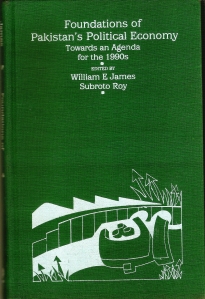
Postscript 18 Nov 2015: I have made clear at Twitter that I find the K.M. Kasuri book promoted and publicized in India by MS Aiyar, S Kulkarni, B Dutt and others in Delhi and Mumbai is mendacious where it is not merely self-serving. Its clear intent is to get India to accept the (false) ISI/Hurriyat narratives about 1947, Kashmir, Bangladesh, terrorism etc. Its purported ideas of demilitarisation and a borderless Kashmir are essentially lifted from my earlier 1980s work in America cited above — which I myself have rejected as naive since the Pakistani aggression in Kargil in 1999. More anon.
Neglecting technological progress was the basis of my pessimism about Chandrayaan
November 9, 2008 — drsubrotoroyI have been very pessimistic about Chandrayaan-I’s prospects and I am delighted to hear ISRO say it has been successful in placing the spacecraft in lunar orbit.
https://independentindian.com/2006/08/13/indias-moon-mission/
I have had to wonder where, precisely, my pessimism was mistaken. The answer is that I had completely left out in my thinking the vast technological progress that has taken place in telecommunications and telemetry in the last 40 years. I had surveyed the history of similar attempts by the USSR and USA in the 1960s and that was a history littered by failures of many sorts. Let aside rocket-launch failures, the other main sources of failure were in trajectories and in communications. I have been deeply concerned that India was simply going to fall in the same pitfalls along the way. But what I neglected was that our attempt was being made forty years later and the world has seen enormous technological progress during that time, especially in telecom. The Soviet and American missions took place in the early 1960s when, for example, colour television hardly existed. Today, in 2008, ISRO seems to have managed control and guidance systems that have been up to the (very complex) task of placing the spacecraft in lunar orbit. Hats off to ISRO if it turns out they have succeeded, and cheers if they actually manage to get the scientific data they have wished to receive.
The same mistake that I made here in a field not my own is what I have myself pointed out being made in a different context regarding the current world financial crisis. Viz., I said in my September 18 2008 Business Standard article “October 1929? Not!” that the world since the 1929 stock market crash had witnessed so much technological progress that the current crisis could not be compared to the one back then.
Subroto Roy,
November 9 2008
Protected: Jawaharlal Nehru invites my father to the Mountbatten Farewell 20 June 1948
November 7, 2008 — drsubrotoroyRai Bahadur Umbika Churn Rai (1827-1902)
November 7, 2008 — drsubrotoroy
Umbika Churn Rai (1827-1902) my great great grandfather, was the founder of the modern Roy family of Behala. He himself was the great grandson of Raja Daibaki Nandan Rai who is said to have brought the family to Behala from Anarpur at the time of the Mahratta invasions. Daibaki Nandan was probably gifted land at Behala as was customary towards Brahmins. The legend is that upon his arrival, a famed band of local dacoits/robbers gave him an ultimatum to surrender the family’s jewels or fight. Daibaki Nandan stood and fought, had his arm cut off by a scimitar, and died bleeding. The family then fell materially for two generations and were “toll pandits” or “tree-shade teachers” under Jagat Ram Rai and Durga Prasad Rai.
Umbika Churn was Durga Prasad’s third son. He was a brilliant ambitious man, well-built and over 6 ft tall, who taught himself English, attended the madrassa started by Warren Hastings to learn Persian, and was well-versed in Sanskrit. Being knowledgeable of Sanskrit, Persian and English at a time of conflict of laws between English, Muslim and Hindu systems, he started as a translator in the Alipore Court under Sir Barnes Peacock (1810-1890). When Peacock went to the new Supreme Court in Calcutta in 1859 as its first Chief Justice, Umbika Churn went with him and rose to become the first Chief Translator. He was made a Rai Bahadur at the time of Queen Victoria’s Jubilee. Rai Bahadur Road in Calcutta is named after him.
The Golden Book of India published at the time of the Victoria Jubilee said Umbika Churn was a descendant of one Raja Gajendra Narayan Rai, Rai-Raian, a finance official under the Great Mughal Jahangir.
There will be much more about him here in due course. Most interesting is the fact that Chief Justice Peacock who had been his mentor, when he returned to England in 1870, later wrote asking him and his eldest son Surendranath for help on behalf of his son, a lawyer, being sent to Calcutta from England. Suren, himself a lawyer at the time, wrote back and assured him he would help find the son work in Calcutta!
I shall upload that correspondence when I am able to.
From Facebook 18 June 2013:
How interesting to find an 1847 depiction of the famous Calcutta Madrassa originated by Warren Hastings (1732–1818) ! … My paternal great great grand-father breached Brahminical rules by insisting on learning Persian there — it was a time of much confusion of laws: Persian was still the, or at least an, official language of the courts, just giving way to English while Hindu law required Sanskrit… Umbik Churn Rai (1827-1902) had had Sanskrit lessons at home, acquired English, and now learnt Persian: he started as a young man as a Court translator in the Alipore Court, came to the attention of the newly arrived Judge, Sir Barnes Peacock (1810-1890), who took him with him in due course when he became the first Chief Justice of the new Calcutta High Court in 1859? 1862?, and made him Chief Translator … We have a fragmentary letter somewhere from Peacock, after retirement in England, written to Umbik’s son, my great grand father, saying his son was coming to Calcutta from England and could be please try to help him find work! A time of camraderie…
And along with Hastings’s Madrassa came Hindu College too, also depicted as of 1847, which became in due course Presidency… Associated to it was a Hindu School too, and our family legend went that Vidyasagar (1820-1891) himself, took his friend Umbik’s eldest son, SN Roy (1860-1929), my great grand father, by hand as a child to attend it.
One tiny prediction about the Obama Administration
November 5, 2008 — drsubrotoroyI predict Ms Caroline Kennedy will be the US Ambassador to the Court of St James’s (i.e. to Britain).
A Complete History of Mankind’s Moon Missions (2006)
October 22, 2008 — drsubrotoroyA COMPLETE HISTORY OF MANKIND’S MISSIONS TO THE MOON
Compiled from open sources by Dr Subroto Roy, c. 2006
(NOTE: These were from notes made by me prior to my August 13 2006 article in The Statesman titled “India’s Moon Mission”. I make no claim to any originality whatsoever to any of the text. As I recall, the notes were from open sources including NASA. Please email me if there are any questions about the text. They are being published today in a bit of a rush in view of Chandrayaan’s launch this morning 22 Oct 2008.)
1. Pioneer 0, Aug 17 1958 Failed lunar orbiter. 1st stage rocket exploded 77 seconds after liftoff.
2. Luna 1958A Sep 23 1958 Failed lunarimpactor. Rocket exploded after liftoff.
3. Pioneer 1, Oct 11 1958 Failed orbiter. 2nd and 3rd stages failed to separate evenly; failed to achieve trajectory, but sent data on Van Allen Belt and micrometeorites.
4. Luna 1958B , Oct 12 1958 Failed impactor. Rocket exploded after liftoff.
5. Pioneer 2, Nov 8 1958 Failed orbiter. 2nd stage failed to ignite; fell back to Earth
6. Luna1958C Dec 4 1958 Failed impactor. 1st stage rocket failed
7. Pioneer 3/4, Dec 6 1958 Failed lunar flyby. 1st stage rocket shut off early; causing crash.
8. Luna 1 Jan 2 1959 Failed impactor. Missed Moon, went into solar orbit, but sent data by releasing sodium vapour cloud 110,000 kms from Earth, allowing study of interplanetary gases.
9. Luna 1959A Jun 18 1959? Failed impactor. Guidance system failed, unable to reach Earth orbit
10. Pioneer 4 , Mar 3 1959 Successful lunar flyby. Passed within 60,000 km of Moon, returned data on lunar radiation levels, then entered solar orbit.
11. Luna 2 , Sep 12 1959 Successful lunar impactor. First craft to land on another celestial body. Impacted Moon’s surface Sep 14 1959, east of Sea of Serenity near raters Aristides, Archimedes, Autolycus at 29.10 N, 0.00 E. Did not detect magnetic field around Moon.
12. Luna 3 Oct 4 1959 Successful flyby. First craft to take photos of far side of Moon. Trajectory took craft around the Moon and back, re-entered Earth’s atmosphere on Apr 20 1960.
13. Pioneer P-3 Nov 26 1959? Failed flyby. Protective cover broke away after 45 seconds in flight, failed to reach orbit, crashed to Earth.
14. Ranger 1 August 23, 1961 Failed Earth-orbit test vehicle. To test “parking orbit” around Earth to give engineers time to calculate accurate trajectory to follow to Moon. Made it to low Earth orbit, then engines, which were supposed to re-ignite after 13 minutes and burn for 90 seconds, burned for a few seconds only and shut off. Re-entered Earth’s atmosphere after 111 orbits.
15. Ranger 2 Nov 18 1961 Failed Earth-orbit test vehicle. Engines failed to re-ignite after spacecraft entered low Earth orbit, and burned up in atmosphere
16. Ranger 3 January. 26, 1962 Failed lunar lander. To take close-up images before impacting, missed the Moon and ended in solar orbit.
17. Ranger 4 April 23, 1962Failed lunar lander. Lunar impact: April 26, 1962 On board communication failure; ground control could track it until it crashed on far side of the Moon but unable to collect any data.
18. Ranger 5 Failed lunar lander. October 18, 1962 Solar cell failed shortly after launch. Without power, engineers unable to control the spacecraft and it missed the Moon by 720 kilometers.
19. Sputnik 25 Failed lunar lander. Launch: January 4, 1963 Failed to transfer to lunar trajectory and burned up as it re-entered Earth’s atmosphere.
20. Luna 4 Failed lunar orbiter. April 2, 1963 Contact lost after it passed within 9,300 kilometers of the Moon.
21. Ranger 6 Failed lunar impactor. January 30, 1964 Lunar impact: Feb 2, 1964 cameras failed and no pictures were returned, crashed in Sea of Tranquillity.
22. Ranger 7 Successful lunar impactor . July 28, 1964 Lunar impact: July 31, 1964 Sent back first high-quality images of lunar surface, more than 4,300 images, before crash-landing in Sea of Clouds.
23. Ranger 8 Successful lunar impactor. Launch: February 17, 1965 Lunar impact: February 20, 1965 Took more than 7,100 high-quality images of the lunar surface before crash-landing in Sea of Tranquility
24. Ranger 9 Successful lunar impactor. Launch: March 21, 1965 Ranger 9 took more than 5,800 images of the lunar surface before it crash-landed in the crater Alphonsus. Network television broadcast images from the spacecraft as they were received — live from the Moon!
25. Luna 5 Failed lunar lander. Launch: May 9, 1965 Lunar Impact: May 12, 1965 First-ever attempt to soft-land a spacecraft on Moon. Luna 5’s retro-rockets failed to fire and the spacecraft crash-landed near Sea of Clouds.
26. Luna 6 – Failed lunar lander. Launch: June 8, 1965 On its way to the Moon, a rocket failed to turn off after a trajectory correction, so missed Moon and went into solar orbit.
27. Zond 3 Successful lunar flyby. Launch: July 18, 1965 Took 25 images as it flew by the far side of the Moon and transmitted them back to Earth nine days later. After passing the Moon, the spacecraft went into a solar orbit.
28. Luna 7 Failed lunar lander. Launch: October 4, 1965 Lunar impact: October 7, 1965 Luna 7 made it to the Moon, but its retrorockets switched on too soon. The spacecraft crash-landed in the Ocean of Storms, west of the crater Kepler.
29. Luna 8 Failed lunar lander. Launch: December 3, 1965 Lunar impact: December 6, 1965 Luna 8 made it to the Moon, but its retrorockets fired too late and the spacecraft crash-landed in the Ocean of Storms, east of the crater Galilei.
30. Luna 9 Successful lunar lander. Launch: Jan. 31, 1966 Lunar landing: February 3, 1966 First to make controlled landing onto surface of another celestial body. Landed on sloping floor of shallow crater at 7.08 N, Longitude 295.63 E, within Oceanus Procellarum. Over the next two days, the spacecraft sent three panoramas of lunar landscape. During the second and third transmission, it shifted a few centimeters, and third set of images taken from a slightly different angle, allowing scientists to construct a stereoscopic view of the landing site and determine the distances to various rocks and depressions. Last communication with the spacecraft was on February 5, 1966.
31. Cosmos 111 Failed lunar flyby. March 1, 1966 The spacecraft was unable to achieve a lunar trajectory. It re-entered Earth’s atmosphere on March 3, 1966.
32. Luna 10 Successful lunar orbiter. Launch: March 31, 1966 Lunar orbit insertion: April 2, 1966. First spacecraft to orbit around another celestial body. Studied radiation levels and cosmic ray intensities and took readings of the Moon’s weak magnetic field. Transmitted data for two months, circling the Moon 460 times before mission ended May 30, 1966.
33. Surveyor 1 – Successful lunar lander. Launch: May 30, 1966 controlled landing on the surface of the Moon, at 2.45 S, 316.79 E. Surveyor 1 took more than 11,100 images of the lunar landscape during its 6-week mission.
34. Lunar Orbiter 1 Successful lunar orbiter. Launch: August 10, 1966 Sent back high-quality TV images of a vast area of lunar surface, including first detailed images of potential Apollo landing sites. After circling Moon 527 times in 77 days, ground control deliberately crashed the craft onto the Moon’s surface, so it would not represent a hazard to upcoming manned missions.
35. Luna 11 Successful lunar orbiter. Launch: August 24, 1966 Lunar orbit insertion: August 27, 1966 Designed to test new technology, completed 277 orbits before its mission was terminated on October 1, 1966.
36. Surveyor 2 Failed lunar lander. Launch: September 20, 1966 Lunar impact: September 22, 1966 Just before touchdown, one of Surveyor 2’s thrusters malfunctioned, and spacecraft tumbled out of control. Crashed into the Moon southeast of the crater Copernicus.
37. Luna 12 Successful lunar orbiter. Launch: October 22, 1966 Lunar orbit insertion: October 25, 1966 took 1,100 pictures of the Moon, including images of the Sea of Rains and area surrounding the crater Aristarchus. The mission was terminated on January 19 1967 after 602 orbits.
38. Lunar Orbiter 2 Successful lunar orbiter. Launch: November 6, 1966 Lunar orbit insertion: November 6, 1966 Lunar impact: October 11, 1967 Took more than 800 pictures including an oblique view of the crater Copernicus. Was deliberately sent crashing into the lunar surface on October 11, 1967,
39. Luna 13 Successful lunar lander. Launch: December 21, 1966 Lunar landing: December 24, 1966 bounced to a landing on the lunar surface, coming to a rest in the Ocean of Storms (Oceanus Procellarum) at 18.87 N, 297.95 E, between the craters Selencus and Craft. The lander collected soil samples and conducted experiments to determine the soil density and radioactivity. The mission ended on December 30, 1966, when the spacecraft’s supplies were depleted.
40. Lunar Orbiter 3 Successful lunar orbiter. Launch: February 4, 1967 Lunar orbit insertion: February 8, 1967. The orbit was altered several times to give controllers on Earth more experience with communications; was able to photograph Surveyor 2 on the surface. Mission ended on October 9, 1967, when controllers deliberately crashed the spacecraft into the Moon.
41. Surveyor 3 Successful lunar lander. Launch: April 17, 1967 Lunar landing: April 20, 1967 As it came in for a soft landing, one thruster did not turn off properly, as a result spacecraft bounced before coming to rest in Ocean of Storms (Oceanus Procellarum), at 3.01 S, 336.66 E. A scoop was used to collect soil samples, and a camera took more than 6,300 images.
42. Lunar Orbiter 4 Successful lunar orbiter. Launch: May 4, 1967 Lunar orbit insertion: May 8, 1967 Lunar Orbiter 4 was the first to take pictures of the Moon’s south pole. It took images from orbit for 8 months before controllers deliberately crashed the spacecraft into the Moon.
43. Surveyor 4 Failed lunar lander. Launch: July 14, 1967 Controllers lost contact with Surveyor 4 just two and a half minutes before it was to touch down in Sinus Medii.
44. Lunar Orbiter 5 Successful lunar orbiter. Launch: August 1, 1967 Lunar orbit insertion: August 5, 1967. With this, more than 99% of the Moon’s surface had been mapped by the Lunar Orbiter spacecraft. Ended when controllers sent spacecraft crashing into the lunar surface on January 31, 1968.
45. Surveyor 5 Successful lunar lander. Launch: September 8, 1967 Lunar landing: September 10, 1967 Despite a helium leak that occurred during its trip to the Moon, controllers were able to bring Surveyor 5 to a successful landing in the Sea of Tranquillity (Mare Tranquillitatis), at 1.41 N, 23.18 E. Controllers ordered the spacecraft to fire its engine to test composition of the soil beneath the lander. The test firing blew away a few clumps of soil but did not create a crater. Final transmission received on December 17, 1967.
46. Surveyor 6 Successful lunar lander. Launch: November 7, 1967 Lunar landing: November 9, 1967 Touched down in Sinus Medii, at 0.49 N, 358.60 E. Once on surface, took a series of pictures and soil samples. On November 17, controllers ordered the spacecraft’s engines to fire, lifting Surveyor 6 off the lunar surface 3 meters (10 feet) and setting it down again a few feet from the original landing site. The spacecraft then took pictures of the former landing site, checking for evidence of a crater created by the rocket’s exhaust. No crater was found, indicating the Moon’s surface was solid enough to support a manned landing. Last contact on Dec 14, 1967.
47. Surveyor 7 Successful lunar lander. Launch: January 7, 1968 Lunar landing: January 9, 1968 Landed in the lunar highlands, near the north rim of the crater Tycho, at 40.86 S, Longitude 348.53 E. Scientists used the scoop on the spacecraft to weigh lunar rocks, based on how much current was needed to lift each rock. Images sent back indicated, for the first time, that some lunar rocks had been molten at some time in their history. Mission successfully completed on February 21, 1968.
48. Luna 14 Successful lunar orbiter. Launch: April 7, 1968 Lunar orbit insertion: April 10, 1968. Spacecraft took images of the Moon and studied the lunar gravitational field.
49. Zond 5 Successful lunar flyby and back. Launch: September 15, 1968 Zond 5 left Earth orbit, flew around the Moon and returned to our planet, splashing down in the Indian Ocean. The spacecraft was recovered and taken back to the USSR for study. Not much information was released but many believed Zond 5 was one of the last steps before the USSR was to land cosmonauts on the Moon.
50. Zond 6 Successful lunar flyby and back. Launch: November 10, 1968 Zond 6 may have been the USSR’s final test before launching cosmonauts to the Moon. Once the spacecraft left Earth orbit, it took 2 days to reach the Moon. There, it took pictures as it swung close to the surface. Zond 6 then returned to Earth, parachuting to a landing within Soviet territory.
51. Apollo 8 Successful manned lunar orbit Launch: December 21, 1968 Lunar orbit insertion: December 24, 1968 Astronauts Frank Borman, James Lovell, and William Anders first humans to leave Earth and travel to the Moon. They arrived at the Moon, completed 10 orbits, and returned to Earth on December 27, 1968. Live TV images broadcast from the trip included an iconic image of Earth rising over the lunar horizon.
52. Zond 1969A Failed lunar flyby and return craft. Launch: January 20, 1969 The launch vehicle’s second stage shut down early and the spacecraft failed to achieve Earth orbit.
53. Luna 1969A Failed lunar rover. Launch: February 19, 1969 Launch vehicle exploded shortly after liftoff.
54. Zond L1S-1 Failed lunar orbiter. Launch: February 21, 1969 Launch vehicle exploded shortly after liftoff.
55. Luna 1969B Failed lunar sample return. Launch: April 15, 1969 Launch vehicle apparently exploded on the launch pad.
56. Apollo 10 – Successful manned lunar orbiter. Launch: May 18, 1969 Lunar orbit insertion: May 21 1969 Astronauts Thomas Stafford, John Young, and Eugene Cernan went into lunar orbit, where they tested procedures for the first moon landing. Apollo 10 splashed down in the Pacific Ocean on May 26, 1969.
57. Luna 1969C Failed lunar sample return. Launch: June 14, 1969 Launch vehicle exploded shortly after liftoff.
58. Luna 15 Failed lunar sample return. Launch: July 13, 1969 Was launched in a veil of secrecy only three days before Apollo 11. The USSR did not reveal the target or mission of Luna 15 causing concern on the part of the USA. Would Luna 15’s mission interfere with Apollo 11? Where would it land? Would there be communication interference? Just two hours before the liftoff of Apollo 11, Luna 15 began its descent to the surface in the Sea of Crisis. The spacecraft crash landed on the lunar surface.
59. Apollo 11 Successful first manned lunar landing. Launch: July 16, 1969 Lunar landing: July 20, 1969 While astronaut Michael Collins orbited overhead, Neil Armstrong and Edwin “Buzz” Aldrin became first humans to land on the Moon, within the Sea of Tranquillity. Remained on the lunar surface for more than 21 hours and collected 20 kilograms (44 pounds) of samples. Apollo 11 returned to Earth on July 24, 1969, splashing down in the Pacific Ocean.
60. Zond 7 Successful lunar flyby and back. Launch: August 7, 1969 Lunar landing August 14, 1969 Zond 7 flew to the Moon and back, taking colour pictures of the Earth and lunar surface along the way. Soft-landed in Kazakhstan.
61. Cosmos 300 Failed lunar sample return. Launch: September 23, 1969 The spacecraft reached Earth orbit, and its rocket failed. Was unable to continue to the Moon.
62. Cosmos 305 Failed lunar sample return. Launch: October 22, 1969 Spacecraft reached Earth orbit, and its rocket failed. Was unable to continue to the Moon.
63. Apollo 12 Successful manned lunar landing. Launch: November 14, 1969 Lunar landing: November 19, 1969 While astronaut Richard Gordon orbited overhead, Charles Conrad and Alan Bean landed on the Moon. Apollo 12 touched down in the Ocean of Storms, within walking distance of Surveyor 3. The astronauts were on the lunar surface for 31.5 hours and collected 34 kilograms (75 pounds) of samples. They returned to Earth on November 24.
64. Apollo 13 Failed manned lunar landing Launch: April 11, 1970 When Apollo 13 was halfway to the Moon, an explosion in the spacecraft’s Service Module required mission control to cancel the scheduled Moon landing and focus on bringing astronauts James Lovell, Fred Haise, and John Swigert safely home which they did.
65. Luna 16 Successful lunar sample return Launch: September 12, 1970 Lunar landing: September 20, 1970 First robotic mission to land on the Moon, collect samples of dust and rock, and return those samples to Earth. Also the first spacecraft to land in lunar darkness. Landed in the Sea of Fertility (Mare Fecunditatis) at 0.68 S, 56.30 E. After collecting dust and rock samples, the spacecraft was launched back into space 26 hours later. Returned to Earth on September 24 with a soft landing, bringing back 101 grams (3.5 ounces) of Moon rocks.
66. Luna 17/Lunokhod 1 Successful lunar sample return
67. Apollo 14 Successful manned lunar landing Launch: January 31, 1971 Lunar landing: February 5, 1971 While astronaut Stuart Roosa orbited overhead, Alan Shepard and Edgar Mitchell landed on the Moon. Apollo 14 touched down in the Fra Mauro highlands, the landing site originally chosen for Apollo 13. The astronauts were on the lunar surface for 33 hours and collected 42 kilograms (94 pounds) of samples before returning to Earth on February 9.
68. Apollo 15 Successful manned lunar landing Launch: July 26, 1971 Lunar landing: July 30, 1971 While astronaut Alfred Worden orbited overhead, David Scott and James Irwin landed on the Moon in the Hadley Rille region. Apollo 15 was the first lander to carry a rover. Astronauts drove rover almost 28 kilometers and were on the lunar surface for almost 67 hours and collected 77 kilograms of samples before returning to Earth on August 7.
69. Luna 18 Failed lunar landing Launch: September 2, 1971 Lunar orbit insertion: September 7, 1971 After completing 54 orbits of the Moon, the spacecraft fired its braking thrusters and began its descent to the lunar surface. Communications were lost upon landing.
70. Luna 19 Successful lunar orbiter Launch: September 28, 1971 Lunar orbit insertion: October 3, 1971 Luna 19 studied the lunar space environment, including radiation, plasma, the solar wind, and the lunar gravity field
71. Luna 20 Successful lunar sample return Launch: February 14, 1972 Lunar landing: February 21, 1972 Luna 20 soft-landed in the Apollonius highlands near Sea of Fertility. Collected samples and then lifted off the next day. The sealed capsule, containing 30 grams of lunar rocks and dust, landed in the USSR on February 25 and was retrieved the following day.
72. Apollo 16 Successful manned lunar landing Launch: April 16, 1972 Lunar landing: April 21, 1972. While astronaut Thomas Mattingly orbited overhead, John Young and Charles Duke landed in the Descartes region on the Moon. Apollo 16 carried a lunar rover that astronauts drove 27 kilometers They were on the lunar surface for 71 hours and collected almost 95 kilograms of samples before returning to Earth on April 27.
73. Soyuz L3 Failure lunar orbiter and test vehicle Launch: November 23, 1972 Was designed to test a capsule that was to function as the base for a lunar lander. Just 90 seconds after launch, 6 of the 30 engines shut down, triggering a catastrophic failure of the launch vehicle.
74. Apollo 17 – Launch: December 7, 1972 Lunar landing: December 11, 1972 Successful manned lunar landing. While astronaut Ronald Evans orbited overhead, Eugene Cernan and Harrison Schmitt landed in the Taurus-Littrow region on the Moon. Schmitt was the first geologist to land on the Moon. Cernan and Schmitt drove 30 kilometers in their lunar rover, collected 110 kilograms of samples, and spent 75 hours on the lunar surface before returning to Earth on December 19. Apollo 17 was the last human landing on the Moon — or any other place in the solar system.
75. Luna 21/Lunokhod 2 – Launch: January. 8, 1973 Lunar landing: January 15, 1973 Successful lunar rover. The rover first took a panoramic shot of the landing site, before it rolled off of its protective shell and onto the lunar surface. The rover was powered by solar panels and kept warm at night by a radioactive heat source. The mission lasted 4 months (4 lunar days), during which it took more than 80,000 television pictures and travelled 37km.
76. Luna 22 – Launched May 29, 1974 Lunar landing: June 2, 1974Successful lunar orbiter studied Moon’s magnetic field, gamma ray emissions, gravitational field. mission ended Nov 1975.
77. Luna 23 – Oct 28, 1974Failed lunar sample return :damaged during its moon landing on November 6, 1974 and was unable to collect samples. transmitted data for 3 days before falling silent.
78. Luna 24 – Aug 9, 1976 Lunar landing: Aug 18, 1976Successful lunar sample return Soft-landed in Sea of Crises. Collected 170 grams lunar dust and rocks, returned to Earth on August 22.
79. Hiten – (Muses-A)Jan 24 1990Successful lunar trajectory test launched into highly elliptical Earth orbit that took it past the Moon 10 times. It released Hagoromo, a small spacecraft that was to go into lunar orbit, but its transmitter failed before it reached the Moon. The Japanese used Hiten to test various technologies for future lunar missions. The spacecraft was intentionally crashed into the moon on April 10, 1993.
80. Clementine – April 25, 1994 Successful lunar orbiter; failed asteroid rendezvous spacecraft flew by Earth twice during the first month of its mission before going into orbit around the Moon. Once in lunar orbit, Clementine began its primary 70-day mapping mission. Then entered a circumlunar orbit and was to have flown on to an encounter with the asteroid Geographos in July 1994. But a malfunctioning thruster depleted all manoeuvering fuel and the spacecraft was stuck in Earth orbit. It lost power in June 1994, after studying the Van Allen radiation belts.
81. Lunar Prospector – Launch: January 7, 1998 Successful lunar orbiter designed to go into a low polar orbit around the Moon search for water ice and other minerals in permanently shadowed polar craters. During its 19-month mission, Lunar Prospector completed a map of the Moon’s surface composition. On July 31, 1999, mission controllers crashed the spacecraft into a crater near the south pole. Observers from Earth watched for any signs of water vapor that might have been released during the impact, but none was seen.
82. SMART-1 –Sep 27, 2003 Lunar orbit insertion: Nov 15, 2004 Successful first ESA lunar orbiter (ESA)Powered only by an ion (solar-electric) engine, to test technologies for future deep space missions.
83. SELENE 2007 ?
84. Chang’e 1 2007?
85. Lunar Reconnaissance Orbiter 2008?
?86. Chandrayaan-1 –Lunar orbiter, Launched October 22 2008.
Shri G Madhavan Nair, Padma Bhushan, Chairman, ISRO
Dear Sir,
Warm congratulations on the successful launch of the PSLV rocket this morning carrying the Chandrayaan-1 spacecraft atop it. As an Indian citizen, I trust all the plans announced by yourself and your colleagues over the last few years shall succeed in this complex endeavour.
In an article “India’s Moon Mission” published in the Editorial Page of The Statesman on August 13 2006, I had expressed the hope of seeing from ISRO a thorough technical survey of all of mankind’s attempts at the Moon from which our Mission could have learnt appropriate lessons. No such survey was apparently done, and hence I am enclosing below a brief survey from open sources, compiled by a lay citizen such as myself. This may be found helpful by your teams in placing our Mission in appropriate historical, scientific and technological context.
With best regards
Subroto Roy,
October 22 2008.
Excuse me, but ISRO’s self-congratulation is absurdly premature!
October 22, 2008 — drsubrotoroyAuthor’s Note, December 28 2008: This post of mine has been superceded ex post facto by the following text:
Chandrayaan adds a little good cheer! Well done, ISRO!
December 28, 2008 — drsubrotoroy
The news that Chandrayaan-I has sent back scientific data as intended is excellent. ISRO has my warm congratulations at last! Iron is apparently very abundant in lunar rock so discovering it is not revolutionary but even so, the fact India has a successful lunar orbiter which is sending back signals and scientific data is simply delightful. It brings good cheer in a season marred by the Mumbai massacres and the clouds of war.
On November 9 2008, I had incidentally diagnosed the basis of my own earlier pessimism about Chandrayaan as follows, reproduced here again:
“I have been very pessimistic about Chandrayaan-I’s prospects and I am delighted to hear ISRO say it has been successful in placing the spacecraft in lunar orbit. I have had to wonder where, precisely, my pessimism was mistaken. The answer is that I had completely left out in my thinking the vast technological progress that has taken place in telecommunications and telemetry in the last 40 years. I had surveyed the history of similar attempts by the USSR and USA in the 1960s and that was a history littered by failures of many sorts. Let aside rocket-launch failures, the other main sources of failure were in trajectories and in communications. I have been deeply concerned that India was simply going to fall in the same pitfalls along the way. But what I neglected was that our attempt was being made forty years later and the world has seen enormous technological progress during that time, especially in telecom. The Soviet and American missions took place in the early 1960s when, for example, colour television hardly existed. Today, in 2008, ISRO seems to have managed control and guidance systems that have been up to the (very complex) task of placing the spacecraft in lunar orbit. Hats off to ISRO if it turns out they have succeeded, and cheers if they actually manage to get the scientific data they have wished to receive.
The same mistake that I made here in a field not my own is what I have myself pointed out being made in a different context regarding the current world financial crisis. Viz., I said in my September 18 2008 Business Standard article “October 1929? Not!” that the world since the 1929 stock market crash had witnessed so much technological progress that the current crisis could not be compared to the one back then.”
Hats off to all at ISRO!
Subroto Roy
The original text was as follows:
Chandrayaan-1 had not completed a single “parking orbit” around Earth (in fact had just reached the atmosphere above Indonesia) before a dozen scientific bureaucrats at ISRO were pouring forth self-congratulations in front of TV cameras — and Indian television news media, including the privately-owned NDTV, were proclaiming “Moon Mission Successful”!
Hello, hello, ISRO and Indian journalists: all of you need a serious reality-check!
Of course India has put satellites into terrestrial space which has been wonderful for telecommunications etc.
But that is not what the present mission is purportedly about.
Please wait until we have managed to get Chandrayan
to escape Earth’s gravity,
reach the Moon’s vicinity,
not crash into the Moon,
or miss it altogether,
(I leave out getting into lunar orbit itself, let aside transmit any data from lunar orbit)
before all the self-congratulations.
No one should want to contribute, after all, to what might still be seen as a large and expensive Government of India publicity/propaganda stunt. Remember that credibility is all important to the good scientist. (Just because New Delhi may be delusional does not mean all-India needs to be so as well.)
Subroto Roy, Kolkata
My Subjective Probabilities on India’s Moon Mission
October 21, 2008 — drsubrotoroyThe subjective probability I would place on the odds
of our Moon rocket leaving earth orbit successfully is 20:1 against,
of it reaching the moon’s vicinity about 50:1 against,
of it entering lunar orbit successfully about 100:1 against,
and of it transmitting half the data it is intended to about 200:1 against.
Going to the Moon requires a spacecraft reach an “escape” velocity of some 40,000 km per hour. After some 324,000 km, the craft escapes Earth’s gravity and comes to a “standstill” or “neutral” point, a fictional station on the Earth-Moon axis, still some 32,000 km (about 19 Moon radii) away from the Moon. The Moon’s gravity then gradually takes over, drawing the spacecraft faster and faster towards the Moon, to either land on its surface or go into orbit around it, though to avoid a fatal impact crashing into the Moon, the spacecraft may require retrorockets to slow itself down.
All Indians will be delighted if the Moon-launch tomorrow is successful. At the same time, all Indians, especially millions of wide-eyed children, will be more than disappointed if ISRO’s plans fail through avoidable error. It was of the highest national importance to try to ensure beforehand that the Indian mission succeeded if it is going to be tried at all. That has not taken place.
The numerous sources of possible failure include
(A) launch-failure causing the spacecraft to never reach, let aside exit from, terrestrial space onto a path to the Moon, all through belts of intense heat and radiation;
(B) trajectory-failure causing the spacecraft to move wrongly through cislunar and translunar space, miss the Moon and go into solar orbit like everything else in the solar system;
(C) failing to enter lunar orbit, crashing into the Moon instead;
(D) failing to transmit intended data from lunar orbit.
Only if all these and more are avoided, can ISRO’s Moon mission be considered successful.
Here are some questions the PM and his Government needed to answer before the liftoff but failed to do so:
1. Is there an indigenous rocket powerful enough for a spacecraft to reach 40,000 kmph, the escape-velocity from Earth’s gravity? If a foreign rocket is being used in whole or in part, what are the terms of collaboration?
2. India’s will be mankind’s 85th mission to the Moon on record and there was a vast amount of publicly available knowledge already gained in other countries; did ISRO do a survey of all previous Moon missions by other countries, especially the USSR and USA since 1957 to investigate and analyse the numerous errors and failures they made? If not, why did it not do so ? If we did absorb all existing lessons available, and there are people at ISRO wholly conversant with what went wrong with every case of launch-failure, trajectory-failure, instrumentation-failure causing spacecraft to fail to reach or leave Earth orbit, or miss the Moon, or fail to communicate etc, what identifiable improvements did this learning cause in our Mission-planning? The cause of nationalism is not served if we repeat the known mistakes of others; why were we made to feel so confident we were not headed to be making the same mistakes as had been already made by others?
3. It is a blow to national prestige and self-confidence if there is failure at any stage of this difficult enterprise and it may have been better to do the job in discrete and successful stages or not do it at all than fail at it most spectacularly; was any thought given to breaking down the present aim into several stages – e.g., improving rocketry to aim at a “parking orbit” around Earth permitting ground control to better calculate trajectories to the Moon, then to flyby the Moon, then to attempt to go into lunar orbit? Why are scientific payloads being planned to be carried even before we have gained any experience in successful rocketry through terrestrial, cislunar, translunar and lunar space?
4. Our country has not been a major manufacturer of engines, aircraft bodies, computers or communications and imaging equipment, all vital to this enterprise; did we import the components to be used and if so, which ones?
5. Science is universal, and belongs to all mankind; all mundane international disputes appear petty when seen from selenocentric space which is the one good reason to want to try to reach it; why not release into the public domain for scrutiny by everyone in the country and the world the equations involved in the rocketry, and even whether Newtonian or Einsteinian frames of reference are being used?
Subroto Roy
October 21 2008
How the Liabilities/Assets Ratio of Indian Banks Changed from 84% in 1970 to 108% in 1998: the PurnimaMihir Graph
October 20, 2008 — drsubrotoroyThis graph was created by me in 2002 from Reserve Bank of India data published until 1998.

Although I had been “full professor” at the time for six years at something known as an “Institution of National Importance” in India, I had received not a rupee by way of any research-assistance, and had to be assisted in the creation of this graph by two very elderly lay persons, one aged 87 and another aged 77, who read out over many hours (despite frail eyesight) long columns of RBI data which I then typed into an Excel file.
[My Research Assistants about six years after they’d helped me create the graph from RBI data…so the graph deserves to be dubbed the PurnimaMihir Graph].
The graph came to be published for the first time to accompany my two-part article “Indian Inflation” published in The Statesman April 15-16 2008, and available elsewhere here.
The Prime Minister of India has today spoken in India’s Parliament of how sound India’s banking seems to him compared to that in the rest of the world at present. I trust he has available to him vast amounts of fresh data since 1998 which the many members of his “Dream Team” of government and other establishment economists in Delhi and Mumbai have analysed adequately to justify his confidence. The data in my RBI graph end at 1998 but they do cover all the years of the PM’s own career as India’s top economic bureaucrat up through his tenure as Finance Minister in the Narasimha Rao Government.
As it happens, I do think India’s banks are relatively insulated from the world economy and its present financial crisis but the reason for that insulation has nothing to do with any purportedly better bank governance in India; rather it has to do with the fact the rupee is not a hard convertible currency and therefore there has been a vast and continuing distortion of relative prices (including interest rates and wages) from world prices.
Subroto Roy, 20 October 2008
Indira Gandhi in Paris, 1971
October 18, 2008 — drsubrotoroy
This is a photograph of Indira Gandhi emerging with Andre Malraux for a press-conference at the Embassy of India in Paris in the Autumn of 1971. (My father, pictured in the centre, had been posted to the Embassy just a few weeks earlier in anticipation of the visit. [My father recalls her asking him during or between one of these meetings, “Mr Roy, I am very hungry, can you please get me something to eat?”, and he went and grabbed a small hotel plate full of peanuts which she devoured…]) Indira was making the serious diplomatic effort that she did in world capitals to avert war with West Pakistan over its atrocities in East Pakistan. War could not be averted and within a few weeks, in December 1971, Bangladesh was born.
“Indira Gandhi’s one and paramount good deed as India’s leader and indeed as a world leader of her time was to have fought a war that was so rare in international law for having been unambiguously just. And she fought it flawlessly. The cause had been thrust upon her by an evil enemy’s behaviour against his own people, an enemy supported by the world’s strongest military power with pretensions to global leadership. Victims of the enemy’s wickedness were scores of millions of utterly defenceless, penniless human beings. Indira Gandhi did everything right. She practised patient but firm diplomacy on the world’s stage to avert war if it was at all possible to do. She chose her military generals well and took their professional judgement seriously as to when to go to war and how to win it. Finally, in victory she was magnanimous to the enemy that had been defeated. Children’s history-books in India should remember her as the stateswoman who freed a fraternal nation from tyranny, at great expense to our own people. As a war-leader, Indira Gandhi displayed extraordinary bravery, courage and good sense.” (From my review article of Inder Malhotra’s Indira Gandhi, first published in The Statesman May 7 2006 and republished elsewhere here under “Revisionist Flattery”.)
“She had indeed fought that rarest of things in international law: the just war. Supported by the world’s strongest military, an evil enemy had made victims of his own people. Indira tried patiently on the international stage to avert war, but also chose her military generals well and took their professional judgement seriously as to when to fight if it was inevitable and how to win. Finally she was magnanimous (to a fault) towards the enemy ~ who was not some stranger to us but our own estranged brother and cousin. It seemed to be her and independent India’s finest hour. A fevered nation was thus ready to forgive and forget her catastrophic misdeeds until that time….” (From “Unhealthy Delhi” first published in The Statesman June 11 2007, republished elsewhere here).
Sarat writes to Manindranath 1931, Sarat visits Surendranath 1927, Death of Sarat 1938 (sraddh invitation to MihirKumar)
October 12, 2008 — drsubrotoroySarat writes to Manindranath 1931
These three little documents give slight glimpses of the relationship between Saratchandra Chattopadhyaya and his friend Manindranath Roy. In reverse chronological order, the first is a 1931 note from Sarat to Mani on a domestic matter about the transport of a table (or perhaps a writing-desk?) by rail; the second is a 1925 diary entry in English by Manindranath that speaks of travel to Shibpur and Sarat coming to breakfast, and then of going with him to the “Ram Mohan Library” ; the third is a 1919 letter to Manindranath from Sudhindranath Tagore (son of Rabindranath’s elder brother) which makes reference to the literary journal Bichitra and also asks of news of Sarat.


The 1931 note (translation by KM):
“Mani, I have asked Tulu to bring the table by train. If by this time the man Bipin has already taken it away that makes it more problematic. Unfortunately, this man intervened unasked and created all the trouble. If you can, please retrieve it from Bipin and deliver it at Howrah station. The rest will be done by Tulu. Dada (Elder Brother) 23 Ashar 1339 P.S . If there is no chance of getting it back for whatever reason please let me know . I will ask carpenter to make another one as soon as possible.”
The 1919 letter (translation by KM):
“My dear,
Have received your letter. How can a great friend like you be forgotten! I can hardly say how happy we are to have met you. But you know the difference between Hazaribagh and Kolkata. The hazards we face here are as stressful as those in the brick-and-mortar jungle! I have so many worries to attend to that I have had no scope thus far to invite you to my place to enjoy your peaceful company. I do not have the necessary peace of mind yet. I shall obviously contact you as soon as I get a little bit settled. Please, never think otherwise even if I am silent for a while. I shall never forget you.
You are still a member of Bichitra but there has been no meeting for a long time. I have also got no such information. However, if there had been one or two it might have been missed due to postal irregularity. I have informed Bireswar about it. I hear you have joined Grace Brothers, is it so? How do you find things there? I hope all is well at your end. Do you meet Saratbabu these days? We are so so . Yours, Sudhindranath Tagore”
Sarat visits Surendranath 1927
https://independentindian.com/2008/06/19/sarat-chandra-vists-surendranath-roy-1927/
Death of Sarat 1938 (sraddh invitation to MihirKumar)
The novelist https://en.wikipedia.org/wiki/Sarat_Chandra_Chattopadhyay … had been a family friend. He died 15/1/1938; my father, then with the Tatas, invited to his sraddh 26/1/1938
Origins of India’s Constitutional Politics: Bengal 1913
October 12, 2008 — drsubrotoroy
This is a 1913 photograph of the Indian members of the first Bengal Legislative Council elected (in 1912) after the 1909 Morley-Minto reforms; the members apparently were being greeted by gentlemen of the sub-urban areas south of Calcutta. The Englishman sitting at the centre seems to be Sir Henry Cotton (1845-1915), the 1904 President of the Indian National Congress and a great political friend of India. To his right sits Surendranath Roy, who may have been the Council’s first President.
Academic studies include notably those by JH Broomfield, “The Vote and the Transfer of Power: A Study of the Bengal Election 1912-1913” Journal of Asian Studies, Feb 1962, his book Elite Conflict in a Plural Society: 20th Century Bengal (Berkeley 1968); and Rajat Kanta Ray, Social Conflict and Political Unrest in Bengal 1875-1927 (Oxford 1984). Professor Ray writes about the 1912 election: “Only a few candidates of the “Popular Party” — Surendranath Banerjea, Abul Kasim, Byomkesh Chakravarti and Surendranath Ray — scraped through…. (A) sympathetic moderate wrote in 1919: ‘The Popular Party is a bundle of disjoined units which cannot resist the slightest pressure from without.’ This charge was eventually disproved by the stand taken by (the Popular Party) in the Bengal Legislative Council. It showed no sign of wilting under the pressure exerted by the European group…”
Other studies of the period include John R McLane, Indian Nationalism and the Early Congress (Princeton 1977), Anil Seal, The Emergence of Indian Nationalism (Cambridge 1971), Gordon Johnson, Provincial Politics and Indian Nationalism (Cambridge 1973) etc.
By way of incidental reference, the young Jawaharlal Nehru had returned from his studies in England in 1912; MK Gandhi was still in South Africa and would not be returning until 1915. The Tilak-Gokhale clash though had been in full swing since 1907.
Subroto Roy
Nota Bene: The text and photograph in this post may be considered in the public domain and may be freely used for purposes of a Wikipedia article or any other publication in the common interest.
Would not a few million new immigrants solve America’s mortgage crisis?
October 10, 2008 — drsubrotoroyAuthor’s note: March 21 2009: I am glad to see there is new interest in America in this short note I published here back in October. No American or other Western economist concerned with the financial crisis has apparently said the same thing. One factor causing this may be that much of what has been made to pass of as “economic research” in American academic economics departments in the last several decades has effectively amounted to being waste-paper.
America was at its best when it was open to mass immigration, and America is at its worst when it treats immigrants with racism and worse (for seeming “uppity”).
All those bad mortgages and foreclosures could vanish within a year or two by playing the demographic card and inviting in a few million new immigrants into the United States. They would pour in from China, Vietnam, Thailand, Philippines, Indonesia, Mexico, South America, South Africa, Nigeria, Egypt, Israel, Poland, Romania, Hungary, Belarus, Ukraine, Russia, Uzbekistan, Kazakhstan, India, Sri Lanka, Bangladesh, and yes, Pakistan too, and more. They would happily buy up all those empty houses and apartments, even in all those desolate dismal locations. If the USA’s housing supply curve has moved so far to the right that the equilibrium price has gone to near zero, the surest way to raise the equilibrium price would be by causing a new wave of immigration leading to a new demand curve arising at a higher level. But yes, nativist feelings of racism towards the outsider or the newcomer would have to be controlled especially in employment — racists after all are often rather “sub-prime” themselves and hence unable to accept characters who may be “prime” or at least less “sub-prime” from foreign immigrant communities. Restoring a worldwide idea of an American dream fuelled by mass immigration may be the surest way for the American economy to restore itself.
Subroto Roy, Kolkata, India
Young Manindranath Roy’s poetry c 1914:1936
October 6, 2008 — drsubrotoroyWe have made a literary find today, October 6 2008, of a notebook of Manindranath Roy’s that he had titled Mandakini. It contains some 51 poems and poetic songs composed between 1914 and 1936, from when he was aged about 23 to when he was 45. He has been dead fifty years now and no one knew of the existence of these poems until today. Nor had he told anyone of the work (perhaps because some of the poems are especially candid, and erotic too). Between about 1933 and 1943 Manindranath had found himself facing trials and tribulations of such gravity and magnitude (caused in part by his own foolish squandering of his inheritance from his father) that he may have wished to forget, ignore or even regret his creative period.
Many of the poems are recorded as having been published in literary journals of the time, like Bharatbarsha and Bichitra, and some are recorded as having been sung or performed on the new radio service of the time, especially around 1931.
Here is poem number 48 titled “Saratchandra” in honour of his friend, the novelist Sarat Chandra Chattopadhyaya. Manindranath as a poet would have been certainly inspired in his modernity by his association with Sarat — while Sarat benefitted economically by the association and also may have found characters and plots for his novels (he apparently dedicated one at least to Manindranath’s wife, my grandmother).
When all of Mandakini is published in due course, it is not impossible Manindranath will come to be recognised as among the finest modern poets of his era in Bengal.
Subroto Roy, October 6 2008
The Bangla date translates as 16 September 1915 – ১ আশ্বিন ১৩২২ (1 Ashwin 1322) Thursday – বৃহস্পতিবার (thanks to http://www.pallab.com)

Rabindranath’s daughter writes to her friend, my grandmother, 1930
October 5, 2008 — drsubrotoroy11 March 2010
My paternal grandfather, Manindranath Roy (not the Communist who took the same pseudonym), had been a friend and colleague of Nagen Ganguly, the son-in-law of Rabindranath Tagore.
This 1930 letter, perhaps from Puri judging by its contents (or could it be Vizag as there is a Mr Naidu as a “local man”?), was sent by Nagen’s wife, Meera Debi, to her friend, my grandmother. It is being published here as it may throw a little light on Bengal’s social life at the time. Though women wrote in Bengali amongst themselves, Bengali men educated in English seemed to invariably correspond in English.
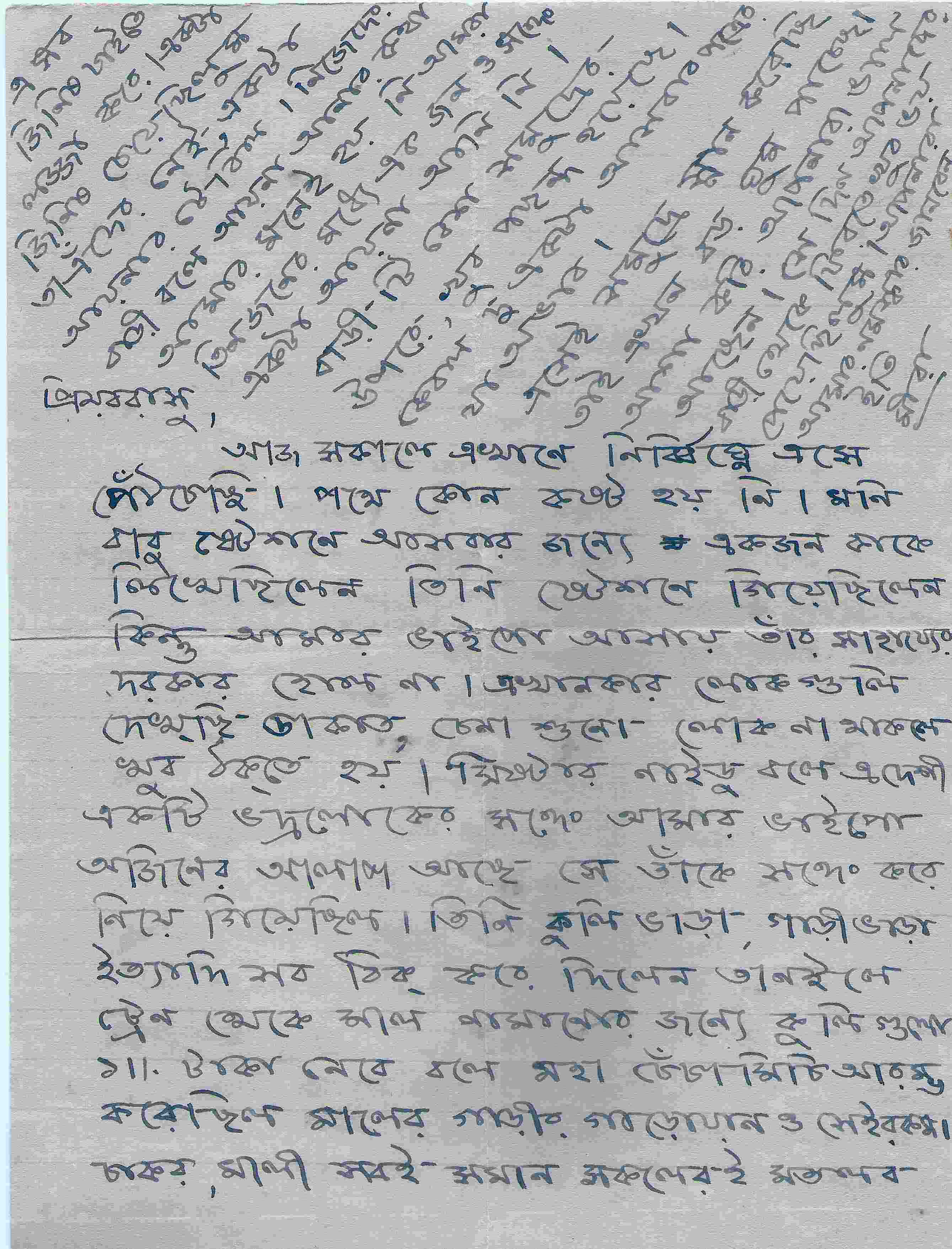

“My Dear, Today we reached here safe and sound. The journey was smooth. Monibabu had asked someone to receive us at the station but we did not need his help as my nephew came to receive us. People here seem to be veritable cut-throats.! If you have no acquaintance here there is every possibility of your being cheated. My nephew, Ajin, took a local man , Mr. Naidu with him. If this person had not bargained with the porters they would have created great chaos demanding …….Rs. just to get our luggage off the train. Mr. Naidu also fixed the fare with the coachman. In fact the servant , the gardener, everyone has this tendency to extort as much as possible. Our gardener has fixed us one helping hand but I don’t find him suitable. He will only bring water, buy daily necessities, and sweep the floors but he will not wash utensils or clothes. He disobeyed me even when I asked him to hang the clothes for drying! Our own servant who has come with us can easily do the cooking along with sweeping and shopping. So, how practical will it be to have another help just for the washing! Today we had lunch at my brother’s. Charubabu’s son-in-law came to look after our requirements as soon as we had come here. A great disadvantage of this house is that there is no shelf or rack to keep a single thing . There are only one table and a small table. Of these one has to be kept in the bathroom for toiletries and the other will have crockery on it. There is no other almirah or cupboard to keep the crockery so that I can use this table for writing purposes. Anyway, I feel embarrassed to ask for anything because we are enjoying the house free of cost. I asked for only one thing but in vain. It was for a dressing table. It never entered my mind to bring a mirror as I had thought it was someone’s home. Naturally none of the three of us had thought it necessary. Nevertheless, I really like this house. It is on the sea beach. It merely lacks a few small necessities. I am feeling very drowsy because I have taken a bath in the sea after arriving here. I hope you are all hale and hearty. That day I got really scared while coming back from your home. My regards to all of you. Yours, Meera” .
From Facebook 8 May 2012
Rabindranath Tagore was a great man, a year younger than my great grandfather. My father when a boy paid his respects to him many a time. My grandfather worked with Tagore’s son-in-law and their wives were friends. A letter from the daughter to my grandmother is at my blog (translated very kindly by KM). Tagore, as a creative genius and literary spirit, would have been appalled by all the worship he has been subjected to in recent decades. A holiday for his 150th birthday? He would have I am sure preferred to see new genius thrive, not his work endlessly repeated, made a hash of, bowdlerized….
What I (also) find odd is no one realises that no Muslim can go about worshipping Tagore or Vivekananda etc statues and photos with garlands and namastes etc. And in this I am wholly Muslim.
Monetary Integrity and the Rupee (2008)
September 28, 2008 — drsubrotoroyMonetary Integrity and the Rupee: Three British Raj relics have dominated our macroeconomic policy-making
First published in Business Standard 28 September 2008
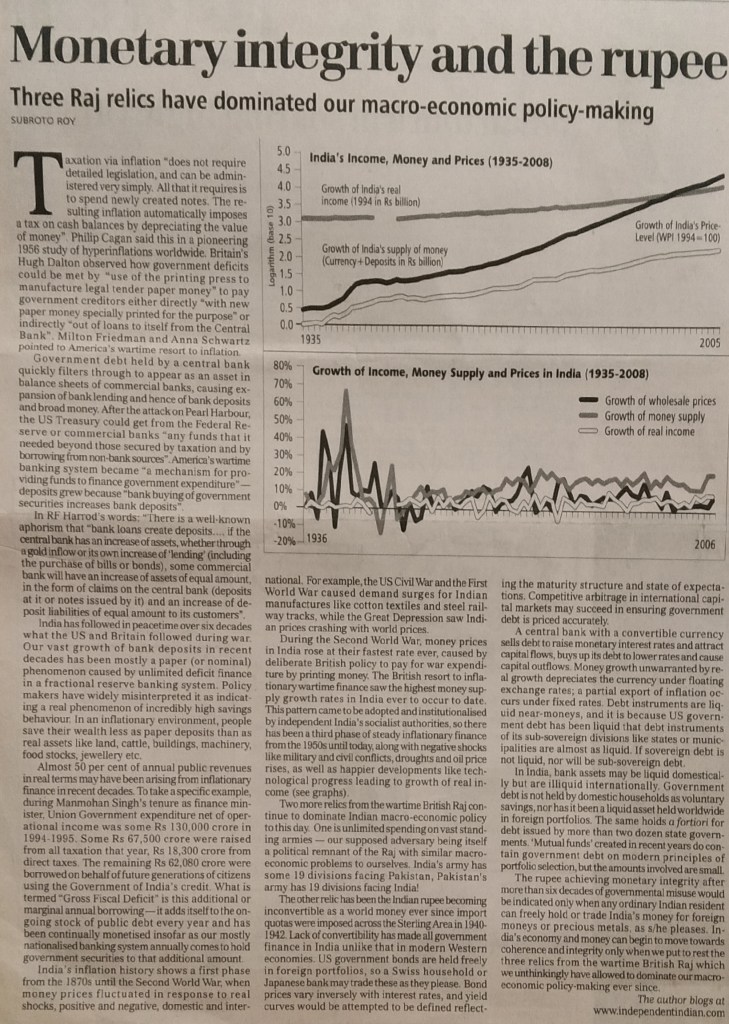
Taxation via inflation “does not require detailed legislation, and can be administered very simply. All that it requires is to spend newly created notes. The resulting inflation automatically imposes a tax on cash balances by depreciating the value of money”. Philip Cagan said this in a pioneering 1956 study of hyperinflations worldwide. Britain’s Hugh Dalton observed how government deficits could be met by “use of the printing press to manufacture legal tender paper money” to pay government creditors either directly “with new paper money specially printed for the purpose” or indirectly “out of loans to itself from the Central Bank”. Milton Friedman and Anna Schwartz pointed to America’s wartime resort to inflation.
Government debt held by a central bank quickly filters through to appear as an asset in balance-sheets of commercial banks, causing expansion of bank-lending and hence of bank-deposits and broad money. After the attack on Pearl Harbour, the US Treasury could get from the Federal Reserve or commercial banks “any funds that it needed beyond those secured by taxation and by borrowing from non-bank sources”. America’s wartime banking system became “a mechanism for providing funds to finance government expenditure” — deposits grew because “bank buying of government securities increases bank deposits”.
In RF Harrod’s words: “There is a well-known aphorism that ‘bank loans create deposits’…. if the central bank has an increase of assets, whether through a gold inflow or its own increase of ‘lending’ (including the purchase of bills or bonds), some commercial bank will have an increase of assets of equal amount, in the form of claims on the central bank (deposits at it or notes issued by it) and an increase of deposit liabilities of equal amount to its customers”.
India has followed in peacetime over six decades what the USA and Britain followed during war. Our vast growth of bank-deposits in recent decades has been mostly a paper (or nominal) phenomenon caused by unlimited deficit-finance in a fractional reserve banking system. Policy-makers have widely misinterpreted it as indicating a real phenomenon of incredibly high savings behaviour. In an inflationary environment, people save their wealth less as paper deposits than as real assets like land, cattle, buildings, machinery, food-stocks, jewellery etc.
Almost 50% of annual public revenues in real terms may have been arising from inflationary finance in recent decades. To take a specific example, during Dr Manmohan Singh’s tenure as Finance Minister, Union Government expenditure net of operational income was some Rs. 1.3 trillion (Rs 1.3 lakh crore) in 1994-1995. Some Rs. 675 billion (1 bn= 100 crore) was raised from all taxation that year, Rs 183 billion from direct taxes. The remaining Rs. 620.8 billion was borrowed on behalf of future generations of citizens using the Government of India’s credit. What is termed “Gross Fiscal Deficit” is this additional or marginal annual borrowing — it adds itself to the ongoing stock of public debt every year and has been continually monetised insofar as our mostly nationalized banking system annually comes to hold government securities to that additional amount.
India’s inflation-history shows a first phase from the 1870s until the Second World War when money prices fluctuated in response to real shocks, positive and negative, domestic and international. E.g., the US Civil War and First World War caused demand surges for Indian manufactures like cotton textiles and steel railway-tracks, while the Great Depression saw Indian prices crashing with world prices.
During the Second World War, money prices in India rose at their fastest rate ever, caused by deliberate British policy to pay for war expenditure by printing money. The British resort to inflationary wartime finance saw the highest money supply growth rates in India ever to occur to date. This pattern came to be adopted and institutionalised by independent India’s socialist authorities, so there has been a third phase of steady inflationary finance from the 1950s until today, along with negative shocks like military and civil conflicts, droughts and oil price-rises, as well as happier developments like technological progress leading to growth of real income (see graph).
Two more relics from the wartime British Raj continue to dominate Indian macroeconomic policy to this day. One is unlimited spending on vast standing armies — our supposed adversary itself being a political remnant of the Raj with similar macroeconomic problems to ourselves. India’s army has some 19 divisions facing Pakistan, Pakistan’s army has 19 divisions facing India!
The other relic has been the Indian rupee becoming inconvertible as a world money ever since import quotas were imposed across the Sterling Area in 1940-1942. Lack of convertibility has made all government finance in India unlike that in modern Western economies. US government bonds are held freely in foreign portfolios so a Swiss household or Japanese bank may trade these as they please. Bond prices vary inversely with interest-rates, and yield curves would be attempted to be defined reflecting the maturity-structure and state of expectations. Competitive arbitrage in international capital markets may succeed in ensuring government debt is priced accurately.
A central bank with a convertible currency sells debt to raise monetary interest rates and attract capital flows, buys up its debt to lower rates and cause capital outflows. Money growth unwarranted by real growth depreciates the currency under floating exchange rates; a partial export of inflation occurs under fixed-rates. Debt instruments are liquid near-moneys, and it is because US Government debt has been liquid that debt instruments of its sub-sovereign divisions like States or municipalities are almost as liquid. If sovereign debt is not liquid, nor will be sub-sovereign debt.
In India, bank assets may be liquid domestically but are illiquid internationally. Government debt is not held by domestic households as voluntary savings nor has it been a liquid asset held worldwide in foreign portfolios. The same holds *a fortiori* for debt issued by more than two dozen State Governments. “Mutual funds” created in recent years do contain government debt on modern principles of portfolio-selection but amounts involved are small. The Rupee achieving monetary integrity after more than six decades of governmental misuse would be indicated only when any ordinary Indian resident can freely hold or trade India’s money for foreign moneys or precious metals as he/she pleases. India’s economy and money can begin to move towards coherence and integrity only when we put to rest the three relics from the wartime British Raj which we unthinkingly have allowed to dominate our macroeconomic policy-making ever since.
The Excel graphs built on my data were made into a nice picture by Business Standard but seem to have been removed from their website, and hence are reproduced here now for the first time today, Oct 2, 2011:

See also, more recently,
India’s Money, 2012,
Critical assessments of India’s economic policy, plus my 3 Dec 2012 Delhi talk on India’s money, Interview on Lok Sabha TV 2012, GDI Impuls Zürich Interview, Sunday Guardian Interview & Asian Age/Deccan Herald coverage
https://independentindian.com/2013/11/23/coverage-of-my-delhi-talk-on-3-dec-2012/
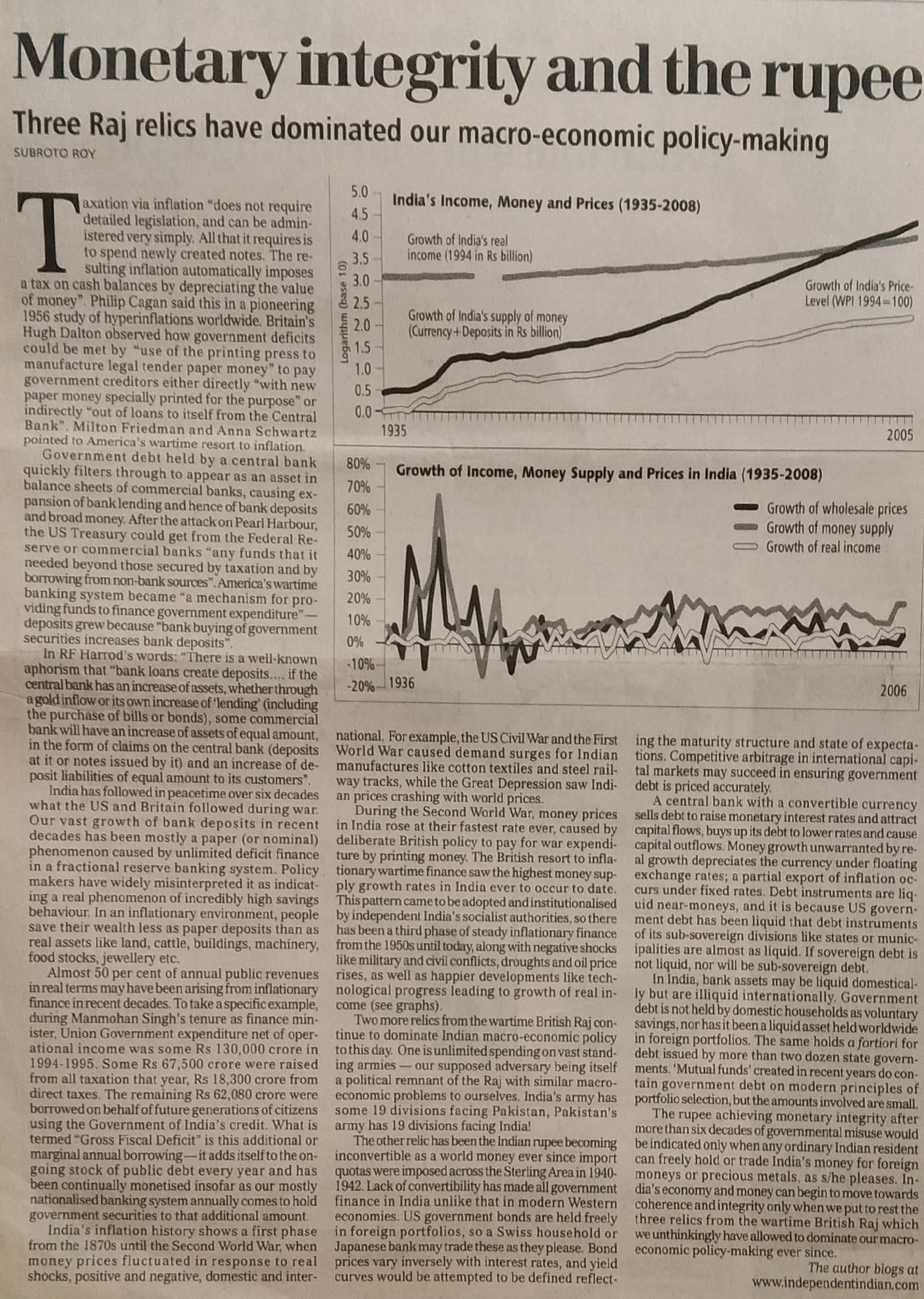
Govt of India: Please call in the BBC and ask them a question
September 27, 2008 — drsubrotoroyThe BBC has unilaterally decided that Jammu & Kashmir has nothing to do with India. On its 1530 Indian Standard Time broadcast of purported “World News” today, it unilaterally lopped off all of J&K from the map of the Republic of India (shown attached to mention of a Delhi bomb-blast). Usually, the BBC at least makes pathetic reference to something it has invented called “Indian-Administered Kashmir”.
There are senior BBC staff-members who are dual Pakistani/British nationals and who may be counted on to have been pushing such a line within the organisation, but lopping off all of J&K unilaterally may be a novelty. There are several “Indian-origin” staff-members too but perhaps they have renounced their Indian nationality, and apparently they have no ability to make any editorial protest.
Does the Government of India have the sense, and the guts, to call in the local BBC and ask them for an explanation about their insult of history? For that matter, what is the BBC’s formal position on the J&K problem? The same as that of the UK Government? What is that of the UK Government for that matter? Has it remained constant since Clement Attlee in October 1947?
BBC staff may like to refer to my articles “Solving Kashmir”, “Law, Justice and J&K”, “Pakistan’s Allies”, “History of Jammu & Kashmir”, etc for enlightenment.
Subroto Roy
122 sensible American economists
September 26, 2008 — drsubrotoroy$700 billion comes to more than, uhhhm, $6,000 per income taxpayer in the USA.
Somehow, I have an inkling that foreign central banks have been left holding more bad US debt than might be remembered — which would explain the embarrassment of Messrs Paulson and Bernanke vis-a-vis their foreign counterparts… Dollar depreciation and an American inflation seem to be inevitable over the next several years.
Subroto Roy
MK Gandhi, SN Roy, MA Jinnah in March 1919: Primary education legislation in a time of protest
September 24, 2008 — drsubrotoroyIn March 1919, Indian politics were extremely tense over the draconian “anti-terrorist” law known as the Rowlatt Act. On March 23, MK Gandhi called for the general strike or hartal on April 6 that came to be known as the Rowlatt Satyagraha (and was soon to be followed by the Jallianwalla Bagh massacre in Amritsar on April 13). On March 28, MA Jinnah resigned his membership of the Viceroy’s Imperial Council in protest that the Rowlatt Act had not been amended as demanded by the Indian members of the Council. In midst of such tumultuous events, my great grandfather Surendranath Roy, on March 27 1919, seems to have quietly managed to get his “Bengal Primary Education Bill” passed in the Bengal Legislative Council.
From India in 1918: A Chronological Record of the Phases of Developments in Indian Polity During 1918, HN Mitra (ed), Annual Register Office, Sibpur, 1921.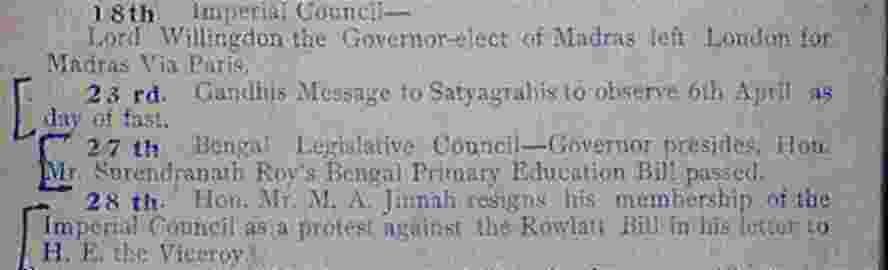
October 1929? Not!
September 18, 2008 — drsubrotoroyOctober 1929? Not!
by Subroto Roy
First published in
Business Standard, Editorial Page,
18 September 2008
Lehman Brothers filing for bankruptcy protection, Merrill Lynch taken over by Bank of America, Fannie Mae and Freddie Mac and now AIG being nationalised by the US Government, Bear Stearns getting a government bailout, many thousands of low-quality loans going bad … Does it all add up to an American financial crisis in the autumn of 2008 comparable to that in the autumn of 1929? Even Alan Greenspan himself has gone on record on TV saying it might.
But there are overriding differences. Most important, the American economy and the world economy are both incomparably larger today in the value of their capital stock, and there has also been enormous technological progress over eight decades. Accordingly, it would take a much vaster event than the present turbulence — say, something like an exchange of multiple nuclear warheads with Russia causing Manhattan and the City of London to be destroyed — before there was a return to something comparable to the 1929 Crash and the Great Depression that followed.
Besides, the roots of the crises are different. What happened back then? In 1922, the Genoa Currency Conference wanted to correct the main defect of the pre-1914 gold standard, which was freezing the price of gold while failing to stabilise the purchasing power of money. From 1922 until about 1927, Benjamin Strong of the Federal Reserve Bank of New York adopted price-stabilisation as the new American policy-objective. Britain was off the gold standard and the USA remained on it. The USA, as a major creditor nation, saw massive gold inflows which, by traditional gold standard principles, would have caused a massive inflation. Governor Strong invented the process of “sterilisation” of those gold inflows instead and thwarted the rise in domestic dollar prices of goods and services.
Strong’s death in 1928 threw the Federal Reserve System into conflict and intellectual confusion. Dollar stabilisation ended as a policy. Surplus bank money was created on the release of gold that had been previously sterilised.
The traditional balance between bulls and bears in the stock-market was upset. Normally, every seller of stock is a bear and every buyer a bull. Now, amateur investors appeared as bulls attracted by the sudden stock price rises, while bears, who sold securities, failed to place their money into deposit and were instead lured into lending it as call money to brokerages who then fuelled these speculative bulls. As of October 22, 1929 about $4 billion was the extent of such speculative lending when Chase National Bank’s customers called in their money.
Chase National had to follow their instructions, as did other New York banks. New York’s Stock Exchange could hardly respond to a demand for $4 billion at a short notice and collapsed. Within a year, production had fallen by 26 per cent, prices by 14 per cent, personal income by 14 per cent, and the Greatest Depression of recorded history was in progress — involuntary unemployment levels in America reaching 25 per cent.
That is not, by any reading, what we have today. Yes, there has been plenty of bad lending, plenty of duping shareholders and workers and plenty of excessive managerial payoffs. It will all take a large toll, and affect markets across the world.
But it will be a toll relative to our plush comfortable modern standards, not those of 1929-1933. In fact, modern decision-makers have the obvious advantage that they can look back at history and know what is not to be done. The US and the world economy are resilient enough to ride over even the extra uncertainty arising from the ongoing presidential campaign, and then some.
Milton Friedman’s defence of my work
September 15, 2008 — drsubrotoroyTwenty years have passed since the acceptance of my book Philosophy of Economics for publication — which coincided with the attack on me arising out of the very success of the India-perestroika and Pakistan-perestroika projects I had been leading (an attack from within the University that had sponsored the projects since 1986). I was graced with the support of two of the 20th Century’s great economists, TW Schultz (1902-1998) and Milton Friedman (1912-2006). Professor Schultz’s defence of my work has been published already. Here is that of Professor Friedman. Both Professor Friedman and Professor Schultz were later expert witnesses on my behalf in a federal trial (a trial that unfortunately came to be marred by demonstrable bribery and perjury, yet to be rectified).
Addendum 23 Dec 2016: the jury trial demanded 14 Feb 1990 has never happened; a bench trial with an admittedly compromised judge happened in 1992, marred by demonstrated bribery and perjury https://independentindian.com/thoughts-words-deeds-my-work-1973-2010/my-american-years-1980-96-battling-for-the-freedom-of-my-books/become-a-us-supreme-court-justice-explorations-in-the-rule-of-law-in-america/

On Jimmy Carter & the “India-US Nuclear Deal”
September 12, 2008 — drsubrotoroyI have always rather liked Jimmy Carter, who was President of the United States when I first went to Blacksburg from Cambridge in the summer of 1980. It astonished me, perhaps because I was naiive, to find the depth of animosity against him among my American colleagues. For example, I remember the late Wilson Schmidt (in one of several kindly gestures towards me until his untimely death) taking me to my first game of College Football — and there singing the Star Spangled Banner with the words “except Carter” added after “home of the brave”. Of course it was the time of the Iranian hostage crisis which had then seemed to be a debilitating humiliation.
Jimmy Carter will need a good biographer to assess him properly, whether now or in years to come, and he may not get one; objective historians are simply too scarce, especially perhaps in America. Certainly it was undignified of the Democratic Party not to give him any role whatsoever during the recent Convention appointing Barack Obama.
In the International Herald Tribune of September 11 2008, President Carter has said about the India-USA nuclear deal:
“different interpretations of the same pact can lead only to harsh confrontations if future decisions are made in New Delhi that contravene what has been understood in our country.”
I flatter myself to think he or his research-staff may have perhaps read my August 19 2007 article “Need for Clarity” available here where I said:
“The agreed text of the “treaty” looks, from a legal standpoint, quite sloppily and hurriedly written ~ almost as if each side has cut and paste its own preferred terms in different places with a nod to the other side…. Through the sloppiness comes scope for different interpretations. The Americans have said: try not to test, you don’t need to, we don’t test any more, and you have to know that if you do test, this deal is over, in fact it gets reversed. We have said, okay, we won’t test, and if we do test we know it is over with you but that does not mean it is over with others. Given such sloppy diplomacy and treaty-making, the scope for mutual misunderstanding, even war, remains immense long after all the public Indian moneys have found their way into private pockets worldwide. Will a future President Jeb Bush or Chelsea Clinton send F-22 bombers to bomb India’s nuclear facilities because India has carried out a test yet declined to return American equipment? Riding a tiger is not something generally to be recommended.”
My books in the Library of Congress and British Library
September 12, 2008 — drsubrotoroySix volumes are listed in the United States Library of Congress in Washington DC under my name <http://www.loc.gov>. For convenience, these are given with their call numbers below.
Four are now in pdf here.
Philosophy of Economics: On the Scope of Reason in Economic Inquiry
© 1989, 1991, 2007 Subroto Roy
https://independentindian.com/thoughts-words-deeds-my-work-1973-2010/pricing-planning-politics-a-study-of-economic-distortions-in-india-1984/
[ 1 ] Roy, Subroto
Foundations of India’s political economy : towards an agenda for the 1990s / editors, Subroto Roy, William E. James. 1992
ACCESS: Jefferson or Adams Bldg General or Area Studies Reading Rms
CALL NUMBER: HC435.2 .F68 1992
[ 2 ] Roy, Subroto
Foundations of Pakistan’s political economy : towards an agenda for the 1990s / editors, William E. James, Subroto Roy. 1992
ACCESS: Jefferson or Adams Bldg General or Area Studies Reading Rms
CALL NUMBER: HC440.5 .F59 1992
[ 3 ] Roy, Subroto
Margaret Thatcher’s revolution : how it happened and what it meant /edited by Subroto Roy and John Clarke. 2005
[ 4 ] Roy, Subroto
Roy, Subroto. Philosophy of economics : on the scope of reason in economic inquiry / Subroto Roy. 1991
[ 5 ] Roy, Subroto
Roy, Subroto. Philosophy of economics : on the scope of reason in economic inquiry / Subroto Roy. 1989
ACCESS: Jefferson or Adams Bldg General or Area Studies Reading Rms
CALL NUMBER: HB72 .R69 1989
[ 6 ] Roy, Subroto
Roy, Subroto. Pricing, planning, and politics : a study of economic distortions in India / Subroto Roy. 1984
ACCESS: Jefferson or Adams Bldg General or Area Studies Reading Rms
CALL NUMBER: HC435.2 .R66 1984
The British Library in London http://catalogue.bl.uk, has the same titles under 9 listings as below:
1 Foundations of India’s political economy : 1992. 96/06669 DSC ORW.1993.a.1142
2 Foundations of Pakistan’s political economy : 1992. YC.1993.a.2144 ORW.1994.a.1019
3 Foundations of Pakistan’s political economy : 1992. 93/06010 DSC
4 Margaret Thatcher’s revolution : 2005. SPIS.320.941
5. Roy, Subroto. Philosophy of economics : 1989. 8458.S.1/92
6 Roy, Subroto. The philosophy of economics : 1989. 89/23299 DSC
7 Roy, Subroto. Philosophy of economics : 1989 YK.1991.a.5102
8 Roy, Subroto. Pricing, planning and politics : 1984. X.0519/26
9 Roy, Subroto. Pricing, planning and politics : 1984. 6217.450000 No.69 DSC
(The difference may have been caused by different editions or reprints being listed, for example the volume on Pakistan was published in Karachi too.)
My grandfather’s death in Ottawa 50 years ago today
September 3, 2008 — drsubrotoroyManindranath Roy, my grandfather, died at Civic Hospital, Ottawa, fifty years ago today, September 3 1958. He was the first Hindu gentleman to die in Ottawa and no cremation was possible there at the time, so we had to go to Montreal. I was three years old and my grandfather was the first person I knew who really “died” (as opposed to die from fake gunfire on TV in a cowboys-and-indians serial). His death meant something very sad and foreboding, the room where he slept at our home at 73 Riverdale Avenue becoming empty, and very scary indeed as if he was still there though he was not. Death meant leaving the living corporally — though obviously not leaving their memories or their consciousness, or we would not have been remembering him today.
The photographs below were at the funeral-home in Ottawa. My father was reading from The Bhagavad Gita. My mother and sisters were distraught as they had known him and loved him well. I only knew him as someone who urged me to fight back when bullied by an older and stronger boy who was our neighbour. “Dadu, mere dao, dadu, mere dao!”, (“Grandson, hit him back! Hit him back!” ) my grandfather would urge when he saw me being pummelled into the lawn — crossly tapping his walking-stick on the ground. And fight back is, I suppose , what I have done when attacked or attempted to be tyrannised ever since.


Thanks to Hillary for Harriet Tubman quote: “keep going”
August 28, 2008 — drsubrotoroyI got to Washington from my Hawaii experience in the summer of 1992, and I remained there through 1993, the first year the Clinton couple came. I am afraid I have never liked the Clinton couple much, for a mixture of objective and subjective reasons. I also think Mrs Clinton’s bid for the Presidency may have been constitutionally barred by the 22nd Amendment as she has been married to a two-term President and may have been considered the same legal person by the authors of the 22nd Amendment. (Suppose Barack Obama becomes a two-term President; can his wife then run on her own and have him campaign for her? Before his term ends or even after?)
But I did hear Mrs Clinton’s speech at the Denver convention the other day, and I was grateful to hear her quote the fine words of Harriet Tubman about slaves running to freedom:
“If you hear the dogs, keep going.
If you see the torches in the woods, keep going.
If they’re shouting after you, keep going.
Don’t ever stop. Keep going.
If you want a taste of freedom, keep going.”
Harriet Tubman (c. 1820-1913)
That is indeed what the individual must do in face of all tyrannies: keep going.
Subroto Roy
Postscript: February 10 2009. I think Mrs Clinton has been very sporting since her loss to Barack Obama , and that she may become as good a foreign minister for the United States as there has been. Hence the cancellation of the sentence above.
“Rangarajan Effect”
August 24, 2008 — drsubrotoroyReddy’s reckoning
August 10, 2008 — drsubrotoroy
Tolstoy on Science and Art
August 4, 2008 — drsubrotoroyTolstoy has been admired by many millions, and I shall plan to upload when I can some rare photos of him with his family and contemporaries from a Russian book in our Library which my father had given my sister in 1962. Here is an interesting excerpt from his On the Significance of Science and Art translated by Isabel F. Hapgood and published in the Project Gutenberg edition.
“The thinker or the artist will never sit calmly on Olympian heights, as we have become accustomed to represent them to ourselves. The thinker or the artist should suffer in company with the people, in order that he may find salvation or consolation. Besides this, he will suffer because he is always and eternally in turmoil and agitation: he might decide and say that which would confer welfare on men, would free them from suffering, would afford them consolation; but he has not said so, and has not presented it as he should have done; he has not decided, and he has not spoken; and tomorrow, possibly, it will be too late, — he will die. And therefore suffering and self-sacrifice will always be the lot of the thinker and the artist. Not of this description will be the thinker and artist who is reared in an establishment where, apparently, they manufacture the learned man or the artist (but in point of fact, they manufacture destroyers of science and of art), who receives a diploma and a certificate, who would be glad not to think and not to express that which is imposed on his soul, but who cannot avoid doing that to which two irresistible forces draw him,—an inward prompting, and the demand of men…. It is possible to study out how many beetles there are in the world, to view the spots on the sun, to write romances and operas, without suffering; but it is impossible, without self-sacrifice, to instruct people in their true happiness, which consists solely in renunciation of self and the service of others, and to give strong expression to this doctrine, without self-sacrifice. Christ did not die on the cross in vain; not in vain does the sacrifice of suffering conquer all things. But our art and science are provided with certificates and diplomas; and the only anxiety of all men is, how to still better guarantee them, i.e., how to render the service of the people impracticable for them.
True art and true science possess two unmistakable marks: the first, an inward mark, which is this, that the servitor of art and science will fulfill his vocation, not for profit but with self-sacrifice; and the second, an external sign,—his productions will be intelligible to all the people whose welfare he has in view. No matter what people have fixed upon as their vocation and their welfare, science will be the doctrine of this vocation and welfare, and art will be the expression of that doctrine. That which is called science and art, among us, is the product of idle minds and feelings, which have for their object to tickle similar idle minds and feelings. Our arts and sciences are incomprehensible, and say nothing to the people, for they have not the welfare of the common people in view. Ever since the life of men has been known to us, we find, always and everywhere, the reigning doctrine falsely designating itself as science, not manifesting itself to the common people, but obscuring for them the meaning of life. Thus it was among the Greeks the sophists, then among the Christians the mystics, gnostics, scholastics, among the Hebrews the Talmudists and Cabalists, and so on everywhere, down to our own times….”
Death of Solzhenitsyn
August 3, 2008 — drsubrotoroyIn Chapter 6 of my Philosophy of Economics, is to be found a quote from Solzhenitsyn: “(Also Solzhenitsyn: “Fastenko, on the other hand, was the most cheerful person in the cell, even though, in view of his age, he was the only one who could not count on surviving and returning to freedom. Flinging an arm around my shoulders, he would say: To stand up for truth is nothing! For truth you have to sit in jail!”)”.
Aleksandr Isayevich Solzhenitsyn, along with Andrei Dmitrievich Sakharov, were heroes of mine after I had left school in India in December 1971 and reached Paris where my father was with the Embassy. My father had purchased Solzhenitsyn’s books and these I devoured eagerly at our then-home at 14 Rue Eugene Manuel, during breaks from my pre-University education at Haileybury College, across the English Channel. We had been in Odessa before Paris, and in Stockholm before Odessa. In 1969, we had travelled by ship and train from Stockholm via Helsinki to Leningrad, Moscow and Odessa. In December 1967, my father had gotten me to fly to Stockholm through Moscow and stay for a day or two with a colleague of his during my winter holidays from India. Moscow in December 1967 was celebrating the 50th Anniversary of the Bolshevik Revolution — I recall what the city felt and seemed like to me as a 12 year old: foreboding, awesome, intimidating.
Now in 1972-73 in Paris, the works of Solzhenitsyn and the example of Sakharov explained to me that brief boyhood experience of the USSR and a great deal more.
As it happens, the present PM of India, as a friend of my father’s, visited us at 14 Rue Eugene Manuel in the summer of 1973 at my father’s request to advise me about studying economics (I was on my way to the London School of Economics as an undergraduate). He stayed about 40 minutes during his busy schedule as part of an Indian economic delegation. I was 18, he was about 41. We ended up having a tense debate about the merits (as he saw them) and demerits (as I saw them) of the Soviet influence on Indian economic “planning”. He had not expected such controversy from a lad but he was kindly disposed and offered when departing to write a letter of introduction to a well-known Indian professor at the LSE for me to carry, which I did.
The works and example of Solzhenitsyn and Sakharov built my youthful understanding of the USSR at age 17-18. This contributed to my libertarianism at Cambridge University and later in America (until my experience of the American federal judiciary at age 37 or so).
When I mentioned my admiration for Solzhenitsyn’s work to Milton Friedman at a memorable luncheon at his San Francisco home in 1989, he said that they had been neighbours in Vermont though they had not interacted because of Solzhenitsyn’s desire to be reclusive.
Solzhenitsyn and Sakharov symbolised shoots of new life in the swamp that had been Soviet totalitarianism.
Growth of Real Income, Money & Prices in India 1869-2008
July 28, 2008 — drsubrotoroyI have warned against a “monetary meltdown” in India for more than a decade and a half now. I said it to Rajiv Gandhi (who listened with care and respect) and after he was gone I have said it to Government economists in India, to IMF/World Bank bureaucrats in Washington, to academic audiences in India and the UK and to India’s general newspaper reading public.
Obviously I hope such a meltdown does not come about. But inflation, or the decline in the value of money, presently is in double-digits even by the Government’s own admission. (As a general rule, I think the decline in the value of money has been higher by several percent than what the Government says at any given time.) Hence I am publishing again some results of my macroeconomic research on India over the years. You are free to use them and communicate with me about them but please acknowledge them properly and do not steal.
The first graph of 1869-2004 data was published in print to accompany my Growth and Government Delusion in The Statesman February 22, 2008; it had also accompanied other similar articles, e.g. The Dream Team: A Critique in January 2006. The second graph of 1935-2008 data was published in print to accompany my article Indian Inflation in The Statesman of April 22 2008.
Subroto Roy

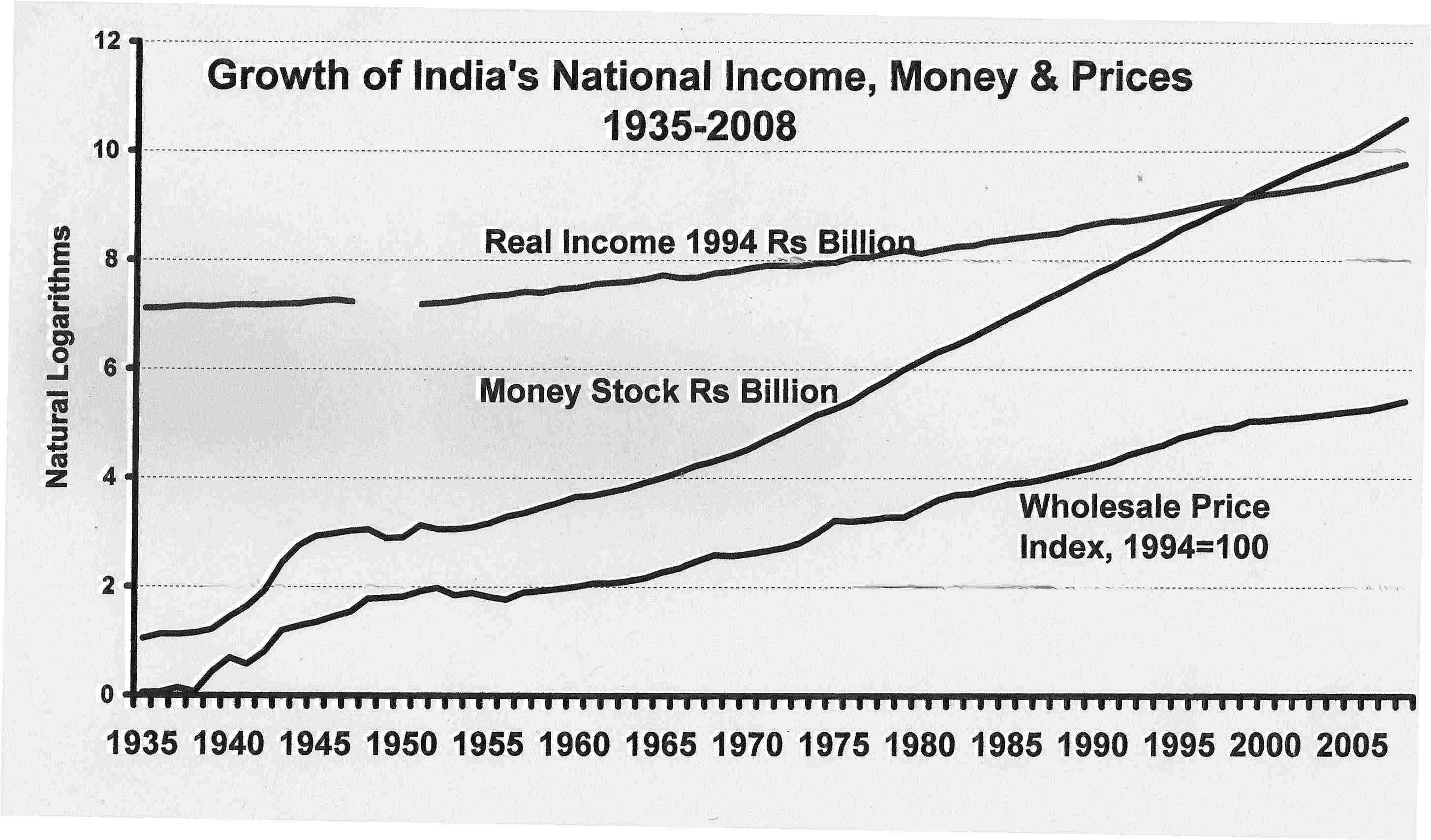
Distribution of Govt of India Expenditure (Net of Operational Income) 1995
July 27, 2008 — drsubrotoroyFor more than a decade and a half now, I have been engaged in some “fundamental research” about India’s public finances. This has involved inter alia transforming the entire set of government accounting data (both Union and all States) from their present obscurity and opaqueness to what I have called a condition of “maximum feasible transparency” (see my April 29 2000 address to the Reserve Bank’s Conference of Finance Secretaries).
Here is an example of the Union Government’s 1994-1995 expenditure (net of operational income).
It is from my unpublished ongoing research and is being released as a public service for India’s people. Readers are welcome to use it with acknowledgement under the normal “fair use” rule. Please try not to steal it, i.e. use it without proper acknowledgement.
from-ongoing-research-of-dr-subroto-roy-on-india
Subroto Roy
see also https://independentindian.com/2013/11/23/coverage-of-my-delhi-talk-on-3-dec-2012/
My father, Indian diplomat, in the Shah’s Tehran 1954-1956
July 8, 2008 — drsubrotoroySee also
https://independentindian.com/life-of-mk-roy-19152012-indian-aristocrat-diplomat-birth-centenary-concludes-7-nov-2016/
https://independentindian.com/life-of-my-father-1915-2012/india-pakistan-diplomacy-during-the-1965-war-the-mk-roy-files/
https://independentindian.com/2011/11/07/my-father-after-presenting-his-credentials-to-president-kekkonen-2/
and https://independentindian.com/category/roys-of-behala/mihir-kumar-roy-mkroy/

On the reverse of this photo is stated the date, 8 July 1955, and “the King enquiring about Indian development projects after the ceremony”. The person he is talking to is my father, then India’s Trade Commissioner in Tehran. The two photos below show Mohammad Reza Shah Pahlevi striding by a line of guests (my father is seventh from the right in the line-up) and then meeting them.
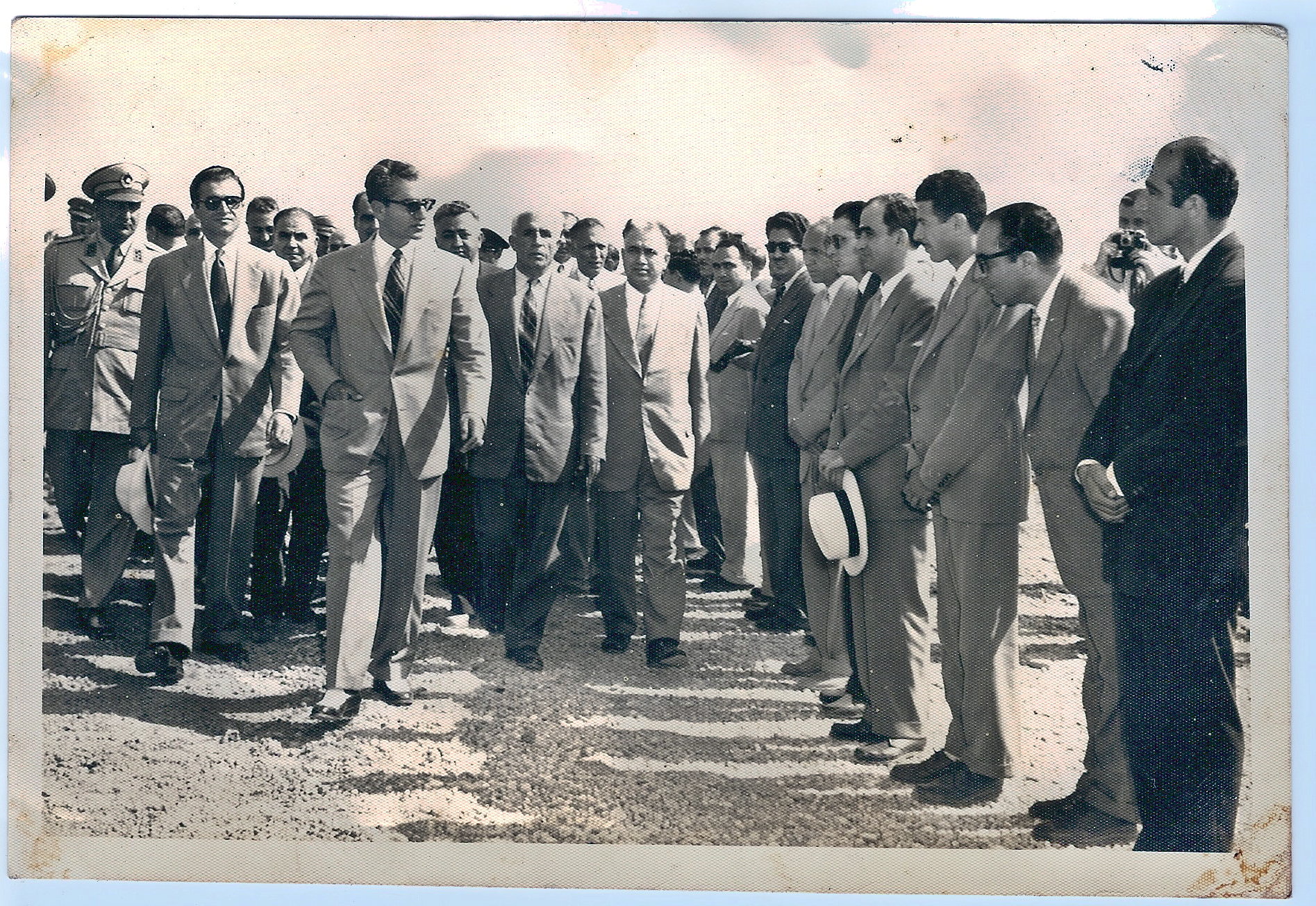

The next photo is of Reza Shah and his Queen Soraiya Esfandiary being greeted by a senior Sikh member of the Indian community.
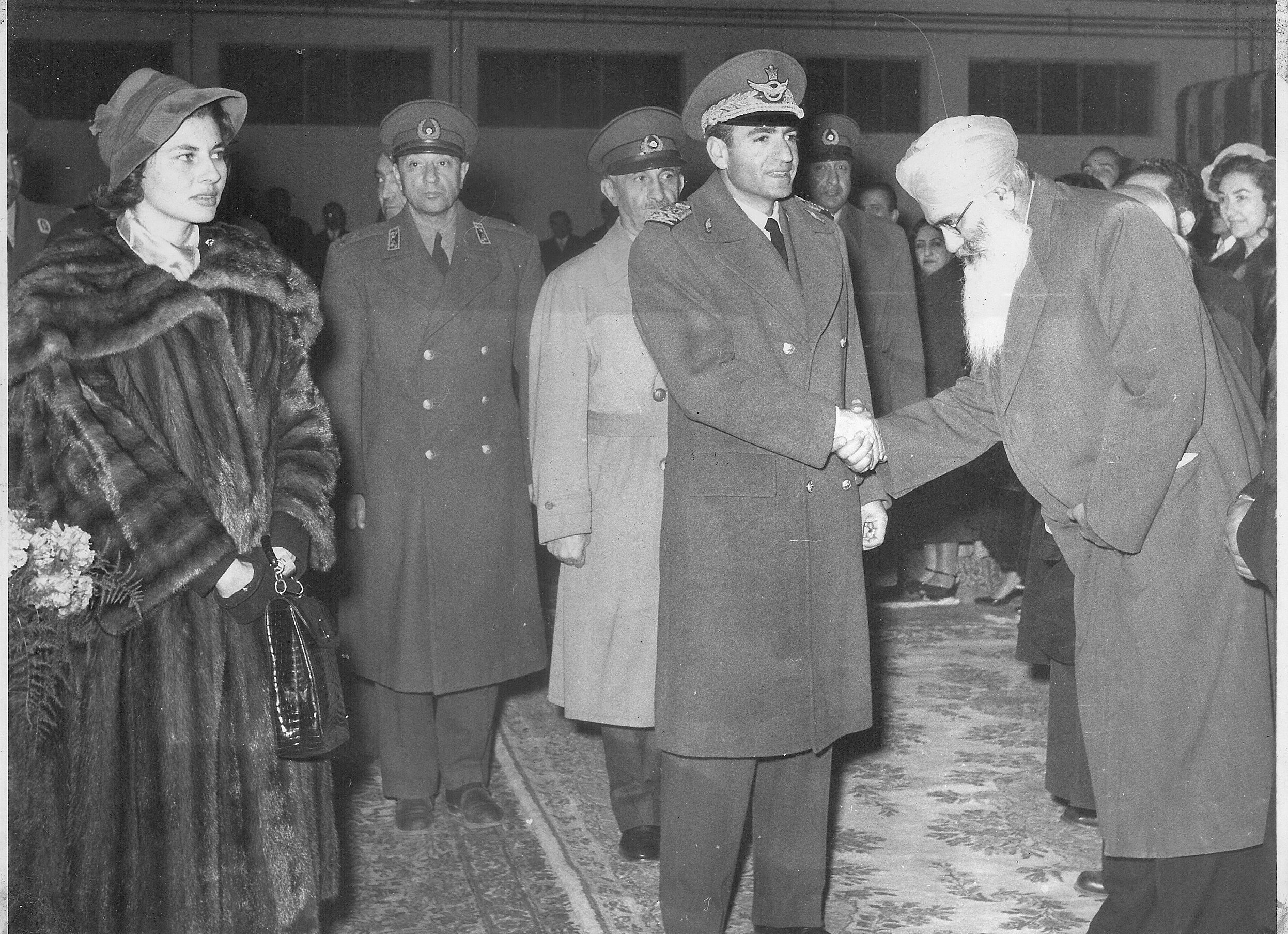
India’s Ambassador to Iran, Dr Tara Chand, author of History of the Freedom Movement in India, accompanies Prime Minister Hossain Ala, probably at the Indian Embassy in Tehran (there is a map of India and the figure of Mahatma Gandhi on the right).

My father with members of the Indian community in Tehran or visiting Tehran for business, including the Birlas and Hindujas etc:


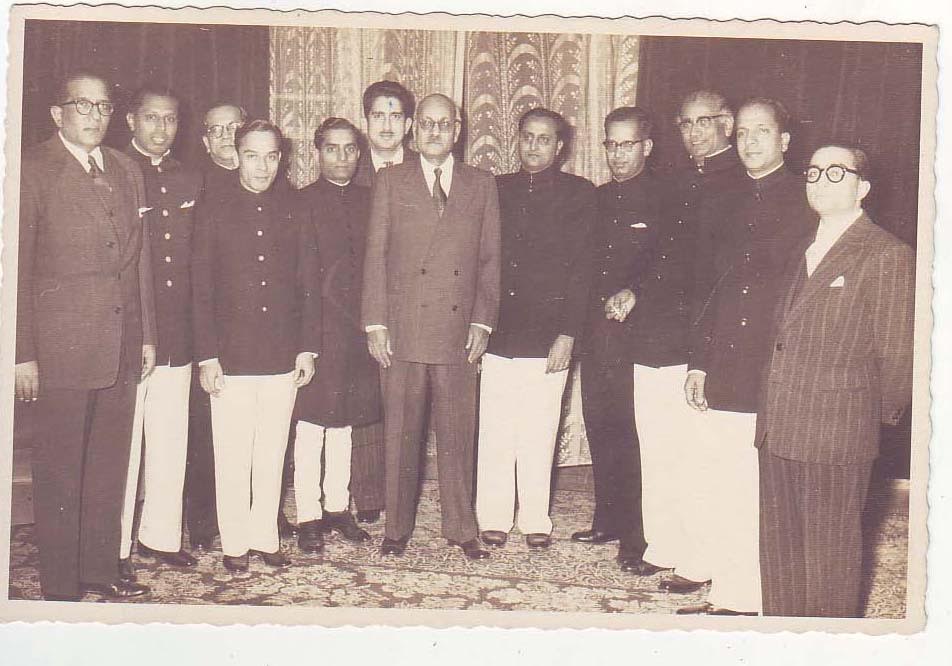
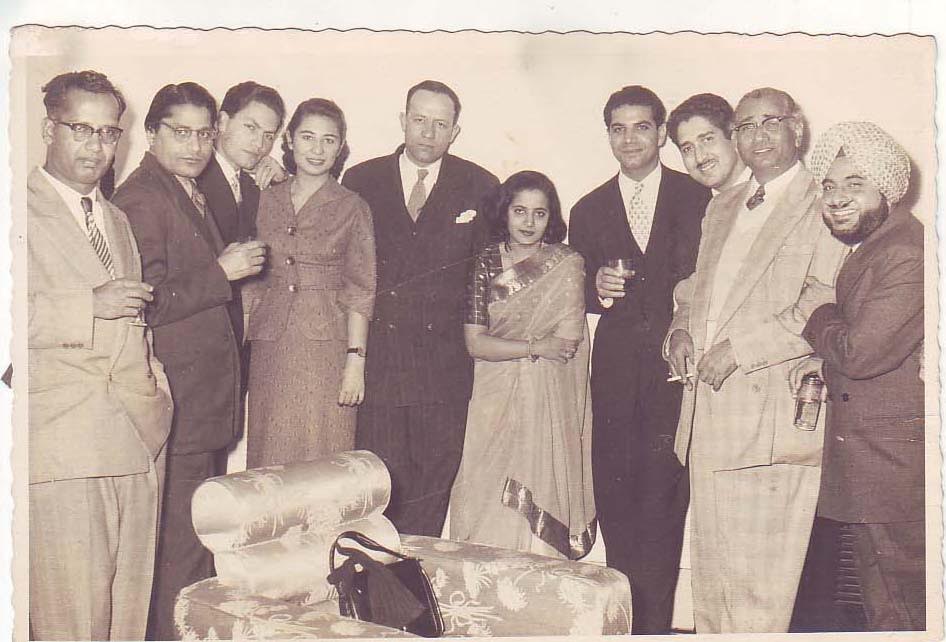
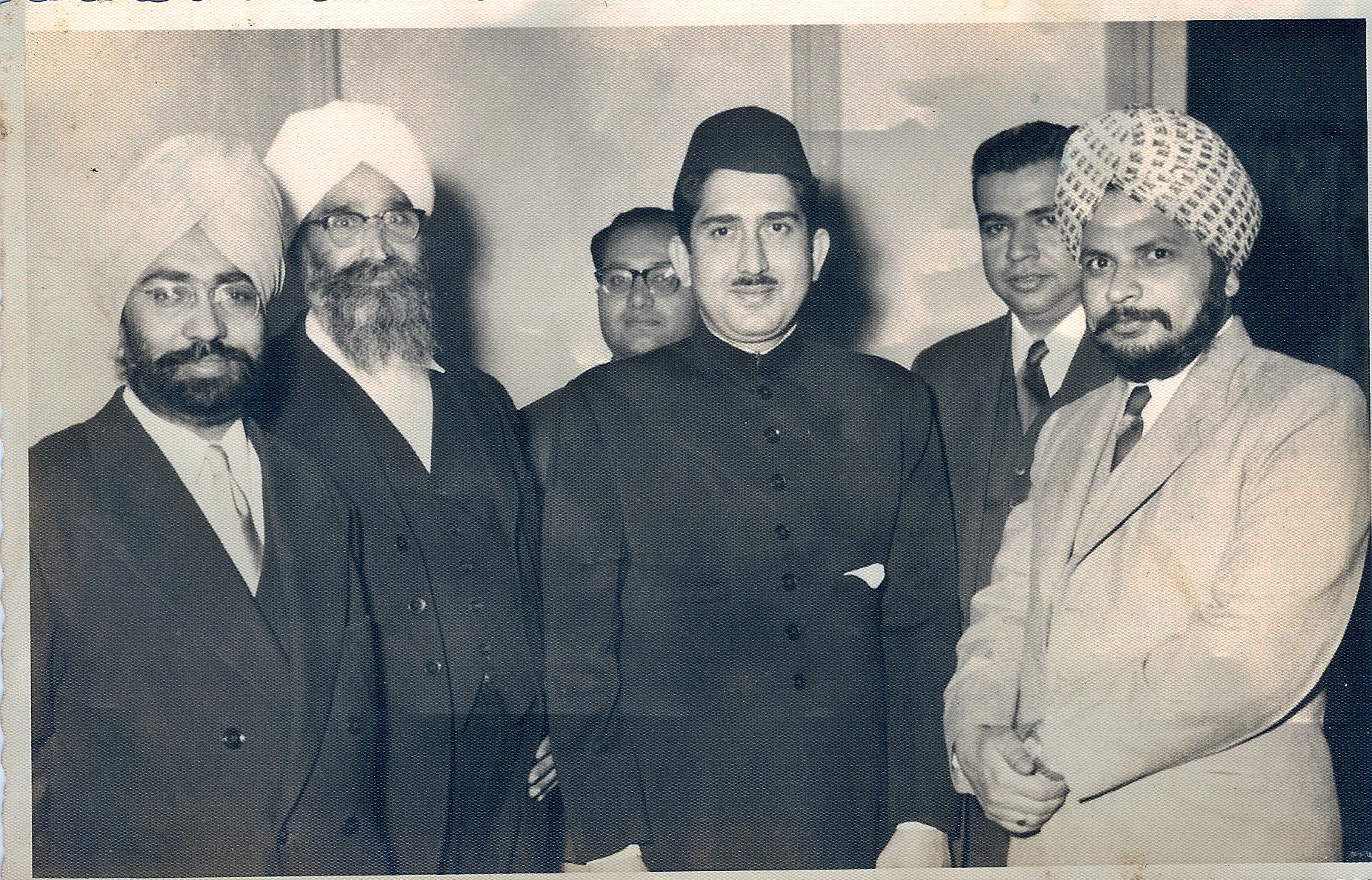
One of many reasons John R Hicks was a great economist
July 3, 2008 — drsubrotoroyProfessor Sir John Hicks (1904-1989) was among the greatest of 20th Century economists. I was much honoured by his letter to me of May 1 1984 sent to Blacksburg, where he acknowledged his departure in later life from the position he had taken in 1934 and 1939 on the foundations of demand theory. (The context of our correspondence had to do with my criticism of the young Hicks and support for the ghost of Alfred Marshall.)
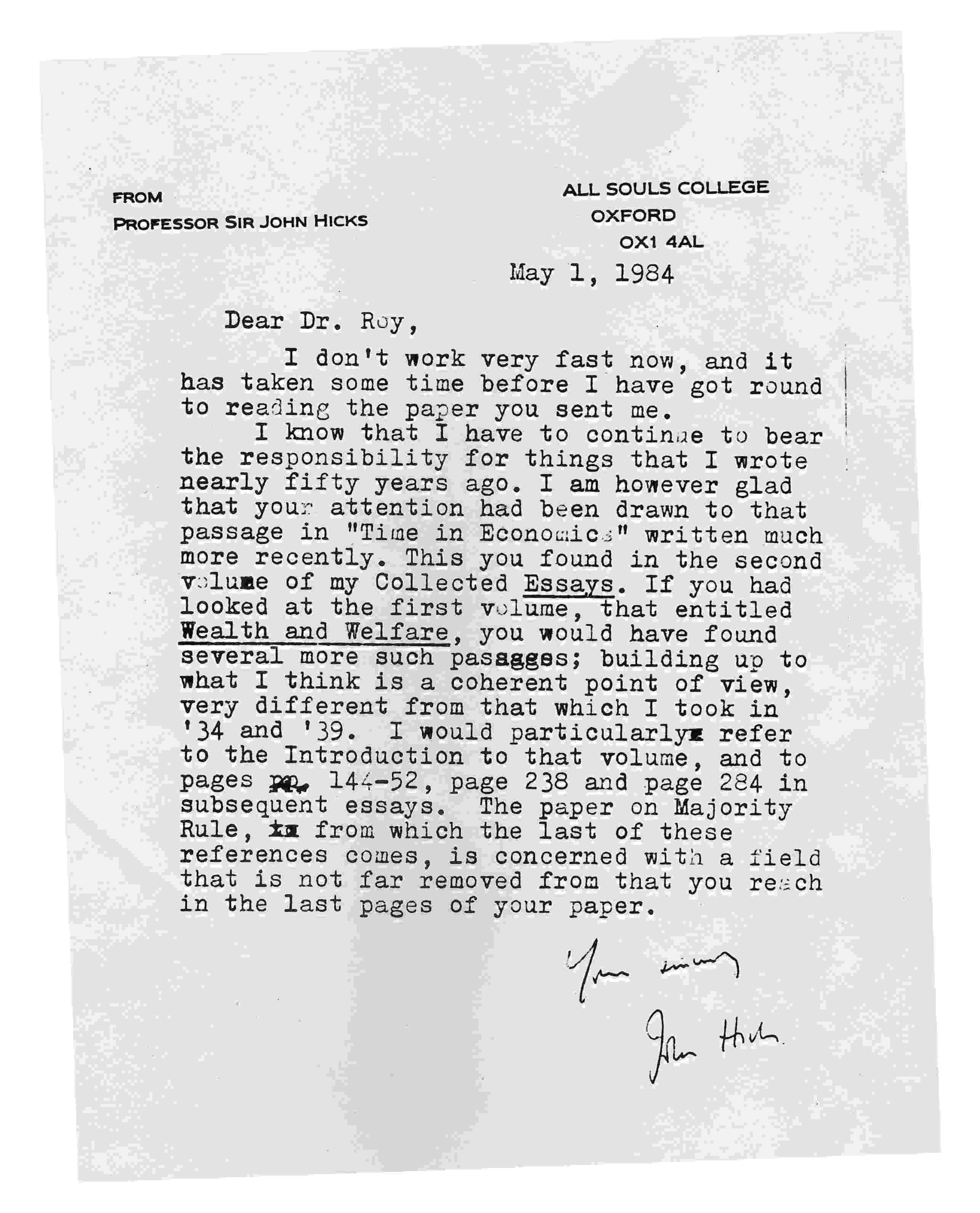
He later sent me a copy of his Wealth and Welfare: Collected Essays on Economic Theory, Vol. I (Cambridge, Mass.: MIT Press, 1981) as a gift.
In Philosophy of Economics, I said about this “It may be a sign of the times that economists, great and small, rarely if ever disclaim their past opinions; it is therefore an especially splendid example to have a great economist like Hicks doing so in this matter.” It was remniniscent of Gottlob Frege’s response to Russell’s paradox; Philosophy of Economics described Frege’s “Letter to Russell”, 1902 (Heijenoort, From Frege to Gödel, pp. 126-128) as “a document which must remain one of the most noble in all of modern scholarship; a fact recorded in Russell’s letter to Heijenoort.”
Nuksaan-Faida Analysis = Cost-Benefit Analysis in Hindi/Urdu
June 30, 2008 — drsubrotoroyI have published about a half dozen or more articles, mainly in The Statesman‘s Editorial Page, on the India-US Nuclear Deal, e.g. “Imperialism Redux”14 March 2006, “Towards an Energy Policy” 2 April 2006, “India’s Energy Interests” 27-28 August 2006, “Need for Clarity”, 19 August 2007. One of my main complaints has been that the Prime Minister and his acolytes seem to have failed to do a proper cost-benefit analysis of the whole thing. The same currency-risk that made the Dabhol-Enron project instantly unviable is also faced a fortiori in the idea of importing nuclear fuel and reactors. The Finance Minister and Finance Secretary who failed to calculate that currency risk in the former project, and hence caused its failure, have now failed again as PM and Planning Commission chief while advocating the latter project. Is the Indian rupee destined to depreciate in the long run? Of course it is: just look at the long run trends and compare our money supply growth rates and inflation rates with those of the USA or EU. The cost of imported nuclear power in India must be recalculated under different scenarios for the exchange-rate of the Indian rupee including e.g. a 20% depreciation.
It is not as if the Government of India is ignorant of what Cost-Benefit Analysis is supposed to be! For example, look up
“*Ministry of Personnel, Public Grievances and Pensions* * *THE INDIAN ADMINISTRATIVE SERVICES (PROBATIONERS’ FINAL EXAMINATION) REGULATIONS, 1955* * *In pursuance of rule 7 of the Indian Administrative Service (Probation) Rules, 1954, the Central Government, in consultation with the State Governments and the Union Public Service Commission, hereby makes the following regulations, namely* *1. Short title:- These regulations may be called the Indian Administrative Service (Probationers’ Final Examination) Regulations, 1955.* *2. Definition:- 2(1) In these regulations, unless the context otherwise requires,-* *(a) `Academay’ (sic) means Lal Bahadur Shastri National Academy of Administration;* *(b) [ ];* *(c) `Director’ means the Director of the Academy; and * *(d) `Schedule’ means a Schedule appended to these regulations.* *2(2) All other words and expressions used in these regulations and not defined shall have the meanings respectively assigned to them in the Indian Administrative Service (Probation) Rules, 1954.* *3. Final examination.- 3(1) Every probationer shall, at or about the end of the period of training in the Academy appear at a final examination.* *3(2) The examination shall be conducted by the 4Director in the manner laid down in these regulations….4. PUBLIC ADMINSTRATION AND MANAGEMENT* *Essentials of Administration-Organisational Structure of Governments, Role of Civil Servants, Administrative Ethics and Accountability, Delegation and Decentralisation-District and Local Administration-Personal Administration, Police Administration-Jail Administration Panchayati Raj Administration- CalamityAdministration-Administration of Development and Welfare Programmes- Budget and Role of Audit and general financial principles-Role of District Officer/SDO-Conduct of Elections.* *Management and Organisation* *Behavioural Science Motivation, Leadership, Decision-Making, MBO, Management of Conflicts, Management of Change ,Transactional Analysis, -MIS-O&M & Work study-Pert-CPM, Time Management Methodology of Presentation of a subject-Financial Management Capital Budgeting, Discountal Cash Flow, Ratio Analysis, Project Formulation, Cost benefit Analysis, Project Evaluation Interpretation of Balance Sheets….” (emphasis added)
How come there has been none with the India-US nuclear deal then? I think we need a new more comprehensible term for Cost-Benefit Analysis, and that should be, most simply, its Hindi/Urdu equivalent: “Nuksaan-Faida Analysis”.
What is the estimated Nuksaan?
What is the estimated Faida?
How do they compare? It all becomes so much easier!
Subroto Roy
Sarat Chandra visits Surendranath Roy 1927
June 19, 2008 — drsubrotoroy
Sarat Chandra Chattopadhyaya (1876-1938) was one of India’s greatest literary geniuses and a marvellous novelist. This is a 1927 photograph of his visit to my great grandfather Surendranath Roy. There will be more about him here in due course.
Oddly enough, the sofa on which they sit has survived and is one of a set of four (much re-upholseterd) that we use daily today more than 80 years later!
https://independentindian.com/2008/10/12/sarat-writes-to-manindranath-1931/
The Roys of Behala 1928
June 17, 2008 — drsubrotoroy
This is a 1928 photo of the male members of the Roy Family of Behala, south of Calcutta, along with the children. Adult women would have been behind an effective “purdah”. The bearded patriarch in the middle is my great grandfather, the Hon’ble Surendranath Roy (1860-1929), an eminent statesman of Bengal of his time https://independentindian.com/2008/06/17/surendranath-roy-1860-1929/ (We did not know until recently he was present and badly injured, along with Ardeshir Dalal, by Bhagat Singh’s bomb thrown in the Central Legislative Assembly on 8 April 1929 during the Simon Commission deliberations. He died seven months later.)
Surendranath was the eldest son of Rai Bahadur Umbik Churn Rai (1827-1902). The Golden Book of India published at the time of the Victoria Jubilee said Umbik was the twelfth descendant of one Raja Gajendra Narayan Rai, Rai-Raian, a finance official under the Great Mughal Jahangir.
Surendranath’s second son, my grandfather, Manindranath Roy, is seated second from the right in the second row with spectacles and moustache.
The bright lad fourth from the left in the last row, with his hand on his knee, would grow up to be my father.
Surendranath Roy (1861-1929)
June 17, 2008 — drsubrotoroySurendranath Roy, b 14 April 1861, d 9 November 1929, was my paternal great grandfather. He was an eminent statesman of his time, sometime President of the Bengal Legislative Council, and close political friend of CR Das who led the Indian National Congress before MK Gandhi. SN Roy helped pioneer Indian constitutionalism under several British governments: Carmichael, Ronaldshay, Lytton, the Simon Commission too.
Lytton’s letter dated 1 May 1922 denied SN Roy appointment as President of the Bengal Legislative Council; instead, Lytton imported HEA (Evan) Cotton (1868-1939) from England in a classic case of British imperial racism in Indian governance.
SN Roy was a pioneer of primary education, and a legislative expert on local and general public finance as well as the federal politics of his time, authoring books on the “Princely” States of Gwalior and Kashmir, and proposing the origins of what became the Rajya Sabha. He also protested the Salt Tax as early as 1918. SN Roy Road in Kolkata is named after him. The first photograph is of him as a newly graduated advocate-at-law, the second may have been after his book on Gwalior was published in 1888. He also gave the Tagore Law Lectures in 1905, on the subject of customary law; these are available at India’s National Library. His friends included the academician Ashutosh Mukherjee and the scientist Jagdish Chandra Bose. His role in the development of the legislative process in Bengal after the Morley-Minto reforms will be described further here in due course, as will be his role as a pioneer of primary education.

. 
Postscript: We did not know until recently he was present and badly injured, along with Ardeshir Dalal, by Bhagat Singh’s bomb thrown in the Central Legislative Assembly on 8 April 1929 during the Simon Commission deliberations. He died seven months later.
see also
S N Roy hears from Lytton: A 1922 case of British imperial racism in Indian governance (with lessons for today) [Draft text 10 Feb 2018]
Origins of India’s Constitutional Politics: Bengal 1913
Carmichael visits Surendranath, 1916
MK Gandhi, SN Roy, MA Jinnah in March 1919: Primary education legislation in a time of protest
Bengal Legislative Council 1921
Jaladhar Sen writes to Manindranath at Surendranath’s death, c. Nov-Dec 1929
Sarat Chandra visits Surendranath Roy 1927
The Roys of Behala 1928
Manindranath Roy 1891-1958
Two scientific Boses who should have but never won Nobels
Pre-Partition Indian Secularism Case-Study: Fuzlul Huq and Manindranath Roy
Life of my father, 1915-2012
“I’m on my way out”: Siddhartha Shankar Ray (1920-2010)
Manindranath Roy 1891-1958
June 16, 2008 — drsubrotoroy
Manindranath Roy (1891-1958) was a quiet enigmatic literary figure and artistic benefactor in Calcutta; he wrote very well and had excellent taste and manners (though was of foolish judgement in money and friends). This photograph is from about 1922 at Allahabad where he used to take his family on annual holiday. (The little boy to the left behind his mother would grow up to become my father.)
My grandfather is dressed in fine post-Edwardian fashion; at the time, his father, Surendranath Rai, was at the peak of his political career as first Deputy President and then President of the new Bengal Legislative Council. Surendranath was an orthodox Brahmin and chose never to wear Western-style suits and neck-ties, and he was thoroughly averse to the idea of dining with Europeans. Manindranath was the first to wear Western clothes, as well as to dine in Calcutta’s Western restaurants. There was tension between father and son due to such matters.
Manindranath’s notebook of poetry Mandakini (found in 2008) contains some 51 poems and poetic songs composed between 1914 and 1936, from when he was aged about 23 to when he was 45. Between about 1933 and 1943 Manindranath had found himself facing trials and tribulations of such gravity and magnitude (caused in part by his own foolish squandering of his inheritance from his father) that he may have wished to forget, ignore or even regret his creative period. Many of the poems are recorded as having been published in literary journals of the time, like Bharatbarsha and Bichitra, and some are recorded as having been sung or performed on the new radio service of the time, especially around 1931. Here is poem number 48 titled “Saratchandra” in honour of his friend, the novelist Sarat Chandra Chattopadhyaya. Manindranath as a poet would have been certainly inspired in his modernity by his association with Sarat — while Sarat benefitted economically by the association and also may have found characters and plots for his novels (he apparently dedicated one at least to Manindranath’s wife, my grandmother). When all of Mandakini is published in due course, it is not impossible Manindranath will come to be recognised as among the finest modern poets of his era in Bengal.


“Buju was my parents’ firstborn, Manindranath’s first grandchild and the apple of his eyes. MK Roy tho’ the second son of Manindranath had wed before his older brother: Buju brought new life to everyone around her. SN Roy’s death in 1929, six months after being injured by Bhagat Singh’s bomb, left a vast personal estate inherited from his father but with unclear succession. His brothers took control. His younger son Manindranath, a poet keen only to broadcast his poetry on the newly created radio and win the love of his beautiful angry wife, came to be quickly and foolishly entangled in the grip of unscrupulous relatives and vicious business acquaintances; incredibly, the vast inherited fortune was purloined or dissipated through egregious frauds within a handful of years, leaving Manindranath broke and broken. A decade went to discharge him from insolvency, a police team travelling from Calcutta to Singapore to bring him back under arrest. My parents’ wedding in the blackout of Calcutta under Japanese aerial bombardment in May 1942 coincided with the end of Manindranath’s pathetic ordeal. Manindranath a broken man when Buju, his first grandchild, brought him joy:

My grandfather came to visit us in Ottawa in May 1958, and here we are on a day’s outing to show him the sights. I recall it well though I was three years old. My mother had stayed home to arrange our meal.
Manindranath in Ottawa would come back from his walks and see me his grandson being pummeled into the lawn by my bigger neighbour Richard Landis…. Becoming very cross he would tap his walking stick loudly on the ground and say loudly, “Dadu… tumi o mere dao, tumi o okey mere dao…” “Grandson! You fight back too, you hit him back too”…
Manindranath Roy died in Ottawa on September 3 1958, the first Hindu gentleman known to have done so, it was said; he had to be cremated in Montreal as no one was cremated in Ottawa back then.


There will be more of his eventful and interesting life here in due course. For example, he was a benefactor of Sarat Chandra Chattopadhyaya and many others including Uday Shankar, and he was a close friend and colleague at Grace and Co of Rabindranath Tagore’s son-in-law, Nagen Gangulee. Rabindranath apparently visited the Swaraj Party’s political meetings where Surendranath was an old friend of CR Das. Another close and respected friend of Surendranath’s was Jagdish Chandra Bose.
See too
https://independentindian.com/2008/10/06/a-literary-find-modern-poetry-in-bengali-1914-1936/
https://independentindian.com/life-of-mk-roy-19152012-indian-aristocrat-diplomat-birth-centenary-concludes-7-nov-2016/
University of Hawaii Project on India’s Political Economy 1986-1992
June 13, 2008 — drsubrotoroy
University of Hawaii Project on India’s Political Economy 1986-1992
This is dated May 21 1989 and located at the University of Hawaii President’s House. Prof. Milton Friedman and the Indian Ambassador to the USA are wearing Hawaiian leis. The academic result of this project was the work Foundations of India’s Political Economy: Towards an Agenda for the 1990s edited by myself & WE James and published by Sage. The practical and political result was the origin of the 1991 Indian economic reform when the project manuscript in unpublished form reached Rajiv Gandhi through my hand on September 18 1990 at 10 Janpath New Delhi; the story of my encounter with Mr Gandhi has been told elsewhere here.
see https://independentindian.com/1990/09/18/rajiv-gandhi-and-the-origins-of-indias-1991-economic-reform/
https://independentindian.com/2013/08/23/did-jagdish-bhagwati-originate-pioneer-intellectually-father-indias-1991-economic-reform-did-manmohan-singh-or-did-i-through-my-encounter-with-rajiv-gandhi-just-as-siddhartha-shan/
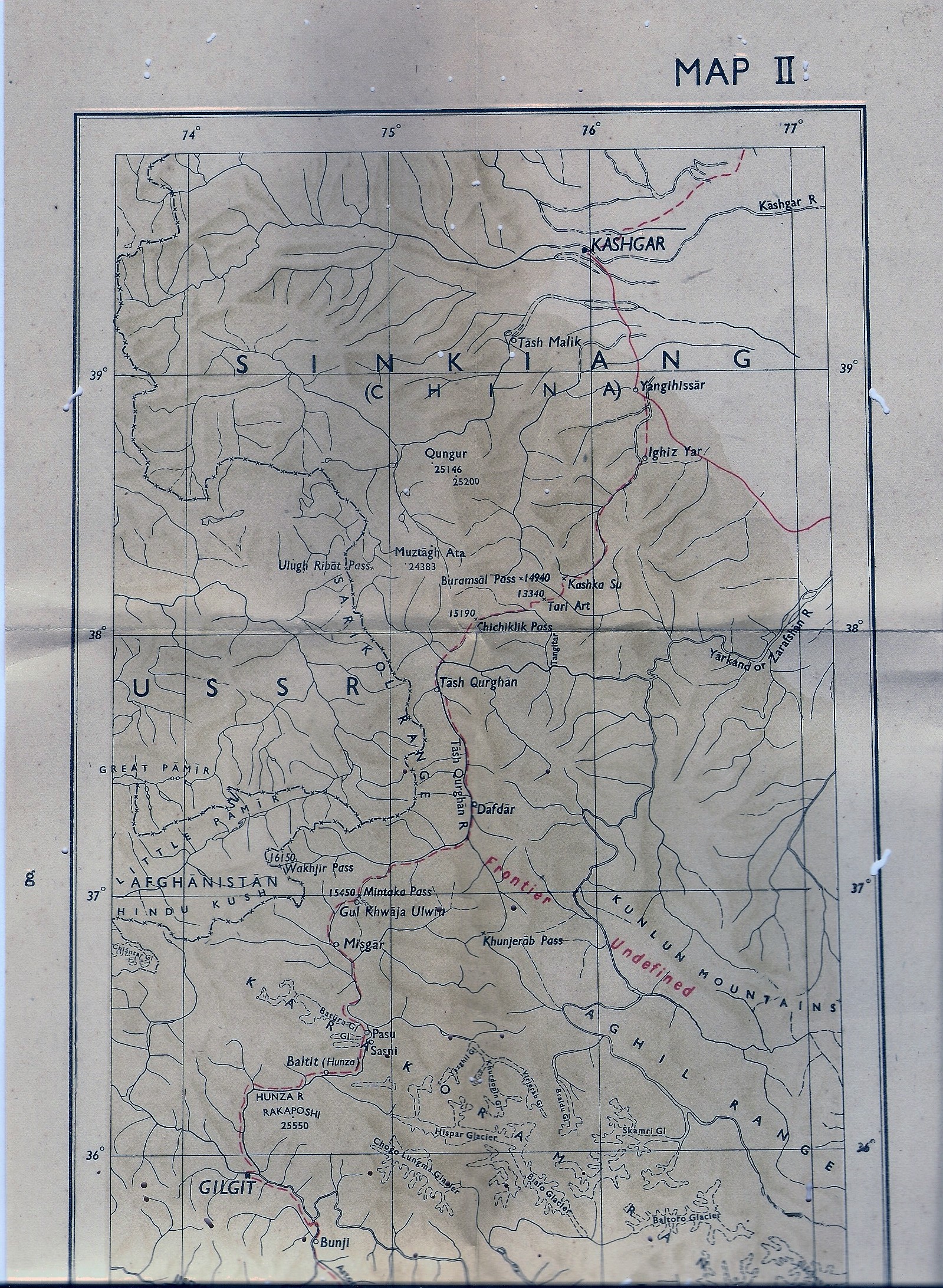
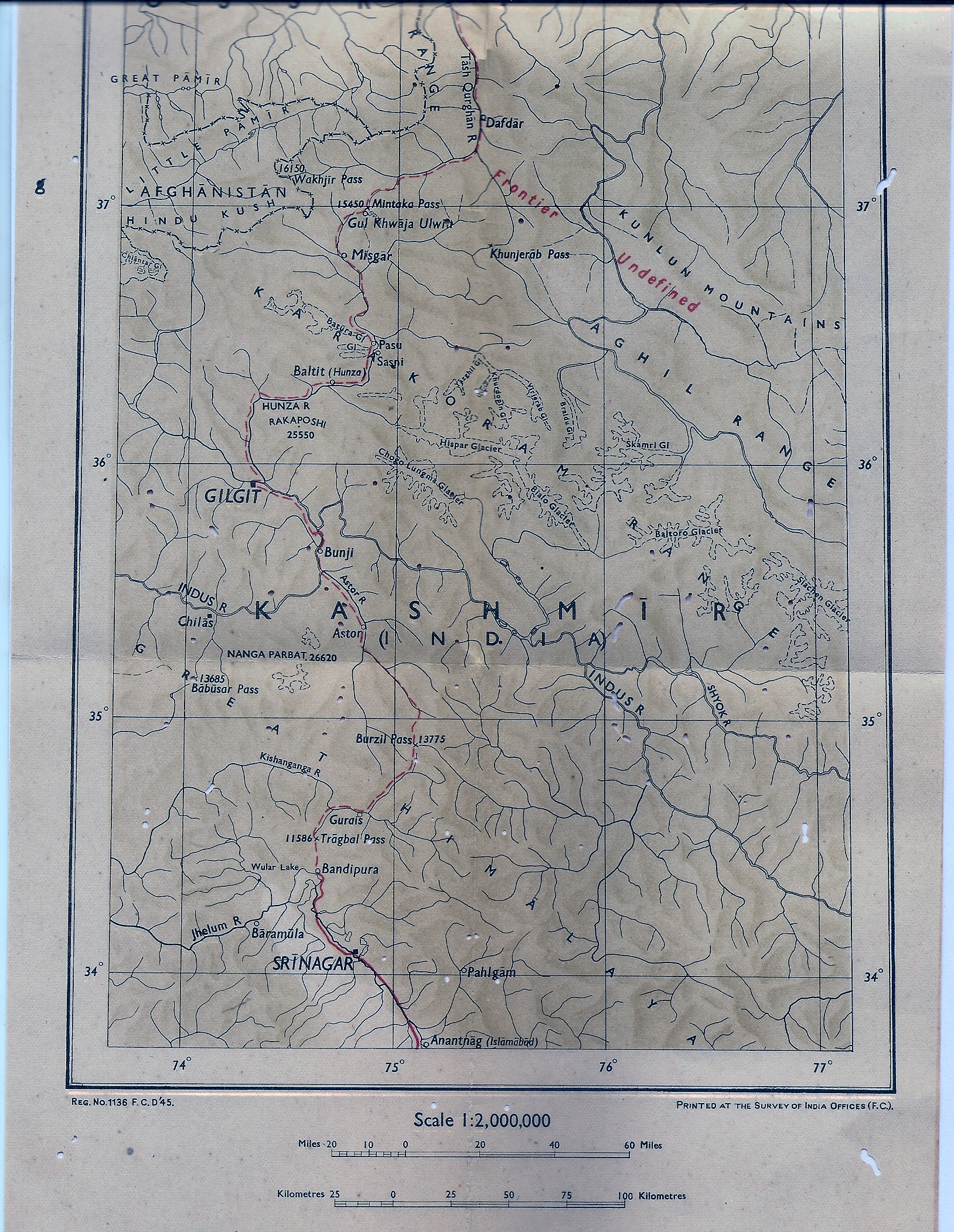
Map of Sinkiang, Tibet and Neighbours 1944
June 7, 2008 — drsubrotoroy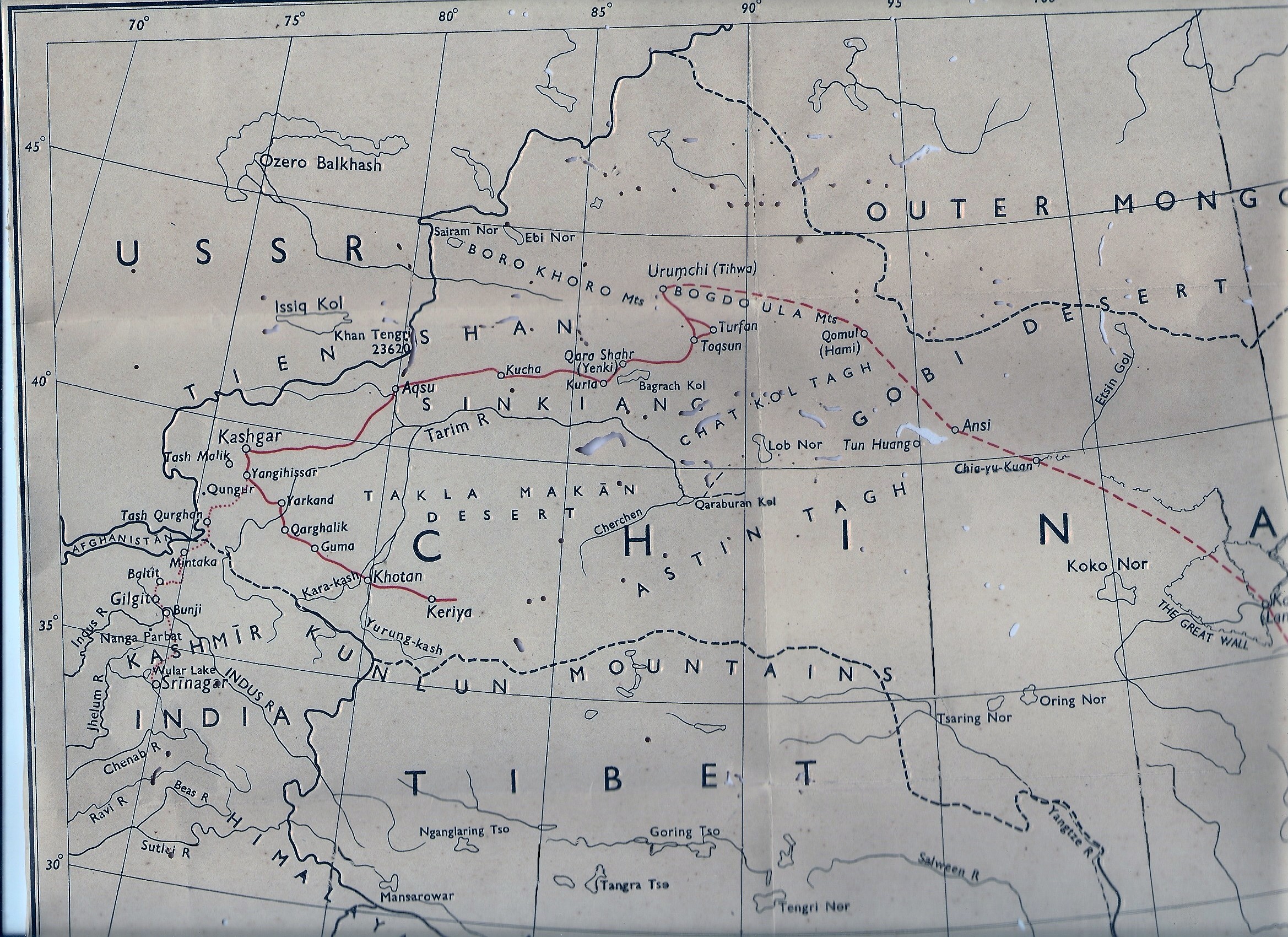
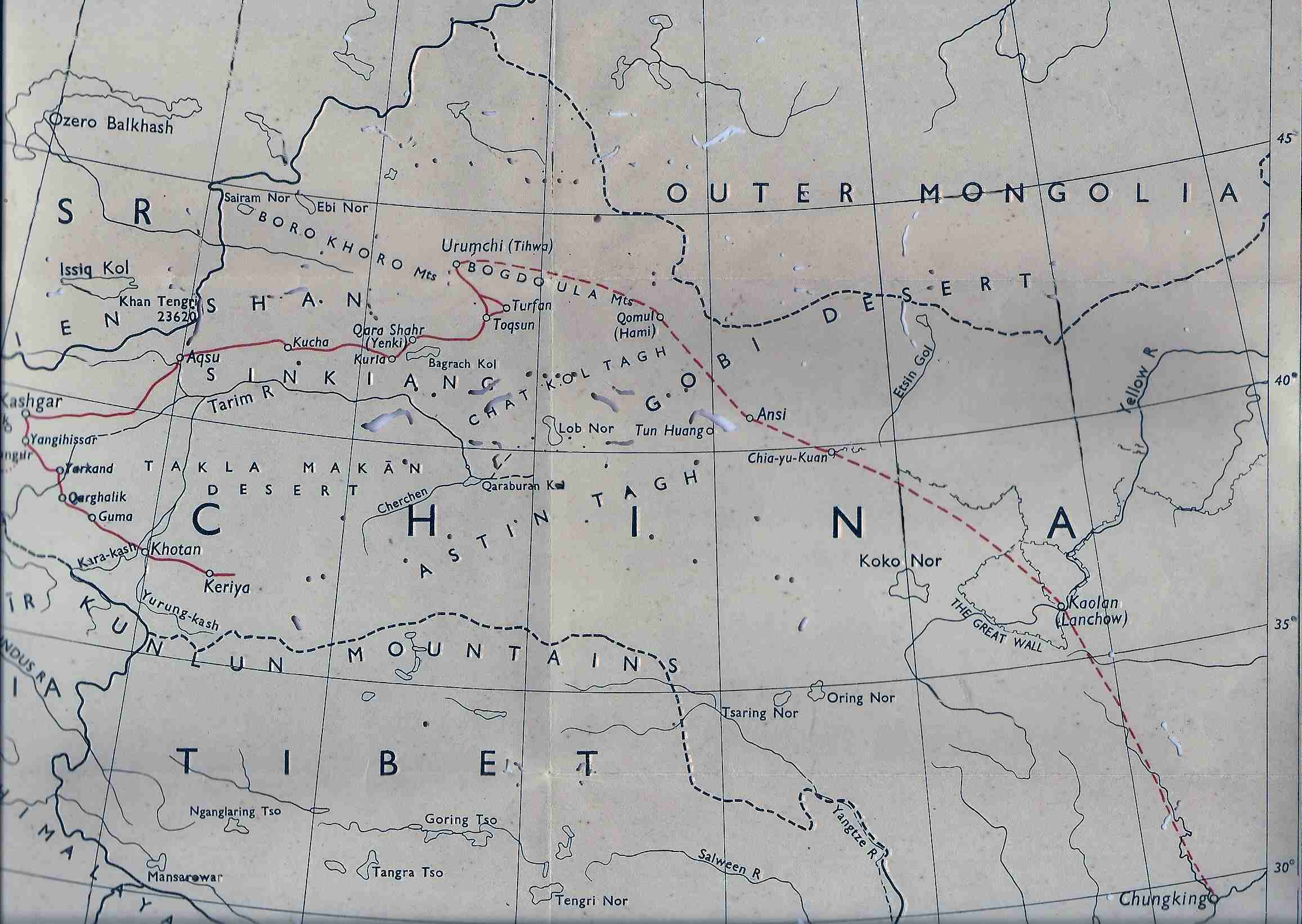
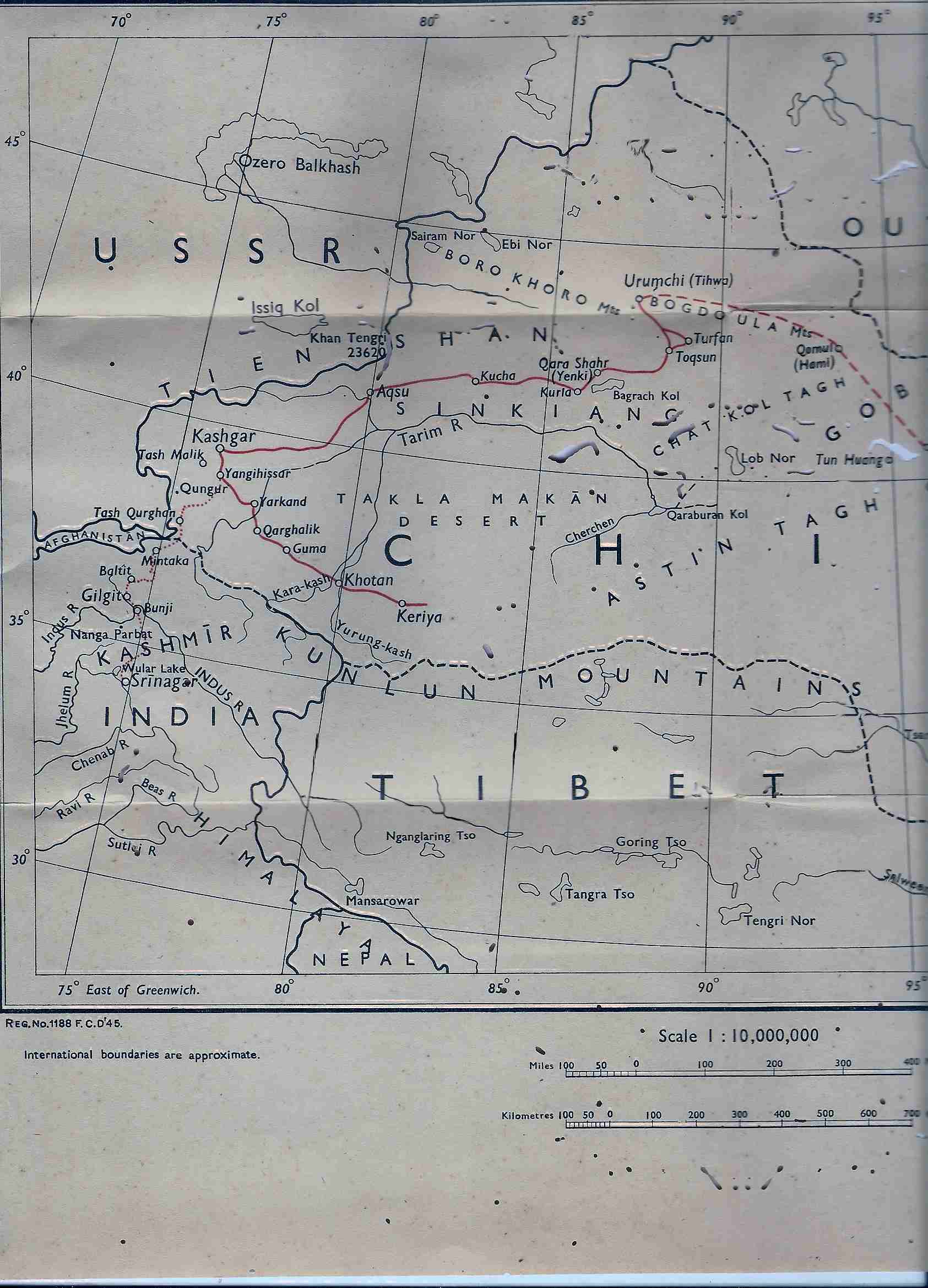
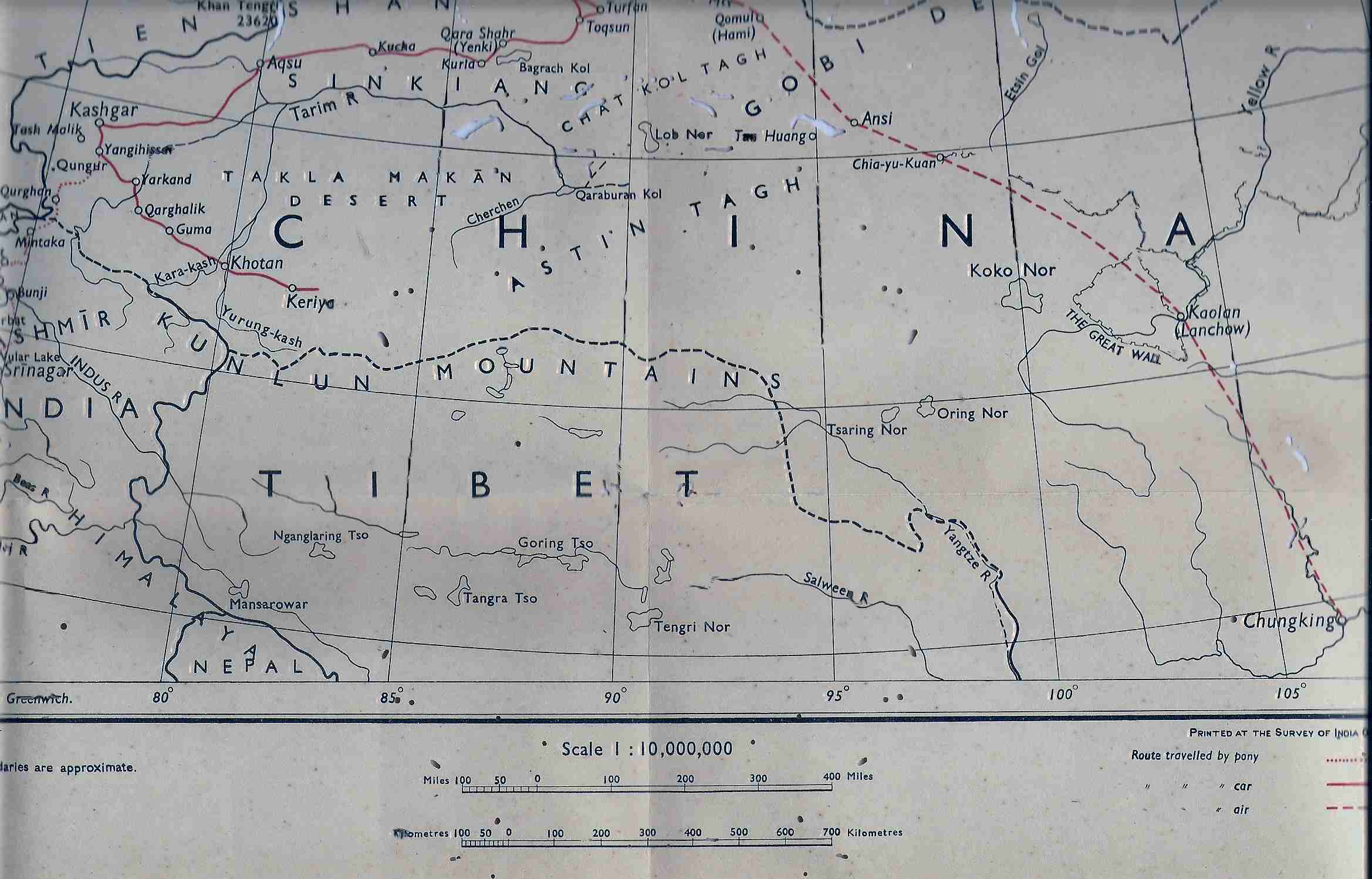
Leadership vacuum
June 7, 2008 — drsubrotoroyFirst published in The Statesman, Editorial Page Special Article, June 7 2008, http://www.thestatesman.net
Leadership vacuum
Time & Tide Wait For No One In Politics: India Trails Pakistan & Nepal!
Subroto Roy
The Karnataka legislative elections, as well as to lesser extent the Bengal panchayat polls, have revealed the vacuum that exists across the leadership of India’s national-level politics today.
To start with the BJP: had India been a normal democratic country on the Western pattern, Mr Arun Jaitley would have rocketed to the top of his party’s leadership by now. Besides being articulate in both Hindi and English and in his fifties (the age-group of most leaders in democratic countries), Mr Jaitley’s political acumen and organisational skills have been acknowledged even by his Congress adversaries after the Karnataka result. He himself has been frank and expansive about his formula for winning in Karnataka, which was simply to focus on real issues, especially state-specific ones, as well as to project a single credible leader. Had the BJP been a normal political party in a normal country, Mr Jaitley would have been given the task of leading it to victory in the next General Election and, assuming he won a Lok Sabha seat, to become its prime ministerial candidate.
Dadagiri
Instead, the BJP chooses to remain backward, backward, backward in the majority of its thought-processes and behaviour-patterns ~ from its kneejerk anti-Muslim psychology via its hyperinflationary macroeconomics and protectionist trade to its embrace of astrology and bovine exclusiveness. The idea of uniting behind someone relatively modern-minded in his politics like Mr Jaitley would be simply unacceptable not merely to people in the party within his own age-cohort (including the present party president) but even more so to those in age-cohorts decades older (including the party’s present prime ministerial candidate).
The opposition of the first group would arise from, in a word, jealousy. The opposition of the second group would arise from, in a word, dadagiri, i.e. the gerontocratic idea that merely because one is older, one is owed respect, authority and the plums of office in precedence over someone who is younger. Jealousy is a universal emotion not something specific to Indian politics, but dadagiri and the lack of meritocracy in our political culture is one reason India remains an abnormal polity in the modern democratic world.
LK Advani, driven by his unfulfilled personal ambition, will likely lead the BJP in the next election and do so with Mr Jaitley’s explicit support; Mr Advani may lead it into defeat or even to a victory in which he, given his age, is not as successful a PM as a Jaitley might have been. Yet our sclerotic political culture is such that neither Mr Advani nor Mr Rajnath Singh will simply stand aside now and hand over the reins to a newer, more competent and progressive leadership.
The same idea of dadagiri pervades what passes for the official “Left” in India as exemplified by the CPI-M. Mr Jyoti Basu has in a recent letter to Harkishen Singh Surjeet reminisced of their times together, and in doing so remarked that he remained the Chief Minister of West Bengal for as many years as he did because the Party had instructed him to do so, and when he handed over power to Buddhadeb Bhattacharjee, he did so with the Party’s agreement.
Those who believe in India’s parliamentary democracy might have thought that what our system requires is for a Chief Minister to hold the confidence of the legislative assembly from the bottom up but clearly that is not so because what a CM or PM seems to need are Party instructions from the top down. When Mr Bhattacharjee was anointed the new CM, the present author had remarked to the then Editor of The Statesman that the transition seemed to take place even without a formal vote of confidence in the Assembly. Does anyone in fact recall the last confidence vote debated and passed in the West Bengal Assembly? Democratic legislatures the world over routinely begin their new sessions with a debate and vote of no confidence being brought by the Opposition against the Government-of-the-day.
Does that happen with us, purportedly the world’s largest democracy? Let aside State legislatures, even our Parliament sees only the rare vote of confidence, and LK Advani specifically as Leader of the Opposition seems to have introduced none. Oppositions that do not wish to properly oppose are of course complicit in a government’s misdeeds.
It is the dadagiri culture shared by the official Communists that has caused the generational handover of power from Mr Basu and Mr Surjeet to the JNU coterie of the Karats and Mr Sitaram Yechuri. The “Left” like the “Right” and everyone else in Indian politics, can only handle cherubic “known” faces at the top ~ genuine grassroots activists like Binayak Sen or Medha Patkar must languish in jail or starve on hunger-strike in seeking to represent the politically and economically powerless in India while the entrenched dadas of Indian politics continue with their dissimulation.
Puppet-masters
In case of the Congress, it is an even deeper aspect of the Indian joint family system than dadagiri that has dominated its political culture, namely, the question who is the karta of the family and, if the karta is or seems too young or naïve or inexperienced, who will act as Regent on the karta’s behalf? Indira Gandhi was successfully guided in international politics for several years by a coterie led by PN Haksar. Rajiv Gandhi was attempted to be guided by several different competing coteries of senior party dadas ~ one of whom first brought up the name of Manmohan Singh in Indian politics on 22 March 1991 in a challenge addressed to the present author on liberalisation plans that Rajiv had authorised.
It is almost true to say that Sonia Gandhi and Rahul Gandhi have been in recent years played by puppet-masters of whose personal interests and intrigues they remain clueless. As has been said before by this author, the most salubrious thing Sonia Gandhi could have done for the Congress Party was to remain steadfast in her decision to stay out of Indian politics, and to have organised a fair, tough intra-party contest among its putative senior leaders based on differences of political and economic ideology.
Instead there is now paralysis in decision-making induced by Sonia Gandhi and Manmohan Singh each mistakenly relying upon the other’s purported economic wisdom and political acumen. This confusion came to be most clearly illustrated in the choice of Head of State last year though that was something politically costless ~ the failures of which Karnataka is the current example may lead the Congress to lose what it, like other Indian parties, loves most of all, namely political power in Lutyens’ Delhi.
Indians should make no mistake: our good neighbours in Pakistan and Nepal (Muslim in Pakistan, Hindu and Buddhist and communist in Nepal) have been through healthy cathartic political experiences in recent months and years of a kind we have not. There continues to remain a dangerous intellectual vacuum around the throne of Delhi.
Serendipity and the China-Tibet-India border problem
June 6, 2008 — drsubrotoroyOur carpenter completed some new book-cases and this led to our library being churned around a little. I found KPS Menon’s 1947 Delhi-Chungking: A Travel Diary about his 125-day 1944 journey from Delhi through Kashmir and Sinkiang/Xinjiang and “the 8th War Zone” to Chiang Kaishek’s capital at the time, Chung King/Chongqing. I had not read the book properly in decades. Looking at the contents, I found it said there were maps in the inside jacket — something I had never noticed before. Now I found the inner-jacket, put my hand in, and out came two Survey of India maps of Northern India (Kashmir, Baltistan), Sinkiang, China, Tibet….
I shall scan and upload them here within a day or so. It is clear that as of 1947 at least, China and Tibet were distinct on a map.
China’s force and diplomacy: The need for realism in India (2008)
May 31, 2008 — drsubrotoroyChina’s force & diplomacy: The need for realism In India
Subroto Roy
First published in The Statesman, Editorial Page Special Article, May 31, 2008

It is almost as large an error to overestimate Chinese military aims and capabilities as it has been to underestimate them. On 8 May 2008 at Tokyo’s Waseda University, China’s President Hu Jintao declared in a speech broadcast live “China has taken a defensive military policy and will not engage in any arms race. We will not become a military threat to any country and we will never assert hegemony or be expansionistic”. This was as clear and authoritative a reply as possible to the June 2005 statement in Singapore of the then American defence minister Donald Rumsfeld: “China appears to be expanding its missile forces, allowing them to reach targets in many areas of the world, not just the Pacific region, while also expanding its missile capacities here in the region. Since no nation threatens China, one must wonder: why this growing investment?”
By 2006, Rumsfeld’s generals were saying China had “the greatest potential to compete militarily with the United States,” and could “field disruptive military technologies that could over time offset traditional US military advantages absent US counter strategies”. The “sizing” of China’s military by American and other Western analysts became a parlour game ~ one with major business implications since the threat perceived or misperceived from China affects American decisions on the size of its own military.
As recently as 13 May 2008, the Wall Street Journal carried opinion that China’s military expansion demanded America have a 1000-ship navy not a 280-ship one, 40 aircraft-carriers not 11, 1000 F-22 aircraft not 183. Exaggerating China’s military and the threat posed by it to the world can mean big business for militaries opposing it!
Dominating India
Communist China’s physical, political and psychological domination of independent India since the 1950s has been achieved more by diplomacy, subterfuge and threat of force than actual military conflict. In its first phase, the policy was expressed clearly by the Chinese Ambassador to New Delhi on 16 May 1959 when he told India’s Foreign Secretary: “Our Indian friends, what is your mind? Will you agree to our thinking regarding the view that China can only concentrate its main attention eastward of China but not south-westward of China, nor is it necessary for it to do so?…. Friends, it seems to us that you, too, cannot have two fronts. Is it not so? If it is, here then lies the meeting point of our two sides. Will you please think it over?” (BN Mullick, Chinese Betrayal, p. 229).
At the time, Pakistan was in military alliances with the USA through CENTO and SEATO, and the Pakistan-China alliance was still years away. The Chinese had used subterfuge to construct their road linking Tibet and Sinkiang through Aksai Chin, ignoring India’s sovereignty, and were now suggesting they had no interest in fighting India because their major military interests were to their east as India’s were towards Pakistan.
The second phase was the short border conflict itself in 1962-63, which consolidated China’s grip on occupied territory in Aksai Chin while establishing its threat to the Brahmaputra Valley that has been perpetuated to this day. The third phase is represented by the 27 November 1974 conversation between Henry Kissinger and Deng Xiaoping, recently made publicly available:
“Deng : There’s something very peculiar about Indian policy. For example, that little kingdom Sikkim. They had pretty good control of Sikkim. Why did they annex it?
Kissinger : It is a good thing India is pacifist, I hate to think (of what they would do) if they weren’t. (Laughs).
Deng : Sikkim was entirely under the military control of India.
Kissinger : I haven’t understood Sikkim. It is incomprehensible.
Deng : After the military annexation, their military position was in no way strengthened.
Kissinger : They had troops there already.
Deng : And they haven’t increased their troops since. We published a statement about it. We just spoke for the cause of justice.
Kissinger : Is it true that you set up loudspeakers to broadcast to the Indian troops on the border? It makes them very tense. (Laughs)
Deng : We have done nothing new along the borders, and frankly we don’t fear that India will attack our borders. We don’t think they have the capability to attack our borders. There was some very queer talk, some said that the reason why the Chinese issued that statement about Sikkim was that the Chinese were afraid after Sikkim that India would complete the encirclement of China. Well, in the first place we never feel things like isolation and encirclement can ever matter very much with us. And particularly with India, it is not possible that India can do any encirclement of China. The most they can do is enter Chinese territory as far as the Autonomous Republic of Tibet, Lhasa. And Lhasa can be of no strategic importance to India. The particular characteristic of Lhasa is that it has no air-because the altitude is more than 3,000 metres.
Kissinger : It’s a very dangerous area for drinking mao tai (a Chinese hard liquor).
Deng : Frankly, if Indian troops were able to reach Lhasa, we wouldn’t be able to supply them enough air! (Laughter)
Kissinger : I don’t think their intention is with respect to Tibet, their immediate intention is Nepal.
Deng : That is correct. They have been recently exercising pressure on Nepal, refusing to supply them oil. It is the dream of Nehru, inherited by his daughter, to have the whole subcontinent in their pocket.
Kissinger : And to have buffer zones around their border…. It is like British policy in the 19th Century. They always wanted Tibet demilitarized.
Deng : I believe even the British at that time didn’t make a good estimate of whether there was enough air. (Laughter)
Kissinger : I think an Indian attack on China would be a very serious matter that cannot be explained in terms of local conditions, but only in terms of a broader objective….”
Our self-delusion
The attitude that is revealed speaks for itself, and has been essentially continued by Deng’s successors in the next decades, especially Jiang Zemin and Hu Jintao. It is because China does not perceive a military threat from India that it has agreed to military exercises with us ~ exercises which, if anything, reinforce their psychological dominance by helping to spook our military’s morale. During this third phase also, China went about systematically creating a major military threat to India in its support of Pakistan’s military, exploiting our subcontinent’s communal conflicts fully to its own strategic advantage.
China has been engaged for more than a decade now in a massive exercise of modernisation of its armed forces, improving productivity, technology, organisation and discipline while trying to cut corruption. It has a right to do so, and such modernisation does not in and of itself signal aggressive intent. The last aggressive war China fought was almost 30 years ago against Vietnam. It is possible that what simply explains the military modernisation (besides conflict with Taiwan) is China’s awful history of being exploited by foreign powers over the centuries.
Indian analysts have expressed concern about nuclear submarines based in Hainan; but where else would China put them? We delude ourselves if we think we are the guardians of the Straits of Malacca. We may do better being concerned to try to modernise, improve productivity and reduce corruption in our own forces, as well as integrate them better with national goals as China has done instead of continuing to maintain them in a rather old-fashioned colonial / imperial manner.
“All India wept”: On the death of Rajiv Gandhi May 21 1991
May 21, 2008 — drsubrotoroy“All India wept” is a sentence from my “Rajiv Gandhi and the Origins of India’s 1991 Economic Reform”, one of the most viewed articles that is published at this site, and excerpted from below. I was in Singapore on my way to the USA to bring my young son back for his summer holidays with me. I heard it first on the radio at night while asleep in a hotel but the horror of what was reported did not register in my semi-conscious brain. It was only the next morning that I read the newspaper headlines at the airport and came to recall what had been said. I phoned my father and found him, at age 75, weeping.
Today, watching all the New Delhi dignitaries parade along Rajiv’s memorial, I wonder if he would have approved: almost certainly not. He would have wanted them to be at their jobs instead of wasting time like this; as for the young family he left behind, he has of course never left them.
Subroto Roy
from Rajiv Gandhi and the Origins of India’s 1991 Economic Reform (1995, 2001, 2005, 2007):
“Krishnamurty had prepared a draft dated March 18 of several pages of the economic aspects of the manifesto. After our discussions, Krishnamurty was hospitable enough to open the draft to improvement. That evening, the 19th, I worked through the night and the next morning to get by noon copies of a revised version with all the members of the group. At 4 p.m. on the 20th there was a meeting at Andhra Bhavan of the whole group except Pitroda, which went on until the night. The next day the 21st , Krishnamurty, Khusro and I met again at Andhra Bhavan for a few hours on the economic aspects of the draft. Then in mid-afternoon I went to Rasgotra’s home to work with him and Krishna Rao. They wanted me to produce the economic draft which they could then integrate as they wished into the material they were dictating to a typist. I offered instead to absorb their material directly on to my laptop computer where the economic draft was. Rasgotra was reluctant to let go control, and eventually I gave in and said I would get them a hard copy of the economic draft, which they then planned to re-draft via a stenographer on a typewriter. At this, Rasgotra gave in and agreed to my solution. So the work began and the three of us continued until late.
That night Krishna Rao dropped me at Tughlak Road where I used to stay with friends. In the car I told him, as he was a military man with heavy security cover for himself as a former Governor of J&K, that it seemed to me Rajiv’s security was being unprofessionally handled, that he was vulnerable to a professional assassin. Krishna Rao asked me if I had seen anything specific by way of vulnerability. With John Kennedy and De Gaulle in mind, I said I feared Rajiv was open to a long-distance sniper, especially when he was on his campaign trips around the country.
This was one of several attempts I made since October 1990 to convey my clear impression to whomever I thought might have an effect that Rajiv seemed to me extremely vulnerable. Rajiv had been on sadhbhavana journeys, back and forth into and out of Delhi. I had heard he was fed up with his security apparatus, and I was not surprised given it seemed at the time rather bureaucratized. It would not have been appropriate for me to tell him directly that he seemed to me to be vulnerable, since I was a newcomer and a complete amateur about security issues, and besides if he agreed he might seem to himself to be cowardly or have to get even closer to his security apparatus. Instead I pressed the subject relentlessly with whomever I could. I suggested specifically two things: (a) that the system in place at Rajiv’s residence and on his itineraries be tested, preferably by some internationally recognized specialists in counter-terrorism; (b) that Rajiv be encouraged to announce a shadow-cabinet. The first would increase the cost of terrorism, the second would reduce the potential political benefit expected by terrorists out to kill him. On the former, it was pleaded that security was a matter being run by the V. P. Singh and then Chandrashekhar Governments at the time. On the latter, it was said that appointing a shadow cabinet might give the appointees the wrong idea, and lead to a challenge to Rajiv’s leadership. This seemed to me wrong, as there was nothing to fear from healthy internal contests for power so long as they were conducted in a structured democratic framework. I pressed to know how public Rajiv’s itinerary was when he travelled. I was told it was known to everyone and that was the only way it could be since Rajiv wanted to be close to the people waiting to see him and had been criticized for being too aloof. This seemed to me totally wrong and I suggested that if Rajiv wanted to be seen as meeting the crowds waiting for him then that should be done by planning to make random stops on the road that his entourage would take. This would at least add some confusion to the planning of potential terrorists out to kill him. When I pressed relentlessly, it was said I should probably speak to “Madame”, i.e. to Mrs. Rajiv Gandhi. That seemed to me highly inappropriate, as I could not be said to be known to her and I should not want to unduly concern her in the event it was I who was completely wrong in my assessment of the danger. The response that it was not in Congress’s hands, that it was the responsibility of the V. P. Singh and later the Chandrashekhar Governments, seemed to me completely irrelevant since Congress in its own interests had a grave responsibility to protect Rajiv Gandhi irrespective of what the Government’s security people were doing or not doing. Rajiv was at the apex of the power structure of the party, and a key symbol of secularism and progress for the entire country. Losing him would be quite irreparable to the party and the country. It shocked me that the assumption was not being made that there were almost certainly professional killers actively out to kill Rajiv Gandhi — this loving family man and hapless pilot of India’s ship of state who did not seem to have wished to make enemies among India’s terrorists but whom the fates had conspired to make a target. The most bizarre and frustrating response I got from several respondents was that I should not mention the matter at all as otherwise the threat would become enlarged and the prospect made more likely! This I later realized was a primitive superstitious response of the same sort as wearing amulets and believing in Ptolemaic astrological charts that assume the Sun goes around the Earth — centuries after Kepler and Copernicus. Perhaps the entry of scientific causality and rationality is where we must begin in the reform of India’s governance and economy. What was especially repugnant after Rajiv’s assassination was to hear it said by his enemies that it marked an end to “dynastic” politics in India. This struck me as being devoid of all sense because the unanswerable reason for protecting Rajiv Gandhi was that we in India, if we are to have any pretensions at all to being a civilized and open democratic society, cannot tolerate terrorism and assassination as means of political change. Either we are constitutional democrats willing to fight for the privileges of a liberal social order, or ours is truly a primitive and savage anarchy concealed beneath a veneer of fake Westernization….
On March 23, our group was to meet Rajiv at noon. There was to be an event in the inner lawns of Rajiv’s residence in the morning, where he would launch Krishna Rao’s book on India’s security. Krishna Rao had expressly asked me to come but I had to wait outside the building patiently, not knowing if it was a mistake or if it was deliberate. This was politics after all, and I had ruffled feathers during my short time there. While I waited, Rajiv was speaking to a farmers’ rally being held at grounds adjoining his residence, and there appeared to be thousands of country folk who had gathered to hear him. When it was over, Rajiv, smiling nervously and looking extremely uncomfortable, was hoisted atop people’s shoulders and carried back to the residence by his audience. As I watched, my spine ran cold at the thought that any killer could have assassinated him with ease in that boisterous crowd, right there in the middle of Delhi outside his own residence. It was as if plans for his security had been drawn up without any strategic thinking underlying them.
Krishna Rao arrived and graciously took me inside for his book launch. The event was attended by the Congress’s top brass, including Narasimha Rao whom I met for the first time, as well as foreign military attaches and officers of the Indian armed forces. The attaché of one great power went about shaking hands and handing out his business card to everyone. I stood aside and watched. Delhi felt to me that day like a sieve, as if little could be done without knowledge of the embassies. One side wanted to sell arms, aircraft or ships, while the other wanted trips abroad or jobs or green cards or whatever for their children. And I thought Islamabad would be worse — could India and Pakistan make peace in this fetid ether?
Proceedings began when Rajiv arrived. This elite audience mobbed him just as the farmers had mobbed him earlier. He saw me and beamed a smile in recognition, and I smiled back but made no attempt to draw near him in the crush. He gave a short very apt speech on the role the United Nations might have in the new post-Gulf War world. Then he launched the book, and left for an investiture at Rashtrapati Bhavan. We waited for our meeting with him, which finally happened in the afternoon. Rajiv was plainly at the point of exhaustion and still hard-pressed for time. He seemed pleased to see me and apologized for not talking in the morning. Regarding the March 22 draft, he said he had not read it but that he would be doing so. He said he expected the central focus of the manifesto to be on economic reform, and an economic point of view in foreign policy, and in addition an emphasis on justice and the law courts. I remembered our September 18 conversation and had tried to put in justice and the courts into our draft but had been over-ruled by others. I now said the social returns of investment in the judiciary were high but was drowned out again. Rajiv was clearly agitated that day by the BJP and blurted out he did not really feel he understood what on earth they were on about. He said about his own family, “We’re not religious or anything like that, we don’t pray every day.” I felt again what I had felt before, that here was a tragic hero of India who had not really wished to be more than a happy family man until he reluctantly was made into a national leader against his will. We were with him for an hour or so. As we were leaving, he said quickly at the end of the meeting he wished to see me on my own and would be arranging a meeting. One of our group was staying back to ask him a favour. Just before we left, I managed to say to him what I felt was imperative: “The Iraq situation isn’t as it seems, it’s a lot deeper than it’s been made out to be.” He looked at me with a serious look and said “Yes I know, I know.” It was decided Pitroda would be in touch with each of us in the next 24 hours. During this time Narasimha Rao’s manifesto committee would read the draft and any questions they had would be sent to us. We were supposed to be on call for 24 hours. The call never came. Given the near total lack of system and organization I had seen over the months, I was not surprised. Krishna Rao and I waited another 48 hours, and then each of us left Delhi. Before going I dropped by to see Krishnamurty, and we talked at length. He talked especially about the lack of the idea of teamwork in India. Krishnamurty said he had read everything I had written for the group and learned a lot. I said that managing the economic reform would be a critical job and the difference between success and failure was thin.
I got the afternoon train to Calcutta and before long left for America to bring my son home for his summer holidays with me. In Singapore, the news suddenly said Rajiv Gandhi had been killed. All India wept. What killed him was not merely a singular act of criminal terrorism, but the system of humbug, incompetence and sycophancy that surrounds politics in India and elsewhere. I was numbed by rage and sorrow, and did not return to Delhi. Eleven years later, on 25 May 2002, press reports said “P. V. Narasimha Rao and Manmohan Singh lost their place in Congress history as architects of economic reforms as the Congress High command sponsored an amendment to a resolution that had laid credit at the duo’s door. The motion was moved by…. Digvijay Singh asserting that the reforms were a brainchild of the late Rajiv Gandhi and that the Rao-Singh combine had simply nudged the process forward.” Rajiv’s years in Government, like those of Indira Gandhi, were in fact marked by profligacy and the resource cost of poor macroeconomic policy since bank-nationalisation may be as high as Rs. 125 trillion measured in 1994 rupees. Certainly though it was Rajiv Gandhi as Leader of the Opposition in his last months who was the principal architect of the economic reform that came to begin after his passing.”
John Wisdom, Renford Bambrough: Main Philosophical Works
May 8, 2008 — drsubrotoroy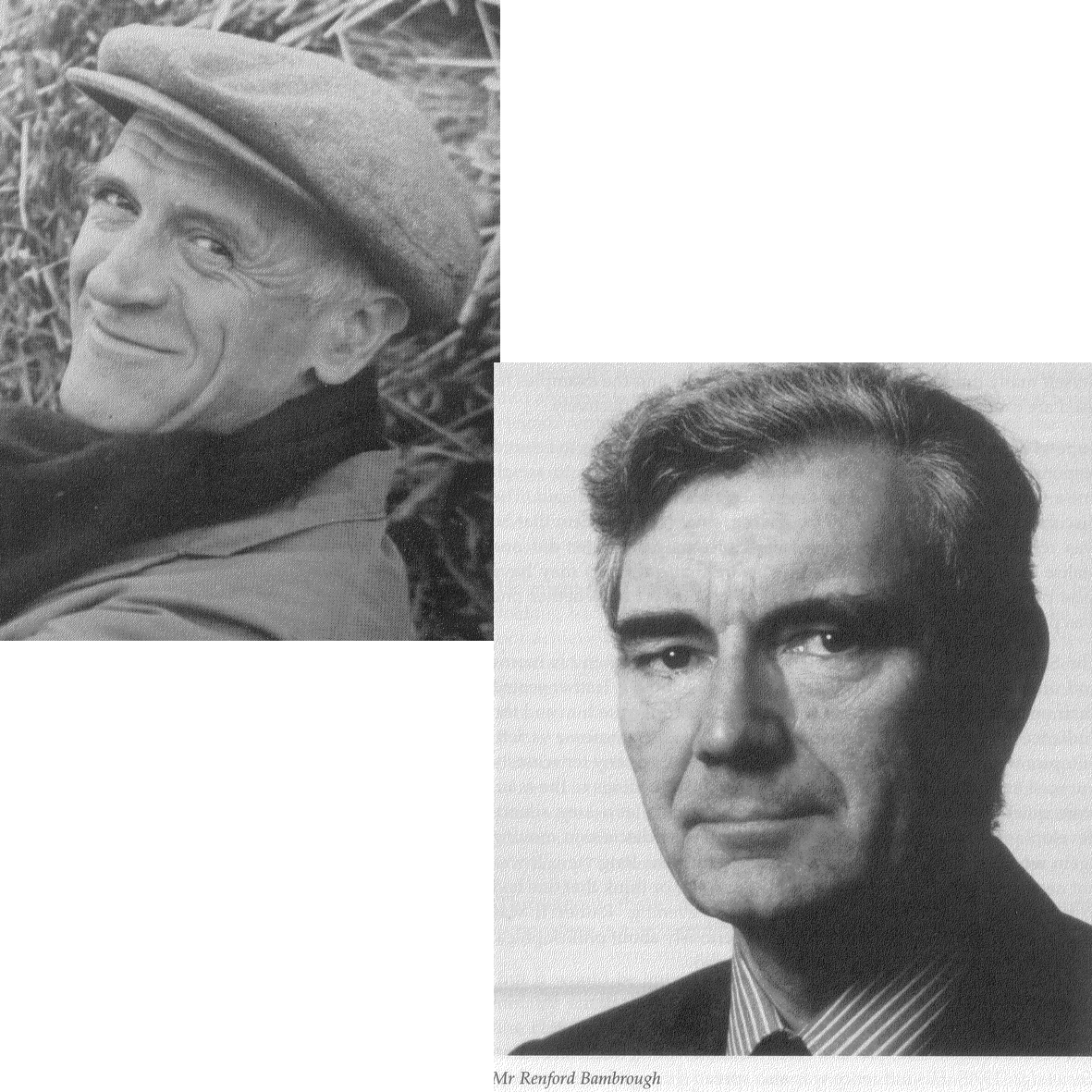
John Wisdom (1904-1993), Main Philosophical Works:
Interpretation and Analysis, 1931
Problems of Mind and Matter 1934
Other Minds, 1952
Philosophy & Psychoanalysis, 1953
Paradox & Discovery, 1965
Logical Constructions (1931-1933),1969
Proof and Explanation (The Virginia Lectures 1957), 1991
Secondary literature:
Wisdom: Twelve Essays, R. Bambrough (ed) 1974
Philosophy and Life: Essays on John Wisdom, I. Dilman (ed) 1984.
(Foreword) The Structure of Metaphysics, Morris Lazerowitz, 1955
“Epilogue: John Wisdom”, The later philosophy of Wittgenstein, David Pole, 1958
Renford Bambrough (1926-1999), Main Philosophical Works:
“Socratic Paradox”, Philosophical Quarterly, 1960
“Universals and Family Resemblances”, Proceedings of the Aristotelian Society 1960-61
“Plato’s Modern Friends and Enemies”, Philosophy 1962
The Philosophy of Aristotle, 1963
“Principia Metaphysica”, Philosophy 1964
New Essays on Plato and Aristotle (edited by R. Bambrough), 1965
“Unanswerable Questions”, Proceedings of the Aristotelian Society Supplement 1966
Plato, Popper and Politics (edited by R. Bambrough), 1967
Reason, Truth and God 1969
“Foundations”, Analysis, 1970
“Objectivity and Objects”, Proceedings of the Aristotelian Society 1971-72
“How to Read Wittgenstein”, in Understanding Wittgenstein, Royal Institute of Philosophy 1972-3
“The Shape of Ignorance”, in Lewis (ed) Contemporary British Philosophy, 1976
Introduction & Notes to Plato’s Republic (Lindsay trans.), 1976
Conflict and the Scope of Reason, 1974; also in Ratio 1978
“Intuition and the Inexpressible” in Katz (ed) Mysticism & Philosophical Analysis, 1978
Moral Scepticism and Moral Knowledge, 1979
“Thought, Word and Deed”, Proceedings of Aristotelian Society Supplement 1980
“Peirce, Wittgenstein and Systematic Philosophy”, MidWest Studies in Philosophy, 1981
“The Scope of Reason: An Epistle to the Persians”, in Objectivity and Cultural Divergence, Royal Institute of Philosophy, 1984
“Principia Metaphysica: The Scope of Reason” also known as “The Roots of Reason”; a work and manuscript mentioned several times but now unknown.
A personal note by Subroto Roy for a public lecture delivered at the University of Buckingham, August 24 2004:
“Renford Bambrough and I met once on January 31 1982, when I had returned to Cambridge from the USA for my PhD viva voce examination. He signed and gave me his last personal copy of Reason, Truth and God. Three years earlier, in 1979, I, as a 24 year old PhD student under F.H. Hahn in economics, had written to him expressing my delight at finding his works and saying these were immensely important to economics; he invited me to his weekly discussion groups at St John’s College but I could not attend. Between 1979 and 1989 we corresponded while I worked in America on my application of his and Wisdom’s work to problems in economics, which emerged in Philosophy of Economics: On the Scope of Reason in Economic Inquiry (Routledge, International Library of Philosophy 1989, 1991), a work which got me into a lot of trouble with American economists (though Milton Friedman and Theodore W. Schultz defended it). Bambrough said of it “The work is altogether well-written and admirably clear”. On another occasion he said he was “extremely pleased” at the interest I had taken in his work. The preface of my book said he was not responsible for the use I had made of his writings, which I reiterate now. Returning to Britain in 2004, I find the work of Wisdom and Bambrough unknown or forgotten, even at the great University North East of Buckingham where they had lived and worked. In my view, they played a kind of modern-day Plato and Aristotle to Wittgenstein’s Socrates; in terms of Eastern philosophy, the wisdom they achieved in their lives and have left behind for us in their work to use and apply to our own problems, make them like modern-day “Boddhisatvas” of Mahayana Buddhism. My lecture “Science, Religion, Art, and the Necessity of Freedom” purports to apply their work to current international problems of grave significance, namely the cultural conflicts made apparent since the September 11 2001 attacks on America. As I am as likely to fail as to succeed in making this application, the brief bibliography given above is intended to direct interested persons to their work first hand for themselves.”
April 2007, March 2020:
See also
Is “Cambridge Philosophy” dead, in Cambridge? Can it be resurrected, there? Case Study: Renford Bambrough (& Subroto Roy) preceded by decades Cheryl Misak’s thesis on Wittgenstein being linked with Peirce via Ramsey…
https://independentindian.com/2017/10/27/cambridge-philosophy-rest-in-peace-yes-bambrough-i-preceded-misaks-link-by-deacades/
*Philosophy of Economics: On the Scope of Reason in Economic Inquiry*, “Science, Religion, Art & the Necessity of Freedom”
*Physics and Reasoning*
Assessing Manmohan: The Doctor of Deficit Finance should realise the currency is at stake
April 25, 2008 — drsubrotoroyAssessing Manmohan:
The Doctor of Deficit Finance should realise the currency is at stake
by Subroto Roy
First published in The Statesman, Editorial Page Special Article, April 25 2008,
The best thing that may be said of the Manmohan Singh premiership is that when it began in May 2004, it seemed, for a short while, refreshing in comparison to the dysfunctional arrogance and brutality displayed by its predecessor. By the last months of the Vajpayee-Advani Government, there were party appointees who had ended all pretence of purportedly Hindu values and were raking it in shamelessly. The Golden Rule of Democracy is “Throw the rascals out”, which is what Indian democracy upheld as it has done time and again. By 2009, India’s electorate will have the chance to decide whether the incumbent government deserves the same fate.
Lok Sabha
Manmohan Singh was seriously discussed as the Congress’s putative nominee for PM as early as 2001. The idea brewing at the time with the party’s next generation of wannabe leaders (in their 50s and 60s, where Manmohan was near 70) was that they needed to maintain good relations with the Great White Queen and wait out one term of an inevitable Singh premiership before having a shot at the top job themselves.
What is surprising is Dr Singh appeared never to feel it necessary to educate himself privately on how to retool himself for the necessary transformation from being the archetypal bureaucrat he had been in his working career to becoming the national statesman he wished to be after retirement. It is doubtful, for example, if he ever stood in front of a mirror and practised an extempore political speech in Hindi in preparation for the highest executive post in the country, let aside writing a clear-headed, original vision or mission statement of substance as to where he wished to lead it. As Narasimha Rao’s Finance Minister, he could meekly take orders from his PM; it seemed he wished to continue in the same mode even when PM himself.
Jawaharlal Nehru is supposed to have been a hero of Dr Singh’s ~ but Nehru was a thorough parliamentarian, among the finest anywhere, and someone who always respected the Lok Sabha immensely. Dr Singh, after he lost to VK Malhotra for the South Delhi seat in 1999, made not the slightest effort to enter the Lok Sabha again, even when the Akalis indicated they might not oppose him in a Punjab contest. When asked specifically at a large press conference about not entering the Lok Sabha, Dr Singh murmured words to the effect he had better uses of his time ~ a display, if anything, of the misplaced arrogance of many New Delhi academics and intellectuals. Dr Singh may be the first PM in any parliamentary democracy never to have won a seat in the lower house nor felt a need to do so.
Dr Singh’s bureaucratic expertise assisted him well in the first national crisis that came his way, which was the Tsunami of 26 December 2004. There appeared to be an air of efficiency about the Government’s response and he seemed in his element as commander of bureaucratic forces while working with Pranab Mukherjee in enlisting the military. George W. Bush (not a great geographer or historian) was apparently impressed to see on a map that India had naval forces deployed as far as the Andamans.
By 2005 though, Dr Singh’s bureaucratic mindset had its negative impact. Montek Ahluwalia had been his Finance Secretary when he was Finance Minister. Mr Ahluwalia’s spouse had been a main supporter of Dr Singh’s unsuccessful Lok Sabha attempt. During the Vajpayee Government, Mr Ahluwalia remained a Planning Commission Member for several years before moving to Washington. With Dr Singh as PM, Mr Ahluwalia returned from the USA in mid 2004 to become Deputy Chair at the Planning Commission. Simultaneously with his return, the idea that the American nuclear industry would like to sell “six to eight lightwater reactors” to India arose.
That is as much as is presently known in public. Dr Singh and Mr Ahluwalia may in the national interest want to frankly and precisely explain to the Indian people the full story of the sudden origins of this idea. Certainly, none of the lessons of the Dabhol fiasco a decade earlier seemed to have been learnt, and the Maharasthtra Government (and hence the Government of India) ended up paying some $300 million to General Electric and Bechtel Corporation for Dabhol before any nuclear talks with the USA could begin. Nor had any serious cost-benefit analysis been done or discussion taken place comparing nuclear energy with coal, hydro and other sources in the Indian case.
Indian foreign policy became frozen in its focus on nuclear negotiations with the USA, swirling around Dr Singh’s fife-and-drum welcome at the White House and President Bush’s return visit to India. At the same time arose the issue of Paul Volcker’s UN committee mentioning the name of India’s foreign minister. As The Statesman put it, regardless of the latter’s involvement, “the damage to India’s diplomatic reputation in the world” was done and it was inevitable a new foreign minister would be necessary. After dilly-dallying and much 10 Janpath to-and-fro, Dr Singh followed Nehru’s mistake of becoming his own foreign minister. The idea was that this would be temporary but it became almost a year.
Instead of transforming himself towards Indian political statesmanship, Dr Singh advanced other retired bureaucrats’ ambitions on similar career-paths. Foreign policy went out of the MEA’s control and seemingly into the control of the new “National Security Adviser”. Dr Singh, sometimes with MK Narayanan beside him, travelled a large number of countries from Brazil to Finland and Uzbekistan to South Africa and Japan. Dr Singh also found time and willingness to accept honorary degrees from British and Russian universities during these short months.
While Dr Singh seemed thus preoccupied, two of India’s main neighbours underwent massive democratic revolutions (leave aside magnificent Bhutan). Nepal’s people practically stormed their Bastille while Dr Singh and Mr Narayanan visited Germany to discuss BMWs. Pakistan’s democratic forces could hardly believe the cold indifference shown to them by a New Delhi merely following Bush’s support for Pervez Musharraf. While Pakistan and Nepal, and to lesser extent Bangladesh, saw movements towards better governance, Sri Lanka descended towards civil war ~ India’s PM remained obsessed with the magic wand that the nuclear deal was supposed to be.
Inflation
Then suddenly the magic vanished ~ Dr Singh seemed to finally come to a silent private recognition that the economics of the nuclear deal simply did not add up if it meant India importing “six to eight lightwater reactors” on a turnkey basis from the USA or anywhere else. Dr Singh seemed to come out of his self-imposed trance and return a little better to reality. By the time he visited China, although he was as deferential to Hu Jintao in his body language as he had been to Bush and Musharraf and even accepted an indoor guard of honour, he also seemed willing to stand up for India. The Arunachal visit was a reality-check.
Now there is inflation ~ and one year left in the UPA’s term. What the country needs is tough sensible macroeconomics and clean public finance. A pandering profligate budget in February was not a healthy sign. Instructing Mr Ahluwalia to close down the Planning Commission and make it a minor R&D wing of the Finance Ministry would be instead a good step. Instructing the RBI to clean up its bureaucratic wastefulness and prepare itself for institutional independence from the Finance Ministry would be even better. Getting proper financial control over every Union and State government entity spending public money and resources would be most important of all. Such major institutional changes in the policy-making process are what an economist might expect of an economist prime minister who wishes to lead India in the 21st Century. India’s currency is at stake.
(See also: “The Politics of Dr Singh”, May 2006; “Mistaken Macroeconomics”, June 2009, etc.)
Indian Inflation: Upside Down Economics from New Delhi’s Establishment (2008)
April 16, 2008 — drsubrotoroyIndian Inflation:
Upside Down Economics From The New Delhi Establishment
by
Subroto Roy
First published in two parts in
The Statesman, Editorial Page Special Article,
April 15-16, 2008
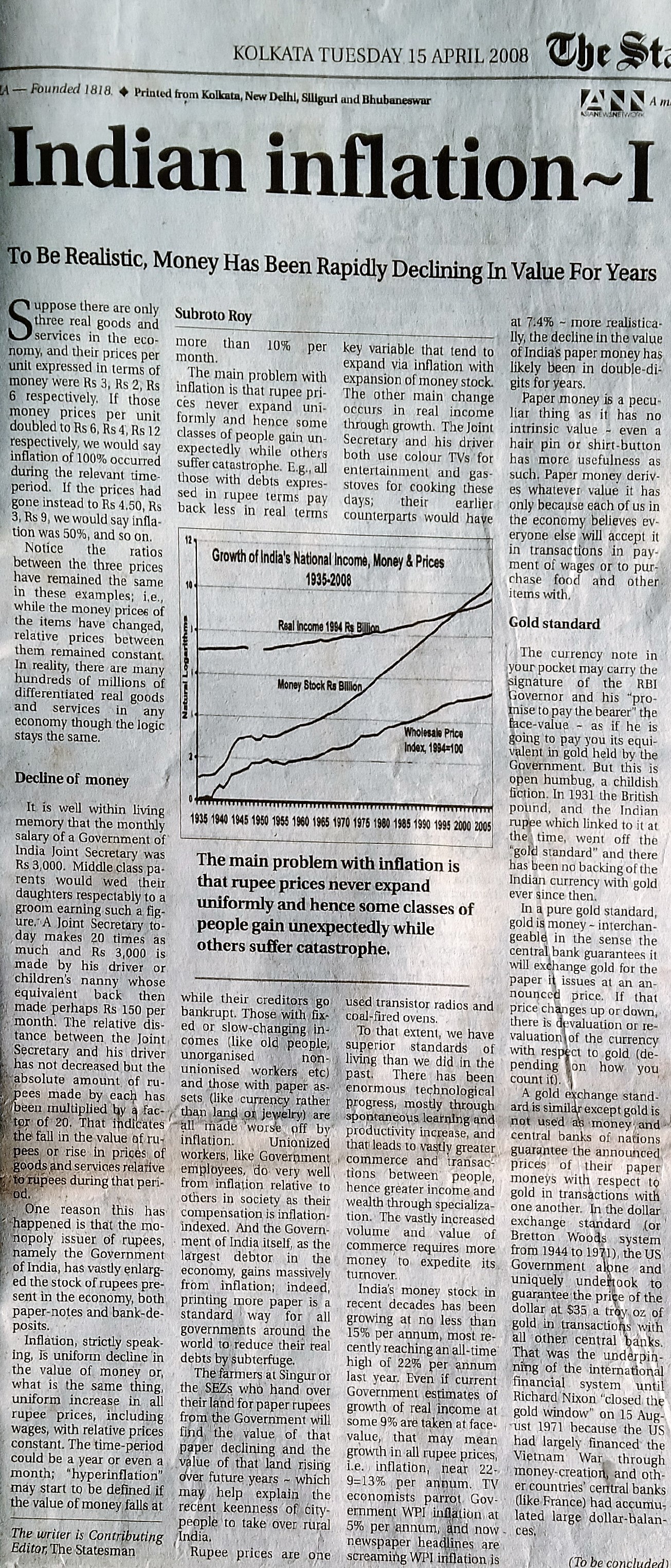
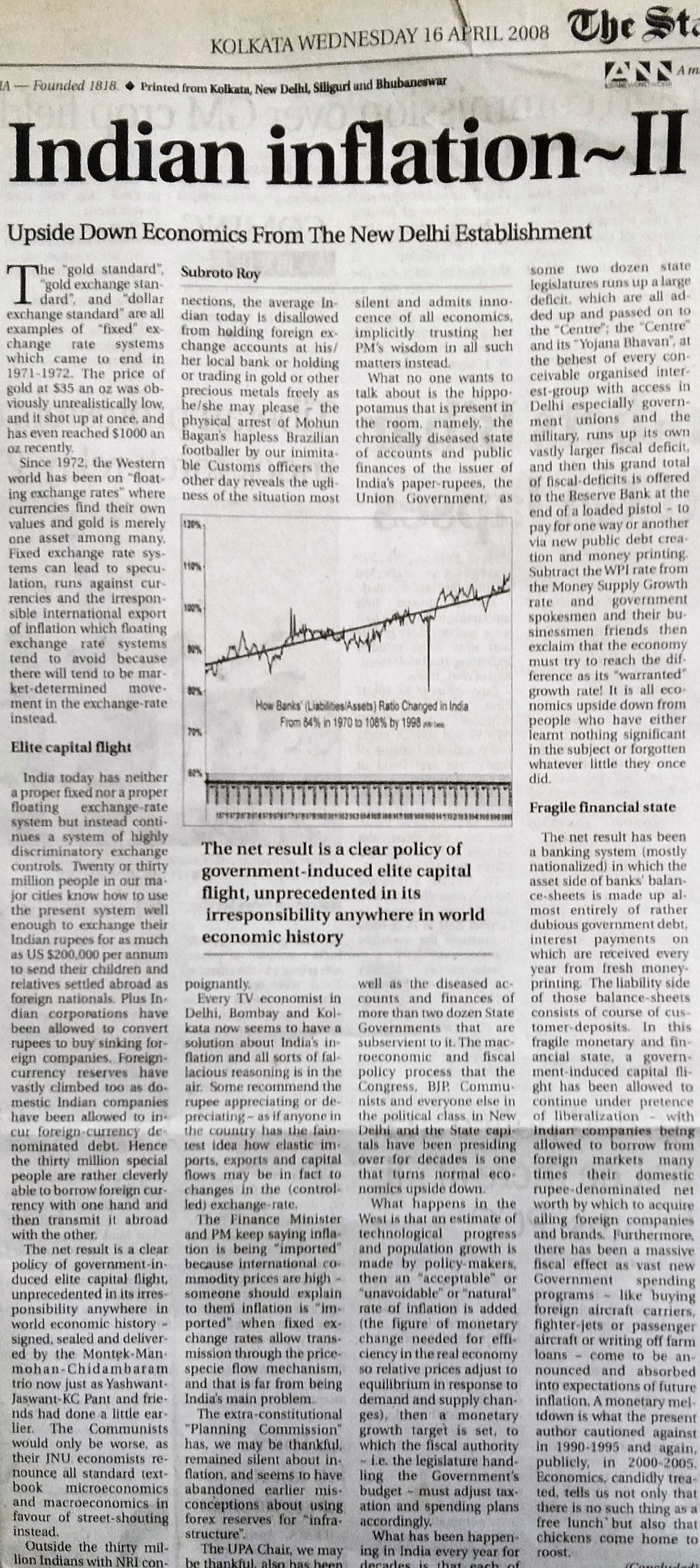
Suppose there are only three real goods and services in the economy, and their prices per unit expressed in terms of money were Rs 3, Rs 2, Rs 6 respectively. If those money prices per unit doubled to Rs 6, Rs 4, Rs 12 respectively, we would say inflation of 100% occurred during the relevant time-period. If the prices had gone instead to Rs 4.50, Rs 3, Rs 9, we would say inflation was 50%, and so on. Notice the ratios between the three prices have remained the same in these examples; i.e., while the money prices of the items have changed, relative prices between them remained constant. In reality, there are many hundreds of millions of differentiated real goods and services in any economy though the logic stays the same.
Decline of money
It is well within living memory that the monthly salary of a Government of India Joint Secretary was Rs 3,000. Middle class parents would wed their daughters respectably to a groom earning such a figure. A Joint Secretary today makes 20 times as much and Rs 3,000 is made by his driver or children’s nanny whose equivalent back then made perhaps Rs 150 per month. The relative distance between the Joint Secretary and his driver has not decreased but the absolute amount of rupees made by each has been multiplied by a factor of 20. That indicates the fall in the value of rupees or rise in prices of goods and services relative to rupees during that period.
One reason this has happened is that the monopoly issuer of rupees, namely the Government of India, has vastly enlarged the stock of rupees present in the economy, both paper-notes and bank-deposits. Inflation, strictly speaking, is uniform decline in the value of money or, what is the same thing, uniform increase in all rupee prices, including wages, with relative prices constant. The time-period could be a year or even a month; “hyperinflation” may start to be defined if the value of money falls at more than 10% per month.
The main problem with inflation is that rupee prices never expand uniformly and hence some classes of people gain unexpectedly while others suffer catastrophe. E.g., all those with debts expressed in rupee terms pay back less in real terms while their creditors go bankrupt. Those with fixed or slow-changing incomes (like old people, unorganised non-unionised workers etc) and those with paper assets (like currency rather than land or jewelry) are all made worse off by inflation. Unionized workers, like Government employees, do very well from inflation relative to others in society as their compensation is inflation-indexed. And the Government of India itself, as the largest debtor in the economy, gains massively from inflation; indeed, printing more paper is a standard way for all governments around the world to reduce their real debts by subterfuge.
The farmers at Singur or the SEZs who hand over their land for paper rupees from the Government will find the value of that paper declining and the value of that land rising over future years ~ which may help explain the recent keenness of city-people to take over rural India.
Rupee prices are one key variable that tend to expand via inflation with expansion of money stock. The other main change occurs in real income through growth. The Joint Secretary and his driver both use colour TVs for entertainment and gas-stoves for cooking these days; their earlier counterparts would have used transistor radios and coal-fired ovens.
To that extent, we have superior standards of living than we did in the past. There has been enormous technological progress, mostly through spontaneous learning and productivity increase, and that leads to vastly greater commerce and transactions between people, hence greater income and wealth through specialization. The vastly increased volume and value of commerce requires more money to expedite its turnover.
India’s money stock in recent decades has been growing at no less than 15% per annum, most recently reaching an all-time high of 22% per annum last year. Even if current Government estimates of growth of real income at some 9% are taken at face-value, that may mean growth in all rupee prices, i.e. inflation, near 22-9=13% per annum. TV economists parrot Government WPI inflation at 5% per annum, and now newspaper headlines are screaming WPI inflation is at 7.4% ~ more realistically, the decline in the value of India’s paper money has likely been in double-digits for years.
Paper money is a peculiar thing as it has no intrinsic value ~ even a hair pin or shirt-button has more usefulness as such. Paper money derives whatever value it has only because each of us in the economy believes everyone else will accept it in transactions in payment of wages or to purchase food and other items with.
Gold standard
The currency note in your pocket may carry the signature of the RBI Governor and his “promise to pay the bearer” the face-value ~ as if he is going to pay you its equivalent in gold held by the Government. But this is open humbug, a childish fiction. In 1931 the British pound, and the Indian rupee which linked to it at the time, went off the “gold standard” and there has been no backing of the Indian currency with gold ever since then.
In a pure gold standard, gold is money ~ interchangeable in the sense the central bank guarantees it will exchange gold for the paper it issues at an announced price. If that price changes up or down, there is devaluation or revaluation of the currency with respect to gold (depending on how you count it).
A gold exchange standard is similar except gold is not used as money and central banks of nations guarantee the announced prices of their paper moneys with respect to gold in transactions with one another. In the dollar exchange standard (or Bretton Woods system from 1944 to 1971), the US Government alone and uniquely undertook to guarantee the price of the dollar at $35 a troy oz of gold in transactions with all other central banks. That was the underpinning of the international financial system until Richard Nixon “closed the gold window” on 15 August 1971 because the US had largely financed the Vietnam War through money-creation, and other countries’ central banks (like France) had accumulated large dollar-balances.
The “gold standard”, “gold exchange standard”, and “dollar exchange standard” are all examples of “fixed” exchange rate systems which came to end in 1971-1972. The price of gold at $35 an oz was obviously unrealistically low, and it shot up at once, and has even reached $1000 an oz recently. Since 1972, the Western world has been on “floating exchange rates” where currencies find their own values and gold is merely one asset among many. Fixed exchange rate systems can lead to speculation, runs against currencies and the irresponsible international export of inflation which floating exchange rate systems tend to avoid because there will tend to be market-determined movement in the exchange-rate instead.
Elite capital flight
India today has neither a proper fixed nor a proper floating exchange-rate system but instead continues a system of highly discriminatory exchange controls. Twenty or thirty million people in our major cities know how to use the present system well enough to exchange their Indian rupees for as much as US $200,000 per annum to send their children and relatives settled abroad as foreign nationals. Plus Indian corporations have been allowed to convert rupees to buy sinking foreign companies. Foreign-currency reserves have vastly climbed too as domestic Indian companies have been allowed to incur foreign-currency denominated debt. Hence the thirty million special people are rather cleverly able to borrow foreign currency with one hand and then transmit it abroad with the other.
The net result is a clear policy of government-induced elite capital flight, unprecedented in its irresponsibility anywhere in world economic history ~ signed, sealed and delivered by the Montek-Manmohan-Chidambaram trio now just as Yashwant-Jaswant-KC Pant and friends had done a little earlier. The Communists would only be worse, as their JNU economists renounce all standard textbook microeconomics and macroeconomics in favour of street-shouting instead.
Outside the thirty million Indians with NRI connections, the average Indian today is disallowed from holding foreign exchange accounts at his/ her local bank or holding or trading in gold or other precious metals freely as he/she may please ~ the physical arrest of Mohun Bagan’s hapless Brazilian footballer by our inimitable Customs officers the other day reveals the ugliness of the situation most poignantly.
Every TV economist in Delhi, Bombay and Kolkata now seems to have a solution about India’s inflation and all sorts of fallacious reasoning is in the air. Some recommend the rupee appreciating or depreciating ~ as if anyone in the country has the faintest idea how elastic imports, exports and capital flows may be in fact to changes in the (controlled) exchange-rate. The Finance Minister and PM keep saying inflation is being “imported” because international commodity prices are high ~ someone should explain to them inflation is “imported” when fixed exchange rates allow transmission through the price-specie flow mechanism, and that is far from being India’s main problem. The extra-constitutional “Planning Commission” has, we may be thankful, remained silent about inflation, and seems to have abandoned earlier misconceptions about using forex reserves for “infrastructure”. The UPA Chair, we may be thankful, also has been silent and admits innocence of all economics, implicitly trusting her PM’s wisdom in all such matters instead.
What no one wants to talk about is the hippopotamus that is present in the room, namely, the chronically diseased state of accounts and public finances of the issuer of India’s paper-rupees, the Union Government, as well as the diseased accounts and finances of more than two dozen State Governments that are subservient to it. The macroeconomic and fiscal policy process that the Congress, BJP, Communists and everyone else in the political class in New Delhi and the State capitals have been presiding over for decades is one that turns normal economics upside down.
What happens in the West is that an estimate of technological progress and population growth is made by policy-makers, then an “acceptable” or “unavoidable” or “natural” rate of inflation is added (the figure of monetary change needed for efficiency in the real economy so relative prices adjust to equilibrium in response to demand and supply changes), then a monetary growth target is set, to which the fiscal authority ~ i.e. the legislature handling the Government’s budget ~ must adjust taxation and spending plans accordingly.
What has been happening in India every year for decades is that each of some two dozen state legislatures runs up a large deficit, which are all added up and passed on to the “Centre”; the “Centre” and its “Yojana Bhavan”, at the behest of every conceivable organised interest-group with access in Delhi especially government unions and the military, runs up its own vastly larger fiscal deficit, and then this grand total of fiscal-deficits is offered to the Reserve Bank at the end of a loaded pistol ~ to pay for one way or another via new public debt creation and money printing. Subtract the WPI rate from the Money Supply Growth rate and government spokesmen and their businessmen friends then exclaim that the economy must try to reach the difference as its “warranted” growth rate! It is all economics upside down from people who have either learnt nothing significant in the subject or forgotten whatever little they once did.
Fragile financial state
The net result has been a banking system (mostly nationalized) in which the asset side of banks’ balance-sheets is made up almost entirely of rather dubious government debt, interest payments on which are received every year from fresh money-printing. The liability side of those balance-sheets consists of course of customer-deposits. In this fragile monetary and financial state, a government-induced capital flight has been allowed to continue under pretence of liberalization ~ with Indian companies being allowed to borrow from foreign markets many times their domestic rupee-denominated net worth by which to acquire ailing foreign companies and brands. Furthermore, there has been a massive fiscal effect as vast new Government spending programs ~ like buying foreign aircraft carriers, fighter-jets or passenger aircraft or writing off farm loans ~ come to be announced and absorbed into expectations of future inflation. A monetary meltdown is what the present author cautioned against in 1990-1995 and again, publicly, in 2000-2005. Economics, candidly treated, tells us not only that there is no such thing as a free lunch but also that chickens come home to roost.
Articles of related interest include “Against Quackery”, “India’s Macroeconomics”, “Fiscal Instability”, “Indian Money and Credit”, “Indian Money and Banking”, “The Dream Team: A Critique” etc. See https://independentindian.com/2013/11/23/coverage-of-my-delhi-talk-on-3-dec-2012/
Two cheers for Pakistan! (2008)
April 7, 2008 — drsubrotoroyTwo cheers for Pakistan!
by
Subroto Roy
First published in The Statesman Editorial Page Special Article
April 7, 2008
A century has passed since British rulers in India like Curzon and Minto became self-styled interlocutors between Muslims and Hindus of the subcontinent. Up through the 19th century there had been no significant national political conversation between India’s main communities. The “Chief Translator” of the High Court in Calcutta was highly prized for his knowledge of Sanskrit, Persian and English because at least three different sets of laws governed different people in the country. Maulana Abul Kalam Azad wrote of his experience in the Bankim-inspired revolutionary societies of Bengal who treated him with extreme suspicion because they could hardly believe a Muslim wanted to join them as an anti-British rebel.
Jinnah vs Azad
Then came MA Jinnah, Iqbal, Rahmat Ali and others, initial creators of Pakistan whether through greater or lesser motives. Azad, Zakir Hussain, Sheikh Abdullah and other Muslims were equally firm the Pakistan idea was not only bad for India in the world it was bad for Muslims in particular. The Azads condemned the Jinnahs as greedy megalomaniacs, the Jinnahs condemned the Azads as minions of the Hindus. Larke lenge Pakistan, marke lenge Pakistan, khoon se lenge Pakistan, dena hoga Pakistan was the mob-cry during the bloody Partition, while the British, weakened by war and economics and bereft of their imperial pretensions, made haste to leave “this beastly country” to its fate ~ rather hoping the bloodshed would be such someone might hire them to stay on.
Certainly, having used the Indian Army for imperial purposes in the War, Britain (represented locally by a series of smartly dressed blundering fools) behaved irresponsibly in not properly demobilizing that Army during a period of intense communal tension. There were no senior Indian officers ~ KM Cariappa became a Brigadier only in 1946, Ayub Khan was a Colonel under him. Then there were the fatuous “princes” the British had propped up in “Indian India”, few being more than cardboard creatures. Among them was J&K’s ruler who was a member of Churchill’s War Cabinet and had come to harbour illusions of international grandeur. Once J&K’s Muslim soldiers returned to their Mirpuri homes, Jammu and Punjab were in communal conflict, months before the decision that Pakistan would indeed be created out of designated areas of British India just before British India extinguished itself. Army-issued Bren guns came to be used by former soldiers in communal massacres of the convoys of refugees going in each direction.
Part of the problem over J&K since then has been that it seems a dialogue of the deaf. Pakistanis since Zafrullah Khan claimed it was communal violence against Muslims in Jammu and Punjab that prompted the Pashtun invasion of Srinagar Valley beginning 22 October 1947; Indians have always claimed the new (and partly British-officered) Pakistan Army organized and instigated the invasion, coinciding with the planned takeover of Gilgit.
As in all complex moral problems, there was truth on all sides though no one doubts the invasion was savage and that the Pashtuns carried off Kashmiri women, Hindu, Muslim and Sikh. J&K descended into civil war, Abdullah’s secularists backed by the new India, Ibrahim’s communalists by the new Pakistan. Field Marshall Auchinlek, who commanded both Indian and Pakistani armies, had the decency to resign when he realized his forces were at war with one another. That J&K could not be independent in international law was sealed when the 15 October 1947 telegram sent by Hari Singh’s regime went unanswered by Attlee. The tribal invasion from Pakistan caused the old State of J&K to become an ownerless entity in international law, whose territories were then carved up by force by the two new British Dominions (later republics) and the result has been the “LOC”.
ZA Bhutto was perhaps Pakistan’s only politician after that time. The years between the assassination of Liaquat Ali Khan and the rise of Bhutto saw Pakistan’s military begin its liaison with the Americans ~ from the US Ambassador’s daughter marrying the Pakistan President’s son to the leasing of Peshawar’s airfields for U-2 flights over the USSR. Yet Bhutto’s deep flaws also contributed to the loss of Bangladesh and to brutality, supported by the Shah of Iran’s American helicopters, against the Baloch.
Bhutto’s daughter now may have succeeded in death where she could not in life. Like Indira Gandhi, there seemed a shrill almost self-sacrificial air about Benazir in her last days, and, like Indira, her assassination caused all her countrymen including her enemies to undergo an existential experience. Perhaps the public death of a woman in public life touches some chivalrous chord in everyone.
Benazir’s husband was transformed from seeming a rather dubious self-seeker to becoming a national leader of some sobriety. Her old adversary Nawaz Sharif, brought to power by one Army Chief and removed by another, is now a constitutional democrat – seemingly adamant that there be the Rule of Law and not of generals. Most of all, Benazir’s death seemed to completely shut up that most loquacious of Pakistanis: Pervez Musharraf. Musharraf seemed stunned and promised free, fair and transparent elections; though no one believed he would deliver, he somehow did. He would like now to be a senior statesman though it seems as likely his countrymen will not forgive his misdeeds and instead exile him to America.
Afghanistan
Pakistan’s main international problem is not and has never been J&K. It has been and remains its unsettled western border and identity vis-à-vis Afghanistan (as India’s problem has been the eastern border with China). Dr Khan Sahib and Khan Abdul Ghaffar Khan knew this but they were not allowed to speak by Pakistan’s Kashmir-obsessed elite. Zaheer Shah’s Afghanistan was the only country that voted against Pakistan joining the UN sixty years ago.
The present author has said before that Osama bin Laden may well be safely and comfortably in the deserts of North Africa while NATO and the Americans raise hell in Afghanistan and Waziristan pretending to look for him. It is not in India’s interest as it is not in Pakistan’s interest that Western militaries, who seem to have nothing better to do, brutalize Afghans of all descriptions in the name of nation-building or fighting “terrorism”. Afghan nation-building can only ultimately come from the Afghans themselves, no matter how many loya jirgas it takes. What Pakistan dislikes emerging from New Delhi is the sometimes rather supercilious and ignorant condescension that our officialdom is infamous for. Instead, with a new, seemingly clear-headed and well-intentioned Government in Pakistan elected for the first time ever, it may be time for all good people in the subcontinent to raise a glass of fruit juice and say “Two cheers for Pakistan!”
List of Works 1973:2022
April 2, 2008 — drsubrotoroyThis is an incomplete bibliography of my writings, public lectures etc 1973-2020 including citations, reviews, comments. I have been mostly an academic economist who by choice or circumstance over 47 years has had to venture also into science, philosophy, public policy, law, jurisprudence, practical politics, history, international relations, military strategy, financial theory, accounting, management, journalism, literary criticism, psychology, psychoanalysis, theology, aesthetics, biography, children’s fables, etc. If anything unites the seemingly diverse work recorded below it is that I have tried to acquire a grasp of the nature of human reason and then apply this comprehension in practical contexts as simply and clearly as possible. Hence I have ended up following the path of Aristotle, as described in modern times (via Wittgenstein and John Wisdom) by Renford Bambrough. The 2004 public lecture in England, “Science, Religion, Art & the Necessity of Freedom”, also my 2017 “Is ‘Cambridge Philosophy’ dead, in Cambridge? Can it be resurrected, there? Case Study: Renford Bambrough (& Subroto Roy) preceded by decades Cheryl Misak’s thesis on Wittgenstein being linked with Peirce via Ramsey…”
may explain and illustrate all this best. A friend has been kind enough to call me an Academician, which I probably am, though one who really needs his own Academy because the incompetence, greed and mendacity encountered too often in the modern professoriat is dispiriting.
Besides writings and publications printed on paper, there are writings or items not printed on paper — as new media break space, cost and other constraints of traditional publishing. A little repetition and overlap has occurred too. Also in a few cases, e.g., Aldous Huxley’s essay on DH Lawrence, nothing has been done except discover and republish. Several databases have been created and released in the public interest, as have been some rare maps. There is also some biographical and autobiographical material. Several inconsequential errors remain in the text, which shall take time to be rectified as documents come to be rediscovered and collated.
1973
1. “Behavioural study of mus musculus”, Haileybury College, Supervised by J de C Ford-Robertson MA (Oxon). (Due to be published here 2010).
2. “Chemistry at Advanced & Special Level: Student Notes 1972-73” (Due to be published here 2010).
3. “Biology at Advanced & Special Level: Student Notes 1972-73”, (Due to be published here 2010).
4. “Physics at Advanced Level: Student Notes 1972-73”, (Due to be published here 2010).
5. “Revolution: theoria and praxis”, London, mimeo (Due to be published here 2010).
6. “Gandhi vs Marx”, London, mimeo (Due to be published here 2010).
1974
7. “Relevance of downward money-wage rigidity to the problem of maintaining full-employment in the classical and Keynesian models of income determination”, London School of Economics, mimeo (Due to be published here 2010).
8. “Testing aircraft fuels at Shell Finland”.
1975
9. “Oxford Street experiences: down and out in London town”.
10. “SE Region Bulk Distribution Survey”, Unilever, Basingstoke.
11. “Four London poems”, in JCM Paton (ed) New Writing (London, Great Portland Street: International Students House). (Due to be republished here 2010)
12. “On economic growth models and modellers”, London School of Economics, mimeo. (Due to be published here 2010).
1976
13. “World money: system or anarchy?”, lecture to Professor ACL Day’s seminar, London School of Economics, Economics Department, April. (Due to be published here 2010).
14. “A beginner’s guide to some recent developments in monetary theory”, lecture to Professor FH Hahn’s seminar, Cambridge University Economics Department, November 17 (Due to be published here 2010). See also “Announcement of My “Hahn Seminar”, published here June 14 2008.
1977
15. “Inflation and unemployment: a survey”, mimeo, Fitzwilliam College, Cambridge. (Due to be published here 2010).
16. “On short run theories of dual economies”, Cambridge University Economics Department “substantial piece of work” required of first year Research Students. Examiner: DMG Newbery, FBA. (Due to be published here 2010).
1978
17. “Pure theory of developing economies 1 and 2”, Delhi School of Economics mimeo (Due to be published here 2010).
18. “Introduction to some market outcomes under uncertainty”, Delhi School of Economics mimeo (Due to be published here 2010).
19. “On money and development”, Corpus Christi College, Cambridge, mimeo, September. (Due to be published here 2010)
20. “Notes on the Newbery-Stiglitz model of sharecropping”, Corpus Christi College, Cambridge, mimeo November. (Due to be published here 2010).
1979
21. “A theory of rights and economic justice”, Corpus Christi College Cambridge mimeo. (Due to be published here 2010).
22. “Monetary theory and economic development”, Corpus Christi College Cambridge, mimeo (Due to be published here 2010).
23. “Foundations of the case against ‘development planning’”, Corpus Christi College Cambridge, mimeo, November. (Due to be published here 2010).
1979-1989
24. Correspondence with Renford Bambrough (1926-1999), philosopher of St John’s College, Cambridge (Due to be published here 2010).
1980
25. “Models before the monetarist storm”, New Statesman letters
26. “Disciplining rulers and experts”, Corpus Christi College, Cambridge, mimeo. (Due to be published here 2010).
1981
27. “On liberty & economic growth: preface to a philosophy for India”, Cambridge University doctoral thesis, supervisor FH Hahn, FBA; examiners CJ Bliss, FBA; TW Hutchison, FBA (Due to be published here 2010). 27a Response of FA Hayek on a partial draft February 18 1981. 27b Response of Peter Bauer, 1982. 27c Response of Theodore W Schultz, 1983. 27d. Response of Frank Hahn 1985.
1982
28. “Knowledge and freedom in economic theory Parts 1 and 2”, Centre for Study of Public Choice, Virginia Polytechnic Institute & State University, Working Papers.
29. “Economic Theory and Development Economics”. Lecture to American Economic Association, New York, Dec 1982. Panel: RM Solow, HB Chenery, T Weisskopf, P Streeten, G Rosen, S Roy. Published in 29a.
1983
29a “Economic Theory and Development Economics: A Comment”. World Development, 1983. [Citation: Stavros Thefanides “Metamorphosis of Development Economics”, World Development 1988.]
30. “The Political Economy of Trade Policy (Comment on J. Michael Finger)”, Washington DC: Cato Journal, Winter 1983/84. See also 000 “Risk-aversion explains resistance to freer trade”, 2008.
1984
31. “Considerations on Utility, Benevolence and Taxation”, History of Political Economy, 1984. 31a Response of Professor Sir John Hicks May 1 1984.
[Citations: P. Hennipman, “A Tale of Two Schools”, De Economist 1987, “A New Look at the Ordinalist Revolution”, J. Econ. Lit. Mar 1988; P. Rappoport, “Reply to Professor Hennipman”, J. Econ. Lit. Mar 1988; Eugene Smolensky et al “An Application of A Dynamic Cost-of-Living Index to the Evaluation of Changes in Social Welfare”, J. Post-Keynesian Econ.IX.3. 1987.]
32. Pricing, Planning and Politics: A Study of Economic Distortions in India, London: Institute of Economic Affairs, London 1984.
[Citations: Lead editorial of The Times of London May 29 1984, “India’s economy”, Times letters June 16 1984. John Toye “Political Economy & Analysis of Indian Development”, Modern Asian Studies, 22, 1, 1988; John Toye, Dilemmas of Development; D. Wilson, “Privatization of Asia”, The Banker Sep. 1984 etc]. See also 370 “Silver Jubilee of ‘Pricing, Planning and Politics: A Study of Economic Distortions in India’” 2009.
33. Review of Utilitarianism and Beyond, Amartya Sen & Bernard Williams (eds) Public Choice.
34. Review of Limits of Utilitarianism, HB Miller & WH Williams (eds.), Public Choice.
35. Deendayal Upadhyaya lecture “On Government and the Individual in India” (one of four invited lecturers), Washington DC, October 1984.
1987
36. (with one other) “Does the Theory of Logical Types Inform the Theory of Communication?”, Journal of Genetic Psychology., 148 (4), Dec. 1987 [Citation:
37. “Irrelevance of Foreign Aid”, India International Centre Quarterly, Winter 1987.
38. Review of Development Planning by Sukhamoy Chakravarty for Economic Affairs, London 1987.
1988
39. (with Seiji Naya and Pearl Imada) “Introduction” to Lessons in Development: A Comparative Study of Asia and Latin America. San Francisco: Inst. of Economic Growth.
40. “A note on the welfare economics of regional cooperation”, lecture to Asia-Latin America conference, East West Center Honolulu, published 2009.
1989
41. Philosophy of Economics: On the Scope of Reason in Economic Inquiry, London & New York: Routledge (International Library of Philosophy) 1989, paperback 1991. Internet edition 2007. [Reviews & Citations: Research in Economics, 1992; De Economist 1991 & 1992; Manch.Sch. Econ.Studs. 59, 1991; Ethics 101.88 Jul. 1991; Kyklos 43.4 1990; Soc. Science Q. 71.880. Dec.1990; Can. Phil. Rev. 1990; J. Econ. Hist. Sep. 1990; Econ. & Phil. Fall 1990; Econ. Affairs June-July 1990; TLS May 1990; Choice March 1990; J. App.Phil. 1994, M. Blaug: Methodology of Economics, 2nd ed., Cambridge, 1992; Hist. Methods. 27.3, 1994; J. of Inst. & Theoretical Econ.,1994; Jahrbucker fur Nationaleconomie 1994, 573:574. Mark A Lutz in Economics for the Common Good, London: Routledge, 1999, et al]. See also 339 “Apropos Philosophy of Economics”, Comments of Sidney Hook, KJ Arrow, Milton Friedman, TW Schultz, SS Alexander, Max Black, Renford Bambrough, John Gray et al.
42. Foreword to Essays on the Political Economy by James M. Buchanan, Honolulu: University of Hawaii Press 1989.
43. “Modern Political Economy of India”, edited by Subroto Roy & William E James, Hawaii mimeo May 21 1989. This published for the first time a November 1955 memorandum to the Government of India by Milton Friedman. See also 43a, 53.
43a. Preface to “Milton Friedman’s extempore comments at the 1989 Hawaii conference: on India, Israel, Palestine, the USA, Debt and its uses, Erhardt abolishing exchange controls, Etc”, May 22 1989, published here for the first time October 31 2008.
44. Milton Friedman’s defence of my work in 1989.
45. Theodore W. Schultz’s defence of Philosophy of Economics
1990
46. “Letter to Judge Evelyn Lance: On A Case Study in Private International Law” (Due to be published here in 2010).
47-49. Selections from advisory work on economic policy etc for Rajiv Gandhi, Leader of the Opposition in the Parliament of India, published in 47a-49a.
1991
41b Philosophy of Economics: On the Scope of Reason in Economic Inquiry, Paperback edition.
50. “Conversations and correspondence with Rajiv Gandhi during the Gulf war, January 1991” (Due to be published here 2010).
47a. A Memo to Rajiv I: Stronger Secular Middle”, The Statesman, Jul 31 1991.
48a “A Memo to Rajiv II: Saving India’s Prestige”, The Statesman, Aug 1 1991.
49a “A Memo to Rajiv III: Salvation in Penny Capitalism”, The Statesman, Aug 2 1991 47b-49b “Three Memoranda to Rajiv Gandhi 1990-91”, 2007 republication here.
51. “Constitution for a Second Indian Republic”, The Saturday Statesman, April 20 1991. Republished here 2009.
52. “On the Art of Government: Experts, Party, Cabinet and Bureaucracy”, New Delhi mimeo March 25 1991, published here July 00 2009.
1992
53. Foundations of India’s Political Economy: Towards an Agenda for the 1990s Edited and with an Introduction by Subroto Roy & William E. James New Delhi, London, Newbury Park: Sage: 1992. Citation: Milton and Rose Friedman Two Lucky People (Chicago 1998), pp. 268-269.
54. Foundations of Pakistan’s Political Economy: Towards an Agenda for the 1990s Edited and with an Introduction by William E. James & Subroto Roy, Hawaii MS 1989, Sage: 1992, Karachi: Oxford 1993.
Reviews of 53 & 54 include: Bus. Today, Mar-Apr 1992; Political Studies March 1995; Econ Times 21 March 1993; Pakistan Development Review 1992. Hindustan Times 11 July 1992. Pacific Affairs 1993; Hindu 21 March 1993, 15 June 1993; Pakistan News International 12 June 1993. Book Reviews March 1993; Deccan Herald 2 May 1993; Pol.Econ.J. Ind. 1992. Fin Express 13 September 1992; Statesman 16 Jan. 1993. J. Royal Soc Asian Aff. 1994, J. Contemporary Asia, 1994 etc.
55. “Fundamental Problems of the Economies of India and Pakistan”, World Bank, Washington, mimeo (Due to be published here 2010).
56.“The Road to Stagflation: The Coming Dirigisme in America, or, America, beware thy economists!, or Zen and Clintonomics,” Washington DC, Broad Branch Terrace, mimeo, November 17.
1993
57. “Exchange-rates and manufactured exports of South Asia”, IMF Washington DC mimeo. Published in part in 2007-2008 as 58-62:
58. “Path of the Indian Rupee 1947-1993”, 2008.
59. “Path of the Pakistan Rupee 1947-1993”, 2008.
60. “Path of the Sri Lankan Rupee 1948-1993”, 2008.
61. “Path of the Bangladesh Taka 1972-1993”, 2008.
62. “India, Pakistan, Sri Lanka, Bangladesh Manufactured Exports, IMF Washington DC mimeo”, published 2007.
63. “Economic Assessment of US-India Merchandise Trade”, Arlington, Virginia, mimeo, published in slight part in Indo-US Trade & Economic Cooperation, ICRIER New Delhi, 1995, and in whole 2007.
64. “Towards an Economic Solution for Kashmir”, mimeo, Arlington, Virginia, circulated in Washington DC 1993-1995, cf 82, 111 infra. Comment of Selig Harrison.
1994
65. “Comment on Indonesia”, in The Political Economy of Policy Reform edited by John Williamson, Washington, DC: Institute for International Economics.
66a “Gold reserves & the gold price in anticipation of Central Bank behaviour”, Greenwich, Connecticut, mimeo. 67b. “Portfolio optimization and foreign currency exposure hedging” Greenwich, Connecticut mimeo.
1995
68. “On the logic and commonsense of debt and payments crises: How to avoid another Mexico in India and Pakistan”, Scarsdale, NY, mimeo, May 1.
69. “Policies for Young India”, Scarsdale, NY, pp. 350, manuscript.
1996
70. US Supreme Court documents, published in part in 2008 as “Become a US Supreme Court Justice!” 70a, 70b (Due to be published in full here in 2010 as Roy vs University of Hawaii, 1989- including the expert testimonies of Milton Friedman and Theodore W Schultz.).
71. “Key problems of macroeconomic management facing the new Indian Government”, May 17. Scarsdale, New York, mimeo. (Due to be published here 2010).
72. “Preventing a collapse of the rupee”, IIT Kharagpur lecture July 16 1996.
73. “The Economist’s Representation of Technological Knowledge”, Vishvesvaraya lecture to the Institution of Engineers, September 15 1996, IIT Kharagpur.
1997
74. “Union and State Budgets in India”, lecture at the World Bank, Washington DC, May 00.
75. “State Budgets in India”, IIT Kharagpur mimeo, June 6.
1998
76. “Transparency and Economic Policy-Making: An address to the Asia-Pacific Public Relations Conference” (panel on Transparency chaired by CR Irani) Jan 30 1998, published here 2008.
77. Theodore W. Schultz 1902-1998, Feb 25.
78. “The Economic View of Human Resources”, address to a regional conference on human resources, IIT Kharagpur.
79. “Management accounting”, lecture at Lal Bahadur Shastri Academy, Mussourie,
80a “The Original Reformer”, Outlook letters, Jan 23 1998
81. “Recent Developments in Modern Finance”, IIM Bangalore Review, 10, 1 & 2, Jan.-Jun 1998. Reprinted as “From the Management Guru’s Classroom”: 81a “An introduction to derivatives”, Business Standard/Financial Times, Bombay 18 Apr 1999; 81b “Options in the future, Apr 25 1999; 81c “What is hedging?”, May 2 1999; 81d “Teaching computers to think”, May 9 1999.
82. “Towards an Economic Solution for Kashmir”, Jun 22 1998, lecture at Heritage Foundation, Washington DC. Cf 111 Dec 2005.
83. “Sixteen Currencies for India: A Reverse Euro Model for Monetary & Fiscal Efficacy”, Lecture at the Institute of Economic Affairs, London, June 29 1998. Due to be published here 2010.
84. “Fable of the Fox, the Farmer, and the Would-Be Tailors”, October (Published here July 27 2009).
85. “A Common Man’s Guide to Pricing Financial Derivatives”, Lecture to “National Seminar on Derivatives”, Xavier Labour Research Institute, Jamshedpur, Dec. 16 1998. See 98.
1999
86. “An Analysis of Pakistan’s War-Winning Strategy: Are We Ready for This?”, IIT Kharagpur mimeo, published in part as 86a.“Was a Pakistani Grand Strategy Discerned in Time by India?” New Delhi: Security & Political Risk Analysis Bulletin, July 1999, Kargil issue. See also 000
80b. “The Original Reformer”, Outlook letters, Sep 13 1999.
2000
87. “On Freedom & the Scientific Point of View”, SN Bose National Centre for Basic Sciences, Feb 17 2000. Cf 100 below.
88. “Liberalism and Indian economic policy”, lecture at IIM Calcutta, Indian Liberal Group Meetings Devlali, Hyderabad; also Keynote address to UGC Seminar Guntur, March 30 2002. (Due to be published here 2010).
89. “Towards a Highly Transparent Fiscal & Monetary Framework for India’s Union & State Governments”, Invited address to Conference of State Finance Secretaries, Reserve Bank of India, Bombay, April 29, 2000. Published 2008.
90. “On the Economics of Information Technology”, two lectures at the Indian Institute of Information Technology, Bangalore, Nov 10-11, 2000.
91. Review of A New World by Amit Chaudhuri in Literary Criterion, Mysore.
2001
92. Review of AD Shroff: Titan of Finance and Free Enterprise by Sucheta Dalal, Freedom First., January.
93. “Encounter with Rajiv Gandhi: On the Origins of the 1991 Economic Reform”, Freedom First, October. See also 93a in 2005 and 93b in 2007.
94. “A General Theory of Globalization & Modern Terrorism with Special Reference to September 11”, a keynote address to the Council for Asian Liberals & Democrats, Manila, Philippines, 16 Nov. 2001. Published as 91a.
95. “The Case for and against The Satanic Verses: Diatribe and Dialectic as Art”, Dec 22 republished in print 95a The Statesman Festival Volume, 2006.
2002
94a “A General Theory of Globalization & Modern Terrorism with Special Reference to September 11”, in September 11 & Political Freedom in Asia, eds. Johannen, Smith & Gomez, Singapore 2002.
2002-2010
96. “Recording vivid dreams: Freud’s advice in exploring the Unconscious Mind” (Due to be published here in 2010).
2003
97. “Key principles of government accounting and audit”, IIT Kharagpur mimeo.
98. “Derivative pricing & other topics in financial theory: a student’s complete lecture notes” (Due to be published here in 2010).
2004
99. TV Interview by BBC, Oxford, after May 2004 General Election in India.
100. “Collapse of the Global Conversation”, International Institute for Asian Studies, Leiden, Netherlands, Jul 2004.
101. “Science, Religion, Art & the Necessity of Freedom”, a public lecture, University of Buckingham, UK, August 24 2004. Published here 2007.
2005
93a Rajiv Gandhi and the Origins of India’s 1991 Economic Reform (this was the full story; it appeared in print for the first time in The Statesman Festival Volume 2007).
102. “Can India become an economic superpower (or will there be a monetary meltdown)?” Cardiff University Institute of Applied Macroeconomics Monetary Economics Seminar, April 13, Institute of Economic Affairs, London, April 27, Reserve Bank of India, Bombay, Chief Economist’s Seminar on Monetary Economics, May 5.
103. Margaret Thatcher’s Revolution: How it Happened and What it Meant, Edited and with an Introduction by Subroto Roy & John Clarke, London & New York: Continuum, 2005; paperback 2006; French translation by Florian Bay, 2007.
104. “Iqbal & Jinnah vs Rahmat Ali in Pakistan’s Creation”, Dawn, Karachi, Sep 3.
105. “The Mitrokhin Archives II from an Indian Perspective: A Review Article”, The Statesman, Perspective Page, Oct 11 .
106. “After the Verdict”, The Statesman, Editorial Page, Oct 20.
107. “US Espionage Failures”, The Statesman, Perspective Page, Oct 26
108. “Waffle But No Models of Monetary Policy”, The Statesman, Perspective Page, Oct 30.
109. “On Hindus and Muslims”, The Statesman, Perspective Page, Nov 6.
110. “Assessing Vajpayee: Hindutva True and False”, The Statesman, Editorial Page, Nov 13-14″.
111. “Fiction from the India Economic Summit”, The Statesman, Front Page, Nov 29.
112. “Solving Kashmir: On an Application of Reason”, The Statesman Editorial Page
I. “Give the Hurriyat et al Indian Green Cards”, Dec 1
II. “Choice of Nationality under Full Information”, Dec 2
III. “Of Flags and Consulates in Gilgit etc”, Dec 3.
2006
113. “The Dream Team: A Critique”, The Statesman Editorial Page
I : New Delhi’s Consensus (Manmohantekidambaromics), Jan 6
II: Money, Convertibility, Inflationary Deficit Financing, Jan 7
III: Rule of Law, Transparency, Government Accounting, Jan 8.
114. “Unaccountable Delhi: India’s Separation of Powers’ Doctrine”, The Statesman, Jan 13.
115. “Communists and Constitutions”, The Statesman, Editorial Page, Jan 22.
116. “Diplomatic Wisdom”, The Statesman, Editorial Page, Jan 31.
117. “Mendacity & the Government Budget Constraint”, The Statesman, Front Page Feb 3.
118. “Of Graven Images”, The Statesman, Editorial Page, Feb5.
119. “Separation of Powers, Parts 1-2”, The Statesman, Editorial Pages Feb 12-13.
120. “Public Debt, Government Fantasy”, The Statesman, Front Page Editorial Comment, Feb 22.
121. “War or Peace Parts 1-2”, The Statesman, Editorial Page, Feb 23-24.
122. “Can You Handle This Brief, Mr Chidambaram?” The Statesman, Front Page Feb 26.
123. “A Downpayment On the Taj Mahal Anyone?”, The Statesman, Front Page Comment on the Budget 2006-2007, Mar 1.
124. “Atoms for Peace (or War)”, The Sunday Statesman, Editorial Page Mar 5.
125. “Imperialism Redux: Business, Energy, Weapons & Foreign Policy”, The Statesman, Editorial Page, Mar 14.
126. “Logic of Democracy”, The Statesman, Editorial Page, Mar 30.
127. “Towards an Energy Policy”, The Sunday Statesman, Editorial Page, Apr 2.
128. “Iran’s Nationalism”, The Statesman, Editorial Page, Apr 6.
129. “A Modern Military”, The Sunday Statesman, Editorial Page, Apr 16.
130. “On Money & Banking”, The Sunday Statesman, Editorial Page, Apr 23.
131. “Lessons for India from Nepal’s Revolution”, The Statesman, Front Page Apr 26.
132. “Revisionist Flattery (Inder Malhotra’s Indira Gandhi: A Review Article)”, The Sunday Statesman, May 7.
133. “Modern World History”, The Sunday Statesman Editorial Page, May 7.
134. “Argumentative Indians: A Conversation with Professor Amartya Sen on Philosophy, Identity and Islam,” The Sunday Statesman, May 14 2006. “A Philosophical Conversation between Professor Sen and Dr Roy”, 2008. Translated into Bengali by AA and published in 00.
135. “The Politics of Dr Singh”, The Sunday Statesman, Editorial Page, May 21.
136. “Corporate Governance & the Principal-Agent Problem”, lecture at a conference on corporate governance, Kolkata May 31. Published here 2008.
137. “Pakistan’s Allies Parts 1-2”, The Sunday Statesman, Editorial Page, Jun 4-5.
138. “Law, Justice and J&K Parts 1-2”, The Sunday Statesman, Editorial Page, Jul 2, The Statesman Editorial Page Jul 3.
139. “The Greatest Pashtun (Khan Abdul Ghaffar Khan)”, The Sunday Statesman, Editorial Page, Jul 16.
140. “Understanding Pakistan Parts 1-2”, The Sunday Statesman, Editorial Page, Jul 30, The Statesman Editorial Page Jul 31.
141. “Indian Money and Credit”, The Sunday Statesman, Editorial Page, Aug 6.
142. “India’s Moon Mission”, The Sunday Statesman, Editorial Page, Aug 13.
143. “Jaswant’s Journeyings: A Review Article”, The Sunday Statesman Magazine, Aug 27.
144. “Our Energy Interests, Parts 1-2”, The Sunday Statesman, Editorial Page, Aug 27, The Statesman Editorial Page Aug 28.
145. “Is Balochistan Doomed?”, The Sunday Statesman, Editorial Page, Sep 3 2006.
146. “Racism New and Old”, The Statesman, Editorial Page, Sep 8 2006
147. “Political Economy of India’s Energy Policy”, address to KAF-TERI conference, Goa Oct 7, published in 147a.
148. “New Foreign Policy? Seven phases of Indian foreign policy may be identifiable since Nehru”, Parts 1-2, The Sunday Statesman, Oct 8, The Statesman Oct 9.
149. “Justice & Afzal: There is a difference between law and equity (or natural justice). The power of pardon is an equitable power. Commuting a death-sentence is a partial pardon”, The Sunday Statesman Editorial Page Oct 14
150. “Non-existent liberals (On a Liberal Party for India)”, The Sunday Statesman Editorial Page Oct 22.
151. “History of Jammu & Kashmir Parts 1-2”, The Sunday Statesman, Oct 29, The Statesman Oct 30, Editorial Page.
152. “American Democracy: Does America need a Prime Minister and a longer-lived Legislature?”, The Sunday Statesman Nov 5.
153. “Milton Friedman A Man of Reason 1912-2006”, The Statesman Perspective Page, Nov 22.
154. “Postscript to Milton Friedman Mahalanobis’s Plan (The Mahalanobis-Nehru “Second Plan”) The Statesman Front Page Nov 22.
155. “Mob Violence and Psychology”, Dec 10, The Statesman, Editorial Page.
156. “What To Tell Musharraf: Peace Is Impossible Without Non-Aggressive Pakistani Intentions”, The Statesman Editorial Page Dec 15.
157. “Land, Liberty and Value: Government must act in good faith treating all citizens equally – not favouring organised business lobbies and organised labour over an unorganised peasantry”, The Sunday Statesman Editorial Page Dec 31.
2007
158. “Hypocrisy of the CPI-M: Political Collapse In Bengal: A Mid-Term Election/Referendum Is Necessary”, The Statesman, Editorial Page, Jan 9.
159. “On Land-Grabbing: Dr Singh’s India, Buddhadeb’s Bengal, Modi’s Gujarat have notorious US, Soviet and Chinese examples to follow ~ distracting from the country’s real economic problems,” The Sunday Statesman, Editorial Page Jan 14.
160. “India’s Macroeconomics: Real growth has steadily occurred because India has shared the world’s technological progress. But bad fiscal, monetary policies over decades have led to monetary weakness and capital flight” The Statesman Editorial Page Jan 20.
161. “Fiscal Instability: Interest payments quickly suck dry every year’s Budget. And rolling over old public debt means that Government Borrowing in fact much exceeds the Fiscal Deficit”, The Sunday Statesman, Editorial Page, Feb 4.
162. “Our trade and payments Parts 1-2” (“India in World Trade and Payments”),The Sunday Statesman, Feb 11 2007, The Statesman, Feb 12 2007.
163. “Our Policy Process: Self-Styled “Planners” Have Controlled India’s Paper Money For Decades,” The Statesman, Editorial Page, Feb 20.
164. “Bengal’s Finances”, The Sunday Statesman Editorial Page, Feb 25.
165. “Fallacious Finance: Congress, BJP, CPI-M may be leading India to Hyperinflation” The Statesman Editorial Page Mar 5.
166. “Uttar Pradesh Polity and Finance: A Responsible New Govt May Want To Declare A Financial Emergency” The Statesman Editorial Page, Mar 24
167. “A scam in the making” in The Sunday Statesman Front Page Apr 1 2007, published here in full as “Swindling India”.
168. “Maharashtra’s Money: Those Who Are Part Of The Problem Are Unlikely To Be A Part Of Its Solution”, The Statesman Editorial Page Apr 24.
147a. “Political Economy of Energy Policy” in India and Energy Security edited by Anant Sudarshan and Ligia Noronha, Konrad Adenauer Stiftung, New Delhi 2007.
169. “Presidential Qualities: Simplicity, Genuine Achievement Are Desirable; Political Ambition Is Not”, The Statesman, Editorial Page, May 8.
170. “We & Our Neighbours: Pakistanis And Bangladeshis Would Do Well To Learn From Sheikh Abdullah”, The Statesman, Editorial Page May 15.
171. “On Indian Nationhood: From Tamils To Kashmiris And Assamese And Mizos To Sikhs And Goans”, The Statesman, Editorial Page, May 25.
172. A Current Example of the Working of the Unconscious Mind, May 26.
173. Where I would have gone if I was Osama Bin Laden, May 31.
174. “US election ’08:America’s Presidential Campaign Seems Destined To Be Focussed On Iraq”, The Statesman, Editorial Page, June 1.
175. “Home Team Advantage: On US-Iran talks and Sunni-Shia subtleties: Tehran must transcend its revolution and endorse the principle that the House of Islam has many mansions”, The Sunday Statesman Editorial Page, June 3
176. “Unhealthy Delhi: When will normal political philosophy replace personality cults?”, The Statesman, Editorial Page, June 11.
177. “American Turmoil: A Vice-Presidential Coup – And Now a Grassroots Counterrevolution?”, The Statesman, Editorial Page, June 18
178. “Political Paralysis: India has yet to develop normal conservative, liberal and socialist parties. The Nice-Housing-Effect and a little game-theory may explain the current stagnation”, The Sunday Statesman, Editorial Page, June 24.
179. “Has America Lost? War Doctrines Of Kutusov vs Clausewitz May Help Explain Iraq War”, The Statesman, Editorial Page, July 3.
180. “Lal Masjid ≠ Golden Temple: Wide differences are revealed between contemporary Pakistan and India by these two superficially similar military assaults on armed religious civilians”, The Sunday Statesman, Editorial Page July 15
181. “Political Stonewalling: Only Transparency Can Improve Institutions”, The Statesman, Editorial Page July 20.
182. “Gold standard etc: Fixed versus flexible exchange rates”, July 21.
183. “US Pakistan-India Policy: Delhi & Islamabad Still Look West In Defining Their Relationship”, The Statesman, Editorial Page, July 27.
184. “Works of DH Lawrence” July 30
185. “An Open Letter to Professor Amartya Sen about Singur etc”, The Statesman, Editorial Page, July 31.
186. “Martin Buber on Palestine and Israel (with Postscript)”, Aug 4.
187. “Auguste Rodin on Nature, Art, Beauty, Women and Love”, Aug 7.
188. “Saving Pakistan: A Physicist/Political Philosopher May Represent Iqbal’s “Spirit of Modern Times”, The Statesman, Editorial Page, Aug 13.
189. Letter to Forbes.com 16 Aug.
190. “Need for Clarity: A poorly drafted treaty driven by business motives is a recipe for international misunderstanding”, The Sunday Statesman, Editorial Page, Aug 19.
191. “No Marxist MBAs? An amicus curiae brief for the Hon’ble High Court”, The Statesman, FrontPage, Aug 29.
192. On Lawrence, Sep 4.
193. Dalai Lama’s Return: In the tradition of Gandhi, King, Mandela, Sep 11.
194. Of JC Bose, Patrick Geddes & the Leaf-World, Sep 12.
195. “Against Quackery: Manmohan and Sonia have violated Rajiv Gandhi’s intended reforms; the Communists have been appeased or bought; the BJP is incompetent Parts 1-2”, in The Sunday Statesman and The Statesman, Editorial Pages of Sep 23-24.
196. Karl Georg Zinn’s 1994 Review of Philosophy of Economics, Sep 26.
197. DH Lawrence’s Phoenix, Oct 3.
93b. “Rajiv Gandhi and the Origins of India’s 1991 Economic Reform”, Statesman Festival Volume.
198. “Iran, America, Iraq: Bush’s post-Saddam Saddamism — one flip-flop too many?”, The Statesman, Editorial Page, Oct 16.
199. “Understanding China: The World Needs to Ask China to Find Her True Higher Self”, The Statesman, Editorial Page, Oct 22.
200. “India-USA interests: Elements of a serious Indian foreign policy”, The Statesman, Editorial Page, Oct 30.
201. “China’s India Aggression : German Historians Discover Logic Behind Communist Military Strategy”, The Statesman, Editorial Page Special Article, Nov 5.
202. Sonia’s Lying Courtier (with Postscript), Nov 25. See also 2014
203. “Surrender or Fight? War is not a cricket match or Bollywood movie. Can India fight China if it must?” The Statesman, Dec 4, Editorial Page.
204. Hutton and Desai: United in Error Dec 14
205. “China’s Commonwealth: Freedom is the Road to Resolving Taiwan, Tibet, Sinkiang”, The Statesman, Dec 17.
2008
206. “Nixon & Mao vs India: How American foreign policy did a U-turn about Communist China’s India aggression. The Government of India should publish its official history of the 1962 war.” The Sunday Statesman, Jan 6, The Statesman Jan 7 Editorial Page.
207. “Lessons from the 1962 War: Beginnings of a solution to the long-standing border problem: there are distinct Tibetan, Chinese and Indian points of view that need to be mutually comprehended”, The Sunday Statesman, January 13 2008.
208. “Our Dismal Politics: Will Independent India Survive Until 2047?”, The Statesman Editorial Page, Feb 1.
209. Median Voter Model of India’s Electorate Feb 7.
210. “Anarchy in Bengal: Intra-Left bandh marks the final unravelling of “Brand Buddha””, The Sunday Statesman, Editorial Page, Feb 10.
211. Fifty years since my third birthday: on life and death.
212. “Pakistan’s Kashmir obsession: Sheikh Abdullah Relied In Politics On The French Constitution, Not Islam”, The Statesman, Editorial Page, Feb 16.
213. A Note on the Indian Policy Process Feb 21.
214. “Growth & Government Delusion: Progress Comes From Learning, Enterprise, Exchange, Not The Parasitic State”, The Statesman, Editorial Page, Feb 22.
215. “How to Budget: Thrift, Not Theft, Needs to Guide Our Public Finances”, The Statesman, Editorial Page, Feb 26.
216. “India’s Budget Process (in Theory)”, The Statesman, Front Page Feb 29.
217. “Irresponsible Governance: Congress, BJP, Communists, BSP, Sena Etc Reveal Equally Bad Traits”, The Statesman, Editorial Page, March 4.
218. “American Politics: Contest Between Obama And Clinton Affects The World”, The Statesman, Editorial Page, March 11.
219. “China’s India Example: Tibet, Xinjiang May Not Be Assimilated Like Inner Mongolia And Manchuria”, The Statesman, Editorial Page, March 25.
220. “Taxation of India’s Professional Cricket: A Proposal”, The Statesman, Editorial Page, April 1.
221. “Two cheers for Pakistan!”, The Statesman, Editorial Page, April 7.
222. “Indian Inflation: Upside Down Economics From The New Delhi Establishment Parts 1-2”, The Statesman, Editorial Page, April 15-16.
223. “Assessing Manmohan: The Doctor of Deficit Finance should realise the currency is at stake”, The Statesman, Editorial Page Apr 25.
224. John Wisdom, Renford Bambrough: Main Philosophical Works, May 8.
225. “All India wept”: On the death of Rajiv Gandhi, May 21.
226. “China’s force and diplomacy: The need for realism in India” The Statesman, Editorial Page May 31.
227. Serendipity and the China-Tibet-India border problem June 6
228. “Leadership vacuum: Time & Tide Wait For No One In Politics: India Trails Pakistan & Nepal!”, The Statesman Editorial Page June 7.
229. My meeting Jawaharlal Nehru Oct13 1962
230. Manindranath Roy 1891-1958
231. Surendranath Roy 1860-1929
232. The Roys of Behala 1928.
233. Sarat Chandra visits Surendranath Roy 1927
234. Nuksaan-Faida Analysis = Cost-Benefit Analysis in Hindi/Urdu Jun 30
235. One of many reasons John R Hicks was a great economist July 3
236. My father, Indian diplomat, in the Shah’s Tehran 1954-57 July 8
237 Distribution of Govt of India Expenditure (Net of Operational Income) 1995 July 27
238. Growth of Real Income, Money & Prices in India 1869-2008, July 28.
239. Communism from Social Democracy? But not in India or China! July 29
240. Death of Solzhenitsyn, Aug. 3
240a. Tolstoy on Science and Art, Aug 4.
241. “Reddy’s reckoning: Where should India’s real interest rate be relative to the world?” Business Standard Aug 10
242. “Rangarajan Effect”, Business Standard Aug 24
243. My grandfather’s death in Ottawa 50 years ago today Sep 3
244. My books in the Library of Congress and British Library Sep 12
245. On Jimmy Carter & the “India-US Nuclear Deal”, Sep 12
246. My father after presenting his credentials to President Kekkonen of Finland Sep 14 1973.
247. “October 1929? Not!”, Business Standard, Sep 18.
248. “MK Gandhi, SN Roy, MA Jinnah in March 1919: Primary education legislation in a time of protest”
249. 122 sensible American economists Sept 26
250. Govt of India: Please call in the BBC and ask them a question Sep 27
251. “Monetary Integrity and the Rupee: Three British Raj relics have dominated our macroeconomic policy-making” Business Standard Sep 28.
252a. Rabindranath’s daughter writes to her friend my grandmother Oct 5
252b. A Literary Find: Modern Poetry in Bengal, Oct 6.
253. Sarat writes to Manindranath 1931, Oct 12
254. Origins of India’s Constitutional Politics 1913
255. Indira Gandhi in Paris, 1971
256. How the Liabilities/Assets Ratio of Indian Banks Changed from 84% in 1970 to 108% in 1998, October 20
257a. My Subjective Probabilities on India’s Moon Mission Oct 21
258. Complete History of Mankind’s Moon Missions: An Indian Citizen’s Letter to ISRO’s Chairman, Oct 22.
259. Would not a few million new immigrants solve America’s mortgage crisis? Oct 26
260. “America’s divided economists”, Business Standard Oct 26
261. One tiny prediction about the Obama Administration, Nov 5
262. Rai Bahadur Umbika Churn Rai, 1827-1902, Nov 7 2008
263. Jawaharlal Nehru invites my father to the Mountbatten Farewell Nov 7 2008
70a. “Become a US Supreme Court Justice! (Explorations in the Rule of Law in America) Preface” Nov 9
70b. “Become a US Supreme Court Justice! (Explorations in the Rule of Law in America)” Nov 9.
257b. Neglecting technological progress was the basis of my pessimism about Chandrayaan, Nov 9.
264. Of a new New Delhi myth and the success of the University of Hawaii 1986-1992 Pakistan project Nov 15
265. Pre-Partition Indian Secularism Case-Study: Fuzlul Huq and Manindranath Roy Nov 16
266. Do President-elect Obama’s Pakistan specialists suppose Maulana Azad, Dr Zakir Hussain, Sheikh Abdullah were Pakistanis (or that Sheikh Mujib wanted to remain one)? Nov 18
267. Jews have never been killed in India for being Jews until this sad day, Nov 28.
268. In international law, Pakistan has been the perpetrator, India the victim of aggression in Mumbai, Nov 30.
269. The Indian Revolution, Dec 1.
270. Habeas Corpus: a captured terrorist mass-murderer tells a magistrate he has not been mistreated by Mumbai’s police Dec 3
271. India’s Muslim Voices (Or, Let us be clear the Pakistan-India or Kashmir conflicts have not been Muslim-Hindu conflicts so much as intra-Muslim conflicts about Muslim identity and self-knowledge on the Indian subcontinent), Dec 4
272. “Anger Management” needed? An Oxford DPhil recommends Pakistan launch a nuclear first strike against India within minutes of war, Dec 5.
273. A Quick Comparison Between the September 11 2001 NYC-Washington attacks and the November 26-28 2008 Mumbai Massacres (An Application of the Case-by-Case Philosophical Technique of Wittgenstein, Wisdom and Bambrough), Dec 6
274. Dr Rice finally gets it right (and maybe Mrs Clinton will too) Dec 7
275. Will the Government of India’s new macroeconomic policy dampen or worsen the business-cycle (if such a cycle exists at all)? No one knows! “Where ignorance is bliss, ‘Tis folly to be wise.” Dec 7
276. Pump-priming for car-dealers: Keynes groans in his grave (If evidence was needed of the intellectual dishonesty of New Delhi’s new macroeconomic policy, here it is) Dec 9.
277. Congratulations to Mumbai’s Police: capturing a terrorist, affording him his Habeas Corpus rights, getting him to confess within the Rule of Law, sets a new world standard Dec 10
278. Two cheers — wait, let’s make that one cheer — for America’s Justice Department, Dec 10
279. Will Pakistan accept the bodies of nine dead terrorists who came from Pakistan to Mumbai? If so, let there be a hand-over at the Wagah border, Dec 11.
280. Kasab was a stupid, ignorant, misguided youth, manufactured by Pakistan’s terrorist masterminds into becoming a mass-murdering robot: Mahatma Gandhi’s India should punish him, get him to repent if he wishes, then perhaps rehabilitate him as a potent weapon against Pakistani terrorism Dec 12.
281. Pakistan’s New Delhi Embassy should ask for “Consular Access” to nine dead terrorists in a Mumbai morgue before asking to meet Kasab, Dec 13
282. An Indian Reply to President Zardari: Rewarding Pakistan for bad behaviour leads to schizophrenic relationships Dec 19
283. Is my prediction about Caroline Kennedy becoming US Ambassador to Britain going to be correct? Dec 27
284. Chandrayaan adds a little good cheer! Well done, ISRO!, Dec 28
285. How sad that “Slumdog millionaire” is SO disappointing! Dec 31
289. (with Claude Arpi) “Transparency & history: India’s archives must be opened to world standards” Business Standard New Delhi Dec 31, 2008, published here Jan 1 .
2009
290. A basis of India-Pakistan cooperation on the Mumbai massacres: the ten Pakistani terrorists started off as pirates and the Al-Huseini is a pirate ship Jan 1.
291. India’s “pork-barrel politics” needs a nice (vegetarian) Hindi name! “Teli/oily politics” perhaps? (And are we next going to see a Bill of Rights for Lobbyists?) Jan 3
292. My (armchair) experience of the 1999 Kargil war (Or, “Actionable Intelligence” in the Internet age: How the Kargil effort got a little help from a desktop) Jan 5
293. How Jammu & Kashmir’s Chief Minister Omar Abdullah can become a worthy winner of the Nobel Peace Prize: An Open Letter, Jan 7
294. Could the Satyam/PwC fraud be the visible part of an iceberg? Where are India’s “Generally Accepted Accounting Principles”? Isn’t governance rather poor all over corporate India? Bad public finance may be a root cause Jan 8
295. Satyam does not exist: it is bankrupt, broke, kaput. Which part of this does the new “management team” not get? The assets belong to Satyam’s creditors. Jan 8
296. Jews are massacred in Mumbai and now Jews commit a massacre in Gaza! Jan 9
297. And now for the Great Satyam Whitewash/Cover-Up/Public Subsidy! The wrong Minister appoints the wrong new Board who, probably, will choose the wrong policy Jan 12
298. Letter to Wei Jingsheng Jan 14
299. Memo to the Hon’ble Attorneys General of Pakistan & India: How to jointly prosecute the Mumbai massacre perpetrators most expeditiously Jan 16
300. Satyam and IT-firms in general may be good candidates to become “Labour-Managed” firms Jan 18
301. “Yes we might be able to do that. Perhaps we ought to. But again, perhaps we ought not to, let me think about it…. Most important is Cromwell’s advice: Think it possible we may be mistaken!” Jan 20.
302. RAND’s study of the Mumbai attacks Jan 25
303. Didn’t Dr Obama (the new American President’s late father) once publish an article in Harvard’s Quarterly Journal of Economics? (Or did he?) Jan 25.
304. “A Dialogue in Macroeconomics” 1989 etc: sundry thoughts on US economic policy discourse Jan 30
305. American Voices: A Brief Popular History of the United States in 20 You-Tube Music Videos Feb 5
306. Jaladhar Sen writes to Manindranath at Surendranath’s death, Feb 23
307. Pakistani expansionism: India and the world need to beware of “Non-Resident Pakistanis” ruled by Rahmat Ali’s ghost, Feb 9
308. My American years Part One 1980-90: battles for academic integrity & freedom Feb 11.
309. Thanks and well done Minister Rehman Malik and the Govt of Pakistan Feb 12
310. Can President Obama resist the financial zombies (let alone slay them)? His economists need to consult Dr Anna J Schwartz Feb 14
311. A Brief History of Gilgit, Feb 18
312. Memo to UCLA Geographers: Commonsense suggests Mr Bin Laden is far away from the subcontinent Feb 20
313. The BBC gets its history and geography deliberately wrong again Feb 21
314. Bengal Legislative Council 1921, Feb 28
315. Carmichael visits Surendranath, 1916, Mar 1
316. Memo to GoI CLB: India discovered the Zero, and 51% of Zero is still Zero Mar 10
317. An Academic Database of Doctoral & Other Postgraduate Research Done at UK Universities on India, Pakistan, Sri Lanka, Bangladesh and Other Asian Countries Over 100 Years, Mar 13
318. Pakistan’s progress, Mar 18
319. Risk-aversion explains resistance to free trade, Mar 19
320. India’s incredibly volatile inflation rate! Mar 20
321. Is “Vicky, Cristina, Barcelona” referring to an emasculation of (elite) American society?, Mar 21
322. Just how much intellectual fraud can Delhi produce? Mar 26
323. India is not a monarchy! We urgently need to universalize the French concept of “citoyen”! Mar 28
324. Could this be the real state of some of our higher education institutions? Mar 29
325. Progress! The BBC retracts its prevarication! Mar 30
326. Aldous Huxley’s Essay “DH Lawrence” Mar 31
327. Waffle not institutional reform is what (I predict) the “G-20 summit” will produce, April 1
328. Did a full cricket team of Indian bureaucrats follow our PM into 10 Downing Street? Count for yourself! April 3
329. Will someone please teach the BJP’s gerontocracy some Economics 101 on an emergency basis? April 5
330. The BBC needs to determine exactly where it thinks Pakistan is!, April 5
331. Alfred Lyall on Christians, Muslims, India, China, Etc, 1908, April 6
332. An eminent economist of India passes away April 9
333. Democracy Database for the Largest Electorate Ever Seen in World History, April 12
334. Memo to the Election Commission of India April 14 2009, 9 AM, April 14
335. Caveat emptor! Satyam is taken over, April 14
336. India’s 2009 General Elections: Candidates, Parties, Symbols for Polls on 16-30 April Phases 1,2,3, April 15
337. On the general theory of expertise in democracy: reflections on what emerges from the American “torture memos” today, April 18
338. India’s 2009 General Elections: 467 constituencies (out of 543) for which candidates have been announced as of 1700hrs April 21, April 21
339. Apropos Philosophy of Economics, Comments of Sidney Hook, KJ Arrow, Milton Friedman, TW Schultz, SS Alexander, Max Black, Renford Bambrough, John Gray et al., April 22.
340. India’s 2009 General Elections: Names of all 543 Constituencies of the 15th Lok Sabha, April 22.
341. India’s 2009 General Elections: How 4125 State Assembly Constituencies comprise the 543 new Lok Sabha Constituencies, April 23.
342. Why has America’s “torture debate” yet to mention the obvious? Viz., sadism and racism, April 24
343. India’s 2009 General Elections: the advice of the late “George Eliot” (Mary Ann Evans, 1819-1880) to India’s voting public, April 24.
344. India’s 2009 General Elections: Delimitation and the Different Lists of 543 Lok Sabha Constituencies in 2009 and 2004, April 25
345. Is “Slumdog Millionaire” the single worst Best Picture ever?
346. India’s 2009 General Elections: Result of Delimitation — Old (2004) and New (2009) Lok Sabha and Assembly Constituencies, April 26
347. India’s 2009 General Elections: 7019 Candidates in 485 (out of 543) Constituencies announced as of April 26 noon April 26
348. What is Christine Fair referring to? Would the MEA kindly seek to address what she has claimed asap? April 27
349. Politics can be so entertaining  Manmohan versus Sonia on the poor old CPI(M)!, April 28
350. A Dozen Grown-Up Questions for Sonia Gandhi, Manmohan Singh, LK Advani, Sharad Pawar, Km Mayawati and Anyone Else Dreaming of Becoming/Deciding India’s PM After the 2009 General Elections, April 28
351. India’s 2009 General Elections: How drastically will the vote-share of political parties change from 2004? May 2
352. India’s 2009 General Elections: And now finally, all 8,070 Candidates across all 543 Lok Sabha Constituencies, May 5
353. India’s 2009 General Elections: The Mapping of Votes into Assembly Segments Won into Parliamentary Seats Won in the 2004 Election, May 7
354. Will Messrs Advani, Rajnath Singh & Modi ride into the sunset if the BJP comes to be trounced? (Corrected), May 10
355. India’s 2009 General Elections: 543 Matrices to Help Ordinary Citizens Audit the Election Commission’s Vote-Tallies May 12
356. Well done Sonia-Rahul! Two hours before polls close today, I am willing to predict a big victory for you (but, please, try to get your economics right, and also, you must get Dr Singh a Lok Sabha seat if he is to be PM) May 13
357. Buddhadeb Bhattacharjee must dissolve the West Bengal Assembly if he is an honest democrat: Please try to follow Gerard Schröder’s example even slightly! May 16
358. India’s 2009 General Elections: Provisional Results from the EC as of 1400 hours Indian Standard Time May 16
359. Memo to the Hon’ble President of India: It is Sonia Gandhi, not Manmohan Singh, who should be invited to our equivalent of the “Kissing Hands” Ceremony May 16
360. Time for heads to roll in the BJP/RSS and CPI(M)!, May 17.
361. Inviting a new Prime Minister of India to form a Government: Procedure Right and Wrong May 18
362. Starting with Procedural Error: Why has the “Cabinet” of the 14th Lok Sabha been meeting today AFTER the results of the Elections to the 15th Lok Sabha have been declared?! May 18
363. Why has the Sonia Congress done something that the Congress under Nehru-Indira-Rajiv would not have done, namely, exaggerate the power of the Rajya Sabha and diminish the power of the Lok Sabha? May 21
364. Shouldn’t Dr Singh’s Cabinet begin with a small apology to the President of India for discourtesy? May we have reviews and reforms of protocols and practices to be followed at Rashtrapati Bhavan and elsewhere? May 23
365. Parliament’s sovereignty has been diminished by the Executive: A record for future generations to know May 25
366. How tightly will organised Big Business be able to control economic policies this time? May 26
367. Why does India not have a Parliament ten days after the 15th Lok Sabha was elected? Nehru and Rajiv would both have been appalled May 27
368. Eleven days and counting after the 15th Lok Sabha was elected and still no Parliament of India! (But we do have 79 Ministers — might that be a world record?) May 28
369. Note to Posterity: 79 Ministers in office but no 15th Lok Sabha until June 1 2009! May 29
370. Silver Jubilee of Pricing, Planning & Politics: A Study of Economic Distortions in India May 29
371. How to Design a Better Cabinet for the Government of India May 29
372. Parliament is supposed to control the Government, not be bullied or intimidated by it: Will Rahul Gandhi be able to lead the Backbenches in the 15th Lok Sabha? June 1
373. Mistaken Macroeconomics: An Open Letter to Prime Minister Dr Manmohan Singh, June 12
374. Why did Manmohan Singh and LK Advani apologise to one another? Is Indian politics essentially collusive, not competitive, aiming only to preserve and promote the post-1947 Dilli Raj at the expense of the whole of India? We seem to have no Churchillian repartee (except perhaps from Bihar occasionally) June 18
375. Are Iran’s Revolutionaries now Reactionaries? George Orwell would have understood. A fresh poll may be the only answer Are Iran’s Revolutionaries now Reactionaries? George Orwell would have understood. A fresh poll may be the only answer June 22
376. My March 25 1991 memo to Rajiv (which never reached him) is something the present Government seems to have followed: all for the best of course! July 12
377. Disquietude about France’s behaviour towards India on July 14 2009 July 14
378. Does the Govt. of India assume “foreign investors and analysts” are a key constituency for Indian economic policy-making? If so, why so? Have Govt. economists “learnt nothing, forgotten everything”? Some Bastille Day thoughts July 14
379. Letter to the GoI’s seniormost technical economist, May 21.July 19
380. Excuse me but young Kasab in fact confessed many months ago, immediately after he was captured – he deserves 20 or 30 years in an Indian prison, and a chance to become a model prisoner who will stand against the very terrorists who sent him on his vile mission July 20
381. Finally, three months late, the GoI responds to American and Pakistani allegations about Balochistan July 24
382. Thoughts, words, deeds: My work 1973-2010
2012
383. Life of my father 1915-2012
384. India’s Money” in the Cayman Financial Review, July 2012
385. Towards Making the Indian Rupee a Hard Currency of the World Economy: An analysis from British times until the present day, lecture at India International Centre, Delhi, 3 Dec 2012
386. here and here in two parts.
387. Interview by GDI Impuls banking quarterly of Zürich published on 6 Dec 2012 is here.
388. My interview by Ragini Bhuyan of Delhi’s Sunday Guardian published on 16 Dec 2012 is here.
2013
389. “I have a student called Suby Roy…”: Reflections on Frank Hahn (1925-2013), my master in economic theory
390. Cambridge Economics & the Disputation in India’s Economic Policy, Revised 15 July 2013
391. Critical assessment dated 19 August 2013 of Raghuram Rajan is here (Live Mint 19 Aug) and here
392. “Did Jagdish Bhagwati “originate”, “pioneer”, “intellectually father” India’s 1991 economic reform? Did Manmohan Singh? Or did I, through my encounter with Rajiv Gandhi, just as Siddhartha Shankar Ray told Manmohan & his aides in Sep 1993 in Washington? Judge the evidence for yourself. And why has Amartya Sen misdescribed his work? India’s right path forward today remains what I said in my 3 Dec 2012 Delhi lecture! 23 August 2013 here
393. My Recent Works, Interviews etc on India’s Money, Public Finance, Banking, Trade, BoP, Land, etc (an incomplete list) Nov 23, 2013
2014
394. 1) My 13 Sep 2019 Advice to PM Modi’s Adviser: Let PM address each State Legislature, get all India Govt Accounting & Public Decision Making to have integrity (2) 16 May 2014 Advice from Rajiv Gandhi’s Adviser to Narendra Modi: Do not populate the “Planning Commission” with worthies, scrap it, integrate its assets with the Treasury. And get the nationalised banks & RBI out of the Treasury. Tell them to read my 3 Dec 2012 Delhi lecture with care. Clean Government Accounting & Audit is the Key to Clean Public Finances & a Proper Indian Currency for the First Time Ever May 16, 2014.
395. “On India’s Education Policy”, published as “Mrs Irani’s New Job”/”Task Cut Out For Smriti Irani” June 16, 2014 http://www.newindianexpress.com/opinion/Task-Cut-Out-for-Smriti-Irani/2014/06/16/article2282316.ece
396. Much as I might love Russia, England, France, America, I despise their spies & local agents affecting poor India’s policies: Memo to PM Modi, Mr Jaitley, Mr Doval & the new Govt. of India: Beware of Delhi’s sleeper agents, lobbyists & other dalals
397. “Haksar, Manmohan and Sonia” August 7, 2014 New Indian Express http://t.co/bRnQI1hrwy
2015
398. Free India’s Foreign Policy & Economy in One Chart: Weapons Imports 1950-2013 by Country of Origin
399. Delhi can never be improved — until the rest of India improves! February 13, 2015
400. Pakistan’s & India’s Illusions of Power (Psychosis vs Vanity) March 3, 2015
401. How the India-Bangladesh Enclaves Problem Was Jump-Started in 2007 Towards its 2015 Solution: A Case Study of Academic Impact on Policy June 8, 2015
402. On being reunited with Arrow Hahn after a dozen years July 3, 2015
403. Fixing Washington: On Improving Institutional Design in the United States November 24, 2016
404. Modi & Monetary Theory: Economic Consequences of the Prime Minister of India December 9, 2016.
405. Physics & Reasoning (An Ongoing Tract) by Subroto Roy DRAFT 01.12.2017 September 26, 2017
406. Is “Cambridge Philosophy” dead, in Cambridge? Can it be resurrected, there? Case Study: Renford Bambrough (& Subroto Roy) preceded by decades Cheryl Misak’s thesis on Wittgenstein being linked with Peirce via Ramsey… October 27, 2017
407. S N Roy hears from Lytton: A 1922 case of British imperial racism in Indian governance (with lessons for today) [Draft text 12 August 2018] February 8, 2018
408. Solving a Problem of State Tyranny: Director General Siddhanta Das: Have Forest Service Officers been threatening ordinary citizens, seizing their property, then threatening them with arrest if they complain? If so, how many cases of wrongful seizure and wrongful imprisonment have WCCB caused among India’s villagers and forest dwellers since 1994? There is immediate need for an Ombudsman to independently review all cases in each of your Five Zones! May 4,
409. Critique of Monetary Ideas of Manmohan & Modi: the Roy Model explaining to Bimal Jalan, Nirmala Sitharaman, RBI etc what it is they are doing (Drafts 4 August, 7 August 2019; 27 August, 28 August, 30 August, 31 August, 1 September 2019) August 4, 2019
410. 1 May 2020 Statement of Dr. Subroto Roy, Economist & Citizen, Proposing PM Narendra Modi & Home Minister Amit Shah Apologize to India’s People, Create Remedy, and Resign to Do Prayaschit/Atonement; 9 May: A New Cabinet for President Kovind May 1,
411. “I’m on my way out”: Siddhartha Shankar Ray (1920-2010)…2020
See also:
My Recent Works, Interviews etc on India’s Money, Public Finance, Banking, Trade, BoP, etc (an incomplete list)
My Seventy-One Articles, Notes Etc on Kashmir, Pakistan, & of course, India (plus my undelivered Lahore lectures)
My Ten Articles on China, Tibet, Xinjiang, Taiwan in relation to India
M1. Map of Asia c. 1900
M2. Map of Chinese Empire c. 1900
M3. Map of Sinkiang, Tibet and Neighbours 1944
M4. China’s Secretly Built 1957 Road Through India’s Aksai Chin
M5. Map of Kashmir to Sinkiang 1944
M6. Map of India-Tibet-China-Mongolia 1959
M7. Map of India, Afghanistan, Russia, China, 1897
M8. Map of Xinjiang/Sinkiang/E Turkestan
M9. Map of Bombay/Mumbai 1909
M10-M13. Himalayan Expedition, West Sikkim 1970 – 1,2,3,4
Taxation of India’s Professional Cricket: A Proposal
April 1, 2008 — drsubrotoroyTax professional cricket: Hockey’s debacle shows the distortions in India’s sports markets
by
Subroto Roy
First published in The Statesman, April 1 2008, Editorial Page Special Article
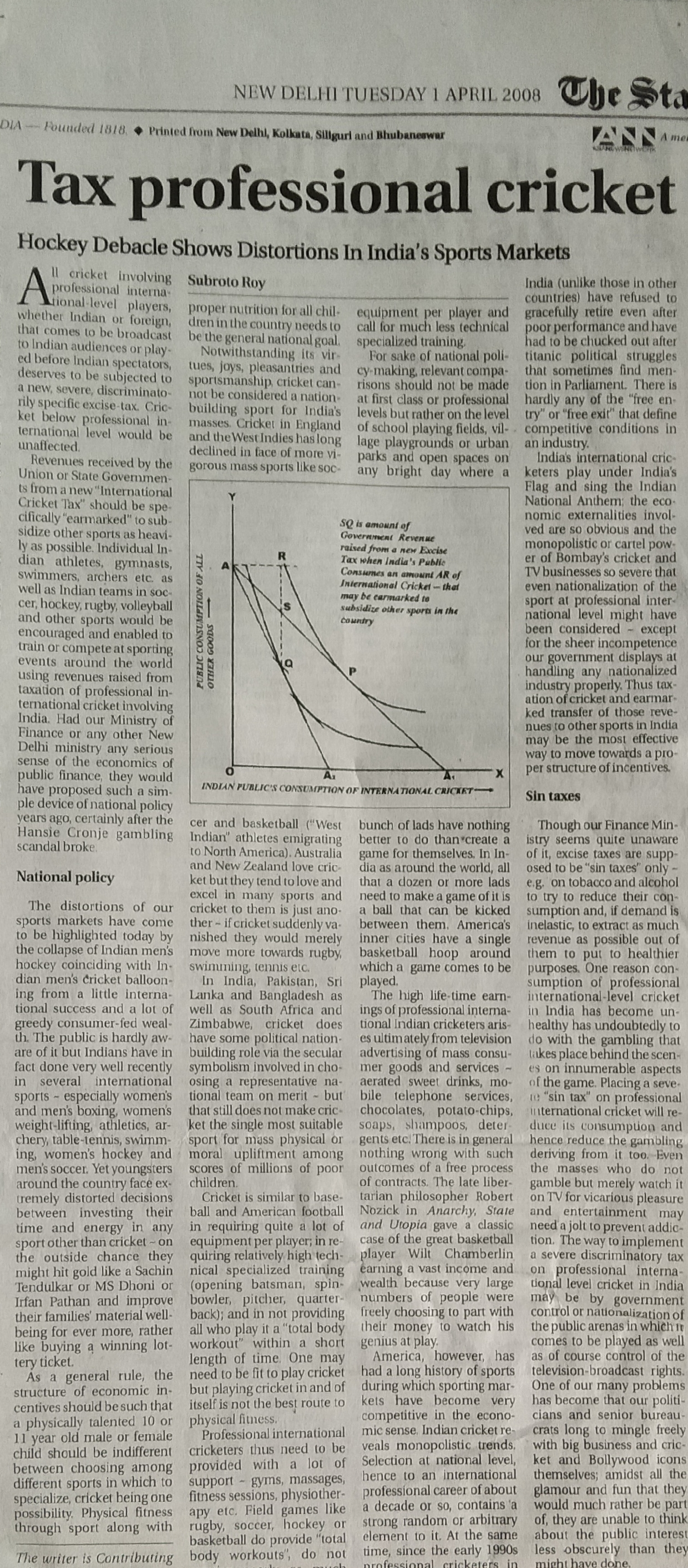
All cricket involving professional international-level players, whether Indian or foreign, that comes to be broadcast to Indian audiences or played before Indian spectators, deserves to be subjected to a new, severe, discriminatingly specific excise-tax. Cricket below professional international level would be unaffected. Revenues received by the Union or State Governments from a new “International Cricket Tax” should be specifically “earmarked” to subsidize other sports as heavily as possible. Individual Indian athletes, gymnasts, swimmers, archers etc. as well as Indian teams in soccer, hockey, rugby, volleyball and other sports would be encouraged and enabled to train or compete at sporting events around the world using revenues raised from taxation of professional international cricket involving India. Had our Ministry of Finance or any other New Delhi ministry any serious sense of the economics of public finance, they would have proposed such a simple device of national policy years ago, certainly after the Hansie Cronje gambling scandal broke.
National policy
The distortions of our sports markets have come to be highlighted today by the collapse of Indian men’s hockey coinciding with Indian men’s cricket ballooning from a little international success and a lot of greedy consumer-fed wealth. The public is hardly aware of it but Indians have in fact done very well recently in several international sports ~ especially women’s and men’s boxing, women’s weight-lifting, athletics, archery, table-tennis, swimming, women’s hockey and men’s soccer. Yet youngsters around the country face extremely distorted decisions between investing their time and energy in any sport other than cricket ~ on the outside chance they might hit gold like a Sachin Tendulkar or MS Dhoni or Irfan Pathan and improve their families’ material well-being for ever more, rather like buying a winning lottery ticket. As a general rule, the structure of economic incentives should be such that a physically talented 10 or 11 year old male or female child should be indifferent between choosing among different sports in which to specialize, cricket being one possibility. Physical fitness through sport along with proper nutrition for all children in the country needs to be the general national goal.
Notwithstanding its virtues, joys, pleasantries and sportsmanship, cricket cannot be considered a nation-building sport for India’s masses. Cricket in England and the West Indies has long declined in face of more vigorous mass sports like soccer and basketball (“West Indian” athletes emigrating to North America). Australia and New Zealand love cricket but they tend to love and excel in many sports and cricket to them is just another ~ if cricket suddenly vanished they would merely move more towards rugby, swimming, tennis etc.
In India, Pakistan, Sri Lanka and Bangladesh as well as South Africa and Zimbabwe, cricket does have some political nation-building role via the secular symbolism involved in choosing a representative national team on merit ~ but that still does not make cricket the single most suitable sport for mass physical or moral upliftment among scores of millions of poor children.
Cricket is similar to baseball and American football in requiring quite a lot of equipment per player; in requiring relatively high technical specialized training (opening batsman, spin-bowler, pitcher, quarter-back); and in not providing all who play it a “total body workout” within a short length of time. One may need to be fit to play cricket but playing cricket in and of itself is not the best route to physical fitness.
Professional international cricketers thus need to be provided with a lot of support ~ gyms, massages, fitness sessions, physiotherapy etc. Field games like rugby, soccer, hockey or basketball do provide “total body workouts”, do not require nearly as much equipment per player and call for much less technical specialized training.
For sake of national policy-making, relevant comparisons should not be made at first class or professional levels but rather on the level of school playing fields, village playgrounds or urban parks and open spaces on any bright day where a bunch of lads have nothing better to do than create a game for themselves. In India as around the world, all that a dozen or more lads need to make a game of it is a ball that can be kicked between them. America’s inner cities have a single basketball hoop around which a game comes to be played.
The high life-time earnings of professional international Indian cricketers arises ultimately from television advertising of mass consumer goods and services ~ aerated sweet drinks, mobile telephone services, chocolates, potato-chips, soaps, shampoos, detergents etc. There is in general nothing wrong with such outcomes of a free process of contracts. The late libertarian philosopher Robert Nozick in Anarchy, State and Utopia gave a classic case of the great basketball player Wilt Chamberlin earning a vast income and wealth because very large numbers of people were freely choosing to part with their money to watch his genius at play.
America, however, has had a long history of sports during which sporting markets have become very competitive in the economic sense. Indian cricket reveals monopolistic trends. Selection at national level, hence to an international professional career of about a decade or so, contains a strong random or arbitrary element to it. At the same time, since the early 1990s professional cricketers in India (unlike those in other countries) have refused to gracefully retire even after poor performance and have had to be chucked out after titanic political struggles that sometimes find mention in Parliament. There is hardly any of the “free entry” or “free exit” that define competitive conditions in an industry.
India’s international cricketers play under India’s Flag and sing the Indian National Anthem; the economic externalities involved are so obvious and the monopolistic or cartel power of Bombay’s cricket and TV businesses so severe that even nationalization of the sport at professional international level might have been considered ~ except for the sheer incompetence our government displays at handling any nationalized industry properly. Thus taxation of cricket and earmarked transfer of those revenues to other sports in India may be the most effective way to move towards a proper structure of incentives.
Sin taxes
Though our Finance Ministry seems quite unaware of it, excise taxes are supposed to be “sin taxes” only ~ e.g. on tobacco and alcohol to try to reduce their consumption and, if demand is inelastic, to extract as much revenue as possible out of them to put to healthier purposes. One reason consumption of professional international-level cricket in India has become unhealthy has undoubtedly to do with the gambling that takes place behind the scenes on innumerable aspects of the game. Placing a severe “sin tax” on professional international cricket will reduce its consumption and hence reduce the gambling deriving from it too. Even the masses who do not gamble but merely watch it on TV for vicarious pleasure and entertainment may need a jolt to prevent addiction. The way to implement a severe discriminatory tax on professional international level cricket in India may be by government control or nationalization of the public arenas in which it comes to be played as well as of course control of the television-broadcast rights. One of our many problems has become that our politicians and senior bureaucrats long to mingle freely with big business and cricket and Bollywood icons themselves; amidst all the glamour and fun that they would much rather be part of, they are unable to think about the public interest less obscurely than they might have done.
Map of Chinese Empire c. 1900
March 25, 2008 — drsubrotoroyThis map accompanied my article “China’s India Example” published in The Statesman on March 25 2008. The map is dated c. 1900 and shows the Chinese Empire of China Proper, East Turkestan (Sinkiang, Xinjiang), Tibet, Manchuria and Mongolia (later Inner Mongolia and Outer Mongolia).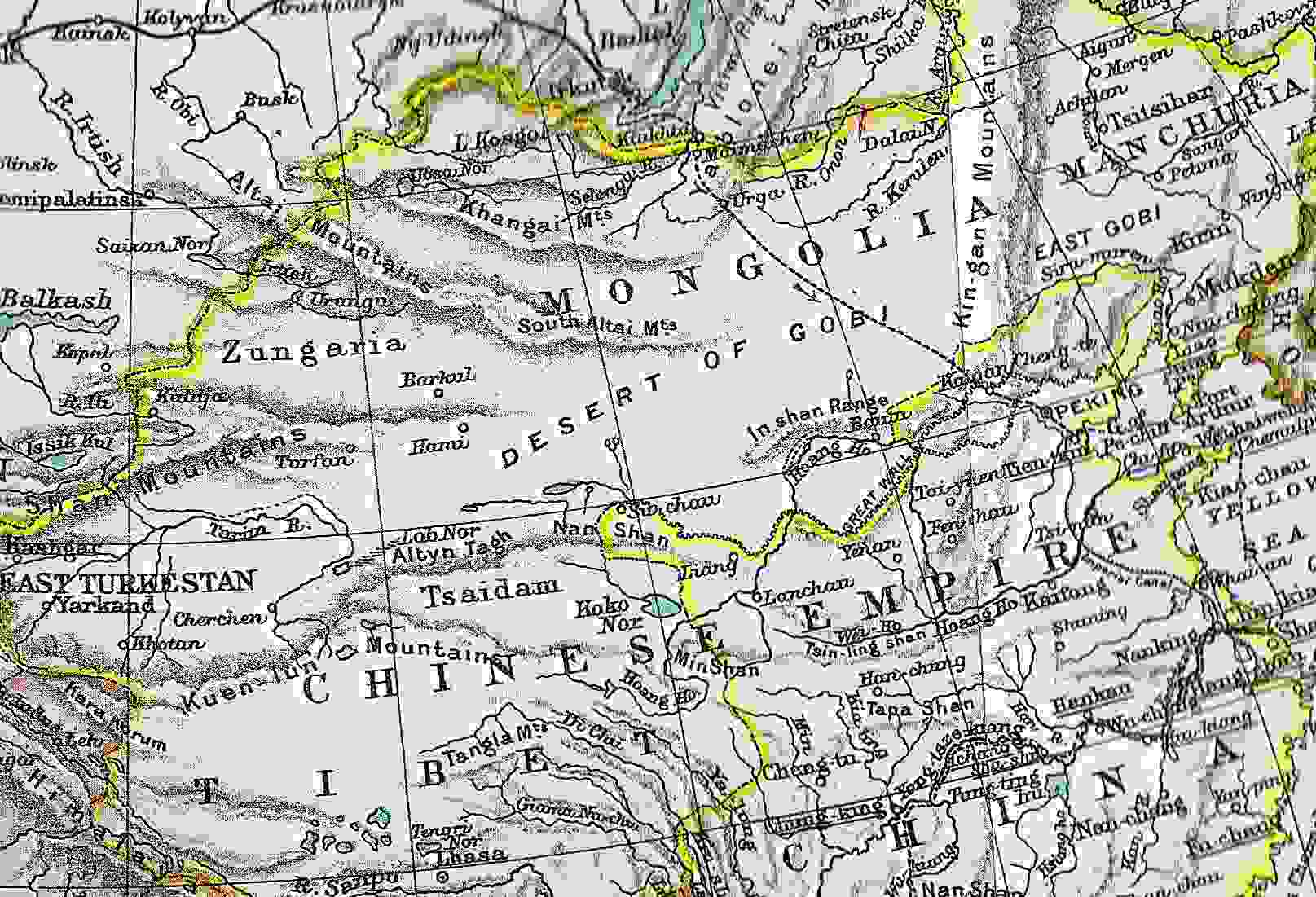
China’s India Example: Tibet, Xinjiang May Not Be Assimilated Like Inner Mongolia, Manchuria (2008)
March 25, 2008 — drsubrotoroyNote: My articles on related subjects recently published in The Statesman include “Understanding China”, “China’s India Aggression”, “China’s Commonwealth”, “Nixon & Mao vs India”, “Lessons from the 1962 War”, “China’s force & diplomacy” etc https://independentindian.com/2009/09/19/my-ten-articles-on-china-tibet-xinjiang-taiwan-in-relation-to-india/
China’s India Example: Tibet, Xinjiang May Not Be Assimilated Like Inner Mongolia And Manchuria
by
Subroto Roy
First published in The Statesman, Editorial Page Special Article March 25, 2008

Zhang Qingli, Tibet’s current Communist Party boss, reportedly said last year, “The Communist Party is like the parent (father and mother) of the Tibetans. The Party is the real boddhisatva of the Tibetans.” Before communism, China’s people followed three non-theistic religious cultures, Buddhism, Confucianism and Taoism, choosing whichever aspects of each they wished to see in their daily lives. Animosity towards the theism of Muslims and Christians predates the 1911 revolution. Count Witte, Russia’s top diplomatist in Czarist times, reported the wild contempt towards Islam and wholly unprovoked insult of the Emir of Bokhara by Li Hung Chang, Imperial China’s eminent Ambassador to Moscow, normally the epitome of civility and wisdom. In 1900 the slogan of the Boxer Revolts was “Protect the country, destroy the foreigner” and catholic churches and European settlers and priests were specifically targeted. The Communists have not discriminated in repression of religious belief and practice ~ monasteries, mosques, churches have all experienced desecration; monks, ulema, clergymen all expected to subserve the Party and the State.
Chinese nationalism
For Chinese officials to speak of “life and death” struggle against the Dalai Lama sitting in Dharamsala is astounding; if they are serious, it signals a deep long-term insecurity felt in Beijing. How can enormous, wealthy, strong China feel any existential threat at all from unarmed poor Tibetans riding on ponies? Is an Israeli tank-commander intimidated by stone-throwing Palestinian boys? How is it China (even a China where the Party assumes it always knows best), is psychologically defensive and unsure of itself at every turn?
The Chinese in their long history have not been a violent martial people ~ disorganized and apolitical traders and agriculturists and highly civilised artisans and scholars more than fierce warriors fighting from horseback. Like Hindus, they were far more numerous than their more aggressive warlike invading rulers. Before the 20th Century, China was dominated by Manchu Tartars and Mongol Tartars from the Northeast and Northwest ~ the Manchus forcing humiliation upon Chinese men by compelling shaved heads with pigtails. Similar Tartar hordes ruled Russia for centuries and Stalin himself, according to his biographer, might have felt Russia buffered Europe from the Tartars.
Chinese nationalism arose only in the 20th Century, first under the Christian influence of Sun Yatsen and his brother-in-law Chiang Kaishek, later under the atheism of Mao Zedong and his admiring friends, most recently Deng Xiaoping and successors. “Socialism with Chinese characteristics” is the slogan of the present Communist Party but a more realistic slogan of what Mao and friends came to represent in their last decades may be “Chinese nationalism with socialist characteristics”. Taiwan and to lesser extent Singapore and Hong Kong represent “Chinese nationalism with capitalist characteristics”. Western observers, keen always to know the safety of their Chinese investments, have focused on China’s economics, whether the regime is capitalist or socialist and to what extent ~ Indians and other Asians may be keener to identify, and indeed help the Chinese themselves to identify better, the evolving nature of Chinese nationalism and the healthy or unhealthy courses this may now take.
Just as Czarist and Soviet Russia attempted Russification in Finland, the Baltics, Poland, Ukraine etc., Imperial and Maoist China attempted “Sinification” in Manchuria and Inner Mongolia as well as Tibet and Xinjiang (Sinkiang, East Turkestan). Russification succeeded partially but backfired in general. Similarly, Sinification succeeded naturally in Manchuria and without much difficulty in Inner Mongolia. But it has backfired and backfired very badly in Tibet and Xinjiang, and may be expected to do so always.
In India, our soft state and indolent corrupt apparatus of political parties constitute nothing like the organized aggressive war-machine that China has tried to make of its state apparatus, and we have much more freedom of all sorts. India does not prohibit or control peasant farmers or agricultural labourers from migrating to or visiting large metropolitan cities; villagers are as free as anyone else to clog up all city life in India with the occasional political rally ~ in fact India probably may not even know how to ban, suppress or repress most of the things Communist China does.
Hindu traditions were such that as long as you did not preach sedition against the king, you could believe anything ~ including saying, like the Carvaka, that hedonism and materialism were good, spiritualism was bunkum and the priestly class were a bunch of crooks and idiots. Muslim and British rulers in India were not too different ~ yes the Muslims did convert millions by offering the old choice of death or conversion to vanquished people, and there were evil rulers among them but also great and tolerant ones like Zainulabidin of Kashmir and Akbar who followed his example.
India’s basic political ethos has remained that unless you preach sedition, you can basically say or believe anything (no matter how irrational) and also pretty much do whatever you please without being bothered too much by government officials. Pakistan’s attempts to impose Urdu on Bengali-speakers led to civil war and secession; North India’s attempts to impose Hindi on the South led to some language riots and then the three-language formula ~ Hindi spreading across India through Bollywood movies instead.
China proudly says it is not as if there are no declared non-Communists living freely in Beijing, Shanghai etc, pointing out distinguished individual academics and other professionals including government ministers who are liberals, social democrats or even Kuomintang Nationalists. There are tiny state-approved non-Communist political parties in China, some of whose members even may be in positions of influence. It is just that such (token) parties must accept the monopoly and dictatorship of the Communists and are not entitled to take state power. The only religion you are freely allowed to indulge in is the ideology of the State, as that comes to be defined or mis-defined at any time by the Communist Party’s rather sclerotic leadership processes.
Chinese passports
During China’s Civil War, the Communists apparently had promised Tibet and Xinjiang a federation of republics ~ Mao later reneged on this and introduced his notion of “autonomous” regions, provinces and districts. The current crisis in Tibet reveals that the notion of autonomy has been a complete farce. Instead of condemning the Dalai Lama and repressing his followers, a modern self-confident China can so easily resolve matters by allowing a Dalai Lama political party to function freely and responsibly, first perhaps just for Lhasa’s municipal elections and gradually in all of Tibet. Such a party and the Tibet Communist Party would be adequate for a two-party system to arise. The Dalai Lama and other Tibetan exiles also have a natural right to be issued Chinese passports enabling them to return to Tibet~ and their right to return is surely as strong as that of any Han or Hui who have been induced to migrate to Tibet from Mainland China. Such could be the very simple model of genuine autonomy for Tibet and Xinjiang whose native people clearly do not wish to be assimilated in the same way as Inner Mongolia and Manchuria. India’s federal examples, including the three-language formula, may be helpful. Once Mainland China successfully allows genuine autonomy and free societies to arise in Tibet and Xinjiang, the road to reconciliation with Taiwan would also have been opened.
American Politics: Obama-Clinton Contest Affects the World
March 11, 2008 — drsubrotoroyAmerican Politics
Contest Between Obama And Clinton Affects The World
by Subroto Roy
First published in The Statesman, Editorial Page Special Article, March 11 2008

In 1968, at the height of the Vietnam War and protests about it, the Democratic Party Convention in Chicago was marked by bloodshed and rioting. The sitting (Democrat) President, Lyndon Johnson, had taken moral responsibility for the war and declined to run for re-election. His widely-respected Vice-President, Hubert Humphrey, was chosen in traditional “smoke-filled rooms” by party elders during the Convention. But the public had witnessed the Convention’s violence, and Humphrey lost to Richard Nixon. In the next election in 1972, Democrats banned party elders from any role and allowed the nominee to emerge solely from state-by-state primary elections. The result was the anti-war candidate George McGovern, who lost 49 out of 50 States to the incumbent Nixon.
Denver Convention
This year’s Democratic Party Convention in Denver in August may be the first to return to “smoke-filled rooms” (figuratively of course, given the absence of public smoking in modern America especially among “politically correct” Democrats). Almost 800 party elders, consisting of senators, congressional representatives, party functionaries etc, known as “superdelegates” may have to break the near dead heat tie among “primary delegates” who have committed to Hillary Clinton or Barack Obama after state-by-state elections.
It was not supposed to have been like this. A year ago Mrs Clinton had seemed an unstoppable favourite not only in the Democratic race but the overall Presidential race too, so much so that the incumbent Bush-Cheney Administration was dropping hints it would not mind seeing a new Clinton Administration taking over its foreign wars. (Mrs Clinton’s husband had become a friend of former President GHW Bush, President Bush’s father, in some relatively rare American nepotism at the top.)
Mrs Clinton had been so confident of being confirmed by now she spent her energy trying to show herself one of the boys, who could be Commander-in-Chief of the world’s largest military and who had voted in favour of Bush’s Iraq war. The idea seemed to be she would show herself just as tough as the Republicans and yet because she was female she would win in November 2008 by reminding women of her gender. Her support among middle-aged white women has remained solid and seems unshakeable but her strategy of being the presumptive anointed “pseudo-incumbent” has failed.
Mr Obama, attracting younger better-educated Democrats as well as the crucial set of cross-party independents and floating Republicans, besides African-Americans like himself, has taken ground Mrs Clinton left undefended; she has been painted by him as Republican-Lite, the archetypal Washington-insider, and a war-monger. Mrs Clinton has indeed recorded the largest contributions of any candidate from America’s “military industrial complex” of weapons’ manufacturers.
Mr Obama went into the recent Ohio and Texas primaries having narrowed large leads against him, and though he lost both has retained a lead in the delegate count. Last weekend he won Wyoming and is likely to win Mississippi — states normally remote in the political landscape but which have acquired significance to “momentum” now. It is expected that even after the major state Pennsylvania votes next month (likely in favour of Mrs Clinton) the contest will not end. A joint ticket could become unstoppable and has been hinted at by the Clintons. But Mr Obama has no reason to be an understudy because if he is not himself the Presidential candidate, it may be better to wait for the 2012 contest than be brushed by the Clinton negatives.
Republicans have surprisingly quickly agreed upon Arizona’s elderly senator John McCain as their candidate out of a raucous field. The single anti-war Republican candidate, Ron Paul, fizzled out. Mr McCain, like his main rivals Rudy Giuliani, Mitt Romney and Mike Huckabee, has been overtly jingoistic, strongly backed the Bush wars and has identified “radical Islamic extremism” as an American enemy. Mr McCain was a POW of the North Vietnamese decades ago and underwent torture, something he has not let anyone forget. His remark that America under him may fight “100 years” in Middle East wars, as well as President Bush’s endorsement of him, may put off a country that has been turning against war and is increasingly anxious about macroeconomics and international trade again.
Mr McCain may have to wait to see who emerges from among the Democrats before he announces his Vice-Presidential running-mate. Usual “ticket-balancing” considerations point to a young conservative or a senior woman or black political figure for obvious reasons.
Thus the Democratic Party leadership now unexpectedly finds itself in a crucial role in the next weeks and months. A raucous divisive Convention in August on the 1968 pattern will leave the Republicans gloating. Current controversy has to do with Michigan and Florida; both held unauthorized primaries ahead of time and were punished by the leadership in not being recognized. Mrs Clinton and Mr Obama both agreed not to campaign there. Will Michigan and Florida “delegates” be recognized and “seated” in Denver? Should they be split equally between the two candidates? Should there be a “do-over” primary via the mail in each now that the race has become heated, and if so, who will pay for it?
The crucial question for the Democratic Party is to decide who may defeat Mr McCain. Mr Obama’s youth, race and Muslim middle name Hussein, will undoubtedly be used by the Republicans to attack him. Mrs Clinton carries a lot of baggage from her husband’s time: there was an unpleasant air of sleaze and mendacity during the entire eight years of Bill’s rule in Washington DC and voters will be wary to allow a re-run of the same. (The 22nd Constitutional Amendment forbids more than eight years for any President, and the idea is novel and untested that a First Lady can run on her own to get around that.)
Israel policy
Mrs Clinton’s foreign and military policy will be quite close to Mr McCain’s in its aggressiveness. Mr Obama opposed the Iraq war and is certain to keep playing that trump-card against both. Mr Obama’s foreign policy “weakness” has to do with being perceived by the pro-Israeli lobby as not hardline enough. He has said clearly he is pro-Israel and strongly so and that he found Israel’s own debate “much more open” than the American one. Mrs Clinton and Mr McCain both pass the “Likud test” with flying colours; Mr Obama’s statement that being pro-Israel is not identical with being “pro-Likud” may mean he does not.
The Democratic Party will have to figure out in its decision between Mrs Clinton and Mr Obama where America’s voters in November 2008 are swinging on the issue of fighting aggressive wars. The other vital issue will be protectionism in international trade ~ some “superdelegates” have already started to demand pledges about trade-policies to “save American jobs”. The world will be affected by who wins between Mrs Clinton and Mr Obama along two important dimensions, viz., whether America will be more likely as a result to (a) launch new wars; (b) become more protectionist in trade.
Growth & Government Delusion (2008)
February 22, 2008 — drsubrotoroyGrowth & Government Delusion:
Progress Comes From Learning, Enterprise, Exchange, Not The Parasitic State
By Subroto Roy
First published in The Statesman, Editorial Page Special Article,
February 22, 2008
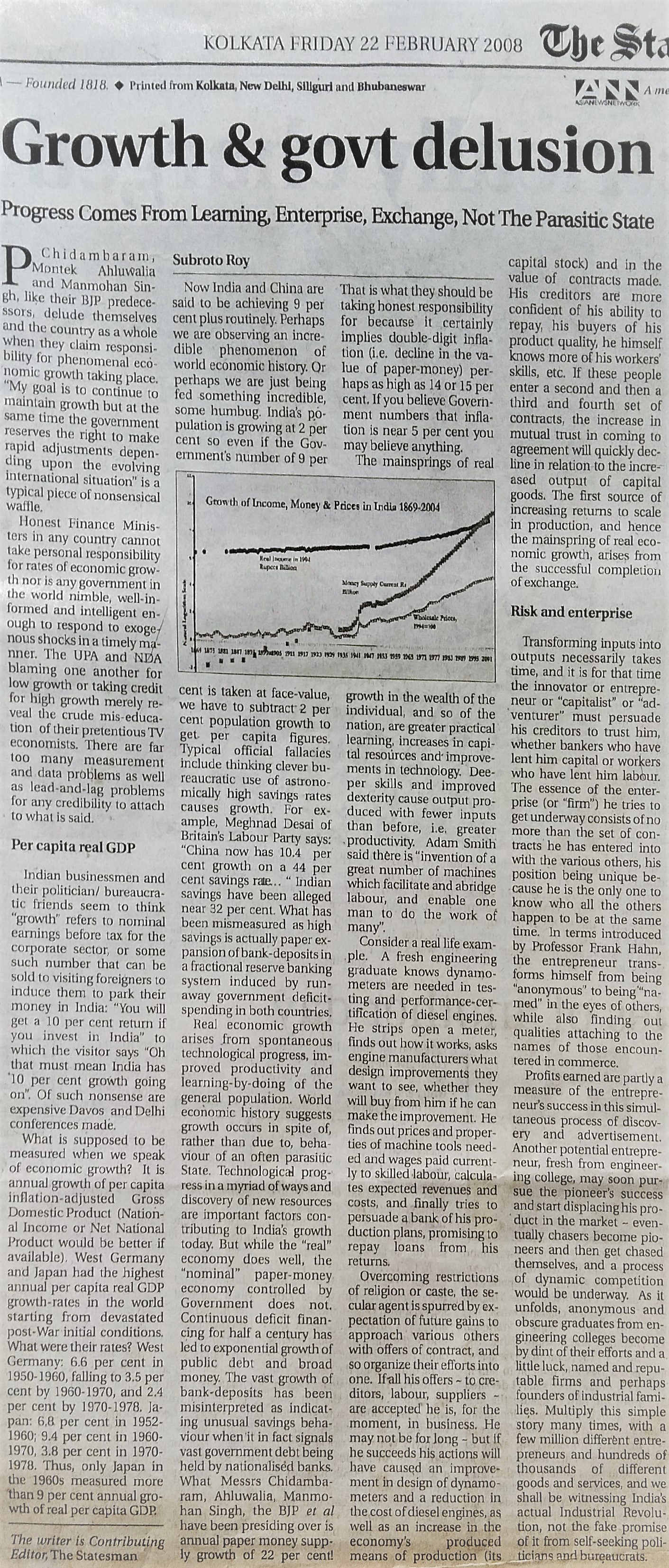
P Chidambaram, Montek Ahluwalia and Manmohan Singh, like their BJP predecessors, delude themselves and the country as a whole when they claim responsibility for phenomenal economic growth taking place. “My goal is to continue to maintain growth but at the same time the government reserves the right to make rapid adjustments depending upon the evolving international situation” is a typical piece of nonsensical waffle.
Honest Finance Ministers in any country cannot take personal responsibility for rates of economic growth nor is any government in the world nimble, well-informed and intelligent enough to respond to exogenous shocks in a timely manner. The UPA and NDA blaming one another for low growth or taking credit for high growth merely reveal the crude mis-education of their pretentious TV economists. There are far too many measurement and data problems as well as lead-and-lag problems for any credibility to attach to what is said.
Per capita real GDP
Indian businessmen and their politician/ bureaucratic friends seem to think “growth” refers to nominal earnings before tax for the corporate sector, or some such number that can be sold to visiting foreigners to induce them to park their money in India: “You will get a 10 per cent return if you invest in India” to which the visitor says “Oh that must mean India has 10 per cent growth going on”. Of such nonsense are expensive Davos and Delhi conferences made.
What is supposed to be measured when we speak of economic growth? It is annual growth of per capita inflation-adjusted Gross Domestic Product (National Income or Net National Product would be better if available). West Germany and Japan had the highest annual per capita real GDP growth-rates in the world starting from devastated post-War initial conditions. What were their rates? West Germany: 6.6 per cent in 1950-1960, falling to 3.5 per cent by 1960-1970, and 2.4 per cent by 1970-1978. Japan: 6.8 per cent in 1952-1960; 9.4 per cent in 1960-1970, 3.8 per cent in 1970-1978. Thus, only Japan in the 1960s measured more than 9 per cent annual growth of real per capita GDP.
Now India and China are said to be achieving 9 per cent plus routinely. Perhaps we are observing an incredible phenomenon of world economic history. Or perhaps we are just being fed something incredible, some humbug. India’s population is growing at 2 per cent so even if the Government’s number of 9 per cent is taken at face-value, we have to subtract 2 per cent population growth to get per capita figures. Typical official fallacies include thinking clever bureaucratic use of astronomically high savings rates causes growth. For example, Meghnad Desai of Britain’s Labour Party says: “China now has 10.4 per cent growth on a 44 per cent savings rate… ” Indian savings have been alleged near 32 per cent. What has been mismeasured as high savings is actually paper expansion of bank-deposits in a fractional reserve banking system induced by runaway government deficit-spending in both countries.
Real economic growth arises from spontaneous technological progress, improved productivity and learning-by-doing of the general population. World economic history suggests growth occurs in spite of, rather than due to, behaviour of an often parasitic State. Technological progress in a myriad of ways and discovery of new resources are important factors contributing to India’s growth today. But while the “real” economy does well, the “nominal” paper-money economy controlled by Government does not.
Continuous deficit financing for half a century has led to exponential growth of public debt and broad money. The vast growth of bank-deposits has been misinterpreted as indicating unusual savings behaviour when it in fact signals vast government debt being held by nationalised banks. What Messrs Chidambaram, Ahluwalia,Manmohan Singh, the BJP et al have been presiding over is annual paper-money supply growth of 22 per cent! That is what they should be taking honest responsibility for because it certainly implies double-digit inflation (i.e. decline in the value of paper-money) perhaps as high as 14 or 15 per cent. If you believe Government numbers that inflationis near 5 per cent you may believe anything.
The mainsprings of real growth in the wealth of the individual, and so of the nation, are greater practical learning, increases in capital resources and improvements in technology. Deeper skills and improved dexterity cause output produced with fewer inputs than before, i.e. greater productivity. Adam Smith said there is “invention of a great number of machines which facilitate and abridge labour, and enable one man to do the work of many”.
Consider a real life example. A fresh engineering graduate knows dynamometers are needed in testing and performance-certification of diesel engines. He strips open a meter, finds out how it works, asks engine manufacturers what design improvements they want to see, whether they will buy from him if he can make the improvement. He finds out prices and properties of machine tools needed and wages paid currently to skilled labour, calculates expected revenues and costs, and finally tries to persuade a bank of his production plans, promising to repay loans from his returns.
Overcoming restrictions of religion or caste, the secular agent is spurred by expectation of future gains to approach various others with offers of contract, and so organize their efforts into one. If all his offers ~ to creditors, labour, suppliers ~ are accepted he is, for the moment, in business. He may not be for long ~ but if he succeeds his actions will have caused an improvement in design of dynamometers and a reduction in the cost of diesel engines, as well as an increase in the economy’s produced means of production (its capital stock) and in the value of contracts made. His creditors are more confident of his ability to repay, his buyers of his product quality, he himself knows more of his workers’ skills, etc. If these people enter a second and then a third and fourth set of contracts, the increase in mutual trust in coming to agreement will quickly decline in relation to the increased output of capital goods. The first source of increasing returns to scale in production, and hence the mainspring of real economic growth, arises from the successful completion of exchange.
Risk and enterprise
Transforming inputs into outputs necessarily takes time, and it is for that time the innovator or entrepreneur or “capitalist” or “adventurer” must persuade his creditors to trust him, whether bankers who have lent him capital or workers who have lent him labour. The essence of the enterprise (or “firm”) he tries to get underway consists of no more than the set of contracts he has entered into with the various others, his position being unique because he is the only one to know who all the others happen to be at the same time. In terms introduced by Professor Frank Hahn, the entrepreneur transforms himself from being “anonymous” to being “named” in the eyes of others, while also finding out qualities attaching to the names of those encountered in commerce.
Profits earned are partly a measure of the entrepreneur’s success in this simultaneous process of discovery and advertisement. Another potential entrepreneur, fresh from engineering college, may soon pursue the pioneer’s success and start displacing his product in the market ~ eventually chasers become pioneers and then get chased themselves, and a process of dynamic competition would be underway. As it unfolds, anonymous and obscure graduates from engineering colleges become by dint of their efforts and a little luck, named and reputable firms and perhaps founders of industrial families. Multiply this simple story many times, with a few million different entrepreneurs and hundreds of thousands of different goods and services, and we shall be witnessing India’s actual Industrial Revolution, not the fake promise of it from self-seeking politicians and bureaucrats.
see also 12 June 2009
A Note on the Indian Policy Process
February 21, 2008 — drsubrotoroyA Note on the Indian Policy Process
Subroto Roy
During the University of Hawaii perestroika-for-India project two decades ago, I had wished to attract Sukhamoy Chakravarty from Delhi. He very kindly met me on July 14 1987 and presented me his last personal signed copy of the famous RBI report his committee had chaired. He said he could not come to Hawaii because of ill health but he strongly recommended I take C. Rangarajan instead because, he said, Dr Rangarajan was the main author of the report. I met Dr Rangarajan in Kolkata at Jadavpur University where he was giving a speech in his role as President of the Indian Economic Society that year. Later in correspondence, he wrote to say he was over-committed but that if I took Amaresh Bagchi instead, he would help co-author Bagchi’s contribution to our project. So I commissioned Amaresh Bagchi, then Director of New Delhi’s National Institute of Public Finance and Policy.
In my next project-related visit to Delhi in December 1988, I met Amaresh Bagchi personally for the first time; he was about to retire or had already done so. He told me he knew my name from the fact the High Commission of India in London had sent the Finance Ministry in Delhi the May 29 1984 lead editorial of The Times of London on my work which had been very critical of Indian economic policy; Bagchi had been at the time in the Finance Ministry, and, as an old sarkari statist, had naturally taken exception to what I had said by way of liberal criticism. He wished to co-write his contribution for our Hawaii project with a young colleague of his; I declined permission for him to do that and told him our understanding was that Dr Rangarajan would be writing with him.
In any case, in May 1989, Amaresh was the first person to reach Honolulu in the team we had put together for the project, arriving early by several days. He was all alone and seemed miserable, so I took him to the supermarket and later invited him to dine with my small family at our home at Punahou Towers, 1621 Dole Street. It pleased him to eat some home-cooked Indian food, and he warmed slightly. He told me he had joined the Government as a bureaucrat in the income tax department and later acquired a doctoral degree in economics, though I did not get a sense that he was familiar with traditional public finance of the sort in Richard Musgrave’s classic textbook. I gifted him a copy of James Buchanan’s lectures that I had put together when Professor Buchanan had visited the University of Hawaii at my invitation in 1988 and which the University had then published with a preface by myself. He remarked he found it terrible that American supermarkets had all this canned pet food when the world was so hungry. Later I invited him to a larger dinner party again at my home before the conference began.
At the conference itself, I placed him next to Milton Friedman, which some said was a master-stroke. There was a long and somewhat heated interchange between him and TN Srinivasan, though not with Milton, as Milton was, as always, invariably polite, patient and clear-headed in argument for the two days that he stayed.
The chapter Amaresh Bagchi wrote for us in the book Foundations of India’s Political Economy, edited by myself and WE James, was useful as practically the only statement until that time on the fiscal-induced monetary weakness of India (that still continues today, indeed may have gotten worse since). It contributed to placing him in the policy-limelight in his post-retirement years. Dr Rangarajan was not a co-author after all but apparently contributed the most important paragraphs on the subject. (We have been trying for almost a year now to get the University of Hawaii to allow free republication of the book on the Internet; the original publisher, now dead, reneged on a promise to produce a paperback edition after there was leftist academic pressure on him in Delhi.)
I gave a copy of our book to Manmohan Singh when I met him and his senior aides in September 1993 in Washington at the Indian Ambassador’s Residence; I was introduced to Dr Singh by the then Ambassador of India SS Ray as the person on whose laptop computer the 1991 economic reform had been designed for Rajiv Gandhi during Rajiv’s last months, a statement accurate enough as has been told elsewhere. (Dr Singh had 20 years earlier kindly visited our then-home in Paris at 14 Rue Eugene Manuel at the invitation of my father who knew him, to advise me about economics just before I headed to the London School of Economics as an 18 year old freshman; but in 1993 both he and I had forgotten that earlier 1973 meeting.)
Today’s newspapers report Amaresh Bagchi’s passing and say that “When (Manmohan) Singh was finance minister in the early 1990s, Bagchi was one of his key advisers on fiscal policy”. Dr Singh has described Bagchi as “one of our most distinguished fiscal policy experts” and said “It is no exaggeration to state that Amaresh has been associated with almost every major fiscal policy reform in the past 30 years”.
I am afraid I disagree with the Prime Minister of India in that I do not see any “major fiscal policy reform” having taken place at all in India, just a lot of unsystematic tinkering here and there. The root cause has been the failure to face or want to comprehend the extremely dismal state of government and public sector accounts throughout the country. Without proper government accounting, there can be neither accountability nor any serious fiscal policy, and hence no serious monetary or macroeconomic policy either.
China’s Secretly Built 1957 Road Through India’s Aksai Chin
February 21, 2008 — drsubrotoroyThis map accompanied my article Lessons from the 1962 War published in The Sunday Statesman of January 13 2008:
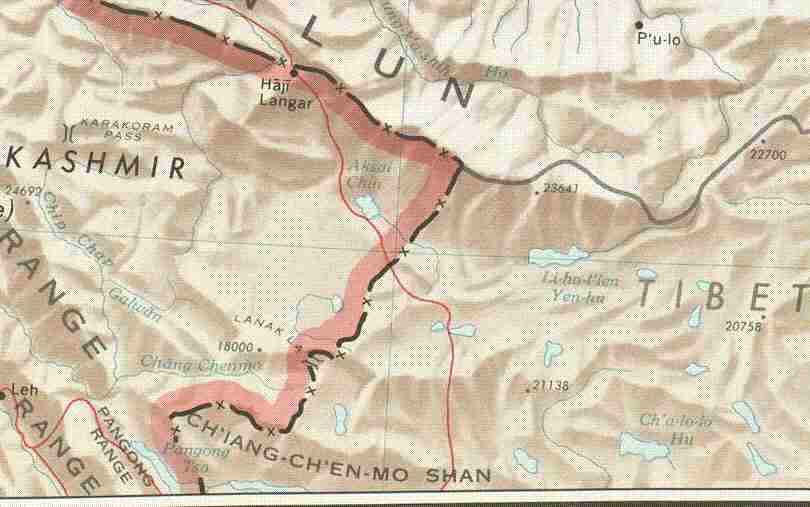
Pakistan’s Kashmir obsession
February 16, 2008 — drsubrotoroy(Author’s Note: This article was preceded by several others e.g. “Saving Pakistan”, “Understanding Pakistan”, “Pakistan’s Allies”, “Law, Justice & J&K”, “Solving Kashmir” , and has been followed by “Two Cheers for Pakistan”.)
Pakistan’s Kashmir obsession
Sheikh Abdullah Relied In Politics On The French Constitution, Not Islam
Subroto Roy
First published in The Statesman, Feb 16 2008, Editorial Page Special Article
Indians would be naïve to suppose Pervez Musharraf has at any point shown friendliness towards India or willingness to come to a genuine permanent agreement over J&K fully consistent with law and justice. Musharraf tells everyone and himself every day that he is a soldier, and it is well to remember he is from the last generation of Pakistan military men motivated by visceral hatred of the Indian Union and a wish to inflict any kind of defeat upon us. Pakistan’s new Army Chief, General Ashfaq Kayani, being a decade younger than Musharraf, may have a less irrational, less belligerent outlook towards India, and it would be a wise Indian move to invite him officially to visit and receive the normal courtesies and honours due to a foreign military chief.
Musharraf, like Ariel Sharon, was visibly uncomfortable with the Hindu rituals we compel foreign leaders to carry out at Mahatma Gandhi’s Memorial; but General Kayani would visit purely as a military chief and not have to make any political gestures.
Lion of Kashmir
As long as Musharraf remains in power, we may expect him to continue to be motivated by his overtly anti-Indian 12 January 2002 speech. Yes, he said, Pakistan would cooperate against terrorism but it expected the USA to reciprocate by pressuring India on Jammu & Kashmir. “Kashmir runs in our blood. No Pakistani can afford to sever links with Kashmir… We will continue to extend our moral, political and diplomatic support to Kashmiris. We will never budge from our principle (sic) stand on Kashmir. Kashmir has to be resolved through dialogue in accordance with the wishes of the people of Pakistan (sic) and in accordance with the UN resolutions.” (BBC 12 January, 2002, Musharraf speech highlights). Pakistan’s first Prime Minister, Liaquat Ali Khan, during his 1950 visit to the USA had claimed “culturally… Kashmir ~ 80 per cent of whose people like the majority of the people in Pakistan are Muslims ~ is in fact an integral part of Pakistan”.
Now, as a matter of fact, Kashmir does not “run in the blood” of Pakistanis nor do the many diverse and ancient cultures of Jammu & Kashmir have much to do with that of a relatively newly created country like Pakistan. It was because Sheikh Mohammad Abdullah knew this and bluntly said so often enough, including at the UN, that Liaquat called him a “Quisling” and the Pakistan Government routinely defamed him as an “Indian stooge”. Yet the Sheikh was known by all in Srinagar Valley as the “Lion of Kashmir”, and had been the acknowledged voice of Muslim political awakening in the Valley ever since 1931.
J&K’s democracy today is the principal political legacy of Sheikh Abdullah. The Pakistan Government to this day denies legitimacy to the elected Government and Opposition of Indian J&K despite there never having been in the history of Pakistan a change of government more democratic in nature than that which occurred in J&K in 2002, bringing in the PDP-Congress Government in place of the National Conference.
Before Pakistan had started its series of military coups, Abdullah had led J&K to adopt an exemplary Constitution and ratify the State’s joining of the new Indian Union. The unbridgeable gulf between Abdullah and the Pakistan Government arose because Abdullah, a Koran scholar and devout Muslim known to intersperse his political speeches with Koranic wisdom, relied for J&K’s constitutional principles not on Islam but rather on the French Constitution. Pakistan’s constitutions by contrast say Pakistan’s sovereignty belongs to Almighty God, leading to perennial confusion over the mundane business of governance here on Planet Earth.
It was the tragic depraved Rahmat Ali, driven by his deep personal anti-Hindu bigotry, who put the “K” into “P, A, K, I, S, T, A, N” purportedly representing “Kashmir”. In his crank view of history, all of Punjab, Afghanistan, Iran, “Tukharistan” (sic) and more would be part of Pakistan too.
The new country might have been better named after a person (as are Colombia, America, Israel), viz., “Iqbalistan” after Mohammad Iqbal who conceived it. It was Iqbal’s seminal 1930 speech to the Muslim League at Allahabad that described the areas (aside from Indian Punjab) that actually constitute post-1971 Pakistan: “I would like to see the Punjab, Northwest Frontier Province, Sind and Baluchistan amalgamated into a single state. Self-government within the British Empire or without the British Empire, the formation of a consolidated North West Indian Muslim state appears to me to be the final destiny of the Muslims at least of Northwest India”. “Dar-e-Islami-Hind”, “Indus Islamic Republic”, “Indic Islamabad” or “Republic of North-Western India” also may have been alternatives to the random acronym Rahmat Ali coined in 1933 on a London bus.
Though Kashmiri himself, Iqbal made no reference to J&K or any of the so-called “princely states” (nor to what became East Pakistan). The legal theory later sold by Britain to both India and Pakistan was that a “Lapse of Paramountcy” over “princely states” would occur on 15 August 1947 before or after which their rulers must “accede” to one or other new Dominion of Britain’s Commonwealth. BR Ambedkar in a brilliant analysis showed this to be erroneous in law: “paramountcy” over any “princely states” which had not acceded passed automatically to the legal successor state of British India, and that was the Dominion of India.
The Dominion of Pakistan was a new state in international law, created out of certain designated territories of British India the day before British India extinguished itself. If, for example, Chitral or Junagadh acceded to Pakistan after that date, it would have to be with the acquiescence of British India’s legal successor, namely, the Dominion of India ~ an acquiescence granted in case of Chitral and denied in case of Junagadh. In case of J&K, all such matters became moot once hostilities broke out between India and Pakistan following the tribal invasion of J&K from Pakistan that commenced October 22 1947; Pakistan’s plan to take over Gilgit by force had been made months before that. The erstwhile State of J&K descended into civil war and chaos, becoming an ownerless entity whose territories came to be carved up by force of arms by both new countries (and in case of uninhabited Aksai Chin, by Communist China also some years later).
Bloated military
Pakistan’s failure to properly develop as a state today ~ in particular allowing its military to bloat in size relative to other social and political institutions and even to possess nuclear weapons intended against the Indian Union ~ has resulted out of the neurotic obsession with Kashmir. India owes a democratic responsibility to residents of the Indian State of J&K to choose their nationality freely under conditions of full information and individual privacy; if some, like Syed Geelani, choose to renounce Indian nationality and either remain stateless or seek the nationality of Pakistan, Iran or Afghanistan, they may still receive permanent residence in India and be legally akin to the many foreign nationals who live and work in India permanently and peacefully. That may be as much as India can realistically contribute to helping the Pakistan Government resolve its neurosis over Kashmir.
Pakistan’s military naturally possesses a fierce loyalty to Pakistan ~ the best way for that loyalty to be implemented in practice may be for General Kayani to allow the country’s public institutions to gradually normalize in size and function. Once Musharraf’s rule comes to an end or a legislature under new clear-headed leaders comes to exist some day, the military may be able to recognise that.
Anarchy in Bengal
February 10, 2008 — drsubrotoroyAnarchy in Bengal
Intra-Left bandh marks the final unravelling of “Brand Buddha”
First published in The Sunday Statesman, 10 February 2008, Editorial Page Special Article http://www.thestatesman.net
by
SUBROTO ROY
Once upon a time, not very long ago, there was something called “Brand Buddha”. The basic idea was that the CPI-M had quietly reformed itself, passing the baton from old unreconstructed communists like Jyoti Basu and Harkishan Surjeet to a new generation of pragmatists and modernists represented by Prakash Karat’s JNU coterie at the national level and the smartly dressed bhadralok persona of Buddhadeb Bhattacharjee in Kolkata itself.
Big businessmen and their foreign collaborators were no longer the “comprador bourgeoisie” but rather were allies to whom government subsidies and concessions, especially land, would be and should be granted. The “investment climate” and “work culture” under a CPI-M government would be among the best in India. High employment levels would be the hoped-for result, especially employment for those associated positively with the CPI-M and its friends. The usual set of academics, journalists, film and TV actors, dancers, sportsmen, singers, NRIs etc who were directly or indirectly recipients of the largesse of the West Bengal Government helped to contribute to the idea that a viable political brand had been identified and it represented the unique way forward for the State. “You are either with us or against us” has always been the brief philosophy of communist and fascist parties around the world ~ joining up with Brand Buddha meant you were part of the bandwagon of progress, if you did not join up you would be left behind. (No one thought Brand Buddha could be or would come to be actively opposed.)
At the national level, the old Indira Gandhi-Communist alliance was restored by way of a new one led by Sonia Gandhi. Jyoti Basu had frankly described Sonia as “a housewife” but now that the housewife was running the country and needed the Communists’ help in doing so, the opportunity was not to be missed to extract whatever price was possible. The main broker between 10 Janpath and West Bengal’s Communists was Pranab Mukherjee who was most familiar with the old Indira-style of opportunistic Indian politics, and who was given the mandate of appeasing the Communists with whatever they needed while also being the pointman to make a phone call to his friend Buddhadeb to see to it, e.g., that the CPI-M like everyone else enjoyed the American and Indian air force show at Kalaikunda.
The “enemy” (for, after all, every unholy alliance must have an identifiable enemy) was the wicked old BJP. Everyone from Sonia Gandhi via Pranab Mukherjee to Jyoti Basu would voice the fear that if they did not join hands in socialist secularist unity, the BJP Boogeyman was destined to return to power. And of course the BJP did nothing and had little positive in its record to dissipate those fears. It was indeed filled with old men and it had indeed behaved wickedly while in power. From negligence in the Graham Staines murder in Orissa to the pogrom in Gujarat, there was little to suggest the BJP’s leadership had any clear ideas or principles about right and wrong governance. In office from 1998-2004, its macroeconomic record was woeful, mainly because it knew no better than maintain the same economic bureaucrats as its predecessors, and allow its finance and other economic ministers to be wholly manipulated by big business lobbies. Now when those bureaucrats and big business lobbies created, endorsed and marketed Brand Buddha itself, the BJP found it had been successfully finessed and could hardly speak a word in opposition. If the BJP thinks it can win in 2009 by its discredited leaders merely recycling anti-Muslim or anti-Christian formulae as before, it may be in for a surprise and a disappointment.
Brand Buddha reached its pinnacle when Sonia Gandhi’s Prime Minister endorsed it personally at a big business meeting in Kolkata on 12 January 2005. But the contradiction involved in Sonia Gandhi then giving merely a perfunctory speech on behalf of the West Bengal Congress in the 2006 election campaign could not be covered up and did not escape the notice of her local partymen.
Brand Buddha started to unravel when Mamata Banerjee realized that all the CPI-M really had was a brand being marketed, not something based on any new and fresh political and economic reality. Mamata has never accepted Sonia’s right to lead the Congress which is what had led to the Trinamul breaking away ~ at the same time, even when she was allied to the BJP, no one could accuse her of being anti-Muslim or anything but secular in her political identity. Her three-week long fast over Singur blocked Metro Channel and riveted the country’s political attention while TV broadcasts of the police-behaviour at Singur acted as a signal to the people of Nandigram to prepare for the same or worse.
The fact the Nandigram peasants who feared losing their land were mostly Muslim caused the central Sonia-Pranab-Buddhadeb myth to explode that only they stood to protect Muslims from the BJP. Once that myth had exploded, the fact the emperor was naked came to be seen by all. There never had been a viable political or economic product behind the brand that was being so heavily advertised and endorsed. If Buddhadeb and his party had been genuinely confident of possessing a constructive new economic policy for West Bengal, they should have transparently and honestly discussed it in detail and gone to the people to ask for a mandate on it before the 2006 elections.
Or when the issue boiled over and Mamata went on her fast at the end of 2006, Buddhadeb could have dissolved the Assembly and gone for fresh elections asking for a specific mandate from Bengal’s voters. Instead, the Chief Minister or his senior ministers not once found the need or courage to address all of West Bengal’s people on television even though the State came to be rocked by violence, mayhem and tragedy – hardly a climate for investment and new employment.
2007 saw the CPI-M and its New Delhi Congress friends being revealed to be bunglers, who could not cope with things as small as Rizwanur’s love-marriage or Taslima’s writings except with heavy-handed repression. The CPI-M’s own unions had crippled their own Government and the State before with bandhs, but not until the Cooch Behar firings has the anarchy become complete. The Forward Bloc protesters were, after all, merely asking for implementation of Sonia Gandhi’s favourite scheme of rural employment guarantees! Anarchy is the absence of government and when a government is so divided that its members cannot decide if they are the government or the opposition, it has to be said there is an absence of government.
Recovery requires candour which in turn requires honesty and introspection, all of which may be qualities too difficult to find. What Brand Buddha could have and should have been about is this: the CPI-M cutting waste, fraud and abuse of publicly owned resources from all the organs, departments and projects of the West Bengal Government that they have controlled for decades, and drastically improving the productivity of all those receiving State government wages or contracts. Real governance does not require any phony advertising because success advertises itself.
Our Dismal Politics: Will Independent India Survive Until 2047? (from 2008)
February 1, 2008 — drsubrotoroyOur Dismal Politics
Will Independent India Survive Until 2047?
By SUBROTO ROY
First published in The Statesman Editorial Page, Special Article, Feb 1 2008

Mayawati and Narendra Modi are both in their 50s. So are the current leaders of Russia, Germany, Britain, France, the USA. No country, not even Communist Party China, is as pretentiously corrupt as ours in allowing a whole generation to be bred of “babalog” politicians among children of dead politicians or existing elderly politicians in their 70s and 80s. These babalog, Rahul Gandhi pre-eminent among them, are usually in their late 30s or early 40s. Having developed no useful marketable skills in life nor done anything worthwhile or creative, they have tended to arbitrage the political positions of their parents (whether departed or living) into gaining access and advantage in Delhi or the State capitals. Some nepotism is being seen in the USA with the Bush and Clinton families but nobody had heard of a Putin, Merkel or Sarkozy before they won their way into political power.
Inheriting advantage
The Indian phenomenon of the inheritance of advantage is also seen in organised business, in Bollywood and in journalism, which, like our politics, tend to be sold via TV. Academic institutions and the civil and military services are not far behind although there the phenomenon more usually involves exporting adult children (and bank accounts) especially to the USA or UK or Australia, and then making annual trips abroad during the hot summer months to be able to tell the neighbours about later.
The idea that the future of Indian politics is in the hands of a babalog GenNext is sheer nonsense and fantasy. The victories of Mayawati and Modi were also defeats of the expectations raised by Rahul Gandhi’s Congress. There is a continuity of years between someone like Sonia Gandhi and her children which implies there can be no discontinuous jump from Sonia to Rahul in the leadership of the Congress. In between, as it were, are people like Kamal Nath among “Friends of Sanjay” or Mani Shankar Aiyar (a solitary Rajivist), both of whom have won seats in the Lok Sabha unlike Sonia’s current elderly PM. If Sonia Gandhi devolves political power to her son who then leads the Congress into another defeat, of which UP and Gujarat have been examples, there will be a revolt among senior middle-aged politicians in the Congress, and the Congress may splinter into a Right Faction and Left Faction leaving Rajiv Gandhi’s family to look after the Rajiv Gandhi Foundation which is what they should have been doing in the first place rather than playing at Indian politics.
A Congress disintegration may or may not finally cause a useful bipolarisation in Indian politics because Indian politics has not only an economic dimension, it has a social or communal dimension too. Besides being (ostensibly) pro-poor or anti-poor, you can be either “Islamophilic” or “Islamophobic” ~ i.e. either pro-Muslim “secularist” /”pseudo-secularist”/minorityist, or anti-Muslim “communalist”/ “fascist”/majority communitarian.
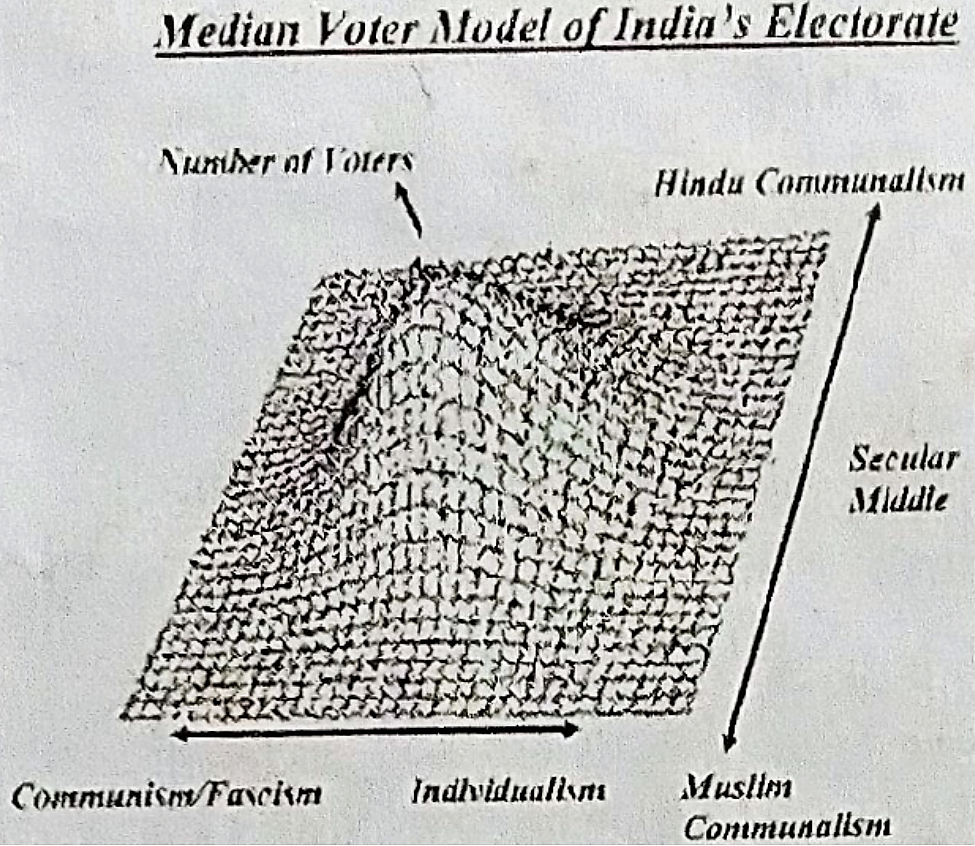
Narasimha Rao cleverly manipulated the median parliamentary vote along these two dimensions so as to maintain a weak Government in power for five years by seeming to ally with the BJP on economic issues and seeming to ally with Leftists on social issues. If the Congress splits after another major defeat caused by Sonia-Rahul incompetence, with the Right Faction joining hands with whatever the BJP morphs into, and the Left Faction joining hands with whatever the CPI-M and CPI morph into, the central question will become which side of the split along the economic dimension holds the median voter along the pro-Muslim/anti-Muslim social dimension.
The BJP remains as dreadful and unscientific a gathering as it has been always without displaying the slightest creative trace of being able to evolve into a serious Conservative Party that India remains in desperate need of. AB Vajpayee and LK Advani led it into electoral defeat but that was not enough for their patriarchy to be disturbed by competent new younger people. In any case, the BJPs more articulate better-educated members in their 50s and 60s are unable to command nation-wide respect nor, with the exception of Modi, are they able to win an election on their own steam. The idea that e.g. Pramode Mahajan’s son could “succeed” him on the 10 JanPath pattern fortunately self-exploded. The best the BJP could do was to choose an inarticulate member as its nominal head while the patriarchy continued unchanged in its backward communalised thinking. Its RSS parent occasionally shows a little savant-like intelligence but generally remains in mental and physical regression.
As for the so-called Left, its multi-dimensional hypocrisy and incompetence has been permanently exposed in the heartland of what passes for Indian communism, Bengal. After the demise of the USSR and transition of Communist China towards Capitalism/ Fascism, there has been no real reason why the CPI and CPI-M cannot merge into one and then renounce together their retrograde ideology in favour of becoming a genuine Social Democratic and Labour Party representing working people and the poor. But that, like any corporate merger, would mean administrative redundancies, retrenchment and new management, and the last thing Stalinist politburo members like is the idea of losing their Rajya Sabha sinecures (in Russia and China they lost their heads but Indian conditions are kinder, gentler, more non-violent).
Besides the Congress, BJP and “Left”, most other parties in India revolve around the whims, personality and IQ of some single local political warlord/warlady. The Naxals and other extremists, including Hindu and Muslim religious terrorists, at least make some pretence at representing political interests of some sections of the people; there is thus at least a slight authenticity about them, no matter how disengaged their thought processes may be from realities around them.
Endless deficit finance
The 2008 Budget or the 2009 General Election seem likely to remain in the grip of all such dramatis personae permanently on the Indian stage, and no new real creative constructive force seems likely to appear. Every political misdemeanour will be paid for by endless deficit finance and money-printing, the accounts and auditing of all public institutions shall remain in a shambles while private pockets of the heads of public institutions come to be lined with gold, the armed forces shall be ready to fight their Pakistani counterparts while deferring to any more formidable adversary, rich business people will continue with their grotesque conspicuous consumption, young people graduating from India’s pampered institutions of tertiary education will continue to line up outside foreign embassies to seek hope and escape.
Can India survive as an independent democratic republic for 100 years after 1947, let alone be a country where all citizens are reasonably free and comfortable? A worst-case scenario may see North India in endless conflict with a chaotic Pakistan, Eastern India hived off under Beijing’s influence, and peninsular India from Surat to Vizag being Western-dominated with “SEZs” on the pattern of pre-communist Coastal China. The failure of our elite classes to provide healthy creative governance over generations must inevitably result in the putrefaction of our body politic.
(Author’s Note: The graph that accompanied this article is published elsewhere here under the title “Median Voter Model of India’s Electorate”.)
Lessons from the 1962 War: there are distinct Tibetan, Chinese and Indian points of view that need to be mutually comprehended (2007)
January 15, 2008 — drsubrotoroyPrefatory Note: This is part of a series of articles published in The Statesman since October 2007 and republished here, viz., Understanding China, India-USA Interests, China’s India Aggression, Surrender or Fight?, China’s Commonwealth, Nixon & Mao vs India, China’s India Example and China’s Force and Diplomacy. See https://independentindian.com/2009/09/19/my-ten-articles-on-china-tibet-xinjiang-taiwan-in-relation-to-india/
Lessons from the 1962 War
Beginnings of a solution to the long-standing border problem: there are distinct Tibetan, Chinese and Indian points of view that need to be mutually comprehended.
SUBROTO ROY
First published in The Sunday Statesman, January 13 2008, Editorial Page Special Article

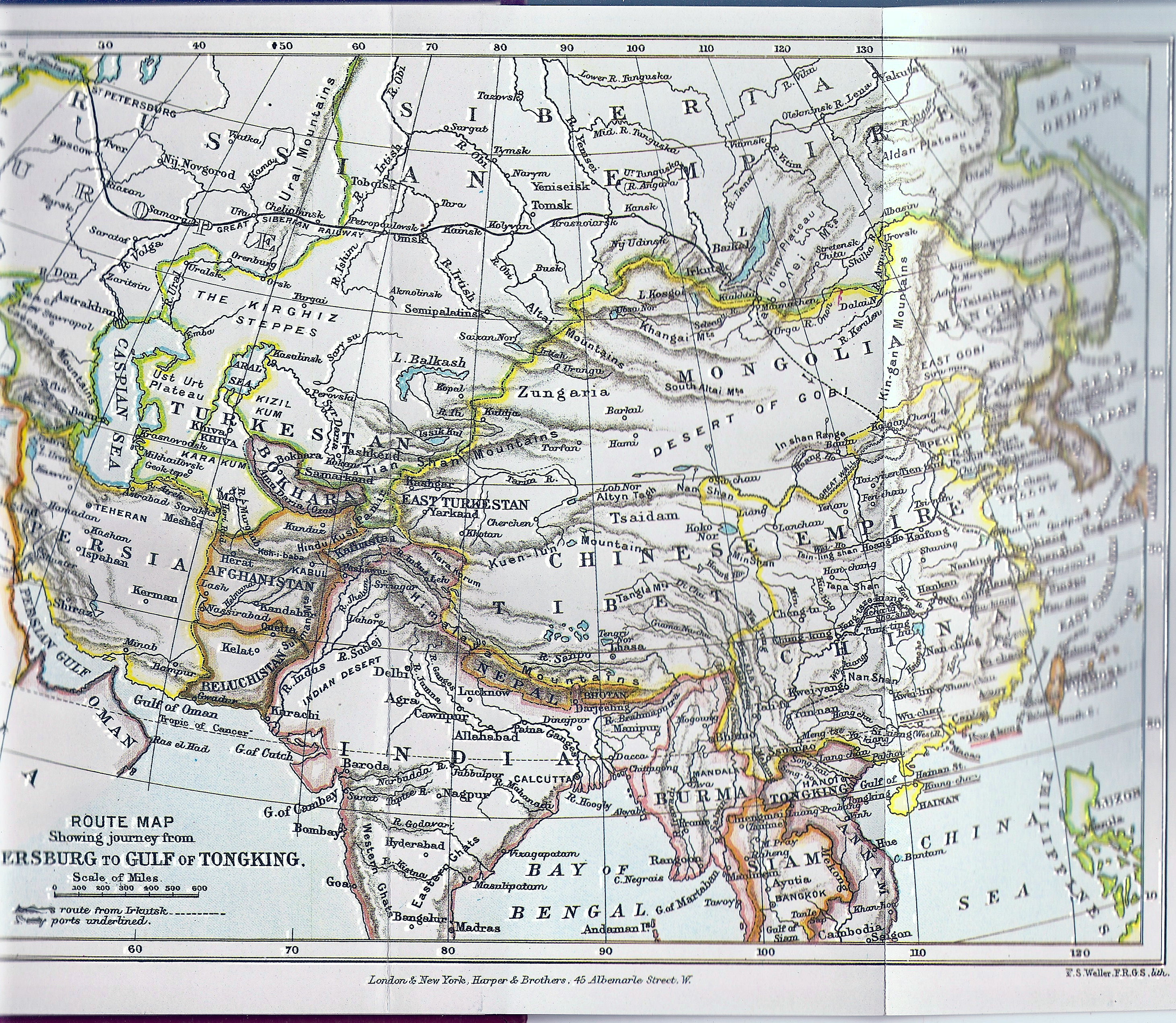

 Independent Indian: Work & Life of Professor Subroto Roy