Preface: This paper culminates my line of argument since our University of Hawaii Pakistan book in the mid 1980s, through my work on the Kashmir problem in the 1990s, published in The Statesman in 2005/2006 etc and in my undelivered Lahore lectures of 2011. https://independentindian.com/2011/10/13/my-seventy-one-notes-at-facebook-etc-on-kashmir-pakistan-and-of-course-india-listed-thanks-to-jd/ The paper has faced resistance from both Indian and Pakistani newspapers for obvious reasons. I would like to especially thank Beena Sarwar and Gita Sahgal in recent weeks for helpful comments. (And Frank Hahn, immediately saw when I mentioned it to him in 2004 that my solution was Pareto-improving…etc)
The *Bulletin of Atomic Scientists* recently reported an Urdu book *Taqat ka Sarab* (‘*Illusion of Power*) published in Pakistan in December 2014 edited by the physicist Dr AH Nayyar. The book “aims to educate Pakistanis about the attitudes of their leadership toward nuclear weapons”. It says “Pakistan’s people have come to believe that the successful acquisition of nuclear capability means that their nation’s security is forever ensured”. Pakistani politicians, scientists and officials who created these weapons have used them to justify a “right to unlimited authority for ruling over Pakistan”. “Consequently, free discussion and honest opinion about nuclear weapons have been nearly prohibited, under the premise that any such talk poses a basic threat to national security.”
“Hindu-dominated India wants to occupy us and destroy the Pakistan Principle for which our martyrs died” has been the constantly heard Pakistani refrain. After 1965 it did not take long for Pakistan, via the ignominy of the 1971 surrender in Dhaka, to acquire by any means the technology to develop its own nuclear weapons, even under the noses of its American friends.
Now Pakistan is said to have some 110 nuclear warheads, mostly in a disassembled state but with a few on fighter-jets in hidden air-bases in Balochistan (made by the USA decades ago) always at the ready, waiting for that Indian attack that will never come. It may all have been psychotic delusion.
India has never initiated hostilities against Pakistan. Not once. Not in 1947, 1965, 1971, 1999, 2008.
In 1971 India undoubtedly supported the Mukti Bahini, and I myself, as a schoolboy distributing supplies to refugees from East Pakistan/Bangladesh, was personally witness to Indian military involvement as of August 1971. Even so, hostilities between the countries formally began on 3 December 1971 with the surprise Pakistani air attack on Indian bases in Punjab and UP.
Though India has never attacked first, the myth continues in Pakistan that wicked Hindu-dominated India wants to attack and suppress their country. What is closer to the truth is that the New Delhi elite is barely able to run New Delhi, and the last place on earth they would want to run is Pakistan.
On our Indian side, the Indian military has been allowed a budgetary carte blanche for decades, especially with foreign exchange resources. (Finance Minister Arun Jaitley on 28 February 2015 has allocated some 2,467 billion INR to the military.)
Despite our vast spending, a band of Lashkar-e-Tayyaba terrorists tyrannized Mumbai for days on end while we seem perpetually without strategy against the People’s Republic of China’s recurrent provocations.
The two world powers with traditional interests in India — Russia and Britain — place their long-term agents in Delhi’s high politics and places with impunity, getting done all they need to in particular cases. The USA, France, Israel and others follow suit – all mainly to do with selling India very expensive military weapons, aircraft etc. that they have in excess inventory. India now has the notorious distinction of being the world’s largest weapons’ importer.
Yet we are hardly a trading or monetary superpower. We have large current account and budgetary deficits, and we are essentially buying whatever weapons, aircraft, shopping malls etc. that we do on foreign credit that we may or may not have. (Pakistan does the same.)
India’s illusions of power have to do with boasting a very large military that can take on the imperialists. We do not realize the New Imperialism that may control Delhi is not of a Clive or Dupleix but of clandestine or open foreign lobbyists and agents who get done what their masters need to have done on a case-by-case basis. The result is a corrosion of Indian power, sovereignty, and credit, little by little, and may lead to a collapse or grave crisis in the future. Even the BJP/RSS Government of Mr Modi (let aside the Sonia-Manmohan Congress and official Communists) may not realize how it all came about.
The way forward for both Pakistan and India is to seek to break the impasse between ourselves.
And there is no doubt the root problem remains Kashmir, and the hysteria and terrorism it has spawned over the years. A resolution of these fundamental issues calls for some hard scholarship, political vision and guts. The vapid gassing of stray bureaucrats, journalists, diplomats or generals has gotten everyone precisely nowhere thus far.
I have argued at length in previous publications that the *de facto* boundary that was the Ceasefire Line in 1949, and was later renamed the Line of Control in 1972, is indeed also the *de jure* boundary between India and Pakistan.
Jammu & Kashmir came into existence as a legal entity on 16 March 1846 under the Dogra Gulab Singh, friend of the British during the Sikh wars, and a protégé earlier of the great Sikh Ranjit Singh.
Dogra J&K ended its existence as an entity recognized in international law on 15 August 1947. (Hari Singh, the fourth and last Dogra ruler where Gulab Singh had been the first, desperately sought Clement Attlee’s recognition but did not get it.) Thanks to British legal confusion, negligence or cunning, the territory of what had been known as Dogra Jammu & Kashmir became sovereign-less or ownerless territory in international law on that date, with the creation of the new Pakistan and new India.
The new Pakistan as of August-September 1947 immediately started to plan to take the territory by force, and sought to implement that plan as of 22 October. Had the Pakistani attackers not stopped to indulge in the Rape of Baramullah, they would have taken Srinagar airport by 26 October, and there would have been no Indian defence of the territory possible. As matters turned out, the ownerless territory of what had been Dogra Jammu & Kashmir came to be divided by “military decision” (to use the UN’s term) between the new Pakistan and new India. Kargil and Drass were taken by Pakistan and then lost. Skardu was held by India and later lost. Neither military ever since is going to permit the other to take an inch from itself either by war or by diplomacy.
The *de facto* boundary over ownerless territory divided by military force is the *de jure* boundary in the Roman law that underlies all international law. Once both sides recognize that properly, we may proceed to the next stages.
On the Pakistani side, recognizing Indian sovereignty over Indian territory in what had been J&K requires stamping out the LeT etc – perhaps not so much by force as by explaining to them that the fight is over, permanently. There is no jihad against India now or ever. Indian territory is not dar-ul-harb but dar-ul-aman: where more than one hundred million Muslim citizens of India freely and peacefully practice their faith.
On the Indian side, if, say, SAS Geelani and friends, under conditions of individual privacy, security and full information, wish to renounce Indian nationality, become stateless, and apply for some other nationality (like Pakistani or Afghan or Iranian) while continuing to live lawfully and law-abidingly on Indian territory, do we have a problem with that? We can’t really. The expatriate children of the Indian elite have renounced Indian nationality in America, Britain, Australia etc upon far weaker principles or beliefs. India has many foreign nationals living permanently on its territory peacefully and law-abidingly (Sir Mark Tully perhaps the most notable) and can add a few more.
The road would be gradually opened for an exchange of consulates between India and Pakistan in Srinagar and Muzaffarabad (leave aside vice-consulates or tourist offices in Jammu, Gilgit, Skardu, Leh). And the remaining Hurriyat, as new Pakistani nationals living in India, can visit the Pakistani consul in Srinagar for tea every day if they wish, to discuss Pakistani matters like Afridi’s cricket or Bilawal’s politics or whatever.
The militaries and potentially powerful economies on both sides could then proceed towards real strength and cooperation, having dispelled their current illusions of power.
My “Critique of Monetary Ideas of Manmohan & Modi: the Roy Model explaining to Bimal Jalan, Nirmala Sitharaman, RBI etc what it is they are doing” of 2019 is here.
My 5 December 2012 interview by Mr Paranjoy Guha Thakurta, on Lok Sabha TV, the channel of India’s Lower House of Parliament, broadcast for the first time on 9 December 2012 on Lok Sabha TV, is here and here in two parts.
My interview by GDI Impuls banking quarterly of Zürich published on 6 Dec 2012 is here.
My interview by Ragini Bhuyan of Delhi’s Sunday Guardian published on 16 Dec 2012 is here.
from World Economy & Central Banking Seminar at Facebook
Professor Rajan’s statement “I determine the monetary policy. I say what it is….ultimately the interest rate that is set is set by me” equates Indian monetary policy with the money interest rate; but monetary policy in India has always involved far more than that, namely, the bulk of Indian banking and insurance has been in government hands for decades, all these institutions have been willy-nilly compelled to hold vast stocks of government debt, both Union and State, on their asset-sides…and unlimited unending deficit finance has led to vast expansion of money supply, making it all rather fragile. My “India’s Money” in 2012 might be found useful. http://tinyurl.com/o9dhe8d
11 April 2014
from World Economy & Central Banking Seminar at Facebook
I have to wonder, What is Professor Rajan on about? Growth in an individual country is affected by the world monetary system? Everyone for almost a century has seen it being a real phenomenon affected by other real factors like savings propensities, capital accumulation, learning and productivity changes, innovation, and, broadly, technological progress… A “source country” needs to consult “recipient” countries before it starts or stops Quantitative Easing? Since when? The latter can always match policy such as to be more or less unaffected… unless of course it wants to ride along for free when the going is good and complain loudly when it is not…. Monetary policy may affect the real economy but as a general rule we may expect growth (a real phenomenon) to be affected by other real factors like savings propensities, capital accumulation, learning and productivity changes, innovation, and, broadly, technological progress..
22 September 2013
“Let us remember that the postponement of tapering is only that, a postponement. We must use this time to create a bullet proof national balance sheet and growth agenda, which creates confidence in citizens and investors alike…”
“Rajan has apparently said, “We do not have a magic wand to make the problems disappear instantaneously, but I have absolutely no doubt we will deal with them.” Of course there are no magic wands but there is a scientific path forward. It involves system-wide improvements in public finance and accounting using modern information technology to comprehend government liabilities and expenditures and raise their productivity. It also involves institutional changes in public decision-making like separating banking and central banking from the treasury while making the planning function serve the treasury function rather than pretend to be above it. It is a road long and arduous but at its end both corruption and inflation will have been reduced to minimal levels. The rupee will have acquired sufficient integrity to become a hard currency of the world in the sense the average resident of, say, rural Madhya Pradesh or Mizoram may freely convert rupees and hold or trade foreign currencies or precious metals as he/she pleases. India signed the treaty of Versailles as a victor and was an original member of the League of Nations, the United Nations and the IMF. Yet sovereign India has failed to develop a currency universally acceptable as freely convertible world money. It is necessary and possible for India to aim to do so because without such a national aim, the integrity of the currency continues to be damaged regularly by governmental abuse. An RBI governor’s single overriding goal should be to try to bring a semblance of integrity to India’s money both domestically and worldwide.”
No magic wand, Professor Rajan? Oh but there is… read up all this over some hours and you will find it… (Of course it’s not from magic really, just hard economic science & politics)
Professor Raghuram Govind Rajan of the University of Chicago Business School deserves everyone’s congratulations on his elevation to the Reserve Bank of India’s Governorship. But I am afraid I cannot share the wild optimism in India’s business media over this. Of course there are several positives to the appointment. First, having a genuine PhD and that too from a top school is a rarity among India’s policy-makers; Rajan earned a 1991 PhD in finance at MIT’s management school for a thesis titled “Essays on banking” (having to do we are told “with the downside to cozy bank-firm relationships”). Secondly, and related, he has not been a career bureaucrat as almost all RBI Governors have been in recent decades. Thirdly, he has been President of the American Finance Association, he won the first Fischer Black prize in finance of that Association, and during Anne Krueger’s 2001-2006 reign as First Deputy MD at the IMF, he was given the research role made well-known by the late Michael Mussa, that of “Economic Counselor” of the IMF.
Hence, altogether, Professor Rajan has come to be well-known over the last decade in the West’s financial media. Given the dismal state of India’s credit in world capital markets, that is an asset for a new RBI Governor to have.
On the negatives, first and foremost, if Professor Rajan has renounced at any time his Indian nationality, surrendered his Indian passport and sworn the naturalization oath of the USA, then he is a US citizen with a US passport and loyalty owed to that country, and by US law he will have to enter the USA using that and no other nationality. If that happens to be the factual case, it will be something that comes out in India’s political cauldron for sure, and there will arise legal issues and court orders barring him from heading the RBI or representing India officially, e.g. when standing in for India’s Finance Minister at the IMF in Washington or the BIS in Basle etc. Was he an Indian national as Economic Counselor at the IMF? The IMF has a tradition of only European MDs and at least one American First Deputy MD. The Economic Counselor was always American too; did Rajan break that by having remained Indian, or conform to it by having become American? It is a simple question of fact which needs to come out clearly. Even if Rajan is an American, he and the Government of India could perhaps try to cite to the Indian courts the new precedent set by the venerable Bank of England which recently appointed a Canadian as Governor.
Let me take two examples. Does Rajan realise how the important Bottomley-Chandavarkar debates of the 1960s about India’s rural credit markets influenced George Akerlof’s “Market for Lemons” theory and prompted much work on “asymmetric information”, signalling etc in credit-markets, insurance-markets, labour-markets and markets in general, as acknowledged in the awards of several Bank of Sweden prizes? Or will he need a tutorial on the facts of rural India’s financial and credit markets, and their relationship with the formal sector? What the Bottomley-Chandavarkar debate referred to half a century ago still continues in rural India insofar as large arbitrage profits are still made by trading across the artificially low rates of money interest caused by financial repression of India’s “formal” monetised sector with its soft inconvertible currency against the very high real rates of return on capital in the “informal” sector. It is obvious to the naked eye that India is a relatively labour-abundant country. It follows the relative price of labour will be low and relative price of capital high compared to, e.g. the Western or Middle Eastern economies, with mobile factors of production like labour and capital expected to flow accordingly across national boundaries. Indian nominal interest-rates in organized credit markets have been for decades tightly controlled, making it necessary to go back to Irving Fisher’s data to obtain benchmark interest-rates, which, as expected, are at least 2%-3% higher in India than in Western capital markets. Joan Robinson once explained “the difference between 30% in an Indian village and 3% in London” saying “side by side with the industrial revolution went great technical progress in the provision of credit and the reduction of lender’s risk.”
What is logically certain is no country can have both relatively low world prices for labour and relatively low world prices for capital! Yet that impossibility seems to have been what India’s purported economic “planners” have planned to engineer! The effect of financial repression over decades may have been to artificially “reverse” or “switch” the risk-premium — making it lucrative for there to be capital flight out of India, with real rates of return on capital within India being made artificially lower than those in world markets! Just as enough export subsidies and tariffs can make a country artificially “reverse” its comparative advantage with its structure of exports and imports becoming inverted, so a labour-rich capital-scarce country may, with enough financial repression, end up causing a capital flight. The Indian elite’s capital flight out of India exporting their adult children and savings overseas may be explained as having been induced by government policy itself.
Secondly, Professor Rajan as a finance and banking specialist, will see at once the import of this graph above that has never been produced let aside comprehended by the RBI, yet which uses the purest RBI data. It shows India’s mostly nationalised banks have decade after decade gotten weaker and weaker financially, being kept afloat by continually pumping in of new “capital” via “recapitalisation” from the government that owns them, using more and more of the soft inconvertible currency that has been debauched merrily by government planners. The nationalised banks with their powerful pampered employee unions, like other powerful pampered employee unions in the government sector, have been the bane of India, where a mere 30 million privileged people in a vast population work with either the government or the organised private sector. The RBI’s own workforce at last count was perhaps 75,000… the largest central bank staff in the world by far!
Will Rajan know how to bring some system out of the institutional chaos that prevails in Indian banking and central banking? If not, he should start with the work of James Hanson “Indian Banking: Market Liberalization and the Pressures for Institutional and Market Framework Reform”, contained in the book created by Anne Krueger who brought him into the IMF, and mentioned in my 2012 article “India’s Money” linked below.
The central question for any 21st century RBI Governor worth the name really becomes whether he or she can stand up to the Finance Ministry and insist that the RBI stop being a mere department of it — even perhaps insisting on constitutional status for its head to fulfill the one over-riding aim of trying to bring a semblance of integrity to India’s currency both domestically and worldwide. Instead it is the so-called “Planning Commission” which has been dominating the Treasury that needs to be made a mere department of the Finance Ministry, while the RBI comes to be hived off to independence!
The path forward involves system-wide improvements in public finance and accounting using modern information technology to comprehend government liabilities and expenditures and raise their productivity, plus institutional changes in public decision-making like separating banking and central banking from the Treasury while making the planning function serve the Treasury function rather than pretend to be above it. The road described is long and arduous but at its end both corruption and inflation will have been reduced to minimal levels, and the rupee would have acquired integrity enough to become a hard currency of the world in the sense the average resident of, say, rural Madhya Pradesh or Mizoram may freely convert rupees and hold or trade foreign currencies or precious metals as he/she pleases.
India signed the Treaty of Versailles as a victor and was an original member of the League of Nations, UN and IMF. Yet sovereign India has failed to develop a currency universally acceptable as a freely convertible world money. It is necessary and possible for India to do so. Without such a national aim, the integrity of the currency continues to be damaged regularly by governmental abuse.
Professor Rajan will not want to be merely an adornment for the GoI in world capital markets for a few years, waiting to get back to his American career and life and perhaps to the IMF again. As RBI Governor, he can find his magic wand if he reads and reflects hard enough using his undoubted academic acumen, and then acts to lead India accordingly. Here is the basic reading list:
“Public finances in India, state and Union, show appalling accounting and lack of transparency. Vast amounts of waste, fraud and malfeasance get hidden as a result. The Congress, BJP, official communists, socialists et al are all culpable for this situation having developed – over decades. So if you ask me, “Is the Indian state and polity in a healthy condition?” I would say no, it is pretty rotten. Well-informed, moneyed, mostly city-based special interest groups (especially including organised capital and organised labour) dominate government agendas at the cost of ill-informed, diffused masses of anonymous individual citizens ~ peasants, forest-dwellers, small businessmen, non-unionized workers, the destitute, etc. Demarcations of private, community and public property rights frequently remain fuzzy. Inflation causes non-paper assets to rise in value, encouraging land-grabs. And the fetish over purported growth-rates continues despite measurements being faulty, not reaching UN SNA standards, probably hiding increasing inequalities. India’s polity and economy are in poor shape for many millions of ordinary people. Armed rebellion, however, does not follow from this. Killing poor policemen and starting class-wars were failed Naxal tactics in the 1970s and remain so today. Naxals should put down their weapons and use Excel sheets and government accounting data instead.
Dr Subroto Roy, economist and adviser to Rajiv Gandhi 1990-1991.”
Subroto Roy notes that since Dr Manmohan Singh is the first Indian Prime Minister ever to have chosen with deliberation not to be a member of the Lok Sabha, he has been free to hold important summits at the White House, Kremlin, Copenhagen etc while the Lok Sabha debates mundane matters like the Liberhan Commission report, inflation etc.
“The U.S. has an awkward problem with Pakistan in that substantial parts of its government actually favor the Afghan Taliban achieving political primacy in Afghanistan *as a buffer against incursions by India*” (italics added):
the US makes a mistake by accepting at face-value the psychotic delusion of the Pakistan military that it has faced or faces now a threat from India.
As I have said before, the last place on earth that New Delhi’s nomenclatura would like to extend its misgovernance would be Pakistan.
And the historical record is clear that India has never initiated hostilities against Pakistan, not once.
In Oct 1947, the new Pakistan started with an armed attack against the old “princely” State of Jammu & Kashmir with whom it had signed a “Standstill Agreement”. That State came into existence in international law in 1846.
In Sep 1965, Ayub Khan’s Pakistan, armed with Patton tanks and F-104s and F-86s, started an inflitration and then a war hoping to drive tanks all the way to Delhi but did not succeed.
In 1971, East Pakistan seceded from West Pakistan, and though India made it militarily possible it was not something that India conspired to bring about but was something caused by West Pakistanis lording it over their own compatriots. The Richard Sisson-Leo Rose book “War and Secession” is quite a definitive history. 90,000 Pakistanis surrendered as POWs whom India protected from Bangladeshi revenge.
In 1999, Musharraf had his Kargil misadventure. Other than the ghastly mutilation and murder of Lieutenant Saurabh Kalia and his platoon as POWs by the Pakistan Army and its Taliban friends, http://en.wikipedia.org/wiki/Saurabh_Kalia
Musharraf achieved nothing. He then sought to stay on in power unlawfully for almost a decade despite his civillian boss trying to sack him.
And then there was the 2008 attack on Mumbai by ten youthful terrorists from Pakistan who were trained by elements of the Pakistan military.
Where has there ever been an Indian “incursion”?
To the contrary, India had proposed the name of Pakistan as a new member of the UNO back in 1947 — and Zahir Shah’s Afghanistan was the only country to oppose it, for precisely the same unresolved problem as continues today, namely, the destiny of the Pashtuns.
Subroto Roy believes the great optimism about the Indian Republic that he had felt as a 7-year old boy upon meeting Jawaharlal Nehru at Colombo Airport on Oct 13 1962 (the first days of the surprise Communist Chinese attack on India), has now dissipated, and apart from Nehru’s immediate successor (Lal Bahadur Shastri) all Indian Prime Ministers since then have been gravely, perhaps catastrophically, disappointing.
Subroto Roy thinks President Obama’s informed lawyerly academic approach to the Afghanistan decision, whether or not it has its intended good consequences, has a positive demonstration effect for other capital cities, e.g. New Delhi, where public policy decisions are too often made to appease special interest groups inside a cloud of meaningless rhetoric.
Subroto Roy says of India and China in summary discussion at Edward Hugh’s Wall: “Well, both have massive and energetic populations, each with relatively little capital per head; raising the capital per head with new production and exchange processes leads to growth. (But the nominal economies are weak, public finances are absymal and paper money is out of control.)”
Subroto Roy recalls again Pericles of Athens: “Here each individual is interested not only in his own affairs but in the affairs of the state as well; even those who are mostly occupied with their own business are extremely well-informed on general politics- this is a peculiarity of ours:we do not say that a man who takes no inter…est in politics is a man who minds his own business;we say that he has no business here at all.”
Subroto Roy must ask Dr Manmohan Singh’s Government how it sees India’s “aam admi” coming to benefit by the United States Polo Team welcoming India in 2010 in the world championship polo matches on the DC National Mall, as has been very kindly reported by Mr and Mrs Tareq Salahi following the “Sensational Night honoring India”.
Subroto Roy is afraid he does not think the interests of the common man and woman of India come to be served in the slightest by a fancy dinner-party whether given by the Queen of England at Buckingham Palace for the President of India or by the President of the United States at the White House for the Prime Minister of India….(…though some businessmen and bureaucrats become happy…)
“I said the public sector’s wastefulness had drained scarce resources that should have gone instead to provide public goods. Since the public sector was owned by the public, it could be privatised by giving away its shares to the public, preferably to panchayats of the poorest villages. The shares would become tradable, drawing out black money, and inducing a historic redistribution of wealth while at the same time achieving greater efficiency by transferring the public sector to private hands. Rajiv seemed to like that idea too, and said he tried to follow a maxim of Indira Gandhi’s that every policy should be seen in terms of how it affected the common man. I wryly said the common man often spent away his money on alcohol, to which he said at once it might be better to think of the common woman instead. (This remark of Rajiv’s may have influenced the “aam admi” slogan of the 2004 election, as all Congress Lok Sabha MPs of the previous Parliament came to receive a previous version of the present narrative.)”
I am afraid I do not think Dr Singh was whom Rajiv or Indira had in mind in speaking of the common man.
Subroto Roy wonders if India’s most eminent academic economist and India’s most eminent government economist have either of them ever said anything that any member of any audience could ever have found at all disagreeable….
(let aside falsifiable in the sense of Karl Popper)
(… except that I have of course disagreed with both…)
I have had slight experience with the so-called multilateral financial institutions — attending a conference and helping to produce a book on Asia & Latin America with the ADB back in Hawaii in the 1980s, and being a consultant for some months at the World Bank and the IMF in Washington DC in the 1990s. The institutions seemed to me gluttonous and incompetent though I did meet a dozen good economic bureaucrats and two or three who were excellent in Washington. The “Asian Development Bank” (under Japan’s sway as the Word Bank is under American sway and the IMF under European sway) was reputedly worst of the three, though the Big Daddy of wasteful intellectually corrupt international bureaucracies must be the UN itself, especially certain notorious UN-affiliates around the world.
Now there are newspapers reports the ADB has apparently voted, under Communist Chinese pressure, to prevent itself from
This should be enough for any self-respecting Government of India to want to give notice to the ADB’s President that the Republic of India is moving out of its membership. Ongoing projects and any in the pipeline need not be affected as we would meet our debt obligations. There is no reason after all why a treaty-defined entity may not conclude deals with non-members or former members and vice versa.
Subroto Roy suggests one reason China has far outpaced India in exports is because it was willing to focus on manufacturing common man mass consumption items like toys, umbrellas, winter clothing etc for a start, where India’s conceited nomenclatura businessmen/ bureaucrats either maintained traditional imperial exports like textiles, raw materials & tea or chose a high-end middle-class item like software….
A: They are all external or exogenous factors that the Government of India’s leaders, spokesmen and other apologists adduce to explain away endogenous economic outcomes arising from bad fiscal and monetary policies, pork-barrel politics, lobbying by organised Big Business and Big Labour, political and bureaucratic corruption etc. (And the Parliamentary Opposition is hardly any better, probably worse…)
Yesterday the PM is reported to have been asked by someone travelling on his aeroplane from Moscow “whether he had forgiven Advani for calling him a ‘weak Prime Minister’”.
The question was absurd, almost ridiculous, typical of our docile ingratiating rather juvenile English-language press and media, as if any issue of forgiveness arises at all about what one politician says during an election campaign about another politician’s performance in office.
Dr Manmohan Singh’s answer was surprising too: “I was compelled to reply to what Advani said…On May 16 when (Advani) telephoned me, he told me that he was hurt by some of my statements. He said he was hurt and regretted his statements… I apologised to him if I have hurt him. I am looking forward to a close relationship with the Leader of the Opposition.”
So LK Advani appears to have apologised to Manmohan Singh and Manmohan Singh to LK Advani for what they said about each other during the recent general election campaign! What is going on? Were they schoolboys exchanging fisticuffs in a school playground or elderly men battling over power and policy in modern Indian politics?
What would we have done if there was a Churchill in Indian politics today – hurling sarcastic insults at domestic opponents and foreign leaders while guiding a nation on its right course during turbulent times?
Churchill once famously said his parents had not shown him “The Boneless Wonder” in PT Barnum’s circus because it was too horrible a sight but now he had finally seen such a “Boneless Wonder” in his opponent on the Treasury Benches, namely, Ramsay MacDonald. Of the same opponent he said later “He has the gift of compressing the largest number of words into the smallest amount of thought”.
When accused of being drunk by a woman MP he replied “And you are very ugly, but tomorrow I’ll be sober”. Today’s politically correct world would scream at far less. Field Marshall Montgomery told Churchill, “I neither drink nor smoke and am 100% fit,” to which Churchill replied, “I drink and smoke and I am 200% fit”. That too would be politically incorrect today.
Churchill described Prime Minister Clement Attlee as “a modest man with much to be modest about”; also about Attlee: “If any grub is fed on Royal Jelly it turns into a Queen Bee”. Yet Attlee had enough dignity and self-knowledge and self-confidence to brush it all off and instead respect and praise him. In the 1954 volume Winston Spencer Churchill Servant of Crown and Commonwealth Attlee added his own tribute to his great opponent: “I recall…the period when he was at odds with his own party and took a seat on the Bench below the Gangway on the Government side. Here he was well placed to fire on both parties. I remember describing him as a heavily armed tank cruising in No Man’s Land. Very impressive were the speeches he delivered as the international horizon grew darker. He became very unpopular with the predominant group in his own party, but he never minded fighting a lone battle.”
Stanley Baldwin, who as PM first appointed Churchill as Chancellor of the Exchequer, once said “There comes Winston with his hundred horsepower mind”. Yet Churchill was to later say harshly “I wish Stanley Baldwin no ill, but it would have been much better had he never lived.”
Of Lenin, Churchill said, he was “transported in a sealed truck like a plague bacillus from Switzerland into Russia”. Of Molotov: “I have never seen a human being who more perfectly represented the modern concept of a robot.” Of Hitler, “If [he] invaded hell I would at least make a favourable reference to the devil in the House of Commons”. Of De Gaulle, “He was a man without a country yet he acted as if he was head of state”.” Of John Foster Dulles, “[He] is the only bull who carries his china shop with him”. Of Stafford Cripps, British Ambassador to the USSR, “…a lunatic in a country of lunatics”; and also “There but for the Grace of God, goes God”.
Politics is, and should be, grown up stuff because it deals with human lives and national destinies, and really, if you can’t take the heat please do not enter the kitchen. The slight Churchillian sarcasm that does arise within modern Indian politics comes very occasionally from Bihar but nowhere else, e.g. about the inevitability of aloo in samosas and of bhaloos in the jungle but no longer of Laloo being in the seat of power. In general, everyone seems frightfully sombre and self-important though may be in fact short of self-knowledge and hence self-confidence.
What had Manmohan Singh said about LK Advani that he felt he had to apologise for? That Advani had no substantial political achievement to his credit and did not deserve to be India’s PM. Manmohan was not alone in making the charge – Sonia Gandhi, Rahul Gandhi and numerous other spokesmen and representatives of their party said the same. Has Manmohan’s apology to Advani been one on behalf of the whole Congress Party itself?
Was Advani’s apology to Manmohan one on behalf of the whole BJP too?
What had the BJP charged Manmohan with that Advani felt he had to apologise for? Being a “weak PM”.
Hmmm. Frankly, thinking about it, it is hard to count who has not been weak as a PM in India’s modern history.
Certainly Vallabhai Patel as a kind of co-PM was decisive and far from weak back in 1947-48.
Lal Bahadur Shastri was not weak when he told Pakistan that a Pakistani attack on Kashmir would result in an Indian attack on Pakistan.
Indira Gandhi was not weak when she resisted the Yahya Khan-Tikka Khan tyranny against Bangladesh.
Had he not been assassinated, Rajiv Gandhi in a second term would have been decisive and not weak in facing up to and tackling the powerful lobbies and special interest groups that have crippled our domestic economic policy for decades.
But the number of such examples may be counted by hand. Perhaps VP Singh might count, riding in an open jeep to Amritsar, as might AB Vajpayee’s Pokhran II and travelling on a bus to Lahore. In general, the BJP’s charge that Manmohan was “weak” may have constructively led to serious discussion in the country about the whole nature of the Prime Ministership in modern India, which means raising a whole gamut of issues about Indian governance – about India being the softest of “soft states”, with the softest of “soft government budget constraints” (i.e., endless deficit finance and paper money creation) etc.
Instead, what we have had thus far is apologies being exchanged for no real political reason between the leaderships of the Government and the Opposition. If two or three sellers come to implicitly carve up a market between themselves they are said by economic theory to be colluding rather than being in competition. Indian politics may be revealing such implicit collusive behaviour. The goal of this political oligopoly would seem to be to preserve and promote the status quo of the post-1947 Dilli Raj with its special hereditary nomenclatura, at the expense of anonymous diffused teeming India.
Subroto Roy
Postscript July 15 2009: Churchill’s mature opinion of Baldwin was one of the fullest praise at the 20 May 1950 unveiling of a memorial to him. See his In the Balance, edited by Randolph S Churchill, 1951, p. 281
There are at least three Supreme Court lawyers, all highly voluble, among the higher echelons of Congress Party politicians; it is surprising that not one of them has been able to get the top Party leadership of Sonia Gandhi and Manmohan Singh to see the apparent breach of normal constitutional law in Parliament not having met more than 10 days after it was elected.
A Government has been formed, Ministers have entered their offices and have been holding press-conferences and taking executive decisions, wannabe-Ministers continue to be wrangling night-and-day for the plums of office — BUT THERE IS NO PARLIAMENT!
Today is the death-anniversary of Jawaharlal Nehru and last week was the death anniversary of Rajiv Gandhi.
Nehru, whatever his faults and infirmities, was an outstanding parliamentarian and a believer in the Westminster model in particular. He was intimately familiar with its unpoken customs and unwritten laws. He would have been completely appalled by the situation today where luminaries of the party that goes by the same name as the one he had led are paying obeisance to his memory 45 years after his death but have failed to see the absurdity in having a Government in office with no new Parliament ten days after a month-long General Election was over! (Incidentally, had he not left explicit instructions against any hero-worship taking place of himself too?)
Rajiv knew his grandfather and had acquired a sense of noblesse oblige from him. He too would have been appalled that the procedural business of government had been simply procrastinated over like this.
It surprises me that Dr Manmohan Singh, having been a post-graduate of Cambridge, having earned a doctorate from Oxford, and more recently having been awarded honorary doctorates from both Ancient Universities, should seem so unaware of the elements of the Westminster model of constitutional jurisprudence which guides our polity too.
It is too late now and the mistakes have been made. I hope his new Government will come to realise at some point and then keep in mind that our Executive receives political legitimacy from Parliament, not vice versa. An Executive can hardly be legitimately in office until the Parliament that is supposed to elect it has been sworn in.
As for our putative Opposition in the Parliament-yet-to-meet, it seems to have drawn a blank too, and eo ipso revealed its own constitutional backwardness and lethargy.
The power of organised Big Business over New Delhi’s economic policies (whether Congress-led or BJP-led) was signalled by the presence in the audience at Rashtrapati Bhavan last week of several prominent lobbyists when Dr Manmohan Singh and his senior-most Cabinet colleagues were being sworn-in by the President of India. Why were such witnesses needed at such an auspicious national occasion?
Organised Big Business (both private sector and public sector) along with organised Big Labour (whose interests are represented most ably by New Delhi’s official communist parties like the CPI-M and CPI), are astutely aware of how best to advance their own economic interests; this usually gets assisted nicely enough through clever use of our comprador English-language TV, newspaper and magazine media. Shortly after the election results, lobbyists were all over commercial TV proposing things like FDI in insurance and airports etc– as if that was the meaning of the Sonia-Rahul mandate or were issues of high national priority. A typical piece of such “pretend-economics” appears in today’s business-press from a formerly Leftist Indian bureaucrat: “With its decisive victory, the new Manmohan Singh government should at last be able to implement the required second generation reforms. Their lineaments (sic) are well known and with the removal of the Left’s veto, many of those stalled in the legislature as well as those which were forestalled can now be implemented. These should be able to put India back on a 9-10 per cent per annum growth rate…”
Today’s business-press also reports that the new Government is planning to create a fresh “Disinvestment Ministry” and Dr Singh’s chief economic policy aide is “a frontrunner among the names short-listed to head the new ministry” with Cabinet rank.
That being said, I have to say I think a new Indian policy of creating a Ministry to privatise India’s public sector is probably a very BAD idea indeed in present circumstances — mainly because it will be driven by the interests of the organised Big Business lobbies that have so profoundly and subtly been able to control the New Delhi Government’s behaviour in recent decades.
Now our Government every year produces paper rupees and bank deposits in practically unlimited amounts to pay for its practically unlimited deficit financing, and it has behaved thus over decades. Why we do not hear about this at all is because the most prominent Government economists themselves remain clueless — sometimes by choice, mostly by sheer ignorance — about the nature of the macroeconomic process that they are or have been part of. (See my “India’s Macroeconomics”, “The Dream Team: A Critique” etc elsewhere here). As for the Opposition’s economists, the less said about the CPI-M’s economists the better while the BJP, poor thing, has absolutely no economists at all!
Briefly speaking, Indian Big Business has acquired an acute sense of this long-term nominal/paper expansion of India’s economy, and as a result acts towards converting wherever possible its own hoards of paper rupees and rupee-denominated assets into more valuable portfolios for itself of real or durable assets, most conspicuously including hard-currency denominated assets, farm-land and urban real-estate, and, now, the physical assets of the Indian public sector. Such a path of trying to transform local domestic paper assets – produced unlimitedly by Government monetary and fiscal policy and naturally destined to depreciate — into real durable assets, is a privately rational course of action to follow in an inflationary economy. It is not rocket-science to realise the long-term path of the Indian rupee is downwards in comparison to the hard-currencies of the world – just compare our money supply growth and inflation rates with those of the rest of the world.
The Statesman of November 15 2006 had a lead editorial titled Government’s land-fraud: Cheating peasants in a hyperinflation-prone economy. It said:
“There is something fundamentally dishonourable about the way the Centre, the state of West Bengal and other state governments are treating the issue of expropriating peasants, farm-workers, petty shop-keepers etc of their small plots of land in the interests of promoters, industrialists and other businessmen. Singur may be but one example of a phenomenon being seen all over the country: Hyderabad, Karnataka, Kerala, Haryana, everywhere. So-called “Special Economic Zones” will merely exacerbate the problem many times over. India and its governments do not belong only to business and industrial lobbies, and what is good for private industrialists may or may not be good for India’s people as a whole. Economic development does not necessarily come to be defined by a few factories or high-rise housing complexes being built here or there on land that has been taken over by the Government, paying paper-money compensation to existing stakeholders, and then resold to promoters or industrialists backed by powerful political interest-groups on a promise that a few thousand new jobs will be created. One fundamental problem has to do with inadequate systems of land-description and definition, implementation and recording of property rights. An equally fundamental problem has to do with fair valuation of land owned by peasants etc. in terms of an inconvertible paper-money. Every serious economist knows that “land” is defined as that specific factor of production and real asset whose supply is fixed and does not increase in response to its price. Every serious economist also knows that paper-money is that nominal asset whose price can be made to catastrophically decline by a massive increase in its supply, i.e. by Government printing more of the paper it holds a monopoly to print. For Government to compensate people with paper-money it prints itself by valuing their land on the basis of an average of the price of the last few years, is for Government to cheat them of the fair present-value of the land. That present-value of land must be calculated in the way the present-value of any asset comes to be calculated, namely, by summing the likely discounted cash-flows of future values. And those future values should account for the likelihood of a massive future inflation causing decline in the value of paper-money in view of the fact we in India have a domestic public debt of some Rs. 30 trillion (Rs. 30 lakh crore) and counting, and money supply growth rates averaging 16-17% per annum. In fact, a responsible Government would, given the inconvertible nature of the rupee, have used foreign exchange or gold as the unit of account in calculating future-values of the land. India’s peasants are probably being cheated by their Government of real assets whose value is expected to rise, receiving nominal paper assets in compensation whose value is expected to fall.”
Mamata Banerjee started her famous protest fast-unto-death in Kolkata not long afterwards, riveting the nation’s attention in the winter of 2006-2007.
What goes for the government buying land on behalf of its businessman friends also goes, mutatis mutandis, for the public sector’s real assets being bought up by the private sector using domestic paper money in a potentially hyperinflationary economy. If Dr Singh’s new Government wishes to see real public sector assets being sold, let the Government seek to value these assets not in inconvertible rupees which the Government itself has been producing in unlimited quantities but rather in forex or gold-units instead!
Today’s headline says “Short of cash, govt. plans to revive disinvestment ministry”. Big Business’s powerful lobbies will suggest that real public assets must be sold (to whom? to organised Big Business of course!) in order to solve the grave fiscal problems in an inflationary economy caused precisely by those grave fiscal problems! What I said in 2002 at IndiaSeminar may still be found to apply: I said the BJP’s privatisation ideas “deserve to be condemned…because they have made themselves believe that the proceeds of selling the public sector should merely go into patching up the bleeding haemorrhage which is India’s fiscal and monetary situation… (w)hile…Congress were largely responsible for that haemorrhage to have occurred in the first place.”
If the new Government would like to know how to proceed more wisely, they need to read and grasp, in the book edited by myself and Professor John Clarke in 2004-2005, the chapter by Professor Patrick Minford on Margaret Thatcher’s fiscal and monetary policy (macroeconomics) before they read the chapter by Professor Martin Ricketts on Margaret Thatcher’s privatisation (microeconomics). India’s fiscal and monetary or macroeconomic problems are far worse today than Britain’s were when Thatcher came in.
During the recent Election Campaign, I contrasted Dr Singh’s flattering praise in 2005 of the CPI-M’s Buddhadeb Bhattacharjee with Sonia Gandhi’s pro-Mamata line in 2009 saying the CPI-M had taken land away from the poor. This may soon signal a new fault-line in the new Cabinet too on economic policy with respect to not only land but also public sector privatisation – with Dr Singh’s pro-Big Business acolytes on one side and Mamata Banerjee’s stance in favour of small-scale unorganised business and labour on the other. Party heavyweights like Dr Singh himself and Sharad Pawar and Pranab Mukherjee will weigh in one side or the other with Sonia being asked in due course to referee.
I personally am delighted to see the New Rahul Gandhi deciding not to be in Government and to instead reflect further on the “common man” and “common woman” about whom I had described his father talking to me on September 18 1990 at his home. Certainly the “aam admi” is not someone to be found among India’s organised Big Business or organised Big Labour nor their paid lobbyists in the big cities.
We in India did not invent the idea of Parliament, the British did. Even the British did not invent the idea of a “Premier Ministre”, the French did that, though the British came to develop its meaning most. Because these are not our own inventions, when something unusual happens in contemporary India to political entities and offices known as “Parliament”, “Prime Minister” etc, contrast and comparison is inevitable with standards and practices that have prevailed around the world in other parliamentary democracies.
Indeed we in India did not even fully invent the idea of our own Parliament though the national struggle led by the original Indian National Congress caused it to come to be invented. The Lok Sabha is the outcome of a long and distinguished constitutional and political history from the Morley-Minto reforms a century ago to the Montagu-Chelmsford reforms and Government of India Act of 1919 to the Government of India Act of 1935 and the first general elections of British India in 1937 (when Jawaharlal Nehru briefly became PM for the first time) and in due course the 1946 Constituent Assembly. Out of all this emerged the 1950 Constitution of India, drafted by that brilliant jurist BR Ambedkar as well as other sober intelligent well-educated and dedicated men and women of his time, and thence arose our first Lok Sabha following the 1951 General Elections.
“What are Lok Sabha Members and State MLAs legitimately required to be doing in caring for their constituents? First of all, as a body as a whole, they need to elect the Government, i.e. the Executive Branch, and to hold it accountable in Parliament or Assembly. For example, the Comptroller and Auditor General submits his reports directly to the House, and it is the duty of individual legislators to put these to good use in controlling the Government’s waste, fraud or abuse of public resources. Secondly, MPs and MLAs are obviously supposed to literally represent their individual constituencies in the House, i.e. to bring the Government and the House’s attention to specific problems or contingencies affecting their constituents as a whole, and call for the help, funds and sympathy of the whole community on their behalf. Thirdly, MPs and MLAs are supposed to respond to pleas and petitions of individual constituents, who may need the influence associated with the dignity of their office to get things rightly done. For example, an impoverished orphan lad once needed surgery to remove a brain tumour; a family helping him was promised the free services of a top brain surgeon if a hospital bed and operating theatre could be arranged. It was only by turning to the local MLA that the family were able to get such arrangements made, and the lad had his tumour taken out at a public hospital. MPs and MLAs are supposed to vote for and create public goods and services, and to use their moral suasion to see that existing public services actually do get to reach the public.”
What about the Rajya Sabha? I said in the same article:
“Rajya Sabha Members are a different species altogether. Most if not all State Legislative Councils have been abolished, and sadly the present nature of the Rajya Sabha causes similar doubts to arise about its utility. The very idea of a Rajya Sabha was first mooted in embryo form in an 1888 book A History of the Native States of India, Vol I. Gwalior, whose author also advocated popular constitutions for the “Indian India” of the “Native States” since “where there are no popular constitutions, the personal character of the ruler becomes a most important factor in the government… evils are inherent in every government where autocracy is not tempered by a free constitution.” When Victoria was declared India’s “Empress” in 1877, a “Council of the Empire” was mooted but had remained a non-starter even until the 1887 Jubilee. An “Imperial Council” was now designed of the so-called “Native Princes”, which came to evolve into the “Chamber of Princes” which became the “Council of the States” and the Rajya Sabha. It was patterned mostly on the British and not the American upper house except in being not liable to dissolution, and compelling periodic retirement of a third of members. The American upper house is an equal if not the senior partner of the lower house. Our Rajya Sabha follows the British upper house in being a chamber which is duty-bound to oversee any exuberance in the Lok Sabha but which must ultimately yield to it if there is any dispute. Parliament in India’s democracy effectively means the Lok Sabha — where every member has contested and won a direct vote in his/her constituency. The British upper house used to have an aristocratic hereditary component which Tony Blair’s New Labour Government has now removed, so it has now been becoming more like what the Rajya Sabha was supposed to have been like.”
The Canadian upper house is similar to ours in intent: a place for “sober second thought” intended to curb the “democratic excesses” of the lower house. In the Canadian, British, Australian, Irish and our own cases, the Prime Minister, as the chief executive of the lower house has immense indirect power over the upper house, whether in appointing members or even, in the Australian case, dissolving the entire upper house if he/she wishes.
Now yesterday apparently Shrimati Sonia Gandhi, as the duly elected leader of the largest political party in the 15th Lok Sabha, accompanied by Dr Manmohan Singh, as her party’s choice for the position of Prime Minister, went to see the President of India where the Hon’ble President apparently appointed Dr Singh to be the Prime Minister of India – meaning the Prime Minister of the 15th Lok Sabha, except that Dr Singh is not a member of the Lok Sabha and apparently has had no intent of becoming one.
In 2004 Shrimati Gandhi had declined to accept an invitation to become PM and instead effectively recommended Dr Singh to be PM despite his not being a member of the Lok Sabha nor intending to be so. This exploited a constitutional loophole to the extent that the drafters of our 1950 Constitution happened not to have explicitly stated that the PM must be from the Lok Sabha. But the reason the founders of our democratic polity such as BR Ambedkar and Jawaharlal Nehru did not specify that the PM must be from the Lok Sabha was quite simply that it was a matter of complete obviousness to them and to their entire generation that this must be so— it would have been appalling to them and something beyond their wildest imagination that a later generation, namely our own, would exploit such a loophole and allow a PM to be appointed who is not a member of the Lok Sabha and intends not to be so.
Ambedkar, Nehru and all others of their time knew fully well that the history and intended purpose of the Lok Sabha was completely different from the history and intended purpose of the Rajya Sabha. They knew too fully well that Lord Curzon had been explicitly denied the leadership of Britain’s Tory Party in 1922 because that would have made him a potential PM when he was not prepared to be a member of the House of Commons. That specific precedent culminated a centuries’-old democratic trend of political power flowing from monarchs to lords to commoners, and has governed all parliamentary democracies worldwide ever since — until Dr Singh’s appointment in 2004.
When such an anomalous situation once arose in Britain, Lord Home resigned his membership of the House of Lords to contest a House of Commons seat as Sir Alec Douglas Home so that he could be PM in a manner consistent with parliamentary law.
Dr Singh instead for five years remained PM of India while not being a member of the Lok Sabha. Even if reasons and exigencies of State could have been cited for such an anomalous situation during his first term, there was really no such reason for him not to contest the 2009 General Election if he wished to be the Congress Party’s prime ministerial candidate a second time. Numerous Rajya Sabha members alongside him have contested Lok Sabha seats this time, and several have won.
As of today, Dr Singh is due to be sworn in tomorrow as Prime Minister for a second term while still having no declared intention of resigning from the Rajya Sabha and contesting a Lok Sabha seat instead. What the present-day Congress has done is elect him the leader of the “Congress Parliamentary Party” and claim that it is in such a capacity that he received the invitation to be Prime Minister of India. But surely if the question had been asked to the Congress Party under Nehru or Indira or Rajiv: “Can you foresee a circumstance ever in which the PM of India is not a member of the Lok Sabha?” their answer in each case would have been a categorical and resounding “no”.
So the question does arise why the Congress under Sonia Gandhi has with deliberation allowed such an anomalous situation to develop. Its effect is to completely distort the trends of relative political power between the Lok Sabha and Rajya Sabha. On the one hand, the Lok Sabha’s power is deliberately made to diminish as the chief executive of the Government of India shall not be from the Lok Sabha but from “the other place” despite the Lok Sabha having greater political legitimacy by having been directly elected by India’s people. This sets a precedent that might get repeated in India in the future but which contradicts the worldwide trend in parliamentary democracies over decades and centuries in precisely the opposite direction – of power flowing in the direction of the people not away from them. On the other hand, the fact this anomalous idea has been pioneered by the elected leader of the largest political party in the Lok Sabha while her PM is in the Rajya Sabha causes a member of the lower house to have unexpected control over the upper house when the latter is supposed to be something of an independent check on the former!
It all really seems an unnecessary muddle and a jumbling up of normal constitutional law and parliamentary procedure. The Sonia-Manmohan Government at the outset of its second term should hardly want to be seen by history as having set a poor precedent using brute force. The situation can be corrected with the utmost ease by following the Alec Douglas Home example, with Dr Singh being given a relatively safe seat to contest as soon as possible, if necessary by some newly elected Congress MP resigning and allowing a bye-election to be called.
Close to 389 million valid votes were cast in India’s previous General Election in 2004 to the 14th Lok Sabha, according to the Election Commission’s volume STATISTICAL REPORT ON GENERAL ELECTIONS, 2004 TO THE 14th LOK SABHA VOLUME III (DETAILS FOR ASSEMBLY SEGMENTS OF PARLIAMENTARY CONSTITUENCIES).
Unfortunately, the Election Commission, like the Government of India in general, remains extremely uncomfortable with using Excel or any spreadsheets at all, and hence much of the information they provide remains unproductive — reflecting, I am afraid, rather obsolescent technology and organisation and management. From an Excel spreadsheet I have had to create for myself using EC data, my calculations give the following breakdown of the votes received in 2004 by most of the larger political parties:
That accounts for 372,382,530. The precise total of valid votes that I get by tabulating EC data using my spreadsheet is 388,920,557. The EC itself reports in the very same document a total of 388,672,504. The percentage difference is close enough to zero but it should be zero itself; I shall be delighted if my spreadsheet’s total is the incorrect one somehow, even though it uses the EC’s own data; but it does lead me to ask: “Who, if anyone, audits the Election Commission’s numerical calculations and vote tallies? Why is India’s ordinary public not informed about all this and other processes of the Election Commission perfectly transparently as a matter of routine? Is reform necessary of the processes and procedures of the Election Commission itself?”.
(Incidentally, the slight discrepancy in the totals could have arisen perhaps because my spreadsheet does, correctly, include the relatively small number of postal ballots, whereas the EC’s total possibly has not done.)
Raw votes like those described above do not of course translate directly into seats in Parliament but even so they indicate the state of popular political opinion in 2004. By how much will that popular opinion be found to have changed in 2009? How will demographic changes, and the delimitation exercise that has redrawn constituencies, affect the new outcomes? These are the kind of grown-up adult questions to ask yourself if you get bored with the endless pretentious waffle that emerges from our talking-heads on TV etc regarding the ongoing election.
Notice too the 16.5 million people of India who voted in 2004 for Independents! What on earth has made Dr Manmohan Singh recently initiate an absurd debate against them?
Here below as well is the full list of all parties that were in contention in 2004; if you want to know the vote-share any of them received according to my spreadsheet, send in a comment to this post and I shall try to respond. Better still, look up the EC volume mentioned and create your own spreadsheet from its data, and tell me how accurate mine is. (But beware, the spreadsheet will have some 60,000 rows to start with!)
The 2009 General Election campaign is supposed to elect a Parliament and a Head of Government for the Republic of India, not a Head Boy/Head Girl at an urban middle-class high school or the karta of a joint family. Unfortunately, our comprador national-level media seem to be docile and juvenile enough in face of power and privilege to want to ask only touchy-feely koochi-woochi pretty baby questions of the “candidates” for PM (several of whom are not even running as candidates for the Lok Sabha but still seem to want to be PM). Rival candidates themselves seem to want to hurl invective and innuendo at one another, as if all this was merely some public squabble between Delhi middle-class families.
So here are a set of grown-up adult questions instead:
1. Pakistan is politically and strategically our most important neighbour. Can you assure the country that a government headed by you will have a coherent policy on both war and peace with Pakistan? How would you achieve it?
2. Do you agree with the Reagan-Gorbachev opinion that “a nuclear war cannot be won and must never be fought”? If so, what would your Government do about it?
3. If there are Indian citizens in Jammu & Kashmir presently governed by Article 370 who wish to renounce Indian nationality and remain stateless or become Pakistani/Afghan/Iranian citizens instead, would you consider letting them do so and giving them Indian “green cards” for peaceful permanent residence in J&K and India as a whole?
4. Do you know where Chumbi Valley is? If so, would your Government consider reviving the decades-old idea with China to mutually exchange permanent leases to Aksai Chin and Chumbi Valley respectively?
5. Nuclear power presently accounts as a source of about 4% of total Indian electricity; do you agree that even if nuclear power capacity alone increased by 100% over the next ten years and all other sources of electricity remained constant, nuclear power would still account for less than 8% of the total?
6. The public debt of the country may now amount to something like Rs 30 lakh crore (Rs 30 trillion); do you find that worrisome? If so, why so? If not, why not?
7. The Government of India may be paying something like Rs 3 lakh crore (Rs 3 trillion) annually on interest payments on its debt; do you agree that tends to suck dry every public budget even before it can try to do something worthwhile?
8. If our money supply growth is near 22% per annum, and the rate of growth of real income is near 7% per annum, would you agree the decline in the value of money (i.e., the rate of inflation) could be as high as 15% per annum?
9. Do you agree that giving poor people direct income subsidies is a far better way to help them than by distorting market prices for everybody? If not, why not?
10. How would you seek to improve the working of (and reduce the corruption in) the following public institutions: (1) the Army and paramilitary; (2) the Judiciary and Police; (3) Universities and technical institutes?
11. There has never been a Prime Minister in any parliamentary democracy in the world throughout the 20th Century who was also not an elected member of the Lower House; do you agree BR Ambedkar and Jawaharlal Nehru intended that for the Republic of India as well and thought it something so obvious as not necessary to specify in the 1950 Constitution? What will your Government do to improve the working of the Presidency, the Lok Sabha, Rajya Sabha and State Assemblies?
12. What, personally, is your vision for India after a five-year period of a Government led by you?
Dr Raja Chelliah (1922-2009) may have been India’s only serious public finance economist in living memory. He first and more clearly than anyone warned of the out-of-control fiscal situation and the grave burden of the public debt.
Unfortunately he has left no professional successors. The institute he founded appears to consist mostly of a name and some buildings and a lot of wasteful bureaucratic public expenditure as is typical of the new Dilli Raj of recent decades. I recall a heated discussion with two of his successors there in the late 1990s in which they somehow attempted to say they were beyond Government of India control and could do as they pleased (which they had in fact proceeded to do). Neither could be said to have been familiar with Indian public finance data at the degree of precision necessary to grasp the fiscal problems Dr Chelliah had warned against. Like the Planning Commission and similar sets of public buildings, it is all mostly a waste; Delhi’s “think tanks” have been largely incapable of any real thought.
Raja Chelliah very kindly met me in the summer of 1987 or the winter of 1988 at his Planning Commission offices when I was putting together the University of Hawaii perestroika-for-India project that led in due course to sparking the 1991 reform thanks to Rajiv Gandhi in his last months. I wish very much I could have had Dr Chelliah join the project but he was over-committed.
His passing means there is no one left in the Indian economic-policy establishment who has (or wishes to have ) the faintest clue about the gravity of the fiscal situation. It may be a sign of the times that the business press is reporting on the same day that the current head of the RBI bureaucracy has been saying that monetising Indian fiscal deficits seems to him “benign”, pointing abroad and saying something like “Look aren’t they doing it too?”! (Contemporary Delhi and Bombay are self-deluded and so enamoured with five-star hotel rooms that they may be unable to cope with economic reality outside such an environment.)
Dr Chelliah was professionally serious, committed to truth-telling, personally modest and truly eminent in his contribution to modern Indian economic thought.
“[I]f Atal Behari Vajpayee and Lal Krishna Advani could bring themselves to honestly walk away from BJP politics, there would have to be a genuine leadership contest and some new principles emerging in their party. There is an excellent and very simple political reason for Vajpayee and Advani to go, which is not that they are too old (which they are) but that they led their party to electoral defeat. Had they walked away in May 2004, there might have been by now some viable conservative political philosophy in India and some recognisable new alternative leadership for 2009. Instead there is none and the BJP has not only failed very badly at being a responsible Opposition, it will go into the 2009 General Election looking exceptionally decrepit and incompetent.”
Lest anyone think this was a tirade against the BJP, most of the article was actually a criticism of the Congress and the Communists!
Mr LK Advani’s claim that Indian resources have been illegally shipped overseas is hardly new or interesting — what is truly grotesque is the sheer irresponsibility of his claim that if somehow this could be reversed, it would suffice to
” Relieve the debts of all farmers and landless • Build world-class roads all over the country – from national and state highways to district and rural roads; • Completely eliminate the acute power shortage in the country and also to bring electricity to every unlit rural home; • Provide safe and adequate drinking water in all villages and towns in India • Construct good-quality houses, each worth Rs. 2.5 lakh, for 10 crore families; • Provide Rs. 4 crore to each of the nearly 6 lakh villages; the money can be used to build, in every single village, a school with internet-enabled education, a primary health centre with telemedicine facility, a veterinary clinic, a playground with gymnasium, and much more. “
This is simply appalling in its sheer mendacity. The BJP is going to give an amnesty to all those with such money and then confiscate it or requisition it or forcibly borrow it to make these resources equivalent to tax-revenues for the purposes of Indian public finance? What can one say beyond this being grotesque in its incomprehension of both facts and economic principles? Could someone who supports the BJP please teach them some Econ 101 asap?
“Summits” of global political leaders require competent “sherpas” to do the preparations. From what I gather about the London “G-20 summit” this has not happened adequately enough, so I expect only a lot of waffle to emerge. (If they suddenly start talking about Global Warming or AIDS in Africa or whatever, we will know the actual talks have failed badly.)
Reforming the IMF? Hmmm, let’s see, what happened to all that talk four years ago about reforming the Big Daddy of them all, the UN? Oh yes, I forget, India is now a permanent veto-wielding Security Council Member, NOT!
It has been said that academic syllabus reform at a university is like ‘”moving a graveyard”. Reforming the world monetary system and its major institutions would be like moving thousands of graveyards. And there is no one with the brains of a White or a Keynes to help things along. But we should not be surprised if there were pronouncements of this or that high-powered commission of pompous worthies who will make recommendations for reform some time in the future. In general, little more than waffle will emerge now — I cannot even see the UK Government following informal British advice to stand down from its founding role at the IMF.
There is no clear path to solving the great (alleged) economic and financial crisis because no one wants to admit its roots were the overvaluation (over decades) of American real-estate, and hence American assets in general.
India’s PM shall be seen at least up and about after several months out of action, indeed he will be up and about for the first time in months doing what he (like India’s nomenclatura in general) likes doing best, which is to travel outside India.
Each of the two sons of Feroze and Indira Gandhi died tragically in his prime, years ago, and it is unbecoming to see their family successors squabble today. Everyone may need to be constantly reminded that this handful of persons are in fact ordinary citizens in our democratic polity, deserving India’s attention principally in such a capacity.
What did, indeed, Feroze Gandhi, Jawaharlal Nehru, Sanjay Gandhi, Indira Gandhi and Rajiv Gandhi “live and die for”? It was not any one identifiable thing or any set of common things, that seems certain.
Feroze Gandhi from all accounts stood for integrity in Indian politics and journalism; it is not impossible his premature death was related to his wife’s negligence because she had returned to her father’s side instead. Jawaharlal Nehru did not do well as a father to promote his daughter so blatantly as his assistant either before 1947
Feroze and Indira’s younger son evidently came to die in a self-inflicted aeronautical mishap of some sort. What did Sanjay Gandhi “live for”? The book Foundations of India’s Political Economy: Towards an Agenda for the 1990s created twenty years ago in America
has a chapter titled “The State of Governance” by the political scientist James Manor which says:
“After 1973 or so, personal loyalty tended increasingly to become the main criterion for advancement in the Congress Party. People who appeared to be loyal often replaced skilled political managers who seemed too independent. Many of these new arrivals did not worry, as an earlier generation of Congress officials had done, that excessive private profiteering might earn the wrath of party leaders. In 1975, Sanjay Gandhi suddenly became the second most powerful figure in Indian politics. He saw that the parties of the left and right had strong organizations that could put large numbers of militants into the streets for demonstrations while Congress had no such capacity. In the belief that Congress should also have this kind of muscle, he began recruiting elements from urban centres including the criminal underworld. The problem of corruption was exacerbated by demands that State-level Congress leaders place large sums of money at the disposal not of the national party but of the persons who presided over it. Congress chief ministers realized that a fulsome response to these demands went a long way toward insulating them from interference from New Delhi, and a monumental system of fund-raising sprang up. When so many people were being drawn into semi-institutionalized malfeasance, which seemed to be condoned by higher authorities, it was inevitable many would skim off portions of the funds raised for personal benefit. Corruption soared. The problem was compounded by the tendency for people to be dismissed from public and party offices abruptly, leading many Congress politicians to fear that their time in power might be quite short.”
I do not have reason to disagree with this opinion contained in the book that I and WE James created at the University of Hawaii twenty years ago. If anything, Sanjay’s political model may have spread itself across other Indian political parties in one way or another.
What does strike me as odd in light of current political controversy is that several of Sanjay’s friends and colleagues are now part-and-parcel of the Sonia Congress – one must ask, were they such fair-weather friends that they never lent a hand or a shoulder to his young widow and her infant son especially against the cruelties Sanjay’s mother bestowed upon them? Did they offer help or guidance to Sanjay’s son, have they tried to guide him away from becoming the bigoted young politician he seems to wish to be today?
Indira’s major faults included playing favourites among her bahus and her grandchildren with as much gusto as any mother-in-law portrayed on the tackiest TV-serial today.
She tried to prevent the Yahya Khan/Tikka Khan genocide in Bangladesh when many Bangladeshis came to be sacrificed at the altar of the Nixon-Kissinger visits to Mao and Zhou. She made a major diplomatic effort in world capitals to avert war with West Pakistan over its atrocities in East Pakistan. But war could not be averted, and within a few weeks, in December 1971, Bangladesh was born.
“Indira Gandhi’s one and paramount good deed as India’s leader and indeed as a world leader of her time was to have fought a war that was so rare in international law for having been unambiguously just. And she fought it flawlessly. The cause had been thrust upon her by an evil enemy’s behaviour against his own people, an enemy supported by the world’s strongest military power with pretensions to global leadership. Victims of the enemy’s wickedness were scores of millions of utterly defenceless, penniless human beings. Indira Gandhi did everything right. She practised patient but firm diplomacy on the world’s stage to avert war if it was at all possible to do. She chose her military generals well and took their professional judgment seriously as to when to go to war and how to win it. Finally, in victory she was magnanimous to the enemy that had been defeated. Children’s history-books in India should remember her as the stateswoman who freed a fraternal nation from tyranny, at great expense to our own people. As a war-leader, Indira Gandhi displayed extraordinary bravery, courage and good sense.” (From my review article of Inder Malhotra’s Indira Gandhi, first published in The Statesman May 7 2006.)
“She had indeed fought that rarest of things in international law: the just war. Supported by the world’s strongest military, an evil enemy had made victims of his own people. Indira tried patiently on the international stage to avert war, but also chose her military generals well and took their professional judgment seriously as to when to fight if it was inevitable and how to win. Finally she was magnanimous (to a fault) towards the enemy ~ who was not some stranger to us but our own estranged brother and cousin. It seemed to be her and independent India’s finest hour. A fevered nation was thus ready to forgive and forget her catastrophic misdeeds until that time….” (From “Unhealthy Delhi” first published in The Statesman June 11 2007).
What did Indira die for? I have said it was “blowback” from domestic and/or international politics, similar to what happened to Rajiv Gandhi and Benazir Bhutto in later years.
“Indira Gandhi died in “blowback” from the unrest she and her younger son and others in their party had opportunistically fomented among Sikh fundamentalists and sectarians since the late 1970s. Rajiv Gandhi died in “blowback” from an erroneous imperialistic foreign policy that he, as Prime Minister, had been induced to make by jingoistic Indian diplomats, a move that got India’s military needlessly involved in the then-nascent Sri Lankan civil war. Benazir Bhutto similarly may be seen to have died in “blowback” from her own political activity as prime minister and opposition leader since the late 1980s, including her own encouragement of Muslim fundamentalist forces. Certainly in all three cases, as in all assassinations, there were lapses of security too and imprudent political judgments made that contributed to the tragic outcomes.” From “An Indian Reply to President Zardari”.
As a 35-year old newcomer to Delhi and a complete layman on security issues, I did what little I knew how to try to reduce the vulnerability that I felt Rajiv faced from unknown lists of assassins.
“That night KR dropped me at Tughlak Road where I used to stay with friends. In the car I told him, as he was a military man with heavy security cover for himself as a former Governor of J&K, that it seemed to me Rajiv’s security was being unprofessionally handled, that he was vulnerable to a professional assassin. KR asked me if I had seen anything specific by way of vulnerability. With John Kennedy and De Gaulle in mind, I said I feared Rajiv was open to a long-distance sniper, especially when he was on his campaign trips around the country. This was one of several attempts I made since October 1990 to convey my clear impression to whomever I thought might have an effect that Rajiv seemed to me extremely vulnerable. Rajiv had been on sadhbhavana journeys, back and forth into and out of Delhi. I had heard he was fed up with his security apparatus, and I was not surprised given it seemed at the time rather bureaucratized. It would not have been appropriate for me to tell him directly that he seemed to me to be vulnerable, since I was a newcomer and a complete amateur about security issues, and besides if he agreed he might seem to himself to be cowardly or have to get even closer to his security apparatus. Instead I pressed the subject relentlessly with whomever I could. I suggested specifically two things: (a) that the system in place at Rajiv’s residence and on his itineraries be tested, preferably by some internationally recognized specialists in counter-terrorism; (b) that Rajiv be encouraged to announce a shadow-cabinet. The first would increase the cost of terrorism, the second would reduce the potential political benefit expected by terrorists out to kill him. On the former, it was pleaded that security was a matter being run by the V. P. Singh and then Chandrashekhar Governments at the time. On the latter, it was said that appointing a shadow cabinet might give the appointees the wrong idea, and lead to a challenge to Rajiv’s leadership. This seemed to me wrong, as there was nothing to fear from healthy internal contests for power so long as they were conducted in a structured democratic framework. I pressed to know how public Rajiv’s itinerary was when he travelled. I was told it was known to everyone and that was the only way it could be since Rajiv wanted to be close to the people waiting to see him and had been criticized for being too aloof. This seemed to me totally wrong and I suggested that if Rajiv wanted to be seen as meeting the crowds waiting for him then that should be done by planning to make random stops on the road that his entourage would take. This would at least add some confusion to the planning of potential terrorists out to kill him. When I pressed relentlessly, it was said I should probably speak to “Madame”, i.e. to Mrs. Rajiv Gandhi. That seemed to me highly inappropriate, as I could not be said to be known to her and I should not want to unduly concern her in the event it was I who was completely wrong in my assessment of the danger. The response that it was not in Congress’s hands, that it was the responsibility of the V. P. Singh and later the Chandrashekhar Governments, seemed to me completely irrelevant since Congress in its own interests had a grave responsibility to protect Rajiv Gandhi irrespective of what the Government’s security people were doing or not doing. Rajiv was at the apex of the power structure of the party, and a key symbol of secularism and progress for the entire country. Losing him would be quite irreparable to the party and the country. It shocked me that the assumption was not being made that there were almost certainly professional killers actively out to kill Rajiv Gandhi — this loving family man and hapless pilot of India’s ship of state who did not seem to have wished to make enemies among India’s terrorists but whom the fates had conspired to make a target. The most bizarre and frustrating response I got from several respondents was that I should not mention the matter at all as otherwise the threat would become enlarged and the prospect made more likely! This I later realized was a primitive superstitious response of the same sort as wearing amulets and believing in Ptolemaic astrological charts that assume the Sun goes around the Earth — centuries after Kepler and Copernicus. Perhaps the entry of scientific causality and rationality is where we must begin in the reform of India’s governance and economy. What was especially repugnant after Rajiv’s assassination was to hear it said by his enemies that it marked an end to “dynastic” politics in India. This struck me as being devoid of all sense because the unanswerable reason for protecting Rajiv Gandhi was that we in India, if we are to have any pretensions at all to being a civilized and open democratic society, cannot tolerate terrorism and assassination as means of political change. Either we are constitutional democrats willing to fight for the privileges of a liberal social order, or ours is truly a primitive and savage anarchy concealed beneath a veneer of fake Westernization….. the news suddenly said Rajiv Gandhi had been killed. All India wept. What killed him was not merely a singular act of criminal terrorism, but the system of humbug, incompetence and sycophancy that surrounds politics in India and elsewhere. I was numbed by rage and sorrow, and did not return to Delhi. Eleven years later, on 25 May 2002, press reports said “P. V. Narasimha Rao and Manmohan Singh lost their place in Congress history as architects of economic reforms as the Congress High command sponsored an amendment to a resolution that had laid credit at the duo’s door. The motion was moved by…. Digvijay Singh asserting that the reforms were a brainchild of the late Rajiv Gandhi and that the Rao-Singh combine had simply nudged the process forward.” Rajiv’s years in Government, like those of Indira Gandhi, were in fact marked by profligacy and the resource cost of poor macroeconomic policy since bank-nationalisation may be as high as Rs. 125 trillion measured in 1994 rupees. Certainly though it was Rajiv Gandhi as Leader of the Opposition in his last months who was the principal architect of the economic reform that came to begin after his passing.”
The treatment of Indira or Rajiv or Sanjay or their family successors as royalty of any kind whatsoever in India was, is, and remains absurd, reflecting stunted growth of Indian democracy. I remember well the obsequiousness I witnessed on the part of old men in the presence of Rajiv Gandhi.
Tribal and mansabdari political cultures still dominate Northern and Western regions of the Indian subcontinent (descending from the Sikhs, Muslims, Rajputs, Mahrattas etc).
Nehru in his younger days was an exemplary democrat, and he had an outstanding democratically-minded young friend in Sheikh Mohammad Abdullah.
But Nehru and Abdullah as Westernized political liberals were exceptions in the autocratic/monarchical political cultures of north India (and Pakistan) which continue today and stunt the growth of any democratic mindset.
What we may urgently need is some French Liberté, égalité, fraternité ! to create a simple ordinary citoyen universally in the country and the subcontinent as a whole! May we please import a Marquis de Lafayette?
Bengal and parts of Dravidian India have long lost fondness for monarchy and autocracy — Western political liberalism began to reach Kolkata almost two centuries ago after all (see e.g. Tapan Raychaudhuri’s fine study Europe Reconsidered). Both Nepal and Pakistan have been undergoing radical transformation towards democracy in recent months, as Bengali Pakistanis had done 40 years earlier under Sheikh Mujib. I said last year and say again that there may be a dangerous intellectual vacuum around the throne of Delhi.
Today’s English-language newspapers report a front-page story that suggests the extent of intellectual fraud emanating from our capital-city’s English-speaking elite may be unending and limitless and uncontrollable (and this Delhi-based elite has spread itself to other places in the country too).
Such may be a source of our ridiculous politics, paralleled by the corruption in organized business in both public and private sectors. Delhi was perhaps the wrong place to which to move India’s capital one hundred years ago; the geography was such that it made ordinary survival hard or at least highly stressful, and when you have a capital-city in which the elite have to work so hard all the time merely to remain within the city-limits, it was inevitable perhaps that truthfulness and honesty would become major casualties.
Satyam may be able to summarily solve the problems caused by its high-level corporate fraud by transforming itself into a “Labour-Managed Firm”.
One of the new Government-appointed board members has stated publicly today that the company has little or no debt. If this is true it would be interesting because not only were the vast cash-assets non-existent, the liabilities-side of the balance-sheet also may be small, which could mean the company was simply far smaller in terms of value than it had made itself out to be. In a bankrupt firm, the remaining assets normally come to belong to the creditors but what if the main creditors happen to be the work-force? If that is in fact the situation in this case, Satyam may be a prime candidate to be transformed into a “Labour-Managed Firm” of the sort discussed by Jaroslav Vanek (The General Theory of Labour Managed Firms and Market Economies, 1970) and James Meade (The theory of the labour-managed firm and profit-sharing, Economic Journal 1972), and surveyed by e.g. Louis Putterman in the New Palgrave Dictionary and by Martin Ricketts in The Economics of Business Enterprise 2003.
As I had briefly mentioned earlier here, the transition could be made by Satyam’s existing technical and other staff being allowed to participate (with their personal savings and claims to future income) in any auction of the “works-in-progress” that constitute the client contracts the company presently has around the world and which constitute its major intangible asset. This may be the single best way to preserve the firm’s value as well as the income-streams of its staff.
The staff would have to make a transition from being employees to becoming self-managers which may not be easy in practice, although in theory the information-technology industry may be well-suited to labour-managed firms given the peculiarly intangible nature of their products. The marginal cost of production of (true) information is typically very high but the marginal cost of dissemination of information is near- zero.
If this happened and a corrupt bankrupt Satyam-I transformed itself into a viable Labour-Managed Satyam-II, the newly appointed board would become redundant even more quickly than it would have done otherwise — though this board may be even less likely to know of Vanek and Meade than to be familiar with modern corporate finance. Time perhaps to hit the textbooks, gentlemen, and burn that midnight candle! Is that something we can expect from some of the key lobbyists of India’s organized business sector?
Subroto Roy
Postscript 1 : Of course if the asset-side has been fraudulently exaggerated while the liabilities-side has been small, the fraud has been directly perpetrated on equity-holders who held stock that was overvalued by the market as a direct result of the fraud.
Postscript 2: I find (grotesquely) amusing the new found emphasis on “Independent Directors” in view of the obvious fraud in the advertised biographies of some rather notorious Independent Directors in the IT-business and other sectors of corporate India and the higher bureaucracy! There seems in fact to have been a wild hyperinflation of reputations generally, especially in Delhi, Mumbai, Bangalore, Pune and other such hip with-it places — people claiming to have earned PhDs when they have none, people calling themselves “Dr” on the basis of some defunct Soviet management institute having once paid them off, people claiming to be Harvard postgraduates on the basis of some outsourced executive development programme of a few weeks’ duration, people claiming academic publications and academic affiliations which are non-existent, etc etc. All that for another day! (But any former students of mine who may find the above pertinent to themselves may please know their old prof is cross with them! Tsk tsk!) (And then there was the one of the senior government economic planner who told his astrologer on the telephone his correct date of birth but had lied to the Government of India by a couple of years…. clearly he did not want to get his own Ptolomaic horoscope wrong even if his plans for India in the Copernican world went awry!)
In a March 5 2007 article in The Statesman, I said:
“Our farmers are peaceful hardworking people who should be paying taxes and user-fees normally but should not be otherwise disturbed or needlessly provoked by outsiders. It is the businessmen wishing to attack our farm populations who need to look hard in the mirror – to improve their accounting, audit, corporate governance, to enforce anti-embezzlement and shareholder protection laws etc.”
In a September 23-24 2007 article in The Sunday Statesman I said:
“… Government, instead of hobnobbing with business chambers, needed to get Indian corporations to improve their accounting, audit and governance, and reduce managerial pilfering and embezzlement, which is possible only if Government first set an example.”
In a February 4 2007 article in The Statesman, I said:
“Financial control of India’s fiscal condition, and hence monetary expansion, vitally requires control of the growth of these kinds of dynamic processes and comprehension of their analytical underpinnings. Yet such understanding and control seem quite absent from all organs of our Government, including establishment economists and the docile financial press…. the actual difference between Government Expenditure and Income in India has been made to appear much smaller than it really is. Although neglected by the Cabinet, Finance Ministry, RBI and even (almost) the C&AG, the significance of this discrepancy in measurement will not be lost on anyone seriously concerned to address India’s fiscal and monetary problems.”
All three articles are available elsewhere here and are republished below together. I have published elsewhere today my brief 2006 lecture on corporate governance. (See also my “The Indian Revolution”, “Monetary Integrity & the Rupee”, “Indian Inflation”, “The Dream Team: A Critique”, “India’s Macroeconomics”, “Growth & Government Delusion”, etc).
The fraud at Satyam amounts to it having been long bankrupt but not seemingly so. The fact it was long bankrupt was apparently overlooked or condoned by its auditors Pricewaterhouse Coopers! This may be big news today but the response of corporate India and the Indian business media seems utterly insincere (and there has been a lot of fake pontificating on TV by some notorious frauds). Remember the head of Satyam received awards with all the other honchos at those fake ceremonies that businessmen and the business media keep holding at this or that hotel. (See my several articles here under the categories “Satyam corporate fraud”, “Corporate governance” etc.)
Government agencies, as enforcers of the law, must be seen in such circumstances to have greater credibility than the violators, but who can say that Government accounting and audit and corporate governance in India is not as bad as that of the private sector? It may be in fact far, far worse. Poor accounting, endless deficit finance, unlimited paper money creation, false convertibility of the rupee etc is what emerges from our supposedly wise economic policy-makers.
When was the last time some major businessman or top politician spoke publicly about the importance of “Generally Accepted Accounting Principles”? The answer is never. Government (of this party or that) has become well-oiled by political lobbyists and is hand-in-glove with organized business, especially in a few cities. Until Government gets its own accounts straight, stops its endless deficit finance, reins in unlimited paper money-creation, creates an honest currency domestically and externally, there is no proper example or standard set for the private sector, and such scandals will erupt along with insincere responses from the cartels of corporate India.
What emerges from New Delhi’s economists seems often to have as much to do with economics as Bollywood has to do with cinema.
Subroto Roy
Fallacious Finance: Congress, BJP, CPI-M et al may be leading India to hyperinflation
It seems the Dream Team of the PM, Finance Minister, Mr. Montek Ahluwalia and their acolytes may take India on a magical mystery tour of economic hallucinations, fantasies and perhaps nightmares. I hasten to add the BJP and CPI-M have nothing better to say, and criticism of the Government or of Mr Chidambaram’s Budget does not at all imply any sympathy for their political adversaries. It may be best to outline a few of the main fallacies permeating the entire Governing Class in Delhi, and their media and businessman friends:
1. “India’s Savings Rate is near 32%”. This is factual nonsense. Savings is indeed normally measured by adding financial and non-financial savings. Financial savings include bank-deposits. But India is not a normal country in this. Nor is China. Both have seen massive exponential growth of bank-deposits in the last few decades. Does this mean Indians and Chinese are saving phenomenally high fractions of their incomes by assiduously putting money away into their shaky nationalized banks? Sadly, it does not. What has happened is government deficit-financing has grown explosively in both countries over decades. In a “fractional reserve” banking system (i.e. a system where your bank does not keep the money you deposited there but lends out almost all of it immediately), government expenditure causes bank-lending, and bank-lending causes bank-deposits to expand. Yes there has been massive expansion of bank-deposits in India but it is a nominal paper phenomenon and does not signify superhuman savings behaviour. Indians keep their assets mostly in metals, land, property, cattle, etc., and as cash, not as bank deposits.
2. “High economic growth in India is being caused by high savings and intelligently planned government investment”. This too is nonsense. Economic growth in India as elsewhere arises not because of what politicians and bureaucrats do in capital cities, but because of spontaneous technological progress, improved productivity and learning-by-doing on part of the general population. Technological progress is a very general notion, and applies to any and every production activity or commercial transaction that now can be accomplished more easily or using fewer inputs than before. New Delhi still believes in antiquated Soviet-era savings-investment models without technological progress, and some non-sycophant must tell our top Soviet-era bureaucrat that such growth models have been long superceded and need to be scrapped from India’s policy-making too. Can politicians and bureaucrats assist India’s progress? Indeed they can: the telecom revolution in recent years was something in which they participated. But the general presumption is against them. Progress, productivity gains and hence economic growth arise from enterprise and effort of ordinary people — mostly despite not because of an exploitative, parasitic State.
3. “Agriculture is a backward sector that has been retarding India’s recent economic growth”. This is not merely nonsense it is dangerous nonsense, because it has led to land-grabbing by India’s rulers at behest of their businessman friends in so-called “SEZ” schemes. The great farm economist Theodore W. Schultz once quoted Andre and Jean Mayer: “Few scientists think of agriculture as the chief, or the model science. Many, indeed, do not consider it a science at all. Yet it was the first science – Mother of all science; it remains the science which makes human life possible”. Centuries before Europe’s Industrial Revolution, there was an Agricultural Revolution led by monks and abbots who were the scientists of the day. Thanks partly to American help, India has witnessed a Green Revolution since the 1960s, and our agriculture has been generally a calm, mature, stable and productive industry. Our farmers are peaceful hardworking people who should be paying taxes and user-fees normally but should not be otherwise disturbed or needlessly provoked by outsiders. It is the businessmen wishing to attack our farm populations who need to look hard in the mirror – to improve their accounting, audit, corporate governance, to enforce anti-embezzlement and shareholder protection laws etc.
4. “India’s foreign exchange reserves may be used for ‘infrastructure’ financing”. Mr Ahluwalia promoted this idea and now the Budget Speech mentioned how Mr Deepak Parekh and American banks may be planning to get Indian businesses to “borrow” India’s forex reserves from the RBI so they can purchase foreign assets. It is a fallacy arising among those either innocent of all economics or who have quite forgotten the little they might have been mistaught in their youth. Forex reserves are a residual in a country’s balance of payments and are not akin to tax revenues, and thus are not available to be borrowed or spent by politicians, bureaucrats or their businessman friends — no matter how tricky and shady a way comes to be devised for doing so. If anything, the Government and RBI’s priority should have been to free the Rupee so any Indian could hold gold or forex at his/her local bank. India’s vast sterling balances after the Second World War vanished quickly within a few years, and the country plunged into decades of balance of payments crisis – that may now get repeated. The idea of “infrastructure” is in any case vague and inferior to the “public goods” Adam Smith knew to be vital. Serious economists recommend transparent cost-benefit analyses before spending any public resources on any project. E.g., analysis of airport/airline industry expansion would have found the vast bulk of domestic airline costs to be forex-denominated but revenues rupee-denominated – implying an obvious massive currency-risk to the industry and all its “infrastructure”. All the PM’s men tell us nothing of any of this.
5. “HIV-AIDS is a major Indian health problem”. Government doctors privately know the scare of an AIDS epidemic is based on false assumptions and analysis. Few if any of us have met, seen or heard of an actual incontrovertible AIDS victim in India (as opposed to someone infected by hepatitis-contaminated blood supplies). Syringe-exchange by intravenous drug users is not something widely prevalent in Indian society, while the practise that caused HIV to spread in California’s Bay Area in the 1980s is not something depicted even at Khajuraho. Numerous real diseases do afflict Indians – e.g. 11 children died from encephalitis in one UP hospital on a single day in July 2006, while thousands of children suffer from “cleft lip” deformity that can be solved surgically for 20,000 rupees, allowing the child a normal life. Without any objective survey being done of India’s real health needs, Mr Chidamabaram has promised more than Rs 9.6 Billion (Rs 960 crore) to the AIDS cottage industry.
6. “Fiscal consolidation & stabilization has been underway since 1991”. There is extremely little reason to believe this. If you or I borrow Rs. 100,000 for a year, and one year later repay the sum only to borrow the same again along with another Rs 40,000, we would be said to have today a debt of Rs. 140,000 at least. Our Government has been routinely “rolling over” its domestic debt in this manner (in the asset-portfolios of the nationalised banking system) but displaying and highlighting only its new additional borrowing in a year as the “ Fiscal Deficit” (see graph, also “Fiscal Instability”, The Sunday Statesman, 4 February 2007). More than two dozen State Governments have been doing the same though, unlike the Government of India, they have no money-creating powers and their liabilities ultimately accrue to the Union as well. The stock of public debt in India may be Rs 30 trillion (Rs 30 lakh crore) at least, and portends a hyperinflation in the future. Mr Chidambaram’s announcement of a “Debt Management Office” yet to be created is hardly going to suffice to avert macroeconomic turmoil and a possible monetary collapse. The Congress, BJP, CPI-M and all their friends shall be responsible.
Against Quackery
First published in two parts in The Sunday Statesman, September 23 2007, The Statesman September 24 2007, http://www.thestatesman.net
By Subroto Roy
Manmohan and Sonia have violated Rajiv Gandhi’s intended reforms; the Communists have been appeased or bought; the BJP is incompetent
WASTE, fraud and abuse are inevitable in the use and allocation of public property and resources in India as elsewhere, but Government is supposed to fight and resist such tendencies. The Sonia-Manmohan Government have done the opposite, aiding and abetting a wasteful anti-economics ~ i.e., an economic quackery. Vajpayee-Advani and other Governments, including Narasimha-Manmohan in 1991-1996, were just as complicit in the perverse policy-making. So have been State Governments of all regional parties like the CPI-M in West Bengal, DMK/ AIADMK in Tamil Nadu, Congress/NCP/ BJP/Sena in Maharashtra, TDP /Congress in Andhra Pradesh, SP/BJP/BSP in Uttar Pradesh etc. Our dismal politics merely has the pot calling the kettle black while national self-delusion and superstition reign in the absence of reason.
The general pattern is one of well-informed, moneyed, mostly city-based special interest groups (especially including organised capital and organised labour) dominating government agendas at the cost of ill-informed, diffused anonymous individual citizens ~ peasants, small businessmen, non-unionized workers, old people, housewives, medical students etc. The extremely expensive “nuclear deal” with the USA is merely one example of such interest group politics.
Nuclear power is and shall always remain of tiny significance as a source of India’s electricity (compared to e.g. coal and hydro); hence the deal has practically nothing to do with the purported (and mendacious) aim of improving the country’s “energy security” in the long run. It has mostly to do with big business lobbies and senior bureaucrats and politicians making a grab, as they always have done, for India’s public purse, especially access to foreign currency assets. Some $300 million of India’s public money had to be paid to GE and Bechtel Corporation before any nuclear talks could begin in 2004-2005 ~ the reason was the Dabhol fiasco of the 1990s, a sheer waste for India’s ordinary people. Who was responsible for that loss? Pawar-Mahajan-Munde-Thackeray certainly but also India’s Finance Minister at the time, Manmohan Singh, and his top Finance Ministry bureaucrat, Montek Ahluwalia ~ who should never have let the fiasco get off the ground but instead actively promoted and approved it.
Cost-benefit analysis prior to any public project is textbook operating procedure for economists, and any half-competent economist would have accounted for the scenario of possible currency-depreciation which made Dabhol instantly unviable. Dr Singh and Mr Ahluwalia failed that test badly and it cost India dearly. The purchase of foreign nuclear reactors on a turnkey basis upon their recommendation now reflects similar financial dangers for the country on a vastly larger scale over decades.
Our Government seems to function most expeditiously in purchasing foreign arms, aircraft etc ~ not in improving the courts, prisons, police, public utilities, public debt. When the purchase of 43 Airbus aircraft surfaced, accusations of impropriety were made by Boeing ~ until the local Airbus representative said on TV that Boeing need not complain because they were going to be rewarded too and soon 68 aircraft were ordered from Boeing!
India imports all passenger and most military aircraft, besides spare parts and high-octane jet fuel. Domestic aviation generates near zero forex revenues and incurs large forex costs ~ a debit in India’s balance of payments. Domestic airline passengers act as importers subsidised by our meagre exporters of textiles, leather, handicrafts, tea, etc. What a managerially-minded PM and Aviation Minister needed to do before yielding to temptations of buying new aircraft was to get tough with the pampered managements and unions of the nationalized airlines and stand up on behalf of ordinary citizens and taxpayers, who, after all, are mostly rail or road-travellers not jet-setters.
The same pattern of negligent policy-behaviour led Finance Minister P. Chidambaram in an unprecedented step to mention in his 2007 Union Budget Speech the private American companies Blackstone and GE ~ endorsing the Ahluwalia/Deepak Parekh idea that India’s forex reserves may be made available to be lent out to favoured private businesses for purported “infrastructure” development. We may now see chunks of India’s foreign exchange reserves being “borrowed” and never returned ~ a monumental scam in front of the CBI’s noses.
The Reserve Bank’s highest echelons may have become complicit in all this, permitting and encouraging a large capital flight to take place among the few million Indians who read the English newspapers and have family-members abroad. Resident Indians have been officially permitted to open bank accounts of US $100,000 abroad, as well as transfer gifts of $50,000 per annum to their adult children already exported abroad ~ converting their largely untaxed paper rupees at an artificially favourable exchange-rate.
In particular, Mr Ratan Tata (under a misapprehension he may do whatever Lakshmi Mittal does) has been allowed to convert Indian rupees into some US$13,000,000,000 to make a cash purchase of a European steel company. The same has been allowed of the Birlas, Wipro, Dr Reddy’s and numerous other Indian corporations in the organised sector ~ three hundred million dollars here, five hundred million dollars there, etc. Western businessmen now know all they have to do is flatter the egos of Indian boxwallahs enough and they might have found a buyer for their otherwise bankrupt or sick local enterprise. Many newcomers to New York City have been sold the Brooklyn Bridge before. “There’s a sucker born every minute” is the classic saying of American capitalism.
The Sonia-Manmohan Government, instead of hobnobbing with business chambers, needed to get Indian corporations to improve their accounting, audit and governance, and reduce managerial pilfering and embezzlement, which is possible only if Government first set an example.
Why have Indian foreign currency reserves zoomed up in recent years? Not mainly because we are exporting more textiles, tea, software engineers, call centre services or new products to the world, but because Indian corporations have been allowed to borrow abroad, converting their hoards of paper rupees into foreign debt. Forex reserves are a residual in a country’s international balance of payments and are not like tax-resources available to be spent by Government; India’s reserves largely constitute foreign liabilities of Indian residents. This may bear endless repetition as the PM and his key acolytes seem impervious to normal postgraduate-level economics textbooks.
Other official fallacies include thinking India’s savings rate is near 32 per cent and that clever bureaucratic use of it can cause high growth. In fact, real growth arises not because of what politicians and bureaucrats do but because of spontaneous technological progress, improved productivity and learning-by-doing of the general population ~ mostly despite not because of an exploitative parasitic State. What has been mismeasured as high savings is actually expansion of bank-deposits in a fractional reserve banking system caused by runaway government deficit-spending.
Another fallacy has been that agriculture retards growth, leading to nationwide politically-backed attempts at land-grabbing by wily city industrialists and real estate developers. In a hyperinflation-prone economy with wild deficit-spending and runaway money-printing, cheating poor unorganised peasants of their land, when that land is an asset that is due to appreciate in value, has seemed like child’s play.
What of the Opposition? The BJP/RSS have no economists who are not quacks though opportunists were happy to say what pleased them to hear when they were in power; they also have much implicit support among organised business lobbies and the anti-Muslim senior bureaucracy. The official Communists have been appeased or bought, sometimes so cheaply as with a few airline tickets here and there. The nonsensical “Rural Employment Guarantee” is descending into the wasteland of corruption it was always going to be. The “Domestic Violence Act” as expected has started to destroy India’s families the way Western families have been destroyed. The Arjun-DMK OBC quota corrodes higher education further from its already dismal state. All these were schemes that Congress and Communist cabals created or wholeheartedly backed, and which the BJP were too scared or ignorant to resist.
And then came Singur and Nandigram ~ where the sheer greed driving the alliance between the Sonia-Manmohan-Pranab Congress and the CPI-M mask that is Buddhadeb, came to be exposed by a handful of brave women like Mamata and Medha.
2. A Fiscal U-Turn is Needed For India to Go in The Right Economic Direction
Rajiv Gandhi had a sense of noblesse oblige out of remembrance of his father and maternal grandfather. After his assassination, the comprador business press credited Narasimha Rao and Manmohan Singh with having originated the 1991 economic reform. In May 2002, however, the Congress Party itself passed a resolution proposed by Digvijay Singh explicitly stating Rajiv and not either of them was to be so credited. The resolution was intended to flatter Sonia Gandhi but there was truth in it too. Rajiv, a pilot who knew no political economy, was a quick learner with intelligence to know a good idea when he saw one and enough grace to acknowledge it.
Rule of Law
The first time Dr Manmohan Singh’s name arose in contemporary post-Indira politics was on 22 March 1991 when M K Rasgotra challenged the present author to answer how Dr Singh would respond to proposals being drafted for a planned economic liberalisation that had been authorised by Rajiv, as Congress President and Opposition Leader, since September 1990. It was replied that Dr Singh’s response was unknown and he had been heading the “South-South Commission” for Tanzania’s Julius Nyerere, while what needed to be done urgently was make a clear forceful statement to restore India’s credit-worthiness and the confidence of international markets, showing that the Congress at least knew its economics and was planning to take bold new steps in the direction of progress.
There is no evidence Dr Singh or his acolytes were committed to any economic liberalism prior to 1991 as that term is understood worldwide, and scant evidence they have originated liberal economic ideas for India afterwards. Precisely because they represented the decrepit old intellectual order of statist ”Ma-Bap Sarkari” policy-making, they were not asked in the mid-1980s to be part of a “perestroika-for-India” project done at a foreign university ~ the results of which were received, thanks to Siddhartha Shankar Ray, by Rajiv Gandhi in hand at 10 Janpath on 18 September 1990 and specifically sparked the change in the direction of his economic thinking.
India is a large, populous country with hundreds of millions of materially poor citizens, a weak tax-base, a vast internal and external public debt (i.e. debt owed by the Government to domestic and foreign creditors), massive annual fiscal deficits, an inconvertible currency, and runaway printing of paper-money. It is unsurprising Pakistan’s economy is similar, since it is born of the same land and people. Certainly there have been real political problems between India and Pakistan since the chaotic demobilisation and disintegration of the old British Indian Army caused the subcontinent to plunge into war-like or “cold peace” conditions for six decades beginning with a bloody Partition and civil war in J&K. High military expenditures have been necessitated due to mutual and foreign tensions, but this cannot be a permanent state if India and Pakistan wish for genuine mass economic well-being.
Even with the continuing mutual antagonism, there is vast scope for a critical review of Indian military expenditures towards greatly improving the “teeth-to-tail” ratio of its fighting forces. The abuse of public property and privilege by senior echelons of the armed forces (some of whom have been keen most of all to export their children preferably to America) is also no great secret.
On the domestic front, Rajiv was entirely convinced when the suggestion was made to him in September 1990 that an enormous infusion of public resources was needed into the judicial system for promotion and improvement of the Rule of Law in the country, a pre-requisite almost for a new market orientation. Capitalism without the Rule of Law can quickly degenerate into an illiberal hell of cronyism and anarchy which is what has tended to happen since 1991.
The Madhava Menon Committee on criminal justice policy in July proposed a Hong Kong model of “a single high-tech integrated Criminal Justice complex in every district headquarters which may be a multi-storied structure, devoting the ground floor for the police station including a video-installed interrogation room; the first floor for the police-lockups/sub-jail and the Magistrate’s Court; the second floor for the prosecutor’s office, witness rooms, crime laboratories and legal aid services; the third floor for the Sessions Court and the fourth for the administrative offices etc…. (Government of India) should take steps to evolve such an efficient model… and not only recommend it to the States but subsidize its construction…” The question arises: Why is this being proposed for the first time in 2007 after sixty years of Independence? Why was it not something designed and implemented starting in the 1950s?
The resources put since Independence to the proper working of our judiciary from the Supreme Court and High Courts downwards have been abysmal, while the state of prisons, borstals, mental asylums and other institutions of involuntary detention is nothing short of pathetic. Only police forces, like the military, paramilitary and bureaucracies, have bloated in size.
Neither Sonia-Manmohan nor the BJP or Communists have thought promotion of the Rule of Law in India to be worth much serious thought ~ certainly less important than attending bogus international conclaves and summits to sign expensive deals for arms, aircraft, reactors etc. Yet Rajiv Gandhi, at a 10 Janpath meeting on 23 March 1991 when he received the liberalisation proposals he had authorized, explicitly avowed the importance of greater resources towards the Judiciary. Dr Singh and his acolytes were not in that loop, indeed they precisely represented the bureaucratic ancien regime intended to be changed, and hence have seemed quite uncomprehending of the roots of the intended reforms ever since 1991.
Similarly, Rajiv comprehended when it was said to him that the primary fiscal problem faced by India is the vast and uncontrolled public debt, interest payments on which suck dry all public budgets leaving no room for provision of public goods.
Government accounts
Government has been routinely “rolling over” its domestic debt in the asset-portfolios of the nationalised banks while displaying and highlighting only its new additional borrowing in a year as the “Fiscal Deficit”. More than two dozen States have been doing the same and their liabilities ultimately accrue to the Union too. The stock of public debt in India is Rs 30 trillion (Rs 30 lakh crore) at least, and portends a hyperinflation in the future.
There has been no serious recognition of this since it is political and bureaucratic actions that have been causing the problem. Proper recognition would entail systematically cleaning up the budgets and accounts of every single governmental entity in the country: the Union, every State, every district and municipality, every publicly funded entity or organisation, and at the same time improving public decision-making capacity so that once budgets and accounts recover from grave sickness over decades, functioning institutions exist for their proper future management. All this would also stop corruption in its tracks, and release resources for valuable public goods and services like the Judiciary, School Education and Basic Health. Institutions for improved political and administrative decision-making are needed throughout the country if public preferences with respect to raising and allocating common resources are to be elicited and then translated into actual delivery of public goods and services. Our dysfunctional legislatures will have to do at least a little of what they are supposed to. When public budgets and accounts are healthy and we have functioning public goods and services, macroeconomic conditions would have been created for the paper-rupee to once more become a money as good as gold ~ a convertible world currency for all of India’s people, not merely the metropolitan special interest groups that have been controlling our governments and their agendas.
Fiscal Instabilty
Interest payments quickly suck dry every year’s Budget. And rolling over old public debt means that Government Borrowing in fact much exceeds the Fiscal Deficit
by Subroto Roy
First published in The Sunday Statesman, Editorial Page Special Article, February 4 2007, http://www.thestatesman.net
While releasing Mr Chidambaram’s book some days ago, our PM said that as Narasimha Rao’s Finance Minister in 1991 he had caused “fiscal stabilization” of the country. Unfortunately, Dr Manmohan Singh may have been believing the flattery of his sycophants, since the facts point differently.
The Fiscal Deficit is new borrowing by Government added for a given year. In 1994-1995 for example, the Union Government’s expenditure net of operational and other income was some Rs 1,295 billion (1 billion = 100 crore). Rs. 674 billion was generated for the Union Government by taxation that year (Rs 184 billion from direct taxes, Rs 653 billion from indirect and miscellaneous taxes, less Rs 163 billion as the States’ share). The difference between Rs 1,295 billion and Rs. 674 billion, that is Rs. 621 billion had to be borrowed by the Government of India in the name of future unborn generations of Indian citizens. That was the “Fiscal Deficit” that year. If the stock of Public Debt already accumulated has been B,this Fiscal Deficit, C, adds to the interest burden that will be faced next year since interest will have to be then paid on B + C.
Interest payments on Government debt have dominated all public finance in recent decades, quickly sucking dry the budgets every year both of the Union and each of our more than two dozen States. Some Rs. 440 billion was paid by the Union Government as interest in 1994-1995, and this had risen to some Rs. 1,281 billion by 2003-2004. As a percentage of tax revenue, interest expenditure by the Government of India on its own debt rose from 40% in 1991 to 68% in 2004 ~ through the Finance Ministerships of Manmohan Singh, P Chidambaram, Yashwant Sinha and Jaswant Singh.
Financial control of India’s fiscal condition, and hence monetary expansion, vitally requires control of the growth of these kinds of dynamic processes and comprehension of their analytical underpinnings. Yet such understanding and control seem quite absent from all organs of our Government, including establishment economists and the docile financial press.
For example, contrary to the impression created by the Finance Ministry, RBI and Union Cabinet (whether of the UPA or NDA, while the Communists would only be worse), the Fiscal Deficit has been in fact very far from being all that the Government of India borrows from financial markets in a given year. The stock of Public Debt at any given moment consists of numerous debt-instruments of various sorts at different terms. Some fraction of these come to maturity every year and hence their principal amounts (not merely their interest) must be repaid by Government. What our Government has been doing routinely over decades is to roll over these debts, i.e. issue fresh public debt of the same amount as that being extinguished and more. For example, some Rs. 720 billion, Rs. 1,180 billion, Rs.1,330 billion and Rs. 1,390 billion were amounts spent in extinguishing maturing public debt in 1993, 1994, 1995 and 1996 respectively. No special taxes were raised in those years specifically for that purpose. Instead the Government merely issued additional new debt or “rolled over” or “converted” the old debt in the same amounts and more in the portfolios of the captive nationalized banking system (see graph).
Plainly, the Government of India’s actual “Borrowing Requirement”, as the difference between its Income and Expenditure, when accounted for properly, will be the sum of this rolled over old debt and the Fiscal Deficit (which is merely the additional borrowing required by a single year’s Budget). In other words, the Government’s Borrowing Requirement is the Fiscal Deficit plus the much larger amount required to annually roll over maturing debt. Because the latter expenditure does not appear at all in calculation of the Fiscal Deficit by the subterfuge of having been routinely rolled over every year, the actual difference between Government Expenditure and Income in India has been made to appear much smaller than it really is. Although neglected by the Cabinet, Finance Ministry, RBI and even (almost) the C&AG, the significance of this discrepancy in measurement will not be lost on anyone seriously concerned to address India’s fiscal and monetary problems.
On the expenditure side, Current Expenditure (anachronistically named “Revenue Expenditure” in India as it is supposed to be met by current revenue) meets recurrent liabilities from one budget-date to the next, like salaries of school-staff or coupon payments on Government debt.
Investment Expenditure “of a capital nature” is supposed to increase “concrete assets of a material and permanent character” like spending on a new public library, or reducing “recurring liabilities” by setting aside a sinking fund to reduce Government debt. Some public resources need to be spent to yield benefits or reduce costs not immediately but in the future. Besides roads, bridges and libraries, these may include less tangible investments too like ensuring proper working of law-courts or training police-officers and school-teachers.
Also, there has been large outright direct lending by the Government of India bypassing normal capital markets on the pattern of old Soviet “central planning”, whereby “credit” is disbursed to chosen recipients.
“Current”, “Investment” and “Loan” expenditure decisions of this kind are made on the same activities. For example, in 1994-1995, the Government of India spent Rs. 2.7 billion as “Loans for Power Projects” in addition to Rs. 9.8 billion under Current Expenditure on “Power” and Rs. 15.5 billion as Investment Expenditure on “Power Projects”. By 2003-2004, these had grown to Rs. 50.94 billion, Rs. 31.02 billion, Rs. 28.5 billion respectively. Yet the opaqueness of Government accounts, finances and economic decision-making today is such that nowhere will such data be found in one table giving a full picture of public expenditure on the Power sector as a whole. On the revenue side, Government’s “Current Income” includes direct and indirect taxes, operational income from public utilities (like railways or the post office), and dividends and profits from public assets. There has been a small “Investment Income” too received from sale of public assets like Maruti. Also, since loans are made directly, there has to be a category for their recovery.
“One must not take from the real needs of the people for the imaginary needs of the state”, said Montesquieu; while De Marco in the same vein said “the greatest satisfaction of collective needs” has to be sought by “the least possible waste of private wealth”. Even Mao Zedong reportedly said: “Thrift should be the guiding principle of our government expenditure”. The C&AG requires Government determine “how little money it need take out of the pockets of the taxpayers in order to maintain its necessary activities at the proper standard of efficiency”.
Yet India’s top politicians and bureaucrats spend wildly ~ driven by the organised special interest groups on whom they depend, while ostentatiously consuming public time, space and resources themselves “quite uselessly in the pleasurable business of inflating the ego” (Veblen).
For Government to do what it need not or should not do contributes to its failure to do what it must. Thus we have armies of indolent soldiers, policemen and bureaucrats and piles of rotting supplies in government warehouses while there are queues outside hospitals, schools, courts etc.
Parliament and State Legislatures need to first ask of an annual budget whether it is efficient: “Is expenditure being allocated to enhance the public interest to the greatest extent possible, and if not, how may it be made to do so?” National welfare overall should increase the same whichever public good or service the final million of public rupees has been spent on.
Fundamentally, government finance requires scientific honesty, especially by way of clear rigorous accounting and audit of uses and origins of public resources. That scientific honesty is what we have not had at Union or State level for more than half a century.
Corporate Governance & the Principal-Agent Problem
by
Subroto Roy
for a conference on corporate governance
I am most grateful for this opportunity to speak at this distinguished gathering. I have to say I have had just a day to collect my thoughts on the subject of our discussion, so I may be less precise than I would wish to be. But I am delighted I have a mere 7 minutes to speak, and I will not plan to speak for a second more!
I would like to ask you to consider the following pairings:
PATIENT: DOCTOR
CLIENT: LAWYER
PUPIL: TEACHER
STUDENT: PROFESSOR
SHAREHOLDER: DIRECTORS & MANAGERS
CITIZEN: GOVERNMENT
You will recognize something in common to all of these pairings I am sure. A patient goes to a doctor with a problem, like a swelling or a stomach ache or a fever, and expects the doctor to do his/her best to treat it successfully. A client goes to a lawyer with a problem, of a contract or a tort or a criminal charge, and expects the lawyer to represent him to the best of his ability. A student attends a University or higher educational Institute, and expects the professors there to impart some necessary knowledge, to explain some difficult or complex natural or social phenomena, to share some well-defined expertise, so the student too may aspire to becoming an expert.
In each case, there is a Principal – namely the patient, the client, the student, — and there is an Agent, namely, the doctor, the lawyer, the professor. The Agent is not acting out of charity but is someone who receives payment from the Principal either directly through fees or indirectly through taxes.
The Agent is also someone who necessarily knows more than the Principal about the answer to the Principal’s problem. I.e. there is an asymmetry in the information between the two sides. The Agent has the relevant information or expertise — the Principal needs this information or expertise and wishes to purchase it from him one way or another.
A company’s Board of Directors and the management that reports to it, may be similarly assumed to have far greater specific knowledge than the company’s shareholders (and other stakeholders) about the state of a company’s operations, its finances, its organisation, its position in various input and output markets, its potential for growth in the industry it is a part of, and so on. Yet the shareholders are the Principal and the directors and managers are their Agents.
And indeed the Government of a country, i.e. its political leadership and the bureaucracy and military that are reporting to it, also have much more relevant decision-making information available to them than does the individual citizen as to the economic and political direction the country should be taking and why, and again the body of the ordinary citizenry of any country may have a reasonable expectation that politicians, bureaucrats and military generals are acting on their behalf.
In each of these cases, the Principal, having less information than the Agent, must necessarily trust that the Agent is going to be acting in good faith on the Principal’s behalf. There is a corporate governance problem in each case simply because the Agent can abuse this derived power that he acquires over the Principal, and breach the contract he has entered into with the Principal. Doctors or lawyers can practise improperly, professors can cheat their students of their money and teach them nothing or less than nothing, boards of directors and managers can cheat their shareholders and other “stakeholders” (including their workers who have expectations about the company) of value that should be rightfully theirs — and of course politicians, bureaucrats and military men are all too easily able to misuse the public purse in a way that the public will not even begin to know how to rectify.
In such situations, the only real checks against abuse can come from within the professions themselves. It is only doctors who can control medical malpractice, and only a doctor can certify that another doctor has behaved badly. It is only lawyers who can control legal malpractice, and testify that yes a client has been cheated of his money by some unscrupulous attorney. It is only good professors and good teachers who can do what they can to stand out as contrasting examples against corrupt professors or incompetent teachers.
In case of managerial malpractice, it is only fellow-managers who may be able to comprehend the scam that a particular CEO has been part of, in stealing money from his shareholders. And in case of political malpractice, similarly, it is only rival political parties and when even those fail, rival political institutions like the courts or the press and media, who can expose the shenanigans of a Government, and tell an electorate to throw the rascals out in the next election.
In other words, self-policing, and professional self-discipline are the only ultimate checks and balances that any society has. The ancient Greeks asked the question “Who guards the guardians”, and the answer has to be that the guardians themselves have to guard themselves. We ultimately must police ourselves . I think it was William Humboldt who said that a people get the government they deserve.
In India today, indeed in India in the last thirty or forty years, perhaps ever since 1966 after the passing away of Lal Bahadur Shastri, we may be facing a universal problem of the breach of good faith especially so perhaps in the Government and the organised corporate sector. Such breaches occur in other countries too, but when an American court sends the top management of Enron to jail for many years or a Korean court sends the top management of Daewoo to jail for many years, we know that there are processes in these countries which are at least making a show of trying to rectify the breaches of good faith that may have occurred there. That is regrettably not the situation in India. And the main responsibility for that rests with our Government simply because our Government is by far the largest organised entity in the country and dwarfs everyone else.
As an economist, I have been personally intrigued to realise that Government corruption is closely caused by the complete absence of serious accounting and audit norms being followed in Government organisations and institutions. Get control of as big a budget as you can, is the aim of every Government department, then spend as little of it as is absolutely necessary on the publicly declared social or national aim that the department is supposed to have, and instead spend as much as possible on the travel or personal lifestyles of those in charge, or better still transform as much as possible into the personal property of those in charge – for example, through kickbacks on equipment purchases or building contracts. For example, it is not unknown for the head of some or other government institution to receive an apartment off-site from a builder who may have been chosen for a major construction project on site. This kind of thing has unfortunately become the implicit goal of almost all departments of the Government of India as well as the Governments of our more than two dozen States. I have no doubt it is a state of affairs ultimately being caused by the macroeconomic processes of continuous deficit-financing and unlimited printing of paper-money over decades. For the first two decades or so after Independence, our institutions still had enough self-discipline, integrity, competence and optimism to correct for the natural human instincts of greed and domination. The next four decades — roughly, as I have said, from the death of Shastriji — there has been increasing social and political rot. I have to wonder if and when a monetary collapse will follow.
“Pork barrel politics” has been known as a concept in America and other Western countries for more than a century. India is clearly playing catch-up here but advancing quickly. The so-called “second fiscal stimulus” announced yesterday by Dr Manmohan Singh’s chief economic policy aide no longer makes any pretence of any engagement with serious public finance economics at all and is instead a plain bill of rights for lobbyists, especially organised business (and with it, organised labour).
In fact New Delhi’s way seems to be for organised lobbies to deal directly with the higher bureaucracy with executive political approval or acquiescence; pork arising from legislative politics may be secondary.
Now “pork” is too ugly a term for our Indian sensibilities and not many people eat any in the country (though, believe it or not, pork-production literally speaking is still the recipient of a government subsidy!). So we do need a nice preferably vegetarian name for “pork-barrel politics” Indian-style. “Tel” or “oil” may provide some ideas, and as a rough approximation I would suggest “Teli politics” or “Oily politics” but suggestions are welcome.
There are groups in America known as “Porkbusters” :
Any similar resistance in India responding to our version of pork-barrel politics might have to be called “Tel busters” or “Oil busters” or just “Detergents”.
And finally, since there has been a complete takeover of the economic policy process (and the mainstream media) by organised business lobbies, are we going to be perhaps seeing next a formal Bill of Rights for Lobbyists?
The Government of India continues to hide India’s history from India’s people using specious excuses. An example is the Henderson-Brook report on the 1962 war, a single copy of which is said to exist locked away in the Defence Ministry. An anti-Indian author like Neville Maxwell is among the few ever given access to it; he has reiterated his factually incorrect theory (accepted by Henry Kissinger and Zhou Enlai and the US and Chinese establishments since) that the 1962 war was due to Nehru’s aggressive policy and China had no choice but launch a “pre-emptive attack”.
In Parliament not long ago, Defence Minister A K Antony said: “Considering the sensitivity of information contained in the report and its security implications, the report has not been recommended to be declassified in the National Security interest.” This is nonsense. Nothing from as far back as 1962 can possibly affect anything significant to India’s security today. In any case the Defence Ministry’s official history of the 1962 war, though officially unpublished, is openly available.
Even the 2005 Right to Information Act goes against transparency of research into India’s history. Article 8 (1) (a) says, “there shall be no obligation to give any citizen,— (a) information, disclosure of which would prejudicially affect the sovereignty and integrity of India, the security, strategic, scientific or economic interests of the State, relation with foreign State or lead to incitement of an offence.” This can cover all files of the MEA, Defence and Home; there seems to be no right to academic freedom for India’s people to research their own history.
China itself is more open with its archives. Since 2004, the Foreign Ministry in Beijing has begun a systematic process declassifying more than 40,000 items from its diplomatic records for the period 1949-1960. The Cold War International History Project at the Woodrow Wilson International Center in Washington DC has recently published Inside China’s Cold War; the Project Director admits this has been possible due to China’s “archival thaw”.
In the USA, official documents are made available after 30 years or when a reasonable demand is made under the Freedom of Information Act. Numerous groups exist whose only work is to make sure the law is followed. The recently released Foreign Relations of the United States, Volume XVIII, China (1973-1976) published by the American foreign ministry reveals several interesting aspects of the India-USA-China relationship. Last year the National Archives and Records Administration (NARA) posted some 320,000 declassified cables on-line. The text of once-secret diplomatic cables indexed is today retrievable from the NARA Website. It also includes withdrawal cards for documents still classified, so these can be requested under the Freedom of Information Act. Out of 119,356 documents for 1973 and 200,508 for 1974, some 7,484 were related to India. Indians scholars today have to rely on US documents for their own history!
In an open society, the ordinary citizen has reasonably easy access to any and all information relating to the public or social interest— whether the information is directly available to the citizen himself/herself, or is indirectly available to his/her elected representatives like MPs and MLAs. Different citizens will respond to the same factual information in different ways, and conflict and debate about the common good will result. But that would be part of the democratic process. In an open society, both good news and bad news is out there in the pubic domain— to be assessed, debated, rejoiced over, or wept about. Citizens are mature enough to cope with both— the experience causes a process of social maturation in formulating the common good as well as responses to problems or crises the community may face. People improve their civic capacities, becoming better-informed and more discerning voters and decision-makers, and so becoming better citizens.
The opposite of an open society is a closed society— in which a ruling political party or self-styled elite or ‘nomenclatura’ keep publicly important information to themselves, and do not allow the ordinary citizen easy or reasonably free access to it. The reason may be merely that they are intent on accumulating assets for themselves in the dark as quickly as possible while in office, or that they are afraid of public anger and want to save their own skins from demands for accountability. Or it may be they have the impression that the public is better off kept in the dark— that only the elite ‘nomenclatura’ is in a position to use the information to serve the national interest. Bad news comes to be suppressed and so good news gets exaggerated in significance. News of economic disasters, military defeats or domestic uprisings gets suppressed. News of victories or achievements or heroics gets exaggerated. If there are no real victories, achievements or heroics, fake ones have to be invented by government hacks— though the suppressed bad news tends to silently whisper all the way through the public consciousness in any case.
Such is the way of government propaganda everywhere. Closed society totalitarianism permitted the general masses to remain docile and unthinking while the ‘nomenclatura’ make the decisions. Dostoevsky’s Grand Inquisitor said that is all that can be expected of the masses. Open society transparency was instead defined by Pericles for the Athenians: “Here each individual is interested not only in his own affairs but in the affairs of the state as well; even those who are mostly occupied with their own business are extremely well-informed on general politics— this is a peculiarity of ours: we do not say that a man who takes no interest in politics is a man who minds his own business; we say that he has no business here at all.”
The study of the subcontinent’s history using archival material is crucial to disentangle difficult problems like the Jammu & Kashmir issue or the border problem with China. Yet today nobody can access independent India’s primary sources locked in South Block and North Block in New Delhi. Most bizarrely, Jawaharlal Nehru’s papers are under control of his descendants like Priyanka Vadra and Sonia Gandhi, who claim copyright. Someone may need to tell them there is a universal principle that there can be no copyright on the public life-work of historical figures like presidents and prime ministers.
This graph was created by me in 2002 from Reserve Bank of India data published until 1998.
Although I had been “full professor” at the time for six years at something known as an “Institution of National Importance” in India, I had received not a rupee by way of any research-assistance, and had to be assisted in the creation of this graph by two very elderly lay persons, one aged 87 and another aged 77, who read out over many hours (despite frail eyesight) long columns of RBI data which I then typed into an Excel file.
[My Research Assistants about six years after they’d helped me create the graph from RBI data…so the graph deserves to be dubbed the PurnimaMihir Graph].
The graph came to be published for the first time to accompany my two-part article “Indian Inflation” published in The Statesman April 15-16 2008, and available elsewhere here.
The Prime Minister of India has today spoken in India’s Parliament of how sound India’s banking seems to him compared to that in the rest of the world at present. I trust he has available to him vast amounts of fresh data since 1998 which the many members of his “Dream Team” of government and other establishment economists in Delhi and Mumbai have analysed adequately to justify his confidence. The data in my RBI graph end at 1998 but they do cover all the years of the PM’s own career as India’s top economic bureaucrat up through his tenure as Finance Minister in the Narasimha Rao Government.
As it happens, I do think India’s banks are relatively insulated from the world economy and its present financial crisis but the reason for that insulation has nothing to do with any purportedly better bank governance in India; rather it has to do with the fact the rupee is not a hard convertible currency and therefore there has been a vast and continuing distortion of relative prices (including interest rates and wages) from world prices.
Our Dismal Politics Will Independent India Survive Until 2047?
By SUBROTO ROY
First published in The Statesman Editorial Page, Special Article, Feb 1 2008
Mayawati and Narendra Modi are both in their 50s. So are the current leaders of Russia, Germany, Britain, France, the USA. No country, not even Communist Party China, is as pretentiously corrupt as ours in allowing a whole generation to be bred of “babalog” politicians among children of dead politicians or existing elderly politicians in their 70s and 80s. These babalog, Rahul Gandhi pre-eminent among them, are usually in their late 30s or early 40s. Having developed no useful marketable skills in life nor done anything worthwhile or creative, they have tended to arbitrage the political positions of their parents (whether departed or living) into gaining access and advantage in Delhi or the State capitals. Some nepotism is being seen in the USA with the Bush and Clinton families but nobody had heard of a Putin, Merkel or Sarkozy before they won their way into political power.
Inheriting advantage
The Indian phenomenon of the inheritance of advantage is also seen in organised business, in Bollywood and in journalism, which, like our politics, tend to be sold via TV. Academic institutions and the civil and military services are not far behind although there the phenomenon more usually involves exporting adult children (and bank accounts) especially to the USA or UK or Australia, and then making annual trips abroad during the hot summer months to be able to tell the neighbours about later.
The idea that the future of Indian politics is in the hands of a babalog GenNext is sheer nonsense and fantasy. The victories of Mayawati and Modi were also defeats of the expectations raised by Rahul Gandhi’s Congress. There is a continuity of years between someone like Sonia Gandhi and her children which implies there can be no discontinuous jump from Sonia to Rahul in the leadership of the Congress. In between, as it were, are people like Kamal Nath among “Friends of Sanjay” or Mani Shankar Aiyar (a solitary Rajivist), both of whom have won seats in the Lok Sabha unlike Sonia’s current elderly PM. If Sonia Gandhi devolves political power to her son who then leads the Congress into another defeat, of which UP and Gujarat have been examples, there will be a revolt among senior middle-aged politicians in the Congress, and the Congress may splinter into a Right Faction and Left Faction leaving Rajiv Gandhi’s family to look after the Rajiv Gandhi Foundation which is what they should have been doing in the first place rather than playing at Indian politics.
A Congress disintegration may or may not finally cause a useful bipolarisation in Indian politics because Indian politics has not only an economic dimension, it has a social or communal dimension too. Besides being (ostensibly) pro-poor or anti-poor, you can be either “Islamophilic” or “Islamophobic” ~ i.e. either pro-Muslim “secularist” /”pseudo-secularist”/minorityist, or anti-Muslim “communalist”/ “fascist”/majority communitarian.
Narasimha Rao cleverly manipulated the median parliamentary vote along these two dimensions so as to maintain a weak Government in power for five years by seeming to ally with the BJP on economic issues and seeming to ally with Leftists on social issues. If the Congress splits after another major defeat caused by Sonia-Rahul incompetence, with the Right Faction joining hands with whatever the BJP morphs into, and the Left Faction joining hands with whatever the CPI-M and CPI morph into, the central question will become which side of the split along the economic dimension holds the median voter along the pro-Muslim/anti-Muslim social dimension.
The BJP remains as dreadful and unscientific a gathering as it has been always without displaying the slightest creative trace of being able to evolve into a serious Conservative Party that India remains in desperate need of. AB Vajpayee and LK Advani led it into electoral defeat but that was not enough for their patriarchy to be disturbed by competent new younger people. In any case, the BJPs more articulate better-educated members in their 50s and 60s are unable to command nation-wide respect nor, with the exception of Modi, are they able to win an election on their own steam. The idea that e.g. Pramode Mahajan’s son could “succeed” him on the 10 JanPath pattern fortunately self-exploded. The best the BJP could do was to choose an inarticulate member as its nominal head while the patriarchy continued unchanged in its backward communalised thinking. Its RSS parent occasionally shows a little savant-like intelligence but generally remains in mental and physical regression.
As for the so-called Left, its multi-dimensional hypocrisy and incompetence has been permanently exposed in the heartland of what passes for Indian communism, Bengal. After the demise of the USSR and transition of Communist China towards Capitalism/ Fascism, there has been no real reason why the CPI and CPI-M cannot merge into one and then renounce together their retrograde ideology in favour of becoming a genuine Social Democratic and Labour Party representing working people and the poor. But that, like any corporate merger, would mean administrative redundancies, retrenchment and new management, and the last thing Stalinist politburo members like is the idea of losing their Rajya Sabha sinecures (in Russia and China they lost their heads but Indian conditions are kinder, gentler, more non-violent).
Besides the Congress, BJP and “Left”, most other parties in India revolve around the whims, personality and IQ of some single local political warlord/warlady. The Naxals and other extremists, including Hindu and Muslim religious terrorists, at least make some pretence at representing political interests of some sections of the people; there is thus at least a slight authenticity about them, no matter how disengaged their thought processes may be from realities around them.
Endless deficit finance
The 2008 Budget or the 2009 General Election seem likely to remain in the grip of all such dramatis personae permanently on the Indian stage, and no new real creative constructive force seems likely to appear. Every political misdemeanour will be paid for by endless deficit finance and money-printing, the accounts and auditing of all public institutions shall remain in a shambles while private pockets of the heads of public institutions come to be lined with gold, the armed forces shall be ready to fight their Pakistani counterparts while deferring to any more formidable adversary, rich business people will continue with their grotesque conspicuous consumption, young people graduating from India’s pampered institutions of tertiary education will continue to line up outside foreign embassies to seek hope and escape.
Can India survive as an independent democratic republic for 100 years after 1947, let alone be a country where all citizens are reasonably free and comfortable? A worst-case scenario may see North India in endless conflict with a chaotic Pakistan, Eastern India hived off under Beijing’s influence, and peninsular India from Surat to Vizag being Western-dominated with “SEZs” on the pattern of pre-communist Coastal China. The failure of our elite classes to provide healthy creative governance over generations must inevitably result in the putrefaction of our body politic.
“Sonia’s Lying Courtier” (see below) has now lied again! In a ghost-written 2014 book published by a prominent publisher in Delhi!
He has so skilfully lied about himself the ghost writer was probably left in the dark too about the truth.
**The largest concealment has to do with his Soviet connection: he is fluent in Russian, lived as a privileged guest of the state there, and before returning to the Indian public sector was awarded in the early 1970s a Soviet degree, supposedly an earned doctorate in Soviet style management!**
How do I know? He told me so personally! His Soviet degree is what allowed himself to pass off as a “Dr” in Delhi power-circles for decades, as did many others who were planted in that era. He has also lied about himself and Rajiv Gandhi in 1990-1991, and hence he has lied about me indirectly.
In 2007 I was gentle in my exposure of his mendacity because of his advanced age. Now it is more and more clear to me that exposing this directly may be the one way for Sonia and her son to realise how they, and hence the Congress party, were themselves influenced without knowing it for years…
25 November 2007
Two Sundays ago in an English-language Indian newspaper, an elderly man in his 80s, advertised as being “the Gandhi family’s favourite technocrat” published some deliberate falsehoods about events in Delhi 17 years ago surrounding Rajiv Gandhi’s last months. I wrote at once to the man, let me call him Mr C, asking him to correct the falsehoods since, after all, it was possible he had stated them inadvertently or thoughtlessly or through faulty memory. He did not do so. I then wrote to a friend of his, a Congress Party MP from his State, who should be expected to know the truth, and I suggested to him that he intercede with his friend to make the corrections, since I did not wish, if at all possible, to be compelled to call an elderly man a liar in public.
That did not happen either and hence I am, with sadness and regret, compelled to call Mr C a liar.
The newspaper article reported that Mr C’s “relationship with Rajiv (Gandhi) would become closer when (Rajiv) was out of power” and that Mr C “was part of a group that brainstormed with Rajiv every day on a different subject”. Mr C has reportedly said Rajiv’s “learning period came after he left his job” as PM, and “the others (in the group)” were Mr A, Mr B, Mr D, Mr E “and Manmohan Singh” (italics added).
In reality, Mr C was a retired pro-USSR bureaucrat aged in his late 60s in September 1990 when Rajiv Gandhi was Leader of the Opposition and Congress President. Manmohan Singh was an about-to-retire bureaucrat who in September 1990 was not physically present in India, having been working for Julius Nyerere of Tanzania for several years.
On 18 September 1990, upon recommendation of Siddhartha Shankar Ray, Rajiv Gandhi met me at 10 Janpath, where I handed him a copy of the unpublished results of an academic “perestroika-for-India” project I had led at the University of Hawaii since 1986. The story of that encounter has been told first on July 31-August 2 1991 in The Statesman, then in the October 2001 issue of Freedom First, then in January 6-8 2006, September 23-24 2007 in The Statesman, and most recently in The Statesman Festival Volume 2007. The last of these speaks most fully yet of my warnings against Rajiv’s vulnerability to assassination; this document in unpublished form was sent by me to Rajiv’s friend, Mr Suman Dubey in July 2005, who forwarded it with my permission to the family of Rajiv Gandhi.
It was at the 18 September 1990 meeting that I suggested to Rajiv that he should plan to have a modern election manifesto written. The next day, 19 September, I was asked by Rajiv’s assistant V George to stay in Delhi for a few days as Mr Gandhi wished me to meet some people. I was not told whom I was to meet but that there would be a meeting on Monday, 24th September. On Saturday, the Monday meeting was postponed to Tuesday 25th September because one of the persons had not been able to get a flight into Delhi. I pressed to know what was going on, and was told I would meet Mr A, Mr B, Mr C and Mr D. It turned out later Mr A was the person who could not fly in from Hyderabad.
The group (excluding Mr B who failed to turn up because his servant had failed to give him the right message) met Rajiv at 10 Janpath in the afternoon of 25th September. We were asked by Rajiv to draft technical aspects of a modern manifesto for an election that was to be expected in April 1991. The documents I had given Rajiv a week earlier were distributed to the group. The full story of what transpired has been told in my previous publications.
Mr C was ingratiating towards me after that first meeting with Rajiv and insisted on giving me a ride in his car which he told me was the very first Maruti ever manufactured. He flattered me needlessly by saying that my PhD (in economics from Cambridge University) was real whereas his own doctoral degree had been from a dubious management institute of the USSR. (Handling out such doctoral degrees was apparently a standard Soviet way of gaining influence.) Mr C has not stated in public how his claim to the title of “Dr” arises.
Following that 25 September 1990 meeting, Mr C did absolutely nothing for several months towards the purpose Rajiv had set us, stating he was very busy with private business in his home-state where he flew to immediately. Mr D went abroad and was later hit by severe illness. Mr B, Mr A and I met for luncheon at New Delhi’s Andhra Bhavan where the former explained how he had missed the initial meeting. Then Mr B said he was very busy with his house-construction, and Mr A said he was very busy with finishing a book for his publishers on Indian defence, and both begged off, like Mr C and Mr D, from any of the work that Rajiv had explicitly set our group. My work and meeting with Rajiv in October 1990 has been reported previously.
Mr C has not merely suppressed my name from the group in what he has published in the newspaper article two Sundays ago, he has stated he met Rajiv as part of such a group “every day on a different subject”, another falsehood. The next meeting of the group with Rajiv was in fact only in December 1990, when the Chandrashekhar Government was discussed. I was called by telephone in the USA by Rajiv’s assistant V George but I was unable to attend, and was briefed later about it by Mr A.
When new elections were finally announced in March 1991, Mr C brought in Mr E into the group in my absence (so he told me), perhaps in the hope I would remain absent. But I returned to Delhi and between March 18 1991 and March 22 1991, our group, including Mr E (who did have a genuine PhD), produced an agreed-upon document. That document was handed over by us together in a group to Rajiv Gandhi at 10 Janpath the next day, and also went to the official political manifesto committee of Narasimha Rao, Pranab Mukherjee and M. Solanki.
Our group, as appointed by Rajiv on 25 September 1990, came to an end with the submission of the desired document to Rajiv on 23 March 1991.
As for Manmohan Singh, contrary to Mr C’s falsehood, Manmohan Singh has himself truthfully said he was with the Nyerere project until November 1990, then joined Chandrashekhar’s PMO in December 1990 which he left in March 1991, that he had no meeting with Rajiv Gandhi prior to Rajiv’s assassination but rather did not in fact enter Indian politics at all until invited by Narasimha Rao several weeks later to be Finance Minister. In other words, Manmohan Singh himself is on record stating facts that demonstrate Mr C’s falsehood.
The economic policy sections of the document submitted to Rajiv on 23 March 1991 had been drafted largely by myself with support of Mr E and Mr D and Mr C as well. It was done over the objections of Mr B, who had challenged me by asking what Manmohan Singh would think of it. I had replied I had no idea what Manmohan Singh would think of it, saying I knew he had been out of the country on the Nyerere project for some years.
Mr C has deliberately excluded my name from the group and deliberately added Manmohan Singh’s instead. What explains this attempted falsification of facts – reminiscent of totalitarian practices in communist countries? Manmohan Singh was not involved by his own admission, and as Finance Minister told me so directly when he and I were introduced in Washington DC in September 1993 by Siddhartha Shankar Ray, then Indian Ambassador to the USA.
A possible explanation for Mr C’s mendacity is as follows: I have been recently publishing the fact that I repeatedly pleaded warnings that I (even as a layman on security issues) perceived Rajiv Gandhi to have been insecure and vulnerable to assassination. Mr C, Mr B and Mr A were among the main recipients of my warnings and my advice as to what we as a group, appointed by Rajiv, should have done towards protecting Rajiv better. They did nothing — though each of them was a senior man then aged in his late 60s at the time and fully familiar with Delhi’s workings while I was a 35 year old newcomer. After Rajiv was assassinated, I was disgusted with what I had seen of the Congress Party and Delhi, and did not return except to meet Rajiv’s widow once in December 1991 to give her a copy of a tape in which her late husband’s voice was recorded in conversations with me during the Gulf War.
Mr C has inveigled himself into Sonia Gandhi’s coterie – while Manmohan Singh went from being mentioned in our group by Mr B to becoming Narasimha Rao’s Finance Minister and Sonia Gandhi’s Prime Minister. If Rajiv had not been assassinated, Sonia Gandhi would have been merely a happy grandmother today and not India’s purported ruler. India would also have likely not have been the macroeconomic and political mess that the mendacious people around Sonia Gandhi like Mr C have now led it towards.
POSTSCRIPT: The Congress MP was kind enough to write in shortly afterwards; he confirmed he “recognize(d) that Rajivji did indeed consult you in 1990-1991 about the future direction of economic policy.” A truth is told and, furthermore, the set of genuine Rajivists in the present Congress Party is identified as non-null.
First published in two parts in The Sunday Statesman, September 23 2007, The Statesman September 24 2007
by
Subroto Roy
Manmohan and Sonia have violated Rajiv Gandhi’s intended reforms; the Communists have been appeased or bought; the BJP is incompetent
WASTE, fraud and abuse are inevitable in the use and allocation of public property and resources in India as elsewhere, but Government is supposed to fight and resist such tendencies. The Sonia-Manmohan Government have done the opposite, aiding and abetting a wasteful anti-economics ~ i.e., an economic quackery. Vajpayee-Advani and other Governments, including Narasimha-Manmohan in 1991-1996, were just as complicit in the perverse policy-making. So have been State Governments of all regional parties like the CPI-M in West Bengal, DMK/ AIADMK in Tamil Nadu, Congress/NCP/ BJP/Sena in Maharashtra, TDP /Congress in Andhra Pradesh, SP/BJP/BSP in Uttar Pradesh etc. Our dismal politics merely has the pot calling the kettle black while national self-delusion and superstition reign in the absence of reason.
The general pattern is one of well-informed, moneyed, mostly city-based special interest groups (especially including organised capital and organised labour) dominating government agendas at the cost of ill-informed, diffused anonymous individual citizens ~ peasants, small businessmen, non-unionized workers, old people, housewives, medical students etc. The extremely expensive “nuclear deal” with the USA is merely one example of such interest group politics.
Nuclear power is and shall always remain of tiny significance as a source of India’s electricity (compared to e.g. coal and hydro); hence the deal has practically nothing to do with the purported (and mendacious) aim of improving the country’s “energy security” in the long run. It has mostly to do with big business lobbies and senior bureaucrats and politicians making a grab, as they always have done, for India’s public purse, especially access to foreign currency assets. Some $300 million of India’s public money had to be paid to GE and Bechtel Corporation before any nuclear talks could begin in 2004-2005 ~ the reason was the Dabhol fiasco of the 1990s, a sheer waste for India’s ordinary people. Who was responsible for that loss? Pawar-Mahajan-Munde-Thackeray certainly but also India’s Finance Minister at the time, Manmohan Singh, and his top Finance Ministry bureaucrat, Montek Ahluwalia ~ who should never have let the fiasco get off the ground but instead actively promoted and approved it.
Cost-benefit analysis prior to any public project is textbook operating procedure for economists, and any half-competent economist would have accounted for the scenario of possible currency-depreciation which made Dabhol instantly unviable. Dr Singh and Mr Ahluwalia failed that test badly and it cost India dearly. The purchase of foreign nuclear reactors on a turnkey basis upon their recommendation now reflects similar financial dangers for the country on a vastly larger scale over decades.
Our Government seems to function most expeditiously in purchasing foreign arms, aircraft etc ~ not in improving the courts, prisons, police, public utilities, public debt. When the purchase of 43 Airbus aircraft surfaced, accusations of impropriety were made by Boeing ~ until the local Airbus representative said on TV that Boeing need not complain because they were going to be rewarded too and soon 68 aircraft were ordered from Boeing!
India imports all passenger and most military aircraft, besides spare parts and high-octane jet fuel. Domestic aviation generates near zero forex revenues and incurs large forex costs ~ a debit in India’s balance of payments. Domestic airline passengers act as importers subsidised by our meagre exporters of textiles, leather, handicrafts, tea, etc. What a managerially-minded PM and Aviation Minister needed to do before yielding to temptations of buying new aircraft was to get tough with the pampered managements and unions of the nationalized airlines and stand up on behalf of ordinary citizens and taxpayers, who, after all, are mostly rail or road-travellers not jet-setters.
The same pattern of negligent policy-behaviour led Finance Minister P. Chidambaram in an unprecedented step to mention in his 2007 Union Budget Speech the private American companies Blackstone and GE ~ endorsing the Ahluwalia/Deepak Parekh idea that India’s forex reserves may be made available to be lent out to favoured private businesses for purported “infrastructure” development. We may now see chunks of India’s foreign exchange reserves being “borrowed” and never returned ~ a monumental scam in front of the CBI’s noses.
The Reserve Bank’s highest echelons may have become complicit in all this, permitting and encouraging a large capital flight to take place among the few million Indians who read the English newspapers and have family-members abroad. Resident Indians have been officially permitted to open bank accounts of US $100,000 abroad, as well as transfer gifts of $50,000 per annum to their adult children already exported abroad ~ converting their largely untaxed paper rupees at an artificially favourable exchange-rate.
In particular, Mr Ratan Tata (under a misapprehension he may do whatever Lakshmi Mittal does) has been allowed to convert Indian rupees into some US$13,000,000,000 to make a cash purchase of a European steel company. The same has been allowed of the Birlas, Wipro, Dr Reddy’s and numerous other Indian corporations in the organised sector ~ three hundred million dollars here, five hundred million dollars there, etc. Western businessmen now know all they have to do is flatter the egos of Indian boxwallahs enough and they might have found a buyer for their otherwise bankrupt or sick local enterprise. Many newcomers to New York City have been sold the Brooklyn Bridge before. “There’s a sucker born every minute” is the classic saying of American capitalism.
The Sonia-Manmohan Government, instead of hobnobbing with business chambers, needed to get Indian corporations to improve their accounting, audit and governance, and reduce managerial pilfering and embezzlement, which is possible only if Government first set an example.
Why have Indian foreign currency reserves zoomed up in recent years? Not mainly because we are exporting more textiles, tea, software engineers, call centre services or new products to the world, but because Indian corporations have been allowed to borrow abroad, converting their hoards of paper rupees into foreign debt. Forex reserves are a residual in a country’s international balance of payments and are not like tax-resources available to be spent by Government; India’s reserves largely constitute foreign liabilities of Indian residents. This may bear endless repetition as the PM and his key acolytes seem impervious to normal postgraduate-level economics textbooks.
Other official fallacies include thinking India’s savings rate is near 32 per cent and that clever bureaucratic use of it can cause high growth. In fact, real growth arises not because of what politicians and bureaucrats do but because of spontaneous technological progress, improved productivity and learning-by-doing of the general population ~ mostly despite not because of an exploitative parasitic State. What has been mismeasured as high savings is actually expansion of bank-deposits in a fractional reserve banking system caused by runaway government deficit-spending.
Another fallacy has been that agriculture retards growth, leading to nationwide politically-backed attempts at land-grabbing by wily city industrialists and real estate developers. In a hyperinflation-prone economy with wild deficit-spending and runaway money-printing, cheating poor unorganised peasants of their land, when that land is an asset that is due to appreciate in value, has seemed like child’s play.
What of the Opposition? The BJP/RSS have no economists who are not quacks though opportunists were happy to say what pleased them to hear when they were in power; they also have much implicit support among organised business lobbies and the anti-Muslim senior bureaucracy. The official Communists have been appeased or bought, sometimes so cheaply as with a few airline tickets here and there. The nonsensical “Rural Employment Guarantee” is descending into the wasteland of corruption it was always going to be. The “Domestic Violence Act” as expected has started to destroy India’s families the way Western families have been destroyed. The Arjun-DMK OBC quota corrodes higher education further from its already dismal state. All these were schemes that Congress and Communist cabals created or wholeheartedly backed, and which the BJP were too scared or ignorant to resist.
And then came Singur and Nandigram ~ where the sheer greed driving the alliance between the Sonia-Manmohan-Pranab Congress and the CPI-M mask that is Buddhadeb, came to be exposed by a handful of brave women like Mamata and Medha.
A Fiscal U-Turn is Needed For India to Go in The Right Economic Direction
Rajiv Gandhi had a sense of noblesse oblige out of remembrance of his father and maternal grandfather. After his assassination, the comprador business press credited Narasimha Rao and Manmohan Singh with having originated the 1991 economic reform. In May 2002, however, the Congress Party itself passed a resolution proposed by Digvijay Singh explicitly stating Rajiv and not either of them was to be so credited. The resolution was intended to flatter Sonia Gandhi but there was truth in it too. Rajiv, a pilot who knew no political economy, was a quick learner with intelligence to know a good idea when he saw one and enough grace to acknowledge it.
Rule of Law
The first time Dr Manmohan Singh’s name arose in contemporary post-Indira politics was on 22 March 1991 when M K Rasgotra challenged the present author to answer how Dr Singh would respond to proposals being drafted for a planned economic liberalisation that had been authorised by Rajiv, as Congress President and Opposition Leader, since September 1990. It was replied that Dr Singh’s response was unknown and he had been heading the “South-South Commission” for Tanzania’s Julius Nyerere, while what needed to be done urgently was make a clear forceful statement to restore India’s credit-worthiness and the confidence of international markets, showing that the Congress at least knew its economics and was planning to take bold new steps in the direction of progress.
There is no evidence Dr Singh or his acolytes were committed to any economic liberalism prior to 1991 as that term is understood worldwide, and scant evidence they have originated liberal economic ideas for India afterwards. Precisely because they represented the decrepit old intellectual order of statist ”Ma-Bap Sarkari” policy-making, they were not asked in the mid-1980s to be part of a “perestroika-for-India” project done at a foreign university ~ the results of which were received, thanks to Siddhartha Shankar Ray, by Rajiv Gandhi in hand at 10 Janpath on 18 September 1990 and specifically sparked the change in the direction of his economic thinking.
India is a large, populous country with hundreds of millions of materially poor citizens, a weak tax-base, a vast internal and external public debt (i.e. debt owed by the Government to domestic and foreign creditors), massive annual fiscal deficits, an inconvertible currency, and runaway printing of paper-money. It is unsurprising Pakistan’s economy is similar, since it is born of the same land and people. Certainly there have been real political problems between India and Pakistan since the chaotic demobilisation and disintegration of the old British Indian Army caused the subcontinent to plunge into war-like or “cold peace” conditions for six decades beginning with a bloody Partition and civil war in J&K. High military expenditures have been necessitated due to mutual and foreign tensions, but this cannot be a permanent state if India and Pakistan wish for genuine mass economic well-being.
Even with the continuing mutual antagonism, there is vast scope for a critical review of Indian military expenditures towards greatly improving the “teeth-to-tail” ratio of its fighting forces. The abuse of public property and privilege by senior echelons of the armed forces (some of whom have been keen most of all to export their children preferably to America) is also no great secret.
On the domestic front, Rajiv was entirely convinced when the suggestion was made to him in September 1990 that an enormous infusion of public resources was needed into the judicial system for promotion and improvement of the Rule of Law in the country, a pre-requisite almost for a new market orientation. Capitalism without the Rule of Law can quickly degenerate into an illiberal hell of cronyism and anarchy which is what has tended to happen since 1991.
The Madhava Menon Committee on criminal justice policy in July proposed a Hong Kong model of “a single high-tech integrated Criminal Justice complex in every district headquarters which may be a multi-storied structure, devoting the ground floor for the police station including a video-installed interrogation room; the first floor for the police-lockups/sub-jail and the Magistrate’s Court; the second floor for the prosecutor’s office, witness rooms, crime laboratories and legal aid services; the third floor for the Sessions Court and the fourth for the administrative offices etc…. (Government of India) should take steps to evolve such an efficient model… and not only recommend it to the States but subsidize its construction…” The question arises: Why is this being proposed for the first time in 2007 after sixty years of Independence? Why was it not something designed and implemented starting in the 1950s?
The resources put since Independence to the proper working of our judiciary from the Supreme Court and High Courts downwards have been abysmal, while the state of prisons, borstals, mental asylums and other institutions of involuntary detention is nothing short of pathetic. Only police forces, like the military, paramilitary and bureaucracies, have bloated in size.
Neither Sonia-Manmohan nor the BJP or Communists have thought promotion of the Rule of Law in India to be worth much serious thought ~ certainly less important than attending bogus international conclaves and summits to sign expensive deals for arms, aircraft, reactors etc. Yet Rajiv Gandhi, at a 10 Janpath meeting on 23 March 1991 when he received the liberalisation proposals he had authorized, explicitly avowed the importance of greater resources towards the Judiciary. Dr Singh and his acolytes were not in that loop, indeed they precisely represented the bureaucratic ancien regime intended to be changed, and hence have seemed quite uncomprehending of the roots of the intended reforms ever since 1991.
Similarly, Rajiv comprehended when it was said to him that the primary fiscal problem faced by India is the vast and uncontrolled public debt, interest payments on which suck dry all public budgets leaving no room for provision of public goods.
Government accounts
Government has been routinely “rolling over” its domestic debt in the asset-portfolios of the nationalised banks while displaying and highlighting only its new additional borrowing in a year as the “Fiscal Deficit”. More than two dozen States have been doing the same and their liabilities ultimately accrue to the Union too. The stock of public debt in India is Rs 30 trillion (Rs 30 lakh crore) at least, and portends a hyperinflation in the future.
There has been no serious recognition of this since it is political and bureaucratic actions that have been causing the problem. Proper recognition would entail systematically cleaning up the budgets and accounts of every single governmental entity in the country: the Union, every State, every district and municipality, every publicly funded entity or organisation, and at the same time improving public decision-making capacity so that once budgets and accounts recover from grave sickness over decades, functioning institutions exist for their proper future management. All this would also stop corruption in its tracks, and release resources for valuable public goods and services like the Judiciary, School Education and Basic Health. Institutions for improved political and administrative decision-making are needed throughout the country if public preferences with respect to raising and allocating common resources are to be elicited and then translated into actual delivery of public goods and services. Our dysfunctional legislatures will have to do at least a little of what they are supposed to. When public budgets and accounts are healthy and we have functioning public goods and services, macroeconomic conditions would have been created for the paper-rupee to once more become a money as good as gold ~ a convertible world currency for all of India’s people, not merely the metropolitan special interest groups that have been controlling our governments and their agendas.
(Author’s Note September 3 2008: This article “Need for Clarity” published in The Statesman last year was one of several I have published on the subject; see also, for example, “Towards an Energy Policy”, “India’s Energy Interests” , “Against Quackery” all published first in The Statesman in 2006 and 2007; also “India and ‘Energy Security'” which was my lecture to a KAF conference on the subject. It seems quite prescient in that it anticipated by a few months the “secret” letter from the US Executive Branch to the Legislative Branch, released by the Washington Post today . India’s UPA Government has put forward a junior spokesman from the Congress Party to waffle around with a purported explanation. )
Need for Clarity
A poorly drafted treaty driven by business motives is a recipe for international misunderstanding
First published in The Sunday Statesman, August 19 2007, Editorial Page Special Article
by
SUBROTO ROY
Confusion prevails over the Indo-US Nuclear Deal. Businessmen, bureaucrats, politicians, diplomats, scientists and now the public at large have all joined in the cacophony in the last two years.
On Wednesday August 15, America’s foreign ministry made the clearest most unequivocal statement possible as to the official American Government interpretation of the Indo-US nuclear deal: “The proposed 123 agreement has provisions in it that in an event of a nuclear test by India, then all nuclear co-operation is terminated, as well as there is provision for return of all materials, including reprocessed material covered by the agreement” (Sean McCormack). Yet our Prime Minister had told Parliament two days earlier: “The agreement does not in any way affect India’s right to undertake future nuclear tests, if it is necessary”. What is going on? Our politics are in uproar, and it has been suggested in these pages that the country go to a General Election to allow the people to speak on the matter. Clearly, we need some clarity.
Let us start at the beginning. How did it all originate? The private US nuclear industry prevailed upon India’s government bureaucrats and businessmen over several years that nuclear power is the way forward to solving India’s “infrastructure” problems. They would sell us, in words of the Manmohan-Montek Planning Commission’s energy adviser, “six to eight lightwater reactors” (especially as they may not be able to sell these anywhere else). Our usual prominent self-seeking retired bureaucrats started their waffling about the importance of “infrastructure”.
Then Manmohan Singh felt his foreign travels as PM could be hardly complete without a fife-and-drum visit to the White House. But before he could do so, Dabhol would have to be cleared up since American business in India was on a self-moratorium until GE and Bechtel were paid settlements of some $140-160 million each by the Governments of India and Maharashtra. GE’s CEO for India kindly said afterwards “India is an important country to GE’s global growth. We look forward to working with our partners, customers, and State and Central Governments in helping India continue to develop into a leading world economy”.
Also, before Manmohan’s USA trip, the Confederation of Indian Industry registered as an official Washington lobbyist and spent half a million dollars lobbying American politicians for the deal. (“Why?” would be a good question.)
So Dr Singh was able to make his White House visit, accompanied by US business lobbies saying the nuclear deal can generate $100 billion worth of new American business in India’s energy-sector alone. It is only when business has lubricated politics in America that so much agreement about the India-deal could arise. The “bottom-line” is that six to eight reactors must be sold to India, whatever politics and diplomacy it takes.
Now Dr Singh is not a PM who is a Member of the Lower House of Parliament commanding its confidence. He says his Government constitutes the Executive and can sign treaties on India’s behalf. This is unwise. If he signs a treaty and then the Congress Party loses the next General Election, a new Executive Government can use his same words to rescind the same treaty. What is sauce for the goose is sauce for the gander. One reason we are so confused is that India has not signed very many bilateral treaties, and there is barely a noted specialist in international law anywhere in the country. Dr Singh’s original mentor, PN Haksar, had gone about getting a treaty signed with the USSR back in 1971 which tided us over a war, though the USSR itself collapsed before that treaty ended.
Signing a treaty is much more than signing an international MOU. It requires a national consensus or a least a wide and deep understanding on the part of the public and the political class as to what necessitates the treaty. That plainly does not exist at present. Most people in India do not even know how nuclear power is generated, nor how small and insignificant nuclear power has been in India.
Natural uranium is 99.3 per cent of the U-238 isotope and 0.7 per cent the radioactive U-235 isotope. Nuclear power generation requires “enriched uranium” or “yellow cake” to be created in which U-235 has been increased from 0.7 per cent to 4 to 5 percent. (Nuclear bombs require “highly enriched” uranium with more than 90 per cent of U-235.) Yellow cake is broken into small pieces, put in metal rods placed in bundles, which are then bombarded by neutrons causing fission. In a reactor, the energy released turns water into steam, which moves turbines generating electricity. While there is no carbon dioxide “waste” as in burning fossil fuels, the “spent” rods of nuclear fuel and other products constitute grave radioactive waste, almost impossible to dispose of.
India’s 14 “civilian” nuclear reactors presently produce less than 4% of our total power. 70% of our power arises from burning fossil fuels, mainly coal. Much of the rest arises from hydro. We have vast hydroelectric potential in the North and Northeast but it would take a lot of serious political, administrative and civil engineering effort to organise all that, and there would not be any nice visits to Washington or Paris involved for politicians and bureaucrats.
Simple arithmetic says that even if all our principal energy sources stayed constant and only our tiny nuclear power sector grew by 100%, that would still hardly increase by very much our energy output overall. Placing a couple of expensive modern lightwater reactors around Delhi, a couple around Mumbai and a few other metros will, however, butter already buttered bread quite nicely and keep all those lifts and ACs running.
The agreed text of the “treaty” looks, from a legal standpoint, quite sloppily and hurriedly written ~ almost as if each side has cut and paste its own preferred terms in different places with a nod to the other side. For example, there is mention of “WMD” initially which is repeated as “weapons of mass destruction” just a little later. There is solemn mention of the “Government of India” and “Government of the United States of America” as the “Parties”, but this suddenly becomes merely “United States” and “India” in the middle and then reverts again to the formal usage.
Through the sloppiness comes scope for different interpretations. The Americans have said: try not to test, you don’t need to, we don’t test any more, and you have to know that if you do test, this deal is over, in fact it gets reversed. We have said, okay, we won’t test, and if we do test we know it is over with you but that does not mean it is over with others. Given such sloppy diplomacy and treaty-making, the scope for mutual misunderstanding, even war, remains immense long after all the public Indian moneys have found their way into private pockets worldwide. Will a future President Jeb Bush or Chelsea Clinton send F-22 bombers to bomb India’s nuclear facilities because India has carried out a test yet declined to return American equipment? Riding a tiger is not something generally to be recommended.
The answer to our present conundrum must be patience and the fullest transparency. What is the rush? If it is good or bad for us to buy six or eight new American reactors now, it will remain good or bad to do so a year or two from now after everyone has had a thorough think about everything that is involved. What the Manmohan-Montek Planning Commission needed to do first of all was a thorough cost-benefit analysis of India’s energy requirements but such elementary professionalism has been sorely lacking among our economists for decades.
India has yet to develop normal conservative, liberal and socialist parties. The Nice-Housing-Effect and a little game-theory may explain the current stagnation
By SUBROTO ROY
First published in The Sunday Statesman, Editorial Page Special Article,
June 24 2007
THE theatrics surrounding the choice of presidential candidates refer to the highest and most dignified office of the land. Otherwise, India’s public would have been justified to think we were watching an absurd farce. Even so, lessons may be learnt about the nature of our polity, especially our purported Government and its purported Opposition.
Consider first how the name of the Congress’s candidate apparently arose. “Why don’t you think of Pratibha Patil?” was the rhetorical suggestion apparently made by Manmohan Singh to Sonia Gandhi at a joint meeting of the UPA and Left where no other person could be agreed upon. What could have been the emotional state of the Prime Minister of India in addressing such a question to its specific addressee? It had to be the same unconscious perplexity and mental contradiction he has experienced throughout the UPA Government, saying to himself: “I am the Prime Minister but I am not the Prime Minister, I am the Head of India’s Government but I am not the Head of India’s Government”.
Instead of leading the country as he was chosen to do in the belief he possessed some superior wisdom and capability for the job, Dr Singh has constantly deferred to and followed the person who chose him to lead. The Head of Government in our system recommends an appropriate Head of State. If Dr Singh truly felt himself India’s leader, not merely someone permitted for some time to enjoy the office and perquisites of India’s Prime Minister and being nominally referred to as such, he could have said: “I think we should consider Pratibha Patil, what say all of you?”
Such words would have displayed too much assertiveness in the presence of Sonia Gandhi, too much leadership from someone flatteringly described as mild and gentle but unflatteringly described as obsequious in the face of power. It is the same excess of deference displayed when he allows himself to be bullied or insulted by the DMK or receive the open contempt of his own Cabinet ministers. Dr Singh has just returned from the so-called “G-8 summit” where he was an invitee. In a group photo standing above and behind the American President, Dr Singh was seen gently touching George Bush on the shoulder as if Bush was a rich younger brother who needed a lift in spirits. Afterwards Dr Singh reportedly said the summit was useless ~ from his long bureaucratic experience he should have known that long beforehand, and declined to waste India’s time there. But then Europe is nice this time of year when Delhi is so hot. China is next on his itinerary, and he will surely not want to miss the Great Wall despite China’s continuing insults.
What the Pratibha episode reveals about Sonia Gandhi is her continuing bewilderment and confusion about the parameters of her life since her husband’s assassination sixteen years ago. There is a very simple candid explanation why, after her years in mourning, she entered politics following the Sitaram Kesri period: she and her children could not financially sustain a lifestyle to which they had become accustomed at 10 Janpath except as part of India’s politics via the Congress Party. Running the Rajiv Gandhi Foundation was not enough, and Rahul Gandhi’s income in a normal private sector career would have been unexceptional. Hence the lure of power has remained strong and cannot be walked away from even if walking away would be the right thing to do for sake of the political health of the Congress Party ~ which would finally have to grow up, find some political principles, and develop some normal processes of internal competition.
When Pratibha Patil’s name was mentioned for the first time in this manner, the rational course of action for the UPA Chair would have been to say, wait, if we are now thinking about a woman definitely, may we please have two or three such names to consider for a few days? But it was Dr Singh mentioning the name, and his supposed wisdom is what Sonia Gandhi believes, in her bewilderment, she should defer to, so she agreed at once in a parallel state of mental confusion as his: “I am India’s Leader but I am not India’s Leader”. Hence Pratibha Patil becomes the nominee. A little “game-theory” may help to explain the outcome (see table).
The paralysis and/or sclerosis of the Congress’s thinking processes is matched by the BJP and Communists. If Sonia Gandhi could bring herself to walk away from Indian politics, a genuine leadership contest in the Congress would have to occur for the first time in decades. Similarly, if Atal Behari Vajpayee and Lal Krishna Advani could bring themselves to honestly walk away from BJP politics, there would have to be a genuine leadership contest and some new principles emerging in their party. There is an excellent and very simple political reason for Vajpayee and Advani to go, which is not that they are too old (which they are) but that they led their party to electoral defeat. Had they walked away in May 2004, there might have been by now some viable conservative political philosophy in India and some recognisable new alternative leadership for 2009. Instead there is none and the BJP has not only failed very badly at being a responsible Opposition, it will go into the 2009 General Election looking exceptionally decrepit and incompetent.
Indeed, Vajpayee and Advani may not have walked away for the same reason as Sonia Gandhi, namely, the “10 Janpath Effect” or what may be generalised to the “Nice-New Delhi-Government-Housing-Effect”. Besides, like our ageing cricketers, cinema stars, playback singers and tons of ageing bureaucrats and corporate executives, where would they go, what would they do, how would they live, what do they know how to do if they were not doing what they have been doing for so long? Golf and grandchildren is the usual American formula.
In case of the Communists, it is not electoral but ideological defeat, indeed ideological annihilation, that their leaders have led them into. When was the last time we heard our Communist leaders extolling Marx, Engels, Lenin, Stalin, Mao, Zhou or even Fidel Castro? Not for a long time. The bankruptcy of official communism is obvious even to them, at least in their candid moments in front of the mirror every morning. Even for the CPI and CPI(M) to merge into a genuine modern socialist party is too creative and productive an outcome to be handled since top and middle management retrenchments would be inevitable. Also, the Cannot-Leave-Nice-Housing-Effect applies here too, and so the most we find by way of communist transformation is a perverse alliance with organised big business in trying to cheat very poor and unorganised peasants of their land in an economy where runaway paper money printing threatens a hyperinflation.
Nobody in power wants to address the rotten state of our public finances, since all of them have contributed to causing the stench. Our Finance Minister finds time to attend posh parties and publish books while presiding over an RBI-supported capital flight of India’s super-rich: “ultrahigh networth individuals are looking forward to buy overseas equities and real estate” Business Standard (25 April 2007) blithely said. The Finance Minister should have been instead burning the midnight candle getting public budgets and government accounting cleaned and healthy nationwide.
We in India have had more than enough time and democratic experience to have developed by now a set of normal conservative, liberal democrat, social democrat and socialist parties. That we have nothing of the kind speaks to the rot in the political culture we are witnessing in our capital and other major cities. Politically, we may be in for an especially ugly, unpleasant and incoherent few years starting with the presidential election currently underway.
When will normal political philosophy replace personality cults?
by Subroto Roy
First published in The Statesman, Editorial Page Special Article, June 11 2007,
A decade after Solzhenitsyn’s classic 1962 memoir One day in the life of Ivan Denisovitch, an ambitious young Delhi photographer published a hagiography called A life in the day of Indira Gandhi. Indira was shown gambolling with her little grandchildren, guiding her dutiful daughter-in-law, weeping for her father, greeting her loyal subjects from around India, reprimanding her ingratiating sycophants, imperiously silent during political meetings, smiling and scolding alternately at press conferences, and of course standing in victory at Shimla beside the defeated Bhutto. “Indira is India” the sycophantic slogan went, and the cult of her personality was one of showing her as omniscient and omnipotent in all earthly matters of Indian politics.
She had indeed fought that rarest of things in international law: the just war. Supported by the world’s strongest military, an evil enemy had made victims of his own people. Indira tried patiently on the international stage to avert war, but also chose her military generals well and took their professional judgement seriously as to when to fight if it was inevitable and how to win. Finally she was magnanimous (to a fault) towards the enemy ~ who was not some stranger to us but our own estranged brother and cousin.
It seemed to be her and independent India’s finest hour. A fevered nation was thus ready to forgive and forget her catastrophic misdeeds until that time, like bank-nationalization and the start of endless deficit-finance and unlimited money-printing, a possible cause of monetary collapse today four decades later under Manmohan Singh whose career as an economic bureaucrat began at that time.
Hitler, Stalin, Mao
Modern personality cults usually have had some basis in national heroism. In Indira’s case it was the 1971 war. Hitler, Stalin and Mao were seen or portrayed as war heroes too. Because there has been leadership in time of war or national crisis, nervous anxious masses extend their hopes and delusions to believe such a leader has answers to everything. The propaganda machinery available as part of modern state apparatus then takes over, and when it is met on behalf of the citizenry with no more than a compliant docile ingratiating mass media, the public image comes to be formed of a parental god-like figure who will protect and guide the community to its destiny.
Beneath this public image, the cunning play of self-interest by anonymous underlings in the allocation of public resources continues unabated, and so it is possible some truth attaches to the idea that an individual leader is not as responsible for evil misdeeds or depredations done by “the party” in his/her name.
In the Indian case, hero-worship and ancestor-worship are part of the culture of all our major religions. Hence we have parades of parliamentarians garlanding or throwing flowers and paying obeisance at this or that statue or oil-painting or photograph regularly ~ though as a people we have yet to produce rigorous intellectual biographies of any major figures of our own modern history, comparable to, say, Judith Brown’s work on Gandhi or Ayesha Jalal’s on Jinnah.
Indira continued to dominate our political culture until her assassination more than a decade later, but there was hardly a shred of political or economic good in what she left the country. Her elder son (leaving aside his blunders in Sri Lanka, J&K etc.) did have the sense to initiate fundamental change in his party’s economic thinking when he found a chance to do so in the months before his own assassination.
Rajiv was the son of Feroze Gandhi too and a happy family man; he seemed not to have psychological need for as much of the kind of personality cult his mother clearly loved to indulge in. It is not clear if his widow is today trying to follow his example or his mother’s ~ certainly, the party that goes by the name of Indian National Congress would like to relive for a second time the worst of the Indira personality cult around Sonia Gandhi. And Rahul Gandhi, instead of seeking to develop or display any talent as befits a young man, has shown disconcerting signs of longing for the days of his grandmother’s personality cult to return. He may have been more effective pursuing a normal career in the private sector.
The Congress’s perpetual tendency towards personality cults has extended by imitation to other political parties in New Delhi and the States. Atal Behari Vajpayee at his peak as PM did not find it at all uncomfortable to be portrayed by his sycophants as a wise, heroic and loving father-figure of the nation ~ an image shattered when, immediately after perfunctorily commiserating the Godhra and post-Godhra horrors, he was pictured fashionably on a Singapore golf-cart sporting designer sunglasses.
India’s organised communists make a great show of collective decision-making since they most intimately followed the details of Kruschev’s denunciation of Stalin’s personality cult. It has not stopped them routinely genuflecting to China’s communists. There also has been a communist tendency to deny individual merit and creativity at junior levels and instead appropriate all good things for the party bosses. New brilliant faces will never arise in the Left and we may be condemned to see the usual characters in perpetuity. If personality cults around Jyoti Basu or Buddhadeb Bhattacharya have failed to thrive it has not been through lack of trying on part of the publicly paid communist intelligentsia and their docile artists, but rather because of resistance from Bengal’s newspapers and a few clear-headed journalists and well known opposition politicians.
Tamil Nadu has seen grotesque rivalry between Karunanidhi and Jayalalitha as to whose personality cult can alternately outdo the other, supplanting all normal political economy or attempts at discovery of the public interest. In Andhra Pradesh, Maharashtra, J&K, Bihar and Uttar Pradesh (but not Gujarat or Rajasthan lately), two-party democratic politics has succeeded in limiting tendencies for personality cults to develop. The North Eastern States have had inadequate coverage by modern media, which, fortuitously, along with tribal traditions, may have restrained personality cults from developing.
Facts explode cults
Facts are the most reliable means by which to explode personality cults. It is not a coincidence that facts are also the source by which to develop modern political philosophies, whether conservative, classical liberal/ libertarian, or socialist. Facts have to be discovered, ferreted out, analysed, studied and reflected upon by those civil institutions that are supposed to be doing so, namely university social science, economics and related departments, as well as responsible newspapers, radio and other mass media. Julian Benda once titled a book The Treason of the Intellectuals. India will begin to have a normal political philosophy when the treason of its modern intellectual classes begins to be corrected.
It is not a treason in which the state has been betrayed to an enemy. Rather it is one in which the very purposes of public conversation, such as the discovery of the public interest, have been betrayed in the interests of immediate private gain. This may help to explain why there is so little coherent public discussion in India today, and certainly almost nothing on television, or in the business papers or what passes for academia.
On Indian Nationhood From Tamils To Kashmiris And Assamese And Mizos To Sikhs And Goans
First published in The Statesman, Editorial Page
May 25 2007
By Subroto Roy
In the decades before 1947, imperialist critics of Indian nationalism accused the movement of being less about creating Indian nationhood than about supplanting British rule with local Indian oligarchies. Sydenham, for example, in the upper house of Britain’s Parliament in August 1918, gleefully quoted from the “Madras Dravidian Hindu Association” (forerunners of today’s DMK etc): “We shall fight to the last drop of our blood any attempt to transfer the seat of authority in this country from British hands to so-called high-caste Hindus, who have ill-treated us in the past and will do so again but for the protection of British laws.” Also quoted were “Namasudras of Bengal”, allegedly numbering “ten million men”, protesting “gross misrepresentation” by “so-called high-caste leaders” of the desirability of “Home Rule or self-government”. Besides caste and class there was always religion too by which India’s inhabitants could be classified and divided, and it must have delighted Sydenham to quote the “South Indian Islamic League” saying “Nothing should be done which will weaken British authority in any manner whatsoever, and hand over the destinies of the Moslem community to a class which has no regard for their interests and no respect for their sentiments”.
Home Rule League
Sydenham was attacking the Montagu-Chelmsford Report which had stated that India had “a core of earnest men who believe sincerely and strive for political progress; around them a ring of less educated people to whom a phrase or a sentiment appeals; and an outside fringe of those who have been described as attracted by curiosity to this new thing, or who find diversions in attacking a big and very solemn Government as urchins might take a perilous joy at casting toy darts at an elephant.”
Annie Besant, herself an Englishwoman, was, along with BG Tilak and MA Jinnah, a pioneer of Indian nationalism at the time and headed the new Indian Home Rule League on the Irish pattern. The League stated its membership at 52,000. Sydenham multiplied that by five and asked if a quarter million could purport to rule 244 millions in an Indian democracy. Where, he demanded, was the “voice that cannot yet be heard, the voice of the peoples of India”? The imperialist jibe was that the British Raj would be replaced at best by a “Vakil Raj” of “high-caste” Hindus and at worst by anarchy and bloodshed.
Thirty years later India’s was partitioned and independent under Attlee’s Labour Party. Churchill took over the imperialist mantle and found solace in the new India agreeing to remain in Britain’s “Commonwealth”, saying that India doing so as a Republic did not impair “the majesty of the Crown or the personal dignity of the King”.
The ghosts of Churchill and Sydenham today would heartily cheer our Republic’s current President APJ Abdul Kalam agreeing to receive the “King Charles II Medal” from the Royal Society, and our current PM Manmohan Singh accepting honorary British degrees also while in office. Britain’s Crown Prince has proposed a cricket match between India and Pakistan to mark the 60th anniversary of 1947, and what, after all, could be less inappropriate to mark the event in British eyes? All that Indian nationalism would have been firmly put in its place.
Now Pakistan mostly goes unmentioned in the history of Indian nationalism because the new Pakistanis as of 14 August 1947 hardly felt or even wished to be independent of the British. Instead they longed only to acquire control over any kind of Muslim-majority Government that they could, and as much of the resources and joint military assets of the old India they could get their hands on.
The Kashmir dispute and India-Pakistan conflict have not been ones between Hindus and Muslims, regardless of what the BBC, CNN etc make themselves believe. As much as for any other reason, Kashmir escalated out of control because of British irresponsibility during the process of disintegration of the old Indian Army between the two new Dominions. Newly demobilised Mirpuri soldiers who had formed loyal British battalions were drawn into the cycle of Partition-related communal violence and reprisals in Punjab, which inevitably spilt over into Jammu and culminated in the attack on J&K State that commenced from Pakistan’s NWFP in October 1947 ~ plunging J&K into civil war with Sheikh Abdullah and Bakshi Ghulam Mohammad’s National Conference allied to the new secular India and Sardar Ibrahim’s Muslim Conference allied to the new and soon to be Islamic Pakistan. Field Marshal Auchinlek, the Supreme Commander of both Indian and Pakistani Armed Forces, had the decency to resign and abolish the so-called “Supreme Command” as soon as he realised his own forces were at war with one another.
It would not be too inaccurate to say Pakistan and Britain continued in a neo-colonial relationship throughout the 1950s and 1960s ~ all the way until Ayub Khan (who had been warmly entertained at Chequers during the Christine Keeler-Profumo matter), overplayed his hand by attacking India in 1965. That war followed by the East Pakistan cyclone in 1969 brought to a head the inherent political contradictions of the Pakistani state accumulated until that time, and soon led to Bangladesh’s creation in 1971. Britain has had no real interest in Bangladesh but as Pakistan had allowed dual nationality with Britain, Britain found itself with a lot of Bangladeshi immigrants whose “Indian” restaurants give modern Britons today something to look forward to every weekend.
Britain and its American ally continued to have deep interests in Pakistan, mostly because of the geopolitical importance of Pakistani real estate and the generally obsequious and compliant nature of the Pakistani military and diplomatic elite. All that began to change fundamentally when the real declaration of Pakistani independence occurred in the world with the AQ Khan nuclear bombs exploding in 1998 followed by the September 11 2001 attacks upon the USA.
Nationalism today
As for ourselves in India, we have developed some coherent and recognisable design of a modern political economy with a Union Government and more than two dozen State Governments, and we have abolished the imperialist lackeys known as the “princes”. Our Governments at Union and State levels change peacefully by periodic elections under the 1950 Constitution. This in itself would be seen as an astonishing democratic achievement relative to where we were one hundred years ago at the time of the Morley-Minto policies. Thanks to Jawaharlal Nehru, we have had universal franchise since 1952 (at a time when the USA still had its Jim Crow laws against black citizens) ~ yet the imperialist jibe of an infinitesimally small elite purporting to represent hundreds of millions of India’s people remains to be addressed.
It would be interesting to know how many descendants of the 52,000 members of Annie Besant’s Home Rule League remain in India and how many have emigrated to the USA, Britain, Australia etc. The children of our top military, bureaucratic, business, professional and academic elite have cheerfully led an exodus out of the country. E.g. the son of a former commanding general of the Indian Army’s Artillery Regiment is now a British businessman and member of Tony Blair’s new House of Lords. Indian Nationhood in the 21st Century no longer has to include Bangladeshis and Pakistanis who have ended up seeking to develop their own nationalisms, but it remains hard enough to try to include everyone else ~ from Tamils to Kashmiris and from Assamese and Mizos to Sikhs and Goans. Cleaning up our government accounting and sorting out our public finances nationwide so as to establish a sound money for everyone to use for the first time in sixty or seventy years, is among the first steps in defining our common goals as an independent nation.
(Postscript: The original text stated Independence and Paritition came “forty years” after the only date mentioned until that point in the text, which is of the 1918 Montagu-Chelmsford period. Unconsciously, I was counting from the Morley-Minto period of 1906-1908 which was the constitutional precedent to Montagu-Chelmsford.)
Fallacious Finance: Congress, BJP, CPI-M et al may be leading India to hyperinflation
by
Subroto Roy
first published in The Statesman, 5 March 2007
Editorial Page Special Article
It seems the Dream Team of the PM, Finance Minister, Mr. Montek Ahluwalia and their acolytes may take India on a magical mystery tour of economic hallucinations, fantasies and perhaps nightmares. I hasten to add the BJP and CPI-M have nothing better to say, and criticism of the Government or of Mr Chidambaram’s Budget does not at all imply any sympathy for their political adversaries.
It may be best to outline a few of the main fallacies permeating the entire Governing Class in Delhi, and their media and businessman friends:
1. “India’s Savings Rate is near 32%”. This is factual nonsense. Savings is indeed normally measured by adding financial and non-financial savings. Financial savings include bank-deposits. But India is not a normal country in this. Nor is China. Both have seen massive exponential growth of bank-deposits in the last few decades. Does this mean Indians and Chinese are saving phenomenally high fractions of their incomes by assiduously putting money away into their shaky nationalized banks? Sadly, it does not. What has happened is government deficit-financing has grown explosively in both countries over decades. In a “fractional reserve” banking system (i.e. a system where your bank does not keep the money you deposited there but lends out almost all of it immediately), government expenditure causes bank-lending, and bank-lending causes bank-deposits to expand. Yes there has been massive expansion of bank-deposits in India but it is a nominal paper phenomenon and does not signify superhuman savings behaviour. Indians keep their assets mostly in metals, land, property, cattle, etc., and as cash, not as bank deposits.
2. “High economic growth in India is being caused by high savings and intelligently planned government investment”. This too is nonsense. Economic growth in India as elsewhere arises not because of what politicians and bureaucrats do in capital cities, but because of spontaneous technological progress, improved productivity and learning-by-doing on part of the general population. Technological progress is a very general notion, and applies to any and every production activity or commercial transaction that now can be accomplished more easily or using fewer inputs than before. New Delhi still believes in antiquated Soviet-era savings-investment models without technological progress, and some non-sycophant must tell our top Soviet-era bureaucrat that such growth models have been long superceded and need to be scrapped from India’s policy-making too. Can politicians and bureaucrats assist India’s progress? Indeed they can: the telecom revolution in recent years was something in which they participated. But the general presumption is against them. Progress, productivity gains and hence economic growth arise from enterprise and effort of ordinary people — mostly despite not because of an exploitative, parasitic State.
3. “Agriculture is a backward sector that has been retarding India’s recent economic growth”. This is not merely nonsense it is dangerous nonsense, because it has led to land-grabbing by India’s rulers at behest of their businessman friends in so-called “SEZ” schemes. The great farm economist Theodore W. Schultz once quoted Andre and Jean Mayer: “Few scientists think of agriculture as the chief, or the model science. Many, indeed, do not consider it a science at all. Yet it was the first science – Mother of all science; it remains the science which makes human life possible”. Centuries before Europe’s Industrial Revolution, there was an Agricultural Revolution led by monks and abbots who were the scientists of the day. Thanks partly to American help, India has witnessed a Green Revolution since the 1960s, and our agriculture has been generally a calm, mature, stable and productive industry. Our farmers are peaceful hardworking people who should be paying taxes and user-fees normally but should not be otherwise disturbed or needlessly provoked by outsiders. It is the businessmen wishing to attack our farm populations who need to look hard in the mirror – to improve their accounting, audit, corporate governance, to enforce anti-embezzlement and shareholder protection laws etc.
4. “India’s foreign exchange reserves may be used for ‘infrastructure’ financing”. Mr Ahluwalia promoted this idea and now the Budget Speech mentioned how Mr Deepak Parekh and American banks may be planning to get Indian businesses to “borrow” India’s forex reserves from the RBI so they can purchase foreign assets. It is a fallacy arising among those either innocent of all economics or who have quite forgotten the little they might have been mistaught in their youth. Forex reserves are a residual in a country’s balance of payments and are not akin to tax revenues, and thus are not available to be borrowed or spent by politicians, bureaucrats or their businessman friends — no matter how tricky and shady a way comes to be devised for doing so. If anything, the Government and RBI’s priority should have been to free the Rupee so any Indian could hold gold or forex at his/her local bank. India’s vast sterling balances after the Second World War vanished quickly within a few years, and the country plunged into decades of balance of payments crisis – that may now get repeated. The idea of “infrastructure” is in any case vague and inferior to the “public goods” Adam Smith knew to be vital. Serious economists recommend transparent cost-benefit analyses before spending any public resources on any project. E.g., analysis of airport/airline industry expansion would have found the vast bulk of domestic airline costs to be forex-denominated but revenues rupee-denominated – implying an obvious massive currency-risk to the industry and all its “infrastructure”. All the PM’s men tell us nothing of any of this.
5. “HIV-AIDS is a major Indian health problem”. Government doctors privately know the scare of an AIDS epidemic is based on false assumptions and analysis. Few if any of us have met, seen or heard of an actual incontrovertible AIDS victim in India (as opposed to someone infected by hepatitis-contaminated blood supplies). Syringe-exchange by intravenous drug users is not something widely prevalent in Indian society, while the practise that caused HIV to spread in California’s Bay Area in the 1980s is not something depicted even at Khajuraho. Numerous real diseases do afflict Indians – e.g. 11 children died from encephalitis in one UP hospital on a single day in July 2006, while thousands of children suffer from “cleft lip” deformity that can be solved surgically for 20,000 rupees, allowing the child a normal life. Without any objective survey being done of India’s real health needs, Mr Chidamabaram has promised more than Rs 9.6 Billion (Rs 960 crore) to the AIDS cottage industry.
6. “Fiscal consolidation & stabilization has been underway since 1991”. There is extremely little reason to believe this. If you or I borrow Rs. 100,000 for a year, and one year later repay the sum only to borrow the same again along with another Rs 40,000, we would be said to have today a debt of Rs. 140,000 at least. Our Government has been routinely “rolling over” its domestic debt in this manner (in the asset-portfolios of the nationalised banking system) but displaying and highlighting only its new additional borrowing in a year as the “ Fiscal Deficit” (see graph, also “Fiscal Instability”, The Sunday Statesman, 4 February 2007). More than two dozen State Governments have been doing the same though, unlike the Government of India, they have no money-creating powers and their liabilities ultimately accrue to the Union as well. The stock of public debt in India may be Rs 30 trillion (Rs 30 lakh crore) at least, and portends a hyperinflation in the future. Mr Chidambaram’s announcement of a “Debt Management Office” yet to be created is hardly going to suffice to avert macroeconomic turmoil and a possible monetary collapse. The Congress, BJP, CPI-M and all their friends shall be responsible.
Real growth has steadily occurred because India has shared the world’s technological progress. But bad fiscal, monetary policies over decades have led to monetary weakness and capital flight
by
Subroto Roy
First published in The Sunday Statesman Editorial Page Special Article
January 20 2007
Anyone wishing to understand India’s macroeconomics today must seek to grasp how Government expenditure and taxing behaviour have become related over decades to Government’s rapid creation of paper-money and bank-deposits. Even those policy-makers who have caused this phenomenon (notably our present PM during his long career as the top economic bureaucrat, as well as his many acolytes and foreign and domestic flatterers) seem to have failed to grasp this. Thus they may be unlikely to identify let alone carry out the key political task facing India today, which is to transform the feeble existing state corroded by corruption and waste into a robust modern one with public institutions of a quality meeting or exceeding world standards.
Government expenditure in a democracy is supposed to be representative of real public needs. But democracy is everywhere imperfect, and spending tends to follow instead the pattern of special interest groups, i.e., who has how much organised lobbying power in the polity. “Whatever can be rescued from useless expenditure is urgently required for useful”, said JS Mill. How can public spending be made more productive (or less unproductive) by cutting waste, fraud and abuse, and instead better alleviate mass ignorance, poverty and destitution? And how can there be reduced chance of a collapse of confidence in public institutions, especially currency and the banks as has happened in other countries at different times? These are central questions for serious macroeconomic policy-making in India today. In fact, it is likely the Indian people are at present both over-taxed and under-taxed: we are over-taxed by the corroded, corrupt wasteful polity that has actually arisen, while we are under-taxed relative to the fiscal and monetary needs of a robust modern democratic polity yet to exist.
India has shared the technological progress the world economy witnessed in the 20th Century. Private ingenuity, enterprise and business acumen at all scales of operation are manifest in countless examples across the country every day. Real economic growth has taken place steadily as a result, and there is no doubt average levels of health, education, and material well-being have improved almost everywhere ~ often despite government action, sometimes thanks to it. Our legendary population has grown mainly due to lowering of mortality rates via better health, nutrition and awareness, causing longer life-spans than ever before. Our village festivals, market-towns and city-streets are filled with bustling shops with busy people and merchandise, while large concrete buildings are being built everywhere by invisible builders. There is no apparent lack of a potential basis for taxation of private resources for public uses in the country.
At the same time, monumental problems of absolute poverty, ignorance, destitution and inequality remain obvious to the naked eye everywhere in India, affecting hundreds of millions of citizens. A rare candid Government study said: “It does not require clever tools of measurement to demonstrate that there are millions of children in India who are totally deprived of any education worth the name. And it is not as if they are invisible, remote, and therefore unreached. They are everywhere in the cities: on the streets, wiping cars at traffic junctions, picking rags in mounds of waste; in the roadside eateries; in small factories, as cheap labour or domestic help; at ‘home’ completing household chores. In the villages again they are everywhere, responding to the contextual demands of family work as well as bonded labour.” (India Education Report, 2002, p. 47). Such and similar children, their parents and kith and kin constitute the hundreds of anonymous millions of India today.
Less than 30 million people are employed in the “organised” sector, about 18 by government and 12 by the “organised private sector”. Even if four dependents are assumed for each, that hardly makes 15% of the whole population of one billion people today. So while there may be some 150 million people in India who in one way or another engage with the “organised sector”, there may be 850 million who do not ~ reminiscent of Disraeli’s “Two Nations” of Dickensian England.
India’s tax-revenues are raised in proportion of about 30% direct to 70% indirect, where the same ratio for an advanced economy like the USA is about 90% direct to 10% indirect. A mere 10 million income-tax returns are received in a given year in all of India. The masses are being taxed, perhaps heavily, though they are mostly unaware of what is being indirectly extracted out of their household budgets through ubiquitous archaic systems of Customs and Excise. From long before the British arrived in India, there was a tax on salt via government monopoly, and long after MK Gandhi’s march to the Arabian Sea to produce salt freely, indirect taxes bear down invisibly upon the masses of democratic India today. Nicholas Kaldor approved the current system in 1956 but by 1959 had retracted and recommended widespread direct taxation instead, which has never happened. Kaldor’s best known Indian student is today PM of the country.
Also, everyone’s holdings of monetary assets in India have been taxed by inflation, without people realising it except for a continual feeling or memory of the dwindling value of the rupee and other paper assets. Government debt, the quantity of money and general price-level of real goods and services (the inverse of the price of money) have been on exponential growth paths, most conspicuously since the compulsory government take-over of banks in the early 1970s, though origins reach back to the start of pseudo-socialist “planning” in the 1950s (see graph).
When transparent visible taxation cannot be proposed and voted for in the “real” economy because it needs too much political effort or insight, governments resort to invisible, undemocratic means of taxing the public’s monetary resources by the subterfuge of inflating currency and bank deposits. Inflation has everywhere raised real resources for governments too weak to administer proper tax systems or resist the onslaught of organised pressure-groups in incurring public expenditure.
Taxation via inflation “does not require detailed legislation, and can be administered very simply. All that it requires is to spend newly created notes. The resulting inflation automatically imposes a tax on cash balances by depreciating the value of money” (Cagan). A routine means of meeting a government’s deficits can become “use of the printing press to manufacture legal tender paper money”, either directly by paying its creditors “with new paper money specially printed for the purpose”, or indirectly by paying its creditors “out of loans to itself from the Central Bank”, issuing money to that amount in exchange for government debt (Dalton). Because public memories are short and economic models and data unavailable to ordinary people, a large scope exists for governments to extract real resources by inflation before “money-illusion” comes to be dispelled. Briefly, such has been how India’s continuous budget-deficits have been financed ever since Independence – made possible with impunity because our rulers have also kept our currency from being internationally convertible (except for themselves).
These quite subtle facts remain practically unknown to the Indian public whose lives and those of future generations are deeply affected by them, though in recent decades elite elements like bureaucrats, academics, military officers, businessmen, politicians etc with better information and access to resources have sensed monetary weakness in the country and exported their adult children and savings abroad expeditiously. The sphere of knowledge and concerns of most people are so close to needs of their own survival that they make easy prey for the machinations of others with better information or access to resources. This may help explain why we, who for more than a century and a half have seen a vast political awakening take place and can take pride in having a free press and the world’s largest electorate, at the same time have had our political life and public institutions wracked by enormous corruption, fraud and venality, enfeebling the political economy by widespread cynicism and loss of confidence, and inducing capital flight abroad on the part of a vapid elite.
By SUBROTO ROY First published in The Sunday Statesman October 22 2006, Editorial Page Special Article Communists, socialists and fascists exist in the Left, Congress and BJP-RSS ~ but there is a conservative/”classical liberal” party missing in Indian democracy today
We in India have sorely needed for many years a serious “classical liberal” or “conservative” political party. Major democratic countries used to have such parties which paid lip-service at least to “classical liberal” principles. But the 2003 attack on Iraq caused Bush/McCain-Republicans to merge with Hilary-Democrats, and Blair-Labour with Tory neocons, all united in a cause of collective mendacity, self-delusion and jingoism over the so-called “war on terror”. The “classical liberal” or “libertarian” elements among the Republicans and Tories find themselves isolated today, just as do pacifist communitarian elements among the Democrats and Labour. There are no obvious international models that a new Indian Liberal Party could look at ~ any models that exist would be very hard to find, perhaps in New Zealand or somewhere in Canada or North Eastern Europe like Estonia. There have been notable individual Indian Liberals though whom it may be still possible to look to for some insight: Gokhale, Sapru, Rajagopalachari and Masani among politicians, Shenoy among economists, as well as many jurists in years and decades gone by.
What domestic political principles would a “classical liberal” or conservative party believe in and want to implement in India today? First of all, the “Rule of Law” and an “Efficient Judiciary”. Secondly, “Family Values” and “Freedom of Religious Belief”. Thirdly, “Limited Government” and a “Responsible Citizenry”. Fourthly, “Sound Money” and “Free Competitive Markets”. Fifthly, “Compassion” and a “Safety Net”. Sixthly, “Education and Health for All”. Seventhly, “Science, not Superstition”. There may be many more items but this in itself would be quite a full agenda for a new Liberal Party to define for India’s electorate of more than a half billion voters, and then win enough of a Parliamentary majority to govern with at the Union-level, besides our more than two dozen States.
The practical policies entailed by these sorts of political slogans would involve first and foremost cleaning up the budgets and accounts of every single governmental entity in the country, namely, the Union, every State, every district and municipality, every publicly funded entity or organisation. Secondly, improving public decision-making capacity so that once budgets and accounts recover from having been gravely sick for decades, there are functioning institutions for their proper future management. Thirdly, resolving J&K in the most lawful and just manner as well as military problems with Pakistan in as practical and efficacious a way as possible today. This is necessary if military budgets are ever going to be drawn down to peacetime levels from levels they have been at ever since the Second World War. How to resolve J&K justly and lawfully has been described in these pages before (The Statesman, “Solving Kashmir” 1-3 December 2005, “Law, Justice and J&K”, 2-3 July 2006).
Cleaning up public budgets and accounts would pari passu stop corruption in its tracks, as well as release resources for valuable public goods and services. A beginning may be made by, for example, tripling the resources every year for three years that are allocated to the Judiciary, School Education and Basic Health, subject to tight systems of performance-audit. Institutions for improved political and administrative decision-making are necessary throughout the country if public preferences with respect to raising and allocating common resources are to be elicited and then translated into actual delivery of public goods and services.
This means inter alia that our often dysfunctional Parliament and State Legislatures have to be inspired by political statesmen (if any such may be found to be encouraged or engendered) to do at least a little of what they have been supposed to be doing. If the Legislative Branch and the Executive it elects are to lead this country, performance-audit will have to begin with them.
The result of healthy public budgets and accounts, and an economy with functioning public goods and services, would be a macroeconomic condition for the paper-rupee to once more become a money that is as good as gold, namely, a convertible world currency again after having suffered sixty years of abuse via endless deficit finance at the hands of first the British and then numerous Governments of free India that have followed.
It may be noticed the domestic aspects of such an agenda oppose almost everything the present Sonia-Manmohan Congress and Jyoti Basu “Left” stand for — whose “politically correct” thoughts and deeds have ruined India’s money and public budgets, bloated India’s Government especially the bureaucracy and the military, starved the Judiciary and damaged the Rule of Law, and gone about overturning Family Values. While there has been endless talk from them about being “pro-poor”, the actual results of their politicization of India’s economy are available to be seen with the naked eye everywhere.
One hundred years from now if our souls returned to visit the areas known today as India, Pakistan, Bangladesh etc, we may well find 500+ million inhabitants still below the same poverty-line despite all the gaseous prime ministerial or governmental rhetoric today and projections about alleged growth-rates.
If the Congress and “Left” must oppose any real “classical liberal” or conservative agenda, we may ask if the BJP-RSS could be conceivably for it. The answer is clearly not. The BJP-RSS may pontificate much about being patriotic to the motherland and about past real or imagined glories of Indian culture and religion, but that hardly ever has translated concretely into anything besides anti-Muslim or anti-Christian rhetoric, or breeding superstitions like astrology even at supposedly top technological institutes in the country. (Why all astrology is humbug, and a pre-Copernican Western import at that, is because all horoscopes assume the Sun rotates around the Earth in a geocentric solar system; the modern West’s scientific outlook arose only after astrology had declined there thanks to Copernicus and Galileo establishing the solar system as heliocentric.)
As for a “classical liberal” economic agenda, the BJP in Government transpired to be as bad if not worse than their adversaries in fiscal and monetary profligacy, except they flattered and were flattered by the organised capital of the big business lobbies whereas their adversaries flatter and are flattered by the organised power of the big labour unions (covering a tiny privileged class among India’s massive workforce). Neither has had the slightest interest in the anonymous powerless individual Indian citizen or household. The BJP in Opposition, instead of seeking to train and educate a new modern principled conservative leadership, appear to wish to regress even further back towards their very own brand of coarse fascism. “Family Values” are why Indian school-children have become the envy of the world in their keen discipline and anxiety to learn – yet even there the BJP had nothing to say on Sonia Gandhi’s pet bill on women’s property rights, whose inevitable result will be further conflict between daughters and daughters-in-law of normal Indian families.
At the root of the malaise of our political parties may be the fact we have never had any kind of grassroots “orange” revolution. There has been also an underlying national anxiety of disintegration and disorder from which the idea of a “strong Centre” follows, which has effectively meant a Delhi bloated with power and swimming in self-delusion. The BJP and Left are prisoners of their geriatric leaderships and rather unpleasant ideologies and interest-groups, while the Congress has failed to invent or adopt any ideology besides sycophancy. Let it be remembered Sonia Gandhi had been genuinely disdainful of the idea of leading that party at Rajiv’s death; today she has allowed herself to become its necessary glue. The most salubrious thing she could do for the party (and hence for India) is to do a Michael Howard: namely, preside over a genuine leadership contest between a half-dozen ambitious people, and then withdraw with her family permanently from India’s politics, focusing instead on the legacy of her late husband. Without that happening, the Congress cannot be made a healthy political entity, and hence the other parties have no role-model to imitate. Meanwhile, a liberal political party, which necessarily would be non-geriatric and non-sycophantic, is still missing in India.
Indian Money & Credit by
Subroto Roy
First published in The Sunday Statesman, August 6 2006, Editorial Page Special Article
One rural household may lend another rural household 10 kg or 100 kg of grain or seed for a short time. When it does, it expects to receive back a little more than the amount lent ~ even if that little amount is in services or in plain goodwill among friends or neighbours. That extra amount is “real interest”, and the percentage of its value relative to the whole is the “real rate of interest”. So if 10 kg of grain are lent for two weeks and 11 kg are returned, an implicit real rate of interest of 10 per cent has been paid over that short period. The future is always less valuable than the present in the sense that 10 kg of grain today is worth something more than the prospect of the same 10 kg of grain tomorrow.
But loans may be made in terms of money rather than real units of grain, thus the change in the value of money over the period of the loan becomes relevant. If a loan of Rs 100,000 is made by a bank to a borrower for one year at a simple interest rate of 13 per cent per annum, and the value of money then declines at 8 per cent over the year, the debtor is paying real interest of just about 13 per cent-8 per cent = 5 per cent. The Yale economist Irving Fisher described how this monetary rate of interest equals the real rate of interest plus the rate of monetary inflation, while the great Swedish economist Knut Wicksell predicted inflation if the monetary rate fell below the real rate, and vice versa.
And there is another consideration too. A new cycle-rickshaw costs about Rs 5,000. A rickshaw driver who does not own his own machine has to pay the owner of the rickshaw a fixed rental of about Rs 15 per day. Now a government policy may want to see more cycle-rickshaw drivers owning their own machines, and allocate bank-credit accordingly. But some fraction of the drivers are alcoholics and hence are bad credit-risks, while others are industrious, have strong family lives and are good credit-risks. If a creditor is unable to distinguish between who is an alcoholic and who is not, credit terms will tend towards subsidising the alcoholic and taxing the industrious.
On the other hand, a creditor who knows each debtor individually will also know their credit-risks, and price individual loans to them accordingly. India’s credit markets, both rural and urban, have been segmented always into “formal” and “informal”, and remain so despite (or perhaps because of) much government intervention in recent decades.
Banks and the Reserve Bank of India operate in formal financial markets, but the informal credit market is where the real action is. For example, a mosaic-machine used in the construction business costs Rs 15,000 brand new and gets to be rented out at the rate of Rs 150 per day.
Someone with access to formal sector bank loans at say 13 per cent per annum, might borrow the Rs 15,000, buy a machine, rent it out, break-even within a few months and make a whopping profit afterwards. Everyone would thus hunger after subsidised formal sector bank loans, and these would be rationed quickly and then come to be allocated to people known to bank officials (like their own friends and relatives).
Rates of return on capital, i.e. real profits, are and always have been massively high in India, and that is what is to be expected because capital, both machinery and finance, is relatively scarce as a factor of production. Rates of return on labour, i.e. real wages, are on the other hand relatively low in India thanks to our vast population. For these reasons we have had for three centuries foreigners coming to India to invest their capital in enterprise and make a profit, while Indians have emigrated all over the world from Fiji to Britain to America in search of higher wages.
Now all of this is very elementary reasoning well known to serious monetary economists, yet it seems to have always escaped India’s monetary and fiscal decision-makers. For example, just the other day, the Finance Minister said in Parliament that all rural banks had been instructed to lend farmers credit at a 7 per cent (monetary) rate of interest, and failure to do so would lead to punishment. By the rickshaw example (in fact many cycle-rickshaw drivers are also marginal farmers), the FM did not wish to, and of course cannot in practice, distinguish between good and bad credit-risks among the recipients of such loans. If the value of money is declining by, say, 8 per cent per annum, a 7 per cent monetary rate is equivalent to a minus 1 per cent real rate. i.e., the FM would have done some Humpty Dumpty economics and caused the future prospect of holding Rs 1,000 tomorrow to be more and not less valuable than the certainty of holding Rs 1,000 today. It is inevitable there will be credit-rationing when credit is so massively subsidised, so the typical borrowing farmer will get some little fraction of his credit-needs at the official government price of 7 per cent per annum and then have to get the bulk of his credit-needs fulfilled in the informal market ~ at a price perhaps of 1 per cent-5 per cent PER DAY! The FM promising in his Budget to subsidise farm credit sounds nice on TV but may be wholly futile as a way of stopping farmers’ suicides.
The same kind of Humpty Dumpty monetary economics has been religiously pursued by the Reserve Bank of India for decades upon directions from its owner and master, the Finance Ministry ~ which in turn has always meekly followed the dictates of India’s unreasonable politicians of all parties. Formal sector interest rates in India have been for decades so artificially lowered that even if we use official figures measuring inflation, this leads to real interest rates being lower in capital-scarce India than in the capital-rich West! (See graphs). Negative or near-zero real interest rates in India’s formal financial sector coexisting with massively high profit rates in informal credit markets point to continuous processes of low risk profits being made by arbitrage between the two. That is why the organised private and public sectors seem so pleased with official credit policies ~ while every borrower in the informal credit markets always has suicide not far from his/her mind.
Other than Dr Rangarajan who once mentioned it, we have never had an RBI Governor who has wished to see the Reserve Bank of India constitutionally independent of the Government of the day, and hence dedicated to restoring the integrity of India’s money. Playing with the repo rate or other short term monetary rates is fun and makes the RBI think it is doing something as important as the US or UK central banks. Certainly the upward trend in such short term rates over the last few months is better than the nonsensical flip-flops previously. But it is small potatoes compared to the really giant variables which are all fiscal and not monetary in India. For example, Sonia Gandhi (as advised by another naturalized Indian, Jean Drèze, disciple of the Non-Resident Amartya Sen) insisted on a massive “Rural Employment Guarantee”; Manmohan Singh and Pranab Mukherjee have insisted on massive foreign weapons’ purchases and government wage increases; Praful Patel on massive foreign aircraft purchases; Arjun Sengupta on Scandinavian welfare benefits; Montek Ahluwalia on nuclear reactor purchases (so South Delhi will be able at least to run its ACs in 20 years’ time). All this adds endlessly to the stock of government paper being held as bank-assets, while the currency remains inconvertible (See e.g. The Statesman 30 October 2005, 6-8 January, 23 April 2006).The RSS/BJP and JNU/Left have been equally bereft of serious thought.
Tell any suicidal farmer that the Government of India has been borrowing larger and larger amounts every year just to pay interest on previously incurred debts; it may make him realise there are famous and powerful people who are even more unwise than himself and amount to effective suicide-prevention therapy. But do not tell him that they unlike himself have been playing with public money ~ or you may have the opposite effect.
Preface April 25 2009: This article of mine has become a victim of bowdlerization on the Internet by someone who seems to support Dr Singh’s political adversaries. I should say, therefore, as I have said before that there is nothing personal in my critical assessment of Dr Singh’s economics and politics. To the contrary, he has been in decades past a friend or at least a colleague of my father’s, and in the autumn of 1973 visited our then-home in Paris at the request of my father to advise me, then aged 18, before I embarked on my undergraduate studies at the London School of Economics. My assessments in recent years like “The Politics of Dr Singh” or “Assessing Manmohan” etc need to be seen along with my “Assessing Vajpayee: Hindutva True and False”, “The Hypocrisy of the CPI-M”, “Against Quackery”, “Our Dismal Politics”, “Political Paralysis” etc. (Also “Mistaken Macroeconomics”, June 2009). Nothing personal is intended in any of these; the purpose at hand has been to contribute to a full and vigorous discussion of the public interest in India.
First published in The Sunday Statesman Editorial Page Special Article, May 21 2006
Manmohan Singh matriculated during Partition, and earned bachelor’s and master’s degrees in economics from Punjab University in 1952 and 1954. He then went to Cambridge to read for the BA over two years. The pro-communist Joan Robinson and Nicholas Kaldor were dominant influences in Cambridge economics at the time. Mark Tully reports Dr Singh saying in 2005 he fell under their influence. “At university I first became conscious of the creative role of politics in shaping human affairs, and I owe that mostly to my teachers Joan Robinson and Nicholas Kaldor. Joan Robinson was a brilliant teacher, but she also sought to awaken the inner conscience of her students in a manner that very few others were able to achieve. She questioned me a great deal and made me think the unthinkable. She propounded the left wing interpretation of Keynes, maintaining that the state has to play more of a role if you really want to combine development with social equity. Kaldor influenced me even more; I found him pragmatic, scintillating, stimulating. Joan Robinson was a great admirer of what was going on in China, but Kaldor used the Keynesian analysis to demonstrate that capitalism could be made to work.”
Now, in fact, what was going on in China at that time was the notorious catastrophe caused by Mao Zedong known initially as the “Little Leap Forward” (with a Stalin-like collectivization of agriculture) and then as the “Great Leap Forward”. Mao later apologised to China’s people for his ignorance of microeconomic principles, admitting he “had not realised coal and steel do not move of their own accord but have to be transported”. If what Robinson was extolling to young Indians at Cambridge like Amartya Sen and Manmohan Singh in the mid 1950s was Mao’s China, it was manifest error.
As for Kaldor, the Canadian economist Harry Johnson independently reported that “being a man who rolls with the times fairly fast”, Kaldor “decided early on that capitalism actually was working. So for him the problem was, given that it works, it cannot possibly work because the theory of it is right. It must work for some quite unsuspected reason which only people as intelligent as himself can see.” Like Robinson, Kaldor made a handful of fine contributions to economic theory. But in policy-making he exemplified the worst leftist intellectual vanity and “technocratic” arrogance.
Returning to India, Manmohan Singh was required to spend three years at Chandigarh. In 1960, he left for Nuffield College to work for an Oxford DPhil on the subject of Indian exports. He returned to Chandigarh as required by government rules for another three years, and in 1966 left again until 1969, this time as a bureaucrat at the new UNCTAD in New York run by Raul Prebisch. A book deriving from his doctoral thesis was published by Clarendon Press in 1964.
In 1969, Dr Singh returned to India becoming Professor of International Trade at the Delhi School of Economics. A technical survey of mainstream Indian economic thinking done by his colleagues Jagdish Bhagwati and Sukhamoy Chakravarty published in the American Economic Review of 1969, made footnote references to his book in context of planning and protectionism, but not in the main discussion of Indian exports which at the time had to do with exchange-rate overvaluation.
After Indira Gandhi’s March 1971 election victory, Dr Singh came to the attention of Parameshwar Narain Haksar, who launched his career in bureaucracy after inviting him to write a political paper “What to do with the victory”. Haksar had been an Allahabad lawyer married into the Sapru family. In London as a student he was a protégé of R. Palme Dutt and Krishna Menon, and openly pro-USSR. He was close to the Nehrus, and Jawaharlal placed him in the new Foreign Service. He was four years older than Indira and later knew her husband Feroze Gandhi who died in 1960. By May 1967 Haksar was Indira’s adviser, and became “probably the most influential and powerful person in the Government” until 1974, when there was a conflict with her younger son. But Haksar’s influence continued well into the 1990s. His deeds include nationalization of India’s banks, the Congress split and creation of the Congress(I), and politicisation of the bureaucracy including the intelligence services. High quality independent civil servants became politically committed pro-USSR bureaucrats instead. Professionalism ended and the “courtier culture” and “durbar” politics began.
Haksar and T. N. Kaul were key figures negotiating the August 1971 “Treaty of Peace, Friendship and Cooperation” with the USSR, which was to run 25 years except the USSR collapsed before then. Indira had hosted Richard Nixon two years previously, and the Nixon-Kissinger attempt to get close to Zhou En Lai’s China using Pakistan’s Z. A. Bhutto and Yahya Khan (coinciding with Pakistan’s civil war) were undoubtedly factors contributing to India’s Soviet alliance.
As Haksar’s protégé, Dr Singh’s rise in the economic bureaucracy was meteoric. By 1972 he was Chief Economic Adviser and by 1976 Secretary in the Finance Ministry. The newly published history of the Reserve Bank shows him conveying the Ministry’s dictates to the RBI. In 1980-1982 he was at the Planning Commission, and in 1982-1985 he was Reserve Bank Governor (when Pranab Mukherjee was Finance Minister), followed by becoming Planning Commission head, until taking his final post before retirement heading the “South-South Commission” invented by Julius Nyerere of Tanzania, from August 1987 until November 1990 in Geneva.
Dr Singh joined Chandrashekhar’s Government on 10 December 1990, when Rajiv Gandhi was Leader of the Opposition yet supporting Chandrashekhar “from the outside”, and left when new elections were announced in March 1991. The first time his name arose in context of contemporary post-Indira Congress Party politics was on 22 March 1991 when M K Rasgotra challenged the present author to answer how Manmohan Singh would respond to proposals being drafted for a planned economic liberalisation of India by the Congress Party authorised by Rajiv since September 1990 (viz., “Memos to Rajiv” The Statesman 31 July-2 August 1991 republished here as “Three Memoranda to Rajiv Gandhi”; “The Dream Team: A Critique” The Statesman 6-8 January 2006 also republished here; see also “Rajiv Gandhi and the Origins of India’s 1991 Economic Reform” published elsewhere here, and in abbreviated form in Freedom First, October 2001).
Rajiv was assassinated on 21 May 1991, resulting in Narasimha Rao (who had been ill and due to retire) becoming PM in June 1991. Dr Singh told Tully: “On the day (Rao) was formulating his cabinet, he sent his Principal Secretary to me saying, `The PM would like you to become the Minister of Finance’. I didn’t take it seriously. He eventually tracked me down the next morning, rather angry, and demanded that I get dressed up and come to Rashtrapati Bhavan for the swearing in. So that’s how I started in politics”. In the same conversation, however, Dr Singh also said he learnt of “the creative role of politics” from Robinson, and hence he must have realised he actually became politically committed when he began to be mentored by Haksar — Indira Gandhi’s most powerful pro-communist bureaucrat. Before 1991, Dr Singh may be fairly described as a statist anti-liberal who travelled comfortably along with the tides of the pro-USSR New Delhi political and academic establishment, following every rule in the bureaucratic book and being obedient in face of arbitrary exercise of political and economic power. There is no evidence whatsoever of him having been a liberal economist before 1991, nor indeed of having originated any liberal economic idea afterwards. The Congress Party itself in May 2002 passed a resolution saying the ideas of India’s liberalisation had originated with neither him nor Narasimha Rao.
Indeed, the 1970s and 1980s saw onset of the worst macroeconomic policies with ruination and politicisation of India’s banking system, origins of the Rs 30 trillion (Rs 30 lakh crore) public debt we have today, and the start of exponential money supply growth and inflation. Along with Pranab Mukherjee, Dr Singh, as the exemplary Haksarian bureaucrat, must accept responsibility for having presided over much of that. If they are to do anything positive for India now, it has to be first of all to undo such grave macroeconomic damage. This would inevitably mean unravelling the post-Indira New Delhi structure of power and privilege by halting deficit finance and corruption, and enforcing clean accounting and audit methods in all government organisations and institutions. Even the BJP’s Vajpayee and Advani lacked courage and understanding to begin to know how to do this, allowing themselves to be nicely co-opted by the system instead. Rajiv might have done things in a second term; but his widow and her coalition government led by Dr Singh, who exemplified India’s political economy of the 1970s and 1980s, appear clueless as to the macroeconomic facts, and more likely to enhance rather than reverse unhealthy fiscal and monetary trends.
THE Reserve Bank of India, like all other public institutions, belongs to all of India’s people. There has been a tendency with every national institution, whether the ONGC or nationalised banks like SBI, or the IITs and IIMs or Air India and Indian Airlines or the Railways, Army, Navy, Air Force, IAS, IFS, Central Secretariat etc, even Parliament and State legislatures, to think that its assets, both tangible and intangible, are to serve the interests mainly of its employees, whether of Class 1, 2, 3, or 4. In fact, the assets of all such national institutions belong to all Indians: all one thousand million of us, from nameless street children and rural mendicants onwards. The body of our whole Indian citizenry own any and all such public institutions, and their employees are merely our “agents”, literally “public servants” who get paid salaries and perquisites out of public revenues. The task of managing and controlling these vast cohorts of public servants is a stupendous one of democratic politics and public administration. As a country we have never been very adept at it, indeed we often have been hopelessly incompetent. Without proper control and management, employees of national institutions have naturally tended to take over control of these assets, shifting liabilities onto the shoulders and budgets of the anonymous diffused body of citizenry who are supposed to be their masters. The public’s servants have tended to become the masters of the public’s assets and resources.
The RBI, as the nation’s Central Bank, has a unique position because its principal task is to establish and maintain the integrity of our money and banking system. The deficit-finance of all public institutions flow like rivulets into the swamp that is our Public Debt, managed by the RBI.
Money as such has no “intrinsic” worth. All the paper rupees, dollars, pounds, euros, yen in the world have less “intrinsic” usefulness than a hairpin or a button or a pair of shoelaces. Hairpins, buttons and shoelaces at least keep your hair, your shirt or your shoes together ~ the paper of paper money can be at best used to roll cigarettes perhaps. Yet paper money comes to be needed and is valued by everyone in every country ~ from street children upwards to Mr Premji, Mr Gates and Mr Mittal. Everyone accepts paper money as wages in exchange for his/her work, and then plans to use that same paper to buy food, shelter, clothing and other necessities with. I.e., we accept paper money for a short time believing we can use it to acquire useful things with. It has no intrinsic worth yet it is universally valued because everyone believes it will be accepted by everyone else in exchange for real goods and services which are in fact useful and conducive to life. The use of paper money depends on a fine and invisible web of collective trust permeating throughout the economy.
Banks arose due to the increasing complexity of modern economies in the last six hundred years. Paper currency was then supplemented in commerce by “deposits”, so that a transaction between two persons need not involve turnover of cash but can come to be accomplished by adjustment in their respective deposits with their banks. This vastly increased the quantum of trust ordinary people placed in the system of normal transactions, since they had to now believe not just in the exchangeability of paper money but also in the viability of the banks where they had placed their deposits. Currency plus Bank Deposits constitute what is called the “Money Supply”, and its controller is the RBI.
Our collective trust in money and banking is in and of itself something with economic value, which commercial banks are in a unique position to exploit. Banks can usually bet that all their customers will not demand their deposits at the same time, and so they are able to lend out as loans a very large fraction of what they have received as deposits from the public. Making such loans in turn causes the recipients of the loans to make new deposits (of what they have borrowed) in yet other banks, and this in turn acts as a signal to the receiving banks to make even more loans. Hence a process of “redeposit” or “deposit multiplication” occurs in any banking system where only a fraction of deposits is legally required to be kept as reserves by the bank. A Central Bank like the RBI then has the duty to see none of this gets out of hand: that while individual banks are acting to make profitable investments on the capital risked by a bank’s owners, they are, as a collective body, creating enough but not excessive credit to meet the needs of business.
In India, most banks came to be nationalised decades ago by Indira Gandhi on advice of P. N. Haksar, the mentor of Dr Manmohan Singh in his career as an economic bureaucrat. Whatever original capital they have had also arises from the public exchequer, and all their employees are effectively “public servants” under the Ministry of Finance. We have not been hearing from the RBI anything about the deleterious effects of this continuing state of affairs.
The RBI’s functions include managing the “Public Debt”, which stands today at perhaps Rs. 30 trillion (1 trillion= 1 lakh crore), on which interest of perhaps Rs 2-3 trillion must be paid by the Union and State Governments every year to those holding the debt (mostly the nationalised banking system under duress from the RBI). Why the stock-market has been doing so “well” is because it has been like an athlete on steroids. A stock market is supposed to be risky while a debt market is supposed to be safe. Our Government’s fiscal and monetary behaviour over decades has caused the formal debt market to yield negative returns, and so the stock-market has become relatively lucrative despite its risky nature.
It is also the RBI’s task to manage the country’s foreign exchange “reserves”, i.e. the residual balance left after all forex outgoings from purchases of imports (like petroleum or weapons) and payments of interest on or repayment of foreign loans have been subtracted from flows of incoming forex arising from export revenues, emigrants’ remittances, and new foreign loans and investments. These “reserves” do not belong to the Government or the nation in the same way tax-revenues belong to the Consolidated Fund of India. It was a shocking conceptual error of the Manmohan Singh Government’s most prominent economic bureaucrat to fail to see this and to suggest forex reserves could be used for “infrastructure” development. For the business press to get excited about forex reserves being at this or that level is also misleading, since high reserves may or may not indicate a better financial position just as a heavily indebted man may or may not be in a bad position depending on what kind of use he has made of his debts.
We have not been hearing of any of these matters from the RBI under Dr Y. V. Reddy. Instead, the one definite number we have received last week is that the RBI, under behest of its master, the Ministry of Finance, has been causing the Money Supply to grow at something like 15%. The Government’s apologists would like us to believe that this gets distributed between real economic growth in the region of 10% and inflation in the region of 5%. But for all that anybody really knows, it may be that real growth is at 5% and inflation is at 10%! Ask yourself if what you bought last year for Rs 1000 costs Rs 1050 or Rs. 1100 this year. Your guess may be as good as the Government’s.
Parliament may unanimously vote for a bill on the “Office of Profit” issue but this will have to be consistent with the spirit and letter of the Constitution and with natural law if it is not to be struck down by the Supreme Court. It is thus important to get the logic right.
India is a representative and not a direct democracy. We the people constitute the Electorate who send our representatives periodically to legislative institutions at national, state and local levels. These representatives, namely, Lok Sabha and Legislative Assembly Members and municipal councilors, have a paid job to do on behalf of all their constituents, not merely those who voted for them. They are supposed to represent everyone including those who voted against them or did not vote at all.
In view of this, if the question is asked: “Was India’s interest served by Sonia Gandhi peremptorily resigning as the Lok Sabha Member from Rae Bareli and then immediately declaring she will fight a fresh election from there?”, the answer must be of course that it was not. Mrs Gandhi had been elected after an expensive process of voting and she had a duty to continue to represent all of Rae Bareli’s people (not just her party-supporters) for the duration of the 14th Lok Sabha. Instead she has given the impression that Rae Bareili is her personal fiefdom from where she must prove again how popular she is as its Maharani.
What needed to be done instead was to abolish the so-called “National Advisory Council” which, like the “Planning Commission” is yet another expensive extra-constitutional body populated by delusional self-styled New Delhi worthies. The NAC has been functioning as Mrs Gandhi’s personal Planning Commission, and she lacked the courage to scrap it altogether — just as Manmohan Singh lacks the courage to tell Montek Ahluwalia to close down the Planning Commission (and make it a minor R&D wing of the Ministry of Finance).
Lok Sabha’s duties
What are Lok Sabha Members and State MLAs legitimately required to be doing in caring for their constituents? First of all, as a body as a whole, they need to elect the Government, i.e. the Executive Branch, and to hold it accountable in Parliament or Assembly. For example, the Comptroller and Auditor General submits his reports directly to the House, and it is the duty of individual legislators to put these to good use in controlling the Government’s waste, fraud or abuse of public resources.
Secondly, MPs and MLAs are obviously supposed to literally represent their individual constituencies in the House, i.e. to bring the Government and the House’s attention to specific problems or contingencies affecting their constituents as a whole, and call for the help, funds and sympathy of the whole community on their behalf.
Thirdly, MPs and MLAs are supposed to respond to pleas and petitions of individual constituents, who may need the influence associated with the dignity of their office to get things rightly done. For example, an impoverished orphan lad once needed surgery to remove a brain tumour; a family helping him was promised the free services of a top brain surgeon if a hospital bed and operating theatre could be arranged. It was only by turning to the local MLA that the family were able to get such arrangements made, and the lad had his tumour taken out at a public hospital. MPs and MLAs are supposed to vote for and create public goods and services, and to use their moral suasion to see that existing public services actually do get to reach the public.
Rajya Sabha different species
Rajya Sabha Members are a different species altogether. Most if not all State Legislative Councils have been abolished, and sadly the present nature of the Rajya Sabha causes similar doubts to arise about its utility. The very idea of a Rajya Sabha was first mooted in embryo form in an 1888 book A History of the Native States of India, Vol I. Gwalior, whose author also advocated popular constitutions for the “Indian India” of the “Native States” since “where there are no popular constitutions, the personal character of the ruler becomes a most important factor in the government… evils are inherent in every government where autocracy is not tempered by a free constitution”.
When Victoria was declared India’s “Empress” in 1877, a “Council of the Empire” was mooted but had remained a non-starter even until the 1887 Jubilee. An “Imperial Council” was now designed of the so-called “Native Princes”, which came to evolve into the “Chamber of Princes” which became the “Council of the States” and the Rajya Sabha.
It was patterned mostly on the British and not the American upper house except in being not liable to dissolution, and compelling periodic retirement of a third of members. The American upper house is an equal if not the senior partner of the lower house. Our Rajya Sabha follows the British upper house in being a chamber which is duty-bound to oversee any exuberance in the Lok Sabha but which must ultimately yield to it if there is any dispute.
Parliament in India’s democracy effectively means the Lok Sabha — where every member has contested and won a direct vote in his/her constituency. The British upper house used to have an aristocratic hereditary component which Tony Blair’s New Labour Government has now removed, so it has now been becoming more like what the Rajya Sabha was supposed to have been like.
The corruption of our body-politic originated with the politicisation of the bureaucracy thirty five years ago by Indira Gandhi and PN Haksar. The Rajya Sabha came to be ruined with the “courtier culture” and “durbar politics” that resulted. This bad model which the Congress Party created and followed was imitated by the Congress’s political opponents too. Our Rajya Sabha has now tended to become a place for party worthies who have lost normal elections, superannuated cinematic personalities, perpetual bureaucrats still seeking office, and similar others. The healthiest course of action for Indian democracy may be to close it down completely for a few years, then recreate it ab initio based on its original purposes and intent (but this may not be constitutionally possible to do).
Holding Executive accountable
It is a forgotten platitude that in a representative democracy what elected legislators are supposed to be doing is represent the interests of the Electorate. Along with the Judiciary, the Legislative Branch is supposed to control the Executive Government, which is the natural oppressor of the Electorate. That is why the Legislature must be independent of the Executive — which is the precise intent behind Article 102 (a) of the Constitution of India: “A person shall be disqualified for being chosen as, and for being, a member of either House of Parliament… if he holds any office of profit under the Government of India or the Government of any State…”
In other words, if you are a Lok Sabha MP or State MLA who is supposed to be a part of the august House which has elected the Executive Government and by whom that Government is supposed to be held accountable, then it is a clear conflict of interest if you are yourself in the pay of that Government. As a legislator, you are either in the Executive or you are not. If you are in the Executive, you are liable to be held accountable by the House. If you are not in the Executive, you are duty-bound as an ordinary Member of the House to hold the Executive accountable. The logic is ultimately as clear and simple as that.
It is inevitable that the delineation of the appropriate boundaries between Legislature and Executive will have to be pronounced upon by the Judiciary. The “Office of Profit” issue has opened an opportunity for a Constitution Bench of the Supreme Court to speak on the rights and duties of the Legislative and Executive Branches of Government. And no Constitution Bench has ever spoken unwisely.
First published in The Statesman March 14 2006 Editorial Page Special Article
By Subroto Roy
If souls can transmigrate, so may souls of companies, and future historians might well look back and say that the new US-India “CEO Forum” heralded the modern rebirth of the East India Company. Like the old Company, the new Forum has many ambitious, competent people. The American side includes heads of AES Corporation, Cargill Inc., Citigroup, JP Morgan Chase, Honeywell, McGraw-Hill, Parsons Brinckerhoff Ltd, PepsiCo, Visa International and Xerox Corporation. The Indian side includes heads of Tata Group, Apollo Hospitals Group, Bharat Forge Ltd, Biocon India Group, HDFC, ICICI One Source, Infosys, ITC Ltd, Max India Group and Reliance Industries — all stalwarts of what Mr Kanu Sanyal’s Naxals would have termed India’s “comprador bourgeoisie”.
Business advocacy
Presiding over the Indian side has been Prime Minister Manmohan Singh’s trusted confidante, Montek Singh Ahluwalia (whose family moved to the USA after 20 years in India). Indeed it may have been his idea to have a government-sponsored business initiative. A “US-India Business Council” has existed for thirty years in Washington as “the premier business advocacy organization promoting US commercial interests in India.… the voice of the American private sector investing in India”. But for both Governments to sponsor private business via the Forum was “unprecedented” as noted by Washington’s press during Dr Singh’s visit in July 2005. The State Department (America’s foreign ministry) announced it saying: “Both our governments have agreed that we should create a high-level private sector forum to exchange business community views on key economic priorities…”
The Forum seems to have gone well beyond exchanging business community views, and has had a clear impact in the sudden redefinition of the direction of India’s foreign, military and energy policy. When Dr Singh addressed America’s legislature, the main aspect of the speech he read there had to do with agreeing with the American President “to enhance Indo-US cooperation in the field of civilian nuclear technology”. And nuclear energy has suddenly begun to dominate India’s news and national political agenda — even though the 2503MW of nuclear power produced in the country accounts for merely 4% of our civilian energy needs, barely significant. But before nuclear or any other deals could be contemplated with American business, the Dabhol payouts were required to be made. The Maharashtra State Electricity Board — or rather, its sovereign guarantor the Government of India — paid out at least $140-$160 million each to General Electric and Bechtel Corporations in “an amicable settlement” of the Dabhol affair. (When is the last word going to be said on that?) Afterwards, General Electric’s CEO for India was kind enough to say “India is an important country to GE’s global growth. We look forward to working with our partners, customers, and State and Central Governments in helping India continue to develop into a leading world economy”.
A weak and corrupt Delhi
Such nice rhetoric was on close display during the deal-making leading up to and beyond President George W. Bush’s recent India visit. America’s Ambassadors are mostly political appointees and special friends of the President of the day; the present Ambassador to India is a prominent Texas businessman, and business has been driving American thinking with India all the way. After Dr Singh’s visit, the US Foreign Commercial Service reportedly said American engineering firms, equipment suppliers and contractors faced a $1000 bn (1 bn = 100 crore) opportunity in India. Before the Bush visit, Dr Singh signed vast purchases of commercial aircraft from Boeing and Airbus, as well as large weapons’ deals with France and Russia. After the Bush visit, the US Chamber of Commerce has said the nuclear deal can cause $100 bn worth of new American business in India’s energy-sector alone. Getting American legislators to agree will require “massive grassroots efforts” at lobbying politicians, saying that “energy-starved” India will now become open “to US investment in key areas from IT and telecom to pharmaceuticals and insurance”. Mr Bush’s foreign minister Condoleezza Rice (who has authored the political aspects of the new India-orientation) and her pointman Nicholas Burns have said, “we are suggesting India-specific amendments to the Atomic Energy Act of 1954… It’s a waiver authority … We are not seeking relief from US law for any country in the world except India and we don’t anticipate putting any country forward. So it is India specific.” India will separate by 2014 closely entwined civilian and military nuclear facilities and put 14 of 22 civilian nuclear reactors under international inspection.
Now the East India Company had not intended to rule India but ended up dictating to a weak and corrupt Delhi, waging wars across Bengal, the Deccan and North India, and inducing “regime change” all over the place among local satraps. In the modern context, the American Government and its businessman Ambassador to the Delhi Court have made it crystal-clear India’s support has been expected in the matter of American policy towards Iran. Dr Singh has been his own Foreign Minister, crafting his America policy aided by Mr Ahluwalia on one hand and Mr M. K. Narayanan on the other. None of the three has diplomatic, historical or foreign policy-making experience. Mr Narayanan is a retired officer of domestic counter-intelligence (which is traditionally Pakistan-specific). Dr Singh and Mr Ahluwalia are retired economic officials. None has ever outlined for public scrutiny any views on India’s history, politics or foreign policy in any book or essay. India’s historians and career diplomats (and not just the most loquacious and greedy ones) have been silenced. Yet this is a time when a well-respected Indian world figure (though unfortunately there may be none, except Zubin Mehta) could have brought Iran and Israel to the conference table together. Iran must recognise Israel and the two countries must exchange ambassadors if the present tension is not to degenerate into more war in our region. Israel needs to declare itself a nuclear weapons’ power and not be belligerent towards Muslims, and Iran could be allowed to pursue its nuclear research within reason. It is in India’s and Pakistan’s common interests to see that Jimmy Carter’s extension of the Monroe doctrine to include the Persian Gulf be replaced by the Zionist philosopher Martin Buber’s idea of a “federative structure” for the peoples of the East. Instead the reverse is happening.
What economics does say
Dr Singh and Mr Ahluwalia may say economics has been driving their new foreign policy. But what economics actually says is that Government should have nothing to do with any kind of business. Government should encourage competition in all avenues of economic activity and prevent or regulate monopoly, and also see to it that firms pay taxes they are due to pay. But that is it. It is as bad for Government to pamper organised business and organised labour with subsidies of any kind as it is to make enterprise difficult with red tape and hurdles. Businessmen are grown ups and should be allowed to freely risk their capital and make their profits or their losses without public intervention. Government’s role is to raise taxes and provide public goods and services properly. We need to remind ourselves that India is a large, populous country with hundreds of millions of materially poor ill-informed citizens, a weak tax-base, a humongous internal and external public debt (i.e. debt owed by the Government to domestic and foreign creditors), a non-investment grade credit-rating in world financial markets, massive annual fiscal deficits, an inconvertible currency, nationalized banks, and runaway printing of paper-money. There is plenty of serious economics that has yet to begin to be done in the country. New Delhi must wake up from its self-induced dreaming.
First published in The Statesman Jan 13 2006 Editorial Page Special Article,
By Subroto Roy
The Speaker does not like the fact the High Court has issued notices questioning the procedure he followed in expelling MPs from Parliament. Sonia Gandhi’s self-styled “National Advisory Council” has demanded control over disbursement of 100,000,000,000 rupees of public money. The Manmohan Singh Government plans to quietly ignore the Supreme Court’s finding that it had breached India’s Constitution in imposing President’s Rule in Bihar. All three issues have to do with application of India’s Separation of Powers Doctrine, i.e. the appropriate delimitation of Constitutional powers between our Legislature, Executive and Judiciary.
A constitutional crime was attempted in India during the Indira-Sanjay Gandhi political “Emergency” declared on 26 June 1975. On 10 November 1975 (a time of press censorship) a 13-judge Bench of the Supreme Court met to hear the Government plead for overrule of Kesavananda Bharati (A.I.R. 1973 S.C. 1461), a landmark Nani Palkhivala once called “the greatest contribution of the Republic of India to constitutional jurisprudence”. Within two days, the Government had failed in the Court, and Kesavananda held. What was upheld? That while India’s Parliament was sovereign and could amend the Constitution, the amending power may not be used to alter or destroy “the basic structure or framework of the Constitution”. And the Supreme Court decides for itself whether Parliament has exceeded its legitimate power to amend.
Basic structure Palkhivala’s description of what constitutes the “basic structure or framework” of India’s Constitution is excellent enough: “the rule of law, the right to personal liberty and freedom from arbitrary arrest and imprisonment, the right to dissent which implies the freedom of speech and expression and a free press are… a part of the basic structure of a free democracy, and it is these priceless human freedoms which cannot be destroyed by Parliament in exercise of its amending power. Thus Kesavananda’s case ensures that tyranny and despotism shall not masquerade as constitutionalism.”
Palkhivala argued that, if anything, the aspects of Kesavananda that needed to be set aside were those that had over-ruled Golaknath (A.I.R. 1967 S.C. 1643) which said Parliament should not be held to have the power to abridge any fundamental right, indeed any amended article which abrogates any fundamental right is invalid.
Dicey said “In the principle of the distribution of powers which determines its form, the constitution of the United States is the exact opposite of the English constitution.” Kesavananda Bharati showed the midway point between the two in constitutional jurisprudence anywhere in the world. We are like the Americans and unlike the British first in being a Republic, and secondly in having an explicit written Constitution. We are like the British and unlike the Americans in being a parliamentary democracy where the Executive Branch of Government, namely the Prime Minister and his/her Cabinet is elected from within the Legislative Branch of Government, namely, Parliament, and must at all times retain the confidence of the latter, specifically the Lok Sabha, the House of the People.
The American Executive Branch has a directly-elected President who chooses his administration, and it is commonplace for him to not have the confidence of the Upper or Lower House of the Legislature, to the point that one recent president had to undergo impeachment proceedings and barely survived. There is no constitutional crisis in America if the Legislature loathes the President and wishes him out. The American President and his Executive Branch stay in office until the last minute of his fixed term.
PM answers to Parliament In our system, the Prime Minister answers at all times to Parliament. Parliament in India’s democracy has normally meant the House of the People — where every member has contested and won a direct vote in his/her constituency. India’s current Lok Sabha has set a constitutional precedent not seen in more than a hundred years anywhere in electing an Executive led by someone not a member. The British Upper House used to have an aristocratic hereditary component which Mr Blair’s New Labour Government has removed, making it more like what the Rajya Sabha was supposed to be — except that by now our Rajya Sabha has tended to become a place for party worthies who have lost normal elections, superannuated cinematic personalities, perpetual bureaucrats still seeking office, and others who really should be at home helping to raise the grandchildren. Parliament may not have fully recovered its health ever since that constitutional crime committed against the Republic known as the Indira-Sanjay “Emergency” (and at least one member of Sanjay’s coterie wields much power today).
Crimes and misdemeanours The Supreme Court’s finding that the Government breached the Constitution by imposing President’s Rule in Bihar is a finding not of a constitutional crime but of a constitutional misdemeanour. (For reasons given already in these columns on 20 October 2005, it has nothing to do with the President, who merely embodies the sovereignty of our Republic.) For an Executive Order or Legislative Act to be found by a competent Court as being unconstitutional means merely that it does not have to be obeyed by citizens. In the Bihar case, the Supreme Court found this consequence irrelevant because new elections were already in process, the result of which would come from the most authentic democratic voice possible, namely, the same people who elect the House of the People in the first place. India’s Executive has been found to have committed a constitutional misdemeanour, for which it needed to apologise to the Court and Parliament (who are its constitutional co-equals) and then ask the latter to renew its confidence — in which event, life goes on. If confidence was not renewed, the Government would fall and a new Government would have to be formed. But we do not have yet the idea of a backbench revolt —mainly because all the front benches themselves have tended to be in such confusion and disarray with regard to parliamentary traditions, processes and functions.
The Supreme Court as the ultimate protector of the Constitution would be well within its prerogative to oversee whether a Parliamentary Speaker has acted appropriately. Consider a hypothetical case. Once elected, a Speaker is supposed to have no party-affiliation ever more for the rest of his/her life. Suppose, hypothetically, a controlled experiment found a Speaker systematically biased in favour of his/her own former party-members and against their opponents. Where but the Courts could such arbitrariness be effectively remonstrated against? Even if the incumbent Speaker impossibly imagines himself the personal embodiment of the Legislative Branch, he is not beyond the Constitution and therefore not beyond India’s Separation of Powers’ Doctrine.
The Opposition had alleged that the Speaker failed to follow procedure which required the culprits in the expulsion case be referred to the Privileges Committee. But beyond that the Opposition was too confused and guilt-ridden to pursue the matter during the dying moments of Parliament’s Winter Session. In the clear light of day, the issue has now ended up in the Courts. If the Supreme Court eventually rules the Speaker had in fact failed to follow Parliament’s own procedures (and hence breached Constitutional practices), the Speaker would need to apologise to the Courts and the House that elected him, and perhaps offer to fall on his sword.
Finally, for the “National Advisory Council”, a wholly unelected body, to demand a say for itself over spending Rs. 100 billion in State and Union Government budget-making, would be another constitutional misdemeanour — unless its members are merely on the personal staff of the Hon’ble Member representing Rae Bareili, who may of course introduce whatever legislation on money-bills that any other Lok Sabha Member may do.
First published in The Statesman and The Sunday Statesman, Editorial Page Special Article, January 6,7,8, 2006
(Author’s Note: Within a few weeks of this article appearing, the Dream Team’s leaders appointed the so-called Tarapore 2 committee to look into convertibility — which ended up recommending what I have since called the “false convertibility” the RBI is presently engaged in. This article may be most profitably read along with other work republished here: “Rajiv Gandhi and the Origins of India’s 1991 Economic Reform”, “Three Memoranda to Rajiv Gandhi”, “”Indian Money & Banking”, “Indian Money & Credit” , “India’s Macroeconomics”, “Fiscal Instability”, “Fallacious Finance”, “India’s Trade and Payments”, “Our Policy Process”, “Against Quackery”, “Indian Inflation”, etc)
1. New Delhi’s Consensus: Manmohantekidambaromics
Dr Manmohan Singh has spoken of how pleasantly surprised he was to be made Finance Minister in July 1991 by PV Narasimha Rao. Dr Singh was an academic before becoming a government economic official in the late 1960s, rising to the high office of Reserve Bank Governor in the 1980s. Mr Montek Singh Ahluwalia now refers to him as “my boss” and had been his Finance Secretary earlier. Mr Ahluwalia was a notable official in the MacNamara World Bank before being inducted a senior government official in 1984. Mr P Chidambaram was PVNR’s Commerce Minister, and later became Finance Minister in the Deve Gowda and Gujral Governments. Mr Chidamabaram is a Supreme Court advocate with an MBA from Harvard’s Business School. During 1998-2004, Dr Singh and Mr Chidambaram were in Opposition but Mr Ahluwalia was Member-Secretary of the Vajpayee Planning Commission. Since coming together again in Sonia Gandhi’s United Progressive Alliance, they have been flatteringly named the “Dream Team” by India’s pink business newspapers, a term originally referring to some top American basketball players.
Based on pronouncements, publications and positions held, other members or associates of the “Dream Team” include Reserve Bank Governor Dr YV Reddy; his predecessor Dr Bimal Jalan; former PMO official Mr NK Singh, IAS; Chief Economic Advisers Dr Shankar Acharya and Dr Ashok Lahiri; RBI Deputy Governor Dr Rakesh Mohan; and others like Dr Arvind Virmani, Dr Isher Ahluwalia, Dr Parthasarathi Shome, Dr Vijay Khelkar, Dr Ashok Desai, Dr Suman Bery, Dr Surjit Bhalla, Dr Amaresh Bagchi, Dr Govind Rao. Honorary members include Mr Jaswant Singh, Mr Yashwant Sinha, Mr KC Pant and Dr Arun Shourie, all economic ministers during the Vajpayee premiership. Institutional members include industry chambers like CII and FICCI representing “Big Business”, and unionised “Big Labour” represented by the CPI, CPI(M) and prominent academics of JNU. Mr Mani Shankar Aiyar joins the Dream Team with his opinion that a gas pipeline is “necessary for the eradication of poverty in India”. Mr Jairam Ramesh explicitly claimed authoring the 1991 reform with Mr Pranab Mukherjee and both must be members (indeed the latter as Finance Minister once had been Dr Singh’s boss). Dr Arjun Sengupta has claimed Indira Gandhi started the reforms, and he may be a member too. External members include Dr Jagdish Bhagwati, Dr. TN Srinivasan, Dr Meghnad Desai, Dr Vijay Joshi, Mr Ian Little, Dr Anne O. Krueger, Dr John Williamson, IMF Head Dr R Rato, and many foreign bank analysts who deal in Bombay’s markets. Harvard’s Dr Larry Summers joins with his statement while US Treasury Secretary in January 2000 that a 10% economic growth rate for India was feasible. His Harvard colleague Dr Amartya Sen — through disciples like Dr Jean Dreze (adviser to Sonia Gandhi on rural employment) — must be an ex officio member; as an old friend, the Prime Minister launched Dr Sen’s recent book while the latter has marked Dr Singh at 80% as PM. Media associates of the Dream Team include editors like Mr Aroon Purie, Mr Vinod Mehta, Dr Prannoy Roy, Mr TN Ninan, Mr Vir Sanghvi and Mr Shekhar Gupta, as well as the giddy young anchors of what passes for news and financial analysis on cable TV.
This illustrious set of politicians, government officials, economists, journalists and many others have come to define what may be called the “New Delhi Consensus” on contemporary India’s economic policy. While it is unnecessary everyone agree to the same extent on every aspect — indeed on economic policy the differences between the Sonia UPA and Vajpayee NDA have had to do with emphasis on different aspects, each side urging “consensus” upon the other — the main factual and evaluative claims and policy-prescriptions of the New Delhi Consensus may be summarised as follows:
A: “The Narasimha Rao Government in July 1991 found India facing a grave balance of payments crisis with foreign exchange reserves being very low.”
B: “A major cause was the 1990-1991 Gulf War, in its impact as an exogenous shock on Indian migrant workers and oil prices.”
C: “The Dream Team averted a macroeconomic crisis through “structural adjustment” carried out with help of the IMF and World Bank; hence too, India was unaffected by the 1997 ‘Asian crisis'”.
D: “The PVNR, Deve Gowda, Gujral and Vajpayee Governments removed the notorious license-quota-permit Raj.”
E: “India’s measurable real economic growth per capita has been raised from 3% or lower to 7% or more.”
F: “Foreign direct investment has been, relative to earlier times, flooding into India, attracted by lower wages and rents, especially in new industries using information technology.”
G: “Foreign financial investment has been flooding into India too, attracted by India’s increasingly liberalised capital markets, especially a liberalised current account of the balance of payments.”
H: “The apparent boom in Bombay’s stock market and relatively large foreign exchange reserves bear witness to the confidence foreign and domestic investors place in India’s prospects.”
I: “The critical constraint to India’s future prosperity is its “infrastructure” which is far below what foreign investors are used to in other countries elsewhere in Asia.”
J: “It follows that massive, indeed gargantuan, investments in highways, ports, airports, aircraft, city-flyovers, housing-estates, power-projects, energy exploration, gas pipelines, etc, out of government and private resources, domestic and foreign, is necessary to remove remaining “bottlenecks” to further prosperity for India’s masses, and these physical constructions will cause India’s economy to finally ‘take off’.”
K: “India’s savings rate (like China’s) is exceptionally high as is observable from vast expansion of bank-deposits, and these high (presumed) savings, along with foreign savings, will absorb the gargantuan investment in “infrastructure” without inflation.”
L: “Before the gargantuan macroeconomic investments bear the fruits of prosperity, equally large direct transfer payments also must be made from the Government to prevent mass hunger and/or raise nominal incomes across rural India, while existing input or other subsidies to producers, especially farmers, also must continue.”
M: “While private sector participants may increasingly compete via imports or as new entrants in industries where the public sector has been dominant, no bankruptcy or privatisation must be allowed to occur or be seen to occur which does not provide public sector workers and officials with golden parachutes.”
Overall, the New Delhi Consensus paints a picture of India’s economy on an immensely productive trajectory as led by Government partnered by Big Business and Big Labour, with the English-speaking intellectuals of the Dream Team in the vanguard as they fly between exotic conferences and international commercial deals. An endless flow of foreign businessmen and politicians streaming through Bangalore, Hyderabad, five-star hotels or photo-opportunities with the PM, followed by official visits abroad to sign big-ticket purchases like arms or aircraft, reinforce an impression that all is fine economically, and modern India is on the move. Previously rare foreign products have become commonplace in India’s markets, streets and television-channels, and a new materialist spirit, supposedly of capitalism, is captured by the smug slogan yeh dil mange more (this heart craves more) as well as the more plaintive cry pardesi jana nahin, mujhe chhorke (foreigner, please don’t leave me).
India’s Rupee became inconvertible in 1942 when the British imposed exchange controls over the Sterling-Area. After 1947 independent India and Pakistan, in name of “planned” economic development, greatly widened this war-time regime – despite the fact they were at war now only with one another over Jammu & Kashmir and, oddly enough, formed an economic union until 1951 with their currencies remaining freely convertible with each other.
On May 29 1984, the present author’s Pricing, Planning and Politics: A Study of Economic Distortions in India proposed in London that the Indian Rupee become a convertible hard currency again — the first time liberal economics had been suggested for India since BR Shenoy’s critique of the Second Five Year Plan (a fact attracting an editorial of The Times). The simple litmus test whether believers in the New Delhi Consensus have or have not the courage of their stated convictions – i.e., whether what they have been saying is, in its empirical fundamentals, more signal or noise, more reality or rhetorical propaganda – would be to carry through that proposal made 21 years ago. The Dream Team have had more than enough political power to undertake this, and it remains the one measure necessary for them to demonstrate to India’s people and the world that the exuberant confidence they have been promoting in their model of India’s economy and its prospects is not spurious.
What does convertibility entail? For a decade now, India has had limited ease of availability of foreign exchange for traders, students and tourists. Indeed some senior Government monetary economists believe there is convertibility already except forex dealers are being allowed “one-way” and not “two-way” quotes! That is wrong. The Government since 1942 has requisitioned at the border all foreign exchange earned by exporters or received as loans or investment — allocating these first to pay interest and amortisation on the country’s foreign debt, then to make its own weapons and other purchases abroad, then to release by ration what remains to private traders, students, tourists et al. Current account liberalisation has meant the last of these categories has been relaxed, especially by removal of some import quotas. What a convertible Rupee would mean is far more profound. It would allow any citizen to hold and save an Indian money that was exchangeable freely (i.e. without Government hindrance) into moneys of other countries. Full convertibility would mean all the paper money, bank deposits and rupee-denominated nominal assets held by ordinary people in India becomes, overnight, exchangeable without hindrance into dollars, yens, pounds or euros held anywhere (although not of course at the “one-way” rates quoted today).
Now money is a most peculiar human institution. Paper money is intrinsically worthless but all of India’s 1,000 million people (from street children onwards) have need to hold it temporarily to expedite their individual transactions of buying and selling real goods and services. Money also acts as a repository of value over time and unit of account or measure of economic value. While demand to hold such intrinsically worthless paper is universal, its supply is a Government monopoly. Because Government accepts obligations owed to it in terms of the fiat money it has itself issued, the otherwise worthless paper comes to possess value in exchange. Because Government controls its supply, money also can be abused easily enough as a technique of invisible taxation via inflation.
With convertibility in India, the quantity of currency and other paper assets like public debt instruments representing fiscal decisions of India’s Union and State Governments, will have to start to compete with those produced by other governments. Just as India’s long-jumpers and tennis-players must compete with the world’s best if they are to establish and sustain their athletic reputations, so India’s fiscal and monetary decisions (i.e. about government spending and revenues, interest-rates and money supply growth) will have to start competing in the world’s financial markets with those of the EU, USA, Japan, Switzerland, ASEAN etc.
The average family in rural Madhya Pradesh who may wish, for whatever personal reason, to liquidate rupee-denominated assets and buy instead Canadian, Swiss or Japanese Government debt, or mutual fund shares in New York, Frankfurt or Singapore, would not be hindered by India’s Government from doing so. They would become as free as the swankiest NRI jet-setters have been for years (like many members of the New Delhi Consensus and their grown children abroad). Scores of millions of ordinary Indians unconnected with Big Business or Big Labour, neither among the 18 million people in government nor the 12 million in the organised private sector, would become free to hold any portfolio of assets they chose in global markets (small as any given individual portfolio may be in value). Like all those glamorous NRIs, every Indian would be able to hold dollar or Swiss Franc deposit accounts at the local neighbourhood bank. Hawala operators worldwide would become redundant. Ordinary citizens could choose to hold foreign shares, real-estate or travellers’ cheques as assets just as they now choose jewellery before a wedding. The Indian Rupee, after more than 65 years, would once again become as good as all the proverbial gold in Fort Knox.
When added up, the new demand of India’s anonymous masses to hold foreign rather than Rupee-denominated assets will certainly make the Rupee decline in price in world markets. But — if the implicit model of India’s economy promoted by the Dream Team is based on correctly ascertained empirical facts — foreign and domestic investor confidence should suffice for countervailing tendencies to keep India’s financial and banking system stable under convertibility. Not only would India’s people be able to use and save a currency of integrity, the allocation of real resources would also improve in efficiency as distortions would be reduced in the signalling function of domestic relative prices compared to world relative prices. An honest Rupee freely priced in world markets at, say, 90 per dollar, would cause very different real microeconomic decisions of Government and private producers and consumers (e.g., with respect to weapons’ purchases or domestic transportation, given petroleum and jet fuel imports) than a semi-artificial Rupee at 45 per dollar which forcibly an inconvertible asset in global markets. A fully convertible Rupee will cause economic and political decisions in the country more consistent with word realities.
Why the Rupee is not going to be made convertible in the foreseeable future – or why, in India’s present fiscal circumstances if it was, it would be imprudent to do so – is because, contrary to the immense optimism promoted by the Dream Team about their own deeds since 1991, they have in fact been causing India’s monetary economy to skate on the thinnest of thin ice. Put another way, a house of cards has been constructed whose cornerstone constitutes that most unscientific anti-economic of assumptions, the “free lunch”: that something can be had for nothing, that real growth in average consumption levels of the masses of ordinary households of rural and urban India can meaningfully come about by nominal paper-money creation accompanied by verbal exhortation, hocus-pocus or abracadabra from policy-makers and their friends in Big Business, Big Labour and the media. (Lest half-remembered inanities about “orthodox economics” come to be mouthed, Maynard Keynes’s 1936 book was about specific circumstances in Western economies during the Depression and it is unwise to extend its presumptions to unintended situations.)
3. Rajiv Gandhi and Perestroika Project
On 25 May 2002, India’s newspapers reported “PV Narasimha Rao and Manmohan Singh lost their place in Congress history as architects of economic reforms as the Congress High Command sponsored an amendment to a resolution that had laid credit at the duo’s door. The motion was moved by…. Digvijay Singh asserting that the reforms were a brainchild of the late Rajiv Gandhi and that the Rao-Singh combine had simply nudged the process forward.”
Now Rajiv Gandhi was an airline-pilot and knew no economics. But the origins of the 1991 reform did come about because of an encounter he had, as Opposition Leader and Congress President from September 1990 onwards, with a “perestroika” project for India’s political economy occurring at an American university since 1986 (viz., The Statesman Editorial Page July 31-August 2 1991, now republished here; Freedom First October 2001). In being less than candid in acknowledging the origins of the reform, the Dream Team may have failed to describe accurately the main symptoms of illness that afflicted India before 1991, and have consequently failed to diagnose and prescribe for it correctly ever since.
The Government of India, like many others, has been sorely tempted to finance its extravagant expenditures by abusing its monopoly over paper-money creation. The British taught us how to do this, and in 1941-43 caused the highest inflation rates ever seen in India as a result. Fig. 1 shows this, and also that real growth in India follows as expected the trend-rate of technological progress (having little to do with government policy). Independent India has continually financed budget- deficits by money creation in a process similar to what the British and Americans did in wartime. This became most conspicuous after Indira Gandhi’s bank and insurance nationalisations of 1969-1970. Indeed, among current policy-makers, Pranab Mukherjee, Manmohan Singh, Arjun Sengupta, Montek Singh Ahluwalia, Bimal Jalan, NK Singh, Amaresh Bagchi and Shankar Acharya, were among those governing such macroeconomic processes before 1991 — albeit in absence of the equations that illustrate their nature. Why the Rupee cannot be made an honest, internationally convertible, stable money held with confidence by all Indians today, is because the Dream Team have continued with the same macroeconomics ever since. The personal and political ambitions of the tiniest super-elite that the New Delhi Consensus represent (both personal and political) have depended precisely on gargantuan unending deficit-financing backed by unlimited printing of paper-money, and hence the continuing destruction of the integrity of India’s banking system. A convertible Rupee would allow India’s ordinary people to choose to hold other stores of value available in the world today, like gold or monies issued by foreign governments, and thus force an end to such processes.
Two recent articles in The Statesman (Perspective Page 30 October 2005, Front Page 29 November 2005) outlined India’s financial repression and negative real interest rates (which suffice to explain the present stock market boom the way athletes perform better on steroids), and also how deficits get financed by money creation accompanied by wishful projections of economic growth in an upside down imitation of how macroeconomic policy gets done in the West.
“Narrow Money” consists mostly of hand-to-hand currency. “Broad Money” consists of Narrow Money plus bank-deposits. Modern banking is built on “fractional reserves”, i.e. a system of trust where your bank does not literally hold onto deposits you place there but lends these out again – which causes further deposit expansion because no individual banker can tell whether a new deposit received by it is being caused by the depositor having himself borrowed. As a general rule, bank lending causes further deposit expansion. Why India’s (and China’s) bank deposits have been expanding is not because Indians (or Chinese) are superhuman savers of financial assets in banks but because the Government of India (and China) has for decades compelled (the mostly nationalised) banks to hold vast sums of Government debt on the asset side of their balance-sheets. Thus there has been humongous lending by the banking system to pay for Government expenditures. The Dream Team’s macroeconomics relies entirely on this kind of unending recourse to deficit finance and money creation, causing dry rot to set into banks’ balance sheets (Figs. 2,3, 4). If the Rupee became convertible, those vast holdings of Government debt by banks would become valued at world prices. The crucial question would be how heavily New York, London and Hong Kong financial markets discounted Indian sovereign debt. If upon convertibility, the asset sides of domestic Indian banks get discounted very heavily by world financial markets, their insolvency upon being valued at international prices could trigger catastrophic repercussions throughout India’s economy. Hence the Rupee cannot be made convertible — and all our present inefficiencies and inequities will continue for ever with New Delhi’s rhetorical propaganda alongside. The capital flight of 10 out of 1000 million Indians will continue, leaving everyone else with the internal and foreign public debts to pay.
4. A Different Strategy had Rajiv Not Been Assassinated
Had Rajiv Gandhi not been assassinated and the perestroika project allowed to take its course, a different strategy would have been chosen. Honest money first demands honest Government and political leadership. It would at the outset have been recognised by Government (and through Government by all India’s people) that the asset-liability, income-expenditure and cash-flow positions of every public entity in the country without exception — of the Union Government, every State and local Government, every public undertaking and project – is abysmal. Due to entanglement with government financial loans, labour regulations, subsidies, price controls, protection and favouritism, the same holds for the financial positions of vast numbers of firms in the organised private sector. Superimpose on this dismal scene, the bleak situation of the Rule of Law in the country today – where Courts of Justice from highest to lowest suffer terrible abuse receiving pitiable amounts of public resources despite constituting a third and independent branch of India’s Government (while police forces, despite massive expenditure, remain incompetent, high-handed and brutal). What India has needed ever since 1991 is the Rule of Law, total transparency of public information, and the fiercest enforcement of rigorous accounting and audit standards in every government entity and public institution. It is only when budgets and financial positions become sound that ambitious goals can be achieved.
The Dream Team have instead made a fetish of physical construction of “infrastructure”, in some grandiose make-believe dreamworld which says the people of India wish the country to be a superpower. The Dream Team have failed to properly redefine for India’s masses the appropriate fiscal and monetary relationship between State and citizen – i.e. to demarcate public from private domains, and so enhance citizens’ sense of individual responsibility for their own futures, as well as explain and define what government and public institutions can and cannot do to help people’s lives. Grotesque corruption and inefficiency have thus continued to corrode practically all organs, institutions and undertakings of government. Corruption is the transmutation of publicly owned things into private property, while its mirror image, pollution, is the disposal of private wastes into the public domain. Both become vastly more prevalent where property rights between private and public domains remain ill demarcated. What belongs to the individual citizen and what to sovereign India –their rights and obligations to one another – remains fuzzy. Hence corruption and pollution run amuck. The irrational obsession with “infrastructure” is based on bad economics, and has led to profoundly wrong political and financial directions. The Rupee cannot be made an honest stable money because India’s fiscal and monetary situation remains not merely out of control but beyond New Delhi’s proper comprehension and grasp. If and when the Dream Team choose to wake up to India’s macroeconomic realities, a great deal of serious work will need to be done.
Preface May 26 2009: Despite the harshness of this review, I should like to add that Ms Sucheta Dalal of Mumbai is my favourite financial journalist in India.
Review of A. D. Shroff: Titan of Finance and Free Enterprise by Sucheta Dalal, with a foreword by N. A. Palkhivala, Viking 2000.
Subroto Roy
First published in Freedom First, 2001
A. D. Shroff died on October 27 1965. But if you want to know when he was born you will not find it in this biography – it could be deduced to be 1898, 1899, 1900 or 1901 depending on where you look in this book. We are told Shroff got a second at Bombay University and proceeded to the LSE in the early 1920s. That was an exciting time to be in Europe and at the LSE in particular, yet this biography tells us nothing of what Shroff may have felt or experienced there, except that he got a job with an American and not an English bank, and attended evening classes at the LSE. Shroff is said to return in 1924 and almost immediately becomes a partner in Batlivala & Karani, stockbrokers, where he remains until 1939 when he joins the Tatas. Now Shroff was a Parsi, and his early education, career and professional relationships in the Bombay financial world were doubtless governed by this central fact. Yet even this vital aspect of his life has not seemed worthy of serious development by Sucheta Dalal.
Then Ms. Dalal tells us numerous times that Shroff was “astonishingly successful” and a “financial wizard”, yet she does not offer a single concrete example which may have illustrated this definitively for us to reflect upon or learn from. Shroff was a stock-broker who actively traded, we are told, on the international exchanges, yet we do not come to know whether he made money or lost money during the boom of the 1920s, the Great Crash of 1929 or the Great Depression of the 1930s. Ms. Dalal tells us (p. 16) the young Shroff’s tax return for 1935 showed an income of Rs. 167,000. As a “well-known financial journalist” herself, she could have calculated this to amount to something like Rs. 20,752,707 at today’s prices. But Ms. Dalal makes no attempt to explain how Shroff made this enormous income, nor does she delve into the further obvious question how a man like Shroff was then eventually to die with taxes unpaid, leaving his family in some financial distress or difficulty. We may have reasonably expected some explanation of all this, but no, it is all going to be left a mystery. That Shroff was “particularly charming to women”, was fond of throwing “lavish” parties, or that he suffered a “nervous breakdown” in 1938, only serves to deepen the mystery. Practically the only concrete example of Shroff’s financial wizardry given by Sucheta Dalal in this biography is that he seems to have been close to the regime of the Nizam of Hyderabad, and borrowed from that source to get the Tatas out of a financial jam.
Ms. Dalal makes much of Shroff being considered for the job of Deputy Governor of the Reserve Bank of India in 1936, in succession to Sikander Hyat (later Premier of Punjab), a job which went to Manilal Nanavati, a senior administrator of Baroda. Dalal says that Shroff was the preferred candidate of the RBI’s first Governor, an Australian banker by the name of Osborne Smith, and that his appointment was sabotaged by the machinations of the senior Deputy Governor, James Taylor, and his fellow civil servant and Finance Member, James Grigg. Now the RBI’s official history spends long pages discussing some of the roots of a conflict between Smith, Taylor and Grigg (History of the Reserve Bank of India, 1939-1951, RBI Bombay 1970, p. 222 et. seq. ). Ms. Dalal has done well to throw some new light on that early conflict, but she makes no comment on why the official history makes no mention at all of Shroff, then a youthful stock-broker, being a candidate for the job, only that “about 25 people were in the run for the post” (History, p. 227). The same official history mentions Shroff and others being members of the “Currency League” which agitated against parts of the original RBI Bill, but Ms. Dalal seems not to have looked up Shroff ‘s name in the index of that book and so says nothing about it.
Leave aside facts and economic history and turn to the sort of gossip, anecdote and rumour which fills many of these pages. Ms. Dalal tells us Shroff had monumental confrontations with two senior contemporaries of his in the Bombay financial world: J. R. D. Tata and Ardeshir Dalal. Fascinating, the reader says, tell us more about this at least. But again there is only disappointment, and we learn almost nothing of the depth or dynamics of these conflicts either. Time after time, a reader is forced to decide whether the biographer has been merely lazy in dealing with her chosen subject or whether facts are being glossed over thirty five years after his death.
This is a great pity. A. D. Shroff’s lasting legacy for India has been the Forum of Free Enterprise, run so ably by his friend and disciple M. R. Pai for so long. Post-Independence Indian liberals, like many liberals elsewhere, are of two kinds – those who were arguing for liberalism before it became fashionable to do so, and those who are filled with newly discovered liberal ideas now that it has become fashionable to be so. The way to fix which category one belongs to is by recalling one’s opinions before and after the fall of the Berlin Wall. Before the fall of the Berlin Wall, our nation of hundreds of millions of people, produced a sum total of perhaps a dozen or so genuine liberals in political economy: Rajagopalachari, Masani, Shenoy among them.
Shroff’s Forum of Free Enterprise was one rare beacon of hope that Indian liberals had in those dark days before 1989. (To her credit, Ms. Dalal records Shroff’s assessment of Nehru: “Pandit Jawaharlal Nehru has indulged in a very serious self-contradiction when he wants a rapid industrialization of the country and at the same time preaches the abolition of private property”). The Forum’s little, plain, inexpensive pamphlets, with their massive reach among unknown multitudes of Indian students, often seemed more important than most Indian newspaper editorials at the time, because they defiantly permitted the opinions of a Milton Friedman or a Peter Bauer to be expressed to contradict the Sovietesque intelligentsia in Delhi and elsewhere. From each of those pamphlets peered out a photograph of and a quotation from A. D. Shroff. Many Forum readers must have wondered who this man was who had given them the chance to read these little pamphlets in the darkness. The opportunity after all these years of even a sponsored biography was an outstanding one. It should have been seized properly and professionally, for the production of a full and comprehensive picture of the man — his talents as well as his faults. This reviewer has little doubt that Shroff was a strong, hard, rambunctious kind of man, who hated all things puny and narrow-minded, who may have had in him rare qualities of economic leadership which India did not come to properly utilize. (Suppose Nehru had made him Finance Minister — could he have been India’s Ludwig Erhardt?) A chance to properly write the biography of that man has been squandered.
An address by Professor Subroto Roy to the Asia-Pacific Public Relations Conference, (panel on Transparency chaired by C. R. Irani) January 30 1998.
This talk is dedicated to the memory of my sister Suchandra Bhattacharjee (14.02.1943-10.01.1998).
1. I would like to talk about transparency and economic policy-making in our country. For something to be transparent is, in plain language, for it to be able to be openly seen through, for it to not to be opaque, obscure or muddy, for it to be clear to the naked eye or to the reasonable mind. A clear glass of water is a transparent glass of water. Similarly, an open and easily comprehensible set of economic policies is a transparent set of economic policies.
The philosopher Karl Popper wrote a famous book after the Second World War titled The Open Society and its Enemies. It contained a passionate defence of liberal institutions and democratic freedoms and a bitter attack on totalitarian doctrines of all kinds. It generated a lot of controversy, especially over its likely misreading of the best known work of political philosophy since the 4th Century BC, namely, Plato’s Republic .[1] I shall borrow Popper’s terms ‘open society’ and ‘closed society’ and will first try to make this a useful distinction for modern times, and then apply it to the process of economic policy-making in India today.
2. An open society is one in which the ordinary citizen has reasonably easy access to any and all information relating to the public or social interest — whether the information is directly available to the citizen himself or herself, or is indirectly available to his or her elected representatives like MP’s and MLA’s. Different citizens will respond to the same factual information in different ways, and conflict and debate about the common good will result. But that would be part of the democratic process.
The assessment that any public makes about the government of the day depends on both good and bad news about the fate of the country at any given time. In an open society, both good news and bad news is out there in the pubic domain — open to be assessed, debated, rejoiced over, or wept about. If we win a cricket match or send a woman into space we rejoice. If we lose a child in a manhole or a busload of children in a river, we weep. If some tremendous fraud on the public exchequer comes to be exposed, we are appalled. And so on.
It is the hallmark of an open society that its citizens are mature enough to cope with both the good and the bad news about their country that comes to be daily placed before them. Or, perhaps more accurately, the experience of having to handle both good and bad news daily about their world causes the citizens in an open society to undergo a process of social maturation in formulating their understanding of the common good as well as their responses to problems or crises that the community may come to face. They might be thereby thought of as improving their civic capacities, as becoming better-informed and more discerning voters and decision-makers, and so becoming better citizens of the country in which they live.
The opposite of an open society is a closed society — one in which a ruling political party or a self-styled elite or nomenclatura keep publicly important information to themselves, and do not allow the ordinary citizen easy or reasonably free access to it. The reason may be merely that they are intent on accumulating assets for themselves as quickly as they can while in office, or that they are afraid of public anger and want to save their own skins from demands for accountability. Or it may be that they have the impression that the public is better off kept in the dark — that only the elite nomenclatura is in position to use the information to serve the national interest.
In a closed society it is inevitable that bad news comes to be censored or suppressed by the nomenclatura, and so the good news gets exaggerated in significance. News of economic disasters, military defeats or domestic uprisings gets suppressed. News of victories or achievements or heroics gets exaggerated. If there are no real victories, achievements or heroics, fake ones have to be invented by government hacks — although the suppressed bad news tends to silently whisper all the way through the public consciousness in any case.
Such is the way of government propaganda in almost every country, even those that pride themselves on being free and democratic societies. Dostoevsky’s cardinal advice in Brothers Karamasov was: “Above all, never lie to yourself”. Yet people in power tend to become so adept at propaganda that they start to deceive themselves and forget what is true and what is false, or worse still, cannot remember how to distinguish between true and false in the first place. In an essay thirty years ago titled Truth and Politics, the American scholar Hannah Arendt put it like this:
“Insofar as man carries within himself a partner from whom he can never win release, he will be better off not to live with a murderer or a liar; or: since thought is the silent dialogue carried out between me and myself, I must be careful to keep the integrity of this partner intact, for otherwise I shall surely lose the capacity for thought altogether.”[2]
3. Closed societies may have been the rule and open societies the exception for most of human history. The good news at the end of the 20th Century is surely that since November 7 1989, when the Berlin Wall fell, the closed society has officially ceased to be a respectable form of human social organization. The age of mass access to television and telecommunications at the end of the 20th Century may be spelling the permanent end of totalitarianism and closed societies in general. The Berlin Wall was perhaps doomed to fall the first day East Germans were able to watch West German television programs.
Other than our large and powerful neighbour China, plus perhaps North Korea, Myanmar, and some Islamic countries, declared closed societies are becoming hard to find, and China remains in two minds whether to be open or closed. No longer is Russia or Romania or Albania or South Africa closed in the way each once was for many years. There may be all sorts of problems and confusions in these countries but they are or trying to become open societies.
Under the glare of TV cameras in the 21st Century, horrors like the Holocaust or the Gulag or even an atrocity like Jalianwalla Bag or the Mai Lai massacre will simply not be able to take place anywhere in the world. Such things are not going to happen, or if they do happen, it will be random terrorism and not systematic, large scale genocide of the sort the 20th Century has experienced. The good news is that somehow, through the growth of human ingenuity that we call technical progress, we may have made some moral progress as a species as well.
4. My hypothesis, then, is that while every country finds its place on a spectrum of openness and closedness with respect to its political institutions and availability of information, a broad and permanent drift has been taking place as the 20th Century comes to an end in the direction of openness.
With this greater openness we should expect bad news not to come to be suppressed or good news not to come to be exaggerated in the old ways of propaganda. Instead we should expect more objectively accurate information to come about in the public domain — i.e., better quality and more reliable information, in other words, more truthful information. This in turn commensurately requires more candour and maturity on the part of citizens in discussions about the national or social interest. Closed society totalitarianism permitted the general masses to remain docile and unthinking while the nomenclatura make the decisions. Dostoevsky’s Grand Inquisitor said that is all that can be expected of the masses. Open society transparency and democracy defines the concept of an ordinary citizen and requires from that citizen individual rationality and individual responsibility. It is the requirement Pericles made of the Athenians:
“Here each individual is interested not only in his own affairs but in the affairs of the state as well; even those who are mostly occupied with their own business are extremely well-informed on general politics – this is a peculiarity of ours: we do not say that a man who takes no interest in politics is a man who minds his own business; we say that he has no business here at all.”[3]
5. All this being said, I am at last in a position to turn to economic policy in India today. I am sorry to have been so long-winded and pedantic but now I can state my main substantive point bluntly: in India today, there is almost zero transparency in the information needed for effective macroeconomic policy-making whether at the Union or State levels. To illustrate by some examples.
(A) Macroeconomic policy-making in any large country requires the presence of half a dozen or a dozen well-defined competing models produced by the government and private agencies, specifying plausible causal links between major economic variables, and made testable against time-series data of reasonably long duration. In India we seem to have almost none. The University Economics Departments are all owned by some government or other and can hardly speak out with any academic freedom. When the Ministry of Finance or RBI or Planning Commission, or the India teams of the World Bank or IMF, make their periodic statements they do not appear to be based on any such models or any such data-base. If any such models exist, these need to be published and placed in the public domain for thorough discussion as to their specification and their data. Otherwise, whatever is being predicted cannot be assessed as being very much more reliable than the predictions obtained from the Finance Minister’s astrologer or palmist. (NB: Horse-Manure is a polite word used in the American South for what elsewhere goes by the initials of B. S.). Furthermore, there is no follow-up or critical review to see whether what the Government said was going to happen a year ago has in fact happened, and if not, why not.
(B) The Constitution of India defines many States yet no one seems to be quite certain how many States really constitute the Union of India at any given time. We began with a dozen. Some 565 petty monarchs were successfully integrated into a unitary Republic of India, and for some years we had sixteen States. But today, do we really have 26 States? Is Delhi a State? UP with 150 million people would be the fifth or sixth largest country in the world on its own; is it really merely one State of India? Are 11 Small States de facto Union Territories in view of their heavy dependence on the Union? Suppose we agreed there are fifteen Major States of India based on sheer population size: namely, Andhra, Assam, Bihar, Gujarat, Haryana, Karnataka, Kerala, MP, Maharashtra, Orissa, Punjab, Rajasthan, Tamil Nadu, UP and West Bengal. These States account for 93% of the population of India. The average population of these 15 Major States is 58 million people each. That is the size of a major country like France or Britain. In other words, the 870 million people in India’s Major States are numerically 15 Frances or 15 Britains put together.
Yet no reliable, uniformly collected GDP figures exist for these 15 States. The RBI has the best data, and these are at least two years old, and the RBI will tell you without further explanation that the data across States are not comparable. If that is the case at State-level, I do not see how the national-level Gross Domestic Product can possibly be estimated with any meaningfulness at all.
(C) Then we hear about the Government Budget deficit as a percentage of GDP. Now any national government is able to pay for its activities only by taxation or borrowing or by using its monopoly over the domestic medium of exchange to print new money. In India today, universal money-illusion seems to prevail. It would not be widely recognised by citizens, journalists or policy-makers that, say, 100,000 Rupees nominally taxed at 10% under 20% inflation leaves less real disposable income than the same taxed at 20% with 5% inflation. This is in part because inflation figures are unknown or suspect. There is no reliable all-India or State-level consumer price index. The wholesale price index on the basis of which the Government of India makes its inflation statements, may not accurately reflect the actual decline in the purchasing power of money, as measured, say, by rises in prices of alternative stores of value like land. The index includes artificially low administered or subsidized prices for petroleum, cereals, and electricity. To the extent these prices may be expected to move towards international equilibrium prices, the index contains a strong element of deferred inflation. One urgent task for all macroeconomic research in India is construction of reliable price-data indices at both Union and State levels, or at a minimum, the testing for reliability by international standards of series currently produced by Government agencies.
Without reliable macroeconomic information being spread widely through a reasonably well-informed electorate, the Government of India has been able to wash away fiscal budget constraints by monetization and inflation without significant response from voters. The routine method of meeting deficits has become “the use of the printing press to manufacture legal tender paper money”, either directly by paying Government creditors “with new paper money specially printed for the purpose” or indirectly by paying creditors “out of loans to itself from the Central Bank”, issuing paper money to that amount. Every Budget of the Government of India, including the most recent ones of 1996 and 1997, comes to be attended by detailed Press discussion with regard to the minutae of changes in tax rates or tax-collection — yet the enormous phenomena of the automatic monetization of the Government’s deficit is ill-understood and effectively ignored. Historically, a policy of monetization started with the British Government in India during the Second World War, with a more than five-fold increase in money supply occurring between 1939 and 1945. Inflation rates never seen in India before or since were the result (Charts 0000), attended by the Great Famine of 1942/43. Though these were brought down after succession of C. D. Deshmukh as Governor of the Reserve Bank, the policy of automatic monetization did not cease and continues until the present day. Inflation “sooner or later destroys the confidence, not only of businessmen, but of the whole community, in the future value of the currency. Then comes the stage known as “the flight from the currency.” Had the Rupee been convertible during the Bretton Woods period, depreciation would have signalled and helped to adjust for disequilibrium. But exchange-controls imposed during the War were enlarged by the new Governments of India and Pakistan after the British departure to exclude convertible Sterling Area currencies as well. With the Rupee no longer convertible, internal monetization of deficits could continue without commensurate exchange-rate depreciation.
The Reserve Bank was originally supposed to be a monetary authority independent of the Government’s fiscal compulsions. It has been prevented from developing into anything more than a department of the Ministry of Finance, and as such, has become the captive creditor of the Government. The RBI in turn has utilized its supervisory role over banking to hold captive creditors, especially nationalized banks whose liabilities account for 90% of commercial bank deposits in the country. Also captive are nationalized insurance companies and pension funds. Government debt instruments show on the asset side of these balance-sheets. To the extent these may not have been held had banks been allowed to act in the interests of proper management of depositors’ liabilities and share-capital according to normal principles, these are pseudo-assets worth small fractions of their nominal values. Chart 0000 shows that in the last five years the average term structure of Government debt has been shortening rapidly, suggesting the Government is finding it increasingly difficult to find creditors, and portending higher interest rates.
General recognition of these business facts, as may be expected to come about with increasing transparency, would be a recipe for a crisis of confidence in the banking and financial system if appropriate policies were not in place beforehand.
(D) As two last examples, I offer two charts. The first shows the domestic interest burden of the Government of India growing at an alarming rate, even after it has been deflated to real terms. The second tries to show India’s foreign assets and liabilities together – we always come to know what is happening to the RBI’s reserve levels, what is less known or less understood is the structure of foreign liabilities being accumulated by the country. Very roughly speaking, in terms that everyone can understand, every man, woman and child in India today owes something like 100 US dollars to the outside world. The Ministry of Finance will tell you that this is not to be worried about because it is long-term debt and not short-term debt. Even if we take them at their word, interest payments still have to be paid on long-term debt, say at 3% per annum. That means for the stock of debt merely to be financed, every man, woman and child in India must be earning $3 every year in foreign exchange via the sale of real goods and services abroad. I.e., something like $3 billion must be newly earned every year in foreign exchange merely to finance the existing stock of debt. Quite clearly, that is not happening and it would stretch the imagination to see how it can be made to happen.
In sum, then, India, blessed with democratic political traditions which we had to take from the British against their will — remember Tilak, “Freedom is my birthright, and I shall have it” — may still be stuck with a closed society mentality when it comes to the all-important issue of economic policy. There is simply an absence in Indian public discourse of vigourous discussion of economic models and facts, whether at Union or State levels. A friendly foreign ambassador pointedly observed an absence in India of political philosophy. It may be more accurate to say that without adequate experience of a normal agenda of government being seen to be practised, widespread ignorance regarding fiscal and monetary causalities and inexperience of the technology of governance remains in the Indian electorate, as well as among public decision-makers at all levels. Our politicians seem to spend an inordinate amount of their time either garlanding one another with flowers or garlanding statues and photographs of the glorious dead. It is high time they stopped to think about the living and the future.
[1] Renford Bambrough (ed.) Plato, Popper and Politics: Some Contributions to a Modern Controversy, 1967.
[2] Philosophy, Politics and Society, 2nd Series, Peter Laslett & W. G. Runciman (eds.), 1967.
[3] Thucydides, History of the Pelopennesian War, II.40.
The search engine above should locate any article by its title; the Index and Archives may be used as well.
Readers are welcome to quote from my work under the normal “fair use” rule, but please try to quote me by name and indicate the place of original publication in case of work being republished here. I am at Twitter @subyroy, see my latest tweets above


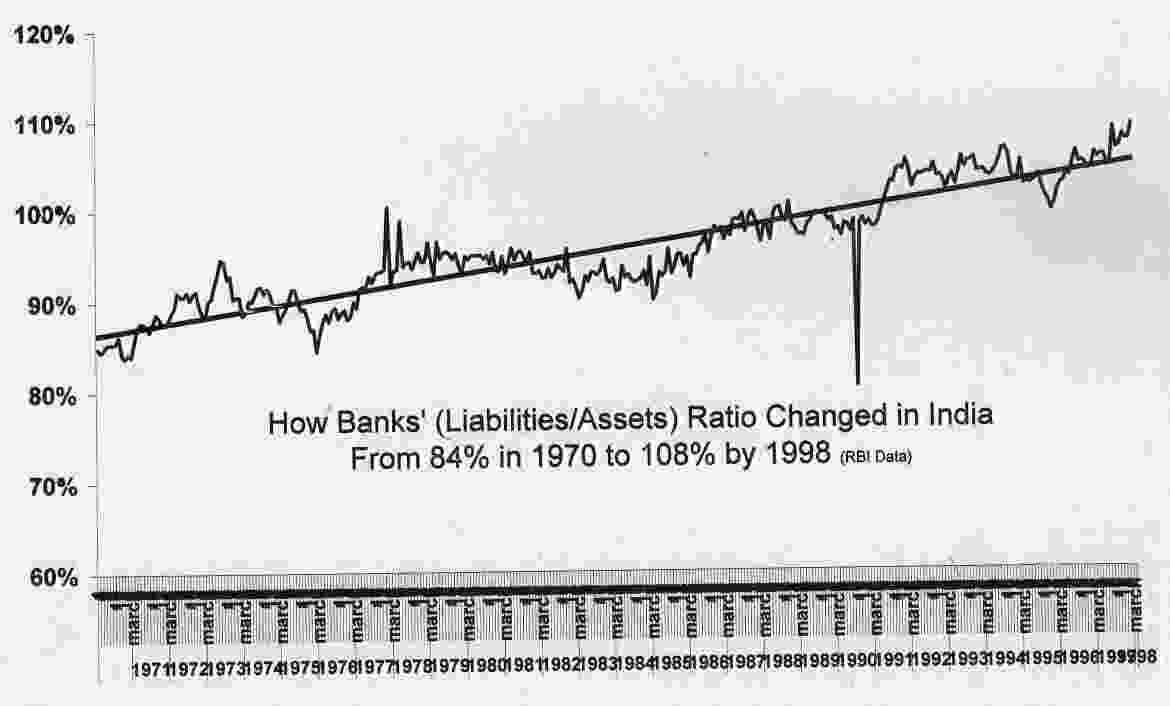
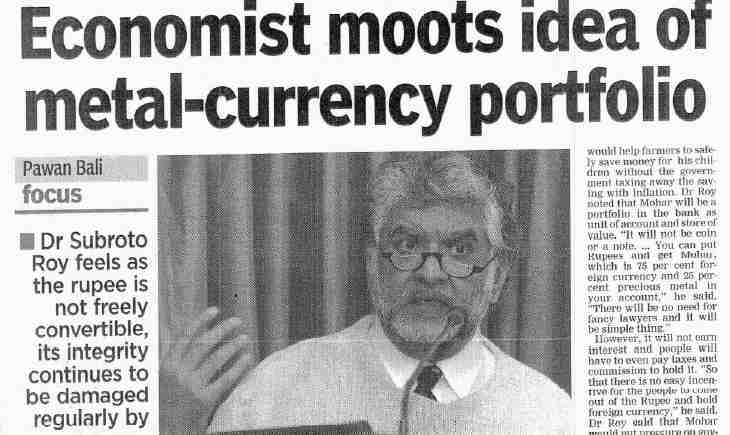

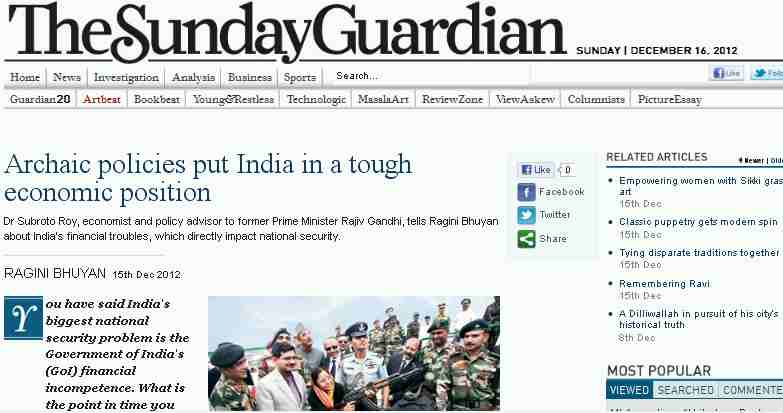



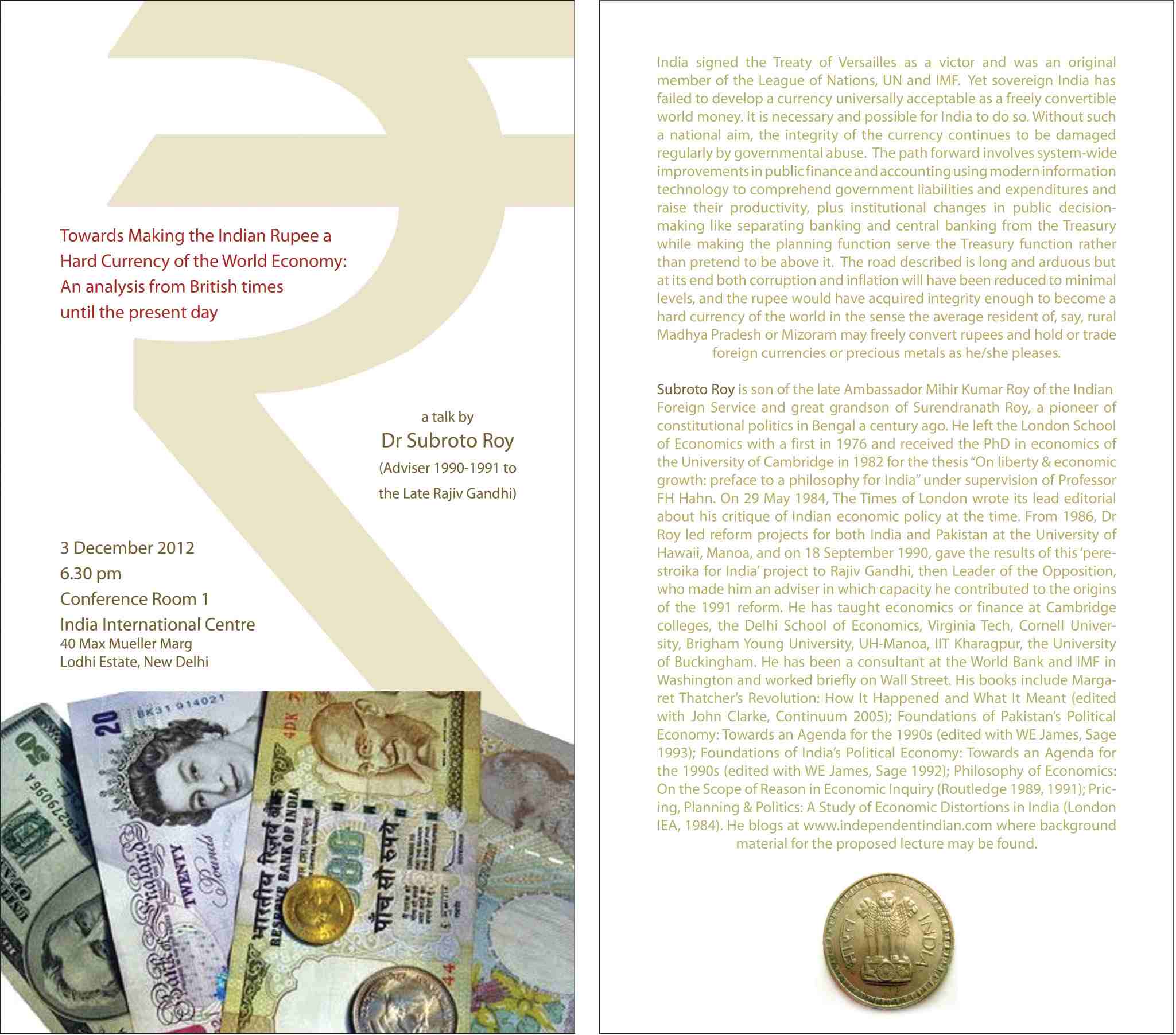

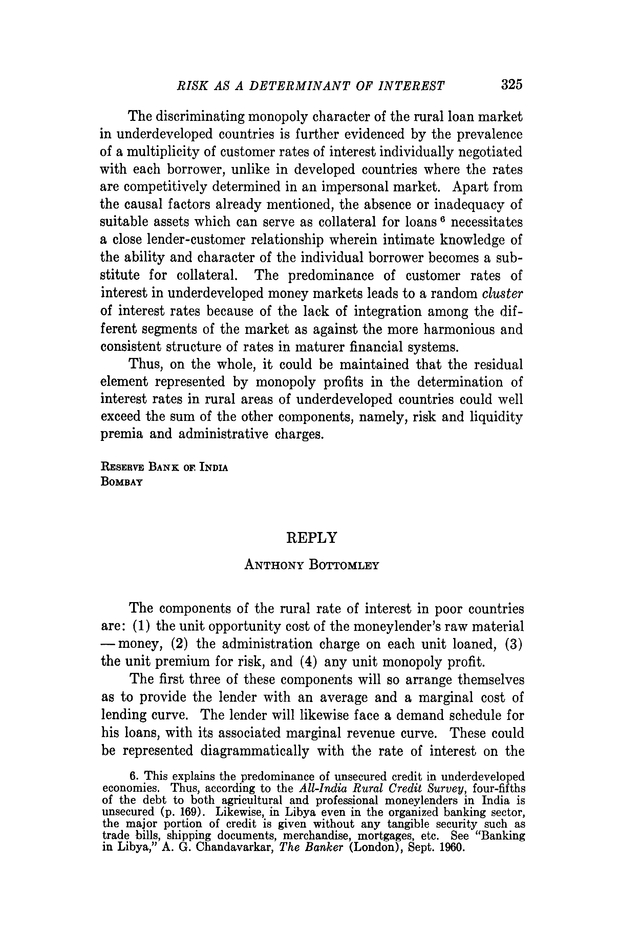

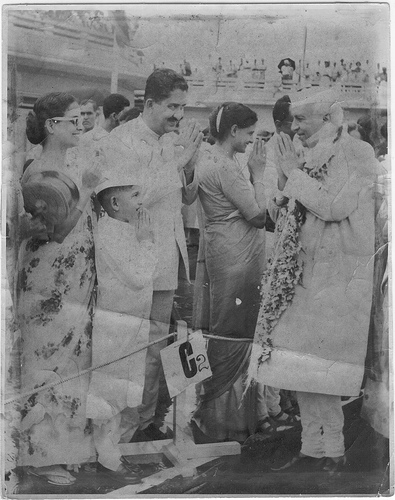

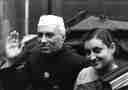
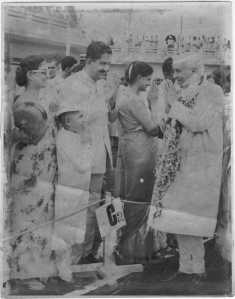
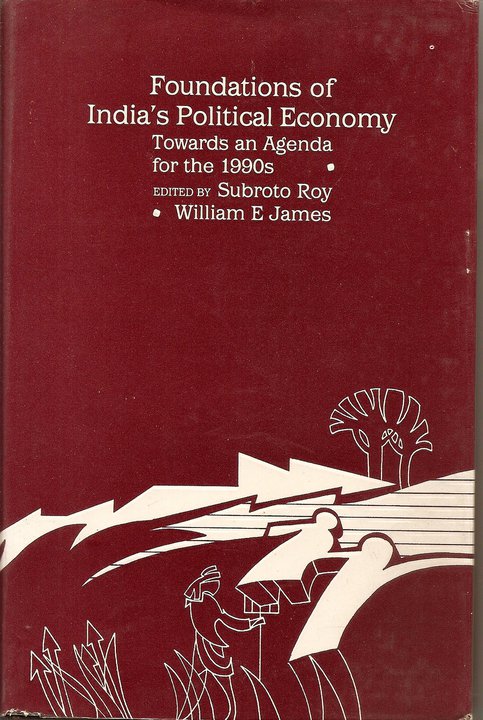
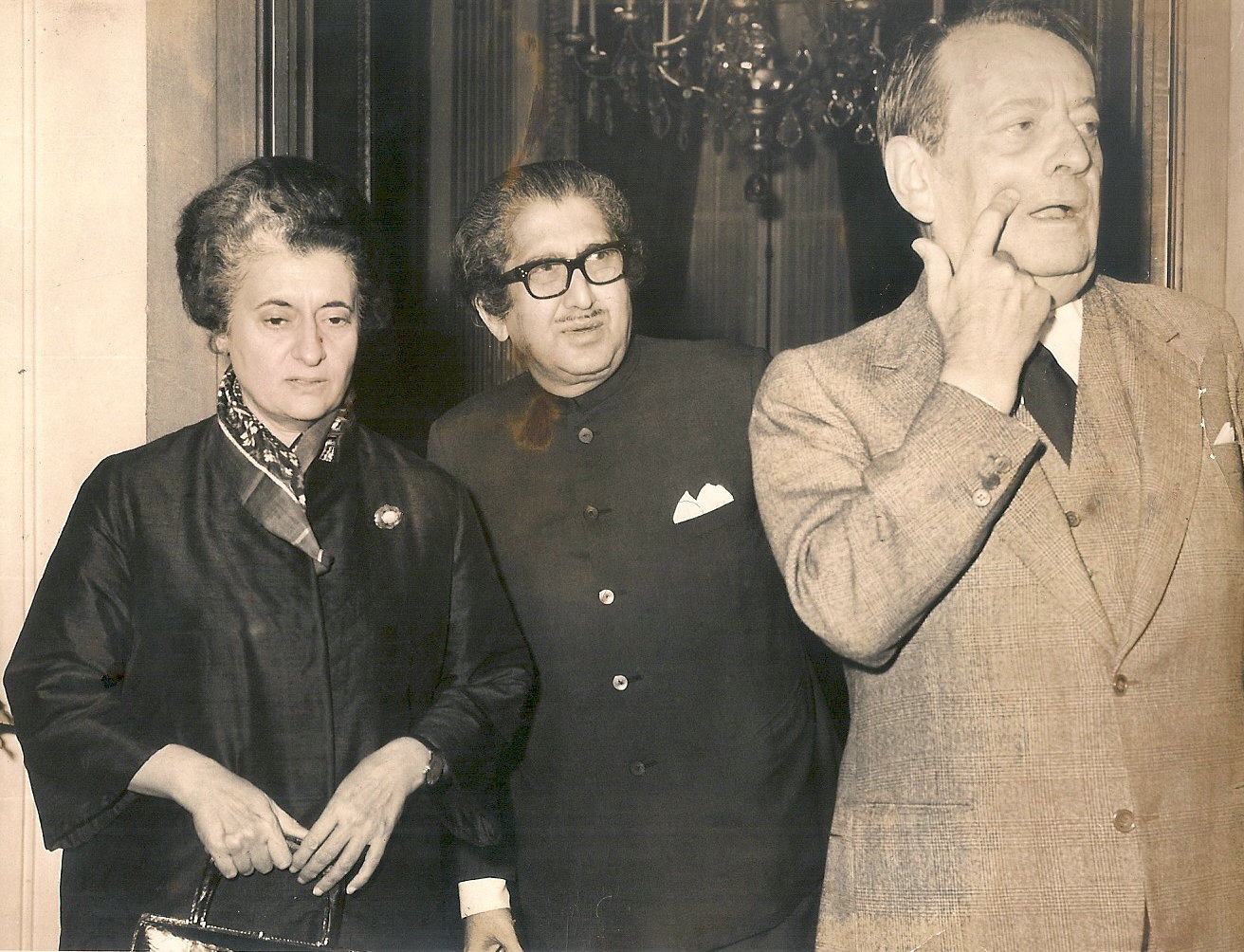



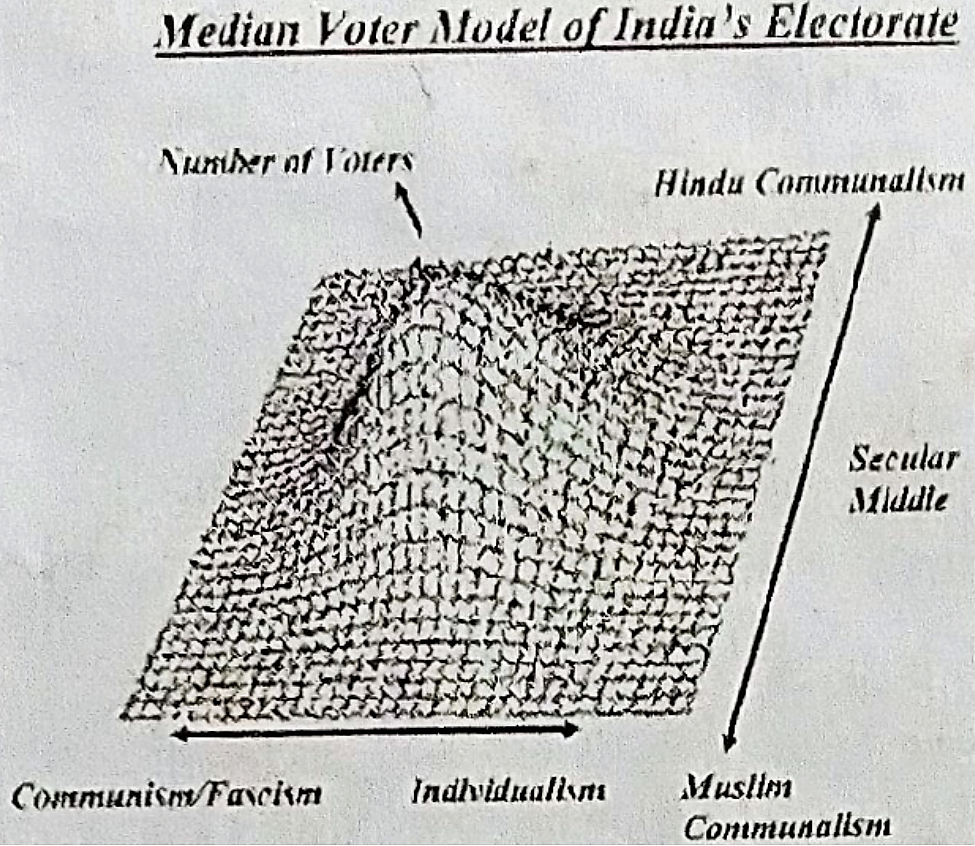
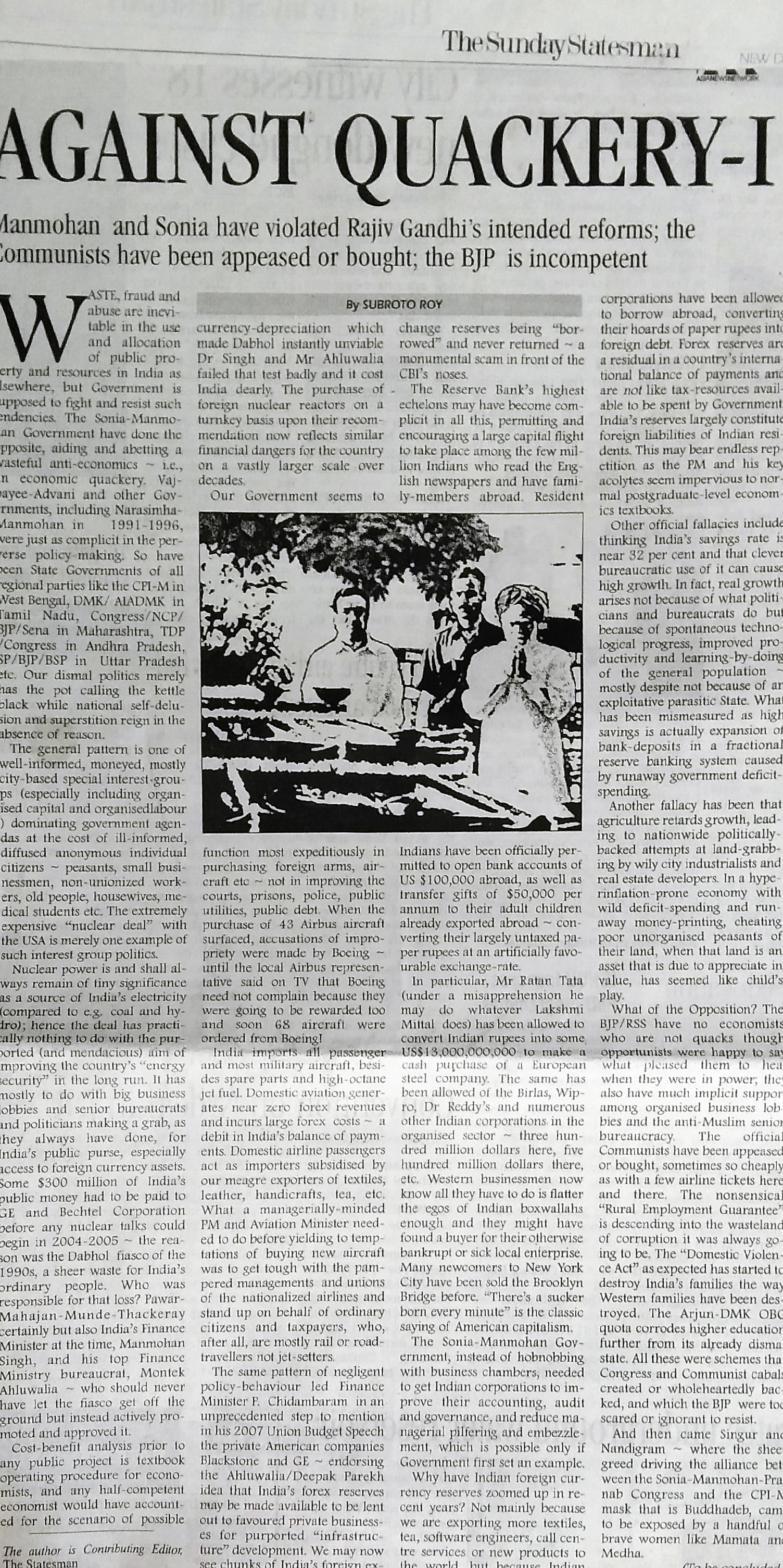
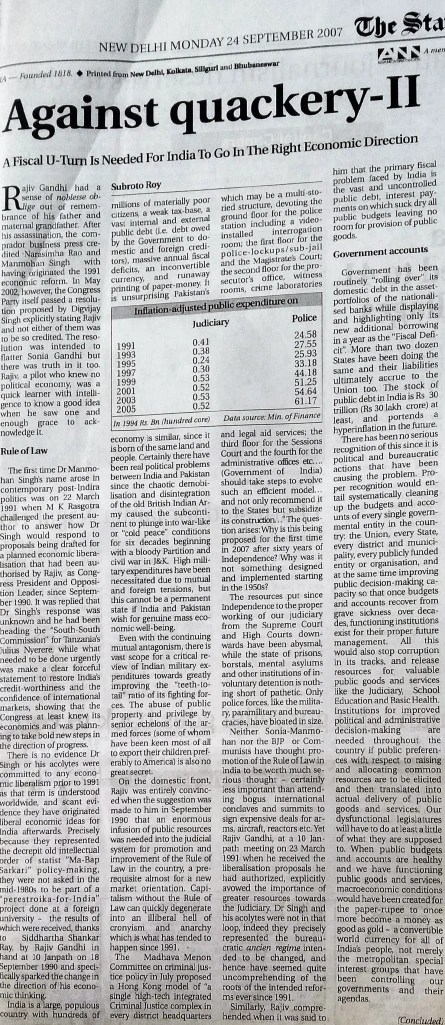


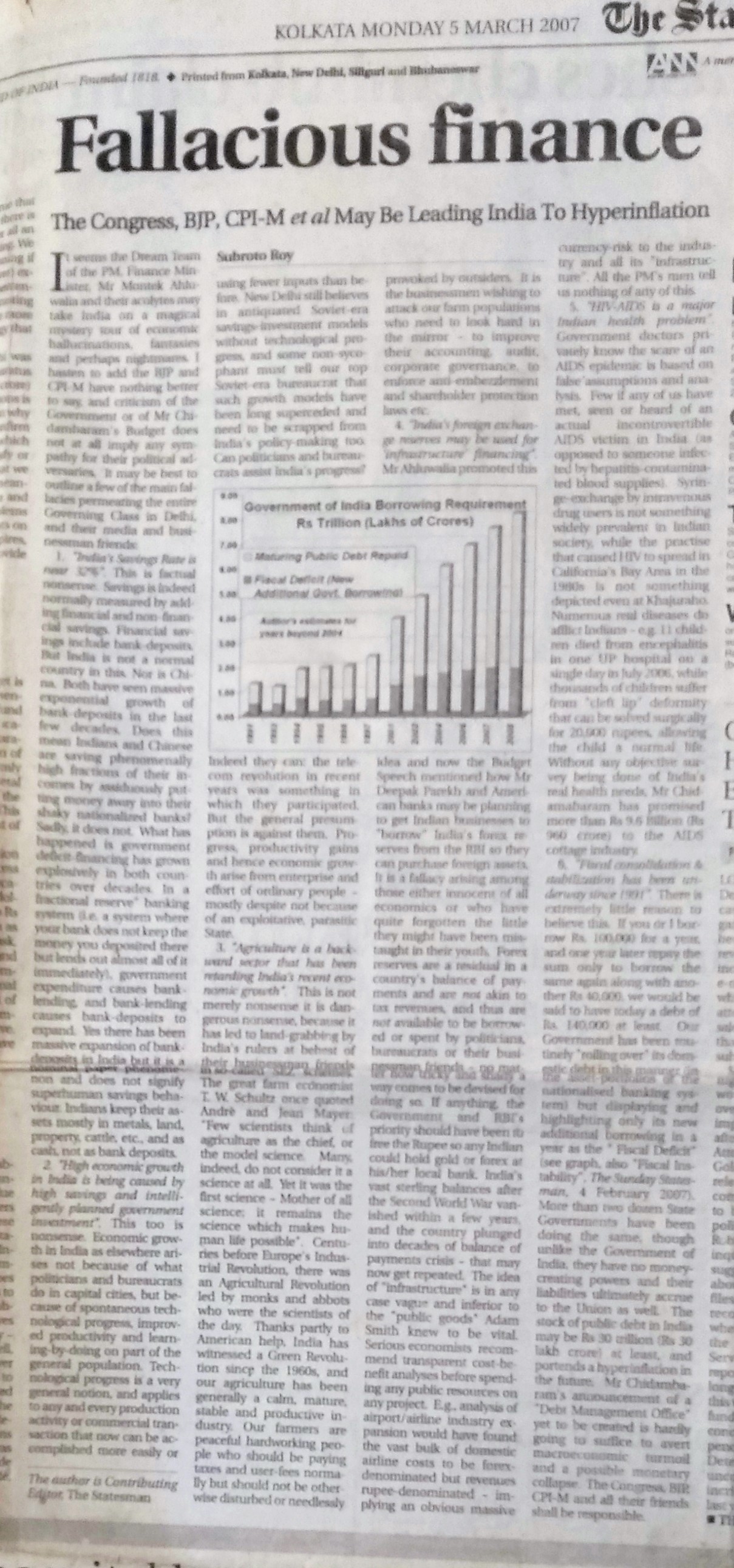


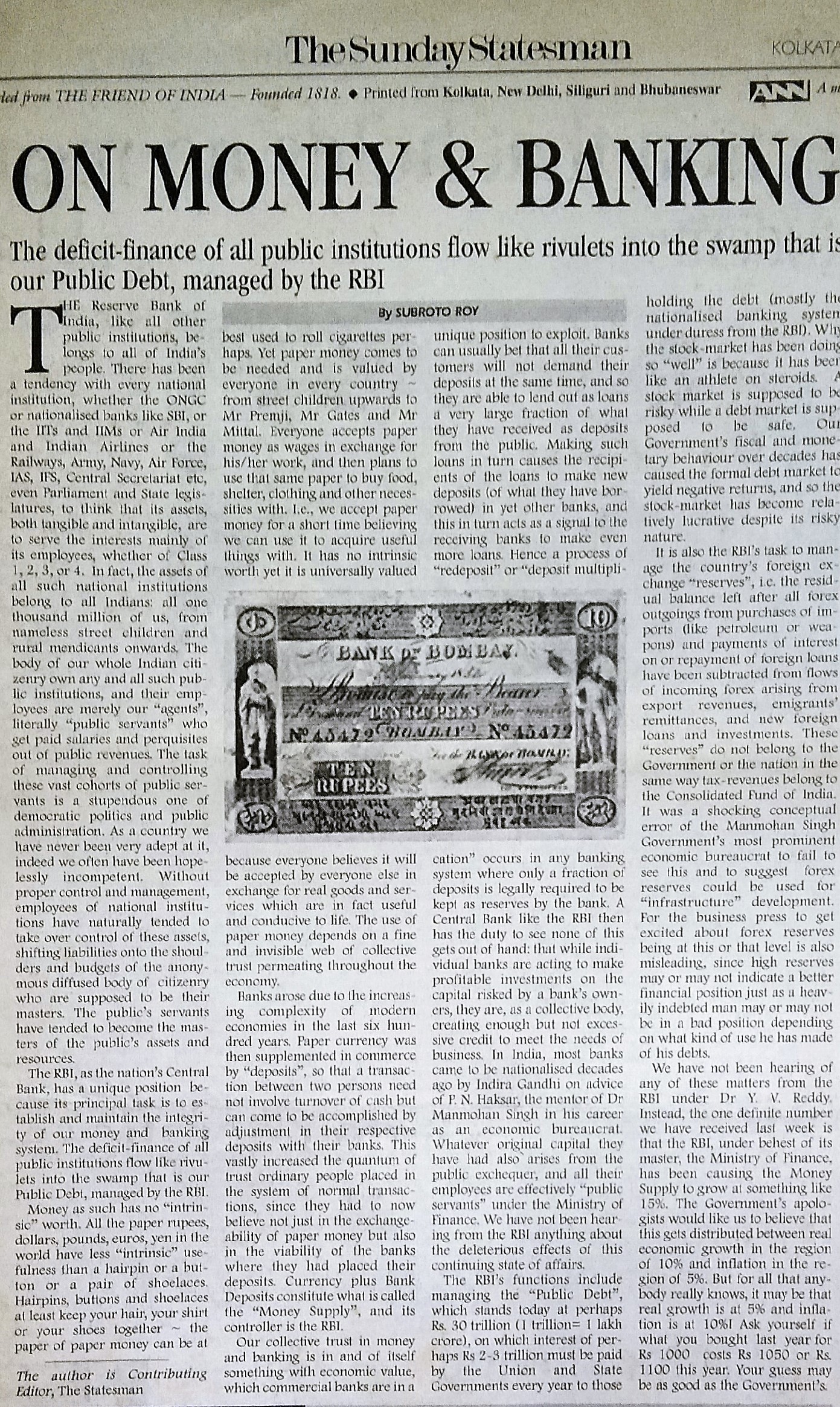

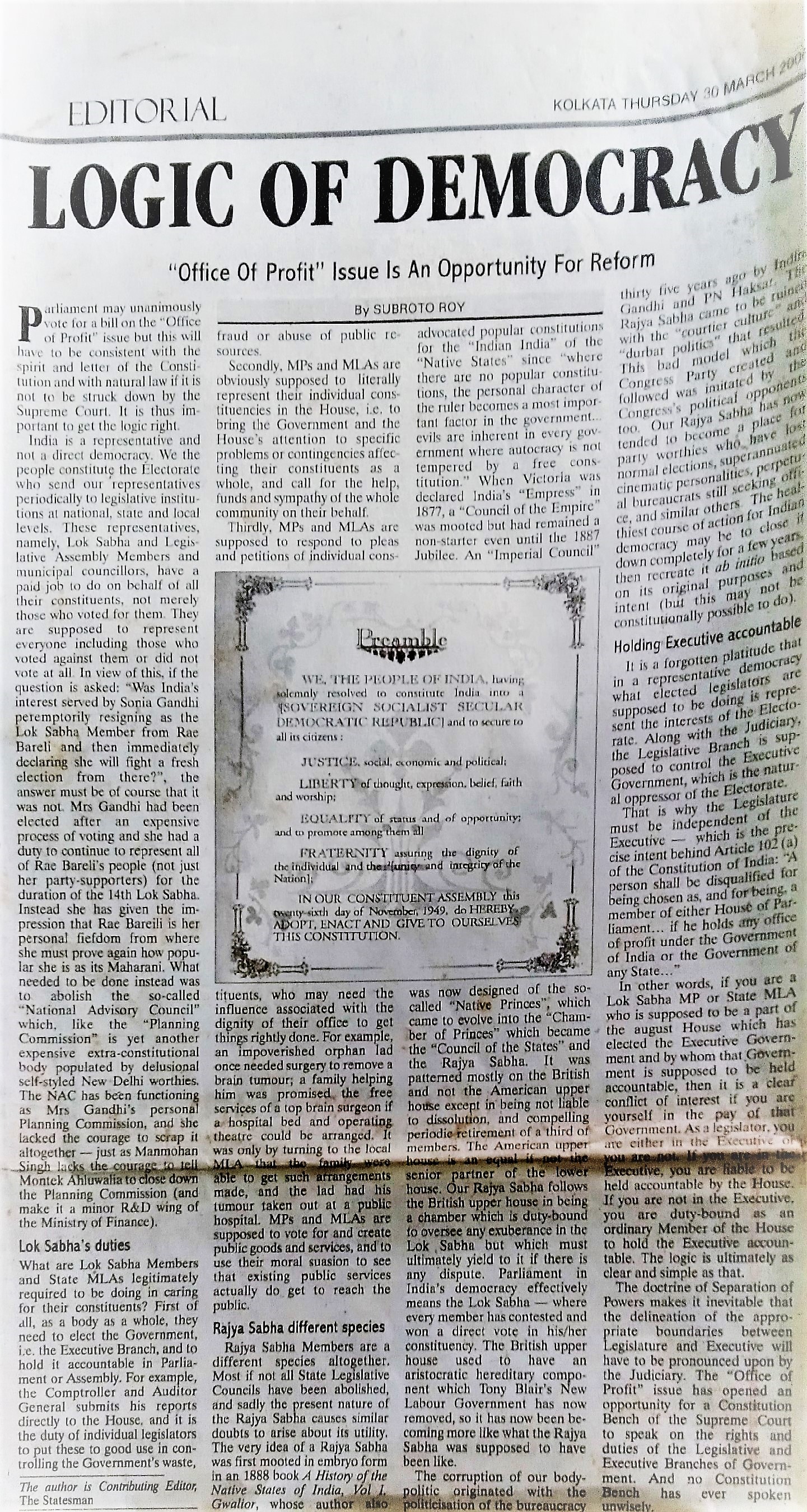
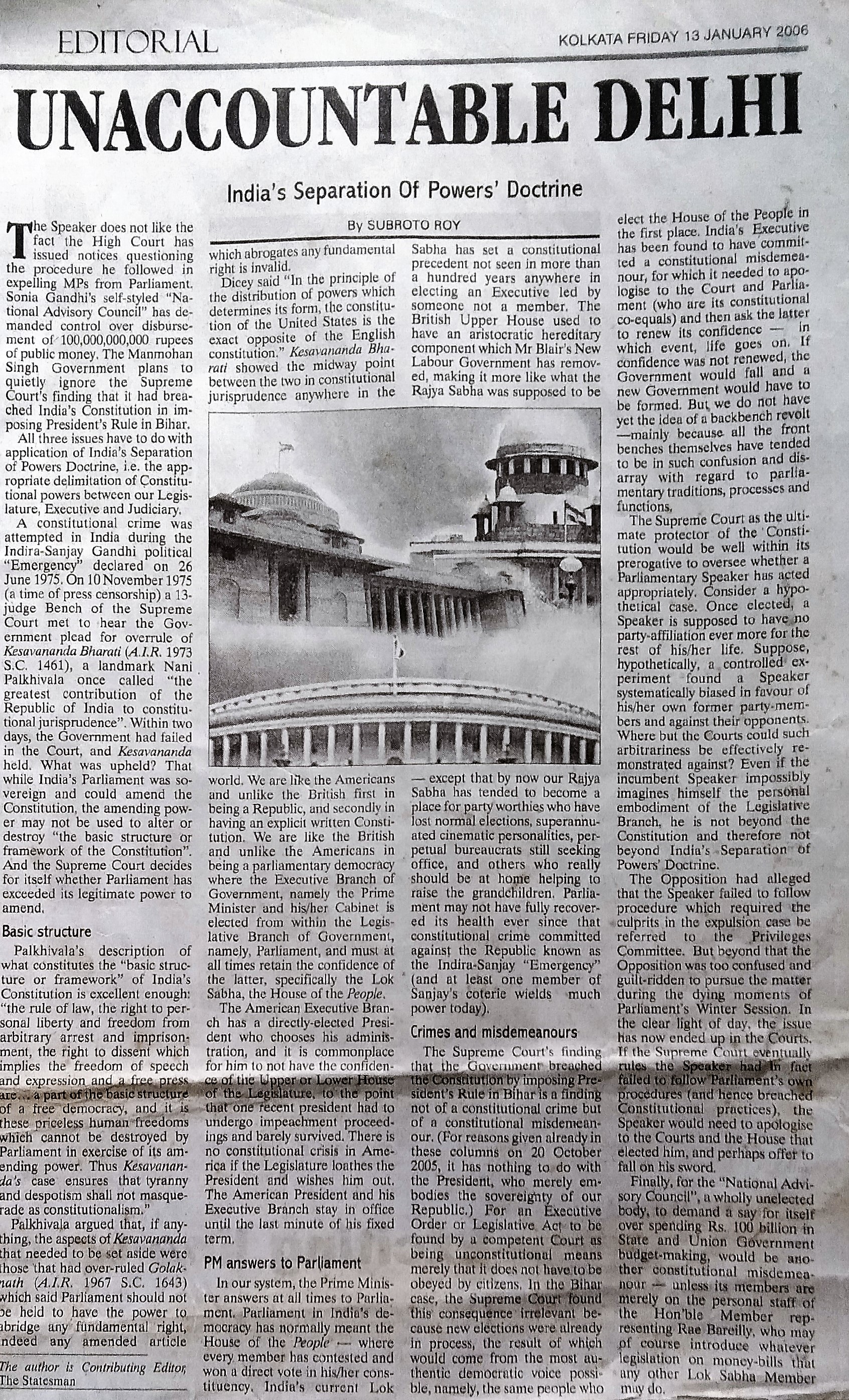
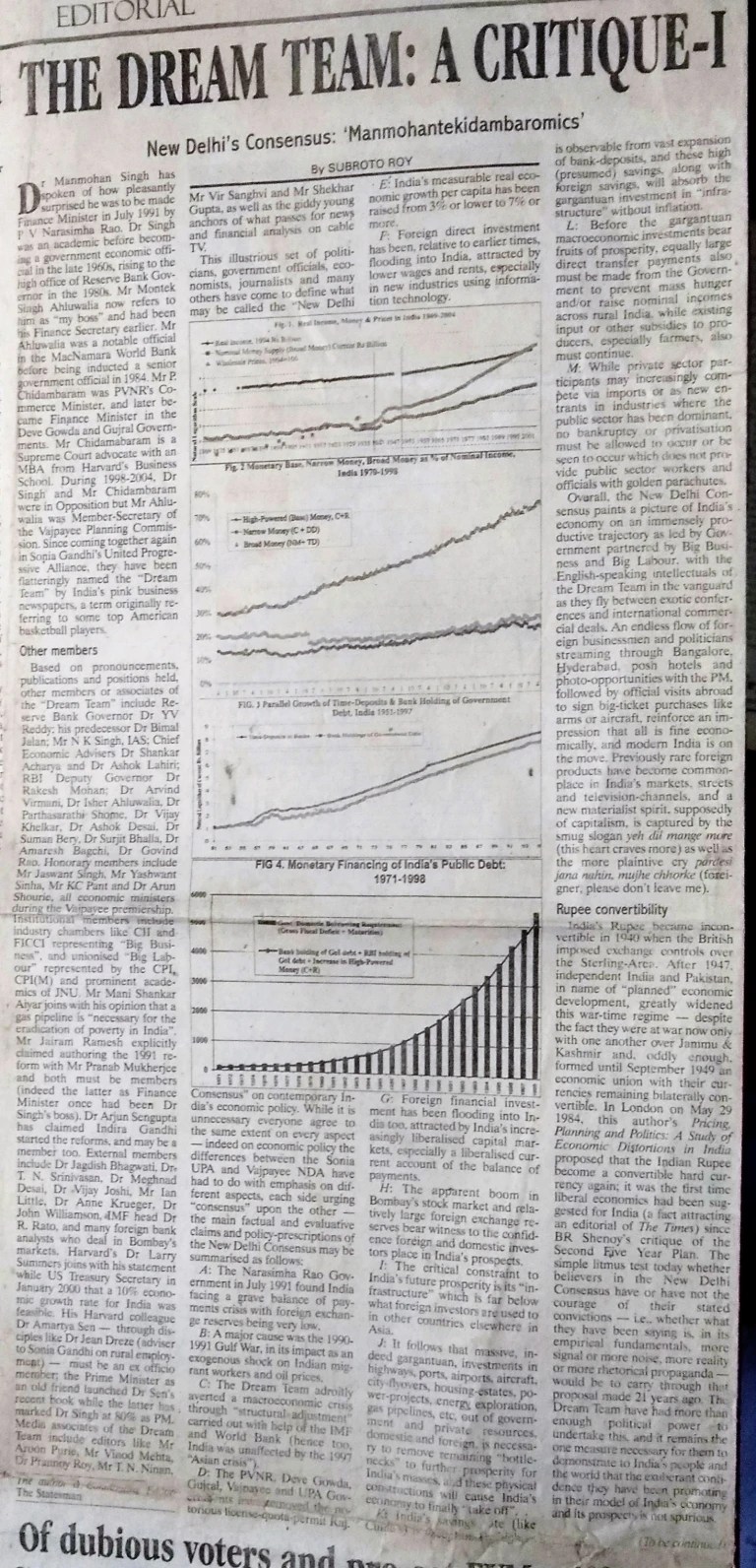

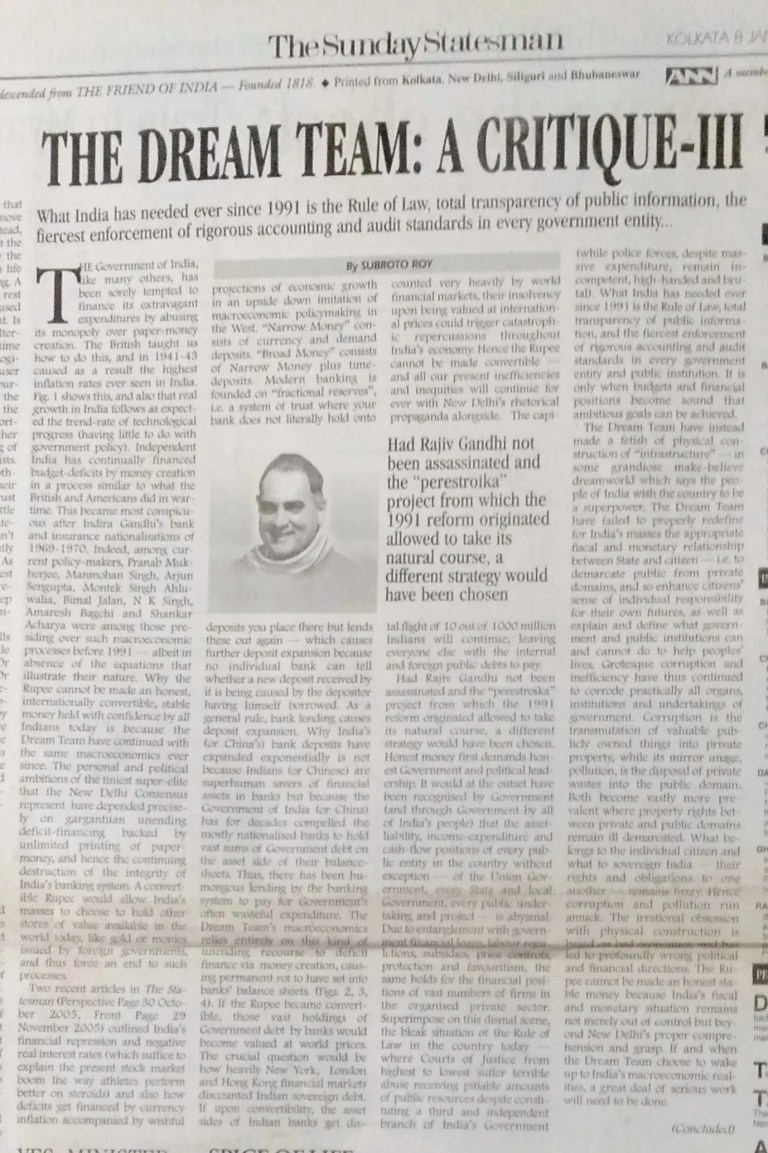

 Independent Indian: Work & Life of Professor Subroto Roy