My article “Haksar, Manmohan and Sonia” appeared today as an op-ed with the New Indian Express http://t.co/bRnQI1hrwy

25 November 2007


Pricing, Planning & Politics: A Study of Economic Distortions in India 1984, uploaded as pdf 2021
Budgets & Financial Positions of Three of India’s Most Populous States (combined population c.300 million)…Brought to you especially by Dr Subroto Roy… Feel free to use (with acknowledgment)…

.
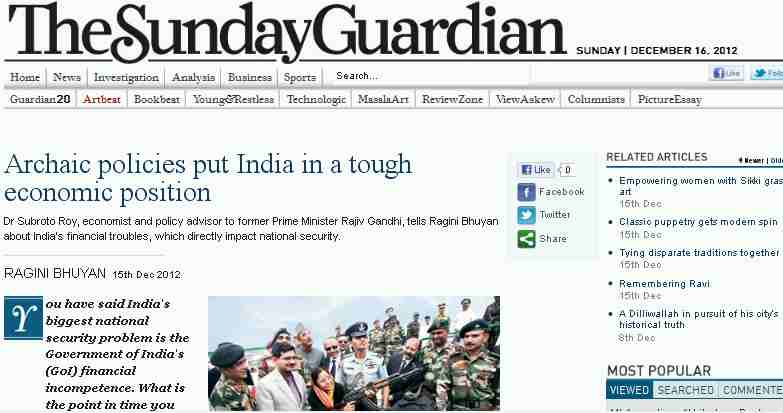

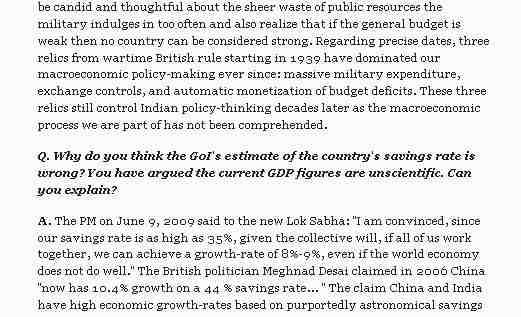


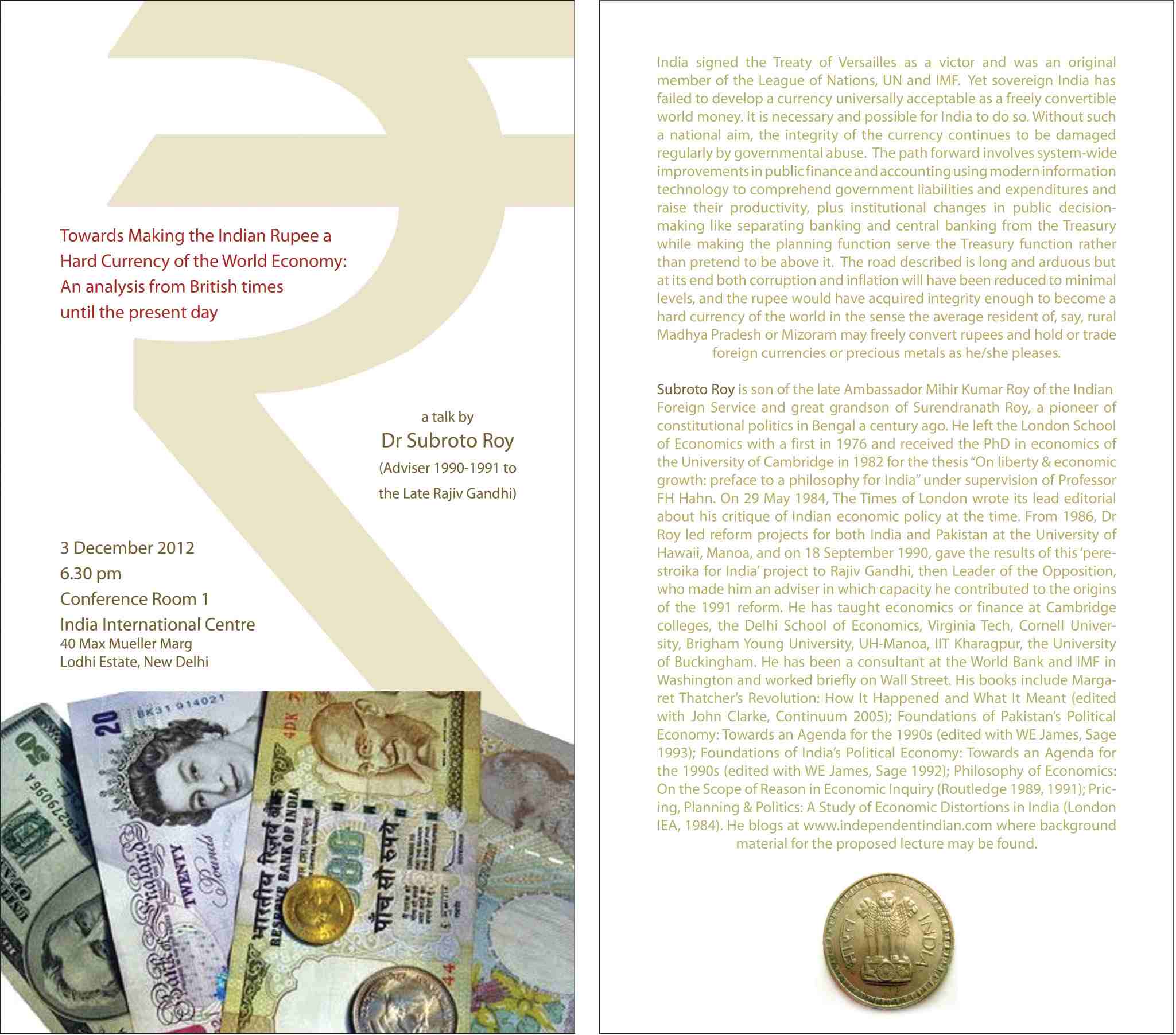
Critique of Amartya Sen: A Tragedy of Plagiarism, Fake News, Dissimulation

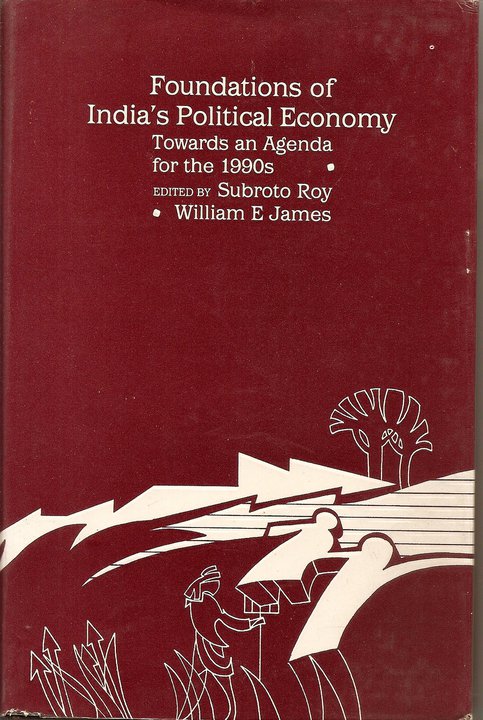







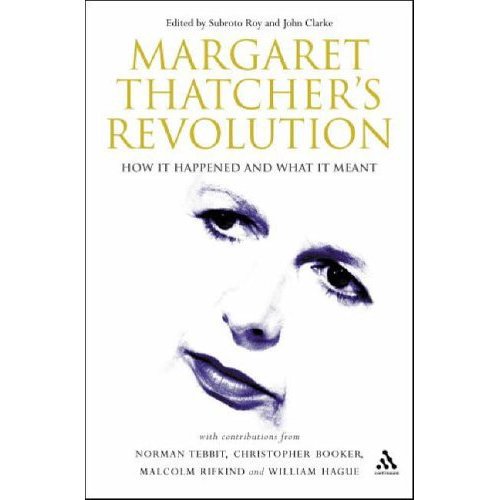

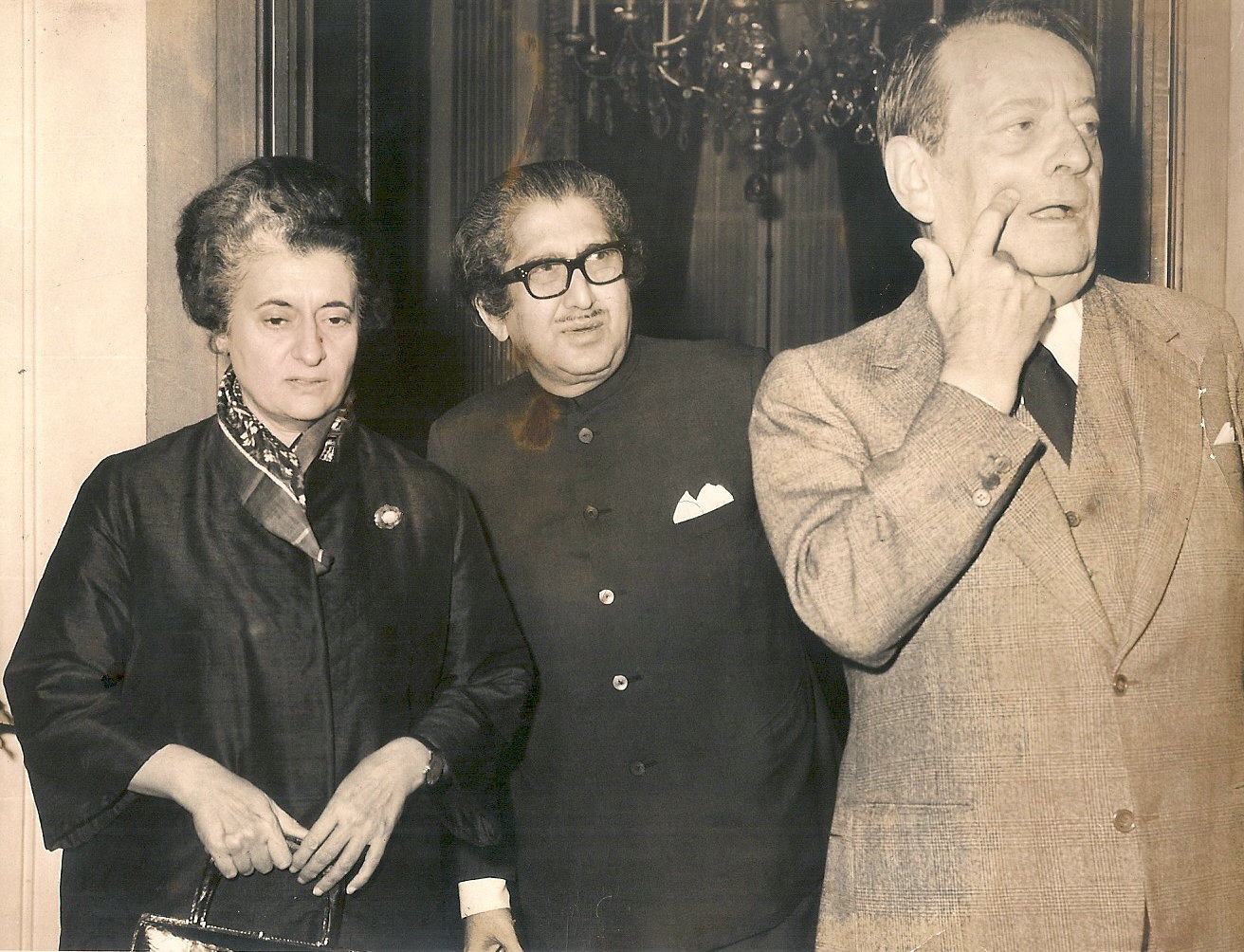



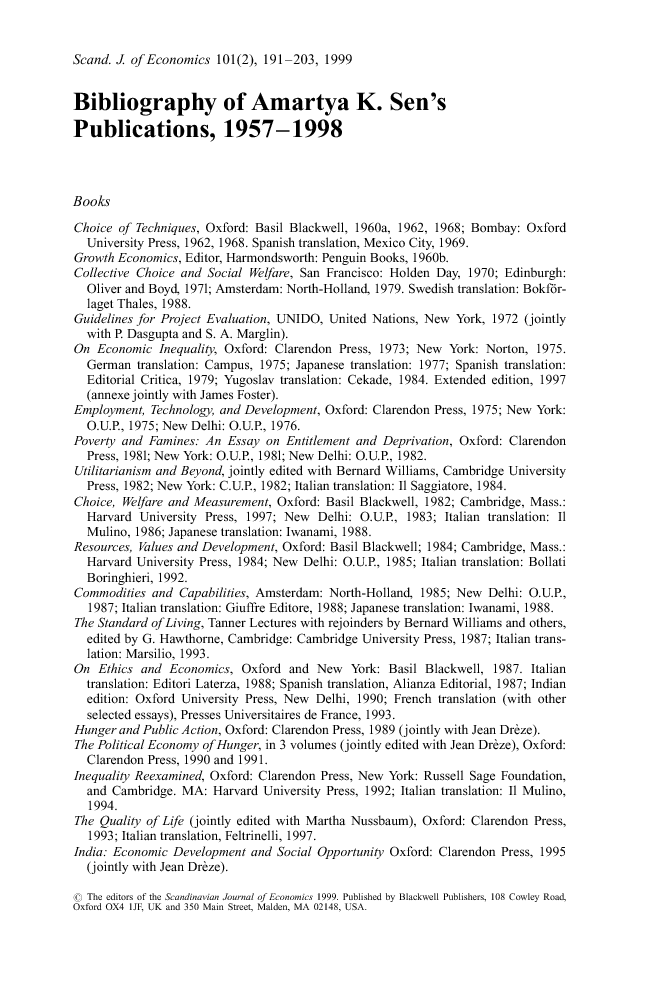 is how consistently these works display his avoidance of all neoclassical economics, and the absence of all of what is normally called ‘price theory’, namely the Marshallian and/or Walrasian theory of value. No “neoclassical economics” anywhere here for sure!
3 June 2014
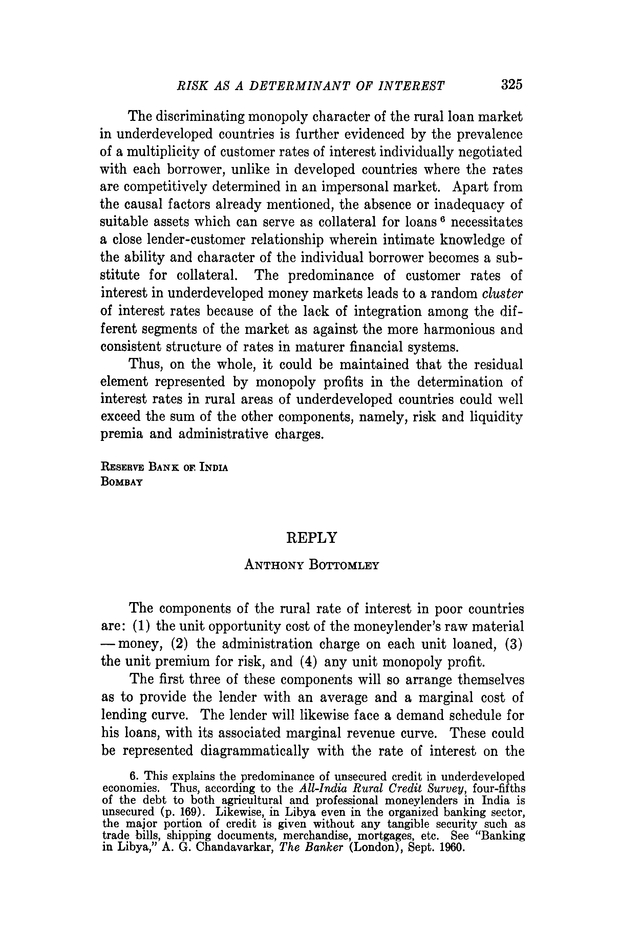 signalling etc in credit-markets, insurance-markets, labour-markets and markets in general, as acknowledged in the awards of several Bank of Sweden prizes? Or will he need a tutorial on the facts of rural India’s financial and credit markets, and their relationship with the formal sector? What the Bottomley-Chandavarkar debate referred to half a century ago still continues in rural India insofar as large arbitrage profits are still made by trading across the artificially low rates of money interest caused by financial repression of India’s “formal” monetised sector with its soft inconvertible currency against the very high real rates of return on capital in the “informal” sector. It is obvious to the naked eye that India is a relatively labour-abundant country. It follows the relative price of labour will be low and relative price of capital high compared to, e.g. the Western or Middle Eastern economies, with mobile factors of production like labour and capital expected to flow accordingly across national boundaries. Indian nominal interest-rates in organized credit markets have been for decades tightly controlled, making it necessary to go back to Irving Fisher’s data to obtain benchmark interest-rates, which, as expected, are at least 2%-3% higher in India than in Western capital markets. Joan Robinson once explained “the difference between 30% in an Indian village and 3% in London” saying “side by side with the industrial revolution went great technical progress in the provision of credit and the reduction of lender’s risk.”
Some of My Works, Interviews etc on India’s Money, Public Finance, Banking, Trade, BoP, Land, etc (an incomplete list)



May 29 2009:

 Rajiv Gandhi 20 August 1944- 21 May 1991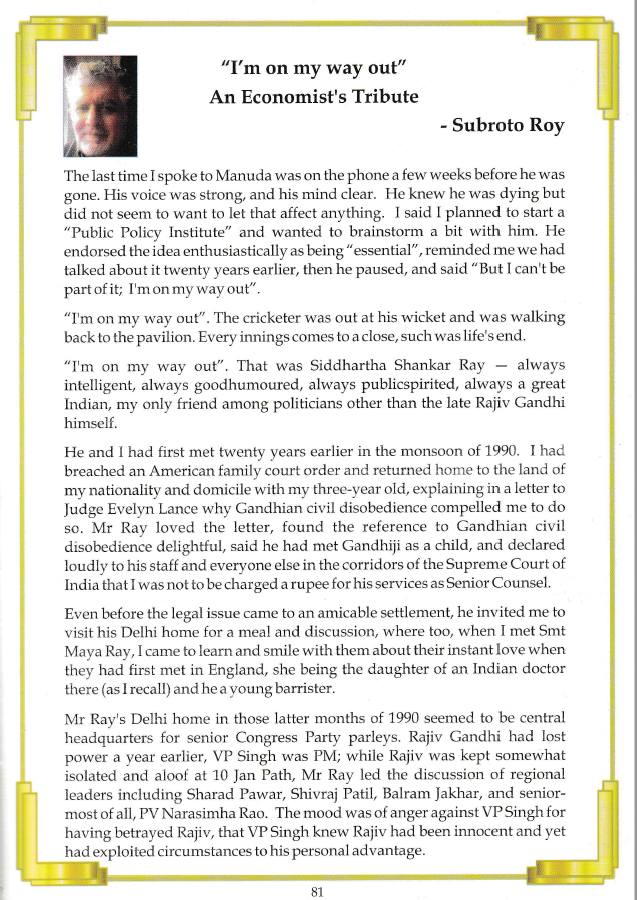

November 7, 2010
From Facebook October 15 2010
Subroto Roy thinks the Sonia-Manmohan Govt throwing auditors with their rule-books ex post facto at the Games’ organisers is a good if miniscule first step (though it is, in my estimation, the third Rajivist step in total, see infra…). May we please have the same done asap to military contracts (especially for Russian fighter jets, used aircraft carriers etc), Boeing & Airbus contracts, railway contracts, power sector contracts including nuclear business contracts, IIT and IIM building contracts, in fact *all* government sector building contracts, in fact *all* government sector contracts……
From Facebook March 28 2010
Subroto Roy is pleased that according to this morning’s news reports of a “national convention” on “Law, Justice & the Common Man”, the Sonia-Manmohan Congress took a small second step yesterday on the same road that Rajiv Gandhi and I had chalked out in 1990-1991. Better late than never!
see also
Dr Manmohan Singh has in a televised meeting with children said about himself:
“I am an aam admi“.
I am afraid this caused me to say at Facebook today:
Subroto Roy finds disconcerting Prime Minister Manmohan Singh’s claim of being himself “a common man”.
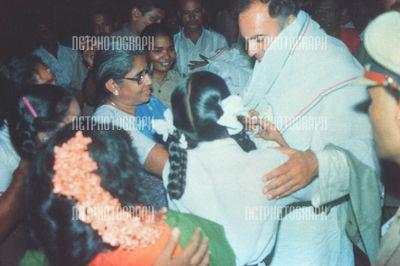
In “Rajiv Gandhi and the Origins of India’s 1991 Economic Reform”, I wrote about my encounter with Rajiv:
“I said the public sector’s wastefulness had drained scarce resources that should have gone instead to provide public goods. Since the public sector was owned by the public, it could be privatised by giving away its shares to the public, preferably to panchayats of the poorest villages. The shares would become tradable, drawing out black money, and inducing a historic redistribution of wealth while at the same time achieving greater efficiency by transferring the public sector to private hands. Rajiv seemed to like that idea too, and said he tried to follow a maxim of Indira Gandhi’s that every policy should be seen in terms of how it affected the common man. I wryly said the common man often spent away his money on alcohol, to which he said at once it might be better to think of the common woman instead. (This remark of Rajiv’s may have influenced the “aam admi” slogan of the 2004 election, as all Congress Lok Sabha MPs of the previous Parliament came to receive a previous version of the present narrative.)”
I am afraid I do not think Dr Singh was whom Rajiv or Indira had in mind in speaking of the common man.
Subroto Roy
Kolkata
From Facebook June 10 2011:
Subroto Roy remembers Gopi with respect and affection.
We met first at his IMF office in Nov 1992 when I had been briefly at the World Bank; hearing of my 1990-91 encounter with Rajiv Gandhi which sparked the 1991 economic reform, he immediately insisted I come to the Fund and it was due to him I became a consultant there in early 1993 (working on exports and exchange-rates of India, Pakistan, Sri Lanka, Bangladesh seen together for the first time as requested for by the Saudi Exec Dir M Al-Jasser).
I had phoned him from Bombay when I arrived from the USA in June 1996 and he immediately sent out three names and contacts of senior business figures he wanted me to meet. But I became a Professor instead. When we met again at his Grindlays office in Delhi later that year, he was just as keen to push me forward saying “You should be in the PMO”. But there was uncertainty in Delhi at the time with the new Deve Gowda Government.
We last met about October 2003 when he treated me to lunch at the IIC Delhi and we then flew together to Calcutta; he told me then the Finance Ministry had become a complete and total *mess* — it was remembering that today that I decided to write this. I had said to him I could not point to any serious macro economists in Delhi who really comprehended the gravity of the problem; he laid great store by one (unobvious) name but came to be disappointed there too.
On September 5 2009, he wrote on my blog “This short piece by Dr Roy on Jinnah is a gem. It puts paid to the theories peddled by all those who have not been introduced to geo-politics”. I was very sorry to hear just two months later that he had died. He embodied a clear-headed and intelligent Nehruvian nationalism which has become vanishingly rare in New Delhi today. “He was my friend, faithful and just to me”.



Cabinet Government has become far too unwieldy and impractical in India, and the new Cabinet chosen by Sonia Gandhi and Manmohan Singh over almost a fortnight — of some 79 Ministers, almost certainly the largest number in the world — may be destined to be so as well. If there is going to be “fiscal prudence” as the PM and Finance Minister have declared, it really needs to start at the top with the Union Government itself. Remember we also have more than two dozen State Governments plus Union Territories and myriad local governments too.
Here then is an example of a better-designed Cabinet for the Government of India with Cabinet Ministers in bold-face, others not so:
Prime Minister
– Parliamentary Affairs
– Intra-Government Liaison
Defence War/Forces (Raksha, Yudh/Fauj)
– Army
– Navy & Coast Guard
– Air Force & Strategic Forces
– Ordnance
Finance
– Money & Banking
– Accountant General
– Planning
Home Affairs
– Law & Justice
– Internal Security
– Disaster Management & Civil Defence
– Archaeology, Art & Culture
Foreign
– Commerce & Tourism
– Overseas Indians
– International Organisations
Transport
– Railways
– Roads & Highways
– Shipping & Waterways
– Civil Aviation
– Urban Development
Agriculture & Food
– Rural Development
– Water, Flood Control & Irrigation
– Environment
– Forestry & Tribal Affairs
Industry
– Competition and Monopoly-Control
– Steel
– Textiles
– Power
– Petroleum and Energy
– Chemicals & Fertilizers
– Coal and Mines
– Communications and IT
Education
– Schools
– Higher Education
– Vocational Education
– Sports
– Science and Technology
Labour & Employment
Health and Human Services
– Housing
– Women and Child Development
– Social Security
There are just eleven Cabinet Ministers (in bold-face above) including the PM, so, along with the Cabinet Secretary, they could sit with ease around a normal table which should help the process of deliberation.
This document has arisen out of one during my work as an adviser to Rajiv Gandhi in his last months in 1990-1991 though the latter never reached him; I had intended to talk to him about its contents but it was not to be.
It may be profitably read alongside my “Distribution of Government Expenditure in India”, which is part of my ongoing research and was released in the public interest last year.
Subroto Roy, Kolkata
see too
Why has the Sonia Congress done something that the Congress under Nehru-Indira-Rajiv would not have done, namely, exaggerate the power of the Rajya Sabha and diminish the power of the Lok Sabha?


see revised and expanded version
My American years: Part One 1980-90: battles for academic integrity & freedom
On the Blacksburg campus February 1982, my second year in America.
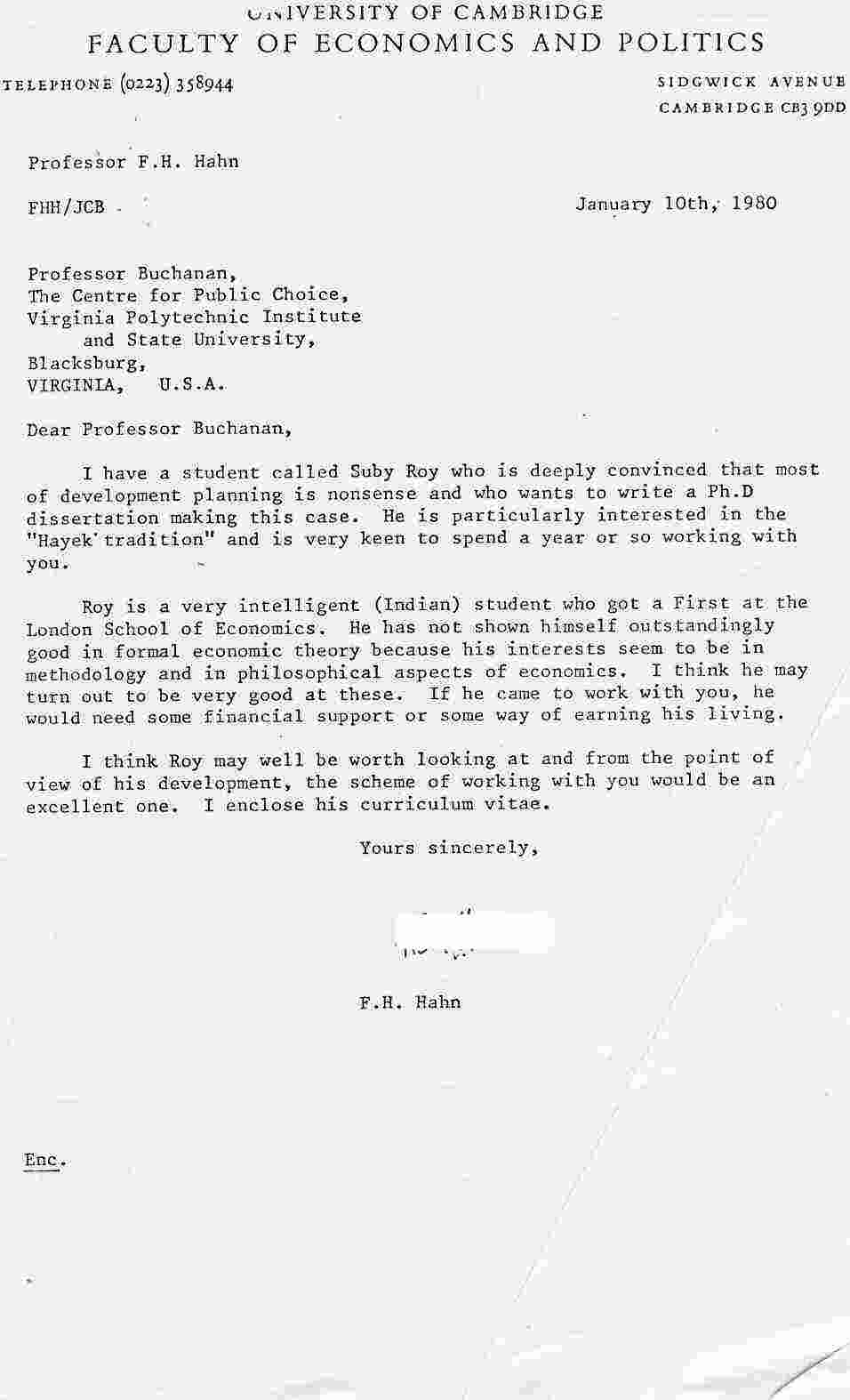
I had come to Blacksburg in August 1980 thanks to a letter Professor Frank Hahn had written on my behalf to Professor James M Buchanan in January 1980.
I was in an “All But Dissertation” stage at Cambridge when I got to Blacksburg; I completed the thesis while teaching in Blacksburg, sent it from there in September 1981, and went back to Cambridge for the viva voce examination in January 1982.
Professor Buchanan and his colleagues were welcoming and I came to learn much from them about the realities of public finance and democratic politics, which I very soon applied to my work on India.
Jim Buchanan had a reputation for running very tough conferences of scholars. He invited me to one such in the Spring of 1981. We were made to work very hard indeed. One of the books prescribed is still with me, In Search of a Monetary Constitution, ed. Leland Yeager, Harvard 1962, and something I still recommend to anyone wishing to understand the classical liberal position on monetary policy. The week-long 1981 conference had one rest-day; it was spent in part at an excellent theatre in a small rural town outside Blacksburg. This photo is of Jim Buchanan on the left and Gordon Tullock on the right; in between them is Ken Minogue of the London School of Economics — who, as it happened, had been Tutor for Admissions when I became a freshman there seven years earlier.

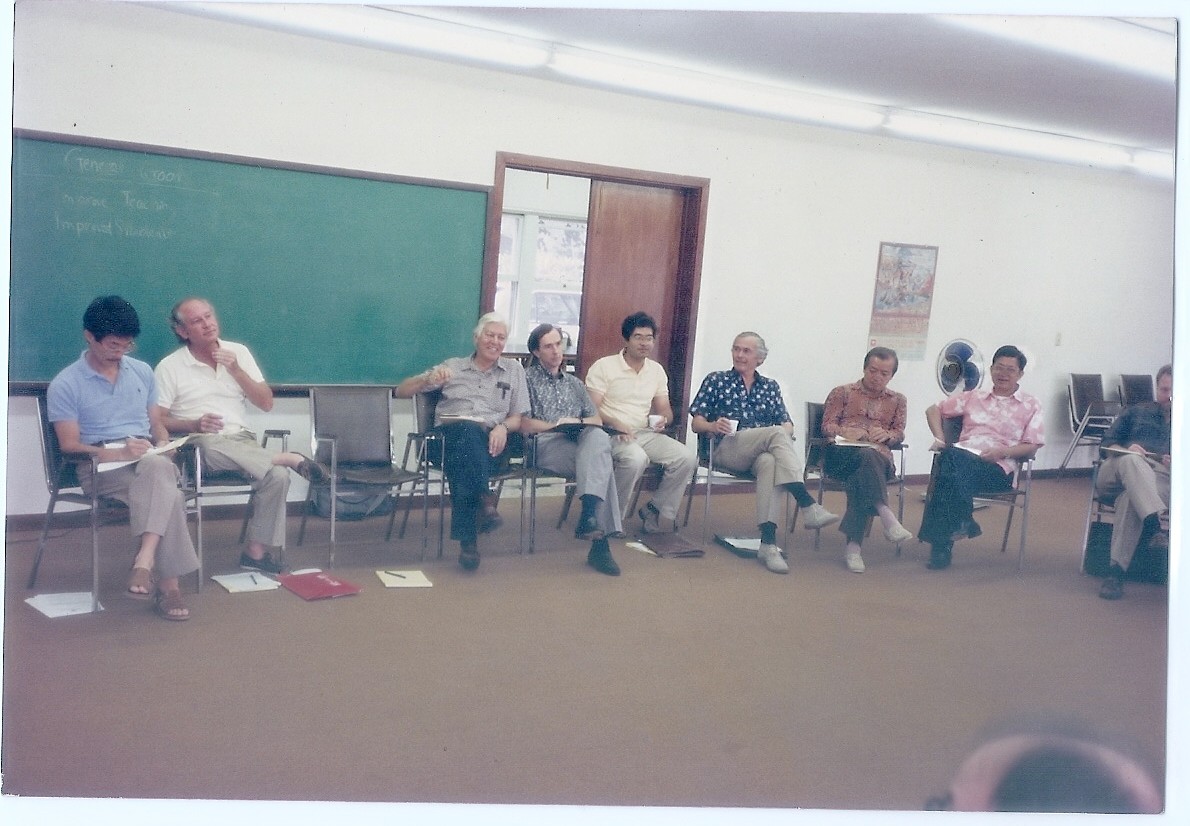
(I must have learnt something from Jim Buchanan about running conferences because nine years later in May-June 1989 at the University of Hawaii, I made the participants of the India-perestroika and Pakistan-perestroika conferences work very hard too.)
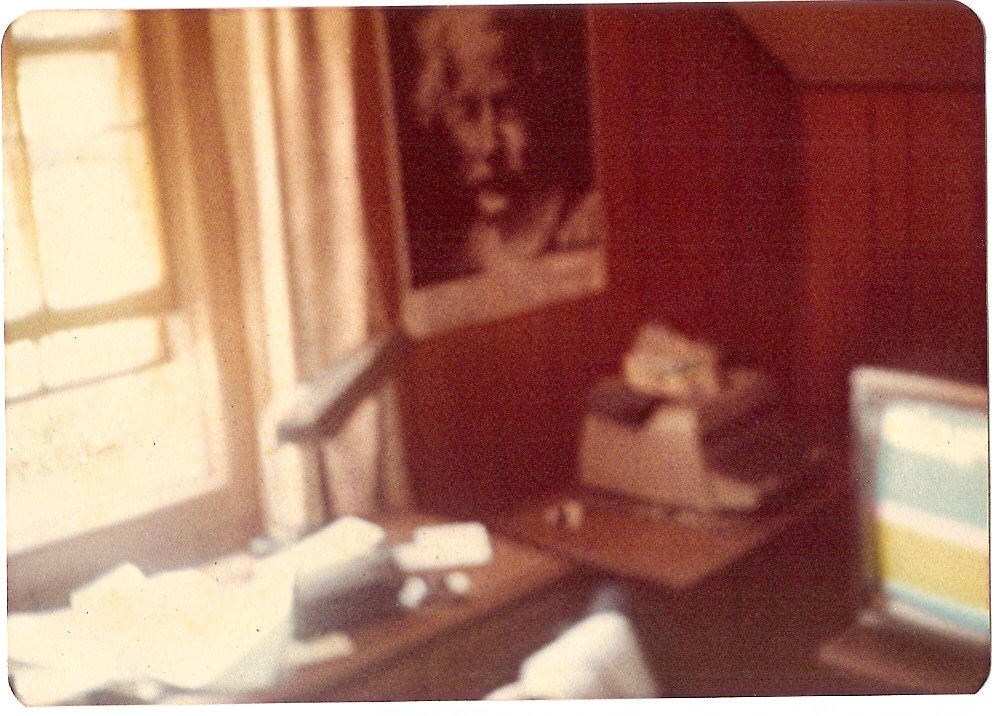
My first rooms in America in 1980 were in the attic of 703 Gracelyn Court, where I paid $160 or $170 per month to my marvellous landlady Betty Tillman. There were many family occasions I enjoyed with her family downstairs, and her cakes, bakes and puddings all remain with me today.
A borrowed electric typewriter may be seen in the photo: the age of the personal computer was still a few years away. The Department had a stand-alone “AB-Dic” word-processor which we considered a marvel of technology; the Internet did not exist but there was some kind of Intranet between geeks in computer science and engineering departments at different universities.
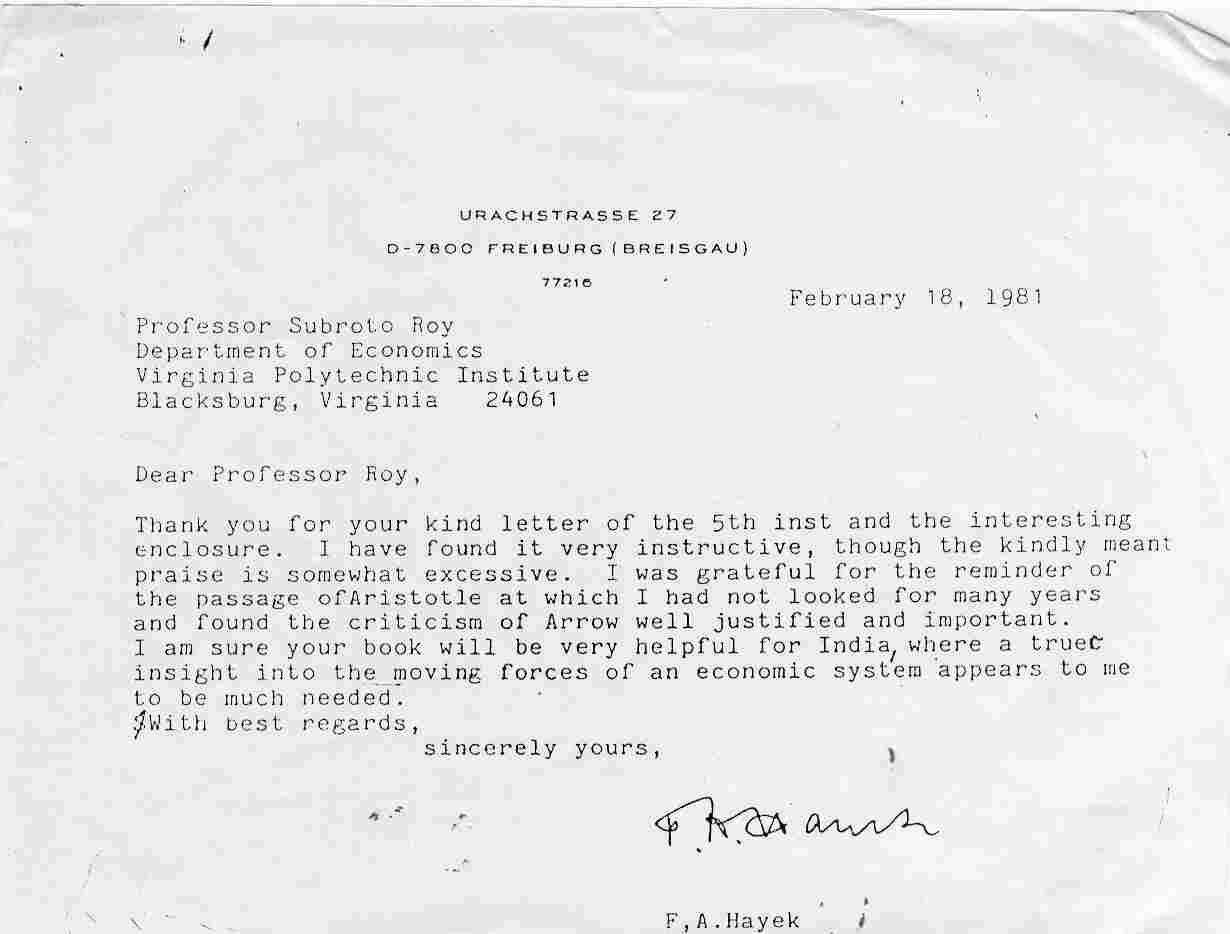
It was at Gracelyn Court that this letter reached me addressed by FA Hayek himself.
Professor Buchanan had moved to Blacksburg from Charlottesville some years earlier with the Centre for Study of Public Choice that he had founded. The Centre came to be housed at the President’s House of Virginia Tech (presumably the University President himself had another residence).

I was initially a Visiting Research Associate at the Centre and at the same time a Visiting Assistant Professor in the Economics Department. I was very kindly given a magnificent office at the Centre, on the upper floor, perhaps the one on the upper right hand side in the picture. It was undoubtedly the finest room I have ever had as an office. I may have had it for a whole year, either 1980-81 or 1981-82. When Professor Buchanan and the Centre left for George Mason University in 1983, the mansion returned to being the University President’s House and my old office presumably became a fine bedroom again.
I spent the summer of 1983 at a long libertarian conference in the Palo Alto/Menlo Park area in California. This is a photo from a barbecue during the conference with Professor Jean Baechler from France on the left; Leonard Liggio, who (along with Walter Grinder) had organised the conference, is at the right.

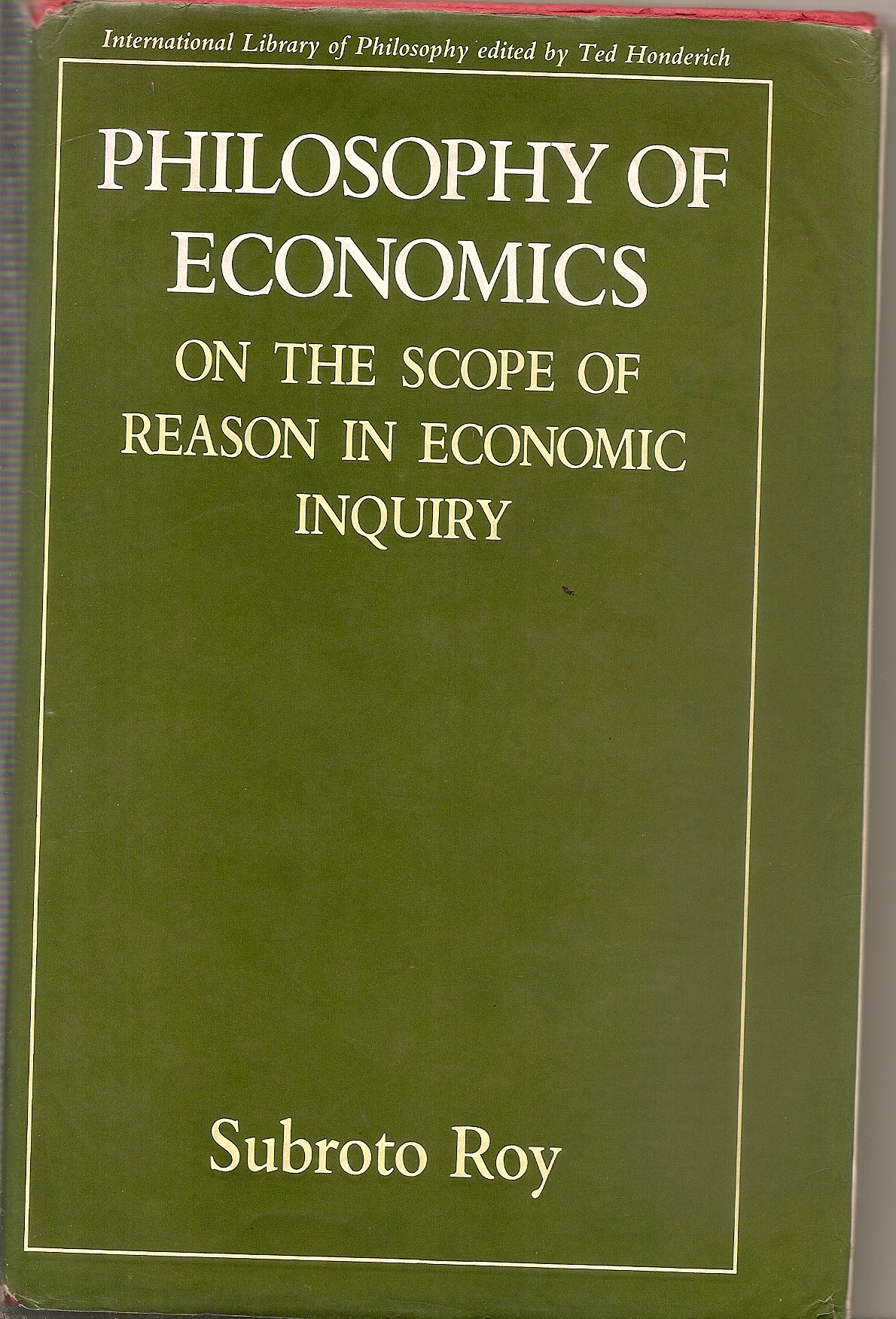
The first draft of the book that became Philosophy of Economics was written (in long hand) during that summer of 1983 in Palo Alto/Menlo Park. The initial title was “Principia Economica”, and the initial contracted publisher, the University of Chicago Press, had that title on the contract.
My principal supporter at the University of Chicago was that great American Theodore W. Schultz, then aged 81,

to whom the Press had initially sent the manuscript for review and who had recommended its prompt publication. Professor Schultz later told me to my face better what my book was about than I had realised myself, namely, it was about economics as knowledge, the epistemology of economics.
My parents came from India to visit me in California, and here we are at Yosemite.
. 
Also to visit were Mr and Mrs Willis C Armstrong, our family friends who had known me from infancy. This is a photo of Bill and my mother on the left, and Louise and myself on the right, taken perhaps by my father. In the third week of January 1991, during the first Gulf War, Bill and I (acting on behalf of Rajiv Gandhi) came to form an extremely tenuous bridge between the US Administration and Saddam Hussain for about 24 hours, in an attempt to get a withdrawal of Iraq from Kuwait without further loss of life. In December 1991 I gave the widow of Rajiv Gandhi a small tape containing my long-distance phone conversations from America with Rajiv during that episode.
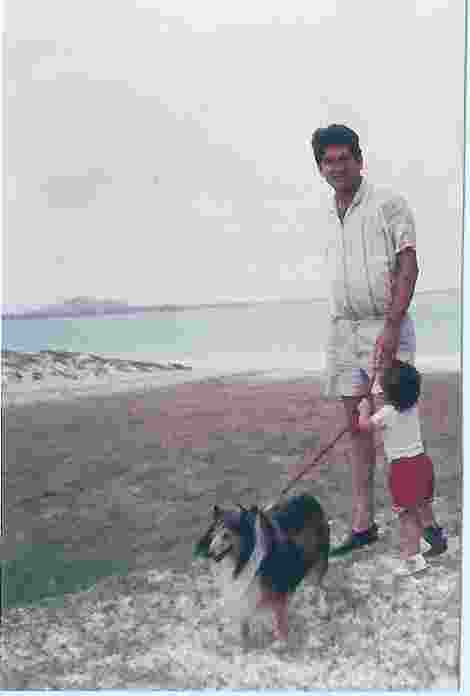
 I had driven with my sheltie puppy from Blacksburg to Palo Alto — through Tennessee, Arkansas, Oklahoma, Texas, New Mexico and Arizona; my parents and I now drove with him back to Blacksburg from California, through Nevada, Arizona, Colorado, Kansas, Missouri, Illinois, Indiana, Kentucky, West Virginia. It may be a necessary though not sufficient condition to drive across America (or any other country) in order to understand it.
After a few days, we drove to New York via Pennsylvania where I became Visiting Assistant Professor in the Cornell Economics Department (on leave from being Assistant Professor at Virginia Tech). The few months at Cornell were noteworthy for the many long sessions I spent with Max Black. I shall add more about that here in due course. My parents returned to India (via Greece where my sister was) in the Autumn of 1983.
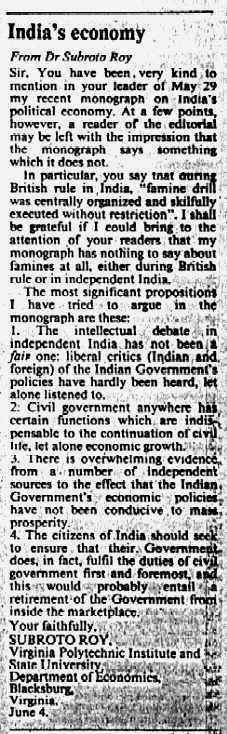
In May 1984, Indira Gandhi ruled in Delhi, and the ghost of Brezhnev was still fresh in Moscow. The era of Margaret Thatcher in Britain and Ronald Reagan in America was at its height. Pricing, Planning & Politics: A Study of Economic Distortions in India emerging from my doctoral thesis though written in Blacksburg and Ithaca in 1982-1983, came to be published by London’s Institute of Economic Affairs on May 29 as Occasional Paper No. 69, ISBN: 0-255 36169-6; its text is reproduced elsewhere here.
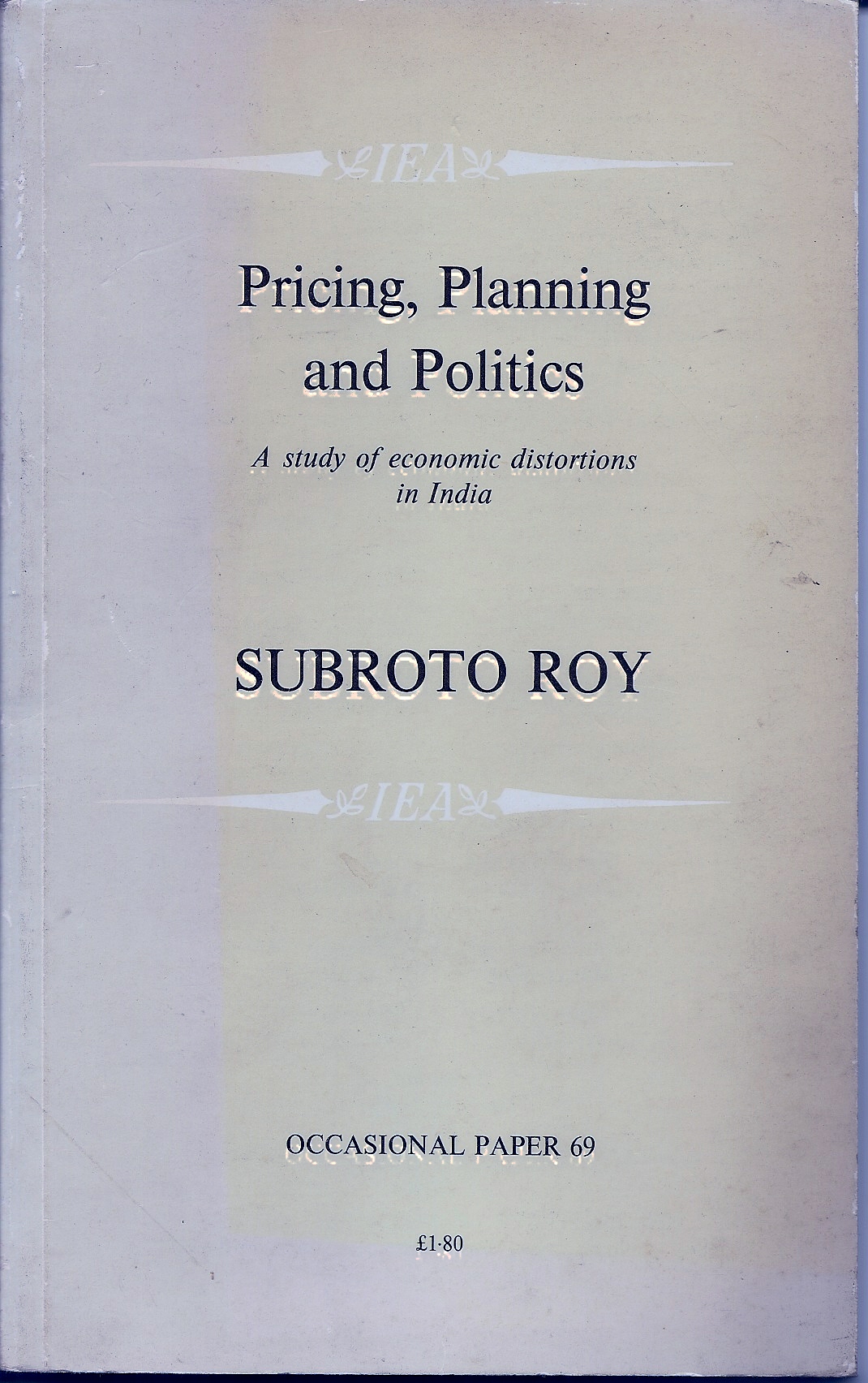
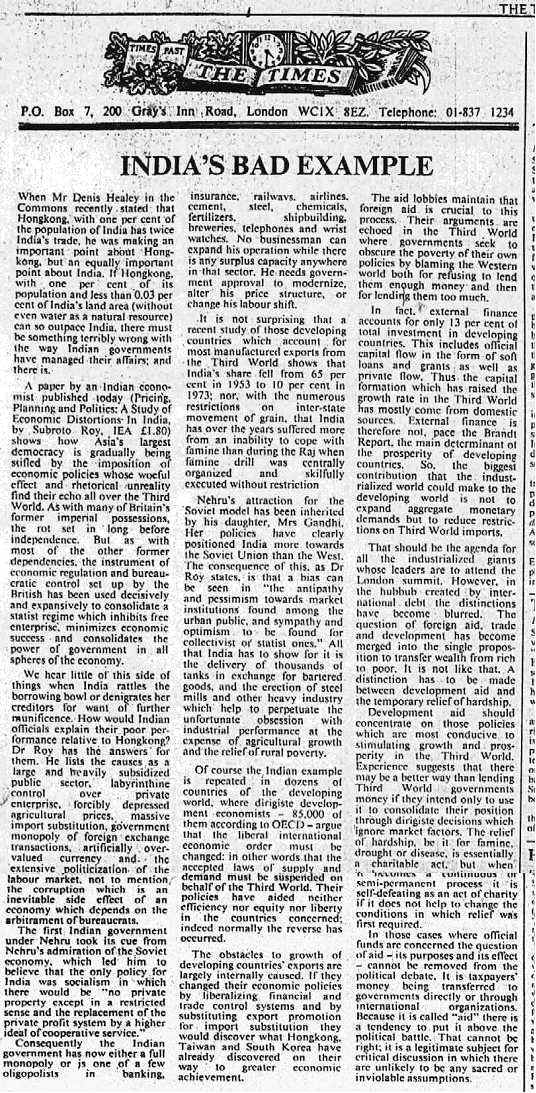
It was the first critique after BR Shenoy of India’s Sovietesque economics since Jawaharlal Nehru’s time. The Times, London’s most eminent paper at the time, wrote its lead editorial comment about it on the day it was published, May 29 1984.

It used to take several days for the library at Virginia Tech in Blacksburg to receive its copy of The Times of London and other British newspapers. I had not been told of the date of publication and did not know of what had happened in London on May 29 until perhaps June 2 — when a friend, Vasant Dave of a children’s charity, who was on campus, phoned me and congratulated me for being featured in The Times which he had just read in the University Library. “You mean they’ve reviewed it?” I asked him, “No, it’s the lead editorial.” “What?” I exclaimed. There was worse. Vasant was very soft-spoken and said “Yes, it’s titled ‘India’s Bad Example’” — which I misheard on the phone as “India’s Mad Example” 😀 Drat! I thought (or words to that effect), they must have lambasted me, as I rushed down to the Library to take a look.
The Times had said
“When Mr. Dennis Healey in the Commons recently stated that Hongkong, with one per cent of the population of India has twice India’s trade, he was making an important point about Hongkong but an equally important point about India. If Hongkong with one per cent of its population and less than 0.03 per cert of India’s land area (without even water as a natural resource) can so outpace India, there must be something terribly wrong with the way Indian governments have managed their affairs, and there is. A paper by an Indian economist published today (Pricing, Planning and Politics: A Study of Economic Distortions in India by Subroto Roy, IEA £1.80) shows how Asia’s largest democracy is gradually being stifled by the imposition of economic policies whose woeful effect and rhetorical unreality find their echo all over the Third World. As with many of Britain’s former imperial possessions, the rot set in long before independence. But as with most of the other former dependencies, the instrument of economic regulation and bureaucratic control set up by the British has been used decisively and expansively to consolidate a statist regime which inhibits free enterprise, minimizes economic success and consolidates the power of government in all spheres of the economy. We hear little of this side of things when India rattles the borrowing bowl or denigrates her creditors for want of further munificence. How could Indian officials explain their poor performance relative to Hongkong? Dr Roy has the answers for them. He lists the causes as a large and heavily subsidized public sector, labyrinthine control over private enterprise, forcibly depressed agricultural prices, massive import substitution, government monopoly of foreign exchange transactions, artificially overvalued currency and the extensive politicization of the labour market, not to mention the corruption which is an inevitable side effect of an economy which depends on the arbitrament of bureaucrats. The first Indian government under Nehru took its cue from Nehru’s admiration of the Soviet economy, which led him to believe that the only policy for India was socialism in which there would be “no private property except in a restricted sense and the replacement of the private profit system by a higher ideal of cooperative service.” Consequently, the Indian government has now either a full monopoly or is one of a few oligipolists in banking, insurance, railways, airlines, cement, steel, chemicals, fertilizers, ship-building, breweries, telephones and wrist-watches. No businessman can expand his operation while there is any surplus capacity anywhere in that sector. He needs government approval to modernize, alter his price-structure, or change his labour shift. It is not surprising that a recent study of those developing countries which account for most manufactured exports from the Third World shows that India’s share fell from 65 percent in 1953 to 10 per cent in 1973; nor, with the numerous restrictions on inter-state movement of grains, that India has over the years suffered more from an inability to cope with famine than during the Raj when famine drill was centrally organized and skillfully executed without restriction. Nehru’s attraction for the Soviet model has been inherited by his daughter, Mrs. Gandhi. Her policies have clearly positioned India more towards the Soviet Union than the West. The consequences of this, as Dr Roy states, is that a bias can be seen in “the antipathy and pessimism towards market institutions found among the urban public, and sympathy and optimism to be found for collectivist or statist ones.” All that India has to show for it is the delivery of thousands of tanks in exchange for bartered goods, and the erection of steel mills and other heavy industry which help to perpetuate the unfortunate obsession with industrial performance at the expense of agricultural growth and the relief of rural poverty.”…..
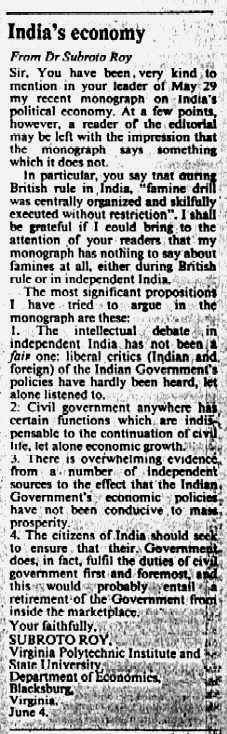
I felt this may have been intended to be laudatory but it was also inaccurate and had to be corrected. I replied dated June 4 which The Times published in their edition of June 16 1984:
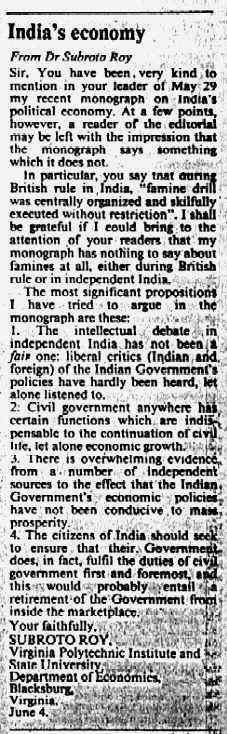
I was 29 when Pricing, Planning and Politics was published, I am 54 now. I do not agree with everything I said in it and find the tone a little puffed up as young men tend to be; it was also five years before my main “theoretical” work Philosophy of Economics would be published. My experience of life in the years since has also made me far less sanguine both about human nature and about America than I was then. But I am glad to find I am not embarrassed by what I said then, indeed I am pleased I said what I did in favour of classical liberalism and against statism and totalitarianism well before it became popular to do so after the Berlin Wall fell. (In India as elsewhere, former communist apparatchiks and fellow-travellers became pseudo-liberals overnight.)
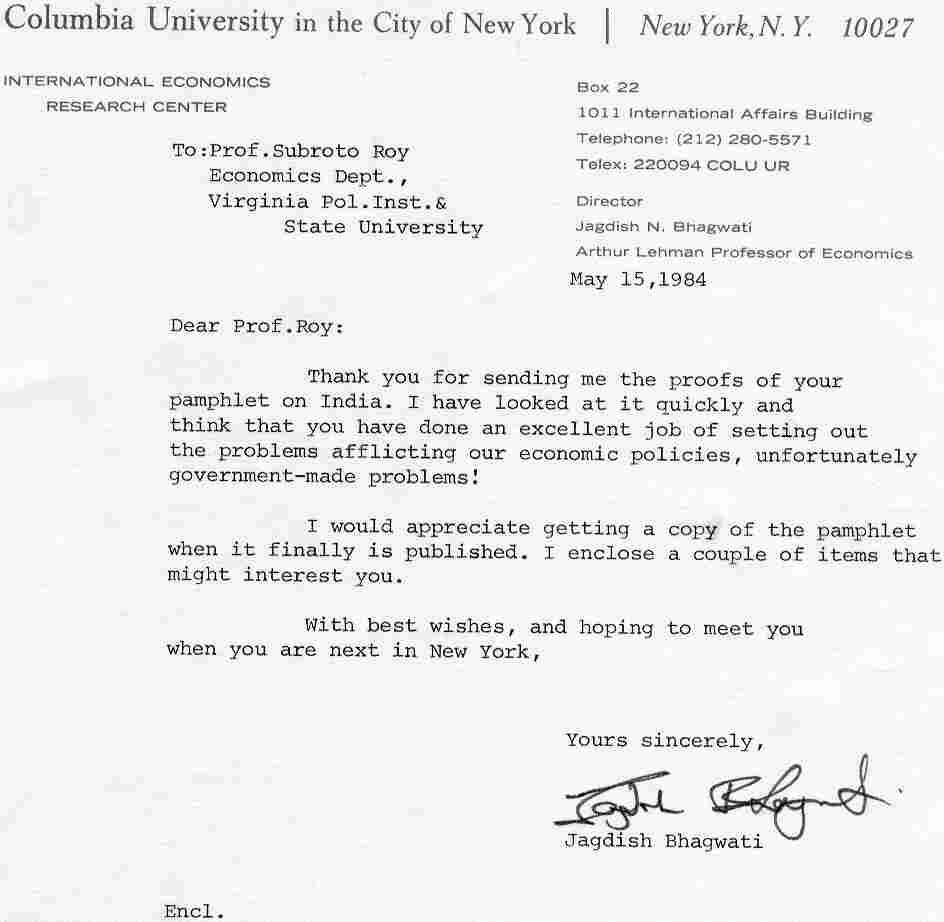
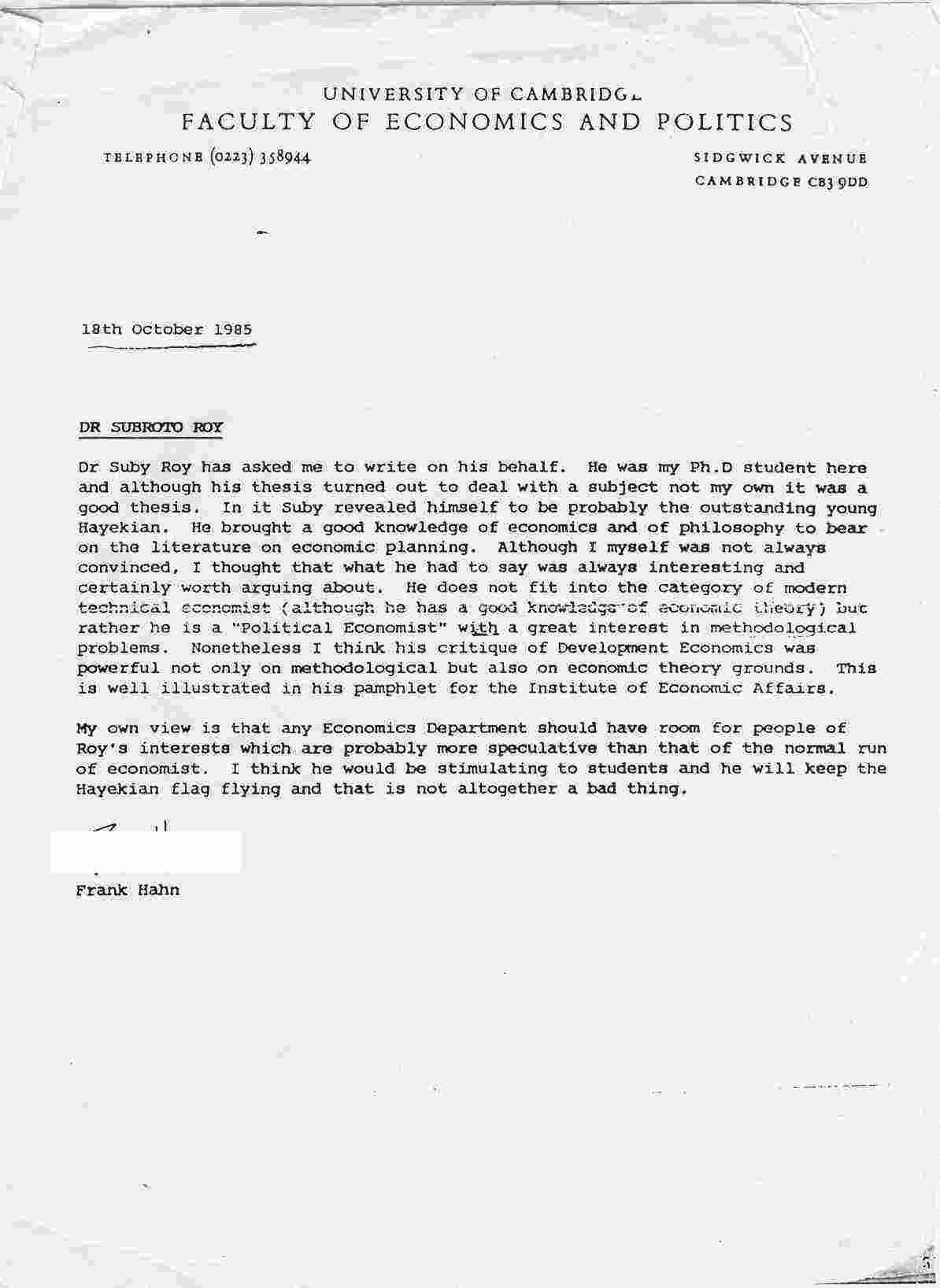
The editorial itself may have been due to a conversation between Peter Bauer and William Rees-Mogg, so I later heard. The work sold 700 copies in its first month, a record for the publisher. The wife of one prominent Indian bureaucrat told me in Delhi in December 1988 it had affected her husband’s thinking drastically. A senior public finance economist told me he had been deputed at the Finance Ministry when the editorial appeared, and the Indian High Commission in London had urgently sent a copy of the editorial to the Ministry where it caused a stir. An IMF official told me years later that he saw the editorial on board a flight to India from the USA on the same day, and stopped in London to make a trip to the LSE’s bookshop to purchase a copy. Professor Jagdish Bhagwati of Columbia University had been a critic of aspects of Indian policy; he received a copy of the monograph in draft just before it was published and was kind enough to write I had “done an excellent job of setting out the problems afflicting our economic policies, unfortunately government-made problems!” My great professor at Cambridge, Frank Hahn, would be kind enough to say that he thought my “critique of Development Economics was powerful not only on methodological but also on economic theory grounds” — something that has been a source of delight to me.
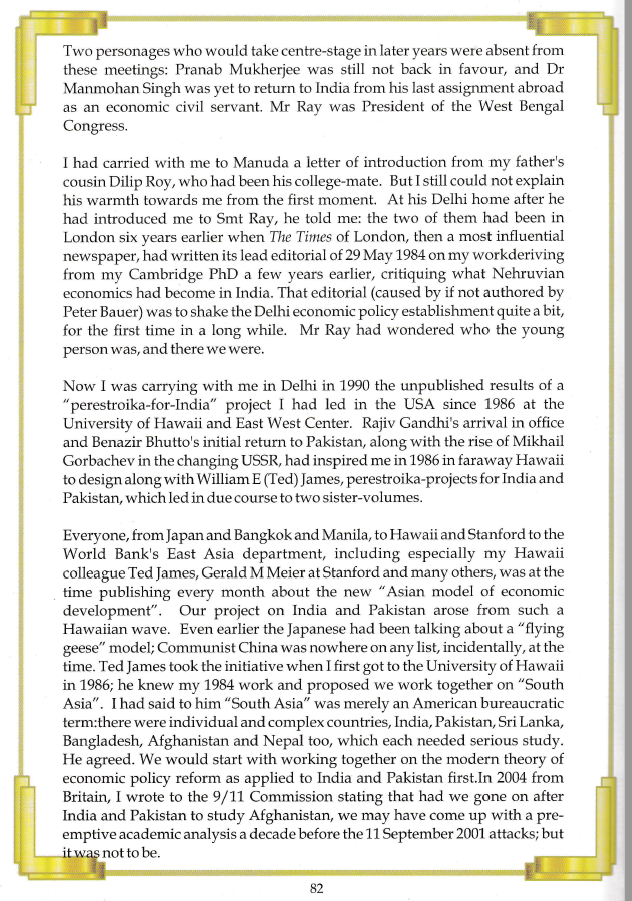
Siddhartha Shankar Ray told me when we first met that he had been in London when the editorial appeared and had seen it there; it affected his decision to introduce me to Rajiv Gandhi as warmly as he came to do a half dozen years later.
In the Autumn of 1984, I went, thanks to Edwin Feulner Jr of the Heritage Foundation, to attend the Mont Pelerin Society Meetings being held at Cambridge (on “parole” from the US immigration authorities as my “green card” was being processed at the time). There I met for the first time Professor and Mrs Milton Friedman.
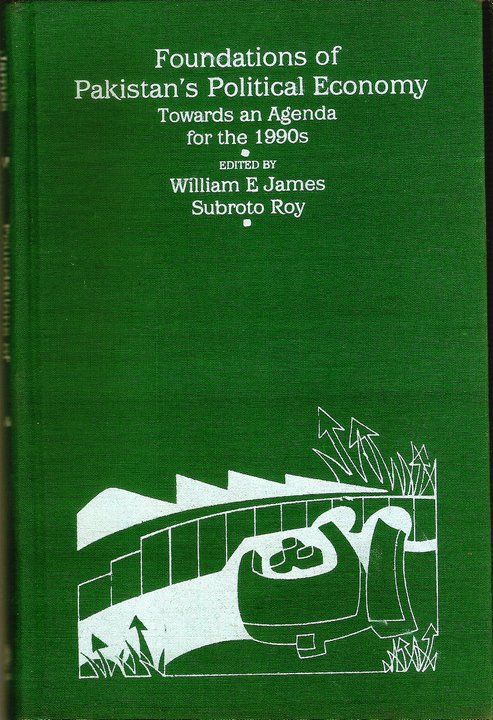
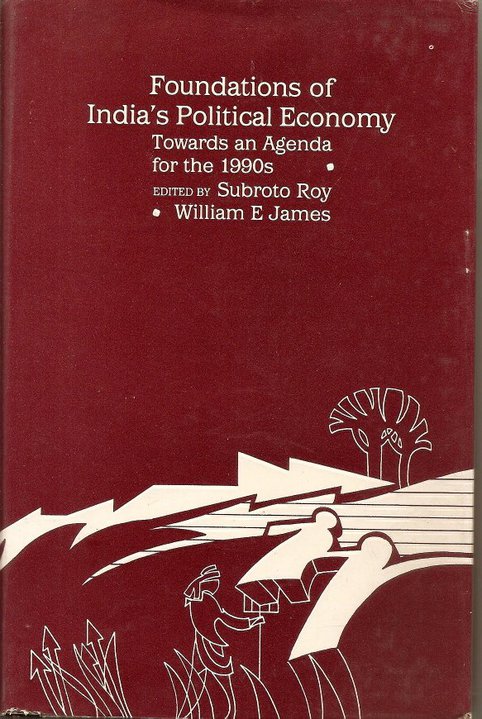
Milton Friedman’s November 1955 memorandum to the Government of India is referred to in my monograph as “unpublished” in note 1; when I met Milton and Rose, I gave them a copy of my monograph; and requested Milton for his unpublished document; when he returned to Stanford he sent to me in Blacksburg his original 1955-56 documents on Indian planning. I published the 1955 document for the first time in May 1989 during the University of Hawaii perestroika-for-India project I was then leading, it appeared later in the 1992 volume Foundations of India’s Political Economy: Towards an Agenda for the 1990s, edited by myself and WE James. (The results of the Hawaii project reached Rajiv Gandhi through my hand in September 1990, as told elsewhere here in “Rajiv Gandhi and the Origins of India’s 1991 Economic Reform”.) The 1956 document was published in November 2006 on the front page of The Statesman, the same day my obituary of Milton appeared in the inside pages.
Meanwhile, my main work within economic theory, the “Principia Economica” manuscript, was being read by the University of Chicago Press’s five or six anonymous referees. One of them pointed out my argument had been anticipated years earlier in the work of MIT’s Sidney Stuart Alexander. I had no idea of this and was surprised; of course I knew Professor Alexander’s work in balance of payments theory but not in this field. I went to visit Professor Alexander in Boston, where this photo came to be taken perhaps in late 1984:
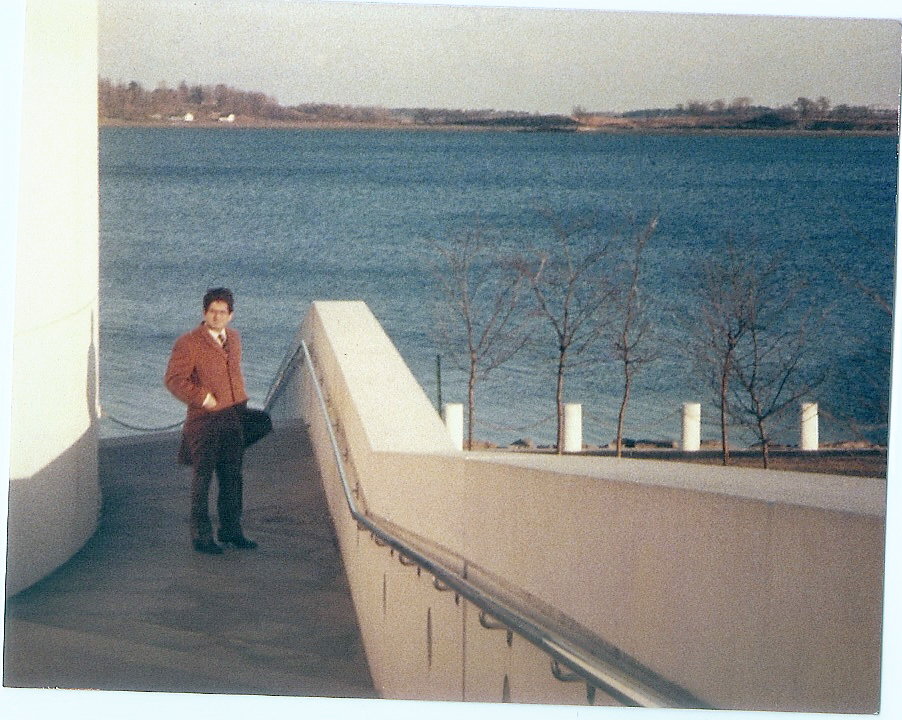
Professor Alexander was extremely gracious, and immediately declared with great generosity that it was clear to him my arguments in “Principia Economica” had been developed entirely independently of his work. He had come at the problem from an American philosophical tradition of Dewey, I had done so from a British tradition of Wittgenstein. (CS Peirce was probably the bridge between the two.) He and I had arrived at some similar conclusions but we had done so completely independently.


Also, I was much honoured by this letter of May 1 1984 sent to Blacksburg by Professor Sir John Hicks (1904-1989), among the greatest of 20th Century economists at the time, where he acknowledged his departure in later life from the position he had taken in 1934 and 1939 on the foundations of demand theory.
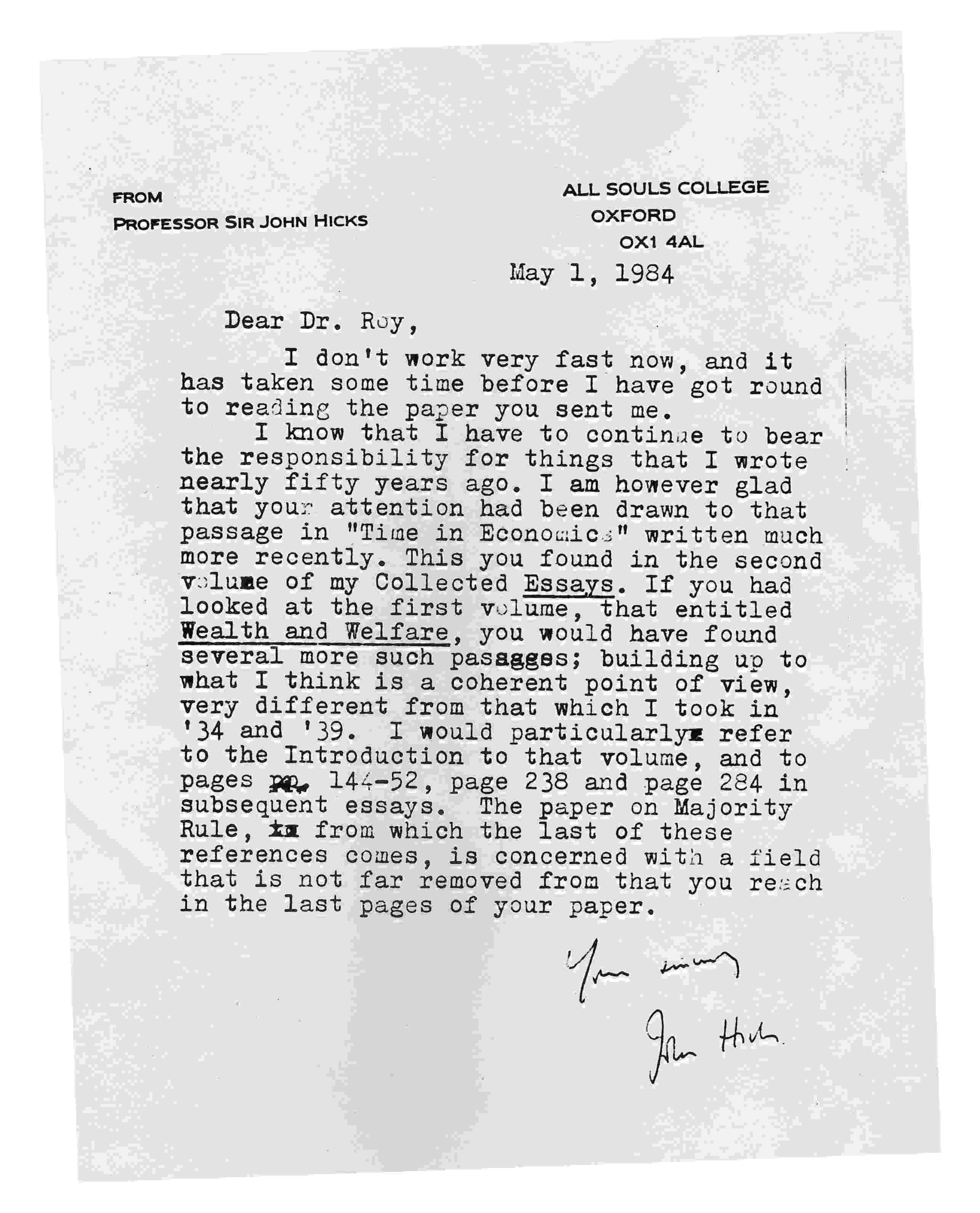
He later sent me a copy of his Wealth and Welfare: Collected Essays on Economic Theory, Vol. I, MIT Press 1981, as a gift. The context of our correspondence had to do with my criticism of the young Hicks and support for the ghost of Alfred Marshall in an article “Considerations on Utility, Benevolence and Taxation” I was publishing in the journal History of Political Economy published then at Duke University. In Philosophy of Economics, I would come to say about Hicks’s letter to me “It may be a sign of the times that economists, great and small, rarely if ever disclaim their past opinions; it is therefore an especially splendid example to have a great economist like Hicks doing so in this matter.” It was reminiscent of Gottlob Frege’s response to Russell’s paradox; Philosophy of Economics described Frege’s “Letter to Russell”, 1902 (Heijenoort, From Frege to Gödel, pp. 126-128) as “a document which must remain one of the most noble in all of modern scholarship; a fact recorded in Russell’s letter to Heijenoort.”
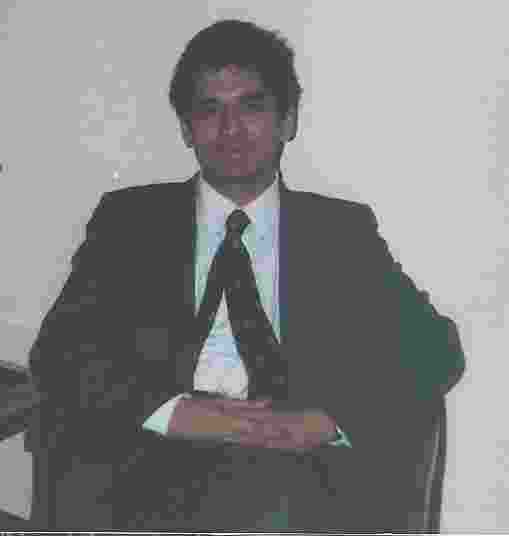
In Blacksburg, by the Summer and Fall of 1984 I was under attack following the arrival of what I considered “a gang of inert game theorists” — my theoretical manuscript had blown a permanent hole through what passes by the name of “social choice theory”, and they did not like it. Nor did they like the fact that I seemed to them to be a “conservative”/classical liberal Indian and my applied work on India’s economy seemed to their academic agenda an irrelevance. This is myself at the height of that attack in January 1985:

Professor Schultz at the University of Chicago came to my rescue and at his recommendation I was appointed Visiting Associate Professor in the Economics Department at Brigham Young University in Provo, Utah.
I declined, without thanks, the offer of another year at Virginia Tech.
On my last day in Blacksburg, a graduate student whom I had helped when she had been assaulted by a senior professor, cooked a meal before I started the drive West across the country. This is a photo from that meal:
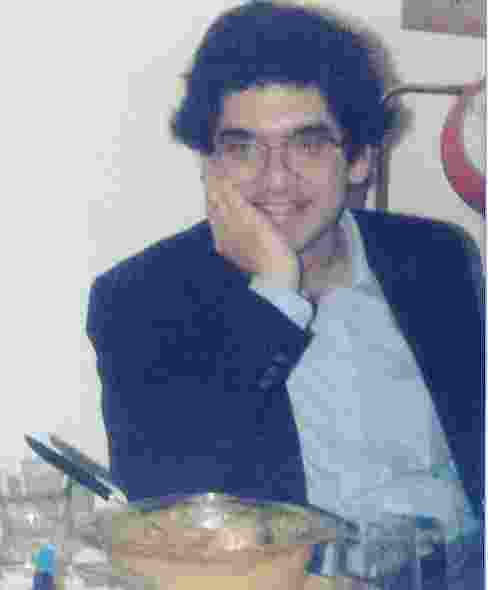
In Provo, I gratefully found refuge at the excellent Economics Department led at the time by Professor Larry Wimmer.

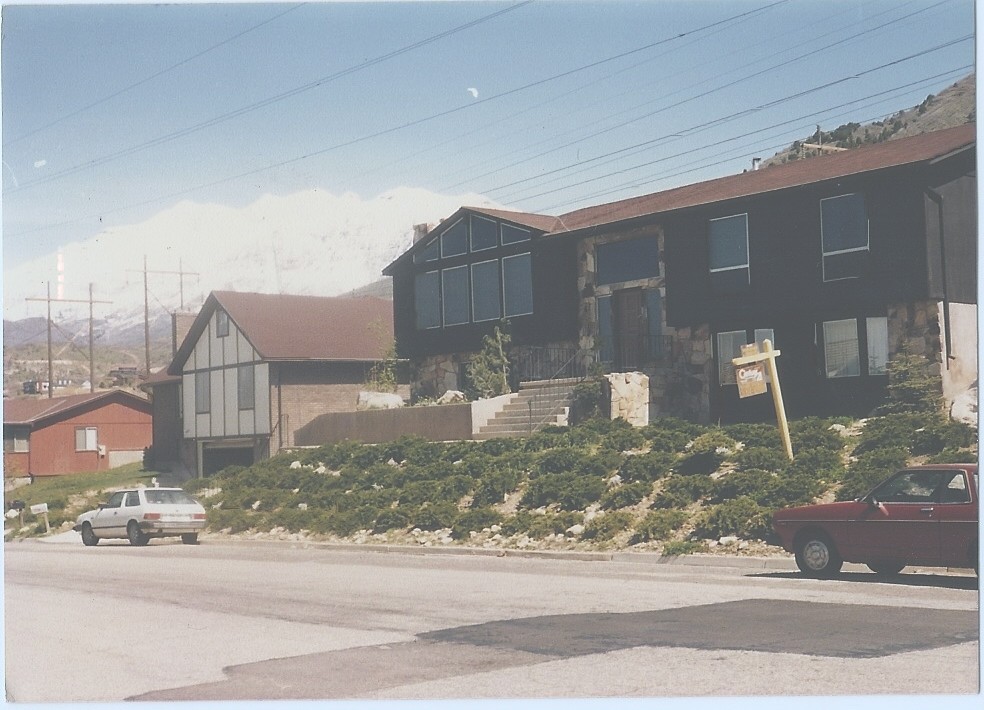

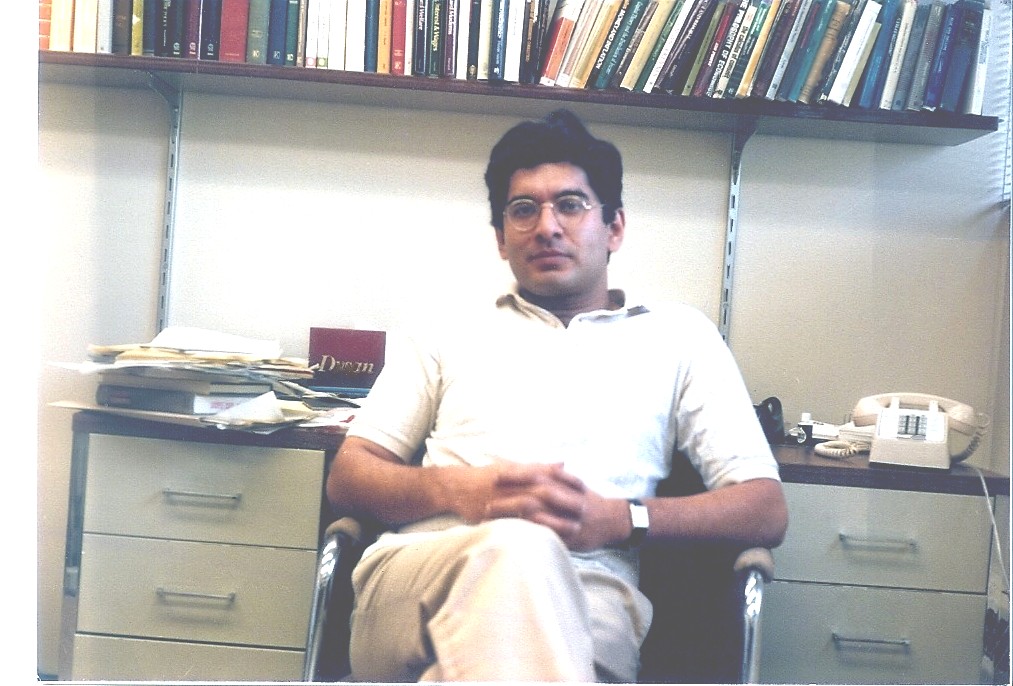
It was at Provo that I first had a personal computer on my desk (an IBM as may be seen) and what a delight that was (no matter the noises that it made). I recall being struck by the fact a colleague possessed the incredible luxury of a portable personal computer (no one else did) which he could take home with him. It looked like an enormous briefcase but was apparently the technology-leader at the time. (Laptops seem not to have been invented as of 1985).
In October 1985, Professor Frank Hahn very kindly wrote to Larry Wimmer revising his 1980 opinion of my work now that the PhD was done, the India-work had led to The Times editorial and the theoretical work was proceeding well.
I had applied for a permanent position at the University of Hawaii, Manoa, and had been interviewed positively at the American Economic Association meetings (in New York) in December 1985 by the department chairman Professor Fred C. Hung. At Provo, Dr James Moncur of the Manoa Department was visiting. Jim became a friend and recommended me to his colleagues in Manoa.
Professor Hung appointed me to that department as a “senior” Assistant Professor on tenure-track beginning September 1986. I had bargained for a rank of “Associate Professor” but was told the advertisement did not allow it; instead I was assured of being an early candidate for promotion and tenure subject to my book “Principia Economica” being accepted for publication. (The contract with the University of Chicago Press had become frayed.)
Hawaii was simply a superb place (though expensive).

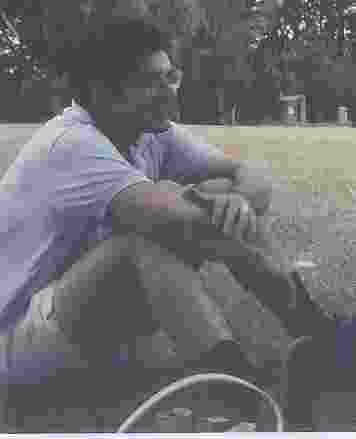

Professor James Buchanan won the Economics “Nobel” in 1986 and I was asked by the Manoa Department to help raise its profile by inviting him to deliver a set of lectures, which he did excellently well in March 1988 to the University as well as the Honolulu community at large. Here he is at my 850 sq ft small condominium at Punahou Towers, 1621 Dole Street:
In August 1988, my manuscript “Principia Economica” was finally accepted for publication by Routledge of London and New York under the title Philosophy of Economics: On the Scope of Reason In Economic Inquiry. The contract with University of Chicago Press had fallen through and the manuscript was being read by Yale University Press and a few others but Routledge came through with the first concrete offer. I was delighted and these photos were taken in the Economics Department at Manoa by a colleague in September 1988 as the publisher needed them.
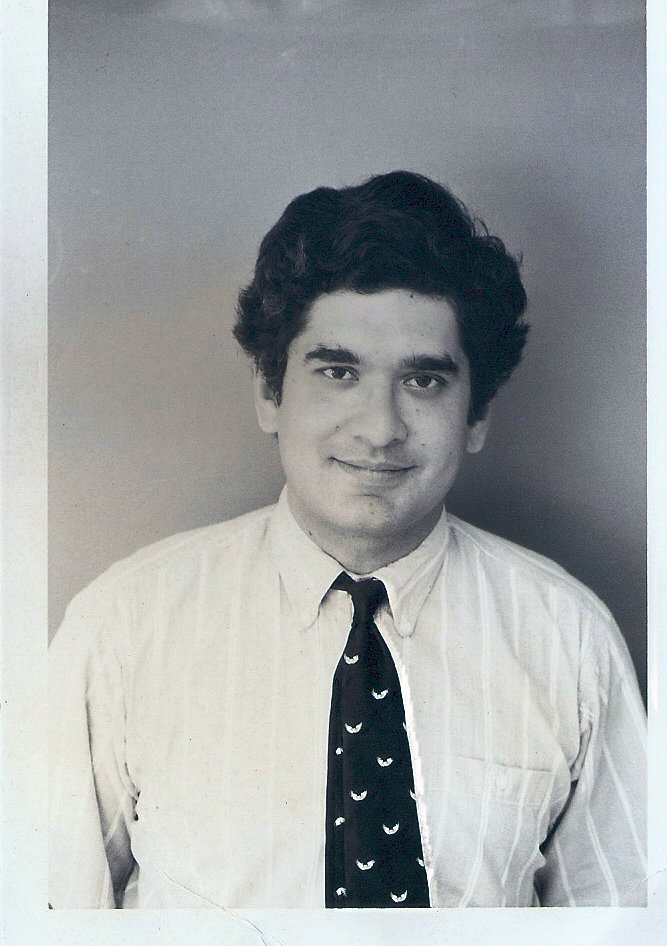
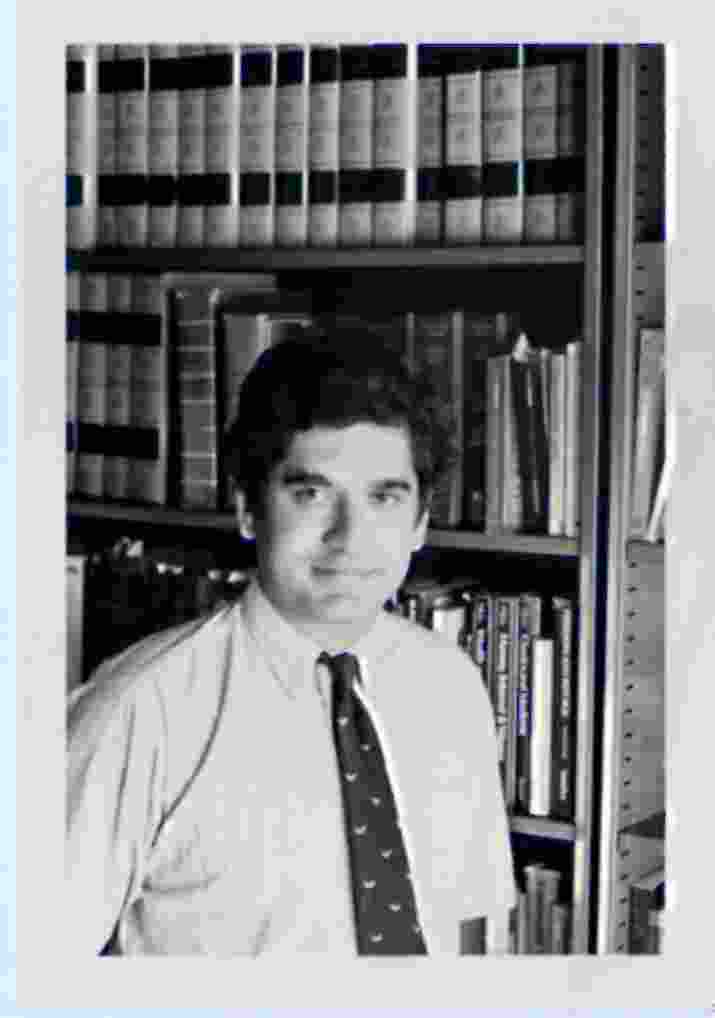
Milton and Rose Friedman came to Honolulu on a private holiday perhaps in January 1989; they had years earlier spent a sabbatical year at the Department.
Here is a luncheon that was arranged in their honour. They had in the Fall of 1988 been on their famous visit to China, and as I recall that was the main subject of discussion on the occasion.
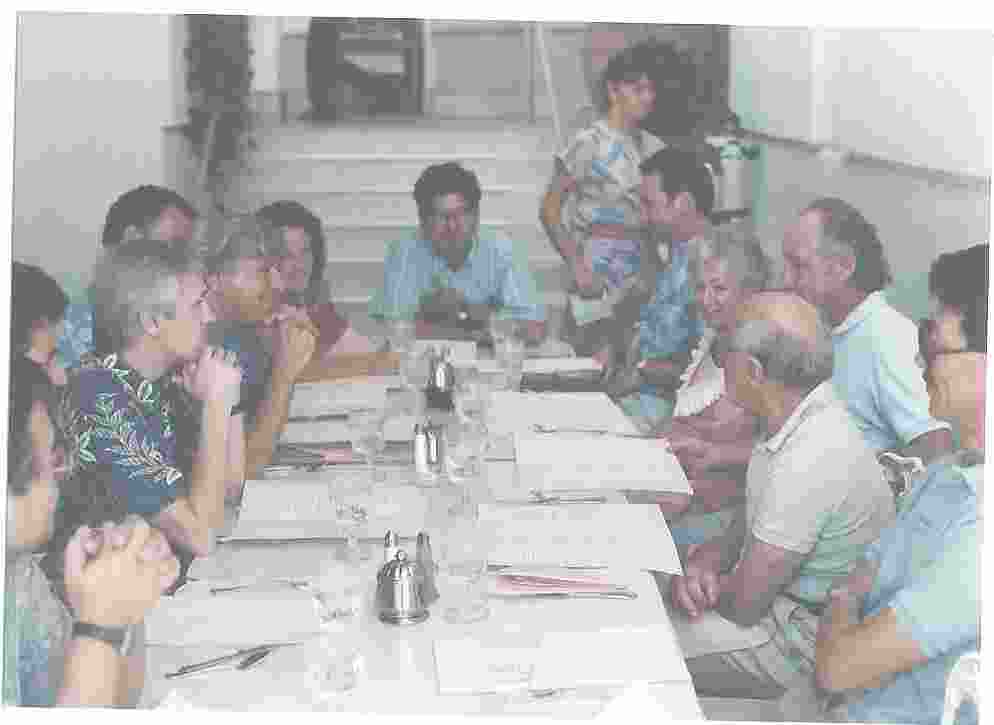

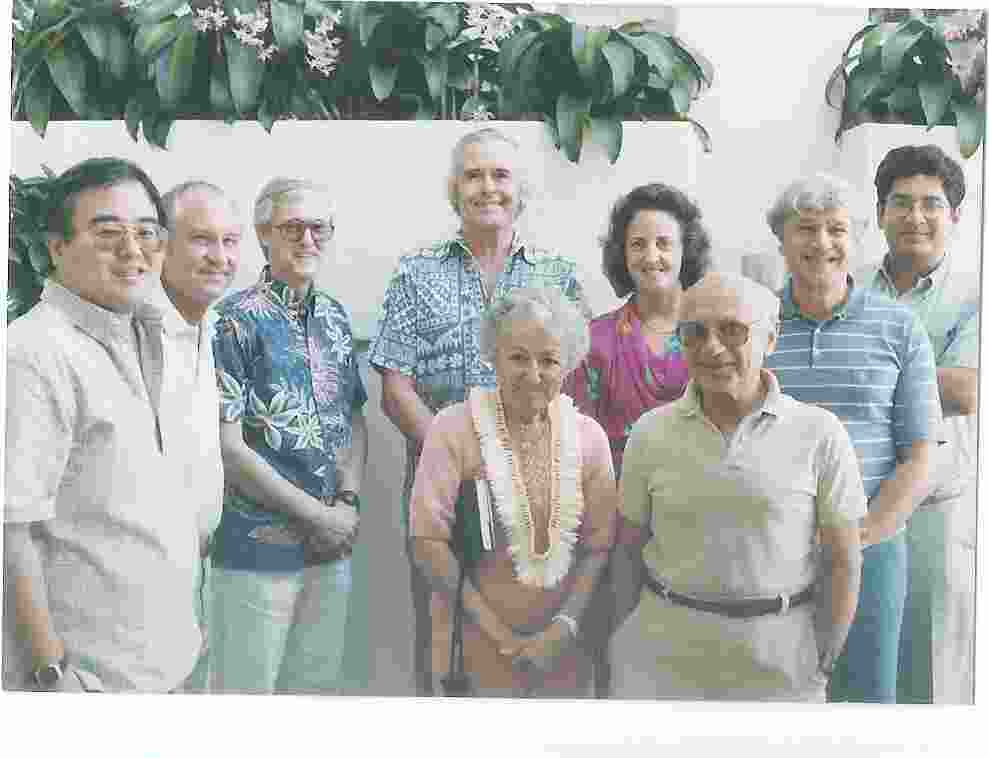
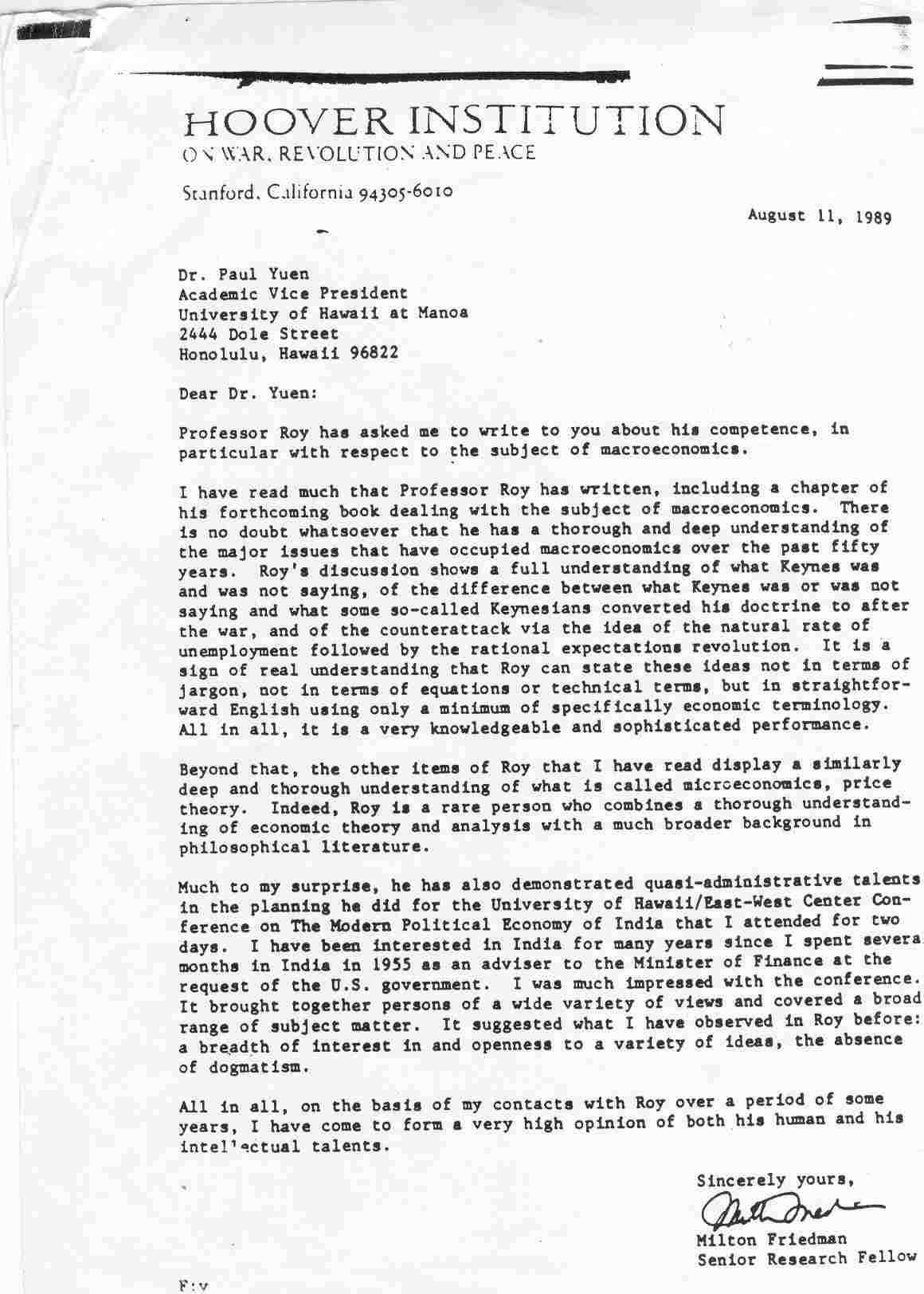
Milton phoned me in my Manoa office and invited me to meet him and Rose at their hotel for a chat; we had met first at the 1984 Mont Pelerin meetings and he wished to know me better. I was honoured and turned up dutifully and we talked for perhaps an hour. I recall making a strong recommendation that he write his memoirs, especially so that the rumours and innuendo surrounding eg the Chile episode could be cleared up; I also said a “Collected Works” would be a great idea; when Milton and Rose published their memoirs Two Lucky People (Chicago 1998) I wondered if my first suggestion had come to be taken; as to the second, he wrote to me years later saying he felt no Collected Works were necessary.
From 1986 onwards, I had been requested by the University of Hawaii to lead a project with William E James on the political economy of “South Asia” .I had said there was no such place, that “South Asia” was a US State Department abstraction but there were India and Pakistan and Sri Lanka and Bangladesh and Afghanistan etc. Sister projects on India and Pakistan had been sponsored by the University, and in 1989 important conferences had been planned by myself and James in May for India and in June for Pakistan.
I was determined to publish for the first time Milton’s 1955 memorandum on India which the Government of India had suppressed or ignored at the time. At the hotel-meeting, I told Milton that and requested him to come to the India-conference in May; Milton and Rose said they would think about it, and later confirmed he would come for the first two days.
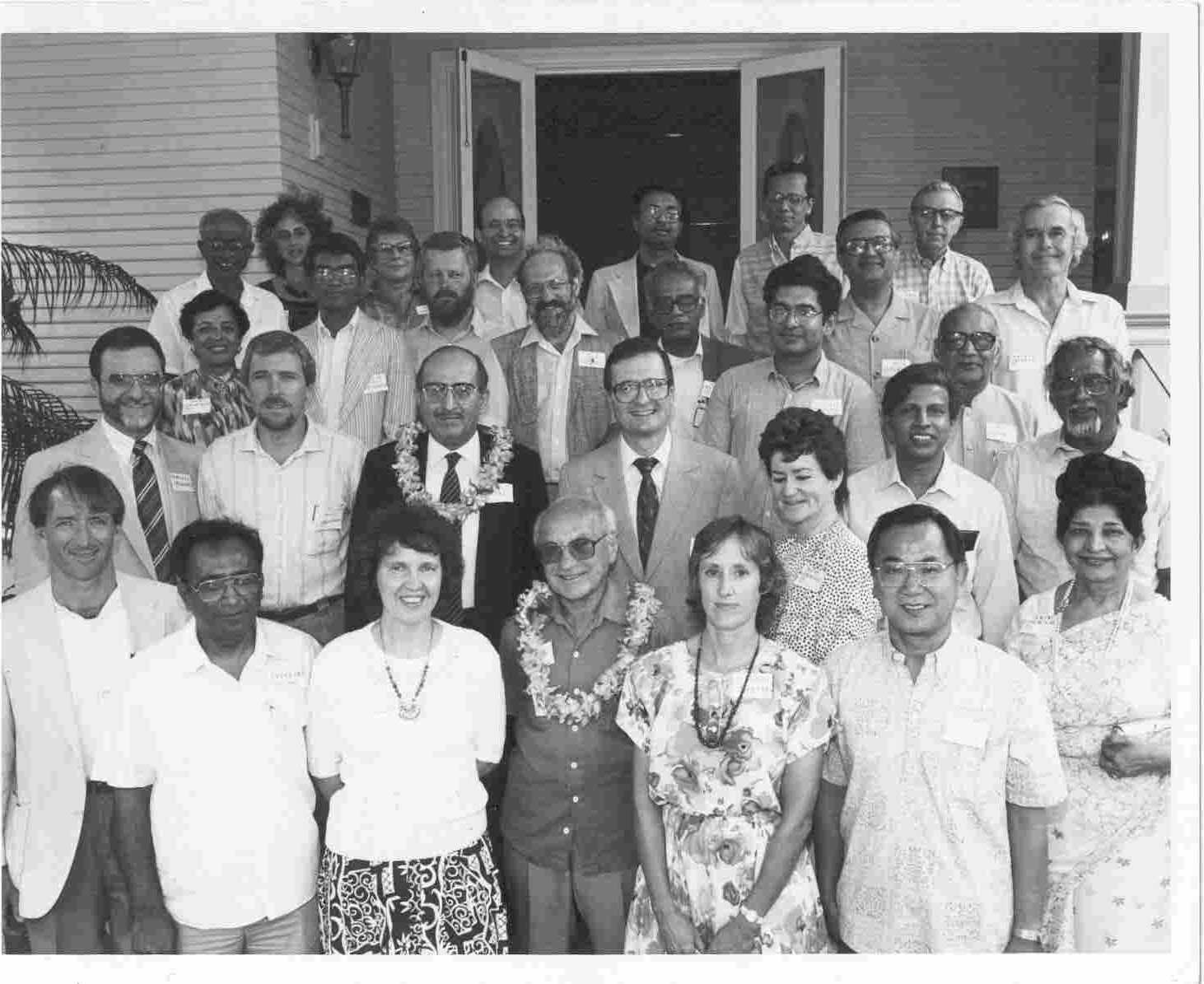
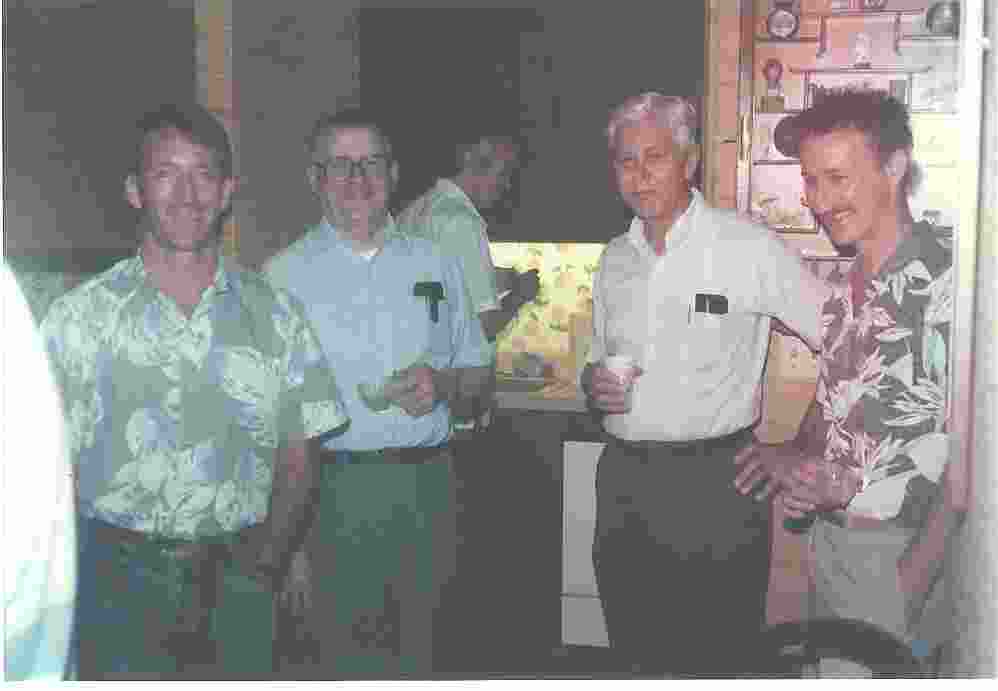
This is a photo of the initial luncheon at the home of the University President on May 21 1989. Milton and India’s Ambassador to the USA at the time were both garlanded with Hawaiian leis. The first photo was one of a joke from Milton as I recall which had everyone laughing.
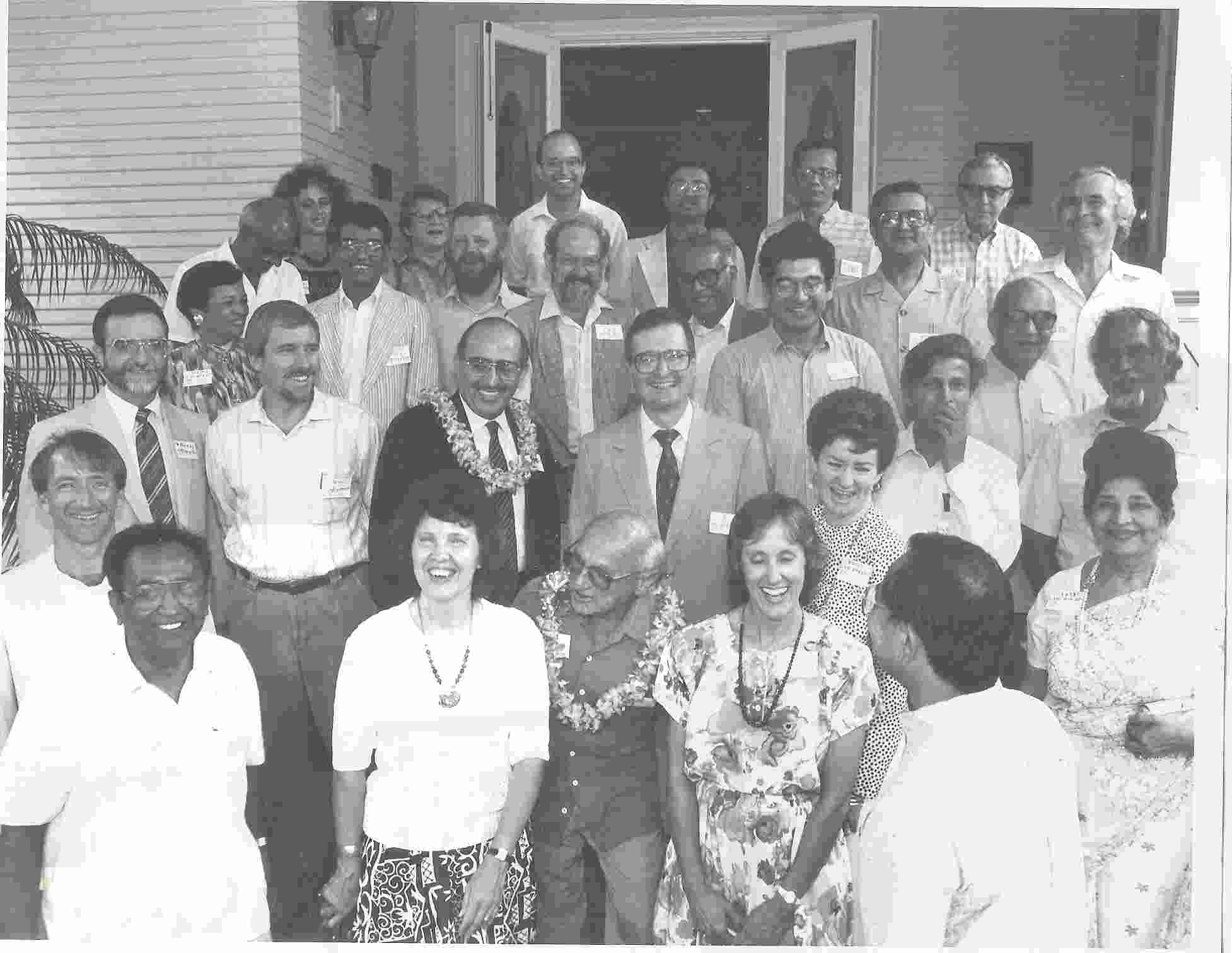

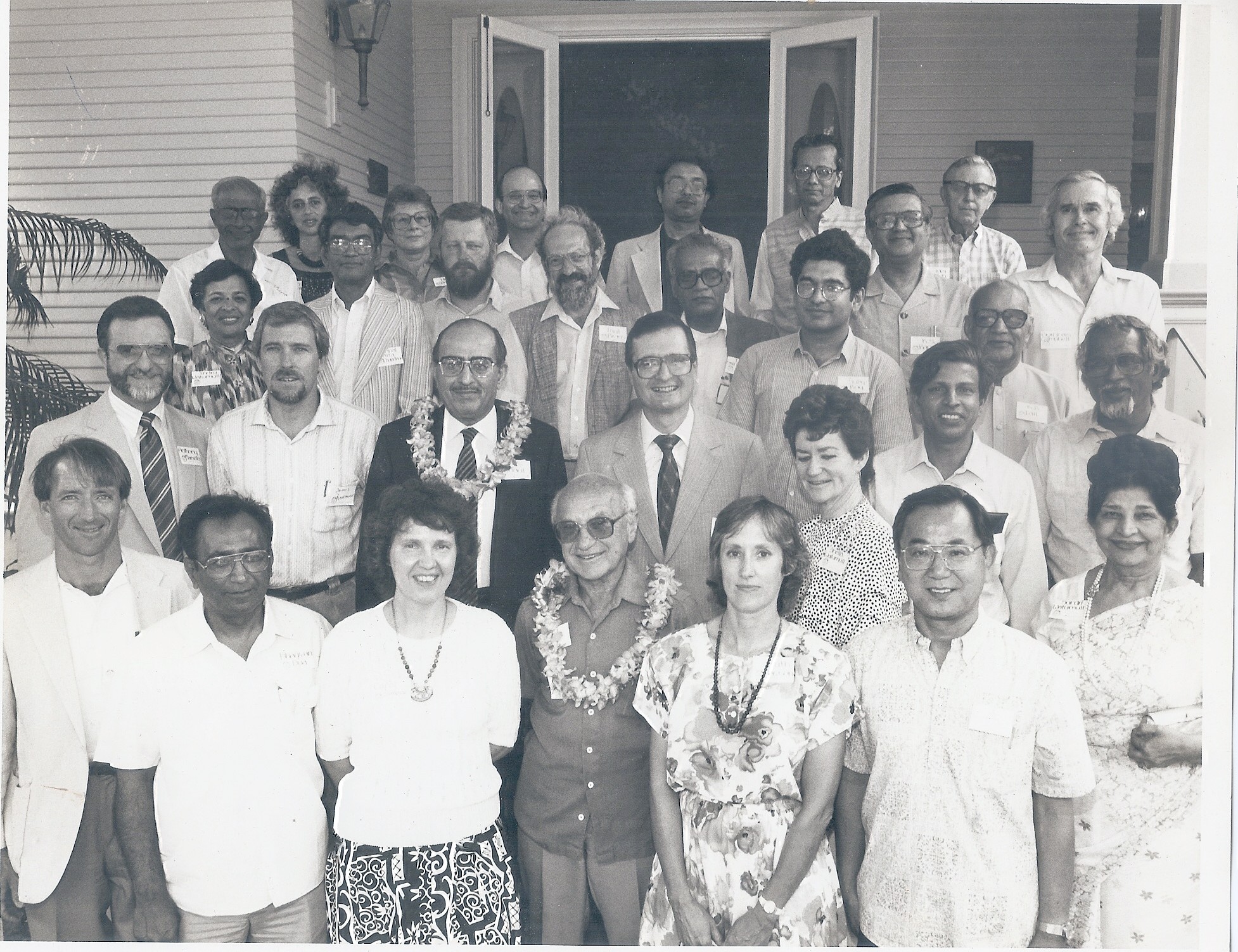
There was no equivalent photo of the distinguished scholars who gathered for the Pakistan conference a month later.
The reason was that from February 1989 onwards I had become the victim of a most vicious racist defamation, engineered within the Economics Department at Manoa by a senior professor as a way to derail me before my expected Promotion and Tenure application in the Fall. All my extra time went to battling that though somehow I managed to teach some monetary economics well enough in 1989-1990 for a Japanese student to insist on being photographed with me and the book we had studied.
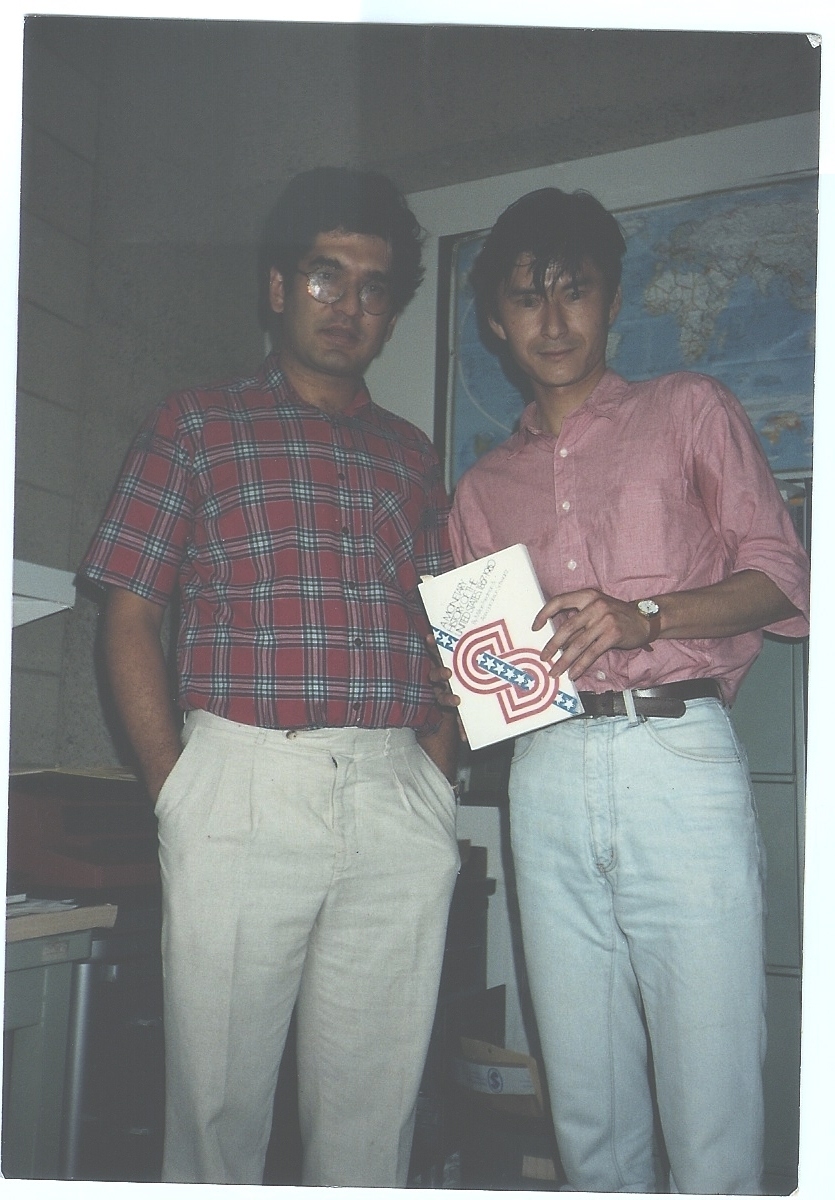
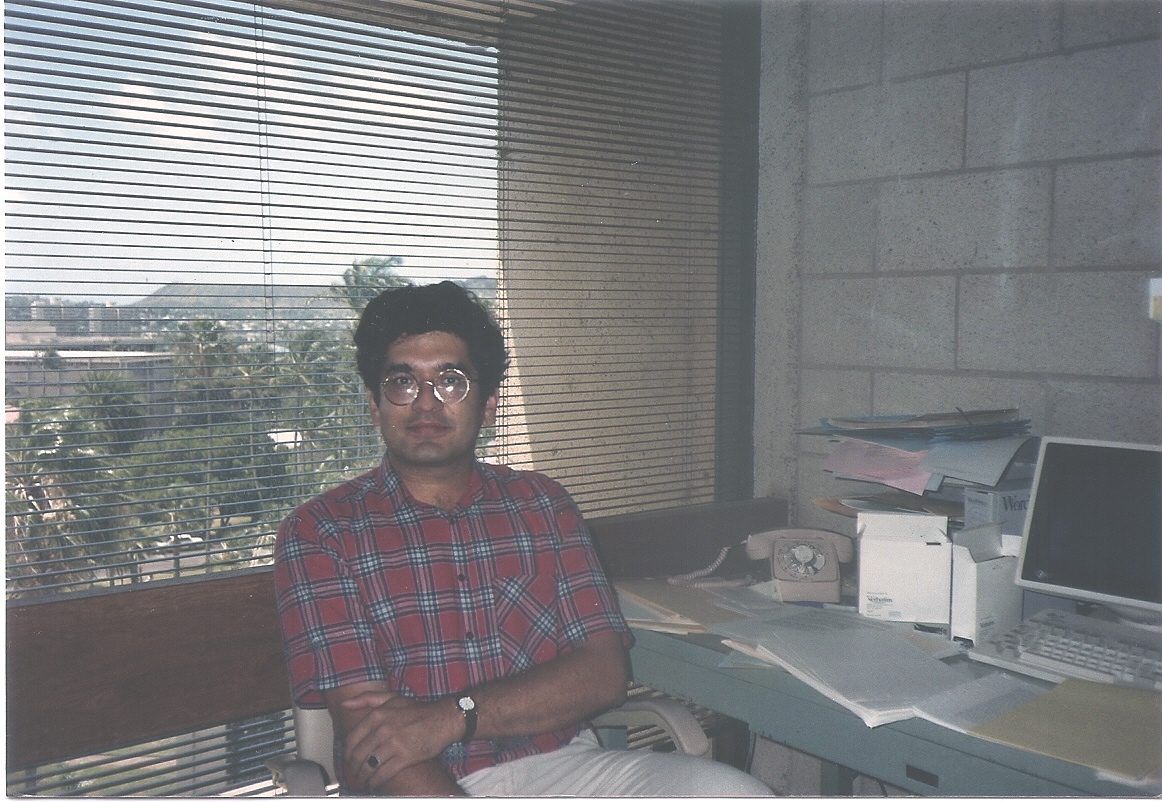
I was being seen by two or three temporarily powerful characters on the Manoa campus as an Uppity Indian who must be brought down. This time I decided to fight back — and what a saga came to unfold! It took me into the United States District Court for the District of Hawaii and then the Ninth Circuit and upto the United States Supreme Court, not once but twice.
Milton Friedman and Theodore Schultz stood valiantly among my witnesses — first writing to the University’s authorities and later deposing in federal court.


Unfortunately, government lawyers, far from wanting to uphold and respect the laws of the United States, chose to deliberately violate them — compromising a judge, suborning demonstrable perjury and then brazenly purchasing my hired attorney (and getting caught doing it). Since September 2007, the State of Hawaii’s attorneys have been invited by me to return to the federal court and apologise for their unlawful behaviour as they are required by law to do.
They had not expected me to survive their illegalities but I did: I kept going.
Philosophy of Economics was published in London and New York in September 1989
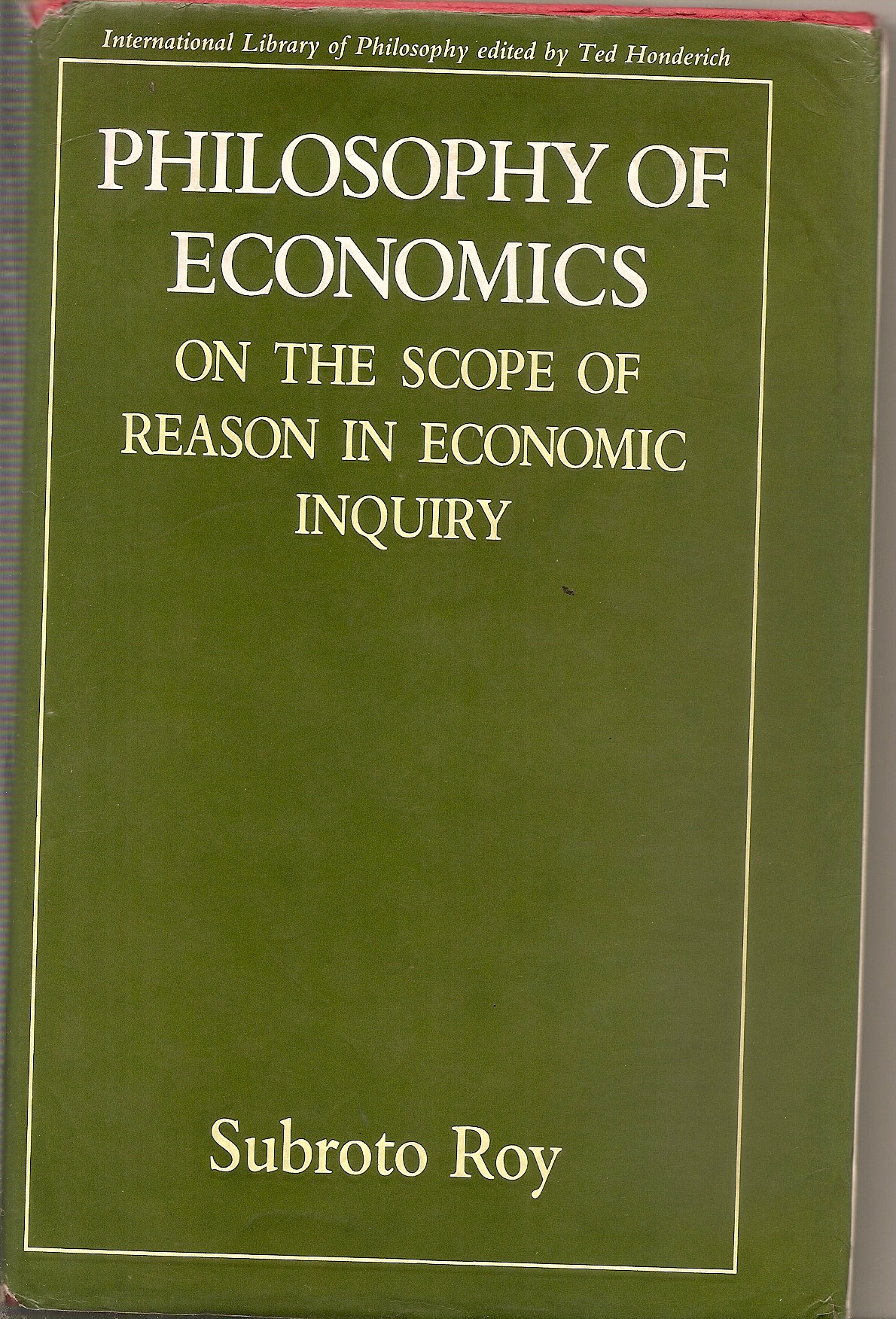
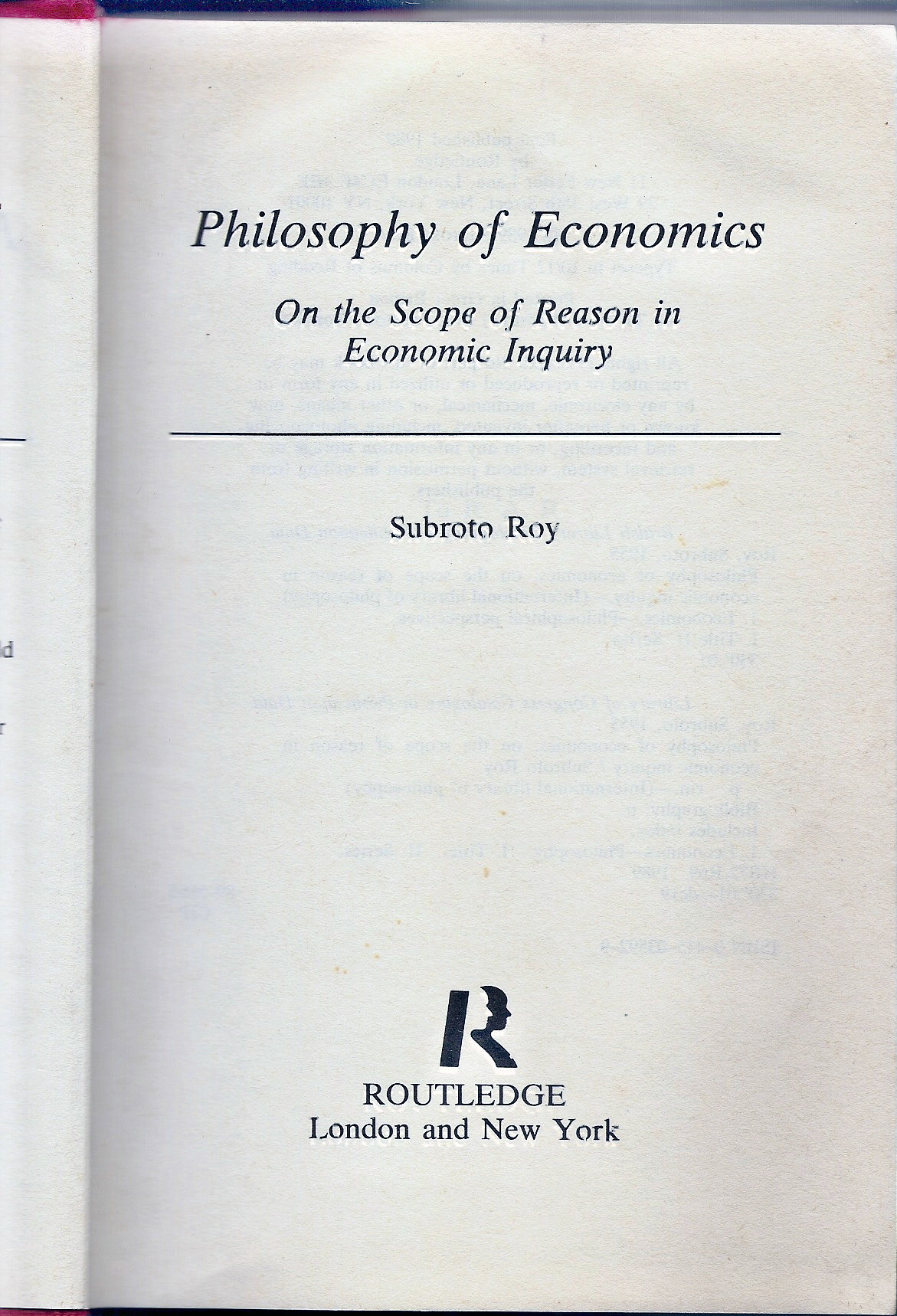
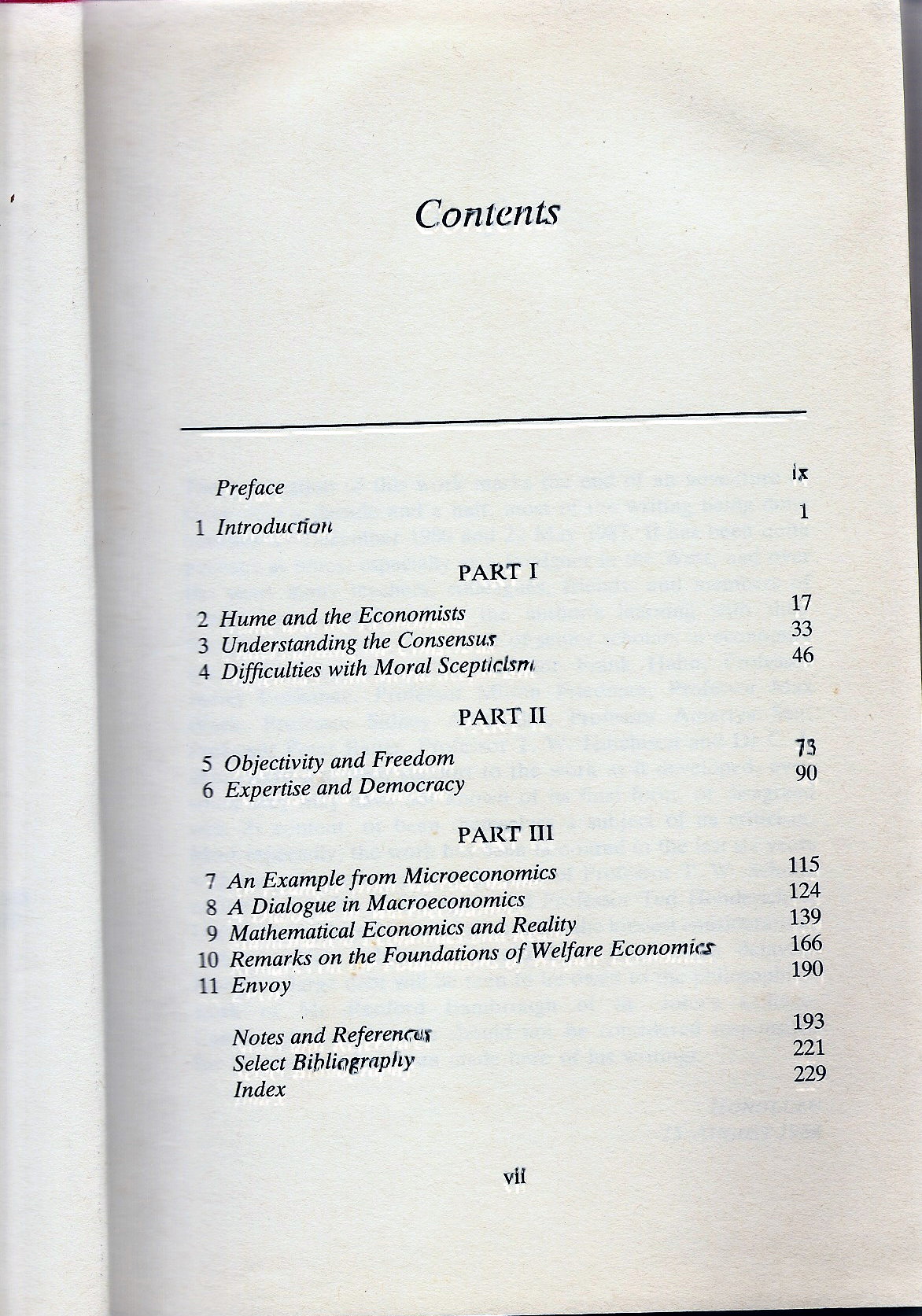
The hardback quickly sold out on its own steam and the book went into paperback in 1991, and I was delighted to learn from a friend that it had been prescribed for a course at Yale Law School and was strewn along an alley in the bookshop:

The sister-volumes on India and Pakistan emerging from the University of Hawaii project led by myself and James were published in 1992 and 1993 in India, Pakistan, Britain and the United States.
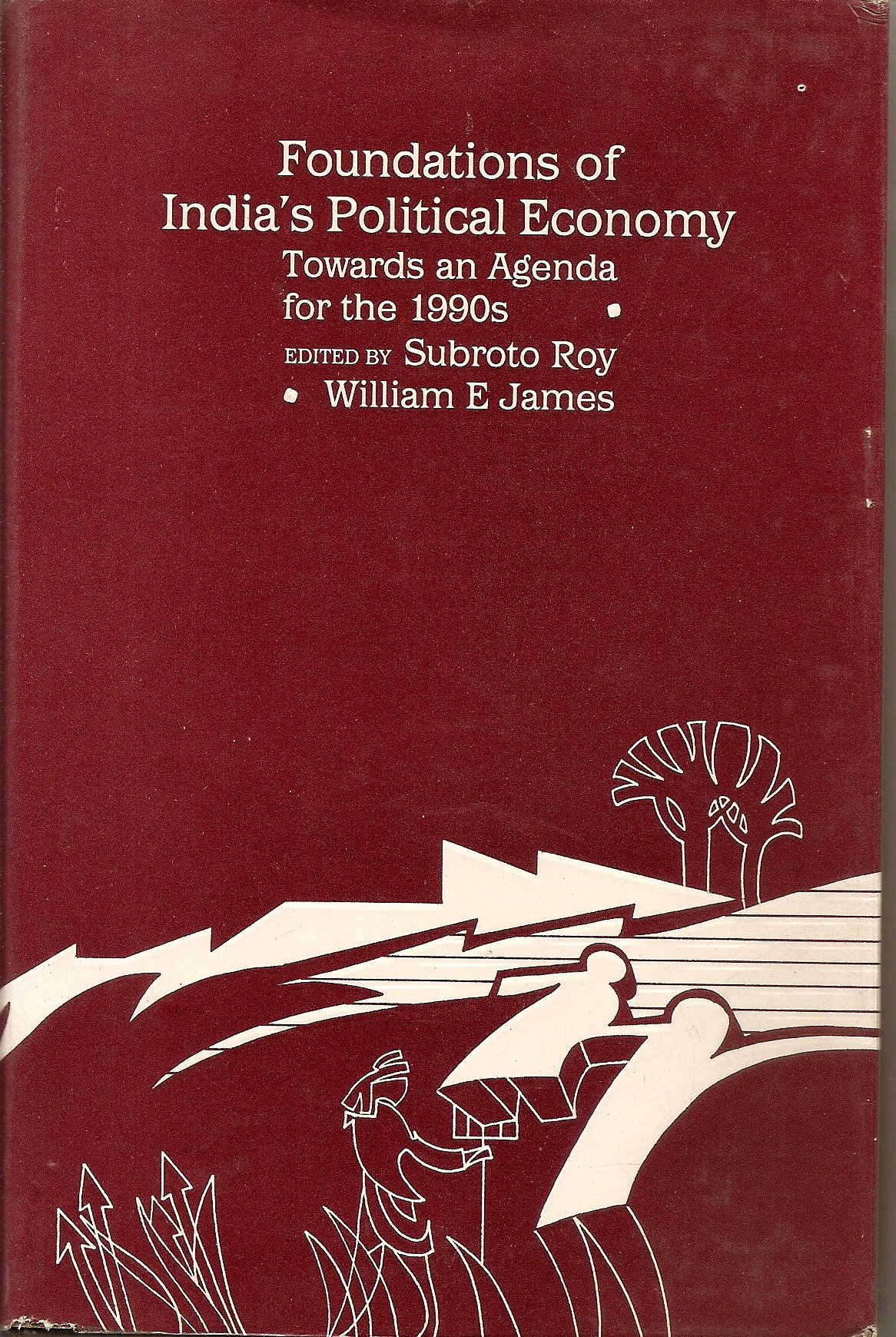
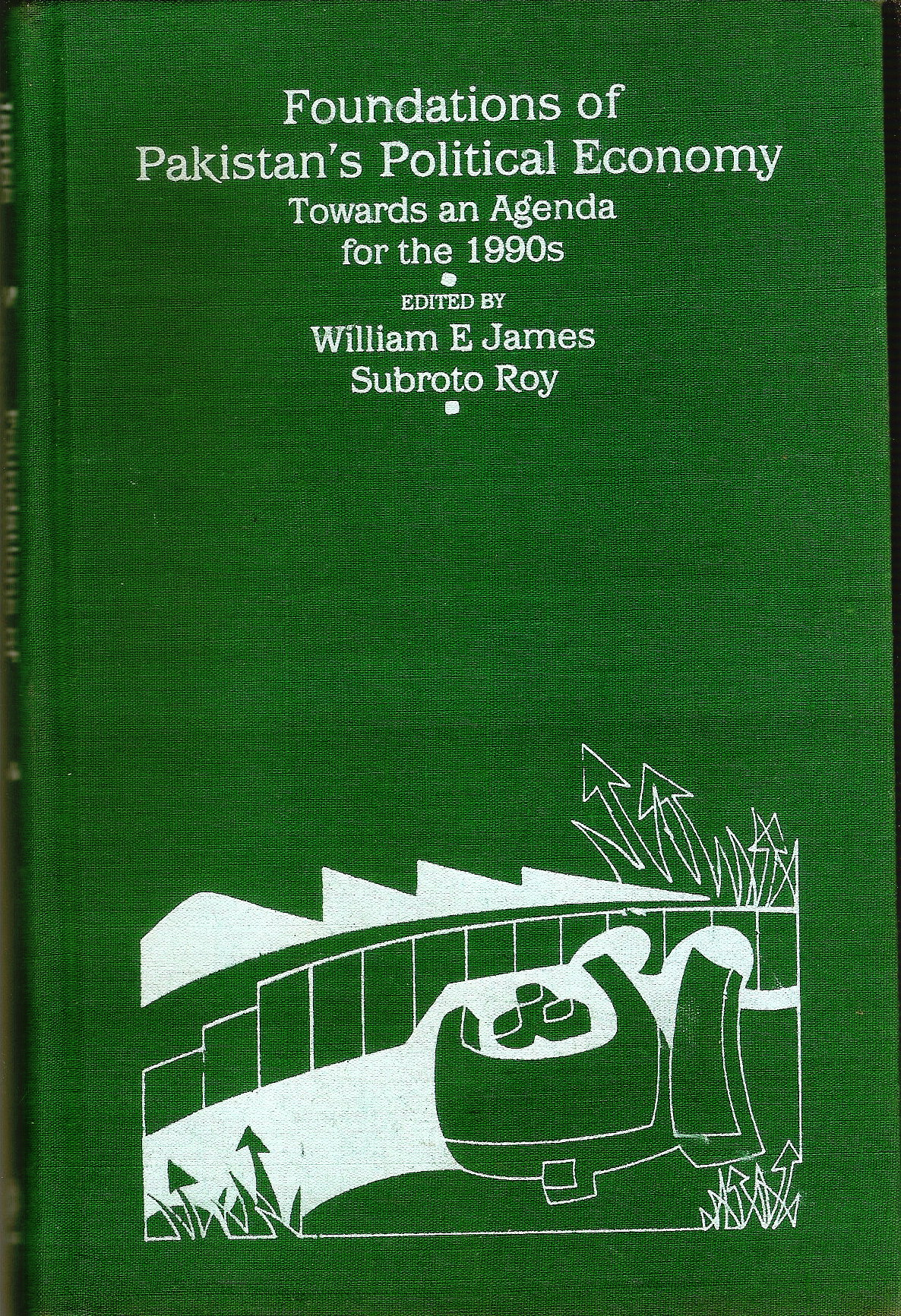
As described elsewhere, the manuscript of the India-volume contributed to the origins of India’s 1991 economic reform during my encounter with Rajiv Gandhi in his last months; the Pakistan-volume came to contribute to the origins of the Pakistan-India peace process. The Indian publisher who had promised paperback volumes of both books reneged under leftwing pressure in Delhi; he has since passed away and James and I still await the University of Hawaii’s permission to publish both volumes freely on the Internet as copyright rests with the University President.
In 2004 from Britain, I wrote to the 9/11 Commission stating that it was possible that had the vicious illegalities against me not occurred at Manoa starting in 1989, we may have gone on after India and Pakistan to study Afghanistan, and come up with a pre-emptive academic analysis a decade before September 11 2001.
To be continued in Part Two.

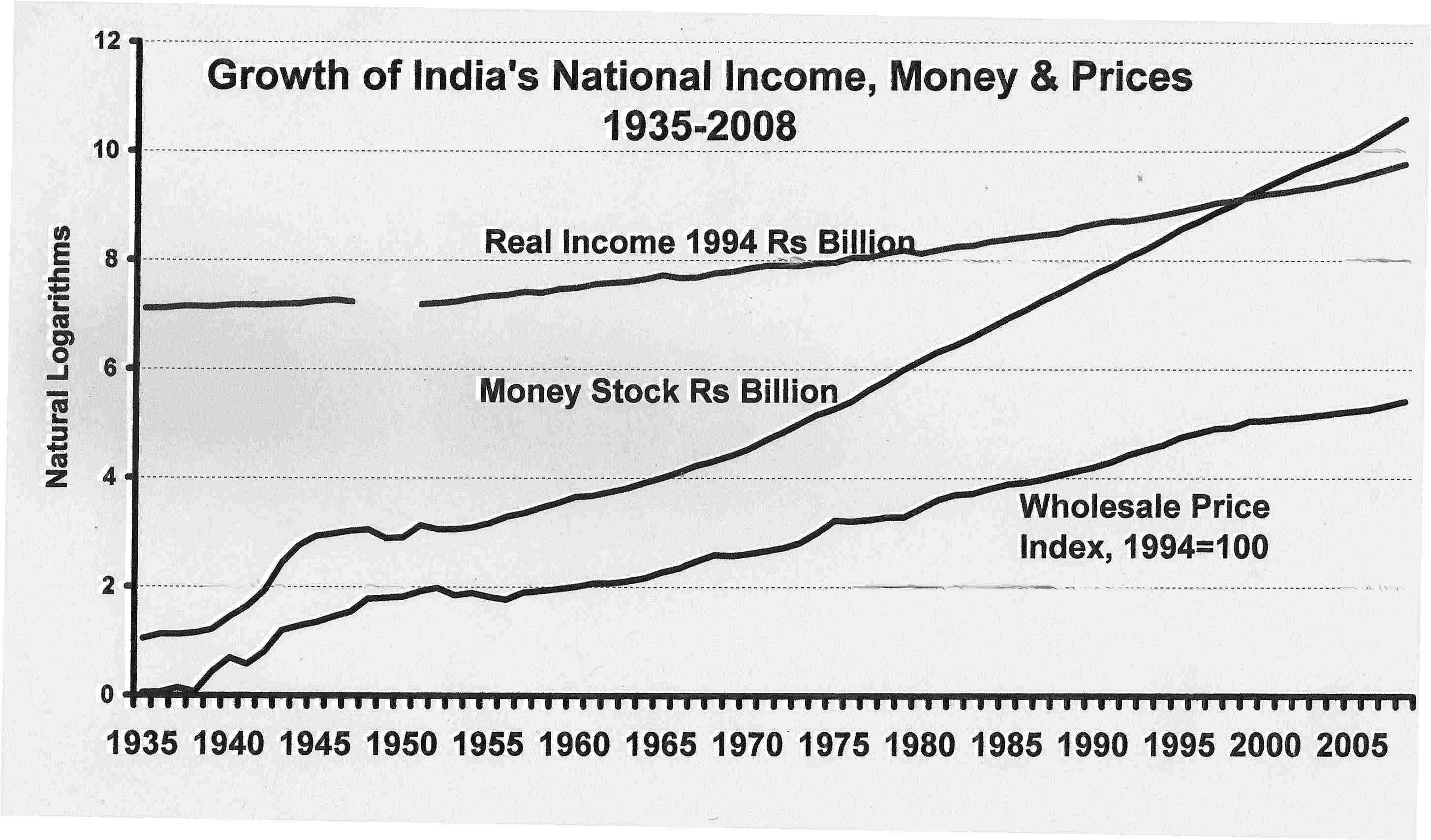

First published in The Statesman, Editorial Page Special Article, June 7 2008, http://www.thestatesman.net
Leadership vacuum
Time & Tide Wait For No One In Politics: India Trails Pakistan & Nepal!
Subroto Roy
The Karnataka legislative elections, as well as to lesser extent the Bengal panchayat polls, have revealed the vacuum that exists across the leadership of India’s national-level politics today.
To start with the BJP: had India been a normal democratic country on the Western pattern, Mr Arun Jaitley would have rocketed to the top of his party’s leadership by now. Besides being articulate in both Hindi and English and in his fifties (the age-group of most leaders in democratic countries), Mr Jaitley’s political acumen and organisational skills have been acknowledged even by his Congress adversaries after the Karnataka result. He himself has been frank and expansive about his formula for winning in Karnataka, which was simply to focus on real issues, especially state-specific ones, as well as to project a single credible leader. Had the BJP been a normal political party in a normal country, Mr Jaitley would have been given the task of leading it to victory in the next General Election and, assuming he won a Lok Sabha seat, to become its prime ministerial candidate.
Dadagiri
Instead, the BJP chooses to remain backward, backward, backward in the majority of its thought-processes and behaviour-patterns ~ from its kneejerk anti-Muslim psychology via its hyperinflationary macroeconomics and protectionist trade to its embrace of astrology and bovine exclusiveness. The idea of uniting behind someone relatively modern-minded in his politics like Mr Jaitley would be simply unacceptable not merely to people in the party within his own age-cohort (including the present party president) but even more so to those in age-cohorts decades older (including the party’s present prime ministerial candidate).
The opposition of the first group would arise from, in a word, jealousy. The opposition of the second group would arise from, in a word, dadagiri, i.e. the gerontocratic idea that merely because one is older, one is owed respect, authority and the plums of office in precedence over someone who is younger. Jealousy is a universal emotion not something specific to Indian politics, but dadagiri and the lack of meritocracy in our political culture is one reason India remains an abnormal polity in the modern democratic world.
LK Advani, driven by his unfulfilled personal ambition, will likely lead the BJP in the next election and do so with Mr Jaitley’s explicit support; Mr Advani may lead it into defeat or even to a victory in which he, given his age, is not as successful a PM as a Jaitley might have been. Yet our sclerotic political culture is such that neither Mr Advani nor Mr Rajnath Singh will simply stand aside now and hand over the reins to a newer, more competent and progressive leadership.
The same idea of dadagiri pervades what passes for the official “Left” in India as exemplified by the CPI-M. Mr Jyoti Basu has in a recent letter to Harkishen Singh Surjeet reminisced of their times together, and in doing so remarked that he remained the Chief Minister of West Bengal for as many years as he did because the Party had instructed him to do so, and when he handed over power to Buddhadeb Bhattacharjee, he did so with the Party’s agreement.
Those who believe in India’s parliamentary democracy might have thought that what our system requires is for a Chief Minister to hold the confidence of the legislative assembly from the bottom up but clearly that is not so because what a CM or PM seems to need are Party instructions from the top down. When Mr Bhattacharjee was anointed the new CM, the present author had remarked to the then Editor of The Statesman that the transition seemed to take place even without a formal vote of confidence in the Assembly. Does anyone in fact recall the last confidence vote debated and passed in the West Bengal Assembly? Democratic legislatures the world over routinely begin their new sessions with a debate and vote of no confidence being brought by the Opposition against the Government-of-the-day.
Does that happen with us, purportedly the world’s largest democracy? Let aside State legislatures, even our Parliament sees only the rare vote of confidence, and LK Advani specifically as Leader of the Opposition seems to have introduced none. Oppositions that do not wish to properly oppose are of course complicit in a government’s misdeeds.
It is the dadagiri culture shared by the official Communists that has caused the generational handover of power from Mr Basu and Mr Surjeet to the JNU coterie of the Karats and Mr Sitaram Yechuri. The “Left” like the “Right” and everyone else in Indian politics, can only handle cherubic “known” faces at the top ~ genuine grassroots activists like Binayak Sen or Medha Patkar must languish in jail or starve on hunger-strike in seeking to represent the politically and economically powerless in India while the entrenched dadas of Indian politics continue with their dissimulation.
Puppet-masters
In case of the Congress, it is an even deeper aspect of the Indian joint family system than dadagiri that has dominated its political culture, namely, the question who is the karta of the family and, if the karta is or seems too young or naïve or inexperienced, who will act as Regent on the karta’s behalf? Indira Gandhi was successfully guided in international politics for several years by a coterie led by PN Haksar. Rajiv Gandhi was attempted to be guided by several different competing coteries of senior party dadas ~ one of whom first brought up the name of Manmohan Singh in Indian politics on 22 March 1991 in a challenge addressed to the present author on liberalisation plans that Rajiv had authorised.
It is almost true to say that Sonia Gandhi and Rahul Gandhi have been in recent years played by puppet-masters of whose personal interests and intrigues they remain clueless. As has been said before by this author, the most salubrious thing Sonia Gandhi could have done for the Congress Party was to remain steadfast in her decision to stay out of Indian politics, and to have organised a fair, tough intra-party contest among its putative senior leaders based on differences of political and economic ideology.
Instead there is now paralysis in decision-making induced by Sonia Gandhi and Manmohan Singh each mistakenly relying upon the other’s purported economic wisdom and political acumen. This confusion came to be most clearly illustrated in the choice of Head of State last year though that was something politically costless ~ the failures of which Karnataka is the current example may lead the Congress to lose what it, like other Indian parties, loves most of all, namely political power in Lutyens’ Delhi.
Indians should make no mistake: our good neighbours in Pakistan and Nepal (Muslim in Pakistan, Hindu and Buddhist and communist in Nepal) have been through healthy cathartic political experiences in recent months and years of a kind we have not. There continues to remain a dangerous intellectual vacuum around the throne of Delhi.
A Note on the Indian Policy Process
Subroto Roy
During the University of Hawaii perestroika-for-India project two decades ago, I had wished to attract Sukhamoy Chakravarty from Delhi. He very kindly met me on July 14 1987 and presented me his last personal signed copy of the famous RBI report his committee had chaired. He said he could not come to Hawaii because of ill health but he strongly recommended I take C. Rangarajan instead because, he said, Dr Rangarajan was the main author of the report. I met Dr Rangarajan in Kolkata at Jadavpur University where he was giving a speech in his role as President of the Indian Economic Society that year. Later in correspondence, he wrote to say he was over-committed but that if I took Amaresh Bagchi instead, he would help co-author Bagchi’s contribution to our project. So I commissioned Amaresh Bagchi, then Director of New Delhi’s National Institute of Public Finance and Policy.
In my next project-related visit to Delhi in December 1988, I met Amaresh Bagchi personally for the first time; he was about to retire or had already done so. He told me he knew my name from the fact the High Commission of India in London had sent the Finance Ministry in Delhi the May 29 1984 lead editorial of The Times of London on my work which had been very critical of Indian economic policy; Bagchi had been at the time in the Finance Ministry, and, as an old sarkari statist, had naturally taken exception to what I had said by way of liberal criticism. He wished to co-write his contribution for our Hawaii project with a young colleague of his; I declined permission for him to do that and told him our understanding was that Dr Rangarajan would be writing with him.
In any case, in May 1989, Amaresh was the first person to reach Honolulu in the team we had put together for the project, arriving early by several days. He was all alone and seemed miserable, so I took him to the supermarket and later invited him to dine with my small family at our home at Punahou Towers, 1621 Dole Street. It pleased him to eat some home-cooked Indian food, and he warmed slightly. He told me he had joined the Government as a bureaucrat in the income tax department and later acquired a doctoral degree in economics, though I did not get a sense that he was familiar with traditional public finance of the sort in Richard Musgrave’s classic textbook. I gifted him a copy of James Buchanan’s lectures that I had put together when Professor Buchanan had visited the University of Hawaii at my invitation in 1988 and which the University had then published with a preface by myself. He remarked he found it terrible that American supermarkets had all this canned pet food when the world was so hungry. Later I invited him to a larger dinner party again at my home before the conference began.
At the conference itself, I placed him next to Milton Friedman, which some said was a master-stroke. There was a long and somewhat heated interchange between him and TN Srinivasan, though not with Milton, as Milton was, as always, invariably polite, patient and clear-headed in argument for the two days that he stayed.
The chapter Amaresh Bagchi wrote for us in the book Foundations of India’s Political Economy, edited by myself and WE James, was useful as practically the only statement until that time on the fiscal-induced monetary weakness of India (that still continues today, indeed may have gotten worse since). It contributed to placing him in the policy-limelight in his post-retirement years. Dr Rangarajan was not a co-author after all but apparently contributed the most important paragraphs on the subject. (We have been trying for almost a year now to get the University of Hawaii to allow free republication of the book on the Internet; the original publisher, now dead, reneged on a promise to produce a paperback edition after there was leftist academic pressure on him in Delhi.)
I gave a copy of our book to Manmohan Singh when I met him and his senior aides in September 1993 in Washington at the Indian Ambassador’s Residence; I was introduced to Dr Singh by the then Ambassador of India SS Ray as the person on whose laptop computer the 1991 economic reform had been designed for Rajiv Gandhi during Rajiv’s last months, a statement accurate enough as has been told elsewhere. (Dr Singh had 20 years earlier kindly visited our then-home in Paris at 14 Rue Eugene Manuel at the invitation of my father who knew him, to advise me about economics just before I headed to the London School of Economics as an 18 year old freshman; but in 1993 both he and I had forgotten that earlier 1973 meeting.)
Today’s newspapers report Amaresh Bagchi’s passing and say that “When (Manmohan) Singh was finance minister in the early 1990s, Bagchi was one of his key advisers on fiscal policy”. Dr Singh has described Bagchi as “one of our most distinguished fiscal policy experts” and said “It is no exaggeration to state that Amaresh has been associated with almost every major fiscal policy reform in the past 30 years”.
I am afraid I disagree with the Prime Minister of India in that I do not see any “major fiscal policy reform” having taken place at all in India, just a lot of unsystematic tinkering here and there. The root cause has been the failure to face or want to comprehend the extremely dismal state of government and public sector accounts throughout the country. Without proper government accounting, there can be neither accountability nor any serious fiscal policy, and hence no serious monetary or macroeconomic policy either.
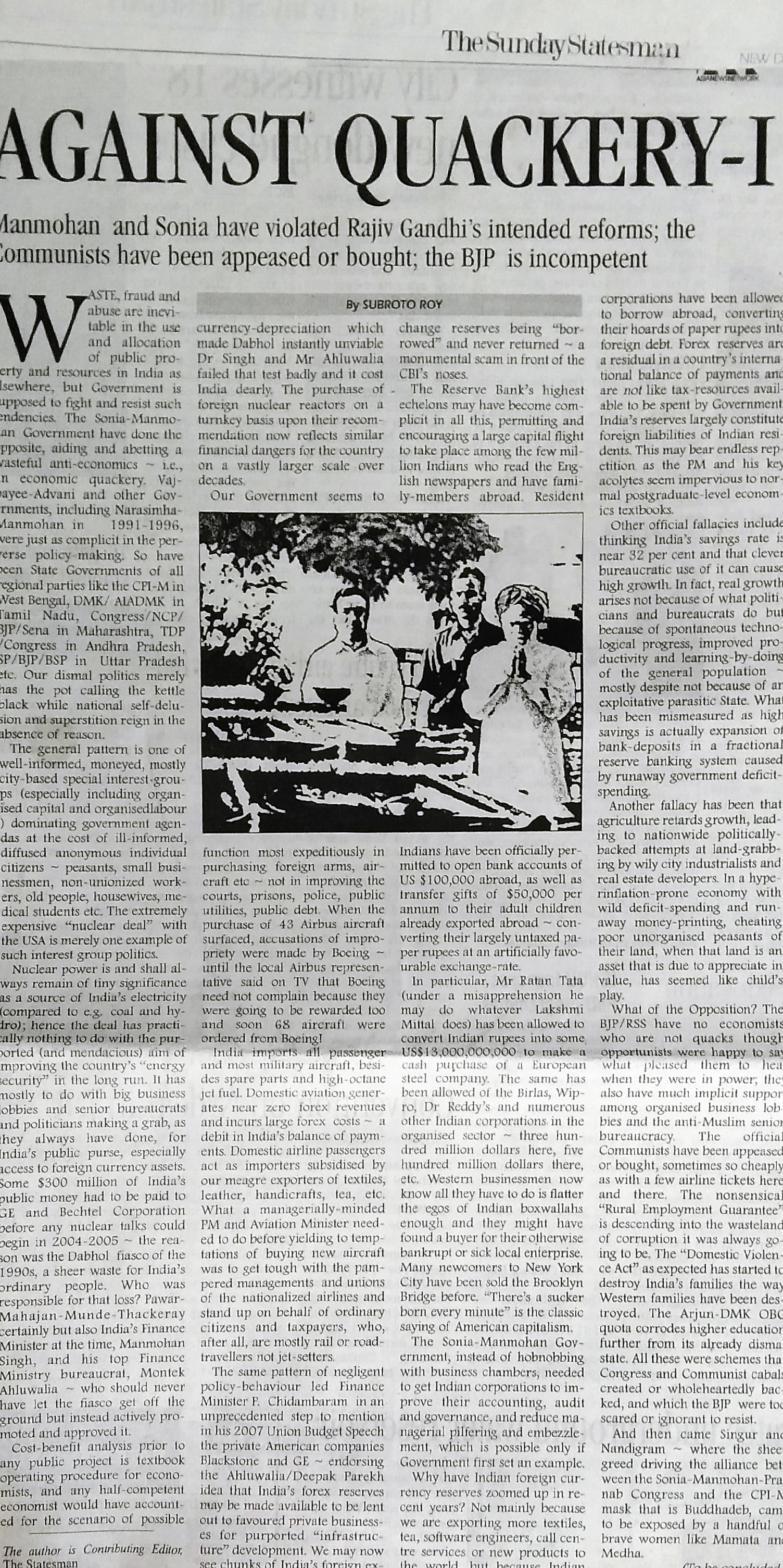
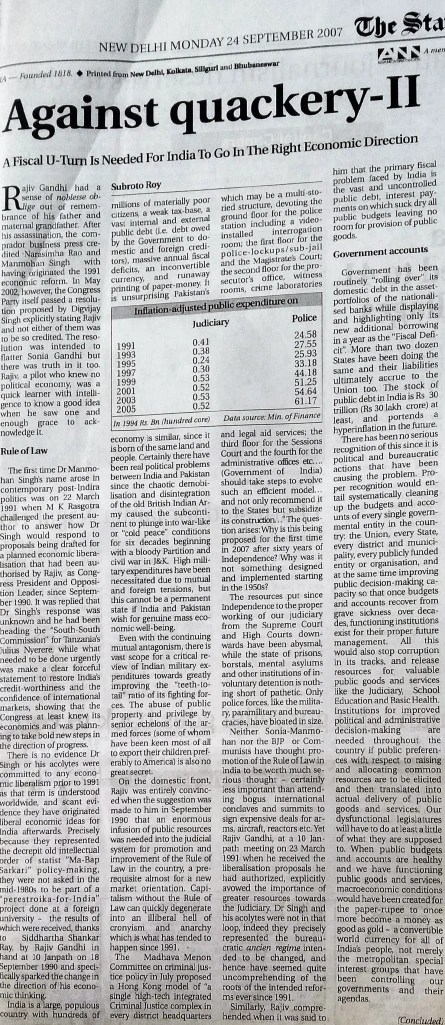


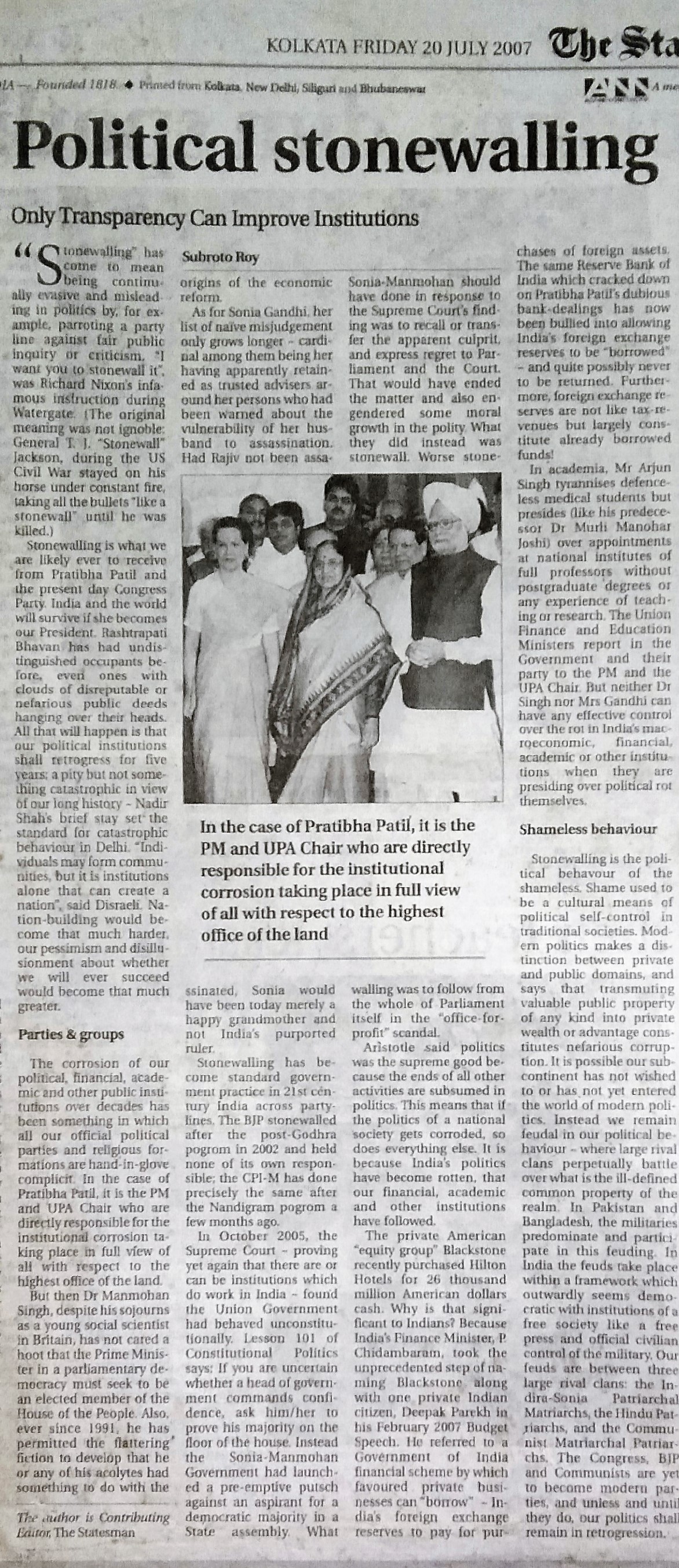


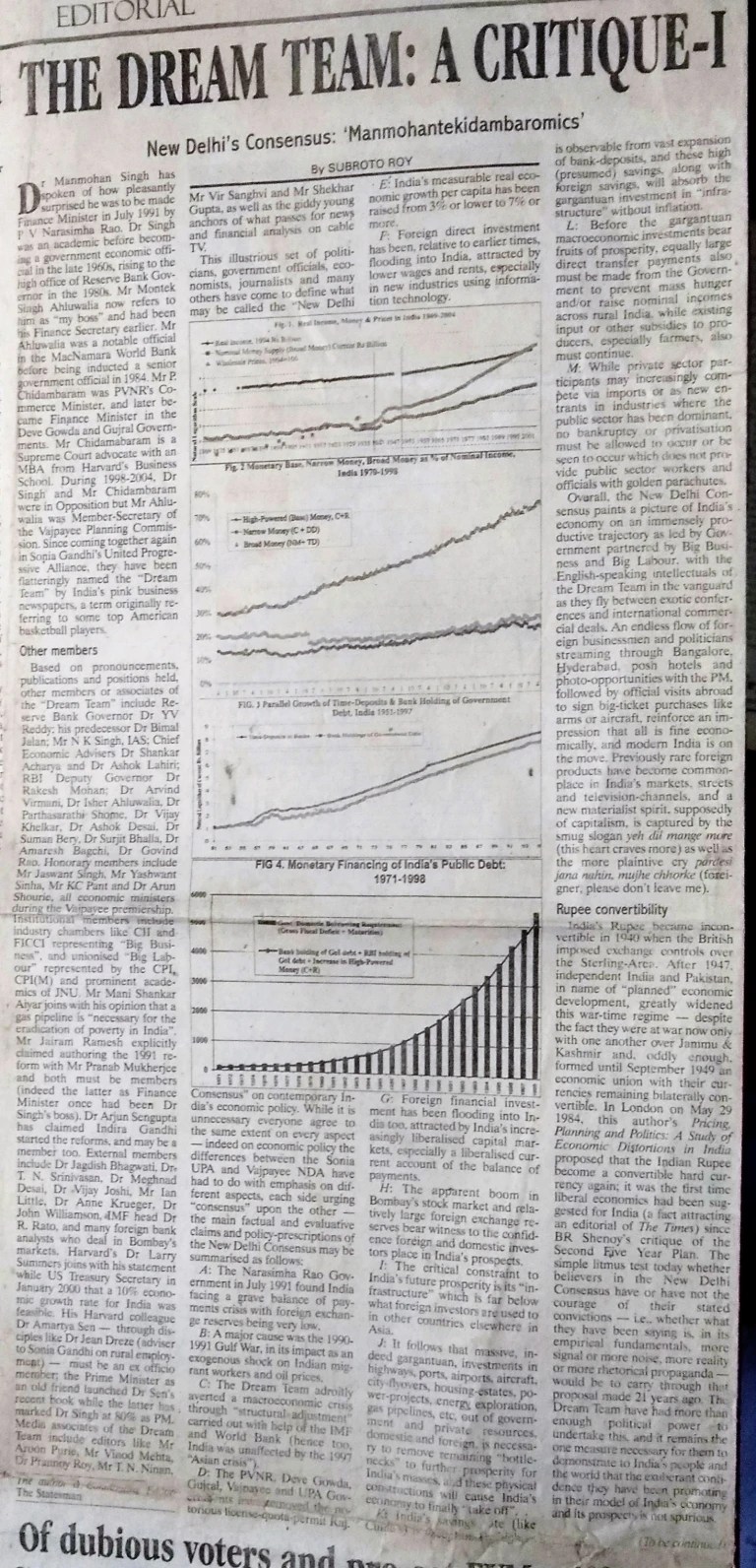

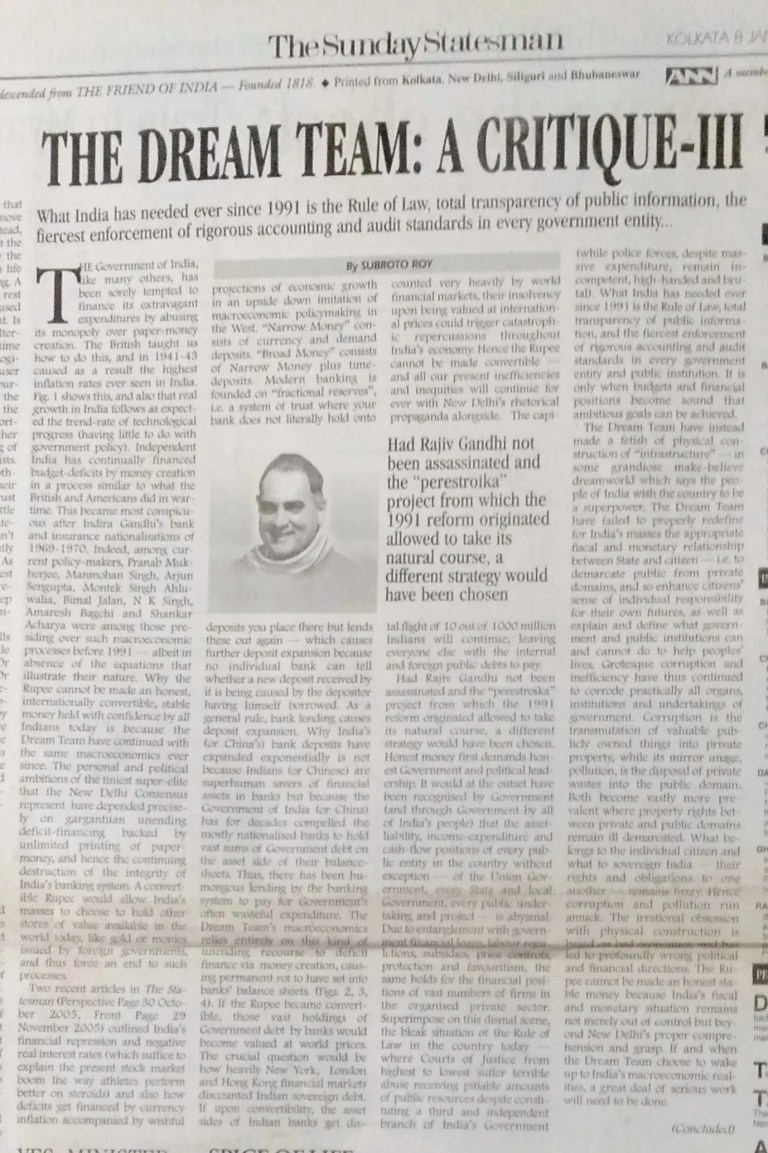
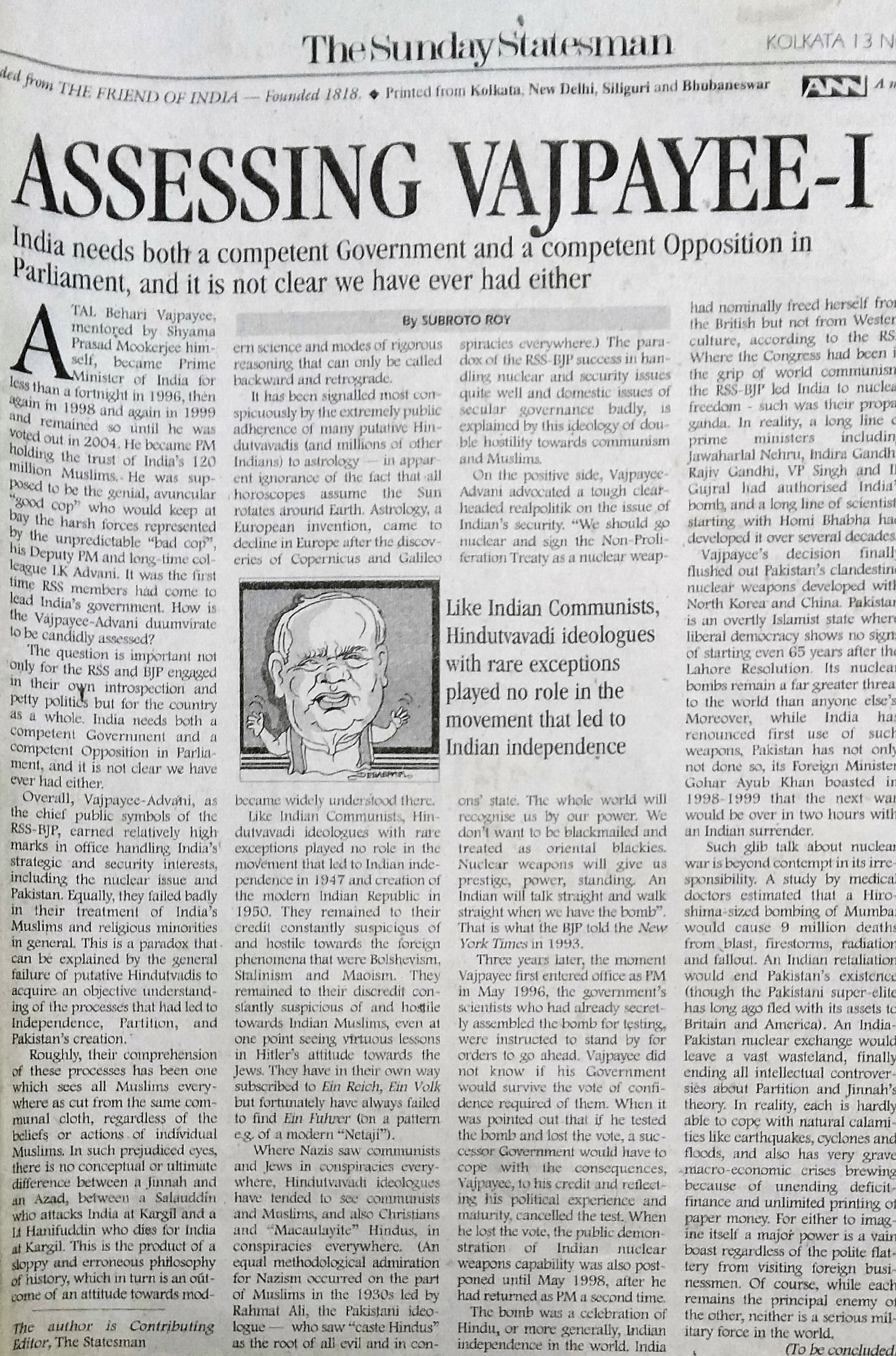
Constitution for a Second Indian Republic
Author’s Note April 2007: I wrote “A Second Constitution for India” on October 2 1990 while working in an advisory capacity for Rajiv Gandhi, then Leader of the Opposition. But he did not get to see it and I was not able to guide any coherent discussion towards this vital subject. I published it on April 20 1991 in The Statesman in its Saturday supplement. While I am not sure I agree with all of my 1991 “Constitution” today, it may be useful for discussion. One salient feature of this concise 60-article Constitution is having a directly elected PM and Deputy PM with a tough Senate somewhat on the US pattern (though the distinction between Head of Government and Head of State is maintained as in the present system) with a modified British pattern of parliamentary democracy continuing in the States.
I do, however, fully endorse what I wrote on December 30 2002 in a personal letter to the late C. R. Irani, in his capacity as a member of the “Constitutional Review Commission” (to which he responded with very warm agreement). That letter is placed below the text of the proposal and outlines some of what I think is most urgent today in India’s constitional progress.
“Nai Duniya”, Constitution of a Second Republic
by Subroto Roy
First published in The Statesman, April 20 1991
Preamble
We the People of India, in order to establish a more perfect Union of PERPETUAL PEACE; in which the ancient virtues of COURAGE,TRUTHFULNESS and JUSTICE may be better practiced; in which the FREEDOM and WELFARE of all our People may be more easily secured, do adopt, enact and give to ourselves this Constitution, on this the 26th day of January 1995.
FOUNDATION
1. India, that is Bharat or Hindustan, shall be a Union of States and Territories, and a sovereign member of the community of nations.
2. The Union of India shall be a democratic republic, and the Union shall guarantee a democratic and republican form of governance in each of its States and Territories.
3. The Union of India shall protect every State and Territory against foreign aggression and armed rebellion, and shall ensure its governance to be in accordance with provisions of the Union Constitution.
4. A State or Territory may elect to establish its own Constitution, but no provision of the Constitution of any State of Territory shall be valid if it violates any provision of the Union Constitution.
FUNDAMENTAL RIGHTS OF CITIZENS
5. Every person born in the territory of India, or either of whose parents or any of whose grandparents was born in the territory of India, or who is a citizen of India at the commencement of this Constitution shall be a citizen of India by birth. Any person who has been domiciled in India for five years may become a citizen of India by naturalization according to law.
6. Every citizen of India who is not less than 21 years of age shall have the right to vote, and the right to vote shall not be denied or abridged on account of religion, race, sex, descent, caste or place of birth, or by reason of failure to pay any poll tax or any other tax.
7. The Union of India or any of its States or Territories shall not deny to any person within the territory of India equality before the laws or the equal protection of the laws.
8. No person within the territory of India shall be deprived of life, liberty or property save by authority of law, nor shall private property be taken for public use without just compensation.
9. The rights of citizens to be secure in their persons, homes, communications, papers and effects, against unreasonable searches and seizures shall not be violated, and no warrants shall issue but upon probable cause, supported by oath or affirmation, and describing the place to be searched, and the person or things to be seized.
10. No person accused of a criminal offence shall be compelled to be a witness against himself or herself, nor shall any person be arrested without being informed of the grounds of such arrest, nor shall any person in custody be deprived of the right to legal
counsel, nor shall the privilege of the writ of habeas corpus be suspended unless in the case of war or armed rebellion the public safety requires it.
11. No person shall be prosecuted or punished for the same offence more than once, nor shall excessive bail be required or excessive fines imposed, nor shall punishments be cruel or unusual.
12. The Union of India or any of its States or Territories shall not deny to any citizen the right to move freely throughout the territory of India or to reside or settle in any part of the territory of India.
13. The Union of India or any of its States or Territories shall not deny to any citizen the right to freedom of conscience, or the right to freely profess or practice religion, or establish, maintain and manage religious institutions in accordance with law and subject to public safety, order and health.
14. No citizen shall be subject on account of religion, race, caste, sex, descent or place of birth to any disability, liability or restriction with regard to public institutions, public places or places of worship, or use of public facilities, maintained wholly or partly out of public funds or otherwise dedicated to the use of the public.
15. The Union of India or any of its States or Territories shall not deny any citizen equality of opportunity or discriminate on account of religion, race, caste, sex, descent or place of birth.
16. The Union of India or any of its States or Territories shall not deny or abridge the freedom of speech, inquiry or expression of citizens, or the freedom of the press or broadcasting, subject to public safety, order, health, laws of defamation and standards of common morality.
17. The Union of India or any of its States or Territories shall not deny the right of citizens to form associations and unions, to assemble peaceably without arms, or to petition for redress of grievances, subject to public safety, order and health.
18. The Union of India or any of its States or Territories shall not deny to any citizen the right to practice any profession, trade or business, or carry on any occupation or means of livelihood, subject to public safety, order, health and standards of common morality.
19. Trade, commerce and enterprise throughout the territory of India shall be free, and the Union of India or any of its States or Territories shall not make any law to restrict them except in the interests of public safety, order, health, standards of common morality or economic efficiency.
20. No tax shall be levied or collected except by authority of law.
DUTIES OF CITIZENS
21. It shall be the duty of every person within the territory of India to abide by the Constitution of India and show no disrespect to its institutions; to participate in democratic processes and to vote in elections according to law; to make timely payments of taxes, fees and dues according to law; to keep clean and hygienic streets, roads, highways, neighbourhoods, waterways, railways, parks, public buildings and institutions; to protect public property; to protect the natural environment and to treat living creatures without cruelty; to abjure violence and promote harmony among all people; to value and preserve the languages and cultural history of the Indian subcontinent; to renounce practices derogatory to women or children.
EXECUTIVE, LEGISLATIVE AND JUDICIAL POWERS
22. There shall be a President of India in whom shall be vested the executive power of the Union, and who shall be the Supreme Commander of the Armed Forces of the Union. The President shall be elected indirectly by the citizens of India in the manner prescribed in Article 40 of this Constitution.
23. There shall be a Vice-President of India, who shall exercise the duties and functions of the President in the event of the death, resignation, incapacitation, absence or impeachment of the President. The Vice-President shall be elected indirectly by the citizens of India in the manner prescribed in Article 41 of this Constitution.
24. The President of India shall appoint a Prime Minister upon the advice of the citizens of India in a direct election in the manner prescribed in Article 43 of this Constitution. The Prime Minister of India shall be the Chief Executive Officer of the Union, and the President shall, in exercising the executive power of the Union, act at all times upon the advice of the Prime Minister. The Prime Minister shall keep the President of India informed at all times, and shall reconsider advice rendered if the President so requests it.
25. There shall be a Union Parliament which shall consist of the President, the Vice-President, the Prime Minister and two elected Houses.
The Upper House, or Council of the Nation, shall consist of members elected directly by the citizens of India according to States in the manner prescribed in Article 37 of this Constitution. The Lower House, or House of the People, shall consist of members elected indirectly by the citizens of India according to States, in the manner prescribed in Article 35 of this Constitution. The legislative power of the Union of India shall be vested in the Union Parliament.
A Bill, except a Tax Bill, may originate in either House. A Tax Bill, that is to say any Bill for the raising of revenue, shall originate in the Lower House. After a Bill has been passed in one House, it shall be sent to the other House which shall pass, modify or reject it. A Bill passed by both Houses shall be sent to the Prime Minister, upon whose approval it shall be sent to the President for signature upon which it shall become law. A Bill passed by both Houses which does not receive the approval of the Prime Minister shall be returned to the House where it shall have originated. If, after reconsideration, both Houses pass the Bill, each House by two thirds of its members, then the Bill shall be sent to the Prime Minister who shall advise the President that it be signed and become law.
26. There shall be a Supreme Court of India, consisting of a Chief Justice and Associate Justices appointed by the President upon the nomination of the Prime Minister with the advice and consent of the Upper House of the Union Parliament. The judicial power of the Union of India shall be vested in the Supreme Court and such courts inferior to it that it may establish or authorize. The Supreme Court of India shall have its seat in the capital of the Union and also in every State of the Union.
27. Each State shall have a Governor appointed by the President of India upon the nomination of the Prime Minister with the advice and consent of the Upper House of the Union Parliament. The Governor shall be vested with the executive power of the State, and shall be the supreme commander of all police forces within the State.
28. Each State shall have a Parliament, which shall consist of the Governor of the State and one or two chambers, elected by the citizens of the State in accordance with the Constitution or laws of the State. All legislative power of the State shall be vested in the State Parliament or such duly elected bodies of local government which the State Parliament shall establish by law.
29. The Governor of a State shall appoint a Chief Minister who shall be a member of the State Parliament enjoying the confidence of that Parliament. The Governor shall act upon the advice of the Chief Minister in exercising the executive powers of the State except in conditions of Emergency as stated in Article 56 of this Constitution. In the event no member of the State Parliament shall have its confidence, or in conditions of Emergency as stated in Article 56, the Governor of the State shall exercise the executive powers of the State in consultation with the State Parliament, until such a time as either such confidence comes to obtain, or new elections to the State Parliament take place within a maximum time of one year, or conditions of Emergency come to an end.
30. Each State Parliament shall elect its representatives to the Lower House of the Union Parliament in accordance with the provisions of Articles 34 and 35 of this Constitution.
31. Each State shall have a Supreme Court consisting of a Chief Judge and Associate Judges appointed by the Governor as the Constitution or laws of the State may establish. The judicial power of the State shall be vested in the Supreme Court of the State and such courts inferior to it as the Constitution or laws of the State may establish.
ELECTIONS AND TERMS OF OFFICE
32. All elections in the Union of India and its States and Territories shall be held on the 2nd day of October in any year, and this day shall be known as Election Day or Gandhi Jayanti and shall be a bank holiday. There shall be no more than 14 other bank holidays in the year, and no more than 2 in any month of the year.
33. The power required for the conduct of all elections to the Union Parliament and all State Parliaments shall be vested in a Chief Election Commissioner, who shall be appointed by the President upon the nomination of the Chief Justice of India with the advice and consent of the Prime Minister and the Upper House of the Union Parliament. The Chief Election Commissioner shall be assisted by four Associate Commissioners, one each for Northern, Central, Southern and Eastern India, and State Election Commissioners, one for each State.
34. Election to any State Parliament shall be for a maximum term of 4 years. A State Parliament shall consist of no more than 1000 members, chosen by direct election from territorial constituencies of the State, each member representing no more than 100,000 citizens so far as is possible.
35. Elections to the Lower House of the Union Parliament shall be for a term of 2 years, and the House shall stand dissolved every 2 years. The Lower House shall be elected indirectly by the citizens of the States, the delegations from a State being elected by members of the State Parliament. Each member of the Lower House shall represent indirectly 1 million citizens of the State so far as is possible. The Lower House of the Union Parliament shall have no more than 1000 members, each member having one vote.
36. The Lower House shall choose its own Speaker; determine the rules of its own proceedings; punish its members including by expulsion with the approval of two thirds of its members; keep a record of its proceedings and publish the same regularly except such parts as may in the judgement of the House require secrecy in the national interest. During their attendance in Parliament or travel to and from Parliament, members shall be privileged from arrest except for treason, felony or breach of peace. Nor shall any speech made in the Lower House be questioned in any other place. No member of the Lower House shall hold any other office of profit or honour of the Union of India or any State or Territory of India.
37. The Upper House of the Union Parliament shall have no more than 100 members, of whom 90 shall be chosen by direct election from territorial constituencies of the Union and shall have one vote each. Elections to the Upper House shall be for a term of 6 years, with one third of the elected members retiring every 2 years. No person shall be elected to the Upper House for more than three terms successively. For purposes of elections to the Upper House, the Union of India shall be divided into territorial constituencies each of approximately 10 million citizens, so long as there are no more than 22 constituencies from the States of Southern India (presently consisting of Tamil Nadu, Kerala, Andhra Pradesh, Karnataka and Goa); 22 constituencies from the States of Eastern India (presently consisting of Arunachal Pradesh, Tripura, Mizoram, Manipur, Meghalaya, Nagaland, Assam, Sikkim, West Bengal and Bihar); 22 constituencies from the States of Northern India (presently consisting of Uttar Pradesh, Himachal Pradesh, Jammu and Kashmir,Rajasthan, Punjab and Haryana); and 22 constituencies from the States of Central India (presently consisting of Gujarat, Maharashtra, Madhya Pradesh and Orissa). There shall be one constituency in the Union Territory of Delhi and one constituency in all other UnionTerritories together.
38. The President of India may appoint up to 10 members of the Upper House each of whom shall have no vote and shall hold one term of office of 2 years. The President shall make such appointments in view of considerations such as the representation of the arts, sciences, sports, literature or social work, as also the representation of any community, caste, religion or other group which, in the opinion of the President, deserves a voice in the Upper House in the national interest.
39. The Vice President of India shall chair the Upper House but shall have no vote unless they are equally divided. The Upper House shall choose its own Chairman pro tempore in the absence of the Vice President; determine the rules of its own proceedings; punish its members including by expulsion with the concurrence of two thirds of its members; keep a record of its proceedings and publish the same except as may in the judgement of the House require secrecy in the national interest. During their attendance in Parliament or their travel to and from Parliament, members shall be privileged from arrest except for treason, felony or breach of peace. Nor shall any speech made in the Upper House be questioned in any other place. No member of the Upper House shall hold any other office of profit or honour of the Union of India or any State or Territory of India.
40. The President of India shall be elected for a term of 5 years by the Union Parliament, and shall be a citizen of India not less than 35 years of age. If there are more than two nominations, there shall be a primary election in the Upper House by secret vote, and the names of those receiving the highest and second highest number of votes shall be sent to the Lower House which shall elect between them by secret ballot. The President of India shall not hold any other office of profit or honour.
41. The Vice-President of India shall be elected for a term of 5 years by the Union Parliament, and shall be a citizen of India not less than 35 years of age. If there are more than two nominations, there shall be a primary election in the Lower House by secret vote, and the names of those receiving the highest and second highest number of votes shall be sent to the Upper House which shall elect between them by secret ballot. The Vice-President of India shall not hold any other office of profit or honour.
42. The terms of the President and Vice-President shall not be concurrent.
43. The Prime Minister of India shall be appointed by the President upon the advice of the citizens of India in a direct election, and shall hold office for four years. The Prime Minister shall be a citizen of India not less than 35 years of age, and no person shall hold the office of Prime Minister for two terms successively. Candidates shall register 12 months prior to the date of the election with the Chief Election Commissioner. The Chief Election Commissioner shall report to the President the results of the election to the office of the Prime Minister, and the President shall appoint the candidate receiving the highest number of votes.
44. Upon the nomination of the Prime Minister, the President shall appoint a Deputy Prime Minister and a Council of Ministers, who shall hold office at the pleasure of the President and who shall assist the Prime Minister in the discharge of the duties of the office. The Deputy Prime Minister shall exercise the duties and functions of the Prime Minister in the event of the death, resignation, incapacitation, absence or impeachment of the Prime Minister.
45. The Prime Minister, the Deputy Prime Minister and the Council of Ministers shall from time to time answer the questions of members of the Union Parliament as requested by the latter, and the Prime Minister shall no less than once every year address the Union Parliament on the State of the Republic.
46. Neither the Prime Minister nor the Deputy Prime Minister nor any member of the Council of Ministers shall hold any other office of profit or honour.
DUTIES OF THE UNION AND THE STATES
47. The duties of the Union of India shall include
— defence of the Republic from foreign aggression, armed rebellion and crime
— foreign relations and foreign trade
— management of currency and exchange-rate
— management of the public debt of the Union
— inter-State highways, waterways and dams
— regulation of inter-State railways
— regulation of harbours and airports
— regulation of civil aviation
— regulation of communications and broadcasting
— protection of national monuments and archives
— development of space and atomic research, research
universities and institutes of national importance
— planning of metropolitan areas
— environmental protection, national forests, parks and wildlife
— regulation of banking other than rural banking
— regulation of stock exchanges and futures markets
— census, voter registration, and social security
48. The Union of India shall in addition
— promote and encourage State and local democracy
— reduce disparities of income and wealth consistent with economic efficiency
— reduce inequitable transfers of debt to future generations by ensuring balance in the Union Budget over a quincennial period
— promote harmony among the nations of the world, abjure violencein the settlement of international conflicts, foster respect for international law, and maintain just and honourable relations with other nations.
49. The original jurisdiction of the Supreme Court of India shall extend to substantive questions of law and constitutional interpretation; fundamental rights of citizens, and relations between the citizen and the Union and its States and Territories; international law; inter-State relations and commerce; relations between the Union and any State.
50. There shall be a Reserve Bank of India. Upon the nomination of the Prime Minister and with the advice and consent of the Upper House of the Union Parliament, the President of India shall appoint a Governor and Deputy Governors of the Reserve Bank of India. It shall be the duty of the Reserve Bank of India to maintain a sound currency, that is, a stable value of the Rupee for transactions within the Union and outside it. The Reserve Bank of India shall be further responsible for the charter and regulation of banks, and the efficient working of financial and credit markets.
51. Upon the nomination of the Prime Minister and with the advice and consent of the Upper House of the Union Parliament, the President of India shall appoint a Comptroller and Auditor General of India, who shall be responsible for the issue of public moneys and the audit of the accounts of the Union of India.
52. There shall be a Public Services Commission of India. Upon the nomination of the Prime Minister and with the advice and consent of the Upper House of the Union Parliament, the President of India shall appoint a Secretary-General of the Public Services Commission, who shall be responsible for all matters relating to the civil services of India.
53. The duties of each State of India shall include
— civil order and police forces in the State
— State highways, waterways and dams
— regulation of State railways
— land registration and tenurial reform
— agricultural pricing, stocks and extension
— animal husbandry
— colleges and non-research universities
— finance of schools and setting of school standards
— regulation of electricity
— regulation of insurance
— regulation of rural banking
— management of the public debt of the State
— vital statistics
— public health
— environmental protection
— State parks and forests
A State of India shall in addition
— extend processes of democracy by promoting ad encouraging constitutional local government
— reduce disparities of income and wealth consistent with requirements of economic efficiency
— reduce inequitable transfers of debt to future generations by ensuring balance in the State Budget over a quincennial period
— endeavour to secure a common civil code for citizens of the State
— promote harmony among the peoples of India.
The duties of local governments established in a State by law shall include provision of primary and secondary education or regulation thereof; provision of and maintenance of streets, roads and lighting or regulation thereof; provision of fresh water and sewage disposal or regulation thereof.
54. The original jurisdiction of the Supreme Court of a State shall extend to substantive questions of law and interpretation of the State Constitution; civil and criminal law within the State; marriage, divorce, custody and guardianship of minors; fundamental rights of citizens and relations between citizens and the State.
WAR AND EMERGENCY
55. The President of India, upon the advice of the Prime Minister and with the consent of a majority of each of the Union Parliament, shall have authority to declare and make war on behalf of the Union of India and its State and Territories, and to raise armed forces and resources for this purpose. A declaration of war may include the suspension of fundamental rights so long as that no such suspension shall continue for longer than 30 days without the consent of a majority of each House of the Union Parliament.
56. The President of India, upon the advice of the Prime Minister and with the consent of a two thirds majority of the Upper House of the Union Parliament, shall have authority to declare the whole of India or any part of its territory to face an imminent danger from foreign aggression, armed rebellion, disturbance or natural calamity, and proclaim an Emergency accordingly. Proclamation of Emergency may include declaration of Governor’s Rule in a State according to Article 29 and suspension of fundamental rights, so long as that no such suspension shall continue for longer than 30 days without the consent of a two thirds majority of the Upper House, and no elections to any State shall be delayed for longer than one year.
AMENDMENTS AND MISCELLANY
57. Within the groupings of States given in Article 37, new States may be formed or State boundaries altered by authority of the President of India, upon the advice of the Prime Minister and with the consent of two thirds of the members of each House of the Union Parliament and the consent of a majority of each State Parliament affected thereby.
58. The provisions of this Constitution may be amended by the authority of the President of India with the consent of a four fifths majority of each House of the Union Parliament.
59. Impeachment from office of the President, Vice-President, Prime Minister or Deputy Prime Minister of India shall be initiated by a four fifths majority of each House of the Union Parliament. The Speaker of the Lower House shall inform the Chief Justice of India of such a majority in each House, whereupon the Chief Justice shall constitute a Special Bench of the Supreme Court of India which shall act as the Court of Impeachment.
60. Written and printed communications between the Union of India and foreign nations; between the Union of India and the States of India, and between the States of India and the Union of India; and between the Union of India and citizens of India shall be in the Hindustani (Hindi) and English languages. Any language or dialect of India may be spoken in the Union Parliament or any State Parliament with the prior permission of the Chairman or Speaker of the chamber.”
December 30 2002 letter to Mr C. R. Irani, Constitutional Review Commission:
“Dear Mr. Irani, Other than yourself and Mr. Sorabji, most other members of the Constitutional Review panel seem to be retired judges or bureaucrats. How many are under 50 years of age? Or have demonstrable knowledge of e.g. modern economics or constitutional political theory? Such a panel may be worse than nothing, since after its fossilized reports are in, it will take another 50 years before genuine constitutional reform can be addressed. Here are some examples:1. There is no such thing as a “Central” Government of India. There used to be one taking orders from London, giving orders to “Provinces” on the periphery. Free India has been a Union of States. Each Indian is supposed to be and to feel as being a citizen both of the Union and of his/her State, owing loyalty and taxes at both levels. Yet the colonial anachronism continues in all our thought with devastating results, so, e.g. the States remain mendicants before an all-powerful “Centre” which remains a mendicant before the new “London”. Ergo, your panel should be talking about Union-State relations, and the proper nature of federalism in modern India. But is any member a recognised expert on fiscal finance? For a start, all our State and Union Government accounting would need to be sorted out properly before anyone can comprehend what is going on between them. 2. The Governor of the RBI must be made a Constitutional post, on par with e.g. the Auditor-General. Reason: Monetary policy needs to be made independent of the fiscal compulsions of the Government of the day, which was the intended function of the RBI at its inception in 1935. Instead it has become a large Department of the Finance Ministry. The RBI’s sole job should be to establish and maintain the soundness of the currency, both domestically and internationally. I wonder if such an idea will arise from the panel appointed to look into it. 3. Our 16 large States have an average population of 61 million people. Each needs to be allowed to have its own Constitution if it so wishes on the American model, where the Union Constitution presides over a large number of State Constitutions. Indeed the resolution of the J&K problem and indeed our problems with Pakistan may rest in a broad, controlled devolution of fiscal and monetary powers to all States, with the Union’s mandate becoming clearer and more focussed and feasible and realistic as a result. Will your panel talk about this? (Delhi does not forsake its own power, as even Old Man Tughlak found many years ago.) I could go on. Eleven years ago, I wrote in Foundations of India’s Political Economy “The 1950 Constitution was a marvellous document at the time. Since then it has become too bulky, too full of exceptions and qualifications, and far from comprehensible to the ordinary Indian. A neater, cleaner and shorter document may be sought which keeps the best of the 1950 Constitution and integrates it with the experience of forty years as well as the best of foreign constitutions, with the aim of promoting a system with less uncertainty and more stability.” The Statesman on April 20 1991 published my proposed Constitution for a Second Indian Republic, now … I enclose a copy for your interest. In Keshavananda Bharati the Supreme Court meant that liberal, republican, representative democracy in a free society with separation of powers must not be subverted by any sort of constitutional gimmickry. My proposals enhance such political values. I hope your panel may do the same.”
THREE MEMORANDA TO RAJIV GANDHI 1990-1991
I. PAKISTAN, SECULARISM AND HINDU COMMUNALISM
II. FOREIGN POLICY
III. ECONOMIC POLICY
by
SUBROTO ROY
Author’s Note, April 2007: As told elsewhere here, in September 1990 I was appointed by Rajiv Gandhi to advise on the long-term agenda for the country. These advisory memoranda were first written by me in that capacity. The Economic Policy Memo was written in September-October 1990; the Foreign Policy Memo was written in February 1991 (during and after the Gulf War); the one on Secularism was a compendium of several smaller ones written in late 1990. These were confidential at the time though were based on the work of the perestroika projects on India and Pakistan that I had been leading since 1986 at the University of Hawaii. As has been told elsewhere, I warned against Rajiv’s vulnerability to assassination. My warnings went in vain. When he was killed, I published these documents in The Statesman Editorial Pages of July 31, August 1, August 2 1991. The published subtitles were “Stronger Secular Middle”, “Saving India’s Prestige”, and “Salvation in Penny Capitalism” respectively. Needless to say, I do not today at age 52 agree with everything I wrote in these documents some 16 years ago at age 35-36, and my perspectives on the economy, Pakistan etc have matured further as may be seen from my current writings; but I am pleased to find I am today not embarrassed more than very slightly by any statement I made back then. My most recent writings relevant to the change in my thought since these documents include “What to tell Musharraf”, “Solving Kashmir”, “Law, Justice and J&K”, “India’s Macroeconomics”, “Fiscal Instability” and “India’s Trade and Payments”.
I. PAKISTAN, SECULARISM, AND HINDU COMMUNALISM (“Stronger Secular Middle”)
The world political order has seen immense structural changes recently. The most important of these are the result of the collapse of totalitarianism in the Soviet Union and Eastern Europe, and its replacement there by free and self-critical thought and debate, with all the risks and responsibilities that these carry. As a result, the world economy too is on the verge of major change. There may well be by 2000 a pact led by people of European descent from Australia via the Americas and Europe to Siberia, and a smaller pact of East Asian peoples from the Sea of Japan to the Straights of Malacca. Competition between the powers in such a world will be for new markets and cheap sources of labour, energy and natural resources. Given the fragmentation of the Islamic world and the overall weakness of Africa, it is China and our subcontinent which may be the only significant counterweights in this new balance of power. Both have long histories, resilient cultures, and vast populations, which make others apprehensive. But the future of China is far from clear to anyone. The collapse of totalitarianism seems certain after the passing of the present gerontocracy, but what will follow is anybody’s guess. At best, it may be the emergence after a power struggle of a Chinese Gorbachev who will free the domestic economy, restore political freedom, and restore Tibet’s self-governance. At worst, it may be a civil war between the remnants of the communists and some new Kuomingtang nationalists backed by Taiwan and Hong Kong. The one thing certain about China’s near term future is the oncoming uncertainty. This leaves our subcontinent, and here the key is India-Pakistan relations.
There is little doubt that the post-Partition configuration of India, Pakistan, and a divided and disputed Kashmir has been extremely detrimental to the welfare of all the people of the subcontinent, and has impoverished the general budgets and distorted the economies of both countries. If it has benefited important sections of the political and military elites of both countries, it has done so only at the expense of the general welfare of the masses. So long as the arms-race and elite-rivalry continues, the economies of both countries are likely to remain severely distorted, and there is little genuine prospect of improvements in mass welfare or the large-scale economic development of either country.
It seems hard to remember that little more than a generation or two ago, there was no problem of Kashmir on the subcontinent, or that, for the most part, the Muslims and Hindus lived in amity in undivided India. Partition came about because of the failure of the political dialogue between the Congress and Jinnah. This dialogue failed for three sets of reasons: the British role in the middle, the specific international context at the time, and the fact Congress and Jinnah were more often at cross-purposes than addressing the same issues. The proof they were largely at cross-purposes is indicated by the fact that Kashmir was never on the agenda of any serious discussion before Partition, yet ever since it has come to precisely symbolize the crisis over national identity in both India and Pakistan.
Now, in general, a country cannot have large land and naval forces at the same time. If it is assumed Pakistan and India must remain the perpetual military enemy of one another, both may have today more than adequate land and naval forces. But if that assumption is mistaken, then the real military weakness of the subcontinent taken as a whole becomes immediately apparent. This is made clear by the recent Gulf War, which is a defining event of the last half-century, and even perhaps of the whole century. If India and Pakistan are to protect themselves adequately in the modern world, they must do so by combined forces.
From a practical point of view, this cannot happen so long as each has its army trained at the other and calling it the “dushman”. On the other hand, the combination of both forces would immediately make the resulting force one of significant power, even though there would have to be further transition towards naval forces while infantries are transformed towards amphibious, airborne, reserve, and civil duties.
In the modern age, the defence of our subcontinent as a whole has to be naval and strategic, and such a defence cannot be made adequately so long as there are instead large rival armies facing one another in anger across a disputed border in Kashmir. The lesson of the Gulf War for the people of the subcontinent is that our bitter problems must be resolved, and resolved completely and permanently, in the way the bitter problems between France and Germany came to be resolved by De Gaulle and Adenauer.
Eventually, Kashmir (with or without Jammu and Ladakh) has to be united and demilitarized by both countries. But Kashmir cannot be independent any more than Punjab, Sind or Assam. Nor can a united Kashmir “go” to either India or Pakistan without further needless bloodshed. So the solution must be to try to mutually re-define the foundational basis of the sovereign states of our subcontinent after Partition. Indians and Pakistanis are free peoples who can voluntarily agree together to alter in their own interests the terms set hurriedly by Attlee or Mountbatten in the Indian Independence Act of 1947. Nobody but we ourselves keeps us prisoners of British or American definitions of who we are or might be.
For such a redefinition to take place, there has to be recognition that the configuration which occurred after Partition was a monumental mistake, which even Jinnah — the chain-smoking secular-minded Muslim nationalist — had not wanted at the time. (Jinnah’s cheerless speech to the Constituent Assembly of Pakistan is, incidentally, as secular a document as any.) The solution must be to reopen the dialogue where it failed almost fifty years ago, and to work towards a major constitutional revision for a new and stable configuration to emerge in all of our subcontinent. Fifty years is, after all, not a long time in the history of our peoples. This kind of a solution is further implied by an understanding of the nature of the three nationalist forces on the subcontinent: secular nationalism as is supposed to be represented by the Congress and its offshoots; Muslim nationalism as represented today by Pakistan; and Hindu nationalism as represented today by the BJP. For the whole of the present century, these have been the three permanent political forces on the subcontinent. Congress has been the most important and central force. But the fact Congress was started mostly by Hindus was enough for a Muslim political force in the form of the Muslim League to get created on one side of it. Muslim politicization had its own reaction of an explicitly Hindu politicization in the form of the Hindu Mahasabha on the other side of Congress. It is not long ago, relative to the length of our history, that the Muslim League and Hindu Mahasabha were just factions of the Congress in its struggle for independence, and many people like Jinnah had joint membership of both a communal and a secular organization.
The fact these three forces are permanent fixtures of our politics is of the highest importance. Each has changed in name, form and strength from time to time. The Muslim force went into the hands of Jinnah who, in course of bluffing his way with Congress and the British in the hope of gaining maximum advantage for his constituents, inadvertently created a moth-eaten Pakistan, which soon collapsed into military rule, foreign domination, civil war and secession. The Hindu political force became associated in the public mind with the assassination of Mahatma Gandhi, was eclipsed for a short while, then re-emerged in the form of the RSS, the Jana Sangha and now the BJP. Congress has stayed more or less in the middle. But with a frequent policy of expediency instead of a clear and convincing national philosophy, during decades of extreme economic and political crisis, Congress has been experiencing continuous factionalism and splintering into various disunited and opportunistic groups.
Nevertheless, a permanent configuration of political forces on the subcontinent can be identified of a secular middle, with Hindu and Muslim communal interests on either side of it. Each force is of such a size and importance that it must be respected and cannot be ignored. None of the three can be destroyed or converted by any one or combination of the other two. Congress and the BJP cannot destroy Muslim communalism as represented today by Pakistan. Congress and the Muslims cannot destroy Hindu communalism as represented today by the BJP. And the BJP and Pakistan will destroy one another and the whole of our subcontinent with them before they destroy secularism. Much as they might like to, neither can the RSS impose universal Hindu domination nor can the Pakistani ulema impose Islamic law over all parts of the subcontinent. Nor, for that matter, can Congress and its offshoots expect to spread secularism everywhere on the subcontinent.
These are the fundamental facts of political life on the subcontinent. They have not changed for 100 years, and, come what may, they are not likely to change for the next 50 years. If the forces are not recognised correctly and accomodated and reconciled properly, all that will happen is that the real and emotional resources of all sides will be drained against each other, until such a time as there is perhaps a break-up of the subcontinent and a repeat of the 18th century, with elites panicking and fleeing abroad if they can, mass blood-letting, while foreigners roam the country competitively in search of aluminium, manganese, coal, iron ore, oil, women, cheap labour, quick profits or whatever. Both the national movement for Independence from European rule and Jinnah’s desire to preserve the cultural identity of Indian Muslims will have become ghastly long-term failures. So long as the conflict between the Hindus and Muslims of the subcontinent continues, with secular forces caught in the middle, it is certain that the people of our subcontinent will not experience genuine mass economic improvement or be able to take their proper position in the world. Instead, we shall be completely vulnerable and defenceless with respect to predaory foreign powers in the post-Cold War world.
A genuine reconciliation between Pakistan and Hindu communalism is possible only via the revitalised leadership of a secular centre, with a clear-headed understanding of the facts and the way forward. It will require courage and calm statesmanship of a high order, of the kind shown by Willy Brandt, Sadat and Gorbachev in recent years. (Postscript: Rajiv Gandhi may have been able to show such statesmanship in his second term.)
II. FOREIGN POLICY (“Saving India’s Prestige”)
A key principle by which to guide the foreign policy of a large and potentially great nation like ours can be stated simply as follows:
An action of the Government of India outside the territory of India, i.e., an act of foreign policy, should be undertaken if and only if it protects or promotes Indian interests outside the territory of India.
Indian interests outside India encompass the private interests of Indian businessmen, Indian migrant workers and their descendants, Indian pilgrims, Indian students, Indian tourists etc, as well as the public interests of the Indian Republic such as the defence of the territory and property of India and the promotion overseas of the culture, languages and values of India.
It is a fact that Indian prestige on the world-stage has declined steadily since Independence. India’s share of world trade and finance used to be large in the 1750s, considerable in the 1850s, small but significant in the 1950s. It is close to insignificant today as we approach 2000. Accurately or not, we are perceived by those who think about us at all as a complex mess of a society, rife with caste, class and religious conflicts; moralistic and hypocritical beggars and braggarts on the world stage; very weak relative to our potential and our pretensions; with all talk and little ability. True or false, whether we like it or not, that is how we are perceived by many people outside India.
Repercussions of this view that the world has of us today are felt everywhere. A cynical Pakistani foreign minister once said about Non-Alignment: “Zero plus zero equals zero”. He was wrong then but would be right today. In public international circles, the Government of India is mostly ignored, and not even humoured or flattered the way some are because of their oil. Many Indians outside India face harrassment, hostility and discrimination of various degrees. This is related not only to the fact they are often competent and successful relative to local populations, but also to the perception that India is a weak and flabby country unable to protect her citizens abroad or offer them a proper life at home. If we are to formulate a new and effective foreign policy for India, we have to be first candid and realistic in our assessment of the facts and circumstances of the world situation and our present place in it.
Ideally, the foreign policy and defence of the subcontinent should be common. Differences between private Indians, Pakistanis, etc tend to disappear outside the subcontinent in face of common opportunities and adversities. If we are not able to persuade our neighbours about this in the short run, we may nevertheless act as far as possible as if we have a common policy, hoping to thereby persuade our neighbours by our example of the gains from such a policy. With this in mind, the broad aims of a new foreign policy may be formulated as follows:
A. Independence from so-called “foreign aid”. We do not ask for or accept public foreign aid from foreign Governments or international organizations at “concessional” terms. Requiring annual foreign aid is an indication of economic maladjustment, having to do with the structure of imports and exports and the international price of the Indian rupee. Receiving the so-called aid of others, e.g. the so-called Aid-India Consortium or the soft-loans of the World Bank, diminishes us drastically in the eyes of the donors, who naturally push their own agendas and gain leverage in the country in various ways in return. Self-reliance from so-called foreign aid would require making certain economic adjustments in commercial and exchange-rate policies, as well as austerity in foreign-exchange spending by the Government. Emergency aid from abroad (e.g. for disaster relief) or private voluntary aid need not be affected.
B. Promotion of amity and demilitarisation on the subcontinent. The idea would be to aim towards a more or less common foreign and military policy on the pattern of Western Europe within five or ten years. This will require some outstanding statesmanship and domestic political courage vis-a-vis Pakistan on the lines suggested in the previous memorandum.
C. Resolving the border-dispute with China by treaty. This too will require some clear-thinking statesmanship. The general trade-off between sectors may be a commonsensical way of breaking the impasse. Prima facie at least, Arunachal which we already have is probably more valuable to us than Aksai Chin which they already have, unless there are defence reasons to the contrary. A sound settlement should allow us to take a firm if quiet stand with them on Tibet. What they do at Tiannanmen may be not be our affair but what they do in Tibet is. Our position on Tibet has not been an altogether honourable one in the last 40 years. Also we should seek to protect those of Indian descent in Hong Kong from the chaos that is likely to occur in 1997.
D. Promotion of emigration and reverse migration to and from e.g. North America, Hong Kong, Africa etc. On the one hand, we should export our most exportable product, which is inexpensive good quality labour skills. At the same time, any Indian or descendant of an Indian living abroad should be encouraged to return at will. This is important for economic reasons, in effect adding value to the stock of human capital in the country. It is even more important for political reasons, as it will undercut to some extent the overseas financing of domestic terrorism. Nationality laws have to be amended giving Indian nationality to as many people as possible of Indian descent. Every Indian abroad who has taken a foreign passport but wishes to retain or re-acquire Indian nationality at the same time should be encouraged by us to do so. This may go to isolate extremist opinion, as thousands of moderate emigrants in Britain and North America will presumably prefer to maintain or freely re-acquire Indian nationality alongside their new nationalities. Many may rediscover patriotism for their homeland, where they now feel rootless in alien cultures which is what subconsciously motivates the demand for an abstract separatism.
E. Promotion of commerce, finance and investment abroad — exports, imports, capital flows in and out, tourism, contacts and exchanges. This is of fundamental importance for economic reasons. It will entail establishing as quickly as possible conditions favourable for the freeing of the rupee, as will be described in the next memorandum.
F. Achievement of tolerable standards in sports, music, and the arts. Our sporting prowess has become laughable. This contributes to our dismal image in the outside world. The present system is utterly hopeless, because of the heavy and completely unnecessary Government involvement in sports. Sports can be and must be privatized as completely as possible. Let commercial advertising and private sponsorship help our athletic development with minimum Government involvement. For example, Government can give tax breaks to sponsors who finance athletes for competitive international sport. There is plenty of black money in the economy which can be induced to come out to support sports in the country. To a lesser extent, the state of music and the arts and the culture in general have also become hopeless due to the unnecessary Government involvement.
For these six new objectives of an effective Indian foreign policy to be achieved, there must be a clear-headed and consistently formulated long-term view. The basic means would be to make a major and distinct move away from multilateralism towards bilateralism in international affairs. This would begin with Pakistan, on the lines discussed in the previous memorandum. Our most active foreign policy must be on the subcontinent, followed by South East Asia to where we once exported Buddhism, Islam, Sanskrit and Hinduism. South East Asia is today thriving economically and is quite stable politically. We have to learn what we can from them and offer whatever we have in exchange. Then there are the major powers: the United States, the Soviet Union, Germany, Japan, Britain and France. Then there is the Islamic crescent from Morocco to Indonesia. Then there are the countries where Indians have gone or can still go as emigrants or where there are significant Indian interests. These include Australia, Canada, South Africa, East Africa, Fiji and the West Indies. Then there are continental powers like Brazil, Argentina, Egypt and Nigeria. Then there are regional groups like the European Community and Scandinavia as collectivities.
On the subcontinent, the relationship should be made domestic and familiar with the aim of identifying common interests and forging a common policy as soon as possible. With the others, a rational bilateralism would involve starting with a thorough assessment of bilateral relations country-by-country. What are the principal components of imports and exports and their rates of expansion or contraction? What are Indian assets and liabilities in each of these countries and how liquid are these? How significant are private Indian interests in each — immigrants, tourists, students, businesses, etc.? What is the scope for expansion of ties in view of our objectives? Etc. Long-term foreign policy requires a constant stock of reliable information and also a continuous flow into and out of that stock. This may require overhauling some of the civil services. For good foreign policy to be made and implemented, there should be easy flow between the IFS and IAS, academia and the military and intelligence services. The aim would be to have a pool of highly qualified people voluntarily pursuing foreign languages and research of national importance with respect to the different countries of the world. The dozens of unthinking think-tanks in Delhi may have to be drastically overhauled to actually produce something useful after all.
Having determined what are the priorities and what are not, a reallocation of the foreign exchange resources of the Government of India will be called for to achieve stated foreign policy objectives. This has to accompany the process of economic reform, as well as the vigourous pursuit of reasonable solutions to the subcontinent’s continuing political problems. Obtaining a broad national consensus on the objectives is very important. Once the thinking has been clarified and the pieces put in place, this may not be so hard to achieve.
III. ECONOMIC POLICY (“Salvation in Penny Capitalism”)
Our economic problems have to do with the misdefinition which has occurred since Independence of the role of government in the economy. Partly under the influence of numerous domestic and foreign economists and pseudo-economists, our Government since the 1950s has frequently done things which need not or should not be done by government at the expense of things which have to be done or can only be done by government. The prime indicator of economic mismanagement today is not the annual deficit, but rather the vast public debt today of more than Rs. 273,000 crores. Our Government has borrowed something like Rs. 3500/- on behalf of each man, woman and child in the country — and spent it. A pile of rupee coins adding up to the public debt of India would stretch 4.55 million km into the sky, or be as long as six trips to the moon and back. That is the size of the problem.
Commonsense says that for the individual family or business or the nation as a whole, if you borrow funds for productive purposes which repay their worth, the size of the debt incurred is immaterial. If you borrow on the credit of the Government of India and then add to the country’s capital stock (whether human capital via better health and education or physical capital like roads and bridges), then the size of the debt does not matter, as long as the payments of interest on the debt are matched by increases in the capital stock. But if Government spends borrowed funds recklessly without a thought to rates of return, no capital gets created and instead the economy approaches technical bankruptcy at which time foreign creditors come knocking at the door.
The roots of the crisis may be traced to the following:
(A) Politicians in democratic systems make competitive soft promises of cash and immediate benefits, without thinking of where the revenue is going to come from. It is recognition of this which this has led to the turnaround in the Western economies since 1979, and made politics there much more sober from an economic point of view.
(B) Our closed economy with a captive Reserve Bank and credit market has caused any amount of the currency to be debased internally. To correct the problem at the roots, these two factors have to be faced squarely.
Short Run Policy (0-6 months) All political parties, national or regional, whether they have been in power or not, are mutually responsible for the crisis. It has been one of the unintended side-effects of the democratic system we have chosen. Therefore, all parties have a responsibility to set things right, and the way to do so was thoughtfully placed in the Constitution by its framers in Article 360: in a situation in which the “financial stability or credit” of India is threatened, the President is entitled to declare a financial emergency. This would permit freezing all levels and increases in Government spending outside essential functions (defence, law and order, roads, transport and comunications, basic education and health), initiate cost-cutting in all non-essential parts of the Government, and create the appropriate mood of seriousness in the country.
Next there will have to be an increase in revenue without increasing taxes. Can this be done? (Bush had once called this Reagan/Thatcher idea “voodoo economics”.) In our economy it may be possible via the appropriate use of two facts — the vast black economy of undeclared income of perhaps Rs. 43,000 crores, and the vast Government-owned industrial and services sector plus any amount of Government-owned land and capital. The black economy has made our businessmen waste their enterprise in trying to cheat or buy out the Government. The Government-owned sector has led our workers to waste their skills and learning abilities in overmanned and unproductive occupations. Any reform-minded Government must be prepared to tackle corrupt or lazy businessmen, union bosses and Government employees, while creating a system which rewards initiative, honesty, enterprise and effort on the part of business, labour and the bureaucracy.
As part of the financial emergency, every Government department can be instructed to reduce costs by 10-25% every year for the next five years. Much of this may be possible without layoffs but by internal economies and tough administration — freezing wages and benefits, saving office-space, more clatter and less chatter, etc.
More crucially, there must be an absolute moratorium on strikes in the public sector. Only if an industry is vital to the national interest should it be in the public sector, e.g. space research, defence production or oil. Strikes in such industries damage the whole country and not just the individual employer. Therefore, either there are no strikes, or the industry is not vital to the nation and can be safely placed in the private sector.
This will set the example for more fundamental changes in industrial relations. Labour laws have to be applied or amended to ensure unions are run for the benefit of their members and not of union bosses or political parties. Unions are vital in industrial society to protect individual workers from exploitation, discrimimation and safety hazards. They are not supposed to be empires for unelected union bosses, arenas for party politics, or excuses for overmanning. Our productivity is shockingly low relative to international standards, and without crucial improvements in it we shall be wiped out if and when the economy is opened as it will have to be for other reasons.
Increasing productivity per head throughout the economy is therefore a vital preparatory step, and must be tackled in the first few months. The device of a strike has to be made a last resort. Workers have to be free to elect their leaders by secret ballot without fear or intimidation. Political parties have to be removed from the workplace. The power of toughs and vandals has to be broken by the ballot box.
At the same time, employment can be made to increase by leaps and bounds by freeing all domestic enterprise from licensing, controls and permits. Freeing domestic enterprise from retrograde Central and State laws may be again most easily done via the Constitution. Subject only to local laws of safety, morality and environmental protection, all trade, commerce and enterprise throughout the territory of India should be made free from Government interference or restriction. That was what was envisioned by Articles 19 and 301 of the Constitution.
The increase may be incalculable in employment, wages and income, and hence the consumption of the masses of our people. Important side-benefits will be that urban discontent, political vandalism and communalism will be reduced. An idle mind is the devil’s workshop — with increased employment via enterprise, there will be less time and inclination for political or communal crimes.
Special notice has to be given to banking policy, as banks affect all other enterprises. Our nationalised banks are in disastrous shape. Private banks are responsible to their share-holders; if bad loans are made or bad risks taken, or if costs are too high or service poor, then managements get replaced by the power of share-holders. In public sector banks this does not happen. Costs are very high, profit rates low or negative, loans are not repaid or should not have been made in the first place, and service is appalling. Small depositors place their confidence in them because they have no other place to put their meagre savings, and because they believe the Government knows best and is not itself bankrupt. If a serious opening of the economy is to be planned in the medium and long-term, there has to be adequate preparation of the monetary system, else there may be a run on the banks and a collapse in public confidence in the currency.
It becomes essential that costs in the public sector banks are slashed, loans get repaid, loan melas stop, and banks are run as banks and not as public charities or employment agencies. At the same time, the Reserve Bank has to be made independent of the Ministry of Finance and of parliamentary pressure, and preferably made constitutionally independent like the UPSC or the Auditor-General. The task of any central bank is to maintain a currency in which the domestic public can have confidence in making their economic transactions, and to reflect a realistic price on international currency markets. The Reserve Bank’s role has been severely distorted by it being forced practically at gunpoint to hold massive amounts of the Government’s debt, and to finance this by printing more and more paper money. Instead, the currency has to reflect real economic transactions, and the Reserve Bank can be instructed (as its own 1985 report said) to follow a non-inflationary monetary rule of expanding the money-supply only relative to the rate of growth of real income and output in the economy.
Similarly, markets for insurance and life-insurance have to be rescued from the bankruptcy of nationalisation. Insurance is a highly complicated industry involving the correct assessment and sharing of business and personal risks. The present industry is in a shambles and will probably have to learn the modern business almost from scratch. Yet reforming it is vital to a new and invigorated economy, and also to laying the basis for heath-insurance for the masses.
Medium-Run Policy (6-18 months) Next, a concerted effort will have to be made to raise revenue without raising taxes. To the contrary, tax rates have to be simplified and reduced if possible, and especially the system of invisible indirect excise taxes (which tend to hurt the poor most heavily) gradually changed as far as possible to visible direct income and wealth taxes. If revenues are to be raised without increasing taxes, it is black money and the public sector which must be made to come to the rescue of the country. The public sector belongs to the public — not to the IAS, not to the public sector unions and certainly not to local politicians. Ideally, the most efficient and equitable means of share-holding of the public sector would be for every Indian adult to receive at the address of his or her domicile (or voter registration), upon a simple application and a processing fee, oe share-certificate in each enterprise being run by the Government of India. (An even better model would be to have a poverty-citerion, and give the shares to the poorest of the poor villages or village panchayats.) The shares would become tradeable; markets of penny-capitalism would spread throughout the villages of India, as each penny-capitalist decided whether to hold or sell the share-certificates thus received, and the Government would have safely handed over the ownership of the public sector to its rightful owners.
It would be a historic move for the distribution of national wealth, as scores perhaps hundreds of millions of new shareholders are created. The hidden hoards of black money would come out and become distributed equitably. Of course the shares of some public sector enterprises will not be worth much, but they will not be worth less than nothing. Nor would anyone be obliged to sell until it was privately profitable to do so. Future entrepreneurs (domestic or foreign) who wished to take over or turn around the fortunes of a bankrupt public sector firm would have to solicit the shares from a vast population of penny-capitalists.
Long-Run Policy (18+ months) Thus the key objective would be to control wasteful Government spending in order to place the Government in a position to redirect public resources towards the fundamental sources of economic growth for the common people of India. One further step would be necessary. This would be to make the rupee a hard currency of the world.
This will have to be done with utmost care and proper preparation of economic and political expectations. It will mean making every Indian — high or lowly, rich or poor — free to hold his or her assets, small as these may be, in any currency or precious metal of choice without Government intervention. Government would use its own reserves of foreign exchange and gold for its own purchases and obligations abroad — e.g. defence, diplomacy, or emergency reserves. Success or failure will depend squarely on the credibility and resolve of the Government that there will be no U-turn. If the Government is steadfast and is believed, the rupee will fall some distance for some months and then turn upwards and rise some lesser distance, at which point it would have become a hard currency. The initial fall will bring out black money and pent-up demand, and may reduce the present (October 26 1990) artificial price of Rs. 20 to the dollar to even Rs. 40 or Rs 50 to the dollar. The import bill will become enormous, and immediate relief will have to be given by cutting back on import duties and excise taxes on petroleum equivalently, leading to a fall in revenue from these sources. Export incentives should be immediately withdrawn, as Indian exporters will face an unprecedented boom as the dollar prices of their goods tumble, and goods which were previously high-cost and unexportable become very exportable. The export boom may be so huge as to be inflationary in the short term, requiring the same steady monetary policy plus corrective action by release of food and other stocks. The critical burden will fall on expansion of supply and production — it is here that the importance of first establishing domestic free enterprise and cooperative industrial relations is seen, as domestic enterprise must be in a position to respond to an export boom when the rupee becomes a hard currency. The rupee would become a hard currency the moment its initial fall comes to an end and it starts upwards at a new and steady equilibrium value. At this value, our credit-worthiness in the world would be firm, our export-led boom would have begun, capital owned by Indians abroad would have begun to flow freely in, and the Government would be in a position to embark on fundamental changes for long term economic growth and welfare of the masses — specifically, village-based economic development and school-based village development. Most important, as people gain more control over their own individual futures, the mood and momentum should make the position one of strong confidence.

 Independent Indian: Work & Life of Professor Subroto Roy