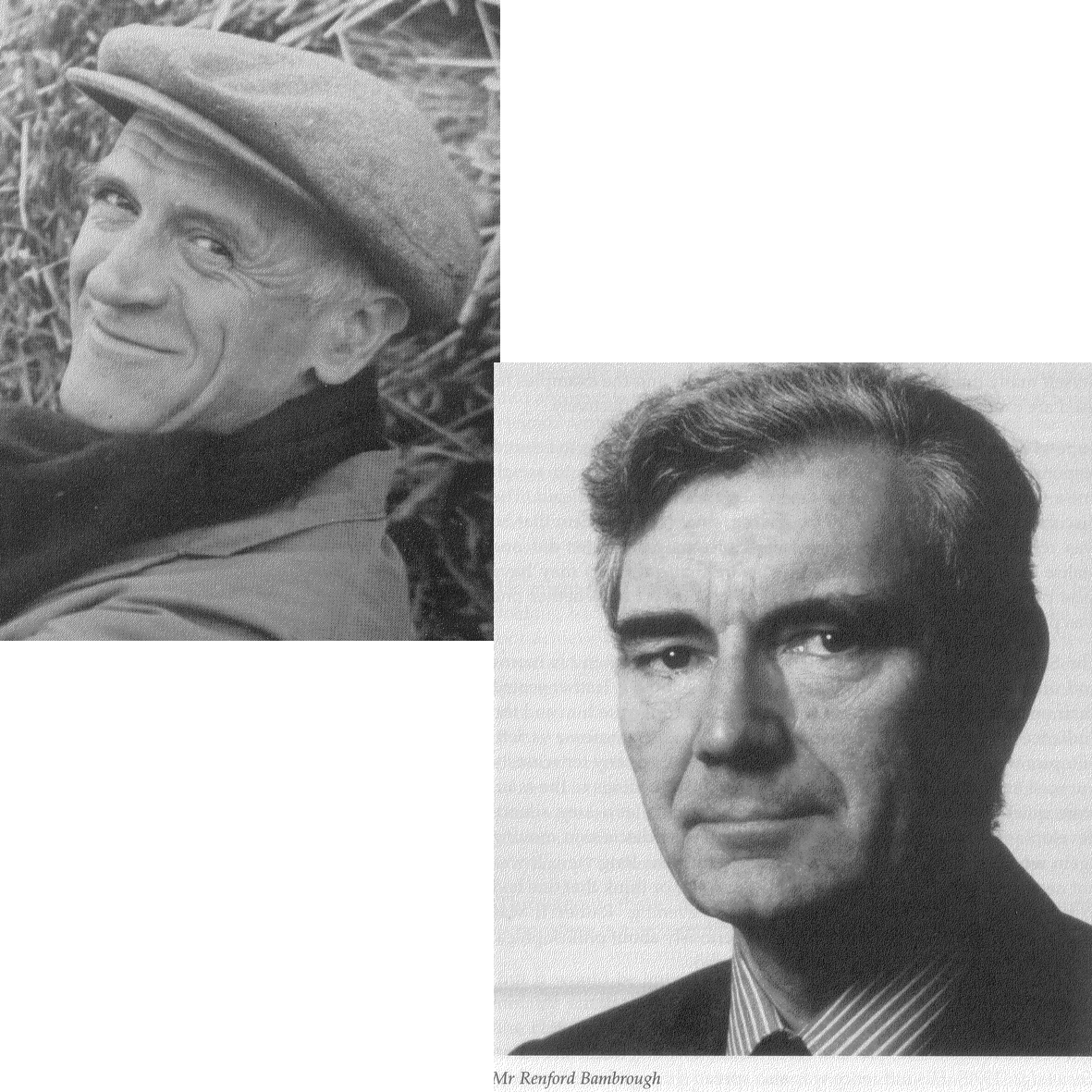
Is “Cambridge Philosophy” dead, in Cambridge? Can it be resurrected, there? Case Study: Renford Bambrough (& Subroto Roy) preceded by decades Cheryl Misak’s thesis on Wittgenstein being linked with Peirce via Ramsey…

“What is the use of studying philosophy if all that does for you is to enable you to talk with some plausibility about some abstruse questions of logic, etc., & if it does not improve your thinking about the important questions of everyday life?”  Wittgenstein, letter to Malcolm, 1944

1.  In my current excursions into “Physics and Reasoning”, I stumbled some days ago upon Professor Cheryl Misak’s 2012 lecture at the Cambridge philosophy department about Ramsey having linked Peirce with Wittgenstein https://www.youtube.com/watch?v=nQuNWNjYcVY  also her 2014 lecture at London’s Royal Institute of Philosophy  https://www.youtube.com/watch?v=c_Nxr3ZQxqA.   I note too Professor Misak has a 2016 book titled Cambridge Pragmatism whose contents are advertised by Oxford University Press as follows

Part I Cambridge, Massachusetts
1: Peirce
2: James
3: Bridges across the Atlantic
Part II Cambridge, England
4: The Anti-Pragmatism of Pre-War Cambridge
5: The Pull of Pragmatism on Russell
6: Ramsey
7: Wittgenstein: Post-Tractatus
Conclusion

I have not seen the book, I enjoyed her talks published at YouTube,  and I look forward to seeing results of her original archival work with Ramsey’s papers. 

Whether Wittgenstein’s later work was affected by Peirce more than a dozen years after Peirce’s death in 1914, and how it may have done so through Ramsey in particular, has been studied extensively if sporadically over years by Jaime Nubiola of the University of Navarre “Scholarship on the Relations Between Ludwig Wittgenstein and Charles S. Peirce” in I. Angelelli & M. Cerezo, eds., Proceedings of the III Symposium on History of Logic, Gruyter, Berlin, 1996; Mathieu Marion of Quebec University, “Wittgenstein, Ramsey and British Pragmatism” in European Journal of Pragmatism and American Philosophy [Online], IV-2 | 2012, 24 December 2012; Albert Atkin of Sheffield University http://www.iep.utm.edu/peircebi/ and doubtless others. Professor Misak’s findings in Ramsey’s papers will add to existing scholarship that is already large. 

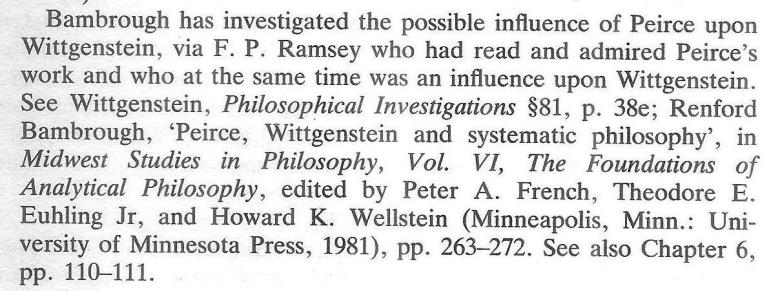
2.  What I found disconcerting even shocking, however, has to do with  her audience at the Cambridge philosophy department in 2012.  That audience, with its noted Professors in attendance and participating, was evidently clueless that two Cambridge people, namely Renford Bambrough, philosophy, and myself, economics, decades ago in the 1980s had described the link between Peirce and Wittgenstein via Ramsey.   If someone asserts at Cambridge today a claim of linking Peirce with Wittgenstein through Ramsey, one expects a Cambridge philosophy audience to be sufficiently informed to know Bambrough, in an extremely difficult achievement, had already done so in 1979.

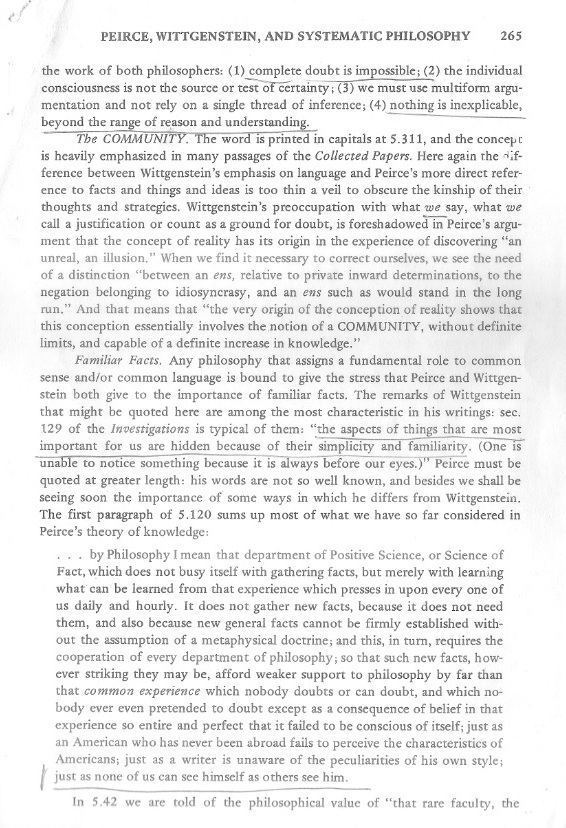
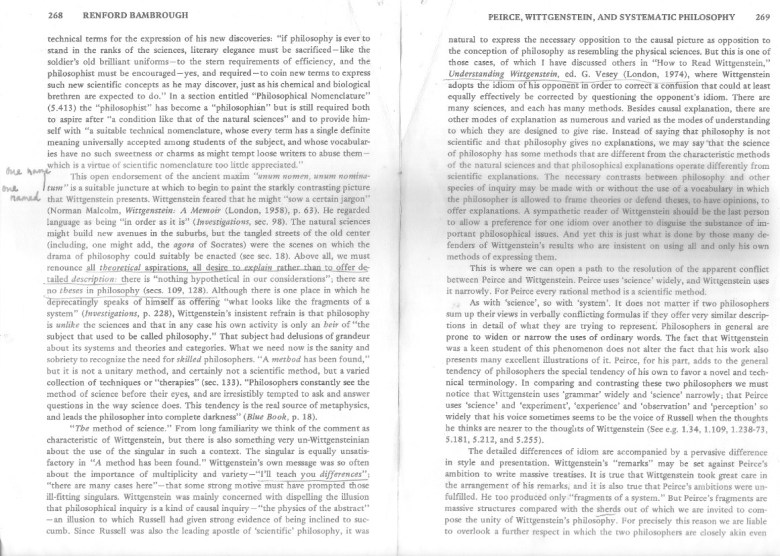
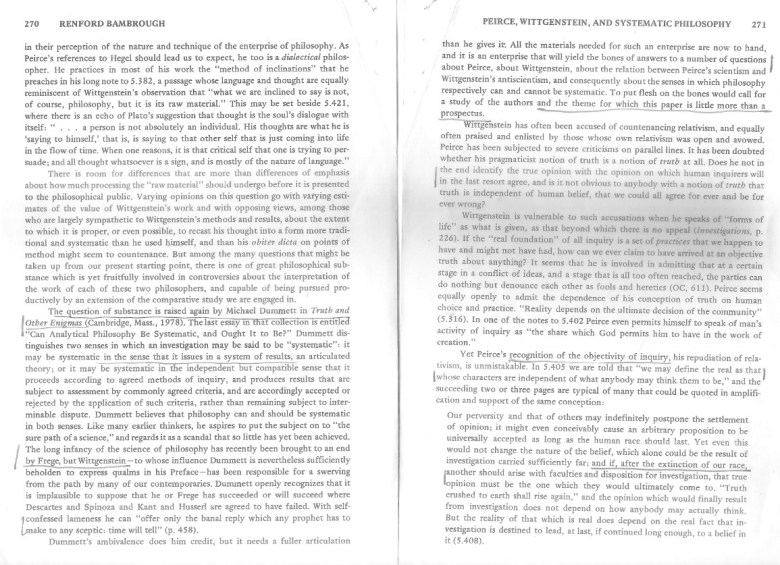
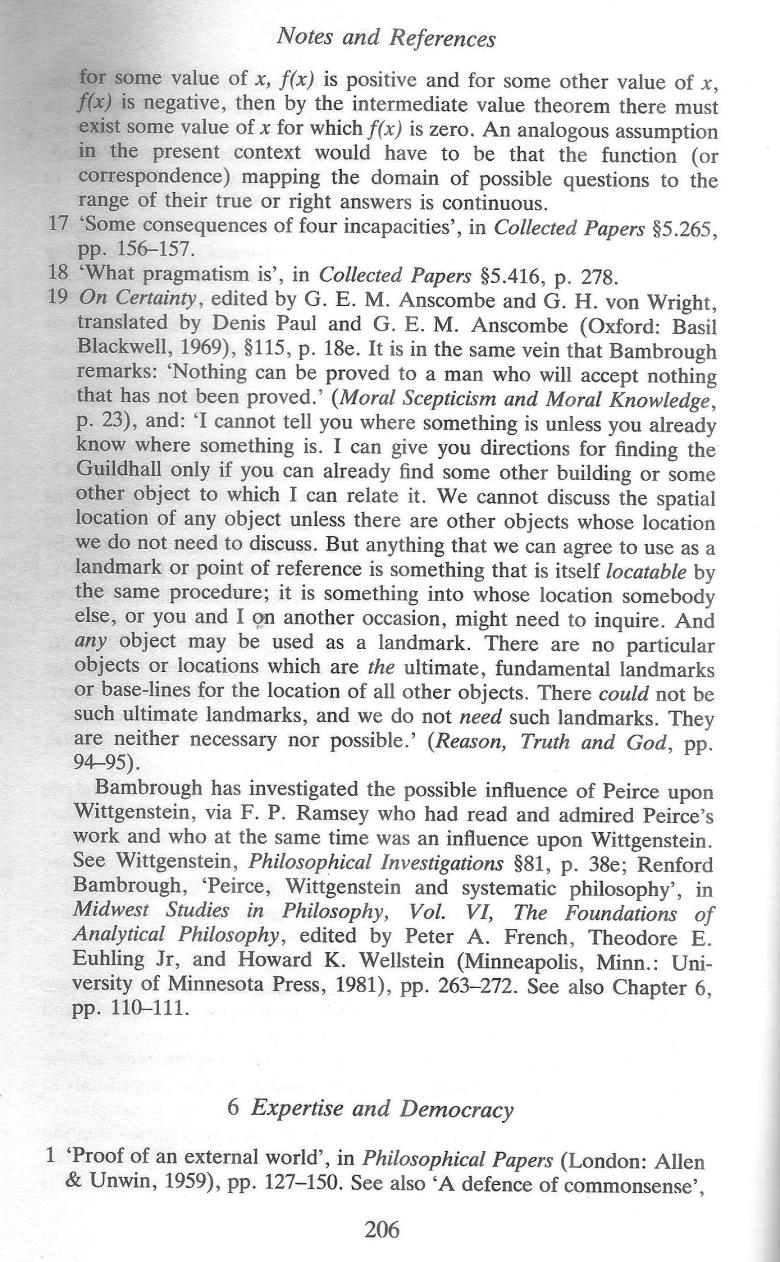
Bambrough sent me, then in Blacksburg, the proof of his article reproduced below; a clearer copy of the published article may be found at

http://onlinelibrary.wiley.com/doi/10.1111/j.1475-4975.1981.tb00439.x/abstract.

 261

 264


265

 266to267

268to9

270to271

272to3


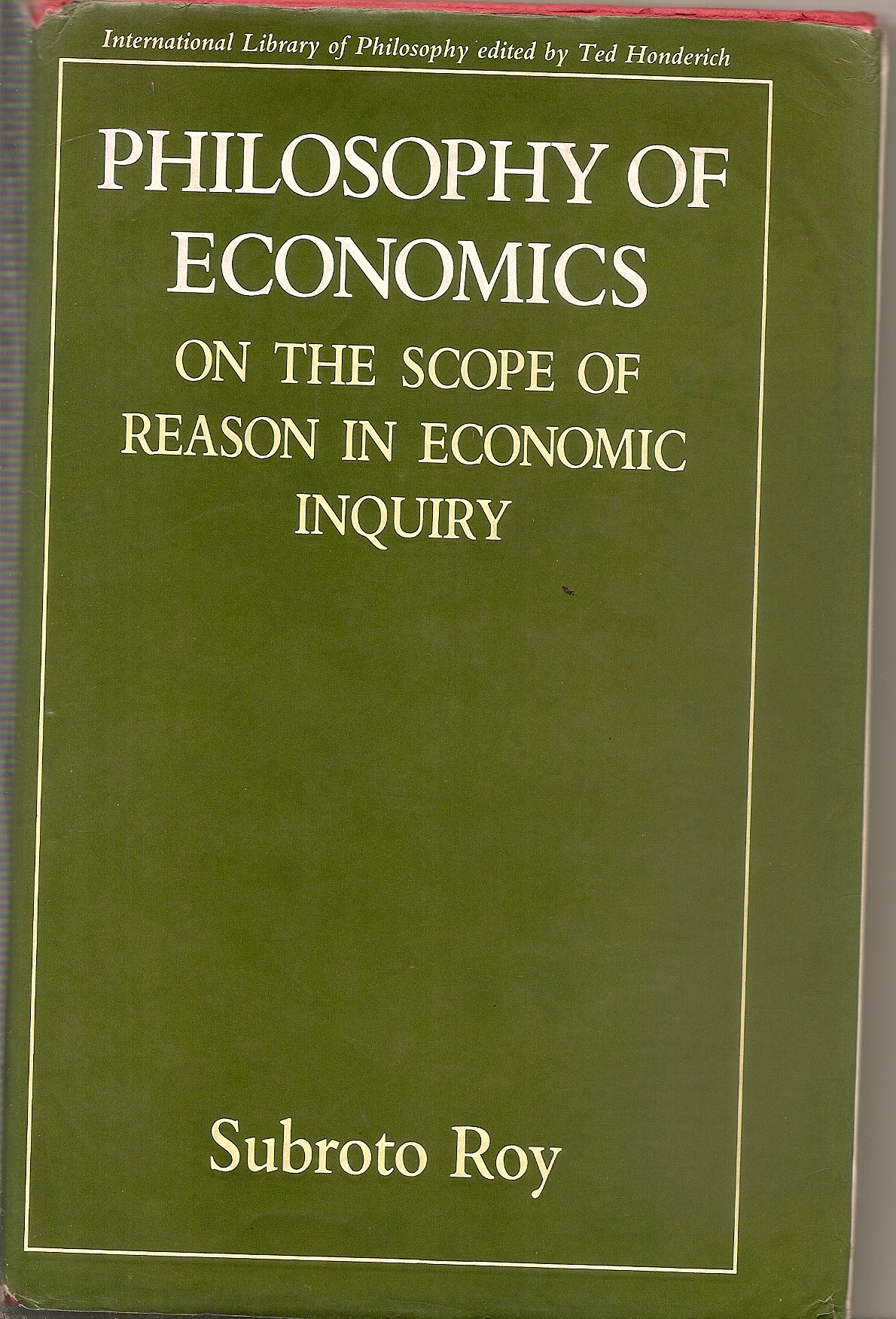
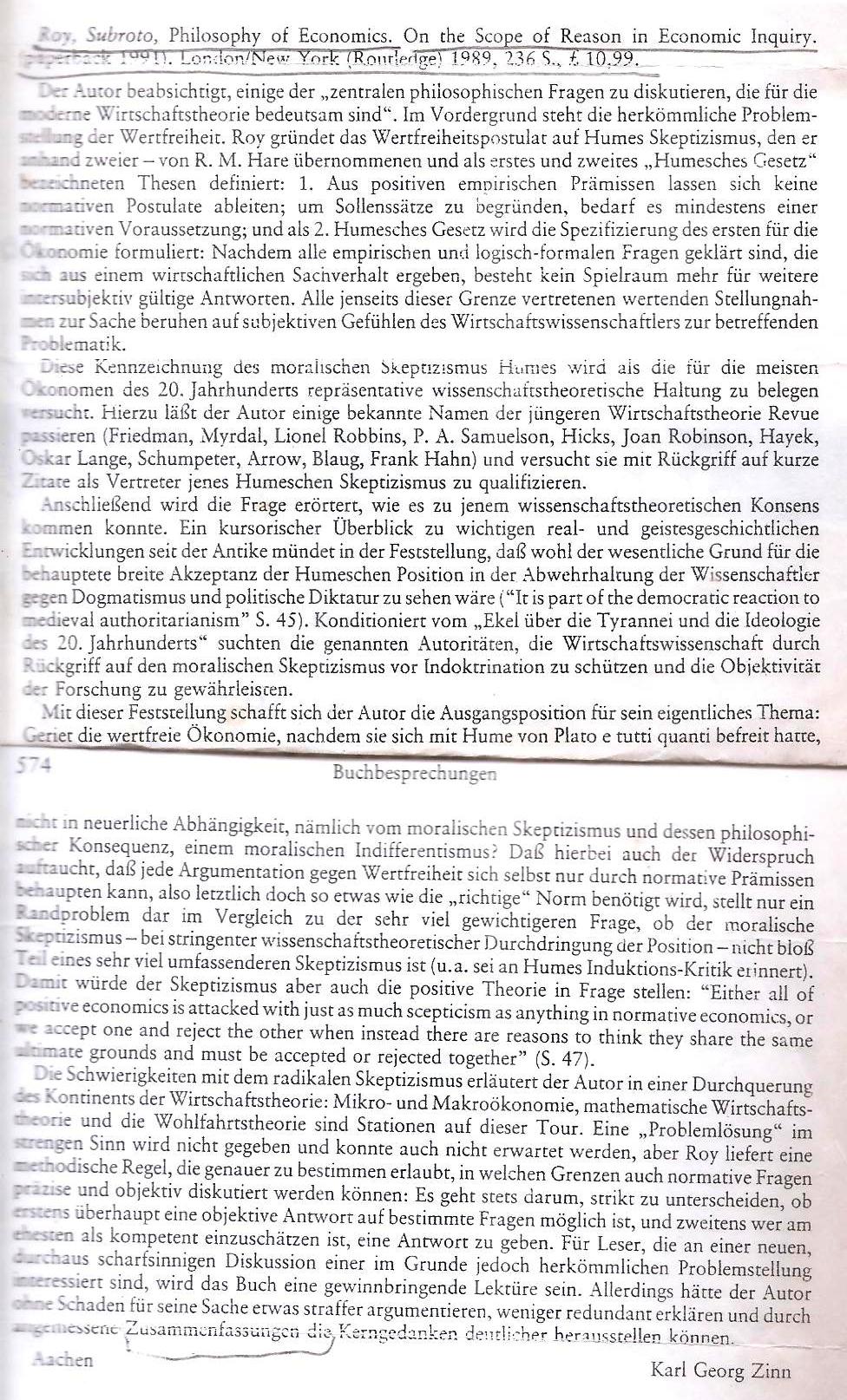
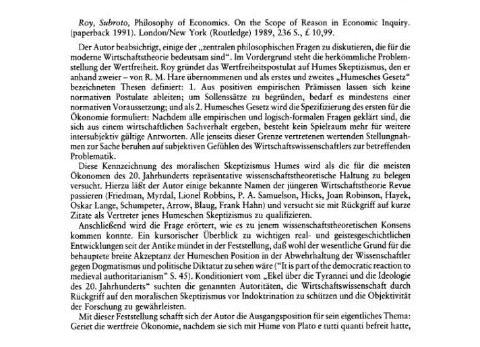
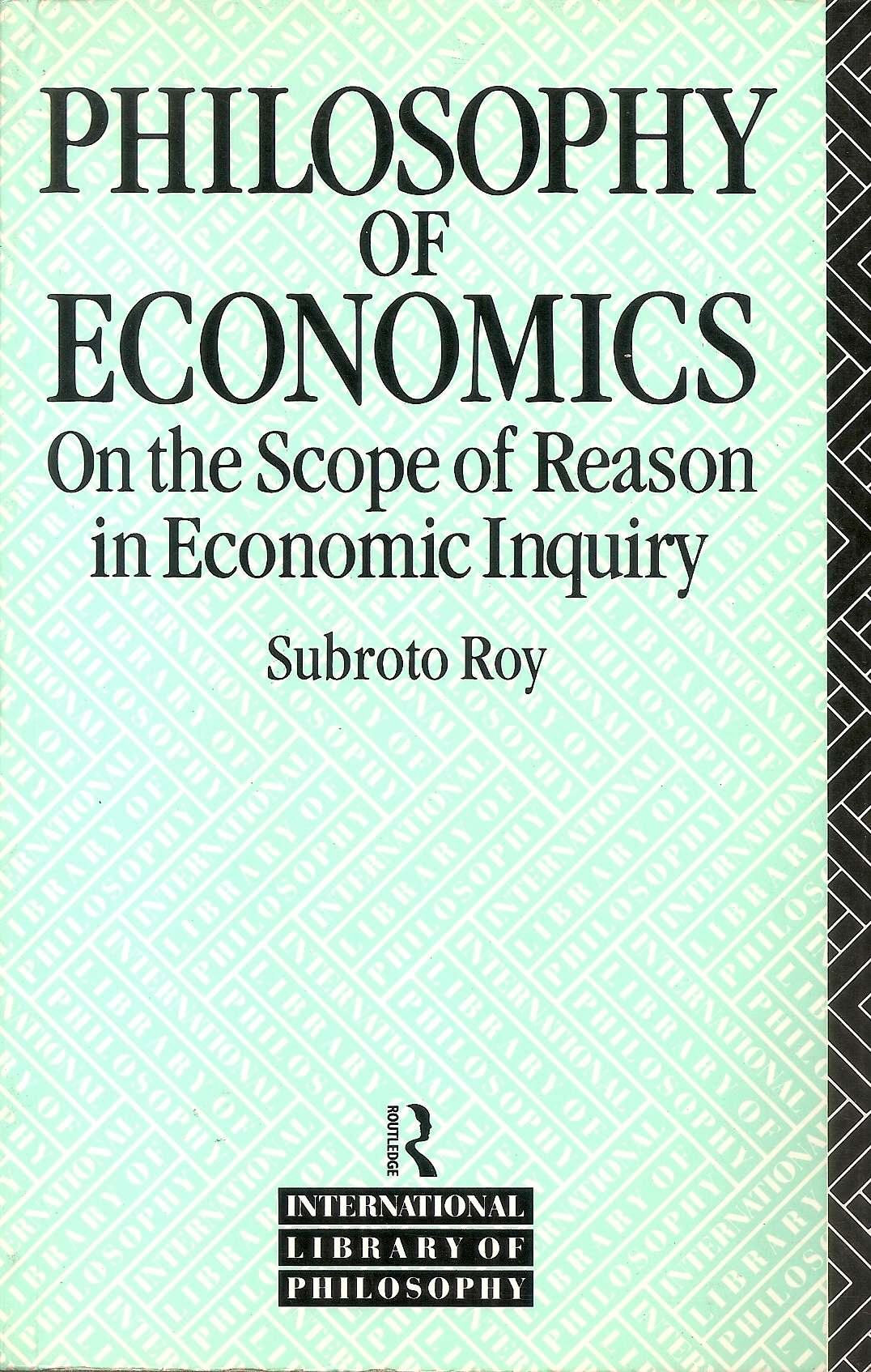
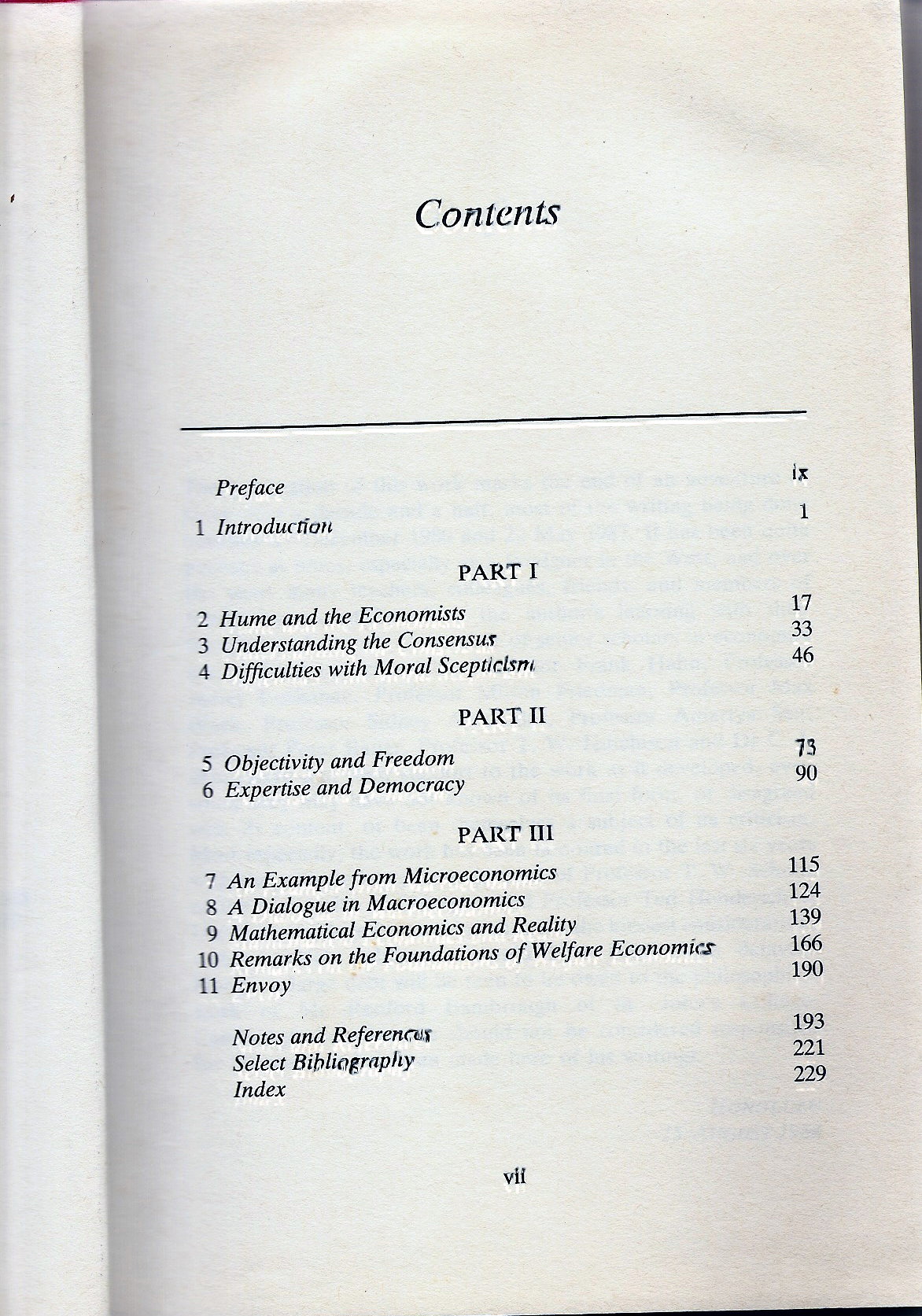
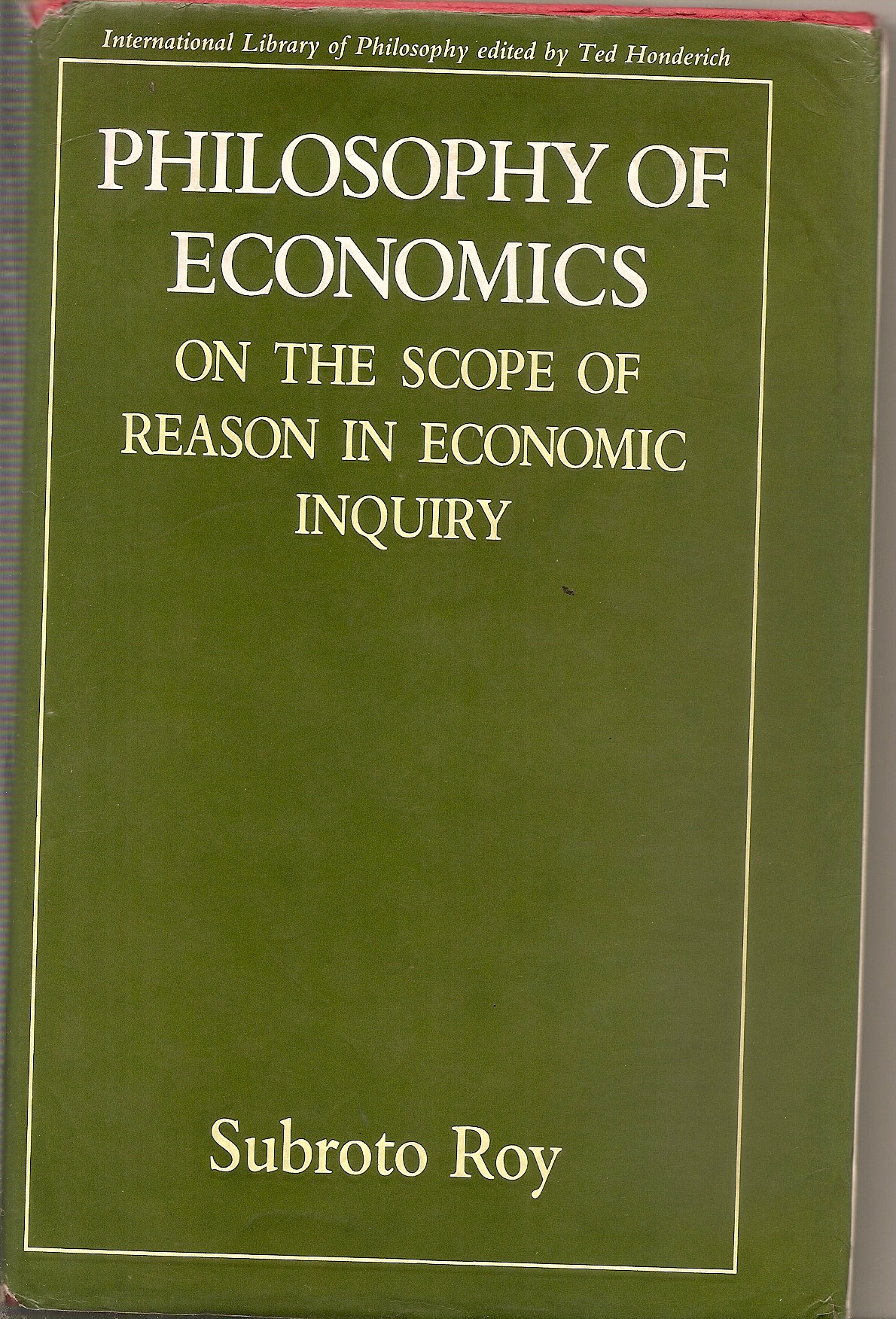
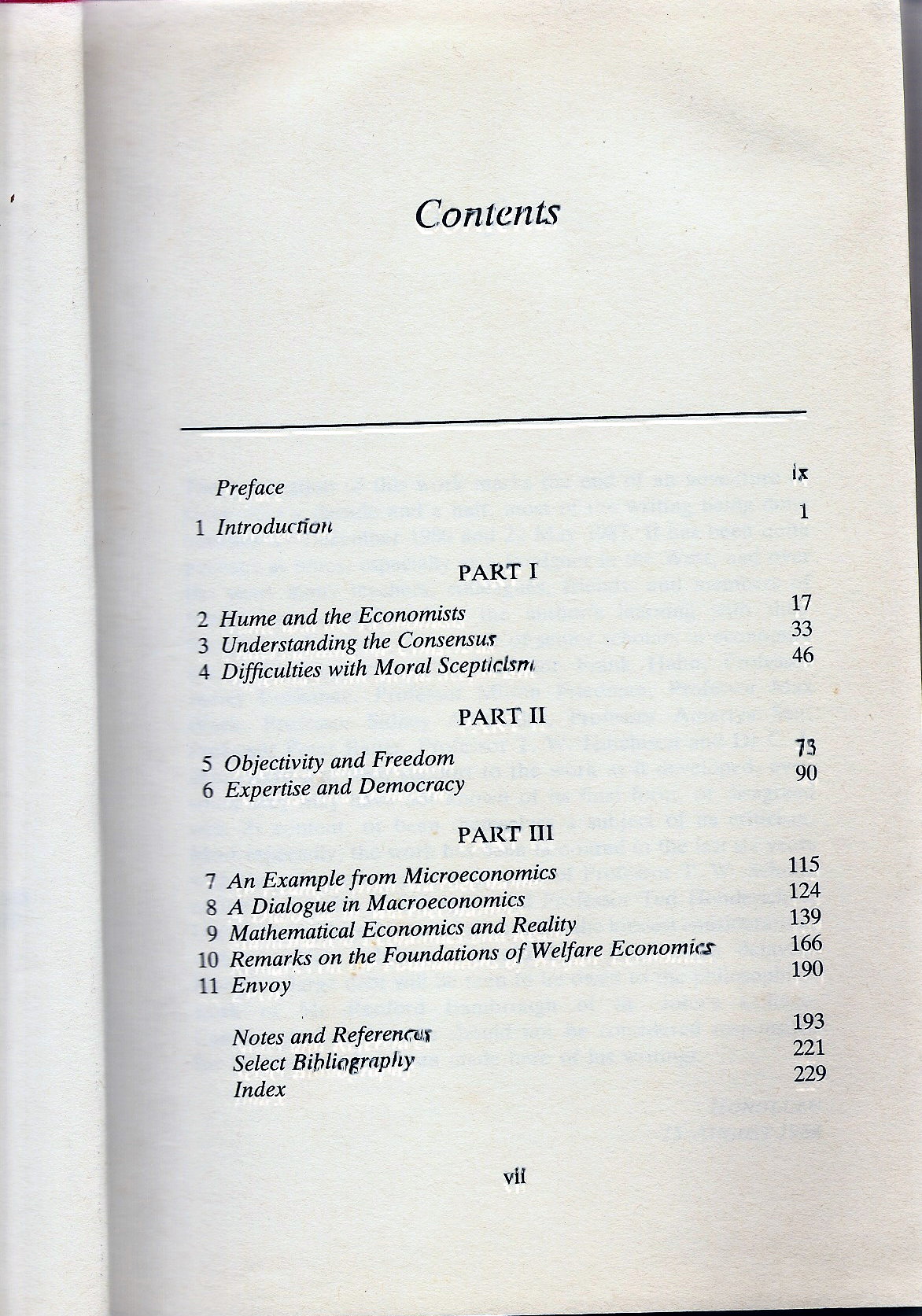
My Philosophy of Economics: On the Scope of  Reason in Economic Inquiry published in 1989 in Routledge’s International Library of Philosophy was the first  work by an economist in that  series, known earlier as the International Library of Psychology, Philosophy and Scientific Method and even before that as the International Scientific Series.  It sold out quickly and was in paperback two years later.  Chapter 5 and Chapter 9 had long passages placing Peirce and Wittgenstein together in regard to doubt and certainty, and the use of mathematics. Keeping with my purpose of addressing extant problems in economic theory while using philosophy as discreetly as possibly, I noted Bambrough had established the link between Wittgenstein and Peirce via Ramsey:

mynote1

To repeat:

mynote12


3.  Now before its publication my book manuscript had been mostly under contract with University of Chicago Press, not Routledge.  About 1984 one of Chicago’s half a dozen reviewers hit me with a large surprise: my argument had been anticipated decades earlier in America by MIT’s Sidney Stuart Alexander!   I had no idea of this though I knew Alexander’s publications on other subjects the balance of payments.

Alexander, who was Paul Samuelson’s contemporary and Robert Solow’s teacher, was extremely gracious, read my manuscript and immediately declared with great generosity it was clear to him my arguments had been developed independently of his own.  Alexander had come at the problem from an American tradition of John Dewey, Peirce’s pupil, I had done so from Wittgenstein through John Wisdom and Renford Bambrough.  Alexander and I had arrived at similar conclusions but had done so completely independently!

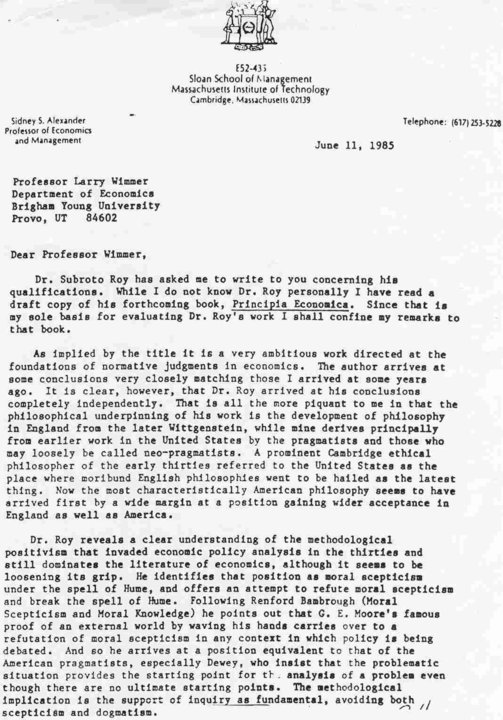
Before we had met, Alexander wrote in support of my work:

“(This) is a very ambitious work directed at the foundations of normative judgments in economics. The author arrives at some conclusions very closely matching those I arrived at some years ago. It is clear, however, that Dr. Roy arrived at his conclusions completely independently. That is all the more piquant to me in that the philosophical underpinning of his work is the development of philosophy in England  from the later Wittgenstein, while mine derives principally from earlier work in the United States by the pragmatists and those who may loosely be called neo-pragmatists. A prominent Cambridge ethical philosopher of the early thirties referred to the United States as the place where moribund English philosophies were to be hailed as the latest thing. Now the most characteristically American philosophy seems to have arrived first by a wide margin at a position gaining wider acceptance in England as well as America.

Dr. Roy reveals a clear understanding of the methodological positivism that invaded economic policy analysis in the thirties and still dominates the literature of economics…. Following Renford Bambrough (Moral Scepticism and Moral Knowledge) he arrives at a position equivalent to that of the American pragmatists, especially Dewey, who insist that the problematic situation provides the starting point for the analysis of a problem even though there are no ultimate starting points. The methodological implication is the support of inquiry as fundamental, avoiding both scepticism and dogmatism. Roy develops his position with a great deal of attention to the ramifications of the problem both in philosophy and in economics….”

When we did meet, as he drove me around MIT in his car, Alexander joked how it used to be bad form in his time to make comparisons about a trio of pairs: Cambridge vs Cambridge, baseball vs cricket, and “American English” vs (what is now called) “British English”!

I asked whom he had referred to as the “prominent Cambridge ethical philosopher”, he said C D Broad and decades later I found Broad’s condescending passage

“… all good fallacies go to America when they die, and rise again as the latest discoveries of the local professors…” Five Types of Ethical Theory 1930, p. 55.

No wonder Alexander found “piquant” that I had reached via Wittgenstein and Bambrough an equivalent position to his own decades earlier via American pragmatism. [Besides by Alexander, a most perspicacious review of my book is by Karl Georg Zinn.]  

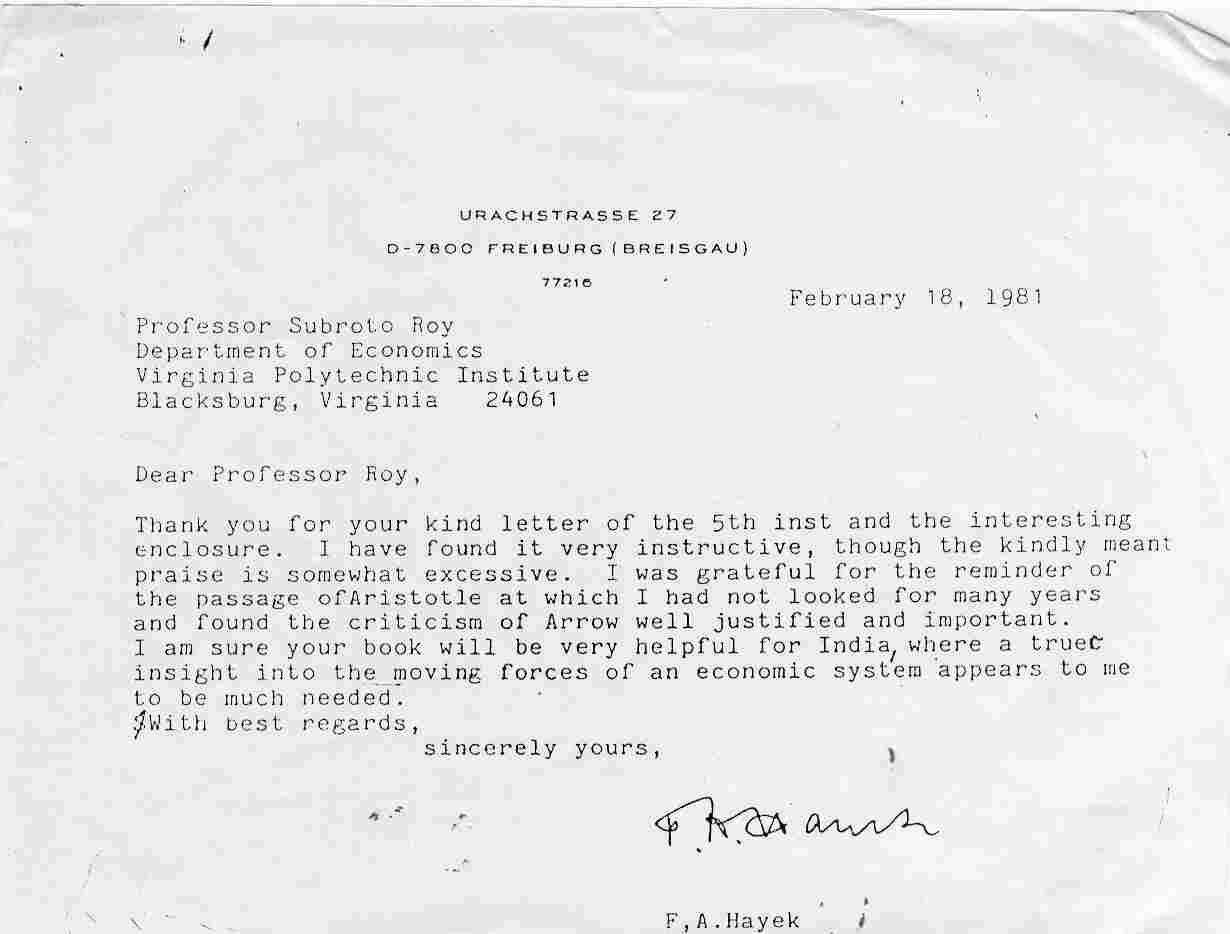
Within economics, Alexander and I were pirate ships blowing holes and permanently sinking the positivist Armada of “social choice theory” etc.  Amartya Sen arrived at Cambridge in 1953, the year Philosophical Investigations was published, two years after Wittgenstein’s death the year after Wittgenstein died. Professor Sen told me, in 2006, John Wisdom and C D Broad both knew him at the time, all at Trinity College; if anyone, Amartya Sen should have conveyed to Kenneth Arrow in America in the 1960s and 1970s the implications for economic theory of Wittgenstein’s later work. Instead I had to do so in 1989, Arrow graciously admitting when he read my book:

“I shall have to ponder your rejection of the Humean position which has, I suppose, been central in not only my thought but that of most economists. Candidly, I have never understood what late Wittgenstein was saying, but I have not worked very hard at his work, and perhaps your book will give guidance.”


4. Last week I wrote to Professor Misak at the University of Toronto:

“Dear Professor Misak, I do hope you accounted for Renford Bambrough’s 1979 linking of Peirce, Wittgenstein and Ramsey, here http://onlinelibrary.wiley.com/doi/10.1111/j.1475-4975.1981.tb00439.x/abstract

My 1989 book Philosophy of Economics applied both, and Sidney Alexander of MIT recognized it. Of course my book was viciously attacked in America.  Your U of T colleague (GBC) was an old friend from Cambridge days and knows all about me.  Cordially Suby Roy …”

I expected to hear back something like:  “Dear Dr Roy, Thanks for this.  Yes I have acknowledged your 1989 book in a footnote, though I was unable to locate the earlier Bambrough piece and will do so now.”  Instead Professor Misak replied

“Dear Suby, Some Americans don’t like anyone to have had thoughts similar to those of their heroes!  Thanks for these references. Cheryl”

Excuse me? “Some Americans don’t like anyone to have had thoughts similar to those of their heroes”?

I have had to take this to mean

“Subroto Roy (doubtless an American national, surely he isn’t still an Indian? Answer: He is) objects to Cheryl Misak having had ‘similar thoughts’ to his hero Bambrough”.

A puzzling response from an eminent Professor of Philosophy at the University of Toronto.  I wrote back:  “Hello, I’m afraid your paragraph is too enigmatic for me”.  Professor Misak’s second reply was even more curious than the first:

“Apologies. I just meant that some Peirce scholars don’t like to think that Ramsey and Wittgenstein might have been promoting the same ideas. The reasoning behind their aversion is enigmatic to me! Cheers, Cheryl.”

I am afraid I do not accept such a completely irrelevant mention of “some Peirce scholars”.  If through negligence or some mishap,  Professor Misak, not having received the effort due to her during the peer review process from either her 2012 Cambridge philosophy department audience or her Oxford University Press referees, has failed to acknowledge in her book the prior work of Bambrough and others including myself it is necessary and sufficient a corrigendum be now inserted into the book giving references to these earlier works, that’s all.


5.  The case is evidence that while Cambridge obviously has a  fine department teaching academic philosophy, that could easily be mistaken for a fine department at an Australian or American university or even Oxford, the distinct product once known as “Cambridge Philosophy” in the line descending from Wittgenstein through John Wisdom and Renford Bambrough is quite dead there.   Several lines descended from Wittgenstein through his several disciples, including Max Black whom I visited and talked extensively with at Cornell throughout the Fall of 1983, and whom I was privileged to count as a friend, an experience I have yet to write of. 

“But there is one disciple who stands apart from the rest; the work of Professor Wisdom is truly Wittgensteinian, yet at the same time original and independent…Wisdom carries Wittgenstein’s work further than he himself did, and faces its consequences more explicitly… Wisdom’s approach is much less esoteric than Wittgenstein’s, and his conclusions are perhaps easier to come to grips with.  We see in Wisdom something like a new application of Wittgenstein’s ideas; we recognize the same forms there, yet cast, as it were, in a new medium…” (David Pole, The later philosophy of Wittgenstein, 1958).

Wisdom in his obituary notice of Wittgenstein said if he was asked to say in one sentence what Wittgenstein had accomplished he would say it was asking the question “Can you play chess without the Queen?”  Wisdom’s disciple Bambrough in turn said if he was asked to say in one sentence what Wisdom accomplished he would say it was Wisdom replying to such a question about Wittgenstein as he had done.  I said in my 2004 public lecture at the University of Buckingham: “If I was asked to answer in one sentence what has been the combined contribution to human thought of Wittgenstein, Wisdom and Bambrough, indeed of modern British philosophy as a whole, I would say it has been the proof that there are no unanswerable questions, that there is no question to which there is not a right answer.  By “common reasoning” I shall mean merely to refer to the structure of any conversation well-enough described by F R Leavis’s operators in literary criticism: “This is so, isn’t it?, Yes, but….”.  My “yes” to your “This is so, isn’t it?” indicates agreement with what you have said while my “but…” tells you I believe there may be something more to the matter, some further logical relation to be found, some further fact to be investigated or experiment carried out, some further reflection necessary and possible upon already known and agreed upon facts. It amounts to a new “This is so, isn’t it?” to which you may respond with your own, “Yes, but…”; and our argument would continue.  Another set of operators is: “You might as well say…”; “Exactly so”; “But this is different…” This was how Wisdom encapsulated the “case-by-case” method of argument that he pioneered and practiced. It requires intimate description of particular cases and marking of similarities and differences between them, yielding a powerful indefinitely productive method of objective reasoning, distinct from and logically prior to the usual methods of deduction and induction that exhaust the range of positivism.  We are able to see how common reasoning may proceed in practice in subtle fields like law, psychology, politics, ethics, aesthetics and theology, just as objectively as it does in natural science and mathematics. Wittgenstein had spoken of our “craving for generality” and our “contemptuous attitude towards the particular case”. Wisdom formalized the epistemological priority of particular over general saying: “Examples are the final food of thought. Principles and laws may serve us well. They can help us to bring to bear on what is now in question what is not now in question. They help us to connect one thing with another and another and another. But at the bar of reason, always the final appeal is to cases.” And “Argument must be heard”.  In all conflicts – whether within a given science, between different sciences, between sciences and religion, within a given religion, between different religions, between sciences and arts, within the arts, between religion and the arts, between quarreling nations, quarreling neighbours or quarreling spouses, whether in real relationships of actual life or hypothetical relationships of literature and drama – an approach of this kind tells us there is something further that may be said, some improvement that can be carried out, some further scope for investigation or experiment allowing discovery of new facts, some further reflection necessary or possible upon known facts. There are no conflicts that are necessarily irresoluble. Where the suicide-bombers and their powerful adversaries invite us to share their hasty and erroneous assumption that religious, political or economic cultures are becoming irreconcilable and doomed to be fights unto death, we may give to them instead John Wisdom’s “Argument must be heard….”

Bambrough, applying Wisdom applying Wittgenstein, and integrating all this with his deep classical scholarship and knowledge of Aristotle and Plato in particular, showed how objectivity and reasoning are possible in politics, in ethics, in theology, in aesthetics, in literature, as much or as little as in science or mathematics.  

Bambrough’s  path-breaking works of general epistemology and ontology are two three four humble papers in  Proceedings of the Aristotelian Society 

“Universals and Family Resemblances”
https://www.jstor.org/stable/4544648

“Unanswerable Questions”

https://www.jstor.org/stable/4106729?seq=1#page_scan_tab_contents

“Objectivity and Objects”

https://www.jstor.org/stable/4544817?seq=1#page_scan_tab_contents

“Thought, Word and Deed”

https://academic.oup.com/aristoteliansupp/article-abstract/54/1/105/1779886?redirectedFrom=PDF

I, applying all of this from Bambrough to the economic theory of Marshall, Keynes, Hicks, Hayek, Hahn, Friedman, Arrow and others Frank Hahn, Milton Friedman, Kenneth Arrow and others showed in 1989 the same for economic policy and normative economics.  I have since then tentatively applied similar methods of reasoning to diplomacy, politics, psychology, religion, literature, and presently explore  physics.

What Wisdom did was far more astonishing, showing, among many other things, how the confluence of Freud and Wittgenstein could be found to help us comprehend all that seems so irrational: hopes & fears, dreams & the unconscious, psychoses & neuroses, everything said or done has an explanation, usually when there has been an adequate description.   Modes of reasoning are manifold, well beyond the deduction and statistical inference induction known to the positivist.  Then besides, there’s reflection about known facts too.  Really if you can make reasonable sense of dreams and the unconscious, of  the psychotic and the neurotic, as Wisdom did, the differences between Pakistan and India over Kashmir, between the West and Islam, between Einstein and Quantum Mechanics too become amenable…

My praise of Wisdom and Bambrough in my 2004 public lecture was extravagant:  “For some 25 years I have been learning of and reflecting upon the work of two great modern British philosophers, John Wisdom (1904-1993) and Renford Bambrough (1926-1999). In the 1980s in America, I came to apply their thinking in Philosophy of Economics (Routledge 1989), a book which got me into a lot of trouble there. Returning to Britain in 2004, I am dismayed to find their work almost forgotten or unknown today, even at the Ancient University that had been their home. “Orientalists” from the West once used to comprehend and highlight the achievements of the East for the peoples of the East who were unaware of them; I am happy to return the favour by becoming an “Occidentalist” in highlighting a little of the work of two of Britain’s finest sons of which she has become unaware. Wisdom and Bambrough played a kind of modern-day Plato and Aristotle to the Socrates played by Wittgenstein (1889-1951); the knowledge they achieved in their lives and have left behind for us to use and apply to our own problems make them, in terms of Eastern philosophy, rather like the “Boddhisatvas” of Mahayana Buddhism. I do not expect anyone to share such an extravagant view, and will be more than satisfied if I am able to suggest that we can have a grasp of the nature and scope of human reasoning thanks to their work which may help resolve the most intractable and seemingly irreconcilable of all current international problems, namely the grave cultural conflicts made apparent since September 11, 2001….”

In 2007 I added:

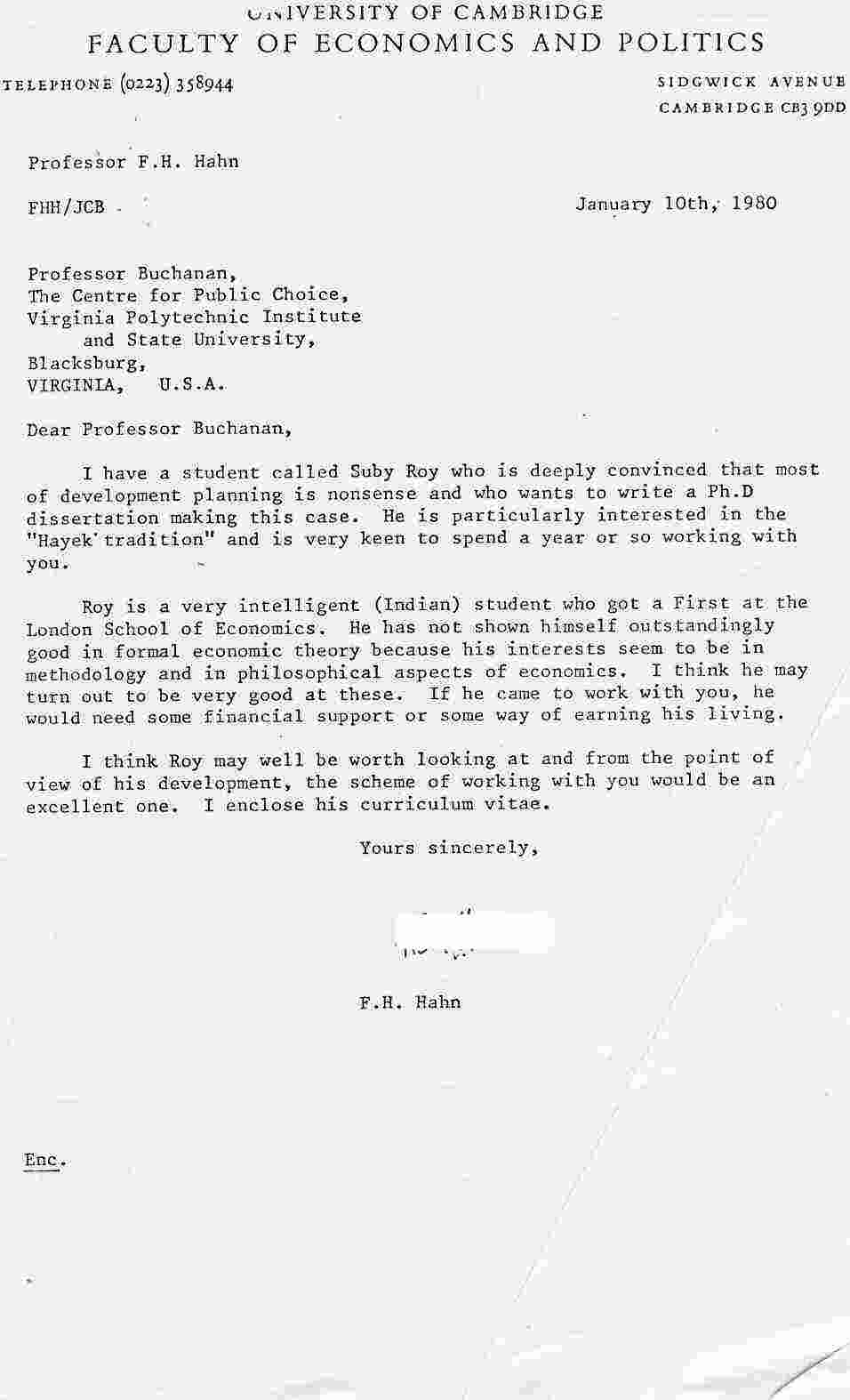
“I had been attracted to Cambridge partly by its old reputation for philosophy, especially that of Wittgenstein. But I met no worthwhile philosophers there until a few months before I was to leave for the United States in 1980, when I chanced upon the work of Renford Bambrough. Hahn had challenged me with the question, “how are you so sure your value judgments promoting liberty blah-blah are better than those of Chenery and the development economists?” It was a question that led inevitably to ethics and its epistemology — when I chanced upon Bambrough’s work, and that of his philosophical master, John Wisdom, the immense expanse of metaphysics (or ontology) opened up as well. “Then felt I like some watcher of the skies, When a new planet swims into his ken; Or like stout Cortez when with eagle eyes, He star’d at the Pacific…” It has taken me more than a quarter century to traverse some of that expanse; when I returned to Britain in 2004 as the Wincott Visiting Professor of Economics at the University of Buckingham, I was very kindly allowed to deliver a public lecture, “Science, Religion, Art and the Necessity of Freedom”, wherein I repaid a few of my debts to the forgotten work of Bambrough and Wisdom — whom I extravagantly compared with the Bodhisattvas of Mahayana Buddhism, also saying that the trio of Wittgenstein, Wisdom and Bambrough were reminiscent of what Socrates, Plato and Aristotle might have been like.  I had written to Bambrough from within Cambridge expressing my delight at finding his works and saying these were immensely important to economics; he had invited me to his weekly discussion groups at St John’s College but I could not attend. Between 1979 and 1989 we corresponded while I worked in America on my application of his and Wisdom’s work to problems in economics. We met only once when I returned to Cambridge from Blacksburg for my doctoral viva voce examination in January 1982. Six years later in 1988 he said of my Philosophy of Economics, “The work is altogether well-written and admirably clear”, and on another occasion he said he was “extremely pleased” at the interest I had taken in his work. The original preface of Philosophy of Economics said he was not responsible for the use I had made of his writings, which I reiterated in the 2004 lecture. At our meeting, he offered to introduce me to Wisdom who had returned to Cambridge from Oregon but I was too scared and declined, something I have always regretted since. It is only in the last few years that I have begun to grasp the immensity of Wisdom’s achievement in comprehending, explaining and extending the work of both Wittgenstein and Freud. His famous “Virginia Lectures” of 1957 were finally published by his admirers with his consent as Proof and Explanation just before his death in 1993. As for Bambrough, I believe he may have been or become the single greatest philosopher since Aristotle; he told me in correspondence there was an unfinished manuscript Principia Metaphysica (the prospectus of which appeared in Philosophy 1964), which unfortunately his family and successors knew nothing about; the fact he died almost in obscurity and was soon forgotten by his University speaks more about the contemporary state of academic philosophy than about him.

Single-handedly I have over a few decades restored the philosophical work of John Wisdom and Renford Bambrough. That there was good reason to do so is now obvious.  

Will Cambridge Philosophy wish to revive “Cambridge Philosophy” within Cambridge?  

Well if so, here’s a reading list from this Indian economist… yes in India (get over those racist thoughts at once!):

wisdombambrough (1)

John Wisdom (1904-1993), Main Philosophical Works:

Interpretation and Analysis, 1931

Problems of Mind and Matter 1934

Other Minds, 1952

Philosophy & Psychoanalysis, 1953

Paradox & Discovery, 1965

Logical Constructions (1931-1933),1969

Proof and Explanation (The Virginia Lectures 1957), 1991

Secondary literature:

Wisdom: Twelve Essays, R. Bambrough (ed) 1974

Philosophy and Life: Essays on John Wisdom, I. Dilman (ed) 1984.


Renford Bambrough (1926-1999), Main Philosophical Works:

“Socratic Paradox”, Philosophical Quarterly, 1960

“Universals and Family Resemblances”, Proceedings of the Aristotelian Society 1960-61

“Plato’s Modern Friends and Enemies”, Philosophy 1962

The Philosophy of Aristotle, 1963

“Principia Metaphysica”, Philosophy 1964

New Essays on Plato and Aristotle (edited by R. Bambrough), 1965

“Unanswerable Questions”, Proceedings of the Aristotelian Society Supplement 1966

Plato, Popper and Politics (edited by R. Bambrough), 1967

Reason, Truth and God 1969

“Foundations”, Analysis, 1970

“Objectivity and Objects”, Proceedings of the Aristotelian Society 1971-72

“How to Read Wittgenstein”, in Understanding Wittgenstein, Royal Institute of Philosophy 1972-3

“The Shape of Ignorance”, in Lewis (ed) Contemporary British Philosophy, 1976

Introduction & Notes to Plato’s Republic (Lindsay trans.), 1976

Conflict and the Scope of Reason, 1974; also in Ratio 1978

“Intuition and the Inexpressible” in Katz (ed) Mysticism & Philosophical Analysis, 1978

Moral Scepticism and Moral Knowledge, 1979

“Thought, Word and Deed”, Proceedings of Aristotelian Society Supplement 1980

“Peirce, Wittgenstein and Systematic Philosophy”, MidWest Studies in Philosophy, 1981

“The Scope of Reason: An Epistle to the Persians”, in Objectivity and Cultural Divergence, Royal Institute of Philosophy, 1984

“Principia Metaphysica: The Scope of Reason” also known as “The Roots of Reason”; a work and manuscript mentioned several times but now unknown.

Of course it’s more likely Cambridge Philosophy fails to move from its inertia, is uninterested in what I have outrageously called “Cambridge Philosophy”, and instead continues to provide the homogeneous, Americanized, philosophical product that is available in Australia, North America, Oxford etc.  

If so, People, not to worry…. enjoy all this “Cambridge Philosophy” at your leisure… and come to see me… in India…  

2492599._UY475_SS475_

612965._UY630_SR1200,630_

51DjoE-O-6L._SX329_BO1,204,203,200_

51t6LbUxcTL._AC_US218_

CeTucLYVIAANB2J

scan0001

scan0002

scan0004

[Postscript 1 from Twitter 22 November 2017: I was still not in Kindergarten

10398982_93361057284_754275_n

when Wisdom delivered his Virginia Lectures:

51DjoE-O-6L._SX329_BO1,204,203,200_

published decades later in 1991 which I bought at a Bethesda bookshop in 1993…I had been to see Prof SF Barker at Johns Hopkins too. I regret I was too scared to meet Wisdom in 1982 when Bambrough suggested it. But yes for a few decades now I have single-handedly restored the work of Wisdom and Bambrough. My intellectual debt to Britain repaid with interest…

Postscript 2   from Twitter  9 January 2018  What is remarkable is John Wisdom’s Virginia Lectures 1957, published eventually in 1991 as *Proof and Explanation*, remain as fresh as a daisy if you read them now in 2018… It was the pre Elvis Presley age in music! ]

On being reunited with Arrow Hahn after a dozen years

On being reunited with Arrow Hahn after a dozen years


Professor Kenneth J Arrow

 Stanford


Dear Professor Arrow,


I am delighted to say I am reunited today after a dozen years with your canonical book written with Frank Hahn, a collaboration of 17 years I think Frank told me once.


It is not my own annotated 1976 copy of the first 1971 edition. 


That was in my professorial office at IIT Kharagpur as of September 2003, when I was compelled as a senior professor to object to grave (and admitted) financial irregularities, a battle that continues to this day. In August 2011, the Hon’ble Calcutta High Court ordered the return of the contents of my professorial office and residence, books, papers, student theses, gown, teaching award, etc. The Institute refused, returning three mud-drenched pamphlets from my collection and a few items of damaged furniture from my campus residence, nothing else. A Contempt application was filed immediately. The Institute had in the meantime surreptitiously purchased both my senior counsel and my solicitors, which came to be accidentally exposed, so new counsel have had to be engaged.


My personal copy of *General Competitive Analysis* was primus inter pares in my office collection, along with Bliss, Takayama, RGD Allen, Sargent, AEA Surveys and a few dozen other volumes including the second volume of your collected works (the first volume I had at home fortunately).


The papers in the office included most importantly the original copy of the memorandum Milton Friedman had written for the Govt of India in 1955, which Milton had sent me in 1984 and which I published in Hawaii for the first time ever in 1989.


I have had to function since 2003 without any of these — until yesterday and today when a very kind Twitter friend in a far away Pacific land sent me first Takayama, and now Arrow-Hahn.  I am delighted by both, especially I have to say the latter.  Frank paid me £50 back in 1976 to proof-read the 1971 original for errors for its second edition which he’d said you were handling.   


With warm regards


Cordially yours


Suby Roy

Some of My Works, Interviews etc on India’s Money, Public Finance, Banking, Trade, BoP, Land, etc (an incomplete list)

255360_10150856082957285_243609311_n185918_10150095999572285_91626_n

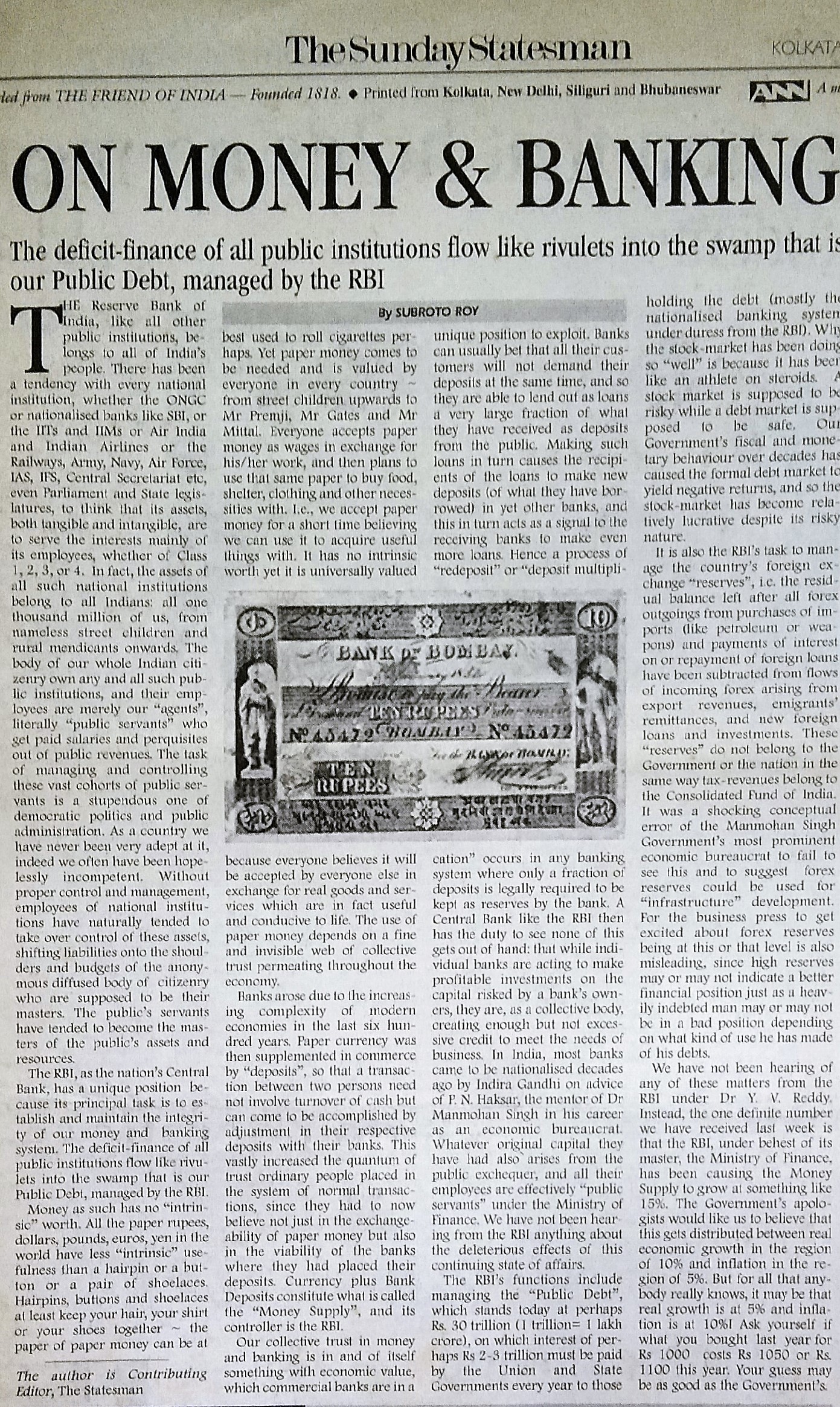
My “Critique of Monetary Ideas of Manmohan & Modi: the Roy Model explaining to Bimal Jalan, Nirmala Sitharaman, RBI etc what it is they are doing” of 2019 is here.


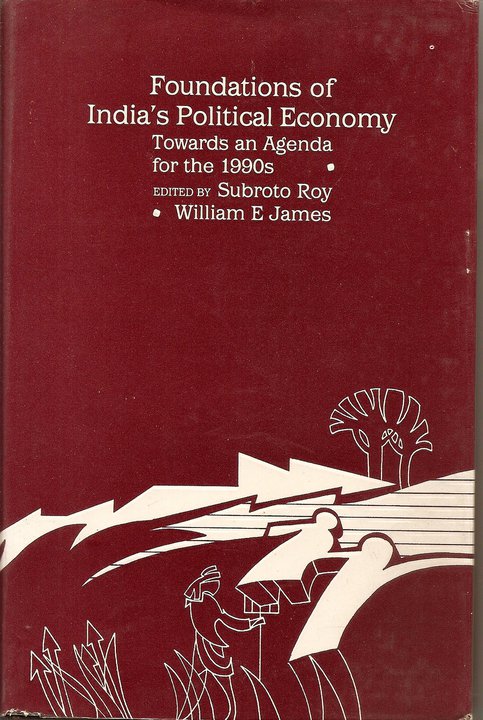
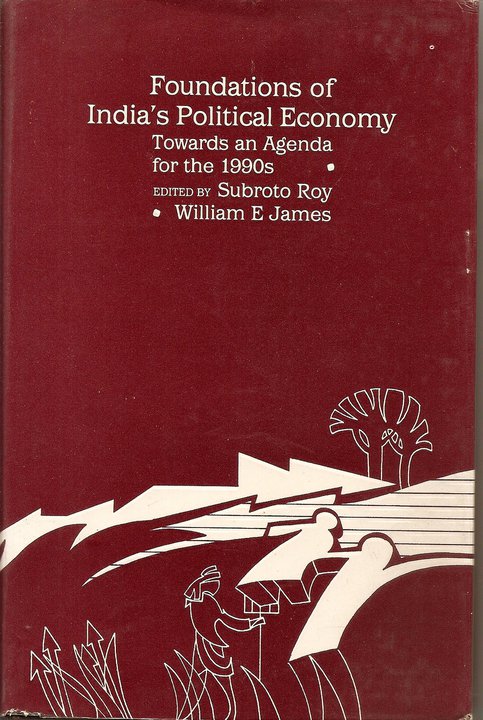
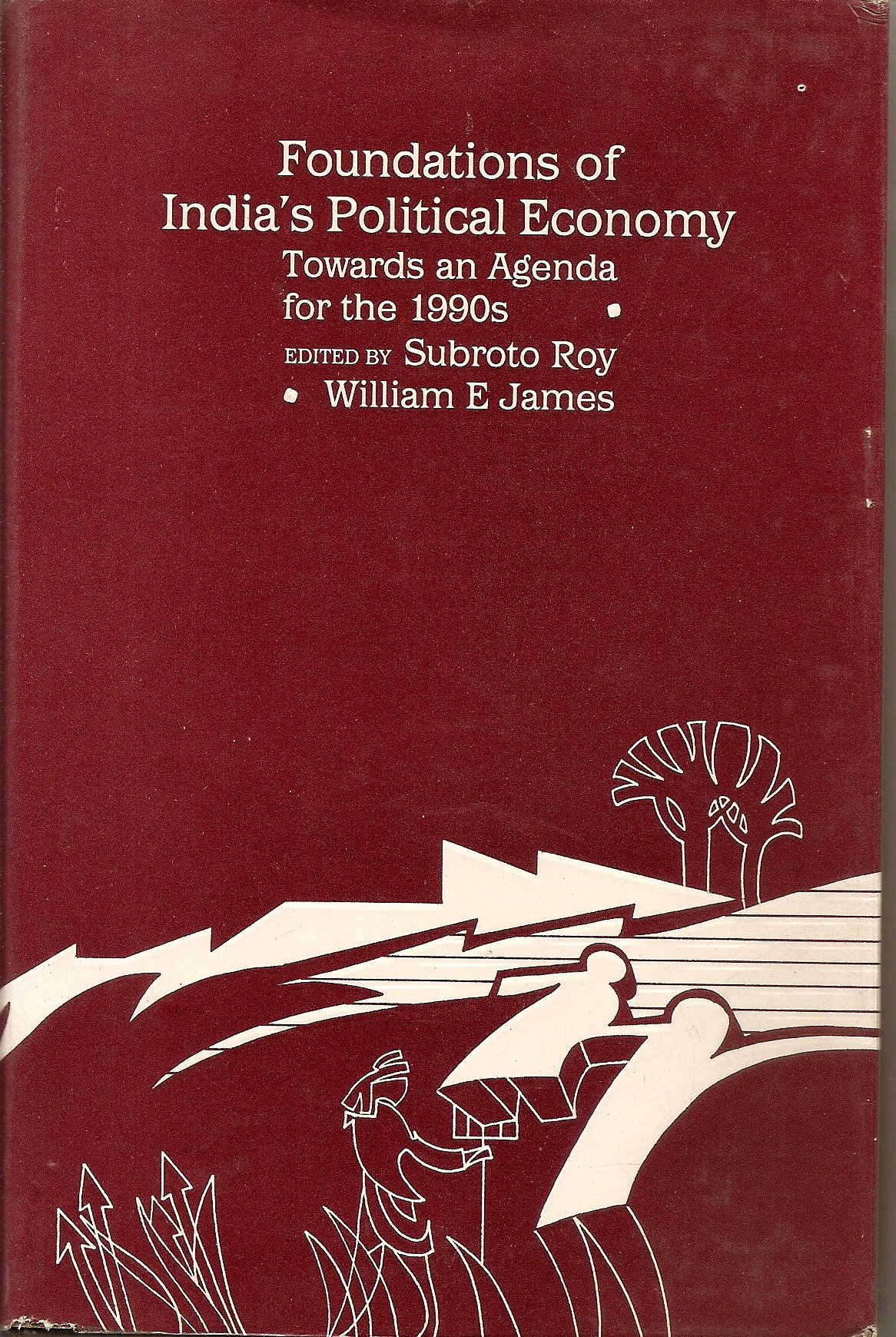
Foundations of India’s Political Economy: Towards an Agenda for the 1990s edited by Subroto Roy & William E James, 1986-1992… pdf copy uploaded 2021

Pricing, Planning & Politics: A Study of Economic Distortions in India 1984, uploaded as pdf 2021


My Sep 2019 recommendation PM address each State Legislature, get all India Govt Accounting & Public Decision Making to have integrity; 16 May 2014 Advice scrap “Planning Commission”,integrate its assets with the Treasury, get the nationalised banks & RBI out of the Treasury

My critical assessment dated 23 August 2013 of Professors Jagdish Bhagwati & Amartya Sen and Dr Manmohan Singh is here


My critique of PM Modi’s 8 November 2016 statement began on Twitter immediately, and is  summarized here “Modi & Monetary Theory: Economic Consequences of the Prime Minister of India”

 3dec

My critical assessment dated 19 August 2013 of Professor Raghuram Rajan is here and here.

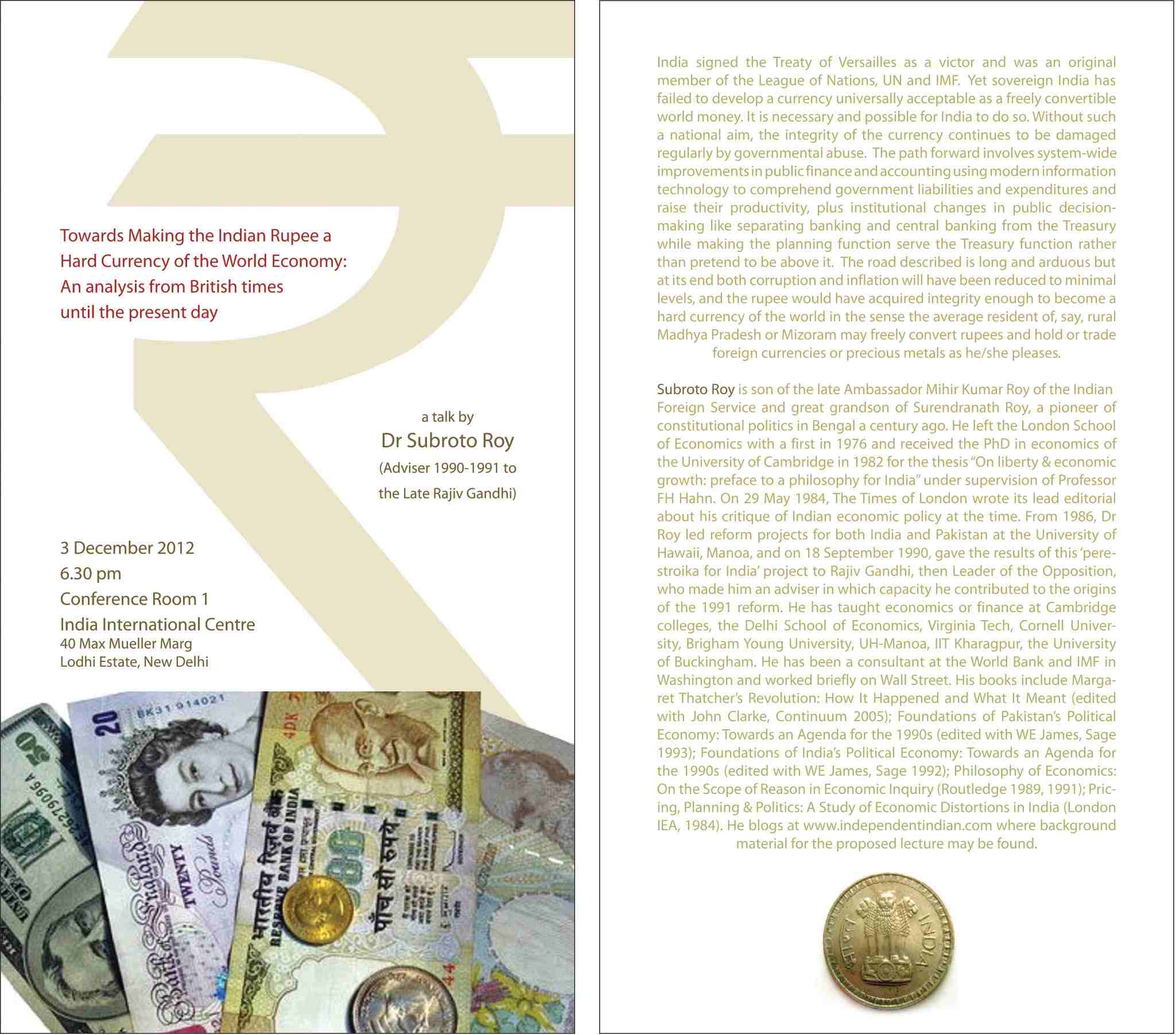
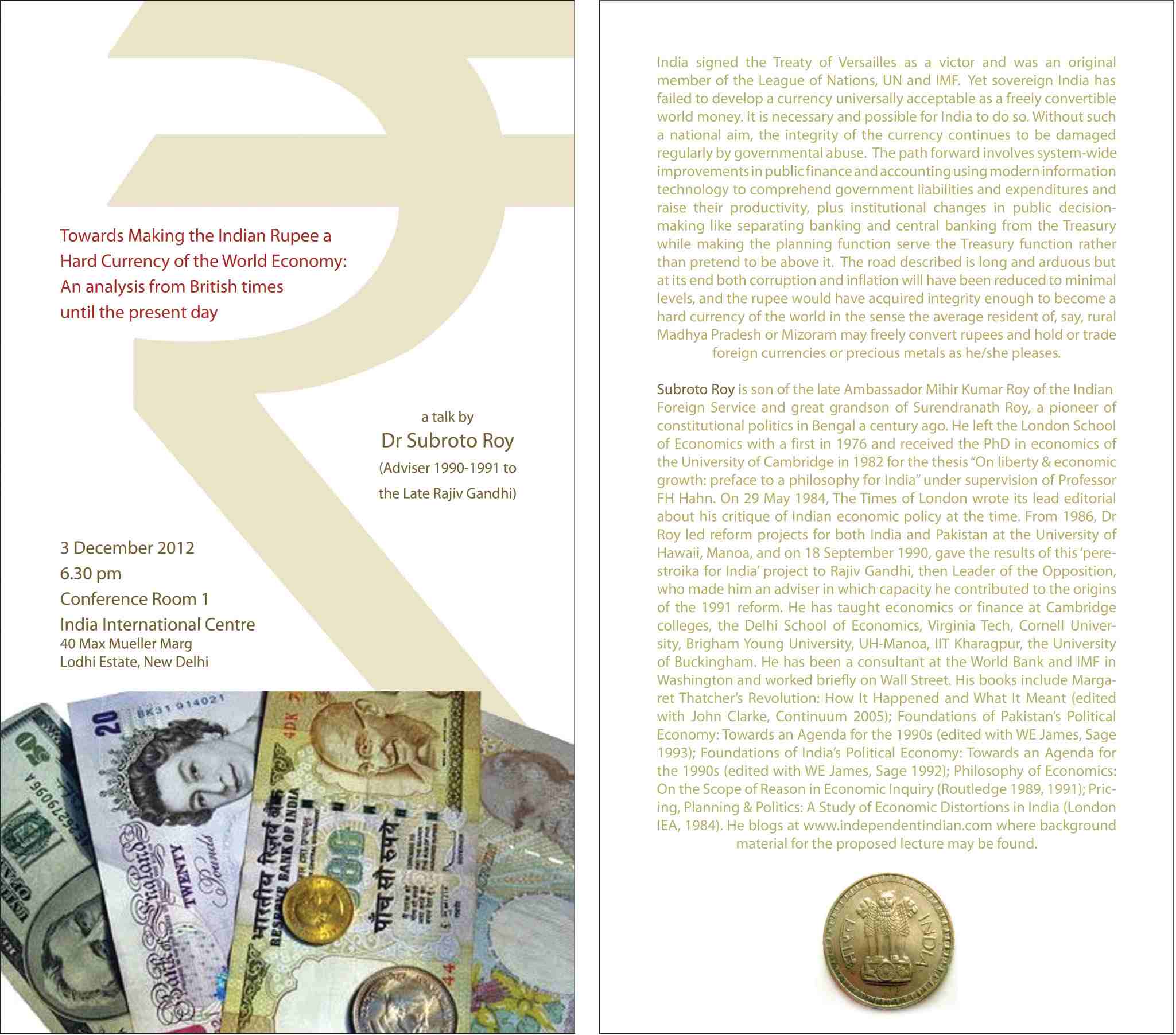
My 3 Dec 2012 Delhi talk on India’s Money is now available at You-Tube in an audio version here

My July 2012 article “India’s Money” in the Caymans Financial Review is here and here https://independentindian.com/2012/07/21/my-article-indias-money-in-the-cayman-financial-review-july-2012/

My 5 December 2012 interview by Mr Paranjoy Guha Thakurta, on Lok Sabha TV, the channel of India’s Lower House of Parliament, broadcast for the first time on 9 December 2012 on Lok Sabha TV, is here and here  in two parts.

My interview by GDI Impuls banking quarterly of  Zürich  published on 6 Dec 2012 is here.

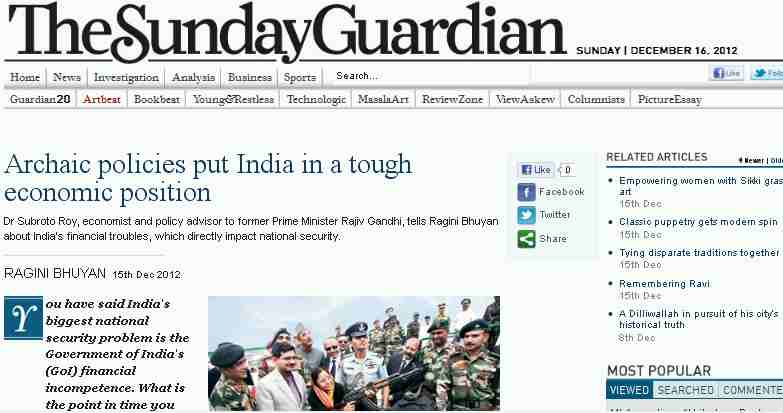
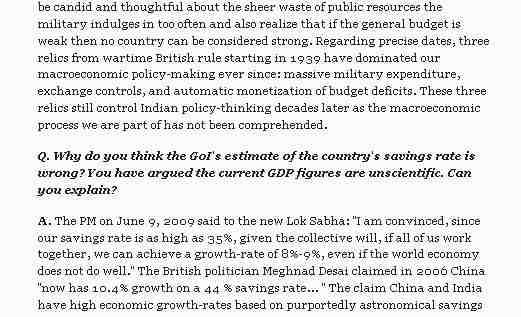
My interview by Ragini Bhuyan of Delhi’s Sunday Guardian published on 16 Dec 2012  is here.

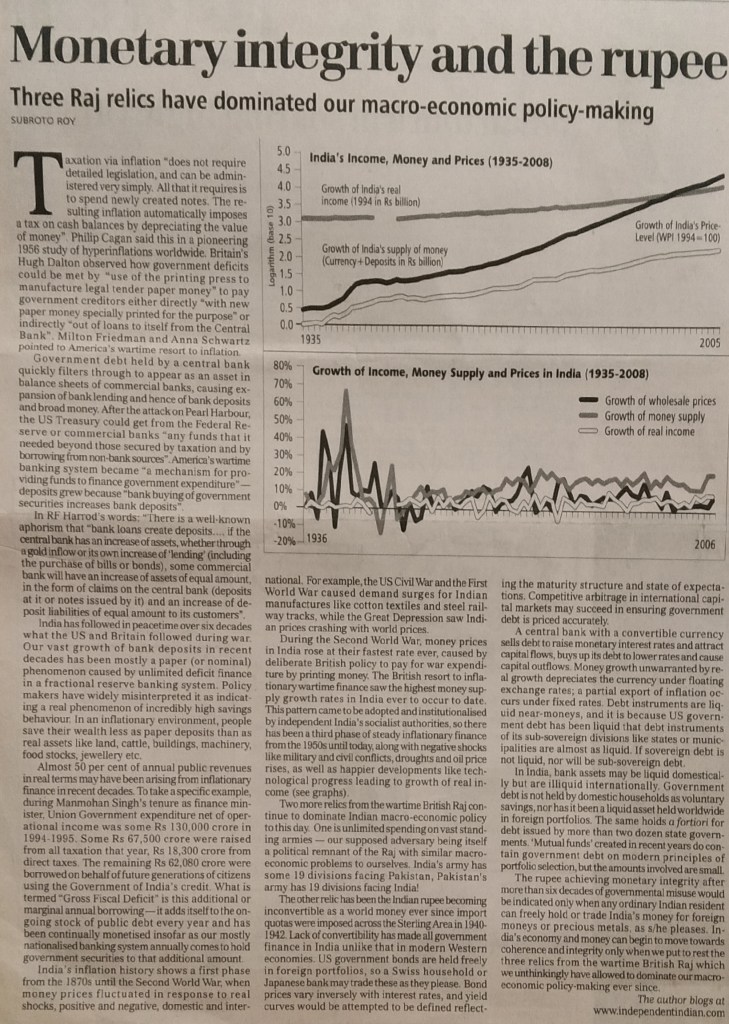
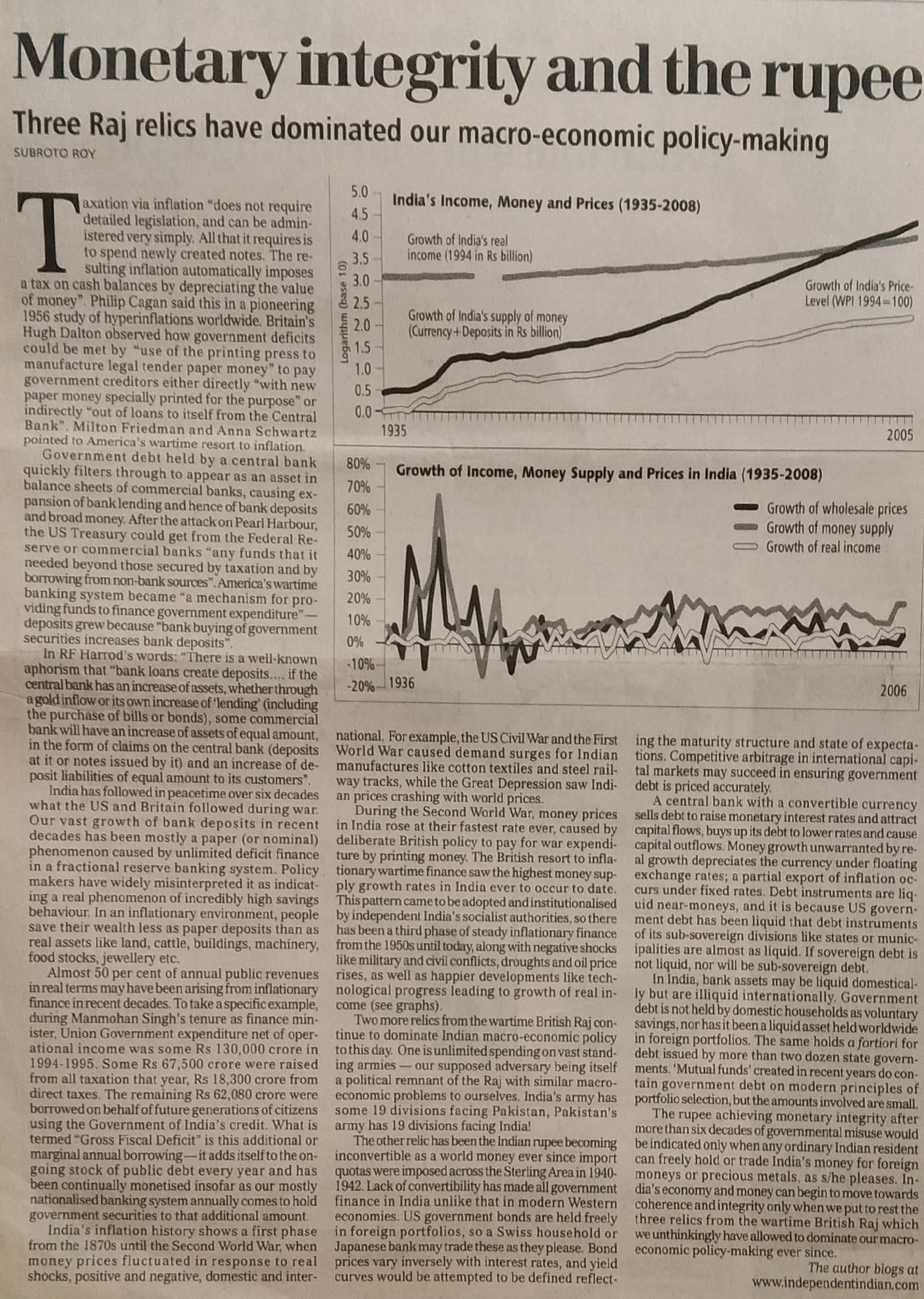
 “Monetary Integrity and the Rupee” (2008)

https://independentindian.com/2008/09/28/monetary-integrity-and-the-rupee/

  “India’s Macroeconomics” (2007)

“Fiscal Instability” (2007)

 “Fallacious Finance” (2007)

https://independentindian.com/2007/03/05/fallacious-finance-the-congress-bjp-cpi-m-et-al-may-be-leading-india-to-hyperinflation/


https://independentindian.com/2021/12/01/on-the-simplest-smallest-most-universal-direct-flattax-of-500-rupees-per-annum-for-india-accruing-to-the-states-with-a-bpl-exemption-too/


Budgets & Financial Positions of Three of India’s Most Populous States (combined population c.300 million)…Brought to you especially by Dr Subroto Roy… Feel free to use (with acknowledgment)…


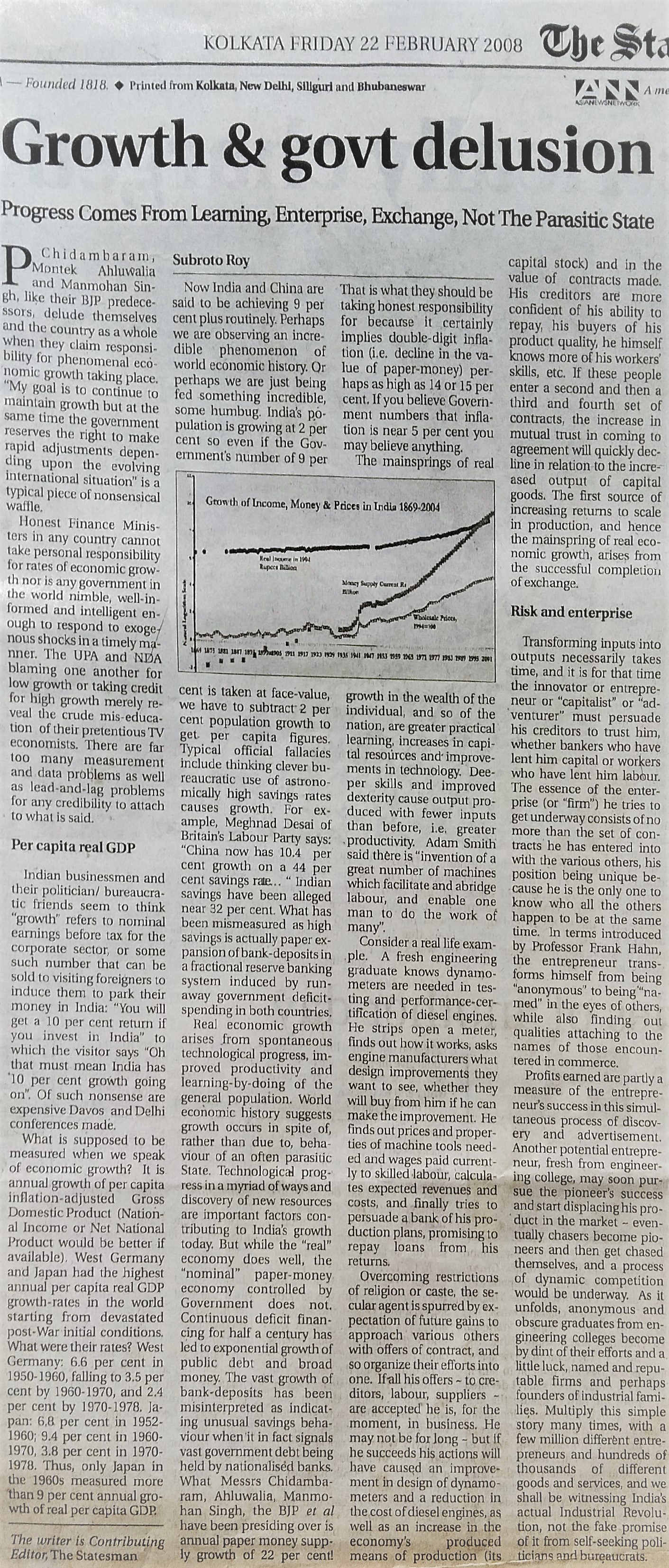
 “Growth and Government Delusion” (2008)

https://independentindian.com/2008/02/22/growth-government-delusion/

 “Distribution of Govt of India Expenditure (Net of Operational Income) 1995”
https://independentindian.com/2008/07/27/distribution-of-govt-of-india-expenditure-net-of-operational-income-1995/

“India in World Trade & Payments” (2007)

https://independentindian.com/2007/02/12/india-in-world-trade-payments/


“Path of the Indian Rupee 1947-1993″ (1993)

https://independentindian.com/1993/06/01/path-of-the-indian-rupee-1947-1993/


“Our Policy Process” (2007)

https://independentindian.com/2007/02/20/our-policy-process-self-styled-planners-have-controlled-indias-paper-money-for-decades/


“Indian Money and Credit” (2006)

https://independentindian.com/2006/08/06/indian-money-and-credit/


“Indian Money and Banking” (2006)

https://independentindian.com/2006/04/23/indian-money-and-banking/


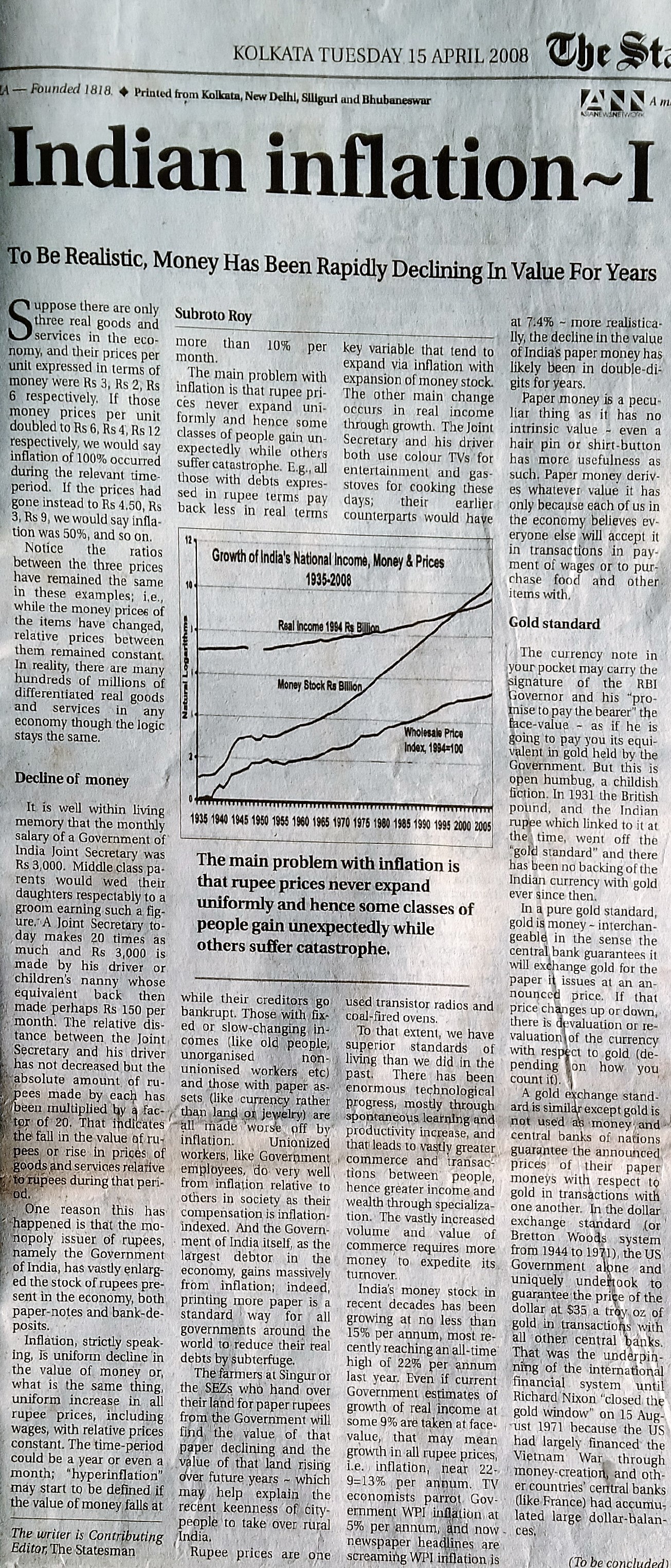
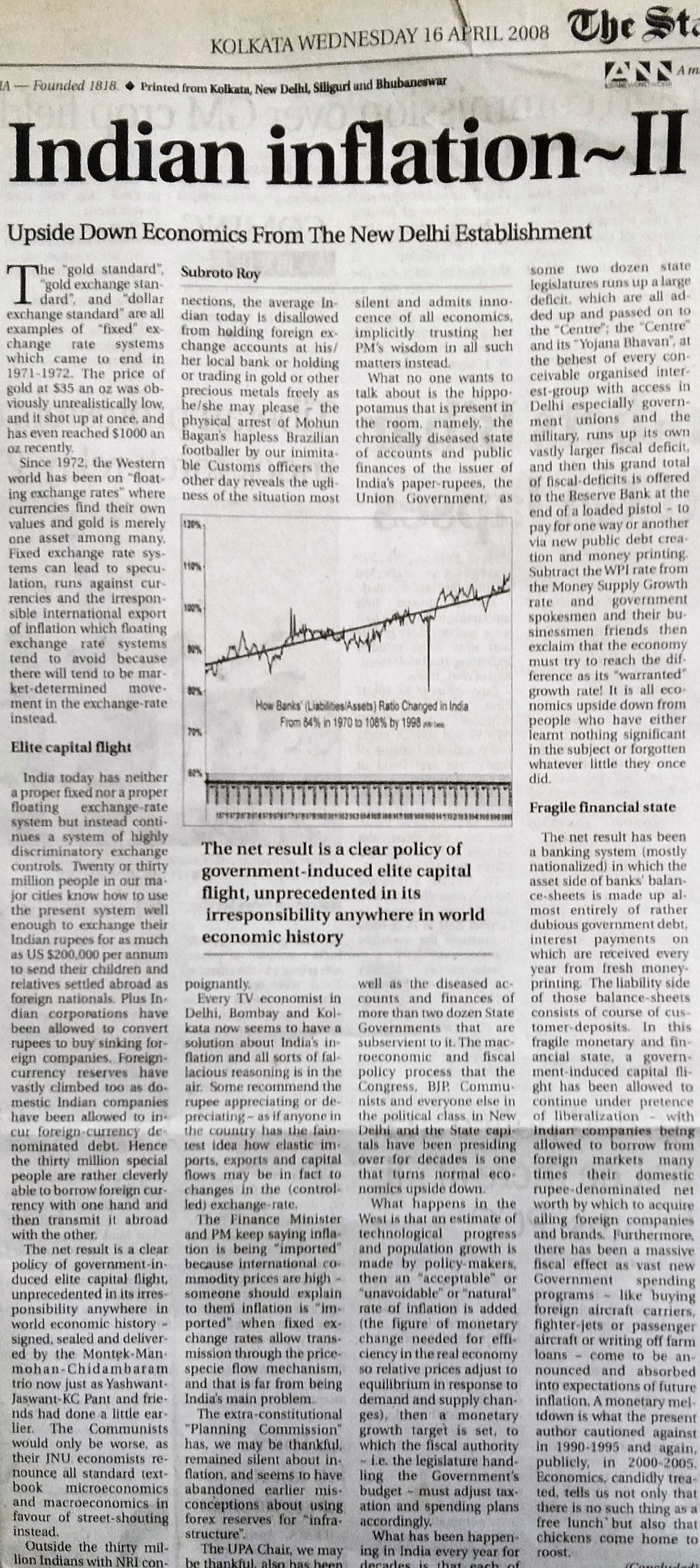
“Indian Inflation” (2008)

https://independentindian.com/2008/04/16/indian-inflation-upside-down-economics-from-new-delhis-establishment/

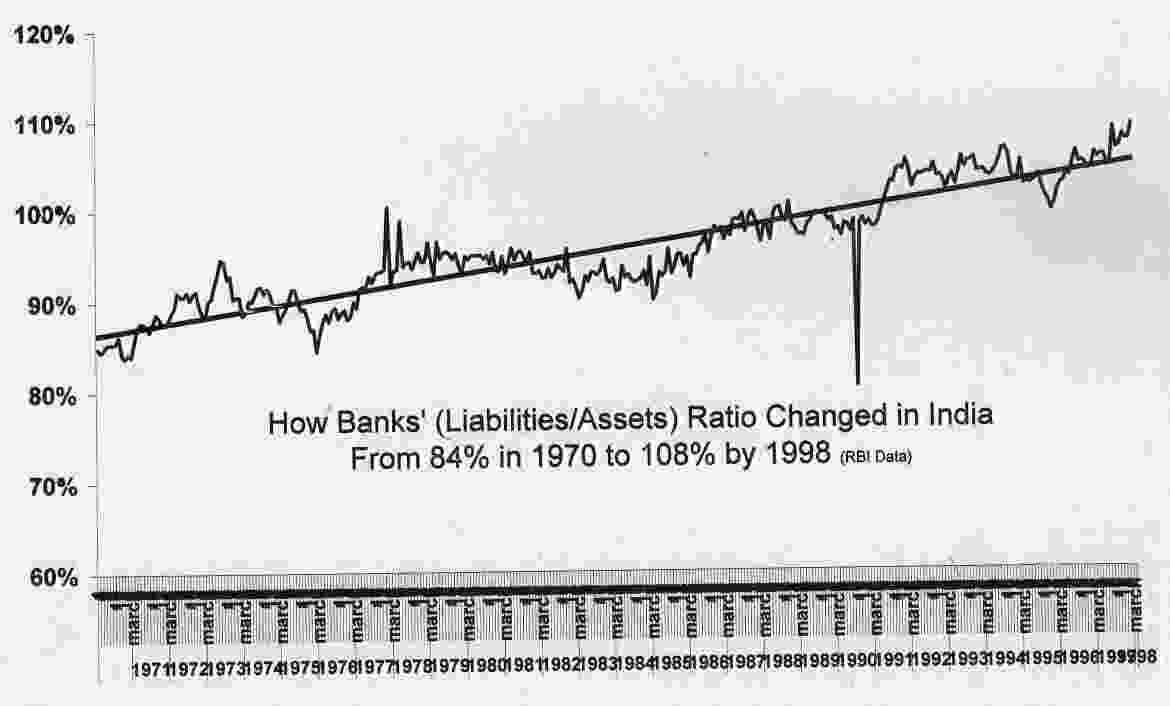
 How the Liabilities/Assets Ratio of Indian Banks Changed from 84% in 1970 to 108% in 1998 https://independentindian.com/2008/10/20/how-the-liabilitiesassets-ratio-of-indian-banks-changed-from-84-in-1970-to-108-in-1998/

indiasbanks1

“Growth of Real Income, Money & Prices in India 1869-2004” (2005)

https://independentindian.com/2008/07/28/growth-of-real-income-money-prices-in-india-1869-2004/


“How to Budget” (2008)

https://independentindian.com/2008/02/26/how-to-budget-thrift-not-theft-should-guide-our-public-finances/


“Waffle but No Models of Monetary Policy: The RBI and Financial Repression (2005)”

https://independentindian.com/2005/10/27/waffle-but-no-models-of-monetary-policy-the-rbi-and-financial-repression/


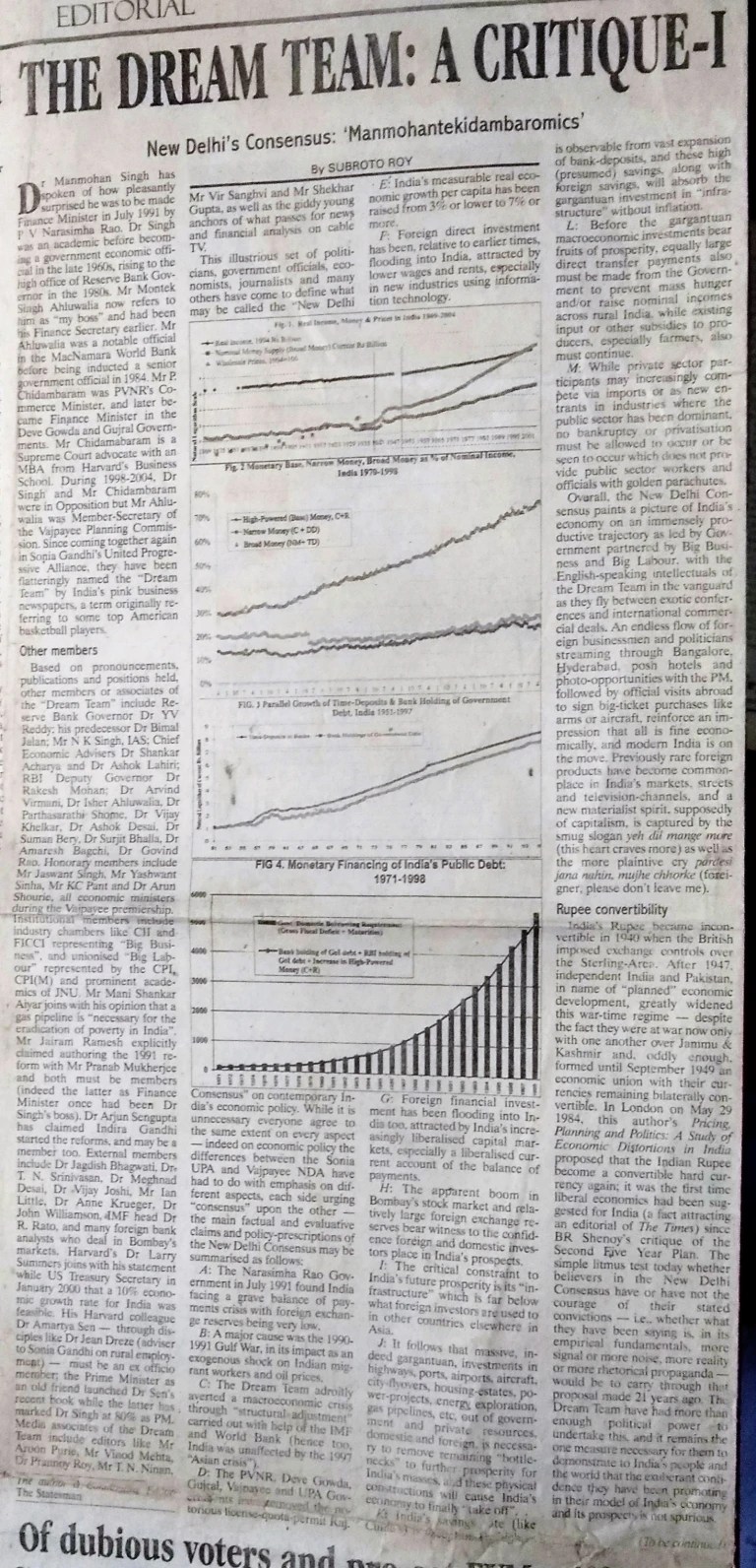
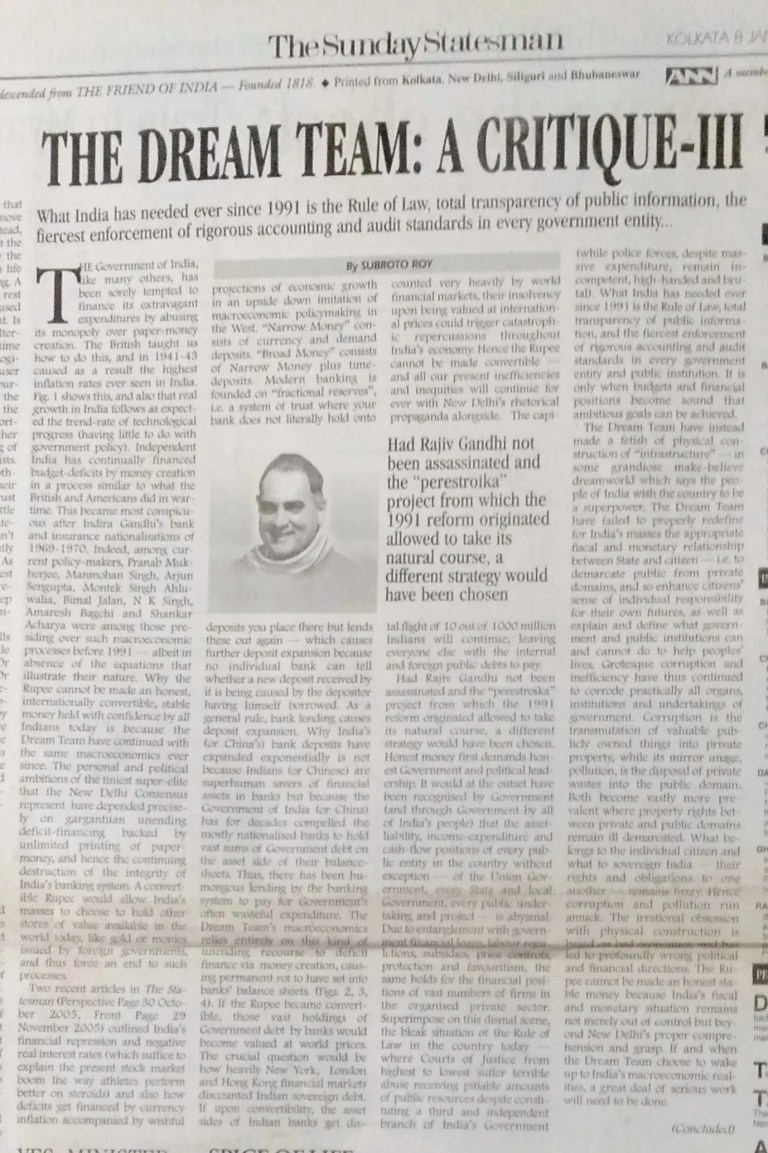
“The Dream Team: A Critique” (2006)

https://independentindian.com/2006/01/08/the-dream-team-a-critique/


“Against Quackery” (2007)

https://independentindian.com/2007/09/24/against-quackery/


“Mistaken Macroeconomics” (2009)

https://independentindian.com/2009/06/12/mistaken-macroeconomics-an-open-letter-to-prime-minister-dr-manmohan-singh/


Towards a Highly Transparent Fiscal & Monetary Framework for India’s Union & State Governments (RBI lecture 29 April 2000)

https://independentindian.com/2000/04/29/towards-a-highly-transparent-fiscal-monetary-framework-for-india%E2%80%99s-union-state-governments/

“The Indian Revolution (2008)”

https://independentindian.com/2008/12/08/the-indian-revolution/

Can India Become an Economic Superpower or Will There Be a Monetary Meltdown? (2005)

https://independentindian.com/2005/05/05/can-india-become-an-economic-superpower-or-will-there-be-a-monetary-meltdown-2005/


Memo to Kaushik Basu, 2010

Land, Liberty, & Value, 2006

https://independentindian.com/2006/12/31/land-liberty-value/

On Land-Grabbing, 2007

https://independentindian.com/2007/01/14/on-land-grabbing/

No Marxist MBAs? An amicus curiae brief for the Honourable High Court

https://independentindian.com/2007/08/29/no-marxist-mbasan-amicus-curae-brief-for-the-honourable-high-court/

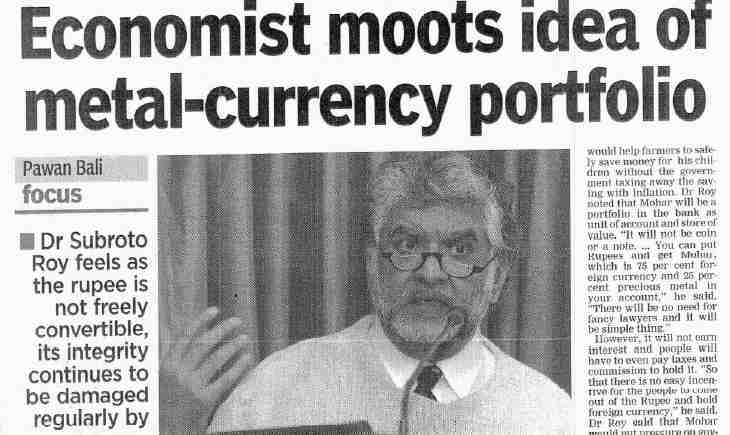
Coverage in The *Asian Age*/*Deccan Herald* of 4 Dec 2012.

IICtophalf IICtalkbottom,half

.

sundayguardiantp sgmiddle sgmid2 sgmid3 sgmid4 sgmid5 3Dec

Posted in Academic research, Amartya Sen, Arvind Panagariya, Bhagwati-Sen spat, Britain in India, China's macroeconomics, China's savings rate, Economic Policy, Economic quackery, Economic Theory, Economic Theory of Growth, Economic Theory of Interest, Economic Theory of Value, Economics of exchange controls, Economics of Public Finance, GDI Impuls Zurich, Government accounting, Government Budget Constraint, Government of India, India's Big Business, India's credit markets, India's Government economists, India's 1991 Economic Reform, India's balance of payments, India's Banking, India's Budget, India's Capital Markets, India's corporate governance, India's corruption, India's currency history, India's Economic History, India's Economy, India's Exports, India's Foreign Exchange Reserves, India's Foreign Trade, India's Government Budget Constraint, India's Government Expenditure, India's Macroeconomics, India's Military Defence, India's Monetary & Fiscal Policy, India's Money, India's nomenclatura, India's political lobbyists, India's Politics, India's pork-barrel politics, India's poverty, India's Public Finance, India's Reserve Bank, India's State Finances, Inflation, Institute of Economic Affairs, International economics, Jagdish Bhagwati, Jean Drèze, Lok Sabha TV, Macroeconomics, Manmohan Singh, Microeconomic foundations of macroeconomics, Milton Friedman, Raghuram Govind Rajan, Raghuram Rajan, Rajiv Gandhi, Reverse-Euro Model for India, Sen-Bhagwati spat, Sonia Gandhi. 1 Comment »

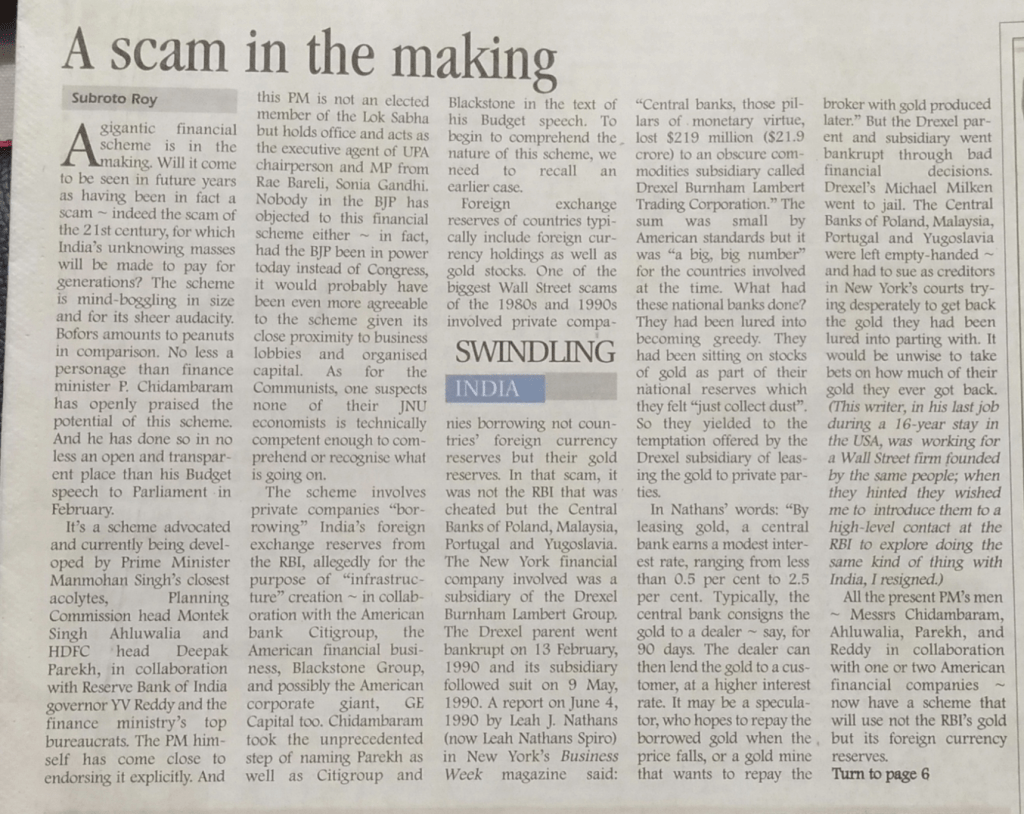
Did Jagdish Bhagwati “originate”, “pioneer”, “intellectually father” India’s 1991 economic reform? Did Manmohan Singh? Or did I, through my encounter with Rajiv Gandhi, just as Siddhartha Shankar Ray told Manmohan & his aides in Sep 1993 in Washington? Judge the evidence for yourself. And why has Amartya Sen misdescribed his work? India’s right path forward today remains what I said in my 3 Dec 2012 Delhi lecture!

Did Jagdish Bhagwati “originate”, “pioneer”, “intellectually father” India’s 1991 economic reform?  Did Manmohan Singh? Or did I, through my encounter with Rajiv Gandhi, just as Siddhartha Shankar Ray told Manmohan & his aides in Sep 1993 in Washington?  Judge the evidence for yourself.  And why has Amartya Sen misdescribed his work? India’s right path forward today remains what I said in my 3 Dec 2012 Delhi lecture!

[See also “I’m on my way out”: Siddhartha Shankar Ray (1920-2010)…An Economist’s Tribute”; “Rajiv Gandhi and the Origins of India’s 1991 Economic Reform”; “Three Memoranda to Rajiv Gandhi 1990-1991″ 

Foundations of India’s Political Economy: Towards an Agenda for the 1990s edited by Subroto Roy & William E James, 1986-1992… pdf copy uploaded 2021

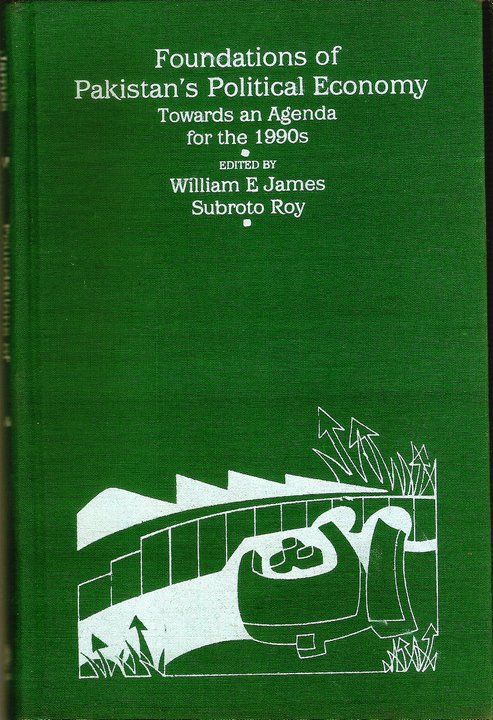
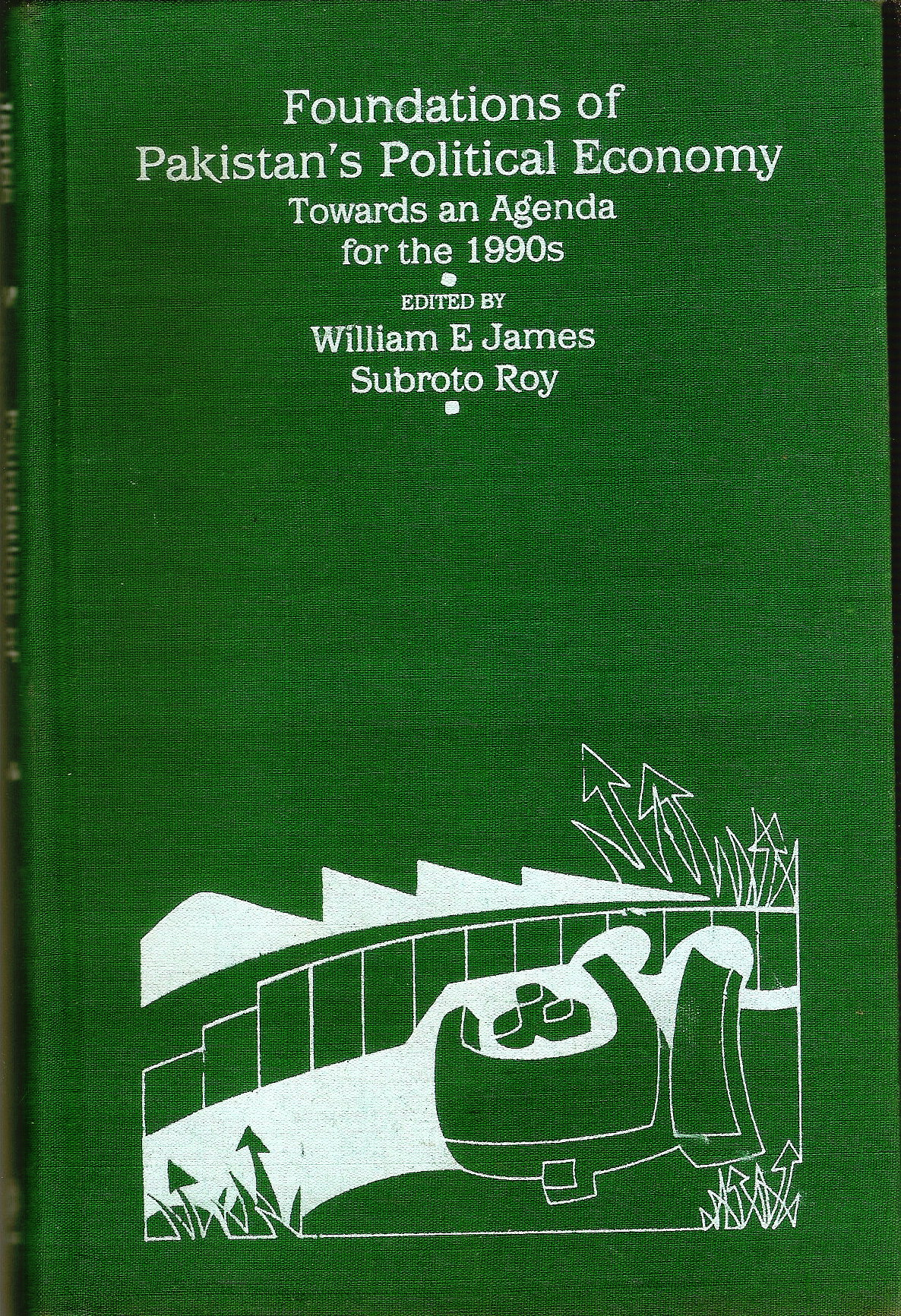
Foundations of Pakistan’s Political Economy: Towards an Agenda for the 1990s, edited by William E James & Subroto Roy, 1986-1993… pdf copy uploaded 2021

Critique of Amartya Sen: A Tragedy of Plagiarism, Fake News, Dissimulation

Contents


Part I:  Facts vs Fiction, Flattery, Falsification, etc

1. Problem

2.    Rajiv Gandhi, Siddhartha Shankar Ray, Milton Friedman & Myself

3.     Jagdish Bhagwati & Manmohan Singh?  That just don’t fly!

 4.    Amartya Sen’s Half-Baked Communism:  “To each according to his need”?

  Part II:    India’s Right Road Forward Now: Some Thoughtful Analysis for Grown Ups

5.   Transcending a Left-Right/Congress-BJP Divide in Indian Politics

6.   Budgeting Military & Foreign Policy

7.    Solving the Kashmir Problem & Relations with Pakistan

8.  Dealing with Communist China

9.   Towards Coherence in Public Accounting, Public Finance & Public Decision-Making

10.   India’s Money: Towards Currency Integrity at Home & Abroad


Part I:  Facts vs Fiction, Flattery, Falsification, etc

1. Problem


Arvind Panagariya says in the Times of India of 27 July 2013

 “…if in 1991 India embraced many of the Track-I reforms, writings by Sen played no role in it… The intellectual origins of the reforms are to be found instead in the writings of Bhagwati, both solely and jointly with Padma Desai and T N Srinivasan….”

Now Amartya Sen has not claimed involvement in the 1991 economic reforms so we are left with Panagariya claiming

“The intellectual origins of the reforms are to be found instead in the writings of Bhagwati…”

Should we suppose Professor Panagariya’s master and co-author Jagdish Bhagwati himself substantially believes and claims the same?  Three recent statements from Professor Bhagwati suffice by way of evidence:

(A)  Bhagwati said to parliamentarians in the Lok Sabha on 2 December 2010 about the pre-1991 situation:

“This policy framework had been questioned, and its total overhaul advocated, by me and Padma Desai in writings through the late 1960s which culminated in our book, India: Planning for Industrialization (Oxford University Press: 1970) with a huge blowback at the time from virtually all the other leading economists and policymakers who were unable to think outside the box. In the end, our views prevailed and the changes which would transform the economy began, after an external payments crisis in 1991, under the forceful leadership of Prime Minister Manmohan Singh who was the Finance Minister at the time….”

(B)  Bhagwati said to Economic Times on 28 July 2013:

“When finance minister Manmohan Singh was in New York in 1992, he had a lunch for many big CEOs whom he was trying to seduce to come to India. He also invited me and my wife, Padma Desai, to the lunch. As we came in, the FM introduced us to the invitees and said: ‘These friends of mine wrote almost a quarter century ago [India: Planning for Industrialisation was published in 1970 by Oxford] recommending all the reforms we are now undertaking. If we had accepted the advice then, we would not be having this lunch as you would already be in India’.”

(C)  And Bhagwati said in Business Standard of 9 August 2013:

“… I was among the intellectual pioneers of the Track I reforms that transformed our economy and reduced poverty, and witness to that is provided by the Prime Minister’s many pronouncements and by noted economists like Deena Khatkhate.. I believe no one has accused Mr. Sen of being the intellectual father of these reforms. So, the fact is that this huge event in the economic life of India passed him by…”

From these pronouncements it seems fair to conclude Professors Bhagwati and Panagariya are claiming Bhagwati has been the principal author of “the intellectual origins” of India’s 1991 reforms, has been their “intellectual father” or at the very least has been “among the intellectual pioneers” of the reform (“among” his own collaborators and friends, since none else is mentioned).  Bhagwati has said too his friend Manmohan Singh as Finance Minister participated in the process while quoting Manmohan as having said Bhagwati was the principal author. 

Bhagwati’s opponent in current debate,  Amartya Sen, has been in agreement with him that Manmohan, their common friend during college days at Cambridge in the 1950s, was a principal originating the 1991 reforms, saying to Forbes in 2006:

“When Manmohan Singh came to office in the early 1990s as the newly appointed finance minister, in a government led by the Congress Party, he knew these problems well enough, as someone who had been strongly involved in government administration for a long time.”

In my experience, such sorts of claims, even in their weakest form, have been, at best, scientifically sloppy and unscholarly,  at worst mendacious suppressio veri/suggestio falsi, and in between these best and worst interpretations, examples of academic self-delusion and mutual flattery.  We shall see Bhagwati’s opponent, Amartya Sen, has denied academic paternity of recent policies he has spawned while appearing to claim academic paternity of things he has not!  Everyone may have reasonably expected greater self-knowledge, wisdom and scholarly values of such eminent academics.  Their current spat has instead seemed to reveal something rather dismal and self-serving. 

You can decide for yourself where the truth, ever such an elusive and fragile thing, happens to be and what is best done about it.   Here is some evidence.


2.  Rajiv Gandhi, Siddhartha Shankar Ray,  Milton Friedman & Myself

Professor Arvind Panagariya is evidently an American economics professor of Indian national origin who holds the Jagdish Bhagwati Chair of Indian Political Economy at Columbia University.   I am afraid I had not known his name until he mentioned my name in Economic Times of  24 October 2001.   He said

panagariya

In mentioning the volume “edited by Subroto Roy and William E  James”,  Professor Panagariya did not appear to find the normal scientific civility to identify our work by name, date or publisher.  So here that is now:

indvol

This was a book published in 1992 by the late Tejeshwar Singh for Sage.  It resulted from the University of Hawaii Manoa perestroika-for-India project, that I and Ted James created and led between 1986 and 1992/93.   (Yes, Hawaii — not Stanford, Harvard, Yale, Columbia or even Penn, whose India-policy programs were Johnny-come-latelies a decade or more later…)   There is a sister-volume too on Pakistan, created by a parallel project Ted and I had led at the same time (both now in pdf):

pakvol

In 2004 from Britain, I wrote to the 9/11 Commission saying if our plan to study Afghanistan after India and Pakistan had not been thwarted by malign local forces among our sponsors themselves, we, a decade before the September 11 2001 attacks on the USA, may  just have come up with a pre-emptive academic analysis.   It was not to be.

Milton Friedman’s chapter that we published for the first time was a memorandum he wrote in November 1955 for the Government of India which the GoI had effectively suppressed.  I came to know of it while a doctoral student at Cambridge under Frank Hahn, when at a conference at Oxford about 1979-1980, Peter Tamas Bauer sat me down beside him and told me the story.  Later in Blacksburg about 1981, N. Georgescu-Roegen on a visit from Vanderbilt University told me the same thing.  Specifically, Georgescu-Roegen told me that leading Indian academics had almost insulted Milton in public which Milton had borne gamely; that after Milton had given a talk in Delhi to VKRV Rao’s graduate-students,  a talk Georgescu-Roegen had been present at, VKRV Rao had addressed the students and told them in all seriousness “You have heard what Professor Friedman has to say, if you repeat what he has said in your exams, you will fail”.

In 1981-1982 my doctoral thesis emerged, titled “On liberty & economic growth: preface to a philosophy for India”,

phd

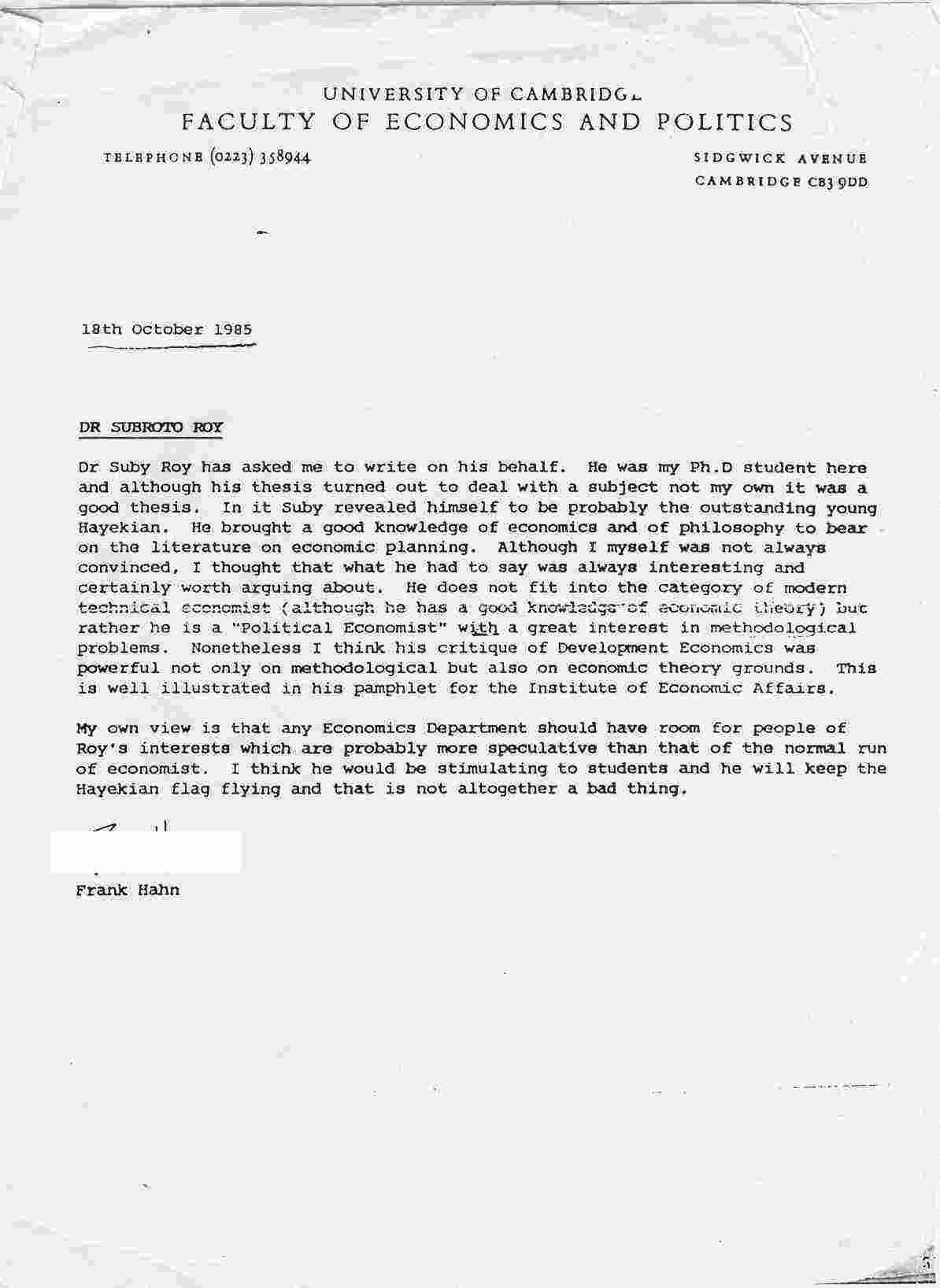
My late great master in economic theory, Frank Hahn (1925-2013), found what I had written to be a “good thesis” bringing “a good knowledge of economics and of philosophy to bear on the literature on economic planning”, saying I had  shown “a good knowledge of economic theory” and my “critique of Development Economics was powerful not only on methodological but also on economic theory grounds”.  

I myself said about it decades later “My original doctoral topic in 1976  ‘A monetary theory for India’ had to be altered not only due to paucity of monetary data at the time but because the problems of India’s political economy and allocation of resources in the real economy were far more pressing. The thesis that emerged in 1982 … was a full frontal assault from the point of view of microeconomic theory on the “development planning” to which everyone routinely declared their fidelity, from New Delhi’s bureaucrats and Oxford’s “development” school to McNamara’s World Bank with its Indian staffers.  Frank Hahn protected my inchoate liberal arguments for India; and when no internal examiner could be found, Cambridge showed its greatness by appointing two externals, Bliss at Oxford and Hutchison at Birmingham, both Cambridge men. “Economic Theory and Development Economics” was presented to the American Economic Association in December 1982 in company of Solow, Chenery, Streeten, and other eminences…” How I landed on that eminent AEA panel in December 1982 was because its convener Professor George Rosen of the University of Illinois recruited me overnight — as a replacement for Jagdish Bhagwati, who had had to return to India suddenly because of a parental death.  The results were published in 1983 in World Development.

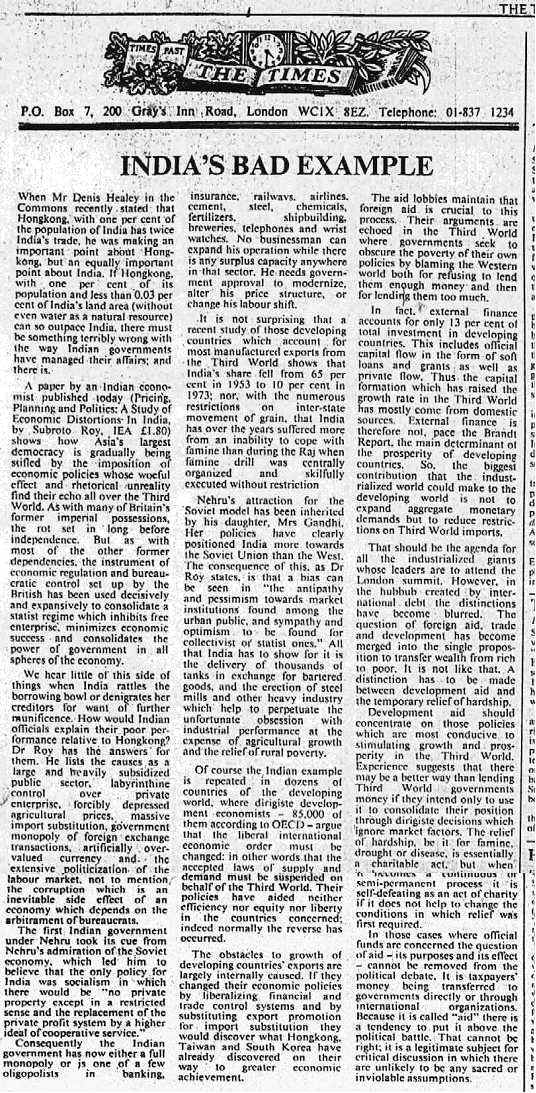
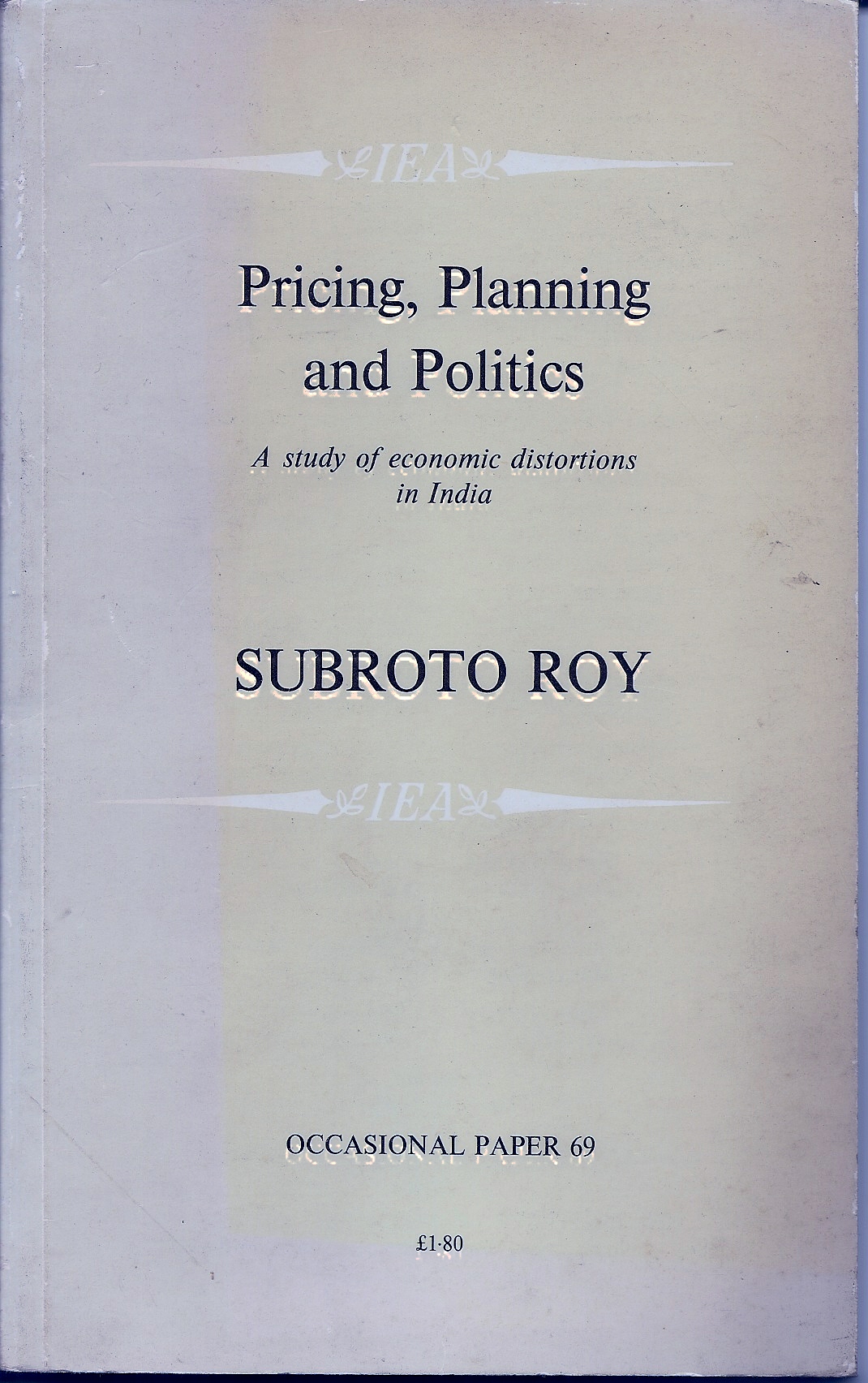
Soon afterwards, London’s Institute of Economic Affairs published Pricing, Planning and Politics: A Study of Economic Distortions in India.  This slim work (now in pdf)  was the first classical liberal critique of post-Mahalonobis Indian economic thought since BR Shenoy’s original criticism decades earlier.  It became the subject of The Times’ lead editorial on its day of publication 29 May 1984 — provoking the Indian High Commission in London to send copies to the Finance Ministry in Delhi where it apparently caused a stir, or so I was told years later by Amaresh Bagchi who was a recipient of it at the Ministry.

ppp19842
londonti

The Times had said

“When Mr. Dennis Healey in the Commons recently stated that Hongkong, with one per cent of the population of India has twice India’s trade, he was making an important point about Hongkong but an equally important point about India. If Hongkong with one per cent of its population and less than 0.03 per cert of India’s land area (without even water as a natural resource) can so outpace India, there must be something terribly wrong with the way Indian governments have managed their affairs, and there is. A paper by an Indian economist published today (Pricing, Planning and Politics: A Study of Economic Distortions in India by Subroto Roy, IEA £1.80) shows how Asia’s largest democracy is gradually being stifled by the imposition of economic policies whose woeful effect and rhetorical unreality find their echo all over the Third World. As with many of Britain’s former imperial possessions, the rot set in long before independence. But as with most of the other former dependencies, the instrument of economic regulation and bureaucratic control set up by the British has been used decisively and expansively to consolidate a statist regime which inhibits free enterprise, minimizes economic success and consolidates the power of government in all spheres of the economy. We hear little of this side of things when India rattles the borrowing bowl or denigrates her creditors for want of further munificence. How could Indian officials explain their poor performance relative to Hongkong? Dr Roy has the answers for them. He lists the causes as a large and heavily subsidized public sector, labyrinthine control over private enterprise, forcibly depressed agricultural prices, massive import substitution, government monopoly of foreign exchange transactions, artificially overvalued currency and the extensive politicization of the labour market, not to mention the corruption which is an inevitable side effect of an economy which depends on the arbitrament of bureaucrats. The first Indian government under Nehru took its cue from Nehru’s admiration of the Soviet economy, which led him to believe that the only policy for India was socialism in which there would be “no private property except in a restricted sense and the replacement of the private profit system by a higher ideal of cooperative service.” Consequently, the Indian government has now either a full monopoly or is one of a few oligipolists in banking, insurance, railways, airlines, cement, steel, chemicals, fertilizers, ship-building, breweries, telephones and wrist-watches. No businessman can expand his operation while there is any surplus capacity anywhere in that sector. He needs government approval to modernize, alter his price-structure, or change his labour shift. It is not surprising that a recent study of those developing countries which account for most manufactured exports from the Third World shows that India’s share fell from 65 percent in 1953 to 10 per cent in 1973; nor, with the numerous restrictions on inter-state movement of grains, that India has over the years suffered more from an inability to cope with famine than during the Raj when famine drill was centrally organized and skillfully executed without restriction. Nehru’s attraction for the Soviet model has been inherited by his daughter, Mrs. Gandhi. Her policies have clearly positioned India more towards the Soviet Union than the West. The consequences of this, as Dr Roy states, is that a bias can be seen in “the antipathy and pessimism towards market institutions found among the urban public, and sympathy and optimism to be found for collectivist or statist ones.” All that India has to show for it is the delivery of thousands of tanks in exchange for bartered goods, and the erection of steel mills and other heavy industry which help to perpetuate the unfortunate obsession with industrial performance at the expense of agricultural growth and the relief of rural poverty.”…..

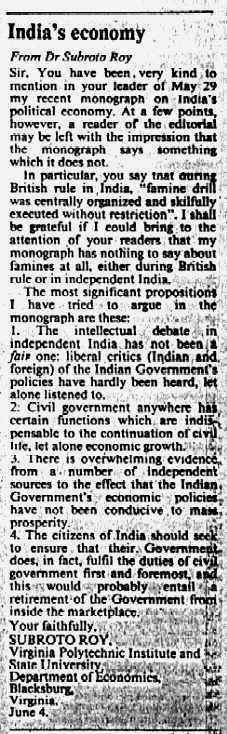
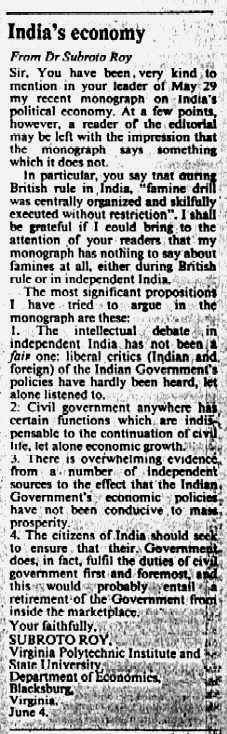
I felt there were inaccuracies in this and so replied  dated 4 June which The Times published on 16 June 1984:

timesletter-11

Milton and I met for the first time in the Fall of 1984 at the Mont Pelerin Society meetings at Cambridge when I gave him a copy of the IEA monograph, which he came to think extremely well of.   I told him I had heard of his 1955 document and asked him for it; he sent me the original blue/purple version of this soon thereafter.

[That original document was, incidentally,  in my professorial office among all my books, papers, theses and other academic items including my gown when I was attacked in 2003 by a corrupt gang at IIT Kharagpur —  all yet to be returned to me by IIT despite a High Court order during my present ongoing battle against corruption there over a USD 1.9 million scam !… Without having ever wished to, I have had to battle India’s notorious corruption first hand for a decade!]

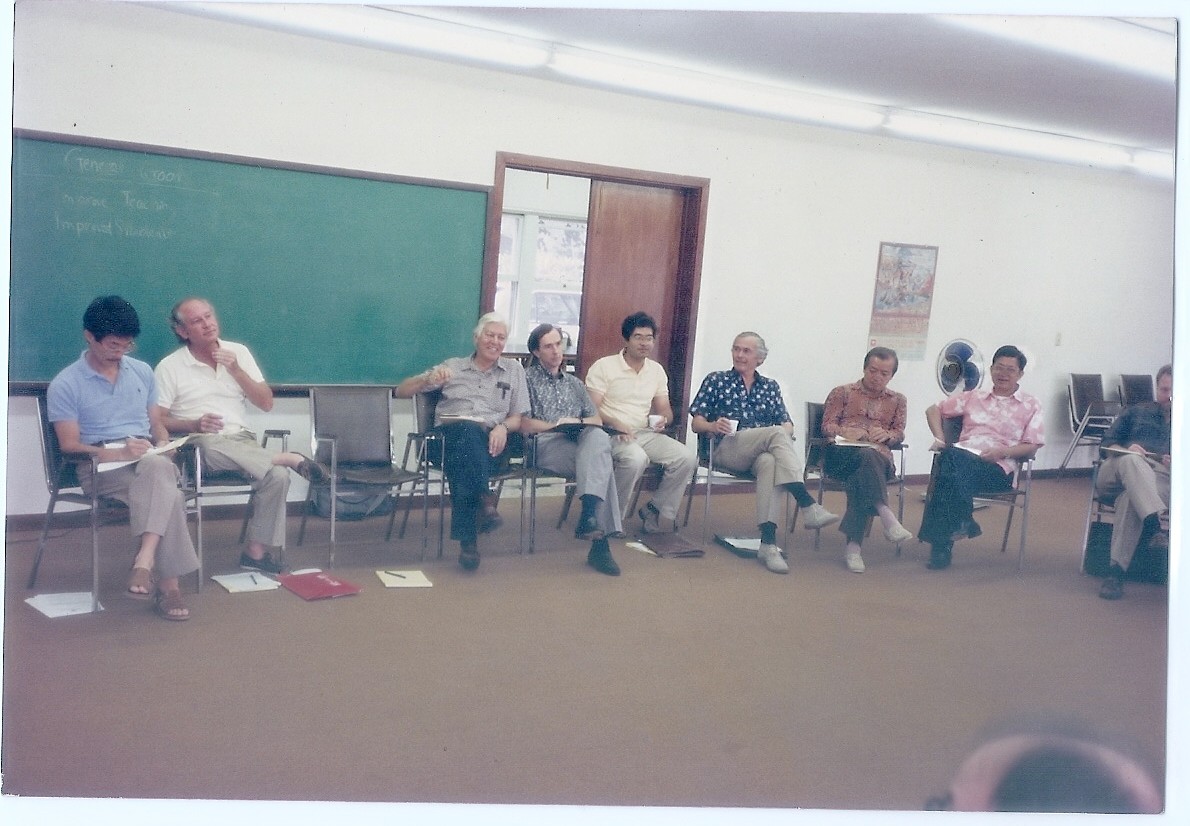
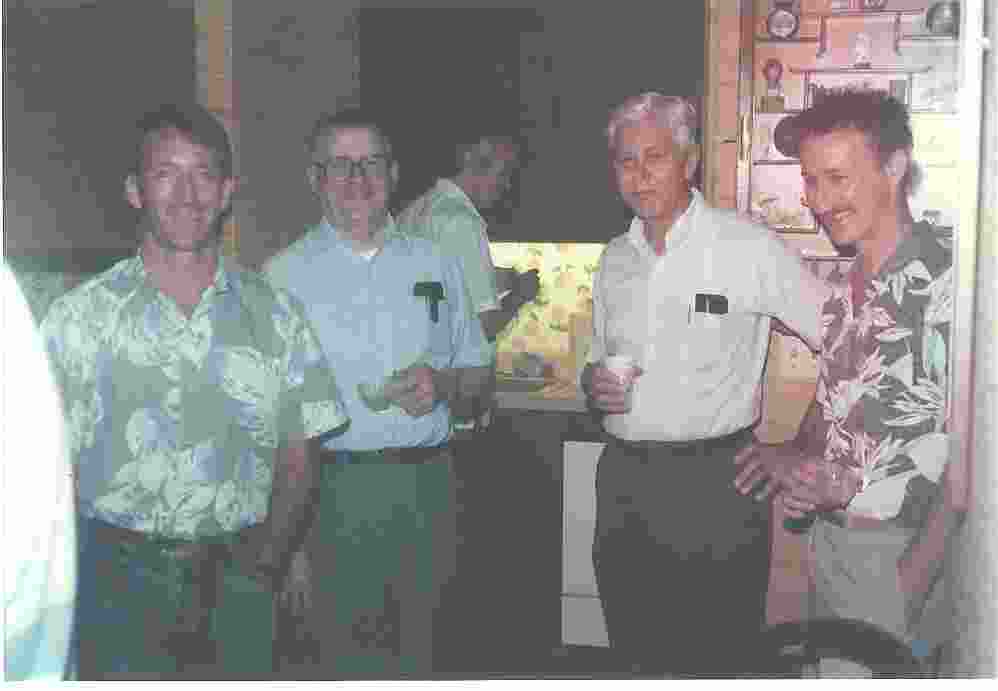
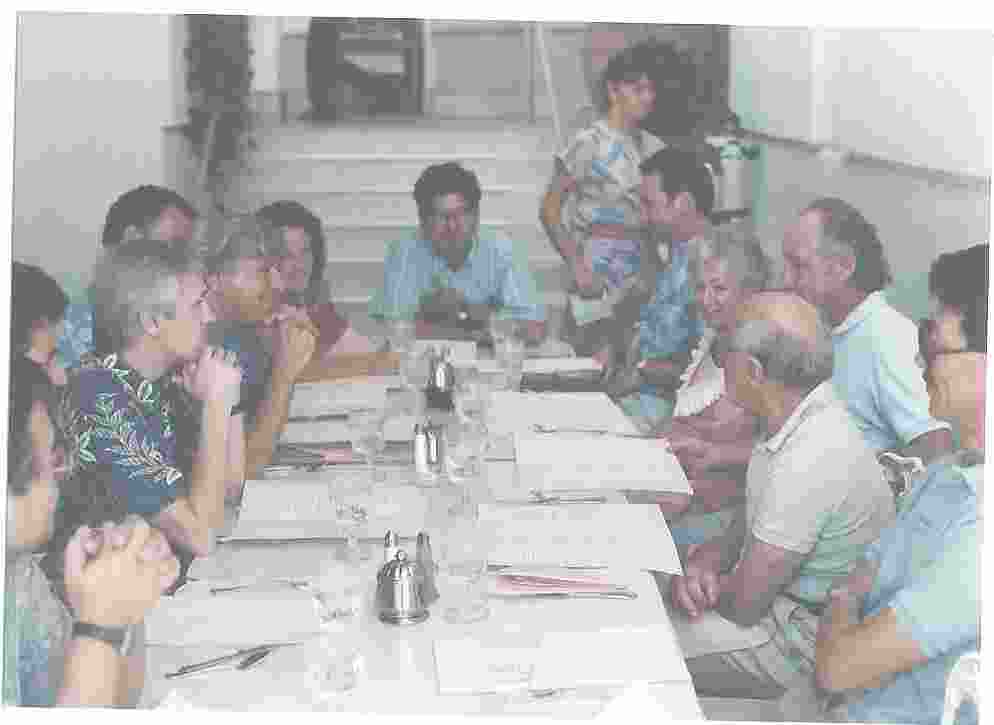
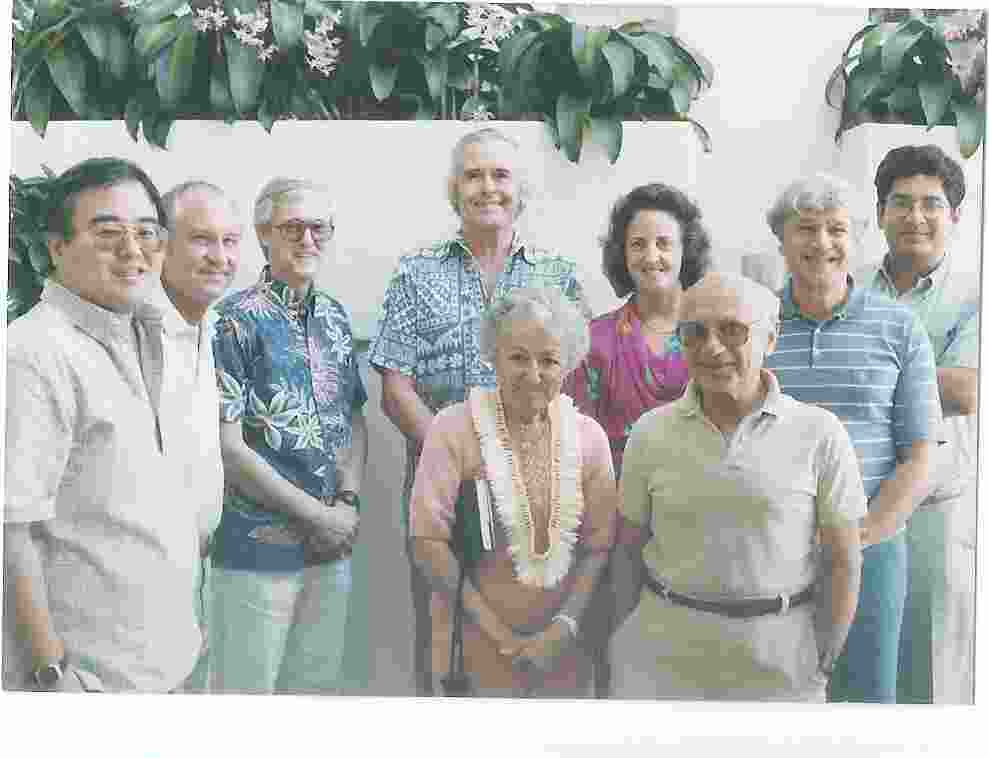
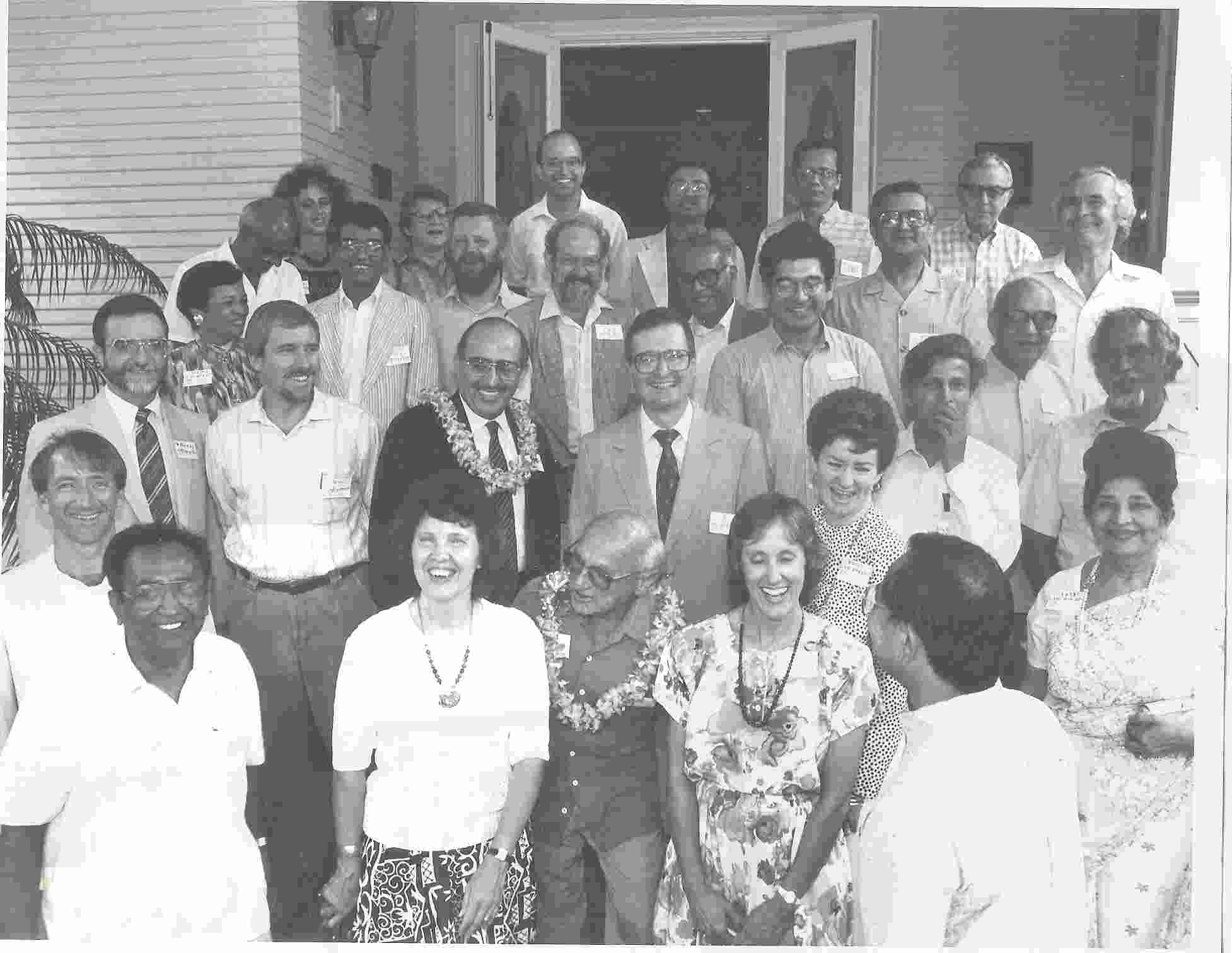
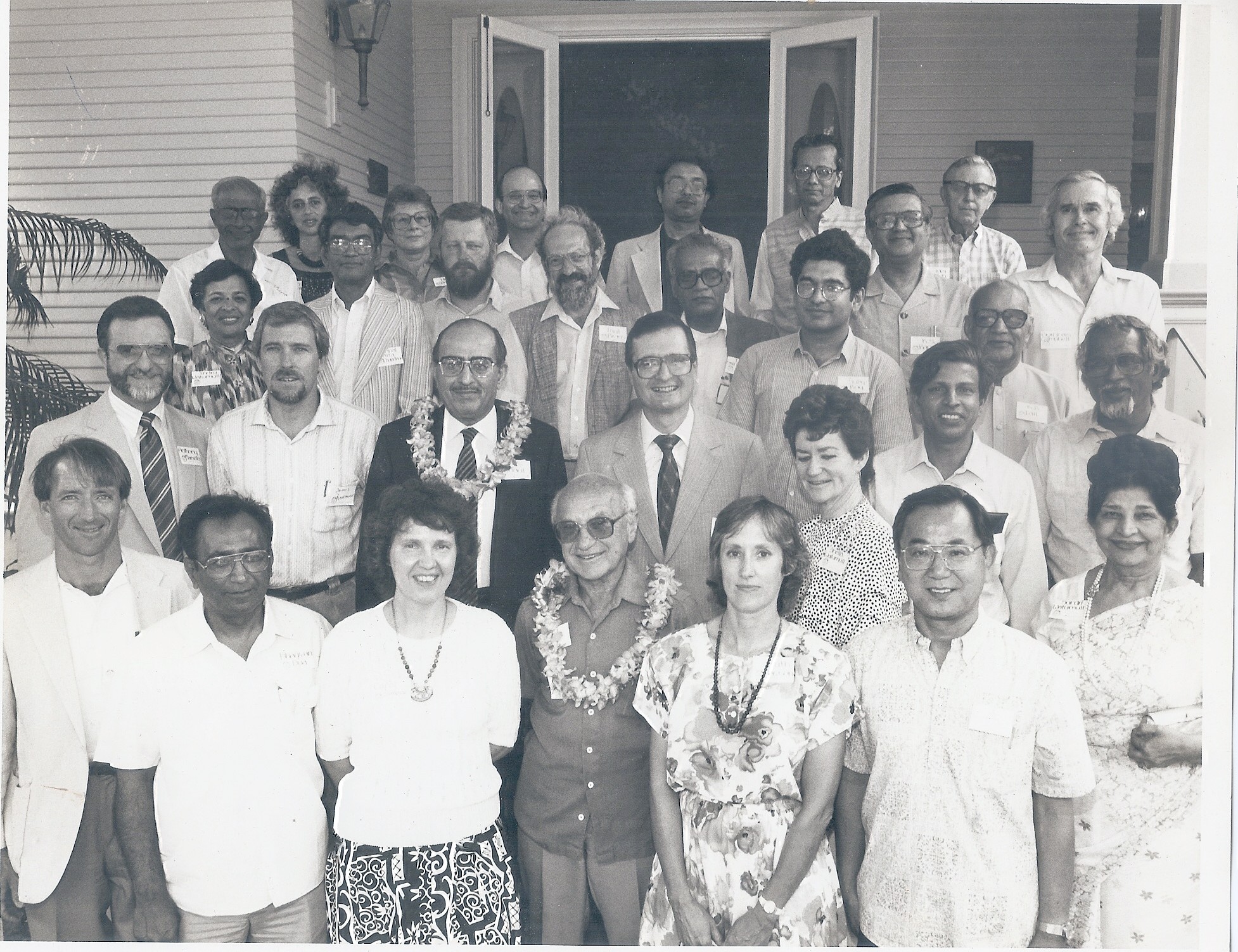
I published Milton’s document for the first time on 21 May 1989 at the conference of the Hawaii project over the loud objection of assorted leftists… 

friedman-et-al-at-uh-india-conf-19891

Amartya Sen, Jagdish Bhagwati, Manmohan Singh or any of their acolytes will not be seen in this group photograph dated 21 May 1989 at the UH President’s House, because they were not there.  The Government of India was represented by the Ambassador to Washington, PK Kaul, as well as the Consul General in San Francisco, KS Rana (later Ambassador to Germany), besides the founding head of ICRIER who had invited himself.  

Manmohan Singh was not there as he precisely represented the Indian economic policy establishment I had been determined to reform!   In any case, he had left India about 1987 on his last assignment before retirement, with Julius Nyerere of Tanzania relating to the “South-South Commission”.  

I have said over more than a half dozen years now that there is no evidence whatsoever of Manmohan Singh having been a liberal economist in any sense of that word at any time before 1991, and scant evidence that he originated any liberal economic ideas since.  The widespread worldwide notion that he is to be credited for originating a sudden transformation of India from a path of pseudo-socialism to one of pseudo-liberalism has been without basis in evidence — almost entirely a political fiction, though an explicable one and one which has served, as such political fictions do, the purposes of those who invent them.

Jagdish Bhagwati and Amartya Sen were in their mid 50s and were two of the three senior-most Indians in US academic economics at the time.  I and Ted James, both in our 30s, decided to invite both Bhagwati and Sen to the Hawaii project-conference as distinguished guests but to do so somewhat insincerely late in the day, predicting they would decline, which is what they did, yet they had come to be formally informed of what we were doing.  We had a very serious attitude that was inspired a bit, I might say, by Oppenheimer’s secret “Manhattan project” and we wanted neither press-publicity nor anyone to become the star who ended up hogging the microphone or the limelight.

Besides, and most important of all, neither Bhagwati nor Sen had done work in the areas we were centrally interested in, namely, India’s macroeconomic and foreign trade framework and fiscal and monetary policies.   

Bhagwati, after his excellent 1970 work with Padma Desai for the OECD on Indian industry and trade, also co-authored with TN Srinivasan a fine 1975 volume for the NBER  Foreign Trade Regimes and Economic Development: India. 

TN Srinivasan was the third of the three senior-most Indian economists at the time in US academia; his work made us want to invite him as one of our main economic authors, and we charged him with writing the excellent chapter in Foundations that he came to do titled “Planning and Foreign Trade Reconsidered”.

The other main economist author we had hoped for was Sukhamoy Chakravarty from Delhi University and the Government of India’s Planning Commission, whom I had known since 1977 when I had been given his office at the Delhi School of Economics as a Visiting Assistant Professor while he was on sabbatical; despite my pleading he would not come due to ill health; he strongly recommended C Rangarajan, telling me Rangarajan had been the main author with him of the crucial 1985 RBI report on monetary policy; and he signed and gave me his last personal copy of that report dating it 14 July 1987.  Rangarajan said he could not come and recommended the head of the NIPFP, Amaresh Bagchi, promising to write jointly with him the chapter on monetary policy and public finance. 

Along with Milton Friedman’s suppressed 1955 memorandum which I was publishing for the first time in 1989, TN Srinivasan and Amaresh Bagchi authored the three main economic policy chapters that we felt we wanted. 

Other chapters we commissioned had to do with the state of governance (James Manor), federalism (Bhagwan Dua), Punjab and similar problems (PR Brass), agriculture (K Subbarao, as proposed by CH Hanumantha Rao), health (Anil Deolalikar, through open advertisement), and a historical assessment of the roots of economic policy (BR Tomlinson, as proposed by Anil Seal).  On the vital subject of education we failed to agree with the expert we wanted very much  (JBG Tilak, as proposed by George Psacharopolous) and so we had to cover the subject cursorily in our introduction mentioning his work.  And decades later, I apologised to Professor Dietmar Rothermund of Heidelberg University for having been so blinkered in the Anglo-American tradition at the time as to not having obtained his participation in the project.  

[The sister-volume we commissioned in parallel on Pakistan’s political economy had among its authors Francis Robinson, Akbar Ahmed, Shirin Tahir-Kehli, Robert La Porte, Shahid Javed Burki, Mohsin Khan, Mahmood Hasan Khan,  Naved Hamid, John Adams and Shahrukh Khan; this book came to be published in Pakistan in 1993 to good reviews but apparently was then lost by its publisher and is yet to be found; the military and religious clergy had been deliberately not invited by us though the name of Pervez Musharraf had I think arisen, and the military and religious clergy in fact came to rule the roost through the 1990s in Pakistan; the volume, two decades old, takes on fresh relevance with the new civilian governments of recent years.] [Postscript  27 November 2015: See my strident critique at Twitter of KM Kasuri, P Musharraf et al  e.g. at https://independentindian.com/2011/11/22/pakistans-point-of-view-or-points-of-view-on-kashmir-my-as-yet-undelivered-lahore-lecture-part-i/ passing off ideas they have taken from this volume without acknowledgement, ideas which have in any case become defunct  to their author, myself.]

Milton himself said this about his experience with me in his memoirs:

tlp

miltononmefinal

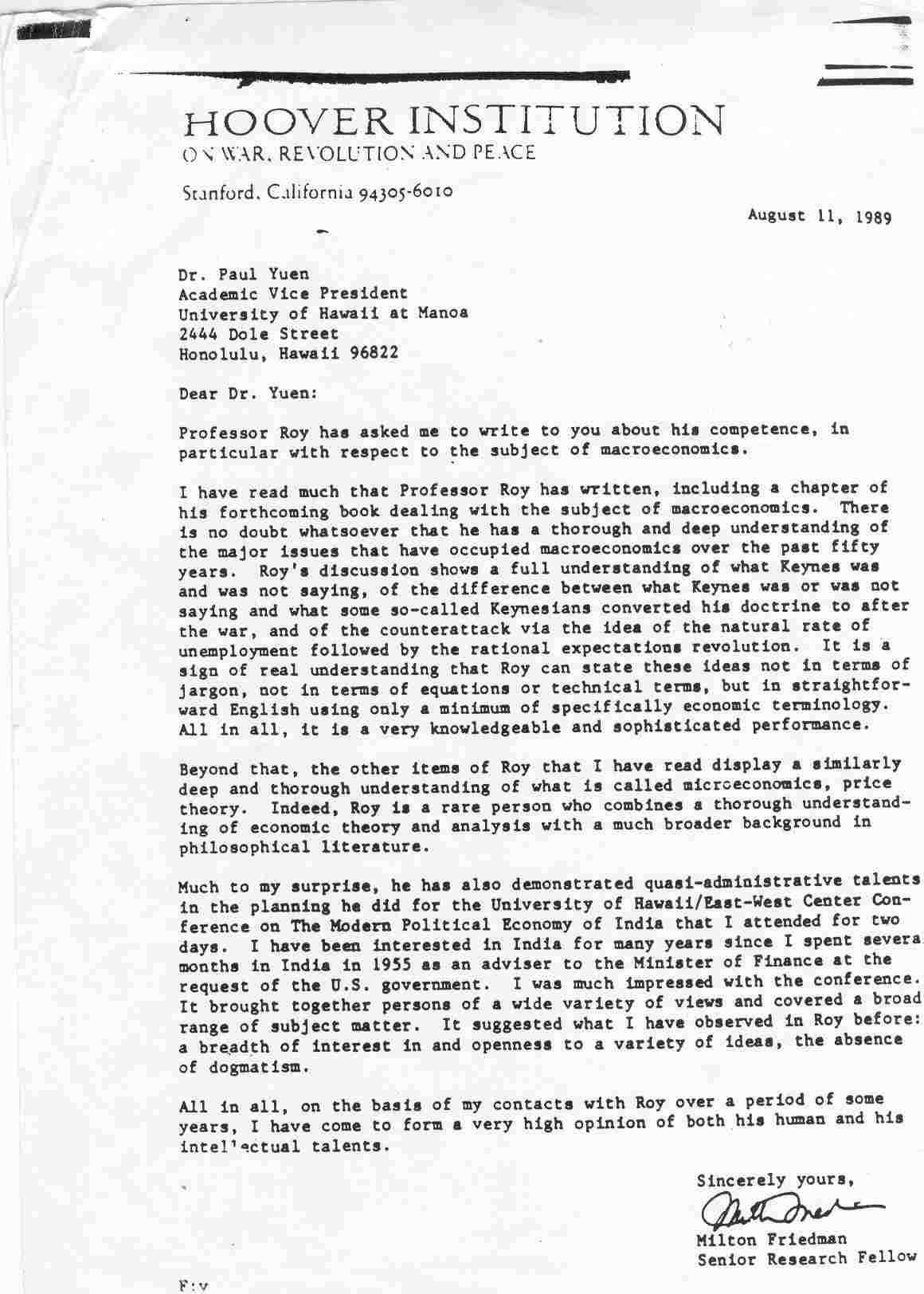
And Milton wrote on my behalf when I came to be attacked, being Indian, at the very University that had sponsored us:

m-friedman-on-roys-work

My obituary notice at his passing in 2006 said: “My association with Milton has been the zenith of my engagement with academic economics…. I was a doctoral student of his bitter enemy yet for over two decades he not only treated me with unfailing courtesy and affection, he supported me in lonely righteous battles: doing for me what he said he had never done before, which was to stand as an expert witness in a United States Federal Court. I will miss him much though I know that he, as a man of reason, would not have wished me to….”

In August 1990 in Delhi I came to tell Siddhartha Shankar Ray about the unpublished India-manuscript resulting from the Hawaii project that was in my possession as it headed to its publisher. 

Ray was a family-friend whose maternal grandfather CR Das led the Congress Party before MK Gandhi and had been a friend and colleague of my great grandfather SN Roy in Bengal’s politics in the 1920s;  Ray had also consented to stand on my behalf as Senior Counsel in a matter in the Supreme Court of India. 

Ray was involved in daily political parlays at his Delhi home with other Congress Party personages led by PV Narasimha Rao.  These senior regional figures seemed to me to be keeping their national leader, Rajiv Gandhi, aloof in splendid isolation at 10 Jan Path. 

Ray told me he and his wife had been in London in May 1984 on the day The Times had written its lead editorial on my work and they had seen it with excitement.  Upon hearing of the Hawaii project and the manuscript I had with me, Ray immediately insisted of his own accord that I must meet Rajiv Gandhi, and that he would be arranging a meeting. 

Hence it came to be a month later that a copy of the manuscript of the completed Hawaii project was be given by my hand on 18 September 1990 to Rajiv Gandhi, then Leader of the Opposition and Congress President, an encounter I have quite fully described elsewhere.  I offered to get a copy to the PM, VP Singh, too but a key aide of his showed no interest in receiving it.

Rajiv made me a senior adviser, and I have claimed principal authorship of the 22 March 1991 draft of the Congress manifesto that actually shook and changed the political thinking of the Congress on economic matters in the direction Rajiv had desired and as I had advised him at our initial 18 September 1990 meeting. 

“… He began by talking about how important he felt panchayati raj was, and said he had been on the verge of passing major legislation on it but then lost the election. He asked me if I could spend some time thinking about it, and that he would get the papers sent to me. I said I would and remarked panchayati raj might be seen as decentralized provision of public goods, and gave the economist’s definition of public goods as those essential for the functioning of the market economy, like the Rule of Law, roads, fresh water, and sanitation, but which were unlikely to appear through competitive forces.

I distinguished between federal, state and local levels and said many of the most significant public goods were best provided locally. Rajiv had not heard the term “public goods” before, and he beamed a smile and his eyes lit up as he voiced the words slowly, seeming to like the concept immensely. It occurred to me he had been by choice a pilot of commercial aircraft. Now he seemed intrigued to find there could be systematic ways of thinking about navigating a country’s governance by common pursuit of reasonable judgement. I said the public sector’s wastefulness had drained scarce resources that should have gone instead to provide public goods. Since the public sector was owned by the public, it could be privatised by giving away its shares to the public, preferably to panchayats of the poorest villages. The shares would become tradable, drawing out black money, and inducing a historic redistribution of wealth while at the same time achieving greater efficiency by transferring the public sector to private hands. Rajiv seemed to like that idea too, and said he tried to follow a maxim of Indira Gandhi’s that every policy should be seen in terms of how it affected the common man. I wryly said the common man often spent away his money on alcohol, to which he said at once it might be better to think of the common woman instead. (This remark of Rajiv’s may have influenced the “aam admi” slogan of the 2004 election, as all Congress Lok Sabha MPs of the previous Parliament came to receive a previous version of the present narrative.)

Our project had identified the Congress’s lack of internal elections as a problem; when I raised it, Rajiv spoke of how he, as Congress President, had been trying to tackle the issue of bogus electoral rolls. I said the judiciary seemed to be in a mess due to the backlog of cases; many of which seemed related to land or rent control, and it may be risky to move towards a free economy without a properly functioning judicial system or at least a viable system of contractual enforcement. I said a lot of problems which should be handled by the law in the courts in India were instead getting politicised and decided on the streets. Rajiv had seen the problems of the judiciary and said he had good relations with the Chief Justice’s office, which could be put to use to improve the working of the judiciary.

The project had worked on Pakistan as well, and I went on to say we should solve the problem with Pakistan in a definitive manner. Rajiv spoke of how close his government had been in 1988 to a mutual withdrawal from Siachen. But Zia-ul-Haq was then killed and it became more difficult to implement the same thing with Benazir Bhutto, because, he said, as a democrat, she was playing to anti-Indian sentiments while he had found it somewhat easier to deal with the military. I pressed him on the long-term future relationship between the countries and he agreed a common market was the only real long-term solution. I wondered if he could find himself in a position to make a bold move like offering to go to Pakistan and addressing their Parliament to break the impasse. He did not say anything but seemed to think about the idea. Rajiv mentioned a recent Time magazine cover of Indian naval potential, which had caused an excessive stir in Delhi. He then talked about his visit to China, which seemed to him an important step towards normalization. He said he had not seen (or been shown) any absolute poverty in China of the sort we have in India. He talked about the Gulf situation, saying he did not disagree with the embargo of Iraq except he wished the ships enforcing the embargo had been under the U.N. flag. The meeting seemed to go on and on, and I was embarrassed at perhaps having taken too much time and that he was being too polite to get me to go. V. George had interrupted with news that Sheila Dixit (as I recall) had just been arrested by the U. P. Government, and there were evidently people waiting. Just before we finally stood up I expressed a hope that he was looking to the future of India with an eye to a modern political and economic agenda for the next election, rather than getting bogged down with domestic political events of the moment. That was the kind of hopefulness that had attracted many of my generation in 1985. I said I would happily work in any way to help define a long-term agenda. His eyes lit up and as we shook hands to say goodbye, he said he would be in touch with me again…. The next day I was called and asked to stay in Delhi for a few days, as Mr. Gandhi wanted me to meet some people…..

… That night Krishna Rao dropped me at Tughlak Road where I used to stay with friends. In the car I told him, as he was a military man with heavy security cover for himself as a former Governor of J&K, that it seemed to me Rajiv’s security was being unprofessionally handled, that he was vulnerable to a professional assassin. Krishna Rao asked me if I had seen anything specific by way of vulnerability. With John Kennedy and De Gaulle in mind, I said I feared Rajiv was open to a long-distance sniper, especially when he was on his campaign trips around the country.  This was one of several attempts I made since October 1990 to convey my clear impression to whomever I thought might have an effect that Rajiv seemed to me extremely vulnerable. Rajiv had been on sadhbhavana journeys, back and forth into and out of Delhi. I had heard he was fed up with his security apparatus, and I was not surprised given it seemed at the time rather bureaucratized. It would not have been appropriate for me to tell him directly that he seemed to me to be vulnerable, since I was a newcomer and a complete amateur about security issues, and besides if he agreed he might seem to himself to be cowardly or have to get even closer to his security apparatus. Instead I pressed the subject relentlessly with whomever I could. I suggested specifically two things: (a) that the system in place at Rajiv’s residence and on his itineraries be tested, preferably by some internationally recognized specialists in counter-terrorism; (b) that Rajiv be encouraged to announce a shadow-cabinet. The first would increase the cost of terrorism, the second would reduce the potential political benefit expected by terrorists out to kill him. On the former, it was pleaded that security was a matter being run by the V. P. Singh and then Chandrashekhar Governments at the time. On the latter, it was said that appointing a shadow cabinet might give the appointees the wrong idea, and lead to a challenge to Rajiv’s leadership. This seemed to me wrong, as there was nothing to fear from healthy internal contests for power so long as they were conducted in a structured democratic framework. I pressed to know how public Rajiv’s itinerary was when he travelled. I was told it was known to everyone and that was the only way it could be since Rajiv wanted to be close to the people waiting to see him and had been criticized for being too aloof. This seemed to me totally wrong and I suggested that if Rajiv wanted to be seen as meeting the crowds waiting for him then that should be done by planning to make random stops on the road that his entourage would take. This would at least add some confusion to the planning of potential terrorists out to kill him. When I pressed relentlessly, it was said I should probably speak to “Madame”, i.e. to Mrs. Rajiv Gandhi. That seemed to me highly inappropriate, as I could not be said to be known to her and I should not want to unduly concern her in the event it was I who was completely wrong in my assessment of the danger. The response that it was not in Congress’s hands, that it was the responsibility of the VP Singh and later the Chandrashekhar Governments, seemed to me completely irrelevant since Congress in its own interests had a grave responsibility to protect Rajiv Gandhi irrespective of what the Government’s security people were doing or not doing. Rajiv was at the apex of the power structure of the party, and a key symbol of secularism and progress for the entire country. Losing him would be quite irreparable to the party and the country. It shocked me that the assumption was not being made that there were almost certainly professional killers actively out to kill Rajiv Gandhi — this loving family man and hapless pilot of India’s ship of state who did not seem to have wished to make enemies among India’s terrorists but whom the fates had conspired to make a target. The most bizarre and frustrating response I got from several respondents was that I should not mention the matter at all as otherwise the threat would become enlarged and the prospect made more likely! This I later realized was a primitive superstitious response of the same sort as wearing amulets and believing in Ptolemaic astrological charts that assume the Sun goes around the Earth — centuries after Kepler and Copernicus. Perhaps the entry of scientific causality and rationality is where we must begin in the reform of India’s governance and economy. What was especially repugnant after Rajiv’s assassination was to hear it said by his enemies that it marked an end to “dynastic” politics in India. This struck me as being devoid of all sense because the unanswerable reason for protecting Rajiv Gandhi was that we in India, if we are to have any pretensions at all to being a civilized and open democratic society, cannot tolerate terrorism and assassination as means of political change. Either we are constitutional democrats willing to fight for the privileges of a liberal social order, or ours is truly a primitive and savage anarchy concealed beneath a veneer of fake Westernization….. Proceedings began when Rajiv arrived. This elite audience mobbed him just as the farmers had mobbed him earlier. He saw me and beamed a smile in recognition, and I smiled back but made no attempt to draw near him in the crush. He gave a short very apt speech on the role the United Nations might have in the new post-Gulf War world. Then he launched the book, and left for an investiture at Rashtrapati Bhavan. We waited for our meeting with him, which finally happened in the afternoon. Rajiv was plainly at the point of exhaustion and still hard-pressed for time. He seemed pleased to see me and apologized for not talking in the morning. Regarding the March 22 draft, he said he had not read it but that he would be doing so. He said he expected the central focus of the manifesto to be on economic reform, and an economic point of view in foreign policy, and in addition an emphasis on justice and the law courts. I remembered our September 18 conversation and had tried to put in justice and the courts into our draft but had been over-ruled by others. I now said the social returns of investment in the judiciary were high but was drowned out again. Rajiv was clearly agitated that day by the BJP and blurted out he did not really feel he understood what on earth they were on about. He said about his own family, “We’re not religious or anything like that, we don’t pray every day.” I felt again what I had felt before, that here was a tragic hero of India who had not really wished to be more than a happy family man until he reluctantly was made into a national leader against his will. We were with him for an hour or so. As we were leaving, he said quickly at the end of the meeting he wished to see me on my own and would be arranging a meeting. One of our group was staying back to ask him a favour. Just before we left, I managed to say to him what I felt was imperative: “The Iraq situation isn’t as it seems, it’s a lot deeper than it’s been made out to be.” He looked at me with a serious look and said “Yes I know, I know.” It was decided Pitroda would be in touch with each of us in the next 24 hours. During this time Narasimha Rao’s manifesto committee would read the draft and any questions they had would be sent to us. We were supposed to be on call for 24 hours. The call never came. Given the near total lack of system and organization I had seen over the months, I was not surprised. Krishna Rao and I waited another 48 hours, and then each of us left Delhi. Before going I dropped by to see Krishnamurty, and we talked at length. He talked especially about the lack of the idea of teamwork in India. Krishnamurty said he had read everything I had written for the group and learned a lot. I said that managing the economic reform would be a critical job and the difference between success and failure was thin….”

543068_10151152270882285_835660216_n

28060_10151152260232285_1198018897_n

530942_10151152258747285_1492496235_n 382134_10151152256102285_1650952662_n

“… I got the afternoon train to Calcutta and before long left for America to bring my son home for his summer holidays with me. In Singapore, the news suddenly said Rajiv Gandhi had been killed. All India wept. What killed him was not merely a singular act of criminal terrorism, but the system of humbug, incompetence and sycophancy that surrounds politics in India and elsewhere. I was numbed by rage and sorrow, and did not return to Delhi….”

In December 1991, I visited Rajiv’s widow at 10 Jan Path to express my condolences, the only time I have met her, and I gave her for her records a taped copy of Rajiv’s long-distance telephone conversations with me during the Gulf War earlier that year.   She seemed an extremely shy taciturn figure in deep mourning, and I do not think the little I said to her about her late husband’s relationship with me was comprehended.  Nor was it the time or place for more to be said.

In September 1993, at a special luncheon at the Indian Ambassador’s Residence in Washington, Siddhartha Shankar Ray, then the Ambassador to Washington, pointed at me and declared to Manmohan Singh, then Finance Minister, in presence of Manmohan’s key aides accompanying him including MS Ahluwalia, NK Singh, C Rangarajan and others,

“Congress manifesto was written on his computer”.

This was accurate enough to the extent that the 22 March 1991 draft as asked for by Rajiv and that came to explicitly affect policy had been and remains on my then-new NEC laptop.

At the Ambassador’s luncheon, I gave Manmohan Singh a copy of the Foundations book as a gift.  My father who knew him in the early 1970s through MG Kaul, ICS, had sent him a copy of my 1984 IEA monograph which Manmohan had acknowledged.  And back in 1973, he had visited our then-home at 14 Rue Eugene Manuel in Paris to advise me about economics at my father’s request, and he and I had ended up in a fierce private debate for about forty minutes over the demerits (as I saw them) and merits (as he saw them) of the Soviet influence on Indian economic policy-making.  But in 1993 we had both forgotten the 1973 meeting.  

In May 2002, the Congress passed an official party resolution moved by Digvijay Singh in presence of PV Narasimha Rao and Manmohan Singh that the 1991 reforms had originated with Rajiv Gandhi and not with either Narasimha Rao or Manmohan; no one dissented.  It was intended to flatter Sonia Gandhi as the Congress President,  but there was truth in it too which all Congress MPs of the 13th Lok Sabha had come to know in a publication of mine they had received from me at IIT Kharagpur where since 1996 I had become Professor.  

Manmohan Singh himself, to his credit, has not at any point, except once during his failed Lok Sabha bid, claimed the reforms as his own invention and has said always he had followed what his Prime Minister had told him. However, he has not been averse to being attributed with all the credit by his flatterers, by the media, by businessmen and many many others around the world, and certainly he did not respond to Ambassador Siddhartha Shankar Ray telling him and his key aides how the Congress-led reform had come about through my work except to tell me at the 1993 luncheon that when Arjun Singh criticised the reforms in Cabinet, he, Manmohan, would mention the manifesto. 

On 28 December 2009, Rajiv’s widow in an official Congress Party statement finally declared her late husband

left his personal imprint on the (Congress) party’s manifesto of 1991.″ 

How Sonia Gandhi, who has never had pretensions to knowledge of economics or political economy or political science or governance or history, came to place Manmohan Singh as her prime ministerial candidate and the font of economic and political wisdom along with Pranab Mukherjee, when both men hardly had been favourites of her late husband, would be a story in its own right.  And how Amartya Sen’s European-origin naturalised Indian co-author Jean Drèze later came to have policy influence from a different direction upon Sonia Gandhi, also a naturalised Indian of European origin, may be yet another story in its own right,  perhaps best told by themselves.

I would surmise the same elderly behind-the-scenes figure, now in his late 80s, had a hand in setting up both sets of influences — directly in the first case (from back in 1990-1991),  and indirectly in the second case (starting in 2004) .  This was a man who in a November 2007 newspaper article literally erased my name and inserted that of Manmohan Singh as part of the group that Rajiv created on 25 September following his 18 September meeting with me!   Reluctantly, I had to call this very elderly man a liar; he has not denied it and knows he has not been libeled.

One should never forget the two traditional powers interested in the subcontinent, Russia and Britain, have been never far from influence in Delhi.  In 1990-1991 what worried vested bureaucratic and business interests and foreign powers through their friends and agents was that they could see change was coming to India but they wanted to be able to control it themselves to their advantage, which they then broadly proceeded to do over the next two decades.  The foreign weapons’ contracts had to be preserved, as did other big-ticket imports that India ends up buying needlessly on credit it hardly has in world markets.  There are similarities to what happened in Russia and Eastern Europe where many apparatchiks and fellow-travellers became freedom-loving liberals overnight;  in the Indian case more than one badly compromised pro-USSR senior bureaucrat promptly exported his children and savings to America and wrapped themselves in the American flag.

The stubborn unalterable fact remains that Manmohan Singh was not physically present in India and was still with the Nyerere project on 18 September 1990 when I met Rajiv for the first time and gave him the unpublished results of the UH-Manoa project.  This simple straightforward fact is something the Congress Party, given its own myths and self-deception and disinformation, has not been able to cope with in its recently published history.   For myself, I have remained loyal to my memory of my encounter with Rajiv Gandhi, and my understanding of him.  The Rajiv Gandhi I knew had been enthused by me in 1990-1991 carrying the UH-Manoa perestroika-for-India project that I had led since 1986, and he had loved my advice to him on 18 September 1990 that he needed to modernise the party by preparing a coherent agenda (as other successful reformers had done) while still in Opposition waiting for elections, and to base that agenda on commitments to improving the judiciary and rule of law, stopping the debauching of money, and focusing on the provision of public goods instead.    Rajiv I am sure wanted a modern and modern-minded Congress — not one which depended on him let aside his family, but one which reduced that dependence and let him and his family alone.

As for Manmohan Singh being a liberal or liberalising economist, there is no evidence publicly available of that being so from his years before or during the Nyerere project, or after he returned and joined the Chandrashekhar PMO and the UGC  until becoming,  to his own surprise as he told Mark Tully,  PV Narasimha Rao’s Finance Minister.  Some of his actions qua Finance Minister were liberalising in nature but he did not originate any basic idea of a change in a liberal direction of economic policy, and he has, with utmost honesty honestly, not claimed otherwise.  Innumerable flatterers and other self-interested parties have made out differently, creating what they have found to be a politically useful fiction; he has yet to deny them.

Siddhartha Shankar Ray and I met last in July 2009, when I gave him a copy of this 2005 volume I had created, which pleased him much. 

180651_497147822284_519449_n

I said to him Bengal’s public finances were in abysmal condition, calling for emergency measures financially, and that Mamata Banerjee seemed to me to be someone who knew how to and would dislodge the Communists from their entrenched misgovernance of decades but she did not seem quite aware that dislodging a bad government politically was not the same thing as knowing how to govern properly oneself.  He,  again of his own accord, said immediately, 

“I will call her and her people to a meeting here so you can meet them and tell them that directly”. 

It never transpired.  In our last phone conversation I mentioned to him my plans of creating a Public Policy Institute — an idea he immediately and fully endorsed as being essential though adding “I can’t be part of it,  I’m on my way out”.

“I’m on my way out”.   That was Siddhartha Shankar Ray — always intelligent, always good-humoured, always public-spirited, always a great Indian, my only friend among politicians other than the late Rajiv Gandhi himself.

18slide1

In March February 2010, my father and I called upon the new Bengal Governor, MK Narayanan and gave him a copy of the Thatcher volume for the Raj Bhavan Library; I told him the story about my encounter with Rajiv Gandhi thanks to Siddhartha Shankar Ray and its result;  Narayanan within a few days made a visit to Ray’s hospital-bed, and when he emerged after several hours he made a statement, which in substance he repeated again when Ray died in November 2010:

“There are few people in post-Independence India who could equal his magnificent contribution to India’s growth and progress”.

To what facts did MK Narayanan, a former Intelligence Bureau chief, mean to refer with this extravagant praise of Ray?  Was Narayanan referring to Ray’s politics for Indira Gandhi?  To Ray’s Chief Ministership of Bengal?  To Ray’s Governorship of Punjab?  You will have to ask him but I doubt that was what he meant:  I surmise Narayanan’s eulogy could only have resulted after he confirmed with Ray on his hospital-bed the story I had told him, and that he was referring to the economic and political results that followed for the country once Ray had introduced me in September 1990 to Rajiv Gandhi. But I say again, you will have to ask MK Narayanan himself what he and Ray talked about in hospital and what was the factual basis of Narayanan’s precise words of praise. To what facts exactly was MK Narayanan, former intelligence chief, meaning to refer when he stated Siddhartha Shankar Ray had made a “magnificent contribution to India’s growth and progress”?


3.   Jagdish Bhagwati & Manmohan Singh?  That just don’t fly!

Now returning to the apparent desire of Professor Panagariya, the Jagdish Bhagwati Professor of Indian Political Economy at Columbia, to attribute to Jagdish Bhagwati momentous change for the better in India as of 1991, even if Panagariya had not the scientific curiosity to look into our 1992 book titled Foundations of India’s Political Economy: Towards an Agenda for the 1990s or into Milton Friedman’s own 1998 memoirs, we may have expected him to at least turn to his co-author and Columbia colleague, Jagdish Bhagwati himself, and ask, “Master, have you heard of this fellow Subroto Roy by any chance?”

Jagdish would have had to say yes, since not only had he received a copy of the proofs of my 1984 IEA work Pricing, Planning and Politics: A Study of Economic Distortions in India, he was kind enough to write in a letter dated 15 May 1984 that I had

“done an excellent job of setting out the problems afflicting our economic policies, unfortunately government-made problems!” 

1013586_10151543024792285_1764498590_n

Also Jagdish may or may not have remembered our only meeting, when he and I had had a long conversation on the sofas in the foyer of the IMF in Washington when I was a consultant there in 1993 and he had come to meet someone; he was surprisingly knowledgeable about my personal 1990 matter in the Supreme Court of India which astonished me until he told me his brother the Supreme Court judge had mentioned the case to him!

Now my 1984 work was amply scientific and scholarly in fully crediting a large number of works in the necessary bibliography, including Bhagwati’s important work with his co-authors.  Specifically, Footnote 1 listed the literature saying:

“The early studies notably include: B. R. Shenoy, `A note of dissent’, Papers relating to the formulation of the Second Five-Year Plan, Government of India Planning Commission, Delhi, 1955; Indian Planning and Economic Development, Asia Publishing, Bombay, 1963, especially pp. 17-53; P. T. Bauer, Indian Economic Policy and Development, George Allen & Unwin, London, 1961; M. Friedman, unpublished memorandum to the Government of India, November 1955 (referred to in Bauer, op. cit., p. 59 ff.); and, some years later, Sudha Shenoy, India : Progress or Poverty?, Research Monograph 27, Institute of Economic Affairs, London, 1971. Some of the most relevant contemporary studies are: B. Balassa, `Reforming the system of incentives in World Development, 3 (1975), pp. 365-82; `Export incentives and export performance in developing countries: a comparative analysis’, Weltwirtschaftliches Archiv, 114 (1978), pp. 24-61; The process of industrial development and alternative development strategies, Essays in International Finance No. 141, Princeton University, 1980; J. N. Bhagwati & P. Desai, India: Planning for Industrialisation, OECD, Paris : Oxford University Press, 1970; `Socialism and Indian Economic Policy’, World Development, 3 (1975), pp. 213-21; J. N. Bhagwati & T. N. Srinivasan, Foreign-trade Regimes and Economic Development: India, National Bureau of Economic Research, New York, 1975; Anne O. Krueger, `Indian planning experience’, in T. Morgan et al. (eds.), Readings in Economic Development, Wadsworth, California, 1963, pp. 403-20; `The political economy of the rent-seeking society, American Economic Review, 64 (June 1974); The Benefits and Costs of Import-Substitution in India: a Microeconomic Study, University of Minnesota Press, Minneapolis, 1975; Growth, distortions and patterns of trade among many countries, Studies in International Finance, Princeton University, 1977; Uma Lele, Food grain marketing in India : private performance and public policy, Cornell University Press, Ithaca, 1971; T. W. Schultz (ed.), Distortions in agricultural incentives, Indiana University Press, Bloomington, 1978; V. Sukhatme, “The utilization of high-yielding rice and wheat varieties in India: an economic assessment”, University of Chicago PhD thesis, 1977….”

There were two specific references to Bhagwati’s work with Srinivasan:

“Jagdish Bhagwati and T. N. Srinivasan put it as follows : `The allocation of foreign exchange among alternative claimants and users in a direct control system . . .would presumably be with reference to a well-defined set of principles and criteria based on a system of priorities. In point of fact, however, there seem to have been few such criteria, if any, followed in practice.’”

and

“But as Bhagwati and Srinivasan report, `. . . the sheer weight of numbers made any meaningful listing of priorities extremely difficult. The problem was Orwellian: all industries had priority and how was each sponsoring authority to argue that some industries had more priority than others? It is not surprising, therefore, that the agencies involved in determining allocations by industry fell back on vague notions of “fairness”, implying pro rata allocations with reference to capacity installed or employment, or shares defined by past import allocations or similar rules of thumb’”

and one to Bhagwati and Desai:

“The best descriptions of Indian industrial policy are still to be found in Bhagwati and Desai (1970)…”

Professors Bhagwati and Panagriya have not apparently referred to anything beyond these joint works of Bhagwati’s dated 1970 with Padma Desai and 1975 with TN Srinivasan.  They have not claimed Bhagwati did anything by way of either publication or political activity in relation to India’s economic policy between May 1984, when he read my soon-to-be-published-work and found I had

done an excellent job of setting out the problems afflicting our economic policies, unfortunately government-made problems”,

and September 1990 when I gave Rajiv the University of Hawaii perestroika-for-India project results developed since 1986, which came to politically spark the 1991 reform in the Congress’s highest echelons from months before Rajiv’s assassination.   

There may have been no such claim made by Bhagwati and Panagariya because there may be no such evidence.  Between 1984 and 1990,  Professor Bhagwati’s research interests were away from Indian economic policy while his work on India through 1970 and 1975 had been fully and reasonably accounted for as of 1984 by myself.

What is left remaining is Bhagwati’s statement :

“When finance minister Manmohan Singh was in New York in 1992, he had a lunch for many big CEOs whom he was trying to seduce to come to India. He also invited me and my wife, Padma Desai, to the lunch. As we came in, the FM introduced us to the invitees and said: ‘These friends of mine wrote almost a quarter century ago [India: Planning for Industrialisation was published in 1970 by Oxford] recommending all the reforms we are now undertaking. If we had accepted the advice then, we would not be having this lunch as you would already be in India’

Now this light self-deprecating reference by Manmohan at an investors’ lunch in New York “for many big CEOs” was an evident attempt at political humour written by his speech-writer.   It was clearly, on its face, not serious history.   If we test it as serious history, it falls flat so we may only hope Manmohan Singh, unlike Jagdish Bhagwati, has not himself come to believe his own reported joke as anything more than that.  

The Bhagwati-Desai volume being referred to was developed from 1966-1970.  India saw critical economic and political events  in 1969, in 1970, in 1971, in 1972, in 1975, in 1977, etc.

Those were precisely years during which Manmohan Singh himself moved from being an academic to becoming a Government of India official, working first for MG Kaul, ICS, and then in 1971 coming to the attention of  PN Haksar, Indira Gandhi’s most powerful bureaucrat between 1967 and 1974: Haksar himself was Manmohan Singh’s acknowledged mentor in the Government, as Manmohan told Mark Tully in an interview.  

After Manmohan visited our Paris home in 1973 to talk to me about economics, my father — who had been himself sent to the Paris Embassy by Haksar in preparation for Indira Gandhi’s visit in November 1971 before the Bangladesh war —

scan0024

had told me Manmohan was very highly regarded in government circles with economics degrees from both Cambridge and Oxford, and my father had added, to my surprise, what was probably a Haksarian governmental view that Manmohan was expected to be India’s Prime Minister some day.  That was 1973.

PN Haksar had been the archetypal Nehruvian Delhi intellectual of a certain era, being both a fierce nationalist and a fierce pro-USSR leftist from long before Independence.  I met him once on 23 March 1991, on the lawns of 10 Jan Path at the launch of General V Krishna Rao’s book on Indian defence which Rajiv was releasing, and Haksar gave a speech to introduce Rajiv (as if Rajiv needed introduction on the lawns of his own residence);  Haksar was in poor health but he seemed completely delighted to be back in favour with Rajiv,  after years of having been treated badly by Indira and her younger son.  

 Had Manmohan Singh in the early 1970s gone to Haksar — the architect of the nationalisation of India’s banking going on right then — and said “Sir, this OECD study by my friend Bhagwati and his wife says we should be liberalising foreign trade and domestic industry”, Haksar would have been astonished and sent him packing.  

There was a war on, plus a massive problem of 10 million refugees, a new country to support called Bangladesh, a railway strike, a bad crop, repressed inflation, shortages, and heaven knows what more, besides Nixon having backed Yahya Khan, Tikka Khan et al. 

nixon-note

Then after Bangladesh and the railway strike etc, came the rise of the politically odious younger son of Indira Gandhi and his friends (at least one of whom is today Sonia Gandhi’s gatekeeper) followed by the internal political Emergency, the grave foreign-fueled problem of Sikh separatism and its control, the assassination of Indira Gandhi by her own Sikh bodyguards, and the Rajiv Gandhi years as Prime Minister. 

Certainly it was Rajiv’s arrival in office and Benazir’s initial return to Pakistan, along with the rise of Michael Gorbachev in the changing USSR, that inspired me in far away Hawaii in 1986 to design with Ted James the perestroika-projects for India and Pakistan which led to our two volumes, and which, thanks to Siddhartha Shankar Ray, came to reach Rajiv Gandhi in Opposition in September 1990 as he sat somewhat forlornly at 10 Jan Path after losing office. “There is a tide in the affairs of men, Which taken at the flood, leads on to fortune….

My friend and collaborator Ted James died of cancer in Manila in May 2010; earlier that year he came to say publicly

“Seldom are significant reforms imposed successfully by international bureaucracies. Most often they are the result of indigenous actors motivated by domestic imperatives. I believe this was the case in India in 1991. It may have been fortuitous that Dr. Roy gained an audience with a receptive Rajiv Gandhi in 1990 but it was not luck that he was prepared with a well-thought out program; this arose from years of careful thought and debate on the matter.”

Changing the direction of a ship of state is very hard, knowing in which direction it should change and to what degree is even harder; it has rarely been something that can be done without random shocks arising let aside the power of vested interests. Had Rajiv Gandhi lived to form a new Government, I have little doubt I would have led the reform that I had chalked out for him and that he had approved of;  Sonia Gandhi would have remained the housewife, mother and grandmother that she had preferred to be and not been made into the Queen of India by the Congress Party; Manmohan Singh had left India in 1987 for the Nyerere project and it had been rumoured at the time that had been slightly to do with him protesting, to the extent that he ever has protested anything, the anti-Sikh pogrom that some of Rajiv’s friends had apparently unleashed after Indira’s killing; he returned in November 1990, joined Chandrashekhar in December 1990, left Chandrashekhar in March 1991 when elections were announced and was biding his time as head of the UGC; had Rajiv Gandhi lived, Manmohan Singh would have had a governor’s career path, becoming the governor of one state after another; he would not have been brought into the economic reform process which he had had nothing to do with originating; and finally Pranab Mukherjee, who left the Congress Party and formed his own when Rajiv took over, would have been likely rehabilitated slowly but would not have come to control the working of the party as he did. I said in my Lok Sabha TV interview on 5 9 December 2012 that there have been many microeconomic improvements arising from technological progress in the last 22 years but the macroeconomic and monetary situation is grim, because at root the fiscal situation remains incoherent and confused. I do not see anyone in Manmohan Singh’s entourage among all his many acolytes and flatterers and apologists who is able to get to these root problems.  We shall address these issues in Part II.

What Manmohan Singh said in self-deprecating humour at an investors’ lunch in New York in 1992 is hardly serious history as Jagdish Bhagwati has seemed to wish it to be.  Besides, it would have been unlike Manmohan,  being the devoted student of Joan Robinson and Nicholas Kaldor as he told Mark Tully,  to have taken such a liberalising initiative at all.  Furthermore, the 1969 American Economic Review published asurvey of Indian economic policy authored by his Delhi University colleagues Jagdish Bhagwati and Sukhamoy Chakravarty which made little mention of his work, and it would have been unreasonable to expect him to have been won over greatly by theirs. Perhaps there is a generous review from the 1970s by Manmohan Singh of the Bhagwati-Desai volume hidden somewhere but if so we should be told where it is.  A list of Manmohan Singh’s publications as an economist do not seem easily available anywhere.  

Lastly and perhaps most decisively, the 1970 Bhagwati-Desai volume, excellent study that it was, was hardly the first of its genre by way of liberal criticism of modern Indian economic policy!   Bhagwati declared in his 2010 speech to the Lok Sabha

“This policy framework had been questioned, and its total overhaul advocated, by me and Padma Desai in writings through the late 1960s…”

But why has Bhagwati been forever silent about the equally if not more forceful and fundamental criticism of “the policy framework”, and advocacy of its “total overhaul”, by scholars in the 1950s, a decade and more earlier than him, when he and Manmohan and Amartya were still students?  Specifically, by BR Shenoy, Milton Friedman, and Peter Bauer?   The relevant bibliography from the mid 1950s is given in Footnote 1 of my 1984 work. 


topimg_15242_br_shenoy_300x400

baueronshenoy

Peter Tamas Bauer (1915-2002) played a vital role in all this as had he himself not brought the Friedman 1955 document to my attention I would not have known of it.

1902FN2

As undergraduates at the LSE, we had been petrified of him and I never spoke to him while there, having believed the propaganda that floated around about him; then while a Research Student at Cambridge, I happened to be a speaker with him at a conference at Oxford; he made me sit next to him at a meal and told me for the first time about Milton Friedman’s 1955 memorandum to the Government of India which had been suppressed.  I am privileged to say Peter from then on became a friend, and wrote, at my request, what became I am sure the kiss of death for me at the World Bank of 1982:

226258_10150168598862285_2325402_n

Later he may have been responsible for the London Times writing its lead editorial of 29 May 1984 on my work.

Now Milton had sent me in 1984, besides the original of his November 1955 memorandum to the Government of India, a confidential 1956 document also which seemed to have been written for US Government consumption.  I did not publish this in Hawaii in 1989 as I was having difficulty enough publishing the 1955 memorandum.  I gave it to be published on the Internet some years ago, and after Milton’s passing, I had it published in The Statesman  on the same day as my obituary of him. 

It makes fascinating reading, especially about Mahalanobis and Shenoy, of how what Bhagwati wishes to call “the policy framework” that, he claims, he and Desai called for a “total overhaul” of, came to be what it was in the decade earlier when he and Amartya and Manmohan were still students. 

Friedman’s 1956 document said

“I met PC Mahalanobis in 1946 and again at a meeting of the International Statistical Institute in September 1947, and I know him well by reputation. He was absent during most of my stay in New Delhi, but I met him at a meeting of the Indian Planning Commission, of which he is one of the strongest and most able members.   Mahalanobis began as a mathematician and is a very able one. Able mathematicians are usually recognized for their ability at a relatively early age. Realizing their own ability as they do and working in a field of absolutes, tends, in my opinion, to make them dangerous when they apply themselves to economic planning. They produce specific and detailed plans in which they have confidence, without perhaps realizing that economic planning is not the absolute science that mathematics is. This general characteristic of mathematicians is true of Mahalanobis but in spite of the tendency he is willing to discuss a problem and listen to a different point of view. Once his decision is reached, however, he has great confidence in it. Mahalanobis was unquestionably extremely influential in drafting the Indian five-year plan. There were four key steps in the plan. The first was the so-called “Plan Frame” drafted by Mahalanobis himself. The second was a tentative plan based on the “Plan Frame”. The third step was a report by a committee of economists on the first two steps, and the fourth was a minority report by BR Shenoy on the economists’ report. The economists had no intention of drafting a definitive proposal but merely meant to comment on certain aspects of the first two steps. Shenoy’s minority report, however, had the effect of making the economists’ report official. The scheme of the Five Year Plan attributed to Mahalanobis faces two problems; one, that India needs heavy industry for economic development; and two, that development of heavy industry uses up large amounts of capital while providing only small employment.  Based on these facts, Mahalanobis proposed to concentrate on heavy industry development on the one hand and to subsidize the hand production cottage industries on the other. The latter course would discriminate against the smaller manufacturers. In my opinion, the plan wastes both capital and labour and the Indians get only the worst of both efforts. If left to their own devices under a free enterprise system I believe the Indians would gravitate naturally towards the production of such items as bicycles, sewing machines, and radios. This trend is already apparent without any subsidy. The Indian cottage industry is already cloaked in the same popular sort of mist as is rural life in the US. There is an idea in both places that this life is typical and the backbone of their respective countries. Politically, the Indian cottage industry problem is akin to the American farm problem. Mohandas Gandhi was a proponent of strengthening the cottage industry as a weapon against the British. This reason is now gone but the emotions engendered by Gandhi remain. Any move to strengthen the cottage industry has great political appeal and thus, Mahalanobis’ plan and its pseudo-scientific support for the industry also has great political appeal.  I found many supporters for the heavy industry phase of the Plan but almost no one (among the technical Civil Servants) who really believes in the cottage industry aspects, aside from their political appeal. In its initial form, the plan was very large and ambitious with optimistic estimates. My impression is that there is a substantial trend away from this approach, however, and an attempt to cut down. The development of heavy industry has slowed except for steel and iron. I believe that the proposed development of a synthetic petroleum plant has been dropped and probably wisely so. In addition, I believe that the proposed five year plan may be extended to six years. Other than his work on the plan, I am uncertain of Mahalanobis’ influence. The gossip is that he has Nehru’s ear and potentially he could be very influential, simply because of his intellectual ability and powers of persuasion. The question that occurs to me is how much difference Mahalanobis’ plan makes. The plan does not seem the important thing to me. I believe that the new drive and enthusiasm of the Indian nation will surmount any plan, good or bad. Then too, I feel a wide diversity in what is said and what is done. I believe that much of Nehru’s socialistic talk is simply that, just talk. Nehru has been trying to undermine the Socialist Party by this means and apparently the Congress Party’s adoption of a socialistic idea for industry has been successful in this respect.  One gets the impression, depending on whom one talks with, either that the Government runs business, or that two or three large businesses run the government. All that appears publicly indicates that the first is true, but a case can also be made for the latter interpretation. Favour and harassment are counterparts in the Indian economic scheme. There is no significant impairment of the willingness of Indian capitalists to invest in their industries, except in the specific industries where nationalization has been announced, but they are not always willing to invest and take the risks inherent in the free enterprise system. They want the Government to support their investment and when it refuses they back out and cry “Socialism”..”

I look forward to seeing a fundamental classical liberal critique from India’s distinguished American friends at Columbia University, Professors Jagdish Bhagwati and Padma Desai and Arvind Panagariya, if and when such a critique arises,  of the  “policy framework” in India as that evolved from the mid 1950s to become what exists across India in 2013 today.  Specifically:  Where is the criticism from Bhagwati of Mahalanobis and friends?  And where is Bhagwati’s defence of Shenoy, leave aside of Milton Friedman or Peter Bauer?   They seem not to exist. The most we get is a footnote again without the civility of any references, in the otherwise cogent 1975 Desai-Bhagwati paper “Socialism and Indian Economic Policy” alleging 

” Of these three types of impact of the Soviet example, the Plan-formulation approach was to be enthusiastically received by most commentators and, indeed, to lead to demands on the part of aid agencies for similar efforts by other developing countries. However, the shift to heavy industry was seen as a definite mistake by economic opinion of the Chicago school variety, reflecting their basic unfamiliarity with the structural models of growth and development planning of the Feldman-Mahalanobis variety-an ignorance which probably still persists. The detailed regulation was not quite noticed at the time, except by conservative commentators whose position however was extreme and precluded governmental planning of industrial investments on any scale.”

Desai and Bhagwati naturally found no apparent desire to locate any possible scientific truth or reasonableness among

“conservative commentators”

nor among the unnamed and undescribed

“economic opinion of the Chicago school variety”.   

Could Desai and Bhagwati have done anything different after all, even when talking about India to an American audience, without being at risk of losing their East Coast Limousine Liberal credentials?  Bhagwati used to routinely declare his “socialist” credentials, and even the other day on Indian TV emphatically declared he was not a “conservative” and scornfully dismissed “Thatcher and Reagan” for their “trickle down economics”…

Jagdish Bhagwati has evidently wanted to have his cake and eat it too…


4.    Amartya Sen’s Half-Baked Communism: “To each according to his need”? 

If I have been candid or harsh in my assessments of Jagdish Bhagwati and Manmohan Singh as they relate to my personal experience with the change of direction in Indian economic policy originating in 1990-1991, I am afraid I must be equally so with Bhagwati’s current opponent in debate, Amartya Sen. Certainly I have found the current spat between Bhagwati and Sen over India’s political economy to be dismal, unscholarly, unscientific and misleading (or off-base) except for it having allowed a burst of domestic policy-discussion in circumstances when India needs it especially much.  

None of this criticism is personal but based on objective experience and the record.  My criticism of Professor Bhagwati and Dr Manmohan Singh does not diminish in the slightest my high personal regard for both of them.


Similarly, Amartya Sen and I go back, momentarily, to Hindustan Park in 1964 when there was a faint connection as family friends from World War II  (as Naren Deb and Manindranath Roy were friends and neighbours, and we still have the signed copy of a book gifted by the former to the latter), and then he later knew me cursorily when I was an undergraduate at LSE and he was already a famous professor, and I greatly enjoyed his excellent lectures at the LSE on his fine book On Economic Inequality, and a few years later he wrote in tangential support of me at Cambridge for which he was thanked in the preface to my 1989 Philosophy of Economics — even though that book of mine also contained in its Chapter 10 the decisive criticism of his main contribution until that time to what used to be called “social choice theory”. Amartya Sen had also written some splendid handwritten letters, a few pages of which remain with me, which puzzled me at the time due to his expressing his aversion to what is normally called ‘price theory’, namely the Marshallian and/or Walrasian theory of value. 

Professor Sen and I met briefly in 1978, and then again in 2006 when I was asked to talk to him in our philosophical conversation which came to be published nicely.  In 2006 I told him of my experience with Rajiv Gandhi in initiating what became the 1991 reform on the basis of my giving Rajiv the results of the Hawaii project,  and Amartya was kind enough to say that he knew I had been arguing all this “very early on”, referring presumably to the 1984 London Times editorial which he would have seen in his Oxford days before coming to Harvard.

This personal regard on my part or personal affection on his part aside, I have been appalled to find Professor Sen not taking moral and intellectual responsibility for and instead disclaiming paternity of the whole so-called “Food Security” policy which Sonia Gandhi has been prevailed upon over the years by him and his acolytes and friends and admirers to adopt, and she in her ignorance of all political economy and governance has now wished to impose upon the Congress Party and India as a whole:

“Questioner: You are being called the creator of the Food Security Bill.

Amartya Sen: Yes, I don’t know why. That is indeed a paternity suit I’m currently fighting. People are accusing me of being the father”.

Amartya Sen has repeatedly over the years gone on Indian prime-time television and declared things like

If you don’t agree there’s hunger in the world, there’s something morally wrong with you”

besides over the decades publishing titles like Poverty and Famines: An Essay on Entitlement and Deprivation, Hunger and Public Action, The Political Economy of Hunger etc and ceaselessly using his immense power with the media, with book publishing houses, with US academic departments and the world development economics business,  to promote his own and his acolytes’ opinions around the world, no matter how ill-considered or incoherent these may be.   A passage from his latest book with Jean Drèze reportedly reads

“If development is about the expansion of freedom, it has to embrace the removal of poverty as well as paying attention to ecology as integral parts of a unified concern, aimed ultimately at the security and advancement of human freedom. Indeed, important components of human freedoms — and crucial ingredients of our quality of life — are thoroughly dependent on the integrity of the environment, involving the air we breathe, the water we drink, and the epidemiological surroundings in which we live….”

Had such a passage reached me in an undergraduate essay, I would have considered it incoherent waffle, and I am afraid I cannot see why merely because it is authored  by an eminence at Harvard and his co-author, the evaluation should be any different.   I am reminded of my encounter in 1976 with Joan Robinson, the great tutor in 1950s Cambridge of Amartya and Manmohan:  “Joan Robinson cornered me once and took me into the office she shared with EAG… She came at me for an hour or so wishing to supervise me, I kept declining politely… saying I was with Frank Hahn and wished to work on money… “What does Frankie know about India?” she said… I said I did not know but he did know about monetary theory and that was what I needed for India;  I also said I did not think much about the Indian Marxists she had supervised… and mentioned a prominent name… she said about him, “Yes most of what he does can go straight into the dustbin”…”  The Indian Marxist whom I had referred to in this conversation with Joan was not Amartya but someone else much younger, yet her candid “can go straight into the dustbin” still applies to all incoherent waffle, whomsoever may produce it.

Indeed, Amartya Sen, if anyone, really should get down to writing his memoirs, and candidly so in order to explain his own thinking and deeds over the decades to himself and to the world in order that needless confusions do not arise.  

Else it becomes impossible to explain how someone who was said to be proud to have been a Communist student on the run from the police in West Bengal, who was Joan Robinson’s star pupil at a time she was extolling Maoist China and who has seemingly nurtured a deep lifelong fascination and affection for Communist China despite all its misdeeds, who was feted by the Communist regime of West Bengal after winning the Bank of Sweden Prize (on the same day that same regime had tossed into jail one unfortunate young Mr Khemkha merely for having been rude to its leaders on the Internet), and who seemed to share some of those winnings on social causes like primary education at the behest of the Communist regime’s ministers, etc, how someone with that noble comradely leftist personal history as an economist allows a flattering interviewer with a Harvard connection to describe him in Business Standard of 25 July 2013  as having been all along really a

“neoclassical economist”

who also happens to be

“the greatest living scholar of the original philosopher of the free market, Adam Smith”

Amartya Sen a neoclassical economist and a great scholar of Adam Smith?  It is hilarious to suppose so. The question arises, Does Sen, having published about Adam Smith recently in a few newspapers and leftist periodicals, agree with such a description by his flattering admirer from Harvard at Business Standard?  “Neoclassical” economics originated with men like Jevons, Menger, Walras, Pareto, Marshall, Wicksell, and was marked by the theory of value being explained by a demand-side too, and not, like classical economics, merely by the cost of production alone on the supply side.  Indeed a striking thing about the list below published by the Scandinavian Journal of Economics of Amartya’s books following his 1998 Bank of Sweden Prize

1467-9442.00152_p1is how consistently these works display his avoidance of all neoclassical economics, and the absence of all of what is normally called ‘price theory’, namely the Marshallian and/or Walrasian theory of value.   No “neoclassical economics” anywhere here  for sure!  

It would be fair enough if Professor Sen says he is hardly responsible for an admirer’s ignorant misdescription of his work — except the question still arises why he has himself also evidently misdescribed his own work!  For example, in his 13 July 2013 letter to The Economist in response to the criticism of Jagdish Bhagwati and Arvind Panagariya, he says he had always been keenly interested in

“the importance of economic growth as a means— not an end”

and that this

“has been one of the themes even in my earliest writings (including “Choice of Techniques” in 1960 and “Growth Economics” in 1970)”.

This is a very peculiar opinion indeed to have been expressed by Professor Sen about his own work because the 1970 volume Growth Economics listed above among his books hardly can be said at all to be one of his own “earliest writings” as he now describes it to have been!

What had happened back then was that Sen, as someone considered a brilliant or promising young Indian economist at the time, had been asked by the editors of the famous Penguin Modern Economics Readings series to edit the specific issue  devoted to growth-theory — a compendium of classic already-published essays including those of Roy Harrod, Evsey Domar, Robert Solow and many others, to which young Amartya was given a chance to write an editorial Introduction.   Every economist familiar with that literature knows too that the growth-theory contained in that volume and others was considered highly abstract and notoriously divorced from actual historical processes of economic growth in different countries.  Everyone also knew that the individual editors in that famous Penguin Modern Economics Series were of relative unimportance as they did not commission new papers but merely collected classics already published and wrote an introduction.

This is significant presently because neither Professor Sen nor Professor Bhagwati may be objectively considered on the evidence of his life’s work as an economist to have been a major scholar of economic growth, either in theory or in historical practice.  As of December 1989,  Amartya Sen himself described his own interests to the American Economic Association as

“social choice theory, welfare economics, economic development”

and Jagdish Bhagwati described his interests as

“theory of international trade and policy, economic development”. 

Neither Sen nor Bhagwati mentioned growth economics or economic history or even general economic theory, microeconomics, macroeconomics, monetary economics, public finance, etc.  Furthermore, Sen saying in his letter to The Economist  that he has been always interested in economic growth seems to be baseless in light of the list of his books above, other than the Penguin compendium already discussed.

Incidentally in the same American Economic Association volume of 1989, Padma Desai had described her interests as

“Soviet economy and comparative economic systems”; 

Arvind Panagariya had described his interests as

“economies of scale and trade; smuggling; parallel markets in planned economies”;

and one Suby Roy described his interests as

“foundations of monetary economics”.

Reflecting on Amartya Sen’s works over the 40 year period that I have known them

[and again, my personal copies of his books and those of Bhagwati and Desai, were all in my professorial office at IIT Kharagpur when I was attacked by a corrupt gang there in 2003; and IIT have been under a High Court order to return them but have not done so],

I wonder in fact if it might be fairly said that Sen has been on his own subjective journey over the decades around the world seeking to reinvent economics and political economy from scratch, and inventing his own terminology like “capabilities”, “functionings” and yes “entitlements” etc. to help him do so, while trying to assiduously avoid mention of canonical works of  modern world economics like Marshall’s Principles, Hicks’s Value and Capital, Debreu’s Theory of Value, or Arrow and Hahn’s General Competitive Analysis, all defining the central neoclassical tradition of the modern theory of value.  

But no contemporary science, economics and political economy included, is open to be re-invented from scratch, and what Amartya Sen has ended up doing instead is seeming to be continually trying to reinvent the wheel, possibly without having had the self-knowledge to realise this.  Wittgenstein once made a paradoxical statement that one may know another’s mind better than one knows one’s own…  

Here is a current example.  Professor Sen says

“First, unlike the process of development in Japan, China, Korea and other countries, which pursued what Jean Drèze and I have called “Asian economic development” in our book, India has not had enough focus on public spending on school education and basic healthcare, which these other countries have had….”

Does Sen really believes believe he and Drèze  have now in 2013 discovered and christened an economic phenomenon named “Asian economic development”?  Everyone, from Japan and Bangkok and Manila, to Hawaii and Stanford to the World Bank’s East Asia department, including  especially my Hawaii colleague Ted James, and many many others including especially Gerald M Meier at Stanford, were was publishing about all that every month — in the mid 1980s!  In fact, our project on India and Pakistan arose in the 1980s from precisely such a Hawaiian wave!  Everyone knows all that from back then or even earlier when the Japanese were talking about the “flying geese” model.  (And, incidentally,  Communist China did not at the time belong in the list.)  Where was Amartya Sen in the mid 1980s when all that was happening?  Jean Drèze was still a student perhaps. Is Professor Sen seeking to reinvent the wheel again with “Asian Economic Development” being claimed to be invented in 2013 by him and Drèze now? Oh please!  That just won’t fly either!

A second example may be taken from the year before Professor Sen was awarded the Bank of Sweden Prize when he gave a lecture on “human capital” theory which was published as a survey titled “Human Capital and Human Capability” in World Development 1997 Vol. 25, No. 12, 

Can you see any reference in this 1997 survey to TW Schultz’s 1960 American Economic Association Presidential Address or to Schultz’s classic 1964 book Transforming Traditional Agriculture or to his 1979 Bank of Sweden Prize address?  I could not.   If one did not know better, one might have thought from Professor Sen’s 1997 survey that there was nothing done worth talking about on the subject of “human capital” from the time of Adam Smith and David Hume until Amartya Sen finally came to the subject himself. 

Thirdly,  one is told by Sen’s admirer and collaborator, Professor James Foster of George Washington University, that what  Sen means by his notion of

“effective freedom”

is that this is something

“enhanced when a marginally nourished family now has the capability to be sufficiently nourished due to public action”…

Are Amartya and his acolytes claiming he has invented or reinvented welfare economics ab initio?   That before Amartya Sen, we did not know the importance of the able-bodied members of a community assisting those who are not able-bodied? 

Where have they been? Amartya needed merely to have read Marshall’s Principles evenslightly to find Marshall himself, the master of Maynard Keynes and all of Cambridge and modern world economics, declaring without any equivocation at the very start 

“….the study of the causes of poverty is the study of the causes of the degradation of a large part of mankind…”

But Marshall was interested in study, serious study, of poverty and its causes and amelioration, which is not something as easy or trivial as pontification on modern television.  My 1984 article “Considerations on Utility, Benevolence and Taxation” which also became a chapter of my 1989 Philosophy of Economics surveyed some of Marshall’s opinion.

“From each according to his ability, to each according to his need” was a utopian slogan around 1875 from Karl Marx, which generations of passionate undergraduates have found impressive. Amartya Sen deserves to tell us squarely about his engagement with Marx or Marxist thought from his earliest days until now.  His commitment in recent decades to democracy and the open and free society is clear;  but has he also at the same time all along been committed to a kind of half-baked communist utopia as represented by Marx’s 1875 slogan? 

“To each according to his need” sounds to be the underlying premise that is seeing practical manifestation in the Sonia Congress’s imposition of a so-called “right to food”; “from each according to his ability” is its flip side in the so-called “rural employment guarantee”.  Leave aside the limitless resource-allocation and incentive and public finance problems created by such naive ideas being made into government policy, there is a grave and fundamental issue that Amartya and other leftists have been too blinkered to see:

Do they suppose the organised business classes have been weakly cooperative and will just allow such massive redistribution to occur without getting the Indian political system to pay them off as well?   And how do the organised business classes get paid off?  By their getting to take the land of the inhabitants of rural India.   And land in an environment of a debauching of money and other paper assets is as good as gold.

So the peasants will lose their land to the government’s businessman friends on the one hand while purportedly getting “guaranteed” employment and food from the government’s bureaucrats on the other!  A landless, asset-less slave population, free to join the industrial proletariat! Is that what Amartya wants to see in India?  It may become what results within a few decades from his and his acolytes’ words and deeds. 

Rajiv Gandhi once gave me his private phone numbers at 10 Jan Path.  I used them back in January 1991 during the Gulf war.  But I cannot do so now as Rajiv is gone.  Amartya can.  Let him phone Sonia and prevail upon her to put the brakes on the wild food and employment schemes he and his friends have persuaded her about until he reads and reflects upon what I said in January 2007 in “On Land-Grabbing” and in my July 2007 open letter to him, reproduced below:

“At a business meet on 12 January 2005, Dr Manmohan Singh showered fulsome praise on Buddhadeb Bhattacharjee as “dynamic”, “the Nation’s Best Chief Minister”, whose “wit and wisdom”, “qualities of head and heart”, “courage of conviction and passionate commitment to the cause of the working people of India” he admired, saying “with Buddhadeb Babu at the helm of affairs it appears Bengal is once again forging ahead… If today there is a meeting of minds between Delhi and Kolkata, it is because the ideas that I and Buddhadebji represent have captured the minds of the people of India. This is the idea of growth with equity and social justice, the idea that economic liberalization and modernization have to be mindful of the needs of the poor and the marginalized.”…. Dr Singh returned to the “needs of the poor and the marginalized” at another business meet on 8 January 2007 promising to “unveil a new Rehabilitation Policy in three months to increase the pace of industrialisation” which would be “more progressive, humane and conducive to the long-term welfare of all stakeholders”, while his businessman host pointedly stated about Singur “land for industry must be made available to move the Indian manufacturing sector ahead”. The “meeting of minds between Delhi and Kolkata” seems to be that agriculture allegedly has become a relatively backward slow-growing sector deserving to yield in the purported larger national interest to industry and services: what the PM means by “long-term welfare of all stakeholders” is the same as the new CPI-M party-line that the sons of farmers should not remain farmers (but become automobile technicians or IT workers or restaurant waiters instead).   It is a political viewpoint coinciding with interests of organised capital and industrial labour in India today, as represented by business lobbies like CII, FICCI and Assocham on one hand, and unions like CITU and INTUC on the other. Business Standard succinctly (and ominously) advocated this point of view in its lead editorial of 9 January as follows: “it has to be recognised that the world over capitalism has progressed only with the landed becoming landless and getting absorbed in the industrial/service sector labour force ~ indeed it is obvious that if people don’t get off the land, their incomes will rise only slowly”.  Land is the first and ultimate means of production, and the attack of the powerful on land-holdings or land-rights of the unorganised or powerless has been a worldwide phenomenon ~ across both capitalism and communism.  In the mid-19th Century, white North America decimated hundreds of thousands of natives in the most gargantuan land-grab of history. Defeated, Chief Red Cloud of the Sioux spoke in 1868 for the Apache, Navajo, Comanche, Cheyenne, Iroquois and hundreds of other tribes: “They made us many promises, more than I can remember, but they never kept any except one: they promised to take our land, and they took it.”  Half a century later, while the collapse of grain prices contributed to the Great Depression and pauperisation of thousands of small farmers in capitalist America in the same lands that had been taken from the native tribes, Stalin’s Russia embarked on the most infamous state-sponsored land-grab in modern history: “The mass collectivisation of Soviet agriculture (was) probably the most warlike operation ever conducted by a state against its own citizens…. Hundreds of thousands and finally millions of peasants… were deported… desperate revolts in the villages were bloodily suppressed by the army and police, and the country sank into chaos, starvation and misery… The object of destroying the peasants’ independence…was to create a population of slaves, the benefit of whose labour would accrue to industry. The immediate effect was to reduce Soviet agriculture to a state of decline from which it has not yet recovered… The destruction of the Soviet peasantry, who formed three quarters of the population, was not only an economic but a moral disaster for the entire country. Tens of millions were driven into semi-servitude, and millions more were employed as executants…” (Kolakowski, Main Currents of Marxism).   Why did Stalin destroy the peasants? Lenin’s wishful “alliance between the proletariat and the peasantry” in reality could lead only to the peasants being pauperised into proletarians. At least five million peasants died and (Stalin told Churchill at Yalta) another ten million in the resultant famine of 1932-1933. “Certainly it involved a struggle ~ but chiefly one between urban Communists and villagers… it enabled the regime to obtain much of the capital desired for industrialization from the defeated village… it was the decisive step in the building of Soviet totalitarianism, for it imposed on the majority of the people a subjection which only force could maintain” (Treadgold, 20th Century Russia).  Mr Bhattacharjee’s CPI-M is fond of extolling Chinese communism, and the current New Delhi establishment have made Beijing and Shanghai holiday destinations of choice. Dr Singh’s Government has been eager to create hundreds of “Special Economic Zones” run by organised capital and unionised labour, and economically privileged by the State. In fact, the Singur and Nandigram experiences of police sealing off villages where protests occur are modelled on creation of “Special Economic Zones” in China in recent years.  For example, Chinese police on 6 December 2005 cracked down on farmers and fishermen in the seaside village of Dongzhou, 125 miles North East of Hong Kong. Thousands of Dongzhou villagers clashed with troops and armed police protesting confiscation of their lands and corruption among officials. The police immediately sealed off the village and arrested protesters. China’s Public Security Ministry admitted the number of riots over land had risen sharply, reaching more than seventy thousand across China in 2004; police usually suppressed peasant riots without resort to firing but in Dongzhou, police firing killed 20 protesters. Such is the reality of the “emergence” of China, a totalitarian police-state since the Communist takeover in 1949, from its period of mad tyranny until Mao’s death in 1976, followed by its ideological confusion ever since.  Modern India’s political economy today remains in the tight grip of metropolitan “Big Business” and “Big Labour”. Ordinary anonymous individual citizens ~ whether housewife, consumer, student, peasant, non-union worker or small businessman ~ have no real voice or representation in Indian politics. We have no normal conservative, liberal or social democratic party in this country, as found in West European democracies where the era of land-grabbing has long-ceased. If our polity had been normal, it would have known that economic development does not require business or government to pauperise the peasantry but instead to define and secure individual property rights and the Rule of Law, and establish proper conditions for the market economy. The Congress and BJP in Delhi and CPI-M in Kolkata would not have been able to distract attention from their macroeconomic misdeeds over the decades ~ indicated, for example, by increasing interest-expenditure paid annually on Government debt as a fraction of tax revenues… This macroeconomic rot originated with the Indira Gandhi-PN Haksar capriciousness and mismanagement, which coincided with the start of Dr Singh’s career as India’s best known economic bureaucrat….”

“Professor Amartya Sen, Harvard University,  Dear Professor Sen,  Everyone will be delighted that someone of your worldwide stature has joined the debate on Singur and Nandigram; The Telegraph deserves congratulations for having made it possible on July 23.  I was sorry to find though that you may have missed the wood for the trees and also some of the trees themselves. Perhaps you have relied on Government statements for the facts. But the Government party in West Bengal represents official Indian communism and has been in power for 30 years at a stretch. It may be unwise to take at face-value what they say about their own deeds on this very grave issue! Power corrupts and absolute power corrupts absolutely, and there are many candid communists who privately recognise this dismal truth about themselves. To say this is not to be praising those whom you call the “Opposition” ~ after all, Bengal’s politics has seen emasculation of the Congress as an opposition because the Congress and communists are allies in Delhi. It is the Government party that must reform itself from within sua sponte for the good of everyone in the State.  The comparisons and mentions of history you have made seem to me surprising. Bengal’s economy now or in the past has little or nothing similar to the economy of Northern England or the whole of England or Britain itself, and certainly Indian agriculture has little to do with agriculture in the new lands of Australia or North America. British economic history was marked by rapid technological innovations in manufacturing and rapid development of social and political institutions in context of being a major naval, maritime and mercantile power for centuries. Britain’s geography and history hardly ever permitted it to be an agricultural country of any importance whereas Bengal, to the contrary, has been among the most agriculturally fertile and hence densely populated regions of the world for millennia.  Om Prakash’s brilliant pioneering book The Dutch East India Company and the Economy of Bengal 1630-1720 (Princeton 1985) records all this clearly. He reports the French traveller François Bernier saying in the 1660s “Bengal abounds with every necessary of life”, and a century before him the Italian traveller Verthema saying Bengal “abounds more in grain, flesh of every kind, in great quantity of sugar, also of ginger, and of great abundance of cotton, than any country in the world”. Om Prakash says “The premier industry in the region was the textile industry comprising manufacture from cotton, silk and mixed yarns”. Bengal’s major exports were foodstuffs, textiles, raw silk, opium, sugar and saltpetre; imports notably included metals (as Montesquieu had said would always be the case).  Bengal did, as you say, have industries at the time the Europeans came but you have failed to mention these were mostly “agro-based” and, if anything, a clear indicator of our agricultural fecundity and comparative advantage. If “deindustrialization” occurred in 19th Century India, that had nothing to do with the “deindustrialization” in West Bengal from the 1960s onwards due to the influence of official communism.  You remind us Fa Hiaen left from Tamralipta which is modern day Tamluk, though he went not to China but to Ceylon. You suggest that because he did so Tamluk effectively “was greater Calcutta”. I cannot see how this can be said of the 5th Century AD when no notion of Calcutta existed. Besides, modern Tamluk at 22º18’N, 87º56’E is more than 50 miles inland from the ancient port due to land-making that has occurred at the mouth of the Hooghly. I am afraid the relevance of the mention of Fa Hiaen to today’s Singur and Nandigram has thus escaped me.  You say “In countries like Australia, the US or Canada where agriculture has prospered, only a very tiny population is involved in agriculture. Most people move out to industry. Industry has to be convenient, has to be absorbing”. Last January, a national daily published a similar view: “For India to become a developed country, the area under agriculture has to shrink, urban and industrial land development has to take place, and about 100 million workers have to move out from agriculture into industry and services. This is the only way forward for bringing prosperity to the rural population”.   Rice is indeed grown in Arkansas or Texas as it is in Bengal but there is a world of difference between the technological and geographical situation here and that in the vast, sparsely populated New World areas with mechanized farming! Like shoe-making or a hundred other crafts, agriculture can be capital-intensive or labour-intensive ~ ours is relatively labour-intensive, theirs is relatively capital-intensive. Our economy is relatively labour-abundant and capital-scarce; their economies are relatively labour-scarce and capital-abundant (and also land-abundant). Indeed, if anything, the apt comparison is with China, and you doubtless know of the horror stories and civil war conditions erupting across China in recent years as the Communist Party and their businessman friends forcibly take over the land of peasants and agricultural workers, e.g. in Dongzhou. All plans of long-distance social engineering to “move out” 40 per cent of India’s population (at 4 persons per “worker”) from the rural hinterlands must also face FA Hayek’s fundamental question in The Road to Serfdom: “Who plans whom, who directs whom, who assigns to other people their station in life, and who is to have his due allotted by others?”  Your late Harvard colleague, Robert Nozick, opened his brilliant 1974 book Anarchy, State and Utopia saying: “Individuals have rights, and there are things no person or group may do to them (without violating their rights)”. You have rightly deplored the violence seen at Singur and Nandigram. But you will agree it is a gross error to equate violence perpetrated by the Government which is supposed to be protecting all people regardless of political affiliation, and the self-defence of poor unorganised peasants seeking to protect their meagre lands and livelihoods from state-sponsored pogroms. Kitchen utensils, pitchforks or rural implements and flintlock guns can hardly match the organised firepower controlled by a modern Government.   Fortunately, India is not China and the press, media and civil institutions are not totally in the hands of the ruling party alone. In China, no amount of hue and cry among the peasants could save them from the power of organised big business and the Communist Party. In India, a handful of brave women have managed to single-handedly organise mass movements of protest which the press and media have then broadcast that has shocked the whole nation to its senses.  You rightly say the land pricing process has been faulty. Irrelevant historical prices have been averaged when the sum of discounted expected future values in an inflationary economy should have been used. Matters are even worse. “The fear of famine can itself cause famine. The people of Bengal are afraid of a famine. It was repeatedly charged that the famine (of 1943) was man-made.” That is what T. W. Schultz said in 1946 in the India Famine Emergency Committee led by Pearl Buck, concerned that the 1943 Bengal famine should not be repeated following dislocations after World War II. Of course since that time our agriculture has undergone a Green Revolution, at least in wheat if not in rice, and a White Revolution in milk and many other agricultural products. But catastrophic collapses in agricultural incentives may still occur as functioning farmland comes to be taken by government and industry from India’s peasantry using force, fraud or even means nominally sanctioned by law. If new famines come to be provoked because farmers’ incentives collapse, let future historians know where responsibility lay.  West Bengal’s real economic problems have to do with its dismal macroeconomic and fiscal position which is what Government economists should be addressing candidly. As for land, the Government’s first task remains improving grossly inadequate systems of land-description and definition, as well as the implementation and recording of property rights.  With my most respectful personal regards, I remain, Yours ever, Suby”

How does India, as a state, treat its weakest and most vulnerable citizens? Not very well at all.  It is often only because families and society have not collapsed completely, as they have elsewhere, that the weakest survive.  Can we solve in the 21st Century, in a practical manner appropriate to our times, the problem Buddha raised before he became the Buddha some twenty six centuries ago?  Says Eliot,

“The legend represents him as carefully secluded from all disquieting sights and as learning the existence of old age, sickness and death only by chance encounters which left a profound impression”

It is to this list we add “the poor” too, especially if we want to include a slightly later and equally great reformer some miles west of the Terai in the Levant.  I said some years ago “As we as infants and children need to be helped to find courage to face the start of life, we when very elderly can need to be helped to find courage to face life’s end”.   Old age carries with it the fear of death, fear of the end of life and what that means, which raises the meaning of life itself, or at least of the individual life, because we can hardly grasp what the end of life is if we haven’t what it is supposed to be the end of in the first place. What the very elderly need, as do the dying and terminally ill, is to find courage within themselves to comprehend all this with as much equanimity as possible. Companionship and camaraderie — or perhaps let us call it love — go towards that courage coming to be found; something similar goes for the sick, whether a sick child missing school or the elderly infirm, courage that they are not alone and that they can and will recover and not have to face death quite yet, that life will indeed resume.  

As for the poor, I said in 2009 about the bizarre Indian scheme of “interrogating, measuring, photographing and fingerprinting them against their will” that “the poor have their privacy and their dignity. They are going to refuse to waste their valuable time at the margins of survival volunteering for such gimmickry.”

“What New Delhi’s governing class fails to see is that the masses of India’s poor are not themselves a mass waiting for New Delhi’s handouts: they are individuals, free, rational, thinking individuals who know their own lives and resources and capacities and opportunities, and how to go about living their lives best. What they need is security, absence of state or other tyranny, roads, fresh water, electricity, functioning schools for their children, market opportunities for work, etc, not handouts from a monarch or aristocrats or businessmen….” Or, to put it differently in Kant’s terms, the poor need to be treated as ends in themselves, and not as the means towards the ends of others…


Part II India’s Right Road Forward Now: Some Thoughtful Analysis for Grown Ups

5.   Transcending a Left-Right/Congress-BJP Divide in Indian Politics

6.   Budgeting Military & Foreign Policy

7.    Solving the Kashmir Problem & Relations with Pakistan

8.  Dealing with Communist China

9.   Towards Coherence in Public Accounting, Public Finance & Public Decision-Making

10.   India’s Money: Towards Currency Integrity at Home & Abroad

Posted in Academic research, Amartya Sen, Arvind Panagariya, Asia and the West, Bengal's Public Finances, Bhagwati-Sen spat, BJP, Britain in India, Cambridge Univ Economics, Cambridge University, Columbia University, Congress Party, Congress Party History, Credit markets, Economic inequality, Economic Policy, Economic quackery, Economic Theory, Economic Theory of Growth, Economic Theory of Interest, Economic Theory of Value, Economics of Public Finance, Financial Repression, Governance, Government accounting, Government of India, India's Big Business, India's Cabinet Government, India's Government economists, India's 1991 Economic Reform, India's balance of payments, India's Budget, India's bureaucracy, India's Capital Markets, India's constitutional politics, India's corruption, India's currency history, India's Economic History, India's Economy, India's Exports, India's Foreign Exchange Reserves, India's Government Budget Constraint, India's Industry, India's inflation, India's Macroeconomics, India's Monetary & Fiscal Policy, India's Polity, India's Public Finance, India's Reserve Bank, India's State Finances, Institute of Economic Affairs, Jagdish Bhagwati, Jean Drèze, LK Advani, Manmohan Singh, Margaret Thatcher's Revolution, Mihir Kumar Roy (MKRoy), Milton Friedman, Money and banking, Padma Desai, Paper money and deposits, Political Economy, Public Choice/Public Finance, Public property waste fraud, Rajiv Gandhi, Rajiv Gandhi's assassination, Reverse-Euro Model for India, Sen-Bhagwati spat, Siddhartha Shankar Ray, Sonia Gandhi, Subroto Roy, Sukhamoy Chakravarty, The Times (London), University of Hawaii, William E (Ted) James (1951-2010). Leave a Comment »

No magic wand, Professor Rajan? Oh but there is…2013 (Plus: 7 Jan 2016 “Professor Rajan stays or goes? My answer to a query”)

7 January 2016
rajan

3 June 2014

from World Economy & Central Banking Seminar at Facebook

Professor Rajan’s statement “I determine the monetary policy. I say what it is….ultimately the interest rate that is set is set by me” equates Indian monetary policy with the money interest rate; but monetary policy in India has always involved far more than that, namely, the bulk of Indian banking and insurance has been in government hands for decades, all these institutions have been willy-nilly compelled to hold vast stocks of government debt, both Union and State, on their asset-sides…and unlimited unending deficit finance has led to vast expansion of money supply, making it all rather fragile. My “India’s Money” in 2012 might be found useful. http://tinyurl.com/o9dhe8d

11 April 2014

from World Economy & Central Banking Seminar at Facebook

I have to wonder, What is Professor Rajan on about? Growth in an individual country is affected by the world monetary system? Everyone for almost a century has seen it being a real phenomenon affected by other real factors like savings propensities, capital accumulation, learning and productivity changes, innovation, and, broadly, technological progress… A “source country” needs to consult “recipient” countries before it starts or stops Quantitative Easing? Since when? The latter can always match policy such as to be more or less unaffected… unless of course it wants to ride along for free when the going is good and complain loudly when it is not…. Monetary policy may affect the real economy but as a general rule we may expect growth (a real phenomenon) to be affected by other real factors like savings propensities, capital accumulation, learning and productivity changes, innovation, and, broadly, technological progress..

22 September 2013

“Let us remember that the postponement of tapering is only that, a postponement. We must use this time to create a bullet proof national balance sheet and growth agenda, which creates confidence in citizens and investors alike…”

I will say the statement above is the first sensible thing I have heard Dr Rajan utter anywhere, cutting through all the hype…I should also think he may be underestimating the task at hand, so here’s some help as to what needs to be done from my 19 Aug 2013 Mint article “A wand for Raghuram Rajan” and my 3 Dec 2012 Delhi lecture:

“Rajan has apparently said, “We do not have a magic wand to make the problems disappear instantaneously, but I have absolutely no doubt we will deal with them.” Of course there are no magic wands but there is a scientific path forward. It involves system-wide improvements in public finance and accounting using modern information technology to comprehend government liabilities and expenditures and raise their productivity. It also involves institutional changes in public decision-making like separating banking and central banking from the treasury while making the planning function serve the treasury function rather than pretend to be above it. It is a road long and arduous but at its end both corruption and inflation will have been reduced to minimal levels. The rupee will have acquired sufficient integrity to become a hard currency of the world in the sense the average resident of, say, rural Madhya Pradesh or Mizoram may freely convert rupees and hold or trade foreign currencies or precious metals as he/she pleases. India signed the treaty of Versailles as a victor and was an original member of the League of Nations, the United Nations and the IMF. Yet sovereign India has failed to develop a currency universally acceptable as freely convertible world money. It is necessary and possible for India to aim to do so because without such a national aim, the integrity of the currency continues to be damaged regularly by governmental abuse. An RBI governor’s single overriding goal should be to try to bring a semblance of integrity to India’s money both domestically and worldwide.”


19 August 2013

A wand for Raghuram Rajan

9 August 2013

No magic wand, Professor Rajan? Oh but there is… read up all this over some hours and you will find it… (Of course it’s not from magic really,  just hard economic science & politics)

Professor Raghuram Govind Rajan of the University of Chicago Business School deserves everyone’s congratulations on his elevation to the Reserve Bank of India’s Governorship.  But I am afraid I cannot share the wild optimism in India’s business media over this.  Of course there are several positives to the appointment.  First, having a genuine PhD and that too from a top school is a rarity among India’s policy-makers; Rajan earned a 1991 PhD in finance at MIT’s management school for a thesis titled “Essays on banking” (having to do we are told “with the downside to cozy bank-firm relationships”).   Secondly, and related,  he has not been a career bureaucrat as almost all RBI Governors have been in recent decades.  Thirdly, he has been President of the American Finance Association, he won the first Fischer Black prize in finance of that Association, and during Anne Krueger’s 2001-2006 reign as First Deputy MD at the IMF, he was given the research role made well-known by the late Michael Mussa, that of “Economic Counselor” of the IMF.

Hence, altogether, Professor Rajan has come to be well-known over the last decade in the West’s financial media. Given the dismal state of India’s credit in world capital markets, that is an asset for a new RBI Governor to have.

On the negatives, first and foremost, if Professor Rajan has renounced at any time his Indian nationality, surrendered his Indian passport and sworn the naturalization oath of the USA, then he is a US citizen with a US passport and loyalty owed to that country, and by US law he will have to enter the USA using that and no other nationality.  If that happens to be the factual case, it will be something that comes out in India’s political cauldron for sure, and there will arise legal issues and court orders  barring him from heading the RBI or representing India officially, e.g. when standing in for India’s Finance Minister at the IMF in Washington or the BIS in Basle etc.   Was he an Indian national as Economic Counselor at the IMF?   The IMF has a tradition of only European MDs and at least one American First Deputy MD.   The Economic Counselor was always American too; did Rajan break that by having remained Indian, or conform to it by having become American?  It is a simple question of fact which needs to come out clearly.   Even if Rajan is an American, he and the Government of India could perhaps try to cite to the Indian courts the new precedent set by the venerable Bank of England which recently appointed a Canadian as Governor.

Secondly, does Professor Rajan know enough (or “have enough domain knowledge” in the modern term) to comprehend let aside confront India’s myriad monetary and public finance problems?  Much of his academic experience in the USA and his approach to Western financial markets may be quite simply divorced from the reality of Indian credit markets and India’s peculiar monetary and banking system as these have evolved over decades and centuries.  Mathematical finance is a relatively new, small specialised American sub-field of economic theory, and not a part of general economics. Rajan’s academic path of engineering and management in India followed by a finance thesis in the management department of a US engineering school may have exposed him to relatively little formal textbook micro- and macroeconomics, monetary economics, public finance, international economics, economic development etc, especially as these relate to Indian circumstances  “Growing up in India, I had seen poverty all around me. I had read about John Maynard Keynes and thought, wow, here’s a guy who managed to have an enormous influence on the world. Economics must be very important.”… He ran across Robert Merton’s paper on rational option pricing, and something clicked that set him on his own intellectual path. “It all came together. You didn’t have these touchy-feely ways of describing human behavior; there were neat arbitrage ways of pricing things. It just seemed so clever and sophisticated,” he said. “And I could use the math skills that I fancied I had, so I decided to get my PhD.”

Let me take two examples.  Does Rajan realise how the important Bottomley-Chandavarkar debates of the 1960s about India’s rural credit markets influenced George Akerlof’s “Market for Lemons” theory and prompted much work on “asymmetric information”, 325.extract signalling etc in credit-markets, insurance-markets, labour-markets and markets in general, as acknowledged in the awards of several Bank of Sweden prizes?  Or will he need a tutorial on the facts of rural India’s financial and credit markets, and their relationship with the formal sector?  What the Bottomley-Chandavarkar debate referred to half a century ago still continues in rural India insofar as large arbitrage profits are still made by trading across the artificially low rates of money interest caused by financial repression of India’s “formal” monetised sector with its soft inconvertible currency against the very high real rates of return on capital in the “informal” sector.   It is obvious to the naked eye that India is a relatively labour-abundant country.  It follows the relative price of labour will be low and relative price of capital high compared to, e.g. the Western or Middle Eastern economies, with mobile factors of production like labour and capital expected to flow accordingly across national boundaries.   Indian nominal interest-rates in organized credit markets have been for decades tightly controlled, making it necessary to go back to Irving Fisher’s data to obtain benchmark interest-rates, which, as expected, are at least 2%-3% higher in India than in Western capital markets. Joan Robinson once explained “the difference between 30% in an Indian village and 3% in London” saying “side by side with the industrial revolution went great technical progress in the provision of credit and the reduction of lender’s risk.”

What is logically certain is no country can have both relatively low world prices for labour and relatively low world prices for capital!  Yet that impossibility seems to have been what India’s purported economic “planners” have planned to engineer!  The effect of financial repression over decades may have been to artificially “reverse” or “switch” the risk-premium — making it lucrative for there to be capital flight out of India, with real rates of return on capital within India being made artificially lower than those in world markets!   Just as enough export subsidies and tariffs can make a country artificially “reverse” its comparative advantage with its structure of exports and imports becoming inverted, so a labour-rich capital-scarce country may, with enough financial repression, end up causing a capital flight.  The Indian elite’s capital flight out of India exporting their adult children and savings overseas may be explained as having been induced by government policy itself.

431314_10150617690307285_69226771_n

Secondly, Professor Rajan as a finance and banking specialist, will see at once the import of this graph above that has never been produced let aside comprehended by the RBI, yet which uses the purest RBI data.  It shows India’s mostly nationalised banks have decade after decade gotten weaker and weaker financially, being kept afloat by continually pumping in of new “capital” via “recapitalisation” from the government that owns them, using more and more of the soft inconvertible currency that has been debauched merrily by government planners.  The nationalised banks with their powerful pampered employee unions, like other powerful pampered employee unions in the government sector, have been the bane of India, where a mere 30 million privileged people in a vast population work with either the government or the organised private sector.  The RBI’s own workforce at last count was perhaps 75,000… the largest central bank staff in the world by far!

Will Rajan know how to bring some system out of the institutional chaos that prevails in Indian banking and central banking?  If not, he should start with the work of James Hanson “Indian Banking: Market Liberalization and the Pressures for Institutional and Market Framework Reform”, contained in the book created by Anne Krueger who brought him into the IMF, and mentioned in my 2012 article “India’s Money” linked below.

The central question for any 21st century RBI Governor worth the name really becomes whether he or she can stand up to the Finance Ministry and insist that the RBI stop being a mere department of it — even perhaps insisting on constitutional status for its head to fulfill the one over-riding aim of trying to bring a semblance of integrity to India’s currency both domestically and worldwide.  Instead it is the so-called “Planning Commission” which has been dominating the Treasury that needs to be made a mere department of the Finance Ministry, while the RBI comes to be hived off to independence!  

Professor Rajan has apparently said “We do not have a magic wand to make the problems disappear instantaneously, but I have absolutely no doubt we will deal with them.”  Of course there are no magic wands but my 3 December 2012 talk in Delhi  has described the right path forward, complex and difficult as this may be.

The path forward involves system-wide improvements in public finance and accounting using modern information technology to comprehend government liabilities and expenditures and raise their productivity, plus institutional changes in public decision-making like separating banking and central banking from the Treasury while making the planning function serve the Treasury function rather than pretend to be above it.  The road described is long and arduous but at its end both corruption and inflation will have been reduced to minimal levels, and the rupee would have acquired integrity enough to become a hard currency of the world in the sense the average resident of, say, rural Madhya Pradesh or Mizoram may freely convert rupees and hold or trade foreign currencies or precious metals as he/she pleases.

3dec

India signed the Treaty of Versailles as a victor and was an original member of the League of Nations, UN and IMF.  Yet sovereign India has failed to develop a currency universally acceptable as a freely convertible world money. It is necessary and possible for India to do so. Without such a national aim, the integrity of the currency continues to be damaged regularly by governmental abuse. 

Professor Rajan will not want to be merely an adornment for the GoI in world capital markets for a few  years, waiting to get back to his American career and life and perhaps to the IMF again.  As RBI Governor, he can find his magic wand if he reads and reflects hard enough using his undoubted academic acumen, and then acts to lead India accordingly.  Here is the basic reading list:

“India’s Money” (2012)

“Monetary Integrity and the Rupee” (2008)

“India’s Macroeconomics” (2007)

“Fiscal Instability” (2007)

“Fallacious Finance” (2007)

“Growth and Government Delusion” (2008)

“India in World Trade & Payments” (2007)

“Path of the Indian Rupee 1947-1993” (1993)

“Our Policy Process” (2007)

“Indian Money and Credit” (2006)

“Indian Money and Banking” (2006)

Indian Inflation

“Growth of Real Income, Money & Prices in India 1869-2004” (2005)

“How to Budget” (2008)

“Waffle but No Models of Monetary Policy: The RBI and Financial Repression (2005)”

“The Dream Team: A Critique” (2006)

“Against Quackery” (2007)

“Mistaken Macroeconomics” (2009)

“The Indian Revolution (2008)”

Some of My Works, Interviews etc on India’s Money, Public Finance, Banking, Trade, BoP, Land, etc (an incomplete list)

Enjoy!

Posted in Academic economics, Academic research, Asia and the West, asymmetric information, Banking, Big Business and Big Labour, Bretton Woods institutions, Britain in India, Capital and labour, Deposit multiplication, Economic Policy, Economic quackery, Economic Theory, Economic Theory of Growth, Economic Theory of Interest, Economic Theory of Value, Economics of exchange controls, Economics of Exchange Rates, Economics of Public Finance, Financial Management, Financial markets, Financial Repression, Foreign exchange controls, Governance, Government accounting, Government Budget Constraint, India's Big Business, India's credit markets, India's Government economists, India's interest rates, India's savings rate, India's stock and debt markets, India's 1991 Economic Reform, India's agriculture, India's balance of payments, India's Banking, India's Budget, India's bureaucracy, India's Capital Markets, India's currency history, India's Foreign Exchange Reserves, India's Foreign Trade, India's Government Budget Constraint, India's Government Expenditure, India's Macroeconomics, India's Monetary & Fiscal Policy, India's nomenclatura, India's Polity, India's poverty, India's Public Finance, India's Reserve Bank, India's State Finances, India's Union-State relations, Inflation, Inflation targeting, Interest group politics, Interest rates, International economics, International monetary economics, International Monetary Fund IMF, Land and political economy, Microeconomic foundations of macroeconomics, Monetary Theory, Money and banking, Paper money and deposits, Power-elites and nomenclatura, Public Choice/Public Finance, Public property waste fraud, Raghuram Govind Rajan, Raghuram Rajan, Rajiv Gandhi, Rajiv Gandhi's assassination, Statesmanship, Unorganised capital markets. Leave a Comment »

Cambridge Economics & the Disputation in India’s Economic Policy (2013)

See also

Foundations of India’s Political Economy: Towards an Agenda for the 1990s edited by Subroto Roy & William E James, 1986-1992… pdf copy uploaded 2021

Foundations of Pakistan’s Political Economy: Towards an Agenda for the 1990s, edited by William E James & Subroto Roy, 1986-1993… pdf copy uploaded 2021

2006: https://independentindian.com/2006/05/21/the-politics-of-dr-singh/

2008: https://independentindian.com/2008/04/25/assessing-manmohan-the-doctor-of-deficit-finance-should-realise-the-currency-is-at-stake/

23 August 2013 : 

https://independentindian.com/2013/08/23/did-jagdish-bhagwati-originate-pioneer-intellectually-father-indias-1991-economic-reform-did-manmohan-singh-or-did-i-through-my-encounter-with-rajiv-gandhi-just-as-siddhartha-shan/

19 May 2013

“Manmohan and Sonia have violated Rajiv Gandhi’s intended reforms; the Communists have been appeased or bought; the BJP is incompetent”

is what I said in Sep 2007 in an op-ed in The Statesman. I have to say it again, adding Amartya Sen too for his backing of the so-called “Food Security Bill”…

[Sonia was livid in a speech after I said in 2007 “Manmohan and Sonia have violated Rajiv Gandhi’s intended reforms” … Her stooges wanted me arrested! One said “lined up and shot”… Then she said she only meant to refer to Haryana politics! … https://twitter.com/subyroy/status/1064737873746976768?s=20  ]

But taking Sonia and Rajiv out of it all, we are left with a battle from within Cambridge economics, viz,

Sen and Singh (disciples of Joan Robinson, Kaldor, Dobb et al in the 1950s)

vs

myself … in my PhD thesis of 1981 under Frank Hahn...

PhD

 15 July 2013

I am afraid I cannot remember a cogent coherent book authored by Amartya Sen since his 1972 *On Economic Inequality*, which had nice surveys of the Gini coefficient and related concepts…

My 2006 conversation with him about his book *Identity and Violence* is here.  (see too Is “Cambridge Philosophy” dead, in Cambridge? Can it be resurrected, there? Case Study: Renford Bambrough (& Subroto Roy) preceded by decades Cheryl Misak’s thesis on Wittgenstein being linked with Peirce via Ramsey…”

I now see he and a co-author seem to have produced yet one more piece of extended undergraduate waffle…E.g. “If development is about the expansion of freedom, it has to embrace the removal of poverty as well as paying attention to ecology as integral parts of a unified concern, aimed ultimately at the security and advancement of human freedom. Indeed, important components of human freedoms — and crucial ingredients of our quality of life — are thoroughly dependent on the integrity of the environment, involving the air we breathe, the water we drink, and the epidemiological surroundings in which we live….”

15 July 2013

Where is Amartya’s reply to this?

scan0001

And where is Manmohan’s reply to this?

ppp19842

And where is Manmohan’s reply to this?

602593_10151152229307285_27628359_n

And Manmohan was given a copy of this

indvol

by me at a luncheon at the Indian Embassy Residence in Washington in September 1993 when the Ambassador, the late Barrister SS Ray, told him in the presence of all his senior aides including Montek Ahluwalia and C. Rangarajan, that I had authored the 1991 reform for the then-dead Rajiv Gandhi… on my laptop…

So, to cut to the chase, I have not and do not accept that either Amartya Sen or Manmohan Singh have been leaders of economic thought about India at least (US and British economists can judge for themselves the impact of the former on their own economics). The Sonia Congress has misled itself on the basis of their advocacy and the pity is the BJP, Communists et al in India seem to be even worse…

See also

Did Jagdish Bhagwati “originate”, “pioneer”, “intellectually father” India’s 1991 economic reform? Did Manmohan Singh? Or did I, through my encounter with Rajiv Gandhi, just as Siddhartha Shankar Ray told Manmohan & his aides in Sep 1993 in Washington? Judge the evidence for yourself. And why has Amartya Sen misdescribed his work? India’s right path forward today remains what I said in my 3 Dec 2012 Delhi lecture!

“I have a student called Suby Roy…”: Reflections on Frank Hahn (1925-2013), my master in economic theory

hahn

1. “What was relatively weak at LSE was general economic theory. We were good at deriving the Best Linear Unbiased Estimator but left unsatisfied with our grasp of the theory of value that constituted the roots of our discipline. I managed a First and was admitted to Cambridge as a Research Student in 1976, where fortune had Frank Hahn choose me as a student. That at the outset was protection from the communist cabal that ran “development economics” with whom almost all the Indians ended up. I was wholly impecunious in my first year as a Research Student, and had to, for example, proof-read Arrow and Hahn’s General Competitive Analysis for its second edition to receive 50 pounds sterling from Hahn which kept me going for a short time. My exposure to Hahn’s subtle, refined and depthless thought as an economist of the first rank led to fascination and wonderment, and I read and re-read his “On the notion of equilibrium in economics”, “On the foundations of monetary theory”, “Keynesian economics and general equilibrium theory” and other clear-headed attempts to integrate the theory of value with the theory of money — a project Wicksell and Marshall had (perhaps wisely) not attempted and Keynes, Hicks and Patinkin had failed at.

Hahn insisted a central question was to ask how money, which is intrinsically worthless, can have any value, why anyone should want to hold it. The practical relevance of this question is manifest. India today in 2007 has an inconvertible currency, vast and growing public debt financed by money-creation, and more than two dozen fiscally irresponsible State governments without money-creating powers. While pondering, over the last decade, whether India’s governance could be made more responsible if States were given money-creating powers, I have constantly had Hahn’s seemingly abstruse question from decades ago in mind, as to why anyone will want to hold State currencies in India, as to whether the equilibrium price of those monies would be positive. (Lerner in fact gave an answer in 1945 when he suggested that any money would have value if its issuer agreed to collect liabilities in it — as a State collects taxes – and that may be the simplest road that bridges the real/monetary divide.)

Though we were never personal friends and I did not ingratiate myself with Hahn as did many others, my respect for him only grew when I saw how he had protected my inchoate classical liberal arguments for India from the most vicious attacks that they were open to from the communists. My doctoral thesis, initially titled “A monetary theory for India”, had to be altered due to paucity of monetary data at the time, as well as the fact India’s problems of political economy and allocation of real resources were more pressing, and so the thesis became “On liberty and economic growth: preface to a philosophy for India”. When no internal examiner could be found, the University of Cambridge, at Hahn’s insistence, showed its greatness by appointing two externals: C. J. Bliss at Oxford and T. W. Hutchison at Birmingham, former students of Hahn and Joan Robinson respectively. My thesis received the most rigorous and fairest imaginable evaluation from them…”

2. “Frank Hahn believed in throwing students in at the deep end — or so it seemed to me when, within weeks of my arrival at Cambridge as a 21 year old Research Student, he insisted I present my initial ideas on the foundations of monetary theory at his weekly seminar.

untitled4

I was petrified but somehow managed to give a half-decent lecture before a standing-room only audience in what used to be called the “Keynes Room” in the Cambridge Economics Department. (It helped that a few months earlier, as a final year undergraduate at the LSE, I had been required to give a lecture at ACL Day’s Seminar on international monetary economics. It is a practice I came to follow with my students in due course, as there may be no substitute in learning how to think while standing up.) I shall try to publish exactly what I said at my Hahn-seminar when I find the document; broadly, it had to do with the crucial problem Hahn had identified a dozen years earlier in Patinkin’s work by asking what was required for the price of money to be positive in a general equilibrium, i.e. why do people everywhere hold and use money when it is intrinsically worthless. Patinkin’s utility function had real money balances appearing along with other goods; Hahn’s “On Some Problems of Proving the Existence of an Equilibrium in a Monetary Economy” in Theory of Interest Rates (1965), was the decisive criticism of this, where he showed that Patinkin’s formulation could not ensure a non-zero price for money in equilibrium. Hence Patinkin’s was a model in which money might not be held and therefore failed a vital requirement of a monetary economy. The announcement of my seminar was scribbled by a young Cambridge lecturer named Oliver Hart, later a distinguished member of MIT and Harvard University.”

3.   Then there was Sraffa…I saw him many a time, in the Marshall Library… He would smile very broadly at me and without saying anything  indicate with his hand to invite me to his office.. I fled in some fear… It was very stupid of me of course… Joan Robinson cornered me once and took me into the office she shared with EAG… She came at me for an hour or so wishing to supervise me, I kept declining politely… saying I was with Frank Hahn and wished to work on money… “What does Frankie know about India?” she said… I said I did not know but he did know about monetary theory and that was what I needed for India;  I also said I did not think much about the Indian Marxists she had supervised… and mentioned a prominent name… she said about him, “Yes most of what he does can go straight into the dustbin”…

4.   “I had been attracted to Cambridge partly by its old reputation for philosophy, especially that of Wittgenstein. But I met no worthwhile philosophers there until a few months before I was to leave for the United States in 1980, when I chanced upon the work of Renford Bambrough. Hahn had challenged me with the question, “how are you so sure your value judgements promoting liberty blah-blah are better than those of Chenery and the development economists?” It was a question that led inevitably to ethics and its epistemology — when I chanced upon Bambrough’s work, and that of his philosophical master, John Wisdom, the immense expanse of metaphysics (or ontology) opened up as well. “Then felt I like some watcher of the skies, When a new planet swims into his ken; Or like stout Cortez when with eagle eyes, He star’d at the Pacific…””

5. “I went to Virginia because James M. Buchanan was there, and he, along with FA Hayek, were whom Hahn decided to write on my behalf. Hayek said he was too old to accept me but wrote me kind and generous letters praising and hence encouraging my inchoate liberal thoughts and arguments. Buchanan was welcoming and I learnt much from him and his colleagues about the realities of public finance and democratic politics, which I quickly applied in my work on India…” Hahn told me he did not know Buchanan but he did know Hayek well and that his wife Dorothy had been an original member of the Mont Pelerin Society in 1947 or 1948. Hence I am amused reading a prominent NYU “American Austrian” say about Frank’s passing “I do think economics would have been better off if the Arrow-Debreu-Hahn approach had not been taken so seriously by the profession. I think it turned out to be an intellectual straight-jacket that prevented the discussion of valuable outside-the-box ideas”, and am tempted to paraphrase the closing lines of Tractatus — “Whereof one cannot speak, thereof one must be silent/About what one can not speak, one must remain silent” — to read “Of that of which we are ignorant, we should at least try not to gas about…” Hahn and Hayek were friends, from when Hayek taught at the London School of Economics in Robbins’ seminar, and Hahn was Robbins’ doctoral student.

6. “The Hawaii project manuscript contained inter alia a memorandum by Milton Friedman done at the request of the Government of India in November 1955, which had been suppressed for 34 years until I published it in May 1989. Milton and Rose Friedman refer to this in their memoirs Two Lucky People (Chicago 1998). Peter Bauer had told me of the existence of Friedman’s document during my doctoral work at Cambridge under Frank Hahn in the late 1970s, as did N. Georgescu-Roegen in America. Those were years in which Brezhnev still ruled in the Kremlin, Gorbachev was yet to emerge, Indira Gandhi and her pro-Moscow advisers were ensconced in New Delhi, and not even the CIA had imagined the Berlin Wall would fall and the Cold War would be over within a decade. It was academic suicide at the time to argue in favour of classical liberal economics even in the West. As a 22-year-old Visiting Assistant Professor at the Delhi School of Economics in 1977, I was greeted with uproarious laughter of senior professors when I spoke of a possible free market in foreign exchange. Cambridge was a place where Indian economists went to study the exploitation of peasants in Indian agriculture before returning to their friends in the well-known bastions of such matters in Delhi and Calcutta. It was not a place where Indian (let alone Bengali) doctoral students in economics mentioned the unmentionable names of Hayek or Friedman or Buchanan, and insisted upon giving their works a hearing. My original doctoral topic in 1976 “A monetary theory for India” had to be altered not only due to paucity of monetary data at the time but because the problems of India’s political economy and allocation of resources in the real economy were far more pressing. The thesis that emerged in 1982 “On liberty and economic growth: preface to a philosophy for India” was a full frontal assault from the point of view of microeconomic theory on the “development planning” to which everyone routinely declared their fidelity, from New Delhi’s bureaucrats and Oxford’s “development” school to McNamara’s World Bank with its Indian staffers. Frank Hahn protected my inchoate liberal arguments for India; and when no internal examiner could be found, Cambridge showed its greatness by appointing two externals, Bliss at Oxford and Hutchison at Birmingham, both Cambridge men.”

7. “I have a student called Suby Roy…”  Frank sends me to America in 1980 to work with Jim Buchanan… One letter from him was all it took…

269343_10151251945912285_471582801_n

And then five years later in 1985 he calls me “probably the outstanding young Hayekian”, says I had brought “a good knowledge of economics and of philosophy to bear on the literature on economic planning”, had “a good knowledge of economic theory” and that my “critique of Development Economics was powerful not only on methodological but also on economic theory grounds” — all that to me has been a special source of delight.

65240_10151251948807285_1328788833_n

We did not meet often after I left Cambridge but he wrote very kindly always, and finally said, hearing of my travails and troubles and adventures, “well you are having an interesting life…”…

In America, I once met Robert M Solow in a hotel elevator as we were on a  panel at a conference together; I  introduced myself as Hahn’s student… “Aren’t you lucky?” said Solow with a smile…and he was right… I was lucky…

I said of Milton Friedman that he had been “the greatest economist after John Maynard Keynes”;  Milton’s critic, Frank Hahn, may have been the greatest economic theorist of modern times.

447px-Frank_Hahn

                                                                      Frank Hahn (1925-2013)

Pakistan’s Point of View (Or Points of View) on Kashmir: My As Yet Undelivered Lahore Lecture–Part I

Preface

27 April 2015 from Twitter: “My Pakistani hosts never managed to go thru w their 2010/11 invitation I speak in Lahore on Kashmir. After ‪#‎SabeenMahmud‬ s murder, I decline”

October 2015 from Twitter: I have started a quite thorough critique under #kasuri etc at Twitter of the extremely peculiar free publicity given in Delhi and  Mumbai power circles to the dressed up (and false) ISI/Hurriyat narrative of KM Kasuri; the Musharraf “demilitarisation/borderless” idea that Mr Kasuri promotes is originally mine from our Pakistan book in America in the 1980s, which I brought to the attention of both sides (and the USA) in Washington in 1993 but which I myself later rejected as naive and ignorant  after the Pakistani aggression in Kargil in 1999, especially the murder of Lt Kalia and his platoon as POWs. https://independentindian.com/2006/12/15/what-to-tell-musharraf-peace-is-impossible-without-non-aggressive-pakistani-intentions/  https://independentindian.com/2008/11/15/of-a-new-new-delhi-myth-and-the-success-of-the-university-of-hawaii-1986-1992-pakistan-project/ 

see too https://independentindian.com/2011/10/13/my-seventy-one-notes-at-facebook-etc-on-kashmir-pakistan-and-of-course-india-listed-thanks-to-jd/

I have also now made clear how and why my Lahore lecture (confirmed by the Pakistani envoy to Delhi personally phoning me of his own accord at home on 3 March 2011, followed the next day by the Indian Foreign Secretary phoning to give me an appointment to brief her about my talk upon my return) came to be sabotaged by two Pakistanis and two Indian politicians associated with them. (Both of the Indian politicians had bad karma catch up immediately afterwards!)


Original Preface  22 November 2011: Exactly a year ago, in late October-November 2010, I received a very kind invitation from the Lahore Oxford and Cambridge Society to speak there on this subject.  Mid March 2011 was a tentative date for this lecture from which the text below is dated.  The lecture has yet to take place for various reasons but as there is demand for its content, I am releasing the part which was due to be released in any case to my Pakistani hosts ahead of time — after all, it would have been presumptuous of me to seek to speak in Lahore on Pakistan’s viewpoint on Kashmir, hence I instead  planned to release my understanding of that point of view ahead of time and open it to the criticism of my hosts.  The structure of the remainder of the talk may be surmised too from the Contents.  The text and argument are mine entirely, the subject of more than 25 years of research and reflection,  and are under consideration of publication as a book by Continuum of London and New York.  If you would like to comment, please feel free to do so, if you would like to refer to it in an online publication, please give this link, if you would like to refer to it in a paper-publication, please   email me.  Like other material at my site, it is open to the Fair Use rule of normal scholarship.


On the Alternative Theories of Pakistan and India about Jammu & Kashmir (And the One and Only Way These May Be Peacefully Reconciled): An Exercise in Economics, Politics, Moral Philosophy & Jurisprudence

 by

Subroto (Suby) Roy

Lecture to the Oxford and Cambridge Society of Lahore

March 14, 2011 (tentative)

“What is the use of studying philosophy if all that does for you is to enable you to talk with some plausibility about some abstruse questions of logic, etc., & if it does not improve your thinking about the important questions of everyday life?”  Wittgenstein, letter to Malcolm, 1944

“India is the greatest Muslim country in the world.”

Sir Muhammad Iqbal, 1930, Presidential Address to the Muslim League, Allahabad

 “Where be these enemies?… See, what a scourge is laid upon your hate,… all are punish’d.” Shakespeare

Dr Roy’s published works include Philosophy of Economics: On the Scope of Reason in Economic Inquiry (London & New York: Routledge, 1989, 1991); Pricing, Planning & Politics: A Study of Economic Distortions in India (London: Institute of Economic Affairs, 1984); and, edited with WE James, Foundations of India’s Political Economy: Towards an Agenda for the 1990s (Hawaii MS 1989, Sage 1992)  &  Foundations of Pakistan’s Political Economy: Towards an Agenda for the 1990s (Hawaii MS 1989, Sage 1992, OUP Karachi 1993); and, edited with John Clarke, Margaret Thatcher’s Revolution: How it Happened and What it Meant (London & New York: Continuum 2005).  He graduated in 1976 with a first from the London School of Economics in mathematical economics, and received the PhD in economics at Cambridge in 1982 under Professor Frank Hahn for the thesis “On liberty & economic growth: preface to a philosophy for India”. In the United States for 16 years he was privileged to count as friends Professors James Buchanan, Milton Friedman, TW Schultz, Max Black and Sidney Alexander.  From September 18 1990 he was an adviser to Rajiv Gandhi and contributed to the origins of India’s 1991 economic reform.  He blogs at http://www.independentindian.com.

CONTENTS

Part I

  1. Introduction

  2. Pakistan’s Point of View (or Points of View)

(a)    1930  Sir Muhammad Iqbal

(b)    1933-1948 Chaudhury Rahmat Ali

(c)    1937-1941 Sir Sikander Hayat Khan

(d)    1937-1947 Quad-i-Azam Mohammad Ali Jinnah

(e)    1940s et seq  Maulana Abul Ala Maudoodi

(f)     1947-1950 Prime Minister Liaquat Ali Khan, 1966 President Ayub Khan, 2005 Govt of Pakistan, 2007 President Musharraf, 2008 FM Qureshi, 2011 Kashmir Day

Part II

  1. India’s Point of View: British Negligence/Indifference during the Transfer of Power, A Case of Misgovernance in the Chaotic Aftermath of World War II

(a)    Rhetoric: Whose Pakistan?  Which Kashmir?

(b)    Law: (i) Liaquat-Zafrullah-Abdullah-Nehru United in Error Over the Second Treaty of Amritsar! Dogra J&K subsists Mar 16 1846-Oct 22 1947. Aggression, Anarchy, Annexations: The LOC as De Facto Boundary by Military Decision Since Jan 1 1949.  (ii) Legal Error & Confusion Generated by 12 May 1946 Memorandum. (iii) War: Dogra J&K attacked by Pakistan, defended by India: Invasion, Mutiny, Secession of “Azad Kashmir” & Gilgit, Rape of Baramulla, Siege of Skardu.

  1. Politics: What is to be Done? Towards Truths, Normalisation, Peace in the 21st Century

The Present Situation is Abnormal & Intolerable. There May Be One (and Only One) Peacable Solution that is Feasible: Revealing Individual Choices Privately with Full Information & Security: Indian “Green Cards”/PIO-OCI status for Hurriyat et al: A Choice of Nationality (India, Pakistan, Afghanistan, Iran).  Of Flags and Consulates in Srinagar & Gilgit etc: De Jure Recognition of the Boundary, Diplomatic Normalisation,  Economic & Military Cooperation.

  1. Appendices:

(a)    History of Jammu & Kashmir until the Dogra Native State

(b)    Pakistan’s Allies (including A Brief History of Gilgit)

(c)    India’s Muslim Voices

(d)    Pakistan’s Muslim Voices: An Excerpt from the Munir Report

Part I

1.  Introduction

For a solution to Jammu & Kashmir to be universally acceptable it must be seen by all as being lawful and just. Political opinion across the subcontinent — in Pakistan, in India, among all people and parties in J&K, those loyal to India, those loyal to Pakistan, and any others — will have to agree that, all things considered, such is the right course of action for everyone today in the 21st Century, which means too that the solution must be consistent with the principal known facts of history as well as account reasonably for all moral considerations.

I claim to have found such a solution, indeed I shall even say it is the only such solution (in terms of theoretical economics, it is the unique solution) and plan with your permission to describe its main outlines at this distinguished gathering.  I have not invented it overnight but it is something  developed over a quarter century, milestones along the way being the books emerging from the University of Hawaii “perestroika” projects for India and Pakistan that I and the late WE James led 25 years ago, and a lecture I gave at Washington’s Heritage Foundation in June 1998, as well as sets of newspaper articles published between 2005 and 2008, one in Dawn of Karachi and others in The Statesman of New Delhi and Kolkata.

Before I start, allow me for a moment to remind just how complex and intractable the problem we face has been, and, therefore, quite how large my ambition is in claiming today to be able to resolve it.

“Kashmir is in the Supreme National Interest of Pakistan”, says Pakistan.

“Kashmir is an Integral Part of India”, says India.

“Kashmir is an Integral Part of Pakistan”, says Pakistan.

“Kashmir is in the Supreme National Interest of India”, says India.

And so it goes, in what over the decades has been all too often a Dialogue of the Deaf.  How may such squarely opposed positions be reconciled without draining public resources even further through wasteful weaponry and confrontation of standing armies, or, what is worse, using these weapons and armies in war, plunging the subcontinent into an abyss of chaos and destruction for generations to come?  How is it possible?

I shall suggest a road can be found only when we realize Pakistan, India and J&K each have been and are going to remain integral to one another — in their histories, their geographies, their economies and their societies.  The only place they may need to differ, where we shall want them to differ, is their politics and political systems. We should not underestimate how much mutual hatred and mutual fear has arisen naturally on all sides over the decades as a result of bloodshed and suffering all around, and the fact must also be accounted for that people simply may not be in a calm-enough emotional state to want to be part of processes seeking resolution; at the same time, it bears to be remembered that although Pakistan and India have been at war more than once and war is always a very serious and awful thing, they have never actually declared war against the other nor have they ever broken diplomatic relations – in fact in some ways it has always seemed like some very long and protracted fraternal Civil War between us where we think we know one another so well and yet come to be surprised more by one another’s virtues than by one another’s vices.

Secondly, with any seemingly intractable problem, dialogue can stall or be aborted due to normal human failings of impatience or lack of good will or lack of good humour or lack of a scientific attitude towards finding facts, or plain mutual miscomprehension of one another’s points of view through ignorance or laziness or negligence.  In case of Pakistan and India over J&K, there has been the further critical complication that we of this generation did not cause this problem — it has been something inherited by us from not even our fathers but our grandfathers!  It is two generations old.  Each side must respect the words and deeds of its forebears but also may have to frankly examine in a scientific spirit where errors of fact or judgment may have occurred back then.  The antagonistic positions have changed only slightly over two generations, and one reason dialogue stalls or gets aborted today is because positions have become frozen for more than half a century and merely get repeated endlessly.  On top of such frozen positions have been piled pile upon pile of further vast mortal complications: the 1965 War, the 1971 secession of East Pakistan, the 1999 Kargil War, the 2008 Mumbai massacres.  Only cacophony results if we talk about everything at once, leaving the status quo of a dangerous expensive confrontation to continue.

I propose instead to focus as specifically and precisely as possible on how Jammu & Kashmir became a problem at all during those crucial decades alongside the processes of Indian Independence, World War II, the Pakistan Movement and creation of Pakistan, accompanied by the traumas and bloodshed of Partition.

Having addressed that — and it is only fair to forewarn this eminent Lahore audience that such a survey of words, deeds and events between the 1930s and 1950s tends to emerge in India’s favour — I propose to “fast-forward” to current times, where certain new facts on the ground appear much more adverse to India, and finally seek to ask what can and ought to be done, all things considered, today in the circumstances of the 21st Century.   There are four central facts, let me for now call them Fact A, Fact B, Fact C and Fact D, which have to be accepted by both countries in good faith and a scientific spirit.  Facts A and B are historical in nature; Pakistan has refused to accept them. Facts C and D are contemporary in nature; official political India and much of the Indian media too often have appeared wilfully blind to them. The moment all four facts come to be accepted by all, the way forward becomes clear.  We have inherited this grave mortal problem which has so badly affected the ordinary people of J&K in the most terrible and unacceptable manner, but if we fail to understand and resolve it, our children and grandchildren will surely fail even worse — we may even leave them to cope with the waste and destruction of further needless war or confrontation, indeed with the end of the subcontinent as we have received and known it in our time.

2. Pakistan’s Point of View (Or Points of View)

1930  Sir Muhammad Iqbal

This audience will need no explanation why I start with Sir Muhammad Iqbal (1877-1938), the poetic and spiritual genius who in the 20th Century inspired the notion of a Muslim polity in NorthWestern India, whose seminal 1930 presidential speech to the Muslim League in Allahabad lay the foundation stone of the new country that was yet to be.   He did not live to see Pakistan’s creation yet what may be called the “Pakistan Principle” was captured in his words:

“I would like to see the Punjab, Northwest Frontier Province, Sind and Baluchistan amalgamated into a single state. Self-government within the British Empire or without the British Empire, the formation of a consolidated North West Indian Muslim state appears to me to be the final destiny of the Muslims at least of Northwest India… India is the greatest Muslim country in the world.  The life of Islam as a cultural force in this living country very largely depends on its centralization in a specified territory”.

He did not see such a consolidated Muslim state being theocratic and certainly not one filled with bigotry or “Hate-Hindu” campaigns:

“A community which is inspired by feelings of ill-will towards other communities is low and ignoble. I entertain the highest respect for the customs, laws, religious and social institutions of other communities… Yet I love the communal group which is the source of my life and my behaviour… Nor should the Hindus fear that the creation of autonomous Muslim states will mean the introduction of a kind of religious rule in such states…. I therefore demand the formation of a consolidated Muslim state in the best interests of India and Islam. For India it means security and peace resulting from an internal balance of power, for Islam an opportunity to rid itself of the stamp that Arabian Imperialism was forced to give it, to mobilise its law, its education, its culture, and to bring them into closer contact with its own original spirit and the spirit of modern times.”[1]

Though Kashmiri himself, in fact a founding member of the “All-India Jammu & Kashmir Muslim Conference of Lahore and Simla”, and a hero and role model for the young Sheikh Abdullah (1905-1982), Allama Iqbal was explicitly silent about J&K being part of the new political entity he had come to imagine.  I do not say he would not have wished it to be had he lived longer; what I am saying is that his original vision of the consolidated Muslim state which constitutes Pakistan today (after a Partitioned Punjab) did not include Jammu & Kashmir.  Rather, it was focused on the politics of British India and did not mention the politics of Kashmir or any other of the so-called “Princely States” or “Native States” of “Indian India” who constituted some 1/3rd of the land mass and 1/4th of the population of the subcontinent.  Twenty years ago I called this “The Paradox of Kashmir”, namely, that prior to 1947 J&K hardly seemed to appear in any discussion at all for a century, yet it has consumed almost all discussion and resources ever since.

Secondly, this audience will see better than I can the significance of Dr Iqbal’s saying the Muslim political state of his conception needed

“an opportunity to rid itself of the stamp that Arabian Imperialism was forced to give it”

and instead seek to

“mobilise its law, its education, its culture, and to bring them into closer contact with its own original spirit and the spirit of modern times”.

Dr Iqbal’s Pakistan Principle appears here the polar opposite of Pakistan’s 18th & 19th Century pre-history represented by Shah Waliullah (1703-1762)[2] saying

“We are an Arab people whose fathers have fallen in exile in the country of Hindustan, and Arabic genealogy and Arabic language are our pride”

 or Sayyid Ahmed Barelwi (1786-1831) saying

“We must repudiate all those Indian, Persian and Roman customs which are contrary to the Prophet’s teaching”.[3]

Some 25 years after the Allahabad address, the Munir Report in 1954 echoed Dr Iqbal’s thought when it observed about medieval military conquests

“It is this brilliant achievement of the Arabian nomads …that makes the Musalman of today live in the past and yearn for the return of the glory that was Islam… Little does he understand that the forces which are pitted against him are entirely different from those against which early Islam had to fight… Nothing but a bold reorientation of Islam to separate the vital from the lifeless can preserve it as a World Idea and convert the Musalman into a citizen of the present and the future world from the archaic incongruity that he is today…” [4]


1933-1947  Chaudhury Rahmat Ali

Dr Iqbal’s young follower, the radical Cambridge pamphleteer Chaudhury Rahmat Ali (1895-1951) drew a picture not of Muslim tolerance and coexistence with Hindus in a peaceful India but of aggression towards Hindus and domination by Muslims over the subcontinent and Asia itself.  Rahmat Ali had been inspired by Dr Iqbal’s call for a Muslim state in Northwest India but found it vague and was disappointed Iqbal had not pressed it at the Third Round Table Conference.  In 1933, reportedly on the upper floor of a London omnibus, he invented for the then-imagined political entity the name “PAKSTAN”, P for his native Punjab, A for Afghania, K for Kashmir, S for Sind, and STAN for Balochistan.  He sought a meeting with Mr Jinnah in London — “Jinnah disliked Rahmat Ali’s ideas and avoided meeting him”[5] but did meet him.  There is a thesis yet to be written on how Europe’s inter-War ideologies affected political thinking on the subcontinent.  Rahmat Ali’s vituperative views about Hindus were akin to others about Jews (and Muslims too) at the time, all models or counterfoils for one another in the fringes of Nazism.  He referred to the Indian nationalist movement as a “British-Banya alliance”, declined to admit India had ever existed and personally renamed the subcontinent “Dinia” and the seas around it the “Pakian Sea”, the “Osmanian Sea” etc. He urged Sikhs to rise up in a “Sikhistan” and urged all non-Hindus to rise up in war against Hindus. Given the obscurity of his life before his arrival at Cambridge’s Emmanuel College, what experiences may have led him to such views are not known.

All this was anathema to Mr Jinnah, the secular constitutionalist embarrassed by a reactionary Muslim imperialism in that rapidly modernising era that was the middle of the 20th Century.  When Rahmat Ali pressed the ‘Pakstan’ acronym, Mr Jinnah said Bengal was not in it and Muslim minority regions were absent.  At this Chaudhury-Sahib produced a general scheme of Muslim domination all over the subcontinent: there would be “Pakstan” in the northwest including Kashmir, Delhi and Agra; “Bangistan” in Bengal; “Osmanistan” in Hyderabad; “Siddiquistan” in Bundelhand and Malwa; “Faruqistan” in Bihar and Orissa; “Haideristan” in UP; “Muinistan” in Rajasthan; “Maplistan” in Kerala; even “Safiistan” in “Western Ceylon” and “Nasaristan” in “Eastern Ceylon”, etc.  In 1934 he published and widely circulated such a diagram among Muslims in Britain at the time.  He was not invited to the Lahore Resolution which did not refer to Pakistan though came to be called the Pakistan Resolution.  When he landed in the new Pakistan, he was apparently arrested and deported back and was never granted a Pakistan passport.  From England, he turned his wrath upon the new government, condemning Mr Jinnah as treacherous and newly re-interpreting his acronym to refer to Punjab, Afghania, Kashmir, Iran, Sindh, Tukharistan (sic), Afghanistan, and Balochistan.  The word “pak” coincidentally meant pure, so he began to speak of Muslims as “the Pak” i.e. “the pure” people, and of how the national destiny of the new Pakistan was to liberate “Pak” people everywhere, including the new India, and create a “Pak Commonwealth of Nations” stretching from Arabia to the Indies.  The map he now drew placed the word “Punjab” over J&K, and saw an Asia dominated by this “Pak” empire. Shunned by officialdom of the new Pakistan, Chaudhury-Sahib was a tragic figure who died in poverty and obscurity during an influenza epidemic in 1951; the Master of Emmanuel College paid for his funeral and was apparently later reimbursed for this by the Government of Pakistan.  In recent years he has undergone a restoration, and his grave at Cambridge has become a site of pilgrimage for ideologues, while his diagrams and writings have been reprinted in Pakistan’s newspapers as recently as February 2005.

1937-1941 Sir Sikander Hayat Khan

Chaudhary Rahmat Ali’s harshest critic at the time was the eminent statesman and Premier of Punjab Sir Sikander Hayat Khan (1892-1942), partner of the 1937 Sikander-Jinnah Pact, and an author of the Lahore Resolution.  His statement of 11 March 1941 in the Punjab Legislative Assembly Debates is a classic:

“No Pakistan scheme was passed at Lahore… As for Pakistan schemes, Maulana Jamal-ud-Din’s is the earliest…Then there is the scheme which is attributed to the late Allama Iqbal of revered memory.  He, however, never formulated any definite scheme but his writings and poems have given some people ground to think that Allama Iqbal desired the establishment of  some sort of  Pakistan.  But it is not difficult to explode this theory and to prove conclusively that his conception of  Islamic solidarity and universal brotherhood is not in conflict with Indian patriotism and is in fact quite different from the ideology now sought to be attributed to him by some enthusiasts… Then there is Chaudhuri Rahmat Ali’s scheme (*laughter*)…it was widely circulated in this country and… it was also given wide publicity at the time in a section of the British press.  But there is another scheme…it was published in one of the British journals, I think Round Table, and was conceived by an Englishman…..the word Pakistan was not used at the League meeting and this term was not applied to (the League’s Lahore) resolution by anybody until the Hindu press had a brain-wave and dubbed it Pakistan…. The ignorant masses  have now adopted the slogan provided by the short-sighted bigotry of the Hindu and Sikh press…they overlooked the fact that the word Pakistan might have an appeal – a strong appeal – for the Muslim masses.  It is a catching phrase and it has caught popular imagination and has thus made confusion worse confounded…. So far as we in the Punjab are concerned, let me assure you that we will not countenance or accept any proposal that does not secure freedom for all (*cheers*).  We do not desire that Muslims should domineer here, just as we do not want the Hindus to domineer where Muslims are in a minority. Now would we allow anybody or section to thwart us because Muslims happen to be in a majority in this province.  We do not ask for freedom that there may be a Muslim Raj here and Hindu Raj elsewhere.  If that is what Pakistan means I will have nothing to do with it.   If Pakistan means unalloyed Muslim Raj in the Punjab then I will have nothing to do with it (*hear, hear*)…. If you want real freedom for the Punjab, that is to say a Punjab in which every community will have its due share in the economic and administrative fields as partners in a common concern, then that Punjab will not be Pakistan but just Punjab, land of the five rivers; Punjab is Punjab and will always remain Punjab whatever anybody may say (*cheers*).  This, then, briefly is the future which I visualize for my province and for my country under any new constitution.

Intervention (Malik Barkat Ali): The Lahore resolution says the same thing.

Premier: Exactly; then why misinterpret it and try to mislead the  masses?…”

1937-1947  Quad-i-Azam Mohammad Ali Jinnah

During the Third Round Table Conference, Dr Iqbal persuaded Mr Jinnah (1876-1948) to return to India; Mr Jinnah, from being settled again in his London law practice, did so in 1934.  But following the 1935 Govt of India Act, the Muslim League failed badly when British India held its first elections in 1937 not only in Bengal and UP but in Punjab (one seat), NWFP and Sind.

World War II, like World War I a couple of brief decades earlier, then changed the political landscape completely. Germany invaded Poland on 1 September 1939 and Britain and France declared war on Germany on 3 September.  The next day, India’s British Viceroy (Linlithgow) granted Mr Jinnah the political parity with Congress that he had sought.[6]  Professor Francis Robinson suggests that until 4 September 1939 the British

“had had little time for Jinnah and his League.  The Government’s declaration of war on Germany on 3 September, however, transformed the situation. A large part of the army was Muslim, much of the war effort was likely to rest on the two Muslim majority provinces of Punjab and Bengal. The following day, the Viceroy invited Jinnah for talks on an equal footing with Gandhi…. As the Congress began to demand immediate independence, the Viceroy took to reassuring Jinnah that Muslim interests would be safeguarded in any constitutional change. Within a few months, he was urging the League to declare a constructive policy for the future, which was of course presented in the Lahore Resolution[7]…. In their August 1940 offer, the British confirmed for the benefit of Muslims that power would not be transferred against the will of any significant element in Indian life. And much the same confirmation was given in the Cripps offer nearly two years later…. Throughout the years 1940 to 1945, the British made no attempt to tease out the contradictions between the League’s two-nation theory, which asserted that Hindus and Muslims came from two different civilisations and therefore were two different nations, and the Lahore Resolution, which demanded that ‘Independent States’ should be constituted from the Muslim majority provinces of the NE and NW, thereby suggesting that Indian Muslims formed not just one nation but two. When in 1944 the governors of Punjab and Bengal urged such a move on the Viceroy, Wavell ignored them, pressing ahead instead with his own plan for an all-India conference at Simla. The result was to confirm, as never before in the eyes of leading Muslims in the majority provinces, the standing of Jinnah and the League. Thus, because the British found it convenient to take the League seriously, everyone had to as well—Congressmen, Unionists, Bengalis, and so on…”[8]

 Mr Jinnah was himself amazed by the new British attitude towards him:

“(S)uddenly there was a change in the attitude towards me. I was treated on the same basis as Mr Gandhi. I was wonderstruck why all of a sudden I was promoted and given a place side by side with Mr Gandhi.”

Britain, threatened for its survival, faced an obdurate Indian leadership and even British socialists sympathetic to Indian aspirations grew cold (Gandhi dismissing the 1942 Cripps offer as a “post-dated cheque on a failing bank”).  Official Britain’s loyalties had been consistently with those who had been loyal to them, and it was unsurprising there would be a tilt to empower Mr Jinnah soon making credible the real possibility of Pakistan.[9]  By 1946, Britain was exhausted, pre-occupied with rationing, Berlin, refugee resettlement and countless other post-War problems — Britain had not been beaten in war but British imperialism was finished because of the War.  Muslim opinion in British India had changed decisively in the League’s favour.   But the  subcontinent’s political processes were drastically spinning out of everyone’s control towards anarchy and blood-letting.  Implementing a lofty vision of a cultured progressive consolidated Muslim state in India’s NorthWest descended into “Direct Action” with urban mobs  shouting Larke lenge Pakistan; Marke lenge Pakistan; Khun se lenge Pakistan; Dena hoga Pakistan.[10]

We shall return to Mr Jinnah’s view on the legal position of the “Native Princes” of “Indian India” during this critical time, specifically J&K; here it is essential before proceeding only to record his own vision for the new Pakistan as recorded by the profoundly judicious report of Justice Munir and Justice Kayani a mere half dozen years later:

“Before the Partition, the first public picture of Pakistan that the Quaid-i-Azam gave to the world was in the course of an interview in New Delhi with Mr. Doon Campbell, Reuter’s Correspondent. The Quaid-i-Azam said that the new State would be a modern democratic State, with sovereignty resting in the people and the members of the new nation having equal rights of citizenship regardless of their religion, caste or creed.  When Pakistan formally appeared on the map, the Quaid-i-Azam in his memorable speech of 11th August 1947 to the Constituent Assembly of Pakistan, while stating the principle on which the new State was to be founded, said:—‘All the same, in this division it was impossible to avoid the question of minorities being in one Dominion or the other. Now that was unavoidable. There is no other solution. Now what shall we do? Now, if we want to make this great State of Pakistan happy and prosperous we should wholly and solely concentrate on the well-being of the people, and specially of the masses and the poor. If you will work in co-operation, forgetting the past, burying the hatchet, you are bound to succeed. If you change your past and work together in a spirit that every one of you, no matter to what community he belongs, no matter what relations he had with you in the past, no matter what is his colour, caste or creed, is first, second and last a citizen of this State with equal rights, privileges and obligations., there will be no end to the progress you will make.  “I cannot emphasise it too much. We should begin to work in that spirit and in course of time all these angularities of the majority and minority communities—the Hindu community and the Muslim community— because even as regards Muslims you have Pathana, Punjabis, Shias, Sunnis and so on and among the Hindus you have Brahmins, Vashnavas, Khatris, also Bengalis, Madrasis and so on—will vanish. Indeed if you ask me this has been the biggest hindrance in the way of India to attain its freedom and independence and but for this we would have been free peoples long long ago. No power can hold another nation, and specially a nation of 400 million souls in subjection; nobody could have conquered you, and even if it had happened, nobody could have continued its hold on you for any length of time but for this (Applause). Therefore, we must learn a lesson from this. You are free; you are free to go to your temples, you are free to go to your mosques or to any other places of worship in this State of Pakistan. You may belong to any religion or caste or creed— that has nothing to do with the business of the State (Hear, hear). As you know, history shows that in England conditions sometime ago were much worse than those prevailing in India today. The Roman Catholics and the Protestants persecuted each other. Even now there are some States in existence where there are discriminations made and bars imposed against a particular class. Thank God we are not starting in those days. We are starting in the days when there is no discrimination, no distinction between one community and another, no discrimination between one caste or creed and another. We are starting with this fundamental principle that we are all citizens and equal citizens of one State (Loud applause). The people of England in course of time had to face the realities of the situation and had to discharge the responsibilities and burdens placed upon them by the Government of their country and they went through that fire step by step. Today you might say with justice that Roman Catholics and Protestants do not exist: what exists now is that every man is a citizen, an equal citizen, of Great Britain and they are all members of the nation. “Now, I think we should keep that in front of us as our ideal and you will find that in course of time Hindus would cease to be Hindus and Muslims would cease to be Muslims, not in the religious sense, because that is the personal faith of each individual, but in the political sense as citizens of the State’. The Quaid-i-Azam was the founder of Pakistan and the occasion on which he thus spoke was the first landmark in the history of Pakistan. The speech was intended both for his own people including non-Muslims and the world, and its object was to define as clearly as possible the ideal to the attainment of which the new State was to devote all its energies. There are repeated references in this speech to the bitterness of the past and an appeal to forget and change the past and to bury the hatchet. The future subject of the State is to be a citizen with equal rights, privileges and obligations, irrespective of colour, caste, creed or community. The word ‘nation’ is used more than once and religion is stated to have nothing to do with the business of the State and to be merely a matter of personal faith for the individual.”

1940s et seq  Maulana Abul Ala Maudoodi, Amir Jama’at-i-Islami

The eminent theologian Maulana Abul Ala Maudoodi (1903-1979), founder of the Jama’at-i-Islami, had been opposed to the Pakistan Principle but once Pakistan was created he became the most eminent votary of an Islamic State, declaring:

 “That the sovereignty in Pakistan belongs to God Almighty alone and that the Government of Pakistan shall administer the country as His agent”.

 In such a view, Islam becomes

“the very antithesis of secular Western democracy. The philosophical foundation of Western democracy is the sovereignty of the people. Lawmaking is their prerogative and legislation must correspond to the mood and temper of their opinion… Islam… altogether repudiates the philosophy of popular sovereignty and rears its polity on the foundations of the sovereignty of God and the viceregency (Khilafat) of man.”

Maulana Maudoodi was asked by Justice Munir and Justice Kayani:

 “Q.—Is a country on the border of dar-ul-Islam always qua an Islamic State in the position of dar-ul-harb ?

A.—No. In the absence of an agreement to the contrary, the Islamic State will be potentially at war with the non-Muslim neighbouring country. The non-Muslim country acquires the status of dar-ul-harb only after the Islamic State declares a formal war against it”.

“Q.—Is there a law of war in Islam?

A.—Yes.

Q.—Does it differ fundamentally from the modern International Law of war?

A.—These two systems are based on a fundamental difference.

Q.—What rights have non-Muslims who are taken prisoners of war in a jihad?

A.—The Islamic law on the point is that if the country of which these prisoners are nationals pays ransom, they will be released. An exchange of prisoners is also permitted. If neither of these alternatives is possible, the prisoners will be converted into slaves for ever. If any such person makes an offer to pay his ransom out of his own earnings, he will be permitted to collect the money necessary for the fidya (ransom).

Q.—Are you of the view that unless a Government assumes the form of an Islamic Government, any war declared by it is not a jihad?

A.—No. A war may be declared to be a jihad if it is declared by a national Government of Muslims in the legitimate interests of the State. I never expressed the opinion attributed to me in Ex. D. E. 12:— (translation)‘The question remains whether, even if the Government of Pakistan, in its present form and structure, terminates her treaties with the Indian Union and declares war against her, this war would fall under the definition of jihad? The opinion expressed by him in this behalf is quite correct. Until such time as the Government becomes Islamic by adopting the Islamic form of Government, to call any of its wars a jihad would be tantamount to describing the enlistment and fighting of a non-Muslim on the side of the Azad Kashmir forces jihad and his death martyrdom. What the Maulana means is that, in the presence of treaties, it is against Shari’at, if the Government or its people participate in such a war. If the Government terminates the treaties and declares war, even then the war started by Government would not be termed jihad unless the Government becomes Islamic’.

….

“Q.—If we have this form of Islamic Government in Pakistan, will you permit Hindus to base their Constitution on the basis of their own religion?

A—Certainly. I should have no objection even if the Muslims of India are treated in that form of Government as shudras and malishes and Manu’s laws are applied to them, depriving them of all share in the Government and the rights of a citizen. In fact such a state of affairs already exists in India.”

.…

“Q.—What will be the duty of the Muslims in India in case of war between India and Pakistan?

A.—Their duty is obvious, and that is not to fight against Pakistan or to do anything injurious to the safety of Pakistan.”

1947-1950 PM Liaquat Ali Khan, 1966 Gen Ayub Khan, 2005 Govt of Pakistan et seq

In contrast to Maulana Maudoodi saying Islam was “the very antithesis of secular Western democracy”,  Prime Minister Liaquat Ali Khan (1895-1951)[11] during his first official visit in 1950 to North America was to say the new Pakistan, because it was Muslim, held Asia’s greatest democratic potential:

“At present there is no democracy in Asia which is more free and more unified than Pakistan; none so free from moral doubts and from strains between the various sections of the people.”

He told his audiences Pakistan was created because Hindus were people wedded to caste-differences where Pakistanis as Muslims had an egalitarian and democratic disposition:

“The Hindus, for example, believe in the caste system according to which some human beings are born superior to others and cannot have any social relations with those in the lower castes or with those who are not Hindus.   They cannot marry them or eat with them or even touch them without being polluted.   The Muslims abhor the caste system, as they are a democratic people and believe in the equality of men and equal opportunities for all, do not consider a priesthood necessary, and have economic laws and institutions which recognize the right of private ownership and yet are designed to promote the distribution of wealth and to put healthy checks on vast unearned accumulations… so the Hindus and the Muslims decided to part and divide British India into two independent sovereign states… Our demand for a country of our own had, as you see, a strong democratic urge behind it.  The emergence of Pakistan itself was therefore the triumph of a democratic idea.  It enabled at one stroke a democratic nation of eighty million people to find a place of its own in Asia, where now they can worship God in freedom and pursue their own way of life uninhibited by the domination or the influence of ways and beliefs that are alien or antagonistic to their genius.” [12]

President Ayub Khan would state in similar vein on 18 November 1966 at London’s Royal Institute of International Affairs:

“the root of the problem was the conflicting ideologies of India and Pakistan. Muslim Pakistan believed in common brotherhood and giving people equal opportunity.  India and Hinduism are based on inequality and on colour and race.  Their basic concept is the caste system… Hindus and Muslims could never live under one Government, although they might live side by side.”

Regarding J&K, Liaquat Ali Khan on November 4 1947 broadcast from here in Lahore that the 1846 Treaty of Amritsar was “infamous” in having caused an  “immoral and illegal” ownership of Jammu & Kashmir.  He, along with Mr Jinnah, had called Sheikh Abdullah a “goonda” and “hoodlum” and “Quisling” of India, and on February 4 1948 Pakistan formally challenged the sovereignty of the Dogra dynasty in the world system of nations.  In 1950 during his North American visit though, the Prime Minister allowed that J&K was a “princely state” but said

“culturally, economically, geographically and strategically, Kashmir – 80 per cent of whose peoples like the majority of the people in Pakistan are Muslims – is in fact an integral part of Pakistan”;

“(the) bulk of the population (are) under Indian military occupation”.

Pakistan’s official self-image, portrayal of India, and position on J&K may have not changed greatly since her founding Prime Minister’s statements.   For example, in June 2005 the website of the Government of Pakistan’s Permanent Mission at the UN stated:

“Q: How did Hindu Raja (sic) become the ruler of Muslim majority Kashmir?

A: Historically speaking Kashmir had been ruled by the Muslims from the 14th Century onwards.  The Muslim rule continued till early 19th Century when the ruler of Punjab conquered  Kashmir and gave Jammu to a Dogra Gulab Singh who purchased Kashmir from the British in 1846 for a sum of 7.5 million rupees.”

“India’s forcible occupation of the State of Jammu and Kashmir in 1947 is the main cause of the dispute. India claims to have ‘signed’ a controversial document, the Instrument of Accession, on 26 October 1947 with the Maharaja of Kashmir, in which the Maharaja obtained India’s military help against popular insurgency.   The people of Kashmir and Pakistan do not accept the Indian claim.   There are doubts about the very existence of the Instrument of Accession.  The United Nations also does not consider Indian claim as legally valid: it recognises Kashmir as a disputed territory.   Except India, the entire world community recognises Kashmir as a disputed territory. The fact is that all the principles on the basis of which the Indian subcontinent was partitioned by the British in 1947 justify Kashmir becoming a part of Pakistan:  the State had majority Muslim population, and it not only enjoyed geographical proximity with Pakistan but also had essential economic linkages with the territories constituting Pakistan.”

India, a country dominated by the hated-Hindus, has forcibly denied Srinagar Valley’s Muslim majority over the years the freedom to become part of Muslim Pakistan – I stand here to be corrected but, in a nutshell, such has been and remains Pakistan’s official view and projection of the Kashmir problem over more than sixty years.[13]

Part II

  1. India’s Point of View: British Negligence/Indifference during the Transfer of Power, A Case of Misgovernance in the Chaotic Aftermath of World War II

(a)    Rhetoric: Whose Pakistan?  Which Kashmir?

(b)    Law: (i) Liaquat-Zafrullah-Abdullah-Nehru United in Error Over the Second Treaty of Amritsar! Dogra J&K subsists Mar 16 1846-Oct 22 1947. Aggression, Anarchy, Annexations: The LOC as De Facto Boundary by Military Decision Since Jan 1 1949.  (ii) Legal Error & Confusion Generated by 12 May 1946 Memorandum. (iii) War: Dogra J&K attacked by Pakistan, defended by India: Invasion, Mutiny, Secession of “Azad Kashmir” & Gilgit, Rape of Baramulla, Siege of Skardu.

  1. Politics: What is to be Done? Towards Truths, Normalisation, Peace in the 21st Century

The Present Situation is Abnormal & Intolerable. There May Be One (and Only One) Peacable Solution that is Feasible: Revealing Individual Choices Privately with Full Information & Security: Indian “Green Cards”/PIO-OCI status for Hurriyat et al: A Choice of Nationality (India, Pakistan, Afghanistan, Iran).  Of Flags and Consulates in Srinagar & Gilgit etc: De Jure Recognition of the Boundary, Diplomatic Normalisation,  Economic & Military Cooperation.

  1. Appendices:

(a)    History of Jammu & Kashmir until the Dogra Native State

(b)    Pakistan’s Allies (including A Brief History of Gilgit)

(c)    India’s Muslim Voices

(d)    Pakistan’s Muslim Voices: An Excerpt from the Munir Report


[1] EIJ Rosenthal, Islam in the Modern National State, 1965, pp.196-197.

[2] A contemporary of Mohammad Ibn Abdal Wahhab of Nejd.

[3] Francis Robinson in  WE James & Subroto Roy, Foundations of Pakistan’s Political Economy: Towards an Agenda for the 1990s, 1993, p. 36.  Indeed Barelwi had created a proto-Pakistan in NorthWest India one hundred years before the Pakistan Movement. “In the later 1820s the movement became militant, regarding jihad as one of the basic tenets of faith.  Possibly encouraged by the British, with whom the movement did not feel powerful enough to come to grips at the outset, it chose as the venue of jihad the NW frontier of the subcontinent, where it was directed against the Sikhs.  Barelwi temporarily succeeded in carving out a small theocratic principality which collapsed owing to the friction between his Pathan and North Indian followers; and he was finally defeated and slain by the Sikhs in 1831″ (Aziz Ahmed, in  AL Basham (ed) A Cultural History of India 1976, p. 384).   Professor Robinson answered a query of mine in an email of 8 August 2005: “the fullest description of this is in Mohiuddin Ahmad, Saiyid Ahmad Shahid (Lucknow, 1975), although practically everyone who deals with the period covers it in some way. Barelwi was the Amir al-Muminin of a jihadi community which based itself north of Peshawar and for a time controlled Peshawar.  He called his fellowship the Tariqa-yi Muhammadiya.  Barelwi corresponded with local rulers about him.  After his death at the battle of Balakot, it survived in the region, at Sittana I think, down to World War One.”

[4] Rosenthal, ibid., p 235

[5] Germans

[6] Events remote from India’s history and geography, namely, the rise of Hitler and the Second World War, had contributed between 1937 and 1947 to the change of fortunes of the Muslim League and hence of all the people of the subcontinent.  The British had long discovered that mutual antipathy between Muslims and Hindus could be utilised in fashioning their rule; specifically that organisation and mobilisation of Muslim communal opinion was a useful counterweight to any pan-Indian nationalism emerging to compete with British authority. As early as 1874, long before Allan Octavian Hume ICS conceived the Indian National Congress, John Strachey ICS observed “The existence side by side of these (Hindu and Muslim) hostile creeds is one of the strong points in our political position in India. The better classes of Mohammedans are a source of strength to us and not of weakness. They constitute a comparatively small but an energetic minority of the population whose political interests are identical with ours.” By 1906, when a deputation of Muslims headed by the Aga Khan first approached the British pleading for communal representation, Minto the Viceroy replied: “I am as firmly convinced as I believe you to be that any electoral representation in India would be doomed to mischievous failure which aimed at granting a personal enfranchisement, regardless of the beliefs and traditions of the communities composing the population of this Continent.” Minto’s wife wrote in her diary the effect was “nothing less than the pulling back of sixty two millions of (Muslims) from joining the ranks of the seditious opposition.” (The true significance of Maulana Azad may have been that he, precisely at the same time, did indeed feel within himself the nationalist’s desire for freedom strongly enough to want to join the ranks of that seditious opposition.)

[7] “That geographically contiguous units are demarcated into regions which should be so constituted, with such territorial readjustments as may be necessary, that the areas in which the Muslims are numerically in a majority, as in the North-Western and Eastern zones of India should be grouped to constitute Independent States in which the constituent units shall be autonomous and sovereign”.

[8] Robinson ibid, pp. 43-44.

[9] In the “Indian India” of the Native Princes, Hari Singh and others who sent troops to fight as part of British armies (and who were nominal members of Churchill’s War Cabinet) would have their vanities flattered, while Sheikh Abdullah’s rebellion against Dogra rule would be ignored. See seq. And in British India, Mr Jinnah the conservative Anglophile and his elitist Muslim League would be backed, while the radicalised masses of the Gandhi-Bose-Nehru Congress suppressed as a nuisance.

[10] An anthology about Lahore reports memories of a murderous mob arriving at a wealthy man’s home to be placated  with words like  “They are Parsis not Hindus, no need to kill them…”

[11] An exact contemporary of Chaudhury Rahmat Ali.

[12] Pakistan, Harvard University Press, 1950.

[13] It is not far from this to a certain body of sentiments frequently found, for example, as recently as February 5 2011: “To observe the Kashmir Solidarity Day, various programs, rallies and protests will be held on Saturday (today) across the city to support the people of Kashmir in their struggle against the Indian occupation of their land.  Various religious, political, social and other organizations have arranged different programs to highlight the atrocities of Indian occupant army in held Jammu and Kashmir where about 800,000 Indian soldiers have been committing atrocities against innocent civilians; killing, wounding and maiming tens of thousands of people; raping thousands of women and setting houses, shops and crops on fire to break the Kashmiris’ will to fight for their freedom…Jamat-ud-Dawah…leaders warned that a ‘jihad’ would be launched if Kashmir was not liberated through civil agitation…the JuD leaders said first the former President, Pervez Musharraf, and now the current dispensation were extending the olive branch to New Delhi despite the atrocities on the Kashmiri people….the Pakistani nation would (never compromise on the issue of Kashmir and) would continue to provide political, moral and diplomatic support to the Kashmiri people.”

My Seventy Four Articles, Books (now in pdf 2021), Notes Etc on Kashmir, Pakistan, & of course, India (plus my undelivered Lahore lectures)

2) Law, Justice and Jammu & Kashmir (2006)

https://independentindian.com/2006/07/03/law-justice-and-jk/

http://www.facebook.com/note.php?note_id=152464726125

Monday, October 5, 2009

3) Solving Kashmir: On an Application of Reason (2005)
https://independentindian.com/2005/12/03/solving-kashmir-on-an-application-of-reason/

http://www.facebook.com/note.php?note_id=152462776125

Monday, October 5, 2009

4) My (armchair) experience of the 1999 Kargil war (Or, How the Kargil effort got a little help from a desktop)

http://www.facebook.com/note.php?note_id=388161476125

Thursday, April 29, 2010

5) Understanding Pakistan (2006)

http://www.facebook.com/note.php?note_id=152348161125

Monday, October 5, 2009

6) Pakistan’s Allies (2006)

http://www.facebook.com/note.php?note_id=152345826125

Monday, October 5, 2009

7) History of Jammu & Kashmir

http://www.facebook.com/note.php?note_id=152343836125

Monday, October 5, 2009

8) from 30 years ago, now in pdf

Foundations of India’s Political Economy: Towards an Agenda for the 1990s edited by Subroto Roy & William E James

indvol

Foundations of Pakistan’s Political Economy: Towards an Agenda for the 1990s edited by William E James & Subroto Roy

pakvol

9) Talking to my student and friend Amir Malik about Pakistan and its problems

http://www.facebook.com/note.php?note_id=10150297082781126

Tuesday, September 27, 2011

10) My thanks to Mr Singh for seeing the optimality of my Kashmir solution

http://www.facebook.com/note.php?note_id=10150271489571126

Sunday, September 4, 2011

11) Zafrullah, my father, and the three frigates: there was no massacre of the Hindu Sindhi refugees in Karachi in 1947

http://www.facebook.com/note.php?note_id=10150265008366126

Saturday, August 27, 2011

12) Conversation with Mr Birinder R Singh about my Kashmir solution

http://www.facebook.com/note.php?note_id=10150259831611126

Saturday, August 20, 2011

13) On the Hurriyat’s falsification of history

http://www.facebook.com/note.php?note_id=10150258949946126

Friday, August 19, 2011

14) Letter from a young Pashtun whose grandfathers were in the 1947 invasion of Kashmir (which the Hurriyat says never happened)

http://www.facebook.com/note.php?note_id=10150258851821126

Friday, August 19, 2011

15) More on my solution

http://www.facebook.com/note.php?note_id=10150258100876126

Thursday, August 18, 2011

16  ) A Hurriyat/Taliban Islamist emirate in the Valley subject to an Indian blockade would likely face famine.

http://www.facebook.com/note.php?note_id=10150257700231126

Wednesday, August 17, 2011

17) There is no Kashmiri nationality and there never has been in the modern era of international law

https://www.facebook.com/notes/subroto-roy/there-is-no-kashmiri-nationality-and-there-never-has-been-in-the-modern-era-of-i/10150255815456126

Monday, August 15, 2011

18) Of the Flag of Pakistan, and the Union Jack, and the Flag of India — August 14-15 1947

http://www.facebook.com/note.php?note_id=10150255301456126

Sunday, August 14, 2011

19) Talking about Kashmir in 1947 to Ralph Coti

http://www.facebook.com/note.php?note_id=10150254871116126

Saturday, August 13, 2011

20) Conversation with Prof. Bhim Singh about 1947

http://www.facebook.com/note.php?note_id=10150254495896126

Saturday, August 13, 2011

21) The LOC represents the division of ownerless, sovereignless territory won by military conquest by either side…

http://www.facebook.com/note.php?note_id=10150245816611126

Monday, August 1, 2011

22) Talking to Mr Tauseef

http://www.facebook.com/note.php?note_id=10150245521131126

Monday, August 1, 2011

23) J&K had ceased to exist as an entity in international law by August 15 1947, at most by October 22 1947

http://www.facebook.com/note.php?note_id=10150244867021126

Sunday, July 31, 2011

24) Would someone be kind enough to tell me which freedoms Indian Kashmiris are being deprived of?

http://www.facebook.com/note.php?note_id=10150243323381126

Friday, July 29, 2011

25) Kunan Poshpora: I would say the evidence reported by the Verghese Committee itself was enough to indicate there had been rape 28 July 2011

https://www.facebook.com/notes/subroto-roy/kunan-poshpora-i-would-say-the-evidence-reported-by-the-verghese-committee-itsel/10150242580476126

26) Talking to Mr Rameez Makhdoomi about Kashmir

http://www.facebook.com/note.php?note_id=10150241973371126

Wednesday, July 27, 2011

27) And, as you well know, General Hasnain is both Muslim and Kashmiri, besides being the Commanding Officer of 15 Corps.

http://www.facebook.com/subyroy?sk=notes&s=40

Friday, July 22, 2011

28) Kashmir needs a Coroner’s Office!

http://www.facebook.com/note.php?note_id=10150238284741126

Friday, July 22, 2011

29) A slogan for Kashmir: No exaggerations, no hallucinations, no cover-ups please: Just the plain facts & accountability

http://www.facebook.com/note.php?note_id=10150238136556126

Friday, July 22, 2011

30) Towards a Spatial Model of Kashmir’s Political History

http://www.facebook.com/note.php?note_id=10150234599731126

Sunday, July 17, 2011

31) Why did Allama Iqbal say “India is the greatest Muslim country in the world…”?

http://www.facebook.com/note.php?note_id=10150233148866126

Friday, July 15, 2011

32) Conversation with Mr Arif

http://www.facebook.com/note.php?note_id=10150230793806126

Tuesday, July 12, 2011

33) Omar Qayoom Bhat: A Victim of State Repression in J&K

http://www.facebook.com/note.php?note_id=10150229389496126

Monday, July 11, 2011

34) Good and evil in Kashmir over more than a millennium…

http://www.facebook.com/note.php?note_id=10150217168656126

Sunday, June 26, 2011

35) Letter to Mr Zargar (Continued)

http://www.facebook.com/note.php?note_id=10150212034496126

June 23, 2011

36) From the Official Indian Army website re Human Rights Violations

http://www.facebook.com/note.php?note_id=10150210741356126

Wednesday, June 22, 2011

37) A Facebook Discussion on Kashmir with the Lahore Oxford & Cambridge Society

http://www.facebook.com/note.php?note_id=10150208871201126

Sunday, June 19, 2011

38) Answering two central questions on the Kashmir Problem

http://www.facebook.com/note.php?note_id=10150202054326126

Friday, June 10, 2011

39) Some articles on Jammu & Kashmir, Pakistan, Afghanistan

http://www.facebook.com/note.php?note_id=10150201498846126

Friday, June 10, 2011

40) Lar ke lenge Pakistan? Khun se lenge Pakistan?

http://www.facebook.com/note.php?note_id=10150195065706126

Thursday, June 2, 2011

41) On Pakistan & Questions of the Nature & Jurisprudence of Polities

http://www.facebook.com/note.php?note_id=10150165301016126

Saturday, April 30, 2011

42) On “state involvement” (January 2009)

http://www.facebook.com/note.php?

on Friday, April 22, 2011

43) My four main 2005-06 articles on the existence of a unique, stable solution to Kashmir

http://www.facebook.com/note.php?note_id=10150155305266126

Sunday, April 17, 2011

44) On the present state of the Pakistan-India dialogue

http://www.facebook.com/note.php?note_id=10150140448906126

Thursday, March 31, 2011

45) Mixed messages (from a Dec 2008 post on Pakistan just after the Mumbai massacres)

http://www.facebook.com/note.php?note_id=10150117696731126

Tuesday, March 29, 2011

46) New Foreign Policy? “Kiss Up, Kick Down”? (October 2006)

http://www.facebook.com/note.php?note_id=10150098854806126

Friday, March 4, 2011

47) Conversations with Kashmiris: An Ongoing Facebook Note

http://www.facebook.com/note.php?note_id=489267761125

Saturday, January 22, 2011

48) On Pakistan and the Theory & Practice of the Islamic State, 1949, 1954

http://www.facebook.com/note.php?note_id=486039761125

Saturday, January 15, 2011

49) A Modern Military (2006)

http://www.facebook.com/note.php?note_id=483556931125

Monday, January 10, 2011

50) India’s Muslim Voices: Sir Sikandar Hyat Khan (1892-1942), Punjab Prime Minister 1941

http://www.facebook.com/note.php?note_id=476020171125

Monday, December 27, 2010

51) Pre-Partition Indian Secularism Case-Study: Fuzlul Huq and Manindranath Roy

http://www.facebook.com/note.php?note_id=445015731125

Tuesday, October 26, 2010

52) A Brief Note on Bangladesh, Pakistan, India and the Pashtuns 1971-2010

http://www.facebook.com/note.php?note_id=414500306125

Wednesday, July 28, 2010

53) On the Existence of a Unique and Stable Solution to the Jammu & Kashmir Problem that is Lawful, Just and Economically Efficient

http://www.facebook.com/note.php?note_id=407478886125

Monday, July 5, 2010

54) Seventy Years Today (Sep 4 2009) Since the British Govt Politically Empowered MA Jinnah

http://www.facebook.com/note.php?note_id=407310716125

Monday, July 5, 2010

55) Justice & Afzal (Oct 14 2006)

http://www.facebook.com/note.php?note_id=393914236125

Tuesday, May 18, 2010

56) A Brief History of Gilgit

http://www.facebook.com/note.php?note_id=336081356125

Monday, March 1, 2010

57)  India-USA interests: Elements of a serious Indian foreign policy (2007)

http://www.facebook.com/note.php?note_id=299902341125

Wednesday, February 10, 2010

58) Ambassador Holbrooke’s error of historical fact

http://www.facebook.com/note.php?note_id=259713446125

Sunday, January 17, 2010

59) Of a new New Delhi myth & the success of the Univ of Hawaii 1986-1992 Pakistan project (Nov 15 2008)

https://www.facebook.com/note.php?note_id=247284116125

Sunday, 10 January 2010

60) Was Sheikh Mohammad Abdullah (1905-1982), Lion of Kashmir, the greatest Muslim political leader of the 20th Century?

http://www.facebook.com/note.php?note_id=244956301125

Friday, January 8, 2010

61) On Indian Nationhood: From Tamils To Kashmiris & Assamese & Mizos To Sikhs & Goans (2007)

http://www.facebook.com/note.php?note_id=222511821125

Friday, December 25, 2009

62) India has never, not once, initiated hostilities against Pakistan (2009)

http://www.facebook.com/note.php?note_id=194400926125

Wednesday, December 2, 2009

63) RAND’s study of the Mumbai attacks (Jan 25 2009)

http://www.facebook.com/note.php?note_id=189261716125

Wednesday, November 25, 2009

64) Memo to the Hon’ble Attorneys General of Pakistan & India (January 16 2009)

http://www.facebook.com/note.php?note_id=189251816125

Wednesday, November 25, 2009

65) On Hindus and Muslims (2005)

http://www.facebook.com/note.php?note_id=172649451125

Tuesday, November 3, 2009

66) Iqbal & Jinnah vs Rahmat Ali in Pakistan’s creation (2005)

http://www.facebook.com/note.php?note_id=171039831125

Saturday, October 31, 2009

67) Have “mixed messages” caused a “double-bind” in the US-Pakistan relationship?

http://www.facebook.com/note.php?note_id=164051251125

Wednesday, October 21, 2009

68) Pakistan’s Kashmir obsession: Sheikh Abdullah Relied In Politics On The French Constitution, Not Islam (Feb 16 2008)

http://www.facebook.com/note.php?note_id=154064436125

Thursday, October 8, 2009

69) Two cheers for Pakistan! (April 7 2008)

http://www.facebook.com/note.php?note_id=154062896125

Thursday, October 8, 2009

70) What to tell Musharraf: Peace Is Impossible Without Non-Aggressive Pakistani Intentions (Dec 15 2006)

http://www.facebook.com/note.php?note_id=153985256125

Wednesday, October 7, 2009

71) India’s Muslim Voices (Dec 4 2008)

http://www.facebook.com/note.php?note_id=153977181125

Wednesday, October 7, 2009

72) Saving Pakistan: A Physicist/Political Philosopher May Represent Iqbal’s “Spirit of Modern Times” (2007)

http://www.facebook.com/note.php?note_id=153971996125

Wednesday, October 7, 2009

73) The Greatest Pashtun: Khan Abdul Ghaffar Khan (1890-1988)

http://www.facebook.com/note.php?note_id=153812126125

Wednesday, October 7, 2009

74) KashNFL

On the rot of institutions (and what an Academy might be like in the Facebook/Internet Age): Listening to the ladies….

From Facebook Aug 31 2011:

Subroto Roy has really done what he can, just about, for his country, & has been rewarded by his country’s government and its “institution of national importance” with the most despicable evil. It is a toss-up between whether my personal experience of Indian corruption and vicious state-tyranny is worse than my personal experience of bribery and perjury in the federal court system in America.

AKe Your bitterness is understandable. Patriotism is rising above appropriate anger toward individuals and continuing to love and serve the nation, even if it is infected by wicked individuals.

Subroto Roy Yes it is indeed, you are right…

AKe The history of most great nations contains examples of individuals who, though later acknowledged as heroes, were treated shabbily by their respective homelands. It is sad that you are being treated badly, but surely it is just by one institution and its envious employees, rather than by the entire country? At least, I hope this is caused by a small number of wickedly envious people rather than by an established policy of the government.;

Subroto Roy Corruption is endemic in India… the matters I exposed some years ago had to do with (a) apparent siphoning off money in building (and purchase) contracts; and (b) apparently abusing the fiduciary interest of students by stealing from their fees to pay for round the world business-class travel, etc.. No, I am not bitter, either about India or about America but yes, as I have said it is a toss-up between whether my personal experience of Indian corruption and vicious state-tyranny is worse than my personal experience of bribery and perjury in the federal court system in America.

AlKu  A is right, though, that you were affected by individual actions more, I think, than by the nation as a whole in both instances. I wish that your fine work was getting the lion’s share of attention and not causing you troubles at all. But ideas have their natural audiences and all too often that audience is located in the future — as Andrea noted. Keep the faith, Suby. Truth does win out in time. And that really does matter too. Listen to the ladies, Suby …

Subroto Roy Thanks though, that you were affected by individual actions”, Individualism is of course something I know much about since my Hayek days (Frank Hahn called me 26 years ago “probably the outstanding young Hayekian”) but my experience has been mixed.

I have had quite long associations with three academic institutions, two in America, one in India. At the first, my academic work was attacked by a gang of what I have called “inert game theorists”, game theory being the prevalent fashion at the time, there was an academic freedom issue and I let it be; but on top of that arose the open and blatant sexual harassment of a woman graduate student by the department head, and my helping her, in a very minimal but essential way, contributed to the conflict. I did not fight it more than a bit and left (for BYU, where the Mormons gave me refuge and allowed me to complete my book, almost).

The second case, also in America, was one of outrageous collective targeting of my work as an academic and an economist by my national origin, even my purported race and religion, and when I did battle that, having immense faith in the American system, my adversary responded by demonstrated perjury, buying out my attorney (and getting caught doing it), and compromising the federal judge. Not good. Certainly my faith in the American system was shaken but *not* in America herself — why? because two of the greatest 20th C American economists, Milton Friedman and TW Schultz — gladly stood for me, and their testimony (ignored by the compromised judge) was far more important than anything else to me. I.e., it was these two American *individuals* (as well as several others less eminent but equally heroic) who allowed my faith in America to continue unshaken even though the personal experience of the institutions had been ghastly.

The Indian case is wholly different as it is a wholly different political culture for the most part. The issues are cheap and pathetic — fraudulent academic credentials, stealing money from the government, stealing money from students, stealing others’ property wherever possible in the knowledge you can get away with it, etc.

There is hardly anything of deep significance involved except it gives the lie to all the government and elite propaganda about how well India is doing — and in that context becomes relevant too what I did in America which came to Rajiv Gandhi through my advice to him in his last months

AlK meanwhile, it was Abigail Adams’s sage advice to “remember the ladies”

Subroto Roy Indeed I do, and follow it; my best buddy, an old lady almost 86, is usually full of sage wisdom these days.

Subroto Roy What is the solution? It is, in my case. what I have said here: “A friend has been kind enough to call me an Academician, which I probably am, though one who really needs his own Academy because the incompetence, greed and mendacity encountered too often in the modern professoriat is dispiriting.”

Subroto Roy And what does such an Academy consist of in the Internet/Facebook Age? Big buildings? Naaaa…

AlK What would Socrates do???? WWSD — for short

Subroto Roy Quite so, what would Socrates do? His Academy today would be his Facebook profile and his blog. 🙂

AlK I get to be Plato — called it first!!

Subroto Roy LOL… Platoletha has a nice ancient ring about it…

AK I think Aletha would be Πλάτωνίσ, and I would then be Ἀριστοτέλά, your devoted acolytes.

Subroto Roy LOL… 🙂 I actually was given the Roman name Subius Maximus myself by my buddy Bobbus Fluhartius, aka Bob Fluharty in Charleston WVa..

“Sidney Alexander & I are really the only ones who showed the basic logical contradictions caused by positivism having penetrated economics in the middle of the 20th Century”

from Is “Cambridge Philosophy” dead, in Cambridge? Can it be resurrected, there? Case Study: Renford Bambrough (& Subroto Roy) preceded by decades Cheryl Misak’s thesis on Wittgenstein being linked with Peirce via Ramsey… 

“3.  Now before its publication my book manuscript had been mostly under contract with University of Chicago Press, not Routledge.  About 1984 one of Chicago’s half a dozen reviewers hit me with a large surprise: my argument had been anticipated decades earlier in America by MIT’s Sidney Stuart Alexander!   I had no idea of this though I knew Alexander’s publications on other subjects the balance of payments.

Alexander, who was Paul Samuelson’s contemporary and Robert Solow’s teacher, was extremely gracious, read my manuscript and immediately declared with great generosity it was clear to him my arguments had been developed independently of his own.  Alexander had come at the problem from an American tradition of John Dewey, Peirce’s pupil, I had done so from Wittgenstein through John Wisdom and Renford Bambrough.  Alexander and I had arrived at similar conclusions but had done so completely independently!

Before we had met, Alexander wrote in support of my work:

“(This) is a very ambitious work directed at the foundations of normative judgments in economics. The author arrives at some conclusions very closely matching those I arrived at some years ago. It is clear, however, that Dr. Roy arrived at his conclusions completely independently. That is all the more piquant to me in that the philosophical underpinning of his work is the development of philosophy in England  from the later Wittgenstein, while mine derives principally from earlier work in the United States by the pragmatists and those who may loosely be called neo-pragmatists. A prominent Cambridge ethical philosopher of the early thirties referred to the United States as the place where moribund English philosophies were to be hailed as the latest thing. Now the most characteristically American philosophy seems to have arrived first by a wide margin at a position gaining wider acceptance in England as well as America.

Dr. Roy reveals a clear understanding of the methodological positivism that invaded economic policy analysis in the thirties and still dominates the literature of economics…. Following Renford Bambrough (Moral Scepticism and Moral Knowledge) he arrives at a position equivalent to that of the American pragmatists, especially Dewey, who insist that the problematic situation provides the starting point for the analysis of a problem even though there are no ultimate starting points. The methodological implication is the support of inquiry as fundamental, avoiding both scepticism and dogmatism. Roy develops his position with a great deal of attention to the ramifications of the problem both in philosophy and in economics….”

When we did meet, as he drove me around MIT in his car, Alexander joked how it used to be bad form in his time to make comparisons about a trio of pairs: Cambridge vs Cambridge, baseball vs cricket, and “American English” vs (what is now called) “British English”!

I asked whom he had referred to as the “prominent Cambridge ethical philosopher”, he said C D Broad and decades later I found Broad’s condescending passage

“… all good fallacies go to America when they die, and rise again as the latest discoveries of the local professors…” Five Types of Ethical Theory 1930, p. 55.

No wonder Alexander found “piquant” that I had reached via Wittgenstein and Bambrough an equivalent position to his own decades earlier via American pragmatism. [Besides by Alexander, a most perspicacious review of my book is by Karl Georg Zinn.]  

Within economics, Alexander and I were pirate ships blowing holes and permanently sinking the positivist Armada of “social choice theory” etc.  Amartya Sen arrived at Cambridge in 1953, the year Philosophical Investigations was published, two years after Wittgenstein’s death the year after Wittgenstein died. Professor Sen told me, in 2006, John Wisdom and C D Broad both knew him at the time, all at Trinity College; if anyone, Amartya Sen should have conveyed to Kenneth Arrow in America in the 1960s and 1970s the implications for economic theory of Wittgenstein’s later work. Instead I had to do so in 1989, Arrow graciously admitting when he read my book:

“I shall have to ponder your rejection of the Humean position which has, I suppose, been central in not only my thought but that of most economists. Candidly, I have never understood what late Wittgenstein was saying, but I have not worked very hard at his work, and perhaps your book will give guidance.””

Originally from 2011:

I heard from Mr Scott Peterson of Oregon,

“Dear Professor Roy, I have been reading your book *Philosophy of Economics* and happened to stumble on the following paper:’Public Finance Texts Cannot Justify Government Taxation’ Walter E. Block (Loyola University New Orleans, Joseph A. Butt, S.J. College of Business) has posted Public Finance Texts Cannot Justify Government Taxation: A Critique on SSRN. Here is the abstract: ‘In virtually all economic sub-disciplines, practitioners of the dismal science are exceedingly desirous of avoiding normative concerns, at least in principle. These are seen, and rightly so, as extremely treacherous. Being only human, they do sometimes stray off the path of positive analysis; but when they fall off the wagon in this manner, if at all, it is done relatively cautiously, and infrequently. There is one blatant exception to this general rule, however, and that is the field of public finance. Here, in sharp contrast to the usual practice, not only is normative economics embraced, it is done so with alacrity, and without apology. That is, most textbooks on the subject start off with one or several chapters which attempt to justify taxation on moral, efficiency, and other grounds. This occurs in no other field.’

When I read this I immediately thought of your discussion of the normative vs positive approaches in economics. Perhaps the exception economists make regarding public finance is that most economists’ paychecks come from the public sector.

Regards,

Scott Peterson

Dear Mr Peterson, Yes indeed. Thanks for the observation. Sidney Alexander and I are really the only ones who showed the basic logical contradictions caused by positivism having penetrated economics in the middle of the 20th Century. Are you at Facebook? Feel free to join me. Cordial regards, Suby Roy

“….Meanwhile, my main work within economic theory, the “Principia Economica” manuscript, was being read by the University of Chicago Press’s five or six anonymous referees. One of them pointed out my argument had been anticipated years earlier in the work of MIT’s Sidney Stuart Alexander. I had no idea of this and was surprised; of course I knew Professor Alexander’s work in balance of payments theory but not in this field. I went to visit Professor Alexander in Boston…. Professor Alexander was extremely gracious, and immediately declared with great generosity that it was clear to him my arguments in “Principia Economica” had been developed entirely independently of his work. He had come at the problem from an American philosophical tradition of Dewey, I had done so from a British tradition of Wittgenstein. (CS Peirce was probably the bridge between the two.) He and I had arrived at some similar conclusions but we had done so completely independently.”

Professor Alexander, contemporary of PA Samuelson, tutor of RM Solow and many others, deserves far greater attention, and I will do what I can towards that.  He introduced me briefly to his MIT colleague Lester Thurow and I sent an email some time ago to Professor Thurow suggesting MIT should try to remember him better.

Furthermore…. (12 August 2013)… as Karl Georg Zinn observed in his perspicacious review:

“Either all of positive economics is attacked with just as much scepticism as anything in normative economics, or we accept one and reject the other when instead there are reasons to think they share the same ultimate grounds and must be accepted or rejected together”(p.47).

Silver Jubilee of “Pricing, Planning & Politics: A Study of Economic Distortions in India”

May 29 2009:

It is a quarter century precisely today since my monograph Pricing, Planning and Politics: A Study of Economic Distortions in India was first published in London by the Institute of Economic Affairs.

ppp1984

Its text is now available (in slightly rough form) at this site here.

Now in May 1984, Indira Gandhi ruled in Delhi, and the ghost of Brezhnev was still fresh in Moscow.   The era of Margaret Thatcher in Britain and Ronald Reagan in America was at its height.   Pricing, Planning & Politics emerged from my 1976-1982 doctoral thesis at Cambridge though it came to be written in Blacksburg and Ithaca in 1982-1983.   It was the first critique after BR Shenoy of India’s Sovietesque economics since Jawaharlal Nehru’s time.

The Times, London’s most eminent paper at the time, wrote its lead editorial comment about it on the day it was published, May 29 1984.

londonti

It used to take several days for the library at Virginia Tech in Blacksburg to receive its copy of The Times of London and other British newspapers.    I had not been told of the date of publication and did not know of what had happened in London on May 29 until perhaps June 2 — when a friend, Vasant Dave of a children’s charity, who was on campus, phoned me and congratulated me for being featured in The Times which he had just read in the University Library.  “You mean they’ve reviewed it?”  I asked him, “No, it’s the lead editorial.” “What?” I exclaimed.  There was worse.  Vasant was very soft-spoken and said “Yes, it’s titled ‘India’s Bad Example'” — which I misheard on the phone as “India’s Mad Example”  😀

Drat! I thought (or words to that effect), they must have lambasted me, as I rushed down to the Library to take a look.

The Times had said

“When Mr. Dennis Healey in the Commons recently stated that Hongkong, with one per cent of the population of India has twice India’s trade, he was making an important point about Hongkong but an equally important point about India.   If Hongkong with one per cent of its population and less than 0.03 per cert of India’s land area (without even water as a natural resource) can so outpace India, there must be something terribly wrong with the way Indian governments have managed their affairs, and there is.   A paper by an Indian economist published today (Pricing, Planning and Politics: A Study of Economic Distortions in India by Subroto Roy, IEA £1.80) shows how Asia’s largest democracy is gradually being stifled by the imposition of economic policies whose woeful effect and rhetorical unreality find their echo all over the Third World.   As with many of Britain’s former imperial possessions, the rot set in long before independence.  But as with most of the other former dependencies, the instrument of economic regulation and bureaucratic control set up by the British has been used decisively and expansively to consolidate a statist regime which inhibits free enterprise, minimizes economic success and consolidates the power of government in all spheres of the economy.  We hear little of this side of things when India rattles the borrowing bowl or denigrates her creditors for want of further munificence.  How could Indian officials explain their poor performance relative to Hongkong?  Dr Roy has the answers for them.   He lists the causes as a large and heavily subsidized public sector, labyrinthine control over private enterprise, forcibly depressed agricultural prices, massive import substitution, government monopoly of foreign exchange transactions, artificially overvalued currency and the extensive politicization of the labour market, not to mention the corruption which is an inevitable side effect of an economy which depends on the arbitrament of bureaucrats.  The first Indian government under Nehru took its cue from Nehru’s admiration of the Soviet economy, which led him to believe that the only policy for India was socialism in which there would be “no private property except in a restricted sense and the replacement of the private profit system by a higher ideal of cooperative service.”  Consequently, the Indian government has now either a full monopoly or is one of a few oligipolists in banking, insurance, railways, airlines, cement, steel, chemicals, fertilizers, ship-building, breweries, telephones and wrist-watches.   No businessman can expand his operation while there is any surplus capacity anywhere in that sector.  He needs government approval to modernize, alter his price-structure, or change his labour shift.  It is not surprising that a recent study of those developing countries which account for most manufactured exports from the Third World shows that India’s share fell from 65 percent in 1953 to 10 per cent in 1973; nor, with the numerous restrictions on inter-state movement of grains, that India has over the years suffered more from an inability to cope with famine than during the Raj when famine drill was centrally organized and skillfully executed without restriction. Nehru’s attraction for the Soviet model has been inherited by his daughter, Mrs. Gandhi.  Her policies have clearly positioned India more towards the Soviet Union than the West.  The consequences of this, as Dr Roy states, is that a bias can be seen in “the antipathy and pessimism towards market institutions found among the urban public, and sympathy and optimism to be found for collectivist or statist ones.”  All that India has to show for it is the delivery of thousands of tanks in exchange for bartered goods, and the erection of steel mills and other heavy industry which help to perpetuate the unfortunate obsession with industrial performance at the expense of agricultural growth and the relief of rural poverty.”…..

I felt this may have been intended to be laudatory but it was also inaccurate and had to be corrected.  I replied dated June 4 which The Times published in their edition of  June 16 1984:

timesletter-11

I was 29 when Pricing, Planning and Politics was published, I am 54 now. I do not agree with everything I said in it and find the tone a little puffed up as young men tend to be; it was also five years before my main “theoretical” work Philosophy of Economics would be published. My experience of life in the years since has also made me far less sanguine both about human nature and about America than I was then. But I am glad to find I am not embarrassed by what I said then, indeed I am pleased I said what I did in favour of classical liberalism and against statism and totalitarianism well before it became popular to do so after the Berlin Wall fell. (In India as elsewhere, former communist apparatchiks and fellow-travellers became pseudo-liberals overnight.)

The editorial itself may have been due to a conversation between Peter Bauer and William Rees-Mogg, so I later heard. The work sold 700 copies in its first month, a record for the publisher. The wife of one prominent Indian bureaucrat told me in Delhi in December 1988 it had affected her husband’s thinking drastically. A senior public finance economist told me he had been deputed at the Finance Ministry when the editorial appeared, and the Indian High Commission in London had urgently sent a copy of the editorial to the Ministry where it caused a stir. An IMF official told me years later that he saw the editorial on board a flight to India from the USA on the same day, and stopped in London to make a trip to the LSE’s bookshop to purchase a copy. Professor Jagdish Bhagwati of Columbia University had been a critic of aspects of Indian policy; he received a copy  in draft just before it was published and was kind enough to write I had “done an excellent job of setting out the problems afflicting our economic policies, unfortunately government-made problems!”

Siddhartha Shankar Ray told me when  we first met that he had been in London when the editorial appeared and had seen it there; it affected his decision to introduce me to Rajiv Gandhi as warmly as he came to do a half dozen years later.

Within a few months though, by the Fall of 1984, I was under attack by the “gang of inert game theorists”  who had come to  Blacksburg following the departure of James Buchanan.  By mid 1985 I had moved to Provo, Utah, really rather wishing, as I recall,  to have left my India-work behind me.  But by late 1986, I was at the University of Hawaii, Manoa, where the perestroika-for-India and Pakistan projects that I and WE James led, had come to be sponsored by the University and the East West Center.

The unpublished results of the India-project reached Rajiv Gandhi by my hand on September 18 1990 as has been told elsewhere.  A week later, on September 25 1990,  Rajiv appointed a small group that included myself, to advise him.  It was that encounter with Rajiv Gandhi that sparked the origins of the 1991 economic reform.  Yet in 2007 one member of the group, declaring himself close to Sonia Gandhi, brazenly lied in public saying it was Manmohan Singh and not I who had been part of the group — a group of which I had been in fact the first member!  Manmohan Singh himself has never claimed to have been present and in fact was not even in India at the time it was formed.

I have explained elsewhere here why I believe this specific  lie  came to be told by this specific liar who shared membership with me in the group that Rajiv had formed:  because I had also pleaded with  many and especially within this group that Rajiv had seemed, to my layman’s eyes, very vulnerable to assassination, and none of them had lifted a finger to  do anything about it!  Such is how duplicity, envy and greed for power make people mendacious and venal in politics!

As for Pricing, Planning and Politics, Dr Manmohan Singh received a personal copy from my father whom he had long known through the Kaul brothers, Brahma and Madan, both of whom were dear friends of my father since the War and Independence.   From a letter Dr Singh wrote to my father,  he would have received his copy in late 1986 when he was heading the Planning Commission in his penultimate appointment before retirement from the bureaucracy.

Readers of Pricing, Planning and Politics today, 25 years after it was published, may judge for themselves what if any  part of it may be still relevant to the new government that Dr Singh is now prime minister of.   The work was mostly one of applied microeconomics or the theory of value; in recent years I have written much also of applied macroeconomics or the theory of money as it relates to India.  My great professor at Cambridge, Frank Hahn, was kind enough to say in 1985 that he thought my “critique of Development Economics was powerful not only on methodological but also on economic theory grounds”; that to me has been a special source of delight.

Subroto Roy

Maynard Keynes on How to Be a Good Economist

From Facebook, April 11, 2011

Since the name of Keynes is back to being used somewhat in vain around the world, it may be appropriate to recall Maynard Keynes’s description of his own role-model as an economist, his master Alfred Marshall.

“The study of economics does not seem to require any specialised gifts of an unusually high order.  Is it not, intellectually regarded, a very easy subject compared with the higher branches of philosophy and pure science?  Yet good, or even competent, economists are the rarest of birds.  An easy subject , at which very few excel!  The paradox finds its explanation, perhaps, in that the master-economist must possess a rare *combination* of gifts.  He must reach a high standard in several different directions and must combine talents not often found together.  He must be mathematician, historian, statesman and philosopher — in some degree. He must understand symbols and speak in words. He must contemplate the particular in terms of the general, and touch abstract and concrete in the same flight of thought. He must study the present in the light of the past for the purposes of the future. No part of man’s nature or his institutions must lie entirely outside his regard. He must be purposeful and disinterested in a simultaneous mood: as aloof and incorruptible as an artist, yet sometimes as near the earth as a politician.”

JM Keynes “Alfred Marshall, 1842-1924” in Memorials of Alfred Marshal, edited by AC Pigou, 1925, p. 12.

Keynes himself was trained as and always thought like a mathematician, though he invariably spoke in words about practical realities. Marshall was his master, and so too, to a lesser extent, was his father, Neville Keynes.

I came to quote Keynes’s statement in Chapter 9 “Mathematical Economics and Reality” of my 1989 book *Philosophy of Economics*...


Two Different Models for India’s Political Economy: Mine & Dr Manmohan Singh’s (Updated 2013)

see

https://independentindian.com/2013/05/19/cambridge-economics-the-disputation-in-indias-economic-policy/

https://independentindian.com/2013/08/23/did-jagdish-bhagwati-originate-pioneer-intellectually-father-indias-1991-economic-reform-did-manmohan-singh-or-did-i-through-my-encounter-with-rajiv-gandhi-just-as-siddhartha-shan/

https://independentindian.com/2009/06/12/mistaken-macroeconomics-an-open-letter-to-prime-minister-dr-manmohan-singh/

From Facebook

February 24 2011

Subroto Roy does not know if he just heard Manmohan Singh say “inflation will soon come down” — excuse me Dr Singh, but how was it you and all your acolytes uniformly said back in July 2010 that inflation would be down to 6% by Dec 2010? 6%?! 16% more likely! I said. Until he explains his previous error, we may suppose he will repeat it.

January 11 2011:

Subroto Roy can stop the Indian inflation and bring integrity to the currency over time, and Manmohan Singh and his advisers cannot (because they have the wrong economic models/theories/data etc and refuse to change), but then they would have to make me a Minister and I keep getting reminded of what Groucho Marx said about clubs that would have him.

Subroto Roy does not think Dr Manmohan Singh or his acolytes and advisers, or his Finance Minister and his acolytes and advisers, understand Indian inflation. If you do not understand something, you are not likely to change it.

March 6 2010:

Subroto Roy  says the central difference between the Subroto Roy Model for India as described in 1990-1991 to Rajiv Gandhi in his last months, and the Manmohan Singh Model for India that has developed since Rajiv’s assassination, is that by my model, India’s money and public finances would have acquired integrity enough for the Indian Rupee to have become a hard currency of the world economy by now, allowing all one billion Indians access to foreign exchange and precious metals freely, whereas by the model of Dr Singh and his countless supporters, India’s money and public finance remain subject to government misuse and abuse, and access to foreign exchange remains available principally to politicians, bureaucrats, big business and its influential lobbyists, the military, as well as perhaps ten or twenty million nomenclatura in the metropolitan cities.

April 8 2010:

Subroto Roy notes a different way of stating his cardinal difference with the economics of Dr Manmohan Singh’s Govt: in their economics, foreign exchange is “made available” by the GoI for “business and personal uses”. That is different from my economics of aiming for all one billion Indians to have a money that has some integrity, i.e., a rupee that becomes a hard currency of the world economy. (Ditto incidentally with the PRC.)


Updates:

From Facebook:

Subroto Roy  reads in *Newsweek* today  (Aug 19) Manmohan Singh “engineered the transition from stagnant socialism to a spectacular takeoff”.  This contradicts my experience with Rajiv Gandhi at 10 Janpath in 1990-91. Dr Singh had not returned to India from his years with Julius Nyerere in his final assignment before retiring from the bureaucracy when Rajiv and I first met on 18 September 1990.

“After (Rajiv Gandhi’s) assassination, the comprador business press credited Narasimha Rao and Manmohan Singh with having originated the 1991 economic reform.  In May 2002, however, the Congress Party itself passed a resolution proposed by Digvijay Singh explicitly stating Rajiv and not either of them was to be so credited… There is no evidence Dr Singh or his acolytes were committed to any economic liberalism prior to 1991 and scant evidence they have originated liberal economic ideas for India afterwards. Precisely because they represented the decrepit old intellectual order of statist ”Ma-Bap Sarkari” policy-making, they were not asked in the mid-1980s to be part of a “perestroika-for-India” project done at a foreign university ~ the results of which were received…by Rajiv Gandhi in hand at 10 Janpath on 18 September 1990 and specifically sparked the change in the direction of his economic thinking…”

Subroto Roy notes that current Indian public policy discussion has thus far failed to realise that the rise in money prices of real goods and services is the same as the fall in the real value of money.

Subroto Roy  is interested to hear Mr Jaitley say in Parliament today the credibility of Government economists is at stake. Of course it is. There has been far too much greed and mendacity all around, besides sheer ignorance. (When I taught for a year or so at the Delhi School of Economics as a 22 year old Visiting Assistant Professor in 1977-78, I was told Mr Jaitley was in the law school and a student leader of note. I though was more interested in teaching the usefulness of Roy Radner’s “information structures” in a course on “advanced economic theory”.)


July 31 2010

Subroto Roy reads in today’s pink business newspaper the GoI’s debt level at Rs 38 trillion & three large states (WB, MH, UP) is at Rs 6 trillion, add another 18 for all other large states together, another 5 for all small states & 3 for errors and omissions, making my One Minute Estimate of India’s Public Debt Stock Rs 70 trillion (70 lakh crores). Interest payments at, say, 9%, keep the banking system afloat, extracting oxygen from the public finances like a cyanide capsule.

July 28 2010

Subroto Roy observes Parliament to be discussing Indian inflation but expects a solution will not be found until the problem has been comprehended.

July 27 2010:

Subroto Roy continues to weep at New Delhi’s continual debauching of the rupee.

July 25 2010:

Subroto Roy  has no idea why Dr Manmohan Singh has himself (along with all his acolytes and flatterers in the Government and media and big business), gone about predicting Indian inflation will fall to 6% by December. 16% may be a more likely figure given a public debt at Rs 40 trillion perhaps plus money supply growth above 20%! (Of course, the higher the figure the Government admits, the more it has to pay in dearness allowance to those poor unionized unfortunates known as Government employees, so perhaps the official misunderestimation (sic) of Indian inflation is a strategy of public finance!)

July 12 2010:

Subroto Roy is amused to read Dr Manmohan Singh’s Chief Acolyte say in today’s pink business newspaper how important accounting is in project-appraisal — does the sinner repent after almost single-handedly helping to ruin project-appraisal  & government accounting & macroeconomic planning over decades?  I  rather doubt it.   For myself, I am amused to see chastity now being suddenly preached from within you-know-where.

July 4 2010:

Subroto Roy does not think the Rs 90 billion (mostly in foreign exchange) spent by the Manmohan Singh Government on New Delhi’s “Indira Gandhi International Airport Terminal 3” is conducive to the welfare of the common man (“aam admi”) who travels, if at all, mostly within India and by rail.

Subroto Roy hears Dr Manmohan Singh say yesterday “Global economic recession did not have much impact on us as it had on other countries”. Of course it didn’t. I had said India was hardly affected but for a collapse of exports & some fall in foreign investment. Why did he & his acolytes then waste vast public resources claiming they were rescuing India using a purported Keynesian fiscal “stimulus” (aka corporate/lobbyist pork)?

May 26 2010:

Subroto Roy  would like to know how & when Dr Manmohan Singh will assess he has finished the task/assignment he thinks has been assigned to him & finally retire from his post-retirement career: when his Chief Acolyte declares on TV that 10% real GDP growth has been reached? (Excuse me, but is that per capita? And about those inequalities….?)

Did the GoI’s MoF’s CEA certify India’s fiscal health yesterday? If so, it is a mistaken certificate

From Facebook:

Subroto Roy reads that Dr Kaushik Basu, Chief Economic Adviser to the Finance Ministry of the Manmohan Singh Government, has “expressed great confidence in the fiscal health of the economy” and says to Kaushik:

You are unaware of that of which you wish to speak.

(Yet Another) Memo to Dr Kaushik Basu

Dear Kaushik,

Apropos your reported predictions, I have had to say at Facebook:

Subroto Roy  is appalled the GoI’s Chief Economic Adviser has declared (as the PM and the PM’s Chief Acolyte had  declared in earlier months) that prices are trending downwards stochastically but amused that at least a stochastic (“fluctuating”) trend got mentioned.

Governor Subbarao has been set a small challenge the other day to release asap for public scrutiny the comprehensive macroeconomic model he says he believes the RBI has — which may be  hard if no such model may exist at the RBI.   Nor does your Ministry or anyone else in New Delhi have such a model.  So what is the Government’s precise scientific basis for predicting a slowing of inflation?  Nothing at all?

The Government needs to begin to try to understand that inflation does not slow down in circumstances where real public debt per capita and money supply have been growing exponentially for decades — to the contrary, inflation tends to rise to dangerous heights!  Debauching of  fiat money would hardly have been allowed if the rupee was a hard currency because we would have seen an honest exchange-rate crashing through the floor with this kind of inflationary finance the Government has given us over the decades. There is, sad to say, zero chance of the rupee becoming a hard currency that all one billion Indians may feel confident about so long as such inflationary finance continues unabated.

Cordially yours

Suby

A New Drachma? Thinking further on the need for a new Greek domestic currency to revive trade: Is the Greek/German Eurozone problem the mathematical dual of Gresham’s Law?

from Twitter 2015 June July


What is my argument against € in #Greece= #grexit? It’s that Greeks didn’t need a hard world currency to turnover their real transactions… Eg suppose everyone in India was compelled to use grains of gold to buy fish or veg in the mkt or to get a haircut: mightn’t trade slow down? even if a barber gives you a haircut and accepts a grain or two of gold in exchange, he may then *hoard* that, not use it in further trade… would you use grains of gold in India to get a haircut or buy fish? if forced to,Velocityof Circulation would slow…

People would tend to hoard the gold, liquidate assets to acquire it, wait to see how things went…rather than actually trade as they used to..

My surmise has been Greeks who had assets & could liquidate did so, gaining windfall profits, then leaving/emigrating…hedging their bets..

The public debt left for those w/o assets…meanwhile velocity of circulation of the currency slowed, domestic trade& hence income collapsed.


From Facebook discussions:

March 2010:  …My view on Greece appears different. In my view, a transition to a new Drachma will be drastic but will not be any more catastrophic than the present trap Greece has put itself in.

The current path makes a fetish of the fiscal side when the problem at root has been monetary, arising from a purported monetary union, a *superficial* monetary union being created, when there were wildly different underlying fiscal histories and fiscal propensities and preferences.

Money has two main functions, being a medium of exchange and a store of value; the Euro has become too (implicitly) expensive for Greeks to be an effective medium of exchange, while the threat of a Greek default makes the Euro a risky store of value for Germans, Dutch et al. Greeks would have been hoarding Euros, reducing the velocity of circulation, and causing domestic trade to turnover more slowly and hence damaging national income; at the same time, others would have been wondering about a flight to safety outside the Euro. Introducing a soft inconvertible domestic money in Greece would allow the medium of exchange function to be fulfilled and revive domestic trade and income; it would have to be accompanied by exchange and import controls, leaving the Euro as a hard currency for external transactions. The present route being followed of trying to improve Greece’s fiscal situation by compulsion may worsen the situation without any new equilibrium path being anywhere near to be found.

The aim is to have a soft flexible inconvertible domestic currency *which facilitates, indeed stimulates, the turnover of domestic trade*, and allows equilibrium domestic relative prices to be found and adjusted towards. There would have to be a

(a) clamping down overnight on capital exports followed by forex rationing;
(b) closing the trade borders and imposing import controls (smuggling is inevitable);
(c) deciding a new price for the Drachma, say something like 500 or 1000 to the Euro (the aim is for equilibrium domestic relative prices to be adjusted towards and for domestic trade to turnover properly and expeditiously and indeed stop its collapse);
(d) exchanging all forex/Euro-denominated financial assets held by domestic residents to New Drachma-denominations at the new rate automatically;
(e) Euro-denominated liabilities incurred by domestic residents remain Euro-denominated: if it is the Government, they can negotiate how much or all if it they will repay over time; if it is private, private assets may be converted to pay it and/or there will be individual defaults or delays (restructuring) or write-offs.
(f) Exchanging all cash forex/Euro held by domestic residents to New Drachmas, through “licensed authorised dealers” as well as e.g. by ordering all commercial establishments to give New Drachma change in transactions.

Would Greece have “left the Euro”? Yes and No. It would not be part of the Euro Area but the New Drachma would be a Euro-standard currency where the Government guaranteed to buy up all Euro held by domestic residents at the fixed price in exchange for New Drachmas and held its forex reserves in Euros.

I have spent decades arguing *against* all this in the Indian case but have to say it is what Greece may need now, for a period of adjustment of half a dozen or so years.

Is the Greek/German Eurozone problem the mathematical dual of Gresham’s Law?
17 October 2011 
 
Money according to economic theory has two main functions, namely, being a medium of exchange and a store of value; I have been saying that I think the Euro has become too (implicitly) expensive for Greeks to be an effective medium of exchange, while the threat of a Greek default would make the Euro a risky store of value for Germans, Danes et al. If I am right, Greeks would have been hoarding Euros, reducing the velocity of circulation, and causing domestic trade to turnover more slowly and hence damaging national income; at the same time, the Germans, Danes et al would have been wondering about a flight to safety outside the Euro. Some young mathematical economist may take my idea and develop it it intelligently as the *dual* problem to Gresham’s law http://en.wikipedia.org/wiki/Gresham%27s_law inasmuch as weak fiscal positions are causing, through a common money, stronger fiscal positions to weaken…
 
Addendum Oct 25 2011
My guess has been the Euro has become a de facto hard currency for Greeks, who will then hoard it and slow the velocity of circulation, damaging the turnover of normal domestic trade and hence damaging national income; i.e. it has become too expensive as a currency to properly fulfill the medium of exchange function of money in Greece; at the same time, Germans, Dutch and others in fiscally strong economies relatively have to account for the added risk of Greek infirmity and hence find the Euro less of a store of value than otherwise, causing incentives to flee to other denominations. Introducing a soft inconvertible domestic money in Greece would allow the medium of exchange function to be fulfilled and revive domestic trade and income; it would have to be accompanied by exchange and import controls, leaving the Euro as a hard currency for external transactions. The present route being followed of trying to improve Greece’s fiscal situation by compulsion may well worsen the situation without any new equilibrium path being anywhere near to be found.
 

Thinking further on the need for a new Greek domestic currency to revive trade
16 September 2011 
 
Subroto Roy: Re  “it is still not clear what will actually happen”, what will happen is there will be an inevitable recognition that the introduction of the Euro was premature, probably irreversible, and likely to be catastrophic as it unwinds.
 
Edward Hugh Yes, well…. and apart from that little detail Suby, what else do you forsee. I absolutely agree, by the way, that these madmen (and women) have taken the global economy to the brink of disaster through their inability to listen.
 
Maria Tadd When words like catastrophic are used, they obviously send fear into the hearts of many. Suby and Ed, how do you envision the fall out to look like?
 
Subroto Roy    There has to be a clear way out for a currency to exit; that has never been thought out beforehand; creating a monetary union is the *final* step from a free trade area to a customs union to an economic union to a monetary union.  A purported monetary union, or rather a *superficial* monetary union was created, when there were wildly different underlying fiscal histories and fiscal propensities and preferences. Now Greece needs, as I have said over two years, an inexpensive inconvertible domestic money which allows domestic trade and savings to take place normally; the Euro would have to become a hard currency for external use.
 
Edward Hugh Do you mean like what has been happening in Croatia Suby?
Subroto Roy I am afraid I have to admit ignorance of Europe’s facts, what I am working on is my (quite sound) knowledge of monetary economics acquired from Hahn, Friedman, Walters, ACL Day, Griffths, Hicks via Miller, etc. Thinking about Greece overnight: if the Euro has become a de facto hard currency there, its velocity of circulation will fall as people tend to hoard it, causing domestic transactions & trade and hence national income to fall too; hence further the need for an inexpensive domestic currency (under capital controls) for domestic trade and transactions to be revived.
 
(Capital controls imply import restrictions and the rationing of foreign exchange so Greeks will not be big tourists in the rest of the world for a while but what the heck they have so much to see in their own country.)
 
 
Oct 3 2011:
 
“What I have said for two years now is that Greece needs to introduce a soft inconvertible domestic money to facilitate domestic trade and revive growth; it would have to be accompanied by import controls and forex rationing with the Euro becoming a hard currency in Greece for external transactions. Why? Because the Euro has probably become a de facto hard currency for Greeks who would then tend to hoard it, slowing velocity of circulation and causing domestic transactions to be reduced. (At the same time, Germans, Danes and others have an incentive to leave the Euro for the safety of some other hard currency in view of a possible Greek default.) Money has two main functions, being a store of value and a medium of exchange. In present circumstances, the Euro is becoming a dubious store of value for the Germans et al while becoming too scarce to be a proper medium of exchange for the Greeks. All this is good standard monetary economics, which no one in the ECB, IMF, financial journalism etc somehow seems to be able to recall. Instead they have made a fetish of the fiscal side, and that is destined to neither address the root problem nor to bring civil peace….”

My “Reverse Euro” Model of June 1998, and my writings on a new money for Greece: letter to the Wolfson Economics Prize donors by Subroto Roy on Thursday, 20 October 2011 at 18:51 ·
 

Hello,
In June 1998, I gave an invited lecture at the Institute of Economic Affairs on a “Reverse Euro” model for India, i.e., on how India could and should consider creating (under certain conditions) more than a dozen state-monies to coexist with a national currency too in the interests of a better fisc and some slight pretence to monetary integrity. In doing so, I also expressed my very grave foreboding about what the Euro was intended to be doing the following year in actual practice in Europe; I remember visiting a prominent British  Euro-optimist too and making my argument in contrast about the Euro’s arrival.

Subsequently, Milton Friedman and I corresponded too about my idea, and he found merit in it in describing an exit route for, he said, Italy for example, if that country needed such an exit route given its fiscal condition to depart from the Euro in due course. I also talked briefly about the subject at an invited lecture at the Reserve Bank of India in April 2000, as well as elsewhere.

Over the last two years, I have (and I think was the first to do so) suggested Greece needs a New Drachma, and how this should be gone about.  This has been outlined by me with many economists informally by email, as well as discussed at Facebook at some length.

I have little doubt what I am saying is broadly right — in the sense that it is the most consistent with the formal body of economic theory known as monetary economics.  I was taught monetary economics very well in the mid 1970s at the LSE by, for example, ACL Day, Alan Walters, Brian Griffiths, Marcus Miller (a student of JR Hicks) and others which came to be followed by my doctoral dissertation at Cambridge under Frank Hahn, and postdoctoral work in America with Jim Buchanan.  Plus Milton Friedman became a friend and stood for me as an expert witness in a US federal court (the only time he ever did that)!  My most recent work is a book edited with John Clark titled Margaret Thatcher’s Revolution: How it Happened and What it Meant published by Continuum in 2005 — that has an essay relevant to this subject commissioned by us and done by Patrick Minford of Cardiff.

So I do plan to write something for your prize but whatever I do write will not be worth the vast sum of money you are offering — in fact, I would say you need to break it up into little bits in due course and parcel it out to the most fruitful ideas.  The fox knows many things but the hedgehog knows one big thing… This is a fox problem, not a hedgehog one.  Perhaps you should commission a journal or a multi-essay volume or a set of volumes or monographs rather than hand out one big cheque to someone who will not deserve it. (And please say no more about the moneys the Bank of Sweden gives away every year in the name of the advancement of knowledge in economics…)  

The problem you have raised is a fundamental one and should have been raised decades ago, not merely by Eurosceptics in the occasional lecture or newspaper article but in many formal academic doctoral theses and journals all over Europe, long before the Euro came to be introduced — and note that the jump from the unification of Germany (with the 1:1 DM:Ostmark problem) was less than a decade before that.  That did not happen.  So now your belated initiative is most welcome, better late than never, better something than nothing.

Do let me know please what else I need to know to send in my theoretical thoughts on this.

Cordially

Suby Roy

February 21 2012:

My idea has been far better (because it is based on standard monetary economics which the ECB, IMF etc bureaucrats appear to have all forgotten or never learnt) …

[Devaluation refers to exchange-rates. There are no exchange-rates, that is precisely the problem; exchange-rates are prices, and as such market signals. By getting rid of them, market signals were lost. The point I am making in my notes is that there is still an *implicit* shadow exchange-rate if you like, so the Euro being used in Greece actually has a different local price in terms of real goods and services than the same Euro being used in Germany!]

Hans Suter: A Drachma at a discount of 40% would certainly push tourism by a 20% ? That would be a 3 to 4% jump of GDP.)

Subroto Roy: A New Drachma can be at 0.1 of a Euro, or less. But at least *local* trade and business will be revived and slowly national income will grow. The Greeks will feel free and self-confident and sovereign. Yes they cannot buy any more BMWs or tour Paris or Italy any more. But they can go and visit the Taj Mahal and the Pyramids perhaps. [And they can take 100 years to repay their Euro debts instead of 50 years…]

Subroto Roy hears “If the Baltics can, then why not Greece?”, and says the Baltics are the Baltics, God Bless them, Greece is Greece… I have no idea about the Baltics. The closest I got to them was an Estonian friend in Helsinki many years ago. In Greece what I am saying is that the money that is being used, the Euro, is no longer a natural money, and for that matter, it never was a natural money — money and banking evolve naturally out of trade and commerce, and to truck, barter and exchange are natural human propensities. Creating a monetary union is the *final* step from a free trade area to a customs union to an economic union to a monetary union. A purported monetary union, or rather a *superficial* monetary union was created, when there were wildly different underlying fiscal histories and fiscal propensities and preferences. The Euro has been an artificial money that eradicated the vital market signalling function that exchange-rates played (since exchange-rates are prices). A new inconvertible soft domestic money for Greece would allow domestic transactions to turnover properly once more and hence revive trade and national income. Greece could still be “in” the Eurozone nominally in the sense of having a fixed exchange-rate with the Euro which would be used for external trade. But there would have to be capital controls and import controls and foreign exchange rationing. At least for a while, probably a long while. Greece’s Euro debt would take 100 years instead of 50 years to repay. But at least the Greeks would feel free and sovereign and self-confident again, and adjust to their domestic economic realities in peace.

From Facebook May 14 2012
Diran Majarian
“The big issue here is how to deal with the debt overhang after the drachma transition since this must apply to both assets and liabilities.”

Subroto Roy The New Drachma has to be an inconvertible soft currency and Greece has to have import controls and capital export controls. Euro denominated assets held by domestic residents become Drachma-denominated (at a fixed, not a market-determined rate, e.g. 1:500 or 1:1000); Euro-denominated liabilities incurred by domestic residents remain Euro-denominated: if it is the Government, they can negotiate how much or all if it they will repay over time; if it is private, private assets may be converted to pay it and/or there will be individual defaults or delays (restructuring) or write-offs.

May 14 2012
The famous Professor Wilhelm Buiter (Cambridge BA 1971, Yale PhD 1975) has said this? “The instant before Greece exits it (somehow) introduces a new currency (the New Drachma or ND, say). Assume for simplicity that at the moment of its introduction the exchange rate between the ND and the euro is 1 for 1. This currency then immediately depreciates sharply vis-à-vis the euro (by 40 percent seems a reasonable point estimate). All pre-existing financial instruments and contracts under Greek law are redenominated into ND at the 1 for 1 exchange rate. What this means is that, as soon as the possibility of a Greek exit becomes known, there will be a bank run in Greece and denial of further funding to any and all entities, private or public, through instruments and contracts under Greek law. Holders of existing euro-denominated contracts under Greek law want to avoid their conversion into ND and the subsequent sharp depreciation of the ND. The Greek banking system would be destroyed even before Greece had left the euro area”…

Excuse me? This from the Chief Economist at Citi bank and “Professor of European Political Economy” at my alma mater, the London School of Economics and Political Science? What a load of rubbish Professor Buiter! Whom did you learn your monetary economics from? OK, ok, I should be polite: what makes you think a 1:1 exchange-rate should be fixed? Why not 1:500? Or 1:1000? The aim is to have a soft flexible inconvertible domestic currency *which facilitates, indeed stimulates, the turnover of domestic trade*, and allows equilibrium domestic relative prices to be found and adjusted towards. And why should Greece default on its Euro debt?! It might merely take a little longer to repay it. The change in currency is a conceptually distinct problem from that of credit-worthiness. Here is what I have said instead over two years, and for free:

Reintroducing the New Drachma would require

(a) clamping down overnight on capital exports followed by forex rationing;
(b) closing the trade borders and imposing import controls;
(c) deciding a new price for the Drachma, I would say something like 500 or 1000 to the Euro (the aim is for equilibrium domestic relative prices to be adjusted towards and for domestic trade to turnover properly and expeditiously and indeed stop its collapse);
(d) exchanging all forex/Euro-denominated financial assets held by domestic residents to New Drachma-denominations at the new rate automatically;
(e) exchanging all cash forex/Euro held by domestic residents to New Drachmas, through “licensed authorised dealers” as well as e.g. by ordering all commercial establishments to give New Drachma change in transactions. Would Greece have “left the Euro”? Yes and No. It would not be part of the Euro Area but the New Drachma would be a Euro-standard currency where the Government guaranteed to buy up all Euro held by domestic residents at the fixed price in exchange for New Drachmas and held its forex reserves in Euros.

A New Drachma?
Facebook April 29 2010:
Subroto Roy thinks a New Drachma is inevitable sooner or later but remains deeply puzzled at the possible ways it may get reintroduced. The examples of such monetary reforms are all long gone from memory, in the immediate aftermath of WWII. It seems clear the Euro will become an increasingly scarce currency not suitable for fulfilling the normal medium of exchange function in domestic Greek transactions and will become a rationed hard currency under capital controls for external transactions only. It may already be hard or impossible to restrain a capital flight, perhaps underway. How will the actual transition be made? Perhaps by allowing Greek government debt denominated in a new local money, call it the New Drachma, to become tradeable? I said in my *Reverse Euro* model for India lecture in June 1998 at London’s IEA that the Eurozone could end up looking less like America’s monetary union than India’s.
 
April 8 2010:
Subroto Roy, reading “It is hard to know how to interpret this large decline in deposits”, says “Not really. The Euro is becoming a *scarce hard currency* in Greece, i.e., it is becoming too expensive to use Euros to satisfy Greece’s transactions demand for money, the medium of exchange function, hence Greece has an increasing need for a new local currency which will satisfy that function while the Euro is retained for use in Greece’s international transactions”.
 
Subroto Roy thinks the only sustainable long-term solution may be the reintroduction of a New Drachma, which will need time to stabilize behind a period of foreign exchange controls and rationing. The DM/FFr-based Euro would become a hard currency relative to a New Drachma.
 
March 24 2010:
Subroto Roy expects the US, Britain, ANZ and everyone else in the IMF who is not in the Eurozone may legitimately ask why the effective subsidy of Greece by its Eurozone partners should be transferred to the rest of the world.
Subroto Roy thinks the Europeans have enough clout in the IMF to, say, insist some of their own IMF-directed resources be directed towards Greece specifically, which would spell the unravelling of the IMF if it became a general habit.
 
Subroto Roy says “I had a very productive few months in 1993 as a high-level consultant working for Hubert Neiss at the IMF (consultants are, or at least were, very rare at the IMF unlike at the World Bank etc) when I came to understand a little of how the place works (leaving aside all the theory). The French Managing Director is a politician and not an economist or even a central banker, and I am sure France and Germany can swing some IMF money towards Greece. But of course, the IMF can by definition give no *monetary* or exchange-rate advice to Greece because there is no sovereign monetary authority in Greece any more. Hence all it can do is add the same fiscal (and political) advice and conditions as the rest of the Eurozone countries have done plus make the piggy bank larger with some IMF money. It may work once, but if France and Germany then say, right, Portugal, Spain, Italy are next in line, that is the end of the IMF, because its European members may as well be asked to pull out altogether. On the other hand, my radical advice to the IMF might have been to propose to help Greece to reintroduce the drachma and re-establish a sovereign monetary authority of its own, which would take IMF advice and expertise as a New Drachma would take time to stabilize and there would be a period of capital controls on foreign exchange transactions.”
 
Subroto Roy gave a Jun ’98 lecture at London’s IEA on why India should have a  *Reverse-Euro* model: eg 16 major states have their own (domestic) monies with a national rupee coexisting too & free currency markets everywhere. I said I feared a Eurozone may end up *looking like India* rather than the US in this. India has papered over wild fiscal mismanagement by the States by even wilder fiscal mismanagement by the Union!
 
Subroto Roy says Europe could have been a confederation & an economic union for practical purposes without individual monetary sovereignties being lost. E.g., the drachma or peso or escudo or punt or lira could each have chosen to appropriately link to some combination of the DM, FFR, sterling etc. And a Europe-wide Euro from an ECB could have coexisted as well.
 
Subroto Roy  finds Mr Constanzo mention Gresham’s Law, and says, “Certainly there might have been currency competition in Europe, and some of the smaller currencies may have chosen to go to *that* Euro — but DM would not have done, and would have been an alternative to it.”
 
Subroto Roy  thought imposing a single newly invented money on different economies a bit like imposing a single newly invented language (like Esperanto) on different peoples.
 
Subroto Roy  says India has papered over the wild fiscal mismanagement by the States by even wilder fiscal mismanagement by the Union!
 
Subroto Roy  thinks the effective subsidy French farmers et al were getting from Germany in pre-Euro days all came to be subsumed within Euro-economics; an alternative would have been to *leave* DM as it was, & perhaps FFR too, & to have introduced a Euro for smaller economies to use (presumably to save transactions costs);*that* Euro could have been linked to the DM etc. The Germans would have been happy & the problems avoided.
 
Subroto Roy  says German unification hit the Germans badly enough and they seem hardly in any mood to keep on playing Sugar-Daddy to everyone else while still having to defer to the putative victors of WWII (France and Britain) for political leadership.
 

Notes on Macroeconomics and India

Dr Kaushik Basu, Chief Economic Adviser, Ministry of Finance

Hello Kaushik,

Long time no see.  Happy Holi 2010.

I was glad to see the phrase “the relatively neglected subject of the micro-foundations of macroeconomic policy” mentioned in Chapter 2 of your document for the GoI a few days ago.

But I am unable to see what you could mean by it  because your chapter  seems devoid of any reference  or   allusion to the vast  discussion over decades of the  subject known as the “microeconomic foundations of macroeconomics”. Namely, the attempt to integrate the theory of value (microeconomics) with the theory of money (macroeconomics); or alternatively, the attempt to comprehend aggregate variables like Consumption, Savings, Investment, the Demand for & Supply of Money etc in conceptual terms rooted in theories of constrained optimization by masses of individual people.

It is not an easy task.  Keynes made no explicit attempt at it (recall Joan Robinson’s famous quip) and probably did not have time or patience to try.  Hicks and Patinkin failed, though after valiant efforts.  The modern period on this work began with Clower and Leijonhufvud, followed by the French (like Grandmont), and especially Frank Hahn.   Hahn’s 1976 IMSSS paper “Keynesian Economics and General Equilibrium Theory” is the survey to read, viz., Equilibrium and Macroeconomics and Money, Stability and Growth as well as of course Arrow & Hahn’s General Competitive Analysis.  You may agree that the general theory of value culminated in an important sense in the Arrow-Debreu model of the 1950s — yet that is something in which no money, and hence no macroeconomics, needs to or can really appear.  The hard part is to develop macroeconomic models for policy-discussion which allow for money and public finance while still making some pretence of being rooted in a theory of constrained optimization by individuals, i.e., in microeconomic behaviour.  (E  Roy Weintraub wrote a textbook with “Microfoundations” in its title.)

In the Indian case, I tried to do a little in my Cambridge PhD thesis thirty years ago: “a full frontal assault from the point of view of microeconomic theory on the ‘development planning’ to which everyone routinely declared their fidelity, from New Delhi’s bureaucrats and Oxford’s ‘development’ school to McNamara’s World Bank with its Indian staffers”.    Frank Hahn was very kind to say he thought my “critique of Development Economics was powerful not only on methodological but also on economic theory grounds”.  Some of the results appeared in my December 1982 talk to the AEA’s NYC meetings “Economic Theory & Development Economics” (World Development 1983), and in my 1984 monograph with London’s IEA.  Dr Manmohan Singh received a copy of the latter work in 1986, as well as, in 1993, a published copy of a work presented to Rajiv Gandhi in 1990, Foundations of India’s Political  Economy: Towards an Agenda for the 1990s.

I am glad to see from your Chapter 2 that the GoI now seems to agree with what I had said in 1984 of the need for systems that “locally include direct subsidies to those (whether in rural or urban areas) who are unable to provide any income for themselves…” Your material on the “enabling State” would also find much support in what I said there about the functions of civil government and the need for better, not necessarily more, government. On the other hand, your reliance on the very expensive (Rs.19 billion this year!)  Nandan Nilekani Numbering idea is odd as there seem to me to be insurmountable “incentive-compatibility” problems with that project no matter how much gets spent on it.

Returning to possible “microfoundations of macroeconomics” relevant to the Indian case, you may find of interest

“India’s Macroeconomics” (2007)

“Fiscal Instability” (2007)

“Fallacious Finance” (2007)

“Monetary Integrity and the Rupee” (2008)

“Growth and Government Delusion” (2008)

“India in World Trade & Payments” (2007)

“Our Policy Process” (2007)

“Indian Money and Credit” (2006)

“Indian Money and Banking” (2006)

“Indian Inflation” (2008)

“Growth of Real Income, Money & Prices in India 1869-2004” (2005)

“How to Budget” (2008)

“The Dream Team: A Critique” (2006)

“Against Quackery” (2007)

“Mistaken Macroeconomics” (2009)

These together outline an idea that the link between macroeconomic policy in India and  individual microeconomic budgets of our one billion citizens arises via the “Government Budget Constraint”.  More specifically, the continual deficit-finance indulged in by the GoI for decades has been paid for by invisible taxation of nominal assets, causing the general money-price of real goods and services to rise.  I.e., the GoI’s wild deficit spending over the decades has been paid for by debauching money through inflation.

(The  unrecorded untaxed “black economy” needs a separate chapter altogether, and it seems to me possible it provides enough real income and transactions to be absorbing some of the wilder money supply growth into its hoards.)

India cannot be a major economy of the world until and unless the Rupee  some day becomes a hard currency — for the first time in many decades, indeed perhaps for the first time since the start of fiat money.   It is going to take much more than the GoI inventing a trading symbol for the Rupee!   The appalling state of our government accounting, public finance and monetary policy, caused by the GoI over decades, disallows this from happening any time soon as domestic bank assets (mostly GoI debt, and mostly held by government banks) would inevitably be re-evaluated at world prices foreshadowing a monetary crisis.   Perhaps you will help slow the rot — I trust you will not add to it.

Cordially yours

Suby Roy

Postscript  March 1 2010:   I recalled it as Joan Robinson’s quip, had forgotten it was in fact her quoting Gerald Shove’s quip: “Keynes was not interested in the theory of relative prices. Gerald Shove used to say that Maynard had never spent the twenty minutes necessary to understand the theory of value.” (1963)

see also

My Recent Works, Interviews etc on India’s Money, Public Finance, Banking, Trade, BoP, etc (an incomplete list)

Where are the Reserve Bank’s Macroeconomic Models?

“On the blissful innocence of the RBI” (2009) From Facebook:

Subroto Roy  can only sigh at the fact that while he has had to struggle for 35 years trying to grasp and then apply serious monetary economics to India’s circumstances, the RBI Governor & his four Deputy Governors appear blissfully innocent of all Hicks, Tobin, Friedman, Cagan et al yet exude confidence enough to “Waffle Away!”

see also A Small Challenge to the RBI’s Governor Subbarao

A Small Challenge to the RBI’s Governor Subbarao
April 21, 2010

The Hon’ble Gov of the Reserve Bank of India Shri D Subbarao

Dear Governor Subbarao,

You said yesterday, April 20 2010, that the Reserve Bank of India has a macroeconomic model which it uses but which you had personally not seen.

I have given two lectures at your august offices, one by invitation of Governor Jalan and Deputy Governor Reddy on April 29, 2000 to address the Conference of State Finance Secretaries, the other on May 5, 2005 to address the Chief Economist’s Monetary Economics Seminar. On both occasions, I had inquired of the RBI’s own models by which I could contrast my own but came to understand there were none.

If since then the RBI has now constructed a macroeconomic model of India’s economy, it is splendid news.

May I request the model be released publicly on the Internet at once, so its specifications of endogenous and exogenous variables, assumed coefficients, and sources of time-series data all may be seen by everyone in the country and abroad? Scientific scrutiny and replication of results would thus come to be permitted.

I would be especially interested to know the demand for money function that you have used. I well remember my meeting with the late great Sukhamoy Chakravarty on July 14 1987 at his Planning Commission offices, when he signed and gifted me his last personal copy of the famous Reserve Bank report by the committee he had chaired and of which he told me personally Dr Rangarajan had been the key author – that report may have contained the first official discussion of the demand for money function in India.

With cordial regards

Subroto Roy

Finance Minister Mukherjee deserves a cheer for connecting with economics (though half a cheer gets subtracted)

From Facebook today

Independent India’s Finance Ministers have never in 62 years referred to economic theory or the history of economic thought until Mr Mukherjee delivered the 4th Kadirgamar Memorial Lecture in Colombo yesterday, making the following academic claim:
“As students of economics would understand, economic theory is an evolutionary process and undergoes change with every major crisis. The classical theory gave way to Keynesian economics after the Great Depression of 1930s. Thereafter, there were post-Keynesian and monetarist approaches to economic problems during 1960s to 90s. The present crisis, which has also been called Great Recession, would be another watershed in the evolution of economics and is expected to bring about radical retooling of the theory. The crisis has, in the first place, conclusively established that the pursuit of individual goals do not necessarily lead to public good. Adam Smith’s ‘invisible hand’ cannot guarantee allocation of resources efficiently.”

I might rather count this as intellectual progress to the extent that it at least allows the Government of India’s economists the possibility of moving away from politically-induced dissimulation and instead begin to connect with where I was 25 years ago in my May 1984 monograph published by London’s Institute of Economic Affairs (leave aside my 1976-82 doctoral thesis under Professor Frank Hahn at Cambridge “On liberty and economic growth: preface to a philosophy for India”). As for the Finance Minister saying “The Indian economy has shown remarkable resilience to the crisis because the financial system had no exposure to the toxic assets”, I am afraid he has left unsaid that this is because (a) the rupee is not a hard currency; and (b) India’s banks hold plenty of domestic assets that are “toxic”.

Subroto Roy

An observation about official economic thought in India

From Facebook:

Subroto Roy  wonders if India’s most eminent academic economist and India’s most eminent government economist have either of them ever said anything that any member of any audience could ever have found at all disagreeable….

(let aside falsifiable in the sense of Karl Popper)

(… except that I have of course disagreed with both…)

On the Existence of a Unique and Stable Solution to the Jammu & Kashmir Problem that is Lawful, Just and Economically Efficient

P Chidambaram may recall our brief interaction at the residence of the late Shri Rajiv Gandhi in September-October 1990, and also my visit in July 1995 when he was a member of Narasimha Rao’s Government.

I am delighted to read in today’s paper that he believes a “unique solution” exists to the grave mortal problem of Jammu & Kashmir.   Almost four years ago, I published in The Statesman my discovery of the existence of precisely such a  unique solution in the three-part article “Solving Kashmir”.

This came to be followed by “Law, Justice and J&K”, “History of Jammu & Kashmir”, “Pakistan’s Allies”, “What to tell Musharraf” and a few others.  The purpose of this open letter is to describe that solution which provides, I believe, the only just and lawful  path available to the resolution of what has been known universally as the Kashmir problem.

Very briefly, it involves recognizing that the question of lawful territorial sovereignty in J&K is logically distinct from the question of the choice of nationality by individual inhabitants.   The solution requires

(a) acknowledging that the original legal entity in the world system  of nations known as Jammu & Kashmir arose on March 16 1846 and ceased to exist on or about October 22 1947; that the military contest that commenced on the latter date has in fact resulted, given all particular circumstances of history, in the lawful and just outcome in international law;

(b) offering all who may be Indian nationals or stateless and who presently live under Article 370, a formal choice of nationality between the Republics of India, Iran, Afghanistan and Pakistan: citizen-by-citizen, without fear or favour, under conditions of full information, individual privacy and security; any persons who voluntarily choose to renounce Indian nationality in such private individual decisions would be nevertheless granted lawful permanent residence in the Indian Republic and J&K in particular.

In other words, the dismemberment of the original J&K State and annexation of its territories by the entities known today as the Republic of Pakistan and Republic of India that occurred since October 22 1947, as represented first by the 1949 Ceasefire Line and then by the 1972 Line of Control, is indeed the just and lawful outcome prevailing in respect of the question of territorial sovereignty and jurisdiction. The remaining democratic question has to do with free individual choice of nationality by inhabitants, under conditions of full information and privacy, citizen-by-citizen, with the grant of permanent residency rights by the Indian Republic to persons under its jurisdiction in J&K who might wish to choose, for deeply personal individual reasons, not to remain Indian nationals but become Afghan, Iranian or Pakistani nationals instead (or remain stateless).  Pakistan has said frequently its sole concern has been the freedom of Muslims of J&K under Indian rule, and any such genuine concern shall have been thereby fully met by India. Indeed if Pakistan agreed to act similarly this entire complex mortal problem of decades shall have begun to be resolved most appropriately. Pakistan and India are both wracked by corruption, poverty and bad governance, and would be able to mutually draw down military forces pit against one another everywhere, so as to begin to repair the grave damage to their fiscal health caused over decades by the deleterious draining away of vast public resources.

The full reasoning underlying this, which I believe to be the only lawful, just, efficient and stable solution that exists, is thoroughly explained in the following six articles. The first five, “Solving Kashmir”, “Law, Justice & J&K”, “History of J&K”, and “Pakistan’s Allies”, “What to Tell Musharraf” were published in The Statesman in 2005-2006 and are marked ONE, TWO, THREE, FOUR and FIVE below, and are also available elsewhere here. The sixth “An Indian Reply to President Zardari”, marked SIX, was published for the first time here following the Mumbai massacres.

I believe careful reflection upon this entire body of reasoning may lead all reasonable men and women to a practically unanimous consensus about this as the appropriate course of action; if such a consensus happened to arise, the implementation of the solution shall only be a matter of (relatively) uncomplicated procedural detail.

Subroto Roy
October 15 2009

ONE
SOLVING KASHMIR: ON AN APPLICATION OF REASON by Subroto Roy First published in three parts in The Statesman, Editorial Page Special Article, December 1,2,3 2005, http://www.thestatesman.net

(This article has its origins in a paper “Towards an Economic Solution for Kashmir” which circulated in Washington DC in 1992-1995, including at the Indian and Pakistani embassies and the Carnegie Endowment, and was given as an invited lecture at the Heritage Foundation on June 23 1998. It should be read along with other articles also republished here, especially “History of J&K”, “Law, Justice and J&K” , “Understanding Pakistan”, “Pakistan’s Allies” and “What to Tell Musharraf”. The Washington paper and lecture itself originated from my ideas in the Introduction to Foundations of Pakistan’s Political Economy, edited by WE James and myself in the University of Hawaii project on Pakistan 1986-1992.)

I. Give Indian `Green Cards’ to the Hurriyat et al

India, being a liberal democracy in its constitutional law, cannot do in Jammu & Kashmir what Czechoslovakia did to the “Sudeten Germans” after World War II. On June 18 1945 the new Czechoslovakia announced those Germans and Magyars within their borders who could not prove they had been actively anti-fascist before or during the War would be expelled — the burden of proof was placed on the individual, not the State. Czechoslovakia “transferring” this population was approved by the Heads of the USA, UK and USSR Governments at Potsdam on August 2 1945. By the end of 1946, upto two million Sudeten Germans were forced to flee their homes; thousands may have died by massacre or otherwise; 165,000 remained who were absorbed as Czechoslovak citizens. Among those expelled were doubtless many who had supported Germany and many others who had not — the latter to this day seek justice or even an apology in vain. Czechoslovakia punished none of its nationals for atrocities, saying it had been revenge for Hitler’s evil (”badla” in Bollywood terms) and the post Cold War Czech Government too has declined to render an apology. Revenge is a wild kind of justice (while justice may be a civilised kind of revenge).

India cannot follow this savage precedent in international law. Yet we must recognise there are several hundred and up to several hundred thousand persons on our side of the boundary in the State of Jammu & Kashmir who do not wish to be Indian nationals. These people are presently our nationals ius soli, having been born in territory of the Indian Republic, and/or ius sanguinis, having been born of parents who are Indian nationals; or they may be “stateless” whom we must treat in accordance with the 1954 Convention on Stateless Persons. The fact is they may not wish to carry Indian passports or be Indian nationals.

In this respect their juridical persons resemble the few million “elite” Indians who have in the last few decades freely placed their hands on their hearts and solemnly renounced their Indian nationality, declaring instead their individual fidelity to other nation-states — becoming American, Canadian or Australian citizens, or British subjects or nationals of other countries. Such people include tens of thousands of the adult children of India’s metropolitan “elite”, who are annually visited abroad in the hot summer months by their Indian parents and relatives. They are daughters and sons of New Delhi’s Government and Opposition, of retired generals, air marshals, admirals, ambassadors, cabinet secretaries, public sector bureaucrats, private sector businessmen, university professors, journalists, doctors and many others. India’s most popular film-actress exemplified this “elite” capital-flight when, after a tireless search, she chose a foreign husband and moved to California.

The difference in Jammu & Kashmir would be that those wishing to renounce Indian nationality do not wish to move to any other place but to stay as and where they are, which is in Kashmir Valley or Jammu. Furthermore, they may wish, for whatever reason, to adopt, if they are eligible to do so, the nationality of e.g. the Islamic Republic of Afghanistan or the Islamic Republic of Iran or the Islamic Republic of Pakistan.

They may believe themselves descended from Ahmad Shah Abdali whose Afghans ruled or mis-ruled Kashmir Valley before being defeated by Ranjit Singh’s Sikhs in 1819. Or they may believe themselves of Iranian descent as, for example, are the Kashmiri cousins of the late Ayatollah Khomeini. Or they may simply have wished to be, or are descended from persons who had wished to be on October 26 1947, citizens of the then-new British Dominion of Pakistan — but who came to be prevented from properly expressing such a desire because of the war-like conditions that have prevailed ever since between India and Pakistan. There may be even a few persons in Laddakh who are today Indian nationals but who wish to be considered Tibetans instead; there is, however, no Tibetan Republic and it does not appear there is going to be one.

India, being a free and self-confident country, should allow, in a systematic lawful manner, all such persons to fulfil their desires, and furthermore, should ensure they are not penalised for having expressed such “anti-national” desires or for having acted upon them. Sir Mark Tully, the British journalist, is an example of someone who has been a foreign national who has chosen to reside permanently in the Republic of India — indeed he has been an exemplary permanent resident of our country. There are many others like him. There is no logical reason why all those persons in Jammu & Kashmir who do wish not to be Indians by nationality cannot receive the same legal status from the Indian Republic as has been granted to Sir Mark Tully. There are already thousands of Sri Lankan, Bangladeshi and Nepalese nationals who are lawful permanent residents in the Indian Republic, and who travel back and forth between India and their home countries. There is no logical reason why the same could not be extended to several hundred or numerous thousand people in Jammu & Kashmir who may wish to not accept or to renounce their Indian nationality (for whatever personal reason) and instead become nationals, if they are so eligible, of the Islamic Republics of Afghanistan, Iran or Pakistan, or, for that matter, to remain stateless. On the one hand, their renunciation of Indian nationality is logically equivalent to the renunciation of Indian nationality by the adult children of India’s “elite” settled in North America and Western Europe. On the other hand, their wish to adopt, if they are eligible, a foreign nationality, such as that of Afghanistan, Iran or Pakistan, and yet remain domiciled in Indian territory is logically equivalent to that of many foreign nationals domiciled in India already like Sir Mark Tully.

Now if you are a permanent resident of some country, you may legally have many, perhaps most, but certainly not all the rights and duties of nationals of that country. e.g., though you will have to pay all the same taxes, you may not be allowed to (or be required to) vote in national or provincial elections but you may in local municipal elections. At the same time, permanently residing foreign nationals are supposed to be equal under the law and have equal access to all processes of civil and criminal justice. (As may be expected though from human frailty, even the federal courts of the USA can be notorious in their injustice and racism towards “Green Card” holders relative to “full” American citizens.) Then again, as a permanently resident foreigner, while you will be free to work in any lawful trade or profession, you may not be allowed to work in some or perhaps any Government agencies, certainly not the armed forces or the police. Many Indians in the USA were engineering graduates, and because many engineering jobs or contracts in the USA are related to the US armed forces and require US citizens only, it is commonplace for Indian engineers to renounce their Indian nationality and become Americans because of this. Many Indian-American families have one member who is American, another Indian, a third maybe Canadian, a fourth Fijian or British etc.

The same can happen in the Indian State of Jammu & Kashmir if it evolves peacefully and correctly in the future. It is quite possible to imagine a productive family in a peaceful Kashmir Valley of the future where one brother is an officer in the Indian Armed Forces, another brother a civil servant and a sister a police officer of the J&K State Government, another sister being a Pakistani doctor, while cousins are Afghan or Iranian or “stateless” businessmen. Each family-member would have made his/her choice of nationality as an individual given the circumstances of his/her life, his/her personal comprehension of the facts of history, his/her personal political and/or religious persuasions, and similar deeply private considerations. All would have their children going to Indian schools and being Indian citizens ius soli and/or ius sanguinis. When the children grow up, they would be free to join, if they wished, the existing capital flight of other Indian adult children abroad and there renounce their Indian nationality as many have come to do.

II Revealing Choices Privately with Full Information
For India to implement such a proposal would be to provide an opportunity for all those domiciled in Kashmir Valley, Jammu and Laddakh to express freely and privately as individuals their deepest wishes about their own identities, in a confidential manner, citizen by citizen, case by case. This would thereby solve the fundamental democratic problem that has been faced ever since the Pakistani attack on the original State of Jammu & Kashmir commenced on October 22 1947, which came to be followed by the Rape of Baramulla — causing the formal accession of the State to the then-new Dominion of India on October 26 1947.

A period of, say, 30 months may be announced by the Government of India during which full information would be provided to all citizens affected by this change, i.e. all those presently governed by Article 370 of the Indian Constitution. The condition of full information may include, for example, easy access to Afghan, Iranian and Pakistani newspapers in addition to access to Indian media. Each such person wishing to either remain with Indian nationality (by explicitly requesting an Indian passport if he/she does not have one already — and such passports can be printed in Kashmiri and Urdu too), or to renounce Indian nationality and either remain stateless or adopt, if he/she is so eligible, the nationality of e.g. Afghanistan, Iran, or Pakistan, should be administratively assisted by the Government of India to make that choice.

In particular, he/she should be individually, confidentially, and without fear or favour assured and informed of his/her new rights and responsibilities. For example, a resident of Kashmir Valley who chooses to become a Pakistani citizen, such as Mr Geelani, would now enjoy the same rights and responsibilities in the Indian Republic that Mr Tully enjoys, and at the same time no longer require a visa to visit Pakistan just as Mr Tully needs no visa to enter Britain. In case individual participants in the Hurriyat choose to renounce Indian nationality and adopt some other, they would no longer be able to legally participate in Indian national elections or J&K’s State elections. That is something which they say they do not wish to do in any case. Those members of the Hurriyat who chose e.g. Pakistani nationality while still residing in Jammu & Kashmir, would be free to send postal ballots or cross the border and vote in Pakistan’s elections if and when these occur. There are many Canadians who live permanently in the USA who cross home to Canada in order to cast a ballot.

After the period of 30 months, every person presently under Article 370 of the Indian Constitution would have received a full and fair opportunity to privately and confidentially reveal his/her preference or choice under conditions of full information. “Partition”, “Plebiscite”, and “Military Decision” have been the three alternatives under discussion ever since the National Conference of Sheikh Mohammad Abdullah and his then-loyal Deputy, Bakshi Ghulam Mohammad, helped the Indian Army and Air Force in 1947-1948 fight off the savage attack against Jammu & Kashmir State that had commenced from Pakistan on October 22 1947. When, during the Pakistani attack, the Sheikh and Bakshi agreed to the Muslim Conference’s demand for a plebiscite among the people, the Pakistanis balked — the Sheikh and Bakshi then withdrew their offer and decisively and irrevocably chose to accede to the Indian Union. The people of Jammu & Kashmir, like any other, are now bound by the sovereign political commitments made by their forebears. Even so, given the painful mortal facts of the several decades since, the solution here proposed if properly implemented would be an incomparably more thorough democratic exercise than any conceivable plebiscite could ever have been.

Furthermore, regardless of the outcome, it would not entail any further “Partition” or population “transfer” which inevitably would degenerate into a savage balkanization, and has been ruled out as an unacceptable “deal-breaker” by the Indian Republic. Instead, every individual person would have been required, in a private and confidential decision-making process, to have chosen a nationality or to remain stateless — resulting in a multitude of cosmopolitan families in Jammu & Kashmir. But that is something commonplace in the modern world. Properly understood and properly implemented, we shall have resolved the great mortal problem we have faced for more than half a century, and Jammu & Kashmir can finally settle into a period of peace and prosperity. The boundary between India and Pakistan would have been settled by the third alternative mentioned at the time, namely, “Military Decision”.

III. Of Flags and Consulates in Srinagar and Gilgit
Pakistan has demanded its flag fly in Srinagar. This too can happen though not in the way Pakistan has been wishing to see it happen. A Pakistan flag might fly in the Valley just as might an Afghan and Iranian flag as well. Pakistan has wished its flag to fly as the sovereign over Jammu & Kashmir. That is not possible. The best and most just outcome is for the Pakistani flag to fly over a recognised Pakistani consular or visa office in Srinagar, Jammu and Leh. In diplomatic exchange, the Indian tricolour would have to fly over a recognised Indian consular or visa office in Muzaffarabad, Gilgit and Skardu.

Pakistan also may have to act equivalently with respect to the original inhabitants of the territory of Jammu & Kashmir that it has been controlling — allowing those people to become Indian nationals if they so chose to do in free private decisions under conditions of full information. In other words, the “Military Decision” that defines the present boundary between sovereign states must be recognised by Pakistan sincerely and permanently in a Treaty relationship with India — and all of Pakistan’s official and unofficial protégés like the Hurriyat and the “United Jehad Council” would have to do the same. Without such a sovereign commitment from the Government of Pakistan, as shown by decisive actions of lack of aggressive intent (e.g. as came to be implemented between the USA and USSR), the Government of India has no need to involve the Government of Pakistan in implementing the solution of enhancing free individual choice of nationality with regard to all persons on our side of the boundary.

The “Military Decision” regarding the sovereign boundary in Jammu & Kashmir will be so recognised by all only if it is the universally just outcome in international law. And that in fact is what it is.

The original Jammu & Kashmir State began its existence as an entity in international law long before the present Republics of India and Pakistan ever did. Pakistan commences as an entity on August 14 1947; India commences as an entity of international law with its signing of the Treaty of Versailles on June 20 1918. Jammu & Kashmir began as an entity on March 16 1846 — when the Treaty of Amritsar was signed between Gulab Singh Dogra and the British, one week after the Treaty of Lahore between the British and the defeated Sikh regency of the child Daleep Singh.

Liaquat Ali Khan and Zafrullah Khan both formally challenged on Pakistan’s behalf the legitimacy of Dogra rule in Jammu & Kashmir since the Treaty of Amritsar. The Pakistani Mission to the UN does so even today. The Pakistanis were following Sheikh Abdullah and Jawaharlal Nehru himself, who too had at one point challenged Dogra legitimacy in the past. But though the form of words of the Pakistan Government and the Nehru-Abdullah position were similar in their attacks on the Treaty of Amritsar, their underlying substantive reasons were as different as chalk from cheese. The Pakistanis attacked the Dogra dynasty for being Dogra — i.e. because they were Hindus and not Muslims governing a Muslim majority. Nehru and Abdullah denounced monarchic autocracy in favour of mass democracy, and so attacked the Dogra dynasty for being a dynasty. All were wrong to think the Treaty of Amritsar anything but a lawful treaty in international law.

Furthermore, in this sombre political game of great mortal consequence, there were also two other parties who were, or appeared to be, in favour of the dynasty: one because the dynasty was non-Muslim, the other, despite it being so. Non-Muslim minorities like many Hindus and Sikhs in the business and governmental classes, saw the Dogra dynasty as their protector against a feared communalist tyranny arising from the Sunni Muslim masses of Srinagar Valley, whom Abdullah’s rhetoric at Friday prayer-meetings had been inciting or at least awakening from slumber. At the same time, the communalists of the Muslim Conference who had broken away from Abdullah’s secular National Conference, sought political advantage over Abdullah by declaring themselves in favour of keeping the dynasty — even elevating it to become an international sovereign, thus flattering the already pretentious potentate that he would be called “His Majesty” instead of merely “His Highness”. The ancestry of today’s Hurriyat’s demands for an independent Jammu & Kashmir may be traced precisely to those May 21-22 1947 declarations of the Muslim Conference leader, Hamidullah Khan.

Into this game stumbled the British with all the mix of cunning, indifference, good will, impatience, arrogance and pomposity that marked their rule in India. At the behest of the so-called “Native Princes”, the 1929 Butler Commission had hinted that the relationship of “Indian India” to the British sovereign was conceptually different from that of “British India” to the British sovereign. This view was adopted in the Cabinet Mission’s 12 May 1946 Memorandum which in turn came to be applied by Attlee and Mountbatten in their unseemly rush to “Divide and Quit” India in the summer of 1947.

It created the pure legal illusion that there was such a thing as “Lapse of Paramountcy” at which Jammu & Kashmir or any other “Native State” of “Indian India” could conceivably, even for a moment, become a sovereign enjoying the comity of nations — contradicting Britain’s own position that only two Dominions, India and Pakistan, could ever be members of the British Commonwealth and hence members of the newly created UN. British pusillanimity towards Jammu & Kashmir’s Ruler had even extended to making him a nominal member of Churchill’s War Cabinet because he had sent troops to fight in Burma. But the legal illusion had come about because of a catastrophic misunderstanding on the part of the British of their own constitutional law.

The only legal scholar who saw this was B R Ambedkar in a lonely and brilliant technical analysis released to the press on June 17 1947. No “Lapse of Paramountcy” over the “Native Princes” of Indian India could occur in constitutional law. Paramountcy over Indian India would be automatically inherited by the successor state of British India at the Transfer of Power. That successor state was the new British Dominion of India as well as (when it came to be finalised by Partition from India) the new British Dominion of Pakistan (Postscript: the deleted words represent a mistake made in the original paper, corrected in “Law, Justice & J&K” in view of the fact the UN in 1947 deemed India alone the successor state of British India and Pakistan a new state in the world system). A former “Native Prince” could only choose to which Dominion he would go. No other alternative existed even for a single logical moment. Because the British had catastrophically failed to comprehend this aspect of their own constitutional law, they created a legal vacuum whereby between August 15 and October 22-26 1947, Jammu & Kashmir became a local and temporary sovereign recognised only by the Dominion of Pakistan (until October 22) and the Dominion of India (until October 26). But it was not a globally recognised sovereign and was never going to be such in international law. This was further proved by Attlee refusing to answer the J&K Prime Minister’s October 18 1947 telegram.

All ambiguity came to end with the Pakistani attack of October 22 1947, the Rape of Baramulla, the secession of an “Azad Kashmir”declared by Sardar Ibrahim, and the Pakistani coup détat in Gilgit on October 31 1947 followed by the massacre of Sikh soldiers of the J&K Army at Bunji. With those Pakistani actions, Gulab Singh’s Jammu & Kashmir State, founded on March 16 1846 by the Treaty of Amritsar, ceased to logically exist as an entity in international law and fell into a state of ownerless anarchy. The conflict between Ibrahim’s Muslim communalists backed by the new Dominion of Pakistan and Abdullah’s secularists backed by the new Dominion of India had become a civil war within a larger intra-Commonwealth war that itself was almost a civil war between forces of the same military.

Jammu & Kashmir territory had become ownerless. The Roman Law which is at the root of all municipal and international law in the world today would declare that in the ownership of such an ownerless entity, a “Military Decision” was indeed the just outcome. Sovereignty over the land, waters, forests and other actual and potential resources of the erstwhile State of Jammu & Kashmir has become divided by “Military Decision” between the modern Republics of India and Pakistan. By the proposal made herein, the people and their descendants shall have chosen their nationality and their domicile freely across the sovereign boundary that has come to result.

TWO
LAW, JUSTICE AND J&K
by Subroto Roy First published in two parts in The Sunday Statesman, July 2 2006 and The Statesman July 3 2006 http://www.thestatesman.net Editorial Page Special Article

I.
For a solution to J&K to be universally acceptable it must be seen by all as being lawful and just. Political opinion in Pakistan and India as well as all people and parties in J&K ~ those loyal to India, those loyal to Pakistan, and any others ~ will have to agree that, all things considered, such is the right course of action for everyone today in the 21st Century, which means too that the solution must be consistent with the facts of history as well as account reasonably for all moral considerations.

On August 14, 1947, the legal entity known as “British India”, as one of its final acts, and based on a sovereign British decision made only two months earlier, created out of some of its territory a new State defined in international law as the “Dominion of Pakistan”. British India extinguished itself the very next day, and the newly independent “Dominion of India” succeeded to all its rights and obligations in international law. As the legal successor of the “India” which had signed the Treaty of Versailles in 1919 and the San Francisco Declaration of 1945, the Dominion of India was already a member of the new UN as well as a signatory to many international treaties. By contrast, the Dominion of Pakistan had to apply afresh to sign treaties and become a member of international organisations. The theory put forward by Argentina that two new States, India and Pakistan, had been created ab initio, came to be rejected and was withdrawn by Argentina. Instead, Pakistan with the wholehearted backing of India was made a member of the UN, with all except Afghanistan voting in favour. (Afghanistan’s exceptional vote signalled presence of conflict over the Durand Line and idea of a Pashtunistan; Dr Khan Sahib and Abdul Ghaffar Khan were imprisoned by the Muslim League regime of NWFP which later supported the tribesmen who attacked J&K starting October 22, 1947; that conflict remains unresolved to this day, even after the American attack on the Taliban, the restart of a constitutional process in Afghanistan, and the purported mediation of US Secretary of State Condoleeza Rice.)

Zafrullah Khan, Pakistan’s distinguished first ambassador to the UN, claimed in September 1947: “Pakistan is not a new member of UNO but a successor to a member State which was one of the founders of the Organisation.” He noted that he himself had led India to the final session of the League of Nations in Geneva in 1939, and he wished to say that Pakistan had been present “as part of India… under the latter name” as a signatory to the Treaty of Versailles. This was, however, logically impossible. The Treaty of Versailles long predated (1) Mohammad Iqbal’s Allahabad Address which conceptualised for the first time in the 20th Century a Muslim State in Northwest India; (2) Rahmat Ali’s invention of the word “PAKSTAN” on the top floor of a London omnibus; (3) M. A. Jinnah and Fazlul Haq’s Lahore Resolution; and (4) the final British decision of June 3, 1947 to create by Partition out of “British India” a Dominion named Pakistan. Pakistan could not have acted in international law prior to having come into being or been created or even conceived itself. Zafrullah Khan would have been more accurate to say that the history of Pakistanis until August 14, 1947 had been one in common with that of their Indian cousins ~ or indeed their Indian brothers, since innumerable North Indian Muslim families came to be literally partitioned, with some brothers remaining Indians while other brothers became Pakistanis.

Pakistan was created at the behest of Jinnah’s Muslim League though with eventual agreement of the Indian National Congress (a distant ancestor of the political party going by the same name today). Pakistan arose not because Jinnah said Hindus and Muslims were “two nations” but because he and his League wished for a State where Muslims would find themselves ruled by fellow-Muslims and feel themselves part of a pan-Islamic culture. Yet Pakistan was intended to be a secular polity with Muslim-majority governance, not an Islamic theocracy. That Pakistan failed to become secular was exemplified most poignantly in the persecution Zafrullah himself later faced in his personal life as an Ahmadiya, even while he was Pakistan’s Foreign Minister. (The same happened later to Pakistan’s Nobel-winning physicist Abdus Salaam.) Pakistan was supposed to allow the genius of Indo-Muslim culture to flourish, transplanted from places like Lucknow and Aligarh which would never be part of it. In fact, the areas that are Pakistan today had in the 1937 provincial elections shown scant popular Muslim support for Jinnah’s League. The NWFP had a Congress Government in the 1946 elections, and its supporters boycotted the pro-Pakistan referendum in 1947. The imposition of Urdu culture as Pakistan’s dominant ethos might have come to be accepted later in West Punjab, Sindh and NWFP but it was not acceptable in East Bengal, and led inevitably to the Pakistani civil war and creation of Bangladesh by Sheikh Mujib in 1971.

In August 1947, the new Dominions of India and Pakistan were each supposed to protect their respective minority populations as their first political duty. Yet both palpably failed in this, and were reduced to making joint declarations pleading for peace and an end to communal killings and the abduction of women. The Karachi Government, lacking the wherewithal and administrative machinery of being a nation-state at all, and with only Liaquat and an ailing Jinnah as noted leaders, may have failed more conspicuously, and West Punjab, the Frontier and Sindh were soon emptied of almost all their many Sikhs and Hindus. Instead, the first act of the new Pakistan Government in the weeks after August 14, 1947 was to arrange for the speedy and safe transfer of the North Indian Muslim elite by air from Delhi using chartered British aeroplanes. The ordinary Muslim masses of UP, Delhi and East Punjab were left in danger from or were subjected to Sikh and Hindu mob attacks, especially as news and rumours spread of similar outrages against Pakistan’s departing minorities.

In this spiral of revenge attacks and counter-attacks, bloodshed inevitably spilled over from West and East Punjab into the northern Punjabi plains of Jammu, though Kashmir Valley remained conspicuously peaceful. Zafrullah and Liaquat would later claim it was this communal civil war which had caused thousands of newly decommissioned Mirpuri soldiers of the British Army, and thousands of Afridi and other Frontier tribesmen, to spontaneously act to “liberate” J&K’s Muslims from alleged tyranny under the Hindu Ruler or an allegedly illegal Indian occupation.

But the main attack on J&K State that began from Pakistan along the Manshera-Muzaffarabad road on October 22, 1947 was admittedly far too well-organised, well-armed, well-planned and well-executed to have been merely a spontaneous uprising of tribesmen and former soldiers. In all but name, it was an act of undeclared war of the new Dominion of Pakistan first upon the State of J&K and then upon the Indian Dominion. This became obvious to Field Marshall Auchinlek, who, as Supreme Commander of the armed forces of both India and Pakistan, promptly resigned and abolished the Supreme Command in face of the fact that two parts of his own forces were now at war with one another.

The invaders failed to take Srinagar solely because they lost their military purpose while indulging in the Rape of Baramula. Thousands of Kashmiri women of all communities ~ Muslim, Sikh and Hindu ~ were violated and transported back to be sold in markets in Peshawar and elsewhere. Such was standard practice in Central Asian tribal wars from long before the advent of Islam, and the invading tribesmen shared that culture. India’s Army and Air Force along with the militias of the secular democratic movement led by Sheikh Abdullah and those remaining loyal units of J&K forces, fought off the invasion, and liberated Baramula, Naushera, Uri, Poonch etc. Gilgit had a British-led coup détat against it bringing it under Pakistan’s control. Kargil was initially taken by the Pakistanis and then lost by them. Leh could have been but was not taken by Pakistani forces. But in seeking to protect Leh and to retake Kargil, the Indian Army lost the siege of Skardu ~ which ended reputedly with the infamous communication from the Pakistani commander to his HQ: “All Sikhs killed; all women raped.”

Legal theory
Now, in this grave mortal conflict, the legal theory to which both the Indian and Pakistani Governments have been wedded for sixty years is one that had been endorsed by the British Cabinet Mission in 1946 and originated with the Butler Commission of 1929. Namely, that “Lapse of Paramountcy” over the “Indian India” of the “Native States” could and did occur with the extinction of British India on August 15, 1947. By this theory, Hyderabad, J&K, Junagadh and the several other States which had not acceded to either Dominion were no longer subject to the Crown’s suzerainty as of that date. Both Dominions drew up “Instruments of Accession” for Rulers to sign upon the supposed “Lapse” of Paramountcy that was to occur with the end of British India.

Ever since, the Pakistan Government has argued that Junagadh’s Ruler acceded to Pakistan and Hyderabad’s had wished to do so but both were forcibly prevented by India. Pakistan has also argued the accession to India by J&K’s Ruler was “fraudulent” and unacceptable, and Sheikh Abdullah was a “Quisling” of India and it was not his National Conference but the Muslim Conference of Ibrahim, Abbas and the Mirwaiz (precursor of the Hurriyat) which represented J&K’s Muslims.

India argued that Junagadh’s accession to Pakistan or Hyderabad’s independence were legal and practical impossibilities contradicting the wills of their peoples, and that their integration into the Indian Dominion was carried out in an entirely legitimate manner in the circumstances prevailing.

On J&K, India has argued that not only had the Ruler requested Indian forces to fight off the Pakistani attack, and he acceded formally before Indian forces were sent, but also that democratic principles were fully adhered to in the unequivocal endorsement of the accession by Sheikh Abdullah and the National Conference and further by a duly called and elected J&K Constituent Assembly, as well as generations of Kashmiris since. In the Indian view, it is Pakistan which has been in illegal occupation of Indian territory from Mirpur, Muzaffarabad and Gilgit to Skardu all the way to the Khunjerab Pass, Siachen Glacier and K2, some of which it illegally ceded to its Communist Chinese ally, and furthermore that it has denied the peoples of these areas any democratic voice.

Roman law
In June 1947, it was uniquely and brilliantly argued by BR Ambedkar in a statement to the Press that the British had made a catastrophic error in comprehending their own constitutional law, that no such thing as “Lapse” of Paramountcy existed, and that suzerainty over the “Native States” of “Indian India” would be automatically transferred in international law to the successor State of British India. It was a legal illusion to think any Native State could be sovereign even for a single logical moment. On this theory, if the Dominion of India was the sole successor State in international law while Pakistan was a new legal entity, then a Native State which acceded to Pakistan after August 15, 1947 would have had to do so with the consent of the suzerain power, namely, India, as may be said to have happened implicitly in case of Chitral and a few others. Equally, India’s behaviour in integrating (or annexing) Junagadh and Hyderabad, would become fully explicable ~ as would the statements of Mountbatten, Nehru and Patel before October 1947 that they would accept J&K going to Pakistan if that was what the Ruler and his people desired. Pakistan unilaterally and by surprise went to war against J&K on October 22, declared the accession to India “fraudulent”, and to this day has claimed the territory of the original State of J&K is “disputed”. Certainly, even if the Ambedkar doctrine is applied that no “Lapse” was possible under British law, Pakistan did not recognise India’s jurisdiction there as the suzerain power as of August 15, 1947. Altogether, Pakistan’s sovereign actions from October 22 onwards amounted to acting to annex J&K to itself by military force ~ acts which came to be militarily resisted (with partial success) by India allied with Sheikh Abdullah’s National Conference and the remaining forces of J&K. By these military actions, Pakistan revealed that it considered J&K territory to have descended into a legal state of anarchy as of October 22, 1947, and hence open to resolution by “Military Decision” ~ as is indeed the just outcome under Roman Law, the root of all municipal and international law today, when there is a contest between claimants over an ownerless entity.

Choice of nationality
Hence, the present author concluded (“Solving Kashmir”, The Statesman December 1-3, 2005) that the dismemberment of the original J&K State and annexation of its territories by India and Pakistan that has occurred since 1947, as represented first by the 1949 Ceasefire Line and then by the 1972 Line of Control, is indeed the just and lawful outcome prevailing in respect of the question of territorial sovereignty and jurisdiction. The remaining “democratic” question described has to do with free individual choice of nationality by the inhabitants, under conditions of full information and privacy, citizen-by-citizen, with the grant of permanent residency rights by the Indian Republic to persons under its jurisdiction in J&K who may choose not to remain Indian nationals but become Afghan, Iranian or Pakistani nationals instead. Pakistan has said frequently its sole concern has been the freedom of the Muslims of J&K under Indian rule, and any such genuine concern shall have been thereby fully met by India. Indeed, if Pakistan agreed to act similarly, this entire complex mortal problem of decades shall have begun to be peacefully resolved. Both countries are wracked by corruption, poverty and bad governance, and would be able to mutually draw down military forces pit against one another everywhere, so as to begin to repair the grave damage to their fiscal health caused by the deleterious draining away of vast public resources.

THREE
HISTORY OF JAMMU & KASHMIR
by Subroto Roy First published in two parts in The Sunday Statesman, Oct 29 2006 and The Statesman Oct 30 2006, Editorial Page Special Article, http://www.thestatesman.net

At the advent of Islam in distant Arabia, India and Kashmir in particular were being visited by Chinese Buddhist pilgrims during Harsha’s reign. The great “Master of Law” Hiuen Tsiang visited between 629-645 and spent 631-633 in Kashmir (”Kia-chi-mi-lo”), describing it to include Punjab, Kabul and Kandahar. Over the next dozen centuries, Buddhist, Hindu, Muslim, Sikh and again Hindu monarchs came to rule the 85 mile long 40 mile wide territory on the River Jhelum’s upper course known as Srinagar Valley, as well as its adjoining Jammu in the upper plains of the Punjab and “Little Tibet” consisting of Laddakh, Baltistan and Gilgit.

In 1344, a Persian adventurer from Swat or Khorasan by name of Amir or Mirza, who had “found his way into the Valley and in time gained great influence at the Raja’s court”, proclaimed himself Sultan Shamsuddin after the death of the last Hindu monarchs of medieval Kashmir. Twelve of his descendants formed the Shamiri dynasty including the notorious Sikander and the just and tolerant Zainulabidin. Sikander who ruled 1386-1410 “submitted himself” to the Uzbek Taimur the Lame when he approached Kashmir in 1398 “and thus saved the country from invasion”. Otherwise, “Sikander was a gloomy ferocious bigot, and his zeal in destroying temples and idols was so intense that he is remembered as the Idol-Breaker. He freely used the sword to propagate Islam and succeeded in forcing the bulk of the population to conform outwardly to the Muslim religion. Most of the Brahmins refused to apostatise, and many of them paid with their lives the penalty for their steadfastness. Many others were exiled, and only a few conformed.”

Zainulabidin who ruled 1417-1467 “was a man of very different type”. “He adopted the policy of universal toleration, recalled the exiled Brahmins, repealed the jizya or poll-tax on Hindus, and even permitted new temples to be built. He abstained from eating flesh, prohibited the slaughter of kine, and was justly venerated as a saint. He encouraged literature, painting and music, and caused many translations to be made of works composed in Sanskrit, Arabic and other languages.” During his “long and prosperous reign”, he “constructed canals and built many mosques; he was just and tolerant”.

The Shamiri dynasty ended in 1541 when “some fugitive chiefs of the two local factions of the Makri and the Chakk invited Mirza Haidar Dughlat, a relation of Babar, to invade Kashmir. The country was conquered and the Mirza held it (nominally in name of Humayan) till 1551, when he was killed in a skirmish. The line… was restored for a few years, until in 1559 a Chakk leader, Ghazi Shah, usurped the throne; and in the possession of his descendants it remained for nearly thirty years.” This dynasty marks the origins of Shia Islam in Srinagar though Shia influence in Gilgit, Baltistan and Laddakh was of longer standing. Constant dissensions weakened the Chakks, and in 1586, Akbar, then at Attock on the Indus, sent an army under Raja Bhagwan Das into Srinagar Valley and easily made it part of his Empire.

Shivaism and Islam both flourished, and Hindu ascetics and Sufi saints were revered by all. Far from Muslims and Hindus forming distinct nations, here they were genetically related kinsmen living in proximity in a small isolated area for centuries. Indeed Zainulabidin may have had a vast unspoken influence on the history of all India insofar as Akbar sought to attempt in his empire what Zainulabidin achieved in the Valley. Like Zainulabidin, Akbar’s governance of India had as its “constant aim” “to conciliate the Hindus and to repress Muslim bigotry” which in modern political parlance may be seen as the principle of secular governance ~ of conciliating the powerless (whether majority or minority) and repressing the bigotry of the powerful (whether minority or majority). Akbar had made the Valley the summer residence of the Mughals, and it was Jahangir, seeing the Valley for the first time, who apparently said the words agar behest baushad, hamee in hast, hamee in hast, hamee in hast: “if Heaven exists, it is here, it is here, it is here”. Yet like other isolated paradises (such as the idyllic islands of the Pacific Ocean) an accursed mental ether can accompany the magnificent beauty of people’s surroundings. As the historian put it: “The Kashmiris remained secure in their inaccessible Valley; but they were given up to internal weakness and discord, their political importance was gone…”

After the Mughals collapsed, Iran’s Turkish ruler Nadir Shah sacked Delhi in 1739 but the Iranian court fell in disarray upon his death. In 1747 a jirga of Pashtun tribes at Kandahar “broke normal tradition” and asked an old Punjabi holy man and shrine-keeper to choose between two leaders; this man placed young wheat in the hand of the 25 year old Ahmed Shah Saddozai of the Abdali tribe, and titled him “Durrani”. Five years later, Durrani took Kashmir and for the next 67 years the Valley was under Pashtun rule, a time of “unmitigated brutality and widespread distress”. Durrani himself “was wise, prudent and simple”, never declared himself king and wore no crown, instead keeping a stick of young wheat in his turban. Leaving India, he famously recited: “The Delhi throne is beautiful indeed, but does it compare with the mountains of Kandahar?”

Kashmir’s modern history begins with Ranjit Singh of the Sikhs who became a soldier at 12, and in 1799 at age 19 was made Lahore’s Governor by Kabul’s Zaman Shah. Three years later “he made himself master of Amritsar”, and in 1806 crossed the River Sutlej and took Ludhiana. He created a fine Sikh infantry and cavalry under former officers of Napoleon, and with 80,000 trained men and 500 guns took Multan and Peshawar, defeated the Pashtuns and overran Kashmir in 1819. The “cruel rule” of the Pashtuns ended “to the great relief of Kashmir’s inhabitants”.

The British Governor-General Minto (ancestor of the later Viceroy), seeing advantage in the Sikhs staying north of the Sutlej, sent Charles Metcalfe, “a clever young civilian”, to persuade the Khalsa; in 1809, Ranjit Singh and the British in the first Treaty of Amritsar agreed to establish “perpetual amity”: the British would “have no concern” north of the Sutlej and Ranjit Singh would keep only minor personnel south of it. In 1834 and 1838 Ranjit Singh was struck by paralysis and died in 1839, leaving no competent heir. The Sikh polity collapsed, “their power exploded, disappearing in fierce but fast flames”. It was “a period of storm and anarchy in which assassination was the rule” and the legitimate line of his son and grandson, Kharak Singh and Nao Nihal Singh was quickly extinguished. In 1845 the Queen Regent, mother of the five-year old Dalip Singh, agreed to the Khalsa ending the 1809 Treaty. After bitter battles that might have gone either way, the Khalsa lost at Sobraon on 10 February 1846, and accepted terms of surrender in the 9 March 1846 Treaty of Lahore. The kingdom had not long survived its founder: “created by the military and administrative genius of one man, it crumbled into powder when the spirit which gave it life was withdrawn; and the inheritance of the Khalsa passed into the hands of the English.”

Ranjit Singh’s influence on modern J&K was even greater through his having mentored the Rajput Gulab Singh Dogra (1792-1857) and his brothers Dhyan Singh and Suchet Singh. Jammu had been ruled by Ranjit Deo until 1780 when the Sikhs made it tributary to the Lahore Court. Gulab Singh, a great grand nephew of Ranjit Deo, had left home at age 17 in search of a soldierly fortune, and ended up in 1809 in Ranjit Singh’s army, just when Ranjit Singh had acquired for himself a free hand to expand his domains north of the River Sutlej.

Gulab Singh, an intrepid soldier, by 1820 had Jammu conferred upon him by Ranjit Singh with the title of Raja, while Bhimber, Chibal, Poonch and Ramnagar went to his brothers. Gulab Singh, “often unscrupulous and cruel, was a man of considerable ability and efficiency”; he “found his small kingdom a troublesome charge but after ten years of constant struggles he and his two brothers became masters of most of the country between Kashmir and the Punjab”, though Srinagar Valley itself remained under a separate Governor appointed by the Lahore Court. Gulab Singh extended Jammu’s rule from Rawalpindi, Bhimber, Rajouri, Bhadarwah and Kishtwar, across Laddakh and into Tibet. His General Zorawar Singh led six expeditions into Laddakh between 1834 and 1841 through Kishtwar, Padar and Zanskar. In May 1841, Zorawar left Leh with an army of 5000 Dogras and Laddakhis and advanced on Tibet. Defeating the Tibetans at Rudok and Tashigong, he reached Minsar near Lake Mansarovar from where he advanced to Taklakot (Purang), 15 miles from the borders of Nepal and Kumaon, and built a fort stopping for the winter. Lhasa sent large re-inforcements to meet him. Zorawar, deciding to take the offensive, was killed in the Battle of Toyu, on 11-12 December 1841 at 16,000 feet.

A Laddakhi rebellion resulted against Jammu, aided now by the advancing Tibetans. A new army was sent under Hari Chand suppressing the rebellion and throwing back the Tibetans, leading to a peace treaty between Lhasa and Jammu signed on 17 September 1842: “We have agreed that we have no ill-feelings because of the past war. The two kings will henceforth remain friends forever. The relationship between Maharajah Gulab Singh of Kashmir and the Lama Guru of Lhasa (Dalai Lama) is now established. The Maharajah Sahib, with God (Kunchok) as his witness, promises to recognise ancient boundaries, which should be looked after by each side without resorting to warfare. When the descendants of the early kings, who fled from Laddakh to Tibet, now return they will not be stopped by Shri Maharajah. Trade between Laddakh and Tibet will continue as usual. Tibetan government traders coming into Laddakh will receive free transport and accommodations as before, and the Laddakhi envoy will, in turn, receive the same facilities in Lhasa. The Laddakhis take an oath before God (Kunchok) that they will not intrigue or create new troubles in Tibetan territory. We have agreed, with God as witness, that Shri Maharajah Sahib and the Lama Guru of Lhasa will live together as members of the same household.” The traditional boundary between Laddakh and Tibet “as recognised by both sides since olden times” was accepted by the envoys of Gulab Singh and the Dalai Lama.

An earlier 1684 treaty between Laddakh and Lhasa had said that while Laddakh would send tribute to Lhasa every three years, “the king of Laddakh reserves to himself the village of Minsar in Ngarees-khor-sum, that he may be independent there; and he sets aside its revenue for the purpose of meeting the expense involved in keeping up the sacrificial lights at Kangree (Kailas), and the Holy Lakes of Mansarovar and Rakas Tal”. The area around Minsar village near Lake Mansarovar, held by the rulers of Laddakh since 1583, was retained by Jammu in the 1842 peace-treaty, and its revenue was received by J&K State until 1948.

After Ranjit Singh’s death in 1839, Gulab Singh was alienated from the Lahore Court where the rise of his brothers and a nephew aroused enough Khalsa jealousy to see them assassinated in palace intrigues. While the Sikhs imploded, Gulab Singh had expanded his own dominion from Rawalpindi to Minsar ~ everywhere except Srinagar Valley itself. He had apparently advised the Sikhs not to attack the British in breach of the 1809 Treaty, and when they did so he had not joined them, though had he done so British power in North India might have been broken. The British were grateful for his neutrality and also his help in their first misbegotten adventure in Afghanistan. It was Gulab Singh who was now encouraged by both the British and the Sikhs to mediate between them, indeed “to take a leading part in arranging conditions of peace”, and he formally represented the Sikh regency in the negotiations. The 9 March 1846 Treaty of Lahore “set forth that the British Government having demanded in addition to a certain assignment of territory, a payment of a crore and a half of rupees, and the Sikh Government being unable to pay the whole”, Dalip Singh “should cede as equivalent to one crore the hill country belonging to the Punjab between the Beas and the Indus including Kashmir and the Hazara”.

For the British to occupy the whole of this mountainous territory was judged unwise on economic and military grounds; it was not feasible to occupy from a military standpoint and the area “with the exception of the small Valley of Kashmir” was “for the most part unproductive”. “On the other hand, the ceded tracts comprised the whole of the hereditary possessions of Gulab Singh, who, being eager to obtain an indefeasible title to them, came forward and offered to pay the war indemnity on condition that he was made the independent ruler of Jammu & Kashmir.

A separate treaty embodying this arrangement was thus concluded between the British and Gulab Singh at Amritsar on 16 March 1846.” Gulab Singh acknowledged the British Government’s supremacy, and in token of it agreed to present annually to the British Government “one horse, twelve shawl goats of approved breed and three pairs of Kashmir shawls. This arrangement was later altered; the annual presentation made by the Kashmir State was confined to two Kashmir shawls and three romals (handkerchiefs).” The Treaty of Amritsar “put Gulab Singh, as Maharaja, in possession of all the hill country between the Indus and the Ravi, including Kashmir, Jammu, Laddakh and Gilgit; but excluding Lahoul, Kulu and some areas including Chamba which for strategic purposes, it was considered advisable (by the British) to retain and for which a remission of Rs 25 lakhs was made from the crore demanded, leaving Rs 75 lakhs as the final amount to be paid by Gulab Singh.” The British retained Hazara which in 1918 was included into NWFP. Through an intrigue emanating from Prime Minister Lal Singh in Lahore, Imamuddin, the last Sikh-appointed Governor of Kashmir, sought to prevent Gulab Singh taking possession of the Valley in accordance with the Treaty’s terms. By December 1846 Gulab Singh had done so, though only with help of a British force which included 17,000 Sikh troops “who had been fighting in the campaign just concluded”. (Contemporary British opinion even predicted Sikhism like Buddhism “would become extinct in a short time if it were not kept alive by the esprit de corps of the Sikh regiments”.)

The British in 1846 may have been glad enough to allow Gulab Singh take independent charge of the new entity that came to be now known as the “State of Jammu & Kashmir”. Later, however. they and their American allies would grow keen to control or influence the region vis-à-vis their new interests against the Russian and Soviet Empires.

FOUR
PAKISTAN’S ALLIES
by Subroto Roy First published in two parts in The Sunday Statesman, June 4 2006, The Statesman June 5 2006, Editorial Page Special Article, http://www.thestatesman.net

From the 1846 Treaty of Amritsar creating the State of Jammu & Kashmir until the collapse of the USSR in 1991, Britain and later the USA became increasingly interested in the subcontinent’s Northwest. The British came to India by sea to trade. Barren, splendid, landlocked Afghanistan held no interest except as a home of fierce tribes; but it was the source of invasions into the Indian plains and prompted a British misadventure to install Shah Shuja in place of Dost Mohammad Khan leading to ignominious defeat. Later, Afghanistan was seen as the underbelly of the Russian and Soviet empires, and hence a location of interest to British and American strategic causes.

In November 1954, US President Dwight Eisenhower authorized 30 U-2 spy aircraft to be produced for deployment against America’s perceived enemies, especially to investigate Soviet nuclear missiles which could reach the USA. Reconnaissance balloons had been unsuccessful, and numerous Western pilots had been shot down taking photographs from ordinary military aircraft. By June 1956, U-2 were making clandestine flights over the USSR and China. But on May 1 1960, one was shot or forced down over Sverdlovsk, 1,000 miles within Soviet territory. The Americans prevaricated that it had taken off from Turkey on a weather-mission, and been lost due to oxygen problems. Nikita Kruschev then produced the pilot, Francis Gary Powers, who was convicted of spying, though was exchanged later for a Soviet spy. Powers had been headed towards Norway, his task to photograph Soviet missiles from 70,000 ft, his point of origin had been an American base 20 miles from Peshawar.

America needed clandestine “forward bases” from which to fly U-2 aircraft, and Pakistan’s ingratiating military and diplomatic establishment was more than willing to offer such cooperation, fervently wishing to be seen as a “frontline state” against the USSR. “We will help you defeat the USSR and we are hopeful you will help us defeat India” became their constant refrain. By 1986, the Americans had been permitted to build air-bases in Balochistan and also use Mauripur air-base near Karachi.

Jammu & Kashmir and especially Gilgit-Baltistan adjoins the Pashtun regions whose capital has been Peshawar. In August-November 1947, a British coup d’etat against J&K State secured Gilgit-Baltistan for the new British Dominion of Pakistan.

The Treaty of Amritsar had nowhere required Gulab Singh’s dynasty to accept British political control in J&K as came to be exercised by British “Residents” in all other Indian “Native States”. Despite this, Delhi throughout the late 19th Century relentlessly pressed Gulab Singh’s successors Ranbir Singh and Partab Singh to accept political control. The Dogras acquiesced eventually. Delhi’s desire for control had less to do with the welfare of J&K’s people than with protection of increasing British interests in the area, like European migration to Srinagar Valley and guarding against Russian or German moves in Afghanistan. “Sargin” or “Sargin Gilit”, later corrupted by the Sikhs and Dogras into “Gilgit”, had an ancient people who spoke an archaic Dardic language “intermediate between the Iranian and the Sanskritic”. “The Dards were located by Ptolemy with surprising accuracy on the West of the Upper Indus, beyond the headwaters of the Swat River (Greek: Soastus) and north of the Gandarae (i.e. Kandahar), who occupied Peshawar and the country north of it. This region was traversed by two Chinese pilgrims, Fa-Hsien, coming from the north about AD 400 and Hsuan Tsiang, ascending from Swat in AD 629, and both left records of their journeys.”

Gilgit had been historically ruled by a Hindu dynasty called Trakane; when they became extinct, Gilgit Valley “was desolated by successive invasions of neighbouring rulers, and in the 20 or 30 years ending with 1842 there had been five dynastic revolutions. The Sikhs entered Gilgit about 1842 and kept a garrison there.” When J&K came under Gulab Singh, “the Gilgit claims were transferred with it, and a boundary commission was sent” by the British. In 1852 the Dogras were driven out with 2,000 dead. In 1860 under Ranbir Singh, the Dogras “returned to Gilgit and took Yasin twice, but did not hold it. They also in 1866 invaded Darel, one of the most secluded Dard states, to the south of the Gilgit basin but withdrew again.”

The British appointed a Political Agent in Gilgit in 1877 but he was withdrawn in 1881. “In 1889, in order to guard against the advance of Russia, the British Government, acting as the suzerain power of Kashmir, established the Gilgit Agency”. The Agency was re-established under control of the British Resident in Jammu & Kashmir. “It comprised the Gilgit Wazarat; the State of Hunza and Nagar; the Punial Jagir; the Governorships of Yasin, Kuh-Ghizr and Ishkoman, and Chilas”. In 1935, the British demanded J&K lease to them for 60 years Gilgit town plus most of the Gilgit Agency and the hill-states Hunza, Nagar, Yasin and Ishkuman. Hari Singh had no choice but to acquiesce. The leased region was then treated as part of British India, administered by a Political Agent at Gilgit responsible to Delhi, first through the Resident in J& K and later a British Agent in Peshawar. J& K State no longer kept troops in Gilgit and a mercenary force, the Gilgit Scouts, was recruited with British officers and paid for by Delhi. In April 1947, Delhi decided to formally retrocede the leased areas to Hari Singh’s J& K State as of 15 August 1947. The transfer was to formally take place on 1 August.

On 31 July, Hari Singh’s Governor arrived to find “all the officers of the British Government had opted for service in Pakistan”. The Gilgit Scouts’ commander, a Major William Brown aged 25, and his adjutant, a Captain Mathieson, planned openly to engineer a coup détat against Hari Singh’s Government. Between August and October, Gilgit was in uneasy calm. At midnight on 31 October 1947, the Governor was surrounded by the Scouts and the next day he was “arrested” and a provisional government declared.

Hari Singh’s nearest forces were at Bunji, 34 miles from Gilgit, a few miles downstream from where the Indus is joined by Gilgit River. The 6th J& K Infantry Battalion there was a mixed Sikh-Muslim unit, typical of the State’s Army, commanded by a Lt Col. Majid Khan. Bunji controlled the road to Srinagar. Further upstream was Skardu, capital of Baltistan, part of Laddakh District where there was a small garrison. Following Brown’s coup in Gilgit, Muslim soldiers of the 6th Infantry massacred their Sikh brothers-at-arms at Bunji. The few Sikhs who survived escaped to the hills and from there found their way to the garrison at Skardu.

On 4 November 1947, Brown raised the new Pakistani flag in the Scouts’ lines, and by the third week of November a Political Agent from Pakistan had established himself at Gilgit. Brown had engineered Gilgit and its adjoining states to first secede from J&K, and, after some talk of being independent, had promptly acceded to Pakistan. His commander in Peshawar, a Col. Bacon, as well as Col. Iskander Mirza, Defence Secretary in the new Pakistan and later to lead the first military coup détat and become President of Pakistan, were pleased enough. In July 1948, Brown was awarded an MBE (Military) and the British Governor of the NWFP got him a civilian job with ICI~ which however sent him to Calcutta, where he came to be attacked and left for dead on the streets by Sikhs avenging the Bunji massacre. Brown survived, returned to England, started a riding school, and died in 1984. In March 1994, Pakistan awarded his widow the Sitara-I-Pakistan in recognition of his coup détat.

Gilgit’s ordinary people had not participated in Brown’s coup which carried their fortunes into the new Pakistan, and to this day appear to remain without legislative representation. It was merely assumed that since they were mostly Muslim in number they would wish to be part of Pakistan ~ which also became Liaquat Ali Khan’s assumption about J&K State as a whole in his 1950 statements in North America. What the Gilgit case demonstrates is that J&K State’s descent into a legal condition of ownerless anarchy open to “Military Decision” had begun even before the Pakistani invasion of 22 October 1947 (viz. “Solving Kashmir”, The Statesman, 1-3 December 2005). Also, whatever else the British said or did with respect to J & K, they were closely allied to the new Pakistan on the matter of Gilgit.

The peak of Pakistan’s Anglo-American alliance came with the enormous support in the 1980s to guerrilla forces created and headquartered in Peshawar, to battle the USSR and Afghan communists directly across the Durand Line. It was this guerrilla war which became a proximate cause of the collapse of the USSR as a political entity in 1991. President Ronald Reagan’s CIA chief William J. Casey sent vast sums in 1985-1988 to supply and train these guerrillas. The Washington Post and New Yorker reported the CIA training guerrillas “in the use of mortars, rocket grenades, ground-to-air missiles”. 200 hand-held Stinger missiles were supplied for the first time in 1986 and the New Yorker reported Gulbudin Hikmatyar’s “Hizbe Islami” guerrillas being trained to bring down Soviet aircraft. “Mujahideen had been promised two Stingers for every Soviet aircraft brought down. Operators who failed to aim correctly were given additional training… By 1986, the United States was so deeply involved in the Afghan war that Soviet aircraft were being brought down under the supervision of American experts”. (Raja Anwar, The Tragedy of Afghanistan, 1988, p. 234).

The budding US-China détente brokered by Pakistan came into full bloom here. NBC News on 7 January 1980 said “for the first time in history (a senior State Department official) publicly admitted the possibility of concluding a military alliance between the United States and China”. London’s Daily Telegraph reported on 5 January 1980 “China is flying large supplies of arms and ammunition to the insurgents in Afghanistan. According to diplomatic reports, supplies have arrived in Pakistan from China via the Karakoram Highway…. A major build-up of Chinese involvement is underway ~ in the past few days. Scores of Chinese instructors have arrived at the Shola-e-Javed camps.”

Afghan reports in 1983-1985 said “there were eight training camps near the Afghan border operated by the Chinese in Sinkiang province” and that China had supplied the guerrillas “with a variety of weapons including 40,000 RPG-7 and 20,000 RPG-II anti tank rocket launchers.” Like Pakistan, “China did not publicly admit its involvement in the Afghan conflict: in 1985 the Chinese Mission at the UN distributed a letter denying that China was extending any kind of help to the Afghan rebels” (Anwar, ibid. p. 234). Support extended deep and wide across the Arab world. “The Saudi and Gulf rulers … became the financial patrons of the Afghan rebels from the very start of the conflict”. Anwar Sadat, having won the Nobel Peace Prize, was “keen to claim credit for his role in Afghanistan…. by joining the Afghanistan jihad, Sadat could re-establish his Islamic credentials, or so he believed. He could thus not only please the Muslim nations but also place the USA and Israel in his debt.” Sadat’s Defence Minister said in January 1980: “Army camps have been opened for the training of Afghan rebels; they are being supplied with weapons from Egypt” and Sadat told NBC News on 22 September 1981 “that for the last twenty-one months, the USA had been buying arms from Egypt for the Afghan rebels. He said he had been approached by the USA in December 1979 and he had decided to `open my stores’. He further disclosed that these arms were being flown to Pakistan from Egypt by American aircraft. Egypt had vast supplies of SAM-7 and RPG-7 anti-aircraft and anti-tank weapons which Sadat agreed to supply to Afghanistan in exchange for new American arms. The Soviet weapons, being light, were ideally suited to guerrilla warfare. … the Mujahideen could easily claim to have captured them from Soviet and Afghan troops in battle.… Khomeini’s Iran got embroiled in war (against Iraq) otherwise Kabul would also have had to contend with the full might of the Islamic revolutionaries.” (Anwar ibid. p. 235).

Afghanistan had been occupied on 26-27 December 1979 by Soviet forces sent by the decrepit Leonid Brezhnev and Yuri Andropov to carry out a putsch replacing one communist, Hafizullah Amin, with a rival communist and Soviet protégé, Babrak Karmal. By 1985 Brezhnev and Andropov were dead and Mikhail Sergeyevich Gorbachev had begun his attempts to reform the Soviet system, usher in openness, end the Cold War and in particular withdraw from Afghanistan, which by 1986 he had termed “a bleeding wound”. Gorbachev replaced Karmal with a new protégé Najibullah Khan, who was assigned the impossible task of bringing about national reconciliation with the Pakistan-based guerrillas and form a national government. Soviet forces withdrew from Afghanistan in February 1989 having lost 14,500 dead, while more than a million Afghans had been killed since the invasion a decade earlier.

Not long after Russia’s Bolshevik Revolution, Gregory Zinoviev had said that international communism “turns today to the peoples of the East and says to them, `Brothers, we summon you to a Holy War first of all against British imperialism!’ At this there were cries of Jehad! Jehad! And much brandishing of picturesque Oriental weapons.” (Treadgold, Twentieth Century Russia, 1990, p. 213). Now instead, the Afghan misadventure had contributed to the collapse of the Soviet Empire itself, the USSR ceasing to be a political entity by 1991, and even Gorbachev being displaced by Boris Yeltsin and later Vladimir Putin in a new Russia.

What resulted for the people of the USA and Britain and the West in general was that they no longer had to live under threat of hostile Soviet tanks and missiles, while the people of Russia, Ukraine and the other erstwhile Soviet republics as well as Eastern Europe were able to throw off the yoke of communism that had oppressed them since the Bolshevik Revolution and instead to breathe the air of freedom.

What happened to the people of Afghanistan, however, was that they were plunged into further ghastly civil war for more than ten years. And what happened to the people of Pakistan was that their country was left resembling a gigantic Islamist military camp, awash with airfields, arms, ammunition and trained guerrillas, as well as a military establishment enlivened as always by perpetual hope that these supplies, provisions and personnel of war might find alternative use in attacks against India over J& K. “We helped you when you wished to see the Soviet Union defeated and withdrawing in Afghanistan”, Pakistan’s generals and diplomats pleaded with the Americans and British, “now you must help us in our wish to see India defeated and withdrawing in Kashmir”. Pakistan’s leaders even believed that just as the Soviet Union had disintegrated afterwards, the Indian Union perhaps might be made to do the same. Not only were the two cases as different as chalk from cheese, Palmerstone’s dictum there are no permanent allies in the politics of nations could not have found more apt use than in what actually came to take place next.

Pakistan’s generals and diplomats felt betrayed by the loss of Anglo-American paternalism towards them after 1989.

Modern Pakistanis had never felt they subscribed to the Indian nationalist movement culminating in independence in August 1947. The Pakistani state now finally declared its independence in the world by exploding bombs in a nuclear arsenal secretly created with help purchased from China and North Korea. Pakistan’s leaders thus came to feel in some control of Pakistan’s destiny as a nation-state for the first time, more than fifty years after Pakistan’s formal creation in 1947. If nothing else, at least they had the Bomb.

Secondly, America and its allies would not be safe for long since the civil war they had left behind in Afghanistan while trying to defeat the USSR now became a brew from which arose a new threat of violent Islamism. Osama bin Laden and the Taliban, whom Pakistan’s military and the USA had promoted, now encouraged unprecedented attacks on the American mainland on September 11 2001 ~ causing physical and psychological damage which no Soviet, Chinese or Cuban missiles ever had been allowed to do. In response, America attacked and removed the Taliban regime in Afghanistan, once again receiving the cooperative use of Pakistani manpower and real estate ~ except now there was no longer any truck with the Pakistani establishment’s wish for a quid pro quo of Anglo-American support against India on J&K. Pakistan’s generals and diplomats soon realised their Anglo-American alliance of more than a half-century ended on September 11 2001. Their new cooperation was in killing or arresting and handing over fellow-Muslims and necessarily lacked their earlier feelings of subservience and ingratiation towards the Americans and British, and came to be done instead under at least some duress. No benefit could be reaped any more in the fight against India over Jammu & Kashmir. An era had ended in the subcontinent.

FIVE

WHAT TO TELL MUSHARRAF: PEACE IS IMPOSSIBLE WITHOUT NON-AGGRESSIVE PAKISTANI INTENTIONS by Subroto Roy, First published in The Statesman December 15 2006 Editorial Page Special Article, www.thestatesman.net

In June 1989 a project at an American university involving Pakistani and other scholars, including one Indian, led to the book Foundations of Pakistan’s Political Economy: Towards an Agenda for the 1990s published in Karachi, New Delhi and elsewhere. The book reached Nawaz Sharif and the Islamabad elite, and General Musharraf’s current proposal on J&K, endorsed warmly by the US State Department last week, derives from the last paragraph of its editorial introduction: “Kashmir… must be demilitarised and unified by both countries sooner or later, and it must be done without force. There has been enough needless bloodshed on the subcontinent… Modern Pakistanis and Indians are free peoples who can voluntarily agree in their own interests to alter the terms set hurriedly by Attlee or Mountbatten in the Indian Independence Act 1947. Nobody but we ourselves keeps us prisoners of superficial definitions of who we are or might be. The subcontinent could evolve its political identity over a period of time on the pattern of Western Europe, with open borders and (common) tariffs to the outside world, with the free movement of people, capital, ideas and culture. Large armed forces could be reduced and transformed in a manner that would enhance the security of each nation. The real and peaceful economic revolution of the masses of the subcontinent would then be able to begin.”

The editors as economists decried the waste of resources involved in the Pakistan-India confrontation, saying it had “greatly impoverished the general budgets of both Pakistan and India. If it has benefited important sections of the political and military elites of  both countries, it has done so only at the expense of the general welfare of the masses.”

International law

Such words may have been bold in the early 1990s but today, a decade and a half later, they seem incomplete and rather naïve even to their author, who was myself, the only Indian in that project. Most significantly, the position in international law in the context of historical facts had been wholly neglected. So had been the manifest nature of the contemporary Pakistani state.

Jammu & Kashmir became an entity in international law when the Treaty of Amritsar was signed between Gulab Singh and the British on March 16 1846. British India itself became an entity in international law much later, possibly as late as June 1919 when it signed the Treaty of Versailles. As for Pakistan, it had no existence in world history or international law until August 14 1947, when the British created it as a new entity out of certain demarcated areas of British India and gave it the status of a Dominion. British India dissolved itself on August 15 1947 and the Dominion of India became its successor-state in international law on that date. As BR Ambedkar pointed out at the time, the new India automatically inherited British India’s suzerainty over any and all remaining “princely” states of so-called “Indian India”. In case of J&K in particular, there never was any question of it being recognised as an independent entity in global international law.

The new Pakistan, by entering a Standstill Agreement with J&K as of August 15 1947, did locally recognise J&K’s sovereignty over its decision whether to join Pakistan or India. But this Pakistani recognition lasted only until the attack on J&K that commenced from Pakistani territory as of October 22 1947, an attack in which Pakistani forces were complicit (something which, in different and mutating senses, has continued ever since). The Dominion of India had indicated it might have consented if J&K’s Ruler had decided to accede to Pakistan in the weeks following the dissolution of British India. But no such thing happened: what did happen was the descent of J&K into a condition of legal anarchy.

Beginning with the Pakistani attack on J&K as of October 22 upto and including the Rape of Baramulla and the British-led Pakistani coup détat in Gilgit on one side, and the arrival of Indian forces as well as mobilization by Sheikh Abdullah and Bakshi Ghulam Mohammad of J&K’s civilians to repel the Pakistani invaders on the other side, the State of Jammu & Kashmir became an ownerless entity in international law. In Roman Law, from which all modern international and municipal law ultimately derives, the ownership of an ownerless entity is open to be determined by “military decision”. The January 1949 Ceasefire Line that came to be renamed the Line of Control after the 1971 Bangladesh War, demarcates the respective territories that the then-Dominions and later Republics of India and Pakistan acquired by “military decision” of the erstwhile State of J&K which had come to cease to exist.

What the Republic of India means by saying today that boundaries cannot be redrawn nor any populations forcibly transferred is quite simply that the division of erstwhile J&K territory is permanent, and that sovereignty over it is indivisible. It is only sheer ignorance on the part of General Musharraf’s Indian interviewer the other day which caused it to be said that Pakistan was willing to “give up” its claim on erstwhile J&K State territory which India has held: Pakistan has never had nor even made such a  claim in international law. What Pakistan has claimed is that India has been an occupier and that there are many people inhabiting the Indian area who may not wish to be Indian nationals and who are being compelled against their will to remain so ~  forgetting to add that precisely the same could be said likewise of the Pakistani-held area.

Accordingly, the lawful solution proposed in these pages a year ago to resolve that matter, serious as it is, has been that the Republic of India invite every person covered under Article 370, citizen-by- citizen, under a condition of full information, to privately and without fear decide, if he/she has not done so already, between possible Indian, Iranian, Afghan or Pakistani nationalities ~ granting rights and obligations of permanent residents to any of those persons who may choose for whatever private reason not to remain Indian nationals. If Pakistan acted likewise, the problem of J&K would indeed come to be resolved. The Americans, as self- appointed mediators, have said they wish “the people of the region to have a voice” in a solution: there can be no better expression of such voice than allowing individuals to privately choose their own nationalities and their rights and responsibilities accordingly. The issue of territorial sovereignty is logically distinct from that of the choice of nationality by individual inhabitants.

Military de-escalation

Equally significant though in assessing whether General Musharraf’s proposal is an  anachronism, is Pakistan’s history since 1947: through Ayub’s 1965 attack, the civil war and secession of Bangladesh, the Afghan war and growth of the ISI, the Kargil incursion, the 1999 coup détat, and, once or twice removed, the 9/11 attacks against America. It is not a history that allows any confidence to arise in Indians that we are not dealing with a country misgoverned by a tiny arrogant exploitative military elite who remain hell-bent on aggression against us. Like the USA and USSR twenty years ago, what we need to negotiate about, and negotiate hard about, is an overall mutual military drawdown and de-escalation appropriate to lack of aggressive intent on both sides. Is General Musharraf willing to discuss that? It would involve reciprocal verifiable assessment of one another’s reasonable military requirements on the assumption that each was not a threatening enemy of the other. That was how the USA-USSR drawdown and de-escalation occurred successfully. If General Musharraf is unwilling to enter such a discussion, there is hardly anything to talk about with him. We should wait for democracy to return.

SIX

“AN INDIAN REPLY TO PRESIDENT ZARDARI: REWARDING PAKISTAN FOR BAD BEHAVIOUR LEADS TO SCHIZOPHRENIC RELATIONSHIPS”

by Subroto Roy, December 17 2008

Pakistan President Asif Ali Zardari’s recent argument in the New York Times resembles closely the well-known publications of his ambassador to the United States, Mr Husain Haqqani. Unfortunately, this Zardari-Haqqani thesis about Pakistan’s current predicament in the world and the world’s predicament with Pakistan is shot through with clear factual and logical errors. These need to be aired because true or useful conclusions cannot be reached from mistaken premises or faulty reasoning.

1. Origins of Pakistan, India, J&K, and their mutual problems

Mr Zardari makes the following seemingly innocuous statement:

“…. the two great nations of Pakistan and India, born together from the same revolution and mandate in 1947, must continue to move forward with the peace process.”

Now as a matter of simple historical fact, the current entities in the world system known as India and Pakistan were not “born together from the same revolution and mandate in 1947”. It is palpably false to suppose they were and Pakistanis indulge in wishful thinking and self-deception about their own political history if they suppose this.

India’s Republic arose out of the British Dominion known as “India” which was the legal successor of the entity known previously in international law as “British India”. British India had had secular governance and so has had the Indian Republic.

By contrast, the Islamic Republic of Pakistan arose out of a newly created state in international law known as the British Dominion of Pakistan, consisting of designated territory carved out of British India by a British decision and coming into existence one day before British India extinguished itself. (Another new state, Bangladesh, later seceded from Pakistan.)

The British decision to create territory designated “Pakistan” had nothing to do with any anti-British “revolution” or “mandate” supported by any Pakistani nationalism because there was none. (Rahmat Ali’s anti-Hindu pamphleteering in London could be hardly considered Pakistani nationalism against British rule. Khan Abdul Ghaffar Khan’s Pashtun patriots saw themselves as Indian, not Pakistani.)

To the contrary, the British decision had to do with a small number of elite Pakistanis — MA Jinnah foremost among them — demanding not to be part of the general Indian nationalist movement that had been demanding a British departure from power in the subcontinent. Jinnah’s separatist party, the Muslim League, was trounced in the 1937 provincial elections in all the Muslim-majority areas of British India that would eventually become Pakistan. Despite this, in September 1939, Britain, at war with Nazi Germany, chose to elevate the political power of Jinnah and his League to parity with the general Indian nationalist movement led by MK Gandhi. (See, Francis Robinson, in William James and Subroto Roy (eds), Foundations of Pakistan’s Political Economy: Towards an Agenda for the 1990s.) Britain needed India’s mostly Muslim infantry-divisions — the progenitors of the present-day Pakistan Army — and if that meant tilting towards a risky political idea of “Pakistan” in due course, so it would be. The thesis that Pakistan arose from any kind of “revolution” or “mandate” in 1947 is fantasy — the Muslim super-elite that invented and endorsed the Pakistan idea flew from Delhi to Karachi in chartered BOAC Dakotas, caring not a hoot about the vulnerability of ordinary Muslim masses to Sikh and Hindu majority wrath and retaliation on the ground.

Modern India succeeded to the rights and obligations of British India in international law, and has had a recognized existence as a state since at least the signing of the Armistice and Treaty of Versailles in 1918-1919. India was a founding member of the United Nations, being a signatory of the 1945 San Francisco Declaration, and an original member of the Bretton Woods institutions. An idea put forward by Argentina that as of 1947 India and Pakistan were both successor states of British India was rejected by the UN (Argentina withdrew its own suggestion), and it was universally acknowledged India was already a member of the UN while Pakistan would have to (and did) apply afresh for membership as a newly created state in the UN. Pakistan’s entry into the UN had the enthusiastic backing of India and was opposed by only one existing UN member, Afghanistan, due to a conflict that continues to this day over the legitimacy of the Durand Line that bifurcated the Pashtun areas.

Such a review of elementary historical facts and the position in law of Pakistan and India is far from being of merely pedantic interest today. Rather, it goes directly to the logical roots of the conflict over the erstwhile State of Jammu and Kashmir (J&K) — a state that itself originated as an entity in the world system a full century before Pakistan was to do so and more than half a century before British India did, but which would collapse into anarchy and civil war in 1947-1949.

Britain (or England) had been a major nation-state in the world system recognized since Grotius first outlined modern international law. On March 16 1846, Britain entered into a treaty, the Treaty of Amritsar, with one Gulab Singh, and the “State of Jammu & Kashmir” came to arise as a recognizable entity in international law for the first time. (See my “History of Jammu and Kashmir” published in The Statesman, Oct 29-30 2006, available elsewhere here.)

Jammu & Kashmir continued in orderly existence as a state until it crashed into legal and political anarchy and civil war a century later. The new Pakistan had entered into a “Standstill Agreement” with the State of Jammu & Kashmir as of August 15 1947. On or about October 22 1947, Pakistan unilaterally ended that Standstill Agreement and instead caused military forces from its territory to attack the State of Jammu & Kashmir along the Mansehra Road towards Baramula and Srinagar, coinciding too with an Anglo-Pakistani coup d’etat in Gilgit and Baltistan (see my “Solving Kashmir”; “Law, Justice & J&K”; “Pakistan’s Allies”, all published in The Statesman in 2005-2006 and available elsewhere here).

The new Pakistan had chosen, in all deliberation, to forswear law, politics and diplomacy and to resort to force of arms instead in trying to acquire J&K for itself via a military decision. It succeeded only partially. Its forces took and then lost both Baramula and Kargil; they may have threatened Leh but did not attempt to take it; they did take and retain Muzaffarabad and Skardu; they were never near taking the summer capital, Srinagar, though might have threatened the winter capital, Jammu.

All in all, a Ceasefire Line came to be demarcated on the military positions as of February 1 1949. After a war in 1971 that accompanied the secession of Bangladesh from Pakistan, that Ceasefire Line came to be renamed the “Line of Control” between Pakistan and India. An ownerless entity may be acquired by force of arms — the erstwhile State of Jammu & Kashmir in 1947-1949 had become an ownerless entity that had been dismembered and divided according to military decision following an armed conflict between Pakistan and India. The entity in the world system known as the “State of Jammu & Kashmir” created on March 16 1846 by Gulab Singh’s treaty with the British ceased to exist as of October 22 1947. Pakistan had started the fight over J&K but there is a general rule of conflicts that he who starts a fight does not get to finish it.

Such is the simplest and most practical statement of the history of the current problem. The British, through their own compulsions and imperial pretensions, raised all the talk about a “Lapse of Paramountcy” of the British Crown over the “Native Princes” of “Indian India”, and of how, the “Native Princes” were required to “accede” to either India or Pakistan. This ignored Britain’s own constitutional law. BR Ambedkar pointed out with unsurpassed clarity that no “Lapse of Paramountcy” was possible even for a single logical moment since “Paramountcy” over any “Native Princes” who had not joined India or Pakistan as of August 15 1947, automatically passed from British India to its legal successor, namely, the Dominion of India. It followed that India’s acquiescence was required for any subsequent accession to Pakistan – an acquiescence granted in case of Chitral and denied in case of Junagadh.

What the Republic of India means by saying today that boundaries cannot be redrawn nor any populations forcibly transferred is quite simply that the division of erstwhile J&K territory is permanent, and that sovereignty over it is indivisible. What Pakistan has claimed is that India has been an occupier and that there are many people inhabiting the Indian area who may not wish to be Indian nationals and who are being compelled against their will to remain so ~ forgetting to add that precisely the same could be said likewise of the Pakistani-held area. The lawful solution I proposed in “Solving Kashmir, “Law, Justice and J&K” and other works has been that the Republic of India invite every person covered under its Article 370, citizen-by-citizen, under a condition of full information, to privately and without fear decide, if he/she has not done so already, between possible Indian, Iranian, Afghan or Pakistani nationalities ~ granting rights and obligations of permanent residents to any of those persons who may choose for whatever private reason not to remain Indian nationals. If Pakistan acted likewise, the problem of J&K would indeed come to be resolved. The Americans, as self-appointed mediators, have said they wish “the people of the region to have a voice” in a solution: there can be no better expression of such voice than allowing individuals to privately choose their own nationalities and their rights and responsibilities accordingly. The issue of territorial sovereignty is logically distinct from that of the choice of nationality by individual inhabitants.

2. Benazir’s assassination falsely compared to the Mumbai massacres
Secondly, President Zardari draws a mistaken comparison between the assassination last year of his wife, Benazir Bhutto, and the Mumbai massacres a few weeks ago. Ms Bhutto’s assassination may resemble more closely the assassinations in India of Indira Gandhi in 1984 and Rajiv Gandhi in 1991.

Indira Gandhi died in “blowback” from the unrest she and her younger son and others in their party had opportunistically fomented among Sikh fundamentalists and sectarians since the late 1970s. Rajiv Gandhi died in “blowback” from an erroneous imperialistic foreign policy that he, as Prime Minister, had been induced to make by jingoistic Indian diplomats, a move that got India’s military needlessly involved in the then-nascent Sri Lankan civil war. Benazir Bhutto similarly may be seen to have died in “blowback” from her own political activity as prime minister and opposition leader since the late 1980s, including her own encouragement of Muslim fundamentalist forces. Certainly in all three cases, as in all assassinations, there were lapses of security too and imprudent political judgments made that contributed to the tragic outcomes.

Ms Bhutto’s assassination has next to nothing to do with the Mumbai massacres, besides the fact the perpetrators in both cases were Pakistani terrorists. President Zardari saying he himself has lost his wife to terrorism is true but not relevant to the proper diagnosis of the Mumbai massacres or to Pakistan-India relations in general. Rather, it serves to deflect criticism and condemnation of the Pakistani state’s pampered handing of Pakistan’s terrorist masterminds, as well as the gross irresponsibility of Pakistan’s military scientists (not AQ Khan) who have been recently advocating a nuclear first strike against India in the event of war.

3. Can any religious nation-state be viable in the modern world?

President Zardari’s article says:

“The world worked to exploit religion against the Soviet Union in Afghanistan by empowering the most fanatic extremists as an instrument of destruction of a superpower. The strategy worked, but its legacy was the creation of an extremist militia with its own dynamic.”

This may be overly simplistic. As pointed out in my article “Pakistan’s Allies”, Gregory Zinoviev himself after the Bolshevik Revolution had declared that international communism “turns today to the peoples of the East and says to them, ‘Brothers, we summon you to a Holy War first of all against British imperialism!’ At this there were cries of Jehad! Jehad! And much brandishing of picturesque Oriental weapons.” (Treadgold, Twentieth Century Russia, 1990, p. 213). For more than half of the 20th century, orthodox Muslims had been used by Soviet communists against British imperialism, then by the British and Americans (through Pakistan) against Soviet communism. Touché! Blowback and counter-blowback! The real question that arises from this today may be why orthodox Muslims have allowed themselves to be used either way by outside forces and have failed in developing a modern nation-state and political culture of their own. Europe and America only settled down politically after their religious wars were over. Perhaps no religious nation-state is viable in the modern world.

4. Pakistan’s behaviour leads to schizophrenia in international relations

President Zardari pleads for, or perhaps demands, resources from the world:

“the best response to the Mumbai carnage is to coordinate in counteracting the scourge of terrorism. The world must act to strengthen Pakistan’s economy and democracy, help us build civil society and provide us with the law enforcement and counterterrorism capacities that will enable us to fight the terrorists effectively.”

Six million pounds from Mr Gordon Brown, so much from here or there etc – President Zardari has apparently demanded 100 billion dollars from America and that is the price being talked about for Pakistan to dismantle its nuclear weapons and be brought under an American “nuclear umbrella” instead.

I have pointed out elsewhere that what Pakistan seems to have been doing in international relations for decades is send out “mixed messages” – i.e. contradictory signals, whether in thought, word or deed. Clinical psychologists following the work of Gregory Bateson would say this leads to confusion among Pakistan’s interlocutors (a “double bind”) and the symptoms arise of what may be found in schizophrenic relationships. (See my article “Do President-elect Obama’s Pakistan specialists believe…”; on the “double bind” theory, an article I chanced to publish in the Journal of Genetic Psychology, 1986, may be of interest).

Here are a typical set of “mixed messages” emanating from Pakistan’s government and opinion-makers:

“We have nuclear weapons
“We keep our nuclear weapons safe from any misuse or unauthorized use
“We are willing to use nuclear weapons in a first strike against India
“We do not comprehend the lessons of Hiroshima-Nagasaki
“We do not comprehend the destruction India will visit upon us if we strike them
“We are dangerous so we must not be threatened in any way
“We are peace-loving and want to live in peace with India and Afghanistan
“We love to play cricket with India and watch Bollywood movies
“We love our Pakistan Army as it is one public institution that works
“We know the Pakistan Army has backed armed militias against India in the past
“We know these militias have caused terrorist attacks
“We are not responsible for any terrorist attacks
“We do not harbour any terrorists
“We believe the world should pay us to not use or sell our nuclear weapons
“We believe the world should pay us to not encourage the terrorists in our country
“We believe the world should pay us to prevent terrorists from using our nuclear weapons
“We hate India and do not want to become like India
“We love India and want to become like India
“We are India and we are not India…”

Etc.

A mature rational responsible and self-confident Pakistan would have said instead:

“We apologise to India and other countries for the outrageous murders our nationals have committed in Mumbai and elsewhere
“We ask the world to watch how our professional army is deployed to disarm civilian and all “non-state” actors of unauthorized firearms and explosives
“We do not need and will not demand or accept a dollar in any sort of foreign aid, military or civilian, to solve our problems
“We realize our economic and political institutions are a mess and we must clean them up
“We will strive to build a society imbued with what Iqbal described as the spirit of modern times..”

As someone who created at great personal cost at an American university twenty years ago the book Foundations of Pakistan’s Political Economy: Towards an Agenda for the 1990s, I have a special interest in hoping that Pakistan shall find the path of wisdom.”

My choices dated Oct 11 for the 2009 “Economics Nobel Prize”

From Facebook:

Subroto Roy announces that if he was awarding the 2009 “Economics Nobel” it would go to Frank Horace Hahn and Anna Jacobson Schwartz: each for a lifetime of contributions to economic theory and monetary economics specifically relevant to the macroeconomic crises of recent years….Hahn’s Non-Walrasian theory provides a logic to what has happened; Schwartz predicted it and has diagnosed it better than anyone else.

Certainly the appalling state of academic economics is manifest in the self-written self-serving Wikipedia entries of the many Elmer & Mrs Fudd Professors of Gobbledygook at Ivy U…. all in the hope of getting noticed by the bookies in England quoting odds… and thereby considering themselves Nobel hopefuls…. (“has been mentioned as a possible winner…”)…

My book “Philosophy of Economics” on the Internet

America has yet to play the demographic card: a few million new immigrants would happily buy up all those bad mortgages

From Facebook:

Mr Tim Cavanaugh’s clear-headed criticism of a principal government economist’s waffle seems to me apt and exactly on target. E.g. he says: “The real purpose here is Panglossian: to convince you that whatever Power does is the right thing to do, and to discredit the idea that government should ever again reduce its presence in the private sector.”

In an article dated Sep 18 2008 titled “October 1929? Not!”, I argued “that the American economy and the world economy are both incomparably larger today in the value of their capital stock, and there has also been enormous technological progress over eight decades. Accordingly, it would take a much vaster event than the present turbulence — say, something like an exchange of multiple nuclear warheads with Russia causing Manhattan and the City of London to be destroyed — before there was a return to something comparable to the 1929 Crash and the Great Depression that followed.” A few weeks later in “America’s divided economists” I said

“Beyond the short run, the US may play the demographic card by inviting in a few million new immigrants (if nativist feelings hostile to the outsider or newcomer can be controlled, especially in employment). Bad mortgages and foreclosures would vanish as people from around the world who long to live in America buy up all those empty houses and apartments, even in the most desolate or dismal locations. If the US’s housing supply curve has moved so far to the right that the equilibrium price has gone to near zero, the surest way to raise the equilibrium price would be by causing a new wave of immigration leading to a new demand curve arising at a higher level. Such proposals seek to address the problem at its source. They might have been expected from the Fed’s economists. Instead, ESSA speaks of massive government purchase and control of bad assets “downriver”, without any attempt to face the problem at its source. This makes it merely wishful to think such assets can be sold for a profit at a later date so taxpayers will eventually gain. It is as likely as not the bad assets remain bad assets.”

Restoring a worldwide idea of an American dream fuelled by mass immigration may be the surest way for the American economy to restore itself. America was at its best when it was open to mass immigration, and America is at its worst when it treats immigrants with racism and worse.

My One-Semester Microeconomics (Theory of Value) Course for Graduate Engineers Planning to Become MBAs

For a half dozen or so years from about 1996 onwards, I taught graduate engineers  a course on microeconomic theory  as part of an MBA syllabus.   The level would have been that of Varian’s undergraduate text as well as, where possible, Henderson & Quandt’s intermediate text (Postscript: and, I now recall, a little of Arrow & Hahn Chapter 2 if there was time).   It was quite successful as most students were very serious and had a more than adequate mathematical background.

Exchange, utility analysis and theory of demand

Rational decisions as constrained optimization

Theory of the firm, technology, profit-maximization, cost-minimization, cost curves

Market equilibrium under competitive conditions

Pricing under Monopoly, Oligopoly

Theory of games

Inter-temporal decision-making

Asset markets : arbitrage and present value

Decision-making under uncertainty

Mean-variance analysis : equilibrium in a market for risky assets

Q: What is common to swine flu, a weak monsoon, climate change, America’s financial crisis and Pakistani terrorism?

A: They are all external or exogenous factors that the Government of India’s leaders, spokesmen and other apologists adduce to explain away endogenous economic outcomes arising from bad fiscal and monetary policies, pork-barrel politics, lobbying by organised Big Business and Big Labour, political and bureaucratic corruption etc.  (And the Parliamentary Opposition is hardly any better, probably worse…)

More to come…

Subroto Roy

Thoughts, words, deeds: My work 1973-2020

This is an incomplete bibliography of my writings, public lectures etc 1973-2020 including citations, reviews, comments. I have been mostly an academic economist who by choice or circumstance over 47 years has had to venture also into science, philosophy, public policy, law, jurisprudence, practical politics, history, international relations, military strategy, financial theory, accounting, management, journalism, literary criticism, psychology, psychoanalysis, theology, aesthetics, biography, children’s fables, etc. If anything unites the seemingly diverse work recorded below it is that I have tried to acquire a grasp of the nature of human reason and then apply this comprehension in practical contexts as simply and clearly as possible. Hence I have ended up following the path of Aristotle, as described in modern times (via Wittgenstein and John Wisdom) by Renford Bambrough. The 2004 public lecture in England, “Science, Religion, Art & the Necessity of Freedom”, also my 2017 “Is ‘Cambridge Philosophy’ dead, in Cambridge? Can it be resurrected, there? Case Study: Renford Bambrough (& Subroto Roy) preceded by decades Cheryl Misak’s thesis on Wittgenstein being linked with Peirce via Ramsey…”

may explain and illustrate all this best. A friend has been kind enough to call me an Academician, which I probably am, though one who really needs his own Academy because the incompetence, greed and mendacity encountered too often in the modern professoriat is dispiriting.

Besides writings and publications printed on paper, there are writings or items not printed on paper — as new media break space, cost and other constraints of traditional publishing. A little repetition and overlap has occurred too. Also in a few cases, e.g., Aldous Huxley’s essay on DH Lawrence, nothing has been done except discover and republish. Several databases have been created and released in the public interest, as have been some rare maps. There is also some biographical and autobiographical material. Several inconsequential errors remain in the text, which shall take time to be rectified as documents come to be rediscovered and collated.

1973

1. “Behavioural study of mus musculus”, Haileybury College, Supervised by J de C Ford-Robertson MA (Oxon). (Due to be published here 2010).

2. “Chemistry at Advanced & Special Level: Student Notes 1972-73” (Due to be published here 2010).

3. “Biology at Advanced & Special Level: Student Notes 1972-73”, (Due to be published here 2010).

4. “Physics at Advanced Level: Student Notes 1972-73”, (Due to be published here 2010).

5. “Revolution: theoria and praxis”, London, mimeo (Due to be published here 2010).

6. “Gandhi vs Marx”, London, mimeo (Due to be published here 2010).

1974

7. “Relevance of downward money-wage rigidity to the problem of maintaining full-employment in the classical and Keynesian models of income determination”, London School of Economics, mimeo (Due to be published here 2010).

8. “Testing aircraft fuels at Shell Finland”.

1975

9. “Oxford Street experiences: down and out in London town”.

10. “SE Region Bulk Distribution Survey”, Unilever, Basingstoke.

11. “Four London poems”, in JCM Paton (ed) New Writing (London, Great Portland Street: International Students House). (Due to be republished here 2010)

12. “On economic growth models and modellers”, London School of Economics, mimeo. (Due to be published here 2010).

1976

13. “World money: system or anarchy?”, lecture to Professor ACL Day’s seminar, London School of Economics, Economics Department, April. (Due to be published here 2010).

14. “A beginner’s guide to some recent developments in monetary theory”, lecture to Professor FH Hahn’s seminar, Cambridge University Economics Department, November 17 (Due to be published here 2010). See also “Announcement of My “Hahn Seminar”, published here June 14 2008.

1977

15. “Inflation and unemployment: a survey”, mimeo, Fitzwilliam College, Cambridge. (Due to be published here 2010).

16. “On short run theories of dual economies”, Cambridge University Economics Department “substantial piece of work” required of first year Research Students. Examiner: DMG Newbery, FBA. (Due to be published here 2010).

1978

17. “Pure theory of developing economies 1 and 2”, Delhi School of Economics mimeo (Due to be published here 2010).

18. “Introduction to some market outcomes under uncertainty”, Delhi School of Economics mimeo (Due to be published here 2010).

19. “On money and development”, Corpus Christi College, Cambridge, mimeo, September. (Due to be published here 2010)

20. “Notes on the Newbery-Stiglitz model of sharecropping”, Corpus Christi College, Cambridge, mimeo November. (Due to be published here 2010).

1979

21. “A theory of rights and economic justice”, Corpus Christi College Cambridge mimeo. (Due to be published here 2010).

22. “Monetary theory and economic development”, Corpus Christi College Cambridge, mimeo (Due to be published here 2010).

23. “Foundations of the case against ‘development planning’”, Corpus Christi College Cambridge, mimeo, November. (Due to be published here 2010).

1979-1989

24. Correspondence with Renford Bambrough (1926-1999), philosopher of St John’s College, Cambridge (Due to be published here 2010).

1980

25. “Models before the monetarist storm”, New Statesman letters

26. “Disciplining rulers and experts”, Corpus Christi College, Cambridge, mimeo. (Due to be published here 2010).

1981

27. “On liberty & economic growth: preface to a philosophy for India”, Cambridge University doctoral thesis, supervisor FH Hahn, FBA; examiners CJ Bliss, FBA; TW Hutchison, FBA (Due to be published here 2010). 27a Response of FA Hayek on a partial draft February 18 1981. 27b Response of Peter Bauer, 1982. 27c Response of Theodore W Schultz, 1983. 27d. Response of Frank Hahn 1985.

1982

28. “Knowledge and freedom in economic theory Parts 1 and 2”, Centre for Study of Public Choice, Virginia Polytechnic Institute & State University, Working Papers.

29. “Economic Theory and Development Economics”. Lecture to American Economic Association, New York, Dec 1982. Panel: RM Solow, HB Chenery, T Weisskopf, P Streeten, G Rosen, S Roy. Published in 29a.

1983

29a “Economic Theory and Development Economics: A Comment”. World Development, 1983. [Citation: Stavros Thefanides “Metamorphosis of Development Economics”, World Development 1988.]

30. “The Political Economy of Trade Policy (Comment on J. Michael Finger)”, Washington DC: Cato Journal, Winter 1983/84. See also 000 “Risk-aversion explains resistance to freer trade”, 2008.

1984

31. “Considerations on Utility, Benevolence and Taxation”, History of Political Economy, 1984. 31a Response of Professor Sir John Hicks May 1 1984.

[Citations: P. Hennipman, “A Tale of Two Schools”, De Economist 1987, “A New Look at the Ordinalist Revolution”, J. Econ. Lit. Mar 1988; P. Rappoport, “Reply to Professor Hennipman”, J. Econ. Lit. Mar 1988; Eugene Smolensky et al “An Application of A Dynamic Cost-of-Living Index to the Evaluation of Changes in Social Welfare”, J. Post-Keynesian Econ.IX.3. 1987.]

32. Pricing, Planning and Politics: A Study of Economic Distortions in India, London: Institute of Economic Affairs, London 1984.

[Citations: Lead editorial of The Times of London May 29 1984, “India’s economy”, Times letters June 16 1984. John Toye “Political Economy & Analysis of Indian Development”, Modern Asian Studies, 22, 1, 1988; John Toye, Dilemmas of Development; D. Wilson, “Privatization of Asia”, The Banker Sep. 1984 etc]. See also 370 “Silver Jubilee of ‘Pricing, Planning and Politics: A Study of Economic Distortions in India’” 2009.

33. Review of Utilitarianism and Beyond, Amartya Sen & Bernard Williams (eds) Public Choice.

34. Review of Limits of Utilitarianism, HB Miller & WH Williams (eds.), Public Choice.

35. Deendayal Upadhyaya lecture “On Government and the Individual in India” (one of four invited lecturers), Washington DC, October 1984.

1987

36. (with one other) “Does the Theory of Logical Types Inform the Theory of Communication?”, Journal of Genetic Psychology., 148 (4), Dec. 1987 [Citation:

37. “Irrelevance of Foreign Aid”, India International Centre Quarterly, Winter 1987.

38. Review of Development Planning by Sukhamoy Chakravarty for Economic Affairs, London 1987.

1988

39. (with Seiji Naya and Pearl Imada) “Introduction” to Lessons in Development: A Comparative Study of Asia and Latin America. San Francisco: Inst. of Economic Growth.

40. “A note on the welfare economics of regional cooperation”, lecture to Asia-Latin America conference, East West Center Honolulu, published 2009.

1989

41. Philosophy of Economics: On the Scope of Reason in Economic Inquiry, London & New York: Routledge (International Library of Philosophy) 1989, paperback 1991. Internet edition 2007. [Reviews & Citations: Research in Economics, 1992; De Economist 1991 & 1992; Manch.Sch. Econ.Studs. 59, 1991; Ethics 101.88 Jul. 1991; Kyklos 43.4 1990; Soc. Science Q. 71.880. Dec.1990; Can. Phil. Rev. 1990; J. Econ. Hist. Sep. 1990; Econ. & Phil. Fall 1990; Econ. Affairs June-July 1990; TLS May 1990; Choice March 1990; J. App.Phil. 1994, M. Blaug: Methodology of Economics, 2nd ed., Cambridge, 1992; Hist. Methods. 27.3, 1994; J. of Inst. & Theoretical Econ.,1994; Jahrbucker fur Nationaleconomie 1994, 573:574. Mark A Lutz in Economics for the Common Good, London: Routledge, 1999, et al]. See also 339 “Apropos Philosophy of Economics”, Comments of Sidney Hook, KJ Arrow, Milton Friedman, TW Schultz, SS Alexander, Max Black, Renford Bambrough, John Gray et al.

42. Foreword to Essays on the Political Economy by James M. Buchanan, Honolulu: University of Hawaii Press 1989.

43. “Modern Political Economy of India”, edited by Subroto Roy & William E James, Hawaii mimeo May 21 1989. This published for the first time a November 1955 memorandum to the Government of India by Milton Friedman. See also 43a, 53.

43a. Preface to “Milton Friedman’s extempore comments at the 1989 Hawaii conference: on India, Israel, Palestine, the USA, Debt and its uses, Erhardt abolishing exchange controls, Etc”, May 22 1989, published here for the first time October 31 2008.

44. Milton Friedman’s defence of my work in 1989.

45. Theodore W. Schultz’s defence of Philosophy of Economics

1990

46. “Letter to Judge Evelyn Lance: On A Case Study in Private International Law” (Due to be published here in 2010).

47-49. Selections from advisory work on economic policy etc for Rajiv Gandhi, Leader of the Opposition in the Parliament of India, published in 47a-49a.

1991

41b Philosophy of Economics: On the Scope of Reason in Economic Inquiry, Paperback edition.

50. “Conversations and correspondence with Rajiv Gandhi during the Gulf war, January 1991” (Due to be published here 2010).

47a. A Memo to Rajiv I: Stronger Secular Middle”, The Statesman, Jul 31 1991.

48a “A Memo to Rajiv II: Saving India’s Prestige”, The Statesman, Aug 1 1991.

49a “A Memo to Rajiv III: Salvation in Penny Capitalism”, The Statesman, Aug 2 1991 47b-49b “Three Memoranda to Rajiv Gandhi 1990-91”, 2007 republication here.

51. “Constitution for a Second Indian Republic”, The Saturday Statesman, April 20 1991. Republished here 2009.

52. “On the Art of Government: Experts, Party, Cabinet and Bureaucracy”, New Delhi mimeo March 25 1991, published here July 00 2009.

1992

53. Foundations of India’s Political Economy: Towards an Agenda for the 1990s Edited and with an Introduction by Subroto Roy & William E. James New Delhi, London, Newbury Park: Sage: 1992. Citation: Milton and Rose Friedman Two Lucky People (Chicago 1998), pp. 268-269.

54. Foundations of Pakistan’s Political Economy: Towards an Agenda for the 1990s Edited and with an Introduction by William E. James & Subroto Roy, Hawaii MS 1989, Sage: 1992, Karachi: Oxford 1993.

Reviews of 53 & 54 include: Bus. Today, Mar-Apr 1992; Political Studies March 1995; Econ Times 21 March 1993; Pakistan Development Review 1992. Hindustan Times 11 July 1992. Pacific Affairs 1993; Hindu 21 March 1993, 15 June 1993; Pakistan News International 12 June 1993. Book Reviews March 1993; Deccan Herald 2 May 1993; Pol.Econ.J. Ind. 1992. Fin Express 13 September 1992; Statesman 16 Jan. 1993. J. Royal Soc Asian Aff. 1994, J. Contemporary Asia, 1994 etc.

55. “Fundamental Problems of the Economies of India and Pakistan”, World Bank, Washington, mimeo (Due to be published here 2010).

56.“The Road to Stagflation: The Coming Dirigisme in America, or, America, beware thy economists!, or Zen and Clintonomics,” Washington DC, Broad Branch Terrace, mimeo, November 17.

1993

57. “Exchange-rates and manufactured exports of South Asia”, IMF Washington DC mimeo. Published in part in 2007-2008 as 58-62:

58. “Path of the Indian Rupee 1947-1993”, 2008.

59. “Path of the Pakistan Rupee 1947-1993”, 2008.

60. “Path of the Sri Lankan Rupee 1948-1993”, 2008.

61. “Path of the Bangladesh Taka 1972-1993”, 2008.

62. “India, Pakistan, Sri Lanka, Bangladesh Manufactured Exports, IMF Washington DC mimeo”, published 2007.

63. “Economic Assessment of US-India Merchandise Trade”, Arlington, Virginia, mimeo, published in slight part in Indo-US Trade & Economic Cooperation, ICRIER New Delhi, 1995, and in whole 2007.

64. “Towards an Economic Solution for Kashmir”, mimeo, Arlington, Virginia, circulated in Washington DC 1993-1995, cf 82, 111 infra. Comment of Selig Harrison.

1994

65. “Comment on Indonesia”, in The Political Economy of Policy Reform edited by John Williamson, Washington, DC: Institute for International Economics.

66a “Gold reserves & the gold price in anticipation of Central Bank behaviour”, Greenwich, Connecticut, mimeo. 67b. “Portfolio optimization and foreign currency exposure hedging” Greenwich, Connecticut mimeo.

1995

68. “On the logic and commonsense of debt and payments crises: How to avoid another Mexico in India and Pakistan”, Scarsdale, NY, mimeo, May 1.

69. “Policies for Young India”, Scarsdale, NY, pp. 350, manuscript.

1996

70. US Supreme Court documents, published in part in 2008 as “Become a US Supreme Court Justice!” 70a, 70b (Due to be published in full here in 2010 as Roy vs University of Hawaii, 1989- including the expert testimonies of Milton Friedman and Theodore W Schultz.).

71. “Key problems of macroeconomic management facing the new Indian Government”, May 17. Scarsdale, New York, mimeo. (Due to be published here 2010).

72. “Preventing a collapse of the rupee”, IIT Kharagpur lecture July 16 1996.

73. “The Economist’s Representation of Technological Knowledge”, Vishvesvaraya lecture to the Institution of Engineers, September 15 1996, IIT Kharagpur.

1997

74. “Union and State Budgets in India”, lecture at the World Bank, Washington DC, May 00.

75. “State Budgets in India”, IIT Kharagpur mimeo, June 6.

1998

76. “Transparency and Economic Policy-Making: An address to the Asia-Pacific Public Relations Conference” (panel on Transparency chaired by CR Irani) Jan 30 1998, published here 2008.

77. Theodore W. Schultz 1902-1998, Feb 25.

78. “The Economic View of Human Resources”, address to a regional conference on human resources, IIT Kharagpur.

79. “Management accounting”, lecture at Lal Bahadur Shastri Academy, Mussourie,

80a “The Original Reformer”, Outlook letters, Jan 23 1998

81. “Recent Developments in Modern Finance”, IIM Bangalore Review, 10, 1 & 2, Jan.-Jun 1998. Reprinted as “From the Management Guru’s Classroom”: 81a “An introduction to derivatives”, Business Standard/Financial Times, Bombay 18 Apr 1999; 81b “Options in the future, Apr 25 1999; 81c “What is hedging?”, May 2 1999; 81d “Teaching computers to think”, May 9 1999.

82. “Towards an Economic Solution for Kashmir”, Jun 22 1998, lecture at Heritage Foundation, Washington DC. Cf 111 Dec 2005.

83. “Sixteen Currencies for India: A Reverse Euro Model for Monetary & Fiscal Efficacy”, Lecture at the Institute of Economic Affairs, London, June 29 1998. Due to be published here 2010.

84. “Fable of the Fox, the Farmer, and the Would-Be Tailors”, October (Published here July 27 2009).

85. “A Common Man’s Guide to Pricing Financial Derivatives”, Lecture to “National Seminar on Derivatives”, Xavier Labour Research Institute, Jamshedpur, Dec. 16 1998. See 98.

1999

86. “An Analysis of Pakistan’s War-Winning Strategy: Are We Ready for This?”, IIT Kharagpur mimeo, published in part as 86a.“Was a Pakistani Grand Strategy Discerned in Time by India?” New Delhi: Security & Political Risk Analysis Bulletin, July 1999, Kargil issue. See also 000

80b. “The Original Reformer”, Outlook letters, Sep 13 1999.

2000

87. “On Freedom & the Scientific Point of View”, SN Bose National Centre for Basic Sciences, Feb 17 2000. Cf 100 below.

88. “Liberalism and Indian economic policy”, lecture at IIM Calcutta, Indian Liberal Group Meetings Devlali, Hyderabad; also Keynote address to UGC Seminar Guntur, March 30 2002. (Due to be published here 2010).

89. “Towards a Highly Transparent Fiscal & Monetary Framework for India’s Union & State Governments”, Invited address to Conference of State Finance Secretaries, Reserve Bank of India, Bombay, April 29, 2000. Published 2008.

90. “On the Economics of Information Technology”, two lectures at the Indian Institute of Information Technology, Bangalore, Nov 10-11, 2000.

91. Review of A New World by Amit Chaudhuri in Literary Criterion, Mysore.

2001

92. Review of AD Shroff: Titan of Finance and Free Enterprise by Sucheta Dalal, Freedom First., January.

93. “Encounter with Rajiv Gandhi: On the Origins of the 1991 Economic Reform”, Freedom First, October. See also 93a in 2005 and 93b in 2007.

94. “A General Theory of Globalization & Modern Terrorism with Special Reference to September 11”, a keynote address to the Council for Asian Liberals & Democrats, Manila, Philippines, 16 Nov. 2001. Published as 91a.

95. “The Case for and against The Satanic Verses: Diatribe and Dialectic as Art”, Dec 22 republished in print 95a The Statesman Festival Volume, 2006.

2002

94a “A General Theory of Globalization & Modern Terrorism with Special Reference to September 11”, in September 11 & Political Freedom in Asia, eds. Johannen, Smith & Gomez, Singapore 2002.

2002-2010

96. “Recording vivid dreams: Freud’s advice in exploring the Unconscious Mind” (Due to be published here in 2010).

2003

97. “Key principles of government accounting and audit”, IIT Kharagpur mimeo.

98. “Derivative pricing & other topics in financial theory: a student’s complete lecture notes” (Due to be published here in 2010).

2004

99. TV Interview by BBC, Oxford, after May 2004 General Election in India.

100. “Collapse of the Global Conversation”, International Institute for Asian Studies, Leiden, Netherlands, Jul 2004.

101. “Science, Religion, Art & the Necessity of Freedom”, a public lecture, University of Buckingham, UK, August 24 2004. Published here 2007.

2005

93a Rajiv Gandhi and the Origins of India’s 1991 Economic Reform (this was the full story; it appeared in print for the first time in The Statesman Festival Volume 2007).

102. “Can India become an economic superpower (or will there be a monetary meltdown)?” Cardiff University Institute of Applied Macroeconomics Monetary Economics Seminar, April 13, Institute of Economic Affairs, London, April 27, Reserve Bank of India, Bombay, Chief Economist’s Seminar on Monetary Economics, May 5.

103. Margaret Thatcher’s Revolution: How it Happened and What it Meant, Edited and with an Introduction by Subroto Roy & John Clarke, London & New York: Continuum, 2005; paperback 2006; French translation by Florian Bay, 2007.

104. “Iqbal & Jinnah vs Rahmat Ali in Pakistan’s Creation”, Dawn, Karachi, Sep 3.

105. “The Mitrokhin Archives II from an Indian Perspective: A Review Article”, The Statesman, Perspective Page, Oct 11 .

106. “After the Verdict”, The Statesman, Editorial Page, Oct 20.

107. “US Espionage Failures”, The Statesman, Perspective Page, Oct 26

108. “Waffle But No Models of Monetary Policy”, The Statesman, Perspective Page, Oct 30.

109. “On Hindus and Muslims”, The Statesman, Perspective Page, Nov 6.

110. “Assessing Vajpayee: Hindutva True and False”, The Statesman, Editorial Page, Nov 13-14″.

111. “Fiction from the India Economic Summit”, The Statesman, Front Page, Nov 29.

112. “Solving Kashmir: On an Application of Reason”, The Statesman Editorial Page

I. “Give the Hurriyat et al Indian Green Cards”, Dec 1

II. “Choice of Nationality under Full Information”, Dec 2

III. “Of Flags and Consulates in Gilgit etc”, Dec 3.

2006

113. “The Dream Team: A Critique”, The Statesman Editorial Page

I : New Delhi’s Consensus (Manmohantekidambaromics), Jan 6

II: Money, Convertibility, Inflationary Deficit Financing, Jan 7

III: Rule of Law, Transparency, Government Accounting, Jan 8.

114. “Unaccountable Delhi: India’s Separation of Powers’ Doctrine”, The Statesman, Jan 13.

115. “Communists and Constitutions”, The Statesman, Editorial Page, Jan 22.

116. “Diplomatic Wisdom”, The Statesman, Editorial Page, Jan 31.

117. “Mendacity & the Government Budget Constraint”, The Statesman, Front Page Feb 3.

118. “Of Graven Images”, The Statesman, Editorial Page, Feb5.

119. “Separation of Powers, Parts 1-2”, The Statesman, Editorial Pages Feb 12-13.

120. “Public Debt, Government Fantasy”, The Statesman, Front Page Editorial Comment, Feb 22.

121. “War or Peace Parts 1-2”, The Statesman, Editorial Page, Feb 23-24.

122. “Can You Handle This Brief, Mr Chidambaram?” The Statesman, Front Page Feb 26.

123. “A Downpayment On the Taj Mahal Anyone?”, The Statesman, Front Page Comment on the Budget 2006-2007, Mar 1.

124. “Atoms for Peace (or War)”, The Sunday Statesman, Editorial Page Mar 5.

125. “Imperialism Redux: Business, Energy, Weapons & Foreign Policy”, The Statesman, Editorial Page, Mar 14.

126. “Logic of Democracy”, The Statesman, Editorial Page, Mar 30.

127. “Towards an Energy Policy”, The Sunday Statesman, Editorial Page, Apr 2.

128. “Iran’s Nationalism”, The Statesman, Editorial Page, Apr 6.

129. “A Modern Military”, The Sunday Statesman, Editorial Page, Apr 16.

130. “On Money & Banking”, The Sunday Statesman, Editorial Page, Apr 23.

131. “Lessons for India from Nepal’s Revolution”, The Statesman, Front Page Apr 26.

132. “Revisionist Flattery (Inder Malhotra’s Indira Gandhi: A Review Article)”, The Sunday Statesman, May 7.

133. “Modern World History”, The Sunday Statesman Editorial Page, May 7.

134. “Argumentative Indians: A Conversation with Professor Amartya Sen on Philosophy, Identity and Islam,” The Sunday Statesman, May 14 2006. “A Philosophical Conversation between Professor Sen and Dr Roy”, 2008. Translated into Bengali by AA and published in 00.

135. “The Politics of Dr Singh”, The Sunday Statesman, Editorial Page, May 21.

136. “Corporate Governance & the Principal-Agent Problem”, lecture at a conference on corporate governance, Kolkata May 31. Published here 2008.

137. “Pakistan’s Allies Parts 1-2”, The Sunday Statesman, Editorial Page, Jun 4-5.

138. “Law, Justice and J&K Parts 1-2”, The Sunday Statesman, Editorial Page, Jul 2, The Statesman Editorial Page Jul 3.

139. “The Greatest Pashtun (Khan Abdul Ghaffar Khan)”, The Sunday Statesman, Editorial Page, Jul 16.

140. “Understanding Pakistan Parts 1-2”, The Sunday Statesman, Editorial Page, Jul 30, The Statesman Editorial Page Jul 31.

141. “Indian Money and Credit”, The Sunday Statesman, Editorial Page, Aug 6.

142. “India’s Moon Mission”, The Sunday Statesman, Editorial Page, Aug 13.

143. “Jaswant’s Journeyings: A Review Article”, The Sunday Statesman Magazine, Aug 27.

144. “Our Energy Interests, Parts 1-2”, The Sunday Statesman, Editorial Page, Aug 27, The Statesman Editorial Page Aug 28.

145. “Is Balochistan Doomed?”, The Sunday Statesman, Editorial Page, Sep 3 2006.

146. “Racism New and Old”, The Statesman, Editorial Page, Sep 8 2006

147. “Political Economy of India’s Energy Policy”, address to KAF-TERI conference, Goa Oct 7, published in 147a.

148. “New Foreign Policy? Seven phases of Indian foreign policy may be identifiable since Nehru”, Parts 1-2, The Sunday Statesman, Oct 8, The Statesman Oct 9.

149. “Justice & Afzal: There is a difference between law and equity (or natural justice). The power of pardon is an equitable power. Commuting a death-sentence is a partial pardon”, The Sunday Statesman Editorial Page Oct 14

150. “Non-existent liberals (On a Liberal Party for India)”, The Sunday Statesman Editorial Page Oct 22.

151. “History of Jammu & Kashmir Parts 1-2”, The Sunday Statesman, Oct 29, The Statesman Oct 30, Editorial Page.

152. “American Democracy: Does America need a Prime Minister and a longer-lived Legislature?”, The Sunday Statesman Nov 5.

153. “Milton Friedman A Man of Reason 1912-2006”, The Statesman Perspective Page, Nov 22.

154. “Postscript to Milton Friedman Mahalanobis’s Plan (The Mahalanobis-Nehru “Second Plan”) The Statesman Front Page Nov 22.

155. “Mob Violence and Psychology”, Dec 10, The Statesman, Editorial Page.

156. “What To Tell Musharraf: Peace Is Impossible Without Non-Aggressive Pakistani Intentions”, The Statesman Editorial Page Dec 15.

157. “Land, Liberty and Value: Government must act in good faith treating all citizens equally – not favouring organised business lobbies and organised labour over an unorganised peasantry”, The Sunday Statesman Editorial Page Dec 31.

2007

158. “Hypocrisy of the CPI-M: Political Collapse In Bengal: A Mid-Term Election/Referendum Is Necessary”, The Statesman, Editorial Page, Jan 9.

159. “On Land-Grabbing: Dr Singh’s India, Buddhadeb’s Bengal, Modi’s Gujarat have notorious US, Soviet and Chinese examples to follow ~ distracting from the country’s real economic problems,” The Sunday Statesman, Editorial Page Jan 14.

160. “India’s Macroeconomics: Real growth has steadily occurred because India has shared the world’s technological progress. But bad fiscal, monetary policies over decades have led to monetary weakness and capital flight” The Statesman Editorial Page Jan 20.

161. “Fiscal Instability: Interest payments quickly suck dry every year’s Budget. And rolling over old public debt means that Government Borrowing in fact much exceeds the Fiscal Deficit”, The Sunday Statesman, Editorial Page, Feb 4.

162. “Our trade and payments Parts 1-2” (“India in World Trade and Payments”),The Sunday Statesman, Feb 11 2007, The Statesman, Feb 12 2007.

163. “Our Policy Process: Self-Styled “Planners” Have Controlled India’s Paper Money For Decades,” The Statesman, Editorial Page, Feb 20.

164. “Bengal’s Finances”, The Sunday Statesman Editorial Page, Feb 25.

165. “Fallacious Finance: Congress, BJP, CPI-M may be leading India to Hyperinflation” The Statesman Editorial Page Mar 5.

166. “Uttar Pradesh Polity and Finance: A Responsible New Govt May Want To Declare A Financial Emergency” The Statesman Editorial Page, Mar 24

167. “A scam in the making” in The Sunday Statesman Front Page Apr 1 2007, published here in full as “Swindling India”.

168. “Maharashtra’s Money: Those Who Are Part Of The Problem Are Unlikely To Be A Part Of Its Solution”, The Statesman Editorial Page Apr 24.

147a. “Political Economy of Energy Policy” in India and Energy Security edited by Anant Sudarshan and Ligia Noronha, Konrad Adenauer Stiftung, New Delhi 2007.

169. “Presidential Qualities: Simplicity, Genuine Achievement Are Desirable; Political Ambition Is Not”, The Statesman, Editorial Page, May 8.

170. “We & Our Neighbours: Pakistanis And Bangladeshis Would Do Well To Learn From Sheikh Abdullah”, The Statesman, Editorial Page May 15.

171. “On Indian Nationhood: From Tamils To Kashmiris And Assamese And Mizos To Sikhs And Goans”, The Statesman, Editorial Page, May 25.

172. A Current Example of the Working of the Unconscious Mind, May 26.

173. Where I would have gone if I was Osama Bin Laden, May 31.

174. “US election ’08:America’s Presidential Campaign Seems Destined To Be Focussed On Iraq”, The Statesman, Editorial Page, June 1.

175. “Home Team Advantage: On US-Iran talks and Sunni-Shia subtleties: Tehran must transcend its revolution and endorse the principle that the House of Islam has many mansions”, The Sunday Statesman Editorial Page, June 3

176. “Unhealthy Delhi: When will normal political philosophy replace personality cults?”, The Statesman, Editorial Page, June 11.

177. “American Turmoil: A Vice-Presidential Coup – And Now a Grassroots Counterrevolution?”, The Statesman, Editorial Page, June 18

178. “Political Paralysis: India has yet to develop normal conservative, liberal and socialist parties. The Nice-Housing-Effect and a little game-theory may explain the current stagnation”, The Sunday Statesman, Editorial Page, June 24.

179. “Has America Lost? War Doctrines Of Kutusov vs Clausewitz May Help Explain Iraq War”, The Statesman, Editorial Page, July 3.

180. “Lal Masjid ≠ Golden Temple: Wide differences are revealed between contemporary Pakistan and India by these two superficially similar military assaults on armed religious civilians”, The Sunday Statesman, Editorial Page July 15

181. “Political Stonewalling: Only Transparency Can Improve Institutions”, The Statesman, Editorial Page July 20.

182. “Gold standard etc: Fixed versus flexible exchange rates”, July 21.

183. “US Pakistan-India Policy: Delhi & Islamabad Still Look West In Defining Their Relationship”, The Statesman, Editorial Page, July 27.

184. “Works of DH Lawrence” July 30

185. “An Open Letter to Professor Amartya Sen about Singur etc”, The Statesman, Editorial Page, July 31.

186. “Martin Buber on Palestine and Israel (with Postscript)”, Aug 4.

187. “Auguste Rodin on Nature, Art, Beauty, Women and Love”, Aug 7.

188. “Saving Pakistan: A Physicist/Political Philosopher May Represent Iqbal’s “Spirit of Modern Times”, The Statesman, Editorial Page, Aug 13.

189. Letter to Forbes.com 16 Aug.

190. “Need for Clarity: A poorly drafted treaty driven by business motives is a recipe for international misunderstanding”, The Sunday Statesman, Editorial Page, Aug 19.

191. “No Marxist MBAs? An amicus curiae brief for the Hon’ble High Court”, The Statesman, FrontPage, Aug 29.

192. On Lawrence, Sep 4.

193. Dalai Lama’s Return: In the tradition of Gandhi, King, Mandela, Sep 11.

194. Of JC Bose, Patrick Geddes & the Leaf-World, Sep 12.

195. “Against Quackery: Manmohan and Sonia have violated Rajiv Gandhi’s intended reforms; the Communists have been appeased or bought; the BJP is incompetent Parts 1-2”, in The Sunday Statesman and The Statesman, Editorial Pages of Sep 23-24.

196. Karl Georg Zinn’s 1994 Review of Philosophy of Economics, Sep 26.

197. DH Lawrence’s Phoenix, Oct 3.

93b. “Rajiv Gandhi and the Origins of India’s 1991 Economic Reform”, Statesman Festival Volume.

198. “Iran, America, Iraq: Bush’s post-Saddam Saddamism — one flip-flop too many?”, The Statesman, Editorial Page, Oct 16.

199. “Understanding China: The World Needs to Ask China to Find Her True Higher Self”, The Statesman, Editorial Page, Oct 22.

200. “India-USA interests: Elements of a serious Indian foreign policy”, The Statesman, Editorial Page, Oct 30.

201. “China’s India Aggression : German Historians Discover Logic Behind Communist Military Strategy”, The Statesman, Editorial Page Special Article, Nov 5.

202. Sonia’s Lying Courtier (with Postscript), Nov 25. See also 2014

203. “Surrender or Fight? War is not a cricket match or Bollywood movie. Can India fight China if it must?” The Statesman, Dec 4, Editorial Page.

204. Hutton and Desai: United in Error Dec 14

205. “China’s Commonwealth: Freedom is the Road to Resolving Taiwan, Tibet, Sinkiang”, The Statesman, Dec 17.

2008

206. “Nixon & Mao vs India: How American foreign policy did a U-turn about Communist China’s India aggression. The Government of India should publish its official history of the 1962 war.” The Sunday Statesman, Jan 6, The Statesman Jan 7 Editorial Page.

207. “Lessons from the 1962 War: Beginnings of a solution to the long-standing border problem: there are distinct Tibetan, Chinese and Indian points of view that need to be mutually comprehended”, The Sunday Statesman, January 13 2008.

208. “Our Dismal Politics: Will Independent India Survive Until 2047?”, The Statesman Editorial Page, Feb 1.

209. Median Voter Model of India’s Electorate Feb 7.

210. “Anarchy in Bengal: Intra-Left bandh marks the final unravelling of “Brand Buddha””, The Sunday Statesman, Editorial Page, Feb 10.

211. Fifty years since my third birthday: on life and death.

212. “Pakistan’s Kashmir obsession: Sheikh Abdullah Relied In Politics On The French Constitution, Not Islam”, The Statesman, Editorial Page, Feb 16.

213. A Note on the Indian Policy Process Feb 21.

214. “Growth & Government Delusion: Progress Comes From Learning, Enterprise, Exchange, Not The Parasitic State”, The Statesman, Editorial Page, Feb 22.

215. “How to Budget: Thrift, Not Theft, Needs to Guide Our Public Finances”, The Statesman, Editorial Page, Feb 26.

216. “India’s Budget Process (in Theory)”, The Statesman, Front Page Feb 29.

217. “Irresponsible Governance: Congress, BJP, Communists, BSP, Sena Etc Reveal Equally Bad Traits”, The Statesman, Editorial Page, March 4.

218. “American Politics: Contest Between Obama And Clinton Affects The World”, The Statesman, Editorial Page, March 11.

219. “China’s India Example: Tibet, Xinjiang May Not Be Assimilated Like Inner Mongolia And Manchuria”, The Statesman, Editorial Page, March 25.

220. “Taxation of India’s Professional Cricket: A Proposal”, The Statesman, Editorial Page, April 1.

221. “Two cheers for Pakistan!”, The Statesman, Editorial Page, April 7.

222. “Indian Inflation: Upside Down Economics From The New Delhi Establishment Parts 1-2”, The Statesman, Editorial Page, April 15-16.

223. “Assessing Manmohan: The Doctor of Deficit Finance should realise the currency is at stake”, The Statesman, Editorial Page Apr 25.

224. John Wisdom, Renford Bambrough: Main Philosophical Works, May 8.

225. “All India wept”: On the death of Rajiv Gandhi, May 21.

226. “China’s force and diplomacy: The need for realism in India” The Statesman, Editorial Page May 31.

227. Serendipity and the China-Tibet-India border problem June 6

228. “Leadership vacuum: Time & Tide Wait For No One In Politics: India Trails Pakistan & Nepal!”, The Statesman Editorial Page June 7.

229. My meeting Jawaharlal Nehru Oct13 1962

230. Manindranath Roy 1891-1958

231. Surendranath Roy 1860-1929

232. The Roys of Behala 1928.

233. Sarat Chandra visits Surendranath Roy 1927

234. Nuksaan-Faida Analysis = Cost-Benefit Analysis in Hindi/Urdu Jun 30

235. One of many reasons John R Hicks was a great economist July 3

236. My father, Indian diplomat, in the Shah’s Tehran 1954-57 July 8

237 Distribution of Govt of India Expenditure (Net of Operational Income) 1995 July 27

238. Growth of Real Income, Money & Prices in India 1869-2008, July 28.

239. Communism from Social Democracy? But not in India or China! July 29

240. Death of Solzhenitsyn, Aug. 3

240a. Tolstoy on Science and Art, Aug 4.

241. “Reddy’s reckoning: Where should India’s real interest rate be relative to the world?” Business Standard Aug 10

242. “Rangarajan Effect”, Business Standard Aug 24

243. My grandfather’s death in Ottawa 50 years ago today Sep 3

244. My books in the Library of Congress and British Library Sep 12

245. On Jimmy Carter & the “India-US Nuclear Deal”, Sep 12

246. My father after presenting his credentials to President Kekkonen of Finland Sep 14 1973.

247. “October 1929? Not!”, Business Standard, Sep 18.

248. “MK Gandhi, SN Roy, MA Jinnah in March 1919: Primary education legislation in a time of protest”

249. 122 sensible American economists Sept 26

250. Govt of India: Please call in the BBC and ask them a question Sep 27

251. “Monetary Integrity and the Rupee: Three British Raj relics have dominated our macroeconomic policy-making” Business Standard Sep 28.

252a. Rabindranath’s daughter writes to her friend my grandmother Oct 5

252b. A Literary Find: Modern Poetry in Bengal, Oct 6.

253. Sarat writes to Manindranath 1931, Oct 12

254. Origins of India’s Constitutional Politics 1913

255. Indira Gandhi in Paris, 1971

256. How the Liabilities/Assets Ratio of Indian Banks Changed from 84% in 1970 to 108% in 1998, October 20

257a. My Subjective Probabilities on India’s Moon Mission Oct 21

258. Complete History of Mankind’s Moon Missions: An Indian Citizen’s Letter to ISRO’s Chairman, Oct 22.

259. Would not a few million new immigrants solve America’s mortgage crisis? Oct 26

260. “America’s divided economists”, Business Standard Oct 26

261. One tiny prediction about the Obama Administration, Nov 5

262. Rai Bahadur Umbika Churn Rai, 1827-1902, Nov 7 2008

263. Jawaharlal Nehru invites my father to the Mountbatten Farewell Nov 7 2008

70a. “Become a US Supreme Court Justice! (Explorations in the Rule of Law in America) Preface” Nov 9

70b. “Become a US Supreme Court Justice! (Explorations in the Rule of Law in America)” Nov 9.

257b. Neglecting technological progress was the basis of my pessimism about Chandrayaan, Nov 9.

264. Of a new New Delhi myth and the success of the University of Hawaii 1986-1992 Pakistan project Nov 15

265. Pre-Partition Indian Secularism Case-Study: Fuzlul Huq and Manindranath Roy Nov 16

266. Do President-elect Obama’s Pakistan specialists suppose Maulana Azad, Dr Zakir Hussain, Sheikh Abdullah were Pakistanis (or that Sheikh Mujib wanted to remain one)? Nov 18

267. Jews have never been killed in India for being Jews until this sad day, Nov 28.

268. In international law, Pakistan has been the perpetrator, India the victim of aggression in Mumbai, Nov 30.

269. The Indian Revolution, Dec 1.

270Habeas Corpus: a captured terrorist mass-murderer tells a magistrate he has not been mistreated by Mumbai’s police Dec 3

271. India’s Muslim Voices (Or, Let us be clear the Pakistan-India or Kashmir conflicts have not been Muslim-Hindu conflicts so much as intra-Muslim conflicts about Muslim identity and self-knowledge on the Indian subcontinent), Dec 4

272. “Anger Management” needed? An Oxford DPhil recommends Pakistan launch a nuclear first strike against India within minutes of war, Dec 5.

273. A Quick Comparison Between the September 11 2001 NYC-Washington attacks and the November 26-28 2008 Mumbai Massacres (An Application of the Case-by-Case Philosophical Technique of Wittgenstein, Wisdom and Bambrough), Dec 6

274. Dr Rice finally gets it right (and maybe Mrs Clinton will too) Dec 7

275. Will the Government of India’s new macroeconomic policy dampen or worsen the business-cycle (if such a cycle exists at all)? No one knows! “Where ignorance is bliss, ‘Tis folly to be wise.” Dec 7

276. Pump-priming for car-dealers: Keynes groans in his grave (If evidence was needed of the intellectual dishonesty of New Delhi’s new macroeconomic policy, here it is) Dec 9.

277. Congratulations to Mumbai’s Police: capturing a terrorist, affording him his Habeas Corpus rights, getting him to confess within the Rule of Law, sets a new world standard Dec 10

278. Two cheers — wait, let’s make that one cheer — for America’s Justice Department, Dec 10

279. Will Pakistan accept the bodies of nine dead terrorists who came from Pakistan to Mumbai? If so, let there be a hand-over at the Wagah border, Dec 11.

280. Kasab was a stupid, ignorant, misguided youth, manufactured by Pakistan’s terrorist masterminds into becoming a mass-murdering robot: Mahatma Gandhi’s India should punish him, get him to repent if he wishes, then perhaps rehabilitate him as a potent weapon against Pakistani terrorism Dec 12.

281. Pakistan’s New Delhi Embassy should ask for “Consular Access” to nine dead terrorists in a Mumbai morgue before asking to meet Kasab, Dec 13

282. An Indian Reply to President Zardari: Rewarding Pakistan for bad behaviour leads to schizophrenic relationships Dec 19

283. Is my prediction about Caroline Kennedy becoming US Ambassador to Britain going to be correct? Dec 27

284. Chandrayaan adds a little good cheer! Well done, ISRO!, Dec 28

285. How sad that “Slumdog millionaire” is SO disappointing! Dec 31

289. (with Claude Arpi) “Transparency & history: India’s archives must be opened to world standards” Business Standard New Delhi Dec 31, 2008, published here Jan 1 .

2009

290. A basis of India-Pakistan cooperation on the Mumbai massacres: the ten Pakistani terrorists started off as pirates and the Al-Huseini is a pirate ship Jan 1.

291. India’s “pork-barrel politics” needs a nice (vegetarian) Hindi name! “Teli/oily politics” perhaps? (And are we next going to see a Bill of Rights for Lobbyists?) Jan 3

292. My (armchair) experience of the 1999 Kargil war (Or, “Actionable Intelligence” in the Internet age: How the Kargil effort got a little help from a desktop) Jan 5

293. How Jammu & Kashmir’s Chief Minister Omar Abdullah can become a worthy winner of the Nobel Peace Prize: An Open Letter, Jan 7

294. Could the Satyam/PwC fraud be the visible part of an iceberg? Where are India’s “Generally Accepted Accounting Principles”? Isn’t governance rather poor all over corporate India? Bad public finance may be a root cause Jan 8

295. Satyam does not exist: it is bankrupt, broke, kaput. Which part of this does the new “management team” not get? The assets belong to Satyam’s creditors. Jan 8

296. Jews are massacred in Mumbai and now Jews commit a massacre in Gaza! Jan 9

297. And now for the Great Satyam Whitewash/Cover-Up/Public Subsidy! The wrong Minister appoints the wrong new Board who, probably, will choose the wrong policy Jan 12

298. Letter to Wei Jingsheng Jan 14

299. Memo to the Hon’ble Attorneys General of Pakistan & India: How to jointly prosecute the Mumbai massacre perpetrators most expeditiously Jan 16

300. Satyam and IT-firms in general may be good candidates to become “Labour-Managed” firms Jan 18

301. “Yes we might be able to do that. Perhaps we ought to. But again, perhaps we ought not to, let me think about it…. Most important is Cromwell’s advice: Think it possible we may be mistaken!” Jan 20.

302. RAND’s study of the Mumbai attacks Jan 25

303. Didn’t Dr Obama (the new American President’s late father) once publish an article in Harvard’s Quarterly Journal of Economics? (Or did he?) Jan 25.

304. “A Dialogue in Macroeconomics” 1989 etc: sundry thoughts on US economic policy discourse Jan 30

305. American Voices: A Brief Popular History of the United States in 20 You-Tube Music Videos Feb 5

306. Jaladhar Sen writes to Manindranath at Surendranath’s death, Feb 23

307. Pakistani expansionism: India and the world need to beware of “Non-Resident Pakistanis” ruled by Rahmat Ali’s ghost, Feb 9

308. My American years Part One 1980-90: battles for academic integrity & freedom Feb 11.

309. Thanks and well done Minister Rehman Malik and the Govt of Pakistan Feb 12

310. Can President Obama resist the financial zombies (let alone slay them)? His economists need to consult Dr Anna J Schwartz Feb 14

311. A Brief History of Gilgit, Feb 18

312. Memo to UCLA Geographers: Commonsense suggests Mr Bin Laden is far away from the subcontinent Feb 20

313. The BBC gets its history and geography deliberately wrong again Feb 21

314. Bengal Legislative Council 1921, Feb 28

315. Carmichael visits Surendranath, 1916, Mar 1

316. Memo to GoI CLB: India discovered the Zero, and 51% of Zero is still Zero Mar 10

317. An Academic Database of Doctoral & Other Postgraduate Research Done at UK Universities on India, Pakistan, Sri Lanka, Bangladesh and Other Asian Countries Over 100 Years, Mar 13

318. Pakistan’s progress, Mar 18

319. Risk-aversion explains resistance to free trade, Mar 19

320. India’s incredibly volatile inflation rate! Mar 20

321. Is “Vicky, Cristina, Barcelona” referring to an emasculation of (elite) American society?, Mar 21

322. Just how much intellectual fraud can Delhi produce? Mar 26

323. India is not a monarchy! We urgently need to universalize the French concept of “citoyen”! Mar 28

324. Could this be the real state of some of our higher education institutions? Mar 29

325. Progress! The BBC retracts its prevarication! Mar 30

326. Aldous Huxley’s Essay “DH Lawrence” Mar 31

327. Waffle not institutional reform is what (I predict) the “G-20 summit” will produce, April 1

328. Did a full cricket team of Indian bureaucrats follow our PM into 10 Downing Street? Count for yourself! April 3

329. Will someone please teach the BJP’s gerontocracy some Economics 101 on an emergency basis? April 5

330. The BBC needs to determine exactly where it thinks Pakistan is!, April 5

331. Alfred Lyall on Christians, Muslims, India, China, Etc, 1908, April 6

332. An eminent economist of India passes away April 9

333. Democracy Database for the Largest Electorate Ever Seen in World History, April 12

334. Memo to the Election Commission of India April 14 2009, 9 AM, April 14

335. Caveat emptor! Satyam is taken over, April 14

336. India’s 2009 General Elections: Candidates, Parties, Symbols for Polls on 16-30 April Phases 1,2,3, April 15

337. On the general theory of expertise in democracy: reflections on what emerges from the American “torture memos” today, April 18

338. India’s 2009 General Elections: 467 constituencies (out of 543) for which candidates have been announced as of 1700hrs April 21, April 21

339. Apropos Philosophy of Economics, Comments of Sidney Hook, KJ Arrow, Milton Friedman, TW Schultz, SS Alexander, Max Black, Renford Bambrough, John Gray et al., April 22.

340. India’s 2009 General Elections: Names of all 543 Constituencies of the 15th Lok Sabha, April 22.

341. India’s 2009 General Elections: How 4125 State Assembly Constituencies comprise the 543 new Lok Sabha Constituencies, April 23.

342. Why has America’s “torture debate” yet to mention the obvious? Viz., sadism and racism, April 24

343. India’s 2009 General Elections: the advice of the late “George Eliot” (Mary Ann Evans, 1819-1880) to India’s voting public, April 24.

344. India’s 2009 General Elections: Delimitation and the Different Lists of 543 Lok Sabha Constituencies in 2009 and 2004, April 25

345. Is “Slumdog Millionaire” the single worst Best Picture ever?

346. India’s 2009 General Elections: Result of Delimitation — Old (2004) and New (2009) Lok Sabha and Assembly Constituencies, April 26

347. India’s 2009 General Elections: 7019 Candidates in 485 (out of 543) Constituencies announced as of April 26 noon April 26

348. What is Christine Fair referring to? Would the MEA kindly seek to address what she has claimed asap? April 27

349. Politics can be so entertaining 🙂 Manmohan versus Sonia on the poor old CPI(M)!, April 28

350. A Dozen Grown-Up Questions for Sonia Gandhi, Manmohan Singh, LK Advani, Sharad Pawar, Km Mayawati and Anyone Else Dreaming of Becoming/Deciding India’s PM After the 2009 General Elections, April 28

351. India’s 2009 General Elections: How drastically will the vote-share of political parties change from 2004? May 2

352. India’s 2009 General Elections: And now finally, all 8,070 Candidates across all 543 Lok Sabha Constituencies, May 5

353. India’s 2009 General Elections: The Mapping of Votes into Assembly Segments Won into Parliamentary Seats Won in the 2004 Election, May 7

354. Will Messrs Advani, Rajnath Singh & Modi ride into the sunset if the BJP comes to be trounced? (Corrected), May 10

355. India’s 2009 General Elections: 543 Matrices to Help Ordinary Citizens Audit the Election Commission’s Vote-Tallies May 12

356. Well done Sonia-Rahul! Two hours before polls close today, I am willing to predict a big victory for you (but, please, try to get your economics right, and also, you must get Dr Singh a Lok Sabha seat if he is to be PM) May 13

357. Buddhadeb Bhattacharjee must dissolve the West Bengal Assembly if he is an honest democrat: Please try to follow Gerard Schröder’s example even slightly! May 16

358. India’s 2009 General Elections: Provisional Results from the EC as of 1400 hours Indian Standard Time May 16

359. Memo to the Hon’ble President of India: It is Sonia Gandhi, not Manmohan Singh, who should be invited to our equivalent of the “Kissing Hands” Ceremony May 16

360. Time for heads to roll in the BJP/RSS and CPI(M)!, May 17.

361. Inviting a new Prime Minister of India to form a Government: Procedure Right and Wrong May 18

362. Starting with Procedural Error: Why has the “Cabinet” of the 14th Lok Sabha been meeting today AFTER the results of the Elections to the 15th Lok Sabha have been declared?! May 18

363. Why has the Sonia Congress done something that the Congress under Nehru-Indira-Rajiv would not have done, namely, exaggerate the power of the Rajya Sabha and diminish the power of the Lok Sabha? May 21

364. Shouldn’t Dr Singh’s Cabinet begin with a small apology to the President of India for discourtesy? May we have reviews and reforms of protocols and practices to be followed at Rashtrapati Bhavan and elsewhere? May 23

365. Parliament’s sovereignty has been diminished by the Executive: A record for future generations to know May 25

366. How tightly will organised Big Business be able to control economic policies this time? May 26

367. Why does India not have a Parliament ten days after the 15th Lok Sabha was elected? Nehru and Rajiv would both have been appalled May 27

368. Eleven days and counting after the 15th Lok Sabha was elected and still no Parliament of India! (But we do have 79 Ministers — might that be a world record?) May 28

369. Note to Posterity: 79 Ministers in office but no 15th Lok Sabha until June 1 2009! May 29

370. Silver Jubilee of Pricing, Planning & Politics: A Study of Economic Distortions in India May 29

371. How to Design a Better Cabinet for the Government of India May 29

372. Parliament is supposed to control the Government, not be bullied or intimidated by it: Will Rahul Gandhi be able to lead the Backbenches in the 15th Lok Sabha? June 1

373. Mistaken Macroeconomics: An Open Letter to Prime Minister Dr Manmohan Singh, June 12

374. Why did Manmohan Singh and LK Advani apologise to one another? Is Indian politics essentially collusive, not competitive, aiming only to preserve and promote the post-1947 Dilli Raj at the expense of the whole of India? We seem to have no Churchillian repartee (except perhaps from Bihar occasionally) June 18

375. Are Iran’s Revolutionaries now Reactionaries? George Orwell would have understood. A fresh poll may be the only answer Are Iran’s Revolutionaries now Reactionaries? George Orwell would have understood. A fresh poll may be the only answer June 22

376. My March 25 1991 memo to Rajiv (which never reached him) is something the present Government seems to have followed: all for the best of course! July 12

377. Disquietude about France’s behaviour towards India on July 14 2009 July 14

378. Does the Govt. of India assume “foreign investors and analysts” are a key constituency for Indian economic policy-making? If so, why so? Have Govt. economists “learnt nothing, forgotten everything”? Some Bastille Day thoughts July 14

379. Letter to the GoI’s seniormost technical economist, May 21.July 19

380. Excuse me but young Kasab in fact confessed many months ago, immediately after he was captured – he deserves 20 or 30 years in an Indian prison, and a chance to become a model prisoner who will stand against the very terrorists who sent him on his vile mission July 20

381. Finally, three months late, the GoI responds to American and Pakistani allegations about Balochistan July 24

382. Thoughts, words, deeds: My work 1973-2010

2012

383.  Life of my father 1915-2012

384. India’s Money” in the Cayman Financial Review, July 2012

385. Towards Making the Indian Rupee a Hard Currency of the World Economy: An analysis from British times until the present day, lecture at India International Centre, Delhi, 3 Dec 2012

386. 5 December 2012 interview by Mr Paranjoy Guha Thakurta, on Lok Sabha TV, the channel of India’s Lower House of Parliament, broadcast for the first time on 9 December 2012 on Lok Sabha TV, is here and here  in two parts.

387. Interview by GDI Impuls banking quarterly of  Zürich  published on 6 Dec 2012 is here.

388. My interview by Ragini Bhuyan of Delhi’s Sunday Guardian published on 16 Dec 2012  is here.

2013

389. “I have a student called Suby Roy…”: Reflections on Frank Hahn (1925-2013), my master in economic theory

390. Cambridge Economics & the Disputation in India’s Economic Policy, Revised 15 July 2013

391. Critical assessment dated 19 August 2013 of Raghuram Rajan is here (Live Mint 19 Aug) and here

392.  “Did Jagdish Bhagwati “originate”, “pioneer”, “intellectually father” India’s 1991 economic reform? Did Manmohan Singh? Or did I, through my encounter with Rajiv Gandhi, just as Siddhartha Shankar Ray told Manmohan & his aides in Sep 1993 in Washington? Judge the evidence for yourself. And why has Amartya Sen misdescribed his work? India’s right path forward today remains what I said in my 3 Dec 2012 Delhi lecture! 23 August 2013 here

393. My Recent Works, Interviews etc on India’s Money, Public Finance, Banking, Trade, BoP, Land, etc (an incomplete list) Nov 23, 2013

2014

394.  1) My 13 Sep 2019 Advice to PM Modi’s Adviser: Let PM address each State Legislature, get all India Govt Accounting & Public Decision Making to have integrity (2) 16 May 2014 Advice from Rajiv Gandhi’s Adviser to Narendra Modi: Do not populate the “Planning Commission” with worthies, scrap it, integrate its assets with the Treasury. And get the nationalised banks & RBI out of the Treasury. Tell them to read my 3 Dec 2012 Delhi lecture with care. Clean Government Accounting & Audit is the Key to Clean Public Finances & a Proper Indian Currency for the First Time Ever May 16, 2014. 

395.  “On India’s Education Policy”, published as “Mrs Irani’s New Job”/”Task Cut Out For Smriti Irani”  http://www.newindianexpress.com/opinion/Task-Cut-Out-for-Smriti-Irani/2014/06/16/article2282316.ece

396. Much as I might love Russia, England, France, America, I despise their spies & local agents affecting poor India’s policies: Memo to PM Modi, Mr Jaitley, Mr Doval & the new Govt. of India: Beware of Delhi’s sleeper agents, lobbyists & other dalals

397. “Haksar, Manmohan and Sonia” New Indian Express http://t.co/bRnQI1hrwy

2015

398.  Free India’s Foreign Policy & Economy in One Chart: Weapons Imports 1950-2013 by Country of Origin

399.  Delhi can never be improved — until the rest of India improves! February 13, 2015

400. Pakistan’s & India’s Illusions of Power (Psychosis vs Vanity) March 3, 2015

401.  How the India-Bangladesh Enclaves Problem Was Jump-Started in 2007 Towards its 2015 Solution: A Case Study of Academic Impact on Policy June 8, 2015

402.  On being reunited with Arrow Hahn after a dozen years July 3, 2015

403.  Fixing Washington: On Improving Institutional Design in the United States November 24, 2016

404.  Modi & Monetary Theory: Economic Consequences of the Prime Minister of India December 9, 2016.

405.  Physics & Reasoning (An Ongoing Tract) by Subroto Roy DRAFT 01.12.2017 September 26, 2017

406. Is “Cambridge Philosophy” dead, in Cambridge? Can it be resurrected, there? Case Study: Renford Bambrough (& Subroto Roy) preceded by decades Cheryl Misak’s thesis on Wittgenstein being linked with Peirce via Ramsey… October 27, 2017

407. S N Roy hears from Lytton: A 1922 case of British imperial racism in Indian governance (with lessons for today) [Draft text 12 August 2018] February 8, 2018

408.  Solving a Problem of State Tyranny: Director General Siddhanta Das: Have Forest Service Officers been threatening ordinary citizens, seizing their property, then threatening them with arrest if they complain? If so, how many cases of wrongful seizure and wrongful imprisonment have WCCB caused among India’s villagers and forest dwellers since 1994? There is immediate need for an Ombudsman to independently review all cases in each of your Five Zones! May 4,

409.  Critique of Monetary Ideas of Manmohan & Modi: the Roy Model explaining to Bimal Jalan, Nirmala Sitharaman, RBI etc what it is they are doing (Drafts 4 August, 7 August 2019; 27 August, 28 August, 30 August, 31 August, 1 September 2019) August 4, 2019

410. 1 May 2020 Statement of Dr. Subroto Roy, Economist & Citizen, Proposing PM Narendra Modi & Home Minister Amit Shah Apologize to India’s People, Create Remedy, and Resign to Do Prayaschit/Atonement; 9 May: A New Cabinet for President Kovind May 1, 2020

See also:

My Recent Works, Interviews etc on India’s Money, Public Finance, Banking, Trade, BoP, etc (an incomplete list)

My Seventy-One Articles, Notes Etc on Kashmir, Pakistan, & of course, India (plus my undelivered Lahore lectures)

My Ten Articles on China, Tibet, Xinjiang, Taiwan in relation to India

M1. Map of Asia c. 1900

M2. Map of Chinese Empire c. 1900

M3. Map of Sinkiang, Tibet and Neighbours 1944

M4. China’s Secretly Built 1957 Road Through India’s Aksai Chin

M5. Map of Kashmir to Sinkiang 1944

M6. Map of India-Tibet-China-Mongolia 1959

M7. Map of India, Afghanistan, Russia, China, 1897

M8. Map of Xinjiang/Sinkiang/E Turkestan

M9. Map of Bombay/Mumbai 1909

M10-M13. Himalayan Expedition, West Sikkim 1970 – 1,2,3,4

Thoughts, words, deeds

My work 1973-2014

Subroto Roy

This is an incomplete bibliography of my writings, public lectures etc 1973-2014 including citations, reviews, comments. I have been mostly an academic economist who by choice or circumstance over 41 years has had to venture also into science, philosophy, public policy, law, jurisprudence, practical politics, history, international relations, military strategy, financial theory, accounting, management, journalism, literary criticism, psychology, psychoanalysis, theology, aesthetics, biography, children’s fables, etc. If anything unites the seemingly diverse work recorded below it is that I have tried to acquire a grasp of the nature of human reason and then apply this comprehension in practical contexts as simply and clearly as possible. Hence I have ended up following the path of Aristotle, as described in modern times (via Wittgenstein and John Wisdom) by Renford Bambrough. The 2004 public lecture in England, “Science, Religion, Art & the Necessity of Freedom”, may explain and illustrate all this best. A friend has been kind enough to call me an Academician, which I probably am, though one who really needs his own Academy because the incompetence, greed and mendacity encountered too often in the modern professoriat is dispiriting.
Besides writings and publications printed on paper, there are writings or items not printed on paper — as new media break space, cost and other constraints of traditional publishing. A little repetition and overlap has occurred too. Also in a few cases, e.g., Aldous Huxley’s essay on DH Lawrence, nothing has been done except discover and republish. Several databases have been created and released in the public interest, as have been some rare maps. There is also some biographical and autobiographical material. Several inconsequential errors remain in the text, which shall take time to be rectified as documents come to be rediscovered and collated.
1973

1. “Behavioural study of mus musculus”, Haileybury College, Supervised by J de C Ford-Robertson MA (Oxon). (Due to be published here 2010).
2. “Chemistry at Advanced & Special Level: Student Notes 1972-73” (Due to be published here 2010).
3. “Biology at Advanced & Special Level: Student Notes 1972-73”, (Due to be published here 2010).
4. “Physics at Advanced Level: Student Notes 1972-73”, (Due to be published here 2010).
5. “Revolution: theoria and praxis”, London, mimeo (Due to be published here 2010).
6. “Gandhi vs Marx”, London, mimeo (Due to be published here 2010).
1974
7. “Relevance of downward money-wage rigidity to the problem of maintaining full-employment in the classical and Keynesian models of income determination”, London School of Economics, mimeo (Due to be published here 2010).
8. “Testing aircraft fuels at Shell Finland”.
1975
9. “Oxford Street experiences: down and out in London town”.
10. “SE Region Bulk Distribution Survey”, Unilever, Basingstoke.
11. “Four London poems”, in JCM Paton (ed) New Writing (London, Great Portland Street: International Students House). (Due to be republished here 2010)
12. “On economic growth models and modellers”, London School of Economics, mimeo. (Due to be published here 2010).
1976
13. “World money: system or anarchy?”, lecture to Professor ACL Day’s seminar, London School of Economics, Economics Department, April. (Due to be published here 2010).
14. “A beginner’s guide to some recent developments in monetary theory”, lecture to Professor FH Hahn’s seminar, Cambridge University Economics Department, November 17 (Due to be published here 2010). See also “Announcement of My “Hahn Seminar”, published here June 14 2008.
1977
15. “Inflation and unemployment: a survey”, mimeo, Fitzwilliam College, Cambridge. (Due to be published here 2010).
16. “On short run theories of dual economies”, Cambridge University Economics Department “substantial piece of work” required of first year Research Students. Examiner: DMG Newbery, FBA. (Due to be published here 2010).
1978
17. “Pure theory of developing economies 1 and 2”, Delhi School of Economics mimeo (Due to be published here 2010).
18. “Introduction to some market outcomes under uncertainty”, Delhi School of Economics mimeo (Due to be published here 2010).
19. “On money and development”, Corpus Christi College, Cambridge, mimeo, September. (Due to be published here 2010)
20. “Notes on the Newbery-Stiglitz model of sharecropping”, Corpus Christi College, Cambridge, mimeo November. (Due to be published here 2010).
1979
21. “A theory of rights and economic justice”, Corpus Christi College Cambridge mimeo. (Due to be published here 2010).
22. “Monetary theory and economic development”, Corpus Christi College Cambridge, mimeo (Due to be published here 2010).
23. “Foundations of the case against ‘development planning’”, Corpus Christi College Cambridge, mimeo, November. (Due to be published here 2010).
1979-1989
24. Correspondence with Renford Bambrough (1926-1999), philosopher of St John’s College, Cambridge (Due to be published here 2010).
1980
25. “Models before the monetarist storm”, New Statesman letters
26. “Disciplining rulers and experts”, Corpus Christi College, Cambridge, mimeo. (Due to be published here 2010).
1981
27. “On liberty & economic growth: preface to a philosophy for India”, Cambridge University doctoral thesis, supervisor FH Hahn, FBA; examiners CJ Bliss, FBA; TW Hutchison, FBA (Due to be published here 2010). 27a Response of FA Hayek on a partial draft February 18 1981. 27b Response of Peter Bauer, 1982. 27c Response of Theodore W Schultz, 1983. 27d. Response of Frank Hahn 1985.
1982
28. “Knowledge and freedom in economic theory Parts 1 and 2”, Centre for Study of Public Choice, Virginia Polytechnic Institute & State University, Working Papers.
29. “Economic Theory and Development Economics”. Lecture to American Economic Association, New York, Dec 1982. Panel: RM Solow, HB Chenery, T Weisskopf, P Streeten, G Rosen, S Roy. Published in 29a.
1983
29a “Economic Theory and Development Economics: A Comment”. World Development, 1983. [Citation: Stavros Thefanides “Metamorphosis of Development Economics”, World Development 1988.]
30. “The Political Economy of Trade Policy (Comment on J. Michael Finger)”, Washington DC: Cato Journal, Winter 1983/84. See also “Did Donald Trump & Bernie Sanders get their Trade Policy from my 1983 Cato talk?”  2009/2017.
1984
31. “Considerations on Utility, Benevolence and Taxation”, History of Political Economy, 1984. 31a Response of Professor Sir John Hicks May 1 1984.
[Citations: P. Hennipman, “A Tale of Two Schools”, De Economist 1987, “A New Look at the Ordinalist Revolution”, J. Econ. Lit. Mar 1988; P. Rappoport, “Reply to Professor Hennipman”, J. Econ. Lit. Mar 1988; Eugene Smolensky et al “An Application of A Dynamic Cost-of-Living Index to the Evaluation of Changes in Social Welfare”, J. Post-Keynesian Econ.IX.3. 1987.]
32. Pricing, Planning and Politics: A Study of Economic Distortions in India, London: Institute of Economic Affairs, London 1984.
[Citations: Lead editorial of The Times of London May 29 1984, “India’s economy”, Times letters June 16 1984. John Toye “Political Economy & Analysis of Indian Development”, Modern Asian Studies, 22, 1, 1988; John Toye, Dilemmas of Development; D. Wilson, “Privatization of Asia”, The Banker Sep. 1984 etc]. See also 370 “Silver Jubilee of ‘Pricing, Planning and Politics: A Study of Economic Distortions in India’” 2009.
33. Review of Utilitarianism and Beyond, Amartya Sen & Bernard Williams (eds) Public Choice.
34. Review of Limits of Utilitarianism, HB Miller & WH Williams (eds.), Public Choice.
35. Deendayal lecture (one of four invited lecturers), Washington DC, May October “On Government and the Individual in India”

1987
36. (with one other) “Does the Theory of Logical Types Inform the Theory of Communication?”, Journal of Genetic Psychology., 148 (4), Dec. 1987 [Citation:
37. “Irrelevance of Foreign Aid”, India International Centre Quarterly, Winter 1987.
38. Review of Development Planning by Sukhamoy Chakravarty for Economic Affairs, London 1987.
1988
39. (with Seiji Naya and Pearl Imada) “Introduction” to Lessons in Development: A Comparative Study of Asia and Latin America. San Francisco: Inst. of Economic Growth.
40. “A note on the welfare economics of regional cooperation”, lecture to Asia-Latin America conference, East West Center Honolulu, published 2009.
1989
41. Philosophy of Economics: On the Scope of Reason in Economic Inquiry, London & New York: Routledge (International Library of Philosophy) 1989, paperback 1991. Internet edition 2007. [Reviews & Citations: Research in Economics, 1992; De Economist 1991 & 1992; Manch.Sch. Econ.Studs. 59, 1991; Ethics 101.88 Jul. 1991; Kyklos 43.4 1990; Soc. Science Q. 71.880. Dec.1990; Can. Phil. Rev. 1990; J. Econ. Hist. Sep. 1990; Econ. & Phil. Fall 1990; Econ. Affairs June-July 1990; TLS May 1990; Choice March 1990; J. App.Phil. 1994, M. Blaug: Methodology of Economics, 2nd ed., Cambridge, 1992; Hist. Methods. 27.3, 1994; J. of Inst. & Theoretical Econ.,1994; Jahrbucker fur Nationaleconomie 1994, 573:574. Mark A Lutz in Economics for the Common Good, London: Routledge, 1999, et al]. See also 339 “Apropos Philosophy of Economics”, Comments of Sidney Hook, KJ Arrow, Milton Friedman, TW Schultz, SS Alexander, Max Black, Renford Bambrough, John Gray et al.
42. Foreword to Essays on the Political Economy by James M. Buchanan, Honolulu: University of Hawaii Press 1989.
43. “Modern Political Economy of India”, edited by Subroto Roy & William E James, Hawaii mimeo May 21 1989. This published for the first time a November 1955 memorandum to the Government of India by Milton Friedman. See also 43a, 53.
43a. Preface to “Milton Friedman’s extempore comments at the 1989 Hawaii conference: on India, Israel, Palestine, the USA, Debt and its uses, Erhardt abolishing exchange controls, Etc”, May 22 1989, published here for the first time October 31 2008.
44. Milton Friedman’s defence of my work in 1989.
45. Theodore W. Schultz’s defence of Philosophy of Economics
1990
46. “Letter to Judge Evelyn Lance: On A Case Study in Private International Law” (Due to be published here in 2010).
47-49. Selections from advisory work on economic policy etc for Rajiv Gandhi, Leader of the Opposition in the Parliament of India, published in 47a-49a.
1991
41b Philosophy of Economics: On the Scope of Reason in Economic Inquiry, Paperback edition.
50. “Conversations and correspondence with Rajiv Gandhi during the Gulf war, January 1991” (Due to be published here 2010).
47a. A Memo to Rajiv I: Stronger Secular Middle”, The Statesman, Jul 31 1991.
48a “A Memo to Rajiv II: Saving India’s Prestige”, The Statesman, Aug 1 1991.
49a “A Memo to Rajiv III: Salvation in Penny Capitalism”, The Statesman, Aug 2 1991 47b-49b “Three Memoranda to Rajiv Gandhi 1990-91”, 2007 republication here.
51. “Constitution for a Second Indian Republic”, The Saturday Statesman, April 20 1991. Republished here 2009.
52. “On the Art of Government: Experts, Party, Cabinet and Bureaucracy”, New Delhi mimeo March 25 1991, published here July 00 2009.
1992
53. Foundations of India’s Political Economy: Towards an Agenda for the 1990s Edited and with an Introduction by Subroto Roy & William E. James New Delhi, London, Newbury Park: Sage: 1992. Citation: Milton and Rose Friedman Two Lucky People (Chicago 1998), pp. 268-269.
54. Foundations of Pakistan’s Political Economy: Towards an Agenda for the 1990s Edited and with an Introduction by William E. James & Subroto Roy, Hawaii MS 1989, Sage: 1992, Karachi: Oxford 1993.
Reviews of 53 & 54 include: Bus. Today, Mar-Apr 1992; Political Studies March 1995; Econ Times 21 March 1993; Pakistan Development Review 1992. Hindustan Times 11 July 1992. Pacific Affairs 1993; Hindu 21 March 1993, 15 June 1993; Pakistan News International 12 June 1993. Book Reviews March 1993; Deccan Herald 2 May 1993; Pol.Econ.J. Ind. 1992. Fin Express 13 September 1992; Statesman 16 Jan. 1993. J. Royal Soc Asian Aff. 1994, J. Contemporary Asia, 1994 etc.
55. “Fundamental Problems of the Economies of India and Pakistan”, World Bank, Washington, mimeo (Due to be published here 2010).
56.“The Road to Stagflation: The Coming Dirigisme in America, or, America, beware thy economists!, or Zen and Clintonomics,” Washington DC, Broad Branch Terrace, mimeo, November 17.
1993
57. “Exchange-rates and manufactured exports of South Asia”, IMF Washington DC mimeo. Published in part in 2007-2008 as 58-62:
58. “Path of the Indian Rupee 1947-1993”, 2008.
59. “Path of the Pakistan Rupee 1947-1993”, 2008.
60. “Path of the Sri Lankan Rupee 1948-1993”, 2008.
61. “Path of the Bangladesh Taka 1972-1993”, 2008.
62. “India, Pakistan, Sri Lanka, Bangladesh Manufactured Exports, IMF Washington DC mimeo”, published 2007.
63. “Economic Assessment of US-India Merchandise Trade”, Arlington, Virginia, mimeo, published in slight part in Indo-US Trade & Economic Cooperation, ICRIER New Delhi, 1995, and in whole 2007.
64. “Towards an Economic Solution for Kashmir”, mimeo, Arlington, Virginia, circulated in Washington DC 1993-1995, cf 82, 111 infra. Comment of Selig Harrison.
1994
65. “Comment on Indonesia”, in The Political Economy of Policy Reform edited by John Williamson, Washington, DC: Institute for International Economics.
66a “Gold reserves & the gold price in anticipation of Central Bank behaviour”, Greenwich, Connecticut, mimeo. 67b. “Portfolio optimization and foreign currency exposure hedging” Greenwich, Connecticut mimeo.
1995
68. “On the logic and commonsense of debt and payments crises: How to avoid another Mexico in India and Pakistan”, Scarsdale, NY, mimeo, May 1.
69. “Policies for Young India”, Scarsdale, NY, pp. 350, manuscript.
1996
70. US Supreme Court documents, published in part in 2008 as “Become a US Supreme Court Justice!” 70a, 70b (Due to be published in full here in 2010 as Roy vs University of Hawaii, 1989- including the expert testimonies of Milton Friedman and Theodore W Schultz.).
71. “Key problems of macroeconomic management facing the new Indian Government”, May 17. Scarsdale, New York, mimeo. (Due to be published here 2010).
72. “Preventing a collapse of the rupee”, IIT Kharagpur lecture July 16 1996.
73. “The Economist’s Representation of Technological Knowledge”, Vishvesvaraya lecture to the Institution of Engineers, September 15 1996, IIT Kharagpur.
1997
74. “Union and State Budgets in India”, lecture at the World Bank, Washington DC, May 00.
75. “State Budgets in India”, IIT Kharagpur mimeo, June 6.
1998
76. “Transparency and Economic Policy-Making: An address to the Asia-Pacific Public Relations Conference” (panel on Transparency chaired by CR Irani) Jan 30 1998, published here 2008.
77. Theodore W. Schultz 1902-1998, Feb 25.
78. “The Economic View of Human Resources”, address to a regional conference on human resources, IIT Kharagpur.
79. “Management accounting”, lecture at Lal Bahadur Shastri Academy, Mussourie,
80a “The Original Reformer”, Outlook letters, Jan 23 1998
81. “Recent Developments in Modern Finance”, IIM Bangalore Review, 10, 1 & 2, Jan.-Jun 1998. Reprinted as “From the Management Guru’s Classroom”: 81a “An introduction to derivatives”, Business Standard/Financial Times, Bombay 18 Apr 1999; 81b “Options in the future, Apr 25 1999; 81c “What is hedging?”, May 2 1999; 81d “Teaching computers to think”, May 9 1999.
82. “Towards an Economic Solution for Kashmir”, Jun 22 1998, lecture at Heritage Foundation, Washington DC. Cf 111 Dec 2005.
83. “Sixteen Currencies for India: A Reverse Euro Model for Monetary & Fiscal Efficacy”, Lecture at the Institute of Economic Affairs, London, June 29 1998. Due to be published here 2010.
84. “Fable of the Fox, the Farmer, and the Would-Be Tailors”, October (Published here July 27 2009).
85. “A Common Man’s Guide to Pricing Financial Derivatives”, Lecture to “National Seminar on Derivatives”, Xavier Labour Research Institute, Jamshedpur, Dec. 16 1998. See 98.
1999
86. “An Analysis of Pakistan’s War-Winning Strategy: Are We Ready for This?”, IIT Kharagpur mimeo, published in part as 86a.“Was a Pakistani Grand Strategy Discerned in Time by India?” New Delhi: Security & Political Risk Analysis Bulletin, July 1999, Kargil issue. See also 000
80b. “The Original Reformer”, Outlook letters, Sep 13 1999.
2000
87. “On Freedom & the Scientific Point of View”, SN Bose National Centre for Basic Sciences, Feb 17 2000. Cf 100 below.
88. “Liberalism and Indian economic policy”, lecture at IIM Calcutta, Indian Liberal Group Meetings Devlali, Hyderabad; also Keynote address to UGC Seminar Guntur, March 30 2002. (Due to be published here 2010).
89. “Towards a Highly Transparent Fiscal & Monetary Framework for India’s Union & State Governments”, Invited address to Conference of State Finance Secretaries, Reserve Bank of India, Bombay, April 29, 2000. Published 2008.
90. “On the Economics of Information Technology”, two lectures at the Indian Institute of Information Technology, Bangalore, Nov 10-11, 2000.
91. Review of A New World by Amit Chaudhuri in Literary Criterion, Mysore.
2001
92. Review of AD Shroff: Titan of Finance and Free Enterprise by Sucheta Dalal, Freedom First., January.
93. “Encounter with Rajiv Gandhi: On the Origins of the 1991 Economic Reform”, Freedom First, October. See also 93a in 2005 and 93b in 2007.
94. “A General Theory of Globalization & Modern Terrorism with Special Reference to September 11”, a keynote address to the Council for Asian Liberals & Democrats, Manila, Philippines, 16 Nov. 2001. Published as 91a.
95. “The Case for and against The Satanic Verses: Diatribe and Dialectic as Art”, Dec 22 republished in print 95a The Statesman Festival Volume, 2006.
2002
94a “A General Theory of Globalization & Modern Terrorism with Special Reference to September 11”, in September 11 & Political Freedom in Asia, eds. Johannen, Smith & Gomez, Singapore 2002.
2002-2010
96. “Recording vivid dreams: Freud’s advice in exploring the Unconscious Mind” (Due to be published here in 2010).
2003
97. “Key principles of government accounting and audit”, IIT Kharagpur mimeo.
98. “Derivative pricing & other topics in financial theory: a student’s complete lecture notes” (Due to be published here in 2010).
2004
99. TV Interview by BBC, Oxford, after May 2004 General Election in India.
100. “Collapse of the Global Conversation”, International Institute for Asian Studies, Leiden, Netherlands, Jul 2004.
101. “Science, Religion, Art & the Necessity of Freedom”, a public lecture, University of Buckingham, UK, August 24 2004. Published here 2007.
2005
93a Rajiv Gandhi and the Origins of India’s 1991 Economic Reform (this was the full story; it appeared in print for the first time in The Statesman Festival Volume 2007).
102. “Can India become an economic superpower (or will there be a monetary meltdown)?” Cardiff University Institute of Applied Macroeconomics Monetary Economics Seminar, April 13, Institute of Economic Affairs, London, April 27, Reserve Bank of India, Bombay, Chief Economist’s Seminar on Monetary Economics, May 5.
103. Margaret Thatcher’s Revolution: How it Happened and What it Meant, Edited and with an Introduction by Subroto Roy & John Clarke, London & New York: Continuum, 2005; paperback 2006; French translation by Florian Bay, 2007.
104. “Iqbal & Jinnah vs Rahmat Ali in Pakistan’s Creation”, Dawn, Karachi, Sep 3.
105. “The Mitrokhin Archives II from an Indian Perspective: A Review Article”, The Statesman, Perspective Page, Oct 11 .
106. “After the Verdict”, The Statesman, Editorial Page, Oct 20.
107. “US Espionage Failures”, The Statesman, Perspective Page, Oct 26
108. “Waffle But No Models of Monetary Policy”, The Statesman, Perspective Page, Oct 30.
109. “On Hindus and Muslims”, The Statesman, Perspective Page, Nov 6.
110. “Assessing Vajpayee: Hindutva True and False”, The Statesman, Editorial Page, Nov 13-14″.
111. “Fiction from the India Economic Summit”, The Statesman, Front Page, Nov 29.
112. “Solving Kashmir: On an Application of Reason”, The Statesman Editorial Page
I. “Give the Hurriyat et al Indian Green Cards”, Dec 1
II. “Choice of Nationality under Full Information”, Dec 2
III. “Of Flags and Consulates in Gilgit etc”, Dec 3.
2006
113. “The Dream Team: A Critique”, The Statesman Editorial Page
I : New Delhi’s Consensus (Manmohantekidambaromics), Jan 6
II: Money, Convertibility, Inflationary Deficit Financing, Jan 7
III: Rule of Law, Transparency, Government Accounting, Jan 8.
114. “Unaccountable Delhi: India’s Separation of Powers’ Doctrine”, The Statesman, Jan 13.
115. “Communists and Constitutions”, The Statesman, Editorial Page, Jan 22.
116. “Diplomatic Wisdom”, The Statesman, Editorial Page, Jan 31.
117. “Mendacity & the Government Budget Constraint”, The Statesman, Front Page Feb 3.
118. “Of Graven Images”, The Statesman, Editorial Page, Feb5.
119. “Separation of Powers, Parts 1-2”, The Statesman, Editorial Pages Feb 12-13.
120. “Public Debt, Government Fantasy”, The Statesman, Front Page Editorial Comment, Feb 22.
121. “War or Peace Parts 1-2”, The Statesman, Editorial Page, Feb 23-24.
122. “Can You Handle This Brief, Mr Chidambaram?” The Statesman, Front Page Feb 26.
123. “A Downpayment On the Taj Mahal Anyone?”, The Statesman, Front Page Comment on the Budget 2006-2007, Mar 1.
124. “Atoms for Peace (or War)”, The Sunday Statesman, Editorial Page Mar 5.
125. “Imperialism Redux: Business, Energy, Weapons & Foreign Policy”, The Statesman, Editorial Page, Mar 14.
126. “Logic of Democracy”, The Statesman, Editorial Page, Mar 30.
127. “Towards an Energy Policy”, The Sunday Statesman, Editorial Page, Apr 2.
128. “Iran’s Nationalism”, The Statesman, Editorial Page, Apr 6.
129. “A Modern Military”, The Sunday Statesman, Editorial Page, Apr 16.
130. “On Money & Banking”, The Sunday Statesman, Editorial Page, Apr 23.
131. “Lessons for India from Nepal’s Revolution”, The Statesman, Front Page Apr 26.
132. “Revisionist Flattery (Inder Malhotra’s Indira Gandhi: A Review Article)”, The Sunday Statesman, May 7.
133. “Modern World History”, The Sunday Statesman Editorial Page, May 7.
134. “Argumentative Indians: A Conversation with Professor Amartya Sen on Philosophy, Identity and Islam,” The Sunday Statesman, May 14 2006. “A Philosophical Conversation between Professor Sen and Dr Roy”, 2008. Translated into Bengali by AA and published in 00.
135. “The Politics of Dr Singh”, The Sunday Statesman, Editorial Page, May 21.
136. “Corporate Governance & the Principal-Agent Problem”, lecture at a conference on corporate governance, Kolkata May 31. Published here 2008.
137. “Pakistan’s Allies Parts 1-2”, The Sunday Statesman, Editorial Page, Jun 4-5.
138. “Law, Justice and J&K Parts 1-2”, The Sunday Statesman, Editorial Page, Jul 2, The Statesman Editorial Page Jul 3.
139. “The Greatest Pashtun (Khan Abdul Ghaffar Khan)”, The Sunday Statesman, Editorial Page, Jul 16.
140. “Understanding Pakistan Parts 1-2”, The Sunday Statesman, Editorial Page, Jul 30, The Statesman Editorial Page Jul 31.
141. “Indian Money and Credit”, The Sunday Statesman, Editorial Page, Aug 6.
142. “India’s Moon Mission”, The Sunday Statesman, Editorial Page, Aug 13.
143. “Jaswant’s Journeyings: A Review Article”, The Sunday Statesman Magazine, Aug 27.
144. “Our Energy Interests, Parts 1-2”, The Sunday Statesman, Editorial Page, Aug 27, The Statesman Editorial Page Aug 28.
145. “Is Balochistan Doomed?”, The Sunday Statesman, Editorial Page, Sep 3 2006.
146. “Racism New and Old”, The Statesman, Editorial Page, Sep 8 2006
147. “Political Economy of India’s Energy Policy”, address to KAF-TERI conference, Goa Oct 7, published in 147a.
148. “New Foreign Policy? Seven phases of Indian foreign policy may be identifiable since Nehru”, Parts 1-2, The Sunday Statesman, Oct 8, The Statesman Oct 9.
149. “Justice & Afzal: There is a difference between law and equity (or natural justice). The power of pardon is an equitable power. Commuting a death-sentence is a partial pardon”, The Sunday Statesman Editorial Page Oct 14
150. “Non-existent liberals (On a Liberal Party for India)”, The Sunday Statesman Editorial Page Oct 22.
151. “History of Jammu & Kashmir Parts 1-2”, The Sunday Statesman, Oct 29, The Statesman Oct 30, Editorial Page.
152. “American Democracy: Does America need a Prime Minister and a longer-lived Legislature?”, The Sunday Statesman Nov 5.
153. “Milton Friedman A Man of Reason 1912-2006”, The Statesman Perspective Page, Nov 22.
154. “Postscript to Milton Friedman Mahalanobis’s Plan (The Mahalanobis-Nehru “Second Plan”) The Statesman Front Page Nov 22.
155. “Mob Violence and Psychology”, Dec 10, The Statesman, Editorial Page.
156. “What To Tell Musharraf: Peace Is Impossible Without Non-Aggressive Pakistani Intentions”, The Statesman Editorial Page Dec 15.
157. “Land, Liberty and Value: Government must act in good faith treating all citizens equally – not favouring organised business lobbies and organised labour over an unorganised peasantry”, The Sunday Statesman Editorial Page Dec 31.
2007
158. “Hypocrisy of the CPI-M: Political Collapse In Bengal: A Mid-Term Election/Referendum Is Necessary”, The Statesman, Editorial Page, Jan 9.
159. “On Land-Grabbing: Dr Singh’s India, Buddhadeb’s Bengal, Modi’s Gujarat have notorious US, Soviet and Chinese examples to follow ~ distracting from the country’s real economic problems,” The Sunday Statesman, Editorial Page Jan 14.
160. “India’s Macroeconomics: Real growth has steadily occurred because India has shared the world’s technological progress. But bad fiscal, monetary policies over decades have led to monetary weakness and capital flight” The Statesman Editorial Page Jan 20.
161. “Fiscal Instability: Interest payments quickly suck dry every year’s Budget. And rolling over old public debt means that Government Borrowing in fact much exceeds the Fiscal Deficit”, The Sunday Statesman, Editorial Page, Feb 4.
162. “Our trade and payments Parts 1-2” (“India in World Trade and Payments”),The Sunday Statesman, Feb 11 2007, The Statesman, Feb 12 2007.
163. “Our Policy Process: Self-Styled “Planners” Have Controlled India’s Paper Money For Decades,” The Statesman, Editorial Page, Feb 20.
164. “Bengal’s Finances”, The Sunday Statesman Editorial Page, Feb 25.
165. “Fallacious Finance: Congress, BJP, CPI-M may be leading India to Hyperinflation” The Statesman Editorial Page Mar 5.
166. “Uttar Pradesh Polity and Finance: A Responsible New Govt May Want To Declare A Financial Emergency” The Statesman Editorial Page, Mar 24
167. “A scam in the making” in The Sunday Statesman Front Page Apr 1 2007, published here in full as “Swindling India”.
168. “Maharashtra’s Money: Those Who Are Part Of The Problem Are Unlikely To Be A Part Of Its Solution”, The Statesman Editorial Page Apr 24.
147a. “Political Economy of Energy Policy” in India and Energy Security edited by Anant Sudarshan and Ligia Noronha, Konrad Adenauer Stiftung, New Delhi 2007.
169. “Presidential Qualities: Simplicity, Genuine Achievement Are Desirable; Political Ambition Is Not”, The Statesman, Editorial Page, May 8.
170. “We & Our Neighbours: Pakistanis And Bangladeshis Would Do Well To Learn From Sheikh Abdullah”, The Statesman, Editorial Page May 15.
171. “On Indian Nationhood: From Tamils To Kashmiris And Assamese And Mizos To Sikhs And Goans”, The Statesman, Editorial Page, May 25.
172. A Current Example of the Working of the Unconscious Mind, May 26.
173. Where I would have gone if I was Osama Bin Laden, May 31.
174. “US election ’08:America’s Presidential Campaign Seems Destined To Be Focussed On Iraq”, The Statesman, Editorial Page, June 1.
175. “Home Team Advantage: On US-Iran talks and Sunni-Shia subtleties: Tehran must transcend its revolution and endorse the principle that the House of Islam has many mansions”, The Sunday Statesman Editorial Page, June 3
176. “Unhealthy Delhi: When will normal political philosophy replace personality cults?”, The Statesman, Editorial Page, June 11.
177. “American Turmoil: A Vice-Presidential Coup – And Now a Grassroots Counterrevolution?”, The Statesman, Editorial Page, June 18
178. “Political Paralysis: India has yet to develop normal conservative, liberal and socialist parties. The Nice-Housing-Effect and a little game-theory may explain the current stagnation”, The Sunday Statesman, Editorial Page, June 24.
179. “Has America Lost? War Doctrines Of Kutusov vs Clausewitz May Help Explain Iraq War”, The Statesman, Editorial Page, July 3.
180. “Lal Masjid ≠ Golden Temple: Wide differences are revealed between contemporary Pakistan and India by these two superficially similar military assaults on armed religious civilians”, The Sunday Statesman, Editorial Page July 15
181. “Political Stonewalling: Only Transparency Can Improve Institutions”, The Statesman, Editorial Page July 20.
182. “Gold standard etc: Fixed versus flexible exchange rates”, July 21.
183. “US Pakistan-India Policy: Delhi & Islamabad Still Look West In Defining Their Relationship”, The Statesman, Editorial Page, July 27.
184. “Works of DH Lawrence” July 30
185. “An Open Letter to Professor Amartya Sen about Singur etc”, The Statesman, Editorial Page, July 31.
186. “Martin Buber on Palestine and Israel (with Postscript)”, Aug 4.
187. “Auguste Rodin on Nature, Art, Beauty, Women and Love”, Aug 7.
188. “Saving Pakistan: A Physicist/Political Philosopher May Represent Iqbal’s “Spirit of Modern Times”, The Statesman, Editorial Page, Aug 13.
189. Letter to Forbes.com 16 Aug.
190. “Need for Clarity: A poorly drafted treaty driven by business motives is a recipe for international misunderstanding”, The Sunday Statesman, Editorial Page, Aug 19.
191. “No Marxist MBAs? An amicus curiae brief for the Hon’ble High Court”, The Statesman, FrontPage, Aug 29.
192. On Lawrence, Sep 4.
193. Dalai Lama’s Return: In the tradition of Gandhi, King, Mandela, Sep 11.
194. Of JC Bose, Patrick Geddes & the Leaf-World, Sep 12.
195. “Against Quackery: Manmohan and Sonia have violated Rajiv Gandhi’s intended reforms; the Communists have been appeased or bought; the BJP is incompetent Parts 1-2”, in The Sunday Statesman and The Statesman, Editorial Pages of Sep 23-24.
196. Karl Georg Zinn’s 1994 Review of Philosophy of Economics, Sep 26.
197. DH Lawrence’s Phoenix, Oct 3.
93b. “Rajiv Gandhi and the Origins of India’s 1991 Economic Reform”, Statesman Festival Volume.
198. “Iran, America, Iraq: Bush’s post-Saddam Saddamism — one flip-flop too many?”, The Statesman, Editorial Page, Oct 16.
199. “Understanding China: The World Needs to Ask China to Find Her True Higher Self”, The Statesman, Editorial Page, Oct 22.
200. “India-USA interests: Elements of a serious Indian foreign policy”, The Statesman, Editorial Page, Oct 30.
201. “China’s India Aggression : German Historians Discover Logic Behind Communist Military Strategy”, The Statesman, Editorial Page Special Article, Nov 5.
202. Sonia’s Lying Courtier (with Postscript), Nov 25. See also 2014
203. “Surrender or Fight? War is not a cricket match or Bollywood movie. Can India fight China if it must?” The Statesman, Dec 4, Editorial Page.
204. Hutton and Desai: United in Error Dec 14
205. “China’s Commonwealth: Freedom is the Road to Resolving Taiwan, Tibet, Sinkiang”, The Statesman, Dec 17.
2008
206. “Nixon & Mao vs India: How American foreign policy did a U-turn about Communist China’s India aggression. The Government of India should publish its official history of the 1962 war.” The Sunday Statesman, Jan 6, The Statesman Jan 7 Editorial Page.
207. “Lessons from the 1962 War: Beginnings of a solution to the long-standing border problem: there are distinct Tibetan, Chinese and Indian points of view that need to be mutually comprehended”, The Sunday Statesman, January 13 2008.
208. “Our Dismal Politics: Will Independent India Survive Until 2047?”, The Statesman Editorial Page, Feb 1.
209. Median Voter Model of India’s Electorate Feb 7.
210. “Anarchy in Bengal: Intra-Left bandh marks the final unravelling of “Brand Buddha””, The Sunday Statesman, Editorial Page, Feb 10.
211. Fifty years since my third birthday: on life and death.
212. “Pakistan’s Kashmir obsession: Sheikh Abdullah Relied In Politics On The French Constitution, Not Islam”, The Statesman, Editorial Page, Feb 16.
213. A Note on the Indian Policy Process Feb 21.
214. “Growth & Government Delusion: Progress Comes From Learning, Enterprise, Exchange, Not The Parasitic State”, The Statesman, Editorial Page, Feb 22.
215. “How to Budget: Thrift, Not Theft, Needs to Guide Our Public Finances”, The Statesman, Editorial Page, Feb 26.
216. “India’s Budget Process (in Theory)”, The Statesman, Front Page Feb 29.
217. “Irresponsible Governance: Congress, BJP, Communists, BSP, Sena Etc Reveal Equally Bad Traits”, The Statesman, Editorial Page, March 4.
218. “American Politics: Contest Between Obama And Clinton Affects The World”, The Statesman, Editorial Page, March 11.
219. “China’s India Example: Tibet, Xinjiang May Not Be Assimilated Like Inner Mongolia And Manchuria”, The Statesman, Editorial Page, March 25.
220. “Taxation of India’s Professional Cricket: A Proposal”, The Statesman, Editorial Page, April 1.
221. “Two cheers for Pakistan!”, The Statesman, Editorial Page, April 7.
222. “Indian Inflation: Upside Down Economics From The New Delhi Establishment Parts 1-2”, The Statesman, Editorial Page, April 15-16.
223. “Assessing Manmohan: The Doctor of Deficit Finance should realise the currency is at stake”, The Statesman, Editorial Page Apr 25.
224. John Wisdom, Renford Bambrough: Main Philosophical Works, May 8.
225. “All India wept”: On the death of Rajiv Gandhi, May 21.
226. “China’s force and diplomacy: The need for realism in India” The Statesman, Editorial Page May 31.
227. Serendipity and the China-Tibet-India border problem June 6
228. “Leadership vacuum: Time & Tide Wait For No One In Politics: India Trails Pakistan & Nepal!”, The Statesman Editorial Page June 7.
229. My meeting Jawaharlal Nehru Oct13 1962
230. Manindranath Roy 1891-1958
231. Surendranath Roy 1860-1929
232. The Roys of Behala 1928.
233. Sarat Chandra visits Surendranath Roy 1927
234. Nuksaan-Faida Analysis = Cost-Benefit Analysis in Hindi/Urdu Jun 30
235. One of many reasons John R Hicks was a great economist July 3
236. My father, Indian diplomat, in the Shah’s Tehran 1954-57 July 8
237 Distribution of Govt of India Expenditure (Net of Operational Income) 1995 July 27
238. Growth of Real Income, Money & Prices in India 1869-2008, July 28.
239. Communism from Social Democracy? But not in India or China! July 29
240. Death of Solzhenitsyn, Aug. 3
240a. Tolstoy on Science and Art, Aug 4.
241. “Reddy’s reckoning: Where should India’s real interest rate be relative to the world?” Business Standard Aug 10
242. “Rangarajan Effect”, Business Standard Aug 24
243. My grandfather’s death in Ottawa 50 years ago today Sep 3
244. My books in the Library of Congress and British Library Sep 12
245. On Jimmy Carter & the “India-US Nuclear Deal”, Sep 12
246. My father after presenting his credentials to President Kekkonen of Finland Sep 14 1973.
247. “October 1929? Not!”, Business Standard, Sep 18.
248. “MK Gandhi, SN Roy, MA Jinnah in March 1919: Primary education legislation in a time of protest”
249. 122 sensible American economists Sept 26
250. Govt of India: Please call in the BBC and ask them a question Sep 27
251. “Monetary Integrity and the Rupee: Three British Raj relics have dominated our macroeconomic policy-making” Business Standard Sep 28.
252a. Rabindranath’s daughter writes to her friend my grandmother Oct 5
252b. A Literary Find: Modern Poetry in Bengal, Oct 6.
253. Sarat writes to Manindranath 1931, Oct 12
254. Origins of India’s Constitutional Politics 1913
255. Indira Gandhi in Paris, 1971
256. How the Liabilities/Assets Ratio of Indian Banks Changed from 84% in 1970 to 108% in 1998, October 20
257a. My Subjective Probabilities on India’s Moon Mission Oct 21
258. Complete History of Mankind’s Moon Missions: An Indian Citizen’s Letter to ISRO’s Chairman, Oct 22.
259. Would not a few million new immigrants solve America’s mortgage crisis? Oct 26
260. “America’s divided economists”, Business Standard Oct 26
261. One tiny prediction about the Obama Administration, Nov 5
262. Rai Bahadur Umbika Churn Rai, 1827-1902, Nov 7 2008
263. Jawaharlal Nehru invites my father to the Mountbatten Farewell Nov 7 2008
70a. “Become a US Supreme Court Justice! (Explorations in the Rule of Law in America) Preface” Nov 9
70b. “Become a US Supreme Court Justice! (Explorations in the Rule of Law in America)” Nov 9.
257b. Neglecting technological progress was the basis of my pessimism about Chandrayaan, Nov 9.
264. Of a new New Delhi myth and the success of the University of Hawaii 1986-1992 Pakistan project Nov 15
265. Pre-Partition Indian Secularism Case-Study: Fuzlul Huq and Manindranath Roy Nov 16
266. Do President-elect Obama’s Pakistan specialists suppose Maulana Azad, Dr Zakir Hussain, Sheikh Abdullah were Pakistanis (or that Sheikh Mujib wanted to remain one)? Nov 18
267. Jews have never been killed in India for being Jews until this sad day, Nov 28.
268. In international law, Pakistan has been the perpetrator, India the victim of aggression in Mumbai, Nov 30.
269. The Indian Revolution, Dec 1.
270. Habeas Corpus: a captured terrorist mass-murderer tells a magistrate he has not been mistreated by Mumbai’s police Dec 3
271. India’s Muslim Voices (Or, Let us be clear the Pakistan-India or Kashmir conflicts have not been Muslim-Hindu conflicts so much as intra-Muslim conflicts about Muslim identity and self-knowledge on the Indian subcontinent), Dec 4
272. “Anger Management” needed? An Oxford DPhil recommends Pakistan launch a nuclear first strike against India within minutes of war, Dec 5.
273. A Quick Comparison Between the September 11 2001 NYC-Washington attacks and the November 26-28 2008 Mumbai Massacres (An Application of the Case-by-Case Philosophical Technique of Wittgenstein, Wisdom and Bambrough), Dec 6
274. Dr Rice finally gets it right (and maybe Mrs Clinton will too) Dec 7
275. Will the Government of India’s new macroeconomic policy dampen or worsen the business-cycle (if such a cycle exists at all)? No one knows! “Where ignorance is bliss, ‘Tis folly to be wise.” Dec 7
276. Pump-priming for car-dealers: Keynes groans in his grave (If evidence was needed of the intellectual dishonesty of New Delhi’s new macroeconomic policy, here it is) Dec 9.
277. Congratulations to Mumbai’s Police: capturing a terrorist, affording him his Habeas Corpus rights, getting him to confess within the Rule of Law, sets a new world standard Dec 10
278. Two cheers — wait, let’s make that one cheer — for America’s Justice Department, Dec 10
279. Will Pakistan accept the bodies of nine dead terrorists who came from Pakistan to Mumbai? If so, let there be a hand-over at the Wagah border, Dec 11.
280. Kasab was a stupid, ignorant, misguided youth, manufactured by Pakistan’s terrorist masterminds into becoming a mass-murdering robot: Mahatma Gandhi’s India should punish him, get him to repent if he wishes, then perhaps rehabilitate him as a potent weapon against Pakistani terrorism Dec 12.
281. Pakistan’s New Delhi Embassy should ask for “Consular Access” to nine dead terrorists in a Mumbai morgue before asking to meet Kasab, Dec 13
282. An Indian Reply to President Zardari: Rewarding Pakistan for bad behaviour leads to schizophrenic relationships Dec 19
283. Is my prediction about Caroline Kennedy becoming US Ambassador to Britain going to be correct? Dec 27
284. Chandrayaan adds a little good cheer! Well done, ISRO!, Dec 28
285. How sad that “Slumdog millionaire” is SO disappointing! Dec 31
289. (with Claude Arpi) “Transparency & history: India’s archives must be opened to world standards” Business Standard New Delhi Dec 31, 2008, published here Jan 1 .
2009
290. A basis of India-Pakistan cooperation on the Mumbai massacres: the ten Pakistani terrorists started off as pirates and the Al-Huseini is a pirate ship Jan 1.
291. India’s “pork-barrel politics” needs a nice (vegetarian) Hindi name! “Teli/oily politics” perhaps? (And are we next going to see a Bill of Rights for Lobbyists?) Jan 3
292. My (armchair) experience of the 1999 Kargil war (Or, “Actionable Intelligence” in the Internet age: How the Kargil effort got a little help from a desktop) Jan 5
293. How Jammu & Kashmir’s Chief Minister Omar Abdullah can become a worthy winner of the Nobel Peace Prize: An Open Letter, Jan 7
294. Could the Satyam/PwC fraud be the visible part of an iceberg? Where are India’s “Generally Accepted Accounting Principles”? Isn’t governance rather poor all over corporate India? Bad public finance may be a root cause Jan 8
295. Satyam does not exist: it is bankrupt, broke, kaput. Which part of this does the new “management team” not get? The assets belong to Satyam’s creditors. Jan 8
296. Jews are massacred in Mumbai and now Jews commit a massacre in Gaza! Jan 9
297. And now for the Great Satyam Whitewash/Cover-Up/Public Subsidy! The wrong Minister appoints the wrong new Board who, probably, will choose the wrong policy Jan 12
298. Letter to Wei Jingsheng Jan 14
299. Memo to the Hon’ble Attorneys General of Pakistan & India: How to jointly prosecute the Mumbai massacre perpetrators most expeditiously Jan 16
300. Satyam and IT-firms in general may be good candidates to become “Labour-Managed” firms Jan 18
301. “Yes we might be able to do that. Perhaps we ought to. But again, perhaps we ought not to, let me think about it…. Most important is Cromwell’s advice: Think it possible we may be mistaken!” Jan 20.
302. RAND’s study of the Mumbai attacks Jan 25
303. Didn’t Dr Obama (the new American President’s late father) once publish an article in Harvard’s Quarterly Journal of Economics? (Or did he?) Jan 25.
304. “A Dialogue in Macroeconomics” 1989 etc: sundry thoughts on US economic policy discourse Jan 30
305. American Voices: A Brief Popular History of the United States in 20 You-Tube Music Videos Feb 5
306. Jaladhar Sen writes to Manindranath at Surendranath’s death, Feb 23
307. Pakistani expansionism: India and the world need to beware of “Non-Resident Pakistanis” ruled by Rahmat Ali’s ghost, Feb 9
308. My American years Part One 1980-90: battles for academic integrity & freedom Feb 11.
309. Thanks and well done Minister Rehman Malik and the Govt of Pakistan Feb 12
310. Can President Obama resist the financial zombies (let alone slay them)? His economists need to consult Dr Anna J Schwartz Feb 14
311. A Brief History of Gilgit, Feb 18
312. Memo to UCLA Geographers: Commonsense suggests Mr Bin Laden is far away from the subcontinent Feb 20
313. The BBC gets its history and geography deliberately wrong again Feb 21
314. Bengal Legislative Council 1921, Feb 28
315. Carmichael visits Surendranath, 1916, Mar 1
316. Memo to GoI CLB: India discovered the Zero, and 51% of Zero is still Zero Mar 10
317. An Academic Database of Doctoral & Other Postgraduate Research Done at UK Universities on India, Pakistan, Sri Lanka, Bangladesh and Other Asian Countries Over 100 Years, Mar 13
318. Pakistan’s progress, Mar 18
319. Risk-aversion explains resistance to free trade, Mar 19
320. India’s incredibly volatile inflation rate! Mar 20
321. Is “Vicky, Cristina, Barcelona” referring to an emasculation of (elite) American society?, Mar 21
322. Just how much intellectual fraud can Delhi produce? Mar 26
323. India is not a monarchy! We urgently need to universalize the French concept of “citoyen”! Mar 28
324. Could this be the real state of some of our higher education institutions? Mar 29
325. Progress! The BBC retracts its prevarication! Mar 30
326. Aldous Huxley’s Essay “DH Lawrence” Mar 31
327. Waffle not institutional reform is what (I predict) the “G-20 summit” will produce, April 1
328. Did a full cricket team of Indian bureaucrats follow our PM into 10 Downing Street? Count for yourself! April 3
329. Will someone please teach the BJP’s gerontocracy some Economics 101 on an emergency basis? April 5
330. The BBC needs to determine exactly where it thinks Pakistan is!, April 5
331. Alfred Lyall on Christians, Muslims, India, China, Etc, 1908, April 6
332. An eminent economist of India passes away April 9
333. Democracy Database for the Largest Electorate Ever Seen in World History, April 12
334. Memo to the Election Commission of India April 14 2009, 9 AM, April 14
335. Caveat emptor! Satyam is taken over, April 14
336. India’s 2009 General Elections: Candidates, Parties, Symbols for Polls on 16-30 April Phases 1,2,3, April 15
337. On the general theory of expertise in democracy: reflections on what emerges from the American “torture memos” today, April 18
338. India’s 2009 General Elections: 467 constituencies (out of 543) for which candidates have been announced as of 1700hrs April 21, April 21
339. Apropos Philosophy of Economics, Comments of Sidney Hook, KJ Arrow, Milton Friedman, TW Schultz, SS Alexander, Max Black, Renford Bambrough, John Gray et al., April 22.
340. India’s 2009 General Elections: Names of all 543 Constituencies of the 15th Lok Sabha, April 22.
341. India’s 2009 General Elections: How 4125 State Assembly Constituencies comprise the 543 new Lok Sabha Constituencies, April 23.
342. Why has America’s “torture debate” yet to mention the obvious? Viz., sadism and racism, April 24
343. India’s 2009 General Elections: the advice of the late “George Eliot” (Mary Ann Evans, 1819-1880) to India’s voting public, April 24.
344. India’s 2009 General Elections: Delimitation and the Different Lists of 543 Lok Sabha Constituencies in 2009 and 2004, April 25
345. Is “Slumdog Millionaire” the single worst Best Picture ever?
346. India’s 2009 General Elections: Result of Delimitation — Old (2004) and New (2009) Lok Sabha and Assembly Constituencies, April 26
347. India’s 2009 General Elections: 7019 Candidates in 485 (out of 543) Constituencies announced as of April 26 noon April 26
348. What is Christine Fair referring to? Would the MEA kindly seek to address what she has claimed asap? April 27
349. Politics can be so entertaining 🙂 Manmohan versus Sonia on the poor old CPI(M)!, April 28
350. A Dozen Grown-Up Questions for Sonia Gandhi, Manmohan Singh, LK Advani, Sharad Pawar, Km Mayawati and Anyone Else Dreaming of Becoming/Deciding India’s PM After the 2009 General Elections, April 28
351. India’s 2009 General Elections: How drastically will the vote-share of political parties change from 2004? May 2
352. India’s 2009 General Elections: And now finally, all 8,070 Candidates across all 543 Lok Sabha Constituencies, May 5
353. India’s 2009 General Elections: The Mapping of Votes into Assembly Segments Won into Parliamentary Seats Won in the 2004 Election, May 7
354. Will Messrs Advani, Rajnath Singh & Modi ride into the sunset if the BJP comes to be trounced? (Corrected), May 10
355. India’s 2009 General Elections: 543 Matrices to Help Ordinary Citizens Audit the Election Commission’s Vote-Tallies May 12
356. Well done Sonia-Rahul! Two hours before polls close today, I am willing to predict a big victory for you (but, please, try to get your economics right, and also, you must get Dr Singh a Lok Sabha seat if he is to be PM) May 13
357. Buddhadeb Bhattacharjee must dissolve the West Bengal Assembly if he is an honest democrat: Please try to follow Gerard Schröder’s example even slightly! May 16
358. India’s 2009 General Elections: Provisional Results from the EC as of 1400 hours Indian Standard Time May 16
359. Memo to the Hon’ble President of India: It is Sonia Gandhi, not Manmohan Singh, who should be invited to our equivalent of the “Kissing Hands” Ceremony May 16
360. Time for heads to roll in the BJP/RSS and CPI(M)!, May 17.
361. Inviting a new Prime Minister of India to form a Government: Procedure Right and Wrong May 18
362. Starting with Procedural Error: Why has the “Cabinet” of the 14th Lok Sabha been meeting today AFTER the results of the Elections to the 15th Lok Sabha have been declared?! May 18
363. Why has the Sonia Congress done something that the Congress under Nehru-Indira-Rajiv would not have done, namely, exaggerate the power of the Rajya Sabha and diminish the power of the Lok Sabha? May 21
364. Shouldn’t Dr Singh’s Cabinet begin with a small apology to the President of India for discourtesy? May we have reviews and reforms of protocols and practices to be followed at Rashtrapati Bhavan and elsewhere? May 23
365. Parliament’s sovereignty has been diminished by the Executive: A record for future generations to know May 25
366. How tightly will organised Big Business be able to control economic policies this time? May 26
367. Why does India not have a Parliament ten days after the 15th Lok Sabha was elected? Nehru and Rajiv would both have been appalled May 27
368. Eleven days and counting after the 15th Lok Sabha was elected and still no Parliament of India! (But we do have 79 Ministers — might that be a world record?) May 28
369. Note to Posterity: 79 Ministers in office but no 15th Lok Sabha until June 1 2009! May 29
370. Silver Jubilee of Pricing, Planning & Politics: A Study of Economic Distortions in India May 29
371. How to Design a Better Cabinet for the Government of India May 29
372. Parliament is supposed to control the Government, not be bullied or intimidated by it: Will Rahul Gandhi be able to lead the Backbenches in the 15th Lok Sabha? June 1
373. Mistaken Macroeconomics: An Open Letter to Prime Minister Dr Manmohan Singh, June 12
374. Why did Manmohan Singh and LK Advani apologise to one another? Is Indian politics essentially collusive, not competitive, aiming only to preserve and promote the post-1947 Dilli Raj at the expense of the whole of India? We seem to have no Churchillian repartee (except perhaps from Bihar occasionally) June 18
375. Are Iran’s Revolutionaries now Reactionaries? George Orwell would have understood. A fresh poll may be the only answer Are Iran’s Revolutionaries now Reactionaries? George Orwell would have understood. A fresh poll may be the only answer June 22
376. My March 25 1991 memo to Rajiv (which never reached him) is something the present Government seems to have followed: all for the best of course! July 12
377. Disquietude about France’s behaviour towards India on July 14 2009 July 14
378. Does the Govt. of India assume “foreign investors and analysts” are a key constituency for Indian economic policy-making? If so, why so? Have Govt. economists “learnt nothing, forgotten everything”? Some Bastille Day thoughts July 14
379. Letter to the GoI’s seniormost technical economist, May 21.July 19
380. Excuse me but young Kasab in fact confessed many months ago, immediately after he was captured – he deserves 20 or 30 years in an Indian prison, and a chance to become a model prisoner who will stand against the very terrorists who sent him on his vile mission July 20
381. Finally, three months late, the GoI responds to American and Pakistani allegations about Balochistan July 24
382. Thoughts, words, deeds: My work 1973-2010
2012
383. Life of my father 1915-2012
384. India’s Money” in the Cayman Financial Review, July 2012
385. Towards Making the Indian Rupee a Hard Currency of the World Economy: An analysis from British times until the present day, lecture at India International Centre, Delhi, 3 Dec 2012
386. 5 December 2012 interview by Mr Paranjoy Guha Thakurta, on Lok Sabha TV, the channel of India’s Lower House of Parliament, broadcast for the first time on 9 December 2012 on Lok Sabha TV, is here and here in two parts.
387. Interview by GDI Impuls banking quarterly of Zürich published on 6 Dec 2012 is here.
388. My interview by Ragini Bhuyan of Delhi’s Sunday Guardian published on 16 Dec 2012 is here.
2013
389. “I have a student called Suby Roy…”: Reflections on Frank Hahn (1925-2013), my master in economic theory
390. Cambridge Economics & the Disputation in India’s Economic Policy, Revised 15 July 2013
391. Critical assessment dated 19 August 2013 of Raghuram Rajan is here (Live Mint 19 Aug) and here
392. 23 August 2013 of Professors Jagdish Bhagwati & Amartya Sen and Dr Manmohan Singh is here…
2014
393. “Mrs Irani’s New Job”/”Task Cut Out For Smriti Irani” June 16, 2014http://www.newindianexpress.com/opinion/Task-Cut-Out-for-Smriti-Irani/2014/06/16/article2282316.ece
394. Much as I might love Russia, England, France, America, I despise their spies & local agents affecting poor India’s policies: Memo to PM Modi, Mr Jaitley, Mr Doval & the new Govt. of India: Beware of Delhi’s sleeper agents, lobbyists & other dalals
395. “Haksar, Manmohan and Sonia” August 7, 2014 New Indian Express http://t.co/bRnQI1hrwy
396. Free India’s Foreign Policy & Economy in One Chart: Weapons Imports 1950-2013 by Country of Origin
See also:
My Recent Works, Interviews etc on India’s Money, Public Finance, Banking, Trade, BoP, etc (an incomplete list)
My Seventy-One Articles, Notes Etc on Kashmir, Pakistan, & of course, India (plus my undelivered Lahore lectures)
My Ten Articles on China, Tibet, Xinjiang, Taiwan in relation to India
M1. Map of Asia c. 1900
M2. Map of Chinese Empire c. 1900
M3. Map of Sinkiang, Tibet and Neighbours 1944
M4. China’s Secretly Built 1957 Road Through India’s Aksai Chin
M5. Map of Kashmir to Sinkiang 1944
M6. Map of India-Tibet-China-Mongolia 1959
M7. Map of India, Afghanistan, Russia, China, 1897
M8. Map of Xinjiang/Sinkiang/E Turkestan
M9. Map of Bombay/Mumbai 1909
M10-M13. Himalayan Expedition, West Sikkim 1970 – 1,2,3,4

2010 version:

This an incomplete bibliography of my writings, public lectures etc 1973-2010 including citations, reviews, comments.  I have been mostly an academic economist who by choice or circumstance over 36 years has had to venture also into science, philosophy, public policy, law, jurisprudence, practical politics, history, international relations, military strategy, financial theory, accounting, management, journalism, literary criticism, psychology, psychoanalysis, theology, aesthetics, biography, children’s fables, etc.   If anything unites the seemingly diverse work recorded below it is that I have tried to acquire a grasp of the nature of human reason and then apply this comprehension in practical contexts as simply and clearly as possible. Hence I have ended up following the path of Aristotle, as described in modern times (via Wittgenstein and John Wisdom) by Renford Bambrough.  The 2004 public lecture in England, “Science, Religion, Art & the Necessity of Freedom”, may explain and illustrate all this best.  A friend has been kind enough to call me an Academician, which I probably am, though one who really needs his own Academy because the incompetence, greed and mendacity encountered too often in the modern professoriat is dispiriting.

1-289 refer mostly to writings and publications printed on paper; 290-382 refer to  writings or items not printed on paper — as new media break space, cost and other  constraints of traditional publishing, a little repetition and overlap has occurred too. Also in a few cases, e.g., Aldous Huxley’s essay on DH Lawrence, nothing has been done except discover and republish.  Several databases have been created and released in the public interest, as have been some rare maps.  There is also some biographical and autobiographical material.  Several inconsequential errors remain in the text, which shall take time to be rectified as documents come to be rediscovered and collated.

1973

1. “Behavioural study of mus musculus”, Haileybury College, Supervised by J de C Ford-Robertson MA (Oxon). (Due to be published here 2010).

2. “Chemistry at Advanced & Special Level: Student Notes 1972-73” (Due to be published here 2010).

3. “Biology at Advanced & Special Level: Student Notes 1972-73”, (Due to be published here 2010).

4.  “Physics at Advanced Level: Student Notes 1972-73”, (Due to be published here 2010).

5. “Revolution: theoria and praxis”, London, mimeo (Due to be published here 2010).

6. “Gandhi vs Marx”, London, mimeo (Due to be published here 2010).

1974

7. “Relevance of downward money-wage rigidity to the problem of maintaining full-employment in the classical and Keynesian models of income determination”, London School of Economics, mimeo (Due to be published here 2010).

8. “Testing aircraft fuels at Shell Finland”.

1975

9. “Oxford Street experiences: down and out in London town”.

10. “SE Region Bulk Distribution Survey”, Unilever, Basingstoke.

11. “Four London poems”, in JCM Paton (ed)  New Writing (London, Great Portland Street: International Students House).  (Due to be republished here 2010)

12. “On economic growth models and modellers”, London School of Economics, mimeo. (Due to be published here 2010).

1976

13. “World money: system or anarchy?”, lecture to Professor ACL Day’s seminar, London School of Economics, Economics Department, April. (Due to be published here 2010).

14. “A beginner’s guide to some recent developments in monetary theory”, lecture to Professor FH Hahn’s seminar, Cambridge University Economics Department, November 17 (Due to be published here 2010). See also “Announcement of My “Hahn Seminar”,  published here June 14 2008.

1977

15. “Inflation and unemployment: a survey”, mimeo, Fitzwilliam College, Cambridge. (Due to be published here 2010).

16. “On short run theories of dual economies”, Cambridge University Economics Department “substantial piece of work” required of first year Research Students.  Examiner: DMG Newbery, FBA. (Due to be published here 2010).

1978

17. “Pure theory of developing economies 1 and 2”, Delhi School of Economics mimeo (Due to be published here 2010).

18. “Introduction to some market outcomes under uncertainty”, Delhi School of Economics mimeo (Due to be published here 2010).

19. “On money and development”, Corpus Christi College, Cambridge, mimeo, September.  (Due to be published here 2010)

20. “Notes on the Newbery-Stiglitz model of sharecropping”, Corpus Christi College, Cambridge, mimeo November.  (Due to be published here 2010).

1979

21. “A theory of rights and economic justice”, Corpus Christi College Cambridge mimeo. (Due to be published here 2010).

22. “Monetary theory and economic development”, Corpus Christi College Cambridge, mimeo  (Due to be published here 2010).

23. “Foundations of the case against ‘development planning’”, Corpus Christi College Cambridge, mimeo, November.   (Due to be published here 2010).

1979-1989

24. Correspondence with Renford Bambrough (1926-1999), philosopher of St John’s College, Cambridge (Due to be published here 2010).

1980

25. “Models before the monetarist storm”, New Statesman letters

26. “Disciplining rulers and experts”, Corpus Christi College, Cambridge, mimeo.  (Due to be published here 2010).

1981

27. “On liberty & economic growth: preface to a philosophy for India”, Cambridge University doctoral thesis, supervisor FH Hahn, FBA; examiners CJ Bliss, FBA; TW Hutchison, FBA  (Due to be published here 2010). 27a Response of FA Hayek on a partial draft February 18 1981.  27b Response of Peter Bauer, 1982.  27c Response of Theodore W Schultz, 1983.  27d. Response of Frank Hahn 1985.

1982

28. “Knowledge and freedom in economic theory Parts 1 and 2”, Centre for Study of Public Choice, Virginia Polytechnic Institute & State University, Working Papers.

29. “Economic Theory and Development Economics”. Lecture to American Economic Association, New York, Dec 1982.  Panel: RM Solow, HB Chenery, T Weisskopf, P Streeten, G Rosen, S Roy. Published in 29a.

1983

29a “Economic Theory and Development Economics: A Comment”. World Development, 1983. [Citation: Stavros Thefanides “Metamorphosis of Development Economics”, World Development 1988.]

30. “The Political Economy of Trade Policy (Comment on J. Michael Finger)”, Washington DC: Cato Journal, Winter 1983/84. See also 000 “Risk-aversion explains resistance to freer trade”, 2008.

1984

31. “Considerations on Utility, Benevolence and Taxation”, History of Political Economy, 1984.   31a Response of Professor Sir John Hicks May 1 1984.

[Citations: P. Hennipman, “A Tale of Two Schools”, De Economist 1987, “A New Look at the Ordinalist Revolution”, J. Econ. Lit. Mar 1988; P. Rappoport, “Reply to Professor Hennipman”, J. Econ. Lit. Mar 1988; Eugene Smolensky et al “An Application of A Dynamic Cost-of-Living Index to the Evaluation of Changes in Social Welfare”, J. Post-Keynesian Econ.IX.3. 1987.]

32. Pricing, Planning and Politics: A Study of Economic Distortions in India, London: Institute of Economic Affairs, London 1984.

[Citations: Lead editorial of The Times of London May 29 1984, “India’s economy”, Times letters June 16 1984. John Toye “Political Economy & Analysis of Indian Development”, Modern Asian Studies, 22, 1, 1988; John Toye, Dilemmas of Development; D. Wilson, “Privatization of Asia”, The Banker Sep. 1984 etc].  See also 370 “Silver Jubilee of ‘Pricing, Planning and Politics: A Study of Economic Distortions in India’” 2009.

33. Review of Utilitarianism and Beyond, Amartya Sen & Bernard Williams (eds) Public Choice.

34. Review of Limits of Utilitarianism, HB Miller & WH Williams (eds.), Public Choice.

35. Deendayal lecture (one of four invited lecturers), Washington DC, May.

1987

36. (with one other) “Does the Theory of Logical Types Inform the Theory of Communication?”, Journal of Genetic Psychology., 148 (4), Dec. 1987 [Citation:

37. “Irrelevance of Foreign Aid”, India International Centre Quarterly, Winter 1987.

38. Review of Development Planning by Sukhamoy Chakravarty for Economic Affairs, London 1987.

1988

39. (with two others) “Introduction” to Lessons in Development: A Comparative Study of Asia and Latin America. San Francisco: Inst. of Economic Growth.

40. “A note on the welfare economics of regional cooperation”, lecture to Asia-Latin America conference, East West Center Honolulu, published 2009.

1989

41. Philosophy of Economics: On the Scope of Reason in Economic Inquiry, London & New York: Routledge (International Library of Philosophy) 1989, paperback 1991. Internet edition 2007.   [Reviews & Citations: Research in Economics, 1992; De Economist 1991 & 1992; Manch.Sch. Econ.Studs. 59, 1991; Ethics 101.88 Jul. 1991; Kyklos 43.4 1990; Soc. Science Q. 71.880. Dec.1990; Can. Phil. Rev. 1990; J. Econ. Hist. Sep. 1990; Econ. & Phil. Fall 1990; Econ. Affairs June-July 1990; TLS May 1990; Choice March 1990; J. App.Phil. 1994, M. Blaug: Methodology of Economics, 2nd ed., Cambridge, 1992;  Hist. Methods. 27.3, 1994; J. of Inst. & Theoretical Econ.,1994;  Jahrbucker fur Nationaleconomie 1994, 573:574. Mark A Lutz in Economics for the Common Good, London: Routledge, 1999, et al].  See also 339 “Apropos Philosophy of Economics”, Comments of Sidney Hook, KJ Arrow, Milton Friedman, TW Schultz, SS Alexander, Max Black, Renford Bambrough, John Gray et al.

42. Foreword to Essays on the Political Economy by James M. Buchanan, Honolulu: University of Hawaii Press 1989.

43. “Modern Political Economy of India”, edited by Subroto Roy & William E James,  Hawaii mimeo May 21 1989.  This published for the first time a November 1955 memorandum to the Government of India by Milton Friedman.  See also 43a, 53.

43a. Preface to “Milton Friedman’s extempore comments at the 1989 Hawaii conference: on India, Israel, Palestine, the USA, Debt and its uses, Erhardt abolishing exchange controls, Etc”,  May 22 1989, published here for the first time October 31 2008.

44. Milton Friedman’s defence of my work  in 1989.

45. Theodore W. Schultz’s defence of Philosophy of Economics

1990

46. “Letter to Judge Evelyn Lance: On A Case Study in Private International Law” (Due to be published here in 2010).

47-49. Selections from advisory work on economic policy etc for Rajiv Gandhi, Leader of the Opposition in the Parliament of India,  published in 47a-49a.

1991

41b Philosophy of Economics: On the Scope of Reason in Economic Inquiry, Paperback edition.

50. “Conversations and correspondence with Rajiv Gandhi during the Gulf war, January 1991”   (Due to be published here 2010).

47a. A Memo to Rajiv I:  Stronger Secular Middle”, The Statesman, Jul 31 1991.

48a “A Memo to Rajiv II: Saving India’s Prestige”, The Statesman, Aug 1 1991.

49a “A Memo to Rajiv III: Salvation in Penny Capitalism”, The Statesman, Aug 2 1991  47b-49b “Three Memoranda to Rajiv Gandhi 1990-91”, 2007 republication here.

51. “Constitution for a Second Indian Republic”, The Saturday Statesman, April 20 1991.  Republished here 2009.

52. “On the Art of Government: Experts, Party, Cabinet and Bureaucracy”, New Delhi mimeo March 25 1991, published here July 00 2009.

1992

53. Foundations of India’s Political Economy: Towards an Agenda for the 1990s Edited and with an Introduction by Subroto Roy & William E. James New Delhi, London, Newbury Park: Sage: 1992.   Citation: Milton and Rose Friedman Two Lucky People (Chicago 1998), pp. 268-269.

54. Foundations of Pakistan’s Political Economy: Towards an Agenda for the 1990s Edited and with an Introduction by William E. James & Subroto Roy, Hawaii MS 1989, Sage: 1992, Karachi: Oxford 1993.

Reviews of 53 & 54 include: Bus. Today, Mar-Apr 1992; Political Studies March 1995; Econ Times 21 March 1993; Pakistan Development Review 1992. Hindustan Times 11 July 1992. Pacific Affairs 1993; Hindu 21 March 1993, 15 June 1993; Pakistan News International 12 June 1993. Book Reviews March 1993; Deccan Herald 2 May 1993; Pol.Econ.J. Ind. 1992. Fin Express 13 September 1992;  Statesman 16 Jan. 1993.  J. Royal Soc Asian Aff. 1994, J. Contemporary Asia, 1994 etc.

55. “Fundamental Problems of the Economies of India and Pakistan”, World Bank, Washington, mimeo  (Due to be published here 2010).

56.“The Road to Stagflation: The Coming Dirigisme in America, or, America, beware thy economists!, or Zen and Clintonomics,” Washington DC, Broad Branch Terrace, mimeo, November 17.

1993

57. “Exchange-rates and manufactured exports of South Asia”, IMF Washington DC mimeo.  Published in part in 2007-2008 as 58-62:

58. “Path of the Indian Rupee 1947-1993”, 2008.

59.  “Path of the Pakistan Rupee 1947-1993”, 2008.

60. “Path of the Sri Lankan Rupee 1948-1993”, 2008.

61. “Path of the Bangladesh Taka 1972-1993”, 2008.

62. “India, Pakistan, Sri Lanka, Bangladesh Manufactured Exports, IMF Washington DC mimeo”, published 2007.

63. “Economic Assessment of US-India Merchandise Trade”, Arlington, Virginia, mimeo, published in slight part in Indo-US Trade & Economic Cooperation, ICRIER New Delhi, 1995, and in whole 2007.

64. “Towards an Economic Solution for Kashmir”, mimeo, Arlington, Virginia, circulated in Washington DC 1993-1995, cf 82, 111 infra. Comment of Selig Harrison.

1994

65. “Comment on Indonesia”, in The Political Economy of Policy Reform edited by John Williamson, Washington, DC: Institute for International Economics.

66a “Gold reserves & the gold price in anticipation of Central Bank behaviour”, Greenwich, Connecticut, mimeo. 67b. “Portfolio optimization and foreign currency exposure hedging” Greenwich, Connecticut mimeo.

1995

68. “On the logic and commonsense of debt and payments crises: How to avoid another Mexico in India and Pakistan”, Scarsdale, NY, mimeo, May 1.

69. “Policies for Young India”, Scarsdale, NY, pp. 350, manuscript.

1996

70. US Supreme Court documents, published in part in 2008 as  “Become a US Supreme Court Justice!” 70a, 70b (Due to be published in full here in 2010 as Roy vs University of Hawaii, 1989- including the expert testimonies of Milton Friedman and Theodore W Schultz.).

71. “Key problems of macroeconomic management facing the new Indian Government”, May 17.  Scarsdale, New York, mimeo.  (Due to be published here 2010).

72. “Preventing a collapse of the rupee”, IIT Kharagpur lecture July 16 1996.

73. “The Economist’s Representation of Technological Knowledge”, Vishleshlaya lecture to the Institution of Engineers, September 15 1996, IIT Kharagpur.

1997

74. “Union and State Budgets in India”, lecture at the World Bank, Washington DC, May 00.

75. “State Budgets in India”, IIT Kharagpur mimeo, June 6.

1998

76. “Transparency and Economic Policy-Making:  An address to the Asia-Pacific Public Relations Conference” (panel on Transparency chaired by CR Irani) Jan 30 1998, published here 2008.

77. Theodore W. Schultz 1902-1998,  Feb 25.

78. “The Economic View of Human Resources”, address to a regional conference on human resources, IIT Kharagpur.

79.  “Management accounting”, lecture at Lal Bahadur Shastri Academy, Mussourie,

80a “The Original Reformer”, Outlook letters, Jan 23 1998

81. “Recent Developments in Modern Finance”, IIM Bangalore Review, 10, 1 & 2, Jan.-Jun 1998. Reprinted as “From the Management Guru’s Classroom”: 81a “An introduction to derivatives”, Business Standard/Financial Times, Bombay 18 Apr 1999; 81b “Options in the future, Apr 25 1999; 81c “What is hedging?”, May 2 1999; 81d “Teaching computers to think”, May 9 1999.

82. “Towards an Economic Solution for Kashmir”, Jun 22 1998, lecture at Heritage Foundation, Washington DC.  Cf 111 Dec 2005.

83. “Sixteen Currencies for India: A Reverse Euro Model for Monetary & Fiscal Efficacy”, Lecture at the Institute of  Economic Affairs, London, June 29 1998.  Due to be published here 2010.

84. “Fable of the Fox, the Farmer, and the Would-Be Tailors”, October  (Published here July 27 2009).

85. “A Common Man’s Guide to Pricing Financial Derivatives”, Lecture to “National Seminar on Derivatives”, Xavier Labour Research Institute, Jamshedpur, Dec. 16 1998.   See 98.

1999

86. “An Analysis of Pakistan’s War-Winning Strategy: Are We Ready for This?”, IIT Kharagpur mimeo, published in part as 86a.“Was a Pakistani Grand Strategy Discerned in Time by India?” New Delhi:  Security & Political Risk Analysis Bulletin, July 1999, Kargil issue.  See also 000

80b. “The Original Reformer”, Outlook letters, Sep 13 1999.

2000

87. “On Freedom & the Scientific Point of View”, SN Bose National Centre for Basic Sciences, Feb 17 2000.  Cf 100 below.

88. “Liberalism and Indian economic policy”, lecture at IIM Calcutta,  Indian Liberal Group Meetings Devlali, Hyderabad; also Keynote address to UGC Seminar Guntur, March 30 2002.  (Due to be published here 2010).

89. “Towards a Highly Transparent Fiscal & Monetary Framework for India’s Union & State Governments”, Invited address to Conference of State Finance Secretaries, Reserve Bank of India, Bombay, April 29, 2000.  Published 2008.

90. “On the Economics of Information Technology”, two lectures at the Indian Institute of Information Technology, Bangalore, Nov 10-11, 2000.

91. Review of A New World by Amit Chaudhuri in Literary Criterion, Mysore.

2001

92. Review of AD Shroff: Titan of Finance and Free Enterprise by Sucheta Dalal, Freedom First., January.

93. “Encounter with Rajiv Gandhi: On the Origins of the 1991 Economic Reform”, Freedom First, October. See also 93a in 2005 and  93b in 2007.

94. “A General Theory of Globalization & Modern Terrorism with Special Reference to September 11”, a keynote address to the Council for Asian Liberals & Democrats, Manila, Philippines, 16 Nov. 2001.  Published as 91a.

95. “The Case for and against The Satanic Verses: Diatribe and Dialectic as Art”, Dec 22 republished in print 95a The Statesman Festival Volume, 2006.

2002

94a “A General Theory of Globalization & Modern Terrorism with Special Reference to September 11”, in September 11 & Political Freedom in Asia, eds. Johannen, Smith & Gomez, Singapore 2002.

2002-2010

96. “Recording vivid dreams: Freud’s advice in exploring the Unconscious Mind” (Due to be published here in 2010).

2003

97. “Key principles of government accounting and audit”, IIT Kharagpur mimeo.

98. “Derivative pricing & other topics in financial theory: a student’s complete lecture notes” (Due to be published here in 2010).

2004

99. “Collapse of the Global Conversation”, International Institute for Asian Studies, Leiden, Netherlands, Jul 2004.

100. “Science, Religion, Art & the Necessity of Freedom”, a public lecture, University of Buckingham, UK, August 24 2004.  Published here 2007.

2005

93a Rajiv Gandhi and the Origins of India’s 1991 Economic Reform (this was the full story; it appeared in print for the first time in The Statesman Festival Volume 2007).

101. “Can India become an economic superpower (or will there be a monetary meltdown)?” Cardiff University Institute of Applied Macroeconomics Monetary Economics Seminar, April 13, Institute of Economic Affairs, London, April 27, Reserve Bank of India, Bombay, Chief Economist’s Seminar on Monetary Economics, May 5.

102. Margaret Thatcher’s Revolution: How it Happened and What it Meant, Edited and with an Introduction by Subroto Roy & John Clarke, London & New York: Continuum, 2005; paperback 2006; French translation by Florian Bay, 2007.

103. “Iqbal & Jinnah vs Rahmat Ali in Pakistan’s Creation”, Dawn, Karachi, Sep 3.

104. “The Mitrokhin Archives II from an Indian Perspective: A Review Article”, The Statesman, Perspective Page, Oct 11 .

105. “After the Verdict”, The Statesman, Editorial Page, Oct 20.

106.   “US Espionage Failures”, The Statesman, Perspective Page, Oct 26

107.  “Waffle But No Models of Monetary Policy”, The Statesman, Perspective Page, Oct 30.

108. “On Hindus and Muslims”, The Statesman, Perspective Page, Nov 6.

109. “Assessing Vajpayee: Hindutva True and False”, The Statesman, Editorial Page, Nov  13-14″.

110. “Fiction from the India Economic Summit”, The Statesman, Front Page, Nov 29.

111. “Solving Kashmir: On an Application of Reason”, The Statesman Editorial Page

I.  “Give the Hurriyat et al Indian Green Cards”, Dec 1

II.  “Choice of Nationality under Full Information”, Dec 2

III.  “Of Flags and Consulates in Gilgit etc”, Dec 3.

2006

112. “The Dream Team: A Critique”, The Statesman Editorial Page

I : New Delhi’s Consensus (Manmohantekidambaromics), Jan 6

II: Money, Convertibility, Inflationary Deficit Financing, Jan 7

III:  Rule of Law, Transparency, Government Accounting, Jan 8.

113. “Unaccountable Delhi: India’s Separation of Powers’ Doctrine”, The Statesman, Jan 13.

114. “Communists and Constitutions”, The Statesman, Editorial Page, Jan 22.

115. “Diplomatic Wisdom”, The Statesman, Editorial Page, Jan 31.

116.  “Mendacity & the Government Budget Constraint”, The Statesman, Front Page  Feb 3.

117. “Of Graven Images”, The Statesman, Editorial Page, Feb5.

118. “Separation of Powers, Parts 1-2”, The Statesman, Editorial Pages Feb 12-13.

119. “Public Debt, Government Fantasy”, The Statesman, Front Page Editorial Comment, Feb 22.

120. “War or Peace Parts 1-2”, The Statesman, Editorial Page, Feb 23-24.

121. “Can You Handle This Brief, Mr Chidambaram?” The Statesman, Front Page  Feb 26.

122. “A Downpayment On the Taj Mahal Anyone?”, The Statesman, Front Page  Comment on the Budget 2006-2007, Mar 1.

123. “Atoms for Peace (or War)”, The Sunday Statesman, Editorial Page Mar 5.

124. “Imperialism Redux: Business, Energy, Weapons & Foreign Policy”, The Statesman, Editorial Page, Mar 14.

125.  “Logic of Democracy”,  The Statesman, Editorial Page, Mar 30.

126. “Towards an Energy Policy”, The Sunday Statesman, Editorial Page, Apr 2.

127. “Iran’s Nationalism”, The Statesman, Editorial Page, Apr 6.

128. “A Modern Military”, The Sunday Statesman, Editorial Page, Apr 16.

129.  “On Money & Banking”, The Sunday Statesman, Editorial Page, Apr 23.

130.  “Lessons for India from Nepal’s Revolution”, The Statesman, Front Page Apr 26.

131. “Revisionist Flattery (Inder Malhotra’s Indira Gandhi: A Review Article)”, The Sunday Statesman, May 7.

132. “Modern World History”, The Sunday Statesman Editorial Page, May 7.

133. “Argumentative Indians: A Conversation with Professor Amartya Sen on Philosophy, Identity and Islam,” The Sunday Statesman,  May 14 2006.  “A Philosophical Conversation between Professor Sen and Dr Roy”,  2008.  Translated into Bengali by AA and published in 00.

134. “The Politics of Dr Singh”, The Sunday Statesman, Editorial Page, May 21.

135. “Corporate Governance & the Principal-Agent Problem”, lecture at a conference on corporate governance, Kolkata May 31.  Published here 2008.

136. “Pakistan’s Allies Parts 1-2”, The Sunday Statesman, Editorial Page, Jun 4-5.

137. “Law, Justice and J&K Parts 1-2”, The Sunday Statesman, Editorial Page, Jul 2, The Statesman Editorial Page Jul 3.

138. “The Greatest Pashtun (Khan Abdul Ghaffar Khan)”, The Sunday Statesman, Editorial Page, Jul 16.

139. “Understanding Pakistan Parts 1-2”, The Sunday Statesman, Editorial Page, Jul 30, The Statesman Editorial Page Jul 31.

140.  “Indian Money and Credit”, The Sunday Statesman, Editorial Page, Aug 6.

141.  “India’s Moon Mission”, The Sunday Statesman, Editorial Page,  Aug 13.

142. “Jaswant’s Journeyings: A Review Article”, The Sunday Statesman Magazine, Aug 27.

143. “Our Energy Interests, Parts 1-2”, The Sunday Statesman, Editorial Page, Aug 27, The Statesman Editorial Page Aug 28.

144. “Is Balochistan Doomed?”, The Sunday Statesman, Editorial Page, Sep 3 2006.

145. “Racism New and Old”, The Statesman, Editorial Page, Sep 8 2006

146. “Political Economy of India’s Energy Policy”, address to KAF-TERI conference, Goa Oct 7, published in 146a.

147. “New Foreign Policy? Seven phases of Indian foreign policy may be identifiable since Nehru”, Parts 1-2, The Sunday Statesman, Oct 8, The Statesman Oct 9.

148. “Justice & Afzal:  There is a difference between law and equity (or natural justice). The power of pardon is an equitable power. Commuting a death-sentence is a partial pardon”, The Sunday Statesman Editorial Page Oct 14

149. “Non-existent liberals (On a Liberal Party for India)”, The Sunday Statesman Editorial Page Oct 22.

150. “History of Jammu & Kashmir Parts 1-2”,  The Sunday Statesman, Oct 29, The Statesman Oct 30, Editorial Page.

151. “American Democracy: Does America need a Prime Minister and a longer-lived Legislature?”, The Sunday Statesman Nov 5.

152. “Milton Friedman A Man of Reason 1912-2006”, The Statesman Perspective Page,  Nov 22.

153. “Postscript to Milton Friedman Mahalanobis’s Plan  (The Mahalanobis-Nehru “Second Plan”) The Statesman Front Page Nov 22.

154.  “Mob Violence and Psychology”, Dec 10,  The Statesman, Editorial Page.

155. “What To Tell Musharraf: Peace Is Impossible Without Non-Aggressive Pakistani Intentions”, The Statesman Editorial Page Dec 15.

156. “Land, Liberty and Value: Government must act in good faith treating all citizens equally – not favouring organised business lobbies and organised labour over an unorganised peasantry”,  The Sunday Statesman Editorial Page Dec 31.

2007

157. “Hypocrisy of the CPI-M: Political Collapse In Bengal: A Mid-Term Election/Referendum Is Necessary”, The Statesman, Editorial Page, Jan 9.

158. “On Land-Grabbing: Dr Singh’s India, Buddhadeb’s Bengal, Modi’s Gujarat have notorious US, Soviet and Chinese examples to follow ~ distracting from the country’s real economic problems,” The Sunday Statesman, Editorial Page Jan 14.

159. “India’s Macroeconomics:  Real growth has steadily occurred because India has shared the world’s technological progress. But bad fiscal, monetary policies over decades have led to monetary weakness and capital flight” The Statesman Editorial Page Jan 20.

160. “Fiscal Instability: Interest payments quickly suck dry every year’s Budget. And rolling over old public debt means that Government Borrowing in fact much exceeds the Fiscal Deficit”, The Sunday Statesman, Editorial Page, Feb 4.

161. “Our trade and payments Parts 1-2”  (“India in World Trade and Payments”),The Sunday Statesman, Feb 11 2007, The Statesman, Feb 12 2007.

162. “Our Policy Process: Self-Styled “Planners” Have Controlled India’s Paper Money For Decades,” The Statesman, Editorial Page, Feb 20.

163. “Bengal’s Finances”, The Sunday Statesman Editorial Page, Feb 25.

164. “Fallacious Finance: Congress, BJP, CPI-M may be leading India to Hyperinflation” The Statesman Editorial Page Mar 5.

165. “Uttar Pradesh Polity and Finance: A Responsible New Govt May Want To Declare A Financial Emergency” The Statesman Editorial Page, Mar 24

166. “A scam in the making” in The Sunday Statesman Front Page Apr 1 2007, published here in full as “Swindling India”.

167. “Maharashtra’s Money: Those Who Are Part Of The Problem Are Unlikely To Be A Part Of Its Solution”, The Statesman Editorial Page Apr 24.

146a. “Political Economy of Energy Policy” in India and Energy Security edited by Anant Sudarshan and Ligia Noronha, Konrad Adenauer Stiftung, New Delhi 2007.

168.  “Presidential Qualities: Simplicity, Genuine Achievement Are Desirable; Political Ambition Is Not”, The Statesman, Editorial Page, May 8.

169. “We & Our Neighbours: Pakistanis And Bangladeshis Would Do Well To Learn From Sheikh Abdullah”, The Statesman, Editorial Page May 15.

170. “On Indian Nationhood: From Tamils To Kashmiris And Assamese And Mizos To Sikhs And Goans”, The Statesman, Editorial Page, May 25.

171. A Current Example of the Working of the Unconscious Mind, May 26.

172. Where I would have gone if I was Osama Bin Laden, May 31.

173. “US election ’08:America’s Presidential Campaign Seems Destined To Be Focussed On Iraq”,  The Statesman, Editorial Page, June 1.

174. “Home Team Advantage: On US-Iran talks and Sunni-Shia subtleties: Tehran must transcend its revolution and endorse the principle that the House of Islam has many mansions”,  The Sunday Statesman Editorial Page, June 3

175. “Unhealthy Delhi: When will normal political philosophy replace personality cults?”,  The Statesman, Editorial Page, June 11.

176. “American Turmoil: A Vice-Presidential Coup – And Now a Grassroots Counterrevolution?”,  The Statesman, Editorial Page, June 18

177.  “Political Paralysis: India has yet to develop normal conservative, liberal and socialist parties. The Nice-Housing-Effect and a little game-theory may explain the current stagnation”,  The Sunday Statesman, Editorial Page, June 24.

177. “Has America Lost? War Doctrines Of Kutusov vs Clausewitz May Help Explain Iraq War”,  The Statesman, Editorial Page, July 3.

178. “Lal Masjid ≠ Golden Temple: Wide differences are revealed between contemporary Pakistan and India by these two superficially similar military assaults on armed religious civilians”, The Sunday Statesman, Editorial Page July 15

179 “Political Stonewalling: Only Transparency Can Improve Institutions”, The Statesman, Editorial Page July 20.

180. “Gold standard etc: Fixed versus flexible exchange rates”, July 21.

181. “US Pakistan-India Policy: Delhi & Islamabad Still Look West In Defining Their Relationship”, The Statesman, Editorial Page, July 27.

182. “Works of DH Lawrence” July 30

183. “An Open Letter to Professor Amartya Sen about Singur etc”, The Statesman, Editorial Page,  July 31.

184.  “Martin Buber on Palestine and Israel (with Postscript)”, Aug 4.

185. “Auguste Rodin on Nature, Art, Beauty, Women and Love”,  Aug 7.

186. “Saving Pakistan: A Physicist/Political Philosopher May Represent Iqbal’s “Spirit of Modern Times”, The Statesman, Editorial Page, Aug 13.

187. Letter to Forbes.com  16 Aug.

188. “Need for Clarity: A poorly drafted treaty driven by business motives is a recipe for international misunderstanding”, The Sunday Statesman, Editorial Page, Aug 19.

189. “No Marxist MBAs? An amicus curiae brief for the Hon’ble High Court”,  The Statesman, FrontPage, Aug 29.

190. On Lawrence, Sep 4.

191. Dalai Lama’s Return: In the tradition of Gandhi, King, Mandela, Sep 11.

192. Of JC Bose, Patrick Geddes & the Leaf-World, Sep 12.

193. “Against Quackery: Manmohan and Sonia have violated Rajiv Gandhi’s intended reforms; the Communists have been appeased or bought; the BJP is incompetent  Parts 1-2”, in The Sunday Statesman and The Statesman, Editorial Pages of Sep 23-24.

194. Karl Georg Zinn’s 1994 Review of Philosophy of Economics, Sep 26.

195. DH Lawrence’s Phoenix, Oct 3.

93b. “Rajiv Gandhi and the Origins of India’s 1991 Economic Reform”, Statesman Festival Volume.

196. “Iran, America, Iraq: Bush’s post-Saddam Saddamism — one flip-flop too many?”, The Statesman, Editorial Page, Oct 16.

197. “Understanding China: The World Needs to Ask China to Find Her True Higher Self”,  The Statesman, Editorial Page, Oct 22.

198. “India-USA interests: Elements of a serious Indian foreign policy”,  The Statesman, Editorial Page, Oct 30.

199. “China’s India Aggression : German Historians Discover Logic Behind Communist Military Strategy”,  The Statesman, Editorial Page Special Article, Nov 5.

200. Sonia’s Lying Courtier (with Postscript), Nov 25.

201. “Surrender or Fight? War is not a cricket match or Bollywood movie. Can India fight China if it must?” The Statesman, Dec 4, Editorial Page.

202. Hutton and Desai: United in Error Dec 14

203. “China’s Commonwealth: Freedom is the Road to Resolving Taiwan, Tibet, Sinkiang”,  The Statesman, Dec 17.

2008

204. “Nixon & Mao vs India: How American foreign policy did a U-turn about Communist China’s India aggression. The Government of India should publish its official history of the 1962 war.”  The Sunday Statesman, Jan 6, The Statesman Jan 7  Editorial Page.

205. “Lessons from the 1962 War:  Beginnings of a solution to the long-standing border problem: there are distinct Tibetan, Chinese and Indian points of view that need to be mutually comprehended”, The Sunday Statesman, January 13 2008.

206. “Our Dismal Politics: Will Independent India Survive Until 2047?”, The Statesman Editorial Page, Feb 1.

207. Median Voter Model of India’s Electorate Feb 7.

208. “Anarchy in Bengal: Intra-Left bandh marks the final unravelling of “Brand Buddha””, The Sunday Statesman, Editorial Page, Feb 10.

209. Fifty years since my third birthday: on life and death.

210. “Pakistan’s Kashmir obsession: Sheikh Abdullah Relied In Politics On The French Constitution, Not Islam”, The Statesman, Editorial Page, Feb 16.

211.  A Note on the Indian Policy Process  Feb 21.

212. “Growth & Government Delusion: Progress Comes From Learning, Enterprise, Exchange, Not The Parasitic State”, The Statesman, Editorial Page, Feb 22.

213.  “How to Budget: Thrift, Not Theft, Needs to Guide Our Public Finances”, The Statesman, Editorial Page, Feb 26.

214. “India’s Budget Process (in Theory)”, The Statesman, Front Page Feb 29.

215.  “Irresponsible Governance: Congress, BJP, Communists, BSP, Sena Etc Reveal Equally Bad Traits”, The Statesman, Editorial Page, March 4.

216. “American Politics: Contest Between Obama And Clinton Affects The World”, The Statesman, Editorial Page, March 11.

217. “China’s India Example: Tibet, Xinjiang May Not Be Assimilated Like Inner Mongolia And Manchuria”, The Statesman, Editorial Page, March 25.

218. “Taxation of India’s Professional Cricket: A Proposal”, The Statesman, Editorial Page, April 1.

219. “Two cheers for Pakistan!”,  The Statesman, Editorial Page, April 7.

220. “Indian Inflation: Upside Down Economics From The New Delhi Establishment Parts 1-2”, The Statesman, Editorial Page, April 15-16.

221. “Assessing Manmohan: The Doctor of Deficit Finance should realise the currency is at stake”, The Statesman, Editorial Page Apr 25.

222. John Wisdom, Renford Bambrough: Main Philosophical Works, May 8.

223.  “All India wept”: On the death of Rajiv Gandhi,  May 21.

224. “China’s force and diplomacy: The need for realism in India” The Statesman, Editorial Page May 31.

226. Serendipity and the China-Tibet-India border problem  June 6

227. “Leadership vacuum: Time & Tide Wait For No One In Politics: India Trails Pakistan & Nepal!”, The Statesman Editorial Page June 7.

228. My meeting Jawaharlal Nehru Oct13 1962

229.  Manindranath Roy 1891-1958

230. Surendranath Roy 1860-1929

231.  The Roys of Behala 1928.

232. Sarat Chandra visits Surendranath Roy 1927

233. Nuksaan-Faida Analysis = Cost-Benefit Analysis in Hindi/Urdu Jun 30

234.  One of many reasons John R Hicks was a great economist July 3

236.  My father, Indian diplomat, in the Shah’s Tehran 1954-57  July 8

237 Distribution of Govt of India Expenditure (Net of Operational Income) 1995 July 27

238. Growth of Real Income, Money & Prices in India 1869-2008, July 28.

239. Communism from Social Democracy? But not in India or China!  July 29

240. Death of Solzhenitsyn, Aug. 3

240a. Tolstoy on Science and Art, Aug 4.

241. “Reddy`s reckoning: Where should India’s real interest rate be relative to the world?” Business Standard Aug 10

242. “Rangarajan Effect”, Business Standard Aug 24

243. My grandfather’s death in Ottawa 50 years ago today  Sep 3

244. My books in the Library of Congress and British Library Sep 12

245. On Jimmy Carter & the “India-US Nuclear Deal”, Sep 12

246. My father after presenting his credentials to President Kekkonen of Finland Sep 14 1973.

247. “October 1929?  Not!”, Business Standard, Sep 18.

248. “MK Gandhi, SN Roy, MA Jinnah in March 1919: Primary education legislation in a time of protest”

249. 122 sensible American economists Sept 26

250. Govt of India: Please call in the BBC and ask them a question Sep 27

251. “Monetary Integrity and the Rupee:  Three British Raj relics have dominated our macroeconomic policy-making” Business Standard Sep 28.

252a.  Rabindranath’s daughter writes to her friend my grandmother Oct 5

252b.  A Literary Find: Modern Poetry in Bengal, Oct 6.

253. Sarat writes to Manindranath 1931,  Oct 12

254. Origins of India’s Constitutional Politics 1913

255. Indira Gandhi in Paris, 1971

256. How the Liabilities/Assets Ratio of Indian Banks Changed from 84% in 1970 to 108% in 1998, October 20

257a. My Subjective Probabilities on India’s Moon Mission Oct 21

258. Complete History of Mankind’s Moon Missions: An Indian Citizen’s Letter to ISRO’s Chairman, Oct 22.

259. Would not a few million new immigrants solve America’s mortgage crisis? Oct 26

260. “America’s divided economists”, Business Standard Oct 26

261. One tiny prediction about the Obama Administration, Nov 5

262. Rai Bahadur Umbika Churn Rai, 1827-1902,  Nov 7 2008

263. Jawaharlal Nehru invites my father to the Mountbatten Farewell  Nov 7 2008

70a. “Become a US Supreme Court Justice! (Explorations in the Rule of Law in America) Preface” Nov 9

70b. “Become a US Supreme Court Justice! (Explorations in the Rule of Law in America) Password protected.” Nov 9.

257b. Neglecting technological progress was the basis of my pessimism about Chandrayaan,  Nov 9.

264. Of a new New Delhi myth and the success of the University of Hawaii 1986-1992 Pakistan project Nov 15

265. Pre-Partition Indian Secularism Case-Study: Fuzlul Huq and Manindranath Roy Nov 16

266. Do President-elect Obama’s Pakistan specialists suppose Maulana Azad, Dr Zakir Hussain, Sheikh Abdullah were Pakistanis (or that Sheikh Mujib wanted to remain one)?  Nov 18

267. Jews have never been killed in India for being Jews until this sad day, Nov 28.

268. In international law, Pakistan has been the perpetrator, India the victim of aggression in Mumbai,  Nov 30.

269. The Indian Revolution, Dec 1.

270. Habeas Corpus: a captured terrorist mass-murderer tells a magistrate he has not been mistreated by Mumbai’s police Dec 3

271. India’s Muslim Voices (Or, Let us be clear the Pakistan-India or Kashmir conflicts have not been Muslim-Hindu conflicts so much as intra-Muslim conflicts about Muslim identity and self-knowledge on the Indian subcontinent), Dec 4

272. “Anger Management” needed? An Oxford DPhil recommends Pakistan launch a nuclear first strike against India within minutes of war, Dec 5.

273. A Quick Comparison Between the September 11 2001 NYC-Washington attacks and the November 26-28 2008 Mumbai Massacres (An Application of the Case-by-Case Philosophical Technique of Wittgenstein, Wisdom and Bambrough), Dec 6

274. Dr Rice finally gets it right (and maybe Mrs Clinton will too) Dec 7

275. Will the Government of India’s new macroeconomic policy dampen or worsen the business-cycle (if such a cycle exists at all)? No one knows! “Where ignorance is bliss, ‘Tis folly to be wise.”  Dec 7

276. Pump-priming for car-dealers: Keynes groans in his grave (If evidence was needed of the intellectual dishonesty of New Delhi’s new macroeconomic policy, here it is) Dec 9.

277. Congratulations to Mumbai’s Police: capturing a terrorist, affording him his Habeas Corpus rights, getting him to confess within the Rule of Law, sets a new world standard  Dec 10

278. Two cheers — wait, let’s make that one cheer — for America’s Justice Department, Dec 10

279. Will Pakistan accept the bodies of nine dead terrorists who came from Pakistan to Mumbai? If so, let there be a hand-over at the Wagah border, Dec 11.

280. Kasab was a stupid, ignorant, misguided youth, manufactured by Pakistan’s terrorist masterminds into becoming a mass-murdering robot: Mahatma Gandhi’s India should punish him, get him to repent if he wishes, then perhaps rehabilitate him as a potent weapon against Pakistani terrorism Dec 12.

281. Pakistan’s New Delhi Embassy should ask for “Consular Access” to nine dead terrorists in a Mumbai morgue before asking to meet Kasab, Dec 13

282. An Indian Reply to President Zardari: Rewarding Pakistan for bad behaviour leads to schizophrenic relationships Dec 19

283. Is my prediction about Caroline Kennedy becoming US Ambassador to Britain going to be correct?  Dec 27

284. Chandrayaan adds a little good cheer! Well done, ISRO!, Dec 28

285. How sad that “Slumdog millionaire” is SO disappointing! Dec 31

289. (with Claude Arpi) “Transparency & history: India’s archives must be opened to world standards” Business Standard New Delhi Dec 31, 2008, published here Jan 1 .

2009

290. A basis of India-Pakistan cooperation on the Mumbai massacres: the ten Pakistani terrorists started off as pirates and the Al-Huseini is a pirate ship Jan 1.

291. India’s “pork-barrel politics” needs a nice (vegetarian) Hindi name! “Teli/oily politics” perhaps? (And are we next going to see a Bill of Rights for Lobbyists?) Jan 3

292. My (armchair) experience of the 1999 Kargil war (Or, “Actionable Intelligence” in the Internet age: How the Kargil effort got a little help from a desktop)  Jan 5

293. How Jammu & Kashmir’s Chief Minister Omar Abdullah can become a worthy winner of the Nobel Peace Prize: An Open Letter,  Jan 7

294. Could the Satyam/PwC fraud be the visible part of an iceberg? Where are India’s “Generally Accepted Accounting Principles”? Isn’t governance rather poor all over corporate India? Bad public finance may be a root cause Jan 8

295. Satyam does not exist: it is bankrupt, broke, kaput. Which part of this does the new “management team” not get? The assets belong to Satyam’s creditors. Jan 8

296. Jews are massacred in Mumbai and now Jews commit a massacre in Gaza!  Jan 9

297. And now for the Great Satyam Whitewash/Cover-Up/Public Subsidy! The wrong Minister appoints the wrong new Board who, probably, will choose the wrong policy Jan 12

298. Letter to Wei Jingsheng  Jan 14

299. Memo to the Hon’ble Attorneys General of Pakistan & India: How to jointly prosecute the Mumbai massacre perpetrators most expeditiously Jan 16

300. Satyam and IT-firms in general may be good candidates to become “Labour-Managed” firms Jan 18

301. “Yes we might be able to do that. Perhaps we ought to. But again, perhaps we ought not to, let me think about it…. Most important is Cromwell’s advice: Think it possible we may be mistaken!” Jan 20.

302. RAND’s study of the Mumbai attacks Jan 25

303. Didn’t Dr Obama (the new American President’s late father) once publish an article in Harvard’s Quarterly Journal of Economics? (Or did he?) Jan 25.

304. “A Dialogue in Macroeconomics” 1989 etc: sundry thoughts on US economic policy discourse Jan 30

305. American Voices: A Brief Popular History of the United States in 20 You-Tube Music Videos Feb 5

306. Jaladhar Sen writes to Manindranath at Surendranath’s death, Feb 23

307. Pakistani expansionism: India and the world need to beware of “Non-Resident Pakistanis” ruled by Rahmat Ali’s ghost, Feb 9

308. My American years Part One 1980-90: battles for academic integrity & freedom Feb 11.

309. Thanks and well done Minister Rehman Malik and the Govt of Pakistan Feb 12

310. Can President Obama resist the financial zombies (let alone slay them)? His economists need to consult Dr Anna J Schwartz Feb 14

311. A Brief History of Gilgit, Feb 18

312. Memo to UCLA Geographers: Commonsense suggests Mr Bin Laden is far away from the subcontinent Feb 20

313. The BBC gets its history and geography deliberately wrong again Feb 21

314. Bengal Legislative Council 1921, Feb 28

315. Carmichael visits Surendranath, 1916, Mar 1

316. Memo to GoI CLB: India discovered the Zero, and 51% of Zero is still Zero Mar 10

317. An Academic Database of Doctoral & Other Postgraduate Research Done at UK Universities on India, Pakistan, Sri Lanka, Bangladesh and Other Asian Countries Over 100 Years, Mar 13

318. Pakistan’s progress, Mar 18

319. Risk-aversion explains resistance to free trade, Mar 19

320. India’s incredibly volatile inflation rate!  Mar 20

321. Is “Vicky, Cristina, Barcelona” referring to an emasculation of (elite) American society?,  Mar 21

322. Just how much intellectual fraud can Delhi produce? Mar 26

323. India is not a monarchy! We urgently need to universalize the French concept of “citoyen”!  Mar 28

324. Could this be the real state of some of our higher education institutions? Mar 29

325. Progress! The BBC retracts its prevarication! Mar 30

326. Aldous Huxley’s Essay “DH Lawrence” Mar 31

327. Waffle not institutional reform is what (I predict) the “G-20 summit” will produce, April 1

328. Did a full cricket team of Indian bureaucrats follow our PM into 10 Downing Street? Count for yourself! April 3

329. Will someone please teach the BJP’s gerontocracy some Economics 101 on an emergency basis?  April 5

330. The BBC needs to determine exactly where it thinks Pakistan is!, April 5

331. Alfred Lyall on Christians, Muslims, India, China, Etc, 1908, April 6

332. An eminent economist of India passes away April 9

333. Democracy Database for the Largest Electorate Ever Seen in World History, April 12

334. Memo to the Election Commission of India April 14 2009, 9 AM, April 14

335. Caveat emptor! Satyam is taken over, April 14

336. India’s 2009 General Elections: Candidates, Parties, Symbols for Polls on 16-30 April Phases 1,2,3, April 15

337. On the general theory of expertise in democracy: reflections on what emerges from the American “torture memos” today, April 18

338. India’s 2009 General Elections: 467 constituencies (out of 543) for which candidates have been announced as of 1700hrs April 21, April 21

339. Apropos Philosophy of Economics, Comments of Sidney Hook, KJ Arrow, Milton Friedman, TW Schultz, SS Alexander, Max Black, Renford Bambrough, John Gray et al., April 22.

340. India’s 2009 General Elections: Names of all 543 Constituencies of the 15th Lok Sabha, April 22.

341. India’s 2009 General Elections: How 4125 State Assembly Constituencies comprise the 543 new Lok Sabha Constituencies, April 23.

342. Why has America’s “torture debate” yet to mention the obvious? Viz., sadism and racism, April 24

343. India’s 2009 General Elections: the advice of the late “George Eliot” (Mary Ann Evans, 1819-1880) to India’s voting public, April 24.

344. India’s 2009 General Elections: Delimitation and the Different Lists of 543 Lok Sabha Constituencies in 2009 and 2004, April 25

345. Is “Slumdog Millionaire” the single worst Best Picture ever?

346. India’s 2009 General Elections: Result of Delimitation — Old (2004) and New (2009) Lok Sabha and Assembly Constituencies, April 26

347. India’s 2009 General Elections: 7019 Candidates in 485 (out of 543) Constituencies announced as of April 26 noon April 26

348. What is Christine Fair referring to? Would the MEA kindly seek to address what she has claimed asap? April 27

349. Politics can be so entertaining 🙂 Manmohan versus Sonia on the poor old CPI(M)!, April 28

350. A Dozen Grown-Up Questions for Sonia Gandhi, Manmohan Singh, LK Advani, Sharad Pawar, Km Mayawati and Anyone Else Dreaming of Becoming/Deciding India’s PM After the 2009 General Elections, April 28

351. India’s 2009 General Elections: How drastically will the vote-share of political parties change from 2004? May 2

352. India’s 2009 General Elections: And now finally, all 8,070 Candidates across all 543 Lok Sabha Constituencies, May 5

353. India’s 2009 General Elections: The Mapping of Votes into Assembly Segments Won into Parliamentary Seats Won in the 2004 Election, May 7

354. Will Messrs Advani, Rajnath Singh & Modi ride into the sunset if the BJP comes to be trounced? (Corrected), May 10

355. India’s 2009 General Elections: 543 Matrices to Help Ordinary Citizens Audit the Election Commission’s Vote-Tallies  May 12

356. Well done Sonia-Rahul! Two hours before polls close today, I am willing to predict a big victory for you (but, please, try to get your economics right, and also, you must get Dr Singh a Lok Sabha seat if he is to be PM) May 13

357. Buddhadeb Bhattacharjee must dissolve the West Bengal Assembly if he is an honest democrat: Please try to follow Gerard Schröder’s example even slightly! May 16

358. India’s 2009 General Elections: Provisional Results from the EC as of 1400 hours Indian Standard Time May 16

359. Memo to the Hon’ble President of India: It is Sonia Gandhi, not Manmohan Singh, who should be invited to our equivalent of the “Kissing Hands” Ceremony May 16

360. Time for heads to roll in the BJP/RSS and CPI(M)!, May 17.

361. Inviting a new Prime Minister of India to form a Government: Procedure Right and Wrong  May 18

362. Starting with Procedural Error: Why has the “Cabinet” of the 14th Lok Sabha been meeting today AFTER the results of the Elections to the 15th Lok Sabha have been declared?!  May 18

363. Why has the Sonia Congress done something that the Congress under Nehru-Indira-Rajiv would not have done, namely, exaggerate the power of the Rajya Sabha and diminish the power of the Lok Sabha? May 21

364. Shouldn’t Dr Singh’s Cabinet begin with a small apology to the President of India for discourtesy? May we have reviews and reforms of protocols and practices to be followed at Rashtrapati Bhavan and elsewhere?  May 23

365. Parliament’s sovereignty has been diminished by the Executive: A record for future generations to know May 25

366. How tightly will organised Big Business be able to control economic policies this time? May 26

367. Why does India not have a Parliament ten days after the 15th Lok Sabha was elected? Nehru and Rajiv would both have been appalled May 27

368. Eleven days and counting after the 15th Lok Sabha was elected and still no Parliament of India! (But we do have 79 Ministers — might that be a world record?) May 28

369. Note to Posterity: 79 Ministers in office but no 15th Lok Sabha until June 1 2009! May 29

370. Silver Jubilee of Pricing, Planning & Politics: A Study of Economic Distortions in India May 29

371. How to Design a Better Cabinet for the Government of India May 29

372. Parliament is supposed to control the Government, not be bullied or intimidated by it: Will Rahul Gandhi be able to lead the Backbenches in the 15th Lok Sabha? June 1

373. Mistaken Macroeconomics: An Open Letter to Prime Minister Dr Manmohan Singh, June 12

374. Why did Manmohan Singh and LK Advani apologise to one another? Is Indian politics essentially collusive, not competitive, aiming only to preserve and promote the post-1947 Dilli Raj at the expense of the whole of India? We seem to have no Churchillian repartee (except perhaps from Bihar occasionally) June 18

375. Are Iran’s Revolutionaries now Reactionaries? George Orwell would have understood. A fresh poll may be the only answer Are Iran’s Revolutionaries now Reactionaries? George Orwell would have understood. A fresh poll may be the only answer  June 22

376. My March 25 1991 memo to Rajiv (which never reached him) is something the present Government seems to have followed: all for the best of course! July 12

377. Disquietude about France’s behaviour towards India on July 14 2009 July 14

378. Does the Govt. of India assume “foreign investors and analysts” are a key constituency for Indian economic policy-making? If so, why so? Have Govt. economists “learnt nothing, forgotten everything”? Some Bastille Day thoughts July 14

379. Letter to the GoI’s seniormost technical economist, May 21.July 19

380. Excuse me but young Kasab in fact confessed many months ago, immediately after he was captured – he deserves 20 or 30 years in an Indian prison, and a chance to become a model prisoner who will stand against the very terrorists who sent him on his vile mission  July 20

381. Finally, three months late, the GoI responds to American and Pakistani allegations about Balochistan July 24

382.  Thoughts, words, deeds: My work 1973-2010

M1. Map of Asia c. 1900

M2. Map of Chinese Empire c. 1900

M3. Map of Sinkiang, Tibet and Neighbours 1944

M4. China’s Secretly Built 1957 Road Through India’s Aksai Chin

M5. Map of Kashmir to Sinkiang 1944

M6. Map of India-Tibet-China-Mongolia 1959

M7. Map of India, Afghanistan, Russia, China, 1897

M8. Map of Xinjiang/Sinkiang/E Turkestan

M9. Map of Bombay/Mumbai 1909

M10-M13. Himalayan Expedition, West Sikkim 1970 – 1,2,3,4

Schoolboys exchanging fisticuffs in a school playground or elderly men battling over power and policy? Why did Manmohan Singh and LK Advani apologize to one another? Is Indian politics essentially collusive, not competitive, aiming only to preserve and promote the post-1947 Dilli Raj at the expense of the whole of India? We seem to have no Churchillian repartee (except perhaps from Bihar occasionally)

Yesterday the PM is reported to have been asked by someone travelling on his aeroplane from Moscow “whether he had forgiven Advani for calling him a ‘weak Prime Minister’”.

The question was absurd, almost ridiculous, typical of our docile ingratiating rather juvenile English-language press and media, as if any issue of forgiveness arises at all about what one politician says during an election campaign about another politician’s performance in office.

Dr Manmohan Singh’s answer was surprising too: “I was compelled to reply to what Advani said…On May 16 when (Advani) telephoned me, he told me that he was hurt by some of my statements. He said he was hurt and regretted his statements… I apologised to him if I have hurt him. I am looking forward to a close relationship with the Leader of the Opposition.”

So LK Advani appears to have apologised to Manmohan Singh and Manmohan Singh to LK Advani for what they said about each other during the recent general election campaign! What is going on? Were they schoolboys exchanging fisticuffs in a school playground or elderly men battling over power and policy in modern Indian politics?

What would we have done if there was a Churchill in Indian politics today – hurling sarcastic insults at domestic opponents and foreign leaders while guiding a nation on its right course during turbulent times?

Churchill once famously said his parents had not shown him “The Boneless Wonder” in PT Barnum’s circus because it was too horrible a sight but now he had finally seen such a “Boneless Wonder” in his opponent on the Treasury Benches, namely, Ramsay MacDonald. Of the same opponent he said later “He has the gift of compressing the largest number of words into the smallest amount of thought”.

When accused of being drunk by a woman MP he replied “And you are very ugly, but tomorrow I’ll be sober”. Today’s politically correct world would scream at far less. Field Marshall Montgomery told Churchill, “I neither drink nor smoke and am 100% fit,” to which Churchill replied, “I drink and smoke and I am 200% fit”. That too would be politically incorrect today.

Churchill described Prime Minister Clement Attlee as “a modest man with much to be modest about”; also about Attlee: “If any grub is fed on Royal Jelly it turns into a Queen Bee”. Yet Attlee had enough dignity and self-knowledge and self-confidence to brush it all off and instead respect and praise him. In the 1954 volume Winston Spencer Churchill Servant of Crown and Commonwealth Attlee added his own tribute to his great opponent: “I recall…the period when he was at odds with his own party and took a seat on the Bench below the Gangway on the Government side. Here he was well placed to fire on both parties. I remember describing him as a heavily armed tank cruising in No Man’s Land. Very impressive were the speeches he delivered as the international horizon grew darker. He became very unpopular with the predominant group in his own party, but he never minded fighting a lone battle.”

Stanley Baldwin, who as PM first appointed Churchill as Chancellor of the Exchequer, once said “There comes Winston with his hundred horsepower mind”. Yet Churchill was to later say harshly “I wish Stanley Baldwin no ill, but it would have been much better had he never lived.”

Of Lenin, Churchill said, he was “transported in a sealed truck like a plague bacillus from Switzerland into Russia”. Of Molotov: “I have never seen a human being who more perfectly represented the modern concept of a robot.” Of Hitler, “If [he] invaded hell I would at least make a favourable reference to the devil in the House of Commons”. Of De Gaulle, “He was a man without a country yet he acted as if he was head of state”.” Of John Foster Dulles, “[He] is the only bull who carries his china shop with him”. Of Stafford Cripps, British Ambassador to the USSR, “…a lunatic in a country of lunatics”; and also “There but for the Grace of God, goes God”.

Decades later, that great neo-Churchillian Margaret Thatcher was on the receiving end of a vast amount of sarcasm. “President Mitterrand once famously remarked that Thatcher had ‘the eyes of Caligula and the lips of Marilyn Monroe’. Rather less flatteringly, Dennis Healey described her as Attila the Hen. She probably took both descriptions as compliments.” (Malcolm Rifkind in Margaret Thatcher’s Revolution: How it Happened and What it Meant edited by Subroto Roy and John Clarke, 2005).

Politics is, and should be, grown up stuff because it deals with human lives and national destinies, and really, if you can’t take the heat please do not enter the kitchen. The slight Churchillian sarcasm that does arise within modern Indian politics comes very occasionally from Bihar but nowhere else, e.g. about the inevitability of aloo in samosas and of bhaloos in the jungle but no longer of Laloo being in the seat of power. In general, everyone seems frightfully sombre and self-important though may be in fact short of self-knowledge and hence self-confidence.

What had Manmohan Singh said about LK Advani that he felt he had to apologise for? That Advani had no substantial political achievement to his credit and did not deserve to be India’s PM. Manmohan was not alone in making the charge – Sonia Gandhi, Rahul Gandhi and numerous other spokesmen and representatives of their party said the same. Has Manmohan’s apology to Advani been one on behalf of the whole Congress Party itself?

Was Advani’s apology to Manmohan one on behalf of the whole BJP too?

What had the BJP charged Manmohan with that Advani felt he had to apologise for?  Being a “weak PM”.

Hmmm. Frankly, thinking about it, it is hard to count who has not been weak as a PM in India’s modern history.

Certainly Vallabhai Patel as a kind of co-PM was decisive and far from weak back in 1947-48.

Lal Bahadur Shastri was not weak when he told Pakistan that a Pakistani attack on Kashmir would result in an Indian attack on Pakistan.

Indira Gandhi was not weak when she resisted the Yahya Khan-Tikka Khan tyranny against Bangladesh.

Had he not been assassinated, Rajiv Gandhi in a second term would have been decisive and not weak in facing up to and tackling the powerful lobbies and special interest groups that have crippled our domestic economic policy for decades.

But the number of such examples may be counted by hand.  Perhaps VP Singh might count, riding in an open jeep to Amritsar, as might AB Vajpayee’s Pokhran II and travelling on a bus to Lahore. In general, the BJP’s charge that Manmohan was “weak” may have constructively led to serious discussion in the country about the whole nature of the Prime Ministership in modern India, which means raising a whole gamut of issues about Indian governance – about India being the softest of “soft states”, with the softest of “soft government budget constraints” (i.e., endless deficit finance and paper money creation) etc.

Instead, what we have had thus far is apologies being exchanged for no real political reason between the leaderships of the Government and the Opposition. If two or three sellers come to implicitly carve up a market between themselves they are said by economic theory to be colluding rather than being in competition. Indian politics may be revealing such implicit collusive behaviour. The goal of this political oligopoly would seem to be to preserve and promote the status quo of the post-1947 Dilli Raj with its special hereditary nomenclatura, at the expense of anonymous diffused teeming India.

Subroto Roy

Postscript July 15 2009: Churchill’s mature opinion of Baldwin was one of the fullest praise at the 20 May 1950 unveiling of a memorial to him.  See his In the Balance, edited by Randolph S Churchill, 1951, p. 281

Mistaken Macroeconomics: An Open Letter to Prime Minister Dr Manmohan Singh 12 June 2009


12 June 2009

The Hon’ble Dr Manmohan Singh, MP, Rajya Sabha

Prime Minister of India


Respected Pradhan Mantriji:


In September 1993 at the residence of the Indian Ambassador to Washington, I had the privilege of being introduced to you by our Ambassador the Hon’ble Siddhartha Shankar Ray, Bar-at-Law. Ambassador Ray was kind enough to introduce me saying the 1991 “Congress manifesto had been written on (my laptop) computer” – a reference to my work as adviser on economic and other policy to the late Rajiv Gandhi in his last months. I presented you a book Foundations of India’s Political Economy: Towards an Agenda for the 1990s created and edited by myself and WE James at the University of Hawaii since 1986 — the unpublished manuscript of that book had reached Rajivji by my hand when he and I first met on September 18 1990. Tragically, my pleadings in subsequent months to those around him that he seemed to my layman’s eyes vulnerable to the assassin went unheeded.


When you and I met in 1993, we had both forgotten another meeting twenty years earlier in Paris. My father had been a long-time friend of the late Brahma Kaul, ICS, and the late MG Kaul, ICS, who knew you in your early days in the Government of India. In the late summer of 1973, you had acceded to my father’s request to advise me about economics before I embarked for the London School of Economics as a freshman undergraduate. You visited our then-home in Paris for about 40 minutes despite your busy schedule as part of an Indian delegation to the Aid-India Consortium. We ended up having a tense debate about the merits (as you saw them) and demerits (as I saw them) of the Soviet influence on Indian economic “planning”. You had not expected such controversy from a lad of 18 but you were kindly disposed and offered when departing to write a letter of introduction to Amartya Sen, then teaching at the LSE, which you later sent me and which I was delighted to carry to Professor Sen.


I may add my father, back in 1973 in Paris, had predicted to me that you would become Prime Minister of India one day, and he, now in his 90s, is joined by myself in sending our warm congratulations at the start of your second term in that high office.


The controversy though that you and I had entered that Paris day in 1973 about scientific economics as applied to India, must be renewed afresh!


This is because of your categorical statement on June 9 2009 to the new 15th Lok Sabha:


“I am convinced, since our savings rate is as high as 35%, given the collective will, if all of us work together, we can achieve a growth-rate of 8%-9%, even if the world economy does not do well.” (Statement of Dr Manmohan Singh to the Lok Sabha, June 9 2009)


I am afraid there may be multiple reasons why such a statement is gravely and incorrigibly in error within scientific economics. From your high office as Prime Minister in a second term, faced perhaps with no significant opposition from either within or without your party, it is possible the effects of such an error may spell macroeconomic catastrophe for India.


As it happens, the British Labour Party politician Dr Meghnad Desai made an analogous statement to yours about India when he claimed in 2006 that China


“now has 10.4% growth on a 44 % savings rate… ”
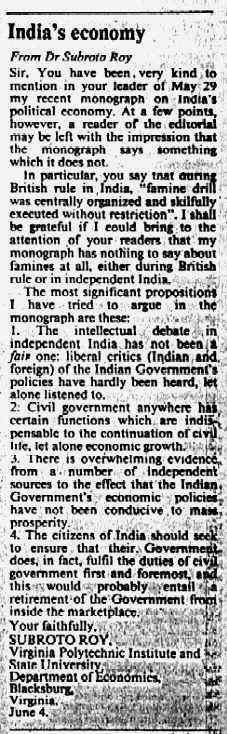
 

Indeed the idea that China and India have had extremely high economic growth-rates based on purportedly astronomical savings rates has become a commonplace in recent years, repeated endlessly in international and domestic policy circles though perhaps without adequate basis.


1.   Germany & Japan


What, at the outset, is supposed to be measured when we speak of “growth”? Indian businessmen and their media friends seem to think “growth” refers to something like nominal earnings before tax for the organised corporate sector, or any unspecified number that can be sold to visiting foreigners to induce them to park their funds in India: “You will get a 10% return if you invest in India” to which the visitor says “Oh that must mean India has 10% growth going on”. Of such nonsense are expensive international conferences in Davos and Delhi often made.


You will doubtless agree the economist at least must define economic growth properly and with care — what is referred to must be annual growth of per capita inflation-adjusted Gross Domestic Product. (Per capita National Income or Net National Product would be even better if available).


West Germany and Japan had the highest annual per capita real GDP growth-rates in the world economy starting from devastated post-World War II initial conditions. What were their measured rates?


West Germany: 6.6% in 1950-1960, falling to 3.5% by 1960-1970 falling to 2.4% by 1970-1978.


Japan: 6.8 % in 1952-1960 rising to 9.4% in 1960-1970 falling to 3.8 % in 1970-1978.


Thus in recent decadesonly Japan measured a spike in the 1960s of more than 9% annual growth of real per capita GDP. Now India and China are said to be achieving 8%-10 % and more year after year routinely!


Perhaps we are observing an incredible phenomenon of world economic history. Or perhaps it is just something incredible, something false and misleading, like a mirage in the desert.


You may agree that processes of measurement of real income in India both at federal and provincial levels, still remain well short of the world standards described by the UN’s System of National Accounts 1993. The actuality of our real GDP growth may be better than what is being measured or it may be worse than what is being measured – from the point of view of public decision-making we at present simply do not know which it is, and to overly rely on such numbers in national decisions may be unwise. In any event, India’s population is growing at near 2% so even if your Government’s measured number of 8% or 9% is taken at face-value, we have to subtract 2% population growth to get per capita figures.


2.  Growth of the aam admi’s consumption-basket


The late Professor Milton Friedman had been an invited adviser in 1955 to the Government of India during the Second Five Year Plan’s formulation. The Government of India suppressed what he had to say and I had to publish it 34 years later in May 1989 during the 1986-1992 perestroika-for-India project that I led at the University of Hawaii in the United States. His November 1955 Memorandum to the Government of India is a chapter in the book Foundations of India’s Political Economy: Towards an Agenda for the 1990s that I and WE James created.


At the 1989 project-conference itself, Professor Friedman made the following astute observation about all GNP, GDP etc growth-numbers that speaks for itself:


“I don’t believe the term GNP ought to be used unless it is supplemented by a different statistic: the rate of growth of the average consumption basket consumed by the ordinary individual in the country. I think GNP rates of growth can give very misleading information. For example, you have rapid rates of growth of GNP in the Soviet Union with a declining standard of life for the people. Because GNP includes monuments and includes also other things. I’m not saying that that is the case with India; I’m just saying I would like to see the two figures together.”


You may perhaps agree upon reflection that not only may our national income growth measurements be less robust than we want, it may be better to be measuring something else instead, or as well, as a measure of the economic welfare of India’s people, namely, “the rate of growth of the average consumption basket consumed by the ordinary individual in the country”, i.e., the rate of growth of the average consumption basket consumed by the aam admi.


It would be excellent indeed if you were to instruct your Government’s economists and other spokesmen to do so this as it may be something more reliable as an indicator of our economic realities than all the waffle generated by crude aggregate growth-rates.


3.  Logic of your model


Thirdly, the logic needs to be spelled out of the economic model that underlies such statements as yours or Meghnad Desai’s that seek to operationally relate savings rates to aggregate growth rates in India or China. This seems not to have been done publicly in living memory by the Planning Commission or other Government economists. I have had to refer, therefore, to pages 251-253 of my own Cambridge doctoral thesis under Professor Frank Hahn thirty years ago, titled “On liberty and economic growth: preface to a philosophy for India”, where the logic of such models as yours was spelled out briefly as follows:


Let


Kt be capital stock


Yt be national output


It be the level of real investment


St be the level of real savings


By definition


It = K t+1 – Kt


By assumption


Kt = k Yt 0 < k < 1


St = sYt 0 < s <1


In equilibrium ex ante investment equals ex ante savings


It = St


Hence in equilibrium


sYt = K t+1 – Kt


Or


s/k = g


where g is defined to be the rate of growth (Y t+1-Yt)/Yt  .


The left hand side then defines the “warranted rate of growth” which must maintain the famous “knife-edge” with the right hand side “natural rate of growth”.


Your June 9 2009 Lok Sabha statement that a 35% rate of savings in India may lead to an 8%-9% rate of economic growth in India, or Meghnad Desai’s statement that a 44% rate of savings in China led to a 10.4% growth there, can only be made meaningful in the context of a logical economic model like the one I have given above.


[In the open-economy version of the model, let Mt be imports, Et be exports, Ft net capital inflows.


Assume


Mt = aIt + bYt 0 < a, b < 1


Et = E for all t


Balance of payments is


Bt = Mt – Et – Ft


In equilibrium It = St + Bt


Or


Ft = (s+b) Yt – (1-a) It – E is a kind of “warranted” level of net capital inflow.]


You may perhaps agree upon reflection that building the entire macroeconomic policy of the Government of India merely upon a piece of economic logic as simplistic as the


s/k = g


equation above, may spell an unacceptable risk to the future economic well-being of our vast population. An alternative procedural direction for macroeconomic policy, with more obviously positive and profound consequences, may have been that which I sought to persuade Rajiv Gandhi about with some success in 1990-1991. Namely, to systematically seek to improve towards normalcy the budgets, financial positions and decision-making capacities of the Union and all state and local governments as well as all public institutions, organisations, entities, and projects in general, with the aim of making our domestic money a genuine hard currency of the world again after seven decades, so that any ordinary resident of India may hold and trade precious metals and foreign exchange at his/her local bank just like all those glamorous privileged NRIs have been permitted to do. Such an alternative path has been described in “The Indian Revolution”, “Against Quackery”, “The Dream Team: A Critique”, “India’s Macroeconomics”, “Indian Inflation”, etc.


4. Gross exaggeration of real savings rate by misreading deposit multiplication


Specifically, I am afraid you may have been misled into thinking India’s real savings rate, s, is as high as 35% just as Meghnad Desai may have misled himself into thinking China’s real savings rate is as high as 44%.


Neither of you may have wanted to make such a claim if you had referred to the fact that over the last 25 years, the average savings rate across all OECD countries has been less than 10%. Economic theory always finds claims of discontinuous behaviour to be questionable. If the average OECD citizen has been trying to save 10% of disposable income at best, it appears prima facie odd that India’s PM claims a savings rate as high as 35% for India or a British politician has claimed a savings rate as high as 44% for China. Something may be wrong in the measurement of the allegedly astronomical savings rates of India and China. The late Professor Nicholas Kaldor himself, after all, suggested it was rich people who saved and poor people who did not for the simple reason the former had something left over to save which the latter did not!


And indeed something is wrong in the measurements. What has happened, I believe, is that there has been a misreading of the vast nominal expansion of bank deposits via deposit-multiplication in the Indian banking system, an expansion that has been caused by explosive deficit finance over the last four or five decades. That vast nominal expansion of bank-deposits has been misread as indicating growth of real savings behaviour instead. I have written and spoken about and shown this quite extensively in the last half dozen years since I first discovered it in the case of India. E.g., in a lecture titled “Can India become an economic superpower or will there be a monetary meltdown?” at Cardiff University’s Institute of Applied Macroeconomics and at London’s Institute of Economic Affairs in April 2005, as well as in May 2005 at a monetary economics seminar invited at the RBI by Dr Narendra Jadav. The same may be true of China though I have looked at it much less.


How I described this phenomenon in a 2007 article in The Statesman is this:


“Savings is indeed normally measured by adding financial and non-financial savings. Financial savings include bank-deposits. But India is not a normal country in this. Nor is China. Both have seen massive exponential growth of bank-deposits in the last few decades. Does this mean Indians and Chinese are saving phenomenally high fractions of their incomes by assiduously putting money away into their shaky nationalized banks? Sadly, it does not. What has happened is government deficit-financing has grown explosively in both countries over decades. In a “fractional reserve” banking system (i.e. a system where your bank does not keep the money you deposited there but lends out almost all of it immediately), government expenditure causes bank-lending, and bank-lending causes bank-deposits to expand. Yes there has been massive expansion of bank-deposits in India but it is a nominal paper phenomenon and does not signify superhuman savings behaviour. Indians keep their assets mostly in metals, land, property, cattle, etc., and as cash, not as bank deposits.”


An article of mine in 2008 in Business Standard put it like this:


“India has followed in peacetime over six decades what the US and Britain followed during war. Our vast growth of bank deposits in recent decades has been mostly a paper (or nominal) phenomenon caused by unlimited deficit finance in a fractional reserve banking system. Policy makers have widely misinterpreted it as indicating a real phenomenon of incredibly high savings behaviour. In an inflationary environment, people save their wealth less as paper deposits than as real assets like land, cattle, buildings, machinery, food stocks, jewellery etc.”


If you asked me “What then is India’s real savings rate?” I have little answer to give except to say I know what it is not – it is not what the Government of India says it is. It is certainly unlikely to be anywhere near the 35% you stated it to be in your June 9 2009 Lok Sabha statement. If the OECD’s real savings rate has been something like 10% out of disposable income, I might accept India’s is, say, 15% at a maximum when properly measured – far from the 35% being claimed. What I believe may have been mismeasured by you and Meghnad Desai and many others as indicating high real savings is actually the nominal or paper expansion of bank-deposits in a fractional reserve banking system induced by runaway government deficit-spending in both India and China over the last several decades.


5. Technological progress and the mainsprings of real economic growth


So much for the g and s variables in the s/k = g equation in your economic model. But the assumed constant k is a big problem too!


During the 1989 perestroika-for-India project-conference, Professor Friedman referred to his 1955 experience in India and said this about the assumption of a constant k:


“I think there was an enormously important point… That was the almost universal acceptance at that time of the view that there was a sort of technologically fixed capital output ratio. That if you wanted to develop, you just had to figure out how much capital you needed, used as a statistical technological capital output ratio, and by God the next day you could immediately tell what output you were going to achieve. That was a large part of the motivation behind some of the measures that were taken then.”


The crucial problem of the sort of growth-model from which your formulation relating savings to growth arises is that, with a constant k, you have necessarily neglected the real source of economic growth, which is technological progress!


I said in the 2007 article referred to above:


“Economic growth in India as elsewhere arises not because of what politicians and bureaucrats do in capital cities, but because of spontaneous technological progress, improved productivity and learning-by-doing on part of the general population. Technological progress is a very general notion, and applies to any and every production activity or commercial transaction that now can be accomplished more easily or using fewer inputs than before.”


In “Growth and Government Delusion” published in The Statesman last year, I described the growth process more fully like this:


“The mainsprings of real growth in the wealth of the individual, and so of the nation, are greater practical learning, increases in capital resources and improvements in technology. Deeper skills and improved dexterity cause output produced with fewer inputs than before, i.e. greater productivity. Adam Smith said there is “invention of a great number of machines which facilitate and abridge labour, and enable one man to do the work of many”. Consider a real life example. A fresh engineering graduate knows dynamometers are needed in testing and performance-certification of diesel engines. He strips open a meter, finds out how it works, asks engine manufacturers what design improvements they want to see, whether they will buy from him if he can make the improvement. He finds out prices and properties of machine tools needed and wages paid currently to skilled labour, calculates expected revenues and costs, and finally tries to persuade a bank of his production plans, promising to repay loans from his returns. Overcoming restrictions of religion or caste, the secular agent is spurred by expectation of future gains to approach various others with offers of contract, and so organize their efforts into one. If all his offers ~ to creditors, labour, suppliers ~ are accepted he is, for the moment, in business. He may not be for long ~ but if he succeeds his actions will have caused an improvement in design of dynamometers and a reduction in the cost of diesel engines, as well as an increase in the economy’s produced means of production (its capital stock) and in the value of contracts made. His creditors are more confident of his ability to repay, his buyers of his product quality, he himself knows more of his workers’ skills, etc. If these people enter a second and then a third and fourth set of contracts, the increase in mutual trust in coming to agreement will quickly decline in relation to the increased output of capital goods. The first source of increasing returns to scale in production, and hence the mainspring of real economic growth, arises from the successful completion of exchange. Transforming inputs into outputs necessarily takes time, and it is for that time the innovator or entrepreneur or “capitalist” or “adventurer” must persuade his creditors to trust him, whether bankers who have lent him capital or workers who have lent him labour. The essence of the enterprise (or “firm”) he tries to get underway consists of no more than the set of contracts he has entered into with the various others, his position being unique because he is the only one to know who all the others happen to be at the same time. In terms introduced by Professor Frank Hahn, the entrepreneur transforms himself from being “anonymous” to being “named” in the eyes of others, while also finding out qualities attaching to the names of those encountered in commerce. Profits earned are partly a measure of the entrepreneur’s success in this simultaneous process of discovery and advertisement. Another potential entrepreneur, fresh from engineering college, may soon pursue the pioneer’s success and start displacing his product in the market ~ eventually chasers become pioneers and then get chased themselves, and a process of dynamic competition would be underway. As it unfolds, anonymous and obscure graduates from engineering colleges become by dint of their efforts and a little luck, named and reputable firms and perhaps founders of industrial families. Multiply this simple story many times, with a few million different entrepreneurs and hundreds of thousands of different goods and services, and we shall be witnessing India’s actual Industrial Revolution, not the fake promise of it from self-seeking politicians and bureaucrats.”


Technological progress in a myriad of ways and discovery of new resources are important factors contributing to India’s growth today. But while India’s “real” economy does well, the “nominal” paper-money economy controlled by Government does not. Continuous deficit financing for half a century has led to exponential growth of public debt and broad money, and, as noted, the vast growth of nominal bank-deposits has been misinterpreted as indicating unusually high real savings behaviour when it in fact may just signal vast amounts of government debt being held by our nationalised banks. These bank assets may be liquid domestically but are illiquid internationally since our government debt is not held by domestic households as voluntary savings nor has it been a liquid asset held worldwide in foreign portfolios.


What politicians of all parties, especially your own and the BJP and CPI-M since they are the three largest, have been presiding over is exponential growth of our paper money supply, which has even reached 22% per annum. Parliament and the Government should be taking honest responsibility for this because it may certainly portend double-digit inflation (i.e., decline in the value of paper-money) perhaps as high as 14%-15% per annum, something that is certain to affect the aam admi’s economic welfare adversely.


6. Selling Government assets to Big Business is a bad idea in a potentially hyperinflationary economy


Respected PradhanMantriji, the record would show that I, and really I alone, 25 years ago, may have been the first among Indian economists to advocate  the privatisation of the public sector. (Viz, “Silver Jubilee of Pricing, Planning and Politics: A Study of Economic Distortions in India”.) In spite of this, I have to say clearly now that in present circumstances of a potentially hyperinflationary economy created by your Government and its predecessors, I believe your Government’s present plans to sell Government assets may be an exceptionally unwise and imprudent idea. The reasoning is very simple from within monetary economics.


Government every year has produced paper rupees and bank deposits in practically unlimited amounts to pay for its practically unlimited deficit financing, and it has behaved thus over decades. Such has been the nature of the macroeconomic process that all Indian political parties have been part of, whether they are aware of it or not.


Indian Big Business has an acute sense of this long-term nominal/paper expansion of India’s economy, and acts towards converting wherever possible its own hoards of paper rupees and rupee-denominated assets into more valuable portfolios for itself of real or durable assets, most conspicuously including hard-currency denominated assets, farm-land and urban real-estate, and, now, the physical assets of the Indian public sector. Such a path of trying to transform local domestic paper assets – produced unlimitedly by Government monetary and fiscal policy and naturally destined to depreciate — into real durable assets, is a privately rational course of action to follow in an inflationary economy. It is not rocket-science to realise the long-term path of rupee-denominated assets is downwards in comparison to the hard-currencies of the world – just compare our money supply growth and inflation rates with those of the rest of the world.


The Statesman of November 16 2006 had a lead editorial titled Government’s land-fraud: Cheating peasants in a hyperinflation-prone economy which said:


“There is something fundamentally dishonourable about the way the Centre, the state of West Bengal and other state governments are treating the issue of expropriating peasants, farm-workers, petty shop-keepers etc of their small plots of land in the interests of promoters, industrialists and other businessmen. Singur may be but one example of a phenomenon being seen all over the country: Hyderabad, Karnataka, Kerala, Haryana, everywhere. So-called “Special Economic Zones” will merely exacerbate the problem many times over. India and its governments do not belong only to business and industrial lobbies, and what is good for private industrialists may or may not be good for India’s people as a whole. Economic development does not necessarily come to be defined by a few factories or high-rise housing complexes being built here or there on land that has been taken over by the Government, paying paper-money compensation to existing stakeholders, and then resold to promoters or industrialists backed by powerful political interest-groups on a promise that a few thousand new jobs will be created. One fundamental problem has to do with inadequate systems of land-description and definition, implementation and recording of property rights. An equally fundamental problem has to do with fair valuation of land owned by peasants etc. in terms of an inconvertible paper-money. Every serious economist knows that “land” is defined as that specific factor of production and real asset whose supply is fixed and does not increase in response to its price. Every serious economist also knows that paper-money is that nominal asset whose price can be made to catastrophically decline by a massive increase in its supply, i.e. by Government printing more of the paper it holds a monopoly to print. For Government to compensate people with paper-money it prints itself by valuing their land on the basis of an average of the price of the last few years, is for Government to cheat them of the fair present-value of the land. That present-value of land must be calculated in the way the present-value of any asset comes to be calculated, namely, by summing the likely discounted cash-flows of future values. And those future values should account for the likelihood of a massive future inflation causing decline in the value of paper-money in view of the fact we in India have a domestic public debt of some Rs. 30 trillion (Rs. 30 lakh crore) and counting, and money supply growth rates averaging 16-17% per annum. In fact, a responsible Government would, given the inconvertible nature of the rupee, have used foreign exchange or gold as the unit of account in calculating future-values of the land. India’s peasants are probably being cheated by their Government of real assets whose value is expected to rise, receiving nominal paper assets in compensation whose value is expected to fall.”


Shortly afterwards the Hon’ble MP for Kolkata Dakshin, Km Mamata Banerjee, started her protest fast, riveting the nation’s attention in the winter of 2006-2007. What goes for government buying land on behalf of its businessman friends also goes, mutatis mutandis, for the public sector’s real assets being bought up by the private sector using domestic paper money in a potentially hyperinflationary economy. If your new Government wishes to see real assets of the public sector being sold for paper money, let it seek to value these assets not in inconvertible rupees that Government itself has been producing in unlimited quantities but perhaps in forex or gold-units instead!


In the 2004-2005 volume Margaret Thatcher’s Revolution: How it Happened and What it Meant, edited by myself and Professor John Clarke, there is a chapter by Professor Patrick Minford on Margaret Thatcher’s fiscal and monetary policy (macroeconomics) that was placed ahead of the chapter by Professor Martin Ricketts on Margaret Thatcher’s privatisation (microeconomics). India’s fiscal and monetary or macroeconomic problems are far worse today than Britain’s were when Margaret Thatcher came to power. We need to get our macroeconomic problems sorted before we attempt the  microeconomic privatisation of public assets.


It is wonderful that your young party colleague, the Hon’ble MP from Amethi, Shri Rahul Gandhi, has declined to join the present Government and instead wishes to reflect further on the “common man” and “common woman” about whom I had described his late father talking to me on September 18 1990. Certainly the aam admi is not someone to be found among India’s lobbyists of organised Big Business or organised Big Labour who have tended to control government agendas from the big cities.


With my warmest personal regards and respect, I remain,

Cordially yours

Subroto Roy, PhD (Cantab.), BScEcon (London)


see also https://independentindian.com/thoughts-words-deeds-my-work-1973-2010/rajiv-gandhi-and-the-origins-of-indias-1991-economic-reform/did-jagdish-bhagwati-originate-pioneer-intellectually-father-indias-1991-economic-reform-did-manmohan-singh-or-did-i-through-my-e/

Posted in 15th Lok Sabha, Academic economics, Academic freedom, Academic research, Adam Smith, Banking, Bengal, Big Business and Big Labour, BJP, Cambridge Univ Economics, Capital and labour, China's macroeconomics, China's savings rate, China's Economy, Congress Party, Deposit multiplication, Economic Policy, Economic Theory, Economic Theory of Growth, Economic Theory of Value, Economics of Public Finance, Enterprise and entrepeneurship, European Community, Financial Management, Financial markets, Foreign exchange controls, General equilbrium theory, Germany, Governance, Government accounting, Government Budget Constraint, Government of India, Growth rates (economic), India's Big Business, India's Government economists, India's savings rate, India's 1991 Economic Reform, India's Banking, India's Budget, India's bureaucracy, India's Capital Markets, India's corporate governance, India's Economy, India's farmers, India's Government Budget Constraint, India's Government Expenditure, India's grassroots activists, India's inflation, India's Land, India's Lok Sabha, India's Macroeconomics, India's Monetary & Fiscal Policy, India's Parliament, India's political lobbyists, India's political parties, India's poverty, India's Public Finance, India's Reserve Bank, India's Revolution, India's State Finances, India's Union-State relations, Inflation, Inflation targeting, Interest group politics, Japan, London School of Economics, Mamata Banerjee, Manmohan Singh, Margaret Thatcher, Margaret Thatcher's Revolution, Martin Ricketts, Milton Friedman, Monetary Theory, Money and banking, Non-Resident Indians, OECD savings rates, Paper money and deposits, Parliamentary Backbenchers, Political Economy, Public Choice/Public Finance, Rahul Gandhi, Rajiv Gandhi, Rajiv Gandhi's assassination, Redeposits, Siddhartha Shankar Ray. 1 Comment »

How tightly will organised Big Business be able to control economic policies this time?

The power of organised Big Business over New Delhi’s economic policies (whether Congress-led or BJP-led) was signalled by the presence in the audience at Rashtrapati Bhavan last week of several prominent lobbyists when Dr Manmohan Singh and his senior-most Cabinet colleagues were being sworn-in by the President of India. Why were such witnesses needed at such an auspicious national occasion?

Organised Big Business (both private sector and public sector) along with organised Big Labour (whose interests are represented most ably by New Delhi’s official communist parties like the CPI-M and CPI), are astutely aware of how best to advance their own economic interests; this usually gets assisted nicely enough through clever use of our comprador English-language TV, newspaper and magazine media. Shortly after the election results, lobbyists were all over commercial TV proposing things like FDI in insurance and airports etc– as if that was the meaning of the Sonia-Rahul mandate or were issues of high national priority. A typical piece of such “pretend-economics” appears in today’s business-press from a formerly Leftist Indian bureaucrat: “With its decisive victory, the new Manmohan Singh government should at last be able to implement the required second generation reforms. Their lineaments (sic) are well known and with the removal of the Left’s veto, many of those stalled in the legislature as well as those which were forestalled can now be implemented. These should be able to put India back on a 9-10 per cent per annum growth rate…”

Today’s business-press also reports that the new Government is planning to create a fresh “Disinvestment Ministry” and Dr Singh’s chief economic policy aide is “a frontrunner among the names short-listed to head the new ministry” with Cabinet rank.

Now if any enterprising doctoral student was to investigate the question, I think the evidence would show that I, and I alone – not even BR Shenoy or AD Shroff or Jagdish Bhagwati — may have been the first among Indian economists to have argued in favour of the privatisation of India’s public sector. I did so precisely 25 years ago in Pricing, Planning and Politics: A Study of Economic Distortions in India, which was so unusual for its time that it attracted the lead editorial of The Times of London on the day it was published May 29 1984, and had its due impact on Indian economic policy then and since, as has been described elsewhere here.  In 1990-1991 while with Rajiv Gandhi, I had floated an idea of literally giving away shares of the public sector to the public that owned it (as several other countries had been doing at that time), specifically perhaps giving them to the poorest panchayats in aid of their development.  In 2004-2005, upon returning to Britain after many years, I helped create the book Margaret Thatcher’s Revolution: How it Happened and What it Meant, and Margaret Thatcher if anyone was a paragon of privatisation.

That being said, I have to say I think a new Indian policy of creating a Ministry to privatise India’s public sector is probably a very BAD idea indeed in present circumstances — mainly because it will be driven by the interests of the organised Big Business lobbies that have so profoundly and subtly been able to control the New Delhi Government’s behaviour in recent decades.

Such lobbyist control is exercised often without the Government even realising or comprehending its parameters. For example, ask yourself: Is there any record anywhere of Dr Manmohan Singh, in his long career as a Government economist and then as a Rajya Sabha MP, having ever proposed before 2004-2005 that nuclear reactors were something vitally important to India’s future? And why do you suppose the most prominent Indian business lobby spent a million dollars and registered itself as an official lobbyist in Washington DC to promote the nuclear deal among American legislators? Because Big Business was feeling generous and altruistic towards the “energy security” of the ordinary people of India? Hardly.  Indian Big Business calculates and acts in its own interests, as is only to be expected under economic assumptions; those interests are frequently camouflaged by their lobbyist and media friends into seeming to be economic policy for the country as a whole.

Now our Government every year produces paper rupees and bank deposits in  practically unlimited amounts to pay for its practically unlimited deficit financing, and it has behaved thus over decades. Why we do not hear about this at all is because the most prominent Government economists themselves remain clueless — sometimes by choice, mostly by sheer ignorance — about the nature of the macroeconomic process that they are or have been part of.  (See my  “India’s Macroeconomics”, “The Dream Team: A Critique” etc elsewhere here). As for the Opposition’s economists, the less said about the CPI-M’s economists the better while the BJP, poor thing, has absolutely no economists at all!

Briefly speaking, Indian Big Business has acquired an acute sense of this long-term nominal/paper expansion of India’s economy, and as a result acts towards converting wherever possible its own hoards of paper rupees and rupee-denominated assets into more valuable portfolios for itself of real or durable assets, most conspicuously including hard-currency denominated assets, farm-land and urban real-estate, and, now, the physical assets of the Indian public sector. Such a path of trying to transform local domestic paper assets – produced unlimitedly by Government monetary and fiscal policy and naturally destined to depreciate — into real durable assets, is a privately rational course of action to follow in an inflationary economy.  It is not rocket-science  to realise the long-term path of the Indian rupee is downwards in comparison to the hard-currencies of the world – just compare our money supply growth and inflation rates with those of the rest of the world.

The Statesman of November 15 2006 had a lead editorial titled Government’s land-fraud: Cheating peasants in a hyperinflation-prone economy. It said:

“There is something fundamentally dishonourable about the way the Centre, the state of West Bengal and other state governments are treating the issue of expropriating peasants, farm-workers, petty shop-keepers etc of their small plots of land in the interests of promoters, industrialists and other businessmen. Singur may be but one example of a phenomenon being seen all over the country: Hyderabad, Karnataka, Kerala, Haryana, everywhere. So-called “Special Economic Zones” will merely exacerbate the problem many times over. India and its governments do not belong only to business and industrial lobbies, and what is good for private industrialists may or may not be good for India’s people as a whole. Economic development does not necessarily come to be defined by a few factories or high-rise housing complexes being built here or there on land that has been taken over by the Government, paying paper-money compensation to existing stakeholders, and then resold to promoters or industrialists backed by powerful political interest-groups on a promise that a few thousand new jobs will be created. One fundamental problem has to do with inadequate systems of land-description and definition, implementation and recording of property rights. An equally fundamental problem has to do with fair valuation of land owned by peasants etc. in terms of an inconvertible paper-money. Every serious economist knows that “land” is defined as that specific factor of production and real asset whose supply is fixed and does not increase in response to its price. Every serious economist also knows that paper-money is that nominal asset whose price can be made to catastrophically decline by a massive increase in its supply, i.e. by Government printing more of the paper it holds a monopoly to print. For Government to compensate people with paper-money it prints itself by valuing their land on the basis of an average of the price of the last few years, is for Government to cheat them of the fair present-value of the land. That present-value of land must be calculated in the way the present-value of any asset comes to be calculated, namely, by summing the likely discounted cash-flows of future values. And those future values should account for the likelihood of a massive future inflation causing decline in the value of paper-money in view of the fact we in India have a domestic public debt of some Rs. 30 trillion (Rs. 30 lakh crore) and counting, and money supply growth rates averaging 16-17% per annum. In fact, a responsible Government would, given the inconvertible nature of the rupee, have used foreign exchange or gold as the unit of account in calculating future-values of the land. India’s peasants are probably being cheated by their Government of real assets whose value is expected to rise, receiving nominal paper assets in compensation whose value is expected to fall.”

Mamata Banerjee started her famous protest fast-unto-death in Kolkata not long afterwards, riveting the nation’s attention in the winter of 2006-2007.

What goes for the government buying land on behalf of its businessman friends also goes, mutatis mutandis, for the public sector’s real assets being bought up by the private sector using domestic paper money in a potentially hyperinflationary economy.  If Dr Singh’s new Government wishes to see real public sector assets being sold, let the Government seek to value these assets not in inconvertible rupees which the Government itself has been producing in unlimited quantities but rather in forex or gold-units instead!

Today’s headline says “Short of cash, govt. plans to revive disinvestment ministry”. Big Business’s powerful lobbies will suggest  that real public assets must be sold  (to whom? to organised Big Business of course!) in order to solve the grave fiscal problems in an inflationary economy caused precisely by those grave  fiscal problems! What I said in 2002 at IndiaSeminar may still be found to apply: I said the BJP’s privatisation ideas “deserve to be condemned…because they have made themselves believe that the proceeds of selling the public sector should merely go into patching up the bleeding haemorrhage which is India’s fiscal and monetary situation… (w)hile…Congress were largely responsible for that haemorrhage to have occurred in the first place.”

If the new Government would like to know how to proceed more wisely, they need to read and grasp, in the book edited by myself and Professor John Clarke in 2004-2005, the chapter by Professor Patrick Minford on Margaret Thatcher’s fiscal and monetary policy (macroeconomics) before they read the chapter by Professor Martin Ricketts on Margaret Thatcher’s privatisation (microeconomics).  India’s fiscal and monetary or macroeconomic problems are far worse today than Britain’s were when Thatcher came in.

During the recent Election Campaign, I contrasted Dr Singh’s flattering praise in 2005 of the CPI-M’s Buddhadeb Bhattacharjee with Sonia Gandhi’s pro-Mamata line in 2009 saying the CPI-M had taken land away from the poor.  This may soon signal a new fault-line in the new Cabinet too on economic policy with respect to not only land but also public sector privatisation – with Dr Singh’s pro-Big Business acolytes on one side and Mamata Banerjee’s stance in favour of small-scale unorganised business and labour on the other.  Party heavyweights like Dr Singh himself and Sharad Pawar and Pranab Mukherjee will weigh in one side or the other with Sonia being asked in due course to referee.

I personally am delighted to see the New Rahul Gandhi deciding not to be in Government and to instead reflect further on the “common man” and “common woman” about whom I had described his father talking to me on September 18 1990 at his home. Certainly the “aam admi” is not someone to be found among India’s organised Big Business or organised Big Labour nor their paid lobbyists in the big cities.

Subroto Roy

Posted in Academic research, AD Shroff, Asia and the West, Big Business and Big Labour, BR Shenoy, Britain, Britain in India, British history, Economic Policy, Economic quackery, Economic Theory, Economics of exchange controls, Economics of Public Finance, Economics of real estate valuation, Financial Management, Financial markets, Foreign exchange controls, Government Budget Constraint, Government of India, India's Big Business, India's Banking, India's bureaucracy, India's Capital Markets, India's corporate finance, India's corporate governance, India's corruption, India's currency history, India's Economic History, India's Economy, India's Government Budget Constraint, India's Government Expenditure, India's Industry, India's inflation, India's Macroeconomics, India's Monetary & Fiscal Policy, India's nomenclatura, India's peasants, India's political lobbyists, India's Politics, India's pork-barrel politics, India's poverty, India's Public Finance, Inflation, Land and political economy, Macroeconomics, Mamata Banerjee, Manmohan Singh, Margaret Thatcher, Margaret Thatcher's Revolution, Martin Ricketts, Mendacity in politics, Microeconomics, Monetary Theory, Money and banking, Mumbai financial world, New Delhi, Patrick Minford, Political cynicism, Political Economy, Political mendacity, Political Science, Politics, Pork-barrel politics, Power-elites and nomenclatura, Practical wisdom, Principal-agent problem, Privatisation, Public Choice/Public Finance, Public property waste fraud, Rajiv Gandhi, Rational decisions, Singur and Nandigram, Sonia Gandhi, Statesmanship, The Statesman, The Times (London), University of Buckingham. Leave a Comment »

Letter to the GoI’s seniormost technical economist, May 21

“May 21 2009    It is wonderful to hear from you and I am honoured to find myself, perhaps accidentally, on the same list as so many of your distinguished colleagues among Government economists.

Your essay is most engaging. I am afraid I disagree with your assessment that the current problems “did not originate in the real sector of the economy” but were “triggered by the excesses of the financial system”. I have said to the contrary There is no clear path to solving the great (alleged) economic and financial crisis because no one wants to admit its roots were the overvaluation (over decades) of American real-estate, and hence American assets in general.”

There is no more real sector than real-estate itself and American real-estate has tended to be overvalued as a result of government policy since the Carter Administration; the accumulated dangers along that path came to explode in the sub-prime crisis. Here as elsewhere in economics, the financial tail has not wagged the non-financial dog but vice versa.

I have also said “(i) foreign central banks might have been left holding more bad US debt than might be remembered, and dollar depreciation and an American inflation seem to be inevitable over the next several years; (ii) all those bad mortgages and foreclosures could vanish within a year or two by playing the demographic card and inviting in a few million new immigrants into the United States; restoring a worldwide idea of an American dream fueled by mass immigration may be the surest way for the American economy to restore itself.”

Re the comparison with the Great Depression, I believe

“there are overriding differences. Most important, the American economy and the world economy are both incomparably larger today in the value of their capital stock, and there has also been enormous technological progress over eight decades. Accordingly, it would take a much vaster event than the present turbulence — say, something like an exchange of multiple nuclear warheads with Russia causing Manhattan and the City of London to be destroyed — before there was a return to something comparable to the 1929 Crash and the Great Depression that followed. Besides, the roots of the crises are different. What happened back then? In 1922, the Genoa Currency Conference wanted to correct the main defect of the pre-1914 gold standard, which was freezing the price of gold while failing to stabilise the purchasing power of money. From 1922 until about 1927, Benjamin Strong of the Federal Reserve Bank of New York adopted price-stabilisation as the new American policy-objective. Britain was off the gold standard and the USA remained on it. The USA, as a major creditor nation, saw massive gold inflows which, by traditional gold standard principles, would have caused a massive inflation. Governor Strong invented the process of “sterilisation” of those gold inflows instead and thwarted the rise in domestic dollar prices of goods and services. Strong’s death in 1928 threw the Federal Reserve System into conflict and intellectual confusion. Dollar stabilisation ended as a policy. Surplus bank money was created on the release of gold that had been previously sterilised. The traditional balance between bulls and bears in the stock-market was upset. Normally, every seller of stock is a bear and every buyer a bull. Now, amateur investors appeared as bulls attracted by the sudden stock price rises, while bears, who sold securities, failed to place their money into deposit and were instead lured into lending it as call money to brokerages who then fuelled these speculative bulls. As of October 22, 1929 about $4 billion was the extent of such speculative lending when Chase National Bank’s customers called in their money. Chase National had to follow their instructions, as did other New York banks. New York’s Stock Exchange could hardly respond to a demand for $4 billion at a short notice and collapsed. Within a year, production had fallen by 26 per cent, prices by 14 per cent, personal income by 14 per cent, and the Greatest Depression of recorded history was in progress — involuntary unemployment levels in America reaching 25 per cent. That is not, by any reading, what we have today. Yes, there has been plenty of bad lending, plenty of duping shareholders and workers and plenty of excessive managerial payoffs. It will all take a large toll, and affect markets across the world. But it will be a toll relative to our plush comfortable modern standards, not those of 1929-1933. In fact, modern decision-makers have the obvious advantage that they can look back at history and know what is not to be done. The US and the world economy are resilient enough to ride over even the extra uncertainty arising from the ongoing presidential campaign, and then some.”

These quotes are from recent publications and may be found most easily under “America’s financial crises” at my site http://www.independentindian.com.

What may be of interest to the Government of India’s economists also may be a sample of my recent short articles on India’s monetary and fiscal economics based on my research beginning with my doctoral work under Frank Hahn at Cambridge in the 1970s and followed by my work with James Buchanan and Milton Friedman in America in the 1980s and 1990s and later. One of these is even named “The Rangarajan Effect” which I first defined at a seminar invited by Dr Jadav at the RBI in May 2005!

“Rangarajan Effect”

Monetary Integrity and the Rupee (2008)

India’s Macroeconomics (2007)

Fiscal Instability

https://independentindian.com/2008/07/16/india-in-world-trade-payments/

Fallacious Finance: Congress, BJP, CPI-M et al may be leading India to hyperinflation (2007)

Our Policy Process: Self-Styled “Planners” Have Controlled India’s Paper Money For Decades

Growth of Real Income, Money & Prices in India 1869-2008

https://independentindian.com/2008/07/17/growth-government-delusion/

https://independentindian.com/2008/07/09/indian-inflation-upside-down-economics-from-new-delhis-establishment/

How to Budget: Thrift, Not Theft, Needs to Guide Our Public Finances

A Note on the Indian Policy Process

With warm regards,

Cordially,

Subroto Roy, PhD (Cantab.), BScEcon(London)

Sometime Adviser to the Late Rajiv Gandhi, 1990-1991

Apropos *Philosophy of Economics*

from Twitter 10 September 2017:

What is the precise scientific claim of my book *Philosophy of Economics* (Routledge 1989) to the Sverige Riksbank Economics Nobel prize?  It is that I detected & corrected central errors in the work of Hicks and Arrow, two greats of 20thC economics, who were early winners in 1972…. And both Hicks and Arrow graciously agreed to my criticism… perhaps even admitted the errors…

Three other early winners, Hayek 1974, Friedman 1976, Schultz 1979, supported my work even more strongly: the last two stood as witnesses! Yes   I bet you didn’t know your early winners Friedman 1976 Schultz 1979 testified on my behalf in US Federal Court!  

So I end up using Twitter to say all this? Yes… ongoing battles against racism in America, corruption in India…!

It is thanks to the Internet my 1989 *Philosophy of Economics* survived the vicious attack against it in America…And Sidney Alexander, contemporary of Samuelson, teacher of Solow, in 1985 found an ally in my work…Alexander and I were pirate ships blowing holes in the positivist Armada of “social choice theory” etc, sinking it permanently…

The incoherence confusion dogmatism irrelevance of a lot of academic economics today dissipates thanks to my 1989 Philosophy of Economics. If  wants to reduce the incoherence of economics let it read the Zinn review below in German & English  


Apropos *Philosophy of Economics*

“Dr. Roy’s book, Philosophy of Economics, which I have read in galleys, I regard as a masterpiece, not only in economic analysis but in philosophic analysis as well. — Sidney Hook 1989

“I shall have to ponder your rejection of the Humean position which has, I suppose, been central in not only my thought but that of most economists. Candidly, I have never understood what late Wittgenstein was saying, but I have not worked very hard at his work, and perhaps your book will give guidance.”–Kenneth J. Arrow, letter to the author, 1989

“I was grateful for the reminder of the passage of Aristotle at which I had not looked for many years and found the criticism of Arrow well justified and important.”  FA Hayek, letter to the author, 1981

“It is an extraordinarily well-written and well-thought through book that shows a wide-ranging capacity and understanding of economics as a discipline in both its macro and micro aspects.” Milton Friedman 1991, Evidence in the US District Court for the District of Hawaii.

“There is no doubt whatsoever that he has a thorough and deep understanding of the major issues that have occupied macroeconomics over the past fifty years…. It is a sign of real understanding that Roy can state these ideas not in terms of jargon, not in terms of equations or technical terms, but in straightforward English using only a minimum of specifically economic terminology. All in all, it is a very knowledgeable and sophisticated performance.” — Milton Friedman, 1989

“I had the privilege of reading early drafts of this book. I saw it emerge as an in-depth analysis of the philosophical foundations of economics. It is scholarship of a high order. It is an original contribution of major importance to economic thought.” — Theodore W. Schultz 1989

“The core of Roy’s study is devoted to the nature and grounds of economics as knowledge; it examines the basic intellectual roots of economics. It is cogent and, what is exceedingly rare these days, it is refreshingly lucid…. Roy’s book is in several important respects an original contribution, the most important being his treatment of the philosophical foundations of economics as knowledge. He is all too modest in assessing the importance of his contribution.” Theodore W. Schultz, 1983

“ (This) is a very ambitious work directed at the foundations of normative judgements in economics. The author arrives at some conclusions very closely matching those I arrived at some years ago. It is clear, however, that Dr. Roy arrived at his conclusions completely independently. That is all the more piquant to me in that the philosophical underpinning of his work is the development of philosophy in England  from the later Wittgenstein, while mine derives principally from earlier work in the United States by the pragmatists… Dr. Roy reveals a clear understanding of the methodological positivism that invaded economic policy analysis in the thirties and still dominates the literature of economics…. Following Renford Bambrough….he arrives at a position equivalent to that of the American pragmatists, especially Dewey, who insist that the problematic situation provides the starting point for the analysis of a problem even though there are no ultimate starting points. The methodological implication is the support of inquiry as fundamental, avoiding both scepticism and dogmatism. Roy develops his position with a great deal of attention to the ramifications of the problem both in philosophy and in economics. While his treatment of economic questions is ‘from the top down’ so to speak, it reveals a strong command of conventional economic analysis. He writes very well and thinks very clearly. He is certainly not afraid to tackle the big questions. His book reveals a keen mind, ready to pay almost undue respect to his forerunners, but anxious also to achieve originality….” Sidney S. Alexander, 1985

“I know that I have to continue to bear the responsibility for things that I wrote nearly fifty years ago.  I am however glad that your attention has been drawn to that passage written much more recently….building up to what I think is  a coherent point of view very different from that which I took in ’34 and ’39…. concerned with a field not far removed from that you  reach…”   John R Hicks, letter to the author, 1984

johnhicks


“A work altogether well written and admirably clear.” Renford Bambrough, 1985

“I like very much the courage in trying to produce a genuine philosophy of economics. Such a book is badly needed and could be very useful to economists. The fine use made of extensive readings in older as well as contemporary theorists and the splendid choice of quotations would themselves be worth the price of admission. The style maintains a fine level of clarity and emphasis.” Max Black 1985

“The discussion of Arrow’s theorem under unintended interpretations focuses our understanding on what is really fundamental to this famous result…. Roy has obviously thought much harder about the foundational and methodological problems in economics than most of his fellow-economists.” Anonymous

“Roy’s platonist view of what is the purpose of government is very odd at this stage of history. He seems to suppose that there is an objectively best state of affairs which we must simply discover. The more urgent issue in politics is generally not that of knowing what is the best thing to do but of dealing with conflicting interests. Conflict of interests is not merely disagreement over facts.” Anonymous

“The author has performed a very valuable service for economists interested in the philosophical problems and positions discussed. He has not misrepresented the positions he discusses and his account of various issues and different positions on those issues is philosophically adequate. Many economists will be stimulated as a result of reading this work to reconsider their own positions on the issues Roy addresses.” Anonymous

“The work has many strengths. It is wide in its references and its outlook. Its endorsement of objectivism is both right and timely. The chapter on mathematics in economics is particularly fine.” Anonymous

KGZ

daifsa6vwaaxwgp

daiftklv0aaiqj_


“The author intends to discuss some of the central philosophical questions facing modern economic theory. In the foreground is a disposition of the conventional problem of value-independence. Roy sees the value-independence postulate as “Hume’s Scepticism”. He defines Hume’s First and Second Laws on the basis of two signified propositions taken from R. M. Hare. (1) From positive empirical premises, no normative postulate can be derived; in order to establish obligatory propositions, at least one normative proposition is needed. (2) In a specified economic context, after all empirical and formal/logical matters are resolved, little scope exists for further intersubjectively valid answers. Valuations beyond this limit are based on the subjective feelings of the economist to the concerned problem. The scientific/theoretical attitude representative of most economists of the 20th century has been based on this characteristic Humean scepticism. To show this, the author reviews short representative quotations from some of the known names of recent economic theory: Friedman, Myrdal, Lionel Robbins, P. A. Samuelson, Hicks, Joan Robinson, Hayek, Oskar Lange, Schumpeter, Arrow, Blaug, Frank Hahn. Subsequently, the author raises the point as to what explains this scientific-theoretical approval. A cursory survey of important real and virtual historical developments since antiquity confirms that the essential reason for the reported wide acceptance of a humean position by the economic scientist indeed could have been as a defensive posture against dogmatism and political dictatorship (“It is part of the democratic reaction against medieval authoritarianism” p.45). Conditioned by their “disgust with the tyrannies and ideologies of the twentieth century”, these authorities tried to protect economic science and guarantee the objectivity of research by resort to moral scepticism. Hence the author arrives at the starting position of his actual subject: After using Hume to escape from dependence on Plato e tutti quanti, has not value-free economics gotten into a fresh dependence, namely, moral scepticism and its philosophical consequence, moral indifference? Here too a contradiction is shown to arise, namely, that each argumentation against the normative can stand its ground only through normative premises. Thus ultimately something like correct standards become necessary. This however is only a marginal problem compared to a very much more important point: whether the moral scepticism permeating the strict scientific-theoretical position, is not just part of a very much more comprehensive scepticism, which includes Hume’s own criticism of induction as well. But then the same scepticism makes positive theory dubious as well: “Either all of positive economics is attacked with just as much scepticism as anything in normative economics, or we accept one and reject the other when instead there are reasons to think they share the same ultimate grounds and must be accepted or rejected together”(p.47). The author illustrates the difficulties with radical scepticism in a continental traversal of economic theory: micro and macroeconomics, mathematical economic theory and welfare theory are stations on this tour. A solution of the problem in the strict sense is not given nor could have been expected. But Roy delivers a methodical rule which permits a more exact definition of the limits to which normative discussion can take place precisely and objectively: first, to distinguish always whether an objective answer is at all possible to certain questions, and secondly, to ask who is competent or in the best position to give an answer. For readers interested in a new, thoroughly subtle discussion of a basic yet customary problem, this book will be profitable reading. However, the author could have argued some matters slightly more elaborately and others less redundantly, and set forth the central idea more clearly through appropriate summaries.”
Karl Georg Zinn in Jahrbücher für Nationalökonomie und Statistik / Zeitschrift für Wirtschaft und Statistik. Vol. 209, Nr. 5/6 (May 1992), p 573-574, translated from the German by Nahar Bhattacharya 1994.

“Effectively demonstrates the direct and significant links between the basic philosophical beliefs held by economists and their fundamental disagreements” Kyklos (Switzerland).

“Every rule of good argument is flouted. Does little to grapple with the large issues to which he rightly urges us to attend.” Times Literary Supplement (UK).

“Not the book to set off the revolution in economic epistemology and it is not even a reliable introduction to the field for undergraduates.” Journal of Applied Philosophy (UK).

“Subroto Roy’s Philosophy of Economics is a formidable contribution…. The author’s aim is to steer a middle course between scepticism and dogmatism in his account of the knowledge we can have of economic phenomena, and in this he largely succeeds. The result is a most distinguished and valuable exploration of the nature of economic inquiry.” John Gray, Economic Affairs (UK).

“Interesting and well-written. Definitely worthwhile being read by any economist interested in the philosophical foundations of his subject and profession.”
Journal of Institutional & Theoretical Economics (Germany).

“Roy’s basic argument is that the theory of economic knowledge underlying the work of most economists is logically inconsistent… The inconsistency lies in not permitting the skepticism that undermines the analysis of normative problems to destroy the logical foundation underlying positive analysis….. This well-documented study is a worthwhile contribution to the burgeoning literature on the philosophy of economics.” Choice

“The central argument of the book shows that the skepticism/dogmatism choice is a false dichotomy, that one need not embrace dogmatism in order to have objectivity or give up objectivity for freedom…. In the final section of the book Roy applies his critique… to several debates in economics. Chapter 8 presents the development of macroeconomics from John Maynard Keynes to the present through a dialogue between economists of opposing schools… Chapter 9 is a rich, wide-ranging discussion of mathematical models in economics…. Chapter 10 discusses the foundations of welfare economics… Roy shows how philosophical mistakes can lead economic thought astray, even though some of his arguments are also unsound. As a philosopher I find it encouraging to see an economist apply recent developments in epistemology to economic debates.” Journal of Economic History

“Accomplished, interesting and ambitious.” Mary Farmer Manchester School (UK).

maryfarmer

“Perfectly sensible.” De Economist (Netherlands).

“Engaging and illuminating study. His seamless style may lull the reader into underestimating the extent and difficulty of the philosophical ground covered.” Research in History & Methodology of Economics (USA).

“(Roy’s) message is for his fellow economists, urging them not to shy away from the treatment of normative issues in their discipline.” – Economics and Philosophy

“When Roy refers to the present received theory of economics, he means that this is the view not only of Chicago, but also of Cambridge, Massachusetts, and Cambridge, England, of Friedman, Samuelson, Myrdal, Hayek, and Joan Robinson. His coverage is broad…. In one place he states that it is precisely because it is possible for even a unanimous group of experts to be wrong that we have a reason, an objective reason, why freedom is to be valued. ‘Freedom is necessary for objectivity.’…. Whether one agrees or disagrees, one has to be impressed by the knowledge and sophistication involved in Roy’s presentation. Involved here is no run-of-the-mill carping at the economics establishment. This is a serious thoughtful work.” Social Science Quarterly

POSTSCRIPT 2025:
The two economic scholars I worked most closely with from 1976-1986 were Frank Hahn and Jim Buchanan…. I did not know until Grok told me earlier this year their opinions on my book:
Frank Hahn: “Dr. Roy’s book is a considerable achievement. He has a real grasp of the philosophy relevant to economics and weaves it skillfully into the fabric of economic theory.”

James Buchanan: “Subroto Roy’s Philosophy of Economics is a challenging and ambitious effort to demonstrate the emptiness of the methodological position that has come to be called ‘positive economics’.”

scan0001

scan0005

scan0002

scan0004

pabeypabe

Can President Obama resist the financial zombies (let alone slay them)? His economists need to consult Dr Anna J Schwartz

The wonders of the Internet continue to surprise (and yes Virginia, there was a world before SMS and before the Internet too).  In early January, in context of India’s Satyam fraud (of a size of perhaps 1 or perhaps 2 billion dollars),  I referred here  to what seemed to me the likelihood of Satyam becoming a zombie company and I said “we in India have many such zombies walking around in the organised business sector”.    I drew attention to Andrew Beattie’s astute  definition of zombies and other such ghoulish phenomena in the financial world, and also referred to John Stepek’s excellent if brief November 2008 analysis “How zombie companies suck the life from an economy”.  Today I find Ms Arianna Huffington has made reference to Mr Martin Wolf’s reference a couple of days ago to zombie companies and to his statement that President Obama needs to “Admit reality, restructure banks and, above all, slay zombie institutions at once.”  Ms Huffington has agreed, though of course all this slaying may be easier said than done.  (It is better that zombies not be created in the first place.)

Mr Wolf has pointedly asked a question that many around the world may have half-thought about but not articulated: “Has Barack Obama’s presidency already failed?”   It would be  a grave and appalling  state of affairs if it has, within less than a month of entering office.   I am grateful to find in Ms Huffington’s article a reference to an October 2008  Wall Stret Journal interview of Dr Anna Jacobson Schwartz, perhaps the most respected voice in monetary economics today.  There have been numerous people claiming to have predicted America’s financial crisis but none may have as much credibility as Dr Schwartz.   Six years ago, in a National Bureau of Economic Research study dated November 2002, “Asset Price Inflation and Monetary Policy”,Working Paper 9321 she had said with utmost clarity: “It is crucial that central banks and regulatory authorities be aware of effects of asset price inflation on the stability of the financial system. Lending activity based on asset collateral during the boom is hazardous to the health of lenders when the boom collapses. One way that authorities can curb the distortion of lenders’ portfolios during asset price booms is to have in place capital requirements that increase with the growth of credit extensions collateralized by assets whose prices have escalated. If financial institutions avoid this pitfall, their soundness will not be impaired when assets backing loans fall in value. Rather than trying to gauge the effects of asset prices on core inflation, central banks may be better advised to be alert to the weakening of financial balance sheets in the aftermath of a fall in value of asset collateral backing loans….”

Most poignantly too, Dr Schwartz was present when Ben Bernanke said  in  a 2002 speech honouring the late Milton Friedman “I would like to say to Milton and Anna: Regarding the Great Depression. You’re right, we did it. We’re very sorry. But thanks to you, we won’t do it again.”   Dr Schwartz told the Wall Street Journal ‘”This was [his] claim to be worthy of running the Fed”.  “He was ‘familiar with history. He knew what had been done.’ But perhaps this is actually Mr. Bernanke’s biggest problem. Today’s crisis isn’t a replay of the problem in the 1930s, but our central bankers have responded by using the tools they should have used then. They are fighting the last war. The result, she argues, has been failure. ‘I don’t see that they’ve achieved what they should have been trying to achieve. So my verdict on this present Fed leadership is that they have not really done their job.'”

President Obama’s economists need to urgently consult Anna J Schwartz.

Subroto Roy, Kolkata

Postscript:  My own brief views on the subject are at “October 1929? Not!” dated September 18 2008, and “America’s divided economists” dated October 26 2008.  The latter article suggested that playing the demographic card and inducing a wave of immigration into the United States may be the surest way to move the housing demand-curve firmly upwards.

My American years Part One 1980-90: battles for academic integrity & freedom

see revised and expanded version

My American years: Part One 1980-90: battles for academic integrity & freedom

On the Blacksburg campus February 1982, my second year in America.

I had come to Blacksburg in August 1980 thanks to a letter Professor Frank Hahn had written on my behalf to Professor James M Buchanan in January 1980.

I was in an “All But Dissertation” stage at Cambridge when I got to Blacksburg; I completed the thesis while teaching in Blacksburg, sent it from there in September 1981, and went back to Cambridge for the viva voce examination in January 1982.

Professor Buchanan and his colleagues were welcoming and I came to learn much from them about the realities of public finance and democratic politics, which I very soon applied to my work on India.

Jim Buchanan had a reputation for running very tough conferences of scholars. He invited me to one such in the Spring of 1981. We were made to work very hard indeed. One of the books prescribed is still with me, In Search of a Monetary Constitution, ed. Leland Yeager, Harvard 1962, and something I still recommend to anyone wishing to understand the classical liberal position on monetary policy. The week-long 1981 conference had one rest-day; it was spent in part at an excellent theatre in a small rural town outside Blacksburg. This photo is of Jim Buchanan on the left and Gordon Tullock on the right; in between them is Ken Minogue of the London School of Economics — who, as it happened, had been Tutor for Admissions when I became a freshman there seven years earlier.

(I must have learnt something from Jim Buchanan about running conferences because nine years later in May-June 1989 at the University of Hawaii, I made the participants of the India-perestroika and Pakistan-perestroika conferences work very hard too.)

My first rooms in America in 1980 were in the attic of 703 Gracelyn Court, where I paid $160 or $170 per month to my marvellous landlady Betty Tillman. There were many family occasions I enjoyed with her family downstairs, and her cakes, bakes and puddings all remain with me today.

A borrowed electric typewriter may be seen in the photo: the age of the personal computer was still a few years away. The Department had a stand-alone “AB-Dic” word-processor which we considered a marvel of technology; the Internet did not exist but there was some kind of Intranet between geeks in computer science and engineering departments at different universities.

It was at Gracelyn Court that this letter reached me addressed by FA Hayek himself.

Professor Buchanan had moved to Blacksburg from Charlottesville some years earlier with the Centre for Study of Public Choice that he had founded. The Centre came to be housed at the President’s House of Virginia Tech (presumably the University President himself had another residence).

I was initially a Visiting Research Associate at the Centre and at the same time a Visiting Assistant Professor in the Economics Department. I was very kindly given a magnificent office at the Centre, on the upper floor, perhaps the one on the upper right hand side in the picture. It was undoubtedly the finest room I have ever had as an office. I may have had it for a whole year, either 1980-81 or 1981-82. When Professor Buchanan and the Centre left for George Mason University in 1983, the mansion returned to being the University President’s House and my old office presumably became a fine bedroom again.

I spent the summer of 1983 at a long libertarian conference in the Palo Alto/Menlo Park area in California. This is a photo from a barbecue during the conference with Professor Jean Baechler from France on the left; Leonard Liggio, who (along with Walter Grinder) had organised the conference, is at the right.

The first draft of the book that became Philosophy of Economics was written (in long hand) during that summer of 1983 in Palo Alto/Menlo Park. The initial title was “Principia Economica”, and the initial contracted publisher, the University of Chicago Press, had that title on the contract.

My principal supporter at the University of Chicago was that great American Theodore W. Schultz, then aged 81,

to whom the Press had initially sent the manuscript for review and who had recommended its prompt publication. Professor Schultz later told me to my face better what my book was about than I had realised myself, namely, it was about economics as knowledge, the epistemology of economics.

My parents came from India to visit me in California, and here we are at Yosemite.

.

Also to visit were Mr and Mrs Willis C Armstrong, our family friends who had known me from infancy. This is a photo of Bill and my mother on the left, and Louise and myself on the right, taken perhaps by my father. In the third week of January 1991, during the first Gulf War, Bill and I (acting on behalf of Rajiv Gandhi) came to form an extremely tenuous bridge between the US Administration and Saddam Hussain for about 24 hours, in an attempt to get a withdrawal of Iraq from Kuwait without further loss of life. In December 1991 I gave the widow of Rajiv Gandhi a small tape containing my long-distance phone conversations from America with Rajiv during that episode.

I had driven with my sheltie puppy from Blacksburg to Palo Alto  — through Tennessee, Arkansas, Oklahoma, Texas, New Mexico and Arizona; my parents and I now drove with him back to Blacksburg from California, through Nevada, Arizona, Colorado, Kansas, Missouri, Illinois, Indiana, Kentucky, West Virginia.  It may be a necessary though not sufficient condition to drive across America (or any other country) in order to understand it.

After a few days, we drove to New York via Pennsylvania where I became Visiting Assistant Professor in the Cornell Economics Department (on leave from being Assistant Professor at Virginia Tech). The few months at Cornell were noteworthy for the many long sessions I spent with Max Black. I shall add more about that here in due course. My parents returned to India (via Greece where my sister was) in the Autumn of 1983.

In May 1984, Indira Gandhi ruled in Delhi, and the ghost of Brezhnev was still fresh in Moscow. The era of Margaret Thatcher in Britain and Ronald Reagan in America was at its height. Pricing, Planning & Politics: A Study of Economic Distortions in India emerging from my doctoral thesis though written in Blacksburg and Ithaca in 1982-1983, came to be published by London’s Institute of Economic Affairs on May 29 as Occasional Paper No. 69, ISBN: 0-255 36169-6; its text is reproduced elsewhere here.

ppp1984

It was the first critique after BR Shenoy of India’s Sovietesque economics since Jawaharlal Nehru’s time. The Times, London’s most eminent paper at the time, wrote its lead editorial comment about it on the day it was published, May 29 1984.

londonti

It used to take several days for the library at Virginia Tech in Blacksburg to receive its copy of The Times of London and other British newspapers. I had not been told of the date of publication and did not know of what had happened in London on May 29 until perhaps June 2 — when a friend, Vasant Dave of a children’s charity, who was on campus, phoned me and congratulated me for being featured in The Times which he had just read in the University Library. “You mean they’ve reviewed it?” I asked him, “No, it’s the lead editorial.” “What?” I exclaimed. There was worse. Vasant was very soft-spoken and said “Yes, it’s titled ‘India’s Bad Example’” — which I misheard on the phone as “India’s Mad Example” 😀 Drat! I thought (or words to that effect), they must have lambasted me, as I rushed down to the Library to take a look.

The Times had said

“When Mr. Dennis Healey in the Commons recently stated that Hongkong, with one per cent of the population of India has twice India’s trade, he was making an important point about Hongkong but an equally important point about India. If Hongkong with one per cent of its population and less than 0.03 per cert of India’s land area (without even water as a natural resource) can so outpace India, there must be something terribly wrong with the way Indian governments have managed their affairs, and there is. A paper by an Indian economist published today (Pricing, Planning and Politics: A Study of Economic Distortions in India by Subroto Roy, IEA £1.80) shows how Asia’s largest democracy is gradually being stifled by the imposition of economic policies whose woeful effect and rhetorical unreality find their echo all over the Third World. As with many of Britain’s former imperial possessions, the rot set in long before independence. But as with most of the other former dependencies, the instrument of economic regulation and bureaucratic control set up by the British has been used decisively and expansively to consolidate a statist regime which inhibits free enterprise, minimizes economic success and consolidates the power of government in all spheres of the economy. We hear little of this side of things when India rattles the borrowing bowl or denigrates her creditors for want of further munificence. How could Indian officials explain their poor performance relative to Hongkong? Dr Roy has the answers for them. He lists the causes as a large and heavily subsidized public sector, labyrinthine control over private enterprise, forcibly depressed agricultural prices, massive import substitution, government monopoly of foreign exchange transactions, artificially overvalued currency and the extensive politicization of the labour market, not to mention the corruption which is an inevitable side effect of an economy which depends on the arbitrament of bureaucrats. The first Indian government under Nehru took its cue from Nehru’s admiration of the Soviet economy, which led him to believe that the only policy for India was socialism in which there would be “no private property except in a restricted sense and the replacement of the private profit system by a higher ideal of cooperative service.” Consequently, the Indian government has now either a full monopoly or is one of a few oligipolists in banking, insurance, railways, airlines, cement, steel, chemicals, fertilizers, ship-building, breweries, telephones and wrist-watches. No businessman can expand his operation while there is any surplus capacity anywhere in that sector. He needs government approval to modernize, alter his price-structure, or change his labour shift. It is not surprising that a recent study of those developing countries which account for most manufactured exports from the Third World shows that India’s share fell from 65 percent in 1953 to 10 per cent in 1973; nor, with the numerous restrictions on inter-state movement of grains, that India has over the years suffered more from an inability to cope with famine than during the Raj when famine drill was centrally organized and skillfully executed without restriction. Nehru’s attraction for the Soviet model has been inherited by his daughter, Mrs. Gandhi. Her policies have clearly positioned India more towards the Soviet Union than the West. The consequences of this, as Dr Roy states, is that a bias can be seen in “the antipathy and pessimism towards market institutions found among the urban public, and sympathy and optimism to be found for collectivist or statist ones.” All that India has to show for it is the delivery of thousands of tanks in exchange for bartered goods, and the erection of steel mills and other heavy industry which help to perpetuate the unfortunate obsession with industrial performance at the expense of agricultural growth and the relief of rural poverty.”…..

I felt this may have been intended to be laudatory but it was also inaccurate and had to be corrected. I replied dated June 4 which The Times published in their edition of June 16 1984:

timesletter-11

I was 29 when Pricing, Planning and Politics was published, I am 54 now. I do not agree with everything I said in it and find the tone a little puffed up as young men tend to be; it was also five years before my main “theoretical” work Philosophy of Economics would be published. My experience of life in the years since has also made me far less sanguine both about human nature and about America than I was then. But I am glad to find I am not embarrassed by what I said then, indeed I am pleased I said what I did in favour of classical liberalism and against statism and totalitarianism well before it became popular to do so after the Berlin Wall fell. (In India as elsewhere, former communist apparatchiks and fellow-travellers became pseudo-liberals overnight.)

The editorial itself may have been due to a conversation between Peter Bauer and William Rees-Mogg, so I later heard. The work sold 700 copies in its first month, a record for the publisher. The wife of one prominent Indian bureaucrat told me in Delhi in December 1988 it had affected her husband’s thinking drastically. A senior public finance economist told me he had been deputed at the Finance Ministry when the editorial appeared, and the Indian High Commission in London had urgently sent a copy of the editorial to the Ministry where it caused a stir. An IMF official told me years later that he saw the editorial on board a flight to India from the USA on the same day, and stopped in London to make a trip to the LSE’s bookshop to purchase a copy. Professor Jagdish Bhagwati of Columbia University had been a critic of aspects of Indian policy; he received a copy of the monograph in draft just before it was published and was kind enough to write I had “done an excellent job of setting out the problems afflicting our economic policies, unfortunately government-made problems!”  My great professor at Cambridge, Frank Hahn, would be kind enough to say that he thought my “critique of Development Economics was powerful not only on methodological but also on economic theory grounds” — something that has been a source of delight to me.

Siddhartha Shankar Ray told me when we first met that he had been in London when the editorial appeared and had seen it there; it affected his decision to introduce me to Rajiv Gandhi as warmly as he came to do a half dozen years later.

In the Autumn of 1984, I went, thanks to Edwin Feulner Jr of the Heritage Foundation,  to attend the Mont Pelerin Society Meetings being held at Cambridge (on “parole” from the US immigration authorities as my “green card” was being processed at the time). There I met for the first time Professor and Mrs Milton Friedman.

Milton Friedman’s November 1955 memorandum to the Government of India is referred to in my monograph as “unpublished” in note 1; when I met Milton and Rose, I gave them a copy of my monograph; and requested Milton for his unpublished document; when he returned to Stanford he sent to me in Blacksburg his original 1955-56 documents on Indian planning. I published the 1955 document for the first time in May 1989 during the University of Hawaii perestroika-for-India project I was then leading, it appeared later in the 1992 volume Foundations of India’s Political Economy: Towards an Agenda for the 1990s, edited by myself and WE James. (The results of the Hawaii project reached Rajiv Gandhi through my hand in September 1990, as told elsewhere here in “Rajiv Gandhi and the Origins of India’s 1991 Economic Reform”.) The 1956 document was published in November 2006 on the front page of The Statesman, the same day my obituary of Milton appeared in the inside pages.

Meanwhile, my main work within economic theory, the “Principia Economica” manuscript, was being read by the University of Chicago Press’s five or six anonymous referees. One of them pointed out my argument had been anticipated years earlier in the work of MIT’s Sidney Stuart Alexander. I had no idea of this and was surprised; of course I knew Professor Alexander’s work in balance of payments theory but not in this field. I went to visit Professor Alexander in Boston, where this photo came to be taken perhaps in late 1984:

Professor Alexander was extremely gracious, and immediately declared with great generosity that it was clear to him my arguments in “Principia Economica” had been developed entirely independently of his work. He had come at the problem from an American philosophical tradition of Dewey, I had done so from a British tradition of Wittgenstein. (CS Peirce was probably the bridge between the two.) He and I had arrived at some similar conclusions but we had done so completely independently.

Also, I was much honoured by this letter of May 1 1984 sent to Blacksburg by Professor Sir John Hicks (1904-1989), among the greatest of 20th Century economists at the time, where he acknowledged his departure in later life from the position he had taken in 1934 and 1939 on the foundations of demand theory.

He later sent me a copy of his Wealth and Welfare: Collected Essays on Economic Theory, Vol. I, MIT Press 1981, as a gift. The context of our correspondence had to do with my criticism of the young Hicks and support for the ghost of Alfred Marshall in an article “Considerations on Utility, Benevolence and Taxation” I was publishing in the journal History of Political Economy published then at Duke University. In Philosophy of Economics, I would come to say about Hicks’s letter to me “It may be a sign of the times that economists, great and small, rarely if ever disclaim their past opinions; it is therefore an especially splendid example to have a great economist like Hicks doing so in this matter.” It was reminiscent of Gottlob Frege’s response to Russell’s paradox; Philosophy of Economics described Frege’s “Letter to Russell”, 1902 (Heijenoort, From Frege to Gödel, pp. 126-128) as “a document which must remain one of the most noble in all of modern scholarship; a fact recorded in Russell’s letter to Heijenoort.”

In Blacksburg, by the Summer and Fall of 1984 I was under attack following the arrival of what I considered “a gang of inert game theorists” — my theoretical manuscript had blown a permanent hole through what passes by the name of “social choice theory”, and they did not like it. Nor did they like the fact that I seemed to them to be a “conservative”/classical liberal Indian and my applied work on India’s economy seemed to their academic agenda an irrelevance. This is myself at the height of that attack in January 1985:

Professor Schultz at the University of Chicago came to my rescue and at his recommendation I was appointed Visiting Associate Professor in the Economics Department at Brigham Young University in Provo, Utah.

I declined, without thanks, the offer of another year at Virginia Tech.

On my last day in Blacksburg, a graduate student whom I had helped when she had been assaulted by a senior professor, cooked a meal before I started the drive West across the country. This is a photo from that meal:

In Provo, I gratefully found refuge at the excellent Economics Department led at the time by Professor Larry Wimmer.

It was at Provo that I first had a personal computer on my desk (an IBM as may be seen) and what a delight that was (no matter the noises that it made).  I recall being struck by the fact a colleague possessed the incredible luxury of a portable personal computer (no one else did) which he could take home with him.   It looked like an enormous briefcase but was apparently the technology-leader at the time.  (Laptops seem not to have been invented as of 1985).

In October 1985, Professor Frank Hahn very kindly wrote to Larry Wimmer revising his 1980 opinion of my work now that the PhD was done, the India-work had led to The Times editorial and the theoretical work was proceeding well.

I had applied for a permanent position at the University of Hawaii, Manoa, and had been interviewed positively at the American Economic Association meetings (in New York) in December 1985 by the department chairman Professor Fred C. Hung. At Provo, Dr James Moncur of the Manoa Department was visiting. Jim became a friend and recommended me to his colleagues in Manoa.

Professor Hung appointed me to that department as a “senior” Assistant Professor on tenure-track beginning September 1986. I had bargained for a rank of “Associate Professor” but was told the advertisement did not allow it; instead I was assured of being an early candidate for promotion and tenure subject to my book “Principia Economica” being accepted for publication. (The contract with the University of Chicago Press had become frayed.)

Hawaii was simply a superb place (though expensive).

Professor James Buchanan won the Economics “Nobel” in 1986 and I was asked by the Manoa Department to help raise its profile by inviting him to deliver a set of lectures, which he did excellently well in March 1988 to the University as well as the Honolulu community at large. Here he is at my 850 sq ft small condominium at Punahou Towers, 1621 Dole Street:

In August 1988, my manuscript “Principia Economica” was finally accepted for publication by Routledge of London and New York under the title Philosophy of Economics: On the Scope of Reason In Economic Inquiry. The contract with University of Chicago Press had fallen through and the manuscript was being read by Yale University Press and a few others but Routledge came through with the first concrete offer. I was delighted and these photos were taken in the Economics Department at Manoa by a colleague in September 1988 as the publisher needed them.

Milton and Rose Friedman came to Honolulu on a private holiday perhaps in January 1989; they had years earlier spent a sabbatical year at the Department.

Here is a luncheon that was arranged in their honour. They had in the Fall of 1988 been on their famous visit to China, and as I recall that was the main subject of discussion on the occasion.

Milton phoned me in my Manoa office and invited me to meet him and Rose at their hotel for a chat; we had met first at the 1984 Mont Pelerin meetings and he wished to know me better. I was honoured and turned up dutifully and we talked for perhaps an hour. I recall making a strong recommendation that he write his memoirs, especially so that the rumours and innuendo surrounding eg the Chile episode could be cleared up; I also said a “Collected Works” would be a great idea; when Milton and Rose published their memoirs Two Lucky People (Chicago 1998) I wondered if my first suggestion had come to be taken; as to the second, he wrote to me years later saying he felt no Collected Works were necessary.

From 1986 onwards, I had been requested by the University of Hawaii to lead a project with William E James on the political economy of “South Asia” .I had said there was no such place, that “South Asia” was a US State Department abstraction but there were India and Pakistan and Sri Lanka and Bangladesh and Afghanistan etc. Sister projects on India and Pakistan had been sponsored by the University, and in 1989 important conferences had been planned by myself and James in May for India and in June for Pakistan.

I was determined to publish for the first time Milton’s 1955 memorandum on India which the Government of India had suppressed or ignored at the time. At the hotel-meeting, I told Milton that and requested him to come to the India-conference in May; Milton and Rose said they would think about it, and later confirmed he would come for the first two days.

This is a photo of the initial luncheon at the home of the University President on May 21 1989. Milton and India’s Ambassador to the USA at the time were both garlanded with Hawaiian leis. The first photo was one of a joke from Milton as I recall which had everyone laughing.

There was no equivalent photo of the distinguished scholars who gathered for the Pakistan conference a month later.

The reason was that from February 1989 onwards I had become the victim of a most vicious racist defamation, engineered within the Economics Department at Manoa by a senior professor as a way to derail me before my expected Promotion and Tenure application in the Fall. All my extra time went to battling that though somehow I managed to teach some monetary economics well enough in 1989-1990 for a Japanese student to insist on being photographed with me and the book we had studied.

I was being seen by two or three temporarily powerful characters on the Manoa campus as an Uppity Indian who must be brought down. This time I decided to fight back — and what a saga came to unfold! It took me into the United States District Court for the District of Hawaii and then the Ninth Circuit and upto the United States Supreme Court, not once but twice.

Milton Friedman and Theodore Schultz stood valiantly among my witnesses — first writing to the University’s authorities and later deposing in federal court.

Unfortunately, government lawyers, far from wanting to uphold and respect the laws of the United States, chose to deliberately violate them — compromising a judge, suborning demonstrable perjury and then brazenly purchasing my hired attorney (and getting caught doing it). Since September 2007, the State of Hawaii’s attorneys have been invited by me to return to the federal court and apologise for their unlawful behaviour as they are required by law to do.

They had not expected me to survive their illegalities but I did: I kept going.

Philosophy of Economics was published in London and New York in September 1989

scan0001

scan0002

scan0004

The hardback quickly sold out on its own steam and the book went into paperback in 1991, and I was delighted to learn from a friend that it had been prescribed for a course at Yale Law School and was strewn along an alley in the bookshop:

scan0005

The sister-volumes on India and Pakistan emerging from the University of Hawaii project led by myself and James were published in 1992 and 1993 in India, Pakistan, Britain and the United States.

scan0013scan0011

As described elsewhere, the manuscript of the India-volume contributed to the origins of India’s 1991 economic reform during my encounter with Rajiv Gandhi in his last months; the Pakistan-volume came to contribute to the origins of the Pakistan-India peace process. The Indian publisher who had promised paperback volumes of both books reneged under leftwing pressure in Delhi; he has since passed away and James and I still await the University of Hawaii’s permission to publish both volumes freely on the Internet as copyright rests with the University President.

In 2004 from Britain, I wrote to the 9/11 Commission stating that it was possible that had the vicious illegalities against me not occurred at Manoa starting in 1989, we may have gone on after India and Pakistan to study Afghanistan, and come up with a pre-emptive academic analysis a decade before September 11 2001.

To be continued in Part Two.

“A Dialogue in Macroeconomics” 1989 etc: sundry thoughts on US economic policy discourse

I have said here recently that some of the wisest advice President Obama or any leader anywhere can receive is that contained in Oliver Cromwell’s famous words “Think it possible you may be mistaken”.

This seems especially significant in context of new American macroeconomic and financial policies.  Mr Steve Clemons reports today there may be less intellectual diversity in the new President’s economic team than is possible or desirable; if so, conversation may become stifled and a greater propensity towards groupthink may arise, hence a greater likelihood of mistakes.

It is possible the directions that different people might like to see the conversation extended are different, and that would be a good sign of course!  For example, someone might think a Barro or a Mishkin could be the right addition of intellectual diversity, whereas others might suppose that to be the wrong direction towards more “market fundamentalism”.    But it would be a pity if the economic conversation within the new Administration came to be artificially or ideologically circumscribed in any direction.

Certainly I believe macroeconomic policy-discourse in the United States or elsewhere needs to proceed to a recognition of the existence of JM Keynes’s original concept of “involuntary unemployment” as well as to ask whether the actual unemployment happens to be or  not be of this sort.   (It may be “frictional” or “structural” or “voluntary” or “seasonal” etc, not the involuntary unemployment Keynes had meant.)  Furthermore, even if significant involuntary unemployment is identified, it needs to be asked whether government policy can be expected to improve or worsen outcomes.   The argument must be made either way, and, in John Wisdom’s phrase,  “Argument must be heard”.

“A Dialogue in Macroeconomics” which was Chapter 8 of my 1989 book Philosophy of Economics (Routledge,  Library of Congress HB 72.R69)  may provide some useful ballast.  The saga  that followed the  book’s publication left me unable to write about the US economy anymore, except briefly in 1992 and 1994-95 in Washington and New York, read only by a few friends.   Now in late 2008, I have published “October 1929? Not!” and “America’s divided economists” which may be of interest too, and which are republished below as well.

I have also added a couple of sundry points from an international perspective that I pointed to last September-October, namely

(i)  foreign central banks might have been left holding more bad US debt than might be remembered, and dollar depreciation and an American inflation seem to be inevitable over the next several years;

(ii) all those bad mortgages and foreclosures could vanish within a year or two by playing the demographic card and inviting in a few million new immigrants into the United States; restoring a worldwide idea of an American dream fueled by mass immigration may be the surest way for the American economy to restore itself.

Subroto Roy

I.

from Philosophy of Economics Routledge 1989

“Chapter 8.
A Dialogue in Macroeconomics

OUR next example is of quite a different sort, namely, the academic debate which has occurred in macroeconomics and monetary theory since Keynes’s General Theory of Employment, Interest and Money. This has of course received a great amount of attention, with innumerable commentaries having been written by many scores of protagonists and moderators around the world. Only a brief and highly simplified summary of these many conversations can be attempted here, within our limited objective of illustrating once more how it may be possible for critical discussion to be seen to proceed freely and yet objectively in economics. In the previous chapter we were fortunate to have had an actual conversation to consider; here our method shall have to be one of constructing a model of a conversation. In honour of Plato, we might name our conversants Athenian and Stranger.

ATHENIAN Tell me, have you perhaps been following the discussions among macroeconomists? I shall be interested to know what you take their present state to be.

STRANGER Indeed I have, though of course it is not possible or worthwhile to follow all of what has been said. But yes I have followed some of it, and certainly we can make it a topic of conversation.

ATHENIAN Please begin.

STRANGER Very well. Shall we do so in ‘36 with the publication of Keynes’s book? Rightly or wrongly, this must be considered a watershed in the history of modern economics, if only because most economists since have had either to admit its arguments in some measure or define and explain their disagreement. You’ll remember at one time it was said by many that Keynes had fathered a revolution in economic science.

ATHENIAN Except Chicago and the Austrians.

STRANGER Quite so. Now more recently a renewal of neoclassical thought has been under way, and many doubts have been raised about the keynesian consensus, so much so that some of the main questions of the thirties seem in modern form to continue to be at issue today.

ATHENIAN The more things change, the more they stay the same! But when you say Keynes has been a central figure, I take it you mean only that he has been among the most influential and most discussed and nothing more. It is not to preclude judgement on the merits of his book, which is itself of very uneven clarity. Besides there has been too much idolatry and hagiography.

STRANGER Yes, there is so often a rush to belief and worship. There may have been less if Keynes had survived longer. Yet I should say the broad aim of the work is not hard to see. Keynes himself clearly believes that he is starting a revolution — going so far as to suggest a comparison with contemporary physics. The first chapter says the book aims to provide a “general” theory, which will explain the traditional model as a “limiting” case. The second chapter says the theory of value has been hitherto concerned with the allocation of given resources between competing ends; Keynes is going to explain how the actual level of employment comes to be what it is.

ATHENIAN And so begs the question?

STRANGER Or does traditional theory? That seems to be at the heart of it.

ATHENIAN Go on.

STRANGER The theory will be of the short run in Marshall’s sense of taking capital as a fixed factor. Traditional theory is said to postulate about the labour market (i) that the real wage equals the marginal product of labour, so there is an assumption of profit maximization by competitive producers giving rise to a short run demand curve for labour; and (ii) that the utility of the wage at a given level of employment equals the marginal disutility of that amount of employment; i.e., the real wage is just sufficient to induce the volume of labour which is actually forthcoming. So it can account for unemployment due to temporary miscalculations, or intermittent demand, or the refusal or inability of labour to accept a job at a given wage due to legislation or social practices or collective bargaining or obstinacy, or merely a rational choice of leisure — i.e., it can account for frictional and voluntary unemployment but not for what Keynes wants to call involuntary unemployment. What it can suggest is either such things as improvements in foresight, information, organization and productivity, or a lowering of the real wage. But Keynes’s critique will not have to do with such causes of the contemporary unemployment; instead the population is said to be seldom “doing as much work as it would like to do on the basis of the current wage…. More labour would, as a rule, be forthcoming at the existing money wage if it were demanded.” But it is not being demanded, and it is not being demanded because there has been a shortfall of “effective demand”. That is why there is as much unemployment as there is.

ATHENIAN Or so Keynes claims. And he would take it the neoclassical view would be that it must be the real wage is too high; it is only because the real wage has not fallen by enough that unemployment continues.

STRANGER Right. To which there are two observations. The first has to do with the actual attitude of workers towards the money wage and the real wage respectively. The traditional supply function of labour is a function of the latter; Keynes claims that at least within a certain range it must be workers are concerned more with the former.

ATHENIAN How so?

STRANGER By the interesting and perhaps plausible claim that workers are found to withdraw labour if the money wage falls but do not seem to do the same if the price level rises. A real wage reduction caused by a fall in the money wage and the same real wage reduction caused by an increase in prices seem to have different effects on labour supply. “Whether logical or illogical, experience shows that this is how labour in fact behaves.” And he cites U. S. data for ‘32 to say labour did not refuse reductions in the money wage nor did the physical productivity of labour fall yet the real wage fell and unemployment continued. “Labour is not more truculent in the depression than in the boom — far from it.”

ATHENIAN And the second observation?

STRANGER This may be of more interest. “Classical theory assumes that it is always open to labour to reduce its real wage by accepting a reduction in its money wage… [it] presumes that labour itself is in a position to decide the real wage for which it works…” Keynes does not find a traditional explanation why prices tend to follow wages, and suggests it could be because the price level is being supposed to be determined by the money supply according to the quantity theory. Keynes wants to dispute the proposition “that the general level of real wages is directly determined by the character of the wage bargain…. For there may be no method available to labour as a whole whereby…. [it] can reduce its real wage to a given figure by making revised money bargains with the entrepreneurs.” Hence he arrives at his central definition of involuntary unemployment: if the real wage falls marginally as a consequence of the price level rising with the money wage constant, and there is greater employment demanded and supplied in consequence, the initial state was one of involuntary unemployment.

ATHENIAN You are saying then that Keynes’s intent is to establish the existence of involuntary unemployment?

STRANGER At least a major part of the intent yes. To make the concept meaningful, to argue that it refers to a logical possibility, and also that much of the actual unemployment of the time may be falling under it, and is a result of lack of “effective demand”.

ATHENIAN The neoclassicals have been said to be cavalier about fluctuations in economic activity, when in fact Wicksell and Marshall and Thornton, let alone Hawtrey or Hayek as Keynes’s own critics, certainly had profound enough theories of the cycle. Before we go further, I think we should remind ourselves of what they actually said.

STRANGER Very well.

ATHENIAN Would you agree that can be summarized, then as now, as the quantity theory of money married to the theory of general equilibrium?

STRANGER Though it may be better to speak of divorce perhaps rather than marriage, in view of the dichotomy.

ATHENIAN From Smith to Mill, political economists broadly agree the role of government should extend and be restricted to such activities as defence, civil protection, the rule of law, the provision of public goods, education, the encouragement of competition, and so on. The traditional agenda does not as a rule include direct activity to restrain or otherwise change the natural course of trade, production, or consumption, and certainly no theory of what today is called macroeconomic policy. Underlying it is a broad belief that the competitive pursuit of private welfare within the necessary and minimal framework of the institutions of government, will result in tolerable social outcomes, and any further activity may be counterproductive. The State is after all endogenous to the economy, without any resources to its own name.

STRANGER The minimal state, though not so minimal perhaps as we sometimes think.

ATHENIAN The main function of money is seen to be that of facilitating real transactions. Hence the main component of the demand for money is the transactions demand, and the broad objective of monetary policy is the maintenance of the stability of the price of money. But this is recognized to be something elusive in practice, and fluctuations in economic activity are expected to occur in spite of the best intentions of the monetary authorities.

STRANGER How so?

ATHENIAN Well we might imagine two or three distinct but related markets: one for real investment and savings determined by intertemporal preferences, resources, and technologies; one a market for investment and savings defined in terms of money; one a short term credit market. The market for real investment and savings is, as it were, unobservable to the naked eye. Yet it drives the second and third markets for nominal savings and investment in which we actually participate. Monetary equilibrium requires the observable money rates of interest to equal the unobservable real rate of return on the market for physical capital. In particular, the real or natural rate of interest determined in the equilibrium of the first market is not, and perhaps ultimately cannot be, affected by nominal or monetary disturbances in the second or third markets.

STRANGER Why call it “natural”?

ATHENIAN In the sense it is a function of the real data of intertemporal preferences, resources, and technologies being what they are. If these data changed it should be expected to change too. But given these data, it would be the rate at which intertemporal constrained maximizations by individual agents resulted in planned present consumption equaling planned present production at the same time as planned future consumption equaled planned future production.

STRANGER In other words, real planned savings equal real planned investment.

ATHENIAN Exactly. It is the real interest rate, or rather the whole structure of own-rates and cross-rates at various terms, which is the key price signal for macroeconomic equilibrium.

STRANGER “Natural” seems to me to carry a physiocratic connotation. A better nomenclature would replace it with something else — perhaps “equilibrium real rate” or just “walrasian” rate.

ATHENIAN Very well, though I for one do not bias myself against the physiocrats! Now consider how a simple business cycle might occur on wicksellian lines. From a position of full real and monetary equilibrium, an expansion of credit has its first effect on the banks, increasing reserves and inducing more lending for reserve/deposit ratios to be restored, and so lowering the loan rate. But customers are only able to perceive a lowering of this nominal rate of interest and cannot know the equilibrium real rate has not changed. As far as households know, the relative price of present consumption has fallen and there is an incentive for greater consumption and lesser savings. As far as businesses know, the relative price of the future good has risen, and there is an incentive for greater investment. Inventories are run down, and markets for both consumer goods and capital goods are stimulated and show signs of excess demand. But if there was a walrasian equilibrium initially, then the economy will now show signs of inflation; with a gold standard, there would be increased demand for imports and an external drain of reserves, and even perhaps an internal drain if there was a panic and a run on the banks. The loan rate will have to rise once more to reign in reserves, but if the rate is now raised too high relative to the still unchanged real rate, there would be the makings of a recession.

STRANGER Your point being that economists before Keynes had recognized the decentralized economy may be fluctuating continually.

ATHENIAN Surely they had done so quite fully. A first set of causes such as wars, disasters, discoveries and migrations would change the real data of the economy, while a second set would be monetary disturbances like the failure of the authorities to adequately follow the dictates of the real data of the economy, i.e., failure to observe the equilibrium real rate of interest. It may even be intrinsic to the problem that they must fail in the attempt to observe, let aside compute, the equilibrium real rate warranted at a given time by the structure of the real data.

STRANGER Hence the conclusion that they cannot hope to do better than establish a climate of monetary and fiscal stability, such as by declaring a long term policy and staying with it.

ATHENIAN Exactly. Private economic agents already face endemic uncertainty with respect to changes in the real data, and must be assumed to not want more added by government policy. You appear to have seen my point nicely.

STRANGER Very well. But you have jumped ahead as this kind of a conclusion sounds very modern to me. You made me stop all the way back at Keynes’s notion of effective demand!

ATHENIAN As I said, the more things change, the more they stay the same.

STRANGER Let us go back a little. I think we may be able to rejoin our initial route at a point which may bring us close to where we seem to have come by the route you have taken. Specifically suppose we go back to the question of the money wage and the real wage, and of the real wage being “too high”.

ATHENIAN That has been interpreted a number of ways, has it not?

STRANGER Yes it has. One would be to say Keynes was merely simple minded and assumed money illusion on the part of workers. Another would be to say Keynes assumed a short run context of fixed prices, so it would not make a difference whether labour happened to be concerned with changes in the real or the money wage. Yet a third would be to say Keynes, whether he realized it or not, had come upon a recondite truth about the sort of complex monetary economy in which we live — namely, that when transactions are quoted and made in a monetary economy, it may become difficult ipso facto for the walrasian equilibrium to be achieved. Even workers might fully recognize the real wage to be too high and be prepared to work more at a lower wage, but be unable to signal this willingness to potential employers.

ATHENIAN So involuntary unemployment becomes another sort of equilibrium outcome.

STRANGER Exactly. Not only of labour but of machines too, along with the unintended holding of inventories. It is as if firms would have sold what they had planned to if only workers had the income to buy it, which they would have done if only they had been able to sell as much labour they had planned to, which they would have done if only there had been an effective demand for it, which there would have been if firms had not cut back on production because they found themselves unable to sell what they had planned to sell. A kind of vicious circle, due to pessimistic and self-fulfilling expectations all around.

ATHENIAN An unhappy solution to a non-cooperative game you might say.

STRANGER Quite so. Keynes does not deny there may be a monetary route out of the impasse. A wage deflation would eventually lead to price deflation, raising the real value of money holdings, so via liquidity preference lead to an increased demand for bonds, raising their price and lowering money interest rates, which through the investment function would lead eventually to increased effective demand. But the fiscal route may be more direct and quicker in its effect on expectations. Trying to deflate across the board in the face of what seem to be excess supplies of goods and labour might be counterproductive, causing unexpected transfers from debtors to creditors and precipitating bankruptcies. Instead: “Government investment will break the vicious circle. If you can do that for a couple of years, it will have the effect, if my diagnosis is right, of restoring business profits more nearly to normal, and if that can be achieved then private enterprise will be revived. I believe you have first of all to do something to restore profits and then rely on private enterprise to carry the thing along….”

ATHENIAN A shot in the arm for enterprise in the hope of breaking the pessimism. But Keynes was hardly alone in such thinking.

STRANGER Quite true.

ATHENIAN And he certainly seemed to treat the opinions of others without due respect, which is to say he may have exaggerated the significance of his own. Hinting that he was the Einstein of economics set an especially bad example. Only the other day one eminence was comparing himself to Newton, and another was calling his friend Shakespeare. It will be Joyce and Pasternak next!

STRANGER Flattery and nepotism are common weaknesses, my friend. Like the rush to belief and worship.

ATHENIAN Besides you would have to assume the government to be outside the game, and only so being able to see the problem which private agents could not from inside the game. That may be too large an assumption, don’t you think?

STRANGER Yes it may. Yet it seems to me pump-priming was a possible solution being offered to a temporary problem. Many of the controversies may have come about because it became institutionalized, because discretionary fiscal policy became a permanent part of the government agenda.

ATHENIAN And a more direct route out was available too, was it not? With wealth placed in the consumption function directly, a deflation would increase the real value and affect effective demand directly. We would not have to wait for the roundabout effects through so-called liquidity preference.

STRANGER Which in a way brings us back to a central pillar of traditional theory: with given real data and given velocity of circulation, desired holding of real money balances will roughly be constant. In particular the demand for real money balances should not be seen as a function of the interest rate.

ATHENIAN The real rate or the monetary rate?

STRANGER For neoclassicals certainly the real; Keynes does not seem clear.

ATHENIAN There may lie a problem.

STRANGER The title of the book says “Employment, Interest, and Money”. No question employment is real and money is money — interest is the bridge. If you ask me to bet I would say Keynes’s agents make real responses to signals expressed as they must be in a large economy in monetary terms.

ATHENIAN Perhaps we ought to move on. Tell me, if you think Keynes’s book rightly or wrongly ranks as the most influential document of the last fifty years, would you agree it is Friedman’s address on the role of monetary policy which must rank second to it if not on a par with it?

STRANGER Certainly there can be few competitors.

ATHENIAN Well then, it appears to me the net effect of Friedman’s critique has been a restoration of the wicksellian theory and a banishment of the keynesian theory.

STRANGER Friedman of course makes his approach via a critique of the Phillips’ Curve.

ATHENIAN Yes, but it is Wicksell whom he acknowledges in advancing the notion of a natural rate of unemployment, one which has been “ground out by the walrasian system of general equilibrium equations” — in other words, one which happens to be consistent with the structure of the real data of the economy at a particular time.

STRANGER Though again we may as well speak of walrasian instead of natural.

ATHENIAN A monetary policy which tried to peg unemployment at lower than such a rate (if such a rate could be determined, which it cannot) is likely to be counterproductive. The initial effect of an expansionary policy on a walrasian equilibrium may be to increase real output. Workers assume the increase to reflect an increase in the unobservable real demand for their services, and hence they expect a higher real wage. Businesses see the same and assume it to reflect an increase in the unobservable real demand for their goods. But given there was no real excess demand in the first place for either labour or goods, the effect outside anything but the short run will be a return to the initial structure of real wages, and the temporary decline in unemployment is reversed to the walrasian rate at higher prices. If the government tries to maintain unemployment at less than the walrasian rate, it will have to concede — indeed it will have caused — accelerating inflation without any real fall in unemployment.

STRANGER And vice versa perhaps, so there would be a kind of knife-edge.

ATHENIAN Now your remark about Friedman making his approach via the Phillips Curve seems to me interesting. We may have been too hasty to make a comparison with the debate in the thirties. For the world suffers a very real and severe shock between Keynes’s book and the keynesian consensus, which is the Second World War itself.

STRANGER I am not sure I follow.

ATHENIAN Well think of the consensus afterwards on the need for macroeconomic policy — it is actually Tinbergen’s notion of a “policy-maker” which is married to what seems to be Phillips’s finding of a trade-off between inflation and unemployment. It becomes the role of the macroeconomist to advise the politician on how to minimize social disutility from inflation and unemployment subject to the Phillips Curve. Macroeconomics becomes a so-called “policy science”. Give your expert economist your social utility function, and he will tell you where to slide to on your Phillips Curve.

STRANGER The available instruments being money supply and tax rates. That is what I meant in saying Keynes’s idea became institutionalized.

ATHENIAN It seems to me this consensus is born out of the War.

STRANGER How so?

ATHENIAN Well just think of the structural problems of the time: demobilization of large armies, reconstruction, all the displaced peoples, and so on. What are democratic governments to do? Say to their voters, right, thank you very much, now could you please go home quietly? What could have been expected except an Employment Act? Governments were going to help their returning citizens find work, or at least it would have seemed irresponsible if they had not said they were going to.

STRANGER You are saying then that Friedman may have been arguing against a new orthodoxy, grown out of what might have been a sensible idea.

ATHENIAN Exactly. The world is a very different place now than in 1945, in ‘45 than in ‘33, in ‘33 than in 1914. Real shocks every time. It may be a grave mistake for us to look for a unique and universal theory which is supposed to explain all particular circumstances, all of history.

STRANGER Reminds me of the historical school.

ATHENIAN Why not? Again I hold no prejudice against them! Anyhow, consider that Lucas and others have followed Friedman to argue it is a mistake to formulate the problem as Tinbergen had done, with unemployment as a target in a social utility function along with inflation. If it ought to be assumed that people will not continually make the same mistakes in predicting policy, then a systematic employment policy is going to be discovered quickly enough and rendered either ineffective or counterproductive. This idea too has its origins in Wicksell. Examining an opinion that inflation might stimulate enterprise and free debtors, Wicksell says: “It need only be said that if this fall in the value of money is the result of our own deliberate policy, or indeed can be anticipated and foreseen, then these supposed beneficial effects will never occur, since the approaching rise in prices will be taken into account in all transactions by reasonably intelligent people.”

STRANGER Wicksell said that?

ATHENIAN Precisely that.

STRANGER It does sound very modern.

ATHENIAN Now Lucas speaks of how the advice that economists give should be limited only to “the well understood and empirically substantiated propositions of monetary economics, discouragingly modest as these may be.” What can we take him to mean? It seems to me he is sharing Friedman’s scepticism of the possibilities which had been claimed for macroeconomics by the keynesian consensus. And that surely has been a healthy scepticism, befitting good economists.

STRANGER As I said, there is so often a rush to belief.

ATHENIAN Which is really disastrous when combined with the craving for power.

STRANGER But the question remains, does it not, as to which propositions of monetary economics are to be considered “well understood and empirically substantiated”. I cannot help think the propositions taken to be well understood and empirically substantiated in Chicago may be very different from those taken to be well understood and empirically substantiated in Cambridge, or for that matter, those in the U. S. from those in Europe.

ATHENIAN I don’t see any difficulty in this. For first, it would have been granted there are propositions in economics which can be well understood and empirically substantiated. And that must be counted as progress! For something cannot be well understood if it cannot be understood at all, and where there is the possibility of understanding there must be the possibility of objective knowledge as well. And second, why should we not say the most appropriate task of economic theory or analytical economics is simply one of clarification and elucidation of the conceptual basis of economic thinking and expression? All theory ultimately is, or ought to be, “Critique of Language”. When we are faced with a particular and concrete problematic situation, the theorist is to whom we turn for conceptual guidance and criticism. If instead you take the role of the theorist to be one of searching the universe for grand and general and absolute and abstract truths, which need to be discovered before we can say anything about some concrete set of particulars, then it seems to me you will be either struck dumb by a total and debilitating scepticism or become very shrill in your dogmatism or alternate wildly between the two. To me it seems unimportant ultimately to whose flag one shows allegiance, or indeed that allegiance to any flag must be shown.

STRANGER It seems again I will not disagree. But you have sketched the critique of Friedman and Lucas and indeed the ghost of Wicksell addressed to the dogmas of the keynesian orthodoxy. And I have agreed with you this has been a healthy criticism of the sort we should expect economists to provide. But there has been serious question too of the framework used by Friedman and Lucas, hasn’t there? I am thinking especially of Tobin and Hahn.

ATHENIAN Tobin has done much to add clear and reasonable thinking about Keynes — his suggestion that a certain amount of inflation may be the only way to bring down real wages towards their walrasian rates in complex monetary economics is especially interesting; it shows how wide the common ground can be upon which the debate may occur. But you will have to tell me what Hahn’s criticisms have been. I have always found them too abstract and too caustic.

STRANGER That they tend to be, but don’t let that deter you. As I see it, Hahn argues somewhat as follows. We should grant Friedman and Lucas two important points: first, the government is itself a large economic agent whose actions and announced plans enter the calculations of private agents; secondly, erratic changes in monetary policy away from a steady k% rule may have perverse effects “by confusing signals of relative scarcity with those that arose from the monetary policy”. Also, we may accept that the assumptions sufficient for a full walrasian equilibrium with rational expectations suffice for the absence of any persistent involuntary unemployment by Keynes’s definition. But Hahn would say this may not be the relevant empirical description.

ATHENIAN In what way?

STRANGER Well for one thing the pricing axiom or the recontracting assumption of stability theory remains unexplained. It is possible traders will face quantity constraints, and this often seems so in markets for labour and credit. We may simply find prices not moving in the direction of excess demand even when a quantity constraint happens to be binding. The structure of wages may be “neither fixed, nor arbritrary, nor inflexible; it is what it is because given conjectures, no agent finds it advantageous to change it.” Moreover, it may not be plausible to suppose there will be convergence after arbitrary displacements back towards a stable equilibrium, because the conditions for stability are very stringent and uniqueness of equilibrium may also need to be postulated. Furthermore, it may be quite unsatisfactory to treat money in models which are isomorphic to the Arrow-Debreu model, because in such a world there is no logical use for money, so there must be some essential features of reality which have failed to be features of the model.

ATHENIAN You don’t think Patinkin’s integration was adequate?

STRANGER For many practical purposes perhaps, but certainly not to full logical satisfaction. If you put real money balances into the utility function and treat money just about like any other good, you have to be prepared to accept a possible equilibrium in which the price of money is zero. Lastly, if there are internal debts denominated in money as there are in fact, you may not assume equiproportional changes in all prices will not have real effects, unless you are prepared to assume away redistributions between creditors and debtors, which you can do only under another assumption that all households have parallel and linear Engel curves through the origin. Hahn’s line of argument is admittedly abstract, but you will have to admit it raises some fundamental questions.

ATHENIAN Another example we might say of the healthy scepticism of the theorist. It seems my turn to agree with you. But we can imagine replies too can we not?

STRANGER What do you have in mind?

ATHENIAN Well to argue there can be unemployment which is involuntary is not to have argued that an employment policy can be expected to remove it. This seems a premise and conclusion too frequently confounded by both keynesians and their critics, with disastrous consequences. Then, Buchanan would argue that a more thorough characterization needs to be given of the making of government policy, especially when it is proposed to supplant the market outcome. Policies are after all proposed, enacted, and put into effect by actual people — all of whom may need to be assumed to be pursuing private rewards as well in the course of their public duties. The relevant description for the economist needs to be one including this further fact that actual proposals of public policy can embody the private interests of the proposers too.

STRANGER Making it that much more difficult to determine what is in the public interest in a given case.

ATHENIAN Exactly. And so reinforcing the case for predictability and an orderliness in the framework of government.

STRANGER But we have been talking now for quite long enough my friend. I seem to feel a fear too that we have not gained anything at all in our discussions.

ATHENIAN Don’t be so pessimistic! Surely the point of reconstructing such conversations as we have done is not to hold absolutely to the matters raised in them. You and I after all have been making summary and highly simplified and unauthorized interpretations. I take the point of it to have been clarifying our thoughts, and perhaps to show ourselves how discussion can proceed between economists of different schools of thought. Arguments might come to a halt for any of a number of reasons, but they needn’t be supposed to have any logical or necessary end. Too often we let people retreat into different dogmatic positions, fostering the belief that each is starting from some set of absolute axioms ultimately irreconcilable with those of the other. We may need to keep insisting instead that the pursuit of knowledge and understanding is an open-ended activity with potentially indefinite limits. It yields conclusive results but has no absolute end. You or I might call a halt and retire from it, but that will not mean it cannot or will not continue without us.

STRANGER Perhaps so. But you are younger than I, and I have become tired by all these thrusts and parries. Besides, there has been the enjoyment of conversation itself.”

II

October 1929? Not!  by Subroto Roy / First published in Business Standard September 18, 2008

“Lehman Brothers filing for bankruptcy protection, Merrill Lynch taken over by Bank of America, Fannie Mae and Freddie Mac and now AIG being nationalised by the US Government, Bear Stearns getting a government bailout, many thousands of low-quality loans going bad … Does it all add up to an American financial crisis in the autumn of 2008 comparable to that in the autumn of 1929? Even Alan Greenspan himself has gone on record on TV saying it might.

But there are overriding differences. Most important, the American economy and the world economy are both incomparably larger today in the value of their capital stock, and there has also been enormous technological progress over eight decades. Accordingly, it would take a much vaster event than the present turbulence — say, something like an exchange of multiple nuclear warheads with Russia causing Manhattan and the City of London to be destroyed — before there was a return to something comparable to the 1929 Crash and the Great Depression that followed.

Besides, the roots of the crises are different. What happened back then? In 1922, the Genoa Currency Conference wanted to correct the main defect of the pre-1914 gold standard, which was freezing the price of gold while failing to stabilise the purchasing power of money. From 1922 until about 1927, Benjamin Strong of the Federal Reserve Bank of New York adopted price-stabilisation as the new American policy-objective. Britain was off the gold standard and the USA remained on it. The USA, as a major creditor nation, saw massive gold inflows which, by traditional gold standard principles, would have caused a massive inflation. Governor Strong invented the process of “sterilisation” of those gold inflows instead and thwarted the rise in domestic dollar prices of goods and services.

Strong’s death in 1928 threw the Federal Reserve System into conflict and intellectual confusion. Dollar stabilisation ended as a policy. Surplus bank money was created on the release of gold that had been previously sterilised.

The traditional balance between bulls and bears in the stock-market was upset. Normally, every seller of stock is a bear and every buyer a bull. Now, amateur investors appeared as bulls attracted by the sudden stock price rises, while bears, who sold securities, failed to place their money into deposit and were instead lured into lending it as call money to brokerages who then fuelled these speculative bulls. As of October 22, 1929 about $4 billion was the extent of such speculative lending when Chase National Bank’s customers called in their money.

Chase National had to follow their instructions, as did other New York banks. New York’s Stock Exchange could hardly respond to a demand for $4 billion at a short notice and collapsed. Within a year, production had fallen by 26 per cent, prices by 14 per cent, personal income by 14 per cent, and the Greatest Depression of recorded history was in progress — involuntary unemployment levels in America reaching 25 per cent.

That is not, by any reading, what we have today. Yes, there has been plenty of bad lending, plenty of duping shareholders and workers and plenty of excessive managerial payoffs. It will all take a large toll, and affect markets across the world.

But it will be a toll relative to our plush comfortable modern standards, not those of 1929-1933. In fact, modern decisionmakers have the obvious advantage that they can look back at history and know what is not to be done. The US and the world economy are resilient enough to ride over even the extra uncertainty arising from the ongoing presidential campaign, and then some.”


III

America’s divided economists by Subroto Roy First published in Business Standard October 26, 2008

“Future doctoral theses about the Great Tremor of 2008 will ask how it was that the Fed chief, who was an academic economist, came to back so wholeheartedly the proposals of the investment banker heading the US Treasury. If Herbert Hoover and FDR in the 1930s started something called fiscal policy for the first time, George W Bush’s lameduck year has marked the total subjugation of monetary policy.

In his 1945 classic, History of Banking Theory, the University of Chicago’s Lloyd Mints said: “No reorganisation of the Federal Reserve System, while preserving its independence from the Treasury, can offer a satisfactory agency for the implementation of monetary policy. The Reserve banks and their branches should be made agencies of the Treasury and all monetary powers delegated by Congress should be given to the Secretary of the Treasury…. It is not at all certain that Treasury control of the stock of money would always be reasonable… but Treasury influence cannot be excluded by the creation of a speciously independent monetary agency that cannot have adequate powers for the performance of its task…” Years later, Milton Friedman himself took a similar position suggesting legislation “to end the independence of the Fed by converting it into a bureau of the Treasury Department…”(see, for example, Essence of Friedman, p 416).

Ben Bernanke’s Fed has now ended any pretence of the monetary policy’s independence from the whims and exigencies of executive power. Yet Dr Bernanke’s fellow academic economists have been unanimous in advising caution, patience and more information and reflection upon the facts. The famous letter of 122 economists to the US Congress was a rare statement of sense and practical wisdom. It agreed the situation was difficult and needed bold action. But it said the Paulson-Bernanke plan was an unfair “subsidy to investors at taxpayers’ expense. Investors who took risks to earn profits must also bear the losses. Not every business failure carries systemic risk. The government can ensure a well-functioning financial industry, able to make new loans to creditworthy borrowers, without bailing out particular investors and institutions whose choices proved unwise.”

Besides, the plan was unclear and too far-reaching. “Neither the mission of the new agency nor its oversight are clear. If taxpayers are to buy illiquid and opaque assets from troubled sellers, the terms, occasions, and methods of such purchases must be crystal clear ahead of time and carefully monitored afterwards…. If the plan is enacted, its effects will be with us for a generation. For all their recent troubles, America’s dynamic and innovative private capital markets have brought the nation unparalleled prosperity. Fundamentally weakening those markets in order to calm short-run disruptions is desperately short-sighted.”

The House’s initial bipartisan “backbench revolt” against “The Emergency Economic Stabilisation Act of 2008” (ESSA) followed this academic argument and rejected the Bernanke Fed’s advice. Is there an “emergency”, and if so what is its precise nature? Is this “economic stabilisation”, and if so, how is it going to work? The onus has been on Dr Bernanke and his staff to argue both, not merely to assert them. Even if the House “held its nose” and passed the measure for now, the American electorate is angry and it is anybody’s guess how a new President and Congress will alter all this in a few months.

Several academic economists have argued for specific price-stabilisation of the housing market being the keystone of any large, expensive and risky government intervention. (John McCain has also placed this in the political discussion now.) Roughly speaking, the housing supply-curve has shifted so far to the right that collapsed housing prices need to be dragged back upward by force. Columbia Business School economists Glenn Hubbard and Chris Mayer, both former Bush Administration officials, have proposed allowing “all residential mortgages on primary residences to be refinanced into 30-year fixed-rate mortgages at 5.25 per cent…. close to where mortgage rates would be today with normally functioning mortgage markets….Lower interest rates will mean higher overall house prices…” Yale’s Jonathan Koppell and William Goetzmann have argued very similarly the Treasury “could offer to refinance all mortgages issued in the past five years with a fixed-rate, 30-year mortgage at 6 per cent. No credit scores, no questions asked; just pay off the principal of the existing mortgage with a government check. If monthly payments are still too high, homeowners could reduce their indebtedness in exchange for a share of the future price appreciation of the house. That is, the government would take an ownership interest in the house just as it would take an ownership interest in the financial institutions that would be bailed out under the Treasury’s plan.”

Beyond the short run, the US may play the demographic card by inviting in a few million new immigrants (if nativist feelings hostile to the outsider or newcomer can be controlled, especially in employment). Bad mortgages and foreclosures would vanish as people from around the world who long to live in America buy up all those empty houses and apartments, even in the most desolate or dismal locations. If the US’s housing supply curve has moved so far to the right that the equilibrium price has gone to near zero, the surest way to raise the equilibrium price would be by causing a new wave of immigration leading to a new demand curve arising at a higher level.

Such proposals seek to address the problem at its source. They might have been expected from the Fed’s economists. Instead, ESSA speaks of massive government purchase and control of bad assets “downriver”, without any attempt to face the problem at its source. This makes it merely wishful to think such assets can be sold for a profit at a later date so taxpayers will eventually gain. It is as likely as not the bad assets remain bad assets.

Indeed the University of Chicago’s Casey Mulligan has argued there is a financial crisis involving the banking sector but not an economic one: “We’re not entering a second Great Depression.” The marginal product of capital remains high and increasing “far above the historical average. The third-quarter earnings reports from some companies already suggest that America’s non-financial companies are still making plenty of money…. So, if you are not employed by the financial industry (94 per cent of you are not), don’t worry. The current unemployment rate of 6.1 per cent is not alarming, and we should reconsider whether it is worth it to spend $700 billion to bring it down to 5.9 per cent.”

Dr Bernanke has been a close student of A Monetary History of the United States in which Milton Friedman and Anna J Schwartz argued that the Fed inadvertently worsened the Great Contraction of 1929-1933 by not responding to Congress. Let not future historians find that the Fed, at the behest of the Treasury Secretary, worsened the Great Tremor of 2008 by bamboozling Congress into hasty action.”

IV

Would not a few million new immigrants solve America’s mortgage crisis?
October 10, 2008 — drsubrotoroy | Edit

America was at its best when it was open to mass immigration, and America is at its worst when it treats immigrants with racism and worse (for seeming “uppity”).

All those bad mortgages and foreclosures could vanish within a year or two by playing the demographic card and inviting in a few million new immigrants into the United States.  They would pour in from China, Vietnam, Thailand, Philippines, Indonesia, Mexico, South America,  South Africa, Nigeria, Egypt, Israel, Poland, Romania, Hungary, Belarus, Ukraine, Russia, Uzbekistan, Kazakhstan,  India, Sri Lanka, Bangladesh, and yes, Pakistan too, and more.  They would happily buy up all those empty houses and apartments, even in all those desolate  dismal locations.  If the USA’s housing supply curve has moved so far to the right that the equilibrium price has gone to near zero, the surest way to raise the equilibrium price would be by causing a  new wave of  immigration leading to a new demand curve arising at a higher level.   But yes, nativist feelings of racism towards the outsider or the newcomer would have to be controlled  especially in employment — racists after all are often rather “sub-prime” themselves and hence unable to accept characters who may be “prime” or at least less “sub-prime” from foreign immigrant communities.   Restoring a worldwide idea of an American dream fuelled by mass immigration may be the surest way for the American economy to restore itself.

V

122 Sensible American economists

September 26, 2008 — drsubrotoroy | Edit

“$700 billion comes to more than, uhhhm, $6,000 per income taxpayer in the USA.

I was glad to see the sensible letter of 122 American economists to US legislators regarding the Paulson-Bernanke plan to address America’s financial crisis.

Somehow, I have an inkling that foreign central banks have been left holding more bad US debt than might be remembered — which would explain the embarrassment of Messrs Paulson and Bernanke vis-a-vis their foreign counterparts… Dollar depreciation and an American inflation seem to be inevitable over the next several years.”

Could the Satyam/PwC fraud be the visible part of an iceberg? Where are India’s “Generally Accepted Accounting Principles”? Isn’t governance rather poor all over corporate India? Bad public finance may be a root cause

In a March 5 2007 article in The Statesman, I said:

“Our farmers are peaceful hardworking people who should be paying taxes and user-fees normally but should not be otherwise disturbed or needlessly provoked by outsiders. It is the businessmen wishing to attack our farm populations who need to look hard in the mirror – to improve their accounting, audit, corporate governance, to enforce anti-embezzlement and shareholder protection laws etc.”

In a September 23-24 2007 article in The Sunday Statesman I said:

“… Government, instead of hobnobbing with business chambers, needed to get Indian corporations to improve their accounting, audit and governance, and reduce managerial pilfering and embezzlement, which is possible only if Government first set an example.”

In a February 4 2007 article in The Statesman, I said:

“Financial control of India’s fiscal condition, and hence monetary expansion, vitally requires control of the growth of these kinds of dynamic processes and comprehension of their analytical underpinnings. Yet such understanding and control seem quite absent from all organs of our Government, including establishment economists and the docile financial press…. the actual difference between Government Expenditure and Income in India has been made to appear much smaller than it really is. Although neglected by the Cabinet, Finance Ministry, RBI and even (almost) the C&AG, the significance of this discrepancy in measurement will not be lost on anyone seriously concerned to address India’s fiscal and monetary problems.”

All three articles are available elsewhere here and are republished below together.  I have published elsewhere today my brief 2006 lecture on corporate governance.  (See also my “The Indian Revolution”, “Monetary Integrity & the Rupee”, “Indian Inflation”,  “The Dream Team: A Critique”, “India’s Macroeconomics”, “Growth & Government Delusion”, etc).

The fraud at Satyam amounts to it having been long bankrupt but not seemingly so.  The fact it was long bankrupt was apparently overlooked or condoned by its auditors Pricewaterhouse Coopers! This may be big news today but the response of corporate India and the Indian business media seems utterly insincere (and there has been a lot of fake pontificating on TV by some notorious frauds).  Remember the head of Satyam received awards with all the other honchos at those fake ceremonies that businessmen and the business media keep holding at this or that hotel.  (See my several articles here under the categories “Satyam corporate fraud”, “Corporate governance” etc.)

Government agencies, as enforcers of the law, must be seen in such circumstances to have greater credibility than the violators, but who can say that Government accounting and audit and corporate governance in India is not as bad as that of the private sector?    It may be in fact far, far worse.   Poor accounting, endless deficit finance, unlimited paper money creation, false convertibility of the rupee etc is what emerges from our supposedly wise economic policy-makers.

When was the last time some major businessman or top politician spoke publicly about the importance of “Generally Accepted Accounting Principles”?   The answer is never.   Government (of this party or that) has become well-oiled by political lobbyists and is hand-in-glove with organized business, especially in a few cities.  Until Government gets its own accounts straight, stops its endless deficit finance, reins in unlimited paper money-creation, creates an honest currency domestically and externally, there is no proper example or standard set for the private sector, and such scandals will erupt along with insincere responses from the cartels of corporate India.

What emerges from New Delhi’s economists seems often to have as much to do with economics as Bollywood has to do with cinema.

Subroto Roy

Fallacious Finance: Congress, BJP, CPI-M et al may be leading India to hyperinflation

by

Subroto Roy

First published in The Statesman, March 5 2007 Editorial Page Special Article http://www.thestatesman.net

It seems the Dream Team of the PM, Finance Minister, Mr. Montek Ahluwalia and their acolytes may take India on a magical mystery tour of economic hallucinations, fantasies and perhaps nightmares. I hasten to add the BJP and CPI-M have nothing better to say, and criticism of the Government or of Mr Chidambaram’s Budget does not at all imply any sympathy for their political adversaries. It may be best to outline a few of the main fallacies permeating the entire Governing Class in Delhi, and their media and businessman friends:

1. “India’s Savings Rate is near 32%”. This is factual nonsense. Savings is indeed normally measured by adding financial and non-financial savings. Financial savings include bank-deposits. But India is not a normal country in this. Nor is China. Both have seen massive exponential growth of bank-deposits in the last few decades. Does this mean Indians and Chinese are saving phenomenally high fractions of their incomes by assiduously putting money away into their shaky nationalized banks? Sadly, it does not. What has happened is government deficit-financing has grown explosively in both countries over decades. In a “fractional reserve” banking system (i.e. a system where your bank does not keep the money you deposited there but lends out almost all of it immediately), government expenditure causes bank-lending, and bank-lending causes bank-deposits to expand. Yes there has been massive expansion of bank-deposits in India but it is a nominal paper phenomenon and does not signify superhuman savings behaviour. Indians keep their assets mostly in metals, land, property, cattle, etc., and as cash, not as bank deposits.

2. “High economic growth in India is being caused by high savings and intelligently planned government investment”. This too is nonsense. Economic growth in India as elsewhere arises not because of what politicians and bureaucrats do in capital cities, but because of spontaneous technological progress, improved productivity and learning-by-doing on part of the general population. Technological progress is a very general notion, and applies to any and every production activity or commercial transaction that now can be accomplished more easily or using fewer inputs than before. New Delhi still believes in antiquated Soviet-era savings-investment models without technological progress, and some non-sycophant must tell our top Soviet-era bureaucrat that such growth models have been long superceded and need to be scrapped from India’s policy-making too. Can politicians and bureaucrats assist India’s progress? Indeed they can: the telecom revolution in recent years was something in which they participated. But the general presumption is against them. Progress, productivity gains and hence economic growth arise from enterprise and effort of ordinary people — mostly despite not because of an exploitative, parasitic State.

3. “Agriculture is a backward sector that has been retarding India’s recent economic growth”. This is not merely nonsense it is dangerous nonsense, because it has led to land-grabbing by India’s rulers at behest of their businessman friends in so-called “SEZ” schemes. The great farm economist Theodore W. Schultz once quoted Andre and Jean Mayer: “Few scientists think of agriculture as the chief, or the model science. Many, indeed, do not consider it a science at all. Yet it was the first science – Mother of all science; it remains the science which makes human life possible”. Centuries before Europe’s Industrial Revolution, there was an Agricultural Revolution led by monks and abbots who were the scientists of the day. Thanks partly to American help, India has witnessed a Green Revolution since the 1960s, and our agriculture has been generally a calm, mature, stable and productive industry. Our farmers are peaceful hardworking people who should be paying taxes and user-fees normally but should not be otherwise disturbed or needlessly provoked by outsiders. It is the businessmen wishing to attack our farm populations who need to look hard in the mirror – to improve their accounting, audit, corporate governance, to enforce anti-embezzlement and shareholder protection laws etc.

4. “India’s foreign exchange reserves may be used for ‘infrastructure’ financing”. Mr Ahluwalia promoted this idea and now the Budget Speech mentioned how Mr Deepak Parekh and American banks may be planning to get Indian businesses to “borrow” India’s forex reserves from the RBI so they can purchase foreign assets. It is a fallacy arising among those either innocent of all economics or who have quite forgotten the little they might have been mistaught in their youth. Forex reserves are a residual in a country’s balance of payments and are not akin to tax revenues, and thus are not available to be borrowed or spent by politicians, bureaucrats or their businessman friends — no matter how tricky and shady a way comes to be devised for doing so. If anything, the Government and RBI’s priority should have been to free the Rupee so any Indian could hold gold or forex at his/her local bank. India’s vast sterling balances after the Second World War vanished quickly within a few years, and the country plunged into decades of balance of payments crisis – that may now get repeated. The idea of “infrastructure” is in any case vague and inferior to the “public goods” Adam Smith knew to be vital. Serious economists recommend transparent cost-benefit analyses before spending any public resources on any project. E.g., analysis of airport/airline industry expansion would have found the vast bulk of domestic airline costs to be forex-denominated but revenues rupee-denominated – implying an obvious massive currency-risk to the industry and all its “infrastructure”. All the PM’s men tell us nothing of any of this.

5. “HIV-AIDS is a major Indian health problem”. Government doctors privately know the scare of an AIDS epidemic is based on false assumptions and analysis. Few if any of us have met, seen or heard of an actual incontrovertible AIDS victim in India (as opposed to someone infected by hepatitis-contaminated blood supplies). Syringe-exchange by intravenous drug users is not something widely prevalent in Indian society, while the practise that caused HIV to spread in California’s Bay Area in the 1980s is not something depicted even at Khajuraho. Numerous real diseases do afflict Indians – e.g. 11 children died from encephalitis in one UP hospital on a single day in July 2006, while thousands of children suffer from “cleft lip” deformity that can be solved surgically for 20,000 rupees, allowing the child a normal life. Without any objective survey being done of India’s real health needs, Mr Chidamabaram has promised more than Rs 9.6 Billion (Rs 960 crore) to the AIDS cottage industry.

6. “Fiscal consolidation & stabilization has been underway since 1991”. There is extremely little reason to believe this. If you or I borrow Rs. 100,000 for a year, and one year later repay the sum only to borrow the same again along with another Rs 40,000, we would be said to have today a debt of Rs. 140,000 at least. Our Government has been routinely “rolling over” its domestic debt in this manner (in the asset-portfolios of the nationalised banking system) but displaying and highlighting only its new additional borrowing in a year as the “ Fiscal Deficit” (see graph, also “Fiscal Instability”, The Sunday Statesman, 4 February 2007). More than two dozen State Governments have been doing the same though, unlike the Government of India, they have no money-creating powers and their liabilities ultimately accrue to the Union as well. The stock of public debt in India may be Rs 30 trillion (Rs 30 lakh crore) at least, and portends a hyperinflation in the future. Mr Chidambaram’s announcement of a “Debt Management Office” yet to be created is hardly going to suffice to avert macroeconomic turmoil and a possible monetary collapse. The Congress, BJP, CPI-M and all their friends shall be responsible.

Against Quackery

First published in two parts in The Sunday Statesman, September 23 2007, The Statesman September 24 2007, http://www.thestatesman.net

By Subroto Roy

Manmohan and Sonia have violated Rajiv Gandhi’s intended reforms; the Communists have been appeased or bought; the BJP is incompetent

WASTE, fraud and abuse are inevitable in the use and allocation of public property and resources in India as elsewhere, but Government is supposed to fight and resist such tendencies. The Sonia-Manmohan Government have done the opposite, aiding and abetting a wasteful anti-economics ~ i.e., an economic quackery. Vajpayee-Advani and other Governments, including Narasimha-Manmohan in 1991-1996, were just as complicit in the perverse policy-making. So have been State Governments of all regional parties like the CPI-M in West Bengal, DMK/ AIADMK in Tamil Nadu, Congress/NCP/ BJP/Sena in Maharashtra, TDP /Congress in Andhra Pradesh, SP/BJP/BSP in Uttar Pradesh etc. Our dismal politics merely has the pot calling the kettle black while national self-delusion and superstition reign in the absence of reason.

The general pattern is one of well-informed, moneyed, mostly city-based special interest groups (especially including organised capital and organised labour) dominating government agendas at the cost of ill-informed, diffused anonymous individual citizens ~ peasants, small businessmen, non-unionized workers, old people, housewives, medical students etc. The extremely expensive “nuclear deal” with the USA is merely one example of such interest group politics.

Nuclear power is and shall always remain of tiny significance as a source of India’s electricity (compared to e.g. coal and hydro); hence the deal has practically nothing to do with the purported (and mendacious) aim of improving the country’s “energy security” in the long run. It has mostly to do with big business lobbies and senior bureaucrats and politicians making a grab, as they always have done, for India’s public purse, especially access to foreign currency assets. Some $300 million of India’s public money had to be paid to GE and Bechtel Corporation before any nuclear talks could begin in 2004-2005 ~ the reason was the Dabhol fiasco of the 1990s, a sheer waste for India’s ordinary people. Who was responsible for that loss? Pawar-Mahajan-Munde-Thackeray certainly but also India’s Finance Minister at the time, Manmohan Singh, and his top Finance Ministry bureaucrat, Montek Ahluwalia ~ who should never have let the fiasco get off the ground but instead actively promoted and approved it.

Cost-benefit analysis prior to any public project is textbook operating procedure for economists, and any half-competent economist would have accounted for the scenario of possible currency-depreciation which made Dabhol instantly unviable. Dr Singh and Mr Ahluwalia failed that test badly and it cost India dearly. The purchase of foreign nuclear reactors on a turnkey basis upon their recommendation now reflects similar financial dangers for the country on a vastly larger scale over decades.

Our Government seems to function most expeditiously in purchasing foreign arms, aircraft etc ~ not in improving the courts, prisons, police, public utilities, public debt. When the purchase of 43 Airbus aircraft surfaced, accusations of impropriety were made by Boeing ~ until the local Airbus representative said on TV that Boeing need not complain because they were going to be rewarded too and soon 68 aircraft were ordered from Boeing!

India imports all passenger and most military aircraft, besides spare parts and high-octane jet fuel. Domestic aviation generates near zero forex revenues and incurs large forex costs ~ a debit in India’s balance of payments. Domestic airline passengers act as importers subsidised by our meagre exporters of textiles, leather, handicrafts, tea, etc. What a managerially-minded PM and Aviation Minister needed to do before yielding to temptations of buying new aircraft was to get tough with the pampered managements and unions of the nationalized airlines and stand up on behalf of ordinary citizens and taxpayers, who, after all, are mostly rail or road-travellers not jet-setters.

The same pattern of negligent policy-behaviour led Finance Minister P. Chidambaram in an unprecedented step to mention in his 2007 Union Budget Speech the private American companies Blackstone and GE ~ endorsing the Ahluwalia/Deepak Parekh idea that India’s forex reserves may be made available to be lent out to favoured private businesses for purported “infrastructure” development. We may now see chunks of India’s foreign exchange reserves being “borrowed” and never returned ~ a monumental scam in front of the CBI’s noses.

The Reserve Bank’s highest echelons may have become complicit in all this, permitting and encouraging a large capital flight to take place among the few million Indians who read the English newspapers and have family-members abroad. Resident Indians have been officially permitted to open bank accounts of US $100,000 abroad, as well as transfer gifts of $50,000 per annum to their adult children already exported abroad ~ converting their largely untaxed paper rupees at an artificially favourable exchange-rate.

In particular, Mr Ratan Tata (under a misapprehension he may do whatever Lakshmi Mittal does) has been allowed to convert Indian rupees into some US$13,000,000,000 to make a cash purchase of a European steel company. The same has been allowed of the Birlas, Wipro, Dr Reddy’s and numerous other Indian corporations in the organised sector ~ three hundred million dollars here, five hundred million dollars there, etc. Western businessmen now know all they have to do is flatter the egos of Indian boxwallahs enough and they might have found a buyer for their otherwise bankrupt or sick local enterprise. Many newcomers to New York City have been sold the Brooklyn Bridge before. “There’s a sucker born every minute” is the classic saying of American capitalism.

The Sonia-Manmohan Government, instead of hobnobbing with business chambers, needed to get Indian corporations to improve their accounting, audit and governance, and reduce managerial pilfering and embezzlement, which is possible only if Government first set an example.

Why have Indian foreign currency reserves zoomed up in recent years? Not mainly because we are exporting more textiles, tea, software engineers, call centre services or new products to the world, but because Indian corporations have been allowed to borrow abroad, converting their hoards of paper rupees into foreign debt. Forex reserves are a residual in a country’s international balance of payments and are not like tax-resources available to be spent by Government; India’s reserves largely constitute foreign liabilities of Indian residents. This may bear endless repetition as the PM and his key acolytes seem impervious to normal postgraduate-level economics textbooks.

Other official fallacies include thinking India’s savings rate is near 32 per cent and that clever bureaucratic use of it can cause high growth. In fact, real growth arises not because of what politicians and bureaucrats do but because of spontaneous technological progress, improved productivity and learning-by-doing of the general population ~ mostly despite not because of an exploitative parasitic State. What has been mismeasured as high savings is actually expansion of bank-deposits in a fractional reserve banking system caused by runaway government deficit-spending.

Another fallacy has been that agriculture retards growth, leading to nationwide politically-backed attempts at land-grabbing by wily city industrialists and real estate developers. In a hyperinflation-prone economy with wild deficit-spending and runaway money-printing, cheating poor unorganised peasants of their land, when that land is an asset that is due to appreciate in value, has seemed like child’s play.

What of the Opposition? The BJP/RSS have no economists who are not quacks though opportunists were happy to say what pleased them to hear when they were in power; they also have much implicit support among organised business lobbies and the anti-Muslim senior bureaucracy. The official Communists have been appeased or bought, sometimes so cheaply as with a few airline tickets here and there. The nonsensical “Rural Employment Guarantee” is descending into the wasteland of corruption it was always going to be. The “Domestic Violence Act” as expected has started to destroy India’s families the way Western families have been destroyed. The Arjun-DMK OBC quota corrodes higher education further from its already dismal state. All these were schemes that Congress and Communist cabals created or wholeheartedly backed, and which the BJP were too scared or ignorant to resist.

And then came Singur and Nandigram ~ where the sheer greed driving the alliance between the Sonia-Manmohan-Pranab Congress and the CPI-M mask that is Buddhadeb, came to be exposed by a handful of brave women like Mamata and Medha.

2. A Fiscal U-Turn is Needed For India to Go in The Right Economic Direction

Rajiv Gandhi had a sense of noblesse oblige out of remembrance of his father and maternal grandfather. After his assassination, the comprador business press credited Narasimha Rao and Manmohan Singh with having originated the 1991 economic reform. In May 2002, however, the Congress Party itself passed a resolution proposed by Digvijay Singh explicitly stating Rajiv and not either of them was to be so credited. The resolution was intended to flatter Sonia Gandhi but there was truth in it too. Rajiv, a pilot who knew no political economy, was a quick learner with intelligence to know a good idea when he saw one and enough grace to acknowledge it.

Rule of Law

The first time Dr Manmohan Singh’s name arose in contemporary post-Indira politics was on 22 March 1991 when M K Rasgotra challenged the present author to answer how Dr Singh would respond to proposals being drafted for a planned economic liberalisation that had been authorised by Rajiv, as Congress President and Opposition Leader, since September 1990. It was replied that Dr Singh’s response was unknown and he had been heading the “South-South Commission” for Tanzania’s Julius Nyerere, while what needed to be done urgently was make a clear forceful statement to restore India’s credit-worthiness and the confidence of international markets, showing that the Congress at least knew its economics and was planning to take bold new steps in the direction of progress.

There is no evidence Dr Singh or his acolytes were committed to any economic liberalism prior to 1991 as that term is understood worldwide, and scant evidence they have originated liberal economic ideas for India afterwards. Precisely because they represented the decrepit old intellectual order of statist ”Ma-Bap Sarkari” policy-making, they were not asked in the mid-1980s to be part of a “perestroika-for-India” project done at a foreign university ~ the results of which were received, thanks to Siddhartha Shankar Ray, by Rajiv Gandhi in hand at 10 Janpath on 18 September 1990 and specifically sparked the change in the direction of his economic thinking.

India is a large, populous country with hundreds of millions of materially poor citizens, a weak tax-base, a vast internal and external public debt (i.e. debt owed by the Government to domestic and foreign creditors), massive annual fiscal deficits, an inconvertible currency, and runaway printing of paper-money. It is unsurprising Pakistan’s economy is similar, since it is born of the same land and people. Certainly there have been real political problems between India and Pakistan since the chaotic demobilisation and disintegration of the old British Indian Army caused the subcontinent to plunge into war-like or “cold peace” conditions for six decades beginning with a bloody Partition and civil war in J&K. High military expenditures have been necessitated due to mutual and foreign tensions, but this cannot be a permanent state if India and Pakistan wish for genuine mass economic well-being.

Even with the continuing mutual antagonism, there is vast scope for a critical review of Indian military expenditures towards greatly improving the “teeth-to-tail” ratio of its fighting forces. The abuse of public property and privilege by senior echelons of the armed forces (some of whom have been keen most of all to export their children preferably to America) is also no great secret.

On the domestic front, Rajiv was entirely convinced when the suggestion was made to him in September 1990 that an enormous infusion of public resources was needed into the judicial system for promotion and improvement of the Rule of Law in the country, a pre-requisite almost for a new market orientation. Capitalism without the Rule of Law can quickly degenerate into an illiberal hell of cronyism and anarchy which is what has tended to happen since 1991.

The Madhava Menon Committee on criminal justice policy in July proposed a Hong Kong model of “a single high-tech integrated Criminal Justice complex in every district headquarters which may be a multi-storied structure, devoting the ground floor for the police station including a video-installed interrogation room; the first floor for the police-lockups/sub-jail and the Magistrate’s Court; the second floor for the prosecutor’s office, witness rooms, crime laboratories and legal aid services; the third floor for the Sessions Court and the fourth for the administrative offices etc…. (Government of India) should take steps to evolve such an efficient model… and not only recommend it to the States but subsidize its construction…” The question arises: Why is this being proposed for the first time in 2007 after sixty years of Independence? Why was it not something designed and implemented starting in the 1950s?

The resources put since Independence to the proper working of our judiciary from the Supreme Court and High Courts downwards have been abysmal, while the state of prisons, borstals, mental asylums and other institutions of involuntary detention is nothing short of pathetic. Only police forces, like the military, paramilitary and bureaucracies, have bloated in size.

Neither Sonia-Manmohan nor the BJP or Communists have thought promotion of the Rule of Law in India to be worth much serious thought ~ certainly less important than attending bogus international conclaves and summits to sign expensive deals for arms, aircraft, reactors etc. Yet Rajiv Gandhi, at a 10 Janpath meeting on 23 March 1991 when he received the liberalisation proposals he had authorized, explicitly avowed the importance of greater resources towards the Judiciary. Dr Singh and his acolytes were not in that loop, indeed they precisely represented the bureaucratic ancien regime intended to be changed, and hence have seemed quite uncomprehending of the roots of the intended reforms ever since 1991.

Similarly, Rajiv comprehended when it was said to him that the primary fiscal problem faced by India is the vast and uncontrolled public debt, interest payments on which suck dry all public budgets leaving no room for provision of public goods.

Government accounts
Government has been routinely “rolling over” its domestic debt in the asset-portfolios of the nationalised banks while displaying and highlighting only its new additional borrowing in a year as the “Fiscal Deficit”. More than two dozen States have been doing the same and their liabilities ultimately accrue to the Union too. The stock of public debt in India is Rs 30 trillion (Rs 30 lakh crore) at least, and portends a hyperinflation in the future.

There has been no serious recognition of this since it is political and bureaucratic actions that have been causing the problem. Proper recognition would entail systematically cleaning up the budgets and accounts of every single governmental entity in the country: the Union, every State, every district and municipality, every publicly funded entity or organisation, and at the same time improving public decision-making capacity so that once budgets and accounts recover from grave sickness over decades, functioning institutions exist for their proper future management. All this would also stop corruption in its tracks, and release resources for valuable public goods and services like the Judiciary, School Education and Basic Health. Institutions for improved political and administrative decision-making are needed throughout the country if public preferences with respect to raising and allocating common resources are to be elicited and then translated into actual delivery of public goods and services. Our dysfunctional legislatures will have to do at least a little of what they are supposed to. When public budgets and accounts are healthy and we have functioning public goods and services, macroeconomic conditions would have been created for the paper-rupee to once more become a money as good as gold ~ a convertible world currency for all of India’s people, not merely the metropolitan special interest groups that have been controlling our governments and their agendas.

Fiscal Instabilty

Interest payments quickly suck dry every year’s Budget. And rolling over old public debt means that Government Borrowing in fact much exceeds the Fiscal Deficit

by Subroto Roy

First published in The Sunday Statesman, Editorial Page Special Article, February 4 2007, http://www.thestatesman.net

While releasing Mr Chidambaram’s book some days ago, our PM said that as Narasimha Rao’s Finance Minister in 1991 he had caused “fiscal stabilization” of the country. Unfortunately, Dr Manmohan Singh may have been believing the flattery of his sycophants, since the facts point differently.

The Fiscal Deficit is new borrowing by Government added for a given year. In 1994-1995 for example, the Union Government’s expenditure net of operational and other income was some Rs 1,295 billion (1 billion = 100 crore). Rs. 674 billion was generated for the Union Government by taxation that year (Rs 184 billion from direct taxes, Rs 653 billion from indirect and miscellaneous taxes, less Rs 163 billion as the States’ share). The difference between Rs 1,295 billion and Rs. 674 billion, that is Rs. 621 billion had to be borrowed by the Government of India in the name of future unborn generations of Indian citizens. That was the “Fiscal Deficit” that year. If the stock of Public Debt already accumulated has been B,this Fiscal Deficit, C, adds to the interest burden that will be faced next year since interest will have to be then paid on B + C.

Interest payments on Government debt have dominated all public finance in recent decades, quickly sucking dry the budgets every year both of the Union and each of our more than two dozen States. Some Rs. 440 billion was paid by the Union Government as interest in 1994-1995, and this had risen to some Rs. 1,281 billion by 2003-2004. As a percentage of tax revenue, interest expenditure by the Government of India on its own debt rose from 40% in 1991 to 68% in 2004 ~ through the Finance Ministerships of Manmohan Singh, P Chidambaram, Yashwant Sinha and Jaswant Singh.

Financial control of India’s fiscal condition, and hence monetary expansion, vitally requires control of the growth of these kinds of dynamic processes and comprehension of their analytical underpinnings. Yet such understanding and control seem quite absent from all organs of our Government, including establishment economists and the docile financial press.

For example, contrary to the impression created by the Finance Ministry, RBI and Union Cabinet (whether of the UPA or NDA, while the Communists would only be worse), the Fiscal Deficit has been in fact very far from being all that the Government of India borrows from financial markets in a given year. The stock of Public Debt at any given moment consists of numerous debt-instruments of various sorts at different terms. Some fraction of these come to maturity every year and hence their principal amounts (not merely their interest) must be repaid by Government. What our Government has been doing routinely over decades is to roll over these debts, i.e. issue fresh public debt of the same amount as that being extinguished and more. For example, some Rs. 720 billion, Rs. 1,180 billion, Rs.1,330 billion and Rs. 1,390 billion were amounts spent in extinguishing maturing public debt in 1993, 1994, 1995 and 1996 respectively. No special taxes were raised in those years specifically for that purpose. Instead the Government merely issued additional new debt or “rolled over” or “converted” the old debt in the same amounts and more in the portfolios of the captive nationalized banking system (see graph).

Plainly, the Government of India’s actual “Borrowing Requirement”, as the difference between its Income and Expenditure, when accounted for properly, will be the sum of this rolled over old debt and the Fiscal Deficit (which is merely the additional borrowing required by a single year’s Budget). In other words, the Government’s Borrowing Requirement is the Fiscal Deficit plus the much larger amount required to annually roll over maturing debt. Because the latter expenditure does not appear at all in calculation of the Fiscal Deficit by the subterfuge of having been routinely rolled over every year, the actual difference between Government Expenditure and Income in India has been made to appear much smaller than it really is. Although neglected by the Cabinet, Finance Ministry, RBI and even (almost) the C&AG, the significance of this discrepancy in measurement will not be lost on anyone seriously concerned to address India’s fiscal and monetary problems.

On the expenditure side, Current Expenditure (anachronistically named “Revenue Expenditure” in India as it is supposed to be met by current revenue) meets recurrent liabilities from one budget-date to the next, like salaries of school-staff or coupon payments on Government debt.

Investment Expenditure “of a capital nature” is supposed to increase “concrete assets of a material and permanent character” like spending on a new public library, or reducing “recurring liabilities” by setting aside a sinking fund to reduce Government debt. Some public resources need to be spent to yield benefits or reduce costs not immediately but in the future. Besides roads, bridges and libraries, these may include less tangible investments too like ensuring proper working of law-courts or training police-officers and school-teachers.

Also, there has been large outright direct lending by the Government of India bypassing normal capital markets on the pattern of old Soviet “central planning”, whereby “credit” is disbursed to chosen recipients.

“Current”, “Investment” and “Loan” expenditure decisions of this kind are made on the same activities. For example, in 1994-1995, the Government of India spent Rs. 2.7 billion as “Loans for Power Projects” in addition to Rs. 9.8 billion under Current Expenditure on “Power” and Rs. 15.5 billion as Investment Expenditure on “Power Projects”. By 2003-2004, these had grown to Rs. 50.94 billion, Rs. 31.02 billion, Rs. 28.5 billion respectively. Yet the opaqueness of Government accounts, finances and economic decision-making today is such that nowhere will such data be found in one table giving a full picture of public expenditure on the Power sector as a whole. On the revenue side, Government’s “Current Income” includes direct and indirect taxes, operational income from public utilities (like railways or the post office), and dividends and profits from public assets. There has been a small “Investment Income” too received from sale of public assets like Maruti. Also, since loans are made directly, there has to be a category for their recovery.

“One must not take from the real needs of the people for the imaginary needs of the state”, said Montesquieu; while De Marco in the same vein said “the greatest satisfaction of collective needs” has to be sought by “the least possible waste of private wealth”. Even Mao Zedong reportedly said: “Thrift should be the guiding principle of our government expenditure”. The C&AG requires Government determine “how little money it need take out of the pockets of the taxpayers in order to maintain its necessary activities at the proper standard of efficiency”.

Yet India’s top politicians and bureaucrats spend wildly ~ driven by the organised special interest groups on whom they depend, while ostentatiously consuming public time, space and resources themselves “quite uselessly in the pleasurable business of inflating the ego” (Veblen).

For Government to do what it need not or should not do contributes to its failure to do what it must. Thus we have armies of indolent soldiers, policemen and bureaucrats and piles of rotting supplies in government warehouses while there are queues outside hospitals, schools, courts etc.

Parliament and State Legislatures need to first ask of an annual budget whether it is efficient: “Is expenditure being allocated to enhance the public interest to the greatest extent possible, and if not, how may it be made to do so?” National welfare overall should increase the same whichever public good or service the final million of public rupees has been spent on.

Fundamentally, government finance requires scientific honesty, especially by way of clear rigorous accounting and audit of uses and origins of public resources. That scientific honesty is what we have not had at Union or State level for more than half a century.

The Indian Revolution

The Indian Revolution

by

Subroto Roy


Prefatory Note Dec 2008: This outlines what might have happened if (a) Rajiv Gandhi had not been assassinated; (b) I had known at age 36 all that I now know at age 53. Both are counterfactuals and hence this is a work of fiction. It was written long before the Mumbai massacres; the text has been left unchanged.


“India’s revolution, when it came, was indeed bloodless and non-violent but it was firm and clear-headed and inevitably upset a lot of hitherto powerful people.


The first thing the Revolutionary Government declared when it took over in Delhi was that the rupee would become a genuine hard currency of the world economy within 18 months.  This did not seem a very revolutionary thing to say and the people at first did not understand what was meant.  The Revolutionaries explained: “Paper money and the banks have been abused by all previous regimes ruling in Delhi since 1947 who learnt their tricks from British war-time techniques.  We will give you for the first time in free India a rupee as good as gold, an Indian currency as respectable as any other in the world, dollar, pound, yen, whatever.  What you earn with your hard work and resources will be measured by a sound standard of value, not continuously devalued in secret by government misuse”.


The people were intrigued but not enlightened much.  Nor did they  grasp things to come when the Revolutionary Government abolished the old Planning Commission, sending its former head as envoy to New Zealand (with a long reading-list); attached the Planning Commission as a new R&D wing to the Finance Ministry; detached the RBI from the Finance Ministry; instructed the RBI Governor to bring proper work-culture and discipline to his 75,000 staff and instructed the Monetary Policy Deputy Governor to prepare plans for becoming a constitutionally independent authority, besides a possible monetary decentralization towards the States.  India’s people did not understand all this, but  there began to be a sense that something was up in Lutyens’ Delhi faraway.


The Revolutionary Government started to seem a little revolutionary when it called in  police-chiefs of all States — the PM himself then signed an order routed via the Home Ministry that they were to state in writing, within a fortnight, how they intended to improve discipline and work-culture in the forces they commanded.  Each was also asked to name three reliable deputies, and left in no doubt what that meant.  State Chief Ministers murmured objections but rumours swirled about more to come and they shut up quickly.  The Revolutionary Government sent a terse note to all CMs asking their assistance in implementation of this and any further orders.  It also set up a “Prison Reform and Reconstruction Panel” with instructions to (a) survey all prisons in the country with a view to immediately reduce injustices within the prison-system; (b) enlarge capacity in the event fresh enforcement of the Rule of Law came to demand this.


The Revolutionary Government then asked all senior members of the judiciary to a meeting in Trivandrum.  There they declared the judiciary must remain impartial and objective, not show favoritism even to members of the Revolutionary Party itself who might be in court before them for whatever reason.  The judges were assured of carte blanche by way of resources to improve quality of all public services under them; at the same time, a new “Internal Affairs Department” was formed that would assure the public that the Bench and the Bar never forgot their noble calling.  When a former judge and a former senior counsel came to be placed in two cells of the new prison-system, the public finally felt something serious was afoot.  Late night comics on TV led the public’s mirth — “Thieves have authority when judges steal themselves”, waxed one eloquently.


The Revolutionary Government’s next step reached into all nooks and crannies of the country.  A large room in the new Finance Ministry was assigned to each State – a few days later, the Revolutionary Government announced it had taken over control under the Constitution’s financial emergency provision of all State budgets for a period of six months at the outset.


Now there was an irrepressible outcry from State Chief Ministers, loud enough for the Revolutionary Government to ask them to a national meeting, this time in Agartala.  When the Delhi CM sweetly complained she did not know how to get there, she got back two words “Get there”; and she did.


There the PM told the CMs they would get their budgets back some day but only after the Revolutionary Government had overseen their cleaning and restoration to financial health from their current rotten state.   “But Prime Minister, the States have had no physical assets”, one bright young CM found courage to blurt out.


“That is the first good question I have heard since our Revolution began,” answered the PM. “We are going to give you the Railways to start with —  Indian Railways will keep control of a few national trains and tracks but will be instructed to devolve control and ownership of all other assets to you, the States.  See that you use your new assets properly”.  There was a collective whoop of excitement.  “During the time your budgets remain with us, get your police, transport, education and hospital systems to work for the benefit of common people, confer with your oppositions about how you can get your legislatures to work at all.  Keep in mind we are committed to making the rupee a hard currency of the world and we will not stand for any waste, fraud or abuse of public moneys. We really don’t want to be tested on what we mean by that. We are doing the same with the Union Government and the whole public sector”.  The Chief Ministers went home nervous and excited.


Finally, the Revolutionary Government turned to Lutyens’ Delhi itself. Foreign ambassadors were called in one by one and politely informed a scale-back had been ordered in Indian diplomatic missions in their countries, and hence by due protocol, a scale-back in their New Delhi embassies was called for.  “We are pulling our staff, incidentally, from almost all international and UN agencies too because we need such high-quality administrators more at home than abroad”, the Revolutionary Foreign Minister told the startled ambassadors.


Palpable tension rose in the national capital when the Revolutionary Government announced that Members of Parliament would receive public housing of high quality but only in their home constituencies!  The MPs would have to vacate their Delhi bungalows and apartments! “But we are Delhi!  We must have facilities in Delhi!”, MPs cried. “Yes, rooms in nationalized hotels suffice for your legislative needs; kindly vacate the bungalows as required; we will be building national memorials, libraries and museums there”, replied the radicals in power.  Tension in the capital did not subside for weeks because the old political parties all had thrived on Delhi’s social circuit, whose epicenter swirled around a handful of such bungalows.  Now those old power-equations were all lost.  A few MPs decided to boycott Delhi and only work in their constituencies.


When the Pakistan envoy was called with a letter for her PM, outlining a process of détente on the USSR-USA pattern of mutual verification of demilitarization, both bloated militaries were upset to see their jobs and perks being cut but steps had been taken to ensure there was never any serious danger of a coup.  The Indian Revolution was in full swing and continued for a few years until coherence and integrity had been forced upon the public finances and currency of a thousand million people….”

see also

Some of My Works, Interviews etc on India’s Money, Public Finance, Banking, Trade, BoP, Land, etc (an incomplete list)

Will the Government of India’s new macroeconomic policy dampen or worsen the business-cycle (if such a cycle exists at all)? No one knows! “Where ignorance is bliss, ‘Tis folly to be wise.”

I began a two part article published in The Statesman last year (September 23-24 2007) titled “Against Quackery” saying:

“WASTE, fraud and abuse are inevitable in the use and allocation of public property and resources in India as elsewhere, but Government is supposed to fight and resist such tendencies. The Sonia-Manmohan Government have done the opposite, aiding and abetting a wasteful anti-economics ~ i.e., an economic quackery. Vajpayee-Advani and other Governments, including Narasimha-Manmohan in 1991-1996, were just as complicit in the perverse policy-making. So have been State Governments of all regional parties…. Our dismal politics merely has the pot calling the kettle black while national self-delusion and superstition reign in the absence of reason.  The general pattern is one of well-informed, moneyed, mostly city-based special interest groups (especially including organised capital and organised labour) dominating government agendas at the cost of ill-informed, diffused anonymous individual citizens ~ peasants, small businessmen, non-unionized workers, old people, housewives, medical students etc….

The cheap money policy announced yesterday and now the so-called “fiscal stimulus” announced today may be a case in point.  Dr Manmohan Singh’s main economic policy aide said the aim was for Government to act in a “contra-cyclical”  manner,  presumably referring to an attempted “counter cyclical policy” to dampen the amplitude of a business-cycle.

But has anyone asked — let aside, does anyone know — where precisely, in terms of phase, period and amplitude, India’s macro-economy happens to be on its presumed business-cycle?  Of course not.   No one has the faintest clue.   There are no models of such a cycle existing and there are no data which have been fit to such non-existent models.   Not in Delhi, not in Mumbai, not with any international agency.

[Inspector Gregory (Scotland Yard detective): “Is there any other point to which you would wish to draw my attention?”
Sherlock  Holmes: “To the curious incident of the dog in the night-time.”
Inspector Gregory: “The dog did nothing in the night-time.”
Sherlock  Holmes: “That was the curious incident.”]

A cheap money policy and a so-called “fiscal stimulus” may in fact, for all that anyone in the Government of India or outside it really knows, exacerbate the amplitude of a business-cycle — making it worse, not better.

In such a  state of ignorance,  it is odd for policy-makers to go about glibly formulating and announcing so many policy-changes at once.   (It may all add up to be just incoherent waffle.)   Such has been the typical pattern to emerge from the process of political lobbying by “well-informed, moneyed, mostly city-based special interest groups”.   Organised capital and organised labour (as well as of course bureaucrats and politicians) will likely do very well from all this as usual, at the expense of  “ill-informed, diffused anonymous individual citizens” of India.


America’s divided economists


America’s divided economists

by

Subroto Roy

First published in

Business Standard 26 October 2008

Future doctoral theses about the Great Tremor of 2008 will ask how it was that the Fed chief, who was an academic economist, came to back so wholeheartedly the proposals of the investment banker heading the US Treasury. If Herbert Hoover and FDR in the 1930s started something called fiscal policy for the first time, George W Bush’s lameduck year has marked the total subjugation of monetary policy.

In his 1945 classic, History of Banking Theory, the University of Chicago’s Lloyd Mints said: “No reorganisation of the Federal Reserve System, while preserving its independence from the Treasury, can offer a satisfactory agency for the implementation of monetary policy. The Reserve banks and their branches should be made agencies of the Treasury and all monetary powers delegated by Congress should be given to the Secretary of the Treasury…. It is not at all certain that Treasury control of the stock of money would always be reasonable… but Treasury influence cannot be excluded by the creation of a speciously independent monetary agency that cannot have adequate powers for the performance of its task…” Years later, Milton Friedman himself took a similar position suggesting legislation “to end the independence of the Fed by converting it into a bureau of the Treasury Department…”(see, for example, Essence of Friedman, p 416).

Ben Bernanke’s Fed has now ended any pretence of monetary policy’s independence from the whims and exigencies of executive power. Yet Dr Bernanke’s fellow academic economists have been unanimous in advising caution, patience and more information and reflection upon the facts. The famous letter of 122 economists to the US Congress was a rare statement of sense and practical wisdom. It agreed the situation was difficult and needed bold action. But it said the Paulson-Bernanke plan was an unfair “subsidy to investors at taxpayers’ expense. Investors who took risks to earn profits must also bear the losses. Not every business failure carries systemic risk. The government can ensure a well-functioning financial industry, able to make new loans to creditworthy borrowers, without bailing out particular investors and institutions whose choices proved unwise.”

Besides, the plan was unclear and too far-reaching. “Neither the mission of the new agency nor its oversight are clear. If taxpayers are to buy illiquid and opaque assets from troubled sellers, the terms, occasions, and methods of such purchases must be crystal clear ahead of time and carefully monitored afterwards…. If the plan is enacted, its effects will be with us for a generation. For all their recent troubles, America’s dynamic and innovative private capital markets have brought the nation unparalleled prosperity. Fundamentally weakening those markets in order to calm short-run disruptions is desperately short-sighted.”

The House’s initial bipartisan “backbench revolt” against “The Emergency Economic Stabilisation Act of 2008” (ESSA) followed this academic argument and rejected the Bernanke Fed’s advice. Is there an “emergency”, and if so what is its precise nature? Is this “economic stabilisation”, and if so, how is it going to work? The onus has been on Dr Bernanke and his staff to argue both, not merely to assert them. Even if the House “held its nose” and passed the measure for now, the American electorate is angry and it is anybody’s guess how a new President and Congress will alter all this in a few months.

Several academic economists have argued for specific price-stabilisation of the housing market being the keystone of any large, expensive and risky government intervention. (John McCain has also placed this in the political discussion now.) Roughly speaking, the housing supply-curve has shifted so far to the right that collapsed housing prices need to be dragged back upward by force. Columbia Business School economists Glenn Hubbard and Chris Mayer, both former Bush Administration officials, have proposed allowing “all residential mortgages on primary residences to be refinanced into 30-year fixed-rate mortgages at 5.25 per cent…. close to where mortgage rates would be today with normally functioning mortgage markets….Lower interest rates will mean higher overall house prices…” Yale’s Jonathan Koppell and William Goetzmann have argued very similarly the Treasury “could offer to refinance all mortgages issued in the past five years with a fixed-rate, 30-year mortgage at 6 per cent. No credit scores, no questions asked; just pay off the principal of the existing mortgage with a government check. If monthly payments are still too high, homeowners could reduce their indebtedness in exchange for a share of the future price appreciation of the house. That is, the government would take an ownership interest in the house just as it would take an ownership interest in the financial institutions that would be bailed out under the Treasury’s plan.”

Beyond the short run, the US may play the demographic card by inviting in a few million new immigrants (if nativist feelings hostile to the outsider or newcomer can be controlled, especially in employment). Bad mortgages and foreclosures would vanish as people from around the world who long to live in America buy up all those empty houses and apartments, even in the most desolate or dismal locations. If the US’s housing supply curve has moved so far to the right that the equilibrium price has gone to near zero, the surest way to raise the equilibrium price would be by causing a new wave of immigration leading to a new demand curve arising at a higher level.

Such proposals seek to address the problem at its source. They might have been expected from the Fed’s economists. Instead, ESSA speaks of massive government purchase and control of bad assets “downriver”, without any attempt to face the problem at its source. This makes it merely wishful to think such assets can be sold for a profit at a later date so taxpayers will eventually gain. It is as likely as not the bad assets remain bad assets.

Indeed the University of Chicago’s Casey Mulligan has argued there is a financial crisis involving the banking sector but not an economic one: “We’re not entering a second Great Depression.” The marginal product of capital remains high and increasing “far above the historical average. The third-quarter earnings reports from some companies already suggest that America’s non-financial companies are still making plenty of money…. So, if you are not employed by the financial industry (94 per cent of you are not), don’t worry. The current unemployment rate of 6.1 per cent is not alarming, and we should reconsider whether it is worth it to spend $700 billion to bring it down to 5.9 per cent.”

Dr Bernanke has been a close student of A Monetary History of the United States in which Milton Friedman and Anna J Schwartz argued that the Fed inadvertently worsened the Great Contraction of 1929-1933 by not responding to Congress. Let not future historians find that the Fed, at the behest of the Treasury Secretary, worsened the Great Tremor of 2008 by bamboozling Congress into hasty action.

Monetary Integrity and the Rupee (2008)

Monetary Integrity and the Rupee: Three British Raj relics have dominated our macroeconomic policy-making

First published in Business Standard 28 September 2008

This image has an empty alt attribute; its file name is img_20210713_160909-1.jpg

Taxation via inflation “does not require detailed legislation, and can be administered very simply. All that it requires is to spend newly created notes. The resulting inflation automatically imposes a tax on cash balances by depreciating the value of money”. Philip Cagan said this in a pioneering 1956 study of hyperinflations worldwide. Britain’s Hugh Dalton observed how government deficits could be met by “use of the printing press to manufacture legal tender paper money” to pay government creditors either directly “with new paper money specially printed for the purpose” or indirectly “out of loans to itself from the Central Bank”. Milton Friedman and Anna Schwartz pointed to America’s wartime resort to inflation.

Government debt held by a central bank quickly filters through to appear as an asset in balance-sheets of commercial banks, causing expansion of bank-lending and hence of bank-deposits and broad money. After the attack on Pearl Harbour, the US Treasury could get from the Federal Reserve or commercial banks “any funds that it needed beyond those secured by taxation and by borrowing from non-bank sources”. America’s wartime banking system became “a mechanism for providing funds to finance government expenditure” — deposits grew because “bank buying of government securities increases bank deposits”.

In RF Harrod’s words: “There is a well-known aphorism that ‘bank loans create deposits’…. if the central bank has an increase of assets, whether through a gold inflow or its own increase of ‘lending’ (including the purchase of bills or bonds), some commercial bank will have an increase of assets of equal amount, in the form of claims on the central bank (deposits at it or notes issued by it) and an increase of deposit liabilities of equal amount to its customers”.

India has followed in peacetime over six decades what the USA and Britain followed during war. Our vast growth of bank-deposits in recent decades has been mostly a paper (or nominal) phenomenon caused by unlimited deficit-finance in a fractional reserve banking system. Policy-makers have widely misinterpreted it as indicating a real phenomenon of incredibly high savings behaviour. In an inflationary environment, people save their wealth less as paper deposits than as real assets like land, cattle, buildings, machinery, food-stocks, jewellery etc.

Almost 50% of annual public revenues in real terms may have been arising from inflationary finance in recent decades. To take a specific example, during Dr Manmohan Singh’s tenure as Finance Minister, Union Government expenditure net of operational income was some Rs. 1.3 trillion (Rs 1.3 lakh crore) in 1994-1995. Some Rs. 675 billion (1 bn= 100 crore) was raised from all taxation that year, Rs 183 billion from direct taxes. The remaining Rs. 620.8 billion was borrowed on behalf of future generations of citizens using the Government of India’s credit. What is termed “Gross Fiscal Deficit” is this additional or marginal annual borrowing — it adds itself to the ongoing stock of public debt every year and has been continually monetised insofar as our mostly nationalized banking system annually comes to hold government securities to that additional amount.

India’s inflation-history shows a first phase from the 1870s until the Second World War when money prices fluctuated in response to real shocks, positive and negative, domestic and international. E.g., the US Civil War and First World War caused demand surges for Indian manufactures like cotton textiles and steel railway-tracks, while the Great Depression saw Indian prices crashing with world prices.

During the Second World War, money prices in India rose at their fastest rate ever, caused by deliberate British policy to pay for war expenditure by printing money. The British resort to inflationary wartime finance saw the highest money supply growth rates in India ever to occur to date. This pattern came to be adopted and institutionalised by independent India’s socialist authorities, so there has been a third phase of steady inflationary finance from the 1950s until today, along with negative shocks like military and civil conflicts, droughts and oil price-rises, as well as happier developments like technological progress leading to growth of real income (see graph).

Two more relics from the wartime British Raj continue to dominate Indian macroeconomic policy to this day. One is unlimited spending on vast standing armies — our supposed adversary itself being a political remnant of the Raj with similar macroeconomic problems to ourselves. India’s army has some 19 divisions facing Pakistan, Pakistan’s army has 19 divisions facing India!

The other relic has been the Indian rupee becoming inconvertible as a world money ever since import quotas were imposed across the Sterling Area in 1940-1942.  Lack of convertibility has made all government finance in India unlike that in modern Western economies. US government bonds are held freely in foreign portfolios so a Swiss household or Japanese bank may trade these as they please. Bond prices vary inversely with interest-rates, and yield curves would be attempted to be defined reflecting the maturity-structure and state of expectations. Competitive arbitrage in international capital markets may succeed in ensuring government debt is priced accurately.

A central bank with a convertible currency sells debt to raise monetary interest rates and attract capital flows, buys up its debt to lower rates and cause capital outflows. Money growth unwarranted by real growth depreciates the currency under floating exchange rates; a partial export of inflation occurs under fixed-rates. Debt instruments are liquid near-moneys, and it is because US Government debt has been liquid that debt instruments of its sub-sovereign divisions like States or municipalities are almost as liquid. If sovereign debt is not liquid, nor will be sub-sovereign debt.

In India, bank assets may be liquid domestically but are illiquid internationally. Government debt is not held by domestic households as voluntary savings nor has it been a liquid asset held worldwide in foreign portfolios. The same holds *a fortiori* for debt issued by more than two dozen State Governments. “Mutual funds” created in recent years do contain government debt on modern principles of portfolio-selection but amounts involved are small. The Rupee achieving monetary integrity after more than six decades of governmental misuse would be indicated only when any ordinary Indian resident can freely hold or trade India’s money for foreign moneys or precious metals as he/she pleases. India’s economy and money can begin to move towards coherence and integrity only when we put to rest the three relics from the wartime British Raj which we unthinkingly have allowed to dominate our macroeconomic policy-making ever since.

The Excel graphs built on my data were made into a nice picture by Business Standard but seem to have been removed from their website, and hence are reproduced here now for the first time today, Oct 2, 2011:

See also, more recently,

India’s Money, 2012,

Critical assessments of India’s economic policy, plus my 3 Dec 2012 Delhi talk on India’s money, Interview on Lok Sabha TV 2012, GDI Impuls Zürich Interview, Sunday Guardian Interview & Asian Age/Deccan Herald coverage

https://independentindian.com/2013/11/23/coverage-of-my-delhi-talk-on-3-dec-2012/

One of many reasons John R Hicks was a great economist

Professor Sir John Hicks (1904-1989) was among the greatest of 20th Century economists.  I was much honoured by his letter to me of May 1 1984 sent to Blacksburg, where he acknowledged his departure in later life from the position he had taken in 1934 and 1939 on the foundations of demand theory.  (The context of our correspondence had to do with my criticism of the young Hicks and support for the ghost of Alfred Marshall.)

He later sent me a copy of his Wealth and Welfare: Collected Essays on Economic Theory, Vol. I (Cambridge, Mass.: MIT Press, 1981) as a gift.

In Philosophy of Economics, I said about this “It may be a sign of the times that economists, great and small, rarely if ever disclaim their past opinions; it is therefore an especially splendid example to have a great economist like Hicks doing so in this matter.”  It was remniniscent of Gottlob Frege’s response to Russell’s paradox; Philosophy of Economics described Frege’s “Letter to Russell”, 1902 (Heijenoort, From Frege to Gödel, pp. 126-128) as  “a document which must remain one of the most noble in all of modern scholarship; a fact recorded in Russell’s letter to Heijenoort.”

John Wisdom, Renford Bambrough: Main Philosophical Works

John Wisdom (1904-1993), Main Philosophical Works:


Interpretation and Analysis, 1931

Problems of Mind and Matter 1934

Other Minds, 1952

Philosophy & Psychoanalysis, 1953

Paradox & Discovery, 1965

Logical Constructions (1931-1933),1969

Proof and Explanation (The Virginia Lectures 1957), 1991

Secondary literature:

Wisdom: Twelve Essays, R. Bambrough (ed) 1974

Philosophy and Life: Essays on John Wisdom, I. Dilman (ed) 1984.

(Foreword) The Structure of Metaphysics, Morris Lazerowitz, 1955

“Epilogue: John Wisdom”, The later philosophy of Wittgenstein, David Pole, 1958


Renford Bambrough (1926-1999), Main Philosophical Works:

“Socratic Paradox”, Philosophical Quarterly, 1960

“Universals and Family Resemblances”, Proceedings of the Aristotelian Society 1960-61

“Plato’s Modern Friends and Enemies”, Philosophy 1962

The Philosophy of Aristotle, 1963

“Principia Metaphysica”, Philosophy 1964

New Essays on Plato and Aristotle (edited by R. Bambrough), 1965

“Unanswerable Questions”, Proceedings of the Aristotelian Society Supplement 1966

Plato, Popper and Politics (edited by R. Bambrough), 1967

Reason, Truth and God 1969

“Foundations”, Analysis, 1970

“Objectivity and Objects”, Proceedings of the Aristotelian Society 1971-72

“How to Read Wittgenstein”, in Understanding Wittgenstein, Royal Institute of Philosophy 1972-3

“The Shape of Ignorance”, in Lewis (ed) Contemporary British Philosophy, 1976

Introduction & Notes to Plato’s Republic (Lindsay trans.), 1976

Conflict and the Scope of Reason, 1974; also in Ratio 1978

“Intuition and the Inexpressible” in Katz (ed) Mysticism & Philosophical Analysis, 1978

Moral Scepticism and Moral Knowledge, 1979

“Thought, Word and Deed”, Proceedings of Aristotelian Society Supplement 1980

“Peirce, Wittgenstein and Systematic Philosophy”, MidWest Studies in Philosophy, 1981

“The Scope of Reason: An Epistle to the Persians”, in Objectivity and Cultural Divergence, Royal Institute of Philosophy, 1984

“Principia Metaphysica: The Scope of Reason” also known as “The Roots of Reason”; a work and manuscript mentioned several times but now unknown.

A personal note by Subroto Roy for a public lecture delivered at the University of Buckingham, August 24 2004:

“Renford Bambrough and I met once on January 31 1982, when I had returned to Cambridge from the USA for my PhD viva voce examination. He signed and gave me his last personal copy of Reason, Truth and God. Three years earlier, in 1979, I, as a 24 year old PhD student under F.H. Hahn in economics, had written to him expressing my delight at finding his works and saying these were immensely important to economics; he invited me to his weekly discussion groups at St John’s College but I could not attend. Between 1979 and 1989 we corresponded while I worked in America on my application of his and Wisdom’s work to problems in economics, which emerged in Philosophy of Economics: On the Scope of Reason in Economic Inquiry (Routledge, International Library of Philosophy 1989, 1991), a work which got me into a lot of trouble with American economists (though Milton Friedman and Theodore W. Schultz defended it). Bambrough said of it “The work is altogether well-written and admirably clear”. On another occasion he said he was “extremely pleased” at the interest I had taken in his work. The preface of my book said he was not responsible for the use I had made of his writings, which I reiterate now. Returning to Britain in 2004, I find the work of Wisdom and Bambrough unknown or forgotten, even at the great University North East of Buckingham where they had lived and worked. In my view, they played a kind of modern-day Plato and Aristotle to Wittgenstein’s Socrates; in terms of Eastern philosophy, the wisdom they achieved in their lives and have left behind for us in their work to use and apply to our own problems, make them like modern-day “Boddhisatvas” of Mahayana Buddhism. My lecture “Science, Religion, Art, and the Necessity of Freedom” purports to apply their work to current international problems of grave significance, namely the cultural conflicts made apparent since the September 11 2001 attacks on America. As I am as likely to fail as to succeed in making this application, the brief bibliography given above is intended to direct interested persons to their work first hand for themselves.”

April 2007, March 2020:

See also

Is “Cambridge Philosophy” dead, in Cambridge? Can it be resurrected, there? Case Study: Renford Bambrough (& Subroto Roy) preceded by decades Cheryl Misak’s thesis on Wittgenstein being linked with Peirce via Ramsey…

https://independentindian.com/2017/10/27/cambridge-philosophy-rest-in-peace-yes-bambrough-i-preceded-misaks-link-by-deacades/

*Philosophy of Economics: On the Scope of Reason in Economic Inquiry*, “Science, Religion, Art & the Necessity of Freedom”
*Physics and Reasoning*


Indian Inflation: Upside Down Economics from New Delhi’s Establishment (2008)

Indian Inflation:

Upside Down Economics From The New Delhi Establishment

by

Subroto Roy

First published in two parts in

The Statesman, Editorial Page Special Article,

April 15-16, 2008


Suppose there are only three real goods and services in the economy, and their prices per unit expressed in terms of money were Rs 3, Rs 2, Rs 6 respectively. If those money prices per unit doubled to Rs 6, Rs 4, Rs 12 respectively, we would say inflation of 100% occurred during the relevant time-period. If the prices had gone instead to Rs 4.50, Rs 3, Rs 9, we would say inflation was 50%, and so on. Notice the ratios between the three prices have remained the same in these examples; i.e., while the money prices of the items have changed, relative prices between them remained constant. In reality, there are many hundreds of millions of differentiated real goods and services in any economy though the logic stays the same.

Decline of money
It is well within living memory that the monthly salary of a Government of India Joint Secretary was Rs 3,000. Middle class parents would wed their daughters respectably to a groom earning such a figure. A Joint Secretary today makes 20 times as much and Rs 3,000 is made by his driver or children’s nanny whose equivalent back then made perhaps Rs 150 per month. The relative distance between the Joint Secretary and his driver has not decreased but the absolute amount of rupees made by each has been multiplied by a factor of 20. That indicates the fall in the value of rupees or rise in prices of goods and services relative to rupees during that period.

One reason this has happened is that the monopoly issuer of rupees, namely the Government of India, has vastly enlarged the stock of rupees present in the economy, both paper-notes and bank-deposits.  Inflation, strictly speaking, is uniform decline in the value of money or, what is the same thing, uniform increase in all rupee prices, including wages, with relative prices constant. The time-period could be a year or even a month; “hyperinflation” may start to be defined if the value of money falls at more than 10% per month.

The main problem with inflation is that rupee prices never expand uniformly and hence some classes of people gain unexpectedly while others suffer catastrophe. E.g., all those with debts expressed in rupee terms pay back less in real terms while their creditors go bankrupt. Those with fixed or slow-changing incomes (like old people, unorganised non-unionised workers etc) and those with paper assets (like currency rather than land or jewelry) are all made worse off by inflation. Unionized workers, like Government employees, do very well from inflation relative to others in society as their compensation is inflation-indexed. And the Government of India itself, as the largest debtor in the economy, gains massively from inflation; indeed, printing more paper is a standard way for all governments around the world to reduce their real debts by subterfuge.

The farmers at Singur or the SEZs who hand over their land for paper rupees from the Government will find the value of that paper declining and the value of that land rising over future years ~ which may help explain the recent keenness of city-people to take over rural India.

Rupee prices are one key variable that tend to expand via inflation with expansion of money stock. The other main change occurs in real income through growth. The Joint Secretary and his driver both use colour TVs for entertainment and gas-stoves for cooking these days; their earlier counterparts would have used transistor radios and coal-fired ovens.

To that extent, we have superior standards of living than we did in the past. There has been enormous technological progress, mostly through spontaneous learning and productivity increase, and that leads to vastly greater commerce and transactions between people, hence greater income and wealth through specialization. The vastly increased volume and value of commerce requires more money to expedite its turnover.

India’s money stock in recent decades has been growing at no less than 15% per annum, most recently reaching an all-time high of 22% per annum last year. Even if current Government estimates of growth of real income at some 9% are taken at face-value, that may mean growth in all rupee prices, i.e. inflation, near 22-9=13% per annum. TV economists parrot Government WPI inflation at 5% per annum, and now newspaper headlines are screaming WPI inflation is at 7.4% ~ more realistically, the decline in the value of India’s paper money has likely been in double-digits for years.

Paper money is a peculiar thing as it has no intrinsic value ~ even a hair pin or shirt-button has more usefulness as such. Paper money derives whatever value it has only because each of us in the economy believes everyone else will accept it in transactions in payment of wages or to purchase food and other items with.

Gold standard

The currency note in your pocket may carry the signature of the RBI Governor and his “promise to pay the bearer” the face-value ~ as if he is going to pay you its equivalent in gold held by the Government. But this is open humbug, a childish fiction. In 1931 the British pound, and the Indian rupee which linked to it at the time, went off the “gold standard” and there has been no backing of the Indian currency with gold ever since then.

In a pure gold standard, gold is money ~ interchangeable in the sense the central bank guarantees it will exchange gold for the paper it issues at an announced price. If that price changes up or down, there is devaluation or revaluation of the currency with respect to gold (depending on how you count it).

A gold exchange standard is similar except gold is not used as money and central banks of nations guarantee the announced prices of their paper moneys with respect to gold in transactions with one another. In the dollar exchange standard (or Bretton Woods system from 1944 to 1971), the US Government alone and uniquely undertook to guarantee the price of the dollar at $35 a troy oz of gold in transactions with all other central banks. That was the underpinning of the international financial system until Richard Nixon “closed the gold window” on 15 August 1971 because the US had largely financed the Vietnam War through money-creation, and other countries’ central banks (like France) had accumulated large dollar-balances.

The “gold standard”, “gold exchange standard”, and “dollar exchange standard” are all examples of “fixed” exchange rate systems which came to end in 1971-1972. The price of gold at $35 an oz was obviously unrealistically low, and it shot up at once, and has even reached $1000 an oz recently. Since 1972, the Western world has been on “floating exchange rates” where currencies find their own values and gold is merely one asset among many. Fixed exchange rate systems can lead to speculation, runs against currencies and the irresponsible international export of inflation which floating exchange rate systems tend to avoid because there will tend to be market-determined movement in the exchange-rate instead.

Elite capital flight

India today has neither a proper fixed nor a proper floating exchange-rate system but instead continues a system of highly discriminatory exchange controls. Twenty or thirty million people in our major cities know how to use the present system well enough to exchange their Indian rupees for as much as US $200,000 per annum to send their children and relatives settled abroad as foreign nationals. Plus Indian corporations have been allowed to convert rupees to buy sinking foreign companies. Foreign-currency reserves have vastly climbed too as domestic Indian companies have been allowed to incur foreign-currency denominated debt. Hence the thirty million special people are rather cleverly able to borrow foreign currency with one hand and then transmit it abroad with the other.

The net result is a clear policy of government-induced elite capital flight, unprecedented in its irresponsibility anywhere in world economic history ~ signed, sealed and delivered by the Montek-Manmohan-Chidambaram trio now just as Yashwant-Jaswant-KC Pant and friends had done a little earlier. The Communists would only be worse, as their JNU economists renounce all standard textbook microeconomics and macroeconomics in favour of street-shouting instead.

Outside the thirty million Indians with NRI connections, the average Indian today is disallowed from holding foreign exchange accounts at his/ her local bank or holding or trading in gold or other precious metals freely as he/she may please ~ the physical arrest of Mohun Bagan’s hapless Brazilian footballer by our inimitable Customs officers the other day reveals the ugliness of the situation most poignantly.

Every TV economist in Delhi, Bombay and Kolkata now seems to have a solution about India’s inflation and all sorts of fallacious reasoning is in the air. Some recommend the rupee appreciating or depreciating ~ as if anyone in the country has the faintest idea how elastic imports, exports and capital flows may be in fact to changes in the (controlled) exchange-rate. The Finance Minister and PM keep saying inflation is being “imported” because international commodity prices are high ~ someone should explain to them inflation is “imported” when fixed exchange rates allow transmission through the price-specie flow mechanism, and that is far from being India’s main problem. The extra-constitutional “Planning Commission” has, we may be thankful, remained silent about inflation, and seems to have abandoned earlier misconceptions about using forex reserves for “infrastructure”. The UPA Chair, we may be thankful, also has been silent and admits innocence of all economics, implicitly trusting her PM’s wisdom in all such matters instead.

What no one wants to talk about is the hippopotamus that is present in the room, namely, the chronically diseased state of accounts and public finances of the issuer of India’s paper-rupees, the Union Government, as well as the diseased accounts and finances of more than two dozen State Governments that are subservient to it. The macroeconomic and fiscal policy process that the Congress, BJP, Communists and everyone else in the political class in New Delhi and the State capitals have been presiding over for decades is one that turns normal economics upside down.

What happens in the West is that an estimate of technological progress and population growth is made by policy-makers, then an “acceptable” or “unavoidable” or “natural” rate of inflation is added (the figure of monetary change needed for efficiency in the real economy so relative prices adjust to equilibrium in response to demand and supply changes), then a monetary growth target is set, to which the fiscal authority ~ i.e. the legislature handling the Government’s budget ~ must adjust taxation and spending plans accordingly.

What has been happening in India every year for decades is that each of some two dozen state legislatures runs up a large deficit, which are all added up and passed on to the “Centre”; the “Centre” and its “Yojana Bhavan”, at the behest of every conceivable organised interest-group with access in Delhi especially government unions and the military, runs up its own vastly larger fiscal deficit, and then this grand total of fiscal-deficits is offered to the Reserve Bank at the end of a loaded pistol ~ to pay for one way or another via new public debt creation and money printing.  Subtract the WPI rate from the Money Supply Growth rate and government spokesmen and their businessmen friends then exclaim that the economy must try to reach the difference as its “warranted” growth rate! It is all economics upside down from people who have either learnt nothing significant in the subject or forgotten whatever little they once did.

Fragile financial state

The net result has been a banking system (mostly nationalized) in which the asset side of banks’ balance-sheets is made up almost entirely of rather dubious government debt, interest payments on which are received every year from fresh money-printing. The liability side of those balance-sheets consists of course of customer-deposits. In this fragile monetary and financial state, a government-induced capital flight has been allowed to continue under pretence of liberalization ~ with Indian companies being allowed to borrow from foreign markets many times their domestic rupee-denominated net worth by which to acquire ailing foreign companies and brands. Furthermore, there has been a massive fiscal effect as vast new Government spending programs ~ like buying foreign aircraft carriers, fighter-jets or passenger aircraft or writing off farm loans ~ come to be announced and absorbed into expectations of future inflation. A monetary meltdown is what the present author cautioned against in 1990-1995 and again, publicly, in 2000-2005. Economics, candidly treated, tells us not only that there is no such thing as a free lunch but also that chickens come home to roost.

Articles of related interest include “Against Quackery”, “India’s Macroeconomics”, “Fiscal Instability”, “Indian Money and Credit”, “Indian Money and Banking”, “The Dream Team: A Critique” etc. See https://independentindian.com/2013/11/23/coverage-of-my-delhi-talk-on-3-dec-2012/

Growth & Government Delusion (2008)

Growth & Government Delusion:

Progress Comes From Learning, Enterprise, Exchange, Not The Parasitic State

By Subroto Roy

First published in The Statesman, Editorial Page Special Article,
February 22, 2008

P Chidambaram, Montek Ahluwalia and Manmohan Singh, like their BJP predecessors, delude themselves and the country as a whole when they claim responsibility for phenomenal economic growth taking place. “My goal is to continue to maintain growth but at the same time the government reserves the right to make rapid adjustments depending upon the evolving international situation” is a typical piece of nonsensical waffle.

Honest Finance Ministers in any country cannot take personal responsibility for rates of economic growth nor is any government in the world nimble, well-informed and intelligent enough to respond to exogenous shocks in a timely manner. The UPA and NDA blaming one another for low growth or taking credit for high growth merely reveal the crude mis-education of their pretentious TV economists. There are far too many measurement and data problems as well as lead-and-lag problems for any credibility to attach to what is said.


Per capita real GDP

Indian businessmen and their politician/ bureaucratic friends seem to think “growth” refers to nominal earnings before tax for the corporate sector, or some such number that can be sold to visiting foreigners to induce them to park their money in India: “You will get a 10 per cent return if you invest in India” to which the visitor says “Oh that must mean India has 10 per cent growth going on”. Of such nonsense are expensive Davos and Delhi conferences made.

What is supposed to be measured when we speak of economic growth? It is annual growth of per capita inflation-adjusted Gross Domestic Product (National Income or Net National Product would be better if available). West Germany and Japan had the highest annual per capita real GDP growth-rates in the world starting from devastated post-War initial conditions. What were their rates? West Germany: 6.6 per cent in 1950-1960, falling to 3.5 per cent by 1960-1970, and 2.4 per cent by 1970-1978. Japan: 6.8 per cent in 1952-1960; 9.4 per cent in 1960-1970, 3.8 per cent in 1970-1978. Thus, only Japan in the 1960s measured more than 9 per cent annual growth of real per capita GDP.

Now India and China are said to be achieving 9 per cent plus routinely. Perhaps we are observing an incredible phenomenon of world economic history. Or perhaps we are just being fed something incredible, some humbug. India’s population is growing at 2 per cent so even if the Government’s number of 9 per cent is taken at face-value, we have to subtract 2 per cent population growth to get per capita figures. Typical official fallacies include thinking clever bureaucratic use of astronomically high savings rates causes growth. For example, Meghnad Desai of Britain’s Labour Party says: “China now has 10.4 per cent growth on a 44 per cent savings rate… ” Indian savings have been alleged near 32 per cent. What has been mismeasured as high savings is actually paper expansion of bank-deposits in a fractional reserve banking system induced by runaway government deficit-spending in both countries.

Real economic growth arises from spontaneous technological progress, improved productivity and learning-by-doing of the general population. World economic history suggests growth occurs in spite of, rather than due to, behaviour of an often parasitic State. Technological progress in a myriad of ways and discovery of new resources are important factors contributing to India’s growth today. But while the “real” economy does well, the “nominal” paper-money economy controlled by Government does not.

Continuous deficit financing for half a century has led to exponential growth of public debt and broad money. The vast growth of bank-deposits has been misinterpreted as indicating unusual savings behaviour when it in fact signals vast government debt being held by nationalised banks. What Messrs Chidambaram, Ahluwalia,Manmohan Singh, the BJP et al have been presiding over is annual paper-money supply growth of 22 per cent! That is what they should be taking honest responsibility for because it certainly implies double-digit inflation (i.e. decline in the value of paper-money) perhaps as high as 14 or 15 per cent. If you believe Government numbers that inflationis near 5 per cent you may believe anything.

The mainsprings of real growth in the wealth of the individual, and so of the nation, are greater practical learning, increases in capital resources and improvements in technology. Deeper skills and improved dexterity cause output produced with fewer inputs than before, i.e. greater productivity. Adam Smith said there is “invention of a great number of machines which facilitate and abridge labour, and enable one man to do the work of many”.

Consider a real life example. A fresh engineering graduate knows dynamometers are needed in testing and performance-certification of diesel engines. He strips open a meter, finds out how it works, asks engine manufacturers what design improvements they want to see, whether they will buy from him if he can make the improvement. He finds out prices and properties of machine tools needed and wages paid currently to skilled labour, calculates expected revenues and costs, and finally tries to persuade a bank of his production plans, promising to repay loans from his returns.

Overcoming restrictions of religion or caste, the secular agent is spurred by expectation of future gains to approach various others with offers of contract, and so organize their efforts into one. If all his offers ~ to creditors, labour, suppliers ~ are accepted he is, for the moment, in business. He may not be for long ~ but if he succeeds his actions will have caused an improvement in design of dynamometers and a reduction in the cost of diesel engines, as well as an increase in the economy’s produced means of production (its capital stock) and in the value of contracts made. His creditors are more confident of his ability to repay, his buyers of his product quality, he himself knows more of his workers’ skills, etc. If these people enter a second and then a third and fourth set of contracts, the increase in mutual trust in coming to agreement will quickly decline in relation to the increased output of capital goods. The first source of increasing returns to scale in production, and hence the mainspring of real economic growth, arises from the successful completion of exchange.


Risk and enterprise

Transforming inputs into outputs necessarily takes time, and it is for that time the innovator or entrepreneur or “capitalist” or “adventurer” must persuade his creditors to trust him, whether bankers who have lent him capital or workers who have lent him labour. The essence of the enterprise (or “firm”) he tries to get underway consists of no more than the set of contracts he has entered into with the various others, his position being unique because he is the only one to know who all the others happen to be at the same time. In terms introduced by Professor Frank Hahn, the entrepreneur transforms himself from being “anonymous” to being “named” in the eyes of others, while also finding out qualities attaching to the names of those encountered in commerce.

Profits earned are partly a measure of the entrepreneur’s success in this simultaneous process of discovery and advertisement. Another potential entrepreneur, fresh from engineering college, may soon pursue the pioneer’s success and start displacing his product in the market ~ eventually chasers become pioneers and then get chased themselves, and a process of dynamic competition would be underway. As it unfolds, anonymous and obscure graduates from engineering colleges become by dint of their efforts and a little luck, named and reputable firms and perhaps founders of industrial families. Multiply this simple story many times, with a few million different entrepreneurs and hundreds of thousands of different goods and services, and we shall be witnessing India’s actual Industrial Revolution, not the fake promise of it from self-seeking politicians and bureaucrats.

see also 12 June 2009

https://independentindian.com/2009/06/12/mistaken-macroeconomics-an-open-letter-to-prime-minister-dr-manmohan-singh/

Karl Georg Zinn’s 1992 Review of *Philosophy of Economics* Routledge: 1989 (English translation, 1994, by Nihar Bhattacharya).

Review of  Philosophy of Economics  by Karl Georg Zinn

Jahrbücher für Nationalökonomie und Statistik / Zeitschrift für Wirtschaft und Statistik. Vol. 209, Nr. 5/6 (May 1992), p 573-574

(translated from the German by Nihar Bhattacharya, 1994)

KGZ

daifsa6vwaaxwgp

daiftklv0aaiqj_

“The author intends to discuss some of the central philosophical questions facing modern economic theory. In the foreground is a disposition of the conventional problem of value-independence. Roy sees the value-independence postulate as “Hume’s Scepticism”. He defines Hume’s First and Second Laws on the basis of two signified propositions taken from R. M. Hare.

(1) From positive empirical premises, no normative postulate can be derived; in order to establish obligatory propositions, at least one normative proposition is needed.

(2) In a specified economic context, after all empirical and formal/logical matters are resolved, little scope exists for further intersubjectively valid answers. Valuations beyond this limit are based on the subjective feelings of the economist to the concerned problem.

The scientific/theoretical attitude representative of most economists of the 20th century has been based on this characteristic Humean scepticism. To show this, the author reviews short representative quotations from some of the known names of recent economic theory: Friedman, Myrdal, Lionel Robbins, P. A. Samuelson, Hicks, Joan Robinson, Hayek, Oskar Lange, Schumpeter, Arrow, Blaug, Frank Hahn.

Subsequently, the author raises the point as to what explains this scientific-theoretical approval. A cursory survey of important real and virtual historical developments since antiquity confirms that the essential reason for the reported wide acceptance of a humean position by the economic scientist indeed could have been as a defensive posture against dogmatism and political dictatorship (“It is part of the democratic reaction against medieval authoritarianism” p.45).

Conditioned by their “disgust with the tyrannies and ideologies of the twentieth century”, these authorities tried to protect economic science and guarantee the objectivity of research by resort to moral scepticism.

Hence the author arrives at the starting position of his actual subject: After using Hume to escape from dependence on Plato e tutti quanti, has not value-free economics gotten into a fresh dependence, namely, moral scepticism and its philosophical consequence, moral indifference? Here too a contradiction is shown to arise, namely, that each argumentation against the normative can stand its ground only through normative premises. Thus ultimately something like correct standards become necessary. This however is only a marginal problem compared to a very much more important point: whether the moral scepticism permeating the strict scientific-theoretical position, is not just part of a very much more comprehensive scepticism, which includes Hume’s own criticism of induction as well. But then the same scepticism makes positive theory dubious as well: “Either all of positive economics is attacked with just as much scepticism as anything in normative economics, or we accept one and reject the other when instead there are reasons to think they share the same ultimate grounds and must be accepted or rejected together”(p.47).

The author illustrates the difficulties with radical scepticism in a continental traversal of economic theory: micro and macroeconomics, mathematical economic theory and welfare theory are stations on this tour. A solution of the problem in the strict sense is not given nor could have been expected. But Roy delivers a methodical rule which permits a more exact definition of the limits to which normative discussion can take place precisely and objectively: first, to distinguish always whether an objective answer is at all possible to certain questions, and secondly, to ask who is competent or in the best position to give an answer.

For readers interested in a new, thoroughly subtle discussion of a basic yet customary problem, this book will be profitable reading. However, the author could have argued some matters slightly more elaborately and others less redundantly, and set forth the central idea more clearly through appropriate summaries.”

See also:  https://independentindian.com/thoughts-words-deeds-my-work-1973-2010/introduction-and-some-biography/philosophy-of-economics-on-the-scope-of-reason-in-economic-inquiry-1989/apropos-philosophy-of-economics/
https://independentindian.com/2013/01/31/i-have-a-student-called-suby-roy-reflections-on-frank-hahn-1925-2013-my-master-in-economic-theory/

Swindling India (2007)

SWINDLING INDIA

by

Subroto Roy

First published in slightly abbreviated form as “A scam in the making” in The Sunday Statesman April 1 2007, Front page comment

A gigantic financial scheme is in the making. Will it come to be seen in future years as having been in fact a scam – indeed India’s scam of the 21st Century for which India’s unknowing masses will be made to pay for many generations? The scheme is mind-boggling in size as well as its sheer audacity. Bofors, Quattrochi etc amount to peanuts in comparison.

No less a personage than the Finance Minister of India, P Chidambaram, has openly praised the potential of this financial scheme. And he has done so in no less an open and transparent place than his latest Budget Speech to Parliament last February.

It is a scheme openly advocated and currently being developed by our Prime Minister Dr Manmohan Singh’s closest acolytes, Planning Commission head Mr Montek Singh Ahluwalia and HDFC head Mr Deepak Parekh, in collaboration with Reserve Bank Governor Dr YV Reddy and the Finance Ministry’s top bureaucrats. The PM himself has come close to endorsing it explicitly. And this PM is not an elected member of the Lok Sabha but holds office and acts as the executive agent of the UPA Chairperson and Lok Sabha Member from Rae Bareilly, Sonia Gandhi.

I hasten to add nobody in the BJP has objected to this financial scheme — in fact had the BJP been in power today instead of Congress, they would have been likely even more agreeable to the scheme given their close proximity to business lobbies and organized capital. As for the Communists, none of their JNU economics professors is technically competent enough to comprehend or recognize what is going on.

The scheme involves private companies “borrowing” India’s foreign exchange reserves from the Reserve Bank of India, allegedly for purpose of “infrastructure” creation — in collaboration with the American bank Citigroup, the American financial business, Blackstone Group, and possibly the American giant, GE Capital too. Mr Chidambaram took the unprecedented step of naming Mr Deepak Parekh as well as Citigroup and Blackstone in the text of his Budget Speech.

To begin to comprehend the nature of this scheme, we need to recall an earlier case.

Foreign exchange reserves of countries typically include foreign currency holdings as well as gold stocks. One of the biggest Wall Street scams of the 1980s-1990s involved private companies borrowing not countries’ foreign currency reserves but their gold reserves.

In that scam, it was not the Reserve Bank of India that was cheated but the Central Banks of Poland, Malaysia, Portugal and Yugoslavia. The New York financial company involved was a subsidiary of the Drexel Burnham Lambert Group. The Drexel parent went bankrupt on February 13 1990 and its subsidiary followed on May 9 1990.

A report on June 4 1990 by Leah J. Nathans (now Leah Nathans Spiro) in New York’s highly respected Business Week magazine said: “Central banks, those pillars of monetary virtue, lost $219 million ($21.9 crore) to an obscure commodities subsidiary called Drexel Burnham Lambert Trading Corporation”. The sum was small by American standards but it was “a big, big number” for the countries involved at the time.

What had these national central banks done? They had been lured into becoming greedy. They had been sitting on stocks of gold as part of their national reserves which they felt “just collect dust”. So they yielded to the temptation offered by the Drexel subsidiary of leasing the gold to private parties.

In Ms. Nathans’ words, “By leasing gold, a central bank earns a modest interest rate, ranging from less than 0.5% to 2.5%. Typically, the central bank consigns the gold to a dealer – say, for 90 days. The dealer can then lend the gold to a customer, at a higher interest rate. It may be a speculator, who hopes to repay the borrowed gold when the price falls, or a gold mine that wants to repay the broker with gold produced later.”

But the Drexel parent and subsidiary went bankrupt through bad financial decisions. Drexel’s Michael Milken went to jail. The Central Banks of Poland, Malaysia, Portugal and Yugoslavia were left empty-handed – and had to sue as creditors in New York’s courts trying desperately to get back the gold they had been lured into parting with. It would be unwise to take bets on how much of their gold they ever got back.

All the present PM’s men — Messrs Chidambaram, Ahluwalia, Parekh, Reddy et al in collaboration with one or two American financial companies – now have a scheme that will use not the RBI’s gold but its foreign currency reserves.

Mr Ahluwalia and Mr Parekh have made the outlandish claim that “India needs US$320 billion” (US 32,000 crore) by way of “investment for physical infrastructure” during the so-called “Eleventh Five-Year Plan”. (How many so-called “Five Year Plans” is India going to have incidentally? We had our “First Plan” when Manmohan Singh was a student at Punjab University. Stalin, who invented the “Five Year Plan”, died during that time, and even his old USSR has ceased to exist, let alone its “Five Year Plans”.)

That vast amount of “investment for physical infrastructure” is what Mr Ahluwalia says he knows India needs for his purported “9% growth rate” to be achieved. Where are the macroeconomic models and time-series data sets from him or his friends to back such assertions? There are none. None of the PM’s men, no one in the Finance Ministry or RBI or Planning Commission, nor any of their JNU economics professor friends or anyone else in Delhi, Mumbai, Kolkata etc have any such models or data with which to back such assertions. Nor do the World Bank etc. It is all sheer humbug – all a lie. It is part of the mendacity and self-delusion that our capital city has been floating upon.

In any event, the RBI reportedly has “opposed the idea of deploying forex reserves for infrastructure development on the grounds that it will create monetary expansion”. But Mr Chidambaram’s Finance Ministry owns the RBI, and the Ministry has said “the RBI’s concerns had been taken care of, as the investments would be deployed only through a structured mechanism”. (Business Standard 23 March 2007, p. 3)

What is a “structured mechanism”? Mr Chidambaram, mentioning Citigroup and Blackstone Group specifically, said in his Budget Speech that Mr Deepak Parekh has “suggested the establishment of two wholly-owned overseas subsidiaries of India Infrastructure Finance Company Ltd with the following objectives: (i) to borrow funds from the RBI and lend to Indian companies implementing infrastructure projects in India, or to co-finance their External Commercial Borrowings for such projects, solely for capital expenditure outside India; and (ii) to borrow funds from the RBI, invest such funds in highly rated collateral securities, and provide ‘credit wrap’ insurance to infrastructure projects in India for raising resources in international markets. The loans by RBI to these two subsidiary companies will be guaranteed by the Government of India and the RBI will be assured of a return higher than the average rate of return on its incremental investment.”

You do not understand? Well, no one is supposed to. The most exquisite thievery occurs after all not in darkness but in broad daylight with everyone watching but no one able to see or comprehend anything. So let us return to elementary first principles.

What are foreign exchange reserves and why do countries hold them? It is quite simply answered. Consider the USA and Canada, each with its own dollar. Canadians want to purchase American goods and services, give gifts and make loans to American residents, and make investments in the USA. Americans want to do the same in Canada. Each has to use the domestic money of the other when it does so. If an American wishes to lend money to a Canadian or to purchase something from him, he receives Canadian dollar notes from the Canadian Government to make his Canadian transactions, handing over his American dollar notes instead. The American dollar notes he hands over become part of Canada’s foreign exchange reserves, held by its Central Bank. Roughly speaking, a country’s foreign exchange reserves are the residual foreign currency assets its central bank holds after all these transactions are carried out on both sides of the border.

In the US-Canada case, neither Government prevents its citizens from exchanging domestic money for foreign money. In India, our rupee has been inconvertible since about 1940. The average Indian cannot freely exchange his/her rupee-denominated assets for foreign exchange denominated ones even if he/she wished to. There has been some import-liberalisation in recent years but only someone with the political access of Mr Tata or Mr Birla can purchase foreign assets and foreign companies using their Indian money – because the rupee is inconvertible, any bad financial decisions they make in using their foreign assets will be implicitly paid for by the Indian public.

Now a country’s central bank, such as our Reserve Bank, is the custodian of its foreign exchange reserves. India’s reserves are supposed to have reached $195.96 Billion ($19,596 Crore) as of March 16 2007. Keep in mind we do not know why they have risen: they can rise merely because foreigners (including NRIs) have lent us more of their money, not because foreigners have bought more of our goods and services. In fact Business Standard yesterday 31 March 2007 said on its front page “external commercial borrowing” was “a major source of accretion” of India’s reserves.

Also keep in mind that the Reserve Bank has the duty to manage these foreign-denominated assets against which it has already issued Indian rupees. It might receive a small conservative income from the cash-management aspect of this but it may not risk them or place them in any jeopardy!

Yet the whole idea behind the Chidambaram-Ahluwalia-Parekh-Reddy scheme under discussion by the Sonia-Manmohan Government is that the RBI will “lend” some of the billions of Americans dollars in its custody to overseas subsidiaries of Indian companies – say, for example, to the Tatas who have now bought foreign “capital assets” of some US$ 12 Billion ($1200 Crore) from Corus without having anything near that kind of foreign income.

Such favoured Indian companies might then use these “borrowed” funds as collateral for other borrowings. In exchange, they will go about undertaking purported “infrastructure” projects in India. So much for the “structured mechanisms” being touted by Messrs Chidambaram, Ahluwalia, Parekh et al.

Before India’s public understands it, the schemers will shout (as they have done with the SEZ Act) that Parliament has passed it. The BJP will applaud with envy. The Communists might uncomprehendingly complain a little, and then be bought off with a sop or two that they do understand, like a little pro-China rhetoric or being let off lightly on Nandigram.

Now international institutions like the International Monetary Fund and the Bank of International Settlements officially exist to advise central banks to stay along the straight and narrow and to avoid all such mischief. Here is what the IMF explicitly warned about such schemes in its Guidelines for Foreign Exchange Reserve Management dated September 20 2001:

Liquidity risk. The pledging of reserves as collateral with foreign financial institutions as support for loans to either domestic entities, or foreign subsidiaries of the reserve management entity, has rendered reserves illiquid until the loans have been repaid. Liquidity risks have also arisen from the direct lending of reserves to such institutions when shocks to the domestic economy led to the borrowers’ inability to repay their liabilities, and impairment of the liquidity of the reserve assets.
Credit risk. Losses have arisen from the investment of reserves in high-yielding assets that were made without due regard to the credit risk associated with the issuer of the asset. Lending of reserves to domestic banks, and overseas subsidiaries of reserve management entities, has also exposed reserve management entities to credit risk.”

Dostoevsky believed man could have evil intent. Socrates was more generous and said man does not do wrong knowingly. It is not impossible our Indian schemers have innocent intent and do not even realize how close they are to becoming scamsters, or are already in the grip of scamsters. But at least we are now forewarned: India faces a clear risk of being swindled of its foreign exchange reserves. Prevention is better than cure.

Our Policy Process: Self-Styled “Planners” Have Controlled India’s Paper Money For Decades

Our Policy Process:


Self-Styled “Planners” Have Controlled India’s Paper Money For Decades


by

Subroto Roy


First published in The Statesman, Editorial Page Special Article, Feb 20 2007


Three agencies of the Executive Branch of our Government have controlled the country’s fiscal and monetary processes. The most glamorous is the Planning Commission, a nominated agency of the Government of the day without constitutional status but which has informally charged itself with articulating national and provincial preferences on public spending. It has overshadowed in impact and prestige the Finance Ministry or Treasury, which normally would design the budget, raise taxes, run the fiscal machinery and be accountable to Parliament (the Legislative Branch) via the person of the Finance Minister. In turn, the Finance Ministry owns and controls the Reserve Bank, effectively placing India’s paper money and bank deposits at the discretion of New Delhi’s purported “economic planners”.


In addition, the Finance Commission is charged with articulating a suitable allocation of public resources between the Union and States, setting some medium-term parameters of federal finance. And the Comptroller & Auditor General is supposed to assess effectiveness of Government behaviour: the “high independent statutory authority..… who sees on behalf of the Legislature that … money expended was legally available for and applied to the purpose or purposes to which it has been applied.” “Audit … is the main instrument to secure accountability of the Executive to the Legislature …. The fundamental object of audit is to secure real value for the taxpayer’s money” (Indian Government Accounts & Audit, 1930).


Weakness of Parliament


In parliamentary government, the whole Executive Branch is accountable to and the agent of the Legislative Branch. But the utter weakness of our Parliament over decades has led its institutions, including the C&AG, to be run roughshod over by the Government of the day. The Finance Commission, being a temporary and transient body, can hardly take on the entrenched bureaucracy the Planning Commission has become.


This unconstitutional subservience of policy-making to the Planning Commission began when the first planners said on December 7 1952: “The raison d’etre of a planned economy is the fullest mobilisation of available resources and their allocation so as to secure optimum results …. There is no doubt that the RBI, which is a nationalised institution, will play its appropriate part in furthering economic development along agreed lines”. When Jawaharlal Nehru as free India’s first prime minister chose to himself lead the “Second Plan”, the fate of India’s paper money was sealed. “Insofar as government expenditure is financed by central bank credit, there is a direct increase in currency in circulation”. That May 14 1956 statement marked the last mention for the next 43 years of India’s money during the process of articulating India’s public expenditure priorities.


The Reserve Bank has indeed behaved “along agreed lines”. While superficially presiding over currency, banking and foreign exchange, it has been legally and practically a department (with some 75,000 employees today) of the Finance Ministry. Since the vast bulk of customer deposits are held by nationalized banks owned and managed by the Finance Ministry, India has had practically a “one-tier” banking system on the old USSR model.


The “Ninth” and “Tenth” Planning Commissions included not only Prime Minister Atal Behari Vajpayee but also his Finance and Foreign Ministers as members. It was not our Reserve Bank but such persons, including the prominent official (now in post-retirement service) Montek Singh Ahluwalia, who declared on April 5 1999 in the “Ninth Five Year Plan” that a “viable monetary posture” was “to accept an average inflation rate in the region of 7 per cent per annum, which would justify a growth rate of money supply (base money) of 16 per cent per annum”. Recent money supply growth rates under the Sonia-Manmohan Congress have been near 19%-21%, and inflation properly measured may be well above 10%.


In Western countries, it would be normal procedure for an acceptable level of inflation to be decided upon, followed by monetary and fiscal targets being set in view of what is statistically expected by way of real economic growth, since growth is mainly a result not of Government behaviour but of spontaneous technological progress and increase in productivity. By contrast, our “planning” process has allowed unconstrained fiscal expenditure to emerge out of chaotic and unconstrained nationwide politics on the sure-fire assumption that budget deficits are going to be “paid for” by money-printing (and hence by invisible taxation of the paper assets of an unknowing public).


For a PM and Finance Minister to sign off on fiscal-monetary targets during the “planning” process commits the entire Executive Branch to it. Reversing or even critically discussing such intentions would require nothing less than a Parliamentary Vote of No-Confidence, which itself would require public dissemination of economic models and data exclusively available to the Executive Branch, whether or not the Executive Branch is aware of it. Public exhortations and rhetoric then follow from politicians, bureaucrats and their businessman friends as to how much real growth needs to occur in order for inflation not to be above a given level!


The cart is thus squarely placed in front of and not behind the buffalo. If exhortations are not met by reality it is typically said ~ in bureaucrat-speak that avoids accountability ~ “slippages” occurred due to outside factors like rainfall, American business cycles or perhaps, now, global warming and AIDS.


Indeed because the upside-down nature of this process has likely not been grasped even by politicians, bureaucrats and establishment economists participating in it, let aside Parliament or the public, it hardly seems a conscious or deliberate “macroeconomic policy” at all, but rather an outcome of habitual, ritualistic routines taking place year after year for decades. And India’s financial press and TV media, instead of soberly seeking facts, have tended merely to flatter top politicians and bureaucrats, as is the wont of businessmen to do.


War finance, not peace


The structure of incentives and information has become such that no one in government, academia, international credit-rating agencies or elsewhere, is able to effectively point out that fiscal intentions expressed in a “Plan” may be infeasible, inflationary or generally unwise. This includes the IMF and World Bank who lead India’s creditors in Western financial markets, and whose staff are generally uninterested in the countries they work on except to make sure loans received are large and repayments timely (as their personal livelihoods depend on such factors). But a brave anonymous squeak can be found hidden in thousands of pages of “Tenth Plan” verbiage dated December 21 2002 ~ that it is all being “financed almost entirely by borrowing …. India’s public finance inherits the consequence of fiscal mismanagement in the past.” Efforts of one recent Governor to carve out a modern independent role for the Reserve Bank have apparently gone in vain, and he too has been co-opted as a Government spokesman in retirement.


The Bank of England could at one time “theoretically lend the full amount” the British Government was authorized to spend by the UK Parliament (Hirsch). For decades, the RBI has been required by our Government to do almost that in practice (see graph). During the Second World War, the US Government was assured its Central Bank “could and would see that the Treasury was supplied with all the money that it needed for war finance … beyond those secured by taxation and by borrowing from non-bank sources” (Chandler). India’s politicians and bureaucrats have given us macroeconomic processes that pretend our country has since Independence remained at war ~ when in fact we have been mostly at peace.

Fiscal Instability

Fiscal Instabilty

Interest payments quickly suck dry every year’s Budget. And rolling over old public debt means that Government Borrowing in fact much exceeds the Fiscal Deficit

by Subroto Roy

First published in The Sunday Statesman,

Editorial Page Special Article, 4 February 2007

While releasing Mr Chidambaram’s book some days ago, our PM said that as Narasimha Rao’s Finance Minister in 1991 he had caused “fiscal stabilization” of the country. Unfortunately, Dr Manmohan Singh may have been believing the flattery of his sycophants, since the facts point differently.

The Fiscal Deficit is new borrowing by Government added for a given year. In 1994-1995 for example, the Union Government’s expenditure net of operational and other income was some Rs 1,295 billion (1 billion = 100 crore). Rs. 674 billion was generated for the Union Government by taxation that year (Rs 184 billion from direct taxes, Rs 653 billion from indirect and miscellaneous taxes, less Rs 163 billion as the States’ share). The difference between Rs 1,295 billion and Rs. 674 billion, that is Rs. 621 billion had to be borrowed by the Government of India in the name of future unborn generations of Indian citizens. That was the “Fiscal Deficit” that year. If the stock of Public Debt already accumulated has been B,this Fiscal Deficit, C, adds to the interest burden that will be faced next year since interest will have to be then paid on B + C.

Interest payments on Government debt have dominated all public finance in recent decades, quickly sucking dry the budgets every year both of the Union and each of our more than two dozen States. Some Rs. 440 billion was paid by the Union Government as interest in 1994-1995, and this had risen to some Rs. 1,281 billion by 2003-2004. As a percentage of tax revenue, interest expenditure by the Government of India on its own debt rose from 40% in 1991 to 68% in 2004 ~ through the Finance Ministerships of Manmohan Singh, P Chidambaram, Yashwant Sinha and Jaswant Singh.

Financial control of India’s fiscal condition, and hence monetary expansion, vitally requires control of the growth of these kinds of dynamic processes and comprehension of their analytical underpinnings. Yet such understanding and control seem quite absent from all organs of our Government, including establishment economists and the docile financial press.

For example, contrary to the impression created by the Finance Ministry, RBI and Union Cabinet (whether of the UPA or NDA, while the Communists would only be worse), the Fiscal Deficit has been in fact very far from being all that the Government of India borrows from financial markets in a given year. The stock of Public Debt at any given moment consists of numerous debt-instruments of various sorts at different terms. Some fraction of these come to maturity every year and hence their principal amounts (not merely their interest) must be repaid by Government. What our Government has been doing routinely over decades is to roll over these debts, i.e. issue fresh public debt of the same amount as that being extinguished and more. For example, some Rs. 720 billion, Rs. 1,180 billion, Rs.1,330 billion and Rs. 1,390 billion were amounts spent in extinguishing maturing public debt in 1993, 1994, 1995 and 1996 respectively. No special taxes were raised in those years specifically for that purpose. Instead the Government merely issued additional new debt or “rolled over” or “converted” the old debt in the same amounts and more in the portfolios of the captive nationalized banking system (see graph).

Plainly, the Government of India’s actual “Borrowing Requirement”, as the difference between its Income and Expenditure, when accounted for properly, will be the sum of this rolled over old debt and the Fiscal Deficit (which is merely the additional borrowing required by a single year’s Budget). In other words, the Government’s Borrowing Requirement is the Fiscal Deficit plus the much larger amount required to annually roll over maturing debt. Because the latter expenditure does not appear at all in calculation of the Fiscal Deficit by the subterfuge of having been routinely rolled over every year, the actual difference between Government Expenditure and Income in India has been made to appear much smaller than it really is. Although neglected by the Cabinet, Finance Ministry, RBI and even (almost) the C&AG, the significance of this discrepancy in measurement will not be lost on anyone seriously concerned to address India’s fiscal and monetary problems.

On the expenditure side, Current Expenditure (anachronistically named “Revenue Expenditure” in India as it is supposed to be met by current revenue) meets recurrent liabilities from one budget-date to the next, like salaries of school-staff or coupon payments on Government debt.

Investment Expenditure “of a capital nature” is supposed to increase “concrete assets of a material and permanent character” like spending on a new public library, or reducing “recurring liabilities” by setting aside a sinking fund to reduce Government debt. Some public resources need to be spent to yield benefits or reduce costs not immediately but in the future. Besides roads, bridges and libraries, these may include less tangible investments too like ensuring proper working of law-courts or training police-officers and school-teachers.

Also, there has been large outright direct lending by the Government of India bypassing normal capital markets on the pattern of old Soviet “central planning”, whereby “credit” is disbursed to chosen recipients.

“Current”, “Investment” and “Loan” expenditure decisions of this kind are made on the same activities. For example, in 1994-1995, the Government of India spent Rs. 2.7 billion as “Loans for Power Projects” in addition to Rs. 9.8 billion under Current Expenditure on “Power” and Rs. 15.5 billion as Investment Expenditure on “Power Projects”. By 2003-2004, these had grown to Rs. 50.94 billion, Rs. 31.02 billion, Rs. 28.5 billion respectively. Yet the opaqueness of Government accounts, finances and economic decision-making today is such that nowhere will such data be found in one table giving a full picture of public expenditure on the Power sector as a whole. On the revenue side, Government’s “Current Income” includes direct and indirect taxes, operational income from public utilities (like railways or the post office), and dividends and profits from public assets. There has been a small “Investment Income” too received from sale of public assets like Maruti. Also, since loans are made directly, there has to be a category for their recovery.

“One must not take from the real needs of the people for the imaginary needs of the state”, said Montesquieu; while De Marco in the same vein said “the greatest satisfaction of collective needs” has to be sought by “the least possible waste of private wealth”. Even Mao Zedong reportedly said: “Thrift should be the guiding principle of our government expenditure”. The C&AG requires Government determine “how little money it need take out of the pockets of the taxpayers in order to maintain its necessary activities at the proper standard of efficiency”.

Yet India’s top politicians and bureaucrats spend wildly ~ driven by the organised special interest groups on whom they depend, while ostentatiously consuming public time, space and resources themselves “quite uselessly in the pleasurable business of inflating the ego” (Veblen).

For Government to do what it need not or should not do contributes to its failure to do what it must. Thus we have armies of indolent soldiers, policemen and bureaucrats and piles of rotting supplies in government warehouses while there are queues outside hospitals, schools, courts etc.

Parliament and State Legislatures need to first ask of an annual budget whether it is efficient: “Is expenditure being allocated to enhance the public interest to the greatest extent possible, and if not, how may it be made to do so?” National welfare overall should increase the same whichever public good or service the final million of public rupees has been spent on.

Fundamentally, government finance requires scientific honesty, especially by way of clear rigorous accounting and audit of uses and origins of public resources. That scientific honesty is what we have not had at Union or State level for more than half a century.

India’s Macroeconomics (2007)

(NB This is one of a set of articles that include “India in World Trade & Payments”, “Fiscal Instability”, “Fallacious Finance”, “Indian Money & Credit”, “Indian Money & Banking”, “Against Quackery”, “Indian Inflation”, “Monetary Integrity and the Rupee”, “The Dream Team: A Critique” etc., as well as “Mistaken Macroeconomics” etc. See My Recent Works, Interviews etc on India’s Money, Public Finance, Banking, Trade, BoP, Land, etc (an incomplete list) )


India’s Macroeconomics

Real growth has steadily occurred because India has shared the world’s technological progress. But bad fiscal, monetary policies over decades have led to monetary weakness and capital flight

by

Subroto Roy

First published in The Sunday Statesman Editorial Page Special Article

January 20 2007

Government expenditure in a democracy is supposed to be representative of real public needs. But democracy is everywhere imperfect, and spending tends to follow instead the pattern of special interest groups, i.e., who has how much organised lobbying power in the polity. “Whatever can be rescued from useless expenditure is urgently required for useful”, said JS Mill. How can public spending be made more productive (or less unproductive) by cutting waste, fraud and abuse, and instead better alleviate mass ignorance, poverty and destitution? And how can there be reduced chance of a collapse of confidence in public institutions, especially currency and the banks as has happened in other countries at different times? These are central questions for serious macroeconomic policy-making in India today. In fact, it is likely the Indian people are at present both over-taxed and under-taxed: we are over-taxed by the corroded, corrupt wasteful polity that has actually arisen, while we are under-taxed relative to the fiscal and monetary needs of a robust modern democratic polity yet to exist.

India has shared the technological progress the world economy witnessed in the 20th Century. Private ingenuity, enterprise and business acumen at all scales of operation are manifest in countless examples across the country every day. Real economic growth has taken place steadily as a result, and there is no doubt average levels of health, education, and material well-being have improved almost everywhere ~ often despite government action, sometimes thanks to it. Our legendary population has grown mainly due to lowering of mortality rates via better health, nutrition and awareness, causing longer life-spans than ever before. Our village festivals, market-towns and city-streets are filled with bustling shops with busy people and merchandise, while large concrete buildings are being built everywhere by invisible builders. There is no apparent lack of a potential basis for taxation of private resources for public uses in the country.

At the same time, monumental problems of absolute poverty, ignorance, destitution and inequality remain obvious to the naked eye everywhere in India, affecting hundreds of millions of citizens. A rare candid Government study said: “It does not require clever tools of measurement to demonstrate that there are millions of children in India who are totally deprived of any education worth the name. And it is not as if they are invisible, remote, and therefore unreached. They are everywhere in the cities: on the streets, wiping cars at traffic junctions, picking rags in mounds of waste; in the roadside eateries; in small factories, as cheap labour or domestic help; at ‘home’ completing household chores. In the villages again they are everywhere, responding to the contextual demands of family work as well as bonded labour.” (India Education Report, 2002, p. 47). Such and similar children, their parents and kith and kin constitute the hundreds of anonymous millions of India today.

Less than 30 million people are employed in the “organised” sector, about 18 by government and 12 by the “organised private sector”. Even if four dependents are assumed for each, that hardly makes 15% of the whole population of one billion people today. So while there may be some 150 million people in India who in one way or another engage with the “organised sector”, there may be 850 million who do not ~ reminiscent of Disraeli’s “Two Nations” of Dickensian England.

Also, everyone’s holdings of monetary assets in India have been taxed by inflation, without people realising it except for a continual feeling or memory of the dwindling value of the rupee and other paper assets. Government debt, the quantity of money and general price-level of real goods and services (the inverse of the price of money) have been on exponential growth paths, most conspicuously since the compulsory government take-over of banks in the early 1970s, though origins reach back to the start of pseudo-socialist “planning” in the 1950s (see graph).

When transparent visible taxation cannot be proposed and voted for in the “real” economy because it needs too much political effort or insight, governments resort to invisible, undemocratic means of taxing the public’s monetary resources by the subterfuge of inflating currency and bank deposits. Inflation has everywhere raised real resources for governments too weak to administer proper tax systems or resist the onslaught of organised pressure-groups in incurring public expenditure.

These quite subtle facts remain practically unknown to the Indian public whose lives and those of future generations are deeply affected by them, though in recent decades elite elements like bureaucrats, academics, military officers, businessmen, politicians etc with better information and access to resources have sensed monetary weakness in the country and exported their adult children and savings abroad expeditiously. The sphere of knowledge and concerns of most people are so close to needs of their own survival that they make easy prey for the machinations of others with better information or access to resources. This may help explain why we, who for more than a century and a half have seen a vast political awakening take place and can take pride in having a free press and the world’s largest electorate, at the same time have had our political life and public institutions wracked by enormous corruption, fraud and venality, enfeebling the political economy by widespread cynicism and loss of confidence, and inducing capital flight abroad on the part of a vapid elite.

Milton Friedman: A Man of Reason, 1912-2006

A Man of Reason


Milton Friedman (1912-2006)


First published in The Statesman, Perspective Page Nov 22 2006


Milton Friedman, who died on 16 November 2006 in San Francisco, was without a doubt the greatest economist after John Maynard Keynes. Before Keynes, great 20th century economists included Alfred Marshall and Knut Wicksell, while Keynes’s contemporaries included Irving Fisher, AC Pigou and many others. Keynes was followed by his younger critic FA Hayek, but Hayek is remembered less for his technical economics as for his criticism of “socialist economics” and contributions to politics. Milton Friedman more than anyone else was Keynes’s successor in economics (and in applied macroeconomics in particular), in the same way David Ricardo had been the successor of Adam Smith. Ricardo disagreed with Smith and Friedman disagreed with Keynes, but the impact of each on the direction and course both of economics and of the world in which they lived was similar in size and scope.


Friedman’s impact on the contemporary world may have been largest through his design and advocacy as early as 1953 of the system of floating exchange-rates. In the early 1970s, when the Bretton Woods system of adjustable fixed exchange-rates collapsed and Friedman’s friend and colleague George P. Shultz was US Treasury Secretary in the Nixon Administration, the international monetary system started to become of the kind Friedman had described two decades earlier. Equally large was Friedman’s worldwide impact in re-establishing concern about the frequent cause of macroeconomic inflation being money supply growth rates well above real income growth rates. All contemporary talk of “inflation targeting” among macroeconomic policy-makers since the 1980s has its roots in Friedman’s December 1967 presidential address to the American Economic Association. His main empirical disagreement with Keynes and the Keynesians lay in his belief that people held the intrinsically worthless tokens known as “money” largely in order to expedite their transactions and not as a store of value – hence the “demand for money” was a function mostly of income and not of interest rates, contrary to what Keynes had suggested in his 1930s analysis of “Depression Economics”. It is in this sense that Friedman restored the traditional “quantity theory” as being a specific theory of the demand for money.


Friedman’s main descriptive work lay in the monumental Monetary History of the United States he co-authored with Anna J. Schwartz, which suggested drastic contractions of the money supply had contributed to the Great Depression in America. Friedman made innumerable smaller contributions too, the most prominent and foresighted of which had to do with advocating larger parental choice in the public finance of their children’s school education via the use of “vouchers”. The modern Friedman Foundation has that as its main focus of philanthropy. The emphasis on greater individual choice in school education exemplified Friedman’s commitments both to individual freedom and the notion of investment in human capital.


Friedman had significant influences upon several non-Western countries too, most prominently India and China, besides a grossly misreported episode in Chile. As described in his autobiography with his wife Rose, Two Lucky People (Chicago 1998), Friedman spent six months in India in 1955 at the Government of India’s invitation during the formulation of the Second Five Year Plan. His work done for the Government of India came to be suppressed for the next 34 years. Peter Bauer had told me during my doctoral work at Cambridge in the late 1970s of the existence of a Friedman memorandum, and N. Georgescu-Roegen told me the same in America in 1980, adding that Friedman had been almost insulted publicly by VKRV Rao at the time after giving a lecture to students on his analysis of India’s problems.


When Friedman and I met in 1984, I asked him for the memorandum and he sent me two documents. The main one dated November 1955 I published in Hawaii on 21 May 1989 during a project on a proposed Indian “perestroika” (which contributed to the origins of the 1991 reform through Rajiv Gandhi), and was later published in Delhi in Foundations of India’s Political Economy: Towards an Agenda for the 1990s, edited by myself and WE James.


The other document on Mahalanobis is published in The Statesman today for the first time, though there has been an Internet copy floating around for a few years. The Friedmans’ autobiography quoted what I said in 1989 about the 1955 memorandum and may be repeated: “The aims of economic policy (in India) were to create conditions for rapid increase in levels of income and consumption for the mass of the people, and these aims were shared by everyone from PC Mahalanobis to Milton Friedman. The means recommended were different. Mahalanobis advocated a leading role for the state and an emphasis on the growth of physical capital. Friedman advocated a necessary but clearly limited role for the state, and placed on the agenda large-scale investment in the stock of human capital, encouragement of domestic competition, steady and predictable monetary growth, and a flexible exchange rate for the rupee as a convertible hard currency, which would have entailed also an open competitive position in the world economy… If such an alternative had been more thoroughly discussed at the time, the optimal role of the state in India today, as well as the optimum complementarity between human capital and physical capital, may have been more easily determined.”


A few months before attending my Hawaii conference on India, Friedman had been in China, and his memorandum to Communist Party General Secretary Zhao Ziyang and two-hour dialogue of 19 September 1988 with him are now classics republished in the 1998 autobiography. Also republished there are all documents relating to Friedman’s six-day academic visit to Chile in March 1975 and his correspondence with General Pinochet, which speak for themselves and make clear Friedman had nothing to do with that regime other than offer his opinion when asked about how to reduce Chile’s hyperinflation at the time.


My association with Milton has been the zenith of my engagement with academic economics, with e-mails exchanged as recently as September. I was a doctoral student of his bitter enemy yet for over two decades he not only treated me with unfailing courtesy and affection, he supported me in lonely righteous battles: doing for me what he said he had never done before, which was to stand as an expert witness in a United States Federal Court. I will miss him much though I know that he, as a man of reason, would not have wished me to.

Subroto Roy

Indian Money and Credit

Indian Money & Credit
by
Subroto Roy
First published in The Sunday Statesman, August 6 2006, Editorial Page Special Article

One rural household may lend another rural household 10 kg or 100 kg of grain or seed for a short time. When it does, it expects to receive back a little more than the amount lent ~ even if that little amount is in services or in plain goodwill among friends or neighbours. That extra amount is “real interest”, and the percentage of its value relative to the whole is the “real rate of interest”. So if 10 kg of grain are lent for two weeks and 11 kg are returned, an implicit real rate of interest of 10 per cent has been paid over that short period. The future is always less valuable than the present in the sense that 10 kg of grain today is worth something more than the prospect of the same 10 kg of grain tomorrow.

But loans may be made in terms of money rather than real units of grain, thus the change in the value of money over the period of the loan becomes relevant. If a loan of Rs 100,000 is made by a bank to a borrower for one year at a simple interest rate of 13 per cent per annum, and the value of money then declines at 8 per cent over the year, the debtor is paying real interest of just about 13 per cent-8 per cent = 5 per cent. The Yale economist Irving Fisher described how this monetary rate of interest equals the real rate of interest plus the rate of monetary inflation, while the great Swedish economist Knut Wicksell predicted inflation if the monetary rate fell below the real rate, and vice versa.

And there is another consideration too. A new cycle-rickshaw costs about Rs 5,000. A rickshaw driver who does not own his own machine has to pay the owner of the rickshaw a fixed rental of about Rs 15 per day. Now a government policy may want to see more cycle-rickshaw drivers owning their own machines, and allocate bank-credit accordingly. But some fraction of the drivers are alcoholics and hence are bad credit-risks, while others are industrious, have strong family lives and are good credit-risks. If a creditor is unable to distinguish between who is an alcoholic and who is not, credit terms will tend towards subsidising the alcoholic and taxing the industrious.

On the other hand, a creditor who knows each debtor individually will also know their credit-risks, and price individual loans to them accordingly. India’s credit markets, both rural and urban, have been segmented always into “formal” and “informal”, and remain so despite (or perhaps because of) much government intervention in recent decades.

Banks and the Reserve Bank of India operate in formal financial markets, but the informal credit market is where the real action is. For example, a mosaic-machine used in the construction business costs Rs 15,000 brand new and gets to be rented out at the rate of Rs 150 per day.

Someone with access to formal sector bank loans at say 13 per cent per annum, might borrow the Rs 15,000, buy a machine, rent it out, break-even within a few months and make a whopping profit afterwards. Everyone would thus hunger after subsidised formal sector bank loans, and these would be rationed quickly and then come to be allocated to people known to bank officials (like their own friends and relatives).

Rates of return on capital, i.e. real profits, are and always have been massively high in India, and that is what is to be expected because capital, both machinery and finance, is relatively scarce as a factor of production. Rates of return on labour, i.e. real wages, are on the other hand relatively low in India thanks to our vast population. For these reasons we have had for three centuries foreigners coming to India to invest their capital in enterprise and make a profit, while Indians have emigrated all over the world from Fiji to Britain to America in search of higher wages.

Now all of this is very elementary reasoning well known to serious monetary economists, yet it seems to have always escaped India’s monetary and fiscal decision-makers. For example, just the other day, the Finance Minister said in Parliament that all rural banks had been instructed to lend farmers credit at a 7 per cent (monetary) rate of interest, and failure to do so would lead to  punishment. By the rickshaw example (in fact many cycle-rickshaw drivers are also marginal farmers), the FM did not wish to, and of course cannot in practice, distinguish between good and bad credit-risks among the recipients of such loans. If the value of money is declining by, say, 8 per cent per annum, a 7 per cent monetary rate is equivalent to a minus 1 per cent real rate. i.e., the FM would have done some Humpty Dumpty economics and caused the future prospect of holding Rs 1,000 tomorrow to be more and not less valuable than the certainty of holding Rs 1,000 today. It is inevitable there will be credit-rationing when credit is so massively subsidised, so the typical borrowing farmer will get some little fraction of his credit-needs at the official government price of 7 per cent per annum and then have to get the bulk of his credit-needs fulfilled in the informal market ~ at a price perhaps of 1 per cent-5 per cent PER DAY! The FM promising in his Budget to subsidise farm credit sounds nice on TV but may be wholly futile as a way of stopping farmers’ suicides.

The same kind of Humpty Dumpty monetary economics has been religiously pursued by the Reserve Bank of India for decades upon directions from its owner and master, the Finance Ministry ~ which in turn has always meekly followed the dictates of India’s unreasonable politicians of all parties. Formal sector interest rates in India have been for decades so artificially lowered that even if we use official figures measuring inflation, this leads to real interest rates being lower in capital-scarce India than in the capital-rich West! (See graphs).  Negative or near-zero real interest rates in India’s formal financial sector coexisting with massively high profit rates in informal credit markets point to continuous processes of low risk profits being made by arbitrage between the two. That is why the organised private and public sectors seem so pleased with official credit policies ~ while every borrower in the informal credit markets always has suicide not far from his/her mind.

Other than Dr Rangarajan who once mentioned it, we have never had an RBI Governor who has wished to see the Reserve Bank of India constitutionally independent of the Government of the day, and hence dedicated to restoring the integrity of India’s money. Playing with the repo rate or other short term monetary rates is fun and makes the RBI think it is doing something as important as the US or UK central banks. Certainly the upward trend in such short term rates over the last few months is better than the nonsensical flip-flops previously. But it is small potatoes compared to the really giant variables which are all fiscal and not monetary in India. For example, Sonia Gandhi (as advised by another naturalized Indian, Jean Drèze, disciple of the Non-Resident Amartya Sen) insisted on a massive “Rural Employment Guarantee”; Manmohan Singh and Pranab Mukherjee have insisted on massive foreign weapons’ purchases and government wage increases; Praful Patel on massive foreign aircraft purchases; Arjun Sengupta on Scandinavian welfare benefits; Montek Ahluwalia on nuclear reactor purchases (so South Delhi will be able at least to run its ACs in 20 years’ time). All this adds endlessly to the stock of government paper being held as bank-assets, while the currency remains inconvertible (See e.g. The Statesman 30 October 2005, 6-8 January, 23 April 2006).The RSS/BJP and JNU/Left have been equally bereft of serious thought.

Tell any suicidal farmer that the Government of India has been borrowing larger and larger amounts every year just to pay interest on previously incurred debts; it may make him realise there are famous and powerful people who are even more unwise than himself and amount to effective suicide-prevention therapy. But do not tell him that they unlike himself have been playing with public money ~ or you may have the opposite effect.

Indian Money and Banking (2006)

ON MONEY & BANKING

The deficit-finance of all public institutions flow like rivulets into the swamp that is our Public Debt, managed by the RBI

by

SUBROTO ROY

First published in The Sunday Statesman, Editorial Page, Special Article

April 23 2006

filter: 0; fileterIntensity: 0.0; filterMask: 0; module: h; hw-remosaic: 0; touch: (-1.0, -1.0); modeInfo: ; sceneMode: Night; cct_value: 0; AI_Scene: (-1, -1); aec_lux: 308.08884; hist255: 0.0; hist252~255: 0.0; hist0~15: 0.0;

THE Reserve Bank of India, like all other public institutions, belongs to all of India’s people. There has been a tendency with every national institution, whether the ONGC or nationalised banks like SBI, or the IITs and IIMs or Air India and Indian Airlines or the Railways, Army, Navy, Air Force, IAS, IFS, Central Secretariat etc, even Parliament and State legislatures, to think that its assets, both tangible and intangible, are to serve the interests mainly of its employees, whether of Class 1, 2, 3, or 4. In fact, the assets of all such national institutions belong to all Indians: all one thousand million of us, from nameless street children and rural mendicants onwards. The body of our whole Indian citizenry own any and all such public institutions, and their employees are merely our “agents”, literally “public servants” who get paid salaries and perquisites out of public revenues. The task of managing and controlling these vast cohorts of public servants is a stupendous one of democratic politics and public administration. As a country we have never been very adept at it, indeed we often have been hopelessly incompetent. Without proper control and management, employees of national institutions have naturally tended to take over control of these assets, shifting liabilities onto the shoulders and budgets of the anonymous diffused body of citizenry who are supposed to be their masters. The public’s servants have tended to become the masters of the public’s assets and resources.

The RBI, as the nation’s Central Bank, has a unique position because its principal task is to establish and maintain the integrity of our money and banking system. The deficit-finance of all public institutions flow like rivulets into the swamp that is our Public Debt, managed by the RBI.

Money as such has no “intrinsic” worth. All the paper rupees, dollars, pounds, euros, yen in the world have less “intrinsic” usefulness than a hairpin or a button or a pair of shoelaces. Hairpins, buttons and shoelaces at least keep your hair, your shirt or your shoes together ~ the paper of paper money can be at best used to roll cigarettes perhaps. Yet paper money comes to be needed and is valued by everyone in every country ~ from street children upwards to Mr Premji, Mr Gates and Mr Mittal. Everyone accepts paper money as wages in exchange for his/her work, and then plans to use that same paper to buy food, shelter, clothing and other necessities with. I.e., we accept paper money for a short time believing we can use it to acquire useful things with. It has no intrinsic worth yet it is universally valued because everyone believes it will be accepted by everyone else in exchange for real goods and services which are in fact useful and conducive to life. The use of paper money depends on a fine and invisible web of collective trust permeating throughout the economy.

Banks arose due to the increasing complexity of modern economies in the last six hundred years. Paper currency was then supplemented in commerce by “deposits”, so that a transaction between two persons need not involve turnover of cash but can come to be accomplished by adjustment in their respective deposits with their banks. This vastly increased the quantum of trust ordinary people placed in the system of normal transactions, since they had to now believe not just in the exchangeability of paper money but also in the viability of the banks where they had placed their deposits. Currency plus Bank Deposits constitute what is called the “Money Supply”, and its controller is the RBI.

Our collective trust in money and banking is in and of itself something with economic value, which commercial banks are in a unique position to exploit. Banks can usually bet that all their customers will not demand their deposits at the same time, and so they are able to lend out as loans a very large fraction of what they have received as deposits from the public. Making such loans in turn causes the recipients of the loans to make new deposits (of what they have borrowed) in yet other banks, and this in turn acts as a signal to the receiving banks to make even more loans. Hence a process of “redeposit” or “deposit multiplication” occurs in any banking system where only a fraction of deposits is legally required to be kept as reserves by the bank. A Central Bank like the RBI then has the duty to see none of this gets out of hand: that while individual banks are acting to make profitable investments on the capital risked by a bank’s owners, they are, as a collective body, creating enough but not excessive credit to meet the needs of business.

In India, most banks came to be nationalised decades ago by Indira Gandhi on advice of P. N. Haksar, the mentor of Dr Manmohan Singh in his career as an economic bureaucrat. Whatever original capital they have had also arises from the public exchequer, and all their employees are effectively “public servants” under the Ministry of Finance. We have not been hearing from the RBI anything about the deleterious effects of this continuing state of affairs.

The RBI’s functions include managing the “Public Debt”, which stands today at perhaps Rs. 30 trillion (1 trillion= 1 lakh crore), on which interest of perhaps Rs 2-3 trillion must be paid by the Union and State Governments every year to those holding the debt (mostly the nationalised banking system under duress from the RBI). Why the stock-market has been doing so “well” is because it has been like an athlete on steroids. A stock market is supposed to be risky while a debt market is supposed to be safe. Our Government’s fiscal and monetary behaviour over decades has caused the formal debt market to yield negative returns, and so the stock-market has become relatively lucrative despite its risky nature.

It is also the RBI’s task to manage the country’s foreign exchange “reserves”, i.e. the residual balance left after all forex outgoings from purchases of imports (like petroleum or weapons) and payments of interest on or repayment of foreign loans have been subtracted from flows of incoming forex arising from export revenues, emigrants’ remittances, and new foreign loans and investments. These “reserves” do not belong to the Government or the nation in the same way tax-revenues belong to the Consolidated Fund of India. It was a shocking conceptual error of the Manmohan Singh Government’s most prominent economic bureaucrat to fail to see this and to suggest forex reserves could be used for “infrastructure” development. For the business press to get excited about forex reserves being at this or that level is also misleading, since high reserves may or may not indicate a better financial position just as a heavily indebted man may or may not be in a bad position depending on what kind of use he has made of his debts.

We have not been hearing of any of these matters from the RBI under Dr Y. V. Reddy. Instead, the one definite number we have received last week is that the RBI, under behest of its master, the Ministry of Finance, has been causing the Money Supply to grow at something like 15%. The Government’s apologists would like us to believe that this gets distributed between real economic growth in the region of 10% and inflation in the region of 5%. But for all that anybody really knows, it may be that real growth is at 5% and inflation is at 10%! Ask yourself if what you bought last year for Rs 1000 costs Rs 1050 or Rs. 1100 this year. Your guess may be as good as the Government’s.

The Dream Team: A Critique (2006)

The Dream Team: A Critique

by Subroto Roy

First published in The Statesman and The Sunday Statesman, Editorial Page Special Article, January 6,7,8, 2006

(Author’s Note: Within a few weeks of this article appearing, the Dream Team’s leaders appointed the so-called Tarapore 2 committee to look into convertibility — which ended up recommending what I have since called the “false convertibility” the RBI is presently engaged in. This article may be most profitably read along with other work republished here: “Rajiv Gandhi and the Origins of India’s 1991 Economic Reform”, “Three Memoranda to Rajiv Gandhi”, “”Indian Money & Banking”, “Indian Money & Credit” , “India’s Macroeconomics”, “Fiscal Instability”, “Fallacious Finance”, “India’s Trade and Payments”, “Our Policy Process”, “Against Quackery”, “Indian Inflation”, etc)


 1. New Delhi’s Consensus: Manmohantekidambaromics

Dr Manmohan Singh has spoken of how pleasantly surprised he was to be made Finance Minister in July 1991 by PV Narasimha Rao. Dr Singh was an academic before becoming a government economic official in the late 1960s, rising to the high office of Reserve Bank Governor in the 1980s. Mr Montek Singh Ahluwalia now refers to him as “my boss” and had been his Finance Secretary earlier. Mr Ahluwalia was a notable official in the MacNamara World Bank before being inducted a senior government official in 1984. Mr P Chidambaram was PVNR’s Commerce Minister, and later became Finance Minister in the Deve Gowda and Gujral Governments. Mr Chidamabaram is a Supreme Court advocate with an MBA from Harvard’s Business School. During 1998-2004, Dr Singh and Mr Chidambaram were in Opposition but Mr Ahluwalia was Member-Secretary of the Vajpayee Planning Commission. Since coming together again in Sonia Gandhi’s United Progressive Alliance, they have been flatteringly named the “Dream Team” by India’s pink business newspapers, a term originally referring to some top American basketball players.

Based on pronouncements, publications and positions held, other members or associates of the “Dream Team” include Reserve Bank Governor Dr YV Reddy; his predecessor Dr Bimal Jalan; former PMO official Mr NK Singh, IAS; Chief Economic Advisers Dr Shankar Acharya and Dr Ashok Lahiri; RBI Deputy Governor Dr Rakesh Mohan; and others like Dr Arvind Virmani, Dr Isher Ahluwalia, Dr Parthasarathi Shome, Dr Vijay Khelkar, Dr Ashok Desai, Dr Suman Bery, Dr Surjit Bhalla, Dr Amaresh Bagchi, Dr Govind Rao. Honorary members include Mr Jaswant Singh, Mr Yashwant Sinha, Mr KC Pant and Dr Arun Shourie, all economic ministers during the Vajpayee premiership. Institutional members include industry chambers like CII and FICCI representing “Big Business”, and unionised “Big Labour” represented by the CPI, CPI(M) and prominent academics of JNU. Mr Mani Shankar Aiyar joins the Dream Team with his opinion that a gas pipeline is “necessary for the eradication of poverty in India”. Mr Jairam Ramesh explicitly claimed authoring the 1991 reform with Mr Pranab Mukherjee and both must be members (indeed the latter as Finance Minister once had been Dr Singh’s boss). Dr Arjun Sengupta has claimed Indira Gandhi started the reforms, and he may be a member too. External members include Dr Jagdish Bhagwati, Dr. TN Srinivasan, Dr Meghnad Desai, Dr Vijay Joshi, Mr Ian Little, Dr Anne O. Krueger, Dr John Williamson, IMF Head Dr R Rato, and many foreign bank analysts who deal in Bombay’s markets. Harvard’s Dr Larry Summers joins with his statement while US Treasury Secretary in January 2000 that a 10% economic growth rate for India was feasible. His Harvard colleague Dr Amartya Sen — through disciples like Dr Jean Dreze (adviser to Sonia Gandhi on rural employment) — must be an ex officio member; as an old friend, the Prime Minister launched Dr Sen’s recent book while the latter has marked Dr Singh at 80% as PM. Media associates of the Dream Team include editors like Mr Aroon Purie, Mr Vinod Mehta, Dr Prannoy Roy, Mr TN Ninan, Mr Vir Sanghvi and Mr Shekhar Gupta, as well as the giddy young anchors of what passes for news and financial analysis on cable TV.

This illustrious set of politicians, government officials, economists, journalists and many others have come to define what may be called the “New Delhi Consensus” on contemporary India’s economic policy. While it is unnecessary everyone agree to the same extent on every aspect — indeed on economic policy the differences between the Sonia UPA and Vajpayee NDA have had to do with emphasis on different aspects, each side urging “consensus” upon the other — the main factual and evaluative claims and policy-prescriptions of the New Delhi Consensus may be summarised as follows:

A: “The Narasimha Rao Government in July 1991 found India facing a grave balance of payments crisis with foreign exchange reserves being very low.”

B: “A major cause was the 1990-1991 Gulf War, in its impact as an exogenous shock on Indian migrant workers and oil prices.”

C: “The Dream Team averted a macroeconomic crisis through “structural adjustment” carried out with help of the IMF and World Bank; hence too, India was unaffected by the 1997 ‘Asian crisis'”.

D: “The PVNR, Deve Gowda, Gujral and Vajpayee Governments removed the notorious license-quota-permit Raj.”

E: “India’s measurable real economic growth per capita has been raised from 3% or lower to 7% or more.”

F: “Foreign direct investment has been, relative to earlier times, flooding into India, attracted by lower wages and rents, especially in new industries using information technology.”

G: “Foreign financial investment has been flooding into India too, attracted by India’s increasingly liberalised capital markets, especially a liberalised current account of the balance of payments.”

H: “The apparent boom in Bombay’s stock market and relatively large foreign exchange reserves bear witness to the confidence foreign and domestic investors place in India’s prospects.”

I: “The critical constraint to India’s future prosperity is its “infrastructure” which is far below what foreign investors are used to in other countries elsewhere in Asia.”

J: “It follows that massive, indeed gargantuan, investments in highways, ports, airports, aircraft, city-flyovers, housing-estates, power-projects, energy exploration, gas pipelines, etc, out of government and private resources, domestic and foreign, is necessary to remove remaining “bottlenecks” to further prosperity for India’s masses, and these physical constructions will cause India’s economy to finally ‘take off’.”

K: “India’s savings rate (like China’s) is exceptionally high as is observable from vast expansion of bank-deposits, and these high (presumed) savings, along with foreign savings, will absorb the gargantuan investment in “infrastructure” without inflation.”

L: “Before the gargantuan macroeconomic investments bear the fruits of prosperity, equally large direct transfer payments also must be made from the Government to prevent mass hunger and/or raise nominal incomes across rural India, while existing input or other subsidies to producers, especially farmers, also must continue.”

M: “While private sector participants may increasingly compete via imports or as new entrants in industries where the public sector has been dominant, no bankruptcy or privatisation must be allowed to occur or be seen to occur which does not provide public sector workers and officials with golden parachutes.”

Overall, the New Delhi Consensus paints a picture of India’s economy on an immensely productive trajectory as led by Government partnered by Big Business and Big Labour, with the English-speaking intellectuals of the Dream Team in the vanguard as they fly between exotic conferences and international commercial deals. An endless flow of foreign businessmen and politicians streaming through Bangalore, Hyderabad, five-star hotels or photo-opportunities with the PM, followed by official visits abroad to sign big-ticket purchases like arms or aircraft, reinforce an impression that all is fine economically, and modern India is on the move. Previously rare foreign products have become commonplace in India’s markets, streets and television-channels, and a new materialist spirit, supposedly of capitalism, is captured by the smug slogan yeh dil mange more (this heart craves more) as well as the more plaintive cry pardesi jana nahin, mujhe chhorke (foreigner, please don’t leave me).


2. Money, Convertibility, Inflationary Deficit Financing

India’s Rupee became inconvertible in 1942 when the British imposed exchange controls over the Sterling-Area. After 1947 independent India and Pakistan, in name of “planned” economic development, greatly widened this war-time regime – despite the fact they were at war now only with one another over Jammu & Kashmir and, oddly enough, formed an economic union until 1951 with their currencies remaining freely convertible with each other.

On May 29 1984, the present author’s Pricing, Planning and Politics: A Study of Economic Distortions in India proposed in London that the Indian Rupee become a convertible hard currency again — the first time liberal economics had been suggested for India since BR Shenoy’s critique of the Second Five Year Plan (a fact attracting an editorial of The Times). The simple litmus test whether believers in the New Delhi Consensus have or have not the courage of their stated convictions – i.e., whether what they have been saying is, in its empirical fundamentals, more signal or noise, more reality or rhetorical propaganda – would be to carry through that proposal made 21 years ago. The Dream Team have had more than enough political power to undertake this, and it remains the one measure necessary for them to demonstrate to India’s people and the world that the exuberant confidence they have been promoting in their model of India’s economy and its prospects is not spurious.

What does convertibility entail?  For a decade now, India has had limited ease of availability of foreign exchange for traders, students and tourists. Indeed some senior Government monetary economists believe there is convertibility already except forex dealers are being allowed “one-way” and not “two-way” quotes! That is wrong. The Government since 1942 has requisitioned at the border all foreign exchange earned by exporters or received as loans or investment — allocating these first to pay interest and amortisation on the country’s foreign debt, then to make its own weapons and other purchases abroad, then to release by ration what remains to private traders, students, tourists et al. Current account liberalisation has meant the last of these categories has been relaxed, especially by removal of some import quotas. What a convertible Rupee would mean is far more profound. It would allow any citizen to hold and save an Indian money that was exchangeable freely (i.e. without Government hindrance) into moneys of other countries. Full convertibility would mean all the paper money, bank deposits and rupee-denominated nominal assets held by ordinary people in India becomes, overnight, exchangeable without hindrance into dollars, yens, pounds or euros held anywhere (although not of course at the “one-way” rates quoted today).

Now money is a most peculiar human institution. Paper money is intrinsically worthless but all of India’s 1,000 million people (from street children onwards) have need to hold it temporarily to expedite their individual transactions of buying and selling real goods and services. Money also acts as a repository of value over time and unit of account or measure of economic value. While demand to hold such intrinsically worthless paper is universal, its supply is a Government monopoly. Because Government accepts obligations owed to it in terms of the fiat money it has itself issued, the otherwise worthless paper comes to possess value in exchange. Because Government controls its supply, money also can be abused easily enough as a technique of invisible taxation via inflation.

With convertibility in India, the quantity of currency and other paper assets like public debt instruments representing fiscal decisions of India’s Union and State Governments, will have to start to compete with those produced by other governments. Just as India’s long-jumpers and tennis-players must compete with the world’s best if they are to establish and sustain their athletic reputations, so India’s fiscal and monetary decisions (i.e. about government spending and revenues, interest-rates and money supply growth) will have to start competing in the world’s financial markets with those of the EU, USA, Japan, Switzerland, ASEAN etc.

The average family in rural Madhya Pradesh who may wish, for whatever personal reason, to liquidate rupee-denominated assets and buy instead Canadian, Swiss or Japanese Government debt, or mutual fund shares in New York, Frankfurt or Singapore, would not be hindered by India’s Government from doing so. They would become as free as the swankiest NRI jet-setters have been for years (like many members of the New Delhi Consensus and their grown children abroad).  Scores of millions of ordinary Indians unconnected with Big Business or Big Labour, neither among the 18 million people in government nor the 12 million in the organised private sector, would become free to hold any portfolio of assets they chose in global markets (small as any given individual portfolio may be in value). Like all those glamorous NRIs, every Indian would be able to hold dollar or Swiss Franc deposit accounts at the local neighbourhood bank. Hawala operators worldwide would become redundant. Ordinary citizens could choose to hold foreign shares, real-estate or travellers’ cheques as assets just as they now choose jewellery before a wedding. The Indian Rupee, after more than 65 years, would once again become as good as all the proverbial gold in Fort Knox.

When added up, the new demand of India’s anonymous masses to hold foreign rather than Rupee-denominated assets will certainly make the Rupee decline in price in world markets. But — if the implicit model of India’s economy promoted by the Dream Team is based on correctly ascertained empirical facts — foreign and domestic investor confidence should suffice for countervailing tendencies to keep India’s financial and banking system stable under convertibility. Not only would India’s people be able to use and save a currency of integrity, the allocation of real resources would also improve in efficiency as distortions would be reduced in the signalling function of domestic relative prices compared to world relative prices. An honest Rupee freely priced in world markets at, say, 90 per dollar, would cause very different real microeconomic decisions of Government and private producers and consumers (e.g., with respect to weapons’ purchases or domestic transportation, given petroleum and jet fuel imports) than a semi-artificial Rupee at 45 per dollar which forcibly an inconvertible asset in global markets. A fully convertible Rupee will cause economic and political decisions in the country more consistent with word realities.

Why the Rupee is not going to be made convertible in the foreseeable future – or why, in India’s present fiscal circumstances if it was, it would be imprudent to do so – is because, contrary to the immense optimism promoted by the Dream Team about their own deeds since 1991, they have in fact been causing India’s monetary economy to skate on the thinnest of thin ice. Put another way, a house of cards has been constructed whose cornerstone constitutes that most unscientific anti-economic of assumptions, the “free lunch”: that something can be had for nothing, that real growth in average consumption levels of the masses of ordinary households of rural and urban India can meaningfully come about by nominal paper-money creation accompanied by verbal exhortation, hocus-pocus or abracadabra from policy-makers and their friends in Big Business, Big Labour and the media. (Lest half-remembered inanities about “orthodox economics” come to be mouthed, Maynard Keynes’s 1936 book was about specific circumstances in Western economies during the Depression and it is unwise to extend its presumptions to unintended situations.)


3. Rajiv Gandhi and Perestroika Project

On 25 May 2002, India’s newspapers reported “PV Narasimha Rao and Manmohan Singh lost their place in Congress history as architects of economic reforms as the Congress High Command sponsored an amendment to a resolution that had laid credit at the duo’s door. The motion was moved by…. Digvijay Singh asserting that the reforms were a brainchild of the late Rajiv Gandhi and that the Rao-Singh combine had simply nudged the process forward.”

Now Rajiv Gandhi was an airline-pilot and knew no economics. But the origins of the 1991 reform did come about because of an encounter he had, as Opposition Leader and Congress President from September 1990 onwards, with a “perestroika” project for India’s political economy occurring at an American university since 1986 (viz., The Statesman Editorial Page July 31-August 2 1991, now republished here; Freedom First October 2001). In being less than candid in acknowledging the origins of the reform, the Dream Team may have failed to describe accurately the main symptoms of illness that afflicted India before 1991, and have consequently failed to diagnose and prescribe for it correctly ever since.

The Government of India, like many others, has been sorely tempted to finance its extravagant expenditures by abusing its monopoly over paper-money creation. The British taught us how to do this, and in 1941-43 caused the highest inflation rates ever seen in India as a result. Fig. 1 shows this, and also that real growth in India follows as expected the trend-rate of technological progress (having little to do with government policy). Independent India has continually financed budget- deficits by money creation in a process similar to what the British and Americans did in wartime. This became most conspicuous after Indira Gandhi’s bank and insurance nationalisations of 1969-1970. Indeed, among current policy-makers, Pranab Mukherjee, Manmohan Singh, Arjun Sengupta, Montek Singh Ahluwalia, Bimal Jalan, NK Singh, Amaresh Bagchi and Shankar Acharya, were among those governing such macroeconomic processes before 1991 — albeit in absence of the equations that illustrate their nature. Why the Rupee cannot be made an honest, internationally convertible, stable money held with confidence by all Indians today, is because the Dream Team have continued with the same macroeconomics ever since. The personal and political ambitions of the tiniest super-elite that the New Delhi Consensus represent (both personal and political) have depended precisely on gargantuan unending deficit-financing backed by unlimited printing of paper-money, and hence the continuing destruction of the integrity of India’s banking system. A convertible Rupee would allow India’s ordinary people to choose to hold other stores of value available in the world today, like gold or monies issued by foreign governments, and thus force an end to such processes.

Two recent articles in The Statesman (Perspective Page 30 October 2005, Front Page 29 November 2005) outlined India’s financial repression and negative real interest rates (which suffice to explain the present stock market boom the way athletes perform better on steroids), and also how deficits get financed by money creation accompanied by wishful projections of economic growth in an upside down imitation of how macroeconomic policy gets done in the West.

“Narrow Money” consists mostly of hand-to-hand currency. “Broad Money” consists of Narrow Money plus bank-deposits. Modern banking is built on “fractional reserves”, i.e. a system of trust where your bank does not literally hold onto deposits you place there but lends these out again – which causes further deposit expansion because no individual banker can tell whether a new deposit received by it is being caused by the depositor having himself borrowed. As a general rule, bank lending causes further deposit expansion. Why India’s (and China’s) bank deposits have been expanding is not because Indians (or Chinese) are superhuman savers of financial assets in banks but because the Government of India (and China) has for decades compelled (the mostly nationalised) banks to hold vast sums of Government debt on the asset side of their balance-sheets. Thus there has been humongous lending by the banking system to pay for Government expenditures. The Dream Team’s macroeconomics relies entirely on this kind of unending recourse to deficit finance and money creation, causing dry rot to set into banks’ balance sheets (Figs. 2,3, 4).   If the Rupee became convertible, those vast holdings of Government debt by banks would become valued at world prices. The crucial question would be how heavily New York, London and Hong Kong financial markets discounted Indian sovereign debt. If upon convertibility, the asset sides of domestic Indian banks get discounted very heavily by world financial markets, their insolvency upon being valued at international prices could trigger catastrophic repercussions throughout India’s economy. Hence the Rupee cannot be made convertible — and all our present inefficiencies and inequities will continue for ever with New Delhi’s rhetorical propaganda alongside. The capital flight of 10 out of 1000 million Indians will continue, leaving everyone else with the internal and foreign public debts to pay.


4. A Different Strategy had Rajiv Not Been Assassinated

Had Rajiv Gandhi not been assassinated and the perestroika project allowed to take its course, a different strategy would have been chosen. Honest money first demands honest Government and political leadership. It would at the outset have been recognised by Government (and through Government by all India’s people) that the asset-liability, income-expenditure and cash-flow positions of every public entity in the country without exception — of the Union Government, every State and local Government, every public undertaking and project – is abysmal.  Due to entanglement with government financial loans, labour regulations, subsidies, price controls, protection and favouritism, the same holds for the financial positions of vast numbers of firms in the organised private sector. Superimpose on this dismal scene, the bleak situation of the Rule of Law in the country today – where Courts of Justice from highest to lowest suffer terrible abuse receiving pitiable amounts of public resources despite constituting a third and independent branch of India’s Government (while police forces, despite massive expenditure, remain incompetent, high-handed and brutal). What India has needed ever since 1991 is the Rule of Law, total transparency of public information, and the fiercest enforcement of rigorous accounting and audit standards in every government entity and public institution. It is only when budgets and financial positions become sound that ambitious goals can be achieved.

The Dream Team have instead made a fetish of physical construction of “infrastructure”, in some grandiose make-believe dreamworld which says the people of India wish the country to be a superpower. The Dream Team have failed to properly redefine for India’s masses the appropriate fiscal and monetary relationship between State and citizen – i.e. to demarcate public from private domains, and so enhance citizens’ sense of individual responsibility for their own futures, as well as explain and define what government and public institutions can and cannot do to help people’s lives. Grotesque corruption and inefficiency have thus continued to corrode practically all organs, institutions and undertakings of government. Corruption is the transmutation of publicly owned things into private property, while its mirror image, pollution, is the disposal of private wastes into the public domain. Both become vastly more prevalent where property rights between private and public domains remain ill demarcated. What belongs to the individual citizen and what to sovereign India –their rights and obligations to one another – remains fuzzy. Hence corruption and pollution run amuck. The irrational obsession with “infrastructure” is based on bad economics, and has led to profoundly wrong political and financial directions. The Rupee cannot be made an honest stable money because India’s fiscal and monetary situation remains not merely out of control but beyond New Delhi’s proper comprehension and grasp. If and when the Dream Team choose to wake up to India’s macroeconomic realities, a great deal of serious work will need to be done.


Posted in Academic economics, Academic research, Accounting and audit, Amartya Sen, Atal Behari Vajpayee, Banking, Big Business and Big Labour, BJP, BR Shenoy, China, Communists, Congress Party, Deposit multiplication, Economic Policy, Economic Theory, Economic Theory of Growth, Economic Theory of Interest, Economic Theory of Value, Economics of Exchange Rates, Economics of Public Finance, Financial markets, Freedom, Governance, Government accounting, Government Budget Constraint, Government of India, India's Big Business, India's credit markets, India's Government economists, India's interest rates, India's savings rate, India's stock and debt markets, India's 1991 Economic Reform, India's agriculture, India's Agriculture & Food, India's balance of payments, India's Banking, India's Budget, India's bureaucracy, India's Capital Markets, India's corruption, India's currency history, India's Democracy, India's Economic History, India's Economy, India's Exports, India's farmers, India's Foreign Exchange Reserves, India's Foreign Trade, India's Industry, India's inflation, India's Jurisprudence, India's Labour Markets, India's Land, India's Macroeconomics, India's Monetary & Fiscal Policy, India's nomenclatura, India's political lobbyists, India's political parties, India's Politics, India's Polity, India's Public Finance, India's Reserve Bank, India's Revolution, India's Rule of Law, India's State Finances, Indira Gandhi, Inflation, John Maynard Keynes, Macroeconomics, Manmohan Singh, Mendacity in politics, Milton Friedman, Monetary Theory, Political cynicism, Political Economy, Political mendacity, Rajiv Gandhi, Redeposits, University of Hawaii, Unorganised capital markets. Leave a Comment »

Solving Kashmir: On an Application of Reason (2005)

SOLVING KASHMIR: ON AN APPLICATION OF REASON

by

Subroto Roy

First published in three parts in The Statesman

Editorial Page Special Article 1, 2, 3 December 2005

This article has its origins in a paper “Towards an Economic Solution for Kashmir” which circulated in Washington DC in 1992-1995, including at the Indian and Pakistani embassies and the Carnegie Endowment, and was given as an invited lecture at the Heritage Foundation on June 23 1998. It should be read along with other articles also republished here, especially “History of J&K”, “Law, Justice and J&K” , “Understanding Pakistan”, “Pakistan’s Allies” and “What to Tell Musharraf”.  See https://independentindian.com/2011/10/13/my-seventy-one-notes-at-facebook-etc-on-kashmir-pakistan-and-of-course-india-listed-thanks-to-jd/  The Washington paper and lecture itself originated from my ideas in the Introduction to Foundations of Pakistan’s Political Economy, edited by WE James and myself in the University of Hawaii project on Pakistan 1986-1992.

Postscript 30 Dec 2015:  I have made clear at Twitter that I find the K.M. Kasuri book, promoted and publicized in India by Mani Shankar Aiyar, Sudheendra Kulkarni, Barkha Dutt and others in Delhi and Mumbai, to be mendacious where it is not merely self-serving.  Its clear intent is to get India to accept the (entirely false) ISI/Hurriyat narratives about 1947, Kashmir, Bangladesh, terrorism etc.  Its purported ideas of demilitarisation and a borderless Kashmir are essentially lifted without the decency of normal acknowledgement from my earlier 1980s work in America cited above — which I myself have rejected as naive since the 1999 Pakistani aggression in Kargil…

NB: https://independentindian.com/2006/07/03/law-justice-and-jk/

https://independentindian.com/2006/10/30/history-of-jk/


I. Give Indian `Green Cards’ to the Hurriyat et al

India, being a liberal democracy in its constitutional law, cannot do in Jammu & Kashmir what Czechoslovakia did to the “Sudeten Germans” after World War II.

On June 18 1945 the new Czechoslovakia announced those Germans and Magyars within their borders who could not prove they had been actively anti-fascist before or during the War would be expelled — the burden of proof was placed on the individual, not the State. Czechoslovakia “transferring” this population was approved by the Heads of the USA, UK and USSR Governments at Potsdam on August 2 1945. By the end of 1946, upto two million Sudeten Germans were forced to flee their homes; thousands may have died by massacre or otherwise; 165,000 remained who were absorbed as Czechoslovak citizens. Among those expelled were doubtless many who had supported Germany and many others who had not — the latter to this day seek justice or even an apology in vain. Czechoslovakia punished none of its nationals for atrocities, saying it had been revenge for Hitler’s evil (“badla” in Bollywood terms) and the post Cold War Czech Government too has declined to render an apology. Revenge is a wild kind of justice (while justice may be a civilised kind of revenge).

India cannot follow this savage precedent in international law. Yet we must recognise there are several hundred and up to several hundred thousand persons on our side of the boundary in the State of Jammu & Kashmir who do not wish to be Indian nationals. These people are presently our nationals ius soli, having been born in territory of the Indian Republic, and/or ius sanguinis, having been born of parents who are Indian nationals; or they may be “stateless” whom we must treat in accordance with the 1954 Convention on Stateless Persons. The fact is they may not wish to carry Indian passports or be Indian nationals.

In this respect their juridical persons resemble the few million “elite” Indians who have in the last few decades freely placed their hands on their hearts and solemnly renounced their Indian nationality, declaring instead their individual fidelity to other nation-states — becoming American, Canadian or Australian citizens, or British subjects or nationals of other countries. Such people include tens of thousands of the adult children of India’s metropolitan “elite”, who are annually visited abroad in the hot summer months by their Indian parents and relatives. They are daughters and sons of New Delhi’s Government and Opposition, of retired generals, air marshals, admirals, ambassadors, cabinet secretaries, public sector bureaucrats, private sector businessmen, university professors, journalists, doctors and many others. India’s most popular film-actress exemplified this “elite” capital-flight when, after a tireless search, she chose a foreign husband and moved to California.

The difference in Jammu & Kashmir would be that those wishing to renounce Indian nationality do not wish to move to any other place but to stay as and where they are, which is in Kashmir Valley or Jammu. Furthermore, they may wish, for whatever reason, to adopt, if they are eligible to do so, the nationality of e.g. the Islamic Republic of Afghanistan or the Islamic Republic of Iran or the Islamic Republic of Pakistan.

They may believe themselves descended from Ahmad Shah Abdali whose Afghans ruled or misruled Kashmir Valley before being defeated by Ranjit Singh’s Sikhs in 1819. Or they may believe themselves of Iranian descent as, for example, are the Kashmiri cousins of the late Ayatollah Khomeini. Or they may simply have wished to be, or are descended from persons who had wished to be on October 26 1947, citizens of the then-new British Dominion of Pakistan — but who came to be prevented from properly expressing such a desire because of the war-like conditions that have prevailed ever since between India and Pakistan. There may be even a few persons in Ladakh who are today Indian nationals but who wish to be considered Tibetans instead; there is, however, no Tibetan Republic and it does not appear there is going to be one.

India, being a free and self-confident country, should allow, in a systematic lawful manner, all such persons to fulfil their desires, and furthermore, should ensure they are not penalised for having expressed such “anti-national” desires or for having acted upon them. Sir Mark Tully, the British journalist, is an example of someone who has been a foreign national who has chosen to reside permanently in the Republic of India — indeed he has been an exemplary permanent resident of our country. There are many others like him. There is no logical reason why all those persons in Jammu & Kashmir who do wish not to be Indians by nationality cannot receive the same legal status from the Indian Republic as has been granted to Sir Mark Tully. There are already thousands of Sri Lankan, Bangladeshi and Nepalese nationals who are lawful permanent residents in the Indian Republic, and who travel back and forth between India and their home countries. There is no logical reason why the same could not be extended to several hundred or numerous thousand people in Jammu & Kashmir who may wish to not accept or to renounce their Indian nationality (for whatever personal reason) and instead become nationals, if they are so eligible, of the Islamic Republics of Afghanistan, Iran or Pakistan, or, for that matter, to remain stateless. On the one hand, their renunciation of Indian nationality is logically equivalent to the renunciation of Indian nationality by the adult children of India’s “elite” settled in North America and Western Europe. On the other hand, their wish to adopt, if they are eligible, a foreign nationality, such as that of Afghanistan, Iran or Pakistan, and yet remain domiciled in Indian territory is logically equivalent to that of many foreign nationals domiciled in India already like Sir Mark Tully.

Now if you are a permanent resident of some country, you may legally have many, perhaps most, but certainly not all the rights and duties of nationals of that country. e.g., though you will have to pay all the same taxes, you may not be allowed to (or be required to) vote in national or provincial elections but you may in local municipal elections. At the same time, permanently residing foreign nationals are supposed to be equal under the law and have equal access to all processes of civil and criminal justice. (As may be expected though from human frailty, even the federal courts of the USA can be notorious in their injustice and racism towards “Green Card” holders relative to “full” American citizens.) Then again, as a permanently resident foreigner, while you will be free to work in any lawful trade or profession, you may not be allowed to work in some or perhaps any Government agencies, certainly not the armed forces or the police. Many Indians in the USA were engineering graduates, and because many engineering jobs or contracts in the USA are related to the US armed forces and require US citizens only, it is commonplace for Indian engineers to renounce their Indian nationality and become Americans because of this. Many Indian-American families have one member who is American, another Indian, a third maybe Canadian, a fourth Fijian or British etc.

The same can happen in the Indian State of Jammu & Kashmir if it evolves peacefully and correctly in the future. It is quite possible to imagine a productive family in a peaceful Kashmir Valley of the future where one brother is an officer in the Indian Armed Forces, another brother a civil servant and a sister a police officer of the J&K State Government, another sister being a Pakistani doctor, while cousins are Afghan or Iranian or “stateless” businessmen. Each family-member would have made his/her choice of nationality as an individual given the circumstances of his/her life, his/her personal comprehension of the facts of history, his/her personal political and/or religious persuasions, and similar deeply private considerations. All would have their children going to Indian schools and being Indian citizens ius soli and/or ius sanguinis. When the children grow up, they would be free to join, if they wished, the existing capital flight of other Indian adult children abroad and there renounce their Indian nationality as many have come to do.

II Revealing Choices Privately with Full Information

For India to implement such a proposal would be to provide an opportunity for all those domiciled in Kashmir Valley, Jammu and Laddakh to express freely and privately as individuals their deepest wishes about their own identities, in a confidential manner, citizen by citizen, case by case. This would thereby solve the fundamental democratic problem that has been faced ever since the Pakistani attack on the original State of Jammu & Kashmir commenced on October 22 1947, which came to be followed by the Rape of Baramulla — causing the formal accession of the State to the then-new Dominion of India on October 26 1947.

A period of, say, 30 months may be announced by the Government of India during which full information would be provided to all citizens affected by this change, i.e. all those presently governed by Article 370 of the Indian Constitution. The condition of full information may include, for example, easy access to Afghan, Iranian and Pakistani newspapers in addition to access to Indian media. Each such person wishing to either remain with Indian nationality (by explicitly requesting an Indian passport if he/she does not have one already — and such passports can be printed in Kashmiri and Urdu too), or to renounce Indian nationality and either remain stateless or adopt, if he/she is so eligible, the nationality of e.g. Afghanistan, Iran, or Pakistan, should be administratively assisted by the Government of India to make that choice.

In particular, he/she should be individually, confidentially, and without fear or favour assured and informed of his/her new rights and responsibilities. For example, a resident of Kashmir Valley who chooses to become a Pakistani citizen, such as Mr Geelani, would now enjoy the same rights and responsibilities in the Indian Republic that Mr Tully enjoys, and at the same time no longer require a visa to visit Pakistan just as Mr Tully needs no visa to enter Britain. In case individual participants in the Hurriyat choose to renounce Indian nationality and adopt some other, they would no longer be able to legally participate in Indian national elections or J&K’s State elections. That is something which they say they do not wish to do in any case. Those members of the Hurriyat who chose e.g. Pakistani nationality while still residing in Jammu & Kashmir, would be free to send postal ballots or cross the border and vote in Pakistan’s elections if and when these occur. There are many Canadians who live permanently in the USA who cross home to Canada in order to cast a ballot.

After the period of 30 months, every person presently under Article 370 of the Indian Constitution would have received a full and fair opportunity to privately and confidentially reveal his/her preference or choice under conditions of full information. “Partition”, “Plebiscite”, and “Military Decision” have been the three alternatives under discussion ever since the National Conference of Sheikh Mohammad Abdullah and his then-loyal Deputy, Bakshi Ghulam Mohammad, helped the Indian Army and Air Force in 1947-1948 fight off the savage attack against Jammu & Kashmir State that had commenced from Pakistan on October 22 1947. When, during the Pakistani attack, the Sheikh and Bakshi agreed to the Muslim Conference’s demand for a plebiscite among the people, the Pakistanis balked — the Sheikh and Bakshi then withdrew their offer and decisively and irrevocably chose to accede to the Indian Union. The people of Jammu & Kashmir, like any other, are now bound by the sovereign political commitments made by their forebears. Even so, given the painful mortal facts of the several decades since, the solution here proposed if properly implemented would be an incomparably more thorough democratic exercise than any conceivable plebiscite could ever have been.

Furthermore, regardless of the outcome, it would not entail any further “Partition” or population “transfer” which inevitably would degenerate into a savage balkanization, and has been ruled out as an unacceptable “deal-breaker” by the Indian Republic. Instead, every individual person would have been required, in a private and confidential decision-making process, to have chosen a nationality or to remain stateless — resulting in a multitude of cosmopolitan families in Jammu & Kashmir. But that is something commonplace in the modern world. Properly understood and properly implemented, we shall have resolved the great mortal problem we have faced for more than half a century, and Jammu & Kashmir can finally settle into a period of peace and prosperity. The boundary between India and Pakistan would have been settled by the third alternative mentioned at the time, namely, “Military Decision”.


III. Of Flags and Consulates in Srinagar and Gilgit

Pakistan has demanded its flag fly in Srinagar. This too can happen though not in the way Pakistan has been wishing to see it happen. A Pakistan flag might fly in the Valley just as might an Afghan and Iranian flag as well. Pakistan has wished its flag to fly as the sovereign over Jammu & Kashmir. That is not possible. The best and most just outcome is for the Pakistani flag to fly over a recognised Pakistani consular or visa office in Srinagar, Jammu and Leh. In diplomatic exchange, the Indian tricolour would have to fly over a recognised Indian consular or visa office in Muzaffarabad, Gilgit and Skardu.

Pakistan also may have to act equivalently with respect to the original inhabitants of the territory of Jammu & Kashmir that it has been controlling — allowing those people to become Indian nationals if they so chose to do in free private decisions under conditions of full information. In other words, the “Military Decision” that defines the present boundary between sovereign states must be recognised by Pakistan sincerely and permanently in a Treaty relationship with India — and all of Pakistan’s official and unofficial protégés like the Hurriyat and the “United Jehad Council” would have to do the same. Without such a sovereign commitment from the Government of Pakistan, as shown by decisive actions of lack of aggressive intent (e.g. as came to be implemented between the USA and USSR), the Government of India has no need to involve the Government of Pakistan in implementing the solution of enhancing free individual choice of nationality with regard to all persons on our side of the boundary.

The “Military Decision” regarding the sovereign boundary in Jammu & Kashmir will be so recognised by all only if it is the universally just outcome in international law. And that in fact is what it is.

The original Jammu & Kashmir State began its existence as an entity in international law long before the present Republics of India and Pakistan ever did. Pakistan commences as an entity on August 14 1947; India commences as an entity of international law with its signing of the Treaty of Versailles on June 28, 1919  20 1918. Jammu & Kashmir began as an entity on March 16 1846 — when the Treaty of Amritsar was signed between Gulab Singh Dogra and the British, one week after the Treaty of Lahore between the British and the defeated Sikh regency of the child Daleep Singh.

Liaquat Ali Khan and Zafrullah Khan both formally challenged on Pakistan’s behalf the legitimacy of Dogra rule in Jammu & Kashmir since the Treaty of Amritsar. The Pakistani Mission to the UN does so even today. The Pakistanis were following Sheikh Abdullah and Jawaharlal Nehru himself, who too had at one point challenged Dogra legitimacy in the past. But though the form of words of the Pakistan Government and the Nehru-Abdullah position were similar in their attacks on the Treaty of Amritsar, their underlying substantive reasons were as different as chalk from cheese. The Pakistanis attacked the Dogra dynasty for being Dogra — i.e. because they were Hindus and not Muslims governing a Muslim majority. Nehru and Abdullah denounced monarchic autocracy in favour of mass democracy, and so attacked the Dogra dynasty for being a dynasty. All were wrong to think the Treaty of Amritsar anything but a lawful treaty in international law.

Furthermore, in this sombre political game of great mortal consequence, there were also two other parties who were, or appeared to be, in favour of the dynasty: one because the dynasty was non-Muslim, the other, despite it being so. Non-Muslim minorities like many Hindus and Sikhs in the business and governmental classes, saw the Dogra dynasty as their protector against a feared communalist tyranny arising from the Sunni Muslim masses of Srinagar Valley, whom Abdullah’s rhetoric at Friday prayer-meetings had been inciting or at least awakening from slumber. At the same time, the communalists of the Muslim Conference who had broken away from Abdullah’s secular National Conference, sought political advantage over Abdullah by declaring themselves in favour of keeping the dynasty — even elevating it to become an international sovereign, thus flattering the already pretentious potentate that he would be called “His Majesty” instead of merely “His Highness”. The ancestry of today’s Hurriyat’s demands for an independent Jammu & Kashmir may be traced precisely to those May 21-22 1947 declarations of the Muslim Conference leader, Hamidullah Khan.

Into this game stumbled the British with all the mix of cunning, indifference, good will, impatience, arrogance and pomposity that marked their rule in India. At the behest of the so-called “Native Princes”, the 1929 Butler Commission had hinted that the relationship of “Indian India” to the British sovereign was conceptually different from that of “British India” to the British sovereign. This view was adopted in the Cabinet Mission’s 12 May 1946 Memorandum which in turn came to be applied by Attlee and Mountbatten in their unseemly rush to “Divide and Quit” India in the summer of 1947.

It created the pure legal illusion that there was such a thing as “Lapse of Paramountcy” at which Jammu & Kashmir or any other “Native State” of “Indian India” could conceivably, even for a moment, become a sovereign enjoying the comity of nations — contradicting Britain’s own position that only two Dominions, India and Pakistan, could ever be members of the British Commonwealth and hence members of the newly created UN. British pusillanimity towards Jammu & Kashmir’s Ruler had even extended to making him a nominal member of Churchill’s War Cabinet because he had sent troops to fight in Burma. But the legal illusion had come about because of a catastrophic misunderstanding on the part of the British of their own constitutional law.

The only legal scholar who saw this was B R Ambedkar in a lonely and brilliant technical analysis released to the press on June 17 1947. No “Lapse of Paramountcy” over the “Native Princes” of Indian India could occur in constitutional law. Paramountcy over Indian India would be automatically inherited by the successor state of British India at the Transfer of Power. That successor state was the new British Dominion of India as well as (when it came to be finalised by Partition from India) the new British Dominion of Pakistan (Postscript: the deleted words represent a mistake made in the original paper, corrected in “Law, Justice & J&K” in view of the fact the UN  in 1947 deemed  India alone the successor state of British India and Pakistan a new state in the world system). A former “Native Prince” could only choose to which Dominion he would go. No other alternative existed even for a single logical moment. Because the British had catastrophically failed to comprehend this aspect of their own constitutional law, they created a legal vacuum whereby between August 15 and October 22-26 1947, Jammu & Kashmir became a local and temporary sovereign recognised only by the Dominion of Pakistan (until October 22) and the Dominion of India (until October 26). But it was not a globally recognised sovereign and was never going to be such in international law. This was further proved by Attlee refusing to answer the J&K Prime Minister’s October 18 1947 telegram.

All ambiguity came to end with the Pakistani attack of October 22 1947, the Rape of Baramulla, the secession of an “Azad Kashmir”declared by Sardar Ibrahim, and the Pakistani coup détat in Gilgit on October 31 1947 followed by the massacre of Sikh soldiers of the J&K Army at Bunji. With those Pakistani actions, Gulab Singh’s Jammu & Kashmir State, founded on March 16 1846 by the Treaty of Amritsar, ceased to logically exist as an entity in international law and fell into a state of ownerless anarchy. The conflict between Ibrahim’s Muslim communalists backed by the new Dominion of Pakistan and Abdullah’s secularists backed by the new Dominion of India had become a civil war within a larger intra-Commonwealth war that itself was almost a civil war between forces of the same military.

Jammu & Kashmir territory had become ownerless. The Roman Law which is at the root of all municipal and international law in the world today would declare that in the ownership of such an ownerless entity, a “Military Decision” was indeed the just outcome. Sovereignty over the land, waters, forests and other actual and potential resources of the erstwhile State of Jammu & Kashmir has become divided by “Military Decision” between the modern Republics of India and Pakistan. By the proposal made herein, the people and their descendants shall have chosen their nationality and their domicile freely across the sovereign boundary that has come to result.

Waffle but No Models of Monetary Policy: The RBI and Financial Repression

Waffle but No Models of Monetary Policy:

The RBI and Financial Repression (A Stock Market on Steroids)

by

Subroto Roy
First published in The Statesman, Perspective Page, October 27 2005

If the average Indian citizen feels flummoxed at hearing all the fancy words from official spokesmen and the talking heads on TV and the expensive pink business newspapers — words like “credit offtake”, “liquidity”, “reverse repo rate” “medium term”, “inflation mandate” etc — there is help at hand. It is as likely as not that the purveyors are as flummoxed themselves even while they bandy these terms about in what has been passing for monetary policy in India in recent years. No one has any reliable economic models backed by time-series data to support all the waffle.

Here is an example.

The Government (and specifically the department of the Finance Ministry known as the RBI) will have us believe that the decline in the value of money that has been occurring in India has been at less than 5% per annum.  According to official figures, the average Indian’s purchase of consumable goods and services (food, housing, clothing, transport etc) has been costing more every year by merely 5% at the very most. “What you can buy for Rs. 1000 in one year, you have to pay just Rs 1050 to buy the next year” is what the Government will have us believe. But is anyone’s personal experience of the diminishing value of the domestic currency in India consonant with what official spokesmen say inflation happens to be?

You may well reply that you cannot quite recall what Rs. 1000 bought for you last year. Precisely so. Nor really can anyone else — and that mutual collective loss of memory on the part of the public is something that India’s Government (like many other governments across time and space) has been literally banking on!

Consider a few very simple calculations. Suppose a citizen earns an annual income of Rs. 100,000, and an honest Government told him/her to pay total taxes (from both income and expenditure) of 10%. Clearly Rs. 90,000 would be left for the citizen to spend on his/her various choices of consumption or saving afterwards. If the citizen could assume the value of money was constant (inflation was 0%) then this Rs. 90,000 in one year would buy the same amount of goods and services the next year. But instead we may be living in a political system where the Government officially taxes very lightly, and then dishonestly taxes very heavily by reducing the value of money invisibly, i.e. by inflation. The Government may make the official tax-rate 8% and the actual inflation-rate 15%. The citizen who has Rs. 100,000 will then pay Rs. 8,000 in nominal taxes, but the Rs. 92,000 that is nominally left over for his own consumption and savings, will be made to decline by a further 15% every year.

I.e., a further value of Rs.13,800 (15% of Rs. 92,000) would effectively disappear as an invisible tax from the household budget due to the decline in the value of money, without the household being any wiser. In real terms, the household would have only Rs. 78,200 left.

Where would that extra value disappear to? Clearly, the beneficiary of this invisible extraction of real resources from household budgets would be the only entity that is able to compel the decline in the value of money, namely, the Government, which holds monopoly power to print the pieces of paper (at zero cost) that we call “money” and which we are forced by circumstances to use to expedite our real transactions of goods and services. Roughly speaking, that is how the Government’s own budget deficit gets financed in India.

I.e., the Government of India has its own (massive) expenditures — not merely on things like roads and bridges and military tanks and submarines, but also on ministers and bureaucrats’ wages etc., besides enormous interest payments on past debts incurred by the Government. If the expenditures exceed the visible revenues raised from taxation, as they have done by perhaps 40-50% or more every year for several decades, then the difference gets bridged by printing more paper money over which the Government has had a monopoly.

In India, a total of perhaps 18 million people work in all branches of government and a total of perhaps 12 million people work in the entire organised private sector. That makes 30 million people — with 4 dependants each, that accounts for perhaps 150 million people in the country. That leaves another 850 million people in our population of 1,000 million. Everyone, whether in the 150 million or the 850 million, rich and named or poor and anonymous, has had to use for his/her real transactions of goods and services the paper that the Government produces as money. By causing a decline in the value of this paper every year by x%, everyone who holds this paper, as well as assets denominated in this paper, suffers an invisible taxation of x% without quite realising it. The real revenue the Government of India extracts in this way is what has allowed it to balance its own books.

Furthermore, in the Indian case, what is said to be the inflation-rate and the actual inflation-rate experienced by ordinary people, may well be two different things. The wage-bill of those 18 million people employed by government agencies are linked directly to what official spokesmen say the inflation-rate is, so if the actual rate being experienced was higher and was announced as such, so would have to be that wage-bill and public expenditure! Official spokesmen may tell us the decline in the value of money has been merely 5% or less a year, so what cost Rs. 1000 last year costs Rs. 1050 this year, but as a matter of plain fact, the average citizen’s experience (and memory) may well tell him/her something different – e.g. that what cost Rs. 1000 last year, is in fact costing Rs. 1100 or Rs 1150 or Rs 1200 this year.

So much for the value of money. Now turn to interest-rates.

Here too, the average citizen need not be a rocket-scientist to know that relative to the Western countries, India is labour abundant and is capital scarce. Roughly speaking, that means we have relatively more people and fewer high-rise concrete buildings than the West does. Where then would you expect wages (the price of labour) to be higher, in the West or in India? Clearly in the place where labour is more scarce, namely, the West. And where would you expect interest-rates (the price of capital) to be higher? Clearly, where capital is relatively more scarce, namely India. Such was clearly the case between 1864 and 1926 (Fig. 1). Calcutta bank interest-rates were uniformly higher by about 2-3% than London bank interest-rates (in an era of zero inflation). But something wholly different occurred in the pseudo-socialist India after Independence. E.g., for the years 1975-1992 official Indian interest-rates (adjusted for inflation) were uniformly lower than those in world capital markets represented by the USA (Fig. 2). That remains true today. Not only have the higher wages of the West been attractive to Indians, so seems to be the higher real rates of return on capital! Hence everyone who could fled India – exporting their adult children and their savings abroad , leaving future generations of the anonymous masses with larger public debts to pay the bills in due course. There has been a flight of skilled labour and as well as capital flight from India — are foreigners going to come when they can see the Indian “elite” has fled? Official real interest-rates in India today may well be negative if inflation is  properly measured, which would explain the Bombay stock-market boom the same way an athlete can perform better when on steroids.

Of course in the unorganised capital markets, actual real rates of return have always been higher in India than in the West and remain so. Just ask anyone in the unorganised capital markets how much he has to pay to rent machinery on a daily basis e.g. in the building or construction trade in an Indian city or small town or village. He will quote you rates of 2% or 5% or 10% — per day. Hence there is a massive distortion between what is happening in the unorganised capital markets all over the country and the official money markets the RBI believes itself to be presiding over in Bombay. Until the RBI starts to tell us frankly about this phenomenon, which is known to economists as “financial repression” and which has been caused by runaway Government spending programmes in India for decades, the average citizen may discount all the talk about a few basis points changing here and there on this or that nominal rate, in our pale imitation of what we think the US Fed or the European or British central banks do as policy. The truth is the RBI has never been allowed to model itself after those institutions. Instead, India has had nationalised commercial banking whose pampered inefficient management and staff have allowed the holding of massive amounts of government debt as assets in their balance-sheets, all denominated in an inconvertible controlled currency, and all presided over by a “one-tier” central bank patterned on the old Gosbank of the former Soviet Union, completely subservient to the dictates of the runaway spending that this or that particular set of politicians in power may demand. If there are dreams to be dreamt by honest economists in India, it would be for all that to be made to change.

Towards a Highly Transparent Fiscal & Monetary Framework for India’s Union & State Governments (29 April 2000)

Towards a Highly Transparent Fiscal & Monetary Framework for India’s Union & State Governments

An address by Dr Subroto Roy to

the Conference of State Finance Secretaries, Reserve Bank of India,  Mumbai, 29 April 2000.

It is a great privilege to speak to this distinguished gathering of Finance Secretaries and economic policy-makers here at the Reserve Bank today. I should like to begin by thanking the Hon’ble Governor Dr Bimal Jalan and the Hon’ble Deputy Governor Dr YV Reddy for their kind invitation for me to do so. I should also like to record here my gratitude to their eminent predecessor, the Hon’ble Governor of Andhra Pradesh, Dr C Rangarajan, for his encouragement of my thinking on these subjects over several years.

My aim will be to share with you and seek your help with my continuing and very incomplete efforts at trying to comprehend as clearly as possible the major public financial flows taking place between the Union of India and each of its constituent States. I plan to show you by the end of this discussion how all the information presently contained in the budgets of the Union and State Governments of India, may be usefully transformed one-to-one into a fresh modern format consistent with the best international practices of government accounting and public budgeting.

I do not use the term “Central Government”, because it is a somewhat sinister anachronism left over from British times. When we were not a free nation, there was indeed a Central Government in New Delhi which took its orders from London and gave orders to its peripheral Provinces as well as to the British “Residents” parked beside the thrones of those who were called “Indian Princes”.

Free India has been a Union of States. There is a Government of the whole Union and there is a Government of each State. The Union is the sovereign and the sole international power, while the States, as political subdivisions of the Union, also possess certain sub-sovereign powers; as indeed do their own subdivisions like zilla parishads, municipalities and other local bodies in smaller measure.

Our 15 large States, which account for 97% of the population of the country, have an average of something like 61 million citizens each, which is vastly more than most countries of the world. In size of population at least, we are like 15 Frances or 15 Britains put together. The Indian Republic is unique or sui generis in that there has never been in history any attempt at federalism or democracy with such sheer large numbers of people involved.

In such a framework the citizen is supposed to feel a voter and a taxpayer at different levels, owing loyalty and taxes to both the national unit and the subdivisions in which he or she resides. In exchange, government at different levels is expected to provide citizens with public goods and services in appropriate measure. The problem of optimal fiscal decentralisation in India as elsewhere is one of allocating to each level of government the power to tax and responsibility to provide, public goods and services most appropriate to that level of government given the availability of information of resources and citizens’ preferences.

In parallel, a problem of optimal monetary decentralisation may be identified as that of allocating between an autonomous Central Bank and its regional or even State-level affiliates or subsidiaries, the power to finance through money-creation the deficits, if any, of the Union and State Governments respectively. It is not impossible to imagine a world in which individual State deficits did not flow into the Union deficit as a matter of course, but instead were intended to be financed more or less independently of the Union budget from a single-window source. There would be a clear conceptual independence between the Union and State levels of public action in the country. In such a world, the Union Government might approach a constitutionally autonomous national-level Central Bank to finance its deficit, while individual State Governments did something analogous with respect to autonomous regional or even State-level Central Banks which would be affiliates or subsidiaries of the national Central Bank.

This is similar to the intended model of the United States Federal Reserve System when it started 90 years ago, though it has not worked like that, in part because of the rapid rise to domination by the New York Federal Reserve relative to the other 11 regional Federal Reserve Banks.

A more radical monetary step would be to contemplate a “Reverse Euro” model by which a national currency issued by the national-level Central Bank acts in parallel with a number of regional or State-level currencies with full convertibility and floating exchange-rates guaranteed between all of them in a world of unhindered mobility of goods and factors.

However, these are very incomplete and theoretical thoughts which perhaps deserve to be shelved for the time being.[1] What necessitates this kind of discussion is after all not something theoretical but rather the practical ground realities of our country’s fiscal and monetary position, something of which this audience will be far better aware than am I.

Economic and political analysis suggests that managing a process of public financial decision-making requires a coincidence of the people who have the best information with the people who have the authority to act. In other words, decision-makers need to have relevant, reliable and timely information made available to them, and then they need to be considered accountable for the decisions made on that basis.

In a democracy like ours, the locus of economic policy decision-making must be Parliament and the State legislatures. Academics, civil servants, journalists, special interest groups, this or that business or industrial lobbyist or foreign management consultant can all have their say — but consensus on the direction and nature of economic policy, if it is to be genuine, has to ultimately emerge out of the legislative process on the basis of reasonable, well-informed discussion and debate, given full relevant timely information. The proper source of all economic policy decisions and initiatives is Parliament, the State legislatures and local government bodies — not this or that lobby or interest-group which may be vocal or powerful enough to be heard at a given time in New Delhi or some State capital-city.

Our 1950 Constitution was a marvellous document in its time and it has worked tolerably well. It defined the functions of government in India in accordance with the main parameters of normative public finance.

Economics ascribed a quite extensive traditional role to Government, the most important functions being collective and individual security, followed by all activities which in the words of Adam Smith,

 “though they may be in the highest degree advantageous to a great society, are, however, of such a nature that the profit could never repay the expence to any individual or small number of individuals, and which it, therefore, cannot be expected that any individual or small number of individuals should erect or maintain.” (Wealth of Nations, V.i.c., 1776)

Our 1950 Constitution defined the Union’s responsibilities to be

External Security;

Foreign Relations & Trade;

Supreme Court & Domestic Security;

Debt Service, Foreign & Domestic;

National Infrastructure;

Communications & Broadcasting;

Atomic Energy;

Public Sector Industries;

Banking; Currency & Finance;

Archives; Surveys & National Institutions;

National Universities;

National Civil Services & Administration.

Each State’s responsibilities were

High Courts & Lower Judiciary;

Police; Civil Order; Prisons;

Water; Sanitation; Health;

State Debt Service;

Intra-State Infrastructure & Communications;

Local Government;

Liquor & Other Public Sector Industries; Trade; Local Banking & Finance;

Land; Agriculture; Animal Husbandry;

Libraries, Museums, Monuments;

State Civil Service & Administration.

Some duties were supposed to be shared by the Union with each State, including

Criminal Law;

Civil & Family Law, Contracts & Torts;

Forests & Environmental Protection;

Unemployment & Refugee Relief;

Electricity;

Education.

But the authors of the 1950 Constitution could not have envisaged the nature of present problems, or foreseen in those early years what we would have become like today. Our fiscal system has become such that a few clauses may have led to an impossibly complex centralization of fiscal power and information. Not only did the 1950 Constitution identify agendas of the Union and State Governments, it also dictated the procedure of decision-making and it is this which may have become intractable over 50 years. Under Article 280, a Finance Commission is appointed every five years whose task is to try to efficiently and equitably allot tax revenues collected by the Union downwards to the States and laterally between the States. Members of Finance Commissions have been elder statesmen of high reputation and integrity, yet the practical impossibility of their task has made their actions seem to all observers to be clouded in mystery and perhaps muddle. As one recent member, Justice Qureshi, has candidly stated

 “it is humanly impossible for a person to understand the problems of the Centre and the 25 States and take a decision thereon within such a short time” (Ninth Finance Commission, Issues and Recommendations, p.350).

No matter how competent or well-meaning a Finance Commission’s members may be, their purpose may be stymied by the overload of information and overcentralisation of authority that has come to take place. As a result, it may have been inevitable that Government has ended up doing what it need not have done at the expense concomitantly of failing to do what only Government could or must have done.

The present situation is such that, despite the best efforts of the Reserve Bank and other Government agencies, there may be a gross lack of timely, relevant and reliable information reaching all decision-makers including the ordinary citizen, who as voter and taxpayer is the cornerstone of the fiscal system. My own inquiry started when Mr. Hubert Neiss, then Central Asia Director at the IMF, hired me as a consultant in December 1992. He told me the IMF was naturally concerned about India’s national budget deficit, but no one seemed to quite know how this related precisely to the budgets of the different States whose deficits seemed to be flowing into it. By its terms of reference, the IMF could not inquire into India’s States’ budgets and I did not do so in my work with them, but the import of his question remained in my thinking. Later I found similar questions being asked at the World Bank. I do not think it a great secret to state that there may be a great deal of simple puzzlement about the workings of our fiscal and monetary system on the part of observers and decision-makers who may be concerned about India’s fiscal position.

Among both public decision-makers and ordinary citizens right across the length and breadth of our country, a severe and widespread lack of information about and comprehension of India’s basic fiscal and monetary facts seems to exist. This in itself may be a cause of fiscal problems as citizens may not be adequately aware of the link between making their demands for public goods and services on the one hand, and the necessity of finding the resources to fund these goods and services on the other.

In any ultimate analysis, resources for public goods and services in an economy can be found only by diverting the real resources of individual citizens towards public uses. Other than printing fiat money, a national Government can only either tax those citizens who are present today in the population, or, borrow from the capital stock on behalf of unborn generations of future citizens.

West Europe and America are heirs to a long history of political development; yet even there, as Professor James Buchanan has often observed, the idea until has not been grasped until recently that benefits from use of public goods and services are supposed to accrue to citizens from whom resources have been raised. Until the 19th Century,

 “government outlay was frequently considered “unproductive”, and there was, by implicit assumption, no return of services to the citizens who were taxed. In a political regime that devotes the bulk of government outlay to the maintenance expenses of a single sovereign, or even of an elite, there is no demonstrable return flow of services to the taxpayers…. Tax principles were discussed as if, once collected, revenues were removed forever from the economy; taxpayers, both individually and in the aggregate, were held to suffer real income loss” (James M. Buchanan, The Demand and Supply of Public Goods, Rand 1968, p. 167).

According to Buchanan, such an undemocratic fiscal model was transformed in the work of the great Swedish economist Knut Wicksell and others by introducing the key assumption of fiscal democracy, namely, that

 “those who bear the costs of public services are also the beneficiaries in democratic structures”

Conversely, we may say those who demand public goods and services in a fiscal democracy should also expect to pay for them in real resources. If citizens are aware of taxes only as a burden and come to feel they receive little or nothing from Governments in return, there is a loss of incentive to pay taxes or to stand up and be counted as proud citizens of the country. There is an incentive instead to evade taxes or to flee the country or to cynically believe everything to be corrupt. On the other hand, if citizens demand public goods and services without expecting to contribute resources for their production, this amounts to being no more than a demand to be a free-rider on the general budget.

In our country, we may have been seeing both phenomena. On one hand, there is, rightly or wrongly, a tremendous public cynicism present almost everywhere with respect to expecting effective provision of public goods and services. On the other hand, the idea that the beneficiaries of public goods and services must also, sooner or later, come to bear the costs in terms of taxed resources is far from established so our politics come to often be unreasonable and irresponsible.

Reliable and comprehensible information about the system as a whole and about the contents of public budgets is thus vital for a fiscal democracy to function. In ancient Athens it was said:

 “Here each individual is interested not only in his own affairs but in the affairs of the State as well; even those who are mostly occupied with their own business are extremely well-informed on general politics — this is a peculiarity of ours: we do not say that a man who has no interest in politics is a man who minds his own business; we say that he has no business here at all.” Pericles (Funeral Oration, Thucydides, The Pelopennesian War)

That was the criterion that Pericles defined for ancient Athenian democracy, and I see no reason why in the 21st Century it cannot be met in modern India’s democracy.

This finally brings me to the positive contribution I have promised to make. The aim my attempt to redesign the Union and State’s budgets utilising precisely the same data as available has been to make the fiscal position of all public entities accessible to any interested citizen.

We do not have to say that every Indian citizen, or even every literate and numerate citizen of our country, has to be able to understand the intricacies of the public budgets of his or her State and the Union. But if information is available such that anyone who understands the finances of his own family or his own business enterprise is also reasonably able to understand the public budget then a standard of maximum feasible transparency would have been defined and met.

I have relied on the international normative model developed by our own countryman, Mr. A. Premchand, who retired from the IMF a few years ago, as described in his outstanding book Effective Government Accounting (IMF 1995), where he showed applications for e.g. the USA, New Zealand and Switzerland. What I have done – or rather did in 1997/1998, with the help of a research assistant and a student – is apply that to all of our States and the Union too.[2] What will be seen by way of differences with the present methodology is that there is essentially an Operating Statement, a Financial Statement and a Cash Flow Statement offered for each State and the Union. The financial position and gross fiscal deficit definition emerge rather neatly from this – while there the rather confusing “Development/Non-development” and “Planning/Non-Planning” distinctions have been done away with.

The exercise points to the foundations of a new and fresh federal framework for our Republic. A central new fact of modern India is that many, perhaps most, of our States have developed what is effectively a bipolar division in their legislatures. Voters have also increasingly started to judge Governments not by the personalities they contain but rather by their performance on the job, and, at election-time, have begun to frequently enough shown one side the door in the hope the other side may do better. In such circumstances, there seems no reason in principle why an entity as large as the average State of modern India today cannot be entrusted to legislate and administer a modern tax-system, based especially on the income-tax, and especially taxing income from all sources including agriculture. In a fresh and modern federalism, an elected State Government would have appropriate economic powers to run its own affairs, and be mainly accountable to the legislature whose confidence it requires, and ultimately to voters below.

From an efficiency standpoint, we should want a framework in which repercussions of political turmoil or bad financial management by a State Government to not spill into other States or flow into the Union Government’s own problems of deficit financing. With free mobility of goods and factors throughout the Union, citizens faced with a poorly performing State Government could seek to vote it out of office, or may of course “vote with their feet” by moving their capital or resources to another part of the country. In short, State Governments will be held responsible by their electorates for their expenditures on public goods and services, while having the main powers of domestic taxation in the economy, especially taxes on income from all sources including agriculture.

At the same time, diverse as India is, we are not 15 or 25 separate republics federated together but rather one country all of whose peoples are united by a common geography and a common experience of history. From an equity and indeed national standpoint, we may also want a system which also firmly established that the National Parliament would have to determine how much each citizen should be taxed for the Union to provide public goods and services for the country as a whole, as well as what transfers ought to be made between the States via the Union in the interests of equity given differences in initial resource-endowments between them.

Here again an American example may be useful. As is well-known, the 50 United States each have their own Constitutions governing most intra-State political matters, yet all being inferior in authority to the 1789 Constitution of the United States as duly amended. In India, an author as early as 1888 recommended popular Constitutions for India’s States on the grounds

“where there are no popular constitutions, the personal character of the ruler becomes a most important factor in the government… evils are inherent in every government where autocracy is not tempered by a free constitution.”[3]

We could ask if a better institutional arrangement may occur by each State of India electing its own Constitutional Convention subject naturally to the supervision of the National Parliament and the obvious provision that all State Constitutions be inferior in authority to the Constitution of the Union of India.[4] These documents would then furnish the major sets of rules to govern intra-State political and fiscal decision-making more efficiently. An additional modern reason can be given from the work of Professor James M. Buchanan, namely, that fiscal constitutionalism, and perhaps only fiscal constitutionalism, allows over-riding to take place of the interests of competing power-groups.[5]

State-level Constitutional Conventions in India would provide an opportunity for a realistic assessment to be made by State-level legislators and citizens of the fiscal positions of their own States. Greater recognition and understanding of the plain facts and the desired relationships between income and expenditures, public benefits and public costs, would likely improve the quality of public decision-making at State-levels, sending public resources from destinations which are socially worthless towards destinations which are socially worthwhile. It bears repeating the average size of a large State of India is 61 million people, and almost all existing political Constitutions around the globe furnish rules for far smaller populations than that.

Thank you for your patience. Jai Hind.

[1] Monetary Federalism at Work: F. A. Hayek more than anyone else taught us that relative prices are signals or guides to economic activity — summarizing in a single statistic information about the resources, constraints, expectations and ambitions of market participants. An exchange-rate between two currencies is also a relative price, conveying information about relative market opinions regarding the issuers of the two currencies. Suppose we had two States of India in the fresh kind of federal framework outlined above, which were identical in all respects except one had a larger deficit and so a larger nominal money supply growth. Would that mean the first currency must depreciate relative to the second? Not necessarily; it is not the size of indebtedness that matters but rather the quality of public investment decisions, to which borrowed money has been put. Thus we come to the crux: Suppose we have two States which are identical in all respects except one: State X is found to have an efficient Government, i.e. one which has made relatively good quality public investment decisions, and State Y is found to have one which has made relatively bad quality public investment decisions. In the present amalgamated model of Indian federal finance, no objective distinction can be made between the two, and efficient State Governments are surreptitiously compelled to end up subsidising inefficient ones. In a differentiated federal framework for India, as the different information about the two State Governments comes to be discovered, the X currency will tend to appreciate as resources move towards it while the Y will tend to depreciate as resources move away from it. In an amalgamated model, efficient State Governments lose incentives to remain efficient, while in a differentiated model, inefficient State Governments will gain an incentive not to be inefficient. The present amalgamated situation is such that inefficient States – and this may include not only the State Government but also the State Legislature and the State electorate itself – receive no fiscal incentive to improve themselves. In a differentiated framework, the same inefficient State would face a tangible, visible loss of reserves or depreciation of its currency relative to other States on account of its inefficiency, and thereby have some incentive to mend its ways. I call the proposal given here a “Reverse Euro” model because Europe appears to be moving from differentiated currencies and money supplies to an amalgamated currency and money supply, while the argument given here for India is in the opposite direction. Professor Milton Friedman of the Hoover Institution at Stanford, has had the kindness, at the age of 88, to send me a brilliant and forceful critique of my Reverse Euro idea for India when I requested his comment. Since he is the founder of the flexible exchange-rate system and he has found it too radical, I have shelved it for the time being.

[2] The assistance of Dola Dasgupta and K. Shanmugam is recorded with gratitude.

[3] Surendranath Roy, A History of the Native States of India, Vol I. Gwalior, Calcutta & London: Thacker 1888.

[4] Large amounts of legal and constitutional precedent have built up on issues of a regional or local nature: whether a State legislature should be unicameral or bicameral, what should be its procedures, what days should be State holidays but need not be national holidays, on tenancy, rent control, school standards, health standards and so on ad infinitum. All this body of explicit and implicit local rules and conventions may be duly collected and placed in State-level Constitutions.

[5] James M. Buchanan, Limits to Liberty, Texas, 1978.

A major expansion and reorganization of the judiciary would have to accompany the sort of basic constitutional reform outlined above. Union and State judiciaries would need to be more clearly demarcated, and rules established for review of State-level decisions by Union courts of law. It is common knowledge the judiciary in India is in a state of organizational overload at the point of collapse and dysfunction. An expansion and reorganization of the judiciary to match new Union-State constitutional relations will likely improve efficiency, and therefore welfare levels of citizens.

popn


Rajiv Gandhi and the Origins of India’s 1991 Economic Reform

Rajiv Gandhi and the Origins of India’s 1991 Economic Reform

Subroto Roy

Author’s Note May 2008: The family of Rajiv Gandhi received a copy of this when it was first written in July 2005. An earlier abbreviated version “Encounter with Rajiv Gandhi: On the Origins of India’s 1991 Economic Reform” was published in October 2001 in Freedom First, Bombay, a journal founded by the late Minoo Masani and now edited by S V Raju. A copy of that article was received by all Congress MPs of the 13th Lok Sabha. In May 2002, the Congress Party passed an official resolution stating Rajiv Gandhi and not Narasimha Rao or Manmohan Singh was to be credited with having originated the 1991 economic reforms. This article has now been published in print in The Statesman Festival Volume, October 2007.  It may be profitably followed by “The Dream Team: A Critique”, “Solving Kashmir”, “Law, Justice & J&K”, “What to tell Musharraf”, “India’s Macroeconomics”, “Fiscal Instability”, “India’s Trade and Payments”, “Fallacious Finance”, “Against Quackery”, etc. My original advisory memoranda to Rajiv in 1990-1991 were published in The Statesman’s Editorial Pages July 31-August 2 1991, and now have been republished elsewhere here as well. See too https://independentindian.com/thoughts-words-deeds-my-work-1973-2010/rajiv-gandhi-and-the-origins-of-indias-1991-economic-reform/did-jagdish-bhagwati-originate-pioneer-intellectually-father-indias-1991-economic-reform-did-manmohan-singh-or-did-i-through-my-e/  https://independentindian.com/2014/08/07/haksar-manmohan-and-sonia/

I met Rajiv Gandhi for the first time on 18th September 1990 thanks to an introduction by S. S. Ray (see “I’m on my way out”: Siddhartha Shankar Ray (1920-2010)… | Independent Indian: Work & Life of Professor Subroto Roy) We met a half dozen or so times until his assassination in May 1991. Yet our encounter was intense and consequential, and resulted directly in the change of the Congress Party’s economic thinking prior to the 1991 elections. I had with me results of an interdisciplinary “perestroika-for-India” project I had led at the University of Hawaii since 1986. This manuscript (later published by Sage as Foundations of India’s Political Economy: Towards an Agenda for the 1990s edited by myself and W. E. James) was given by me to Rajiv, then Leader of the Opposition, and was instrumental in the change of thinking that took place. In interests of fairness, I tried to get the work to V. P. Singh too because he was Prime Minister, but a key aide of his showed no interest in receiving it.

The Hawaii project manuscript contained inter alia a memorandum by Milton Friedman done at the request of the Government of India in November 1955, which had been suppressed for 34 years until I published it in May 1989. Milton and Rose Friedman refer to this in their memoirs Two Lucky People (Chicago 1998). Peter Bauer had told me of the existence of Friedman’s document during my doctoral work at Cambridge under Frank Hahn in the late 1970s, as did N. Georgescu-Roegen in America. Those were years in which Brezhnev still ruled in the Kremlin, Gorbachev was yet to emerge, Indira Gandhi and her pro-Moscow advisers were ensconced in New Delhi, and not even the CIA had imagined the Berlin Wall would fall and the Cold War would be over within a decade. It was academic suicide at the time to argue in favour of classical liberal economics even in the West. As a 22-year-old Visiting Assistant Professor at the Delhi School of Economics in 1977, I was greeted with uproarious laughter of senior professors when I spoke of a possible free market in foreign exchange. Cambridge was a place where Indian economists went to study the exploitation of peasants in Indian agriculture before returning to their friends in the well-known bastions of such matters in Delhi and Calcutta. It was not a place where Indian (let alone Bengali) doctoral students in economics mentioned the unmentionable names of Hayek or Friedman or Buchanan, and insisted upon giving their works a hearing.

My original doctoral topic in 1976 “A monetary theory for India” had to be altered not only due to paucity of monetary data at the time but because the problems of India’s political economy and allocation of resources in the real economy were far more pressing. The thesis that emerged in 1982 “On liberty and economic growth: preface to a philosophy for India” was a full frontal assault from the point of view of microeconomic theory on the “development planning” to which everyone routinely declared their fidelity, from New Delhi’s bureaucrats and Oxford’s “development” school to McNamara’s World Bank with its Indian staffers.

Frank Hahn protected my inchoate liberal arguments for India; and when no internal examiner could be found, Cambridge showed its greatness by appointing two externals, Bliss at Oxford and Hutchison at Birmingham, both Cambridge men. “Economic Theory and Development Economics” was presented to the American Economic Association in December 1982 in company of Solow, Chenery and other eminences, and then Pricing, Planning and Politics: A Study of Economic Distortions in India published by London’s Institute of Economic Affairs, provoking the lead editorial of The Times on May 29 1984. The Indian High Commission sent the editorial to the Finance Ministry where it caused a stir as the first classical liberal attack on post-Mahalonobis Indian economic thought since B. R. Shenoy’s original criticism decades earlier. The “perestroika-for-India” project was to follow at Hawaii starting in 1986. New Delhi was represented at the project’s conference held between May 22-27 1989 by the accredited Ambassador of India to the USA, the accredited Consul General of India to San Francisco, and by the founder-director of ICRIER (see photo).

friedman-et-al-at-uh-india-conf-19891

All this I brought into that first meeting with Rajiv Gandhi on September 18 1990. That first day he came to the door to greet me. He was a handsome tall man with the most charming smile and manner, seemed pleased to see me and put me at ease at once. I gave him my books as well as the manuscript of the “perestroika for India” project. He gave me a celebratory volume that had just been published to mark his grandfather’s centenary. He began by talking about how important he felt panchayati raj was, and said he had been on the verge of passing major legislation on it but then lost the election. He asked me if I could spend some time thinking about it, and that he would get the papers sent to me. I said I would and remarked panchayati raj might be seen as decentralized provision of public goods, and gave the economist’s definition of public goods as those essential for the functioning of the market economy, like the Rule of Law, roads, fresh water, and sanitation, but which were unlikely to appear through competitive forces.

I distinguished between federal, state and local levels and said many of the most significant public goods were best provided locally. Rajiv had not heard the term “public goods” before, and he beamed a smile and his eyes lit up as he voiced the words slowly, seeming to like the concept immensely. It occurred to me he had been by choice a pilot of commercial aircraft. Now he seemed intrigued to find there could be systematic ways of thinking about navigating a country’s governance by common pursuit of reasonable judgement. I said the public sector’s wastefulness had drained scarce resources that should have gone instead to provide public goods. Since the public sector was owned by the public, it could be privatised by giving away its shares to the public, preferably to panchayats of the poorest villages. The shares would become tradable, drawing out black money, and inducing a historic redistribution of wealth while at the same time achieving greater efficiency by transferring the public sector to private hands. Rajiv seemed to like that idea too, and said he tried to follow a maxim of Indira Gandhi’s that every policy should be seen in terms of how it affected the common man. I wryly said the common man often spent away his money on alcohol, to which he said at once it might be better to think of the common woman instead. (This remark of Rajiv’s may have influenced the “aam admi” slogan of the 2004 election, as all Congress Lok Sabha MPs of the previous Parliament came to receive a previous version of the present narrative.)

Our project had identified the Congress’s lack of internal elections as a problem; when I raised it, Rajiv spoke of how he, as Congress President, had been trying to tackle the issue of bogus electoral rolls. I said the judiciary seemed to be in a mess due to the backlog of cases; many of which seemed related to land or rent control, and it may be risky to move towards a free economy without a properly functioning judicial system or at least a viable system of contractual enforcement. I said a lot of problems which should be handled by the law in the courts in India were instead getting politicised and decided on the streets. Rajiv had seen the problems of the judiciary and said he had good relations with the Chief Justice’s office, which could be put to use to improve the working of the judiciary.

The project had worked on Pakistan as well, and I went on to say we should solve the problem with Pakistan in a definitive manner. Rajiv spoke of how close his government had been in 1988 to a mutual withdrawal from Siachen. But Zia-ul-Haq was then killed and it became more difficult to implement the same thing with Benazir Bhutto, because, he said, as a democrat, she was playing to anti-Indian sentiments while he had found it somewhat easier to deal with the military. I pressed him on the long-term future relationship between the countries and he agreed a common market was the only real long-term solution. I wondered if he could find himself in a position to make a bold move like offering to go to Pakistan and addressing their Parliament to break the impasse. He did not say anything but seemed to think about the idea. Rajiv mentioned a recent Time magazine cover of Indian naval potential, which had caused an excessive stir in Delhi. He then talked about his visit to China, which seemed to him an important step towards normalization. He said he had not seen (or been shown) any absolute poverty in China of the sort we have in India. He talked about the Gulf situation, saying he did not disagree with the embargo of Iraq except he wished the ships enforcing the embargo had been under the U.N. flag. The meeting seemed to go on and on, and I was embarrassed at perhaps having taken too much time and that he was being too polite to get me to go. V. George had interrupted with news that Sheila Dixit (as I recall) had just been arrested by the U. P. Government, and there were evidently people waiting. Just before we finally stood up I expressed a hope that he was looking to the future of India with an eye to a modern political and economic agenda for the next election, rather than getting bogged down with domestic political events of the moment. That was the kind of hopefulness that had attracted many of my generation in 1985. I said I would happily work in any way to help define a long-term agenda. His eyes lit up and as we shook hands to say goodbye, he said he would be in touch with me again.

The next day I was called and asked to stay in Delhi for a few days, as Mr. Gandhi wanted me to meet some people. I was not told whom I was to meet but that there would be a meeting on Monday, 24th September. On Saturday, the Monday meeting was postponed to Tuesday because one of the persons had not been able to get a flight into Delhi. I pressed to know what was going on, and was told I was to meet former army chief K.V. Krishna Rao, former foreign secretary M. K. Rasgotra, V. Krishnamurty and Sam Pitroda.

The group met for the first time on September 25 in the afternoon. Rasgotra did not arrive. Krishna Rao, Pitroda, Krishnamurty and I gathered in the waiting room next to George’s office. The three of them knew each other but none knew me and I was happy enough to be ignored. It seemed mysterious while we were gathering, especially when the tall well-dressed General arrived, since none of us knew why we had been called by Rajiv, and the General remarked to the others he had responded at once to the call to his home but could not get a flight into Delhi for a day.

Rajiv’s residence as Leader of the Opposition had a vast splendid meeting room, lined with high bookshelves on one or two walls, a large handsome desk on one side, two spacious comfortable sofa sets arranged in squares, and a long conference table with leather chairs occupying most of the rest of the room. The entrance to it was via a small 10 ft by 10 ft air-conditioned anteroom, where George sat, with a fax machine, typewriters and a shredding machine, plus several telephones, and a used copy of parliamentary procedures on the shelf. Getting to George’s office was the final step before reaching Rajiv. There were several chairs facing George, and almost every prospective interviewee, no matter how senior or self-important, had to move from one chair to the next, while making small talk with George, as the appointment with Rajiv drew near. Opening into George’s office was a larger and shabbier waiting room, which is where we sat, which was not air-conditioned, and which opened to the outside of the building where a plainclothes policeman sometimes stood around with a walkie-talkie. There were large photographs of Mahatma Gandhi, Nehru and Indira Gandhi on the wall, and a modern print also hung incongruously. A dozen or more plastic chairs lined the walls. There were faded torn issues of a few old magazines on the plastic coffee-table, and on one occasion there was a television playing the new sporadic domestic cable news and weather information for the entertainment of the many visitors waiting. Via this waiting room went the vast majority of people who were to meet Rajiv in his office. To reach the waiting room, one had to walk a hundred yards along a path lined by splendid high hedges from the initial reception desk at the rear-gate, manned by Congress Seva Dal volunteers in khadi wearing Gandhi-caps. These persons were in touch with George’s office by telephone, and would check with George or his assistant Balasubramaniam before sending a visitor along. The visitor would then pass through a metal-detector manned by a couple of policemen. If someone’s face came to be known and had been cleared once, or if someone acted to the policemen like a sufficiently important political personage, such a person seemed to be waved through. Outside, the front-entrance of the premises were closed unless extremely important people were entering or exiting, while at the rear-entrance there were usually two or three jeeps and several plainclothes policemen, who might or might not challenge the prospective visitor with a kind of “Who goes there?” attitude before the visitor reached the Seva Dal reception desk. The whole arrangement struck me from the first as insecure and inefficient, open to penetration by professional assassins or a terrorist squad, let aside insiders in the way Indira Gandhi had been assassinated. I could not imagine counter-terrorist commandos would suddenly appear from the high hedges in the event of an emergency.

On that Tuesday when Rajiv finally called in our group, we entered hesitantly not knowing quite what the meeting was going to be about. Rajiv introduced me to the others and then spoke of why he had gathered us together. He wanted us to come up with proposals and recommendations for the direction the country should take on an assumption the Congress Party was returned to power in the near future. He said it would help him to have an outside view from specialists who were not party functionaries, though the others obviously had been closely involved with Congress governments before. Rajiv said we were being asked to write a draft of what may enter the manifesto for the next election, which we should assume to be forthcoming by April 1991. I asked what might have become of the “perestroika” manuscript I had given him at our previous meeting. He said he had gotten it copied and bound, and that along with my 1984 monograph, it had been circulated among a few of his party colleagues who included P. Chidambaram and Mani Shankar Aiyar.

The initial meeting left us breathless and excited. Yet within a few days, the others became extremely tied up for personal causes, and I found myself alone in getting on with doing what we had been explicitly asked to do. I felt I should get done what I could in the time I had while keeping the others informed. Rajiv had said to me at our first meeting that he felt the Congress was ready for elections. This did not seem to me to be really the case. He actually seemed very isolated in his office, with George seeming to be his conduit to the outside world. I decided to start by trying to write a definite set of general principles that could guide and inform thought about the direction of policy. I spent the evening of October 26 in the offices at Rajiv’s residence, preparing an economic policy memorandum on a portable Toshiba computer of his, the first laptop I ever used. After Rajiv’s assassination, this was part of what was published in The Statesmen’s center pages July 31-August 2, 1991.

Rajiv read the work and met me on October 30 or 31, even though he was down badly with a sore throat after his sadbhavana travels around the country; he looked odd clad in khadi with a muffler and gym shoes. He said he liked very much what I had written and had given it to be read by younger Congress leaders who would discuss it for the manifesto, for an election he again said, he expected early in 1991. I said I was grateful for his kind words and inquired whom he had shown the work to. This time he said Chidambaram and also mentioned another name that made me wince. In December 1990, I was back in Hawaii when I was called on the phone to ask whether I could come to Delhi. With the rise of Chandrashekhar as Prime Minister, Rajiv had called a meeting of the group. But I could not go.

In January 1991, the Gulf War brought an odd twist to my interaction with Rajiv. On January 15, the UN deadline for the withdrawal of Iraq from Kuwait passed without Iraqi compliance, and American-led forces started the heavy aerial bombardment of Iraq. The American media had built up the impending war as one of utter devastation and mass killing, especially when the American infantry became engaged. Estimated casualties on the American side alone were being wildly exaggerated by the number of “body-bags” being ordered by the Pentagon. An even larger conflagration was being imagined if Israel entered the fighting, while Saddam Hussein had vowed to set fire to Kuwait’s oil-fields before retreating. I like everyone else erroneously believed the media’s hyperbole about the impending regional catastrophe. On January 16, just after the bombing of Iraq had begun, I called an American family friend who had retired from a senior foreign policy role and who had known me from when I was an infant. In informal conversation, I mentioned to him that since other channels had by then become closed, an informal channel might be attempted via India, specifically via Rajiv who was still Leader of the Opposition but on whom the Chandrashekhar Government depended. The sole aim would be to compel an immediate Iraqi withdrawal without further loss of life. What transpired over the next few days was that a proposal to that effect was communicated at Rajiv’s decision to a high level of the Iraqis on the one hand, and evidently received their assent, while at the same time, it was mentioned to the authorities on the American side. But nothing came of it. Rajiv initiated a correspondence with Chandrashekhar beginning January 19, demanding a coherent formulation of Indian policy in the Gulf war, and faxed me copies of this. By February 8, the Times of India led by saying Rajiv’s stand “on the Gulf War demonstrates both his experience and perspicacity … in consonance with an enlightened vision of national interest”, and urged Rajiv to “give the nation some respite from [the] non-government” of Chandrashekhar. I taped my phone conversations with Rajiv during the Gulf War because notes could not be taken at the necessary speed; in late December 1991, I was to give his widow a copy of the tape for her personal record.

I returned to Delhi on Monday, March 18, 1991 as new elections had been announced. Rasgotra said I should be in touch with Krishna Rao, and the next day March 19 Krishna Rao met me for several hours. I told him what I thought were the roots and results of the Gulf war. He in turn generously told me what had happened while I had been away. He said the group had met Rajiv in December with the proposal that Rajiv better organize his time by having an “office manager” of larger political stature than George. The name of a UP Congressman of integrity had been put forward, but nothing had come of it. Rajiv had been advised to keep Chandrashekhar in power through the autumn of 1991, as Chandrashekhar was doing Rajiv’s work for him of sidelining V. P. Singh. The idea was to cooperate with Chandrashekhar until he could be pushed up to the Presidency when that fell vacant. Rajiv had been advised not to work in a Chandrashekhar cabinet, though in my opinion, had we been like the Scandinavians, it was not impossible for a former prime minister to enter another cabinet on the right terms in the national interest of providing stable government, which was imperative at the time. Things seem to have slipped out of control when Chandrashekhar resigned. At that point, Rajiv called the group together and instructed them to write a draft of the manifesto for the impending elections. I had advised readiness back in September but the lack of organization had prevented much tangible progress at the time. Our group was to now report to a political manifesto-committee of three senior party leaders who would report to Rajiv. They were Narasimha Rao, Pranab Mukherjee and Madhavsingh Solanki. Krishna Rao liased with Narasimha Rao, Krishnamurty with Mukherjee, Pitroda with Solanki. While Rajiv would obviously lead a new Congress Government, Mukherjee was the presumptive Finance Minister, while Narasimha Rao and Solanki would have major portfolios though Narasimha Rao was expected to retire before too long.

Krishna Rao said I should be in touch with Krishnamurty who was preparing the economic chapters of the draft of the manifesto. Krishnamurty told me he had brought in A. M. Khusro to the group, and there would be a 5 p.m. meeting at Khusro’s office at the Aga Khan Foundation. I arrived early and was delighted to meet Khusro, and he seemed pleased to meet me. Khusro seemed excited by my view that India and Pakistan were spending excessively on defence against each other, which resonated with his own ideas, and he remarked the fiscal disarray in India and Pakistan could start to be set right by mutually agreed cuts in military spending. (Khusro was eventually to accompany Prime Minister Vajpayee to Lahore in 1999).

Krishnamurty had prepared a draft dated March 18 of several pages of the economic aspects of the manifesto. After our discussions, Krishnamurty was hospitable enough to open the draft to improvement. That evening, the 19th, I worked through the night and the next morning to get by noon copies of a revised version with all the members of the group. At 4 p.m. on the 20th there was a meeting at Andhra Bhavan of the whole group except Pitroda, which went on until the night. The next day the 21st , Krishnamurty, Khusro and I met again at Andhra Bhavan for a few hours on the economic aspects of the draft. Then in mid-afternoon I went to Rasgotra’s home to work with him and Krishna Rao. They wanted me to produce the economic draft which they could then integrate as they wished into the material they were dictating to a typist. I offered instead to absorb their material directly on to my laptop computer where the economic draft was. Rasgotra was reluctant to let go control, and eventually I gave in and said I would get them a hard copy of the economic draft, which they then planned to re-draft via a stenographer on a typewriter. At this, Rasgotra gave in and agreed to my solution. So the work began and the three of us continued until late.

That night Krishna Rao dropped me at Tughlak Road where I used to stay with friends. In the car I told him, as he was a military man with heavy security cover for himself as a former Governor of J&K, that it seemed to me Rajiv’s security was being unprofessionally handled, that he was vulnerable to a professional assassin. Krishna Rao asked me if I had seen anything specific by way of vulnerability. With John Kennedy and De Gaulle in mind, I said I feared Rajiv was open to a long-distance sniper, especially when he was on his campaign trips around the country.

This was one of several attempts I made since October 1990 to convey my clear impression to whomever I thought might have an effect that Rajiv seemed to me extremely vulnerable. Rajiv had been on sadhbhavana journeys, back and forth into and out of Delhi. I had heard he was fed up with his security apparatus, and I was not surprised given it seemed at the time rather bureaucratized. It would not have been appropriate for me to tell him directly that he seemed to me to be vulnerable, since I was a newcomer and a complete amateur about security issues, and besides if he agreed he might seem to himself to be cowardly or have to get even closer to his security apparatus. Instead I pressed the subject relentlessly with whomever I could. I suggested specifically two things: (a) that the system in place at Rajiv’s residence and on his itineraries be tested, preferably by some internationally recognized specialists in counter-terrorism; (b) that Rajiv be encouraged to announce a shadow-cabinet. The first would increase the cost of terrorism, the second would reduce the potential political benefit expected by terrorists out to kill him. On the former, it was pleaded that security was a matter being run by the V. P. Singh and then Chandrashekhar Governments at the time. On the latter, it was said that appointing a shadow cabinet might give the appointees the wrong idea, and lead to a challenge to Rajiv’s leadership. This seemed to me wrong, as there was nothing to fear from healthy internal contests for power so long as they were conducted in a structured democratic framework. I pressed to know how public Rajiv’s itinerary was when he travelled. I was told it was known to everyone and that was the only way it could be since Rajiv wanted to be close to the people waiting to see him and had been criticized for being too aloof. This seemed to me totally wrong and I suggested that if Rajiv wanted to be seen as meeting the crowds waiting for him then that should be done by planning to make random stops on the road that his entourage would take. This would at least add some confusion to the planning of potential terrorists out to kill him. When I pressed relentlessly, it was said I should probably speak to “Madame”, i.e. to Mrs. Rajiv Gandhi. That seemed to me highly inappropriate, as I could not be said to be known to her and I should not want to unduly concern her in the event it was I who was completely wrong in my assessment of the danger. The response that it was not in Congress’s hands, that it was the responsibility of the V. P. Singh and later the Chandrashekhar Governments, seemed to me completely irrelevant since Congress in its own interests had a grave responsibility to protect Rajiv Gandhi irrespective of what the Government’s security people were doing or not doing. Rajiv was at the apex of the power structure of the party, and a key symbol of secularism and progress for the entire country. Losing him would be quite irreparable to the party and the country. It shocked me that the assumption was not being made that there were almost certainly professional killers actively out to kill Rajiv Gandhi — this loving family man and hapless pilot of India’s ship of state who did not seem to have wished to make enemies among India’s terrorists but whom the fates had conspired to make a target. The most bizarre and frustrating response I got from several respondents was that I should not mention the matter at all as otherwise the threat would become enlarged and the prospect made more likely! This I later realized was a primitive superstitious response of the same sort as wearing amulets and believing in Ptolemaic astrological charts that assume the Sun goes around the Earth — centuries after Kepler and Copernicus. Perhaps the entry of scientific causality and rationality is where we must begin in the reform of India’s governance and economy. What was especially repugnant after Rajiv’s assassination was to hear it said by his enemies that it marked an end to “dynastic” politics in India. This struck me as being devoid of all sense because the unanswerable reason for protecting Rajiv Gandhi was that we in India, if we are to have any pretensions at all to being a civilized and open democratic society, cannot tolerate terrorism and assassination as means of political change. Either we are constitutional democrats willing to fight for the privileges of a liberal social order, or ours is truly a primitive and savage anarchy concealed beneath a veneer of fake Westernization.

The next day, Friday March 22, I worked from dawn to get the penultimate draft to Krishna Rao before noon as planned the night before. Rasgotra arrived shortly, and the three of us worked until evening to finish the job. I left for an hour to print out copies for a meeting of the entire group, where the draft we were going to submit would come to be decided. When I got back I found Rasgotra had launched an extended and quite unexpected attack on what had been written on economic policy. Would someone like Manmohan Singh, Rasgotra wanted to know, agree with all this talk we were putting in about liberalization and industrial efficiency? I replied I did not know what Manmohan Singh’s response would be but I knew he had been in Africa heading something called the South-South Commission for Julius Nyrere of Tanzania. I said what was needed was a clear forceful statement designed to restore India’s credit-worthiness, and the confidence of international markets. I said that the sort of thing we should aim for was to make clear, e.g. to the IMF’s man in Delhi when that person read the manifesto, that the Congress Party at least knew its economics and was planning to make bold new steps in the direction of progress. I had argued the night before with Rasgotra that on foreign policy we should “go bilateral” with good strong ties with individual countries, and drop all the multilateral hogwash. But I did not wish to enter into a fight on foreign policy which he was writing, so long as the economic policy was left the way we said. Krishnamurty, Khusro and Pitroda came to my defence saying the draft we had done greatly improved on the March 18 draft. For a bare half hour or so with all of us present, the draft was agreed upon. Later that night at Andhra Bhavan, I gave Krishna Rao the final copy of the draft manifesto which he was going to give Narasimha Rao the next day, and sent a copy to Krishnamurty who was liaising with Pranab Mukherjee. Pitroda got a copy on a floppy disc the next day for Solanki.

In its constructive aspects, the March 22 1991 draft of the Congress manifesto went as follows with regard to economic policy: “CHAPTER V AGENDA FOR ECONOMIC ACTION 1. Control of Inflation …. The Congress believes the inflation and price-rise of essential commodities… is a grave macroeconomic problem facing the country today. It has hit worst the poorest and weakest sections of our people and those with fixed incomes like pensioners. The Congress will give highest priority to maintaining the prices of essential commodities, increasing their production and supply using all appropriate economic instruments. 2. Macroeconomic Policy Framework To control inflation of the general price-level, the Congress will provide a predictable long-term policy framework. The average Indian household and business will not have their lives and plans disrupted by sudden changes in economic policy. Coherent monetary policy measures will be defined as called for by the Report of Experts of the Reserve Bank of India in 1985. The Long-Term Fiscal Policy introduced by the Congress Government of 1984-1989 will be revived. Medium and long-term export-import policies will be defined. The basis for a strong India must be a strong economy. The Congress believes a high rate of real growth is essential for securing a strong national defence, social justice and equity, and a civilized standard of living for all. As the party of self-reliance, Congress believes resources for growth must be generated from within our own economy. This means all wasteful and unproductive Government spending has to be cut, and resources transferred from areas of low priority to areas of high national priority. Subsidies have to be rationalized and reduced, and productivity of investments already made has to be improved. The widening gap between revenue receipts and revenue expenditure must be corrected through fiscal discipline, and the growing national debt brought under control as a matter of high priority. These policies in a consistent framework will create the environment for the freeing of the rupee in due course, making it a hard currency of the world of which our nation can be proud. Public resources are not unlimited. These have to be allocated to high priority areas like essential public services, poverty-reduction, strategic sectors, and protection of the interests of the weaker sections of society. Government has to leave to the initiative and enterprise of the people what can be best done by themselves. Government can now progressively vacate some areas of activity to the private, cooperative and non-government sectors. Black money in the parallel economy has become the plague of our economic and political system. This endangers the social and moral fabric of our nation. Artificial price controls, excessive licensing, capacity restrictions, outmoded laws on rent control and urban ceiling, and many other outdated rules and regulations have contributed to pushing many honest citizens into dishonest practices. The Congress will tackle the problem of black money at its roots by attacking all outmoded and retrograde controls, and simplifying procedures in all economic spheres. At the same time, the tax-base of the economy must be increased via simplification and rationalization of tax-rates and coverage, user-fees for public goods, and reduction of taxes wherever possible to improve incentives and stimulate growth. 3. Panchayati Raj India’s farmers and khet mazdoors are the backbone of our economy. Economic development is meaningless until their villages provide them a wholesome rural life. The Congress will revitalize Panchayat Raj institutions to decentralize decision-making, so development can truly benefit local people most effectively. 4. Rural Development Basic economic infrastructure like roads, communications, fresh drinking water, and primary health and education for our children must reach all our villages. The Congress believes such a policy will also relieve pressures from migration on our towns and cities…… Through the Green Revolution which the Congress pioneered over 25 years, our farmers have prospered. Now our larger farmers must volunteer to contribute more to the national endeavour, and hence to greater equity and overall economic development. Equity demands land revenue should be mildly graduated so that small farmers holding less than one acre pay less land revenue per acre…. 9. Education and Health The long-run prosperity of our nation depends on the general state of education, health and well-being of our people. Small families give themselves more choice and control over their own lives. Improving female literacy, promoting the welfare of nursing mothers and reducing infant mortality will have a direct bearing on reducing the birth-rate and improving the health and quality of all our people. Primary and secondary education has high social returns and is the best way in the long-run for achievement of real equality. Efforts will be made to reduce the cost of education for the needy through concessional supply of books and other study materials, scholarships and assistance for transportation and residential facilities. The Congress Party pledges to dedicate itself to promoting education, especially in rural areas and especially for girls and the weaker sections of society. The next Congress Government will prepare and launch a 10-year programme for introduction of free and compulsory primary education for all children of school age. It will continue to emphasize vocational bias in education, integrating it closely with employment opportunities…. 11. Industrial Efficiency Our industrial base in the private and public sectors are the core of our economy. What we have achieved until today has been creditable, and we are self-reliant in many areas. Now the time has come for industry to provide more efficiency and better service and product-quality for the Indian consumer. The public sector has helped the Indian economy since Independence and many national goals have been achieved. Now it has become imperative that the management of public sector units is made effective, and their productivity increased. Major steps must be taken for greater accountability and market-orientation. Failure to do this will make our country lose more and more in the international economy. Budgetary support will be given only for public sector units in the core and infrastructure sectors. Emphasis will be on improving performance and productivity of existing investments, not on creating added organizations or over manning. Units not in the core sector will be privatised gradually. Even in core sectors like Telecommunications, Power, Steel and Coal, incremental needs can be taken care of by the private sector. The Government-Enterprise interface must be properly defined in a White Paper. The Congress believes privatisation must distribute the profits equitably among the people of India. In order to make our public enterprises truly public, it is essential that the shares of many such enterprises are widely held by the members of the general public and workers. Congress pledges to allot a proportion of such shares to the rural Panchayats and Nagarpalikas. This will enhance their asset-base and yield income for their development activities, as well as improve income-distribution. 12. Investment and Trade Indian industry, Government and professional managers are now experienced enough to deal with foreign companies on an equal footing, and channel direct foreign investment in desired directions. Foreign companies often bring access to advanced technological know-how, without which the nation cannot advance. The Congress Government will formulate a pragmatic policy channelling foreign investment into areas important to the national interest. Every effort must be made also to encourage Indians who are outside India to invest in the industry, trade and real estate of their homeland. Because of the protected and inflationary domestic market, Indian industry has become complacent and the incentive for industrial exports has been weakened. When all production is comfortably absorbed at home, Indian industry makes the effort to venture into exports only as a last resort. This must change. A Congress Government will liberalize and deregulate industry to make it competitive and export-oriented, keeping in mind always the interests of the Indian consumer in commercial policy. Export-oriented and predictable commercial policies will be encouraged. Existing procedural constraints and bottlenecks will be removed. Quotas and tariffs will be rationalized. Thrust areas for export-development will be identified and monitored. Efforts will be made to develop a South Asian Community. Trade and economic cooperation among South Asian countries must be increased and simplified.”

This March 22 1991 draft of the Congress’s intended economic policies got circulated and discussed, and from it rumours and opinions appeared that Congress was planning to launch a major economic reform in India. Economic Times said the manifesto “is especially notable for its economic agenda” and Business Standard said “if party manifestos decide election battles” Congress must be “considered home and dry”. A senior IMF official told me three years later the manifesto had indeed seemed a radical and bold move in the direction of progress, which had been exactly our intended effect. When I met Manmohan Singh at the residence of S. S. Ray in September 1993 in Washington, Ray told him and his senior aides the Congress manifesto had been written on my computer. Manmohan Singh smiled and said that when Arjun Singh and other senior members of the Congress had challenged him in the cabinet, he had pointed to the manifesto. Yet, oddly enough, while the March 22 draft got discussed and circulated, and the Indian economic reform since July 1991 corresponded in fundamental ways to its contents as reproduced above, the actual published Congress manifesto in April 1991 was as tepid and rhetorical as usual, as if some party hack had before publication put in the usual nonsense about e.g. bringing down inflation via price-controls. Certainly the published manifesto was wholly undistinguished in its economic aspects, and had nothing in it to correspond to the bold change of attitude towards economic policy that actually came to be signalled by the 1991 Government.

On March 23, our group was to meet Rajiv at noon. There was to be an event in the inner lawns of Rajiv’s residence in the morning, where he would launch Krishna Rao’s book on India’s security. Krishna Rao had expressly asked me to come but I had to wait outside the building patiently, not knowing if it was a mistake or if it was deliberate. This was politics after all, and I had ruffled feathers during my short time there. While I waited, Rajiv was speaking to a farmers’ rally being held at grounds adjoining his residence, and there appeared to be thousands of country folk who had gathered to hear him. When it was over, Rajiv, smiling nervously and looking extremely uncomfortable, was hoisted atop people’s shoulders and carried back to the residence by his audience. As I watched, my spine ran cold at the thought that any killer could have assassinated him with ease in that boisterous crowd, right there in the middle of Delhi outside his own residence. It was as if plans for his security had been drawn up without any strategic thinking underlying them.

Krishna Rao arrived and graciously took me inside for his book launch. The event was attended by the Congress’s top brass, including Narasimha Rao whom I met for the first time, as well as foreign military attaches and officers of the Indian armed forces. The attaché of one great power went about shaking hands and handing out his business card to everyone. I stood aside and watched. Delhi felt to me that day like a sieve, as if little could be done without knowledge of the embassies. One side wanted to sell arms, aircraft or ships, while the other wanted trips abroad or jobs or green cards or whatever for their children. And I thought Islamabad would be worse — could India and Pakistan make peace in this fetid ether?

Proceedings began when Rajiv arrived. This elite audience mobbed him just as the farmers had mobbed him earlier. He saw me and beamed a smile in recognition, and I smiled back but made no attempt to draw near him in the crush. He gave a short very apt speech on the role the United Nations might have in the new post-Gulf War world. Then he launched the book, and left for an investiture at Rashtrapati Bhavan. We waited for our meeting with him, which finally happened in the afternoon. Rajiv was plainly at the point of exhaustion and still hard-pressed for time. He seemed pleased to see me and apologized for not talking in the morning. Regarding the March 22 draft, he said he had not read it but that he would be doing so. He said he expected the central focus of the manifesto to be on economic reform, and an economic point of view in foreign policy, and in addition an emphasis on justice and the law courts. I remembered our September 18 conversation and had tried to put in justice and the courts into our draft but had been over-ruled by others. I now said the social returns of investment in the judiciary were high but was drowned out again. Rajiv was clearly agitated that day by the BJP and blurted out he did not really feel he understood what on earth they were on about. He said about his own family, “We’re not religious or anything like that, we don’t pray every day.” I felt again what I had felt before, that here was a tragic hero of India who had not really wished to be more than a happy family man until he reluctantly was made into a national leader against his will. We were with him for an hour or so. As we were leaving, he said quickly at the end of the meeting he wished to see me on my own and would be arranging a meeting. One of our group was staying back to ask him a favour. Just before we left, I managed to say to him what I felt was imperative: “The Iraq situation isn’t as it seems, it’s a lot deeper than it’s been made out to be.” He looked at me with a serious look and said “Yes I know, I know.” It was decided Pitroda would be in touch with each of us in the next 24 hours. During this time Narasimha Rao’s manifesto committee would read the draft and any questions they had would be sent to us. We were supposed to be on call for 24 hours. The call never came. Given the near total lack of system and organization I had seen over the months, I was not surprised. Krishna Rao and I waited another 48 hours, and then each of us left Delhi. Before going I dropped by to see Krishnamurty, and we talked at length. He talked especially about the lack of the idea of teamwork in India. Krishnamurty said he had read everything I had written for the group and learned a lot. I said that managing the economic reform would be a critical job and the difference between success and failure was thin.

I got the afternoon train to Calcutta and before long left for America to bring my son home for his summer holidays with me. In Singapore, the news suddenly said Rajiv Gandhi had been killed. All India wept. What killed him was not merely a singular act of criminal terrorism, but the system of humbug, incompetence and sycophancy that surrounds politics in India and elsewhere. I was numbed by rage and sorrow, and did not return to Delhi. Eleven years later, on 25 May 2002, press reports said “P. V. Narasimha Rao and Manmohan Singh lost their place in Congress history as architects of economic reforms as the Congress High command sponsored an amendment to a resolution that had laid credit at the duo’s door. The motion was moved by…. Digvijay Singh asserting that the reforms were a brainchild of the late Rajiv Gandhi and that the Rao-Singh combine had simply nudged the process forward.” Rajiv’s years in Government, like those of Indira Gandhi, were in fact marked by profligacy and the resource cost of poor macroeconomic policy since bank-nationalisation may be as high as Rs. 125 trillion measured in 1994 rupees. Certainly though it was Rajiv Gandhi as Leader of the Opposition in his last months who was the principal architect of the economic reform that came to begin after his passing.

Announcement of My “Hahn Seminar”, 1976 November 17

Frank Hahn believed in throwing students in at the deep end — or so it seemed to me when, within weeks of my arrival at Cambridge as a 21 year old Research Student, he insisted I present my initial ideas on the foundations of monetary theory at his weekly seminar. I was petrified but somehow managed to give a half-decent lecture before a standing-room only audience in what used to be called the “Keynes Room” in the Cambridge Economics Department.

(It helped that a few months earlier, as a final year undergraduate at the LSE, I had been required to give a lecture at ACL Day’s Seminar on international monetary economics. It is a practice I came to follow with my students in due course, as there may be no substitute in learning how to think while standing up.)

I shall try to publish exactly what I said at my Hahn-seminar when I find the document; broadly, it had to do with the crucial problem Hahn had identified a dozen years earlier in Patinkin’s work by asking what was required for the price of money to be positive in a general equilibrium, i.e. why do people everywhere hold and use money when it is intrinsically worthless.  Patinkin’s utility function had real money balances appearing along with other goods;  Hahn’s “On Some Problems of Proving the Existence of an Equilibrium in a Monetary Economy” in Theory of Interest Rates (1965), was the decisive criticism of this, where he showed that Patinkin’s formulation could not ensure a non-zero price for money in equilibrium. Hence Patinkin’s was a model in which money might not be held and therefore failed a vital requirement of a monetary economy.

The announcement of my seminar was scribbled by a young  Cambridge lecturer named Oliver Hart, later a distingushed member of MIT and Harvard University.


Alfred Marshall (1842-1924)

Alfred Marshall (1842-1924), founder of modern economics, master of Maynard Keynes, concluding his 1885 Inaugural Lecture: “It will be my most cherished ambition, my highest endeavour, to do what with my poor ability and my limited strength I may, to increase the numbers of those, whom Cambridge, the great mother of strong men, sends out into the world with cool heads but warm hearts, willing to give some at least of their best powers to grappling with the social suffering around them; resolved not to rest content till they have done what in them lies to discover how far it is possible to open up to all the material means of a refined and noble life”.