Fact vs Falsification & Flattery in New Delhi

From Facebook  June 26 2010:

Subroto Roy reads yet another of New Delhi’s economic bluff-masters say in today’s pink business newspaper: “The architect of reforms in 1991 was… Manmohan Singh”. Manmohan is on record himself  that he had nothing to do with it, & all the bluff-masters know for a fact but cannot admit it happened due to my encounter with Rajiv Gandhi beginning Sep 18 1990 when I gave him the results of the UH Manoa project I had led since 1986.


(Subroto Roy notes that this particular bluff-master is yet another who calls himself a Dr but cannot recall or state where his PhD is from or what if anything his dissertation was about. The stench of intellectual fraud from purported economists in New Delhi continues to keep me as nauseated as a pregnant Johanna Van Beethoven.)

From Facebook:

Subroto Roy  has great sympathy for the people who were made to officially disappear by Stalin – and suggests that even today old Stalinist habits die hard in countries where there has been no liberal revolution against them.

Subroto Roy  is amused to read in the pink business papers this morning more self-serving fabrication emerge out of New Delhi’s vapid formerly Stalinist bureaucrats about what happened in 1990-91. And says he must dig out those old Stalinist photos which rubbed out Trotsky from standing beside Lenin! Hey Trotsky, I need some advice, man! Please channel…

Subroto Roy  finally declares, on the basis of what Dr Manmohan Singh’s chief aide Chief Acolyte said yesterday as quoted in the pink business papers today, that there has been a systematic attempt at a Stalinist falsification of history in New Delhi as to what happened between September 18 1990 and March 23 1991 with respect to the prospective economic policy-making of the Congress Government following the 1991 election. The falsification has failed and is destined to fail further.

Subroto Roy  needs to channel Trotsky: “Leon Trotsky was a close friend of Lenin, and shared his idealistic ideas about the communist state. In the following photographs he canbe seen together with Lenin. The next set of images are nearly identical,however Trotsky is removed from both photographs. The historical reason for this alteration is that Stalin eventually began to see Trotsky as a threat and labeled him an “enemy of the people”. After he was deported from the Soviet Union in 1929, Trotsky criticized Stalin’s leadership, arguing that the dictatorship Stalin exercised was based on his own interests, rather than those of the people. This contributed substantially to Trotsky’s removal from photographs and history.”

Sonia’s Lying Courtier (with Postscript) November 25, 2007

Two Sundays ago in an English-language Indian newspaper, an elderly man in his 80s, advertised as being “the Gandhi family’s favourite technocrat” published some deliberate falsehoods about events in Delhi 17 years ago surrounding Rajiv Gandhi’s last months. I wrote at once to the man, let me call him Mr C, asking him to correct the falsehoods since, after all, it was possible he had stated them inadvertently or thoughtlessly or through faulty memory. He did not do so. I then wrote to a friend of his, a Congress Party MP from his State, who should be expected to know the truth, and I suggested to him that he intercede with his friend to make the corrections, since I did not wish, if at all possible, to be compelled to call an elderly man a liar in public.

That did not happen either and hence I am, with sadness and regret, compelled to call Mr C a liar.

The newspaper article reported that Mr C’s “relationship with Rajiv (Gandhi) would become closer when (Rajiv) was out of power” and that Mr C “was part of a group that brainstormed with Rajiv every day on a different subject”. Mr C has reportedly said Rajiv’s “learning period came after he left his job” as PM, and “the others (in the group)” were Mr A, Mr B, Mr D, Mr E “*and Manmohan Singh*” (italics added).

In reality, Mr C was a retired pro-USSR bureaucrat aged in his late 60s in September 1990 when Rajiv Gandhi was Leader of the Opposition and Congress President. Manmohan Singh was an about-to-retire bureaucrat who in September 1990 was not physically present in India, having been working for Julius Nyerere of Tanzania for several years.

On 18 September 1990, upon recommendation of Siddhartha Shankar Ray, Rajiv Gandhi met me at 10 Janpath, where I handed him a copy of the unpublished results of an academic “perestroika-for-India” project I had led at the University if Hawaii since 1986. The story of that encounter has been told first on July 31-August 2 1991 in The Statesman, then in the October 2001 issue of Freedom First, then in January 6-8 2006, September 23-24 2007 in The Statesman, and most recently in The Statesman Festival Volume 2007. The last of these speaks most fully yet of my warnings against Rajiv’s vulnerability to assassination; this document in unpublished form was sent by me to Rajiv’s friend, Mr Suman Dubey in July 2005, who forwarded it with my permission to the family of Rajiv Gandhi.

It was at the 18 September 1990 meeting that I suggested to Rajiv that he should plan to have a modern election manifesto written. The next day, 19 September, I was asked by Rajiv’s assistant V George to stay in Delhi for a few days as Mr Gandhi wished me to meet some people. I was not told whom I was to meet but that there would be a meeting on Monday, 24th September. On Saturday, the Monday meeting was postponed to Tuesday 25th September because one of the persons had not been able to get a flight into Delhi. I pressed to know what was going on, and was told I would meet Mr A, Mr B, Mr C and Mr D. It turned out later Mr A was the person who could not fly in from Hyderabad.

The group (excluding Mr B who failed to turn up because his servant had failed to give him the right message) met Rajiv at 10 Janpath in the afternoon of 25th September. We were asked by Rajiv to draft technical aspects of a modern manifesto for an election that was to be expected in April 1991. The documents I had given Rajiv a week earlier were distributed to the group. The full story of what transpired has been told in my previous publications.

Mr C was ingratiating towards me after that first meeting with Rajiv and insisted on giving me a ride in his car which he told me was the very first Maruti ever manufactured. He flattered me needlessly by saying that my PhD (in economics from Cambridge University) was real whereas his own doctoral degree had been from a dubious management institute of the USSR. (Handling out such doctoral degrees was apparently a standard Soviet way of gaining influence.) Mr C has not stated in public how his claim to the title of “Dr” arises.

Following that 25 September 1990 meeting, Mr C did absolutely nothing for several months towards the purpose Rajiv had set us, stating he was very busy with private business in his home-state where he flew to immediately. Mr D went abroad and was later hit by severe illness. Mr B, Mr A and I met for luncheon at New Delhi’s Andhra Bhavan where the former explained how he had missed the initial meeting. Then Mr B said he was very busy with his house-construction, and Mr A said he was very busy with finishing a book for his publishers on Indian defence, and both begged off, like Mr C and Mr D, from any of the work that Rajiv had explicitly set our group. My work and meeting with Rajiv in October 1990 has been reported previously.

Mr C has not merely suppressed my name from the group in what he has published in the newspaper article two Sundays ago, he has stated he met Rajiv as part of such a group “every day on a different subject”, another falsehood. The next meeting of the group with Rajiv was in fact only in December 1990, when the Chandrashekhar Government was discussed. I was called by telephone in the USA by Rajiv’s assistant V George but I was unable to attend, and was briefed later about it by Mr A.

When new elections were finally announced in March 1991, Mr C brought in Mr E into the group in my absence (so he told me), perhaps in the hope I would remain absent. But I returned to Delhi and between March 18 1991 and March 22 1991, our group, including Mr E (who did have a genuine PhD), produced an agreed-upon document. That document was handed over by us together in a group to Rajiv Gandhi at 10 Janpath the next day, and also went to the official political manifesto committee of Narasimha Rao, Pranab Mukherjee and M. Solanki.

Our group, as appointed by Rajiv on 25 September 1990, came to an end with the submission of the desired document to Rajiv on 23 March 1991.

As for Manmohan Singh, contrary to Mr C’s falsehood, Manmohan Singh has himself truthfully said he was with the Nyerere project until November 1990, then joined Chandrashekhar’s PMO in December 1990 which he left in March 1991, that he had no meeting with Rajiv Gandhi prior to Rajiv’s assassination but rather did not in fact enter Indian politics at all until invited by Narasimha Rao several weeks later to be Finance Minister. In other words, Manmohan Singh himself is on record stating facts that demonstrate Mr C’s falsehood.

The economic policy sections of the document submitted to Rajiv on 23 March 1991 had been drafted largely by myself with support of Mr E and Mr D and Mr C as well. It was done over the objections of Mr B, who had challenged me by asking what Manmohan Singh would think of it. I had replied I had no idea what Manmohan Singh would think of it, saying I knew he had been out of the country on the Nyerere project for some years.

Mr C has deliberately excluded my name from the group and deliberately added Manmohan Singh’s instead. What explains this attempted falsification of facts – reminiscent of totalitarian practices in communist countries? Manmohan Singh was not involved by his own admission, and as Finance Minister told me so directly when he and I were introduced in Washington DC in September 1993 by Siddhartha Shankar Ray, then Indian Ambassador to the USA.

A possible explanation for Mr C’s mendacity is as follows: I have been recently publishing the fact that I repeatedly pleaded warnings that I (even as a layman on security issues) perceived Rajiv Gandhi to have been insecure and vulnerable to assassination. Mr C, Mr B and Mr A were among the main recipients of my warnings and my advice as to what we as a group, appointed by Rajiv, should have done towards protecting Rajiv better. They did nothing — though each of them was a senior man then aged in his late 60s at the time and fully familiar with Delhi’s workings while I was a 35 year old newcomer. After Rajiv was assassinated, I was disgusted with what I had seen of the Congress Party and Delhi, and did not return except to meet Rajiv’s widow once in December 1991 to give her a copy of a tape in which her late husband’s voice was recorded in conversations with me during the Gulf War.

Mr C has inveigled himself into Sonia Gandhi’s coterie – while Manmohan Singh went from being mentioned in our group by Mr B to becoming Narasimha Rao’s Finance Minister and Sonia Gandhi’s Prime Minister. If Rajiv had not been assassinated, Sonia Gandhi would have been merely a happy grandmother today and not India’s purported ruler. India would also have likely not have been the macroeconomic and political mess that the mendacious people around Sonia Gandhi like Mr C have now led it towards.

POSTSCRIPT: The Congress MP was kind enough to write in shortly afterwards; he confirmed he “recognize(d) that Rajivji did indeed consult you in 1990-1991 about the future direction of economic policy.” A truth is told and, furthermore, the set of genuine Rajivists in the present Congress Party is identified as non-null.

Subroto Roy… reads Manmohan Singh’s Media-Flatterer-in-Chief (as opposed to the Chief Acolyte) claim in the pink business newspaper today that a young Dr Singh in 1974-5 had “crafted” a “strategy” to reduce India’s “hyperinflation” and purportedly won Indira Gandhi’s praise & confidence. Sheer nonsense I am afraid. There was no “hyperinflation” at the time in India, only a massive readjustment of relative prices caused by the first oil shock & a lot of “repressed inflation” typical of controlled economies. People like LK Jha & PN Dhar (if memory serves rightly) were the key economic decision-makers, not Dr Singh. The “strategy” was one of “forced saving” and price-controls (i.e., almost no “strategy” at all). And the data show it did not work! Look up *Indian Economic Journal*, Special No in Monetary Economics Oct-Dec 1975, especially the keynote address by my great professor, Frank Hahn, titled “Money and General Equilibrium”, republished in *Money, Growth and Stability* (MIT 1984)…

Climate Change Alarmism: The real battle is against corruption, pollution, deforestation, energy waste etc

Last year I wrote but happened not to publish this brief article which may be relevant today.

Climate Change Alarmism: The real battle is against corruption, pollution, deforestation, energy waste etc

Subroto Roy
May 28 2008

Like the AIDS epidemic that never was, “climate change” is on its way to becoming the new myth sold by paternalist governments and their bureaucrat/scientist busybodies to ordinary people coping with their normal lives. E.g., someone says, without any trace of irony: “Everyone in the world should have the same emissions quota. Since Trotsky’s permanent revolution is unfortunately on hold at the moment, and the world still happens to be partitioned into nations, once the per capita quotas are determined they would have to be grouped on a nationwide basis”.

Trotskyism will have to be made of sterner stuff. Canada’s Lorne Gunter (*National Post* 20 May 2008) reports that Noel Keenlyside, the principal scientist who suggested that man-made global warming exists, has now led a team from the Leibniz Institute of Marine Science and Max Planck Institute of Meteorology which “for the first time entered verifiable data on ocean circulation cycles into one of the UN’s climate supercomputers, and the machine spit out a projection that there will be no more warming for the foreseeable future.…” Oops! So much for impending catastrophe. Rajendra Pachauri himself has in January “reluctantly admitted to Reuters… that there has been no warming so far in the 21st Century”.

Mr Pachauri had earlier gone on Indian television comparing himself to CV Raman and Mother Theresa as an Indian Nobel Prize winner — in fact, Al Gore and the 2500 member “UN Intergovernmental Panel on Climate Change” chaired by Mr Pachauri shared the Nobel Peace Prize last year. Now the prediction from that UN “Panel” of “a 0.3 deg C rise in temperature in the coming decade” has been contradicted by Noel Keenlyside’s own scientific results. Gunter reports further that 2007 “saw a drop in the global average temperature of nearly 0.7 deg C (the largest single-year movement up or down since global temperature averages have been calculated). Despite advanced predictions that 2007 would be the warmest year on record, made by such UN associates as Britain’s Hadley Centre, a government climate research agency, 2007 was the coolest year since at least 1993. According to the U. S. National Climatic Data Centre, the average temperature of the global land surface in January 2008 was below the 20th-Century mean for the first time since 1982. Also in January, Southern Hemisphere sea ice coverage was at its greatest summer level (January is summer in the Southern Hemisphere) in the past 30 years. Neither the 3,000 temperature buoys that float throughout the world’s oceans nor the eight NASA satellites that float above our atmosphere have recorded appreciable warming in the past six to eight years. Climate alarmists the world over were quick to add that they had known all along there would be periods when the Earth’s climate would cool even as the overall trend was toward dangerous climate change.”

Honest government doctors know that the myth that HIV/AIDS can spread at Western rates in a society as conservative and sexless as India’s has diverted vast public resources away from India’s numerous real killer diseases: filariasis, dysentery, leprosy, influenza, malaria, gastroenteritis, TB, whooping cough, enteric fever, infectious hepatitis, gonococcal infection, syphilis, measles, tetanus, chicken-pox, cholera, rabies, diptheria, meningococcal infection, poliomelitis, dengue and haemmorrhagic fever and encephalitis. Candid environmentalists similarly know that obsessing about climate change distracts from what is significant and within our power to do, namely, the prevention or at least regulation of the pollution of our air and water and prevention of the waste of energy using policies appropriate for a myriad of local communities and neighbourhoods.

The pollution of India’s atmosphere, rivers, lakes, roads and public property is an unending disgrace. Pollution and corruption are mirror images of each other: corruption is to steal something valuable that belongs to the public; pollution is to dispose private waste into the public domain. Both occur conspicuously where property rights between public and private domains are vague or fuzzy, where pricing of public and private goods and services is distorted, and where judicial and legal processes enforcing contracts are for whatever reason weak or inoperable.

Walk into any government office in India and lights, fans, ACs may be found working at top speed whether or not any living being can be seen. A few rare individual bureaucrats may be concerned but India’s Government as a whole cares not a hoot if public electricity or for that matter any public funds and resources are being wasted, stolen or abused.
At the same time, private motorists face little disincentive from pouring untaxed “black money” into imported gas-guzzling heavy automobiles regardless of India’s narrow roads and congestion. There are no incentives whatsoever for anyone who does not have to do so to want to bicycle or walk to work. The “nuclear deal” involves importing “six to eight lightwater reactors” on a turnkey basis; like the Enron-Dabhol deal a decade ago, it makes no financial sense at all and will make even less if the rupee depreciates anytime in future. Our government policy is in general invented and carried out regardless of technical or financial feasibility; the waste of energy and pollution of the environment are merely examples of the waste of resources and abuse of public property in general.

Someone says “The North”, mainly the USA, “is primarily responsible for climate change”. He may mean Western countries have contributed relatively more pollutants and effluents into the world’s waters and air which is probably a good guess since the West has also contributed more to the world’s scientific, industrial and agricultural progress in general over the centuries.

But to think human beings today understand the complexities of climate and its changes adequately enough to be able to control it is a fatal conceit. Philip Stott, emeritus professor of biogeography at the University of London, is among many scientists who have challenged “the key contradiction at the heart of the Kyoto Protocol, the global climate agreement – that climate is one of the most complex systems known, yet that we can manage it by trying to control a small set of factors, namely greenhouse gas emissions. Scientifically, this is not mere uncertainty: it is a lie…The problem with a chaotic coupled non-linear system as complex as climate is that you can no more predict successfully the outcome of doing something as of not doing something. Kyoto will not halt climate change. Full stop.” (BBC 25 February 2002). For Indian foreign or economic policy to waffle on about climate change is as ineffectual and irrelevant as for the Indian Finance Minister to waffle on about AIDS.

Is this the core of the *Bhagavad Gita*?

From Facebook:

Subroto Roy thinks the core of the *Bhagavad Gita* is captured in Grigori Perelman’s statement declining the Fields Medal after proving Poincaré’s conjecture: “[The prize] was completely irrelevant for me. Everybody understood that if the proof is correct then no other recognition is needed.”

Life’s paradoxes: On watching the fall of the Berlin Wall in Honolulu, November 1989

From Facebook:

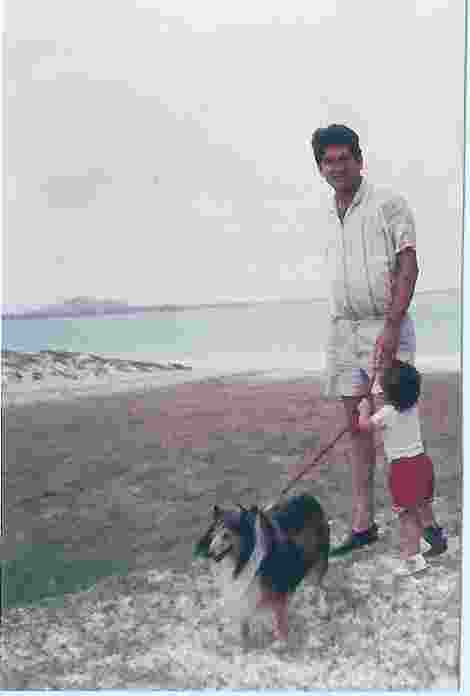
Subroto Roy  recalls how, twenty years ago in Honolulu, he called his three-year old to the television to watch the fall of the Berlin Wall with him as a historic event — even while he had to battle as an individual against the most vicious tyranny unleashed against him by the Government of one of the fifty States (a battle that has continued).

Facebook chatter is a modern technologically advanced international version of the traditional Calcutta Bengali “adda”

After a month and a half or so on Facebook, I have arrived at the assessment that Facebook chatter is a modern technologically advanced international version of the traditional Calcutta Bengali “adda”.   I came to this conclusion while trying to explain the phenomenon  to my father who was born during the First World War.

Subroto Roy, Kolkata

On the curious pre-9/11 quaintness of current criticism of India’s 1998 nuclear tests

I said towards the end of my June 4-5 2006 article in The Statesman “Pakistan’s Allies”

“…America and its allies would not be safe for long since the civil war they had left behind in Afghanistan while trying to defeat the USSR now became a brew from which arose a new threat of violent Islamism. Osama bin Laden and the Taliban, whom Pakistan’s military and the USA had promoted, now encouraged unprecedented attacks on the American mainland on September 11 2001 ~ causing physical and psychological damage which no Soviet, Chinese or Cuban missiles ever had been allowed to do….”

Earlier, in The Statesman of October 26 2005,  I had outlined a series of recent US espionage failures

“There have been three or four enormous failures of American espionage (i.e. intelligence and counter-intelligence) in the last 20 years. The collapse of the Berlin Wall and the end of Soviet communism were salubrious events but they had not been foreseen by the United States which was caught unawares by the speed and nature of the developments that took place. Other failures have been catastrophic.

First, there was the failure to prevent the attack that took place on the American mainland on September 11 2001. It killed several thousand civilians and caused vast, perhaps irreparable, psychological and physical destruction to the United States. The attack was without precedent. The December 7 1941 Japanese attack on Pearl Harbour in Hawaii, though a surprise, was carried out by one military against another military and did not affect very many civilians (except that thousands of American civilians of Japanese ancestry came to be persecuted and placed in concentration camps for years by the US Government). And the last time the American mainland had been attacked before 2001 was in 1814 when British troops marched south from Canada and burnt down the Capitol and the US President’s house in Washington.

Secondly, there has been a failure to discover any reasonable justification for the American-led attack on Iraq and its invasion and occupation. Without any doubt, America has lost, at the very least, an incalculable amount of international goodwill as a result of this, let aside suffering two thousand young soldiers killed, fifteen thousand wounded, and an unending cost in terms of prestige and resources in return for the thinnest of tangible gains. India at great cost liberated East Pakistan from the brutal military tyranny of Yahya Khan and Tikka Khan in December 1971 but the average Bangladeshi today could hardly care less. Regardless of what form of government emerges in Iraq now, there is no doubt the mass of the Iraqi people will cheer the departure of the bulk of foreign troops and tanks from their country (even if a permanent set of a dozen hermetically sealed American bases remain there for ever, as appears to have been planned).

When things go wrong in any democracy, it is natural and healthy to set up a committee to investigate, and America has done that several times now. For such committees to have any use at all they must be as candid as possible and perhaps the most candid of the American committees has been the US Government’s 9/11 Commission. But it too has appeared no closer to finding out who was the mastermind of the 9/11 attacks or who financed it and who, precisely, executed it. Osama Bin Laden may have been the ideological head of a movement allied to the perpetrators, and Bin Laden undoubtedly expressed his glee afterwards, but it beggars the imagination that Bin Laden could have been executive president in charge of this operation while crawling around Sudan, Pakistan and Afghanistan. If not him, then whom? Mossad the Israeli spy agency was supposed to have pointed to a super-secret invisible Lebanese terrorist but nobody really knows. The biggest modern mass murder remains unsolved.

As for solutions, the American 9/11 Commission went into the same politically correct formulae that came to be followed in 2005 by British PM Tony Blair’s New Labour Cabinet, namely, that “moderate” peace-loving Muslims must be encouraged and bribed not to turn to terrorism (indeed to expose those among them who do), while “extremist” Muslims must be stamped out with brute force. This rests on a mistaken premise that an economic carrot-and-stick policy can work in creating a set of external incentives and disincentives for Muslims, when in fact believing Muslims, like many other religious believers, are people who feel the power of their religion deep within themselves and so are unlikely to be significantly affected by external incentives or disincentives offered by non-believers.  Another committee has been the United States Senate’s Select Committee on Intelligence which reported in July 2004, and from whose findings have stemmed as an offshoot the current matter about whether high government officials broke the law that is being investigated by Special Prosecutor Patrick J. Fitzgerald.

Bertrand Russell said in his obituary of Ludwig Wittgenstein that he had once gone about looking under all the tables and chairs to prove to Wittgenstein that there was not a hippopotamus present in the room. In the present case, however, there is in fact a very large hippopotamus present in the room yet the entire American foreign policy establishment has seemed to refuse to wish to see it. Saddam Hussain and OBL are undoubtedly certifiable members of the international gallery of rogues – but the central fact remains they were rogues who were in alliance with America’s defined strategic interests in the 1980s. Saddam Hussain’s Iraq invaded Iran in 1980 and gassed the Kurds in 1986; an Iraqi Mirage on May 17 1987 fired two Exocet missiles at the USS Stark killing 37 American sailors and injuring 21. The Americans did nothing. The reason was that Saddam was still in favour at the time and had not yet become a demon in the political mythology of the American state, and it was expedient for nothing to be done. Indeed Saddam’s Iraq was explicitly removed in 1982 from the US Government’s list of states sponsoring terrorism because, according to the State Department’s Patterns of Global Terrorism, it had “moved closer to the policies of its moderate Arab neighbours”.

The very large hippopotamus that is present in the room at the moment is April Glaspie, the highly regarded professional career diplomat and American Ambassador to Iraq at the time of the 1990 Gulf War. Saddam Hussein as President had a famous meeting with her on July 25 1990, eight days before he invaded Kuwait. The place was the Presidential Palace in Baghdad and the Iraqis videotaped the meeting:

U.S. Ambassador Glaspie – “I have direct instructions from President (George Herbert Walker) Bush to improve our relations with Iraq. We have considerable sympathy for your quest for higher oil prices, the immediate cause of your confrontation with Kuwait. (pause) As you know, I lived here for years and admire your extraordinary efforts to rebuild your country. We know you need funds. We understand that, and our opinion is that you should have the opportunity to rebuild your country. (pause) We can see that you have deployed massive numbers of troops in the south. Normally that would be none of our business, but when this happens in the context of your threats against Kuwait, then it would be reasonable for us to be concerned. For this reason, I have received an instruction to ask you, in the spirit of friendship – not confrontation – regarding your intentions: Why are your troops massed so very close to Kuwait’s borders?

Saddam Hussein – As you know, for years now I have made every effort to reach a settlement on our dispute with Kuwait. There is to be a meeting in two days; I am prepared to give negotiations only this one more brief chance. (pause) When we (the Iraqis) meet (with the Kuwaitis) and we see there is hope, then nothing will happen. But if we are unable to find a solution, then it will be natural that Iraq will not accept death.

U. S. Ambassador Glaspie – What solutions would be acceptable?

Saddam Hussein – If we could keep the whole of the Shatt al Arab – our strategic goal in our war with Iran – we will make concessions (to the Kuwaitis). But, if we are forced to choose between keeping half of the Shatt and the whole of Iraq (i.e., in Saddam’ s view, including Kuwait ) then we will give up all of the Shatt to defend our claims on Kuwait to keep the whole of Iraq in the shape we wish it to be. (pause) What is the United States’ opinion on this?

U.S. Ambassador Glaspie – We have no opinion on your Arab – Arab conflicts, such as your dispute with Kuwait. Secretary (of State James) Baker has directed me to emphasize the instruction, first given to Iraq in the 1960’s, that the Kuwait issue is not associated with America. (Saddam smiles)

Saddam had seen himself fighting Islamic Iran on behalf of the Kuwaitis, Saudis and other Arabs, and Islamic Iran was of course the sworn adversary of the USA at least since Khomeini had deposed America’s ally, the Shah. Therefore Saddam could not be all bad in the eyes of the State Department. On August 2 1990, the Iraqi troops seen by American satellites amassed on the border, invaded and occupied Kuwait. On September 2 1990, the Iraqis released the videotape and transcript of the July 29 Saddam-Glaspie meeting and Glaspie was confronted by British journalists as she left the Embassy:

Journalist 1 – Are the transcripts (holding them up) correct, Madam Ambassador? (No answer from Glaspie)

Journalist 2 – You knew Saddam was going to invade (Kuwait ) but you didn’t warn him not to. You didn’t tell him America would defend Kuwait. You told him the opposite – that America was not associated with Kuwait.

Journalist 1 – You encouraged this aggression – his invasion. What were you thinking?

U.S. Ambassador Glaspie – Obviously, I didn’t think, and nobody else did, that the Iraqis were going to take all of Kuwait.

Journalist 1 – You thought he was just going to take some of it? But, how could you? Saddam told you that, if negotiations failed , he would give up his Iran(Shatt al Arab waterway) goal for the whole of Iraq, in the shape we wish it to be. You know that includes Kuwait, which the Iraqis have always viewed as a historic part of their country!

Journalist 1 – America green-lighted the invasion. At a minimum, you admit signalling Saddam that some aggression was okay – that the U.S. would not oppose a grab of the al-Rumeilah oil field, the disputed border strip and the Gulf Islands (including Bubiyan) – the territories claimed by Iraq?

Glaspie said nothing, the car door closed behind her, the car drove off. Nothing has been apparently heard from Glaspie ever since, and we may have to wait for her memoirs in 25 years when they are declassified to come to know what happened. It is astonishing, however, that the 521 page report of the US Senate’s Select Committee on espionage about Iraq before the 2003 war finds no cause whatsoever to mention Glaspie at all (at least in its public censored version). It is almost as if Glaspie has never existed and her conversation with Saddam never happened. Glaspie has disappeared down an Orwellian memory-hole. Yet her conversation with Saddam was the last official, recorded conversation between the Americans and Saddam while they were still on friendly terms.

There may be many causes explaining how such serious failures have come to occur in a country where billions of dollars have been annually spent on espionage. Among them must be that while America’s great strengths have included creation of the finest advanced scientific and technological base on earth, America’s great intellectual weaknesses in recent decades have included an impatience with historical and philosophical reflection of all sorts, and that includes reflection about her own as well as other cultures. This is exemplified too in the third palpable failure of intelligence of the last 20 years, which has been to have not foreseen or prevented atomic weapons from being developed by America and Britain’s Islamist ally and client-state, Pakistan, and thence to have failed to prevent the proliferation of such weapons in general. The consequences of that may yet turn out to be the most grave.”

Now as it happens, a couple of days ago, eleven years after the Government of India’s May 1998 underground nuclear tests at Pokhran, an Indian scientist who had something to do with them has engaged in a general discussion about the tests’ efficacy. Indian newspapers duly reported this as part of an ongoing domestic discussion about nuclear policy.

Oddly enough, there has been an instantaneous reaction from American critics of India’s nuclear activities – beginning with Dr Jeffrey Lewis:

“Yes, Virginia, India’s H-bomb fizzled.  K Santhanam (who was director of test site preparations for India’s 1998 nuclear tests… has admitted what everyone else has known for a long time — that India’s 1998 test of a thermonuclear device was unsuccessful.…”

Followed by Mark Hibbs:

“Is this cool or what? I remember what happened when I wrote that article in the fall of 1998 saying in the headline that the US had concluded that the Indian “H-Bomb failed.” Almost overnight after the article was published I got a huge bundle of papers from BARC and DAE sent to me by diplomatic pouch from Mumbai informing me with all kinds of numbers that I was wrong.  I gave the papers to laboratory geoscientists at several European countries and the US. One main CTBTO monitoring scientist told me explicitly: “Nope. The stuff in these papers is shitty science. They haven’t shown that you are wrong.” That having been said, please note however that, as PK Iyengar had made the case to me back a decade ago, once again this “news” is surfacing in India because their bomb makers want to keep testing. Some things in India are changing fast. Other things aren’t.”

Followed by Charles Mead:

“I got into a huge pissing match with the Indians on this issue as I was the principal author of Barker et. al. 1998 which had the yield estimates far below the Indian press releases. A number of Indian scientists tried to submit a comment to Science rebutting our analysis. We asked them to provide the in-country seismic data on which they based their analysis, but they refused. Luckily, in the end, their comment was rejected and never published.  On a related note, I saw the other day that wikipedia has a glowing description of the Indian 1998 tests, citing the inflated yields and saying the tests were a huge technical accomplishment. See http://en.wikipedia.org/wiki/Pokhran-II In the next day or so, I plan to submit a corrected analysis.”

Mark Hibbs:

“Charles, I recall one of your co-authors back then explained to me in nitty-gritty detail your frustration on this with these guys. Please do correct the record for posterity.”

Charles Meade:

“Their arguments at the time were quite remarkable. They said that our seismic data didn’t reflect the true yield because of a complex interference pattern caused by the simultaneous tests. Under these circumstances, they said that one could only obtain the correct yield from near field data. We said, “fine, show it to us”. They refused and that was the end of their paper.”

Yale Simkin:

“The Indian argument: ‘For us to have a nuclear deterrent we must weaponise. For this, we must have fusion weapons, because these are smaller, lighter, and more efficient than fission weapons.’ is a lot of hooey.  They claim to be building a deterrent force, not a war-fighting arsenal with a counter-force capability.  For the size and mass of their likely early-generation fusion designs, they can instead use basic fission bombs yielding in the multi-dekakiloton range – multiples of the hell weapons that incinerated Hiroshima and Nagasaki.  That should be sufficient to deter any rational adversary. And if they aren’t rational, then you have no deterrent.”

Hmmm.  The choice of terminology even within such a brief discussion might reveal a little of the mind-set: “shitty science”, “pissing match”, “a lot of hooey”…

Rather uncool, really.

Specifically:

“A number of Indian scientists tried to submit a comment to Science rebutting our analysis. We asked them to provide the in-country seismic data on which they based their analysis, but they refused. Luckily, in the end, their comment was rejected and never published…. Their arguments at the time were quite remarkable. They said that our seismic data didn’t reflect the true yield because of a complex interference pattern caused by the simultaneous tests. Under these circumstances, they said that one could only obtain the correct yield from near field data. We said, “fine, show it to us”. They refused and that was the end of their paper.

Hmmm — once more.  The words that I have placed in bold above might be prima facie evidence of incorrect and hence unfair editorial procedures having been followed at Science (distinguished as its general reputation may be as a journal).  Why were these here-unnamed “Indian scientists” not allowed to speak for themselves, rather than have their now-unknown statements be bowdlerised out of their critics’ memories a decade later (when these critics themselves had been the subject of the rebuttal)?  Perhaps the rebuttal should not have been refused publication even if it came with an editorial caveat that all the data deemed necessary had not been provided (which may have been the case, for example, due to a Government gag-order).  Readers today would have been able to judge for themselves.

I am happy to claim zero expertise in the field known rather sweetly as “Crater Morphology”; but post 9/11, post-Iraq war, it does seem to me a rather quaint form of prejudice to be using such words as those quoted above  in discussing the precise tonnage of the Indian explosions and how, really, India’s scientists were not up to it.  Perhaps,  when matters of public policy or international diplomacy become involved, science  everywhere is too important to be left to the scientists.

Are all the available data out there in the public domain on which to judge whether the Indian explosions in 1998 were or were not what was precisely claimed at the time?  Apparently not.

Does it matter to anything today?  Hardly.  Not even to the credibility of the Government of India (something on which I have had a lot to say over decades).

Do Governments lie?  Yes Virginia, they do.

Governments the world over, whether Indian, American, Russian, Chinese, British, French, Israeli, Arab, Pakistani or whatever, let aside inter-Governmental bodies constituted by these Governments, are prone to exaggeration, propaganda, self-delusion, self-deception as well as deliberate mendacity, perhaps routinely on a daily basis.

(For myself as an individual, I have had to battle the demonstrated and deliberate mendacity of the government of one of the fifty States in the US federal courts for two decades now, as told of elsewhere…)

An Age of Government Mendacity has seemed to descend upon the world — which makes the smugness expressed so quickly today by the critics of India’s 1998 explosions seem, as I have said, quaint.

Is the current Indian debate indicating something about keeping open the possibility of more tests and isn’t this related to the Indo-US civil nuclear deal?   It may well be, I do not know.  My position for what it is worth has been clear and described in several articles in The Statesman in recent years e.g.

1) Atoms for Peace (or War)  (March 5 2006)

“Atoms for Peace” was Dwight D. Eisenhower’s 1953 speech to the UN (presided over by Jawaharlal Nehru’s sister) from which arose the IAEA. Eisenhower was the warrior par excellence, having led the Allies to victory over Hitler a few years earlier.

Yet he was the first to see “no sane member of the human race” can discover victory in the “desolation, degradation and destruction” of nuclear war. “Occasional pages of history do record the faces of the ‘great destroyers’, but the whole book of history reveals mankind’s never-ending quest for peace and mankind’s God-given capacity to build.” Speaking of the atomic capacity of America’s communist adversary at the time, he said: “We never have, and never will, propose or suggest that the Soviet Union surrender what rightly belongs to it. We will never say that the peoples of the USSR are an enemy with whom we have no desire ever to deal or mingle in friendly and fruitful relationship.” Rather, “if the fearful trend of atomic military build-up can be reversed, this greatest of destructive forces can be developed into a great boon, for the benefit of all mankind…. if the entire body of the world’s scientists and engineers had adequate amounts of fissionable material… this capability would rapidly be transformed into universal, efficient and economic usage”. Eisenhower’s IAEA would receive contributions from national “stockpiles of normal uranium and fissionable materials”, and also impound, store and protect these and devise “methods whereby this fissionable material would be allocated to serve the peaceful pursuits of mankind.…to provide abundant electrical energy in the power-starved areas of the world… to serve the needs rather than the fears of mankind.” When Eisenhower visited India he was greeted as the “Prince of Peace” and a vast multitude threw rose petals as he drove by in an open limousine.

Now, half a century later, Dr Manmohan Singh read a speech in Parliament on February 27 relating to our nuclear discussions with America. But it seems unclear even his speech-writers or technical advisers knew how far it was rhetoric and how far grounded in factual realities. There is also tremendous naivete among India’s media anchors and political leaders as to what exactly has been agreed by the Americans on March 2.

Churchill once asked what might have happened if Lloyd George and Clemenceau told Woodrow Wilson: “Is it not true that nothing but your fixed and expiring tenure of office prevents you from being thrown out of power?” The same holds for George W. Bush today. Wilson made many promises to the world that came to be hit for a six by US legislators. In December 2005, Edward Markey (Democrat) and Fred Upton (Republican) promised to scuttle Bush’s agreements with India, and once the pleasant memories of his India visit fade, Bush may quite easily forget most things about us. All the Americans have actually agreed to do is to keep talking.

It needs to be understood that submarine-launched ballistic missiles are the only ultimate military deterrent. Land and air forces are all vulnerable to a massive first-strike. Only submarines lurking silently for long periods in waters near their target, to launch nuclear warheads upon learning their homeland had been hit by the enemy, act as a deterrent preventing that same enemy from making his attack at all. Indeed, the problem becomes how a submarine commander will receive such information and his instructions during such a war. (For India to acquire an ICBM capability beyond the MRBM Agni rockets is to possess an expensive backward technology — as retrograde as the idea India should spend scarce resources sending manned moon missions half a century after it has already been done. The secret is to do something new and beneficial for mankind, not repeat what others did long ago merely to show we can now do it too.) A nuclear-armed submarine needs to be submerged for long periods and also voyage long distances at sea, and hence needs to be nuclear-powered with a miniature version of a civilian nuclear reactor aboard in which, e.g. rods of enriched uranium are bombarded to release enough energy to run hydroelectric turbines to generate power. Patently, no complete separation of the use of atomic power for peace and war may be practically possible. If India creates e.g. its own thorium reactors for civilian power (and we have vast thorium reserves, the nuclear fuel of the future), and then miniaturised these somehow to manufacture reactors for submarines, the use would be both civilian and military. In 1988 the old USSR leased India a nuclear-powered submarine for “training” purposes, and the Americans did not like it at all. In January 2002, Russia’s Naval Chief announced India was paying to build and then lease from 2004 until 2009 two nuclear-powered Akula-class attack submarines, and Jaswant Singh reportedly said we were paying $1 thousand crore ($10 bn) for such a defence package. Whether the transaction has happened is not known. Once we have nuclear submarines permanently, that would be more than enough of the minimum deterrent sought.

Indeed, India’s public has been barely informed of civilian nuclear energy policy as well, and an opportunity now exists for a mature national debate to take place — both on what and why the military planning has been and what it costs (and whether any bribes have been paid), and also on the cost, efficiency and safety of the plans for greater civilian use of nuclear energy. Government behaviour after the Bhopal gas tragedy does not inspire confidence about Indian responses to a Three Mile Island/Chernobyl kind of catastrophic meltdown.

That being said, the central question remains why India or anyone else needs to be nuclear-armed at all. With Britain, France or Russia, there is no war though all three are always keen to sell India weapons. Indeed it has been a perennial question why France and Britain need their own deterrents. They have not fought one another for more than 100 years and play rugby instead. If Russia was an enemy, could they not count on America? Or could America itself conceivably become an enemy of Britain and France? America owes her origins to both, and though the Americans did fight the British until the early 1800s, they have never fought the French and love the City of Paris too much ever to do so.

Between China and India, regardless of what happened half a century ago, nuclear or any war other than border skirmishes in sparse barren lands is unlikely. Ever since Sun Yat-sen, China has been going through a complex process of self-discovery and self-definition. An ancient nation where Maoism despoiled the traditional culture and destroyed Tibet, China causes others to fear it because of its inscrutability. But it has not been aggressive in recent decades except with Taiwan. It has threatened nuclear war on America if the Americans stand up for Taiwan, but that is not a quarrel in which India has a cogent role. China (for seemingly commercial reasons) did join hands with Pakistan against India, but there is every indication the Chinese are quite bored with what Pakistan has become. With Pakistan, our situation is well-known, and there has been an implicit equilibrium since Pokhran II finally flushed out their capacity. Had India ever any ambition of using conventional war to knock out and occupy Pakistan as a country? Of course not. We are barely able to govern ourselves, let aside try to rule an ideologically hostile Muslim colony in the NorthWest. Pakistan’s purported reasons for acquiring nuclear bombs are spurious, and cruelly so in view of the abject failures of Pakistan’s domestic political economy. Could Pakistan’s Government use its bombs against India arising from its own self-delusions over J&K? Gohar Ayub Khan in 1998-1999 threatened to do so when he said the next war would be over in two hours with an Indian surrender. He thereby became the exception to Eisenhower’s rule requiring sanity. An India-Pakistan nuclear exchange is, unfortunately, not impossible, leaving J&K as Hell where Jahangir had once described it as Heaven on Earth.

America needs to end her recent jingoism and instead rediscover the legacy of Eisenhower. America can lead everyone in the world today including Russia, China, Israel, Iran and North Korea. But she can do so only by example. America can decommission many of her own nuclear weapons and then lead everyone else to the conference table to do at least some of the same. Like the UN, the IAEA (and its NPT) needs urgent reform itself. It is the right time for serious and new world parleys towards the safe use of atoms for peace and their abolition in war. But are there any Eisenhowers or Churchills to lead them?

2) Our  energy interests ( Aug 27-28 2006)

Americans are shrewd and practical people in commercial matters, and expect the same of people they do business with. Caveat emptor, “let the buyer beware”, is the motto they expect those on the other side of the table to be using. Let us not think they are doing us favours in the nuclear deal ~ they are grown-ups looking after their interests and naturally expect we shall look after our own and not expect charity while doing business. Equally, let us not blame the Americans if we find in later years (long after Manmohan Singh and Montek Ahluwalia have exited from India’s stage) that the deal has been implemented in a bad way for our masses of ordinary people.

That said, there is a remarkable disjoint between India’s national energy interests (nuclear interests in particular), and the manner in which the nuclear deal is being perceived and taken to implementation by the two sides. There may be a fundamental gap between the genuine positive benefits the Government of India says the deal contains, and the motivations American businessmen and through them Indian businessmen have had for lobbying American and Indian politicians to support it. An atmosphere of being at cross-purposes has been created, where for example Manmohan Singh is giving answers to questions different from the questions we may want to be asking Montek Ahluwalia. The fundamental gap between what is being said by our Government and what may be intended by the businessmen is something anyone can grasp, though first we shall need some elementary facts.

In 2004, the International Energy Agency estimated the new energy capacity required by rising economic growth in 2020 will derive 1400 GW from burning coal (half of it in China and India), 470 GW from burning oil, 430GW from hydro, and 400 GW from renewable sources like solar or wind power. Because gas prices are expected to remain low worldwide, construction of new nuclear reactors for electricity will be unprofitable. By 2030, new energy expected to be required worldwide is 4700GW, of which only 150GW is expected from new nuclear plants, which will be in any case replacing existing plants due to be retired. Rational choice between different energy sources depends on costs determined by history and geography. Out of some 441 civilian reactors worldwide, France has 59 and these generate 78 per cent of its electricity, the rest coming from hydro. Japan has 54 reactors, generating 34% of its electricity from them. The USA has 104 reactors but generates only 20 per cent of its electricity from them, given its vast alternative sources of power like hydro. In India as of 2003, installed power generating capacity was 107,533.3MW, of which 71 per cent came from burning fuels. Among India’s energy sources, the largest growth-potential is hydroelectric, which does not involve burning fuels ~ gravity moves water from the mountains to the oceans, and this force is harnessed for generation. Our hydro potential, mostly in the North and North-East, is some 150,000MW but our total installed hydro capacity with utilities was only 26,910MW (about 18 per cent of potential). Our 14 civilian nuclear reactors produced merely 4 per cent or less of the electricity being consumed in the country. Those 14 plants will come under “international safeguards” by 2014 under the nuclear deal.

It is extremely likely the international restrictions our existing nuclear plants have been under since the 1970s have hindered if not crippled their functioning and efficiency. At the same time, the restrictions may have caused us to be innovative too. Nuclear power arises from fission of radioactive uranium, plutonium or thorium. India has some 8 million tonnes of monazite deposits along the seacoast of which half may be mined, to yield 225,000 tonnes of thorium metal; we have one innovatively designed thorium reactor under construction. Almost all nuclear energy worldwide today arises from uranium of which there are practically unlimited reserves. Fission of a uranium atom produces 10 million times the energy produced by combustion of an atom of carbon from coal. Gas and fossil fuels may be cheap and in plentiful supply worldwide for generations to come but potential for cheap nuclear energy seems practically infinite. The uranium in seawater can satisfy mankind’s total electricity needs for 7 million years. There is more energy in the uranium impurity present in coal than can arise from actually burning the coal. There is plenty of uranium in granite. None of these become profitable for centuries because there is so much cheap uranium extractable from conventional ores. Design improvements in reactors will also improve productivity; e.g. “fast breeder” reactors “breed” more fissile material than they use, and may get 100 times as much energy from a kilogram of uranium as existing reactors do. India has about 95,000 tonnes of uranium metal that may be mined to yield about 61,000 tonnes net for power generation. Natural uranium is 99.3 per cent of the U-238 isotope and 0.7 per cent of the radioactive U-235 isotope. Nuclear power generation requires “enriched uranium” or “yellow cake” to be created in which U-235 has been increased from 0.7 per cent to 4 to 5 percent. (Nuclear bombs require highly enriched uranium with more than 90 per cent of U-235.) Yellow cake is broken into small pieces, put in metal rods placed in bundles, which are then bombarded by neutrons causing fission. In a reactor, the energy released turns water into steam, which moves turbines generating electricity. While there is no carbon dioxide “waste” as in burning fossil fuels, the “spent” rods of nuclear fuel and other products constitute grave radioactive waste, almost impossible to dispose of.

The plausible part of the Government of India’s official line on the Indo-US nuclear deal is that removing the international restrictions will ~ through importation of new technologies, inputs, fuel etc ~ improve functioning of our 14 existing civilian plants. That is a good thing. Essentially, the price being paid for that improvement is our willingness to commit that those 14 plants will not be used for military purposes. Fair enough: even if we might become less innovative as a result, the overall efficiency gains as a result of the deal will add something to India’s productivity. However, those purchasing decisions involved in enhancing India’s efficiency gains must be made by the Government’s nuclear scientists on technical grounds of improving the working of our existing nuclear infrastructure.

It is a different animal altogether to be purchasing new nuclear reactors on a turn-key basis from American or any other foreign businessmen in a purported attempt to improve India’s “energy security”. (Lalu Yadav has requested a new reactor for Bihar, plus of course Delhi will want one, etc.) The central question over such massive foreign purchases would no longer be the technical one of using the Indo-US deal to improve efficiency or productivity of our existing nuclear infrastructure. Instead it would become a question of calculating social costs and benefits of our investing in nuclear power relative to other sources like hydroelectric power. Even if all other sources of electricity remained constant, and our civilian nuclear capacity alone was made to grow by 100 per cent under the Manmohan-Montek deal-making, that would mean less than 8% of total Indian electricity produced.

This is where the oddities arise and a disjoint becomes apparent between what the Government of India is saying and what American and Indian businessmen have been doing. A “US-India Business Council” has existed for thirty years in Washington as “the premier business advocacy organization promoting US commercial interests in India.… the voice of the American private sector investing in India”. Before the nuclear or any other deals could be contemplated with American business, the USIBC insisted we pay up for Dabhol contracted by a previous Congress Government. The Maharashtra State Electricity Board ~ or rather, its sovereign guarantor the Government of India ~ duly paid out at least $140-$160 million each to General Electric and Bechtel Corporations in “an amicable settlement” of the Dabhol affair. Afterwards, General Electric’s CEO for India was kind enough to say “India is an important country to GE’s global growth. We look forward to working with our partners, customers, and State and Central Governments in helping India continue to develop into a leading world economy”.

Also, a new “US-India CEO Forum” then came about. For two Governments to sponsor private business via such a Forum was “unprecedented”, as noted by Washington’s press during Manmohan Singh’s visit in July 2005. America’s foreign ministry announced it saying: “Both our governments have agreed that we should create a high-level private sector forum to exchange business community views on key economic priorities…” The American side includes heads of AES Corporation, Cargill Inc., Citigroup, JP Morgan Chase, Honeywell, McGraw-Hill, Parsons Brinckerhoff Ltd, PepsiCo, Visa International and Xerox Corporation. The Indian side includes heads of Tata Group, Apollo Hospitals Group, Bharat Forge Ltd, Biocon India Group, HDFC, ICICI One Source, Infosys, ITC Ltd, Max India Group and Reliance Industries. Presiding over the Indian side has been Montek Ahluwalia, Manmohan’s trusted aide ~ and let it be remembered too that the Ahluwalias were Manmohan’s strongest backers in his failed South Delhi Lok Sabha bid. (Indeed it is not clear if the Ahluwalias have been US or Indian residents in recent years, and if it is the former, the onus is on them to clear any perception of conflict of interest arising in regard to roles regarding the nuclear deal or any other official Indo-US business.)

Also, before the Manmohan visit, the Confederation of Indian Industry registered as an official lobbyist in Washington, and went about spending half a million dollars lobbying American politicians for the nuclear deal. After the Manmohan visit, the US Foreign Commercial Service reportedly said American engineering firms, equipment suppliers and contractors faced a $1,000 billion (1 bn =100 crore) opportunity in India. Before President Bush’s visit to India in March 2006, Manmohan Singh signed vast purchases of commercial aircraft from Boeing and Airbus, as well as large weapons’ deals with France and Russia. After the Bush visit, the US Chamber of Commerce said the nuclear deal can cause $100 billion worth of new American business in India’s energy-sector alone. What is going on?

Finally, the main aspect of Manmohan Singh’s address to America’s legislature had to do with agreeing with President Bush “to enhance Indo-US cooperation in the field of civilian nuclear technology”. What precisely does this mean? If it means the Indo-US nuclear deal will help India improve or maintain its existing nuclear infrastructure, well and good. There may be legitimate business for American and other foreign companies in that cause, which also helps India make the efficiency and productivity gains mentioned. Or has the real motivation for the American businessmen driving the deal (with the help of the “CEO Forum” etc) been to sell India nuclear reactors on a turn-key basis (in collaboration with private Indian businessmen) at a time when building new nuclear reactors is unprofitable elsewhere in the world because of low gas prices? India’s citizens may demand to know from the Government whether the Manmohan-Montek deal-making is going to cause importation of new nuclear reactors, and if so, why such an expensive alternative is being considered (relative to e.g. India’s abundant hydroelectric potential) when it will have scant effect in satisfying the country’s energy needs and lead merely to a worsening of our macroeconomic problems. Both Manmohan Singh and Montek Ahluwalia have been already among those to preside over the growth of India’s macroeconomic problems through the 1980s and 1990s.

Lastly, an irrelevant distraction should be gotten out of the way. Are we a “nuclear weapons” state? Of course we are, but does it matter to anything but our vanity? Ronald Reagan and Mikhail Sergeyevich Gorbachev had control over vastly more nuclear weapons and they declared together twenty years ago: “A nuclear war cannot be won and must not be fought”, which is how the Cold War started to come to an end. We need to remind ourselves that India and Pakistan are large, populous countries with hundreds of millions of materially poor, ill-informed citizens, weak tax-bases, humongous internal and external public debts (i.e. debt owed by the Government to domestic and foreign creditors), non-investment grade credit- ratings in world financial markets, massive annual fiscal deficits, inconvertible currencies, nationalized banks, and runaway printing of paper-money. Discussing nuclear or other weapon-systems to attack one other with is mostly a pastime of our cowardly, irresponsible and yes, corrupt, elites.

3) Need for Clarity A poorly drafted treaty driven by business motives is a recipe for international misunderstanding  (August 19 2007)

Confusion prevails over the Indo-US Nuclear Deal. Businessmen, bureaucrats, politicians, diplomats, scientists and now the public at large have all joined in the cacophony in the last two years. On Wednesday August 15, America’s foreign ministry made the clearest most unequivocal statement possible as to the official American Government interpretation of the Indo-US nuclear deal: “The proposed 123 agreement has provisions in it that in an event of a nuclear test by India, then all nuclear co-operation is terminated, as well as there is provision for return of all materials, including reprocessed material covered by the agreement” (Sean McCormack). Yet our Prime Minister had told Parliament two days earlier: “The agreement does not in any way affect India’s right to undertake future nuclear tests, if it is necessary”. What is going on? Our politics are in uproar, and it has been suggested in these pages that the country go to a General Election to allow the people to speak on the matter. Clearly, we need some clarity.

Let us start at the beginning. How did it all originate? The private US nuclear industry prevailed upon India’s government bureaucrats and businessmen over several years that nuclear power is the way forward to solving India’s “infrastructure” problems. They would sell us, in words of the Manmohan-Montek Planning Commission’s energy adviser, “six to eight lightwater reactors” (especially as they may not be able to sell these anywhere else). Our usual prominent self-seeking retired bureaucrats started their waffling about the importance of “infrastructure”.

Then Manmohan Singh felt his foreign travels as PM could be hardly complete without a fife-and-drum visit to the White House. But before he could do so, Dabhol would have to be cleared up since American business in India was on a self-moratorium until GE and Bechtel were paid settlements of some $140-160 million each by the Governments of India and Maharashtra. GE’s CEO for India kindly said afterwards “India is an important country to GE’s global growth. We look forward to working with our partners, customers, and State and Central Governments in helping India continue to develop into a leading world economy”.

Also, before Manmohan’s USA trip, the Confederation of Indian Industry registered as an official Washington lobbyist and spent half a million dollars lobbying American politicians for the deal. (”Why?” would be a good question.)

So Dr Singh was able to make his White House visit, accompanied by US business lobbies saying the nuclear deal can generate $100 billion worth of new American business in India’s energy-sector alone. It is only when business has lubricated politics in America that so much agreement about the India-deal could arise. The “bottom-line” is that six to eight reactors must be sold to India, whatever politics and diplomacy it takes.

Now Dr Singh is not a PM who is a Member of the Lower House of Parliament commanding its confidence. He says his Government constitutes the Executive and can sign treaties on India’s behalf. This is unwise. If he signs a treaty and then the Congress Party loses the next General Election, a new Executive Government can use his same words to rescind the same treaty. What is sauce for the goose is sauce for the gander. One reason we are so confused is that India has not signed very many bilateral treaties, and there is barely a noted specialist in international law anywhere in the country. Dr Singh’s original mentor, PN Haksar, had gone about getting a treaty signed with the USSR back in 1971 which tided us over a war, though the USSR itself collapsed before that treaty ended.

Signing a treaty is much more than signing an international MOU. It requires a national consensus or a least a wide and deep understanding on the part of the public and the political class as to what necessitates the treaty. That plainly does not exist at present. Most people in India do not even know how nuclear power is generated, nor how small and insignificant nuclear power has been in India.

Natural uranium is 99.3 per cent of the U-238 isotope and 0.7 per cent the radioactive U-235 isotope. Nuclear power generation requires “enriched uranium” or “yellow cake” to be created in which U-235 has been increased from 0.7 per cent to 4 to 5 percent. (Nuclear bombs require “highly enriched” uranium with more than 90 per cent of U-235.) Yellow cake is broken into small pieces, put in metal rods placed in bundles, which are then bombarded by neutrons causing fission. In a reactor, the energy released turns water into steam, which moves turbines generating electricity. While there is no carbon dioxide “waste” as in burning fossil fuels, the “spent” rods of nuclear fuel and other products constitute grave radioactive waste, almost impossible to dispose of.

India’s 14 “civilian” nuclear reactors presently produce less than 4% of our total power. 70% of our power arises from burning fossil fuels, mainly coal. Much of the rest arises from hydro. We have vast hydroelectric potential in the North and Northeast but it would take a lot of serious political, administrative and civil engineering effort to organise all that, and there would not be any nice visits to Washington or Paris involved for politicians and bureaucrats.

Simple arithmetic says that even if all our principal energy sources stayed constant and only our tiny nuclear power sector grew by 100%, that would still hardly increase by very much our energy output overall. Placing a couple of expensive modern lightwater reactors around Delhi, a couple around Mumbai and a few other metros will, however, butter already buttered bread quite nicely and keep all those lifts and ACs running.

The agreed text of the “treaty” looks, from a legal standpoint, quite sloppily and hurriedly written ~ almost as if each side has cut and paste its own preferred terms in different places with a nod to the other side. For example, there is mention of “WMD” initially which is repeated as “weapons of mass destruction” just a little later. There is solemn mention of the “Government of India” and “Government of the United States of America” as the “Parties”, but this suddenly becomes merely “United States” and “India” in the middle and then reverts again to the formal usage.

Through the sloppiness comes scope for different interpretations. The Americans have said: try not to test, you don’t need to, we don’t test any more, and you have to know that if you do test, this deal is over, in fact it gets reversed. We have said, okay, we won’t test, and if we do test we know it is over with you but that does not mean it is over with others. Given such sloppy diplomacy and treaty-making, the scope for mutual misunderstanding, even war, remains immense long after all the public Indian moneys have found their way into private pockets worldwide. Will a future President Jeb Bush or Chelsea Clinton send F-22 bombers to bomb India’s nuclear facilities because India has carried out a test yet declined to return American equipment? Riding a tiger is not something generally to be recommended.

The answer to our present conundrum must be patience and the fullest transparency. What is the rush? If it is good or bad for us to buy six or eight new American reactors now, it will remain good or bad to do so a year or two from now after everyone has had a thorough think about everything that is involved. What the Manmohan-Montek Planning Commission needed to do first of all was a thorough cost-benefit analysis of India’s energy requirements but such elementary professionalism has been sorely lacking among our economists for decades.”

Subroto Roy, Kolkata

Protected: The Case of the Missing Princeton PhD Thesis

This post is password protected. To view it please enter your password below:


Thoughts, words, deeds: My work 1973-2010

Thoughts, words, deeds

My work 1973-2010

Subroto Roy

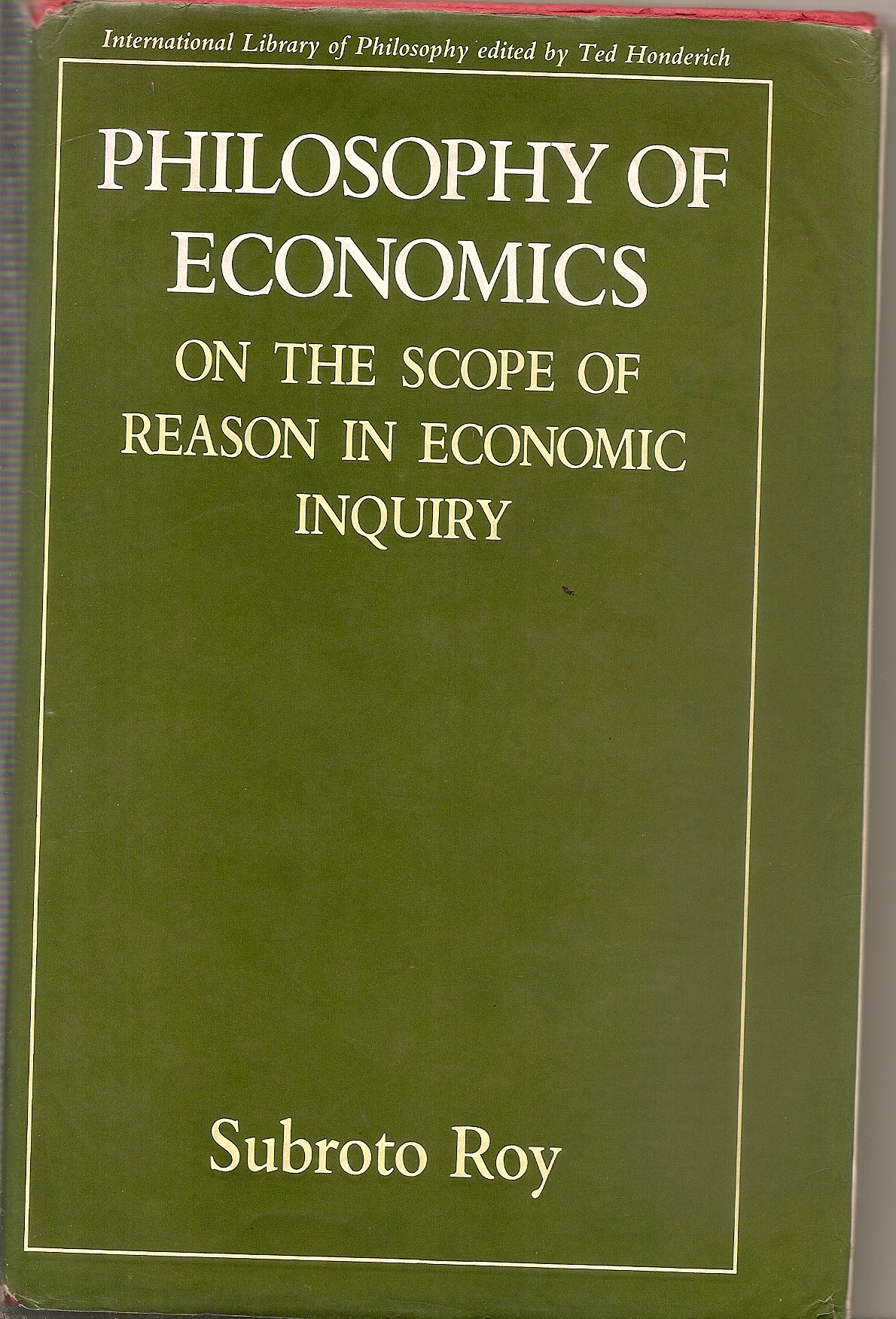
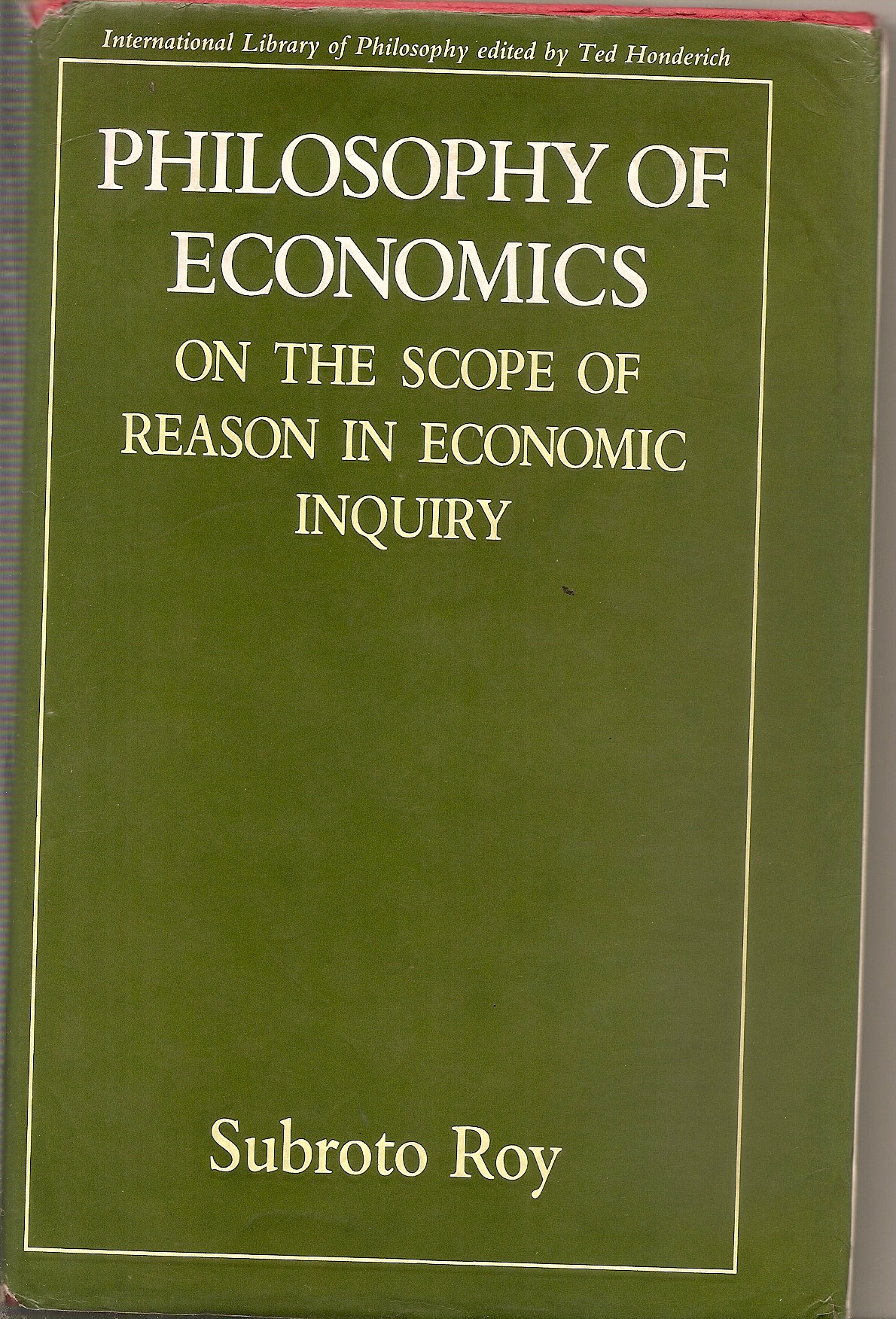
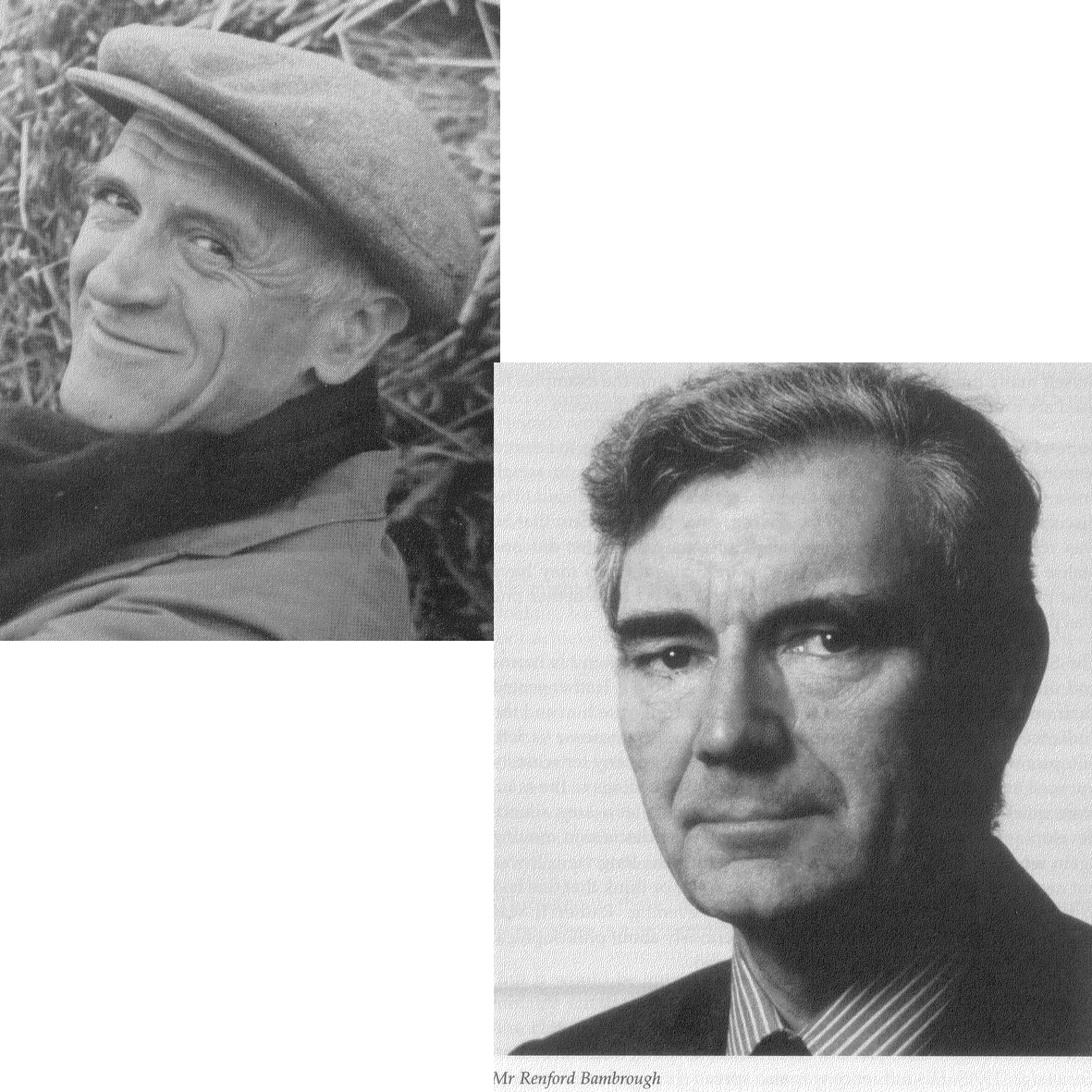
This is an incomplete bibliography of my writings, public lectures etc 1973-2010 including citations, reviews, comments.  I have been mostly an academic economist who by choice or circumstance over 36 years has had to venture also into science, philosophy, public policy, law, jurisprudence, practical politics, history, international relations, military strategy, financial theory, accounting, management, journalism, literary criticism, psychology, psychoanalysis, theology, aesthetics, biography, children’s fables, etc.   If anything unites the seemingly diverse work recorded below it is that I have tried to acquire a grasp of the nature of human reason and then apply this comprehension in practical contexts as simply and clearly as possible. Hence I have ended up following the path of Aristotle, as described in modern times (via Wittgenstein and John Wisdom) by Renford Bambrough.  The 2004 public lecture in England, “Science, Religion, Art & the Necessity of Freedom”, may explain and illustrate all this best.  A friend has been kind enough to call me an Academician, which I probably am, though one who really needs his own Academy because the incompetence, greed and mendacity encountered too often in the modern professoriat is dispiriting.

1-289 refer mostly to writings and publications printed on paper; 290-382 refer to  writings or items not printed on paper — as new media break space, cost and other  constraints of traditional publishing, a little repetition and overlap has occurred too. Also in a few cases, e.g., Aldous Huxley’s essay on DH Lawrence, nothing has been done except discover and republish.  Several databases have been created and released in the public interest, as have been some rare maps.  There is also some biographical and autobiographical material.  Several inconsequential errors remain in the text, which shall take time to be rectified as documents come to be rediscovered and collated.

1973

1. “Behavioural study of mus musculus”, Haileybury College, Supervised by J de C Ford-Robertson MA (Oxon). (Due to be published here 2010).

2. “Chemistry at Advanced & Special Level: Student Notes 1972-73” (Due to be published here 2010).

3. “Biology at Advanced & Special Level: Student Notes 1972-73”, (Due to be published here 2010).

4.  “Physics at Advanced Level: Student Notes 1972-73”, (Due to be published here 2010).

5. “Revolution: theoria and praxis”, London, mimeo (Due to be published here 2010).

6. “Gandhi vs Marx”, London, mimeo (Due to be published here 2010).

1974

7. “Relevance of downward money-wage rigidity to the problem of maintaining full-employment in the classical and Keynesian models of income determination”, London School of Economics, mimeo (Due to be published here 2010).

8. “Testing aircraft fuels at Shell Finland”.

1975

9. “Oxford Street experiences: down and out in London town”.

10. “SE Region Bulk Distribution Survey”, Unilever, Basingstoke.

11. “Four London poems”, in JCM Paton (ed)  New Writing (London, Great Portland Street: International Students House).  (Due to be republished here 2010)

12. “On economic growth models and modellers”, London School of Economics, mimeo. (Due to be published here 2010).

1976

13. “World money: system or anarchy?”, lecture to Professor ACL Day’s seminar, London School of Economics, Economics Department, April. (Due to be published here 2010).

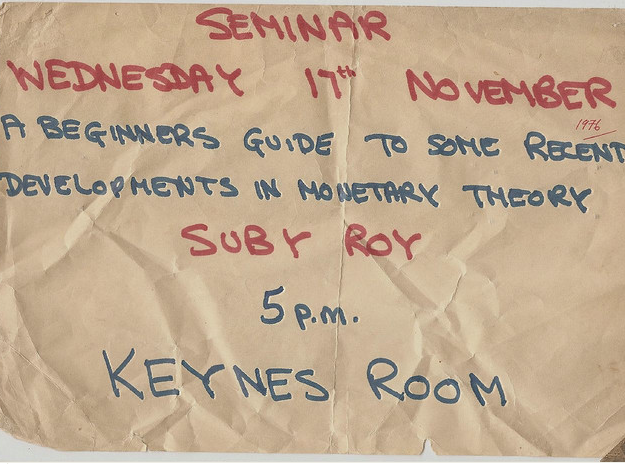
14. “A beginner’s guide to some recent developments in monetary theory”, lecture to Professor FH Hahn’s seminar, Cambridge University Economics Department, November 17 (Due to be published here 2010). See also “Announcement of My “Hahn Seminar”,  published here June 14 2008.

1977

15. “Inflation and unemployment: a survey”, mimeo, Fitzwilliam College, Cambridge. (Due to be published here 2010).

16. “On short run theories of dual economies”, Cambridge University Economics Department “substantial piece of work” required of first year Research Students.  Examiner: DMG Newbery, FBA. (Due to be published here 2010).

1978

17. “Pure theory of developing economies 1 and 2”, Delhi School of Economics mimeo (Due to be published here 2010).

18. “Introduction to some market outcomes under uncertainty”, Delhi School of Economics mimeo (Due to be published here 2010).

19. “On money and development”, Corpus Christi College, Cambridge, mimeo, September.  (Due to be published here 2010)

20. “Notes on the Newbery-Stiglitz model of sharecropping”, Corpus Christi College, Cambridge, mimeo November.  (Due to be published here 2010).

1979

21. “A theory of rights and economic justice”, Corpus Christi College Cambridge mimeo. (Due to be published here 2010).

22. “Monetary theory and economic development”, Corpus Christi College Cambridge, mimeo  (Due to be published here 2010).

23. “Foundations of the case against ‘development planning’”, Corpus Christi College Cambridge, mimeo, November.   (Due to be published here 2010).

1979-1989

24. Correspondence with Renford Bambrough (1926-1999), philosopher of St John’s College, Cambridge (Due to be published here 2010).

1980

25. “Models before the monetarist storm”, New Statesman letters

26. “Disciplining rulers and experts”, Corpus Christi College, Cambridge, mimeo.  (Due to be published here 2010).

1981

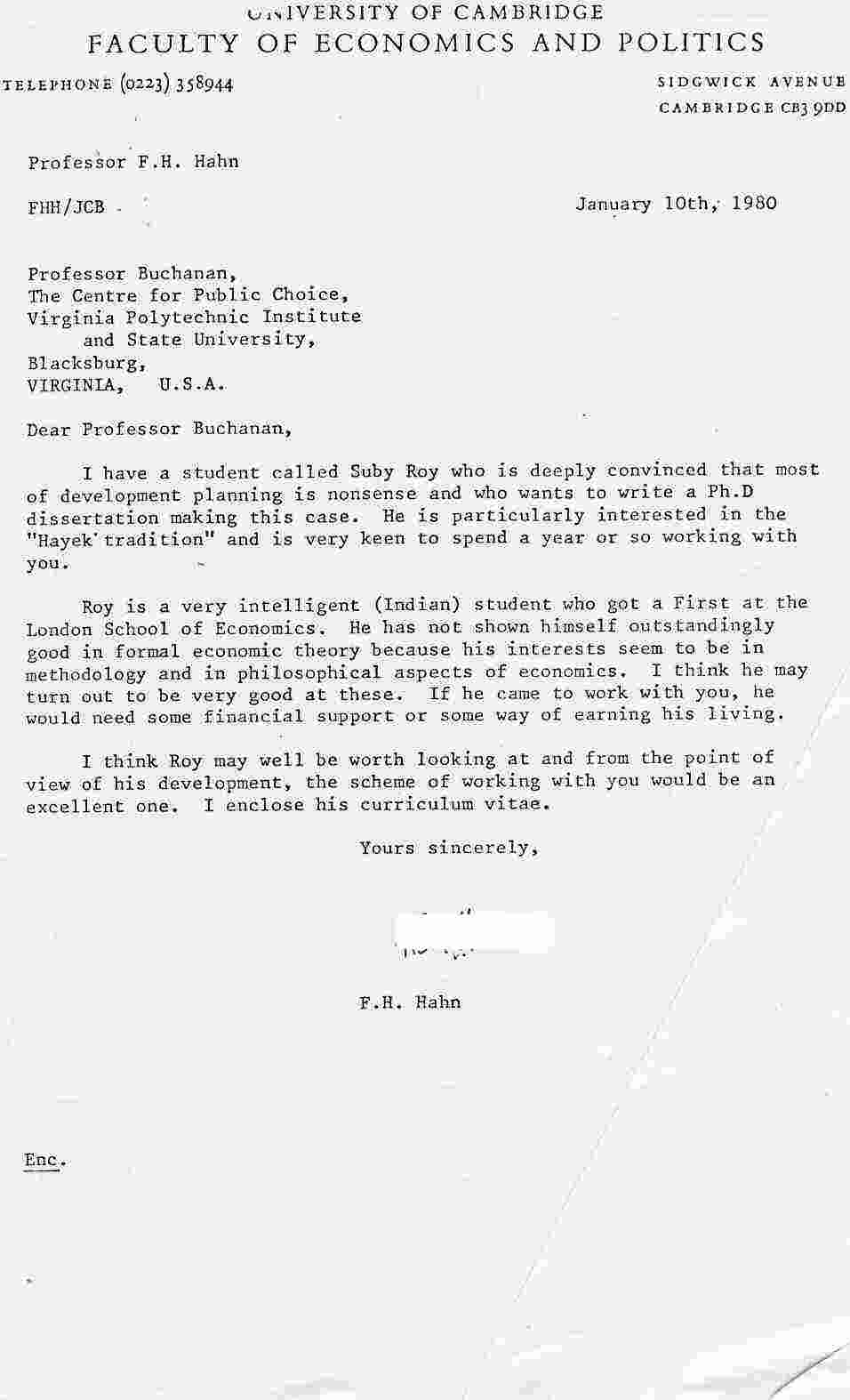
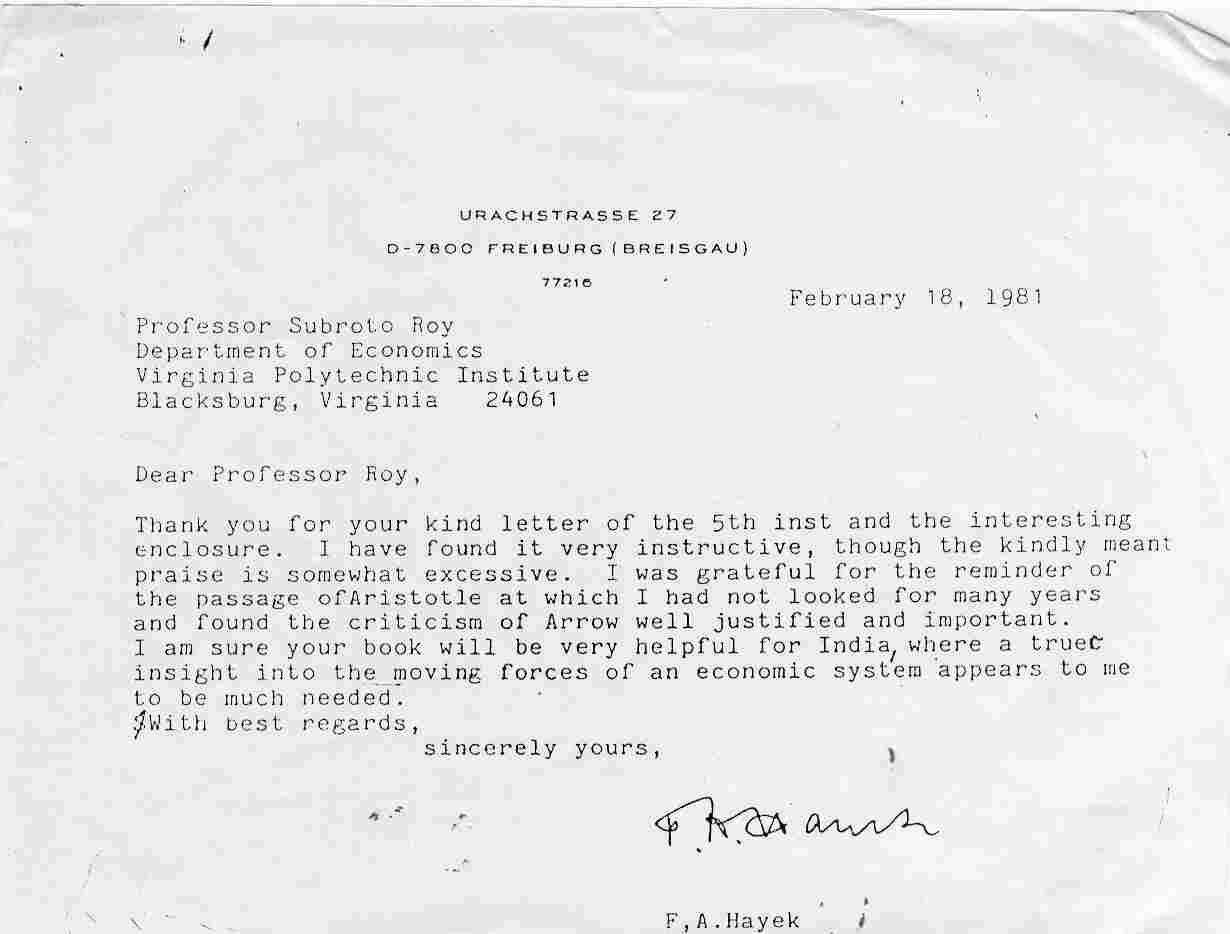
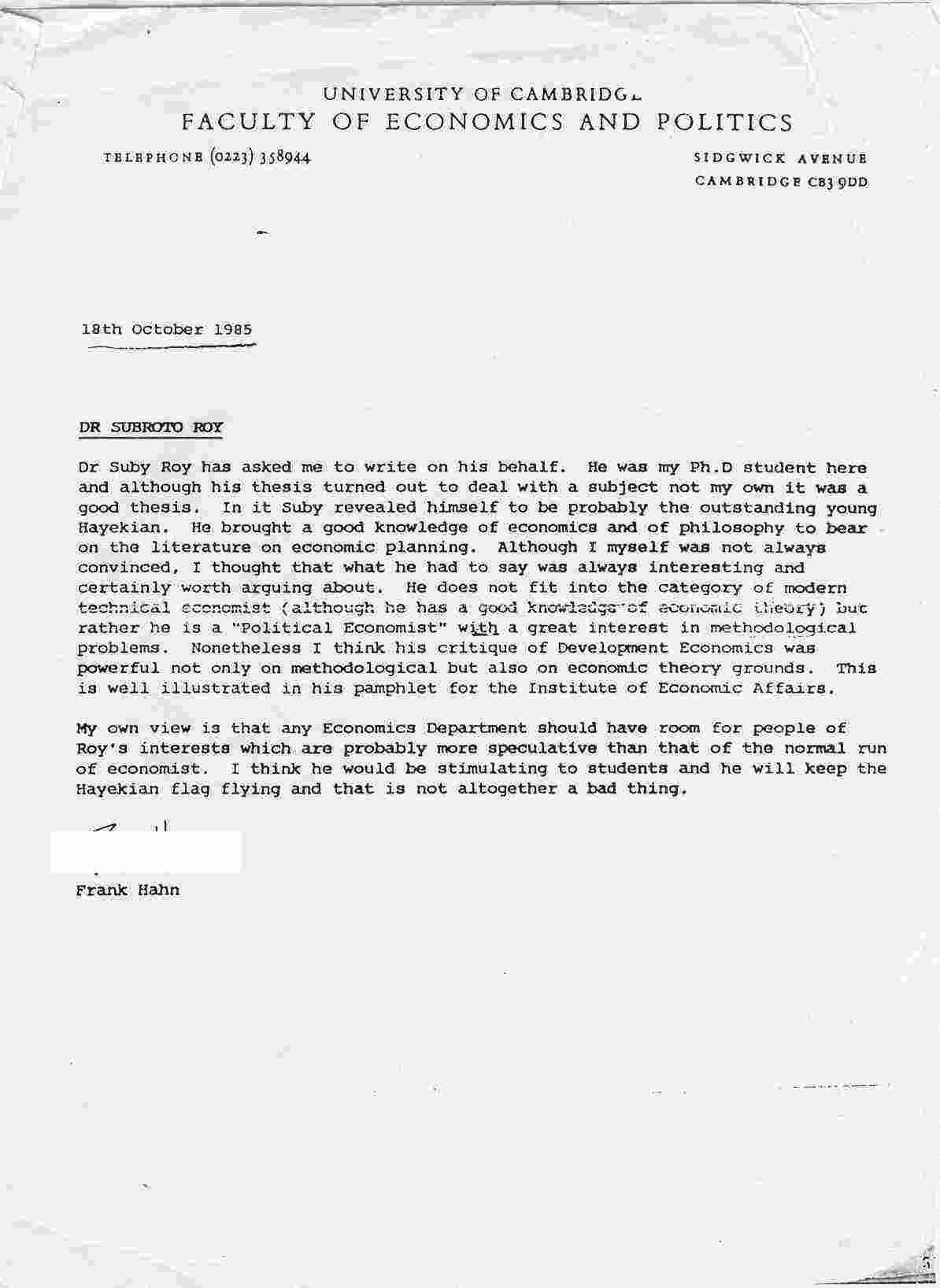
27. “On liberty & economic growth: preface to a philosophy for India”, Cambridge University doctoral thesis, supervisor FH Hahn, FBA; examiners CJ Bliss, FBA; TW Hutchison, FBA  (Due to be published here 2010). 27a Response of FA Hayek on a partial draft February 18 1981.  27b Response of Peter Bauer, 1982.  27c Response of Theodore W Schultz, 1983.  27d. Response of Frank Hahn 1985.

1982

28. “Knowledge and freedom in economic theory Parts 1 and 2”, Centre for Study of Public Choice, Virginia Polytechnic Institute & State University, Working Papers.

29. “Economic Theory and Development Economics”. Lecture to American Economic Association, New York, Dec 1982.  Panel: RM Solow, HB Chenery, T Weisskopf, P Streeten, G Rosen, S Roy. Published in 29a.

1983

29a “Economic Theory and Development Economics: A Comment”. World Development, 1983. [Citation: Stavros Thefanides "Metamorphosis of Development Economics", World Development 1988.]

30. “The Political Economy of Trade Policy (Comment on J. Michael Finger)”, Washington DC: Cato Journal, Winter 1983/84. See also 000 “Risk-aversion explains resistance to freer trade”, 2008.

1984

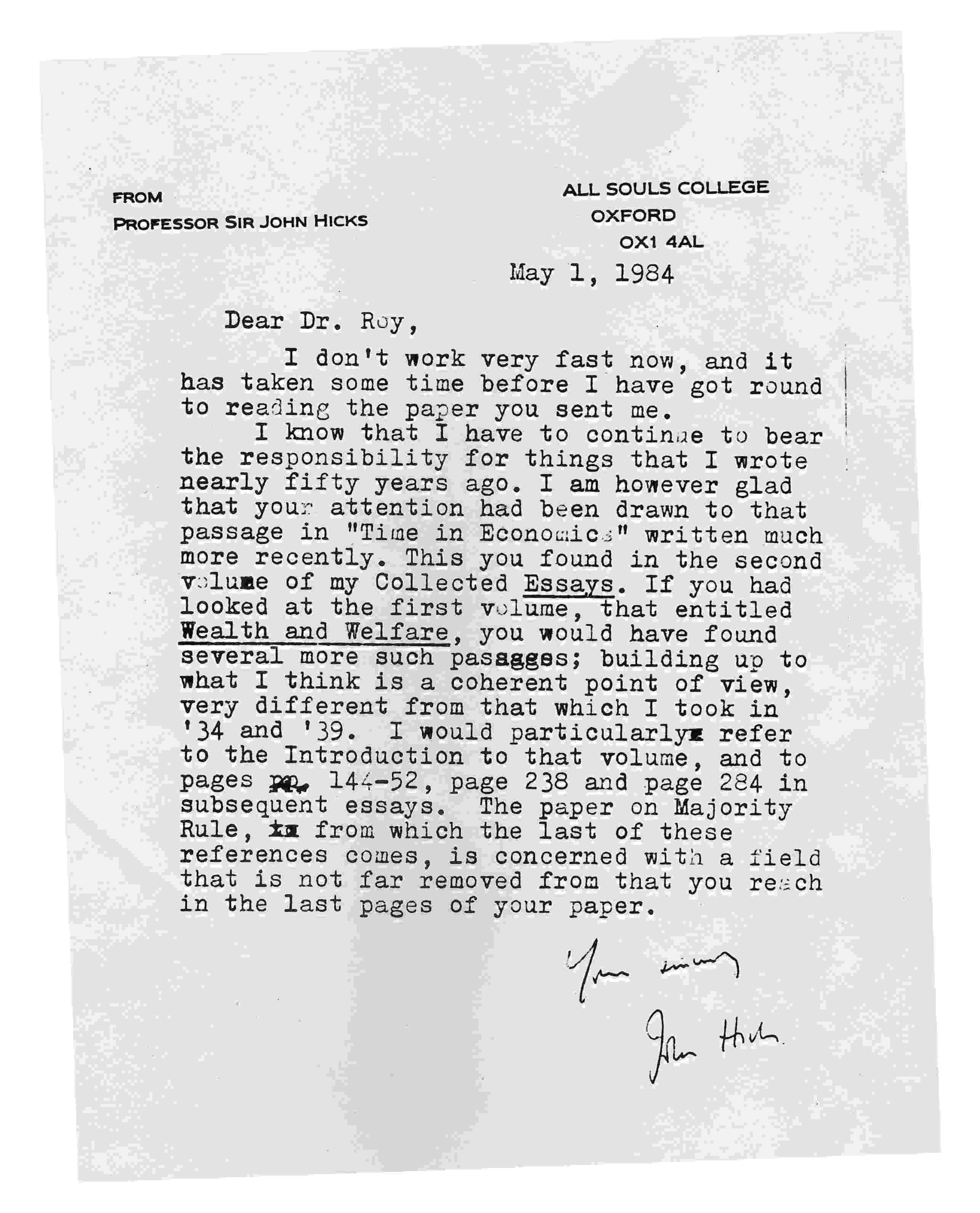
31. “Considerations on Utility, Benevolence and Taxation”, History of Political Economy, 1984.   31a Response of Professor Sir John Hicks May 1 1984.

[Citations: P. Hennipman, "A Tale of Two Schools", De Economist 1987, "A New Look at the Ordinalist Revolution", J. Econ. Lit. Mar 1988; P. Rappoport, "Reply to Professor Hennipman", J. Econ. Lit. Mar 1988; Eugene Smolensky et al "An Application of A Dynamic Cost-of-Living Index to the Evaluation of Changes in Social Welfare", J. Post-Keynesian Econ.IX.3. 1987.]

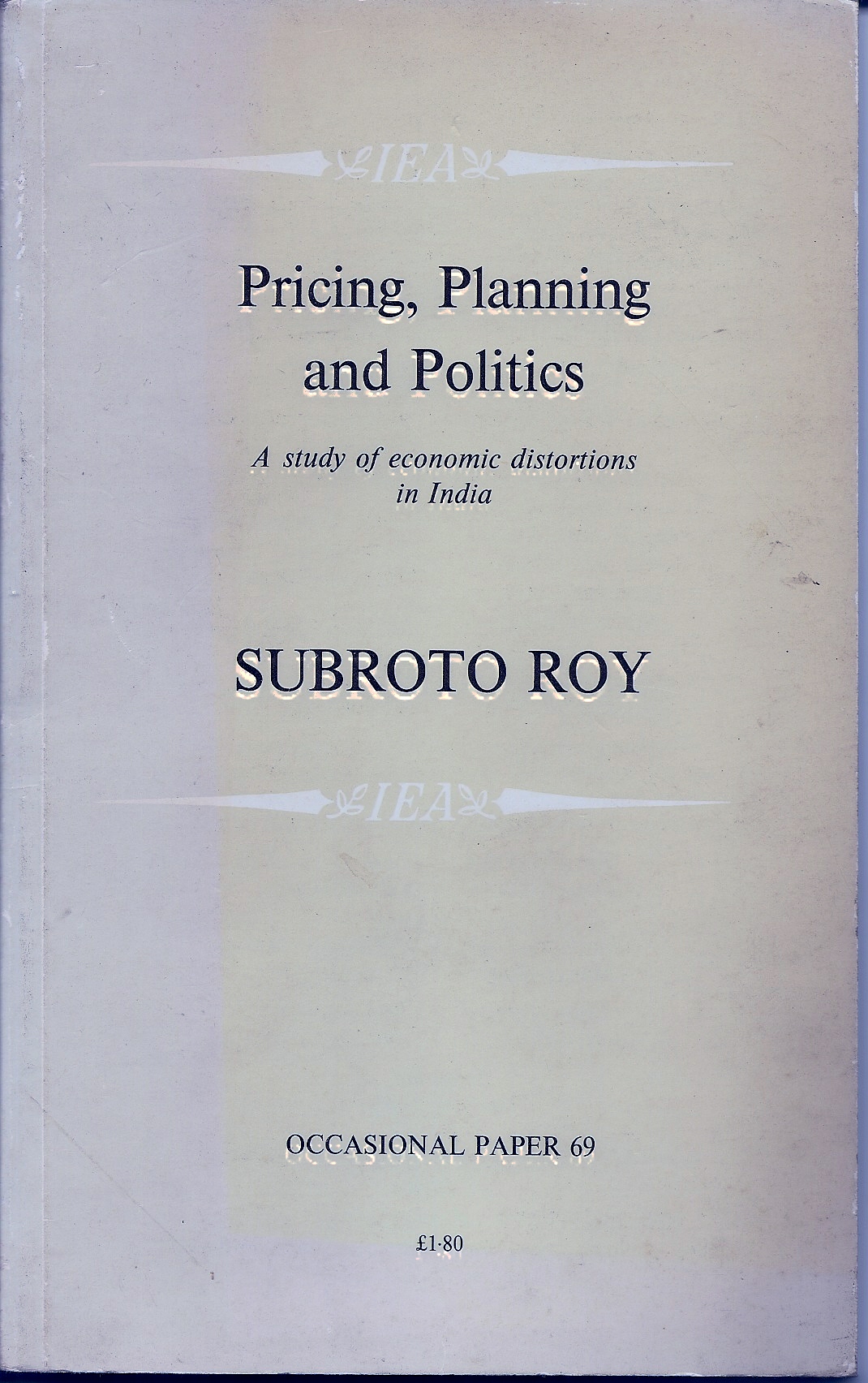
32. Pricing, Planning and Politics: A Study of Economic Distortions in India, London: Institute of Economic Affairs, London 1984.

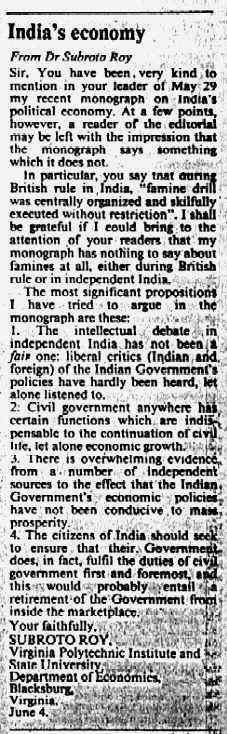
[Citations: Lead editorial of The Times of London May 29 1984, “India’s economy”, Times letters June 16 1984. John Toye "Political Economy & Analysis of Indian Development", Modern Asian Studies, 22, 1, 1988; John Toye, Dilemmas of Development; D. Wilson, "Privatization of Asia", The Banker Sep. 1984 etc].  See also 370 “Silver Jubilee of ‘Pricing, Planning and Politics: A Study of Economic Distortions in India’” 2009.

33. Review of Utilitarianism and Beyond, Amartya Sen & Bernard Williams (eds) Public Choice.

34. Review of Limits of Utilitarianism, HB Miller & WH Williams (eds.), Public Choice.

35. Deendayal lecture (one of four invited lecturers), Washington DC, May.

1987

36. (with one other) “Does the Theory of Logical Types Inform the Theory of Communication?”, Journal of Genetic Psychology., 148 (4), Dec. 1987 [Citation:

37. “Irrelevance of Foreign Aid”, India International Centre Quarterly, Winter 1987.

38. Review of Development Planning by Sukhamoy Chakravarty for Economic Affairs, London 1987.

1988

39. (with two others) “Introduction” to Lessons in Development: A Comparative Study of Asia and Latin America. San Francisco: Inst. of Economic Growth.

40. “A note on the welfare economics of regional cooperation”, lecture to Asia-Latin America conference, East West Center Honolulu, published 2009.

1989

41. Philosophy of Economics: On the Scope of Reason in Economic Inquiry, London & New York: Routledge (International Library of Philosophy) 1989, paperback 1991. Internet edition 2007.   [Reviews & Citations: Research in Economics, 1992; De Economist 1991 & 1992; Manch.Sch. Econ.Studs. 59, 1991; Ethics 101.88 Jul. 1991; Kyklos 43.4 1990; Soc. Science Q. 71.880. Dec.1990; Can. Phil. Rev. 1990; J. Econ. Hist. Sep. 1990; Econ. & Phil. Fall 1990; Econ. Affairs June-July 1990; TLS May 1990; Choice March 1990; J. App.Phil. 1994, M. Blaug: Methodology of Economics, 2nd ed., Cambridge, 1992;  Hist. Methods. 27.3, 1994; J. of Inst. & Theoretical Econ.,1994;  Jahrbucker fur Nationaleconomie 1994, 573:574. Mark A Lutz in Economics for the Common Good, London: Routledge, 1999, et al].  See also 339 “Apropos Philosophy of Economics”, Comments of Sidney Hook, KJ Arrow, Milton Friedman, TW Schultz, SS Alexander, Max Black, Renford Bambrough, John Gray et al.

42. Foreword to Essays on the Political Economy by James M. Buchanan, Honolulu: University of Hawaii Press 1989.

43. “Modern Political Economy of India”, edited by Subroto Roy & William E James,  Hawaii mimeo May 21 1989.  This published for the first time a November 1955 memorandum to the Government of India by Milton Friedman.  See also 43a, 53.

43a. Preface to “Milton Friedman’s extempore comments at the 1989 Hawaii conference: on India, Israel, Palestine, the USA, Debt and its uses, Erhardt abolishing exchange controls, Etc”,  May 22 1989, published here for the first time October 31 2008.

44. Milton Friedman’s defence of my work  in 1989.

45. Theodore W. Schultz’s defence of Philosophy of Economics

1990

46. “Letter to Judge Evelyn Lance: On A Case Study in Private International Law” (Due to be published here in 2010).

47-49. Selections from advisory work on economic policy etc for Rajiv Gandhi, Leader of the Opposition in the Parliament of India,  published in 47a-49a.

1991

41b Philosophy of Economics: On the Scope of Reason in Economic Inquiry, Paperback edition.

50. “Conversations and correspondence with Rajiv Gandhi during the Gulf war, January 1991”   (Due to be published here 2010).

47a. A Memo to Rajiv I:  Stronger Secular Middle”, The Statesman, Jul 31 1991.

48a “A Memo to Rajiv II: Saving India’s Prestige”, The Statesman, Aug 1 1991.

49a “A Memo to Rajiv III: Salvation in Penny Capitalism”, The Statesman, Aug 2 1991  47b-49b “Three Memoranda to Rajiv Gandhi 1990-91”, 2007 republication here.

51. “Constitution for a Second Indian Republic”, The Saturday Statesman, April 20 1991.  Republished here 2009.

52. “On the Art of Government: Experts, Party, Cabinet and Bureaucracy”, New Delhi mimeo March 25 1991, published here July 00 2009.

1992

53. Foundations of India’s Political Economy: Towards an Agenda for the 1990s Edited and with an Introduction by Subroto Roy & William E. James New Delhi, London, Newbury Park: Sage: 1992.   Citation: Milton and Rose Friedman Two Lucky People (Chicago 1998), pp. 268-269.

54. Foundations of Pakistan’s Political Economy: Towards an Agenda for the 1990s Edited and with an Introduction by William E. James & Subroto Roy, Hawaii MS 1989, Sage: 1992, Karachi: Oxford 1993.

Reviews of 53 & 54 include: Bus. Today, Mar-Apr 1992; Political Studies March 1995; Econ Times 21 March 1993; Pakistan Development Review 1992. Hindustan Times 11 July 1992. Pacific Affairs 1993; Hindu 21 March 1993, 15 June 1993; Pakistan News International 12 June 1993. Book Reviews March 1993; Deccan Herald 2 May 1993; Pol.Econ.J. Ind. 1992. Fin Express 13 September 1992;  Statesman 16 Jan. 1993.  J. Royal Soc Asian Aff. 1994, J. Contemporary Asia, 1994 etc.

55. “Fundamental Problems of the Economies of India and Pakistan”, World Bank, Washington, mimeo  (Due to be published here 2010).

56.“The Road to Stagflation: The Coming Dirigisme in America, or, America, beware thy economists!, or Zen and Clintonomics,” Washington DC, Broad Branch Terrace, mimeo, November 17.

1993

57. “Exchange-rates and manufactured exports of South Asia”, IMF Washington DC mimeo.  Published in part in 2007-2008 as 58-62:

58. “Path of the Indian Rupee 1947-1993”, 2008.

59.  “Path of the Pakistan Rupee 1947-1993”, 2008.

60. “Path of the Sri Lankan Rupee 1948-1993”, 2008.

61. “Path of the Bangladesh Taka 1972-1993”, 2008.

62. “India, Pakistan, Sri Lanka, Bangladesh Manufactured Exports, IMF Washington DC mimeo”, published 2007.

63. “Economic Assessment of US-India Merchandise Trade”, Arlington, Virginia, mimeo, published in slight part in Indo-US Trade & Economic Cooperation, ICRIER New Delhi, 1995, and in whole 2007.

64. “Towards an Economic Solution for Kashmir”, mimeo, Arlington, Virginia, circulated in Washington DC 1993-1995, cf 82, 111 infra. Comment of Selig Harrison.

1994

65. “Comment on Indonesia”, in The Political Economy of Policy Reform edited by John Williamson, Washington, DC: Institute for International Economics.

66a “Gold reserves & the gold price in anticipation of Central Bank behaviour”, Greenwich, Connecticut, mimeo. 67b. “Portfolio optimization and foreign currency exposure hedging” Greenwich, Connecticut mimeo.

1995

68. “On the logic and commonsense of debt and payments crises: How to avoid another Mexico in India and Pakistan”, Scarsdale, NY, mimeo, May 1.

69. “Policies for Young India”, Scarsdale, NY, pp. 350, manuscript.

1996

70. US Supreme Court documents, published in part in 2008 as  “Become a US Supreme Court Justice!” 70a, 70b (Due to be published in full here in 2010 as Roy vs University of Hawaii, 1989- including the expert testimonies of Milton Friedman and Theodore W Schultz.).

71. “Key problems of macroeconomic management facing the new Indian Government”, May 17.  Scarsdale, New York, mimeo.  (Due to be published here 2010).

72. “Preventing a collapse of the rupee”, IIT Kharagpur lecture July 16 1996.

73. “The Economist’s Representation of Technological Knowledge”, Vishleshlaya lecture to the Institution of Engineers, September 15 1996, IIT Kharagpur.

1997

74. “Union and State Budgets in India”, lecture at the World Bank, Washington DC, May 00.

75. “State Budgets in India”, IIT Kharagpur mimeo, June 6.

1998

76. “Transparency and Economic Policy-Making:  An address to the Asia-Pacific Public Relations Conference” (panel on Transparency chaired by CR Irani) Jan 30 1998, published here 2008.

77. Theodore W. Schultz 1902-1998,  Feb 25.

78. “The Economic View of Human Resources”, address to a regional conference on human resources, IIT Kharagpur.

79.  “Management accounting”, lecture at Lal Bahadur Shastri Academy, Mussourie,

80a “The Original Reformer”, Outlook letters, Jan 23 1998

81. “Recent Developments in Modern Finance”, IIM Bangalore Review, 10, 1 & 2, Jan.-Jun 1998. Reprinted as “From the Management Guru’s Classroom”: 81a “An introduction to derivatives”, Business Standard/Financial Times, Bombay 18 Apr 1999; 81b “Options in the future, Apr 25 1999; 81c “What is hedging?”, May 2 1999; 81d “Teaching computers to think”, May 9 1999.

82. “Towards an Economic Solution for Kashmir”, Jun 22 1998, lecture at Heritage Foundation, Washington DC.  Cf 111 Dec 2005.

83. “Sixteen Currencies for India: A Reverse Euro Model for Monetary & Fiscal Efficacy”, Lecture at the Institute of  Economic Affairs, London, June 29 1998.  Due to be published here 2010.

84. “Fable of the Fox, the Farmer, and the Would-Be Tailors”, October  (Published here July 27 2009).

85. “A Common Man’s Guide to Pricing Financial Derivatives”, Lecture to “National Seminar on Derivatives”, Xavier Labour Research Institute, Jamshedpur, Dec. 16 1998.   See 98.

1999

86. “An Analysis of Pakistan’s War-Winning Strategy: Are We Ready for This?”, IIT Kharagpur mimeo, published in part as 86a.“Was a Pakistani Grand Strategy Discerned in Time by India?” New Delhi:  Security & Political Risk Analysis Bulletin, July 1999, Kargil issue.  See also 000

80b. “The Original Reformer”, Outlook letters, Sep 13 1999.

2000

87. “On Freedom & the Scientific Point of View”, SN Bose National Centre for Basic Sciences, Feb 17 2000.  Cf 100 below.

88. “Liberalism and Indian economic policy”, lecture at IIM Calcutta,  Indian Liberal Group Meetings Devlali, Hyderabad; also Keynote address to UGC Seminar Guntur, March 30 2002.  (Due to be published here 2010).

89. “Towards a Highly Transparent Fiscal & Monetary Framework for India’s Union & State Governments”, Invited address to Conference of State Finance Secretaries, Reserve Bank of India, Bombay, April 29, 2000.  Published 2008.

90. “On the Economics of Information Technology”, two lectures at the Indian Institute of Information Technology, Bangalore, Nov 10-11, 2000.

91. Review of A New World by Amit Chaudhuri in Literary Criterion, Mysore.

2001

92. Review of AD Shroff: Titan of Finance and Free Enterprise by Sucheta Dalal, Freedom First., January.

93. “Encounter with Rajiv Gandhi: On the Origins of the 1991 Economic Reform”, Freedom First, October. See also 93a in 2005 and  93b in 2007.

94. “A General Theory of Globalization & Modern Terrorism with Special Reference to September 11”, a keynote address to the Council for Asian Liberals & Democrats, Manila, Philippines, 16 Nov. 2001.  Published as 91a.

95. “The Case for and against The Satanic Verses: Diatribe and Dialectic as Art”, Dec 22 republished in print 95a The Statesman Festival Volume, 2006.

2002

94a “A General Theory of Globalization & Modern Terrorism with Special Reference to September 11”, in September 11 & Political Freedom in Asia, eds. Johannen, Smith & Gomez, Singapore 2002.

2002-2010

96. “Recording vivid dreams: Freud’s advice in exploring the Unconscious Mind” (Due to be published here in 2010).

2003

97. “Key principles of government accounting and audit”, IIT Kharagpur mimeo.

98. “Derivative pricing & other topics in financial theory: a student’s complete lecture notes” (Due to be published here in 2010).

2004

99. “Collapse of the Global Conversation”, International Institute for Asian Studies, Leiden, Netherlands, Jul 2004.

100. “Science, Religion, Art & the Necessity of Freedom”, a public lecture, University of Buckingham, UK, August 24 2004.  Published here 2007.

2005

93a Rajiv Gandhi and the Origins of India’s 1991 Economic Reform (this was the full story; it appeared in print for the first time in The Statesman Festival Volume 2007).

101. “Can India become an economic superpower (or will there be a monetary meltdown)?” Cardiff University Institute of Applied Macroeconomics Monetary Economics Seminar, April 13, Institute of Economic Affairs, London, April 27, Reserve Bank of India, Bombay, Chief Economist’s Seminar on Monetary Economics, May 5.

102. Margaret Thatcher’s Revolution: How it Happened and What it Meant, Edited and with an Introduction by Subroto Roy & John Clarke, London & New York: Continuum, 2005; paperback 2006; French translation by Florian Bay, 2007.

103. “Iqbal & Jinnah vs Rahmat Ali in Pakistan’s Creation”, Dawn, Karachi, Sep 3.

104. “The Mitrokhin Archives II from an Indian Perspective: A Review Article”, The Statesman, Perspective Page, Oct 11 .

105. “After the Verdict”, The Statesman, Editorial Page, Oct 20.

106.   “US Espionage Failures”, The Statesman, Perspective Page, Oct 26

107.  “Waffle But No Models of Monetary Policy”, The Statesman, Perspective Page, Oct 30.

108. “On Hindus and Muslims”, The Statesman, Perspective Page, Nov 6.

109. “Assessing Vajpayee: Hindutva True and False”, The Statesman, Editorial Page, Nov  13-14″.

110. “Fiction from the India Economic Summit”, The Statesman, Front Page, Nov 29.

111. “Solving Kashmir: On an Application of Reason”, The Statesman Editorial Page

I.  “Give the Hurriyat et al Indian Green Cards”, Dec 1

II.  “Choice of Nationality under Full Information”, Dec 2

III.  “Of Flags and Consulates in Gilgit etc”, Dec 3.

2006

112. “The Dream Team: A Critique”, The Statesman Editorial Page

I : New Delhi’s Consensus (Manmohantekidambaromics), Jan 6

II: Money, Convertibility, Inflationary Deficit Financing, Jan 7

III:  Rule of Law, Transparency, Government Accounting, Jan 8.

113. “Unaccountable Delhi: India’s Separation of Powers’ Doctrine”, The Statesman, Jan 13.

114. “Communists and Constitutions”, The Statesman, Editorial Page, Jan 22.

115. “Diplomatic Wisdom”, The Statesman, Editorial Page, Jan 31.

116.  “Mendacity & the Government Budget Constraint”, The Statesman, Front Page  Feb 3.

117. “Of Graven Images”, The Statesman, Editorial Page, Feb5.

118. “Separation of Powers, Parts 1-2”, The Statesman, Editorial Pages Feb 12-13.

119. “Public Debt, Government Fantasy”, The Statesman, Front Page Editorial Comment, Feb 22.

120. “War or Peace Parts 1-2”, The Statesman, Editorial Page, Feb 23-24.

121. “Can You Handle This Brief, Mr Chidambaram?” The Statesman, Front Page  Feb 26.

122. “A Downpayment On the Taj Mahal Anyone?”, The Statesman, Front Page  Comment on the Budget 2006-2007, Mar 1.

123. “Atoms for Peace (or War)”, The Sunday Statesman, Editorial Page Mar 5.

124. “Imperialism Redux: Business, Energy, Weapons & Foreign Policy”, The Statesman, Editorial Page, Mar 14.

125.  “Logic of Democracy”,  The Statesman, Editorial Page, Mar 30.

126. “Towards an Energy Policy”, The Sunday Statesman, Editorial Page, Apr 2.

127. “Iran’s Nationalism”, The Statesman, Editorial Page, Apr 6.

128. “A Modern Military”, The Sunday Statesman, Editorial Page, Apr 16.

129.  “On Money & Banking”, The Sunday Statesman, Editorial Page, Apr 23.

130.  “Lessons for India from Nepal’s Revolution”, The Statesman, Front Page Apr 26.

131. “Revisionist Flattery (Inder Malhotra’s Indira Gandhi: A Review Article)”, The Sunday Statesman, May 7.

132. “Modern World History”, The Sunday Statesman Editorial Page, May 7.

133. “Argumentative Indians: A Conversation with Professor Amartya Sen on Philosophy, Identity and Islam,” The Sunday Statesman,  May 14 2006.  “A Philosophical Conversation between Professor Sen and Dr Roy”,  2008.  Translated into Bengali by AA and published in 00.

134. “The Politics of Dr Singh”, The Sunday Statesman, Editorial Page, May 21.

135. “Corporate Governance & the Principal-Agent Problem”, lecture at a conference on corporate governance, Kolkata May 31.  Published here 2008.

136. “Pakistan’s Allies Parts 1-2″, The Sunday Statesman, Editorial Page, Jun 4-5.

137. “Law, Justice and J&K Parts 1-2″, The Sunday Statesman, Editorial Page, Jul 2, The Statesman Editorial Page Jul 3.

138. “The Greatest Pashtun (Khan Abdul Ghaffar Khan)”, The Sunday Statesman, Editorial Page, Jul 16.

139. “Understanding Pakistan Parts 1-2”, The Sunday Statesman, Editorial Page, Jul 30, The Statesman Editorial Page Jul 31.

140.  “Indian Money and Credit”, The Sunday Statesman, Editorial Page, Aug 6.

141.  “India’s Moon Mission”, The Sunday Statesman, Editorial Page,  Aug 13.

142. “Jaswant’s Journeyings: A Review Article”, The Sunday Statesman Magazine, Aug 27.

143. “Our Energy Interests, Parts 1-2”, The Sunday Statesman, Editorial Page, Aug 27, The Statesman Editorial Page Aug 28.

144. “Is Balochistan Doomed?”, The Sunday Statesman, Editorial Page, Sep 3 2006.

145. “Racism New and Old”, The Statesman, Editorial Page, Sep 8 2006

146. “Political Economy of India’s Energy Policy”, address to KAF-TERI conference, Goa Oct 7, published in 146a.

147. “New Foreign Policy? Seven phases of Indian foreign policy may be identifiable since Nehru”, Parts 1-2, The Sunday Statesman, Oct 8, The Statesman Oct 9.

148. “Justice & Afzal:  There is a difference between law and equity (or natural justice). The power of pardon is an equitable power. Commuting a death-sentence is a partial pardon”, The Sunday Statesman Editorial Page Oct 14

149. “Non-existent liberals (On a Liberal Party for India)”, The Sunday Statesman Editorial Page Oct 22.

150. “History of Jammu & Kashmir Parts 1-2”,  The Sunday Statesman, Oct 29, The Statesman Oct 30, Editorial Page.

151. “American Democracy: Does America need a Prime Minister and a longer-lived Legislature?”, The Sunday Statesman Nov 5.

152. “Milton Friedman A Man of Reason 1912-2006”, The Statesman Perspective Page,  Nov 22.

153. “Postscript to Milton Friedman Mahalanobis’s Plan  (The Mahalanobis-Nehru “Second Plan”) The Statesman Front Page Nov 22.

154.  “Mob Violence and Psychology”, Dec 10,  The Statesman, Editorial Page.

155. “What To Tell Musharraf: Peace Is Impossible Without Non-Aggressive Pakistani Intentions”, The Statesman Editorial Page Dec 15.

156. “Land, Liberty and Value: Government must act in good faith treating all citizens equally – not favouring organised business lobbies and organised labour over an unorganised peasantry”,  The Sunday Statesman Editorial Page Dec 31.

2007

157. “Hypocrisy of the CPI-M: Political Collapse In Bengal: A Mid-Term Election/Referendum Is Necessary”, The Statesman, Editorial Page, Jan 9.

158. “On Land-Grabbing: Dr Singh’s India, Buddhadeb’s Bengal, Modi’s Gujarat have notorious US, Soviet and Chinese examples to follow ~ distracting from the country’s real economic problems,” The Sunday Statesman, Editorial Page Jan 14.

159. “India’s Macroeconomics:  Real growth has steadily occurred because India has shared the world’s technological progress. But bad fiscal, monetary policies over decades have led to monetary weakness and capital flight” The Statesman Editorial Page Jan 20.

160. “Fiscal Instability: Interest payments quickly suck dry every year’s Budget. And rolling over old public debt means that Government Borrowing in fact much exceeds the Fiscal Deficit”, The Sunday Statesman, Editorial Page, Feb 4.

161. “Our trade and payments Parts 1-2”  (“India in World Trade and Payments”),The Sunday Statesman, Feb 11 2007, The Statesman, Feb 12 2007.

162. “Our Policy Process: Self-Styled “Planners” Have Controlled India’s Paper Money For Decades,” The Statesman, Editorial Page, Feb 20.

163. “Bengal’s Finances”, The Sunday Statesman Editorial Page, Feb 25.

164. “Fallacious Finance: Congress, BJP, CPI-M may be leading India to Hyperinflation” The Statesman Editorial Page Mar 5.

165. “Uttar Pradesh Polity and Finance: A Responsible New Govt May Want To Declare A Financial Emergency” The Statesman Editorial Page, Mar 24

166. “A scam in the making” in The Sunday Statesman Front Page Apr 1 2007, published here in full as “Swindling India”.

167. “Maharashtra’s Money: Those Who Are Part Of The Problem Are Unlikely To Be A Part Of Its Solution”, The Statesman Editorial Page Apr 24.

146a. “Political Economy of Energy Policy” in India and Energy Security edited by Anant Sudarshan and Ligia Noronha, Konrad Adenauer Stiftung, New Delhi 2007.

168.  “Presidential Qualities: Simplicity, Genuine Achievement Are Desirable; Political Ambition Is Not”, The Statesman, Editorial Page, May 8.

169. “We & Our Neighbours: Pakistanis And Bangladeshis Would Do Well To Learn From Sheikh Abdullah”, The Statesman, Editorial Page May 15.

170. “On Indian Nationhood: From Tamils To Kashmiris And Assamese And Mizos To Sikhs And Goans”, The Statesman, Editorial Page, May 25.

171. A Current Example of the Working of the Unconscious Mind, May 26.

172. Where I would have gone if I was Osama Bin Laden, May 31.

173. “US election ’08:America’s Presidential Campaign Seems Destined To Be Focussed On Iraq”,  The Statesman, Editorial Page, June 1.

174. “Home Team Advantage: On US-Iran talks and Sunni-Shia subtleties: Tehran must transcend its revolution and endorse the principle that the House of Islam has many mansions”,  The Sunday Statesman Editorial Page, June 3

175. “Unhealthy Delhi: When will normal political philosophy replace personality cults?”,  The Statesman, Editorial Page, June 11.

176. “American Turmoil: A Vice-Presidential Coup – And Now a Grassroots Counterrevolution?”,  The Statesman, Editorial Page, June 18

177.  “Political Paralysis: India has yet to develop normal conservative, liberal and socialist parties. The Nice-Housing-Effect and a little game-theory may explain the current stagnation”,  The Sunday Statesman, Editorial Page, June 24.

177. “Has America Lost? War Doctrines Of Kutusov vs Clausewitz May Help Explain Iraq War”,  The Statesman, Editorial Page, July 3.

178. “Lal Masjid ≠ Golden Temple: Wide differences are revealed between contemporary Pakistan and India by these two superficially similar military assaults on armed religious civilians”, The Sunday Statesman, Editorial Page July 15

179 “Political Stonewalling: Only Transparency Can Improve Institutions”, The Statesman, Editorial Page July 20.

180. “Gold standard etc: Fixed versus flexible exchange rates”, July 21.

181. “US Pakistan-India Policy: Delhi & Islamabad Still Look West In Defining Their Relationship”, The Statesman, Editorial Page, July 27.

182. “Works of DH Lawrence” July 30

183. “An Open Letter to Professor Amartya Sen about Singur etc”, The Statesman, Editorial Page,  July 31.

184.  “Martin Buber on Palestine and Israel (with Postscript)”, Aug 4.

185. “Auguste Rodin on Nature, Art, Beauty, Women and Love”,  Aug 7.

186. “Saving Pakistan: A Physicist/Political Philosopher May Represent Iqbal’s “Spirit of Modern Times”, The Statesman, Editorial Page, Aug 13.

187. Letter to Forbes.com  16 Aug.

188. “Need for Clarity: A poorly drafted treaty driven by business motives is a recipe for international misunderstanding”, The Sunday Statesman, Editorial Page, Aug 19.

189. “No Marxist MBAs? An amicus curiae brief for the Hon’ble High Court”,  The Statesman, FrontPage, Aug 29.

190. On Lawrence, Sep 4.

191. Dalai Lama’s Return: In the tradition of Gandhi, King, Mandela, Sep 11.

192. Of JC Bose, Patrick Geddes & the Leaf-World, Sep 12.

193. “Against Quackery: Manmohan and Sonia have violated Rajiv Gandhi’s intended reforms; the Communists have been appeased or bought; the BJP is incompetent  Parts 1-2”, in The Sunday Statesman and The Statesman, Editorial Pages of Sep 23-24.

194. Karl Georg Zinn’s 1994 Review of Philosophy of Economics, Sep 26.

195. DH Lawrence’s Phoenix, Oct 3.

93b. “Rajiv Gandhi and the Origins of India’s 1991 Economic Reform”, Statesman Festival Volume.

196. “Iran, America, Iraq: Bush’s post-Saddam Saddamism — one flip-flop too many?”, The Statesman, Editorial Page, Oct 16.

197. “Understanding China: The World Needs to Ask China to Find Her True Higher Self”,  The Statesman, Editorial Page, Oct 22.

198. “India-USA interests: Elements of a serious Indian foreign policy”,  The Statesman, Editorial Page, Oct 30.

199. “China’s India Aggression : German Historians Discover Logic Behind Communist Military Strategy”,  The Statesman, Editorial Page Special Article, Nov 5.

200. Sonia’s Lying Courtier (with Postscript), Nov 25.

201. “Surrender or Fight? War is not a cricket match or Bollywood movie. Can India fight China if it must?” The Statesman, Dec 4, Editorial Page.

202. Hutton and Desai: United in Error Dec 14

203. “China’s Commonwealth: Freedom is the Road to Resolving Taiwan, Tibet, Sinkiang”,  The Statesman, Dec 17.

2008

204. “Nixon & Mao vs India: How American foreign policy did a U-turn about Communist China’s India aggression. The Government of India should publish its official history of the 1962 war.”  The Sunday Statesman, Jan 6, The Statesman Jan 7  Editorial Page.

205. “Lessons from the 1962 War:  Beginnings of a solution to the long-standing border problem: there are distinct Tibetan, Chinese and Indian points of view that need to be mutually comprehended”, The Sunday Statesman, January 13 2008.

206. “Our Dismal Politics: Will Independent India Survive Until 2047?”, The Statesman Editorial Page, Feb 1.

207. Median Voter Model of India’s Electorate Feb 7.

208. “Anarchy in Bengal: Intra-Left bandh marks the final unravelling of “Brand Buddha””, The Sunday Statesman, Editorial Page, Feb 10.

209. Fifty years since my third birthday: on life and death.

210. “Pakistan’s Kashmir obsession: Sheikh Abdullah Relied In Politics On The French Constitution, Not Islam”, The Statesman, Editorial Page, Feb 16.

211.  A Note on the Indian Policy Process  Feb 21.

212. “Growth & Government Delusion: Progress Comes From Learning, Enterprise, Exchange, Not The Parasitic State”, The Statesman, Editorial Page, Feb 22.

213.  “How to Budget: Thrift, Not Theft, Needs to Guide Our Public Finances”, The Statesman, Editorial Page, Feb 26.

214. “India’s Budget Process (in Theory)”, The Statesman, Front Page Feb 29.

215.  “Irresponsible Governance: Congress, BJP, Communists, BSP, Sena Etc Reveal Equally Bad Traits”, The Statesman, Editorial Page, March 4.

216. “American Politics: Contest Between Obama And Clinton Affects The World”, The Statesman, Editorial Page, March 11.

217. “China’s India Example: Tibet, Xinjiang May Not Be Assimilated Like Inner Mongolia And Manchuria”, The Statesman, Editorial Page, March 25.

218. “Taxation of India’s Professional Cricket: A Proposal”, The Statesman, Editorial Page, April 1.

219. “Two cheers for Pakistan!”,  The Statesman, Editorial Page, April 7.

220. “Indian Inflation: Upside Down Economics From The New Delhi Establishment Parts 1-2”, The Statesman, Editorial Page, April 15-16.

221. “Assessing Manmohan: The Doctor of Deficit Finance should realise the currency is at stake”, The Statesman, Editorial Page Apr 25.

222. John Wisdom, Renford Bambrough: Main Philosophical Works, May 8.

223.  “All India wept”: On the death of Rajiv Gandhi,  May 21.

224. “China’s force and diplomacy: The need for realism in India” The Statesman, Editorial Page May 31.

226. Serendipity and the China-Tibet-India border problem  June 6

227. “Leadership vacuum: Time & Tide Wait For No One In Politics: India Trails Pakistan & Nepal!”, The Statesman Editorial Page June 7.

228. My meeting Jawaharlal Nehru Oct13 1962

229.  Manindranath Roy 1891-1958

230. Surendranath Roy 1860-1929

231.  The Roys of Behala 1928.

232. Sarat Chandra visits Surendranath Roy 1927

233. Nuksaan-Faida Analysis = Cost-Benefit Analysis in Hindi/Urdu Jun 30

234.  One of many reasons John R Hicks was a great economist July 3

236.  My father, Indian diplomat, in the Shah’s Tehran 1954-57  July 8

237 Distribution of Govt of India Expenditure (Net of Operational Income) 1995 July 27

238. Growth of Real Income, Money & Prices in India 1869-2008, July 28.

239. Communism from Social Democracy? But not in India or China!  July 29

240. Death of Solzhenitsyn, Aug. 3

240a. Tolstoy on Science and Art, Aug 4.

241. “Reddy`s reckoning: Where should India’s real interest rate be relative to the world?” Business Standard Aug 10

242. “Rangarajan Effect”, Business Standard Aug 24

243. My grandfather’s death in Ottawa 50 years ago today  Sep 3

244. My books in the Library of Congress and British Library Sep 12

245. On Jimmy Carter & the “India-US Nuclear Deal”, Sep 12

246. My father after presenting his credentials to President Kekkonen of Finland Sep 14 1973.

247. “October 1929?  Not!”, Business Standard, Sep 18.

248. “MK Gandhi, SN Roy, MA Jinnah in March 1919: Primary education legislation in a time of protest”

249. 122 sensible American economists Sept 26

250. Govt of India: Please call in the BBC and ask them a question Sep 27

251. “Monetary Integrity and the Rupee:  Three British Raj relics have dominated our macroeconomic policy-making” Business Standard Sep 28.

252a.  Rabindranath’s daughter writes to her friend my grandmother Oct 5

252b.  A Literary Find: Modern Poetry in Bengal, Oct 6.

253. Sarat writes to Manindranath 1931,  Oct 12

254. Origins of India’s Constitutional Politics 1913

255. Indira Gandhi in Paris, 1971

256. How the Liabilities/Assets Ratio of Indian Banks Changed from 84% in 1970 to 108% in 1998, October 20

257a. My Subjective Probabilities on India’s Moon Mission Oct 21

258. Complete History of Mankind’s Moon Missions: An Indian Citizen’s Letter to ISRO’s Chairman, Oct 22.

259. Would not a few million new immigrants solve America’s mortgage crisis? Oct 26

260. “America’s divided economists”, Business Standard Oct 26

261. One tiny prediction about the Obama Administration, Nov 5

262. Rai Bahadur Umbika Churn Rai, 1827-1902,  Nov 7 2008

263. Jawaharlal Nehru invites my father to the Mountbatten Farewell  Nov 7 2008

70a. “Become a US Supreme Court Justice! (Explorations in the Rule of Law in America) Preface” Nov 9

70b. “Become a US Supreme Court Justice! (Explorations in the Rule of Law in America) Password protected.” Nov 9.

257b. Neglecting technological progress was the basis of my pessimism about Chandrayaan,  Nov 9.

264. Of a new New Delhi myth and the success of the University of Hawaii 1986-1992 Pakistan project Nov 15

265. Pre-Partition Indian Secularism Case-Study: Fuzlul Huq and Manindranath Roy Nov 16

266. Do President-elect Obama’s Pakistan specialists suppose Maulana Azad, Dr Zakir Hussain, Sheikh Abdullah were Pakistanis (or that Sheikh Mujib wanted to remain one)?  Nov 18

267. Jews have never been killed in India for being Jews until this sad day, Nov 28.

268. In international law, Pakistan has been the perpetrator, India the victim of aggression in Mumbai,  Nov 30.

269. The Indian Revolution, Dec 1.

270. Habeas Corpus: a captured terrorist mass-murderer tells a magistrate he has not been mistreated by Mumbai’s police Dec 3

271. India’s Muslim Voices (Or, Let us be clear the Pakistan-India or Kashmir conflicts have not been Muslim-Hindu conflicts so much as intra-Muslim conflicts about Muslim identity and self-knowledge on the Indian subcontinent), Dec 4

272. “Anger Management” needed? An Oxford DPhil recommends Pakistan launch a nuclear first strike against India within minutes of war, Dec 5.

273. A Quick Comparison Between the September 11 2001 NYC-Washington attacks and the November 26-28 2008 Mumbai Massacres (An Application of the Case-by-Case Philosophical Technique of Wittgenstein, Wisdom and Bambrough), Dec 6

274. Dr Rice finally gets it right (and maybe Mrs Clinton will too) Dec 7

275. Will the Government of India’s new macroeconomic policy dampen or worsen the business-cycle (if such a cycle exists at all)? No one knows! “Where ignorance is bliss, ‘Tis folly to be wise.”  Dec 7

276. Pump-priming for car-dealers: Keynes groans in his grave (If evidence was needed of the intellectual dishonesty of New Delhi’s new macroeconomic policy, here it is) Dec 9.

277. Congratulations to Mumbai’s Police: capturing a terrorist, affording him his Habeas Corpus rights, getting him to confess within the Rule of Law, sets a new world standard  Dec 10

278. Two cheers — wait, let’s make that one cheer — for America’s Justice Department, Dec 10

279. Will Pakistan accept the bodies of nine dead terrorists who came from Pakistan to Mumbai? If so, let there be a hand-over at the Wagah border, Dec 11.

280. Kasab was a stupid, ignorant, misguided youth, manufactured by Pakistan’s terrorist masterminds into becoming a mass-murdering robot: Mahatma Gandhi’s India should punish him, get him to repent if he wishes, then perhaps rehabilitate him as a potent weapon against Pakistani terrorism Dec 12.

281. Pakistan’s New Delhi Embassy should ask for “Consular Access” to nine dead terrorists in a Mumbai morgue before asking to meet Kasab, Dec 13

282. An Indian Reply to President Zardari: Rewarding Pakistan for bad behaviour leads to schizophrenic relationships Dec 19

283. Is my prediction about Caroline Kennedy becoming US Ambassador to Britain going to be correct?  Dec 27

284. Chandrayaan adds a little good cheer! Well done, ISRO!, Dec 28

285. How sad that “Slumdog millionaire” is SO disappointing! Dec 31

289. (with Claude Arpi) “Transparency & history: India’s archives must be opened to world standards” Business Standard New Delhi Dec 31, 2008, published here Jan 1 .

2009

290. A basis of India-Pakistan cooperation on the Mumbai massacres: the ten Pakistani terrorists started off as pirates and the Al-Huseini is a pirate ship Jan 1.

291. India’s “pork-barrel politics” needs a nice (vegetarian) Hindi name! “Teli/oily politics” perhaps? (And are we next going to see a Bill of Rights for Lobbyists?) Jan 3

292. My (armchair) experience of the 1999 Kargil war (Or, “Actionable Intelligence” in the Internet age: How the Kargil effort got a little help from a desktop)  Jan 5

293. How Jammu & Kashmir’s Chief Minister Omar Abdullah can become a worthy winner of the Nobel Peace Prize: An Open Letter,  Jan 7

294. Could the Satyam/PwC fraud be the visible part of an iceberg? Where are India’s “Generally Accepted Accounting Principles”? Isn’t governance rather poor all over corporate India? Bad public finance may be a root cause Jan 8

295. Satyam does not exist: it is bankrupt, broke, kaput. Which part of this does the new “management team” not get? The assets belong to Satyam’s creditors. Jan 8

296. Jews are massacred in Mumbai and now Jews commit a massacre in Gaza!  Jan 9

297. And now for the Great Satyam Whitewash/Cover-Up/Public Subsidy! The wrong Minister appoints the wrong new Board who, probably, will choose the wrong policy Jan 12

298. Letter to Wei Jingsheng  Jan 14

299. Memo to the Hon’ble Attorneys General of Pakistan & India: How to jointly prosecute the Mumbai massacre perpetrators most expeditiously Jan 16

300. Satyam and IT-firms in general may be good candidates to become “Labour-Managed” firms Jan 18

301. “Yes we might be able to do that. Perhaps we ought to. But again, perhaps we ought not to, let me think about it…. Most important is Cromwell’s advice: Think it possible we may be mistaken!” Jan 20.

302. RAND’s study of the Mumbai attacks Jan 25

303. Didn’t Dr Obama (the new American President’s late father) once publish an article in Harvard’s Quarterly Journal of Economics? (Or did he?) Jan 25.

304. “A Dialogue in Macroeconomics” 1989 etc: sundry thoughts on US economic policy discourse Jan 30

305. American Voices: A Brief Popular History of the United States in 20 You-Tube Music Videos Feb 5

306. Jaladhar Sen writes to Manindranath at Surendranath’s death, Feb 23

307. Pakistani expansionism: India and the world need to beware of “Non-Resident Pakistanis” ruled by Rahmat Ali’s ghost, Feb 9

308. My American years Part One 1980-90: battles for academic integrity & freedom Feb 11.

309. Thanks and well done Minister Rehman Malik and the Govt of Pakistan Feb 12

310. Can President Obama resist the financial zombies (let alone slay them)? His economists need to consult Dr Anna J Schwartz Feb 14

311. A Brief History of Gilgit, Feb 18

312. Memo to UCLA Geographers: Commonsense suggests Mr Bin Laden is far away from the subcontinent Feb 20

313. The BBC gets its history and geography deliberately wrong again Feb 21

314. Bengal Legislative Council 1921, Feb 28

315. Carmichael visits Surendranath, 1916, Mar 1

316. Memo to GoI CLB: India discovered the Zero, and 51% of Zero is still Zero Mar 10

317. An Academic Database of Doctoral & Other Postgraduate Research Done at UK Universities on India, Pakistan, Sri Lanka, Bangladesh and Other Asian Countries Over 100 Years, Mar 13

318. Pakistan’s progress, Mar 18

319. Risk-aversion explains resistance to free trade, Mar 19

320. India’s incredibly volatile inflation rate!  Mar 20

321. Is “Vicky, Cristina, Barcelona” referring to an emasculation of (elite) American society?,  Mar 21

322. Just how much intellectual fraud can Delhi produce? Mar 26

323. India is not a monarchy! We urgently need to universalize the French concept of “citoyen”!  Mar 28

324. Could this be the real state of some of our higher education institutions? Mar 29

325. Progress! The BBC retracts its prevarication! Mar 30

326. Aldous Huxley’s Essay “DH Lawrence” Mar 31

327. Waffle not institutional reform is what (I predict) the “G-20 summit” will produce, April 1

328. Did a full cricket team of Indian bureaucrats follow our PM into 10 Downing Street? Count for yourself! April 3

329. Will someone please teach the BJP’s gerontocracy some Economics 101 on an emergency basis?  April 5

330. The BBC needs to determine exactly where it thinks Pakistan is!, April 5

331. Alfred Lyall on Christians, Muslims, India, China, Etc, 1908, April 6

332. An eminent economist of India passes away April 9

333. Democracy Database for the Largest Electorate Ever Seen in World History, April 12

334. Memo to the Election Commission of India April 14 2009, 9 AM, April 14

335. Caveat emptor! Satyam is taken over, April 14

336. India’s 2009 General Elections: Candidates, Parties, Symbols for Polls on 16-30 April Phases 1,2,3, April 15

337. On the general theory of expertise in democracy: reflections on what emerges from the American “torture memos” today, April 18

338. India’s 2009 General Elections: 467 constituencies (out of 543) for which candidates have been announced as of 1700hrs April 21, April 21

339. Apropos Philosophy of Economics, Comments of Sidney Hook, KJ Arrow, Milton Friedman, TW Schultz, SS Alexander, Max Black, Renford Bambrough, John Gray et al., April 22.

340. India’s 2009 General Elections: Names of all 543 Constituencies of the 15th Lok Sabha, April 22.

341. India’s 2009 General Elections: How 4125 State Assembly Constituencies comprise the 543 new Lok Sabha Constituencies, April 23.

342. Why has America’s “torture debate” yet to mention the obvious? Viz., sadism and racism, April 24

343. India’s 2009 General Elections: the advice of the late “George Eliot” (Mary Ann Evans, 1819-1880) to India’s voting public, April 24.

344. India’s 2009 General Elections: Delimitation and the Different Lists of 543 Lok Sabha Constituencies in 2009 and 2004, April 25

345. Is “Slumdog Millionaire” the single worst Best Picture ever?

346. India’s 2009 General Elections: Result of Delimitation — Old (2004) and New (2009) Lok Sabha and Assembly Constituencies, April 26

347. India’s 2009 General Elections: 7019 Candidates in 485 (out of 543) Constituencies announced as of April 26 noon April 26

348. What is Christine Fair referring to? Would the MEA kindly seek to address what she has claimed asap? April 27

349. Politics can be so entertaining :) Manmohan versus Sonia on the poor old CPI(M)!, April 28

350. A Dozen Grown-Up Questions for Sonia Gandhi, Manmohan Singh, LK Advani, Sharad Pawar, Km Mayawati and Anyone Else Dreaming of Becoming/Deciding India’s PM After the 2009 General Elections, April 28

351. India’s 2009 General Elections: How drastically will the vote-share of political parties change from 2004? May 2

352. India’s 2009 General Elections: And now finally, all 8,070 Candidates across all 543 Lok Sabha Constituencies, May 5

353. India’s 2009 General Elections: The Mapping of Votes into Assembly Segments Won into Parliamentary Seats Won in the 2004 Election, May 7

354. Will Messrs Advani, Rajnath Singh & Modi ride into the sunset if the BJP comes to be trounced? (Corrected), May 10

355. India’s 2009 General Elections: 543 Matrices to Help Ordinary Citizens Audit the Election Commission’s Vote-Tallies  May 12

356. Well done Sonia-Rahul! Two hours before polls close today, I am willing to predict a big victory for you (but, please, try to get your economics right, and also, you must get Dr Singh a Lok Sabha seat if he is to be PM) May 13

357. Buddhadeb Bhattacharjee must dissolve the West Bengal Assembly if he is an honest democrat: Please try to follow Gerard Schröder’s example even slightly! May 16

358. India’s 2009 General Elections: Provisional Results from the EC as of 1400 hours Indian Standard Time May 16

359. Memo to the Hon’ble President of India: It is Sonia Gandhi, not Manmohan Singh, who should be invited to our equivalent of the “Kissing Hands” Ceremony May 16

360. Time for heads to roll in the BJP/RSS and CPI(M)!, May 17.

361. Inviting a new Prime Minister of India to form a Government: Procedure Right and Wrong  May 18

362. Starting with Procedural Error: Why has the “Cabinet” of the 14th Lok Sabha been meeting today AFTER the results of the Elections to the 15th Lok Sabha have been declared?!  May 18

363. Why has the Sonia Congress done something that the Congress under Nehru-Indira-Rajiv would not have done, namely, exaggerate the power of the Rajya Sabha and diminish the power of the Lok Sabha? May 21

364. Shouldn’t Dr Singh’s Cabinet begin with a small apology to the President of India for discourtesy? May we have reviews and reforms of protocols and practices to be followed at Rashtrapati Bhavan and elsewhere?  May 23

365. Parliament’s sovereignty has been diminished by the Executive: A record for future generations to know May 25

366. How tightly will organised Big Business be able to control economic policies this time? May 26

367. Why does India not have a Parliament ten days after the 15th Lok Sabha was elected? Nehru and Rajiv would both have been appalled May 27

368. Eleven days and counting after the 15th Lok Sabha was elected and still no Parliament of India! (But we do have 79 Ministers — might that be a world record?) May 28

369. Note to Posterity: 79 Ministers in office but no 15th Lok Sabha until June 1 2009! May 29

370. Silver Jubilee of Pricing, Planning & Politics: A Study of Economic Distortions in India May 29

371. How to Design a Better Cabinet for the Government of India May 29

372. Parliament is supposed to control the Government, not be bullied or intimidated by it: Will Rahul Gandhi be able to lead the Backbenches in the 15th Lok Sabha? June 1

373. Mistaken Macroeconomics: An Open Letter to Prime Minister Dr Manmohan Singh, June 12

374. Why did Manmohan Singh and LK Advani apologise to one another? Is Indian politics essentially collusive, not competitive, aiming only to preserve and promote the post-1947 Dilli Raj at the expense of the whole of India? We seem to have no Churchillian repartee (except perhaps from Bihar occasionally) June 18

375. Are Iran’s Revolutionaries now Reactionaries? George Orwell would have understood. A fresh poll may be the only answer Are Iran’s Revolutionaries now Reactionaries? George Orwell would have understood. A fresh poll may be the only answer  June 22

376. My March 25 1991 memo to Rajiv (which never reached him) is something the present Government seems to have followed: all for the best of course! July 12

377. Disquietude about France’s behaviour towards India on July 14 2009 July 14

378. Does the Govt. of India assume “foreign investors and analysts” are a key constituency for Indian economic policy-making? If so, why so? Have Govt. economists “learnt nothing, forgotten everything”? Some Bastille Day thoughts July 14

379. Letter to the GoI’s seniormost technical economist, May 21.July 19

380. Excuse me but young Kasab in fact confessed many months ago, immediately after he was captured – he deserves 20 or 30 years in an Indian prison, and a chance to become a model prisoner who will stand against the very terrorists who sent him on his vile mission  July 20

381. Finally, three months late, the GoI responds to American and Pakistani allegations about Balochistan July 24

382.  Thoughts, words, deeds: My work 1973-2010

M1. Map of Asia c. 1900

M2. Map of Chinese Empire c. 1900

M3. Map of Sinkiang, Tibet and Neighbours 1944

M4. China’s Secretly Built 1957 Road Through India’s Aksai Chin

M5. Map of Kashmir to Sinkiang 1944

M6. Map of India-Tibet-China-Mongolia 1959

M7. Map of India, Afghanistan, Russia, China, 1897

M8. Map of Xinjiang/Sinkiang/E Turkestan

M9. Map of Bombay/Mumbai 1909

M10-M13. Himalayan Expedition, West Sikkim 1970 – 1,2,3,4

Mistaken Macroeconomics: An Open Letter to Prime Minister Dr Manmohan Singh

The Hon’ble Dr Manmohan Singh, MP, Rajya Sabha

Prime Minister of India

Respected Pradhan Mantriji:

In September 1993 at the residence of the Indian Ambassador to Washington, I had the privilege of being introduced to you by our Ambassador the Hon’ble Siddhartha Shankar Ray, Bar-at-Law. Ambassador Ray was kind enough to introduce me saying the 1991 “Congress manifesto had been written on (my laptop) computer” – a reference to my work as adviser on economic and other policy to the late Rajiv Gandhi in his last months. I presented you a book Foundations of India’s Political Economy: Towards an Agenda for the 1990s created and edited by myself and WE James at the University of Hawaii since 1986 — the unpublished manuscript of that book had reached Rajivji by my hand when he and I first met on September 18 1990. Tragically, my pleadings in subsequent months to those around him that he seemed to my layman’s eyes vulnerable to the assassin went unheeded.

When you and I met in 1993, we had both forgotten another meeting twenty years earlier in Paris. My father had been a long-time friend of the late Brahma Kaul, ICS, and the late MG Kaul, ICS, who knew you in your early days in the Government of India. In the late summer of 1973, you had acceded to my father’s request to advise me about economics before I embarked for the London School of Economics as a freshman undergraduate. You visited our then-home in Paris for about 40 minutes despite your busy schedule as part of an Indian delegation to the Aid-India Consortium. We ended up having a tense debate about the merits (as you saw them) and demerits (as I saw them) of the Soviet influence on Indian economic “planning”. You had not expected such controversy from a lad of 18 but you were kindly disposed and offered when departing to write a letter of introduction to Amartya Sen, then teaching at the LSE, which you later sent me and which I was delighted to carry to Professor Sen.

I may add my father, back in 1973 in Paris, had predicted to me that you would become Prime Minister of India one day, and he, now in his 90s, is joined by myself in sending our warm congratulations at the start of your second term in that high office.

The controversy though that you and I had entered that Paris day in 1973 about scientific economics as applied to India, must be renewed afresh!

This is because of your categorical statement on June 9 2009 to the new 15th Lok Sabha:

“I am convinced, since our savings rate is as high as 35%, given the collective will, if all of us work together, we can achieve a growth-rate of 8%-9%, even if the world economy does not do well.” (Statement of Dr Manmohan Singh to the Lok Sabha, June 9 2009)

I am afraid there may be multiple reasons why such a statement is gravely and incorrigibly in error within scientific economics. From your high office as Prime Minister in a second term, faced perhaps with no significant opposition from either within or without your party, it is possible the effects of such an error may spell macroeconomic catastrophe for India.

As it happens, the British Labour Party politician Dr Meghnad Desai made an analogous statement to yours about India when he claimed in 2006 that China

now has 10.4% growth on a 44 % savings rate… ”

Indeed the idea that China and India have had extremely high economic growth-rates based on purportedly astronomical savings rates has become a commonplace in recent years, repeated endlessly in international and domestic policy circles though perhaps without adequate basis.

1.   Germany & Japan

What, at the outset, is supposed to be measured when we speak of “growth”? Indian businessmen and their media friends seem to think “growth” refers to something like nominal earnings before tax for the organised corporate sector, or any unspecified number that can be sold to visiting foreigners to induce them to park their funds in India: “You will get a 10% return if you invest in India” to which the visitor says “Oh that must mean India has 10% growth going on”. Of such nonsense are expensive international conferences in Davos and Delhi often made.

You will doubtless agree the economist at least must define economic growth properly and with care — what is referred to must be annual growth of per capita inflation-adjusted Gross Domestic Product. (Per capita National Income or Net National Product would be even better if available).

West Germany and Japan had the highest annual per capita real GDP growth-rates in the world economy starting from devastated post-World War II initial conditions. What were their measured rates?

West Germany: 6.6% in 1950-1960, falling to 3.5% by 1960-1970 falling to 2.4% by 1970-1978.

Japan: 6.8 % in 1952-1960 rising to 9.4% in 1960-1970 falling to 3.8 % in 1970-1978.

Thus in recent decades only Japan measured a spike in the 1960s of more than 9% annual growth of real per capita GDP. Now India and China are said to be achieving 8%-10 % and more year after year routinely!

Perhaps we are observing an incredible phenomenon of world economic history. Or perhaps it is just something incredible, something false and misleading, like a mirage in the desert.

You may agree that processes of measurement of real income in India both at federal and provincial levels, still remain well short of the world standards described by the UN’s System of National Accounts 1993. The actuality of our real GDP growth may be better than what is being measured or it may be worse than what is being measured – from the point of view of public decision-making we at present simply do not know which it is, and to overly rely on such numbers in national decisions may be unwise. In any event, India’s population is growing at near 2% so even if your Government’s measured number of 8% or 9% is taken at face-value, we have to subtract 2% population growth to get per capita figures.

2.  Growth of the aam admi’s consumption-basket

The late Professor Milton Friedman had been an invited adviser in 1955 to the Government of India during the Second Five Year Plan’s formulation. The Government of India suppressed what he had to say and I had to publish it 34 years later in May 1989 during the 1986-1992 perestroika-for-India project that I led at the University of Hawaii in the United States. His November 1955 Memorandum to the Government of India is a chapter in the book Foundations of India’s Political Economy: Towards an Agenda for the 1990s that I and WE James created.

At the 1989 project-conference itself, Professor Friedman made the following astute observation about all GNP, GDP etc growth-numbers that speaks for itself:

“I don’t believe the term GNP ought to be used unless it is supplemented by a different statistic: the rate of growth of the average consumption basket consumed by the ordinary individual in the country. I think GNP rates of growth can give very misleading information. For example, you have rapid rates of growth of GNP in the Soviet Union with a declining standard of life for the people. Because GNP includes monuments and includes also other things. I’m not saying that that is the case with India; I’m just saying I would like to see the two figures together.”

You may perhaps agree upon reflection that not only may our national income growth measurements be less robust than we want, it may be better to be measuring something else instead, or as well, as a measure of the economic welfare of India’s people, namely, “the rate of growth of the average consumption basket consumed by the ordinary individual in the country”, i.e., the rate of growth of the average consumption basket consumed by the aam admi.

It would be excellent indeed if you were to instruct your Government’s economists and other spokesmen to do so this as it may be something more reliable as an indicator of our economic realities than all the waffle generated by crude aggregate growth-rates.

3.  Logic of your model

Thirdly, the logic needs to be spelled out of the economic model that underlies such statements as yours or Meghnad Desai’s that seek to operationally relate savings rates to aggregate growth rates in India or China. This seems not to have been done publicly in living memory by the Planning Commission or other Government economists. I have had to refer, therefore, to pages 251-253 of my own Cambridge doctoral thesis under Professor Frank Hahn thirty years ago, titled “On liberty and economic growth: preface to a philosophy for India”, where the logic of such models as yours was spelled out briefly as follows:

Let

Kt be capital stock

Yt be national output

It be the level of real investment

St be the level of real savings

By definition

It = K t+1 – Kt

By assumption

Kt = k Yt 0 < k < 1

St = sYt 0 < s <1

In equilibrium ex ante investment equals ex ante savings

It = St

Hence in equilibrium

sYt = K t+1 – Kt

Or

s/k = g

where g is defined to be the rate of growth (Y t+1-Yt)/Yt  .

The left hand side then defines the “warranted rate of growth” which must maintain the famous “knife-edge” with the right hand side “natural rate of growth”.

Your June 9 2009 Lok Sabha statement that a 35% rate of savings in India may lead to an 8%-9% rate of economic growth in India, or Meghnad Desai’s statement that a 44% rate of savings in China led to a 10.4% growth there, can only be made meaningful in the context of a logical economic model like the one I have given above.

[In the open-economy version of the model, let Mt be imports, Et be exports, Ft net capital inflows.

Assume

Mt = aIt + bYt 0 < a, b < 1

Et = E for all t

Balance of payments is

Bt = Mt – Et – Ft

In equilibrium It = St + Bt

Or

Ft = (s+b) Yt – (1-a) It - E is a kind of “warranted” level of net capital inflow.]

You may perhaps agree upon reflection that building the entire macroeconomic policy of the Government of India merely upon a piece of economic logic as simplistic as the

s/k = g

equation above, may spell an unacceptable risk to the future economic well-being of our vast population. An alternative procedural direction for macroeconomic policy, with more obviously positive and profound consequences, may have been that which I sought to persuade Rajiv Gandhi about with some success in 1990-1991. Namely, to systematically seek to improve towards normalcy the budgets, financial positions and decision-making capacities of the Union and all state and local governments as well as all public institutions, organisations, entities, and projects in general, with the aim of making our domestic money a genuine hard currency of the world again after seven decades, so that any ordinary resident of India may hold and trade precious metals and foreign exchange at his/her local bank just like all those glamorous privileged NRIs have been permitted to do. Such an alternative path has been described in “The Indian Revolution”, “Against Quackery”, “The Dream Team: A Critique”, “India’s Macroeconomics”, “Indian Inflation”, etc.

4. Gross exaggeration of real savings rate by misreading deposit multiplication

Specifically, I am afraid you may have been misled into thinking India’s real savings rate, s, is as high as 35% just as Meghnad Desai may have misled himself into thinking China’s real savings rate is as high as 44%.

Neither of you may have wanted to make such a claim if you had referred to the fact that over the last 25 years, the average savings rate across all OECD countries has been less than 10%. Economic theory always finds claims of discontinuous behaviour to be questionable. If the average OECD citizen has been trying to save 10% of disposable income at best, it appears prima facie odd that India’s PM claims a savings rate as high as 35% for India or a British politician has claimed a savings rate as high as 44% for China. Something may be wrong in the measurement of the allegedly astronomical savings rates of India and China. The late Professor Nicholas Kaldor himself, after all, suggested it was rich people who saved and poor people who did not for the simple reason the former had something left over to save which the latter did not!

And indeed something is wrong in the measurements. What has happened, I believe, is that there has been a misreading of the vast nominal expansion of bank deposits via deposit-multiplication in the Indian banking system, an expansion that has been caused by explosive deficit finance over the last four or five decades. That vast nominal expansion of bank-deposits has been misread as indicating growth of real savings behaviour instead. I have written and spoken about and shown this quite extensively in the last half dozen years since I first discovered it in the case of India. E.g., in a lecture titled “Can India become an economic superpower or will there be a monetary meltdown?” at Cardiff University’s Institute of Applied Macroeconomics and at London’s Institute of Economic Affairs in April 2005, as well as in May 2005 at a monetary economics seminar invited at the RBI by Dr Narendra Jadav. The same may be true of China though I have looked at it much less.

How I described this phenomenon in a 2007 article in The Statesman is this:

“Savings is indeed normally measured by adding financial and non-financial savings. Financial savings include bank-deposits. But India is not a normal country in this. Nor is China. Both have seen massive exponential growth of bank-deposits in the last few decades. Does this mean Indians and Chinese are saving phenomenally high fractions of their incomes by assiduously putting money away into their shaky nationalized banks? Sadly, it does not. What has happened is government deficit-financing has grown explosively in both countries over decades. In a “fractional reserve” banking system (i.e. a system where your bank does not keep the money you deposited there but lends out almost all of it immediately), government expenditure causes bank-lending, and bank-lending causes bank-deposits to expand. Yes there has been massive expansion of bank-deposits in India but it is a nominal paper phenomenon and does not signify superhuman savings behaviour. Indians keep their assets mostly in metals, land, property, cattle, etc., and as cash, not as bank deposits.”

An article of mine in 2008 in Business Standard put it like this:

“India has followed in peacetime over six decades what the US and Britain followed during war. Our vast growth of bank deposits in recent decades has been mostly a paper (or nominal) phenomenon caused by unlimited deficit finance in a fractional reserve banking system. Policy makers have widely misinterpreted it as indicating a real phenomenon of incredibly high savings behaviour. In an inflationary environment, people save their wealth less as paper deposits than as real assets like land, cattle, buildings, machinery, food stocks, jewellery etc.”

If you asked me “What then is India’s real savings rate?” I have little answer to give except to say I know what it is not – it is not what the Government of India says it is. It is certainly unlikely to be anywhere near the 35% you stated it to be in your June 9 2009 Lok Sabha statement. If the OECD’s real savings rate has been something like 10% out of disposable income, I might accept India’s is, say, 15% at a maximum when properly measured – far from the 35% being claimed. What I believe may have been mismeasured by you and Meghnad Desai and many others as indicating high real savings is actually the nominal or paper expansion of bank-deposits in a fractional reserve banking system induced by runaway government deficit-spending in both India and China over the last several decades.

5. Technological progress and the mainsprings of real economic growth

So much for the g and s variables in the s/k = g equation in your economic model. But the assumed constant k is a big problem too!

During the 1989 perestroika-for-India project-conference, Professor Friedman referred to his 1955 experience in India and said this about the assumption of a constant k:

“I think there was an enormously important point… That was the almost universal acceptance at that time of the view that there was a sort of technologically fixed capital output ratio. That if you wanted to develop, you just had to figure out how much capital you needed, used as a statistical technological capital output ratio, and by God the next day you could immediately tell what output you were going to achieve. That was a large part of the motivation behind some of the measures that were taken then.”

The crucial problem of the sort of growth-model from which your formulation relating savings to growth arises is that, with a constant k, you have necessarily neglected the real source of economic growth, which is technological progress!

I said in the 2007 article referred to above:

“Economic growth in India as elsewhere arises not because of what politicians and bureaucrats do in capital cities, but because of spontaneous technological progress, improved productivity and learning-by-doing on part of the general population. Technological progress is a very general notion, and applies to any and every production activity or commercial transaction that now can be accomplished more easily or using fewer inputs than before.”

In “Growth and Government Delusion” published in The Statesman last year, I described the growth process more fully like this:

“The mainsprings of real growth in the wealth of the individual, and so of the nation, are greater practical learning, increases in capital resources and improvements in technology. Deeper skills and improved dexterity cause output produced with fewer inputs than before, i.e. greater productivity. Adam Smith said there is “invention of a great number of machines which facilitate and abridge labour, and enable one man to do the work of many”. Consider a real life example. A fresh engineering graduate knows dynamometers are needed in testing and performance-certification of diesel engines. He strips open a meter, finds out how it works, asks engine manufacturers what design improvements they want to see, whether they will buy from him if he can make the improvement. He finds out prices and properties of machine tools needed and wages paid currently to skilled labour, calculates expected revenues and costs, and finally tries to persuade a bank of his production plans, promising to repay loans from his returns. Overcoming restrictions of religion or caste, the secular agent is spurred by expectation of future gains to approach various others with offers of contract, and so organize their efforts into one. If all his offers ~ to creditors, labour, suppliers ~ are accepted he is, for the moment, in business. He may not be for long ~ but if he succeeds his actions will have caused an improvement in design of dynamometers and a reduction in the cost of diesel engines, as well as an increase in the economy’s produced means of production (its capital stock) and in the value of contracts made. His creditors are more confident of his ability to repay, his buyers of his product quality, he himself knows more of his workers’ skills, etc. If these people enter a second and then a third and fourth set of contracts, the increase in mutual trust in coming to agreement will quickly decline in relation to the increased output of capital goods. The first source of increasing returns to scale in production, and hence the mainspring of real economic growth, arises from the successful completion of exchange. Transforming inputs into outputs necessarily takes time, and it is for that time the innovator or entrepreneur or “capitalist” or “adventurer” must persuade his creditors to trust him, whether bankers who have lent him capital or workers who have lent him labour. The essence of the enterprise (or “firm”) he tries to get underway consists of no more than the set of contracts he has entered into with the various others, his position being unique because he is the only one to know who all the others happen to be at the same time. In terms introduced by Professor Frank Hahn, the entrepreneur transforms himself from being “anonymous” to being “named” in the eyes of others, while also finding out qualities attaching to the names of those encountered in commerce. Profits earned are partly a measure of the entrepreneur’s success in this simultaneous process of discovery and advertisement. Another potential entrepreneur, fresh from engineering college, may soon pursue the pioneer’s success and start displacing his product in the market ~ eventually chasers become pioneers and then get chased themselves, and a process of dynamic competition would be underway. As it unfolds, anonymous and obscure graduates from engineering colleges become by dint of their efforts and a little luck, named and reputable firms and perhaps founders of industrial families. Multiply this simple story many times, with a few million different entrepreneurs and hundreds of thousands of different goods and services, and we shall be witnessing India’s actual Industrial Revolution, not the fake promise of it from self-seeking politicians and bureaucrats.”

Technological progress in a myriad of ways and discovery of new resources are important factors contributing to India’s growth today. But while India’s “real” economy does well, the “nominal” paper-money economy controlled by Government does not. Continuous deficit financing for half a century has led to exponential growth of public debt and broad money, and, as noted, the vast growth of nominal bank-deposits has been misinterpreted as indicating unusually high real savings behaviour when it in fact may just signal vast amounts of government debt being held by our nationalised banks. These bank assets may be liquid domestically but are illiquid internationally since our government debt is not held by domestic households as voluntary savings nor has it been a liquid asset held worldwide in foreign portfolios.

What politicians of all parties, especially your own and the BJP and CPI-M since they are the three largest, have been presiding over is exponential growth of our paper money supply, which has even reached 22% per annum. Parliament and the Government should be taking honest responsibility for this because it may certainly portend double-digit inflation (i.e., decline in the value of paper-money) perhaps as high as 14%-15% per annum, something that is certain to affect the aam admi’s economic welfare adversely.

6. Selling Government assets to Big Business is a bad idea in a potentially hyperinflationary economy

Respected PradhanMantriji, the record would show that I, and really I alone, 25 years ago, may have been the first among Indian economists to advocate  the privatisation of the public sector. (Viz, “Silver Jubilee of Pricing, Planning and Politics: A Study of Economic Distortions in India”.) In spite of this, I have to say clearly now that in present circumstances of a potentially hyperinflationary economy created by your Government and its predecessors, I believe your Government’s present plans to sell Government assets may be an exceptionally unwise and imprudent idea. The reasoning is very simple from within monetary economics.

Government every year has produced paper rupees and bank deposits in practically unlimited amounts to pay for its practically unlimited deficit financing, and it has behaved thus over decades. Such has been the nature of the macroeconomic process that all Indian political parties have been part of, whether they are aware of it or not.

Indian Big Business has an acute sense of this long-term nominal/paper expansion of India’s economy, and acts towards converting wherever possible its own hoards of paper rupees and rupee-denominated assets into more valuable portfolios for itself of real or durable assets, most conspicuously including hard-currency denominated assets, farm-land and urban real-estate, and, now, the physical assets of the Indian public sector. Such a path of trying to transform local domestic paper assets – produced unlimitedly by Government monetary and fiscal policy and naturally destined to depreciate — into real durable assets, is a privately rational course of action to follow in an inflationary economy. It is not rocket-science to realise the long-term path of rupee-denominated assets is downwards in comparison to the hard-currencies of the world – just compare our money supply growth and inflation rates with those of the rest of the world.

The Statesman of November 15 2006 had a lead editorial titled Government’s land-fraud: Cheating peasants in a hyperinflation-prone economy which said:

“There is something fundamentally dishonourable about the way the Centre, the state of West Bengal and other state governments are treating the issue of expropriating peasants, farm-workers, petty shop-keepers etc of their small plots of land in the interests of promoters, industrialists and other businessmen. Singur may be but one example of a phenomenon being seen all over the country: Hyderabad, Karnataka, Kerala, Haryana, everywhere. So-called “Special Economic Zones” will merely exacerbate the problem many times over. India and its governments do not belong only to business and industrial lobbies, and what is good for private industrialists may or may not be good for India’s people as a whole. Economic development does not necessarily come to be defined by a few factories or high-rise housing complexes being built here or there on land that has been taken over by the Government, paying paper-money compensation to existing stakeholders, and then resold to promoters or industrialists backed by powerful political interest-groups on a promise that a few thousand new jobs will be created. One fundamental problem has to do with inadequate systems of land-description and definition, implementation and recording of property rights. An equally fundamental problem has to do with fair valuation of land owned by peasants etc. in terms of an inconvertible paper-money. Every serious economist knows that “land” is defined as that specific factor of production and real asset whose supply is fixed and does not increase in response to its price. Every serious economist also knows that paper-money is that nominal asset whose price can be made to catastrophically decline by a massive increase in its supply, i.e. by Government printing more of the paper it holds a monopoly to print. For Government to compensate people with paper-money it prints itself by valuing their land on the basis of an average of the price of the last few years, is for Government to cheat them of the fair present-value of the land. That present-value of land must be calculated in the way the present-value of any asset comes to be calculated, namely, by summing the likely discounted cash-flows of future values. And those future values should account for the likelihood of a massive future inflation causing decline in the value of paper-money in view of the fact we in India have a domestic public debt of some Rs. 30 trillion (Rs. 30 lakh crore) and counting, and money supply growth rates averaging 16-17% per annum. In fact, a responsible Government would, given the inconvertible nature of the rupee, have used foreign exchange or gold as the unit of account in calculating future-values of the land. India’s peasants are probably being cheated by their Government of real assets whose value is expected to rise, receiving nominal paper assets in compensation whose value is expected to fall.”

Shortly afterwards the Hon’ble MP for Kolkata Dakshin, Km Mamata Banerjee, started her protest fast, riveting the nation’s attention in the winter of 2006-2007. What goes for government buying land on behalf of its businessman friends also goes, mutatis mutandis, for the public sector’s real assets being bought up by the private sector using domestic paper money in a potentially hyperinflationary economy. If your new Government wishes to see real assets of the public sector being sold for paper money, let it seek to value these assets not in inconvertible rupees that Government itself has been producing in unlimited quantities but perhaps in forex or gold-units instead!

In the 2004-2005 volume Margaret Thatcher’s Revolution: How it Happened and What it Meant, edited by myself and Professor John Clarke, there is a chapter by Professor Patrick Minford on Margaret Thatcher’s fiscal and monetary policy (macroeconomics) that was placed ahead of the chapter by Professor Martin Ricketts on Margaret Thatcher’s privatisation (microeconomics). India’s fiscal and monetary or macroeconomic problems are far worse today than Britain’s were when Margaret Thatcher came to power. We need to get our macroeconomic problems sorted before we attempt the  microeconomic privatisation of public assets.

It is wonderful that your young party colleague, the Hon’ble MP from Amethi, Shri Rahul Gandhi, has declined to join the present Government and instead wishes to reflect further on the “common man” and “common woman” about whom I had described his late father talking to me on September 18 1990. Certainly the aam admi is not someone to be found among India’s lobbyists of organised Big Business or organised Big Labour who have tended to control government agendas from the big cities.

With my warmest personal regards and respect, I remain,

Cordially yours

Subroto Roy, PhD (Cantab.), BScEcon (London)

Kolkata

Posted in 15th Lok Sabha, Academic economics, Academic freedom, Academic research, Adam Smith, BJP, Banking, Bengal, Big Business and Big Labour, Cambridge Univ Economics, Capital and labour, China's macroeconomics, China's savings rate, China's Economy, Congress Party, Deposit multiplication, Economic Policy, Economic Theory, Economic Theory of Growth, Economic Theory of Value, Economics of Public Finance, Enterprise and entrepeneurship, European Community, Financial Management, Financial markets, Foreign exchange controls, General equilbrium theory, Germany, Governance, Government Budget Constraint, Government accounting, Government of India, Growth rates (economic), India's Big Business, India's Government economists, India's savings rate, India's 1991 Economic Reform, India's Banking, India's Budget, India's Capital Markets, India's Economy, India's Government Budget Constraint, India's Government Expenditure, India's Land, India's Lok Sabha, India's Macroeconomics, India's Monetary & Fiscal Policy, India's Parliament, India's Public Finance, India's Reserve Bank, India's Revolution, India's State Finances, India's Union-State relations, India's bureaucracy, India's corporate governance, India's farmers, India's grassroots activists, India's inflation, India's political lobbyists, India's political parties, India's poverty, Inflation, Inflation targeting, Interest group politics, Japan, London School of Economics, Mamata Banerjee, Manmohan Singh, Margaret Thatcher, Margaret Thatcher's Revolution, Martin Ricketts, Milton Friedman, Monetary Theory, Money and banking, Non-Resident Indians, OECD savings rates, Paper money and deposits, Parliamentary Backbenchers, Political Economy, Public Choice/Public Finance, Rahul Gandhi, Rajiv Gandhi, Rajiv Gandhi's assassination, Redeposits, Siddhartha Shankar Ray. Leave a Comment »

On the general theory of expertise in democracy: reflections on what emerges from the American “torture memos” today

Twenty years ago, I wrote in Philosophy of Economics (Routledge, London & New York, 1989) quoting from Solzhenitsyn’s experience:

“….the received theory of economic policy… must be silent about the appropriate role of the expert not only under conditions of tyranny (Solzhenitsyn: “The prison doctor was the interrogator’s and executioner’s right-hand man. The beaten prisoner would come to on the floor only to hear the doctor’s voice: ‘You can continue, the pulse is normal’” ); but also where the duly elected government of an open and democratic society proceeded to do things patently wrong or tyrannical (the imprisonment of the Japanese Americans). Hence Popper’s “paradox of democracy” and “tyranny of the majority”..… A theory of economic policy which both assumes a free and open society and bases itself upon a moral scepticism cannot have anything to say ultimately about the objective reasons why a free and open society may be preferred to an unfree or closed society, or about the good or bad outcomes that may be produced by the working of democratic processes…”

Today’s Washington Post reports:

“When the CIA began what it called an “increased pressure phase” with captured terrorism suspect Abu Zubaida in the summer of 2002, its first step was to limit the detainee’s human contact to just two people. One was the CIA interrogator, the other a psychologist. During the extraordinary weeks that followed, it was the psychologist who apparently played the more critical role. According to newly released Justice Department documents, the psychologist provided ideas, practical advice and even legal justification for interrogation methods that would break Abu Zubaida, physically and mentally. Extreme sleep deprivation, waterboarding, the use of insects to provoke fear — all were deemed acceptable, in part because the psychologist said so. “No severe mental pain or suffering would have been inflicted,” a Justice Department lawyer said in a 2002 memo explaining why waterboarding, or simulated drowning, should not be considered torture. The role of health professionals as described in the documents has prompted a renewed outcry from ethicists who say the conduct of psychologists and supervising physicians violated basic standards of their professions. Their names are among the few details censored in the long-concealed Bush administration memos released Thursday, but the documents show a steady stream of psychologists, physicians and other health officials who both kept detainees alive and actively participated in designing the interrogation program and monitoring its implementation. Their presence also enabled the government to argue that the interrogations did not include torture. Most of the psychologists were contract employees of the CIA, according to intelligence officials familiar with the program. “The health professionals involved in the CIA program broke the law and shame the bedrock ethical traditions of medicine and psychology,” said Frank Donaghue, chief executive of Physicians for Human Rights, an international advocacy group made up of physicians opposed to torture. “All psychologists and physicians found to be involved in the torture of detainees must lose their license and never be allowed to practice again.” The CIA declined to comment yesterday on the role played by health professionals in the agency’s self-described “enhanced interrogation program,” which operated from 2002 to 2006 in various secret prisons overseas. “The fact remains that CIA’s detention and interrogation effort was authorized and approved by our government,” CIA Director Leon Panetta said Thursday in a statement to employees. The Obama administration and its top intelligence leaders have banned harsh interrogations while also strongly opposing investigations or penalties for employees who were following their government’s orders. The CIA dispatched personnel from its office of medical services to each secret prison and evaluated medical professionals involved in interrogations “to make sure they could stand up, psychologically handle it,” according to a former CIA official. The alleged actions of medical professionals in the secret prisons are viewed as particularly troubling by an array of groups, including the American Medical Association and the International Committee of the Red Cross. AMA policies state that physicians “must not be present when torture is used or threatened.” The guidelines allow doctors to treat detainees only “if doing so is in their [detainees'] best interest” and not merely to monitor their health “so that torture can begin or continue.” The American Psychological Association has condemned any participation by its members in interrogations involving torture, but critics of the organization faulted it for failing to censure members involved in harsh interrogations. The ICRC, which conducted the first independent interviews of CIA detainees in 2006, said the prisoners were told they would not be killed during interrogations, though one was warned that he would be brought to “the verge of death and back again,” according to a confidential ICRC report leaked to the New York Review of Books last month. “The interrogation process is contrary to international law and the participation of health personnel in such a process is contrary to international standards of medical ethics,” the ICRC report concluded….” (emphasis added)

Twenty-five years ago, the draft-manuscript that became the book Philosophy of Economics got me into much trouble in American academia. As I have said elsewhere, a gang of “inert game theorists”, similar to many (often unemployable ex-mathematicians) who had come to and still dominate what passes for academic economics in many American and European universities, did not like at all what I was saying. A handful of eminent senior economists – Frank Hahn, T W Schultz, Milton Friedman, James M Buchanan, Sidney Alexander – defended my work and but for their support over the decade 1979-1989, my book would not have seen light of day.  Eventually, I have had to battle over years in the US federal courts over it – only to find myself having to battle bribery of court officers and the suborning of perjury by government legal officers  too! (And speaking of government-paid psychologists, I was even required at one point by my corrupt opponent to undergo tests for having had the temerity of being in court at all! Fortunately for me that particular psychologist declined to participate in the nefariousness of his employer!).

I find all this poignant today as Philosophy of Economics may have, among other things, described the general theoretical problem that has been brought to light today.  I was delighted to hear from a friend in 1993 that my book had been prescribed for a course at Yale Law School and was strewn all over an alley in the bookshop.

Separately, I am also delighted to find that a person pioneering the current work is a daughter of our present PM. I have been sharply critical of Dr Singh’s economics and politics, but I have also said I have had high personal regard for him ever since 1973 when he, as a friend of my father’s, visited our then-home in Paris to advise me before I embarked on my study of economics. My salute to the ACLU’s work in this – may it be an example in defeating cases of State-tyranny in India too.

Subroto Roy,

Kolkata

Could this be the real state of some of our higher education institutions?

Just how much intellectual fraud can Delhi produce?

Today’s English-language newspapers report a front-page story that suggests the extent of intellectual fraud emanating from our capital-city’s English-speaking elite may be unending and limitless and uncontrollable (and this  Delhi-based elite has spread itself to other places in the country too).

Such  may be a source of our ridiculous politics, paralleled by the corruption in organized business in both public and private sectors.  Delhi was perhaps the wrong place to which to move India’s capital  one hundred years ago; the geography was such that it made ordinary survival hard or at least highly stressful, and when you have a capital-city in which the elite have to work so hard all the time merely to remain within the city-limits, it was inevitable perhaps that truthfulness and honesty would become  major casualties.

Subroto Roy, Kolkata

An Academic Database of Doctoral & Other Postgraduate Research Done at UK Universities on India, Pakistan, Sri Lanka, Bangladesh and Other Asian Countries Over 100 Years

British universities have in the last one hundred years produced a vast and unsurpassable body of doctoral and other postgraduate research relating to India, Pakistan, Sri Lanka, Bangladesh, Burma, Afghanistan, Malaysia and  other Asian countries.

The first table below contains almost 3,300 entries,  each beginning with the date of award and the degree, followed by the University (and College), followed by the title of the thesis, followed by the AUTHOR in capital letters, followed by the name of the thesis supervisor where provided.

NB: There is a second table  that follows containing a further 78 77 entries — these latter are, however, incomplete in that either the year or the degree appears not to be available.

If you are an author or thesis-supervisor or other academic representative and you are able to correct any inadvertent error or omission, please feel free to write to me promptly by email and I shall seek to account for it.  For omissions, please also identify yourself clearly and send a comment  to the post along with the necessary data that you believe should be accounted for.  Numerous typos existed in the original transcription, several of which have been corrected though many might remain.  In several cases,  it is not impossible the original transcription has mis-spelt a name but authentication could require  the original thesis to be checked.

This  database has been created from public data and is published below with the aim of encouraging further research and reflection.  It may be of special interest to notice the choice and quality of subjects in the context of particular times.

Subroto Roy, Kolkata, India

Postscript:   More than one grateful reader has called this document someone’s  “labour of love”.   I agree though I have to say it was not mine — my contribution has been merely to  transform a confused spreadsheet into HTML, editing it very slightly, removing some but not all typos yet, and publishing it.  The spreadsheet was one of a million files on my computer, which must mean I downloaded it from some public source at some time though I am afraid I have no record where, most probably in British academia.

Degree    University & College    Title    AUTHOR    Supervisor

1909    MA    Liverpool    The interaction of England and India during the early years of George III    Dorothy DUDLEY
1917    BLitt    Oxford    The history of the occupation and rural administration of Bengal by the English Company from the time of Clive to the permanent settlement under Cornwallis    W K FIRMINGER
1917    MA    Liverpool    The constitutional relations of the Marquess Wellesley with the home authorities    Beatrice L FRAZER
1917    BLitt    Oxford    Agricultural cooperation in British India    J MATTHAI
1921    BA    Cambridge    Relations between the Bombay government and the Marathi powers up to the year 1774    W S DESI
1921    MA    Manchester    The movement of opinion in England as regards Indian affairs, 1757-1773    E EMMETT    Prof Muir
1921    MA    Manchester    The relations of the Mahrattas with the British power    I Kathleen WALKER    Prof Muir
1922    BLitt    Oxford    The history of Burma to 1824    G E HARVEY
1922    PhD    London    Commercial relations between India and England, 1600-1757    B KRISHNA
1922    MSc    London    Agricultural problems and conditions in the Bombay Presidency, 1870-1914    M A TATA
1922    BLitt    Oxford    The Indian calico trade and its influence on English history    P J THOMAS
1922    MSc    London    The cotton industry in India to 1757    J N VARMA    Prof Sargeant
1922    PhD    Manchester    The administration of Bengal under Warren Hastings    Sophia WEITZMAN    Prof Muir
1923    MA    Manchester    The administrative and judicial reforms of Lord Cornwallis in Bengal (excluding the permanent settlement)    A ASPINALL    Mr Higham
1923    MA    Manchester    The Residency of Oudh during the administration of Warren Hastings    C C BRACEWELL    Prof Davis
1923    MLitt    Cambridge    Industrial evolution of India in recent times    D R GADGIL
1923    PhD    London    The Punjab as a sovereign state, 1799-1839    GULSHAM LALL    Prof Dodwell
1924    BLitt    Oxford    Development of the cotton industry in Indian from the early 19th century    S DESOUANDE
1925    MA    Liverpool    Henry Dundas and the government of India, 1784-1800    Dorothy THORNTON    Prof Veitch
1926    PhD    Cambridge    The North West Frontier of India, 1890-1909, with a survey of policy since 1849    C C DAVIES
1927    PhD    Leeds    A study of the development of agriculture in the Punjab and its economic effects    K S BAJWA
1927    BLitt    Oxford    The military system of the Mahrattas: its origin and development from the time of the Shivaji to the fall of the Mahratta empire    S SEN
1928    MA    Birmingham    The East India Company crisis, 1770-1773    R BEARD
1928    PhD    Edinburgh    A comparative study of the woollen industry in Scotland and the Punjab    J W SIRAJUDDIN    Dr Rankin
1929    PhD    London    The relations of the Governor-General and council with the Governor and council of Madras under the Regulating Act of 1773    A Das GUPTA    Prof Dodwell
1929    PhD    London, LSE    The evolution of Indian income tax, 1860-1922: a historical, critical and comparative study    J P NIYOGI
1929    PhD    London    Development of Indian ralways, 1842-1928    N SANYAL    Prof Foxwell; Dr Slater
1930    PhD    London    Financial history of Mysore, 1799-1831    M H GOPAL    Dr Slater; Prof Dodwell
1930    BLitt    Oxford, St Cath’s Soc    The development of political institutions in the state of Travancore, 1885-1924    V M ITTYERAH
1930    BLitt    Oxford    Sir Charles Crosthwaite and the consolidation of Burma    Mys J MAY-OUNG
1930    PhD    London, SOAS    Revenue administration of the Sirkars under the East India Company down to 1802    Lanka SUNDERAM
1930    PhD    London, LSE    Hastings’ experiments in the judicial administration    N J M YUSUF
1931    PhD    London    State policy and economic development in Mysore State since 1881    UDAYAM ABHAYAMBAL    Miss Anstey
1931    PhD    London    The origin and early history of public debt in India    P DATTA    Prof Coatman
1931    MA    London    Lord Macaulay and the Indian Legislative Council    C D DHARKAR    Prof Dodwell
1931    MA    London    The bilingual problem in Ceylon    T D JAYASURIYA
1931    PhD    London; LSE    Study of agricultural cooperation in India based upon foreign experience    H L PASRICHA    Prof Gregory
1931    PhD    London, UC    The administration of Mysore under Sir Mark Cubbon. 1834-1861    K N V SASTRI    Prof Dodwell

1931    PhD    London, SOAS    Administrative beginnings in British Burma, 1826-1843    Barbara J STEWART

1931/32    PhD    Cambridge, St Cath’s    English social life in India in the 18th century    T G P SPEAR
1932    PhD    London    The growth and development of the Indian tea industry and trade    S M AKHTAR    Dr Anstey
1932    PhD    London    Anglo-Sikh relations, 1839-1849    K C KHANNA    Prof Dodwell
1932    PhD    London, LSE    Indian commodity market speculation    L N MISRA    Prof Coatman
1932    PhD    London, LSE    Indian foreign trade, 1870-1930    Parimal RAY    Prof Sargent
1932    PhD    London, King’s    Ceylon under the British occupation: its political and economic development, 1795-1833    C R de SILVA    Prof Newton
1932    PhD    London    Post-war labour legislation in India – a comparison with Japan    Sasadhar SINHA    Dr Anstey
1932    PhD    London    Local finance in India    G C VARMA    Prof Coatman
1933    PhD    Leeds    Historical survey of the financial policy of the government of India from 1857 to 1900 and of its economic and other consequences    H S BHAI
1933    PhD    London    The relations between the Board of Commissioners for the affairs of India and the Court of Directors, 1784-1816    P CHANDRA    Prof Coatman
1934    PhD    London    The influence of the home government on land revenue and judicial administration in the Presidency of Fort William in Bengal from 1807-1822    B S BALIGA    Prof Dodwell
1934    MSc    Leeds    A survey of the resources of tanning materials and the leather industry of Bhopal State, India    G W DOUGLAS
1934    PhD    Edinburgh    Human geography of Bengal    Arthur GEDDES
1934    BLitt    Oxford, Somerville    A study of the legal and administrative records of Dacca as illustrating the policy of Warren Hastings in East Bengal    F M SACHSE
1934    BLitt    Oxford    Biography of Maharaja DalipSingh    K S THAPER
1935    DPhil    Oxford    The development of the Indian administrative and financial system, 1858-1905, with special reference to the relations    F J THOMAS
1936    MSc    London    British Indian administration: a historical study    K R Ramaswami AIYANGAR
1936    MA    London    Lord Ellenborough’s ideas on Indian policy    Kathleen I GARRETT    Dr Morrell
1936    MA    London    British public opinion regarding Indian policy at the time of the mutiny    Jessie HOLMES    Dr Morrell
1936    PhD    London, SOAS    The rise and fall of the Rohilla power in Hindustan, 1707-1774 AD    A F M K RAHMAN
1936/37    PhD    Edinburgh    Indian foreign trade, 1900-1931, and its economic background: a study    W B RAGHAVIAH
1937    PhD    Cambridge, Gonville    The national income of British India, 1931-1932    V K R V RAO
1937    PhD    London, LSE    Culture change in South-Western India    A AIYAPPAN
1937    PhD    London, UC    Banks and industrial finance in India    R BAGCHI
1937    PhD    London    Development of social and political ideas in Bengal, 1858-1884    B C BHATTACHARYA    Prof Dodwell
1937    MSc    Leeds    An interpretation of the distribution of the population within the United Provinces of Agra and Oudh    Nora Y BOYDELL
1937    PhD    London, LSE    Rise and growth of Indian liberalism    M A BUCH
1937    PhD    London, LSE    Industrial finance and management in India    N DAS
1937    MSc    London, LSE    The effect of the breakdown of the international gold standard on India    R DORAISWAMY
1937    PhD    London, LSE    The problem of rural indebtedness in Indian economic life    B G GHATE
1937    MSc    London, LSE    Indian coal trade    J GUHATHAKURTA
1937    PhD    London SOAS    Reorganisation of the Punjab government (1847-1857)    R C LAI

1937    PhD    London, External    An economic and regional geography of the United Provinces of Agra and Oudh    S M T RIZVI
1937    PhD    Wales    Purposes and methods of recording and accounting as applied to agriculture, with special reference to provision and use of economic data relating to agriculture in India    Arjan SINGH
1938    PhD    London, SOAS    The relations between Oudh and the East India Company from 1785-1801    P BASU
1938    PhD    London,  SOAS    East India Company’s relations with Assam, 1771-1826    S K BHUYAN
1938    PhD    London, LSE    Discretionary powers in the Indian Government with special reference to district administration    B CHAND
1938    MA    London, SOAS    The British conquest of Sind    K A CHISHTI
1938    PhD    Cambridge, Christ’s    The working of the Bengal legislative council under the Government of India Act, 1919    J G DRUMMOND
1938    MA    London    British relations with the Sikhs and Afghans, July 1823 to March 1840    E R KAPADIA
1938    PhD    London, SOAS    The East India interest and the British government, 1784-1833    C H PHILIPS
1938    PhD    London, LSE    The position of the Viceroy and Governor General of India    A RUDRA
1938    MA    London    British relations with the Sikhs and Afghans, July 1823 to March 1840    Charles WADE
1938/39    PhD    Edinburgh    Agricultural geography of the United Provinces    B N MUKERJI
1939    PhD    London, LSE    Industrial development of Mysore    R BALAKRISHNA
1939    MA    London, LSE    A general geographical account of the North West Frontier Province of India    M A K DURRANI
1939    PhD    Wales    The international production and exchange of rice with special reference to the production, market demand and consumption of rice in India and Burma    Ahmas KHAN
1939    BLitt    Oxford, St Cath’s Soc    The Governor-Generalship of Sir John Shore, 1793-1798    A W MAHMOOD
1939    PhD    London, LSE    Indian provincial finance (1919-1937) with special reference to the United Provinces    B R MISRA
1940    PhD    London, LSE    Recent economic depression in India with reference to agriculture and rural life    R K BHAN
1940    PhD    Wales    The future of agricultural cooperation in the United Provinces (with an examination of the cooperative experience)with special reference to the problems of agricultural cooperation in the United Provinces, India    H R CHATURVEDI
1940    PhD    London, LSE    An administrative study of the development of the civil service in India during the Company’s regime    A K GHOSAL
1940    PhD    Wales    The production, marketing and consumption of the chief oilseeds in India and the supply and use of oilseeds in the United Kingdom    A S KHAN
1940    PhD    Wales    Principles of agricultural planning with reference to relationships of natural resources, populations and dietaries in India and with further reference to rural development in certain provinces of India    Jaswant SINGH
1941    PhD    London, LSE    Financing of local authorities in British India    A N BANERJI
1941    PhD    London    The political and cultural history of the Punjab including the North West Frontier Province in its earliest period    L CHANDRA    Prof Barnett
1941    PhD    London, LSE    Capital development of India, 1860-1913    A KRISHNASAWMI
1941    PhD    London, LSE    Influence of European political doctrines upon the evolution of the Indian governmental institutions and practice, 1858-1938    G PRASAD
1942    MLitt    Cambridge, Fitzwilliam    Economic and political relations of India with Iran and Afghanistan since 1900    T BASU
1942    PhD    Edinburgh    A study of missionary policy and methods in Bengal from 1793 to 1905    W B S DAVIS    Prof Watt; Prof Buleigh
1943    PhD    London, LSE    Development of large scale industries in India and their localisation    N S SASTRI
1944    BLitt    Oxford, St Cath’s    Communal representation and Indian self-government    I J BAHADOORSINGH
1944    MA    London, External    The physiographic evolution of Ceylon    K KULARATNAM
1946    MA    London, SOAS    The origins and development to 1892 of the Indian National Congress    Iris M JONES
1947    PhD    London, LSE    The agricultural geography of Bihar    P DAYAL
1947    PhD    Cambridge, King’s    Consumer expenditure in India, 1931/32 to 1940/41    R L DESAI
1947    MA    London, LSE    Power resources and utilisation in the United Provinces    P K DUTT
1947    PhD    London, LSE    Cultural change with special reference to the hill tribes of Burma and Assam    Edmund Ronald LEACH
1947    PhD    London, SOAS    The judicial administration of the East India Company in Bengal, 1765-1982    B B MISRA
1947    PhD    London, LSE    The monetary policy of the Reserve Bank of India with special reference to the structural and institutional factors in the economy    K N RAJ
1948    PhD    Wales    The principles and practice of health insurance as applied to India    J AGRAWALA
1948    MSc    London, LSE    International monetary policy since 1919 with special reference to India    D C GHOSE
1948    DPhil    Oxford, Balliol    British policy on the North East Frontier of India, 1826-1886    S GUPTA
1948    DPhil    Oxford, St Cath’s    Local self-government in the Madras Presidency, 1850-1919    K K PILLAY
1948    PhD    London, LSE    The problem of the standards of the Indian currency    A SADEQUE
1948    DPhil    Oxford, Exeter    The social function of religion in a south India community    Mysore Narasimhashar SRINIVAS
1948    BLitt    Oxford, St Cath’s Society    Some aspects of agricultural marketing in India with reference to developments in western marketing systems    R S SRIVASTAVA
1948    PhD    London,. SOAS    Muslims in India: a political analysis (from 1885-906)    Rafiq ZAKARIA
1949    PhD    London, LSE    Settlements in the United Provinces of Agra and Oudh    E AHMAD
1949    PhD    London, SOAS    The growth of self-government in Assam, 1984-1919    A K BARKAKOTY
1949    PhD    London, SOAS    British administration in Assam (1825-1845)with special reference to the hill tribes on the frontier    H BARPUJARI
1949    MA    London    An enquiry into the development of training of teachers in the Punjab during the British period    Aquila B BERLAS
1949    PhD    London, LSE    The problem of federation in India with special reference to economic relations    J N BHAN
1949    PhD    London, LSE    A study of methods of national income measurements with special reference to the problems of India    V K CHOPRA
1949    PhD    London, LSE    An analysis of the Indian price structure from 1861    A K GHOSH
1949    DPhil    Oxford, Keble    The achievement of Christian missionaries in India, 1794-1833    Kenneth INGHAM
1949    PhD    Wales    The organization and methods of agricultural cooperation in the British Isles and the possibility of their application in the Central Province of India    N Y KHER
1949    PhD    London, LSE    Industrial geography of Bihar    S A MAJID
1949    PhD    London, LSE    Development of Indian public finance during the war, April 1939-March 1946    S MISRA
1949    PhD    London, LSE    A study of the methods of state regulation of wages with special reference to their possible applications in India    S B L NIGAM
1949    PhD    London, SOAS    The development of marriage in ancient India    B C PAUL
1949    PhD    St Andrews    The social and administrative reforms of Lord William Bentinck    G SEED
1950    PhD    London, LSE    Jails and borstals with special reference to West Bengal    B BHATTACHARYYA    Dr Mannheim
1950    PhD    London    The growth of local self-government in Assam, 1874-1919    A K BORKAKOTY    Prof C R Philips; Prof Hall
1950    DPhil    Oxford, Lady Margaret Hall    The problem of the Indian immigrant in British colonial policy after 1834    I Mary CUMPSTON
1950    PhD    London, LSE    Underemployment and industrialisation: a study of the basic problems with special reference to India    B DATTA
1950    PhD    London, UC    The agriculture of Mysore    G K GHORI
1950    PhD    London, SOAS    The influence of western, particularly English, political ideas on Indian political thought, with special reference to the political ideas of the Indian National Congress, 1885-1919    Sailesh C GHOSH
1950    PhD    London, LSE    Principles of unemployment insurance and assistance with special reference to their application to India    D GUPTA
1950    PhD    Newcastle    Anglo-Afghan relations, 1798-1878, with particular reference to British policy in Central Asia and on the North West Frontier of India    M KHAN
1950    PhD    London, LSE    The social consequences of imperialism with special reference to Ceylon    P R PIERIS
1950    PhD    London, LSE    An experiment in the estimation of national income and the in the construction of social accounts of India, 1945-1946    D N SAXENA    Mr Booker
1950    PhD    London, SOAS    The relations between the home and Indian governments, 1858-1870    Zahinuddin  Husain ZOBERI
1951    PhD    London, External    Memoir of the geology and mineral resources of the neighbourhood of Bentong, Pahang and adjoining portions of Selangor and Negri Sembilan, incorporating an account of the prospecting and mining activities of the Bentong District    J B ALEXANDER
1951    BLitt    Oxford, Exeter    The political organization of the plains Indians    Frederick George BAILEY
1951    BLitt    Oxford, Corpus    Southern India under Wellesley, 1798-1805    A S BENNELL    Mr C C Davies
1951    PhD    London, LSE    Problems of the Indian foreign exchanges since 1927    D GHOSH
1951    DPhil    Oxford, Balliol    The Viceroyalty of Lord Ripon, 1880-1884    S GOPAL    Mr R C Davies
1951    MA    Wales    The problem of the Straits, 1896-1936    E W GRIFFITHS
1951    PhD    London, LSE    Sources of Indian official statistics relating to production    O P GUPTA    Dr Rhodes
1951    MA    Manchester    The administration and financial control of municipalities and district boards in the UP    N K KATHIA
1951    PhD    Glasgow    The legal and constitutional implications of the evolution of Indian independence    R KEMAL
1951    PhD    Cambridge, Jesus    An analysis of the Hindu caste system in its interactions with the total social structure in certain parts of the Malabar coast    E J MILLER    Prof Hutton
1951    PhD    Cambridge, Girton    Changes in matrilineal kinship on th Malabar coast    E K MILLER    Prof Hutton
1951    PhD    Bristol    Agriculture and horticulture in India – sundry papers    K C NAIK
1951    MA    Manchester    An economic survey of West Pakistan    A SHARIF
1951    PhD    Cambridge    The interpretation of legislative powers under the Government of India Act, 1935    S D SHARMA
1951    BLitt    Oxford, St Cath’s Society    Religion and society among some of the tribes of Chota Nagpur    H N C STEVENSON
1951        London, SOAS    The political development of Burma during the period 1918-1935    OHN TIN
1951    PhD    London, LSE    The working of the Donoughmore constitution of Ceylon, 1931-1947: a study of a colonial central government by executive committees    Irripitwebadalge don Samaradasa WEERAWARDANA    Mr W H Morris-Jones
1952    PhD    London SOAS    The career of Mir Jafar Khan, 1757-1765 AD    Raya ATULA-CHANDRA    Prof C H Philips
1952    PhD    London, LSE    The development of Calcutta: a study in urban geography    M GUHA    Prof L D Stamp; Prof O H K Spate
1952    PhD    London, LSE    The East India Company’s land policy and management in Bengal from 1698 to 1784    Mazharul HUQ    Dr Anstey
1952    MA    Leeds    The social accounts relating to Ceylon    E L P JAYTILAKA
1952    MSc    London, LSE    Rural industries in India: a study in rural economic development with special reference to Madras    C K KAUSUKUTTY    Dr Anstey
1952    MSc    London, LSE    India’s balance of international payments with special reference to her food and agricultural conditions    G B KULKARNI    Dr Anstey; Dr Raeburn
1952    PhD    Cambridge    Utilitarian influence and the formation of Indian policy, 1820-1840    E T STOKES
1952    PhD    London, SOAS    Local government in India and Burma, 1908-1937: a comparative study of the evolution and working of local authorities in Bombay, the United Provinces and Burma    Hugh R TINKER    Prof Hall
1953    PhD    London, LSE    Economic geography of East Pakistan    N AHMAD    Prof Stamp
1953    MSc    London, UC    the changing pattern of India’s foreign trade, with special reference to the impact of large scale industrial development since 1919    A ALAGAPPAN
1953    PhD    London, SOAS    The East India Company and the economy of Bengal from 1704 to 1740    Sukumar BHATTACHARYYA    Prof C H Philips
1953    MA    Wales    National income of Pakistan for the year 1948-49    Z ul H CHAUDRI
1953    MLitt    Cambridge, Fitzwilliam    The influence of Western thought on social, educational, political and cultural development of India, 1818-1840    V DATTA    Dr T G P Spear
1953    MSc    Belfast    The growth of trade unions in India    S DAYAL
1953    PhD    London    The establishment of Dutch power in Ceylon, 1638-1658     K W GOONEWARDENA    Prof Hall
1953    PhD    London, LSE    The submontane region of North West Pakistan: a geographical study of its economic development    Maryam KARAM-ELAHI    Prof Buchanan; Prof Stamp
1953    PhD    London, LSE    A study of rhe measurement of national product and its distribution, with special reference to Pakistan    A H KHANDKER
1953    PhD    Edinburgh    A regional study of survival, mortality and disease in British India in relation to the geographic factors, 1921-1940    A T A LEARMONTH
1953    PhD    London, SOAS    Development of the Muslims of Bengal and Bihar, 1819-1856, with special reference to their education    A R MAALICK    Prof Philips
1953    DPhil    Oxford, Jesus    The study of the economy of self-subsisting rural communities: the methods of investigation, economic conditions and economic relations, with specific reference to India    P K MUKHOPADHYAY
1953    PhD    London, LSE    The relationship of land tenure to the economic modernization of Uttar Pradesh    W C NEALE
1953    PhD    London, Bedford    Social status of women during the past fifty years (1900=1950)    T N PATEL    Mrs B Wootton
1953    PhD    London, LSE    The state in relation to trade unions and trade disputes in India    Anand PRAKASH    Mr W H Morris-Jones; Mr Roberts
1953    MA    London, SOAS    The tribal village in Bihar    SACHCHIDANANDA    Prof C Haimendorf
1953    PhD    London, UC    Delegated legislation in India    V N SHULKA    Prof Keeton
1953    PhD    London, SOAS    The internal policy of the Indian government, 1885-1898    H L SINGH    Prof C H Philips
1953    PhD    London, SOAS    The internal policy of Lord Auckland in British India, 1836-1842, with special reference to education    D P SINHA    Prof C H Philips
1953/54    MA    Leeds    Demand for certain exports of Ceylon    K THARMARATNAM
1954    MA    London    The administration of Sir Henry Ward,Governor of Ceylon, 1855-1860    S V BALASINGHAM    Prof Graham
1954    PhD    London, SOAS    Social policy and social change in Western India, 1817-1830    Kenneth A BALLHATCHET    Prof C H Philips
1954    Dphil    Oxford, St Hilda’s    Lord William Bentinck in Bengal, 1828-1835    C E BARRETT    Dr C C Davies
1954    MA    London    A historical survey of the training of teachers in Bengal in the 19th and 20th centuries    S BHATTACHARYA
1954    MA    London, SOAS    Evolution of representative government in India, 1884-1909    Sasadhar CHAKRAVARTY    Prof C H Philips

1954    PhD    London, LSE    Consumption levels in India    T P CHAUDHURI
1954    PhD    London, LSE    The forests of Assam: a study in economic geography    H DAS
1954    MSc    Leeds    A study of price fixing for agricultural products with special reference to milk in Great Britain and Bombay    N K DESAI
1954    BLitt    St Andrews    Eldred Pottinger and the North West Frontier, 1838-1842    D W F GOURLAY    Sir C Ogilvie
1954    PhD    London, LSE    The Korean crisis and the Indian Union    K GUPTA
1954    MA    Manchester    Some aspects of the development of Pakistan’s financial structure    M HOSSAIN
1954    MSc    London, LSE    Financing economic development in Ceylon    A T JAYAKODDY    Prof Paish; Dr Anstey
1954    PhD    London, LSE    Measurement of profits: a study of methods with special reference to India    R K NIGAM
1954    DPhil    Oxford, St Antony’s    A study of communal representation in constitutional systems of the British Commonwealth with specific reference to Ceylon, Kenya and Fiji    Carl Gustav ROSBERG    Mr K E Robinson
1954    PhD    London, LSE    Land utilization in Eastern Uttar Pradesh (comprising the districts of Jaunpur, Banares, Guezipur, Azamgarh and Baldea)    M SHAFI    Prof Stamp; Mr R R Rawson
1954    PhD    London, LSE    Representation and representative government in the Indian Republic    Irene C TINKER    Mr W H Morris-Jones
1954    PhD    London, SOAS    Trade and finance in the Bengal Presidency, 1793-1833    Amales TRIPATHY    Prof C H Phillips
1954    PhD    London, LSE    Some aspects of the history of the coffee industry in Ceylon with specific reference to 1823-1885    I H VAN DEN DRIESEN    Mr Fisher
1954    PhD    London, LSE    The Manning constitution of Ceylon, 1924-1931    Alfred Jeyaretnam WILSON    Mr R Bassett; Mr W H Morris-Jones
1955    MSC    London, LSE    Some aspects of the history of British investments in the private sector of the Indian economy, 1876-1914    N Z AHMED    Dr Ashworth; F J Fisher
1955    PhD    Manchester    The social organisation of a village on the Hindu frontier of Orissa    Frederick George BAILEY
1955    LLM    London, LSE    Recognition and enforcement of foreign judgements in India: a comparative study    B N BANERJEE
1955    PhD    London    The administration of criminal justice in Bengal from 1773 to 1861    T K BANERJEE    S A de Smith; Prof A Gledhill
1955    MA    London    The East India Company in Madras, 1707-1744    R N BANERJI
1955    PhD    London    The factory of the English East India Company at bantam, 1602-1682    D K BASSETT    Prof D G E Hall
1955    PhD    London, LSSE    Pressure of population on land in India: a regional approach    B S BHIR
1955    MA    London, SOAS    The economic policy of the Government of India, 1898-1905    Edna BONNER    Prof C R Philips
1955    DPhil    Oxford, St Antony’s    The educational policy of the East India Company, 1781-1854    J G BOWEN    Mr C C Davies
1955    BLitt    Oxford, Magdalen    Indian labour migration to Malaya, 1867-1910    D A CALMAN    Dr A F Madden
1955    PhD    London, LSE    Consumption levels in India    T P CHOUDHURY
1955    PhD    London, LSE    The Malay family in Singapore    J DJAMOUR
1955    PhD    Edinburgh    The abolition of the East India Company’s monopoly, 1833    D EYLES    Prof Pares
1955    MLitt    Cambridge. Fitzwilliam House    The mongoloids and their contributions to the growth of Assamese culture    M C GOSWAMI    Dr J E Lindgren
1955    PhD    London, SOAS    The administration of the Delhi Territory, 1803-1832    Jessie HOLMES    Prof C H Philips
1955    MSc (Econ)    London, LSE    Taxation and saving in India    D JHA
1955    MSc    London, LSE    A comparison of the federal aspects of the Government of India Act, 1935, and the constitution of 1950    S KHAN
1955    MA    London, SOAS    Some aspects of the social history of Bengal with special reference to the Muslims, 1854-1884    L KHATOON    Prof Philips
1955    PhD    Aberdeen    Ports of the Indian ocean: an historical geography    W KIRK    A C O’Dell
1955    PhD    Cambridge, Peterhouse    British investment in Indian guaranteed railways, 1845-1875    W J MACPHERSON    Mr K E Berrill
1955    PhD    London, UC    Fundamental freedoms, with particular reference to the Indian constitution    J C MEHDI    Prof G W Keeton
1955    PhD    Birmingham    The educational ideas of Mahatma Gandhi    N P PILLAI
1955    MA    Manchester    Cottage industries in Bihar    S B SAXENA
1955    PhD    London, LSE    The Indian jute industry: a study of agricultural geography    P SENGUPTA
1955    PhD    London,  LSE    The political philosophy of Mahatma Gandhi in relation to the English liberal tradition    Bishan Sarup SHARMA
1955    LLM    London, SOAS    Distribution of legislative power under the India constitution    R P SHARMA
1955    PhD    London , SOAS    The Council of India, 1858-1919    S SINGH    Prof C H Philips
1955    PhD    London LSE    The origin and development of left wing movements and ideas in India, 1919-1947    Lalan Prasad SINHA    R Mikband; W H Morris-Jones
1955    PhD    London; SOAS    British interest in trans-Burma trade routes to China, 1826-1876    Ma THAUNG
1955    MA    London    The training of teachers in the Bombay Presidency during the British period: a historical survey    N L VAIDYA
1955    PhD    Edinburgh    Save there, eat here: a cultural study of labour migration from a Pakhtun village    Francis Philip WATKINS
1955    PhD    London, LSE    The southeast quadrant of Ceylon: a study of the geographical aspects of land use    W A R WIKKRAMATILEKE
1956    PhD    London, SOAS    The Dutch power in Ceylon, 1658-1687    S ARASARATNAM    Prof D Hall
1956    PhD    London, LSE    Land use and soil erosion problems of Bist Jullundur Doab, Punjab, India    O P BHARDWAJA
1956    PhD    London, SOAS    British rule in Assam, 1845-1858    B CHAUDHURI    Prof C R Philips
1956    PhD    London, SOAS    Sir Josiah Child and the East India Company at the end of the 17th century    A L CROWE    Prof C Philips
1956    MSc    London, LSE    Scope and method of agricultural economic surveys in India    N Y Z FARUQI    Dr Raeburn
1956    PhD    London, LSE    A study of capital taxation and its scope in India    I S GULATI
1956    PhD    London, LSE    An analysis of the monetary experience of Ceylon    H A de S GUNASEKERA    Prof Sayers; Mr Wilson
1956    PhD    London, LSE    Federal finance and economic development with special reference to Pakistan    M HOSSAIN
1956    PhD    London, LSE    The demand for Indian exports and imports: an econometric study of selected commodities    A K MUKERJI    Prof Allen; Dr Norton
1956    PhD    London, LSE    Capital development in India with special reference to recent trends in investments    Dinanath Kashinath RANGNEKAR    Prof Paish; Dr Anstey
1956    PhD    Cambridge, St John’s    A study of India’s balance of payments, 1901-1913 and 1924-1936    B S RAO    Prof E A G Robinson
1956    MA    London, SOAS    The relations between the Indian central and provincial governments with special reference to the Presidencies of Madras and Bombay, 1858-1882    D N SINGH    Prof C H Philips
1957    MA    Birmingham    An examination in disposal and treatment of juvenile delinquents in Bombay State in relation to practice in England    A D ATTAR
1957    MA    London    The development and reconstruction of university education in Pakistan since 1854    S M A AZIZ
1957    PhD    Cambridge, Trinity    Social organisation of the Jaffna Tamils of North Ceylon with special reference to kinship, marriage and inheritance    M Y BANKS    Mr E R Leach
1957    PhD    London, LSE    West Midnapore: a study of land use    S C CHAKRABORTI
1957    BLitt    Oxford, St Cath’s    The place of agricultural development in India’s first two Five-Year Plans    A CORREIA-AFONSO
1957    PhD    London, SOAS    Studies in the economic and social development of Inida, 1848-1856    M N DAS    Prof C Philips
1957    MA    London, LSE    The population of Chota Nagpur    H P DEVI    Prof L D Stamp
1957    MSc    London, LSE    Small scale and cottage industries as a means of providing better opportunities for labour in India    Q H FAROOQUEE    Prof A Plant; Mr Foldes
1957    PhD    London, LSE    Fiscal policy and inflation in post-war India, 1945-1954    K V G GOWDA
1957    DPhil    Oxford    Anglo Sikh relations, 1799-1849    B J HASRAT    C C Davies
1957    MLitt    Cambridge, Girton    Indian constitutional development, 1927-1935    M B HASSEN    Dr T G P Spear
1957    PhD    London, LSE    The commitee system in British and Indian local authorities    C JHA    Prof W A Robbins
1957    DPhil    Oxford, St Cath’s    The development of money and banking in Ceylon    J B KELEGAMA
1957    PhD    London, LSE    The civil service in independent India: the All India and Union Civil Services    B S KHANNA    Prof W A Robson
1957    PhD    London, LSE    Urbanization in West Pakistan    K KURESHY
1957    PhD    London, LSE    Hinduism and economic growth: a study of the nature of the impact of Hinduism on India’s economic growth with special emphasis on theperiod since the mid 18th century    B B MISHRA    Dr Anstey
1957    PhD    London, External    Large scale sampling surveys in agriculture in the Punjab (Pakistan)    D M QURESHI
1957    PhD    London, SOAS    British land policy in Oudh    j RAJ    Prof C H Philips
1957    DPhil    Oxford    The Dutch in Coromandel, 1605-1690    Tapan RAYCHAUDHURI
1957    PhD    London, LSE    Geomorphological evolution of the highaland of Chota Nagpur and the adjoining districts of Bihar    R P SINGH
1957    PhD    London, LSE    Credit problems of small farmers in Ceylon    Wijetunga Mudianselagadera TILAKARATNA    Mr A D Knox
1957    PhD    London    The urban geography of Agra    A R TIWARI    Prof A E Smailes
1957/58    PhD    London, SOAS    The life and career of Jonathan Duncan, 1756-1795    V NARAIN
1957/58    PhD    Manchester    A comparative study of informal relationships in a Chinese village in Malaya and north India    W H NEWELL
1957/58    PhD    Manchester    The history of the Arghuns and Tarkhans of Sind    M H SIDDIQI
1957/58    PhD    Manchester    An analysis of the demand for, and the supply of, food in India    R P SINHA
1958    MA    London, Inst Ed    The missionary activities of the CMS and CZEMS in Kashmir during the second half of the 19th century    S Z AHMED SAH    Prof J A Lauwerys
1958    PhD    Cambridge, King’s    The political organisation of the Swat Pathans    T F W BARTH    Mr E R Leach
1958    MA    London, Inst Ed    A historical survey of the languages problem in Bengal from the Muslim period to the end of the British period    K BHATTACHARYYA
1958    MSc    Cambridge, Fitzwilliam    The financing of planned economic development in India    S R DATTA GUPTA    Dr A R Prest
1958    MA    London, LSE    Sociology of marriage rituals in India: a study of Sanskritisation and de-Sanskritisation    B DATTAGUPTA
1958    MSc    Londond, LSE    Some aspects of Indo-British trade during the 20th century with special reference to capital goods    V P DHITAL
1958    MA    London, SOAS    The political system of the Rajputs    Sylvia J DUTRA    Dr Bauley; Prof C von Furer-Haimendorf
1958    MSc    London, LSE    The economics of the tea industry in Ceylon    J M F G FERNANDO    Dr V Anstey
1958    PhD    London    The development of the Indian National Congress, 1892-1909    Pansy C GHOSH    Dr K Balhatchet
1958    PhD    London, LSE    Inflation in India, 1939-1952: a study of inflation in an underdeveloped economy    S K GHOSH    Dr Anstey; Mr Day
1958    PhD    London,SOAS    The internal administration of Lord Lytton, with special reference to social and economic policy, 1876-1880    L M GUJRAL
1958    MLitt    Cambridge, King’s    Sir Richard Jenkins and the Residency at Nagpur, 1807-1818    F A HAGAR    Dr T G P Spear
1958    PhD    London, LSE    Agrarian problems in Bihar based, primarily, on surveys in five villages    F Tomasson JANNUZI    Dr V Anstey
1958    BLitt    Oxford, Campion Hall    An economic and historical study of food grain controls in India during the second world war and after    S C JOSEPH
1958    MSc    London, LSE    Union-state administrative cooperation in India (1937-1952)    M KAMAL    Prof W A Robson
1958    MSc    London, LSE    Problems of the agricultural labourers in India    R P KAMAT
1958    MSc    Cambridge, Newnham    The employment problem in Ceylon    I KANNANGARA    Mrs J V Robinson
1958    PhD    Cambridge, Trinity    The commercial and diplomatic relations between India and Tibet in the nineteenth century    H A LAMB    Dr V W W S Purcell
1958    PhD    Cambridge, St Catharine’s    The Dutch East India Company and Mysore, 1762-1790    J van LOHUIZEN    Dr T G P Spear
1958    MA    London, LSE    Social and economic geography of the Mathura District (western Uttar Pradash)    S D MISRA    Mr R R Rawson
1958    PhD    London, LSE    Economics of nutritional problems in India    R N MITRA    Dr Raeburn
1958    PhD    Cambridge, Peterhouse    The analysis of Kandyan marriage: landlords, labourers and aristocrats    OSMAN YALMAN NUR
1958    PhD    London, SOAS    Sir Elijah Impey in India, 1774-1783    Bishwa Nath PANDEY    Prof C H Philips
1958    MA    London, LSE    A geography of the Peshawar region    M Z SAHIBZADA
1958    PhD    London, LSE    Indian monetary policy and debt management since 1939    J C D SETHI    Dr V Anstey; Mr R Turvey
1958    PhD    London, LSE    Strategic aspects of India’s foreign policy    V B L SHARMA
1958    BLitt    Oxford, St Antony’s    The rise and growth of the Praja Socialist Party of India (1934-1935)    H K SINGH    Mr F G Carnell
1958    PhD    London, LSE    Allahabad: a study in urban geography    Ujaqir SINGH    Prof D L Stamp
1958    MA    London, SOAS    History of the development of Rangoon    TUN THET    Prof Hall
1958    PhD    London, LSE    India’s membership of the sterling area    Jai Dev VARMA
1958    PhD    Cambridge    The present situation and the probably future of cotton in West Pakistan’s economy    S B WHITEHILL
1958    PhD    Edinburgh    The economic geography of Madhya Pradesh (formerly Central Provinces and Behar)    R H ZAIDI
1959    MSc(Econ)    London, LSE    The industrial worker in East Pakistan: a study in the adaptation of an industrial labour force    A K AHMADULLAH    Prof Phelps
1959    MA    Manchester    The recruitment of Indians into the covenanted civil service, 1853-1892    M R ANWAR
1959    PhD    Manchester    Britain and Muslim India: a study of British public opinion vis-a-vis the development of Muslim nationalism in India, 1905-1947    K K AZIZ
1959    MSc    London, LSE    Problems in corporation taxation with special reference to India    M P BHATT    Mr Turvey
1959    PhD    London, LSE    Applications of linear programming to the development plans of India    B BHATTACHARYYA
1959    MA    London    Trincocmalee and the East Indies Squadron, 1746-1844    H A COLGATE    Prof Graham
1959    PhD    London, LSE    Economic development of Assam with special reference to the 20th century    P GOSWAMI    Dr Anstey
1959    PhD    London    The nationalist movement in Ceylon betweem 1910 and 1931, with special reference to communal and elective problems    D K GREENSTREET    Dr Miliband
1959    BLitt    Oxford, St Cath’s    Land tenure in the Kandyan provinces of Ceylon    U A GUNASEKERA    Dr D F Pocock
1959    BLitt    Oxford, St Anne’s    The analysis of external trade and economic structure of Ceylon, 1900-1955    O E B GUNEWARDENA    Miss P H Ady
1959    PhD    London, LSE    Some problems of the organisation and administration of public enterprise with special reference to India    L N GUPTA    Prof Robson; Dr Anstey
1959    PhD    Edinburgh    The collection of agricultural statistics and the use of data in the United Kingdom and Pakistan: an objective study to explore possibilities of improvement in Pakistan    Muhammed Altaf HUSSAIN
1959    MA    London, SOAS    Social and administrative policy of the Government of Bengal, 1877-1890    Rokeya KABEER    Prof Basham
1959    PhD    London, External    Industrial relations in India    C B KUMAR
1959    PhD    London, LSE    Some aspects of the problem of implementing agricultural planning in India    Gouri NAG    Mr Knox; Mr Lancaster
1959    PhD    Edinburgh    Early English travellers in India. A study in the travel literature of the Elizabethan and Jacobean periods with particular reference to India    R C PRASAD    Prof W L Renwick; Mr G A Shepperson
1959    PhD    London, LSE    Judicial review in India: a study in constitutional theory and judicial practice    V R RAVIKANTI    Mr S de Smith
1959    MA    London, LSE    The position of women in Hinayana Buddhist countries (Burma, Ceylon, Thailand)    S SEIN    Mr F Freedman
1959    PhD    London , LSE    British opinion and Indian neutralism: an analysis of India’s foreign policy in the  light of British public reactions, 1947-1957    Shri Ram SHARMA    Prof Manning
1959/60    PhD    Cambridge, Fitzwilliam    The cottage industries of India: an enquiry into their economics with special reference to developmental planning    Kedarnath PRASAD
1959/60    PhD    Cambridge, Queen’s    The role of transport and foreign trade in the economic development of Burma under British rule, 1885-1914    Maung SHEIN
1959/60    PhD    London, External    North east Baluchistan, Quetta Division: a critical evaluation of the land and its resources    A H SIDDIQI
1959/60    MA    Manchester    An analysis of the principal factors affecting India’s policy toward her Himalayan border    J TOOMRE
1960    PhD    London, SOAS    Some aspects of the history of the Muslim community in Bengal, 1884-1912    Sufia AHMED    Prof C H Philips
1960    MA    London    Aspects of the economic development of the Assam valley, 1858-1884    A C BARUA    Dr K Ballhatchet
1960    PhD    Cambridge    Thomas Munro and the development of administrative policy in Madras, 1791-1818: the origins of “the Munro system”    T H BEAGLEHOLE    Dr K Ballhatchet
1960    PhD    London, LSE    Measurements of production and productivity in Indian industry with special reference to methodological aspects    G C BERI
1960    PhD    London, SOAS    The state and the cooperative movement in the Bombay Presidency, 1880-1930    I J CATANACH    Dr K Ballhatchet
1960    PhD    London, LSE    The centrally recruited services in Pakistan    M A CHAUDHURI    Prof P Robson
1960    DPhil    Oxford, Lincoln    Portuguese society in India in the sixteenth and seveteenth centuries    K J CROWTHER
1960    PhD    Cambridge, St Cath’s    Cottage industries of Ceylon    H D DIAS    Mr B H Farmer
1960    MSc (Econ)    London    Someproblems of agriculture in the Vale of Peshawar (West Pakistan)    Lloyd Suttor EDMONDS
1960    PhD    Cambridge, Fitzwilliam    Malabar in Asian trade, 1740-1800    Asin Ranjan Das GUPTA

1960    MA    Wales, Swansea    Indian international transactions 1948 to 1958    C GURUPRASAD
1960    PhD    London, SOAS    British policy on the North West Frontier Province of India, 1889-1901    L HARRIS    Prof K Ballhatchet
1960    PhD    London, External    Agricultural geography of East Pakistan    B L C JOHNSON
1960    DPhil    Oxford, St Antony’s    The Indian National Congress, 1918-1923    G KKRISHNA    Dr G F Hudson
1960    PhD    London    The growth of the idea of Commonwealth in India. 1900-1929    S R MEHROTRA    Prof Philips
1960    PhD    London    The Burma-China boundary since 1886    Khin Maung NYUNT
1960    PhD    London, Birkbeck    Colombo: a study in urban geography    D B L PANDITARATNA    Prof A L Basham
1960    PhD    London, LSE    The law and the banker in Ceylon    M J L RAJANAYAGAM    Prof Gower
1960    PhD    London, LSE    Land reforms and some allied agrarian problems in Madras State since independence    Arungiri RAMASWAMI
1960    PhD    London LSE    Economic aspects of the sugar industry in India    Saraswathi RAU    Dr Raeburn
1960    PhD    London, LSE    Industrial injuries schemes in India and Britain: a comparative study    B RAYCHAUDHURI
1960    MSc    London, LSE    Wage boards in British and the application of their proceedings in India    C J N SAXENA    Prof Phelps Brown
1960    PhD    London, LSE    Recent changes in land use in the Upper Damodar Basin, India    A SHARAN    Mr Rawson
1960    PhD    London, SOAS    English relations with Haidar Ali, 1760-1782    B SHEIK ALI
1960    MA    London, Inst Ed    A comparative study of the language problem at the university level in India    R K YADAVA
1960    PhD    London, SOAS    Anglo-Chinese diplomacy regarding Burma, 1885-1897    Nancy Iu YAN-KIT
1960/61    PhD    Cambridge, King’s    Surplus manpower in agriculture and economic development with special reference to India    P S SANGHVI    Dr M R Fisher
1960/61    PhD    Cambridge, Newnham    A critique of surplus labour doctrine as applied to the Pakistan in 1947-1957    Rehana TANWIR
1961    PhD    London    Constitutional and political aspects of the public corporation in Britain and India    R S ARORA
1961    BLitt    Oxford, Exeter    Some aspects of change in the structure of the Muslim family in the Punjab under British rule    T ASAD    Dr D F Pocock
1961    PhD    London, SOAS    The structure and organisatioin of the Bengal Native Infantry with special reference to the problems of discipline (1796-1852)    Amiya BARAT    Dr K Ballhatchet
1961    PhD    London, LSE    Howrah: an urban study    A CHATTOPADHYAY    Dr E Jones
1961    PhD    Leeds    India, Britain and Russia: a study of British opinion    V K CHAVDA    Prof Briggs
1961    DPhil    Oxford, Magdalen    Muslim politics in the Indo-Pakistan sub-continent, 1858-1916    M CHUGHTAI    Dr C C Davies
1961    DPhil    Oxford, Nuffield    Henry Dundas and the government of India, 1773-1801    B DE    Mr Davies
1961    PhD    London, SOAS    Some aspects of the development of social policy in Ceylon, 1840-1955 with special reference to the influence of missionary organisations    K M DE SILVA    Dr K Ballhatchet
1961    MSc    London    The economics, organisation and administration of the Indian paper industry    B N DHAR
1961    PhD    London    The administration of Guntur District with special reference to local influences on revenue policy, 1837-1848    Robert Eric FRYKENBERG    Dr K Ballhatchet
1961    PhD    Cambridge    Sir Richard Temple and the government of India 1868-1880: some trends in Indian administrative policy    G R G HAMBLY
1961    PhD    London, SOAS    Tribal unrest on the south-west frontier of the Bengal Presidency, 1831-1833    J C JHA
1961    MA    London, SOAS    Changing values in the Naga Hills and Manipur State    M KALABOVA    Prof C Von Furer Haimerdorf
1961    PhD    London, External    Financial administration in Ceylon since independence    V KANESALINGHAM
1961    MSc    London, LSE    Government of India policy towards Portuguese possessions in India from 1947 to 1957    R A KHAN
1961    PhD    London, SOAS    The development of nationalist ideas and tactics and the policies of the government of India    J R McLANE
1961    PhD    London, SOAS    The Kurumas of Malabar    Richard Lionel ROOKSBY
1961    PhD    Cambridge, Trinity Hall    The Ceylon economy, 1920-1938: a national accounts study    M R P SALGADO    Dr B B Das Gupta
1961    MA    London, SOAS    The social and political organisation of the Kandyan Kingdom (Ceylon)    S B W WICKREMASEKERA
1961/62    PhD    Cambridge, Newnham    The growth of agricultural labour in the Madras Presidency in the nineteenth century    Dharma KUMAR    Mr J Gallagher
1962    MA    London, LSE    Population changes in West Bengal, 1872-1951    A BHATTACHARYYA    Prof Jones
1962    MA    London, Inst Ed    Policies regarding higher education in Ceylon during the 19th and 20th centuries with special reference to the establishment of the University of Ceylon    P CHANDRASEGARAM    Mr B Holmes
1962    PhD    London    The development of the English East India Company with special reference to its trade and organization, 1600-1640    K N CHAUDHURI
1962    PhD    Edinburgh    The control of public expenditure in less-developed countries with special reference to India    usha DAR
1962    PhD    London, LSE    Investment and economic growth in Ceylon    S B D DE SILVA    Prof Paish
1962    PhD    Londond, Birkbeck    The North West frontier of West Pakistan: a study in regional geography    D DICHTER    Prof East
1962    PhD    London    Social institutions in Ceylon 5th century BC to 4th century AD    H ELLAWALLA    Prof Basham; Dr de Casparia
1962    MLitt    Durham    The political ideas of Sir Alfred Comyn Lyall    P HASSAN    Prof W H Morris Jones
1962    DPhil    Oxford, St Antony’s    Some aspects of the social and political thought of Mahatma Gandhi    Raghavan Narasimhan IYER    Mr J P Plamenatz
1962    PhD    London, SOAS    Murshid Quli Khan and his times    Abdul KARIM    Mr Harrison
1962    PhD    London    Indo-Ceylon relations since independence    Shelton Upatissa KODIKARA
1962    PhD    London    The fiscal policy of the central government of India since independence and its economic effects    J MADHAB
1962    DPhil    Oxford, Wadham    The impeachment of Warren Hastings    Peter James MARSHALL    Principal of Lady Margeret Hall
1962    PhD    London, External    Social geography of Himachal Pradesh    S D MISRA
1962    PhD    London, LSE    Public administration aspects of community development in India (with special reference to Rajasthan)    D C POTTER
1962    PhD    London, LSE    The development of the Indian capital market with special reference to the managing agent system    B PRASAD    Dr Paish; Dr Anstey
1962    PhD    London,  LSE    A study of productivity problems in the cotton textile industries of the UK (Lancashire) and India (Bombay and Ahmedabad) since the Second World War    S P S PRUTHI    Mr Roberts
1962    PhD    London    The political and constitutional evolution of Burma from 1923-1936    Asha RAM
1962    PhD    London, Inst Ed    Education in colonial Ceylon, being a research study on the history of education in Ceylon for the period 1796 to 1834    T R A RUBERU
1962    PhD    Edinburgh    Scottish experience in the impact of farm mechanisation on the employment and use of man labour with observatioins on possible Indian problems in this field    Kalyan Kumar SARKAR
1962    PhD    Cambridge, Trinity Hall    The emergence of Indian nationalism, 1885-1915    A SEAL    Mr J Gallagher
1962    PhD    Manchester    A comparative study of the central administrative organisation in India and in some other Commonwealth countries    S C SETH
1962    DPhil    Oxford, Nuffield    India’s export performance, 1951-1960, export prospects and policy implications    M V SINGH    Dr I M D Little
1962    PhD    Manchester    Some aspects of the administration of community projects in India    T N SRIVASTAVA
1962    PhD    London, QMC    Aspects of the urban geography of new Delhi    M P THAKORE    Prof Smailes
1962    PhD    London    Family planning in India: a field study of attitudes and behaviour in a population of Delhi compared with results of existing research in India and elsewhere    S THAPER
1962   PhD    London, SOAS    Lord Minto and the Indian nationalist movement with special reference to the political activities of the Indian Muslims, 1905-1910    S R WASTI
1962    DPhil    Oxford, New    The formation of policy in the India Office, 1858-1866, with special reference to the Political, Judicial, Revenue and Public Works Departments    D WILLIAMS    Mr C C Davies
1962/63    MA    London, Inst Ed    Education in the Roman Catholic missions in Ceylon in the second half of the 19th century (1842-1905)    C N V FERNANDO    Dr Weitzman
1962/63    PhD    London, External    Sterling tea and rubber companies in Ceylon, 1889-1958    N RAMACHANDRAN
1963    DPhil    Oxford, St Cath’s    Land systems in the Punjab (including North West Frontier Province)as affected by British rule between 1849 and 1901    R AHMAD    Mrs U K Hicks
1963    PhD    London, SOAS    The Bengali reaction to Christian missionary activities, 1833-1957    M M ALI
1963    PhD    Manchester    Economic ideas and Indian economic policies in the nineteenth century    S AMBIRAJAN
1963    PhD    London, UC    The development of the constitution of Jammu and Kashmir    A S ANAND    Mr Holland
1963    PhD    Cambridge, Trinity    Private investment and partial planning in India    Amiya Kumar BAGCHI
1963    PhD    London    The law of parliamentary elections in India and the United Kingdom    R K BAHL
1963    PhD    London, SOAS    British policy towards the Panjab, 1844-1849    S S BAL    Dr K Ballhatchet
1963    PhD    London    Estimates of the current and capital accounts of the balance of payments of India, 1921/22 to 1938/39, incorporating also the estimates of the government of India    A K BANERJI
1963    MS    London    The governorship of Sir William Gregory in Ceylon    B E St J BASTIAMPILLAI    Prof G S Graham
1963    PhD    Manchester    The industrial growth and technological pluralism in India with special reference to the cotton textile industry    AS BHALLA
1963    PhD    London, LSE    Financial administration of nationalised industries in UK and India    G S BHALLA
1963    MA    London, Inst Ed    A cross-cultural study of interests and attitudes of British and Indian university students    J K BHATNAGAR
1963    MSc    London, LSE    American attitudes towards foreign aid with special reference to the Indian sub continent    E I BRODKIN    Mr Chambers
1963    PhD    London, SOAS    Lord Curzon and the Indian states. 1899-1905    I A BUTT    Dr K A Ballhatchet

1963    MsC    London, UC    A comparative study of the nature and effectiveness of selective credit controls in the UK, India and Australia since 1951    J G CHAPATWALA    Dr Cramp
1963    PhD    London, SOAS    Slavery in the Bengal Presidency under East India Company rule, 1772-1843    A K CHATTOPADHYAY    Major Harrison
1963    PhD    London, SOAS    The rice industry of Burma, 1852-1940    Siok-hwa CHENG    Prof C D Cowan
1963    MA    London, Inst Ed    The effects of diarchy upon educational developments in Bengal, 1919-1953    S K DUTTA GUPTA
1963    PhD    London, LSE    Colonisation of the dry zone of Ceylon    H N C FONSECA
1963    PhD    London    British relations with Kashmir, 1885-1893    D K GHOSE    Dr K Ballhatchet
1963    PhD    Sheffield    The Marquis of Dalhousie and education in India, 1848-1956    Kamala GHOSH
1963    PhD    Manchester    The British Conservative Party and Indian problems. 1927-1935    S C GHOSH
1963    PhD    London, SOAS    British historical writing from Alexander Dow to Mountstuart Elphinstone on Muslim India    J S GREWAL    Dr Hardy
1963    PhD    London, SOAS    Indian politics and the British right, 1914-1922    M R HASSAN    Dr K Ballhatchet
1963    PhD    London, LSE    Ritual pollution and social structure in Hindu Assam    T T S HAYLEY
1963    MSc    London, LSE    English, German, Spanish relations in the Sulu question, 1987-1877    S C HUNTER
1963    PhD    London, LSE    Rainfall, rice fields and irrigation needs in West Bengal    P HUR    Mr Rawson
1963    MSc    London, LSE    Ideological influences in the foreign policy of Pakistan    A HUSSAIN    Dr Manning
1963    MA    Sheffield    The industrial geography of Madras State    Iyer Balasubramanyan HYMA
1963    PhD    Cambridge, King’s    The supply of Sinhalese labour to Ceylon plantations, 1830-1930: a study of imperial policy in a peasant society    L R U JAYAWARDENA    Mr K E Berrill
1963    PhD    London, External    Caste and class in pre-Muslim Bengal: studies in social history of Bengal    N KUNDU
1963    DPhil    Oxford, Jesus    The role and limits of state authority in northern India in the early historical period: an empirical examination of the administration of government    Ian W MABBETT    Prof T Borrow
1963    DPhil    Oxford, Lady Margaret    Lord Minto’s administration in India (1807-1813)with special reference to his foreign policy    Amita MAJUMDAR    Mr C C Davies
1963    DPhil    Oxford, St Hugh’s    Imperial policy in India, 1905-1910    V MAZUMDAR    Dr C C Davies
1963    PhD    London, LSE    The origin, development and problems of village (“community”) projects in India    Vindhyeshwari Prasad PANDE
1963    PhD    London, LSE    Constitutional protection of property in India: a critical and comparative study    P P PANDIT
1963    DPhil    Oxford, Regent’s Park    British Baptist missions and missionaries in India, 1793-1837    E D POTTS    Mr C C Davis
1963    DPhil    Oxford, Somerville    Land revenue administration in the ceded and conquered provinces and its economic background, 1819-1833    Asiya SIDDIQI    Mr C C Davis
1963    MA    London, SOAS    British administration in Upper Burma, 1885-1897    Jagjit Singh SIDHU
1963    BLitt    Oxford, St Cath’s    The Jats: an ethnographic survey    Gunter TIEMANN    Dr D F Pocock
1963    DPhil    Oxford, Balliol    The development and significance of transport in India (1834-1882)    K E VERGHESE    Mr C C Davies
1963    PhD    London,  SOAS    Some aspects of Indian society as depicted in the Pali Canon    N K WAGLE
1963    MA    London, LSE    Magic in Malaya    W D WILDER
1963    PhD    London, UC    Basic democracies in Pakistan    M S K YOUSUFZAI    Prof Holland
1964    LlM    London, UC    The origin and nature of presidential powers in Pakistan    M ARIF    Mr Holland
1964    PhD    London, SOAS    The ideological differences between moderates and extremists in the Indian national movement with special reference to Surendranath Banerjea and Lajpat Rai, 1882-1919    D ATGOV    Prof H Tinker
1964    DPhil    Oxford, St Antony’s    The Indian Constituent Assembly and the framing of the Indian constitution    G S AUSTIN    Mr F G Carnell
1964    PhD    London, SOAS    The role of Shaikh Ahmad of Sarhind in Islam in India    M Q BAIG    Prof Basham
1964    PhD    London, SOAS    David Scott on the North East Frontier of India and in Assam    N K BAROOAH    Mr Harrison
1964    BLitt    Oxford, Somerville    An examination of marriage ritual among selected groups in South India    B E F BECK
1964    PhD    London, LSE    The mobilisation of savings and the role of financial institutions with special reference to India    M Q M S DALVI    Dr Anstey
1964    PhD    London, LSE    Producers’ rationality and technical changes in agriculture with special reference to India    S DASGUPTA    Dr Anstey; Mr Joy
1964    PhD    London, SOAS    British policy towards the Pathans and Pindaris in central India, 1805-1818    B GHOSH    Dr K Ballhatchet
1964    PhD    Cambridge. Newnham    Service centres in Southern Ceylon    K A GUNAWARDENA    Mr B H Farmer
1964    PhD    London, External    An appraisal of public investment policy in India, 1951-1961    J M HEALEY
1964    PhD    London    The formation of British land revenue policy in the ceded and conquered provinces of northern India. 1801-1833    M I HUSAIN    Dr K A Ballhatchet
1964    PhD    London, LSE    Soviet Russia’s policy towards India and its effect on Anglo-Soviet relations, 1917-1928    Z IMAM    Mr Schapiro
1964    PhD    London, Wye    Efficiency in agricultural production; its meaning, measurement and improvement in peasant agriculture with special reference to Pakistan    M S ISLAM
1964    PhD    London, LSE    The urban labour movement in Ceylon with reference to political factors, 1893-1947    V K JAYAWARDENA    Prof Roberts
1964    PhD    London, External    A study of the current trends in the industrial development of Ceylon    V KANAPATHY
1964    PhD    London, LSE    The modern Muslim political elite in Bengal    Abdul Khair Nazmul KARIM
1964    PhD    London, LSE    Iron and steel prices in India since independence    S S MENSINKAI
1964    PhD    London, SOAS    Sir Charles Wood’s Indian policy, 1953-1866    R J MOORE    Prof Basham
1964    PhD    London, SOAS    Lord Northwood’s Indian administration, 1872-1876    E C MOULTON    Dr K Ballhatchet
1964    PhD    London, LSE    Some aspects of agrarian reorganizationin India with special reference to size of holding    B MUKHERJEE    D Anstey
1964    PhD    Cambridge, Newnham    British commercial interests and the expansion of the Bombay Presidency, 1784-1806    P NIGHTINGALE    Dr T G P Spear
1964    PhD    London, SOAS    The rise of the Muslim middle class as a political factor in India and Pakistan    A H M NOORUZZAMAN    Prof H Tinker
1964    PhD    London, SOAS    The rev. James Long and Protestant missionary policy in Bengal, 1840-1872    G A ODDIE    Prof K Ballhatchet
1964    PhD    London, Inst Ed    Some issues between the church and state in Ceylon in the education of the people from 1870 to 1901    A RAJAINDRAN    Dr Holmes
1964    PhD    London, LSE    Rural development in India with special reference to agriculture, education and administration    K RAJARATNAM    Dr Anstey
1964    PhD    Durham    The central legislature in British India, 1921-1947    Md RASHIDUZZAMAN    Prof W H Morris-Jones
1964    PhD    London, LSE    Land tenure as related to agricultural efficiency and rural welfare in India    Paramahansa RAY    Dr Anstey; Mr Joy
1964    PhD    London    The revenue administration of Chittagong from 1761 to1784    Alamgir Muhammad SERAJUDDIN    Mr Harrison
1964    BLitt    Oxford, St Hilda’s    A study of representation in multi-lateral communities with special reference to Ceylon and Trinidad from 1946-1961    A SPACKMAN    Dr A F Madden
1964    MSc    London, LSE    Trends in the pattern of distribution of consumer goods in India    B K VADEHRA
1964    PhD    London, SOAS    British administration in the maritime provinces of Ceylon, 1796-1802    U C WICKREMERATNE    Prof K A Ballhatchet
1964    MA    Nottingham    British policy and the defence of Asia, 1903-1905: with special reference to China and India    B WILLCOCK    Dr J A S Grenville
1964/65    PhD    Manchester    Revolution and counter-revolution: a study of British colonial policy as a factor in the growth and disintegration of national liberation movements in Burma and Malaya    F NEMENZO
1964/65    PhD    Nottingham    Impact of the size of the organization on the personnel management function: a comparative study of personnel departments in some British and Indian industrial firms    B P SINGH
1965    DPhil    Oxford, New College    Life and conditions of the people of Bengal (1765-1785)    Z AHMA    Mr C C Davies
1965    PhD    London, External    The commercial progress and administrative development of the East India company on the Coromandel coast during the first half of the 18th century    R N BANERJI
1965    PhD    London, SOAS    The minorities of Southern Asia and public policy with special reference to India (mainly since 1919)    J H BEAGLEHOLE    Prof H Tinker
1965    PhD    Manchester    Urban unemployment in India    RC BHARDWAJ
1965    DPhl    Oxford, Balliol    The governor-generalship of the Marquess of Hastings, 1813-1823, with special reference to the Supreme Council and Secretariat…Palmer Company    Richard J BINGLE    Mr C C Davies
1965    MSc    London, SOAS    Ministerial government under the dyarchical reforms with special reference to Bengal and Madras    K A CHOWDHURY
1965    PhD    London, SOAS    The idea of freedom in the political thought of Vivekananda, Aurobindo, Gandhi and Tagore    D G DALTON
1965    MA    London, LSE    Irrigation and winter crops in East Pakistan    O HUQ    Mr Rawson
1965    PhD    London, SOAS    Conditions of employment and industrial disputes in Pakistan    A HUSAIN    Prof A Gledhill
1965    PhD    London, LSE    Democratic decentralization and planning in rural India    A C S ILCHMAN    Dr Anstey; Prof Self
1965    MSc    London, King’s    A social geography of Chitral State    ISRAR-UD-DIN    Prof Jones
1965    MSc (Econ)    London, LSE    Economic problems and organisation of public enterprise in Ceylon, 1931-1963    A S JAYAWARDENE    Mr Foldes
1965    PhD    London, SOAS    The rights and liabilities of the Bengal raiyats under tenancy legislation from 1885 to 1947    L KABIR
1965    MA    Manchester    The failure of parliamentary system of government in Pakistan    M A KHAN
1965    PhD    London, SOAS    Curzon, Kitchener and the problem of India army administration, 1899-1909    J E LYDGATE    Prof Robinson
1965    PhD    London, SOAS    A study of urban centres and industries in the central provinces of the Mughal Empire between 1556 and 1803    H K NAQVI    Mr Harrison
1965    PhD    London, SOAS    Sir Charles Metcalfe’s administration and administrative ideas in India, 1806-1835    D N PANIGRAHI    Prof C H Philips
1965    PhD    Birmingham    Peasant farming past and present in the wet zone of Ceylon    P D A PERERA    Prof H Thorpe; Dr W B Morgan
1965    DPhil    Oxford, Merton    Some aspects of British economic and social policy in Ceylon, 1840-1871    M W ROBERTS    Prof J A Gallagher
1965    PhD    London    The rise of business corporations in India and their development during 1851-1900    R S RUNGTA    Prof Paish; Dr V Ansty
1965    PhF    London, SOAS    The Sultanate of Jaunpur    Mian Muhhammad SAEED    Prof Basham
1965    BLitt    Oxford, Lady Margaret    Agricultural policy and economic development in India    K N V SASTRI    Mr G R Allen
1965    PhD    London, SOAS    A comparative study of the traditional political organisation of Kerala and Punjab    S J SHAHANI    Dr Mayer
1965    PhD    London, SOAS    The joint Hindiu family: its evolution as a legal institution    Gunther-Dietz SONTHEIMER    Dr Derrett
1965    PhD    London, SOAS    Nullity of marriage in modern Hindu law    S K TEWARI    Dr J D M Derrett
1965    MA    London, Inst Ed    The social and political significance of Anglo-Indian schools in India    Rosalind TIWARI    Dr King
1965    MA    Manchester    Federalism in south-East Asia with special reference to Burma    Margaret YIYI
1965    PhD    London, SOAS    The partition of Bengal and its annulment: a survey of the schemes of territorial redistribution of Bengal, 1902-1911    S Z H ZAIDI    Prof Basham
1965/66    PhD    Cambridge, St John’s    Economic geography of rubber production in Ceylon    G H PEIRIS    Mr B H Farmer
1965/66    PhD    Leeds    Impact of money supply on the Indian economy, 1950/51 – 1963/64    K PRASAD
1965/66    PhD    Cambridge, Newnham    The structure and working of the commercial banking system in Ceylon, 1945-1963    A J A N SILVA    Miss P M Deane
1965/66    PhD    Durham    Aspects of hte administration of the Punjab, judicial, revenue and political, 1849-1858    S K SONI
1965/66    PhD    Cambridge, Trinity House    The public finances of Ceylon, 1948-1961    G USWATTE-ARATCHI    Dr A R Prest
1966    PhD    London, LSE    Expenditure classification and investment planning with special reference to Pakistan    K U AHMAD    Dr Anstey
1966    PhD    London, LSE    The methodology of studying fertility differentials with reference to East Pakistan    M AHMAD    Prof Glass; Mr Carrier
1966    PhD    Bristol    The role of a higher civil service in Pakistan    A AHMED
1966    PhD    London, SOAS    Conditions of employment and industrial disputed in Pakistan    H AHMED
1966    MScEcon    London, SOAS    Political parties and the Labour Movement in India in the 1920s    N BEGAM
1966    MLitt    Edinburgh    Patronage and education in the East India Company civil service, 1800-1857    J T BEYER
1966    PhD    Cambridge, Churchill    Regional cooperation for development in South Asia with special reference to India and Pakistan    S R BOSE    Mr W B Reddaway
1966    PhD    London    The constitutional history of Malaya with special reference toe Malay states of Perak, Selangor, Negri Sembilan and Pahong, 1874-1914    P L BURNS    Prof C D Cowan
1966    PhD    Cambridge, Girton    The impact of planning upon federalism in India, 1951-1964    A CHATTERJI    Prof Sir Ivor Jennings
1966    PhD    London, UC    Industrial conciliation and arbitration in India    R L CHAUDHARY
1966    PhD    London, UC    Lahore: a geographical study    M M CHAUDHURY
1966    PhD    Manchester    The approach to planning in Pakistan    M K CHOWDHURY
1966    PhD    London, LSE    Jamshedpur – the growth of the city and its region    M DUTT    Prof Jones
1966    DPhil    Oxford, Campion Hall    The Tana Bhagats:a study in social change    P EKKA    Mr K O L Burridge
1966    PhD    London, LSE    The scope for wage policy as an instrument of planning in early stages of national economic development: a comparative study of the USSR, India and the UAR    M A ELLEISI    Prof Phelps Brown; Dr Ozga
1966    PhD    London, SOAS    The social condition of the British community in Bengal, 1757-1800    S C GHOSH    Prof A L Basham
1966    PhD    Cambridge, Girton    The transfer of power to Pakistan and its consequences (1946-1951)    M HASAN    Prof N Mansergh
1966    PhD    London, UC    The Indian Supreme Court and the constitution    M IMAM    Dr D C Holland
1966    PhD    London, LSE    Cotton futures markets in India: some economic studies    T ISLAM    Prof Yamey
1966    PhD    London, LSE    The extensions of the franchise in Ceylon with some consideration of the their political and social consequences    K H JAYASINGHE    Mr Pickles
1966    MA    London, External    The control of education in Ceylon: the last fifty years of British rule and after (1900-1962)    C S V JAYAWAWEERA
1966    PhD    London, External    A comparative study of British and American colonial educational policy in Ceylon and the Philippines from 1900 to 1948]    S JAYAWEERA
1966    PhD    Manchester    Import substitution in relations to industrial growth and balance of payments iof Pakistan, 1965-1970    A H KADRI
1966    PhD    London, SOAS    Origins of Indian foreign policy: a study of Indian nationalist attitudes to foreign affairs, 1927-1939    T A KEENLEYSIDE    Prof H Tinker
1966    PhD    London, SOAS    The transition in Bengal, 1756-1775: a study of Muhammad Reza Khan    Abdul Majed KHAN    Mr Harrison
1966    PhD    London, SOAS    The British administration of Sind between 1843 and 1865: a study in social and economic development    Hamida KHUHRO    Mr Harrison
1966    PhD    London, SOAS    The internal administration of Lord Elgin in India, 1984-1898    P L MALHOTRA    Mr Harrison
1966    PhD    London, SOAS    A study of Murshidabad Distrrict, 1765-1793    K M MOHSIN    Mr Harrison
1966    PhD    London, SOAS    The new province of Eastern Bengal and Assam, 1905-1911    M K U MOLLA    Dr Hardy; Dr Pandey
1966    PhD    London, SOAS    The early history of the East Indian Railways, 1845-1879    Hena MUKHERJEE    Dr Chaudhuri
1966    PhD    London, King’s    British military policy and the defence of India: a study of British military policy, plans and preparations during the Russian crisis, 1876-1880    A W PRESTON    Prof M E Howard
1966    PhD    London, LSE    Changes in caste in rural Kumaon    R D SANWAL    Dr Freedman
1966    PhD    London,  SOAS    The Christian missionaries in Bengal. 1793-1833    K SENGUPTA    Prof Basham
1966    PhD    London, LSE    Central control and supervision of capital expenditure in the public sector in the UK and India    Ram Parkash SETH    Prof Greaves; Prof Self
1966    PhD    London, King’s    Surveying and charting the Indian Ocean    W A SPRAY    Prof G S Graham
1966    PhD    London, SOAS    Politics and change in the Madras Presidency, 1884-1894: a regional study of Indian nationalism    R SUNTHARALINGAM    Prof H R Tinker
1966    PhD    London, External    The law relating to directors and managing agents of companies limited by shares in Pakistan    Muhammad ZAHIR    Prof Gledhill
1966/67    PhD    Cambridge, Trinity    Planning and regional development: the application of a multi-sectoral programming model to inter-regional planning in Pakistan    A R KHAN    Dr J A Mirrlees
1966/67    MPhil    London, Inst Ed    The impact of the creation of Pakistan on Muslim education in Pakistan    G NABI
1966/67    PhD    Manchester    A study of fiscal policy in Pakistan, 1950-51, with special reference to its contribution to economic development    M NAYIMUDDIN
1966/67    PhD    Edinburgh    The fisheries of Pakistan: their present position and potentialities    R NIAZI
1966/67    PhD    Leeds    An evaluation of the human impact on the nature and distribution of wild plant communities in the Ceylon Highlands    N P PERERA
1966/67    PhD    Reading    Intra-party relationships and federalism: a comparative study of the Indian Congress Party and the Australian political parties    Y A RAFEEK
1966/67    PhD    Cambridge, St Cath’s    The share of labour in value added during the inflation in the modern sector in under-developed economies: a comparative study of the experience of India, Peru and Turkey between 1939 and 1958    W M WARREN    Mr J A C Bowen
1967    LLM    Queen’s, Belfast    A comparative study of the provisions for emergency powers in the constitutions of the Indian, Australian, Nigerian and Malaysian federations with special emphasis on the Malaysian constitution    A ABIDIN
1967    PhD    Edinburgh    The peasant family and social status in East Pakistan    Nizam Uddin AHMED
1967    BLitt    Glasgow    Foreign trade policy of India    N M AMIN
1967    PhD    London, SOAS    English educated Ceylonese in the official life of Ceylon from 1865 to 1883    W M D D ANDRADI    Mr J B Harrison
1967    PhD    London, SOAS    Some aspects of the relationship of political and constitutional theories to the constitutional evolution of India and Pakistan with special reference to the period 1919-1956    B P BARUA    Prof H Tinker
1967    PhD    Cambridge, Newnham    Indian education and politics,1898-1920    A BASU    Prof J A Gallagher

1967    MA    Sussex    Choice of technique: an activity analysis approach with special reference to the Indian cotton textiles industry    C L BELL
1967    PhD    Cambridge, Selwyn    Anglo-Afghan relations, 1870-1880    S CHAKRAVARTY    Dr T G Spear
1967    PhD    Cambridge, Clare    The relations of the Court of Directors, the India Board, the India Office and the Government of India, 1853-1865    P K CHATTARJI    Dr T G Spear
1967    MA    Sussex    The regulation of communal disturbances in West Bengal and East Pakistan in 1950    M CHAUDHURY
1967    MSc    London, SOAS    Political parties in the Bombay Presidency, 1920-1929    D S CHAVDA    Prof H Tinker
1967    PhD    London, SOAS    Oil prices and the Indian market, 1886-1964    Biplab Kumar DASGUPTA    Prof Penrose
1967    MPhil    London, LSE    Some aspects of stratificatioin in Indian rural communities    K S DASGUPTA    Prof Glass
1967    DPhil    Oxford, Lady Margaret    The growth of urban leadership n Western India with special reference to Bombay City, 1845-1885    C E DOBBIN    Prof J A Gallagher
1967    DPhil    Oxford, Balliol    Judicial control of administrative action in India and Pakistan    A FAZAL    Prof H W R Wade
1967    DPhil    Oxford, Linacre House    Patterns of investment, political stability and rates of growth: an analysis of central government expenditure of Ceylon, 1930-1963    S T G FERNANDO    Lady Hicks
1967    MA    Sussex    Development administration and Calcutta metropolitan government    R FOGEL
1967    PhD    London, QMC    Peasant production of tea in Sri Lanka    R S GUNAWARDENA    Dr Hodder; Prof Smailes
1967    PhD    London, SOAS    The policy of Sir James Fergusson as Governor of Bombay Presidency, 1880-1885    A GUPTA    Prof K Ballhatchet
1967    PhD    Cambridge, Sidney    The effect of a change in the terms of trade on the economic growth of Pakistan: a study of the third five year plan    I U HAQUE    Mr W B Reddaway
1967    PhD    London, LSE    Agricultural taxation in a newly developing country: the case of Pakistan    A HASHEM    Prof Peston
1967    PhD    London, SOAS    A price stabilisation model for Pakistan: jute    A K M S HUQ    Prof Penrose
1967    DPhil    Oxford, St Antony’s    The failure of parliamenary politics in Pakistan, 1953-1958    I HUSAIN    Prof M Beloff
1967    PhD    Cambridge, Trinity    The development of Indian politics, 1888-1909    G JOHNSON    Dr A Seal
1967    MA    Sussex    Language as an issue in Indian politics    J KABANGO
1967    MA    London, LSE    The changing distribution of cash crops in East Pakistan, 1945-1962    A K M KALIMULLAH    Dr Board
1967    PhD    Aberdeen    The development of transport in East Pakistan    Abul Fazal Muhammed KAMALUDDIN
1967    MPhil    London, SOAS    The advent of the British in Ceylon, 1762-1803    V L B MENDIS    Dr Bastin
1967    MPhil    Leeds    The linguistic world of Anglo-India    K MUSA
1967    MPhil    London, SOAS    Some aspects of the Hindu-Muslim relationship in India, 1876-1892    Shamsun NAHAR    Dr B N Pandey
1967    PhD    Edinburgh    The contribution of Scottish missions to the rise and growth of responsible churches in India    James McMichael ORR    Dr H Watt; Prof A C Cheyne
1967    PhD    London, LSE    The impact of industrialisation on urban growth: a case study of Chotanagpur    P PANDEYA    Prof Jones
1967    DPhil    Oxford, Jesus    British relations with Pakistan, 1947-1962: a study of British policy towards Pakistan    M A QURESHI    Mr G Wint
1967    PhD    London    The evolution for civil procedure in Bengal from 1772 to 1806    Z RAHMAN
1967    PhD    London, SOAS    Local government services in India: a case study of Punjab, 1860-1960    D R SACHDEVA    Prof H Tinker
1967    PhD    London, UC    Judicial interpretation of the Government of India Act, 1935    H SAHARAY
1967    MA    London, SOAS    Political conflict in selected villages of India, Pakistan and Ceylon    M J SHEPPERSDSON    Prof Mayer
1967    PhD    Leicester    Some early tertiary ostracods from West Pakistan    Qadeer Ahmad SIDDIQUI
1967    PhD    London, SOAS    Evolution of the structure of civil judiciary in Bengal, 1800-1831    C SINHA    Dr Pandey
1967    PhD    London, External    The social structure of an Indian-Jewish community    S STRIZOWER
1967    MPhil    London, Inst Ed    Education and international understanding between the East and the West with special reference to the UK and Pakistan    Q J SURI    Prof Lauwery; Mr Goodings
1967    MPhil    London, Inst Ed    Education in Kerala and the missionary contribtion to it during the first half of the nineteenth century    Joseph THAIKOODAN
1967    PhD    London, SOAS    Customs and institutions connected with the domestic life of the Sinhalese in the Kandyan period:    Miniwan P TILLAKARATNE
1967    PhD    London, SOAS    Trends in and prospectsof Pakistan’s exports to the UK and the European Economic Community, 1951-1970    Z A VAINCE    Prof Penrose
1967    DPhil    Oxford, Merton    The policies of the government of Ceylon concerning education and religion, 1865-1885    L A WICKREMERATNE    Mr K A Ballhatchet
1967    BLitt    Oxford, Somerville    The sociological implications of educational policies in Ceylon since 1947    C K WICKREMESINGHE    Dr D F Pocock
1967    BLitt    Oxford, St Hilda’s    Henry Russell’s activities in Hyderabad, 1811-1820    Z YAZDANI    Mr K A Ballhatchet
1967/68    PhD    Cambridge, Corpus    The causes and consequence of trade fluctuations in Ceylon, 1948-1960    M A FERNANDO    Mr H H Leisner
1967/68    PhD    London, External    British relations with Tanjore (1748-1799)    C S RAMANUJAM
1967/68    PhD    Edinburgh    The agricultural geography of Hissar District    Jasbur SINGH
1967-68    PhD    Cambridge, Christ’s    Anglo-Mughal relations in western India and the development of Bombay, 1662-1690    G Z REFAI
1968    MA    Durham    The influence of religion on politics in Pakistan, 1947-1956    S R AHMAD
1968    PhD    London, SOAS    The administration of the North West Frontier,1901-1919    L BAHA    Dr Hardy
1968    MSc    Cambridge, Christ’s    Industrial expansion and regional cooperation in South Asia: a study of selected industries    Peter Douglas BALACS
1968    MLitt    Cambridge, Trinity Hall    The working of the supreme government of India and its constitutional relations with the home authorities, 1833-1853    A G BANERJEE    Dr T G P Spear
1968    PhD    Cambridge, Newnham    On price relationships in Indian agriculture    K BARDHAN    P M Deane
1968    DPhil    Oxford, Somerville    Social and conceptual order in Kongu: a region of South India    B E F BECK    Dr R K Jain
1968    PhD    London    The urban geography of Lyallpur    M H BOKHARI    Prof A E Smailes
1968    PhD    Cambridge    Rohilkhand from conquest to revolt, 1774-1858: a study in the origins of the Indian Mutiny uprising    E I BRODKIN    Dr E T Stokes
1968    PhD    Cam,bridge, Girton    Gandhi in India, 1915-1920: his emergence as a leader and the transformation of politics    J M BROWN    Dr A Seal
1968    MPhil    London    The development of education in India under Lord Curzon, 1899-1905    Hamida I BUTT
1968    DPhil    Oxford, St Antony’s    Bengali political unrest (1905-1918)with special reference to terrorism    H CHAKRABARTI    Prof K Ballhatchet
1968    MPhil    London, King’s    The development of mountain warfare in India in the 19th century    S CHANDRA    Prof M E Howard
1968    DPhil    Oxford, St Cath’s    American policy towards India, 1941-1947, with emphasis on the Phillips mission to India, 1943    F L CHASE    Prof J A Gallagher
1968    DPHil    Oxford, Linacre    The agrarian economy and agrarian relations in Bengal, 1859-1885    B B CHAUDHURI    Dr K A Ballhatchet
1968    BLitt    Oxford, Linacre    Some aspects of English Protestant missionary activities in Bengal, 1857-1885    T CHAUDHURI    Dr S Gopal
1968    DPhil    Oxford, University    British government and society in the residency of Bengal, 1858-1880: an examination of certain aspects of British policy in relation to the changing nature of society    J M COMPTON    Mr K A Ballhatchet
1968    DPhil    Oxford, Magdalen    British reform policy and Indian politics on the eve of the rise of Gandhi    R J DANZIG    Dr S Gopal
1968    PhD    Cambridge, Magdalen    Optimum investment decisions with special reference to the Indian fertilizer industry    A K DAS GUPTA    Dr J A Mirrlees
1968    DPhil    Oxford, Somerville    Public opinion and Indian policy, 1872-1880    U DAS GUPTA    Dr S Gopal
1968    MPhil    London, Inst Ed    The contribution of the Wesleyan missionaries to southern India    P W DE SILVA
1968    PhD    York    The verbal piece in spoken Hindi: a morpho-syntactic study    Hans DUA
1968    MPhil    London, Inst Ed    An enquiry into the purpose and development of Catholic education in Madras. 1850-1950    M A DUNNE    Prof Lauwerys
1968    PhD    London, LSE    Some political aspects of foreign aid in India, 1947-1966    P J ELDRIDGE    Prof Goodwin
1968    DPhil    Oxford, Linacre House    The development of a new elite in Ceylon with special reference to educational and occupational background, 1910-1931    P T M FERNANDO    Dr A H Halsey
1968    BLitt    Oxford, Exeter    An historical survey and assessment of the ecclesiastical and missionary policy of the East India Company    I J GASH    Mr C C Davies
1968    MLitt    Bristol    The civil servant and contemporary government in India    B GIRI
1968    PhD    Birmingham    Consumption patterns in India: a regional analysis    D B GUPTA
1968    DPhil    Oxford, St Edmund Hall    The debts of the Nawab of Arcot, 1763-1776    J D GURNEY    Dame L Sutherland
1968    PhD    London, LSE    Econometrics of import planning in India (1947-1965): a case study of selected commodities    M L HANDA    Prof Sargan; De Desai
1968    DPhil    Oxford, Nuffield    Moral and religious changes in an urban village of Bangalore, South India    M N HOLSTROM    Dr D P Pocock
1968    MPhil    London SOAS    Lord Mayo’s Viceroyalty (1869-1872) with special reference to problems of external security and internal stability    M A HOSSAIN    Dr Zaidi
1968    PhD    London, LSE    British policy towards Persia and the defence of British India, 1798-1807    R INGRAM ELLIS    Miss H Lee
1968    PhD    London, LSE    Karachi: a pre-industrial city in transition    M Z KHAN    Prof Jones
1968    PhD    London, SOAS    The Dutch in Ceylon, 1743-1766    D A KOTELAWEL    Dr Bastin
1968    PhD    London, SOAS    The contribution of Christian missionaries to education in Bengal, 1793-1837    M A LAIRD    Prof K Ballhatchet

1968    PhD    London, LSE    Socio-economic determinants of infant and child mortality in Sri Lanka: an analysis of post-war experience     S A MEEGAMA    Prof Glass
1968    MPhil    London, UC    Higher judiciary in Pakistan    M Y MIRZA    Mr Holland
1968    BLitt    Oxford, St Cath’s    Funeral ritual in South India    M M MOFFATT    Dr R K Jain
1968    MPhil    London, LSE    Land use and nutrition in Lucknow District    I MOHIUDDIN    Mr R Rawson
1968    PhD    London, SOAS    Political relations between India and Nepal, 1877-1923    K MOJUMDAR    Prof K Ballhatchet
1968    MPhil    London, Bedford    The cities of Hyderabad-Secunderabad with special reference to their industrial development    K B MUSTAFA    Mr Mountjoy
1968    MPhil    London, LSE    Concepts of purity and pollution in Indian religion    Judith Ann OSTROW
1968    PhD    Lancaster    The evolution and history of the Buddhist monastic order with special reference to the Sangha in Ceylon    Gunaratne PANABOKKE
1968    PhD    London, SOAS    The invasion of Nepal: John Company at war, 1814-1816    J C PEMBLE    Dr Moore
1968    PhD    London, SOAS    The All-India Muslim League in Indian politics, 1906-1912    M RAHMAN    Dr Moore
1968    MPhil    London, SOAS    The reform of local self-government in India under Lord Ripon, 1880-1884: a study in the formation of policy    Q RAHMAN
1968    PhD    Wales, Bangor    An economic appraisal of agricultural marketing in Pakistan    Abdur RASHID
1968    PhD    Edinburgh    A geographical analysis of the historical development of towns in Ceylon    L K RATNAYAKE    Prof J W Watson; Dr R Jones
1968    MA    Sussex    Constitutional change and the depressed classes: the representations from the depressed classes in the United Provinces to the Indian Statutory Commission, 1928, and their outcome    L SEN-GUPTA
1968    PhD    London, External    The role of railway transport in Ceylon: present problems and future prospects    K SUNDERALINGAM
1968    PhD    London, Inst Ed    A critical study of the history and development of university education in modern India, with special reference to problems and patterns of growth since 1847    C TICKOO
1968    DPhil    Oxford, St Cath’s    Kinship and marriage among the Jat of Haryana in northern India    Gunter TIEMANN    Dr R K Jain
1968    PhD    Edinburgh    The strategy of Christian missions to the Muslims: Anglican and reformed contributions in India and the Near East from Henry Martyn to Samuel Zwemmer, 1800-1938    Lyle L VANDER WERFF    Prof M Watt; Prof AC Cheyne
1968    DPhil    Oxford, St Antony’s    Indian historical writing in English, 1870-1920, with special reference to the influence of nationalism    Johannes H VOIGT    Mr K A Ballhatchet
1968    MPhil    London, LSE    The hierarchy of towns in Vidarbha, India, and its significance for regional planning    Sudhir Vyankatesh WANMALI.  Prof MJ Wise
1968    MA    Manchester    The relevance of land reform to economic progress in Pakistan    M A ZAMAN
1968/69    PhD    Glasgow    Planning for economic development: a comparative case study of Indian and Egyptian experience, 1946-1966, with special reference to planning strategy and effectiveness    A El- H H EL-GHAZALI
1968/69    PhD    Cambridge, Girton    Muslim politics and government policy: studies in  the development of Muslim organisation and its social background in North India and Bengal, 1885-1917    Janetr Mary RIZVI
1969    PhD    Durham    The working of district administration in Pakistan, 1947-1964    N ABEDIN    Prof W H Morris-Jones
1969    PhD    Cambridge, Fitzwilliam    The formation of the Government of India Act, 1935    W AHMAD    Dr T G P Sper
1969    MPhil    London, SOAS    Ideological factors in selected fields of policy making in India    Zoe F ALLEN
1969    PhD    London, SOAS    British famine and agricultural policies in India with special reference to the administration of Lord George Hamilton    S K BANDYOPADHYAY    Dr R J Moore
1969    PhD    London, SOAS    The political and economic conditions of Indians in Burma, 1900-1941    N R CHAKRAVARTI
1969    PhD    London, SOAS    The amending process in the Indian constitution    H CHAND
1969    PhD    London    Trade and commercial organisation in Bengal with special reference to the English East India Company, 1650-1720    S CHAUDHURY    Dr K N Chaudhuri
1969    DPhil    Oxford, Balliol    The Bombay political service, 1863-1924    I F S COPLAND    Prof J A Gallagher
1969    PhD    London, Birkbeck    The Colonial Office and political problems in Ceylon and Mauritius, 1907-1921    L B L CROOK    Dr I M Cumpston
1969    DPhil    Oxford, Nuffield    British defence policy in the Indian Ocean region between the Indian Independence Act, 1947, and the British defence review, 1966    P G C DARBY    Prof N H Gibbs
1969    DPhil    Oxford    An evaluation of the Eastern bloc assistance to India (1956-57 to 1965-66)    DATARHA
1969    PhD    London, LSE    The effect of international labour migration on trade and real income: a case study of Ceylon, 1920 to 1938    A DUTTA    Prof Johnson
1969    PhD    London, Bedford    The development of the sugar industry in Nizamabad, Andhra Pradesh    A H FAROOQI
1969    PhD    London    Lord William Bentinck in Madras, 1803-1807    M GUPTA    Dr B M Pandey
1969    PhD    London, External    A study of the planning techniques in India: India’s five year plans    S GUPTA
1969    PhD    Manchester    A typical support structure of leadership in Punjab – the faction    J J M HAUDHRI
1969    PhD    Manchester    A structural study of Pakistan’s monetary sector    K A IMAN
1969    PhD    London, LSE    Regional development in Pakistan with special reference to the effects of import licensing and exchange control    A I A ISLAM
1969    PhD    London    Social aspects of the historical geography of East Pakistan, 1608-1857    Bilquis JAHAN    Miss E M J Campbell
1969    PhD    London, External    The sources and development of the customary laws of the Sinhalese up to 1835    M L S JAYASEKERA
1969    MSocSc    Birmingham    Industrial development and organization in Ceylon – a case study of the Ceylon cement industry    G W JAYSURIYA
1969    PhD    London    Dutch rule in maritime Ceylon, 1766-1796    V KAMAPATHYPILLAI    Dr J S Bastin
1969    PhD    London, LSE    Domestic instability as a factor in Pakistan’s foreign policy, 1952-1958    M KAMLIN    Dr Lyon
1969    PhD    London, LSE    A study of import control, with special reference to India    H KUSARI
1969    PhD    London, LSE    Britain and the termination of the India-China opium trade, 1905-1913    Margaret J B-C LIM    Prof Medlicott; Mr Dilks
1969    BLitt    Oxford, Linacre    Financing agricultural development with special reference to the place of agricultural credit in West Pakistan after 1947    A M MALIK    Mr R G Opie
1969    PhD    London, SOAS    Election laws in Pakistan    M D MALIK
1969    PhD    London, SOAS    The development of the jurisdiction and powers of the superior courts in Pakistan    M A MANNAN    Prof Gledhill
1969    MA    Sussex    Th Krishak Praja Party and the Bengal provincial elections, 1937    H MOMEN
1969    BPhil    St Andrews    Muslim politics in India, 1858-1918    S NAZ    D G Seed
1969    PhD    London, SOAS    Jury and police reform during the Indian Vice-Royalty of Lord Lansdowne, 1888-1894    R RAHMAN    Dr P Hardy
1969    PhD    London, LSE    Frontier problems in Pakistan’s foreign policy    S M M RAZVI    Dr P H Lyon
1969    DPhil    Oxford, Merton    The Commission of Eastern Inquiry in Ceylon, 1829-1837: a study of a Royal Commission of Colonial Inquiry    V K SAMARAWEERA    Dr A F Madden
1969    PhD    London, SOAS    Hinduism in a Kangra village    U M SHARMA    Pror Mayer
1969    PhD    London, SOAS    The reorganization of the Indian armies, 1858-1879    A H SHIBLEY    Dr Moore
1969    PhD    London, SOAS    Land resumption in Bengal, 1819-1846    A M WAHEEDUZZAMA    Dr Zaidi
1969    PhD    London, External    Methodism in north Ceylon: its history and influences, 1814-1890    D K WILSON
1969/70    PhD    Bristol    On the construction and implementation of a planning model for Ceylon    S NARAPALASINGAM
1969/70    PhD    Durham    Some aspects of central banking in Pakistan, 1948-1966    A K NIAZI
1969/70    PhD    Edinburgh    Settlement geography of the Indian desert (Rajasthan area)    Ram C SHARMA
1969/70    PhD    Bristol    The relations between central and provincial governments in Pakistan    M A TAYYEB    Prof Bromhead
1969/70    PhD    London, SOAS    Some legal aspects of agrarian reform in India    Namgi Lal UPADHYAYA
1970    MPhil    London, LSE    Production and trade in the raw cotton and cotton textile industries of Pakistan,1948-1966    Q K AHMAD    Prof H Myint
1970    PhD    Edinburgh    Regionalism and political integration in Pakistan: a case study in political geography    Masood ALI
1970    MPhil    London, SOAS    The urban geography of Kanpur    S A ALI
1970    MPhil    London, LSE    Peasant agriculture in Ceylon, 1933-1893    A C L AMEER ALI    Prof F J Fisher
1970    PhD    Edinburgh    Possible developments in building technology in relations to low cost housing in Pakistan    Mohammed M BAJWA
1970    DPhil    Oxford, St Anthony’s    The growth of political organization inthe Allahabad locality, 1880-1925    C A BAYLY    Prof J A Gallgher
1970    PhD    Cambridge, Gonville       Spatial organizationof some villages in Northern India    P M BLAIKIE    Mr B H Farmer
1970    PhD    Cambridge    British impact on the Indian cotton textile industry, 1757-1865    J G BORPUJARI    Dr W J Macpherson
1970    MPhil    London, UC    Some problems of physical planning in Ceylon    S W P BULANKULAME
1970    PhD    London, LSE    The behaviour of prices in India, 1952-1966: an empirical study    S K CHAKRABARTI    Prof Walters
1970    MSc    Bristol    The long-term outlook for the consumption of tea in India – a quantitative analysis    B M CHAMBERS
1970    MA    Manchester    Social change in Indian towns    M K CHATERJEE
1970    PhD    Cambridge, St Cath’s    Sir Alfred Comyn Lyall: a study of the Anglo-Indian official mind    E C T CHEW    Dr E T Stokes
1970    PhD    London, SOAS    British policy on the North East frontier of India, 1865-1914    D P CHOUDHURY    Prof K Ballhatchet
1970    MA    Kent    Recent trends in Indian federalism    S DAS
1970    MPhil    London, Inst Ed    Development of adult education in India since independence with special reference to rural reconstruction    B DUTTA
1970    BLitt    Oxford, Keble    Identity amongst Muslims in West Bengal, India, and its relationship with political, social and economic change    P J K EADE    Dr R K Jain
1970    BLitt    Oxford, St Edmund Hall    Aspects of history of the Indian National Congress with special reference to the Swarajya Party, 1919-1927    R A GORDON    Prof J A Gallagher
1970    PhD    Wales, Swansea    A study of the social and economic geography of the coastal fishing industry of Ceylon    Suniti Danissari GUNASEKERA
1970    PhD    London, SOAS    British policy and Baluchistan, 1854-1876    T A HEATHCOTE    Dr M E Yapp
1970    MPhil    London, King’s    Selected aspects of agricultural development in West Pakistan    J HUSSAIN
1970    PhD    London, SOAS    Social and political change in Ceylon, 1900-1919 with special reference to the disturbances of 1915     p v i JAYASEKERA    Prof K A Ballhatchet
1970    MSc    Edinburgh    Language and politics in modern India    P KARAT
1970    PhD    London, SOAS    Protection of minority interests under the Indian constitution    G T LUIS    Prof Derrett
1970    DPhil    Oxford, Wadham    Sociological aspects of revival and change in Buddhism in nineteenth century Ceylon    Kitsiri MALALGODA    Mr B R Wilson
1970    PhD    London, SOAS    The administration of British Burma, 1852-1885    J A MILLS    Prof C D Cowan
1970    DPhil    Oxford, St John’s    Renewable natural resources planning for regional development with special reference to Kashmir    Maharaj K MUTHOO    Mr J J Macgregor
1970    DPhil    Sussex    Labour organisation in the Bombay textile industry, 1918-1929    R NEWMAN    Dr Reeves
1970    PhD    London, QMC    Land development in the Sinharaja foothill of Ceylon    M P PERERA    Mr B W Hodder
1970    PhD    London, SOAS    Shareholders’ control of public companies in Pakistan    A K RANJHA
1970    PhD    Cambridge, Trinity    The politics of U.P. Muslims    Francis Christopher Rowland ROBINSON    Dr Seal
1970    MPhil    London, Inst Ed    Urbanisation – its educational implications in India    P SAJNANI
1970    PhD    York    Predicate complement constructions in Hindi and English    Anil SINHA
1970    PhD    London, LSE    Water supply and irrigation in the dry zone of Ceylon    K U SIRINANDA    Mr P Rawson; Dr Chandler
1970    PhD    Cambridge, Jesus    Ceylon’s export trends and prospects    M P S SURIAARACHCHI    Mr H Leisner
1970    MA    London, Inst Ed    The t rainingof teachers in Bombay Province (including Gujerat) since 1947    M N UPADHYAYA
1970    MSc    Wales    Britain’s forgotten war: the British role in the confrontation of Malaysia by Indonesia    Michael R WAGSTAFF
1970    MPhil    London, SOAS    A structural analysis of myths from the North east frontier of India    James Mackie WILSON
1970    PhD    Leeds    The role of the Ceylon civil service before and after independence    Watareke Aratchchige WISWA WARNAPALA
1970/71    PhD    St Andrews    The theory, practice and administration of Waqf with special reference to the Malayan state of Kadah    M Z B H OTHMAN    Dr J Burton
1970/71    PhD    Cambridge, Trinity    The politics of U P muslims    M A ROWLANDS
1970/71    PhD    London, LSHTM    Dynamics of malaria in Ceylon    C SIVAGNANASUNDRAM
1971    MPhil    London, SOAS    A comparative study of social heirarchies in selected areas of India and Pakistan    Makhdum Tasadduq AHMAD    Dr Mayer
1971    PhD    Lancaster    Technical change and economic development of agriculture: the case of Bangladesh    M ALAMGIR
1971    MPhil    London, UC    A select bibliography of periodical literature published in English, German, French, Sanskrit, Hindi, Pali and Bengali during 1951-1966 on some aspects of Indian culture (philosophy, religion, linguistics, literature)from the post-Vedic to the pre-Kalidasa era    P BISWAS
1971    MPhil    London, SOAS    Symbolic and material aspects of institutions in political process: analysis of two North Indian villages    Bengt-Erik Per Gustaf BORGSTROM
1971    MLitt    Cambridge, Firtzwilliam    Metropolitan dominance in South India    R W BRADNOCK    Mr B H Farmer
1971    PhD    London, SOAS    Social change of marriage patterns in the North Western Himalayas (Churah, Pangi and Ladakh)    Bharpur Singh BRAR
1971    PhD    Cambridge, King’s    Political alliances in rural Western Maharashtra    Anthony Thomas CARTER
1971    PhD    London, External    Culture conflicts and education in Ceylon after independence    Ida W DESILVA
1971    PhD    London, SOAS    The internal politics of the Kandyan kingdom, 1707-1760    Lorna S DEWARAJA
1971    PhD    Durham    Patterns of population structure and growth in East Pakistan    K Maudood ELAHI
1971    PhD    London, LSE    An econometric growth model for Pakistan    A FAROOQUI    Mr J M Desai
1971    DPhil    Sussex    Municipal politics in Calcutta: elite groups and the Calcutta corporation, 1875-1900     C P M FUREDY    Prof A Low
1971    BLitt    Oxford, St John’s    Statutory provisions for the settlement of collective industrial disputes in England and Australia and India    S T GOH
1971    MA    Exeter    A study of the authority structure of an industrial organisation in a transitional setting: case study of a Ceylon industrial plant    S GOONATILAKE
1971    MSc    Hull    The impact of foreign aid on India’s international trade, 1951-1965    C P HALLWOOD
1971    PhD    Nottingham    Pakistan’s external relations    A K M A HAQUE    Prof Pear
1971    PhD    Durham    The working of parliamentary government in Pakistan, 1947-1958    S C HARUN
1971    MLitt    Glasgow    Government expenditure: a study with reference to economic development in Pakistan    M HUQ
1971    PhD    London, King’s    Freedom of interstate trade in India    C K M JARIWALA
1971    DPhil    Oxford, St Hilda’s    Government policy and economic and social change in western India,1850-1875    J F M JHIRAD    Prof K A Ballhatchet
1971    MSc    Strathclyde    Administrative aspects of social security programmes for factory labourers in East Pakistan    M KABIR
1971    DPhil    Oxford, Balliol    Nationalism n Bengal, 1903-1911: a study of Bengali reactions to the partition of the province with special reference to the social groups involved    A P KANNANGARA    Prof K A Ballhatchet
1971    PhD    London, SOAS    Some aspects of society and politics in Bengal, 1927 to 1936    B R KHAN    Mr J B Harrison
1971    MPhil    London, SOAS    The tripartite countries [Iran, Pakistan and Turkey]of the regional cooperation for development: a geographical study of a regional grouping    Durray S KURESHI
1971    DPhil    Sussex    Administrative structures, economic change and problems of rural development in Aligarh District, Uttar Pradesh, India    Bismarck U MWANSASU
1971    PhD    London, King’s    A comparative study of the executive in Australia and India    J D OJO
1971    PhD    London, SOAS    Some aspects of the Indian Viceroyalty of Lord Elgin, 1862-1863    J A RAHMAN    Dr Harrison
1971    PhD    London, SOAS    Legal aspects of the “doctrine of pleasure” in relation to public servants in India    U R RAI
1971    MPhil    London, LSE    A comparative study of manpower in selected industries with similar technologies in India and the UK    S F RICHARDS    Prof Wise
1971    MPhil    Leeds    The military in politics in India and Pakistan since 1947    A H RIZVI    Prof Hanson; Dr O A Hartley
1971    PhD    London, SOAS    The government of India under Lord Chelmsford, 1916-1921, with special reference to the policies adopted towards constitutional change and political agitation in British India    P G ROBB    Prof K A Ballhatchet
1971    PhD    York    A generative semantic treatment of some aspects of English and Hindigrammar    Prajapati SAH
1971    PhD    London, LSE    The problem of economic holdings in the peasant agriculture of the dry zone of Ceylon    Somasundaram SELVANAYAGAM
1971    PhD    London,  SOAS    Status, power and resources: the study of a Sinhalese village    S P F SENATATNE
1971    MPhil    London. LSE    British opinion and Indian independence: a study of some British pressure groups which advanced the cause of Indian independence    Kumar Indra VIJAY
1971    MLitt    Edinburgh    David Livingstone and India    rOSINA g VISRAM    Prof G A Shepperson
1971    PhD    Cambridge, Newnham    Employment incomes in Ceylon: an inquiry into the structure and determination of wage and salary earnings in Ceylon, 1949-1969    Pabawathie C WICKREMASINGHE
1971    MPhil    London, Inst Ed    A critical analysis of the problems of higher education in Pakistan since independence (1947) with special reference to student unrest    U S ZAMAN
1971/72    PhD    Liverpool    British opinion and Indian reform, 1858-1876    Nilima SAHA    Mr P J N Tuck
1972    DPhil    Oxford, Christ Church    Economic aspects of some peasant colonizations in Ceylon    G M ABAYARATNA    Miss M R Haswell
1972    PhD    Leeds    Economic, political and administrative aspects of planning for development in a divided country: a study of relationships between East Bengal and West Pakistan, 1947-1971    Shaikh Magsood ALI
1972    MSc    Bristol    Capital finance in a developing economy – Ceylon    Bernard V ANTHONISZ
1972    PhD    Cambridge, Clare Hall    Communal conflict in Ceylon politics and the advance towards self-government    Rupasinghe A ARIYARATNE
1972    MPhil    London, Inst Ed    A comparative study of language policies and problems in Ceylon and India since independence    V ARUMUGAM
1972    MPhil    London, SOAS    Judicial control of the machinery of government in Pakistan    Chaudhary M Y ASIM
1972    PhD    Cambridge, Queens    Politics in South India. 1917-1947    Christopher J BAKER
1972    PhD    Durham    The hierarchy of central places in Northern Ceylon    P BALASUNDARAMPILLAI
1972    PhD    London, LSE    Some aspects of the strains and stresses in Indo-British relations, 1947-1965: an analysis of the causes and course of gradual decline in Britain’s importance to India    A R BANERJI    Mr J B L Mayall
1972    PhD    London, QMC    Fiscal policy in India (with reference to taxation)over three five year plans    S BHADURI    Prof M H Peston
1972    DPhil    Sussex    Political change in Rohilkhand, 1932-1952: a study of the rleationships between provincial and district level politicans    L BRENNAN
1972    PhD    London, SOAS    An examination of the development and structure of the legal profession at Allahabad, 1866-1935    Gilliam F BUCKEE
1972    MPhil    Sussex    Educational administration in Bombay Presidency, 1913-1937    J L BUTLER
1972    PhD    London, SOAS    Extra-constitutional actions in Pakistan    Z I CHOUDHURY
1972    PhD    London, SOAS    The politics and functioning of the East Bengal legislature, 1947-1958    Najma CHOWDHURY
1972    MEd    Manchester    The social and educational changes brought about in some South Indian villages by the Saruodaya movement    A G CLARK
1972    DPhil    Oxford    Decentralisation and political change in the United Provinces, 1880-1921    W F CRAWLEY
1972    PhD    Aberdeen    The development and influence of British missionary movements toward India, 1786-1830    Allan K DAVIDSON    Mr A F Walls
1972    PhD    Cambridge, Emmanuel    The official mind and the problem of agrarian indebtedness in India, 1870-1910    Clive J DEWEY
1972    PhD    London, SOAS    Juristic techniques in the Supreme Court of India (195-1971)in some selected areas of public and personal law    Rajeev DHAVAN

1972    MA    Hull    Resource allocation in the public sector in Malaysia with special reference to the Muda River irrigation scheme    CHEW CHAI DOAN
1972    PhD    Hull    Some aspects of private foreign enterprise in Ceylon    L E N FERNANDO
1972    PhD    London, SOAS    Rural money markets in India    Subrata GHATAK
1972    MA    Manchester    Traditional India and the meaning of caste    Beth GOLDBLATT
1972    DPhil    Sussex    Optimum location of paddy improvement schemes in Ceylon    J M GUNADESA
1972    MA     Exeter    Industrialization and protective tariffs in Pakistan    A M A HAKIM
1972    PhD    Cambridge,St John’s    The place of India in the strategic and political consideration of the Axis powers, 1939-1942    Milan HAUNER    Prof F H Hinsley
1972    MA    Exeter    Foreign capital and economic development: the case of Pakistan    M E HOSSAIN
1972    PhD    London, LSE    Rural society and leadership in Malaya with special reference to three selected communities    Syed HUSIN ALI
1972    BLitt    Oxford, Lady Margaret    Some aspects of religion and culture in Bengal    H K ION
1972    PhD    London, SOAS    Agricultural development of Bengal: a quantitative study, 1920-1946    M M ISLAM    Dr Chaudhuri
1972    PhD    London, SOAS    Bengali Moslem public opinion as reflected in the vernacular press between 1901 and 1930    Mustafa N ISLAM
1972    PhD    London, SOAS    The permanent settlement and the landed interests in Bengal from 1793 to 1819    M S ISLAM    Mr G B Harrison
1972    BLitt    Oxford, Somerville    A social anthropological study of Jainism in Northern India    S JAIN    Dr R G Leinhardt
1972    DPhil    Sussex    Techno-economic survey of industrial potential in Sri Lanka    N D KARUNARATNE
1972    PhD    London, SOAS    Constitutional protection of the freedom of association in Pakistan    Hamiduddin KHAN
1972    PhD    London, UC    Kowloon: a factorial study of urban land use and retail structure    Chi-sen LIANG    Prof P Wood
1972    PhD    London, SOAS    The rajas and nawabs of Bengal, 1911-1919    Pronoy Chand MEHTAB
1972    PhD    Cambridge, Fitzwilliam    Income distribution and savings in Pakistan: an appraisal of development strategy    T E NULTY    Prof W B Reddaway
1972    DPhil    Oxford    The organisational basis of Indian agriculture with special reference to the development of capitalistic farming (ie based on wage-labour and following economic criteria for investment) in selected regions in recent years    U PATNAIK
1972    PhD    York    A systematic treatment of certain aspects of Telugu phonology    Vennelakanti PRAKASAM
1972    PhD    Cambridge, Trinity    Regional disparities in the growth of incomes and population in India, 1951-1965    Siripurapu Kesava RAO    Dr A K Bagchi
1972    PhD    Exeter    The impact of devaluation on prices and production in Pakistan    M M SHAIKH
1972    PhD    London, SOAS    The study of inflation in Pakistan, 1955-1968    Qamarul H SIDDIQI    Prof E Penrose
1972    PhD    London, UC    Functions of international conflict: a case study of Pakistan    K SIDDIQUI    Dr J W Burton
1972    PhD    London    The home government of India, 1834-1853    Robert F S TATE    Mr Harrison
1972    PhD    London, SOAS    Indian politics and the elections of 1937    D D TAYLOR    Prof H Tinker
1972    PhD    Wales, Aberystwyth    Economic integration and development with special reference to four Asian countries [India, Ceylon, Burma and Malaysia]    Ransit Corneille WANIGATUNGA    Prof G L Rees
1972    PhD    Cambridge, Newnham    The development and function of the transport system in Ceylon: a network analysis    Poonanulkarange C H WEERASURIYA    Dr B T Robson
1972    MPhil    London, SOAS    Tribal identity among the Santals, 1770-1857    Michael Piers YORKE
1972/73    PhD    Cambridge, Trinity    Social conflict and political unrest in Bengal, 1875-1908    Rajat K RAY
1972/73    PhD    Reading    The applicability of linear programming to resource allocation in an irrigated agriculture with special reference to the Punjab of Pakistan    T U REHMAN
1973    BLitt    Oxford, Balliol    A study of Bengal peasants, 1765-1812    S U AHMED    Dr C C Davies
1973    PhD    London    The role of the Zamindars in Bengal, 1707-1772    Shirin AKHTAR    J B Harrison
1973    DPhil    Sussex    Political structure and economic development in rural West Pakistan    H ALAVI
1973    MPhil    London, Inst Ed    The impact of British educational thought onthe concept of university education in Sri Lanka    Chandra Lilian AMARASEKERA
1973    PhD    London, Wye    A study of economic resource use and production possibilities on settlement schemes in Sri Lanka (with special reference to the Minipe Colonisation Scheme)    Nihal St Michael Aloysius AMERASINGHE
1973    DPhil    Sussex    Nationalism and the regional politics: Tamiland, India, 1920-1937    D J ARNOLD    Prof D A Low
1973    PhD    London, QMC    Functions and status of urban settlement in West Bengal    Mira DAS
1973    DPhil    Sussex    Peasant movements in India,c.1920-1950    D N DHANAGARE
1973    PhD    London, LSE    The development of the port of Colombo, 1860-1939    K DHARMASENA    Prof F J Fisher
1973    MPhil    York    Male nurses in Ceylon: a study of the career problems of male nurses in the Ceylon health service, 1972    Malsiri K DIAS
1973    BLitt    Oxford, Campion Hall    Some aspects of agricultural policy in Ceylon since independence with special reference to youth resettlement schemes    B W DISSANAYAKE    Miss M R Haswell
1973    PhD    Exeter    Orgnisational forms in post traditional society with special reference to South Asia    P D S  GOONATILAKE
1973    PhD    London, SOAS    A study of the revenue administration of Sylhet District in Bengal, 1765-1792    Kusha HARAKSINGH    Prof K A Ballhatchet
1973    DPhil    Sussex    Revolutionary networks in Northern Indian politics, 1907-1935: a case study of the terrorist movement in Delhi, the Punjab, the United Provinces and adjacent princely states    M HARCOURT
1973    PhD    London, LSE    Indian population policy and the family planning programme    Edward C HARRIMAN
1973    BLitt    Oxford, Jesus    The role of law in the politics of Pakistan from 1947 to 1956    S F A HASSAN    Prof H W R Wade
1973    DPhil    Oxford, St Catharine’s    Foreign aid in the economic development of Ceylon    W HETTIARACHI    Miss P H Ady
1973    MSc    Lancaster    Monetary management, commercial bank credit expansion and economic development in Pakistan    Rafiqul ISLAM
1973    PhD    London, External    Economic development in Ceylon    Halwalage N S KARUNATILAKE
1973    MSocSc    Birmingham    Distribution of rate of suicide according to age and sex on the basis on caste in Gujerat State    H KAZI
1973    PhD    Hull    Some economic aspects of the oil palm industry of West Malaysia    Hacharan Singh KHERA
1973    DPhil    Oxford    Terms of trade, public policy and economic development of Ceylon, 1948-1958    W D LAKSHMAN
1973    PhD    Wales    An economic analysis of recent developments in the production and marketing of jute with particular reference to their implications for the economy of Pakistan    Saidur R LASKER
1973    PhD    London, LSE    Local government and administration in Ceylon    Genevieve R LEITAN
1973    PhD    York    Some aspects of Bhartrhari’s linguistic theory as represented in the Vakyapadiya    Kaluwachchimule MAHANAMA
1973    PhD    London, SOAS    The changing position and functions of the Rajahs and Nawabs of Bengal, 1911-1919    P C MAHTAB    Prof K Ballhatchet
1973    DPhil    Oxford, Nuffield    Private corporate industrial investment in India, 1947/1967: factors affecting its size, fluctuations and sectoral distribution    P PATNAIK    Mr P P Streeten
1973    PhD    London, King’s    The legal framework for the settlement of industrial disputes in Ceylon    Stanislaus Edward PULLE    Mr A Hughes
1973        London, SOAS    The minorities of Ceylon,, 1926-1931 with special reference to the Donoughmore Commission    G QUINTUS
1973    PhD    London, SOAS    The covenanted civil servant and the government of India, 1858-1883: a study of his part in the decision-making and decision implementing process in India    Muhammad A RAHIM    Mr J B Harrison
1973    MPhil    London, QMC    The markets of Calcutta: an analysis of the evolution of indigenous marketing systems and shopping facilities    Mondira Sinha RAY
1973    DPhil    Sussex    Poverty and policy: the impact of rural public works in the Kosi area of Bihar, India    Gerry RODGERS    L Joy
1973    PhD    Cambridge, Lucy     Polarization on Colombo in the economic geography of Ceylon    Liyanage Kundali Vidyamali SAMARASINGHE    Mr B H Farmer
1973    PhD    Birmingham    A quantitative analysis of the patterns of export: a case study of India    M L SETH
1973    MA    Sussex    A multisectoral model of production for Sri Lanka    Paran SIRISENA
1973    MSc    Cambridge, Girton    Underutilized industrial capacity in India    Nancy SLOCUM
1973    MPhil    London, QMC    External aspects of Pakistan’s political geography    A H SYED
1973    PhD    London, SOAS    Extradition in the light of the Indian constitution    Madan M TEWARI
1973    DPhil    Oxford, Balliol    The Vice-royalty of Lord Irwin in 1926/31 with special reference to political and constitutional developments    James Frederick Caleb WATTS    Dr A F Madden
1973    PhD    Cambridge, Clare Hall    Some aspects of prodcution and market surplus in the rice sector of Ceylon    Piyasiri WICKRAMASEKARA
1973    PhD    Exeter    A theory of multiple exchange rates and exchange rate management in Ceylon    G W P WICKRAMASINGHE
1973/74    PhD    London, Wye    The marketing of tea with special reference to India’s share of thew world market    N C NANDA
1973/74    PhD    East Anglia    Constraints on optimum resource use in an irrigated land settlement scheme in Ceylon    D H R J PERERA
1973/74    PhD    Cambridge, Newnham    Locational analysis and government sponsored large-scale industries in Ceylon    Y RASANAYAGAM

1973/74    DPhil    Sussex    A multisectoral model of production for Sri Lanka    N L SIRISENA
1973/74    PhD    Cambridge, King’s    The kinship and social organization of a Roman Catholic fishing village in Ceylon    Roderick Lennox STIRRAT
1974    PhD    Brunel    Defence expenditure and economic growth with reference to India    V AGARWAL
1974    MSc    London, LSHTM    Current patterns of food administration in the West and their application to Pakistan    A AHMED
1974    DTPH    London, LSHTM    Some problems in family planning in rural Sri Lanka    E R AMARASEKERA
1974    PhD    London, Inst Comm    Trotskyism in Ceylon: a study of the development, ideology and political role of Lanka Sama Samaja Party, 1935-1964    Y R AMARASINGHE    Prof W H Morris-Jones
1974    PhD    London, SOAS    Changes in patterns and practices of wheat farming since the introduction of the new high yielding varieties. A study of six villages in the Bulandshahr District, Uttar Pradesh, Northern India    Kathleen May BAKER
1974    PhD    London    Urban society in Bengal, 1850-1872,with special reference to Calcutta    Ranu BASU    Prof K Ballhatchet
1974    MPhil    London, Wye    Some economic aspects of rubber production in Sri Lanka    Gamlath Rallage CHADRASIRI
1974    PhD    Cambridge, Pembroke    Agrarian society and British administration in Western India, 1847-1920    Neil Rex Foster CHARLESWORTH
1974    DPhil    Sussex    Innovation, inequality and rural planning: the economics of Tubewell irrigation in the Kosi region, Bihar, India    Edward J CLAY
1974    PhD    Kent    Money and monetary policy in a lerss developed economy: the case of Ceylon (Sri Lanka)1950-1970    E CONTOGIANNIS
1974    DPhil    Sussex    A study of wages of the coal miners in India (with special reference ot the Raniganj and Jharia coalfields)    A DASGUPTA
1974    MSc    Wales, Aberystwyth    The factor shares of Indian international trade, 1947-1948 to 1967-1968    Mazumdar D DATT
1974    MPhil    Nottingham    A Marxist analysis of the economic development of India    Brian DAVEY    Prof Parkinson
1974    PhD    London    The intrigues of the German government and the Ghadr Party against British rule in India, 1914-1918    T G FRASER    Mr D N Dilks
1974    DTPH    London, LSHTM    Some public health problems of the labour force in Sri Lanka    A N HANIFFA
1974    MPhil    London, SOAS    The role of “reasonable restrictions” under the Indian constitution    Tirukattupali Kalyana Krishnamurthy IYER
1974    PhD    London    Buddhist-Christian relationships in British Ceylon, 1797-1948    C W KARUNARATNA    E G S Parrinder
1974    MSc    London, LSHTM    Growth study of the preschool children of Pakistan    M M R KHAN
1974    MPhil    Edinburgh    Implementation of development plans in Pakistan    S J KHAWAJA
1974    DPhil    Oxford, St Hugh’s    The movement towards constitutional reform in Ceylon, 1880-1910    N N LABROOY
1974    DPhil    Oxford    Social and political attitudes of British expatriates in India, 1880-1920    Margaret O MACMILLAN    Prof Gallagher
1974    PhD    Queen’s, Belfast    Allahabad: a study in social structure and urban morphology    L MALVIYA
1974    DPhil    Oxford    The Donoughmore Commission in Ceylon, 1927-1931    Tilaka Piyaseeli METHTHANANDA
1974    DPhil    Oxford, Balliol    India’s exports and export policies in the sixties    D NAYYAR    Mr P P Streeten
1974    DPhil    Oxford    Prelude to partition: all-India moslem politics, 1920-1932    D J H PAGE
1974    PhD    London, King’s    The social background, motivation and training of missionaries to India, 1789-1858    Frederic S PIGGIN
1974    PhD    York    Some aspects of the Vanni dialect of Sinhalese as contrasted with the dialect of the western region of Sri Lanka    Pushpakumara PREMARATNE
1974    PhD    Manchester    The commercial pressure on the British government policy towards Indian nationalist movement, 1919-1935    M R PREST
1974    PhD    Cambridge, Clare Hall    Change in Bengal agrarian society c.1760-1850: a study of selected districts    Ratnalekha RAY    Prof E G Stokes
1974    PhD    London, SOAS    Education and society in the Bombay Presidency, 1840-1858    A J ROBERTS    Prof K S Ballhatchet
1974    PhD    Bradford    Pakistani villages in a British city: the world of the Mirpuri villager in Bradford and in his village of origin    Verity J SAIFULLAH-KHAN
1974    DPhil    Oxford    Labour and industrial organization in the Indian coal-mining industry, 1900-1939    Colin P SIMMONS    Prof P Mathias
1974    PhD    Cambridge, Trinity    Nationalism and Indian politics: the Indian National Congress, 1934-1942    B R TOMLINSON    Dr A Seal
1974    PhD    Hull    The European plantation rubber industry in South East Asia, 1876-1921    Phin Keong VOON
1974    PhD    London, SOAS    British scholarship and Muslim rule in India: the work of William Erskine, Sir Henry Elliot, John Dowson, Edwards Thomas, J Talboys Wheeler and Henry J Keene    Tripta WAHI    Dr P Hardy
1974    PhD    Cambridge, Tinity    The society and politics of the Madras Presidency, 1880-1920    D A WASHBROOK    Dr A Seal
1974    PhD    Hull    The Saribas Malays of Sarawak: their social and economic organisation and system of values    BIN kLING ZAINAL
1974/75    PhD    Cambridge, Darwin    Landlords, planters and colonial rule: a study of tensions in Bengal rural society, c. 1830-1860    Chittabrata PALIT    Prof E T Stokes
1974/75    PhD    London, SOAS    The Khilafat movement in India, 1919-1924    M Naeem QURESHI    SDr Moore
1974/75    PhD    Birmingham    A multisectoral model for manpower and educational planning in Sri Lanka    T W Y RANAWEERA
1974/75    MSc    Cambridge Trinity    The extraction and use of surplus in India and China, 1950-1960    Chiranjivi Shumshere THAPA
1975    MSc    Strathclyde    Foreign indebtedness and debt servicing capacity of Pakistan, 1955-1970    M K ACHIGZAI
1975    MSc    London, LSHTM    Mortality and fertility trends in Orissa, 1951-1972    V AHMAD
1975    PhD    Edinburgh    Industrialisation and the problems of access to finance of small and medium sized forms in Ceylon    C A BALASURIYA
1975    MA    Ulster    Bangladesh: a divided Pakistan    N J BEST
1975    PhD    Manchester    Science and politics in India: accountability of scientific research policy structures, 1952-1970    B BHANEJA
1975    MSc    Salford    Factionalism and party building in India with special reference to the State of Rajasthan    R BHARGAVA
1975    MSc    Wales, Swansea    Population planning in Bangladesh    A R BHUIYAN    Mr J Whetton
1975    PhD    Lancaster    As assessment of the economic effects of a customs union among the South Asian countries of India, Pakistan, Bangladesh and Sri Lanka    M A R BHUYAN
1975    PhD    London    The East India Company and its army, 1600-1778    G J BRYANT    Dr P J Marshall
1975    DPhil    sussex    The effects of external assistance on economic development: the case of Sri Lanka    A CHANDRA-RANDENI
1975    PhD    Leeds    The marketing of cotton in Pakistan    I U CHAUDHRY
1975    MSc    Wales, Swansea    Social welfare services in Pakistan: the integration of state and welfare activity    A CHOUDRY    Jim Whetton
1975    PhD    Londond, Wye    Factors influencing India’s exports since 1950    Kashmir Singh DHINDSA
1975    DPhil    Oxford    The journals and memoirs of British travellers and residents in India in the late 18th century and the 19th century prior to the Mutiny    Ketaki K DYSON    Dr C M Ing
1975    PhD    London, SOAS    The structure of politics in South India, 1918-1939: conflict and adjustment in Madras City    J A ELLIS
1975    MA    Sussex    The Vidhan Sabha election, Uttar Pradash, India, of February 1974    J GOODMAN
1975    MPhil    London, UC    Problems of port development in Sri Lanka, with special reference to Colombo    Daya Somalatha GUNATILLAKE
1975    DPhil    Sussex    Peasant agitations in Kheder District, Gujerat, 1917-1934    D R HARDIMAN    Mr P K Chaudhuri
1975    MSc    Wales, Swansea    Organisation and staffing needs in four state social services departments in Malaysia    Kamariah Mohd ISMAIL    Mr C Gore
1975    MScEcon    Wales    Economic development and the problem of unemployment with special reference to Bangladesh    Halim JAHANGIR
1975    PhD    Edinburgh    Public sector investment in the direct development of urban housing in Sri Lanka (Ceylon)    M E JOACHIM
1975    DPhil    Sussex    The relation between land settlement and party politics in Uttar Pradesh, India, 1950-69, with special reference to the formulation of the Bharatiya Kranti Dal    M H JOHNSON
1975    PhD    London, SOAS    Business, labour and opposition movements in the politics of Ahmedabad City, 1960-1972    Bharti KANSARA    Prof W H Morris-Jones
1975    MLitt    Aberdeen    South Asian international relations since rthe emergence of Bangladesh    A KHAN
1975    MA    Sussex    The Congress split of 1969: a study in factional and ideological conflicts    H KINASE-LEGGETT
1975    PhD    London    Legal aspects of stage carriage licensing in India    P LEELAKRISHNAN
1975    PhD    London, SOAS    Economics of higher yielding varieties of rice with special reference to a south Indian district…West Godavari (Andhra Pradesh)    S MADHAVAN    Mr T J Byres
1975    DPhil    Sussex    Political change in an Indian state: Mysore, 1910-1952    James G MANOR    Prof A Low; Dr Reeves
1975    PhD    Leeds    Financial institutions and private investment in Pakistan, 1955/56 to 1969/70    A M M MASIH    Finance
1975    MPhil    London, UC    Self-help in Hyderabad’s urban development    Catherine Anne MEDE
1975    PhD    London, LSE    An analysis of the economy and social organisation of the the Malapantara – a south Indian hunting and gathering people    Brian MORRIS
1975    DPhil    Oxford, Wolfson    The Indian National Congress and political mobilization in the United Provinces, 1926-1934    G PANDEY

Mr D K Fieldhouse
1975    PhD    Edinburgh    A prototype system for the control of land use and settlements in the planned development of Bangladesh    A M A QUAZI
1975    PhD    London, Inst Comm    The emergence of Bangladesh as a sovereign state    Mizanur RAHMAN
1975    DPhil    Oxfird, Linacre House    Some aspects of the Indian government’s policy of state railways, 1869-1884    V SHANMUGASUNDARAM    Prof K Ballhatchet
1975    PhD    Edinburgh    Changing patterns of cropland use in Bist Doab, Punjab, 1951-1968    Gurjeet SINGH
1975    PhD    London, LSE    A demographic analysis of the sterilization programme in the Indian states, 1957-1973    Veena SONI    Prof D Glass
1975    MLitt    St Andrews    Tax revenue forecasting in a developing economy with special reference to India    D K SRIVASTAVA
1975    DPhil    Sussex    The British in Malabar, 1792-1806    B S W SWAI    Prof D A Low; Dr P Reeves
1975    PhD    London, SOAS    The cotton trade and the commercial development of Bombay, 1855-1875    Antonia M VICZIANY    Dr K N Chaudhuri
1975    PhD    London, SOAS    The Moplah rebellion of 1921-1922 and its genesis    Conrad WOOD
1975/76    PhD    Birmingham    Significance of size in Indian public limited companies    N P NAYAR
1975/76    DPhil    Oxford, Trinity    British policy and the political impasse in India during the viceroyalty of Lord Linlithgow    Gowher RIZVI
1976    MPhil    London, UC    Development of printing in Urdu, 1743-1857    Nazir AHMAD    Mr R Staveley
1976    PhD    London, SOAS    The beginnings of British rule in Upper Burma: the study of British policy and Burmese reaction, 1885-1890    Muhammad S ALI    Prof C D Cowan
1976    MLitt    Glasgow    Jute in the agrarian history of Bengal, 1870-1914: a study in primary production    M W ALI    Prof S Checkland; Mr J F Munro
1976    PhD    Cambridge, Queen’s    Private industrial investment in Pakistan    Rashid AMJAD    Mr M A King
1976    PhD    London, SOAS    The Tamil renaissance and Dravidian nationalism, 1905-1944, with special reference to the works of Maraimalai Atikal    K Nambi AROORAN    Prof K Ballhatchet
1976    PhD    Lancaster    Regional dualism: a case study of Pakistan, 1947/48 to 1969/70    M AZHAR-UD-DIN
1976    PhD    London, SOAS    Patterns of rural development in Tamil Nadu    Robert Wilfred BRADNOCK
1976    DPhil    Sussex    Patterns of tractorization in the major rice growing areas of Sri Lanka    M N CARR
1976    DPhil    Oxford, St John’s    Aspects of the registration and legal control of trade unions in India with some comparative observations    B K CHANDRASHEKAR
1976    MSc    Heriot-Watt    The development of tourism in Sri Lanka(Ceylon)with special reference to Nuwara Elyia    E G DHARMASIRIWARANDE
1976    MPhil    Edinburgh    Some guidelines for a spatial framework for regional planning in Sri Lnaka    N D DICKSON
1976    PhD    London, UC    Some problems relating to constitutional amendments in India    Bhubaneswar DUTTA
1976    MA    Sheffield    An examination of the letters and papers of a Wesleyan missionary (the Rev. James John Ellis of India, 1883-1962    J ELLIS    Prof J Atkinson; Dr J C G Binfield
1976    DPhil    Sussex    Caste and Christianity: a study of the development and influence of attitudes and policies concerning caste held by Protetsant Anglo-Saxon missions in India    D B FORRESTER
1976    DPhil    Sussex    Sri Lanka and the powers: an investigation into Sri Lanka’s relations with Britain, India, US, Soviet Union and China, 1948-1974    Birty GAJAMERAGEDARA    Coral Bell
1976    PhD    Cambridge, Selwyn    Bombay city businessmen and politics, 1918-1933: the politics of indigenous colonial businessmen in relation to rising nationalism and a modernising economy    A D D GORDON    Prof J A Gallagher
1976    MSc    Wales, UWIST    The impact of the Central Freight Bureau of Sri Lanka on liner conferences and trade patterns    M H GUNARATNE
1976    PhD    Wales, Aberystwyth    Programming for a balanced development of modern industries in Bangladesh    A K Md HABIBULLAH    Prof P N Mathur
1976    MPhil    East Anglia    Techniques and management of annual planning with reference to Bangladesh    Shamsul HAQUE
1976    MSc    Wales, Swansea    Employment planning in Sri Lanka    Nimal HETTIARATCHY
1976    PhD    Cambridge, Christ’s    Agrarian structure and land productivity in Bangladesh: an analysis of farm level data    Mahabub HOSSAIN    Mrs S Paine
1976    PhD    Glasgow    Factor price distortions in Bangladesh    M M HUQ
1976    PhD    London, SOAS    A quantitative study of price movements in Bengal during the 18th and 19th centuries    A S M A HUSSAIN    Dr K N Chaudhuri
1976    MPhil    London    A study of 19th century historical work on Muslim rule in Bengal: Charles Stewart to Henry Beveridge    Muhammad D HUSSAIN    Dr P Hardy
1976    MSc    Wales    Construction and use of new system of national accounts for Sri Lanka    Siripala IPALAWATTE    Prof P N Mathur
1976    PhD    London, LSE    Factor intensity and labour absorption in manufacturing industries: the case of Bangladesh    R ISLAM    Prof A Sen; Dr Dasgupta
1976    PhD    Wales, Aberystwyth    An investigation into the effect of farm structure on resource productivitiy in selected areas of Bangladesh    Md Abdul JABBAR
1976    PhD    London, Inst Comm    India in the British Commonwealth: the problem of diplomatic representation 1917-1947    James L KEMBER    Dr T Reese
1976    PhD    Aberdeen    International relations in the South Asian sub-continent since the emergence of Bangladesh: conflict or co-operation ?    Ataur Rahman KHAN
1976    MSc    Strathclyde    Indian decision making and the Sino-Indian boundary conflict    R LOUDIS
1976    PhD    Glasgow    Regional disparities and structural change in an underdeveloped economy: a case study of India    M MAJMUDAR
1976    DPhil    Oxford, St Antony’s    Radical nationalism in India, 1930-1942: the role of the All India Congress Socialist Party    Z M MASANI
1976    PhD    London, SOAS    Political leadership among the Hindu community in Calcutta, 1857-1885    John G McGUIRE    Prof K A Ballhatchet
1976    MPhil    Leeds    Public enterprise and the economic development of Pakistan: a study of the relationship between industrial finance corporations and the development of the private sector    I MEHDI
1976    PhD    Manchester    Marketing of social products: family planning in Bangladesh    M A MIYAN
1976    PhD    London, UC    History of printing in Bengali characters up to 1866    Hussain Khan MOFAKHKHAR
1976    PhD    Cambridge, Christ’s    An Indian rural society: aspects of the structure of rural society in the United Provinces, 1860-1920    P J MUSGRAVE    Prof E T Stokes
1976    PhD    Cambridge, St John’s    The British in India, 1740-1763: a study in imperial expansion into Bengal    J B NICHOL    Prof E T Stokes
1976    PhD    London, LSE    Education and educated manpower in Bangladesh: a study of development after the 1947 partition    M NURUZZAMAN    Dr C M Phillips
1976    PhD    Manchester    The sensitivity of the demand for Indian exports to world prices: a study of particular commodities    N G PEERA
1976    PhD    Glasgow    Some methodological aspects of the cost benefit analysis of irrigation projcts: a case study of the Telegana region of India    Gautam PINGLE    Mr E RAdo; Dr R P Sinha
1976    DPhil    Oxford, St John’s    The role of India in imperial defence beyond its frontiers and home waters, 1919-1939    J O RAWSON    Prof N H Gibbs
1976    PhD    London, LSE    Towards a spatial strategy for Indian development    L R SATIN
1976    PhD    London, SOAS    Municipal markets of Calcutta: three case studies    Mondira SINHA RAY
1976    PhD    London, SOAS    Munda religion and social structure    Hilary STANDING
1976    PhD    London, SOAS    Pakistan: a geopolitical analysis, 1947-1974    Arif Hassan SYED
1976    MSc    Wales, Swansea    Child welfare planning in India    Kalyani Sarojini THADI
1976    PhD    Aston    Techno-economic aspects of the competitive position of natural rubber with special reference to the natural rubber industry in Sri Lanka    G VARATHUNGARAJAN
1976    PhD    Cambridge, Sidney    The impact of tariff protection on Indian industrial growth, 1918-1939, with special reference to the steel, cotton mill and sugar industries    D M WAGLE    Dr W J Macpherson
1976    DPhil    Sussex    The use of project appraisal techniques in the Indian public sector: a case study of the fertiliser industry    John WEISS
1976    PhD    London, SOAS    Decisions and analogy: political structure and discourse among the Ho tribes of India    Michael Piers YORKE
1976/77    PhD    Cambridge, Darwin    Living saints and their devotees: a study of guru cults in urban Orissa    Deborah Anne SWALLOW    Prof E R Leach
1977    PhD    London, LSE    The jute manufacturing industry of Bangladesh, 1947-1974    Q K AHMAD
1977    DPhil    Oxford    The Bengal Muslims, circa 1871-1906: the re-definition of identity    R AHMED
1977    PhD    Hull    The Boria: a study of a Malay theatre in its socio-cultural context    RAHMAN AZMAN
1977    PhD    London,SOAS    Guardianship in South Asia with special reference to alienation and limitation    M BADARUDDIN
1977    PhD    Lancaster    The image of Gandhi in the Indo-Anglican nove    D CHATTERJEE
1977    PhD    Cambridge, Selwyn    Lancashire cotton trade and British policy in India, 1919-1939    Basudev CHATTERJI
1977    PhD    Aberdeen    Doctrinal and exegetical issues in the Hindu-Christian debate during the nineteenth century Bengal renaissance with special reference to St Paul’s teaching on the religions of the nations    Chee Pang CHOONG
1977    PhD    Glasgow    Technological change in agriculture: the development experience of Tamil Nadu    M D’SA
1977    PhD    Cambridge, Selwyn    Indigo plantations and agrarian society in North Bihar in the 19th and early 20th centuries    C M FISHER    Prof E Stokes
1977    PhD    Edinburgh    Some aspects of the colonial administration in Ceylon, 1855-1865    Alison C FORBES    Dr T J Barron
1977    PhD    Manchester    A model of manpower planning for India    R D GAIHA
1977    PhD    East Anglia    Paddy and rice marketing in Northern Tamil Nadu, India    Barbara HARRISS
1977    PhD    East Anglia    Technological change in agriculture and agrarian social structure in Northern Tamil Nadu    John Charles HARRISS
1977    PhD    Cambridge, Trinity    Indian National congress and the Indian Muslims (1916-1928)    M HASAN    Dr A Seal
1977    MEd    Wales, Aberystwyth    Television strategies for health education in Pakistan    Muhammad Anwar HASSAN
1977    PhD    London, UC    The tax burden on Bangladeshi agriculture – a welfare economics approach    M HUQ
1977    PhD    Durham    Differentiation, polarisation and confrontation in rural Bangladesh    B K JAHANGIR
1977    DPhil    Oxford, St Hugh’s    Gangaguru: the public and private life of a Brahmin community of North India    A S JAMESON
1977    PhD    Edinburgh    A Bangladeshi town’s elite: a sociological study    F KHAN
1977    MPhil    London, King’s    South Asia Muslims and the ocncept of equality with reference to the 20th century    M LAHLOU    Dr P Hardy
1977    PhD    London, SOAS    Evaluation of integrated rural development project in Pakistan    W E LOVETT
1977    PhD    London    Depression kills more than a self: concepts of mental distress among Pakistanis    R MALIK
1977    PhD    London, SOAS    The origins and early years of the British Committee of the Indian National Congress, 1885-1907    Margot I MORROW    Prof K A Ballhatchet
1977    MPhil    London, SOAS    Caste, rituals and strategies    Rina NAYAR
1977    PhD    Edinburgh    The directors of the East India Company, 1754-1790    J G PARKER    Dr J N M Maclean; Prof V G Kiernan
1977    PhD    Hull    Anglo-Burmese relations, 1795-1826    Gandadharan Padmanabhan RAMACHANDRA
1977    PhD    Leicester    The development of local transport in Bangladesh    Abu REZA
1977    DPhil    Sussex    An analysis of the export performance and policies of Bangladesh since 1950 with special reference to the income and employment implications of trade in manufactures    S A L REZA
1977    DPhil    Sussex    A study of political elites in Bangladesh, 1947-1970    Rangalal SEN    Prof T B Bottomore
1977    PhD    Leeds    Organisation and leadership of industrial labour in Karachi, Pakistan    Z A SHAHEED
1977    PhD    Kent    A monetary macro-economic model for India, 1951/52-1965/66    M A SHAHI
1977    MLitt    Cambridge, Girton    The Congress ministry in Bombay, 1937-1939    Rani SHANKAREDASS    Prof J Gallagher
1977    mpHIL    Edinburgh    A comparative study of development policies in Pakistan, 1955-1970    S H SYED
1977    MPhil    London, Birkbeck    Differences between the UK and Indian management attitudes to organization development (OD) and manpower planning: a comparative study    M N THAKUR
1977    PhD    London, LSE    Anglo-Indian  economic relations, 1913-1928: with special reference to the cotton trade    James David TOMLINSON    Mr M E Falkus; Mr D E Baines
1977/78    PhD    Cambridge, Selwyn    Thje unemployment problem and development planning in Pakistan    Ghazy bin Subh-o MUHJAHID    Mr D A S Jackson
1977/78    PhD    London, LSE    Economic inequality and group welfare: theory and application in Bangladesh    S R OSMANI    Prof A Sen
1977/78    PhD    Cambridge, King’s    The interrelation of agriculture and industry in a developing country: the case of Bangladesh    A H WAHIDUDDIN MAHMUD    Dr R M Goodwin
1978    PhD    London, SOAS    The economic and social organization of selected Mohmand Pukhtun settlements    Akbar S AHMED
1978    MPhil    Leeds    Disguised unemployment in the rural sector in Bangladesh    A H W M ALAM
1978    PhD    London, SOAS    British policy towards the Indian states, 1905-1939    S R ASHTON    Dr B N Pandey
1978    DPhil    Oxford, St Antony’s    Lord Willington and India, 19192-1936    George W BERGSTROM    Dr A F Madden
1978    DPhl    Sussex    Inequality, demand, structures and employment: the case of India    R BERRY
1978    PhD    Edinburgh    The Kui people: changes in belief and practice    Barbara Mather BOAL
1978    MPhil    Sussex    Islam in India since the partition of the sub-continent: issues in self-definition    J A BOND
1978    PhD    Leicester    The civil and military patronage of the East India Company, 1784-1840    John Michael BOURNE
1978    PhD    London, SOAS    The history of Janakpurdham: a study of asceticism and the Hindu polity    Richard BURGHART
1978    PhD    London, SOAS    The Hindu family firm and its future in the light of Indian tax law    S C CHAKRABORTY
1978    PhD    Exeter    The production and trade of rice and cotton in Pakistan with special reference to exports to the European Community    M A CHOUDHRY
1978    DPhil    Oxford    The colonial police and anti-terrorism: Bengal 1930-1936, Palestine 1837-1947 and Cyprus 1955-1959    D J CLARK    Prof M E Howard
1978    DPhil    Oxford, Hertford    International trade and payments and economic policy in Ceylon during 1938/1953: a case study in the economics of independence    D C DOLAWATTA    Mr R W Bacon
1978    MPhil    Leicester    An econometric model of consumer behaviour in India, 1950/51-1972/73    A GHATAK
1978    PhD    Durham    Kinship and ritual in a South Indian micro-region    Anthony GOOD
1978    PhD    Cambridge, Wolfson    Pineapples from Sri Lanka: the export potential of fresh fruit in relation to some aspects of post-harvest deterioration    S J GOONERATNE    Dr P H Lowings
1978    PhD    London    The law of homicide in Pakistan    M HANIF

1978    PhD    Cranfield    Inter-urban bus operation in Bangladesh: a comparative study of the efficiency of the public and private bus sectors    M ISLAM
1978    PhD    Lancaster    Religion and moderenisation: a case study of interactions between Christianity, Hinduism and modernisation in Northern Orissa, 1947-197    A KANJAMALA
1978    PhD    Manchester    Analysis of industrial efficiency in Pakistan, 1959/60 to 1969/70    A R KEMAL
1978    PhD    Cambridge    Indian business and nationalist politics, 1931-1939: the political attitude of the indigenous capitalist class in relation to the crisis of the colonial economy    Claude MARKOVITS    Dr A Seal
1978    PhD    Lancaster    Herman Merivale and the British Empire. 1806-1874, with special reference to British North America, Southern Africa and India    D T McNAB    Dr J M MacKenzie
1978    DPhil    Oxford.     The era of civillisation: British policy for the Indians of the Canadas, 1830-1860    John Sheridan MILLOY    Dr F Madden
1978    PhD    Exeter    An analysis of the world jute economy and its implications for Bangladesh    M G MOSTAFA
1978    PhD    Surrey    Causes of educated unemployment in less developed countries: the case of Sri  Lanka    T PERERA
1978    PhD    Leeds    Public expenditure growth and its role in developing countries: the case of Bangladesh    A H PRAMANIK
1978    DPhil    Sussex    Capacity utilisation and labour employment in large scale manufacturing plant in Bangladesh    Alimur RAHMAN    B Dasgupta
1978    MPhil    Liverpool    A study in some aspects of demand and supply of food in a rapidly expanding population: the case of Bangladesh    F RAHMAN
1978    PhD    Essex    Tenancy and production behaviour in agriculture: a study of Bangladesh agriculture    K M RAHMAN
1978    MPhil    Leeds    The political economy of inflation: a case study of Bangladesh, 1959-1975    Syed Z SADEQUE
1978    PhD    Wales, InstSciTech    Spatial impact of growth poles in the context of regional development planning: a case study in the Ranchi Region (Bihar), India    Suranjit Kumar SAHA
1978    PhD    Cambridge, Trinity    Agrarian structure, technology and marketed surplus in the Indian economy    A SAITH
1978    MPhil    London, LSE    The Cominterm and the Communist Party of India, 1920-1929    Dushka Hyder SAIYID    Prof J Joll
1978    PhD    London, SOAS    Relations between Roman Catholics and Hindus in Jaffna, Ceylon, 1900-1926: a study of religious encounter    N M SAVERIMUTTU    Prof K A Ballhatchet
1978    PhD    London, SOAS    Legal aspects of public enterprise in India and Tanzania: a comparative study    A SEN
1978    PhD    London, SOAS    The life and writings of Sir John William Kaye, 1814-1876    Nihar Nandan Prasad SING
1978    PhD    London, SOAS    Some aspects of education and educational administration in the Madras Presidency between 1870 and 1898: a study of British educational policy in India    S SRIVASTAVA    Mr J Harrison
1978    PhD    London, SOAS    Public expenditure and state accumulation in India, 1960-1970    John F J TOTE    Mr T J Byres
1978    PhD    London, SOAS    Law and order in Oudh, 1856-1877    D B TRIVEDI    Prof K A Ballhatchet
1978    PhD    Cambridge, St John’s    Periodic markets in south Bihar, India    Sudhir Vyankatesh WANMALI    Dr GP Chapman Mr BH Farmer
1978    PhD    Brunel    Job satisfaction and labour turnover among women workers in Sri Lanka    W T WEERAKOON
1978    PhD    London, SOAS    Gandhists and socialists: the struggle for control of the Indian National Congress, 1931-1939    James Carroll WILSON
1978    MPhil    London, Insti Comm    Political conflict and regionalism: Orissa, 1938-1948    T W WOLF    Prof W H Morris-Jones
1979    MPhil    Edinburgh    National parks planning in Malaysia    A K bin ABANG MORSHIDI
1979    PhD    Cambridge    Labour market and labour utilisation in Bangladesh agriculture: an analysis of farm level data    Iqbal AHMED
1979    PhD    London, SOAS    The history of the city of Dacca, 1840-1884    S U AHMED    Mr Harrison
1979    DPhil    Oxford, Balliol    Sugar cane cultivation in Gorakhpur, Uttar Pradesh c.1890-1940: a study in the interrelations between capitalistic enterprise and a dependent peasantry    S AMIN    Dr Raychaudhuri
1979    PhD    London, UC    Occupational and spatial mobility among shanty dwellers in Poona: a study of selected settlements and implications for housing policy    M M BAPAT
1979    MLitt    Oxford, St Antony’s    The Punjab and recruitment to the Indian Army (1846-1918)    D BRIEF
1979    PhD    Keele    UN India Pakistan Observation Mission (UNIPOM), 1965-1966    S CHAUHDRY
1979    PhD    Wales    Local government finance in Bangladesh    Amirul Islam CHOWDHURY    Mr J Eaton
1979    PhD    Warwick    Interrelationships between income redistribution and economic growth with special reference to Sri Lanka    H M A CODIPPILY
1979    MPhil    London, SOAS    The constitutional history of Sri Lanka with special reference to the judiciary    M J A COORAY
1979    PhD    London, SOAS    Local politics in Bengal, Midnapur District    Swapan DAS GUPTA
1979    PhD    Edinburgh    Government and princes: India 1918-1939    G J DOUDS
1979    PhD    Manchester    The establishment of nuclear industry in less developed countries: the cases of Argentine, Brazil and India    M DUAYER DE SOUZA
1979    DPhil    Sussex    Levels, the communication of programmes and sectional strategies in Indian politics with reference to the Bharatiya Kranti Dal and the Republican Party of India in Uttar Pradesh State and Aligarh District (UP)    R I DUNCAN
1979    DPhil    Oxford, Keble    An anthropological analysis of the identity of the educated Bengali Muslim middle class of Calcutta, India    P J K EADE    Prof M Freeman
1979    DPhil    Oxford, Balliol    Bombay peasants and Indian nationalism: a study of economic change and political activity in the Bombay countryside, 1919-1939    Simon J M EPSTEIN
1979    DPhil    Sussex    Bilateral trade and payments agreements as an instrument of trade policy in Ceylon, 1952-1971    L S FERNANDO    D Wall
1979    DPhil    Oxford    Military aid as a factor in Indo-Soviet relations, 1961-1971    P C GERHARDT
1979    PhD    Manchester    Image makers of Kumartuli: the transformation of a caste-based industry in a slum quarter of Calcutta    Beth GOLDBLATT
1979    PhD    Lancaster    Achieving national development in the Third World: a systems study [Sri Lanka and Venezuela]    P W GUNAWARDENA
1979    PhD    London, SOAS    Industrial development of Bengal, 1902-1939    A Z M IFTIKHAR-UL-AWWAL
1979    PhD    Cambridge    Afghanistan in British imperial strategy and diplomacy, 1919-1941    Lesley Margaret JACKMAN
1979    DPhil    Sussex    Changing production relations and population in Uttar Pradesh    Vinod K JAIRATH    S Epstein
1979    DPhil    Oxford, Merton    Religion and politics among the Sikhs in the Punjab, 1873-1925    R A KAPUR    Prof R E Robinson
1979    PhD    Aberdeen    Nationalism in Bangladesh    Ataur R KHAN
1979    MLitt    Oxford, Wolfson    Communities in Ceylon: an ethnic perspective on Sinhalese-Tamil relations    P LANGTON    Dr Schuyler-Jones
1979    PhD    London, Wye    An economic analyses of resource use with respect of farm size and tenure in an area of Bangladesh    Md Abdur Sattar MANDAL
1979    DPhil    Oxford    Hindu pilgrimage with particular reference to West Bengal, India    E Alan MORINIS
1979    MPhil    York    Sociolinguistics of language planning: a historical study of language planning in Sri Lanka    Abul Monsur Md Abu MUSA    Dr M W S De Silva
1979    PhD    London, SOAS    Chittagong Port: a study of its fortunes, 1892-1912    S H OSMANY    Mr J B Harrison
1979    PhD    Cambridge, St Cath’s    Punjab peasants and politics: a study of the Lower Chenab Canal, 1890-1020    B J POFF    Prof E Stokes
1979    PhD    Cambridge, Clare    Agrarian structure and capital formation: a study of Bangladesh agriculture with farm level data    Atiqur RAHMAN
1979    PhD    London, SOAS    The non-official British in India, 1883-1920    R K RENFORD
1979    PhD    Aberdeen    The soils of the central Sarawak lowlands, Malaysia    I M SCOTT
1979    PhD    Durham    The socio-cultural determinants of fertility and the population policy in India    M SEKHRI
1979    PhD    St Andrews    Macroeconmic forecasting in developing countries with special reference to fiscal policy: a case study of India    Dinesh K SRIVASTAVA    Dr GK Shaw
1979    PhD    London,  SOAS    Emergency powers in the Indian constitution    Jahnavi K P SRIVASTAVA
1979    PhD    London, LSE    Democratic considerations and population policies in development planning: a survey of third world countries with case studies of Bangladesh and Pakistan    B F M STAMFORD    Prof D V Glass
1979    PhD    Edinburgh    The development of British Indology    K B SWANSON
1979    PhD    London, Royal Holloway    Anglo-French diplomacy overseas, 1935-1845, with special reference to West Africa and the Indian Ocean    Rosalind M WALLER    Prof G N Sanderson
1979/80    PhD    Cambridge, St John’s    Some aspects of the monetary and financial experience of a mixed economy: the case of Ceylon, 1950-1970    S W R D SARMARASINGHE    Mr M G Kuczynski
1980    MPhil/PhD    London, LSHTM    Sex differential mortality: a study of the status of women in Pakistan    A AHMAD
1980    DPhil    Sussex    Overseas aid and the transfer of technology – agricultural mechanisation in Sri Lanka    D F BURCH    E Brett
1980    PhD    Aberdeen    Aspects of population changes in British colonial Malacca: a study in social geography    Kok Eng CHAN
1980    PhD    London, SOAS    Rural power and debt in Sind in late 19th century, 1865-1901    David CHEESMAN    Dr Zaidi
1980    PhD    London, UC    Optimal development and various public policies: a case study of Bangladesh    Omar H CHOWDHURY    Mr Lal
1980    PhD    Cambridge    The agrarian economy of northern India, 1800-1880: aspects of growth and stagnation in the Doab    S J COMMANDER    Prof Stokes
1980    PhD    Leeds    Methodism and Sinhalese Buddhism: the Wesleyan-Methodist missionary encounter with Buddhism in Ceylon, 1814-1868, with special reference to the work of Robert Spencer Hardy    Barbara A R COPLANS    Dr E M Pye; Dr R C Towler
1980    PhD    London, King’s    British and Indian strategy and policy in Mesopotamia, November 1914-May 1916    P K DAVIS    Dr M L Dockrill
1980    MPhil    Edinburgh    Use of technology: rural industrialization in Sri Lanka    A DE WILDE
1980    PhD    Cambridge, Trinity    The Indian Civil Service. 1919-1947    H A EWING    Dr A Seal
1980    PhD    Edinburgh    Devotional music in Mysore    Gordon GEEKIE
1980    MPhil    CNAA    An approach to the assessment and control by developing countries of the economic costs and benefits of their national fleets, with particular reference to Sri Lanka    M D H GUNATILLAKE
1980    DPhil    Sussex    Development of capitalism in agriculture in Pakistan with special reference to the Punjab Province    S A HUSSAIN
1980    PhD    Cambridge    Popular Christianity, caste and Hindu society in south India, 1800-1915: a study of Travancore and Tirunelveli    Susan Banks KAUFMANN
1980    PhD    Edinburgh    The cost and effictiveness of export incentive schemes in Pakistan, 1950-1970    Mohammad KHAYRAT
1980    PhD    London, SOAS    The city of Lucknow before 1856 and its buildings    Rosaleen M LLEWELLYN-JONES    Dr Chaudhuri
1980    PhD    Manchester    Domestic worship and the festival cycle in the south Indian city of Madurai    Penelope LOGAN
1980    PhD    Leeds    The policy of the government of India towards Afghanistan, 1919-1947    C MAPRAYIL    Prof D Dilks
1980    PhD    Strathclyde    Appropriate products, employment and income distribution in Bangladesh and Ghana: a case study of the soap industry    A K A MUBIN
1980    PhD    Manchester    Choice and transfer of technology: the case of modernization of dairying in India    S K MUKERJI
1980    DPhil    Oxford    The rebellion in Awadh, 1857-1858: a study in popular resistance    R MUKHERJEE
1980    DPhil    Sussex    The Muriya and Tallot Mutte: a study of the concept of the earth among the Muriya Gonds of Bastar District, India    Terrell POPOFF
1980    DPhil    Oxford    Saving in Pakistan, 1950-1977: estimation and analysis    M Z M QURESHI
1980    PhD    Durham    A study of the status of women in Islamic law and society with special reference to Pakistan    S F SAIFI
1980    PhD    London, SOAS    The political economy of rural poverty in Bangladesh    K U SIDDIQUI    Mr T J Byres
1980    DPhil    Sussex    Export led industrial development: the case of Sri Lanka    Upanda VIDANAPATHIRANA    Mr Godfrey
1980    PhD    London    Foreign investment law and policy of India: the control of private direct foreign investment    S L WATKINS
1980    PhD    Kent    The little businessman of Bukit Timah: a study of the economic, social and political organisation of traders in a market complex in Singapore    C W WONG
1981    PhD    London, External    An analysis of academic libraries in the Punjab (Pakistan)and proposals for their future development    Nazir AHMAD
1981    DPhil    Sussex    Institutional structure, income distribution and economic development: a case study of Pakistan    S E AHMAD    R Jolly; P Chaudhuri
1981    DPhil    Oxford, Wolfson    Productivity, prices and distribution in Pakistan’s manufacturing sector, 1955-1970    Meekal A AHMED    Mr Z A Silberston
1981    PhD    Birmingham    Pakistani entrepreneurs, their development, characteristics and attitudes    Zafar ALTAF
1981    MPhil    Reading    Approaches to the optimisation of calving interval in large dairy herds in Sri Lanka    V ARIYAKUMAR
1981    DPhil    Sussex    Adoption of high-yielding varieties of paddy: a case study of Bangladesh agriculture    M ASADUZZAMAN
1981    MPhil    Oxford    Alternative approaches to the analysis of Indian agriculture: an evaluation    P BALAKRISHNAN
1981    MLitt    Oxford, Balliol    The Indian state and the state of emergency    Ashis BANERJEE    Mr N Maxwell
1981    DPhil    Oxford, St Cath’s    Migration theory with special reference to Delhi    B BANERJEE    Prof I M D Little
1981    PhD    London, SOAS    Evaluation of changes brought about by resettlement scheme in Sri Lanka    G S BETTS
1981    PhD    Newcastle    Genetic variation and structure in selected populations of India    S M S CHAHAL
1981    PhD    London, LSE    Commercial policy and industrialization with special reference to India since independence    S CHATTERJEE    Prof T Scitovsky
1981    PhD    Edinburgh    The politics and technology ofsharing  the Ganges    B CROW
1981    PhD    Hull    Karst water studies and environment in West Malaysia    J CROWTHER
1981    DPhil    Sussex    Land and politics in West Bengal: a sociological study of a multicaste village    A S DASGUPTA
1981    DPhil    Sussex    Population trends and changes in village organisation – Rampur revisited    M DASGUPTA    S Epstein; R Cassen
1981    MPhil    London, King’s    A study of female offenders in Sri Lanka and England    S S H DE SILVA
1981    MPhil    Oxford    Educated unemployment in India    D J DONALDSON
1981    DPhil    Sussex    Rules and transactions: some aspects of marriage among the Dhund Abbasi of North East Pakistan    H DONNAN
1981    PhD    London    India’s relations with developing countries: a study of the political economy of Indian investment, aid, overseas banking and insurance    S K DUTT
1981    DPhil    Oxford, Wolfson    Geomorphology and environmental change in South India and Sri Lanka    Rita A M GARDNER    Dr A S Goudie
1981    PhD    Aberdeen    A study of Bangladesh tea soils with particular reference to the efficiency of phosphatic fertilizers    A K M GOLAM KIBRIA
1981    MPhil    Oxford    Some early British socialists in India    N GOPAL
1981    PhD    Cambridge, Churchill    The agrarian economy of the Bombay Deccan, 1818-1941    Sumit GUHA
1981    PhD    Cambridge, Trinity    Planning for growth and structural change in an under-nourished economy: the case of India    U R GUNJAL    Dr D M Nuti
1981    PhD    Manchester    Buddism, magic and society in a southern Sri Lankan town    M C HODGE
1981    PhD    Cambridge, Churchill    An investigation of the impact of British rule in India, c 1820-1860 in the context of political, social and economic continuity and change    D J HOWLETT    Dr G Johnson
1981    DPhil    Oxford, St Antony’s    The origins of the partition of India, 1936-1947    Anita INDER SINGH
1981    PhD    Cambridge    Jinnah, the Muslim League and the demand for Pakistan    A JALAL
1981    PhD    London, Imperial    Supervisory style and work group satisfaction: an empirical study in the textile industry in Sri Lanka    N W N JAYASIRI
1981    MPhil    Sussex    The effect of proximity to urban influence on rural leadership in Sri Lanka    s JAYATILAKE    R Dore
1981    MPhil    London, LSHTM    Relations between estimation biases and response errors in the analysis of a retrospective demographic survey of Bangladesh    Mokbul Ahmed KHAN    Prof W Brass
1981    MTh    Aberdeen    Salvation in a Malaysian context    Boo Wah KHOO
1981    MPhil    Edinburgh    British and Indian post-war new towns: a comparative analysis    D KUMER
1981    PhD    London, LSE    Bhutto, the People’s Pakistan Party and political development in Pakistan,1867-1977    M LODHI
1981    PhD    Bradford    The economics of railway traction with particular reference to India    J MAJUMDAR
1981    PhD    London, SOAS    Law and development in Sri Lanka: an historical perspective, 1796-1989     M L MARASINGHE
1981    PhD    Glasgow    The techno-economic development of the Indian machine tool industry, with special emphasis on aspects affecting efficiency    Ronald G MATTHEWS
1981    PhD    Durham    Spatial patterns of population growth and agricultural change in the Punjab, Pakistan, 1901-1972    M A MIAN
1981    PhD    Cambridge    Patterns of long-run agrarian change in Bombay and Punjab, 1881-1972    S C MISHRA
1981    PhD    Edinburgh    An empirical analysis of export promotion in Pakistan, 1959-1977    K MOHAMMAD
1981    DPhil    Sussex    The state and peasantry in Sri Lanka    M P MOORE
1981    PhD    Warwick    Rural factor markets in Pakistan    I NABI    Prof Stern
1981    PhD    Wales, UCNW    Basic needs fulfillment and the evaluation of land use alternatives with special reference to forestry in Kerala State, India    C T S NAIR
1981    MPhil    Oxford    The structure of Indian society: a study of some aspects of the work of Louis Dumont    S S RANDERIA
1981    DPhil    Sussex    The historical problems of agricultural productivity with special reference to the use of modern technology inputs: a case study of Meerut district in western Uttar Pradesh    Sumit ROY    B Dasgupta
1981    PhD    London, SOAS    The thakur and the goldsmith: aspects of legitimation in an Indian village    Christopher Thomas SELWYN
1981    PhD    Cambridge, Trinity Hall    The agrarian constraint to economic development: the case of India    Abhijit SEN    Mr J A Rowthorn
1981    MPhil    London, LSE    Control and regulation of cotton marketing in India, 1950-1975    J SENGUPTA    Prof B S Yamey
1981    MPhil    Kent    Patani nationalism    O bin SHEIKH AHMAD
1981    PhD    Cambridge, St Edmund’s    Canal irrigation and agrarian change under colonial rule: a study of the UP Doab, India, 1830-1930    Ian Edward STONE
1981    PhD    London    The growth of the Muslim League in the Punjab, 1937-1946    I A TALBOT
1981    MPhil    Brunel    A study of financing of small industries in UK and India    J P TEWARI
1981    DPhil    Sussex    Population, growth and labour utilisation in a rural/urban context: a Sri Lanka case study    W TILAKARATNE
1981    PhD    London, SOAS    Determinants of change in population resource relationships at village level: a study of two south Indian villages    Christopher Louis WILDE
1981    PhD    Bath    Class formation, state intervention and rural development in South Asia    G D WOOD
1981    PhD    London, LSE    The identification of developing Soviet strategy interests in the Indian Ocean, 1968-1974    Rashna Minoo WRITER    Mr P Windsor
1981    PhD    London, SOAS    The impact of canal irrigation on the rural structuresof the Punjab: the canal colony districts, 1880 to 1940    Fareeha ZAFAR
1982    DPhil    Sussex    Capital accumulation, land productivity and agrarian structure in Bangladesh agriculture    M ALAM
1982    PhD    Warwick    Effects of taxation on business in less developed countries with special reference to Sri Lanka    P BENNETT
1982    DPhil    Sussex    Agrarian structure, economic change and poverty: the experience of central Gujerat    BHANWARSINGH
1982    PhD    London, Imperial    Development of the labour process in the Indian electrical industry    B BHUSHAN
1982    PhD    Edinburgh    Energy flows in subsistence agriculture: a study of a dry zone village in Sri Lanka    Jan Roderic BIALY
1982    PhD    Cambridge    Conjugal units and single persons: an analysis of the social system of the Naiken of the Nilgirirs (South India)    Nirut BIRD
1982    PhD    Aberdeen    A sociological study of the development of social classes and social structure of Bangladesh    B M CHODWHURY
1982    PhD    Salford    Foreign aid and economic development: a case study of Pakistan with special reference to poverty and income distribution    M K CHOUDHARY
1982    PhD    Cabridge    A study of cotton-weaving in Bangladesh: the relative advantages and disadvantages of handloom weaving and factory production    Nuimuddin CHOWDHURY
1982    DPhil    Sussex    Technological innovation in agriculture in India: an analysis of economic policy and political pressures    F C CLIFT
1982    DPhil    Sussex    Open unemployment and poverty in the rural sector in Sri Lanka    I COOMARASWAMY
1982    DPhil    Oxford, Balliol    The jute economy of Bengal, 1900-1947: unequal interaction between the industrial, trading and agricultural sectors    O GOSWAMI    Dr Raychaudhuri
1982    DPhil    Sussex    Changing socio-economic relations in a Kandyan countryside    P N GUNASINGHE    S Epstein
1982    MPhil    Leeds    Recovery of gemstones from river gravels in Sri Lanka    S M HERATH BANDA
1982    DPhil    Oxford, St Antony’s    The changing structure of cotton textile production in Bengal under the impact of the East India Company, 1750-1813, and the textile producers of Bengal    Hameeda HOSSAIN    Dr T Raychaudhuri
1982    MPhil    Sussex    The difference between ideological planning and service performance and the problems of differential access to agricultural credit in Bangladesh: the case of the integrated rural development programme    Sajjad HUSSAIN
1982    PhD    London, LSE    Boundary problems in South Asia    K H KAIKOBAD    Prof I Brownlie
1982    DPhil    Sussex    Spring Valley: a social, anthropological and historical enquiry into the impact of the tea estates upon a Sinhalese village in the Uva Highlands of Sri Lanka    C P KEMP
1982    DPhil    Oxford, Trinity    Pakistan’s relations with the USA, the USSR, China and India from the Sino-Indian war of 1962 to the Simla Pact    Mohamed Jameelur Rehman KHAN    Dr S Rose
1982    PhD    London    Aspects of the urban history, social, administrative and insttitutional of Dacca City, 1921-1947    Nazia KHANUM    Mr J B Harrison
1982    MPhil    Cambridge, Magdalene    The British policy of withdrawal from India: in particular with reference to its impact on the subsequent political development of India    S W KIM    Mr C Barnett
1982    DPhil    Oxford, New    The Indian coal industry after nationalisation    Rajiv KUMAR    Mr S Lall
1982    PhD    Lonon, SOAS    Industrial location and regional policy in south India    James William MACKIE    Dr Bradnock
1982    PhD    Cambridge    Women’s work and economic power in the family: a study of two villages in West Bengal    Linda Catherine MAYOUX
1982    PhD    Wales, Aberystwyth    Construction of capital and labour coefficient matrices for the India economy and their use in framing a development plan    Deba Kumar Datt MAZUMDAR    Prof F N Mathur
1982    PhD    Edinburgh    Relativization in Bengali    A K M MORSHED
1982    PhD    London, LSE    India and the EEC, 1962-1973    Bishakha MUKHERJEE
1982    PhD    Keele    Social aspects of production and reproduction in Bonda society    Bikram N NANDA
1982    MPhil    Reading    The evaluation and control of constraints on the development of dairying in the Jaffna District of Sri Lanka    A NAVARATNARAJAH
1982    DPhil    Sussex    Social change and class relations in rural Sri Lanka    U L PERERA    R Dore
1982    PhD    Manchester    An evaluationof the problems of measuring the profit performance of multinational enterprise in less developed countries: a case study of Bangladesh    M Z RAHMAN
1982    DPhil    Sussex    Villagers education aspirations and their relationship to rural development: a south Indian case study    Sudha V RAO    S Epstein
1982    PhD    Cambridge, Corpus    On liberty and economic growth: preface to a philosophy for India    Subroto ROY    Prof F Hahn
1982    PhD    London, LSHTM    Education and fertility in Pakistan    Zeba A SATHAR
1982    PhD    London, LSE    Maintaining non-alignment: India’s political relations with the superpowers in the 1970s    Muhammad Azher Zafar SHAH    Mr C J Hill
1982    DPhil    Sussex    The process of rural change and its impact on income distribution in Gujerat    Bhanwar SINGH    R Cassen
1982    PhD    Leeds    Analytical techniques in agricultural development planning: a critical appraisal of a project for the modernization of an irrigation scheme in Sri Lanka    Nelson VITHANAGE    Mr I G Simpson
1982    PhD    Reading    A biological study of the benefits of intercropping in England and India    N VORASOOT
1982/83    PhD    Birmingham    Pakistan: the energy sector: a study in sector planning    Tariq RIAZ
1982/83    PhD    Cambridge    A study of the development of the sugar industry in Ahmednagar Diustrict, Maharashtra, (with particular reference to the harvesting and carting labourers employed in the industry    Joy RICHARDSON
1982/83    PhD    London, SOAS    Politics and the state in Pakistan, 1947-1975    Mohammad WASEEM
1983    PhD    London, LSHTM    Dimensions of intra-household food and nutrient allocation: a study of a Bangaldeshi village    M ABDULLAH    Ms Wheeler
1983    PhD    Aberdeen    Inter-religious controversy in India: the interpretation of Jesus in the works of Rammohun Roy and Sayyid Ahmad Khan    Muda Ismail bin AB-RAHMAN
1983    DPhil    Oxford    Emerson and India    S ACHARYA
1983    DPhil    Oxford, Wolfson    The contribution of Elphinstone College to higher education and political leadership in the Bombay Presidency. 1840-1940    Naheed AHMAD    Prof R E Robinson
1983    PhD    London, Inst Comm    The Mujib regime in Bangladesh, 1972-75: an analysis of its problems and performance    A U AHMED
1983    PhD    London, King’s    Chromite deposits of the Sakhakot-Qila ultramafic complex, Pakistan    Zulfiqar AHMED
1983    PhD    Cambridge, St Cath’s    Rural society and politics in Bengal, 1900-1950    Sugata BOSE    Prof T E Stokes
1983    PhD    City    Conflict and communication in the Third World: a study of class and ethnic bases of conflict and relationships between these and the mass media in Pakistan and Nigeria    C M BRYNIN
1983    PhD    London, SOAS    Contemporary problems in Hindu religious endowments    Nihar Ranjan CHAKRABARTI
1983    PhD    Cambridge    Labour and society in Bombay, 1918-1940: workplace, neighbourhood and social organization    R S CHANDAVARKAR    Dr A Seal
1983    MLitt    Oxford, Trinity    The Congress ministers and the Raj, 1937-1939: a style of British policy and Indian politics    Sunil CHANDER    Dr T Raychaudhuri
1983    PhD    London, King’s    Transforming a traditional agriculture: the change from subsistence to commercial cropping in a part of Hazara District, Pakistan    K L COOK
1983    PhD    London, SOAS    Family and business in a small town of Rajasthan    C COTTAM    Dr L Caplan
1983    MPhil    Edinburgh    Towards a national human settlements strategy for Pakistan    M CRAGLIA
1983    PhD    London, SOAS    The urban demography of industrialization and its economic implications, with particular reference to a region of India from 1951 to 1971    Nigel Royden CROOK
1983    PhD    Newcastle    Agricultural export diversification and earnings instability of Sri Lanka    Maxwell Peter DE SILVA
1983    PhD    London, SOAS    British firms and the economy of Burma, with special reference to the rice and teak industries    Maria Serena Icaziano DIOKNO
1983    MPhil    London, UC    Jammu and Kashmir: a selected and annotated bibliography of manuscripts, books and articles together with a survey of its history, languages and literature from Rajatarangini, 1977/8    Ramesh Chander DOGRA
1983    PhD    London, SOAS    Trade unionism in Bengal before 1922: historical origins, development and characteristics    Stephen N GOURLAY    Dr K chaudhuri
1983    PhD    Exeter    Forms of Chhou: an investigation of an Indian theatre tradition    S J HAWKES
1983    PhD    London, Wye    Food production and food entitlement in rural Bangladesh: five year outlook for a small community in an irrigated area    Walza Md Hossaine JAIM    Mr G Allanson
1983    PhD    Cambridge    The economic and social bases of political allegiance in Sri Lanka, 1947-1982    D J JAYANNATHA    Mr G P Hawthonr
1983    PhD    London, SOAS    Domestic terms of trade and agricultural taxation policy in Pakistan, 1970-1977    Shahnaz KAZI    Mr T Byres
1983    PhD    Wales    Production technology and industrial development: India’s planning period    Edward Lawrence LYNK
1983    PhD    London, SOAS    Transport systems and urban growth in Punjab, Pakistan    M K MALIK    Dr R W Bradnock
1983    PhD    Cambridge, Churchill    Peasant society and agricultural development: a case study from coastal Orissa    S MITRA    Prof J A Barnes
1983    PhD    London    A general information programme for Pakistan: some problems and prospects with special reference to the promotion of cultures in the libraries and other information centres    Rafia MOHADADALLY
1983    PhD    London, UC    A general information programme for Pakistan: some problems and prospects with special reference to the promotion of culture in the libraries and other information centres    Rafia MOHAMMADALLY
1983    PhD    Cranfield    Smallholder mechanization in Pakistan    A Q A MUGHAL
1983    DPhil    Oxford    Madrasahs, scholars and saints: Muslim response to the British presence in Delhi and the Upper Doab, 1803-1857    Farhan Ahmed NIZAMI    Dr T Raychaudhuri
1983    MPhil    Edinburgh    Social consequences of rural economic change in South Asia    O NOTE
1983    PhD    London, SOAS    A study of low caste consciousness and social protest in Western India in the later 19th century    Rosalind O’HANLON    Prof K Ballhatchet
1983    PhD    Bradford    Gandhi as a political organiser; an analysis of local and national campaigns in Inda    B OVERY
1983    PhD    London, SOAS    Contact and controversy between Islam and Christianity in northern India, 1833-1857: the relations between Muslim and Protestant missionaries in the north-western provinces and Oudh    Avril Ann POWELL    Prof K Ballhatchet
1983    DPhil    Sussex    Technological capacity and production performance in the fertilizer and the paper industries in Bangladesh    H A QUAZI
1983    PhD    London, SOAS    Differrentiation of the peasantry in Bangladesh: an empirical study with micro-level data    A RAHMAN    Mr T J Byres
1983    MPhil    Edinburgh    Planning for rural development with particular reference to Bangladesh    A H S RAHMAN    Mr J B Leonard; Prof P Johnson-Marshall
1983    PhD    Birmingham    A study of small indigenous church movements in Andra Pradesh    S RAJ
1983    PhD    London, InstiComm    Problems of organisation, policies and mobilisation in the development of the Bengal Provincial Muslim League, 1936-1947    Mohammed Harun-Or RASHID    Prof W H Morris-Jones
1983    PhD    London, UC    Commodity taxes and employment policy in developing countries (with special reference to India)    B RAYCHAUDHURI
1983    PhD    Edinburgh    Responsiveness and rules: parent-child interaction in Scotland and India    V REDDY
1983    MPhil    Sueery    Alignment in Pakistan’s foreign policy, 1954-1977    Arif H SYED    Prof C Pick
1983    MLitt    Aberdeen    The 1853 Government of India Act    Jane THOMAS    Miss R M RTyzack; Dr E C Bridges
1983    PhD    Cambridge, Corpus    Labour migration and economic development in an Indian hillarea    W WHITTAKER    Mr B H Farmer
1983    PhD    Warwick    Some experiments with a multisectoral intertemporal optimization model for Sri Lanka    D E WIJESINGHE
1984    PhD    Bristol    The socio-economic aspects of the population age structure of Uttar Pradesh, India    Mhammed ABUZAR    Dr Morgan
1984    PhD    Cambridge, Churchill    Peasant production and capitalist development: a model with reference to Bangladesh    Abu M S ADNAN
1984    PhD    London, LSE    Squatter settlements of Karachi: a comparative perspective of the culture of activism    M O L AZAM
1984    PhD    Cambridge, Sidney    Regional dependence and rural development in Central India, 1820-1930    C N BATES    Dr D A Washbrook
1984    DPhil    Oxford    Agricultural growth in Bangladesh and West Bengal    J K BOYCE
1984    PhD    Edinburgh    The Vellore Mutiny, 1806    Alan D CAMERON    Prof G Shepperson
1984    PhD    Cambridge, Jesus    Opening up the interior: the impact of railways on the north Indian economy and society, 1860-1914    Ian David DERBYSHIRE
1984    PhD    Reading    Technology, growth and distribution in Sri Lanka’s paddy sub-sector    J FARRINGTON
1984    PhD    Cambridge, Churchill    Non capitalist land rent: theories and the case of North India    J GHOSH    Mr T Byres
1984    PhD    Ulster    The 1st Marquess of Dufferin and Ava: Whig Ulster landlord and imperial statesman     A T HARRISON    Dr T G Fraser
1984    PhD    Edinburgh    The cultural determinants of fertility in a region of South India    Heather M  JACKSON
1984    PhD    London, SOAS    Human rights – the Sri Lanka experience    N JAYAWICKRAMA
1984    PhD    London, Bedford    Urban transport problems: the case of Bombay    P JOSHI    Dr D Hilling
1984    PhD    London, LSE    Caste and temple service in a Sinhalese highland village    Andrew John KENDRICK    Dr J P Perry
1984    PhD    London, SOAS    Tribal settlement and socio-economic integration: a case study of the Bannu lowlands, Pakistan    Gul Mohammad KHAN    Dr R Bradnock
1984    MPhil    Sussex    The effects of the changing patterns of leadership on succession problems and the use of ideology: a comparative study of India (1962-1969)and Japan (1929-1936)    H KINASE-LEGGETT    B D Graham
1984    PhD    London, SOAS    The British administaration of the Kandyan provinces of Sri Lanka, 1815-1833    K M P KULASEKERA    Prof K A Ballhatchet
1984    PhD    Cambridge, Clare    Studies in the development of India’s non-traditional manufactured exports, 1957-1980    A KUMAR    Prof W B Reddaway
1984    DPhil    Sussex    Implications of international mobility of labour for trade and development with particular reference to Bangladesh    Raisul MAHMOOD    Mr Godfrey
1984    MLitt    Oxford, St Antony’s    The Communist Movement in West Bengal. 1962-1980    Ross MALLICK    Dr T Raychaudhuri
1984    PhD    London, SOAS    Role and ritual in Hindu marriage    Werner F MENSKI    Prof J D M Derrott
1984    DPhil    Oxford, Magdalen    Political mobilisation and the nationalism movement in India – a study of eastern Uttar Pradesh and Bihar, 1936-1942    Chandan S MITRA    Dr T Raychaudhuri
1984    PhD    Cambridge, Christ’s    Instability in food grain production: causes, adjustments, policies: a case study of Bangladesh    K A S MURSHID    Prof A Robinson
1984    DPhil    Sussex    Poverty and inequality in rural India: a state-wide analysis of trends since 1950    R NAYYAR    P Chaudhuri
1984    PhD    Edinburgh    Productivity and innovation in traditional agriculture: a comparative study of agricultural development in the Forth Valley, 1760-1841 and the Bengal Presidency, 1870-1914    Alastair William ORR
1984    DPhil    Oxford, St Antony’s    Alliance and elopement: economy, social order and sexual antagonism the Kalasha (Kalash Kafirs) of Chitral    Peter S C PARKES    Dr Schuyler-Jones
1984    PhD    Leicester    The structure, petrology and geochemistry of the Kohistan batholith, Gilgit, Kashmir, North Pakistan    Michael George PETTERSON
1984    PhD    Cambridgew    Respecting power: temples, resources and authority in southern Tamilnadu, India    Gordon Darge PRAIN
1984    PhD    Cambridge, Churchill    The evolution of the agrarian economy of western India, 1860-1940: a case study of selected Gujerat and Deccan districts    S PRAKASH    Dr G Johnson
1984    PhD    London, LSE    Rural protest and politics: a study of peasant movements in Western Maharashtra, 1875-1947    Livi Nancy Mary RODRIGUES
1984    PhD    London, SOAS    Crime and society in the Sinhala speaking areas of Sri Lanka, 1865-1905    John D ROGERS    Prof K Ballhatchet
1984    MPhil    Nottingham    The right to property under the Indian independence constitution    J S SANGHIA    Prof Pear
1984    PhD    Cambridge    Rural organizations in Sri Lanka: official policy and institutional reform in the peasant agricultural sub-sector, 1948-1977    S SATHANANDAN
1984    PhD    London, SOAS    Muslim society and politics in the Punjab    P SCRAGG    Dr Zaidi
1984    MPhil    London, LSE    Bengal economic development, 1790-1830    P SEN    Mr M E Falkus
1984    PhD    Reading    Tropical forest monitoring using digital Landsat data in northeastern India    Ashbindu SINGH
1984    PhD    Cambridge    Temple “prostitution” and community reform: an examination of the ethnographic, historical and textual context of the devadasi of Tamil Nadu, south India    A SRINAVASAN

1984    PhD    Edinburgh    Technology transfer in the Indian and Indonesian pharmaceutical industries    A J STOKER

1984 PhD London, SOAS, British Attitudes to Indian Nationalism, 1922-1935. Pillarisetti SUDHIR. Professor Kenneth A. Ballhatchet.

1984    PhD    London,  SOAS    Ritual status in the life cycles of women in a village of central India    catherine S THOMPSON    Prof A Mayer
1984    DPhil    Sussex    Gender as a variable in the political process: a case study of women’s participation in state-level electoral politics, Andhra Pradesh, India    C WOLKOWITZ
1985    PhD    Strathclyde    The development of small-scale enterprises: a study of the agriculture-related engineering industry in Pakistan Punjab    K AFTAB
1985    PhD    London, Royal Holloway    The emergence of Muslim socialists in North India, 1917-1947    Khizar H ANSARI    Dr F C R Robinson
1985    PhD    Salford    The impact of farm mechanization on productivity and employment: a case study of Punjab, Pakistan    M ASHRAF
1985    PhD    Durham    Blue-green algal nitrogen fixation associated with deepwater rice in Bangladesh    A AZIZ
1985    PhD    London, SOAS    Indian opium and Sino-Indian trade relations    F BAKHALA    Prof K N Chaudhuri
1985    PhD    Cambridge    On the Srawacs or Jains: processes of division and cohesion among two Jain communities in India and England    M J BANKS
1985    PhD    London, SOAS    Martial law in Bangladesh, 1975-`979: a legal analysis    M E BARI
1985    PhD    London, SOAS    Thomas Munro: the decision making process in Madras, 1795-1830    H BREITMEYER    Prof K A Ballhatchet
1985    PhD    London, LSE    Political radicalism and middle class ideology in Bengal: a study of the politics of Subhas Chandra Bose, 1928-1940    B CHAKRABARTY
1985    PhD    Cambridge, Girton    The behaviour of industrial prices in India, 1947-1977    Ruchira CHATTERJI    Dr G Meeks
1985    PhD    Edinburgh    Lateritic soils and their managment in parts of West Bengal    Sandip K CHAUDHURI
1985    PhD    London, SOAS    Social change and the development of “modern” politics in Travancore from the late 19th century to 1938    James L CHIRIYANKANDATH    Dr P G Robb
1985    PhD    Manchester    The role of exchange rate policies in the balance of payments and adjustment process in a small open developing economy: a case study of Sri Lanka    S S COLOMBAGE
1985    DPhil    Sussex    Sharecropping and sharecroppers’ struggles in Bengal, 1930-1950    Adrienne J COOPER    Mr R Guha
1985    MSc    Stirling    The mechanism of distribution of marketed surplus in the models of dual economies through the Soviet, Chinese and Indian practice towards economic development    Z COTTI
1985    PhD    Sheffield    Vegetation and land use studies in the Udawalawe Basin, Sri Lanka    D S EPITAWATTA
1985    PhD    Newcastle    Analysis of the lactation curve of Pakistani dairy buffaloes    K Z GONDAL
1985    DPhil    Oxford, St Edmund Hall    The relations between Britian, India and Burma in the formulaton of imperial policy, 1890-1905    G P GUYER
1985    PhD    Lancaster    The continuity of Madhyamaka and Yogacara in Indian Mahayana Buddhism    I C HARRIS
1985    PhD    London, LSE    Women in the urban labour force in Pakistan: the case of Lahore    Emma HOOPER
1985    PhD    Strathclyde    The choice of technique in cotton textiles and its impact on employment in Bangladesh    M R ISLAM
1985    DPhil    Sussex    The impact of male outmigration on intra-village social relationships: a case study of Meharabad, a Punjabi village in Pakistan    Naveed-I-Rahat JAAFRI
1985    PhD    Edinburgh    Health and the state in India    Roger JEFFERY
1985    PhD    Oxford    Limites and renewals: transformations of belief in Kipling’s fiction    S KEMP
1985    PhD    Queen’s, Belfast    The traditional tabla drumming of Lucknow in its social and cultural context    J R KIPPEN
1985    MPhil    CNAA, Kingston Poly    The rubber industry in India: a vital industry in the planned economy    P A MARS
1985    PhD    Cambridge    Economic relations between a centrally planned and a developing market economy: Indo-Soviet trade (1970-1982)and technology transfer (post 1955)    Santosh Kumar MEHROTRA    Dr P Nolan
1985    DPhil    Oxford    The Bengal Muslim intelligentsia, 1937-1977: the tension between the religious and the seccular    Tazeen Mahnaz MURSHID
1985    PhD    Kent    The impact of colonial rule in Johore: a case of social and political adjustment    M S H MUSTAJAB
1985    PhD    London, LSE    The sacred city of Anuradhapura: aspect of Sinhalese Buddhism and nationhood    Elizabeth NISSAN    Dr C J Fuller; Dr J P Parry
1985    MPhil    Manchester    Land ownership and irrigation development in the Sind region of Pakistan: institutional constraints on technical change    Meherunissa M K PANWHAR
1985    PhD    Cambridge, Darwin    Social and political implications of changing land and labour relations in rural Bangladesh: a village level study    Tanyal RAHMAN VIROOMAL
1985    DPhil    Oxford, Lincoln    The Naxalites and their ideology: a study in the sociology of knowledge    Rabindra RAY    Dr F Parkin
1985    PhD    Cambridge    Honour, nurture and festivity: aspects of female religiosity amongst Jain women in Jaipur    J REYNELL
1985    PhD    Queen’s, Belfast    An analysis of the structure, conduct and performance of the date marketing system in Sind-Pakistan    Muneer Ali Shah RIZVI
1985    PhD    Brunel    The influence of the state in the industrial relations systems of third world countries with special reference to Bangladesh    S A SIDDIQ
1985    MPhil    London, LSHTM    Refugees, health and development: a case study of Tibetan refugees in India    Staphanie Pietre Pardoe SIMMONDS
1985    PhD    Durham    Ritual tradition of Berava caste of southern Sri Lanka    Robert SIMPSON    Mr D Brooks
1985    DPhil    Oxford, Christ Church    Some aspects of implementing appropriate technology with special reference to cotton textiles in India    Harsha Vardhana SINGH    Mrs F J Stewart
1985    PhD    Aston    Nations and organisations: a comparative study of English and Indian work-related values and attitudes in matched manufacturing firms    M H TAYEB
1985    PhD    London, SOAS    Planned language and Penang Hokkien: the socioeconomic effects of language planning on an urban Chinese community in West Malaysia    Diane Arnauld de TERRA
1985    PhD    London, Inst Ed    Education and rural development in India since independence in 1947: with special reference to Kerala    Joseph THAIKOODAN    Prof B holmes
1985    PhD    London, Queen Elizabeth    Class, nutrition education and growth: a class analysis of the impact on infant nutritional status of maternal education concerning early supplementation in Bangladesh    Katharine J WILSON    Dr C Greissler
1985    PhD    Edinburgh    Upholding the veil: Hindu women’s perceptions of gender and caste identity in rural Pakistan    Caroline Sara Lindsay YOUNG

1986    PhD    Bradford    Higher education in developing countries    M A ADEEB
1986    DPhil    Oxford, St Cath’s    Information, uncertainty and rural credit markets in Pakistan    Irfan ALEEM    Prof J A Mirrlees
1986    MPhil    Edinburgh    Housing and the state in Lahore, Pakistan    I U BAJWA
1986    MPhil    Edinburgh    Visual patterns and the landscape of wet zone Sri Lanka    S I BALASURIYA
1986    MPhil    Ulster    Russio-Afghan boundary demarcation. 1884-1895    Anila BALI    Dr T G Fraser
1986    PhD    London, SOAS    The devolution of government in Sri Lanka: legal aspects of the relationship between central and local government: an historical and comparative study    S A BANDARANAYAKE
1986    PhD    Keele    Migrant employment in the urban formal sector: the jute industry in Dacca, Bangladesh    Salma BANU    Prof D Dwyer
1986    PhD    Sheffield    The economic impact of a regional economy: the case of Bhilai Steel Plant (India)    S BHATARA    Mr W D Watts
1986    PhD    Open    Implementation across national boundaries: implementing the Government of India Act, 1935    V BOROOAH
1986    PhD    Wales, Aberystwyth    British politics and the East India Company, 1767-1773    H V BOWEN    Prof P D H Thomas
1986    PhD    London, LSHTM    Evaluation of a community based oral rehydration programme in rural Bangladesh    Ahmed M R CHOWDHURY
1986    PhD    Exeter    Household, kin and community in a Bangladesh village    M A M CHOWDHURY
1986    PhD    Cranfield    Rice by-product production, disposal and utilisation in Sri Lanka    S ELIAS
1986    PhD    London    Trade, kinship and Islamisation: a comparative study of the social and economic organisation of Muslim and Hindu traders in Tirunelveli District, South India    Frank Sylvester FANSELOW
1986    PhD    Aberdeen    Inter-religious conflict in India – the dynamics of Hindu-Muslim relations in North Malabar, 1498-1947    Theodore Paul Christian GABRIEL    Prof A Walls
1986    DPhil    Sussex    Rice in Bangladesh: post harvest losses, technology and employment    M T GREELEY
1986    MSc    Cambridge    The impact of Sri Lankan land reform measures, 1972-1975, on the tea sub-sector    S A P JAYATILAKA
1986    MLitt    Oxford, Trinity    The nature of Indian state: an investigation into the interrelationship between economic and political crisis (1965-75)    A K JHA
1986    PhD    London, LSE    The functions of children in the household economy and levels of fertility: a case study of a village in Bangladesh    N KABEER    Mr C M Langford
1986    MPhil    Edinburgh    The role of incentives for paddy cultivation in developing countries with reference to Bangladesh and Sri Lanka    G A M KARUNARATNE
1986    PhD    Reading    Obstacles to the adoption of modern rice cultivation practices by small farmers in Bangaldesh    Md Abul KASHEM
1986    PhD    Glasgow    Handling of industrial disputes in the public sector industries in Bangladesh    M A A KHAN
1986    DPhil    York    The state, village society and political economy of agricultural development in Bangladesh. 1960-1985    S A KHAN
1986    DPhil    Oxford, Corpus    Instability of jute prices and supplies: the impact on and implications for jute fibre production in Bangladesh    Reza KIBRIA    Mr M F G Scott
1986    MPhil    Essex    Selected aspects of India’s foreign trade in the 1970s    S LAKRA
1986    MTh    Wales, Aberystwyth    The life of the people of north Mizoram prior to and subsequent to the advent of Christianity, up the the year of the Mizo Church’s jubilee in 1944    J M LLOYD
1986    PhD    Bradford    The modelling and analysis of national development strategies for India    P MANDAL
1986    PhD    Cambridge, Emmanuel    Financial and manpower aspects of the Dominions and India’s contribution to Britain’s war effort, 1914-1919    G W MARTIN    Dr Z S Steiner
1986    PhD    Leicester    Fulfilment theology: the Aryan race theory and the work of British Protestant missionariesin Victorian India    Martin MAW
1986    PhD    London, LSHTM    Patterns of adult energy nutrition in a south Indian village    G McNEILL
1986    PhD    Dundee    Estimates of gross domestic product by provinces in Pakistan    A M MIRZA
1986    DPhil    Oxford, New    Caste, Christianity and Hinduism: a study of social organisation and religion in rural Ramnad    C MOSSE    Dr N J Allen
1986    MPhil    East Anglia    Go plough and eat: the impact of Gandhian intervention in a Bihar village between 1954 and 1974    Ivan Charles NUTBROWN
1986    PhD    Londonb, SOAS    A history of the London Missionary Scoiety in the Straits Settlements, 1815-1847    Ronnie Leona O’SULLIVAN    Prof K Ballhatchet
1986    PhD    Aston    Investigation of relationship betrween product design and production departments in manufacturing companies (India)    K PAWAR
1986    PhD    Manchester    Landed property and dynamic of instability: Bengal: the property-power nexus: state formation under colonialism and its contemporary siginificance    H Z RAHMAN
1986    PhD    Cranfield    Appropriateness of incentives for small scale enterprise location in less developed areas: the experience of the UK, Japan and India    K RAMACHANDRAN
1986    DPhil    London, St Antony’s    Exchange rate and commercial policy in a controlled trade regime: a case study of India    Narhari RAO
1986    PhD    City    The social and economic conditions of export orientated industrialisation as a strategy of development [Sri Lanka]    K RUPESINGHE
1986    PhD    City    British press coverage and the role of the Pakistan press from independence to the emergence of Bangladesh    M SHAMSUDDIN
1986    PhD    London SOAS    Vallabhbhal Patel: his role and style in Indian politics, 1928-1947    R D SHANKARDASS
1986    PhD    Sheffield    Transport and regional development in Bangladesh: a geographical study    A H M Raihan SHARIF
1986    PhD    London, SOAS    Sri Lanka: an examination of economic and social development associated with recolonisation on an irrigation scheme    Richard Paul SLATER    Dr A Turton
1986    PhD    Leeds    Pakistan’s relations with Britain, 1947-1951: with particular reference to some problems of partition    M SOHAIL
1986    DPhil    Oxford, Linacre    Tenna: peasant, state and nation in the making of a Sinhalese rural community    Jonathan R SPENCER
1986    PhD    Salford    Rural-urban population mobility in Bangladesh: its implications for rural areas with particular reference to two villages    R M TALUKDAR
1986    PhD    London, LSE    Sacrifice and divine power: Hindu temple rituals and village festivals in a fishing village, Sri Lanka    Masakazu TANAKA
1986    DPhil    Oxford, St Peter’s    India: colonialism, nationalism and perception sof develeopment    Kevin WATKINS
1986    PhD    Manchester    Agrarian change in India: a case study of Bundwan District, West Bengal    Neil Anthony WEBSTER
1986    MLitt    Oxford, Wolfson    A critical examination of Aurobindo’s contribution to the tradition of Vedanta    Yvonne WILLIAMS    Prof B K Matilal
1986    PhD    East Anglia    Cyclone vulnerability and housing policy in the Krishna Delta, South India, 1977-83    Peter WINCHESTER    Dr P M Blaikie
1986    MPhil    East Anglia    Urban unemployment in peninsular Malaysia    S R YAHYA    Dr J T Thoburn
1986    PhD    Edinburgh    The realities of life from a Hindu Sindi perspective    John Nicol YOUNG
1986    PhD    London, LSE    Sacrifice and the sacred in a Hindu “t-irtha”: the case of Pushkar, India    Sushila Jane ZEITLYN    Dr J R Parry
1986/87    PhD    Cambridge, Wolfson    Surplus appropriation and accumulation by rural households in India: a case study based on fieldwork in Uttar Pradesh    Ravi Shankar SRIVASTAVA
1987    PhD    London Royal Holloway    All India Muslim League, 1906-1919    M S AHMAD
1987    PhD    Sheffield    Formulation of design criteria for industrial architecture in Bangladesh in light of the developments made in the United Kingdom and other developed countries    N AHMED
1987    MPhil    CNAA Sheffield Poly    The effects of climate on the design and location of windows for buildings in Bangladesh    Z N AHMED
1987    PhD    Nwecastle    Housing for the lower income people of Dhaka,Bangladesh: a peri-urban development approach    S AMEEN
1987    MPhil    City    Personality, leadership and subordinate satisfaction: an empirical study in the civil service of Singapore    C T ANG
1987    PhD    London, RHBNC    The Pirs of Sind and their relationship with the British, 1843-1947    Sarah Frances Deborah ANSARI    Dr F R C Robinson
1987    MPhil    Strathclyde    The development of sugar manufacturing in Pakistan    M AURANGZEB
1987    PhD    Keele    The growth and development of trade unionism in Bangladesh, 1947-1986    M Z BADIUZZAMAN
1987    PhD    Loughborough    A strategy for the integrated development of squatter settlements: a Karachi case study    Q A BAKHTEARI
1987    PhD    Edinburgh    State and indigenous medicine in nineteenth and twentieth-century Bengal, 1800-1947    Poonam BALA
1987    PhD    Cambridge    Sectoral price determination and the inflationary process in the Indian economy, 1950-1980    P BALAKRISHNAN
1987    PhD    East Anglia    Draught animal power in Bangladesh    D BARTON    Dr D P Gibbon
1987    MPhil    Manchester    The role and contribution of the Alilgarh Muslim University in modern Indian Islam, 1877-1947    G N BUDDHANI
1987    PhD    Cambridge, Magdalene    From a pre-colonial order to a princely state: Hyderabad in tranition, c.1748-1865    S CHANDER
1987    PhD    Dundee    Financial development and agricultural development in Pakistan, 1952-1982    Mohammad Jamil CHAUDHARY
1987    PhD    Leicester    Conflict and change among the Khyber Afridis: a study of British policy and tribal society on the North-West Frontier, 1839-1947    R O CHRISTENSEN
1987    PhD    Cambridge, Sidney     State, tribe and region: policy and politics in Indiaa’s Jharkhand, 1900-1980    S E CORBRIDGE    Mr B H Farmer
1987    DPhil    Oxford, St Antony’s    Communal riots in Bengal, 1905-1947    Suranjan DAS    Dr T Raychoudhuri
1987    PhD    Cambridge    Money and finance in an underdeveloped economy: some themes from Indian economic history, 1914-1917    T DATTA    Mr M G Kuczynki
1987    PhD    London, SOAS    Images and metaphor: an analysis of Iban collective representations    J DAVISON
1987    PhD    Keele    The United Nations Military Observer Group in India and Pakistan (UNMOGIP), 1948-1965, with postscript on the impact of UNMOGIP on the Indo-Pakistan war of 1971    Pauline DAWSON    Prof A M James
1987    PhD    London, SOAS    The changing role of women in Bengal, c.1890-c.1930, with special reference to British and Bengali discourse on gender    Dagmar ENGELS    Prof K Ballhatchet
1987    PhD    London, SOAS    Psychiatry and colonialism: the treatment of European lunatics in British India, 1800-1858    Waltraud ERNST    Prof K A Ballhatchet
1987    PhD    Manchester    The origins of inflation in Pakistan, 1959-1982: an evaluation of alternative hypotheses    Faiz B FIROZE
1987    PhD    Cambridge    The brick trade in India: energy use, tradition and development    S GANDHI
1987    DPhil    Oxford    Money and the real economy: a study of India, 1960-1984    S E GHANI
1987    PhD    Cranfield    Computer simulation of runoff and soil erosion from small agricultural catchments in Sri Lanka    E GUNAWARDENA
1987    PhD    Exeter    Tariqah-i-Muhammadiyah movement and its contribution to creating a separatist political consciousness among the Muslims of India, 1818-1872    Ghulam Muhammad JAFFAR
1987    PhD    Salford    Agricultural marketing and agrarian relations in Pakistan: a case study of the Nawahshak districrt, Sind    M A KAMDAR    Dr C P Simmons
1987    MLitt    Cambridge, Trinity Hall    Communal politics in the United Provinces, 1935-1947    Mukul KESAVAN    Dr C A Bayley
1987    DPhil    Oxford, Balliol    Poverty and public policy: government intervention and levels of living in Kerala, India    Bhaskar Gopalakrishna KUMAR    Prof A K Sen
1987    DPhil    Oxford, Hertford    The rise and fall of the Indian cotton mill industry, 1900-1985: the Swadeshi movement and its political legacy    Simon Robert Bough LEADBEATER    Mr G P Williams
1987    DPhil    Oxford, Oriel    British architecture in Victorian Bombay    Christopher W LONDON    Dr R A Beddard
1987    PhD    Cambridge    West Bengal government policy, 1977–1985    Ross MALLICK
1987    PhD    London, LSE    Muslims, work and status in Aligargh    Elizabeth Ashley MANN
1987    PhD    London, SOAS    Migration and the international Goan community    Stella V MASCARENHAS-KEYES
1987    MPhil    Edinburgh    Women and the housing process: observations in a Katchi Abadi in Pakistan    F McCLUNEY
1987    PhD    Leicester    The mineralogy and geochemistry of the carbonatites, syenites and fenites of North West Frontier Province, Pakistan    Ihsanullah MIAN
1987    MPhil    Sussex    Linguistic nationalism in Pakistan (with special reference to the role and history of Urdu in the Punjab)    Yameema MITHA    Dr R I Duncan
1987    PhD    Stirling    Food retailing in Malaysia: a study of supermarket use in peninsular Malaysia    K B OTHMAN
1987    DPhil    Oxford    British rule and the Konds of Orissa: a study of tribal administration and its legitimating discourse    Felix J PADEL
1987    PhD    Reading    Extension needs of a plantation industry with special reference to the tea industry in Sri Lnaka    W A PADMASIRI WANIGASUNDARA
1987    PhD    Wales, UWIST    The role of government in the administration and management of major ports in developing countries with special reference to India    Jose PAUL
1987    PhD    London, LSE    Time, work and the gods: temporal strategies and industrislisation in central India    Christopher PINNEY
1987    DPhil    York    The political dynamics of Indo-Soviet relations, 1930-1977    S S RAI
1987    PhD    London, SOAS    Islamization of laws in Pakistan with particular reference to the status of women    Abdur RASHID
1987    PhD    Aberdeen    Availability and retention of zinc, especially in relation to the soils of Bangladesh    H M RASHID
1987    DPhil    York    Indo-Soviet relations during the period 1955-1974    S S ROY
1987    PhD    Liverpool    The role of small towns in rural development: a case study of Bangaldesh    Toufiq Mohammad SERAJ
1987    PhD    Liverpool    An analysis of squatter settlements in Dhaka, Bangladesh    M T SHAKUR
1987    PhD    London, LSE    Communism in Punjab up to 1867    Gurharpal SINGH
1987    PhD    Edinburgh    The implementation of systematic nursing in selected hospsitals in India: a chronicle of the change process    Esther SIRRA
1987    DPhil    Sussex    Sri Lankan traders: a case study of credit relations and coconut marketing in a rural economy    sARAH lLEWELLYN SOUTHWOLD
1987    PhD    Leeds    The life and influence of Shapurji Saklatvala    Michael John SQUIRES
1987    PhD    Leicester    Evolution of the southern part of the Aravalli-Delhi orogen western India    Tim J SUGDEN
1987    MSc    Aberdeen    Supply response analysis of palm oil in Malaysia, 1961-1985    B A TALIB
1987    PhD    Leicester    Communication and development in South India    Pradip Ninan THOMAS
1987    PhD    Southampton    Developing a critical success factor approach to a holistic institutional evaluation for polytechnics in the states of Gujerat and Madhya Pradesh, 1977-1984    V N TRAFFORD
1987    PhD    Cranfield    The social relevance of postgraduate management education: a case study of India    S VYAKARNAM
1988    PhD    London    Breast feeding, weaning and infant growth in rural Chandpur, Bangladesh    S AHMED
1988    PhD    London, External    Islam in contemporary Bangladesh     Umne Asman Begum Razia AKEER BANU    Dr D Taylor
1988    PhD    Bradford    The impact of public policy on the poor in Sri Lnaka, 1970-1982    Pat ALAILIMA    C Dennis; S Curry
1988    PhD    Manchester    Makran and Baluchistan from the early Islamic times to the Mongol invasion    S S M AL-HUMAIDI    Prof Bosworth
1988    PhD    Birmingham    The British iron and steel industry and India, 1919-1939    H J ANDERSEN
1988    PhD    Edinburgh    Some aspects of the political and commercial history of the Muslims of Sri Lanka with special referenmce to the British period    Mahmudu Naina Marikar Kamil ASAD
1988    MPhil    Kent    The image of women in selected Malaysian novels    Rosnah BAHARUDIN
1988    PhD    Wales, UCNW    Ecology, management and conservation of Pinus roxburghii forests in Kumaun Himalaya, India    Bhagat Singh BURFAL
1988    PhD    Wales, Aberystwyth    The nineteenth-century book trade in Sind    Allah Rakhio BUTT
1988    PhD    London, King’s    Soldiers of Christ: evangelicals and India, 1784-1833    Penelope S E CARSON
1988    DPhil    Oxford, Exeter    Punjab politics, 1909-1923    Amrita CHEEMA    Dr T Raychaudhuri
1988    MSc    Wales    Economic appraisal of irrigated plantations of the Punjab, Pakistan: Changa Manga case study    Faqir Ahmad CHOUDHRY
1988    PhD    Reading    State sponsrship of investment credit to promote rural development in India    J G COPESTAKE
1988    PhD    Leicester    Leucogranites of the North West Himalaya: crust-mantle interaction beneath the Karakoram and the magmatic evolution of collisional belts    Mark B CRAWFORD
1988    MPhil    Brunel    Aspects of the development of manufacturing industries of India    Parviz DABIR-ALAI
1988    MLitt    Oxford, Keble    An ecumneical episcopate: Edwin James Palmer, seventh Bishop of Bombay and the reunion of the churches, with special reference to the church of South India    R W DAVIS
1988    PhD    Cambridge    The irrigation and water supply systems of the city of Vijayanagara    D J DAVISON-JENKINS
1988    PhD    Kent    Law, nation and cosmology in Sri Lanka: deconstructioni and the failure of closure    Rochan DE SILVA    Prof F Fitzpatrick
1988    DPhil    Oxford, St Antony’s    Application of social accounting matrix framework to agricultural policy analysis in Pakistan    Shafique DHANANI    Mr G H Peters
1988    DPhil    Sussex    Rural commerce in Sri Lanka: commercialisation and farm credit in the Uva highlands    E DUE
1988    PhD    Nottingham    Environmental upgrading and intra-urban migration in Calcutta    Margaret Sylvia FOSTER    Prof J C Moughton; Dr T Oc
1988    PhD    Southampton    Catholic education in Sri Lanka during its first century as a British colony, 1796-1901    J B GNANAPRAGASAM
1988    PhD    East Anglia    Inter- and intra-household analysis in North Bihar village: implications for agricultural research    Ruth GROSVENOR-ALSOP    Dr S D Biggs
1988    PhD    Cambridge    Conservation and colonial expansion: a study of the evolution of environmental attitudes and conservation policies on St Helena, Mauritius and in India, 1660-1860    R H GROVE
1988    DPhil    Oxford, St Antony’s    Art, artists and aesthetics in Bengal, c.1850-1920: westernising trends and nationalist concerns in the making of new “Indian” art    Thakurta Tapati GUHA
1988    MSc    Manchester    Science and technology policy in developing countries of South Asia and South East Asia    K R GUPTA
1988    PhD    Queen’s, Belfast    The sitar music of Calcutta: a study of two gharanas    J S HAMILTON
1988    PhD    London, UC    Inbreeding and fertility in a South Indian village population    Katherine Louise  HANN    Dr J Landers
1988    PhD    London, Inst Ed    Education and political instability in Pakistan, 1937-1971    M HAQUE
1988    PhD    Strathclyde    Tubewell irrigation and green revolution: impact on productivity and income distribution    A IKRAMULLAH
1988    MPhil    Edinburgh    Marketing problems of farmers in Punjab, Pakistan: a case study    Qamar-ul ISLAM
1988    PhD    Edinburgh    The reawakening of Islamic consciousness in Malaysia, 1970-1987    Fadzillah bin Mohd JAMIL
1988    PhD    Cambridge, King’s    Clientelism, corruption and capitalist development: an analysis of state intervention with special reference to Bangladesh    Mushtaq Husain KHAN
1988    DPhil    Oxford, St Antony’s    External developments and policy choices facing the non-oil developing countries in the post 1973 period    Faizullah KHILJI    Mrs F J Stewart
1988    DPhil    Sussex    Political and economic organisation in a Sri Lanka market town    Colin KIRK
1988    PhD    Leicester    Media education, communications and public policy: an Indian perspective    K J KUMAR
1988    PhD    Leeds    R K Narayan and V S Naipaul: a comparative study of some Hindu aspects of their work    P LANGRAN
1988    DPhil    Oxford    Orientallism, utilitarianism and British India: James Mill’s “The history of British India” and the romantic orient    Javed MAJEED    Dr N G Shrimpton
1988    MPhil    Edinburgh    Policy issues for conservation: the case of Lahore walled city    M I MIAN
1988    PhD    Sheffield    Development of small and medium sized towns in Bangladesh: a regional planning approach    Mohammed A MOHIT
1988    DPhil    Oxford, St Antony’s    The question of nuclear weapons proliferation in the Indian sub-continent    Ziba MOSHAVER    Mr E A Roberts
1988    PhD    London, UC    The theoretical modelling and empirical measurement of the shadow economy with application to India    U MUKHERJEE
1988    MPhil    Reading    Farming systems and information needs of tea smallholders in Sri Lanka    D K NAWARATNA
1988    PhD    London, SOAS    A social history of a colonial steroetype: the “criminal tribes and castes” of Uttar Pradesh    S B L NIGAM
1988    PhD    London, LSE    Policy making in the Indian offshore oil industry with reference to the period 1974-1986    M L NORONHA    Prof D C Watt
1988    PhD    London, LSE    The Asiatic mode of production, historical materialism and Indian historiography    Denis Brendan O’LEARY
1988    PhD    Leicester    Terraces, uplift and climate, Karakoram Mountains, Northern Pakistan    Lewis Andrew OWEN
1988    MPhil    London, LSE    The tea plantation labour movement in the “Dooars” region of north Bengal, 1900-1951    Nayantara PALCHOUDHURI
1988    PhD    Oxford, St Antony’s    Decline of the Bengal zamindars: Mindapore, 1870-1920    C PANDA    Dr T Raychaudhuri
1988    PhD    London, King’s    Between Mars and Mammon: the military and the political economy of British India at the time of the first Burma war, 1824-1826    Douglas M PEERS
1988    PhD    Cambridge, Corpus    British intelligence and Indian subversion: the surveillance of Indian revolutionaries in India and abroad    R J POPPLEWELL
1988    PhD    London, SOAS    Socio-economic change in Bihar (India) in the later 19th and early 20th century    Bihdeshwar RAM    Dr P Robb
1988    PhD    Kent    Figuring Naipaul: the subject of the post-colonial world    Dulluri Venkat RAO
1988    PhD    Cambridge, Newnham    Aspects of the ethnoarchaeology of Adilabad (Andhra-Pradesh), India    Nandini Rameshwar RAO

1988    DPhil    Oxford, Wolfson    The determinants of India’s manufactured export performance: industry-level and firm-level evidence    Amit Shovon RAY
1988    DPhil    Sussex    Religion, class and function: the politics of communalism in twentieth century Punjab    Mark ROBINSON    Dr R I Duncan
1988    PhD    London, SOAS    The evolution of the printed Bengali character from 1778 -1978    Fiona Georgina Elizabeth ROSS
1988    PhD    Keele    Marginality, identity and the politicisation of the Bhangi community, Delhi    Rama SHARMA
1988    PhD    Kent    Class, kinship and ritual: Islam and the politics of change in Pakistan    S R SHERANI
1988    PhD    De Montfort    Temple architecture of the Marathas in Maharashtra    A SOHONI
1988    PhD    London, SOAS    Nalanda Mahayihara, 1812-1939: some aspects of the study of its art and archaeology    M L STEWART
1988    PhD    Wales, Cardiff    White-collar crime: a study of the nature, extent and control of income tax evasion in Pakistan    Muhammad Shoaib SUDDLE
1988    PhD    CNAA, Westminster     A critical and comparative study of the practice and theology of Christian social witness in Indonesia and India between 1974 and 1983 with special reference to the work of Wayan Mastra in the Protestant Christian Church of Bali and of Vinay Samual in the Church of South India    C M N SUGDEN
1988    PhD    Leeds    Some aspects of Muslim politics in the Pubab, 1921-1947    Qalb-i-Abid SYED    Prof D N Dilks
1988    PhD    Wales, UCNW    Utility-based social shadow pricing and its comparison with other evaluation techniques: a cost-benefit study of fuelwood plantations in Bihar, India    Satyendra Nath TRIVEDI
1988    PhD    Glasgow    Characteristics of public enterprise management in Bangladesh    Syed J UDDIN    Dr D Buchanan
1988    PhD    Cambridge, Trinity Hall    The economic and political context of Indian independence    R P WANCHOO    Dr C A Dayly
1988    PhD    Bath    In the teeth of the crocodile: class and gender in rural Bangladesh    Sarah C WHITE
1988    PhD    Nottingham    Presenting the Raj: the politics of representation in recent fiction on the British empire    R J F WILLIAMS
1988    PhD    East Anglia    Sources of growth and its beneficiaries in Pakistan’s large-scale manufacturing sector, 1955-1981    S WIZARAT
1988/89    PhD    Cambridge, Darwin    Household energy in rural Pakistan: a technical, environmental and socio-economic assessment    A N QAZI
1988/89    PhD    Cambridge, King’s    Administration, classification and knowledge:land revenue settlements in the Panjab at the start of British rule    R W SAUMAREZ-SMITH
1989    PhD    Cambridge    Sedimentology and structure of the Southern Kohat, Trans Indus Ranged, Pakistan    Iftikhar AHMED
1989    PhD    York    Pakistan since independence: the political role of the Ulama    Safir AKHTAR    Dr T V Sathyamurthy
1989    PhD    Strathclyde    Growth of tubewell irrigation and agricultural development in the North West Frontier Province of Pakistan    M AKRAM
1989    PhD    London, Wye    A quantitative analysis of marketable surplus of paddy and food policy in Bangladesh    S AKTER
1989    MA    Leeds    Communication influences on the political socialisation of Bangladeshi adolescents    A M ALI    Prof J G Blumer; Dr T J Nossiter
1989    MPhil    London, LSE    The India League and the Indian reconciliation group as factors in Indo-British relations, 1930-1949    Keshava Chand ARORA    Prof I H Nish
1989    PhD    London, King’s    Pakistan crisis 1971: its political and strategic causes    F J AZIZ
1989    PhD    London, SOAS    Indian monetary policy and the international liquidity crisis during rthe inter-war years (1919-1939)    Gopalan BALACHANDRAN
1989    PhD    London, LSE    Communism in Tripura up to 1965    Harihar BHATTACHARYYA    Dr T J Nossiter
1989    DPhil    Oxford    The evolution of classical Indian dance literature: a study of the Sanskritic tradition    M BOSE
1989    PhD    Kent    An ethnographic account of the religious practice in a Tibetan Buddhist refugee monastery in Northern India    Catherine Mary CANTWELL    Dr J Endes
1989    MPhil    Reading    Cropping systems research in North West Frontier Province, Pakistan    E W CHARLES
1989    PhD    Glasgow    The inter-war depression in British India: aspects of its economic and social impact, 1929-36    P S COLLINS
1989    DPhil    Sussex    Paliamentary representation in Sri Lanka, 1931-1986    R COOMARASWAMY    Prof Lloyd
1989    PhD    London, LSE    Ideology and urban planning: the case of Hong Kong    A R CUTHBERT    Dr D R Diamond
1989    PhD    Cambridge, Sidney     Unfulfilled promises, popular protest, the Congress and the national movement in Bihar    V DAMODARAN
1989    PhD    London, LSE    Embodying spirits: village oracles and possession rituals in Ladakh, North India    Sophia Elizabeth DAY    Dr J P Parry
1989    PhD    London, SOAS    Discourses of ethnicity: the adivasis of Jharkhand    S B C DEVALLE
1989    MPhil    Wales, Cardiff    Rice leaffolders: natural enemies and management ractices in Sri Lanka    Malgaha Gamage DHANAPALA
1989    PhD    London, SOAS    The growth of Buddhist monastic institutions in Sri Lanka as depicted in the Brahmi inscriptions    K D M DIAS
1989    PhD    Cambridge    The socio-economic impact of a minor flood control project in rural Bangladesh    B J DODSON
1989    PhD    Bath    Water to the swamp ? Irrigation and patterns of accumulation and agrarian change in Bangladesh    M GLASER
1989    MPhil    Cranfield    Vocational training and self employment in developing countries: aspects of the design and approach of sucessful programmes    John Patrick GRIERSON    Prof M H Harper
1989    MPhil    CNAA, Poly NLondon    British women and the British empire in India, 1915-1947    Florence HAMILTON    Mr E Wilson; Dr D Judd
1989    MPhil    London, LSE    The problem of federalism and regional autonomy in Pakistan    Fayyaz Ahmad HUSSAIN    P Dawson
1989    PhD    Bradford    The monetary transmission mechanism in Sri Lanka, 1977-1985    Ranee JAYAMAHA    P Wilson; J Weiss
1989    DPhil    Sussex    The impact of international labour migration on the rural “Barani” areas of Northern Pakistan    A F KHAN
1989    PhD    Sheffield    The implementation of rural poor programmes in Bangladesh    T A KHAN
1989    PhD    Manchester    Perception and response to floods in Bangladesh    M S KHONDAKER
1989    PhD    Wales, Bangor,    Cost benefit analysis and sustained yield forestry in India    Periyapattanam Jayapal Dilip KUMAR
1989    DPhil    Oxford, Wolfson    Medical knowledge in rural Rajasthan: popular constructions of illness and therapeutic practice    Helen Susanna LAMBERT    Dr N J Allen
1989    MPhil    London    The expansion of the Indian Army during the Great War    I D LEASK    Prof M E Yapp
1989        Bath    Technologies and transactions: a study of the interaction between new technology and agrarian structure in Bangladesh    D J LEWIS
1989    PhD    Edinburgh    One or two sons: class, gender and fertility in north India    Andrew LYON
1989    DPhil    Sussex    Capital accumulation in agriculture in the Punjab (Pakistan)    Moazam MAHMOOD    Prof M Lipton
1989    DPhil    Oxford    The performance of selected public sector industries in Bangladesh, 1972-1985    Syed A MAHMOOD
1989    PhD    Cambridge, Trinity Hall    Missionary of the Indian Road: a study of the thought and work of E Stanley Jones between 1915 and 1948 in the light of certain issues raised by M K Gandhi for Anglo-Saxon Protestant missionaries during the period    P A J MARTIN    Dr J J Lipner
1989    PhD    Glasgow    Exchange rate regimes of less developed countries: the cxase of India    M J MELAZHAKAM
1989    PhD    London, UC    Appropriate evaluation techniques for urban planning in Sri Lanka    N S P MNEDIS
1989    PhD    Cambridge, Magdalene    The Harappan civilisation: a study in variation and regionalisssssssation in Haryana, India    V MOHAN    Dr F R Allchin
1989    PhD    Lancaster    Three Hindu philosophers: comparative philosophy and philosophy in modern India    Paul Martin MORRIS    Prof N Smart; Dr D Smith
1989    PhD    Manchester    The role of financial information in collective bargaining in a developing country: the case of Bangladesh    A J M H MURSHED
1989    PhD    East Anglia    Agrarian structure and rural poverty in Western India    Thomas PALAKUDIYIL    Dr J C Harriss
1989    PhD    Wales, Cardiff    The role of accounting in the economic development of Bangladesh    Michael John PARRY
1989    PhD    London, LSE    Household organisation and marriage in Ladakh Indian Himalaya    Maria Christina PHYLACTOU    Dr C J Fuller
1989    PhD    London, LSE    Social representations of birth control and family welfare: an Indian study    Ragini PRAKASH    Prof R Farr
1989    PhD    London, LSHTM    Household food insecurity and its implications on health, nutrition and work – a study of a dry land farming community in Sri Lanka    M K RATNAYAKE
1989    DPhil    Oxford, St Antony’s    Colonial policy, ethnic politics and the minorities in Ceylon    Nira Konjit SAMARASINGHE    Dr T Raychaudhuri
1989    PhD    Cambridge    Administration, classification and knowledge: land revenue settlements in the Panjab at the start of British rule    R S SMITH
1989    DPhil    Oxford, Somerville    Inequality and economic mobility: an analysis of panel data from a south Indian village    Madhura SWAMINATHAN    Dr S Anand
1989    DPhil    Oxford    Art, artists and aesthetics in Bengal, c. 1850-1920: westernising trends and nationalist concerns in the making of a new “Indian” art    Tapati G THAKURTA
1989    PhD    Middlesex Polytechnic    The impact of flood control on agricultural development in India: a case study in north Bihar    P M THOMPSON    Prof E Penning-Rowsell
1989    MPhil    East Anglia    The state and the determinants of the fiscal process in India: an application of James O’Connor’s Theory of the Fiscal Crisis of the State    Sarah VARKKI
1989    PhD    Aberdeen    Some aspects of the chemistry and mineralogy of soil potassium in Sri Lanka acid tea soils and Scottish soils under a range of crops    G WIMALADASA
1989    PhD    Strathclyde    Marketing implications of intermediate technology in the textile industry in Pakistan    M ZAFARULLAH
1989    PhD    Edinburgh    Strategic planning: an exploratory study of its practice by agro-based public enterprises in Malaysia    M ZAINAL ABIDIN
1990    PhD    Cambridge, Wolfson    The politics of pollution control: the Ganges at Varanasi    Sara AHMED    Prof T O’Riordan
1990    PhD    London, LSE    The budgetary process in uncertain contexts: a study of public sector corporations in Bangladesh    Mansurai ALAM
1990    PhD    Aberdeen    Petroleum geochemistry of the tertiary sediments and oil samples from the Bengal Basin, Bangladesh    M ALAM
1990    PhD    Glasgow    Size and management characteristics in the public sector: a case of Pakistan International Airlines    A H M H H AL-ESHAIKER
1990    PhD    CNAA Birmingham Poly    The low-income housing production process in Lakore, Pakistan    M I A ALVI
1990    PhD    Aberdeen    Theological education in relation to the identificaton of the task of mission and the development of ministries in India: 1947 to 1987 with special reference to the Church of South India    Siga ARLES
1990    MPhil    London, QMW    A study of some influences on the development of Ruth Jhabvala’s Indian fiction    Jayanti BAILUR
1990    PhD    London, LSE    Pakistan and the birth of the regional pacts in Asia, 1947-1955    Farooq Naseem BAJWA    Prof I H Nish
1990    PhD    Cam,bridge, King’s    Procedural rationality in public expenditure decision making with specific reference to India    A BASU
1990    PhD    Cambridge    Inter-urban and rural-urban linkages in terms of migration and remittances    J R CHAUDHURI
1990    MPhil    Bradford    Kashmir and the partition of India: the politicians and the personalities involved in the partition of India, particularly in relation to the position of Kashmir at the moment of independence on 15th August, 1947    S CHOUDHRY    Dr M J LeLohe
1990    PhD    Aberdeen    An Indian perspective on the church in the context of poverty and religious pluralism, with special reference to the works of M M Thomas    Ashish J CHRISPAL    Prof. Terrance
1990    PhD    London, LSE    Petty-trading in Calcutta: a socio-political analysis of a third world city    Nandini DASGUPTA
1990    PhD    London, King’s    Rural Bengal: social structure and agrarian economy in the late eighteenth century    Rajat DATTA    Prof P Marshall
1990    PhD    London, SOAS    Development of Sinhala drama: a socio-cultural analysis (from Nadagama to modern theatre, up to 1922)    T R G DELA BANDARA
1990    DPhil    Oxford, Wolfson    Indian death rituals: the enactment of ambivalence    Gillian A  EVISON    Prof R F Gombrich
1990    PhD    Bradford    Financial reforms in Sri Lanka, 1977-1987    D J G FERNANDO
1990    PhD    London, SOAS    Discussions of polygamy and divorce by Muslim modernists in South Asia, with special reference to their treatment in Qur’an and Sunna    Rehana FIRDOUS
1990    PhD    Kent    The six-nation initiative    C FRANGONIKOLOPOULOS    Prof A J R Groom
1990    PhD    Sheffield    Man mosquito interaction: the social context of Malaria transmisson in Sri Lanka    Jayaratne Pinnikamaha GAMAGE    Ms J M M Hoogvelt; Dr R A Dixon
1990    PhD    London, LSE    Paddy fields and jumbo jets: overseas migration and village life in Sylhet district, |Bangladesh    Katherine Jane GARDNER
1990    PhD    York    The politics of British aid policy formation: the case of Bangladesh, 1972-1986    M GUHATHAKURTA
1990    DPhil    Oxford    Exports and exchange rate policy: the case of India    B D GUPTA
1990    PhD    London, SOAS    The short story in Pakistan Panjab, 1947-1980    Salim Ullah HAIDRANI
1990    PhD    London, External    The phenomenonology of religious change in Bangladesh in relation to the theology and practice of conversion    Ian McLaurin HAWLEY
1990    PhD    London, UC    The single dominant party system and political development: case studies of India and Japan    Takako HIROSE
1990    MPhil    London, External    The economy and development of education in Bangladesh with particular reference to cost and some aspects of efficiency and effectiveness of higher education for the period 1972-1985    Mohammad Tazammul HUSSAIN
1990    PhD    London    Variations in mountain front geometry across the Potwar Plateau and Hazara/Kalachitta Hill ranges, North Pakistan    C N IZATT
1990    PhD    Open    Charnockite formation in Southern India    D H JACKSON
1990    PhD    Leeds    The effects of agrarian development on class formation and production relations in Pakistan    Muhammad Siddique JAVED    Mr J V Hillard
1990    MPhil    Manchester Poly    Ethnic identity and contemporary female costumes of Sri Lanka    V R JAYASURIYA
1990    PhD    London, UC    Transfer of private external capital to LDCs with special reference to India in comparison to Brazil    Veena JHA
1990    PhD    Salford    The impact of decentralisation on development, with special reference to the experience of Bangladesh since 1982    A K M A KALAM    Prof M B Gleave; Dr B Ingham
1990    PhD    Exeter    Some statistical aspects of child health and growth modelling in Pakistan    S KAMAL
1990    MSc    Wales, Cardiff    Analysis of the provision of sites and services schemes as a solution to low income housing in Colombo, Sri Lanka    Somas Kandarajah KANDIAH
1990    PhD    London, LSE    Gender, caste and class in rural South India    Karin KAPADIA
1990    DPhil    Oxford, St Cath’s    The consequence of economic liberalisation in Sri Lanka    Saman B KELEGAMA    Dr S Anand
1990    PhD    London, SOAS    Revenue, agriculture and warfare in North India: technical knowledge and the post-Mughal elites from the mid-18th century to the early 19th century    Iqbal Ghani KHAN
1990    PhD    Kent    Bengali elites’ perceptions of Pakistan – the road to disillusionment: uneven development or ethnicity    Alqama KHAWAJA    Prof A J R Groom
1990    PhD    Bath    Impact of irrigation upon the rural political economy in Bangladesh    David LEWIS    Dr G D Wood
1990    DPhil    Oxford, Magdalen    United States-Indian relations, 1961-1989: the pursuit and limits of accommodation    Satu P LIMAYE    Dr G Rizvi
1990    PhD    London, UC    Hydrogeology of part of South-Eastern Bangladesh    S M MAHABUB-UL-ALAM
1990    PhD    Lancaster    The atavara myth in the in the Harivamsa, the Visnupurana and the Bhagavatapurana    Freda MATCHETT    Prof N Smart; Dr D Smith
1990    PhD    Open    East India patronage and the political management of Scotland, 1720-1774    G K McGILVARY    Dr A L R Calder; Mr J Riddy
1990    PhD    London, UC    Epidemiology of coronary heart disease in Asians in Britain    Paul Matthew McKEIGUE
1990    PhD    Hull    The fiction of Ruth Prawer Jhabvala: irony within a dual philosophical framework    F F MERICAN
1990    PhD    Leicester    A thermotectonic evolution for the main central thrust and higher Himalaya, Western Garhwal, India    Richard Paul METCALFE
1990    PhD    Leeds    A history of Nandyal Diocese in Andhra Pradesh, 1947-1990    Constance Mary MILLINGTON    Prof A Hastings
1990    PhD    Newcastle    Becoming bilingual: a sociolinguistic study of the communication of young mother tongue Panjabi-speaking children    S MOFFAT
1990    PhD    Wales, BBangor    Ecology and silviculture of Malamus manan in peninsular Malaysia    A B MOHAMAD
1990    DPhil    Oxford, St Antony’s    The politics of Oriya nationalism, 1903-1936    Bishnu Narayan MOHAPATRA    Dr G Rizvi
1990    PhD    London, UC    Rural development and the problem of access: the case of the integrated rural development programme in Bangladesh    Salim MOMTAZ    Prof R J C Munton
1990    PhD    CNAA, Oxford Poly    Geology and geochemistry of the Closepet granite, Karnataka, South India    K A OAK
1990    PhD    London, SOAS    Indian Muslims and the Ottomans (1877-1914): a study of Indo Muslim attitudes to Pan-Islamism and Turkey    Azmi OZCAN
1990    PhD    London, Inst Ed    The cooperative movement in the Jaffa district of Sri Lanka from 1911 to 1970    Kanthappoo PARAMOTHAYAN
1990    PhD    Sheffield    Man-mosquito interaction: the social context of malaria transmission in Sri Lanka    J PINIKAHANAN GAMAGE
1990    PhD    London, SOAS    The mercantile community of Penang and the changing pattern of trade, 1890-1941    Chuleeporn PONGONGSUPATH    Dr I Brown
1990    PhD    Salford    Gandhi and deep ecology: experiencing the nonhuman environment    S A POWER
1990    PhD    London, External    Socio-economic and environmental aspects of under nutrition and ill health in an urban slum in Bangladesh    Jane Allison PRYER
1990    PhD    London, External    Impact of zinc supplementation on Bangladeshi children suffering from acute and persistent diarrhoea    Swapan Kumar ROY
1990    PhD    London, Wye    Persistent poverty among rice farmers in the major irrigated colonization scheme of Sri Lanka    Madar SAMAD    I Carruthers
1990    PhD    London, Wye    Persistent poverty among rice farmers in the major irrigated colonization schemes of Sri Lanka    Madar SAMAD
1990    PhD    St Andrews    Political violence in the Third World: a case study of Sri Lanka, 1971-1987    Gemini SAMARANAYAKE    Prof P Wilkinson
1990    PhD    London, QMW    The use of Hindu mythology in some novels of R K Narayan and Raja Rao    Chitra SANKARAN
1990    PhD    Liverpool    State intervention in rural development: a case study of Bangladesh    A E SARKER
1990    PhD    London, SOAS    The emergence of a Muslim “middle class” in Bengal: attitudes and rhetoric of communalism, 1880-194    Mohammad SHAH    Dr P G Robb
1990    PhD    Edinburgh    Socioeconomic planning in social forestry with particular reference to Orissa State, India    Ran Avtar SHARMA
1990    PhD    Cambridge    A “despotism of law”: a British criminal justice and public authority in north India, 1772-1837    Radhika SINGHA    Dr C A Bayley
1990    PhD    Wales, Swansea    Indian merchant communities in 19th century western India    Sheila M SMITH    Dr R K Newman
1990    PhD    London, LSHTM    The estimation of fertility from incomplete birth registration records, with application to India    Govind Singh SOMAWAT    B Brass
1990    PhD    Cranfield    The role of industrial extension for  the local production of agricultural machinery in developing countries with particular reference to Sri Lanka    K-H STEINMANN    I Crawford; F Inns
1990    PhD     North London Poly    The Viceroyalty of Lord Reading, 1921-1926, with particular reference to Indian political constitutional problems and progress    Christine TURNBULL    Dr D Judd
1990    PhD    Cambridge    Constructing difference: social categories and Girahya women: social kinship and resources in south Rajasthan    Maya UNNITHAN    Dr C Humphrey
1990    MPhil    Essex    An analysis of the effects of salinity on the growth of Sri Lankan rice cultivars    S C WANIGASURIYA
1990    PhD    London, Imperial    The structure and metamorphism of the northern margin of Indian Plate, North Pakistan    Mathew Philipps WILLIAMS
1991    MPhil    Trinity College, Bristol    Identity, Islam and Christianity in rural Bangladesh    D W ABECASSSIS
1991    MPhil    London, LSHTM    Fertility trends in Pakistan: a birth order analysis    Mohamed AFZAL    J Blacker
1991    PhD    Sheffield    Intraurban residential mobility in the city of Karachi    N AHMAD
1991    PhD    Wales, Swansea    Decentralisation and the local state under peripheral capitalism: a study in the political economy of local government in Pakistan    Tofail AHMAD
1991    PhD    Newcastle upon Tyne    The effects of price and non-price factors on the production of major crops in Bangladesh    S ALAM
1991    PhD    Cambridge, St Cath’s    North Indian military culture in transition, 1770-1830    S ALAVE    Dr C A Bayly
1991    PhD    Cambridge, Trinity    Inheriting then earth: Pakistan People’s Party: popular mobilisation and political conflict in Pakistan, 1967-1971    R F ALI    Mr P G Hawthorn
1991    PhD    London, LSHTM    Anti-microbial chemotherapy of leprosy: a quantitiave theoretical basis for trial regimens with particular reference to India    J E ALMEIDA
1991    PhD    London, King’s    The international arms trade: case studies of India and Pakistan, 1947-86    I ANTHONY
1991    PhD    Manchester    The role of the housing market in the development of Jaffna City and its fringe    Krishnapillai ARUMUHAM    Prof B Robson
1991    PhD    London, SOAS    Agricultural production in six selected Qasbas in eastern Rajasthan (c. 1700-1780)    Madhavi BAJAKAL
1991    PhD    LondonSOAS    Agricultural production in six selected qasbas of eastern Rajastan (c.1700-1780)    Madhavi BAJEKAL    Prof K N Chaudhuri
1991    PhD    Salford    Some environmental implications of agricultural and agro-industrial developments in rural India    S K BARAT
1991    PhD    Newcastle upon Tyne    Swami Vivekananda’s practical vedanta    Vivienne BAUMFIELD    Dr D H Killingley
1991    PhD    Wales, Swansea    The significqance of “Ostindien” in the evolution of German colonial thought, 1840-1885    Theodore Robert Maria BOSKE    Prof M E Chamberlain
1991    PhD    Cambridge, Trinity    Communal politics and the partition of Bengal, 1932-1947    Joya CHATTERJI    Dr A Seal
1991    PhD    Cambridge    A study of subsistance and settlement patterns during the late prehistory of northcentral India    U C CHATTOPADHYAYA
1991    PhD    London, King’s    Indian nuclear strategy    Mohammad Zafar Iqbal CHEEMA    Prof L D Freedman
1991    MPhil    Bradford    Kashmir and the partition of India    S CHOUDRY
1991    PhD    London, UC    The social implications of thalassaemia major among Muslims of Pakistani origin: family experience and service delivery    Aamra Rashid DARR
1991    MPhil    CNAA, Architectural Assoc    The roots of power and root power: an enquiry into negotiations for the consolidation of illegal settlements in New Delhi, India    S DASAPPA
1991    PhD    London, SOAS    Strategy and structure: a case study in imperial policy and tribal society in British Baluchistan    Simanti DUTTA
1991    PhD    Loughborough    The Revd A G Fraser: his ecclesiastical, educational and political activity in Ceylon, 1904-1924    Brian EATHARD    Dr Avril Powell
1991    PhD    Cambridge, Churchill    The political culture of the urban poor: the United Provinces between the two World Wars    N GOOPTU    Dr R S Chandavarkar
1991    DPhil    Oxford, Balliol    Azariah and Indian Christianity in the late years of the Raj    S Bharper HARPER, s b
1991    DPhil    Oxford, Green College    Public health and medical research in India, c. 1860-1914    Mark HARRISON    Miss M H Pelling; Dr P J Weindling
1991    PhD    London, King’s College    Rhizolith occurrence and formation within the quartnary coastal deposits of Tamil Nadu State, South East India    Derek Albert HENDRY    Dr R Garner
1991    PhD    London, Wye    Economic analysis of production opportunities, constraints and improvement policies in coconut-based farming systems in Sri Lanka    Mudiyanselage Anura Lokubandara HERATH
1991    MPhil    Wales    Performance, problems and potential of irrigated land settlements in Sri Lanka: an analysis of past policies    Thosapala HEWAGE
1991    PhD    Cambridge    Tax reform, public pricing and trade protection in Bangladesh    S M HOSSAIN
1991    PhD    London, SOAS    The production and use of ritual terracottas in India    Stephen Porter HUYLER
1991    DPhil    Oxford, St Antony’s    Defence production in a third world country: the case of the Indian aircraft industry 1940-1980    Shireen Karim Alimohamed JANMOHAMED    Prof E A Roberts
1991    PhD    London, LSE    Rice, work and community among the Kelabit of Sarawak, East Malaysia    Monica Rachel Hughes JANOWSKI
1991    PhD    Stirling    Fishery, population dynamics and breeding biology of Panulirus homarus (L.)on the south coast of Sri Lanka    D S JAYAKODY
1991    PhD    Stirling    The utilisation of acid sulphate on soils for shrimp (Oenaeus monodon)culture on the west coast of Sri Lanka    J JAYASINGHE
1991    PhD    Durham    Perception of, and adjustment to. drought hazard by farmers in southern Sri Lanka    N L A KARUNARATNE
1991    DPhil    Oxford, Trinity    Competing through technology and manufacturing: a study of the Indian commerical vehicles industry    Sanjay KATHURIA    Dr J L Enos
1991    PhD    Leicester    Primary geochemistry and secondary dispersion from gold prospects in the Karkoram and Hindu Kush, northern Pakistan    Abdul KHALIQ
1991    PhD    London, RHBNC    The contribution of the All India Muslim Educational Conference to the educational and cultural development of Indian Muslims, 1886-1947    Abdul Rashid KHAN    Dr F C Robinson
1991    PhD    Sheffield    Low income settlement in city fringes: a case study of eastern fringe Dhaka    R A KHAN    Dr C Choguill
1991    PhD    Edinburgh    Women’s work and rural transformation in India: a study from Gujerat    Uma KOTHARI
1991    DPhil    Sussex    The role of women in household survival strategies: a case study from an urban low-income settlement in Colombo, Sri Lanka    Chandrika KOTTEGODA    Dr K Young
1991    PhD    Warwick    Critical reflections on law and public enterprises in Bangladesh    A K MASUDAL HAQUE
1991    PhD    Sheffield    Urban services in the national cities of India: organisation, financing, planning and delivery    B MATHUR
1991    DPhil    Oxford    The ecological interaction between habitat composition, habitat quality and abundance of some wild ungulates in India    V B MATHUR
1991    PhD    Bath    Poverty and patronage: a study of credit, development and change in rural Bangladesh    James Allister McGREGOR    Dr D G Wood
1991    PhD    Cambridge, Trinity    Caste, nationalism and communism in Malabar, 1900-1948    D M MENON    Dr R S Chandravarkar
1991    PhD    Southampton    Municipal finance and local self government: the Indian experience    Rajalakshmi MISHRA    Dr D M Hill
1991    PhD    Durham    Industrial water pollution in a surface water system in Colombo, Sri Lanka    S K MOHAMMED-ALI    Prof I G Simmons
1991    PhD    Warwick    The migration and racialisation of doctors fromthe Indian subcontinent    P J MOSS
1991    PhD    London, LSE    India and the Middle East: constancy of policy in the context of changing perspectives, 1947-1986    Prithvi Ram MUDIAM    Dr G Sen
1991    PhD    Surrey    The impact of industrialisation and urbanisation on Patidar women in the Khada District of Gujerat    P R NATTRESS
1991    PhD    Cambridge, Clare Hall    People and trees: gender relations and participation in social forestry in West Bengal, India    C A NESMITH    Dr T P Bayliss-Smith
1991    PhD    Nottingham    Urban lower-middle class and middle income housing: an investigation into affordability and options, Dhaka, Bangladesh    Mohammed Mahbubur RAHMAN    Prof J C Moughton; Mr S Jalloh
1991    PhD    Exeter    Location-allocation modelling for primary health provision in Bangladesh    S-U RAHMAN
1991    MSc    Kent    On the systematics and ecology of some freshwater turtles of Bangladesh    S M A RASHID
1991    PhD    London, SOAS    Structure and performance: a case study of Pakistan’s large scale manufacturing sector (1950-1987)    Shahnaz RAUF
1991    PhD    Cambridge, Newnham    Inter-urban and rural-urban linkages in terms of migration and remittances: case study – Durgapur (West Bengal)    J RAY CHAUDHURI    Prof G P Chapman
1991    PhD    London, King’s    A comparison of the diet and health of pre-menopausal Indian and Caucasian vegetarian women    Sheela REDDY
1991        Cranfield, Silsoe    A case study on training and development of cooperative managers in implementing “Irrigation management programme” of Bangladesh Rural Development Board in Hossainpur Upazila, Bangladesh    M A SADEQUE
1991    PhD    Warwick    Towards a definition of Indian literary feminism: an analysis of the novels of K Markandaya, N Sahgal and A Desai    Minola K SALGADO    Ms P Dunbar
1991    DPhil    Oxford, St Antony’s    South Asian Muslim politics, 1937-1958    Ahmad Y SAMAD    Dr T Raychaudhuri
1991    PhD    London, SOAS    Poverty, growth and stagnation in north Indian agriculture: a comparative study in the political economy of poverty generation in western and eastern Uttar Pradash in the early 1970s    Jean Diana SARGENT
1991    PhD    CNAA, Leicester Poly    Speech in Sri Lankan cleft palate subjects with delayed palatoplasty    D A SELL
1991    DPhil    Oxford, Wadham    The biology of vitex (verbenaceae)in Sri Lanka    Balangeda M P SINGHAKUMARA    Dr C Huxley-Lambrick
1991    PhD    London, King’s    Nabob, historian and orientalist: the life and writing of Robert Orme (1728-1801)    Asora SW TAMMITA-DELGODA    Prof P J Marshall
1991    PhD    London, LSE    Donors, development and dependence: some lessons from Bangladesh, 1971-1986    Peter Graeme Rugge THOMSON    Prof M Desai
1991    PhD    East Anglia    Errant males and the divided woman: melodrana and sexual difference in the Hindi social film of the 1950s    Ravi VASUDEVAN
1991    DPhil    Oxford, Wolfson    The uplift history of the Western Ghats in India    Mike WIDDOWSON    Dr K G Cox; Prof A S Goudie
1991    PhD    Salford    The causes and processes of rural-urban migration in 19th and early 20th century India: the case of Ratnagiri district    G M YAMIN
1992    PhD    East Anglia    Models of household behaviour in subsistence agriculture: a case study of NWFP in Pakistan    Farman ALI    Prof A Parikh
1992    PhD    London, King’s    Nation-building and the nature of conflict in South Asia: a search for patterns in the use of force as a political instrument within and between the states of the region    Syed Mahmud ALI
1992    PhD    Aberdeen    Aspects of Islamic revival and consciousness in Bangladesh, 1905 AC and 1975 AC    A N M AMIN
1992    PhD    Cambridge, Trinity    Colonialism and the transformation of matriliny in Malabar, 1850-1940    G ARUNIMA    Dr R S Chandavarkar
1992    LLD    Edinburgh    Dravidian studies    Ronald ASHER
1992    PhD    Kent    The political implications of migration: a study of the British Sikh community    S BALI    Mr K Webb
1992    PhD    Manchester    A study of aspects of Indian theatre and its role: consideration and strategies for developing theatre in education in India    S N BARHANPURKAR    Dr Jackson
1992    PhD    London^hUC    The temples of the interface: a study of the relation between Buddhism and Hinduism at the Munnervaram temples, Sri Lanka    Rohan Neil BASTIN
1992    PhD    London, SOAS    Poverty and power: survival strategies of the poorest in three villages of West Bengal, India    Anthony BECK    Dr R W Bradnock
1992    DPhil    Oxford, St Anne’s    The English East India Company and Hindu laws of property in Bengal, 1765-1801: appropriation and invention of tradition    Nandini BHATTACHARYYA-PANDA    Dr T Raychaudhuri
1992    MLitt    Oxford, Magdalen     South Asian women, midwives and the maternity system: the role of cultural differences in the creation of inequality    Isobel M W BOWLER    Dr R W Dingwall
1992    PhD    London, LSE    Agricultural pricing in developing countries: Pakistan 1960-1988    David Patrick COADY    Prof N H Stern
1992    PhD    St Andrews    Alexander Dalrymple (1737-1808), hydrographer to the East India Company and to the Admiralty, as publisher: a catalogue of books and charts.    Andrew COOK    Dr B P Lenman
1992    PhD    Cambridge, Selwyn    Cross cultural conflict analysis: the “reality” of British victory in the second Anglo-Maratha War, 1803-1805    Randolf G S COOPER    Dr G Johnson
1992    DPhil    Sussex    The determinants of private consumption and the impact of fiscal policy: a study of Sri Lanka    Ginige A C DE SILVA    Prof M T Sumner
1992    DPhil    Oxford, St Antony’s    Aspects of community participation among the slum dwellers in achieving housing in Bombay    Vandana DESAI    Dr M J Banks; Dr G C K Peach
1992    DPhil    Sussex    Biomass entitlements and rural poverty in India: a village study of crop residues in south Gujerat    Priyamwada DESHINGKAR    Dr M Greeley
1992    PhD    Cambridge, Girton    Indian thought, myth and folklore in the fiction of Rudyard Kipling and E M Forster    C R DEVADAWSON    Prof J B Beer
1992    PhD    London, UC    Residential location of low-income households in Hyderabad, India    Pothuia Jonathan DHARMARAJ
1992    PhD    London, UC    Residential location of low-income households in Hyderabad, India    J P DHARMARAT
1992    PhD    Cambridge, Churchill    Religion, identity and authority among the Satnamis in colonial central India    S DUBE    Dr R O’Hanlon
1992    DPhil    Oxford, Wolfson College    Continuity and recreation in the performing arts of India: a study of two artistic traditions    Anne-Marie GASTON    Mr B R Wilson
1992    PhD    Cambridge, Wolfson    The institutional politics of gender in development policy for rural development in Bangladesh    A M M GOETZ    Mr G P Hawthorn
1992    PhD    CNAA, Central England    The “Karnata Dravida” tradition: development of Indian temple architecture in Karnataka 7th to 13th centuries    C A HARDY
1992    PhD    Open    State policy, liberalisation and the development of the Indian software industry    Richard Brendan HEEKS
1992    DPhil    Oxford    Entreprenurial decline and the end of Empire: British business in India, 1919-1949    A-M HISRA
1992    PhD    Cambridge, King’s    Music of Northern Pakistan    C E HUEHNS    Dr R F Davis
1992    PhD    London, SOAS    Female migrants’ adaptation in Dhaka: a case study of the processes of urban socio-economic change    Shahnaz HUQ-HUSSAIN    Dr R W Bradnock
1992    PhD    Bristol    Hindu Muslim inter group relations in Bangladesh: a cognitive inter group analysis    Mir R ISLAM    Prof M R C Hewstone
1992    MLitt    Cambridge, Christ’s    Medical choice in an urban village: a study of Zamrudpur, Delhi    R JALOTA
1992    MPhil    London, Wye    The economics of tea investments: an assessment of factors influencing the profitability of management and rehabilitation of tea establishments in Sri Lanka    Jayakodi Arachchige Maikanthi JAYAKODY
1992    MPhil    Liverpool    The response of democratic governments to armed resistance: India, Argentina, Peru, Colombia and Northern Ireland    J KARUMBIAH
1992    PhD    Leicester    Plume-lithosphere interaction: petrology of Rajmahal continental flood basalts and associated lamproites, Northeast India    Raymond William KENT
1992    PhD    Nottingham    Housing and landslides: a case study in Murree, Pakistan    Amir Nawaz KHAN    Prof J C Moughtin; Mr S Jalloh
1992    MPhil    Bradford    Investment in human capital in Pakistan    M N KHAN
1992    PhD    Strathclyde    Foreign aid, domestic saving and economic growth in retrospect: the case of Pakistan (1960-1988)    Naheed Zia KHAN    Dr E Rahim
1992    PhD    Strathclyde    Settlement processes and strategy in metropolitan areas: policy options for improvements of slums in Pakistan    Dost-Ali KHOWAJA    A Ramsey
1992    PhD    London, Wye    Irrigation systems management under diversified cropping in Sri Lanka: a multiple objective economic assessment on performance of main-water management    Hemesiri Bandara KOTAGAMA
1992    DPhil    Oxford, St Cath’s    A description of the trade in readers for children by Longmans to British India and by Thomas Nelson to the British West Indies (1900-1939)and an examination of the structure of motifs in the readers’ texts    Wayne Barry KUBLALSINGH    Dr T F Eagleton
1992    PhD    Cambridge, Churchill College    State power and the erosion of colonial authority in Uttar Pradesh, India, 1930-42    G KUDAISYA    Prof D A Low
1992    PhD    Cambridge    The public career of G D Birla, 1911-1947    M Mlf G S KUDAISYA    Prof D A Low
1992    PhD    London, LSE    An anthropological account of Islamic holy men in Bangladesh    Samual Peter LANDELL-MILLS    Dr A A F Gell
1992    PhD    London, LSE    Inequality, poverty and mobility: the experience of a north Indian village    Peter Frederik LANJOUW    Prof N Stern
1992    PhD    Wales, Cardiff    Planning education in small dispersed island states with particular reference to the Maldives    Mohamed  LATHEEF
1992    PhD    London, LSE    The demography of Indian famines: a historical perspective    A MAHARATNA
1992    MPhil    London, King’s    The British in Bihar, 1757-81    Paramita MAHARATNA    Prof P J Marshall
1992    MPhil    London, King’s    The establishment of British rule in Bihar, 1757-1981    Paraamita MAHARATNA    Prof P J Marshall
1992    MPhil    East Anglia    Rural development in Pakistan: role and some effects of public sector    Abrar Ahmad MALIK
1992    DPhil    Sussex    A study of rural poverty in Pakistan with special reference to agricultural price policy    Shahnawaz MALIK    Mr P Chaudhuri
1992    PhD    Liverpool    Prevalence and genetics of resistance of antimicrobial agents in faecal enterobacteriaceae from children in Bangladesh    K Z MAMUM
1992    PhD    Bradford    Foreign joint ventures in Bangladesh: an empirical investigation of joint ventures in a less developed country between foreign multinational countries and local enterpirses: the case of Bangladesh    G S MAOLA    Prof P J Buckley
1992    DPhil    Oxford, St Hilda’s     Entreprenurial decline and the end of the Empire: British business in India, 1919-1949    Anna-Maria MISRA    Dr T Raychaudhuri; Dr D R Tomlinson
1992    PhD    London, Birkbeck    Languages as identity symbols: an investigation into language attitudes and behaviour amongst second-generation South Asian schoolchildren in Britain including the special case of Hindi and Urdu    M C MOBBS
1992    PhD    Cambridge, Gonville       From cattle to cane: the economic and social transformation of a Tarai village, North India    R H MONTGOMERY    Dr C Humphrey
1992    MPhil    Leicester    British newspaper coverage of Pakistan    Ahmad MUKHTAR    P Golding
1992    DPhil    Oxford, Balliol    Food Engel curves and equivalence scales in Sri Lanka    M MURTHI
1992    PhD    Glasgow    The institution of cooperation, credit and the process of of development in the Indian and Pakistan Punjabs    K MUSTAFA
1992    PhD    CNAA, Huddersfield    Hindu students in a further education college: an ethnographic enquiry    P OLIVER
1992    DPhil    Oxford , Hertford College    Distress sales and exchange relations in a rural area of Rayalaseema Andhra Pradesh    Wendy K OLSEN    Mrs J U Heyer
1992    PhD    Newcastle    Vulnerability, seasonality and the public distribution system in western India: a micro-level study    E A OUGHTON
1992    PhD    Warwick    Education and community in colonial Jallandhar, 1880-1935    Rajvinder S PAL    Dr D A Washbrook
1992    PhD    London, LSE    Electricity demand and pricing in India, 1947-1986    Kirtida Vimai PARIKH    Dr M S Morgan
1992    PhD    London, Wye    Micropropogation of the Sri Lankan anthurium cultivar “Crinkled Red” (Anthurium andreanum Lind)    Sriyani Edussuriya PEIRIS
1992    MPhil    CNAA, St John’s College, Nottingham    The extended family in spouse selection: a critical study and theological evaluation of the patterns of Christian family life in India (especially in the churches of South India)    P S C POTHAN
1992    PhD    Sheffield    A study of rainfall fluctuations in the homogeneous rainfall regimes in Sri Lanka    M PUVANESWARAN
1992    PhD    Stirling    Studies of filter feeding carps of commerical importance in Bangladesh with particular emphasis on the use of automated counting methods    S RAHMATULLAH
1992    PhD    Strathclyde    Solar radiation assessment in Pakistan    I A RAJA
1992    DPhil    Oxford, Nuffield    Forest policy in the Central Provinces, 1860-1914    Mahesh RANGARAJAN    Dr T Raychaudhuri
1992    DPhil    Oxford, Linacre College    Ecophysiology of natural regeneration of “Abies pindrow” in the moist temperate forest of Pakistan    RAZA-UL-HAQ    Mr F B Thompson; Dr P S Savill
1992    PhD    London, External    Recent Christian-Hindu dialogue with reference to Christology    Robert Arthur ROBINSON
1992    MPhil    Newcastle upon Tyne    Changing the attitudes of staff in a residential setting in India – a case study    N ROTTON
1992    PhD    Cambridge, Fitzwilliam    The effect of regular deworming on the growth, health and nutritional status of pre-school children in Bangladesh    Emily Kate ROUSHAM    Dr C G Mascie-Taylor
1992    PhD    South Bank    Effects of psycho-cultural factors on the socialization of British born Indian and indigenous British children living in England    D SACHDEV
1992    PhD    Birmingham    An ecumenical ecclesiology: an historical and systemaic theological enquiry into the Church of North India    D K SAHU
1992    PhD    Reading    A systems approach to the study of potential production of boro rice in the Haor region of Bangladesh    M U SALAM
1992    PhD    Aberdeen    Farm level approaches to tree growing in agroforestry in Haryana, India    P K SARDANA
1992    DPhil    Oxford, Green    Adoption and rejection of eucalyptus on farms in North-West India    Naresh C SAXENA    Dr B Harriss; Mr J E M Arnold
1992    PhD    Cambridge, Trinity    Women workers in the Bengal jute industry, 1890-1940: migration, motherhood and militancy    S SEN    Dr R S Chandabarkar
1992    PhD    Cambridge^hTrinity    Literary representation of national identity and the rhetoric of nationalism in Raja Rao’s Kanthapura    R SETHI    Mr T J L Cribb
1992    DPhil    Sussex    The determinants of private consumption and the impact of fiscal policy: a study of Sri Lanka    G A C de SILVIA
1992    PhD    Cambridge, Gonville    A forest policy for Western India: the Dangs, 1800s-1920s    A SKARIA    Prof C A Bayly
1992    MPhil    Birmingham    The encounter between Christianity and Buddhism in Sri Lanka from the perspective of the Lausanne Movement    S F SKUCE
1992    MPhil    Birmingham    The development of Gandhi’s moral and religious philosophy from 1888-1921    G E SMITH
1992    PhD    Leicester    The geology of the roof-zone of the Kohistan Batholith, Northwestern Pakistan    Michael A SULLIVAN
1992    PhD    Cambridge, Churchill    The military and the state in colonial Punjab, 1900–1939    T Yong TAN    Prof D A Low
1992    PhD    London, SOAS    Competing identities: the problem of what to wear in late colonial and contemporary India    Emma Josephine TARLO
1992    DPhil    Oxford, St John’s College    Studies in English and European writing on India, 1600-1800    Kate ( Katherine S) TELTSCHER    Prof J Carey; Mr J B Katz
1992    PhD    London, LSE    Health attitudes and personal health care decisions in Bombay, India    Bayjool THAKKER    Dr J E Stockdale
1992    PhD    London, LSE    Personal health care decisions in Bombay, India    B THAKKER
1992    PhD    East Anglia    NGOs and rural development process in India: case studies from Rayalaseema    V UMA
1992    PhD    London, SOAS    The personal pronouns and their related clitics in six Khasi dialects: a grammatical and sociolinguistic study    B WAR
1992    PhD    CNAA, North London    Sir Walter Lawrence and India, 1879-1918    Catherine Mary WILSON    Prof D Judd; Dr P Mercer
1993    PhD    Open    Women’s home-based income generation as a strategy towards poverty survival: dynamics of the “Khannawalli” (mealmaking)activity of Bombay    D ABBOTT    Mr A Thoms
1993    PhD    Wales, Cardiff    The role of communication in the rise of the Islamic movements in the Muslim world with special reference to Egypt, Kuwait, Afghanistan, Pakistan and Turkey    K ABU-ALKHAIR
1993    PhD    Cambridge, Girton    The People’s Party, the National Awami League and the political dynamics of federalism in Pakistan    S J AHMED    Mr G P Hawthorn
1993    PhD    Dundee    E M Forster at home and abroad: British and non-British elements in his fiction    A AL-HOUT
1993    PhD    Reading    Farmer-extension worker interaction and upstream information transfer in the T   V extension system in Bangladesh    Md. Mozahar ALI    Prof M J Rolls
1993    PhD    London, Ext (LSHTM)    Cultural influences on contraceptive behaviour in rural Bangaldesh    A AL-SABIR    J Simons
1993    PhD    Bradford    Agricultural credit for small farmers in Northern Pakistan: an analysis of access and productivity impact    Shehla Nasreen AMJAD    Dr Allan Low; Dr Behrooz Morvaridi
1993    PhD    East Anglia    Women’s experiences of a survival strategy: commoditisation of folk embroidery in Gujarat, India    J B ANDHARIA
1993    PhD    Liverpool    Seaweed resources in Sri Lanka: culture of Gracilaria and intertidal surveys    P ANNESTY JAYASURIYA
1993    PhD    Sheffield    A study of significant historic buildings in Lahore, leading towards the formulation of a national conservation policy for Pakistan    M Y AWAN    A Craven
1993    DPhil    York    The management of ethnic secessionist conflict with special reference to devolution of government: the external dimension and the big neighbour syndrome    Abersinghe BANDARA    Prof A Dunsire; Dr A Leftwich
1993    DPhil    Oxford, Somerville    A study of the Khudai Khidmatgar movement 1930-1947, North West Frontier Province, British India    Mukulika BANERJEE    Prof J Davis
1993    MPhil    Eales, Cardiff    A survey of the Pakistani Muslim community in Cardiff    P G BATEMAN
1993    PhD    Cambridge, Churchill    Agrarian reforms and the politics of the Left in West Bengal    D BHATTACHARYYA    Mr G P Hawthorn
1993    PhD    Leeds    Salisbury at the India Office, 1866-67 and 1874-78    Paul R BRUMPTON    Dr E D Steele
1993    PhD    London, SOAS    Contesting the resource: the politics of forest management in colonial Burma    Raymond Leslie BRYANT
1993    PhD    London, UC    The incompatability between the the needs of low-income households and the perceptions and attitudes of architects and planners: a case study of Lahore, Pakistan    Arif Qayyum BUTT
1993    PhD    Kent    Confidence building measures in South Asia    Navnita CHADHA    Prof A J R Groom
1993    DPhil    Oxford    The changing nature of the Indian hill station    A CHATERJI
1993    MLitt    Oxford, St Hilda’s    The changing nature of the Indian Hill Station    Aditi CHATTERJI    Dr D I Scargill
1993    PhD    Keele    Paul Scott’s “Raj Quartet”: historical approaches and Bakhtinian readings    P CHILDS
1993    MPhil    Sheffield    Applicability of the CDS-ISIS package in the automation of University libraries with partciular reference to India    S CHOWDHURY
1993    PhD    London, SOAS    Colonialism and cultural identity: the making of a Hindu discourse, Bengal, 1867-1905    Indira CHOWDHURY-SENGUPTA    Prof D J Arnold
1993    MPhil    London, SOAS    The rhythmic organisation of North Indian classical music: tal, lay and laykari    Martin Richard Lawson CLAYTON
1993    PhD    London, SOAS    From Bhakti to Buddhism: early Dalit literature and ideology    Philip John CONSTABLE    Prof D J Arnold
1993    PhD    London    The relevance and feasibility of community-based production of leaf concentrate as a supplement for pre-school children in Sri Lanka    David Nicholas COX
1993    PhD    Edinburgh    Size isn’t everything: an anthropologist’s view of the cook, the potter, her engineer and his donor in appropriate technology development in Sri Lanka, Kenya and UK    Emma CREWE    Dr A Good; Dr M Noble
1993    PhD    Essex    An empirical study of technical and allocative efficiency of wheat farmers in the Indian village of Palanpur    A CROPPENSTEDT
1993    DPhil    Oxford, St Antony’s    Privilege and policy: the indigenous elite and the colonial education system in Ceylon, 1869-1948    Lakshmi K DANIEL    Dr T Raychaudhuri
1993    PhD    REading    Weed ecology studies in Sri Lanka: competition studies with maize, barley and oilseed rape    N P DISSANAYAKER
1993    M.Phil    Edinburgh    A study of the indigenous contribution to Tamil Saiva bhakti    C J EDEN
1993    PhD    Lancaster    Epic naratives inthe Hoysala temples: the Ramayana, Mahabharata and Bhagavata Purana in Halebid, Belur and Amrtapura    Kirsti Kaarina EVANS    Dr David Smith
1993    PhD    CNAA, Brighton Poly    Sport and South Asian male youth    S FLEMING
1993    PhD    Manchester    Intermarriage of Zoroastrian women in bombay    H K FRASER
1993    PhD    Brunel    TV talk in a London Punjabi peer culture    M GILLESPIE
1993    PhD    Keele    Occasions of grace: interpretations of truth in Paul Scott’s “The Raj Quartet”    P A GLOVER
1993    PhD    London, LSE    The multiplicity of agencies promoting the health of refugees, with a case study of the Afghans in Pakistan, 1978-1989    Nancy GODFREY    Prof B Abel-Smith
1993    PhD    Open    The Gujeratis of Bolton: the leaders and the led    K G HAHLO
1993    PhD    Loughborough    Acquiring foreign language materials for Pakistani libraries: a study    Syed Jalaluddin HAIDER    Prof J P Feather
1993    Phil    East Anglia    The implications of tourism for the environment: a Maldives case study    H HAMEED
1993    PhD    London, SOAS    Eurasians in British India, 1773-1833: the making of a reluctant community    Christopher John HAWES    Prof D J Arnold
1993    PhD    Aberdeen    Some aspects of the chemistry and mineralogy of soil magnesium in relation to Camellia growth on Sri Lankan acid tea soils    L HETTIARACHCHI
1993    PhD    Manchester    Management control in public sector enterprises: a case study of budgeting in the jute industry of Bangladesh    A K M Z HOQUE    Prof T Hopper
1993    PhD    Salford    Rural accessibility and agricultural development in Bangladesh    N A HUQ    Dr R D Knowles
1993    PhD    London, LSE    Decentralized resource allocation in primary health care: formal methods and their application in Britain and Pakistan    M ISHFAQ
1993    PhD    Manchester    Transnational corporations and economic development: a study of the Malaysian electronics industry    M N ISMAIL
1993    PhD    Edinburgh    Rice marketing in Pakistan: the case for liberalisation ?    Amanat Ali JALBANI
1993    DPhil    York    Language maintenance and bilingualism in Darbhanga    Shailjanand JHA    Dr C Verma
1993    PhD    Cambridge    Industrial concentration and performance: an empirical study of the structure, conduct and performance of Indian industry (1970-1985)    U S KAMBHAMPATI
1993    PhD    London    A genetic analysis of diabetes mellitus in subjects of Indian origin    Parminder Kaur KAMBO
1993    MPhil    Strathclyde    Famine and poliocy in the Central Provinces of India: the crises of 1896/97 and 1899/1900    Nicalas W KEYS    Dr P S Collins
1993    PhD    Kent    Regional conflict in South Asia: the route to intractability in the Kashmir conflict, 1947-1990    A Robert KHAN    Prof A J R Groom
1993    MPhil    Wales, Bangor    Wood production through agroforestry in Charsadda district, North West Frontier Province, Pakistan    F S KHAN
1993    DPhil    Oxford, St Hilda’s     Indian Muslim perceptions of the West during the 18th century    Gulfishan KHAN    Dr I Malik
1993    PhD    Wales, Bangor    Ex-post cost benefit analysis of village woodlots of Gujarat, India    J A KHAN
1993    PhD    London, External    The history of printing and publishing in Ceylon, with special reference to Sinhalese books, 1737-1912    Egodahettiarachchige Don Tilakapala KULARATNE
1993    MLitt    Cambridge    The security of new states, Pakistan and Singapore: a study in contrast and compulsion    A UL I LATIF
1993    MLitt    Glasgow    The imperial eye: perceptions in British photography (1850-1870)of India and the Near East    Alison J LINDSAY    Dr C A Wilson
1993    DPhil    Oxford, Somerville    The role of culture in India’s international relations    V MANI
1993    PhD    London, SOAS    Caring women: power and ritual in Gujerati households in East London    Merryle Ann McDONALD    Dr N Lindisfarne
1993    PhD    Cambridge    Governance and resistance in north Indian towns, c.1860-1900    Patrick M McGINN    Prof C A Bayly
1993    PhD    City    Gamaka and Alamkara: concepts of vocal ornamentation with reference to Bara Khayal    S M McINTOCH
1993    PhD    Aston    Management role in employee participation: a comparative study of multination enterprisei n India and the UK    Santrupt MISRA    Dr R Lumley
1993    PhD    Aston    Management role in employee participation: a comparative study of multinational enterprises in India and the UK    Santrupt MISRA    Dr R Lumley
1993    PhD    London, LSE    Inside and outside: conceptual continuities from household to region in Kumaon, North India    Joanne MOLLER    Dr C Fuller
1993    MPhil    Loughborough    Performance of concrete buried pipe distribution systems of surface irrigation under farm manager’s management in Tangail, Bangladesh    Mohammed Abdul Karim MRIDHA    Mr I K Smout
1993    PhD    London, Wye    The economic evaluation of agricultural research in Sri Lanka    Jeyaluxmy NADARAJAH
1993    PhD    Cambridge, St Edmund’s    Co-option and control: the role of the colonial army in India, 1918-47    Namrata NARAIN    Dr R S Chandavarkar
1993    PhD    London, LSE    Kinship, marriage and womanhood among the Nakarattars of South India    Yuko NISHIMURA    Dr C Fuller
1993    PhD    Guildhall    The determinants of direct overseas investment from Singapore    Samual Bassey OKPOSEN    M Cowen
1993    PhD    Hull    British policy and Chinese policy in Malaya, 1942-1955    HAK CHING OONG    C J Christie
1993    PhD    London, LSE    Making hierarchy natural: the cultural construction of gender and maturity in Kerala, India    Caroline OSELLA    Dr C Fuller; Dr J P Parry
1993    PhD    London, LSE    Caste, class, power and social mobility in Kerala, India    Filippo OSELLA    Dr C Fuller; Dr J P Parry
1993    DPhil    Oxford, Christ Church    The confusions of an imperialist inheritance: the Labour Party and the Indian problem, 1940-1947    Nicholas J OWEN    Dr J G Darwin
1993    DPhil    York    Imperialism, insularity and identity: the novels of Paul Scott    G Martin PATERSON    Mr Landig White
1993    PhD    London, UC    Effects of land use policies on land prices in middle income housing, Hyderabad, India    Padmavathi PERVAR
1993    PhD    London, UC    Sir Leonard Rogers F.R.S. (1868-1962): tropical medicine in the Indian Medical Service    Helen Joy POWER    Prof WF Bynum
1993    DPhil    Oxford, Campion Hall    Satnamis: the changing status of a scheduled caste in Chhattisgarh, Madhya Pradash    Gnana PRAKASAM    Dr N J Allen
1993    MPhil    Wales, Aberystwyth    The career of Robert, first  baron Clive (1725-1764) with special reference to his administrative and political career    David Livett PRIOR    Prof P D G Thomas
1993    PhD    London, QMW    Belonging and not belonging: understanding India in novels by Paul Scott, Ruth Prawer Jhabvala and V S Naipaul    Janet Mariana PUGH
1993    PhD    Newcastle upon Tyne    Coping strategies of domestic workers: a study of three settlements in Delhi metropolitan region, India    P RAGHURAM    Dr J D Jones
1993    MPhil    Leicester    Conceptions of health and health care among two generations of Gujerati-speaking Hindu women in Leicester    V RAJA
1993    PhD    London, LSE    The political economy of agrarian policies in Kerala: a study of state intervention in agricultural commodity markets with particular reference to dairy pmarkets    Velayudhan RAJAGOPALAN    Prof T J Nossiter
1993    PhD    Hull    Religion, politics and the secular state in India after independence    C S RANGANATHAN
1993    PhD    London, LSE    Construction of female gender in rural north India    Deborah Edith RUTTER    Dr J P Parry
1993    MPhil    Newcastle-upon-Tyne    Modelling growth of rainfed and irrigated sugarcane in the dryzone of Sri Lanka    K SANMUGANATHAN
1993    PhD    Hull    Tribes, politics and social change in India: a case study iof the Mullukurumbas of the Nilgiri Hills    S SATHIANATHAN
1993    PhD    Keele    The sources and supply of basic foods in Dhaka City    Sayeed SAYEED
1993    PhD    London, SOAS    Pollution theory and Harijan strategies among south Indian Tamils    Yasumasa SEKINE
1993    PhD    London, Inst Comm    The linkages between Pakistan’s domestic policies and its foreign policy, 1971-1991    Mehtab-Ali SHAH    Dr P H Lyon
1993    PhD    UEA    Various approaches to the measurement of inefficiency in Pakistani agriculture: an empirical investigation    M K SHAR
1993    PhD    London, SOAS    Consumer protection law in India: a socio-legal study    Gurjeet SINGH
1993    PhD    Cambridge, Darwin    Quarternary alluvial sedimentology in Bihar, India    Rajeev SINHA    Dr P F Friend
1993    PhD    Cambridge, King’s    On religion and renunciation: the case of the Raikas of western Rajahastan    Vinay Kumar SRIVASTAVA    Dr C Humphrey
1993    PhD    Leicester    The empire aggrandized, a study in commemorative portrait statuary exported from Britain to her colonies in South Asia, 1800-1939    M A STEGGIES
1993    MPhil    Warwick    South Asians and employment in Great Britain with particular reference to agriculture    R H G SUGGETT
1993    OhD    London, SOAS    Peasant agriculture and tenancy in Orissa (India): a study of three villages at different levels of development, with special reference to share tenancy    M SWAIN
1993    PhD    Warwick    The politics of homeland: a study of ethnic linkages and political mobilisation amongst Sikhs in Britain and North America    D S TALLA
1993    PhD    Edinburgh    Lakshmi in the market place: traders and farmers in a north Indian market    M S TOMAR    Dr P M Jeffrey; Dr R Jeffrey
1993    PhD    Hull    Nagas in the museum: an anthropological study of the material cculture of the Hill People of the Assam-Burnma border    Andrew OChristopher WEST    Mr L G Hill
1993    PhD    London, SOAS    The politics of moderation: Britain and the Indian Liberal Party, 1917-1923    Philip Graham WOODS    Prof D J Arnold
1993    PhD    Leeds    Afghanistan in the defence of India, 1903-1915    Christopher Mark WYATT    Dr K M Wilson
1993    PhD    Exeter    The correlates of contraceptive and fertility behaviour withon the framework of sociocultural ideology: a case study of two urban centres of Pakistan    M I ZAFAR
1994    PhD    Glasgow    The non-compliant behaviour of the small states of South Asia: Nepal and Bangladesh in relation to India    S AFROZE
1994    MPhil    Lancaster    The status of women and fertility: a case study of Pakistani women in Rochdale     Salma AHMAD    Dr Suzette Heald; Dr Sarah Franklin
1994    PhD    London, UC    The hydrogeology of the Dupi Tila sands acquifer of the Barind tract, NA Bangladesh    Kazi Matin Uddin AHMED    Dr W G Burgess
1994    PhD    Cambridge, Wolfson    Behavioural ecology of the Hoolock gibbon (Hylobates Hoolock)in Bangladesh    M F AHSAN    Dr D J Chivers
1994    PhD    Cambridge, King’s    Violence and the state in the partition of Punjab, 1947-48    Swarna AIYAR    Prof D A Low
1994    PhD    Manchester    Taxation and economic development in Bangladesh with special reference to indirect taxation    Sofia H J ALI    Ms W Olsen
1994    PhD    Salford    Environmental assessment for wetlands management in Sri Lanka    M D AMARASINGHE
1994    PhD    Cambridge, Fitzwilliam    Residential land price changes in selected peripheral colonies of Lucknow City, India, 1970-1990    F AMITABH    Dr S E Corbridge
1994    PhD    Cranfield, Silsoe    Mechanisation of grain harvesting in Pakistan    Nadeem AMJAD
1994    PhD    London, SOAS    Women’s consciousness and assertion in colonial India: gender, social reform and politics in Maharashtra, c.1870-c.1920    P ANAGOL-McGINN
1994    PhD    London, SOAS    Women’s consciousness and assertion in colonial India: gender, social reform and politics in Maharashtra, c.1870-1920    Padma ANAGOL-McGINNnagol    Prof D J Arnold
1994    PhD    Strathclyde    Tourism in developing countries: a case study of Pakistan    M I ANWAR
1994    PhD    Bradford    The understanding of truth and the human person in Gandhi’s thought    C ARBER
1994    PhD    Leicester    Mineralogy, geochemistry and stable isotope studies of the ultramafic rocks from the Swat Valley ophiolite, North Western Pakistan: implications for the genesis of emerald and nickeliferous opaque phases    Mohammad ARIF
1994    PhD    Edinburgh    The understanding of pastoral care and counselling in the Church of South India, with special reference to the work of the Christian Counselling Centre, Velore    Nalini ARLES    Prof A F Walls; Dr D Lyall
1994    PhD    Birmingham    Bangladeshi community organisations in East London: a case study analysis    M A ASGHAR
1994    PhD    London, SOAS    Naqshbandi Sufis in a western setting    A T ATAY
1994    PhD    London, LSHTM    Cost effectiveness of anti-malaria activities in Sri Lanka    A M G G N K ATTANAYAKE
1994    PhD    Cambridge, Trinity    Is education beneficial ? A microeconomic analysis of the impact of education on the economic welfare of a developing country, Sri Lanka    D H C ATURUPANE    Dr P B Seabright
1994    PhD    Leicester    The Koga feldspathoidal syenite, North Western Pakistan: mineralogy and industrial applications    Iftikar Hussain BALOCH
1994    PhD    Cambridge, Darwin    Workers’ politics in Bengal, 1890-1929: mill-towns, strikes and nationalist agitations    Subho BASU    Dr R S Chandavarkar
1994    BLitt    Oxford, Lady Margaret    The famine of 1899-1900 and the government of India    M BHABA
1994    PhD    Essex    A comparative sociolinguistic study of urban and rural Sindhi    M Q BUGHIO
1994    PhD    Southampton    India, Sri Lanka and the Tamil crisis, 1976-1990    A J BULLION
1994    PhD    Cambridge, Darwin    Fluvial landforms and sediments in the North-Central Gangetic plain, India    S CHANDRA    Dr K S Richards
1994    PhD    London, LSE    Legislators in India: a comparison of MLAs in five states    Virender Kumar CHOPRA    Prof T J Nossiter
1994    PhD    London, King’s    The development of Singapore land law as influenced by English and Australian law    Panicker Alice CHRISTUDASON
1994    PhD    Cambridge, King’s     Urban texts: an interpretation of the architectural, textual and artefactual records of a Sri Lankan early historic city    R A E CONINGHAM    Dr F R Allchin
1994    PhD    Kent    Indias of the mind: the construction of post-colonial identity in Salman Rushdie’s fiction    C P CUNDY
1994    MLitt    Bristol    British Baptist missionary activity in Orissa, 1822-1914    P K DAS
1994    PhD    Cambridge, St Cath’s     The making of a Jat identity in the Southeast Punjab circa 1880-1936    Monica DATTA    Prof C A Bayly
1994    MPhil    Wales, Cardiff    An evaluation of the attractiveness to Apia cerana F. of the honeybee flora growing in the Dhaka region of Bangladesh and the socio-economic value of these plants to the local community    R J DAY
1994    DPhil    Oxford, New    Indian industry 1950-1990: growth, demand and productivity    Ranu DAYAL
1994    DPhil    Oxford, Wolfson    Technical change and efficiency in Sri Lanka’s manufacturing sector    Sonali D P DERANIYAGALA    Mrs F J Stewart
1994    PhD    Edinburgh    Energy resources and the role of mini and micro hydro power in Northern India    Alison DOIG
1994    PhD    London, Wye    Reaching the poor ? The identification and assessment of rural poverty by a non-governmental organisation (NGO)in Gujerat, India    Talib Baahadurail Karmali ESMAIL
1994    PhD    London, LSE    Defence industrialization in the NICs: case studies from Brazil and India    Carol Vervain EVANS
1994    PhD    London    Dying: death and bereavement in a British Hindu community    Shirley Jean FIRTH
1994    MPhil    Bristol    Pakistan: a power in central Asia     N GHUFRAN    Dr V Hewitt
1994    PhD    Hull    Construction of the European Union: implications for the developing countries: case study of India    D K GIRI
1994    PhD    London    Sufism and its development inthe Panjab    Shuja Ul HAQ
1994    PhD    Aberdeen    Export performance and marketing strategy for Malaysian palm oil    A HASHIM
1994    PhD    Bradford    Microenterprises in Pakistan: an efficiency and performance analysis of manufacturing microenterprises in North West Frontier Province, Pakistan    Syed Amjad Farid HASNU    Mr Michael Yaffey
1994    PhD    Birmingham    The quest of Ajneya: a theological appraisal of the search for meaning in his three Hindi novels    R H HOOKER
1994    PhD    Newcastle    Mechanisation of wheat production in Bangladesh based on a growth modelling approach    A H M S HOSSAIN
1994    PhD    Newcastle    Some factors affecting the performance of draught buffaloes in wetland rice cultivation in Sri Lanka    S M HULANGAMUWA
1994    PhD    Edinburgh    The scented garden in Deccani Muslim literature    S A A HUSAIN
1994    PhD    Durham    Rural-urban integration in Bangladesh: a study of linkages between villages and small urban centres    M N ISLAM    Dr P J Atkins
1994    PhD    Nottingham    Standards of safety in the underground coal mining industry of Pakistan    K G JADOON
1994    PhD    Bradford    Trade liberalization and performance: the impact of trade reform on manufacturing sector performance: Sri Lanka, 1977-89    Kangesu JAYANTHAKUMARAN    Prof C Kirkpatrick; Mr Michael Yaffey
1994    PhD    Reading    Changing patterns ofinformal and formal finance in a Rajasthan village    J Howard M JONES    Mr A Harrison
1994    PhD    London, SOAS    Polygamy and purdah in the royal households of Rajastan – 13th-19th centuries    Varsha JOSHI    Prof D J Arnold
1994    MPhil    Oxford, St Cath’s    Sustainability of public debt: an application to India    Alka KACKER    Dr E V K Fitzgerald
1994    PhD    Reading    Comparison of extension provision for the smallholder and estate tea sectors in Sri Lanka    H R K K KARUNADASA    Dr C J Garforth
1994    PhD    Glasgow    Factor price distortions, underutilisation of capacity and employment in the large-scale manufacturing sector of Pakistan    R KAUSER
1994    PhD    London, SOAS    Missionaries: the Hindu state and British paramountcy in Travancore and Cochin, 1858-1936    Koji KAWASHIMA    Prof D J Arnold
1994    MPhil    Strathclyde    Famine and famine policy in the central provinces of India: the crises of 1896-7 and 1899-1900    N W KEYS
1994    PhD    Wales, Lampeter    Indian Muslims in the political process    O KHALIDI
1994    PhD    Strathclyde    Poverty, uneven development, urbanisation and economic planning policies in Pakistan: a case study of Peshawar, North West Frontier Province    Assmatullah KHAN    Prof U Wannop
1994    PhD    Strathclyde    Interlinkages between land-lease and credit markets: impact on the introduction of modern technology in the North West Frontier Province (Pakistan)    H KHAN
1994    PhD    Lancaster    Saiva priests of Tamil Nadu    G LAZAR
1994    PhD    London    Fertility transition in Malaysia: an analysis by state and ethnic group    R LEETE
1994    PhD    London, Inst Ed    A comparative study of educational disadvantage in India within the Anglo-Indian community: a historical and contemporary analysis    Antoinette Iris Grace LOBO    Mr C Jones
1994    PhD    London, SOAS    The transformation of colonial perceptions into legal norms: legislating for crime and punishment in Bengal, 1790s to 1820s    Shahdeen MALIK
1994    PhD    Central England    Housing finance in developing countries: a case study of Lahore, Pakistan    T H MALIK
1994    PhD    Open    Thermal comfort for urban housing in Bangladesh    F H MALLICK
1994    PhD    London, Bedford    Consciousness and the actors: a re-assessment of Western and Indian approaches to the actor’s emotional involvement from the perspective of Vedic psychology    Daniel MEYER-DINKGRAFE
1994    DPhil    Sussex    The comprehensive crop insurance scheme in India, 1985-1991: a study of its working with special reference to Gujerat    Pramod K MISHRA    Prof M Lipton
1994    PhD    London, SOAS    From patriarchy to gender equity: family law and its impact on women in Bangladesh    Taslima MONSOOR
1994    DPhil    Sussex    Re-reading the Raj: narrative and power in British fictions of India    P G MOREY
1994    PhD    Reading    An effective communication model for the acceptance of new agricultural technology by farmers in the Punjab, Pakistan    Sher MUHAMMAD    Dr C J Garforth
1994    DPhil    Sussex    Brother, there are only two Jatis – men and women: the construction of gender identity, women, the state and personal laws in India    M MUKHOPADHYAY
1994    PhD    London, LSHTM    Visceral leishmaniasis vectors in Pakistan    Mohammad Arif MUNIR
1994    PhD    Leeds    Ramayana and Mahabharata: contemporary theatrical experiments in English with Indic oral traditions of storytelling    V NAIDU
1994    PhD    Durham    Rural-urban interaction in Bangladesh: a study of linkages between villagers and small urban centres    M N I NAZERN
1994    PhD    Queen’s, Belfast    Rukmini Devi and the Bharata Natyam – the revival of classical dance in India    K OHTANI
1994    PhD    London, SOAS    Bauls of West Bengal: with special reference to Raj Khyapa and his followers    Jeanne OPENSHAW    Dr A Cantlie
1994    DPhil     Sussex    Agrarian structure, new technology and labour absorption in Indian agriculture: an empirical investigation of Gujerat    Kirankumar Manubhai PANDYA
1994    PhD    London    Gender, discipleship and charismatic authority in the Rajneesh movement    Marie Elizabeth PUTTICK
1994    PhD    Durham    Social change and fertility transition in Sri Lanka    P PUVANARAJAN    Prof J I Clarke; Mr A R Townsend
1994    PhD    London, LSHTM    Epidemiology of visceral leishmaniasis in northern areas of Pakistan with particular reference to the reservoir(s)    Mohammed Abdur RAB
1994    PhD    Brunel    Management education and development strategies in Bangladesh    A S M M RAHMAN
1994    PhD    Wales, Swansea    Decentralisation and rural society in Bangladesh: a study of bureaucratic restraints on access in the UPAZILA structure     Mohammed Halibur RAHMAN    Dr C Gerry
1994    DPhil    Oxford, Worcester    India and the north-south politics of global environmental issues: the case of ozone depletion, climate change and loss of biodiversity    Mukund G RAJAN    Dr A J Hurrell
1994    PhD    Kent    Causal factors and transmission mechanisms of inflationary impulses in Sri Lanka, 1970-1989    Purnima RAJAPAKSE    Prof Thirlwall
1994    MPhil    London, SOAS    Remembering Burma: Tamil migrants and memories    Audrey Beatrice Stephanie RAMAMURTHY    Dr N Lindisfarne
1994    PhD    Reading    The analysis of farmer information systems for feeding dairy cattle in two villages of Kerala State, India    S N RAMKUMAR
1994    PhD    City    Perception-production in relation to fronting of velars in Hindi and Marati speaking children    M E RAO
1994    PhD    London, UC    Socio-economic status, channels of recruitment and the rural to urban migration of labour: a case study of the squatter settlements of Delhi, India    Himmat Singh RATNOO
1994    PhD    London, UC    Haemoglobin disorders among the tribal population of Madhya Pradesh, India    P H REDDY
1994    PhD    Cambridge, Sidney    Mohajir subnationalism and the Mohajir Qaumi Movement in Sindh Province, Pakistan    J J RICHARDS    Dr S Corbridge
1994    PhD    Cambridge, Trinity    Conversion and catholicism in Southern Goa, India    R T ROBINSON    Dr C Humphrey
1994    DPhil    Oxford, St Antony’s    Rural labour arrangements in West Bengal, India    Benjamin N ROGALY    Dr B Harriss
1994    PhD    Cambridge, St John’s    The politics of fiscal policy: some reflections on fiscal policy and state intervention in developing economies with special reference to India    R ROY
1994    PhD    Reading    The taxonomy and ecology of the genus Licuala (Palmae)in Malaya    L G SAW
1994    PhD    Cambridge, Clare Hall    Politics in Orissa, 1900-1956: regional identity and popular movements    Jayanta SENGUPTA    Dr R S Chandavarkar
1994    MPhil    Newcastle    Public participation in the Malaysian structure plan system practice, response and impact studies    K SHAMSUDIN
1994    PhD    Aberdeen    Attitudes of tribal people towards social forestry with reference to Madhya Pradesh, India    A SHUKLA
1994    PhD    Manchester    Decentralisation, participation and rural development in Bangladesh: an analysis pf the Upazila system    N A SIDDIQUEE    Dr D Hulme
1994    PhD    Bradford    The political economy of agricultural change in India    Kalim U SIDDIQUI    Dr Carolyn Dennis; Dr Behrooz Morvaridi
1994    PhD    Leicester    Electoral campaigns and the media: the coverage of India’s 1991 general election in the Indian and the British press    Balwinder SINGH    Ms O Linne
1994    DPhil    York    Case and agreement in Hindi: a GB approach    Joga SINGH    Mr M K Verma
1994    PhD    Manchester    Historical relations: representing collective identities. Small group portraiture in eighteenth-century England, British India and America    K S STANWORTH
1994    PhD    London, SOAS    The symbolic construction of the Sri Lankan Hindu Tamil community in Britain    D A TAYLOR
1994    PhD    Leeds    The development of the Bangladesh jute industry since 1971    F TERKELSEN
1994    PhD    Reading    Exploring media non-professionals’ participation in access television: towards a participatory production model for development broadcasting in India    Korula VARGHESE    Dr P Norrish
1994    PhD    London, Goldsmiths’    What the neighbours say: gender and power in two low-income settlemets in Madras    Penny VERA-SANSO    Prof P Caplan
1994    PhD    Queen’s, Belfast    Creation in Santal tribal religion and Christian faith: a study in comparative religion    W WALKER
1994    PhD    Manchester    Growth and adjustment after trade liberalisation: Sri Lanka, 1977-1992    D N WEERAKOON
1994    PhD    London, UC    The management of official records in Sri Lanka and its impact on public administration    Sarath Sisira Kumara WICKRAMANAYAKA
1994    PhD    REading    The solubility of rice straw silica and its use as a silicon source in paddy cultivation    D E WICKRAMASINGHE
1994    PhD    London    Effect of climatic factors on the growth of tea (“Camellia sinensis”)in the low country wet zone of Sri Lanka    Madawala Arachchillage WIJERATNE
1994    PhD    Leeds    Young British Hindu women’s interpretation of the images of womenhood in Hinduism    S M WILKINSON
1994    PhD    Bradford    Interlocking directorates in Hong Kong business organizations: a longitudinal study of their changing patterns    G Y-Y WONG
1994    PhD    London, SOAS    Mission-conversion-dialogue: the process of Christianization of the Richi in south-West Bangladesh    Cosimo ZENE    Dr A Cantlie
1995    PhD    London, King’s    The implications of the Falklands War for the defence of India’s island territories    Biju ABRAHAM    Prof G Till
1995    PhD    Exeter    An investigation into programme factors and providers and providers’ perceptions of family welfare centres in Faisalabad district of Pakistan    A AHMAD
1995    PhD    Exeter    An initiative into programme factors and providers’ perceptions at family welfare centres in Faisalbad district of Pakistan    Ashfaq AHMED
1995    PhD    Wales, Cardiff    Aspects of influence over accounting and accounting for currency devaluation in Bangladesh    J AHMED
1995    PhD    Birmingham    Social relations and migration: a study of post-war migration with particular reference to migration from Bangladesh to Britain    F ALAM
1995    PhD    Hull    Keralites in Abu Dhabi: a study of skilled and unskilled Keralite migrant workers in the city of Abu Dhabi    S A S ALKOBAISI
1995    PhD    Reading    The effect of a prolonged release formulation of bovine somatotropin (sometribove)on milk production of Bos Taurus and dairy crossbred cows in Malaysia    A AZIZAN
1995    PhD    Stirling    Scholarly publishing in Malaysia: a study of marketing environment and influences on readership behaviour    Firdaus Ahmad AZZAM
1995    PhD    Strathclyde    The role of the private sector in the provision of sites and services schemes for low income groups: a case study of Lahore, Pakistan    Ihsan-Ullah BAJWA    P Green
1995    PhD    Open    Crustal evolution and metamorphism in the high-grade terrain of South India    J M BARTLETT
1995    PhD    Lancaster    A study of continuity within the Ramakrishna Math and Mission with reference to the practice of seva, service to humanity    G T BECKERLEGGE
1995    MPhil    Wales    Population planning and its effect upon the development of agricultural policies in India since 1947    Austin BICKERS
1995    PhD    London, SOAS    An Indian cloth painting and its art worlds: perceptions of Orissan “patta” paintings    Helle BUNDGAARD    Dr C Pinney
1995    PhD    London, LSE    Gender, exchange and person in a fishing community in Kerala, South India    Cecilia Jane BUSBY    Dr Henrietta Moore
1995    PhD    Cambridge, Clare Hall    Britain, India and the genesis of the Colombo Plan, 1945-51    Philip J CHARRIER    Prof D A Low
1995    MPhil    Warwick    Such a long journey: the Anglo-Indian literary tradition: a study in duality    Mithu CHATTOPADHYAY
1995    DPhil    Oxford, Somerville    Orientalist themes and English verse in nineteenth century India    Rosinka CHAUDHURI    Dr R Young
1995    MPhil    London, King’s College    So peculiarly formed a corps: the beginnings of Gorkha service with the British     A P (Jim) COLEMAN    Prof B J Bond
1995    PhD    London    The elites of the Maldives: sociopolitical organisation and change    Elizabeth Overton COLTON
1995    PhD    Cambridge, Gonville      Origins, development and organisation of national Antarctic programmes with special reference to the United Kingdom and India    A DEY-NUTTALL
1995    PhD    London    The control of Callosobruchus maculatus (Fab.)in cowpeas in Sri Lanka: effect of varietal resistance, conventional insecticides and locally available bontanicals    C M D DHARMASENA
1995    PhD    London, SOAS    The Gujerati lyrics of Kavi Dayarambhai    R M J DWYER
1995    PhD    Edinburgh    Community health care the NGO way: an anthropological study of a maternal-child health and family planning programme in rural Bangladesh    R V EBDON    Dr A Good; Dr M C Jedrej
1995    DPhil    Oxford, Balliol    Co-option and exclusion: a study of Indian MPs    Paul C R FLATHER    Dr A F Heath
1995    PhD    Strathclyde    Solar based technology for crop drying in rural Pakistan    Mohammad GHAFFAR    Dr G Zawdie
1995    PhD    Cambridge, St Edmund’s    The enforcement of the zini ordinance by the Federal Shariat Court in the period 1980-1990 and its impact on women    E GIUNCHI    Dr B F Musallam
1995    PhD    London, SOAS    Popular resistance to Zamindari oppression in the Eastern Uttar Pradesh, Northern India, 1920-1960    Kusum GOPAL    Prof D J Arnold
1995    PhD    London, SOAS    Geology in India, 1770-1851: a study in the methods and motivations of a colonial science    Andrew GROUT    Dr P G Robb
1995    PhD    London    Carbon dioxide abatement in an empirical model of the Indian economy: an integration of micro and macro analysis    S GUPTA
1995    DPhil    Oxford    The Kishangarh school of painting, c 1680-1850    N N HAIDAR
1995    PhD    Cambridge, King’s    The implications of resettlement on Vasava identity: a study of a community displaced by the Sardar Sarovar (Narmada)Dam project    R P HAKIM    Mr G P Hawthorn
1995    PhD    Keele    Dimensions and types of Malay family interaction in Malaysia: a humanistic approach    L M H HARUN
1995    PhD    London, LSE    Management practices and business development in Pakistan, 1950-1988    Naveed HASAN    Dr G M Austin
1995    PhD    London, Wye    Factors influencing post-harvest longevity of embul bananas    K S HEWAGE
1995    PhD    Durham    Singapore’s experience in ASEAN: the nature of trade and inward investment    M A HILEY    Dr R J A Wilson
1995    PhD    East London    Women’s right to divorce in rural Bangladesh    Naima HUQ    Mr J Roche; Dr J Cooper; Dr J Eade
1995    MPhil    Wales, Lampeter    Resistance, reformation and rejection: modernity and tradition in ninteenth century Hinduism    S B JACOBS
1995    PhD    London, LSHTM    Gynaecological and mental health of low-income urban women in India    Surinda Kaur Parmar JASWAL
1995    PhD    Edinburgh    Estate Tamil: a morphosyntactic study    Nagita KADRURGAMUWE
1995    PhD    Leeds    Provision of corporate financial information in Bangladesh    A K M Waresul KARIM    Prof P Moizer; Ms H Short
1995    PhD    East London    Changing responses to child labour: the case of female children in the Bangladesh garment industry    Sumaiya KHAIR    Dr H Lim; Prof M Freeman
1995    PhD    London, Imperial    Inclincations towards enterprise – a typology of poor, enterprising and non-enterprising women in India    U E KRAUS-HARPER
1995    PhD    London, SOAS    Metropolitan encounters: a study of Indian students in Britain, 1880-1930    Shompa LAHIRI    Dr P G Robb
1995    PhD    Exeter    How to measure default risk: an empirical study on India’s operations in the loan and bond markets    Geeta LAKSHMI    Mr J Matatko; B Pearson
1995    DPhil    Oxford, Nuffield    Financial development, economic growth and the effect of financial innovation on the demand for money in an open economy: an econometric analysis for Singapore    Lamin LEIGH    Dr J Muellbauer; Prof D F Hendry
1995    PhD    Kent    Structured dependency: lone mothers and social security in Hong Kong    L C LEUNG
1995    PhD    London, RHBNC    Sufism, sufi leadership and modernisation in South Asia since c.1800    Claudia LIEBESKIND    Prof F R C Robinson
1995    PhD    Wales, Swansea    Planning for the participation of vulnerable groups in communal management of forest resources: the case of the Western Ghats forestry projects    Catherine LOCKE    Prof Alan Rew
1995    PhD    Wales, Cardiff    Aspects of urban design with special reference to image and identity in built form – case study of Kuala Lumpur    B S MAHBOB
1995    DPhil    Oxford, St Antony’s    Pakistan’s foreign policy, 1971-1981: the search for security    Niloufer Q MAHDI    Dr G Rizvi
1995    DPhil    Oxford, St Peter’s     Impact of highland-lowland interaction on agriculture in the Hunza Valley: the socio-economic transformation of mountain societies    Arif MAHMUD    Prof G C K Peach
1995    DPhil    Oxford, Oriel    Contractual arrangements in Pakistani agriculture : a study of share tenancy in Sindh    Nomaan MAJID    Dr B Harriss
1995    MD    Manchester    Maternal and environmental factors and the development of Pakistani children (6-18 months)    S MAQBOOL
1995    PhD    Nottingham    Resource partitioning and productivity of perennial pigeonpea/groundnut agroforestry systems in India    F M MARSHALL
1995    PhD    Essex    Social factors shaping fertility behaviour in Pakistan    Rukhsana MASOOD    Dr Joan Busfield; Mr? Sullivan
1995    PhD    Kent    Toward an integral ecotheology relevant for India    MATHEW
1995    PhD    Edinburgh    Alexander Duff and the theological and philosophical background to the General Assembly’s mission in Calcutta to 1840    Ian Douglas MAXWELL    Prof A F Walls; Dr A C Ross
1995    PhD    London, SOAS    Tibet and the British Raj, 1904-47: the influence of the Indian political department officers    Alexander Colin McKAY    Dr P G Robb
1995    PhD    Cambridge, New Hall    The politics of nationalism: the cast of the Chittagong Hill Tracts, Bangladesh    A A MOHSIN    Mr G P Hawthorn
1995    PhD    Leicester    Media, state and political violence: the press construction of terrorism in the Indian Pubjab    Vipul MUDGAL    Anders Hansen
1995    PhD    Leicester    Media, state and political violence: the press construction of terrorism in the Indian Punjab    Vipul MUDGAL
1995    PhD    Manchester    An analysis of factors affecting farmers’ participation in two rice irrigation schemes in Sri Lanka    S H MUDIYANSELAGE
1995    PhD    Edinburgh    Evolution of the early Himalayan Foreland Basin in North West India and its relationship to orogenesis    Y M R NAJMAN
1995    PhD    Lancaster    The Mills and Boon memsahibs: women’s romantic Indian fiction, 1877-1947    Dominic OMISSI    Prof J M MacKenzie
1995    PhD    Surrey    Consumption, fiscal policy and endogenous growth: the case of India    I PATNAIK
1995    PhD    Durham    A theological reappraisal of the mission of the Christian church in Tamilnadu in the light of the challenge presented by the Dravida Kazhagam Movement (a secular humanistic)movement    R PAULRAJ
1995    PhD    Bradford    A cointegration analysis of money demand in a developing country: a case study of Pakistan    A QAYYUM
1995    PhD    Edinburgh    A comparative study of native and Pakistani geology research articles    Mujib RAHMAN
1995    PhD    Newcastle    Eco-engineering prtactices in Malaysia    N RAHMAN
1995    PhD    Edinburgh    Activating vs. resetting functional categories in second language acquisition: the acquisition of AGR and TNS in English by Sinhalese first language speakers    Hemamala Vajira RATWATTE
1995    PhD    Edinburgh    George Orwell, the BBC and India: a critical study    Abha S RODRIGUES    Mr G D Carnell; Dr R C Craig
1995    PhD    London, LSE    Socio-cultural changes in an Indian peasant society    Arild Engelsen RUUD    Dr J Harries
1995    PhD    London, UC    Public transport in Kuala Lumpur: a model based approach    A F SADULLAH
1995    MPhil    Loughborough    The macroeconomic impact of foreign capital inflows: a case study of Pakistan    T SAEED
1995    PhD    Strathclyde    The lessons from privatization experience for privatization in Pakistan: from public sector enterprises to monopolistic utilities    Mushtaq A SAJID
1995    PhD    Leicester    Mineralogy, geochemistry and possible industrial applications of illite-smectite rich clays from Karak, Northwestern Pakistan    Akhtar Ali SALEEMI
1995    PhD    Stirling    Small enterprise development in Bangladesh: a study of the nature and effectiveness of support services    J H SARDER
1995    PhD    Cambridge    Histological techniques for estimating age at death from human bone:an Indian case study    A SAXENA
1995    MPhil    Newcastle    An analysis of prices and marketing margins for potatoes and onions in Pakistan    S SHAH
1995    MPhil    Leeds    The development of an environmentally sensitive information system in the water industry in Bangladesh    Mohammad Taslim Uddin SHARIF    Prof T Moizer
1995    PhD    Open    A comparative study of Milton Keynes (UK)and Islamabad (Pakistan)    M I H SIDDIQI    Mr R Thomas; Mr J B Harison
1995    PhD    Newcastle    The reproductive biology and histology of three species of sceractinian corals from the Republic of Maldives, India Ocean    C J SIER
1995    PhD    Wales, Bangor    Economic evaluation of agroforestry, forestry and agriculture projects in Orissa, India: with particular reference to financial profitability and basic needs fulfilment    Jitendra Prasad SINGH    Mr T H Thomas
1995    DPhil    Oxford, Linacre    The impact of migration, environment and economic conditions on the biological growth and physique of Sikhs    Lakhwinder P SINGH    Prof G A Harrison
1995    PhD    London, Inst Ed    Design and standardisation of a developmental test for Indian children: the Indian picture puzzle test    R SINGHANIA
1995    DPhil    Oxford, Wolfson    The stylistic development of the sculpture of Kashmir    John E C SIUDMAK    Mr G J S Sanderson
1995    MPhil    London, LSE    Auctioning the dreams: economy, community and philanthropy in a North Indian city    Roger Graham SMEDLEY    Dr C Fuller; Dr J P Parry
1995    DPhil    Oxford, Wolfson    The stylistic development of the sculpture of Kashmir    J E C SUIDMAK
1995    PhD    Lancaster    I see all the gods in your body: a study of religious doctrine in the Mahabharata    N SUTTON
1995    PhD    Sussex    Utilisation of industrial R & D findings in Malaysia: a case study of selected public research institutions, universities and industry    K THIRUCHELVAM
1995    PhD    Middlesex     A regional power : United States policy in the Indian Ocean and the definition of national security, 1978-1980    Paul TODD    T Putnam; Prof F Halliday
1995    PhD    London, LSE    Sacred grove (kaavu): ancestral land of “landless agricultural labourers” in Kerala, India    Yasushi UCHIYAMADA    Dr C Fuller
1995    PhD    East Anglia    Employment and the small enterprise economy in India: an inquiry into its growth and significance for development    Nalini VITTAL
1995    PhD    Edinburgh    Social control and deviance in Edinburgh’s Pakistani community    Abdul Ali WARDAK
1995    MLitt    Aberdeen    From Banff to Bengal and beyond: the list, travel and writings of a remarkable north-east loon: Robert Wilson, M D. (1787-1871)    Thelma G WATT    Prof R Bridges
1995    phD    Edinburgh    Environmental effects on the growth of broad-leaved trees introduced under pine stands in Sri Lanka    N D R WEERAWARDANE
1995    DPhil    Oxford, Magdalen    Manufactured exports, outward-orientation, and the acquisition of technological capabilities in Sri Lanka, 1997-1989    Ganeshan WIGNARAJA    Dr S Lall
1995    PhD    Birmingham    A study of recent conversion to and from Christianity in the Tamil area of South India    A D C WINGATE
1995    PhD    Bradford    The economic impact of temporary migrant workers remittances on the Pakistan economy: estimates from a macro economic model    K U ZAMAN
1996    MLitt    Oxford, Exeter    The women’s movement in Pakistan in the 1980s and 1990s    Nilofer AFRIDI-QAZI    Dr M W Lau
1996    PhD    Leicester    Paleoenvironments, diagenesis and geochemical studies of the Dungan formation (Palaocene)eastern Sulaiman Range, Pakistan    Nazir AHMAD
1996    PhD    Sheffield    A study of changes occurring in valuable aspects ofthe built environment of the core areas of historic settlements in Pakistan    T AHMAD    A Craven
1996    PhD    Open    Approaches to bioclimatic urban design for the tropics with special reference to Dhaka, Bangladesh    K S AHMED
1996    DPhil    Oxford, Linacre    Oral traditions in Ladakh    Monisha AHMED    Dr R Barnes Dr N J Allen
1996    PhD    London, RHBNC    The emergence of Muslim feminism in South Asia, 1920-1960    Azra Asghar ALI    Prof F R C Robinson
1996    MPhil    Liverpool    Molecular epidemiology of human and environmental enterobacteriaceae in rural Bangladesh    K S ANWAR
1996    DPhil    Sussex    The spread of technology and the level of development: a comparative study of steel mills using electric arc furnace technology in India and Britain    S S ATHREYE
1996    PhD    Londond, SOAS    A garland of razors: the life of a traditional musician in contemporary Pakistan    Khalid Manzoor BASRA
1996    PhD    Cambridge, St John’s    Bharat versus India: peasant politics and rural-urban relations in North West India    M J R BENTALL    Dr S E Corbridge
1996    DPhil    Oxford, Wolfson    Four essays on the labour market in India    Sonia R BHALOTRA    Prof S J Nickell
1996    MPhil    York    Women writing India: a study of prose fiction by Ruth Prawer Jhabvala, Nayantara Sahgal and Sashi Deshpanda    Shivani BHARGAVA    Dr Joe Bristow
1996    PhD    London, SOAS    A necessary weapon of war: state policies towards propaganda and information in Eastern India, 1939-1945    Sanjoy BHATTACHARYA    Dr P G Robb
1996    PhD    Birmingham    Rich pickings ? the political economy of solid waste management in Calcutta, India    A BOSE    I C Blore
1996    PhD    Glasgow    Cultural strategies of young women of south Asian origin in Glasgow, with special reference to health    H BRADBY
1996    PhD    Cambridge, Corpus    European authority and caste disputes in South India, 1650-1850    N BRIMNES    Prof C A Bayly
1996    PhD    London, SOAS    Contemporary uses of Vastu Vidya, the traditional Indian knowledge of architecture    Vibhuti CHAKRABARTI    Dr Giles Tillotson
1996    PhD    Strathclyde    Waterlogging and salinity in the Sukkur region of Sindh: causes and remedies    Mohammed Nawaz CHAND    Prof A I Clunies Ross
1996    PhD    London, SOAS    Slavery and the household in Bengal, 1770-1880    Indrani CHATTERJEE    Prof D J Arnold

1996    PhD    Wales, Aberystwyth    A comparative analysis of centre-local relations in government with special reference to Pakistan and Britain    Ishtiaq Ahmed CHOUDHRY
1996    PhD    Dundee    Audit expectations gap in the public sector of Bangladesh    R R CHOWDHURY
1996    PhD    Cambridge, Churchill    Gujjars in Garhwal – parallel lives: situational identity and exchange    B DALAL    Dr C Humphrey
1996    PhD    Cambridge, Churchill    The Europeans of Calcutta, 1858-1883    Damayanti DATTA    Prof C A Bayley
1996    MPhil    Reading    The effectiveness of different radio programme formats for the dissemination of information on safe use of insecticides in paddy cultivation in Mahaweli system C in Sri Lanka    N DE SILVA
1996    PhD    Cranfield    Estimating groundwater recharge with limited resources with special emphasis on spatial variability: a study in the dry zone of Sri Lanka    Roshan Priyantha DE SILVA    R C Carter
1996    PhD    London, LSE    Religion and nationalism in India: the case of Punjab, 1960-1990    Harnick DEOL    Prof A Smith
1996    MPhil    London, SOAS    Love and mysticism in the Punjabi Qissas of the seventeenth and eighteenth centuries    Jeevan Singh DEOL    Prof C Shackle
1996    PhD    Lancaster    The development of Bhuddist monastic education in Sri Lanka with special reference to the modern period    Naimbala DHAMMADASSI    Prof G Samuel; Dr H Kawanami
1996    PhD    Strathclyde    Solar-based technology for crop drying in Pakistan    M G DOUGGAR
1996    PhD    Lancaster    Touring the Taj: tourist practices and narratives at the Taj Mahal and in Agra    T EDENSOR
1996    PhD    London    Indian music and the west: a critical history    GJ FARRELL
1996    PhD    Hull    Standarisation versus adaptation of marketing strategies: British multinationals in Pakistan    G GHOUS
1996    PhD    Hull    The religious and political thought of Swami Vivekananda    A HARILELA
1996    PhD    Leicester    Cross cultural interpretatioins of television: a phenomenonological hermeneutic enquiry [India]    Ramaswami HARINDRANATH    Mr R Dickinson
1996    PhD    Cambridge, Corpus    Pre-cursors to post-colonialism : Leonard Woolf, E. J. Thompson, and E. M. Forster and the rhetoric of English India    R B P HARRISON    Prof J B Beer
1996    PhD    Wales, Bangor    Farmers’ knowledge and the development of complex agroforestry practices in Sri Lanka    H HITINAYAKE
1996    PhD    Aberdeen    Effects of periodic drought on Acacia magum Willd. and Acacia auriculiformis A.Cunn.ex Benth growing on sand tailings in Malaysia    A L HOE
1996    DPhil    Sussex    Replacing market with government: the Indian experience in credit control    R KOHLI
1996    DPhil    Oxford, Wadham    Indian civil servants, 1892-1937: an age of transition    Takehiko HONDA    Prof J M Brown; Dr M C Curthoys
1996    PhD    London, SOAS    Rokeya Sakhawat Hossain, 1880-1932: the status of Muslim women in Bengal    H Y HOSSAIN
1996    PhD    East London    Born to be wed: Bangladeshi women and the Muslim marriage contract    Shahnaz HUDA    Dr K Green; Ms A Stewart
1996    PhD    Manchester    Social, psychological and economic factors in the growth of a small firm: a study of the small scale furniture and footwear firms in Pakistan    S A HUSSAIN
1996    PhD    Cambridge, Jesus    Fluvial sedimentology of the Kamial Formation (Miocene)Himalayan Foreland, Pakistan    J A HUTT    Dr P F Friend
1996    DPhil    York    Development through conservation: a sustainable development strategy with special reference to a heritage zone in Madras    R V ISIAH
1996    PhD    Reading    Improvement of Erythrina variegata L.: a multipurpose fast growing tree species in Bangladesh    S ISLAM
1996    PhD    East Anglia    Constraints to the adoption of modern rice varieties during the Aman season in Bangladesh    Md Abdul JABBER    Dr Richard Palmer-Jones
1996    PhD    London, UC    Modern agricultural production and the environment: the case of wheat production in the Indian Punjab, 1971-1988    Amballur Jospeh JAMES
1996    PhD    Cambridge, Newnham    Agro-ecological knowledges and forest managment in the Jharkhand, India: tribal development or populist impasse ?    S L JEWITT    Dr T P Bayliss-Smit
1996    PhD    Glasgow    A study of human rights organizations and issues in India    M JHA
1996    PhD    London, UC    Early iron and steel in Sri Lanka: a study of the Samanalawewa area    G JULEFF
1996    PhD    London, LSHTM    Areal variations in use of modern contraceptives in rural Bangladesh    Nashid KAMAL    A Sloggett
1996    PhD    Cambridge, Churchill    A longitudinal anthropometric study of mother-infants pairs in Dhaka, Bangladesh    E KARIM
1996    PhD    Southampton    Development of dietary assessment methods for use in the South Asian community    N A KARIM
1996    DPhil    Oxford, St Edmund Hall    Capital market liberalization in Pakistan: 1980-1992    Bashir A KHAN    Mr C J Cowton
1996    PhD    Bradford    Public sector accounting and financial reporting oractices in Bangladesh    M A S KHAN
1996    PhD    Leicester    Genesis of stratabound scheelite and stratiform Pb-Zn mineralisation, Chitral, Northern Pakistan, and its comparison with South West England tin-tungsten deposits    Mohammad Zahid KHAN
1996    PhD    Wales, Swansea    A political economy of forest resource use: case studies of social forestry in Bangladesh    Niaz Ahmed KHAN    Prof A Rew
1996    PhD    Loughborough    An analysis of risk sharing in Islamic finance with reference to Pakistan    T KHAN
1996    PhD    Leeds    Central-local government relations in Pakistan since 1979    T KHAN    Dr Owen Hartley
1996    PhD    London, UC    Economic values of resource depreciation and environmental degradation in Bangladesh    Fahmida Akter KHATUN
1996    PhD    Warwick    Analysis of tariff and tax policies in Bangladesh: a computable general equilibrium approach    B H KHONDKER
1996    PhD    London, UC    Subsistence and petty-capitalist landlords: an enquiry into the petty commodity production of rental housing in low-income settlements in Madras, India    S KUMAR
1996    PhD    London, LSE    Civil-military relationships in British and independent India, 1918-1962, and coup prediction theory    Apurba KUNDU    Prof T J Nossiter
1996    PhD    London, King’s    Marketing and economic development: a case study of maize marketing in Mardan District, North West Frontier Province, Pakistan    Teshome LEMMA    R Black; M Byron; M E Frost
1996    PhD    London, Imperial    The effects of ozone and nitrogen dioxide on Pakistan wheat (“Triticum aestivum”l.)and rice (“Oryza sativa”L) cultivars    R MAGGS
1996    PhD    Keele    The European Community and South Asia: development, economic cooperation and trade policies with India, Bangladesh and Bhutan, 1973-1993    M MARWAHA    Christopher Brewin
1996    PhD    Hull    Corporate management styles of Malaysian parent companies in managing their local subsidiaries in the manufacturing sector    N A MAZELAN
1996    PhD    Cambridge    Fertility and frailty: demographic change and the health and status of Indian women    K McNAY
1996    MPhil    Leicester    Constraints to professionalism in Sri Lankan newspaper journalism    Mahim MENDIS    Anders Hansen
1996    PhD    Wales, Bangor    The ecology and management of traditional home gardens in Bangladesh    M MILLAT-E-MUSTAFA
1996    PhD    East London    Land reform and landlessness in Bangaldesh    M A MOMEN
1996    PhD    London, King’s    Passing it on: the army in India and the development of frontier warfare, 1849-1947    Timothy Robert MOREMAN    Prof B J Bond
1996    MPhil    London, SOAS    Legal and penal institutions within a middle class perspective in colonial Bengal, 1854-1910    Anindita MUKHOPADHYAY    Prof D J Arnold
1996    DPhil    Oxford    Space, class and rhetoric in Lahore    R McG MURPHY
1996    PhD    Cambridge, Trinity     The crisis of the Burmese State and the foundations of British colonial rule in Upper Burma (1853-1900)    T MYINT-U    Prof C A Bayly
1996    PhD    Nottingham    Open distance learning aspects of adult basic educastion in the UK and their implications for Kerala (India)    Chandrasekharan NAIR-MADHAVEN    W J Morgan
1996    PhD    Cambridge, Churchill    Chidambaram – city and people in the Tamil tradition    V NANDA    Dr F R Allchin
1996    PhD    Cambridge, Churchill    Chidambaram: temple and city in the Tamil tradition    Vivek NANDA    Dr F R Allchin
1996    PhD    London, Inst Ed    Manpower planning in Pakistan: a study of its assumptions concerning the education-occupation relationship    H K NIAZI
1996    PhD    Southampton    Exploring a bottom up approach to networking for open learning in India    Asad Mohd NIZAM    Dr A P Hart
1996    MPhil    East Anglia    Contradictions of organisation: a case study of a rural development NGO in Rajasthan, India    Jane Elizabeth OLIVER
1996    PhD    Reading    Studies of black pepper (Piper nigrum L)virus disease in Sri Lanka    D PADMINI DE SILVA
1996    PhD    Sheffield    The role of small towns and intermediate cities in regional development in India    A PANNEERSELVAM    C L Chogull
1996    PhD    Birmingham    The word of God is not bound: the necounter of Sikhs and Christians in India and the United Kingdom    J M PARRY
1996    DPhil    Oxford, Green College    Regeneration and sucession following shifting cultivation of dry tropical deciduous forests of Sri Lanka    Gamaralalage A D PERERA    Dr N D Brown; Dr P S Savill
1996    PhD    London    Bureaucrats, development and decentralisation in India: the bureau-shaping model applied to Panchayati in Karnataka, 1987-1991    H J PERRY
1996    PhD    London, LSHTM    Linear growth retardation (stunting)in Sri Lankan children and the role of dietary calcium    Ambegoda Geekiyanage Damayanthi PIYADASA
1996    DPhil    Sussex    English studies and the articulation of the nation in India    P K PODDAR
1996    MPhil    REading    Village organisations and extension: a case study of Balochistan rural support programme    A R QAZI
1996    PhD    Cambridge    Lactational amenorrhoea, infant feeding patterns and behaviours in Bangladeshi women    M RAHMAN
1996    PhD    Cambridge    Relation between energetics, body composition and length of post-partum amenorrhoea in Bangladeshi women    M RASHID
1996    MPhil    Leicester    Thermobarometry of the garnet bearing rocks of the Jijal complex (western Himalayas, northern Pakistan)    Lucie RINGUETTE
1996    PhD    London, SOAS    The devotional poetry of Svami Haridasa    Ludmila Lupu ROSENSTEIN    Dr R Snell
1996    PhD    London, SOAS    Local perceptions of environmental change in a tropical coastal wetland: the case of Koggala Lagoon, Galle, Sri Lnaka    V N SAMARASEKARA
1996    PhD    Newcastle    The production of seed potato (Solanum tuberosum L)tubers from stem cuttings in Sri Lanka    P W S M SAMARASINGHE
1996    PhD    London, SOAS    Mangrove ecology in Sri Lanka    V SAMARESKARA    Prof P Stott
1996    PhD    London, King’s    Agrarian impacts on manufacturing expansion in the Indian Punjab    Jagpal Kaur SANGHA    Dr L Hoggart
1996    DPhil    York    A sociolinguistic study of Panjabi Hindus in Southall: language maintenance and shift    Mukul SAXENA    C Wallace
1996    PhD    Cambridge, Darwin    Political alignments, the state and industrial policy in Pakistan: a comparison of performance in the 1960s and 1980s    A U SAYEED    Dr M H Khan
1996    PhD    Manchester    The role of agriculture in the Indian economy: an analysis using a general equilibrium model based on a social accounting matrix    Sabyasachi SEN    Prof D Colman; Dr A Ozanne
1996    PhD    London, SOAS    Famine, state and society in North India, c.1800-1840    Sanjay Kumar SHARMA    Dr P G Robb
1996    PhD    Wales, Bangor    Project appraisal under risk, threat and uncertainty: a case study of the afforestation project of Bihar, India    Devendra Kumar SHUKLA    Dr C Price
1996    PhD    London    Pakistan’s arms procurement decision-making    A SIDDIQA
1996    PhD    London, SOAS    Political prisoners in India, 1920-1977    Ujjwal Kumar SINGH    Dr Taylor
1996    PhD    Liverpool    Molecular and seroepidemiological studies of rotavirus from children in Bangladesh    S TABASSUM
1996    PhD    Beradford    Environmental education and distance teaching: a case study from Pakistan    F TAHIR
1996    MPhil    Liverpool John Moores    The demand for money in Pakistan: simple-sum versis Divisia    S M TARIQ
1996    PhD    Cambridge, Corpus    Property rights and the issue of power: the case of inland fisheries in Bangladesh    Kazi Ali TOUFIQUE    Dr M H Khan
1996    MPhil    Open    Gender issues and social change: evaluating programme impact in rural Bangladesh    A M VAN SWINDEREN    Mr A Thomas
1996    PhD    Cranfield    The performance in public enterprises in a developing country: Sri Lanka’s experience in perspective    Tillaka S WEERAKOON    Prof Chris Brewster
1996    PhD    Reading    Evaluation of the effectiveness of radio and television in changing the knowledge and attitudes of cinnamon growers in Sri Lanka    J WEERASINGHE
1996    PhD    Manchester    Rationales of accounting controls in a developing context: a mode of production theory anaysis of two Sri Lankan case studies    D P WICKRAMASINGHE    Prof T Hopper
1996    PhD    Cambridge, St Cath’s    Socialist development ? Economic and political change in rural West Bengal under the Left Front    G O WILLIAMS    Dr S Corbridge
1996    PhD    Bristol    The politics of caste in India with special reference to the Dalit Christian campaign for scheduled caste reservations    Andrew K J WYATT    Dr D Turner; Dr V Hewitt
1997    PhD    Stirling    Strategic planning and strategic awareness in small enterprise: a study of small engineering firms in Bangladesh    A F M ABDUL MOYEEN
1997    PhD    Loughborough    A strategy for managing brickwork in Sri Lanka    W V K M ABEYSEKERA    Dr A Thorpe
1997    PhD    East Anglia    Sex ratio imbalances in India: a disaggregated analysis    S B AGNIHOTRI
1997    PhD    Lancaster    Gender roles and fertility: a comparative analysis of women from Britain and Pakistan    S AHMAD
1997    PhD    Nottingham    Modelling the impact of agricultural policy at the farm level in the Punjab, Pakistan    Z AHMAD
1997    PhD    London, Imperial    Particulate air pollution and respiratory morbidity in New Delhi, India    S AKBAR
1997    PhD    East London    Keeping a wife at the end of a stick: law and wife abuse in Bangladesh    Nusrat AMEEN    Dr Kate Green; Ms N Lacey
1997    PhD    Birmingham    The generation of a tool for screening the early grammatical development of Bangla-speaking children and the potential useof this instrument in classes of hearing-impaired children    N ANAM
1997    PhD    Durham    A mission for India: Dr Ellen Farrer and India, 1891-1933    Imogen S ANDERSON    A J Heesom
1997    DPhil    Sussex    Changes in poverty and inequality in Pakistan during the period of structural adjustment (1987-88 to 1990-91)    T ANWAR
1997    PhD    Cranfield    Sustainable farming systems and the role of change agents: Moneragala District, Sri Lanka    J P ATAPATTU
1997    PhD    Edinburgh    Common property resource management in Haryana State, India: analysis of the impact of participation in the management of common property resources and the relative effectiveness of common property regimes    Pasumarthy Venkata Subhash Chandra BABU
1997    MPhil    Oxford, Nuffield    Recognising minorities: a study of some aspects of the Indian Constituent Assembly debates, 1946-1949    Rochana BAJPAI    Dr N Gooptu; Prof M S Freeden
1997    PhD    London, SOAS    The transformation of domesticity as an ideology: Calcutta, 1880-1947    Sudeshna BANERJEE    Prof D J Arnold
1997    PhD    Cambridge, Darwin    Decentralising forest management in India: the case of Van Panchayats in Kumaun    P C BAUMANN    Mr G P Hawthorn
1997    PhD    London, LSE    Households, livelihoods and the urban environmental social development perspectives on solid waste management in Faisalabad, Pakistan    J D BEALL
1997    PhD    London, SOAS    Tribe and state in Waziristan, 1849-83    Hugh BEATTIE    Prof M E Yapp
1997    DPhil    Sussex    A study of small-scale community tank irrigation systems in the dry zone of Sri Lanka    Saleha BEGUM    Dr M Moore
1997    PhD    Aberdeen    The “empire of the raj:” conflict and cooperation with Britain over the shape and function of the Indian sphere in Eastern Africa and the Middle East, 1850s-1930s    Robert J BLYTH    Prof R C Bridges; Ms Rosemary M Tyzack
1997    PhD    Manchester    Comparative human resource managment: a cross national study of India and Britain    P S BUDHWAR
1997    PhD    Wales, Lampeter    Decision making and idjtihad in Islamic environments: a comparative study of Pakistan, Malaysia, Singapore and the United Kingdom    G L R BUNT
1997    DPhil    Oxford, St Hilda’s    A history of the trade to South Asia of Macmillan   Co and Oxford University Press, 1875-1900    Rimi B CHATTERJEE    Mr M Turner; Mr L W St Clair
1997    PhD    East Anglia    Innovation paths in developing country agriculture: true potato seed in India, Egypt and Indonesia    a CHILVER
1997    PhD    Cambridge, Clare Hall    From nabob to sahib: the construction of the British body in India, c.1800-1914    Elizabeth M COLLINGHAM    Prof C A Bayley
1997    PhD    London, UC    Of moths and candle flames: the aesthetics of fertility and childbearing in the Northern areas of Pakistan    Teresa Mary Helen COLLINS    Dr N Redclift; Dr Murray Last
1997    PhD    London, UC    Environmental aspects of industrial location policy in India    Mala DAMODARAN
1997    PhD    Cambridge, Pembroke    A comparative analysis of sharecropping and mudaraba business in Pakistan: a study of PLS in the context of the new theory of the firm    M H A DAR    Dr A M M McFarquhar
1997    PhD    Open    Multiple realities, multiple meanings: a reception analysis of television and nationhood in India    S DAS
1997    PhD    Portsmouth    Control of mycotoxins in major food commodities in Bangladesh    M DAWLATANA
1997    PhD    Liverpool    Evidence based decision making and managerial chaos in population displacement emergencies: a case study of Rohingya refugees in Bangladesh, 1992-93    P M DISKETT
1997    PhD    Hull    An investigation into effective management structure for tuna resources in the West Indian Ocean    EDALY
1997    PhD    London, External    Parasitical clinical and sero-epidemiological studies of visceral leishmaniasis in Bangladesh    Md A EL-MASUM
1997    PhD    Manchester    Production, consumption and labour supply linkages of farm households in the rice-wheat zone of Punjab, Pakistan    U FAROOQ
1997    PhD    Aberdeen    An economic analysis of factors affecting the adoption of coconut-based intercropping systems in Sri Lanka    M T N FERNANDO
1997    PhD    Edinburgh    Varieties of pilgrimage experience: religious journeying in central Kerala    Alexander David Hanson GATH
1997    PhD    Warwick    Against purity, identity, Western feminism and Indian complications    I GEDALOF
1997    PhD    Oxford Brookes    Spatial setting for household income generation: The case of intermediate sized cities, Bangladesh    Shayer GHAFUR
1997    PhD    Cambridge, Clare    Literature, language and print in Bengal, c.1780-1900    Anindita GHOSH    Dr R O’Hanlon
1997    PhD    Cambridge, Darwin    Conservation ecology of primates and human impact in North East India    A K GUPTA    Dr D J Chivers
1997    DPhil    Oxford, New College    The monetary system of Mughal India    Syed N HAIDER    Dr D A Washbrook
1997    PhD    London    Diet, exercise and CHD risk: a comparison of children in the UK and Pakistan    Rubina HAKEEM
1997    PhD    London, LSE    India’s information technology industry: adapting to globalisation and policy change in the 1990s    Gopalakrishnan HARINDRANATH
1997    PhD    Cambridge, Girton    State and local power relations in the towns of Gujerat, Surat and Cambray, c.1572-1740    F HASAN    Dr G Johnson
1997    PhD    Exeter    The organisation, development and management of the population training programmes: a case study in Bangladesh    Md Akhter HOSSAIN    Dr A Ankomah;  C Allison
1997    PhD    Reading    Involving women in the process of rural development: a project case study from Balochistan, Pakistan    U HUBNERR
1997    MPhil    London, Goldsmith’s    Significant other: Anglo Indian female authors, 1880-1914    Karyn Marie HUENEMANN    Dr B Moore-Gilbert
1997    PhD    Cambridge, Queens’    Public housing in Hong Kong    E C M HUI    Dr B J Pearce
1997    PhD    East London    Law as a site of resistance: recourse to the law by “garments women” in Bangladesh    Farmin ISLAM    Dr Hilary Lim; Prof J Cooper
1997    PhD    Middlesex    The impact of flooding and methods of assessment in urban areas of Bangladesh    K N ISLAM
1997    DPhil    Sussex    Democratic adjustment: explaining the political sustainability of economic reform in India     Robert S JENKINS    Prof J Manor
1997    PhD    Cambridge, Newnham    Labour and nationalism in Sholapur: conflict, confrontation and control in a Deccan city, Western India, 1918-39    M N KAMAT    Dr R S Chandavakar
1997    PhD    London, LSE    Political communication in India    Kavita KARAN    Prof T J Nossiter
1997    PhD    Cambridge, Churchill    The social history of the Rajput clans in colonial North India circa 1800-1900    Malavika KASTURI    Prof C A Bayley
1997    PhD    Aberdeen    Sustainability of small-holder sugar cane based production systems in Sri Lanka    Adhikari P KEERTHIPALA
1997    PhD    Manchester    The market for local capital for small firms in Bangladesh: loan evaluation, monitoring and contracting practices    Mohammed Hassanul Abedin KHAN    P Taylor
1997    PhD    Reading    Improving precision of agricultural field experiments in Pakistan    M I KHAN
1997    PhD    London, Wye    The mango production and marketing system in Sindh Pakistan: constraints and opprtunities    A M KHUSHK
1997    PhD    Aberdeen    Factors influencing adoption of farm level tree planting in social forestry in Orissa, India    A K MAHAPATRA
1997    PhD    Bradford    The quality of higher education in Pakistan: an exploration into the quality of curriculum taught in the universities    M J MALIK
1997    PhD    Surrey    Management consultancies in developing countries: strategies for a competetive era – the case of Pakistan    S H MALLICK
1997    PhD    Cambridge, St John’s    Non-seccessionist regionalism in India: the demand for a separate state of Uttarakhand    E E MAWDSLEY    Dr S E Corbridge
1997    PhD    Cambridge    Sadhana and salvation: soteriology in Ramanuja and John Wesley    P R MEADOWS
1997    PhD    Wales, Cardiff    The unit head nurse in Pakistani hospitals: current and desired levels of practice    G P MILLER
1997    PhD    Edinburgh    The lunatic asylum in British India, 1857-1880: colonialism, medicine and power    James Henry MILLS    Dr C N Bates; Dr P J Bailey
1997    PhD    London, SOAS    The making of a cultural identity: language, literature and gender in Orissa in the late nineteenth and early twentieth centuries    Pragati MOHAPATRA    Dr P G Robb
1997    PhD    Leicester    Conceptualising post-colonial policing: an analysis and application of policing public order    S C MUKHOPADHYAY
1997    DPhil    Sussex    Small firm industrial districts in Pakistan    Khalid M NADVI    Dr H Schmitz
1997    DPhil    Oxford, St Antony’s    British and American Army counterinsurgency learning during the Malaysian emergency and the Vietnam War    J A M NAGL
1997    PhD    London, External    Constitutional breakdown and the judiciary in Pakistan    M F NASEEM
1997    PhD    Sheffield    The external environment of housing in the third world: sustainability and user satisfaction in planned and unplanned low-income housing in Lahore, Pakistan    N NAZ
1997    PhD    London, UC    Dynamics of urban spatial and formal changes of old Dhaka: a developmental influence on a historical city of the Third World    Farida NILUFAR    Alan Penn
1997    PhD    London, SOAS    The Hindi public sphere, 1920-1940    Francesca ORSINI    Dr A S Kalsi
1997    PhD    London, InstChild Health    Iodine deficiency in the Northern Pujab of Pakistan    M POULTON
1997    PhD    REading    Studies on weed management during early establishment of tea in low-country of Sri Lanka    K G PREMATILAKA
1997    PhD    Reading    The effect of defoliation of vetch, barley and their mixtures on forage yield, quality and residual effects on succeeding crops in the rainfed areas of Pakistan    I A QAMAR
1997    PhD    Cambridge, Lucy     Shifting culture in the global terrain: cultural identity constructions amongst British Hindu Punjabis    D S RAJ    Dr S N Bensen
1997    PhD    Manchester    The rural poor and technological change: an enquiry into agricultural extention in Sri Lanka    T T RANASINGHE    Dr J Mullen
1997    PhD    Bradford    Environmental education and agricultural education in Pakistan    G RASUL
1997    PhD    London, SOAS    Social history of North Bengal, c.1870-1949    Rubhajyoti RAY    Dr P G Robb
1997    PhD    Cambridge, St Cath’s    Indian elites, urban space and the restructuring of Ahmedabad city, 1890-1947    Siddhartha RAYCHAUDHURI    Prof C A Bayly
1997    PhD    City    Military rule and the media: a study of Bangladesh     REZWAN-UL-ALAM
1997    PhD    London, LSE    The Kalbelias of Rajasthan: Jogi Nath snake charmers, an ethnography    Miriam ROBERTSON    Dr J Parry; Dr J Woodburn
1997    MPhil    Open    The role of caste in prostitution: culture and violence in the life histories of prostitutes in India    M R ROZARIO
1997    PhD    Hull    A socio-economic assessment of collective choices in the coastal trawl fishery of Malaysia    K H SALIM
1997    PhD    London, LSHTM    Contraception following birth in Bangladesh    S M SALWAY    Prof J Cleland
1997    PhD    Nottingham    People’s participation in community development and community work activities: a case study in a planned village settlement in Malaysia    Asnarulkhadi Abu SAMAH
1997    PhD    Bristol    A basket of resources: women’s resistence to domestic violence in Calcutta    P SEN
1997    MPhil    Reading    Evaluation of adoption levels of innovations in coffee in relation to technology transfer process in the Central Province of Sri Lanka    M A P K SENEVIRATNE
1997    PhD    Kent    Choice and collection of agricultural survey data in Punjab and its use in planning improved food supply    Javid SHABBIR    Mr G M Clarke
1997    DPhil    Sussex    Participatory village resource management: case study of Aga Khan Rural Support Programme (AKRSP), India    Parmesh SHAH    Dr M T Howes
1997    PhD    London, SOAS    The formation of the Indo-European telegraph line: Britain, the Ottoman Empire and Persia, 1855-1865    Sulieman SHAHVAR    R M Burrell
1997    PhD    Cambridge, Emmanuel    The development of an Indian nuclear doctrine since 1980    W P S SIDHU    Dr I Clark
1997    PhD    Leeds    Gender and nation in selected contemporary writing from Sri Lanka, India and Pakistan    N M S SILVA
1997    PhD    York    Changing attitudes to design with nature: the urban Indian context    P SINGH
1997    PhD    Cambridge, Emmanuel    Pollution and environmental policy in the Ganga Basin: a case study of heavy metal pollution by tanneries near Kanpur, India    S SINHA    Dr K S Richards
1997    PhD    East Anglia    Framing the nation: languages of “modernity” in India    Ajanta SIRCAR
1997    PhD    London, UC    Islamic anthropology and religious practice among Muslims in a southern Sri Lankan town    Llyn Frances SMITH    Prof B Kapferer
1997    PhD    Sussex    The formal and informal sector of solid waste management in Hyderabad, India    Marielle SNEL    Dr T Binns
1997    PhD    London, UC    Urban development and the information technology industry: a study of Bangalore, India    Sampath SRINIVAS    Ms Julie Davila
1997    PhD    London    Land policies in Delhi: their contribution to unauthorised land development    K SRIRANGAN
1997    PhD    Southampton    Coronary heart disease, diabetes, serum lipid concentrations and lung function in relation to fetal growth in South India    C E STEIN
1997    PhD    Open    The involvement of the Church of Pakistan in development    P SULTAN
1997    PhD    Salford    Off-farm activities in India: a case stury of rural househlds in Rurka Kalan Development Block, Punjab, c. 1961-1993    S S SUPRI
1997    PhD    Cambridge, Robinson    Gandhara art in the Swat Valley, Pakistan: a study based on the Peshawar University collection    M F SWATI    Dr J R Knox
1997    PhD    Reading    The compound verb in Assamese    J TAMULI
1997    MPhil    Newcastle    Socio-economic problems of second genertion settelrs in Mahaweli irigation settlement in Sri Lanka    T M P B TENNAKOON
1997    PhD    London, SOAS    The political economy of Burma    TIN MAUNG MAUNG THAN    Prof R Taylor
1997    PhD    Warwick    Reconstructing the history of women’s participation in the nationalist movement in India, 1905-1945: a study of women activitists inUttar Prqdesh    Suruchi THAPAR-BJORKERT    Dr C Wolkowitz; Ms Joanna Liddle
1997    PhD    London, LSE    Spiritual communities in India    Dimitrios THEODOSSOPOULOS    Dr P Loizos
1997    DPhil    Oxford, New    Rajput painting in Mewar    A S TOPSFIELD
1997    PhD    Manchester    The role of management control systems in privatisation: a labour process analysis of a Bangladeshi case study    S N UDDIN
1997    PhD    Cambridge, Clare Hall    Distribution improving development policies for Bangladesh: applying the equilibrium framework    W J A VAN DER GEEST    Prof D M G Newbery
1997    MPhil    City    Women, gender and news values: a case study of Bangladesh    F R VEENA
1997    PhD    Kingston    Miocene-aged extension within the main mantle thrust zone, Pakistan Himalaya    K J VINCE    Dr P Treloar; Dr J Grocott
1997    PhD    London, SOAS    The development of Siraiki language in Pakistan    M A WAGHA
1997    PhD    Cambridge, King’s    Worth its weight: gold, women and value in North West India    H WARD    Dr C Humphrey
1997    PhD    London, Birkbeck    Colonialism and culture in nineteenth century British India    Caroline L WEAVER
1997    PhD    Cambridge    Hedgerow intercropping for soil improvement in Sri Lanka    S M WEERASINGHE
1997    PhD    London, LSHTM    Control of anopheline vectors in a gem mining area in Sri Lanka    A M G M YAPABANDARA
1998    PhD    Liverpool    Malaria and malarial control in Jeli Peninsular Malaysia    M R ABDULLAH
1998    PhD    Reading    The management practices and organisational culture of large Malaysian construction contractors    R ABU BAKER
1998    MPhil    Aberdeen    The determination of sheep and goat prices in the markets of Balochistan – Pakistan    M AFZAL
1998    PhD    London, SOAS    Litigating in the name of the people: stresses and strains of the development of public interest litigation in Bangladesh    Naim AHMED
1998    PhD    London, UC    An approach for the prevention of thalassaemia in Pakistan    S AHMED
1998    PhD    Leeds    Foreign direct investment in Pakistan    M AKHTAR    Hugo Radice
1998    PhD    Durham    Water rationality: mediating the Indus Waters Treaty    U Z ALAM    Dr J D Rigg
1998    PhD    Bath    Fish consumption behaviour in Bangladesh    Zulfiqar ALI    Prof Chris Heady; Dr J A McGregor
1998    DPhil    Oxford    Operationalizing Amartya Sen’s capability approach to human development: a framework for identifying valuable capabilities    Sabina ALKIRE
1998    PhD    Reading    The impact of Anand Pattern Cooperative Societies on the status of women in dairying households in Kerala, India    S S ANIL
1998    PhD    London, SOAS    The politics of time: “primitives” and the writing of history in colonial Bengal    Prathama BANERJEE    Prof D J Arnold
1998    PhD    Bristol    Scripture as empowerment for liberation and justice: the experience of Christian and Muslim women in Bangaldesh    Mukti BARTON    Prof U King
1998    PhD    Nottingham    The protection of human rights in Islamic Republic of Pakistan with special reference to Islamic Shari’ah under 1973 Constitution    A H BOKHARI
1998    PhD    Wales, Cardiff    A comparison of vocational schools and industrial training institutes in Malaysia    A BRAHIM
1998    PhD    London, SOAS    The Nayak temple complex: architecture and ritual in southern Tamilnadu, 1550-1700    Crispin Peter C BRANFOOT    Dr G Tillotson
1998    PhD    Bristol    Studies in early Indian Madhyamaka epistemology    David F BURTON    Dr P Williams; Dr R Gethin
1998    PhD    Cambridge    Agency, animacy and personification in “A passage to India”    R BUZZA
1998    MPhil    Birmingham    Identifying the requirements of a parent education programme for the primary prevention of child physical abuse in the Indian State of Maharashtra    M CAESAR
1998    PhD    Birmingham    Recent structural reforms in India: the role of the government    S CHATTERJEE
1998    PhD    Manchester    Gender implications of industrial reforms and adjustment in the manufacturing sector of Bangladesh    Salma  CHAUDHURI ZOHIR    Ms D Elson
1998    PhD    Wales, Swansea    Order and diversity: representing and assisting organisational learning in non government aid organisations [Bangladesh]    Richard J DAVIES    Prof A Rew
1998    PhD    Kent    Law, nation and cosmology in Sri Lanka: deconstruction and the failure of closure    B R DE SILVE WIJEYERATNE
1998    PhD    Cambridge, Darwin    Muslim women in colonial North India, c.1920-1947: politics, law and community identity    Karin A DEUTSCH    Dr R O’Hanlon
1998    PhD    Bath    Factors influencing the growth of sustainable people’s organisations at grassroots level: the case of Caritas DEEDS and Sangathan in Bangladesh    Benedict D’ROZARIO
1998    PhD    Aberdeen    South Asia: a case study of a subordinate internaltional system approach with a speicla reference fo India’s security policy during the Cold War    B DUSADEEISARIYAWONG
1998    PhD    London    Childhood cataract in South India: aetiology, management and outcome    M B ECKSTEIN
1998    PhD    Leeds    Neighbourhood perceptiopns of health and the value placed on health care deliverers in the slums of Mumbai    Nick EMMEL    Dr Ray Bush; J Soussan
1998    PhD    Strathclyde    Patrick Geddes, education and society in colonial India    Michael EYRE    Prof B R Tomlinson
1998    PhD    London, LSE    Migrants to citizens: changing orientations among Bangladeshis of Tower Hamlets, London    K S GAVRON
1998    PhD    Bradford    Evaluating the performance of public infrastructure: the case of electric power and telecommications in Pakistan    A G GHAFOOR
1998    PhD    Bradford    Budget deficits and the economy: the macro-economic effects of budget deficits in Sri Lanka, 1978-1996    Nandana Wijesiri GOONEWARDENA    Prof C Kirkpatrick; Mr Roland Clarke
1998    MPhil    Bradford    An assessment of the survival of dairy residues associated with archaeological and ethnographic ceramics: GC and GC/MS analysis of lipid residues extracted from archaeological (Bronze Age Harappa)and ethnographic (modern Pakistan and India)ceramic vessels    S M GRAYSON
1998    PhD    Southampton    Household structure, health and mortality in three Indian states    Paula L GRIFFITHS    Dr P Hinde
1998    PhD    London, Goldsmiths    Local politics in the Suru Valley of northern India    Nicola GRIST    Dr Sophie Day
1998    PhD    London, LSHTM    The impact of peer counsellers on breast feeding practices in Dhaka, Bangladesh    Rukhsana HAIDER

1998    PhD    Oxford Brookes    Spatial setting of manufacturing activities in the metropolitan cities of developing countries: the example of Dhaka, Bangladesh    Mahmudul HASAN
1998    DPhil    Oxford, Jesus    The Hindu Kush of Pakistan: mountain range evolution from an active margin to continent-continent collision    P R HILDEBRAND    Prof J F Dewe; Dr M P Searle
1998    PhD    London, Institute of Child Health    Iodine nutrition, cognition and school achievement of Bangladeshi schoolchildren    S N HUDA
1998    PhD    Open    Education as a missionary tool: a study in Christian missionary education by English Protestant missionaries in India with special reference to cultural change    J C INGLEBY
1998    PhD    London, SOAS    Urban planning in new Bombay: physical and socio-economic growth and development of a counter-magnet in India    Alain JAQUEMIN
1998    PhD    Open    A critical and comparative study of the relationship between missionary strategy, Dalit consciousness and socio-economic transformation in the missionary work by SPG among the Nadar and Paraiya communities of Tirunelveli District between 1830 and 1930    S JAYAKUMAR
1998    PhD    Birmingham    Portfolio behaviour ofIslamic banks: case studies for Pakistan, 1974-1994, and Iran, 1984-1994    K A A KAGIGI
1998    PhD    London, SOAS    Performative politics: artworks, festival praxis and nationalism with reference to Ganipatil Utsav in western India    Raminder Kaur KAHLON    Dr C Pinney
1998    PhD    London, SOAS    The Vishnu Hindu Parishad in the rise of Hindu militancy in India    Manjari KATJA    Dr Taylor
1998    PhD    Bradford    Foreign aid as a determinant of health expenditure, life expectancy at birth and infant mortality rate in Pakistan, 1971-1990    S G H KAZMI
1998    PhD    Reading    Farmers’ objectives and the choice of new crops in the irrigated farming systems of Pakistan’s Punjab    M A KHAN
1998    PhD    Reading    Improving the potential for adoption of agricultural technology through enhanced use of the mass media and the religious community in disadvantaged environments in Pakistan    N KHAN
1998    MPhil    Salford    Pakistan’s and international textile and clothing trade regime    S M KHAN
1998    MPhil    Manchester    Women’s access to credit and gender relations in Bangladesh    Mubina KHONDKAR    Dr D Hulme; Dr U Kothari
1998    PhD    London, SOAS    Politics of mass literacy in India; a case study of two North Indian villaages under the “Total Literacy” campaign (198-1995)    Ajay KUMAR    Dr S Kaviraj
1998    PhD    London, SOAS    Contesting seclusion: the political emergence of Muslim women in Bhopal, 1901-1930    Siobhan LAMBERT-HURLEY    Dr A A Powell
1998    PhD    Cambridge, Clare    Prosodic prominence in Singapore English    E L LOW    Dr F J D Nolan
1998    PhD    London, SOAS    Pativratas and Kupattis: gender, caste and identity in Punjab, 1870-1920    Anshu MALHOTRA    Dr A A Powell
1998    PhD    Warwick    Modelling macroeconomic adjustment with growth in developing economies: the case of India    Sushanta Kumar MALLICK
1998    PhD    London, UC    Religion, ritual and the pantheon amongst the Sinhalese Buddhist traders of Kandy City, Sri Lanka    Desmond MALLIKARACHCHI    Prof Bruce Kapferer; Dr Danny Miller
1998    DPhil    Sussex    Rapid credit deepening and the joint liability of credit contract: a study of Grameen Bank borrowers in Madhupur    Imran MATIN
1998    PhD    Leeds    Spatial and temporal change in the caste system: the Punjab to Bradford    D J MEDWAY
1998    DPhil    Sussex    Contexts of scarcity: the political economy of water in Kutch, India    Lyla MEHTA    Dr M Greeley
1998    DPhil    Oxford, Balliol    Popular princes: kingship and social change in Travancore and Cochin, 1870-1930    Vikram MENON    Prof J M Brown; Dr D A Washbrook
1998    PhD    Manchester    Perception of adolescent problems by form four malay students in Sarawak, Malaysia    Z MERAWI
1998    DPhil    Sussex    The peculiar mission of Christian womanhood: the selection and preparation of women missionaries of the Church of England Zenana Missionary Society, 1880-1920    Jennifer MORAWIECKI    C A Dyhouse; Prof P M Thane
1998    PhD    Dundee    Approaches to the integrated management of potato cyst nematode in Pakistan    A MUNIR
1998    PhD    Wales    A study of the relation between Christianity and Khasi-Jaintia culture, 1899-1969, with particular reference to the theology and practice of the Khasi-Jaintia Presbyterian Church    L MYLLIEMNGAP
1998    PhD    London, Wye    The pineapple industry in Sri Lanka: constraints and opportunities for its future development    Arumugam NAGENDRAM
1998    PhD    Southampton    Study of rice blast fungus Magnaporthe grisea (Herbert)of Bangladesh    N S NAHAR
1998    PhD    London, LSHTM    A study of policy process and implementation of the national tuberculosis programme India    Thelma NARAYAN
1998    PhD    London, SOAS    English in the colonial university and the politics of language: the emergence of a public sphere in western India, 1830-1880    Veena NAREGAL    Dr S Kaviraj
1998    PhD    Southampton    Women in Bangladesh: a study of the effects of garment factory work on control over income and autonomy    M H NEWBY
1998    MPhil    Oxford, Hertford    Homeward bound ? the influence of the national norm on voluntary repatriation on the construction of Indian refugee policy with reference to the Bangladeshi Jumma refugees and the Sri Lanka Tamil refugees    Pia A OBEROI
1998    PhD    Southampton    Theorising nuclear weapons proliferation: understanding the nuclear policies of India, South Africa, North Korea and Ukraine    T OGILVIE-WHITE
1998    PhD    Queen’s, Belfast    Credit and women’s relative well-being: a case study of the Grameen Bank, Bangladesh    L N K OSMANI
1998    PhD    Warwick    Pakistani children in Oslo: Islamic nurture in a secular context    Sissel OSTBERG

1998    PhD    London, UC    Control of childhood epilepsy in rural India    D K PAL
1998    PhD    London, SOAS    The politics of development and identity in the Jharkhand Region of Bihar (India), 1951-1991    Amit PRAKASH
1998    PhD    Bristol    The Assam Movement and the construction of Assamese identity    G PRICE
1998    PhD    Lancaster    Social access to housing: a study of low-income settlements around the walled city of Amritsar, Punjab, India    N K PUREWAL
1998    PhD    Aberdeen    An analysis of beef and bovine marketing systems in Pothwar Plateau of Punjab, Pakistan    A H QURESHI
1998    PhD    Aberdeen    An analysis of beef and bovine marketing systems in Pothwar Plateau of Punjab, Pakistan    A H QURISHI
1998    PhD    Reading    The role of the migrant moneylenders in North East India: the Kabuliwallahs of Assam    S RAFIQUE
1998    MPhil    Newcastle    Integrated crop growth modelling system for Barind in Bangladesh    M S RAHMAN
1998    PhD    Kent    Socio legal status of Bengali women in Bangladesh: implications for development    S RAHMAN
1998    PhD    Wales, Bangor    Risk, store of wealth and land use choice: a socio-economic analysis of farmer adoption of woodlots in Karnataka, India    D RAVINDRAN
1998    PhD    London, SOAS    Idealizing motherhood: the brahmanical discourse on women in ancient India (c500 BCE-300CE)    Ujjayini RAY    Dr I J Leslie
1998    DPhil    Oxford, Somerville    British women writers on India between the mid-eighteenth century and 1857    Rosemary A RAZA    Prof J M Brown; Mr J M Prest
1998    PhD    London, LSE    Organisational identification of managers in multinational corporations: a quantitative case study in India and Pakistan    C E W READE
1998    PhD    London, RHBNC    Intense weathering regimes of Deccan basalts    Jennifer Lesley REEVES    Dr J N Walsh
1998    PhD    Leeds    Sedimentology and dynamics of mega-dunes, Jamuna River, Bangladesh    Julie Elizabeth RODEN    Prof P Ashworth
1998    PhD    Newcastle    Owner-occupiers’ transformation of public low-cost housing in Peninsular Malaysia    Azizah SALIM    Dr A G Tipple
1998    PhD    Strathclyde    A study in inter-sectoral relations of linkages, trade and technology: the case of Bangladesh (an application of input-output analysis)    Mohammed SALIMULLAH    Prof I McNicoll
1998    PhD    Wales, Swansea    Contraband trade between Sri Lanka and India    M SARVATHAN    Mr J Whetton
1998    PhD    London, SOAS    The transitional state: Congress and government in Uttar Pradesh, India, 1947-1955    Suhit Kumar SEN    Dr P G Robb
1998    PhD    Manchester    Gender implications of economic reforms in the education sector in India-care of Haryana abd Madhya Pradesh    Manju SENAPATY    Ms D Elson
1998    PhD    Cambridge, St Cath’s    The creation of religious identities in the Punjab, c,1850-1920    Anil SETHI    Prof C A Bayly
1998    PhD    Reading    Relative efficiency of crop production n the cotton-wheat cropping system of Pakistan’s Punjab    M SHAFIQ
1998    PhD    Nottingham    Educational management: an exploratory study of management roles and possibilities of management development at college level in AJK, Pakistan    Saeeda Jahan Ara SHAH    Dr M Parker-Jenkins; Dr M Griffiths
1998    DPhil    Oxford, Worcester    Muslim politics in the North West Frontier Province, 1937-1947    Sayed W A SHAH    Prof J M Brown
1998    PhD    Reading    Economic and non-economic factors that influence the adoption of no-tillage technologies at farm level in rice-wheat and cotton-wheat areas of Pakistana’s Punjab    A D SHEIKH
1998    PhD    Bradford    Project performance and the impact of official development assistance: aid to agricultural development in Pakistan    M K SHEIKH
1998    MLitt    Aberdeen    Selective evaluation of the cycle of women’s status through religious and social practices with special reference to Bengal    S K SIRKAR
1998    DPhil    Oxford, Balliol    Transplanting liberal education: higher education in 19th century Bombay Presidency, India    Anne H E SLIWKA    Prof J M Brown
1998    MPhil    Newcastle    The  Permatent emergency shelter cum roofing unit for Bangladesh    David SORRILL    Dr A G Tipple
1998    PhD    Cambridge, Queens’    Colonialism and linguistic knowledge: John Gilchrist and the representation of Urdu in the late eighteenth and early nineteenth centuries    R D STEADMAN-JONES    Dr V A Law
1998    PhD    London, LSHTM    Child work and school attendance in urban India    H TAYLOR    Prof I Timaeus; N Crook (SOAS)
1998    PhD    Edinburgh    Building Christianity on Indian foundations: the theological legacy of Brahmabandav Upadhyay (1861-1907)    Timothy Craig TENNENT
1998    PhD    Leeds    Homelands and the representation of cultural and political identity in selected South Asian texts, 1857 to the present    g f h TICKELL
1998    DPhil    Oxford, Balliol    Between two civilisations: history and self representation of Bangladeshi Buddhism    Paola G TINTI    Prof R F Gombrich
1998    PhD    Kent    Readings in the works of Michael Ondaatje (1963-1982)    Monica TURCI    Prof C L Innes
1998    PhD    Queens, Belfast    Formal and de facto states of emergency: the Indian experience, 1947-1997    K S VENKATESWARAN
1998    PhD    Wales, Cardiff    Studies on the biology and control of Tropilaelaps clareae: Asian parasitic brood mite in Apis mellifera colonies in Islamabad, Pakistan    Camphour E S WAGHCHOURE
1998    PhD    Wales, Cardiff    Studies on the biology and control or Tropilaelaps clareae: Asian parasitic brood mites in Apis mellifera colonies in Islamabad, Pakistan    Elizabeth S WAGHCHOURE-CAMPHOR
1998    PhD    London, SOAS    India’s small scale industry policy: an evaluation and a case study    Trevor L WILLIAMS
1998    PhD    Aberdeen    Studies on weed populations in sugar cane in Sri Lanka    W R G WITHARAMA
1998    PhD    Strathclyde    Industrialization and economic growth: a case study of Bangladesh    A K M ZASHEEM UDDIN AHMED    Dr M M Huq
1998    PhD    Bristol    Sangathan: the pursuit of a Hindu ideal in colonial India: the idea of organisation in the emergence of Hindu nationalism, 1870-1930    John ZAVOS    Prof U King
1998    PhD    Ulster    Groundwater pollution and its environmental impact in Karachi Region (Pakistan)    A ZUBAIR
1999    PhD    London. LSE    Banking and debt recovery: a comparative study of the law and practice in India, Sri Lanka and Malaysia    Sonil G ABEYRATNE
1999    PhD    Oxford Brookes    A micro-level view of low-income rural housing in Bangaldesh    K I AHMED
1999    PhD    Cambridge    A political economy of industrial policy and development: a comparative study of Pakistan and Malaysia    A AKHLAQUE    Industrial productivity
1999    MPhil    Newcastle    An appraisal of processes of soil degradation in the Barind Tract, Bangladesh    S M M ALAM
1999    PhD    Leeds    Urban women in households and in the labour market under structural adjustment policy and programmes: a case study of Pakistani working women    K ALI
1999    DPhil    Oxford, Magdalen    Operationalising Amartya Sen’s capability approach: a framework for identifying valuable capabilities    S M ALKIRE    Prof F J Stewart; Prof J M Finnis
1999    PhD    Manchester    Economic reform in India since 1991 with particular reference to direct foreign investment and privatisation    Thanhkom ARUN    Prof F Nixson
1999    PhD    Hull    Opium and heroin production in Pakistan    A Z ASAD
1999    DPhil    York    Biodiversity and community ecology of mangrove plants, molluscs and crustaceans in two mangrove forests in Peninsular Malaysia in relation to local management practices    E C ASHTON
1999    PhD    Southampton    A multilevel model of the impact of health services on child mortality in Bangladesh    Michael Dennis ASHTON    Dr J McDdonald
1999    PhD    Southampton    Genetic diversity of jackfruit in Bangladesh and development of propagation methods    A K AZAD
1999    PhD    London, King’s    Nuclear weapons in the Indo-Pakistan conflict    Sanjay BADRI-MAHARAJ
1999    PhD    Leicester    The growth of farm firms through production,investment and capital formation in the rice-wheat zone of the Punjab Province of Pakistan    K A BAJWA
1999    PhD    Aberdeen    An economic analysis of farm household pluriactivity in Sri Lanka    G BALASURIYA
1999    DPhil    Oxford, St Cross    This work on Oriya literature and the Jagannath cult, 1866-1936: quest for identity    Subhakanta BEHERA    Dr F A Nizami
1999    PhD    London, UC    Structure of the DP in Bangla    Tanmoy BHATTACHARYA
1999    DPhil    Oxford, Wolfson    The politics of religious identity in South Asia in the late nineteenth century     Torkel BREKKE    Prof R F Gombrich
1999    MSc    Stirling    Investigations to the biology and ecology of an unidentified isopod affecting the CARE CAGES aquaculture programme, Bangladesh    P BULCOCK
1999    DPhil    Sussex    The global and the local in the post-colonial: popular music in Calcutta (1992-1997)    R CHAKRAVARTY
1999    PhD    London, SOAS    Change and continuity in Naqshbandi Sufism: Mujaddidi branch and its Hindu environment    T W P DAHNHARDT    Prof C Shackle
1999    PhD    Ulster    Traveller acts: a critical ethngraphy of backpacker India    K J DAVIDSON
1999    PhD    London , LSE    Tamil warps and wefts: an anthropological study of urban weavers in South India    Geert Raymond DE NEVE    Prof C Fuller; Prof J Parry
1999    PhD    London, Wye    Amelioration of the physical conditions of sandy soils with organic amendments under tropical conditions    S H S A DE SILVA
1999    PhD    Cambridge, Jesus    Youth, gender and community change: a case study of Bangladeshi students in an inner city    Eva DEBNATH    Dr M M Arnot
1999    PhD    Bath    One foot in each boat: the macro politics and micro sociology of NGOs in Bangladesh    Joseph DEVINE    Dr G D Wood; Dr A McGregor
1999    PhD    London, RHUL    The image of the prophet in Bengali Muslim piety, 1850-1950    Amit DEY    Prof F C R Robinson
1999    PhD    London, RHBNC    Images of the Prophet in Bengali Muslim piety, 1850-1950    Amit DEY    Prof F R C Robinson
1999    PhD    London, LSE    Women and gold: gender and urbanisation in comtemporary Bengal    Fentje Henrike DONNER    Dr J F Parry; Dr C Fuller
1999    DPhil    Oxford, Linacre    A study of the origin, evolution and role in society of a group of chiselled steel Hindu arms and armour from Southern India, c.1400-1800 A D    Robert F W ELGOOD    Dr Schuyler Jones

1999    PhD    Cambridge, Churchill    Caste, ethnicity and nation in the politics of the Muslims of Tamil Nadu, 1930-1967    S M A K FAKHRI    Dr R S Chandravarkar
1999    PhD    Cambridge, Selwyn    The ecology and behaviour of the pig-tailed macaque (Macaca Nemestrina Leonina)in Bangladesh    M M FEEROZ
1999    PhD    Wales    At the feet of the goddess: a comparative study of local goddess worship in Khurdapur, a village settlement in Orisssa and Cholavandan, a small town in Tamil Nadu    L F FOULSTON
1999    PhD    Leeds    Socio-economic changes in the peri-urban villages in Penang, Malaysia    Suriati GHAZALI    Dr D Preston
1999    PhD    London, SOAS    The dynamics of scientific culture under a colonial state: Western India, 1823-1880    Vaswati Bidhan Chandra GHOSH    Prof P G Robb
1999    PhD    Southampton    A passage from India: British women travelling home, 1915-1947    Georgina GOWANS
1999    PhD    London, External    Solid waste management: a case study of Delhi    V I GROVER
1999    PhD    Aberdeen    A study of factors influencing participation in joint forest management in the northwest Himalayas, India    H K GUPTA
1999    PhD     Southampton    British relations with the Marathas under the Wellesley regime     William A C HALLIWELL    Dr C M Woolgar
1999    PhD    Leeds    A corpus-based study of apposition in written Malay    H A HAROON
1999    PhD    London, UC    The vulnerability of the Dupi Tila Aquifer, Daka, Bangladesh    Muhammed Kamrul HASAN    Dr W G Burgess; Dr J Dottridge
1999    PhD    London, LSHTM    The prevalence of reproductive tract infections in rural Bangladesh    Sarah Jane HAWKES
1999    PhD    Warwick    The colonial city and the challenge of modernity: urban hegemonies and civic contestations in Bombay City, 1905-1925    H HAZAREESINGH
1999    PhD    Warwick    Gandhi and the Muslim question    Sandip HAZARIESINGH    Dr D A Washbrook
1999    PhD    London    Malaria in Afghan refugee communities in North-Western Pakistan: appropriate strategies for vector control and personal protection    S E HEWITT
1999    PhD    London, SOAS    Kings, things and courtly ideal in pre-colonial south India, 1500-1800    Jennifer Anne HOWES    Dr Giles Tillitson
1999    PhD    Cambridge, Clare    The Gujerati literati and the construction of a regional identity in the late 19th century    Riho ISAKA    Dr R S Chandavarkar
1999    DPhil    Sussex    The Grameen Bank: rhetoric and reality    Sanae ITO    Dr M T Greeley
1999    PhD    Stirling    Gender and management: factors affecting career advancement of women in the federal civil service of Pakistan    N JABEEN
1999    PhD    Wales, Aberystwyth    Hindu identity, nationalism and globalization    S R JACOBS
1999    PhD    Reading    Residual effect of phosphate fertiliser measured using the Olsen method in Pakistani soils    Shahid JAVID
1999    PhD    Edinburgh    When horizons darken: the process and experience of religious conversion among Sri Lankan Tamil refugees in London    A W JEBANESAN
1999    DPhil    Oxford, Nuffield    Press and Empire: the London press, government news management and India, c.1900-1922    Chandrika KAUL    Dr J G Darwin
1999    PhD    Edinburgh    Informal Islamic leadership in a Bangladeshi village    Jeffrey William John KEMP
1999    PhD    Wales, Aberystwyth    The economics of milk production and marketing in the development of Pakistan with special reference to Peshawar District    M KHAN
1999    PhD    Essex    Narratives of rise and fall: family, memory and mobility in Jaipur City    Ajay K KHANDELWAL    Prof P Thompson
1999    PhD    Durham    The provision of infrastructure services in Rohtak and Bhiwani Districts, Haryana, India, 1981-1998: a geographical analysis    N KUMAR
1999    PhD    Edinburgh    From people’s theatre to people’s Eucharist: resources from popular theatre for Eucharist reform in the Church of South India, Kerala State.    George KURUVILLA
1999    PhD    Nottingham    Spectrohistory: new historicism and beyond in Salman Rushdie’s novels    C-H LAI
1999    PhD    London, SOAS    Institutional and social change among the Muslims of Malabar, with special refernce to Calicut, 1870-1947    Lakshminarayayanapuram R S LAKSHMI    Dr Avril A Powell
1999    PhD    London, LSE    India’s relationship with the non-resident Indians, 1947-1996: a missed opportunity ?    Marie-Carine LALL
1999    PhD    London, SOAS    The Islamic marble carving and architecture of Cambay in Gujerat between 1200 and 1350: a collection of merits from difference sources    E A LAMBOURN
1999    DPhil    Oxford, St Antony’s    Science and related consciousness: a study of the response to modern science in colonial Bengal. c 1870-1930    John Bosco LOURDUSAMY    Dr D A Washbrook
1999    PhD    Manchester    Runoff modelling from large glacierised basins in the Karakoram Himalayas using remote sensing of the transient snowline    A LOWE
1999    MPhil    Edinburgh    The influence of light availability on attack by the mahogany shoot-borer (Hypsipyla rubusta Moore)in Sri Lanka    M R MAHROOF
1999    PhD    Kent    The interpretation of Islam and nationalism by the elite through the English language media in Pakistan    A L MAJOR
1999    PhD    Hull    Ethnicity and politics in the Kashmir Valley    I S MALIK
1999    PhD    London, LSHTM    Undernutrition and impaired functional ability amongst elderly slum dwellers in Mumbai, India    Mary C MANANDHAR
1999    PhD    East Anglia    Cotton leaf curl disease in Pakistan: molecular characterisation, diagnostics and genetically engineered virus resistance    S MANSOOR
1999    PhD    Birmingham    Some historical responses to disability in South Asia and reflections on service provision, with focus on mental retardation in India, Pakistan and Bangladesh, and some consideration of blindness    M MILES
1999    PhD    Kent    Sacred anthropology: a study of nondual conceptions of man in Hinduism and Christianity    J R MILNE
1999    PhD    Hull    Perception of Islam in Indian nationalist thought    A MISRA
1999    PhD    London, Inst Comm    The politics of privatisation in Bangladesh    Mobasser MONEM    Prof J Manor
1999    PhD    Cambridge, King’s    The Kisan world abd human rights: a displaced people of eastern India    Ranjit NAYAK    Dr K J Hart
1999    PhD    Salford    An analysius of information systems development across time and space: the case of outsourcing to Infia    Brian NICHOLSON
1999    MLitt    Oxford, St Anne’s    Shaikh Mohammad Abdulllah and the movement for Muslim female education in North India (1890-1945)    Farah NIZAMI    Prof J M Brown; Prof F Robinson
1999    DPhil    Oxford, Lincoln    India, parliament and the press under George III: a study of British attitudes towards the East India Company amd empire in the later 18th and early 19th centuries    Jeremy R OSBORN    Dr D A Washbrook
1999    DPhil    Oxford, Brasenose    Identity and institutions in ethnic conflict:the Muslims of Sri Lanka    Meghan L O’SULLIVAN    Dr N Gooptu
1999    PhD    Warwick    Labour and land rights of women in rural India with particular reference to Western Orissa    Reena PATEL
1999    PhD    Edinburgh    Legislating forests in colonial India, 1800-1880    Akhileshwar PATHAK
1999    DPhil    York    An environmental Leibenstein framework: population pressure, agricultural land use and and environmental change in Orissa (India)    Lopamudra PATNAIK    Prof C Perrings
1999    PhD    Edinburgh    Social and cultural processes of healing and rehabilitation in Sri Lanka    Abigail PENNY    Dr J Spencer
1999    PhD    City    Development and international business: an application to India    M RAMAN
1999    PhD    Liverpool    Fertility in Kerala: the impacts of social development policies and gender relations    Linda REICHENFELD    Prof R I Woods; Mr W T S Gould
1999    PhD    London     Paleoclimate of South Asia over the last 80 ka: luminescent ages of sediments from former glaciations in Nepal and Pakistan    B W M RICHARDS
1999    PhD    Nottingham    Fiscal response to foreign aid: applications to Pakistan and Costa Rica    S E RODRIGUEZ

2000    PhD    Cambridge, Newnham    Religion and the economics of fertility in South India    S IYER
2000    MPhil    London, Inst Ed    Privatisation and equity: the case of Pakistan urban secondary schools    B R JAMIL
2000    PhD     Exeter    The Penjdeh crisis and its impact on the Great Game and the defence of India, 1885-1897     Robert A JOHNSON    Prof J Black
2000    PhD    Cambridge, Darwin    The state and the political economy of industrial development in India: the automobile industry circa 1980-1996    Indraneel KARLEKAR    Dr S E Corbridge
2000    DPhil    Oxford, St Antony’s    Gender, identity and development among the Wakhi of northern Pakistan    Sabrina KASSAM-JAN    Dr D Parkes; Dr N J Allen
2000    PhD    Exeter    Drug addiction syndrome among university students in Pakistan    W KAUSAR
2000    PhD    Bath    Struggle for survival: networks and relationships in a Bangladesh slum    M Iqbal Alam KHAN    Prof G Wood; Dr J A McGregor
2000    PhD    Cambridge, Queens’    An empirical study of human resource management in a developing country – the case of the banking industry of Pakistan    Shaista Ensan KHILJI    Mr C G Gill
2000    PhD    Cambridge. Queens    Human resource management in a developing country: the case of banking industry in Pakistan    S E KHILJI    Mr C G Gill
2000    PhD    Cambridge, Fitzwilliam    A study of debates on Christian conversion in India, 1947-1999 from the perspective of Christian mission    Sebastian Chang-Hwan KIM    Dr B Stanley
2000    DPhil    Oxford, St Edmund Hall    The “domestic” world of the Mughals in the reigns of Babar, Humayan and Akbar (1500-1605)    Ruby LAL    Dr D A Washbrook;  Dr J D Gurney
2000    PhD    East Anglia    Perceiving disability and practising community-based rehabilitiation: a critical examination with case studies from south India    R P LANG
2000    PhD    Keele    The internationalisation of Malaysian business and its relevance to Malay entrepreneurs    A J MAHAJAR
2000    PhD    Birmingham    The administration of waqf, pious endowment in Islam: a critical study of the State Islamic Religious Councils as the sole trustees of awqaf assets and the implementation of istibdal in Malaysia with special reference to the Federal Territory of Kuala Lumpur    S M MAHAMOOD
2000    PhD    Strathclyde    Price competetitiveness and performance of manufactured exports: the case of Pakistan    Seema K MAKHDOOMI    Dr M Huq; Prof J Love
2000    MPhil    Nottingham    Levels of flat ownership by middle-income households in Dhaka, Bangladesh    Nasima MATIN    Mr S Jalloh; Prof J C Moughtin
2000    MPhil    London, LSE    European images of India before the rise of orientalism in the late eighteenth century    Kyoko MATSUKAWA    Dr G Wilson
2000    PhD    East London    Thermal comfort in havelis of Jaisalmer    Jane MATTHEWS
2000    DPhil    Sussex    Distress diversification or growth linkages ? Explaining rural non-farm employment variations in Andhra Pradesh, India    Prasado R MECHARIA    D M Hunt
2000    PhD    Bradford    Social policy in Malaysia: a study of social support for the elderly in a rural area    N MOHAMED
2000    PhD    Oxford Brookes    Seismic interpretation and sequence stratigraphy of the offshore Indus basin of Pakistan    S MOHAMMAD
2000    PhD    London    Nationalism, literature and ideology in colonial India and occupied Egypt    A A  MONDAL
2000    MPhil    Manchester    Burma and British Cold War policy, 1946-1951    Benjamin John MORRIS    Dr P C Lowe
2000    PhD    Cambridge, Trinity    Gender, work and familial ideology: women workers in the unorganised garment export industry, New Delhi, India    T MUKHOPADHYAY    Prof G P Hawthorn
2000    PhD    Newcastle    Supply reponse of major agricultural commodities in Pakistan    K MUSHTAQ
2000    MPhil    London, SOAS    Political economic dimensions of East Asian development: South Korea, India    Rajiv Chitazhi NARAYAN    Dr R H Taylor
2000    DPhil    Oxford, Christ Church    Conservation management of the tiger, Panthera Tigris Tigris, in Bandhavgarh National Park, India    Latika NATH    Dr D W MacDonald
2000    PhD    LSHTM    Epidemiological immunochemistry of Helicobacter pylori in Jessore, BBHangladesh    J NESSA
2000    PhD    Wales, Aberystwyth    An operational evaluation test of MEDLINE on CD-ROM  in Malaysia with special reference to investigating practicable relevance-based perfoormance measures    Roslina OTHMAN
2000    PhD    Hull    Changing dimensions of single European Market: implications for the non-member countries – a case study on India’s textile and clothing exports    S Gnanasekara PANDIAN
2000    PhD    Cambridge, St John’s    Technology and environmental leapfrogging: three case studies from India    R M PERKINS    Dr B Vira
2000    PhD    London, LSE    Legal systems as a determinant of foreign direct investment: the case of Sri Lanka    Amanda Joan PERRY    Mr P Muchlinski
2000    PhD    Lancaster    A critical ethnography on the production of the Indian MBA discourse    E PRIYADHARSHINI
2000    PhD    Nottingham Trent    Douglarisation and the politics of Indian/African relations in Trinidad writing    Sheila RAMPERSAD
2000    PhD    Edinburgh    Another member of our family: aspects of television culture and social change in Varanasi, North India    Simon William ROBERTS    Dr A Good; Dr J Spencer
2000    PhD    Cambridge, Trinity    Communal conflict in Bengal, 1930-1947: political parties, the Muslim intelligentsia and the Pakistan Movement    Sulagna ROY    Dr R S Chandavarkar
2000    PhD    Cambridge    Matrilineal comunities, patriarchial realities: female headship in eastern Sri Lanka – a feminist economic reading    K N RUWANPURA    Mrs S Fennell
2000    MPhil    Newcastle    Modelling privatised minor irrigation systems in Bangladesh: an economic analysis    F I M G W SARKER
2000    PhD    Durham    The influence of British political thought in China and India: the cases of Sun Yat-Sen, Mahatma Gandhi and Jawaharlal Nehru    N A SCOTT
2000    PhD    Wales, Bangor    The influence of farmer knowledge, shade and planting density on smallholder rubber/banana intercropping in Sri Lanka    A M W K SENEVIRATHNA
2000    DPhil    Sussex    Mother/child health and health care in Pakistan    Shafqat SHEHZAD    Mr P Chaudhuri; Dr A Wagstaff
2000    PhD    Southampton    Constitutional rights relating to criminal justice in South Asia: a comparison with the European Convention on Human Rights    Kabiniyage Buddhappriya Asola SILVA
2000    PhD    Warwick    Gendered labour process and flexibility: a study of jewellery production in India    U SONI-SINHA
2000    PhD    London, SOAS    The impact of Islamization on the Christian community of Pakistan    P SOOKHDEO
2000    PhD    Southampton    The impact of rural-urban migration on child survival in India    Robert STEPHENSON    Dr J McDdonald
2000    PhD    Open    Coproducing universal primary education in a context of social exclusion: households, community organisations and state administration in a district of Karnataka, India    R SUBRAHMANIAN
2000    PhD    Edinburgh    Development of a range management decision support system (RAMDSS)for forest planning in the Banavasi Range of the Western Ghats, India    Ramanathan SUGUMARAN
2000    PhD    Cambridge, Trinity    Women’s political strategies to combat poverty: a study of a squatter settlement in Dhaka    S M SULTAN    Dr R S Chandavarkar
2000    PhD    Cambridge, Wolfson    Mapping hinduism: “Hinduism” and the study of Indian religions, 1630-1776    Barry W H  SWEETMAN    Dr J Lipner
2000    PhD    Essex    The perception of social support and the experience of depression in Pakistani women    E TAREEN
2000    PhD    Southampton    Rural poverty and the role of the non-farm sector in economic development: the Indian experience    M TIWARI
2000    PhD    Portsmouth    Illiteracy in India: a multi-level analysis    S VENKATASUBRAMANIAN
2000    PhD    Warwick    The influence of culture and politics on accounting change in India from 1947 to 1998    Shradda VERMA
2000    PhD    Cambridge, Corpus    Cranial diversity and the evolutionary history of South Asians    Samanti Dineshkumari WARUSAWITHANA KULATILAKE
2000    MPhil    Wales, Aberystwyth    Britain and the Muslims: imperial perceptions of Indian Muslims, 1914-1922    R A J WHITE
2000    MPhil    Oxford, St Cross    Released on both sides ? The origin and position of formless meditation in early Indian Buddhism    Alexander WYNNE    Prof R F Gombrich
2000    PhD    Edinburgh    The forest cooks and the people eat: nature and society in Mayurbhanj, Orissa    Hannele Kirsi Aija YLO’NEN
2000    PhD    Bradford    Agriculture and pastorarlism in the late Bronze Age, North West Frontier, Pakistan    R L YOUNG
2001    MPhil    Glasgow    Colonisation and Hijab: a case study of Egypt and India    N AHMAD
2001    PhD    Stirling    Socio-economic aspects of freshwater prawn culture development in Bangladesh    N AHMED
2001    PhD    Leeds    Thalassaemia carrier testing in pregnant Pakistani women: perceptions of “information ” and “consent”    Shenaz AHMED
2001    PhD    London, SOAS    Early Indian moulded terracotta: the emergence of an iconography and variations in style, circa second century BC to first century AD    Naman Parmeshwar AHUJA
2001    PhD    Essex    Pakistan’s export performance, 1972-1998    M AKBAR
2001    PhD    Durham    Slaves of water: indigenous knowledge of fisheries on the floodplain of Bangladesh    M ALAM
2001    PhD    Aberdeen    Evaluation of environmental sustainability of forest land use policies of Bangladesh    Mohammad ALI
2001    PhD    Aberdeen    The effects of low temperature and seed quality on the germination of fifteen rice (Oryza sative L)cultivars from Bangladesh    M G  ALI
2001    PhD    Portsmouth    The rise of a service class culture in India: the software industry in Bangalore    Elaine ASSAR
2001    PhD    Portsmouth    The emergence of a new culture class: the software industry in Bangalore, India    Elain Risa ASSER    Dr P Churmer-Smit
2001    PhD    Brunel    The development of India’s crafts and their implication upon Indo-European furniture    N W BAMFORTH
2001    PhD    Strathclyde    A critique of tourism development planning: a case of Sri Lanka    H M BANDARA
2001    PhD    Wales, Bangor    Developing fodder resources on the forest grassland of tribal areas in western India    Peter George BEZKOROWAJNYI
2001    PhD    Bristol    Conceptions: an exploration of infertility and assisted conception in India    A BHARADWAJ
2001    PhD    Oxford, St Antony’s    The emergence of the Bombay film industry, 1913-1937    Kaushik BHAUMIK    Dr D A Washbrook
2001    PhD    Strathclyde    Consumer preferences and public policy: a case study of water supply and waste management in Madras (Chennai), India    A P BHAYAN KARAM
2001    PhD    Strathclyde    Contingent variation in a developing metropolis: an exploration of water and waste management in Madres    Anand Prathivadi BHAYANKARAM    Mr R Perman
2001    PhD    Kingston    The initiation and magmatic evolution of a juvenile island arc: the Kohistan arc, Pakistan Himalaya    S M BIGNOLD
2001    PhD    London, LSHTM    The rational use of blood in India: intervention to promote good transfusion practice    Timothy John BRAY
2001    PhD    Aberdeen    Chipko and crofter: land movements in northern India and the Highlands of Scotland    Nandini B CHADHA    Mr W T C Brotherstone; Dr J Forster
2001    PhD    Strathclyde    The impact of trade policy on growth in India    Ramesh CHANDRA    Prof J Love
2001    PhD    Cambridge, Girton    Colonial power and agrarian politics in Kheda District (Gujarat), c.1890-1930    Vinayak CHATURVEDI    Prof C A Bayly
2001    PhD    Leeds    Appropriate disposal of sewage in urban and suburban Sri Lanka    E J H COREA
2001    PhD    London, RHUL    Faith, unity, discipline: the making of a socio-political formation in urban India, Lahore,1935-1953    Markus DAECHSEL    Prof F C R Robinson
2001    PhD    Cambridge, Sidney     Whither urban governance ? Self-help civil society, political conflicts and environmental services in Chennai, India    S L DAHIYA    Dr B J Devereux
2001    PhD    Glasgow    The Bengal Army and the outbreak of the Indian Mutiny, 1856-1857    Julian Saul Markham DAVID    Prof H F A Strachen
2001    PhD    London    Air pollution and agricultural insect pests in urban and peri-urban areas of India    C DAVIES
2001    PhD    Essex    No time to play: social, economic and legal dimensions of child labour practices in India    Rie DEBABRATA
2001    PhD    Cambridge, St John’s    Sikh discourses of community and sovereignty in the seventeenth and eighteenth centuries     Jeevan S DEOL    Prof C A Bayley
2001    PhD    Exeter    The effects of marital dissolution, fertility and contraceptive behaviour among men and woimen in Addu Atoll, Maldives    Aminath Mohamed DIDI    Dr N Ford; Dr A Ankomah
2001    PhD    Cambridge, Queens’    The scars of piety: Islam and the dynamics of religious dispute on Androth Island, South India    Brian John DIDIER    Dr J A Laidlaw
2001    PhD    London, RHUL    Traditional rule and western conventions: the Maharajas of Bikaner and their partnership with the Raj, 1887-1947    Paolo DURISOTTO    Prof F C R Robinson
2001    PhD    Loughborough    Venture capital financing in India: a study of venture capitalist’s valuation, structuring and monitoring practices     Mansoor DURRANI
2001    PhD    Cambridge, Clare Hall    Commerce and diaspora: locating the business practices of Hindu Sindhis     Mark Anthony FALZON    Dr J A Laidlaw
2001    PhD    London, SOAS    Buddhist narratives in Burmese murals    Alexandra Raissa GREEN    Dr E H Moore; Dr G H R Tillitson
2001    PhD    Lancaster    A critical review of ecological impact assessment in Sri Lanka: with particular reference to the shrimp aquaculture industry    Miriya Prasanni GUNAWARDENA
2001    DrPH    London, LSHTM    Regulation of the private health care sector in Pakistan    Ajmal HAMID
2001    PhD    South Bank    Social exclusion and women’s health in Lahore, Pakistan    N A HAMID
2001    PhD    Liverpool    Identity, conflict and nationalism: the Naga and Kuki peoples of northeast India and northwest Burma    Seilen HAOKIP
2001    MPhil    London, LSE    Humanitarian assistance: the relationship between NGOs and the government of Sri Lanka    Marit HAUG    Prof C Fuller; Prof M Light
2001    PhD    Durham    The engineering behaviour of the tropical clay soils of Dhaka, Bangladesh    A S HOSSAIN
2001    PhD    London, Imperial    The nitrogen economy of rice-based cropping systems in Bangladesh    F HOSSAIN
2001    PhD    Southampton    Assessment of family planning outreach workers’ contact and contraceptive use dynamics in rural Bangladesh using multilevel modelling    M B HOSSAIN
2001    DPhil    Oxford, St Antony’s    Essays on consumption and asset mobility in rural Pakistan: a microeconomic approach    Taimur HYAT    Prof B Harriss-White
2001    PhD    Leeds    Internet implementation and strategic subsidiary context of Malaysias subsidiaries located in the UK    Azizi Ali IBRAHIM
2001    PhD    Edinburgh    The scent of jasmine: experiencing knowledge and emotion in cross cultural contextrs of South Indian classical dance    Joanna Rose JACOBSON
2001    PhD    Stirling    Fishery biology and population dynamics of shrimps (Penaeua indicus)and Metapenaeus dobsoni)in the lagoon and coastal area of Negombo, Sri Lanka    P A A T JAYAWARDANE
2001    PhD    Birmingham    A cluster randomised controlled trial of reorganising maternal health services in Sindh, Pakistan    A H JOKHIO
2001    DPhil    Oxford, St Edmund Hall    Christian and non-Christian Angami Nagas with special reference to traditional healing practices    Vibha JOSHI    Dr N J Allen
2001    PhD    London, SOAS    The making of colonial psychiatry, Bombay Presidentcy, 1849-1940    Shruti KAPILA    Prof D J Arnold
2001    PhD    London, Inst Comm.    Security, development and political accommodation in Bangladesh    Shahnaz KARIM    Prof J Manor; Prof R F Holland
2001    PhD    Southampton    Maternal health care utilisation among the urban poor of Maharashtra, India    F KAUSAR
2001    DPhil    Oxford    Echo words in Tamil    Elinor KEANE
2001    PhD    Newcastle    Enhancement of nutritional quality of straw-based diets in Pakistan by urea treatment or suppementation with protein or energy    Muhammad Aslam KHAN
2001    PhD    Nottingham    Environmental hazards, risk perception and general environmental beliefs: a cross cultural study between UK and Pakistan    N R KHAN
2001    DPhil    Oxford, Wadham    Poverty in Pakistan: a study on health, nutrition, income and consumption    Salman H KHAN    Dr C Muller
2001    DPhil    Oxford, Wadham    State, society and labour in colonial Bombay, 1893-1918    Prashant K KIDAMBI    Dr D A Washbrook
2001    PhD    Birminghm    Mission pneumatology with special reference to the Indian theologies of the holy spirit of Stanley Samartha, Vandana and Samuel Rayan    K KIM
2001    PhD    Reading    Sociolinguistic variation in urban India: a study of Marathi-speaking adolescents in Pune    Sonal KULKARNI
2001    PhD    Birmingham    British South Asian identities and the popular cultures of British Bhangra music, Bollywod films and Zee TV in Birmringham    r KUMAR DUDRAH
2001    PhD    London, External    Sarangi style in North Indian art music    Nicolas Fairchild MAGRIEL    Dr R Widdess
2001    PhD    Lancaster    Economic reforms in India: impact on savings and productivity of the manufacturing sector    Vidya MAHAMBARE    Prof V N Balasubramanyam
2001    PhD    Stirling    Small scale multispecies demersal fishery off Negombo, Sri Lanka    R R P MALDENIYA
2001    PhD    Oxford, St Antony’s    A reluctant warrior: Hong Kong in Anglo-American interactions, 1949-1957    Chi Kwan MARK    Dr R J Foot
2001    PhD    Brunel    Rushdie’s legacy: the emergence of a radical British Muslim identity    G A McROY
2001    PhD    Cambridge, Trinity    African NGOs: turning knowledge and experience into power    Sarah G MICHAEL    Dr C Elliott
2001    PhD    London, SOAS    Painting awareness: a study in the use of exotic cultural traditions by the artists of the Emperor Akbar’s Khamsa of Nizami    Gregory B MINISSALE
2001    PhD    Leeds    Weak market efficiency and the determinants of share returns: a study of the listed companies on the Dhaka Stock Exchange    Asma MOBAREK    Prof K Keasey; Dr H Short
2001    PhD    Cambridge, Trinity    Love and marriage in Delhi    Perveez MODY SPENCER    Dr J A Laidlaw
2001    PhD    Wales, Aberystwyth    Dispute settlement mechanism in the ASEAN free trade area (AFTA}    Rahmat MOHAMAD
2001    PhD    Leeds    Dividend policy and behaviour and security price reaction to the announcement of dividends in an emergency market: a study of companies listed on the Dhaka Stock Exchange    A Sabur MOLLAH    Prof K Keasey
2001    PhD    Cambridge, St John’s    Writing crime, writing empire: representing the colony in nineteenth century fiction fo crime    Upamanyu Pablo MUKHERJEE    Prof C I Donaldson
2001    PhD    Kent    On the strength of a likeness: Kipling and the analogical connections between India and Ireland    Kaori NAGAI
2001    PhD    Leeds    Perceptions of empowerment and reproductive health decisions amongst rural India women    Ann Marie NICHOLS    Dr Ray Bush; Dr Z Aydin
2001    PhD    London, LSE    The Singapore entrepreneurial state in China: a sociological study of the Suzhou industrial park, 1992-1999    Alexius A PEREIRA    Dr A Power
2001    PhD    Hull    Population biology and management of hilsa shad (Tenualosa ilisha)in Bangladesh    Md Jalilur RAHMAN
2001    PhD    London, LSHTM    Utilisation of primary health care services in rural Bangladesh: the population and provider perspectives    S A RAHMAN
2001    PhD    Manchester    Modelling demand and supply in Bangladesh agriculture: a computable general equilibrium approach to public policy and economic welfare    S M Osman RAHMAN    Dr N Russell
2001    PhD    City    The evolving devi: education, employment and British Hindu Gujerati women’s identity    Hasmita RAMJI
2001    DPhil    Oxford, Christ Church    Constrictions of identity and cultural translation in relation to origin and destination: a generational comparison of South Asian expatriate and immigrant writers in Britain (1937-present)    Ruvani RANASINHA    Dr J A Mee
2001    PhD    London, QMW    Public interest environmental legislation in India, Pakistan and Bangladesh    J RAZZAQUE
2001    PhD    Manchester    Participation and protected area conservation in India: ecodevelopment theory and practice    Trevor Pritchard REES    Prof D Hulme
2001    PhD    Cambridge, Clare Hall    The making of ethnoHinduism: communalism, reservations and the Ahmedabad riot of 1985    Ornit SHANI    Dr R S Chandravarkar
2001    PhD    London, LSE    Merchants, “saints” and sailors: the social production of islamic reform in a port town of western India    Edward Lawrence SIMPSON
2001    PhD    Wales, Swansea    Gender participation and community forestry: the case of joint forest management in Madhya Pradesh, India    R SINGH
2001    PhD    Reading    International experience of plant variety protection: lessons for India    Chittur SSRINIVASAN    Prof C G Thirtle
2001    PhD    Cambridge, Sidney Sussex    Ecological institutions: joint forest management in Bihar (Jharkhand)and West Bengal, India    M TIWARY    Dr S E Corbridge
2001    PhD    Cambridge, Gonville    Contested notions of sovereignty in Bengal under British rule, 1765-1785    Thomas R TRAVERS    Prof C A Bayly
2001    MPhil    Open    The legacy of the controversies: the continuing impact on interfaith encounters in Sri Lanka of nineteenth century controversies between Buddhists and Christians     M S VASANTHAKUMAR
2001    PhD    Cambridge, Newnham    The appeal of a modern god-person in contemporary India: the case of Mata Amritanandamayi and her mission    M WARRIER    Dr S B Bayley
2001    PhD    Hertfordshire    Identifying potential barriers to business process and information systems reengineering in Sri Lanka    V WEERAKKODY
2001    PhD    Southampton    Short birth intervals and infant health in India    Alison K WHITWORTH
2001    DPhil    Oxford, St Hughes    Governing property, making law: British conceptions of agrarian society and the administration of rural Bengal, c.1785-1835    Jon E WILSON    Dr D A Washbrook
2001    DPhil    Oxford, St Cross    Process analysis of a total literacy campaign in India: a case study of Udaiput District    Rie YAGI    Dr C Brock
2001    PhD    Loughborough    The globalisation of Western advertising: a case study of the impact of imported advertising on cultural values    Azizul Halim YAHYA
2001    PhD    London, SOAS    The intertextuality of women in Urdu litterature: a study of Fahmida Riaz and Kishwar Naheed    Amina YAQIN
2002    PhD    Wales, Bangor    Basic needs analysis of social forestry participants in northwest Bangladesh    S AKHTER    Prof C Price
2002    PhD    Cambridge, Trinity    Child labour in the Bombay Presidency, 1850-1920    Emma Catherine ALEXANDER    Dr R S Chandavarkar
2002    PhD    London, Imperial    Biological variation and chemical control of Rhizoctonia solani causing rice sheath blight disease in Bangladesh    Md Ansar ALI
2002    PhD    LSHTM    An analysis of private hospital markets in Bangladesh    M A AMIN
2002    PhD    Stirling    A question of “Chineseness”: the Chinese diaspora in Singapore, 1819-1950s    Lynn Ling-Yin ANG    Dr S Mishra
2002    MPhil    Newcastle    Trophy hunting and conservation: Himalayan Ibrex Capra Ibex sibirica in northern Pakistan    Masood ARSHAD
2002    PhD    London    The political economy of policy reform: labour market regulation in India    Roli ASTHANA
2002    PhD    Sheffield    Children’s drawings as research tool: establishing children’s environmental concepts and preferences with reference to urban openspace planning design in Johore Bahru, Malaysia    M S A BAKAR
2002    PhD    London, SOAS    Buddhism and shamanism in village Sikkim    A BALIKCI
2002    DPhil    Oxford, Somerville    The other side of the Raj: representation of colonial India in the writings of Edward John Thompson    Nilanjana BANERJI    Prof R J C Young
2002    PhD    London, SOAS    An investigation into the 56 Vinayakas in Banares and their origins    Isabelle O T BERMIJN
2002    DPhil    Oxford, Linacre    Biodiversity and conservation of a cultural landscape in the Western ghats of India    Shonil A BHAGWAT    Dr N D Brown; Dr P S Savill
2002    DPhil    Oxford, St Anne’s    Stylistic features of Sanskrit in the Upanisads and Pali in early Buddhist texts with special reference to prose word order    Pathompong BODHIPRASIDDHINAND    Prof R F Gombrich
2002    PhD    Cambridge, Wolfson    Archaeological science as anthropology: time, space and matreriality in rural India and the ancient past    Nicole Lise BOIVIN    Dr C A French
2002    MPhil    London, Birkbeck    Religion and the experiences of Indo-Pakistani women in the fiction of Bharati Mukherjee, Bapsi Sidhwa, Hanif Kureishi and Salmon Rushdie    N H BOWEN
2002    PhD    London, SOAS    Baloch nationalism: its origin and development up to 1980    Taj Mohammad BRESEEG
2002    PhD    London    Asakta Karman in the Bhagavadgita    Simon Pearse BRODBECK
2002    PhD    London, SOAS    Indian religions    Simon Pearse BRODBECK
2002    PhD    Newcastle    The integration of poverty-focused aquaculture in large-scale irrigation systems in South Asia    Cecile D BRUGERE
2002    PhD    London    Local governance in Calcutta: bureaucratic performance and health care delivery    Indranil CHAKRABARTI
2002    MLitt    Oxford, St Antony’s    Ashraf identity in early Urdu fiction    Shardul Kumar CHATURVEDI    Dr D A Washbrook; Dr N Gooptu
2002    PhD    Bristol    Towards the socialisation of children’s learning: pupils, parents and primary education in an Indian district – an ethnographic survey    Rita CHAWLA-DUGGAN
2002    PhD    London, UC    The influence of ethnicity and beliefs on the course and outcome of schizophrenia in Singapore    J L CHUA
2002    PhD    London, LSE    Social mobility in a Chamar community in eastern Uttar Pradesh, northern Indian    Manuela CIOTTI
2002    DPhil    Sussex    Rural poverty in Bangaldesh: a comparative study of determinants of economic well-being and inequality    Maria Jose A  CORTIJO
2002    PhD    Open    Environmental impact of Deccan Trap flood basalt volcanism: assessment of regional floral responses to late Cretaceous-early Tertiary activity    Jennifer Ann CRIPPS
2002    PhD    De Montfort    Maharashtra and the cross-fertilisation of style of Brahmanical caves in India    Deepanjana DANDA
2002    PhD    London, LSHTM    The long term effect of child bearing on adult mortality in Matlab, Bangladesh    Lisa Sioned DAVIES
2002    DPhil    Oxford, Wolfson    British policy in Bengal: 1939-1954    Bikramjit DE    Prof J M Brown; Prof T Raychaudhuri
2002    PhD    London, SOAS    Institutionalizing education: colonial government, missionary and household education in British colonial Punjab    Jeffrey Mark DIAMOND    Dr A A Powell
2002    PhD    Oxford Brookes    The molecular basis of thalassaemia in Sri Lanka    Christopher A FISHER
2002    PhD    Cambridge, St John’s    Globalization and religious revival in the imperial cities of the Indian Ocean rim, 1870-1820    Mark Ravinder FROST    Dr T N Harper
2002    PhD    Durham    Indigenous knowledge, livelihood and decision -making strategies on floodplain farmers in Bangladesh    G P GHOSH
2002    PhD    Bath    Competing interests and institutional ambiguities: problems of sustainable forest management in the northern areas of Pakistan    A GOHAR
2002    PhD    Edinburgh    Untouchable citizens: an analysis of the Liberation Panthers and democratistion in Tamil Nadu    Hugh GORRINGE
2002    PhD    London, SOAS    The Sufi saints of Awrangabad: narratives, contexts and identities    Nile S GREEN
2002    PhD    Cambridge. St John’s    Mantle plumes and depositional sequences: onshore/offshore India    A R W HALKETT    Dr N J White
2002    DPhil    Oxford, St Antony’s    Famine process and famine policy: a case study of Ahmednagar District, Bombay Presidency, 1870-84    David N J HALL-MATTHEWS    Dr D A Washbrook; Dr B Harriss
2002    PhD    Leeds    Computer misuse within the organisation: an evaluation of computer misuse legislation in Britain and Malaysia    Zaiton HAMIN
2002    PhD    London, Imperial    Characterisation of Bacillus cereus strains in Bangladeshi rice    Md Anwarul HAQUE
2002    PhD    Edinburgh    Growing gods: bidayuh processes of religious change in Sarawak, Malaysia    F M A HARRIS
2002    DPhil    Sussex    British collecting of Indian art and artifacts in the 18th and 19th centuies    Lucian G HARRIS
2002    PhD    Reading    Understanding farmers’ attitudes and behaviours towards the use of pesticides on cotton crop in Pakisdtan’s Punjab    Tariq HASSAN
2002    PhD    London    The curriculum for health education in schools: issues of definition, choice and implementation: an illuminative study based on Uganda, Zambia and India    Hubert William Richmond HAWES
2002    PhD    Strathclyde    The significance of ethnic ties and entreprenurial networks in the internationalisation of the firm: case study: the internationalisation of UK Indian enterprises    Jaswinder Singh HAYER
2002    PhD    Leeds    The expression of syntax in Sri Lankan English: speech and writing    S M F HERAT
2002    PhD    Hull    US – Pakistan partnership in response to the Soviet invasion of Afghanistan, 1979-1988: causes, dynamics and consequences    A Z A HILALI
2002    PhD    Strathclyde    An integrated performance measurement system of health care services: an empirical study of public and private hospitals in Malaysia    Abdul Razak IBRAHIM
2002    PhD    Cambridge, Churchill    Alternative methods and sources for measuring vaccination coverage in rural Bangladesh    MdD Shafiqul ISLAM    Dr C G N Mascie-Taylor
2002    DPhil    Sussex    Voice, responsiveness and collaboration: democratic decentralization and service delivery in two Indian cities    Jennifer JALAL    J P Gaventa
2002    PhD    Wales, Bangor    Drivers of land use change and policy analysis: the case of Bangladesh    Mohammed JASHIMUDDIN    Prof G Edwards-Jones
2002    PhD    Open    An investigation of teaching and learning biology at a distance: with special reference to Sri Lanka    B G JAYATILLEKE
2002    DPhil    York    Cultural construction of the “Sinhala woman” and women’s lives in post-independence Sri Lanka    J D JAYAWARDENA    Dr J de Groot
2002    DPhil    Oxford, St Antony’s    Greeks, Saracens and Indians: imperial builders in south India, 1800-1880    Ioma Shanti JAYEWARDENE-PILLAI    Dr D A Washbrook
2002    PhD    London, RHUL    Being Sri Lankan: three cultural geographies    Tariq JAZEEL    Dr C Nash; Prof D Gower
2002    PhD    Southampton    The rhetoric and reality of gender issues in the domestic water sector: a case study from India    Deepa JOSHI
2002    PhD    Cambridge, Selwyn    Behavioural ecology of sympatric langures in Bangladesh    Md Mofizul KABIR    Dr D J Chivers
2002    MD    Leeds    Genetic and environmental determinants of cardiovascular risk factors in South Asian patients with cerebrovascular disease and their first degree relatives    K KAIN
2002    PhD    Nottingham    The categories of Hindu nationalism: a neo-structuralist analysis of the discourse of Hindutva    Christian KARNER
2002    PhD    Manchester Metropolitan    Public participation in environmental impact assessment in the developing and developed worlds: Pakistan and UK perspectives    Amjad Ali KHAN
2002    PhD    Kent    Memory, dis-location, violence and women in the partition literature of Pakistan and India     Furrukh Abbas KHAN    Dr A S Gurnah
2002    MPhil    London, UC    Vitamin A deficiency in children in the North West Frontier Province (NWFP)of Pakistan    M A KHAN
2002    PhD    Manchester    An evaluation of the performance of small and medium enterprises in Bangladesh with special reference to finance    Md Saiful Amin KHAN    Prof F Nixson
2002    PhD    Durham    Women’s voices: the presentation of women in the fiction of South Asian women    Lisa Ee Jia LAU    Dr M A Crang; Dr E E Mawdsley
2002    PhD    London    The role of Islam in the legal system of Pakistan    Martin Wilhelm LAU
2002    PhD    Kent    Power and patronage in Pakistan    Stephen M LYON    Mr R S Edmond
2002    PhD    Reading    The role of English in higher education in Pakistan    S MANSOOR
2002    PhD    Bristol    The global regulation of marine fisheries and its impact on two developing states: Namaibia and Kerala    Leonarda Enrica Camilla MARAZZI
2002    DClinPsy    Leicester    Illness representations, coping and locus of control in breast cancer: a comparative study amongst South Asian Indian women and white indigenous women    R MARTYN
2002    PhD    Durham    Sowing new ideas; an investigation of anthropology’s contribution to rural development in south east Sri Lanka    M MARZANO
2002    DPhil    Oxford, St Antony’s    The sepoy army and colonial Madras, c1806-57    Carina Anne MONTGOMERY    Dr D A Washbrook
2002    PhD    London, SOAS    A lot of history: sexual violence, public memory and the Bangladesh Liberation War of 1971    Nayanika MOOKHERJEE    Dr C Pinney; Dr C Osella
2002    PhD    London, SOAS    Hindi film songs: and the cinema    Anna Frances MORCOM    Dr R Widdess
2002    PhD    Bristol    A study of the late Madhyamaka doxography    Jundo NAGASHIMA
2002    PhD    East Anglia    Between work and school: children in rural Andhra Pradesh    Masako OTA    Prof J D Seddon; Dr R Palmer-Jones

2002    DPhil    Oxford, Wolfson    The fragile web of order: conflict avoidance and dispute resolution in Ladakh    Fernanda PIRIE    Dr M J Banks; Prof D Parkin
2002    PhD    Glasgow    Morphological and molecular systematic studies of Asian caecilians (Amphibia: Gymnophiona)    Bronwen PRESSWELL
2002    PhD    London, LSE    US foreign  policy to Pakistan, 1947-1960: reconstructing strategy    Saqib Iqbal QUERESHI    Dr C Coker
2002    PhD    Essex    India in the making of liberal identities: the case of Mary Carpenter and Harrier Martineau    Brenda A QUINN    Prof C M Hall
2002    PhD    Wales, Bangor    Muslims and crime: a comparative criminological study of South Asian Muslims in Britain and Pakistan    Muzammil QURAISHI    Dr J Wardhaugh
2002    PhD    London, LSE    US foreign policy to Pakistan, 1947-1960: re-constructing strategy    Saqib Iqbal QURESHI    Dr C Coker
2002    PhD    Aberdeen    Seasonal availability and utilisation of feed resources and their impact on the nutrition of livestock in an agro pastoral system of the Hindu Kush Karakoram Himalayan region of Pakistan    Abdur RAHMAN
2002    PhD    East Anglia    Standing one’s ground: gender, land and livelihoods in the Santal Parganas, Jharkhans, India    Nitya RAO    Prof C Jackson; Dr B Rogaly
2002    PhD    Bradford    Opening up spaces: engendering protracted social conflict and conflict transformation: an analysis with special reference to Sri Lanka    C REIMANN
2002    PhD    London, LSHTM    Sustaining menstrual regulation policy: a case study of the policy process in Bangladesh    Gabrielle Catherine ROSS
2002    PhD    Aberdeen    The economic viability of shrimp farming in the coastal areas of Pakistan    Nizam SABIR
2002    PhD    Wales, Cardiff    Raj Bhakta Marg: the path of devotion to Srimad Rajcandra: a Jain community in the twenty first century    E K SALTER    Dr Johnson
2002    PhD    Edinburgh    Negotiations and contradictions: local perceptions of tourism on Langkawi Island, Malaysia    Nor Hafizah SELAMAT
2002    PhD    London, UC    A study to determine the effects of the status of women on child growth undertaken in the Mysore region of Karnataka, India    K SETHURAMAN
2002    PhD    Wales, Aberystwyth    The resolution of environmental disputes in India    D SHANNUGANATHAN
2002    PhD    Newcastle    Application of information technology to improve the design process in the construction sector in Pakistan: a case of the specification management process    B K SHAR
2002    PhD    London, SOAS    Communism in India    Shalini SHARMA    Dr S Kaviraj
2002    PhD    Cambridge, Darwin    The sacred geography of Sanchi Hill: the archaeological setting of Buddhist monasteries in central India    J SHAW    Dr D K Chakrabarti
2002    PhD    Wales, Cardiff    Metaphysical psychology: an analysis of Sri Aurobindo Ghose’s theory of psychological consciousness development with special reference to his concepts of integral Brahman and the psychic entity     Girija SHETTAR    Dr Johnson
2002    MPhil/PhD    Reading    Credit constraints on the growth of rural non-farm sector in India    Anchita SHUKLA (TRIPATHI)    Dr S L Wiggins
2002    PhD    Bath    Escape and “struggle”: routes to women’s liberation in Bihar    Indu B SINHA    Dr G Wood; Dr J A McGregor
2002    PhD    Wales, Cardiff    Representative agent modes and macroeconomic poliocy: an application to the UK    Naveen SRINIVASAN
2002    DPhil    Oxford, Trinity    Bhuvanekabahu VII and the Portuguese: temporal and spiritual encounters in Sri Lanka, 1521-1551    Alan Leiper STRATHERN    Dr P B R Carey; Prof T F Earle
2002    PhD    Cranfield, Silsoe    An evaluation of public and private groundwater irrigation systems in Bangladesh and Pakistan    David SUTHERLAND    Dr R Carter
2002    DPhil    Oxford    Clothing culture: sex, gender and transvestism with reference to UK transvestites and the hijras of India    Charlotte SUTHRELL    Prof M Banks
2002    DPhil    Oxford, Wolfson    A study of consecration ritual in Indian Buddhist tantrism: a critical and annotated transslation of selected sections of the Kriyasagrahapanjika of Kuladatta    Ryugen TANEMURA    Prof A G J Sanderson
2002    PhD    Wales, Bangor    Influence of crop profitability, market, labour and land on smallholder cropping systems in rubber-growing areas of Sri Lanka    Sunethra Pushpa Kumri Thennakoon  THENNAKOON-MUDIYANSELAGE    Dr F Sinclair
2002    DPhil    Oxford, Hertford    Negotiating the boundaries of gender and empire: Lady Mary Curzon, Vicereine of India    Nicola J THOMAS    Dr P Coones; Dr J R Ryan
2002    PhD    Cambridge, Fitzwilliam    The institutional responses to the water needs of peri-urban communities in Delhi, India    Kathryn Signe TOVEY    Dr B Vira
2002    PhD    Cambridge, Christ’s    Crafting discourse: mat weaving in Pattamadai, South India    S VENKATESAN    Dr D A Swallow
2002    PhD    East Anglia    Foreign aid, power and elementary education reform in Pakistan from 1992 to 1999    Michael WARD    Dr R McBride
2002    PhD    Nottingham    Salman Rushdie: imagining the other name foe Islam    Y YACOUBI
2002    PhD    London, SOAS    The Vinaya in India and China: spirit and transformation    Jing YIN    Dr T Skorupski
2002    PhD    Reading    An application of theory of planned behaviour and logistic regression models to understand farm level tree planting and its determinants in the district of Dera Ismail of Pakistan’s North West Frontier Province    Muhammad ZUBAIR
2003    PhD    Birmingham    Women empowerment and intrahousehold resource allocation through micro-finance: a comparative study of two micro-finance institutions in Bangladesh    Shahnaz Tarannum ABDULLAH
2003    PhD    Glasgow    An ethnographic study of violence experienced by Dalit Christian women in Kerala State, India, and the implications of this for feminist theology    S ABRAHAM
2003    PhD    London, LSE    Federal formation and consociational stabilisation: the politics of national identity, articulation and ethnic conflict regulation in India and Pakistan    Katharine ADENEY    Prof B O’Leary
2003    PhD    Stirling    An empirical study of employee share ownership in Malaysia    Mohmad ADNAN B ALIAS
2003    PhD    Exeter    Linking India with Britain: the Persian Gulf cable, 1864-1906    Farajollah AHMADI    Prof J Black; Dr L P Morris
2003    PhD    London, UC    Ethnicity and environment in the Chittagong Hill Tracts. Bangladesh    Farid AHMED    Dr M Banerjee
2003    DPhil    Sussex    The construction of childhood in Monipur: negotiating boundaries through activities    Iftikhar AHMED
2003    PhD    Manchester    Sri Lankan export-orientated clothing manufacturing industry: a comparison of management development practices across foreign, joint venture and local companies    Vathsala AKURATIYAGAMAGE    B Cooke; A Mamman
2003    PhD    Queen’s, Belfast    We are fighting for the women’s liberation also: a comparative study of female combatants in the national conflicts in Sri Lanka and Northern Ireland    M ALISON
2003    PhD    London, SOAS    Dominant texts, subaltern performances: two tellings of the Ramayan in central India    S ANITHA
2003    PhD    Cambridge, Wolfson    A political biography of Don Stephen Senanyake, (1931-1952): the former prime minister of Sri Lanka    Drene Terana APONSO    Dr G Johnson
2003    DPhil    Oxford, St Cross    Education reform in developing countries:decentralisation with reference to India and Pakistan    Linda F C ARTHUR    Dr C Brock
2003    PhD    London, UC    Childhood epilepsy in Bangladesh: clinical profile, predictors of outcome and randomised controlled trial of efficacy and side effects of treatment    S H BANU
2003    MPhil    Birmingham    A comparative examination of critical, religious and interreligious ingredients contributing to intercommunal harmony and disharmony in Sri Lanka: Sri Lankan Tamil Hindu dynamism, British Christian evangelism and the rise of 20th century Sinhalese Buddhist militancy    A R BECKETT
2003    PhD    Manchester    Perceptions of user education in the university libraries of Pakistan    Rubina BHATTI    T Christie; G Price
2003    PhD    Oxford Brookes    Revolution, military personnel and the war of liberation in  Banglaldesh    O A BIR BIKRAM
2003    MPhil    London, SOAS    Hindustani music in the reign of Aurangzeb    Katherine Ruth BROWN    Dr R Widdess
2003    PhD    London, SOAS    We Nelpalis: language, lliterature and the formation of a Nepali public sphere in India, 1914-1940    Rhoderick Alasdair MacDonald CHALMERS    Dr M Hutt
2003    PhD    Leeds    The relationship between knowledge and power in the work of Amitav Ghosh    C G CHAMBERS
2003    PhD    Cambridge, Trinity Hall    Mysore: the making and unmaking of a model state, c. 1799-1834    Nigel Hugh Mosman CHANCELLOR    Prof C A Bayly
2003    PhD    Edinburgh    Rishtas: transational Pakistani marriages    Katharine CHARSLEY
2003    PhD    Sheffield    Birth for some women in Pakistan: defining and defiling    M CHESNEY
2003    PhD    Edinburgh    Admitted truths in Muslim-Christian dialogue: a study of William Muir, Sayyid Ahmad Khan and William Goldsack in 19th century India    David Otis COFFEY
2003    DPhil    Oxford, Queen’s    Marxism and middle class intelligentsia: political ideology and culture in Bengal, 1920-1950    Rajarshi DASGUPTA    Dr N Gooptu
2003    DPhil    Oxford, St Hugh’s    Bridging educational and social divides ? private school outreach for out-of-school children in India    Laura L DAY    Dr C Brock
2003    PhD    London, SOAS    Local brokers: knowledge and trust and organisation in the practice of agricultural extension for small and marginal farmers in Rajasthan, India    Bina DESAI    Dr D Mosse
2003    PhD    Newcastle    The regulation of private schools for low-income families in Andrha Pradesh,India: an Austrian economic approach    P DIXON
2003    PhD    Cambridge, Girton    Orientalism, Sanskrit scholarship and education in colonial north India, ca 1775-1875    Michael Sinclair DODSON    Prof C A Bayley
2003    PhD    Wales, Cardiff    Sri Ramakrishna, Swami Vivekananda and the Ramakrishna movement: the question of continuity    Paul W EATON    Dr Johnson
2003    PhD    London, SOAS    Jews and Judaism in modern Indian discourse    Yulia EGOROVA    Prof C Shackle
2003    PhD    Cambridge, Clare Hall    Behind the scenes at the magic house: an ethnoggraphy of the Indian Museum, Calcutta    M J ELLIOTT    Dr D A Swallow
2003    PhD    Cambridge, Jesus    A study of agricultural production at the level of household, community and region: long term trends in India and China    Shailaja FENNELL    Dr P H Nolan
2003    PhD    London, SOAS    Sinhala Buddhist nationalism from revivalism to militant political ideology: the struggle to shape public culture in Sri Lanka    Yolanda FOSTER    Dr DTaylor
2003    PhD    Gloucestershire    Exiled from glory: Anglo-Indian settlement in nineteenth century Britain with special reference to Cheltenham    S FRASER    Dr C R V More; Dr J M Bourne
2003    PhD    Gloucestershire    Exiled from glory: Anglo-Indian settlement in nineteenth century Britain with special reference to Cheltenham    Stuart J FRASER    Dr C R V More; Dr J M Bourne
2003    PhD    London, LSE    From local tensions to ethnic conflict: the emergence of Hindu nationalism in a Christian/Hindu “tribal” community in Chhattisgargh, northern India    Peggy FROERER    Dr L Sklar
2003    PhD    Cambridge, Churchill    An economic perspective on resettlement of populations displaced by large dams: the case of the Sardar Sarovar Project displaced, India    Supriya GARIKIPATI
2003    PhD    London, SOAS    The origins and early development of anthropomorphic Indian iconography    Madhuvanti GHOSE    Dr G H R Tillotson
2003    DPhil    Oxford, St Edmund Hall    Subduction-related metamorphism, structure and tectonic evolution of the Kohistan arc and main mantle thrust zone, Pakistanm Himalayas    Simon J GOUGH    Dr D J Waters; Dr M P Searle
2003    PhD    Birmingham    Islamic activism in South Asia: the reasons for the electoral under-achievement of the Jama’at Islami Party of Pakistan, 1947-1977    F HAMEED
2003    PhD    Derby    A critical analysis of policy initiatives involving small and medium enterprises in  Malaysia    A B A HAMID
2003    PhD    Sunderland    Identity and the Bengal Muslims: mapping changing perspectives (1905-1971)    F HASHEM
2003    PhD    London, External    Patterns and dynamics of loan use: a study of BRAC borrowers in Bangladesh    F HASIN
2003    PhD    Durham    Arsenic toxicity in Bangladesh: health and social hazards    Md Manzarul HASSAN
2003    DPhil    Sussex    Elite public discourses of poverty and the poor in Bangladesh    Naomi T HOSSAIN    M P Moore
2003    PhD    Southampton    Quality of care in maternity services: childbirth among the urban poor of Mumbai, India    Louise A HULTON
2003    PhD    Cambridge, Churchill    Effect of weekly iron supplementation and antihelminthic treatment on the physical growth and development of Bangladeshi children    Mohammad Mushtuq HUSAIN
2003    PhD    Essex    Factors limiting productivity and adoption of rubber tea intercropping in the low country wet zone of Sri Lanka    S M M IQBAL
2003    MPhil    Birmingham    A call to Christian discipleship in a situation of conflict: a study of Christian mission in the socio-ethnic conflict of Sri Lanka, with special reference to the life witness and theoleogy of Dietrich Bonhoefer    M B JEYAKUMAR
2003    PhD    Cambridge, Queens’    Novels of the South Asian diaspora in East Africa    Stephanie Jillian JONES    Mr T L J Cribb
2003    PhD    London, LSE    Governing morals: state, marriage and householfd among the Gaddis of north India    Kriti KAPILA
2003    MPhil    London, SOAS    The power behind the throne: relations between the British and Indian states, 1870-1909    Caroline J KEEN    Dr A A Powell
2003    PhD    Cambridge, Corpus    Representing children: power, policy and the discourse on child labour in the football manufacturing industry of Sialkot    Ali KHAN    Dr D Sneath
2003    PhD    Manchester    The impact of privatisation in Pakistan    Iram Anjum KHAN    Dr P Cook
2003    PhD    Cambridge, Hughes Hall    A social and political history of the telegraph in the Indian empire, circa 1850-1920    Deep Kanta LAHIRI CHOUDHURY    Prof C A Bayley
2003    PhD    Cambridge,Fitzwillliam    Colonial governmentality: spaces of inperialism and nationalism in India’s new capital, New Delh    S I LEGG    Dr J S Duncan
2003    PhD    London, SOAS    Women, equality, autonomy: study of women’s rights in India    Sumi MADHOK    Dr S Kaviraj
2003    PhD    Aberdeen    The performance of agricultural institutions in disseminating new technologies: a case study of  modern rice variety BR 32 in Bangladesh’    B MAJUMDER
2003    PhD    Reading    Vegetation mapping in the north west of Pakistan    R N MALIK
2003    DPhil    Sussex    Gendered places, transnational lives: Sikh women in Tanzania, Britain and Indian Pubjab    K P K MAND
2003    PhD    Stirling    Policy transfer and policy translation: day care for people with dementia in Kerala, India    L F M McCABE
2003    PhD    Southampton    Barriers and opportunities in effective contraceptive management in Bangladesh    Juliet McEACHRAN
2003    PhD    Wales, Aberystwyth    Federalism in Malaysia: a constitutional study of the federal institutions established by the Federal Constitution of Malaysia and their relationships with the traditional institutions in the constitution (with special reference to the Islamic religious power and bureaucracy in the states)    K A MOKHTAR
2003    PhD    Leeds    The levels of integration of people with spinal cord lesion in Bangladesh    Abdul Khair Mohammed MOMIN
2003    PhD    Loughborough    Modelling a flow of funds and policy simulation experiments in the financial sector in India    Tomoe MOORE
2003    PhD    London, LSE    Tradition and modernity: a sociological comparison between Sri Lankan women in Colombo and in London in the late 1990s    Fathima Fatheena MUBARAK
2003    PhD    London, Goldsmiths    Doing development: voluntary agencies in the Sundarbans of West Bengal    Amites MUKHOPADHYAY    Prof P Caplan
2003    PhD    London, LSHTM    Gender and reproductive health in Pakistan: a need for reconceptualisation    Z MUMTAZ
2003    PhD    London, SOAS    Romance and pleasure in a restrictive society: understanding the sexual conduct of unmarried middle class young people in Bangladesh    Lazeena MUNA    Prof J Cleland (LSHTM)
2003    PhD    London, LSE    Marxism and beyond in Indian politicval thought: J P Narayan and M N Roy’s theory of radical democrary    Eva-Maria NAG    Dr Chun Lin
2003    PhD    London, SOAS    The museum in colonial India (1770-1936): a history of collecting, exhibiting and disciplining of knowledge    Savithri Preetha NAIR    De G H R Tillotson
2003    PhD    Wales, Aberystwyth    Second World War Japanese atrocities and British minor war crimes trials: the issue of fair trial in four selected British war crimes trials in Malaysia and Singapore in 1946-1947    Arujanan NARAYANAN
2003    PhD    London, UC    The life cycle of clothing: recycling and the efficacy of materiality in contemporary urban India    Katherine Lucy NORRIS    Dr S Kuechler-Fogden
2003    DPhil    Oxford, St Antony’s    Refugees on the Indian sub-continent, 1947-1998: state policy and practice    Pia A OBEROI    Dr G S Goodwin-Gill
2003    PhD    Aberdeen    The classification and efficiency of use of forage resources under semi-arid conditions in the Hindukush, Karakoram and Himalayan region of Pakistan    R M OMER
2003    PhD    Birmingham    The echoes of a faded memory: a contribution to a history of the Tamil Coolie Mission    P J T PEIRIS
2003    PhD    London, SOAS    The formation of a divided public: print, language and literatuire in colonial Goa    R PINTO
2003    PhD    Greenwich    A tapestry of resistance: Afghan educated refugee women in Pakistan: “Agency” identity and resistance in war and displacement    N POURZAND
2003    PhD    Dundee    Quality assurance in undergraduate medical education: a multiple case study in Bangladesh, Thailand and Indonesia    Titi Savitri PRIHATININGSIH
2003    PhD    Reading    International joint ventures in developing economies: an analysis of Indo-British ventures in India    Raji RAJAN    Prof M Utton; Dr U Kambhampati
2003    PhD    London, SOAS    Law and social change in India    Gopalan RAMAN
2003    PhD    London, LSHTM    The consequences of health insurance for the informal sector: two non-governmental, non-profit schemes in Gujerat    Michael Kent RANSON
2003    PhD    Durham    A study of land transformation in Savar Upazila, Bangladesh, 1915-2001: an integrated approach using remore sensing    Md Shahedur RASHID    Dr P J Atkins
2003    PhD    Cambridge, Sidney Sussex    Auditing “development”: an anthropological study of “audit culture” within a “participatory rural development” project in eastern India    M J REW
2003    MPhil    Newcastle    Development and land relations in tribal India: a study of Chotanagpur    Richard ROBERTS    P W Kellett
2003    PhD    Edinburgh    William Roxburgh (1751-1815)the founding father of Indian botany    Timothy Francis ROBINSON
2003    DPhil    Sussex    Representing rebellion: visual aspects of counter-insurgency in colonial India    Daniel J RYCROFT
2003    PhD    Wawick    Malaysian pre-school children with attention deficit hyperactivity disorder (ADHD) in inclusive settings    S SAAD
2003    PhD    Bristol    Voices from an island: a reading of four Sri Lankan novelists in English    D SAIKIA
2003    PhD    Bradford    A social constructionist account of children’s rights under the conditions of globalisation: the issue of child labour in India    G SANGHERA
2003    PhD    Warwick    The knowledge and perspectives about Educational Management Information System (EIS/SMPP) of decision makers in the Malaysian Ministry of Education (MMOE): an enquiry into the implementation of an EMIS    M W SARWANI
2003    PhD    Manchester    Institutions and poverty reduction: a case study of rural Bangladesh    Md Golam SARWAR    Dr J Mullen
2003    PhD    London, SOAS    Woman and communal violence in India    Atreyee SEN    Dr D Mosse
2003    PhD    Manchester    Information technology and the construction industry in Pakistan    Ali SHAR    Prof S Guy
2003    PhD    Cambridge, St Cath’s    The making of modern Assam, 1826-1935    Jayeeta SHARMA    Prof C A Bayley
2003    PhD    Wales, Cardiff    Arsenic mobility in sediments and contamination of he Bengal Basin    Darren SHAW
2003    PhD    Bradford    Microfinance and social change: a case study of household finance, development and change in gender relations in rural Bangladesh    M N I SHEKH
2003    DPhil    Sussex    Resisting stigma and interventions: situating trafficked Nepali women’s struggles for self-respect, safety and security in Mumbai and Nepal    M M SHIVADAS
2003    PhD    Leicester    Violence as non communication: the news differential of Kashmir and north east conflicts in the Indian national press    Prasun SONWALKAR    Prof A Sreberny
2003    PhD    Aberdeen    Factors affecting tree growing in traditional agriforestry systems in Werstern Himalaya, India    K K SOOD
2003    PhD    Brunel    Moral continuity: Gujerati kinship, women, children and rituals    Alison SPIRO, Mary
2003    PhD    London, SOAS    Social exclusion and cohesion: the case of leprosy in South India    James STAPLES    Dr D Mosse
2003    PhD    London, LSE    Bringing the Empire back in: patterns of growth in the British imperial state, 1890-1960 (with special reference to Indian and Africa)    Gita SUBRAHMANYAM
2003    PhD    Birmingham    Imagining Hinduism: a post colonial perspective    S SUGIRTHARAJAH
2003    PhD    Manchester    A feminist analysis of “white-ness” in an Indian research context    Maria SUMMERSON    Prof L Stanley
2003    PhD    London, SOAS    Prostitution and the law in Pakistan: a case study of Lahore’s Hira Mandi    R TAK
2003    PhD    Open    South Asian women and the construction of political identity    S TAKHAR
2003    PhD    Warwick    Foreign music: linguistic estrangement and its textual effects in Joyce, Beckett, Nabokov and Rushdie    J TAYLOR
2003    DPhil    Oxford, Wadham    Monetary remedy for breach of constitutional rights in the United States, India, New Zealand and the United Kingdom    Lisa Anne TORTELL    Prof P P Craig
2003    PhD    London, SOAS    Literature and the politics of identity in Orissa    Lopamudra TRIPATHY    Dr S Kaviraj
2003    DPhil    Oxford, Nuffield    Growth empirics within a low income country: evidence from states in India,1960-1992    Kamakshya D TRIVEDI    Dr G M F Cameron
2003    PhD    London, LSE    Rebels and devotees of Jharkhand: social, religious and political transformation among the Adivasis of northern India    Barbara VERARDO
2003    PhD    Cambridge, St John’s    Institutional change and natural resource management: the case of forest policy reform in India    Bhaskar VIRA    Prof P H Nolan
2003    PhD    East Anglia    Embodied working lives: manual labouring in Maharashtra, India    Louise WAITE    Dr C Jackson; Dr R Palmer-Jones
2003    PhD    Warwick    Pakistan’s teaching hospitals: present measures quality and proposed quality improvement programmes    G WAJID
2003    DPhil    Oxford, St Cross    Bangladeshi pupils: experiences, identity and achievement    Sue WALTERS    Dr C W R Davies; Prof S Tomlinson
2003    PhD    East Anglia    The growth of the Indian software industry: a social history    Meera WARRIER    Dr K Sen
2003    PhD    Edinburgh    Stereotyped Scots: representations and realities of Scottish missionary and military experience in colonial and post-independence Pakistan    Jeremy WESTON
2003    PhD    Wales    Pandita Ramabai (1858-1922): a re-evaluation of her life and work    Keith J WHITE
2004    PhD    Cambridge, Lucy     The world is established through the work of existence: the performance of Gham-Khadi among Pukhtun Bibiane in northern Pakistan:    Amineh A AHMED    Dr S B Bayly
2004    PhD    Hull    Political regime change and local government in Bangladesh    Tariq AHMED    L Summers
2004    MPhil    Bradford    Community level conflict transformation for sustainable peace: a Barefoot University for peace education in Sri Lanka    Monica ALFRED
2004    MPhil    De Montfort    Arsenic speciation in foodstuffs from Bangladesh and a method for arsenic removal from water    Shaban W AL-RMAILLY
2004    PhD    Wales, Cardiff    The portfolio behaviour of the GCC islamic and conventional banks    Abdulaziz Mohammad N AL-SAEED
2004    DPhil    Oxford, Linacre    Just a pile of stones ! The politicization of identity , indigenous knowledge and sacred landscapes among the Lepcha and the Bhutia tribes in contemporary Sikkim, India    Vibha ARORA    Prof D Parkin; Prof M J Banks
2004    DPhil    Oxford, Campion Hall    From outcaste to caste: the use of symbols and myths in the construction of identity: a study of conflict between the Paraiyars and the Vanniyars in Tamil Nadu, South India    Chockalingam Joe ARUN    Dr M J Banks
2004    PhD    Durham    Economic and structural reforms and bank efficiency: a comparative analysis of India and Pakistan, 1990-1998    A ATAULLAH
2004    PhD    Bradford    Quality assurance in the basic nurse education programme in Pakistan: a case study aimed at improving the quality assurance practices in the basic nurse education in Pakistan    A AZIZ
2004    PhD    Greenwich    A sustainable competitiveness model for strategic alliances: a study of rural entrepreneurs and commercial organisations in Malaysia with special emphasis on Malaysian farmer’s organisations    S A BAHARUM
2004    DPhil    Oxford, Nuffield    The legisimating vocabulary of group rights in contemporary India    Rochana BAJPAI    Prof M S Freedom; Dr N Gooptu
2004    PhD    Reading    Farmers’ risk and uncertainty perceptions and their influence on farm level decision-making in the cotton-wheat zone of Pakistan’s Punjab    K A BAJWA    Dr T Rehman
2004    PhD    London, InstEd    An evaluation of the impact of school-based resource management and formula funding of schools and on the efficiency and equity of resource allocation in Sri Lanka    Balasooriya Mudiyanselage Jayantha BALASOORIYA    Prof A Little; Prof R Levacic
2004    PhD    Cambridge, Downing    Skill upgrading within informal training: lessons from the Indian auto mechanic    J C BARBER    Dr L Caley
2004    DBA    Strathclyde    The competitive advantage of Pakistan: empirical analysis of the textile/apparel industry    K M BARI
2004    PhD    London, Goldsmiths    In service in India: the ethics of rule and conduct of British administrators and army officers in late nineteenth and early twentieth century India    Jatinder BARN    N Rose
2004    MPhil    SOAS    The dispensary movement in Bombay Presidency: ideology and practice, 1800-1876    Jennifer BLAKE    Prof D Arnold
2004    PhD    Middlesex    The “divine heirarchy”: the social and institutional elements of vulnerability in South India    B BOSHER
2004    PhD    London, SOAS    Challenging development: western discourses and Rajasthan women    Tamsin Jane BRADLEY
2004    PhD    Cambridge, Queens    Tectono-metamorphic evolution of the central and western Himalayas    M CADDICK    Dr T J B Holland
2004    PhD    Coventry    Empire and authority:  Curzon, collisions, character and the Raj, 1899-1906    M CARRINGTON
2004    DPhil    Sussex    Bringing citizens back in: public sector reform, service delivery performance and and accountability in an Indian state    Jonathan CASELEY    Dr A Joshi
2004    PhD    Sheffield    Site-formation studies and paleolithic investigations in the Siwalik Hill of northern India: reconsidering the  Soanian history    P R CHAUHAN
2004    PhD    London, SOAS    Buddhist nuns in Sri Lanka and Taiwan    W-Y CHENG
2004    PhD    Warwick    Uncovering injustice: towards a Dalit feminist politics in Bangladesh    Shraddha CHIGATERI    C Wright
2004    PhD    London, SOAS    The Da’sanami-Samnyasis: the integration of ascetic lineages into an order    Matthew James CLARK
2004    PhD    Manchester    We are the kings: the children of Dhaka’s streets    Alessandro CONTICINI    D Hulme
2004    PhD    Anglia    Adaptation and change in a traditional society: sustainable development in the context of a Ladakhi village    Robert COOK
2004    PhD    Cambridge, Darwin    The Irish expatriate community in British India, c1750-1900    Barry James Conleth CROSBIE    Prof C A Bayley
2004    DPhil    Oxford, Balliol    Much ado about religion: a critical and annotated translation of the Agamadambara, a satirical play by the 9th century Kashmirian philosopher Bhatta Jayanta    Csaba DEZSO    Prof J A Sanderson
2004    PhD    Manchester    Marginal Indian Punjabi Sikh men; a psychotherapeutic perspective    Kamaldeep Singh DHILLON    Dr C Bates
2004    PhD    Nottingham    Inherited factors in pre-eclampsia: molecular genetic and epidemiological studies in a Sri Lankan population    V H W DISSANAYAKE
2004    PhD    Bristol    Gender and human rights: a discursive study of “violence against women” in Mexico and Pakistan    Silvie DRESSELHAUS    Dr J Weldes; Dr V Hewitt
2004    PhD    Portsmouth    The growth and applicationof Shari’ah in India: a legislative and judicial interpretation since 1947    E EHSANULLAH
2004    PhD    London, SOAS    Portugal and Portuguese India, 1870-1961    Bernard Dale ETHELL    Prof P G Robb
2004    PhD    Bradford    Ceramic specialisation and standardisation in early historic South Asia: an interdisciplinary investigation of rouletted ware, grey ware and Arikamedu Type 10    L A FORD
2004    PhD    Hull    Identity, war and the state in India:  the case of the Nagas    Mr T FRANKS
2004    PhD    London, King’s    Improving the quality management systems for pharmaceutical services in developing countries: a case study in Sri Lanka    Piyadasa Galalla GAMAGE
2004    PhD    Oxford, Blackfriars    The Vedantic cosmology of Ramanuja and its western parallels    Robindra GANERI    Prof J S K Ward
2004    PhD    Nottingham    Slavery in ancient Greek poleis and ancient Sri Lanka: a comparison    W M W GEDARA
2004    PhD    Cambridge, Queens’    Of poverty and markets: the political economy of informal waste recovery and plastic recycling in Delhi    K GILL    Dr B Vira
2004    PhD    St Hugh’s    Caitanya Vaisnava Vedanta: acintyabhedabheda of Jiva Gosvani’s Catusutri Tika    Ravi Mohar GUPTA    Dr S Gupta-Gombrich; Prof J S K Ward
2004    PhD    London, SOAS    Samaj and unity: the in Bengali literati’s discourse on nationhood,  1867-1905    Swarupa GUPTA    Prof P G Robb
2004    PhD    London, SOAS    The politics of language and nation-building: the Nehruvian legacy and representations of cultural diversity in Sahgal, Rushdie and Seth    A M GUTTMAN
2004    PhD    East Anglia    Understanding gender and intra-household relations: a case study of Shaviyani Atoll, Maldives    Hala HAMEED    Prof C Jackson
2004    DPhil    Oxford, St Antony’s    The dynamics of low-caste conversion movements: rural Punjab c 1880-1935    Christopher Gerard Michael HARDING    Prof J M Brown
2004    PhD    London, SOAS    Religious mobilisation and the construction of political space in the Indian North West Frontier tribal areas in the early twentieth century    Sana HAROON
2004    MPhil    Leicester    Lord Lake of Laswaree and Delhi, 1744-1808    Roger HARRIS    Dr H V Bowen
2004    PhD    Durham    Detection, monitoring and management of small water bodies: a case study of Shahjadpur Thana, Bangladesh    Khondaker Mohammod Shariful HUDA    Dr P J Atkins; Dr D Donaghue
2004    PhD    Warwick    Problem of national identity of the middle class in Bangladesh and state-satellite television    Zeenat HUDA    Dr P Mukta
2004    PhD    Essex    Initial public offerings in Pakistan    T IMTIAZ
2004    PhD    South Bank    Parental involvement, attitudes and responsibilities in educaton: a case study of parents in Britain and Pakistan    N INAYAT
2004    PhD    Cranfield    Technology catch-up actions for manufacturing companies in Pakistan    N IQBAL

2004    PhD    London, SOAS    Protestant translations of the Bible (1714-1995) and defining a Protestant Tamil identity    Hephziba ISRAEL
2004    PhD    London, LSE    People and tigers: an anthropological study of the Sundarbans of West Belgal, India    A JALAIS
2004    PhD    Cambridge, Queens’    The agency of normal food: performing normality in contemporary urban Bengal    Manpreet Kaur JANEJA    Prof C Humphrey
2004    DPhil    Oxford, Nuffield    Bridging the digital divide: regulating universal access in India    Akash K KAPUR    Ms B Morgan
2004    PhD    Reading    Constraints and opportunities for sustainable livelihoods and forest management in the mountains of North West Frontier Province, Pakistan    Jahangir KHAN    Dr H M Jones
2004    PhD    Cambridge, Selwyn    Ecology and conservation of the Bengal tiger in the Sundarbans mangrove forest of Bangadesh    M M H KHAN    Dr D J Chivers
2004    PhD    De Montfort    Temple architecture of Bengal 9th to 16th centuries    A KHARE
2004    PhD    Keele    Reconstructing rights: an analysis of the role of rights in reconstructing gender relations in the earthquake affected area, Maharashtra, India    Jane KRISHNADAS
2004    PhD    London, SOAS    Resolution and rupture: the paradox of violence in witch accusations in Chhatisgarh, India    Helen M MACDONALD    Dr D Mosse
2004    PhD    London, SOAS    Resolution and rupture: the paradox of violence in witch accusations in Chhattisgarh, India    Helen M MacDONALD
2004    PhD    Edinburgh    Pious flames: changing Western interpretations of widow burning in India to 1860    Andrea MAJOR    Dr C Bates; Dr I Duffield
2004    PhD    Oxford, St John’s    Cricket in colonial India, 1850-1947    Boria MAJUMDAR    Dr D A Washbrook
2004    PhD    Nottingham    Land tax administration and compliance attitudes in Malaysia    N A A MANAF
2004    PhD    London, King’s    Countering hegemony: the geopolitics of agrobiotechnology and the regulatory role of the Indian state    Martin MANSKI    M Mulligan
2004    PhD    Birmingham    The interdependency and the relationship between the government and private sector and their changing role in the development of micro island tourism in the Maldives    Abdulla MAUSOOM
2004    PhD    Durham    Travelling knowledges: urban poverty and slum/shack dwellers international    Colin McFARLANE    Dr G Macleod
2004    PhD    Wales, Aberystwyth    The establishment and growth of selected pioneer tree species from disturbed tropical rainforest sites in Malaysia    H MD NOOR
2004    PhD    London, King’s    Reterritorialising transnational corporate hegemony: the geopolitics of agribiotechnology and the regulatory role of the state in India    Martin MENSKI
2004    PhD    London, SOAS    Zorastrian music    Raiomond MIRZA    Prof O Wright; Dr R Widdess
2004    PhD    London, SOAS    Space, borders and histories: identity in colonial Goalpura (India)    Sanghamitra MISRA    Prof P G Robb
2004    PhD    Cambridge, St John’s    Crystal structure of north east India and southern Tibet and a comparison with thelithosphere of the stable Indian shield    S MITRA    Dr K F Priestley
2004    DPhil    Oxford, St Antony’s    The British in India and their domiciled brethern: race and class in the colonial context, 1858-1930    Satoshi MIZUTANI    Dr D A Washbrook
2004    MPhil    Leeds    Enabling and disabling factors of community cohesion among Pakistani Muslims in Bradford    Dominic J MOGHAL    Dr K Knott
2004    PhD    London , UC    Reworking modernity: the impact of resettlement in the Narmada valley, India    Kuheli MOOKERJEE    Dr C Dwyer; Dr A Varley
2004    PhD    London, InstArch    An examination of the spatial and temporal variation of lithic technology throughout the early Bronze Age of Pakistan    Justin Collard MORRIS    K Thomas
2004    PhD    London, UC    Lithic technology and cultural change during the late prehistoric period of northwest South Asia    J C MORRIS
2004    PhD    Cambridge, Lucy     Markets, transport and the state of Bengal economy, c.1750-1800    T MUKHERJEE    Prof C A Bayley
2004    PhD    London, SOAS    The perception of the “medieval” in Indian popular films, 1920s -1960s    Urvi MUKHOPADHYAY    Dr D Ali; Dr R Dwyer
2004    PhD    Cambridge    Impact of food supplementation on pregnancy weight gain and birth weight in rural Bangladesh    Shamsun NAHAR
2004    PhD    Cambridge. Sidney    Caught in the digital divide: transforming meanings of space, gender and identity for high tech professionals in Bangalore city, India    Roopa NAIR    Prof S E Corbridge
2004    PhD    Reading    The motivation of masons in the Sri Lankan construction industry    Leyon NANAYAKKARA
2004    PhD    Wales, Aberystwyth    Second World War Japanese atrocities and British minor war crimes trials: the issue of fair trial in the four selected British minor war crimes trials in Malaya and Singapore    A NARAYAN
2004    PhD    London, SOAS    The Gandavyuha-sutra: a study of wealth, gender and power in an Indian Buddhist narrative    Douglas Edward OSTO
2004    PhD    London, SOAS    Archaic knowledge, tradition and authenticity in colonial north India    Rakesh PANDEY    Dr D Ali
2004    PhD    West of England    Performance measurement and evaluation of supply chain: the Indian automobile industry    B PATEL
2004    PhD    Aberdeen    Emergency obstetric care: needs of poor women in Bangladesh    E PITCHFORTH
2004    PhD    London, LSE    Multinationals, local firms and economic reforms in Indian industry    Tushar PODDAR
2004    PhD    Birmingham    Mineral chemistry and metal extraction of Sri Lanka beach sands    W A P PREMARATNE
2004    PhD    London, LSE    A micro-econometric analysis of alcohol prohibition in India    L RAHMAN
2004    PhD    London, Wye    Measurement of productivity and efficiency of rice farmers in Bangladesh: an empirical study    Mohamed Mizanur RAHMAN
2004    PhD    Cambridge, Wolfson    Seismic characteristics of the southern Indian and the adjacent pan-African high grade terranes of Gondwanaland    Abhishek Kumar RAI    Dr K F Priestley
2004    PhD    Leeds    Nation, celebration and selected works of Michel Ondaatje and Carol Shields    Gillian Marie ROBERTS
2004    PhD    Cambridge, Gonville    HLA-DBQ1 – reproduction and health in consanguinous and non consanguinous families in Bangladesh    S ROY CHOUDHURY    Dr L A Knapp
2004    PhD    Leeds    The Sixteenth Landers, 1822-1846: the experience of regimental soldiering in India    J H RUMSBY
2004    PhD    Newcastle    Trade reforms: total factor productivity and profitability of manufacturing sectors in Pakistan    Naveeda SALAM
2004    PhD    Open    Psychedelic whiteness: rave tourism and the materiality of race in Goa    Joseph Johannes Arun SALDANHA    Dr J D Robinson; Prof D B Massey
2004    PhD    Manchester    The effect of globalisation on the grassroots women in Bangladesh    Nasreen SATTAR    Ms S Rowbotham
2004    PhD    London, LSE    Understanding the state: an anthropological study of rural Jharkhand, India    A SHAH
2004    PhD    London, SOAS    The Balochi verb: an etymological study    Azim SHAHBAKHSH
2004    DPhil    Oxford, Wolfson    State and society in: Gujerat, c.1200-1500: the making of a region    Samira SHEIKH    Dr D A Washbrook
2004    PhD    Edinburgh    Living with HIV/AIDS: turning points, transitions and transformations in the lives of women in Bombay and Edinburgh    Dina Pervez SIDHVA
2004    PhD    Cambridge    Exploring inclusive education in an Indian context    N SINGAL
2004    PhD    Birmingham    The question of method in Dalit theology: in search of a systematic approach of an Indian liberation theology    Charles SINGARAM
2004    MPhil    Wales, Swansea    Policy and practice of forest management through local institutions in Himachal Pradesh, India    M P SOOD
2004    PhD    South Bank    Health beliefs and health practices of South Asian and British white adults with and without myocardial infarction    Dooroowadave SOOKHOO
2004    DPhil    Oxford, Linacre    Secularism in Salman Rushdie’s “Midnight’s children” and Vikram Seth’s “A suitable boy”: history, nation, language    Neelam F R SRIVASTAVA    Dr J A Mee
2004    PhD    Cardiff    Crossing boundaries: an ethnography of occupational socialization of post-diploma baccalaureate nursing students in Pakistan    Grace D STANLEY
2004    PhD    Cardiff    Crossing boundaries: an ethnography of occupational socialization of post-diploma baccalaureate student nurses in Pakistan    Grace Dianne STANLEY    M Neary; G A Donald
2004    PhD    Cambridge, Downing    From “Palestine” [poem] to India: Bishop Heber’s poetic pilgrimage    I TAKAHASHI    Dr N J Leask
2004    PhD    London, SOAS    Towards a definitive grammar of Bengali: a study and critique of research on selected grammatical structures    Hanne-Ruth THOMPSON    Dr W Radice
2004    PhD    Birmingham    Support and supervision of secondary school teachers in Bangladesh    H THORNTON
2004    DPhil    Oxford, Worcester    Tectonic, metamorphic and magmatic evolution of the central Karakoram crust, northern Pakistan    aNDREW THOW    Dr D J Waters; Prof R R Parrish; Dr M P Searle
2004    DPhil    Oxford, St Cross    The grammar and poetics of Murti-Seva: Caitanya Vaisnava image worship as discourse, ritual and narrative    Kenneth R VALPEY    Dr S Gupta-Gombrich; Prof J S K Ward
2004    PhD    Birmingham    Differences in school performance between Tamil Brahmin and Malabar Muslim children in Kerala, India: a socio-cutural approach    V P VAZHALANICKAL
2004    PhD    Open    Science, technology and agency in the development of drought prone areas: a cognitive history of drought and scarcity    Linden Faith VINCENT    Prof D V Wield
2004    PhD    Coventry    Partition and locality: case studies of the impact of partition and its aftermath in the Punjab region, 1947-1961    Pritpal VIRDEE    Prof I A Talbot
2004    PhD    Cambridge, St Edmund’s    Eating and identity in the novels of V S Naipaul, Anita Desai, Timothy Mo and Salman Rushdie    Paul Matthew John VLITOS    Dr A D B Poole
2004    PhD    Cambridge, Churchill    Thuggee and the “construction” of crime in early nineteenth century India    Kim Ati WAGNER    Prof C A Bayley
2004    PhD    Cambridge, Emmanuel    Between bureaucrats and beneficiaries: the implementation of eco-development:in Pench tiger reserves, India    Jo L WOODMAN    Dr B Vira
2004    PhD    Glasgow    The analysis of human mitochondrial DNA in peninsular Malaysia    Z ZAINUDDIN
2004    PhD    London, King’s    Remote sensing and GIS based assessment of El-Nino related fire activity on Borneo, 1982-1998    Athanossios ZOUMAS
2005    PhD    Loughborough    Alternative arrangements for water supply in urban areas: case studies in Karachi, Pakistan    Noman AHMED
2005    PhD    London, UC    Through “spirits”: cosmology and landscape ecology among the Nyishi tribe of upland Arunachal Pradesh, northeast India    Alexander AISHER    Dr C Pinney; Dr M Banerjee
2005    PhD    Keele    The cultural politics of production: ethnicity, gender and the labour process in Sri Lanka tea plantations    Chandana G ALAWATTAGE
2005    PhD    London, King’s    Studies on slected Malaysian plants as antidiabetic agent    H M ALI
2005    DPhil    Oxford, St Antony’s    Equality of educational opportunity and public policy in Bangladesh    Mohammad Niaz ASADULLAH    Dr R Kingdon; Dr S Dercon
2005    PhD    London, LSE    Structural changes in East Asia: factor accumulation, technological progress and economic geography    Shuvojit BANERJEE
2005    PhD    Manchester    The politics of market space in Calcutta, India: past and present    Martin BEATTIE    Prof S Guy
2005    DPhil    Oxford, St Antony’s    Missionary education knowledge and and north Indian society, c 1880- 1915    Hayden John-Andrew BELLENOIT    Dr D A Washbrook
2005    PhD    London, King’s    The changing goddess: the religious lives of Hindu women in West Bengal    Cynthia BRADLEY    Prof F Hardy
2005    PhD    London, UC    Mental illness, medical pluralism and Islamism in Sylhet, Bangladesh    Alyson Fleur CALLAN    Prof R Littlewood
2005    PhD    London, SOAS    Muzaffar Ahmad, Calcutta and socialist politics, 1913-1929    Suchetana CHATTOPADYHYAY    Prof P G Robb
2005    PhD    East Anglia    Surface tension: water and agrarian change in a rainfed village, West Bengal, India    Daniel COPPARD    Dr B Lankford
2005    PhD    Edinburgh    Sri Pada: diversity and exclusion in a sacred site in Sri Lanka    Delkandura Arachchige Premakumara DE SILVA
2005    PhD    London, LSHTM    Social capital and maternal mental health: a cross cultural comparison of four developing countries [Peru, India, Ethiopia, Vietnam]    Mary Joan DE SILVA    Ms S Huttly; Prof T Harpham
2005    PhD    Cambridge. Trinity Hall    Second language acquisition of articles and plural markings by Bengali learners of Engish    Hildegunn DIRDAL    Dr T Parodi
2005    MPhil    London, UC    The servant/employer relationship in19th century England and India    Fae Ceridwen DUSSART    Prof C M Hall
2005    PhD    London, Royal Holloway    Analysing the impact of labour and education laws on child labour in Pakistan during the 1990s    T FASIH
2005    PhD    London, Inst Ed    Ways forward to achieve school effectiveness and school improvement: a case study of school leadership and teacher professional development in Sri Lanka    B N A B FERNANDO
2005    PhD    London, SOAS    Surrendering to the earth: a feminine interpretation of Dharma worship in Bengal with special reference to ‘Sunya Purana    Fabrizio FERRARI
2005    PhD    Edinburgh    Twentieth century South Asian Christian theological engagement with religious pluralism: its challenges for pentecostalism in India    Geomon Kizhakkemalayil GEORGE
2005    MPhil    Birmingham    Sikhism and violence    P GILL
2005    PhD    Cambridge, Gonville     Inverted metamorphism in the Sikkim-Darjeeling Himalay: structural, metamorphic and numerical studies    S GOSWAMI    Prof M J Bickle
2005    MPhil    West of  England    A study of “enabling conditions” in primary schools in Negombo Education Zone in Sri Lanka with special reference to effective leadership and physical and material resources    Egodawatte Arachchige Don GUNAWARDENA
2005    DPhil    Oxford, St Cross    Discourses of religion and development: agency, empowerment and choices or Muslim women in Gujerat, India    Laila N HALANI    Dr M J Banks
2005    PhD    Reading    Farmers’ decision-making in rice pest management: implications for farmer field school approaches in Bangladesh    Mohammad Abdul HAMID    Dr D D Shepherd
2005    PhD    Manchester    A fire of tongues: narrative patterning in the Sanskrit Mahabharata    James Marcel HEGARTY
2005    PhD    London, Queen Mary    Intellectual property law and e-commerce in Sri Lanka: towards a jurisprudence based on consitution, Roman-Dutch law and Buddhist principles    T S K HEMARATNE
2005    PhD    Edinburgh    Rights based development: formal and process approaches in Pakistan    Shiona Mary HOOD
2005    PhD    Cambridge, Fitzwilliam    Ecology, economy and society in the eastern Bengal delta, c.1840-1943    Khondker Iftekhar IQBAL    Prof C A Bayley
2005    PhD    Plymouth    International freight transport multimodal development in developing countries: the case of Bangladesh    Dewan Mohammad Zahurul ISLAM    Dr R Gray
2005    DPhil    Sussex    Women, employment and the family: poor informal sector women workers in Dhaka city    Farzana ISLAM    Dr H Standing
2005    PhD    London, LSE    Assessing the impact of Gujerat’s resettlement and rehabilitation policy on the livelihoods of women and their empowerment post-displacement    Anupma JAIN
2005    PhD    Open    Volcanic architecture of the Deccan Traps, western Maharashtra, India: an integrated chemostratigraphic and paleomagnetic study    Anne E JAY
2005    PhD    Cambridge, Darwin    Cross cultural perspectives in contemporary Sri Lankan writing in English    Sharanya JAYAWICKRAMA    Dr P Gopal
2005    DPhil    Oxford, St Antony’s    India divided: state and society in the aftermath of partitition: the case of Uttar Pradesh, 1946-1952    Yasmin KHAN    Prof J M Brown; Prof I A Talbot
2005    PhD    London, LSE    Soldiers’ experience of war, Burma 1942-1945    Tatjana Genoveva Ursula KRALJIC    Prof M Knox
2005    MPhil    West of England    An investigation of primary teachers’ professional attitudes in Sri Lanka with special reference to Negombo Educational Zone    Nihil Tissa Kumara LOKULIYANA
2005    DPhil    Oxford    Implications of displacement and resettlement for the Gonds of central India    Preeti MANN    Dr D Chatty; Dr M J Banks
2005    PhD    Queen’s, Belfast    Women’s human rights in Islam and international human rights regime: the case of Pakistan    N MIAN
2005    PhD    London, SOAS    Merchants, markets and the monopoly of the East India Company: the salt trade in Bengal under colonial control c. 1790-1836    Sayako MIKI    Prof P G Robb
2005    PhD    London,  SOAS    The transmission and performance for khyai composition in the Gwalior gharana of India vocal music    A D MORRIS
2005    PhD    Essex    A case of interest maximisation? Military-civil bureaucratic behaviour and political outcomes in Bangladesh (1975-1990)    Khairuzzaman MOZUMDER
2005    EdD    Birmingham    Exploring the potential for educational change through participatory and democratic approaches in Pakistan    N MUHAMMAD
2005    PhD    Nottingham    United Nations charter and treaty-based international human rights monitoring in relation to the prohibition of torture and other cruel, inhuman and degrading treatment or punishment: a study of two states, the United Kingdom and the Republic of India    A MUKHERJEE
2005    DPhil    Sussex    Knowledge, identity, place and (cyber)space: growing up male and middle class in Bangalore    N C NISBETT
2005    PhD    Edinburgh    Case study of a health-oriented NGO in Pakistan    Madeline PATTERSON
2005    PhD    Edinburgh    From medical relief to community health care: a case study of non-governmental organisation (Frontier Primary Health Care) in North Western Province, Pakistan    Margaret Madeline PATTERSON
2005    dpHIL    Oxford, Balliol    Through district eyes: local raj and the myth of the Punjab tradition in British India, 1858-1907    Dara Milnes PRICE    Dr D A Washbrook
2005    PhD    London, SOAS    The sant traditioin and community formation in the works of Guru Nanak and Dadu Dayal    Susan Elizabeth PRILL    Dr C Shackle
2005    PhD    King’s, London    Gender disadvantage as a risk factor for common mental disorder in women residing in Rawalpindi/Islamabad    F QADIR
2005    EdD    Durham    Nurse education, foreign aid and development: a case study from Bangladesh    Patricia ROBSON
2005    DPhil    Sussex    Tamil youth: the performance of hierarchical masculinities: an anthropological study of youth groups in Chennai, Tamil Nadu, India    M C ROGERS
2005    PhD    London, Insti Comm    Socio-economic rights as constitutional human rights: Canada, South Africa and India compared    Desa ROSEN    Dr M Craven (SOAS); Dr P Gready
2005    PhD    London, SOAS    Early photography in India, 1850s-1870s    Stephanie S ROY
2005    PhD    Cambridge, Trinity    Sentimental imperialism: British literature and India, 1770-1830    Andrew John RUDD    Dr N J Leask
2005    PhD    Edinburgh    Conversion and communication: Christian communication and indigenous agency in conversion among the Kui people of Orissa, India, 1835-1970    Jagat Ranjan SANTRA
2005    PhD    London, SOAS    The formation of Islamic community identity in medieval north India    Nilanjan SARKAR    Dr D Ali
2005    PhD    London, SOAS    The political identity of the Delhi Sultanate, 1200-1400: a study of Zia ud-din Barani’s Fatawa-i-Jahandari    Nilanjan SARKAR    Dr D Ali
2005    PhD    London, SOAS    Globalization and identity: Sikh nationalism, diaspora and international relations    Giorgiandrea SHANI
2005    PhD    Sheffield    Structure and composition of India’s exports with speial reference to India’s post- liberalisation period    Abhijit SHARMA
2005    PhD    De Montfort    Colonial intervention and urban transformation: a case studyof Shahjahanabad, Old Delhi    J P SHARMA
2005    PhD    London, SOAS    A study of the Amaravati stupa: the chronology and social contexts of an early historic Buddhist site in the Lower Krishna Valley    Akira SHIMADA    Dr D Ali
2005    DPhil    Oxford, Green    The business of schooling:the school choice processes, markets and institutions governing low-fee provate schooling for disadvantaged groups in India    Prachi SRIVASTAVA    Dr M Birbili; Prof G Walford
2005    DPhil    Oxford    The experience of four famines in NWP & O (1837-1838, 1860- 1861; 1868-1869; 1896-1897): the gainers and the losers    Seema SRIVASTAVA
2005    MPhil    Nottingham    The effects of Asean on trade flows and assessing trade flows of the candidate country (case study: India)    Puttachat SUWANKIRI
2005    PhD    Edinburgh    Prime time and prayer time: television, religion and the practices of everyday life of Marthoma Christians in Kerala, India    Sham Padinjattethil THOMAS
2005    PhD    Strathclyde    Car dependency and traffic congestion: a case of a Malaysian city in Borneo    L TSESED KONG
2005    MPhil    Dundee    Motivation and incentives in government organisations: a study of the Income Tax Department in India    Mohanish VERMA
2005    PhD    Cambridge, Jesus    Seeking cultural safety: NGO responses to HIV/AIDS among South Asians in Delhi and London    Hannah Jill WESTON    Dr G Kearns
2005    MPhil    London, King’s    Sri Lankan perceptions of health and illness: quantitative and qualitative approaches    Yapa Mudiyanselage Charitha Gothami WIJERATNE
2005    PhD    Sunderland    Women’s ordination in Theravada Buddhism:ancient evidence and modern debates    L WILLIAMS
2005    PhD    London, SOAS    Literate networks and the production of Sgaw and Pwo Karen writing in Burma, c.1830-1930    William Burgess WOMACK    Dr M Charney Professor Ian Brown
2005    PhD    Nottingham    Predictors of language learning success in Bangladeshi secondary education institutions    Feroza YASMIN    Prof Z Dornyel
2006    PhD    London, LSHTM    Quality of care for reproductive tract morbidities by rural private practitioners in north India    Meenakshi GAUTHAM
2006    DPhil    Sussex    Poor women’s experiences of marriage and love in the city of New Delhi: every day stories of Sukh and Dukh    Shalini GROVER
2006    PhD    Newcastle    Valuation techniques of protected areas: a case study of Gir, Gujarat, India    Mohan Lal SHARMA
2006    PhD    London, Imperial    Contaminated irrigaton water and food safety in India    Kerry Vivienne SWANTON

Table 2: List of theses with incomplete data, listed alphabetically by the University and College followed by the AUTHOR (in capital letters) followed by the Supervisor(s) where available and the thesis Title. The Year and/or  Degree were not available in the public database.  If you are an author or supervisor or other academic representative, please write in with these details if possible.

Aberdeen    Sultan Ali ADIL        An economic analysis of energy use in irrigated agriculture of Punjab        PhD
Birmingham 0.365217391    S A KARUNANAYAKE        An evaluation of the present system of local government in Ceylon in the light of national needs for unity and economic and social development and proposals for appropriate changes        PhD
Birmingham 0.369264706    M G KANBUR        Spatial equilibrium analysis of trhe rice economy of South India    2000
BradfordCambridge, Trinity    Z KHAN        The development of overt nuclear weapon states in South Asia        PhD
Cambridge    Katherine Helen PRIOR        The British administration of Hinduism in India, 1780-1900        PhD
Cambridge    G CHAKRAVARTY        Imagining resistance: British historiography and popular fiction on the Indian Rebellion of 1857-1859        PhD
Cambridge 0.327375    Ajit Kumar GHOSE        Production organisation, markets and resource use in Indian agriculture        PhD
Cambridge 0.361285714    M J EGAN        A structural analysis of a Sinhalese healing ritual        PhD
Cambridge, King’s 0.301    J A LAIDLAW        The religion of Svetambar Jain merchants in Jaipur        PhD
Cambridge, Pembroke    H T  FRY    Prof E E Rich    Alexander Dalrymple, cosmographer and servant of the East India Company        PhD
Cambridge, Trinity    Magnus Murray MARSDEN    Dr S B Bayly    Islamization and globalization in Chitral, Northern Pakistan
Cambridge, Trinity Hall    C J JEFFREY    Dr S E Corbridge    Reproducing difference: the accumulation strategies of richer Jat farmers in Western Uttar Pradesh, India    2002
Cambridge, Wolfson    Gethin REES    DrD K Chakrabarti    Buddhism and trade: rock cut caves of the Western Ghats        PhD
Cranfield, Silsoe    Ariyaratne DISSANAYAKE    J Morris    Research and development and extension for agricultural mechanisation in Sri Lanka
De Montfort    S JAIN        The havelis of Rajasthan: form and identity        PhD
Durham 0.401311475    M F A KHAN        The arid zone of West Pakistan        PhD
East Anglia    John HARISS        Technological change in agricultural and agrarian social structure in Northen Tamil Nadu, India        PhD
Edinburgh    N THIN        High spirits and heteroglossia: forest festivals of the Nilgiri Irulas        PhD
Edinburgh    AKSHAY KHANNA        Sexuality as a political object in civil society: active formations in India    2003
Edinburgh    Rebecca WALKER        Concepts of peace in conflict situations in Sri Lanka        PhD
Glasgow    Sana KHOKHAR    Dr F Noorbakhsh; Dr A Paloni    An evaluation of the structural adjustment and economic reform programme: a case study of Pakistan        MPhil
Lancaster    J A BURR        Cultural stereotypes and the diagnosis of depression: women from South Asian communities and their experience of mental distress    1980
Leeds    E K TARIN        Health sector reforms: factors influencing the policy process for government initiatives in the Punjab (Pakistan) health sector, 1993-2000        PhD
Leeds 0.35375    A P A FERNANDO        Agricultural development of Ceylon since independence (1948-1968)- an investigation into some aspects of agricultural development in Ceylon and an evaluation of major agricultural policies adopted in the peasant sector        PhD
Leeds 0.35375    M S KHAN        Policies and planning for agricultural development with a high population density: a case study of East Pakistan        PhD
London    F R M HASAN        Ecology and rural class relations in Bangladesh: a study with special reference to three villages        PhD
London    B GHOSH    Dr Anstey    The Indian salt industry, trade and taxation        PhD
London    R L HATFIELD        Management reform in a centralised environment: primary education administration in Balochistan, Pakistan, 1992-1997        MSc
London    GAYAS-UD-DIN        Medical library and information system for India        PhD
London    Sarmistha PAL        Choice of casual and regular labour contracts in Indian agriculture: a theoretical and empirical analysis    2000
London,  SOAS    Pillarisetti SUDHIR    Mr Chaudhuri    British attitudes to Indian nationalism, 1922-1935    2001 (Apropos the author’s correction in the Comments section, this entry has been moved to the main list.)
London, External 0.357464789    A A KHATRI        Marriage and family relationships in Gujerati fiction        PhD
London, Imperial    Sinniah JEYALINGAWATHANI        Thr utilisation of indigenous and imported Bos indicus breeds in the dry zone of Sri Lanka    2002
London, LSE    A KUNDU    Prof Allen; Mr Booker    Statistical measures of five year plans in India    2003
London, LSE    Flora Elizabeth CORNISH    Dr C Campbell    Constructing an actionable environment: colelctive action for HIV prevention among Kolkata sex workers        MPhil
London, LSE 0.423157895    B P DUTIA        Economic aspects of production and marketing of cotton in India        PhD
London, LSHTM    Margaret J LEPPARD        Obstetric care in a Bangladeshi hospital: an organisational ethnography        PhD
London, LSHTM    Steven RUSSELL        Can households afford to be ill ? the role of the health system, maternal resources and social networks in Sri Lanka        PhD
London, LSHTM    Syed Mohd Akramuz ZAMAN        Cohort study of the effect of measles on childhood morbidity in urban Bangladesh        PhD
London, LSHTM    Mrigesh Roopchandra BHATIA        Economic evaluation od malaria control in Surat, India: bednets versus residual insecticide apray        PhD
London, SOAS    A B M MAHMOOD    Mr Harrison    The land revenue history of the Rajshahi zamindari, 1765-1793        PhD
London, SOAS    Oliver David SPRINGATE-BAGINSKY    Dr S I Jewitt    Sustainable development through particpatory forest management: an analysis of the long term role of the cooperative forest societies of Kangra District, Himachal Pradesh, India        PhD
London, SOAS    Isabella NARDI    Dr G Tillotson    The Citrasutras: the Indian theory of painting    1929?    MA
London, SOAS    Angela ATKINS    Dr R Snell    The Indian novel in English and Hindi        PhD
London, SOAS    Angela C EYRE        Land, language and literary identity: a thematic comparison of Indian novels in Hindi and English        MA
London, SOAS    Rajit Kumar MAZUMDER    Prof P G Robb    The making of Punjab: colonial power, the Indian army and recruited peasants, 1849-1939        MA
London, SOAS    Lalita Nath PANIGRAHI    Prof a l Basham    The practice of female infanticide in India and its suppression in the North Western Provinces        PhD
London, SOAS 0.318795181    Terumichi KAWAI        Freedom of religion in comparative constitutional law with special reference to the UK, US, India and Japan        MPhil
London, SOAS 0.3432    W P KINNEY    Dr M Caldwell; P C Ayre    Aspects of economic development in Malaya        MA
London, SOAS 0.35375    K D GAUR        Economic crimes relating to income tax in India: a critical analysis of tax evasion and tax avoidance        PhD
London, SOAS 0.35375    A GHAFFAR        Protection of personal liberty under the Pakistan constitution        BLitt
London, SOAS 0.35375    K P MISHRA    Dr J B Harrison    The administration and economy of the Banaras region, 1738-1795        BLitt
London, SOAS 0.382153846    K M KARIM        The provinces of Bihar and Bengal under Shabjahan    2003
Manchester    A BERADLEY    Prof Muir    Settlement of the Madras Presidency, 1765-1827        MA
Manchester    W A G HARRINGTON        The theory and practice of non-formal education in developing countries with case studies from India        PhD
Manchester    Jane HAGGIS        Professional ladies and working wives: female missionaries in the London Missionary Society and its South Travancoe District, South India, 1850-1900         MPhil
Manchester 0.401311475    S T G FERNANDO        A historical and analytical account of export taxation in Ceylon, 1802-1958        PhD
Manchester 0.411864407    R L KUMAR        India’s post-war balance of payments sincce 1945-1955        DPhil
Manchester 0.417413793    T S EPSTEIN        A comparative study of economic change and differentiation in two South Indian villages        PhD
Manchester Metropolitan    S PAREKH        Relationships between children with cerebral palsy and their siblings: an ethnography in Kolkata, India
Newcastle    Alice MALPASS    Dr P Phillimore    Hibred kala: the hybrid age of choice, dissent and imagination: contract faming and genetically modified cotton in Karnataka, South India        MSC
Newcastle 0.373432836    K K KHOSLA        Conditions of labour and labour legislation of industrial workers in India since 1947    2001
North London    Jasmin ARA    Ms R Glanville    Primary health care facilities in Bangladesh: a method of planning and design taking account of limited resources, local technology, future growth and change    2000
Oxford    W M KHAN        An economic evaluation of the alternative uses of land under state forests in Baluchistan    1999
Oxford, Campion Hall    P EKKE    Dr D F Brook    An ethnogaphic survey of the Oraons and the Mundas of Chota-Nagpur    1991
Oxford, Nuffield    Alistair McMILLAN    Dr N Gooptu; Prof A F Heath    Scheduled castes, scheduled tribes and party competition in India    1991
Oxford, St Hilda’s    H Vinita TSENG    Prof R F Gombrich    The Nidanavagga of the Saratthappakasini: the first two vaggas    1993
Oxford, Wolfson    Somadeva VASUDEVA    Prof A G J S Sanderson    The yoga of the Malinivijayottaratantra    1994
Reading 0.38671875    M A KAMAL        Balances and unbalanced growth as exemplified by a decade of planning experience in India    1994
Salford    S CHOWDHURY    Mr E K Grime    Housing in Bangladesh    1998
Sheffield    RITA SAIKIA    Prof M F Lynch    The utility of object-oriented domain specification in the context of a large organisation in India    1998
Southampton 0.369264706    Mohammad A MONDAL        A suggested approach to the solution of the profit measurement and asset valuation with reference to the developing economies of India and Pakisttan    1999
Strathclyde 0.37358209    T G GEHANI        A critical review of the work of Scottish Presbyterian missions in India, 1878-1914    1999
Sussex    R G HESELTINE        The development and impact of jute cultivation in Bengal, 1870-1930    2000
Wales    Animesh HALDER        Potential diversification in India’s export pattern    2000
Wales, Swansea    S S MUKHERJEE        Urban process in Calcutta: some planning implications    2004
Wales, Swansea    Julia CLEEVES        Gender and reproductive health: issues in hormonal contraception in India    2004
Wales, University College of Swansea 0.346621622    E A KUMARASINGHE        Information for health planning in Sri Lanka    1965

My American years Part One 1980-90: battles for academic integrity & freedom

On the Blacksburg campus February 1982, my second year in America.

I had come to Blacksburg in August 1980 thanks to a letter Professor Frank Hahn had written on my behalf to Professor James M Buchanan in January 1980.

I was in an “All But Dissertation” stage at Cambridge when I got to Blacksburg; I completed the thesis while teaching in Blacksburg, sent it from there in September 1981, and went back to Cambridge for the viva voce examination in January 1982.

Professor Buchanan and his colleagues were welcoming and I came to learn much from them about the realities of public finance and democratic politics, which I very soon applied to my work on India.

Jim Buchanan had a reputation for running very tough conferences of scholars. He invited me to one such in the Spring of 1981. We were made to work very hard indeed. One of the books prescribed is still with me, In Search of a Monetary Constitution, ed. Leland Yeager, Harvard 1962, and something I still recommend to anyone wishing to understand the classical liberal position on monetary policy. The week-long 1981 conference had one rest-day; it was spent in part at an excellent theatre in a small rural town outside Blacksburg. This photo is of Jim Buchanan on the left and Gordon Tullock on the right; in between them is Ken Minogue of the London School of Economics — who, as it happened, had been Tutor for Admissions when I became a freshman there seven years earlier.

(I must have learnt something from Jim Buchanan about running conferences because nine years later in May-June 1989 at the University of Hawaii, I made the participants of the India-perestroika and Pakistan-perestroika conferences work very hard too.)

My first rooms in America in 1980 were in the attic of 703 Gracelyn Court, where I paid $160 or $170 per month to my marvellous landlady Betty Tillman. There were many family occasions I enjoyed with her family downstairs, and her cakes, bakes and puddings all remain with me today.

A borrowed electric typewriter may be seen in the photo: the age of the personal computer was still a few years away. The Department had a stand-alone “AB-Dic” word-processor which we considered a marvel of technology; the Internet did not exist but there was some kind of Intranet between geeks in computer science and engineering departments at different universities.

It was at Gracelyn Court that this letter reached me addressed by FA Hayek himself.

Professor Buchanan had moved to Blacksburg from Charlottesville some years earlier with the Centre for Study of Public Choice that he had founded. The Centre came to be housed at the President’s House of Virginia Tech (presumably the University President himself had another residence).

I was initially a Visiting Research Associate at the Centre and at the same time a Visiting Assistant Professor in the Economics Department. I was very kindly given a magnificent office at the Centre, on the upper floor, perhaps the one on the upper right hand side in the picture. It was undoubtedly the finest room I have ever had as an office. I may have had it for a whole year, either 1980-81 or 1981-82. When Professor Buchanan and the Centre left for George Mason University in 1983, the mansion returned to being the University President’s House and my old office presumably became a fine bedroom again.

I spent the summer of 1983 at a long libertarian conference in the Palo Alto/Menlo Park area in California. This is a photo from a barbecue during the conference with Professor Jean Baechler from France on the left; Leonard Liggio, who (along with Walter Grinder) had organised the conference, is at the right.

The first draft of the book that became Philosophy of Economics was written (in long hand) during that summer of 1983 in Palo Alto/Menlo Park. The initial title was “Principia Economica”, and the initial contracted publisher, the University of Chicago Press, had that title on the contract.

My principal supporter at the University of Chicago was that great American Theodore W. Schultz, then aged 81,

to whom the Press had initially sent the manuscript for review and who had recommended its prompt publication. Professor Schultz later told me to my face better what my book was about than I had realised myself, namely, it was about economics as knowledge, the epistemology of economics.

My parents came from India to visit me in California, and here we are at Yosemite.

.

Also to visit were Mr and Mrs Willis C Armstrong, our family friends who had known me from infancy. This is a photo of Bill and my mother on the left, and Louise and myself on the right, taken perhaps by my father. In the third week of January 1991, during the first Gulf War, Bill and I (acting on behalf of Rajiv Gandhi) came to form an extremely tenuous bridge between the US Administration and Saddam Hussain for about 24 hours, in an attempt to get a withdrawal of Iraq from Kuwait without further loss of life. In December 1991 I gave the widow of Rajiv Gandhi a small tape containing my long-distance phone conversations from America with Rajiv during that episode.

I had driven with my sheltie puppy from Blacksburg to Palo Alto  — through Tennessee, Arkansas, Oklahoma, Texas, New Mexico and Arizona; my parents and I now drove with him back to Blacksburg from California, through Nevada, Arizona, Colorado, Kansas, Missouri, Illinois, Indiana, Kentucky, West Virginia.  It may be a necessary though not sufficient condition to drive across America (or any other country) in order to understand it.

After a few days, we drove to New York via Pennsylvania where I became Visiting Assistant Professor in the Cornell Economics Department (on leave from being Assistant Professor at Virginia Tech). The few months at Cornell were noteworthy for the many long sessions I spent with Max Black. I shall add more about that here in due course. My parents returned to India (via Greece where my sister was) in the Autumn of 1983.

In May 1984, Indira Gandhi ruled in Delhi, and the ghost of Brezhnev was still fresh in Moscow. The era of Margaret Thatcher in Britain and Ronald Reagan in America was at its height. Pricing, Planning & Politics: A Study of Economic Distortions in India emerging from my doctoral thesis though written in Blacksburg and Ithaca in 1982-1983, came to be published by London’s Institute of Economic Affairs on May 29 as Occasional Paper No. 69, ISBN: 0-255 36169-6; its text is reproduced elsewhere here.

ppp1984

It was the first critique after BR Shenoy of India’s Sovietesque economics since Jawaharlal Nehru’s time. The Times, London’s most eminent paper at the time, wrote its lead editorial comment about it on the day it was published, May 29 1984.

londonti

It used to take several days for the library at Virginia Tech in Blacksburg to receive its copy of The Times of London and other British newspapers. I had not been told of the date of publication and did not know of what had happened in London on May 29 until perhaps June 2 — when a friend, Vasant Dave of a children’s charity, who was on campus, phoned me and congratulated me for being featured in The Times which he had just read in the University Library. “You mean they’ve reviewed it?” I asked him, “No, it’s the lead editorial.” “What?” I exclaimed. There was worse. Vasant was very soft-spoken and said “Yes, it’s titled ‘India’s Bad Example’” — which I misheard on the phone as “India’s Mad Example” :D Drat! I thought (or words to that effect), they must have lambasted me, as I rushed down to the Library to take a look.

The Times had said

“When Mr. Dennis Healey in the Commons recently stated that Hongkong, with one per cent of the population of India has twice India’s trade, he was making an important point about Hongkong but an equally important point about India. If Hongkong with one per cent of its population and less than 0.03 per cert of India’s land area (without even water as a natural resource) can so outpace India, there must be something terribly wrong with the way Indian governments have managed their affairs, and there is. A paper by an Indian economist published today (Pricing, Planning and Politics: A Study of Economic Distortions in India by Subroto Roy, IEA £1.80) shows how Asia’s largest democracy is gradually being stifled by the imposition of economic policies whose woeful effect and rhetorical unreality find their echo all over the Third World. As with many of Britain’s former imperial possessions, the rot set in long before independence. But as with most of the other former dependencies, the instrument of economic regulation and bureaucratic control set up by the British has been used decisively and expansively to consolidate a statist regime which inhibits free enterprise, minimizes economic success and consolidates the power of government in all spheres of the economy. We hear little of this side of things when India rattles the borrowing bowl or denigrates her creditors for want of further munificence. How could Indian officials explain their poor performance relative to Hongkong? Dr Roy has the answers for them. He lists the causes as a large and heavily subsidized public sector, labyrinthine control over private enterprise, forcibly depressed agricultural prices, massive import substitution, government monopoly of foreign exchange transactions, artificially overvalued currency and the extensive politicization of the labour market, not to mention the corruption which is an inevitable side effect of an economy which depends on the arbitrament of bureaucrats. The first Indian government under Nehru took its cue from Nehru’s admiration of the Soviet economy, which led him to believe that the only policy for India was socialism in which there would be “no private property except in a restricted sense and the replacement of the private profit system by a higher ideal of cooperative service.” Consequently, the Indian government has now either a full monopoly or is one of a few oligipolists in banking, insurance, railways, airlines, cement, steel, chemicals, fertilizers, ship-building, breweries, telephones and wrist-watches. No businessman can expand his operation while there is any surplus capacity anywhere in that sector. He needs government approval to modernize, alter his price-structure, or change his labour shift. It is not surprising that a recent study of those developing countries which account for most manufactured exports from the Third World shows that India’s share fell from 65 percent in 1953 to 10 per cent in 1973; nor, with the numerous restrictions on inter-state movement of grains, that India has over the years suffered more from an inability to cope with famine than during the Raj when famine drill was centrally organized and skillfully executed without restriction. Nehru’s attraction for the Soviet model has been inherited by his daughter, Mrs. Gandhi. Her policies have clearly positioned India more towards the Soviet Union than the West. The consequences of this, as Dr Roy states, is that a bias can be seen in “the antipathy and pessimism towards market institutions found among the urban public, and sympathy and optimism to be found for collectivist or statist ones.” All that India has to show for it is the delivery of thousands of tanks in exchange for bartered goods, and the erection of steel mills and other heavy industry which help to perpetuate the unfortunate obsession with industrial performance at the expense of agricultural growth and the relief of rural poverty.”…..

I felt this may have been intended to be laudatory but it was also inaccurate and had to be corrected. I replied dated June 4 which The Times published in their edition of June 16 1984:

timesletter-11

I was 29 when Pricing, Planning and Politics was published, I am 54 now. I do not agree with everything I said in it and find the tone a little puffed up as young men tend to be; it was also five years before my main “theoretical” work Philosophy of Economics would be published. My experience of life in the years since has also made me far less sanguine both about human nature and about America than I was then. But I am glad to find I am not embarrassed by what I said then, indeed I am pleased I said what I did in favour of classical liberalism and against statism and totalitarianism well before it became popular to do so after the Berlin Wall fell. (In India as elsewhere, former communist apparatchiks and fellow-travellers became pseudo-liberals overnight.)

The editorial itself may have been due to a conversation between Peter Bauer and William Rees-Mogg, so I later heard. The work sold 700 copies in its first month, a record for the publisher. The wife of one prominent Indian bureaucrat told me in Delhi in December 1988 it had affected her husband’s thinking drastically. A senior public finance economist told me he had been deputed at the Finance Ministry when the editorial appeared, and the Indian High Commission in London had urgently sent a copy of the editorial to the Ministry where it caused a stir. An IMF official told me years later that he saw the editorial on board a flight to India from the USA on the same day, and stopped in London to make a trip to the LSE’s bookshop to purchase a copy. Professor Jagdish Bhagwati of Columbia University had been a critic of aspects of Indian policy; he received a copy of the monograph in draft just before it was published and was kind enough to write I had “done an excellent job of setting out the problems afflicting our economic policies, unfortunately government-made problems!”  My great professor at Cambridge, Frank Hahn, would be kind enough to say that he thought my “critique of Development Economics was powerful not only on methodological but also on economic theory grounds” — something that has been a source of delight to me.

Siddhartha Shankar Ray told me when we first met that he had been in London when the editorial appeared and had seen it there; it affected his decision to introduce me to Rajiv Gandhi as warmly as he came to do a half dozen years later.

In the Autumn of 1984, I went, thanks to Edwin Feulner Jr of the Heritage Foundation,  to attend the Mont Pelerin Society Meetings being held at Cambridge (on “parole” from the US immigration authorities as my “green card” was being processed at the time). There I met for the first time Professor and Mrs Milton Friedman.

Milton Friedman’s November 1955 memorandum to the Government of India is referred to in my monograph as “unpublished” in note 1; when I met Milton and Rose, I gave them a copy of my monograph; and requested Milton for his unpublished document; when he returned to Stanford he sent to me in Blacksburg his original 1955-56 documents on Indian planning. I published the 1955 document for the first time in May 1989 during the University of Hawaii perestroika-for-India project I was then leading, it appeared later in the 1992 volume Foundations of India’s Political Economy: Towards an Agenda for the 1990s, edited by myself and WE James. (The results of the Hawaii project reached Rajiv Gandhi through my hand in September 1990, as told elsewhere here in “Rajiv Gandhi and the Origins of India’s 1991 Economic Reform”.) The 1956 document was published in November 2006 on the front page of The Statesman, the same day my obituary of Milton appeared in the inside pages.

Meanwhile, my main work within economic theory, the “Principia Economica” manuscript, was being read by the University of Chicago Press’s five or six anonymous referees. One of them pointed out my argument had been anticipated years earlier in the work of MIT’s Sidney Stuart Alexander. I had no idea of this and was surprised; of course I knew Professor Alexander’s work in balance of payments theory but not in this field. I went to visit Professor Alexander in Boston, where this photo came to be taken perhaps in late 1984:

Professor Alexander was extremely gracious, and immediately declared with great generosity that it was clear to him my arguments in “Principia Economica” had been developed entirely independently of his work. He had come at the problem from an American philosophical tradition of Dewey, I had done so from a British tradition of Wittgenstein. (CS Peirce was probably the bridge between the two.) He and I had arrived at some similar conclusions but we had done so completely independently.

Also, I was much honoured by this letter of May 1 1984 sent to Blacksburg by Professor Sir John Hicks (1904-1989), among the greatest of 20th Century economists at the time, where he acknowledged his departure in later life from the position he had taken in 1934 and 1939 on the foundations of demand theory.

He later sent me a copy of his Wealth and Welfare: Collected Essays on Economic Theory, Vol. I, MIT Press 1981, as a gift. The context of our correspondence had to do with my criticism of the young Hicks and support for the ghost of Alfred Marshall in an article “Considerations on Utility, Benevolence and Taxation” I was publishing in the journal History of Political Economy published then at Duke University. In Philosophy of Economics, I would come to say about Hicks’s letter to me “It may be a sign of the times that economists, great and small, rarely if ever disclaim their past opinions; it is therefore an especially splendid example to have a great economist like Hicks doing so in this matter.” It was reminiscent of Gottlob Frege’s response to Russell’s paradox; Philosophy of Economics described Frege’s “Letter to Russell”, 1902 (Heijenoort, From Frege to Gödel, pp. 126-128) as “a document which must remain one of the most noble in all of modern scholarship; a fact recorded in Russell’s letter to Heijenoort.”

In Blacksburg, by the Summer and Fall of 1984 I was under attack following the arrival of what I considered “a gang of inert game theorists” — my theoretical manuscript had blown a permanent hole through what passes by the name of “social choice theory”, and they did not like it. Nor did they like the fact that I seemed to them to be a “conservative”/classical liberal Indian and my applied work on India’s economy seemed to their academic agenda an irrelevance. This is myself at the height of that attack in January 1985:

Professor Schultz at the University of Chicago came to my rescue and at his recommendation I was appointed Visiting Associate Professor in the Economics Department at Brigham Young University in Provo, Utah.

I declined, without thanks, the offer of another year at Virginia Tech.

On my last day in Blacksburg, a graduate student whom I had helped when she had been assaulted by a senior professor, cooked a meal before I started the drive West across the country. This is a photo from that meal:

In Provo, I gratefully found refuge at the excellent Economics Department led at the time by Professor Larry Wimmer.

It was at Provo that I first had a personal computer on my desk (an IBM as may be seen) and what a delight that was (no matter the noises that it made).  I recall being struck by the fact a colleague possessed the incredible luxury of a portable personal computer (no one else did) which he could take home with him.   It looked like an enormous briefcase but was apparently the technology-leader at the time.  (Laptops seem not to have been invented as of 1985).

In October 1985, Professor Frank Hahn very kindly wrote to Larry Wimmer revising his 1980 opinion of my work now that the PhD was done, the India-work had led to The Times editorial and the theoretical work was proceeding well.

I had applied for a permanent position at the University of Hawaii, Manoa, and had been interviewed positively at the American Economic Association meetings (in New York) in December 1985 by the department chairman Professor Fred C. Hung. At Provo, Dr James Moncur of the Manoa Department was visiting. Jim became a friend and recommended me to his colleagues in Manoa.

Professor Hung appointed me to that department as a “senior” Assistant Professor on tenure-track beginning September 1986. I had bargained for a rank of “Associate Professor” but was told the advertisement did not allow it; instead I was assured of being an early candidate for promotion and tenure subject to my book “Principia Economica” being accepted for publication. (The contract with the University of Chicago Press had become frayed.)

Hawaii was simply a superb place (though expensive).

Professor James Buchanan won the Economics “Nobel” in 1986 and I was asked by the Manoa Department to help raise its profile by inviting him to deliver a set of lectures, which he did excellently well in March 1988 to the University as well as the Honolulu community at large. Here he is at my 850 sq ft small condominium at Punahou Towers, 1621 Dole Street:

In August 1988, my manuscript “Principia Economica” was finally accepted for publication by Routledge of London and New York under the title Philosophy of Economics: On the Scope of Reason In Economic Inquiry. The contract with University of Chicago Press had fallen through and the manuscript was being read by Yale University Press and a few others but Routledge came through with the first concrete offer. I was delighted and these photos were taken in the Economics Department at Manoa by a colleague in September 1988 as the publisher needed them.

Milton and Rose Friedman came to Honolulu on a private holiday perhaps in January 1989; they had years earlier spent a sabbatical year at the Department.

Here is a luncheon that was arranged in their honour. They had in the Fall of 1988 been on their famous visit to China, and as I recall that was the main subject of discussion on the occasion.

Milton phoned me in my Manoa office and invited me to meet him and Rose at their hotel for a chat; we had met first at the 1984 Mont Pelerin meetings and he wished to know me better. I was honoured and turned up dutifully and we talked for perhaps an hour. I recall making a strong recommendation that he write his memoirs, especially so that the rumours and innuendo surrounding eg the Chile episode could be cleared up; I also said a “Collected Works” would be a great idea; when Milton and Rose published their memoirs Two Lucky People (Chicago 1998) I wondered if my first suggestion had come to be taken; as to the second, he wrote to me years later saying he felt no Collected Works were necessary.

From 1986 onwards, I had been requested by the University of Hawaii to lead a project with William E James on the political economy of “South Asia” .I had said there was no such place, that “South Asia” was a US State Department abstraction but there were India and Pakistan and Sri Lanka and Bangladesh and Afghanistan etc. Sister projects on India and Pakistan had been sponsored by the University, and in 1989 important conferences had been planned by myself and James in May for India and in June for Pakistan.

I was determined to publish for the first time Milton’s 1955 memorandum on India which the Government of India had suppressed or ignored at the time. At the hotel-meeting, I told Milton that and requested him to come to the India-conference in May; Milton and Rose said they would think about it, and later confirmed he would come for the first two days.

This is a photo of the initial luncheon at the home of the University President on May 21 1989. Milton and India’s Ambassador to the USA at the time were both garlanded with Hawaiian leis. The first photo was one of a joke from Milton as I recall which had everyone laughing.

There was no equivalent photo of the distinguished scholars who gathered for the Pakistan conference a month later.

The reason was that from February 1989 onwards I had become the victim of a most vicious racist defamation, engineered within the Economics Department at Manoa by a senior professor as a way to derail me before my expected Promotion and Tenure application in the Fall. All my extra time went to battling that though somehow I managed to teach some monetary economics well enough in 1989-1990 for a Japanese student to insist on being photographed with me and the book we had studied.

I was being seen by two or three temporarily powerful characters on the Manoa campus as an Uppity Indian who must be brought down. This time I decided to fight back — and what a saga came to unfold! It took me into the United States District Court for the District of Hawaii and then the Ninth Circuit and upto the United States Supreme Court, not once but twice.

Milton Friedman and Theodore Schultz stood valiantly among my witnesses — first writing to the University’s authorities and later deposing in federal court.

Unfortunately, government lawyers, far from wanting to uphold and respect the laws of the United States, chose to deliberately violate them — compromising a judge, suborning demonstrable perjury and then brazenly purchasing my hired attorney (and getting caught doing it). Since September 2007, the State of Hawaii’s attorneys have been invited by me to return to the federal court and apologise for their unlawful behaviour as they are required by law to do.

They had not expected me to survive their illegalities but I did: I kept going.

Philosophy of Economics was published in London and New York in September 1989

scan0001

scan0002

scan0004

The hardback quickly sold out on its own steam and the book went into paperback in 1991, and I was delighted to learn from a friend that it had been prescribed for a course at Yale Law School and was strewn along an alley in the bookshop:

scan0005

The sister-volumes on India and Pakistan emerging from the University of Hawaii project led by myself and James were published in 1992 and 1993 in India, Pakistan, Britain and the United States.

scan0013scan0011

As described elsewhere, the manuscript of the India-volume contributed to the origins of India’s 1991 economic reform during my encounter with Rajiv Gandhi in his last months; the Pakistan-volume came to contribute to the origins of the Pakistan-India peace process. The Indian publisher who had promised paperback volumes of both books reneged under leftwing pressure in Delhi; he has since passed away and James and I still await the University of Hawaii’s permission to publish both volumes freely on the Internet as copyright rests with the University President.

In 2004 from Britain, I wrote to the 9/11 Commission stating that it was possible that had the vicious illegalities against me not occurred at Manoa starting in 1989, we may have gone on after India and Pakistan to study Afghanistan, and come up with a pre-emptive academic analysis a decade before September 11 2001.

To be continued in Part Two.

Letter to Wei Jingsheng

Mr Wei Jingsheng,  Citizen of  China

Dear Sir,

I am delighted to know from news reports today that you are well and active.

This short note is merely to tell you that some 28 years ago, your name entered my doctoral thesis  submitted to the Cambridge University Faculty of Economics & Politics,  titled “On liberty & economic growth: preface to a philosophy for India”.
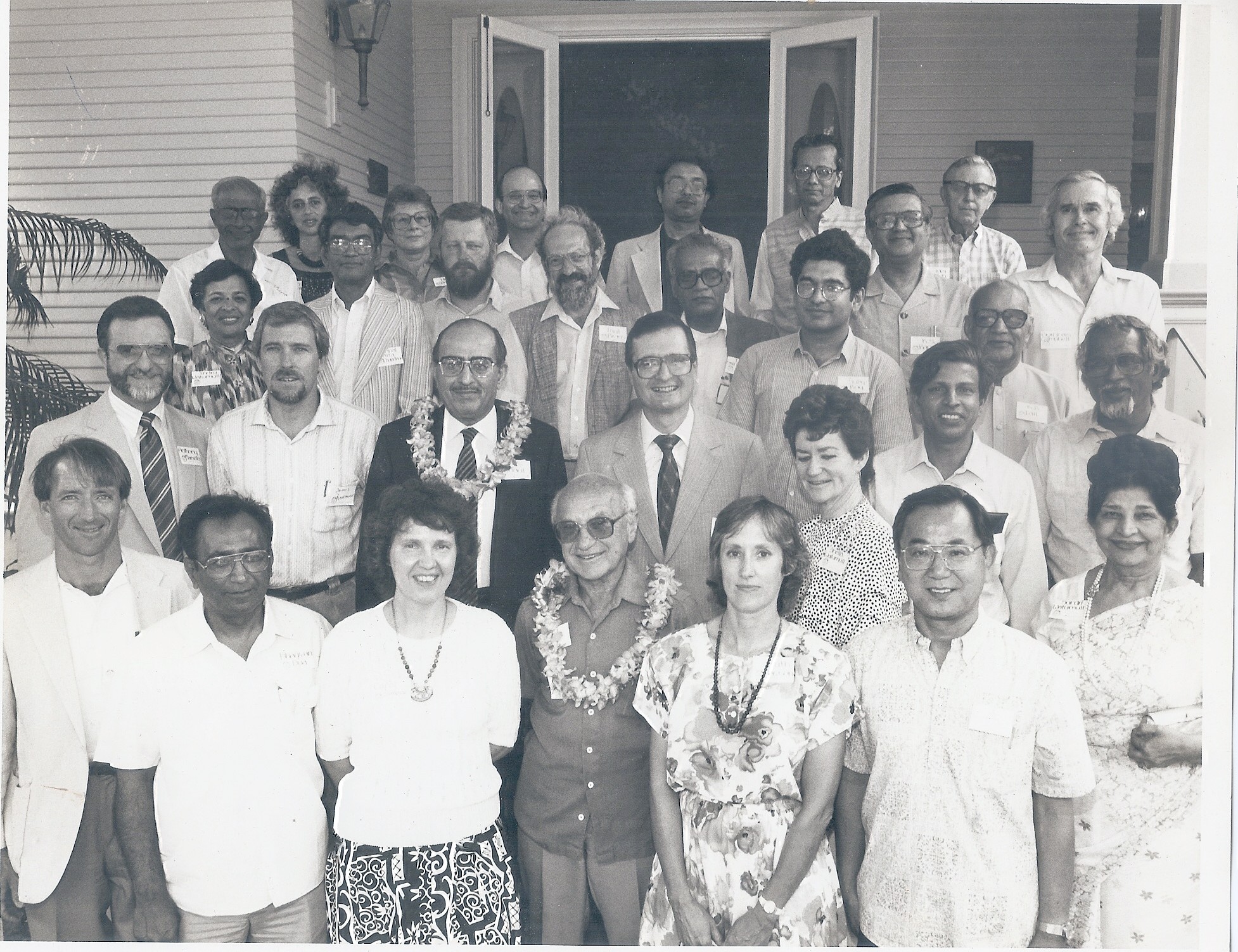
On page 23, the thesis said:

“We know such conversations should not be forcibly silenced, which is why it is wrong that Dr Sakharov is banished, or that Mr Wei Jingsheng is gaoled for a decade, or that Dr Tomin is brutally assaulted and not allowed to lecture on Aristotle.”

And again on page 104:

“A disciplined and united oligarchy can with careful planning maintain its rule indefinitely over an amorphous and anonymous citizenry.  The only thorns in its side will be men like Sakharov and Wei Jingsheng and Tomin whose courage is somehow signalled to the outside world and who thus become recognisable names.  But even these men can be exiled or gaoled or thrashed into silence, so extinguishing the small chance left of the the truth being told and the Leadership’s claim to unique wisdom being exposed for the sheer humbug it is.”

With my continuing admiration, I remain

Yours truly

Subroto Roy

Kolkata, India

Transparency & history: India’s archives must be opened to world standards

Transparency & history: India’s archives must be opened to world standards
by Claude Arpi & Subroto Roy
First published in Business Standard New Delhi December 31, 2008, 0:26 IST

The Government of India continues to hide India’s history from India’s people using specious excuses. An example is the Henderson-Brook report on the 1962 war, a single copy of which is said to exist locked away in the Defence Ministry. An anti-Indian author like Neville Maxwell is among the few ever given access to it; he has reiterated his factually incorrect theory (accepted by Henry Kissinger and Zhou Enlai and the US and Chinese establishments since) that the 1962 war was due to Nehru’s aggressive policy and China had no choice but launch a “pre-emptive attack”.

In Parliament not long ago, Defence Minister A K Antony said: “Considering the sensitivity of information contained in the report and its security implications, the report has not been recommended to be declassified in the National Security interest.” This is nonsense. Nothing from as far back as 1962 can possibly affect anything significant to India’s security today. In any case the Defence Ministry’s official history of the 1962 war, though officially unpublished, is openly available.

Even the 2005 Right to Information Act goes against transparency of research into India’s history. Article 8 (1) (a) says, “there shall be no obligation to give any citizen,— (a) information, disclosure of which would prejudicially affect the sovereignty and integrity of India, the security, strategic, scientific or economic interests of the State, relation with foreign State or lead to incitement of an offence.” This can cover all files of the MEA, Defence and Home; there seems to be no right to academic freedom for India’s people to research their own history.
China itself is more open with its archives. Since 2004, the Foreign Ministry in Beijing has begun a systematic process declassifying more than 40,000 items from its diplomatic records for the period 1949-1960. The Cold War International History Project at the Woodrow Wilson International Center in Washington DC has recently published Inside China’s Cold War; the Project Director admits this has been possible due to China’s “archival thaw”.

In the USA, official documents are made available after 30 years or when a reasonable demand is made under the Freedom of Information Act. Numerous groups exist whose only work is to make sure the law is followed. The recently released Foreign Relations of the United States, Volume XVIII, China (1973-1976) published by the American foreign ministry reveals several interesting aspects of the India-USA-China relationship. Last year the National Archives and Records Administration (NARA) posted some 320,000 declassified cables on-line. The text of once-secret diplomatic cables indexed is today retrievable from the NARA Website. It also includes withdrawal cards for documents still classified, so these can be requested under the Freedom of Information Act. Out of 119,356 documents for 1973 and 200,508 for 1974, some 7,484 were related to India. Indians scholars today have to rely on US documents for their own history!

In an open society, the ordinary citizen has reasonably easy access to any and all information relating to the public or social interest— whether the information is directly available to the citizen himself/herself, or is indirectly available to his/her elected representatives like MPs and MLAs. Different citizens will respond to the same factual information in different ways, and conflict and debate about the common good will result. But that would be part of the democratic process. In an open society, both good news and bad news is out there in the pubic domain— to be assessed, debated, rejoiced over, or wept about. Citizens are mature enough to cope with both— the experience causes a process of social maturation in formulating the common good as well as responses to problems or crises the community may face. People improve their civic capacities, becoming better-informed and more discerning voters and decision-makers, and so becoming better citizens.

The opposite of an open society is a closed society— in which a ruling political party or self-styled elite or ‘nomenclatura’ keep publicly important information to themselves, and do not allow the ordinary citizen easy or reasonably free access to it. The reason may be merely that they are intent on accumulating assets for themselves in the dark as quickly as possible while in office, or that they are afraid of public anger and want to save their own skins from demands for accountability. Or it may be they have the impression that the public is better off kept in the dark— that only the elite ‘nomenclatura’ is in a position to use the information to serve the national interest. Bad news comes to be suppressed and so good news gets exaggerated in significance. News of economic disasters, military defeats or domestic uprisings gets suppressed. News of victories or achievements or heroics gets exaggerated. If there are no real victories, achievements or heroics, fake ones have to be invented by government hacks— though the suppressed bad news tends to silently whisper all the way through the public consciousness in any case.

Such is the way of government propaganda everywhere. Closed society totalitarianism permitted the general masses to remain docile and unthinking while the ‘nomenclatura’ make the decisions. Dostoevsky’s Grand Inquisitor said that is all that can be expected of the masses. Open society transparency was instead defined by Pericles for the Athenians: “Here each individual is interested not only in his own affairs but in the affairs of the state as well; even those who are mostly occupied with their own business are extremely well-informed on general politics— this is a peculiarity of ours: we do not say that a man who takes no interest in politics is a man who minds his own business; we say that he has no business here at all.”

The study of the subcontinent’s history using archival material is crucial to disentangle difficult problems like the Jammu & Kashmir issue or the border problem with China. Yet today nobody can access independent India’s primary sources locked in South Block and North Block in New Delhi. Most bizarrely, Jawaharlal Nehru’s papers are under control of his descendants like Priyanka Vadra and Sonia Gandhi, who claim copyright. Someone may need to tell them there is a universal principle that there can be no copyright on the public life-work of historical figures like presidents and prime ministers.

Protected: Become a US Supreme Court Justice! (Explorations in the Rule of Law in America)

This post is password protected. To view it please enter your password below:


Become a US Supreme Court Justice! (Explorations in the Rule of Law in America) Preface

For almost two decades, I have found myself in a saga exploring the Rule of Law, the nature of justice and freedom, and the nature of racial animosity and xenophobia in the United States. Judge it here for yourself. There are 10 pdf files in a password protected post of the same name. Please send me an email identifying yourself and offering any reason, including curiosity, that you may have to want to examine the matter. Files 1 and 2 marked SCOTUS are the front-matter and Petition for Writ of Mandamus as received by Circuit Justice Sandra Day O’Connor of the Supreme Court of the United States in February 1996. Files 3 to 10 constitute the Appendix of Record giving the rulings of the US District Court for the District of Hawaii and the US Court of Appeals for the Ninth Circuit, including especially in File 8 the “after-discovered” evidence of how my attorney had been covertly purchased by my opponent. An example of perjured trial testimony is contained in File 2. In September 2007, I asked my opponent — the Government of one of the 50 States — to voluntarily admit its wrongdoings to the present Chief Judge of the US District Court as is required by law. Government lawyers should, after all, try to act lawfully.

How the Liabilities/Assets Ratio of Indian Banks Changed from 84% in 1970 to 108% in 1998

This graph was created by me in 2002 from Reserve Bank of India data published until 1998. Although I had been “full professor” at the time for six years at something known as an “Institution of National Importance” in India, I had received not a rupee by way of any research-assistance, and had to be assisted in the creation of this graph by two very elderly lay persons, one aged 87 and another aged 77, who read out over many hours  (despite frail eyesight) long columns of RBI data which I then typed into an Excel file. The graph came to be published for the first time to accompany my two-part article “Indian Inflation” published in The Statesman April 15-16 2008,  and available elsewhere here.

The Prime Minister of India has today spoken in India’s Parliament of how sound India’s banking seems to him compared to that in the rest of the world at present.  I  trust he has available to him vast amounts of fresh data since 1998 which  the many members of  his  “Dream Team” of government and other establishment economists  in Delhi and Mumbai have analysed adequately to justify his confidence.  The data in my RBI graph end at 1998 but  they do cover all the years of the PM’s own career as  India’s top economic bureaucrat up through his tenure as Finance Minister in the Narasimha Rao Government.

As it happens, I do think India’s banks are relatively insulated from  the world economy and its present financial crisis but the reason for that insulation has nothing to do with any purportedly better bank governance in India; rather it has to do with the fact the rupee is not a hard convertible currency and therefore there has been a vast and continuing distortion of relative prices (including interest rates and wages) from world prices.

Subroto Roy, October 20 2008


Growth of Real Income, Money & Prices in India 1869-2008

I have warned against a “monetary meltdown” in India for more than a decade and a half now.  I said it to Rajiv Gandhi (who listened with care and respect) and after he was gone I have said it to Government economists in India, to IMF/World Bank bureaucrats in Washington, to academic audiences in India and the UK and to India’s general newspaper reading public.

Obviously I hope such a meltdown does not come about.   But inflation, or the decline in the value of money, presently is in double-digits even by the Government’s own admission.  (As a general rule, I think the decline in the value of money has been higher by several percent than what the Government says at any given time.)  Hence I am publishing again some results of my macroeconomic research on India over the years.   You are free to use them and communicate with me about them but please acknowledge them properly and do not steal.

The first graph of 1869-2004 data was published in print to accompany my Growth and Government Delusion in The Statesman February 22, 2008; it had also accompanied other similar articles, e.g. The Dream Team: A Critique in January 2006.  The second graph of 1935-2008 data was published in print to accompany my article Indian Inflation in The Statesman of  April 22 2008.

Subroto Roy

John Wisdom, Renford Bambrough: Main Philosophical Works

John Wisdom (1904-1993), Main Philosophical Works:

Interpretation and Analysis, 1931
Problems of Mind and Matter 1934
Other Minds, 1952
Philosophy & Psychoanalysis, 1953
Paradox & Discovery, 1965
Logical Constructions (1931-1933),1969
Proof and Explanation (The Virginia Lectures 1957), 1991

Secondary literature:
Wisdom: Twelve Essays, R. Bambrough (ed) 1974
Philosophy and Life: Essays on John Wisdom, I. Dilman (ed) 1984.

Renford Bambrough (1926-1999), Main Philosophical Works:

“Socratic Paradox”, Philosophical Quarterly, 1960

“Universals and Family Resemblances”, Proceedings of the Aristotelian Society 1960-61

“Plato’s Modern Friends and Enemies”, Philosophy 1962

The Philosophy of Aristotle, 1963

“Principia Metaphysica”, Philosophy 1964

New Essays on Plato and Aristotle (edited by R. Bambrough), 1965

“Unanswerable Questions”, Proceedings of the Aristotelian Society Supplement 1966

Plato, Popper and Politics (edited by R. Bambrough), 1967

Reason, Truth and God 1969

“Foundations”, Analysis, 1970

“Objectivity and Objects”, Proceedings of the Aristotelian Society 1971-72

“How to Read Wittgenstein”, in Understanding Wittgenstein, Royal Institute of Philosophy 1972-3

“The Shape of Ignorance”, in Lewis (ed) Contemporary British Philosophy, 1976

Introduction & Notes to Plato’s Republic (Lindsay trans.), 1976

Conflict and the Scope of Reason, 1974; also in Ratio 1978

“Intuition and the Inexpressible” in Katz (ed) Mysticism & Philosophical Analysis, 1978

Moral Scepticism and Moral Knowledge, 1979

“Thought, Word and Deed”, Proceedings of Aristotelian Society Supplement 1980

“Peirce, Wittgenstein and Systematic Philosophy”, MidWest Studies in Philosophy, 1981

“The Scope of Reason: An Epistle to the Persians”, in Objectivity and Cultural Divergence, Royal Institute of Philosophy, 1984

“Principia Metaphysica: The Scope of Reason” also known as “The Roots of Reason”; a work and manuscript mentioned several times but now unknown.

A personal note by Subroto Roy for a public lecture delivered at the University of Buckingham, August 24 2004:

“Renford Bambrough and I met once on January 31 1982, when I had returned to Cambridge from the USA for my PhD viva voce examination. He signed and gave me his last personal copy of Reason, Truth and God. Three years earlier, in 1979, I, as a 24 year old PhD student under F.H. Hahn in economics, had written to him expressing my delight at finding his works and saying these were immensely important to economics; he invited me to his weekly discussion groups at St John’s College but I could not attend. Between 1979 and 1989 we corresponded while I worked in America on my application of his and Wisdom’s work to problems in economics, which emerged in Philosophy of Economics: On the Scope of Reason in Economic Inquiry (Routledge, International Library of Philosophy 1989, 1991), a work which got me into a lot of trouble with American economists (though Milton Friedman and Theodore W. Schultz defended it). Bambrough said of it “The work is altogether well-written and admirably clear”. On another occasion he said he was “extremely pleased” at the interest I had taken in his work. The preface of my book said he was not responsible for the use I had made of his writings, which I reiterate now. Returning to Britain in 2004, I find the work of Wisdom and Bambrough unknown or forgotten, even at the great University North East of Buckingham where they had lived and worked. In my view, they played a kind of modern-day Plato and Aristotle to Wittgenstein’s Socrates; in terms of Eastern philosophy, the wisdom they achieved in their lives and have left behind for us in their work to use and apply to our own problems, make them like modern-day “Boddhisatvas” of Mahayana Buddhism. My lecture “Science, Religion, Art, and the Necessity of Freedom” purports to apply their work to current international problems of grave significance, namely the cultural conflicts made apparent since the September 11 2001 attacks on America. As I am as likely to fail as to succeed in making this application, the brief bibliography given above is intended to direct interested persons to their work first hand for themselves.”

April 2007: See also Preface 2007 to the republication here at www.independentindian.com of Philosophy of Economics: On the Scope of Reason in Economic Inquiry, and also the 2004 public lecture “Science, Religion, Art & the Necessity of Freedom”.

Karl Georg Zinn’s Review of my Philosophy of Economics

Review of Subroto Roy’s Philosophy of Economics

by Karl Georg Zinn of Aachen, Germany, in

Jahrbücher für Nationalökonomie und Statistik

translated from the German by Nahar Bhattacharya

“The author intends to discuss some of the central philosophical questions facing modern economic theory. In the foreground is a disposition of the conventional problem of value-independence. Roy sees the value-independence postulate as “Hume’s Scepticism”. He defines Hume’s First and Second Laws on the basis of two signified propositions taken from R. M. Hare.

(1) From positive empirical premises, no normative postulate can be derived; in order to establish obligatory propositions, at least one normative proposition is needed.

(2) In a specified economic context, after all empirical and formal/logical matters are resolved, little scope exists for further intersubjectively valid answers. Valuations beyond this limit are based on the subjective feelings of the economist to the concerned problem.

The scientific/theoretical attitude representative of most economists of the 20th century has been based on this characteristic Humean scepticism. To show this, the author reviews short representative quotations from some of the known names of recent economic theory: Friedman, Myrdal, Lionel Robbins, P. A. Samuelson, Hicks, Joan Robinson, Hayek, Oskar Lange, Schumpeter, Arrow, Blaug, Frank Hahn.

Subsequently, the author raises the point as to what explains this scientific-theoretical approval. A cursory survey of important real and virtual historical developments since antiquity confirms that the essential reason for the reported wide acceptance of a humean position by the economic scientist indeed could have been as a defensive posture against dogmatism and political dictatorship (“It is part of the democratic reaction against medieval authoritarianism” p.45).

Conditioned by their “disgust with the tyrannies and ideologies of the twentieth century”, these authorities tried to protect economic science and guarantee the objectivity of research by resort to moral scepticism.

Hence the author arrives at the starting position of his actual subject: After using Hume to escape from dependence on Plato e tutti quanti, has not value-free economics gotten into a fresh dependence, namely, moral scepticism and its philosophical consequence, moral indifference? Here too a contradiction is shown to arise, namely, that each argumentation against the normative can stand its ground only through normative premises. Thus ultimately something like correct standards become necessary. This however is only a marginal problem compared to a very much more important point: whether the moral scepticism permeating the strict scientific-theoretical position, is not just part of a very much more comprehensive scepticism, which includes Hume’s own criticism of induction as well. But then the same scepticism makes positive theory dubious as well: “Either all of positive economics is attacked with just as much scepticism as anything in normative economics, or we accept one and reject the other when instead there are reasons to think they share the same ultimate grounds and must be accepted or rejected together”(p.47).

The author illustrates the difficulties with radical scepticism in a continental traversal of economic theory: micro and macroeconomics, mathematical economic theory and welfare theory are stations on this tour. A solution of the problem in the strict sense is not given nor could have been expected. But Roy delivers a methodical rule which permits a more exact definition of the limits to which normative discussion can take place precisely and objectively: first, to distinguish always whether an objective answer is at all possible to certain questions, and secondly, to ask who is competent or in the best position to give an answer.

For readers interested in a new, thoroughly subtle discussion of a basic yet customary problem, this book will be profitable reading. However, the author could have argued some matters slightly more elaborately and others less redundantly, and set forth the central idea more clearly through appropriate summaries.”

Transparency and Economic Policy-Making

Transparency and Economic Policy-Making

An address by Professor Subroto Roy to the Asia-Pacific Public Relations Conference, (panel on Transparency chaired by C. R. Irani) January 30 1998.

This talk is dedicated to the memory of my sister Suchandra Bhattacharjee (14.02.1943-10.01.1998).
1. I would like to talk about transparency and economic policy-making in our country. For something to be transparent is, in plain language, for it to be able to be openly seen through, for it to not to be opaque, obscure or muddy, for it to be clear to the naked eye or to the reasonable mind. A clear glass of water is a transparent glass of water. Similarly, an open and easily comprehensible set of economic policies is a transparent set of economic policies.

The philosopher Karl Popper wrote a famous book after the Second World War titled The Open Society and its Enemies. It contained a passionate defence of liberal institutions and democratic freedoms and a bitter attack on totalitarian doctrines of all kinds. It generated a lot of controversy, especially over its likely misreading of the best known work of political philosophy since the 4th Century BC, namely, Plato’s Republic .[1] I shall borrow Popper’s terms ‘open society’ and ‘closed society’ and will first try to make this a useful distinction for modern times, and then apply it to the process of economic policy-making in India today.

2. An open society is one in which the ordinary citizen has reasonably easy access to any and all information relating to the public or social interest — whether the information is directly available to the citizen himself or herself, or is indirectly available to his or her elected representatives like MP’s and MLA’s. Different citizens will respond to the same factual information in different ways, and conflict and debate about the common good will result. But that would be part of the democratic process.

The assessment that any public makes about the government of the day depends on both good and bad news about the fate of the country at any given time. In an open society, both good news and bad news is out there in the pubic domain — open to be assessed, debated, rejoiced over, or wept about. If we win a cricket match or send a woman into space we rejoice. If we lose a child in a manhole or a busload of children in a river, we weep. If some tremendous fraud on the public exchequer comes to be exposed, we are appalled. And so on.

It is the hallmark of an open society that its citizens are mature enough to cope with both the good and the bad news about their country that comes to be daily placed before them. Or, perhaps more accurately, the experience of having to handle both good and bad news daily about their world causes the citizens in an open society to undergo a process of social maturation in formulating their understanding of the common good as well as their responses to problems or crises that the community may come to face. They might be thereby thought of as improving their civic capacities, as becoming better-informed and more discerning voters and decision-makers, and so becoming better citizens of the country in which they live.

The opposite of an open society is a closed society — one in which a ruling political party or a self-styled elite or nomenclatura keep publicly important information to themselves, and do not allow the ordinary citizen easy or reasonably free access to it. The reason may be merely that they are intent on accumulating assets for themselves as quickly as they can while in office, or that they are afraid of public anger and want to save their own skins from demands for accountability. Or it may be that they have the impression that the public is better off kept in the dark — that only the elite nomenclatura is in position to use the information to serve the national interest.

In a closed society it is inevitable that bad news comes to be censored or suppressed by the nomenclatura, and so the good news gets exaggerated in significance. News of economic disasters, military defeats or domestic uprisings gets suppressed. News of victories or achievements or heroics gets exaggerated. If there are no real victories, achievements or heroics, fake ones have to be invented by government hacks — although the suppressed bad news tends to silently whisper all the way through the public consciousness in any case.

Such is the way of government propaganda in almost every country, even those that pride themselves on being free and democratic societies. Dostoevsky’s cardinal advice in Brothers Karamasov was: “Above all, never lie to yourself”. Yet people in power tend to become so adept at propaganda that they start to deceive themselves and forget what is true and what is false, or worse still, cannot remember how to distinguish between true and false in the first place. In an essay thirty years ago titled Truth and Politics, the American scholar Hannah Arendt put it like this:

“Insofar as man carries within himself a partner from whom he can never win release, he will be better off not to live with a murderer or a liar; or: since thought is the silent dialogue carried out between me and myself, I must be careful to keep the integrity of this partner intact, for otherwise I shall surely lose the capacity for thought altogether.”[2]

3. Closed societies may have been the rule and open societies the exception for most of human history. The good news at the end of the 20th Century is surely that since November 7 1989, when the Berlin Wall fell, the closed society has officially ceased to be a respectable form of human social organization. The age of mass access to television and telecommunications at the end of the 20th Century may be spelling the permanent end of totalitarianism and closed societies in general. The Berlin Wall was perhaps doomed to fall the first day East Germans were able to watch West German television programs.

Other than our large and powerful neighbour China, plus perhaps North Korea, Myanmar, and some Islamic countries, declared closed societies are becoming hard to find, and China remains in two minds whether to be open or closed. No longer is Russia or Romania or Albania or South Africa closed in the way each once was for many years. There may be all sorts of problems and confusions in these countries but they are or trying to become open societies.

Under the glare of TV cameras in the 21st Century, horrors like the Holocaust or the Gulag or even an atrocity like Jalianwalla Bag or the Mai Lai massacre will simply not be able to take place anywhere in the world. Such things are not going to happen, or if they do happen, it will be random terrorism and not systematic, large scale genocide of the sort the 20th Century has experienced. The good news is that somehow, through the growth of human ingenuity that we call technical progress, we may have made some moral progress as a species as well.

4. My hypothesis, then, is that while every country finds its place on a spectrum of openness and closedness with respect to its political institutions and availability of information, a broad and permanent drift has been taking place as the 20th Century comes to an end in the direction of openness.

With this greater openness we should expect bad news not to come to be suppressed or good news not to come to be exaggerated in the old ways of propaganda. Instead we should expect more objectively accurate information to come about in the public domain — i.e., better quality and more reliable information, in other words, more truthful information. This in turn commensurately requires more candour and maturity on the part of citizens in discussions about the national or social interest. Closed society totalitarianism permitted the general masses to remain docile and unthinking while the nomenclatura make the decisions. Dostoevsky’s Grand Inquisitor said that is all that can be expected of the masses. Open society transparency and democracy defines the concept of an ordinary citizen and requires from that citizen individual rationality and individual responsibility. It is the requirement Pericles made of the Athenians:

“Here each individual is interested not only in his own affairs but in the affairs of the state as well; even those who are mostly occupied with their own business are extremely well-informed on general politics – this is a peculiarity of ours: we do not say that a man who takes no interest in politics is a man who minds his own business; we say that he has no business here at all.”[3]

5. All this being said, I am at last in a position to turn to economic policy in India today. I am sorry to have been so long-winded and pedantic but now I can state my main substantive point bluntly: in India today, there is almost zero transparency in the information needed for effective macroeconomic policy-making whether at the Union or State levels. To illustrate by some examples.

(A) Macroeconomic policy-making in any large country requires the presence of half a dozen or a dozen well-defined competing models produced by the government and private agencies, specifying plausible causal links between major economic variables, and made testable against time-series data of reasonably long duration. In India we seem to have almost none. The University Economics Departments are all owned by some government or other and can hardly speak out with any academic freedom. When the Ministry of Finance or RBI or Planning Commission, or the India teams of the World Bank or IMF, make their periodic statements they do not appear to be based on any such models or any such data-base. If any such models exist, these need to be published and placed in the public domain for thorough discussion as to their specification and their data. Otherwise, whatever is being predicted cannot be assessed as being very much more reliable than the predictions obtained from the Finance Minister’s astrologer or palmist. (NB: Horse-Manure is a polite word used in the American South for what elsewhere goes by the initials of B. S.). Furthermore, there is no follow-up or critical review to see whether what the Government said was going to happen a year ago has in fact happened, and if not, why not.

(B) The Constitution of India defines many States yet no one seems to be quite certain how many States really constitute the Union of India at any given time. We began with a dozen. Some 565 petty monarchs were successfully integrated into a unitary Republic of India, and for some years we had sixteen States. But today, do we really have 26 States? Is Delhi a State? UP with 150 million people would be the fifth or sixth largest country in the world on its own; is it really merely one State of India? Are 11 Small States de facto Union Territories in view of their heavy dependence on the Union? Suppose we agreed there are fifteen Major States of India based on sheer population size: namely, Andhra, Assam, Bihar, Gujarat, Haryana, Karnataka, Kerala, MP, Maharashtra, Orissa, Punjab, Rajasthan, Tamil Nadu, UP and West Bengal. These States account for 93% of the population of India. The average population of these 15 Major States is 58 million people each. That is the size of a major country like France or Britain. In other words, the 870 million people in India’s Major States are numerically 15 Frances or 15 Britains put together.

Yet no reliable, uniformly collected GDP figures exist for these 15 States. The RBI has the best data, and these are at least two years old, and the RBI will tell you without further explanation that the data across States are not comparable. If that is the case at State-level, I do not see how the national-level Gross Domestic Product can possibly be estimated with any meaningfulness at all.

(C) Then we hear about the Government Budget deficit as a percentage of GDP. Now any national government is able to pay for its activities only by taxation or borrowing or by using its monopoly over the domestic medium of exchange to print new money. In India today, universal money-illusion seems to prevail. It would not be widely recognised by citizens, journalists or policy-makers that, say, 100,000 Rupees nominally taxed at 10% under 20% inflation leaves less real disposable income than the same taxed at 20% with 5% inflation. This is in part because inflation figures are unknown or suspect. There is no reliable all-India or State-level consumer price index. The wholesale price index on the basis of which the Government of India makes its inflation statements, may not accurately reflect the actual decline in the purchasing power of money, as measured, say, by rises in prices of alternative stores of value like land. The index includes artificially low administered or subsidized prices for petroleum, cereals, and electricity. To the extent these prices may be expected to move towards international equilibrium prices, the index contains a strong element of deferred inflation. One urgent task for all macroeconomic research in India is construction of reliable price-data indices at both Union and State levels, or at a minimum, the testing for reliability by international standards of series currently produced by Government agencies.

Without reliable macroeconomic information being spread widely through a reasonably well-informed electorate, the Government of India has been able to wash away fiscal budget constraints by monetization and inflation without significant response from voters. The routine method of meeting deficits has become “the use of the printing press to manufacture legal tender paper money”, either directly by paying Government creditors “with new paper money specially printed for the purpose” or indirectly by paying creditors “out of loans to itself from the Central Bank”, issuing paper money to that amount. Every Budget of the Government of India, including the most recent ones of 1996 and 1997, comes to be attended by detailed Press discussion with regard to the minutae of changes in tax rates or tax-collection — yet the enormous phenomena of the automatic monetization of the Government’s deficit is ill-understood and effectively ignored. Historically, a policy of monetization started with the British Government in India during the Second World War, with a more than five-fold increase in money supply occurring between 1939 and 1945. Inflation rates never seen in India before or since were the result (Charts 0000), attended by the Great Famine of 1942/43. Though these were brought down after succession of C. D. Deshmukh as Governor of the Reserve Bank, the policy of automatic monetization did not cease and continues until the present day. Inflation “sooner or later destroys the confidence, not only of businessmen, but of the whole community, in the future value of the currency. Then comes the stage known as “the flight from the currency.” Had the Rupee been convertible during the Bretton Woods period, depreciation would have signalled and helped to adjust for disequilibrium. But exchange-controls imposed during the War were enlarged by the new Governments of India and Pakistan after the British departure to exclude convertible Sterling Area currencies as well. With the Rupee no longer convertible, internal monetization of deficits could continue without commensurate exchange-rate depreciation.

The Reserve Bank was originally supposed to be a monetary authority independent of the Government’s fiscal compulsions. It has been prevented from developing into anything more than a department of the Ministry of Finance, and as such, has become the captive creditor of the Government. The RBI in turn has utilized its supervisory role over banking to hold captive creditors, especially nationalized banks whose liabilities account for 90% of commercial bank deposits in the country. Also captive are nationalized insurance companies and pension funds. Government debt instruments show on the asset side of these balance-sheets. To the extent these may not have been held had banks been allowed to act in the interests of proper management of depositors’ liabilities and share-capital according to normal principles, these are pseudo-assets worth small fractions of their nominal values. Chart 0000 shows that in the last five years the average term structure of Government debt has been shortening rapidly, suggesting the Government is finding it increasingly difficult to find creditors, and portending higher interest rates.

General recognition of these business facts, as may be expected to come about with increasing transparency, would be a recipe for a crisis of confidence in the banking and financial system if appropriate policies were not in place beforehand.

(D) As two last examples, I offer two charts. The first shows the domestic interest burden of the Government of India growing at an alarming rate, even after it has been deflated to real terms. The second tries to show India’s foreign assets and liabilities together – we always come to know what is happening to the RBI’s reserve levels, what is less known or less understood is the structure of foreign liabilities being accumulated by the country. Very roughly speaking, in terms that everyone can understand, every man, woman and child in India today owes something like 100 US dollars to the outside world. The Ministry of Finance will tell you that this is not to be worried about because it is long-term debt and not short-term debt. Even if we take them at their word, interest payments still have to be paid on long-term debt, say at 3% per annum. That means for the stock of debt merely to be financed, every man, woman and child in India must be earning $3 every year in foreign exchange via the sale of real goods and services abroad. I.e., something like $3 billion must be newly earned every year in foreign exchange merely to finance the existing stock of debt. Quite clearly, that is not happening and it would stretch the imagination to see how it can be made to happen.

In sum, then, India, blessed with democratic political traditions which we had to take from the British against their will — remember Tilak, “Freedom is my birthright, and I shall have it” — may still be stuck with a closed society mentality when it comes to the all-important issue of economic policy. There is simply an absence in Indian public discourse of vigourous discussion of economic models and facts, whether at Union or State levels. A friendly foreign ambassador pointedly observed an absence in India of political philosophy. It may be more accurate to say that without adequate experience of a normal agenda of government being seen to be practised, widespread ignorance regarding fiscal and monetary causalities and inexperience of the technology of governance remains in the Indian electorate, as well as among public decision-makers at all levels. Our politicians seem to spend an inordinate amount of their time either garlanding one another with flowers or garlanding statues and photographs of the glorious dead. It is high time they stopped to think about the living and the future.

[1] Renford Bambrough (ed.) Plato, Popper and Politics: Some Contributions to a Modern Controversy, 1967.

[2] Philosophy, Politics and Society, 2nd Series, Peter Laslett & W. G. Runciman (eds.), 1967.

[3] Thucydides, History of the Pelopennesian War, II.40.

Milton Friedman on the Mahalanobis-Nehru “Second Plan”

Mahalanobis’s  Plan
by Milton Friedman

First published in The Statesman front page www.thestatesman.net November 22 2006 (NB postscript by Subroto Roy).

“I met PC Mahalanobis in 1946 and again at a meeting of the International Statistical Institute in September 1947, and I know him well by reputation. He was absent during most of my stay in New Delhi, but I met him at a meeting of the Indian Planning Commission, of which he is one of the strongest and most able members.

Mahalanobis began as a mathematician and is a very able one. Able mathematicians are usually recognized for their ability at a relatively early age. Realizing their own ability as they do and working in a field of absolutes, tends, in my opinion, to make them dangerous when they apply themselves to economic planning. They produce specific and detailed plans in which they have confidence, without perhaps realizing that economic planning is not the absolute science that mathematics is. This general characteristic of mathematicians is true of Mahalanobis but in spite of the tendency he is willing to discuss a problem and listen to a different point of view. Once his decision is reached, however, he has great confidence in it.

Mahalanobis was unquestionably extremely influential in drafting the Indian five-year plan. There were four key steps in the plan. The first was the so-called “Plan Frame” drafted by Mahalanobis himself. The second was a tentative plan based on the “Plan Frame”. The third step was a report by a committee of economists on the first two steps, and the fourth was a minority report by BR Shenoy on the economists’ report. The economists had no intention of drafting a definitive proposal but merely meant to comment on certain aspects of the first two steps. Shenoy’s minority report, however, had the effect of making the economists’ report official.

The scheme of the Five Year Plan attributed to Mahalanobis faces two problems; one, that India needs heavy industry for economic development; and two, that development of heavy industry uses up large amounts of capital while providing only small employment.

Based on these facts, Mahalanobis proposed to concentrate on heavy industry development on the one hand and to subsidize the hand production cottage industries on the other. The latter course would discriminate against the smaller manufacturers. In my opinion, the plan wastes both capital and labour and the Indians get only the worst of both efforts. If left to their own devices under a free enterprise system I believe the Indians would gravitate naturally towards the production of such items as bicycles, sewing machines, and radios. This trend is already apparent without any subsidy.

The Indian cottage industry is already cloaked in the same popular sort of mist as is rural life in the US. There is an idea in both places that this life is typical and the backbone of their respective countries. Politically, the Indian cottage industry problem is akin to the American farm problem. Mohandas Gandhi was a proponent of strengthening the cottage industry as a weapon against the British. This reason is now gone but the emotions engendered by Gandhi remain. Any move to strengthen the cottage industry has great political appeal and thus, Mahalanobis’ plan and its pseudo-scientific support for the industry also has great political appeal.  I found many supporters for the heavy industry phase of the Plan but almost no one (among the technical Civil Servants) who really believes in the cottage industry aspects, aside from their political appeal.

In its initial form, the plan was very large and ambitious with optimistic estimates. My impression is that there is a substantial trend away from this approach, however, and an attempt to cut down. The development of heavy industry has slowed except for steel and iron. I believe that the proposed development of a synthetic petroleum plant has been dropped and probably wisely so. In addition, I believe that the proposed five year plan may be extended to six years. Other than his work on the plan, I am uncertain of Mahalanobis’ influence. The gossip is that he has Nehru’s ear and potentially he could be very influential, simply because of his intellectual ability and powers of persuasion. The question that occurs to me is how much difference Mahalanobis’ plan makes. The plan does not seem the important thing to me. I believe that the new drive and enthusiasm of the Indian nation will surmount any plan, good or bad. Then too, I feel a wide diversity in what is said and what is done. I believe that much of Nehru’s socialistic talk is simply that, just talk. Nehru has been trying to undermine the Socialist Party by this means and apparently the Congress Party’s adoption of a socialistic idea for industry has been successful in this respect.

One gets the impression, depending on whom one talks with, either that the Government runs business, or that two or three large businesses run the government. All that appears publicly indicates that the first is true, but a case can also be made for the latter interpretation. Favour and harassment are counterparts in the Indian economic scheme. There is no significant impairment of the willingness of Indian capitalists to invest in their industries, except in the specific industries where nationalization has been announced, but they are not always willing to invest and take the risks inherent in the free enterprise system. They want the Government to support their investment and when it refuses they back out and cry “Socialism”.”

(Note by Dr Subroto Roy: Milton Friedman, who died last week (obituary: page 7) , gave me this document (dated 15 February 1956) in 1984. I did not publish it in Hawaii in May 1989 in Foundations of India’s Political Economy along with his November 1955 Memorandum to the Government of India because it was rather more candid and personal in tone. The Berlin Wall had not yet fallen, and I was at the time being attacked by prominent Indian and foreign economists and political scientists for wanting to publish the 1955 Memorandum at all. Today, we in India are well on our way to making more objective studies of our intellectual and political history than was possible two decades ago. Friedman’s candid observations, from the Cold War era of Krushchev’s denunciation of Stalin, seem as fascinating as the tales of travellers from courts of olden times.)

On a Liberal Party for India

NON-EXISTENT LIBERALS

By SUBROTO ROY

First published in The Sunday Statesman October 22 2006, Editorial Page Special Article, www.thestatesman.net

Communists, socialists and fascists exist in the Left, Congress and BJP-RSS ~ but there is a conservative/”classical liberal” party missing in Indian democracy today

We in India have sorely needed for many years a serious “classical liberal” or “conservative” political party. Major democratic countries used to have such parties which paid lip-service at least to “classical liberal” principles. But the 2003 attack on Iraq caused Bush/McCain-Republicans to merge with Hilary-Democrats, and Blair-Labour with Tory neocons, all united in a cause of collective mendacity, self-delusion and jingoism over the so-called “war on terror”. The “classical liberal” or “libertarian” elements among the Republicans and Tories find themselves isolated today, just as do pacifist communitarian elements among the Democrats and Labour. There are no obvious international models that a new Indian Liberal Party could look at ~ any models that exist would be very hard to find, perhaps in New Zealand or somewhere in Canada or North Eastern Europe like Estonia. There have been notable individual Indian Liberals though whom it may be still possible to look to for some insight: Gokhale, Sapru, Rajagopalachari and Masani among politicians, Shenoy among economists, as well as many jurists in years and decades gone by.

What domestic political principles would a “classical liberal” or conservative party believe in and want to implement in India today? First of all, the “Rule of Law” and an “Efficient Judiciary”. Secondly, “Family Values” and “Freedom of Religious Belief”. Thirdly, “Limited Government” and a “Responsible Citizenry”. Fourthly, “Sound Money” and “Free Competitive Markets”. Fifthly, “Compassion” and a “Safety Net”. Sixthly, “Education and Health for All”. Seventhly, “Science, not Superstition”. There may be many more items but this in itself would be quite a full agenda for a new Liberal Party to define for India’s electorate of more than a half billion voters, and then win enough of a Parliamentary majority to govern with at the Union-level, besides our more than two dozen States.

The practical policies entailed by these sorts of political slogans would involve first and foremost cleaning up the budgets and accounts of every single governmental entity in the country, namely, the Union, every State, every district and municipality, every publicly funded entity or organisation. Secondly, improving public decision-making capacity so that once budgets and accounts recover from having been gravely sick for decades, there are functioning institutions for their proper future management. Thirdly, resolving J&K in the most lawful and just manner as well as military problems with Pakistan in as practical and efficacious a way as possible today. This is necessary if military budgets are ever going to be drawn down to peacetime levels from levels they have been at ever since the Second World War. How to resolve J&K justly and lawfully has been described in these pages before (The Statesman, “Solving Kashmir” 1-3 December 2005, “Law, Justice and J&K”, 2-3 July 2006).

Cleaning up public budgets and accounts would pari passu stop corruption in its tracks, as well as release resources for valuable public goods and services. A beginning may be made by, for example, tripling the resources every year for three years that are allocated to the Judiciary, School Education and Basic Health, subject to tight systems of performance-audit. Institutions for improved political and administrative decision-making are necessary throughout the country if public preferences with respect to raising and allocating common resources are to be elicited and then translated into actual delivery of public goods and services.

This means inter alia that our often dysfunctional Parliament and State Legislatures have to be inspired by political statesmen (if any such may be found to be encouraged or engendered) to do at least a little of what they have been supposed to be doing. If the Legislative Branch and the Executive it elects are to lead this country, performance-audit will have to begin with them.

The result of healthy public budgets and accounts, and an economy with functioning public goods and services, would be a macroeconomic condition for the paper-rupee to once more become a money that is as good as gold, namely, a convertible world currency again after having suffered sixty years of abuse via endless deficit finance at the hands of first the British and then numerous Governments of free India that have followed.

It may be noticed the domestic aspects of such an agenda oppose almost everything the present Sonia-Manmohan Congress and Jyoti Basu “Left” stand for — whose “politically correct” thoughts and deeds have ruined India’s money and public budgets, bloated India’s Government especially the bureaucracy and the military, starved the Judiciary and damaged the Rule of Law, and gone about overturning Family Values. While there has been endless talk from them about being “pro-poor”, the actual results of their politicization of India’s economy are available to be seen with the naked eye everywhere.

One hundred years from now if our souls returned to visit the areas known today as India, Pakistan, Bangladesh etc, we may well find 500+ million inhabitants still below the same poverty-line despite all the gaseous prime ministerial or governmental rhetoric today and projections about alleged growth-rates.

If the Congress and “Left” must oppose any real “classical liberal” or conservative agenda, we may ask if the BJP-RSS could be conceivably for it. The answer is clearly not. The BJP-RSS may pontificate much about being patriotic to the motherland and about past real or imagined glories of Indian culture and religion, but that hardly ever has translated concretely into anything besides anti-Muslim or anti-Christian rhetoric, or breeding superstitions like astrology even at supposedly top technological institutes in the country. (Why all astrology is humbug, and a pre-Copernican Western import at that, is because all horoscopes assume the Sun rotates around the Earth in a geocentric solar system; the modern West’s scientific outlook arose only after astrology had declined there thanks to Copernicus and Galileo establishing the solar system as heliocentric.)

As for a “classical liberal” economic agenda, the BJP in Government transpired to be as bad if not worse than their adversaries in fiscal and monetary profligacy, except they flattered and were flattered by the organised capital of the big business lobbies whereas their adversaries flatter and are flattered by the organised power of the big labour unions (covering a tiny privileged class among India’s massive workforce). Neither has had the slightest interest in the anonymous powerless individual Indian citizen or household. The BJP in Opposition, instead of seeking to train and educate a new modern principled conservative leadership, appear to wish to regress even further back towards their very own brand of coarse fascism. “Family Values” are why Indian school-children have become the envy of the world in their keen discipline and anxiety to learn – yet even there the BJP had nothing to say on Sonia Gandhi’s pet bill on women’s property rights, whose inevitable result will be further conflict between daughters and daughters-in-law of normal Indian families.

At the root of the malaise of our political parties may be the fact we have never had any kind of grassroots “orange” revolution. There has been also an underlying national anxiety of disintegration and disorder from which the idea of a “strong Centre” follows, which has effectively meant a Delhi bloated with power and swimming in self-delusion. The BJP and Left are prisoners of their geriatric leaderships and rather unpleasant ideologies and interest-groups, while the Congress has failed to invent or adopt any ideology besides sycophancy. Let it be remembered Sonia Gandhi had been genuinely disdainful of the idea of leading that party at Rajiv’s death; today she has allowed herself to become its necessary glue. The most salubrious thing she could do for the party (and hence for India) is to do a Michael Howard: namely, preside over a genuine leadership contest between a half-dozen ambitious people, and then withdraw with her family permanently from India’s politics, focusing instead on the legacy of her late husband. Without that happening, the Congress cannot be made a healthy political entity, and hence the other parties have no role-model to imitate. Meanwhile, a liberal political party, which necessarily would be non-geriatric and non-sycophantic, is still missing in India.

Indian Money and Banking

ON MONEY & BANKING

The deficit-finance of all public institutions flow like rivulets into the swamp that is our Public Debt, managed by the RBI

by

SUBROTO ROY

First published in The Sunday Statesman, Editorial Page, Special Article

April 23 2006, www.thestatesman.net

THE Reserve Bank of India, like all other public institutions, belongs to all of India’s people. There has been a tendency with every national institution, whether the ONGC or nationalised banks like SBI, or the IITs and IIMs or Air India and Indian Airlines or the Railways, Army, Navy, Air Force, IAS, IFS, Central Secretariat etc, even Parliament and State legislatures, to think that its assets, both tangible and intangible, are to serve the interests mainly of its employees, whether of Class 1, 2, 3, or 4. In fact, the assets of all such national institutions belong to all Indians: all one thousand million of us, from nameless street children and rural mendicants onwards. The body of our whole Indian citizenry own any and all such public institutions, and their employees are merely our “agents”, literally “public servants” who get paid salaries and perquisites out of public revenues. The task of managing and controlling these vast cohorts of public servants is a stupendous one of democratic politics and public administration. As a country we have never been very adept at it, indeed we often have been hopelessly incompetent. Without proper control and management, employees of national institutions have naturally tended to take over control of these assets, shifting liabilities onto the shoulders and budgets of the anonymous diffused body of citizenry who are supposed to be their masters. The public’s servants have tended to become the masters of the public’s assets and resources.

The RBI, as the nation’s Central Bank, has a unique position because its principal task is to establish and maintain the integrity of our money and banking system. The deficit-finance of all public institutions flow like rivulets into the swamp that is our Public Debt, managed by the RBI.

Money as such has no “intrinsic” worth. All the paper rupees, dollars, pounds, euros, yen in the world have less “intrinsic” usefulness than a hairpin or a button or a pair of shoelaces. Hairpins, buttons and shoelaces at least keep your hair, your shirt or your shoes together ~ the paper of paper money can be at best used to roll cigarettes perhaps. Yet paper money comes to be needed and is valued by everyone in every country ~ from street children upwards to Mr Premji, Mr Gates and Mr Mittal. Everyone accepts paper money as wages in exchange for his/her work, and then plans to use that same paper to buy food, shelter, clothing and other necessities with. I.e., we accept paper money for a short time believing we can use it to acquire useful things with. It has no intrinsic worth yet it is universally valued because everyone believes it will be accepted by everyone else in exchange for real goods and services which are in fact useful and conducive to life. The use of paper money depends on a fine and invisible web of collective trust permeating throughout the economy.

Banks arose due to the increasing complexity of modern economies in the last six hundred years. Paper currency was then supplemented in commerce by “deposits”, so that a transaction between two persons need not involve turnover of cash but can come to be accomplished by adjustment in their respective deposits with their banks. This vastly increased the quantum of trust ordinary people placed in the system of normal transactions, since they had to now believe not just in the exchangeability of paper money but also in the viability of the banks where they had placed their deposits. Currency plus Bank Deposits constitute what is called the “Money Supply”, and its controller is the RBI.

Our collective trust in money and banking is in and of itself something with economic value, which commercial banks are in a unique position to exploit. Banks can usually bet that all their customers will not demand their deposits at the same time, and so they are able to lend out as loans a very large fraction of what they have received as deposits from the public. Making such loans in turn causes the recipients of the loans to make new deposits (of what they have borrowed) in yet other banks, and this in turn acts as a signal to the receiving banks to make even more loans. Hence a process of “redeposit” or “deposit multiplication” occurs in any banking system where only a fraction of deposits is legally required to be kept as reserves by the bank. A Central Bank like the RBI then has the duty to see none of this gets out of hand: that while individual banks are acting to make profitable investments on the capital risked by a bank’s owners, they are, as a collective body, creating enough but not excessive credit to meet the needs of business.

In India, most banks came to be nationalised decades ago by Indira Gandhi on advice of P. N. Haksar, the mentor of Dr Manmohan Singh in his career as an economic bureaucrat. Whatever original capital they have had also arises from the public exchequer, and all their employees are effectively “public servants” under the Ministry of Finance. We have not been hearing from the RBI anything about the deleterious effects of this continuing state of affairs.

The RBI’s functions include managing the “Public Debt”, which stands today at perhaps Rs. 30 trillion (1 trillion= 1 lakh crore), on which interest of perhaps Rs 2-3 trillion must be paid by the Union and State Governments every year to those holding the debt (mostly the nationalised banking system under duress from the RBI). Why the stock-market has been doing so “well” is because it has been like an athlete on steroids. A stock market is supposed to be risky while a debt market is supposed to be safe. Our Government’s fiscal and monetary behaviour over decades has caused the formal debt market to yield negative returns, and so the stock-market has become relatively lucrative despite its risky nature.

It is also the RBI’s task to manage the country’s foreign exchange “reserves”, i.e. the residual balance left after all forex outgoings from purchases of imports (like petroleum or weapons) and payments of interest on or repayment of foreign loans have been subtracted from flows of incoming forex arising from export revenues, emigrants’ remittances, and new foreign loans and investments. These “reserves” do not belong to the Government or the nation in the same way tax-revenues belong to the Consolidated Fund of India. It was a shocking conceptual error of the Manmohan Singh Government’s most prominent economic bureaucrat to fail to see this and to suggest forex reserves could be used for “infrastructure” development. For the business press to get excited about forex reserves being at this or that level is also misleading, since high reserves may or may not indicate a better financial position just as a heavily indebted man may or may not be in a bad position depending on what kind of use he has made of his debts.

We have not been hearing of any of these matters from the RBI under Dr Y. V. Reddy. Instead, the one definite number we have received last week is that the RBI, under behest of its master, the Ministry of Finance, has been causing the Money Supply to grow at something like 15%. The Government’s apologists would like us to believe that this gets distributed between real economic growth in the region of 10% and inflation in the region of 5%. But for all that anybody really knows, it may be that real growth is at 5% and inflation is at 10%! Ask yourself if what you bought last year for Rs 1000 costs Rs 1050 or Rs. 1100 this year. Your guess may be as good as the Government’s.

Can India Become an Economic Superpower or Will There Be a Monetary Meltdown? (2005)

In 2005, I returned to Britain thanks to an invitation from Professor Patrick Minford of the Cardiff Business School, Cardiff University, to deliver a lecture on India’s Money at his Economics Seminar. www.cardiff.ac.uk/carbs/research/seminars.html
“Wednesday 13 April 2005 Dr Subroto Roy /India’s Money/ 4.30pm, Room S01 (Economics Seminar Series)

The same lecture was delivered at the Institute of Economic Affairs, London, a fortnight later under the title “Can India Become an Economic Superpower or Will There Be a Monetary Meltdown?”. The IEA’s summary of the lecture was as follows

http://www.iea.org.uk/record.jsp?type=news&ID=263

27 April 2005

“Leading Indian economist, Dr. Subroto Roy discusses the prospects of the Indian economy and warns of dangers ahead.

Can India become an economic superpower or will there be a monetary meltdown?

Dr. Roy discussed the prospects for the Indian economy at a lecture at the IEA on 27th April. Below is a synopsis of his lecture, outlining his hopes and concerns.

New technological progress in a myriad of ways, as well as the discovery of new resources, plus a possible peace-dividend arising from reduced regional tensions and conflict, are all important factors contributing to real economic growth in India today.

While the real side of the economy does well, the “nominal” economy, within the Government’s control, displays disconcerting trends. Continual deficit financing for half a century has led to exponential growth of public debt and broad money. The vast growth of time-deposits in banks may have been misinterpreted as indicating a real phenomenon such as unusual savings behaviour when it is more likely to be a nominal phenomenon resulting from increasing amounts of government debt being held by the largely nationalised banking sector. (The same may be true of China).

Twenty-one years ago, the author’s IEA Occasional Paper No. 69, Pricing, planning and politics: a study of economic distortions in India, proposed microeconomic reforms provoking the Times‘ lead editorial of May 29 1984. Some of these came to be implemented following the author’s role as a senior adviser to Rajiv Gandhi in 1990-1991. Now, monetary and fiscal reforms of a classical liberal nature are vitally necessary if a macroeconomic meltdown is to be prevented. Important among these are complete budgetary transparency, fiscal discipline improving the social productivity of all public expenditure, and monetary and financial policies to restore the integrity of the currency at home and abroad. Dr. Roy was Wincott Professor at the Department of Economics at the University of Buckingham last year. He is editor of Margaret Thatcher’s Revolution available from the recommended books page of the IEA’s website.”

When I returned to India, I was invited to give the same lecture on May 5 2005 to the Reserve Bank of India’s Monetary Economics Seminar, chaired by Chief Economist Dr Narendra Jadav; the invitation came thanks to the intervention of Dr S. S. Tarapore. I subsequently informed a few of India’s key monetary policy decision-makers of these lectures, and I was happy to see policy talk emanating from Delhi and Bombay becoming a little less drunken and disorderly than it had been before.

Subroto Roy, April 14 2007

Science, Religion, Art & the Necessity of Freedom (2004)

Science, Religion, Art & the Necessity of Freedom: Reason’s Response to Islamism

by
Subroto Roy, PhD (Cantab.), BScEcon (London)

(A public lecture delivered as the Wincott Visiting Professor of Economics at the University of Buckingham on August 24 2004, based on a keynote address to the Council of Asian Liberals and Democrats, Manila, November 16 2001.)

I am most grateful to the University of Buckingham for allowing me to refresh and carry forward my research these last several months. For some 25 years I have been learning of and reflecting upon the work of two great modern British philosophers, John Wisdom (1904-1993) and Renford Bambrough (1926-1999). In the 1980s in America, I came to apply their thinking in Philosophy of Economics (Routledge 1989), a book which got me into a lot of trouble there. Returning to Britain in 2004, I am dismayed to find their work almost forgotten or unknown today, even at the Ancient University that had been their home. “Orientalists” from the West once used to comprehend and highlight the achievements of the East for the peoples of the East who were unaware of them; I am happy to return the favour by becoming an “Occidentalist” in highlighting a little of the work of two of Britain’s finest sons of which she has become unaware. Wisdom and Bambrough played a kind of modern-day Plato and Aristotle to the Socrates played by Wittgenstein (1889-1951); the knowledge they achieved in their lives and have left behind for us to use and apply to our own problems make them, in terms of Eastern philosophy, rather like the “Boddhisatvas” of Mahayana Buddhism. I do not expect anyone to share such an extravagant view, and will be more than satisfied if I am able to suggest that we can have a grasp of the nature and scope of human reasoning thanks to their work which may help resolve the most intractable and seemingly irreconcilable of all current international problems, namely the grave cultural conflicts made apparent since September 11 2001.

2. The September 11 attacks aimed to cripple one of the world’s largest and most important countries in a new kind of act of war. The perpetrators apparently saw themselves — subjectively in their own minds — acting in the name of one of the world’s largest and most important religions. Since the attacks, the world has become an unusually bewildering place, as if notions of freedom, tolerance and the rule of law have been proven a lie overnight, as if virtues like patience, common reasoning and good humour have all become irrelevant, deserving to be flushed away in face of a resurgence of ancient savageries. The attackers and their friends taunt the West saying their love of death is greater and more powerful than the West’s love of life; the taunts and the counter-taunts of their powerful adversaries have had the effect of spraying panic, mutual fear, hatred or destruction across the surface of everyday life everywhere, so we now have bizarre scenes of people taking off their shoes and clothes and putting them on again while travelling, and of the British public being advised on how to cope with nerve gas attacks when they might have much rather been watching “reality TV” instead. An Age of Unreason appears upon us.

The very simple proposition I put forward here is this: there are, indeed there cannot be, any conflicts that are necessarily irresoluble. To put it differently, the logical scope of common reasoning is indefinite and limitless. There is no question to which there is not a right answer. If I was asked to answer in one sentence what has been the combined contribution to human thought of Wittgenstein, Wisdom and Bambrough, indeed of modern British philosophy as a whole, I would say it has been the proof that there are no unanswerable questions, that there is no question to which there is not a right answer.
By “common reasoning” I shall mean merely to refer to the structure of any conversation well-enough described by F. R. Leavis’s operators in literary criticism:

“This is so, isn’t it?,

Yes, but….”.

My “yes” to your “This is so, isn’t it?” indicates agreement with what you have said while my “but…” tells you I believe there may be something more to the matter, some further logical relation to be found, some further fact to be investigated or experiment carried out, some further reflection necessary and possible upon already known and agreed upon facts. It amounts to a new “This is so, isn’t it?” to which you may respond with your own, “Yes, but…”; and our argument would continue. Another set of operators is:

“You might as well say…”;

“Exactly so”;

“But this is different…”

This was how Wisdom encapsulated the “case-by-case” method of argument that he pioneered and practised. It requires intimate description of particular cases and marking of similarities and differences between them, yielding a powerful indefinitely productive method of objective reasoning, distinct from and logically prior to the usual methods of deduction and induction that exhaust the range of positivism. We are able to see how common reasoning may proceed in practice in subtle fields like law, psychology, politics, ethics, aesthetics and theology, just as objectively as it does in natural science and mathematics. Wittgenstein had spoken of our “craving for generality” and our “contemptuous attitude towards the particular case”. Wisdom formalised the epistemological priority of particular over general saying: “Examples are the final food of thought. Principles and laws may serve us well. They can help us to bring to bear on what is now in question what is not now in question. They help us to connect one thing with another and another and another. But at the bar of reason, always the final appeal is to cases.” And “Argument must be heard”.

In all conflicts – whether within a given science, between different sciences, between sciences and religion, within a given religion, between different religions, between sciences and arts, within the arts, between religion and the arts, between quarrelling nations, quarrelling neighbours or quarrelling spouses, whether in real relationships of actual life or hypothetical relationships of literature and drama – an approach of this kind tells us there is something further that may be said, some improvement that can be carried out, some further scope for investigation or experiment allowing discovery of new facts, some further reflection necessary or possible upon known facts. There are no conflicts that are necessarily irresoluble. Where the suicide-bombers and their powerful adversaries invite us to share their hasty and erroneous assumption that religious, political or economic cultures are becoming irreconcilable and doomed to be fights unto death, we may give to them instead John Wisdom’s “Argument must be heard.”

Parties to this or any conflict may in fact fail to find in themselves enough patience, tolerance, good humour, courage to take an argument where it leads, or they may fail to find enough of these qualities in adequate time, as Quesnay and the Physiocrats failed to find solutions in adequate time and were swept away by the French Revolution. But the failures of our practical human powers and capabilities do not signal that the logical boundaries of the scope of reason have been reached or even approached or come to be sighted.

3. The current conflict is said to be rooted in differences between religious cultures. We may however wish to first address whether any religious belief or practice can survive the devastating onslaught of natural science, the common modern adversary of all religions. What constitutes a living organism? What is the difference between plants and animals? What is the structure of a benzene ring or carbon atom or subatomic particle? What is light? Sound? Gravity? What can be said about black holes or white dwarfs? When did life begin here and when is it likely to end? Are we alone in being the only form of self-conscious life? Such questions about the world and Universe and our place in it have been asked and answered in their own way by all peoples of the world, from primitive tribes in hidden forests to sophisticated rocket scientists in hidden laboratories. Our best common understanding of them constitutes the state of scientific knowledge at a given time. Once we have accounted for all that modern science has to say, can any reasonable explanation or justification remain to be given of any religious belief or practice from any time or place?

Bambrough constructed this example. Suppose we are walking on the shore of a stormy sea along with Homer, the ancient Greek poet, who has been restored to us thanks to a time machine. We are walking along when Homer looks at the rough sea and says, “Poseidon is angry today”. We look at the waves loudly hitting the rocks and nod in agreement saying, “Yes, Poseidon is angry today”. We may be using the same words as Homer but Homer’s understanding of and expectations about the words “Poseidon is angry today” and our understanding of and expectations about the same words would be utterly different, a difference moreover we are able to understand but he may not. To us with our modern meteorology and oceanography, and the results of the television cameras of Jacques Cousteau and David Attenborough, we know for a fact there is no god-like supernatural being called Poseidon living within the ocean whose moods affect the waves. But to Homer, Poseidon not only exists in the ocean but also leaves footprints and descendants on the land, when Poseidon is angry the sea is vicious, when Poseidon is calm the seas are peaceful. We use the words “Poseidon is angry today” as an accurate description of the mood of an angry sea; Homer uses the same words to mean there was a god-like supernatural being inside the ocean whose anger was being reflected in the anger of the waves.

My second story is from 7th century AD located here in Buckingham, from a spot a few hundred yards behind the Economics Department of the University where there is St Rumbwald’s Well. In 650 AD — just a short while after The Recital of the Prophet of Islam (570-632AD) had been written down as The Q’uran, and just a little while before the Chinese pilgrim I-Ching (635-713AD) would be travelling through India recording his observations about Buddhism – here 12 miles from Buckingham was born the babe known as Rumwold or Rumbwald. England was hardly Christian at the time and the first Archbishop of Canterbury had been recently sent by the Pope to convert the Anglo-Saxons. Rumbwald’s father was a pagan prince of Northumbria; his mother the Christian daughter of the King of Mercia. St Rumbwald of Buckingham or Brackley is today the patron saint of fishermen at Folkestone, and he has been historically revered at monasteries in Mercia, Wessex and distant Sweden. Churches have been dedicated to him in Kent,Essex, Northamptonshire, Lincolnshire, Dorset and North Yorkshire. Pilgrims have washed themselves at St Rumwald’s Well over centuries and it is said Buckingham’s inns originated in catering to them. What is the legend of St Rumbwald? It is that on the day he was born he declared three times in a loud voice the words “I am a Christian, I am a Christian, I am a Christian”. After he had been baptised, he, on the second day of his life, was able to preach a sermon on the Trinity and the need for virtuous living, and foretold his imminent death, saying where he wished to be buried. On the third day of his life he died and was buried accordingly.

When we hear this story today, we might smile, wishing newborn babes we have known waking up in the middle of the night might be more coherent too. Professor John Clarke has shown Catholic hagiography over the centuries has also registered deep doubts about the Rumbwald story. We might be tempted to say the whole thing is complete nonsense. If a modern person took it at face value, we would look on it sympathetically. We know for a fact it is impossible, untrue, there has to be some error.

At the bar of reason, all religions lose to science where they try to compete on science’s home grounds, which are the natural or physical world. If a religious belief requires that a material object can be in two places at the same time, that something can be made out of nothing, that the Sun and planets go around the Earth to make Night and Day, that the Earth is flat and the sky is a ceiling which may be made to fall down upon it by Heavenly Wrath, that the rains will be on time if you offer a prayer or a sacrifice, it is destined to be falsified by experience. Natural science has done a lot of its work in the last few centuries; all the major religions pre-date this expansion so their physical premises may have remained those of the science understood in their time. In all questions where religions try to take on scientific understanding head on, they do and must lose, and numerous factual claims made by all religions will disappear in the fierce and unforgiving heat of the crucible of scientific reasoning and evidence.Yet even a slight alteration of the St Rumbwald story can make it plausible to modern ears. Just the other day Radio 4 had a programme on child prodigies who were able to speak words and begin to master language at age of one or two. It is not impossible a child prodigy of the 7th Century AD in his first or second year of life spoke the words “I’m a Christian”, or that as a toddler with a devout Christian mother, he said something or other about the Holy Trinity or about virtue or that he wished to be buried in such and such place even if he had had no real understanding of what he was talking about. If such a prodigious infant of royal blood then died from illness, we can imagine the grief of those around him, and how word about him might spread through a countryside in an era 1200 years before the discovery of electricity and invention of telecommunications, and for that information to become garbled enough to form the basis of the legend of St Rumbwald through the centuries.

The Rumbwald story is a typical religious story that has its parallels in other times and places including our own. It is impossible for it to have been factually true in the way it has come down to us, but it is completely possible for us with our better knowledge of facts and science today to reasonably explain its power over the beliefs of many generations of people. And if we are able to reasonably explain why people of a given time and place may have believed or practised what they did, we have not reason to be disdainful or scornful of them. The mere fact such religious stories, beliefs, experiences and practices of human beings over several thousand years across the globe have been expressed in widely different and far from well-translated or well-understood languages – Egyptian, Hebrew, Aramaic, Greek, Latin, Sanskrit, Pali, Tibetan, Chinese, Korean, Japanese, Hawaiian, Samoan, Apache, Kwa Zulu, Hausa, Swahili – let aside English, Arabic, Yiddish or a thousand others, provides more than ample explanation of how miscomprehension and misapprehension can arise and continue, of how a vast amount of mutual contempt and scorn between peoples of different cultures is able to be irrationally sustained. The scope for the reasonable “demythologisation” of all these stories in all these languages from all these religions, in the way we have sought to “demythologise” the Rumbwald story here obviously remains immense and indefinite.

Next consider religious practice in the modern world, and the universal act of praying. (Economists have not seemed to look much at this before though a lot of mankind’s energy and resources are rationally spent towards it every day across the world.) Some weeks ago, on the 60th Anniversary of D-Day, Lady Soames, the daughter of Churchill, recalled the incredible fear and tension and uncertainty felt during the buildup to the invasion of Normandy; she said that when she finally heard the roar of the aeroplanes as they started across the English Channel: “I fell to my knees and prayed as I’d never prayed before or since” (BBC 1 June 6 2004, 8.40 am). A policeman’s wife in Costa Rica in Central America is shown making the sign of the cross upon her husband before he goes to work in the morning into a crime-ridden area from which he might not return safely at the end of the day. Footballers and boxers and opening batsmen around the world say a prayer before entering the field of contest. So do stockbrokers, foreign exchange dealers, businessmen, job-candidates and students taking examinations, and of course hospital-patients entering operating theatres. Before a penalty shootout between England and Portugal or Holland and Sweden, many thousands of logically contradictory prayers went up.

All this praying is done without a second thought about the ultimate ontological character of the destination of such prayers, or even whether such a destination happens or happens not to exist at all. The universal ubiquitous act of praying might be a rational human response to fear, uncertainty, hopelessness, and despair, as also to unexpected joy or excessive happiness.

Blake said: “Excess of joy, weeps, Excess of sorrow, laughs”. When there is excess of sorrow or excess of joy, praying may contribute mental resources like courage, tranquillity and equanimity and so tend to restore emotional equilibrium in face of sudden trauma or excitement. A provisional conclusion we may then register is that religious beliefs and practices of people around the world are open to be reasonably comprehended and explained in these sorts of straightforward ways, and at the same time there is a good sense in which progress in religious understanding is possible and necessary to be made following growth and improvement of our factual understanding of the world and Universe in which we live.

We still speak of the Sun “rising in the East” and “setting in the West” despite knowing since Copernicus and Galileo and the testimony of Yuri Gagarin, John Glenn and Neil Armstrong that the Sun has in fact never done any such thing. Our understanding of the same words has changed fundamentally. Tycho Brahe thought the Sun went around Earth; his disciple Kepler the opposite; when Tycho Brahe looked East at dawn he understood something different from (and inferior to) what Kepler understood when Kepler looked East at dawn. It is similar to Homer and us with respect to whether Poseidon’s moods affect the waves of the sea. Examples of traditional religious belief and understanding may get modified by our scientific knowledge and understanding such that the same words may mean something quite different as a result and have a new significance for our consciousness.

Indeed it extends well beyond natural science to our understanding of literature, art and psychology as well. With the knowledge we have gained of ourselves — of our conscious waking minds as well as of our unconscious dreaming minds — after we have read and tried to grasp Blake, Goethe, Dostoevsky or Freud, we may quite well realise and comprehend how the thoughts and feelings residing in the constitutions of actual beings, including ourselves, are more than enough to describe and explain good and evil, and without having to refer to any beings outside ourselves residing elsewhere other than Earth. It is like the kind of progress we make in our personal religious beliefs from what we had first learned in childhood. We do not expect a person after he or she has experienced the ups and downs of adult life to keep to exactly the same religious beliefs and practises he or she had as a child at mother’s knee, and we do not expect mankind to have the same religious beliefs today as it did in its early history.

Bambrough concluded: “There is no incompatibility between a refurbished demythologised Homeric polytheism, a refurbished demythologised Christianity, and a refurbished demythologised Islam…. The Creation and the Resurrection, the Ascension and the Virgin Birth…may be very differently conceived without being differently expressed….we can still learn from the plays and poems of the ancient Greeks, although we reject the basis of the mythological structure through which they express their insight and their understanding. The myths continue to teach us something because they are attached to, and grounded in, an experience that we share. It would therefore be astonishing if the Christian religion, whether when considered as a united and comprehensive body of doctrine it is true or false, did not contain much knowledge and truth, much understanding and insight, that remain valuable and accessible even to those who reject its doctrinal foundations. In and through Christianity the thinkers and writers and painters and moralists of two thousand years have struggled to make sense of life and the world and men…. What is more, the life that they wrestled with is our life; the world they have portrayed is the world that we live in; the men that they were striving to understand are ourselves.”

Bambrough was addressing Church of England clergy forty years ago but in his reference to a refurbished demythologised Islam he might as well have been addressing Muslim clergy today — indeed his findings are quite general and apply to other theists as well as to atheists, and provide an objective basis for the justification of tolerance.

Judaism, Christianity and Islam each starts with a “religious singularity”, a single alleged moment in the history of human beings when a transcendental encounter is believed to have occurred: the Exodus of God’s Chosen People led by Moses; the Birth, Life, Death and Resurrection of God’s Only Son, Jesus Christ; the Revelation of God’s Book to His Messenger, Muhammad, Peace Be Unto Him, the Seal of the Prophets. Each speaks of a transcendental Creator, of just rewards and punishments awaiting us in a transcendental eternal life after mortal earthly death.

A different fork in the road says, however, that the wind blowing in the trees may be merely the wind blowing in the trees, nothing more; it is the path taken by Buddhism and Jainism, which deny the existence of any Creator who is to be owed our belief or reverence. It is also the path taken by Sigmund Freud the ultra-scientific rationalist of modern times: “It seems not to be true that there is a power in the universe, which watches over the well-being of every individual with parental care and brings all his concerns to a happy ending…. it is by no means the rule that virtue is rewarded and wickedness punished, but it happens often enough that the violent, the crafty and the unprincipled seize the desirable goods of the earth, while the pious go empty away. Dark, unfeeling and unloving powers determine human destiny; the system of rewards and punishments, which, according to religion, governs the world, seems to have no existence.”

We then seem to have a choice between a Universe Created or Uncreated, Something and Nothing, One and Zero, God and No God. Pascal said we have to bet on the Something not on the Nothing, bet on the One not on the Zero, bet on God being there rather than not being there. Pascal’s reasoning was clear and forms the basis of “decision theory” today: if you bet on God’s existence and God does not exist, you lose nothing; if you bet on God’s lack of existence and God exists, you’ve had it. The philosophies of my own country, India, speak of Zero and One, Nothing or Something, and almost leave it at that. Perhaps we know, or perhaps we do not says the Rg Veda’s Hymn of Creation.. Does our self-knowledge end with our mortal death or perhaps begin with it? Or perhaps just as there is an infinite continuum of numbers between 0 and 1, there is also an infinite continuum of steps on a staircase between a belief in Nothing and a belief in Something, between the atheism of Freud and the Buddhists and the theism of Judaism, Christianity and Islam. Generalising Bambrough’s findings, it would be surprising if we did not find each and every religion, whether theistic or atheistic, to contain some knowledge and truth, some understanding and insight, that remains valuable and accessible even to those who may otherwise reject the doctrinal foundations of any or all of them. In and through the religions, the thinkers, writers, painters, poets, sculptors and artists of thousands of years have struggled to make sense of our life and the world that we live in; the men and women they were striving to understand are ourselves.

4. Just after the September 11 attacks, I said in the Philippines that the perpetrators of the attacks would have been surprised to know of the respect with which the religious experience of the Prophet of Islam had been treated by the 19th Century British historian Thomas Carlyle: “The great Mystery of Existence… glared in upon (Mohammad), with its terrors, with its splendours; no hearsays could hide that unspeakable fact, ‘Here am I!’. Such sincerity… has in very truth something of divine. The word of such a man is a Voice direct from Nature’s own Heart. Men do and must listen to that as nothing else; all else is wind in comparison.” Carlyle told stories of Mohammad once not abiding by his own severe faith when he wept for an early disciple saying “You see a friend weeping over his friend”; and of how, when the young beautiful Ayesha tried to make him compare her favourably to his deceased wife and first disciple the widow Khadija, he had denied her: “She believed in me when none else would believe. In the whole world I had but one friend and she was that!” Carlyle’s choice of stories suggested the simple humanity and humility of Mohammad’s life and example, even an intersection between Islamic belief and modern science (”a Voice direct from Nature’s own Heart”). Carlyle quoted Goethe: “If this be Islam, do we not all live in Islam?”, suggesting there might be something of universal import in the message well beyond specifically Muslim ontological beliefs.

In general, the words and deeds of a spiritual leader of mankind like that of secular or scientific leaders like Darwin, Einstein, Aristotle, Adam Smith or Karl Marx, may be laid claim to by all of us whether we are explicit adherents, disciples or admirers or not. No private property rights attach upon their legacies, rather these remain open to be discussed freely and reasonably by everyone. Just as war is too important to be left to the generals, politics is too important to be left to the politicians, economics is definitely too important to be left to the economists; even science may be too important to be left to the scientists — certainly also, the religions are far too important to be left to the religious.

Yet Mr Osama Bin Laden and his friends, followers and potential followers, indeed any believing Muslims, are unlikely to be impressed with any amount of “external” praise heaped on Islam by a Carlyle or a Goethe, let aside by a President Bush or Prime Minister Blair. They may be wary of outsiders who bring so much praise of Islam, and will tell them instead “If you like Islam as much as you say you do, why not convert? It’s so easy. You have merely to say ‘God is One and Mohammad is the Seal of the Prophets’ – that’s all, you are Muslim, God is Great”.

Indeed Mr Bin Laden and friends are unlikely to be impressed with any kind of economic or carrot-and-stick policy of counter-terrorism, where incentives and disincentives are created by Western authorities like the US 9/11 Commission or the Blair Cabinet telling them: “If you are ‘moderate’ in your thoughts, words and deed you will earn this, this and this as rewards from the Government, but if you are ‘extremist’ in your thoughts, words and deeds then you shall receive that, that and that as penalties from the Government. These are your carrots and here is the stick.” It is Skinnerian behavioural psychology gone overboard. The incentives mean nothing, and the disincentives, well, they would merely have to be more careful not to end up in the modern Gulags.

We could turn from carrot-and-stick to a more sophisticated mode of negative rhetoric instead. If a doctrine C, declares itself to be resting upon prior doctrines B and A, then C’s reliability and soundness comes to depend on the reliability and soundness of B and A. If Islam declares itself to depend on references to a historical Moses or a historical Jesus, and if the last word has not been spoken by Jews, Christians, sceptics or others about the historical Moses or the historical Jesus, then the last word cannot have been spoken about something on which Islam declares itself to depend.

We can be more forceful too. Suicide-bombers combine the most sordid common crimes of theft and murder with the rare act of suicide as political protest. Suicide as political protest is a dignified and noble and awesome thing – many may remember the awful dignity in the sight of the Buddhist monks and nuns of South Vietnam immolating themselves in 1963 in protest against religious persecution by Diem’s Catholic regime, which led to the start of the American war in Vietnam. Six years and half a world away, Jan Palach, on January 19 1969, immolated himself in Wenceslas Square protesting the apathy of his countrymen to the Soviet invasion that had ended the Prague Spring. Socrates himself was forced to commit suicide for political reasons, abiding by his own injunction that it would be better to suffer wrong oneself than to come to wrong others — suicide as political protest is not something invented recently. And certainly not by Bin Laden and friends, whose greed makes their intentions and actions merely ghastly lacking all dignity: they are not satisfied like the Buddhist monks or like Jan Palach with political protest of their own suicides by self-immolation; they must add the sordid cruelty that goes with the very ordinary crimes of theft and mass murder as well.

Yet this kind of negative rhetorical attack too may not cut much ice with Mr Bin Laden and his friends. Just as they will dismiss our praise for Islam as being a suspicious trick, they will dismiss our criticism as the expected animus of an enemy.

To convict Mr Bin Laden of unreason, of contradicting himself, of holding contrary propositions x and ~x simultaneously and so talking meaninglessly and incoherently, we will have to bring out our heaviest artillery, namely, The Holy Q’uran itself, the Recital of Prophet Muhammad (Peace be upon Him). We may have to show explicitly how Mr Bin Laden’s own words contradict what is in The Q’uran. He and his followers would then be guilty of maintaining x and its contrary ~x at the same time, of violating the most basic law of logical reasoning, the law of excluded middle, of contradicting themselves, and therefore of speaking meaninglessly, incoherently, nonsensically regardless of their language, culture, nationality or religion. The Q’uran is a grand document and anyone reading it must be prepared to either considering believing it or having powerful enough reasons not to do so. “The great Mystery of Existence”, Carlyle said, “glared in upon (Mohammad), with its terrors, with its splendours; no hearsays could hide that unspeakable fact, ‘Here am I!’. Such sincerity… has in very truth something of divine. The word of such a man is a Voice direct from Nature’s own Heart. Men do and must listen to that as nothing else; all else is wind in comparison.”

Certainly, as in many other religions, the believers and unbelievers are distinguished numerous times in the Prophet’s Recital; believers are promised a Paradise of wine and many luxuries, while unbelievers are promised hell-fire and many other deprivations. But who are these unbelievers? They are the immediate local adversaries of the Prophet, the pagans of Mecca, the hanifs, the local tribes and sceptics arrayed against the Prophet. It is crystal clear that these are the people being named as unbelievers in The Q’uran, and there is absolutely no explicit or implicit mention or reference in it to peoples of other places or other times. There is no mention whatsoever of Anglo-Saxons or Celts, Vikings, Goths, or Gauls, of Hindus, Jains, Buddhists, Confucians or Shintos, no mention of Aztecs, Incas, or Eskimos. There is no mention of any peoples of any other places or of any later times. Certainly there is no mention of the people of modern America or Israel or Palestine or Britain or India. Yet Mr Bin Laden evidently sent an email to the head of the Taliban on October 3 2001, in which he referred to “defending Islam and in standing up to the symbols of infidelity of this time” (Atlantic Monthly, Sep. 2004). We are then able to say to him or any of his friends: “Tell us, Sir, when you declare a war between believers and unbelievers in the name of Islam, whom do you mean to refer to as “unbelievers”? Do you mean to refer to every person in history who has not been a Muslim, even those who may have been ignorant of Islam and its Prophet? Or do you mean to refer to the opponents and enemies the Prophet actually happened to encounter in his struggles during his mission as a proselytiser, i.e., the Arabic idolaters of Mecca, the hanifs and Qureshis, this local Jewish tribe or that local Christian or pagan tribe against whom the early Muslim believers had to battle strenuously and heroically in order to survive? If it is these local enemies of the Prophet and his early disciples whom you mean to refer to as “unbelievers” destined for Hell’s fires, there is textual evidence in The Recital to support you. But if you mean by “unbelievers” an arbitrary assortment of people across all space and all time, you are challenged to show the verses that give you this authority because there are none. Certainly you may have military or political reasons for wishing to engage in conflict with A or B or C — because you feel affronted or violated by their actions — but these would be normal secular reasons open to normal discourse and resolution including the normal laws of war as known by all nations and all peoples. There may be normal moral arguments to be made by radical Muslims against the US Government or against the Israeli Government or the British or Indian or some other Government — but there are no generalised justifications possible from within The Q’uran itself against these modern political entities. We should expose Mr Bin Laden and his friends’ lack of reason in both maintaining that Prophet Muhammad is the Seal of the Prophets, and also maintaining that they can extrapolate from The Q’uran something that is not in The Q’uran. The Q’uran speaks of no unbelievers or enemies of the Prophet or the early Muslims who are not their local enemies in that time and place.

Pritchard, the distinguished Oxford philosopher, once wrote an article called “Does Moral Philosophy Rest on a Mistake?” We today may have to ask a similar question “Does Islamist Philosophy Rest on a Mistake?”

5. If all this so far has seemed too clinical and aseptic in approaching the mystical matters of the spirit, I hasten to add finally that a decisive counterattack upon natural science may be made by both religion and art together. Our small planet is a satellite of an unexceptional star in an unexceptional galaxy yet we are still the centre of the Universe in that it is only here, as far as any of us knows, that such things as reason, intelligence and consciousness have come to exist. (Finding water or even primitive life elsewhere will not change this.) We alone have had an ability to understand ourselves and be conscious of our own existence — the great galaxies, black holes and white dwarfs are all very impressive but none of them can do the same. What responsibility arises for us (or devolves upon us) because of this? That is the perfectly good question asked by art and religion on which science remains silent. Life has existed for x million years and will be extinguished in y million more years, but we do not know why it arose at all, or what responsibility falls on those beings, ourselves, who have the consciousness to ask this. Religion and art cannot battle and win on science’s home ground but they can and do win where science has nothing left to say.

That is what DH Lawrence meant when he said the novel was a greater invention than Galileo’s telescope. Other artists would say the same. Art expresses life, and human cultures can be fresh and vigorous or decadent and redolent of death. The culture that evaluates its own art and encourages new shoots of creativity will be one with a vibrant life; the culture that cannot will be vulnerable to a merger or takeover. There is and has been only one human species, no matter how infinitely variegated its specimens across space and time. All have a capacity to reason as well as a capacity to feel a range of emotions in their experience of the world, something we share to an extent with other forms of life as well. And every human society, in trying to ascertain what is good for itself, finds need to reason together about how its members may be best able to survive, grow, reproduce and flourish, and this vitally demands freedom of inquiry and expression of different points of view. The lone voice in dissent needs to be heard or at least not suppressed just in case it is the right voice counselling against a course that might lead to catastrophe for all. To reason together implies a true or right answer exists to be found, and so the enterprise of truth seeking requires freedom as a logical necessity. It takes guts to be a lone dissenter, and all societies have typically praised and encouraged the virtues of courage and integrity, and poured shame on cowardice, treachery or sycophancy. Similarly, since society is a going concern, justice and fairplay in the working of its institutions is praised and sought after while corruption, fraud or other venality is condemned and punished. Leavis spoke of the need for an educated public if there was not to be a collapse of standards in the arts, since it was only individual candour that could expose shallow but dominant coteries.

Freedom is logically necessary to keep all potential avenues to the truth open, and freedom of belief and experience and the tolerance of dissent, becomes most obvious in religion, where the stupendous task facing everyone is to unravel to the extent we can the “Mystery of Existence”. The scope of the ontological questions is so vast it is only wise to allow the widest search for answers to take place, across all possible sources of faith, wherever the possibility of an insight into any of these subtle truths may arise, and this may explain too why a few always try to experience all the great religions in their own lifetimes. A flourishing culture advances in its science, its artistic creativity and its spiritual or philosophical consciousness. It would be self-confident enough to thrive in a world of global transmissions of ideas, practices, institutions and artefacts. Even if it was small in economic size or power relative to others, it would not be fearful of its own capacity to absorb what is valuable or to reject what is worthless from the rest of the world. To absorb what is valuable from outside is to supercede what may be less valuable at home; to reject what is worthless from outside is to appreciate what may be worthwhile at home. Both require faculties of critical and self-critical judgement, and the flourishing society will be one that possesses these qualities and exercises them with confidence. Words are also deeds, and deeds may also be language.

The crimes of September 11 2001 were ones of perverse terroristic political protest, akin on a global scale to the adolescent youth in angry frustration who kills his schoolmates and his teachers with an automatic weapon. But they were not something inexplicable or sui generis, but rather signalled a collapse of the old cosmopolitan conversation with Islam, and at the same time expressed an incoherent cry of stifled people trying to return to an austere faith of the desert. Information we have about one another and ourselves has increased exponentially in recent years yet our mutual comprehension of one another and ourselves may have grossly deteriorated in quality. Reversing such atrophy in our self-knowledge and mutual comprehension requires, in my opinion, the encouragement of all societies of all sizes to flourish in their scientific knowledge, their religious and philosophical consciousness and self-discovery, and their artistic expressiveness under conditions of freedom. Ultra-modern societies like some in North America or Europe may then perhaps become more reflective during their pursuit of material advancement and prosperity, while ancient societies like those of Asia and elsewhere may perhaps become less fearful of their capacity to engage in the transition between tradition and modernity, indeed, may even affect the direction or speed of change in a positive manner. To use a metaphor of Otto Neurath, we are as if sailors on a ship, who, even while sailing on the water, have to change the old planks of the ship with new planks one by one. In due course of time, all the planks get changed one at a time, but at no time has there not been a ship existing in the process — at no time need we have lost our history or our identity.

Philosophy of Economics: On the Scope of Reason in Economic Inquiry (1989)

Philosophy of Economics

On the Scope of Reason in Economic Inquiry

Subroto Roy
© 1989, 1991, 2007 Subroto Roy

First published by Routledge of London & New York , 1989, in the International Library of Philosophy,

Library of Congress HB72.R69 1989

British Library 330’.01-dc19
Economics – philosophical perspectives
ISBN 0-415-03592-9

Reprinted in paperback, 1991
Library of Congress HB72.R69.1991
British Library 330’.01-dc20
ISBN0-415-06028-1

Preface to 2007 WordPress.com Republication

This book germinated when I was 18 or 19 years of age in Paris, Helsinki and London, and it was first published when I was 34 in Honolulu. I came to economics from natural science (biology, chemistry, physics), not mathematics. It was inevitable I would be drawn to the beauty of philosophy as a theoretical discipline while being driven, as a post-Independence Indian, to economics as the practical discipline that might unlock secrets to India’s prosperity and progress. I belonged to an ancient family of political men, and my father, who had joined India’s new foreign service the year before I was born, inculcated in me as a boy an idea that I had “a mission” (though he later forgot he had done so).

I was fortunate to fail to enter Oxford’s PPE and instead go to the London School of Economics. LSE was at an intellectual peak in the early 1970s. DHN Johnson in international law, ACL Day in international monetary economics, Brian Griffiths vs Marcus Miller in monetary economics with everyone still in awe of Harry Johnson’s graduate lectures in macroeconomics, Ken Wallis, Graham Mizon, JJ Thomas, David Hendry in econometrics with the odd lecture by Durbin himself – I was exposed to a fully grown up intellectual seriousness from the day I arrived as an 18 year old. Michio Morishima as my professorial tutor told me frankly that, as an Indian, I would face less prejudice in Western academia than in the private sector, and said he was speaking from experience as a fellow-Asian. He turned out to be wrong but it was wise advice nevertheless, just as wise as his requiring pupils to read Hicks’ Value and Capital (which, in our undergraduate mythology, he himself had read inside a Japanese gunboat during war).

What was relatively weak at LSE was general economic theory. We were good at deriving the Best Linear Unbiased Estimator but left unsatisfied with our grasp of the theory of value that constituted the roots of our discipline. I managed a First and was admitted to Cambridge as a Research Student in 1976, where fortune had Frank Hahn choose me as a student. That at the outset was protection from the communist cabal that ran “development economics” with whom almost all the Indians ended up. I was wholly impecunious in my first year as a Research Student, and had to, for example, proof-read Arrow and Hahn’s General Competitive Analysis for its second edition to receive 50 pounds sterling from Hahn which kept me going for a short time. My exposure to Hahn’s subtle, refined and depthless thought as an economist of the first rank led to fascination and wonderment, and I read and re-read his “On the notion of equilibrium in economics”, “On the foundations of monetary theory”, “Keynesian economics and general equilibrium theory” and other clear-headed attempts to integrate the theory of value with the theory of money — a project Wicksell and Marshall had (perhaps wisely) not attempted and Keynes, Hicks and Patinkin had failed at.

Hahn insisted a central question was to ask how money, which is intrinsically worthless, can have any value, why anyone should want to hold it. The practical relevance of this question is manifest. India today in 2007 has an inconvertible currency, vast and growing public debt financed by money-creation, and more than two dozen fiscally irresponsible State governments without money-creating powers. While pondering, over the last decade, whether India’s governance could be made more responsible if States were given money-creating powers, I have constantly had Hahn’s seemingly abstruse question from decades ago in mind, as to why anyone will want to hold State currencies in India, as to whether the equilibrium price of those monies would be positive. (Lerner in fact gave an answer in 1945 when he suggested that any money would have value if its issuer agreed to collect liabilities in it — as a State collects taxes – and that may be the simplest road that bridges the real/monetary divide.)

Though we were never personal friends and I did not ingratiate myself with Hahn as did many others, my respect for him only grew when I saw how he had protected my inchoate classical liberal arguments for India from the most vicious attacks that they were open to from the communists. My doctoral thesis, initially titled “A monetary theory for India”, had to be altered due to paucity of monetary data at the time, as well as the fact India’s problems of political economy and allocation of real resources were more pressing, and so the thesis became “On liberty and economic growth: preface to a philosophy for India”. When no internal examiner could be found, the University of Cambridge, at Hahn’s insistence, showed its greatness by appointing two externals: C. J. Bliss at Oxford and T. W. Hutchison at Birmingham, former students of Hahn and Joan Robinson respectively. My thesis received the most rigorous and fairest imaginable evaluation from them.

I had been attracted to Cambridge partly by its old reputation for philosophy, especially that of Wittgenstein. But I met no worthwhile philosophers there until a few months before I was to leave for the United States in 1980, when I chanced upon the work of Renford Bambrough. Hahn had challenged me with the question, “how are you so sure your value judgements promoting liberty blah-blah are better than those of Chenery and the development economists?” It was a question that led inevitably to ethics and its epistemology — when I chanced upon Bambrough’s work, and that of his philosophical master, John Wisdom, the immense expanse of metaphysics (or ontology) opened up as well. “Then felt I like some watcher of the skies, When a new planet swims into his ken; Or like stout Cortez when with eagle eyes, He star’d at the Pacific…”

It has taken me more than a quarter century to traverse some of that expanse; when I returned to Britain in 2004 as the Wincott Visiting Professor of Economics at the University of Buckingham, I was very kindly allowed to deliver a public lecture, “Science, Religion, Art and the Necessity of Freedom”, wherein I repaid a few of my debts to the forgotten work of Bambrough and Wisdom — whom I extravagantly compared with the Bodhisattvas of Mahayana Buddhism, also saying that the trio of Wittgenstein, Wisdom and Bambrough were reminiscent of what Socrates, Plato and Aristotle might have been like.

I had written to Bambrough from within Cambridge expressing my delight at finding his works and saying these were immensely important to economics; he had invited me to his weekly discussion groups at St John’s College but I could not attend. Between 1979 and 1989 we corresponded while I worked in America on my application of his and Wisdom’s work to problems in economics. We met only once when I returned to Cambridge from Blacksburg for my doctoral viva voce examination in January 1982. Six years later in 1988 he said of my Philosophy of Economics, “The work is altogether well-written and admirably clear”, and on another occasion he said he was “extremely pleased” at the interest I had taken in his work. The original preface of Philosophy of Economics said he was not responsible for the use I had made of his writings, which I reiterated in the 2004 lecture. At our meeting, he offered to introduce me to Wisdom who had returned to Cambridge from Oregon but I was too scared and declined, something I have always regretted since. It is only in the last few years that I have begun to grasp the immensity of Wisdom’s achievement in comprehending, explaining and extending the work of both Wittgenstein and Freud. His famous “Virginia Lectures” of 1957 were finally published by his admirers with his consent as Proof and Explanation just before his death in 1993. As for Bambrough, I believe he may have been or become the single greatest philosopher since Aristotle; he told me in correspondence there was an unfinished manuscript Principia Metaphysica (the prospectus of which appeared in Philosophy 1964), which unfortunately his family and successors knew nothing about; the fact he died almost in obscurity and was soon forgotten by his University speaks more about the contemporary state of academic philosophy than about him. (Similarly, the fact Hahn, Morishima and like others did not receive the so-called Economics “Nobel” says more about the award than it does about them.)

All I needed in 1980 was time and freedom to develop the contents of this book, and that I found in America — which I could not have done in either Britain or India. It would take eight or nine very strenuous years before the book could be written and published, mostly spent at Virginia Polytechnic Institute (1980-1985) and the University of Hawaii (1986-1990) Economics Departments, with short interludes at Cornell (Fall 1983) and Brigham Young (1985-86). I went to Virginia because James M. Buchanan was there, and he, along with FA Hayek, were whom Hahn decided to write on my behalf. Hayek said he was too old to accept me but wrote me kind and generous letters praising and hence encouraging my inchoate liberal thoughts and arguments. Buchanan was welcoming and I learnt much from him and his colleagues about the realities of public finance and democratic politics, which I quickly applied in my work on India, published in 1984 in London as Pricing, Planning & Politics: A Study of Economic Distortions in India and republished elsewhere here. The visit to the Cornell Economics Department was really so I could talk to Max Black the philosopher, who represented a different line of Wittgenstein’s students, and Max and I became friends until his death in 1988.

Buchanan’s departure from Blacksburg led to a gang of inert “game theorists” to arrive, and I was immediately under attack – one senior man telling me I was free to criticise the “social choice” work of Amartya Sen (since he was Indian too) but I was definitely unfree to do the same of Sen’s mentor, Kenneth Arrow, who was Jewish! (Arrow was infinitely more gracious when he himself responded to my criticism.) On top of that arose a matter of a woman, fresh off the aeroplane from India, being assaulted by a senior professor, and when I stood for her against her assailant, my time in Blacksburg was definitely up.

The manuscript of this book was at the time under contract with University of Chicago Press, and, thanks to Mrs Harry Johnson there, I had come in contact with that great American, Theodore W. Schultz. Schultz, at age 81, told me better to my face what the book was about than I had realised myself, namely, it was about economics as knowledge — its subject-matter was the epistemology of economics. Schultz wrote letters all over America on my behalf (as did Milton Friedman at Stanford and Sidney Alexander of MIT, whom I had also met and become friends with), and I was able to first spend a happy year among the Mormons at Brigham Young, and then end up at the University of Hawaii where I was given responsibility for the main graduate course in macroeconomics. I taught Harry Johnson-level IS-LM theory and Friedman-Tobin macroeconomics and then the new “rational expectations” vs Keynesian material.

I was also offered a large University grant to work on “South Asia”, which led to the books Foundations of India’s Political Economy: Towards an Agenda for the 1990s, and Foundations of Pakistan’s Political Economy: Towards an Agenda for the 1990s, both created by myself and WE James, and which led to the origins of India’s 1991 economic reform and the India-Pakistan peace process as told elsewhere. Also, this book came to be accepted for publication by Routledge, as the first economics book in its famed International Library of Philosophy.

Just as I was set to be evaluated for promotion and tenure at the University of Hawaii, I became the victim of a most vicious racist defamation (and there was some connection with Blacksburg). Quite fed up with the sordidness of American academia as I had experienced it, I sued in the federal court, which consumed much of the next half dozen years as the case worked its way through the United States Supreme Court twice. Milton Friedman and Theodore W. Schultz stood as expert witnesses on my behalf but you would not have known it from the judge’s ruling. There had been not only demonstrable perjury and suborning of perjury by the State of Hawaii’s officers, there was also “after-discovered” evidence of bribery of court-officers in the US District Court for the District of Hawaii, and I had to return to India in 1996 quite exhausted to recuperate from the experience. “Solicitation of counsel, clerks or judges” is “embracery curialis”, recognized as extrinsic fraud and subversion of justice since Jepps 72 E R 924 (1611), “firmly established in English practice long before the foundation” of the USA, Hazel Atlas, 322 US 238 (1943). “Embracery is an offense striking at the very foundation of civil society” says Corpus Juris 20, 496. A court of equity has inherent power to investigate if a judgement has been obtained by fraud, and that is a power to unearth it effectively, since no fraud is more odious than one to subvert justice. Cases include when “by reason of something done by the successful party… there was in fact no adversary trial or decision of the issue in the case. Where the unsuccessful party has been prevented from exhibiting fully his case, by fraud or deception practised on him by his opponent, as…where an attorney fraudulently or without authority assumes to represent a party and connives at his defeat; or where the attorney regularly employed corruptly sells out his client’s interest to the other side ~ these, and similar cases which show that there has never been a real contest in the trial or hearing of the case, are reasons for which a new suit may be sustained to set aside and annul the former judgment or decree, and open the case for a new and a fair hearing….” (Hazel Atlas). There is no time-limit in United States federal law for rectification of fraud on the court of this sort, and I remain fully hopeful today of the working of American justice in the case.

The practical result was that this book was never able to be properly publicized among economists as it would have been had I become Professor of Economics at the University of Hawaii by 1992 as expected. The hardback sold out quickly on its own steam and went into paperback by 1991, and a friend told me it was being used for a course at Yale Law School. The reviews were mostly intelligent. Upon returning to Britain as the Wincott Visiting Professor in 2004, I found times had changed and so had Routledge who would not keep it in print let alone permit a second revised edition. But I am now free to republish the book as I please, and today in 2007, with the Internet growing to a maturity which allows the young geeks at WordPress.com to want to encourage blogging worldwide, I can think of no more apt place to reproduce the first edition of this book than here at my own blog www.independentindian.com.

This is not a second or revised edition, and it is unchanged in content except for this lengthy new preface made necessary by the adventures and dramas the book’s author found himself unwittingly part of since its first publication. I am 52 now and happy to say I endorse the book just as I had published it at 34, though I do find it a little impatient and too terse in a few places. The 1991 paperback corrected a few slight errors in the 1989 hardback, and has been used. I am planning an entirely new book which shall have its roots in this one though it will be mostly in philosophy and not economics — the outlines it may take may be seen in the 2004 public lecture I gave on the work of Bambrough and Wisdom mentioned above and published elsewhere; its main aim will be to uncover for new generations the immense worth there is in their work which is in danger of being lost.

At least two names failed to appear in the original list of acknowledgements. G. Bruce Chapman, now of the University of Toronto, and I talked much of serious ethics and political philosophy when I first arrived at Cambridge in 1976. And in 1980 in Blacksburg, Anil Lal, then a graduate student and house-painter, borrowed my copy of Bambrough’s work, read it, and later made a comment on the metaphysics of John Wisdom which allowed me to see things more clearly.

Ballygunge, Kolkata,
April 7 2007

TO: R.A.R.

Contents

Preface

1. Introduction

Part I

2. Hume and the Economists

3. Understanding the Consensus

4. Difficulties with Moral Scepticism

Part II

5. Objectivity and Freedom

6. Expertise and Democracy

Part III

7. An Example from Microeconomics

8. A Dialogue in Macroeconomics

9. Mathematical Economics and Reality

10. Remarks on the Foundations of Welfare Economics

Envoi

Notes and References

Select Bibliography

Preface to First Edition
The publication of this work marks the end of an adventure of more than a decade and a half, most of the writing being done between 17 December 1980 and 22 May 1987. It has been quite perilous at times, especially as a foreigner in the West, and over the years many teachers, colleagues, friends and members of family have contributed to the author’s learning with their thoughts and actions. A number of senior scholars in economics and philosophy — especially Professor Frank Hahn, Professor James Buchanan, Professor Sidney Alexander, Professor Milton Friedman, Professor Max Black, Professor Sidney Alexander, Professor Amartya Sen, Professor Peter Bauer, Professor T. W. Hutchison and Dr C. J. Bliss, have lent their support to the work as it developed, even when they may have not known of its final form, or disagreed with its content, or been themselves a subject of its criticism. Most especially, the work has been honoured in the last six years with the unwavering encouragement of Professor T. W. Schultz of the University of Chicago. And Professor Ted Honderich of University College London has shown it the kindest consideration, without which publication would have been much delayed. Finally, a large philosophical debt will be seen to be owed to the work of Mr. Renford Bambrough of St. John’s College, Cambridge; however he should not be considered responsible for the use that has been made here of his writings.
HONOLULU
15 AUGUST 1988.

1. Introduction

1. IN this book, some of the central philosophical questions facing the modern economist will be raised. Most attention will be given to the question of the appropriate relationship between the positive and the normative, as well as to its parent question of the appropriate scope of objective reasoning in the making of evaluative judgements. Closely related is the question of the appropriate role of the economic expert in society, while slightly more distant questions have to do with the significance of interpersonal comparisons of utility, with the philosophical status of the concepts and theorems of mathematical economics, and with how judgements of probability should be understood. It is this family of questions which will be the concern of the present work.

Economics is a science with potentially important practical bearing upon the lives of men and nations. The state of the modern world may have been affected more profoundly and subtly by the use or misuse of economic knowledge than by many another science. Yet anyone familiar with the intellectual history of the field will know it to have seen more conflicts, and often conflicts of a more destructive kind, than may be reasonably expected or tolerated in the development of a scholarly discipline. The reader will be familiar with the many explicit and implicit divisions of opinion that have occurred upon theories and methods and evidence and policies, which have sometimes torn apart individual university departments and even threatened the integrity of the science itself. Indeed the modern economist in a despondent mood might be inclined to say of the state of his discipline as David Hume once said of philosophy: “There is nothing which is not the subject of debate, and in which men of learning are not of contrary opinions. The most trivial question escapes not our controversy, and in the most momentous we are not able to give any certain decision. Disputes are multiplied, as if everything was uncertain, and they are settled with the utmost warmth, as if everything was certain.”
At the same time as there have been deep and persistent divisions on substantive questions of economic theory and method and evidence and policy, there has been a deliberate or inadvertent consensus about the answer to an important question in the theory of knowledge. Modern economists happen to have been practically unanimous in their opinion on the possible scope of objective reasoning in the making of judgements, and thus in their opinion on the appropriate relationship between the positive and the normative. A broad consensus has developed to the effect that while common reasoning can have some scope in evaluative discussion, it is quite possible in practice and in principle for this scope to become exhausted. At such a point of the exhaustion of reason, only sheer and unadulterated subjective differences will be found to remain between people. Put another way, it has been believed possible for judgements ultimately to become immune to rational question and criticism.

Many of the pioneers of twentieth century economic thought, Kenneth J. Arrow, Milton Friedman, F. A. Hayek, Sir John Hicks, Oskar Lange, Gunnar Myrdal, Lionel Robbins, Joan Robinson, Paul Samuelson, Joseph Schumpeter, Jan Tinbergen, to name but a few, who between themselves would represent all of the main schools of contemporary economics, may be found to have shared such a thesis in the theory of knowledge, differing amongst themselves only upon the relatively minor question of the precise amount of room reasoning should be considered to have: some saying a great amount, others saying almost none, but all agreeing that whatever the exact amount it is a finite amount, both actually and potentially. The theory of demand, the theory of macroeconomic policy, the theory of welfare economics, the theory of social choice — each has in whole or in part rested upon an epistemological premise of this kind. If such a consensus can be shown to have existed, the reader may agree it to be something of a remarkable fact, since it would be difficult indeed to find a single substantive proposition of theory or method or evidence or policy to which a similar measure of consensus among modern economists might obtain.
One of the objects of the present work will be to argue that the fact there have been tremendous disharmonies on substantive economic questions, may not be independent of the fact there has been this kind of harmony in the theory of knowledge among many of the pioneers of twentieth century economics as well as the many more who have followed them. If the epistemological point hitherto accepted as true happens in fact to be false, it becomes possible that the scope of objective reasoning on substantive questions has been artificially prevented from being extended as far as it could have and should have been. Evaluative judgements are clearly of indefinite variety: attitudes towards goods or people, expectations of the future, recommendations to buy or sell, advice to a friend or a student or a government, etc. — roughly, all judgements taken by an individual or social agent about a right or optimal course of action in given circumstances. We shall find the consensus has been that it is possible for reasoning to come to a necessary halt in the process of coming to such judgements, whether the maker of the judgement is a public body or a private individual acting in the capacity of consumer or voter. A large amount (and possibly the whole amount) of what may deserve to be within the domain of common and objective reasoning comes to be placed instead under the rule of subjective will and caprice. Not only must we live with the fact that discussions between citizens or economists or politicians or spouses or states do frequently come to end without resolution, because there happens to be a lack of patience or tolerance or perseverance or good humour or whatever, but also that such outcomes may be written into the script from the start. In any normative discussion, we are to be permitted to call a unilateral halt merely by declaring “Well that is a value judgement of mine” or “That is a personal opinion of mine”, with the implication that any further questioning is out of bounds and unacceptable. Given a theory which allows us in this way to declare as we please what to call objective science and what to call subjective opinion, and given that it may be but human nature to be sceptical of the other fellow’s dogma while being oblivious to one’s own, we may have some explanation of how the consensus among economists in the theory of knowledge may have caused and preserved a state of affairs in which rival substantive dogmas can thrive — because the processes of common reasoning and even communication itself may have been allowed too often to come to a virtual standstill. (Or move at a snail’s pace.) “Disputes are multiplied, as if everything was uncertain, and they are settled with the utmost warmth, as if everything was certain.”

The gist of the present work will be that the present consensus in the theory of economic knowledge is logically inconsistent. It is therefore untenable and deserves to be abandoned. Men can aspire to, and in fact do attain and possess, certain and objective knowledge in an indefinite number of contexts. At the same time, there is no proposition of any kind held by anyone which must be thought of as necessarily closed to further question on grounds of reason or evidence. This simple maxim is something that may be found to hold in any field of human inquiry or endeavour one cares to mention — mathematics or medicine, ethics or physics, history or probability, logic or theology — and it will be our purpose in this work to examine its consequences in the context of economics in particular.

§2. Our study is one in what may be called theory of economic knowledge, and it may be worth a moment to consider what may be meant by this.

Bertrand Russell said of pure mathematics that it was a subject “in which we do not know what we are talking about” — meaning that the pure mathematician does not normally intend to refer in his theorems to substantive factual truths about the world. The epistemology or theory of knowledge of a discipline may be thought of similarly as being not concerned with either affirming or denying, corroborating or refuting the substantive propositions that happen to be made within the discipline. The study of the theory of economic knowledge may be thought of as not making any commitment one way or another to the substantive propositions which are to be found within the department of economics itself. Instead it is a more abstract undertaking, which seeks to examine certain kinds of questions from outside the department in the practical hope of dissolving or at least clarifying the character of substantive questions and controversies that may be occurring within. For example, to ask whether a criterion of truth and falsity can be applied to economic propositions, or whether objective knowledge is possible in the field, or how the kinds of propositions made in economics are to be justified, or how they compare and contrast with propositions made in other departments of inquiry — these would be the kinds of question we might see asked in the theory of economic knowledge; from which too the importance can be seen of generally abstaining from making substantive commitments in the process.

Much of the present work, especially Parts I and II, may be understood to be an attempt to provide a theory of economic knowledge of this kind. Thus the reader will not find in it commitments made to any substantive economic propositions. There is no theorem reported of the existence or efficiency of some new kind of economic equilibrium, no new model or evidence offered of the influence of the supply of money on prices, no new theory of how the expectations of economic agents may be formed or fulfilled or disappointed, no new evidence or explanation of why some country may be experiencing rapid growth or high inflation or increasing unemployment. No new result within economic science; one might almost say, nothing substantive! The present work will offer no more than “a machine to think with” on certain philosophical aspects of economics; it intends to leave economics as it is — and yet in so doing to have shown the way out of some of the philosophical difficulties that are encountered in its study. “For the clarity that we are aiming at is indeed complete clarity. But this simply means that the philosophical problems should completely disappear.”

Yet the practical purpose to making an investigation of this kind may be stated quite readily. For suppose, for sake of argument, we granted the truth of our simple maxim and assumed the epistemological concepts ‘knowledge’ and ‘doubt’, and their allied concepts ‘objectivity’ and ‘freedom’, should not be seen as incompatible in the project of inquiry. What consequences would follow from accepting such a viewpoint? Clearly first of all, we would be placed in a happy position of being able to say that no matter how deep or persistent the actual disagreements between economists or between citizens on economic questions happened to be, there is knowledge to be had in the study of economics. Not just high sophistry or rhetoric or political posturing or the opinions and prejudices of different people — but certain and objective knowledge about those actions, events, and phenomena that are part of the economic context. We would be able to say, in other words, there are at least some propositions in economics which are true, and which moreover can be known to be true.

An important ambiguity is possible here in asking whether there is knowledge about a given matter, insofar as such a question can be taken either as asking whether it is possible for there to be any knowledge about the matter, or as asking whether it is known that someone actually possesses such knowledge and how that has been determined. Defining as an expert someone who has the most reasonable and justifiable answer to give to a question, we need to distinguish, in other words, the relatively cool logical question of whether here can be any such thing as expert knowledge from the more heated political question of who is supposed to be such an expert and how we are supposed to know that. For instance, a question like “Is there a proof to Fermat’s last theorem?” can be understood either in the manner of the pure mathematician, as asking whether there can be a proof to the proposition it is impossible xn + yn = zn for positive integers x, y, z, n, and n > 2; or in the manner of the historian of mathematics, as asking whether any human being has come up with such a proof, as Fermat himself claimed to have done but of which no record exists. Among the great thinkers, Plato is the most influential to have crossed these wires in suggesting it possible not only for there to be objective knowledge about mathematics and ethics and statesmanship, but also for a special and closed set of experts to come to be identified to whom such knowledge should be thought of as being exclusively given. Plato’s theory can be and has been interpreted as giving license to elitism and dictatorship, yet the natural protest which the ideas of these would evoke in most of us may lead to an equal and opposite error of denying the very possibility of knowledge because we feared or wished to reject the idea of being ruled by a closed set of self-described experts. Once these wires are uncrossed, we may see it to be quite possible to maintain there can be objective knowledge and expertise in economics, without making any commitments toward specifying who should be considered an expert on some economic issue, or how we are supposed to determine that, or for that matter claiming any such knowledge or expertise for ourselves.

A second consequence of our simple maxim may seem more troubling. For by its second part, we should also have to say that even while there is objective knowledge in economics, there is nevertheless no proposition in the field which must be thought of as being necessarily closed to further question. Not the proposition that every human act is a rational act, nor the proposition that economic agents continually maximize utility, or are well modelled as doing so, nor the proposition that the market economy cannot be expected to reach full employment and needs to be and can be actively supplemented by macroeconomic policy, nor the proposition that the growth of money is necessary and sufficient for inflation, nor the proposition that free trade will maximize world output given factor immobility, nor the proposition that externalities imply a possible scope for taxes and subsidies, nor the proposition that the histories of nations is a history of class struggle.

By the second part of the maxim, there is no axiom or theorem of economic theory, no finding of economic history, no estimate of the value of an economic coefficient, no prediction of the course of an economic variable, no proposal of economic policy, which must be thought of as being closed to further question. None whatsoever. “No statement is immune to revision” (Quine).

Taken together, then, the net consequence of supposing objectivity and freedom, knowledge and doubt, to be compatible concepts deserving of equal respect, is that we shall be able to chart a course which steers us clear of two perennial and opposing hazards besetting all projects of human inquiry, viz., Scepticism and Dogmatism — the modern origins of which were traced by the American philosopher Charles Sanders Peirce to the cartesian proposal that philosophy “must begin with universal doubt, whereas scholasticism had never questioned fundamentals.” In the pages to follow, we will be denying universal doubt and we shall be free to question fundamentals. In an indefinite number of contexts, there is certain and objective knowledge to be had. Scepticism, understood technically as a logical thesis denying that we can possibly have or know that we have certain knowledge, is therefore a false thesis. At the same time, there is no proposition which is necessarily closed to question. Dogmatism, understood technically as a logical thesis implying there can be or must be some propositions which are absolutely and incorrigibly true, is therefore an equally false thesis. In place of a theory of knowledge restricting the scope of common reasoning to the finite or even the potentially finite, it is possible to have a theory of knowledge extending this scope to the potentially infinite. In particular, while normative proposals in economics or elsewhere may be supposed to be objectively better or worse depending on the soundness of the positive grounds given in their support, there are no unquestionable normative proposals — because there are no unquestionable positive grounds. The simple practical result of making the present investigation is that it will permit a sure and safe course to be found between Scepticism and Dogmatism for any project of economic inquiry.

§3. Would such a simple and straightforward thesis be new to economics in any way? To what extent would the argument which has been summarized above and which will be developed in the chapters to follow not been expressed before? The reader may wish an answer to such a question, and the author presently takes this to be as follows. With respect to the general debate which has occurred about knowledge and scepticism especially in moral philosophy, there will be little if anything in the present work which is a direct or novel contribution to it. While the philosophers have not been concerned with political economy at all, we shall be passive participants to their discussions, listening in to see what can be learned for our purposes and not intending to add to them directly. It may be remembered of course that it has not been long since economics formally broke away from philosophy to become a specialized discipline in its own right, in the belief the concerns of economics are of a more concrete and practical kind than those of philosophy. Since then we have made many highly abstract and theoretical claims, while also becoming scornful of philosophical thinking and believing ourselves to be exempt from its influences. Yet serious philosophical thought constitutes a mature and magnificent conversation which it would be foolish for any serious science to be deaf to. Moreover, it has been quite widely believed that there have been significant advances in philosophical understanding in the present century, and we are responsible to take such a claim seriously. It will be one of the aims of the present work to apply what may be learned from these discussions towards resolving, or at least clarifying, some of the main substantive disputations in modern economic science.

These are two broad traditions of moral philosophy relevant to our subject-matter, one deriving from Aristotle, the other from Hume (and a line of sceptics before him). Even though it would be unwise to expect agreement within either tradition, we may for convenience speak of an aristotelian and a humean tradition respectively. With respect to the discussions among economists on the relationship of the positive to the normative, we shall find an eminent consensus to have appeared on the humean side. This work will declare for the other side, and in so doing shall have to dissent from the humean consensus upon which all of the theory of social choice and much of the theory of welfare economics and theory of economic policy have appeared to rest. As far as is known by the author, there seem to have been but two published dissents on similar lines among economists in recent decades: those of Sidney Alexander and Amartya Sen. Of these, Professor Sen’s dissent has been very short and hesitant, and he would seem to have withdrawn it in other writings. Professor Alexander’s dissent has been clear and vigourous, but unlike his work on the balance of payments, his philosophical work has not received attention, and the present work was mostly developed in complete ignorance of its existence.

By the end of this work however, a clear choice should have been set out for the reader on the question of the relationship of the positive to the normative — between the consequences of accepting the humean consensus among economists and the consequences of the position of Professor Alexander and the author and possibly Professor Sen. The simple maxim “Objective knowledge is possible and yet there is no proposition which is closed to question” should not undermine its own content by being closed to question itself — instead it is supposed to refer and apply to itself as well. It may be true and deserving of our belief but it is not self evidently so, and will have to earn its credentials at the common bar of reason. Ultimately it will have to be the reader’s individual judgement whether it has been successfully shown that, contrary to what has been supposed by many of the pioneers of twentieth century economics, no conflict must arise between knowledge and doubt, objectivity and freedom. The history of the discussion may accord to our side the advantage J. S. Mill had seen to be enjoyed by all minority opinions: if the opinion of one or a few is false then not much will be lost by believing in it, while if it proves better able to stand the tests of time then much may be gained by allowing it to replace error. Put differently, it may seem quite risky that the pioneers of modern economic science have placed all their philosophical eggs in the humean basket — just in case it is Hume himself who happens to be mistaken.

§4. In Part I of the work will be found described the received theory of economic knowledge and its possible justification, as well as an account of the logical difficulties that arise with it. Chapter 2 has the task of documenting as fully as possible the existence of a humean consensus among economists in recent decades. Chapter 3 then examines the kinds of reasons that may incline us to be persuaded to such a view, and which may go to explaining how it has seemed to be an attractive theory to so many economists. These reasons appear to have been of two different but related sorts.

First the concept of value as used in ordinary life and ethics may have become confounded with the concept of economic value or scarcity or rareté in Walras’s term. Where economists have referred to a theory of value, they may have meant to refer more accurately to a theory of relative prices as determined by conditions of scarcity. The advance of the original neoclassicals in the late nineteenth century was to establish the importance of subjective estimations of economic agents to the determination of the relative prices of goods — as opposed to say how much labour went into different production processes as the classical economists might have said, or how much intrinsic value God had placed in the goods as the scholastics might have said. While it is clear by now that such an observation is broadly correct, it would be a mistake to go from a premise that market prices are determined in part by subjective estimations to a conclusion that the relative prices thus determined in any sense establish an order of how goods deserve to be valued or not. Goods are indeed valued the way they are because people happen to value them. Yet equally, in most cases, people seem to value goods in the way they do because the goods deserve to be thus valued — for example, because, like food or clothing or shelter, the goods are conducive to some valuable human purpose.
Secondly, it is possible the consensus has been motivated by a desire to find an effective shield against dogmatism and tyranny. For example, the context of an open parliamentary democracy presupposed by the modern theory of economic policy may have derived out of the experience of the great tyrannies of twentieth century history. There may have been a natural and understandable desire that the choices and decisions of citizens in the capacity of voters or consumers should be treated with the fullest due respect, and a humean scepticism may have been adopted because it has been believed to be something which is necessary and sufficient for this kind of respect to be shown. This would be an outstanding reason for adopting a humean point of view, and one which any critic must be required to account for. Yet it also places in relief the fatal self-contradiction that is present within the humean theory. For example, a theory of economic policy which has to rely upon an assumption of the polity being open and democratic would have to be silent about the conduct of economic policy in societies which were demonstrably not open or democratic, making it a theory very special and contingent in its range of application. Moreover, to give the defence of political or economic or religious freedom as a reason for holding a subjectivist epistemology would be to have left freedom entirely defenceless and toothless from those who would attack it from within precisely the same subjectivist framework. For example, if we conflated a general right to express an opinion freely with an idea that what such an opinion expresses is itself a matter of subjective opinion, then clearly, by the same token, an opinion that opinions should be freely expressed might also be considered merely subjective, and therefore no better or worse than its contrary. Within a subjectivist theory of knowledge, there ultimately can be nothing to choose between freedom and tyranny.

Chapter 4 is a survey of these kinds of logical difficulties with the humean position stated in Chapters 2 and 3. Its main result will be that the anti dogmatic campaign of the humean cannot succeed, and in fact comes to make the Sceptic resemble the Dogmatist more than anything else. It is possible this happens because both Sceptic and Dogmatist are sharing the same deductivist model of justification, to the effect that we cannot know a proposition to be true or right unless we have deduced it as the conclusion of a set of premises of whose truth or rightness we are certain. The Sceptic sees the threat of infinite regress that is implicit in such a model, and then denies we can be certain of anything. The Dogmatist sees the potential regress too, but responds to it by calling a halt at some arbitrary point, denying the need or possibility of going any further. In Part II a fresh picture will be given which attempts to preserve the truths the Sceptic and Dogmatist would each like us to take notice of, while correcting for the distortions both would force upon us by their unequivocal adoption of a deductivist model of justification. Chapter 5 reframes the main philosophical problems of Part I in the terms of the ancient dualism between Nominalism and Realism, and brings to light a possible resolution of this which has been advanced by a number of modern philosophers. Chapter 6 develops the argument further and applies it to the question of the appropriate role of expertise in a democracy. Taken together, Part II contains the main outlines of a fresh theory of economic knowledge with which to replace the flawed and inconsistent theory to which so many economists have thus far subscribed.

Part III of the work consists of a series of diverse illustrations and possible applications of the theory of knowledge developed in Part II. Chapters 7-10 all give examples of how inquiry and criticism can be seen to proceed in economics without sacrifice of either objectivity or freedom. Chapter 7 examines an actual debate on a concrete question of microeconomic policy, which may be compared and contrasted with the more academic examples of later chapters. Chapter 8 examines aspects of the division in macroeconomics and monetary theory since J. M. Keynes’s General Theory of Employment, Interest and Money. Chapter 9 considers a question with wide and general reference to economic theory: how the relationship between mathematical economics and real economic phenomena might be best understood. This has been the subject of long and bitter disputation, and some light is attempted to be shed on it from the vantage point of the philosophy of mathematics. It is possible that certain views in the philosophy of mathematics have been presupposed in modern mathematical economics; once these are exposed and aired, some of the conceptual problems which have been faced in this discussion may come to be dissolved. The theory of probability and expected utility and the theory of general equilibrium will be used as brief illustrations. Finally, in Chapter 10, the possible philosophical sources of the controversy surrounding the question of interpersonal comparisons of utility will be described, and a possible resolution suggested. This will be argued to have bearing on received understanding of the foundations of welfare economics.

§5. It will be found in the present work, then, that we shall be denying universal doubt on the one hand, while yet being free to question fundamentals on the other. Such a project will entail a critical examination of the philosophical premises and assumptions advanced by some of the most distinguished contemporary scholars in our field, and it is to be hoped the spirit in which the present criticism is offered will not be misunderstood. Every generation holds a peculiar advantage over preceding generations in having available to it what has gone before, while not being able to anticipate the criticisms of its own beliefs that will certainly come in the future. This kind of advantage that the present holds over the past may be thought of as being quite arbitrary, and we can expect it to carry with it a responsibility of taking what has gone before into serious account. Since no individual is able to do so on his own, we find every generation as a whole attempting to provide itself with critical discussions, which, when integrated over time, constitute the grand and unending conversation we call the history of human thought. It is with such a model in mind of a continuing and self-critical tradition of scholarship that we shall seek to address the questions raised at the beginning about the foundations of economic knowledge, while not making any pretence whatsoever to finality, and instead leaving the entire treatment as open as it can be made to the examination and criticism of others.

PART I

2. Hume and the Economists
THERE has been a broad and long standing consensus among economists about the character of the relationship between positive and normative propositions, as well as about the related question of the appropriate scope and limits of economic expertise in society. Joining in this consensus have been many of the pioneers of twentieth century economic thought: Kenneth J. Arrow, Milton Friedman, F. A. Hayek, Sir John Hicks, Oskar Lange, Gunnar Myrdal, Lionel Robbins, Joan Robinson, Paul A. Samuelson, Joseph Schumpeter, Jan Tinbergen, to name but a few. Many others are likely to be found in explicit or implicit agreement, while a survey by Professor T. W. Hutchison suggests that some of the most renowned figures of nineteenth century economics should probably be included as well. The main purpose of this chapter will be to provide enough documentary evidence to show that such a consensus has in fact existed. When we think of how many deep and wide differences there have been over the years in the field that was once called political economy and is now called economic science, differences on questions of method and theory and evidence and recommendations of policy, the existence of such a consensus may seem quite a remarkable fact.

Very briefly, what appears to have been accepted is that it is possible to identify a body of progressively changing knowledge called ‘positive economics’, which is the main contribution of economists to human knowledge and understanding in general. It consists of such things as the microeconomic and macroeconomic descriptions of present and past states of an economy, conditional predictions of such states in the future, hypothetical or substantive explanations of what economic causes may have what economic effects, the deduction and analysis of theorems of economic significance, and so on. That is to say, positive economics has been supposed to consist of the domain of propositions in an economic context which have to do in one way or another with questions of what is the case, or with what has been the case in the past or may be expected to be the case in the future. In contrast, evaluative or prescriptive or ‘normative’ propositions, having in one way or another to do with what ought to be done or not done by a government or a private economic agent, have been believed to fall into quite a different category. These have been believed to amount sooner or later to being expressions of subjective personal opinion, either on the part of the individual economist himself or of those whom he may happen to be advising.

Most economists who have considered the matter have allowed that there is usually at least some scope, and sometimes much scope, for common reasoning on logical and empirical grounds to be brought to bear in normative discussion; making it possible that at least some of the disagreements between economists or citizens or politicians on normative questions can come to be objectively resolved. But it has been believed possible also for the processes of common reasoning to become exhausted in discussions of normative questions like those of economic policy or ethics or jurisprudence, in a way they are not supposed to become exhausted in discussions of positive questions like those of economic theory or econometrics or natural science or mathematics. Once such a point of the exhaustion of reason has been reached, any residual conflict which remains is to be considered necessarily irreconcilable and of a sheer normative kind. And such sheer normative opinions, upon which it is not possible to bring to bear any further objective consideration, are to be supposed to express the purely subjective attitudes and feelings of the individual person, opinions which might happen to be shared by others too, but which are certainly closed to further argumentation, whether in public or in the person’s own mind. Put a little differently, the theory of knowledge and policy which we shall see to have been widely accepted by many economists in the twentieth century, has made an assumption that while all questions of analysis and evidence can have objectively true or false answers, only some and not all questions of evaluation and prescription can have objectively right or wrong answers.

§2. Underlying the consensus among economists has been a more general thesis in the theory of knowledge or epistemology. It is a thesis which may be called ‘moral scepticism’, and its most brilliant and influential exponent in the modern period has been David Hume (1711-1776). Among those to have advanced influential and persuasive points of view of a similar kind in twentieth century moral and political philosophy have been C. L. Stevenson, R. M. Hare, A. J. Ayer, and Karl Popper.

In the course of a critique of dogmatic religion and ethics, the young Hume was to attack with a sceptical scalpel what he took to be the illogic of trying to deduce evaluation and prescription from analysis and description: “In every system of morality, which I have hitherto met with… the author proceeds for some time in the ordinary way of reasoning… when of a sudden I am surpriz’d to find, that instead of the usual copulations of propositions, is, and is not, I meet with no proposition that is not connected with an ought or an ought not. This change is imperceptible; but is, however, of the last consequence. For as this ought, or ought not, expresses a new relation or affirmation, ’tis necessary that it shou’d be observ’d and explain’d; and at the same time that a reason should be given, for what seems altogether inconceivable, how this new relation can be a deduction from others, which are entirely different from it.” While the precise context and implications of this passage continue to divide philosophers, it will be adequate for our present purpose to follow the sympathetic and influential modern interpretation given by the Oxford moral philosopher R. M. Hare, and obtain for an economic context what may be called Hume’s First Law: No normative conclusion, for example, about what a private economic agent or a government ought to do or not do, can be validly deduced from a set of solely positive premises, i.e., from premises which only describe what is the case. No normative conclusion can be deduced without at least one normative premise having been made. A dualism of this kind between the ‘is’ and the ‘ought’ has been frequently supposed to separate science from ethics, the objective from the subjective, the rational from the irrational, public knowledge from private opinion.

Hume was to reinforce this opinion a decade later in a more recondite form of words: “[A]fter every circumstance and every relation is known, the understanding has no further room to operate, nor any object on which it could employ itself. The approbation or blame which then ensues cannot be the work of the judgement, but of the heart; and is not a speculative proposition or affirmation, but an active feeling or sentiment.” This passage too continues to divide philosophers, but for our present purpose R. M. Hare’s recent writing is once more helpful in obtaining a modern interpretation. Hare asks whether, in addition to logical questions and factual questions about how the world is, there can be “irreducibly evaluative or prescriptive questions” as well; once we have “done all we can” by way of reasoning and adducing evidence, “will there remain something to be done which is neither logic nor fact finding but pure evaluation or prescription?” Hare answers yes it is possible, and in the same vein we may restate the idea to obtain for an economic context what may be called Hume’s Second Law: After every empirical question and every logical and mathematical question has been answered in an economic problem, there is no further scope for common reasoning to work. If an evaluative statement is made at such a point, then it can express no more than a subjective attitude or feeling of the individual economist towards the subject.

This is a maxim which does grant that a measure of common reasoning and evidence can be brought to bear upon particular normative questions, and so some normative disagreements may come to be objectively resolved. But it also allows for the potential for such reasoning to become exhausted, leaving merely a subjective residue of personal sentiment or feeling which people might or might not happen to share with one another but which would be beyond further question and discussion. In the pages to follow, a position will be referred to as ‘humean’ if it implicitly or explicitly endorses one or both of Hume’s Laws as stated above. The small h is used to suggest that a close examination of Hume’s works may show him to have been not entirely clear in his own meaning, as well as to suggest that the question of what Hume himself may have actually or fully meant is not of as direct importance for the present purpose as the question of what he has been taken to mean by contemporary economists.

The remainder of this chapter is given to documenting at fair length the fact that a number of the pioneers of twentieth century economics have quite unambiguously seemed to endorse a humean point of view in the theory of knowledge. Chapter 3 will be given to placing this fact in an appropriate historical context. This needs to be done not only in order to understand the nature of the consensus as fully as possible, but also to realize how close economists have been to one another on a central question in the theory of knowledge, even while being engaged in any number of deep and well known and seemingly interminable disputes on substantive matters. The reader who may be impatient with a detailed record of this kind, or who is prepared for the present to take its existence for granted, may wish to move on directly to Chapter 3 without losing the main threads of the argument.

§3. Friedman. Following Neville Keynes, Professor Milton Friedman has clearly and emphatically argued the importance of extending the scope of common reasoning in economics: “Positive economics is in principle independent of any particular ethical position or normative judgments…. [it] is, or can be, an ‘objective’ science, in precisely the same sense as any of the physical sciences…. Normative economics and the art of economics, on the other hand, cannot be independent of positive economics…. differences about economic policy among disinterested citizens derive predominantly from different predictions about the economic consequences of taking action — differences that in principle can be eliminated by the progress of positive economics — rather than from fundamental differences in basic values, differences about which men can ultimately only fight.” It is well known that in this and other works, Friedman has argued for the extension of common reasoning and evidence, or positive economics, as the surest means to resolving normative disputations. Yet from the passage quoted, it is clear that Friedman has also accepted something like Hume’s Second Law, to the effect that while common reasoning can have some and indeed much scope, a point of ultimate and sheer normative disagreement can still be reached, distant though it might be, where reasoning must be considered to have become exhausted and “men can ultimately only fight”. In the same essay, Friedman added that it was the practical importance of economics which impeded objectivity and promoted confusion between “scientific analysis and normative judgment”, suggesting an endorsement of Hume’s First Law as well.

Myrdal. Gunnar Myrdal argued for many years that a number of economic concepts purporting to be analytical or descriptive in character in fact had evaluative or prescriptive overtones. Myrdal and his editor and translator, Professor Paul Streeten, argued that a view that there is no place for normative judgments in economic science has been a guise for the advocacy of a specifically liberal political economy, a thesis which might well be endorsed by many marxian and keynesian economists. While postponing an assessment of this claim to a later chapter, we may note that Myrdal also happened to endorse the extension of the scope of positive economics, with as much emphasis as Friedman would do after him: “By subjecting to impartial criticism those arguments in political controversies which concern the facts and the causal relations between them, economic science can make an important contribution to the political sphere. As often as not, conflicting political opinions spring not so much from divergent valuations about the best possible future state of society and the proper policy for securing it, as from subjectively coloured and therefore distorted beliefs regarding actual social conditions.” Myrdal went on to endorse Hume’s First Law in recommending that the economist leave the supply of evaluative premises to the politician. While the economist can provide descriptions, explanations and conditional predictions, “the scientist must not venture beyond this. If he wishes to go further he needs another set of premises, which is not available to science: an evaluation to guide him in his choice of the effects which are politically desirable and the means permissible for achieving them.” Finally, Myrdal reached the humean conclusion that the normative differences between economists are ultimately beyond objective resolution: “[E]conomic reasoning is often obscured by the fact that normative principles are not introduced explicitly, but in the shape of general ‘concepts’. The discussion is thus shifted from the normative to the logical plane. On the former there is either harmony or conflict; conflict can only be stated, not solved by discussion. On the logical plane we should define our concepts clearly and then operate with them in a logically correct manner. What is ‘correct’ and what ‘false’ can be discussed with the methods of logic, whereas conflicting interests can be recognized, never solved scientifically.”

Robbins. In his influential writings over many years, Lionel Robbins made a distinction between ‘economic science’, having to do with such questions as how best to allocate scarce resources between alternative ends, and ‘political economy’ or normative theories of economic policy, prescribing the ends themselves and the weights to be attached to them. In his well known methodological work we read as clear a statement of Hume’s First Law as might be found in economics: “Propositions involving ‘ought’ are on an entirely different plane from propositions involving ‘is’…. Economics is neutral as between ends. Economics cannot pronounce on the validity of ultimate judgements of value…. Economics deals with ascertainable facts; ethics with values and obligations. The two fields of inquiry are not on the same plane of discourse. Between the generalizations of positive and normative studies there is a logical gulf fixed which no ingenuity can disguise and no juxtaposition in space or time can bridge over.” Robbins’s endorsement of the Second Law was equally emphatic. While positive economics extends the scope of common reasoning, it is still possible to find normative differences which are rationally irresoluble: “If we disagree about ends it is a case of thy blood or mine — or live and let live according to the importance of the difference or the relative strength of our opponents. But if we disagree on means, then scientific analysis can often help us to resolve our differences. If we disagree about the morality of the taking of interest (and we understand what we are talking about), then there is no room for argument.”
Samuelson. Professor Paul Samuelson has seemed to feel a tension in the humean position, but also that its logic compelled him to follow closely in Robbins’s path: “It is fashionable for the modern economist to insist that ethical value judgments have no place in scientific analysis. Professor Robbins in particular has insisted upon this point, and today it is customary to make a distinction between the pure analysis of Robbins qua economist and his propaganda, condemnations and policy recommendations qua citizen. In practice, if pushed to extremes, this somewhat schizophrenic rule becomes difficult to adhere to, and it leads to rather tedious cicumlocutions. But in essence Robbins is undoubtedly correct. Wishful thinking is a powerful deterrent of good analysis and description, and ethical conclusions cannot be verified in the same way that scientific hypotheses are inferred or verified.”

Hicks. Like Samuelson, Professor Sir John Hicks has seemed to feel a tension in the humean position, yet he too must be considered as having endorsed at least an important version of it. On the one hand, Hicks has seemed critical of mid-century positivism and emotivism, and claimed the main rationale of the “new welfare economics” to be that it allowed a route of escape from them. “During the nineteenth century, it was generally considered to be the business of an economist, not only to explain the economic world as it is and as it has been, not only to make prognostications (so far as he was able) about the future course of economic events, but also to lay down principles of economic policy, to say what policies are likely to be conducive to social welfare, and what policies are likely to lead to waste and impoverishment.” Since then positivism had declared that explanation and only explanation may be part of scientific economics, and any move to prescribe “must depend upon the scale of social values held by the particular investigator. Such conclusions can possess no validity for anyone who lives outside the circle in which these values find acceptance. Positive economics can be, and ought to be, the same for all men; one’s welfare economics will inevitably be different according as one is a liberal or a socialist, a nationalist or an internationalist, a christian or a pagan.” But such a position is “rather a dreadful thing to have to accept”, one which might “become an excuse for the shirking of live issues, very conducive to the euthanasia of our science.” Fortunately we are not compelled to accept it, since the new welfare economics advanced by Kaldor, Hotelling and Hicks himself was a viable alternative, not open to the objections the positivists had raised to the utilitarianism of Pigou and others.

Yet we may ask, what had the new welfare economics been about? And did it in fact make a break with the positivism which seemed to be troubling Hicks, or had it not been prompted precisely by humean doubts? As is well known, the new welfare economics had to do with questions such as whether the potential gainers from a change in policy could possibly compensate the potential losers from the change by enough so as to get them to go along with it, or conversely for the losers from a change to compensate the gainers from the change by enough so as to get them to go along without it, and so on. As Hicks himself makes clear, it was a discussion very much motivated by the belief that while the Pareto criterion was not a wholly adequate substitute for the utilitarianism of Pigou, any emendation of the paretian theory must leave untouched its basic positivistic premise, viz., that interpersonal comparisons cannot be conceived of as anything but purely subjective judgements, outside the scope of objective reasoning. Hicks claimed it was because the new welfare economics avoided making interpersonal comparisons that it should be considered a positive advance, a scientific advance. And Hicks has emphasized that he, like Robbins, has not wanted any truck with interpersonal comparisons. The old welfare economics of Pigou required one “to admit the possibility of comparing the satisfactions derived from their wealth by different individuals. This is where Professor Robbins parts company; for my part, I go with him.” More recently: “A single individual… shows by his choices that he prefers one thing to another; we may put this, if we like, in the form of saying that he derives (or thinks he derives) greater satisfaction from the one than from the other. But there is no similar way in which we can see that the satisfaction derived by one individual from one good is greater than the satisfaction derived by another individual from another good; these satisfactions are not compared in any actual choice, so that for the comparison between them there is not the same evidence.”
While we shall be returning to these questions in Chapter 10, what we may note here is that since interpersonal comparisons certainly amount to being a particular species of evaluative judgement, Hicks’s scepticism with respect to the possibility of making them objectively must be considered to amount to an endorsement of at least a species of moral scepticism. If so, it would seem to sit uncomfortably with Hicks’s opinion that he had not cared much for the positivist dichotomy between explanatory science and subjective prescriptions, which was said to have prompted the search for the new welfare economics in the first place.

Robinson. Writing on the theory of employment, Joan Robinson was to give a superbly clear account of the humean position at its best, which requires no commentary: “[All economic] controversies should be capable of resolution. The rules of logic and the laws of evidence are the same for everyone, and in the nature of the case there can be nothing to dispute about. Controversies arise for five main reasons. First, they occur when the two parties fail to understand each other. Here patience and toleration should provide a cure. Second, controversies occur in which one (or both) of the parties have made an error of logic. Here the spectators at least should be able to decide on which side reason lies. Third, two parties may be making, unwittingly, different assumptions, and each maintaining something which is correct on the appropriate assumptions…. Here the remedy is to discover the assumptions and to set each argument out in a manner which makes clear that it is not inconsistent with the other. Fourth, there may not be sufficient evidence to settle a question of fact conclusively one way or the other. Here the remedy is for each party to preserve an open mind and to assist in the search for further evidence. Fifth, there may be differences of opinion as to what is a desirable state of affairs. Here no resolution is possible, since judgements of ultimate values cannot be settled by any purely intellectual process…. argument in the nature of the case can make no difference to ultimate judgements based on interest or moral feeling. The ideal is to set out all the arguments fairly on their merits, and agree to differ about ultimate values. On questions of policy, the differences can never be resolved.”

Hayek. Professor F. A. Hayek has stated an unambiguous commitment to Hume’s First Law, as when he wrote recently: “Our starting point must be the logical truism that from premises containing only statements about cause and effect, we can derive no conclusions about what ought to be.” In his earlier discussion of the economics of socialism, Hayek had hinted at the Second Law as well, saying that “problems of ethics, or rather of individual judgements of value… [are]… ones on which different people might agree or disagree, but on which no reasoned arguments would be possible.” If the questions about socialist planning are ethical by this definition then “no scientist, least of all the economist” would have anything to say about them. Positive argument presumes there to be some common values between the participants: “Meaningful discussion about public affairs is clearly possible only with persons with whom we share at least some values. I doubt if we could even fully understand what someone says if we had no values whatever in common with him. This means, however, that in practically any discussion it will be in principle possible to show that some of the policies one person advocates are inconsistent or irreconcilable with some other beliefs he holds.” In particular, the argument over socialist planning should be seen to be one on positive grounds: “[E]veryone desires, of course, that we should handle our common problems as rationally as possible and that, in so doing, we should use as much foresight as we can command. In this sense, everybody who is not a complete fatalist is a planner, every political act is (or ought to be) an act of planning, and there can be differences only between good and bad, between wise and foresighted and foolish and shortsighted planning. An economist, whose whole task is to study how men actually do and how they might plan their affairs is the last person who could object to planning in this general sense.” The dispute between socialists and their critics is “not a dispute about whether planning is to be done or not. It is a dispute as to whether planning is to be done centrally, by one authority for the whole economic system, or is to be divided among many individuals.”

Lange. Oskar Lange, the famous adversary of Hayek and Robbins on the question of socialist planning, was agreed with them that the only task within the scope of scientific economics was the determination of the best means, with economic ends having been decided politically. He gave this infelicitous analogy to the economist’s role: “The situation may be compared with that of two physicians treating a patient. There is no necessity of interpersonal agreement about the objective of the treatment. One physician may want to heal the patient, the other may want to kill him (e.g., the patient may be a Jew in a Nazi concentration camp; one physician may be a fellow prisoner who wants to help him, the other may be a Nazi acting under orders to exterminate Jews). But once the objective is set for the purposes under discussion (either of the two physicians may, of course, refuse to act upon it), their statements as to whether a given treatment is conducive to the end under consideration have interpersonal validity. Any disagreement between them can be settled by appeal to fact and to the rules of scientific procedure.”

Schumpeter. In discussing the wertfrei controversy between Carl Menger and the German historical school, Joseph Schumpeter was to suggest that the epistemological matters involved were neither difficult nor interesting and could be disposed of shortly. The distinction between ‘is’ and ‘ought’ had been correctly and adequately drawn already, so it only needed to be accepted that an ‘ought’ statement “that is to say, a precept or advice, can for our purpose be reduced to a statement about preference or ‘desirability’.” Schumpeter went on to endorse Hume’s First Law, saying that an acceptance of one value judgement always requires the acceptance of others. This “is of little moment when the ‘ultimate’ value judgments to which we are led up as we go on asking why an individual evaluates as he does, are common to all normal men in our cultural environment.” Unlike Lange, Schumpeter gave the physician as a negative analogy: “[T]here is no harm in the physician’s contention that the advice he gives follows from scientific premises, because the — strictly speaking extra-scientific — value judgment involved is common to all normal men in our cultural environment. We all mean pretty much the same thing when we speak of health and find it desirable to enjoy good health. But we do not mean the same thing when we speak of the Common Good, simply because we hopelessly differ in those cultural visions with reference to which the common good has to be defined in any particular case.” I.e., common reasoning can proceed in normative discussion but only so long as we find common values among “all normal men in our cultural environment”, which is to suggest reasoning may be helpless with abnormal men or those who are outside our cultural environment. Further, siding with Menger, Schumpeter suggested that the bitterness of the wertfrei controversy could be explained because it had been not so much a logical dispute as one between those who were practising and those who were protesting a kind of scholarly deceit, viz., the propagation of personal dogmas within an ostensible pursuit of objective knowledge: “Those who profess to be engaged in the task of widening, deepening, and ‘tooling’ humanity’s stock of knowledge and who claim the privilege that civilized societies are in the habit of granting to the votaries of this particular pursuit, fail to fulfil their contract if, in the sheltering garb of the scientist, they devote themselves to what really is a kind of political propaganda.”

Arrow. In opening his famous paper on the theory of social choice, Professor Kenneth J. Arrow was to refer explicitly to the ancient ontological dualism between Nominalism and Realism. To take aggregate rankings of “social states” as independent of individual rankings “is to assume, with traditional social philosophy of the Platonic realist variety, that there exists an objective social good defined independently of individual desires. This social good, it was frequently held, could be best apprehended by the methods of philosophic inquiry. Such a philosophy could be and was used to justify government by elite, secular or religious, although the connection is not a necessary one. To the nominalist temperament of the modern period the assumption of the existence of the social ideal in some Platonic realm of being was meaningless.” Nineteenth century utilitarianism had “sought instead to ground the social good on the good of individuals”, which, when combined with a hedonistic psychology, implied “each individual’s good was identical with his desires” and “the social good was in some sense to be a composite of the desires of individuals.” Such a view “serves as a justification of both political democracy and laissez faire economics, or at least an economic system involving free choice of goods by consumers and of occupations by workers.”
While Arrow found it necessary to remark that a connection between elitist rule and a Realist ontology was “not a necessary one”, he did not also remark upon whether he took a connection between democratic rule and a Nominalist ontology to be logically necessary. If not, then we might of course entertain other cases equally well, such as Nominalism being associated with elitist rule, or Realism with democratic rule, or perhaps more subtle cases which may arise from a denial of the dualism altogether — matters to which we shall return more explicitly in Part II. In any case, it would seem evident Arrow’s sympathy has been with the humean thesis, which he endorses strongly in suggesting, like Schumpeter, that no distinction can be made between a personal preference and a judgement of value: “One might want to reserve the term ‘values’ for a specially elevated or noble set of choices. Perhaps choices in general might be referred to as ‘tastes’. We do not ordinarily think of the preference for additional bread over additional beer as being a value worthy of philosophical inquiry. I believe, though, that the distinction cannot be made logically, and certainly not in dealing with the single isolated individual. If there is any distinction between values and tastes it must lie in the realm of interpersonal relations.” That Arrow believes normative questions to be only personally and subjectively answerable is further suggested by his remarks that “[t]he only rational defense of what may be termed a liberal position… is that it is itself a value judgment”; that his own values are such he is willing “to go very far indeed in the direction of respect for the means by which others choose to derive their satisfactions”; that he personally shares “a strongly affirmed egalitarianism, to be departed from only when it is in the interest of all to do so”; that he is personally “in favor of very wide toleration”; and so on. In Chapters 9 and 10, we shall return to examine certain aspects of the theories of general equilibrium and social choice which Professor Arrow has helped pioneer.

Blaug. In his influential writings in the history and methodology of economics, Professor Mark Blaug has appealed directly to Hume, declaring that the “orthodox Weberian position on wertfrei social science is essentially a matter of logic: as David Hume taught us, ‘you can’t deduce ought from is’.” Blaug grants that scientific practice does continually call for the exercise of judgement, but he wishes to distinguish “methodological” judgements, having to do with such questions as “the levels of statistical significance, selection of data, assessment of their reliability, and adherence to the canons of formal logic”, from “normative” or “appraising” judgements, which “refer to evaluative assertions about states of the world, including the desirability of certain kinds of behavior and the social outcomes that are produced by that behavior; thus all statements of the ‘good society’ are appraising value judgments.” It is judgements of this latter sort which are “incapable of being eliminated in positive science”. In support of such a dualism Blaug claims “there are long established, well tried methods for reconciling different methodological judgments” but none “for reconciling different normative value judgments — other than political elections and shooting it out at the barricades.” Blaug’s acceptance of Hume’s Second Law is as explicit as may be found in contemporary economics. There sometimes can be rational discussion over normative differences “and that is all to the good because there is a firmer tradition for settling disputes about facts than for settling disputes about values. It is only when we distill a pure value judgment… that we have exhausted the possibilities of rational analysis and discussion.” Echoing Robbins, Blaug suggests that at such a terminal point we are left with “factual statements and pure value judgments between which there is indeed an irreconcilable gulf on anyone’s interpretation.” Like Arrow, Blaug also makes reference to an ontological division between Realism (or “essentialism”) and Nominalism, and hints at a necessary link between a Realist ontology and dogmatism and tyranny. From Plato and Aristotle up through the nineteenth century, Western thought had been under the malign and mistaken impression that “it is the aim of science to discover the true nature or essence of things”. Such a view “raises its ugly head” even today, and Blaug charges the authors of a recent marxian thesis as being one such recent manifestation: “Adherents of essentialism are inclined to settle substantive questions by reaching for a dictionary of their own making, and Hollis and Nell exemplify this tendency to perfection: reproduction is the ‘essence’ of economic systems because we tell you so!”

Hahn. Professor Frank Hahn reports that contemporary economists “in keeping with the Positivist perspective” make “a thorough distinction of ‘is’ from ‘ought’ (positive from normative).” While Hahn has been mostly guarded in his own opinion as to the precise relationship between positive and normative, he has suggested recently that while normative questions are subject to reasonable argument, and economic theory is intended to widen this scope of common reasoning, “the intention is to take a small step in distilling what are genuinely questions of values.” Such a remark would seem to place Hahn among the moderate humeans like Joan Robinson and Milton Friedman — which in turn would make it an interesting fact that while Hahn has had long and well known disputes on substantive matters with both Friedman and Robinson, he would appear closely agreed with them on a point in the theory of knowledge, viz., that while there is much room for objective discussion to take place, it is possible for sheer differences of a normative kind to exist and come to be identified.

A few others. To take some final examples, Professor Robert Sugden affirms “Hume’s Law reflects a liberal view of the universe”; Professor William Baumol and Professor Allan Blinder write in their textbook that the economist defines rational decisions as those “that are most effective in helping the decision maker achieve his own objectives, whatever they may be”; Professor James Quirk writes in his textbook that “normative economics is based on a system of axioms, but these axioms concern ethics” and because these and any propositions derived from them are not “verifiable through empirical observation”, a person is “free to accept or reject the conclusions of normative economics as he wishes, simply by accepting or rejecting the axiom system — there are no scientific issues involved.” And Professor Jack Hirschleifer wrote in his textbook that “if one economist prefers Maoism and another capitalism, or if one prefers to exterminate and the other to tolerate an inconvenient minority group, the fundamental sources of contention are almost surely divergences in ethical values… [which] will not be eliminated by advances in scientific economics.”

3. Understanding the Consensus
THE great German philosopher and mathematician Gottlob Frege suggested at one place that we should not “ask for the meaning of a word in isolation, but only in the context of a proposition.” In the same vein, it may be said the meaning of a proposition or a hypothesis should not be asked for except in relation to the particular context in which it has been advanced. And we can maintain this without requiring the description of such a context to be fully explicit or even one which can be easily expressed in words. A proposition needs to be understood in relation to the fullest possible description of its implicit and explicit context — which may be a good sense too in which to understand the reference by Wittgenstein to the concept of a “language game” .

In the previous chapter, we have marshalled considerable evidence for our initial thesis that there has been a broad measure of consensus among many of the pioneers of modern economics about the appropriate relationship of the positive to the normative. Irrespective of their many and well known substantive differences, they have seemed all to share an affinity with a humean thesis of moral scepticism, whether in a radical way like Schumpeter and Professor Arrow when they say there can be no difference in kind between personal preferences and value judgements, or in a more moderate way like Joan Robinson and Professor Friedman and Professor Hahn, when they say there can be a great amount of room for objective argumentation to take place about normative questions before a naked and irreconcilable difference will be found to appear. The first question that needs now to be addressed is how this consensus should be understood, and this will require as full a description as can be attempted in this work of the context in which it has occurred. The second question would be whether or not the consensus is correct and justified — whether or not there are firm and adequate grounds for us to think we should join it, and so take the is ought dualism to be a barrier which it is neither possible nor necessary to surmount. The reader will have known from the Introduction that it is a main purpose of this study to make the argument that such grounds are not in fact available, that a humean position is ultimately untenable and misleading, and deserves to give way to a theory of economic knowledge and policy which treated objectivity and freedom as compatible concepts deserving of equal respect. Nevertheless we are first obliged to identify the strengths and motivations of a humean point of view, if only so that we might explain how it has come to command the kind of assent it has done among many of the most eminent of twentieth century economists as well as the many more who have followed them. When expressed as thoroughly as it has been by some, a humean point of view is certainly a respectable and recondite one to hold in the theory of knowledge; there seems nothing obvious that is wrong with it; to the contrary, it may seem foolhardy to try to refute it or even place its merits under scrutiny. In other words, a well thought-out moral scepticism deserves the respect of its critics, and any difficulties with it may be expected to be of a relatively subtle and not self evident kind.
The purpose of this chapter will be then to give as full a description as possible of the historical and political context — of the “language game” or the civilization — within which it is possible for the humean consensus in modern economics to be understood. The economists quoted in Chapter 2 do not appear to have attempted such descriptions themselves, and may even have assumed a humean point of view on the positive and normative to be self-evidently justified, for little thought seems to have been given as to why we should want to endorse it. Thus it will be fair to caution the reader that while a possible justification and explanation of a humean point of view will be given here, it will be one which has been constructed by a critic. Furthermore, the discussion will refer first to a more distant and then a more proximate context, and the discussion of the former will have to be speculative and greatly simplified — a mere thumbnail sketch of an actual drama of indefinite proportions.

§2. The adoption of moral scepticism in twentieth century economics may be most briefly explained as having been motivated by a genuine desire to shield against dogmatism and tyranny, whether in political, economic, scientific, or religious contexts. As scientist and scholar, the economist has been naturally concerned to extend the scope of common reasoning, as well as to protect the objectivity of the findings of his science from the imposition of personal or political dogma. Equally, it has been felt that the choices of the individual agent who is studied by economists, whether as consumer or voter, deserve to be treated with the fullest respect. A humean scepticism may have been adopted because it has been believed to be necessary and possibly sufficient for this kind of respect to be shown to the results of popular choice, whether in parliament, the market place, or in private life. This is summarized in for instance Sugden’s remark “Hume’s Law reflects a liberal view of the universe”, as well as in Schumpeter’s suggestion that the wertfrei controversy had been merely one between those who practised and those who protested a kind of scholarly deceit, namely, the propagation of personal dogma in the guise of a pursuit of knowledge. In other words, someone might become a moral sceptic because he wishes to defend, and wishes perhaps to be seen as defending, the freedom of the individual person to form and hold his or her own normative beliefs, as well as the objectivity of science from being compromised by the forced imposition of the beliefs of any one or a few people. In particular, the modern humean economist is likely to wish to contrast his theory as sharply as possible with the famous theory given by Plato, both directly with the political philosophy which is to be found in Plato’s writings, as well as indirectly, with the medieval scholasticism which came to be deeply influenced by the rediscovered works of Plato and Aristotle and to which the origins of modern economic and political thought can be traced.

Now the question of whether there is any objective knowledge in a field of inquiry is open to be understood either as asking whether there possibly can be any knowledge in the field, or as asking who should be thought of as possessing such knowledge and how they may have been identified. The first of these senses can be thought of as epistemological and the second as political in character. In Republic, Plato offered answers to both questions with respect to the knowledge of the statesman, and the answers he gave were yes — not only is it logically possible for there to be objective knowledge of use to the statesman, but it is practically possible to identify certain men and women in society as actually possessing or being considered fit to possess such knowledge. It is these special people who are the only true lovers of wisdom in society, and since we surely should want the policies of a state in which we lived to be the wisest and most prudent possible, informed by the best available knowledge, it appears to follow at once that what needs to be done is unite knowledge with authority and make these special people our guardians and rulers.

Plato’s ideal city-state is a place where individual freedom is conspicuous by its absence. Its rulers are to be imagined as being about as perfect rulers as there can be: the single and genuine source of all true wisdom and justice, and deserving therefore to be granted absolute authority on all significant questions of private and political conduct, including the right to suppress dissent, since any dissent would be misguided by definition. This is not to say the philosopher-kings would be entitled to a life of luxury or even ordinary comforts. To the contrary, since those who deserve to be philosopher-kings may well be disinclined to seek power and privilege for themselves in the normal course of politics, they may have to be first discovered and then forcibly drafted to take the office which rightfully should be theirs. In preparation for the serious business of piloting the ship of state, they will be placed in seclusion and rigourously educated in such disciplines as aesthetics and gymnastics and mathematics and music, their lives certainly without any of the signs of corruption that we would frequently associate with the exercise of power. At the end of the tenure of one generation of such rulers, they will be retired and replaced by a new generation, bred and educated through a similar and careful programme of eugenics and training in the arts and sciences of statesmanship. Finding actual examples of such extraordinary beings may be quite impossible; perhaps some appropriate mixture of the Dalai Lama, Gandhi, Attaturk and Mozart’s Sarastro might help our modern imagination.
A number of modern political thinkers have roundly condemned Plato for having written a theory hostile to democratic political institutions, and even for having provided the blueprints for the tyrannies of modern history. Yet while there is no question that Plato was no friend of democracy, or at least of the kind of democracy which had brought about the judicial murder of his friend and teacher Socrates, a fair-minded reader of Republic is unlikely to find in it any justification of tyranny at all. If we were to define tyranny in the way Plato and his contemporaries would have done as the rule of the ignorant and capricious, it would be a state of affairs Plato found abhorrent, the complete antithesis of his own ideal of a full union between knowledge and authority, of rule by the genuinely wise and the genuinely good; even the faulted system of democracy would be preferable to it. Moreover, Plato was to discuss at length the dynamics of how even his ideal city-state would be likely to degenerate into a tyranny; and besides, his single attempt to put theory into practice ended in pathetic failure, when he accepted an invitation to train a fatuous prince, who was incapable of and soon became bored with the rigorous education Plato had in mind for him, and who eventually became the worst of tyrants, much to Plato’s disgust. In fact Kant, the modern lover of freedom, was led to come to the defence of Plato, the ancient authoritarian, precisely because the logical possibility of a utopia is suggested to the reader of Republic — a state of affairs in which everyone is a genuine lover of wisdom, everyone a philosopher-king, and therefore all external government made redundant. Republic is a masterpiece of philosophy and mathematics and literature and political economy as well, and it would be a mistake to suppose its author to have been so inexperienced of human nature and society as to provide it as a textbook for grand or petty tyrannies, whether of his own time or of ours.

What is true however what is true is that the theological culture of medieval Europe would come to be deeply influenced by the rediscovered works of Plato and Aristotle, with which a synthesis of medieval Christianity was sought to be made. And it may also be fair to say that regardless of Plato’s intentions, Republic came to provide something of a model for the tyrannies to be experienced in subsequent European history.
Social and economic life in medieval Europe is marked by a four-fold division of society into the nobility, the clergy, free artisans and tradesmen self governed within a system of guilds and corporations, and the peasantry. The medieval church is seen as an eternal institution representing divine will on earth, deserving to be endowed with final and absolute authority on all significant questions of right conduct, somewhat perhaps in the manner of Plato’s philosopher-kings. Specific duties and rights belong to the members of different occupations, and it is within one’s calling that one is expected to lead one’s life in accordance with the divine law as interpreted by the church and the natural law as discovered by the temporal authorities. In particular, there is a notion that economic activities may be licit or illicit in nature, and since the general moral question of what ought to be done is closely identified with whether there is the sanction of the church for it to be done, whether a particular economic activity is to be approved of or not comes to depend on whether or not it has such a sanction. There is an idea too of economic goods having a ‘true’ or ‘intrinsic’ or ‘natural’ value endowed in them by God — an idea which will become perhaps a precursor of the labour theory of value of classical economics in the eighteenth and nineteenth centuries. Determining this intrinsic value establishes the ‘just’ price of a good or service, i.e., the price at which it ought to be traded, even if the actual market price as determined by the subjective estimates and actions of traders happens to contingently differ from this. There is a related concept of ‘equivalence’ in transactions, with a suggestion that one party to a trade can gain from it only at the expense of the other. Merchants and middlemen thus come to be treated with some disdain, since it does not seem apparent they are adding anything to the intrinsic values of goods, making the just price of their services seem hard to determine. Indeed the unabashed pursuit of wealth by anyone is probably the object of some considerable social and religious disapproval. Similar thinking may underlie the condemnation of usury, since, given a premise of money having no intrinsic worth, what is perceived to be the lending out of money should seem to have a just price of nought.

The common medieval culture and economy was to be transformed drastically though differently across Europe between the fourteenth and eighteenth centuries. The sea routes are discovered, nation states emerge competing with one another in trade and war, the age of modern science begins, a long and rapid succession of scientific discoveries and technological inventions takes place, there is a vast expansion of commerce and population and the settlement of European colonies in other continents. Accompanying these transformations in some places are intellectual rebellions against the medieval church, and almost everywhere in Europe a decline in the influence of formal faith. The assertion of individual will and conscience as the principal guides of human conduct is a challenge directed at church doctrine and dogma; but given that the medieval concept of reasoning is one of reason ultimately bounded by the doctrines and dogmas of faith, the assertion of a subjective individual will may have been assumed to amount to being a challenge to the full possibilities of objective reasoning itself.

In this new mercantilist age, the pursuit of material gain must come to be freed of the sanction of the church, and once more, since right and wrong are closely identified with such sanction and prohibition, a declaration of the independence of economic activity from the sanction of the church amounts virtually to a declaration of its independence from ethics as well. In particular, the medieval notion of ‘equivalence’ in the intrinsic value of goods in a transaction is transformed with the aid of mechanistic analogies at hand into a concept of ‘equilibrium’ in trade, such that each party to a trade is conceived of as gaining from it as an individual and continuing to transact until the prospect of such gain has come to be exhausted. It is understandable perhaps that England and Holland will be in the vanguard of the mercantilist revolution, given their theological distance from Rome as well as their growing commercial interests and naval power. Nor does it seem obviously foolish, at least in the early mercantilist years, for the wealth of a nation to be identified with its ability to export and its holdings of precious metals, when the circumstances of the time make it a first priority of the business of government to have liquid payment available for navies and armies. In France there comes to be the liberal protest of the physiocrats against the iniquities upon the peasantry, a protest which serves to rehabilitate a more secular version of the natural law of the scholastics. But the calls of men like Quesnay and Turgot for reform are too late, and the system of physiocracy is itself swept away with the onset of the French Revolution.

Adam Smith however has admired and learned from the physiocrats, while observing at first hand the dismal effects of a staling British mercantilism. This he rises to condemn in The Wealth of Nations, thereby starting an intellectual revolution of his own, ringing in a new century of free enterprise and imperial expansion, and establishing the concern of the economist with the workings of individual interest and the market economy which continues to this day. Forty years later it is David Ricardo who introduces to political economy the practice of an abstract hypothetical method, by which it is a body of abstract and general principles that the economist’s speculations and ratiocinations are intended to discover, detached from the rush of concrete economic realities. And Ricardo and his immediate followers exemplify the application of the new method to a main subject of Smith’s preoccupation, namely, the workings of individual self interest and the market economy.

In the musty passage-ways of Victorian thought, the new methods of abstraction in political economy must have been felt to be as invigorating as fresh air. Jevons, Walras, Menger and the other original neoclassicals firmly insist upon making the plain and simple observation that in the case of many and perhaps most goods, the prime determinant of relative value is not how much labour went into the different production processes, nor how much intrinsic value God might have placed in the goods, but rather the subjective estimations of economic agents in the market place. The victory seems complete. Out of the medieval notion of the scope of reasoning being limited by the dictates of doctrine and dogma, is eventually born the neoclassicals’ notion of the concept of value as fully and exactly synonymous with the concept of scarcity or market value, or rareté in Walras’s term. Economists are seemingly freed to speak of ‘a theory of value’ when meaning to refer more specifically to a theory of scarcity-determined relative prices, determined by conditions of supply and demand in the marketplace. From an idea that something is or is not a good only and merely because the church happens to say so, the wheel comes full circle to an idea that something is or is not a good only and merely because of the price it happens to command in the marketplace. The moral absolutism of the platonist and the scholastic gives way to the moral scepticism of the humean, and we reach the threshold of the modern period of economics in the later nineteenth and early twentieth centuries.

§3. Briefly then, the development of the kind of sceptical and subjectivist point of view represented by Hume and the humean economists may be seen as the democratic reaction which occurs to medieval and platonist authoritarianism. And in parallel with these democratic developments occurring in the marketplace and economic thought, there occurs between the medieval and the modern period an emancipation of the political mind as well. No more will it be for clergy and aristocracy to dictate divine and temporal laws respectively. Men are born equal — which is to say there are not grounds ex ante why one human being should be supposed to deserve more or less authority or dignity than another merely in virtue of his or her humanity. The political process must reflect this new emancipation, and displace the hierarchies of the past with the equalitarian notion that every man’s vote should count the same, and the most popular choice be established to rule.

The modern institutional context of a parliamentary democracy, bound by formal or informal constitutional principles and precedents, may be roughly sketched somewhat as follows. From among the body of citizens, some will choose to run for elected office. While reasonable restrictions may be placed on who can so choose (e.g., they must be adult nationals) any citizen normally will be free to be a candidate. Before a vote is conducted, a reasonable time will be allowed for candidates to put their respective cases to the public. There will be some constitutional rule, like first-past-the-post or proportional representation, agreed upon more or less unanimously in advance of the vote, which will map how the actual balloting will induce particular outcomes as to the composition of the parliament. The individual voter casts his or her ballot, reflecting some private mixture of interest, prejudice, caprice or good sense about the common welfare. The rule is applied, and the largest coalition of winning candidates come to constitute the new government, with smaller coalitions constituting the loyal opposition. Once elected, a government will be expected prima facie to carry out the agenda it had proposed to the public before the election and not something different. What it actually does will be the subject of constant scrutiny and criticism by the opposition, the press, and the public at large, but the laws finally enacted will have jurisdiction over all. After a certain maximum time, elections must be held again and the process repeated, with an incoming government either maintaining or changing the policies of its predecessor in large or small measure. The system may be considered indirectly democratic insofar as that at any given time citizens shall have given themselves, via their elected representatives, the policies and laws under which they are themselves to live.

While a government would be expected to implement the agenda chosen indirectly in this way by the public, it will be expected also to elicit expert advice upon the best means to be employed towards achieving the chosen ends. Yet the expert must be appropriately humbled, brought down from the high altar where Plato had placed him to being the modest and self-effacing servant of the popular will. The scientist in government is to take as given the ends of his political masters, under a presumption that these reflect the democratic choice and any interference or criticism would be impertinent. More generally, the competence of the expert in a democratic society is not to extend to questioning the uses to which his expertise may be put. Thus Popper was to write: “No amount of physics will tell a scientist that it is the right thing for him to construct a plough, or an aeroplane, or an atomic bomb. Ends must be adopted by him, or given to him; and what he does qua scientist is only to construct means by which these ends can be realised.” Or as Myrdal put it in the passage quoted in the previous chapter, the expert must not go beyond advising on the means, for he would otherwise require premises of a normative kind which have not been given to science, but which are to be presumed available instead to the elected politican. And Robbins wrote of how economists ought not to judge the ends to which economics is put, indeed that ultimately “there is no room for argument” about ends, but rather how the quintessence of economics is the study of the optimal allocation of scarce resources between competing ends. It is only the question of the best or optimal means towards such an allocation that is within the scope of rational inquiry, and therefore within the competence of the economist qua scientist; it is not for the economist to question the ends given to him by the representatives of the public.

Now the widespread view since that there is a unique and quintessential economic problem, and that in particular it is the problem of the allocation of scarce resources between competing ends, is of course one initially advanced in the course of the neoclassical revolution. As Marshall put it: “if a person has a thing which he can put to several uses, he will distribute it among these uses in such a way that it has the same marginal utility in all. For if it had a greater marginal utility in one use than another, he would gain by taking some of it from the second use, and applying it to the first.” The housewife must decide how much yarn should be put to making socks and how much to making vests so “as to contribute as much as possible to family well-being”; she will have allocated the yarn efficiently if the marginal increase in family well-being is the same whether she puts the last ball of yarn to making an extra pair of socks or to making an extra vest. In modern terms, the problem is one of constrained maximization in which a concave objective function is to be maximized subject to a number of linear or non-linear constraints. We might imagine, for example, a hospital administrator who must allocate fixed quantities of various resources at his disposal like medical staff, beds, dressings, and so on, between a number of alternative outputs which have to be produced in different hospital wards, with the aim of maximizing an objective function containing these outputs as concave arguments. The objective function itself, that is, the relative weights which should be given to the various outputs, is not ultimately for the administrator to decide, but rather to be taken by him as a parameter from an appropriate authority. If the necessary conditions for a maximum are met, an optimal allocation would be one in which (a) the ratio of marginal increases in the objective function from marginal increases in the output of any two goods equalled the implicit shadow prices of their technologies; and (b) the marginal increase in the objective function from increased use of a resource in any two production activities would be the same and equalled the shadow price of the particular resource. Thus the marginal hour of a nurse’s skills would be equally well applied whether in assisting mothers in labour or in providing aid in the Emergency Room. Similarly, a humean view of the expertise of economists would be one in which the economist did not question the social objective function but rather takes as his task the statement and solution of the formal problem of the allocation of scarce resources between the defined ends.

With the necessary change of detail, the same has been required in the influential theory of macroeconomic policy advanced by Professor Jan Tinbergen and his principal expounder, Professor Henri Theil. In this theory, normative premises are seen as being given to the expert economist by a representative of the political process, for instance “the Minister of Finance or Economic Affairs, who is interested in the employment level of his country and its balance of payments”. Such a person is assumed to know the set of variables relevant to determining the present state of the economy, which are divided into those whose values can be changed (“instruments”) and those whose values cannot be changed (“targets”), with a change in the value of an instrument being defined as a “policy measure”. The expert economist is called upon to specify as best as possible the structural relations between targets, instruments, and exogenous disturbances, and predict as best as possible the future course of the targets under alternative assumptions about the instruments. As Theil put it, the policy-maker is to receive from his forecasters “conditional expectations about the time-patterns of non-controlled variables, the conditions being alternative measures to be taken by himself in the present and the future.” Alternative futures of the economic model are then to be evaluated one against the other by means of a social utility function decided upon by the policy-maker. Its arguments could be a pair of macroeconomic ills such as inflation and unemployment implying the function should be minimized, or a pair of microeconomic goods like efficiency and equity implying the function should be maximized subject to the relevant constraints, with the relative weights given to the ends presumed to be reflecting the democratic mandate. An optimal vector of targets is determined which yields the least possible social disutility or the highest possible social utility; the values of the instruments which would result in this optimal vector are calculated, and changes from the present values of these instruments to these optimal values define the optimal set of policy measures to be taken.
Such briefly was the kind of theory of economic policy Tinbergen put forward in the early years after the Second World War. It was soon to have much influence among macroeconomists, especially in the United States. Fairly or not to both Keynes and Tinbergen, the models themselves came to be called “Keynesian”, yet their influence has been significant enough that contemporary critics of Keynes and Tinbergen have described their method and purpose in similar terms. For keynesians and their critics, the macroeconomist principally has a positive role, extending the scope of reasoning and discussion on logical and empirical grounds as far as he is able to. He assumes a constitutional democracy, and takes for granted that the normative premises of the policy-maker reflect the popular will.

§4. Drawing together, then, the main threads of this highly simplified and summary discussion, it may be possible to explain the adoption by twentieth century economists of a humean theory of knowledge by the widespread belief that such a theory provides a necessary and even a sufficient defence against dogmatism and tyranny. It is part of the democratic reaction to medieval authoritarianism. The modern civilization which has adopted the moral scepticism of Hume is one born out of the great medieval civilizations which had been influenced by the authoritarianism of Plato. And just as Plato’s theory was affected by his disgust with the doings of the democracy of his time, so it may be the theory of knowledge which has come to be adopted by as eminent and diverse economists as Robbins and Friedman and Samuelson and Hicks and Robinson and Myrdal and Arrow and Hayek and Lange and Tinbergen and Hahn and Schumpeter, and the many others who have followed them, has been conditioned in part by their disgust with the tyrannies and ideologies of twentieth century history, and their desire to protect from these both the objectivity of economic science as well as the individual in his capacity of consumer and voter.

The question arises however, whether, in making their escape from Plato, the pioneers of twentieth century economic thought have not become entranced by Hume.

4. Difficulties with Moral Scepticism

We have now a description of some of the main features of the theory of economic knowledge most widely accepted in the twentieth century, and we have seen also how its plausibility and influence may be explained by placing it in appropriate historical and political context. In this chapter we shall examine some of the main difficulties and paradoxes which happen to arise with this theory. These have been serious in their implications, and the more general problems from which they derive have been well known to many contemporary philosophers, yet they do not appear to have been given adequate notice by modern economists.
Briefly, the difficulties are two-fold.
First, if the justification of adopting a humean theory of knowledge by contemporary economists is to be what we have taken it to be, viz., that such a theory and only such a theory can provide an adequate bulwark for science and the individual against tyranny and dogmatism, then we clearly have the makings of an internal contradiction on our hands — since what is patently a moral purpose would have been advanced within a theory of knowledge whose ostensible aim was to deny the possibility of moral knowledge! In a theory in which all moral propositions are taken ultimately to be statements of mere personal opinion, the defence of the freedom of the individual or of the integrity of science must also be taken ultimately to be matters of mere personal opinion, and the declared or undeclared purpose of protecting freedom by adopting moral scepticism would have been internally defeated by that very scepticism itself.
Secondly, we shall find that sceptical attacks just as powerful as Hume’s attack on the possibility of moral knowledge can be made upon the possibility of knowledge in a number of non-moral contexts as well. Hume himself is responsible for one such attack when he raised his famous doubts about the possibility of induction, and analogous attacks can be made in diverse other contexts such as those of science, history, mathematics, or psychology. The result of recognizing these new possibilities for scepticism is to make evident that an acceptance of moral scepticism on its own may force a choice between either sliding into total scepticism, the position of believing there is ultimately nothing whatsoever that can be objectively known, or forsaking parity of reasoning, and denying that what may be sauce for the goose is also sauce for the gander. Either the possibilities of mathematical knowledge and scientific knowledge and historical knowledge all come to be denied ultimately because we wish in a consistent way to deny the possibility of moral knowledge, or one sort of knowledge is accepted and another sort rejected when there are reasons to think they must stand or fall together. Either all of positive economics is attacked with just as much scepticism as anything in normative economics, or we accept one and reject the other when instead there are reasons to think they share the same ultimate grounds and must be accepted or rejected together.
Such will be the main hazards we shall find on the humean course taken in the theory of knowledge by the economists quoted in Chapter 2. Their precise locations however are subtle and quite well hidden, so if we are to avoid them we must move here as carefully and precisely as possible.

§2. Let us recall at the outset Hume’s First Law as saying to the effect that a normative conclusion cannot be validly deduced from solely positive premises; that a normative conclusion cannot be deduced without at least one normative premise being made. Faced with a normative proposition then, a moral sceptic will ask to see the set of prior positive and normative premises from which it is to derive. To take a simple example, if you were to say “I think the government should reduce the rate of growth of the money supplym from 6% to 3%”, a moral sceptic may ask “Could you say why you think so, since your proposition is plainly normative and cannot have derived from a set of solely positive premises?” (We can suppose this not to be meant rhetorically, that some opinion like “What a stupid idea!” is not being surreptitiously introduced in the guise of asking a question, but rather that a genuine inquiry is being made to be told the grounds that may go to support the proposal.) If you were to reply “Well the government should try to reduce the rate of inflationp , it is necessary and/or sufficient to reducem in order to reducep , that is why I think the government should reducem ,” it would remain open for the sceptic to respond “Certainly I can agree if your premises are true then your conclusion follows. But your premises once more are not solely positive ones, including as they do one that is plainly normative. Could you now say why you think the government should try to reducep in the first place?”
It is not difficult to imagine a fair reply being given to this as well, such as perhaps “Well inflation has been rampant and the election was fought and won on a promise inflation would be curbed, election promises should be attempted to be kept, that is why the government should make a determined attempt to reducep .” But in practice the economist would typically and rightly allow such discussion to fade into the background — since an important and difficult task would already have been defined for him, which is to ask whether it is likely a reduction inm by the stated amount will succeed in reducingp , assuming that the government should be trying to do this in the first place. Trying to answer it will require abiding by the practices of language and logic and scientific method; but the question itself is a positive and not a normative one insofar as it asks what is the case, or what has been the case or is likely to be the case, and the desire to keep it distinct for analytical convenience from the explicitly normative may be understandable. The modern economist is one of many kinds of expert in civil society, and as such is expected to have some special theoretical or practical knowledge not possessed by the non-economist. And economists everywhere are in fact being called upon to evaluate whether or not a dam or a highway should be built, a budget balanced or unbalanced, a bond released or redeemed, a tax or a tariff levied or lifted; to judge whether the argument of a government or a colleague or a student or a critic is valid, substantiated, compelling, sound, cogent. In any such investigation, it may well be useful for purposes of clarity and analytical convenience to work with a dualism between the ‘is’ and the ‘ought’, the descriptive and the prescriptive — just as it is commonly useful to work with a dualism between an analytical sense of ‘is’ as in “two plus two is four”, and a descriptive sense of ‘is’ as in “the cat is on the mat”.
Yet from saying it may be useful to make working dualisms between what is possible and what is actual or between what is the case and what ought to be done, it does not follow there are any absolute or ineradicable lines to be drawn. Taking a set of normative premises as given and from there proceeding to extend the scope of positive reasoning would not imply the normative premises are unquestionable — only that they are not now in question, not presently in question. It is as if they have been temporarily taken out of the game while we attempted to see how far we may proceed without them. They can still be brought back and others taken out — indeed, in the game of inquiry, we might even wonder if there needs to be any proposition which must be so privileged as never to be benched, so indispensable that we must fear the whole project will collapse without it.

§3. We may recall next Hume’s Second Law to the effect that while it may be possible to bring to bear objective reasoning in some normative discussions, a point of sheer and unadulterated difference over ‘basic’ or ‘ultimate’ values can nevertheless come to be reached. The moderate humean may allow for much room for common reasoning to take place, but he takes the further step of supposing such reasoning to have a limit, a finite limit. In any normative discussion, it is eventually possible for the scope of objective reasoning to become exhausted and a difference of a sheer normative kind to come to be identified. While it is clear the economists quoted in Chapter 2 have meant to refer to a limit of this sort being reached, it is strictly speaking not clear if they have meant to refer to such a limit being reached just as a contingent matter of fact — in actual arguments and discussions — or whether they have meant to refer to such a limit being possible in principle as well. In other words, whether it is merely intended to be an empirical possibility that a disagreement will come to end without resolution, or whether it is also intended for this to be the logically necessary outcome. If a residue of disagreement remains after the processes of common reasoning have been allowed to work, is this residue to consist of differences which just happen to be closed to further discussion in a particular case, say because the discussants lack patience or good humour or tolerance or perseverance or whatever, or is it supposed to consist of sheer and naked differences over ‘basic’ values which must be thought of as necessarily beyond the scope of further discussion?
If it is the first interpretation alone which has been intended, then only a fairly small claim would have been made, which may need to be clarified and fully set out but which would not need to be disputed by someone wishing to attribute a greater scope to reason than does the moral sceptic. For it is quite evident that actual arguments and discussions frequently do come to end without full resolution — those between physicists, mathematicians, biologists, doctors or engineers no less perhaps than those between politicans, economists, writers, historians, spouses, or nation states. Yet an observation of this sort of the frequency or intensity of disagreement would not be directly relevant to the theory of knowledge, insofar as the fact an argument happens to stop where it does, does not bear upon whether a question in dispute is capable of having a true or a right answer. It is possible for the true or right answer to a question not to be available to those who happen to be discussing it, or even to others in their generation or those in later generations; that there can be an objectively true or right answer to a question is a different question from whether it has been found or will be found today or tomorrow or next year. What the answers happen to be to the questions raised by Darwin or Freud or Keynes is a different question from what they themselves might have thought the answers to be, or what their contemporary state of opinion happened to think the answers to be, or what the state of opinion in our own time or in some future time happens to think the answers to be. It is of course natural to want to know the true or right answer to a question, to know whether the answer which we think is true or right is true or right, and certainly we should be surprised and find it incongruent if someone said he or she believed something even while knowing it was not true, or approved of something even while knowing it was not right — we normally want to know what is true and what is right and make our beliefs congruent with it. In other words, we may distinguish the actual and contingent history of inquiry and conflict from the logic of inquiry and conflict.
Moreover, some concepts and propositions will be found to form a context or a background in any disagreement, being understood by both sides and being unnecessary to be made explicit. If we were discussing the monetary history of the United States in the 1980s for example, we would take for granted such facts as that the United States was not at war or civil war or in the throes of any major social convulsion during this time; assumptions which may not have formed the implicit background if we were instead discussing the monetary history of the 1960s or the 1860s. Not every feature of a description may be relevant to a particular question at hand nor must it be made explicit. And an observation of this kind may be made of any dispute in economics, once it has been carefully and thoroughly characterized, whether on method or theory or evidence or policy, in microeconomics or macroeconomics, whether between mathematical economist and applied economist, or keynesian and quantity theorist, or marxian and mainstream. Some aspects of any description will be implicitly understood or taken for granted by the participants in a discussion.
More strictly, it has been argued by the Cambridge philosopher Renford Bambrough that it is necessary for the participants in a discussion to be in at least some agreement before they can be even said to be in any disagreement at all: “You and I cannot be known to be in conflict unless it is possible to identify a proposition that I assert with a proposition that you deny; no such proposition can be identified unless there is some expression that you and I use in the same way; if we use an expression in the same way then we regard the same steps as relevant to determining the truth or falsehood of what is expressed by it; for a disagreement about what is relevant is or involves a disagreement about what the dispute is that we are engaged in, and when such a case of cross-purposes is resolved it resolves itself either into agreement or into a disagreement to which all these conditions again apply.” In other words, it must be either that the participants in a dispute are giving different answers to the same question or that they are giving answers to different questions. If the first, we have identified a genuine case of disagreement; if the second, we have what is strictly speaking not a genuine disagreement at all but a case of cross-purposes, where each is giving a different answer to the question as to what the question they are disagreeing over happens to be. The English literary critic F. R. Leavis suggested at one place that critical inquiry proceeds as if one person declares to another “This is so, isn’t it?”, and the other replies “Yes, but…”. When A declares “This is so, isn’t it?” he has invited both the challenge and collaboration of others. B’s yes in reply would indicate a certain agreement, while his “but…” would indicate the agreement was not total, that there perhaps is some case or circumstance to which what A has said will be found not to apply. In effect, the “but…” amounts to being a fresh “This is so, isn’t it?”, inviting in turn the collaboration and challenge of A, and so on. Applying such a scheme to our example of a simple debate over economic policy, we would obtain an abstract form of the following sort:
A : n1.
B : Why n1?
A : Given n2, p1 implies n1.
B : Granted (p1), but why n2?
A : Given n3, p2 implies n2.
B : Granted (p1, p2), but why n3?
A : Given n4, p3 implies n3.
B : Granted (p1, p2, p3), but why n4?
A can think B to be stupid or stubborn or self-seeking, and B can think the same of A, and neither or one or both of them may be partly or wholly correct in thinking so, and all these may be facts which go to explaining how their dispute actually happens to proceed or fail to proceed over time — yet the correct answer, the most reasonable and justifiable answer, to the question to which different answers may be given at any stage will be independent of all this. We should want to distinguish, in short, questions of the logic of thought from questions in the history of thought.
Thus if someone becomes persuaded to a moderate moral scepticism only through observing that as a matter of fact many normative disputations seem heated or interminable, then we need only to demonstrate that such an observation does not and should not be allowed to bear upon the theory of knowledge or epistemology we come to hold. Certainly the scope of objective reasoning may be found to be finite in practice in actual disagreements and disputations between people, because there happens to be a lack of patience or good humour or tolerance or perseverance or whatever. But from that it does not follow at all that there is no further room for discussion, or indeed that reasoning cannot be thought of as being of potentially indefinite scope.
If however, as seems equally likely, the economists who have endorsed a humean theory of knowledge have meant it to be possible not only in practice but also in principle for the scope of objective reasoning to become exhausted, then a much more serious claim would have been made, which deserves appropriately more rigorous scrutiny. It would then have been claimed that it is logically possible for A and B to be in total and justifiable agreement about all the empirical evidence and about every logical relation, and still for each to declare in favour of a sheer and contradictory ‘ultimate’ value.
B : Granted (p1, p2, p3,…, pω-2); but why nω-1?
A : Given nω, pω-1 implies nω-1.
B : Granted (p1, p2, p3,…, pω-2, pω-1); but why nω ?
A : nω that’s why! (Go jump in the lake if you don’t accept it too.)
B : I deny nω that’s all! (And it’s you who can jump in the lake.)
Not only in practice but also in principle the scope of common reasoning would be supposed to have a finite limit. Not only is it a handicap we have to live with that many disputes between economists or scientists or citizens or spouses or nation-states do come to halt without full and justifiable resolution, through lack of patience or tolerance or good humour or whatever, but it is inevitable that common reasoning will become exhausted and only sheer and unadulterated differences remain over ‘basic’ or ‘ultimate’ values over which only the irrational holds sway. Hume and Hare among philosophers certainly may be interpreted to have taken such a view, and, on the basis of the writings quoted in Chapter 2, it would not be unfair to interpret at least some of the economists to have meant the same. However no proof or example of the existence of a sheer dispute over ‘basic’ or ‘ultimate’ values between people who are in justifiable agreement over everything else, has ever been offered by Hume or any philosopher or economist after him. It seems merely to have been asserted or taken for granted that a point can come where the scope of reason must have become exhausted and nothing further could remain to be said or done.

§4. We are in position to have a clear sighting at last of the first major hazard which is present on the humean course: It is possible that the declared purpose of the humean economist of extending objectivity and thwarting dogmatism will be contradicted by an ultimate adoption of irrationality and personal dogmatism. Huge and invaluable edifices of inquiry and argument can crumble to the ground because the scope of reasoning must sooner or later become exhausted, and mere personal prejudice take its place. The presence of a single ‘ought’ would signal the presence of another, and then another, and another… until some set of private moral primes or absolutes or supreme principles are supposed to be reached, which others might or might not share but which are in any event beyond further question. According to the received theory of knowledge, the economist is ultimately able only to persuade or coax or cajole or perhaps bribe others into accepting the absolutes he may himself wish to endorse, but common reasoning is of no further avail. Sooner or later the advice of the expert economist cannot but express the personal dogmas and prejudices of the adviser (or those of his employer).
It was a tension of this kind in the humean doctrine that Professor Samuelson may have felt when he called it a “somewhat schizophrenic rule” even as he endorsed it in the passage quoted in Chapter 2. Yet while Samuelson was not afraid to describe the role of the economist in society that follows from the humean thesis, he did not see the paradox to which it leads. Following Robbins and in keeping with the modern theory of economic policy, Samuelson said we should keep distinct the economist qua scientist from the economist qua citizen. The former expresses objective knowledge (“pure analysis”), the latter expresses subjective opinions (“propaganda, condemnations and policy recommendations”). Thus when Professor Samuelson himself writes from his offices at the Massachusetts Institute of Technology, we must take him to be doing so qua rational, objective, scientific economist, while if the very same person writes from his home qua citizen of the United States, we must take him to be expressing a subjective and possibly irrational personal point of view. Or must Samuelson expect himself to sign and stamp everything he writes either as being a claim to objective knowledge made by the eminent economist which he is and deserving the world’s attention, or as being a subjective and possibly irrational opinion expressed by the ordinary citizen and human being which he also is, and perhaps not deserving nearly as much of the world’s attention? What would happen if the same human being came to say the same thing in both scientific and civic capacities? Clearly we would be in a quandary of having to decide whether it should be considered objective or subjective, public knowledge or private opinion, rational or irrational, economic science or personal prejudice. In the previous chapter we have seen that the humean economist is likely to want to sharply contrast his theory of the role of economic expertise from the famous theory given by Plato in Republic. Now we are able to see that there seems to be a less well known similarity too between the moral scepticism of the humean and the moral absolutism of the platonist. For just as in Plato’s theory so in the modern humean theory, there is evidently no way of telling from within the theory who is supposed to be the expert. Either the humean has to join the platonist whom he takes to be his enemy and declare there to be some arbitrary and unspecified way of distinguishing expert from layman, philosopher from commoner. Or the humean has to part company with Plato and the scholastics, and say that there is ultimately no objective distinction possible between knowledge and opinion, expert and layman, science and prejudice. What appears to be at stake when the merits of the humean epistemology are brought under critical scrutiny in this way, therefore, is nothing less than whether there ultimately can be objective knowledge in economics; and so, whether or not the economist can rightly consider himself to be a seeker after such knowledge — or whether we are all involved merely in some highly evolved and sophisticated branch of rhetoric, having “the semblance of wisdom without the reality” whose teacher and practitioner is just “one who makes money from an apparent but unreal wisdom.”

§5. The problem we are observing here with the received theory of economic knowledge can be placed in relief by comparing the moderate moral sceptic with his more radical cousin, the emotivist. For the emotivist is one who flatly denies there to be any scope at all for common reasoning to occur upon normative questions, maintaining instead that normative propositions amount only to being the expressions of personal feeling or emotive attitude. Thus a statement like “the government should reducem from 6% to 3%” would be taken by the emotivist to express merely the personal feelings or preferences of the individual, its full meaning and implications being equally well described if the speaker had said “I wish the government would reducem from 6% to 3%”, just as someone might say “I wish to have my coffee black” or “I do not like boiled vegetables” or “I like to wear colourful shirts”.
Now the feelings and emotions and attitudes of a speaker or author may be naturally and normally involved in the making of evaluative or prescriptive statements, in a way they may not be in the making of logical or empirical statements. When I propose something should be done I must mean what I say, or I would not be being sincere, what I outwardly expressed would be incongruent with what I inwardly felt, I would be engaged in a kind of self-contradiction or inner dissonance. Yet this sort of involvement of matters of personal sincerity and authenticity in the making of normative judgements does not imply these are all that is involved, or even the most important of what is involved, or that common reasoning cannot make headway in normative discussion. The emotivist correctly observes the involvement of the emotions in normative discussion but exaggerates its significance, perhaps by the confounding of simple and literal uses of concepts like “taste” and “preference” as in “I have a taste for ice-cream” or “I prefer my vegetables lightly cooked” with looser and more metaphorical and so more complex uses of the same concepts like “I prefer Truman to Dewey” or “I have no taste for public executions”. Where the moderate moral sceptic supposes a residue of irrational difference to remain after every relevant empirical and logical question has been answered, the emotivist wants to call a halt the instant a normative proposition is sighted. The difference is one of degree and not of kind. If a moderate moral sceptic like R. M. Hare or Milton Friedman or Joan Robinson remonstrated with the emotivist saying “Look you really should try to bring to bear as much logic and evidence as you possibly can in a normative dispute”, the emotivist has only to coolly reply “Sorry, but what you have just said is patently normative. Since, as you know, I take all normative propositions to amount to being expressions of personal taste or emotive attitude, I cannot take what you have said to be anything more than that either. That does not mean I cannot share the same emotive attitude as you, but that is no reason to think we can construct an objective justification for it.” The humean can bang his head in frustration at the emotivist’s behaviour, but he may not without circularity argue against it.
A more dramatic illustration of this sort of difficulty with the humean doctrine may be found in the writings of Hare and Popper, suggesting that even the most tough-minded and critical of moral sceptics may have allowed themselves to admit an ultimate irrationalism. Hare considers a fanatic who so fervently believes some group of innocent people should be put to death that he is prepared to be made such a victim himself if his own ancestors transpired to be of the same group. And the fanatic is closed to all further discussion of the matter. This, Hare takes it, would be a case of an ultimate value judgement, impervious both in practice and in principle to further question. Hare says that “fortunately” there are few fanatics who would be found to hold such an “extreme” position, leaving unsaid that if they were found then they should be just as entitled to their opinion as anyone else — not merely in the sense of having a legal right to hold such an opinion but in the more significant sense that such an opinion ultimately must be considered to be just as good, just as reasonable, just as cogent, just as sound, as its contrary. We could try to persuade or cajole or bribe our fanatic to give up his opinion and to hold ours, but there is no way for us to say he is simply wrong in his belief. If it turned out there were more fanatics than there were of us, it could of course become their turn to persuade or cajole or bribe us away from our opinions, yet none of their acts could be condemned, since, in the last analysis, there cannot be any such thing as moral knowledge.
Popper has written frankly that he knows of no rational grounds for recommending a rational temperament: “It is impossible to determine ends scientifically. There is no scientific way of choosing between two ends. Some people, for example, love and venerate violence. For them a life without violence would be shallow and trivial. Many others, of whom I am one, hate violence. This is a quarrel about ends. It cannot be decided by science…. you cannot, by means of argument, convert those who suspect all argument, and who prefer violent decisions to rational decisions. You cannot prove to them that they are wrong….” “I frankly confess that I choose rationalism because I hate violence, and I do not deceive myself into believing that this hatred has any rational grounds. Or to put it another way, my rationalism is not self-contained, but rests on an irrational faith in the attitude of reasonableness. I do not see that we can go beyond this.” But if Popper is entitled to have an irrational faith in being reasonable, then the fanatic is surely entitled as well to have an irrational faith in being unreasonable. Thus Professor Max Black responds on behalf of the fanatic who engages Popper thus: “Bravo! You hate violence, but I hate argument (a sneaking use of force by other means). You call me irrational, but I glory in that title. Like you, I hold that there are no ultimate reasons for my irrationality (for that would detract from the purity of my position). The difference between us is like that between a Protestant and a Catholic: your faith is my heresy; my faith is your heresy. That’s all there is to say.” (Yet Black himself does not say why differences between protestant and catholic must be supposed beyond discussion!)

§6. This kind of internal contradiction we are observing here to be associated with moral scepticism can be seen in a slightly more positive light as well. For we may ask, what does the moral sceptic’s recognition that dogma and tyranny should not be imposed upon science or the individual amount to being except a manifest example of a moral recognition? Or a proposal that the integrity of science as well as the freedom of the individual as consumer and voter should be preserved, except a manifest example of a moral proposal? All the economists quoted in Chapter 2 have recommended and practised the extension of the scope of common reasoning in economic science; what sort of recommendation would that be except a patently moral recommendation? When the theory of economic policy requires the economist to respect the ends of the elected politician, what sort of a premise does that rest upon except a moral premise that the institutions of constitutional democracy should be respected and not abused? It would presuppose in turn such things as that parliamentary elections do take place periodically and are in fact genuine and not fraudulent elections, that citizens will be judicious and well enough informed in their voting so that a good indication of what things are conducive to the common welfare will come to be determined as closely as possible given the size and diversity of the electorate, that the policies of a resulting administration are sincere attempts to reflect the ends chosen by the voters, that candidates for elected office and private citizens and scientists and scholars and others are not subject to being shot or jailed or persecuted for saying publicly what they think these ends should or should not be, and so on. It is implicitly or explicitly within the context of a free and open society, and one which probably has working democratic institutions, that the modern theory of economic policy makes sense at all, that positive questions like “Does the evidence support the hypothesis that reducingm from 6% to 3% is necessary and/or sufficient to reducep ?” are supposed to be discussed in the first place. Regardless of what the humean economist happens to say or suppose himself to be doing or not doing by adopting the theory of knowledge which he does, we are entitled to conclude that he is in fact far from asserting there cannot be any such thing as objective moral knowledge — since he himself may have advanced his moral scepticism precisely upon substantive moral grounds. Put differently, it does not seem possible without contradiction to start with a set of moral premises and arrive at a conclusion that there cannot be moral knowledge.
Equally, if the received theory of economic policy must presuppose a context of a free and open society and working democratic institutions, then it would seem it must be silent where such a context cannot be presumed. When we consider that most societies most of the time probably have not been very open or very democratic (and in such a count we must consider societies not only on the scale of nation-states but also families and clubs and corporations and university departments and armies and religions, and so on) this would at once make the received theory one of quite special and contingent application. Indeed it is a theory which must be silent about the appropriate role of the expert not only under conditions of tyranny (Solzhenitsyn: “The prison doctor was the interrogator’s and executioner’s right-hand man. The beaten prisoner would come to on the floor only to hear the doctor’s voice: ‘You can continue, the pulse is normal’” ); but also where the duly elected government of an open and democratic society proceeded to do things patently wrong or tyrannical (the imprisonment of the Japanese Americans). Hence Popper’s “paradox of democracy” and “tyranny of the majority”. It is ironic that the economist who may have adopted a humean epistemology as a reaction to dogmatism and tyranny in the first place, will come to be prevented by his own moral scepticism from condemning an act of tyranny whether it is committed in the name of the popular will or by an outright despotism. A theory of economic policy which both assumes a free and open society and bases itself upon a moral scepticism cannot have anything to say ultimately about the objective reasons why a free and open society may be preferred to an unfree or closed society, or about the good or bad outcomes that may be produced by the working of democratic processes.
A parallel difficulty arises for the humean economist with respect to market institutions and their possible outcomes. Ultimately, the received theory of economic knowledge cannot allow that there may be objective reasons why market institutions may be preferable (or not preferable) to non-market ones, whether one is speaking roughly and generally in a theory of political economy or more precisely and specifically about some actual set of concrete circumstances. Just as the medieval scholastics might have said that a good was a good only because the church said it was a good, so the modern humeans may have to say that a good is a good only because market forces have made it a good — i.e., because it happens to have a positive price in an equilibrium of supply and demand. And just as the church may have said a lot of things were goods which were indeed good, so market forces make a lot of things goods which indeed are good — for instance, like food, clothing and shelter, because they are conducive to some valuable human purpose. But also, just as there could have been things which the church said were good but were not, and things which were good but which the church said were not, so it is not at all hard for any of us to find in experience things which the market may have put a high value on but which were not in fact valuable, as well as things which the market did not value but which were indeed valuable.

§7. Drawing these simple threads together then, a first set of reasons why the modern economist may think himself poorly served by a subjectivist theory of knowledge has to do with the fact that it is a theory which falters and fails even in its own declared purpose of being an adequate shield against dogmatism and tyranny. In a theory in which nothing, ultimately, can be considered objectively right, it cannot be objectively right to extend the scope of reasoning in economics, or to preserve the integrity of science, or to protect the individual from dogmatism or tyranny. In a theory in which nothing, ultimately, can be considered objectively wrong, it cannot be wrong to block or subvert reason or to force dogma and tyranny upon science or the individual. If all moral propositions are ultimately taken to be matters of mere personal opinion, then the defence of individual freedom or the integrity of science also must be taken ultimately to be matters of mere personal opinion. Professor Arrow remarks: “The only rational defense of a liberal position… is that it is itself a value judgment.” Combine with this the idea that judgements are subjective, and you would have the result that no objective justification can be given ultimately for a liberal position, or for any other position either for that matter. When all has been said and done, protecting individual freedom is no better or worse than attacking it, preserving the integrity of science is no better or worse than destroying it. “Nothing is good or bad, but thinking makes it so.” Such fragile things as the preservation of human freedom and the integrity of science would seem to have been left exposed by the accepted epistemology in twentieth century economics to the shifting whims of popular opinion. The purposes that many eminent economists may have had in adopting the humean thesis, and these may have been invaluable purposes, would seem to be able to be fulfilled only in a theory which denied the humean thesis that nothing can be right or wrong but thinking makes it so.

§8. We have now sketched the first important set of dangers that are present on the humean course which has been adopted by modern economists. There happens also to be a second set with equally serious implications, calling for us to continue to move as carefully and precisely as possible. The reader who may have been unconvinced by the argument so far will therefore have a fresh set of challenges to consider, while the author will have to ask for the patience of the reader who may have agreed that there does happen to be something wrong at the foundations of the received theory of economic knowledge.
In short, there is the problem that an adoption of moral scepticism on its own may lead by parity of reasoning to total scepticism, to the ‘pyrrhonism’ which Hume himself had drawn back from. For what will come to be noticed by the truly serious and tough-minded sceptic is that the general logic employed in Hume’s First Law is in fact extremely powerful, more powerful than Hume or the modern humean economist may wish or intend it to be. For the tough-minded sceptic will look at Hume’s First Law and say: Why stop at ethics? Why so half-hearted? That it is not legitimate to deduce one kind of statement from another kind of statement is surely an argument of more general application. Just as a sceptical attack can be launched upon the possibility of ethics, so why not launch sceptical attacks everywhere: on the possibilities of science and history and induction and deduction and everything? In particular, the tough-minded sceptic will say to the humean economist: Why do you stop with normative economics? — Surely you can and you must destroy all of positive economics as well!
It was shown some years ago by the English philosopher John Wisdom how sceptical attacks analogous to Hume’s attack on ethics in fact can be made in a number of other contexts as well. Let us consider an example similar to one given by Wisdom to show how easily it may be possible to proceed to be sceptical of something so obvious as our knowledge of the past. A sceptic says “Do we really know anything about what has happened in the past? Can we be certain about anything that has happened at all before this very instant?” You say to him “What do you mean? Surely you don’t mean that while we know some things for certain such as that we are now having this conversation, we don’t know for certain other things such as that we did get up from bed this morning or that Nazi Germany did invade Poland on September 1 1939?” The sceptic says “Yes that’s the kind of thing I mean.” You reply “Well that’s crazy. I for one am just as confident of knowing that here I am talking with you now, as I am that I got up this morning, as indeed I am that Nazi Germany invaded Poland on September 1 1939.” The sceptic says “Please tell me how you can be so certain you got up this morning.” Staring at him in disbelief, you reply “Look I usually get up to the alarm clock at 7 am; this morning was no different; I remember the clock going at 7 am as usual, and I got up. That’s all there’s to it.” The sceptic makes a flanking movement. “If you remember something taking place you would of course imply the event did take place?” You are now perhaps quite irritated by this odd fellow — “Obviously; I could not have remembered the alarm clock going off if it had not in fact gone off.” But in fact the sceptic has got you exactly in his sights and can move in for the kill. “In that case it appears to me you have missed the point of my original question completely. I wished to know how we can know anything about the past. You gave me an example that you knew you had gotten up this morning, and that you knew this for certain because the alarm clock had gone off as usual and that you remembered getting up when it did. I can agree of course that if you knew this premise to be true then you are entitled to deduce that you know you did get up this morning. But you will have to grant that this is a premise which itself refers to the past. So all you would have done in supporting one statement about the past is to have given me another statement about the past, when the point of my question was to ask how we can know anything at all about the past for certain.”
Just as the fact we cannot deduce a normative conclusion without a normative premise having been made might lead someone to a moral scepticism, so the fact we cannot deduce a conclusion about the past without a premise about the past being made might lead someone to a historical scepticism. That Nazi Germany did invade Poland on September 1 1939, cannot be deduced except by reference to other historical premises — films and photographs of the dive-bombers going in against the Polish Cavalry, government documents, the testimony of eye-witnesses, reports in the newspapers of September 2 1939, etc. The sceptic agrees that if the premises were known to be true then the conclusion would be true as well, but he says that that would be to miss his point. Like the moral sceptic, he is challenging the possibility of our knowledge of all propositions of a particular kind, and it is no use giving him for his scepticism what amounts to merely a another proposition of the same kind. Bambrough has put the matter clearly thus: “So long as the premises used in support of a proposition include any propositions of the same type as itself, a philosophical sceptic, or any other enquirer who is determined to seek the ultimate grounds, is properly dissatisfied, since his question is about how propositions of that whole type are to be validated, and he cannot consistently permit any such proposition to be unproblematic when it occurs among the premises of an argument whose conclusion is of the same type…. the grounds offered for a proposition of kind k will necessarily be either of kind k or not of kind k; if they are of kind k they may be logically sufficient for the proposition that they are intended to support, but a further question will arise about the validation of the premises themselves; if on the other hand they are not of kind k then they necessarily cannot be logically sufficient for the truth of the proposition that they are intended to support.”
Yet once this box has been opened, we are obliged to examine all its contents, and there are quite a number. For one thing we may now join with the sceptic of the senses and cast doubt on all the knowledge the natural sciences purport to provide of the physical world; since, surely, no conclusion about the physical world can be deduced without a premise about the physical world having been made. Next we might join with the solipsist and question the possibility of knowledge in psychology, doubting whether one can ever know what someone else thinks or feels; since, surely, no conclusion about a mind other than one’s own can be deduced without a premise of the same sort having been made. It is this species of scepticism which forms the basis of the widespread belief in modern economics of the impossibility of interpersonal comparisons of utility, which we observed in discussing the views of Professor Hicks in Chapter 2 and to which we shall be returning in Chapter 10. Then of course there is Hume himself being just as famous for his sceptical attack on the possibility of induction as he is for his attack on the possibility of ethics: “there can be no demonstrative arguments to prove, that those instances of which we have had no experience resemble those of which we have had experience.” “Nay, I will go farther, and assert, that [reason alone] could not so much as prove by any probable arguments, that the future must be conformable to the past. All probable arguments are built on the supposition, that there is this conformity betwixt the future and the past, and therefore can never prove it. This conformity is a matter of fact, and if it must be proved, will admit of no proof but from experience. But our experience of the past can be a proof of nothing for the future, but upon a supposition, that there is a resemblance betwixt them. This therefore is a point, which can admit of no proof at all, and which we can take for granted without any proof.” In short, no conclusion about the future can be deduced without at least one premise about the future having been made.
And then again, the full force of the sceptical onslaught can be felt when we direct its method against that of which we might seem most certain of all: the procedure of deduction itself in logic and mathematics. Adapting an example given by Wisdom and Bambrough, we can see how it may not be possible without circularity to use deductive reasoning to justify deduction itself.
For consider the propositions All firms maximize profits and GM is a firm. We would be normally inclined to think GM maximizes profits is something which follows from these. But the serious sceptic can once more ask how we may justify such a conclusion. We might be inclined to take such a challenge lightly, and try to dismiss it by stating a general rule of the form of modus ponnens: “If all S is P, and x is S then x is P.” But that would be a mistake and we would have fallen directly for the trap set for us, since the sceptic would need only to make the following decisive response: “A rule of this sort must necessarily either exclude or include the particular case at hand. If it is intended to exclude this particular case but is intended to apply to every other case, then clearly I need not accept in this case that the conclusion GM maximizes profits follows from the premises All firms maximize profits and GM is a firm. On the other hand, if the rule is intended to include this case as well, then you are asking me to reason as follows: ‘In all syllogisms, deduction proceeds like this; this is a syllogism; therefore, deduction proceeds like this here as well.’ All you would have done in trying to justify the deduction at hand is to have given me yet another deduction against which all my arguments would apply with equal force once more. You may not mind arguing in a circle but I am not going to join you.” If making an is ought dualism is sufficient ground for us to doubt the possibility of moral knowledge, then we seem now to have just as good grounds to doubt we can know anything at all. The upshot of these kinds of sceptical attacks on the practice of modern economics may be seen quite readily. For consider the fact that it would be difficult to overestimate the significance to the practice of modern economic science of (i) the elementary mathematical concept of a function, mapping all the values taken by one variable X upon a range of values taken by another variable Y, and (ii) the formal and informal procedures of statistical inference. Yet at their foundations, all procedures of statistical inference must rest upon the possibility of a rational induction. Suppose there was some economic variable Y which has been found to take a particular value in each of the last 100 or 200 or 300 or 500 periods. Or suppose it is found in each of a large number of observations that Y happens to be systematically related by some identifiable functional form to another economic variable X. It will be seldom if ever that we shall be obliged with such neat data, but it will be readily agreed the study of such relationships whether in economic theory or in economic history or in applied economics or in econometrics constitutes the very stuff of the modern science. The variable Y might be the quantity traded of a good where X is the market price, or Y the long-term interest rate and X the state of expectations, or Y the change in the price and X the difference between quantity demanded and quantity supplied, or Y the rate of inflation and X the money supply, and so on indefinitely in hundreds of different contexts. If we are genuinely serious about adopting a humean scepticism — that is, adopting it consistently, without contradiction — then we must lead ourselves to conclude that even with a thousand observations of Y taking a certain value after X had taken a certain value, we would still have no grounds, no deductive grounds, for predicting the value of Y given the 1001st observation of X. From no amount of past evidence can any proposition about the present or the future be deduced. Equally, if we were to prevent ourselves out of a debilitating scepticism of this kind from employing the modus ponnens of deductive reasoning — if all S is P, and x is S then x is P — then all reasoning in economic theory would immediately come to a standstill. Without induction and deduction, we cannot proceed in economics or elsewhere: it would be not only normative economics but all of economics which would come to be lost in the whirlpools of scepticism.
The point the sceptic wishes to make is that we cannot deduce one kind of proposition from an altogether different kind of proposition — the is ought dualism may be a useful reminder that we cannot deduce a normative conclusion from any number of positive premises. Every normative conclusion must have had at least one normative premise, and it is the attempt to justify one normative proposition by offering another as a premise that allows the moral sceptic to keep repeating his challenge indefinitely. But that does not prevent us from asking whether the sceptic has not skewed the rules of the game in such a way that he must always win, and if he has done so, we can certainly decline to play. For what the sceptic seems to require is that the grounds for any kind of justification specifically be deductive grounds. We are to deduce every proposition as the descendant of other higher or more primitive propositions, which might explain how the sceptic is able to raise the threat of an infinite regress in every field in which he attacks. “Everything we offer and everything we could conceivably offer is either too little or too much…. Nothing will ever do to meet the sceptic’s requirement. But that is different from saying nothing will ever do.” Perhaps it is not necessary to meet the sceptic’s requirement. Perhaps it is not even possible to do so. Perhaps we do not have to have a deductive proof to justify that we can and we do know some things in science, in history, in ethics, in psychology, in economics, or that we can and do frequently and reliably use inductive reasoning in these and a hundred other contexts. In Part II we shall be making an argument on these lines more fully to show how scepticism can be avoided even as we steer well clear of the opposite dangers of dogmatism. What is important here is only to notice the slide into total scepticism that may be entailed by adopting moral scepticism on its own. The economist who accepts an is-ought dualism as an adequate reason for adopting a subjectivist theory of knowledge comes to face an unhappy choice between either becoming in the interest of consistency a sceptic of all of economics — theory, history, econometrics, everything, not to mention everything else outside economics as well like natural science and mathematics and history; or denying the parity of reasoning, and not having adequate grounds for believing objectivity is possible in one context but not another. Either accept the propositions of positive economics and natural science and mathematics and history etc. to be, in the final analysis, just as subjective as normative propositions. The infinite regress threatens everywhere, what is sauce for the goose is sauce for the gander, so there cannot be objective knowledge of any kind anywhere. The economist slides into a scepticism about everything — into the pyrrhonism which Hume himself had rejected. Or become a partial and prejudiced sceptic like the positivist — led to the inconsistency of threatening only normative propositions with infinite regress when analogous sceptical attacks can be made with equal force in any number of non-normative contexts as well, and therefore not having adequate reason to maintain objective knowledge to be possible in contexts other than ethics. When asked “Can there be objective knowledge in economics?” if we answer “No, truth is defined merely by agreement of opinions; we know a proposition in economics to be true only insofar as economists happened to agree it to be true; if such agreement fails to hold in the future the proposition would no longer be true”, we next may be asked “Can there be objective knowledge in physics?”, to which we can only reply yes or no. If yes, we shall have said that there is merely rhetoric in economics, perhaps a highly evolved and sophisticated rhetoric but mere rhetoric nevertheless, certainly not objective knowledge. We would justify the cynic and the cartoonist who mocks economists as the most querulous of breeds, for every one who says this there is another who says that, how it is entirely a matter of caprice or fashion or pecuniary interest which side one happens to take, whose “paradigm” one happens to accept. We should have to frankly admit to the scholarly commmunity that since there is nothing which may be properly called objective knowledge in economics, the Department of Economics in every university should be closed down, or why there might just as well be a Department of Astrology on campus too, teaching and researching the reading of palms, the writing of horoscopes, and so on. On the other hand, if we denied there to be objective knowledge possible of the physical world as well, if we said we cannot be certain of such things as that there is a table in this room or that the window is open and there is a tree outside it, then we would have to do battle not only with every scientist in history but also with the man on the street, whose commonsense like our own tells us the opposite.
It is said that Hume thought himself leaving his scepticism behind when he left his study. Yet “[his] scepticism is at odds with his actions even when he is at his most deliberately and consciously philosophical. His pen goes confidently to the ink-pot, he turns the pages of Sextus Empiricus with the well grounded expectation that Book II will be found between Books I and III…. it is shown by his life that he believes what he is trying to doubt.” Just as surely as the scholastics fell under the Spell of Plato, so modern economists may have fallen under the Spell of Hume. The time has come at last to see how both spells may be broken.
PART II

5. Objectivity and Freedom

SUPPOSE there was a philosopher who addressed modern economists in a strange way as follows
Consider the entities that we call ‘firms’. I mean banks, manufacturers, airlines, law partnerships, farms, grocery-stores, and so on. What is common to them all? — Don’t say: “There must be something in common, or they would not be called ‘firms’” — but look and see whether there is anything common to all. — For if you look at them you will not see something that is common to all, but similarities, relationships, and a whole series of them at that. To repeat: don’t think, but look! — Look for example at banks with their multifarious relationships. Now pass to savings and loans associations; here you find many correspondences with the first group, but many common features drop out, and others appear. When we pass next to manufacturers and transporters, much that is common is retained, but much is lost. — Are they all ‘profit-maximizing’? Compare the taxi company with the electricity company. Or is there always a separation of ownership from management? Think of the tailor’s shop at the corner. With corporations there is the buying and selling of shares; but when a farmer is offered a price for his homestead this feature too may have disappeared. Look at the part played by entrepreneurship; and at the difference between the entrepreneurship of a mom-and-pop shop and the entrepreneurship of a firm of lobbyists. Think now of firms like General Motors; here is the element of giant size, but how many other characteristic features have disappeared! And we can go through the many, many other groups of firms in the same way; can see how similarities crop up and disappear.
What should we think of such a strange philosopher? And what answer is to be made to him by the economist?
The philosopher is Ludwig Wittgenstein, and the passage which has been paraphrased here, odd though it may seem, is among the most famous in twentieth century philosophy, from his posthumous work Philosophical Investigations. The problem that can be found to be raised in it is the ancient problem of universals, the problem of the One and the Many, of Unity and Diversity: Must all instances of a general term or concept have anything in common, over and above the fact they are all instances of the same concept? Must all firms have anything in common, over and above the fact they are all firms? Must all red things have anything in common, over and above the fact they are all red things? Certainly we know there to be individual red things like red poppies and red roses and red corpuscles and redheads and Red Square, and we know there to be individual firms like General Motors and Mitsubishi and Kodak and the corner grocery-store. But how is each individual red thing related to the general concept ‘Red’? How are General Motors, Mitsubishi, the corner-store etc. each related to the general concept ‘Firm’? Should we think of red poppies and red corpuscles and redheads as each sharing or partaking of some transcendental property, a universal, called ‘Redness’? Should we think of General Motors and Mitsubishi and the corner-store as each sharing or partaking of some universal called ‘Firmhood’? Would it be because they do that we call a red thing red or a firm a firm?
Interpreting Wittgenstein’s passage in this way, one response that might be made to it would be this: “What you seem to be doing is to test whether there is any property common to all firms. However, as your example suggests, individual firms are actually indefinitely varied — in their goals, constraints, size, type of ownership, operating characteristics, and so on. (Even if they were not indefinitely varied as a matter of fact, we can certainly imagine them being indefinitely varied in principle.) Indeed so much do individual firms vary that, in my opinion, we should not think there to be anything at all in common to all of them, besides of course our arbitrary decision to call them all ‘firms’.” Let us call such a reply the reply of the Nominalist.
But another response to the same passage could go like this: “I agree that what you are trying to suggest is that there is no common property between all the things we call firms. But surely in applying the concept ‘firm’ we must have an objective justification. For instance, while we do and we may apply the concept to General Motors and to Mitsubishi and to the corner-store, we do not and may not apply it just arbitrarily to any old thing at all — such as to my umbrella or to the number 16 or to Harry Truman or to the characters in a Dickens novel. Even when people refer to modern Japan as ‘Japan Inc.’, what they mean is that some analogy can be drawn between the way a firm works and the way political and economic arrangements in Japan seem to work, not that Japan is literally a firm, for that would be absurd since Japan is not a firm but a sovereign nation-state, a parliamentary democracy, a former Axis power, etc., and to call her a firm would be an objective misuse of language. It is likely that a property common to all individual firms does exist, and indeed it seems to me it is precisely because it does exist, whether or not we have been able to identify it, that we are entitled to call all firms ‘firms’, and so distinguish what are firms, such as General Motors and Mitsubishi and the corner-store, from what are not firms, such as Harry Truman or my umbrella or the nation-state of Japan.” Let us call such a reply the reply of the Realist.
The Nominalist stresses the Many — he is the lover of Freedom and Diversity, and the enemy of all Dogmatism and Conformity. He looks and insists that we look at the vast differences there are or can be — between firms, in the uses of words and concepts, across ways of life and culture, in the histories of nations, in the circumstances and personalities of individuals. The Realist worries about the indiscipline and caprice that can result from the exaggeration or corruption of freedom. He recognizes and insists that we recognize the vast areas of commonality there are or can be. We use words and language only because there are objective or “intersubjective” (Popper) ways of speaking and understanding. No matter how diverse individual personalities or circumstances or ways of life may be, the fact is we belong to one species (or one genus etc.), which implies something different from if we had not. The Realist stresses the One; he is the lover of Objectivity and Reason, and the enemy of all Scepticism.
A similar division may be made to obtain with any of a number of other concepts in economics as well — ‘capital’, ‘money’, ‘utility’, ‘competitive market’, ‘unemployment’, ‘development’, ‘mixed economy’, ‘socialist economy’, or any of a hundred others. In each case, the plea of the Nominalist would be that we observe the differences between the individual instances, the plea of the Realist that we respect the similarities. Indeed what should be supposed to be in common between individual economists themselves? From Aaron, Abramovitz and Ackley, through Bagehot, Baran and Bauer, and Cantillon, Cassell and Cournot, all the way to Zeckhauser, Zellner and Zeuthen, what is there in common except that each happens to be listed in a recent bibliographic dictionary of economists? The Nominalist would say “Nothing. Ultimately there is nothing in common to all economists except that we have chosen to call them all economists. That these people happen to be in the dictionary and other people like Picasso or Jesse Owens or Greta Garbo are not is, ultimately, just a matter of arbitrary choice.” The Realist would say “Surely there must be something in common to all economists, otherwise we would not call them economists. We wouldn’t in our right minds consider Picasso, Jesse Owens, or Greta Garbo to be economists, just as we wouldn’t consider Wicksell, Keynes, or Milton Friedman to be famous artists, athletes, or cinema stars. There must be an objective justification to calling someone an economist — it must be that economists are economists because they all believe in Q”; where Q would refer to some criterion like the practice of mathematical modelling, or an attribution of utility-maximization, or an attendance to statistical data, or a concern with the distribution of wealth and income. If someone did not believe in Q, did not fall under a specific definition of this kind, the Realist would be inclined to say such a person was not really an economist at all but something of an imposter or a charlatan who did not rightfully belong in the dictionary. And of course if one man chooses one Q and another chooses another then we may begin to explain how each might think himself to fall under his own definition of economist while it was the other fellow who was the charlatan.
A similar division can be made to obtain upon the larger concept of science itself. The Nominalist would observe the rich and indefinite variety there is in the methods and subject-matter of the individual sciences, and indeed that there can be within any of the individual sciences as well — certainly within physics, chemistry, biology, and engineering but also within mathematics, law, medicine, economics, history, and philosophy itself. Dazzled by all the different colours and the different shades of different colours, the Nominalist would tend to conclude there to be no unifying characteristic between the sciences, nothing except that we have chosen to name them all sciences. The Realist for his part would observe and be impressed by the many points of comparison there are between and within the individual sciences. And being especially concerned to protect the concept of science from being hijacked and employed arbitrarily to just anything at all, the Realist will be in search of the common ingredient which he thinks must be present in each individual science to warrant our calling it a science at all. The Realist will be inclined to say that all scientific statements have this in common — where his this would now refer to something like “hypothetico-deductive methodology”, or the use of mathematics or deductive proof, or the empirical testability or falsifiability of propositions, or knowing the means of verification. The Realist searches for the criterion or set of criteria which he believes to be necessary to demarcate science from non-science (Popper), public knowledge from private opinion. And again, if one man chooses one criterion to demarcate science from non-science and another chooses another and contrary criterion, we can imagine the merry possibility of how each might think himself to fall under his own definition of scientist while really it is the other fellow who is the charlatan and the fraud.
Parallel to this kind of a division between Nominalism and Realism in the theory of existence occurs the division between Scepticism and Dogmatism in the theory of knowledge which we have met with in previous chapters. A Nominalist in ontology is likely also to be a Sceptic in epistemology, and a Realist in ontology is likely also to be a Dogmatist in epistemology and vice versa. C. S. Peirce had remarked that two points of contrast between scholastic and modern thought lay in the modern opinions that thought “must begin with universal doubt, whereas scholasticism had never questioned fundamentals” and that “the ultimate test of certainty is to be found in the individual consciousness; whereas scholasticism had relied on the testimony of sages and of the Catholic Church.” The Dogmatist finds there are at least some things which are certainly known. Therefore, he concludes, it must be that we cannot question everything, it must be that there are at least some propositions which should be supposed to be closed to further inquiry and discussion. Thus the medieval schoolmen would have supposed the Christian Scriptures to contain at least some propositions of this sort. Certainly there is scope to reason but it is a scope necessarily limited by the doctrines and dogmas of the faith. It would be precisely against this kind of a barrier being placed on the road of inquiry that the Sceptic protests. And finding there to be no human belief which must be thought of as closed to further question, the Sceptic concludes that it must be we cannot know anything for certain. Each side seems to have a compelling reason in its favour yet to be in direct contradiction of the other. One asks for belief and conviction, the other for doubt and question. The feeling of an antinomy arises because we feel we must choose between them.
It was suggested in Chapter 3 that medieval political thinking was platonistic and absolutist in important respects, and evidence has been given in Chapter 2 that modern economists have adopted the sceptical humean epistemology which may be seen as a reaction to the medieval dogmatism. As Peirce’s remarks make clear, this would not be a new thesis, though it is perhaps something which has not been adequately noticed before by modern economists and it has now been plainly set out. It is also a thesis which amounts to being a generalization, and suffers, as all generalizations must, from a lack of truth in its details, especially in not doing nearly enough justice to the depth and diversity of medieval thought. Yet every generation must be concerned with identifying and correcting the errors of its own time, and the purpose of trying to establish even such a generalized thesis as this has been to correct contemporary errors: to argue that the humean foundations of the modern theory of economic knowledge entail serious difficulties, that it is these and not the is-ought dualism which turn out to be insurmountable, that the broad and long standing consensus on the central question of the relationship between economic knowledge and economic advice, the positive and the normative, cannot be held consistently and deserves to be abandoned.
Nevertheless the reader who may have agreed with the drift of these arguments may wish to ask whether, in an attempt to correct contemporary errors, we shall not be led to commit the errors of an earlier time. Will we become Dogmatists if we renounce Scepticism? Are we forced to choose between Realist and Nominalist, Dogmatist and Sceptic, Plato and Hume? Must we either admit objectivity and reality and knowledge and expertise and common reasoning and commonsense, and suppress diversity and individuality and creativity and freedom and question and criticism; or embrace diversity and individuality and creativity and freedom and question and criticism, and abandon objectivity and reality and knowledge and expertise and common reasoning and commonsense? Can we lead our thinking lives coherently enough without making a choice, or would we find ourselves inevitably being shuttled between the rival parties, one moment in the Nominalist’s camp the next moment in the Realist’s, one moment with the Sceptics the next moment with the Dogmatists? If we decide to abandon Hume, is there no choice but Plato? If we find Plato’s embrace too close and claustrophobic, is there no alternative but to continue to live in doubt with Hume? Are we caught between the Spell of Plato and the Spell of Hume? Is the choice: Either Objectivity or Freedom?

§2. The simple answer that may be offered is that it is not. When objectivity and freedom, knowledge and doubt, have been carefully and adequately characterized, there is no conflict which must arise between them, whether in natural science, mathematics, ethics, history, economics, medicine, law, literature, or any other context of inquiry. There may be good reasons to be a Nominalist and also good reasons to be a Realist and yet better reasons to be neither. There may be good reasons to adopt a sceptical theory of knowledge and also good reasons to adopt a dogmatic theory of knowledge and yet better reasons to adopt neither. A course can be found which will allow us to steer clear of the hazards of Dogmatism on the one side while avoiding the whirlpools of Scepticism on the other.
How we may proceed to chart such a course is by airing and exposing a hidden and questionable assumption which may be being shared by both Nominalist and Realist. Namely, an assumption that for a general term or concept like ‘firm’ or ‘game’ or ‘science’ to be objectively employed, there must also correspond some sort of object. Just as alcohol is common to whiskey and beer and gin, so some common ingredient must be present in General Motors and Mitsubishi and the corner grocery-store in order to make them all firms. If such an assumption does happen to be at the source of the division between Nominalist and Realist, we might readily explain how it is that each seems plausible in part yet neither seems satisfactory as a whole. The Nominalist finds he cannot distill out any single common ingredient from all the particular instances of firms that there are or can be. But because he may be committed to an assumption that such an ingredient is necessary for the concept ‘firm’ to be objectively employed, he concludes it cannot be objectively employed. The Realist is certain the concept ‘firm’ can be objectively employed, and very certain it should not be arbitrarily employed, but because he too may be committed to the same assumption, he concludes there must be a common ingredient, a common “essence” which every particular firm must share, prompting him to make a search for it or merely declare his faith in it being “there”, somewhere, “out there”.
Wittgenstein in his later works (as well as others before and after him such as H. A. Price) may be understood to have offered a suggestion that to make this kind of dualism between Nominalism and Realism is ultimately mistaken and misleading. After careful and detailed examination of a variety of the individual entities or institutions or activities which fall under a general concept like ‘firm’ or ‘game’ or ‘competitive market’ or ‘mixed economy’ or ‘economist’ or ‘science’, it may well be that we shall wish to make an entry in our notebooks of the following sort: “We see a complicated network of similarities overlapping and criss-crossing: sometimes overall similarities, sometimes similarities in detail. I can think of no better expression to characterize these similarities than ‘family resemblances’; for the various resemblances between members of a family: build, features, colour of eyes, gait, temperament etc. etc. overlap and criss-cross in the same way.” An alternative to a common ingredient model of the structure of concepts would be a family resemblances model, and an example constructed by Bambrough may easily illustrate its working. Suppose there to be five objects, A, B, C, D, E, each of which has four out of five possible properties, a, b, c, d, e. A pattern may be produced like
object A B C D E
properties bcde acde abde abce abcd
in which each object would evidently share 75% of its properties with every other yet there would no single property or set of properties common to all the objects. “But if someone wished to say: ‘There is something in common to all these constructions — namely the disjunction of all their common properties’ — I should reply: Now you are playing with words. One might as well say: ‘Something runs through the whole thread — namely the continuous overlapping of those fibres.”
Many concepts, perhaps even most concepts, may be family resemblance concepts, their instances constituting “a ‘family’ of diverse things bundled together by virtue of shifting similarities”. While there may be no single or constant similarity between all the individual instances of firms or games or economists or sciences or competitive markets or mixed economies, there may be diverse and shifting similarities between the different instances. It is these shifting similarities which can provide an adequate justification for supposing the different instances to fall under the same concept; while the recognition that there is no need for them to be anything but shifting in kind would equally justify not making a search for some mysterious essence which must be common to the individual instances. (We might even “throw away the ladder” after we have climbed with it — for armed with such a model of the structure of concepts, we might even take Nominalism and Realism as family resemblance concepts themselves!)
A parallel observation is suggested about the division between Sceptic and Dogmatist, and a parallel resolution may be offered as well. Perhaps there too the problem occurs because the Sceptic and the Dogmatist have been united in sharing a hidden and questionable assumption, viz., that if knowledge is to be considered objective, it must also be considered absolute, not admitting any error or exception. The Sceptic correctly sees error to be possible, indeed error to be ubiquitous, and so an absolute or exceptionless knowledge to be impossible; from which he mistakenly concludes objective knowledge to be impossible. The Dogmatist correctly sees many things indeed to be known, but mistakes the character of what is known or at least some of what is known as incorrigible and unexceptionable, and goes on to deny error and exception to be possible. An equal and opposite error would be to confound the notion of something being personal or subjective with respect to an individual and the notion of something being relative to a given individual case or context or circumstance. That something can be true or right in a given case, context, or circumstance does not imply it must be true or right in all cases or contexts or circumstances. Nor does it have to mean that such knowledge must have been derived by applying an absolute and unexceptionable law or theory to a particular case. What may be true or right simply may be true or right relative to the particular case or context or circumstance, while the fact it is relative to the case or circumstance would not imply that it is a matter of subjective choice whether it is true or right.
An example can illustrate. If a child asked us whether Chicago is to the left or the right of New York, we might say that this is an incomplete question with no definite answer. Relative to someone looking north in Washington, Chicago is certainly to the left of New York, while relative to someone looking south in Montreal, it is to the right of New York. In each case, there is an objectively right answer to the question relative to the situation of the observer. And the significant fact would be the situation of the observer, not what his subjective beliefs might happen to be. If a man in Montreal said Chicago was to the left of New York he would be making an objective mistake in the sense that anyone in his situation should be reasonably expected to conclude the opposite. Or consider that while the West is due West and the East is due East of Istanbul, the West is due East and the East is due West — of Honolulu. The Sceptic would take the fact different and conflicting answers are possible to the same question as evidence for the conclusion that it is ultimately arbitrary what we call West or East, or whether Chicago is to the left or right of New York. The Dogmatist would take one or the other answer and conclude it must hold absolutely true everywhere, without possibility of exception or error. The division has been expressed clearly by Bambrough like this: “Both the sceptic and his dogmatist opponent assume that the absoluteness of logical space is necessary for the objectivity of enquiry; that in seeking knowledge and understanding we orient ourselves, if at all, by fixed landmarks whose own positions neither can be nor need to be the subject of investigation. Sceptics become sceptical because they recognise that what they believe to be necessary is nevertheless not possible. Dogmatists become dogmatic because they rebel against the paradoxes of scepticism but still agree with the sceptic on what is necessary for the validity of our knowledge. One party denies the possibility of knowledge because it sees that logical space is relative and the other denies that logical space is relative because it sees that knowledge is possible.” Both Sceptic and Dogmatist may be seen as united in their belief as to what will be allowed to count as knowledge — in what must be supposed to be the appropriate model of the justification of knowledge. In answering the question “How do we know this?” both may be assuming that we have to deduce our answer from some previous and more general law, rule, or theory; the answers we seek or arrive at must always be a particular application or exemplification of some more general thesis. (Wittgenstein wrote of a “craving for generality” and a “contemptuous attitude towards the particular case”.) The Sceptic becomes sceptical because he finds the process of deduction to be one without end. Deduction cannot be done without a remainder of unproven premises — a conclusion is deduced from a set of premises, each of which is the conclusion of other sets of premises, each member of which is the conclusion of yet other sets of premises, and so on. For every proposition there seems to be a genealogical tree consisting of all the lines from which the proposition deductively descends. The fact these lines can be indefinitely extended to unknown reaches leads the Sceptic to think the pedigree of every proposition to be questionable, that every argument ultimately must be inconclusive, that there really can be no such thing as certain knowledge. The Dogmatist shares the same kind of idea that the only justification of knowledge is a deductive justification, and also observing the same kind of threat of infinite regress in argument, decides to call a halt at some or other point; the precise point where to halt either being determined ex cathedra (the medieval schoolmen) or being chosen arbitrarily (the humean economist!). At such a point the Dogmatist is ready to stand and fight, and of course if different people choose different and contrary points, we may expect some mighty rows indeed to develop between rival dogmas. Indeed it is possible that economists who have subscribed to the received theory of knowledge have been both sceptical about the possibility of moral knowledge and dogmatic about the existence of supreme unquestionable normative primes and principles. The widespread adoption of moral scepticism may be itself a relevant fact in explaining how it is that numerous divisions of opinion have been so persistent in modern economics, whether with respect to the methods or the substance of inquiry in the subject. Thus it is possible to find eminent economists being in deep and seemingly irreconcilable conflict with one another on questions of method or theory or evidence or policy, being members or even founders of rival schools of thought, yet being completely agreed that the logical status of economic advice is equivalent ultimately to that of personal bias or prejudice. As Peirce remarked: “When society is broken into bands, now warring, now allied, now for a time subordinated one to another, man loses his conceptions of truth and of reason. If he sees one man assert what another denies, he will, if he is concerned, choose his side and set to work by all means in his power to silence his adversaries. The truth for him is that for which he fights.”

§3. It is possible that this parallelism between the Nominalist/Realist divide in the theory of existence and the Sceptic/Dogmatist divide in the theory of knowledge is not accidental. There is a possible connection which goes back to Plato. For it was part of Plato’s thinking that the things we find in the world are merely distorted and defective versions of ideal entities not actually given to human experience. In mathematics for example, a platonist would say that the dot we make on a piece of paper and call “a point” is but a defective image of the ideal point which has no parts or magnitude; the chalk mark on the blackboard which we call “a line” is but a defective version of the ideal line which has no breadth or width, and so on. It is these kinds of ideal points, lines, planes, etc. which are the true objects of mathematics; while they do not have location in the world in which we live that does not mean they are any less real. Rather mathematical objects should be thought of as inhabiting a kind of transcendental universe, a domain not directly observable yet which is reachable through the reasonings of the mathematician and philosopher, whose task it would be to discover and chart this unobservable terrain much as the geographer and astronomer discover and chart the observable earth and universe in which we live. As the English mathematician G. H. Hardy put it: “For me, and I suppose for most mathematicians, there is another reality, which I will call ‘mathematical reality’; and there is no sort of agreement about the nature of mathematical reality among either mathematicians or philosophers. Some hold that it is ‘mental’ and that in some sense we construct it, others that it is outside and independent of us…. I believe that mathematical reality lies outside us, that our function is to discover and observe it, and that the theorems which we prove, and which we describe grandiloquently as our ‘creations’, are simply notes of our observations.” Professor Michael Dummett has put it recently like this: “[Platonism is] the thesis that there really do exist such structures of abstract objects, and that we are capable of apprehending them by a faculty of intuition which is to abstract entities as our powers of perception are to physical objects.”
And ideal mathematical objects need not be the only inhabitants of Plato’s heaven. So could be ideal men and ideal women, ideal marriages and ideal families, ideal languages and ideal cultures, ideal economic agents trading at ideal prices in ideal markets, ideal societies and ideal polities. In fact there is some evidence to think modern economic theorists may have subscribed to such a view. For example, Professor Arrow remarked in his Nobel Lecture: “In my own thinking, the model of general equilibrium under uncertainty is as much a normative ideal as an empirical description. It is the way the actual world differs from the criteria of the model which suggests social policy to improve the efficiency with which risk bearing is allocated.” And Professor Hahn in his Political Economy Lecture at Harvard University and elsewhere has argued that the model of general equilibrium “serves a function similar to that which an ideal and perfectly healthy body might serve a clinical diagnostician when he looks at an actual body”, that even though the model “is known to conflict with the facts” and “is not a description of an actual economy” it nevertheless tells us “what the world would have to look like” if a neoclassical view of the economy is to be considered plausible. What is it possible to understand Arrow and Hahn to mean by such remarks except to be endorsing a platonist ontology? If so, it would of course sit oddly with their subjectivism elsewhere; we shall return to these matters in Chapters 9 and 10.
The platonist seeks to mentally grasp the ideal entities by his “mind’s hand” as it were, to use a phrase of Professor Morton White . And once he believes himself to have done so, the expression of his understanding would amount to being not only an expression of objective knowledge but an expression of absolute knowledge as well — something which is necessarily free of error or exception since it would have been the ideal which had been understood and expressed. The Realist becomes the Dogmatist. The Nominalist for his part wants nothing whatever to do with tales of airy fairy entities in transcendental heavens. As Professor W. V. O. Quine might have put it, what needs to be done instead is to make a clean shave of Plato’s Beard with Occam’s Razor. But in rejecting a picture of transcendental entities and the theory of absolute knowledge that goes with it, if the Nominalist cuts too thickly, he ends up rejecting the possibility of objective knowledge as well; the Nominalist becomes the Sceptic.
The theory of knowledge suggested by the writings of Peirce and Wittgenstein independently, suggests a third route. Reject Plato’s theory of a transcendental universe, as being unnecessary to the resolution of any question in the theory of knowledge. With it therefore is rejected the idea that to know something certainly and objectively we must have deduced it from some absolute and general law, theory, rule or principle; that when we say we know something we must be in fact expressing the discovery of some ideal transcendental “form”. Gone at once would be the possibility of an error-free and exceptionless knowledge which forms the basis of the Dogmatist’s dogmatism. Error and folly are ubiquitous: Let freedom ring! At the same time, once we unshackle ourselves from the cramped idea that every claim to genuine knowledge must be deduced from some previous and higher claim to knowledge and ultimately from some set of unquestionable supreme principles or axioms, we may reject Hume just as decisively as we reject Plato. The antidote to Hume’s debilitating and self-contradictory scepticism is commonsense. — We know some things are true and other things are false, we know some things to be right and other things to be wrong. And we can know these things without having to be haunted by an idea that we do not truly know them unless we have deduced them from some “higher” or more general proposition. The general rule or principle or theory may serve perfectly well as the unquestioned premise of one argument only to be the questionable conclusion of another. The inductive and the deductive may alternate in the activity of reasoning, as we proceed from one set of particular cases and questions to another set of particular cases and questions via as many general rules, principles, and theories that we need. As John Wisdom put it: “Examples are the final food of thought. Principles and laws may serve us well. They can help us to bring to bear on what is now in question what is not now in question. They help us to connect one thing with another and another and another. But at the bar of reason, always the final appeal is to cases.”
Furthermore, there may be a third and alternative mode of reasoning too, namely, reasoning by analogy. When faced with a question to which we do not have an answer, what may be required of us may involve neither induction nor deduction but comparison and contrast. The most reasonable way to proceed in a given situation may be to take the question at hand to which we do not presently have an answer and compare and contrast it with questions on either side of it to which we do have true or right answers. Here is a question L to which we do not presently have an answer. But we do know the answer to a question K which is close to L on one side, as well as the answer to another question M which is close to L on the other side. Now our question is, is L more like K or more like M? The reader may agree that that is how much reasoning does in fact proceed — in mathematics as much as in medicine, in science as much as in literature, in engineering as much as in ethics. It may turn out that on a particular question L the present state of our knowledge happens to be so poor that we require an answer not only to K but also to I, H, G, F, E, on the one side of it, as well as an answer not only to M but also to N, O, P, Q, R, on the other side of it, as well as perhaps to questions above and below and all around it. Will that mean our project is hopeless or that common reasoning can be of no avail in answering L? Not at all — it would only mean there is that much work to be done. For inquiry to be inchoate does not have to be cause for despair.
This kind of a notion that in the actual process of inquiry we always do start somewhere, and indeed that that is the only place to start, is to be found being expressed in the writings of Peirce: “We cannot begin with complete doubt. We must begin with all the prejudices which we actually have when we enter upon the study of philosophy. These prejudices are not to be dispelled by (the Cartesian maxim that philosophy must begin with universal doubt) for they are things which it does not occur to us can be questioned. Hence this initial skepticism will be a mere self-deception, and not real doubt; and no one who follows the Cartesian method will ever be satisfied until he has formally recovered all those beliefs which in form he has given up…. A person may, it is true, in the course of his studies, find reason to doubt what he began by believing; but in that case he doubts because he has a positive reason for it, and not on account of the Cartesian maxim. Let us not pretend to doubt in philosophy what we do not doubt in our hearts.” Then again: “Philosophers of very diverse stripes propose that philosophy shall take its start from one or another state of mind in which no man, least of all the beginner in philosophy, actually is. One proposes that you shall begin by doubting everything, and says that there is only one thing that you cannot doubt, as if doubting were ‘as easy as lying’. Another proposes that we should begin by observing ‘the first impressions of sense’, forgetting that our very precepts are the results of cognitive elaboration. But in truth, there is but one state of mind from which you can ‘set out’, namely, the very state of mind in which you actually find yourself at the time you do ‘set out’ — a state in which you are laden with an immense mass of cognition already formed, of which you cannot divest yourself if you would; and who knows whether, if you could, you would not have made all knowledge impossible to yourself? Do you call it doubting to write down on a piece of paper that you doubt? If so, doubt has nothing to do with any serious business.” A remarkable resemblance to this line of thought is to be found in the later writing of Wittgenstein: “If you tried to doubt everything you would not get as far as doubting anything. The game of doubting itself presupposes certainty.”
No theory of knowledge can compel us to think of the activity of reasoning to be starting all of a sudden out of nothing and nowhere, nor are we obliged to suppose it must have any necessary end. We always start somewhere — there are always cases to which we do have answers with which to compare and contrast the particular case presently in question. And there are always unexamined cases and unasked questions remaining, which we may bring to test the validity and soundness of any general law or theory or definition or principle in which we may have come to believe on the basis of the known and settled cases. Thus reasoning can be thought of as a certain and objective activity without having to be thought of as an exhaustive activity. Argument can be potentially endless, but it is not thereby inconclusive. It is conclusive, but it is not thereby absolute or final. There need not be either any canonical points from which we have to begin our reasonings, or any ultimate destination at which we have to stop. Reasoning can be objective without being thought of as having to have either an absolute beginning or an absolute end. We can be objective without being platonist, we can admit a rich and indefinite variety and diversity without being subjectivist.
In the next chapter this line of argument is continued in more detail and concluded.

6. Expertise and Democracy

In this chapter we shall consider in more detail the thesis introduced in the last, with the intent of together providing the main outlines of a theory of economic knowledge with which to replace the received humean theory.

§2. Our first task is to try to provide a more formal refutation of scepticism, i.e., to formally prove the existence of knowledge, a task which is in fact quite readily accomplished.
We have noted in previous chapters the important difference between the question of whether it is possible for an objective answer to be given to a question, and the question of whether someone should be thought of as possessing such an answer and how we are supposed to identify him or her. The question of whether there can be any expertise about a given matter is independent of (and prior to) the question of who if anyone should be thought of as an expert about it. Scepticism, considered technically as a thesis in the theory of knowledge, needs to be concerned with the former question alone; the consistent and universal sceptic being someone who takes each and every concept like ‘scientific knowledge’, ‘historical knowledge’, ‘moral knowledge’, ‘mathematical knowledge’, ‘probable knowledge’, ‘economic knowledge’ etc. and argues it to be empty, devoid of content, ultimately extending to no instances, in the way concepts like ‘unicorn’ or ‘reigning Czar of Russia’ would be said to have no instances. Equally a refutation of scepticism may proceed as a logical exercise as well, amounting to showing the existence of just one instance of knowledge. And to argue the possible existence of knowledge in this way would not be to commit oneself to any claim of knowing who should be thought of as an expert or indeed to any claim of knowledge for oneself. The heated political problem of who is supposed to be an expert and how we are supposed to identify him or her deserves to be kept separate from the cooler logical problem of whether there can be any knowledge on a question in the first place.
It is in such a light that we may view the proof of the existence of an external world given by the English philosopher G. E. Moore. Moore raised his hands one at a time before the British Academy and declared to the effect “Here is one hand and here is another. Therefore we know there are at least two objects in the external world.” Or Moore might have taken a pencil from his pocket and said: “Here is a pen; therefore we know there to be a world outside our minds.” The sceptic who protested that Moore was holding a pencil and not a pen would have helped Moore to prove his point, in that an attempt to deny Moore was holding an object in his hand could not be more certain than Moore’s claim itself. A single such example may suffice to show the concept ‘knowledge of the external world’ to be not empty and scepticism of the senses to be false and misleading. Moore wanted to show that we can and we do know some things for certain, and that we know them neither by induction or deduction necessarily, nor by fiat or dogma or mysticism, but simply by commonsense. Furthermore, if a theory of knowledge came to imply we did not know such things to be true when we did know them to be true then it was likely that it was the theory and not commonsense which was in error. Thus Moore declared that he most definitely knew that there was a living human body which was his body; that this body had been born at a certain time in the past and had existed continuously since then though not without changes; that it had come into contact with and been at various distances from many other things also having shape and size in three dimensions; that the earth had existed for many years before he had been born; that his body had been always in contact with or not far from the surface of the earth, and so on. Moore said that not only did he know these things to be certainly true, but that all of us know such things to be certainly true as well. In short, the problem of proving the existence of knowledge of an external world had a simple and yet rigorous solution.
An analogous proof of the existence of moral knowledge has been given recently by Bambrough by way of the following example: “We know that this child, who is about to undergo what would otherwise be painful surgery, should be given an anaesthetic before the operation. Therefore, we know at least one moral proposition to be true.” Bambrough claims there can be no argument to refute this proposition which does not accept the logical existence of moral knowledge. For suppose we tried to disagree on whether the child should be given the anaesthetic; there might be any of a number of grounds for doing so — such as the parents forbidding it, or because it went against the religion of the child and the child refused it, or because it was wartime and there was a shortage of anaesthetic and the child needed only a stitch on the hand when there were more serious cases needing the same scarce anaesthetic, or because the child was a premature and underweight newborn and there was danger it would not survive an operation under anaesthetic, and so on. That is, because there were other values besides that of avoiding unnecessary pain which were considered relevant to the problem at hand. We would have entered into a substantive moral debate with Bambrough, and pari passu we would have implied that whether it was he who was right to say the child should be given the anaesthetic or we who were right to say the child should not be given the anaesthetic, there was a right answer to the question whether the child should or should not be given the anaesthetic in the circumstances. A logical thesis of the objectivity of moral knowledge needs to establish only that there is, in principle, a right answer to every question as to what ought to be done. And this can be maintained without having to make any claim of either having the answer oneself, or knowing with whom it lies, or even knowing whether the answer has been in fact found. All substantive normative argumentation might be seen to take place within, as it were, this kind of logical space and would presuppose its existence. Likewise it may be said that there is to every question, once it has been appropriately characterized, a true answer whether or not we happen to have found it. “If a question can be framed at all, it is also possible to answer it.”
An analogous proof can be and needs to be given of the existence of objective knowledge in economics. And just as Moore did not refer to relatively complex physical propositions such as whether the universe is or is not expanding, nor Bambrough to relatively complex moral propositions such as whether abortion is or is not justifiable in some cases, so too we do not have to refer to relatively complex propositions in economics such as = (X’X)-1 X’y ; or that if Uh is a continuous utility function from a non-empty compact subspace Bh of Xh to the real line then Uh(Xh) has a maximum; or that with identical consumer preferences and production techniques a difference in factor endowments between countries is sufficient to explain the existence and direction of trade, with a country tending to export those goods which used relatively intensively the relatively abundant factor, and factor prices tending to equalize across countries. Just as very simple and uncomplicated propositions are sufficient to prove the existence of objective knowledge in physics or ethics, so only very simple and uncomplicated propositions are sufficient to prove the existence of objective knowledge in economics. For example: “In any human society which is not tribal or nomadic, there will be households concerned with the terms at which they are able to trade some of what they own for some of what they want, and this may well be true of tribal and nomadic societies as well. Therefore, we know at least one proposition in economics to be certainly true.” This would be a weak substantive claim, which can be made even weaker if in place of a generalization we merely point to this particular person who happens to be concerned with the terms of trade and declare: “Here is a person who happens to be concerned with the terms at which he can trade what he has for what he wants; therefore, we know at least one proposition in economics to be certainly true.” Or perhaps weaker still: “Here is a London taxi driver who knows how to get his passengers from King’s Cross to Knightsbridge; therefore, we know at least one proposition in economics to be certainly true.” The sceptic who tried to deny any of these as examples (albeit simple examples) of economic knowledge will have to bring to bear reasoning and evidence; will have to refer to propositions which he would say are true of economics — for instance, that this person in particular or people in general are not really concerned with the terms of trade or that the taxi driver does not really know his roads and intersections. Like Moore’s sceptic of the senses or Bambrough’s moral sceptic, the sceptic of economics would help us to prove our point, namely, that there exists a right answer to the substantive question to which he and we were giving different answers — as well as to every other substantive question, once it has been adequately characterized, which happens to have divided economists, whether or not its answer has been actually found. Once again to maintain that there can be objective knowledge in economics — that is, certain and definite answers known to be true about substantive questions in an economic context — would not commit us to any claim of knowing with whom such knowledge lies or even to claiming any such knowledge for ourselves. The cool logical question may be answered affirmatively that there is objective knowledge and expertise in economics without commitment to any answer to the heated political question of knowing who should be thought of as an expert on a given economic matter.
What may be indicated by this line of argument is the self-refutation that seems to be inherent in the sceptical position. As Frege remarked: “If anyone tried to contradict the statement that what is true is true independently of our recognizing it as such, he would by his very assertion contradict what he had asserted; he would be in a similar position to the Cretan who said that all Cretans are liars. To elaborate: if something were true only for him who held it to be true, there would be no contradiction between the opinions of different people. So to be consistent, any person holding this view would have no right whatsoever to contradict the opposite view.” It is also the requirement of Socrates that to be engaged in rational thought or action what one may not do is contradict oneself: “And yet I think it better…. that the majority of mankind should disagree with and oppose me, rather than I, who am but one man, should… contradict myself.” I, who am but one man, carry myself within as a partner, so to speak, and my thinking consists of the silent conversation in which we engage. If I find nothing uncomfortable in being inconsistent in my thought, I am at odds with myself and perhaps may not be said to be engaged in thinking at all. Likewise I would not be saying what I meant if my words contradicted my thoughts, and I would not be doing what I said if my actions contradicted my words.

§3. Now it is the political question of course of who should be thought of as having knowledge, who should be thought of as being an expert, which leads everywhere to the most and the merriest discussion. As we have seen in Chapter 3, a moral scepticism may have been found appealing by economists because it has been believed to be a doctrine which protects both the individual and the integrity of science from dogmatic claims that knowledge and expertise derive necessarily and absolutely out of unique or special sources. Plato may be considered responsible for this, if only indirectly through the misunderstandings and corruptions of his philosophy which have occurred from medieval times onwards. Plato was no friend of the democracy of his time, and dreaded the rise of the charlatan to high office who might proceed in caprice and folly to ruin public institutions and bring about civil chaos and misery. In the parable of the ship of state, which is overrun by a mob of sailors who then constantly try to fight one another for its control, the warning is issued of how mob rule can lead inevitably to the adulation of fraud and the condemnation of knowledge and justice. And certainly if we grant it to be possible that power and authority will fail to coincide with competence and virtue and instead coincide with ignorance and vice, we would be agreeing in some measure with this lesson in Republic. Plato’s solution was to propose the coincidence of competence and virtue with power and authority, either by suitably re-educating those already in office or by replacing them with those already educated in the arts and sciences requisite of statesmanship.
With the first part of such a solution, the modern democrat will have no dispute. In the modern theory of economic policy advanced by Professor Tinbergen and his followers for example, the maker of economic policy is imagined as someone representing the democratic political process, who, while setting the weights to be given to the variables in the social objective function to reflect the popular choice, also elicits expert advice on the best means to achieve these desired ends. The expert economist is imagined as someone specifying the constraints, doing the calculations and recommending how the intended “targets” can be most expeditiously reached given the “instruments” at hand. The modern theory differs from Plato’s in saying the democratic choice deserves respect, and that it is not the place of the expert to gratuitously debate it; but the modern democrat would be fully and rightly in agreement with Plato that the policies of a state deserve to be as well advised and well informed, as judicious and as prudent as they can be made.
Even some of the second part of Plato’s solution need not be disputed by the modern democrat. For the notion that an incompetent or corrupt government deserves to be replaced by one expected to do better is after all a principal reason for holding elections in modern democracies (“throw the rascals out”). What will be disputed by the democrat is Plato’s view that genuine knowledge and wisdom ultimately cannot be the property of any more than a few people, specifically a closed and identifiable set of philosopher-kings. We have seen in the previous chapter a possible connection between Plato’s theory of knowledge and his ontology or theory of existence; now we may add that Plato’s political philosophy too may be connected to his ontology. For it is only the genuine lover of wisdom, the true philosopher, who is supposed to have access through his pure reasonings to the transcendental domain of ideal “forms”, and thus come to possess what amounts to not just objective knowledge but absolute and infallible knowledge as well. Hence if knowledge and authority are to be made to coincide in the interest of good statesmanship, it is such a person and only such a person in whom they should be united. We have seen that we can sever Plato’s link between the possibility of objective knowledge and his ontological idea of the existence of a transcendental domain; likewise a democratic political theory might sever the link between the existence of political wisdom and Plato’s idea that such wisdom must be the ultimate property of only a few. It seems likely that Plato misconstrued the character of knowledge in this respect, and especially the task the scholar and scientist have of elucidating it. Yet it is possible to preserve the merits of his thought even while we reject its mistakes.
For what would there be to prevent us from characterizing the concept of knowledge fully and thoroughly as a family resemblance concept — as a concept of indefinite variety of kind and instance? As something which is the ultimate property neither of the one or the few as the platonist tells us, nor of no one at all as the humean tells us, but rather of everyone — precisely as the democrat tells us? In the previous chapter it was proposed that the activity of reasoning need not be conceived of so narrowly as to require deduction and induction alone as its methods; it can and often does require and involve a third method as well which is the method of analogy, i.e., the comparison and contrast of a question to which we do not presently have an answer with questions on all sides of it to which we do have answers. The expert answer is merely the correct answer, the most reasonable and most justifiable answer. When Plato has Socrates asking questions like “Who would you go to for advice in medicine or carpentry or shipbuilding?” the most natural answers are the ones given by Socrates’s respondents “Why to the doctor and the carpenter and the shipbuilder of course!” We expect the doctor’s answer to a medical question to be better than our own because we expect the doctor to have encountered many similar cases before in his training and practice; in other words, to have had experience of a larger stock of similar cases, drawing upon which he is expected to come more quickly and more surely than we would to the right answer to the question at hand. Learning from experience in any context, whether removing an appendix or piloting an aircraft or driving an automobile or tailoring clothes or running a household or a business, involves facing and resolving an indefinite number of similar cases. We call someone an expert about something relative to his or her stock of experience, and the novice or apprentice or student may be the expert relative to the complete layman. Understood in this way, everyone may be thought of as in fact having some experience, some expertise, some knowledge. — And then, if we are all specialists at some things, we must be laymen at everything else. Knowledge and expertise, as well as the power of reason as the means of their acquisition, may be relative and not absolute quantitites, possessed in some measure by all and in complete measure by none. (And it is this perhaps, we might say with Kant, that accords to every individual, to every rational being, a certain dignity. )

§4. A line of argument of this sort may be developed further in two aspects, with more specific reference first to knowledge of a public and scientific kind, and secondly, to the private knowledge of the individual agent.
Not everyone who may want to know the answer to a given question may be able to answer it correctly or have access to the correct answer. “The ionic addition to unsymmetrical alkenes proceeds in such a way that the more positive part of the reagent attaches itself to the least substituted carbon atom of the double bond” is not something self-evident to everyone, yet it is as a matter of fact something quite elementary to the student of organic chemistry, who refers to it as “Markofnikoff’s Rule” and knows it to be true under particular conditions, predicting for example that hydrochloric acid reacts with ethanol to give ethyl chloride and water. But why should the non-chemist be obliged to accept it? If the chemist tells us we must do so merely because all chemists happen to accept it, we may tell him he is making an ex cathedra claim and begging the question, since what we wish to know is from where the community of chemists itself derives its authority. Indeed the distinction we have made between the logical question of the existence of knowledge and the political question of who is supposed to have knowledge, makes it evident that even if every scientist or expert or a whole community itself took something to be true or right, that would not by itself make it true or right. For it is clearly possible to imagine a world in which all those who were called scientists or experts about a given matter happened to be inadvertently or deliberately spinning myths and falsehoods; to be engaged in self-deception and deception on a vast scale; e.g. Lysenkoism or Nazi genetics — but there are many less obvious examples too. (At once the claim of Mark Blaug reported in Chapter 2 is seen to be untenable. Blaug says “methodological” judgements can be and have to be made objectively in science but similar objectivity is not possible about “ethical views about the desirability of certain kinds of behaviour and certain social outcomes.” But let a community unanimously have as its “ethical view” one which entails deception or self-deception on scientific matters, and Blaug’s position becomes helpless.) Rather it is precisely because it is possible for even a unanimous group of experts to be wrong that we have a reason, an objective reason, why freedom deserves to be valued. As J. S. Mill put it: “If all mankind minus one were of one opinion and only one person of the contrary opinion, mankind would be no more justified in silencing that one person, than he, if he had the power would be justified in silencing mankind. Were an opinion a personal possession of no value except to the owner; if to be obstructed in the enjoyment of it were simply a private injury, it would make some difference whether the injury was inflicted on a few persons or on many. But the peculiar evil of silencing an opinion is that it is robbing the human race; posterity as well as the existing generation; those who dissent from the opinion still more than those who hold it. If the opinion is right they are deprived of the opportunity of exchanging error for truth; if wrong, they lose what is almost as great a benefit, the clearer perception and livelier impression of the truth, produced by its collision with error.” Where there is no freedom to ask what is the case, there may be answers but there will not be justifiable answers as to what the case is. In other words: freedom is necessary for objectivity. Just as Mill was clear that what is important is not only the formal presence of the freedom of dissent and criticism but its active exercise, so Karl Popper in more recent times has urged scientists to actively and continually try to refute their own and others’ conjectures about the world. It is only when we engage in conversation, in critical argument and discussion, in inquiry, whether within ourselves or with one another, that we are able to find out whether our beliefs are true or false, right or wrong, justifiable or unjustifiable, sound or unsound. If we are prevented by force or dissimulation from engaging one another in conversation, all we would be left with is the private reasoning in our own minds, as Orwell’s hero found in 1984: “The Party told you to reject the evidence of your eyes and ears. It was their final, most essential command. His heart sank as he thought of the enormous power arrayed against him, the ease with which any Party intellectual would overthrow him in debate, the subtle arguments which he would not be able to understand, much less answer. And yet he was right! They were wrong and he was right. The obvious, the silly and the true had got to be defended. Truisms are true, hold on to that! The solid world exists, its laws do not change. Stones are hard, water is wet, objects unsupported fall towards the earth’s centre. With the feeling that he was speaking to O’Brien, and also that he was setting forth an important axiom, he wrote: ‘Freedom is the freedom to say two plus two make four. If that is granted, all else follows.” (Also Solzhenitsyn: “Fastenko, on the other hand, was the most cheerful person in the cell, even though, in view of his age, he was the only one who could not count on surviving and returning to freedom. Flinging an arm around my shoulders, he would say: To stand up for truth is nothing! For truth you have to sit in jail!”)
When the authority of a scientific or scholarly or expert community is brought to bear in answering some question, it may be understood merely as a short hand way of saying the result happens to be the best that common reasoning under conditions of freedom has thus far been able to achieve. If we say Markofnikoff’s Rule is true because the community of organic chemists says it is or β^ = (X’X)-1 X’y is true because the community of econometricians says it is, we would mean that so far as is known by anyone who has inquired into the truth of these propositions, they happen to be true under given conditions. If the layman wishes to challenge them, the route remains open for examination and discussion. If the route comes to be closed by force or dissimulation, the layman correspondingly is not obliged to accept as genuine what is being claimed as expert knowledge, and the writ of the experts cannot be said to run; while if it is open for anyone to examine the gamut of reasoning and evidence from common ground right up to the question at hand then we would have another kind of instance in which knowledge may be thought of as objective and yet relative to the situation of the knower. Just as someone in Washington is expected to conclude Chicago to be to the left and not the right of New York, so someone in the position of the econometrician is reasonably expected to conclude β^= (X’X)-1 X’y, and anyone in the position of the chemist is reasonably expected to conclude Markofnikoff’s Rule to be true under given conditions.
With respect to dogmatism directed at the individual, our central notion may continue to be applied that knowledge can be objective and yet its objectivity relative to the situation of the knower. Just as the West is objectively due West relative to Istanbul but objectively due East relative to Honolulu, so it may be said about positive questions that there can be a true answer in every case without it having to be that what is true in one case is also true in another, and likewise about normative questions that there can be a right answer as to what should be done in every case or context circumstance without it having to be that what is right in one case or even right in most cases is also right in every case. Murder is wrong, yet tyrannicide may be an exception (the July 1944 conspiracy against Hitler); slavery is an evil, yet it may have been the lesser evil when ancient victors offered the vanquished slavery or death; the soldier must obey orders, yet mutiny or desertion may prevent what could be worse such as mass murder, and so on. The social proposals of Jefferson or Marx or Keynes might be found strange and irrelevant by the bushmen of the Kalahari or the tribal people of the Amazon not because either the tribesmen or the philosophers are foolish or dogmatic but because the contexts experienced by the one are not the contexts envisaged by the other. “Circumstances objectively alter cases.” It is possible to suppose normative questions may be answered objectively in each carefully described context, while stopping well short of the further and fatal step taken by the dogmatist of supposing such answers to be of an absolute or infallible or unexceptionable kind. We have seen the subjectivist epistemology may have had as its purpose to protect the individual from some or other dogmatic rule when the individual is in fact going to be faced with having to make particular judgements in particular circumstances. Yet this is a purpose which may be better fulfilled, without the inconsistencies of the subjectivist epistemology, within an objectivist theory which nevertheless recognized the diversity, the indefinite diversity, that there can be in individual experiences and circumstances. Indeed an argument in support of the traditional liberal thesis of the freedom of the individual has been that individual knowledge and expertise is precisely of this particular and relative kind, and not of a general or absolute kind. An observation common to a number of liberal thinkers has been that the evidence relevant to the making of individual decisions is most likely to be available to the agents whom they most concern, that the individual normally has a certain kind of privileged access to the data which most concern him. Professor Hayek especially has placed in the foreground of his thinking what he has called the “indisputable intellectual fact which nobody can hope to alter” that there is a “constitutional limitation of man’s knowledge and interests, the fact that he cannot know more than a tiny part of the whole of society and that therefore all that can enter into his motives are the immediate effects which his actions will have in the sphere he knows.” Aristotle, though not a liberal in the modern sense, had made a similar observation long before: “the whole account of matters of conduct must be given in outline and not precisely, as we said at the very beginning that the accounts we demand must be in accordance with the subject matter; matters concerned with conduct and questions of what is good for us have no fixity, any more than matters of health. The general account being of this nature, this account of particular cases is yet more lacking in exactness; for they do not fall under any art or precept but the agents themselves must in each case consider what is appropriate to the occasion, as happens also in the art of medicine or of navigation…. We do not deliberate even about all human affairs; for instance, no Spartan deliberates about the best constitution for the Scythians. For none of these things can be brought about by our own efforts. We deliberate about things that are in our power and can be done.” It is an observation made in modern microeconomics as well. When an assumption of rationality is said to require of the individual economic agent merely “correct calculations and an orderly personality”, it is meant that the agent ranks in a consistent way the alternatives he believes himself to be facing, and that the action taken is the highest ranked alternative given constraints of feasibility. The picture is of someone looking to the particular evidence and deliberating upon it, evaluating the alternatives believed to be faced, and doing what is judged to be the most appropriate in the circumstances. ‘Ought’ certainly follows from ‘is’ in such a model of man, in the straightforward sense that action and conduct follow from observation and thought — Aristotle would have claimed no more in arguing the objectivity of moral knowledge. If this is believed to be the set of alternatives and this the set of constraints and this the ranking then this is the right action, the “optimal” action — that which the agent ought to do. Change the factual ingredients of the individual case, and the right action may well change with it, suggesting again not that there is no such thing as a right action but that what happens to be the right action in one context or set of circumstances may not be so in another. In the theory of general equilibrium too, an economy would be formally defined by the preferences, resources, technologies, expectations, etc. of different economic agents, and it would be taken for granted an individual agent has available knowledge only of his own particular data (“informational privacy”). To account for the fact the individual agent knows only of a small fraction of all the tradeable goods there are, we may have to define the specific partition of goods and skills known to the agent as his particular “information structure”, so all of the agent’s other data would come to be defined only within this small and particular subspace. It then would be said that for the agent to be able to make decisions and act upon them it suffices that he knows in addition only of relative prices, i.e., the terms at which he can make his desired trades.
It is from positive observations of this sort that the normative liberal recommendations followed. For example, it has been from an observation that the individual agent has a “special knowledge of circumstances of the fleeting moment not known to others”, a “knowledge of particular circumstances of time and place”, that Hayek concludes “practically every individual has some advantage over all others because he possesses unique information of which beneficial use might be made, but of which use can be made only if the decisions depending on it are left to him or are made with his active cooperation.” Adam Smith had arrived at a similar conclusion from similar grounds: “What is the species of domestick industry which his capital can employ, and of which the produce is likely to be of the greatest value, every individual, it is evident, can, in his local situation, judge much better than any statesman or lawgiver can do for him.” A correct answer exists to every question. Smith’s question is: Who is likely to know best where an individual’s resources will earn their highest reward? The expert answer is just the correct answer. In Smith’s view, it is the individual himself who is normally the expert, perhaps the unique expert, because evidently it is he in his local situation who is most likely to know where his resources will come to earn their highest reward. In general, the liberal thesis of Adam Smith and J. S. Mill and Hayek and others gave objectivist grounds as to why the individual’s exercise of expertise should be valued and considered to be part of his “protected sphere”; viz., because it is usually the individual himself who knows most about his own ends and means while being ignorant of or indifferent about those of others.
Moreover, that the individual agent normally can be expected to have available to him the particular evidence relevant to his own decisions does not imply that what he actually comes to do is necessarily the right or optimal thing to be done. Nor does this in turn imply that he should be forced to do anything different. We know from ordinary experience that it is possible for our actual behaviour to be capricious, mercurial, myopic, foolhardy, thoughtless, profligate — in short, irrational. A person may even know something ought not to be done or be made a habit of and yet continue out of what Aristotle called akrasia or weakness of the will. Dostoevsky has Marameladov tell us how he is fully aware of the wretch he has become, that the more he drinks the more he feels it, that he is in search of not happiness but continued wretchedness. As the addict himself may be prepared to grant, behaving out of akrasia may no longer to be acting out of free and responsible volition. Of course the economist typically must ignore all this actual diversity in human behaviour and restrict his study for the sake of economy and analytical convenience only to what is purposeful in an economic context. Yet a potential error in the use of the concept of rationality in contemporary economic science would be to assume every human action must be an instance of it, when there is no such necessity and to make such an assumption would be to leave the concept without any force. As Frege said at one place: “It is only in virtue of the possibility of something not being wise that it makes sense to say ‘Solon is wise’. The content of a concept diminishes as its extension increases; if its extension becomes all-embracing, its content must vanish altogether.” If the concept of rationality is made to be all-embracing, its content must vanish altogether.
Furthermore, whether an individual believes what is mistaken or behaves irrationally is a different question from whether he or she should be forced to believe or do any different. This is a difference which has been blurred in the theory of social choice which will be discussed in Chapter 10, where dictatorship is defined as a situation in which one person alone believes x to be better than y and x and not y comes to be imposed on everyone. Certainly dictatorship may imply, among other things, the forced imposition of something over someone else; but in general whether someone should or should not believe or do something is quite a different question from whether he or she should be forced to believe it or do it. Whether it is only one or a few or a minority or a majority or all who happen to believe one alternative to be better than another, that would not by itself make one better than the other nor be a ground for others to be forced to believe the same. Whether a lesser or a greater evil happens to be avoided or a greater or lesser good promoted when a law forces everyone to do or not do something would be a question requiring the fullest possible description of the particular case for its answer; the question of whether something should or should not be done by an individual in a given context or set of circumstances deserves to be kept separate from it.

§5. Thus the Spell of Plato is broken when we recognize the pursuit of knowledge in any context to be a dynamic enterprise which necessarily requires freedom for its success. While we can know and do know many things, everything that we know or will come to know remains open to further inquiry, examination, discussion, and interpretation — open, that is, to fuller and more mature understanding. According to the received theory of economic knowledge, we are to suppose that while some positive considerations may be brought to bear in a normative discussion, a naked subjective conflict can still remain after there has been full and justifiable agreement over the evidence and the analysis. We have been taught to assume that the processes of common reasoning must have a finite limit. Yet even so, it is only supposed to be after all the positive questions have been answered, every relevant piece of evidence discovered, every piece of evidence tested for its relevance, every logical relation established, every detail in the vector of positive considerations (p1, p2,…, pω-2, pω-1) not only agreed upon but justifiably agreed upon; that Hume’s Second Law would declare there to be no further scope for reason, nothing more to be said or done. We have found in our study no grounds for supposing such a limit to be anything but a fiction. Instead we are in position to turn the tables on both sceptic and dogmatist and say to them: Surely there is always something further to be said, some logical argument to be improved, some contrast or comparison yet to be made, some relevant piece of evidence yet to be established. Even when two disputants seem entirely agreed upon all the positive considerations (p1, p2,…,pω-2, pω-1), and seem to be divided only over a sheer normative proposition like nω, surely there still remains pω to be discussed! The Spell of Hume upon modern economists can be finally broken when we see that while normative recommendations in economics or elsewhere may be objectively better or worse depending upon how sound or unsound are the positive arguments given in their support, there are no unquestionable normative recommendations — because there are no unquestionable positive grounds. A set of actions which are the means towards certain ends can be themselves the ends towards which other prior means have to be taken, as Aristotle said. Similarly the ends of certain actions can be the means towards certain others. The rational agent may be capable of deliberating not only as to the means towards certain ends but also as to the reasonableness of the ends themselves. We can accept the sound advice of the humean economist that it is a useful maxim to do these tasks in stages, without having to accept the dogmatic advice of the humean economist that deliberating about ends must sooner or later become dogmatic.

§6. If these should all seem quite simple and straightforward thoughts it will be all the more remarkable that in recent decades there seem to have been but two economists, Sidney Alexander and Amartya Sen, who have come to similar conclusions in their writing. In a very brief and troubled argument, Sen defined a “basic value judgment” as one held by a person “under all conceivable circumstances”. Sen admitted the humean position: only if a person’s judgement was “basic” could it be said to be beyond rational discussion. And then continued: while some judgements could be shown not to be “basic”, no judgement could be shown to be “basic”; there is “no sure-fire test” which can tell us whether the point has arrived where the scope of reasoning is allegedly exhausted. But Sen was ambivalent, and ended weakly with the statement “it seems impossible to rule out the possibility of fruitful scientific discussion on value judgments.” Sidney Alexander advanced the argument clearly and vigorously that if the foundations of economics are to be laid on positivist premises they would be necessarily inadequate. The positivist economist had seemed to shy away from normative discussion without in fact having done so. Indeed the positivist economist could not help not doing so, and besides need not do so, because once the scope of reason in the making of judgements has been properly characterized it is in fact seen to be potentially indefinite.
Many economists who have explicitly subscribed to the received theory of knowledge have nevertheless contradicted it in practice, and thereby stood on firmer epistemological grounds than their own theory would permit them to do. To take just two distinguished examples: when Professor Friedman recommends a monetary authority ought to have a steady and declared k% money supply growth rule, it is because he believes that it is the case that money is neutral outside the short run, that the quantity theory more or less accurately describes the demand for real money balances, that the lags entailed by discretionary policies are likely to thwart the intent of such policies, and so on. And Robbins for many years of his life was closely involved with the making of government policy in Britain, especially having to do with higher education. In such a capacity he would have sought to justify his evaluations on grounds of reasoning and evidence, and hardly would have said that only a free-for-all was ultimately possible over value judgements. There are these grounds on one side of the issue, and these on the other, he might have said, let us try to stand on the firmest possible. The same may be confidently expected to hold for every economist who has ever made a recommendation as to what ought to be done or not done by a government or a committee or a colleague or a student. Evaluations are grounded on reasons, and an evaluation is good or bad, judicious or capricious as the arguments and evidence which go to support it are true or false, reasonable or unreasonable, sound or unsound. Whenever two economists come to give different answers to the same normative question — who are therefore in genuine disagreement and not at cross-purposes — we may be confident they shall be found to be giving different answers to some or other positive question at the same time. When we disagree on whether the highway should be built, or whether there should be a balanced budget amendment, or whether the deficit or the money supply should be expanded, we shall also be found to disagree on whether the benefits expected of the highway will be exceeded by its costs, whether an amendment will hobble the legislature or discipline it, whether a deficit or an expanding money supply is likely to be inflationary or recessionary, and so on. In any actual public discussion, it is very unlikely that any serious economist will want to make use of, or be permitted by others to make use of, what he happens to be permitted to by the received theory of economic knowledge, which would be to foreclose all further discussion at any point he wishes saying “Look I like it and that’s that; if you don’t like it as well you can jump in the lake.”

§7. There is finally to be considered the position of Gunnar Myrdal and Paul Streeten, which has been widely believed to be opposed to the humean theory. In a representative statement Myrdal wrote: “There is no way of studying social reality other than from the viewpoint of human ideals. A ‘disinterested social science’ has never existed and, for logical reasons, cannot exist. The value connotation of our main concepts represents our interest in a matter, gives direction to our thought and significance to our inferences. It poses the questions without which there are no answers. The recognition that our very concepts are value-loaded implies that they cannot be defined except in terms of political valuations.” And Streeten writes: “The strict separation of ‘ought’ from ‘is’, which dominates modern liberal economic theory (and, in different versions, modern philosophy) is not, as it claims to be, morally neutral, nor simply a discovery of philosophical analysis. For no observation or logical analysis can discover that we ought to separate values from facts, or ends from means. No amount of description or deduction can show that we can fully analyze actual political and moral choices without introducing values into our analysis…. The philosophy which denies the logical connection between facts and values and deduces from this denial its own moral neutrality (suppressing a series of necessary unwarranted premises) suits admirably a liberal philosophy of tolerance, in which different political views have an equal right to exist (though it is not explicit whence it derives this claim).”
A sound epistemological premise may be seen here to be leading to an unsound epistemological conclusion. As Myrdal correctly observes, ethics does indeed help to represent our interest in a matter, give direction to our thoughts, significance to our inferences, to pose the questions without which there are no answers. And Streeten correctly hints at the paradoxes resulting from a cramped understanding of the is-ought dualism which have been brought to light in previous chapters. But both Myrdal and Streeten appear to take for granted with the humean economist, whom they think to be their enemy, that normative questions are only subjectively answerable, indeed that the answers to them might as well be equated with the personal interests of the respondent. Combine with this the correct observation of the involvement of values within the activity of reasoning, and we would be led with Myrdal and Streeten to conclude that there is no distinction — not even a working distinction — between facts and values, means and ends; that making such a distinction is merely a guise for the covert advocacy of a liberal economics; more generally, that the “main concepts” used by economists or other students of society must be being driven by the covert political motivations of their users — i.e., by “ideologies”. From trying to establish that some particular economic concepts may have had particular political overtones, Myrdal and Streeten would seem to slide into a position of saying political motivations permeate the study of man and society completely. Where the valid and useful line between the positive and the normative is exaggerated by the humean to be one which is impenetrable and ineradicable, Myrdal and Streeten over-react to erase it completely. The humean theory makes itself unable to judge the ends to which economic expertise is to be put, and so has a perverse if unintended consequence of confounding the economist as independent scholar or adviser with the economist as mercenary — disapproved of less because of the ends to which his special knowledge might be put than because he himself is indifferent as to whether these are foreseeably right or wrong, justifiable or unjustifiable, good or evil; where the humean theory provides respectability to the mercenary, the theory of Myrdal and Streeten may come to have an equally perverse if unintended consequence of providing respectability to the ideologue — solely and supremely concerned with the advancement or imposition of his own ideas. (“Thanks to ideology, the twentieth century was fated to experience evildoing on a scale calculated in the millions.”)
We are entitled to take a view less cramped than that offered by either theory.
First, the objectivity of economic knowledge is independent of the history of our controversies. The fact there may be widespread or even unanimous agreement among economists on a substantive positive or normative proposition does not by itself make the proposition true or right. Equally, the actual presence of deep and long standing substantive disputes between economists on the answers to positive or normative questions does would not constitute grounds for doubting the objectivity of economic inquiry, just as the presence of deep and long standing disputes on mathematical or scientific or medical questions does not constitute grounds for doubting the objectivity of mathematical or scientific or medical inquiry. We may hold certain and objective knowledge to be possible in economics even while we hold there to be no logical end to inquiry in the field.
Secondly, as noted in Chapter 4, it would be a cramped understanding of the is-ought dualism which leads to an absolute separation between the economist qua objective, rational, expert scientist, and the economist qua subjective, irrational, opinionated citizen and propagandist; the former allegedly concerned only with the ‘is’ questions of science, the latter allegedly with the ‘ought’ questions of dogma or prejudice. We have seen this to be, in effect, the same kind of absolute distinction as made in Plato’s theory between the special people of true wisdom and the ignorant populace at large, and that it suffers from the same internal weakness as well, of not being able to specify how such special people are supposed to be identified. Instead, we are entitled to take a view that the expertise of the economist — like that of the doctor, scientist, historian, writer or mathematician — is relative and not absolute in character. Its authority derives from and rests upon the weight of reasons in its support; upon the extent to which it can be made to stand, or has been subject to and has withstood rational criticism. Where force or dissimulation happens to prevent the possibility of criticism, we may not claim authority for our pronouncements, while if we are ourselves party to the prevention of criticism by force or dissimulation, then we lose by the same token our credentials as experts with special knowledge of the question at issue.
Thirdly, the expertise of the economist, like that of the scientist or the doctor, does not ipso facto exempt him from the constraints of ordinary moral reasoning to which everyone else is subject. The fact we are trained within a particular department of enquiry is hardly sufficient license for us to ignore or deny the central moral distinctions between right and wrong, good and evil, which we as rational beings are in general capable of making. Indeed the true/false distinction and the right/wrong distinction may be thought of as running in close parallels within the very activity of reasoning. If something is true then it ought to be believed (normally). Thus Peirce was to regard “Logic as the Ethics of the Intellect”. And Frege was to remark “Logic has a closer affinity with ethics. The property ‘good’ has a significance for the latter analogous to that which the property ‘true’ has for the former.” While Wittgenstein spoke of “the hardness of the logical ‘must’”. “A proof shews us what ought to come out.” “What I am saying comes to this, that mathematics is normative. But ‘norm’ does not mean the same thing as ‘ideal’.”
In sum, our broad strategy has been to show common knowledge to be a sufficient antidote for scepticism, while freedom to be a necessary antidote for dogmatism. We are justified in relying upon our commonsense beliefs in the objectivity of science, yet the history of the progress of science has been a history of the discovery of errors in our beliefs, requiring us to place as much importance upon the ubiquity of error as upon the possibility of knowledge. In turn this shows there to be perfectly objective grounds for valuing freedom, namely, that it is necessary for the progress of our knowledge and understanding and rationality itself, in all the manifold diversity that these concepts may be understood. We are also justified in relying upon our commonsense beliefs that some things are objectively right and others objectively wrong, without having to deduce how we know what