How the India-Bangladesh Enclaves Problem Was Jump-Started in 2007 Towards its 2015 Solution: A Case Study of Academic Impact on Policy

How the India-Bangladesh Enclaves Problem Was Jump-Started in 2007 Towards its 2015 Solution: A Case Study of Academic Impact on Policy

by

Subroto Roy, with Brendan Whyte

Progress on the complex problem of India-Bangladesh enclaves started slightly in 1958 and especially 1974, then came to be stalled completely.  In May 2007 press reports said a joint delegation was doing some survey work.

That same month, I as Contributing Editor at The Statesman newspaper (biding my time away from a corrupted academia) stumbled on the excellent doctoral work done by a young researcher in Australia on what seemed at the time the impossibly intractable problem of India-Bangladesh enclaves.

I wrote to the newspaper’s Editor on 9 May 2007,

Dear Ravi, You may know that there is an incredibly complex problem between India and Bangladesh relating to enclaves between them, some dating back to Cooch Behar and Mughal enclaves 200 years ago. An Australian researcher named Brendan Whyte at the Univ of Melbourne has done the definitive study of the problem. I think we should invite him to produce a 2000-2500 word two parter on his work which would be very helpful to both governments and to public discussion. If you agree, I can write to him and invite him or you can do so directly. I will have to find his email. Regards Suby

I enclosed a published abstract of Whyte’s work:

“Waiting for the Esquimo: An historical and documentary study of the Cooch Behar enclaves of India and Bangladesh. Whyte, Dr Brendan (2002) “Waiting for the Esquimo: An historical and documentary study of the Cooch Behar enclaves of India and Bangladesh” School of Anthropology, Geography and Environmental Studies, University of Melbourne

“Enclaves are defined as a fragment of one country totally surrounded by one other. A list of the world’s current enclaves and a review of the literature about them reveals a geographical bias that has left enclaves outside western Europe almost untouched. This bias is particularly noticeable in the almost complete absence of information on the Cooch Behar enclaves, along Bangladesh’s northern border with India. The Cooch Behar enclaves number almost 200. This total includes about two dozen counter-enclaves (enclaves within enclaves), and the world’s only counter-counter-enclave. Together, these enclaves represent 80% of the total number of enclaves existing in the world since the 1950s, and have been at the centre of Indo-East Pakistani and then Indo-Bangladeshi boundary disputes since Cooch Behar acceded to India in 1949.

The incredibly complex Cooch Behar sector of the Indo-Bangladesh boundary is investigated in detail for the first time, from historical, political and geographical perspectives. The history of the enclaves is traced, from their origin c.1713 until the present, in an attempt to understand their genesis and survival under a succession of states, from the Kingdom of Cooch Behar and the Mughal Empire in the 1700s, to Bangladesh and the Republic of India today. The difficulties of the enclaves’ existence for their residents and the two countries today is contrasted with their peaceful, albeit administratively inconvenient, existence until 1947, to prove that the enclaves themselves are not the cause of border tensions in the area, but are rather a focus for other cross-border disputes.

The current situation of the enclaves is described, highlighting the abandonment of the enclave residents by each country, which refuse to allow the other to administer its exclaves. India’s inability to implement a 1958 treaty with Pakistan, and its continued delay in ratifying a subsequent 1974 treaty with Bangladesh to exchange the enclaves is highlighted as the major factor impeding resolution of the enclave dispute. That the delays have been rooted in Indian internal politics is demonstrated. Highly disparate official and media reports as to the number, area and population of the enclaves are analysed to determine the true extent of the enclave problem, and the first ever large-scale map of the enclaves is published, locating and naming each enclave.”

The Statesman‘s Editor agreed, and I went about trying to locate Dr Whyte. I think I phoned Australia, asked after him, and learnt he was a New Zealander teaching at a university in Thailand.  On 10 May, I wrote to his former department head, Ian Rutherfurd:

Dear Dr Rutherfurd, I am Contributing Editor at The Statesman of Calcutta and New Delhi, and would like to be in touch with your colleague Brendon Whyte but there is no email for him at your site. Please tell him we much wish him to write a two-part article on the editorial page (over two days) for us of less than 2500 words in total on his important research on the India-Bangladesh enclaves. There would be a relatively tiny honorarium probably from the Editor but a large impact on policy and public discussion in both countries. The Statesman is India’s oldest and most eminent newspaper. It may be seen at http://www.thestatesman.net and I am to be found at http://www.independentindian.com Many thanks,  Subroto Roy, PhD (Cantab.), BScEcon (London), Contributing Editor

Brendan Whyte replied the same day:

Dear Dr Roy, I have received your message, and am honoured to be asked to write a piece for your paper. I now work in Thailand. Are there any further details regarding this assignment in addition to your information below? For example, is there a deadline, and if so, when? Do you want/can you accept maps/photos and if so how to send them to you? Can the text be sent to you be email or do you prefer a printed version instead of/in addition to an email? Regarding email should the text be in the body of an email or do you prefer an attachment in Word/RTF or other format? Do you prefer a Word document, or should the text be in the body of an email Thank you very much Brendan Whyte, PhD, Faculty of Management Science,Ubon Ratchathani University, THAILAND

I wrote back the same day

Dear Dr Whyte, Many thanks for the quick reply, and our thanks to your colleagues for locating you. The Statesman’s editorial page is as influential a place as there can be in serious Indian public discussion, though I have to say there is far too little such discussion in the country. At my suggestion, the Editor has invited a 2500 word two-part article (over two days); I have said you may have done the definitive work in the area. I know nothing of the subject and am reluctant to suggest any further guidelines, and leave to you to say what you wish once you get a sense of the audience and likely impact. I have in recent months published numerous special articles in The Statesman, and these may be seen at http://www.independentindian.com to give you a sense of the kind of quality you may aim at — though certainly we are a newspaper and not a technical journal. Regarding graphs, each article would have an illustration a few inches square and if you felt you could squeeze the relevant data into two such articles for the two days it would be excellent. Do drop by Calcutta when you can. The honorarium will be a few thousand rupees I expect though the Editor has not specified it yet. No there is no time rush; I accidentally found your work through a wordpress.com blog on strange maps. On second thoughts, if your articles generated invitations from geography departments in India or other invitations to give lectures on the subject, that too would be a worthwhile aim. Best regards Suby Roy

Brendan sent his proposed article a month later in June.

I replied:

Hello, I have reduced it by 300 words without reducing any substance. I hope you may agree. Can you please try to reduce another 200 words, eg of the Belgian/Dutch case? I normally don’t allow anyone to touch my stuff so if you would like to try to reduce it all yourself, that’s fine. Also, 198 is not equal to 106+91+3+1. Please send all the graphics you may think suitable, and people here will try to figure out what to use. It may all go on one day on the Op-Ed page, I have no iodea what the Editor may decide. Also add your PhD University Thanks for this. The work is excellent and I hope it brings you the publicity you deserve. Suby Roy

Brendan sent his final draft on 16 July 2007

Hi Suby, My apologies that this has taken me so long, but the teaching year has been so busy! I have reduced it to 2274 words, about 10% below your limit of 2500. It is attached as a Word file, and appended below as plain text. I hope to send some illustrations separately in the next day or two. Let me know if the revised article is ok or not. Thanks, Brendan

I wrote to the Editor again the same day:

Subject: India-Bangladesh Enclaves: A Major Foreign Policy Problem Solved

Dear Ravi, Apropos our correspondence two months ago, Dr Brendan Whyte has at our request produced an excellent analysis of one of the trickiest and longest-standing problems between India and Bangladesh, viz. enclaves. Dr Whyte is a political geographer from New Zealand who worked on this subject for his doctoral thesis at the University of Melbourne, Australia. He apparently teaches in Thailand at present. By publishing this, we will be doing the MEA a very big favour, besides of course contributing to an important yet neglected public problem relevant to Eastern India. I recommend it for a Saturday night-Sunday night two-parter, rather than the Perspective page, given its close factual basis. Sincerely, Suby.

I wrote to Brendan:

Hello, Your article looks to me first-rate. The basis of a Government White Paper on this side or that. I have forwarded it to the Editor with my recommendation. Please send me any illustrations asap, as he may go with it any day though likely not before the weekend. Best wishes SR

Brendan Whyte’s 16 July 2007 final draft was this:

“The Enclave Problem: India and Bangladesh can and must solve this 300 year problem!

There are 198 “enclaves” (chhit-mahals) between India and Bangladesh. Cooch Behar district has 106 enclaves in Bangladesh, and Bangladesh has 92 enclaves in India: 88 in Cooch Behar, 3 in Jalpaiguri, and 1 between Cooch Behar and Assam’s Dhubri district. The enclaves vary from clusters of villages to individual fields. The smallest Indian enclave may be Panisala, only 0.1093 ha; the smallest Bangladeshi enclave is Upan Chowki Bhajni #24 at 0.2870 ha. The largest are India’s Balapara Khagrabari at 25.95 sq. km, and Bangladesh’s 18.68 sq. km Dahagram-Angarpota. The 198 enclaves also include 3 Indian and 21 Bangladeshi counter-enclaves (enclaves within enclaves). India also possesses the world’s only counter-counter-enclave: a 0.69 ha jute field inside a Bangladeshi enclave inside an Indian enclave inside Bangladesh! Enclave populations-sizes are unknown. The last censuses to include enclaves were in 1951, although the Pakistani enumeration was incomplete. The population today is probably under 100,000 persons in total, 60% living in Indian enclaves in Bangladesh, the rest in Bangladeshi enclaves in India.

The enclaves are 300 years old, originating during the Mughal wars against Cooch Behar in the late 1600s. A treaty was concluded in 1711 in which the Mughals obtained three chaklas from Cooch Behar, but the Subahdar of Bengal rejected the treaty and forced Cooch Behar to cede further lands in 1713, reducing it to about its present borders. This second treaty is the origin of the enclaves: as in feudal Europe, the holdings of kings and their vassals were not contiguous wholes but rather a patchwork of land parcels, so the ceded chaklas included lands inside the unceded areas and vice versa. The East India Company fixed the Bengal-Cooch Behar boundary about 1773, and by 1814 noted that the enclaves were safe havens for bandits. Yet the Company itself created more enclaves in 1817 when it adjudicated a territorial dispute between Cooch Behar and Bhutan, creating Cooch Behari enclaves in then-Bhutanese territory (now Alipar Duar district of Jalpaiguri). These enclaves remained when the British annexed the Bhutanese lands in 1865.

The British quashed the bandit menace but proliferation of liquor, ganja and opium shops in the enclaves became an excise problem between Bengal and Cooch Behar. After discussions, the main boundary of Cooch Behar became the customs and excise boundary. All Cooch Behar enclaves in British India fell under British excise control while all British enclaves in Cooch Behar fell under Cooch Behari excise control. This practical solution to the problem in hand left the sovereignty of the enclaves intact.

A full exchange of enclaves was suggested by the British in the early 1930s, to reduce the costs of the upcoming survey and demarcation of the Cooch Behar boundary but the idea was dropped in face of strong local objections, and all the enclaves were surveyed and demarcated with pillars by the late 1930s.

Partition and independence in 1947, and the subsequent accession of Cooch Behar to India in 1949, elevated the enclaves to the international level. Initially this was unproblematic, with India and Pakistan concluding agreements on cross-border trade and movement in the enclave areas. Censuses in 1951 included the enclaves. But Pakistan’s unilateral 1952 introduction of visas requirements, and immediate Indian reciprocation sealed the fate of the enclave dwellers. High-level politics subordinated the needs of enclave dwellers on both sides.

Full exchange was again agreed upon by the 1958 Nehru-Noon Accord, and this was reiterated in modified form in the 1974 Indira-Mujib Agreement between India and Bangladesh (Bangladesh would keep its largest enclave, Dahagram-Angarpota, to guarantee access to which, India would lease it a short corridor. But a succession of mainly Indian legal challenges regarding the constitutionality of both accords prevented implementation until 1992, when the Tin Bigha corridor was finally opened. The exchange of the remaining enclaves, agreed in 1958 and 1974 and cleared of legal challenged by 1990 remains unimplemented, despite constant Bangladeshi calls for India to implement the agreements fully.

Meanwhile, since the 1950s the chhit mahalis, or enclave dwellers, have been effectively rendered stateless by the two governments abandoning responsibility for them.

India’s fencing of its border with Bangladesh has added a physical dimension to the political isolation of its own enclaves. The chhit mahalis on both sides are unable to vote, to attend schools or markets, to be helped by NGOs working in either country, or to seek police help or medical attention. Each country claims its original citizens have been forced out of their enclaves by the population of the other country surrounding them, and so each country refuses to extend its governmental responsibilities to the supposed invaders. Simultaneously each denies it can legally assist the populations of the other country’s enclaves inside its own territory. Abandoned by both sides, the chhit mahalis struggle to survive without the ability to protect their rights, homes or lives. Bandits once more make use of the enclaves to escape the jurisdiction of the surrounding state.

The problem is one of India and Bangladesh’s own making but it is not unique. Since 1996, when the Lithuanian enclave of Pogiry in Belarus (population: three) was exchanged for equivalent land, 259 enclaves have remained on the world map. Besides India-Bangladesh, there are 61 enclaves affecting 21 countries as owners or hosts. Most consist of a single farm, or a village and its surrounding farmland, inside a neighbouring country. Some approach the complexity of the Cooch Behar enclaves, such as 30 enclaves (including 8 counter-enclaves) belonging to Belgium and the Netherlands in the village of Baarle (population 8500).

The Belgian-Dutch enclaves originated in a feudal agreement c.1198, and emerged at the international level when Belgium declared independence from the Netherlands in 1830. The enclaves were an annoyance to customs, police and foreign ministry officials; but arrangements allowed goods to pass into and through the enclaves, paying tax only if they were destined for the other country or its enclaves. Nevertheless, smuggling brought prosperity to a village on the economic and political periphery of both countries. Today the village park boasts a statue honouring the smugglers. The economic union of Belgium and the Netherlands and the subsequent European Union have eliminated the profitabililty of smuggling without the need for policing or fences. Differences in tax rates and national laws remain, so that some types of business, such as sex or fireworks shops can only operate in one country and its enclaves, and not in the other. Yet the village happily contains both sorts of shops, each in the permitting country, but serving customers from both. Different planning laws, educational syllabii, post offices, town halls, and churches exist side by side. Several businesses and houses straddle the enclave boundaries, enjoying two postal address and two telephone connections. The policemen from each country share an office. The fire departments work together with special hose-coupling devices. Utilities, sewerage, road maintenance and rubbish collection are conducted by one country or  he other for the population of both. Where a national law unduly inconveniences the enclaves, an exception is granted. Thus while Sunday shopping is illegal in the Netherlands, the shops in Baarle’s Dutch enclaves may open on Sundays to compete with the Belgian shops, and the village has a thriving Sunday market, drawing crowds from both countries. Before the Euro was introduced, all shopkeepers and government offices accepted both national currencies. Overall the village has boomed as a border market, increasingly tourism-oriented, marketing its enclaves as a tourist attraction. Without the enclaves Baarle would be a small unimportant village. The enclaves have allowed it to surpass its neighbouring villages in size and prosperity.

Other enclaves are often placed inside the customs, postal or telephone jurisdiction of the surrounding country. Switzerland tolerates a casino in the Italian tax-haven enclave of Campione d’Italia, on condition that Swiss citizens have a daily betting limit. Germany’s village of Büsingen, also inside Switzerland, is inside the Swiss customs and currency area, not that of the EU. Passage from the UAE into the Omani enclave of Madha and into the UAE’s counter-enclave of Dahwa inside remain free of controls for locals and foreigners alike. On Cyprus, locals from two villages enclaved inside the British territory (and military base) of Dhekelia move about freely, and farm land under both British and Cypriot sovereignty.

What can India and Bangladesh learn from these foreign enclave cases? They have three main options. The worst is to maintain the status quo, each country refusing to properly govern its own enclaves while also forbidding the other to govern its enclaves across the intervening territory. This “dog-in-the-manger” attitude has reduced the enclaves to poverty and despair, countenanced violence and oppression, fostered corruption, and encourages the problems of criminal dens and drug-cultivation in the enclaves.

The second option is an enclave exchange. Inhabitants should be given two independent options concerning citizenship and relocation. For up to two years after the enclave exchange, they should have the option to choose whether to retain their current citizenship or to become citizens of the other country. They should also have the independent option to remain owning and farming the land they occupy after its tranfer to the other country, or of being resettled on land of equivalent value, size and productive capacity in their original country. There is no reason why they should not be able to choose to stay in situ and retain their old citizenship, nor why they could not hold both citizenships: dual nationality is an increasingly common occurrence worldwide.

The problems with this policy include a requirement for equivalent land for the resettlement of those wishing to relocate, and the need for each country to recognise the inhabitants of its enclaves as its own citizens before exchange. An imbalance in the numbers on each side desiring resettlement will cause difficulties. But it would only repeat the injustices of the 1947 partition if an exchange was made without addressing the needs of the enclave inhabitants, and allowing them some input into the process. The enclaves also form the world’s most complicated boundary, and include the world’s only counter-counter-enclave: so another problem with exchange is heritage loss. Finally, an exchange of enclaves is also an admittance of failure.

Enclave exchange will remove a cartographic anomaly but it will not solve the underlying tensions in bilateral relations. The enclaves are not a problem in themselves but are simply a focus point for distrust and tension created elsewhere. Exchange may not improve the lives of the chhit mahalis, who may end up marginalised, landless and dispossessed by the exchange process. Even if able to remain on their lands, they will still be living in an economically and politically peripheral location. Therefore any exchange should be entered into only with the will of, and in full consultation with, the people involved, so as not to become a further injustice.

A third policy is to retain the enclaves but improve their situation. The 30 enclaves of Belgium and the Netherlands at Baarle, along with other enclaves of Europe and the Middle East, are a good model for this. The advantages are many. It would put the enclave dwellers in charge of their own destiny, leaving them on their lands, but able to engage fully as citizens of their own country.

The distances between each country and its own enclaves are small, often less than one kilometre, rarely more than two or three. Designated access routes, for foot, cart and motorised traffic, could be easily set up and policed. This would allow enclave dwellers to traverse the intervening country to reach the nearest schools and markets of their own country. The local district commissioners should be granted authority to meet frequently and at will to discuss any problems and work out local solutions, without having to refer to New Delhi or Dhaka. Officials such as teachers, doctors, district officials, electoral officers, census enumerators and police should also be permitted visa-free access on demand. Which country’s currency, excise laws, and postal system, electricity and other services are used in an enclave should be based on principles of efficiency, not on chauvinistic nationalism.

There is no reason why exchange of enclaves for customs and excise purposes made in the 1930s could not be readopted. Indian enclaves could be alcohol-free like surrounding Bangladesh, and Bangladeshi enclaves could be prohibited from slaughtering cows as in India. This is no more a threat to the sovereignty of either country than is the differing alcohol and tax regimes of the Indian states and territories. The unique border situation of the enclaves would encourage tourism to this forgotten region in both countries, offering new economic possibilities to an area devoid of industrial capability and development.

India and Bangladesh are not alone in wrestling with the problem of enclaves. Similar problems have been solved in most other enclaves around the world. The long-delayed exchange of the Cooch Behar enclaves, mooted since 1910 and agreed upon in 1958 may simplify the border itself, but it is unlikely to improve bilateral relations, assist economic development of the area or improve the lives of the enclave dwellers. The needs and desires of the chhit-mahalis must be taken into account, but action must be taken to remove their current effective statelessness. The examples of successful enclaves elsewhere in the world suggest that even if relations between two countries are not completely harmonious, enclaves can exist and be beneficial to the economic potential of the area and the prosperity of its inhabitants. These two aspects are the raison d’etre of government, hence it behoves the governments concerned to ensure that any solution to the enclave problem addresses these issues and not merely cartographic simplification, which may only cement the 1947 division more firmly.”

Brendan’s article was published in two parts on Sunday and Monday  July 22 2007 &  July 23 2007 with very slight alteration –except the splendid maps he had sent failed to be published!

“The Enclave Problem India, Bangladesh can and must solve this 300-year-old issue! By BRENDANWHYTE

There are 198 “enclaves” (chhit-mahals) between India and Bangladesh. Cooch Behar district has 106 enclaves in Bangladesh, and Bangladesh has 92 enclaves in India: 88 in Cooch Behar, 3 in Jalpaiguri, and 1 between Cooch Behar and Assam’s Dhubri district. The enclaves vary from clusters of villages to individual fields. The smallest Indian enclave may be Panisala, only 0.1093 ha; the smallest Bangladeshi enclave is Upan Chowki Bhajni #24 at 0.2870 ha. The largest are India’s Balapara Khagrabari at 25.95 sq. km, and Bangladesh’s 18.68 sq. km Dahagram-Angarpota. The 198 enclaves also include 3 Indian and 21 Bangladeshi counter-enclaves (enclaves within enclaves). India also possesses the world’s only counter-counter-enclave: a 0.69 ha jute field inside a Bangladeshi enclave inside an Indian enclave inside Bangladesh! Enclave population-sizes are unknown. The last census to include enclaves was conducted in 1951, although the Pakistani enumeration was incomplete. The population today is probably under 100,000 in total, 60% living in Indian enclaves in Bangladesh, the rest in Bangladeshi enclaves in India. The enclaves are 300 years old, originating during the Mughal wars against Cooch Behar in the late 1600s. A treaty was concluded in 1711 in which the Mughals obtained three chaklas from Cooch Behar, but the Subahdar of Bengal rejected the treaty and forced Cooch Behar to cede further lands in 1713, reducing it to about its present borders. This second treaty is the origin of the enclaves: as in feudal Europe, the holdings of kings and their vassals were not contiguous wholes but rather a patchwork of land parcels, so the ceded chaklas included lands inside the unceded areas and vice versa. The East India Company fixed the Bengal-Cooch Behar boundary about 1773, and by 1814 noted that the enclaves were safe havens for bandits. Yet the Company itself created more enclaves in 1817 when it adjudicated a territorial dispute between Cooch Behar and Bhutan, creating Cooch Behari enclaves in then-Bhutanese territory (now Alipurduar district of Jalpaiguri). These enclaves remained when the British annexed the Bhutanese lands in 1865. The British quashed the bandit menace but proliferation of liquor, ganja and opium shops in the enclaves became an excise problem between Bengal and Cooch Behar. After discussions, the main boundary of Cooch Behar became the customs and excise boundary. All Cooch Behar enclaves in British India fell under British excise control, while all British enclaves in Cooch Behar fell under Cooch Behari excise control. This practical solution to the problem in hand left the sovereignty of the enclaves intact. A full exchange of enclaves was suggested by the British in the early 1930s, to reduce the costs of the upcoming survey and demarcation of the Cooch Behar boundary but the idea was dropped in face of strong local objections, and all the enclaves were surveyed and demarcated with pillars by the late 1930s. Partition and independence in 1947, and the subsequent accession of Cooch Behar to India in 1949, elevated the enclaves to the international level. Initially this was unproblematic, with India and Pakistan concluding agreements on cross-border trade and movement in the enclave areas. The 1951 census included the enclaves. But Pakistan’s unilateral 1952 introduction of visa requirements, and immediate Indian reciprocation sealed the fate of the enclave dwellers. High-level politics subordinated the needs of enclave dwellers on both sides. Full exchange was again agreed upon by the 1958 Nehru-Noon accord, and this was reiterated in a modified form in the 1974 Indira-Mujib agreement between India and Bangladesh (Bangladesh would keep its largest enclave, Dahagram-Angarpota, to guarantee access to which, India would lease it a short corridor). But a succession of mainly Indian legal challenges regarding the constitutionality of both accords prevented implementation until 1992, when the Tin Bigha corridor was finally opened. The exchange of the remaining enclaves, agreed in 1958 and 1974 and cleared of legal challenges by 1990 remains unimplemented, despite constant Bangladeshi calls for India to implement the agreements fully. Meanwhile, since the 1950s the chhit mahalis, or enclave dwellers, have been effectively rendered stateless by the two governments abandoning responsibility for them. India’s fencing of its border with Bangladesh has added a physical dimension to the political isolation of its own enclaves. The chhit mahalis on both sides are unable to vote, to attend schools or markets, to be helped by NGOs working in either country, or to seek police help or medical attention. Each country claims its original citizens have been forced out of their enclaves by the population of the other country surrounding them, and so each country refuses to extend its governmental responsibilities to the supposed invaders. Simultaneously each denies it can legally assist the populations of the other country’s enclaves inside its own territory. Abandoned by both sides, the chhit mahalis struggle to survive without the ability to protect their rights, homes or lives. Bandits once more make use of the enclaves to escape the jurisdiction of the surrounding state. The problem is one of India and Bangladesh’s own making but it is not unique. Since 1996, when the Lithuanian enclave of Pogiry in Belarus (population: three) was exchanged for equivalent land, 259 enclaves have remained on the world map. Besides India-Bangladesh, there are 61 enclaves affecting 21 countries as owners or hosts. Most consist of a single farm, or a village and its surrounding farmland, inside a neighbouring country. Some approach the complexity of the Cooch Behar enclaves, such as 30 enclaves (including 8 counter-enclaves) belonging to Belgium and the Netherlands in the village of Baarle (population 8500). The Belgian-Dutch enclaves originated in a feudal agreement c.1198, and emerged at the international level when Belgium declared independence from the Netherlands in 1830. The enclaves were an annoyance to customs, police and foreign ministry officials; but arrangements allowed goods to pass into and through the enclaves, paying tax only if they were destined for the other country or its enclaves. Nevertheless, smuggling brought prosperity to a village on the economic and political periphery of both countries. Today the village park boasts a statue honouring the smugglers. The economic union of Belgium and the Netherlands and the subsequent European Union have eliminated the profitabililty of smuggling without the need for policing or fences. Different town halls and churches exist side by side. Several businesses and houses straddle the enclave boundaries, enjoying two postal addresses and two telephone connections. The policemen from each country share an office. The fire departments work together with special hose-coupling devices. Utilities, sewerage, road maintenance and rubbish collection are conducted by one country or the other for the population of both. Where a national law unduly inconveniences the enclaves, an exception is granted. Thus while Sunday shopping is illegal in the Netherlands, the shops in Baarle’s Dutch enclaves may open on Sundays to compete with the Belgian shops, and the village has a thriving Sunday market, drawing crowds from both countries. Before the Euro was introduced, all shopkeepers and government offices accepted both national currencies. Overall the village has boomed as a border market, increasingly tourism-oriented, marketing its enclaves as a tourist attraction. Without the enclaves Baarle would be a small unimportant village. The enclaves have allowed it to surpass its neighbouring villages in size and prosperity. Other enclaves are often placed inside the customs, postal or telephone jurisdiction of the surrounding country. Switzerland tolerates a casino in the Italian tax-haven enclave of Campione d’Italia, on condition that Swiss citizens have a daily betting limit. Germany’s village of Büsingen, also inside Switzerland, is inside the Swiss customs and currency area, not that of the EU. Passage from the UAE into the Omani enclave of Madha and into the UAE’s counter-enclave of Dahwa inside remain free of controls for locals and foreigners alike. On Cyprus, locals from two villages enclaved inside the British territory (and military base) of Dhekelia move about freely, and farm land under both British and Cypriot sovereignty. (To be concluded)

The enclave problem~II What can India and Bangladesh learn from these foreign enclave cases? They have three main options. The worst is to maintain the status quo, each country refusing to properly govern its own enclaves while also forbidding the other to govern its enclaves across the intervening territory. This “dog-in-the-manger” attitude has reduced the enclaves to poverty and despair, countenanced violence and oppression, fostered corruption, and encouraged the problems of criminal dens and drug-cultivation in the enclaves. The second option is an enclave exchange. Inhabitants should be given two independent options concerning citizenship and relocation. For up to two years after the enclave exchange, they should have the option to choose whether to retain their current citizenship or to become citizens of the other country. They should also have the independent option to remain owning and farming the land they occupy after its transfer to the other country, or of being resettled on land of equivalent value, size and productive capacity in their original country.

Dual nationality There is no reason why they should not be able to choose to stay in situ and retain their old citizenship, nor why they could not hold both citizenships: dual nationality is an increasingly common occurrence worldwide. The problems with this policy include a requirement for equivalent land for the resettlement of those wishing to relocate, and the need for each country to recognise the inhabitants of its enclaves as its own citizens before exchange. An imbalance in the numbers on each side desiring resettlement will cause difficulties. But it would only repeat the injustices of the 1947 Partition if an exchange was made without addressing the needs of the enclave inhabitants, and allowing them some input into the process. The enclaves also form the world’s most complicated boundary, and include the world’s only counter-counter-enclave: so another problem with exchange is heritage loss. Finally, an exchange of enclaves is also an admittance of failure. Enclave exchange will remove a cartographic anomaly but it will not solve the underlying tensions in bilateral relations. The enclaves are not a problem in themselves but are simply a focus point for distrust and tension created elsewhere. Exchange may not improve the lives of the chhit mahalis, who may end up marginalised, landless and dispossessed by the exchange process. Even if able to remain on their lands, they will still be living in an economically and politically peripheral location. Therefore any exchange should be entered into only with the will of, and in full consultation with, the people involved, so as not to become a further injustice. A third policy is to retain the enclaves but improve their situation. The 30 enclaves of Belgium and the Netherlands at Baarle, along with other enclaves of Europe and the Middle East, are a good model for this. The advantages are many. It would put the enclave dwellers in charge of their own destiny, leaving them on their lands, but able to engage fully as citizens of their own country. The distances between each country and its own enclaves are small, often less than one kilometre, rarely more than two or three. Designated access routes, for foot, cart and motorised traffic, could be easily set up and policed. This would allow enclave dwellers to traverse the intervening country to reach the nearest schools and markets of their own country. The local district commissioners should be granted authority to meet frequently and at will to discuss any problems and work out local solutions, without having to refer to New Delhi or Dhaka. Officials such as teachers, doctors, district officials, electoral officers, census enumerators and police should also be permitted visa-free access on demand. Which country’s currency, excise laws, and postal system, electricity and other services are used in an enclave should be based on principles of efficiency, not on chauvanistic nationalism. There is no reason why exchange of enclaves for customs and excise purposes made in the 1930s could not be readopted. Indian enclaves could be alcohol-free like surrounding Bangladesh, and Bangladeshi enclaves could be prohibited from slaughtering cows as in India. This is no more a threat to the sovereignty of either country than is the differing alcohol and tax regimes of the Indian states and territories. The unique border situation of the enclaves would encourage tourism to this forgotten region in both countries, offering new economic possibilities to an area devoid of industrial capability and development.

Economic potential

India and Bangladesh are not alone in wrestling with the problem of enclaves. Similar problems have been solved in most other enclaves around the world. The long-delayed exchange of the Cooch Behar enclaves, mooted since 1910 and agreed upon in 1958 may simplify the border itself, but it is unlikely to improve bilateral relations, assist economic development of the area or improve the lives of the enclave dwellers. The needs and desires of the chhit-mahalis must be taken into account, but action must be taken to remove their current effective statelessness. The examples of successful enclaves elsewhere in the world suggest that even if relations between two countries are not completely harmonious, enclaves can exist and be beneficial to the economic potential of the area and the prosperity of its inhabitants. These two aspects are the raison d’etre of government, hence it behooves the governments concerned to ensure that any solution to the enclave problem addresses these issues and not merely cartographic simplification, which may only cement the 1947 division more firmly.

(Concluded)”

I wrote to him immediately Hello, You were published in yesterday’s Sunday Statesman and continued in this morning’s edition, as the special article on the editorial page. I am enclosing the text as it appears on the Internet edition. Through some apparent editorial mishap, the illustrattions you sent never got published, and two photographs were used. I think you could follow it up with an invited talk in Kolkata. If you wish, I can look into that possibility. Send me a cv if you are interested and I shall see what I can do. Re working with me on the China-India problem, a visit from you might enable us to talk further. I am introducing you separately to the Editor’s assistant who should help with copies, money etc. Best wishes Subroto Roy

All that was between May and July 2007.

On 6 September 2011, Dr Manmohan Singh as India’s PM on a visit to Bangladesh apparently signed what the India’s Foreign Ministry calls the “2011 Protocol”. And now a few days ago, Prime Minister Sheik Hasina, Prime Minister Narendra Modi, along with the agreement of Chief Minister Mamata Banerjee, have all signed a comprehensive landmark “Land Boundary Agreement” between India and Bangladesh, solving the 300 year problem!  All’s well that ends well…

And yes, Excellencies, PM Sheikha Hasina, PM Narendra Modi, former PM Manmohan Singh, CM Mamata Banerjee: re the Land Boundary Agreement, Dr Brendan Whyte and I and The Statesman newspaper may all take a bow after you…

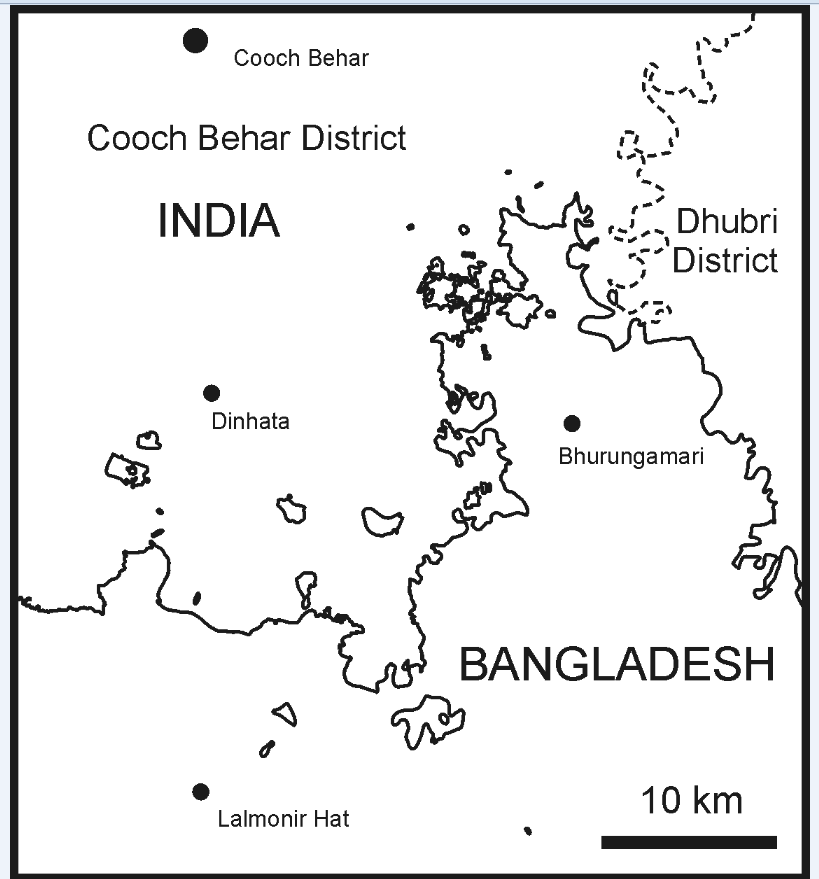
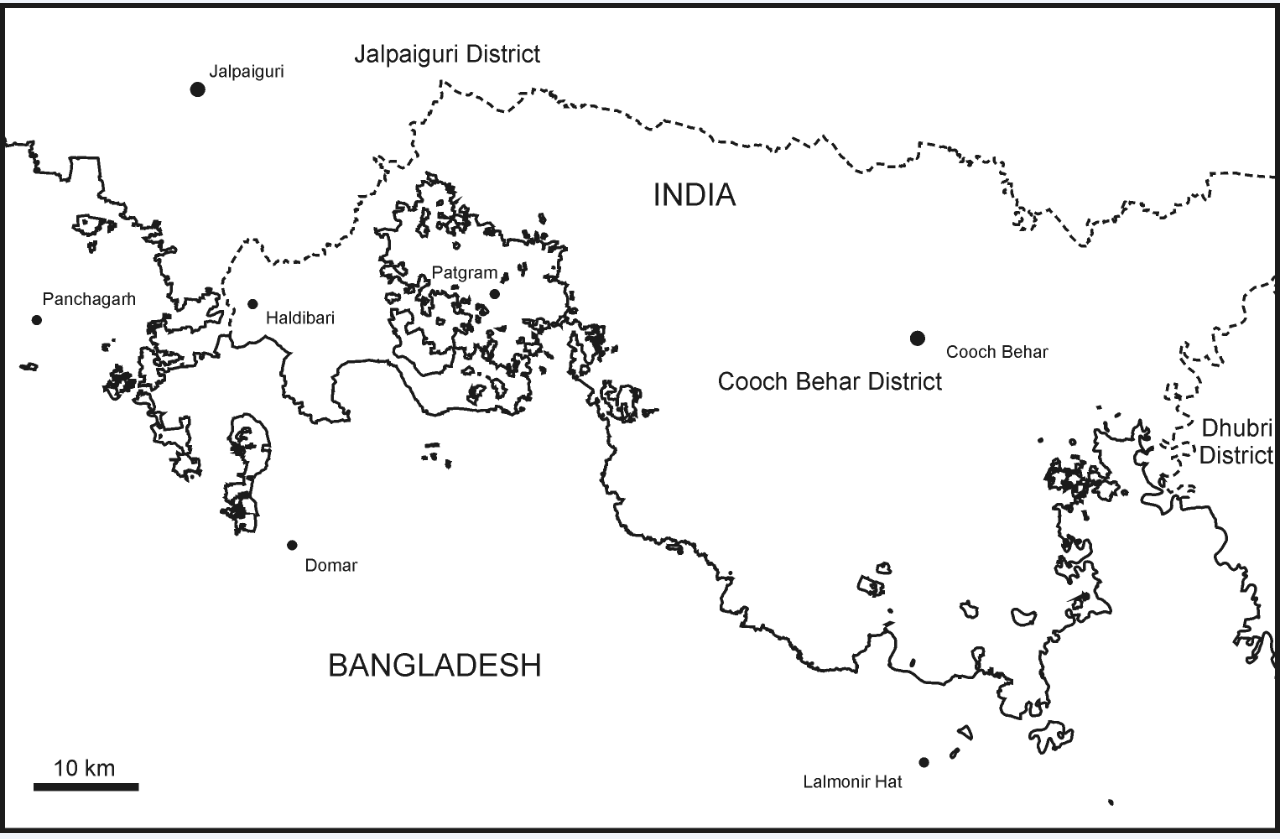
Nota Bene:  The Statesman for some reason did not publish along with Dr Whyte’s excellent article these important maps which are now published here below for the first time:

Eastmainwest

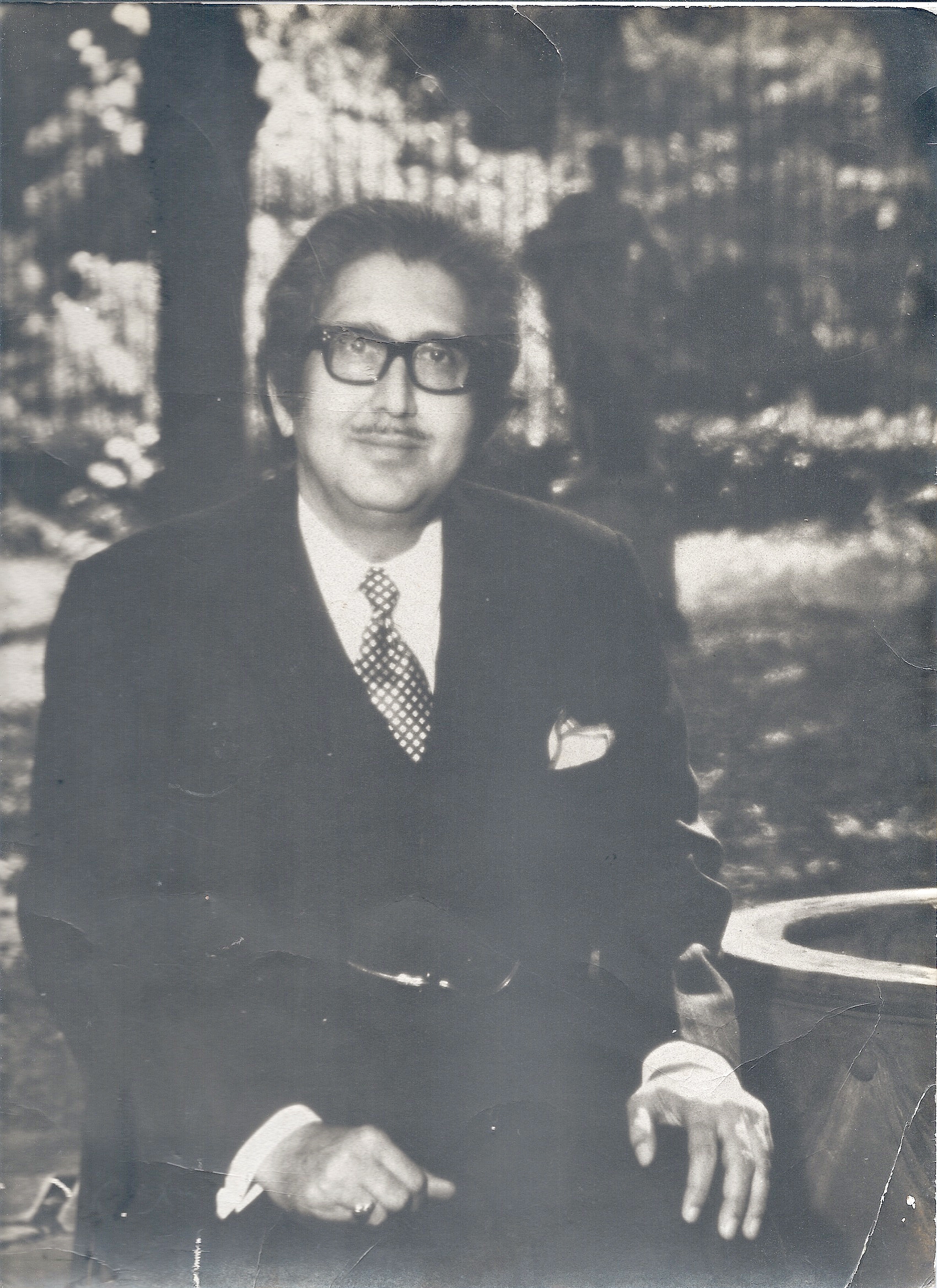
A personal note: The words “enclave” and “No Man’s Land” entered my vocabulary due to my father back in January 1965 when we crossed from India through No Man’s Land into what was then East Pakistan. He was with India’s diplomatic post in Dhaka and during the 1965 war would be acting head while his friend G Parthasarathi was head of Mission in Karachi [Correction November 2015: Parthasarathi left shortly before the war, replaced in August 1965 by Kewal Singh]. Half a dozen years later in the summer of 1971, I was a schoolboy volunteer in West Dinajpur helping in small ways the innumerable refugees who had poured across the porous boundary with East Dinajpur during the tyranny West Pakistan had unleashed in East Pakistan; there was effectively no boundary distinction left then. I dedicate my part of this work to my late father MK Roy 1915-2012.

Pakistan’s & India’s Illusions of Power (Psychosis vs Vanity)

Preface: This paper culminates my line of argument since our University of Hawaii Pakistan book in the mid 1980s, through my work on the Kashmir problem in the 1990s, published in The Statesman in 2005/2006 etc and  in my undelivered Lahore lectures of 2011.  https://independentindian.com/2011/10/13/my-seventy-one-notes-at-facebook-etc-on-kashmir-pakistan-and-of-course-india-listed-thanks-to-jd/ The paper has faced resistance from both Indian and Pakistani newspapers for obvious reasons.  I would like to especially thank Beena Sarwar and Gita Sahgal in recent weeks for helpful comments.  (And Frank Hahn, immediately saw when I mentioned it to him in 2004 that my solution was Pareto-improving…etc)


The *Bulletin of Atomic Scientists* recently reported an Urdu book *Taqat ka Sarab* (‘*Illusion of Power*) published in Pakistan in December 2014 edited by the physicist Dr AH Nayyar. The book “aims to educate Pakistanis about the attitudes of their leadership toward nuclear weapons”. It says “Pakistan’s people have come to believe that the successful acquisition of nuclear capability means that their nation’s security is forever ensured”. Pakistani politicians, scientists and officials who created these weapons have used them to justify a “right to unlimited authority for ruling over Pakistan”. “Consequently, free discussion and honest opinion about nuclear weapons have been nearly prohibited, under the premise that any such talk poses a basic threat to national security.”

Prime Minister Lal Bahadur Shastri’s order to Indian forces to cross the Punjab border towards Lahore in 1965 in response to President Ayub Khan’s attack in Kashmir genuinely shocked Pakistan’s political and military establishment at the time. It may have continued to do so ever since. Everyone in Lahore for those few days in September 1965 was ready to battle the invasion of infidel India considered imminent when Indian forces reached the Ichogil canal.

“Hindu-dominated India wants to occupy us and destroy the Pakistan Principle for which our martyrs died” has been the constantly heard Pakistani refrain. After 1965 it did not take long for Pakistan, via the ignominy of the 1971 surrender in Dhaka, to acquire by any means the technology to develop its own nuclear weapons, even under the noses of its American friends.

Now Pakistan is said to have some 110 nuclear warheads, mostly in a disassembled state but with a few on fighter-jets in hidden air-bases in Balochistan (made by the USA decades ago) always at the ready, waiting for that Indian attack that will never come. It may all have been psychotic delusion.

India has never initiated hostilities against Pakistan. Not once. Not in 1947, 1965, 1971, 1999, 2008.

In 1971 India undoubtedly supported the Mukti Bahini, and I myself, as a schoolboy distributing supplies to refugees from East Pakistan/Bangladesh, was personally witness to Indian military involvement as of August 1971. Even so, hostilities between the countries formally began on 3 December 1971 with the surprise Pakistani air attack on Indian bases in Punjab and UP.

Though India has never attacked first, the myth continues in Pakistan that wicked Hindu-dominated India wants to attack and suppress their country. What is closer to the truth is that the New Delhi elite is barely able to run New Delhi, and the last place on earth they would want to run is Pakistan.

On our Indian side, the Indian military has been allowed a budgetary carte blanche for decades, especially with foreign exchange resources. (Finance Minister Arun Jaitley on 28 February 2015 has allocated some 2,467 billion INR to the military.)

Despite our vast spending, a band of Lashkar-e-Tayyaba terrorists tyrannized Mumbai for days on end while we seem perpetually without strategy against the People’s Republic of China’s recurrent provocations.

The two world powers with traditional interests in India — Russia and Britain — place their long-term agents in Delhi’s high politics and places with impunity, getting done all they need to in particular cases. The USA, France, Israel and others follow suit – all mainly to do with selling India very expensive military weapons, aircraft etc. that they have in excess inventory.  India now has the notorious distinction of being the world’s largest weapons’ importer.

weaponsimportsfinal

Yet we are hardly a trading or monetary superpower.  We have large current account and budgetary deficits, and we are essentially buying whatever weapons, aircraft, shopping malls etc. that we do on foreign credit that we may or may not have. (Pakistan does the same.)

India’s illusions of power have to do with boasting a very large military that can take on the imperialists. We do not realize the New Imperialism that may control Delhi is not of a Clive or Dupleix but of clandestine or open foreign lobbyists and agents who get done what their masters need to have done on a case-by-case basis. The result is a corrosion of Indian power, sovereignty, and credit, little by little, and may lead to a collapse or grave crisis in the future. Even the BJP/RSS Government of Mr Modi (let aside the Sonia-Manmohan Congress and official Communists) may not realize how it all came about.

The way forward for both Pakistan and India is to seek to break the impasse between ourselves.

And there is no doubt the root problem remains Kashmir, and the hysteria and terrorism it has spawned over the years.  A resolution of these fundamental issues calls for some hard scholarship, political vision and guts. The vapid gassing of stray bureaucrats, journalists, diplomats or generals has gotten everyone precisely nowhere thus far.

I have argued at length in previous publications that the *de facto* boundary that was the Ceasefire Line in 1949, and was later renamed the Line of Control in 1972, is indeed also the *de jure* boundary between India and Pakistan.

Jammu & Kashmir came into existence as a legal entity on 16 March 1846 under the Dogra Gulab Singh, friend of the British during the Sikh wars, and a protégé earlier of the great Sikh Ranjit Singh.

Dogra J&K ended its existence as an entity recognized in international law on 15 August 1947. (Hari Singh, the fourth and last Dogra ruler where Gulab Singh had been the first, desperately sought Clement Attlee’s recognition but did not get it.)  Thanks to British legal confusion, negligence or cunning, the territory of what had been known as Dogra Jammu & Kashmir became sovereign-less or ownerless territory in international law on that date, with the creation of the new Pakistan and new India.

The new Pakistan as of August-September 1947 immediately started to plan to take the territory by force, and sought to implement that plan as of 22 October. Had the Pakistani attackers not stopped to indulge in the Rape of Baramullah, they would have taken Srinagar airport by 26 October, and there would have been no Indian defence of the territory possible. As matters turned out, the ownerless territory of what had been Dogra Jammu & Kashmir came to be divided by “military decision” (to use the UN’s term) between the new Pakistan and new India. Kargil and Drass were taken by Pakistan and then lost. Skardu was held by India and later lost. Neither military ever since is going to permit the other to take an inch from itself either by war or by diplomacy.

The *de facto* boundary over ownerless territory divided by military force is the *de jure* boundary in the Roman law that underlies all international law. Once both sides recognize that properly, we may proceed to the next stages. 

On the Pakistani side, recognizing Indian sovereignty over Indian territory in what had been J&K requires stamping out the LeT etc – perhaps not so much by force as by explaining to them that the fight is over, permanently. There is no jihad against India now or ever. Indian territory is not dar-ul-harb but dar-ul-aman: where more than one hundred million Muslim citizens of India freely and peacefully practice their faith.

On the Indian side, if, say, SAS Geelani and friends, under conditions of individual privacy, security and full information, wish to renounce Indian nationality, become stateless, and apply for some other nationality (like Pakistani or Afghan or Iranian) while continuing to live lawfully and law-abidingly on Indian territory, do we have a problem with that? We can’t really. The expatriate children of the Indian elite have renounced Indian nationality in America, Britain, Australia etc upon far weaker principles or beliefs. India has many foreign nationals living permanently on its territory peacefully and law-abidingly (Sir Mark Tully perhaps the most notable) and can add a few more.

The road would be gradually opened for an exchange of consulates between India and Pakistan in Srinagar and Muzaffarabad (leave aside vice-consulates or tourist offices in Jammu, Gilgit, Skardu, Leh). And the remaining Hurriyat, as new Pakistani nationals living in India, can visit the Pakistani consul in Srinagar for tea every day if they wish, to discuss Pakistani matters like Afridi’s cricket or Bilawal’s politics or whatever. 

The militaries and potentially powerful economies on both sides could then proceed towards real strength and cooperation, having dispelled their current illusions of power.

Viz  https://independentindian.com/2011/10/13/my-seventy-one-notes-at-facebook-etc-on-kashmir-pakistan-and-of-course-india-listed-thanks-to-jd/


One of the men Rajiv introduced me to on 25-9-1990 at 10 JanPath (No, Rajiv did not realize who he was…) 2023

Much as I might love Russia, England, France, America, I despise their spies & local agents affecting poor India’s policies: Memo to PM Modi, Mr Jaitley, Mr Doval & the new Govt. of India: Beware of Delhi’s sleeper agents, lobbyists & other dalals (2014)

1 July 2014


Dear Bibek,

The very elderly man I refer to as “Sonia’s Lying Courtier” herein

https://independentindian.com/2007/11/25/sonias-lying-courtier/

is someone who has known you, leading up to your appointment as Director at Sonia’s “Rajiv Gandhi Institute” and later. He has now published a purported memoir whose main aim is to conceal his Soviet connections during the Brezhnev era 1960s-1970s, besides trying to rub my name out from my role with Rajiv in 1990-1991. The woman journalist in Delhi who is named as having ghost-written his new book is someone you know quite well too.

The man was someone whom I worked with and who was introduced to me by Rajiv Gandhi on 25/9/1990, a Soviet trained “technocrat” who had inveigled himself into Rajiv’s circle as he had been a favoured one of Indira (presumably via PN Haksar) when he returned from the USSR. He was also the link explaining, again via PN Haksar, how Manmohan first became FM in 1991 after Rajiv’s assassination, then how Manmohan came to Sonia’s notice and attention, and was later crucial in the so-called Rajiv Gandhi Foundation and in the formation of Sonia’s so-called National Advisory Council.

His mandate was to keep INC policies predictable and agreeable in the areas of Soviet/Russian interest, in which he seems to have succeeded during the Sonia-Manmohan regime.

He found me an unknown force, and worked to edge me out, despite the fact the 25/9/90 group was formed by Rajiv as a sounding-board for the perestroika-for-India project I led in America since 1986 and which I brought to Rajiv the week before on 18/9/90…

I send this to you as a word of caution as you are clearly close to Mr Modi and Mr Doval, yet none of you may know the man’s background and intent, even in his dotage. Certainly the purported memoir written by the woman journalist is something whose main aim is to conceal the man’s Soviet/Russian background. Had it been an honest intent, he would have had no need to conceal any of this but would have addressed his own Russian experience openly and squarely. He may have had his impact already with the new Government, I do not know.


For myself, I have been openly rather pro-Russia on the merits of the current Ukraine issue, but, as you will appreciate, I despise any kind of deep foreign agent seeking to control Indian policy in long-term concealment.


Cordially


Suby Roy


Sonia’s Lying Courtier with Postscript 25 Nov 2007, & Addendum 30 June 2014

30th June 2014

“Sonia’s Lying Courtier” (see below) has now lied again! In a ghost-written 2014 book published by a prominent publisher in Delhi!

He has so skilfully lied about himself the ghost writer was probably left in the dark too about the truth.

**The largest concealment has to do with his Soviet connection: he is fluent in Russian, lived as a privileged guest of the state there, and before returning to the Indian public sector was awarded in the early 1970s a Soviet degree, supposedly an earned doctorate in Soviet style management!**

How do I know? He told me so personally! His Soviet degree is what allowed himself to pass off as a “Dr” in Delhi power-circles for decades, as did many others who were planted in that era. He has also lied about himself and Rajiv Gandhi in 1990-1991, and hence he has lied about me indirectly.

In 2007 I was gentle in my exposure of his mendacity because of his advanced age. Now it is more and more clear to me that exposing this directly may be the one way for Sonia and her son to realise how they, and hence the Congress party, were themselves influenced without knowing it for years…

25 November 2007

Two Sundays ago in an English-language Indian newspaper, an elderly man in his 80s, advertised as being “the Gandhi family’s favourite technocrat” published some deliberate falsehoods about events in Delhi 17 years ago surrounding Rajiv Gandhi’s last months. I wrote at once to the man, let me call him Mr C, asking him to correct the falsehoods since, after all, it was possible he had stated them inadvertently or thoughtlessly or through faulty memory. He did not do so. I then wrote to a friend of his, a Congress Party MP from his State, who should be expected to know the truth, and I suggested to him that he intercede with his friend to make the corrections, since I did not wish, if at all possible, to be compelled to call an elderly man a liar in public.

That did not happen either and hence I am, with sadness and regret, compelled to call Mr C a liar.

The newspaper article reported that Mr C’s “relationship with Rajiv (Gandhi) would become closer when (Rajiv) was out of power” and that Mr C “was part of a group that brainstormed with Rajiv every day on a different subject”. Mr C has reportedly said Rajiv’s “learning period came after he left his job” as PM, and “the others (in the group)” were Mr A, Mr B, Mr D, Mr E “and Manmohan Singh” (italics added).

In reality, Mr C was a retired pro-USSR bureaucrat aged in his late 60s in September 1990 when Rajiv Gandhi was Leader of the Opposition and Congress President. Manmohan Singh was an about-to-retire bureaucrat who in September 1990 was not physically present in India, having been working for Julius Nyerere of Tanzania for several years.

On 18 September 1990, upon recommendation of Siddhartha Shankar Ray, Rajiv Gandhi met me at 10 Janpath, where I handed him a copy of the unpublished results of an academic “perestroika-for-India” project I had led at the University of Hawaii since 1986. The story of that encounter has been told first on July 31-August 2 1991 in The Statesman, then in the October 2001 issue of Freedom First, then in January 6-8 2006, September 23-24 2007 in The Statesman, and most recently in The Statesman Festival Volume 2007. The last of these speaks most fully yet of my warnings against Rajiv’s vulnerability to assassination; this document in unpublished form was sent by me to Rajiv’s friend, Mr Suman Dubey in July 2005, who forwarded it with my permission to the family of Rajiv Gandhi.

It was at the 18 September 1990 meeting that I suggested to Rajiv that he should plan to have a modern election manifesto written. The next day, 19 September, I was asked by Rajiv’s assistant V George to stay in Delhi for a few days as Mr Gandhi wished me to meet some people. I was not told whom I was to meet but that there would be a meeting on Monday, 24th September. On Saturday, the Monday meeting was postponed to Tuesday 25th September because one of the persons had not been able to get a flight into Delhi. I pressed to know what was going on, and was told I would meet Mr A, Mr B, Mr C and Mr D. It turned out later Mr A was the person who could not fly in from Hyderabad.

The group (excluding Mr B who failed to turn up because his servant had failed to give him the right message) met Rajiv at 10 Janpath in the afternoon of 25th September. We were asked by Rajiv to draft technical aspects of a modern manifesto for an election that was to be expected in April 1991. The documents I had given Rajiv a week earlier were distributed to the group. The full story of what transpired has been told in my previous publications.

Mr C was ingratiating towards me after that first meeting with Rajiv and insisted on giving me a ride in his car which he told me was the very first Maruti ever manufactured. He flattered me needlessly by saying that my PhD (in economics from Cambridge University) was real whereas his own doctoral degree had been from a dubious management institute of the USSR. (Handling out such doctoral degrees was apparently a standard Soviet way of gaining influence.) Mr C has not stated in public how his claim to the title of “Dr” arises.

Following that 25 September 1990 meeting, Mr C did absolutely nothing for several months towards the purpose Rajiv had set us, stating he was very busy with private business in his home-state where he flew to immediately. Mr D went abroad and was later hit by severe illness. Mr B, Mr A and I met for luncheon at New Delhi’s Andhra Bhavan where the former explained how he had missed the initial meeting. Then Mr B said he was very busy with his house-construction, and Mr A said he was very busy with finishing a book for his publishers on Indian defence, and both begged off, like Mr C and Mr D, from any of the work that Rajiv had explicitly set our group. My work and meeting with Rajiv in October 1990 has been reported previously.

Mr C has not merely suppressed my name from the group in what he has published in the newspaper article two Sundays ago, he has stated he met Rajiv as part of such a group “every day on a different subject”, another falsehood. The next meeting of the group with Rajiv was in fact only in December 1990, when the Chandrashekhar Government was discussed. I was called by telephone in the USA by Rajiv’s assistant V George but I was unable to attend, and was briefed later about it by Mr A.

When new elections were finally announced in March 1991, Mr C brought in Mr E into the group in my absence (so he told me), perhaps in the hope I would remain absent. But I returned to Delhi and between March 18 1991 and March 22 1991, our group, including Mr E (who did have a genuine PhD), produced an agreed-upon document. That document was handed over by us together in a group to Rajiv Gandhi at 10 Janpath the next day, and also went to the official political manifesto committee of Narasimha Rao, Pranab Mukherjee and M. Solanki.

Our group, as appointed by Rajiv on 25 September 1990, came to an end with the submission of the desired document to Rajiv on 23 March 1991.

As for Manmohan Singh, contrary to Mr C’s falsehood, Manmohan Singh has himself truthfully said he was with the Nyerere project until November 1990, then joined Chandrashekhar’s PMO in December 1990 which he left in March 1991, that he had no meeting with Rajiv Gandhi prior to Rajiv’s assassination but rather did not in fact enter Indian politics at all until invited by Narasimha Rao several weeks later to be Finance Minister. In other words, Manmohan Singh himself is on record stating facts that demonstrate Mr C’s falsehood.

The economic policy sections of the document submitted to Rajiv on 23 March 1991 had been drafted largely by myself with support of Mr E and Mr D and Mr C as well. It was done over the objections of Mr B, who had challenged me by asking what Manmohan Singh would think of it. I had replied I had no idea what Manmohan Singh would think of it, saying I knew he had been out of the country on the Nyerere project for some years.

Mr C has deliberately excluded my name from the group and deliberately added Manmohan Singh’s instead. What explains this attempted falsification of facts – reminiscent of totalitarian practices in communist countries? Manmohan Singh was not involved by his own admission, and as Finance Minister told me so directly when he and I were introduced in Washington DC in September 1993 by Siddhartha Shankar Ray, then Indian Ambassador to the USA.

A possible explanation for Mr C’s mendacity is as follows: I have been recently publishing the fact that I repeatedly pleaded warnings that I (even as a layman on security issues) perceived Rajiv Gandhi to have been insecure and vulnerable to assassination. Mr C, Mr B and Mr A were among the main recipients of my warnings and my advice as to what we as a group, appointed by Rajiv, should have done towards protecting Rajiv better. They did nothing — though each of them was a senior man then aged in his late 60s at the time and fully familiar with Delhi’s workings while I was a 35 year old newcomer. After Rajiv was assassinated, I was disgusted with what I had seen of the Congress Party and Delhi, and did not return except to meet Rajiv’s widow once in December 1991 to give her a copy of a tape in which her late husband’s voice was recorded in conversations with me during the Gulf War.

Mr C has inveigled himself into Sonia Gandhi’s coterie – while Manmohan Singh went from being mentioned in our group by Mr B to becoming Narasimha Rao’s Finance Minister and Sonia Gandhi’s Prime Minister. If Rajiv had not been assassinated, Sonia Gandhi would have been merely a happy grandmother today and not India’s purported ruler. India would also have likely not have been the macroeconomic and political mess that the mendacious people around Sonia Gandhi like Mr C have now led it towards.

POSTSCRIPT: The Congress MP was kind enough to write in shortly afterwards; he confirmed he “recognize(d) that Rajivji did indeed consult you in 1990-1991 about the future direction of economic policy.”   A truth is told and, furthermore, the set of genuine Rajivists in the present Congress Party is identified as non-null.

Pakistan’s Point of View (Or Points of View) on Kashmir: My As Yet Undelivered Lahore Lecture–Part I

Preface

27 April 2015 from Twitter: “My Pakistani hosts never managed to go thru w their 2010/11 invitation I speak in Lahore on Kashmir. After ‪#‎SabeenMahmud‬ s murder, I decline”

October 2015 from Twitter: I have started a quite thorough critique under #kasuri etc at Twitter of the extremely peculiar free publicity given in Delhi and  Mumbai power circles to the dressed up (and false) ISI/Hurriyat narrative of KM Kasuri; the Musharraf “demilitarisation/borderless” idea that Mr Kasuri promotes is originally mine from our Pakistan book in America in the 1980s, which I brought to the attention of both sides (and the USA) in Washington in 1993 but which I myself later rejected as naive and ignorant  after the Pakistani aggression in Kargil in 1999, especially the murder of Lt Kalia and his platoon as POWs. https://independentindian.com/2006/12/15/what-to-tell-musharraf-peace-is-impossible-without-non-aggressive-pakistani-intentions/  https://independentindian.com/2008/11/15/of-a-new-new-delhi-myth-and-the-success-of-the-university-of-hawaii-1986-1992-pakistan-project/ 

see too https://independentindian.com/2011/10/13/my-seventy-one-notes-at-facebook-etc-on-kashmir-pakistan-and-of-course-india-listed-thanks-to-jd/

I have also now made clear how and why my Lahore lecture (confirmed by the Pakistani envoy to Delhi personally phoning me of his own accord at home on 3 March 2011, followed the next day by the Indian Foreign Secretary phoning to give me an appointment to brief her about my talk upon my return) came to be sabotaged by two Pakistanis and two Indian politicians associated with them. (Both of the Indian politicians had bad karma catch up immediately afterwards!)


Original Preface  22 November 2011: Exactly a year ago, in late October-November 2010, I received a very kind invitation from the Lahore Oxford and Cambridge Society to speak there on this subject.  Mid March 2011 was a tentative date for this lecture from which the text below is dated.  The lecture has yet to take place for various reasons but as there is demand for its content, I am releasing the part which was due to be released in any case to my Pakistani hosts ahead of time — after all, it would have been presumptuous of me to seek to speak in Lahore on Pakistan’s viewpoint on Kashmir, hence I instead  planned to release my understanding of that point of view ahead of time and open it to the criticism of my hosts.  The structure of the remainder of the talk may be surmised too from the Contents.  The text and argument are mine entirely, the subject of more than 25 years of research and reflection,  and are under consideration of publication as a book by Continuum of London and New York.  If you would like to comment, please feel free to do so, if you would like to refer to it in an online publication, please give this link, if you would like to refer to it in a paper-publication, please   email me.  Like other material at my site, it is open to the Fair Use rule of normal scholarship.


On the Alternative Theories of Pakistan and India about Jammu & Kashmir (And the One and Only Way These May Be Peacefully Reconciled): An Exercise in Economics, Politics, Moral Philosophy & Jurisprudence

 by

Subroto (Suby) Roy

Lecture to the Oxford and Cambridge Society of Lahore

March 14, 2011 (tentative)

“What is the use of studying philosophy if all that does for you is to enable you to talk with some plausibility about some abstruse questions of logic, etc., & if it does not improve your thinking about the important questions of everyday life?”  Wittgenstein, letter to Malcolm, 1944

“India is the greatest Muslim country in the world.”

Sir Muhammad Iqbal, 1930, Presidential Address to the Muslim League, Allahabad

 “Where be these enemies?… See, what a scourge is laid upon your hate,… all are punish’d.” Shakespeare

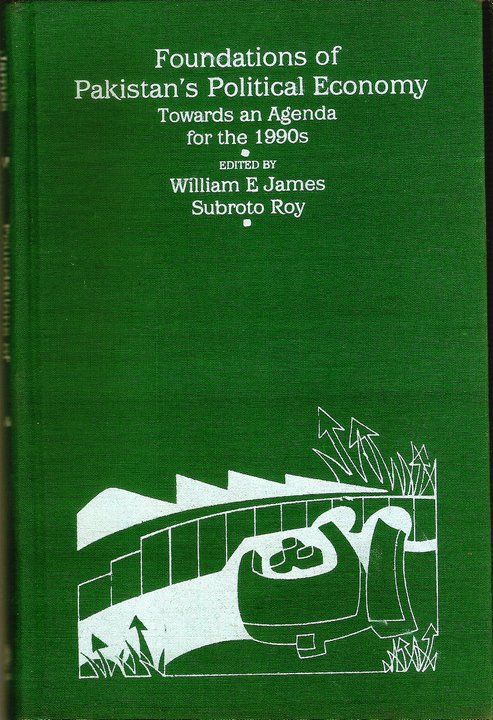
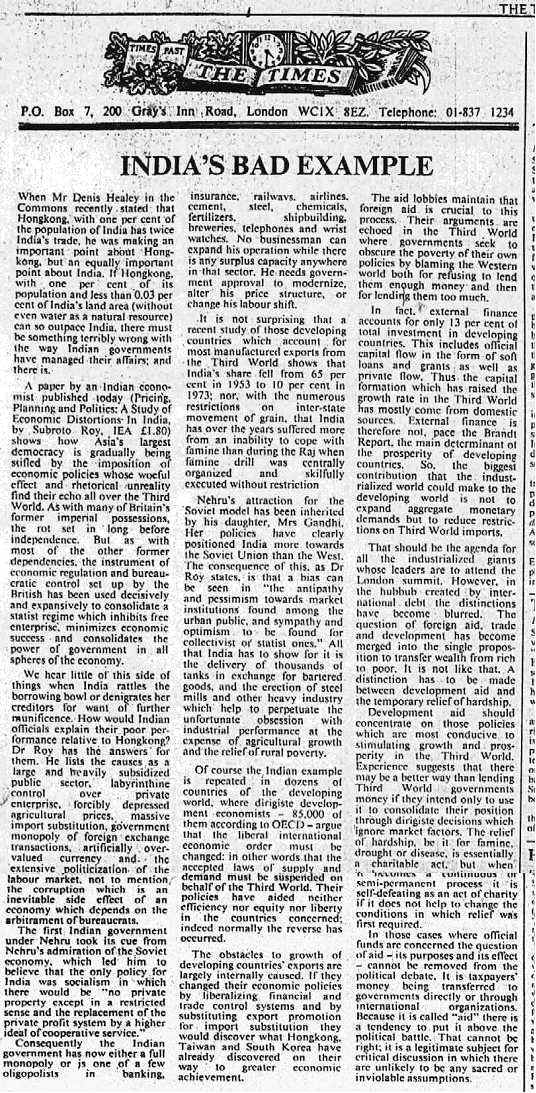
Dr Roy’s published works include Philosophy of Economics: On the Scope of Reason in Economic Inquiry (London & New York: Routledge, 1989, 1991); Pricing, Planning & Politics: A Study of Economic Distortions in India (London: Institute of Economic Affairs, 1984); and, edited with WE James, Foundations of India’s Political Economy: Towards an Agenda for the 1990s (Hawaii MS 1989, Sage 1992)  &  Foundations of Pakistan’s Political Economy: Towards an Agenda for the 1990s (Hawaii MS 1989, Sage 1992, OUP Karachi 1993); and, edited with John Clarke, Margaret Thatcher’s Revolution: How it Happened and What it Meant (London & New York: Continuum 2005).  He graduated in 1976 with a first from the London School of Economics in mathematical economics, and received the PhD in economics at Cambridge in 1982 under Professor Frank Hahn for the thesis “On liberty & economic growth: preface to a philosophy for India”. In the United States for 16 years he was privileged to count as friends Professors James Buchanan, Milton Friedman, TW Schultz, Max Black and Sidney Alexander.  From September 18 1990 he was an adviser to Rajiv Gandhi and contributed to the origins of India’s 1991 economic reform.  He blogs at http://www.independentindian.com.

CONTENTS

Part I

  1. Introduction

  2. Pakistan’s Point of View (or Points of View)

(a)    1930  Sir Muhammad Iqbal

(b)    1933-1948 Chaudhury Rahmat Ali

(c)    1937-1941 Sir Sikander Hayat Khan

(d)    1937-1947 Quad-i-Azam Mohammad Ali Jinnah

(e)    1940s et seq  Maulana Abul Ala Maudoodi

(f)     1947-1950 Prime Minister Liaquat Ali Khan, 1966 President Ayub Khan, 2005 Govt of Pakistan, 2007 President Musharraf, 2008 FM Qureshi, 2011 Kashmir Day

Part II

  1. India’s Point of View: British Negligence/Indifference during the Transfer of Power, A Case of Misgovernance in the Chaotic Aftermath of World War II

(a)    Rhetoric: Whose Pakistan?  Which Kashmir?

(b)    Law: (i) Liaquat-Zafrullah-Abdullah-Nehru United in Error Over the Second Treaty of Amritsar! Dogra J&K subsists Mar 16 1846-Oct 22 1947. Aggression, Anarchy, Annexations: The LOC as De Facto Boundary by Military Decision Since Jan 1 1949.  (ii) Legal Error & Confusion Generated by 12 May 1946 Memorandum. (iii) War: Dogra J&K attacked by Pakistan, defended by India: Invasion, Mutiny, Secession of “Azad Kashmir” & Gilgit, Rape of Baramulla, Siege of Skardu.

  1. Politics: What is to be Done? Towards Truths, Normalisation, Peace in the 21st Century

The Present Situation is Abnormal & Intolerable. There May Be One (and Only One) Peacable Solution that is Feasible: Revealing Individual Choices Privately with Full Information & Security: Indian “Green Cards”/PIO-OCI status for Hurriyat et al: A Choice of Nationality (India, Pakistan, Afghanistan, Iran).  Of Flags and Consulates in Srinagar & Gilgit etc: De Jure Recognition of the Boundary, Diplomatic Normalisation,  Economic & Military Cooperation.

  1. Appendices:

(a)    History of Jammu & Kashmir until the Dogra Native State

(b)    Pakistan’s Allies (including A Brief History of Gilgit)

(c)    India’s Muslim Voices

(d)    Pakistan’s Muslim Voices: An Excerpt from the Munir Report

Part I

1.  Introduction

For a solution to Jammu & Kashmir to be universally acceptable it must be seen by all as being lawful and just. Political opinion across the subcontinent — in Pakistan, in India, among all people and parties in J&K, those loyal to India, those loyal to Pakistan, and any others — will have to agree that, all things considered, such is the right course of action for everyone today in the 21st Century, which means too that the solution must be consistent with the principal known facts of history as well as account reasonably for all moral considerations.

I claim to have found such a solution, indeed I shall even say it is the only such solution (in terms of theoretical economics, it is the unique solution) and plan with your permission to describe its main outlines at this distinguished gathering.  I have not invented it overnight but it is something  developed over a quarter century, milestones along the way being the books emerging from the University of Hawaii “perestroika” projects for India and Pakistan that I and the late WE James led 25 years ago, and a lecture I gave at Washington’s Heritage Foundation in June 1998, as well as sets of newspaper articles published between 2005 and 2008, one in Dawn of Karachi and others in The Statesman of New Delhi and Kolkata.

Before I start, allow me for a moment to remind just how complex and intractable the problem we face has been, and, therefore, quite how large my ambition is in claiming today to be able to resolve it.

“Kashmir is in the Supreme National Interest of Pakistan”, says Pakistan.

“Kashmir is an Integral Part of India”, says India.

“Kashmir is an Integral Part of Pakistan”, says Pakistan.

“Kashmir is in the Supreme National Interest of India”, says India.

And so it goes, in what over the decades has been all too often a Dialogue of the Deaf.  How may such squarely opposed positions be reconciled without draining public resources even further through wasteful weaponry and confrontation of standing armies, or, what is worse, using these weapons and armies in war, plunging the subcontinent into an abyss of chaos and destruction for generations to come?  How is it possible?

I shall suggest a road can be found only when we realize Pakistan, India and J&K each have been and are going to remain integral to one another — in their histories, their geographies, their economies and their societies.  The only place they may need to differ, where we shall want them to differ, is their politics and political systems. We should not underestimate how much mutual hatred and mutual fear has arisen naturally on all sides over the decades as a result of bloodshed and suffering all around, and the fact must also be accounted for that people simply may not be in a calm-enough emotional state to want to be part of processes seeking resolution; at the same time, it bears to be remembered that although Pakistan and India have been at war more than once and war is always a very serious and awful thing, they have never actually declared war against the other nor have they ever broken diplomatic relations – in fact in some ways it has always seemed like some very long and protracted fraternal Civil War between us where we think we know one another so well and yet come to be surprised more by one another’s virtues than by one another’s vices.

Secondly, with any seemingly intractable problem, dialogue can stall or be aborted due to normal human failings of impatience or lack of good will or lack of good humour or lack of a scientific attitude towards finding facts, or plain mutual miscomprehension of one another’s points of view through ignorance or laziness or negligence.  In case of Pakistan and India over J&K, there has been the further critical complication that we of this generation did not cause this problem — it has been something inherited by us from not even our fathers but our grandfathers!  It is two generations old.  Each side must respect the words and deeds of its forebears but also may have to frankly examine in a scientific spirit where errors of fact or judgment may have occurred back then.  The antagonistic positions have changed only slightly over two generations, and one reason dialogue stalls or gets aborted today is because positions have become frozen for more than half a century and merely get repeated endlessly.  On top of such frozen positions have been piled pile upon pile of further vast mortal complications: the 1965 War, the 1971 secession of East Pakistan, the 1999 Kargil War, the 2008 Mumbai massacres.  Only cacophony results if we talk about everything at once, leaving the status quo of a dangerous expensive confrontation to continue.

I propose instead to focus as specifically and precisely as possible on how Jammu & Kashmir became a problem at all during those crucial decades alongside the processes of Indian Independence, World War II, the Pakistan Movement and creation of Pakistan, accompanied by the traumas and bloodshed of Partition.

Having addressed that — and it is only fair to forewarn this eminent Lahore audience that such a survey of words, deeds and events between the 1930s and 1950s tends to emerge in India’s favour — I propose to “fast-forward” to current times, where certain new facts on the ground appear much more adverse to India, and finally seek to ask what can and ought to be done, all things considered, today in the circumstances of the 21st Century.   There are four central facts, let me for now call them Fact A, Fact B, Fact C and Fact D, which have to be accepted by both countries in good faith and a scientific spirit.  Facts A and B are historical in nature; Pakistan has refused to accept them. Facts C and D are contemporary in nature; official political India and much of the Indian media too often have appeared wilfully blind to them. The moment all four facts come to be accepted by all, the way forward becomes clear.  We have inherited this grave mortal problem which has so badly affected the ordinary people of J&K in the most terrible and unacceptable manner, but if we fail to understand and resolve it, our children and grandchildren will surely fail even worse — we may even leave them to cope with the waste and destruction of further needless war or confrontation, indeed with the end of the subcontinent as we have received and known it in our time.

2. Pakistan’s Point of View (Or Points of View)

1930  Sir Muhammad Iqbal

This audience will need no explanation why I start with Sir Muhammad Iqbal (1877-1938), the poetic and spiritual genius who in the 20th Century inspired the notion of a Muslim polity in NorthWestern India, whose seminal 1930 presidential speech to the Muslim League in Allahabad lay the foundation stone of the new country that was yet to be.   He did not live to see Pakistan’s creation yet what may be called the “Pakistan Principle” was captured in his words:

“I would like to see the Punjab, Northwest Frontier Province, Sind and Baluchistan amalgamated into a single state. Self-government within the British Empire or without the British Empire, the formation of a consolidated North West Indian Muslim state appears to me to be the final destiny of the Muslims at least of Northwest India… India is the greatest Muslim country in the world.  The life of Islam as a cultural force in this living country very largely depends on its centralization in a specified territory”.

He did not see such a consolidated Muslim state being theocratic and certainly not one filled with bigotry or “Hate-Hindu” campaigns:

“A community which is inspired by feelings of ill-will towards other communities is low and ignoble. I entertain the highest respect for the customs, laws, religious and social institutions of other communities… Yet I love the communal group which is the source of my life and my behaviour… Nor should the Hindus fear that the creation of autonomous Muslim states will mean the introduction of a kind of religious rule in such states…. I therefore demand the formation of a consolidated Muslim state in the best interests of India and Islam. For India it means security and peace resulting from an internal balance of power, for Islam an opportunity to rid itself of the stamp that Arabian Imperialism was forced to give it, to mobilise its law, its education, its culture, and to bring them into closer contact with its own original spirit and the spirit of modern times.”[1]

Though Kashmiri himself, in fact a founding member of the “All-India Jammu & Kashmir Muslim Conference of Lahore and Simla”, and a hero and role model for the young Sheikh Abdullah (1905-1982), Allama Iqbal was explicitly silent about J&K being part of the new political entity he had come to imagine.  I do not say he would not have wished it to be had he lived longer; what I am saying is that his original vision of the consolidated Muslim state which constitutes Pakistan today (after a Partitioned Punjab) did not include Jammu & Kashmir.  Rather, it was focused on the politics of British India and did not mention the politics of Kashmir or any other of the so-called “Princely States” or “Native States” of “Indian India” who constituted some 1/3rd of the land mass and 1/4th of the population of the subcontinent.  Twenty years ago I called this “The Paradox of Kashmir”, namely, that prior to 1947 J&K hardly seemed to appear in any discussion at all for a century, yet it has consumed almost all discussion and resources ever since.

Secondly, this audience will see better than I can the significance of Dr Iqbal’s saying the Muslim political state of his conception needed

“an opportunity to rid itself of the stamp that Arabian Imperialism was forced to give it”

and instead seek to

“mobilise its law, its education, its culture, and to bring them into closer contact with its own original spirit and the spirit of modern times”.

Dr Iqbal’s Pakistan Principle appears here the polar opposite of Pakistan’s 18th & 19th Century pre-history represented by Shah Waliullah (1703-1762)[2] saying

“We are an Arab people whose fathers have fallen in exile in the country of Hindustan, and Arabic genealogy and Arabic language are our pride”

 or Sayyid Ahmed Barelwi (1786-1831) saying

“We must repudiate all those Indian, Persian and Roman customs which are contrary to the Prophet’s teaching”.[3]

Some 25 years after the Allahabad address, the Munir Report in 1954 echoed Dr Iqbal’s thought when it observed about medieval military conquests

“It is this brilliant achievement of the Arabian nomads …that makes the Musalman of today live in the past and yearn for the return of the glory that was Islam… Little does he understand that the forces which are pitted against him are entirely different from those against which early Islam had to fight… Nothing but a bold reorientation of Islam to separate the vital from the lifeless can preserve it as a World Idea and convert the Musalman into a citizen of the present and the future world from the archaic incongruity that he is today…” [4]


1933-1947  Chaudhury Rahmat Ali

Dr Iqbal’s young follower, the radical Cambridge pamphleteer Chaudhury Rahmat Ali (1895-1951) drew a picture not of Muslim tolerance and coexistence with Hindus in a peaceful India but of aggression towards Hindus and domination by Muslims over the subcontinent and Asia itself.  Rahmat Ali had been inspired by Dr Iqbal’s call for a Muslim state in Northwest India but found it vague and was disappointed Iqbal had not pressed it at the Third Round Table Conference.  In 1933, reportedly on the upper floor of a London omnibus, he invented for the then-imagined political entity the name “PAKSTAN”, P for his native Punjab, A for Afghania, K for Kashmir, S for Sind, and STAN for Balochistan.  He sought a meeting with Mr Jinnah in London — “Jinnah disliked Rahmat Ali’s ideas and avoided meeting him”[5] but did meet him.  There is a thesis yet to be written on how Europe’s inter-War ideologies affected political thinking on the subcontinent.  Rahmat Ali’s vituperative views about Hindus were akin to others about Jews (and Muslims too) at the time, all models or counterfoils for one another in the fringes of Nazism.  He referred to the Indian nationalist movement as a “British-Banya alliance”, declined to admit India had ever existed and personally renamed the subcontinent “Dinia” and the seas around it the “Pakian Sea”, the “Osmanian Sea” etc. He urged Sikhs to rise up in a “Sikhistan” and urged all non-Hindus to rise up in war against Hindus. Given the obscurity of his life before his arrival at Cambridge’s Emmanuel College, what experiences may have led him to such views are not known.

All this was anathema to Mr Jinnah, the secular constitutionalist embarrassed by a reactionary Muslim imperialism in that rapidly modernising era that was the middle of the 20th Century.  When Rahmat Ali pressed the ‘Pakstan’ acronym, Mr Jinnah said Bengal was not in it and Muslim minority regions were absent.  At this Chaudhury-Sahib produced a general scheme of Muslim domination all over the subcontinent: there would be “Pakstan” in the northwest including Kashmir, Delhi and Agra; “Bangistan” in Bengal; “Osmanistan” in Hyderabad; “Siddiquistan” in Bundelhand and Malwa; “Faruqistan” in Bihar and Orissa; “Haideristan” in UP; “Muinistan” in Rajasthan; “Maplistan” in Kerala; even “Safiistan” in “Western Ceylon” and “Nasaristan” in “Eastern Ceylon”, etc.  In 1934 he published and widely circulated such a diagram among Muslims in Britain at the time.  He was not invited to the Lahore Resolution which did not refer to Pakistan though came to be called the Pakistan Resolution.  When he landed in the new Pakistan, he was apparently arrested and deported back and was never granted a Pakistan passport.  From England, he turned his wrath upon the new government, condemning Mr Jinnah as treacherous and newly re-interpreting his acronym to refer to Punjab, Afghania, Kashmir, Iran, Sindh, Tukharistan (sic), Afghanistan, and Balochistan.  The word “pak” coincidentally meant pure, so he began to speak of Muslims as “the Pak” i.e. “the pure” people, and of how the national destiny of the new Pakistan was to liberate “Pak” people everywhere, including the new India, and create a “Pak Commonwealth of Nations” stretching from Arabia to the Indies.  The map he now drew placed the word “Punjab” over J&K, and saw an Asia dominated by this “Pak” empire. Shunned by officialdom of the new Pakistan, Chaudhury-Sahib was a tragic figure who died in poverty and obscurity during an influenza epidemic in 1951; the Master of Emmanuel College paid for his funeral and was apparently later reimbursed for this by the Government of Pakistan.  In recent years he has undergone a restoration, and his grave at Cambridge has become a site of pilgrimage for ideologues, while his diagrams and writings have been reprinted in Pakistan’s newspapers as recently as February 2005.

1937-1941 Sir Sikander Hayat Khan

Chaudhary Rahmat Ali’s harshest critic at the time was the eminent statesman and Premier of Punjab Sir Sikander Hayat Khan (1892-1942), partner of the 1937 Sikander-Jinnah Pact, and an author of the Lahore Resolution.  His statement of 11 March 1941 in the Punjab Legislative Assembly Debates is a classic:

“No Pakistan scheme was passed at Lahore… As for Pakistan schemes, Maulana Jamal-ud-Din’s is the earliest…Then there is the scheme which is attributed to the late Allama Iqbal of revered memory.  He, however, never formulated any definite scheme but his writings and poems have given some people ground to think that Allama Iqbal desired the establishment of  some sort of  Pakistan.  But it is not difficult to explode this theory and to prove conclusively that his conception of  Islamic solidarity and universal brotherhood is not in conflict with Indian patriotism and is in fact quite different from the ideology now sought to be attributed to him by some enthusiasts… Then there is Chaudhuri Rahmat Ali’s scheme (*laughter*)…it was widely circulated in this country and… it was also given wide publicity at the time in a section of the British press.  But there is another scheme…it was published in one of the British journals, I think Round Table, and was conceived by an Englishman…..the word Pakistan was not used at the League meeting and this term was not applied to (the League’s Lahore) resolution by anybody until the Hindu press had a brain-wave and dubbed it Pakistan…. The ignorant masses  have now adopted the slogan provided by the short-sighted bigotry of the Hindu and Sikh press…they overlooked the fact that the word Pakistan might have an appeal – a strong appeal – for the Muslim masses.  It is a catching phrase and it has caught popular imagination and has thus made confusion worse confounded…. So far as we in the Punjab are concerned, let me assure you that we will not countenance or accept any proposal that does not secure freedom for all (*cheers*).  We do not desire that Muslims should domineer here, just as we do not want the Hindus to domineer where Muslims are in a minority. Now would we allow anybody or section to thwart us because Muslims happen to be in a majority in this province.  We do not ask for freedom that there may be a Muslim Raj here and Hindu Raj elsewhere.  If that is what Pakistan means I will have nothing to do with it.   If Pakistan means unalloyed Muslim Raj in the Punjab then I will have nothing to do with it (*hear, hear*)…. If you want real freedom for the Punjab, that is to say a Punjab in which every community will have its due share in the economic and administrative fields as partners in a common concern, then that Punjab will not be Pakistan but just Punjab, land of the five rivers; Punjab is Punjab and will always remain Punjab whatever anybody may say (*cheers*).  This, then, briefly is the future which I visualize for my province and for my country under any new constitution.

Intervention (Malik Barkat Ali): The Lahore resolution says the same thing.

Premier: Exactly; then why misinterpret it and try to mislead the  masses?…”

1937-1947  Quad-i-Azam Mohammad Ali Jinnah

During the Third Round Table Conference, Dr Iqbal persuaded Mr Jinnah (1876-1948) to return to India; Mr Jinnah, from being settled again in his London law practice, did so in 1934.  But following the 1935 Govt of India Act, the Muslim League failed badly when British India held its first elections in 1937 not only in Bengal and UP but in Punjab (one seat), NWFP and Sind.

World War II, like World War I a couple of brief decades earlier, then changed the political landscape completely. Germany invaded Poland on 1 September 1939 and Britain and France declared war on Germany on 3 September.  The next day, India’s British Viceroy (Linlithgow) granted Mr Jinnah the political parity with Congress that he had sought.[6]  Professor Francis Robinson suggests that until 4 September 1939 the British

“had had little time for Jinnah and his League.  The Government’s declaration of war on Germany on 3 September, however, transformed the situation. A large part of the army was Muslim, much of the war effort was likely to rest on the two Muslim majority provinces of Punjab and Bengal. The following day, the Viceroy invited Jinnah for talks on an equal footing with Gandhi…. As the Congress began to demand immediate independence, the Viceroy took to reassuring Jinnah that Muslim interests would be safeguarded in any constitutional change. Within a few months, he was urging the League to declare a constructive policy for the future, which was of course presented in the Lahore Resolution[7]…. In their August 1940 offer, the British confirmed for the benefit of Muslims that power would not be transferred against the will of any significant element in Indian life. And much the same confirmation was given in the Cripps offer nearly two years later…. Throughout the years 1940 to 1945, the British made no attempt to tease out the contradictions between the League’s two-nation theory, which asserted that Hindus and Muslims came from two different civilisations and therefore were two different nations, and the Lahore Resolution, which demanded that ‘Independent States’ should be constituted from the Muslim majority provinces of the NE and NW, thereby suggesting that Indian Muslims formed not just one nation but two. When in 1944 the governors of Punjab and Bengal urged such a move on the Viceroy, Wavell ignored them, pressing ahead instead with his own plan for an all-India conference at Simla. The result was to confirm, as never before in the eyes of leading Muslims in the majority provinces, the standing of Jinnah and the League. Thus, because the British found it convenient to take the League seriously, everyone had to as well—Congressmen, Unionists, Bengalis, and so on…”[8]

 Mr Jinnah was himself amazed by the new British attitude towards him:

“(S)uddenly there was a change in the attitude towards me. I was treated on the same basis as Mr Gandhi. I was wonderstruck why all of a sudden I was promoted and given a place side by side with Mr Gandhi.”

Britain, threatened for its survival, faced an obdurate Indian leadership and even British socialists sympathetic to Indian aspirations grew cold (Gandhi dismissing the 1942 Cripps offer as a “post-dated cheque on a failing bank”).  Official Britain’s loyalties had been consistently with those who had been loyal to them, and it was unsurprising there would be a tilt to empower Mr Jinnah soon making credible the real possibility of Pakistan.[9]  By 1946, Britain was exhausted, pre-occupied with rationing, Berlin, refugee resettlement and countless other post-War problems — Britain had not been beaten in war but British imperialism was finished because of the War.  Muslim opinion in British India had changed decisively in the League’s favour.   But the  subcontinent’s political processes were drastically spinning out of everyone’s control towards anarchy and blood-letting.  Implementing a lofty vision of a cultured progressive consolidated Muslim state in India’s NorthWest descended into “Direct Action” with urban mobs  shouting Larke lenge Pakistan; Marke lenge Pakistan; Khun se lenge Pakistan; Dena hoga Pakistan.[10]

We shall return to Mr Jinnah’s view on the legal position of the “Native Princes” of “Indian India” during this critical time, specifically J&K; here it is essential before proceeding only to record his own vision for the new Pakistan as recorded by the profoundly judicious report of Justice Munir and Justice Kayani a mere half dozen years later:

“Before the Partition, the first public picture of Pakistan that the Quaid-i-Azam gave to the world was in the course of an interview in New Delhi with Mr. Doon Campbell, Reuter’s Correspondent. The Quaid-i-Azam said that the new State would be a modern democratic State, with sovereignty resting in the people and the members of the new nation having equal rights of citizenship regardless of their religion, caste or creed.  When Pakistan formally appeared on the map, the Quaid-i-Azam in his memorable speech of 11th August 1947 to the Constituent Assembly of Pakistan, while stating the principle on which the new State was to be founded, said:—‘All the same, in this division it was impossible to avoid the question of minorities being in one Dominion or the other. Now that was unavoidable. There is no other solution. Now what shall we do? Now, if we want to make this great State of Pakistan happy and prosperous we should wholly and solely concentrate on the well-being of the people, and specially of the masses and the poor. If you will work in co-operation, forgetting the past, burying the hatchet, you are bound to succeed. If you change your past and work together in a spirit that every one of you, no matter to what community he belongs, no matter what relations he had with you in the past, no matter what is his colour, caste or creed, is first, second and last a citizen of this State with equal rights, privileges and obligations., there will be no end to the progress you will make.  “I cannot emphasise it too much. We should begin to work in that spirit and in course of time all these angularities of the majority and minority communities—the Hindu community and the Muslim community— because even as regards Muslims you have Pathana, Punjabis, Shias, Sunnis and so on and among the Hindus you have Brahmins, Vashnavas, Khatris, also Bengalis, Madrasis and so on—will vanish. Indeed if you ask me this has been the biggest hindrance in the way of India to attain its freedom and independence and but for this we would have been free peoples long long ago. No power can hold another nation, and specially a nation of 400 million souls in subjection; nobody could have conquered you, and even if it had happened, nobody could have continued its hold on you for any length of time but for this (Applause). Therefore, we must learn a lesson from this. You are free; you are free to go to your temples, you are free to go to your mosques or to any other places of worship in this State of Pakistan. You may belong to any religion or caste or creed— that has nothing to do with the business of the State (Hear, hear). As you know, history shows that in England conditions sometime ago were much worse than those prevailing in India today. The Roman Catholics and the Protestants persecuted each other. Even now there are some States in existence where there are discriminations made and bars imposed against a particular class. Thank God we are not starting in those days. We are starting in the days when there is no discrimination, no distinction between one community and another, no discrimination between one caste or creed and another. We are starting with this fundamental principle that we are all citizens and equal citizens of one State (Loud applause). The people of England in course of time had to face the realities of the situation and had to discharge the responsibilities and burdens placed upon them by the Government of their country and they went through that fire step by step. Today you might say with justice that Roman Catholics and Protestants do not exist: what exists now is that every man is a citizen, an equal citizen, of Great Britain and they are all members of the nation. “Now, I think we should keep that in front of us as our ideal and you will find that in course of time Hindus would cease to be Hindus and Muslims would cease to be Muslims, not in the religious sense, because that is the personal faith of each individual, but in the political sense as citizens of the State’. The Quaid-i-Azam was the founder of Pakistan and the occasion on which he thus spoke was the first landmark in the history of Pakistan. The speech was intended both for his own people including non-Muslims and the world, and its object was to define as clearly as possible the ideal to the attainment of which the new State was to devote all its energies. There are repeated references in this speech to the bitterness of the past and an appeal to forget and change the past and to bury the hatchet. The future subject of the State is to be a citizen with equal rights, privileges and obligations, irrespective of colour, caste, creed or community. The word ‘nation’ is used more than once and religion is stated to have nothing to do with the business of the State and to be merely a matter of personal faith for the individual.”

1940s et seq  Maulana Abul Ala Maudoodi, Amir Jama’at-i-Islami

The eminent theologian Maulana Abul Ala Maudoodi (1903-1979), founder of the Jama’at-i-Islami, had been opposed to the Pakistan Principle but once Pakistan was created he became the most eminent votary of an Islamic State, declaring:

 “That the sovereignty in Pakistan belongs to God Almighty alone and that the Government of Pakistan shall administer the country as His agent”.

 In such a view, Islam becomes

“the very antithesis of secular Western democracy. The philosophical foundation of Western democracy is the sovereignty of the people. Lawmaking is their prerogative and legislation must correspond to the mood and temper of their opinion… Islam… altogether repudiates the philosophy of popular sovereignty and rears its polity on the foundations of the sovereignty of God and the viceregency (Khilafat) of man.”

Maulana Maudoodi was asked by Justice Munir and Justice Kayani:

 “Q.—Is a country on the border of dar-ul-Islam always qua an Islamic State in the position of dar-ul-harb ?

A.—No. In the absence of an agreement to the contrary, the Islamic State will be potentially at war with the non-Muslim neighbouring country. The non-Muslim country acquires the status of dar-ul-harb only after the Islamic State declares a formal war against it”.

“Q.—Is there a law of war in Islam?

A.—Yes.

Q.—Does it differ fundamentally from the modern International Law of war?

A.—These two systems are based on a fundamental difference.

Q.—What rights have non-Muslims who are taken prisoners of war in a jihad?

A.—The Islamic law on the point is that if the country of which these prisoners are nationals pays ransom, they will be released. An exchange of prisoners is also permitted. If neither of these alternatives is possible, the prisoners will be converted into slaves for ever. If any such person makes an offer to pay his ransom out of his own earnings, he will be permitted to collect the money necessary for the fidya (ransom).

Q.—Are you of the view that unless a Government assumes the form of an Islamic Government, any war declared by it is not a jihad?

A.—No. A war may be declared to be a jihad if it is declared by a national Government of Muslims in the legitimate interests of the State. I never expressed the opinion attributed to me in Ex. D. E. 12:— (translation)‘The question remains whether, even if the Government of Pakistan, in its present form and structure, terminates her treaties with the Indian Union and declares war against her, this war would fall under the definition of jihad? The opinion expressed by him in this behalf is quite correct. Until such time as the Government becomes Islamic by adopting the Islamic form of Government, to call any of its wars a jihad would be tantamount to describing the enlistment and fighting of a non-Muslim on the side of the Azad Kashmir forces jihad and his death martyrdom. What the Maulana means is that, in the presence of treaties, it is against Shari’at, if the Government or its people participate in such a war. If the Government terminates the treaties and declares war, even then the war started by Government would not be termed jihad unless the Government becomes Islamic’.

….

“Q.—If we have this form of Islamic Government in Pakistan, will you permit Hindus to base their Constitution on the basis of their own religion?

A—Certainly. I should have no objection even if the Muslims of India are treated in that form of Government as shudras and malishes and Manu’s laws are applied to them, depriving them of all share in the Government and the rights of a citizen. In fact such a state of affairs already exists in India.”

.…

“Q.—What will be the duty of the Muslims in India in case of war between India and Pakistan?

A.—Their duty is obvious, and that is not to fight against Pakistan or to do anything injurious to the safety of Pakistan.”

1947-1950 PM Liaquat Ali Khan, 1966 Gen Ayub Khan, 2005 Govt of Pakistan et seq

In contrast to Maulana Maudoodi saying Islam was “the very antithesis of secular Western democracy”,  Prime Minister Liaquat Ali Khan (1895-1951)[11] during his first official visit in 1950 to North America was to say the new Pakistan, because it was Muslim, held Asia’s greatest democratic potential:

“At present there is no democracy in Asia which is more free and more unified than Pakistan; none so free from moral doubts and from strains between the various sections of the people.”

He told his audiences Pakistan was created because Hindus were people wedded to caste-differences where Pakistanis as Muslims had an egalitarian and democratic disposition:

“The Hindus, for example, believe in the caste system according to which some human beings are born superior to others and cannot have any social relations with those in the lower castes or with those who are not Hindus.   They cannot marry them or eat with them or even touch them without being polluted.   The Muslims abhor the caste system, as they are a democratic people and believe in the equality of men and equal opportunities for all, do not consider a priesthood necessary, and have economic laws and institutions which recognize the right of private ownership and yet are designed to promote the distribution of wealth and to put healthy checks on vast unearned accumulations… so the Hindus and the Muslims decided to part and divide British India into two independent sovereign states… Our demand for a country of our own had, as you see, a strong democratic urge behind it.  The emergence of Pakistan itself was therefore the triumph of a democratic idea.  It enabled at one stroke a democratic nation of eighty million people to find a place of its own in Asia, where now they can worship God in freedom and pursue their own way of life uninhibited by the domination or the influence of ways and beliefs that are alien or antagonistic to their genius.” [12]

President Ayub Khan would state in similar vein on 18 November 1966 at London’s Royal Institute of International Affairs:

“the root of the problem was the conflicting ideologies of India and Pakistan. Muslim Pakistan believed in common brotherhood and giving people equal opportunity.  India and Hinduism are based on inequality and on colour and race.  Their basic concept is the caste system… Hindus and Muslims could never live under one Government, although they might live side by side.”

Regarding J&K, Liaquat Ali Khan on November 4 1947 broadcast from here in Lahore that the 1846 Treaty of Amritsar was “infamous” in having caused an  “immoral and illegal” ownership of Jammu & Kashmir.  He, along with Mr Jinnah, had called Sheikh Abdullah a “goonda” and “hoodlum” and “Quisling” of India, and on February 4 1948 Pakistan formally challenged the sovereignty of the Dogra dynasty in the world system of nations.  In 1950 during his North American visit though, the Prime Minister allowed that J&K was a “princely state” but said

“culturally, economically, geographically and strategically, Kashmir – 80 per cent of whose peoples like the majority of the people in Pakistan are Muslims – is in fact an integral part of Pakistan”;

“(the) bulk of the population (are) under Indian military occupation”.

Pakistan’s official self-image, portrayal of India, and position on J&K may have not changed greatly since her founding Prime Minister’s statements.   For example, in June 2005 the website of the Government of Pakistan’s Permanent Mission at the UN stated:

“Q: How did Hindu Raja (sic) become the ruler of Muslim majority Kashmir?

A: Historically speaking Kashmir had been ruled by the Muslims from the 14th Century onwards.  The Muslim rule continued till early 19th Century when the ruler of Punjab conquered  Kashmir and gave Jammu to a Dogra Gulab Singh who purchased Kashmir from the British in 1846 for a sum of 7.5 million rupees.”

“India’s forcible occupation of the State of Jammu and Kashmir in 1947 is the main cause of the dispute. India claims to have ‘signed’ a controversial document, the Instrument of Accession, on 26 October 1947 with the Maharaja of Kashmir, in which the Maharaja obtained India’s military help against popular insurgency.   The people of Kashmir and Pakistan do not accept the Indian claim.   There are doubts about the very existence of the Instrument of Accession.  The United Nations also does not consider Indian claim as legally valid: it recognises Kashmir as a disputed territory.   Except India, the entire world community recognises Kashmir as a disputed territory. The fact is that all the principles on the basis of which the Indian subcontinent was partitioned by the British in 1947 justify Kashmir becoming a part of Pakistan:  the State had majority Muslim population, and it not only enjoyed geographical proximity with Pakistan but also had essential economic linkages with the territories constituting Pakistan.”

India, a country dominated by the hated-Hindus, has forcibly denied Srinagar Valley’s Muslim majority over the years the freedom to become part of Muslim Pakistan – I stand here to be corrected but, in a nutshell, such has been and remains Pakistan’s official view and projection of the Kashmir problem over more than sixty years.[13]

Part II

  1. India’s Point of View: British Negligence/Indifference during the Transfer of Power, A Case of Misgovernance in the Chaotic Aftermath of World War II

(a)    Rhetoric: Whose Pakistan?  Which Kashmir?

(b)    Law: (i) Liaquat-Zafrullah-Abdullah-Nehru United in Error Over the Second Treaty of Amritsar! Dogra J&K subsists Mar 16 1846-Oct 22 1947. Aggression, Anarchy, Annexations: The LOC as De Facto Boundary by Military Decision Since Jan 1 1949.  (ii) Legal Error & Confusion Generated by 12 May 1946 Memorandum. (iii) War: Dogra J&K attacked by Pakistan, defended by India: Invasion, Mutiny, Secession of “Azad Kashmir” & Gilgit, Rape of Baramulla, Siege of Skardu.

  1. Politics: What is to be Done? Towards Truths, Normalisation, Peace in the 21st Century

The Present Situation is Abnormal & Intolerable. There May Be One (and Only One) Peacable Solution that is Feasible: Revealing Individual Choices Privately with Full Information & Security: Indian “Green Cards”/PIO-OCI status for Hurriyat et al: A Choice of Nationality (India, Pakistan, Afghanistan, Iran).  Of Flags and Consulates in Srinagar & Gilgit etc: De Jure Recognition of the Boundary, Diplomatic Normalisation,  Economic & Military Cooperation.

  1. Appendices:

(a)    History of Jammu & Kashmir until the Dogra Native State

(b)    Pakistan’s Allies (including A Brief History of Gilgit)

(c)    India’s Muslim Voices

(d)    Pakistan’s Muslim Voices: An Excerpt from the Munir Report


[1] EIJ Rosenthal, Islam in the Modern National State, 1965, pp.196-197.

[2] A contemporary of Mohammad Ibn Abdal Wahhab of Nejd.

[3] Francis Robinson in  WE James & Subroto Roy, Foundations of Pakistan’s Political Economy: Towards an Agenda for the 1990s, 1993, p. 36.  Indeed Barelwi had created a proto-Pakistan in NorthWest India one hundred years before the Pakistan Movement. “In the later 1820s the movement became militant, regarding jihad as one of the basic tenets of faith.  Possibly encouraged by the British, with whom the movement did not feel powerful enough to come to grips at the outset, it chose as the venue of jihad the NW frontier of the subcontinent, where it was directed against the Sikhs.  Barelwi temporarily succeeded in carving out a small theocratic principality which collapsed owing to the friction between his Pathan and North Indian followers; and he was finally defeated and slain by the Sikhs in 1831″ (Aziz Ahmed, in  AL Basham (ed) A Cultural History of India 1976, p. 384).   Professor Robinson answered a query of mine in an email of 8 August 2005: “the fullest description of this is in Mohiuddin Ahmad, Saiyid Ahmad Shahid (Lucknow, 1975), although practically everyone who deals with the period covers it in some way. Barelwi was the Amir al-Muminin of a jihadi community which based itself north of Peshawar and for a time controlled Peshawar.  He called his fellowship the Tariqa-yi Muhammadiya.  Barelwi corresponded with local rulers about him.  After his death at the battle of Balakot, it survived in the region, at Sittana I think, down to World War One.”

[4] Rosenthal, ibid., p 235

[5] Germans

[6] Events remote from India’s history and geography, namely, the rise of Hitler and the Second World War, had contributed between 1937 and 1947 to the change of fortunes of the Muslim League and hence of all the people of the subcontinent.  The British had long discovered that mutual antipathy between Muslims and Hindus could be utilised in fashioning their rule; specifically that organisation and mobilisation of Muslim communal opinion was a useful counterweight to any pan-Indian nationalism emerging to compete with British authority. As early as 1874, long before Allan Octavian Hume ICS conceived the Indian National Congress, John Strachey ICS observed “The existence side by side of these (Hindu and Muslim) hostile creeds is one of the strong points in our political position in India. The better classes of Mohammedans are a source of strength to us and not of weakness. They constitute a comparatively small but an energetic minority of the population whose political interests are identical with ours.” By 1906, when a deputation of Muslims headed by the Aga Khan first approached the British pleading for communal representation, Minto the Viceroy replied: “I am as firmly convinced as I believe you to be that any electoral representation in India would be doomed to mischievous failure which aimed at granting a personal enfranchisement, regardless of the beliefs and traditions of the communities composing the population of this Continent.” Minto’s wife wrote in her diary the effect was “nothing less than the pulling back of sixty two millions of (Muslims) from joining the ranks of the seditious opposition.” (The true significance of Maulana Azad may have been that he, precisely at the same time, did indeed feel within himself the nationalist’s desire for freedom strongly enough to want to join the ranks of that seditious opposition.)

[7] “That geographically contiguous units are demarcated into regions which should be so constituted, with such territorial readjustments as may be necessary, that the areas in which the Muslims are numerically in a majority, as in the North-Western and Eastern zones of India should be grouped to constitute Independent States in which the constituent units shall be autonomous and sovereign”.

[8] Robinson ibid, pp. 43-44.

[9] In the “Indian India” of the Native Princes, Hari Singh and others who sent troops to fight as part of British armies (and who were nominal members of Churchill’s War Cabinet) would have their vanities flattered, while Sheikh Abdullah’s rebellion against Dogra rule would be ignored. See seq. And in British India, Mr Jinnah the conservative Anglophile and his elitist Muslim League would be backed, while the radicalised masses of the Gandhi-Bose-Nehru Congress suppressed as a nuisance.

[10] An anthology about Lahore reports memories of a murderous mob arriving at a wealthy man’s home to be placated  with words like  “They are Parsis not Hindus, no need to kill them…”

[11] An exact contemporary of Chaudhury Rahmat Ali.

[12] Pakistan, Harvard University Press, 1950.

[13] It is not far from this to a certain body of sentiments frequently found, for example, as recently as February 5 2011: “To observe the Kashmir Solidarity Day, various programs, rallies and protests will be held on Saturday (today) across the city to support the people of Kashmir in their struggle against the Indian occupation of their land.  Various religious, political, social and other organizations have arranged different programs to highlight the atrocities of Indian occupant army in held Jammu and Kashmir where about 800,000 Indian soldiers have been committing atrocities against innocent civilians; killing, wounding and maiming tens of thousands of people; raping thousands of women and setting houses, shops and crops on fire to break the Kashmiris’ will to fight for their freedom…Jamat-ud-Dawah…leaders warned that a ‘jihad’ would be launched if Kashmir was not liberated through civil agitation…the JuD leaders said first the former President, Pervez Musharraf, and now the current dispensation were extending the olive branch to New Delhi despite the atrocities on the Kashmiri people….the Pakistani nation would (never compromise on the issue of Kashmir and) would continue to provide political, moral and diplomatic support to the Kashmiri people.”

My father after presenting his credentials to President Kekkonen

On 14 September 1973 my father presented his credentials as “Ambassadeur extraordinaire et plenepotentiaire de l’Inde” to the President of the Republic of Finland, His Excellency Urho Kekkonen (1900-1986).

My father’s career included a half dozen or so years spent with  Indian Oxygen and the Tatas in Jamshedpur (where he met my mother’s family), followed by a dozen years starting in 1942 with the Government of India (as a “Class I Grade 1 officer”) in the war-time Ministry of Supply and later the Ministry of Commerce, followed by little more than two decades in the new Indian Foreign Service.

He has been a man of aesthetic taste and good manners; looking back upon his foreign service career through postings in Tehran, Ottawa, Colombo, Dhaka, Stockholm, Odessa, Paris and Helsinki, I think his aristocratic sensibility made him a “natural diplomat”.

(It is not a sensibility I have felt myself sharing much; he had wished me to follow in his footsteps but I rarely have wished to be diplomatic in my  pronouncements!)

There will be more of my father’s experiences here in due course, 

https://independentindian.com/life-of-mk-roy-19152012-indian-aristocrat-diplomat-birth-centenary-concludes-7-nov-2016/

especially during the early years of independent India, e.g. with Zafrullah Khan at Karachi airport in 1947, in the evacuation of Hindu refugees from Karachi during Partition, handling of the Indian diplomatic mission  in Dhaka during the 1965 war

https://independentindian.com/life-of-mk-roy-19152012-indian-aristocrat-diplomat-birth-centenary-concludes-7-nov-2016/india-pakistan-diplomacy-during-the-1965-war-the-mk-roy-files/

My Seventy Four Articles, Books (now in pdf 2021), Notes Etc on Kashmir, Pakistan, & of course, India (plus my undelivered Lahore lectures)

2) Law, Justice and Jammu & Kashmir (2006)

https://independentindian.com/2006/07/03/law-justice-and-jk/

http://www.facebook.com/note.php?note_id=152464726125

Monday, October 5, 2009

3) Solving Kashmir: On an Application of Reason (2005)
https://independentindian.com/2005/12/03/solving-kashmir-on-an-application-of-reason/

http://www.facebook.com/note.php?note_id=152462776125

Monday, October 5, 2009

4) My (armchair) experience of the 1999 Kargil war (Or, How the Kargil effort got a little help from a desktop)

http://www.facebook.com/note.php?note_id=388161476125

Thursday, April 29, 2010

5) Understanding Pakistan (2006)

http://www.facebook.com/note.php?note_id=152348161125

Monday, October 5, 2009

6) Pakistan’s Allies (2006)

http://www.facebook.com/note.php?note_id=152345826125

Monday, October 5, 2009

7) History of Jammu & Kashmir

http://www.facebook.com/note.php?note_id=152343836125

Monday, October 5, 2009

8) from 30 years ago, now in pdf

Foundations of India’s Political Economy: Towards an Agenda for the 1990s edited by Subroto Roy & William E James

indvol

Foundations of Pakistan’s Political Economy: Towards an Agenda for the 1990s edited by William E James & Subroto Roy

pakvol

9) Talking to my student and friend Amir Malik about Pakistan and its problems

http://www.facebook.com/note.php?note_id=10150297082781126

Tuesday, September 27, 2011

10) My thanks to Mr Singh for seeing the optimality of my Kashmir solution

http://www.facebook.com/note.php?note_id=10150271489571126

Sunday, September 4, 2011

11) Zafrullah, my father, and the three frigates: there was no massacre of the Hindu Sindhi refugees in Karachi in 1947

http://www.facebook.com/note.php?note_id=10150265008366126

Saturday, August 27, 2011

12) Conversation with Mr Birinder R Singh about my Kashmir solution

http://www.facebook.com/note.php?note_id=10150259831611126

Saturday, August 20, 2011

13) On the Hurriyat’s falsification of history

http://www.facebook.com/note.php?note_id=10150258949946126

Friday, August 19, 2011

14) Letter from a young Pashtun whose grandfathers were in the 1947 invasion of Kashmir (which the Hurriyat says never happened)

http://www.facebook.com/note.php?note_id=10150258851821126

Friday, August 19, 2011

15) More on my solution

http://www.facebook.com/note.php?note_id=10150258100876126

Thursday, August 18, 2011

16  ) A Hurriyat/Taliban Islamist emirate in the Valley subject to an Indian blockade would likely face famine.

http://www.facebook.com/note.php?note_id=10150257700231126

Wednesday, August 17, 2011

17) There is no Kashmiri nationality and there never has been in the modern era of international law

https://www.facebook.com/notes/subroto-roy/there-is-no-kashmiri-nationality-and-there-never-has-been-in-the-modern-era-of-i/10150255815456126

Monday, August 15, 2011

18) Of the Flag of Pakistan, and the Union Jack, and the Flag of India — August 14-15 1947

http://www.facebook.com/note.php?note_id=10150255301456126

Sunday, August 14, 2011

19) Talking about Kashmir in 1947 to Ralph Coti

http://www.facebook.com/note.php?note_id=10150254871116126

Saturday, August 13, 2011

20) Conversation with Prof. Bhim Singh about 1947

http://www.facebook.com/note.php?note_id=10150254495896126

Saturday, August 13, 2011

21) The LOC represents the division of ownerless, sovereignless territory won by military conquest by either side…

http://www.facebook.com/note.php?note_id=10150245816611126

Monday, August 1, 2011

22) Talking to Mr Tauseef

http://www.facebook.com/note.php?note_id=10150245521131126

Monday, August 1, 2011

23) J&K had ceased to exist as an entity in international law by August 15 1947, at most by October 22 1947

http://www.facebook.com/note.php?note_id=10150244867021126

Sunday, July 31, 2011

24) Would someone be kind enough to tell me which freedoms Indian Kashmiris are being deprived of?

http://www.facebook.com/note.php?note_id=10150243323381126

Friday, July 29, 2011

25) Kunan Poshpora: I would say the evidence reported by the Verghese Committee itself was enough to indicate there had been rape 28 July 2011

https://www.facebook.com/notes/subroto-roy/kunan-poshpora-i-would-say-the-evidence-reported-by-the-verghese-committee-itsel/10150242580476126

26) Talking to Mr Rameez Makhdoomi about Kashmir

http://www.facebook.com/note.php?note_id=10150241973371126

Wednesday, July 27, 2011

27) And, as you well know, General Hasnain is both Muslim and Kashmiri, besides being the Commanding Officer of 15 Corps.

http://www.facebook.com/subyroy?sk=notes&s=40

Friday, July 22, 2011

28) Kashmir needs a Coroner’s Office!

http://www.facebook.com/note.php?note_id=10150238284741126

Friday, July 22, 2011

29) A slogan for Kashmir: No exaggerations, no hallucinations, no cover-ups please: Just the plain facts & accountability

http://www.facebook.com/note.php?note_id=10150238136556126

Friday, July 22, 2011

30) Towards a Spatial Model of Kashmir’s Political History

http://www.facebook.com/note.php?note_id=10150234599731126

Sunday, July 17, 2011

31) Why did Allama Iqbal say “India is the greatest Muslim country in the world…”?

http://www.facebook.com/note.php?note_id=10150233148866126

Friday, July 15, 2011

32) Conversation with Mr Arif

http://www.facebook.com/note.php?note_id=10150230793806126

Tuesday, July 12, 2011

33) Omar Qayoom Bhat: A Victim of State Repression in J&K

http://www.facebook.com/note.php?note_id=10150229389496126

Monday, July 11, 2011

34) Good and evil in Kashmir over more than a millennium…

http://www.facebook.com/note.php?note_id=10150217168656126

Sunday, June 26, 2011

35) Letter to Mr Zargar (Continued)

http://www.facebook.com/note.php?note_id=10150212034496126

June 23, 2011

36) From the Official Indian Army website re Human Rights Violations

http://www.facebook.com/note.php?note_id=10150210741356126

Wednesday, June 22, 2011

37) A Facebook Discussion on Kashmir with the Lahore Oxford & Cambridge Society

http://www.facebook.com/note.php?note_id=10150208871201126

Sunday, June 19, 2011

38) Answering two central questions on the Kashmir Problem

http://www.facebook.com/note.php?note_id=10150202054326126

Friday, June 10, 2011

39) Some articles on Jammu & Kashmir, Pakistan, Afghanistan

http://www.facebook.com/note.php?note_id=10150201498846126

Friday, June 10, 2011

40) Lar ke lenge Pakistan? Khun se lenge Pakistan?

http://www.facebook.com/note.php?note_id=10150195065706126

Thursday, June 2, 2011

41) On Pakistan & Questions of the Nature & Jurisprudence of Polities

http://www.facebook.com/note.php?note_id=10150165301016126

Saturday, April 30, 2011

42) On “state involvement” (January 2009)

http://www.facebook.com/note.php?

on Friday, April 22, 2011

43) My four main 2005-06 articles on the existence of a unique, stable solution to Kashmir

http://www.facebook.com/note.php?note_id=10150155305266126

Sunday, April 17, 2011

44) On the present state of the Pakistan-India dialogue

http://www.facebook.com/note.php?note_id=10150140448906126

Thursday, March 31, 2011

45) Mixed messages (from a Dec 2008 post on Pakistan just after the Mumbai massacres)

http://www.facebook.com/note.php?note_id=10150117696731126

Tuesday, March 29, 2011

46) New Foreign Policy? “Kiss Up, Kick Down”? (October 2006)

http://www.facebook.com/note.php?note_id=10150098854806126

Friday, March 4, 2011

47) Conversations with Kashmiris: An Ongoing Facebook Note

http://www.facebook.com/note.php?note_id=489267761125

Saturday, January 22, 2011

48) On Pakistan and the Theory & Practice of the Islamic State, 1949, 1954

http://www.facebook.com/note.php?note_id=486039761125

Saturday, January 15, 2011

49) A Modern Military (2006)

http://www.facebook.com/note.php?note_id=483556931125

Monday, January 10, 2011

50) India’s Muslim Voices: Sir Sikandar Hyat Khan (1892-1942), Punjab Prime Minister 1941

http://www.facebook.com/note.php?note_id=476020171125

Monday, December 27, 2010

51) Pre-Partition Indian Secularism Case-Study: Fuzlul Huq and Manindranath Roy

http://www.facebook.com/note.php?note_id=445015731125

Tuesday, October 26, 2010

52) A Brief Note on Bangladesh, Pakistan, India and the Pashtuns 1971-2010

http://www.facebook.com/note.php?note_id=414500306125

Wednesday, July 28, 2010

53) On the Existence of a Unique and Stable Solution to the Jammu & Kashmir Problem that is Lawful, Just and Economically Efficient

http://www.facebook.com/note.php?note_id=407478886125

Monday, July 5, 2010

54) Seventy Years Today (Sep 4 2009) Since the British Govt Politically Empowered MA Jinnah

http://www.facebook.com/note.php?note_id=407310716125

Monday, July 5, 2010

55) Justice & Afzal (Oct 14 2006)

http://www.facebook.com/note.php?note_id=393914236125

Tuesday, May 18, 2010

56) A Brief History of Gilgit

http://www.facebook.com/note.php?note_id=336081356125

Monday, March 1, 2010

57)  India-USA interests: Elements of a serious Indian foreign policy (2007)

http://www.facebook.com/note.php?note_id=299902341125

Wednesday, February 10, 2010

58) Ambassador Holbrooke’s error of historical fact

http://www.facebook.com/note.php?note_id=259713446125

Sunday, January 17, 2010

59) Of a new New Delhi myth & the success of the Univ of Hawaii 1986-1992 Pakistan project (Nov 15 2008)

https://www.facebook.com/note.php?note_id=247284116125

Sunday, 10 January 2010

60) Was Sheikh Mohammad Abdullah (1905-1982), Lion of Kashmir, the greatest Muslim political leader of the 20th Century?

http://www.facebook.com/note.php?note_id=244956301125

Friday, January 8, 2010

61) On Indian Nationhood: From Tamils To Kashmiris & Assamese & Mizos To Sikhs & Goans (2007)

http://www.facebook.com/note.php?note_id=222511821125

Friday, December 25, 2009

62) India has never, not once, initiated hostilities against Pakistan (2009)

http://www.facebook.com/note.php?note_id=194400926125

Wednesday, December 2, 2009

63) RAND’s study of the Mumbai attacks (Jan 25 2009)

http://www.facebook.com/note.php?note_id=189261716125

Wednesday, November 25, 2009

64) Memo to the Hon’ble Attorneys General of Pakistan & India (January 16 2009)

http://www.facebook.com/note.php?note_id=189251816125

Wednesday, November 25, 2009

65) On Hindus and Muslims (2005)

http://www.facebook.com/note.php?note_id=172649451125

Tuesday, November 3, 2009

66) Iqbal & Jinnah vs Rahmat Ali in Pakistan’s creation (2005)

http://www.facebook.com/note.php?note_id=171039831125

Saturday, October 31, 2009

67) Have “mixed messages” caused a “double-bind” in the US-Pakistan relationship?

http://www.facebook.com/note.php?note_id=164051251125

Wednesday, October 21, 2009

68) Pakistan’s Kashmir obsession: Sheikh Abdullah Relied In Politics On The French Constitution, Not Islam (Feb 16 2008)

http://www.facebook.com/note.php?note_id=154064436125

Thursday, October 8, 2009

69) Two cheers for Pakistan! (April 7 2008)

http://www.facebook.com/note.php?note_id=154062896125

Thursday, October 8, 2009

70) What to tell Musharraf: Peace Is Impossible Without Non-Aggressive Pakistani Intentions (Dec 15 2006)

http://www.facebook.com/note.php?note_id=153985256125

Wednesday, October 7, 2009

71) India’s Muslim Voices (Dec 4 2008)

http://www.facebook.com/note.php?note_id=153977181125

Wednesday, October 7, 2009

72) Saving Pakistan: A Physicist/Political Philosopher May Represent Iqbal’s “Spirit of Modern Times” (2007)

http://www.facebook.com/note.php?note_id=153971996125

Wednesday, October 7, 2009

73) The Greatest Pashtun: Khan Abdul Ghaffar Khan (1890-1988)

http://www.facebook.com/note.php?note_id=153812126125

Wednesday, October 7, 2009

74) KashNFL

Silver Jubilee of “Pricing, Planning & Politics: A Study of Economic Distortions in India”

May 29 2009:

It is a quarter century precisely today since my monograph Pricing, Planning and Politics: A Study of Economic Distortions in India was first published in London by the Institute of Economic Affairs.

ppp1984

Its text is now available (in slightly rough form) at this site here.

Now in May 1984, Indira Gandhi ruled in Delhi, and the ghost of Brezhnev was still fresh in Moscow.   The era of Margaret Thatcher in Britain and Ronald Reagan in America was at its height.   Pricing, Planning & Politics emerged from my 1976-1982 doctoral thesis at Cambridge though it came to be written in Blacksburg and Ithaca in 1982-1983.   It was the first critique after BR Shenoy of India’s Sovietesque economics since Jawaharlal Nehru’s time.

The Times, London’s most eminent paper at the time, wrote its lead editorial comment about it on the day it was published, May 29 1984.
londonti

It used to take several days for the library at Virginia Tech in Blacksburg to receive its copy of The Times of London and other British newspapers.    I had not been told of the date of publication and did not know of what had happened in London on May 29 until perhaps June 2 — when a friend, Vasant Dave of a children’s charity, who was on campus, phoned me and congratulated me for being featured in The Times which he had just read in the University Library.  “You mean they’ve reviewed it?”  I asked him, “No, it’s the lead editorial.” “What?” I exclaimed.  There was worse.  Vasant was very soft-spoken and said “Yes, it’s titled ‘India’s Bad Example'” — which I misheard on the phone as “India’s Mad Example”  😀
Drat! I thought (or words to that effect), they must have lambasted me, as I rushed down to the Library to take a look.

The Times had said

“When Mr. Dennis Healey in the Commons recently stated that Hongkong, with one per cent of the population of India has twice India’s trade, he was making an important point about Hongkong but an equally important point about India.   If Hongkong with one per cent of its population and less than 0.03 per cert of India’s land area (without even water as a natural resource) can so outpace India, there must be something terribly wrong with the way Indian governments have managed their affairs, and there is.   A paper by an Indian economist published today (Pricing, Planning and Politics: A Study of Economic Distortions in India by Subroto Roy, IEA £1.80) shows how Asia’s largest democracy is gradually being stifled by the imposition of economic policies whose woeful effect and rhetorical unreality find their echo all over the Third World.   As with many of Britain’s former imperial possessions, the rot set in long before independence.  But as with most of the other former dependencies, the instrument of economic regulation and bureaucratic control set up by the British has been used decisively and expansively to consolidate a statist regime which inhibits free enterprise, minimizes economic success and consolidates the power of government in all spheres of the economy.  We hear little of this side of things when India rattles the borrowing bowl or denigrates her creditors for want of further munificence.  How could Indian officials explain their poor performance relative to Hongkong?  Dr Roy has the answers for them.   He lists the causes as a large and heavily subsidized public sector, labyrinthine control over private enterprise, forcibly depressed agricultural prices, massive import substitution, government monopoly of foreign exchange transactions, artificially overvalued currency and the extensive politicization of the labour market, not to mention the corruption which is an inevitable side effect of an economy which depends on the arbitrament of bureaucrats.  The first Indian government under Nehru took its cue from Nehru’s admiration of the Soviet economy, which led him to believe that the only policy for India was socialism in which there would be “no private property except in a restricted sense and the replacement of the private profit system by a higher ideal of cooperative service.”  Consequently, the Indian government has now either a full monopoly or is one of a few oligipolists in banking, insurance, railways, airlines, cement, steel, chemicals, fertilizers, ship-building, breweries, telephones and wrist-watches.   No businessman can expand his operation while there is any surplus capacity anywhere in that sector.  He needs government approval to modernize, alter his price-structure, or change his labour shift.  It is not surprising that a recent study of those developing countries which account for most manufactured exports from the Third World shows that India’s share fell from 65 percent in 1953 to 10 per cent in 1973; nor, with the numerous restrictions on inter-state movement of grains, that India has over the years suffered more from an inability to cope with famine than during the Raj when famine drill was centrally organized and skillfully executed without restriction. Nehru’s attraction for the Soviet model has been inherited by his daughter, Mrs. Gandhi.  Her policies have clearly positioned India more towards the Soviet Union than the West.  The consequences of this, as Dr Roy states, is that a bias can be seen in “the antipathy and pessimism towards market institutions found among the urban public, and sympathy and optimism to be found for collectivist or statist ones.”  All that India has to show for it is the delivery of thousands of tanks in exchange for bartered goods, and the erection of steel mills and other heavy industry which help to perpetuate the unfortunate obsession with industrial performance at the expense of agricultural growth and the relief of rural poverty.”…..

I felt this may have been intended to be laudatory but it was also inaccurate and had to be corrected.  I replied dated June 4 which The Times published in their edition of  June 16 1984:

timesletter-11

I was 29 when Pricing, Planning and Politics was published, I am 54 now. I do not agree with everything I said in it and find the tone a little puffed up as young men tend to be; it was also five years before my main “theoretical” work Philosophy of Economics would be published. My experience of life in the years since has also made me far less sanguine both about human nature and about America than I was then. But I am glad to find I am not embarrassed by what I said then, indeed I am pleased I said what I did in favour of classical liberalism and against statism and totalitarianism well before it became popular to do so after the Berlin Wall fell. (In India as elsewhere, former communist apparatchiks and fellow-travellers became pseudo-liberals overnight.)

The editorial itself may have been due to a conversation between Peter Bauer and William Rees-Mogg, so I later heard. The work sold 700 copies in its first month, a record for the publisher. The wife of one prominent Indian bureaucrat told me in Delhi in December 1988 it had affected her husband’s thinking drastically. A senior public finance economist told me he had been deputed at the Finance Ministry when the editorial appeared, and the Indian High Commission in London had urgently sent a copy of the editorial to the Ministry where it caused a stir. An IMF official told me years later that he saw the editorial on board a flight to India from the USA on the same day, and stopped in London to make a trip to the LSE’s bookshop to purchase a copy. Professor Jagdish Bhagwati of Columbia University had been a critic of aspects of Indian policy; he received a copy  in draft just before it was published and was kind enough to write I had “done an excellent job of setting out the problems afflicting our economic policies, unfortunately government-made problems!”

Siddhartha Shankar Ray told me when  we first met that he had been in London when the editorial appeared and had seen it there; it affected his decision to introduce me to Rajiv Gandhi as warmly as he came to do a half dozen years later.

Within a few months though, by the Fall of 1984, I was under attack by the “gang of inert game theorists”  who had come to  Blacksburg following the departure of James Buchanan.  By mid 1985 I had moved to Provo, Utah, really rather wishing, as I recall,  to have left my India-work behind me.  But by late 1986, I was at the University of Hawaii, Manoa, where the perestroika-for-India and Pakistan projects that I and WE James led, had come to be sponsored by the University and the East West Center.

The unpublished results of the India-project reached Rajiv Gandhi by my hand on September 18 1990 as has been told elsewhere.  A week later, on September 25 1990,  Rajiv appointed a small group that included myself, to advise him.  It was that encounter with Rajiv Gandhi that sparked the origins of the 1991 economic reform.  Yet in 2007 one member of the group, declaring himself close to Sonia Gandhi, brazenly lied in public saying it was Manmohan Singh and not I who had been part of the group — a group of which I had been in fact the first member!  Manmohan Singh himself has never claimed to have been present and in fact was not even in India at the time it was formed.

I have explained elsewhere here why I believe this specific  lie  came to be told by this specific liar who shared membership with me in the group that Rajiv had formed:  because I had also pleaded with  many and especially within this group that Rajiv had seemed, to my layman’s eyes, very vulnerable to assassination, and none of them had lifted a finger to  do anything about it!  Such is how duplicity, envy and greed for power make people mendacious and venal in politics!

As for Pricing, Planning and Politics, Dr Manmohan Singh received a personal copy from my father whom he had long known through the Kaul brothers, Brahma and Madan, both of whom were dear friends of my father since the War and Independence.   From a letter Dr Singh wrote to my father,  he would have received his copy in late 1986 when he was heading the Planning Commission in his penultimate appointment before retirement from the bureaucracy.

Readers of Pricing, Planning and Politics today, 25 years after it was published, may judge for themselves what if any  part of it may be still relevant to the new government that Dr Singh is now prime minister of.   The work was mostly one of applied microeconomics or the theory of value; in recent years I have written much also of applied macroeconomics or the theory of money as it relates to India.  My great professor at Cambridge, Frank Hahn, was kind enough to say in 1985 that he thought my “critique of Development Economics was powerful not only on methodological but also on economic theory grounds”; that to me has been a special source of delight.

Subroto Roy

Important summits in the USA, Russia, Copenhagen can be attended by the Prime Minister of India as he is not a Member of the Lok Sabha

Subroto Roy notes that since Dr Manmohan Singh is the first Indian Prime Minister ever to have chosen with deliberation not to be a member of the Lok Sabha, he has been free to hold important summits at the White House, Kremlin, Copenhagen etc while the Lok Sabha debates mundane matters like the Liberhan Commission report, inflation etc.

Do diplomatic parties help the common man?

From Facebook

Subroto Roy is afraid he does not think the interests of the common man and woman of India come to be served in the slightest by a fancy dinner-party whether given by the Queen of  England at Buckingham Palace for the President of India or by the President of the United States at the White House for the Prime Minister of India….(…though some businessmen and bureaucrats become happy…)

Crunch-time: Do New Delhi’s bureaucrats have guts enough to walk away from the ADB, World Bank etc? (And does India have a Plan B, or for that matter a Plan A, in dealing with Communist China?)

I have had slight experience with the so-called multilateral financial institutions — attending a conference and helping to produce a book on Asia & Latin America with the ADB back in Hawaii in the 1980s, and being a consultant for some months at the World Bank and the IMF in Washington DC in the 1990s. The institutions seemed to me gluttonous and incompetent though I did meet a dozen good economic bureaucrats and two or three who were excellent in Washington. The “Asian Development Bank” (under Japan’s sway as the Word Bank is under American sway and the IMF under European sway) was reputedly worst of the three, though the Big Daddy of wasteful intellectually corrupt international bureaucracies must be the UN itself, especially certain notorious UN-affiliates around the world.

Now there are newspapers reports the ADB has apparently voted, under Communist Chinese pressure, to prevent itself from

“formally acknowledging Arunachal Pradesh as part of India”.

This should be enough for any self-respecting Government of India to want to give notice to the ADB’s President that the Republic of India is moving out of its membership. Ongoing projects and any in the pipeline need not be affected as we would meet our debt obligations.  There is no reason after all why a treaty-defined entity may not conclude deals with non-members or former members and vice versa.

But New Delhi’s bureaucrats may not find the guts to think on these lines as they would have to overcome their personal interests involved in taking up the highly lucrative non-jobs that these places offer. They will need some political kicking from the top. Thus in 1990-91 I had said to Rajiv Gandhi that “on foreign policy we should ‘go bilateral’ with good strong ties with individual countries, and drop all the multilateral hogwash”… “We do not ask for or accept public foreign aid from foreign Governments or international organizations at “concessional” terms. Requiring annual foreign aid is an indication of economic maladjustment, having to do with the structure of imports and exports and the international price of the Indian rupee. Receiving the so-called aid of others, e.g. the so-called Aid-India Consortium or the soft-loans of the World Bank, diminishes us drastically in the eyes of the donors, who naturally push their own agendas and gain leverage in the country in various ways in return. Self-reliance from so-called foreign aid would require making certain economic adjustments in commercial and exchange-rate policies, as well as austerity in foreign-exchange spending by the Government….”

Today, nineteen years later, I would say the problem has to do less with the structure of India’s balance of payments than with trying to normalise away from the rotten state of our government accounts and public finances. I have thus said “getting on properly with the mundane business of ordinary government and commerce… may call for a gradual withdrawal of India from all or most of the fancy, corrupt international bureaucracies in New York, Washington, Geneva etc, focussing calmly but determinedly instead on improved administration and governance at home.” We need those talented and well-experienced Indian staff-members in these international bureaucracies to return to work to improve our own civil services and public finances of the Union and our more than two dozen States.

As for India developing a Plan B (or a Plan A) in dealing with Communist China, my ten articles republished here yesterday provide an outline of both.

My Ten Articles on China, Tibet, Xinjiang, Taiwan in relation to India (2007-2009)

nehru
I have had a close interest in China ever  since the “Peking Spring” more than thirty years ago (if not from when I gave all my saved pocket money to Nehru in 1962 to fight the Chinese aggression) but I had not published anything relating to China until 2007-2008 when I published the ten articles listed below:

“Understanding China”, The Statesman Oct 22 2007

“India-US interests: Elements of a serious Indian foreign policy”, The Statesman Oct 30 2007

“China’s India Aggression”, The Statesman, Nov 5 2007,

“Surrender or Fight? War is not a cricket match or Bollywood movie. Can India fight China if it must? “ The Statesman, Dec 4 2007

“China’s Commonwealth: Freedom is the Road to Resolving Taiwan, Tibet, Sinkiang” The Statesman, December 17, 2007

“Nixon & Mao vs India: How American foreign policy did a U-turn about Communist China’s India aggression”. The Statesman, January 7 2008.

“Lessons from the 1962 War: there are distinct Tibetan, Chinese and Indian points of view that need to be mutually comprehended,” The Statesman, January 15, 2008

“China’s India Example: Tibet, Xinjiang May Not Be Assimilated Like Inner Mongolia, Manchuria”, The Statesman, March 25, 2008

“China’s force and diplomacy: The need for realism in India”, The Statesman, May 31, 2008

“Transparency and history” (with Claude Arpi), Business Standard, Dec 31 2008

With new tensions on the Tibet-India border apparently being caused by the Chinese military, these may be helpful for India to determine a Plan B, or even a Plan A, in its dealings with Communist China.

See also https://independentindian.com/1990/09/18/my-meeting-jawaharlal-nehru-2/

On the zenith and nadir of US-India relations

scan0010

Disquietude about France’s behaviour towards India on July 14 2009

The Indian press and media, especially the Government-owned part, exulted about Dr Manmohan Singh’s presence at France’s Bastille Day parade this year.   And of course it was generally a splendid occasion and there were things that the organisers of Indian military parades could have and should have learnt from it.   But there were two sources of disquietude.


Did anyone but myself notice that Dr Manmohan Singh had been placed on the left hand side of the French President?   Is that the place of a Guest of Honour?


Who was on the right hand side?  Germany’s President Horset Köhler.   Why?  Some French reports said Dr Singh was the Guest of Honour; others said both were.  Either way diplomatic protocol should have placed Dr Singh to the right of President Sarkozy.  If President Köhler too was an equivalent Guest of Honour through some last minute diplomatic mishap, he should have been to the right of Dr Singh.


France slighted India by placing Dr Singh to the left of President Sarkozy and still calling him the Guest of Honour.  (And why Dr Singh was invited was clearly not because of any new great power status for India but firstly to reciprocate the recent invitation to President Sarkozy last 26 January, and secondly, to gain advantage in business deals with India.)


Secondly, what business did a French paratrooper have to parachute out of an aircraft holding India’s tricolour and then, upon landing, drag it momentarily on the ground?  What business did two French paratroopers have to be holding the Indian  tricolour in a salute to the French President?


Again, France has slighted India.


I love Paris and I am generally Francophilic — except for such  instances of Napoleonic self-aggrandisement.


Subroto Roy


Postscript July 15:  Where her husband did not, Mme Sarkozy  did get the protocol  right, placing Mme Singh to her immediate right and Mme Köhler to Mme Singh’s right.

sarkozy


A Dozen Grown-Up Questions for Indian Politicians Dreaming of Becoming/Deciding India’s PM After the 2009 General Elections

The 2009 General Election campaign is supposed to elect a Parliament and a Head of Government for the Republic of India, not a Head Boy/Head Girl at an urban middle-class high school or the karta of a joint family. Unfortunately, our comprador national-level media seem to be docile  and juvenile enough in face of power and privilege to want to ask only touchy-feely koochi-woochi pretty baby questions of the “candidates” for PM (several of whom are not even running as candidates for the Lok Sabha but still seem to want to be PM).   Rival candidates themselves seem to want to hurl invective and innuendo at one another, as if all this was merely some public squabble between Delhi middle-class families.

So here are a set of grown-up adult questions instead:

1. Pakistan is politically and strategically our most important neighbour. Can you assure the country that a government headed by you will have a coherent policy on both war and peace with Pakistan? How would you achieve it?

2. Do you agree with the Reagan-Gorbachev opinion that “a nuclear war cannot be won and must never be fought”? If so, what would your Government do about it?

3. If there are Indian citizens in Jammu & Kashmir presently governed by Article 370 who wish to renounce Indian nationality and remain stateless or become Pakistani/Afghan/Iranian citizens instead, would you consider letting them do so and giving them Indian “green cards” for peaceful permanent residence in J&K and India as a whole?

4. Do you know where Chumbi Valley is? If so, would your Government consider reviving the decades-old idea with China to mutually exchange permanent leases to Aksai Chin and Chumbi Valley respectively?

5. Nuclear power presently accounts as a source of about 4% of total Indian electricity; do you agree that even if nuclear power capacity alone increased by 100% over the next ten years and all other sources of electricity remained constant, nuclear power would still account for less than 8% of the total?

6. The public debt of the country  may now amount to something like Rs 30 lakh crore (Rs 30 trillion); do you find that worrisome? If so, why so? If not, why not?

7. The Government of India may be paying something like Rs 3 lakh crore (Rs 3 trillion) annually on interest payments on its debt;  do you agree that tends to suck dry every public budget even before it can try to do something worthwhile?

8.  If our money supply growth is near 22% per annum, and the rate of growth of real income is near 7% per annum, would you agree the decline in the value of money (i.e., the rate of inflation) could be as high as 15% per annum?

9. Do you agree that giving poor people direct income subsidies is a far better way to help them than by distorting market prices for everybody? If not, why not?

10. How would you seek to improve the working of  (and reduce the corruption in) the following public institutions: (1) the Army and paramilitary; (2) the Judiciary and Police; (3) Universities and technical institutes?

11. There has never been a Prime Minister in any parliamentary democracy in the world throughout the 20th Century who was also not an elected member of the Lower House; do you agree BR Ambedkar and Jawaharlal Nehru intended that for the Republic of India as well and thought it  something so obvious as  not necessary to specify in the 1950 Constitution?  What will your Government do to improve the working of the Presidency, the Lok Sabha, Rajya Sabha and State Assemblies?

12. What, personally, is your vision for India after a five-year period of a Government led by you?

Subroto Roy,

Citizen & Voter

Posted in 15th Lok Sabha, Academic research, Afghanistan, Air warfare, Aksai Chin, BR Ambedkar, China's expansionism, China-India Relations, Chumbi Valley, India's 2009 General Election, India's Army, India's Banking, India's Budget, India's bureaucracy, India's Constitution, India's constitutional politics, India's Democracy, India's Diplomacy, India's Economy, India's education, India's Election Commission, India's Electorate, India's Foreign Policy, India's Government Budget Constraint, India's Government Expenditure, India's higher education, India's History, India's inflation, India's Judiciary, India's Lok Sabha, India's Macroeconomics, India's Monetary & Fiscal Policy, India's nomenclatura, India's Personality Cults, India's political lobbyists, India's political parties, India's Politics, India's Polity, India's pork-barrel politics, India's poverty, India's Presidency, India's private TV channels, India's Public Finance, India's Rajya Sabha, India's Reserve Bank, India's Rule of Law, India's State Finances, India's Supreme Court, India's Union-State relations, India-China relations, India-Pakistan cooperation against terrorism, India-Pakistan naval cooperation, India-Pakistan peace process, India-Tibet Border, India-United States business, India-US Nuclear Deal, International diplomacy, Iran, Jammu & Kashmir, Jammu & Kashmir in international law, Jawaharlal Nehru, Just war, Laddakh, Land and political economy, LK Advani, Manmohan Singh, Pakistan's murder of Indian POWs, Pakistan's terrorist masterminds, Pakistan's terrorist training institutes, Pakistan, Balochistan, Afghanistan, Iran, Pakistani expansionism, Press and Media, Sonia Gandhi, Stonewalling in politics, Voting, War. Leave a Comment »

What is Christine Fair referring to? Would the MEA kindly seek to address what she has claimed asap?

Almost three years ago when the Baloch leader Nawab Bugti was killed by bombardment during the Musharraf-regime, I was moved to research and write a short analysis of Balochistan for the first time. I said inter alia

“because there are two million Balochis in Iranian Balochistan, Pakistan’s Balochi nationalists have had a declared enemy to their west in the Iranian Government ~ the Pahlevi regime even provided Italian-made American Huey helicopter gunships with Iranian pilots to help Bhutto crush the Baloch rebellions of the early 1970s. In fact, Balochi rebels have had no military allies except the pre-communist Government of Afghanistan under Daud, who ‘ordered the establishment of a training camp at Qandahar for Baloch liberation fighters. Between 10,000 and 15,000 Baloch youths were trained and armed there’ (R Anwar, The Tragedy of Afghanistan 1988, p. 78). The Governments of India or the United States lack motivation or capability to help, and Balochistan may be doomed to becoming a large human rights/genocidal disaster of the next decade. An independent Balochistan may be unviable, being overwhelmed by its riches while having too small, uneducated and backward a population of its own, and powerful greedy neighbours on either side… Today, the Pashtun of Pakistan and Afghanistan (as well as perhaps Sindhis of Baloch origin) may be the only interlocutors who can prevent a genocide and mediate a peace between Balochi nationalists and Musharraf’s ruthless Punjabi military-businessmen determined to colonize Balochistan completely with Chinese help, effectively subsidising their misgovernance elsewhere with Balochistan’s riches…”

Raja Anwar had been a close friend and associate of ZA Bhutto, the founder of Pakistan’s ruling party,  and his book on Afghanistan published 20 years ago is required reading.

The wonders of the Internet sent me back to this subject a few days ago when a Pakistani website claimed that the American analyst Dr Christine Fair of RAND said she had visited an Indian consulate in Zahedan, Iran, and alleged to her interlocutors that the consulate was “not issuing visas as the main activity” .

Dr Fair’s reported words seemed to me to be surprising, so I wrote to her seeking a confirmation that she had been quoted correctly, when the Pakistani website very kindly sent me the link to her words at a recent gathering of American and British observers discussing Pakistan.  This is what Dr Fair said at that gathering on this topic (emphasis added):

“I think it would be a mistake to completely disregard Pakistan’s regional perceptions due to doubts about Indian competence in executing covert operations. That misses the point entirely. And I think it is unfair to dismiss the notion that Pakistan’s apprehensions about Afghanistan stem in part from its security competition with India. Having visited the Indian mission in Zahedan, Iran, I can assure you they are not issuing visas as the main activity! Moreover, India has run operations from its mission in Mazar (through which it supported the Northern Alliance) and is likely doing so from the other consulates it has reopened in Jalalabad and Qandahar along the border. Indian officials have told me privately that they are pumping money into Baluchistan. Kabul has encouraged India to engage in provocative activities such as using the Border Roads Organization to build sensitive parts of the Ring Road and use the Indo-Tibetan police force for security. It is also building schools on a sensitive part of the border in Kunar–across from Bajaur. Kabul’s motivations for encouraging these activities are as obvious as India’s interest in engaging in them. Even if by some act of miraculous diplomacy the territorial issues were to be resolved, Pakistan would remain an insecure state. Given the realities of the subcontinent (e.g., India’s rise and its more effective foreign relations with all of Pakistan’s near and far neighbors), these fears are bound to grow, not lessen. This suggests that without some means of compelling Pakistan to abandon its reliance upon militancy, it will become ever more interested in using it — and the militants will likely continue to proliferate beyond Pakistan’s control.”

Now I have nothing to do with the Government of India and have no idea about the evidence relating to the precise facts being alleged here. But I do have some circumstantial evidence as well as  a personal reason to be curious, as my father was an Indian diplomat in Tehran during 1954-1957 and I was in fact born there.

I recalled him having told me he had travelled in that region and today he confirmed that he had in fact, from the Tehran Embassy as part of his official duties as Commercial Secretary and Consul, visited what was then an Indian Vice-Consulate at Zahedan, peopled by a single Indian Vice-Consul with whom he had spent two days.

That was more than 50 years ago — so the “Indian mission” that Dr Fair said she visited in Zahedan is far from being anything new whatsoever. In fact, I would predict it was probably something that existed during British India too and that it was precisely an outpost of British India issuing visas for anyone headed towards Quetta in what was then British Baluchistan.

Could the Consulate be upto anything else?  Hmmm, let’s see, how about assisting in the complex overall discussions, now apparently stalled or aborted, between Iran, Pakistan and India over the gas pipeline perhaps?

In other words, there might be any number of perfectly legitimate reasons for India to be represented in Zahedan as it has been for more than half a century — the allegation contained in the American discussion of India fomenting trouble for Pakistan in Balochistan may be entirely baseless.

Did India once support the Northern Alliance? Of course, as did Iran too, but that was all pre 9/11 during the extended Afghan civil war before the toppling of the Mullah Umar Government by the Northern Alliance allied with the United States! That is wholly a separate thing from any claim that India from Iranian soil has caused trouble in Balochistan.

Such an aspersion coming from such a source would be easily and delightedly picked up by those in Pakistan looking for exogenous explanations of their problems.   For example, if you watch the video of the ghastly murder of the Polish engineer Piotr Stanczak by the Pakistani Taliban, you will find a demented Pakistani commentator in the background disclaiming any Pakistani responsibility for it saying instead it was all India’s fault and India has been financing the Pakistani Taliban with “billions”!   (Postcript June 8 2009: Jemima Khan reported a few days ago: “Pakistan pulsates with conspiracy theories. One, which has made it into the local newspapers, is that the Taliban when caught and stripped were revealed to have been “intact, not Muslims”, a euphemism for uncircumcised. (Pakistanis are big on euphemisms.) Their beards were stuck on with glue. “Foreign elements” (India) are suspected.”)

Such is the extent of the psychosis.  “Delta Dawn, what’s that flower you have on…?”

The Government of India obviously needs to address Dr Fair’s claim and seek to squarely refute what she has said in these remarks.

Subroto Roy, Kolkata

Did a full cricket team of Indian bureaucrats follow our PM into 10 Downing Street? Count for yourself!

British PM Gordon Brown welcomed our PM into his official home at 10 Downing Street — but did he know there would be something like a dozen Indian bureaucrats following Dr Singh in? What did all these people talk about in such a short time? Or did they just sit around creating a receptive audience for the two PMs’ discussion? Perhaps they were planning a cricket match between the Prime Minister’s Offices of the United Kingdom and the Republic of India, and so the teams were getting introduced to one another.

SR

The BBC gets its history and geography deliberately wrong again

Last September 27, I said here

“The BBC has unilaterally decided that Jammu & Kashmir has nothing to do with India.  On its 1530 Indian Standard Time broadcast of purported “World News” today, it unilaterally lopped off all of J&K from the map of the Republic of India (shown attached to mention of a Delhi bomb-blast). Usually, the BBC at least makes pathetic reference to something it has invented called “Indian-Administered Kashmir”.  There are senior BBC staff-members who are dual Pakistani/British nationals and who may be counted on to have been pushing such a line within the organisation, but lopping off all of J&K unilaterally may be a novelty. There are several “Indian-origin” staff-members too but perhaps they have renounced their Indian nationality, and apparently they have no ability to make any editorial protest.  Does the Government of India have the sense, and the guts, to call in the local BBC and ask them for an explanation about their insult of history?   For that matter, what is the BBC’s formal position on the J&K  problem?  The same as that of the UK Government?  What is that of the UK Government for that matter?  Has it remained constant since Clement Attlee in October 1947?  BBC staff may like to refer to my articles “Solving Kashmir”, “Law, Justice and J&K”, “Pakistan’s Allies”, “History of Jammu & Kashmir”, etc for enlightenment.”

Then on December 4, I had to say again:

“Ill-informed Western observers, especially at purported “think tanks” and news-portals, frequently proclaim the Pakistan-India confrontation and Jammu & Kashmir conflict to represent some kind of savage irreconcilable division between Islamic and Hindu cultures. For example, the BBC, among its many prevarications on the matter (like lopping off J&K entirely from its recently broadcast maps of India, perhaps under influence of its Pakistani staffers), frequently speaks of “Hindu-majority India” and “Indian-administered Kashmir” being confronted by Muslim Pakistan….”

Well this morning, in its purported “World News from America” received in India in its 0530 IST broadcast (in a story about that dreadful British film Slumdog millionaire), the BBC has done it  yet again, lopping off the whole of Jammu, Kashmir and Ladakh from its purported map of India. Clearly the powerful Pakistan lobby in Britain continues to affect British policy deeply,  especially  perhaps through the BBC’s dual-national Pakistani staffers.

I remain intrigued to know the official UK Government position on both J&K and the legality or otherwise of a UK public broadcaster distorting history and geography like this.

Specifically, I wonder if  modern British foreign policy  has, in  a nutshell, taken a hardline, regardless of the facts of  history, on the Israel-Arab dispute and a corresponding softline, regardless of the facts of history, with the Pakistani viewpoint on J&K.  “Accept our position on Palestine and we will accept your views on Kashmir” might be the implicit trade that has been offered to the UK’s powerful Pakistani immigrant community.

Furthermore, in the event the UK Government  and the European Union recognise Indian sovereignty de facto and de jure over J&K on the Indian side of the Line of Control with Pakistan and on the Indian side of the Line of Actual Control with China, does the BBC, as a public British broadcaster, have any  legal business to be setting that aside and instead  inventing its own history and geography as it pleases?

The Government of India really needs to formally ask the UK Government  what its opinion is.

The organisation that presently goes by the name BBC seems to be  only very   distantly related to the organisation by the same name whose radio news-broadcasts  used to be definitive in my childhood.

Subroto Roy

POSTSCRIPT: But see now “Progress! The BBC retracts its prevarication!”

Kasab, the young misguided Pakistani mass-murdering terrorist, needs to be given political asylum in India! (Matt Damon, Will Smith: here’s a real-life case!)

Life imitates art or rather Hollywood again as young Kasab, the misguided primary-school dropout Pakistani mass-murdering terrorist caught by Indian police after the Mumbai massacres,  becomes a kind of Jason-Bourne/Enemy-of-the-State character who is said to be being targeted now by Pakistan’s terrorist masterminds for not being dead already! There have been all kinds of weird assassinations by and of government agents using poisoned umbrellas and radioactive pills etc in real life, and who is to say that young Kasab is not going to be given a small cyanide capsule along with a letter of farewell from his parents when His Excellency the High Commissioner’s consular agents receive access to him?

Shortly after Kasab’s remorseful confessions (which flowed from his natural gratitude at having survived and having been treated humanely by Mumbai’s police), I said here that if I was the judge trying him, I would send him to an Indian prison for 20 or 30 years (given his 20 or 30 murder victims), but I would add that he should be occasionally, say once a year, permitted to offer namaz at India’s grandest mosques. He could become a model prisoner,  possibly a potent weapon against Pakistan’s terrorist masterminds who have ruined his life and now wish him dead.

(Message to Matt Damon, Will Smith and assorted Hollywood cinematic personalities:  there is a confessed, remorseful mass-murdering 20-year old Pakistani terrorist in an Indian prison who is being targeted by the very people who sent him on his vile mission.)

In present circumstances, young Kasab needs to seek political asylum in the Indian Republic as his life in his own Pakistan Republic is as good as over for political reasons. He would become the first person ever in history to receive political asylum in a country that he attacked despite being a confessed terrorist mass-murderer.   But Mahatma Gandhi would have approved and smiled at the irony of it all!  Ahimsa paramo dharmaha in practice.

SR

RAND’s study of the Mumbai attacks (2009)

RAND’s study of the Mumbai attacks

by

Subroto Roy  January 25, 2009

The conspicuously good thing that can be said about the RAND Corporation’s study of the Mumbai massacres (“The Lessons of Mumbai”, RAND January 2009) is that there is no sign of it having been affected by the powerful Pakistan lobby.  Far too many purported studies emerging from American or British “thinktanks” cannot say the same.

If anything, the ten American authors of the 25-pages of the RAND text have among them two prominent advocates of better US-India relations.  This is helpful to truthfulness because of the simple fact India has been in this case a victim of aggression that originated in Pakistan. Whether elements of the Pakistan Government were involved is almost the wrong question – if some retired underemployed former soldier drawing a Pakistan Army pension helped the Lashkar-e-Taiba’s commando training of the Mumbai terrorists, the existence of Pakistani state involvement is proved. Commando training requires technical skills of a sort that can only originate with a military.

In Pakistan as in any other large populous country including India, the state tends to be a hydra-headed monster and it may be foolish to imagine instead a rational, unified, well-informed or even a benevolent political entity.  State involvement in Pakistan, India, China or elsewhere is something hard to isolate when there is so much mixing of private and public property or misuse of resources arising from the public exchequer.

What Pakistan’s PR campaign has done after Mumbai is not so much raise the Kashmir dispute as to obfuscate things by shedding crocodile tears and pretending to share victimhood saying, oh we sympathise with you but please sympathise with us too as we have been victims of even bigger terrorist attacks by the same kind of people, we have lost Benazir, we have lost many more people than you have, therefore  cooperate with us and we will try to do what we can to help you in this matter.  English-speaking liberals educated at places like Karachi Grammar School have then appeared on Indian TV stations (owned by Delhi people from places like Doon School) purporting to represent Pakistan on “the Mumbai incident”; none of them can have much credibility because the real India-haters in Pakistan might cheerfully make them murder victims too given half a chance.

The RAND study deserves credit for avoiding all misleading Pakistani rhetoric about the Mumbai massacres and at least intending to try to get to the bottom of things in a systematic manner.  Beyond that, unfortunately, it has made logical and factual and methodological errors which cause it to fail to do so.

The key logical error made by the RAND authors arises from combining a central front-page statement

“Evidence suggests Lashkar-e-Taiba, a terrorist group based in Pakistan, was responsible for the attack”

with assertive suggestions about Mumbai’s police being backward, incompetent, cowardly etc (“passive”).  Yet how precisely did evidence about LeT culpability come to light?  Only because Mumbai’s police and the Railway police engaged, injured and then captured Kasab using their antiquated equipment the best they could.  There is no evidence of police cowardice at CST Station; to the contrary, it took courage to aim .303’s at adversaries firing back with assault rifles.  Kasab received his first hand injury there. ATS Chief Karkare and his fellow-officers may seem foolhardy in hindsight to have been driving in the same vehicle but they did engage their unknown enemy immediately they could and died doing so, crippling Kasab badly enough that he could be captured in due course at Chowpatty.  [Correction: it appears that though Kasab was fired upon by the police at CST Station  he  received both his hand injuries from the firing by the ATS squad.] And the Chowpatty police action showed obvious bravery in absorbing injury and death in order to kill Ishmail and capture Kasab.  (Kasab, among the youngest, had been paired with Ishmail, the apparent leader of the group.)

Furthermore, Kasab upon capture was treated humanely and lawfully.  His injuries were treated, he was produced before a magistrate within a week who asked him if he was being mistreated to which he said no.  Slumdog millionaire may get undeserved Oscars portraying torture of a British actor by Mumbai police but it is ridiculous fiction – Kasab the captured Pakistani terrorist mass murderer was not tortured by Mumbai’s police.

Contrast such Indian police behaviour with the “enhanced interrogation techniques” the Bush Administration used with negative results in Guantanamo and Abu Ghraib – which President Obama has now started to end.  Kasab, an ignorant misguided youth, was grateful enough for the humane and civilized treatment to start singing like the proverbial canary.  The result of that has been precisely all the evidence the Government of India has now presented to the world and Pakistan about the LeT’s culpability.

As for the anti-terrorist actions of the Indian Army, Navy and NSG, the RAND study is right to point to multitudinous errors and it is useful to have these listed in orderly fashion.  But many of these errors were obvious to millions of lay Indian citizens who watched events on TV.  The central fault was the scarcity of trained NSG officers and men, and the failure to apply standard emergency management protocols.

The RAND study, by relying overly on government sources, has failed to point to what ordinary Indian citizens already know – the NSG is being utterly wasted protecting our politicians.  India has no proper equivalent of the US “Secret Service”, and even if we did, we would probably waste that by spreading it too thinly among politicians.  As it happens if almost any politician in India today did happen to be unfortunately assassinated, the main mourners would be family-members and not the general Indian public.  Despite politicians constituting rather “low-value targets” for terrorists, India’s scarce anti-terrorist and police resources have been misallocated to protecting them.

Finally, the RAND study makes the lazy-man’s methodological error of supposing outfits like the LeT think and behave in a manner explicable by American political science textbooks, or ought to do so.  What Western analysts may need to do instead is learn from the old Arabist and Orientalist traditions of how to think and see the world from Eastern points of view.    But that may require greater self-knowledge than the modern world tends to permit.

Postscript:

My December 6 2008 analysisA Quick Comparison Between the September 11 2001 NYC-Washington attacks and the November 26-28 2008 Mumbai Massacres (An Application of the Case-by-Case Philosophical  Technique of Wittgenstein, Wisdom and Bambrough)” is republished below.  I have corrected “Rome Airport” with “Lod Airport” on the basis of  reading the RAND report, though may not have received the courtesy of aknowledement for the reminder of the  Japanese Red Army attack.


“In my book Philosophy of Economics (Routledge, 1989) and in my August 24  2004 public lecture  in England  “Science,  Religion, Art and the Necessity of Freedom”, both available elsewhere here, I described the “case-by-case” philosophical technique recommended by Ludwig Wittgenstein, John Wisdom and Renford Bambrough.  (Bambrough had also shown a common root in the work of the American philosopher Charles Sanders Peirce.)   Herewith an application of the technique to a contemporary problem that shows the “family resemblance” between two modern terrorist attacks, the September 11 2001 attack on New York and Washington and the Mumbai massacres last week.

Similarity:  In both, a gang of motivated youthful terrorists acted as a team against multiple targets; their willingness to accept  suicide while indulging in mass-murder may have, bizarrely enough, brought a sense of adventure and meaning to otherwise empty lives.

Difference: In the 9/11 attacks, Mohammad Atta seemed to have been a single predominant leader while each of the others also had complex active roles requiring decisions, like piloting and navigating hijacked jumbo-jets.  In the Mumbai massacres, the training and leadership apparently came from outside the team before and even during the operation  – almost as if the team were acting like brainwashed robots under long-distance control.

Similarity:  Both attacks required a long prior period of training and planning.

Difference: The 9/11 attacks did not require commando-training imparted by military-style trainers; the Mumbai massacres did.

Difference: In the 9/11 attacks, the actual weapons used initially were primitive, like box-cutters; in the Mumbai massacres, assault rifles and grenades were used along with sophisticated telecommunications equipment.

Difference: In 9/11, the initial targets, the hijacked aircraft, were themselves made into weapons against the ultimate targets, namely the buildings, in a way not seen before.  In the Mumbai massacres, mass-shooting of terrorized civilians was hardly something original; besides theatres of war, the Baader-Meinhof gang and the Japanese Red Army used these in the 1970s as terrorist techniques (e.g. at Rome Airport  Lod Airport; Postscript January 26 2009: I make this correction after reading and commenting on the RAND study which unfortunately  did not have the courtesy of acknowledging my December 6 2008 analysis) plus there were, more recently, the Columbine and Virginia Tech massacres.

Similarity: In both cases, Hollywood and other movie scripts could have inspired the initial ideas of techniques to be  used.

Similarity: In both cases, the weapons used were appropriate to the anticipated state of defence: nothing more than box-cutters could be expected to get by normal airport security; assault rifles etc could come in by the unguarded sea and attack soft targets in Mumbai.  (Incidentally, even this elementary example of strategic thinking  in a practical situation may be beyond the analytical capacity contained in the tons of waste paper produced at American and other modern university Economics departments under the rubric of  “game theory”.)

Similarity: In both cases, a high-level of widespread fear was induced for several days or more within a targeted nation-state by a small number of people.

Similarity: No ransom-like demands were made by the terrorists in either case.

Similarity: Had the single terrorist not been captured alive in the Mumbai massacres, there would have been little trace left by the attackers.

Difference: The 9/11 attackers knew definitely they were on suicide-missions; the Mumbai attackers may not have done and may have imagined an escape route.”

SEE ALSO

https://independentindian.com/2009/11/26/did-civil-military-conflict-contribute-to-the-2611-destruction/
https://independentindian.com/2009/11/26/on-decision-making-in-terrorist-hostage-situations/

Pakistan’s New Delhi Embassy should ask for “Consular Access” to nine dead terrorists in a Mumbai morgue before asking to meet Kasab

After two weeks of pointblank denials that Pakistan had anything to do with the Mumbai massacres (“the  Mumbai incident”, “the Bombay event” as Pakistan’s social butterflies put it), Pakistan’s diplomats are now asking for Consular Access to Kasab, the lone captured terrorist!   The cheek of it!   Would they please request Consular Access instead to the nine dead terrorists who were Kasab’s companions, and who are presumably in a Mumbai morgue at present because India’s Muslims have denied them a burial?   It is certain the Government of India would be relieved and delighted to hand over  full custody of the mortal remains of these nine Pakistanis to representatives of His Excellency the High Commissioner of Pakistan to New Delhi for transfer back home to Pakistan.

As for Consular Access to Kasab, the Government of India will doubtless inform His Excellency that His Excellency may appreciate that in present circumstances in which the individual Kasab, not to put  too fine a point on it,   is singing like a canary, the Government of India deems the security of India could be jeopardised by any possibility of such a song becoming jeopardised.  The Government of India will however doubtless assure His Excellency that Kasab is being well cared for in custody and has reported as such to the magistrate.

The Indian Revolution

The Indian Revolution

by

Subroto Roy


Prefatory Note Dec 2008: This outlines what might have happened if (a) Rajiv Gandhi had not been assassinated; (b) I had known at age 36 all that I now know at age 53. Both are counterfactuals and hence this is a work of fiction. It was written long before the Mumbai massacres; the text has been left unchanged.


“India’s revolution, when it came, was indeed bloodless and non-violent but it was firm and clear-headed and inevitably upset a lot of hitherto powerful people.


The first thing the Revolutionary Government declared when it took over in Delhi was that the rupee would become a genuine hard currency of the world economy within 18 months.  This did not seem a very revolutionary thing to say and the people at first did not understand what was meant.  The Revolutionaries explained: “Paper money and the banks have been abused by all previous regimes ruling in Delhi since 1947 who learnt their tricks from British war-time techniques.  We will give you for the first time in free India a rupee as good as gold, an Indian currency as respectable as any other in the world, dollar, pound, yen, whatever.  What you earn with your hard work and resources will be measured by a sound standard of value, not continuously devalued in secret by government misuse”.


The people were intrigued but not enlightened much.  Nor did they  grasp things to come when the Revolutionary Government abolished the old Planning Commission, sending its former head as envoy to New Zealand (with a long reading-list); attached the Planning Commission as a new R&D wing to the Finance Ministry; detached the RBI from the Finance Ministry; instructed the RBI Governor to bring proper work-culture and discipline to his 75,000 staff and instructed the Monetary Policy Deputy Governor to prepare plans for becoming a constitutionally independent authority, besides a possible monetary decentralization towards the States.  India’s people did not understand all this, but  there began to be a sense that something was up in Lutyens’ Delhi faraway.


The Revolutionary Government started to seem a little revolutionary when it called in  police-chiefs of all States — the PM himself then signed an order routed via the Home Ministry that they were to state in writing, within a fortnight, how they intended to improve discipline and work-culture in the forces they commanded.  Each was also asked to name three reliable deputies, and left in no doubt what that meant.  State Chief Ministers murmured objections but rumours swirled about more to come and they shut up quickly.  The Revolutionary Government sent a terse note to all CMs asking their assistance in implementation of this and any further orders.  It also set up a “Prison Reform and Reconstruction Panel” with instructions to (a) survey all prisons in the country with a view to immediately reduce injustices within the prison-system; (b) enlarge capacity in the event fresh enforcement of the Rule of Law came to demand this.


The Revolutionary Government then asked all senior members of the judiciary to a meeting in Trivandrum.  There they declared the judiciary must remain impartial and objective, not show favoritism even to members of the Revolutionary Party itself who might be in court before them for whatever reason.  The judges were assured of carte blanche by way of resources to improve quality of all public services under them; at the same time, a new “Internal Affairs Department” was formed that would assure the public that the Bench and the Bar never forgot their noble calling.  When a former judge and a former senior counsel came to be placed in two cells of the new prison-system, the public finally felt something serious was afoot.  Late night comics on TV led the public’s mirth — “Thieves have authority when judges steal themselves”, waxed one eloquently.


The Revolutionary Government’s next step reached into all nooks and crannies of the country.  A large room in the new Finance Ministry was assigned to each State – a few days later, the Revolutionary Government announced it had taken over control under the Constitution’s financial emergency provision of all State budgets for a period of six months at the outset.


Now there was an irrepressible outcry from State Chief Ministers, loud enough for the Revolutionary Government to ask them to a national meeting, this time in Agartala.  When the Delhi CM sweetly complained she did not know how to get there, she got back two words “Get there”; and she did.


There the PM told the CMs they would get their budgets back some day but only after the Revolutionary Government had overseen their cleaning and restoration to financial health from their current rotten state.   “But Prime Minister, the States have had no physical assets”, one bright young CM found courage to blurt out.


“That is the first good question I have heard since our Revolution began,” answered the PM. “We are going to give you the Railways to start with —  Indian Railways will keep control of a few national trains and tracks but will be instructed to devolve control and ownership of all other assets to you, the States.  See that you use your new assets properly”.  There was a collective whoop of excitement.  “During the time your budgets remain with us, get your police, transport, education and hospital systems to work for the benefit of common people, confer with your oppositions about how you can get your legislatures to work at all.  Keep in mind we are committed to making the rupee a hard currency of the world and we will not stand for any waste, fraud or abuse of public moneys. We really don’t want to be tested on what we mean by that. We are doing the same with the Union Government and the whole public sector”.  The Chief Ministers went home nervous and excited.


Finally, the Revolutionary Government turned to Lutyens’ Delhi itself. Foreign ambassadors were called in one by one and politely informed a scale-back had been ordered in Indian diplomatic missions in their countries, and hence by due protocol, a scale-back in their New Delhi embassies was called for.  “We are pulling our staff, incidentally, from almost all international and UN agencies too because we need such high-quality administrators more at home than abroad”, the Revolutionary Foreign Minister told the startled ambassadors.


Palpable tension rose in the national capital when the Revolutionary Government announced that Members of Parliament would receive public housing of high quality but only in their home constituencies!  The MPs would have to vacate their Delhi bungalows and apartments! “But we are Delhi!  We must have facilities in Delhi!”, MPs cried. “Yes, rooms in nationalized hotels suffice for your legislative needs; kindly vacate the bungalows as required; we will be building national memorials, libraries and museums there”, replied the radicals in power.  Tension in the capital did not subside for weeks because the old political parties all had thrived on Delhi’s social circuit, whose epicenter swirled around a handful of such bungalows.  Now those old power-equations were all lost.  A few MPs decided to boycott Delhi and only work in their constituencies.


When the Pakistan envoy was called with a letter for her PM, outlining a process of détente on the USSR-USA pattern of mutual verification of demilitarization, both bloated militaries were upset to see their jobs and perks being cut but steps had been taken to ensure there was never any serious danger of a coup.  The Indian Revolution was in full swing and continued for a few years until coherence and integrity had been forced upon the public finances and currency of a thousand million people….”

see also

Some of My Works, Interviews etc on India’s Money, Public Finance, Banking, Trade, BoP, Land, etc (an incomplete list)

Indira Gandhi in Paris, 1971

This is a photograph of Indira Gandhi emerging with Andre Malraux for a press-conference at the Embassy of India in Paris  in the Autumn of 1971.   (My father, pictured in the centre, had been posted to the Embassy  just a few weeks earlier in anticipation of the visit.  [My father recalls her asking him during or between one of these meetings, “Mr Roy, I am very hungry, can you please get me something to eat?”, and he went and grabbed a small hotel plate full of peanuts which she devoured…])  Indira was making the serious diplomatic effort that she did in world capitals to avert war with West Pakistan over its atrocities in East Pakistan.  War could not be averted and within a few weeks, in December 1971, Bangladesh was born.


“Indira Gandhi’s one and paramount good deed as India’s leader and indeed as a world leader of her time was to have fought a war that was so rare in international law for having been unambiguously just. And she fought it flawlessly. The cause had been thrust upon her by an evil enemy’s behaviour against his own people, an enemy supported by the world’s strongest military power with pretensions to global leadership. Victims of the enemy’s wickedness were scores of millions of utterly defenceless, penniless human beings. Indira Gandhi did everything right. She practised patient but firm diplomacy on the world’s stage to avert war if it was at all possible to do. She chose her military generals well and took their professional judgement seriously as to when to go to war and how to win it. Finally, in victory she was magnanimous to the enemy that had been defeated. Children’s history-books in India should remember her as the stateswoman who freed a fraternal nation from tyranny, at great expense to our own people. As a war-leader, Indira Gandhi displayed extraordinary bravery, courage and good sense.” (From my review article of Inder Malhotra’s Indira Gandhi, first published in The Statesman May 7 2006 and republished elsewhere here under “Revisionist Flattery”.)


“She had indeed fought that rarest of things in international law: the just war. Supported by the world’s strongest military, an evil enemy had made victims of his own people. Indira tried patiently on the international stage to avert war, but also chose her military generals well and took their professional judgement seriously as to when to fight if it was inevitable and how to win. Finally she was magnanimous (to a fault) towards the enemy ~ who was not some stranger to us but our own estranged brother and cousin.  It seemed to be her and independent India’s finest hour. A fevered nation was thus ready to forgive and forget her catastrophic misdeeds until that time….” (From  “Unhealthy Delhi” first published in The Statesman June 11 2007,  republished elsewhere here).

My father, Indian diplomat, in the Shah’s Tehran 1954-1956

See also

https://independentindian.com/life-of-mk-roy-19152012-indian-aristocrat-diplomat-birth-centenary-concludes-7-nov-2016/

https://independentindian.com/life-of-my-father-1915-2012/india-pakistan-diplomacy-during-the-1965-war-the-mk-roy-files/

https://independentindian.com/2011/11/07/my-father-after-presenting-his-credentials-to-president-kekkonen-2/

and https://independentindian.com/category/roys-of-behala/mihir-kumar-roy-mkroy/

On the reverse of this photo is stated the date, 8 July 1955, and “the King enquiring about Indian development projects after the ceremony”.   The person he is talking to is my father, then India’s Trade Commissioner in Tehran.  The  two photos below show Mohammad Reza  Shah Pahlevi striding by a line of guests (my father is seventh from the right in the line-up) and then meeting them.

The next photo is of  Reza Shah and his Queen Soraiya Esfandiary being greeted by a senior Sikh member of the Indian community.

India’s Ambassador to Iran, Dr Tara Chand, author of History of the Freedom Movement in India, accompanies Prime Minister Hossain Ala, probably at the Indian Embassy in Tehran (there is a map of India and the figure of Mahatma Gandhi on the right).

My father with members of the Indian community in Tehran or visiting Tehran for business, including the Birlas and Hindujas etc:

t7t4t6t3t2t1

China’s force and diplomacy: The need for realism in India (2008)

China’s force & diplomacy: The need for realism In India

Subroto Roy

First published in The Statesman, Editorial Page Special Article, May 31, 2008

It is almost as large an error to overestimate Chinese military aims and capabilities as it has been to underestimate them. On 8 May 2008 at Tokyo’s Waseda University, China’s President Hu Jintao declared in a speech broadcast live “China has taken a defensive military policy and will not engage in any arms race. We will not become a military threat to any country and we will never assert hegemony or be expansionistic”. This was as clear and authoritative a reply as possible to the June 2005 statement in Singapore of the then American defence minister Donald Rumsfeld: “China appears to be expanding its missile forces, allowing them to reach targets in many areas of the world, not just the Pacific region, while also expanding its missile capacities here in the region. Since no nation threatens China, one must wonder: why this growing investment?”

By 2006, Rumsfeld’s generals were saying China had “the greatest potential to compete militarily with the United States,” and could “field disruptive military technologies that could over time offset traditional US military advantages absent US counter strategies”. The “sizing” of China’s military by American and other Western analysts became a parlour game ~ one with major business implications since the threat perceived or misperceived from China affects American decisions on the size of its own military.

As recently as 13 May 2008, the Wall Street Journal carried opinion that China’s military expansion demanded America have a 1000-ship navy not a 280-ship one, 40 aircraft-carriers not 11, 1000 F-22 aircraft not 183. Exaggerating China’s military and the threat posed by it to the world can mean big business for militaries opposing it!

Dominating India

Communist China’s physical, political and psychological domination of independent India since the 1950s has been achieved more by diplomacy, subterfuge and threat of force than actual military conflict. In its first phase, the policy was expressed clearly by the Chinese Ambassador to New Delhi on 16 May 1959 when he told India’s Foreign Secretary: “Our Indian friends, what is your mind? Will you agree to our thinking regarding the view that China can only concentrate its main attention eastward of China but not south-westward of China, nor is it necessary for it to do so?…. Friends, it seems to us that you, too, cannot have two fronts. Is it not so? If it is, here then lies the meeting point of our two sides. Will you please think it over?” (BN Mullick, Chinese Betrayal, p. 229).

At the time, Pakistan was in military alliances with the USA through CENTO and SEATO, and the Pakistan-China alliance was still years away. The Chinese had used subterfuge to construct their road linking Tibet and Sinkiang through Aksai Chin, ignoring India’s sovereignty, and were now suggesting they had no interest in fighting India because their major military interests were to their east as India’s were towards Pakistan.

The second phase was the short border conflict itself in 1962-63, which consolidated China’s grip on occupied territory in Aksai Chin while establishing its threat to the Brahmaputra Valley that has been perpetuated to this day. The third phase is represented by the 27 November 1974 conversation between Henry Kissinger and Deng Xiaoping, recently made publicly available:

Deng : There’s something very peculiar about Indian policy. For example, that little kingdom Sikkim. They had pretty good control of Sikkim. Why did they annex it?
Kissinger : It is a good thing India is pacifist, I hate to think (of what they would do) if they weren’t. (Laughs).
Deng : Sikkim was entirely under the military control of India.
Kissinger : I haven’t understood Sikkim. It is incomprehensible.
Deng : After the military annexation, their military position was in no way strengthened.
Kissinger : They had troops there already.
Deng : And they haven’t increased their troops since. We published a statement about it. We just spoke for the cause of justice.
Kissinger : Is it true that you set up loudspeakers to broadcast to the Indian troops on the border? It makes them very tense. (Laughs)
Deng : We have done nothing new along the borders, and frankly we don’t fear that India will attack our borders. We don’t think they have the capability to attack our borders. There was some very queer talk, some said that the reason why the Chinese issued that statement about Sikkim was that the Chinese were afraid after Sikkim that India would complete the encirclement of China. Well, in the first place we never feel things like isolation and encirclement can ever matter very much with us. And particularly with India, it is not possible that India can do any encirclement of China. The most they can do is enter Chinese territory as far as the Autonomous Republic of Tibet, Lhasa. And Lhasa can be of no strategic importance to India. The particular characteristic of Lhasa is that it has no air-because the altitude is more than 3,000 metres.
Kissinger : It’s a very dangerous area for drinking mao tai (a Chinese hard liquor).
Deng : Frankly, if Indian troops were able to reach Lhasa, we wouldn’t be able to supply them enough air! (Laughter)
Kissinger : I don’t think their intention is with respect to Tibet, their immediate intention is Nepal.
Deng : That is correct. They have been recently exercising pressure on Nepal, refusing to supply them oil. It is the dream of Nehru, inherited by his daughter, to have the whole subcontinent in their pocket.
Kissinger : And to have buffer zones around their border…. It is like British policy in the 19th Century. They always wanted Tibet demilitarized.
Deng : I believe even the British at that time didn’t make a good estimate of whether there was enough air. (Laughter)
Kissinger : I think an Indian attack on China would be a very serious matter that cannot be explained in terms of local conditions, but only in terms of a broader objective….”

Our self-delusion

The attitude that is revealed speaks for itself, and has been essentially continued by Deng’s successors in the next decades, especially Jiang Zemin and Hu Jintao. It is because China does not perceive a military threat from India that it has agreed to military exercises with us ~ exercises which, if anything, reinforce their psychological dominance by helping to spook our military’s morale. During this third phase also, China went about systematically creating a major military threat to India in its support of Pakistan’s military, exploiting our subcontinent’s communal conflicts fully to its own strategic advantage.

China has been engaged for more than a decade now in a massive exercise of modernisation of its armed forces, improving productivity, technology, organisation and discipline while trying to cut corruption. It has a right to do so, and such modernisation does not in and of itself signal aggressive intent. The last aggressive war China fought was almost 30 years ago against Vietnam. It is possible that what simply explains the military modernisation (besides conflict with Taiwan) is China’s awful history of being exploited by foreign powers over the centuries.

Indian analysts have expressed concern about nuclear submarines based in Hainan; but where else would China put them? We delude ourselves if we think we are the guardians of the Straits of Malacca. We may do better being concerned to try to modernise, improve productivity and reduce corruption in our own forces, as well as integrate them better with national goals as China has done instead of continuing to maintain them in a rather old-fashioned colonial / imperial manner.

Assessing Manmohan: The Doctor of Deficit Finance should realise the currency is at stake

Assessing Manmohan:

The Doctor of Deficit Finance should realise the currency is at stake

by Subroto Roy

First published in The Statesman, Editorial Page Special Article, April 25 2008,

The best thing that may be said of the Manmohan Singh premiership is that when it began in May 2004, it seemed, for a short while, refreshing in comparison to the dysfunctional arrogance and brutality displayed by its predecessor. By the last months of the Vajpayee-Advani Government, there were party appointees who had ended all pretence of purportedly Hindu values and were raking it in shamelessly. The Golden Rule of Democracy is “Throw the rascals out”, which is what Indian democracy upheld as it has done time and again. By 2009, India’s electorate will have the chance to decide whether the incumbent government deserves the same fate.

Lok Sabha

Manmohan Singh was seriously discussed as the Congress’s putative nominee for PM as early as 2001. The idea brewing at the time with the party’s next generation of wannabe leaders (in their 50s and 60s, where Manmohan was near 70) was that they needed to maintain good relations with the Great White Queen and wait out one term of an inevitable Singh premiership before having a shot at the top job themselves.

What is surprising is Dr Singh appeared never to feel it necessary to educate himself privately on how to retool himself for the necessary transformation from being the archetypal bureaucrat he had been in his working career to becoming the national statesman he wished to be after retirement. It is doubtful, for example, if he ever stood in front of a mirror and practised an extempore political speech in Hindi in preparation for the highest executive post in the country, let aside writing a clear-headed, original vision or mission statement of substance as to where he wished to lead it. As Narasimha Rao’s Finance Minister, he could meekly take orders from his PM; it seemed he wished to continue in the same mode even when PM himself.

Jawaharlal Nehru is supposed to have been a hero of Dr Singh’s ~ but Nehru was a thorough parliamentarian, among the finest anywhere, and someone who always respected the Lok Sabha immensely. Dr Singh, after he lost to VK Malhotra for the South Delhi seat in 1999, made not the slightest effort to enter the Lok Sabha again, even when the Akalis indicated they might not oppose him in a Punjab contest. When asked specifically at a large press conference about not entering the Lok Sabha, Dr Singh murmured words to the effect he had better uses of his time ~ a display, if anything, of the misplaced arrogance of many New Delhi academics and intellectuals. Dr Singh may be the first PM in any parliamentary democracy never to have won a seat in the lower house nor felt a need to do so.

Dr Singh’s bureaucratic expertise assisted him well in the first national crisis that came his way, which was the Tsunami of 26 December 2004. There appeared to be an air of efficiency about the Government’s response and he seemed in his element as commander of bureaucratic forces while working with Pranab Mukherjee in enlisting the military. George W. Bush (not a great geographer or historian) was apparently impressed to see on a map that India had naval forces deployed as far as the Andamans.

By 2005 though, Dr Singh’s bureaucratic mindset had its negative impact. Montek Ahluwalia had been his Finance Secretary when he was Finance Minister. Mr Ahluwalia’s spouse had been a main supporter of Dr Singh’s unsuccessful Lok Sabha attempt. During the Vajpayee Government, Mr Ahluwalia remained a Planning Commission Member for several years before moving to Washington. With Dr Singh as PM, Mr Ahluwalia returned from the USA in mid 2004 to become Deputy Chair at the Planning Commission. Simultaneously with his return, the idea that the American nuclear industry would like to sell “six to eight lightwater reactors” to India arose.

That is as much as is presently known in public. Dr Singh and Mr Ahluwalia may in the national interest want to frankly and precisely explain to the Indian people the full story of the sudden origins of this idea. Certainly, none of the lessons of the Dabhol fiasco a decade earlier seemed to have been learnt, and the Maharasthtra Government (and hence the Government of India) ended up paying some $300 million to General Electric and Bechtel Corporation for Dabhol before any nuclear talks with the USA could begin. Nor had any serious cost-benefit analysis been done or discussion taken place comparing nuclear energy with coal, hydro and other sources in the Indian case.

Indian foreign policy became frozen in its focus on nuclear negotiations with the USA, swirling around Dr Singh’s fife-and-drum welcome at the White House and President Bush’s return visit to India. At the same time arose the issue of Paul Volcker’s UN committee mentioning the name of India’s foreign minister. As The Statesman put it, regardless of the latter’s involvement, “the damage to India’s diplomatic reputation in the world” was done and it was inevitable a new foreign minister would be necessary. After dilly-dallying and much 10 Janpath to-and-fro, Dr Singh followed Nehru’s mistake of becoming his own foreign minister. The idea was that this would be temporary but it became almost a year.

Instead of transforming himself towards Indian political statesmanship, Dr Singh advanced other retired bureaucrats’ ambitions on similar career-paths. Foreign policy went out of the MEA’s control and seemingly into the control of the new “National Security Adviser”. Dr Singh, sometimes with MK Narayanan beside him, travelled a large number of countries from Brazil to Finland and Uzbekistan to South Africa and Japan. Dr Singh also found time and willingness to accept honorary degrees from British and Russian universities during these short months.

While Dr Singh seemed thus preoccupied, two of India’s main neighbours underwent massive democratic revolutions (leave aside magnificent Bhutan). Nepal’s people practically stormed their Bastille while Dr Singh and Mr Narayanan visited Germany to discuss BMWs. Pakistan’s democratic forces could hardly believe the cold indifference shown to them by a New Delhi merely following Bush’s support for Pervez Musharraf. While Pakistan and Nepal, and to lesser extent Bangladesh, saw movements towards better governance, Sri Lanka descended towards civil war ~ India’s PM remained obsessed with the magic wand that the nuclear deal was supposed to be.

Inflation

Then suddenly the magic vanished ~ Dr Singh seemed to finally come to a silent private recognition that the economics of the nuclear deal simply did not add up if it meant India importing “six to eight lightwater reactors” on a turnkey basis from the USA or anywhere else. Dr Singh seemed to come out of his self-imposed trance and return a little better to reality. By the time he visited China, although he was as deferential to Hu Jintao in his body language as he had been to Bush and Musharraf and even accepted an indoor guard of honour, he also seemed willing to stand up for India. The Arunachal visit was a reality-check.

Now there is inflation ~ and one year left in the UPA’s term. What the country needs is tough sensible macroeconomics and clean public finance. A pandering profligate budget in February was not a healthy sign. Instructing Mr Ahluwalia to close down the Planning Commission and make it a minor R&D wing of the Finance Ministry would be instead a good step. Instructing the RBI to clean up its bureaucratic wastefulness and prepare itself for institutional independence from the Finance Ministry would be even better. Getting proper financial control over every Union and State government entity spending public money and resources would be most important of all. Such major institutional changes in the policy-making process are what an economist might expect of an economist prime minister who wishes to lead India in the 21st Century. India’s currency is at stake.

(See also:  “The Politics of Dr Singh”, May 2006; “Mistaken Macroeconomics”, June 2009, etc.)

Two cheers for Pakistan! (2008)

Two cheers for Pakistan!

by

Subroto Roy

First published in The Statesman Editorial Page Special Article

April 7, 2008

A century has passed since British rulers in India like Curzon and Minto became self-styled interlocutors between Muslims and Hindus of the subcontinent. Up through the 19th century there had been no significant national political conversation between India’s main communities. The “Chief Translator” of the High Court in Calcutta was highly prized for his knowledge of Sanskrit, Persian and English because at least three different sets of laws governed different people in the country. Maulana Abul Kalam Azad wrote of his experience in the Bankim-inspired revolutionary societies of Bengal who treated him with extreme suspicion because they could hardly believe a Muslim wanted to join them as an anti-British rebel.

Jinnah vs Azad

Then came MA Jinnah, Iqbal, Rahmat Ali and others, initial creators of Pakistan whether through greater or lesser motives. Azad, Zakir Hussain, Sheikh Abdullah and other Muslims were equally firm the Pakistan idea was not only bad for India in the world it was bad for Muslims in particular. The Azads condemned the Jinnahs as greedy megalomaniacs, the Jinnahs condemned the Azads as minions of the Hindus. Larke lenge Pakistan, marke lenge Pakistan, khoon se lenge Pakistan, dena hoga Pakistan was the mob-cry during the bloody Partition, while the British, weakened by war and economics and bereft of their imperial pretensions, made haste to leave “this beastly country” to its fate ~ rather hoping the bloodshed would be such someone might hire them to stay on.

Certainly, having used the Indian Army for imperial purposes in the War, Britain (represented locally by a series of smartly dressed blundering fools) behaved irresponsibly in not properly demobilizing that Army during a period of intense communal tension. There were no senior Indian officers ~ KM Cariappa became a Brigadier only in 1946, Ayub Khan was a Colonel under him. Then there were the fatuous “princes” the British had propped up in “Indian India”, few being more than cardboard creatures. Among them was J&K’s ruler who was a member of Churchill’s War Cabinet and had come to harbour illusions of international grandeur. Once J&K’s Muslim soldiers returned to their Mirpuri homes, Jammu and Punjab were in communal conflict, months before the decision that Pakistan would indeed be created out of designated areas of British India just before British India extinguished itself. Army-issued Bren guns came to be used by former soldiers in communal massacres of the convoys of refugees going in each direction.

Part of the problem over J&K since then has been that it seems a dialogue of the deaf. Pakistanis since Zafrullah Khan claimed it was communal violence against Muslims in Jammu and Punjab that prompted the Pashtun invasion of Srinagar Valley beginning 22 October 1947; Indians have always claimed the new (and partly British-officered) Pakistan Army organized and instigated the invasion, coinciding with the planned takeover of Gilgit.

As in all complex moral problems, there was truth on all sides though no one doubts the invasion was savage and that the Pashtuns carried off Kashmiri women, Hindu, Muslim and Sikh. J&K descended into civil war, Abdullah’s secularists backed by the new India, Ibrahim’s communalists by the new Pakistan. Field Marshall Auchinlek, who commanded both Indian and Pakistani armies, had the decency to resign when he realized his forces were at war with one another. That J&K could not be independent in international law was sealed when the 15 October 1947 telegram sent by Hari Singh’s regime went unanswered by Attlee. The tribal invasion from Pakistan caused the old State of J&K to become an ownerless entity in international law, whose territories were then carved up by force by the two new British Dominions (later republics) and the result has been the “LOC”.

ZA Bhutto was perhaps Pakistan’s only politician after that time. The years between the assassination of Liaquat Ali Khan and the rise of Bhutto saw Pakistan’s military begin its liaison with the Americans ~ from the US Ambassador’s daughter marrying the Pakistan President’s son to the leasing of Peshawar’s airfields for U-2 flights over the USSR. Yet Bhutto’s deep flaws also contributed to the loss of Bangladesh and to brutality, supported by the Shah of Iran’s American helicopters, against the Baloch.

Bhutto’s daughter now may have succeeded in death where she could not in life. Like Indira Gandhi, there seemed a shrill almost self-sacrificial air about Benazir in her last days, and, like Indira, her assassination caused all her countrymen including her enemies to undergo an existential experience. Perhaps the public death of a woman in public life touches some chivalrous chord in everyone.

Benazir’s husband was transformed from seeming a rather dubious self-seeker to becoming a national leader of some sobriety. Her old adversary Nawaz Sharif, brought to power by one Army Chief and removed by another, is now a constitutional democrat – seemingly adamant that there be the Rule of Law and not of generals. Most of all, Benazir’s death seemed to completely shut up that most loquacious of Pakistanis: Pervez Musharraf. Musharraf seemed stunned and promised free, fair and transparent elections; though no one believed he would deliver, he somehow did. He would like now to be a senior statesman though it seems as likely his countrymen will not forgive his misdeeds and instead exile him to America.

Afghanistan

Pakistan’s main international problem is not and has never been J&K. It has been and remains its unsettled western border and identity vis-à-vis Afghanistan (as India’s problem has been the eastern border with China). Dr Khan Sahib and Khan Abdul Ghaffar Khan knew this but they were not allowed to speak by Pakistan’s Kashmir-obsessed elite. Zaheer Shah’s Afghanistan was the only country that voted against Pakistan joining the UN sixty years ago.

The present author has said before that Osama bin Laden may well be safely and comfortably in the deserts of North Africa while NATO and the Americans raise hell in Afghanistan and Waziristan pretending to look for him. It is not in India’s interest as it is not in Pakistan’s interest that Western militaries, who seem to have nothing better to do, brutalize Afghans of all descriptions in the name of nation-building or fighting “terrorism”. Afghan nation-building can only ultimately come from the Afghans themselves, no matter how many loya jirgas it takes. What Pakistan dislikes emerging from New Delhi is the sometimes rather supercilious and ignorant condescension that our officialdom is infamous for. Instead, with a new, seemingly clear-headed and well-intentioned Government in Pakistan elected for the first time ever, it may be time for all good people in the subcontinent to raise a glass of fruit juice and say “Two cheers for Pakistan!”

China’s Secretly Built 1957 Road Through India’s Aksai Chin

This map accompanied my article Lessons from the 1962 War published in The Sunday Statesman of January 13 2008:

aksaichinroad.jpg

Lessons from the 1962 War: there are distinct Tibetan, Chinese and Indian points of view that need to be mutually comprehended (2007)

Prefatory Note: This is part of a series of articles published in The Statesman since October 2007 and republished here, viz., Understanding China, India-USA Interests, China’s India Aggression, Surrender or Fight?, China’s Commonwealth, Nixon & Mao vs India, China’s India Example and China’s Force and Diplomacy. See https://independentindian.com/2009/09/19/my-ten-articles-on-china-tibet-xinjiang-taiwan-in-relation-to-india/


Lessons from the 1962 War

Beginnings of a solution to the long-standing border problem: there are distinct Tibetan, Chinese and Indian points of view that need to be mutually comprehended.

SUBROTO ROY

First published in The Sunday Statesman, January 13 2008,  Editorial Page Special Article

WAR is an existential experience from which nations emerge altered, reflective and sometimes more mature. Germany tried to purge anti-Jewish hatred, Japan to adopt pacifism, Britain to break class-structures, Russia to explode Stalin’s cult. America learnt little from its Vietnam debacle, creating new tactics and technologies to reduce American casualties in war but not showing any improved capacity to comprehend the world beyond its shores and borders.

India after the 1962 defeat by Mao’s China learnt less than was possible and necessary to do. The Government’s official history concluded: “In a fundamental sense, the origins of the 1962 Sino-Indian conflict lay in Chinese expansionism and occupation of Tibet. The issue got further aggravated due to failure of the Chinese to win over the Tibetans. Indian asylum to the Dalai Lama raised Chinese suspicions about ultimate Indian intentions. On the other hand, India, while tacitly accepting the Chinese occupation of Tibet through a treaty in 1954, failed to obtain any quid pro quo on the border issue.” This is true enough but a deeper probe is also possible.

India’s 20th Century political and intellectual leadership may have grossly failed to comprehend critical world events in a realistic manner, specifically Vladimir Ulyanov’s German-assisted Bolshevik coup d’etat, the Kuomintang and Maoist takeovers in China, as well as India’s own struggle for Independence. After BG Tilak, Annie Besant, GK Gokhale and other founders of Indian nationalism passed from the scene, leaders arose like MK Gandhi, MA Jinnah, SC Bose and J Nehru who tended to be consumed, to lesser or greater extent, by their own hubris and were less able to see India’s fortunes and capacities in context of a larger world. None had military, administrative or public finance experience needed for practical government; instead there arose almost a new hereditary caste of the “professional politician” who has no other vocation or anything better to do in life. Nazi-admirers like Mashriqi and Rahmat Ali among Muslims and the Mahasabha and RSS among Hindus also lent mainstream Indian nationalism a harsh distasteful colouration.

Czechoslovakia’s great nationalist Masaryk (who famously denounced Austro-Hungary as a “corrupt, pretentious, senseless relic”) was said to be “a leader who planned further ahead than his contemporaries, understood the corroding effects of power, the vital need of restraint in the ruler, and above all the need for taking the nation into his confidence, educating it in the sense of drawing out all its innate qualities and sharing its manifold aspirations” (Seton-Watson). India’s clear-headed statesmen of that calibre were not among its most visible or ambitious. Vallabhbhai Patel, MAK Azad, C Rajagopalachari and others were left on the sidelines of free India’s politics ~ as Plato predicted, the genuine pilot of the ship of state will be hardly invited to take its wheel nor even want to do so.

Nehru alone, as chosen by Gandhi, came to wield actual power in the 1950s, having maneuvered Rajendra Prasad to being President. And Nehru, besotted in middle age with a married British woman, seemed awestruck by appearance of a victorious Maoist communism in China just as he had been adoring of Stalin’s Russia two decades earlier. The Congress’s friends among India’s official Communists and fellow-travelers never had much original indigenous grassroots support and always looked abroad for guidance. Non-alignment needed to be made of sterner stuff.

Nehru’s flawed management of the relationship with Communist China included not merely choosing a favourite like Krishna Menon to head India’s military, but also imagining himself a competent world diplomatist. Girja Shankar Bajpai would have been far superior as India’s first Foreign Minister. In 1952, Bajpai, then Governor of Bombay, wrote to Nehru saying India should inform Zhou Enlai the McMahon Line was firm in law and non-negotiable.

Was the McMahon Line firm and just? Nehru was no Curzon but it was as a Curzonian imperialist that Mao and Zhou saw him. All Chinese, whether Communist or Nationalist, chafed at the way the Manchu-dynasty’s Empire had been carved up. “China is our India” was Czarist Russia’s intent towards China itself. China had an awful political and military history from when foreign depredations began in the 1840s all the way until the Mao-Zhou era ended in the 1970s. Indeed China’s polity between the 1840s and 1940s suffered far greater chaos and anarchy than India’s in the same period.

From a Chinese standpoint, Younghusband’s diplomatic and military invasion of Gyantze and Lhasa in 1903-1904 was an insult they had been unable to militarily confront. Curzon sent Younghusband’s expedition because there appeared to be Russian intrigues with the Dalai Lama via the Russian/Mongolian agent Dorjiev who had transmitted Russian ideas of extending its new Siberian railway to Lhasa and posting Cossack soldiers there. The Russians seemed to want to adopt the Dalai Lama given his religious influence over Mongolia. The British were alarmed and determined to annihilate the influence of Dorjiev which they did. Thence came the Anglo-Russian Treaty of 1907 which specified British and Russian spheres of influence in Iran and Afghanistan, and stated Tibet would be dealt with internationally only through the Chinese Empire. The McMahon Line, as a recognition of the traditional boundary, flowed naturally from the legitimacy of the Anglo-Russian Treaty. As for Sinkiang, though a Chinese province since 1884 it came to be ruled by warlords under Russian influence.

The Mao-Zhou war machine was determined to take over and militarily hold both Sinkiang and Tibet as an assertion of new China’s self-definition against Russia and Britain; hence their denunciation of Nehru as a pawn first of Britain and then of Russia. China building a road surreptitiously between Sinkiang and Tibet through Aksai Chin was reminiscent of Russia’s coercive behaviour against China in building the Trans-Siberian Railway through Chinese territory to Vladivostok. At worst, the Indians would have to admit that erstwhile J&K State since October 1947 had become an ownerless entity whose unclaimed territory had been carved up by force by the new Pakistan, new India and new China.

From an Indian standpoint, the traditional recognised boundary placed Aksai Chin clearly in Ladakh and not Tibet. Aksai Chain is a salt pit without “a blade of grass” but for all anyone knows, it could be rich in minerals. Karakorum Pass is also newly valuable to the Chinese as they seek to develop a land-route from Baluchistan’s Gwadar Port through Pakistan to China. If India has lost Aksai Chin and Karakorum Pass by force of arms without compensation, force of arms may be the only means of retrieval. Due compensation from China could be Chumbi Valley between Sikkim and Bhutan, and China seems once to have mentioned mutual perpetual lease of Aksai Chin and Chumbi Valley.

From a Tibetan point of view, the Amban representing the Chinese Emperor was driven out of Lhasa in 1912 and Tibet was independent of China for 38 years. Tibet has as much of a claim to be independent of China as Poland or Ukraine have had to be of Russia. As for the McMahon Line, it is indeed legally non-negotiable between China and India as it flowed directly out of the Anglo-Russian Treaty of 1907, and it was under that Treaty that China received international recognition of its formal suzerainty over Tibet since 1720 until that time. Mao once likened Tibet to the palm of a hand with Ladakh, Nepal, Sikkim, Bhutan and Assam as five fingers. Modern China must decide between such a metaphor of Maoist expansionism (which India would have to militarily resist) and joining the world of international law created since Grotius. Democratic conditions in Tibet would also have to be insisted upon so the Dalai Lama and other Tibetans may return home from India in peace and freedom.

Nixon & Mao vs India: How American foreign policy did a U-turn about Communist China’s India aggression

Nixon & Mao vs India

How American foreign policy did a U-turn about Communist China’s India aggression. The Government of India should publish its official history of the 1962 war.

by

SUBROTO ROY

First published in The Sunday Statesman, Jan 6 2008, The Statesman Jan 7 2008

Editorial Page Special Article

THE 1972-74 conversations between Richard Nixon and Henry Kissinger on one hand and Mao Zedong, Zhou Enlai and Deng Xiaoping on the other, especially about India, Pakistan and Bangladesh, have been public for a few years now. They make disturbing reading for Indians and Bangladeshis, and for Pakistanis too who may be concerned about the political health of their country. Yahya Khan, Pakistan’s debauched military dictator, made the Nixon-Mao meeting possible and received much praise from Zhou and support from Nixon and Kissinger. Pakistan’s official assessment of Yahya following the 1971 military defeat and secession of Bangladesh was far more candid and truthful, giving the lie to the praise bestowed upon him by Nixon and Zhou in their conversation.

Nixon and Kissinger were decidedly second-rate intellects in political power who believed themselves first-rate ~ a dangerous circumstance. Their policy caused Chiang Kaishek’s Republic of China to be expelled from the UN, its veto-wielding seat taken by Mao’s People’s Republic. The Government of India, under influence of communist sympathisers like Krishna Menon, KM Pannikar, KPS Menon et al, had been pleading the same case at the UN since 1949/1950, rebuffed each time by American veto. Now Nixon and Kissinger yielded to the idea to the delight of Mao-Zhou, and ganged up with Pakistan’s military against democratic India and the new Bangladesh.

Nixon went to Beijing at a time the catastrophic American involvement in Vietnam had reached a peak ~ something that itself was an outcome of the Dulles-Nixon doctrine of a “domino effect” in South East Asia. The Americans failed to comprehend Vietnamese nationalism against France or recognise how that had been historically directed at imperial China. Nixon’s carpet-bombing of Cambodia in needless extension of the Vietnam conflict was to cause the rise to power of Pol Pot and his vicious Khmer Rouge (to remove whom Vietnam attacked, causing China to attack Vietnam in 1979).

Nixon was in Beijing in February 1972 ostensibly to seek Chinese cooperation in ending the Vietnam War, as well as opening an Eastern Front in the Cold War against the USSR. Nixon fancied himself a Metternich-like statesman whose wisdom and brilliance would redesign the international order for a century. What was plain to unsentimental observers was that his underlying purpose was greedy and hardly statesmanlike, namely, winning re-election in November 1972 by outflanking domestic left-wing criticism using photos of having been toasted by Mao himself. That Nixon was no Machiavelli, Metternich or Bismarck but more likely just delusional and paranoid came to be revealed in his subsequent political debacle over Watergate.

The US attitude towards China’s 1959-1962 aggression against India changed drastically because of Nixon’s Beijing visit. Tibet’s people and culture had not been attacked and brutalised by Chiang Kaishek’s Nationalist Army nor by India’s soldiers ~ the Mao-Zhou Communist war machine, fresh from their Korean adventures, did that. There would have been no border conflict between China and India today in 2008 if Communist China had not first invaded and occupied Tibet.

All such fundamental facts used to be perfectly clear to the Americans as to everyone else. India’s Defence Ministry’s excellent official history of the 1962 war acknowledges the vital aid sent by President Kennedy with the help of Ambassador Galbraith. Ten years later, in 1972, Nixon and Kissinger in Beijing changed all that completely and did a U-turn against India using the dubious book of a single journalist as cover for their dissimulation:

“ZHOU: …. Actually the five principles (of peaceful coexistence) were put forward by us, and Nehru agreed. But later on he didn’t implement them. In my previous discussions with Dr Kissinger, I mentioned a book by Neville Maxwell about the Indian war against us, which proves this.
NIXON: I read the book.
KISSINGER: I gave it to the President.
NIXON: I committed a faux pas ~ Dr Kissinger said it was ~ but I knew what I was doing. When Mrs Gandhi was in my office before going back, just before the outbreak of the (1971) war, I referred to that book and said it was a very interesting account of the beginning of the war between India and China. She didn’t react very favourably when I said that. (Zhou laughs)
ZHOU: Yes, but you spoke the truth. It wasn’t faux pas. Actually that event was instigated by Khrushchev. He encouraged them. In looking at 1962, the events actually began in 1959. Why did he go to Camp David? In June of that year, before he went to Camp David, he unilaterally tore up the nuclear agreements between China and the Soviet Union. And after that there were clashes between Chinese and Indian troops in the western part of Sinkiang, the Aksai Chin area. In that part of Sinkiang province there is a high plateau. The Indian-occupied territory was at the foot of the Karakorums, and the disputed territory was on the slope in between.
KISSINGER: It’s what they call Ladakh.
NIXON: They attacked up the mountains.
ZHOU: We fought them and beat them back, with many wounded. But the TASS Agency said that China had committed the aggression against India…..They just don’t want to listen to reason. Anyway, the TASS Agency account had the effect of encouraging India. And also Maxwell mentioned in the book that in 1962 the Indian Government believed what the Russians told them that we, China, would not retaliate against them. Of course we won’t send our troops outside our borders to fight against other people. We didn’t even try to expel Indian troops from the area south of the McMahon Line, which China doesn’t recognize, by force. But if (Indian) troops come up north of the McMahon Line, and come even further into Chinese territory, how is it possible for us to refrain from retaliating? We sent three open telegrams to Nehru asking him to make a public reply, but he refused. He was so discourteous; he wouldn’t even do us the courtesy of replying, so we had no choice but to drive him out. You know all the other events in the book, so I won’t describe them, but India was encouraged by the Soviet Union to attack.
NIXON: I would like to ask the Prime Minister a question with regard to Bangladesh recognition. We have delayed recognition though Britain and other countries have done so.
ZHOU: France has also recognised Bangladesh.
NIXON: Before we make a decision on that, we have tried to find the attitude of (Zulfikar Ali) Bhutto. And Bhutto indicated he does not object to recognition. In fact he could see that we would have some advantage in not leaving the field clear to the Soviet Union in that region. It is our understanding that India is supposed to withdraw all its forces from Bangladesh by the 24th of March. And based on what we have for consideration, we have for consideration the possibility of recognising Bangladesh about that time….”
“ZHOU: …. we truly wish to see (India) truly withdraw their troops in East Pakistan, now called Bangladesh. We wish to see them truly do this and not just with words. Of course they can only do that superficially, because if they get some Bengali forces to remain and join Mujibar Rahman, there would be no way to be sure because the Bengalis all look the same. But that would trouble to the future of India and Mrs Gandhi herself. The Indians said they have no territorial ambitions, but the development of events is that they have remained in their place and refused to withdraw. Once again we can only cite the events of Indian aggression in the 1962 war. At that time our troops pressed to the foothills quite close to Tezpur in Assam, and when they reached that place, Chairman Mao ordered that all troops should turn back. We turned back to the Indians ~ this is in Maxwell’s book ~ and we withdrew all troops back north of the so-called McMahon Line because one must show one can be trusted and must not wait for others to act…. India should withdraw its troops from the areas it is occupying in West Pakistan, and Pakistan should also withdraw from the lesser areas it occupies in India. Bhutto agrees. These two things, at least, the Indian side should abide by. If the US recognises Bangladesh after this situation is brought about, then we believe this would raise the prestige of the US in the United Nations.
After all, what you want is to bring about the withdrawal of all troops from Bangladesh and West Pakistan. Also, you will be able to encourage Mr Bhutto and give him some assistance. That is what they need. You said your actions should be parallel to ours, and we don’t mind that. We said this both to Yahya, the former President, and to the present President. Both of us owe something to Yahya, although he didn’t show much statesmanship in leading his country, for (bridging) the link between our two countries.
NIXON: He is a bridge.
ZHOU: We should not forget and we cannot forget, especially that Dr Kissinger was able through him to come secretly for talks here. And when a man makes a contribution to the world, we should remember him.
KISSINGER: Actually the President sent a message to Bhutto that he should treat Yahya well in retirement and we would not look favourably on any retribution. It was a personal message from Pakistan.
ZHOU: …. At the time of the ceasefire they (the Pakistanis) still had 80,000 troops in East Pakistan. It was not a situation in which they couldn’t keep fighting….. Yahya should have concentrated his troops to win a victory, and once the Indians had suffered a defeat they would have stopped because West Bengal was not very secure either. So at that time even our Vice Foreign Minister still believed they could win the war. Bhutto too…. .
KISSINGER: (Reading from a cable) Mr President, you were speaking of military shipments. We have information that the Soviet Union has shipped since November 150 tanks from Poland and 100 armored personnel carriers from Czechoslovakia. They were shipped in two ships each month in November and December. In January a third ship was to bring military equipment to India.
NIXON: To India?
KISSINGER: To India.
NIXON: The problem is to find some way that West Pakistan can find some military equipment and assistance. On our side, what we will do is to supply substantial amounts of economic assistance to West Pakistan. That would enable West Pakistan to ~ we would think in the interest of its defence ~ to acquire arms from other sources. As a matter of fact, that is the tragedy of our policy in India. We supplied almost 10 billion dollars in assistance to India in the last 20 years ~ very little was military assistance, it was economic ~ and that relieved India so it could purchase very substantial amounts of arms from the Soviet Union, and also manufacture arms. That was not our intent, but that’s what happened. With regard to our aid to India on this point ~ economic assistance ~ we are going to move in a very measured way. I am resisting considerable pressure from the public and the press to rush in and resume economic assistance at former levels. We are going to wait and see what India does with regard to the border problem and our relations generally.
ZHOU: And India actually is a bottomless hole. (Nixon laughs)
NIXON: When the Prime Minister referred to the problem India has with Bangladesh, as I look at India’s brief history, it has had enough trouble trying to digest West Bengal. If now it tries to digest East Bengal it may cause indigestion which could be massive.
ZHOU: That’s bound to be so. It is also a great pity that the daughter (Madame Gandhi) has also taken as her legacy the philosophy of her father embodied in the book Discovery of India (in English). Have you read it?
KISSINGER: He was thinking of a great India empire?
ZHOU: Yes, he was thinking of a great Indian empire ~ Malaysia, Ceylon, etc. He would probably also include our Tibet. When he was writing that book in a British prison, but one reserved for gentlemen in Darjeeling. Nehru told me himself that the prison was in Sikkim, facing the Himalayan mountains. At the time I hadn’t read the book, but my colleague Chen Yi had, and called it to my attention. He said it was precisely the spirit of India which was embodied in the book. Later on when I read it I had the same thought.
NIXON: …. Germany and Japan, received US aid…. why (they) have done so well, it is because they have qualities of drive and are willing to work hard, whereas some other countries we have helped do not have this quality. This brings me to the point: it is not the help that is provided a country that counts, it is whether the people of that country have the will to use this help. If they don’t have that, the money just goes down a rathole. A pretty good example is aid to India. (Zhou laughs)… India is not able to do much with aid because as compared with Japan, it does not have the drive, or the spirit of determination that the Japanese people have…..”

Genocide
Every Bangladeshi knows the causal role Z A Bhutto had in Pakistan’s civil war yet it is upon the word of such a man that Nixon’s recognition of their nation seemed based. The famous “Archer Blood telegram” by the American Consul-General in Dhaka reporting the genocidal Yahya-Tikka assault on East Pakistan starting March 25 1971 meant nothing to Nixon and Kissinger. Benazir retained her charm in Washington’s power circles because she was Bhutto’s daughter. Similarly, as recently as the 1999 Kargil conflict, Bill Clinton flatteringly referred to China for advice on how to deal with India and Pakistan.

Perversely enough, many in New Delhi, Kolkata etc express so much confused love for both China and the United States that they have accepted as their own the biased baseless opinions about India expressed by Nixon, Kissinger and the Communist Chinese. They would do well to read instead the Defence Ministry’s excellently researched historical account of the 1962 war, which the Government of India should not only publish properly at once but have translated into Mandarin as well.

Dr Manmohan Singh has as recently as 29 November 2007 expressed the opinion: “The type of leadership that China has produced since the days of Deng, I think, is the greatest asset that China has”. Dr Singh might have said, but did not, that China’s greatest asset has been in fact the preservation of Confucian values despite decades of communist tyranny and destruction. With such deep misapprehension about post-1949 China on the part of India’s present Head of Government, it may be unlikely that New Delhi or Kolkata acquires a realistic view of our neighbour or of a healthy China-India relationship in the 21st Century.

Map of India-Tibet-China-Mongolia 1959

This map reproduced from the 1964 edition of Encyclopaedia Britannica is said to have been prepared by the US CIA and is dated 1959.  It is something I published to accompany my November 5 2007 article “China’s India Aggression”.  The Government of India and Government of China have a hard time with maps in discussing the boundary-dispute; this might help them.

See also

https://independentindian.com/2009/06/08/map-of-sinkiangxinjiang-1967-could-this-be-the-best-available-in-the-public-domain/

https://independentindian.com/2008/06/07/map-of-sinkiang-tibet-and-neighbours-1944/

https://independentindian.com/2009/09/19/my-ten-articles-on-china-tibet-xinjiang-taiwan-in-relation-to-india/

China’s India Aggression (2007)

China’s India Aggression

German Historians Discover Logic Behind Communist Military Strategy

by

Subroto Roy

First published in The Statesman, Editorial Page Special Article, Nov 5 2007

There are four main aspects to the China-Tibet-India problem over the last century, some of which are only now becoming apparent. The first is historical prior to the 1949 Communist takeover, in which the British, Tibetans and Kuomintang were participants in background discussion and events. The second is historical too, namely, the appeasement by Nehru and his diplomats of the Mao-Zhou Communists and betrayal of normal Tibetan and Indian interests in the period 1949-1959. The third is political, to do with reaction, confusion and conflict among Indian Communists leading to the CPI/CPI-M split in response to Communist attacks upon Tibet and India. The fourth is military, to do with the 1962 war itself, the nature of the surprise Chinese attack and Indian defeat.

Chinese claims

A 1954 Beijing publication not only claimed Tibet but alleged vast areas of Asia to be Chinese: Ladakh, Nepal, Sikkim, Bhutan, NEFA (Arunachal), Assam, the Andaman Islands, Burma (Myanmar), Malaya, Singapore, Thailand, Indo-China, the Sulu Islands, the Ryukyus, Korea, Formosa (Taiwan), the whole of East Turkestan (Sinkiang), Kazakhstan, Siberia west of the Amur River, maritime provinces east of the Amur down to Vladivostok, and Sakhalin (viz., Coral Bell in FS Northedge (ed) Foreign Policies of the Powers, 1973).

America’s CIA reported in a secret 1962 analysis, declassified in May 2007, that the Left faction of India’s Communists had been repeating what Mao Zedong said to Ajoy Ghosh: “that Tibet, Sikkim, Bhutan, and NEFA are provinces peopled by the same race, that China had a historic right to these territories, that the McMahon line was not valid, and that the Indian government’s raising of ‘the bogey of Chinese aggression’ had resulted from its realisation that Nepal, Sikkim, Bhutan and India would be deeply affected by the social and economic revolution in Tibet” (CIA The Indian Communist Party and the Sino-Soviet Dispute, Feb 1962, page 76). Referring to Chinese designs on Mongolia, Kruschev’s USSR condemned its fellow-Communists: “… The true schemes of the Chinese leaders (are) obvious. They are permeated through and through with great-power chauvinism and hegemonism”, Pravda 2 Sep 1964, quoted by Bell, op.cit.

China’s 1962 India war was rationally consistent with carrying out precisely such an expansionist policy in Sinkiang and Tibet. As the German historians Hermann Kulke and Dietmar Rothermund have stated most succinctly, the NEFA conflict was merely a deliberate diversionary tactic which has worked brilliantly for decades:

“The consolidation of the Chinese hold on Tibet, as well as on other areas of Central Asia… (required military infrastructure) to maintain it and a ring road was constructed which led from China to Tibet and from there via the Karakorum Range to Sinkiang and Mongolia and then back to China. At a crucial point some Indian territory (Aksai Chin) obstructed this connection. Beyond Aksai Chin was the terrible desert, Takla Makan, which was a major obstacle. Faced with the dilemma of violating Indian territory or getting stuck in the desert, the Chinese opted for the first course and quietly built a road through Aksai Chin. In the meantime, they provoked incidents on the northeastern border so as to divert attention from their real aims. They also published maps which showed the border in Assam at the foot of the mountains rather than on the watershed. The watershed line had been settled by the McMahon border commission, which had also included a Chinese delegate who initialled the protocol, although it was not subsequently ratified by the Chinese government. Actually, there was no disagreement about the watershed line at that time when debate was focused on a different line, supposed to divide Tibet into an Inner and Outer Tibet on the same pattern as Inner and Outer Mongolia. Inner Tibet was to be under Chinese influence and Outer Tibet under British influence. But Communist China made use of the fact that the agreement had not been ratified and accused India of clinging to the imperialist heritage with regard to the Himalayan boundary. This harping on the legal position in the northeast was a tactical move made in order to build up a bargaining position with regard to Aksai Chin where the Chinese could not raise similar claims… Finally, a border war broke out in October 1962. It was a typical demonstration war conducted with great finesse by the Chinese. They completely perplexed the Indian generals by pushing a whole division through the mountains down to the valley of Assam and withdrawing it again as quickly as it had come. The Indian strategic concept of defending the Himalayan boundary by cutting off the supply lines of the enemy if it ventured too far beyond the border could not be put into operation: the Chinese were gone before the supply lines could be cut. But why did they do this? They wanted to divert attention from their moves in the northwest, where they did reach the Karakorum Pass in a swift offensive and did not withdraw as they had done in the east.” (History of India, 1998, pp 321-322).

Chinese casualties were some 1,460 dead, 1,697 wounded, Indian casualties some 3,128 dead, 3,968 captured, 548 wounded, each as reported by itself. JK Galbraith, the friendliest and fairest observer India may have hoped for, found our Army populated by “tragically old-fashioned” peacetime generals full of bluster, while brave soldiers under them remained woefully ill-equipped and came to be outgunned and out-manoeuvred.

Mao Zedong’s racist reference to the people populating NEFA being of Chinese origin was misguided, even nonsensical. On such a basis, China might claim Japan or Korea next, as might West Africa claim sovereignty over North and South American blacks or Mongolia over Turks and Afghans. NEFA’s five administrative divisions ~ Kameng, Subansiri, Siang, Lohit and Tirap ~ are populated by indigenous animistic tribes including the Momba, Mishmi, Abor, Miri, Dafla and Aka, each with defined areas. The 1883 Survey of India showed these areas administered de facto by British India from Assam. The 1908 Edinburgh Geographical Institute’s map by JG Bartholomew showed most of the same to be part of Bhutan, a British Indian protectorate, as did earlier 18th Century maps.


Less than legitimate

Communist China’s claims of sovereignty over NEFA (Arunachal) in any case derive from its claims of sovereignty over Tibet. Britain, India and other nations guided by international law have allowed that Lhasa, though long independent, may acknowledge Chinese suzerainty ~ but only subject to the condition of traditional autonomy. The 1907 Anglo-Russian Treaty stipulated Tibet would be dealt with officially through China, leading to the Henry McMahon Commission of 1914 which followed the normal international cartographic practise of the watershed defining the boundary in NEFA. That came to be generally followed by British and Indian maps of NEFA since. The CIA’s official 1959 map of the region concurred and the United States Government explicitly instructed Galbraith, its New Delhi Ambassador during the 1962 war, that the American position was the same as the British and Indian. There appears to be no record of any serious Chinese cartography of the region ever ~ Chinese maps prior to 1935 agreeing with the British Indian position but disputing it afterwards, placing Tibet’s boundary along the margin of the Assam plain. China was ravaged by war, civil war and revolutionary excesses during much of the 20th Century and hardly had well-preserved national archives at a time when its own capital and central government was changing several times.

China’s Communists, being themselves in political power for decades somewhat less than legitimately as a one-party dictatorship, have been loath to admit all such inconvenient facts, and instead continue in their hegemonic mode. A new liberal democratic China guided by law on the Taiwan pattern may have to be awaited before this conflict comes to be resolved.

See also https://independentindian.com/2009/09/19/my-ten-articles-on-china-tibet-xinjiang-taiwan-in-relation-to-india/

India-USA interests: Elements of a serious Indian foreign policy (2007)

India-USA interests: Elements of a serious Indian foreign policy

by


Subroto Roy


First published in The Statesman, Editorial Page Special Article, Oct 30 2007

If there is a “natural alliance” between India and the United States, it arises to the extent that both are large democracies and more or less free societies that happen to be placed half way across the globe and pose no perceptible military threat to one another. The real long-term strategic and political dimensions of such an alliance are quite independent of the business interests driving the “nuclear deal” or selfish interests of the few million “elite” Indians who have fled to the USA as immigrants in recent decades. The interests of Indian immigrants in the USA and interests of the vast masses in India are, after all, quite distinct. Also, America derives most if its own energy not from nuclear reactors but from abundant hydroelectric resources. If the nuclear deal has been ill-conceived and fails in implementation at any stage, India will not import expensive nuclear reactors but can still learn much from the USA in developing hydroelectric power which constitutes India’s greatest energy potential as well.


China and Pakistan

Key strategic interests of India and the USA are fully convergent in East Asia, especially in respect of Communist China. But in West Asia, American attitudes and actions towards the Muslim world, specifically the invasion and occupation of Iraq and now a possible assault on Iran, have been deeply disconcerting for India which has some 120 million Muslim citizens.


It is not a coincidence that Pakistan, an overtly religious Muslim state, has had a marriage of convenience with Communist China, an overtly atheistic anti-religious state. Both have been militarist dictatorships that have seen democratic India as a strategic adversary, especially over territorial claims. It was Pakistan that facilitated President Nixon’s desired opening to Communist China and later permitted President Reagan’s attack on the soft underbelly of the USSR in the Afghan civil war (an attack in which China participated too). With the USSR’s collapse, the USA removed its main strategic adversary only to be left with two new adversaries: Islamic fundamentalism in the short run and China in the long run!


Indian diplomacy can credit a rare (indeed exceptional) success in having warned the USA from the early 1990s onwards of the dangers brewing in the jihadist camps in Pakistan sponsored by the ISI. The US Government has now declassified its assessments of those dangers and what it tried to do as early as 1995 and as late as 2000 through the Saudis with the Taliban’s Mullah Omar ~ who refused to hand over Osama Bin Laden to Saudi Arabia and openly spoke of plans for revenge against American interests. With a continuing Cold-War mindset, US policy-makers thought state-actors like Saddam Hussein were a graver risk to Israel than non-state or  pan-state actors like Osama could be to the American mainland. Having distracted itself with Saddam, the US Government’s response to Osama has been far too much far too late ~ the maddened bull chasing the matador’s cape, in Stephen Holmes’s recent metaphor.


Pakistan’s consistent motivation was one of gaining advantage with the Americans in the hope of undermining India, and indeed the nexus created in Washington by Pakistan’s bureaucrats, politicians and military over decades has been the envy of all lobbyists. But Pakistan overplayed its hand, and once the 9/11 genie was let out of the bottle it could not be put back in again. Meanwhile, Pakistan allowing Gwadar port to become a haven for China’s Navy would have obvious new strategic repercussions.


American interests in West Asia are to protect Israel, to protect trade-routes and to defend against non-state or pan-state terrorism. American interests in East Asia are to protect Japan, South Korea and Taiwan from communist attack, to protect trade-routes and to defend against new terrorism arising from places like Indonesia or the  Philippines. All American interests in Asia would be facilitated by appearance of genuine multiparty democracy and free societies in China and Pakistan.


China as a two-party or multi-party democracy and a free society, even on the Taiwan-model, is unlikely to be an expansionist militarist aggressor in the way it has been as a dictatorship and unfree society. Communist China in the early 21st Century makes the same outrageous unlawful claims on Indian territory as it did half a century ago. Only the USA came to India’s assistance in a tangible way when Communist China attacked in Ladakh and Arunachal in the late months of 1962. John Kenneth Galbraith was President Kennedy’s Ambassador in New Delhi and his memoirs tell the tale of the landings of C-130 aircraft in Kolkata carrying infantry weapons, light artillery and quartermaster stores for the beleaguered Indian Army in Tezpur and Leh.

 scan0010

Nehru, Krishna Menon and India’s whole political and diplomatic leadership revealed gross incompetence as did the Army’s top brass. Indian Communists virtually betrayed the country. The Chinese massed in the Chumbi Valley near Nathu La, and had they attacked all the way to Siliguri, India’s North East would have been cut off. As a demonstration, the Chinese in division strength took and held the whole of Arunachal for a month, withdrawing before there could be anyIndian attempt to retaliate or cut supply lines. The geography has not changed in fifty years. What can yet change is the ideology, away from the communism that has ruined China’s great people, to a new and bold commitment to liberal democracy and the Rule of Law.


As for Pakistan, its people under crude military rule have hardly allowed themselves to become the source of Muslim culture that Iqbal had dreamt of. Pakistan today is not a place even the most ardent pro-Pakistani person in Jammu & Kashmir can find very appealing or inspiring. If there was multiparty democracy and a free society in which the military had a normal small role of defence (as opposed to a large purportedly offensive role against India), Pakistan could calm down from its neuroses and become a normal country for the first time~ one in which the so-called “extremists” of today are transformed into a politically legitimate religious conservatism, who could seek to take power responsibly through the ballot box.


Neutrality

India should be a friendly neutral in the conflict between the West and Muslim world, doing whatever we can to bring better understanding between the two sides. Both have been invaders in Indian history, bringing both evil and good in their wake. India’s culture absorbed and assimilated their influences and became more resilient as a consequence. India also was a haven for Jews and Zoroastrians fleeing persecution. India as a country must condemn fanatical terrorist attacks on the West and bizarre reactionary attempts to return to a caliphate in the world of modern science. Equally, India must condemn vicious racist bombing and warfare unleashed by technologically advanced countries upon ancient societies and cultures struggling to enter the modern world in their own way.


As for the central issue of Israel in Palestine, Martin Buber (1878-1965), the eminent Zionist scholar and philosopher of Judaism, said to Rabindranath Tagore in 1926 that the Jewish purpose should be one of “pursuing the settlement effort in Palestine in agreement, nay, alliance with the peoples of the East, so as to erect with them together a great federative structure, which might learn and receive from the West whatever positive aims and means might be learnt and received from it, without, however, succumbing to the influence of its inner disarray and aimlessness.” If India could guide the region towards such a “great federative structure” of reason and tranquillity, while encouraging democracy in China and Pakistan, the aim of our “natural alliance” with the United States half way across the globe would have been fulfilled.

see also

Diplomatic Wisdom (2006)

https://independentindian.com/2006/10/09/new-foreign-policy-kiss-up-kick-down/
https://independentindian.com/2006/06/05/pakistans-allies/

https://independentindian.com/2011/10/13/my-seventy-one-notes-at-facebook-etc-on-kashmir-pakistan-and-of-course-india-listed-thanks-to-jd/

https://independentindian.com/2009/09/19/my-ten-articles-on-china-tibet-xinjiang-taiwan-in-relation-to-india/

https://independentindian.com/2007/08/19/to-clarity-from-confusion-on-indo-us-nuclear-deal/

https://independentindian.com/2009/11/25/on-the-zenith-and-nadir-of-us-india-relations/


Understanding China (2007)

Understanding China

The World Needs to Ask China to Find Her True Higher Self

by Subroto Roy

First published in The Statesman, October 22, 2007, Editorial Page Special Article

The most important factors explaining China’s progress since the deaths of Mao Zedong and Zhou Enlai have been the spread and quick absorption of modern Western technology under conditions of relative peace and tranquillity. The “capitalist road” came to be taken after all and the once-denounced Liu Shaoqui was posthumously rehabilitated by his shrewd old friend Deng Xiaoping.

To be sure, the new technology itself has combined with democratic hatred felt by young Chinese against the corrupt elitist police-state gerontocracy, and this produced first a Wei Jingsheng and Democracy Wall and later the Tiananmen Square protests. There have been also in recent years many thousands of incidents of peasants resisting State-sponsored brutality, fighting to prevent their lands being stolen in the name of purported capitalist industrialisation, in an economy where, as in India, land is an appreciating asset and the paper-currency remains weak because inflation by money-printing is the basis of public finance. China’s multitudinous domestic tensions continue to boil over as if in a cauldron, and it seems inevitable Chinese Gorbachevs and Yeltsins will one day emerge from within the Communist Party to try to begin the long political march towards multiparty democracy and a free society ~ though of course they may fail too, and China will remain condemned to being a dictatorship of one sort or other for centuries more.

Absence of war

What has been seen in recent decades is the relative absence of war. The last military war the Chinese fought was a month-long battle against fellow-Communist Vietnamese in 1979, after Vietnam had run over and destroyed the Chinese (and Western) backed Khmer Rouge in Cambodia. Before that, fellow-Communists of the USSR were fought in a border war in 1969. Before that was the border-war with India in 1959-1963 and occupation of Tibet 1950-1959.

The really savage, fierce large-scale fighting in 20th Century Chinese history was seen in the Second Sino-Japanese War of 1937-1945, the Civil War of 1945-1949 and the Korean War of 1950-1953. The occupation of Tibet and fighting against India resulting from Tibet’s occupation were really, from a Chinese Communist point of view, merely light follow-ups to those major wars of the Mao-Zhou era, especially fighting the USA and UN in Korea. Peaceful Tibet and naïve non-violent India stood no chance against the aggressive highly experienced Mao-Zhou war-machine at the time.

It may even be that Mao could live only with incessant external tumult ~ after fighting military wars, he orchestrated domestic conflicts in the Little and Great Leap Forward of 1949-1963 and Great Proletarian Cultural Revolution of 1964-1969, all among the failures of a cruel ill-educated man who led his people into social, political and economic disaster from which trauma they have been slowly recovering over the last thirty years.

Today, Communist China’s military is geared to fight the non-Communist Chinese of Taiwan in a continuation of the Civil War. It seems unlikely there will be an actual invasion for the simple reason that Taiwan, though much smaller, may not suffer eventual defeat but instead inflict a mortal wound upon invading forces. Mao succeeded in driving Chiang Kaishek across the Taiwan Straits but it is post-Chiang Taiwan that displays the model of how strong, prosperous, democratic and self-confident Chinese people really can strive to be in the modern world. Everyone agrees Taiwan and China must one day unite ~ the interesting question is whether Taiwan will get absorbed into China or whether China shall take Taiwan as its new model! Just as Liu Shaoqi had the last word over Mao on the question of taking the capitalist road, Chiang Kaishek may yet have the last word over Mao on the best constitutional method for modern China’s governance.

Peculiarly enough, China’s Kuomintang and Communists were both allies of Russian Bolshevism (not unlike India’s Congress Party and Communists). Sun Yatsen’s collaboration with Comintern’s founders began as early as 1921. By 1923 there was a formal agreement and Stalin sent Gruzenberg (alias Borodin) to China as an adviser, while Sun sent many including Chiang to Russia on learning expeditions. “In reorganising the party, we have Soviet Russia as our model, hoping to achieve a real revolutionary success”, said Sun hopefully. But by March 1926, Sun’s successor Chiang, had begun purging Communists from the Kuomintang-Communist alliance; in July 1927 Borodin returned to Russia after failing at reconciliation; and by July 1928 Chiang had unified China under his own leadership, and Moscow had repudiated the Kuomintang and ordered Chinese Communists to revolt, starting the Civil War and instability that invited the vicious Japanese aggression and occupation.

China’s problems today with Taiwan and with Tibet (and hence with India) will not come to be resolved until China looks hard in the mirror and begins to resolve her problems with herself. No major country today possesses a more factually distorted image of its own history, politics and economics than does China since the Communist takeover of 1949. “Protect the country, destroy the foreigner” was the motto of the Boxer revolts in 1900, a natural defensive reaction to the depredations and humiliations that Manchu-dynasty China suffered at the hands of the British, French, Germans, Russians, Japanese etc for more than a century. The Boxer motto seemed to implicitly drive Mao, Deng and his modern successors too ~ hence the “One China” slogan, the condemnation of “splittism” etc. But the ideology that Mao, Liu, Deng et al developed out of Stalin, Lenin and Marx seems base and stupid when it is unsentimentally compared to the great political philosophy and ethics of ancient China, which emerged out of wise men like Mo Tzu, Meng Ko (Mencius) and the greatest genius of them all, K’ung Fu Tzu, Confucius himself, undoubtedly among the few greatest men of world history.

Tibet

India has not been wrong to acknowledge Outer Tibet as being under China’s legal suzerainty nor in encouraging endogenous political reform among our Tibetan cousins. The Anglo-Russian treaty of 1907 undertook that Tibet would not be dealt with except through China, and the Indian Republic has been the legal successor of British India. Lhasa may be legitimately under Beijing as far as international relations goes ~ the more profound question is whether Beijing’s Communists since 1949 have not been themselves less than legitimate, and if so whether they can now transform themselves in the post Mao-Zhou era through good deeds towards greater legitimacy.

The root problem between China and India has not been the Tibet-India border which was almost always a friendly one and never a problem even when it remained imprecise and undefined over centuries. The root problem has been the sheer greed and aggressiveness of Chinese Communists ~ who now demand not merely Aksai Chin but also a minimum of some 2000 sq km of Tawang and Takpa Shiri in Arunachal. The CIA’s 1959 map of the region, which would be acceptable to the USA, UK, Taiwan and the international community in general as depicting the lawful position, shows the Communist Chinese territorial claim to be baseless and Indian position to be justified.

Nehru’s India was naïve to approach the Mao-Zhou Communists with the attitude of ahimsa and a common Buddhism. But Mao-Zhou Communism is dead, and the Deng capitalist road itself has lost its ethical way. What India and the world need to do now is ask China or help guide China to find her true higher self. China’s Tibet problem and hence border-dispute with India would have been solved peacefully by application of the ways of great men like Confucius, Mencius and Mo Tzu, who are and will remain remembered by mankind long after petty cruel modern dictators like Mao, Zhou and Deng have been long forgotten. Why China’s Communist bosses despise Taiwan may be because Taiwan has sought to preserve that memory of China’s true higher self.

see also https://independentindian.com/2009/09/19/my-ten-articles-on-china-tibet-xinjiang-taiwan-in-relation-to-india/
https://www.youtube.com/watch?v=VHUhy9pJyys

Dalai Lama’s Return: In the tradition of Gandhi, King, Mandela

Author’s Note: Shortly after this, I published  in The Statesman beginning October 2007 more than a half dozen articles on China, Tibet, Taiwan, etc beginning with “”Understanding China”. https://independentindian.com/2009/09/19/my-ten-articles-on-china-tibet-xinjiang-taiwan-in-relation-to-india/

Dalai Lama’s Return: In the tradition of Gandhi, King, Mandela
by

Subroto Roy

The Dalai Lama must exercise his traditional right in international law, enshrined in the 1966 International Covenant on Civil and Political Rights, to enter his own country, namely Tibet. After he left Tibet as a young man to seek political asylum in India decades ago, the de facto sovereign over Tibet had become the new People’s Republic of China following the brutal attack its armies had made upon the Tibetan people. It was not clear if the de jure sovereign over Tibet was the PRC or Republic of China (Taiwan) though since then the PRC has been included in the United Nations at the expense of Taiwan. The Dalai Lama may declare his intention to exercise his right to return to his country, and then simply do so – walking across the Nathu La Pass or any other convenient location, and then travelling on foot or by other means to Lhasa. The Government of China may ask to be assured that there will be no public disturbance to law and order by his followers, and subject to that mild and reasonable condition, it shall have no right to stop him from entering his own country. At the same time, the Government of India (e.g. at the behest of the Government of China) will have no right to prevent him from leaving India. The same body of international law that gives a person the right to enter his/her own country also gives a person the right to leave any country. The Dalai Lama is manifestly a man of peace and non-violence. His return to his own nation and his people is long overdue. He has been in forced exile in Dharamsala, and even if he has been a recipient of the Nobel Peace Prize during this time, his heart and soul are in Tibet and that is where he must be free to return to. It will be a walk similar to Gandhi’s to Dandi, or Martin Luther King’s in Alabama, or Nelson Mandela’s first walk in freedom. They are similar men, all four of them, men of courage and peace and non-violence and yet of firm political principle who shall be remembered with love for all time by their peoples. The Government of the People’s Republic of China must demonstrate to the world that it is a civilised, legitimate and magnanimous authority. It must not kill, shoot at, assault, arrest or otherwise stop the Dalai Lama from returning to Tibet. Rather, it must encourage him to walk home in peace and freedom as is his right to do.


To Clarity from Confusion on Indo-US Nuclear Deal

(Author’s Note September 3 2008: This article “Need for Clarity” published in The Statesman last year was one of several I have published on the subject; see also, for example, “Towards an Energy Policy”, “India’s Energy Interests” , “Against Quackery” all published first in The Statesman in 2006 and 2007; also “India and ‘Energy Security'” which was my lecture to a KAF conference on the subject.  It seems quite prescient in that it anticipated by a few  months the “secret”  letter from the US Executive Branch to the Legislative Branch, released by the Washington Post today . India’s UPA Government has put forward a junior spokesman from the Congress Party  to waffle around with a purported explanation. )


Need for Clarity 

A poorly drafted treaty driven by business motives is a recipe for international misunderstanding

First published in The Sunday Statesman, August 19 2007, Editorial Page Special Article

by

SUBROTO ROY


Confusion prevails over the Indo-US Nuclear Deal. Businessmen, bureaucrats, politicians, diplomats, scientists and now the public at large have all joined in the cacophony in the last two years.


On Wednesday August 15, America’s foreign ministry made the clearest most unequivocal statement possible as to the official American Government interpretation of the Indo-US nuclear deal: “The proposed 123 agreement has provisions in it that in an event of a nuclear test by India, then all nuclear co-operation is terminated, as well as there is provision for return of all materials, including reprocessed material covered by the agreement” (Sean McCormack). Yet our Prime Minister had told Parliament two days earlier: “The agreement does not in any way affect India’s right to undertake future nuclear tests, if it is necessary”. What is going on? Our politics are in uproar, and it has been suggested in these pages that the country go to a General Election to allow the people to speak on the matter. Clearly, we need some clarity.


Let us start at the beginning. How did it all originate? The private US nuclear industry prevailed upon India’s government bureaucrats and businessmen over several years that nuclear power is the way forward to solving India’s “infrastructure” problems. They would sell us, in words of the Manmohan-Montek Planning Commission’s energy adviser, “six to eight lightwater reactors” (especially as they may not be able to sell these anywhere else). Our usual prominent self-seeking retired bureaucrats started their waffling about the importance of “infrastructure”.


Then Manmohan Singh felt his foreign travels as PM could be hardly complete without a fife-and-drum visit to the White House. But before he could do so, Dabhol would have to be cleared up since American business in India was on a self-moratorium until GE and Bechtel were paid settlements of some $140-160 million each by the Governments of India and Maharashtra. GE’s CEO for India kindly said afterwards “India is an important country to GE’s global growth. We look forward to working with our partners, customers, and State and Central Governments in helping India continue to develop into a leading world economy”.


Also, before Manmohan’s USA trip, the Confederation of Indian Industry registered as an official Washington lobbyist and spent half a million dollars lobbying American politicians for the deal. (“Why?” would be a good question.)


So Dr Singh was able to make his White House visit, accompanied by US business lobbies saying the nuclear deal can generate $100 billion worth of new American business in India’s energy-sector alone. It is only when business has lubricated politics in America that so much agreement about the India-deal could arise. The “bottom-line” is that six to eight reactors must be sold to India, whatever politics and diplomacy it takes.


Now Dr Singh is not a PM who is a Member of the Lower House of Parliament commanding its confidence. He says his Government constitutes the Executive and can sign treaties on India’s behalf. This is unwise. If he signs a treaty and then the Congress Party loses the next General Election, a new Executive Government can use his same words to rescind the same treaty. What is sauce for the goose is sauce for the gander. One reason we are so confused is that India has not signed very many bilateral treaties, and there is barely a noted specialist in international law anywhere in the country. Dr Singh’s original mentor, PN Haksar, had gone about getting a treaty signed with the USSR back in 1971 which tided us over a war, though the USSR itself collapsed before that treaty ended.


Signing a treaty is much more than signing an international MOU. It requires a national consensus or a least a wide and deep understanding on the part of the public and the political class as to what necessitates the treaty. That plainly does not exist at present. Most people in India do not even know how nuclear power is generated, nor how small and insignificant nuclear power has been in India.


Natural uranium is 99.3 per cent of the U-238 isotope and 0.7 per cent the radioactive U-235 isotope. Nuclear power generation requires “enriched uranium” or “yellow cake” to be created in which U-235 has been increased from 0.7 per cent to 4 to 5 percent. (Nuclear bombs require “highly enriched” uranium with more than 90 per cent of U-235.) Yellow cake is broken into small pieces, put in metal rods placed in bundles, which are then bombarded by neutrons causing fission. In a reactor, the energy released turns water into steam, which moves turbines generating electricity. While there is no carbon dioxide “waste” as in burning fossil fuels, the “spent” rods of nuclear fuel and other products constitute grave radioactive waste, almost impossible to dispose of.


India’s 14 “civilian” nuclear reactors presently produce less than 4% of our total power. 70% of our power arises from burning fossil fuels, mainly coal. Much of the rest arises from hydro. We have vast hydroelectric potential in the North and Northeast but it would take a lot of serious political, administrative and civil engineering effort to organise all that, and there would not be any nice visits to Washington or Paris involved for politicians and bureaucrats.


Simple arithmetic says that even if all our principal energy sources stayed constant and only our tiny nuclear power sector grew by 100%, that would still hardly increase by very much our energy output overall. Placing a couple of expensive modern lightwater reactors around Delhi, a couple around Mumbai and a few other metros will, however, butter already buttered bread quite nicely and keep all those lifts and ACs running.


The agreed text of the “treaty” looks, from a legal standpoint, quite sloppily and hurriedly written ~ almost as if each side has cut and paste its own preferred terms in different places with a nod to the other side. For example, there is mention of “WMD” initially which is repeated as “weapons of mass destruction” just a little later. There is solemn mention of the “Government of India” and “Government of the United States of America” as the “Parties”, but this suddenly becomes merely “United States” and “India” in the middle and then reverts again to the formal usage.


Through the sloppiness comes scope for different interpretations. The Americans have said: try not to test, you don’t need to, we don’t test any more, and you have to know that if you do test, this deal is over, in fact it gets reversed. We have said, okay, we won’t test, and if we do test we know it is over with you but that does not mean it is over with others. Given such sloppy diplomacy and treaty-making, the scope for mutual misunderstanding, even war, remains immense long after all the public Indian moneys have found their way into private pockets worldwide. Will a future President Jeb Bush or Chelsea Clinton send F-22 bombers to bomb India’s nuclear facilities because India has carried out a test yet declined to return American equipment? Riding a tiger is not something generally to be recommended.


 The answer to our present conundrum must be patience and the fullest transparency. What is the rush? If it is good or bad for us to buy six or eight new American reactors now, it will remain good or bad to do so a year or two from now after everyone has had a thorough think about everything that is involved. What the Manmohan-Montek Planning Commission needed to do first of all was a thorough cost-benefit analysis of India’s energy requirements but such elementary professionalism has been sorely lacking among our economists for decades.


Saving Pakistan: A Physicist/Political Philosopher May Represent Iqbal’s “Spirit of Modern Times”

Saving Pakistan: A Physicist/Political Philosopher May Represent Iqbal’s “Spirit of Modern Times”

by Subroto Roy

First published in The Statesman, Editorial Page Special Article, August 13 2007,

Pakistan’s Nobel winning particle physicist Abdus Salam (1926-1996) was, like Pakistan’s most eminent jurist Zafrullah Khan (1893-1985), treated badly by his country and compatriots merely because of his religious beliefs as an Ahmadiya/Qadiani. This itself may be an adequate reason for secular thinking when it comes to identifying Pakistan’s or any country’s interests. Pakistan has had eminent poets and writers but there have been no dedicated first-rate technical economists ~ and no serious political philosophers other than, recently, Pervez Hoodbhoy who is a physicist. Most political economy by Pakistanis about Pakistan has tended to be at the level of World Bank bureaucratic reports or traveller’s tales, which have their uses but hardly amount to profound insight or significant scholarship. (We in India also have had numerous minor World Bank/UN bureaucrats, with or without PhDs about anything, passing themselves off as experts on India’s political economy.)

Yet during Pakistan’s present national crisis (and Pakistan has continually faced crises ever since 1947) people must go back to first principles of political economy and ask questions like “Who are we?”; “What are we doing to ourselves?”; “What is our future?” etc ~ questions about national identity and national viability and national purpose.

Abu Dhabi Pact

On 29-30 July, a deal was reportedly struck in Abu Dhabi after a secret face-to-face meeting between Pervez Musharraf and Benazir Bhutto: he would stay on as President for five years, she would be PM and Head of Government, have prosecutions against her dropped and get back her enormous frozen wealth. Such would be the intended outcome of the long-touted return to fair competitive elections later this year. The deal was brokered by British, American, Saudi and other go-betweens outside Pakistan, and is an overt way of keeping Musharraf in power while also seeming to allow a large concession by way of the return of a purported symbol of democracy like Benazir.

But Benazir seems out of touch with reality. When she returned two decades ago as a young unmarried woman confronting General Zia ul-Haq, she was a genuine popular hero. Her father’s judicial execution at Zia’s hands was still fresh in public memory, and Zulfiqar Ali Bhutto, no matter how misguided his ideologies, had some makings of a serious modern Pakistani nationalist politician.

Benazir as a middle aged matron is not her father and has lost almost all political credibility with her flip-flopping opportunism, and is now seen merely as a face agreeable to the West. Her good looks were discussed on American TV by the comedian Bill Maher while Musharraf’s publicity agent had him sharing jokes on a rival TV comedy – however, American TV audiences are or should not be a Pakistani constituency.

Benazir also forgets that Zia had set up Nawaz Sharif as an ally of the Pakistan military against her own populism in the late 1980s, just as she is being set up now as an ally of the same military against people like Sharif, Javed Hashmi, Maulana Fazlur Rahman and Imran Khan. Musharraf overthrew Sharif and jailed Hashmi and they are his declared foes; the other two have expressed opinions hostile to Western military presence in Pakistan and Afghanistan. The Maulana made a nationalistic overture towards India, while Imran has openly praised Indian democracy despite its faults. But Indian foreign policy has not responded and seems under manifest influence of the Western powers ~ had we felt and thought with genuine independence we could have, for example, easily declared and implemented large-scale humanitarian food-aid from the FCI’s wheat-stocks for the people of Afghanistan and Iraq as was suggested in these pages a year ago.

A Musharraf-Benazir alliance is hardly destined to save Pakistan and will be no more than a cynical example of short-term opportunism: we in India can expect them to use J&K as traditional rhetorical camouflage for their own continuing misgovernance and corruption. As in Iraq, Palestine and Afghanistan, the Western powers face the dilemma that any government they support in Pakistan will be perceived as lacking legitimacy while a genuine hands-off policy could result in legitimate popular governments which seem to Western Governments beyond their control and hence seemingly adverse to Western interests.

The West has long ill-understood Pakistan, partly because it has seen Pakistan merely to be used as a source of convenient military manpower and real-estate for itself as and when necessary. American diplomats were reporting as early as November 1951 that Maulana Maududi’s Jamaat were hostile to the “evils” of Western materialism which they wanted to “do away with root and branch” in the country. In January 1976, American diplomats were reporting Pakistan’s “crash program to develop nuclear weapons”, and by June 1983 that Pakistan was close to nuclear test capability, intended to deter aggression by India “which remains Pakistan’s greatest security concern”. For Islamic revivalism to coincide with nuclear weapons in the last decade has been something long-predictable if there had been adequate will to do so.

Right wing politicians and religious fundamentalists have come to power in countries with nuclear weapons without untoward results, e.g., Likud in Israel or the BJP/RSS in India. (It is America’s present leaders, as well as all main Democrat and Republican presidential candidates except Ron Paul, who have unilaterally threatened nuclear attacks on a non-nuclear country that has not committed aggression against anyone.) There is no obvious reason why an elected legitimate “conservative” or right wing government in Pakistan must come to pose a special nuclear danger to anyone. If it is serious about governance (which Musharraf-Benazir may not be), it may even succeed in finding enough sobriety and political honesty to start to face up to Pakistan’s real economic and social problems which are vast in size and scope.

Wali Allah vs Iqbal

“We are an Arab people whose fathers have fallen in exile in the country of Hindustan, and Arabic genealogy and Arabic language are our pride,” said Wali Allah (1703-1762). Two centuries later, Mohammad Iqbal (1877-1938), in his 1930 Presidential Speech to the Muslim League in Allahabad conceptualising today’s Pakistan, wished precisely to become free of that Arab influence: “I would like to see the Punjab, NWFP, Sind and Baluchistan amalgamated into a single state… The life of Islam as a cultural force in this living country very largely depends on its centralisation in a specified territory… For India it means security and peace resulting from an internal balance of power, for Islam an opportunity to rid itself of the stamp that Arabian Imperialism was forced to give it, to mobilise its law, its education, its culture, and to bring them into closer contact with its own original spirit and the spirit of modern times.”

That “spirit of modern times” is today represented most prominently in Pakistan by Pervez Hoodbhoy. In a December 2006 speech, Hoodbhoy suggested a new alternative to MA Jinnah’s ”Faith, Unity, Discipline” slogan: “First, I wish for minds that can deal with the complex nature of truth…. My second wish is for many more Pakistanis who accept diversity as a virtue… My third, and last, wish is that Pakistanis learn to value and nurture creativity.” And he has spoken of bringing “economic justice to Pakistan”, of the “fight to give Pakistan’s women the freedom which is their birthright”, and of people to “wake up” and engage politically. We shall witness a most engaging battle if Benazir and her new military friends all representing the jaded and corrupt old political power structures, come to face in the elections a new conservative alliance of people like Sharif, Hashmi, Fazlur Rahman and Imran all infused with Hoodbhoy’s scientific liberalism representing Iqbal’s ”spirit of modern times”.

America’s Pakistan-India Policy (2007)

US Pak-India Policy
Delhi & Islamabad Still Look West In Defining Their Relationship

First published in The Statesman, Editorial Page Special Article,

July 27, 2007

by

Subroto Roy

“Balance of power” between other nations while pursuing one’s own commercial and political self-interest, was the leitmotif of British foreign policy throughout the 19th Century and up until World War I. This came to be broadly absorbed and imitated by US foreign policy-makers afterwards. It remains the clear leitmotif of US policy between and towards Pakistan and India in recent years, especially since the 9/11 attacks on New York and Washington. Pakistan’s armed forces have been induced through the usual incentives of modern weapons like F-16s, comfortable officer-visits to US military academies, and hard cash to behave cooperatively with perceived American objectives.

Osama bin Laden
For some bizarre and unknown reason (though it might be as simple as ignorance and thoughtlessness), the USA has made itself believe that arch-enemy Osama bin Laden has remained in the Pashtun areas ever since the American attack took place on the-then Taliban Government in late 2001. The Taliban’s leader Mullah Omar certainly remained there or in Balochistan, but anyone who recalls the reported last conversation between Omar and Osama at the time may well have surmised that Osama was planning a long and permanent trip away from Afghanistan and Pakistan. The present author’s own speculation has been that Osama bin Laden probably moved westwards and has been in a safe and comfortable hideout somewhere in the deserts of North Africa ~ while everyone continues to frantically and ridiculously look for him very far away from where he is.

American policy towards Pakistan has been determined by the parameters of the new policy towards Afghanistan ~ which has been to prop up the Hamid Karzai Government in the hope a pro-American “moderate” “modern” Pashtun like Mr Karzai might one day become a constructive role model for all other Pashtuns, while NATO extends itself “pacifying” any new Pashtun insurgency and attacking poppy-crops on the pattern of the anti-narcotics war in Colombia, and US “Special Forces” continue to look for Osama and friends. Pakistan’s Musharraf has been expected to play along with this, and, in order for him to release and transfer some 80,000 soldiers towards that end, India has been requested not to give him a reason not to want to do so.

General Musharraf was one of the major beneficiaries of the officer-exchange programmes between the US and Pakistan militaries in the past. Like Benazir Bhutto, he is a “known” quantity, well-understood and hence rendered predictable by the American military and diplomatic establishment. Both are also explained and advocated for by their go-betweens, the extremely influential Pakistani bureaucrats within the Washington Beltway and their K-Street lobbyists. Musharraf’s departure to a nice retirement/exile in the USA helped by royalties from his book etc as well as his already-exported son, presumably constitutes a well-planned exit strategy for him personally.

The American problem is that Musharraf may be among the last if not the last of such pliable old-style Pakistani generals ~ the officer-exchange programmes came to slow down or end after the USA pulled out following the defeat of the USSR in Afghanistan, and at the same time Zia ul-Haq had initiated an overt Islamisation of younger officers of the Pakistan military. With such a level of uncertainty as to where the post-Musharraf Pakistan military can or would take itself (along with the country and its nuclear weapons), the only strategy has been to buy them out.

In the current Foreign Affairs, Daniel Markey of the US State Department and Council on Foreign Relations says as much (amid the usual little rhetoric about supporting Pakistani democracy): “Washington must win the trust and confidence of Pakistan’s army. This goal can only be achieved through closer working relationships and tangible investments that lock the United States into a long-term commitment to the region” (italics added).

If American policy towards Pakistan has been to pay to pacify Pakistan’s unpredictable nuclear-armed military, the policy towards India has been one of business, business, and more business. The “US-India Business Council” is merely an official Washington lobbyist protecting American business interests in India such as getting the Governments of India and Maharashtra to pay several hundred million dollars over the Dabhol-Enron fiasco. Yet that is where senior Indian politicians, like the Finance and Commerce Ministers, feel the need to routinely visit on pilgrimage if only to be made to feel important while in the USA. Even Dr Manmohan Singh felt the need to send a personal emissary to gift Condoleeza Rice a basket of Indian mangoes not at her office in the US State Department but when she was addressing a closed-door meeting of that business-lobbyist.

Certainly in case of the so-called “nuclear deal”, there is a political motivation on the American side that India must be prevented from conducting future nuclear explosions, although this may be something mostly symbolic as US intelligence agencies had notoriously failed to predict Pokhran I and Pokhran II. And there is doubtless some reliance that the Indian side to the negotiations has not really properly understood the intricacies of the American political and administrative system, e.g. the insignificance of a Presidential “signing statement”. Hence, if the deal goes through as seems likely now, it will certainly indicate the American side is more than comfortable that if a future Indian Government does not do what the US-side has intended in the nuclear deal (whether or not the Indian negotiators have understood that now), a future US Congress and President will be able to reverse the deal without too much difficulty.

What has mainly driven the deal on the American side is the prospect of very large nuclear business ~ specifically, that India will import six to eight American lightwater reactors. As I have said before in these pages, India’s national energy outlook will barely improve through the nuclear deal (given the miniscule size of the nuclear sector compared to coal and hydro), though a few favoured metros, and Delhi for sure, may see improvement after a decade or two when and if these expensive nuclear reactors become operational.

Short-sightedness
The short-sightedness and indeed sheer imbecility of Indian and Pakistani foreign policy is made clear by the fact we are unable to properly communicate with one another about our common interests as neighbouring countries with the same history and geography except through Washington. The elites of both countries have either fled already or would like to flee or at least travel to the USA to visit their exported adult children as often as possible. It is not dissimilar to our imperial relationship with Britain, where Indians had to travel to London to have their Round Table Conference, England being of course a place of national pilgrimage as the USA has now become. The result is not merely that the militaries and polities of Pakistan and India have wasted vast immeasurable resources in struggles against one another and continue to do so, but also and as importantly, have failed to define robust national identities after six decades.


India and “Energy Security”

First published in India’s Energy Security edited by Anant Sudarshan and Ligia Noronha, Konrad Adenauer Stiftung, New Delhi 2007

“On the Political Economy of India’s Energy Policy: One Citizen’s Viewpoint”

by

Subroto Roy

For the idea of “energy security” to have meaning, “energy insecurity” must hold meaning as well.  Looking back a generation, the average American, European and  Japanese citizen became anxious and insecure when the cartel power of the oil exporting countries was first exercised, and energy prices quadrupled.   The idea of the US Government accumulating a “strategic reserve” of petroleum originated due to the oil crisis, and amounted to no more than a buffer-stock or commodity price-stabilisation scheme so “cheap gasoline” could be had always, and lifestyles would not be suddenly inconvenienced, and hence presidential popularity ratings would not suddenly drop.

In many ways energy insecurity has been a creation of bad design.  Hawaii is a good example of this.  Hawaii’s renowned climate is cooled by the magnificent trade-winds which blow all year long except in September.   Architecture suitable to those trade-winds would have created homes a few stories high with windows which could be opened.   Instead, Honolulu has become a city of high-rises and skyscrapers in the middle of the Pacific Ocean — many with New York-style permanently closed windows and centralised airconditioning.

Energy Insecurity, and hence Energy Security, may be notions mostly relevant to advanced Western economies.  North American, European and Japanese homes, lifestyles, architectures and urban sprawls are all highly capital-intensive and inelastically dependant on domestic or imported energy.   The reason a vague undefined notion of “Energy Security” tends to make New Delhi anxious is because many inside the Delhi Beltway live in dreamlands or fantasy-worlds where they would like to imitate Western lifestyles in their personal lives.    But New Delhi is not Europe or America and certainly India is not New Delhi.

There are hundreds of millions of Indians in rural India.  What is the appropriate National Energy Policy for them?   It quite simply is for there to be genuine electrification of India’s 600,000 villages (where more than 70% of the rural Indian population still have no electric lighting even according to Government data), as well as better trains, better all-weather feeder-roads to reach bus routes and primary schools, and conditions to arise for technological change and normal prosperity among ordinary people, so those who are today transporting a whole family of four on a bicycle, are able in a few years to do so on a motor-scooter, and some years after that perhaps in a small private car.      Economic theory speaks of preferences, resources and technologies.   Preferences define and give rise to the demand-side; resources and technologies define and give rise to the supply-side.   Relative prices (which include interest-rates, reflecting the force of the present relative to the future) tend to intermediate equilibria between demand and supply conditions.    In policy-making, private preferences for public goods and services must somehow become translated through a tolerable political process into reasonable public preferences.   It must have seemed a good idea privately to someone to create skyscrapers with closed windows in Honolulu forgetting the trade winds and ignoring the energy-dependence of the Hawaiian Islands, yet in retrospect that may seem to have been publicly unwise.   Similarly, India is a coal-abundant coal-exporting and diesel-importing country yet we got rid of all our steam locomotives and replaced these with diesel engines – if there were enough reasons to do so, I at least remain ignorant of what they were.   One problem with our energy policy-making that has emerged in the current nuclear deal-making with American businessmen and politicians, is that it has seemed to lack rational assessments being made of relative costs and benefits in the Indian case of nuclear/fossil fuel/renewable energy, especially hydroelectric energy.  Indeed it reveals the same lack of transparency as other policy-making in this country – like the $12 billion worth of commercial aircraft from Boeing and Airbus bought for our bankrupt nationalized airlines.

Moving from preference-formation to resources and technologies, it will be recalled that no economist of any school of thought anywhere ever backed the Club of Rome/“Limits to Growth” idea a generation ago that mankind was doomed in some sense to run out of resources.   There are always alternatives, each with a relative cost attached to it, and there are always new and unpredictable opportunities and ingenuities arising which dynamically change the set of alternatives on offer at a given time.   Prices and costs tend to adjust when possible to make myriad individual decisions consistent with one another, and in fact, futures, forward and option markets for petroleum products are among the most active and well-traded that there are in the world.  Design improvements in nuclear reactors will also improve productivity; e.g.  “fast breeder” reactors “breed” more fissile material than they use, and may get 100 times as much energy from a kilogram of uranium as existing reactors do.    We in India also have one innovatively designed thorium reactor under construction.

Coming to the nuclear deal, the plausible part of the Government of India’s official line on the Indo-US nuclear deal is that removing these international restrictions will — through importation of new technologies, inputs, fuel etc — improve the functioning of the 14 existing nuclear plants that are going to be designated as “civilian”.   However, those purchasing decisions involved in enhancing India’s efficiency gains must be made by the Government’s nuclear scientists on technical grounds of improving the working of our existing nuclear infrastructure.

It would be a different animal altogether to be purchasing new nuclear reactors on a turnkey basis from American, French or any other foreign businessmen in a purported attempt to improve India’s “energy security”.   The central question over such massive foreign purchases no longer would be the technical one of using the Indo-US deal to improve efficiency or productivity of our existing inefficient and even crippled nuclear infrastructure.   Instead it would become a question of calculating social costs and benefits of our newly investing in nuclear power relative to other sources like hydroelectric power.   The contribution of nuclear power to India’s electricity production has been close to negligible.  Among India’s energy sources, the largest growth-potential has remained hydroelectric.  Even if all other sources of electricity remained constant, and our civilian nuclear capacity alone was made to grow by 100% under the deal that Dr Manmohan Singh and Mr Montek Singh Ahluwalia have been promoting, that would still make up less than 8% of total Indian electricity produced.

In 2004, the International Energy Agency’s estimated that the new energy capacity required by rising economic growth in 2020 will derive 1400 GW from burning coal (half of it in China and India), 470 GW from burning oil, 430 GW from hydro, and 400 GW from renewable sources like solar or wind power.  Because gas prices are expected to remain low worldwide, construction of new nuclear reactors for electricity will mostly remain  unprofitable.   By 2030, new energy expected to be required worldwide is 4700 GW, of which only 150 GW is expected from new nuclear plants which in any case will replacing existing plants due to be retired.   I am afraid the thought cannot be avoided that a proper cost-benefit analysis may reveal that the reason why potential American, French and other sellers of new nuclear reactors to India are becoming so keen on India using civilian nuclear energy is that they are unable to sell these reactors under free market principles elsewhere in the world  economy.    There is enough circumstantial evidence that the current nuclear deal-making has been promoted mostly by big business lobbies and has had little to do with anything else.    The nuclear deal was promoted by the US-India Business Council and the US-India CEO Forum. The Confederation of Indian Industry registered as an official lobbyist in Washington, and went about spending half a million dollars lobbying American politicians for the nuclear deal.  After President Bush’s visit to India, the US Foreign Commercial Service reportedly said American engineering firms, equipment suppliers and contractors faced a $1,000 billion opportunity in India, and the US Chamber of Commerce said the nuclear deal can cause $100 billion worth of new American business in India’s energy-sector alone.

If the Indo-US nuclear deal helps India improve or maintain its existing nuclear infrastructure, well and good.  If in fact the underlying motivation of the local and foreign business lobbies driving the deal has been to sell India nuclear reactors on a turnkey basis at a time when nuclear energy is uneconomical elsewhere in the world because of low gas prices, then India’s ordinary citizens may demand to know from the Government whether the deal is principally aimed at allowing such importation of new nuclear reactors, and if so, why such an expensive alternative is being considered.  Thus must include a realisation that while the transactions, organisation and political costs of getting new hydroelectric power investments off the ground are high, it is hydroelectric and not nuclear power where India’s real future potential exists.   As a general rule, I put it to you that we need to be less worried about “Energy Security” anywhere and more worried about thoughtless irresponsible corrupt governments everywhere.     There is no shortage of energy or resources as such anywhere in the world; what should be making us feel insecure is the shortage of  wisdom in political decision-making.  That there is everywhere.

What To Tell Musharraf: Peace Is Impossible Without Non-Aggressive Pakistani Intentions

What to tell Musharraf:

Peace Is Impossible Without Non-Aggressive Pakistani Intentions

First published in The Statesman December 15, 2006,

Editorial Page Special Article

by

SUBROTO ROY

In June 1989 a project at an American university involving Pakistani and other scholars, including one Indian, led to the book Foundations of Pakistan’s Political Economy: Towards an Agenda for the 1990s published in Karachi, New Delhi and elsewhere. The book reached Nawaz Sharif and the Islamabad elite, and General Musharraf’s current proposal on J&K, endorsed warmly by the US State Department last week, derives from the last paragraph of its editorial introduction: “Kashmir… must be demilitarised and unified by both countries sooner or later, and it must be done without force. There has been enough needless bloodshed on the subcontinent… Modern Pakistanis and Indians are free peoples who can voluntarily agree in their own interests to alter the terms set hurriedly by Attlee or Mountbatten in the Indian Independence Act 1947. Nobody but we ourselves keeps us prisoners of superficial definitions of who we are or might be. The subcontinent could evolve its political identity over a period of time on the pattern of Western Europe, with open borders and (common) tariffs to the outside world, with the free movement of people, capital, ideas and culture. Large armed forces could be reduced and transformed in a manner that would enhance the security of each nation. The real and peaceful economic revolution of the masses of the subcontinent would then be able to begin.”

The editors as economists decried the waste of resources involved in the Pakistan-India confrontation, saying it had “greatly impoverished the general budgets of both Pakistan and India. If it has benefited important sections of the political and military elites of  both countries, it has done so only at the expense of the general welfare of the masses.”

International law

Such words may have been bold in the early 1990s but today, a decade and a half later, they seem incomplete and rather naïve even to their author, who was myself, the only Indian in that project. Most significantly, the position in international law in the context of historical facts had been wholly neglected. So had been the manifest nature of the contemporary Pakistani state.

Jammu & Kashmir became an entity in international law when the Treaty of Amritsar was signed between Gulab Singh and the British on March 16 1846. British India itself became an entity in international law much later, possibly as late as June 1919 when it signed the Treaty of Versailles. As for Pakistan, it had no existence in world history or international law until August 14 1947, when the British created it as a new entity out of certain demarcated areas of British India and gave it the status of a Dominion. British India dissolved itself on August 15 1947 and the Dominion of India became its successor-state in international law on that date. As BR Ambedkar pointed out at the time, the new India automatically inherited British India’s suzerainty over any and all remaining “princely” states of so-called “Indian India”. In case of J&K in particular, there never was any question of it being recognised as an independent entity in global international law.

The new Pakistan, by entering a Standstill Agreement with J&K as of August 15 1947, did locally recognise J&K’s sovereignty over its decision whether to join Pakistan or India. But this Pakistani recognition lasted only until the attack on J&K that commenced from Pakistani territory as of October 22 1947, an attack in which Pakistani forces were complicit (something which, in different and mutating senses, has continued ever since). The Dominion of India had indicated it might have consented if J&K’s Ruler had decided to accede to Pakistan in the weeks following the dissolution of British India. But no such thing happened: what did happen was the descent of J&K into a condition of legal anarchy.

Beginning with the Pakistani attack on J&K as of October 22 upto and including the Rape of Baramulla and the British-led Pakistani coup détat in Gilgit on one side, and the arrival of Indian forces as well as mobilization by Sheikh Abdullah and Bakshi Ghulam Mohammad of J&K’s civilians to repel the Pakistani invaders on the other side, the State of Jammu & Kashmir became an ownerless entity in international law. In Roman Law, from which all modern international and municipal law ultimately derives, the ownership of an ownerless entity is open to be determined by “military decision”. The January 1949 Ceasefire Line that came to be renamed the Line of Control after the 1971 Bangladesh War, demarcates the respective territories that the then-Dominions and later Republics of India and Pakistan acquired by “military decision” of the erstwhile State of J&K which had come to cease to exist.

What the Republic of India means by saying today that boundaries cannot be redrawn nor any populations forcibly transferred is quite simply that the division of erstwhile J&K territory is permanent, and that sovereignty over it is indivisible. It is only sheer ignorance on the part of General Musharraf’s Indian interviewer the other day which caused it to be said that Pakistan was willing to “give up” its claim on erstwhile J&K State territory which India has held: Pakistan has never had nor even made such a  claim in international law. What Pakistan has claimed is that India has been an occupier and that there are many people inhabiting the Indian area who may not wish to be Indian nationals and who are being compelled against their will to remain so ~  forgetting to add that precisely the same could be said likewise of the Pakistani-held area.

Accordingly, the lawful solution proposed in these pages a year ago to resolve that matter, serious as it is, has been that the Republic of India invite every person covered under Article 370, citizen-by- citizen, under a condition of full information, to privately and without fear decide, if he/she has not done so already, between possible Indian, Iranian, Afghan or Pakistani nationalities ~ granting rights and obligations of permanent residents to any of those persons who may choose for whatever private reason not to remain Indian nationals. If Pakistan acted likewise, the problem of J&K would indeed come to be resolved. The Americans, as self- appointed mediators, have said they wish “the people of the region to have a voice” in a solution: there can be no better expression of such voice than allowing individuals to privately choose their own nationalities and their rights and responsibilities accordingly. The issue of territorial sovereignty is logically distinct from that of the choice of nationality by individual inhabitants.

Military de-escalation

Equally significant though in assessing whether General Musharraf’s proposal is an  anachronism, is Pakistan’s history since 1947: through Ayub’s 1965 attack, the civil war and secession of Bangladesh, the Afghan war and growth of the ISI, the Kargil incursion, the 1999 coup détat, and, once or twice removed, the 9/11 attacks against America. It is not a history that allows any confidence to arise in Indians that we are not dealing with a country misgoverned by a tiny arrogant exploitative military elite who remain hell-bent on aggression against us. Like the USA and USSR twenty years ago, what we need to negotiate about, and negotiate hard about, is an overall mutual military drawdown and de-escalation appropriate to lack of aggressive intent on both sides. Is General Musharraf willing to discuss that? It would involve reciprocal verifiable assessment of one another’s reasonable military requirements on the assumption that each was not a threatening enemy of the other. That was how the USA-USSR drawdown and de-escalation occurred successfully. If General Musharraf is unwilling to enter such a discussion, there is hardly anything to talk about with him. We should wait for democracy to return.

New Foreign Policy? (8-9 Oct 2006)

NEW FOREIGN POLICY? “Kiss Up, Kick Down”?

Seven phases of Indian foreign policy may be identifiable since Nehru; the current phase seems to involve subservience to the strong, jingoism otherwise


by Subroto Roy


First published in The Sunday Statesman 8 Oct 2006, The Statesman 9 Oct 2006 Editorial Page Special Article


The outlines of a new tri-partisan Indian foreign policy may be becoming discernible. That it is “new” or that it commands near unanimity among the Congress, BJP and “Left” and their respective friends in the Indian media and political classes, does not make it sound or robust in any way. In fact, its basis in the history, geography and economics of India is wholly inadequate, and it is also entirely divorced from any clearly enunciated new Indian political ethics for the modern world.


The new policy, which may be fairly dubbed the Jaswant-Manmohan policy after the BJP and Congress politicians who have been its putative authors and leading practitioners, is as likely as not to lead to an India that is no longer a free decision-maker in any meaningful way in world affairs by 2047, one hundred years after Independence. Our great grandchildren may well be taught that for some decades in Indian history a sovereign unitary republic actually existed which then came to be effectively lost.


Indeed the new policy may amount to being less a coherent new doctrine of India’s role in international relations than a mere change in attitude on the part of politicians, bureaucrats and their intelligentsia friends: from seeming universally arrogant in the world to becoming pliant and subservient towards those world powers perceived (accurately or inaccurately) as strong, combined with a vainglorious jingoism towards all others. It is an application to international diplomacy and politics of the classic bureaucratic principle of “kiss up, kick down” in an organisation, and may reflect the fact the two main institutions the Mughals and British used to run their empires were the bureaucracy and military ~ both of which have grown and continued to run New Delhi (and Islamabad) afterwards, co-opting whatever domestic political development that has arisen. There is plenty of wishful waffling too about India becoming a “great power” or being a “swing state in the global balance of power”, and about how well the economy is supposedly doing ~ as if what Government spokesmen say about the economy is to be believed at face-value. Indian Leftists and their fellow-travellers ~ as great lovers themselves of bureaucracy, collectivist groupthink and propaganda on the USSR or PRC pattern, and fearful or envious of all individual criticism, creativity and achievement – have taken to the same principle like fish to water.


The first phase of Indian foreign policy was Nehruvian in that it began with Nehru’s Fabian misperception of Stalin’s USSR, and ended with the military debacle he led the country into at the hands of Zhou’s “human wave” armies in the mountains of Ladakh and NEFA.


A second phase was Kashmir-centric, overlapping with the first insofar as it may be traced to Karan Singh’s iniquitous dismissal of Sheikh Abdullah’s first Government, but really beginning after Nehru’s death with the Ayub-Abdullah summit, and being marked by Ayub’s 1965 attack in J&K ~ Shastri’s riposte reaching the Ichogil Canal signalled that no longer would war over J&K be confined to J&K.


A third phase was forced on India by the Pakistani civil war that led to Bangladesh’s creation, and was marked by the Indira/ Haksar alliance with Brezhnev’s USSR, as well as by Pokhran-I.


A fourth phase of Indian foreign policy may be identified in the late 1970s and 1980s, marked by rebellion of the fundamentalist Sikhs whom Indira and Sanjay Gandhi had provoked, which led in due course to her assassination. The turmoil that followed in Punjab and North India was financed by anti-Indian Sikhs from Vancouver,California and Britain, with gleeful help from the Pakistanis, and Indian diplomats had their hands full in trying to counter that phenomenon. It was during this phase of domestic Indian turmoil that New Delhi wholly missed the seismic changes occurring in the USSR, East Europe and international relations generally, and completely failed to predict its consequences for India.


The phase came to end when the Narasimha Rao Government (upon advice of a well-known communist cabal in the IFS and JNU) instantly showered praise on the anti-Yeltsin coup in August 1991. When Yeltsin returned to power, the new anti-communist Russians took their revenge on New Delhi, exacting hard dollars for the soft rouble-trade of friendlier times.


A fifth phase may be seen in retrospect as one of relative success.The main plank of Indian foreign policy in the late 1980s and early 1990s was to get Pakistan designated a “terrorist state” in American eyes, as well as to warn of the dangers of a Pakistani nuclear bomb. It had been prompted by the end of American involvement in the Afghan war, which caused the ISI to shift the jihadis to J&K, and the Indian policy was destined not to succeed. No matter how hard Kanwal Sibal tried in 1992-1993 as Minister-Political in the Washington Embassy to tell the Americans that their Pakistani friends were dangerous, he was destined to fail as the MEA had entirely failed to realise how far ahead the Pakistanis were in their lobbying power in Washington ~ the Pakistani super-elite has been entrenched among the K-Street lobbyists and in expensive real-estate along the Potomac River for more than two generations. Yet after the 9/11 attacks several years later, the Indians were able to look back at that fifth phase and say to the Americans, “We told you so”.


In the late 1990s came a short-lived sixth phase of Pokhran-II and the Lahore bus-trip, which may be credited as Vajpayee successes, and also contained the Kargil War and Kandahar hijacking, which were more dubious. This overlapped with the last and currently continuing seventh phase of Indian foreign policy with Jaswant Singh breaking the ice with the Americans when they had recovered from the fact the CIA’s failures included not foreseeing Pokhran-II; it coincided too with Osama bin Laden’s declarations of jihad against the USA. The Americans enlisting themselves on the side of the Northern Alliance to defeat the Taliban after 9/11 was beneficial from an Indian standpoint since Afghanistan had been effectively lost to secular Indian influence for two decades, and the Taliban had shown themselves no friends of India during the Kandahar hijacking.


But the BJP’s anti-Muslim thought processes quickly took over, as did its proximity to organised business lobbies. When Iraq was attacked and occupied in 2003, there was hardly a whimper from the BJP leadership, and instead their businessmen friends started to fly to Amman hopeful of “reconstruction” contracts. The Sonia/ Manmohan Congress/Leftist combine has effectively continued and expanded that trend, though now the business lobbies have been much more muted and subtle, especially in their backroom dealings and payoffs with respect to the nuclear deal. There is also an occasional burst of anti-Americanism from leftists though it is hard of course to beg for American foreign investment in Marxist-run areas while also being sincere in quaint street demos or agitprop.


Running through the new foreign policy is a fiction that it is driven by a new economic motivation to improve development and mass well-being in India. The bizarre idea of creating hundreds of so-called “Special Economic Zones” (reminiscent of 17th and 18th Century colonial fortifications) illustrates this. India’s ordinary anonymous masses ~ certainly the 850 million people entirely outside the organised sector ~ have little or nothing to do with any of this. Benefits will accrue only to the ten million Indian nomenclatura controlling or having access to the gaping exit holes to the outside world in the new semi-closed economy with its endless deficit finance paid for by unlimited printing of an inconvertible domestic currency.


It is as fallacious to think private investment from foreign or domestic businessmen will support public “infrastructure” creation as it is to think foreign exchange reserves are like tax revenues in being available for Government expenditure on “infrastructure”. Such fallacies are intellectual products of either those who know no economics at all or those who have forgotten whatever little they might have been once mistaught in their youth. What serious economics does say is that Government should generally have nothing to do with any kind of private business, and instead should focus on properly providing public goods and services, encourage competition in all avenues of economic activity and prevent or regulate monopoly, and see to it all firms pay taxes they are due to pay.


That is it. It is as bad for Government to be pampering organised foreign or domestic business or organised labour with innumerable subsidies, as has been happening in India for decades, as it is to make enterprise difficult with red tape and hurdles. Businessmen are grown ups and should be allowed to freely risk their capital and make their profits or their losses without public intervention.


An economics-based policy would have single-mindedly sought to improve the financial condition of every governmental entity in the country, with the aim of improving the provision of public goods and services to all 1,000 million Indians. If and when budgets of all governmental entities become sound, foreign creditors would automatically line up before them with loans to sell, and ambitious development goals can be accomplished. As long as public budgets (and public accounts) remain in an outrageous shambles, nothing can be in fact achieved and only propaganda, corruption and paper-money creation results instead. Whatever economic growth does occur is due to new enterprise and normal technological progress, and is mostly despite and not because of New Delhi’s bureaucrats (see “The Dream Team: A Critique”, The Statesman 6-8 January 2006).


The first aspect of the new Indian foreign policy has been for Government to become wholly ingratiating towards any and all “First World” members visiting India who may deign to consider any kind of collaboration whatsoever. The long line of foreign businessmen and heads of government having photo-ops with the Indian PM began with Vajpayee and has continued with Manmohan, especially when there is a large weapons’ or commercial aircraft or other purchase to be signed. The flip-side has been ministerial and especially Prime Ministerial trips abroad ~ from Vajpayee’s to a Singapore golf-cart immediately after commiserating Gujarat, to Manmohan receiving foreign honorary doctorates while still holding public office.


Subservience to foreign business interests in the name of economic policy extends very easily to Indian naval, military or diplomatic assets being used to provide policing or support services for the great powers as and when they may ask for it. Hence, Indian naval forces may be asked by the Americans to help fight pirates in the Indian Ocean, or escort this vessel or that, or India may be asked to provide refuelling or base facilities, or India may be requested to vote against Iran, Venezuela or whomever here or there. But there would be absolutely no question of India’s role in international politics being anything greater than that of a subaltern or comprador whose response must be an instant “Ji, Huzoor”. The official backing of the Tharoor candidacy was as futile and ridiculous as the quest for UN veto-power or the willingness to attend G-8 summits as an observer.


While subservience towards the First World’s business and military interests is the “kiss up” aspect of the new foreign policy, an aggressive jingoism towards others is the “kick down” aspect. One influential voice among the media friends of the new foreign policy states it as follows: “The search for `equity oil’ has been the single most important new element of Indian economic diplomacy in recent years… Equity oil raises India’s stakes in the stability of regimes or even individuals who preside over these resources… the big question is how far would India go in defence of `regime stability’ elsewhere? And if it’s assets fall into hostile hands, would India be prepared to consider promoting `regime change’?” Just as surely as a pacifist Fabian socialist Nehru misperceived Stalin’s USSR, New Delhi’s new capitalistic jingoists have misperceived the Cheney-Rumsfeld grab for “equity oil” and have even defined Bush-Blair adventurism as being “the side of the angels”. How they must love to want to project Indian military force ~ paratroopers in the Maldives perhaps, though they need to recall what happened with the LTTE too!


Multiple Jallianwalla Bagh massacres may have been occurring in front of us in Iraq, Afghanistan and Balochistan, and there may soon be an attack on Iran too. New Delhi’s new “kiss up, kick down” attitude has rendered India’s once-dignified and sober voice silent, our eyes closed or our face turned away.


The obvious alternative to bureaucratic “kiss up, kick down” would be “kick up, kiss down” loved by all individualists and anti-bureaucrats. In other words, it would be for India to take each case and circumstance in international politics on its merits; be seen to stand up seriously to the powerful in world politics wherever and whenever necessary; seek to protect those who may be vulnerable to international or other brutality in world affairs, while getting on properly with the mundane business of ordinary government and commerce at all other times. That mundane business may call for a gradual withdrawal of India from all or most of the fancy, corrupt international bureaucracies in New York, Washington, Geneva etc, focussing calmly but determinedly instead on improved administration and governance at home. Such was what Rajiv Gandhi was advised in January 1991 (see “Memos to Rajiv,” The Statesman 31 July-2 August 1991; Freedom First October 2001), when for one futile moment he even formed a peaceful bridge between the Americans and Saddam during the first Gulf War. The New Delhi establishment may be too intoxicated with power and insecure intellectually to be able to reflect on such sober alternatives.

Is Balochistan Doomed? (2006)

Is Balochistan Doomed?

by Subroto Roy

First published  in The Sunday Statesman Editorial Page Special Article Sep 3 2006

Nawab Mohammad Akbar Khan Bugti’s death (apparently in a cave that was precision-bombed by the Pakistani military using American equipment after he had spoken on a Thuraya satellite-phone) lengthens Pakistan’s list of political killings and assassinations, many still unsolved.  Liaquat Ali Khan, Dr Khan Sahib, ZA Bhutto and sons as well as their enemy Zia ul Haq, are prominent members of the list. The Rule of Law is better in India to the extent we tend to solve and punish our major assassinations.

Bugti’s killing is symptomatic of many of Pakistan’s continuing ills, not least of which is the continuing inability of the military to comprehend politics as a discipline that accommodates competing interests and uses two-way dialogue, not one-way instruction, as its method. There is also the personal failure of Pervez Musharraf, seven years after his coup détat, to transform himself into Pakistan’s first genuine statesman in many years. Musharraf is a well-read, well-spoken soldier who sees himself as a man of destiny but he has quite simply failed to recognise statesmanship requires far more than personal ambition; he has become a Napoleon at home and a Quisling abroad when what he aspired to become was Pakistan’s Attaturk.

The roots of Pakistan’s Balochistan problem are depthless. When Pakistan was first created, Punjabis constituted 25 per cent of the population but 77 per cent of the new armed forces. East Bengalis constituted 55% of the population ~ a fact inevitably leading to the idea of a “one-unit West Pakistan wing” governing itself independent of the numerical majority of Bengali-speakers. Equally inevitably perhaps, this led to Punjabi military domination of East Pakistan; the history of Bangladesh’s creation is too well-known to need recitation here except to say the Mukti Bahini, like Balochi separatists today, were incapable of taking on Pakistan’s military on their own.

After Bangladesh’s secession, Pakistan became the four areas originally named in Iqbal’s 1930 speech conceptualising a Muslim country in North Western India (which, incidentally, excluded J&K despite Iqbal having been Kashmiri). Pakistan’s Pashtun and Baloch highlanders were never of Hindu/Indian origin, whereas the plainsmen consisting of Punjabis, Sindhis and migrants from India were (despite protestations and pretensions), closely related to their Hindu/Indian cousins and neighbours. Muslim and Hindu religious and cultural beliefs and practices may be very different, but DNA testing would likely identify most of the subcontinent’s Muslims and Hindus as ethnically indistinguishable from a scientific point of view.

The central fact driving and explaining Pakistan’s political history has been that the idea of Pakistan arose in the subcontinent’s Muslim-minority areas, not among the peoples of the areas that today constitute Pakistan ~ least of all the Baloch (viz., F Robinson in WE James & S Roy (eds) Foundations of Pakistan’s Political Economy). Having created a country based on an ideology imported by a handful of super-elite Indian migrants like Jinnah and Liaquat, serious political conversation and democratic nation-building of a high order was required immediately from Pakistan’s national statesmen to make the enterprise a success. That was never forthcoming simply because there were no such national statesmen, only rather thick bungling soldiers and some corpulent corrupt politicians. In an alternative universe in which ZA Bhutto had been born a generation earlier, things might have been different. Musharraf’s efforts since his January 2002 speech to become an intelligent modern soldier-statesman amount to far too little, far too late, rather the way the French physiocrats were too late and came to be swept away by revolution.

The Baloch are a tribal people who defeated and later assimilated the Dravidian(?)-Brahui inhabitants of the area. For most of their modern history they were independent though owed nominal allegiance to the Afghan ruler in Kabul. The 19th Century British created a strip known as “British Balochistan” including Quetta and Sibi, but were interested in the region solely to the extent it controlled access to Afghanistan and otherwise left the Khan of Kalat to himself. The British also annexed Sindh from a Balochi dynasty. In the 21st Century, it has become Balochistan not Afghanistan which has immense economic potential and strategic value in international politics. Yet its future must be filled with foreboding because Musharraf’s military-business state, goaded on by Western and Chinese business and military interests, has recognised its potential and begun to behave ruthlessly against Balochis as a result. Balochistan contains Pakistan’s reserves of uranium, coal, gold, silver, copper, aluminium, and of course plentiful natural gas at Sui. The Makran Coast had been gifted by the Khan of Kalat to Oman, and was bought back by Pakistan in 1958. Development of Gwadar and Ormara ports and naval bases (whose strategic value is self-evident) and a road link through the Karakoram to Sinkiang have now become top Pakistani and Chinese military and business priorities.

Gwadar real-estate speculation is rampant among Lahore and Rawalpindi’s military-businessmen, while two Chinese workers were killed in Gwadar by Balochi nationalists in 2004 causing ruthless Punjabi reprisals. Also, the Americans have long had secret CIA-built bases in Pasni and Dalbandin in Baloch territory, which are being used presently in military operations in Afghanistan; their Pashtun/Taliban enemy also use Quetta and northern Balochistan for rest and recuperation while fighting in Afghanistan! And Balochistan’s caves are where Pakistan’s nuclear-armed F-16s against India are hidden. The Balochi are a small, poor, traditionally peaceful, politically divided tribal minority of perhaps 6.5 million people spread sparsely over this vast arid area that constitutes more than 48% of Pakistan’s present territory. Despite the pretensions of an articulate expatriate rebel elite (including even a self-styled Government-in-Exile based in Jerusalem dreaming of a secular free Balochistan), Baloch guerrilla fighters are wholly incapable of taking on the organised military might of the Pakistani state, armed by America and China. The expansion of Pakistan’s 74 million Punjabis, 30 million Sindhis and 17 million Pashtun into Balochistan seems as inevitable at present as the expansion of the Han Chinese into Tibet ~ a similarity doubtless noted by Musharraf’s Communist Chinese friends and advisers. Also, because there are two million Balochis in Iranian Balochistan, Pakistan’s Balochi nationalists have had a declared enemy to their west in the Iranian Government ~ the Pahlevi regime even provided Italian-made American Huey helicopter gunships with Iranian pilots to help Bhutto crush the Baloch rebellions of the early 1970s. In fact, Balochi rebels have had no military allies except the pre-communist Government of Afghanistan under Daud, who “ordered the establishment of a training camp at Qandahar for Baloch liberation fighters. Between 10,000 and 15,000 Baloch youths were trained and armed there” (R Anwar, The Tragedy of Afghanistan 1988, p. 78). The Governments of India or the United States lack motivation or capability to help, and Balochistan may be doomed to becoming a large human rights/genocidal disaster of the next decade.

An independent Balochistan may be unviable, being overwhelmed by its riches while having too small, uneducated and backward a population of its own, and powerful greedy neighbours on either side. In effect, a weak Balochistan has been divided rather like a weak Poland was divided by Hitler and Stalin in the Ribbentrop-Molotov pact.

Today, the Pashtun of Pakistan and Afghanistan (as well as perhaps Sindhis of Baloch origin) may be the only interlocutors who can prevent a genocide and mediate a peace between Balochi nationalists and Musharraf’s ruthless Punjabi military-businessmen determined to colonize Balochistan completely with Chinese help, effectively subsidising their misgovernance elsewhere with Balochistan’s riches. Like Bhutto and Zia, Musharraf has chosen military suppression and failed to see the only way forward for Pakistan is political accommodation of both Baloch and Pashtun aspirations and desires, while solving Pakistan’s grave fiscal and monetary problems separately. The terms of a peaceful accommodation could involve e.g., a vertical administrative division of Pakistan between its tribal highlander peoples and its Indus Valley plainsmen (viz., The Statesman 16 July 2006) followed by slow, steady, sustainable development and modernization consistent with tribal cultural wishes ~ not Shanghai or World Bank capitalism. To be a man of destiny, Musharraf must transcend the military-business complex he rules over and reduce its role in Pakistani life, not increase it. Statesmanship involves taking risks for a noble cause and these are the main risks he needs to address and build a national consensus upon. Instead, he has enhanced military capabilities and seems hell-bent (perhaps on advice of his MBA prime minister) on ruthless exploitation of Balochistan as a Lahore/ Rawalpindi colony. It is the road to catastrophe.

(NB The original article said grandsons of Nawab Bugti had been killed with him, but this is not confirmed.)

India’s Energy Interests

OUR ENERGY INTERESTS
Subroto Roy

First published in The Sunday Statesman, August 27 2006, The Statesman August 28 2006, Editorial Page Special Article

Americans are shrewd and practical people in commercial matters, and expect the same of people they do business with. Caveat emptor, “let the buyer beware”, is the motto they expect those on the other side of the table to be using. Let us not think they are doing us favours in the nuclear deal ~ they are grown-ups looking after their interests and naturally expect we shall look after our own and not expect charity while doing business. Equally, let us not blame the Americans if we find in later years (long after Manmohan Singh and Montek Ahluwalia have exited from India’s stage) that the deal has been implemented in a bad way for our masses of ordinary people.

That said, there is a remarkable disjoint between India’s national energy interests (nuclear interests in particular), and the manner in which the nuclear deal is being perceived and taken to implementation by the two sides. There may be a fundamental gap between the genuine positive benefits the Government of India says the deal contains, and the motivations American businessmen and through them Indian businessmen have had for lobbying American and Indian politicians to support it. An atmosphere of being at cross-purposes has been created, where for example Manmohan Singh is giving answers to questions different from the questions we may want to be asking Montek Ahluwalia. The fundamental gap between what is being said by our Government and what may be intended by the businessmen is something anyone can grasp, though first we shall need some elementary facts.

In 2004, the International Energy Agency estimated the new energy capacity required by rising economic growth in 2020 will derive 1400 GW from burning coal (half of it in China and India), 470 GW from burning oil, 430GW from hydro, and 400 GW from renewable sources like solar or wind power. Because gas prices are expected to remain low worldwide, construction of new nuclear reactors for electricity will be unprofitable. By 2030, new energy expected to be required worldwide is 4700GW, of which only 150GW is expected from new nuclear plants, which will be in any case replacing existing plants due to be retired. Rational choice between different energy sources depends on costs determined by history and geography. Out of some 441 civilian reactors worldwide, France has 59 and these generate 78 per cent of its electricity, the rest coming from hydro. Japan has 54 reactors, generating 34% of its electricity from them. The USA has 104 reactors but generates only 20 per cent of its electricity from them, given its vast alternative sources of power like hydro. In India as of 2003, installed power generating capacity was 107,533.3MW, of which 71 per cent came from burning fuels. Among India’s energy sources, the largest growth-potential is hydroelectric, which does not involve burning fuels ~ gravity moves water from the mountains to the oceans, and this force is harnessed for generation. Our hydro potential, mostly in the North and North-East, is some 150,000MW but our total installed hydro capacity with utilities was only 26,910MW (about 18 per cent of potential). Our 14 civilian nuclear reactors produced merely 4 per cent or less of the electricity being consumed in the country. Those 14 plants will come under “international safeguards” by 2014 under the nuclear deal.

It is extremely likely the international restrictions our existing nuclear plants have been under since the 1970s have hindered if not crippled their functioning and efficiency. At the same time, the restrictions may have caused us to be innovative too. Nuclear power arises from fission of radioactive uranium, plutonium or thorium. India has some 8 million tonnes of monazite deposits along the seacoast of which half may be mined, to yield 225,000 tonnes of thorium metal; we have one innovatively designed thorium reactor under construction. Almost all nuclear energy worldwide today arises from uranium of which there are practically unlimited reserves. Fission of a uranium atom produces 10 million times the energy produced by combustion of an atom of carbon from coal. Gas and fossil fuels may be cheap and in plentiful supply worldwide for generations to come but potential for cheap nuclear energy seems practically infinite. The uranium in seawater can satisfy mankind’s total electricity needs for 7 million years. There is more energy in the uranium impurity present in coal than can arise from actually burning the coal. There is plenty of uranium in granite. None of these become profitable for centuries because there is so much cheap uranium extractable from conventional ores. Design improvements in reactors will also improve productivity; e.g. “fast breeder” reactors “breed” more fissile material than they use, and may get 100 times as much energy from a kilogram of uranium as existing reactors do. India has about 95,000 tonnes of uranium metal that may be mined to yield about 61,000 tonnes net for power generation. Natural uranium is 99.3 per cent of the U-238 isotope and 0.7 per cent of the radioactive U-235 isotope. Nuclear power generation requires “enriched uranium” or “yellow cake” to be created in which U-235 has been increased from 0.7 per cent to 4 to 5 percent. (Nuclear bombs require highly enriched uranium with more than 90 per cent of U-235.) Yellow cake is broken into small pieces, put in metal rods placed in bundles, which are then bombarded by neutrons causing fission. In a reactor, the energy released turns water into steam, which moves turbines generating electricity. While there is no carbon dioxide “waste” as in burning fossil fuels, the “spent” rods of nuclear fuel and other products constitute grave radioactive waste, almost impossible to dispose of.

The plausible part of the Government of India’s official line on the Indo-US nuclear deal is that removing the international restrictions will ~ through importation of new technologies, inputs, fuel etc ~ improve functioning of our 14 existing civilian plants. That is a good thing. Essentially, the price being paid for that improvement is our willingness to commit that those 14 plants will not be used for military purposes. Fair enough: even if we might become less innovative as a result, the overall efficiency gains as a result of the deal will add something to India’s productivity. However, those purchasing decisions involved in enhancing India’s efficiency gains must be made by the Government’s nuclear scientists on technical grounds of improving the working of our existing nuclear infrastructure.

It is a different animal altogether to be purchasing new nuclear reactors on a turn-key basis from American or any other foreign businessmen in a purported attempt to improve India’s “energy security”. (Lalu Yadav has requested a new reactor for Bihar, plus of course Delhi will want one, etc.) The central question over such massive foreign purchases would no longer be the technical one of using the Indo-US deal to improve efficiency or productivity of our existing nuclear infrastructure. Instead it would become a question of calculating social costs and benefits of our investing in nuclear power relative to other sources like hydroelectric power. Even if all other sources of electricity remained constant, and our civilian nuclear capacity alone was made to grow by 100 per cent under the Manmohan-Montek deal-making, that would mean less than 8% of total Indian electricity produced.

This is where the oddities arise and a disjoint becomes apparent between what the Government of India is saying and what American and Indian businessmen have been doing. A “US-India Business Council” has existed for thirty years in Washington as “the premier business advocacy organization promoting US commercial interests in India.… the voice of the American private sector investing in India”. Before the nuclear or any other deals could be contemplated with American business, the USIBC insisted we pay up for Dabhol contracted by a previous Congress Government. The Maharashtra State Electricity Board ~ or rather, its sovereign guarantor the Government of India ~ duly paid out at least $140-$160 million each to General Electric and Bechtel Corporations in “an amicable settlement” of the Dabhol affair. Afterwards, General Electric’s CEO for India was kind enough to say “India is an important country to GE’s global growth. We look forward to working with our partners, customers, and State and Central Governments in helping India continue to develop into a leading world economy”.

Also, a new “US-India CEO Forum” then came about. For two Governments to sponsor private business via such a Forum was “unprecedented”, as noted by Washington’s press during Manmohan Singh’s visit in July 2005. America’s foreign ministry announced it saying: “Both our governments have agreed that we should create a high-level private sector forum to exchange business community views on key economic priorities…” The American side includes heads of AES Corporation, Cargill Inc., Citigroup, JP Morgan Chase, Honeywell, McGraw-Hill, Parsons Brinckerhoff Ltd, PepsiCo, Visa International and Xerox Corporation. The Indian side includes heads of Tata Group, Apollo Hospitals Group, Bharat Forge Ltd, Biocon India Group, HDFC, ICICI One Source, Infosys, ITC Ltd, Max India Group and Reliance Industries. Presiding over the Indian side has been Montek Ahluwalia, Manmohan’s trusted aide ~ and let it be remembered too that the Ahluwalias were Manmohan’s strongest backers in his failed South Delhi Lok Sabha bid. (Indeed it is not clear if the Ahluwalias have been US or Indian residents in recent years, and if it is the former, the onus is on them to clear any perception of conflict of interest arising in regard to roles regarding the nuclear deal or any other official Indo-US business.)

Also, before the Manmohan visit, the Confederation of Indian Industry registered as an official lobbyist in Washington, and went about spending half a million dollars lobbying American politicians for the nuclear deal. After the Manmohan visit, the US Foreign Commercial Service reportedly said American engineering firms, equipment suppliers and contractors faced a $1,000 billion (1 bn =100 crore) opportunity in India. Before President Bush’s visit to India in March 2006, Manmohan Singh signed vast purchases of commercial aircraft from Boeing and Airbus, as well as large weapons’ deals with France and Russia. After the Bush visit, the US Chamber of Commerce said the nuclear deal can cause $100 billion worth of new American business in India’s energy-sector alone. What is going on?

Finally, the main aspect of Manmohan Singh’s address to America’s legislature had to do with agreeing with President Bush “to enhance Indo-US cooperation in the field of civilian nuclear technology”. What precisely does this mean? If it means the Indo-US nuclear deal will help India improve or maintain its existing nuclear infrastructure, well and good. There may be legitimate business for American and other foreign companies in that cause, which also helps India make the efficiency and productivity gains mentioned. Or has the real motivation for the American businessmen driving the deal (with the help of the “CEO Forum” etc) been to sell India nuclear reactors on a turn-key basis (in collaboration with private Indian businessmen) at a time when building new nuclear reactors is unprofitable elsewhere in the world because of low gas prices? India’s citizens may demand to know from the Government whether the Manmohan-Montek deal-making is going to cause importation of new nuclear reactors, and if so, why such an expensive alternative is being considered (relative to e.g. India’s abundant hydroelectric potential) when it will have scant effect in satisfying the country’s energy needs and lead merely to a worsening of our macroeconomic problems. Both Manmohan Singh and Montek Ahluwalia have been already among those to preside over the growth of India’s macroeconomic problems through the 1980s and 1990s.

Lastly, an irrelevant distraction should be gotten out of the way. Are we a “nuclear weapons” state? Of course we are, but does it matter to anything but our vanity? Ronald Reagan and Mikhail Sergeyevich Gorbachev had control over vastly more nuclear weapons and they declared together twenty years ago: “A nuclear war cannot be won and must not be fought”, which is how the Cold War started to come to an end. We need to remind ourselves that India and Pakistan are large, populous countries with hundreds of millions of materially poor, ill-informed citizens, weak tax-bases, humongous internal and external public debts (i.e. debt owed by the Government to domestic and foreign creditors), non-investment grade credit- ratings in world financial markets, massive annual fiscal deficits, inconvertible currencies, nationalized banks, and runaway printing of paper-money. Discussing nuclear or other weapon-systems to attack one other with is mostly a pastime of our cowardly, irresponsible and yes, corrupt, elites.

India’s Moon Mission (2006)

(Author’s Note October 22 2008: Please see also “Complete History of  Mankind’s Moon Missions: An Indian Citizen’s Letter to the ISRO Chairman” published elsewhere here today.)

INDIA’S MOON MISSION

Subroto Roy

First published in The Sunday Statesman, Editorial Page, August 13, 2006.

If India’s Moon project planned for September 2007 is successful, it will be something for everyone to cheer loudly about. The Moon is Earth’s single important natural satellite, and as planetary moons go, it is unusually large in size compared to Earth. Our five-stage PSLV rocket is planned to place a scientific satellite around it. In token political gestures, NASA and the Europeans may provide scientific payloads too.

The central question is whether the Indian satellite now being built will ever succeed in reaching lunar orbit ~ an immensely complex task which deserves to be urgently reconsidered.  It is of the highest national importance to try to ensure beforehand that our mission succeeds if it is going to be tried at all.

Yet neither our much-vaunted scientific establishment nor our political decision-makers have any sense of urgency about it. Let it be clearly said it will be simply not good enough this time for the Government of India’s scientists, bureaucrats and politicians to shrug off failures as they have been prone to do by saying, “Oh, we’ll do better next time”. Wasteful expenditure of public resources (paid for by endless deficit finance in an inconvertible currency) is common across all government departments, but in this most dramatic of missions, the hopes and aspirations of one thousand million Indians, and especially hundreds of millions of wide-eyed children, will become focussed on the launch. It will be a severe blow to national prestige, morale and self-confidence, as well as a display of scientific and technological incompetence, if there is failure at any stage of this difficult enterprise.

Indeed, it would be better to do the job in discrete and successful stages or not do it at all than to fail at it most spectacularly.

All Indians need to and can come to know what is involved. A trip to the Moon requires a spacecraft reach an “escape” velocity of some 40,000 km per hour. At a distance of some 324,000 km, the spacecraft escapes Earth’s gravity and comes to a “standstill” or “neutral” point, a fictional station on the Earth-Moon axis, still some 32,000 km (or about 19 Moon radii) from the Moon. The Moon’s gravity then gradually takes over, drawing the spacecraft faster and faster towards the Moon, to either land on its surface or go into orbit around it ~ though to avoid a fatal impact crashing into the Moon, the spacecraft may require retrorockets to slow itself down.

The numerous sources of possible failure include (a) launch-failure causing the spacecraft to never reach let aside exit from terrestrial space onto a path to the Moon, all through belts of intense heat and radiation; (b) trajectory-failure causing the spacecraft to move wrongly through cislunar and translunar space, miss the Moon and go into solar orbit like everything else; (c) failing to enter lunar orbit, crashing into the Moon instead; (d) failing to transmit intended data. Only if all these and more are avoided, can our Moon mission as presently defined be considered successful.

India’s mission will be mankind’s 85th to the Moon on record. There is a vast amount of knowledge already gained in other countries, almost all of which is publicly available. The era of international competitions in space-research and exploration started between Russia and America half a century ago and it ended after the Cold War. Since the 1980s, the two space superpowers changed emphasis away from the Moon, towards creating re-usable vehicles like the Shuttle and permanent space-stations, unmanned probes to Earth’s planetary neighbours, as well as major space-telescopes which now provide unprecedented visions of the galaxy we inhabit. Now there has been new interest in the Moon again, and there have been successful American, European and Japanese missions recently. Even if our Moon mission succeeds, we will be placed technologically at a point still 40 years behind the world’s leaders in space exploration, and it would be self-delusion to think we lead in space research in any way whatsoever.

Indeed such a realisation is cause for sober reflection and critical questions. Late-starting space missions like the Europeans and Japanese, have all intelligently absorbed the lessons from the Russian and American projects. Has India done so?

Have our space scientists absorbed into their work for the Moon mission next year all the existing lessons available? Are there people at ISRO wholly conversant with what went wrong with every case of launch-failure, trajectory-failure, instrumentation-failure etc causing spacecraft to fail to reach or leave Earth orbit, or to miss the Moon, or fail to communicate etc? If so, have all those lessons been absorbed into our mission’s planning? If not, why not? Can we be assured now that we are not headed to be making the same mistakes as have been already made by others? It is not the cause of  nationalism but the cause of unwisdom which shall be served if we repeat the known mistakes of others.

We are fond of saying our space programme is low in costs, and indeed it is when compared internationally. But there are always domestic opportunity costs, and there may be much better and more cost-effective ways of creating a scientifically-minded population in India. E.g., all of astrology assumes a geocentric Ptolomaic solar system — a fierce Government-led all-India campaign against astrology, and promotion instead of the heliocentric Copernican solar system, may do much more for the cause of rationality and basic scientific education in the country today than a failed Moon mission. After all, we still have purported physicists and directors of national technological institutes who are astrology-believers!

The Government of India’s scientists, bureaucrats and politicians must become wholly candid and transparent with the public whose resources they are spending about the exact significance of our Moon project, the risks of failure, and how these are being addressed. So far that has not been done. Little more than a year away from the launch, all we seem to have in the public domain are pious hopes being expressed and a wish-list of what scientific results might be like once the spacecraft is in lunar orbit. The real question is whether our satellite will succeed in reaching lunar orbit at all.

Indeed the present aim may be far too ambitious for 2007, and may need to be broken down into several stages. E.g. improving rocketry first to aim at a “parking orbit” around Earth permitting ground control to better calculate trajectories to the Moon, then to flyby the Moon, then to attempt to go into lunar orbit.

It may be wise to postpone carrying scientific payloads until much more experience has been successfully gained in rocketry through terrestrial, cislunar, translunar and lunar space. We should also bear in mind we have not been major manufacturers of engines, aircraft bodies, computers or communications and imaging equipment ~ all of which are vital to this enterprise.

Furthermore, let all the equations involved in the rocketry, and even whether Newtonian or Einsteinian frames of reference are being used, be released into the public domain for scrutiny by everyone in the country and the world. If someone says this will benefit the Pakistanis, the intelligent political response would be to invite the Pakistanis, Bangladeshis, Sri Lankans, Malaysians, Singaporeans Indonesians and our other neighbours to join our mission. Science is universal, and belongs to all mankind. All mundane disputes appear petty when seen from selenocentric space ~ which is the one good reason to want to try to reach it.

Understanding Pakistan

UNDERSTANDING PAKISTAN

First published in The Sunday Statesman & The Statesman Editorial Page Special Article

30-31 July, 2006

by

Subroto Roy


Pakistan’s political institutions have failed to develop properly over sixty years. Yet in the last ten years or more, its Government has acquired weapons of mass destruction and in 1998-99 its Foreign Minister half-threatened to use these against India in a first strike. As a religious and cultural phenomenon and as a putative nation-state, Pakistan needs to be sought to be understood in as unbiased and objective a manner as possible, not least by Pakistanis themselves, as well as by Afghans, Bangladeshis, Chinese, Americans,Israelis, Arabs, Iranians etc. besides ourselves in India.


The slogan “Islam in danger” has always had some substance since orthodox Muslims constantly face temptations in the world existing around them from materialism, scepticism, syncretism, pantheism etc. Some responded defensively to the Westernisation/modernisation of India’s Hindus, Parsees and Christians by becoming insular and separatist in outlook, and anti-individualist or communal in behaviour.


“We are an Arab people whose fathers have fallen in exile in the country of Hindustan, and Arabic genealogy and Arabic language are our pride,” declared Wali Allah (1703-1762), a contemporary of Nejd’s founder of Wahhabism. “We must repudiate all those Indian, Persian and Roman customs which are contrary to the Prophet’s teaching”, declared Barelvi (1786-1831), who also initiated the idea of a religious mass migration of North Indian Muslims. His movement saw “jihad as one of the basic tenets of faith… it chose as the venue of jihad the NW Frontier of the subcontinent, where it was directed against the Sikhs. Barelvi temporarily succeeded in carving out a small theocratic principality which collapsed owing to the friction between his Pathan and North Indian followers…” (A. Ahmed, in Basham (ed) Cultural History of India).


Political and psychological tensions between Pakistan’s Pashtun/Baloch tribal people and Punjabi/ Urdu elite continue to this day, even when many of the former have integrated into industries and vocations controlled by the latter. The highlanders were never part of Hindu societies, while the plainsmen, whether they admit it or not, ethnically were converts for the most part from India’s native religions (though here again the religious syncretism of Sindhis, both Muslim and Hindu, may be contrasted with orthodoxy). Barelvi’s theocracy, named Tariqa-yi Muhammadiya, had remnants near Sittana until the First World War, and his followers are still a major component of Pakistan’s most orthodox today.


Muslim separatism in North India would have been futile without British political backing. As early as 1874, the British saw their advantage: “The existence side by side of these hostile creeds (Hindu and Muslim) is one of the strong points in our political position in India. The better classes of Mohammedans are a source of strength to us and not of weakness. They constitute a comparatively small but an energetic minority of the population whose political interests are identical with ours.” When the Agha Khan’s 1906 delegation first pleaded for communal representation, Minto agreed with them, and Minto’s wife wrote in her diary the effect was “nothing less than the pulling back of sixty two millions (of Muslims) from joining the ranks of the seditious opposition.” The slogan “If you are not with us you are against us” was always widely applied by the British in India in the form “If you dare to not be with us, we definitely will be with your adversaries”.


One obscure ideological current of today’s Pakistan came via the enigmatic personage of Inayatullah Mashriqi (1888-1963), who, from being a Cambridge Wrangler, became a friend of Adolf Hitler in 1926, received a Renault as a gift from Hitler (possibly housed in a Lahore museum today) and claimed to have affected Hitler’s ideology. Mashriqi created the Khaksars, modelled on the Nazi SA, and was often jailed for violence.


But the official ideology of today’s Pakistan came from Mohammad Iqbal (1877-1938), an admirer of Friedrich Nietzsche. Indeed, “Pakistan” would have been better named “Iqbalistan” and its nationals “Iqbalians”, just as countries like Colombia, the USA, Israel, Saudi Arabia etc. have been named after an individual person. Iqbal’s 1930 Presidential Speech to the Muslim League in Allahabad conceptualised the country that exists today: “I would like to see the Punjab, NWFP, Sind and Baluchistan amalgamated into a single state…the formation of a consolidated NW Indian Muslim state appears to me to be the final destiny of the Muslims at least of NW India… India is the greatest Muslim country in the world. The life of Islam as a cultural force in this living country very largely depends on its centralisation in a specified territory… “


Though Kashmiri himself, Iqbal was silent about J&K being any part of this new entity. Nor did he see this Muslim country being theocratic or filled with anti-Hindu bigotry: “A community which is inspired by feelings of ill-will towards other communities is low and ignoble. I entertain the highest respect for the customs, laws, religious and social institutions of other communities…. Yet I love the communal group which is the source of my life and my behaviour; and which has formed me what I am by giving me its religion, its literature, its thought, its culture,and thereby recreating its whole past, as a living operating factor, in my present consciousness… Nor should the Hindus fear that the creation of autonomous Muslim states will mean the introduction of a kind of religious rule in such states…. I therefore demand the formation of a consolidated Muslim state in the best interests of India and Islam. For India it means security and peace resulting from an internal balance of power, for Islam an opportunity to rid itself of the stamp that Arabian Imperialism was forced to give it, to mobilise its law, its education, its culture, and to bring them into closer contact with its own original spirit and the spirit of modern times.” Iqbal clearly wished to be rid of the same stamp of Arabian Imperialism that Wali Allah had extolled.


In 1937, Iqbal added an economic dimension referring to Shariat in order that “at least the right to subsistence is secured to everybody”. A “free Muslim state or states” was “the only way to solve the problem of bread for Muslims as well as to secure a peaceful India.”


Iqbal persuaded MA Jinnah (1876-1948), who had settled once again into his London law practice, to return to India in 1934. But when, following the 1935 Government of India Act, India experienced its first democratic elections in 1937, the Muslim League’s ideology promoted by Iqbal and Jinnah failed miserably in the very four provinces that Iqbal had named.


Three days after Hitler’s attack on Poland, the British chose to politically empower Jinnah. Until September 4 1939, the British “had had little time for Jinnah and his League. The Government’s declaration of war on Germany on 3 September, however, transformed the situation. A large part of the army was Muslim, much of the war effort was likely to rest on the two Muslim majority provinces of Punjab and Bengal. The following day, the Viceroy invited Jinnah for talks on an equal footing with Gandhi…. because the British found it convenient to take the League seriously, everyone had to as well” (F. Robinson, in James & Roy (eds) Foundations of Pakistan’s Political Economy). Jinnah himself was amazed: “suddenly there was a change in the attitude towards me. I was treated on the same basis as Mr Gandhi. I was wonderstruck why all of a sudden I was promoted and given a place side by side with Mr Gandhi.”


Britain at war was faced too with intransigence from the Congress — Gandhi, for example, rudely dismissing the 1942 Cripps offer as a “post-dated cheque on a failing bank”. It was unsurprising this would contribute to the British tilt towards Congress’s adversary. Suddenly, Rahmat Ali’s acronym “PAKSTAN” , supposedly invented on the top floor of a London bus, was becoming a credible possibility.


By 1946, Muslim electoral opinion had changed drastically in the League’s favour. By 1947, Iqbal’s lofty philosophical vision of a cultured Muslim state had degenerated into irrational street mobs shouting: “Larke lenge Pakistan; Marke lenge Pakistan; Khun se lenge Pakistan; Dena hoga Pakistan”.


Events remote from India’s history and geography, namely, Hitler’s rise and the Second World War, had contributed between 1937 and 1947 to the change of fortune of Jinnah’s League, and hence the fate of all the people of the subcontinent. Even so, thanks to AK Azad’s diplomacy, the May 1946 Cabinet Mission Plan denying Partition and Pakistan did come to be accepted by Jinnah’s Muslim League, and it was doubtless the obduracy and megalomania of Azad’s Congress colleagues which contributed equally to the failure to find a political solution ~ along with the vapid behaviour of a pompous, vacuous Mountbatten who caused infinite uncertainty until June 3 1947, as to what was going to happen to the lives of scores of millions of ordinary people within a few weeks.


In August 1947, the new Pakistani elite hardly felt or even wished to feel free of the British ~ they merely felt independent of what they saw as Congress domination, and had now acquired some power for themselves. Far from any nation-building taking place, Pakistan’s early years were marked by political, legal, constitutional and military chaos and trauma. Both Dominions made a grab for the Raj’s common assets, especially the armed forces.


Indeed, how did the Kashmir problem originate? As much as any other factor, it occurred because of the incompetent partitioning of military assets and hurried decommissioning of British Indian armies ~ causing thousands of Mirpuri soldiers to return to a communally inflamed Punjab/ Jammu region.


The first J&K war started within weeks of Partition and was in all but name a civil war ~ somewhat like the American Civil War. It was a civil war not merely between Kashmir’s National and Muslim Conferences but also between Army regiments who had been jointly fighting Britain’s enemies until very recently.


Pakistan’s leadership vacuum started at once. Jinnah was ill and died shortly. Liaquat Ali Khan was the only politician of any experience left. He faced on one side Pashtuns having no wish to be dominated by a new Karachi/ Rawalpindi elite, and on the other side, the Kashmir conflict. The most basic functions of governance never got started. Taking a Census has been one such function since Roman times, yet Pakistan has never had one. Writing a Constitution is another, but Maududi and others demanded “That the sovereignty in Pakistan belongs to God Almighty alone and that the Government of Pakistan shall administer the country as His agent”. As a result, Pakistan’s few constitutionalists have been battling impossibly ever since to overcome the ontological mistake made of assuming that any earthly government, no matter how pious, can be in communication with God Almighty as easily as it can be with foreign governments.


The Rule of Law is another basic function. But when Liaquat was himself assassinated in 1951, his assassin was killed on the spot yet the murder remained unsolved. Mashriqi was immediately arrested because of his hostility to the Muslim League, but later released. Because the assassin was Pashtun, Afghanistan was blamed but the Afghan Government proved otherwise. The investigating policeman was killed in an aircrash, and all documents went with him. Final suspicion pointed towards Akbar Khan, the renegade Army general who had led the attack on J&K and was in jail for the Rawalpindi conspiracy. Years later, Liaquat’s widow (the former Irene Pant of Naini Tal) rued the fact no one was ever prosecuted.


After Liaquat’s assassination, the period of Ghulam Mohammad, Nazimuddin, Mohammad Ali Bogra, Chaudhury Mohammad Ali, and most importantly, Iskander Mirza leading up to Ayub Khan’s Martial Law in 1958, was simply appalling in its display of the sheer irresponsibility of Pakistan’s new super-elite. Instead of domestic nation-building or fulfilling the basic functions of governance, close comprador relations came to be established with the US and British Governments ~ exemplified by Mirza’s elder son taking the American Ambassador’s daughter as his (first) wife and moving to a lifelong career with the World Bank in Washington. This comprador relationship between Washington, London and Pakistan’s super-elite flourishes and continues to this day. E.g., the current World Bank head and architect of the 2003 Bush invasion of Iraq, Paul Wolfowitz, remains in a mentoring relationship with Shaukat Aziz, a former American bank executive, who is General Musharraf’s Prime Minister. For better or worse, Pakistan’s Government will never veer from the side of Anglo-American policy while such comprador relationships remain intact.


Before the 1971 war, West Pakistan was in a frenzy from a propaganda campaign of “Crush India” and “Hang Mujib”. General Niazi’s surrender to General Arora in Dhaka Stadium ~ causing 90,000 PoWs whom India then protected from Bangladeshi revenge ~ shocked Pakistan and shattered the self-image of its Army. ZA Bhutto was the only populist politician of the country ever, and his few years held vanishing promise of a normal political agenda (no matter how economically misguided) finally arising. But Bhutto suppressed the new Baloch revolt with the Shah of Iran’s military help; at the same time he failed to protect his own back against Zia ul Haq’s coup, leading to his judicial murder in 1979. Zia tried to rebuild the Army’s shattered esprit de corps the only way he knew how, which was by indoctrinating the Punjabi officer corps with Sunni dogmatism. This coincided with the Afghan civil war, influx of refugees, and US-Saudi-Chinese plan to defeat the USSR. Pakistan’s super-elite in their comprador role were happy to allow themselves to be used again and be hung out to dry afterwards.


All normal branches of Pakistan’s polity, like the electorate,press, political parties, Legislature and Judiciary, have remained at best in ill-formed inchoate states of being. The economy remains, like India’s, one fed on endless deficit finance paid for by unlimited printing of inconvertible paper money, though Pakistan has had relatively more labour emigration and much less foreign investment and technological progress than India. Both are wracked by corruption, poverty, ignorance and superstition.


Over half a century, the military has acquired vast economic and political interests and agendas, on pretext of protecting Pakistan from India or gaining “Kashmeer” for it. With few and noble exceptions, academics, politicians and journalists have remained timid in face of fascistic State-power with its militarist/Islamist ideology ~ causing a transferance of the people’s anger and frustration onto an easier target, namely ourselves in India. Anti-Indianism (especially over J&K) remains the sole unifying factor of Pakistan’s super-elite, regardless of what history’s objective facts may have to say. Much political courage and understanding will be needed for that to be reversed.


All countries hunger for genuine national heroes who take upon themselves individual risks on behalf of ordinary people. Wali Khan stood up to his father’s jailors, and young Benazir of 1980s vintage to her father’s executioner. But Pakistan has had few such heroes,certainly none among its bemedalled generals. Why AQ Khan is seen as a hero is because he at least took some personal risks, and finally brought Pakistan a kind of respect and independence in the world with his Bomb.

Law, Justice and J&K (2006)

LAW, JUSTICE AND J&K

by SUBROTO ROY

First published in two parts inThe Sunday Statesman, July 2 2006 and The Statesman July 3 2006 Editorial Page Special Article


I.

For a solution to J&K to be universally acceptable it must be seen by all as being lawful and just. Political opinion in Pakistan and India as well as all people and parties in J&K ~ those loyal to India, those loyal to Pakistan, and any others ~ will have to agree that, all things considered, such is the right course of action for everyone today in the 21st Century, which means too that the solution must be consistent with the facts of history as well as account reasonably for all moral considerations.

On August 14, 1947, the legal entity known as “British India”, as one of its final acts, and based on a sovereign British decision made only two months earlier, created out of some of its territory a new State defined in international law as the “Dominion of Pakistan”. British India extinguished itself the very next day, and the newly independent “Dominion of India” succeeded to all its rights and obligations in international law. As the legal successor of the “India” which had signed the Treaty of Versailles in 1919 and the San Francisco Declaration of 1945, the Dominion of India was already a member of the new UN as well as a signatory to many international treaties. By contrast, the Dominion of Pakistan had to apply afresh to sign treaties and become a member of international organisations. The theory put forward by Argentina that two new States, India and Pakistan, had been created ab initio, came to be rejected and was withdrawn by Argentina. Instead, Pakistan with the wholehearted backing of India was made a member of the UN, with all except Afghanistan voting in favour. (Afghanistan’s exceptional vote signalled presence of conflict over the Durand Line and idea of a Pashtunistan; Dr Khan Sahib and Abdul Ghaffar Khan were imprisoned by the Muslim League regime of NWFP which later supported the tribesmen who attacked J&K starting October 22, 1947; that conflict remains unresolved to this day, even after the American attack on the Taliban, the restart of a constitutional process in Afghanistan, and the purported mediation of US Secretary of State Condoleeza Rice.)

Zafrullah Khan, Pakistan’s distinguished first ambassador to the UN, claimed in September 1947: “Pakistan is not a new member of UNO but a successor to a member State which was one of the founders of the Organisation.” He noted that he himself had led India to the final session of the League of Nations in Geneva in 1939, and he wished to say that Pakistan had been present “as part of India… under the latter name” as a signatory to the Treaty of Versailles. This was, however, logically impossible. The Treaty of Versailles long predated (1) Mohammad Iqbal’s Allahabad Address which conceptualised for the first time in the 20th Century a Muslim State in Northwest India; (2) Rahmat Ali’s invention of the word “PAKSTAN” on the top floor of a London omnibus; (3) M. A. Jinnah and Fazlul Haq’s Lahore Resolution; and (4) the final British decision of June 3, 1947 to create by Partition out of “British India” a Dominion named Pakistan. Pakistan could not have acted in international law prior to having come into being or been created or even conceived itself. Zafrullah Khan would have been more accurate to say that the history of Pakistanis until August 14, 1947 had been one in common with that of their Indian cousins ~ or indeed their Indian brothers, since innumerable North Indian Muslim families came to be literally partitioned, with some brothers remaining Indians while other brothers became Pakistanis.

Pakistan was created at the behest of Jinnah’s Muslim League though with eventual agreement of the Indian National Congress (a distant ancestor of the political party going by the same name today). Pakistan arose not because Jinnah said Hindus and Muslims were “two nations” but because he and his League wished for a State where Muslims would find themselves ruled by fellow-Muslims and feel themselves part of a pan-Islamic culture. Yet Pakistan was intended to be a secular polity with Muslim-majority governance, not an Islamic theocracy. That Pakistan failed to become secular was exemplified most poignantly in the persecution Zafrullah himself later faced in his personal life as an Ahmadiya, even while he was Pakistan’s Foreign Minister. (The same happened later to Pakistan’s Nobel-winning physicist Abdus Salaam.) Pakistan was supposed to allow the genius of Indo-Muslim culture to flourish, transplanted from places like Lucknow and Aligarh which would never be part of it. In fact, the areas that are Pakistan today had in the 1937 provincial elections shown scant popular Muslim support for Jinnah’s League. The NWFP had a Congress Government in the 1946 elections, and its supporters boycotted the pro-Pakistan referendum in 1947. The imposition of Urdu culture as Pakistan’s dominant ethos might have come to be accepted later in West Punjab, Sindh and NWFP but it was not acceptable in East Bengal, and led inevitably to the Pakistani civil war and creation of Bangladesh by Sheikh Mujib in 1971.

In August 1947, the new Dominions of India and Pakistan were each supposed to protect their respective minority populations as their first political duty. Yet both palpably failed in this, and were reduced to making joint declarations pleading for peace and an end to communal killings and the abduction of women. The Karachi Government, lacking the wherewithal and administrative machinery of being a nation-state at all, and with only Liaquat and an ailing Jinnah as noted leaders, may have failed more conspicuously, and West Punjab, the Frontier and Sindh were soon emptied of almost all their many Sikhs and Hindus. Instead, the first act of the new Pakistan Government in the weeks after August 14, 1947 was to arrange for the speedy and safe transfer of the North Indian Muslim elite by air from Delhi using chartered British aeroplanes. The ordinary Muslim masses of UP, Delhi and East Punjab were left in danger from or were subjected to Sikh and Hindu mob attacks, especially as news and rumours spread of similar outrages against Pakistan’s departing minorities.

In this spiral of revenge attacks and counter-attacks, bloodshed inevitably spilled over from West and East Punjab into the northern Punjabi plains of Jammu, though Kashmir Valley remained conspicuously peaceful. Zafrullah and Liaquat would later claim it was this communal civil war which had caused thousands of newly decommissioned Mirpuri soldiers of the British Army, and thousands of Afridi and other Frontier tribesmen, to spontaneously act to “liberate” J&K’s Muslims from alleged tyranny under the Hindu Ruler or an allegedly illegal Indian occupation.

But the main attack on J&K State that began from Pakistan along the Manshera-Muzaffarabad road on October 22, 1947 was admittedly far too well-organised, well-armed, well-planned and well-executed to have been merely a spontaneous uprising of tribesmen and former soldiers. In all but name, it was an act of undeclared war of the new Dominion of Pakistan first upon the State of J&K and then upon the Indian Dominion. This became obvious to Field Marshall Auchinlek, who, as Supreme Commander of the armed forces of both India and Pakistan, promptly resigned and abolished the Supreme Command in face of the fact that two parts of his own forces were now at war with one another.

II.

The invaders failed to take Srinagar solely because they lost their military purpose while indulging in the Rape of Baramula. Thousands of Kashmiri women of all communities ~ Muslim, Sikh and Hindu ~ were violated and transported back to be sold in markets in Peshawar and elsewhere. Such was standard practice in Central Asian tribal wars from long before the advent of Islam, and the invading tribesmen shared that culture. India’s Army and Air Force along with the militias of the secular democratic movement led by Sheikh Abdullah and those remaining loyal units of J&K forces, fought off the invasion, and liberated Baramula, Naushera, Uri, Poonch etc. Gilgit had a British-led coup détat against it bringing it under Pakistan’s control. Kargil was initially taken by the Pakistanis and then lost by them. Leh could have been but was not taken by Pakistani forces. But in seeking to protect Leh and to retake Kargil, the Indian Army lost the siege of Skardu ~ which ended reputedly with the infamous communication from the Pakistani commander to his HQ: “All Sikhs killed; all women raped.”

Legal theory

Now, in this grave mortal conflict, the legal theory to which both the Indian and Pakistani Governments have been wedded for sixty years is one that had been endorsed by the British Cabinet Mission in 1946 and originated with the Butler Commission of 1929. Namely, that “Lapse of Paramountcy” over the “Indian India” of the “Native States” could and did occur with the extinction of British India on August 15, 1947. By this theory, Hyderabad, J&K, Junagadh and the several other States which had not acceded to either Dominion were no longer subject to the Crown’s suzerainty as of that date. Both Dominions drew up “Instruments of Accession” for Rulers to sign upon the supposed “Lapse” of Paramountcy that was to occur with the end of British India.

Ever since, the Pakistan Government has argued that Junagadh’s Ruler acceded to Pakistan and Hyderabad’s had wished to do so but both were forcibly prevented by India. Pakistan has also argued the accession to India by J&K’s Ruler was “fraudulent” and unacceptable, and Sheikh Abdullah was a “Quisling” of India and it was not his National Conference but the Muslim Conference of Ibrahim, Abbas and the Mirwaiz (precursor of the Hurriyat) which represented J&K’s Muslims.

India argued that Junagadh’s accession to Pakistan or Hyderabad’s independence were legal and practical impossibilities contradicting the wills of their peoples, and that their integration into the Indian Dominion was carried out in an entirely legitimate manner in the circumstances prevailing.

On J&K, India has argued that not only had the Ruler requested Indian forces to fight off the Pakistani attack, and he acceded formally before Indian forces were sent, but also that democratic principles were fully adhered to in the unequivocal endorsement of the accession by Sheikh Abdullah and the National Conference and further by a duly called and elected J&K Constituent Assembly, as well as generations of Kashmiris since. In the Indian view, it is Pakistan which has been in illegal occupation of Indian territory from Mirpur, Muzaffarabad and Gilgit to Skardu all the way to the Khunjerab Pass, Siachen Glacier and K2, some of which it illegally ceded to its Communist Chinese ally, and furthermore that it has denied the peoples of these areas any democratic voice.

Roman law

In June 1947, it was uniquely and brilliantly argued by BR Ambedkar in a statement to the Press that the British had made a catastrophic error in comprehending their own constitutional law, that no such thing as “Lapse” of Paramountcy existed, and that suzerainty over the “Native States” of “Indian India” would be automatically transferred in international law to the successor State of British India. It was a legal illusion to think any Native State could be sovereign even for a single logical moment. On this theory, if the Dominion of India was the sole successor State in international law while Pakistan was a new legal entity, then a Native State which acceded to Pakistan after August 15, 1947 would have had to do so with the consent of the suzerain power, namely, India, as may be said to have happened implicitly in case of Chitral and a few others. Equally, India’s behaviour in integrating (or annexing) Junagadh and Hyderabad, would become fully explicable ~ as would the statements of Mountbatten, Nehru and Patel before October 1947 that they would accept J&K going to Pakistan if that was what the Ruler and his people desired. Pakistan unilaterally and by surprise went to war against J&K on October 22, declared the accession to India “fraudulent”, and to this day has claimed the territory of the original State of J&K is “disputed”. Certainly, even if the Ambedkar doctrine is applied that no “Lapse” was possible under British law, Pakistan did not recognise India’s jurisdiction there as the suzerain power as of August 15, 1947. Altogether, Pakistan’s sovereign actions from October 22 onwards amounted to acting to annex J&K to itself by military force ~ acts which came to be militarily resisted (with partial success) by India allied with Sheikh Abdullah’s National Conference and the remaining forces of J&K. By these military actions, Pakistan revealed that it considered J&K territory to have descended into a legal state of anarchy as of October 22, 1947, and hence open to resolution by “Military Decision” ~ as is indeed the just outcome under Roman Law, the root of all municipal and international law today, when there is a contest between claimants over an ownerless entity.

Choice of nationality

Hence, the present author concluded (“Solving Kashmir”, The Statesman December 1-3, 2005) that the dismemberment of the original J&K State and annexation of its territories by India and Pakistan that has occurred since 1947, as represented first by the 1949 Ceasefire Line and then by the 1972 Line of Control, is indeed the just and lawful outcome prevailing in respect of the question of territorial sovereignty and jurisdiction. The remaining “democratic” question described has to do with free individual choice of nationality by the inhabitants, under conditions of full information and privacy, citizen-by-citizen, with the grant of permanent residency rights by the Indian Republic to persons under its jurisdiction in J&K who may choose not to remain Indian nationals but become Afghan, Iranian or Pakistani nationals instead. Pakistan has said frequently its sole concern has been the freedom of the Muslims of J&K under Indian rule, and any such genuine concern shall have been thereby fully met by India. Indeed, if Pakistan agreed to act similarly, this entire complex mortal problem of decades shall have begun to be peacefully resolved. Both countries are wracked by corruption, poverty and bad governance, and would be able to mutually draw down military forces pit against one another everywhere, so as to begin to repair the grave damage to their fiscal health caused by the deleterious draining away of vast public resources .

The Politics of Dr Singh (2006)

Preface April 25 2009:  This article of mine has become a victim of bowdlerization on the Internet by someone who seems to support Dr Singh’s political adversaries.  I should say, therefore, as I have said before that  there is nothing personal in my critical assessment of Dr Singh’s economics and politics.  To the contrary, he has been in decades past a friend or at least a colleague of my father’s, and in the autumn of 1973 visited our then-home in Paris at the request of my father to advise me, then aged 18, before I embarked on my undergraduate studies at the London School of Economics.   My assessments in recent years like “The Politics of Dr Singh” or “Assessing Manmohan” etc need to be seen along with my “Assessing Vajpayee: Hindutva True and False”, “The Hypocrisy of the CPI-M”, “Against Quackery”, “Our Dismal Politics”, “Political Paralysis” etc.   (Also “Mistaken Macroeconomics”, June 2009). Nothing personal is intended in any of these; the purpose at hand has been to contribute to a full and vigorous discussion of the public interest in India.

Postscript 2 Sep 2013: See especially Did Jagdish Bhagwati “originate”, “pioneer”, “intellectually father” India’s 1991 economic reform?  Did Manmohan Singh? Or did I, through my encounter with Rajiv Gandhi, just as Siddhartha Shankar Ray told Manmohan & his aides in Sep 1993 in Washington?  Judge the evidence for yourself.  And why has Amartya Sen misdescribed his work? India’s right path forward today remains what I said in my 3 Dec 2012 Delhi lecture!

also from 2014: https://independentindian.com/2014/08/07/haksar-manmohan-and-sonia/


THE POLITICS OF DR SINGH


by

Subroto Roy

First published in The Sunday Statesman Editorial Page Special Article, May 21 2006

Manmohan Singh matriculated during Partition, and earned bachelor’s and master’s degrees in economics from Punjab University in 1952 and 1954. He then went to Cambridge to read for the BA over two years. The pro-communist Joan Robinson and Nicholas Kaldor were dominant influences in Cambridge economics at the time. Mark Tully reports Dr Singh saying in 2005 he fell under their influence. “At university I first became conscious of the creative role of politics in shaping human affairs, and I owe that mostly to my teachers Joan Robinson and Nicholas Kaldor. Joan Robinson was a brilliant teacher, but she also sought to awaken the inner conscience of her students in a manner that very few others were able to achieve. She questioned me a great deal and made me think the unthinkable. She propounded the left wing interpretation of Keynes, maintaining that the state has to play more of a role if you really want to combine development with social equity. Kaldor influenced me even more; I found him pragmatic, scintillating, stimulating. Joan Robinson was a great admirer of what was going on in China, but Kaldor used the Keynesian analysis to demonstrate that capitalism could be made to work.”

Now, in fact, what was going on in China at that time was the notorious catastrophe caused by Mao Zedong known initially as the “Little Leap Forward” (with a Stalin-like collectivization of agriculture) and then as the “Great Leap Forward”. Mao later apologised to China’s people for his ignorance of microeconomic principles, admitting he “had not realised coal and steel do not move of their own accord but have to be transported”. If what Robinson was extolling to young Indians at Cambridge like Amartya Sen and Manmohan Singh in the mid 1950s was Mao’s China, it was manifest error.

As for Kaldor, the Canadian economist Harry Johnson independently reported that “being a man who rolls with the times fairly fast”, Kaldor “decided early on that capitalism actually was working. So for him the problem was, given that it works, it cannot possibly work because the theory of it is right. It must work for some quite unsuspected reason which only people as intelligent as himself can see.” Like Robinson, Kaldor made a handful of fine contributions to economic theory. But in policy-making he exemplified the worst leftist intellectual vanity and “technocratic” arrogance.

Returning to India, Manmohan Singh was required to spend three years at Chandigarh. In 1960, he left for Nuffield College to work for an Oxford DPhil on the subject of Indian exports. He returned to Chandigarh as required by government rules for another three years, and in 1966 left again until 1969, this time as a bureaucrat at the new UNCTAD in New York run by Raul Prebisch. A book deriving from his doctoral thesis was published by Clarendon Press in 1964.

In 1969, Dr Singh returned to India becoming Professor of International Trade at the Delhi School of Economics. A technical survey of mainstream Indian economic thinking done by his colleagues Jagdish Bhagwati and Sukhamoy Chakravarty published in the American Economic Review of 1969, made footnote references to his book in context of planning and protectionism, but not in the main discussion of Indian exports which at the time had to do with exchange-rate overvaluation.

After Indira Gandhi’s March 1971 election victory, Dr Singh came to the attention of Parameshwar Narain Haksar, who launched his career in bureaucracy after inviting him to write a political paper “What to do with the victory”. Haksar had been an Allahabad lawyer married into the Sapru family. In London as a student he was a protégé of R. Palme Dutt and Krishna Menon, and openly pro-USSR. He was close to the Nehrus, and Jawaharlal placed him in the new Foreign Service. He was four years older than Indira and later knew her husband Feroze Gandhi who died in 1960. By May 1967 Haksar was Indira’s adviser, and became “probably the most influential and powerful person in the Government” until 1974, when there was a conflict with her younger son. But Haksar’s influence continued well into the 1990s. His deeds include nationalization of India’s banks, the Congress split and creation of the Congress(I), and politicisation of the bureaucracy including the intelligence services. High quality independent civil servants became politically committed pro-USSR bureaucrats instead. Professionalism ended and the “courtier culture” and “durbar” politics began.

Haksar and T. N. Kaul were key figures negotiating the August 1971 “Treaty of Peace, Friendship and Cooperation” with the USSR, which was to run 25 years except the USSR collapsed before then. Indira had hosted Richard Nixon two years previously, and the Nixon-Kissinger attempt to get close to Zhou En Lai’s China using Pakistan’s Z. A. Bhutto and Yahya Khan (coinciding with Pakistan’s civil war) were undoubtedly factors contributing to India’s Soviet alliance.

As Haksar’s protégé, Dr Singh’s rise in the economic bureaucracy was meteoric. By 1972 he was Chief Economic Adviser and by 1976 Secretary in the Finance Ministry. The newly published history of the Reserve Bank shows him conveying the Ministry’s dictates to the RBI. In 1980-1982 he was at the Planning Commission, and in 1982-1985 he was Reserve Bank Governor (when Pranab Mukherjee was Finance Minister), followed by becoming Planning Commission head, until taking his final post before retirement heading the “South-South Commission” invented by Julius Nyerere of Tanzania, from August 1987 until November 1990 in Geneva.

Dr Singh joined Chandrashekhar’s Government on 10 December 1990, when Rajiv Gandhi was Leader of the Opposition yet supporting Chandrashekhar “from the outside”, and left when new elections were announced in March 1991. The first time his name arose in context of contemporary post-Indira Congress Party politics was on 22 March 1991 when M K Rasgotra challenged the present author to answer how Manmohan Singh would respond to proposals being drafted for a planned economic liberalisation of India by the Congress Party authorised by Rajiv since September 1990 (viz., “Memos to Rajiv” The Statesman 31 July-2 August 1991 republished here as “Three Memoranda to Rajiv Gandhi”; “The Dream Team: A Critique” The Statesman 6-8 January 2006 also republished here; see also “Rajiv Gandhi and the Origins of India’s 1991 Economic Reform” published elsewhere here, and in abbreviated form in Freedom First, October 2001).

Rajiv was assassinated on 21 May 1991, resulting in Narasimha Rao (who had been ill and due to retire) becoming PM in June 1991. Dr Singh told Tully: “On the day (Rao) was formulating his cabinet, he sent his Principal Secretary to me saying, `The PM would like you to become the Minister of Finance’. I didn’t take it seriously. He eventually tracked me down the next morning, rather angry, and demanded that I get dressed up and come to Rashtrapati Bhavan for the swearing in. So that’s how I started in politics”. In the same conversation, however, Dr Singh also said he learnt of “the creative role of politics” from Robinson, and hence he must have realised he actually became politically committed when he began to be mentored by Haksar — Indira Gandhi’s most powerful pro-communist bureaucrat. Before 1991, Dr Singh may be fairly described as a statist anti-liberal who travelled comfortably along with the tides of the pro-USSR New Delhi political and academic establishment, following every rule in the bureaucratic book and being obedient in face of arbitrary exercise of political and economic power. There is no evidence whatsoever of him having been a liberal economist before 1991, nor indeed of having originated any liberal economic idea afterwards. The Congress Party itself in May 2002 passed a resolution saying the ideas of India’s liberalisation had originated with neither him nor Narasimha Rao.

Indeed, the 1970s and 1980s saw onset of the worst macroeconomic policies with ruination and politicisation of India’s banking system, origins of the Rs 30 trillion (Rs 30 lakh crore) public debt we have today, and the start of exponential money supply growth and inflation. Along with Pranab Mukherjee, Dr Singh, as the exemplary Haksarian bureaucrat, must accept responsibility for having presided over much of that. If they are to do anything positive for India now, it has to be first of all to undo such grave macroeconomic damage. This would inevitably mean unravelling the post-Indira New Delhi structure of power and privilege by halting deficit finance and corruption, and enforcing clean accounting and audit methods in all government organisations and institutions. Even the BJP’s Vajpayee and Advani lacked courage and understanding to begin to know how to do this, allowing themselves to be nicely co-opted by the system instead. Rajiv might have done things in a second term; but his widow and her coalition government led by Dr Singh, who exemplified India’s political economy of the 1970s and 1980s, appear clueless as to the macroeconomic facts, and more likely to enhance rather than reverse unhealthy fiscal and monetary trends.

Revisionist Flattery of Indira Gandhi

Inder Malhotra’s Indira Gandhi : A Review Article
by Subroto Roy
First published in The Statesman May 7 2006

Indira Priyadarshini Nehru was fortunate to have been a handsome woman born to an eminent and indulgent father and grandfather. Despite her lack of higher education or significant worldly wisdom or experience, she acquired enough of an aura of being born to rule that she became Congress Party President in 1959 at age 41, and India’s most dramatic Prime Minister from 1966-1977 and again from 1980-1984 when she was assassinated. She was lucky too that the Zoroastrian man she married did not have one of the many long and colourful surnames Indian Zoroastrians can have, but coincidentally shared the same surname as modern India’s founder. Hence arose the iconic name and personage known as Indira Gandhi.

“The evil that men do lives after them, the good is often interred with their bones”, said Shakespeare. Indira Gandhi’s one and paramount good deed as India’s leader and indeed as a world leader of her time was to have fought a war that was so rare in international law for having been unambiguously just. And she fought it flawlessly. The cause had been thrust upon her by an evil enemy’s behaviour against his own people, an enemy supported by the world’s strongest military power with pretensions to global leadership. Victims of the enemy’s wickedness were scores of millions of utterly defenceless, penniless human beings. Indira Gandhi did everything right. She practised patient but firm diplomacy on the world’s stage to avert war if it was at all possible to do. She chose her military generals well and took their professional judgement seriously as to when to go to war and how to win it. Finally, in victory she was magnanimous to the enemy that had been defeated. Children’s history-books in India should remember her as the stateswoman who freed a fraternal nation from tyranny, at great expense to our own people. As a war-leader, Indira Gandhi displayed extraordinary bravery, courage and good sense.

Unfortunately, this was the only arena in which these virtues of hers came to be expressed. India’s serious history-books, beyond those written for or read by children, need to record that her sheer ignorance of the fundamentals of domestic statecraft as well as her caprice, arrogance and hubris caused permanent harm to India’s polity in innumerable dimensions from which we have yet long to recover. On advice first of her childhood acquaintance, the proto-communist P. N. Haksar, and later of her ruffian unprincipled younger son Sanjay, she single-handedly destroyed India’s nascent parliamentary traditions, federalism, the Rule of Law, and its most important political party; the integrity of the civil services, judiciary, police, intelligence services and other public institutions; as well as monetary and fiscal prudence Beside this, she and her younger son Sanjay contributed to destroying communal harmony and political stability in the Punjab, while she and later her older son Rajiv contributed to do the same in Kashmir. She exulted in the personality cult, courtier culture and durbar politics of her father and grandfather.

Many pertinent questions about the personal and political life of Indira Gandhi have remained to be answered by any serious modern biographer. Her relationships with her husband and his rival for her time and affections, her father, remain in darkness, as does, after their deaths, her relationship between 1967- 1974 with Haksar, her key adviser. Her capacity and her failures as a mother to two very different sons also remain unclear. Her own lack of education was transmitted to them and neither succeeded at what he studied to be, though at least Rajiv became a gentleman. Her father had been an indifferent husband to Kamala and she an indifferent wife to Feroze — the most important thing her sons may have done with their lives was to have married women she did not choose for them, and then to have become well-loved spouses themselves. As mother-in-law, her petulant bullying of the young Sikh widow of Sanjay, mother of an infant child at the time, remains to be contrasted with her apparent warmth and generosity towards her Italian-born elder daughter-in-law. All such questions would be ones of feminine gossip or TV-soap operas in case of any ordinary woman but assume political significance for Indians because of the inordinate impact she, her father, her sons and their widows have had on India’s modern history. Why all of India’s national-level politics have acquired a gossipy joint-family tone about them is because she projected onto them no high and universally known political principles whatsoever, but merely her own personal experiences and desire for popularity.

The book at hand provides almost no new fact or insight on any relevant extant personal or political question about Indira Gandhi at all. The one exception has to do with a brief discussion of her relationship with Lal Bahadur Shastri which reveals her naked ambition most clearly, though the author is too ingratiating to wish to draw such a conclusion himself. He meekly deflects blame for her faults onto exogenous random shocks like monsoon failures, the rise in petroleum prices or other uncontrollable international events, or the ill-will of others. The most fawning apologists and cultists are quoted with approval: Sanjay was merely “inept”, the Emergency was brought on by its victims and not such a bad thing really, the Shah Commission resembled “a Chinese people’s court”, Maneka was a “rebellious chit of a girl”, etc. Two decades later, we must expect the greatest detachment and calm objectivity in any serious treatment of this complex stateswoman’s life. What we have instead received — at a time when Rajiv’s widow is in power in Delhi and Haksar’s protégé is her PM, while The Mitrokhin Archives II are published — is a clear attempt at revisionist flattery, complete with Indira’s face smiling at us at the start of every chapter and old propaganda photos from the PIB. This is deeply unfortunate coming from the National Book Trust. Indeed, neither she nor her father deserve further inquiry and reflection today more than do their respective spouses, Feroze Gandhi and Kamala Nehru, both of whom died prematurely.

Lessons for India from Nepal’s Revolution (2006)

Lessons for India from Nepal’s Revolution

Subroto Roy

 The Statesman, frontpage, April 26 2006

King Gyanendra of Nepal has lost legitimacy in the eyes of almost all his people. His days as a monarch are numbered. It is as inevitable as night follows day that his dynasty is over, and Nepal will sooner or later become a secular Republic. The practical questions that follow include what is to be done with him and his family, that is, which country should they seek exile in and at what pension, to whom exactly should sovereignty in Nepal pass immediately and in the long term, how may needless bloodshed, civil chaos and mayhem come to be avoided, and how soon can a viable democratic republic and a healthy economy and society emerge.

Salus populi suprema lex: the good of the people is the supreme law. And the good of the people in Nepal today requires Gyanendra to depart (that is, for exile in Britain), after abdicating in favour of his son ~ or better still his infant grandson, placing a Regent acceptable to the Seven-Party Alliance in charge of calling a Constituent Assembly as everyone and especially the Maoists have demanded.

 The Government and people of India seem strangely ignorant or indifferent about what is happening right next door to us, even when that door is open. While the people of Nepal almost stormed their Bastille, we witnessed instead the bizarre televised parade of politicians and Bollywood personalities to visit another celebrity in hospital (we should be thankful they have not been allowed anywhere near him).

 Our Prime Minister/foreign minister, with his “national security advisor” sitting next to him, flew off to a brief spring holiday in Europe to discuss importation of uranium and BMWs and other such posh things. The Congress Party has said the Prime Minister may have expressed “his own views” on the subject of supporting King Gyanendra’s Friday offer but that the Government of India always supported “multiparty democracy” and the Congress Party supported the government! Have people become even more detached from reality here? If it is the case the Prime Minister has become so utterly consumed by personal hubris that he is making impromptu remarks contrary to his own government’s policies, then it may be time for him to realise he has filled his quota of foreign trips and put in his papers. At the very least, MK Narayanan has been derelict in his duties by joining the Prime Minister in the European spring rather than remaining in India watching Nepal. The Prime Minister has been so negligent as his own foreign minister (for example, handing over his America policy to personal diplomacy by his favoured aide, Mr Montek Singh Ahluwalia) that he is making the country almost miss the foreign minister who had to be fired, an unfortunate thought!

 In the last six months, Nepal’s non-Maoist opposition coalesced and the Maoists declared a unilateral cease-fire. India remained preoccupied with the vanities of its own petty dynasties. Why we Indians, despite our pretensions as the world’s largest democracy (in reality, the world’s largest voting public), may have been so dull and ignorant with respect to Nepal’s “trinamul” democratic movement is that we have never had any kind of revolution ourselves.

 Revolution is anathema to the pompous bureaucrats of New Delhi, just as it is to the pompous generals of Islamabad. Partition was the one all-consuming trauma experienced by the Indian and Pakistani ruling classes, and they are simply unable to understand populist rebellions of the kind now being seen in Nepal or seen under Sheikh Mujib in East Pakistan almost 40 years ago. The Indira Gandhi brand of populism practised by India’s “democratic leaders” has to do with renting crowds and giving speeches while waving to the TV cameras, always making sure to fly back to air-conditioned comfort in Lutyens Delhi by the end of the day if at all possible. Lutyens Delhi is Royal India, and Royal India secretly sympathises with all Royalty and pseudo-Royalty. Ours has become a democracy upside down where it is not a question of how the interests of the people of India should be represented in New Delhi but how New Delhi’s interests can come to be projected upon the people of India.

 In Nepal on the other hand, the questions now precisely have to do with the most difficult issues of sovereignty, political legitimacy and representation. The forced exile of the Shah of Iran was followed by the return of Ayatollah Khomeini from Qom and the brutality and bloodshed of the Islamic Revolution. The exile of Sihanouk of Cambodia was followed by the horrors of the Khmer Rouge. Can mass bloodshed and class war be averted if the exile of King Gyanendra is followed by a Maoist takeover in Nepal? The Maoists are indisputably led by Pushpa Kamal Dahal (Prachanda) who does not appear to be a murderous Pol Pot and has been projected as principled and statesmanlike. But will he be able to control his own creation or could he himself be swept aside? “Revolution is not a tea party” said Mao Zedong. There are at least two other proximate models that are more benign. One was the forced exile of Ferdinand Marcos and his odious family to the USA in 1986, leading to Mrs Benito Aquino becoming President of the Philippines. She and Fidel Ramos had led ordinary people to the most peaceful bloodless revolution ever seen until then, and coined the term “People Power”. Democracy has had its problems here but has survived intact ever since. Another relevant model has to do with the forced departure for Bombay of Hari Singh of Jammu and Kashmir (who pretended to “abdicate” in favour of his young son though in fact no such alternative existed in international law). Sheikh Abdullah knew his constitutional politics well enough and then led J&K to a reasonable Constituent Assembly. Our Pakistani cousins, cut from the same political cloth as ourselves, embarked haplessly saying “That the sovereignty in Pakistan belongs to God Almighty alone and that the Government of Pakistan shall administer the country as His agent”. In the words of Rashid Rida and Maulana Maududi, Islam becomes “the very antithesis of secular Western democracy. The philosophical foundation of Western democracy is the sovereignty of the people. Lawmaking is their prerogative and legislation must correspond to the mood and temper of their opinion… Islam… altogether repudiates the philosophy of popular sovereignty and rears its polity on the foundations of the sovereignty of God and the viceregency (Khilafat) of man.” Sheikh Abdullah by contrast told the J&K Constituent Assembly: “You are the sovereign authority in this State of Jammu & Kashmir; what you decide has the irrevocable force of law. The basic democratic principle of sovereignty of the nation, embodied ably in the American and French Constitutions, is once again given shape in our midst. I shall quote the famous words of Article 3 of the French Constitution of 1791: `The source of all sovereignty resides fundamentally in the nation. Sovereignty is one and indivisible, inalienable and imprescriptable. It belongs to the nation.’ We should be clear about the responsibilities that this power invests us with. In front of us li e decisions of the highest national importance which we shall be called upon to take. Upon the correctness of our decisions depends not only the happiness of our land and people now, but the fate as well of generations to come.”


The fact the young son of Hari Singh then caused or contributed to a putsch against Abdullah is among the most regrettable events contributing to the misfortunes of J&K’s recent history. Nepal is going through its own French Revolution in which Gyanendra is no longer able to claim the “Divine Right of Kings” simply because his people have permanently withdrawn their acceptance of his legitimacy.


In the circumstances, Nepalese of all political colours would do very well to remember that the greatest of them in the history of mankind was a Hindu prince who became the founder of Buddhism. As the Himalayan home of Hindus and Buddhists and many others, the Nepalese Revolution could be among the most exemplary in being peaceful without bloodshed. The aim of Indians and all other friends of Nepal must be to seek to ensure that.

A Modern Military

A Modern Military
First published in The Statesman

Editorial Page Special Article

April 16 2006

by

Subroto Roy

THE first line of defence in a major modern war is the air force, and any air force is only as good as its pilots. A small number of determined pilots once beat Goering’s Nazi armada in the skies over the English Channel. The good, indeed excellent, news for Indians is that our air force’s fighter pilots and frontline military aircraft now have been internationally benchmarked and are being recognised as first-class. Objective assessments are becoming available of the joint exercises the IAF held with the United States Air Force in 2004 and 2005 in Alaska, Gwalior and Kalaikunda. Though there were mixed Indo-US teams during several exercises, on balance the Americans admitted being surprised and even defeated by the IAF’s aircraft, technical skills and tactics. The IAF literally “defeated” the USAF in the sense Indian “gun cameras” shot pictures of their opponents far more often than vice-versa thus indicating “hits”; and the IAF certainly destroyed for all time all the expectations the Americans may have had about exercising with an inferior fighting force. To be sure, American apologists have made several political and technical points since then. One of the cheapest is that the American squadrons sent were not top frontline squadrons whereas the IAF had sent its best. Another has been that the USAF literally wished to “throw” a fight because they have wanted American legislators to fund the super-advanced F-22, and one way to help do that was by getting the IAF’s Russian aircraft to “beat” American F-16s. Of more substance is the point that the IAF imposed a requirement of “old-fashioned dogfights”, which in this missile age means aircraft being within “visual range” of one another. Current USAF strategy relies more on “Beyond Visual Range” (BVR) capabilities where aircraft never get to see the enemy but launch their air-to-air weapons based on instructions, for example from advanced on-board instrumentation or from airborne controllers in Airborne Warning and Control (AWAC) aircraft. The Americans also use “fire-and-forget” missiles in this BVR warfare which they did not bring to the joint exercises with India. Lastly, American AWACs did operate in the Indo-US exercises but as a neutral party assigning targets to pilots from both air forces; this was the first experience Indian pilots had of working with AWACs and by American accounts they outperformed their counterparts despite lack of familiarity with the technology. However, in an actual war, the AWACs and other devices would have been used to jam or destroy an adversary’s communications, and India has no capability in that.

Even so, in most encounters between the USAF’s F-16s and F-15 C/D Eagles, and the IAF’s Sukhoi-30 MKIs, MiG-27s, MiG-29s, and even the refurbished MiG-21 Bisons, Indian pilots apparently came out winners. One American commander said: “We try to replicate how these aircraft perform in the air, and I think we’re good at doing that in our Air Force, but what we can’t replicate is what’s going on in their minds. They’ve challenged our traditional way of thinking on how an adversary, from whichever country, would fight.” And the USAF’s Chief of Air Combat Command, General Hal M. Hornburg told USA Today that as a result of defeats in the mock combat exercises with the Indians he felt: “We may not be as far ahead of the rest of the world as we thought we were”. As in case of the Bofors gun, despite the corruption scams surrounding the deal-making, the Sukhoi-30 has apparently been a sound military purchase.

If the competence of our pilots and their aircraft is the good news, the bad news has been their failure of morale. The IAF’s pilots in droves have wished to quit because of “poor working and living conditions”, family-separation, and a “culture of sycophancy” promoted by the top brass which has made it difficult for them to work or even to stay motivated. In 2002-2004, 263 pilots were allowed to seek premature retirement; in 2005, only 8 out of some 200 have been allowed (one of whom got an MP to support him). The High Court has ruled in favour of the Air Force that when the nation spends untold millions in each pilot’s training, he/she is required to fulfil his/her obligations in turn. Premature retirement cannot be given by the Air Force on “compassionate grounds” to everyone who might ask for it. The new commercial airlines also seem very alluring to both young pilots and older commanders Perhaps an exit strategy needs to be devised whereby Air Force pilots wanting to quit and join the private sector may be allowed to do so ~ once they have agreed to repay the Air Force a reasonable fraction of the millions that have been invested by the country in their training. If we extrapolate these kinds of facts in different directions, a modern picture of desirable Indian weaponry, armed forces and doctrine can begin to be sketched. The first step must be an objective assessment of military threats faced by the country. We have only one declared adversary with aggressive intent against us, and that is the military and political elite that has ruled over Pakistan for almost 60 years. For sake of argument, let us ask if we have any other identifiable external enemies. We might imagine China to be an enemy because of the border war decades ago but there is in fact no plausible war scenario with China today. There may be conceivable threats but hardly any large ones from Bangladesh, Nepal, Burma, the Tamil Tigers, Indonesia, or Iran. As for Afghanistan, we have our Pakistani cousins to thank for having unwittingly buffered us from the turmoil there over three decades, although of course the Pakistani establishment tried to use that chaos to its advantage against India. There are some traditional threats of a special nature from insurgencies in the North-east but these too are amenable to political and diplomatic resolution. If we are vulnerable anywhere from an unknown quarter it is to a modern air-sea attack of the kind launched against Iraq twice recently and being threatened upon Iran now. Indeed our new American friends had themselves “gamed” a scenario as early as 1990-1991 of such an air-sea assault taking place upon India. Assuming we come to resolve our difficulties with Pakistan over Jammu & Kashmir reasonably (cf. Solving Kashmir, The Statesman 1-3 Dec. 2005 republished here), what India comes to need from a military standpoint is a compact, first-rate airforce, a defensive naval capacity based on nuclear-powered and nuclear-armed submarines (the era of grandiose vulnerable aircraft carrier battle groups is over), and some short and intermediate-range missile capacity of the kind we have in fact been developing. Jungle warfare, counterinsurgency and counter-terrorism may be the new specialised areas required from ground troops, though of course traditional artillery and armoured corps will likely have to be developed and retained indefinitely until such a time as Pakistan becomes a peaceful and healthy nation-state, which may be a long time yet.

Most important of all though, we need a supply of young fighter pilots of the kind who defeated the Americans in the war-games, young submariners willing to go to sea for ever, young soldiers like Batra, Hanifuddin, Kalia and the other heroes of Kargil who are prepared to dedicate their minds, bodies and souls for their compatriots if the need ever arises. For that to happen, the Army, Navy and Air Force must not merely cut all the corruption, sycophancy, fat, waste and moral turpitude in the senior ranks of their organisational structures, but political statesmen must arise to lead and motivate the whole polity itself with an inspiring yet realistic vision of India’s future, and one which remains consistent with our national ethos of ahimsa. A paradox has come to be revealed in our young warriors being excellent and yet their morale and motivation being low. The fault lies not with them but with those who purport to lead them.

Iran’s Nationalism (2006)

IRAN’S NATIONALISM


Is America close to breaking its pledged word?

  First published in The Statesman Editorial Page, 6 April 2006


by


Subroto Roy


Ayatollah Khomeini was the Ho Chi Minh of Iran. Ho was both a communist and a Vietnamese nationalist, but America’s Presidents from Eisenhower to Nixon failed to see the latter. Khomeini was both a devout Shia Muslim and an Iranian nationalist yet America’s Presidents from Carter to W. Bush refused to see his Revolution being as much about Iranian nationalism as about creating an Islamic Republic. As a general rule, Western countries allow for nationalism among other Western countries but not among non-Western countries. Immanuel Kant’s dictum of treating everyone as an end in himself/herself and not as a means towards one’s own ends, is applied in intra-Western international relations but often not when the West deals with others. But Indians did not have to be communists to sympathise with Vietnam’s struggle against first France and then America, and Indians do not have to be Shia Muslims to sympathise with Iran’s struggle against an impending Anglo-American aggression. The opaque Manmohan- Montek deal-making with America on behalf of India’s people may need to be set aside in such a context — while it might benefit several dozen businesses on both sides and several hundred bureaucrats may become even fatter with bribes, it may have next to nothing to do with any dimension of India’s national interests.


US pledge 1981, policy 2006


On January 19 1981, the Government of the United States signed what came to be called the Algiers Accord, the first point of which stated: “Non-Intervention in Iranian Affairs: The United States pledges that it is and from now on will be the policy of the United States not to intervene, directly or indirectly, politically or militarily, in Iran’s internal affairs.” This was part of a comprehensive truce between Khomeini’s Iran and the USA in regard to the war-like conditions then prevailing between them. That pledge now seems about to be broken. British newspapers reported on April 2 2006 that the Blair Government is holding “secret talks” with its own Chief of Defence Staff, Chief of Defence Intelligence and others to discuss “an American-led attack, designed to destroy Iran’s ability to develop a nuclear bomb… if Tehran’s leaders fail to comply with United Nations demands to freeze their uranium enrichment programme.” This is despite the British foreign minister saying last month “that a military attack against Iran was ‘inconceivable’”. America’s “National Security Strategy” dated March 16 2006 states the policy clearly: “We may face no greater challenge from a single country than from Iran. For almost 20 years, the Iranian regime hid many of its key nuclear efforts from the international community. Yet the regime continues to claim that it does not seek to develop nuclear weapons. The Iranian regime’s true intentions are clearly revealed by the regime’s refusal to negotiate in good faith; its refusal to come into compliance with its international obligations by providing the IAEA access to nuclear sites and resolving troubling questions; and the aggressive statements of its President calling for Israel to ‘be wiped off the face of the earth’. The United States has joined with our EU partners and Russia to pressure Iran to meet its international obligations and provide objective guarantees that its nuclear program is only for peaceful purposes. This diplomatic effort must succeed if confrontation is to be avoided. As important as are these nuclear issues, the United States has broader concerns regarding Iran. The Iranian regime sponsors terrorism; threatens Israel; seeks to thwart Middle East peace; disrupts democracy in Iraq; and denies the aspirations of its people for freedom. The nuclear issue and our other concerns can ultimately be resolved only if the Iranian regime makes the strategic decision to change these policies, open up its political system, and afford freedom to its people. This is the ultimate goal of U.S. policy. In the interim, we will continue to take all necessary measures to protect our national and economic security against the adverse effects of their bad conduct. The problems lie with the illicit behavior and dangerous ambition of the Iranian regime, not the legitimate aspirations and interests of the Iranian people. Our strategy is to block the threats posed by the regime while expanding our engagement and outreach to the people the regime is oppressing.“


Attack scenario


In one scenario, America will make a surprise cruise-missile attack on Iranian buildings “suspected” of producing biological weapons. If the Iranians respond in any way other than total submission, it will be sufficient to launch a major bombing of Iran’s military facilities using B-2 bombers based in Diego Garcia, England and other American bases, possibly using nuclear “earth penetrating” weapons to attack underground facilities. Of course it is not impossible the British and Americans are merely setting up a bluff to scare the Iranians into complying without a fight, but the existence of aggressive war plans and preparations cannot be doubted.


Now it is possible the Americans will say they are not bound by the pledge made in the Algiers Accord in January 1981 to not intervene in Iran’s affairs. In breach of all diplomatic law, 66 Americans had been taken captive by Iranians seizing the American Embassy on November 4 1979. Six others escaped with the help of the Canadian and Swedish embassies. Of the 66, 13 women and black Americans were released two weeks later; one man was released due to ill-health in July 1980. The remaining 52 including two women and one black American were released on January 20 1981 by the terms of the Algiers Accord just before Ronald Reagan took over as President of the United States. Eight American military personnel were killed on April 25 1980 in a failed attempt to rescue them. The official designations of the 52 (who had been held captive for 444 days) included 10 military attachés; 6 “communications and electronics specialists”; 8 political and administrative officers, and 12 diplomatic/consular staff. In addition there were 12 guards and 4 others. Even if the US Embassy in Tehran was a den of spies as the Iranians claimed, the Revolutionary Government could have ordered them all to leave and to have ended diplomatic relations in accordance with international law. What explained Iranians’ anger for them to have violated international law so brazenly? That was the age before terrorism, and nor was Iran a player in the conflict between Israel and the Arabs.


Iran’s anger stemmed from having felt being used by Britain, America and Soviet Russia for half a century before the 1979 Khomeini Revolution – from having been merely means towards their ends in violation of the Kantian dictum. It was almost as if Britain and America had said to Iran and the entire Middle East, “We invented the internal combustion engine and the automobile which uses it, and we also discovered the petroleum that runs it; the mere fact you happen to sit on this petroleum does not make you own it; we own it too and we will take it by force whenever necessary.” During the Cold War, the USSR followed suit, and now after the Cold War has ended, the new Russia is a Western ally in the same kind of attempted domination over non-Western countries like Iran (or Pakistan and India, who get sold a lot of useless weapons to fight each other with).


Mossadeq the democrat


Specifically, if the January 1981 Algiers Accord was signed by the USA under duress, the Iranians could say that Iran had been cheated into signing the 25 year agreement of September 1954 with an international oil consortium led by the Anglo-Iranian Oil Company. Iran would receive 50% profit on all Iranian oil exported, after paying the AIOC ₤25 million in compensation for having nationalised it in 1951 under the democratic government of Mohammad Mossadeq which had broken off diplomatic relations with Britain. Mossadeq was overthrown by an Anglo-American coup détat in August 1953, and replaced by the compliant General Fazlollah Zahedi and Shah Mohammad Reza Pahlavi. Arthur Millspaugh, an American invited by the Iranians to help their public finances, once wrote: “Persia cannot be left to herself, even if the Russians were to keep their hands off politically. …Persia has never yet proved its capacity for independent self-government.” Millspaugh’s 1925 book titled America’s Task in Persia seems to have remained the handbook of Western policy towards Iran. Khomeini’s Revolution was its antithesis.

Towards an Energy Policy

Note:  This article  may have initiated the public debate on the economics of the Indo-US nuclear deal.  It was published as a Special Article on the Editorial Page of The Sunday Statesman of April 2 2006 but it failed to be uploaded at the website http://www.thestatesman.net because there had been a fire on March 31 2006.  The politicians who led the  parliamentary debate  in 2006 subsequently made reference to it.


See also  republished elsewhere here e.g. “India’s Energy Interests”, “India and Energy Security”, “Need for Clarity”/”From Confusion to Clarity”, “Against Quackery”, “Jimmy Carter and the Indo-US Nuclear Deal””, NuksaanFaida Analysis”.


“Towards an Energy Policy”


by Subroto Roy


First published in

The Sunday Statesman, Editorial Page Special Article 2 April 2006


When was the last time we heard a thorough, well informed debate in Parliament about India’s long-term energy needs and policy-alternatives? The answer is never. Just as Pakistan tends to be run by Islamabad’s generals, we tend to be run by New Delhi’s bureaucrats; both are a legacy of the Raj which was run by small numbers of pompous civil servants and soldiers. Bureaucrats keep as much decision-making information as they can to themselves, give it to Parliament only under duress and then too in garbled opaque form, and share it voluntarily with the public never at all. A bureaucrat of conscience who shares vital information transparently becomes a “whistleblower”, and may risk his/her life and career because assorted mafias invariably surround all government contracting, and, like vampire bats, cannot stand the light of day shed upon them.


The problem with the Manmohan/Montek deal-making with the USA on behalf of India’s people has less to do with rational assessments not having been made of the relative costs and benefits of e.g. nuclear/fossil fuel/renewable energy, as it has to do with the fact it reflects the same lack of transparency (and is accompanied by the same politically correct propaganda) as has existed in other policy-making – like the $12 billion worth of commercial aircraft from Boeing and Airbus bought for our bankrupt nationalized airlines, or spending untold billions of borrowed dollars on new weapons from France, Russia, Britain or whomever to fight unknown enemies in unimagined wars, or throwing newly printed paper-money at every government project that any fool or knave cares to mention.


To be fair, the UPA/Communist dispensation of the public’s largesse is no worse than that of the NDA/RSS. Both are part of New Delhi’s own “Inside-the-Beltway” syndrome, and turn up at the same celebrity wedding-receptions and iftehar parties. Neither minds too much when the other is in power so long as they can keep their government accommodation. Our fundamental political problem may be the absence of any serious party of Left or of Right which is secular, scientific, liberal, nationalist, clean, law-abiding, and fiscally prudent.


Since no national debate on energy-policy has been offered by New Delhi, ordinary citizens will have to create such a debate for themselves. What follows constitutes a few of the barest facts needed to start such an analysis of India’s alternative energy scenarios and their respective costs.


Hydroelectric power does not involve burning any fuels. Instead, the gravitational force of the movement of water from the mountains to the oceans is harnessed to generate electricity. But hydroelectric projects (like the Narmada Dam) can displace people, who must be then compensated and resettled. Burning of organic “fossil fuels” like coal, gas and oil, causes atmospheric oxygen to turn into carbon dioxide, which may affect climate in unknown ways. In 2004, the International Energy Agency’s estimated the new energy capacity worldwide required by rising economic growth in the year 2020 will derive 1400 GW from burning coal (half of it in China and India), 470 GW from burning oil, 430GW from hydro, and 400 GW from renewable sources (like solar or wind power). On the Agency’s assumptions, gas prices will remain low, making construction of new nuclear plants for electricity uneconomical. By 2030, new energy expected to be required worldwide is 4700GW, of which only 150GW is expected from new nuclear plants — which will be replacing existing nuclear plants due to be retired. (Such is the scenario before any new nuclear plants were going to be exported by e.g. USA to India).


Now the fission of an atom of uranium produces perhaps 10 million times the energy produced by combustion of an atom of carbon from coal. Gas and fossil fuels may be cheap and in plentiful supply worldwide for generations to come but the potential for cheap energy from nuclear sources seems practically infinite. Nuclear power can arise from fission of radioactive uranium, plutonium or thorium. India has perhaps 8 million tonnes of monazite deposits along the seacoast of which half may be mined, to yield 225,000 tonnes of thorium metal; we have one innovatively designed thorium reactor under construction. But almost all nuclear energy worldwide today arises from uranium, and there are practically unlimited reserves of that. There is so much uranium in sea water that mankind’s total electricity needs can be satisfied for 7 million years. There is more energy in the uranium impurity present in coal than can arise from actually burning the coal. There is plenty of uranium in granite. None of these sources will become profitable for centuries because there is so much cheap uranium possible to be extracted from conventional ores. In 2001, uranium cost about US$20 per kg or so, translating to US$0.0004 per kwh of electricity. The known reserves of uranium that can be profitably sold at $120 per kg are enough for at least a hundred years. Design improvements in reactors will also improve productivity; e.g. “fast breeder” reactors “breed” more fissile material than they use, and may get 100 times as much energy from a kilogram of uranium as existing reactors do. India has about 95,000 tonnes of uranium metal which may be mined to yield about 61,000 tonnes net for power generation.

Natural uranium is 99.3 percent of the U-238 isotope and 0.7 percent of the radioactive U-235 isotope. Nuclear power requires “enriched uranium” or “yellow cake” in which U-235 has been increased from 0.7 percent to 4 to 5 percent, and that “separation” process is expensive. (Nuclear bombs require highly enriched uranium with more than 90% of U-235). Yellow cake is broken into small pieces, put in metal rods placed in bundles, which are then bombarded by neutrons causing fission. In nuclear bombs, the fission occurs in a small space, and the blast that results kills all life for miles around it by sucking up all the atmospheric oxygen, besides causing firestorms, shock waves and radioactivity. In a civilian reactor, the energy released turns water into steam, which moves turbines powering the generation of electricity. However, while there is no carbon dioxide “waste” as in burning fossil fuels, the “spent” rods of nuclear fuel and other products constitute grave radioactive waste, which is hard if not impossible to dispose of. Many countries like the USA just bury their nuclear waste in remote thinly populated desert areas.

Rational choice between energy sources depends on costs determined by history and geography. France has 59 of the 441 or so civilian nuclear reactors in the world, and generates 78% of its electricity from them, 22% from hydroelectricity. Japan has 54 reactors and generates 34% of its electricity from them. The USA has 104 reactors but generates only 20% of its electricity from them, principally because it has vast alternative sources of energy. In India, installed power generating capacity as of 2003 was 107,533.3MW, of which 71% was from burning fossil fuels. Hydroelectric potential is 150,000MWe. In 2003, total installed hydro capacity with utilities was 26,910MWe (about 18% of the potential). More than 70% of India’s hydroelectric potential is in the North and NorthEast regions put together.


India’s 14 nuclear reactors produce less than 4% of the total electricity being consumed in the country. Even if all other sources of electricity remained constant, and our civilian nuclear capacity alone was made to grow by 100% under the Manmohan-Montek deal with the USA, that would mean less than 8% of total Indian electricity produced. So the first question India’s citizens must ask is why such a fuss has been created about the Manmohan-Montek deal with America. Clearly, the Government of India must come wholly clean with all the facts and analysis it has available on the whole problem of India’s energy future in all its complexity and detail. If and when it does so, we may simply find that the fault lies not in the stars but in ourselves. Whether the US-India nuclear deal stands or falls, it will have scant effect in satisfying the country’s energy needs.

Imperialism redux

IMPERIALISM REDUX

Business, Energy, Weapons And Foreign Policy

First published in The Statesman March 14 2006 Editorial Page Special Article

By Subroto Roy

If souls can transmigrate, so may souls of companies, and future historians might well look back and say that the new US-India “CEO Forum” heralded the modern rebirth of the East India Company. Like the old Company, the new Forum has many ambitious, competent people. The American side includes heads of AES Corporation, Cargill Inc., Citigroup, JP Morgan Chase, Honeywell, McGraw-Hill, Parsons Brinckerhoff Ltd, PepsiCo, Visa International and Xerox Corporation. The Indian side includes heads of Tata Group, Apollo Hospitals Group, Bharat Forge Ltd, Biocon India Group, HDFC, ICICI One Source, Infosys, ITC Ltd, Max India Group and Reliance Industries — all stalwarts of what Mr Kanu Sanyal’s Naxals would have termed India’s “comprador bourgeoisie”.

Business advocacy
Presiding over the Indian side has been Prime Minister Manmohan Singh’s trusted confidante, Montek Singh Ahluwalia (whose family moved to the USA after 20 years in India). Indeed it may have been his idea to have a government-sponsored business initiative. A “US-India Business Council” has existed for thirty years in Washington as “the premier business advocacy organization promoting US commercial interests in India.… the voice of the American private sector investing in India”. But for both Governments to sponsor private business via the Forum was “unprecedented” as noted by Washington’s press during Dr Singh’s visit in July 2005. The State Department (America’s foreign ministry) announced it saying: “Both our governments have agreed that we should create a high-level private sector forum to exchange business community views on key economic priorities…”

The Forum seems to have gone well beyond exchanging business community views, and has had a clear impact in the sudden redefinition of the direction of India’s foreign, military and energy policy. When Dr Singh addressed America’s legislature, the main aspect of the speech he read there had to do with agreeing with the American President “to enhance Indo-US cooperation in the field of civilian nuclear technology”. And nuclear energy has suddenly begun to dominate India’s news and national political agenda — even though the 2503MW of nuclear power produced in the country accounts for merely 4% of our civilian energy needs, barely significant. But before nuclear or any other deals could be contemplated with American business, the Dabhol payouts were required to be made. The Maharashtra State Electricity Board — or rather, its sovereign guarantor the Government of India — paid out at least $140-$160 million each to General Electric and Bechtel Corporations in “an amicable settlement” of the Dabhol affair. (When is the last word going to be said on that?) Afterwards, General Electric’s CEO for India was kind enough to say “India is an important country to GE’s global growth. We look forward to working with our partners, customers, and State and Central Governments in helping India continue to develop into a leading world economy”.

A weak and corrupt Delhi
Such nice rhetoric was on close display during the deal-making leading up to and beyond President George W. Bush’s recent India visit. America’s Ambassadors are mostly political appointees and special friends of the President of the day; the present Ambassador to India is a prominent Texas businessman, and business has been driving American thinking with India all the way. After Dr Singh’s visit, the US Foreign Commercial Service reportedly said American engineering firms, equipment suppliers and contractors faced a $1000 bn (1 bn = 100 crore) opportunity in India. Before the Bush visit, Dr Singh signed vast purchases of commercial aircraft from Boeing and Airbus, as well as large weapons’ deals with France and Russia. After the Bush visit, the US Chamber of Commerce has said the nuclear deal can cause $100 bn worth of new American business in India’s energy-sector alone. Getting American legislators to agree will require “massive grassroots efforts” at lobbying politicians, saying that “energy-starved” India will now become open “to US investment in key areas from IT and telecom to pharmaceuticals and insurance”. Mr Bush’s foreign minister Condoleezza Rice (who has authored the political aspects of the new India-orientation) and her pointman Nicholas Burns have said, “we are suggesting India-specific amendments to the Atomic Energy Act of 1954… It’s a waiver authority … We are not seeking relief from US law for any country in the world except India and we don’t anticipate putting any country forward. So it is India specific.” India will separate by 2014 closely entwined civilian and military nuclear facilities and put 14 of 22 civilian nuclear reactors under international inspection.

Now the East India Company had not intended to rule India but ended up dictating to a weak and corrupt Delhi, waging wars across Bengal, the Deccan and North India, and inducing “regime change” all over the place among local satraps. In the modern context, the American Government and its businessman Ambassador to the Delhi Court have made it crystal-clear India’s support has been expected in the matter of American policy towards Iran. Dr Singh has been his own Foreign Minister, crafting his America policy aided by Mr Ahluwalia on one hand and Mr M. K. Narayanan on the other. None of the three has diplomatic, historical or foreign policy-making experience. Mr Narayanan is a retired officer of domestic counter-intelligence (which is traditionally Pakistan-specific). Dr Singh and Mr Ahluwalia are retired economic officials. None has ever outlined for public scrutiny any views on India’s history, politics or foreign policy in any book or essay. India’s historians and career diplomats (and not just the most loquacious and greedy ones) have been silenced. Yet this is a time when a well-respected Indian world figure (though unfortunately there may be none, except Zubin Mehta) could have brought Iran and Israel to the conference table together. Iran must recognise Israel and the two countries must exchange ambassadors if the present tension is not to degenerate into more war in our region. Israel needs to declare itself a nuclear weapons’ power and not be belligerent towards Muslims, and Iran could be allowed to pursue its nuclear research within reason. It is in India’s and Pakistan’s common interests to see that Jimmy Carter’s extension of the Monroe doctrine to include the Persian Gulf be replaced by the Zionist philosopher Martin Buber’s idea of a “federative structure” for the peoples of the East. Instead the reverse is happening.

What economics does say
Dr Singh and Mr Ahluwalia may say economics has been driving their new foreign policy. But what economics actually says is that Government should have nothing to do with any kind of business. Government should encourage competition in all avenues of economic activity and prevent or regulate monopoly, and also see to it that firms pay taxes they are due to pay. But that is it. It is as bad for Government to pamper organised business and organised labour with subsidies of any kind as it is to make enterprise difficult with red tape and hurdles. Businessmen are grown ups and should be allowed to freely risk their capital and make their profits or their losses without public intervention. Government’s role is to raise taxes and provide public goods and services properly. We need to remind ourselves that India is a large, populous country with hundreds of millions of materially poor ill-informed citizens, a weak tax-base, a humongous internal and external public debt (i.e. debt owed by the Government to domestic and foreign creditors), a non-investment grade credit-rating in world financial markets, massive annual fiscal deficits, an inconvertible currency, nationalized banks, and runaway printing of paper-money. There is plenty of serious economics that has yet to begin to be done in the country. New Delhi must wake up from its self-induced dreaming.

Atoms for Peace (or War)

Atoms for Peace (or War)

by Subroto Roy

First published in The Sunday Statesman, March 5 2006 Editorial Page Special Article,

“Atoms for Peace” was Dwight D. Eisenhower’s 1953 speech to the UN (presided over by Jawaharlal Nehru’s sister) from which arose the IAEA. Eisenhower was the warrior par excellence, having led the Allies to victory over Hitler a few years earlier.

Yet he was the first to see “no sane member of the human race” can discover victory in the “desolation, degradation and destruction” of nuclear war. “Occasional pages of history do record the faces of the ‘great destroyers’, but the whole book of history reveals mankind’s never-ending quest for peace and mankind’s God-given capacity to build.” Speaking of the atomic capacity of America’s communist adversary at the time, he said: “We never have, and never will, propose or suggest that the Soviet Union surrender what rightly belongs to it. We will never say that the peoples of the USSR are an enemy with whom we have no desire ever to deal or mingle in friendly and fruitful relationship.” Rather, “if the fearful trend of atomic military build-up can be reversed, this greatest of destructive forces can be developed into a great boon, for the benefit of all mankind…. if the entire body of the world’s scientists and engineers had adequate amounts of fissionable material… this capability would rapidly be transformed into universal, efficient and economic usage”. Eisenhower’s IAEA would receive contributions from national “stockpiles of normal uranium and fissionable materials”, and also impound, store and protect these and devise “methods whereby this fissionable material would be allocated to serve the peaceful pursuits of mankind.…to provide abundant electrical energy in the power-starved areas of the world… to serve the needs rather than the fears of mankind.” When Eisenhower visited India he was greeted as the “Prince of Peace” and a vast multitude threw rose petals as he drove by in an open limousine.

Now, half a century later, Dr Manmohan Singh read a speech in Parliament on February 27 relating to our nuclear discussions with America. But it seems unclear even his speech-writers or technical advisers knew how far it was rhetoric and how far grounded in factual realities. There is also tremendous naivete among India’s media anchors and political leaders as to what exactly has been agreed by the Americans on March 2.

Churchill once asked what might have happened if Lloyd George and Clemenceau told Woodrow Wilson: “Is it not true that nothing but your fixed and expiring tenure of office prevents you from being thrown out of power?” The same holds for George W. Bush today. Wilson made many promises to the world that came to be hit for a six by US legislators. In December 2005, Edward Markey (Democrat) and Fred Upton (Republican) promised to scuttle Bush’s agreements with India, and once the pleasant memories of his India visit fade, Bush may quite easily forget most things about us. All the Americans have actually agreed to do is to keep talking.

It needs to be understood that submarine-launched ballistic missiles are the only ultimate military deterrent. Land and air forces are all vulnerable to a massive first-strike. Only submarines lurking silently for long periods in waters near their target, to launch nuclear warheads upon learning their homeland had been hit by the enemy, act as a deterrent preventing that same enemy from making his attack at all. Indeed, the problem becomes how a submarine commander will receive such information and his instructions during such a war. (For India to acquire an ICBM capability beyond the MRBM Agni rockets is to possess an expensive backward technology — as retrograde as the idea India should spend scarce resources sending manned moon missions half a century after it has already been done. The secret is to do something new and beneficial for mankind, not repeat what others did long ago merely to show we can now do it too.) A nuclear-armed submarine needs to be submerged for long periods and also voyage long distances at sea, and hence needs to be nuclear-powered with a miniature version of a civilian nuclear reactor aboard in which, e.g. rods of enriched uranium are bombarded to release enough energy to run hydroelectric turbines to generate power. Patently, no complete separation of the use of atomic power for peace and war may be practically possible. If India creates e.g. its own thorium reactors for civilian power (and we have vast thorium reserves, the nuclear fuel of the future), and then miniaturised these somehow to manufacture reactors for submarines, the use would be both civilian and military. In 1988 the old USSR leased India a nuclear-powered submarine for “training” purposes, and the Americans did not like it at all. In January 2002, Russia’s Naval Chief announced India was paying to build and then lease from 2004 until 2009 two nuclear-powered Akula-class attack submarines, and Jaswant Singh reportedly said we were paying $1 thousand crore ($10 bn) for such a defence package. Whether the transaction has happened is not known. Once we have nuclear submarines permanently, that would be more than enough of the minimum deterrent sought.

Indeed, India’s public has been barely informed of civilian nuclear energy policy as well, and an opportunity now exists for a mature national debate to take place — both on what and why the military planning has been and what it costs (and whether any bribes have been paid), and also on the cost, efficiency and safety of the plans for greater civilian use of nuclear energy. Government behaviour after the Bhopal gas tragedy does not inspire confidence about Indian responses to a Three Mile Island/Chernobyl kind of catastrophic meltdown.

That being said, the central question remains why India or anyone else needs to be nuclear-armed at all. With Britain, France or Russia, there is no war though all three are always keen to sell India weapons. Indeed it has been a perennial question why France and Britain need their own deterrents. They have not fought one another for more than 100 years and play rugby instead. If Russia was an enemy, could they not count on America? Or could America itself conceivably become an enemy of Britain and France? America owes her origins to both, and though the Americans did fight the British until the early 1800s, they have never fought the French and love the City of Paris too much ever to do so.

Between China and India, regardless of what happened half a century ago, nuclear or any war other than border skirmishes in sparse barren lands is unlikely. Ever since Sun Yat-sen, China has been going through a complex process of self-discovery and self-definition. An ancient nation where Maoism despoiled the traditional culture and destroyed Tibet, China causes others to fear it because of its inscrutability. But it has not been aggressive in recent decades except with Taiwan. It has threatened nuclear war on America if the Americans stand up for Taiwan, but that is not a quarrel in which India has a cogent role. China (for seemingly commercial reasons) did join hands with Pakistan against India, but there is every indication the Chinese are quite bored with what Pakistan has become. With Pakistan, our situation is well-known, and there has been an implicit equilibrium since Pokhran II finally flushed out their capacity. Had India ever any ambition of using conventional war to knock out and occupy Pakistan as a country? Of course not. We are barely able to govern ourselves, let aside try to rule an ideologically hostile Muslim colony in the NorthWest. Pakistan’s purported reasons for acquiring nuclear bombs are spurious, and cruelly so in view of the abject failures of Pakistan’s domestic political economy. Could Pakistan’s Government use its bombs against India arising from its own self-delusions over J&K? Gohar Ayub Khan in 1998-1999 threatened to do so when he said the next war would be over in two hours with an Indian surrender. He thereby became the exception to Eisenhower’s rule requiring sanity. An India-Pakistan nuclear exchange is, unfortunately, not impossible, leaving J&K as Hell where Jahangir had once described it as Heaven on Earth.

America needs to end her recent jingoism and instead rediscover the legacy of Eisenhower. America can lead everyone in the world today including Russia, China, Israel, Iran and North Korea. But she can do so only by example. America can decommission many of her own nuclear weapons and then lead everyone else to the conference table to do at least some of the same. Like the UN, the IAEA (and its NPT) needs urgent reform itself. It is the right time for serious and new world parleys towards the safe use of atoms for peace and their abolition in war. But are there any Eisenhowers or Churchills to lead them?

War or Peace (2006)

WAR OR PEACE

By SUBROTO ROY

First published in The Statesman

Editorial Page Special Article, February 23-24, 2006

An American Attack On Iran Will End The Post-1945 System Of Nation-States

The relevance of the Iran-USA conflict to India’s energy, nuclear and strategic future is obvious, yet it appears ill understood by New Delhi’s bureaucrats and politicians, whether neo-communist or neo-fascist. It is understood even less by Islamabad’s army generals, all of whose official brainpower has been perpetually consumed by one subject alone: how to obtain J&K for Pakistan by hook or by crook from India. Yet Iran’s potential nuclear weapons arose entirely thanks to sales by Pakistan’s AQ Khan and the ISI — friends or allies of the USA, just like Osama bin Laden, the Taliban and Saddam Hussein once had been. We may surmise that a possible war will be quite catastrophic for the world, and India’s and Pakistan’s region of it in particular.

Israel’s piecemeal strategy
The Americans and Israelis may be assumed to have developed over years contingency plans to attack Iran by air and/or sea, though Israel is unlikely to take any offensive role in view of the circumstances of the end of Ariel Sharon’s political career. For one hundred years, the security and prosperity of the Zionist migration to Palestine, which came to be transmuted into the Israeli Republic in the middle of the 20th Century, has been defined as a matter of vital national interest first by Britain and then by America. Badly outnumbered by hostile Muslim countries, Israel after the 1973 Yom Kippur war adopted a long-term piecemeal strategy of diplomacy with Egypt, Jordan and North Africa; co-existence with Saudi Arabia and the Gulf; battle with Syria, Lebanon and the Palestinians leading to co-existence; and indirect war, using the USA and UK as proxies, with Iraq and Iran leading in due course to co-existence.

Ayatollah Khomeini’s Revolution in 1978-1979 caused Iran’s Islamic Republic to start to pose a major ideological threat to Israel. But during the decade of the Iran-Iraq war that started immediately after the Iranian Revolution, neither could pose any possible military threat to Israel. Saddam’s invasion of Kuwait was a result of the Iran-Iraq war, and since then Saddam has been neutralised by the Americans as a military threat to Israel. A new Iran, torn between a modern future for itself and a return to its revolutionary origins, is the last Muslim nation-state that could possibly threaten Israel. Pakistan would never dare to do so, nor wish to do so in view of its single-minded obsession for almost sixty years with trying to obtain J&K from India, or to dominate India any which way it can. The Pakistanis — having been Indians previously (even A Q Khan was born in Bhopal) — want to rule or dominate Delhi, or at least display their self-styled superiority to Hindus. They are uninterested from a psychological perspective in what happens to European and American Jews in the Middle East because they are mostly of Indian origin themselves.

Pakistanis’ explicit hatred (or implicit love) of India is at least in part a hatred (or love) of themselves. The US State Department and Pentagon have realised that as long as they tilt towards Pakistan on J&K now and then, the Pakistani Government will stay obsessed with its relationship with India alone, and also remain an American ally.

Possible nuclear strike
The questions to be asked now are when the Americans will make an attack on Iran, what manner it will take, and what Iranian and Muslim and world reaction will be. Israel’s attack on Iraq’s nuclear facilities a quarter century ago taught the Iranians to go underground and disperse their facilities around the country. Conventional heavy B52, B2 or Stealth bombing or cruise-missile attacks using ships, submarines and carrier-based aircraft from American forward bases in Diego Garcia, the Gulf, Saudi Arabia, Britain, Germany, Turkey or former Soviet Republics will kill at least 10,000 Iranians even if there are American warnings to evacuate human populations. Much physical havoc will be caused to Iran’s two dozen main nuclear installations, delaying or crippling Iran’s ambitions by years. But it is unlikely such attacks will succeed in wiping out Iran’s capacity. America’s warplans may thus include exploding small nuclear warheads on Iran’s suspected installations. If that happens, it would be the first use of atomic weapons since Hiroshima and Nagasaki.  It is doubtful if the world as a whole will actually condemn American use of heavy bombing or even small nuclear weapons against Iran in anything but words. Permanent changes in the post-1945 system of international institutions will certainly result. Kofi Annan (or his successor) will resign, ending the UN staff’s effete pontificating. Indeed, all the inefficient, corrupt international bureaucracies in New York, Washington, Geneva and elsewhere may come to close down. The Japanese Left will weep and wring their hands while the Right will renew calls for Japan’s re-militarization.  North Korea’s Kim will issue warnings of how crazy he is. India’s PMO and MEA will express deepest concern, sorrow and tears; after the communists bluster about in Delhi and Kolkata, this will be enlarged to unequivocal condemnation. But India’s anti-Muslim brigades will remain silent and smiling and the VHP/Bajrang Dal will say it is revenge for Nadir Shah and assorted other Iranian plunderers in India’s past. JNU, AMU etc. historians and Bollywood and Tollywood showbiz personalities will hold seminars and processions and shake their fists at America. Pakistan’s Government will issue strong condemnations and call in the American Ambassador for a talking to, then explain to the Karachi street-mobs how important it is to continue the alliance with America so that J&K may be gained for Pakistan one day. The Hurriyat and other friends of Pakistan will agree with Pakistan and demonstrate in Srinagar against India and America. Russia will privately regret its impotence while Putin will refuse to turn up at a G-8 meeting in protest. The Chinese will shake their heads, warning Taiwan not to think itself as loved by America as Israel is. Muslim countries will rant and rave Death to America, and recruit thousands of new suicide bombers. France and Britain will look for new reconstruction or weapons contracts once the smoke clears. Germany, Holland, Scandinavia, Canada and New Zealand will hold candle-light peace vigils. South America’s leftists will decry Il Nord from high in the Andes or deep in the Amazon. Nelson Mandela, Desmond Tutu, Dalai Lama and the Pope will condemn the inhumanity of it all. Australia will agree with America. That may be just about all, except the oil price will reach $200 a barrel momentarily, then settle at $150 for ever, causing large macroeconomic problems for several years in the world economy.

The new ideology
Iran itself will be plunged into greater political and economic disarray than it is in already. It is unlikely to be intimidated into accepting Western conditions straightaway. Nor will it experience any kind of “regime-change” with Non-Resident Iranian-Americans coming back from Los Angeles to try their hand at a little government and money-making at home. Iran would launch conventional war against the 140,000 American infantry in Iraq as well as missiles against Israel, but is unlikely to make much successful war against American or Israeli interests. But Iraq’s Shia majority would join with them, and make America’s departure more prompt from an anarchic, chaotic and disintegrating Iraq, hanging Saddam Hussein before they go. Essentially, Iran’s ability to pose any conceivable military threat to Israel will have been militarily neutralized, just as has happened to Iraq recently, and to Egypt, Jordan etc. by diplomacy and foreign aid ever since Jimmy Carter’s Sadat-Begin summit in 1978. Syria and Lebanon’s Hezbollah will remain but Israel can on its own battle them defensively anytime.

The cost of having eliminated all possible military threats to Israel permanently will have been rendering chaos and immense destruction upon the erstwhile Republics of Iran and Iraq. But that is not a cost that America’s public cares very much about, and so will not appear much on American TV screens or America’s public memory for very long. Iraq and Iran will have been neutralised and destroyed as legal entities and modern nation-states, being left instead as large oil-fields and chaotic/anarchic polities and societies under sway of American and Western military forces. The return in the 21st Century to the pre-1945 world of imperialism would entail an end of the system of worldwide nation-states that was attempted with the United Nations experiment (the progeny of US President Woodrow Wilson’s “League of Nations”), and the imposition of a new ideology of the West vs. the Rest.

A Mature Israel Is The Key To Averting An American Attack On Iran

It would be better for everyone in the world, including Israel and America, if an American attack against Iran could somehow be averted. Muslim cultures have much long-term patience — a virtue modern American culture most conspicuously lacks. There are Iraqi mothers who have promised their unborn sons for vengeance against America and Iranian mothers may well join them. America’s TV-driven culture can barely remember who said or did what last week, whereas ideological Muslims rehearse and revisit endlessly every day what supposedly happened in Muslim history over 1200 years ago. Indeed ideological Muslims and their orthodox Jewish and Christian fundamentalist adversaries have all tended to be obsessed with the purported ancient histories of the three faiths that arose in the deserts of Palestine and Arabia — though none of these religious histories or any other may be able to withstand very much rigorous academic or scientific scrutiny.

Martin Buber
What has been forgotten too has been the early joint history of Zionists and Palestinians together. Founders of Zionism, including Theodor Herzl himself, who began his campaign in Vienna about 1897 in response to European anti-Jewish behaviour, envisioned “brotherhood” and “cooperation” with the Arab inhabitants of Palestine, where new Jewish immigrants were to find refuge from the decades of tyranny against them in Europe long before Hitler arose. Martin Buber, the profound Hasidic philosopher and Zionist, corresponded with Rabindranath Tagore about the need to build a strong “federative” structure among all the peoples of the East — because the peoples of the West seemed to Buber to have become lost and aimless. (It is not impossible America’s entry into the First World War in 1917, which thwarted a possible German victory, was part of a complicated trade-off in which the Balfour Declaration by Britain promising creation of an Israel, living peacefully with the Arabs in Palestine, was another part.) It was only later revisionist Zionists, led by Vladimir Jabotinsky, who proposed a complete separation of Jew from Arab in that small land — which is where we seem to have been headed now decades later. Israel and Pakistan were the only two countries created in the 20th Century, and about the same time, supposedly as “homelands” for people based on religious definitions alone. The Zionist Movement was ongoing by the early 1930s, and young Rahmat Ali, the lonely ideological inventor of the term “PAKSTAN” on the top floor of a London bus in 1934, might well have been influenced by what he heard of it.

The one way war may be preventable today is if Israel’s political centre and right-wing (i.e. the Kadima and Likud parties) came to obtain and declare a clear and justifiable view that (a) an American attack on Iran would be counter- productive; and/or (b) that an Iran, even a nuclear armed Iran, shall not be a tangible threat to Israel. If an American attack on Iran is ultimately premised on the defence of Israel, and if the Israelis themselves come to justifiably believe such an attack overall could be a very bad thing and told the Americans so publicly or privately, there would no longer be reason for the Americans to be preparing to make such an attack, and instead could keep their almost 600 warships and submarines in harbour or on normal patrol around the world.

Israeli security assessment

There may be enough reason on both these points for Israel’s toughest hawks to agree that superior alternatives to war need to be and can be found. On the first, Yuval Diskin, the head of Israel’s domestic security agency, Shin Bet, has recently said that Israel may yet come to regret the overthrow of Saddam Hussein. His confidential speech to students preparing for military service came to be secretly recorded and was then broadcast on Israeli TV. “When you dismantle a system in which there is a despot who controls his people by force, you have chaos… I’m not sure we won’t miss Saddam”, saying a strong dictatorship may have been better than the present “chaos” in Iraq. Israeli security assessments are likely to be far more astute than what gets to be produced in America’s East Coast think tanks. The near-chaos the Bush-Blair invasion of Iraq in 2003 has caused will be multiplied several fold if there was now a major attack on Iran, let aside use of atomic bombs against it. Such an attack may be in fact wholly counterproductive.

Secondly, Israel needs to abandon her feigned immaturity and coyness with respect to her erstwhile Anglo-American guardians, and instead demonstrate to the world and her neighbours in particular that she is a mature and responsible adult in international politics. Avner Cohen and Thomas Graham Jr. have said in Bulletin of the Atomic Scientists May/June 2004 that Israel had promised the USA “it [would] not be the first to introduce nuclear weapons to the Middle East…A taboo was created… By September 1969, Israeli Prime Minister Golda Meir and President Richard Nixon had reached a new secret understanding of the issue. Meir pledged that Israel would not declare its nuclear status, would not test its weapons, and would not use its nuclear capability for diplomatic gains. Rather, the Israeli bomb would be kept in the basement, for use only as a last resort. Israel would not join the NPT, but it would not defy it either. What had begun as a taboo turned into a symbiotic policy. The United States stopped pressuring Israel and accepted a de facto policy of `don’t ask, don’t tell’. …Today … Israel’s policy of nuclear secrecy stands in profound tension with the basic values upon which the country’s democracy rests: the principles of accountability, oversight, and the public’s right to know. In the absence of public debate (and public debate requires some factual information) the taboo only reinforces and perpetuates itself….By becoming more transparent and by associating itself in some way with the nonproliferation regime — from which it indirectly benefits — Israel could gain an important element of legitimacy for its program and for its security posture…. The basic technology needed to create nuclear weapons is increasingly available. Capabilities once possessed only by a few governments can now be purchased in stores and marketplaces around the world. If nuclear weapon states are ever to achieve deep cuts in their nuclear stockpiles — an important part of the basic bargain of the NPT and essential to the long-term viability of the treaty — some account has to be taken of Israel, India, and Pakistan’s nuclear weapons. They must be integrated into the non- proliferation regime”.

The road to peace
Israel declaring itself a nuclear weapons power of long-standing with an independent deterrent the size of France or Britain (with perhaps 500 nuclear warheads, more than China, India and Pakistan combined), would be more than enough by way of military warning to its potential adversaries. Indeed even if Iran (having bought from Pakistan’s programme which itself had bought from North Korea and China) was allowed over the next dozen years to crawl towards half a dozen nuclear warheads of its own, recognition and normal diplomatic relations between Israel and Iran, and Israel and Pakistan, could be followed by a new protocol between Israel, India, Pakistan and Iran. Israel, India and Pakistan are not signatories to the existing NPT and Iran has now declared its intent, as a sovereign signatory, to exit the NPT as well. To get Iran and Israel to recognise one another and establish diplomatic relations would be of course a masterly feat of international diplomacy. But it is not impossible if adequate knowledge and determination can be mustered in good time before it becomes too late. Finally of course, as President Dwight D. Eisenhower had warned in his Farewell Address to the American people in 1961, an “alert and knowledgeable citizenry” must also rein in America’s “military industrial complex”.

see also https://independentindian.com/2006/04/06/irans-nationalism/

Diplomatic Wisdom (2006)

DIPLOMATIC WISDOM

by Subroto Roy

Editorial page, The Statesman, January 31 2006


Indian diplomacy has, almost accidentally, shown some wisdom. The King of Saudi Arabia should have been long ago invited to be Chief Guest on Republic Day. His Majesty immediately reciprocated with the most gracious words possible: “I consider myself to be in my second homeland. The relationship between India and the Kingdom of Saudi Arabia is an historic one, we have been old friends and, God willing, this visit will renew these historic ties”. Indeed the King should be invited to make a full State visit in the near future travelling all over India, including Srinagar Valley ; where Khruschev and Bulganin went in 1955!


India has the second largest population of Muslim believers in the world after Indonesia, and it is only right the Keeper of the Holy Places of Islam should see for himself that India is indeed dar-ul-aman, not the dar-ul-harb that the propaganda of the Pakistanis and their terroristic protégés have made it out to be in Saudi and Gulf power circles.


Kalam and the King

The Vajpayee Government deserves a little credit for the present success, because it was they who caused the fact that His Majesty Faisal Ibn Abdullah Ibn Muhammad Al-Saud was hosted by an Indian rocket scientist born in a Muslim family in an impecunious fishing village of Tamil Nadu. The King and his princes would not have failed to feel the poignancy in that. India is also the second largest country of Shiá Islam after Iran, and Ayatollah Khatami was Chief Guest a few years ago when he was President of Iran. It has been argued in these columns (“Solving Kashmir”, The Statesman, December 1-3, 2005) that the solution to J&K requires Indian diplomacy with Iran and Afghanistan as well ; which, incidentally, will make the hollowness of Pakistan’s claims in J&K most obvious.


Now the President of the United States is due to visit India shortly. George W Bush is the third Republican President to come to India after Dwight D. Eisenhower and Richard Nixon. His predecessor Bill Clinton came as a single man at the end of his second term, on holiday from a rocky marriage, to dance with Rajasthani women and indulge his love of Indian food. Before Clinton in 2000, the last American President to visit was Jimmy Carter in 1978, who gave a stirring speech to Parliament about democracy after Morarji Desai had defeated Indira Gandhi’s Emergency. George Bush, also in his second term, will come to India amid controversy.


“You’re a good man”, Bush condescendingly said to Manmohan Singh in Washington, half-remembering that morning’s intelligence briefing memo. Had our PM been more experienced of the world he could have replied equally loudly: “Thanks, you’re not so bad yourself. Let’s chop some wood next time”. It is almost definite there will be no agreement on the nuclear collaboration deal, and that the dispute erupting over Iran may have enlarged itself. Platitudes will be exchanged but the fact that the President has chosen to combine his visit to India with a visit to his buddies in the Pakistani Government will not go unnoticed in the MEA.


“Balance of power” has been the motif of Anglo-American foreign policy in Asia at least ever since the Arabs were induced to revolt against the Turks by Allenby and Lawrence, followed by pitting Iran and the Arabs against each other. The same goes for India and Pakistan. Also, our rather uncouth Communists have vowed to make their presence felt in street-protests and boycotts of Parliament when Bush comes.


FDR & Martin Luther King Jr

In this tense atmosphere, where the summit may actually falter rather badly on substance, Manmohan Singh will need to make some important symbolic gestures. Going to meet the Saudi King at the airport was an appropriate gesture. Clinton had expected the Indian PM to meet him too, and was visibly disappointed to land in the middle of the night only amidst the lights of the TV cameras. The Bushes should be met at the airport by our PM and his spouse. The President is our honoured guest and guests are to be treated like gods.


In the same vein, four boulevards across India’s largest cities deserve to be named after four American heroes: Franklin Delano Roosevelt, Martin Luther King Jr., Dwight D. Eisenhower and Abraham Lincoln. The first two were Democrats, the latter two Republicans.


Naming a boulevard in New Delhi after FDR would belatedly acknowledge his small, spontaneous yet critical and principled role in support of Indian independence that, shockingly, remains unrecognised in India. Britain could not expect American support against German and Japanese imperialism while expecting the Americans not to support Indian aspirations for national freedom. India’s own academic historians, mostly under influence of either Communist or RSS methodologies, have failed even to produce objective biographies of major national leaders, let aside candid accounts of British rule, the development of the Indian nation-state, the Transfer of Power or Partition.


The same intellectual sloppiness has extended to economics too, and underlies the gross misunderstanding of India’s monetary and fiscal histories as was outlined recently in these columns. It has required a young American scholar, Dinyar Patel, writing in an official American Government publication to outline Roosevelt’s role during India’s independence (Span, March 2005).


Where FDR helped India’s struggle for freedom, Martin Luther King Jr adopted India’s method to lead America’s blacks (“Negroes” and “coloureds” as they were then called) to freedom within their own country. MK Gandhi had corresponded with Tolstoy after beginning his campaign of passive resistance to unjust South African laws, and he read Henry Thoreau’s essay on civil disobedience when he was already in jail for that very same offence. Many years later, the young Alabama preacher put to use Gandhi’s example of courageous peaceful defiance of injustice in his own sweet land of liberty. On receiving the Nobel Peace Prize on 10 December 1964, King said: “Non-violence is the answer to the crucial political and moral question of our time – the need for man to overcome oppression and violence without resorting to violence and oppression. Civilisation and violence are antithetical concepts. Negroes of the United States, following the people of India, have demonstrated that non-violence is not sterile passivity, but a powerful moral force which makes for social transformation”. Of course, King like Gandhi would have been appalled by the religious, colour, caste and racial prejudices of contemporary Indians, Pakistanis etc today, and naming a boulevard in King’s name may do more for our own moral well-being than anything else.


Eisenhower and Lincoln

As for Dwight Eisenhower and Abraham Lincoln, the former may well be seen in later centuries as the greatest of 20th Century American Presidents as the latter was of the 19th. Though they had nothing to do with India, naming boulevards after them would remind Indians of the existence of great men in world history.

Jyoti Basu’s Communists once named streets in Kolkata after Lenin and Ho Chi Minh, and still pay annual obeisance at Lenin’s statue with clenched fists and garlands. Ho Chi Minh was a great nationalist and may have deserved an Indian street but it was a cheap and gratuitous insult by the Communists to name the very street on which the American Consulate stood after the Vietnamese leader who was then their enemy. The Americans were mature enough at the time to ignore it and not pull out their Consulate from Kolkata — the very same Consulate that is so highly in demand with Basu’s successor, Buddhadeb Bhattacharjee.

Under influence of the well-known academic apologists for Communist China, Bhattacharjee has been recently extolling the virtues of Mao Zedong and Zhou Enlai too – apparently ignorant of the 40 million Chinese that Mao killed and apparently forgiving Zhou’s hatred of and perfidy against India. Before any further such nonsense occurs, we should name roads after FDR, King, Eisenhower and Lincoln, and the time to do it would be when George W. Bush makes his visit.

Solving Kashmir: On an Application of Reason (2005)

SOLVING KASHMIR: ON AN APPLICATION OF REASON

by

Subroto Roy

First published in three parts in The Statesman

Editorial Page Special Article 1, 2, 3 December 2005

This article has its origins in a paper “Towards an Economic Solution for Kashmir” which circulated in Washington DC in 1992-1995, including at the Indian and Pakistani embassies and the Carnegie Endowment, and was given as an invited lecture at the Heritage Foundation on June 23 1998. It should be read along with other articles also republished here, especially “History of J&K”, “Law, Justice and J&K” , “Understanding Pakistan”, “Pakistan’s Allies” and “What to Tell Musharraf”.  See https://independentindian.com/2011/10/13/my-seventy-one-notes-at-facebook-etc-on-kashmir-pakistan-and-of-course-india-listed-thanks-to-jd/  The Washington paper and lecture itself originated from my ideas in the Introduction to Foundations of Pakistan’s Political Economy, edited by WE James and myself in the University of Hawaii project on Pakistan 1986-1992.

Postscript 30 Dec 2015:  I have made clear at Twitter that I find the K.M. Kasuri book, promoted and publicized in India by Mani Shankar Aiyar, Sudheendra Kulkarni, Barkha Dutt and others in Delhi and Mumbai, to be mendacious where it is not merely self-serving.  Its clear intent is to get India to accept the (entirely false) ISI/Hurriyat narratives about 1947, Kashmir, Bangladesh, terrorism etc.  Its purported ideas of demilitarisation and a borderless Kashmir are essentially lifted without the decency of normal acknowledgement from my earlier 1980s work in America cited above — which I myself have rejected as naive since the 1999 Pakistani aggression in Kargil…

NB: https://independentindian.com/2006/07/03/law-justice-and-jk/

https://independentindian.com/2006/10/30/history-of-jk/


I. Give Indian `Green Cards’ to the Hurriyat et al

India, being a liberal democracy in its constitutional law, cannot do in Jammu & Kashmir what Czechoslovakia did to the “Sudeten Germans” after World War II.

On June 18 1945 the new Czechoslovakia announced those Germans and Magyars within their borders who could not prove they had been actively anti-fascist before or during the War would be expelled — the burden of proof was placed on the individual, not the State. Czechoslovakia “transferring” this population was approved by the Heads of the USA, UK and USSR Governments at Potsdam on August 2 1945. By the end of 1946, upto two million Sudeten Germans were forced to flee their homes; thousands may have died by massacre or otherwise; 165,000 remained who were absorbed as Czechoslovak citizens. Among those expelled were doubtless many who had supported Germany and many others who had not — the latter to this day seek justice or even an apology in vain. Czechoslovakia punished none of its nationals for atrocities, saying it had been revenge for Hitler’s evil (“badla” in Bollywood terms) and the post Cold War Czech Government too has declined to render an apology. Revenge is a wild kind of justice (while justice may be a civilised kind of revenge).

India cannot follow this savage precedent in international law. Yet we must recognise there are several hundred and up to several hundred thousand persons on our side of the boundary in the State of Jammu & Kashmir who do not wish to be Indian nationals. These people are presently our nationals ius soli, having been born in territory of the Indian Republic, and/or ius sanguinis, having been born of parents who are Indian nationals; or they may be “stateless” whom we must treat in accordance with the 1954 Convention on Stateless Persons. The fact is they may not wish to carry Indian passports or be Indian nationals.

In this respect their juridical persons resemble the few million “elite” Indians who have in the last few decades freely placed their hands on their hearts and solemnly renounced their Indian nationality, declaring instead their individual fidelity to other nation-states — becoming American, Canadian or Australian citizens, or British subjects or nationals of other countries. Such people include tens of thousands of the adult children of India’s metropolitan “elite”, who are annually visited abroad in the hot summer months by their Indian parents and relatives. They are daughters and sons of New Delhi’s Government and Opposition, of retired generals, air marshals, admirals, ambassadors, cabinet secretaries, public sector bureaucrats, private sector businessmen, university professors, journalists, doctors and many others. India’s most popular film-actress exemplified this “elite” capital-flight when, after a tireless search, she chose a foreign husband and moved to California.

The difference in Jammu & Kashmir would be that those wishing to renounce Indian nationality do not wish to move to any other place but to stay as and where they are, which is in Kashmir Valley or Jammu. Furthermore, they may wish, for whatever reason, to adopt, if they are eligible to do so, the nationality of e.g. the Islamic Republic of Afghanistan or the Islamic Republic of Iran or the Islamic Republic of Pakistan.

They may believe themselves descended from Ahmad Shah Abdali whose Afghans ruled or misruled Kashmir Valley before being defeated by Ranjit Singh’s Sikhs in 1819. Or they may believe themselves of Iranian descent as, for example, are the Kashmiri cousins of the late Ayatollah Khomeini. Or they may simply have wished to be, or are descended from persons who had wished to be on October 26 1947, citizens of the then-new British Dominion of Pakistan — but who came to be prevented from properly expressing such a desire because of the war-like conditions that have prevailed ever since between India and Pakistan. There may be even a few persons in Ladakh who are today Indian nationals but who wish to be considered Tibetans instead; there is, however, no Tibetan Republic and it does not appear there is going to be one.

India, being a free and self-confident country, should allow, in a systematic lawful manner, all such persons to fulfil their desires, and furthermore, should ensure they are not penalised for having expressed such “anti-national” desires or for having acted upon them. Sir Mark Tully, the British journalist, is an example of someone who has been a foreign national who has chosen to reside permanently in the Republic of India — indeed he has been an exemplary permanent resident of our country. There are many others like him. There is no logical reason why all those persons in Jammu & Kashmir who do wish not to be Indians by nationality cannot receive the same legal status from the Indian Republic as has been granted to Sir Mark Tully. There are already thousands of Sri Lankan, Bangladeshi and Nepalese nationals who are lawful permanent residents in the Indian Republic, and who travel back and forth between India and their home countries. There is no logical reason why the same could not be extended to several hundred or numerous thousand people in Jammu & Kashmir who may wish to not accept or to renounce their Indian nationality (for whatever personal reason) and instead become nationals, if they are so eligible, of the Islamic Republics of Afghanistan, Iran or Pakistan, or, for that matter, to remain stateless. On the one hand, their renunciation of Indian nationality is logically equivalent to the renunciation of Indian nationality by the adult children of India’s “elite” settled in North America and Western Europe. On the other hand, their wish to adopt, if they are eligible, a foreign nationality, such as that of Afghanistan, Iran or Pakistan, and yet remain domiciled in Indian territory is logically equivalent to that of many foreign nationals domiciled in India already like Sir Mark Tully.

Now if you are a permanent resident of some country, you may legally have many, perhaps most, but certainly not all the rights and duties of nationals of that country. e.g., though you will have to pay all the same taxes, you may not be allowed to (or be required to) vote in national or provincial elections but you may in local municipal elections. At the same time, permanently residing foreign nationals are supposed to be equal under the law and have equal access to all processes of civil and criminal justice. (As may be expected though from human frailty, even the federal courts of the USA can be notorious in their injustice and racism towards “Green Card” holders relative to “full” American citizens.) Then again, as a permanently resident foreigner, while you will be free to work in any lawful trade or profession, you may not be allowed to work in some or perhaps any Government agencies, certainly not the armed forces or the police. Many Indians in the USA were engineering graduates, and because many engineering jobs or contracts in the USA are related to the US armed forces and require US citizens only, it is commonplace for Indian engineers to renounce their Indian nationality and become Americans because of this. Many Indian-American families have one member who is American, another Indian, a third maybe Canadian, a fourth Fijian or British etc.

The same can happen in the Indian State of Jammu & Kashmir if it evolves peacefully and correctly in the future. It is quite possible to imagine a productive family in a peaceful Kashmir Valley of the future where one brother is an officer in the Indian Armed Forces, another brother a civil servant and a sister a police officer of the J&K State Government, another sister being a Pakistani doctor, while cousins are Afghan or Iranian or “stateless” businessmen. Each family-member would have made his/her choice of nationality as an individual given the circumstances of his/her life, his/her personal comprehension of the facts of history, his/her personal political and/or religious persuasions, and similar deeply private considerations. All would have their children going to Indian schools and being Indian citizens ius soli and/or ius sanguinis. When the children grow up, they would be free to join, if they wished, the existing capital flight of other Indian adult children abroad and there renounce their Indian nationality as many have come to do.

II Revealing Choices Privately with Full Information

For India to implement such a proposal would be to provide an opportunity for all those domiciled in Kashmir Valley, Jammu and Laddakh to express freely and privately as individuals their deepest wishes about their own identities, in a confidential manner, citizen by citizen, case by case. This would thereby solve the fundamental democratic problem that has been faced ever since the Pakistani attack on the original State of Jammu & Kashmir commenced on October 22 1947, which came to be followed by the Rape of Baramulla — causing the formal accession of the State to the then-new Dominion of India on October 26 1947.

A period of, say, 30 months may be announced by the Government of India during which full information would be provided to all citizens affected by this change, i.e. all those presently governed by Article 370 of the Indian Constitution. The condition of full information may include, for example, easy access to Afghan, Iranian and Pakistani newspapers in addition to access to Indian media. Each such person wishing to either remain with Indian nationality (by explicitly requesting an Indian passport if he/she does not have one already — and such passports can be printed in Kashmiri and Urdu too), or to renounce Indian nationality and either remain stateless or adopt, if he/she is so eligible, the nationality of e.g. Afghanistan, Iran, or Pakistan, should be administratively assisted by the Government of India to make that choice.

In particular, he/she should be individually, confidentially, and without fear or favour assured and informed of his/her new rights and responsibilities. For example, a resident of Kashmir Valley who chooses to become a Pakistani citizen, such as Mr Geelani, would now enjoy the same rights and responsibilities in the Indian Republic that Mr Tully enjoys, and at the same time no longer require a visa to visit Pakistan just as Mr Tully needs no visa to enter Britain. In case individual participants in the Hurriyat choose to renounce Indian nationality and adopt some other, they would no longer be able to legally participate in Indian national elections or J&K’s State elections. That is something which they say they do not wish to do in any case. Those members of the Hurriyat who chose e.g. Pakistani nationality while still residing in Jammu & Kashmir, would be free to send postal ballots or cross the border and vote in Pakistan’s elections if and when these occur. There are many Canadians who live permanently in the USA who cross home to Canada in order to cast a ballot.

After the period of 30 months, every person presently under Article 370 of the Indian Constitution would have received a full and fair opportunity to privately and confidentially reveal his/her preference or choice under conditions of full information. “Partition”, “Plebiscite”, and “Military Decision” have been the three alternatives under discussion ever since the National Conference of Sheikh Mohammad Abdullah and his then-loyal Deputy, Bakshi Ghulam Mohammad, helped the Indian Army and Air Force in 1947-1948 fight off the savage attack against Jammu & Kashmir State that had commenced from Pakistan on October 22 1947. When, during the Pakistani attack, the Sheikh and Bakshi agreed to the Muslim Conference’s demand for a plebiscite among the people, the Pakistanis balked — the Sheikh and Bakshi then withdrew their offer and decisively and irrevocably chose to accede to the Indian Union. The people of Jammu & Kashmir, like any other, are now bound by the sovereign political commitments made by their forebears. Even so, given the painful mortal facts of the several decades since, the solution here proposed if properly implemented would be an incomparably more thorough democratic exercise than any conceivable plebiscite could ever have been.

Furthermore, regardless of the outcome, it would not entail any further “Partition” or population “transfer” which inevitably would degenerate into a savage balkanization, and has been ruled out as an unacceptable “deal-breaker” by the Indian Republic. Instead, every individual person would have been required, in a private and confidential decision-making process, to have chosen a nationality or to remain stateless — resulting in a multitude of cosmopolitan families in Jammu & Kashmir. But that is something commonplace in the modern world. Properly understood and properly implemented, we shall have resolved the great mortal problem we have faced for more than half a century, and Jammu & Kashmir can finally settle into a period of peace and prosperity. The boundary between India and Pakistan would have been settled by the third alternative mentioned at the time, namely, “Military Decision”.


III. Of Flags and Consulates in Srinagar and Gilgit

Pakistan has demanded its flag fly in Srinagar. This too can happen though not in the way Pakistan has been wishing to see it happen. A Pakistan flag might fly in the Valley just as might an Afghan and Iranian flag as well. Pakistan has wished its flag to fly as the sovereign over Jammu & Kashmir. That is not possible. The best and most just outcome is for the Pakistani flag to fly over a recognised Pakistani consular or visa office in Srinagar, Jammu and Leh. In diplomatic exchange, the Indian tricolour would have to fly over a recognised Indian consular or visa office in Muzaffarabad, Gilgit and Skardu.

Pakistan also may have to act equivalently with respect to the original inhabitants of the territory of Jammu & Kashmir that it has been controlling — allowing those people to become Indian nationals if they so chose to do in free private decisions under conditions of full information. In other words, the “Military Decision” that defines the present boundary between sovereign states must be recognised by Pakistan sincerely and permanently in a Treaty relationship with India — and all of Pakistan’s official and unofficial protégés like the Hurriyat and the “United Jehad Council” would have to do the same. Without such a sovereign commitment from the Government of Pakistan, as shown by decisive actions of lack of aggressive intent (e.g. as came to be implemented between the USA and USSR), the Government of India has no need to involve the Government of Pakistan in implementing the solution of enhancing free individual choice of nationality with regard to all persons on our side of the boundary.

The “Military Decision” regarding the sovereign boundary in Jammu & Kashmir will be so recognised by all only if it is the universally just outcome in international law. And that in fact is what it is.

The original Jammu & Kashmir State began its existence as an entity in international law long before the present Republics of India and Pakistan ever did. Pakistan commences as an entity on August 14 1947; India commences as an entity of international law with its signing of the Treaty of Versailles on June 28, 1919  20 1918. Jammu & Kashmir began as an entity on March 16 1846 — when the Treaty of Amritsar was signed between Gulab Singh Dogra and the British, one week after the Treaty of Lahore between the British and the defeated Sikh regency of the child Daleep Singh.

Liaquat Ali Khan and Zafrullah Khan both formally challenged on Pakistan’s behalf the legitimacy of Dogra rule in Jammu & Kashmir since the Treaty of Amritsar. The Pakistani Mission to the UN does so even today. The Pakistanis were following Sheikh Abdullah and Jawaharlal Nehru himself, who too had at one point challenged Dogra legitimacy in the past. But though the form of words of the Pakistan Government and the Nehru-Abdullah position were similar in their attacks on the Treaty of Amritsar, their underlying substantive reasons were as different as chalk from cheese. The Pakistanis attacked the Dogra dynasty for being Dogra — i.e. because they were Hindus and not Muslims governing a Muslim majority. Nehru and Abdullah denounced monarchic autocracy in favour of mass democracy, and so attacked the Dogra dynasty for being a dynasty. All were wrong to think the Treaty of Amritsar anything but a lawful treaty in international law.

Furthermore, in this sombre political game of great mortal consequence, there were also two other parties who were, or appeared to be, in favour of the dynasty: one because the dynasty was non-Muslim, the other, despite it being so. Non-Muslim minorities like many Hindus and Sikhs in the business and governmental classes, saw the Dogra dynasty as their protector against a feared communalist tyranny arising from the Sunni Muslim masses of Srinagar Valley, whom Abdullah’s rhetoric at Friday prayer-meetings had been inciting or at least awakening from slumber. At the same time, the communalists of the Muslim Conference who had broken away from Abdullah’s secular National Conference, sought political advantage over Abdullah by declaring themselves in favour of keeping the dynasty — even elevating it to become an international sovereign, thus flattering the already pretentious potentate that he would be called “His Majesty” instead of merely “His Highness”. The ancestry of today’s Hurriyat’s demands for an independent Jammu & Kashmir may be traced precisely to those May 21-22 1947 declarations of the Muslim Conference leader, Hamidullah Khan.

Into this game stumbled the British with all the mix of cunning, indifference, good will, impatience, arrogance and pomposity that marked their rule in India. At the behest of the so-called “Native Princes”, the 1929 Butler Commission had hinted that the relationship of “Indian India” to the British sovereign was conceptually different from that of “British India” to the British sovereign. This view was adopted in the Cabinet Mission’s 12 May 1946 Memorandum which in turn came to be applied by Attlee and Mountbatten in their unseemly rush to “Divide and Quit” India in the summer of 1947.

It created the pure legal illusion that there was such a thing as “Lapse of Paramountcy” at which Jammu & Kashmir or any other “Native State” of “Indian India” could conceivably, even for a moment, become a sovereign enjoying the comity of nations — contradicting Britain’s own position that only two Dominions, India and Pakistan, could ever be members of the British Commonwealth and hence members of the newly created UN. British pusillanimity towards Jammu & Kashmir’s Ruler had even extended to making him a nominal member of Churchill’s War Cabinet because he had sent troops to fight in Burma. But the legal illusion had come about because of a catastrophic misunderstanding on the part of the British of their own constitutional law.

The only legal scholar who saw this was B R Ambedkar in a lonely and brilliant technical analysis released to the press on June 17 1947. No “Lapse of Paramountcy” over the “Native Princes” of Indian India could occur in constitutional law. Paramountcy over Indian India would be automatically inherited by the successor state of British India at the Transfer of Power. That successor state was the new British Dominion of India as well as (when it came to be finalised by Partition from India) the new British Dominion of Pakistan (Postscript: the deleted words represent a mistake made in the original paper, corrected in “Law, Justice & J&K” in view of the fact the UN  in 1947 deemed  India alone the successor state of British India and Pakistan a new state in the world system). A former “Native Prince” could only choose to which Dominion he would go. No other alternative existed even for a single logical moment. Because the British had catastrophically failed to comprehend this aspect of their own constitutional law, they created a legal vacuum whereby between August 15 and October 22-26 1947, Jammu & Kashmir became a local and temporary sovereign recognised only by the Dominion of Pakistan (until October 22) and the Dominion of India (until October 26). But it was not a globally recognised sovereign and was never going to be such in international law. This was further proved by Attlee refusing to answer the J&K Prime Minister’s October 18 1947 telegram.

All ambiguity came to end with the Pakistani attack of October 22 1947, the Rape of Baramulla, the secession of an “Azad Kashmir”declared by Sardar Ibrahim, and the Pakistani coup détat in Gilgit on October 31 1947 followed by the massacre of Sikh soldiers of the J&K Army at Bunji. With those Pakistani actions, Gulab Singh’s Jammu & Kashmir State, founded on March 16 1846 by the Treaty of Amritsar, ceased to logically exist as an entity in international law and fell into a state of ownerless anarchy. The conflict between Ibrahim’s Muslim communalists backed by the new Dominion of Pakistan and Abdullah’s secularists backed by the new Dominion of India had become a civil war within a larger intra-Commonwealth war that itself was almost a civil war between forces of the same military.

Jammu & Kashmir territory had become ownerless. The Roman Law which is at the root of all municipal and international law in the world today would declare that in the ownership of such an ownerless entity, a “Military Decision” was indeed the just outcome. Sovereignty over the land, waters, forests and other actual and potential resources of the erstwhile State of Jammu & Kashmir has become divided by “Military Decision” between the modern Republics of India and Pakistan. By the proposal made herein, the people and their descendants shall have chosen their nationality and their domicile freely across the sovereign boundary that has come to result.

Assessing Vajpayee: Hindutva True and False (2005)

Assessing Vajpayee: Hindutva True and False

by

Subroto Roy

First published in The Sunday Statesman, Nov 13 2005 and The Statesman, Nov 14 2005, Editorial Page Special Article

Atal Behari Vajpayee, mentored by Shyama Prasad Mookerjee himself, became Prime Minister of India for less than a fortnight in 1996, then again in 1998 and again in 1999 and remained so until he was voted out in 2004.

He became PM holding the trust of India’s 120 million Muslims. He was supposed to be the genial, avuncular “good cop” who would keep at bay the harsh forces represented by the unpredictable “bad cop”, his Deputy PM and long-time colleague LK Advani. It was the first time RSS members had come to lead India’s government. How is the Vajpayee-Advani duumvirate to be candidly assessed? The question is important not only for the RSS and BJP engaged in their own introspection and petty politics but for the country as a whole. India needs both a competent Government and a competent Opposition in Parliament, and it is not clear we have ever had either.

Overall, Vajpayee-Advani, as the chief public symbols of the RSS-BJP, earned relatively high marks in office handling India’s strategic and security interests, including the nuclear issue and Pakistan. Equally, they failed badly in their treatment of India’s Muslims and religious minorities in general. This is a paradox that can be explained by the general failure of putative Hindutvadis to acquire an objective understanding of the processes that had led to Independence, Partition, and Pakistan’s creation.

Roughly, their comprehension of these processes has been one which sees all Muslims everywhere as cut from the same communal cloth, regardless of the beliefs or actions of individual Muslims. In such prejudiced eyes, there is no conceptual or ultimate difference between a Jinnah and an Azad, between a Salauddin who attacks India at Kargil and a Lt Hanifuddin who dies for India at Kargil. This is the product of a sloppy and erroneous philosophy of history, which in turn is an outcome of an attitude towards modern science and modes of rigorous reasoning that can only be called backward and retrograde.

It has been signalled most conspicuously by the extremely public adherence of many putative Hindutvadis (and millions of other Indians) to astrology — in apparent ignorance of the fact that all horoscopes assume the Sun rotates around Earth. Astrology, a European invention, came to decline in Europe after the discoveries of Copernicus and Galileo became widely understood there.

Like Indian Communists, Hindutvadi ideologues with rare exceptions played no role in the movement that led to Indian independence in 1947 and creation of the modern Indian Republic in 1950. They remained to their credit constantly suspicious of and hostile towards the foreign phenomena that were Bolshevism, Stalinism and Maoism. They remained to their discredit constantly suspicious of and hostile towards Indian Muslims, even at one point seeing virtuous lessons in Hitler’s attitude towards the Jews. They have in their own way subscribed to Ein Reich, Ein Volk but fortunately have always failed to find Ein Fuhrer (on a pattern e.g. of a modern “Netaji”).

Where Nazis saw communists and Jews in conspiracies everywhere, Hindutvadi ideologues have tended to see communists and Muslims, and also Christians and “Macaulayite” Hindus, in conspiracies everywhere. (An equal methodological admiration for Nazism occurred on the part of Muslims in the 1930s led by Rahmat Ali, the Pakistani ideologue — who saw “caste Hindus” as the root of all evil and in conspiracies everywhere.) The paradox of the RSS-BJP success in handling nuclear and security issues quite well and domestic issues of secular governance badly, is explained by this ideology of double hostility towards communism and Muslims.

On the positive side, Vajpayee-Advani advocated a tough clear-headed realpolitik on the issue of Indian’s security. “We should go nuclear and sign the Non-Proliferation Treaty as a nuclear weapons’ state. The whole world will recognise us by our power. We don’t want to be blackmailed and treated as oriental blackies. Nuclear weapons will give us prestige, power, standing. An Indian will talk straight and walk straight when we have the bomb”. That is what the BJP told the New York Times in 1993.

Three years later, the moment Vajpayee first entered office as PM in May 1996, the government’s scientists who had already secretly assembled the bomb for testing, were instructed to stand by for orders to go ahead. Vajpayee did not know if his Government would survive the vote of confidence required of them. When it was pointed out that if he tested the bomb and lost the vote, a successor Government would have to cope with the consequences, Vajpayee, to his credit and reflecting his political experience and maturity, cancelled the test. When he lost the vote, the public demonstration of Indian nuclear weapons capability was also postponed until May 1998, after he had returned as PM a second time. The bomb was a celebration of Hindu, or more generally, Indian independence in the world. India had nominally freed herself from the British but not from Western culture, according to the RSS. Where the Congress had been in the grip of world communism, the RSS-BJP led India to nuclear freedom – such was their propaganda.

In reality, a long line of prime ministers including Jawaharlal Nehru, Indira Gandhi, Rajiv Gandhi, VP Singh and IK Gujral had authorised India’s bomb, and a long line of scientists starting with Homi Bhabha had developed it over several decades.

Vajpayee’s decision finally flushed out Pakistan’s clandestine nuclear weapons developed with North Korea and China. Pakistan is an overtly Islamist state where liberal democracy shows no signs of starting even 65 years after the Lahore Resolution. Its nuclear bombs remain a far greater threat to the world than anyone else’s. Moreover, while India has renounced first use of such weapons, Pakistan has not only not done so, its Foreign Minister Gohar Ayub Khan boasted in 1998-1999 that the next war would be over in two hours with an Indian surrender.

Such glib talk about nuclear war is beyond contempt in its irresponsibility. A study by medical doctors estimated that a Hiroshima-sized bombing of Mumbai would cause 9 million deaths from blast, firestorms, radiation and fallout. An Indian retaliation would end Pakistan’s existence (though the Pakistani super-elite has long ago fled with its assets to Britain and America). An India-Pakistan nuclear exchange would leave a vast wasteland, finally ending all intellectual controversies about Partition and Jinnah’s theory. In reality, each is hardly able to cope with natural calamities like earthquakes, cyclones and floods, and also has very grave macroeconomic crises brewing because of unending deficit-finance and unlimited printing of paper money. For either to imagine itself a major power is a vain boast regardless of the polite flattery from visiting foreign businessmen. Of course, while each remains the principal enemy of the other, neither is a serious military force in the world.

After the exchange of nuclear tests in 1998, Vajpayee took the bus across the Wagah border to meet Nawaz Sharif in February 1999. He claimed it was a diplomatic and psychological breakthrough as indeed it was for a moment. But it had not been his original idea. AM Khusro, who accompanied him on the bus, had worked with Rajiv Gandhi in 1990-1991 when Rajiv was advised to make such a Sadat-like move. Furthermore, Vajpayee failed to see the significance of the Pakistani military chiefs led by Pervez Musharraf refusing to meet him formally, which would have entailed saluting him when he was their enemy.

Vajpayee also may not have known the Pakistani monument he visited was later “purified” with rose water by orthodox Muslim believers. So much for Indian diplomatic triumphs or Pakistan’s diplomatic niceties towards their kaffir guest. BJP foreign ministers later ingratiated themselves with Ariel Sharon because he was an enemy of Muslims — though again the BJP seemed unaware that “a single hair” shorn from idol-worshipping Hindu women at Tirupathi was enough for orthodox rabbis to declare as “impure” the wigs worn by Jewish women made from such hair. The evil of “untouchability” has not been a “caste Hindu” monopoly.


Kargil war

According to the Sharif-Musharraf plan secretly brewing during Vajpayee’s Pakistan visit, the Kargil infiltration followed. India’s Army and Air Force gamely fought back in the initial weeks suffering relatively severe losses, but the country seemed mesmerised by World Cup cricket and there was no significant political leadership from Vajpayee’s Government until the second week of June 1999. It was only after Brajesh Mishra was provoked by an analysis of how Pakistan might actually succeed (with the possibility of hidden Pakistani plans of a blitzkrieg and missile attacks), that Vajpayee’s Government seemed to wake up from its stupor, mobilised forces rapidly and threatened Pakistan with direst consequences, a threat made credible because it was conveyed by Mishra via the Americans. The Pakistanis backed down, which led soon to Musharraf’s coup détat against Sharif, and the world has had to deal with a Pakistani state synonymous with Musharraf ever since. The Vajpayee-Advani military triumph at Kargil was short-lived, as it was followed within months by an abject surrender to the Taliban’s terrorists at Kandahar airport.

In the meantime, on 23 January 1999, the Australian missionary Graham Staines and his two young sons were murdered by a savage anti-Christian mob as they slept in their car in rural Orissa. Vajpayee, the agreeable face of the RSS-BJP with allegedly impeccable secular credentials, responded without the moral strength that was necessary from a leader of all of India’s people. It was a model of weakness of political will and comprehension that would be followed in the larger catastrophe to occur in Gujarat.

On 27 February 2002, a train approaching Godhra station had a bunch of travelling rowdies bullying ticketed passengers, ticket-collectors and local tea-vendors. The vendors belonged to a lowly Muslim caste whose members were entrenched around Godhra and the nearby Signal Falia. During an extended stop at Godhra station, the altercations grew fiercer — the rowdies forcing people to shout slogans and roughing them up when they did not. False rumours flew that the rowdies had molested a Muslim woman and her two daughters who had been waiting on the platform. As the train left Godhra, a gang of rioters led by one tea-shop owner and other tea-vendors gathered before Signal Falia, stopped the train and assaulted it with stones and petrol-bombs.

One whole compartment was completely burnt, scores of passengers, including 26 women and 12 children, were incinerated, many of whom remain unidentified. (Some of those supposed to be in the compartment according to Railway lists were later found alive and well, as they had moved due to the rowdyism.) Throughout the day, Godhra District Collector Jayanthi Ravi stated on television and radio that a riot had occurred and appealed for calm. But after 7 pm, the State’s political executive called it a “pre-planned violent act of terrorism”, and an organised pogrom began against Muslims across the State. Over several weeks, thousands were killed and raped and turned into refugees inside their own country.


Political patronage

Gujarat’s chief political executive, a Vajpayee-Advani protégé, should have been immediately held accountable; instead he continued to receive their political patronage. Vajpayee, en route to a planned business trip abroad, made a perfunctory visit to the scene of the civil horror, then proceeded to Singapore, where he was shown moving around on a golf-cart wearing designer goggles. He had clearly failed to grasp the dimensions or the gravity of the nature of the office he held. Vajpayee thus came to lose the trust of India’s Muslims and minorities in general which he had earned by his moderation and maturity over many decades in the Opposition. The RSS-BJP had lost, perhaps permanently, the last opportunity to make their actions tally with their sweet words about a united Indian people living in bliss in a common sacred Motherland.

Vajpayee’s finance and economic planning ministers were as ignorant of the reality of India’s macroeconomics as the Stalinist New Delhi bureaucrats pampered by Congress and its Communist friends. These bureaucrats continued in power under Vajpayee. Plus the RSS’s pseudo-economists were enough to scare away all except a minor econometrician and a shallow economic historian. The latter led the BJP up the garden path in 2003-2004 with talk about India’s economy being on the point of “take off” (based on defunct American theory from the 1960s), which misled them into the “India Shining” campaign and electoral defeat. The BJP finance minister, thus misled, revealed his own ignorance of his job-requirements when he happily spoke on TV of how much he sympathised with businessmen who had told him CBI, CVC and CAG were the initials holding India back from this (bogus) “take off”. Equally innocent of economics, the BJP’s planning chief went about promising vast government subsidies to already-rich Indians abroad to become “venture capitalists” in India! Instead of reversing the woeful Stalinism of the Congress decades overall, Vajpayee’s Government super-imposed a crony capitalism upon it. Budgetary discipline was not even begun to be sought — another BJP finance minister revelling publicly in his ignorance of Maynard Keynes.

The signal of monetary crisis that was the UTI fiasco was papered over with more paper money printing. Privatisation was briefly made a fetish — despite there being sound conservative reasons not to privatise in India until the fiscal and monetary haemorrhaging is stopped. Liquidating real assets prior to a likely massive inflation of paper assets caused by deficit-financing, is not a public good.

RSS members and protégés appointed to government posts and placed in charge of government moneys revealed themselves as corrupt and nepotistic as anyone else. The overall failure of the management of India’s public institutions and organs of State continued under Vajpayee-Advani just as it had done for decades earlier. Vajpayee-Advani evinced no vision of a modern political economy as reformers of other major countries have done, such as Thatcher, Reagan, Gorbachev-Yeltsin, Adenauer-Erhardt, De Gaulle, even Deng Tsiaoping.

Irrational obsession

The overall explanation of the ideological and practical failure of the putative Hindutvadis must have to do with their irrational obsession over two decades with the masjid-mandir issue. Ramayana and Mahabharata are magnificent mythological epics yet they are incidental aspects of the faith and culture deriving from the Vedas and Upanishads. The motive force of a true Hindutva is already contained in the simple Upanishadic motto of the Indian Republic, Satyameva jayathe (let truth prevail) which is almost all the religion that anyone may need. The search for all truth necessarily requires individual freedom, and taking its first steps would require the RSS-BJP denouncing all their backward pseudo-science and anti-science. Who among them will liberate them from the clutches of astrology, and bring instead the fresh air and light of modern science since Copernicus and Galileo? Without rigorous modern reasoning, the RSS and BJP are condemned to their misunderstanding of themselves and of India, just as surely as their supposed enemies — literalist Muslim believers — are committed to a flat earth and an implacably stern heaven placed above it. Pakistan’s finest academic has reported how his colleagues pass off as physics the measurement of earth receding from heaven if Einstein and The Qúran could be amalgamated. The RSS and BJP need to free themselves from similar irrational backwardness in all fields, including politics and economics. It is plain Vajpayee, Advani or any of their existing political progeny cannot lead themselves, or Indians in general, to that promised land.

US Espionage Failures (2005)

US Espionage Failures

(There is a hippopotamus in the room)

First published in The Statesman Perspective Page under the title “Flunking inteligence” Oct 26 2005

by

Subroto Roy

There have been three or four enormous failures of American espionage (i.e. intelligence and counter-intelligence) in the last 20 years. The collapse of the Berlin Wall and the end of Soviet communism were salubrious events but they had not been foreseen by the United States which was caught unawares by the speed and nature of the developments that took place. Other failures have been catastrophic.

First, there was the failure to prevent the attack that took place on the American mainland on September 11 2001. It killed several thousand civilians and caused vast, perhaps irreparable, psychological and physical destruction to the United States.

The attack was without precedent. The December 7 1941 Japanese attack on Pearl Harbour in Hawaii, though a surprise, was carried out by one military against another military and did not affect very many civilians (except that thousands of American civilians of Japanese ancestry came to be persecuted and placed in concentration camps for years by the US Government). And the last time the American mainland had been attacked before 2001 was in 1814 when British troops marched south from Canada and burnt down the Capitol and the US President’s house in Washington.

Secondly, there has been a failure to discover any reasonable justification for the American-led attack on Iraq and its invasion and occupation. Without any doubt, America has lost, at the very least, an incalculable amount of international goodwill as a result of this, let aside suffering two thousand young soldiers killed, fifteen thousand wounded, and an unending cost in terms of prestige and resources in return for the thinnest of tangible gains. India at great cost liberated East Pakistan from the brutal military tyranny of Yahya Khan and Tikka Khan in December 1971 but the average Bangladeshi today could hardly care less. Regardless of what form of government emerges in Iraq now, there is no doubt the mass of the Iraqi people will cheer the departure of the bulk of foreign troops and tanks from their country (even if a permanent set of a dozen hermetically sealed American bases remain there for ever, as appears to have been planned).

When things go wrong in any democracy, it is natural and healthy to set up a committee to investigate, and America has done that several times now. For such committees to have any use at all they must be as candid as possible and perhaps the most candid of the American committees has been the US Government’s 9/11 Commission. But it too has appeared no closer to finding out who was the mastermind of the 9/11 attacks or who financed it and who, precisely, executed it. Osama Bin Laden may have been the ideological head of a movement allied to the perpetrators, and Bin Laden undoubtedly expressed his glee afterwards, but it beggars the imagination that Bin Laden could have been executive president in charge of this operation while crawling around Sudan, Pakistan and Afghanistan. If not him, then whom? Mossad the Israeli spy agency was supposed to have pointed to a super-secret invisible Lebanese terrorist but nobody really knows. The biggest modern mass murder remains unsolved.

As for solutions, the American 9/11 Commission went into the same politically correct formulae that came to be followed in 2005 by British PM Tony Blair’s New Labour Cabinet, namely, that “moderate” peace-loving Muslims must be encouraged and bribed not to turn to terrorism (indeed to expose those among them who do), while “extremist” Muslims must be stamped out with brute force. This rests on a mistaken premise that an economic carrot-and-stick policy can work in creating a set of external incentives and disincentives for Muslims, when in fact believing Muslims, like many other religious believers, are people who feel the power of their religion deep within themselves and so are unlikely to be significantly affected by external incentives or disincentives offered by non-believers.

Another committee has been the United States Senate’s Select Committee on Intelligence which reported in July 2004, and from whose findings have stemmed as an offshoot the current matter about whether high government officials broke the law that is being investigated by Special Prosecutor Patrick J. Fitzgerald.

Bertrand Russell said in his obituary of Ludwig Wittgenstein that he had once gone about looking under all the tables and chairs to prove to Wittgenstein that there was not a hippopotamus present in the room. In the present case, however, there is in fact a very large hippopotamus present in the room yet the entire American foreign policy establishment has seemed to refuse to wish to see it. Saddam Hussain and OBL are undoubtedly certifiable members of the international gallery of rogues – but the central fact remains they were rogues who were in alliance with America’s defined strategic interests in the 1980s. Saddam Hussain’s Iraq invaded Iran in 1980 and gassed the Kurds in 1986; an Iraqi Mirage on May 17 1987 fired two Exocet missiles at the USS Stark killing 37 American sailors and injuring 21. The Americans did nothing. The reason was that Saddam was still in favour at the time and had not yet become a demon in the political mythology of the American state, and it was expedient for nothing to be done. Indeed Saddam’s Iraq was explicitly removed in 1982 from the US Government’s list of states sponsoring terrorism because, according to the State Department’s Patterns of Global Terrorism, it had “moved closer to the policies of its moderate Arab neighbours”.

The very large hippopotamus that is present in the room at the moment is April Glaspie, the highly regarded professional career diplomat and American Ambassador to Iraq at the time of the 1990 Gulf War. Saddam Hussein as President had a famous meeting with her on July 25 1990, eight days before he invaded Kuwait. The place was the Presidential Palace in Baghdad and the Iraqis videotaped the meeting:

U.S. Ambassador Glaspie – “I have direct instructions from President (George Herbert Walker) Bush to improve our relations with Iraq. We have considerable sympathy for your quest for higher oil prices, the immediate cause of your confrontation with Kuwait. (pause) As you know, I lived here for years and admire your extraordinary efforts to rebuild your country. We know you need funds. We understand that, and our opinion is that you should have the opportunity to rebuild your country. (pause) We can see that you have deployed massive numbers of troops in the south. Normally that would be none of our business, but when this happens in the context of your threats against Kuwait, then it would be reasonable for us to be concerned. For this reason, I have received an instruction to ask you, in the spirit of friendship – not confrontation – regarding your intentions: Why are your troops massed so very close to Kuwait’s borders?

Saddam Hussein – As you know, for years now I have made every effort to reach a settlement on our dispute with Kuwait. There is to be a meeting in two days; I am prepared to give negotiations only this one more brief chance. (pause) When we (the Iraqis) meet (with the Kuwaitis) and we see there is hope, then nothing will happen. But if we are unable to find a solution, then it will be natural that Iraq will not accept death.

U. S. Ambassador Glaspie – What solutions would be acceptable?

Saddam Hussein – If we could keep the whole of the Shatt al Arab – our strategic goal in our war with Iran – we will make concessions (to the Kuwaitis). But, if we are forced to choose between keeping half of the Shatt and the whole of Iraq (i.e., in Saddam’ s view, including Kuwait ) then we will give up all of the Shatt to defend our claims on Kuwait to keep the whole of Iraq in the shape we wish it to be. (pause) What is the United States’ opinion on this?

U.S. Ambassador Glaspie – We have no opinion on your Arab – Arab conflicts, such as your dispute with Kuwait. Secretary (of State James) Baker has directed me to emphasize the instruction, first given to Iraq in the 1960’s, that the Kuwait issue is not associated with America. (Saddam smiles)

Saddam had seen himself fighting Islamic Iran on behalf of the Kuwaitis, Saudis and other Arabs, and Islamic Iran was of course the sworn adversary of the USA at least since Khomeini had deposed America’s ally, the Shah. Therefore Saddam could not be all bad in the eyes of the State Department. On August 2 1990, the Iraqi troops seen by American satellites amassed on the border, invaded and occupied Kuwait.

On September 2 1990, the Iraqis released the videotape and transcript of the July 29 Saddam-Glaspie meeting and Glaspie was confronted by British journalists as she left the Embassy:

Journalist 1 – Are the transcripts (holding them up) correct, Madam Ambassador? (No answer from Glaspie)

Journalist 2 – You knew Saddam was going to invade (Kuwait ) but you didn’t warn him not to. You didn’t tell him America would defend Kuwait. You told him the opposite – that America was not associated with Kuwait.

Journalist 1 – You encouraged this aggression – his invasion. What were you thinking?

U.S. Ambassador Glaspie – Obviously, I didn’t think, and nobody else did, that the Iraqis were going to take all of Kuwait.

Journalist 1 – You thought he was just going to take some of it? But, how could you? Saddam told you that, if negotiations failed , he would give up his Iran(Shatt al Arab waterway) goal for the whole of Iraq, in the shape we wish it to be. You know that includes Kuwait, which the Iraqis have always viewed as a historic part of their country!

Journalist 1 – America green-lighted the invasion. At a minimum, you admit signalling Saddam that some aggression was okay – that the U.S. would not oppose a grab of the al-Rumeilah oil field, the disputed border strip and the Gulf Islands (including Bubiyan) – the territories claimed by Iraq?

Glaspie said nothing, the car door closed behind her, the car drove off. Nothing has been apparently heard from Glaspie ever since, and we may have to wait for her memoirs in 25 years when they are declassified to come to know what happened. It is astonishing, however, that the 521 page report of the US Senate’s Select Committee on espionage about Iraq before the 2003 war finds no cause whatsoever to mention Glaspie at all (at least in its public censored version). It is almost as if Glaspie has never existed and her conversation with Saddam never happened. Glaspie has disappeared down an Orwellian memory-hole. Yet her conversation with Saddam was the last official, recorded conversation between the Americans and Saddam while they were still on friendly terms.

There may be many causes explaining how such serious failures have come to occur in a country where billions of dollars have been annually spent on espionage. Among them must be that while America’s great strengths have included creation of the finest advanced scientific and technological base on earth, America’s great intellectual weaknesses in recent decades have included an impatience with historical and philosophical reflection of all sorts, and that includes reflection about her own as well as other cultures. This is exemplified too in the third palpable failure of intelligence of the last 20 years, which has been to have not foreseen or prevented atomic weapons from being developed by America and Britain’s Islamist ally and client-state, Pakistan, and thence to have failed to prevent the proliferation of such weapons in general. The consequences of that may yet turn out to be the most grave.

The Mitrokhin Archives II from an Indian Perspective: A Review Article

The Mitrokhin Archives II from an Indian Perspective: A Review Article

by Subroto Roy

First published in The Statesman, Oct. 11 2005, Perspective Page

Vasili Mitrokhin’s defection from the former Soviet Union to Britain in 1992 caused a treasure-trove to reach MI-6 and the CIA and FBI, because he exposed many dozens of Soviet agents and their plots and intrigues around the world. But this fact that his material greatly helped Anglo-American counter-intelligence does not per se make it a source of accurate evidence with which a historian’s history book can be created. Rather, what this monumental and extremely informative volume amounts to being is a vast documentation, from an Anglo-American perspective, of what MI-6 and its allies have agreed to make public about what they now know of Soviet foreign policy and KGB practices, and of how Russian diplomacy and the KGB’s successors might function in the future.

That this is not a detached and disinterested history of intelligence is revealed by the three chapters on the subcontinent which have been causing a stir in India for the wrong reasons.

Everyone in the 1970s and through the 1980s knew of the tight grip around New Delhi’s policy-making circles of top bureaucrats, academics, journalists etc who were blatantly and incorrigibly pro-Soviet, some being active communists or fellow- travellers. Some of those complaining today know fully well that a cardinal implicit reason the CPI(M) broke from its parent party had to do precisely with Moscow’s control of the CPI. Moreover, while it might have been newsworthy when the KGB honey-trapped a senior diplomat or a junior cipher clerk in the Indian Embassy now and then, there were also hundreds of public sector bureaucrats, military personnel, journalists, technology professors, writers, artists, dancers et al who were treated most hospitably by the Soviet state – getting freebies flying to Soviet cities, being greeted by singing Young Pioneers, touring L’Hermitage with Intourist, receiving dollar honoraria and splendid gifts, sitting in on “technical training”, even receiving bogus Soviet doctoral degrees to allow themselves to be called “Dr” etc. Purchasing influence in New Delhi or any other capital city has never been merely a crude matter of cash-filled suitcases sloshing around in the middle of the night. Much of what Mitrokhin’s material says about the KGB’s penetration of India should, candidly speaking, generate but a desultory yawn from us –although even this book seems not to know that Narasimha Rao’s infamous, catastrophically damaging remarks in August 1991, in favour of the abortive KGB coup led by Kryuchkov against Gorbachev and Yeltsin, had been prompted by a staunchly pro-Soviet retired Indian diplomat at his side long-associated with the CPI.

Yes there are many titbits in this book that may be of interest from an Indian perspective — such as that Sanjay Gandhi’s entourage contained both a Soviet and an American mole in it (where are they now?). But what may be far more interesting to us today is what can be deduced from what Mitrokhin is silent about. For example, India and the Soviets were close allies in 1971 when Kissinger had teamed up with Yahya Khan and Bhutto to send Nixon to China. It is well known our Army Chief, General Maneckshaw, had demanded and received from Indira Gandhi and Jagjivan Ram enough time to prepare to go to war, and when Maneckshaw finally did move to liberate Bangladesh in December, it surprised Yahya and the Americans. Were the Soviets also quite surprised? If so, it would mean that although the Indian establishment was as porous as a sieve with respect to arms’ deals etc, on a matter of paramount national interest, namely, the just war on our own against Yahya Khan and Tikka Khan’s brutality in East Pakistan condoned by Nixon and Kissinger, India had kept her secrets secure. If, as seems likely, Indira Gandhi and her overtly communistic advisers had kept India’s war plans from not leaking to the KGB between March and December 1971, we may not have been in fact too badly compromised despite the widespread “shallow” penetration that occurred through corruption all around in the bureaucracy, academic institutions, media, political parties, etc.

Mitrokhin’s material describes this kind of shallow corrupt penetration that everyone knew was (and still remains) part of the lobbying process in Delhi. But there is no evidence in the book that the KGB knew of General Maneckshaw’s military preparations or plan of action until the lights went out in a blackout in Delhi on the night of December 2 1971 — that at least is something of which Indians may be slightly proud today. The same goes for the Pokhran nuclear tests. It is well known the CIA was caught by surprise by Pokhran-II in 1998; was the KGB caught by surprise by Pokhran-I in 1974? Probably so. Equally, the book says the KGB had at one point cracked Pakistani codes; did the Soviets share this information with India? Almost certainly not. Our Government’s chummery with the Soviets during the Cold War probably stopped well short of complete incest.

Unfortunately, many questions of interest to India or other countries have simply not been asked in the book. The Soviets (and Harold Wilson) had seemed to broker the India-Pakistan ceasefire in 1965, and Lal Bahadur Shastri died the day after he signed the Tashkent Declaration. What is the inside KGB information on that?

We do not know from this book. What do Soviet archives say about communist influence through the 1940s in Jammu & Kashmir (upon some of the very names who became Indira Gandhi’s inner circle later in Delhi)? Or about the uncritical adoption in the 1950s of Sovietesque economic models by the Planning Commission (and the suppression of Milton Friedman’s November 1955 memorandum to the Government of India, as well as the tarnishing of BR Shenoy as a CIA agent)? The answers are not present in this book because these and analogous questions of interest to India or many other countries simply have not been asked. Mitrokhin’s material has been mined only from an Anglo-American point of view, and until it is thrown open completely to everyone, a detached and disinterested history of permanent and universal interest on the important matters it touches upon is not available.

Several factual and methodological problems result as a consequence, and these need to be identified for purposes of future progress in understanding. For example, the book speaks many times of the KGB having forged or fabricated documents around the world as a technique of spreading disinformation.

Doubtless this was standard operating procedure for intelligence agencies but it is left completely impossible for the average reader to come to any assessment whether a given document mentioned was genuine or forged.

Consider a case in Iran. The book states that in February 1958, the KGB “forged a letter from the American Secretary of State, John Foster Dulles, to his ambassador in Tehran belittling the Shah’s ability and implying that the United States was plotting his overthrow. The Teheran residency circulated copies of the letter to influential Iranian parliamentarians and editors in the confident expectation that one would come to the attention of the Shah – which it duly did. According to the KGB files on the operation, the Shah was completely taken in by the fabricated Dulles letter and personally instructed that a copy be sent to the US embassy with a demand for an explanation. Though the embassy dismissed it as a forgery, the Teheran residency reported that its denials were disbelieved. Dulles’s supposedly slighting references to the Shah were said to be a frequent topic of whispered conversation among the Iranian elite.” (p. 171)

It is impossible for anyone who has not seen this document or other supporting evidence to come to any assessment of what actually happened here. Matters are made worse by a note that says the KGB “claimed improbably that the Americans blamed the forgery not on the KGB but the British, who were said to be jealous of the strength of US influence in Iran”.

Was the document genuine or was it forged and if so by whom? If forged, must we believe the KGB was so astute in 1958 in its knowledge of American idiom that it could achieve the tremendous deception of mimicking the greatest of Cold Warriors writing to his own ambassador, enough to fool the Shah of Iran who had been placed in power by the very same Americans? No one can really tell unless the documents are opened up completely.

Another example is of more topical interest, and also reveals that this book must be seen as a contribution to a continuing (if friendly and academic) battle between rival intelligence agencies. Yevgeny Primakov, the former KGB chief and reformist Prime Minister (and Soviet Ambassador to India) is quoted as saying about the American help to the Pakistan-based guerrillas against the Soviets in Afghanistan: “the idea of deploying the Stingers (shoulder-held ground-to- air-missiles) was supplied by Osama bin Laden, who had been cooperating closely with the CIA at the time.” (Russian Crossroads, Yale University Press, 2004.)

Professor Andrew denies this flatly: “There is no support in the Mitrokhin material (or any other reliable source) for the claim that the CIA funded bin Laden or any of the other Arab volunteers who came to support the mujahideen. Most were funded through charities and mosques in the Middle East, especially Saudi Arabia and the Gulf states, and were frequently viewed with suspicion by the Afghan mujahideen.” (p. 579)

It is obvious why this question is important: if Primakov is right and Andrew is wrong the Americans must be acutely embarrassed in having been allies or supporters or financiers not long ago of the very same Bin Laden who has now become their most bitter enemy. The United States Government’s “9/11 Commission” in 2004 made a much weaker statement than Professor Andrew: “Saudi Arabia and the United States supplied billions of dollars worth of secret assistance to rebel groups in Afghanistan fighting the Soviet occupation. This assistance was funnelled through Pakistan: the Pakistani military intelligence (ISID) helped train the rebels and distribute the arms. But Bin Laden and his associates had their own sources of support and training and they received little or no assistance from the United States…. In his memoirs, (Bin Laden’s deputy) Ayman al Zawahiri contemptuously rejects the claim that the Arab mujahideen were financed (even `one penny’) or trained by the United States… CIA officials involved in aiding the Afghan resistance regarded Bin Laden and his `Arab Afghans’ as having been militarily insignificant in the war and recall having little to do with him.”

Bin Laden was a callow youth when he got to Afghanistan shortly after the Soviet invasion in December 1979. Yet his contributions of funds, military effort and religious zealotry made him emerge age 33-34 as the “Emir” of Al Qaeda by the time the Soviets were compelled to withdraw in 1989, having suffered 14,500 dead. The Americans then began to lose interest in the region and in their Pakistani clients, and it was in that atmosphere that Pakistan decided to declare its independence in the world with its clandestine nuclear programme (never having felt part of the nationalist movement which led to Indian independence in 1947). It was in the same period that Bin Laden and Al Qaeda grew to become implacable and formidable enemies of the West, which culminated in the 9/11 mass murders in 2001. The claim that while the CIA certainly supported “Afghan” jihadists, it did not support Arab or African ones like Bin Laden and his friends is highly implausible. The New Yorker and Washington Post reported in 1986 the CIA supplying and training Hekmatyar’s “Hizbe-Islami” in the use of Stinger missiles to bring down Soviet aircraft. It is impossible to imagine the admittedly myopic American policy at the time included checking passports of these trainee- beneficiaries, saying “OK, you’re an Afghan resistance fighter you get a Stinger, you’re an Arab/African terrorist-of-the-future-who-may-attack-New York, you don’t”. Professor Andrew quotes positively the work on Bhutto of Raza Anwar, the Pakistani socialist, but he may have been unaware of Anwar’s The Tragedy of Afghanistan (Verso, 1988) where the precise nature of the American, Chinese and Arab support for the thousands of guerrillas in the dozens of camps in Zia’s Pakistan is quite fully and objectively documented. Foreign jihadists in Jammu & Kashmir came to be known as “Afghans” because they were veterans of the Afghan conflicts, not because they were Afghan nationals. Unlike Britain’s MI-6, the United States Government’s 9/11 Commission has made no bones about the connection between Bin Laden and the Pakistani ISI whose intent has been to attack India: “Pakistan’s rulers found these multitudes of ardent young `Afghans’ a source of potential trouble at home but potentially useful abroad. Those who joined the Taliban movement, espousing a ruthless version of Islamic law, perhaps could bring order in chaotic Afghanistan and make it a cooperative ally. They thus might give Pakistan greater security on one of the several borders where Pakistani military officers hoped for what they called `strategic depth’ (…. Pakistan’s need for a friendly, pliable neighbour on the west due to its hostile relationship with India on the east.)… It is unlikely that Bin Laden could have returned to Afghanistan (in 1996) had Pakistan disapproved. The Pakistani military intelligence service probably had advance knowledge of his coming, and its officers may have facilitated his travel. During his entire time in Sudan, he had maintained guesthouses and training camps in Pakistan and Afghanistan. These were part of a larger network used by diverse organisations for recruiting and training fighters for Islamic insurgencies in such places as Tajikistan, Kashmir and Chechnya. Pakistani intelligence officers reportedly introduced Bin Laden to Taliban leaders in Kandahar, their main base of power, to aid his reassertion of control over camps near Khowst, out of an apparent hope that he would now expand the camps and make them available for training of Kashmiri militants.”

Regardless of the fondness of the very strong lobby of British apologists (led by a former British High Commissioner to Pakistan) for the ISI and Pakistani Army, no detached history of modern intelligence in our part of the world can be written which whitewashes the misdeeds of Pakistan’s generals over several decades. Aside from what The Mitrokihn Archive II signifies about our region, there is a great amount of invaluable material on other parts of the world too, from Chile and Peru to Cuba and Nicaragua, to South Africa and Egypt and Israel, to China and Korea and Japan.

Indeed the keenest pages have to do with the internecine tensions between communists, like Castro and Gorbachev, or Khrushchev and Mao Zedong, in which no Anglo-American interests were involved. We in India have had our share of academic apologists and fellow travellers for totalitarian communist China, but the roots of the Sino-Soviet split have never come to be aired in Indian discussion. Professor Andrew is a leading member of the vitally important Cold War International History Project at the Woodrow Wilson Center in Washington DC, whose website displays new and vitally important data from formerly communist countries (like Mongolia, Russia and East Germany) about how Chinese communists saw and felt about India, Pakistan, Tibet etc, which needs urgent attention from serious Indian observers. The Mitrokhin Archive II gives us a privileged glimpse of some of what happened: “The Sino-Soviet split in the early 1960s brought to an acrimonious end the deference from the PRC which Stalin had taken for granted. The first public attack on Moscow was made by Mao’s veteran security chief, Kang Sheng, whose ferocious purges during Mao’s Great Leap Forward were largely modelled on techniques he had learned in Moscow during the Great Terror. On the Soviet side, the ideological dispute with China was compounded by personal loathing for Mao – the `Great Helmsman’ – and a more general dislike of the Chinese population as a whole, Khrushchev `repeatedly’ told a Romanian delegation shortly before his overthrow in 1964 that `Mao Zedong is sick, crazy, that he should be taken to an asylum, etc.” An assessment of Chinese national character circulated to KGB residencies by the Centre twelve years later claimed that the Chinese were `noted for their spitefulness’. What most outraged both the Kremlin and the Centre was Beijing’s impudence in setting itself up as a rival capital of world Communism, attempting to seduce other Communist parties from their rightful allegiance to the Soviet Union. Moscow blamed the horrors of Pol Pot’s regime… on the takeover of the Cambodian Communist Party by `an anti-popular, pro-Beijing clique’.

If nothing else, The Mitrokhin Archives II provides an honest opportunity for India’s Left to come clean with their frank and non-ideological opinions about Soviet, Chinese and other communist histories, and hence to candidly gain self-knowledge. Will they take it? Are there any George Orwells out there?

Kolkata, October 5 2005

Three Memoranda to Rajiv Gandhi 1990-1991

THREE MEMORANDA TO RAJIV GANDHI 1990-1991

I. PAKISTAN, SECULARISM AND HINDU COMMUNALISM

II. FOREIGN POLICY

III. ECONOMIC POLICY

by

SUBROTO ROY

Author’s Note, April 2007: As told elsewhere here, in September 1990 I was appointed by Rajiv Gandhi to advise on the long-term agenda for the country. These advisory memoranda were first written by me in that capacity. The Economic Policy Memo was written in September-October 1990; the Foreign Policy Memo was written in February 1991 (during and after the Gulf War); the one on Secularism was a compendium of several smaller ones written in late 1990. These were confidential at the time though were based on the work of the perestroika projects on India and Pakistan that I had been leading since 1986 at the University of Hawaii.  As has been told elsewhere, I warned against Rajiv’s vulnerability to assassination.  My warnings went in vain.  When he was killed, I published these documents in The Statesman Editorial Pages of July 31, August 1, August 2 1991. The published subtitles were “Stronger Secular Middle”, “Saving India’s Prestige”, and “Salvation in Penny Capitalism” respectively. Needless to say, I do not today at age 52 agree with everything I wrote in these documents some 16 years ago at age 35-36, and my perspectives on the economy, Pakistan etc have matured further as may be seen from my current writings; but I am pleased to find I am today not  embarrassed more than very slightly by any statement I made back then.  My most recent writings relevant to the change in my thought since these documents include “What to tell Musharraf”, “Solving Kashmir”, “Law, Justice and J&K”, “India’s Macroeconomics”, “Fiscal Instability” and “India’s Trade and Payments”.

I. PAKISTAN, SECULARISM, AND HINDU COMMUNALISM (“Stronger Secular Middle”)

The world political order has seen immense structural changes recently. The most important of these are the result of the collapse of totalitarianism in the Soviet Union and Eastern Europe, and its replacement there by free and self-critical thought and  debate, with all the risks and responsibilities that these carry. As a result, the world economy too is on the verge of major change. There may well be by 2000 a pact led by people of European descent from Australia via the Americas and Europe to Siberia, and a smaller pact of East Asian peoples from the Sea of Japan to the Straights of Malacca. Competition between the powers in such a world will be for new markets and cheap sources of labour, energy and natural resources.  Given the fragmentation of the Islamic world and the overall weakness of Africa, it is China and our subcontinent which may be the only significant counterweights in this new balance of power. Both have long histories, resilient cultures, and vast populations, which make others apprehensive. But the future of China is far from clear to anyone. The collapse of totalitarianism seems certain after the passing of the present gerontocracy, but what will follow is anybody’s guess. At best, it may be the emergence after a power struggle of a Chinese Gorbachev who will free the domestic economy, restore political freedom, and restore Tibet’s self-governance. At worst, it may be a civil war between the remnants of the communists and some new Kuomingtang nationalists backed by Taiwan and Hong Kong. The one thing certain about China’s near term future is the oncoming uncertainty. This leaves our subcontinent, and here the key is India-Pakistan relations.

There is little doubt that the post-Partition configuration of India, Pakistan, and a divided and disputed Kashmir has been extremely detrimental to the welfare of all the people of the subcontinent, and has impoverished the general budgets and distorted the economies of both countries. If it has benefited important sections of the political and military elites of both countries, it has done so only at the expense of the general welfare of the masses. So long as the arms-race and elite-rivalry continues, the economies of both countries are likely to remain severely distorted, and there is little genuine prospect of improvements in mass welfare or the large-scale economic development of either country.

It seems hard to remember that little more than a generation or two ago, there was no problem of Kashmir on the subcontinent, or that, for the most part, the Muslims and Hindus lived in amity in undivided India. Partition came about because of the failure of the political dialogue between the Congress and Jinnah. This dialogue failed for three sets of reasons: the British role in the middle, the specific international context at the time, and the fact Congress and Jinnah were more often at cross-purposes than addressing the same issues. The proof they were largely at cross-purposes is indicated by the fact that Kashmir was never on the agenda of any serious discussion before Partition, yet ever since it has come to precisely symbolize the crisis over national identity in both India and Pakistan.
Now, in general, a country cannot have large land and naval forces at the same time. If it is assumed Pakistan and India must remain the perpetual military enemy of one another, both may have today more than adequate land and naval forces. But if that assumption is mistaken, then the real military weakness of the subcontinent taken as a whole becomes immediately apparent. This is made clear by the recent Gulf War, which is a defining event of the last half-century, and even perhaps of the whole century. If India and Pakistan are to protect themselves adequately in the modern world, they must do so by combined forces.

From a practical point of view, this cannot happen so long as each has its army trained at the other and calling it the “dushman”. On the other hand, the combination of both forces would immediately make the resulting force one of significant power, even though there would have to be further transition towards naval forces while infantries are transformed towards amphibious, airborne, reserve, and civil duties.

In the modern age, the defence of our subcontinent as a whole has to be naval and strategic, and such a defence cannot be made adequately so long as there are instead large rival armies facing one another in anger across a disputed border in Kashmir. The lesson of the Gulf War for the people of the subcontinent is that our bitter problems must be resolved, and resolved completely and permanently, in the way the bitter problems between France and Germany came to be resolved by De Gaulle and Adenauer.

Eventually, Kashmir (with or without Jammu and Ladakh) has to be united and demilitarized by both countries. But Kashmir cannot be independent any more than Punjab, Sind or Assam. Nor can a united Kashmir “go” to either India or Pakistan without further needless bloodshed. So the solution must be to try to mutually re-define the foundational basis of the sovereign states of our subcontinent after Partition. Indians and Pakistanis are free peoples who can voluntarily agree together to alter in their own interests the terms set hurriedly by Attlee or Mountbatten in the Indian Independence Act of 1947. Nobody but we ourselves keeps us prisoners of British or American definitions of who we are or might be.

For such a redefinition to take place, there has to be recognition that the configuration which occurred after Partition was a monumental mistake, which even Jinnah — the chain-smoking secular-minded Muslim nationalist — had not wanted at the time. (Jinnah’s cheerless speech to the Constituent Assembly of Pakistan is, incidentally, as secular a document as any.) The solution must be to reopen the dialogue where it failed almost fifty years ago, and to work towards a major constitutional revision for a new and stable configuration to emerge in all of our subcontinent. Fifty years is, after all, not a long time in the history of our peoples. This kind of a solution is further implied by an understanding of the nature of the three nationalist forces on the subcontinent: secular nationalism as is supposed to be represented by the Congress and its offshoots; Muslim nationalism as represented today by Pakistan; and Hindu nationalism as represented today by the BJP. For the whole of the present century, these have been the three permanent political forces on the subcontinent. Congress has been the most important and central force. But the fact Congress was started mostly by Hindus was enough for a Muslim political force in the form of the Muslim League to get created on one side of it. Muslim politicization had its own reaction of an explicitly Hindu politicization in the form of the Hindu Mahasabha on the other side of Congress. It is not long ago, relative to the length of our history, that the Muslim League and Hindu Mahasabha were just factions of the Congress in its struggle for independence, and many people like Jinnah had joint membership of both a communal and a secular organization.

The fact these three forces are permanent fixtures of our politics is of the highest importance. Each has changed in name, form and strength from time to time. The Muslim force went into the hands of Jinnah who, in course of bluffing his way with Congress and the British in the hope of gaining maximum advantage for his constituents, inadvertently created a moth-eaten Pakistan, which soon collapsed into military rule, foreign domination, civil war and secession. The Hindu political force became associated in the public mind with the assassination of Mahatma Gandhi, was eclipsed for a short while, then re-emerged in the form of the RSS, the Jana Sangha and now the BJP. Congress has stayed more or less in the middle. But with a frequent policy of expediency instead of a clear and convincing national philosophy, during decades of extreme economic and political crisis, Congress has been experiencing continuous factionalism and splintering into various disunited and opportunistic groups.

Nevertheless, a permanent configuration of political forces on the subcontinent can be identified of a secular middle, with Hindu and Muslim communal interests on either side of it. Each force is of such a size and importance that it must be respected and cannot be ignored. None of the three can be destroyed or converted by any one or combination of the other two. Congress and the BJP cannot destroy Muslim communalism as represented today by Pakistan. Congress and the Muslims cannot destroy Hindu communalism as represented today by the BJP. And the BJP and Pakistan will destroy one another and the whole of our subcontinent with them before they destroy secularism. Much as they might like to, neither can the RSS impose universal Hindu domination nor can the Pakistani ulema impose Islamic law over all parts of the subcontinent. Nor, for that matter, can Congress and its offshoots expect to spread secularism everywhere on the subcontinent.

These are the fundamental facts of political life on the subcontinent. They have not changed for 100 years, and, come what may, they are not likely to change for the next 50 years. If the forces are not recognised correctly and accomodated and reconciled properly, all that will happen is that the real and emotional resources of all sides will be drained against each other, until such a time as there is perhaps a break-up of the subcontinent and a repeat of the 18th century, with elites panicking and fleeing abroad if they can, mass blood-letting, while foreigners roam the country competitively in search of aluminium, manganese, coal, iron ore, oil, women, cheap labour, quick profits or whatever. Both the national movement for Independence from European rule and Jinnah’s desire to preserve the cultural identity of Indian Muslims will have become ghastly long-term failures. So long as the conflict between the Hindus and Muslims of the subcontinent continues, with secular forces caught in the middle, it is certain that the people of our subcontinent will not experience genuine mass economic improvement or be able to take their proper position in the world. Instead, we shall be completely vulnerable and defenceless with respect to predaory foreign powers in the post-Cold War world.

A genuine reconciliation between Pakistan and Hindu communalism is possible only via the revitalised leadership of a secular centre, with a clear-headed understanding of the facts and the way forward. It will require courage and calm statesmanship of a high order, of the kind shown by Willy Brandt, Sadat and Gorbachev in recent years. (Postscript: Rajiv Gandhi may have been able to show such statesmanship in his second term.)

II. FOREIGN POLICY (“Saving India’s Prestige”)
A key principle by which to guide the foreign policy of a large and potentially great nation like ours can be stated simply as follows:

An action of the Government of India outside the territory of India, i.e., an act of foreign policy, should be undertaken if and only if it protects or promotes Indian interests outside the territory of India.

Indian interests outside India encompass the private interests of Indian businessmen, Indian migrant workers and their descendants, Indian pilgrims, Indian students, Indian tourists etc, as well as the public interests of the Indian Republic such as the defence of the territory and property of India and the promotion overseas of the culture, languages and values of India.

It is a fact that Indian prestige on the world-stage has declined steadily since Independence. India’s share of world trade and finance used to be large in the 1750s, considerable in the 1850s, small but significant in the 1950s. It is close to insignificant today as we approach 2000. Accurately or not, we are perceived by those who think about us at all as a complex mess of a society, rife with caste, class and religious conflicts; moralistic and hypocritical beggars and braggarts on the world stage; very weak relative to our potential and our pretensions; with all talk and little ability. True or false, whether we like it or not, that is how we are perceived by many people outside India.

Repercussions of this view that the world has of us today are felt everywhere. A cynical Pakistani foreign minister once said about Non-Alignment: “Zero plus zero equals zero”. He was wrong then but would be right today. In public international circles, the Government of India is mostly ignored, and not even humoured or flattered the way some are because of their oil. Many Indians outside India face harrassment, hostility and discrimination of various degrees. This is related not only to the fact they are often competent and successful relative to local populations, but also to the perception that India is a weak and flabby country unable to protect her citizens abroad or offer them a proper life at home. If we are to formulate a new and effective foreign policy for India, we have to be first candid and realistic in our assessment of the facts and circumstances of the world situation and our present place in it.

Ideally, the foreign policy and defence of the subcontinent should be common. Differences between private Indians, Pakistanis, etc tend to disappear outside the subcontinent in face of common opportunities and adversities. If we are not able to persuade our neighbours about this in the short run, we may nevertheless act as far as possible as if we have a common policy, hoping to thereby persuade our neighbours by our example of the gains from such a policy. With this in mind, the broad aims of a new foreign policy may be formulated as follows:

A. Independence from so-called “foreign aid”. We do not ask for or accept public foreign aid from foreign Governments or international organizations at “concessional” terms. Requiring annual foreign aid is an indication of economic maladjustment, having to do with the structure of imports and exports and the international price of the Indian rupee. Receiving the so-called aid of others, e.g. the so-called Aid-India Consortium or the soft-loans of the World Bank, diminishes us drastically in the eyes of the donors, who naturally push their own agendas and gain leverage in the country in various ways in return. Self-reliance from so-called foreign aid would require making certain economic adjustments in commercial and exchange-rate policies, as well as austerity in foreign-exchange spending by the Government. Emergency aid from abroad (e.g. for disaster relief) or private voluntary aid need not be affected.

B. Promotion of amity and demilitarisation on the subcontinent. The idea would be to aim towards a more or less common foreign and military policy on the pattern of Western Europe within five or ten years. This will require some outstanding statesmanship and domestic political courage vis-a-vis Pakistan on the lines suggested in the previous memorandum.

C. Resolving the border-dispute with China by treaty. This too will require some clear-thinking statesmanship. The general trade-off between sectors may be a commonsensical way of breaking the impasse. Prima facie at least, Arunachal which we already have is probably more valuable to us than Aksai Chin which they already have, unless there are defence reasons to the contrary. A sound settlement should allow us to take a firm if quiet stand with them on Tibet. What they do at Tiannanmen may be not be our affair but what they do in Tibet is. Our position on Tibet has not been an altogether honourable one in the last 40 years.  Also we should seek to protect those of Indian descent in Hong Kong from the chaos that is likely to occur in 1997.

D. Promotion of emigration and reverse migration to and from e.g. North America, Hong Kong, Africa etc. On the one hand, we should export our most exportable product, which is inexpensive good quality labour skills. At the same time, any Indian or descendant of an Indian living abroad should be encouraged to return at will. This is important for economic reasons, in effect adding value to the stock of human capital in the country. It is even more important for political reasons, as it will undercut to some extent the overseas financing of domestic terrorism. Nationality laws have to be amended giving Indian nationality to as many people as possible of Indian descent. Every Indian abroad who has taken a foreign passport but wishes to retain or re-acquire Indian nationality at the same time should be encouraged by us to do so. This may go to isolate extremist opinion, as thousands of moderate emigrants in Britain and North America will presumably prefer to maintain or freely re-acquire Indian nationality alongside their new nationalities. Many may rediscover patriotism for their homeland, where they now feel rootless in alien cultures which is what subconsciously motivates the demand for an abstract separatism.

E. Promotion of commerce, finance and investment abroad — exports, imports, capital flows in and out, tourism, contacts and exchanges. This is of fundamental importance for economic reasons. It will entail establishing as quickly as possible conditions favourable for the freeing of the rupee, as will be described in the next memorandum.

F. Achievement of tolerable standards in sports, music, and the arts. Our sporting prowess has become laughable. This contributes to our dismal image in the outside world. The present system is utterly hopeless, because of the heavy and completely unnecessary Government involvement in sports. Sports can be and must be privatized as completely as possible. Let commercial advertising and private sponsorship help our athletic development with minimum Government involvement. For example, Government can give tax breaks to sponsors who finance athletes for competitive international sport. There is plenty of black money in the economy which can be induced to come out to support sports in the country. To a lesser extent, the state of music and the arts and the culture in general have also become hopeless due to the unnecessary Government involvement.

For these six new objectives of an effective Indian foreign policy to be achieved, there must be a clear-headed and consistently formulated long-term view. The basic means would be to make a major and distinct move away from multilateralism towards bilateralism in international affairs. This would begin with Pakistan, on the lines discussed in the previous memorandum. Our most active foreign policy must be on the subcontinent, followed by South East Asia to where we once exported Buddhism, Islam, Sanskrit and Hinduism. South East Asia is today thriving economically and is quite stable politically. We have to learn what we can from them and offer whatever we have in exchange. Then there are the major powers: the United States, the Soviet Union, Germany, Japan, Britain and France. Then there is the Islamic crescent from Morocco to Indonesia. Then there are the countries where Indians have gone or can still go as emigrants or where there are significant Indian interests. These include Australia, Canada, South Africa, East Africa, Fiji and the West Indies. Then there are continental powers like Brazil, Argentina, Egypt and Nigeria. Then there are regional groups like the European Community and Scandinavia as collectivities.

On the subcontinent, the relationship should be made domestic and familiar with the aim of identifying common interests and forging a common policy as soon as possible. With the others, a rational bilateralism would involve starting with a thorough assessment of bilateral relations country-by-country. What are the principal components of imports and exports and their rates of expansion or contraction? What are Indian assets and liabilities in each of these countries and how liquid are these? How significant are private Indian interests in each — immigrants, tourists, students, businesses, etc.? What is the scope for expansion of ties in view of our objectives? Etc. Long-term foreign policy requires a constant stock of reliable information and also a continuous flow into and out of that stock. This may require overhauling some of the civil services. For good foreign policy to be made and implemented, there should be easy flow between the IFS and IAS, academia and the military and intelligence services. The aim would be to have a pool of highly qualified people voluntarily pursuing foreign languages and research of national importance with respect to the different countries of the world. The dozens of unthinking think-tanks in Delhi may have to be drastically overhauled to actually produce something useful after all.

Having determined what are the priorities and what are not, a reallocation of the foreign exchange resources of the Government of India will be called for to achieve stated foreign policy objectives. This has to accompany the process of economic reform, as well as the vigourous pursuit of reasonable solutions to the subcontinent’s continuing political problems. Obtaining a broad national consensus on the objectives is very important. Once the thinking has been clarified and the pieces put in place, this may not be so hard to achieve.

III. ECONOMIC POLICY (“Salvation in Penny Capitalism”)
Our economic problems have to do with the misdefinition which has occurred since Independence of the role of government in the economy. Partly under the influence of numerous domestic and foreign economists and pseudo-economists, our Government since the 1950s has frequently done things which need not or should not be done by government at the expense of things which have to be done or can only be done by government. The prime indicator of economic mismanagement today is not the annual deficit, but rather the vast public debt today of more than Rs. 273,000 crores. Our Government has borrowed something like Rs. 3500/- on behalf of each man, woman and child in the country — and spent it. A pile of rupee coins adding up to the public debt of India would stretch 4.55 million km into the sky, or be as long as six trips to the moon and back. That is the size of the problem.
Commonsense says that for the individual family or business or the nation as a whole, if you borrow funds for productive purposes which repay their worth, the size of the debt incurred is immaterial. If you borrow on the credit of the Government of India and then add to the country’s capital stock (whether human capital via better health and education or physical capital like roads and bridges), then the size of the debt does not matter, as long as the payments of interest on the debt are matched by increases in the capital stock. But if Government spends borrowed funds recklessly without a thought to rates of return, no capital gets created and instead the economy approaches technical bankruptcy at which time foreign creditors come knocking at the door.

The roots of the crisis may be traced to the following:

(A) Politicians in democratic systems make competitive soft promises of cash and immediate benefits, without thinking of where the revenue is going to come from. It is recognition of this which this has led to the turnaround in the Western economies since 1979, and made politics there much more sober from an economic point of view.
(B) Our closed economy with a captive Reserve Bank and credit market has caused any amount of the currency to be debased internally. To correct the problem at the roots, these two factors have to be faced squarely.

Short Run Policy (0-6 months) All political parties, national or regional, whether they have been in power or not, are mutually responsible for the crisis. It has been one of the unintended side-effects of the democratic system we have chosen. Therefore, all parties have a responsibility to set things right, and the way to do so was thoughtfully placed in the Constitution by its framers in Article 360: in a situation in which the “financial stability or credit” of India is threatened, the President is entitled to declare a financial emergency. This would permit freezing all levels and increases in Government spending outside essential functions (defence, law and order, roads, transport and comunications, basic education and health), initiate cost-cutting in all non-essential parts of the Government, and create the appropriate mood of seriousness in the country.
Next there will have to be an increase in revenue without increasing taxes. Can this be done? (Bush had once called this Reagan/Thatcher idea “voodoo economics”.) In our economy it may be possible via the appropriate use of two facts — the vast black economy of undeclared income of perhaps Rs. 43,000 crores, and the vast Government-owned industrial and services sector plus any amount of Government-owned land and capital. The black economy has made our businessmen waste their enterprise in trying to cheat or buy out the Government. The Government-owned sector has led our workers to waste their skills and learning abilities in overmanned and unproductive occupations. Any reform-minded Government must be prepared to tackle corrupt or lazy businessmen, union bosses and Government employees, while creating a system which rewards initiative, honesty, enterprise and effort on the part of business, labour and the bureaucracy.
As part of the financial emergency, every Government department can be instructed to reduce costs by 10-25% every year for the next five years. Much of this may be possible without layoffs but by internal economies and tough administration — freezing wages and benefits, saving office-space, more clatter and less chatter, etc.

More crucially, there must be an absolute moratorium on strikes in the public sector. Only if an industry is vital to the national interest should it be in the public sector, e.g. space research, defence production or oil. Strikes in such industries damage the whole country and not just the individual employer. Therefore, either there are no strikes, or the industry is not vital to the nation and can be safely placed in the private sector.

This will set the example for more fundamental changes in industrial relations. Labour laws have to be applied or amended to ensure unions are run for the benefit of their members and not of union bosses or political parties. Unions are vital in industrial society to protect individual workers from exploitation, discrimimation and safety hazards. They are not supposed to be empires for unelected union bosses, arenas for party politics, or excuses for overmanning. Our productivity is shockingly low relative to international standards, and without crucial improvements in it we shall be wiped out if and when the economy is opened as it will have to be for other reasons.

Increasing productivity per head throughout the economy is therefore a vital preparatory step, and must be tackled in the first few months. The device of a strike has to be made a last resort. Workers have to be free to elect their leaders by secret ballot without fear or intimidation. Political parties have to be removed from the workplace. The power of toughs and vandals has to be broken by the ballot box.

At the same time, employment can be made to increase by leaps and bounds by freeing all domestic enterprise from licensing, controls and permits. Freeing domestic enterprise from retrograde Central and State laws may be again most easily done via the Constitution. Subject only to local laws of safety, morality and environmental protection, all trade, commerce and enterprise throughout the territory of India should be made free from Government interference or restriction. That was what was envisioned by Articles 19 and 301 of the Constitution.

The increase may be incalculable in employment, wages and income, and hence the consumption of the masses of our people. Important side-benefits will be that urban discontent, political vandalism and communalism will be reduced. An idle mind is the devil’s workshop — with increased employment via enterprise, there will be less time and inclination for political or communal crimes.

Special notice has to be given to banking policy, as banks affect all other enterprises. Our nationalised banks are in disastrous shape. Private banks are responsible to their share-holders; if bad loans are made or bad risks taken, or if costs are too high or service poor, then managements get replaced by the power of share-holders. In public sector banks this does not happen. Costs are very high, profit rates low or negative, loans are not repaid or should not have been made in the first place, and service is appalling. Small depositors place their confidence in them because they have no other place to put their meagre savings, and because they believe the Government knows best and is not itself bankrupt. If a serious opening of the economy is to be planned in the medium and long-term, there has to be adequate preparation of the monetary system, else there may be a run on the banks and a collapse in public confidence in the currency.

It becomes essential that costs in the public sector banks are slashed, loans get repaid, loan melas stop, and banks are run as banks and not as public charities or employment agencies. At the same time, the Reserve Bank has to be made independent of the Ministry of Finance and of parliamentary pressure, and preferably made constitutionally independent like the UPSC or the Auditor-General. The task of any central bank is to maintain a currency in which the domestic public can have confidence in making their economic transactions, and to reflect a realistic price on international currency markets. The Reserve Bank’s role has been severely distorted by it being forced practically at gunpoint to hold massive amounts of the Government’s debt, and to finance this by printing more and more paper money. Instead, the currency has to reflect real economic transactions, and the Reserve Bank can be instructed (as its own 1985 report said) to follow a non-inflationary monetary rule of expanding the money-supply only relative to the rate of growth of real income and output in the economy.
Similarly, markets for insurance and life-insurance have to be rescued from the bankruptcy of nationalisation. Insurance is a highly complicated industry involving the correct assessment and sharing of business and personal risks. The present industry is in a shambles and will probably have to learn the modern business almost from scratch. Yet reforming it is vital to a new and invigorated economy, and also to laying the basis for heath-insurance for the masses.

Medium-Run Policy (6-18 months) Next, a concerted effort will have to be made to raise revenue without raising taxes. To the contrary, tax rates have to be simplified and reduced if possible, and especially the system of invisible indirect excise taxes (which tend to hurt the poor most heavily) gradually changed as far as possible to visible direct income and wealth taxes. If revenues are to be raised without increasing taxes, it is black money and the public sector which must be made to come to the rescue of the country. The public sector belongs to the public — not to the IAS, not to the public sector unions and certainly not to local politicians.  Ideally, the most efficient and equitable means of share-holding of the public sector would be for every Indian adult to receive at the address of his or her domicile (or voter registration), upon a simple application and a processing fee, oe share-certificate in each enterprise being run by the Government of India. (An even better model would be to have a poverty-citerion, and give the shares to the poorest of the poor villages or village panchayats.) The shares would become tradeable; markets of penny-capitalism would spread throughout the villages of India, as each penny-capitalist decided whether to hold or sell the share-certificates thus received, and the Government would have safely handed over the ownership of the public sector to its rightful owners.

It would be a historic move for the distribution of national wealth, as scores perhaps hundreds of millions of new shareholders are created. The hidden hoards of black money would come out and become distributed equitably. Of course the shares of some public sector enterprises will not be worth much, but they will not be worth less than nothing. Nor would anyone be obliged to sell until it was privately profitable to do so. Future entrepreneurs (domestic or foreign) who wished to take over or turn around the fortunes of a bankrupt public sector firm would have to solicit the shares from a vast population of penny-capitalists.

Long-Run Policy (18+ months) Thus the key objective would be to control wasteful Government spending in order to place the Government in a position to redirect public resources towards the fundamental sources of economic growth for the common people of India. One further step would be necessary. This would be to make the rupee a hard currency of the world.
This will have to be done with utmost care and proper preparation of economic and political expectations. It will mean making every Indian — high or lowly, rich or poor — free to hold his or her assets, small as these may be, in any currency or precious metal of choice without Government intervention. Government would use its own reserves of foreign exchange and gold for its own purchases and obligations abroad — e.g. defence, diplomacy, or emergency reserves.  Success or failure will depend squarely on the credibility and resolve of the Government that there will be no U-turn. If the Government is steadfast and is believed, the rupee will fall some distance for some months and then turn upwards and rise some lesser distance, at which point it would have become a hard currency. The initial fall will bring out black money and pent-up demand, and may reduce the present (October 26 1990) artificial price of Rs. 20 to the dollar to even Rs. 40 or Rs 50 to the dollar. The import bill will become enormous, and immediate relief will have to be given by cutting back on import duties and excise taxes on petroleum equivalently, leading to a fall in revenue from these sources. Export incentives should be immediately withdrawn, as Indian exporters will face an unprecedented boom as the dollar prices of their goods tumble, and goods which were previously high-cost and unexportable become very exportable. The export boom may be so huge as to be inflationary in the short term, requiring the same steady monetary policy plus corrective action by release of food and other stocks. The critical burden will fall on expansion of supply and production — it is here that the importance of first establishing domestic free enterprise and cooperative industrial relations is seen, as domestic enterprise must be in a position to respond to an export boom when the rupee becomes a hard currency. The rupee would become a hard currency the moment its initial fall comes to an end and it starts upwards at a new and steady equilibrium value. At this value, our credit-worthiness in the world would be firm, our export-led boom would have begun, capital owned by Indians abroad would have begun to flow freely in, and the Government would be in a position to embark on fundamental changes for long term economic growth and welfare of the masses — specifically, village-based economic development and school-based village development. Most important, as people gain more control over their own individual futures, the mood and momentum should make the position one of strong confidence.

Rajiv Gandhi and the Origins of India’s 1991 Economic Reform

Rajiv Gandhi and the Origins of India’s 1991 Economic Reform

Subroto Roy

Author’s Note May 2008: The family of Rajiv Gandhi received a copy of this when it was first written in July 2005. An earlier abbreviated version “Encounter with Rajiv Gandhi: On the Origins of India’s 1991 Economic Reform” was published in October 2001 in Freedom First, Bombay, a journal founded by the late Minoo Masani and now edited by S V Raju. A copy of that article was received by all Congress MPs of the 13th Lok Sabha. In May 2002, the Congress Party passed an official resolution stating Rajiv Gandhi and not Narasimha Rao or Manmohan Singh was to be credited with having originated the 1991 economic reforms. This article has now been published in print in The Statesman Festival Volume, October 2007.  It may be profitably followed by “The Dream Team: A Critique”, “Solving Kashmir”, “Law, Justice & J&K”, “What to tell Musharraf”, “India’s Macroeconomics”, “Fiscal Instability”, “India’s Trade and Payments”, “Fallacious Finance”, “Against Quackery”, etc. My original advisory memoranda to Rajiv in 1990-1991 were published in The Statesman’s Editorial Pages July 31-August 2 1991, and now have been republished elsewhere here as well. See too https://independentindian.com/thoughts-words-deeds-my-work-1973-2010/rajiv-gandhi-and-the-origins-of-indias-1991-economic-reform/did-jagdish-bhagwati-originate-pioneer-intellectually-father-indias-1991-economic-reform-did-manmohan-singh-or-did-i-through-my-e/  https://independentindian.com/2014/08/07/haksar-manmohan-and-sonia/

I met Rajiv Gandhi for the first time on 18th September 1990 thanks to an introduction by S. S. Ray (see “I’m on my way out”: Siddhartha Shankar Ray (1920-2010)… | Independent Indian: Work & Life of Professor Subroto Roy) We met a half dozen or so times until his assassination in May 1991. Yet our encounter was intense and consequential, and resulted directly in the change of the Congress Party’s economic thinking prior to the 1991 elections. I had with me results of an interdisciplinary “perestroika-for-India” project I had led at the University of Hawaii since 1986. This manuscript (later published by Sage as Foundations of India’s Political Economy: Towards an Agenda for the 1990s edited by myself and W. E. James) was given by me to Rajiv, then Leader of the Opposition, and was instrumental in the change of thinking that took place. In interests of fairness, I tried to get the work to V. P. Singh too because he was Prime Minister, but a key aide of his showed no interest in receiving it.

The Hawaii project manuscript contained inter alia a memorandum by Milton Friedman done at the request of the Government of India in November 1955, which had been suppressed for 34 years until I published it in May 1989. Milton and Rose Friedman refer to this in their memoirs Two Lucky People (Chicago 1998). Peter Bauer had told me of the existence of Friedman’s document during my doctoral work at Cambridge under Frank Hahn in the late 1970s, as did N. Georgescu-Roegen in America. Those were years in which Brezhnev still ruled in the Kremlin, Gorbachev was yet to emerge, Indira Gandhi and her pro-Moscow advisers were ensconced in New Delhi, and not even the CIA had imagined the Berlin Wall would fall and the Cold War would be over within a decade. It was academic suicide at the time to argue in favour of classical liberal economics even in the West. As a 22-year-old Visiting Assistant Professor at the Delhi School of Economics in 1977, I was greeted with uproarious laughter of senior professors when I spoke of a possible free market in foreign exchange. Cambridge was a place where Indian economists went to study the exploitation of peasants in Indian agriculture before returning to their friends in the well-known bastions of such matters in Delhi and Calcutta. It was not a place where Indian (let alone Bengali) doctoral students in economics mentioned the unmentionable names of Hayek or Friedman or Buchanan, and insisted upon giving their works a hearing.

My original doctoral topic in 1976 “A monetary theory for India” had to be altered not only due to paucity of monetary data at the time but because the problems of India’s political economy and allocation of resources in the real economy were far more pressing. The thesis that emerged in 1982 “On liberty and economic growth: preface to a philosophy for India” was a full frontal assault from the point of view of microeconomic theory on the “development planning” to which everyone routinely declared their fidelity, from New Delhi’s bureaucrats and Oxford’s “development” school to McNamara’s World Bank with its Indian staffers.

Frank Hahn protected my inchoate liberal arguments for India; and when no internal examiner could be found, Cambridge showed its greatness by appointing two externals, Bliss at Oxford and Hutchison at Birmingham, both Cambridge men. “Economic Theory and Development Economics” was presented to the American Economic Association in December 1982 in company of Solow, Chenery and other eminences, and then Pricing, Planning and Politics: A Study of Economic Distortions in India published by London’s Institute of Economic Affairs, provoking the lead editorial of The Times on May 29 1984. The Indian High Commission sent the editorial to the Finance Ministry where it caused a stir as the first classical liberal attack on post-Mahalonobis Indian economic thought since B. R. Shenoy’s original criticism decades earlier. The “perestroika-for-India” project was to follow at Hawaii starting in 1986. New Delhi was represented at the project’s conference held between May 22-27 1989 by the accredited Ambassador of India to the USA, the accredited Consul General of India to San Francisco, and by the founder-director of ICRIER (see photo).

friedman-et-al-at-uh-india-conf-19891

All this I brought into that first meeting with Rajiv Gandhi on September 18 1990. That first day he came to the door to greet me. He was a handsome tall man with the most charming smile and manner, seemed pleased to see me and put me at ease at once. I gave him my books as well as the manuscript of the “perestroika for India” project. He gave me a celebratory volume that had just been published to mark his grandfather’s centenary. He began by talking about how important he felt panchayati raj was, and said he had been on the verge of passing major legislation on it but then lost the election. He asked me if I could spend some time thinking about it, and that he would get the papers sent to me. I said I would and remarked panchayati raj might be seen as decentralized provision of public goods, and gave the economist’s definition of public goods as those essential for the functioning of the market economy, like the Rule of Law, roads, fresh water, and sanitation, but which were unlikely to appear through competitive forces.

I distinguished between federal, state and local levels and said many of the most significant public goods were best provided locally. Rajiv had not heard the term “public goods” before, and he beamed a smile and his eyes lit up as he voiced the words slowly, seeming to like the concept immensely. It occurred to me he had been by choice a pilot of commercial aircraft. Now he seemed intrigued to find there could be systematic ways of thinking about navigating a country’s governance by common pursuit of reasonable judgement. I said the public sector’s wastefulness had drained scarce resources that should have gone instead to provide public goods. Since the public sector was owned by the public, it could be privatised by giving away its shares to the public, preferably to panchayats of the poorest villages. The shares would become tradable, drawing out black money, and inducing a historic redistribution of wealth while at the same time achieving greater efficiency by transferring the public sector to private hands. Rajiv seemed to like that idea too, and said he tried to follow a maxim of Indira Gandhi’s that every policy should be seen in terms of how it affected the common man. I wryly said the common man often spent away his money on alcohol, to which he said at once it might be better to think of the common woman instead. (This remark of Rajiv’s may have influenced the “aam admi” slogan of the 2004 election, as all Congress Lok Sabha MPs of the previous Parliament came to receive a previous version of the present narrative.)

Our project had identified the Congress’s lack of internal elections as a problem; when I raised it, Rajiv spoke of how he, as Congress President, had been trying to tackle the issue of bogus electoral rolls. I said the judiciary seemed to be in a mess due to the backlog of cases; many of which seemed related to land or rent control, and it may be risky to move towards a free economy without a properly functioning judicial system or at least a viable system of contractual enforcement. I said a lot of problems which should be handled by the law in the courts in India were instead getting politicised and decided on the streets. Rajiv had seen the problems of the judiciary and said he had good relations with the Chief Justice’s office, which could be put to use to improve the working of the judiciary.

The project had worked on Pakistan as well, and I went on to say we should solve the problem with Pakistan in a definitive manner. Rajiv spoke of how close his government had been in 1988 to a mutual withdrawal from Siachen. But Zia-ul-Haq was then killed and it became more difficult to implement the same thing with Benazir Bhutto, because, he said, as a democrat, she was playing to anti-Indian sentiments while he had found it somewhat easier to deal with the military. I pressed him on the long-term future relationship between the countries and he agreed a common market was the only real long-term solution. I wondered if he could find himself in a position to make a bold move like offering to go to Pakistan and addressing their Parliament to break the impasse. He did not say anything but seemed to think about the idea. Rajiv mentioned a recent Time magazine cover of Indian naval potential, which had caused an excessive stir in Delhi. He then talked about his visit to China, which seemed to him an important step towards normalization. He said he had not seen (or been shown) any absolute poverty in China of the sort we have in India. He talked about the Gulf situation, saying he did not disagree with the embargo of Iraq except he wished the ships enforcing the embargo had been under the U.N. flag. The meeting seemed to go on and on, and I was embarrassed at perhaps having taken too much time and that he was being too polite to get me to go. V. George had interrupted with news that Sheila Dixit (as I recall) had just been arrested by the U. P. Government, and there were evidently people waiting. Just before we finally stood up I expressed a hope that he was looking to the future of India with an eye to a modern political and economic agenda for the next election, rather than getting bogged down with domestic political events of the moment. That was the kind of hopefulness that had attracted many of my generation in 1985. I said I would happily work in any way to help define a long-term agenda. His eyes lit up and as we shook hands to say goodbye, he said he would be in touch with me again.

The next day I was called and asked to stay in Delhi for a few days, as Mr. Gandhi wanted me to meet some people. I was not told whom I was to meet but that there would be a meeting on Monday, 24th September. On Saturday, the Monday meeting was postponed to Tuesday because one of the persons had not been able to get a flight into Delhi. I pressed to know what was going on, and was told I was to meet former army chief K.V. Krishna Rao, former foreign secretary M. K. Rasgotra, V. Krishnamurty and Sam Pitroda.

The group met for the first time on September 25 in the afternoon. Rasgotra did not arrive. Krishna Rao, Pitroda, Krishnamurty and I gathered in the waiting room next to George’s office. The three of them knew each other but none knew me and I was happy enough to be ignored. It seemed mysterious while we were gathering, especially when the tall well-dressed General arrived, since none of us knew why we had been called by Rajiv, and the General remarked to the others he had responded at once to the call to his home but could not get a flight into Delhi for a day.

Rajiv’s residence as Leader of the Opposition had a vast splendid meeting room, lined with high bookshelves on one or two walls, a large handsome desk on one side, two spacious comfortable sofa sets arranged in squares, and a long conference table with leather chairs occupying most of the rest of the room. The entrance to it was via a small 10 ft by 10 ft air-conditioned anteroom, where George sat, with a fax machine, typewriters and a shredding machine, plus several telephones, and a used copy of parliamentary procedures on the shelf. Getting to George’s office was the final step before reaching Rajiv. There were several chairs facing George, and almost every prospective interviewee, no matter how senior or self-important, had to move from one chair to the next, while making small talk with George, as the appointment with Rajiv drew near. Opening into George’s office was a larger and shabbier waiting room, which is where we sat, which was not air-conditioned, and which opened to the outside of the building where a plainclothes policeman sometimes stood around with a walkie-talkie. There were large photographs of Mahatma Gandhi, Nehru and Indira Gandhi on the wall, and a modern print also hung incongruously. A dozen or more plastic chairs lined the walls. There were faded torn issues of a few old magazines on the plastic coffee-table, and on one occasion there was a television playing the new sporadic domestic cable news and weather information for the entertainment of the many visitors waiting. Via this waiting room went the vast majority of people who were to meet Rajiv in his office. To reach the waiting room, one had to walk a hundred yards along a path lined by splendid high hedges from the initial reception desk at the rear-gate, manned by Congress Seva Dal volunteers in khadi wearing Gandhi-caps. These persons were in touch with George’s office by telephone, and would check with George or his assistant Balasubramaniam before sending a visitor along. The visitor would then pass through a metal-detector manned by a couple of policemen. If someone’s face came to be known and had been cleared once, or if someone acted to the policemen like a sufficiently important political personage, such a person seemed to be waved through. Outside, the front-entrance of the premises were closed unless extremely important people were entering or exiting, while at the rear-entrance there were usually two or three jeeps and several plainclothes policemen, who might or might not challenge the prospective visitor with a kind of “Who goes there?” attitude before the visitor reached the Seva Dal reception desk. The whole arrangement struck me from the first as insecure and inefficient, open to penetration by professional assassins or a terrorist squad, let aside insiders in the way Indira Gandhi had been assassinated. I could not imagine counter-terrorist commandos would suddenly appear from the high hedges in the event of an emergency.

On that Tuesday when Rajiv finally called in our group, we entered hesitantly not knowing quite what the meeting was going to be about. Rajiv introduced me to the others and then spoke of why he had gathered us together. He wanted us to come up with proposals and recommendations for the direction the country should take on an assumption the Congress Party was returned to power in the near future. He said it would help him to have an outside view from specialists who were not party functionaries, though the others obviously had been closely involved with Congress governments before. Rajiv said we were being asked to write a draft of what may enter the manifesto for the next election, which we should assume to be forthcoming by April 1991. I asked what might have become of the “perestroika” manuscript I had given him at our previous meeting. He said he had gotten it copied and bound, and that along with my 1984 monograph, it had been circulated among a few of his party colleagues who included P. Chidambaram and Mani Shankar Aiyar.

The initial meeting left us breathless and excited. Yet within a few days, the others became extremely tied up for personal causes, and I found myself alone in getting on with doing what we had been explicitly asked to do. I felt I should get done what I could in the time I had while keeping the others informed. Rajiv had said to me at our first meeting that he felt the Congress was ready for elections. This did not seem to me to be really the case. He actually seemed very isolated in his office, with George seeming to be his conduit to the outside world. I decided to start by trying to write a definite set of general principles that could guide and inform thought about the direction of policy. I spent the evening of October 26 in the offices at Rajiv’s residence, preparing an economic policy memorandum on a portable Toshiba computer of his, the first laptop I ever used. After Rajiv’s assassination, this was part of what was published in The Statesmen’s center pages July 31-August 2, 1991.

Rajiv read the work and met me on October 30 or 31, even though he was down badly with a sore throat after his sadbhavana travels around the country; he looked odd clad in khadi with a muffler and gym shoes. He said he liked very much what I had written and had given it to be read by younger Congress leaders who would discuss it for the manifesto, for an election he again said, he expected early in 1991. I said I was grateful for his kind words and inquired whom he had shown the work to. This time he said Chidambaram and also mentioned another name that made me wince. In December 1990, I was back in Hawaii when I was called on the phone to ask whether I could come to Delhi. With the rise of Chandrashekhar as Prime Minister, Rajiv had called a meeting of the group. But I could not go.

In January 1991, the Gulf War brought an odd twist to my interaction with Rajiv. On January 15, the UN deadline for the withdrawal of Iraq from Kuwait passed without Iraqi compliance, and American-led forces started the heavy aerial bombardment of Iraq. The American media had built up the impending war as one of utter devastation and mass killing, especially when the American infantry became engaged. Estimated casualties on the American side alone were being wildly exaggerated by the number of “body-bags” being ordered by the Pentagon. An even larger conflagration was being imagined if Israel entered the fighting, while Saddam Hussein had vowed to set fire to Kuwait’s oil-fields before retreating. I like everyone else erroneously believed the media’s hyperbole about the impending regional catastrophe. On January 16, just after the bombing of Iraq had begun, I called an American family friend who had retired from a senior foreign policy role and who had known me from when I was an infant. In informal conversation, I mentioned to him that since other channels had by then become closed, an informal channel might be attempted via India, specifically via Rajiv who was still Leader of the Opposition but on whom the Chandrashekhar Government depended. The sole aim would be to compel an immediate Iraqi withdrawal without further loss of life. What transpired over the next few days was that a proposal to that effect was communicated at Rajiv’s decision to a high level of the Iraqis on the one hand, and evidently received their assent, while at the same time, it was mentioned to the authorities on the American side. But nothing came of it. Rajiv initiated a correspondence with Chandrashekhar beginning January 19, demanding a coherent formulation of Indian policy in the Gulf war, and faxed me copies of this. By February 8, the Times of India led by saying Rajiv’s stand “on the Gulf War demonstrates both his experience and perspicacity … in consonance with an enlightened vision of national interest”, and urged Rajiv to “give the nation some respite from [the] non-government” of Chandrashekhar. I taped my phone conversations with Rajiv during the Gulf War because notes could not be taken at the necessary speed; in late December 1991, I was to give his widow a copy of the tape for her personal record.

I returned to Delhi on Monday, March 18, 1991 as new elections had been announced. Rasgotra said I should be in touch with Krishna Rao, and the next day March 19 Krishna Rao met me for several hours. I told him what I thought were the roots and results of the Gulf war. He in turn generously told me what had happened while I had been away. He said the group had met Rajiv in December with the proposal that Rajiv better organize his time by having an “office manager” of larger political stature than George. The name of a UP Congressman of integrity had been put forward, but nothing had come of it. Rajiv had been advised to keep Chandrashekhar in power through the autumn of 1991, as Chandrashekhar was doing Rajiv’s work for him of sidelining V. P. Singh. The idea was to cooperate with Chandrashekhar until he could be pushed up to the Presidency when that fell vacant. Rajiv had been advised not to work in a Chandrashekhar cabinet, though in my opinion, had we been like the Scandinavians, it was not impossible for a former prime minister to enter another cabinet on the right terms in the national interest of providing stable government, which was imperative at the time. Things seem to have slipped out of control when Chandrashekhar resigned. At that point, Rajiv called the group together and instructed them to write a draft of the manifesto for the impending elections. I had advised readiness back in September but the lack of organization had prevented much tangible progress at the time. Our group was to now report to a political manifesto-committee of three senior party leaders who would report to Rajiv. They were Narasimha Rao, Pranab Mukherjee and Madhavsingh Solanki. Krishna Rao liased with Narasimha Rao, Krishnamurty with Mukherjee, Pitroda with Solanki. While Rajiv would obviously lead a new Congress Government, Mukherjee was the presumptive Finance Minister, while Narasimha Rao and Solanki would have major portfolios though Narasimha Rao was expected to retire before too long.

Krishna Rao said I should be in touch with Krishnamurty who was preparing the economic chapters of the draft of the manifesto. Krishnamurty told me he had brought in A. M. Khusro to the group, and there would be a 5 p.m. meeting at Khusro’s office at the Aga Khan Foundation. I arrived early and was delighted to meet Khusro, and he seemed pleased to meet me. Khusro seemed excited by my view that India and Pakistan were spending excessively on defence against each other, which resonated with his own ideas, and he remarked the fiscal disarray in India and Pakistan could start to be set right by mutually agreed cuts in military spending. (Khusro was eventually to accompany Prime Minister Vajpayee to Lahore in 1999).

Krishnamurty had prepared a draft dated March 18 of several pages of the economic aspects of the manifesto. After our discussions, Krishnamurty was hospitable enough to open the draft to improvement. That evening, the 19th, I worked through the night and the next morning to get by noon copies of a revised version with all the members of the group. At 4 p.m. on the 20th there was a meeting at Andhra Bhavan of the whole group except Pitroda, which went on until the night. The next day the 21st , Krishnamurty, Khusro and I met again at Andhra Bhavan for a few hours on the economic aspects of the draft. Then in mid-afternoon I went to Rasgotra’s home to work with him and Krishna Rao. They wanted me to produce the economic draft which they could then integrate as they wished into the material they were dictating to a typist. I offered instead to absorb their material directly on to my laptop computer where the economic draft was. Rasgotra was reluctant to let go control, and eventually I gave in and said I would get them a hard copy of the economic draft, which they then planned to re-draft via a stenographer on a typewriter. At this, Rasgotra gave in and agreed to my solution. So the work began and the three of us continued until late.

That night Krishna Rao dropped me at Tughlak Road where I used to stay with friends. In the car I told him, as he was a military man with heavy security cover for himself as a former Governor of J&K, that it seemed to me Rajiv’s security was being unprofessionally handled, that he was vulnerable to a professional assassin. Krishna Rao asked me if I had seen anything specific by way of vulnerability. With John Kennedy and De Gaulle in mind, I said I feared Rajiv was open to a long-distance sniper, especially when he was on his campaign trips around the country.

This was one of several attempts I made since October 1990 to convey my clear impression to whomever I thought might have an effect that Rajiv seemed to me extremely vulnerable. Rajiv had been on sadhbhavana journeys, back and forth into and out of Delhi. I had heard he was fed up with his security apparatus, and I was not surprised given it seemed at the time rather bureaucratized. It would not have been appropriate for me to tell him directly that he seemed to me to be vulnerable, since I was a newcomer and a complete amateur about security issues, and besides if he agreed he might seem to himself to be cowardly or have to get even closer to his security apparatus. Instead I pressed the subject relentlessly with whomever I could. I suggested specifically two things: (a) that the system in place at Rajiv’s residence and on his itineraries be tested, preferably by some internationally recognized specialists in counter-terrorism; (b) that Rajiv be encouraged to announce a shadow-cabinet. The first would increase the cost of terrorism, the second would reduce the potential political benefit expected by terrorists out to kill him. On the former, it was pleaded that security was a matter being run by the V. P. Singh and then Chandrashekhar Governments at the time. On the latter, it was said that appointing a shadow cabinet might give the appointees the wrong idea, and lead to a challenge to Rajiv’s leadership. This seemed to me wrong, as there was nothing to fear from healthy internal contests for power so long as they were conducted in a structured democratic framework. I pressed to know how public Rajiv’s itinerary was when he travelled. I was told it was known to everyone and that was the only way it could be since Rajiv wanted to be close to the people waiting to see him and had been criticized for being too aloof. This seemed to me totally wrong and I suggested that if Rajiv wanted to be seen as meeting the crowds waiting for him then that should be done by planning to make random stops on the road that his entourage would take. This would at least add some confusion to the planning of potential terrorists out to kill him. When I pressed relentlessly, it was said I should probably speak to “Madame”, i.e. to Mrs. Rajiv Gandhi. That seemed to me highly inappropriate, as I could not be said to be known to her and I should not want to unduly concern her in the event it was I who was completely wrong in my assessment of the danger. The response that it was not in Congress’s hands, that it was the responsibility of the V. P. Singh and later the Chandrashekhar Governments, seemed to me completely irrelevant since Congress in its own interests had a grave responsibility to protect Rajiv Gandhi irrespective of what the Government’s security people were doing or not doing. Rajiv was at the apex of the power structure of the party, and a key symbol of secularism and progress for the entire country. Losing him would be quite irreparable to the party and the country. It shocked me that the assumption was not being made that there were almost certainly professional killers actively out to kill Rajiv Gandhi — this loving family man and hapless pilot of India’s ship of state who did not seem to have wished to make enemies among India’s terrorists but whom the fates had conspired to make a target. The most bizarre and frustrating response I got from several respondents was that I should not mention the matter at all as otherwise the threat would become enlarged and the prospect made more likely! This I later realized was a primitive superstitious response of the same sort as wearing amulets and believing in Ptolemaic astrological charts that assume the Sun goes around the Earth — centuries after Kepler and Copernicus. Perhaps the entry of scientific causality and rationality is where we must begin in the reform of India’s governance and economy. What was especially repugnant after Rajiv’s assassination was to hear it said by his enemies that it marked an end to “dynastic” politics in India. This struck me as being devoid of all sense because the unanswerable reason for protecting Rajiv Gandhi was that we in India, if we are to have any pretensions at all to being a civilized and open democratic society, cannot tolerate terrorism and assassination as means of political change. Either we are constitutional democrats willing to fight for the privileges of a liberal social order, or ours is truly a primitive and savage anarchy concealed beneath a veneer of fake Westernization.

The next day, Friday March 22, I worked from dawn to get the penultimate draft to Krishna Rao before noon as planned the night before. Rasgotra arrived shortly, and the three of us worked until evening to finish the job. I left for an hour to print out copies for a meeting of the entire group, where the draft we were going to submit would come to be decided. When I got back I found Rasgotra had launched an extended and quite unexpected attack on what had been written on economic policy. Would someone like Manmohan Singh, Rasgotra wanted to know, agree with all this talk we were putting in about liberalization and industrial efficiency? I replied I did not know what Manmohan Singh’s response would be but I knew he had been in Africa heading something called the South-South Commission for Julius Nyrere of Tanzania. I said what was needed was a clear forceful statement designed to restore India’s credit-worthiness, and the confidence of international markets. I said that the sort of thing we should aim for was to make clear, e.g. to the IMF’s man in Delhi when that person read the manifesto, that the Congress Party at least knew its economics and was planning to make bold new steps in the direction of progress. I had argued the night before with Rasgotra that on foreign policy we should “go bilateral” with good strong ties with individual countries, and drop all the multilateral hogwash. But I did not wish to enter into a fight on foreign policy which he was writing, so long as the economic policy was left the way we said. Krishnamurty, Khusro and Pitroda came to my defence saying the draft we had done greatly improved on the March 18 draft. For a bare half hour or so with all of us present, the draft was agreed upon. Later that night at Andhra Bhavan, I gave Krishna Rao the final copy of the draft manifesto which he was going to give Narasimha Rao the next day, and sent a copy to Krishnamurty who was liaising with Pranab Mukherjee. Pitroda got a copy on a floppy disc the next day for Solanki.

In its constructive aspects, the March 22 1991 draft of the Congress manifesto went as follows with regard to economic policy: “CHAPTER V AGENDA FOR ECONOMIC ACTION 1. Control of Inflation …. The Congress believes the inflation and price-rise of essential commodities… is a grave macroeconomic problem facing the country today. It has hit worst the poorest and weakest sections of our people and those with fixed incomes like pensioners. The Congress will give highest priority to maintaining the prices of essential commodities, increasing their production and supply using all appropriate economic instruments. 2. Macroeconomic Policy Framework To control inflation of the general price-level, the Congress will provide a predictable long-term policy framework. The average Indian household and business will not have their lives and plans disrupted by sudden changes in economic policy. Coherent monetary policy measures will be defined as called for by the Report of Experts of the Reserve Bank of India in 1985. The Long-Term Fiscal Policy introduced by the Congress Government of 1984-1989 will be revived. Medium and long-term export-import policies will be defined. The basis for a strong India must be a strong economy. The Congress believes a high rate of real growth is essential for securing a strong national defence, social justice and equity, and a civilized standard of living for all. As the party of self-reliance, Congress believes resources for growth must be generated from within our own economy. This means all wasteful and unproductive Government spending has to be cut, and resources transferred from areas of low priority to areas of high national priority. Subsidies have to be rationalized and reduced, and productivity of investments already made has to be improved. The widening gap between revenue receipts and revenue expenditure must be corrected through fiscal discipline, and the growing national debt brought under control as a matter of high priority. These policies in a consistent framework will create the environment for the freeing of the rupee in due course, making it a hard currency of the world of which our nation can be proud. Public resources are not unlimited. These have to be allocated to high priority areas like essential public services, poverty-reduction, strategic sectors, and protection of the interests of the weaker sections of society. Government has to leave to the initiative and enterprise of the people what can be best done by themselves. Government can now progressively vacate some areas of activity to the private, cooperative and non-government sectors. Black money in the parallel economy has become the plague of our economic and political system. This endangers the social and moral fabric of our nation. Artificial price controls, excessive licensing, capacity restrictions, outmoded laws on rent control and urban ceiling, and many other outdated rules and regulations have contributed to pushing many honest citizens into dishonest practices. The Congress will tackle the problem of black money at its roots by attacking all outmoded and retrograde controls, and simplifying procedures in all economic spheres. At the same time, the tax-base of the economy must be increased via simplification and rationalization of tax-rates and coverage, user-fees for public goods, and reduction of taxes wherever possible to improve incentives and stimulate growth. 3. Panchayati Raj India’s farmers and khet mazdoors are the backbone of our economy. Economic development is meaningless until their villages provide them a wholesome rural life. The Congress will revitalize Panchayat Raj institutions to decentralize decision-making, so development can truly benefit local people most effectively. 4. Rural Development Basic economic infrastructure like roads, communications, fresh drinking water, and primary health and education for our children must reach all our villages. The Congress believes such a policy will also relieve pressures from migration on our towns and cities…… Through the Green Revolution which the Congress pioneered over 25 years, our farmers have prospered. Now our larger farmers must volunteer to contribute more to the national endeavour, and hence to greater equity and overall economic development. Equity demands land revenue should be mildly graduated so that small farmers holding less than one acre pay less land revenue per acre…. 9. Education and Health The long-run prosperity of our nation depends on the general state of education, health and well-being of our people. Small families give themselves more choice and control over their own lives. Improving female literacy, promoting the welfare of nursing mothers and reducing infant mortality will have a direct bearing on reducing the birth-rate and improving the health and quality of all our people. Primary and secondary education has high social returns and is the best way in the long-run for achievement of real equality. Efforts will be made to reduce the cost of education for the needy through concessional supply of books and other study materials, scholarships and assistance for transportation and residential facilities. The Congress Party pledges to dedicate itself to promoting education, especially in rural areas and especially for girls and the weaker sections of society. The next Congress Government will prepare and launch a 10-year programme for introduction of free and compulsory primary education for all children of school age. It will continue to emphasize vocational bias in education, integrating it closely with employment opportunities…. 11. Industrial Efficiency Our industrial base in the private and public sectors are the core of our economy. What we have achieved until today has been creditable, and we are self-reliant in many areas. Now the time has come for industry to provide more efficiency and better service and product-quality for the Indian consumer. The public sector has helped the Indian economy since Independence and many national goals have been achieved. Now it has become imperative that the management of public sector units is made effective, and their productivity increased. Major steps must be taken for greater accountability and market-orientation. Failure to do this will make our country lose more and more in the international economy. Budgetary support will be given only for public sector units in the core and infrastructure sectors. Emphasis will be on improving performance and productivity of existing investments, not on creating added organizations or over manning. Units not in the core sector will be privatised gradually. Even in core sectors like Telecommunications, Power, Steel and Coal, incremental needs can be taken care of by the private sector. The Government-Enterprise interface must be properly defined in a White Paper. The Congress believes privatisation must distribute the profits equitably among the people of India. In order to make our public enterprises truly public, it is essential that the shares of many such enterprises are widely held by the members of the general public and workers. Congress pledges to allot a proportion of such shares to the rural Panchayats and Nagarpalikas. This will enhance their asset-base and yield income for their development activities, as well as improve income-distribution. 12. Investment and Trade Indian industry, Government and professional managers are now experienced enough to deal with foreign companies on an equal footing, and channel direct foreign investment in desired directions. Foreign companies often bring access to advanced technological know-how, without which the nation cannot advance. The Congress Government will formulate a pragmatic policy channelling foreign investment into areas important to the national interest. Every effort must be made also to encourage Indians who are outside India to invest in the industry, trade and real estate of their homeland. Because of the protected and inflationary domestic market, Indian industry has become complacent and the incentive for industrial exports has been weakened. When all production is comfortably absorbed at home, Indian industry makes the effort to venture into exports only as a last resort. This must change. A Congress Government will liberalize and deregulate industry to make it competitive and export-oriented, keeping in mind always the interests of the Indian consumer in commercial policy. Export-oriented and predictable commercial policies will be encouraged. Existing procedural constraints and bottlenecks will be removed. Quotas and tariffs will be rationalized. Thrust areas for export-development will be identified and monitored. Efforts will be made to develop a South Asian Community. Trade and economic cooperation among South Asian countries must be increased and simplified.”

This March 22 1991 draft of the Congress’s intended economic policies got circulated and discussed, and from it rumours and opinions appeared that Congress was planning to launch a major economic reform in India. Economic Times said the manifesto “is especially notable for its economic agenda” and Business Standard said “if party manifestos decide election battles” Congress must be “considered home and dry”. A senior IMF official told me three years later the manifesto had indeed seemed a radical and bold move in the direction of progress, which had been exactly our intended effect. When I met Manmohan Singh at the residence of S. S. Ray in September 1993 in Washington, Ray told him and his senior aides the Congress manifesto had been written on my computer. Manmohan Singh smiled and said that when Arjun Singh and other senior members of the Congress had challenged him in the cabinet, he had pointed to the manifesto. Yet, oddly enough, while the March 22 draft got discussed and circulated, and the Indian economic reform since July 1991 corresponded in fundamental ways to its contents as reproduced above, the actual published Congress manifesto in April 1991 was as tepid and rhetorical as usual, as if some party hack had before publication put in the usual nonsense about e.g. bringing down inflation via price-controls. Certainly the published manifesto was wholly undistinguished in its economic aspects, and had nothing in it to correspond to the bold change of attitude towards economic policy that actually came to be signalled by the 1991 Government.

On March 23, our group was to meet Rajiv at noon. There was to be an event in the inner lawns of Rajiv’s residence in the morning, where he would launch Krishna Rao’s book on India’s security. Krishna Rao had expressly asked me to come but I had to wait outside the building patiently, not knowing if it was a mistake or if it was deliberate. This was politics after all, and I had ruffled feathers during my short time there. While I waited, Rajiv was speaking to a farmers’ rally being held at grounds adjoining his residence, and there appeared to be thousands of country folk who had gathered to hear him. When it was over, Rajiv, smiling nervously and looking extremely uncomfortable, was hoisted atop people’s shoulders and carried back to the residence by his audience. As I watched, my spine ran cold at the thought that any killer could have assassinated him with ease in that boisterous crowd, right there in the middle of Delhi outside his own residence. It was as if plans for his security had been drawn up without any strategic thinking underlying them.

Krishna Rao arrived and graciously took me inside for his book launch. The event was attended by the Congress’s top brass, including Narasimha Rao whom I met for the first time, as well as foreign military attaches and officers of the Indian armed forces. The attaché of one great power went about shaking hands and handing out his business card to everyone. I stood aside and watched. Delhi felt to me that day like a sieve, as if little could be done without knowledge of the embassies. One side wanted to sell arms, aircraft or ships, while the other wanted trips abroad or jobs or green cards or whatever for their children. And I thought Islamabad would be worse — could India and Pakistan make peace in this fetid ether?

Proceedings began when Rajiv arrived. This elite audience mobbed him just as the farmers had mobbed him earlier. He saw me and beamed a smile in recognition, and I smiled back but made no attempt to draw near him in the crush. He gave a short very apt speech on the role the United Nations might have in the new post-Gulf War world. Then he launched the book, and left for an investiture at Rashtrapati Bhavan. We waited for our meeting with him, which finally happened in the afternoon. Rajiv was plainly at the point of exhaustion and still hard-pressed for time. He seemed pleased to see me and apologized for not talking in the morning. Regarding the March 22 draft, he said he had not read it but that he would be doing so. He said he expected the central focus of the manifesto to be on economic reform, and an economic point of view in foreign policy, and in addition an emphasis on justice and the law courts. I remembered our September 18 conversation and had tried to put in justice and the courts into our draft but had been over-ruled by others. I now said the social returns of investment in the judiciary were high but was drowned out again. Rajiv was clearly agitated that day by the BJP and blurted out he did not really feel he understood what on earth they were on about. He said about his own family, “We’re not religious or anything like that, we don’t pray every day.” I felt again what I had felt before, that here was a tragic hero of India who had not really wished to be more than a happy family man until he reluctantly was made into a national leader against his will. We were with him for an hour or so. As we were leaving, he said quickly at the end of the meeting he wished to see me on my own and would be arranging a meeting. One of our group was staying back to ask him a favour. Just before we left, I managed to say to him what I felt was imperative: “The Iraq situation isn’t as it seems, it’s a lot deeper than it’s been made out to be.” He looked at me with a serious look and said “Yes I know, I know.” It was decided Pitroda would be in touch with each of us in the next 24 hours. During this time Narasimha Rao’s manifesto committee would read the draft and any questions they had would be sent to us. We were supposed to be on call for 24 hours. The call never came. Given the near total lack of system and organization I had seen over the months, I was not surprised. Krishna Rao and I waited another 48 hours, and then each of us left Delhi. Before going I dropped by to see Krishnamurty, and we talked at length. He talked especially about the lack of the idea of teamwork in India. Krishnamurty said he had read everything I had written for the group and learned a lot. I said that managing the economic reform would be a critical job and the difference between success and failure was thin.

I got the afternoon train to Calcutta and before long left for America to bring my son home for his summer holidays with me. In Singapore, the news suddenly said Rajiv Gandhi had been killed. All India wept. What killed him was not merely a singular act of criminal terrorism, but the system of humbug, incompetence and sycophancy that surrounds politics in India and elsewhere. I was numbed by rage and sorrow, and did not return to Delhi. Eleven years later, on 25 May 2002, press reports said “P. V. Narasimha Rao and Manmohan Singh lost their place in Congress history as architects of economic reforms as the Congress High command sponsored an amendment to a resolution that had laid credit at the duo’s door. The motion was moved by…. Digvijay Singh asserting that the reforms were a brainchild of the late Rajiv Gandhi and that the Rao-Singh combine had simply nudged the process forward.” Rajiv’s years in Government, like those of Indira Gandhi, were in fact marked by profligacy and the resource cost of poor macroeconomic policy since bank-nationalisation may be as high as Rs. 125 trillion measured in 1994 rupees. Certainly though it was Rajiv Gandhi as Leader of the Opposition in his last months who was the principal architect of the economic reform that came to begin after his passing.

My response to The Times’ editorial of May 29 1984

In August 1980, I went to Blacksburg in Virginia from Cambridge to work with James M. Buchanan’s Center for Study of Public Choice and to be Visiting Assistant Professor and later Assistant Professor at the Economics Department. When The Times editorial appeared in London on May 29 1984, I did not come to know of it for several days until foreign newspapers reached the Virginia Tech library and a friend phoned me with having seen it there. The Times (then under the editorship of Charles Douglas-Home) had been laudatory but also inaccurate as to what I did or did not have to say. My letter dated June 16 1984 corrected what was said about my work. The editorial is republished elsewhere here.

Pricing, Planning & Politics: A Study of Economic Distortions in India (1984)

Pricing, Planning & Politics: A Study of Economic Distortions in India Subroto Roy

First published on May 29 1984 as Occasional Paper No. 69 of the Institute of Economic Affairs, London

Preface March 2007

A quarter century has passed since my 1982 doctoral thesis at Cambridge University under Frank Hahn, examined by Christopher Bliss and Terence Hutchison, and titled “On liberty and economic growth: preface to a philosophy for India.” I wrote what follows shortly afterwards in Blacksburg, Virginia, and Ithaca, New York, and it was published on May 29 1984 in London by the Institute of Economic Affairs as Occasional Paper No. 69, ISBN: 0-255 36169-6. The day it was published it turned out to be the subject of the main editorial of The Times, then London’s leading newspaper. (I learnt later this had been due to Peter Bauer, and also that 700 copies sold in the first month, a record for the publisher.) The Times editorial though laudatory was misleading, and I had to clarify the contents of the monograph in a letter published on June 16 1984; both documents are available elsewhere at this site.

This work was the first explicit critique of post-Mahalanobis Indian economic thought from a classical liberal perspective since B. R. Shenoy’s initial criticism decades previously. I was 29 when it was published, I am 52 now. I do not agree with everything I wrote back then and find the tone a little puffed up as young men tend to be; it was five years before publication of my main “theoretical” work Philosophy of Economics: On the Scope of Reason in Economic Inquiry (Routledge: London & New York, 1989, also now republished here). My experience of life in the years since has also made me far less sanguine both about human nature and about America than I was then. But I am glad to find I am not embarrassed by what I said as a young man, indeed I am pleased I said what I did in favour of classical liberalism and against statism and totalitarianism well before it became popular to do so after the Berlin Wall fell. (In India as elsewhere, former communist apparatchiks and fellow-travellers became pseudo-liberals overnight.)

The famous November 1955 Milton Friedman memorandum is referred to herein for the first time as “unpublished” in note 1; I was to meet Milton and Rose Friedman at the Mont Pelerin Society meetings held at Cambridge later that year, where I gave them a copy of this monograph; when Milton returned to Stanford he sent to me in Blacksburg his original 1955-56 documents on Indian planning. I published the 1955 document for the first time in May 1989 during the University of Hawaii perestroika-for-India project that I was then leading, it appeared later in the 1992 volume Foundations of India’s Political Economy: Towards an Agenda for the 1990s, edited by myself and WE James. The results of the Hawaii project reached Rajiv Gandhi through my hand in September 1990, as told elsewhere in “Rajiv Gandhi and the Origins of India’s 1991 Economic Reform”. The 1956 document was published in November 2006 on the front page of The Statesman, on the same day my obituary of Milton appeared in the inside pages (both are republished here too).

It is apparent from this monograph that I knew almost nothing then about Pakistan or Islam; that has changed as may be seen especially from the other book I created with WE James at the University of Hawaii, Foundations of Pakistan’s Political Economy: Towards an Agenda for the 1990s, as well as my more recent work on Pakistan and Islam. It is of course impossible to understand India without understanding Pakistan and vice versa.

In general, this monograph had to do with India’s microeconomics and theory of value and resource allocation while my latest work – “India’s Macroeconomics”, “Fiscal Instability”, “India’s Trade and Payments”, “Our Policy Process”, “Fallacious Finance”, “The Dream Team: A Critique” . “Against Quackery”, “Growth & Government Delusion” etc – has to do with India’s macroeconomics and monetary and fiscal theory and policy. Part of the criticism of “distorted incentives” prevailing in Indira Gandhi’s India may still be relevant to India today, while the discussion of ethnic problems, agriculture, the “public choice” factors that stymie Indian progress, misgovernance etc will almost certainly be found so.

Pricing, Planning and Politics:

A Study of Economic Distortions in India

First published on May 29 1984 as Occasional Paper No. 69 of the Institute of Economic Affairs, London

“The economic laws which operate in India are the same as in other countries of the world; the causes which lead to wealth among other nations lead to prosperity in India; the causes which impoverish other nations impoverish the people of India. Therefore, the line of enquiry which the economist will pursue in respect of India is the same which he adopts in inquiring into the wealth or poverty of other nations.” Romesh Chunder Dutt, 1906, The Economic History of India

“Satyameva Jayathe” (“Let truth be victorious”), Motto of the Indian Republic

I. INTRODUCTION

IN THE last 15 years, considerable evidence has accumulated to suggest that the most important policies pursued by successive governments of independent India have not been conducive to economic development, and have indeed gone against some of the most basic lessons that political economy has to offer. Forewarnings of the present predicament of India had come from a few economists in the late 1950s and early 1960s, but their arguments were either ignored or maligned as dogmatic and motivated by`ideology’.[1] My thesis in this Occasional Paper will be that, if the basic and commonsensical lessons of political economy had been acknowledged early on in the history of the Indian Republic, we might have found today a much more prosperous economy and a much healthier body politic than is the case.

To argue this, it is first necessary to describe an economy where the pursuit of the individual good by rational agents is conducted within some set of orderly political institutions which is conducive to both civil peace and sustained mass prosperity. Accordingly, Part I of this short Paper begins by describing the broad and familiar features of what may be called a neo-classical or liberal model, and then proceeds briefly to contrast it with a model in which individual incentives and public institutions have been distorted from their efficient characterizations.

The practical question that arises is: Where in practice have independent India’s policies led most conspicuously to distorted incentives and institutions? This will be the subject of Part III. Part II places the discussion in context by briefly describing a few relevant aspects of the political history of the Indian Republic.

I have argued elsewhere that every normative proposal for action is, in principle, open to question and criticism on the logical and factual grounds upon which it is founded. Whenever two people disagree about what ought to be done, it will be found either that at least one of them has made a mistake of logic or that they are also in disagreement about the facts of the case.[2] In Part IV, a tentative manifesto for political and economic reform in India is proposed, and I hope these proposals too will be subjected to critical scrutiny on the positive grounds upon which I shall seek to establish them.

Part I: Theory

2. EFFICIENT INCENTIVES AND INSTITUTIONS

A `FACT’ may be understood as the opposite of that which could have been the case but is not. A basic fact of the study of men and society – one which was acknowledged first by Aristotle and then, very importantly, by Adam Smith, and which has been emphasized in modern times by Friedrich Hayek – is that, while we are able to study and speak of the nature of human decision and action in general terms, we do not and cannot have a knowledge of how particular actions are moved by particular causes and circumstances.[3]

We might certainly know, for instance, that every household in an economy views some horizons, wants to fulfill some aspirations, and faces some constraints. But if we were asked to specify what all these characteristics happened to be as a matter of fact at any one moment, we would certainly not be able to do so. Men are concerned almost wholly with (and are experts at) living their own lives as best they can – foraging for food, shelter and work, celebrating weddings and births, rearing children, and mourning deaths. For the most part, they are neither interested in, nor competent at judging, what others happen to be doing in their private lives. Neither benevolence nor envy extends much beyond a man’s immediate vicinity, and, certainly, neither can extend to people he does not know or come to know of in the course of a lifetime.

This fact is also acknowledged in modern microeconomics, when it is said that, for the individual agent to be able to make decisions and act upon them, it is sufficient for him to know (besides his own desires, abilities and constraints) only of the relative prices prevailing locally of the goods and skills he wishes to trade.`Efficient incentive’ defined We might then provisionally define an `efficient incentive’ as a set of relative prices and wages such that, when economic agents act upon them, three conditions are fulfilled:(i) the difference between the total demand for and the total supply of every good and skill is zero; (ii) every consumer succeeds in trading the amounts of different goods that he desires, and so obtains the highest utility he can within the constraint of his budget; (iii) every private enterprise maximizes the difference between its total revenues and total costs, that is, its profits. [4]

Rational action, however, occurs within a particular institutional context. Which action is rational and which is not will depend on what institutions there are and how well or poorly they function. As both classical liberals and Marxists argue, the neo-Walrasian tradition in modern economics – as exemplified by the Arrow-Debreu model – is practically devoid of any explicit institutional description, and so may best be regarded as a useful but grossly incomplete metaphor in the economist’s inquiry.

The institutions most relevant to economic activity are those of government. We might therefore add a fourth condition to characterize an efficient economy, namely, that government institutions work in such a way as to allocate tax revenues towards providing public goods in the amounts desired by citizens. This must be an institutional assumption implicit in the general equilibrium construction, without which it would be impossible to see the sense of that model.

The question that follows is how we are to ascertain the composition of the set of public goods to be provided. As is commonly known, this seems to confront the economist with numerous conceptual and practical problems. I propose here to circumvent all the typical difficulties of how to discover and combine individual preferences for public goods, or how to prevent free-riders, and to take a somewhat different route.

Functions of civil government: protection, public goods, education

To answer the question `What should be public goods first and foremost? I suggest we look for the kind of answer Adam Smith or Jeremy Bentham or J. S. Mill might have given to a related but different question : `What should be the functions of government in a large civil society, regardless of whether or not it is constituted democratically?’ This was the relevant question before the modern era of mass democracy. And it is still interesting because, first, it probably remains the appropriate question for the many countries today which either do not have democratic governments or do not have long histories of democracy, and, secondly, because the kinds of answer given by classical authors were very similar to those we might expect from individual citizens in modern democracies as well.

The most important practical functions of civil government include defence against external aggression, the dispensing of civil and criminal justice, the protection of life, property and trade – broadly, the Rule of Law – and the pursuit of a judicious foreign policy. All are different aspects of the same broad objective of ensuring the survival of the community and the security of individual life.

Yet no pretext has been more common than that an imminent danger to the security of the community requires the government to take despotic measures. The guarantee by a civil government of the freedom of inquiry, discourse, criticism, and historical research should take precedence, therefore, even over ensuring security and survival, for it is probably the only final check there can be on whether what a government says is or is not in fact the case. Where this freedom is forcibly denied, or where it exists but people are too apathetic, ignorant or busy with their daily lives to exercise it, public life soon becomes self deceptive and absurd, with propaganda taking the place of discourse, and pretensions and appearances diverging more and more from attainments and reality. Wherever the questions `What is true?’ or `What is the case?’ are not asked frequently enough, there will be fewer and fewer correct answers as to what the case happens to be.[5]
After collective and individual security, the functions of government include the building of dams, embankments, bridges and canals, the provision of roads and fresh water, and so on – activities which, as Adam Smith put it, “. . . though they may be in the highest degree advantageous to a great society, are, however, of such a nature that the profit could never repay the expence to any individual or small number of individuals, and which it, therefore, cannot be expected that any individual or small number of individuals should erect or maintain.” [6]

Each may be more or less a “pure” public good in the modern sense :“that each individual’s consumption of such a good leads to no subtraction from any other individual’s consumption of that good”.[7]

Such a list could be extended to include activities as diverse as: the prevention of soil erosion; the public finance of school education, and’ of measures of basic public health such as vaccinations against contagious diseases; the issuing of currency; sewage disposal; population censuses; the standardization of weights and measures; and so on. It is unnecessary to be more specific here since some people will find even this list controversial. Dogmatists will deny the need for free inquiry; pacifists will dispute that defence is a public good; communists will protest against the public protection of private property; `anarcho-capitalists’ will contest the public dispensation of justice; and so on. To these critics, I would offer merely the following short and incomplete reply.

First, a sound argument can be made that what functions civil government should have can be ascertained, without prejudice, by reasonable citizens, though which particular functions these are may well vary according to circumstances. Secondly, if we could spend time in thoughtful and leisured conversation with every citizen of a large community, it might be predicted – as a matter of cold, empirical fact – that practically everyone would agree with the suggestion that the first destinations of tax revenues should indeed be activities like defence, civil protection and the Rule of Law, the provision of roads, and so on. If such a prediction is correct, my thesis is plainly much more democratic than it might appear to modern economists, though I shall later claim that an objective defence of democratic institutions can be made on quite different grounds as well.

If there is a clear family resemblance between classical liberal authors – from Smith and Mill through to Hayek, Robbins, Friedman, Buchanan, Bauer and many others – it has to do, not so much with the denunciation of government activity in the market-place, as with the recognition of the existence of certain duties of government outside it, the fulfillment of which are indispensable to civil life, let alone the pursuit of economic prosperity. Their protest is at the high opportunity cost of the alternatives foregone.

This raises the question of how we might tell whether government is working well or badly in a particular country at a particular time, or, generally, how we might tell whether different public goods are provided in too small or large amounts. For present purposes it will again be sufficient to suggest a very rough and common sense way of proceeding: let us look first, and think second.

For example, the Iran-Iraq war has clearly been a perfect public bad as far as the ordinary citizenry in either country are concerned. Similarly, if there happen to be millions of cases queuing outside the courts waiting to be heard, or if crime is rampant and police protection ineffective, that may constitute prima facie evidence that too few public resources have been devoted to civil order and justice. Or, if heavy rainfall annually causes landslides in the hills and floods in the plains, devastating crops and leaving innumerable citizens destitute, that also might prompt us to ask whether sufficient public resources have gone towards precautions against such havoc. And so on.[8]

Which goods happen to be public goods depends on the circumstances and the level of government being discussed. For similar circumstances and levels, similar goods will most likely be public goods in different countries. The state ordinarily consists not only of the national government but also of several provincial governments and a myriad of local governments. In particular, a premise of the liberal state would be that public goods should in fact be provided by various levels of government, financed through taxes paid respectively at those levels. The citizen is a taxpayer at a variety of levels, and accordingly public goods are due to be provided at a variety of levels. Just as the national government may not usurp the power to tax for, or spend money on, a public good which is best provided by a provincial government to the citizens of a province, so a provincial government may not tax for, or spend on, a public good best provided by a local government to the citizens of a locality.

The broad principle involved has two aspects: first, a recognition that knowledge of particular circumstances – and hence the ability to act – is infinitesimally dispersed within a population; and, secondly, as direct and visible a matching as possible of the benefits a citizen receives from a particular public good with the taxes he pays towards it, thereby perhaps reducing his incentive to be a free rider on the contributions of others.8Uncertainty and ignoranceProvisionally, therefore, efficient incentives may be thought to consist of a set of market-clearing relative prices and wages, occurring within an institutional context in which the basic and indispensable functions of government have been adequately performed at a variety of appropriate levels.

Such a definition would still be seriously incomplete in one major respect. For we must now recognise: (i) that history is unique and irretrievable, that the present consists only of the fleeting moment, and that the future, by its very nature, cannot be fully known; (ii) that such a thing as human freedom exists; and (iii) that, as a consequence, uncertainty and ignorance are ubiquitous.

Some of the uncertainty derives from the unfolding of natural events (like the rains) over which man has little or no control. The rest derives from the fact that the individual is a free agent who is affected by the actions of others but who cannot predict those actions completely because they too are free agents like himself. Game theory would have had no appeal for the economist if the existence of human freedom had not been a fact. It is this which makes it impossible to read everything in another person’s mind and thus makes it impossible to predict everything he might do. The lasting contribution of Keynesian economics could be its emphasis that such uncertainty and ignorance are important to the economist’s inquiry.

Mathematical economists have been saying for several years that what is required if we are to be realistic are models which reflect the sequential character of actual decision-making and account for the past being immutable and the future uncertain.[9] However, they have proceeded to write even more complex mathematics than we already have – disregarding Aristotle’s advice not to seek more precision from the subject of an inquiry than it may be capable of yielding.[10] My question is the more mundane one of what becomes of the classical liberals’ concept of efficient incentives and institutions in a dynamic world. I shall answer it too in a pedestrian way.

The single overwhelming reason why uncertainty and ignorance are relevant to the economist’s descriptions is that they make real the possibility of mistakes by economic agents. To extend the previous discussion to a dynamic context, what we can do is to ask which institutions are most likely to reduce or mitigate the social consequences of mistaken decisions, whether made by private agents or by those in public office. And it is here that the classical liberals advocate two important institutional features: competition and the decentralisation of decision-making.

The major value of democratic institutions over authoritarian ones is that they encourage these two principles to be put into effect. Because, in a large economy, particular knowledge is infinitesimally dispersed, it may be better for adjustments to a multitude of variables to be made continuously in response to changing circumstances by a vast number of small economic agents, rather than for adjustments to a few variables to be made at political intervals by a small group of very powerful agents. The concentration of power to make major decisions among a few fallible men is a much more ominous prospect than the distribution of power in small amounts among a large number of fallible men. It is much more dangerous for a monopoly of ideas to be claimed about where the political good of a country lies than for there to be free and open competition among such ideas at the bar of reason.

D. H. Robertson put it well when he warned “that all the eggs should not be in the same basket – that in this highly uncertain world the fortunes of a whole trade, or a whole area, should not depend on the foresight and judgement of a single centre of decision”.[11] The presumption in favour of democratic institutions is that they reduce the potential damage from wrong political decisions damage which can be rationally expected in an uncertain world.[12] Elections, in the liberal understanding, are then not so much the means to promote the interests of one’s confederates as to remove from office without bloodshed rulers who fail to do what they are entrusted with, and to replace them by those from whom better is expected. Economic efficiency in an uncertain worldThe economic notion of efficient incentives is also modified by uncertainty and ignorance. In the theory, a set of prices is market clearing only relative to unchanging preferences, resources and technologies. In a dynamic world, however, demand and supply functions are themselves changing and the notion of efficient incentives must accordingly be adapted to one in which relative prices move in the direction of the excess demand: that is, if the parameters change so that the total demand for a good or skill comes to exceed the total supply, we should want to see its relative price rising (and, conversely, if total supply exceeds total demand, we should want to see its relative price falling). During such a process of adjustment, many people may suffer very considerable hardship – something which reasonable Keynesians do well to emphasise.

If changing preferences, resources or technologies cause the demand for a product to diminish, we should want to see the firms which manufacture it either entering different markets, or improving its quality by technological innovation, or lowering prices. Similarly, we should want to see workers in these firms whether blue- or white-collar – who have skills specific to a product whose price is falling either increasing their productivity or retraining themselves in different skills more specific to the manufacture of goods whose prices are rising. Numerous enterprises can go bankrupt, and numerous workers can find themselves unable to sell the skills they possess, if they fail to adapt quickly enough to changing market conditions. The more specialised the product and the more specific the skill, the more hardship there may be. There could well be orthodox Keynesian consequences whereby laid-off workers reduce their consumption expenditures and firms on the verge of bankruptcy reduce their investment expenditures, leading to lower incomes for others, and thus to lower expenditures by them too, and so on. An anti-Keynesian who denied the existence of such hardship would be closed to the facts. He might also not be doing his own theory justice: for it is not unreasonable to argue that, while adjustments are inevitable in an uncertain world, the classical response of prices moving in the direction of excess demand probably minimises the hardship in the transition from one equilibrium to the next.

In a dynamic world, therefore, in which supply and demand functions are shifting continually and unpredictably (though probably incrementally, and not drastically), efficient incentives are better thought of as relative prices which are not stagnant but which are moving – and moving quickly – in the direction of excess demand. It should, in general, be continually profitable at the margin for firms and workers to be innovating technologically and improving productivity. As everyone knows from experience, the principle goad to such activity is fair and free competition. If a job or contract is sought badly enough, and if better quality or lower price are known to be the only criteria of selection, the expected outcome is a differentiation and improvement by competitors of the individual quality or price of what is sold.

In broad summary, the liberal understanding of how material well-being can be improved rests on the assumption that the basic functions of civil government are performed satisfactorily. Government provides the backdrop of civil order and protection necessary for private citizens freely and fairly to conduct their own lives and their transactions with one another. It is a theory which acknowledges a fundamental fact in the study of society, namely, that the individual household : (a) most commonly defines its own horizons; (b) knows the particular opportunities available to it to produce, trade and consume; (c) recognises the particular constraints which prevent it from doing all that it may desire; and(d) perceives how these opportunities and constraints may be changing. Where, as in the liberal picture, there are large numbers of producers and consumers, sellers and buyers – each family acting more or less independently – the efforts of one family do not directly make for other than its own success, while at the same time the repercussions of its mistakes are felt by itself and do not reverberate throughout the whole community. Such has been, as I see it, the American secret to mass prosperity.

3. DISTORTED INCENTIVES AND INSTITUTIONS

DISTORTED INCENTIVES are the logical opposites of efficient ones. Relative prices and wages send distorted signals to individual economic agents when they do not move in the direction of excess demand, so that there is no general tendency for markets to clear. A long-run or endemic excess demand for a good reveals itself in rationing, queueing and black markets. The price at which trade nominally takes place is too low and shows no tendency to move upwards.

Conversely, in a product market, a long-run or endemic excess supply reveals itself in surpluses and spoilages. In a labour market, it reveals itself, on the one hand, in armies of tenured employees who have no incentive to improve productivity, and, on the other hand, in lines of involuntarily or disguised unemployed who cannot sell all the skill they possess and have to settle for selling their less-specialised ones. The price at which trade nominally takes place is too high and shows no tendency to move downwards. In practical terms, firms do not find it profitable to be continually entering new markets or improving quality or enhancing technology or reducing price in order to attract and retain customers. Farmers in particular may face output and input prices which make technological improvements unprofitable.

In politics, distorted incentives are ones which make it profitable for politicians and government officials to be corruptible and taxpayers to be evasive. Because corruption is not penalised and honesty not rewarded, the pursuit of private interest may make it rational to be corrupt and irrational to be honest.

Individualism and statism

A neo-classical economic model like the one outlined above presupposes among citizens a political attitude of individualism. This may be defined as a condition in which citizens have the idea (a) that it is the individual household itself which is principally responsible for improvements in its own well-being, and (b) that government merely “is, or ought to be, instituted for the common benefit, protection and security of the people …”, and that government officials are merely the citizens’ “trustees and servants, and at all times amenable to them.” [13]

Its logical opposite may be called an attitude of statism – defined as prevailing when various classes of citizens have the idea that it is government which is and should be principally responsible for improvements in individual and public well-being. A good sense in which `power’ can be defined in political and economic contexts is as “the capacity to restrict the choices open to other men”.[14] An attitude of statism entails a willingness, or at least an acquiescence, on the part of citizens to relinquish to those in government, with little or no questioning, the power to make decisions which may affect their lives intimately. At the same time, responsibility for relapses or lack of progress in individual well-being is also thought to be the consequence of governmental and not private decision-making. Whereas individualism is a self-assertive attitude, statism is a self abnegating one. For those in government to have a statist mentality is the same as saying they are paternalistic, that is, making the presumption that the citizen is often incapable of judging for himself what is for his own good.

The suggestion that government should have the principal responsibility for improvements in individual and collective economic well-being – in the sense that the collectivity can and should satisfy the material aspirations of every individual – appears straightaway to be self contradictory. An individual can have enough difficulty trying to articulate his own horizons, aspirations and constraints, let alone trying to do the same for others. For a politician (or economist) to claim (or imply) not only that he knows(or can know) the relevant characteristics of everyone at once, but also that he knows how to ameliorate the condition of humanity at a stroke, as if by magic, would have been considered ridiculous in more candid times than ours. If we understand `collective effort’ to mean the sum of individual labours engaged in a common pursuit or endeavour, then for the collectivity to try materially to satisfy every individual would amount to imposing a duty on everyone to try materially to satisfy everyone else – an absurd state of affairs, flying in the face of the fact that most people most of the time do not wish to, or cannot, cope with much else except their private lives.

Exhorting government directly to improve the material wellbeing of `the people’ cannot mean what it seems to because it cannot refer to literally all the people but only to some of them perhaps only a majority, or only the well-organised. That the state is endogenous to the polity implies that no government has resources of its own out of which to disburse the amounts a politician may promise or an economist recommend. To fulfil new promises, given an initial condition of budgetary equilibrium, a government is only able either to print more fiat money or to tax the resources of individual citizens more heavily. Leaving aside the first alternative, fulfillment of the exhortation amounts to using public institutions to transfer resources from some people in order to keep promises made to others.

When the attitude spreads that, in politics, one man’s gain is another man’s loss, and where political control is to be had by winning majorities in elections, the citizen comes to face a perverse incentive to try to coalesce with more and more others in the hope of capturing the public revenues in his favour – instead of thinking critically about the nature of the political good as the institutions of democracy require him to. Political power becomes less dispersed, and the size of the polity diminishes in the sense that it comes to have fewer and fewer constituent agents, each of which is a larger and larger coalition of like-minded confederates intent on acquiring control for its own benefit.

Perhaps the worst consequence of a general attitude of statism, however, is that the basic, commonsensical functions of government are obscured, ignored, and neglected. Instead of requiring politicians and government officials to fulfill these functions, a citizenry allows its public agents to become brokers and entrepreneurs – trading not only in the products of government controlled industries but also in an array of positions of power and privilege, all in the name of directing a common endeavour to help the poor. The state places itself at every profitable opportunity between private citizens who might otherwise have conducted their transactions themselves perfectly well. The result is that governments do, or try to do, what either does not need to be done or ought not to be done by government, while they neglect that which only governments can do and which therefore they ought to be doing.

Part II: History

4. INDIVIDUALISM AND STATISM IN INDIA

AN ATTITUDE of statism has probably been present in India since Mughal times at least. If anything, it spread during the British period since the raison d’être of British rule in India would have vanished without paternalism (as in the course of time it did) and the existence of British rule was the raison d’être of the nationalist movement. Paternalism towards India was espoused even by those Englishmen known for their liberal views at home. Thomas Macaulay, for instance, declared to the House of Commons in 1833: “It may be that the public mind of India may expand under our system till it has outgrown that system; that by good government we may educate our subjects into a capacity for better government; that having become instructed in European knowledge, they may, in some future stage, demand European institutions. Whether such a day will ever come I know not. But never will I attempt to avert or retard it. Whenever it comes, it will be the proudest day in English history.”[15]

Less than a hundred years later, in 1930-31, the Indian National Congress – to the considerable chagrin of the British Government – resolved to bring about an independent India in which every citizen would have the right to free speech, to profess and practise his faith freely, and to move and practise his profession anywhere in the country. There would be universal adult suffrage and no-one would be unjustly deprived of his liberty or have his property entered, sequestered or confiscated. In particular, all citizens in the future republic would be `equal before the law, irrespective of religion, caste, creed or sex’, and no disability would attach`to any citizen by reason of his or her religion, caste, creed or sex, in regard to public employment, office of power or honour, and in the exercise of any trade or calling’.[16]

These resolutions were made in the thick of the battle for independence, and underscored the fundamental argument of the nationalists that, in spite of the infinitely diverse characteristics of the inhabitants of the sub-continent, a free and secular India was possible in which all would be ruled by a common law. That argument had been in contradistinction to the frequent taunt from British Conservatives that an
India without Britain would disintegrate in internecine bloodshed, and also to the later `two nations’ theory of the Muslim League which led eventually to the creation of
Pakistan. With the departure of the British and the Pakistanis, in 1950 the Constitution of the first Indian Republic was finally able to bring into force the idea of secularity which had inspired the nationalist cause. Thus, among the Fundamental Rights established by the Constitution, Article 14 provided that the state `shall not deny to any person equality before the law or the equal protection of the laws within the territory of
India’. Articles 15.1, 15.2, 16.1, 16.2 and 29.2 went on to prohibit discrimination on the arbitrary grounds of religion, race, caste, sex or place of birth in matters of public employment or access to publicly-funded education.

The century between Macaulay and the resolutions for independence was by far the most important to the country’s intellectual history since earliest antiquity. While it took its turbulent course, long severed since the time of the early Greeks – came to be re-established. The common interest and the common contribution became one of admiring and learning from Europe and from India’s own past what there was to be admired and learnt, whilst forsaking and resisting what was self contradictory or base. The maxim for a century might have been : learn the good and let the evil be buried in history. As Tagore wrote :`The lamp of Europe is still burning; we must rekindle our old and extinguished lamp at that flame and start again on the road of time. We must fulfill the purpose of our connection with the English. This is the task we face in the building up of a great India.’[17]

The ideal aspired to was swaraj, or `self rule’. It literally meant not only a government of India by Indians accountable to Indians, but also the governance of the individual by himself. Not only was the country to be sovereign vis-à-vis other states; its individual citizens were to be free vis-à-vis each other and equal before its laws. Swaraj meant, in other words, a condition of political autonomy where the citizen constrained his own free actions so as not to harm others, and where the Rule of Law would protect him when he acted autonomously and resist him when he did not. Given a backdrop of civil order, the infinite number of ways to individual happiness and prosperity in an infinitely diverse sub-continent could then be pursued. Statism all pervading

An attitude of statism, however, has pervaded all public discourse in independent India, and has been reinforced by the social and economic policies pursued by successive governments.

In the first place, a ghost from earlier controversies with the British was to remain in the 1950 Constitution. Immediately after the provisions establishing equality before the law and equality of opportunity in public employment and publicly funded education, the following caveats appeared. Article 15.3 said that the state could make “any special provision for women and children”; and then, of more significance, Article 15.4 allowed the state to make “any special provisions for the advancement of any socially and educationally backward classes of citizens or for the Scheduled Castes and the Scheduled Tribes”.

Article 16.4 allowed it to make “any provision for the reservation of appointments or posts in favour of any backward class of citizens which, in the opinion of the State, is not adequately represented in the services under the State.” Lastly, Article 335 said that “the claims of the members of the Scheduled Castes and the Scheduled Tribes shall be taken into consideration, consistently with the maintenance of efficiency of administration, in the making of appointments to services and posts [under the State] . . .” Who was to decide who was `backward’ and who was not, or which group was to be `scheduled’ and which not? Article 341.1 said that `The President may . . . by public notification specify the castes, races or tribes which shall for the purposes of this Constitution be deemed to be Scheduled Castes’, and Article 341.2 added that `Parliament may by law include in or exclude from the list of Scheduled Castes specified under 341.1 any caste, race or tribe or part of or any group within any caste, race or tribe . . .’ Articles 342.1 and 342.2 said the same for the Scheduled Tribes.

Subsequently, two Presidential Orders named no fewer than 1,181 different groups in the country as `Scheduled Castes’ and more than 583 other groups as `Scheduled Tribes’. Roughly a sixth of the population thus came to be termed `backward’ by executive decree and were segregated by statute from the rest of the citizenry.

The direct precursor of these provisions was the `Communal Award’ by the British Government in 1932, who had taken it to be their duty “to safeguard what we believe to be the right of Depressed Classes to a fair proportion in Legislatures ”.[18] (`Depressed Classes’ was the official name for those misleadingly called `untouchables’ outside the Hindu fold.)

The complex customs of the Hindus call for endogamy and commensality among members of the same caste, thus making anyone outside a caste somewhat `untouchable’ for its members. In marriage and dining habits, many orthodox Hindus would hold foreigners, Muslims, and even Hindus of other castes at the same distance as those formally classified as `Depressed Classes’. Indeed, non-Hindus in India -including the British often maintained social protocols that were equally as strict.

No serious Indian historian would doubt that members of the `Depressed Classes’ had been oppressed and had suffered countless indignities throughout Indian history at the hands of so-called`caste Hindus’. At various times, persecution had led to mass conversions to the more secular faiths. But the ancient wrongs of the Hindu practices had to do not so much with the lack of physical contact in personal life which the word `untouchability’ connotes for Indian society has always consisted of a myriad of voluntarily segregated groups – but rather with open and obvious inequities such as the denial of equal access to temples, public wells, baths and schools.

Gandhi, who by his personal example probably did more for the cause of the `Depressed Classes’ than anyone else, protested against the Communal Award with one of his most famous fasts. Privately, he suspected that `…the communal question [was] being brought deliberately to the forefront and magnified by the government because they did not intend to part with power’.[19] Publicly, he argued that the pernicious consequence would be a further exacerbation of the apartheid under which the `Depressed Classes’ had suffered for so long, when the important thing was for their right to be within the Hindu fold to be acknowledged by `caste’ Hindus.[20]

The Fundamental Rights in the 1950 Constitution establishing the equality of all citizens before the law evidently had the 1930-31 resolutions as their precursors; while Article17 – which specifically declared `untouchability’ to be `abolished’ and its practice `forbidden’ – was part of Gandhi’s legacy, placing those who had for centuries been denigrated and persecuted on exactly the same footing in the eyes of the laws of the Republic as their denigrators and persecutors. The subsequent clauses authorizing the state to discriminate in favour of `Scheduled Castes’, and allowing it to define by executive decree who was to be so called, were evidently the remnants of the Communal Award of 1932. Discrimination by the state was initially to last for a period of 10 years only. It has, however, been extended three times -for another 10 years on each occasion – and so continues to the present day. We shall examine a few of the consequences in Part III.‘A socialistic pattern of society’As for economic policy, while the original 1950 Constitution had ambiguously stated certain ends – such as that government was `to strive to promote the welfare of the people’ – it made no mention at all of any specific economic institutions, statist or liberal, which the new Republic was to nurture as means towards those ends. In spite of this omission, successive governments have explicitly avowed their espousal of` socialism’ as the means to the good and prosperous society.

For instance, a “socialistic pattern of society where the principal means of production are under social ownership or control” was declared to be a national objective at the ruling Congress Party’s convention in 1955; and, in 1976, the notorious 42nd Amendment purported to change the very description of the country in the preamble to the original Constitution from the sober `Sovereign, Democratic Republic’ to the awkward `Sovereign, Secular, Socialist Democratic Republic’. It is an open and important issue of constitutional practice whether a temporary majoritarian government can change the legal description of a republic so fundamentally that it necessarily begs every question now and in the future about the efficacy of socialism as the route to mass prosperity.[21]

Even so, `socialism’ is a vague and equivocal word, meaning different things to different people. Briefly, what happened in the Indian context seems to have been that the Nationalist Government explicitly took upon itself the responsibility of becoming the prime mover of the economic growth of the country. This was in addition to its other fundamental and urgent political responsibilities at the time, namely, to establish peace and civil order in the aftermath of a bloody partition, re-settle several million destitute refugees, integrate into the Republic the numerous principalities and fiefdoms run by the princes and potentates, re-draw provincial boundaries on a sensible linguistic criterion, and generally educate people about their rights and responsibilities as individual citizens in a new and democratic republic.

In a poor country which had just ended a long period of alien rule, it was understandable, if in advisable, that a nationalist government led by cultured, educated men among unlettered masses should take upon itself the responsibility for economic growth. Part of the nationalists’ critique of British rule had been precisely that it had worked to the considerable detriment of the Indian economy. And, certainly, whatever the exact calculation of the benefits and costs of the British presence in India, while there had been obvious benefits, there had also been obvious costs such as iniquitous taxes and overt racial discrimination in employment. [22]Thus, when the nationalists practically swore themselves to provide better government for the economy, it was certainly a very praiseworthy aim; 1947 would indeed be the year of India’s `tryst with destiny’.

Better government not necessarily more government
What the Nehru Government came to believe, however, was that better government for the economy necessarily meant more government activity in the economy. A similar nationalist government led by cultured, educated men among an unlettered public had chosen differently in 1776 at Philadelphia, but the times and circumstances were very different. The Indian nationalists, and most especially Prime Minister Nehru, had just witnessed what they took to be, on the one hand, the collapse of the market economy in the Great Depression and, on the other, the rapid growth to greatness of Bolshevik Russia. In his presidential address to the Congress in 1936, for instance, Nehru spoke of the immediate past in these terms: `Everywhere conflicts grew, and a great depression overwhelmed the world and there was a progressive deterioration, everywhere except in the wide flung Soviet territories of the USSR, where, in marked contrast with the rest of the world, astonishing progress was made in every direction . . .’ Thus, it seemed to him, there was`. . . no way of ending the poverty, the vast unemployment, the degradation, and the subjection of the Indian people except through Socialism”. Socialism meant, inter alia, ` the ending of private property, except in a restricted sense, and ttte repla emenr of the ,private profit system by a higher ideal of co-operative service. It means ultimately a change in our instincts and habits and desires. In short, it means a new civilisation, radically different from the present capitalist order. Some glimpse we can have of this new civilisation in the territories of the USSR. Much has happened there which has pained me greatly and with which I disagree, but I look upon that great and fascinating unfolding of anew order and a new civilisation as the most promising feature of our dismal age. If the future is full of hope it is largely because of Soviet Russia and what it has done, and I am convinced that, if some world catastrophe does not intervene, this new civilisation will spread to other lands and put an end to the wars and conflicts on which capitalism feeds’.[23]
Equally as certain and deep as his admiration for the liberal values of the West was Nehru’s evident misunderstanding of the causes and consequences of Stalin’s Russia. The political and economic history of India in the past 30 years cannot be understood without regard to her most powerful leader’s ambivalence about the nature of the political and economic good.
By the mid-1950s, many of India’s other prominent statesmen had died or retired from public life, and there was hardly a public figure of’ stature left (with the exception of Rajagopalachari) to challenge Nehru’s socialist vision of the country’s future. Moreover, men who were ostensibly `expert economists’, but whose writings revealed no knowledge of prices or markets or the concept of feasibility, were encouraged to endorse and embellish this vision, which they did without hesitation in the secure knowledge that they were shielded from critics by the intellectual patronage of a charismatic and elected leader.[24]
The choice between alternative models of mass economic prosperity must have seemed quite clear at the time. The cold fact did not, however, vanish that one of the oldest objective lessons of political economy has been that more government is not necessarily better government. It is to the consequences of ignoring this lesson that we now turn.

Part III: Practice
ECONOMIC POLICIES IN INDEPENDENT INDIA

INDIA TODAY is a bizarre maze of distorted incentives, which I (and no doubt others) have found very difficult to untangle and understand. I shall, however, list and discuss the most significant of them as methodically as I can.

(i) Industry
The Indian Government has declared a large `public sector’ in commerce and industry to be a national objective. Towards this end, it has therefore progressively acquired numerous enterprises, large and small, so that it now has either a full monopoly in an industry or is one of a few oligopolists. These industries range from banking, insurance, railways, airlines, cement, steel, chemicals, fertilisers and ship-building to making beer, soft drinks, telephones and wrist-watches. There are no explicit penalties for indefinite loss-making; indeed, bankrupt private enterprises have often been nationalised to serve politicians’ ends. And, certainly, there has been no general rule of marginal-cost pricing. In public utilities, like electricity generation and distribution or city buses and trams, prices appear to be well below marginal cost, leading to severe rationing and queueing. Sudden stoppages of electricity for hours at a time and monumental congestion on buses and trams have become endemic facts of life for millions of urban Indians.
At the same time, private industry in India has been made to face labyrinthine controls. The government has continually exhorted private firms to work in the `national interest’ – which means accepting the constraints of centralised planning. It has left no doubt that, while there is a `role’ for the min the growth of the economy, they exist at the sufferance of government and had better realise it, otherwise the dark forces of revolution which have so far been kept at bay will inevitably sweep them away altogether, as happened in Russia and China.
The constraints imposed on the operation of a private business are legion, and would make a businessman from the West or Far East reach for a psychiatrist or a pistol. An entrepreneur may not enter numerous industries without government approval of the `technical’ viability of his project; once it is approved, he cannot find credit except from a government bank; and he cannot buy raw materials and machinery of the highest quality at the lowest price since, if they are produced in India, he will be denied a licence to import better and/or cheaper foreign substitutes. The onus is on him to satisfy the government that no production occurs within India of the input he requires; only then will an import licence conceivably be granted, subject to periodic review by the government. He may be compelled to export a specified proportion of his output as a condition for the renewal of his import licence, which therefore places him at a disadvantage with foreign buyers who, of course, are aware of this restraint. He may be unable to compete internationally because the rupee is priced above its likely equilibrium and some of the inputs he uses are high-cost, low-quality domestic substitutes. As a result, he may be compelled practically to dump his output abroad at whatever price it will fetch.

The entrepreneur’s factory may be subject to random cuts in electricity for hours at a time. He may require government approval before he can increase his fixed capacity, modernise his plant, change a product-line, or even change the number of labour shifts. He may face minimum-wage and stringent unfair dismissal laws on the one hand, and price controls on the other. If he fails to meet credit obligations to the nationalised banks, he may be penalised by the appointment of one or more government directors to his board – a form of `creeping’ nationalisation. Further, he may be subjected to a constant threat of full nationalisation as and when the government decides that his industry should be in the public sector in the interests of national planning.[25]

The consequence of all these controls has been a monumental distortion of incentives away from encouraging private firms to try to attract customers by improving technology and quality or reducing prices towards encouraging them to concentrate on `rent-seeking’, in the term made familiar by Professors Gordon Tullock and James Buchanan.[26]

As Anne Krueger says in her excellent study of the automobile ancillary industry, the very notion of entrepreneurial efficiency changes in such circumstances: `Under conditions in India, the most important problem confronting entrepreneurs is that of assuring that production will continue. The combined effects of import licensing and investment licensing give virtually every firm a monopoly or quasi-monopoly position. The entrepreneur who is most successful in getting licences of greater value and/or in getting licences more quickly than his fellow producers will have higher profits. `The producer who does not compete successfully for licences cannot produce at all, no matter how skilled he is in achieving engineering efficiency, unless he enters the “open market” and pays a premium to the successful licence applicant for some materials . . . Successful entrepreneurs are therefore those who are best at obtaining the greatest number of licences most expeditiously . . .’ [27]

Moreover, firms which are low-cost and efficient (in the free market sense) and which are successful at rent-seeking as high-cost, inefficient firms may still not be able to compete the latter out of business because government will not usually allow a particular firm to expand – regardless of its efficiency – if there is excess capacity in the industry of which it is a part. High-cost firms can thereby rationally count on staying in business simply by maintaining significant excess capacity.

(ii) Foreign trade
The Government of India has always claimed that foreign exchange is a `scarce’ resource which must be rationed by fiat in the national interest. The total foreign-exchange revenue (at an exchange rate which was fixed until 1971 and has since been on a managed `peg’) has been allocated in the following order of priorities: first, to meet foreign debt repayments and government expenditures in the conduct of foreign policy, such as the maintenance of embassies (G1); secondly, to pay for imports of defence equipment, food, fertilisers and petroleum (G2); thirdly, to meet ear-marked payments for the imported inputs of public sector industries so that they may achieve projected production targets (G3); fourthly, to pay for the imported inputs of private sector firms which are
successful in obtaining import licences (P1); and, lastly, to satisfy the demands of the public at large for purposes such as travel abroad (P2).
Foreign exchange is `scarce’ in India, or elsewhere, in precisely the same sense that rice or petrol or cloth is scarce. Just as there exists some positive price for rice, petrol or cloth which, at any moment, will match total supplies with total demands, so there exists some positive price for rupees relative to dollars which, at any moment, will match the transaction and asset demands of Indians for dollars with the transaction and asset demands of foreigners for rupees. Underlying that market-clearing price would be (a) the demands of Indians for foreign goods whose f.o.b. prices were lower than those of domestic substitutes, and, similarly, the demands of foreigners for goods in which India has had a comparative advantage; and (b) the expectations of Indians and foreigners about the future purchasing power of the rupee relative to the dollar, using as a proxy, say, the difference between interest rates in India and abroad.

A free market in foreign exchange would first have encouraged India’s traditional exports, like jute manufactures and textiles, and then (if the positive theory of international trade is broadly correct)progressively encouraged the export of other non traditional goods which used India’s relatively inexpensive labour relatively intensively and thereby enabled Indian entrepreneurs to compete successfully in foreign markets. At the same time, capital flows into and out of India would have given the monetary authorities an incentive to keep domestic interest rates in line with the real opportunity cost of forgoing consumption in favour of savings.

Thus, the case against a free market in foreign exchange has always been, to say the least, far from obvious.[28] But even if, for the sake of argument, we accept the presumed superiority of rationing, the elementary theory of optimisation which underlies the so-called theory of `planning’ dictates that the government should allocate dollars between alternative uses such that the marginal dollar yields the same increase in social utility in any use. The Indian Government, however, appears to have allocated foreign exchange simply on the basis of giving a higher priority to its own foreign expenditures (categories Gl, G2 and G3) than to private foreign expenditures (categories Pl and P2). That is to say, regardless of how much social utility might have been derived from a particular increase in private-sector imports, it would not be considered until after the government had met all its own expenditures abroad.[29]
Jagdish Bhagwati and T. N. Srinivasan put it as follows : `The allocation of foreign exchange among alternative claimants and users in a direct control system . . .would presumably be with reference to a well-defined set of principles and criteria based on a system of priorities. In point of fact, however, there seem to have been few such criteria, if any, followed in practice.’[30]
With respect to imported inputs for private- and public-sector industries, a rule of `essentiality’ (that is, the input must be technically `essential’ to the production process) and a rule of `indigenous availability’(that is, there must be absolutely no domestically-produced physical substitutes, regardless of cost and quality)seem to have been followed. But, as Bhagwati and Srinivasan report, `. . . the sheer weight of numbers made any meaningful listing of priorities extremely difficult. The problem was Orwellian: all industries had priority and how was each sponsoring authority to argue that some industries had more priority than others? It is not surprising, therefore, that the agencies involved in determining allocations by industry fell back on vague notions of “fairness”, implying pro rata allocations with reference to capacity installed or employment, or shares defined by past import allocations or similar rules of thumb’. [31]

Clearly, in abjuring the free market and claiming a monopoly over foreign-exchange transactions, government planners have accepted certain premises as unquestionable: (a) that government sponsored industrialisation is the best means to mass prosperity; (b) that a policy of indefinite import-substitution is the best means to industrialisation; and (c) that such a policy requires all foreign expenditures by government to take precedence over all private foreign expenditures. The trade and foreign-exchange policies pursued cannot be understood except by reference to domestic economic policies and, in particular, to the view held about the proper functions of government in and out of the market-place.

In addition to a plethora of controls, tariffs and outright bans on imports, there have been erratic policies, subsidising the export of `new’, non-traditional manufactures like engineering goods, and taxing- and even banning – the export of goods in which India has traditionally enjoyed a comparative advantage.[32]

Moreover, the rupee has been continuously over-valued. From 1949 to 1959, the official exchange rate of Rs. 4.76 to the US dollar was, on average, 12..3 percent above the black-market rate, a figure which rose to 61 per cent between 1960 and 1965. From 1966 to 1970, the devalued official rate of Rs. 7.50 to the dollar was above the black-market rate by an average of 47.6 per cent, while from 1971 onwards the managed-peg rate has been above the black-market rate by an average of 24.3 per cent.[33]

Simple economics suggests that a free-market equilibrium rate would be somewhere between the black-market and official rates. An official exchange rate for the rupee fixed above that warranted by underlying relative demands for Indian and foreign goods, as well as by relative degrees of confidence in the rupee and the dollar, subsidises imports at the expense of exports. By discriminating in favour of its own foreign expenditures and against those of the private sector, the government has been the principal beneficiary of an over-valued rupee. If capital-intensive goods are the main imports and labour-intensive ones the main exports, an over-valued rupee further distorts incentives so as to favour the use of capital-intensive production processes over labour intensive ones – in a country with a demonstrable abundance of relatively inexpensive labour!
With an eye to India, Krueger has argued the general issue in these terms:`Subsidies can make any industry an export industry, even one that would not produce at all in an efficient allocation. Similarly, taxes can be levied on an industry that has comparative advantage which will penalize it enough to render domestic production entirely unprofitable. When taxes and subsidies are used, therefore, it is possible not only to distort the structure of production, but to distort it so much that the “wrong” commodities are exported.”[34]

The Indian Government’s planners have had the idea of forcibly effecting a reversal in the comparative advantage of the country, as if by magic overnight. The hope might have been that a forced pace of industrialisation would somehow allow economies of scale to be reaped and thus soon make Indian industrial goods competitive enough in international markets to be the country’s principal source of foreign exchange, displacing traditional manufactures like jute and textiles. In practice, however, as the evidence given by Bela Balassa
and other economists demonstrates, such a policy has not succeeded to date and is most unlikely ever to do so.
India’s import bill has risen continuously, most drastically after the 1973-74 quadrupling of petroleum prices; non-traditional manufactures have hardly been able to compete successfully in foreign markets; and the traditional exports of jute and textiles have suffered very severe setbacks. Balassa contrasts the consequences of the freer, outward-looking trade policies of South Korea, Singapore and Taiwan with those of the inward-looking, controlled regime of India as part of a study of 11 countries(including Argentina, Brazil, Colombia, Mexico, Chile, Israel and Yugoslavia) which, along with Hong Kong, account for most of the manufactured exports of developing countries. India’s share of the total manufactured exports of these countries has fallen steadily from 65.4 per cent in 1953 to 50.7 per cent in1960, to 31.2 per
cent in 1966 and to a mere 10.3 per cent in 1973. The proportion exported of India’s total manufactured output fell from 9.7 per cent in 1960 to 9.4 per cent in 1966 and to 8.6 per cent in1973. In contrast, during the same two periods, the proportion of manufactured output exported rose from1 to 14 to 41 per cent in South Korea, from 11 to 20 to 43 per cent in Singapore, and from 9 to 19 to 50 per cent in Taiwan.[35]
Balassa cogently argues that the adverse effects of a sudden change in external factors, such as the quadrupling of petroleum prices in 1973-74 or the 1974-75 Western recession, were absorbed much more easily by developing countries with large foreign-trade sectors than by those like India with relatively small ones: `Outward orientation is associated with high export and import shares that permit reduction in non-essential imports without serious adverse effects on the functioning of the economy. By contrast, continued inward orientation involves limiting imports to an unavoidable minimum, so that any further reduction will impose a considerable cost in terms of growth. Furthermore, the greater flexibility of the national economies of countries pursuing an outward-oriented strategy, under which firms learn to live with foreign competition, makes it possible to change the product composition of exports in response to changes in world market conditions, whereas inward orientation entails establishing a more rigid economic structure.’[36]
In other words, if imports are both high in total value and diverse in composition, a rise in the relative price of a particular import for which home demand is relatively inelastic (like petroleum and its products) can be accommodated by a substitution of expenditure towards it and away from inessential imports for which demand is relatively elastic. A similar argument had typically been advanced by advocates of import-substitution when they maintained that the exports of a small country should be diverse and not concentrated on only a few goods since a decline in world prices would otherwise lead to serious falls in export revenues. This suggests that both critics and advocates of import substitution might agree that, for a country which is a price-taker in world markets, the encouragement of a large foreign-trade sector is a way of diversifying the risk of adverse effects from changes in world prices. The question remains as to whether the positive theory of trade is correct in saying that the encouragement of comparative advantage is superior to import-substitution as a means of achieving a large foreign sector. From the contrasting experiences of, say, South Korea on the one hand and India on the other, the answer seems overwhelmingly to be that it is.

(iii) Agriculture
The Indian Government has instituted a multiple-pricing system for the major food-grains, especially rice and wheat. Farmers are compelled to sell a specified fraction of their output to the government, at a price fixed by the government which is significantly lower than that warranted by underlying supply and demand conditions. Farmers may sell the remainder of their output freely. The quantities the government acquires in this way, plus any it imports (imports being subsidised by the over-valuation of the exchange rate), are sold by ration at lower than free-market prices in the so-called `fair-price’ shops – which happen to be mainly in urban areas. Urban consumers may purchase part of their requirements from such shops and the remainder on the open market at higher prices. Astute middle-class urban housewives know that rationed grain is often of poorer quality than that sold on the open market. Accordingly, the former often constitutes part of the wages of the domestic servants of the urban household, while the family consumes the latter. Insofar as this is true, it suggests that farmers distinguish quality much better than do government officials, and that they use this advantage somewhat to partition their output into low- and high-quality, selling the first under compulsion to the government and the second on the open market.
While such is the general food policy of India, the compulsory procurement of grains and their distribution to the ration-shops is implemented by individual State governments and not by the Union Government. There have usually been numerous restrictions on inter-State movements of grain, so the States do not form a full customs union; instead, the Union Government tries to be a central clearing-house, matching the desired imports of one State with the desired exports of another.[37]

Economic effects of ban on futures contracts
Furthermore, futures contracts in grains have been banned by law, in the belief that futures trading is conducive to speculation and that speculation is undesirable. A futures contract in grain consists simply of a promise by a seller to deliver an amount of grain to a buyer at some specified date in the future in return for payment at a price agreed today. The seller’s incentive to enter into the contract is the guarantee of a certain sale, and the availability of funds now; the buyer’s incentive is the guarantee of a certain price for future deliveries. The contract may be entered into because buyer and seller have different expectations about what the spot price will be in the future. The buyer minimises his expected costs and the seller maximises his expected revenues; both are able to balance their budgets inter-temporally. Even if they have the same expectations about future spot prices, buyer and seller may still find it mutually profitable to enter into a futures contract as a way of insuring against risk. Forbidding such contracts by decree thus forces more risk onto both buyer and seller than they would normally be prepared to carry, and also induces them to balance their accounts in each period rather than it inter-temporally. Alternative kinds of credit markets become it relatively more lucrative, with the potential seller and buyer of futures wheat respectively borrowing and lending more than they would otherwise have done.[38]
The government has also expressed its determination to keep prices in ration-shops low. It has accordingly stockpiled large inventories of grain, apparently regardless of the costs of storage and spoilage or the alternative of holding larger foreign-exchange reserves to permit increased imports when necessary.

The ostensible, declared objective of all such policies has been to ensure that the poor do not suffer severe adverse income effects from sudden rises in the price of food resulting (it has been thought) from the contingencies of rainfall and the actions of speculative traders. It is, however, an open secret that the policies have really been a means of (a) taxing farmers, who pay a smaller percentage of their income in direct and indirect taxes than do urban dwellers, and (b) subsidising urban consumers, who broadly comprise the industrial working class and the middle in classes.
At the same time, however, the government and its advisers — after the considerable hesitation recorded by David Hopper [39]- have also accepted that the best long-run prospects for increasing agricultural productivity lie in modernising traditional farming techniques. Given the outstanding results of the Green Revolution in wheat, they could hardly have arrived at any other conclusion. The problem from the government’s point of view has been, as a sympathetic economist puts it “…how to procure a sufficient quantity of food grains at reasonable prices without jeopardising the farmers’ incentives to produce more”.[40]

Thus, while taxing farmers de facto on their output, on the one hand, the government has tried, on the other, to promote the use of modern inputs by subsidizing them both directly and through low-interest loans from the banks for such investment.
Distortions of incentives in agriculture
The distortions of efficient incentives caused by such policies are not difficult to see. First, the low output prices of wheat and rice have, in effect, been discriminatory taxes on wheat. As Edward Schuh remarks, these discourage the production of `. . . the very crops that policy-makers believe the vulnerable groups should have greater access to . . .’[41]

Vasant Sukhatme and Theodore Schultz have argued that, even between wheat and rice, there has been severe discrimination in favour of the former. At the official over-valued exchange rate, the price of domestic wheat has been significantly higher than imported, while at open-market rates for the rupee, the domestic price approximated the import price. For rice, however, the domestic price has been consistently below the import price. Sukhatme estimated that the dead weight loss in welfare from the under pricing of rice amounted to 8.5 per cent of total agricultural income in 1967-68 and to 2.2 per cent in 1970-71. He also calculated effective rates of protection, which were strongly negative for rice whether at official or open-market exchange rates and positive for wheat at the official exchange rate. Both he and Schultz conclude that the discrimination against rice has been a major factor in explaining the absence of a Green Revolution in rice on the scale of that in wheat.[42]
Secondly, the main beneficiaries of government subsidies for modern inputs have evidently been not the many small farmers but the fewer relatively large ones. As Gilbert Brown reports :`Large-scale farmers buy most subsidised inputs. Poorer farmers usually lack the money to buy adequate amounts of fertiliser and pesticides, and are commonly unable to get credit except at near-prohibitive rates of often 60% to 100% per year. Even in countries with subsidised bank credit for agriculture, rich farmers get most of the credit because of legal or administrative restrictions and/ or through open or disguised bribery. Credit and subsidy programmes for tractors, tube wells and other fixed investments also go mostly to the largest and richest farmers . . .Water is also a subsidised input . . . The farmers who receive this subsidised water generally have substantially higher incomes (because of the water) than farmers without access to public irrigation. Thus, claims that water should be subsidised to help small farmers misses the point that most farmers with irrigation have higher incomes than those who do not.’[43]
Brown argues that subsidies for inputs have been made necessary only to offset the forced depression of output prices. Moreover, the social benefit from subsidising inputs is limited to when the input is first introduced: ‘Once the benefits and technique of using the input are widely known, however, the continuation of such subsidies serves largely to increase the benefit-cost ratio of using the input . . .’.
Whether it is better to continue with artificially low input and output prices or to adjust towards a free market in both must take into account that the subsidies have encouraged more capital-intensity in production, and also that the `. . . low prices of certain inputs, particularly water, are often associated with widespread waste and inefficient use of the resource’.[44]
Thirdly, the farmer who is too small to find investment in storage facilities profitable may also consider it not worth his while to hold any of his output for sale on the open market. He will then sell it all to the government – at a below-market price.
A general conclusion would seem to be that, if the combined effect of input subsidies and forced grain sales to government has been a net subsidy to agriculture, then it has been a progressive subsidy; whereas if the combined effect has been a net tax on agriculture, then it has been a regressive tax. The Marxists may be quite right to protest that what gains there have been in agriculture have accrued to the relatively larger farmers, while smaller peasants and farmers are becoming landless labourers in growing numbers as a result of bankruptcy (that is, there has been increasing `rural proletarianisation’, to use the Marxists’ picturesque phrase). But if this is true, the cause can be traced unambiguously to the Indian Government’s belief – vociferously shared by the Marxists – that the way towards the declared objective of helping the poor is by extensive interference in the price system. Besides, the industrial working class demonstrably benefits from low food prices, so the honest Marxist must face up to being torn by divided loyalties between the rural and the urban proletariats.

Srinivasan put it as follows in a 1974 survey article :`The public distribution system with respect to foodgrains . . . operated to the benefit of all those living in metropolitan cities and other large urban concentrations while all others, including rich and poor in relatively small urban and almost all rural areas, did not benefit at all. When one recalls that the rural population includes the most abject among the poor, namely landless workers, the inequity of the system becomes glaring. And in urban areas, the existence of the system and the fact that the ration is often inadequate provides incentives for a household to falsify the data on its size and age composition given to the rationing authorities, as well as to create bogus or ghost ration-cards, not to speak of the corruption of the personnel manning the rationing administration.’[45]

The history of the extensive control of agriculture – which has included a partial government monopsony, forcibly-depressed output prices, inter-State restrictions on grain movements, and urban ration-shops – can be traced to the last years of British rule, as an attempt to bolster the popularity of the imperial regime. [46] The continuation and reinforcement of statism in agriculture in independent India has evidently rested on certain premises, namely, that the private market would be grossly inefficient and would be dominated by a few traders continually reaping large speculative profits, with both the small farmer and the ordinary consumer suffering in consequence.

Uma Lele’s fine study of the private grain trade, however, shows the real picture to be quite different. She found that the trade was highly competitive, that individual traders were rational agents (given the constraints of technology and government policy), that location price differences closely reflected transport costs, and that temporal price differences closely reflected storage costs. She argued that, while there was considerable scope for government activity, it should be in the form, not of interfering in the competitive market, but rather of encouraging the market to work – by, for example, disseminating relevant information such as crop forecasts, standardising weights and measures, constructing or improving roads and encouraging efficiency in the market for the transport of grain, etc.[47]

The evident neglect of such findings as these, and the continued application of policies inimical to competition and the free market, suggest that successive governments of independent India have been hardly more concerned for the rural poor – whether as farmer or consumer – and hardly less concerned with bolstering their popularity in the urban areas than were the British.

(iv) Employment
An obvious consequence of the economic policies described above has been the distortion of the individual citizen’s calculation of the expected benefits and costs of living and working in urban areas compared with the rural countryside. The forced depression of output prices in agriculture and the plethora of foreign-trade policies which discriminate against agriculture certainly seem to have artificially depressed the expected incomes of farmers. At the same time, a large `public sector’ in industry, plus the array of foreign-trade policies which have protected private industry, plus the indirect subsidisation of food sold in urban ration-shops certainly seem to have artificially raised expected urban incomes. Predictably, the reaction has been a vast and continuing net migration from the villages to the towns and cities, even after adjusting for the seasonal nature of agriculture. This drift has been the subject of much inquiry and discussion by development economists.[48] I propose to set it aside and examine instead a different aspect of employment policy which has not received nearly as much attention, namely, the consequences of putting into effect the clauses in the 1950 Indian Constitution mentioned above which authorised discrimination in employment and public education in favour of the `Scheduled’ castes and tribes, as well as other policies which discriminate on grounds of ethnic origin.

The consequences have been similar in several respects to those in America of `affirmative action’ towards so-called `racial minorities’, and it will be useful to draw out the analogy a little. As Thomas Sowell has cogently argued in recent years, the racial composition of contemporary American society is a complex mosaic, and no-one can say with certainty how it has come to be what it is today. In such circumstances, for the government to try to isolate a single contingent characteristic like `race’, partition society on the basis of census data according to this characteristic, and then construct public policies accordingly, is to introduce an enormous arbitrariness into economic life. By merely defining a group by reference to a single contingent characteristic, which all its members seem to possess, the intrinsic complexity of the individual person is lost or overlooked. Two members of the same race may be very different from each other in every relevant characteristic (income, education, political preference, and so on), and indeed resemble members of other races more closely in them. A policy which introduces a citizen’s race as a relevant factor in the assignment of jobs or college places partitions the citizenry into vague groups : members of groups who are very different from members of other groups in characteristics other than race rarely competing with each other anyway, while the burden and beneficence of the state’s policies fall on members of groups who are not very different from members of other groups in characteristics other than race: `. . . costs are borne disproportionately by those members of the general population who meet those standards with the least margin and are therefore most likely to be the ones displaced to make room for minority applicants. Those who meet the standards by the widest margin are not directly affected – that is, pay no costs. They are hired, admitted or promoted as if blacks did not exist. People from families with the most general ability to pay also have the most ability to pay for the kind of education and training that makes such performance possible. The costs of special standards are paid by those who do not. Among the black population, those most likely to benefit from the lower standards are those closest to meeting the normal standards. It is essentially an implicit transfer of wealth among people least different in non-racial characteristics. For the white population it is a regressively graduated tax in kind, imposed on those who are rising but not on those already on top.’[49]
At the same time, there is, in effect, a progressively graduated subsidy for members of the `minority’ group in favour of those who are already closest to meeting the general standards. Those in the mainstream of each group are largely unaffected; it is at the margins of competition that the bitterness caused by such policies will be felt and will manifest itself. It would seem that the situation in India – where the racial mosaic is if anything more complex than in America – is somewhat analogous. In recent years there has been civil tension and violence in the streets as poor Muslims, `caste’ Hindus, Sikhs and others have protested at being edged out of jobs and promotions by equally poor, or wealthier, members of the `Scheduled Castes’. In March-April 1981, for instance, there was widespread civil tension and violence in Gujarat over the reservation of places in the State’s medical colleges. A quarter of these places were statutorily reserved for members of the `Scheduled Castes’, with any not taken up by qualified candidates from these groups accruing to them in the future, thereby rapidly excluding from general competition as many as half the total number of places.[50]

The cruel paradox is that, while the position of many members (perhaps the vast majority) of the `Scheduled Castes’ vis-à-vis `caste’ Hindus remains one of degradation and persecution – quite regardless of the constitutional guarantees of equality in the eyes of the law – the relatively few who have succeeded in taking advantage of the discriminatory statutes have aroused the indignation of those who have not -causing even more animosity towards the `Scheduled Castes’ in general. One commentator observes the emergence of a `new elite’ among the `Scheduled Castes’ which `ceases to identify with its caste brethren’; while, at the same time, the law on equality `is so widely flouted precisely because the Scheduled Castes have not the means or courage to seek its protection . . .’ He concludes :`Contrived gestures such as are now popular will either not benefit [the Scheduled Castes] . . . or will do so only by further lowering already deplorable academic and administrative standards’. [51]
Moreover, when all government posts are advertised with a caveat that 10 or 15 per cent of themare reserved for members of the `Scheduled Castes’ and `Scheduled Tribes’, there is a considerable incentive for people to persuade Parliament to declare them as being such. And that also has happened. Discrimination in employment on the ground of caste has not been the only kind of discrimination practised by the Indian state. In what may be the most thorough study currently available on the origins, consequences and legal history of official discrimination in India, Weiner, Katzenstein and Rao have described the plethora of policies pursued by the central and state governments which have used not caste but ethnic origin as a criterion for public employment (with the private sector also often being `encouraged’ to follow suit) :`Preferences are given to those who belong to the “local” community, with “local” understood as referring to the numerically dominant linguistic group in the locality.’ [52] The authors conclude that what is emerging in India is`. . . a government-regulated labour market in which various ethnic groups are given a reserved share of that market. Competition for employment is thus not among all Indians, but within specified linguistic, caste, and tribal groups.`. . . various ethnic groups, therefore, fight politically for a share of that labour market. The major political struggles are often over who should get reservations, how the boundaries of the ethnic groups should be defined, and how large their share should be. There are also political struggles over whether there should be reservations in both education and employment, in private as well as in public employment, and in promotions as well as hiring. The preferential policies themselves have thus stimulated various ethnic groups to assert their “rights” to reservations.’[53]

It is not difficult to understand the general economic argument against discrimination on grounds such as caste or ethnic origin. If a private employer indulges a personal preference to hire only people of an kind A when there are more able or better qualified candidates of other ethnic kinds B, C, D, . . . ,available, and if the product of his firm is subject to competition in the market from other enterprises which do not discriminate on criteria which are irrelevant to economic efficiency, we may confidently expect the discriminating employer’s product to become uncompetitive and his profits to fall. The best and most obvious example of this would be in the professional sports industry in the USA : a `whites-only’ basketball or football team would be immediately vanquished on the games-field into bankruptcy. If government pursues employment policies which discriminate according to economically irrational criteria such as caste or ethnic origin, or if it forces all private firms to do likewise, there will certainly be inefficiency resulting in a loss of real aggregate output in the economy. In the terms of modern economics, a vector of total outputs which would be feasible given the parameters of the economy, and which would leave everyone either better off or at least no worse off, would not be achieved. In sum, the consequence of direct and widespread government interference in the labour market in India appears to have been, not only a disregard for the principle of equality before the law for every citizen (in a nascent republic of immensely diverse peoples), but also a loss of real output and an enormous `politicisation’ of economic life whereby individual success becomes increasingly tied to political power and increasingly removed from personal merit, enterprise and effort. In addition, the composition of occupations in the economy has been indirectly distorted by the set of industrial, agricultural and foreign-trade policies pursued by successive governments.

6. THE MALFUNCTIONING OF GOVERNMENT

IT MIGHT be thought that a large and flabby `public sector’ in industry and commerce, labyrinthine controls on private industry, a government monopoly of foreign-exchange dealings, the overvaluation of the currency, indefinite import-substitution, forcibly depressed output and input prices in agriculture, enormous politicization of the labour market, disregard for equality before the law, and distortion of the composition of occupations would constitute a sufficient catalogue of symptoms of grave illness in the political economy of a nation. Sadly, however, there are in modern India other symptoms too which I can mention only briefly here.
An opinion frequently encountered among urban Indians (as well as among the majority of Western development economists) is that government control over the size of the population is a necessary condition for economic development, and indeed that it is the failure of government to do this that has dissipated the economic growth that would otherwise have resulted from the economic policies pursued. The urban Indian witnesses the hovels and shanty-towns inhabited by migrant families from the countryside attracted by the policies discussed previously, and he experiences the resulting congestion. So does the Western development economist when he ventures out of his hotel into the city streets. Very often, that is his only personal experience of the legendary `poor masses’ of India. It is understandable that such princely discomfiture should lead him to the opinion that the poor are mindless in their breeding habits and that they must be persuaded, bullied or compelled to change. If this opinion were true, it would seem to point to a neat and simple solution to many of the woes of poor countries, and India in particular. But if the opinion is false and yet widely believed, it would cause governments to be, as it were, barking up the wrong tree.
It is, however, far from established, and certainly not at all obvious, that demographic control is either necessary or desirable in India or elsewhere. In the first place, when the rate of infant mortality is known and experienced by rural people to be high, there will be mare births than there would have been otherwise. Secondly, it is perfectly clear that children are an investment good in traditional societies such as those of rural India. Even young children are a source of family income, either directly by working outside the home or indirectly by working at domestic chores and thereby releasing adult members of the family for outside work. For a child to be absent from primary school or to drop out within a few years is not necessarily truancy; it may be the outcome of a rational economic calculation about where his time may be better spent towards increasing the household’s income. Furthermore, in traditional societies adult children are the principal source of support for elderly and retired parents.
To know of the existence of artificial measures of contraception certainly enlarges the alternatives open to a couple. Assuming that such knowledge is not in itself a cause of unhappiness (as it can be if there are conflicting religious commitments), a couple may certainly be better off with that knowledge because of their ability to control the number and timing of their children. The couple might also have fewer children – though there is no necessary or causal connection between a knowledge of contraception and the number of children born to a couple. Rational calculation may produce the same number of children as the caprice of nature, the implication being that in general there is no causal connection between the availability of contraceptives and the rate of growth of the population. The value of a public policy which encourages the use of artificial contraception is not so much that it reduces the number of births as that it may allow couples more control over their own lives. Whether or not artificial contraception should be publicly subsidised is quite another question.
The Indian Government has expended considerable resources in propagating and subsidizing artificial birth control. The results appear to have been, at best, indifferent (coupled as birth control has been with indirect incentives for large families and, at worst, cruel – as when frenetic zeal spilled over into demands for, and the implementation of, compulsory sterilisation. For this author, however, the important consideration would seem to be not so much the exact costs and benefits of the demographic policies pursued as the critical acknowledgement that they have little or nothing to do with the fundamental causes of mass economic development.[54]
It remains a stark paradox that, with a general literacy rate of perhaps 30 per cent [NB: In 2007, this has grown to 73% for males and 48% for females] India still produces the third largest absolute number of science and engineering graduates in the world. This reflects the lopsidedness of the educational system, continued from British times, in which higher education is enormously subsidised relative to primary education. In addition, entry into the civil services requires a college or university education, which in turn requires a good private secondary school education, which in turn requires a good preparatory school education. Strenuously competing to enter prep. school, with the help of outside tutoring, is the unhappy fate of many a five- or six-year-old in the towns and cities, followed by strenuous competition in secondary school, college and university, and finally at the doorstep of government (or a foreign university).
A job in government – any job in government – has carried prestige since Mughal times. In addition to the prestige and the obvious benefits of tenure where ether `decent’ jobs are scarce, there has been in recent times the inner satisfaction from a belief that a person can truly do his best for his country only by being in government. Tens of thousands of youths spend significant personal resources (such as whole years in cramming schools) to compete for a few annual openings in government. It is only to be expected that the competent, ambitious, patriotic youth who succeeds will mature into a respected mandarin with an unshakeable conviction in the good his government has done for the masses, and in the further good yet in prospect.
Failure to anticipate monsoon damage and disarray of the judicial system
The most serious examples of the malfunctioning of civil government in India are probably the failure to take feasible public precautions against the monsoons and the disarray of the judicial system. Official estimates, for instance, of the damage caused by flooding to homes, crops and public utilities in a few weeks of July-August 1981 alone amounted to over Rs 1 billion, with 10.8 million people `affected’, 35,000 head of cattle lost, and 195,000 homes damaged. The full magnitude of the devastation which annually visits vast areas can be understood perhaps only by those in rural India, although the towns and cities also regularly suffer considerable chaos. [55] [NB 2007: Monsoon prediction appears far better today than it was when these words were written.]
As for the disarray of the judicial system, The Statesman lamented in July 1980:`The simplest matter takes an inordinate amount of time, remedies seldom being available to those without means or influence. Of the more than 16,000 cases pending in the Supreme Court, about 5,000 were introduced more than five years ago; while nearly 16,000 of the backlog of more than 600,000 cases in our high courts have been hanging fire for over a decade. Allahabad is the worst offender but there are about 75,000 uncleared cases in the Calcutta High Court in addition to well over a million in West Bengal’s lower courts.”[56] Such a state of affairs has been caused not only by lazy and corrupt policemen, court clerks and lawyers, but also by the paucity of judges and magistrates. In addition, however,`. . . a vast volume of laws provokes endless litigation as much because of poor drafting which leads to disputes over interpretation as because they appear to violate particular rights and privileges. Land legislation offers an example of radical zeal running away with legal good sense, giving rise to thousands of suits against the Government . . .’ [57] When governments determinedly do what they need not or should not do, it may be expected that they will fail to do what civil government positively should be doing. In a sentence, that has been the tragedy of modern India.

Part IV : Reform
A LIBERAL AGENDA

IT WILL by now have become evident to the reader from the descriptions and arguments given above that, in the judgement of the present author, only a set of radical changes in policy can put the Indian economy on a path to higher mass prosperity within a free and healthy body politic. I shall therefore put forward a tentative manifesto for reform, adding some predictions about which classes of citizens would be most likely to support or oppose a particular proposal. The scope and intention of such a manifesto should be made clear at the outset. As Aristotle taught, a set of actions which are the means towards certain ends may themselves be the ends towards which other prior means have to be taken.[58]
The ultimate ends of economic advice in India are to seek to bring about mass prosperity under conditions of individual freedom. The proposals I which follow are to be construed as means towards those ultimate ends. But they also constitute a set of intermediate ends, and their implementation would require further judgement about the best means towards achieving them. In economic policy, for instance, a firm but gradual phasing-in over a period of three or four years may be the best way to minimise the hardships entailed by the adjustment. For reasons which will become clear, however, I shall not here try to answer the question as to how the proposals might best be implemented.

(a) Effects of foreign policy on the domestic economy
It will be useful to begin with a short and very incomplete consideration of foreign policy insofar as it may bear upon domestic economic policies. It is a settled fact of international politics that, while there is no obvious connection between a nation’s economic and political institutions and the choice of strategic allies it faces, people’s subjective perceptions and opinions of the social arrangements in a foreign country can be deeply influenced by whether that country is seen as a potential ally or adversary. A related and equally settled fact is that war, or the fear of war, can make for the most incongruous of bed-fellows. In contemporary India, it is quite evident that the antipathy and pessimism towards market institutions found among the urban public, and the sympathy and optimism to be found for collectivist or statist ones, has been caused to a very significant extent by the perception that the United States is relatively hostile towards India while the Soviet Union is relatively friendly. This was not always so. The official affection between the United States and India in the early years of the Republic was grounded in sincerity and goodwill. The roots of its demise are probably to be found in the split between the Soviet Union and China in the late 1950s which, in a short period of time, made the latter a valuable strategically for the United States against the former. By the early 1970s, the spectre of a joint military threat to India from a totalitarian China and a militarist Pakistan – and especially a threat which it was perceived democratic America would do little or nothing to thwart – made it prudent for democratic India to become the virtual ally of totalitarian Russia.
Such a configuration on the international chess-board need not have been detrimental to India’s economic development. It is possible to imagine a liberal state allied to a totalitarian one for strategic reasons, yet maintaining liberal economic policies domestically and internationally. In practice[58], however, the extent of `economic collaboration’, bilateral trading arrangements, `joint ventures’, barter agreements, `cultural exchanges’, and the like into which the Indian Government has entered with the Soviet bloc, appears significantly to exceed what it has achieved with the Western powers. In particular, Soviet arms have in recent years been purchased more often and then manufactured under licence. This too need not have been economically detrimental if the Soviet products had in practice been competitive on international markets in terms of price and quality. As is common knowledge, however, this is often not so. It therefore appears that part of the price India has had to pay for the strategic support of the Soviet Union has been the foisting on her of low-quality, high-priced Soviet goods, whether arms or steel mills or technical know-how. At the same time, for reasons which are partly historical and partly related to these considerations, direct foreign investment by private Western firms has been treated with, at best, coolness and, at worst, open hostility.

A change in India’s foreign policy
If the economic liberalisation that will be proposed here for India is to be effective, a truly independent yet prudent foreign policy may be required to accompany it. A change in the present strategic configuration – in which the United States is perceived in India to be virtually the ally of both China and Pakistan, while India is perceived in the United States to be virtually the ally of the Soviet Union – is unlikely until and unless the United States finds it in her best interests in the region to distance herself from China and Pakistan, which is unlikely to happen without a rapprochement between the Soviet Union and China. A drastic alternative way for India to reduce her dependence upon the Soviet Union would be the kind of divorce Egypt effected some years ago, followed by an alliance with the Western powers. This might, however, undermine once more the independence of foreign policy and be perceived in India as a move from the devil to the deep sea. The prudent remaining alternative would appear to be an earnest and vigorous pursuit of serious no-war pacts with Pakistan and China, combined with an appropriately small independent nuclear deterrent. It seems to the author that the reasons which commend this course are closely analogous to those offered by the present American and British governments for pursuing serious no-war negotiations with the Soviet bloc whilst simultaneously improving the Western nuclear deterrent.
(b) Liberalisation of foreign trade
Not only would the truly independent foreign policy proposed in the preceding paragraph allow India to distance herself from the Soviet Union; it would probably also prompt the Western powers to end the intergovernmental transfers which go by the name of `foreign aid’. For reasons that Peter Bauer has emphasised over many years, an end to such transfers might be a boon in disguise for India.[59] In particular, it would require the government to seek to balance the foreign-exchange accounts without becoming obligated to the Western powers, and this in turn would require a major economic transformation from a closed and protectionist economy to an open one which harnessed India’s comparative advantages.
An initial liberalisation of foreign trade, involving a transition from quotas to tariffs, would probably be supported by private industry as a whole. It would, however, be opposed by incumbent politicians and government officials since it would dissipate the rents they receive under the closed regime. A subsequent reduction in tariffs, a withdrawal of export subsidies, and the free floating of the rupee would be opposed by those private firms (and their labour unions) which would be uncompetitive internationally – probably those in `non-traditional’ industries. The measures would, however, be supported by ordinary consumers, by private firms in traditional industries like jute manufactures and textiles, and particularly by farmers.
Once private industry became subject to the strict discipline of international competition again, there would be no reason whatsoever for government-imposed internal controls which were not conducive to free and fair competition among firms for the consumer’s rupee. The repeal of the plethora of licensing policies would dissipate the large rents attached to the controls under the present regime. Since these rents are paid by private industry and received, directly or indirectly, by incumbent politicians and government officials, the former could be expected to welcome repeal and the latter to oppose it vigorously.

(c) Privatisation of `public-sector’ industries
At the same time, for the so-called `public-sector’ industries to face international competition, when they are currently monopolists or oligopolists, would demand such an improvement in economic discipline as probably to require the shares of most of them to be sold on the open market, with marginal-cost pricing imposed on the remainder. There is no economic reason why the Government of India shouldbe engaged in commercial or merchant banking and insurance, or in industries from steel, machine-tools, ship-building and fertilisers to wrist-watches, hotels and beer. Nor is there any cogent reason why it should be a major producer, let alone a monopolist, in the road, rail, air and sea transport industries. Large-scale privatisation would be supported by private citizens in general, and would also draw out the reputedly vast private funds which circulate in the untaxable underground economy. But such measures would probably be opposed vigorously by the government officials who currently manage these industries, aswell as by the public-sector labour unions.

(d) Free-market pricing in agriculture
With the repudiation of the mistaken premise that government sponsored industrialisation is the best means to mass economic development, the free-market pricing of agricultural outputs and the removal of all controls that are not conducive to free competition among farmers should follow. This would be welcomed by all farmers and perhaps by the rural population in general. It could also be expected to provide much encouragement to the technological transformation of traditional agriculture. The abolition of ration-shops in urban areas would be opposed by the industrial working class, by the urban middle classes in general, and by government officials and employees engaged in the present regime of public distribution. Further, farmers, especially relatively large ones, might be expected to oppose the concomitant free-market pricing of agricultural inputs, including credit and fertilisers, as would those government employees presently charged with distributing these inputs.
The ending of the distortions in agricultural output and input prices would establish a conclusive case for uniform systems of taxation in the economy, and especially for income from agriculture to be treated on a par with income from other occupations. These systems could locally include direct subsidies to those (whether in rural or urban areas) who are unable to provide any income for themselves, such as the insane and the severely disabled – all of whom are currently cared for, if at all, by private charity, and none of whom, strangely enough, appears to enter the moral calculations of socialist and Marxist economists.

(e) Tax revenues for public goods
The first and most important destination of tax revenues, whether raised centrally, provincially or locally, must be the provision of public goods – central, provincial and local. In an earlier section, we have seen what kinds of goods these should be. Among the most urgent in India are more effective precautions against the monsoons and improvements in the efficiency of the systems of civil and criminal justice. The former might include measures to prevent soil erosion and the building of better dams, embankments, canals and roads. Such programmes would be likely to command practically unanimous support in the localities in which they were implemented.
Reforms of the judicial system might include raising the salaries of judges and policemen, as well as the penalties for their misconduct; improving the training and morale of the police, with the object of increasing public confidence in them (especially in the villages); and expanding the number of courts, at least temporarily until the monumental backlog of cases has been reduced and brought under control. A general reduction in the political and administrative direction of economic life would lead to fewer lawsuits being brought against the government itself, and thus provide further relief for the judiciary. Widespread prison reform may also be required if the reports are true that a large proportion of those held prisoner for a number of years have yet to be brought to trial, and that potential prosecution witnesses, if they are poor and uneducated, are themselves sometimes kept in jail until a case comes to court. Such reforms would command the support of everyone except criminals, capricious litigants and corrupt or incompetent members of the police and judiciary, none of which groups, it must be supposed, comprises apolitical constituency.

Together with improvements in the system of justice, the principle of equality before the law would have to be taken seriously. This would require the dispensation of justice by the state to be, as it were, a process blind to the infinitely diverse caste and ethnic characteristics of the citizenry, which in turn would imply the repeal of all laws – whether central, provincial or local – permitting governmental authorities to discriminate in favour of a particular politically-specified caste or ethnic group. Merely to have written `equality before the law’ into the Constitution without really believing it either possible or desirable is to allow the mutual caste and ethnic bigotry of private citizens to be exploited for political ends. That innumerable members of a caste, or religious or ethnic community have suffered at the hands of another, and that members of the `Scheduled Castes’ in particular have been victims of enormous cruelty, should not prevent acknowledgement of the sober fact that the past is irretrievable, or that it is similar cruelty in the present and future against any citizen at the hands of any other, or the state, that the declaration of Fundamental Rights was intended to prevent.

(f) Other reforms
Other proposals could also be suggested : the introduction of vouchers for primary and secondary education; a serious assessment of the benefits from and costs of subsidies to higher education; an end to the government monopoly of radio and television; a revision of government pay-scales to make them competitive with the private sector, together with equivalent reductions in non pecuniary benefits; a decentralisation of public spending decisions from New Delhi to the State capitals and from there to the districts; and so on. However, it is hardly necessary to go further, since even a limited liberal agenda would appear doomed to be still-born.
Incumbent politicians, government officials, and the public sector unions in general would vigorously oppose any reduction in government intervention in the economy for fear of losing the rents and sinecures of the status quo. Indeed, professional politicians in general could be expected to be averse to any lessening of the politicisation of economic life.
In other countries, a political party proposing such a reduction in government intervention would usually enjoy the backing of private industry. In India, however, private industry in general would probably see it in its own interest to support only the reduction of internal controls, whilst vigorously opposing reductions in the neo-mercantilist external controls. In July 1981, for example, I asked a prominent industrialist to imagine first a free-market regime at home : `That would be very welcome indeed’, he replied enthusiastically. I then asked him to imagine a policy of free trade : `That would wipe us out’, he replied gravely. His answers indicate very well what is perhaps the single most important feature of the equilibrium that has emerged in India: by accepting without significant protest the constraints and costs imposed upon it by the government and its `planners’, the private corporate sector has traded the freedom of enterprise for mercantilist monopoly profits in the home market.
When Indian Marxists rail about collusion between the `national bourgeoisie’ (that is, the governmental class) and the `comprador bourgeoisie’ (that is, the private sector), they make a cogent point as old as Adam Smith’s critique of mercantilism.[60] But, again, they fail to see that the fortunes of the industrial working-class have also risen with those of the private and public industries that have gained from the present regime. Moreover, a large proportion of industrial workers and blue-collar government employees are migrants with families left behind in rural areas; these rural families might also oppose reductions in the transfers currently received by their migrant relatives. Finally, while joining other farmers in welcoming a free market in grain, the politically influential larger farmers could be expected to oppose the direct taxation of agricultural incomes and the elimination of subsidies for inputs.

Who is left who would gain from the kinds of reforms proposed here? Only the ordinary citizen qua consumer, the rural poor and the residuum of severely disabled citizens unable to create any income for themselves. None of these has been or is likely to become an effective political force.

India’s `unhappy equilibrium’
The economy of the first Indian Republic has tended towards a broad and increasingly unhappy equilibrium. Distortions of efficient relative prices and wages lead to both substitution and income effects. Those who lose from one distortion rationally seek another from which they may gain; those who lose from the second seek a third; and so on ad infinitum until a maze of distorted incentives are in place and a60Adam Smith, host of income transfers are in progress – sometimes offsetting losses, sometimes not. Tullock has emphasised that the problem is not only that there are dead-weight losses in welfare, but also that people are led `. . . to employ resources in attempting to obtain or prevent such transfers.’[61] In modern India, the waste of productive resources put to the pursuit of such transfers has been incalculable. The reforms pro-posed here would cut through the maze of distorted incentives and institutions all at once – for which very reason it seems unlikely they can come to be implemented.

The economic significance of a political attitude of individualism is that it clearly recognises the relationship between individual effort and reward, and the relationship between cause and consequence generally. An attitude of statism obscures or obliterates this relationship. In republican India, statism has pervaded all public discourse and prompted most public policy. Successive groups of politicians and government officials seem never to have recognised the fundamental nature of those functions of government which are the indispensable prerequisites of civil peace and mass prosperity. Nor have they understood that it is no part of government’s agenda to be the driving force to mass prosperity, and that this can come (if it will) only from innumerable individual efforts in the pursuit of private rewards. This is not at all to say that those in government have been ill-intentioned. On the contrary, they may have sincerely sought the public good whilst introducing a Leviathan government into the market-place and neglecting the proper duties of government outside it. As Bauer has remarked in a related context :`Their financial benefits may appear to be fortuitous, as if Adam Smith’s invisible hand were to work in reverse, so that those who sought the public good achieve what was no part of their intention, namely personal prosperity.’[62] It is indeed possible that the basic fact of human nature that individual households every where ordinarily know most about, and are only concerned with, their own well-being has never been acknowledged in modern India. The simple secret of a stable and prosperous polity is to create institutions which harness the universal pursuit of individual self interest, and not ones which pretend that men are selfless saints. A polity where this fact is acknowledged would not have to depend for the viability of its institutions on mere exhortation, as the institutions of the Indian Republic seem perpetually fated to do, even while the competitive pursuit of self interest is everywhere manifest.

The logic of economic reasoning and the adducement of economic evidence have in the past had little effect in India because the distribution of gains and losses from the policies pursued has been closely matched by the distribution of effective political power. This distribution seems most likely to continue, and so the prospects of significant and sustained endogenous reform seem, to this author at least, very small. Changes in external constraints seem to be the only likely source of a major disturbance to the equilibrium, and there can be no guarantee that the results will be for the better. This is a sad and troubling conclusion to come to, for a citizen of India or anyone else who has loved the country. It places this author in the paradoxical position of believing his arguments to be broadly correct – while hoping they are not.

ENDNOTES (The original monograph in 1984 had footnotes, which have had to be transformed since pages, in this new HTML age, no longer have to be linear as in a book nor have to be turned in order to be read).

[1] The early studies notably include: B. R. Shenoy, `A note of dissent’, Papers relating to the formulation of the Second Five-Year Plan, Government of India Planning Commission, Delhi, 1955; Indian Planning and Economic Development, Asia Publishing, Bombay, 1963, especially pp. 17-53; P. T. Bauer, Indian Economic Policy and Development, George Allen & Unwin, London, 1961; M. Friedman, unpublished memorandum to the Government of India, November 1955 (referred to in Bauer, op. cit., p. 59 ff.); and, some years later, Sudha Shenoy, India : Progress or Poverty?, Research Monograph 27, Institute of Economic Affairs, London, 1971. Some of the most relevant contemporary studies are: B. Balassa, `Reforming the system of incentives in World Development, 3 (1975), pp. 365-82; `Export incentives and export performance in developing countries: a comparative analysis’, Weltwirtschaftliches Archiv, 114 (1978), pp. 24-61; The process of industrial development and alternative development strategies, Essays in International Finance No. 141, Princeton University, 1980; J. N. Bhagwati & P. Desai, India: Planning for Industrialisation, OECD, Paris : Oxford University Press, 1970; `Socialism and Indian Economic Policy’, World Development, 3 (1975), pp. 213-21; J. N. Bhagwati & T. N. Srinivasan, Foreign-trade Regimes and Economic Development: India, National Bureau of Economic Research, New York, 1975; Anne O. Krueger, `Indian planning experience’, in T. Morgan et al. (eds.), Readings in Economic Development, Wadsworth, California, 1963, pp. 403-20; `The political economy of the rent-American Economic Review, 64 (June 1974); The Benefits and Costs of Import-Substitution in India : a Microeconomic Study, University of Minnesota Press, Minneapolis, 1975; Growth, distortions and patterns of trade among many countries, Studies in International Finance, Princeton University, 1977; Uma Lele, Food grain marketing in India : private performance and public policy, Cornell University Press, Ithaca, 1971; T. W. Schultz (ed.), Distortions in agricultural incentives, Indiana University Press, Bloomington, 1978; V. Sukhatme, “The utilization of high-yielding rice and wheat varieties in India: an economic assessment”, University of Chicago PhD thesis, 1977.

[2] S. Roy, “On liberty and economic growth: preface to a philosophy for India”, University of Cambridge PhD thesis, 1982a, Chapters I and II; “Knowledge and freedom in economic theory: Parts I and II”, Centre for Study of Public Choice, Virginia Tech, working papers, 1982b. My epistemological arguments have closely followed those of Renford Bambrough, Moral Scepticism and Moral Knowledge, Routledge and Kegan Paul, London, 1979.

[3] Aristotle, Ethica Nicomachea, in Richard McKeon (ed.), The Basic Works of Aristotle, Random House, New York, 1941. We read: `. . . the whole account of matters of conduct must be given in outline and not precisely, as we said at the very beginning that the accounts we demand must be in accordance with the subject matter; matters concerned with conduct and questions of what is good for us have no fixity, any more than matters of health. The general account being of this nature, this account of particular cases is yet more lacking in exactness; for they do not fall under any art or precept but the agents themselves must in each case consider what is appropriate to the occasion, as happens also in the art of medicine or of navigation.’ (1,104a2-a9.)`. . . we do not deliberate even about all human affairs; for instance, no Spartan deliberates about the best constitution for the Scythians. For none of these things can be brought about by our own efforts. We deliberate about things that are in our power and can be done.’ (1,112a28-30.) Adam Smith, An Inquiry into the Nature and Causes of the Wealth of Nations(1776), eds. R. H. Campbell et al., Liberty Classics, Indianapolis, 1981. We read: `What is the species of domestick industry which his capital can employ, and of which the produce is likely to be of the greatest value, every individual, it is evident, can, in hislocal situation, judge much better than any statesman or lawgiver can do for him.’ (Book IV. ii. 10, p. 456.) In modern times, Friedrich Hayek has always kept this fact in the foreground of his thinking. In his Individualism and Economic Order, Routledge and Kegan Paul, London, 1949, we read, for example, of `. . . the constitutional limitation of man’s knowledge and interests, the fact the he cannot know more than a tiny part of the whole of society and that therefore all that can enter into his motives are the immediate effects which his actions will have in the sphere he knows . . .’ (p. 14.) The individual agent has a `special knowledge of circumstances of the; thus `. . . practically every individual has some advantage over all others because he possesses unique information of which beneficial use might be made, but of which use can be made only if the decisions depending on it are left to him or are made with his active co-operation.’ (p. 80.)

[4] The mathematical economist will recognise these three conditions as the characteristics which define a multi-market general equilibrium in the Arrow-Debreu model: Gerard Debreu, Theory of Value, Yale University Press, New Haven, 1959; K. J. Arrow and F. H. Hahn, General Competitive Analysis, Oliver and Boyd, Edinburgh, 1971.

[5] This argument is discussed further in Roy (1982a), pp. 96-107, pp. 133-43.

[6] Adam Smith, op. cit., Book V. i. c., p. 723.

[7] P. A. Samuelson, `A pure theory of public expenditures’, Review of Economics & Statistics, 36, 1954,reprinted in K. J. Arrow & T. Scitovsky (eds.), Readings in Welfare Economics, R. D. Irwin, Homewood, Ill., 1969.

[8] The idea I have in the background is of some implicit public goods function endorsed more or less unanimously by citizens – but not necessarily by those with political power – with commonsense dictating the elements it should contain. Thus Let U = U (π1, π2 , …, πn) be such a function with δU/δπi > 0, δ2U/δπi2 < 0 i=1,2,…,n, where πi = 1,2,…n, is a lateral index of a public good or service like defence, civil protection, roads, dams, or the finance of basic education. Each of these is “produced” by an expenditure of public resources: πi = πi (τi ), δπi/δτi > 0, δ2πi /δτi2 < 0 i=1,2,…,k, Σ i=1,2,…,n τi = τ* where τ* is the total level of public resources available (whether by taxation or borrowing). An efficient condition, i.e., one in which given public resources are efficiently allocated among alternative public goods or services, would be δU/δπi/ δπi/δτi = δU/δπj / δπj/δτj for every i,j = 1,2,. .,n. So, if the marginal tax-rupee was put towards the production of any public good, the increase in social utility should be the same; otherwise we would find an excess supply of some public goods (e.g. bureaucrats) and an excess demand for others (e.g. courts, dams, police protection, etc.).

[9] Two examples are F. H. Hahn, On the notion of equilibrium in economics : an inaugural lecture, Cambridge University Press, Cambridge, 1973, and J. M. Grandmont, “Temporary general equilibrium theory : a survey”, Econometrica, vol. 46, 1977.

[10] Aristotle, op. cit., 1,094b12-1,094b27

[11] D. H. Robertson, `The Economic Outlook’, in his Utility and All That, Allen & Unwin, London, 1952, pp.51-52.

[12] Karl Popper made a similar point in The Open Society and its Enemies, Princeton University Press, Princeton, 1950, when he suggested that Plato’s question `who should rule?’ should be discarded for the question:`How can we so organise political institutions that bad or incompetent rulers can be prevented from doing too muchdamage?’ (p. 120). There is relevant discussion by Renford Bambrough in `Plato’s modern friends and enemies’, Philosophy, 37, 1962, reprinted in R.Bambrough (ed.), Plato, Popper and Politics : some contributions to a modern controversy, Barnes and Noble, New York, 1967. I have discussed the relationship of expertise to democracy in Roy (1982a), pp 80-95.

[13] Virginia Bill of Rights, 1776, in The Constitution of the United States, ed. E. C. Smith, Barnes & Noble, New York, 1979, p. 21.

[14] P. T. Bauer, Dissent on Development, Harvard University Press, Cambridge, Mass., 1971, p. 72, n. 2. The term `statism’ suggested itself to the author after he read M. R. Masani, “Post-Sanjay outlook: where salvation does not lie” The Statesman, 9 July 1980.

[15]G. M. Young (ed.), Macaulay: Prose and Poetry, London: Macmillan, 1952, p. 718. Some 20 years later, in Considerations on Representative Government, ed. H. B. Acton (London: J. M. Dent), J. S. Mill claimed that rule by`a superior people . . . is often of the greatest advantage to a people, carrying them rapidly through several stages of progress’ (Ch. IV, p. 224). Ironically, a few years ago a distinguished retired member of the Indian civil service (who happens to be a recipient of the Lenin Peace Prize) used very similar words in a newspaper article – in defence of the Soviet occupation of Afghanistan!

[16] Resolution of the Indian National Congress, August 1931, reprinted in B. N. Pandey (ed.), The IndianNationalist Movement : 1885-1947, Macmillan, London, 1979, p. 67.

[17] S. Radhakrishnan, The philosophy of Rabindranath Tagore, Macmillan, London, 1918, p. 232. For an excellent account of the intercourse between ancient India and ancient Greece, H. G. Rawlinson, `Early contacts between India and Europe’, in A. L. Basham (ed.), A Cultural History of India, Clarendon Press, Oxford, 1975. For excellent accounts of the growth of liberalism in India in the l9th and carly 20th centuries : Anil Seal, The Emergence of Indian Nationalism : Competition and Collaboration in the later l9th Century, Cambridge University Press, Cambridge, 1971, Chs. 1, 3-6; J. R. McLane, Indian Nationalism and the Early Congress, Princeton University Press, Princeton, 1977; Gordon Johnson, Provincial Politicsand Indian Nationalism,Cambridge University Press, Cambridge, 1973, Ch. 1.

[18] Ramsay Macdonald’s letter to M. K. Gandhi, 8 September 1932, reprinted in Pandey (ed.), op. cit., p. 74.

[19] Devdas Gandhi’s letter to Jawaharlal Nehru, 2 October 1931, reprinted in Pandey (ed.), op. cit., p. 71

[20] Gandhi’s protest succeeded to the extent that the Award itself was superseded; and in unusual, euphoric displays of fraternity, `caste’ Hindus threw open temples to members of the `Depressed Classes’ and embraced them with
garlands. The compromise Pact which replaced the Communal Award removed separate electorates but still guaranteed special political representation for some years following the agreement. For an account of Gandhi’ s position on the Communal Award, Judith M. Brown, Gandhi and Civil Disobedience, Cambridge University Press, Cambridge, 1977, pp. 313-21.

[21] For an eminent lawyer’s commentary, N. A. Palkhivala, The Light of the Constitution, Forum of Free Enterprise, Bombay, 1976.

[22] There is reason to think the Mughals before the British had done no better and had probably done much worse. T. Raychaudhuri, `The State and the Economy: the Mughal Empire’, in T. Raychaudhuri & I. Habib (eds.), The Cambridge Economic History of India, vol. I, Cambridge University Press, Cambridge, 1982.

[23] V. B. Singh (ed.), Nehru on Socialism, Government of India, Ministry of Information and Broadcasting, Publications Division, Delhi, 1977, pp. 56-57, 67.

[24] `Draft recommendations for the formulation of the Second Five Year Mahalanobis;`The Second Five-Year Plan – A tentative framework’, drafted by the economic ministries; and a `Memorandum’ written by a panel of prominent Indian economists – all contained in Papers relating to the formulation of the SecondFive Year Plan, Government of India: Planning Commission, 1955 – were the principal influences on the actual Second Plan. No significant understanding of markets, prices or the concept of feasibility is evident on the part of any of the authors. Shenoy’s lonely dissent has already been noted (note 1).

[25] The best descriptions of Indian industrial policy are still to be found in Bhagwati and Desai (1970), op. cit. Also C. Wadhwa, `New Industrial Licensing Policy: An Appraisal’, in C. Wadhwa (ed.), Some problems of India’seconomic policy, Tata-McGraw Hill, Delhi, 1977, pp. 290-324.

[26] Gordon Tullock is generally credited with introducing the notion of rent-seeking in `The welfare costs of tariffs, monopolies and theft’, Western Economic, Journal, 5 (June 1967), while Krueger (1974), op. cit., introduced the term itself. The collection edited by J. M. Buchanan et al., Toward a theory of the rent-seeking society, Texas A&M Press, College Station, 1980, contains reprints of both papers as well as other studies.

[27] Krueger (1975), op. cit., p. 108 ff.

[28] The classic argument for a free market is in M. Friedman, `The case for flexible exchange rates’, in his Essays in Positive Economics, University of Chicago Press, Chicago, 1953, pp. 157-203. Also V. S. Vartikar,Commercial policy and economic development in India, Praeger, New York, 1969, based on his PhD at Wayne State University; and D. Lal, A liberal international economic order : the international monetary system and economic development, Essays in International Finance No. 139, Princeton University, October 1980.

[29] An additive sub-utility function might be defined within each set of categories UG= ∑ ai vi (Gi) a1 ≥ a2 ≥ a3, ∑ ai= 1UP= ∑ bj wj (Pj) b1 ≥ b2 ∑ bj= 1where the vi (.) and the wj (.) are further sub-utility functions defined on each category, etc. None of these has ever been spelt out by the Indian Government and certainly no amount of UP has seemed substitutable for an iota of UG.

[30] Bhagwati and Srinivasan, op. cit., p. 38.

[31] Ibid.,p. 38

[32] In 1980, for example, exports of pig-iron and of sheep- and goat-meat were banned; an export duty on jute manufactures was imposed on 18 February and lifted on 8 September. (Annual Report on Exchange Controls, International Monetary Fund, 1981, pp. 205-13.) The Import and Export Policy (April 1982, March 1983)announced by the Commerce Ministry reported the banning of exports of cane, paraffin wax, mustard and rape-seedoil, and `certain
wild-life items’, including lizards and robins. An embargo on the export of CTC (cut, tear and curl) tea was announced by the Ministry of Commerce on 24December 1983. CTC is high-quality tea which accounts for about three-quarters of India’s tea exports. The ban followed a doubling of domestic prices over the previous year, compulsory registration of tea dealers holding more than 1,000 kg. to prevent hoarding, and agreement by manufacturers to reduce their profit margins and cut prices ofpackaged tea by about 20 per cent (Financial Times, 14 December 1983). The Indian Government apparently feared that the supply of tea for the domestic market was going to run out (The Times, 5 January 1984). The effect of thesemeasures is artificially to depress prices in the domestic market whilst raising them overseas (The Economist, 14 January 1984).

[33] Pick’s Currency Year-book, various editions

[34] Krueger (1977), op. cit., pp. 27-28.

[35] Balassa (1978), op. cit., p. 39; Balassa (1980), op. cit., p. 16.

[36] Ibid.,p. 22.

[37] Short surveys of the relevant practices can be found in Lele, op. cit.,Appendix 1, pp. 225-37, and Sukhatme, op. cit., pp. 29-37. Also Gilbert Brown, `Agricultural pricing policies in developing countries’, and G. E.Schuh, `Approaches to “basic needs” and to “equity” that distort incentives in agriculture’, in Schultz (ed.), op. cit.,pp. 84-113 and pp. 307-27 respectively.

[38] Theoretical economists have long recognised that a fundamental flaw in, for example, the Arrow-Debreu model is its assumption that all conceivable futures contracts are practicable. The longest futures price actually quoted at
the Chicago Board of Trade, however, would be for silver, at about two years; for grains, the longest would be only about three months. Since the natural market outcome is a far-cry from the theory, the Indian Government’s fears about the effects of speculation appear to be much exaggerated. To see the risk-dispersing character of a futures contract, let us suppose that both buyer and seller place a probability of one-half on prices being either in 8 or 2; if they are risk-averse, they may prefer to trade at a certain futures price of 5 now, rather than wait for the future to unfold.

[39] David Hopper, `Distortions of agricultural development resulting from Government prohibitions,’ Schultz (ed.), op. cit., p. 69 ff.

[40] K. Prasad, `Foodgrains policy 1966-1976′, in Wadhwa (ed.), op. cit., p.479.

[41] Schultz (ed.), op. cit., p. 309.

[42] Sukhatme, op. cit., pp. 74-86; T. W. Schultz, `On the economics and politics of agriculture’, in Schultz(ed.), op. cit., p. 15 ff.

[43] Schultz (ed.), op. cit., pp. 92-93.

[44] Ibid.,p. 95.

[45] T. N. Srinivasan, `Income Distribution: A survey of policy-aspects’, in Wadhwa (ed.), op. cit., p. 265. That the small farmer may not find it profitable to invest in storage, and that (if it has been taxed) agriculture has been taxed regressively, are also remarked upon by Srinivasan.

[46] Lele, op. cit., p. 2, where reference is made to Sir Henry Knight, Food Administration in India, Stanford University Press, Stanford, 1954.

[47] Lele, op. cit., pp. 214-24

[48] For example, M. Todaro, `A model of labor migration and urban unemployment in less developed countries’, American Economic Review, March 1969, 59, pp. 138-48; J. P. Harris & M. Todaro, `Migration,unemployment and development: a two-sector analysis’, American Economic Review, March 1970 60, pp. 126-42.The best paper known to the author is by Jerome Rothenberg, `On the economics of internal migration’, Working Paper No. 189, Dept. of Economics, MIT, July 1976.

[49] Thomas Sowell, Knowledge and Decisions, Basic Books, New York, 1980, pp. 268-69.

[50] `The logic of protection’, The Statesman, Editorial, 19 March 1981; also the Editorial, `Danger of caste ethnic

[51] S. K. Datta Ray, `Backlash to protection: fancy gifts ignore real reform’, The Statesman Weekly, 21 March 1981.

[52]M. Weiner, M. F. Katzenstein, K.V.N. Rao, India’s preferential policies : migrants, the middle classes and ethnic equality, University of Chicago Press, Chicago, 1981, pp. 16-17.

[53] Ibid. p. 5

[54] P. T. Bauer, `Population explosion: myths and realities’, in Equality, the Third World and Economic Delusion, Harvard University Press, Cambridge, Mass., 1981, pp. 42-65, contains some of the clearest arguments known to the author about this question; also M. Weiner, India at the Polls : the Parliamentary Election of 1977, American Enterprise Institute, Washington DC, 1978, pp. 35-39.

[55] 10 8 million people affected by floods’, The Statesman Weekly, 22 August 1981; also `Down the drain’, Editorial in The Statesman, 8 July 1981.

[56] Justice with speed’, Editorial in The Statesman, Calcutta and New Delhi, 21 July, 1980

[57] Aristotle, op. cit., 1,094a1-1, 094b11.

[58] There are few thorough studies known to the author that are relevant. One such is Asha L. Dattar, India’s Economic Relations with the USSR and Eastern Europe 1953-1969, Cambridge University Press, Cambridge, 1972.

[59] Bauer (1981) op. cit. Chapters 5 & 6.

[60]. Adam Smith op cit Book IV; also B. Baysinger et al.,`Mercantilism as a rent-seeking society’, in Buchanan et al (eds) op. cit. pp. 235-68.

[61] G. Tullock in Buchanan et al. (eds.), op. cit., p. 48.

[62] Bauer (1981), op. cit., p. 144.