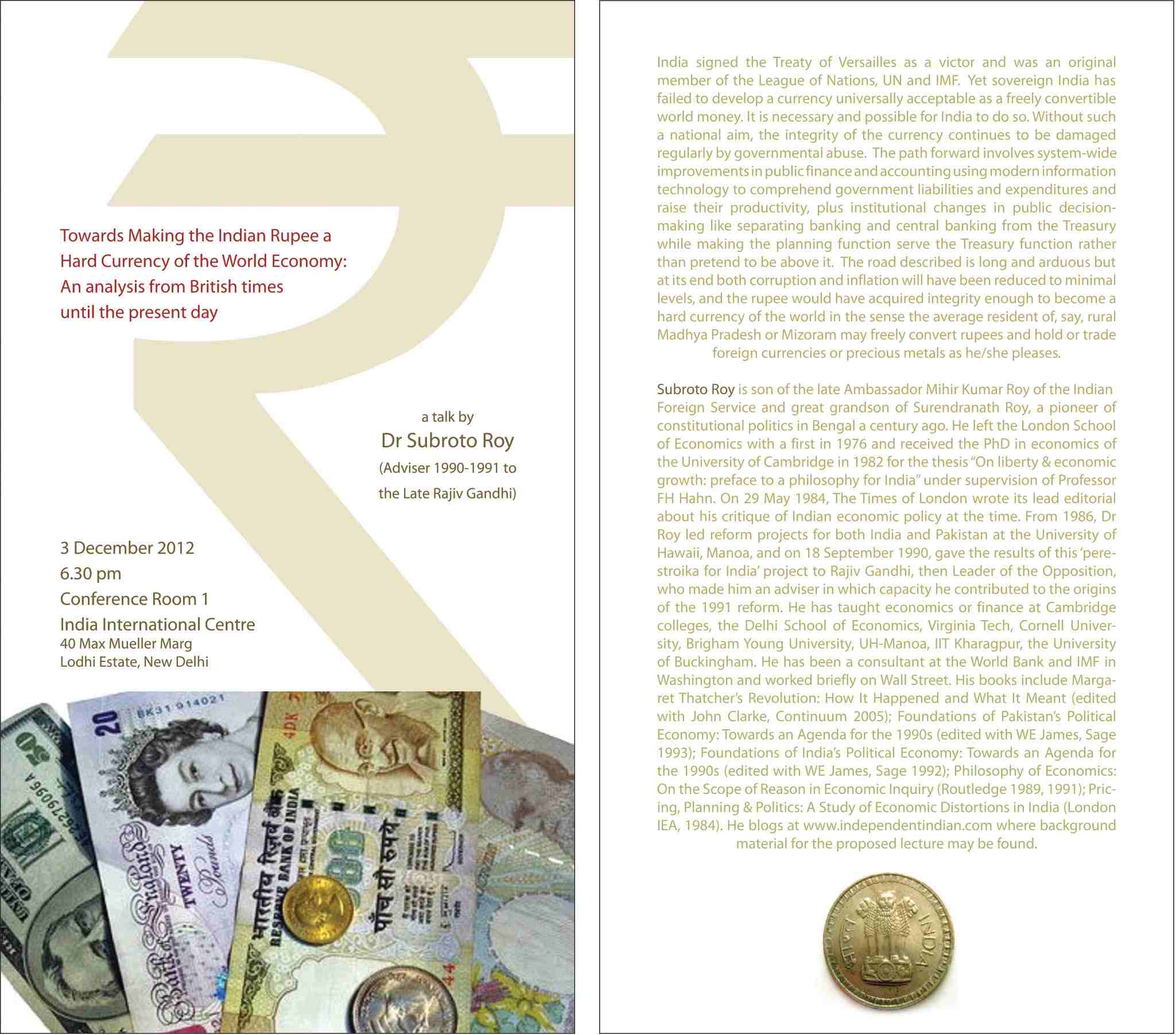
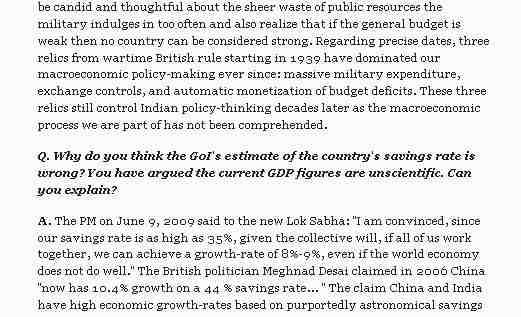
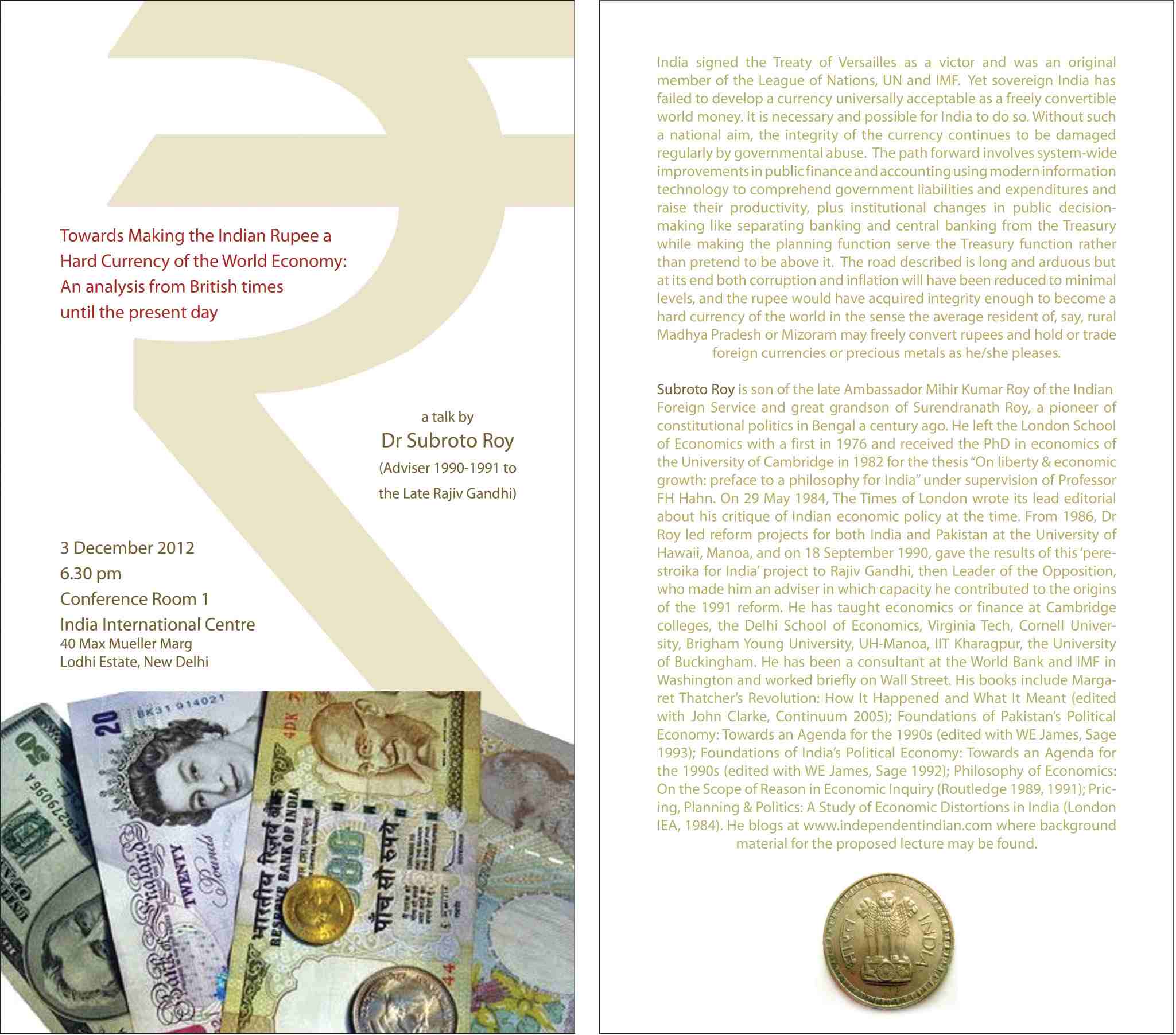
My 3 Dec IIC Delhi talk “Towards Making the Indian Rupee a Hard Currency of the World Economy: An analysis from British times until the present day” & its coverage in Asian Age/Deccan Herald, GDI Impuls Zurich, Lok Sabha TV & Sunday Guardian

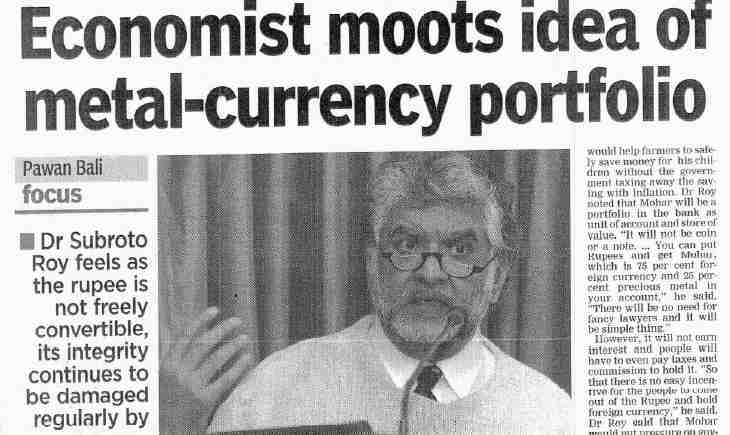
The article below, which is not inaccurate, is from the *Asian Age*/*Deccan Herald* of 4 December.

IICtophalf

IICtalkbottom,half

There has been a Lok Sabha TV interview, 1 on One with Paranjoy Guha Thakurta,  aired on Sunday 9 Dec 10 pm, repeated Monday 9 am.

There has been an interview with GDI Impuls banking quarterly of Zurich published on 6 Dec 2012.

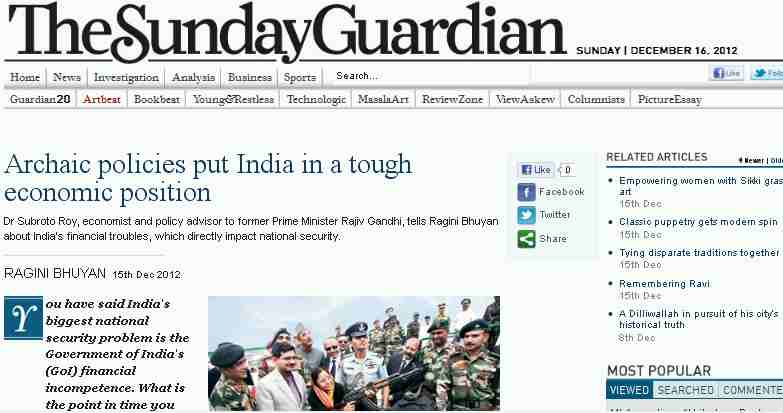
And there has been an interview with Delhi’s Sunday Guardian weekly newspaper dated 16 Dec 2012.

sundayguardiantp

sgmiddle

sgmid2

sgmid3

sgmid4

sgmid5


3Dec

Silver Jubilee of “Pricing, Planning & Politics: A Study of Economic Distortions in India”

May 29 2009:

It is a quarter century precisely today since my monograph Pricing, Planning and Politics: A Study of Economic Distortions in India was first published in London by the Institute of Economic Affairs.

ppp1984

Its text is now available (in slightly rough form) at this site here.

Now in May 1984, Indira Gandhi ruled in Delhi, and the ghost of Brezhnev was still fresh in Moscow.   The era of Margaret Thatcher in Britain and Ronald Reagan in America was at its height.   Pricing, Planning & Politics emerged from my 1976-1982 doctoral thesis at Cambridge though it came to be written in Blacksburg and Ithaca in 1982-1983.   It was the first critique after BR Shenoy of India’s Sovietesque economics since Jawaharlal Nehru’s time.

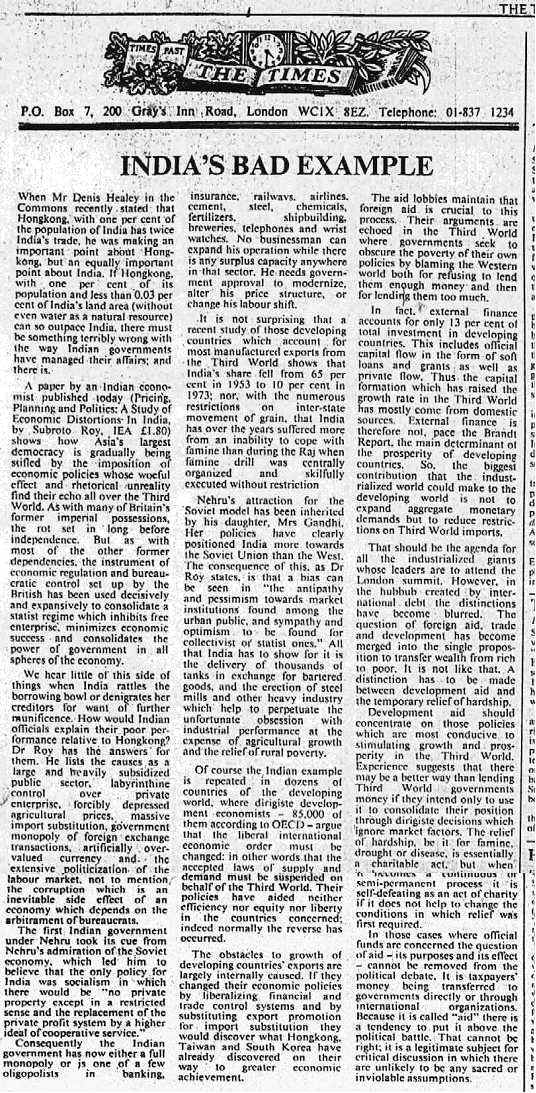
The Times, London’s most eminent paper at the time, wrote its lead editorial comment about it on the day it was published, May 29 1984.

londonti

It used to take several days for the library at Virginia Tech in Blacksburg to receive its copy of The Times of London and other British newspapers.    I had not been told of the date of publication and did not know of what had happened in London on May 29 until perhaps June 2 — when a friend, Vasant Dave of a children’s charity, who was on campus, phoned me and congratulated me for being featured in The Times which he had just read in the University Library.  “You mean they’ve reviewed it?”  I asked him, “No, it’s the lead editorial.” “What?” I exclaimed.  There was worse.  Vasant was very soft-spoken and said “Yes, it’s titled ‘India’s Bad Example’” — which I misheard on the phone as “India’s Mad Example”  :D

Drat! I thought (or words to that effect), they must have lambasted me, as I rushed down to the Library to take a look.

The Times had said

“When Mr. Dennis Healey in the Commons recently stated that Hongkong, with one per cent of the population of India has twice India’s trade, he was making an important point about Hongkong but an equally important point about India.   If Hongkong with one per cent of its population and less than 0.03 per cert of India’s land area (without even water as a natural resource) can so outpace India, there must be something terribly wrong with the way Indian governments have managed their affairs, and there is.   A paper by an Indian economist published today (Pricing, Planning and Politics: A Study of Economic Distortions in India by Subroto Roy, IEA £1.80) shows how Asia’s largest democracy is gradually being stifled by the imposition of economic policies whose woeful effect and rhetorical unreality find their echo all over the Third World.   As with many of Britain’s former imperial possessions, the rot set in long before independence.  But as with most of the other former dependencies, the instrument of economic regulation and bureaucratic control set up by the British has been used decisively and expansively to consolidate a statist regime which inhibits free enterprise, minimizes economic success and consolidates the power of government in all spheres of the economy.  We hear little of this side of things when India rattles the borrowing bowl or denigrates her creditors for want of further munificence.  How could Indian officials explain their poor performance relative to Hongkong?  Dr Roy has the answers for them.   He lists the causes as a large and heavily subsidized public sector, labyrinthine control over private enterprise, forcibly depressed agricultural prices, massive import substitution, government monopoly of foreign exchange transactions, artificially overvalued currency and the extensive politicization of the labour market, not to mention the corruption which is an inevitable side effect of an economy which depends on the arbitrament of bureaucrats.  The first Indian government under Nehru took its cue from Nehru’s admiration of the Soviet economy, which led him to believe that the only policy for India was socialism in which there would be “no private property except in a restricted sense and the replacement of the private profit system by a higher ideal of cooperative service.”  Consequently, the Indian government has now either a full monopoly or is one of a few oligipolists in banking, insurance, railways, airlines, cement, steel, chemicals, fertilizers, ship-building, breweries, telephones and wrist-watches.   No businessman can expand his operation while there is any surplus capacity anywhere in that sector.  He needs government approval to modernize, alter his price-structure, or change his labour shift.  It is not surprising that a recent study of those developing countries which account for most manufactured exports from the Third World shows that India’s share fell from 65 percent in 1953 to 10 per cent in 1973; nor, with the numerous restrictions on inter-state movement of grains, that India has over the years suffered more from an inability to cope with famine than during the Raj when famine drill was centrally organized and skillfully executed without restriction. Nehru’s attraction for the Soviet model has been inherited by his daughter, Mrs. Gandhi.  Her policies have clearly positioned India more towards the Soviet Union than the West.  The consequences of this, as Dr Roy states, is that a bias can be seen in “the antipathy and pessimism towards market institutions found among the urban public, and sympathy and optimism to be found for collectivist or statist ones.”  All that India has to show for it is the delivery of thousands of tanks in exchange for bartered goods, and the erection of steel mills and other heavy industry which help to perpetuate the unfortunate obsession with industrial performance at the expense of agricultural growth and the relief of rural poverty.”…..

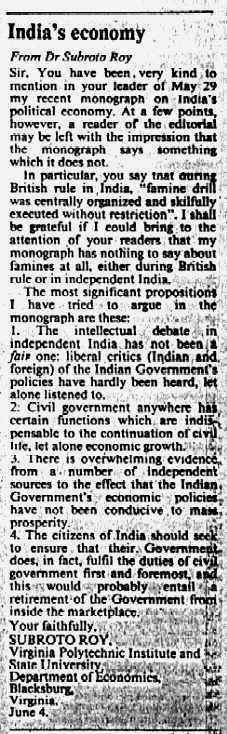
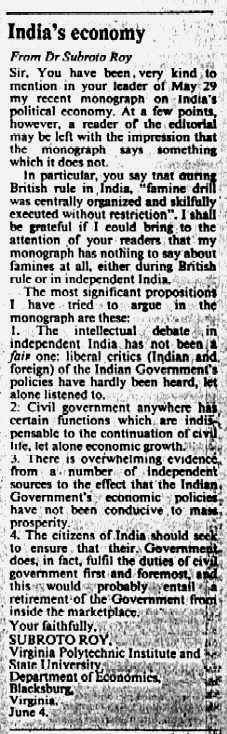
I felt this may have been intended to be laudatory but it was also inaccurate and had to be corrected.  I replied dated June 4 which The Times published in their edition of  June 16 1984:

timesletter-11

I was 29 when Pricing, Planning and Politics was published, I am 54 now. I do not agree with everything I said in it and find the tone a little puffed up as young men tend to be; it was also five years before my main “theoretical” work Philosophy of Economics would be published. My experience of life in the years since has also made me far less sanguine both about human nature and about America than I was then. But I am glad to find I am not embarrassed by what I said then, indeed I am pleased I said what I did in favour of classical liberalism and against statism and totalitarianism well before it became popular to do so after the Berlin Wall fell. (In India as elsewhere, former communist apparatchiks and fellow-travellers became pseudo-liberals overnight.)

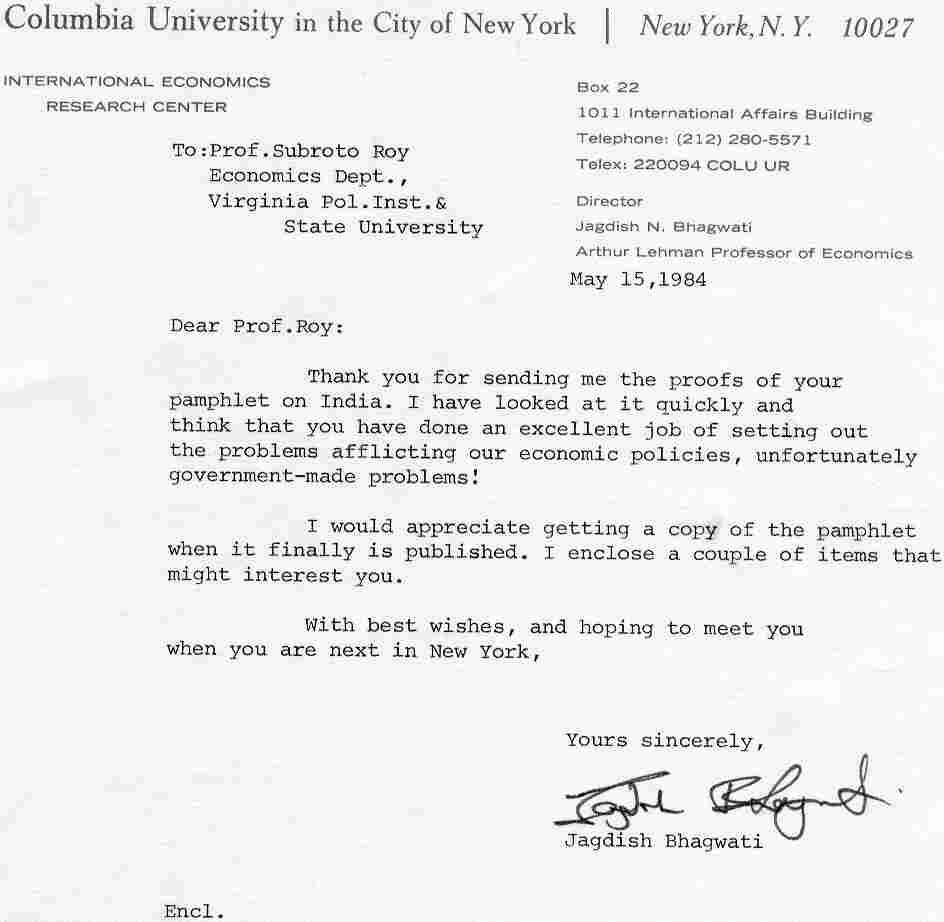
The editorial itself may have been due to a conversation between Peter Bauer and William Rees-Mogg, so I later heard. The work sold 700 copies in its first month, a record for the publisher. The wife of one prominent Indian bureaucrat told me in Delhi in December 1988 it had affected her husband’s thinking drastically. A senior public finance economist told me he had been deputed at the Finance Ministry when the editorial appeared, and the Indian High Commission in London had urgently sent a copy of the editorial to the Ministry where it caused a stir. An IMF official told me years later that he saw the editorial on board a flight to India from the USA on the same day, and stopped in London to make a trip to the LSE’s bookshop to purchase a copy. Professor Jagdish Bhagwati of Columbia University had been a critic of aspects of Indian policy; he received a copy  in draft just before it was published and was kind enough to write I had “done an excellent job of setting out the problems afflicting our economic policies, unfortunately government-made problems!”

Siddhartha Shankar Ray told me when  we first met that he had been in London when the editorial appeared and had seen it there; it affected his decision to introduce me to Rajiv Gandhi as warmly as he came to do a half dozen years later.

Within a few months though, by the Fall of 1984, I was under attack by the “gang of inert game theorists”  who had come to  Blacksburg following the departure of James Buchanan.  By mid 1985 I had moved to Provo, Utah, really rather wishing, as I recall,  to have left my India-work behind me.  But by late 1986, I was at the University of Hawaii, Manoa, where the perestroika-for-India and Pakistan projects that I and WE James led, had come to be sponsored by the University and the East West Center.

The unpublished results of the India-project reached Rajiv Gandhi by my hand on September 18 1990 as has been told elsewhere.  A week later, on September 25 1990,  Rajiv appointed a small group that included myself, to advise him.  It was that encounter with Rajiv Gandhi that sparked the origins of the 1991 economic reform.  Yet in 2007 one member of the group, declaring himself close to Sonia Gandhi, brazenly lied in public saying it was Manmohan Singh and not I who had been part of the group — a group of which I had been in fact the first member!  Manmohan Singh himself has never claimed to have been present and in fact was not even in India at the time it was formed.

I have explained elsewhere here why I believe this specific  lie  came to be told by this specific liar who shared membership with me in the group that Rajiv had formed:  because I had also pleaded with  many and especially within this group that Rajiv had seemed, to my layman’s eyes, very vulnerable to assassination, and none of them had lifted a finger to  do anything about it!  Such is how duplicity, envy and greed for power make people mendacious and venal in politics!

As for Pricing, Planning and Politics, Dr Manmohan Singh received a personal copy from my father whom he had long known through the Kaul brothers, Brahma and Madan, both of whom were dear friends of my father since the War and Independence.   From a letter Dr Singh wrote to my father,  he would have received his copy in late 1986 when he was heading the Planning Commission in his penultimate appointment before retirement from the bureaucracy.

Readers of Pricing, Planning and Politics today, 25 years after it was published, may judge for themselves what if any  part of it may be still relevant to the new government that Dr Singh is now prime minister of.   The work was mostly one of applied microeconomics or the theory of value; in recent years I have written much also of applied macroeconomics or the theory of money as it relates to India.  My great professor at Cambridge, Frank Hahn, was kind enough to say in 1985 that he thought my “critique of Development Economics was powerful not only on methodological but also on economic theory grounds”; that to me has been a special source of delight.

Subroto Roy, Kolkata

Letter to the GoI’s seniormost technical economist, May 21

“May 21 2009    It is wonderful to hear from you and I am honoured to find myself, perhaps accidentally, on the same list as so many of your distinguished colleagues among Government economists.

Your essay is most engaging. I am afraid I disagree with your assessment that the current problems “did not originate in the real sector of the economy” but were “triggered by the excesses of the financial system”. I have said to the contrary There is no clear path to solving the great (alleged) economic and financial crisis because no one wants to admit its roots were the overvaluation (over decades) of American real-estate, and hence American assets in general.”

There is no more real sector than real-estate itself and American real-estate has tended to be overvalued as a result of government policy since the Carter Administration; the accumulated dangers along that path came to explode in the sub-prime crisis. Here as elsewhere in economics, the financial tail has not wagged the non-financial dog but vice versa.

I have also said “(i) foreign central banks might have been left holding more bad US debt than might be remembered, and dollar depreciation and an American inflation seem to be inevitable over the next several years; (ii) all those bad mortgages and foreclosures could vanish within a year or two by playing the demographic card and inviting in a few million new immigrants into the United States; restoring a worldwide idea of an American dream fueled by mass immigration may be the surest way for the American economy to restore itself.”

Re the comparison with the Great Depression, I believe

“there are overriding differences. Most important, the American economy and the world economy are both incomparably larger today in the value of their capital stock, and there has also been enormous technological progress over eight decades. Accordingly, it would take a much vaster event than the present turbulence — say, something like an exchange of multiple nuclear warheads with Russia causing Manhattan and the City of London to be destroyed — before there was a return to something comparable to the 1929 Crash and the Great Depression that followed. Besides, the roots of the crises are different. What happened back then? In 1922, the Genoa Currency Conference wanted to correct the main defect of the pre-1914 gold standard, which was freezing the price of gold while failing to stabilise the purchasing power of money. From 1922 until about 1927, Benjamin Strong of the Federal Reserve Bank of New York adopted price-stabilisation as the new American policy-objective. Britain was off the gold standard and the USA remained on it. The USA, as a major creditor nation, saw massive gold inflows which, by traditional gold standard principles, would have caused a massive inflation. Governor Strong invented the process of “sterilisation” of those gold inflows instead and thwarted the rise in domestic dollar prices of goods and services. Strong’s death in 1928 threw the Federal Reserve System into conflict and intellectual confusion. Dollar stabilisation ended as a policy. Surplus bank money was created on the release of gold that had been previously sterilised. The traditional balance between bulls and bears in the stock-market was upset. Normally, every seller of stock is a bear and every buyer a bull. Now, amateur investors appeared as bulls attracted by the sudden stock price rises, while bears, who sold securities, failed to place their money into deposit and were instead lured into lending it as call money to brokerages who then fuelled these speculative bulls. As of October 22, 1929 about $4 billion was the extent of such speculative lending when Chase National Bank’s customers called in their money. Chase National had to follow their instructions, as did other New York banks. New York’s Stock Exchange could hardly respond to a demand for $4 billion at a short notice and collapsed. Within a year, production had fallen by 26 per cent, prices by 14 per cent, personal income by 14 per cent, and the Greatest Depression of recorded history was in progress — involuntary unemployment levels in America reaching 25 per cent. That is not, by any reading, what we have today. Yes, there has been plenty of bad lending, plenty of duping shareholders and workers and plenty of excessive managerial payoffs. It will all take a large toll, and affect markets across the world. But it will be a toll relative to our plush comfortable modern standards, not those of 1929-1933. In fact, modern decision-makers have the obvious advantage that they can look back at history and know what is not to be done. The US and the world economy are resilient enough to ride over even the extra uncertainty arising from the ongoing presidential campaign, and then some.”

These quotes are from recent publications and may be found most easily under “America’s financial crises” at my site http://www.independentindian.com.

What may be of interest to the Government of India’s economists also may be a sample of my recent short articles on India’s monetary and fiscal economics based on my research beginning with my doctoral work under Frank Hahn at Cambridge in the 1970s and followed by my work with James Buchanan and Milton Friedman in America in the 1980s and 1990s and later. One of these is even named “The Rangarajan Effect” which I first defined at a seminar invited by Dr Jadav at the RBI in May 2005!

http://independentindian.com/2008/08/24/rangarajan-effect/

http://independentindian.com/2008/09/28/monetary-integrity-and-the-rupee/

http://independentindian.com/2007/01/20/indias-macroeconomics/

http://independentindian.com/2007/02/04/fiscal-instability/

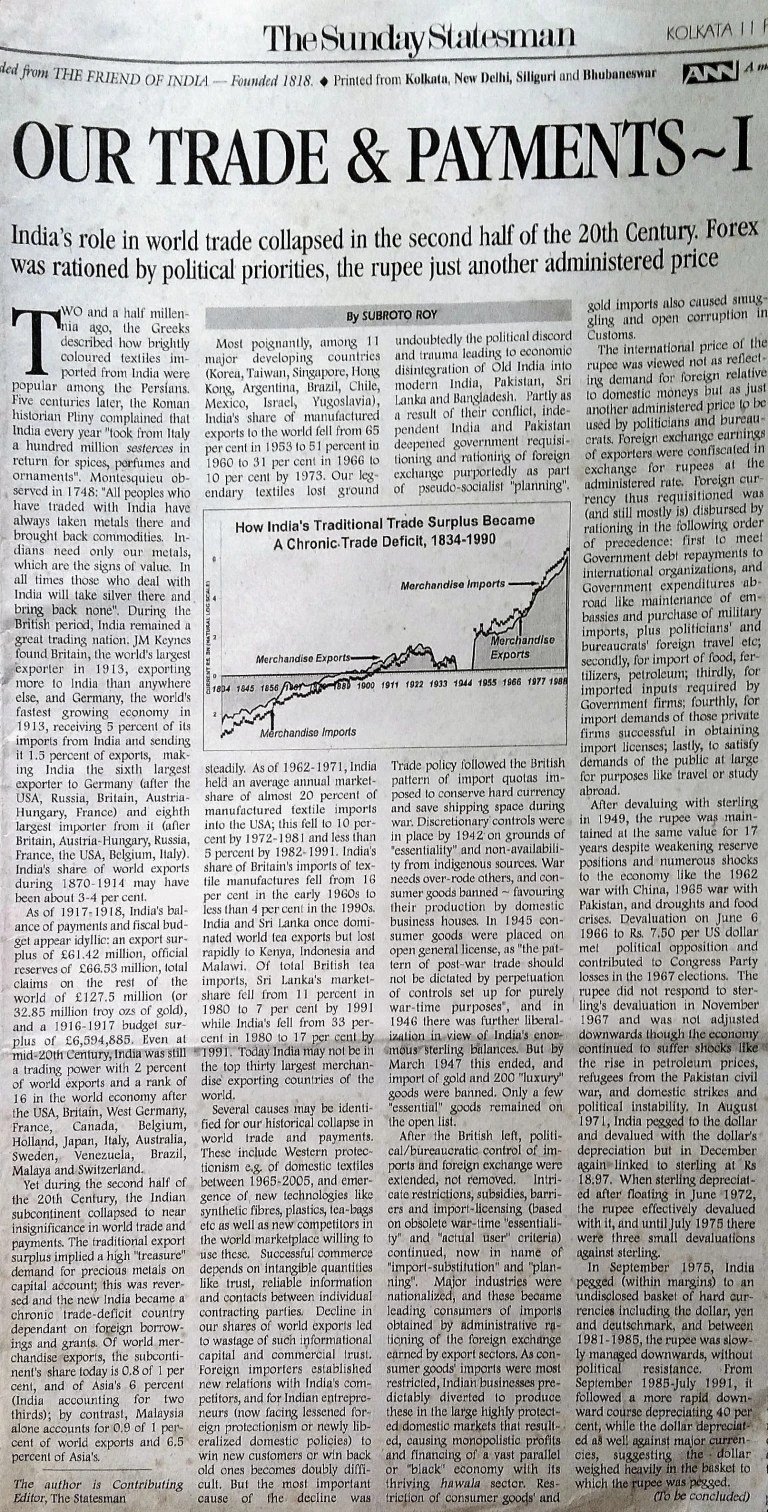
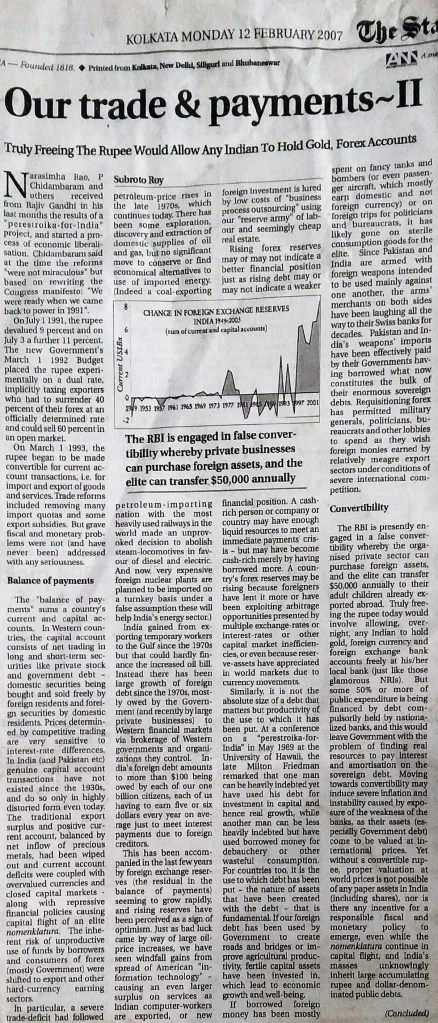
http://independentindian.com/2008/07/16/india-in-world-trade-payments/

http://independentindian.com/2007/03/05/fallacious-finance-the-congress-bjp-cpi-m-et-al-may-be-leading-india-to-hyperinflation/

http://independentindian.com/2007/02/20/our-policy-process-self-styled-planners-have-controlled-indias-paper-money-for-decades/

http://independentindian.com/2008/07/28/growth-of-real-income-money-prices-in-india-1869-2004/

http://independentindian.com/2008/07/17/growth-government-delusion/

http://independentindian.com/2008/07/09/indian-inflation-upside-down-economics-from-new-delhis-establishment/

http://independentindian.com/2008/02/26/how-to-budget-thrift-not-theft-should-guide-our-public-finances/

http://independentindian.com/2008/02/21/a-note-on-the-indian-policy-process/

With warm regards,

Cordially,

Subroto Roy, PhD (Cantab.), BScEcon(London)

Sometime Adviser to the Late Rajiv Gandhi, 1990-1991

Will someone please teach the BJP’s gerontocracy some Economics 101 on an emergency basis?

Two years ago, I said in “Political Paralysis”,

“[I]f Atal Behari Vajpayee and Lal Krishna Advani could bring themselves to honestly walk away from BJP politics, there would have to be a genuine leadership contest and some new principles emerging in their party. There is an excellent and very simple political reason for Vajpayee and Advani to go, which is not that they are too old (which they are) but that they led their party to electoral defeat. Had they walked away in May 2004, there might have been by now some viable conservative political philosophy in India and some recognisable new alternative leadership for 2009. Instead there is none and the BJP has not only failed very badly at being a responsible Opposition, it will go into the 2009 General Election looking exceptionally decrepit and incompetent.”

Lest anyone think this was a tirade against the BJP, most of the article was actually a criticism of the Congress and the Communists!

Mr LK Advani’s claim that Indian resources have been illegally shipped overseas is hardly new or interesting — what is truly grotesque is the sheer irresponsibility of his claim that if somehow this could be reversed, it would suffice to

” Relieve the debts of all farmers and landless • Build world-class roads all over the country – from national and state highways to district and rural roads; • Completely eliminate the acute power shortage in the country and also to bring electricity to every unlit rural home; • Provide safe and adequate drinking water in all villages and towns in India • Construct good-quality houses, each worth Rs. 2.5 lakh, for 10 crore families; • Provide Rs. 4 crore to each of the nearly 6 lakh villages; the money can be used to build, in every single village, a school with internet-enabled education, a primary health centre with telemedicine facility, a veterinary clinic, a playground with gymnasium, and much more. “

This is simply appalling in its sheer mendacity. The BJP is going to give an amnesty to all those with such money and then confiscate it or requisition it or forcibly borrow it to make these resources equivalent to tax-revenues for the purposes of Indian public finance? What can one say beyond this being grotesque in its incomprehension of both facts and economic principles? Could someone who supports the BJP please teach them some Econ 101 asap?

As I have said elsewhere, only quackery, fallacious finance and multitudinous intellectual fraud seem destined to emerge from New Delhi’s governing class of all political parties and their media and businessman friends. “Government finance requires scientific honesty, especially by way of clear rigorous accounting and audit of uses and origins of public resources. That scientific honesty is what we have not had at Union or State level for more than half a century.”

Subroto Roy, Kolkata

Could the Satyam/PwC fraud be the visible part of an iceberg? Where are India’s “Generally Accepted Accounting Principles”? Isn’t governance rather poor all over corporate India? Bad public finance may be a root cause

In a March 5 2007 article in The Statesman, I said:

“Our farmers are peaceful hardworking people who should be paying taxes and user-fees normally but should not be otherwise disturbed or needlessly provoked by outsiders. It is the businessmen wishing to attack our farm populations who need to look hard in the mirror – to improve their accounting, audit, corporate governance, to enforce anti-embezzlement and shareholder protection laws etc.”

In a September 23-24 2007 article in The Sunday Statesman I said:

“… Government, instead of hobnobbing with business chambers, needed to get Indian corporations to improve their accounting, audit and governance, and reduce managerial pilfering and embezzlement, which is possible only if Government first set an example.”

In a February 4 2007 article in The Statesman, I said:

“Financial control of India’s fiscal condition, and hence monetary expansion, vitally requires control of the growth of these kinds of dynamic processes and comprehension of their analytical underpinnings. Yet such understanding and control seem quite absent from all organs of our Government, including establishment economists and the docile financial press…. the actual difference between Government Expenditure and Income in India has been made to appear much smaller than it really is. Although neglected by the Cabinet, Finance Ministry, RBI and even (almost) the C&AG, the significance of this discrepancy in measurement will not be lost on anyone seriously concerned to address India’s fiscal and monetary problems.”

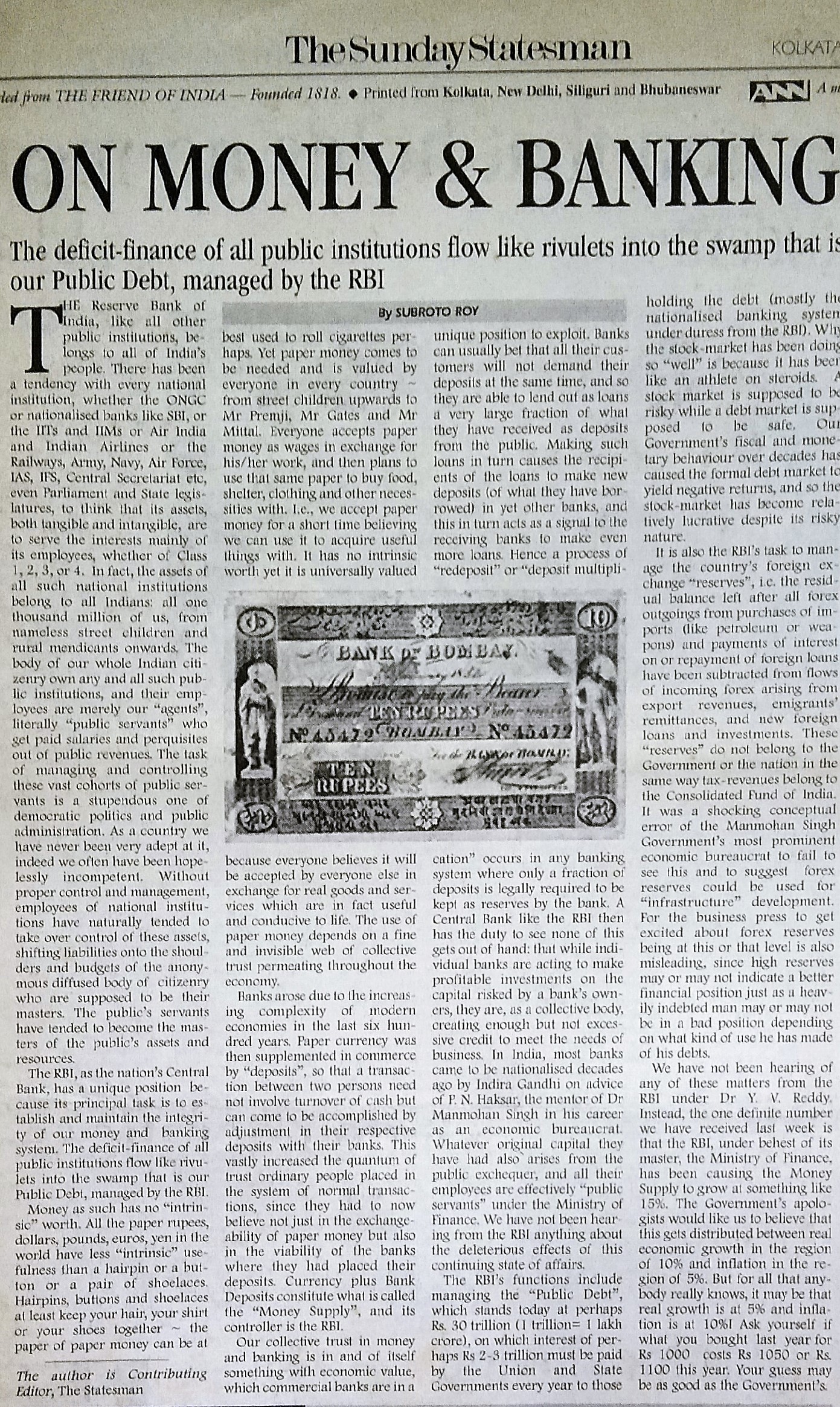
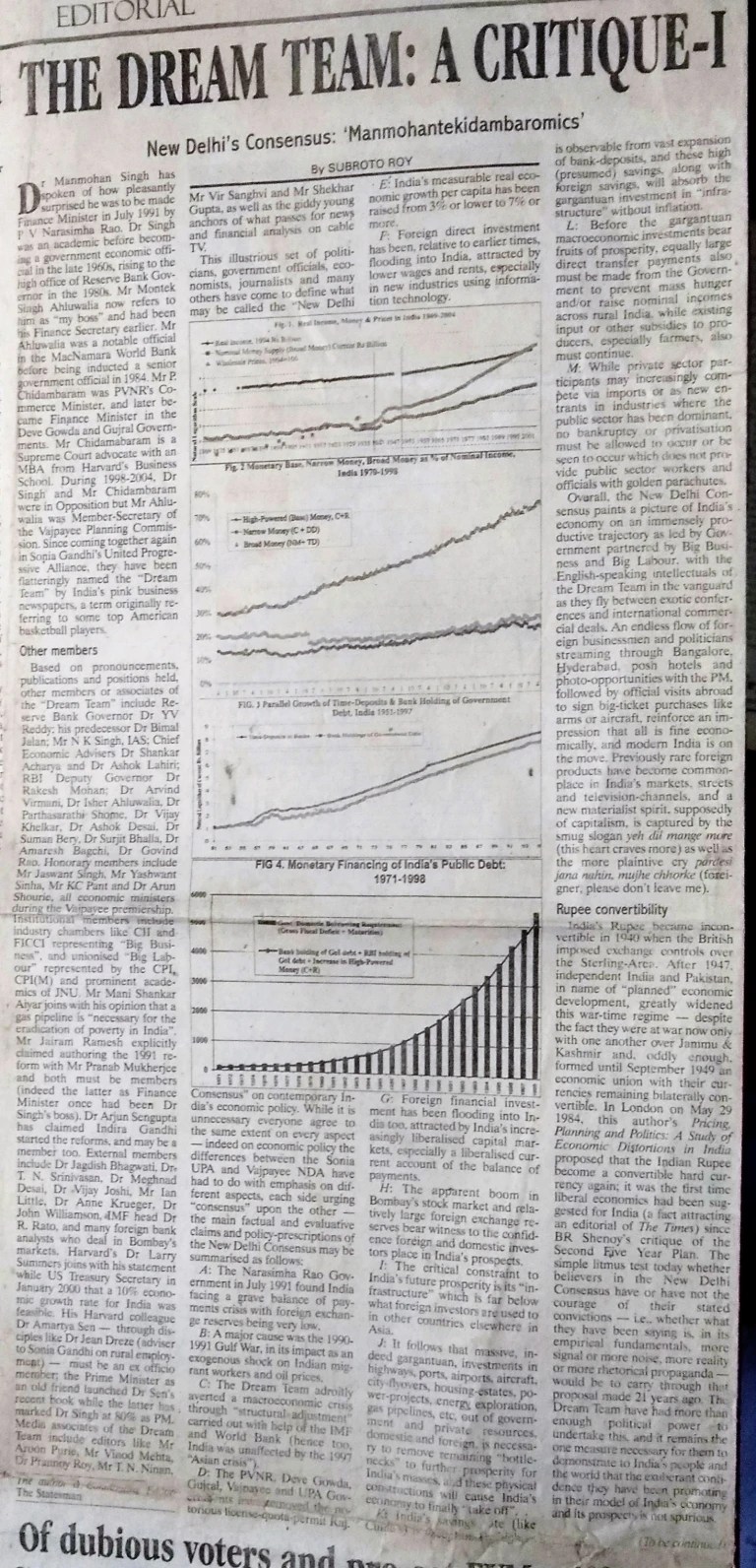
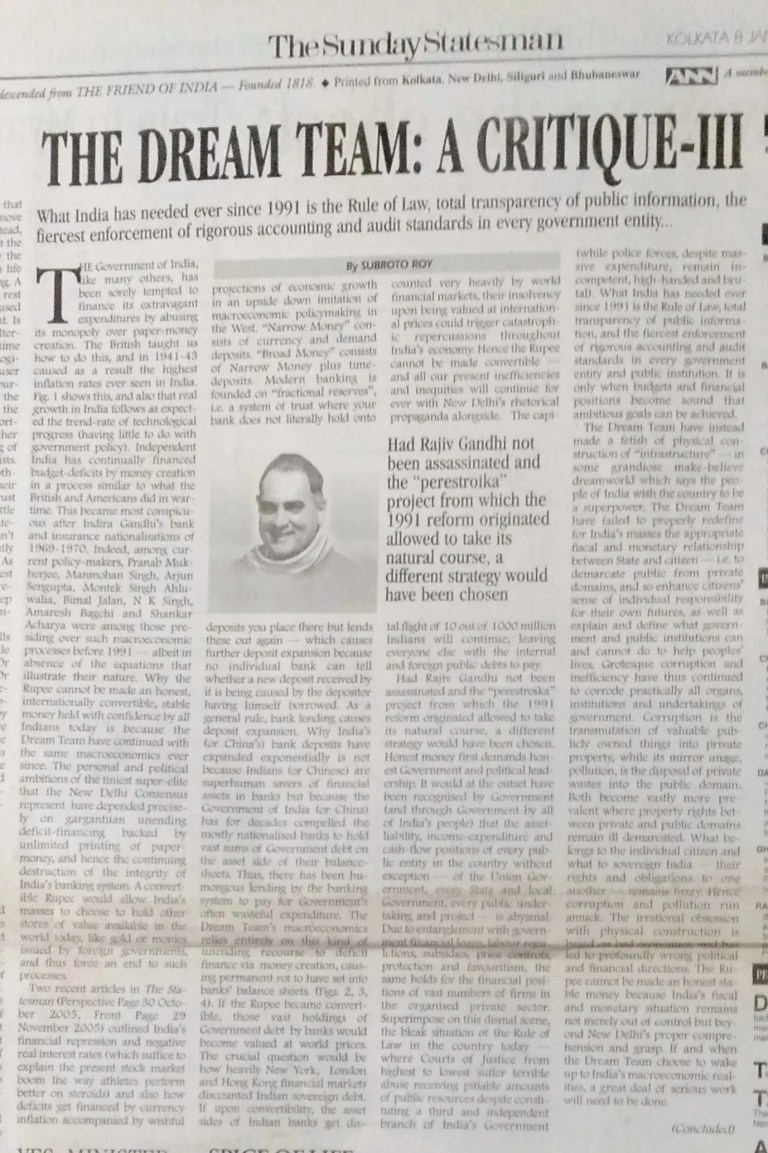
All three articles are available elsewhere here and are republished below together.  I have published elsewhere today my brief 2006 lecture on corporate governance.  (See also my “The Indian Revolution”, “Monetary Integrity & the Rupee”, “Indian Inflation”,  “The Dream Team: A Critique”, “India’s Macroeconomics”, “Growth & Government Delusion”, etc).

The fraud at Satyam amounts to it having been long bankrupt but not seemingly so.  The fact it was long bankrupt was apparently overlooked or condoned by its auditors Pricewaterhouse Coopers! This may be big news today but the response of corporate India and the Indian business media seems utterly insincere (and there has been a lot of fake pontificating on TV by some notorious frauds).  Remember the head of Satyam received awards with all the other honchos at those fake ceremonies that businessmen and the business media keep holding at this or that hotel.  (See my several articles here under the categories “Satyam corporate fraud”, “Corporate governance” etc.)

Government agencies, as enforcers of the law, must be seen in such circumstances to have greater credibility than the violators, but who can say that Government accounting and audit and corporate governance in India is not as bad as that of the private sector?    It may be in fact far, far worse.   Poor accounting, endless deficit finance, unlimited paper money creation, false convertibility of the rupee etc is what emerges from our supposedly wise economic policy-makers.

When was the last time some major businessman or top politician spoke publicly about the importance of “Generally Accepted Accounting Principles”?   The answer is never.   Government (of this party or that) has become well-oiled by political lobbyists and is hand-in-glove with organized business, especially in a few cities.  Until Government gets its own accounts straight, stops its endless deficit finance, reins in unlimited paper money-creation, creates an honest currency domestically and externally, there is no proper example or standard set for the private sector, and such scandals will erupt along with insincere responses from the cartels of corporate India.

What emerges from New Delhi’s economists seems often to have as much to do with economics as Bollywood has to do with cinema.

Subroto Roy, Kolkata

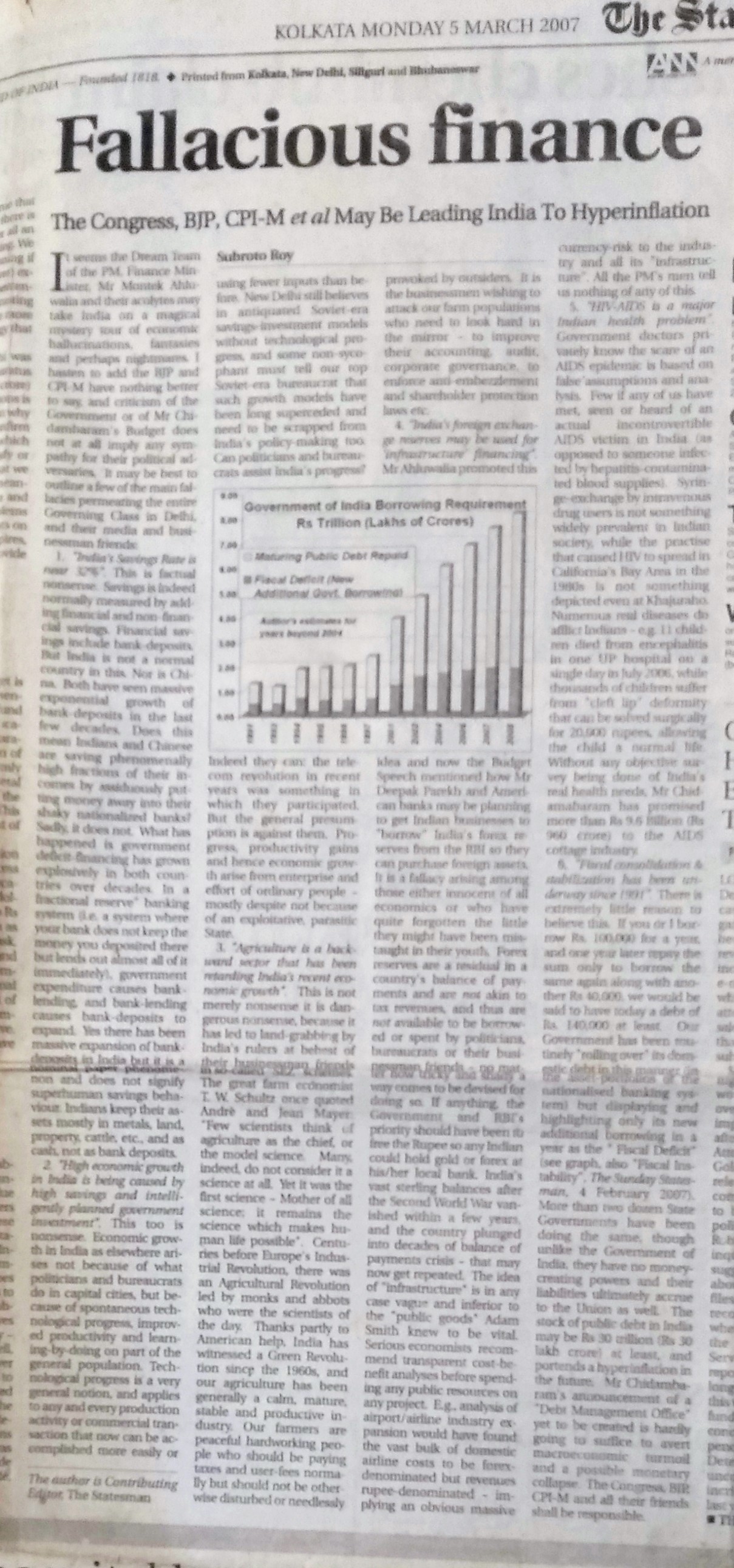
Fallacious Finance: Congress, BJP, CPI-M et al may be leading India to hyperinflation

by

Subroto Roy

First published in The Statesman, March 5 2007 Editorial Page Special Article http://www.thestatesman.net

It seems the Dream Team of the PM, Finance Minister, Mr. Montek Ahluwalia and their acolytes may take India on a magical mystery tour of economic hallucinations, fantasies and perhaps nightmares. I hasten to add the BJP and CPI-M have nothing better to say, and criticism of the Government or of Mr Chidambaram’s Budget does not at all imply any sympathy for their political adversaries. It may be best to outline a few of the main fallacies permeating the entire Governing Class in Delhi, and their media and businessman friends:

1. “India’s Savings Rate is near 32%”. This is factual nonsense. Savings is indeed normally measured by adding financial and non-financial savings. Financial savings include bank-deposits. But India is not a normal country in this. Nor is China. Both have seen massive exponential growth of bank-deposits in the last few decades. Does this mean Indians and Chinese are saving phenomenally high fractions of their incomes by assiduously putting money away into their shaky nationalized banks? Sadly, it does not. What has happened is government deficit-financing has grown explosively in both countries over decades. In a “fractional reserve” banking system (i.e. a system where your bank does not keep the money you deposited there but lends out almost all of it immediately), government expenditure causes bank-lending, and bank-lending causes bank-deposits to expand. Yes there has been massive expansion of bank-deposits in India but it is a nominal paper phenomenon and does not signify superhuman savings behaviour. Indians keep their assets mostly in metals, land, property, cattle, etc., and as cash, not as bank deposits.

2. “High economic growth in India is being caused by high savings and intelligently planned government investment”. This too is nonsense. Economic growth in India as elsewhere arises not because of what politicians and bureaucrats do in capital cities, but because of spontaneous technological progress, improved productivity and learning-by-doing on part of the general population. Technological progress is a very general notion, and applies to any and every production activity or commercial transaction that now can be accomplished more easily or using fewer inputs than before. New Delhi still believes in antiquated Soviet-era savings-investment models without technological progress, and some non-sycophant must tell our top Soviet-era bureaucrat that such growth models have been long superceded and need to be scrapped from India’s policy-making too. Can politicians and bureaucrats assist India’s progress? Indeed they can: the telecom revolution in recent years was something in which they participated. But the general presumption is against them. Progress, productivity gains and hence economic growth arise from enterprise and effort of ordinary people — mostly despite not because of an exploitative, parasitic State.

3. “Agriculture is a backward sector that has been retarding India’s recent economic growth”. This is not merely nonsense it is dangerous nonsense, because it has led to land-grabbing by India’s rulers at behest of their businessman friends in so-called “SEZ” schemes. The great farm economist Theodore W. Schultz once quoted Andre and Jean Mayer: “Few scientists think of agriculture as the chief, or the model science. Many, indeed, do not consider it a science at all. Yet it was the first science – Mother of all science; it remains the science which makes human life possible”. Centuries before Europe’s Industrial Revolution, there was an Agricultural Revolution led by monks and abbots who were the scientists of the day. Thanks partly to American help, India has witnessed a Green Revolution since the 1960s, and our agriculture has been generally a calm, mature, stable and productive industry. Our farmers are peaceful hardworking people who should be paying taxes and user-fees normally but should not be otherwise disturbed or needlessly provoked by outsiders. It is the businessmen wishing to attack our farm populations who need to look hard in the mirror – to improve their accounting, audit, corporate governance, to enforce anti-embezzlement and shareholder protection laws etc.

4. “India’s foreign exchange reserves may be used for ‘infrastructure’ financing”. Mr Ahluwalia promoted this idea and now the Budget Speech mentioned how Mr Deepak Parekh and American banks may be planning to get Indian businesses to “borrow” India’s forex reserves from the RBI so they can purchase foreign assets. It is a fallacy arising among those either innocent of all economics or who have quite forgotten the little they might have been mistaught in their youth. Forex reserves are a residual in a country’s balance of payments and are not akin to tax revenues, and thus are not available to be borrowed or spent by politicians, bureaucrats or their businessman friends — no matter how tricky and shady a way comes to be devised for doing so. If anything, the Government and RBI’s priority should have been to free the Rupee so any Indian could hold gold or forex at his/her local bank. India’s vast sterling balances after the Second World War vanished quickly within a few years, and the country plunged into decades of balance of payments crisis – that may now get repeated. The idea of “infrastructure” is in any case vague and inferior to the “public goods” Adam Smith knew to be vital. Serious economists recommend transparent cost-benefit analyses before spending any public resources on any project. E.g., analysis of airport/airline industry expansion would have found the vast bulk of domestic airline costs to be forex-denominated but revenues rupee-denominated – implying an obvious massive currency-risk to the industry and all its “infrastructure”. All the PM’s men tell us nothing of any of this.

5. “HIV-AIDS is a major Indian health problem”. Government doctors privately know the scare of an AIDS epidemic is based on false assumptions and analysis. Few if any of us have met, seen or heard of an actual incontrovertible AIDS victim in India (as opposed to someone infected by hepatitis-contaminated blood supplies). Syringe-exchange by intravenous drug users is not something widely prevalent in Indian society, while the practise that caused HIV to spread in California’s Bay Area in the 1980s is not something depicted even at Khajuraho. Numerous real diseases do afflict Indians – e.g. 11 children died from encephalitis in one UP hospital on a single day in July 2006, while thousands of children suffer from “cleft lip” deformity that can be solved surgically for 20,000 rupees, allowing the child a normal life. Without any objective survey being done of India’s real health needs, Mr Chidamabaram has promised more than Rs 9.6 Billion (Rs 960 crore) to the AIDS cottage industry.

6. “Fiscal consolidation & stabilization has been underway since 1991”. There is extremely little reason to believe this. If you or I borrow Rs. 100,000 for a year, and one year later repay the sum only to borrow the same again along with another Rs 40,000, we would be said to have today a debt of Rs. 140,000 at least. Our Government has been routinely “rolling over” its domestic debt in this manner (in the asset-portfolios of the nationalised banking system) but displaying and highlighting only its new additional borrowing in a year as the “ Fiscal Deficit” (see graph, also “Fiscal Instability”, The Sunday Statesman, 4 February 2007). More than two dozen State Governments have been doing the same though, unlike the Government of India, they have no money-creating powers and their liabilities ultimately accrue to the Union as well. The stock of public debt in India may be Rs 30 trillion (Rs 30 lakh crore) at least, and portends a hyperinflation in the future. Mr Chidambaram’s announcement of a “Debt Management Office” yet to be created is hardly going to suffice to avert macroeconomic turmoil and a possible monetary collapse. The Congress, BJP, CPI-M and all their friends shall be responsible.

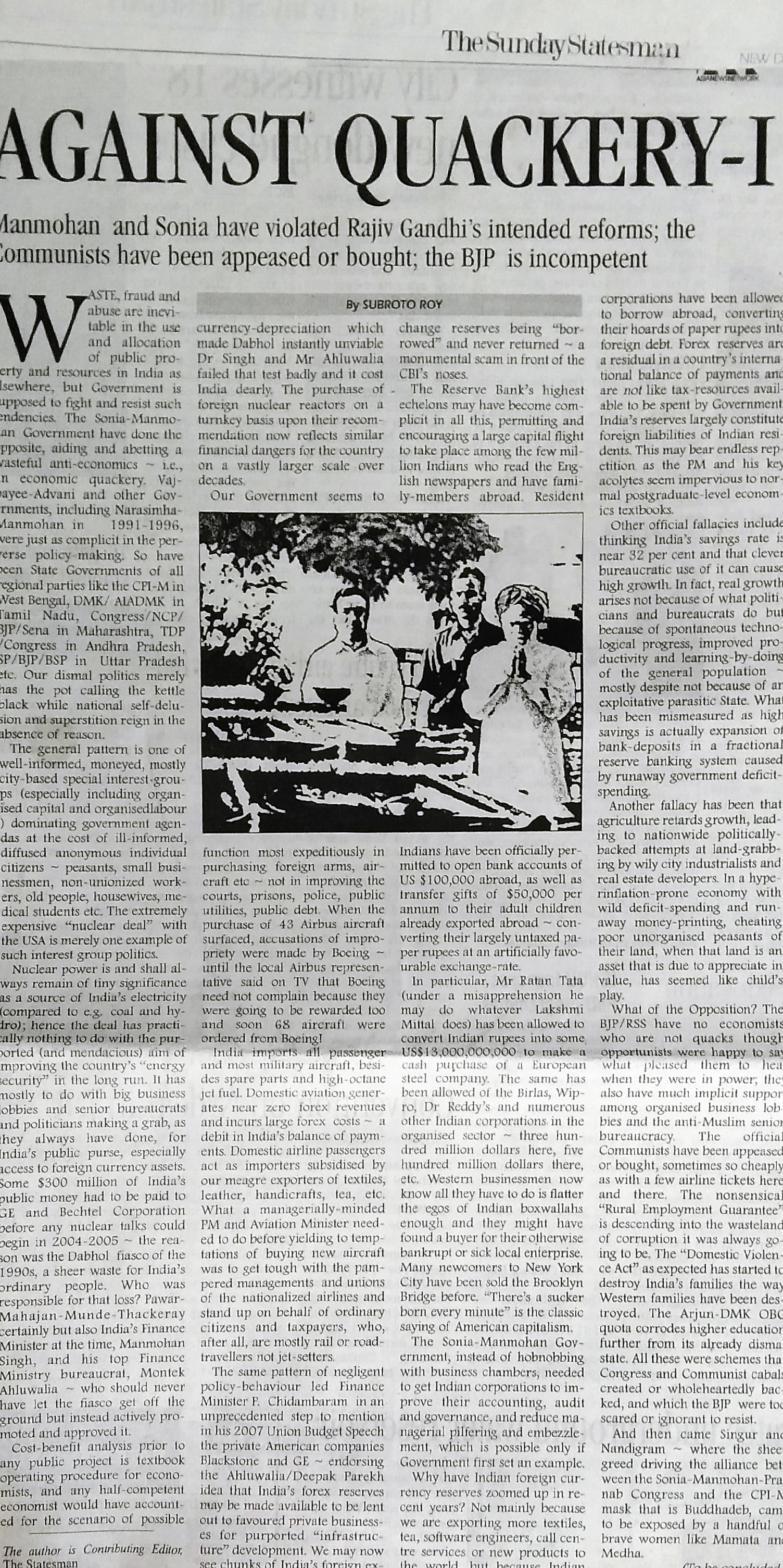
Against Quackery

First published in two parts in The Sunday Statesman, September 23 2007, The Statesman September 24 2007, http://www.thestatesman.net

By Subroto Roy

Manmohan and Sonia have violated Rajiv Gandhi’s intended reforms; the Communists have been appeased or bought; the BJP is incompetent

WASTE, fraud and abuse are inevitable in the use and allocation of public property and resources in India as elsewhere, but Government is supposed to fight and resist such tendencies. The Sonia-Manmohan Government have done the opposite, aiding and abetting a wasteful anti-economics ~ i.e., an economic quackery. Vajpayee-Advani and other Governments, including Narasimha-Manmohan in 1991-1996, were just as complicit in the perverse policy-making. So have been State Governments of all regional parties like the CPI-M in West Bengal, DMK/ AIADMK in Tamil Nadu, Congress/NCP/ BJP/Sena in Maharashtra, TDP /Congress in Andhra Pradesh, SP/BJP/BSP in Uttar Pradesh etc. Our dismal politics merely has the pot calling the kettle black while national self-delusion and superstition reign in the absence of reason.

The general pattern is one of well-informed, moneyed, mostly city-based special interest groups (especially including organised capital and organised labour) dominating government agendas at the cost of ill-informed, diffused anonymous individual citizens ~ peasants, small businessmen, non-unionized workers, old people, housewives, medical students etc. The extremely expensive “nuclear deal” with the USA is merely one example of such interest group politics.

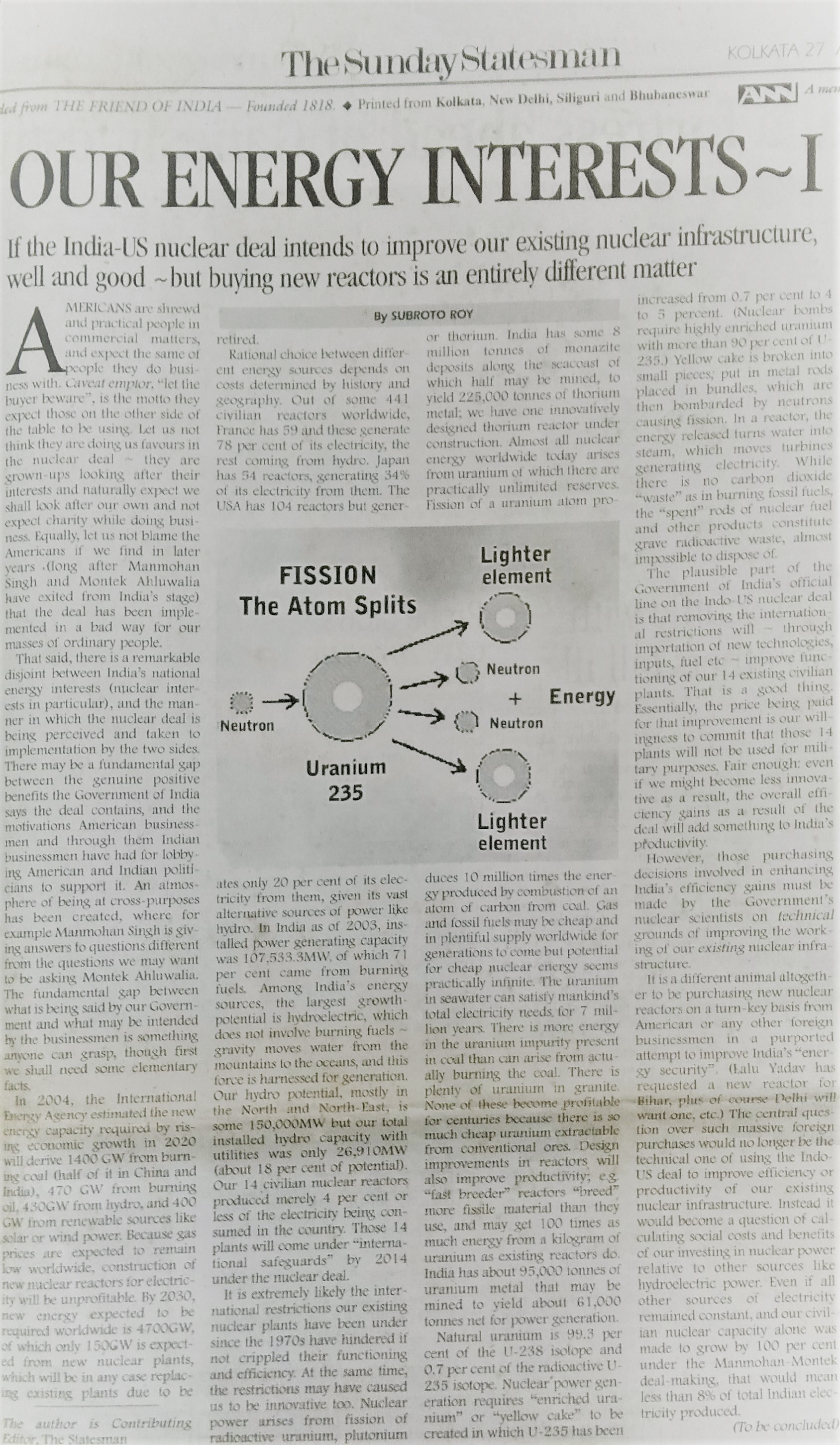
Nuclear power is and shall always remain of tiny significance as a source of India’s electricity (compared to e.g. coal and hydro); hence the deal has practically nothing to do with the purported (and mendacious) aim of improving the country’s “energy security” in the long run. It has mostly to do with big business lobbies and senior bureaucrats and politicians making a grab, as they always have done, for India’s public purse, especially access to foreign currency assets. Some $300 million of India’s public money had to be paid to GE and Bechtel Corporation before any nuclear talks could begin in 2004-2005 ~ the reason was the Dabhol fiasco of the 1990s, a sheer waste for India’s ordinary people. Who was responsible for that loss? Pawar-Mahajan-Munde-Thackeray certainly but also India’s Finance Minister at the time, Manmohan Singh, and his top Finance Ministry bureaucrat, Montek Ahluwalia ~ who should never have let the fiasco get off the ground but instead actively promoted and approved it.

Cost-benefit analysis prior to any public project is textbook operating procedure for economists, and any half-competent economist would have accounted for the scenario of possible currency-depreciation which made Dabhol instantly unviable. Dr Singh and Mr Ahluwalia failed that test badly and it cost India dearly. The purchase of foreign nuclear reactors on a turnkey basis upon their recommendation now reflects similar financial dangers for the country on a vastly larger scale over decades.

Our Government seems to function most expeditiously in purchasing foreign arms, aircraft etc ~ not in improving the courts, prisons, police, public utilities, public debt. When the purchase of 43 Airbus aircraft surfaced, accusations of impropriety were made by Boeing ~ until the local Airbus representative said on TV that Boeing need not complain because they were going to be rewarded too and soon 68 aircraft were ordered from Boeing!

India imports all passenger and most military aircraft, besides spare parts and high-octane jet fuel. Domestic aviation generates near zero forex revenues and incurs large forex costs ~ a debit in India’s balance of payments. Domestic airline passengers act as importers subsidised by our meagre exporters of textiles, leather, handicrafts, tea, etc. What a managerially-minded PM and Aviation Minister needed to do before yielding to temptations of buying new aircraft was to get tough with the pampered managements and unions of the nationalized airlines and stand up on behalf of ordinary citizens and taxpayers, who, after all, are mostly rail or road-travellers not jet-setters.

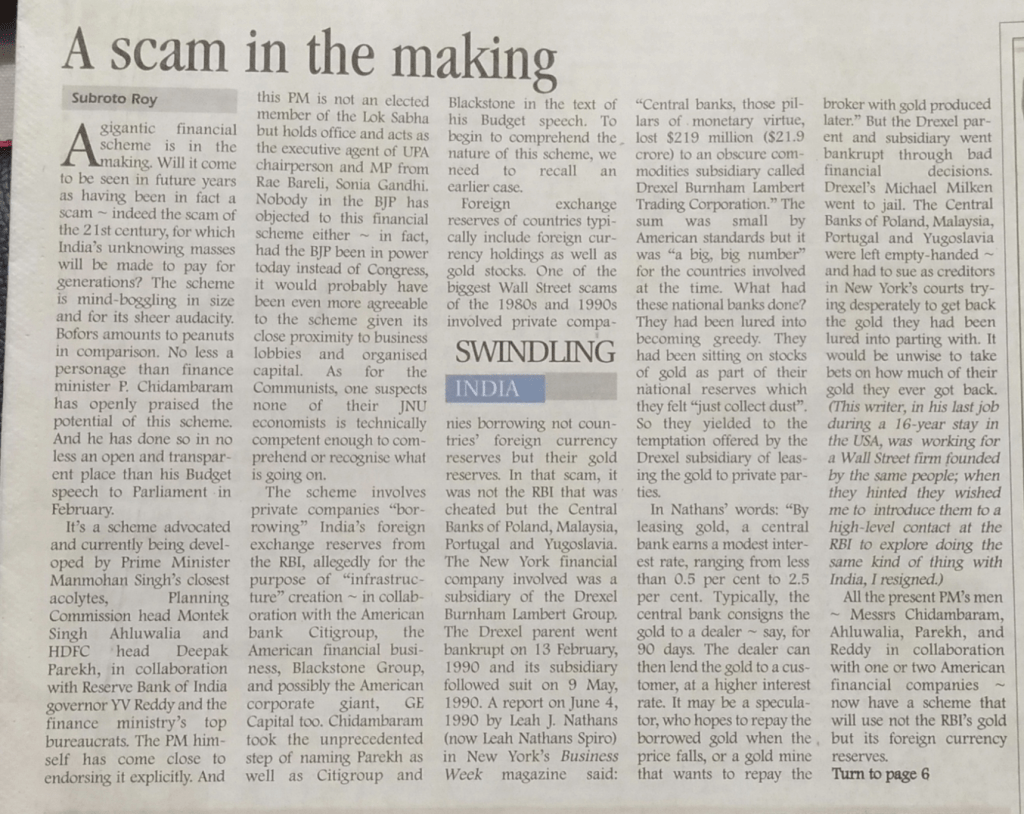
The same pattern of negligent policy-behaviour led Finance Minister P. Chidambaram in an unprecedented step to mention in his 2007 Union Budget Speech the private American companies Blackstone and GE ~ endorsing the Ahluwalia/Deepak Parekh idea that India’s forex reserves may be made available to be lent out to favoured private businesses for purported “infrastructure” development. We may now see chunks of India’s foreign exchange reserves being “borrowed” and never returned ~ a monumental scam in front of the CBI’s noses.

The Reserve Bank’s highest echelons may have become complicit in all this, permitting and encouraging a large capital flight to take place among the few million Indians who read the English newspapers and have family-members abroad. Resident Indians have been officially permitted to open bank accounts of US $100,000 abroad, as well as transfer gifts of $50,000 per annum to their adult children already exported abroad ~ converting their largely untaxed paper rupees at an artificially favourable exchange-rate.

In particular, Mr Ratan Tata (under a misapprehension he may do whatever Lakshmi Mittal does) has been allowed to convert Indian rupees into some US$13,000,000,000 to make a cash purchase of a European steel company. The same has been allowed of the Birlas, Wipro, Dr Reddy’s and numerous other Indian corporations in the organised sector ~ three hundred million dollars here, five hundred million dollars there, etc. Western businessmen now know all they have to do is flatter the egos of Indian boxwallahs enough and they might have found a buyer for their otherwise bankrupt or sick local enterprise. Many newcomers to New York City have been sold the Brooklyn Bridge before. “There’s a sucker born every minute” is the classic saying of American capitalism.

The Sonia-Manmohan Government, instead of hobnobbing with business chambers, needed to get Indian corporations to improve their accounting, audit and governance, and reduce managerial pilfering and embezzlement, which is possible only if Government first set an example.

Why have Indian foreign currency reserves zoomed up in recent years? Not mainly because we are exporting more textiles, tea, software engineers, call centre services or new products to the world, but because Indian corporations have been allowed to borrow abroad, converting their hoards of paper rupees into foreign debt. Forex reserves are a residual in a country’s international balance of payments and are not like tax-resources available to be spent by Government; India’s reserves largely constitute foreign liabilities of Indian residents. This may bear endless repetition as the PM and his key acolytes seem impervious to normal postgraduate-level economics textbooks.

Other official fallacies include thinking India’s savings rate is near 32 per cent and that clever bureaucratic use of it can cause high growth. In fact, real growth arises not because of what politicians and bureaucrats do but because of spontaneous technological progress, improved productivity and learning-by-doing of the general population ~ mostly despite not because of an exploitative parasitic State. What has been mismeasured as high savings is actually expansion of bank-deposits in a fractional reserve banking system caused by runaway government deficit-spending.

Another fallacy has been that agriculture retards growth, leading to nationwide politically-backed attempts at land-grabbing by wily city industrialists and real estate developers. In a hyperinflation-prone economy with wild deficit-spending and runaway money-printing, cheating poor unorganised peasants of their land, when that land is an asset that is due to appreciate in value, has seemed like child’s play.

What of the Opposition? The BJP/RSS have no economists who are not quacks though opportunists were happy to say what pleased them to hear when they were in power; they also have much implicit support among organised business lobbies and the anti-Muslim senior bureaucracy. The official Communists have been appeased or bought, sometimes so cheaply as with a few airline tickets here and there. The nonsensical “Rural Employment Guarantee” is descending into the wasteland of corruption it was always going to be. The “Domestic Violence Act” as expected has started to destroy India’s families the way Western families have been destroyed. The Arjun-DMK OBC quota corrodes higher education further from its already dismal state. All these were schemes that Congress and Communist cabals created or wholeheartedly backed, and which the BJP were too scared or ignorant to resist.

And then came Singur and Nandigram ~ where the sheer greed driving the alliance between the Sonia-Manmohan-Pranab Congress and the CPI-M mask that is Buddhadeb, came to be exposed by a handful of brave women like Mamata and Medha.

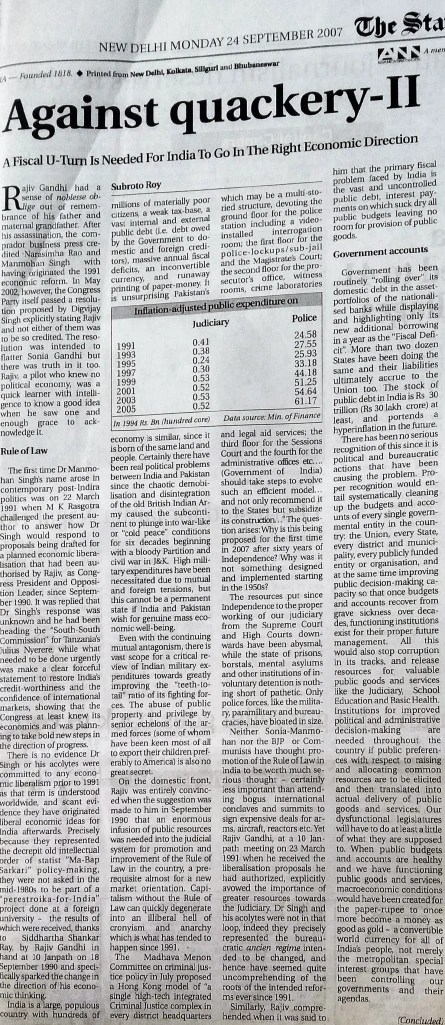
2. A Fiscal U-Turn is Needed For India to Go in The Right Economic Direction

Rajiv Gandhi had a sense of noblesse oblige out of remembrance of his father and maternal grandfather. After his assassination, the comprador business press credited Narasimha Rao and Manmohan Singh with having originated the 1991 economic reform. In May 2002, however, the Congress Party itself passed a resolution proposed by Digvijay Singh explicitly stating Rajiv and not either of them was to be so credited. The resolution was intended to flatter Sonia Gandhi but there was truth in it too. Rajiv, a pilot who knew no political economy, was a quick learner with intelligence to know a good idea when he saw one and enough grace to acknowledge it.

Rule of Law

The first time Dr Manmohan Singh’s name arose in contemporary post-Indira politics was on 22 March 1991 when M K Rasgotra challenged the present author to answer how Dr Singh would respond to proposals being drafted for a planned economic liberalisation that had been authorised by Rajiv, as Congress President and Opposition Leader, since September 1990. It was replied that Dr Singh’s response was unknown and he had been heading the “South-South Commission” for Tanzania’s Julius Nyerere, while what needed to be done urgently was make a clear forceful statement to restore India’s credit-worthiness and the confidence of international markets, showing that the Congress at least knew its economics and was planning to take bold new steps in the direction of progress.

There is no evidence Dr Singh or his acolytes were committed to any economic liberalism prior to 1991 as that term is understood worldwide, and scant evidence they have originated liberal economic ideas for India afterwards. Precisely because they represented the decrepit old intellectual order of statist ”Ma-Bap Sarkari” policy-making, they were not asked in the mid-1980s to be part of a “perestroika-for-India” project done at a foreign university ~ the results of which were received, thanks to Siddhartha Shankar Ray, by Rajiv Gandhi in hand at 10 Janpath on 18 September 1990 and specifically sparked the change in the direction of his economic thinking.

India is a large, populous country with hundreds of millions of materially poor citizens, a weak tax-base, a vast internal and external public debt (i.e. debt owed by the Government to domestic and foreign creditors), massive annual fiscal deficits, an inconvertible currency, and runaway printing of paper-money. It is unsurprising Pakistan’s economy is similar, since it is born of the same land and people. Certainly there have been real political problems between India and Pakistan since the chaotic demobilisation and disintegration of the old British Indian Army caused the subcontinent to plunge into war-like or “cold peace” conditions for six decades beginning with a bloody Partition and civil war in J&K. High military expenditures have been necessitated due to mutual and foreign tensions, but this cannot be a permanent state if India and Pakistan wish for genuine mass economic well-being.

Even with the continuing mutual antagonism, there is vast scope for a critical review of Indian military expenditures towards greatly improving the “teeth-to-tail” ratio of its fighting forces. The abuse of public property and privilege by senior echelons of the armed forces (some of whom have been keen most of all to export their children preferably to America) is also no great secret.

On the domestic front, Rajiv was entirely convinced when the suggestion was made to him in September 1990 that an enormous infusion of public resources was needed into the judicial system for promotion and improvement of the Rule of Law in the country, a pre-requisite almost for a new market orientation. Capitalism without the Rule of Law can quickly degenerate into an illiberal hell of cronyism and anarchy which is what has tended to happen since 1991.

The Madhava Menon Committee on criminal justice policy in July proposed a Hong Kong model of “a single high-tech integrated Criminal Justice complex in every district headquarters which may be a multi-storied structure, devoting the ground floor for the police station including a video-installed interrogation room; the first floor for the police-lockups/sub-jail and the Magistrate’s Court; the second floor for the prosecutor’s office, witness rooms, crime laboratories and legal aid services; the third floor for the Sessions Court and the fourth for the administrative offices etc…. (Government of India) should take steps to evolve such an efficient model… and not only recommend it to the States but subsidize its construction…” The question arises: Why is this being proposed for the first time in 2007 after sixty years of Independence? Why was it not something designed and implemented starting in the 1950s?

The resources put since Independence to the proper working of our judiciary from the Supreme Court and High Courts downwards have been abysmal, while the state of prisons, borstals, mental asylums and other institutions of involuntary detention is nothing short of pathetic. Only police forces, like the military, paramilitary and bureaucracies, have bloated in size.

Neither Sonia-Manmohan nor the BJP or Communists have thought promotion of the Rule of Law in India to be worth much serious thought ~ certainly less important than attending bogus international conclaves and summits to sign expensive deals for arms, aircraft, reactors etc. Yet Rajiv Gandhi, at a 10 Janpath meeting on 23 March 1991 when he received the liberalisation proposals he had authorized, explicitly avowed the importance of greater resources towards the Judiciary. Dr Singh and his acolytes were not in that loop, indeed they precisely represented the bureaucratic ancien regime intended to be changed, and hence have seemed quite uncomprehending of the roots of the intended reforms ever since 1991.

Similarly, Rajiv comprehended when it was said to him that the primary fiscal problem faced by India is the vast and uncontrolled public debt, interest payments on which suck dry all public budgets leaving no room for provision of public goods.

Government accounts
Government has been routinely “rolling over” its domestic debt in the asset-portfolios of the nationalised banks while displaying and highlighting only its new additional borrowing in a year as the “Fiscal Deficit”. More than two dozen States have been doing the same and their liabilities ultimately accrue to the Union too. The stock of public debt in India is Rs 30 trillion (Rs 30 lakh crore) at least, and portends a hyperinflation in the future.

There has been no serious recognition of this since it is political and bureaucratic actions that have been causing the problem. Proper recognition would entail systematically cleaning up the budgets and accounts of every single governmental entity in the country: the Union, every State, every district and municipality, every publicly funded entity or organisation, and at the same time improving public decision-making capacity so that once budgets and accounts recover from grave sickness over decades, functioning institutions exist for their proper future management. All this would also stop corruption in its tracks, and release resources for valuable public goods and services like the Judiciary, School Education and Basic Health. Institutions for improved political and administrative decision-making are needed throughout the country if public preferences with respect to raising and allocating common resources are to be elicited and then translated into actual delivery of public goods and services. Our dysfunctional legislatures will have to do at least a little of what they are supposed to. When public budgets and accounts are healthy and we have functioning public goods and services, macroeconomic conditions would have been created for the paper-rupee to once more become a money as good as gold ~ a convertible world currency for all of India’s people, not merely the metropolitan special interest groups that have been controlling our governments and their agendas.

Fiscal Instabilty

Interest payments quickly suck dry every year’s Budget. And rolling over old public debt means that Government Borrowing in fact much exceeds the Fiscal Deficit

by Subroto Roy

First published in The Sunday Statesman, Editorial Page Special Article, February 4 2007, http://www.thestatesman.net

While releasing Mr Chidambaram’s book some days ago, our PM said that as Narasimha Rao’s Finance Minister in 1991 he had caused “fiscal stabilization” of the country. Unfortunately, Dr Manmohan Singh may have been believing the flattery of his sycophants, since the facts point differently.

The Fiscal Deficit is new borrowing by Government added for a given year. In 1994-1995 for example, the Union Government’s expenditure net of operational and other income was some Rs 1,295 billion (1 billion = 100 crore). Rs. 674 billion was generated for the Union Government by taxation that year (Rs 184 billion from direct taxes, Rs 653 billion from indirect and miscellaneous taxes, less Rs 163 billion as the States’ share). The difference between Rs 1,295 billion and Rs. 674 billion, that is Rs. 621 billion had to be borrowed by the Government of India in the name of future unborn generations of Indian citizens. That was the “Fiscal Deficit” that year. If the stock of Public Debt already accumulated has been B,this Fiscal Deficit, C, adds to the interest burden that will be faced next year since interest will have to be then paid on B + C.

Interest payments on Government debt have dominated all public finance in recent decades, quickly sucking dry the budgets every year both of the Union and each of our more than two dozen States. Some Rs. 440 billion was paid by the Union Government as interest in 1994-1995, and this had risen to some Rs. 1,281 billion by 2003-2004. As a percentage of tax revenue, interest expenditure by the Government of India on its own debt rose from 40% in 1991 to 68% in 2004 ~ through the Finance Ministerships of Manmohan Singh, P Chidambaram, Yashwant Sinha and Jaswant Singh.

Financial control of India’s fiscal condition, and hence monetary expansion, vitally requires control of the growth of these kinds of dynamic processes and comprehension of their analytical underpinnings. Yet such understanding and control seem quite absent from all organs of our Government, including establishment economists and the docile financial press.

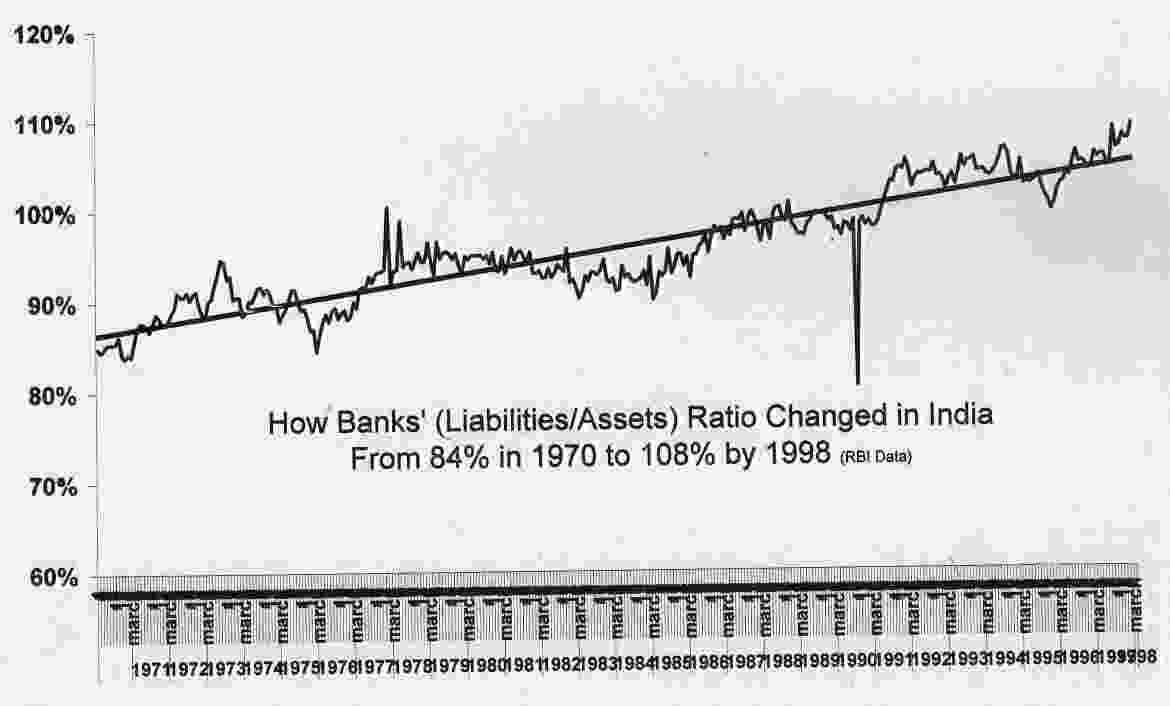
For example, contrary to the impression created by the Finance Ministry, RBI and Union Cabinet (whether of the UPA or NDA, while the Communists would only be worse), the Fiscal Deficit has been in fact very far from being all that the Government of India borrows from financial markets in a given year. The stock of Public Debt at any given moment consists of numerous debt-instruments of various sorts at different terms. Some fraction of these come to maturity every year and hence their principal amounts (not merely their interest) must be repaid by Government. What our Government has been doing routinely over decades is to roll over these debts, i.e. issue fresh public debt of the same amount as that being extinguished and more. For example, some Rs. 720 billion, Rs. 1,180 billion, Rs.1,330 billion and Rs. 1,390 billion were amounts spent in extinguishing maturing public debt in 1993, 1994, 1995 and 1996 respectively. No special taxes were raised in those years specifically for that purpose. Instead the Government merely issued additional new debt or “rolled over” or “converted” the old debt in the same amounts and more in the portfolios of the captive nationalized banking system (see graph).

Plainly, the Government of India’s actual “Borrowing Requirement”, as the difference between its Income and Expenditure, when accounted for properly, will be the sum of this rolled over old debt and the Fiscal Deficit (which is merely the additional borrowing required by a single year’s Budget). In other words, the Government’s Borrowing Requirement is the Fiscal Deficit plus the much larger amount required to annually roll over maturing debt. Because the latter expenditure does not appear at all in calculation of the Fiscal Deficit by the subterfuge of having been routinely rolled over every year, the actual difference between Government Expenditure and Income in India has been made to appear much smaller than it really is. Although neglected by the Cabinet, Finance Ministry, RBI and even (almost) the C&AG, the significance of this discrepancy in measurement will not be lost on anyone seriously concerned to address India’s fiscal and monetary problems.

On the expenditure side, Current Expenditure (anachronistically named “Revenue Expenditure” in India as it is supposed to be met by current revenue) meets recurrent liabilities from one budget-date to the next, like salaries of school-staff or coupon payments on Government debt.

Investment Expenditure “of a capital nature” is supposed to increase “concrete assets of a material and permanent character” like spending on a new public library, or reducing “recurring liabilities” by setting aside a sinking fund to reduce Government debt. Some public resources need to be spent to yield benefits or reduce costs not immediately but in the future. Besides roads, bridges and libraries, these may include less tangible investments too like ensuring proper working of law-courts or training police-officers and school-teachers.

Also, there has been large outright direct lending by the Government of India bypassing normal capital markets on the pattern of old Soviet “central planning”, whereby “credit” is disbursed to chosen recipients.

“Current”, “Investment” and “Loan” expenditure decisions of this kind are made on the same activities. For example, in 1994-1995, the Government of India spent Rs. 2.7 billion as “Loans for Power Projects” in addition to Rs. 9.8 billion under Current Expenditure on “Power” and Rs. 15.5 billion as Investment Expenditure on “Power Projects”. By 2003-2004, these had grown to Rs. 50.94 billion, Rs. 31.02 billion, Rs. 28.5 billion respectively. Yet the opaqueness of Government accounts, finances and economic decision-making today is such that nowhere will such data be found in one table giving a full picture of public expenditure on the Power sector as a whole. On the revenue side, Government’s “Current Income” includes direct and indirect taxes, operational income from public utilities (like railways or the post office), and dividends and profits from public assets. There has been a small “Investment Income” too received from sale of public assets like Maruti. Also, since loans are made directly, there has to be a category for their recovery.

“One must not take from the real needs of the people for the imaginary needs of the state”, said Montesquieu; while De Marco in the same vein said “the greatest satisfaction of collective needs” has to be sought by “the least possible waste of private wealth”. Even Mao Zedong reportedly said: “Thrift should be the guiding principle of our government expenditure”. The C&AG requires Government determine “how little money it need take out of the pockets of the taxpayers in order to maintain its necessary activities at the proper standard of efficiency”.

Yet India’s top politicians and bureaucrats spend wildly ~ driven by the organised special interest groups on whom they depend, while ostentatiously consuming public time, space and resources themselves “quite uselessly in the pleasurable business of inflating the ego” (Veblen).

For Government to do what it need not or should not do contributes to its failure to do what it must. Thus we have armies of indolent soldiers, policemen and bureaucrats and piles of rotting supplies in government warehouses while there are queues outside hospitals, schools, courts etc.

Parliament and State Legislatures need to first ask of an annual budget whether it is efficient: “Is expenditure being allocated to enhance the public interest to the greatest extent possible, and if not, how may it be made to do so?” National welfare overall should increase the same whichever public good or service the final million of public rupees has been spent on.

Fundamentally, government finance requires scientific honesty, especially by way of clear rigorous accounting and audit of uses and origins of public resources. That scientific honesty is what we have not had at Union or State level for more than half a century.

The Indian Revolution

The Indian Revolution

by

Subroto Roy

Prefatory Note Dec 2008: This outlines what might have happened if (a) Rajiv Gandhi had not been assassinated; (b) I had known at age 36 all that I now know at age 53. Both are counterfactuals and hence this is a work of fiction. It was written long before the Mumbai massacres; the text has been left unchanged.

“India’s revolution, when it came, was indeed bloodless and non-violent but it was firm and clear-headed and inevitably upset a lot of hitherto powerful people.

The first thing the Revolutionary Government declared when it took over in Delhi was that the rupee would become a genuine hard currency of the world economy within 18 months.  This did not seem a very revolutionary thing to say and the people at first did not understand what was meant.  The Revolutionaries explained: “Paper money and the banks have been abused by all previous regimes ruling in Delhi since 1947 who learnt their tricks from British war-time techniques.  We will give you for the first time in free India a rupee as good as gold, an Indian currency as respectable as any other in the world, dollar, pound, yen, whatever.  What you earn with your hard work and resources will be measured by a sound standard of value, not continuously devalued in secret by government misuse”.

The people were intrigued but not enlightened much.  Nor did they  grasp things to come when the Revolutionary Government abolished the old Planning Commission, sending its former head as envoy to New Zealand (with a long reading-list); attached the Planning Commission as a new R&D wing to the Finance Ministry; detached the RBI from the Finance Ministry; instructed the RBI Governor to bring proper work-culture and discipline to his 75,000 staff and instructed the Monetary Policy Deputy Governor to prepare plans for becoming a constitutionally independent authority, besides a possible monetary decentralization towards the States.  India’s people did not understand all this, but  there began to be a sense that something was up in Lutyens’ Delhi faraway.

The Revolutionary Government started to seem a little revolutionary when it called in  police-chiefs of all States — the PM himself then signed an order routed via the Home Ministry that they were to state in writing, within a fortnight, how they intended to improve discipline and work-culture in the forces they commanded.  Each was also asked to name three reliable deputies, and left in no doubt what that meant.  State Chief Ministers murmured objections but rumours swirled about more to come and they shut up quickly.  The Revolutionary Government sent a terse note to all CMs asking their assistance in implementation of this and any further orders.  It also set up a “Prison Reform and Reconstruction Panel” with instructions to (a) survey all prisons in the country with a view to immediately reduce injustices within the prison-system; (b) enlarge capacity in the event fresh enforcement of the Rule of Law came to demand this.

The Revolutionary Government then asked all senior members of the judiciary to a meeting in Trivandrum.  There they declared the judiciary must remain impartial and objective, not show favoritism even to members of the Revolutionary Party itself who might be in court before them for whatever reason.  The judges were assured of carte blanche by way of resources to improve quality of all public services under them; at the same time, a new “Internal Affairs Department” was formed that would assure the public that the Bench and the Bar never forgot their noble calling.  When a former judge and a former senior counsel came to be placed in two cells of the new prison-system, the public finally felt something serious was afoot.  Late night comics on TV led the public’s mirth — “Thieves have authority when judges steal themselves”, waxed one eloquently.

The Revolutionary Government’s next step reached into all nooks and crannies of the country.  A large room in the new Finance Ministry was assigned to each State – a few days later, the Revolutionary Government announced it had taken over control under the Constitution’s financial emergency provision of all State budgets for a period of six months at the outset.

Now there was an irrepressible outcry from State Chief Ministers, loud enough for the Revolutionary Government to ask them to a national meeting, this time in Agartala.  When the Delhi CM sweetly complained she did not know how to get there, she got back two words “Get there”; and she did.

There the PM told the CMs they would get their budgets back some day but only after the Revolutionary Government had overseen their cleaning and restoration to financial health from their current rotten state.   “But Prime Minister, the States have had no physical assets”, one bright young CM found courage to blurt out.

“That is the first good question I have heard since our Revolution began,” answered the PM. “We are going to give you the Railways to start with –  Indian Railways will keep control of a few national trains and tracks but will be instructed to devolve control and ownership of all other assets to you, the States.  See that you use your new assets properly”.  There was a collective whoop of excitement.  “During the time your budgets remain with us, get your police, transport, education and hospital systems to work for the benefit of common people, confer with your oppositions about how you can get your legislatures to work at all.  Keep in mind we are committed to making the rupee a hard currency of the world and we will not stand for any waste, fraud or abuse of public moneys. We really don’t want to be tested on what we mean by that. We are doing the same with the Union Government and the whole public sector”.  The Chief Ministers went home nervous and excited.

Finally, the Revolutionary Government turned to Lutyens’ Delhi itself. Foreign ambassadors were called in one by one and politely informed a scale-back had been ordered in Indian diplomatic missions in their countries, and hence by due protocol, a scale-back in their New Delhi embassies was called for.  “We are pulling our staff, incidentally, from almost all international and UN agencies too because we need such high-quality administrators more at home than abroad”, the Revolutionary Foreign Minister told the startled ambassadors.

Palpable tension rose in the national capital when the Revolutionary Government announced that Members of Parliament would receive public housing of high quality but only in their home constituencies!  The MPs would have to vacate their Delhi bungalows and apartments! “But we are Delhi!  We must have facilities in Delhi!”, MPs cried. “Yes, rooms in nationalized hotels suffice for your legislative needs; kindly vacate the bungalows as required; we will be building national memorials, libraries and museums there”, replied the radicals in power.  Tension in the capital did not subside for weeks because the old political parties all had thrived on Delhi’s social circuit, whose epicenter swirled around a handful of such bungalows.  Now those old power-equations were all lost.  A few MPs decided to boycott Delhi and only work in their constituencies.

When the Pakistan envoy was called with a letter for her PM, outlining a process of détente on the USSR-USA pattern of mutual verification of demilitarization, both bloated militaries were upset to see their jobs and perks being cut but steps had been taken to ensure there was never any serious danger of a coup.  The Indian Revolution was in full swing and continued for a few years until coherence and integrity had been forced upon the public finances and currency of a thousand million people….”

Against Quackery

Against Quackery

First published in two parts in The Sunday Statesman, September 23 2007, The Statesman September 24 2007, http://www.thestatesman.net

By Subroto Roy

Manmohan and Sonia have violated Rajiv Gandhi’s intended reforms; the Communists have been appeased or bought; the BJP is incompetent

WASTE, fraud and abuse are inevitable in the use and allocation of public property and resources in India as elsewhere, but Government is supposed to fight and resist such tendencies. The Sonia-Manmohan Government have done the opposite, aiding and abetting a wasteful anti-economics ~ i.e., an economic quackery. Vajpayee-Advani and other Governments, including Narasimha-Manmohan in 1991-1996, were just as complicit in the perverse policy-making. So have been State Governments of all regional parties like the CPI-M in West Bengal, DMK/ AIADMK in Tamil Nadu, Congress/NCP/ BJP/Sena in Maharashtra, TDP /Congress in Andhra Pradesh, SP/BJP/BSP in Uttar Pradesh etc. Our dismal politics merely has the pot calling the kettle black while national self-delusion and superstition reign in the absence of reason.

The general pattern is one of well-informed, moneyed, mostly city-based special interest groups (especially including organised capital and organised labour) dominating government agendas at the cost of ill-informed, diffused anonymous individual citizens ~ peasants, small businessmen, non-unionized workers, old people, housewives, medical students etc. The extremely expensive “nuclear deal” with the USA is merely one example of such interest group politics.

Nuclear power is and shall always remain of tiny significance as a source of India’s electricity (compared to e.g. coal and hydro); hence the deal has practically nothing to do with the purported (and mendacious) aim of improving the country’s “energy security” in the long run. It has mostly to do with big business lobbies and senior bureaucrats and politicians making a grab, as they always have done, for India’s public purse, especially access to foreign currency assets. Some $300 million of India’s public money had to be paid to GE and Bechtel Corporation before any nuclear talks could begin in 2004-2005 ~ the reason was the Dabhol fiasco of the 1990s, a sheer waste for India’s ordinary people. Who was responsible for that loss? Pawar-Mahajan-Munde-Thackeray certainly but also India’s Finance Minister at the time, Manmohan Singh, and his top Finance Ministry bureaucrat, Montek Ahluwalia ~ who should never have let the fiasco get off the ground but instead actively promoted and approved it.

Cost-benefit analysis prior to any public project is textbook operating procedure for economists, and any half-competent economist would have accounted for the scenario of possible currency-depreciation which made Dabhol instantly unviable. Dr Singh and Mr Ahluwalia failed that test badly and it cost India dearly. The purchase of foreign nuclear reactors on a turnkey basis upon their recommendation now reflects similar financial dangers for the country on a vastly larger scale over decades.

Our Government seems to function most expeditiously in purchasing foreign arms, aircraft etc ~ not in improving the courts, prisons, police, public utilities, public debt. When the purchase of 43 Airbus aircraft surfaced, accusations of impropriety were made by Boeing ~ until the local Airbus representative said on TV that Boeing need not complain because they were going to be rewarded too and soon 68 aircraft were ordered from Boeing!

India imports all passenger and most military aircraft, besides spare parts and high-octane jet fuel. Domestic aviation generates near zero forex revenues and incurs large forex costs ~ a debit in India’s balance of payments. Domestic airline passengers act as importers subsidised by our meagre exporters of textiles, leather, handicrafts, tea, etc. What a managerially-minded PM and Aviation Minister needed to do before yielding to temptations of buying new aircraft was to get tough with the pampered managements and unions of the nationalized airlines and stand up on behalf of ordinary citizens and taxpayers, who, after all, are mostly rail or road-travellers not jet-setters.

The same pattern of negligent policy-behaviour led Finance Minister P. Chidambaram in an unprecedented step to mention in his 2007 Union Budget Speech the private American companies Blackstone and GE ~ endorsing the Ahluwalia/Deepak Parekh idea that India’s forex reserves may be made available to be lent out to favoured private businesses for purported “infrastructure” development. We may now see chunks of India’s foreign exchange reserves being “borrowed” and never returned ~ a monumental scam in front of the CBI’s noses.

The Reserve Bank’s highest echelons may have become complicit in all this, permitting and encouraging a large capital flight to take place among the few million Indians who read the English newspapers and have family-members abroad. Resident Indians have been officially permitted to open bank accounts of US $100,000 abroad, as well as transfer gifts of $50,000 per annum to their adult children already exported abroad ~ converting their largely untaxed paper rupees at an artificially favourable exchange-rate.

In particular, Mr Ratan Tata (under a misapprehension he may do whatever Lakshmi Mittal does) has been allowed to convert Indian rupees into some US$13,000,000,000 to make a cash purchase of a European steel company. The same has been allowed of the Birlas, Wipro, Dr Reddy’s and numerous other Indian corporations in the organised sector ~ three hundred million dollars here, five hundred million dollars there, etc. Western businessmen now know all they have to do is flatter the egos of Indian boxwallahs enough and they might have found a buyer for their otherwise bankrupt or sick local enterprise. Many newcomers to New York City have been sold the Brooklyn Bridge before. “There’s a sucker born every minute” is the classic saying of American capitalism.

The Sonia-Manmohan Government, instead of hobnobbing with business chambers, needed to get Indian corporations to improve their accounting, audit and governance, and reduce managerial pilfering and embezzlement, which is possible only if Government first set an example.

Why have Indian foreign currency reserves zoomed up in recent years? Not mainly because we are exporting more textiles, tea, software engineers, call centre services or new products to the world, but because Indian corporations have been allowed to borrow abroad, converting their hoards of paper rupees into foreign debt. Forex reserves are a residual in a country’s international balance of payments and are not like tax-resources available to be spent by Government; India’s reserves largely constitute foreign liabilities of Indian residents. This may bear endless repetition as the PM and his key acolytes seem impervious to normal postgraduate-level economics textbooks.

Other official fallacies include thinking India’s savings rate is near 32 per cent and that clever bureaucratic use of it can cause high growth. In fact, real growth arises not because of what politicians and bureaucrats do but because of spontaneous technological progress, improved productivity and learning-by-doing of the general population ~ mostly despite not because of an exploitative parasitic State. What has been mismeasured as high savings is actually expansion of bank-deposits in a fractional reserve banking system caused by runaway government deficit-spending.

Another fallacy has been that agriculture retards growth, leading to nationwide politically-backed attempts at land-grabbing by wily city industrialists and real estate developers. In a hyperinflation-prone economy with wild deficit-spending and runaway money-printing, cheating poor unorganised peasants of their land, when that land is an asset that is due to appreciate in value, has seemed like child’s play.

What of the Opposition? The BJP/RSS have no economists who are not quacks though opportunists were happy to say what pleased them to hear when they were in power; they also have much implicit support among organised business lobbies and the anti-Muslim senior bureaucracy. The official Communists have been appeased or bought, sometimes so cheaply as with a few airline tickets here and there. The nonsensical “Rural Employment Guarantee” is descending into the wasteland of corruption it was always going to be. The “Domestic Violence Act” as expected has started to destroy India’s families the way Western families have been destroyed. The Arjun-DMK OBC quota corrodes higher education further from its already dismal state. All these were schemes that Congress and Communist cabals created or wholeheartedly backed, and which the BJP were too scared or ignorant to resist.

And then came Singur and Nandigram ~ where the sheer greed driving the alliance between the Sonia-Manmohan-Pranab Congress and the CPI-M mask that is Buddhadeb, came to be exposed by a handful of brave women like Mamata and Medha.

A Fiscal U-Turn is Needed For India to Go in The Right Economic Direction

Rajiv Gandhi had a sense of noblesse oblige out of remembrance of his father and maternal grandfather. After his assassination, the comprador business press credited Narasimha Rao and Manmohan Singh with having originated the 1991 economic reform. In May 2002, however, the Congress Party itself passed a resolution proposed by Digvijay Singh explicitly stating Rajiv and not either of them was to be so credited. The resolution was intended to flatter Sonia Gandhi but there was truth in it too. Rajiv, a pilot who knew no political economy, was a quick learner with intelligence to know a good idea when he saw one and enough grace to acknowledge it.

Rule of Law

The first time Dr Manmohan Singh’s name arose in contemporary post-Indira politics was on 22 March 1991 when M K Rasgotra challenged the present author to answer how Dr Singh would respond to proposals being drafted for a planned economic liberalisation that had been authorised by Rajiv, as Congress President and Opposition Leader, since September 1990. It was replied that Dr Singh’s response was unknown and he had been heading the “South-South Commission” for Tanzania’s Julius Nyerere, while what needed to be done urgently was make a clear forceful statement to restore India’s credit-worthiness and the confidence of international markets, showing that the Congress at least knew its economics and was planning to take bold new steps in the direction of progress.

There is no evidence Dr Singh or his acolytes were committed to any economic liberalism prior to 1991 as that term is understood worldwide, and scant evidence they have originated liberal economic ideas for India afterwards. Precisely because they represented the decrepit old intellectual order of statist ”Ma-Bap Sarkari” policy-making, they were not asked in the mid-1980s to be part of a “perestroika-for-India” project done at a foreign university ~ the results of which were received, thanks to Siddhartha Shankar Ray, by Rajiv Gandhi in hand at 10 Janpath on 18 September 1990 and specifically sparked the change in the direction of his economic thinking.

India is a large, populous country with hundreds of millions of materially poor citizens, a weak tax-base, a vast internal and external public debt (i.e. debt owed by the Government to domestic and foreign creditors), massive annual fiscal deficits, an inconvertible currency, and runaway printing of paper-money. It is unsurprising Pakistan’s economy is similar, since it is born of the same land and people. Certainly there have been real political problems between India and Pakistan since the chaotic demobilisation and disintegration of the old British Indian Army caused the subcontinent to plunge into war-like or “cold peace” conditions for six decades beginning with a bloody Partition and civil war in J&K. High military expenditures have been necessitated due to mutual and foreign tensions, but this cannot be a permanent state if India and Pakistan wish for genuine mass economic well-being.

Even with the continuing mutual antagonism, there is vast scope for a critical review of Indian military expenditures towards greatly improving the “teeth-to-tail” ratio of its fighting forces. The abuse of public property and privilege by senior echelons of the armed forces (some of whom have been keen most of all to export their children preferably to America) is also no great secret.

On the domestic front, Rajiv was entirely convinced when the suggestion was made to him in September 1990 that an enormous infusion of public resources was needed into the judicial system for promotion and improvement of the Rule of Law in the country, a pre-requisite almost for a new market orientation. Capitalism without the Rule of Law can quickly degenerate into an illiberal hell of cronyism and anarchy which is what has tended to happen since 1991.

The Madhava Menon Committee on criminal justice policy in July proposed a Hong Kong model of “a single high-tech integrated Criminal Justice complex in every district headquarters which may be a multi-storied structure, devoting the ground floor for the police station including a video-installed interrogation room; the first floor for the police-lockups/sub-jail and the Magistrate’s Court; the second floor for the prosecutor’s office, witness rooms, crime laboratories and legal aid services; the third floor for the Sessions Court and the fourth for the administrative offices etc…. (Government of India) should take steps to evolve such an efficient model… and not only recommend it to the States but subsidize its construction…” The question arises: Why is this being proposed for the first time in 2007 after sixty years of Independence? Why was it not something designed and implemented starting in the 1950s?

The resources put since Independence to the proper working of our judiciary from the Supreme Court and High Courts downwards have been abysmal, while the state of prisons, borstals, mental asylums and other institutions of involuntary detention is nothing short of pathetic. Only police forces, like the military, paramilitary and bureaucracies, have bloated in size.

Neither Sonia-Manmohan nor the BJP or Communists have thought promotion of the Rule of Law in India to be worth much serious thought ~ certainly less important than attending bogus international conclaves and summits to sign expensive deals for arms, aircraft, reactors etc. Yet Rajiv Gandhi, at a 10 Janpath meeting on 23 March 1991 when he received the liberalisation proposals he had authorized, explicitly avowed the importance of greater resources towards the Judiciary. Dr Singh and his acolytes were not in that loop, indeed they precisely represented the bureaucratic ancien regime intended to be changed, and hence have seemed quite uncomprehending of the roots of the intended reforms ever since 1991.

Similarly, Rajiv comprehended when it was said to him that the primary fiscal problem faced by India is the vast and uncontrolled public debt, interest payments on which suck dry all public budgets leaving no room for provision of public goods.

Government accounts
Government has been routinely “rolling over” its domestic debt in the asset-portfolios of the nationalised banks while displaying and highlighting only its new additional borrowing in a year as the “Fiscal Deficit”. More than two dozen States have been doing the same and their liabilities ultimately accrue to the Union too. The stock of public debt in India is Rs 30 trillion (Rs 30 lakh crore) at least, and portends a hyperinflation in the future.

There has been no serious recognition of this since it is political and bureaucratic actions that have been causing the problem. Proper recognition would entail systematically cleaning up the budgets and accounts of every single governmental entity in the country: the Union, every State, every district and municipality, every publicly funded entity or organisation, and at the same time improving public decision-making capacity so that once budgets and accounts recover from grave sickness over decades, functioning institutions exist for their proper future management. All this would also stop corruption in its tracks, and release resources for valuable public goods and services like the Judiciary, School Education and Basic Health. Institutions for improved political and administrative decision-making are needed throughout the country if public preferences with respect to raising and allocating common resources are to be elicited and then translated into actual delivery of public goods and services. Our dysfunctional legislatures will have to do at least a little of what they are supposed to. When public budgets and accounts are healthy and we have functioning public goods and services, macroeconomic conditions would have been created for the paper-rupee to once more become a money as good as gold ~ a convertible world currency for all of India’s people, not merely the metropolitan special interest groups that have been controlling our governments and their agendas.

Posted in Accounting and audit, asymmetric information, Banking, Big Business and Big Labour, BJP, Communists, Congress Party, Deposit multiplication, DMK, Economic Policy, Economic quackery, Economics of Public Finance, Governance, Government accounting, Government Budget Constraint, Government of India, India's Big Business, India's savings rate, India's stock and debt markets, India's 1991 Economic Reform, India's aviation, India's balance of payments, India's Banking, India's Budget, India's Capital Markets, India's communists, India's corporate governance, India's corruption, India's Democracy, India's Economic History, India's Economy, India's Energy, India's Exports, India's Families, India's Foreign Exchange Reserves, India's Foreign Trade, India's Government Budget Constraint, India's Government Expenditure, India's Industry, India's inflation, India's Judiciary, India's Land, India's Macroeconomics, India's Monetary & Fiscal Policy, India's nomenclatura, India's political lobbyists, India's Politics, India's Polity, India's pork-barrel politics, India's poverty, India's Public Finance, India's Reserve Bank, India's State Finances, India's Union-State relations, India-Pakistan peace process, India-US Nuclear Deal, Indira Gandhi, Inflation, Interest group politics, Mamata Banerjee, Manmohan Singh, Mendacity in politics, Non-Resident Indians, Pakistan, Balochistan, Afghanistan, Iran, Political corruption, Political cynicism, Political Economy, Political mendacity, Political Philosophy, Politics, Pork-barrel politics, Power-elites and nomenclatura, Public Choice/Public Finance, Public property waste fraud, Rajiv Gandhi, Reason, Redeposits, Singur and Nandigram, Sonia Gandhi, Unorganised capital markets, Welfare Economics. 2 Comments »

Swindling India

SWINDLING INDIA

by

Subroto Roy

First published in slightly abbreviated form as “A scam in the making” in The Sunday Statesman April 1 2007, Front page comment

A gigantic financial scheme is in the making. Will it come to be seen in future years as having been in fact a scam – indeed India’s scam of the 21st Century for which India’s unknowing masses will be made to pay for many generations? The scheme is mind-boggling in size as well as its sheer audacity. Bofors, Quattrochi etc amount to peanuts in comparison.

No less a personage than the Finance Minister of India, P Chidambaram, has openly praised the potential of this financial scheme. And he has done so in no less an open and transparent place than his latest Budget Speech to Parliament last February.

It is a scheme openly advocated and currently being developed by our Prime Minister Dr Manmohan Singh’s closest acolytes, Planning Commission head Mr Montek Singh Ahluwalia and HDFC head Mr Deepak Parekh, in collaboration with Reserve Bank Governor Dr YV Reddy and the Finance Ministry’s top bureaucrats. The PM himself has come close to endorsing it explicitly. And this PM is not an elected member of the Lok Sabha but holds office and acts as the executive agent of the UPA Chairperson and Lok Sabha Member from Rae Bareilly, Sonia Gandhi.

I hasten to add nobody in the BJP has objected to this financial scheme — in fact had the BJP been in power today instead of Congress, they would have been likely even more agreeable to the scheme given their close proximity to business lobbies and organized capital. As for the Communists, none of their JNU economics professors is technically competent enough to comprehend or recognize what is going on.

The scheme involves private companies “borrowing” India’s foreign exchange reserves from the Reserve Bank of India, allegedly for purpose of “infrastructure” creation — in collaboration with the American bank Citigroup, the American financial business, Blackstone Group, and possibly the American giant, GE Capital too. Mr Chidambaram took the unprecedented step of naming Mr Deepak Parekh as well as Citigroup and Blackstone in the text of his Budget Speech.

To begin to comprehend the nature of this scheme, we need to recall an earlier case.

Foreign exchange reserves of countries typically include foreign currency holdings as well as gold stocks. One of the biggest Wall Street scams of the 1980s-1990s involved private companies borrowing not countries’ foreign currency reserves but their gold reserves.

In that scam, it was not the Reserve Bank of India that was cheated but the Central Banks of Poland, Malaysia, Portugal and Yugoslavia. The New York financial company involved was a subsidiary of the Drexel Burnham Lambert Group. The Drexel parent went bankrupt on February 13 1990 and its subsidiary followed on May 9 1990.

A report on June 4 1990 by Leah J. Nathans (now Leah Nathans Spiro) in New York’s highly respected Business Week magazine said: “Central banks, those pillars of monetary virtue, lost $219 million ($21.9 crore) to an obscure commodities subsidiary called Drexel Burnham Lambert Trading Corporation”. The sum was small by American standards but it was “a big, big number” for the countries involved at the time.

What had these national central banks done? They had been lured into becoming greedy. They had been sitting on stocks of gold as part of their national reserves which they felt “just collect dust”. So they yielded to the temptation offered by the Drexel subsidiary of leasing the gold to private parties.

In Ms. Nathans’ words, “By leasing gold, a central bank earns a modest interest rate, ranging from less than 0.5% to 2.5%. Typically, the central bank consigns the gold to a dealer – say, for 90 days. The dealer can then lend the gold to a customer, at a higher interest rate. It may be a speculator, who hopes to repay the borrowed gold when the price falls, or a gold mine that wants to repay the broker with gold produced later.”

But the Drexel parent and subsidiary went bankrupt through bad financial decisions. Drexel’s Michael Milken went to jail. The Central Banks of Poland, Malaysia, Portugal and Yugoslavia were left empty-handed – and had to sue as creditors in New York’s courts trying desperately to get back the gold they had been lured into parting with. It would be unwise to take bets on how much of their gold they ever got back.

All the present PM’s men — Messrs Chidambaram, Ahluwalia, Parekh, Reddy et al in collaboration with one or two American financial companies – now have a scheme that will use not the RBI’s gold but its foreign currency reserves.

Mr Ahluwalia and Mr Parekh have made the outlandish claim that “India needs US$320 billion” (US 32,000 crore) by way of “investment for physical infrastructure” during the so-called “Eleventh Five-Year Plan”. (How many so-called “Five Year Plans” is India going to have incidentally? We had our “First Plan” when Manmohan Singh was a student at Punjab University. Stalin, who invented the “Five Year Plan”, died during that time, and even his old USSR has ceased to exist, let alone its “Five Year Plans”.)

That vast amount of “investment for physical infrastructure” is what Mr Ahluwalia says he knows India needs for his purported “9% growth rate” to be achieved. Where are the macroeconomic models and time-series data sets from him or his friends to back such assertions? There are none. None of the PM’s men, no one in the Finance Ministry or RBI or Planning Commission, nor any of their JNU economics professor friends or anyone else in Delhi, Mumbai, Kolkata etc have any such models or data with which to back such assertions. Nor do the World Bank etc. It is all sheer humbug – all a lie. It is part of the mendacity and self-delusion that our capital city has been floating upon.

In any event, the RBI reportedly has “opposed the idea of deploying forex reserves for infrastructure development on the grounds that it will create monetary expansion”. But Mr Chidambaram’s Finance Ministry owns the RBI, and the Ministry has said “the RBI’s concerns had been taken care of, as the investments would be deployed only through a structured mechanism”. (Business Standard 23 March 2007, p. 3)

What is a “structured mechanism”? Mr Chidambaram, mentioning Citigroup and Blackstone Group specifically, said in his Budget Speech that Mr Deepak Parekh has “suggested the establishment of two wholly-owned overseas subsidiaries of India Infrastructure Finance Company Ltd with the following objectives: (i) to borrow funds from the RBI and lend to Indian companies implementing infrastructure projects in India, or to co-finance their External Commercial Borrowings for such projects, solely for capital expenditure outside India; and (ii) to borrow funds from the RBI, invest such funds in highly rated collateral securities, and provide ‘credit wrap’ insurance to infrastructure projects in India for raising resources in international markets. The loans by RBI to these two subsidiary companies will be guaranteed by the Government of India and the RBI will be assured of a return higher than the average rate of return on its incremental investment.”

You do not understand? Well, no one is supposed to. The most exquisite thievery occurs after all not in darkness but in broad daylight with everyone watching but no one able to see or comprehend anything. So let us return to elementary first principles.

What are foreign exchange reserves and why do countries hold them? It is quite simply answered. Consider the USA and Canada, each with its own dollar. Canadians want to purchase American goods and services, give gifts and make loans to American residents, and make investments in the USA. Americans want to do the same in Canada. Each has to use the domestic money of the other when it does so. If an American wishes to lend money to a Canadian or to purchase something from him, he receives Canadian dollar notes from the Canadian Government to make his Canadian transactions, handing over his American dollar notes instead. The American dollar notes he hands over become part of Canada’s foreign exchange reserves, held by its Central Bank. Roughly speaking, a country’s foreign exchange reserves are the residual foreign currency assets its central bank holds after all these transactions are carried out on both sides of the border.

In the US-Canada case, neither Government prevents its citizens from exchanging domestic money for foreign money. In India, our rupee has been inconvertible since about 1940. The average Indian cannot freely exchange his/her rupee-denominated assets for foreign exchange denominated ones even if he/she wished to. There has been some import-liberalisation in recent years but only someone with the political access of Mr Tata or Mr Birla can purchase foreign assets and foreign companies using their Indian money – because the rupee is inconvertible, any bad financial decisions they make in using their foreign assets will be implicitly paid for by the Indian public.

Now a country’s central bank, such as our Reserve Bank, is the custodian of its foreign exchange reserves. India’s reserves are supposed to have reached $195.96 Billion ($19,596 Crore) as of March 16 2007. Keep in mind we do not know why they have risen: they can rise merely because foreigners (including NRIs) have lent us more of their money, not because foreigners have bought more of our goods and services. In fact Business Standard yesterday 31 March 2007 said on its front page “external commercial borrowing” was “a major source of accretion” of India’s reserves.

Also keep in mind that the Reserve Bank has the duty to manage these foreign-denominated assets against which it has already issued Indian rupees. It might receive a small conservative income from the cash-management aspect of this but it may not risk them or place them in any jeopardy!

Yet the whole idea behind the Chidambaram-Ahluwalia-Parekh-Reddy scheme under discussion by the Sonia-Manmohan Government is that the RBI will “lend” some of the billions of Americans dollars in its custody to overseas subsidiaries of Indian companies – say, for example, to the Tatas who have now bought foreign “capital assets” of some US$ 12 Billion ($1200 Crore) from Corus without having anything near that kind of foreign income.

Such favoured Indian companies might then use these “borrowed” funds as collateral for other borrowings. In exchange, they will go about undertaking purported “infrastructure” projects in India. So much for the “structured mechanisms” being touted by Messrs Chidambaram, Ahluwalia, Parekh et al.

Before India’s public understands it, the schemers will shout (as they have done with the SEZ Act) that Parliament has passed it. The BJP will applaud with envy. The Communists might uncomprehendingly complain a little, and then be bought off with a sop or two that they do understand, like a little pro-China rhetoric or being let off lightly on Nandigram.

Now international institutions like the International Monetary Fund and the Bank of International Settlements officially exist to advise central banks to stay along the straight and narrow and to avoid all such mischief. Here is what the IMF explicitly warned about such schemes in its Guidelines for Foreign Exchange Reserve Management dated September 20 2001:

Liquidity risk. The pledging of reserves as collateral with foreign financial institutions as support for loans to either domestic entities, or foreign subsidiaries of the reserve management entity, has rendered reserves illiquid until the loans have been repaid. Liquidity risks have also arisen from the direct lending of reserves to such institutions when shocks to the domestic economy led to the borrowers’ inability to repay their liabilities, and impairment of the liquidity of the reserve assets.
Credit risk. Losses have arisen from the investment of reserves in high-yielding assets that were made without due regard to the credit risk associated with the issuer of the asset. Lending of reserves to domestic banks, and overseas subsidiaries of reserve management entities, has also exposed reserve management entities to credit risk.”

Dostoevsky believed man could have evil intent. Socrates was more generous and said man does not do wrong knowingly. It is not impossible our Indian schemers have innocent intent and do not even realize how close they are to becoming scamsters, or are already in the grip of scamsters. But at least we are now forewarned: India faces a clear risk of being swindled of its foreign exchange reserves. Prevention is better than cure.

Fallacious Finance: Congress, BJP, CPI-M et al may be leading India to hyperinflation

Fallacious Finance: Congress, BJP, CPI-M et al may be leading India to hyperinflation

by

Subroto Roy

First published in The Statesman, March 5 2007 Editorial Page Special Article www.thestatesman.net

It seems the Dream Team of the PM, Finance Minister, Mr. Montek Ahluwalia and their acolytes may take India on a magical mystery tour of economic hallucinations, fantasies and perhaps nightmares. I hasten to add the BJP and CPI-M have nothing better to say, and criticism of the Government or of Mr Chidambaram’s Budget does not at all imply any sympathy for their political adversaries. It may be best to outline a few of the main fallacies permeating the entire Governing Class in Delhi, and their media and businessman friends:

1. “India’s Savings Rate is near 32%”. This is factual nonsense. Savings is indeed normally measured by adding financial and non-financial savings. Financial savings include bank-deposits. But India is not a normal country in this. Nor is China. Both have seen massive exponential growth of bank-deposits in the last few decades. Does this mean Indians and Chinese are saving phenomenally high fractions of their incomes by assiduously putting money away into their shaky nationalized banks? Sadly, it does not. What has happened is government deficit-financing has grown explosively in both countries over decades. In a “fractional reserve” banking system (i.e. a system where your bank does not keep the money you deposited there but lends out almost all of it immediately), government expenditure causes bank-lending, and bank-lending causes bank-deposits to expand. Yes there has been massive expansion of bank-deposits in India but it is a nominal paper phenomenon and does not signify superhuman savings behaviour. Indians keep their assets mostly in metals, land, property, cattle, etc., and as cash, not as bank deposits.

2. “High economic growth in India is being caused by high savings and intelligently planned government investment”. This too is nonsense. Economic growth in India as elsewhere arises not because of what politicians and bureaucrats do in capital cities, but because of spontaneous technological progress, improved productivity and learning-by-doing on part of the general population. Technological progress is a very general notion, and applies to any and every production activity or commercial transaction that now can be accomplished more easily or using fewer inputs than before. New Delhi still believes in antiquated Soviet-era savings-investment models without technological progress, and some non-sycophant must tell our top Soviet-era bureaucrat that such growth models have been long superceded and need to be scrapped from India’s policy-making too. Can politicians and bureaucrats assist India’s progress? Indeed they can: the telecom revolution in recent years was something in which they participated. But the general presumption is against them. Progress, productivity gains and hence economic growth arise from enterprise and effort of ordinary people — mostly despite not because of an exploitative, parasitic State.

3. “Agriculture is a backward sector that has been retarding India’s recent economic growth”. This is not merely nonsense it is dangerous nonsense, because it has led to land-grabbing by India’s rulers at behest of their businessman friends in so-called “SEZ” schemes. The great farm economist Theodore W. Schultz once quoted Andre and Jean Mayer: “Few scientists think of agriculture as the chief, or the model science. Many, indeed, do not consider it a science at all. Yet it was the first science – Mother of all science; it remains the science which makes human life possible”. Centuries before Europe’s Industrial Revolution, there was an Agricultural Revolution led by monks and abbots who were the scientists of the day. Thanks partly to American help, India has witnessed a Green Revolution since the 1960s, and our agriculture has been generally a calm, mature, stable and productive industry. Our farmers are peaceful hardworking people who should be paying taxes and user-fees normally but should not be otherwise disturbed or needlessly provoked by outsiders. It is the businessmen wishing to attack our farm populations who need to look hard in the mirror – to improve their accounting, audit, corporate governance, to enforce anti-embezzlement and shareholder protection laws etc.

4. “India’s foreign exchange reserves may be used for ‘infrastructure’ financing”. Mr Ahluwalia promoted this idea and now the Budget Speech mentioned how Mr Deepak Parekh and American banks may be planning to get Indian businesses to “borrow” India’s forex reserves from the RBI so they can purchase foreign assets. It is a fallacy arising among those either innocent of all economics or who have quite forgotten the little they might have been mistaught in their youth. Forex reserves are a residual in a country’s balance of payments and are not akin to tax revenues, and thus are not available to be borrowed or spent by politicians, bureaucrats or their businessman friends — no matter how tricky and shady a way comes to be devised for doing so. If anything, the Government and RBI’s priority should have been to free the Rupee so any Indian could hold gold or forex at his/her local bank. India’s vast sterling balances after the Second World War vanished quickly within a few years, and the country plunged into decades of balance of payments crisis – that may now get repeated. The idea of “infrastructure” is in any case vague and inferior to the “public goods” Adam Smith knew to be vital. Serious economists recommend transparent cost-benefit analyses before spending any public resources on any project. E.g., analysis of airport/airline industry expansion would have found the vast bulk of domestic airline costs to be forex-denominated but revenues rupee-denominated – implying an obvious massive currency-risk to the industry and all its “infrastructure”. All the PM’s men tell us nothing of any of this.

5. “HIV-AIDS is a major Indian health problem”. Government doctors privately know the scare of an AIDS epidemic is based on false assumptions and analysis. Few if any of us have met, seen or heard of an actual incontrovertible AIDS victim in India (as opposed to someone infected by hepatitis-contaminated blood supplies). Syringe-exchange by intravenous drug users is not something widely prevalent in Indian society, while the practise that caused HIV to spread in California’s Bay Area in the 1980s is not something depicted even at Khajuraho. Numerous real diseases do afflict Indians – e.g. 11 children died from encephalitis in one UP hospital on a single day in July 2006, while thousands of children suffer from “cleft lip” deformity that can be solved surgically for 20,000 rupees, allowing the child a normal life. Without any objective survey being done of India’s real health needs, Mr Chidamabaram has promised more than Rs 9.6 Billion (Rs 960 crore) to the AIDS cottage industry.

6. “Fiscal consolidation & stabilization has been underway since 1991”. There is extremely little reason to believe this. If you or I borrow Rs. 100,000 for a year, and one year later repay the sum only to borrow the same again along with another Rs 40,000, we would be said to have today a debt of Rs. 140,000 at least. Our Government has been routinely “rolling over” its domestic debt in this manner (in the asset-portfolios of the nationalised banking system) but displaying and highlighting only its new additional borrowing in a year as the “ Fiscal Deficit” (see graph, also “Fiscal Instability”, The Sunday Statesman, 4 February 2007). More than two dozen State Governments have been doing the same though, unlike the Government of India, they have no money-creating powers and their liabilities ultimately accrue to the Union as well. The stock of public debt in India may be Rs 30 trillion (Rs 30 lakh crore) at least, and portends a hyperinflation in the future. Mr Chidambaram’s announcement of a “Debt Management Office” yet to be created is hardly going to suffice to avert macroeconomic turmoil and a possible monetary collapse. The Congress, BJP, CPI-M and all their friends shall be responsible.

Of related interest: Mistaken Macroeconomics,
“The Indian Revolution”, “Against Quackery”, “The Dream Team: A Critique”, “India’s Macroeconomics”, “Indian Inflation”

Posted in Academic research, Banking, Big Business and Big Labour, BJP, China, China's macroeconomics, China's savings rate, China's Economy, Communists, Congress Party, Deposit multiplication, Economic Policy, Economic quackery, Economic Theory of Growth, Economics of exchange controls, Economics of Public Finance, Economics of real estate valuation, Finance, Financial Management, Financial markets, Financial Repression, Foreign exchange controls, Governance, Government accounting, Government Budget Constraint, Government of India, India's Big Business, India's credit markets, India's Government economists, India's interest rates, India's savings rate, India's stock and debt markets, India's agriculture, India's Agriculture & Food, India's balance of payments, India's Banking, India's Budget, India's bureaucracy, India's Capital Markets, India's corporate finance, India's corporate governance, India's currency history, India's Democracy, India's Economic History, India's Economy, India's Exports, India's farmers, India's Finance Commission, India's Foreign Exchange Reserves, India's Foreign Trade, India's Government Budget Constraint, India's Government Expenditure, India's grassroots activists, India's Health/Medicine, India's Industry, India's inflation, India's Labour Markets, India's Land, India's Macroeconomics, India's Monetary & Fiscal Policy, India's nomenclatura, India's peasants, India's political lobbyists, India's Polity, India's pork-barrel politics, India's poverty, India's Public Finance, India's Reserve Bank, India's State Finances, India's Union-State relations, Inflation, Interest group politics, Macroeconomics, Manmohan Singh, Mendacity in politics, Monetary Theory, Money and banking, Paper money and deposits, Political cynicism, Political Economy, Political mendacity, Public Choice/Public Finance, Redeposits, Unorganised capital markets. 3 Comments »

India in World Trade & Payments

Our Trade & Payments

By SUBROTO ROY

First published in The Sunday Statesman, Feb 11 2007, The Statesman, Feb 12 2007

Editorial Page Special Article,  www.thestatesman.net

TWO and a half millennia ago, the Greeks described how brightly coloured textiles imported from India were popular among the Persians. Five centuries later, the Roman historian Pliny complained that India every year “took from Italy a hundred million sesterces in return for spices, perfumes and ornaments”. Montesquieu observed in 1748: “All peoples who have traded with India have always taken metals there and brought back commodities. Indians need only our metals, which are the signs of value. In all times those who deal with India will take silver there and bring back none”.

During the British period, India remained a great trading nation. JM Keynes found Britain, the world’s largest exporter in 1913, exporting more to India than anywhere else, and Germany, the world’s fastest growing economy in 1913, receiving 5 percent of its imports from India and sending it 1.5 percent of exports, making India the sixth largest exporter to Germany (after the USA, Russia, Britain, Austria-Hungary, France) and eighth largest importer from it (after Britain, Austria-Hungary, Russia, France, the USA, Belgium, Italy). India’s share of world exports during 1870-1914 may have been about 3-4 per cent. As of 1917-1918, India’s balance of payments and fiscal budget appear idyllic: an export surplus of £61.42 million, official reserves of £66.53 million, total claims on the rest of the world of £127.5 million (or 32.85 million troy ozs of gold), and a 1916-1917 budget surplus of £6,594,885.

Even at mid-20th Century, India was still a trading power with 2 percent of world exports and a rank of 16 in the world economy after the USA, Britain, West Germany, France, Canada, Belgium, Holland, Japan, Italy, Australia, Sweden, Venezuela, Brazil, Malaya and Switzerland.

Yet during the second half of the 20th Century, the Indian subcontinent collapsed to near insignificance in world trade and payments. The traditional export surplus implied a high “treasure” demand for precious metals on capital account; this was reversed and the new India became a chronic trade-deficit country dependant on foreign borrowings and grants. Of world merchandise exports, the subcontinent’s share today is 0.8 of 1 per cent, and of Asia’s 6 percent (India accounting for two thirds); by contrast, Malaysia alone accounts for 0.9 of 1 percent of world exports and 6.5 percent of Asia’s. Most poignantly, among 11 major developing countries (Korea, Taiwan, Singapore, Hong Kong, Argentina, Brazil, Chile, Mexico, Israel, Yugoslavia), India’s share of manufactured exports to the world fell from 65 per cent in 1953 to 51 percent in 1960 to 31 per cent in 1966 to 10 per cent by 1973. Our legendary textiles lost ground steadily. As of 1962-1971, India held an average annual market-share of almost 20 percent of manufactured textile imports into the USA; this fell to 10 percent by 1972-1981 and less than 5 percent by 1982-1991. India’s share of Britain’s imports of textile manufactures fell from 16 per cent in the early 1960s to less than 4 per cent in the 1990s. India and Sri Lanka once dominated world tea exports but lost rapidly to Kenya, Indonesia and Malawi. Of total British tea imports, Sri Lanka’s market-share fell from 11 percent in 1980 to 7 per cent by 1991 while India’s fell from 33 percent in 1980 to 17 per cent by 1991. Today India may not be in the top thirty largest merchandise exporting countries of the world.

Several causes may be identified for our historical collapse in world trade and payments. These include Western protectionism e.g. of domestic textiles between 1965-2005, and emergence of new technologies like synthetic fibres, plastics, tea-bags etc as well as new competitors in the world marketplace willing to use these. Successful commerce depends on intangible quantities like trust, reliable information and contacts between individual contracting parties. Decline in our shares of world exports led to wastage of such informational capital and commercial trust. Foreign importers established new relations with India’s competitors, and for Indian entrepreneurs (now facing lessened foreign protectionism or newly liberalized domestic policies) to win new customers or win back old ones becomes doubly difficult.

But the most important cause of the decline was undoubtedly the political discord and trauma leading to economic disintegration of Old India into modern India, Pakistan, Sri Lanka and Bangladesh. Partly as a result of their conflict, independent India and Pakistan deepened government requisitioning and rationing of foreign exchange purportedly as part of pseudo-socialist “planning”.

Trade policy followed the British pattern of import quotas imposed to conserve hard currency and save shipping space during war. Discretionary controls were in place by 1942 on grounds of “essentiality” and non-availability from indigenous sources. War needs over-rode others, and consumer goods banned ~ favouring their production by domestic business houses. In 1945 consumer goods were placed on open general license, as “the pattern of post-war trade should not be dictated by perpetuation of controls set up for purely war-time purposes”, and in 1946 there was further liberalization in view of India’s enormous sterling balances. But by March 1947 this ended, and import of gold and 200 “luxury” goods were banned. Only a few “essential” goods remained on the open list.

After the British left, political/bureaucratic control of imports and foreign exchange were extended, not removed. Intricate restrictions, subsidies, barriers and import-licensing (based on obsolete war-time “essentiality” and “actual user” criteria) continued, now in name of “import-substitution” and “planning”. Major industries were nationalized, and these became leading consumers of imports obtained by administrative rationing of the foreign exchange earned by export sectors. As consumer goods’ imports were most restricted, Indian businesses predictably diverted to produce these in the large highly protected domestic markets that resulted, causing monopolistic profits and financing of a vast parallel or “black” economy with its thriving hawala sector. Restriction of consumer goods’ and gold imports also caused smuggling and open corruption in Customs. The international price of the rupee was viewed not as reflecting demand for foreign relative to domestic moneys but as just another administered price to be used by politicians and bureaucrats. Foreign exchange earnings of exporters were confiscated in exchange for rupees at the administered rate. Foreign currency thus requisitioned was (and still mostly is) disbursed by rationing in the following order of precedence: first to meet Government debt repayments to international organizations, and Government expenditures abroad like maintenance of embassies and purchase of military imports, plus politicians’ and bureaucrats’ foreign travel etc; secondly, for import of food, fertilizers, petroleum; thirdly, for imported inputs required by Government firms; fourthly, for import demands of those private firms successful in obtaining import licenses; lastly, to satisfy demands of the public at large for purposes like travel or study abroad.

After devaluing with sterling in 1949, the rupee was maintained at the same value for 17 years despite weakening reserve positions and numerous shocks to the economy like the 1962 war with China, 1965 war with Pakistan, and droughts and food crises. Devaluation on June 6 1966 to Rs. 7.50 per US dollar met political opposition and contributed to Congress Party losses in the 1967 elections. The rupee did not respond to sterling’s devaluation in November 1967 and was not adjusted downwards though the economy continued to suffer shocks like the rise in petroleum prices, refugees from the Pakistan civil war, and domestic strikes and political instability. In August 1971, India pegged to the dollar and devalued with the dollar’s depreciation but in December again linked to sterling at Rs 18.97. When sterling depreciated after floating in June 1972, the rupee effectively devalued with it, and until July 1975 there were three small devaluations against sterling. In September 1975, India pegged (within margins) to an undisclosed basket of hard currencies including the dollar, yen and deutschmark, and between 1981-1985, the rupee was slowly managed downwards, without political resistance. From September 1985-July 1991, it followed a more rapid downward course depreciating 40 per cent, while the dollar depreciated as well against major currencies, suggesting the dollar weighed heavily in the basket to which the rupee was pegged.

1991 reforms

Narasimha Rao, P Chidambaram and others received from Rajiv Gandhi in his last months the results of a “perestroika-for-India” project, and started a process of economic liberalisation. Chidambaram said at the time the reforms “were not miraculous” but based on rewriting the Congress manifesto: “We were ready when we came back to power in 1991″.

On July 1 1991, the rupee devalued 9 percent and on July 3 a further 11 percent. The new Government’s March 1 1992 Budget placed the rupee experimentally on a dual rate, implicitly taxing exporters who had to surrender 40 percent of their forex at an officially determined rate and could sell 60 percent in an open market. On March 1 1993, the rupee began to be made convertible for current account transactions, i.e. for import and export of goods and services. Trade reforms included removing many import quotas and some export subsidies. But grave fiscal and monetary problems were not (and have never been) addressed with any seriousness.

Balance of payments

The “balance of payments” sums a country’s current and capital accounts. In Western countries, the capital account consists of net trading in long and short-term securities like private stock and government debt ~ domestic securities being bought and sold freely by foreign residents and foreign securities by domestic residents. Prices determined by competitive trading are very sensitive to interest-rate differences. In India (and Pakistan etc) genuine capital account transactions have not existed since the 1930s, and do so only in highly distorted form even today. The traditional export surplus and positive current account, balanced by net inflow of precious metals, had been wiped out and current account deficits were coupled with overvalued currencies and closed capital markets – along with repressive financial policies causing capital flight of an elite nomenklatura. The inherent risk of unproductive use of funds by borrowers and consumers of forex (mostly Government) were shifted to export and other hard-currency earning sectors.

In particular, a severe trade-deficit had followed petroleum-price rises in the late 1970s, which continues today. There has been some exploration, discovery and extraction of domestic supplies of oil and gas, but no significant move to conserve or find economical alternatives to use of imported energy. (Indeed a coal-exporting petroleum-importing nation with the most heavily used railways in the world made an unprovoked decision to abolish steam-locomotives in favour of diesel and electric. And now, very expensive foreign nuclear plants are planned to be imported on a turnkey basis under a false assumption these will help India’s energy sector.)

India gained from exporting temporary workers to the Gulf since the 1970s but that could hardly finance the increased oil bill. Instead there has been large growth of foreign debt since the 1970s, mostly owed by the Government (and recently by large private businesses) to Western financial markets via brokerage of Western governments and organizations they control. India’s foreign debt amounts to more than $100 being owed by each of our one billion citizens, each of us having to earn five or six dollars every year on average just to meet interest payments due to foreign creditors.

This has been accompanied in the last few years by foreign exchange reserves (the residual in the balance of payments) seeming to grow rapidly, and rising reserves have been perceived as a sign of optimism. Just as bad luck came by way of large oil-price increases, we have seen windfall gains from spread of American “information technology” ~ causing an even larger surplus on services as Indian computer-workers are exported, or new foreign investment is lured by low costs of “business process outsourcing” using our “reserve army” of labour and seemingly cheap real estate.

Rising forex reserves may or may not indicate a better financial position just as rising debt may or may not indicate a weaker financial position. A cash-rich person or company or country may have enough liquid resources to meet an immediate payments’ crisis ~ but may have become cash-rich merely by having borrowed more. A country’s forex reserves may be rising because foreigners have lent it more or have been exploiting arbitrage opportunities presented by multiple exchange-rates or interest-rates or other capital market inefficiencies, or even because reserve-assets have appreciated in world markets due to currency movements.

Similarly, it is not the absolute size of a debt that matters but productivity of the use to which it has been put. At a conference on a “perestroika-for-India” in May 1989 at the University of Hawaii, the late Milton Friedman remarked that one man can be heavily indebted yet have used his debt for investment in capital and hence real growth, while another man can be less heavily indebted but have used borrowed money for debauchery or other wasteful consumption.

For countries too, it is the use to which debt has been put ~ the nature of assets that have been created with the debt ~ that is fundamental. If our foreign debt has been used by Government to create roads and bridges or improve agricultural productivity, fertile capital assets have been invested in, which lead to economic growth and well-being.

If borrowed foreign money has been mostly spent on fancy tanks and bombers (or even passenger aircraft, which mostly earn domestic and not foreign currency) or on foreign trips for politicians and bureaucrats, it has likely gone on sterile consumption goods for the elite. Since Pakistan and India are armed with foreign weapons intended to be used mainly against one another, the arms’ merchants on both sides have been laughing all the way to their Swiss banks for decades. Pakistan and India’s weapons’ imports have been effectively paid by their Governments having borrowed what now constitutes the bulk of their enormous sovereign debts. Requisitioning forex has permitted military generals, politicians, bureaucrats and other lobbies to spend as they wish foreign monies earned by relatively meagre export sectors under conditions of severe international competition.

False convertibility

The RBI is presently engaged in a false convertibility whereby the organised private sector can purchase foreign assets, and the elite can transfer $50,000 annually to their adult children already exported abroad. Truly freeing the rupee today would involve allowing, overnight, any Indian to hold gold, foreign currency and foreign exchange bank accounts freely at his/her local bank (just like those glamorous NRIs). But some 50% or more of public expenditure is being financed by debt compulsorily held by nationalized banks, and this would leave Government with the problem of finding real resources to pay interest and amortisation on the sovereign debt. Moving towards convertibility may induce severe inflation and instability caused by exposure of the weakness of the banks, as their assets (especially Government debt) come to be valued at international prices. Yet without a convertible rupee, proper valuation at world prices is not possible of any paper assets in India (including shares), nor is there any incentive for a responsible fiscal and monetary policy to emerge, even while the nomenklatura continue in capital flight, and India’s masses unknowingly inherit large accumulating rupee and dollar-denominated public debts.

India’s Energy Interests

OUR ENERGY INTERESTS
Subroto Roy

First published in The Sunday Statesman, August 27 2006, The Statesman August 28 2006, Editorial Page Special Article, www.thestatesman.net

Americans are shrewd and practical people in commercial matters, and expect the same of people they do business with. Caveat emptor, “let the buyer beware”, is the motto they expect those on the other side of the table to be using. Let us not think they are doing us favours in the nuclear deal ~ they are grown-ups looking after their interests and naturally expect we shall look after our own and not expect charity while doing business. Equally, let us not blame the Americans if we find in later years (long after Manmohan Singh and Montek Ahluwalia have exited from India’s stage) that the deal has been implemented in a bad way for our masses of ordinary people.

That said, there is a remarkable disjoint between India’s national energy interests (nuclear interests in particular), and the manner in which the nuclear deal is being perceived and taken to implementation by the two sides. There may be a fundamental gap between the genuine positive benefits the Government of India says the deal contains, and the motivations American businessmen and through them Indian businessmen have had for lobbying American and Indian politicians to support it. An atmosphere of being at cross-purposes has been created, where for example Manmohan Singh is giving answers to questions different from the questions we may want to be asking Montek Ahluwalia. The fundamental gap between what is being said by our Government and what may be intended by the businessmen is something anyone can grasp, though first we shall need some elementary facts.

In 2004, the International Energy Agency estimated the new energy capacity required by rising economic growth in 2020 will derive 1400 GW from burning coal (half of it in China and India), 470 GW from burning oil, 430GW from hydro, and 400 GW from renewable sources like solar or wind power. Because gas prices are expected to remain low worldwide, construction of new nuclear reactors for electricity will be unprofitable. By 2030, new energy expected to be required worldwide is 4700GW, of which only 150GW is expected from new nuclear plants, which will be in any case replacing existing plants due to be retired. Rational choice between different energy sources depends on costs determined by history and geography. Out of some 441 civilian reactors worldwide, France has 59 and these generate 78 per cent of its electricity, the rest coming from hydro. Japan has 54 reactors, generating 34% of its electricity from them. The USA has 104 reactors but generates only 20 per cent of its electricity from them, given its vast alternative sources of power like hydro. In India as of 2003, installed power generating capacity was 107,533.3MW, of which 71 per cent came from burning fuels. Among India’s energy sources, the largest growth-potential is hydroelectric, which does not involve burning fuels ~ gravity moves water from the mountains to the oceans, and this force is harnessed for generation. Our hydro potential, mostly in the North and North-East, is some 150,000MW but our total installed hydro capacity with utilities was only 26,910MW (about 18 per cent of potential). Our 14 civilian nuclear reactors produced merely 4 per cent or less of the electricity being consumed in the country. Those 14 plants will come under “international safeguards” by 2014 under the nuclear deal.

It is extremely likely the international restrictions our existing nuclear plants have been under since the 1970s have hindered if not crippled their functioning and efficiency. At the same time, the restrictions may have caused us to be innovative too. Nuclear power arises from fission of radioactive uranium, plutonium or thorium. India has some 8 million tonnes of monazite deposits along the seacoast of which half may be mined, to yield 225,000 tonnes of thorium metal; we have one innovatively designed thorium reactor under construction. Almost all nuclear energy worldwide today arises from uranium of which there are practically unlimited reserves. Fission of a uranium atom produces 10 million times the energy produced by combustion of an atom of carbon from coal. Gas and fossil fuels may be cheap and in plentiful supply worldwide for generations to come but potential for cheap nuclear energy seems practically infinite. The uranium in seawater can satisfy mankind’s total electricity needs for 7 million years. There is more energy in the uranium impurity present in coal than can arise from actually burning the coal. There is plenty of uranium in granite. None of these become profitable for centuries because there is so much cheap uranium extractable from conventional ores. Design improvements in reactors will also improve productivity; e.g. “fast breeder” reactors “breed” more fissile material than they use, and may get 100 times as much energy from a kilogram of uranium as existing reactors do. India has about 95,000 tonnes of uranium metal that may be mined to yield about 61,000 tonnes net for power generation. Natural uranium is 99.3 per cent of the U-238 isotope and 0.7 per cent of the radioactive U-235 isotope. Nuclear power generation requires “enriched uranium” or “yellow cake” to be created in which U-235 has been increased from 0.7 per cent to 4 to 5 percent. (Nuclear bombs require highly enriched uranium with more than 90 per cent of U-235.) Yellow cake is broken into small pieces, put in metal rods placed in bundles, which are then bombarded by neutrons causing fission. In a reactor, the energy released turns water into steam, which moves turbines generating electricity. While there is no carbon dioxide “waste” as in burning fossil fuels, the “spent” rods of nuclear fuel and other products constitute grave radioactive waste, almost impossible to dispose of.

The plausible part of the Government of India’s official line on the Indo-US nuclear deal is that removing the international restrictions will ~ through importation of new technologies, inputs, fuel etc ~ improve functioning of our 14 existing civilian plants. That is a good thing. Essentially, the price being paid for that improvement is our willingness to commit that those 14 plants will not be used for military purposes. Fair enough: even if we might become less innovative as a result, the overall efficiency gains as a result of the deal will add something to India’s productivity. However, those purchasing decisions involved in enhancing India’s efficiency gains must be made by the Government’s nuclear scientists on technical grounds of improving the working of our existing nuclear infrastructure.

It is a different animal altogether to be purchasing new nuclear reactors on a turn-key basis from American or any other foreign businessmen in a purported attempt to improve India’s “energy security”. (Lalu Yadav has requested a new reactor for Bihar, plus of course Delhi will want one, etc.) The central question over such massive foreign purchases would no longer be the technical one of using the Indo-US deal to improve efficiency or productivity of our existing nuclear infrastructure. Instead it would become a question of calculating social costs and benefits of our investing in nuclear power relative to other sources like hydroelectric power. Even if all other sources of electricity remained constant, and our civilian nuclear capacity alone was made to grow by 100 per cent under the Manmohan-Montek deal-making, that would mean less than 8% of total Indian electricity produced.

This is where the oddities arise and a disjoint becomes apparent between what the Government of India is saying and what American and Indian businessmen have been doing. A “US-India Business Council” has existed for thirty years in Washington as “the premier business advocacy organization promoting US commercial interests in India.… the voice of the American private sector investing in India”. Before the nuclear or any other deals could be contemplated with American business, the USIBC insisted we pay up for Dabhol contracted by a previous Congress Government. The Maharashtra State Electricity Board ~ or rather, its sovereign guarantor the Government of India ~ duly paid out at least $140-$160 million each to General Electric and Bechtel Corporations in “an amicable settlement” of the Dabhol affair. Afterwards, General Electric’s CEO for India was kind enough to say “India is an important country to GE’s global growth. We look forward to working with our partners, customers, and State and Central Governments in helping India continue to develop into a leading world economy”.

Also, a new “US-India CEO Forum” then came about. For two Governments to sponsor private business via such a Forum was “unprecedented”, as noted by Washington’s press during Manmohan Singh’s visit in July 2005. America’s foreign ministry announced it saying: “Both our governments have agreed that we should create a high-level private sector forum to exchange business community views on key economic priorities…” The American side includes heads of AES Corporation, Cargill Inc., Citigroup, JP Morgan Chase, Honeywell, McGraw-Hill, Parsons Brinckerhoff Ltd, PepsiCo, Visa International and Xerox Corporation. The Indian side includes heads of Tata Group, Apollo Hospitals Group, Bharat Forge Ltd, Biocon India Group, HDFC, ICICI One Source, Infosys, ITC Ltd, Max India Group and Reliance Industries. Presiding over the Indian side has been Montek Ahluwalia, Manmohan’s trusted aide ~ and let it be remembered too that the Ahluwalias were Manmohan’s strongest backers in his failed South Delhi Lok Sabha bid. (Indeed it is not clear if the Ahluwalias have been US or Indian residents in recent years, and if it is the former, the onus is on them to clear any perception of conflict of interest arising in regard to roles regarding the nuclear deal or any other official Indo-US business.)

Also, before the Manmohan visit, the Confederation of Indian Industry registered as an official lobbyist in Washington, and went about spending half a million dollars lobbying American politicians for the nuclear deal. After the Manmohan visit, the US Foreign Commercial Service reportedly said American engineering firms, equipment suppliers and contractors faced a $1,000 billion (1 bn =100 crore) opportunity in India. Before President Bush’s visit to India in March 2006, Manmohan Singh signed vast purchases of commercial aircraft from Boeing and Airbus, as well as large weapons’ deals with France and Russia. After the Bush visit, the US Chamber of Commerce said the nuclear deal can cause $100 billion worth of new American business in India’s energy-sector alone. What is going on?

Finally, the main aspect of Manmohan Singh’s address to America’s legislature had to do with agreeing with President Bush “to enhance Indo-US cooperation in the field of civilian nuclear technology”. What precisely does this mean? If it means the Indo-US nuclear deal will help India improve or maintain its existing nuclear infrastructure, well and good. There may be legitimate business for American and other foreign companies in that cause, which also helps India make the efficiency and productivity gains mentioned. Or has the real motivation for the American businessmen driving the deal (with the help of the “CEO Forum” etc) been to sell India nuclear reactors on a turn-key basis (in collaboration with private Indian businessmen) at a time when building new nuclear reactors is unprofitable elsewhere in the world because of low gas prices? India’s citizens may demand to know from the Government whether the Manmohan-Montek deal-making is going to cause importation of new nuclear reactors, and if so, why such an expensive alternative is being considered (relative to e.g. India’s abundant hydroelectric potential) when it will have scant effect in satisfying the country’s energy needs and lead merely to a worsening of our macroeconomic problems. Both Manmohan Singh and Montek Ahluwalia have been already among those to preside over the growth of India’s macroeconomic problems through the 1980s and 1990s.

Lastly, an irrelevant distraction should be gotten out of the way. Are we a “nuclear weapons” state? Of course we are, but does it matter to anything but our vanity? Ronald Reagan and Mikhail Sergeyevich Gorbachev had control over vastly more nuclear weapons and they declared together twenty years ago: “A nuclear war cannot be won and must not be fought”, which is how the Cold War started to come to an end. We need to remind ourselves that India and Pakistan are large, populous countries with hundreds of millions of materially poor, ill-informed citizens, weak tax-bases, humongous internal and external public debts (i.e. debt owed by the Government to domestic and foreign creditors), non-investment grade credit- ratings in world financial markets, massive annual fiscal deficits, inconvertible currencies, nationalized banks, and runaway printing of paper-money. Discussing nuclear or other weapon-systems to attack one other with is mostly a pastime of our cowardly, irresponsible and yes, corrupt, elites.

Indian Money and Banking

ON MONEY & BANKING

The deficit-finance of all public institutions flow like rivulets into the swamp that is our Public Debt, managed by the RBI

by

SUBROTO ROY

First published in The Sunday Statesman, Editorial Page, Special Article

April 23 2006, www.thestatesman.net

THE Reserve Bank of India, like all other public institutions, belongs to all of India’s people. There has been a tendency with every national institution, whether the ONGC or nationalised banks like SBI, or the IITs and IIMs or Air India and Indian Airlines or the Railways, Army, Navy, Air Force, IAS, IFS, Central Secretariat etc, even Parliament and State legislatures, to think that its assets, both tangible and intangible, are to serve the interests mainly of its employees, whether of Class 1, 2, 3, or 4. In fact, the assets of all such national institutions belong to all Indians: all one thousand million of us, from nameless street children and rural mendicants onwards. The body of our whole Indian citizenry own any and all such public institutions, and their employees are merely our “agents”, literally “public servants” who get paid salaries and perquisites out of public revenues. The task of managing and controlling these vast cohorts of public servants is a stupendous one of democratic politics and public administration. As a country we have never been very adept at it, indeed we often have been hopelessly incompetent. Without proper control and management, employees of national institutions have naturally tended to take over control of these assets, shifting liabilities onto the shoulders and budgets of the anonymous diffused body of citizenry who are supposed to be their masters. The public’s servants have tended to become the masters of the public’s assets and resources.

The RBI, as the nation’s Central Bank, has a unique position because its principal task is to establish and maintain the integrity of our money and banking system. The deficit-finance of all public institutions flow like rivulets into the swamp that is our Public Debt, managed by the RBI.

Money as such has no “intrinsic” worth. All the paper rupees, dollars, pounds, euros, yen in the world have less “intrinsic” usefulness than a hairpin or a button or a pair of shoelaces. Hairpins, buttons and shoelaces at least keep your hair, your shirt or your shoes together ~ the paper of paper money can be at best used to roll cigarettes perhaps. Yet paper money comes to be needed and is valued by everyone in every country ~ from street children upwards to Mr Premji, Mr Gates and Mr Mittal. Everyone accepts paper money as wages in exchange for his/her work, and then plans to use that same paper to buy food, shelter, clothing and other necessities with. I.e., we accept paper money for a short time believing we can use it to acquire useful things with. It has no intrinsic worth yet it is universally valued because everyone believes it will be accepted by everyone else in exchange for real goods and services which are in fact useful and conducive to life. The use of paper money depends on a fine and invisible web of collective trust permeating throughout the economy.

Banks arose due to the increasing complexity of modern economies in the last six hundred years. Paper currency was then supplemented in commerce by “deposits”, so that a transaction between two persons need not involve turnover of cash but can come to be accomplished by adjustment in their respective deposits with their banks. This vastly increased the quantum of trust ordinary people placed in the system of normal transactions, since they had to now believe not just in the exchangeability of paper money but also in the viability of the banks where they had placed their deposits. Currency plus Bank Deposits constitute what is called the “Money Supply”, and its controller is the RBI.

Our collective trust in money and banking is in and of itself something with economic value, which commercial banks are in a unique position to exploit. Banks can usually bet that all their customers will not demand their deposits at the same time, and so they are able to lend out as loans a very large fraction of what they have received as deposits from the public. Making such loans in turn causes the recipients of the loans to make new deposits (of what they have borrowed) in yet other banks, and this in turn acts as a signal to the receiving banks to make even more loans. Hence a process of “redeposit” or “deposit multiplication” occurs in any banking system where only a fraction of deposits is legally required to be kept as reserves by the bank. A Central Bank like the RBI then has the duty to see none of this gets out of hand: that while individual banks are acting to make profitable investments on the capital risked by a bank’s owners, they are, as a collective body, creating enough but not excessive credit to meet the needs of business.

In India, most banks came to be nationalised decades ago by Indira Gandhi on advice of P. N. Haksar, the mentor of Dr Manmohan Singh in his career as an economic bureaucrat. Whatever original capital they have had also arises from the public exchequer, and all their employees are effectively “public servants” under the Ministry of Finance. We have not been hearing from the RBI anything about the deleterious effects of this continuing state of affairs.

The RBI’s functions include managing the “Public Debt”, which stands today at perhaps Rs. 30 trillion (1 trillion= 1 lakh crore), on which interest of perhaps Rs 2-3 trillion must be paid by the Union and State Governments every year to those holding the debt (mostly the nationalised banking system under duress from the RBI). Why the stock-market has been doing so “well” is because it has been like an athlete on steroids. A stock market is supposed to be risky while a debt market is supposed to be safe. Our Government’s fiscal and monetary behaviour over decades has caused the formal debt market to yield negative returns, and so the stock-market has become relatively lucrative despite its risky nature.

It is also the RBI’s task to manage the country’s foreign exchange “reserves”, i.e. the residual balance left after all forex outgoings from purchases of imports (like petroleum or weapons) and payments of interest on or repayment of foreign loans have been subtracted from flows of incoming forex arising from export revenues, emigrants’ remittances, and new foreign loans and investments. These “reserves” do not belong to the Government or the nation in the same way tax-revenues belong to the Consolidated Fund of India. It was a shocking conceptual error of the Manmohan Singh Government’s most prominent economic bureaucrat to fail to see this and to suggest forex reserves could be used for “infrastructure” development. For the business press to get excited about forex reserves being at this or that level is also misleading, since high reserves may or may not indicate a better financial position just as a heavily indebted man may or may not be in a bad position depending on what kind of use he has made of his debts.

We have not been hearing of any of these matters from the RBI under Dr Y. V. Reddy. Instead, the one definite number we have received last week is that the RBI, under behest of its master, the Ministry of Finance, has been causing the Money Supply to grow at something like 15%. The Government’s apologists would like us to believe that this gets distributed between real economic growth in the region of 10% and inflation in the region of 5%. But for all that anybody really knows, it may be that real growth is at 5% and inflation is at 10%! Ask yourself if what you bought last year for Rs 1000 costs Rs 1050 or Rs. 1100 this year. Your guess may be as good as the Government’s.

The Dream Team: A Critique

The Dream Team: A Critique

by Subroto Roy

First published in The Statesman and The Sunday Statesman, Editorial Page Special Article, January 6,7,8 2006 www.thestatesman.net

(Author’s Note: Within a few weeks of this article appearing, the Dream Team’s leaders appointed the so-called Tarapore 2 committee to look into convertibility — which ended up recommending what I have since called the “false convertibility” the RBI is presently engaged in. This article may be most profitably read along with other work republished here: “Rajiv Gandhi and the Origins of India’s 1991 Economic Reform”, “Three Memoranda to Rajiv Gandhi”, “”Indian Money & Banking”, “Indian Money & Credit” , “India’s Macroeconomics”, “Fiscal Instability”, “Fallacious Finance”, “India’s Trade and Payments”, “Our Policy Process”, “Against Quackery”, “Indian Inflation”, etc)

1. New Delhi’s Consensus: Manmohantekidambaromics

Dr Manmohan Singh has spoken of how pleasantly surprised he was to be made Finance Minister in July 1991 by PV Narasimha Rao. Dr Singh was an academic before becoming a government economic official in the late 1960s, rising to the high office of Reserve Bank Governor in the 1980s. Mr Montek Singh Ahluwalia now refers to him as “my boss” and had been his Finance Secretary earlier. Mr Ahluwalia was a notable official in the MacNamara World Bank before being inducted a senior government official in 1984. Mr P Chidambaram was PVNR’s Commerce Minister, and later became Finance Minister in the Deve Gowda and Gujral Governments. Mr Chidamabaram is a Supreme Court advocate with an MBA from Harvard’s Business School. During 1998-2004, Dr Singh and Mr Chidambaram were in Opposition but Mr Ahluwalia was Member-Secretary of the Vajpayee Planning Commission. Since coming together again in Sonia Gandhi’s United Progressive Alliance, they have been flatteringly named the “Dream Team” by India’s pink business newspapers, a term originally referring to some top American basketball players.

Based on pronouncements, publications and positions held, other members or associates of the “Dream Team” include Reserve Bank Governor Dr YV Reddy; his predecessor Dr Bimal Jalan; former PMO official Mr NK Singh, IAS; Chief Economic Advisers Dr Shankar Acharya and Dr Ashok Lahiri; RBI Deputy Governor Dr Rakesh Mohan; and others like Dr Arvind Virmani, Dr Isher Ahluwalia, Dr Parthasarathi Shome, Dr Vijay Khelkar, Dr Ashok Desai, Dr Suman Bery, Dr Surjit Bhalla, Dr Amaresh Bagchi, Dr Govind Rao. Honorary members include Mr Jaswant Singh, Mr Yashwant Sinha, Mr KC Pant and Dr Arun Shourie, all economic ministers during the Vajpayee premiership. Institutional members include industry chambers like CII and FICCI representing “Big Business”, and unionised “Big Labour” represented by the CPI, CPI(M) and prominent academics of JNU. Mr Mani Shankar Aiyar joins the Dream Team with his opinion that a gas pipeline is “necessary for the eradication of poverty in India”. Mr Jairam Ramesh explicitly claimed authoring the 1991 reform with Mr Pranab Mukherjee and both must be members (indeed the latter as Finance Minister once had been Dr Singh’s boss). Dr Arjun Sengupta has claimed Indira Gandhi started the reforms, and he may be a member too. External members include Dr Jagdish Bhagwati, Dr. TN Srinivasan, Dr Meghnad Desai, Dr Vijay Joshi, Mr Ian Little, Dr Anne O. Krueger, Dr John Williamson, IMF Head Dr R Rato, and many foreign bank analysts who deal in Bombay’s markets. Harvard’s Dr Larry Summers joins with his statement while US Treasury Secretary in January 2000 that a 10% economic growth rate for India was feasible. His Harvard colleague Dr Amartya Sen — through disciples like Dr Jean Dreze (adviser to Sonia Gandhi on rural employment) — must be an ex officio member; as an old friend, the Prime Minister launched Dr Sen’s recent book while the latter has marked Dr Singh at 80% as PM. Media associates of the Dream Team include editors like Mr Aroon Purie, Mr Vinod Mehta, Dr Prannoy Roy, Mr TN Ninan, Mr Vir Sanghvi and Mr Shekhar Gupta, as well as the giddy young anchors of what passes for news and financial analysis on cable TV.

This illustrious set of politicians, government officials, economists, journalists and many others have come to define what may be called the “New Delhi Consensus” on contemporary India’s economic policy. While it is unnecessary everyone agree to the same extent on every aspect — indeed on economic policy the differences between the Sonia UPA and Vajpayee NDA have had to do with emphasis on different aspects, each side urging “consensus” upon the other — the main factual and evaluative claims and policy-prescriptions of the New Delhi Consensus may be summarised as follows:

A: “The Narasimha Rao Government in July 1991 found India facing a grave balance of payments crisis with foreign exchange reserves being very low.”

B: “A major cause was the 1990-1991 Gulf War, in its impact as an exogenous shock on Indian migrant workers and oil prices.”

C: “The Dream Team averted a macroeconomic crisis through “structural adjustment” carried out with help of the IMF and World Bank; hence too, India was unaffected by the 1997 ‘Asian crisis’”.

D: “The PVNR, Deve Gowda, Gujral and Vajpayee Governments removed the notorious license-quota-permit Raj.”

E: “India’s measurable real economic growth per capita has been raised from 3% or lower to 7% or more.”

F: “Foreign direct investment has been, relative to earlier times, flooding into India, attracted by lower wages and rents, especially in new industries using information technology.”

G: “Foreign financial investment has been flooding into India too, attracted by India’s increasingly liberalised capital markets, especially a liberalised current account of the balance of payments.”

H: “The apparent boom in Bombay’s stock market and relatively large foreign exchange reserves bear witness to the confidence foreign and domestic investors place in India’s prospects.”

I: “The critical constraint to India’s future prosperity is its “infrastructure” which is far below what foreign investors are used to in other countries elsewhere in Asia.”

J: “It follows that massive, indeed gargantuan, investments in highways, ports, airports, aircraft, city-flyovers, housing-estates, power-projects, energy exploration, gas pipelines, etc, out of government and private resources, domestic and foreign, is necessary to remove remaining “bottlenecks” to further prosperity for India’s masses, and these physical constructions will cause India’s economy to finally ‘take off’.”

K: “India’s savings rate (like China’s) is exceptionally high as is observable from vast expansion of bank-deposits, and these high (presumed) savings, along with foreign savings, will absorb the gargantuan investment in “infrastructure” without inflation.”

L: “Before the gargantuan macroeconomic investments bear the fruits of prosperity, equally large direct transfer payments also must be made from the Government to prevent mass hunger and/or raise nominal incomes across rural India, while existing input or other subsidies to producers, especially farmers, also must continue.”

M: “While private sector participants may increasingly compete via imports or as new entrants in industries where the public sector has been dominant, no bankruptcy or privatisation must be allowed to occur or be seen to occur which does not provide public sector workers and officials with golden parachutes.”

Overall, the New Delhi Consensus paints a picture of India’s economy on an immensely productive trajectory as led by Government partnered by Big Business and Big Labour, with the English-speaking intellectuals of the Dream Team in the vanguard as they fly between exotic conferences and international commercial deals. An endless flow of foreign businessmen and politicians streaming through Bangalore, Hyderabad, five-star hotels or photo-opportunities with the PM, followed by official visits abroad to sign big-ticket purchases like arms or aircraft, reinforce an impression that all is fine economically, and modern India is on the move. Previously rare foreign products have become commonplace in India’s markets, streets and television-channels, and a new materialist spirit, supposedly of capitalism, is captured by the smug slogan yeh dil mange more (this heart craves more) as well as the more plaintive cry pardesi jana nahin, mujhe chhorke (foreigner, please don’t leave me).

2. Money, Convertibility, Inflationary Deficit Financing

India’s Rupee became inconvertible in 1942 when the British imposed exchange controls over the Sterling-Area. After 1947 independent India and Pakistan, in name of “planned” economic development, greatly widened this war-time regime – despite the fact they were at war now only with one another over Jammu & Kashmir and, oddly enough, formed an economic union until 1951 with their currencies remaining freely convertible with each other.  

On May 29 1984, the present author’s Pricing, Planning and Politics: A Study of Economic Distortions in India proposed in London that the Indian Rupee become a convertible hard currency again — the first time liberal economics had been suggested for India since BR Shenoy’s critique of the Second Five Year Plan (a fact attracting an editorial of The Times). The simple litmus test whether believers in the New Delhi Consensus have or have not the courage of their stated convictions – i.e., whether what they have been saying is, in its empirical fundamentals, more signal or noise, more reality or rhetorical propaganda – would be to carry through that proposal made 21 years ago. The Dream Team have had more than enough political power to undertake this, and it remains the one measure necessary for them to demonstrate to India’s people and the world that the exuberant confidence they have been promoting in their model of India’s economy and its prospects is not spurious.

What does convertibility entail?  For a decade now, India has had limited ease of availability of foreign exchange for traders, students and tourists. Indeed some senior Government monetary economists believe there is convertibility already except forex dealers are being allowed “one-way” and not “two-way” quotes! That is wrong. The Government since 1942 has requisitioned at the border all foreign exchange earned by exporters or received as loans or investment — allocating these first to pay interest and amortisation on the country’s foreign debt, then to make its own weapons and other purchases abroad, then to release by ration what remains to private traders, students, tourists et al. Current account liberalisation has meant the last of these categories has been relaxed, especially by removal of some import quotas. What a convertible Rupee would mean is far more profound. It would allow any citizen to hold and save an Indian money that was exchangeable freely (i.e. without Government hindrance) into moneys of other countries. Full convertibility would mean all the paper money, bank deposits and rupee-denominated nominal assets held by ordinary people in India becomes, overnight, exchangeable without hindrance into dollars, yens, pounds or euros held anywhere (although not of course at the “one-way” rates quoted today).

Now money is a most peculiar human institution. Paper money is intrinsically worthless but all of India’s 1,000 million people (from street children onwards) have need to hold it temporarily to expedite their individual transactions of buying and selling real goods and services. Money also acts as a repository of value over time and unit of account or measure of economic value. While demand to hold such intrinsically worthless paper is universal, its supply is a Government monopoly. Because Government accepts obligations owed to it in terms of the fiat money it has itself issued, the otherwise worthless paper comes to possess value in exchange. Because Government controls its supply, money also can be abused easily enough as a technique of invisible taxation via inflation.

With convertibility in India, the quantity of currency and other paper assets like public debt instruments representing fiscal decisions of India’s Union and State Governments, will have to start to compete with those produced by other governments. Just as India’s long-jumpers and tennis-players must compete with the world’s best if they are to establish and sustain their athletic reputations, so India’s fiscal and monetary decisions (i.e. about government spending and revenues, interest-rates and money supply growth) will have to start competing in the world’s financial markets with those of the EU, USA, Japan, Switzerland, ASEAN etc.

The average family in rural Madhya Pradesh who may wish, for whatever personal reason, to liquidate rupee-denominated assets and buy instead Canadian, Swiss or Japanese Government debt, or mutual fund shares in New York, Frankfurt or Singapore, would not be hindered by India’s Government from doing so. They would become as free as the swankiest NRI jet-setters have been for years (like many members of the New Delhi Consensus and their grown children abroad).  Scores of millions of ordinary Indians unconnected with Big Business or Big Labour, neither among the 18 million people in government nor the 12 million in the organised private sector, would become free to hold any portfolio of assets they chose in global markets (small as any given individual portfolio may be in value). Like all those glamorous NRIs, every Indian would be able to hold dollar or Swiss Franc deposit accounts at the local neighbourhood bank. Hawala operators worldwide would become redundant. Ordinary citizens could choose to hold foreign shares, real-estate or travellers’ cheques as assets just as they now choose jewellery before a wedding. The Indian Rupee, after more than 65 years, would once again become as good as all the proverbial gold in Fort Knox.

When added up, the new demand of India’s anonymous masses to hold foreign rather than Rupee-denominated assets will certainly make the Rupee decline in price in world markets. But — if the implicit model of India’s economy promoted by the Dream Team is based on correctly ascertained empirical facts — foreign and domestic investor confidence should suffice for countervailing tendencies to keep India’s financial and banking system stable under convertibility. Not only would India’s people be able to use and save a currency of integrity, the allocation of real resources would also improve in efficiency as distortions would be reduced in the signalling function of domestic relative prices compared to world relative prices. An honest Rupee freely priced in world markets at, say, 90 per dollar, would cause very different real microeconomic decisions of Government and private producers and consumers (e.g., with respect to weapons’ purchases or domestic transportation, given petroleum and jet fuel imports) than a semi-artificial Rupee at 45 per dollar which forcibly an inconvertible asset in global markets. A fully convertible Rupee will cause economic and political decisions in the country more consistent with word realities.

Why the Rupee is not going to be made convertible in the foreseeable future – or why, in India’s present fiscal circumstances if it was, it would be imprudent to do so – is because, contrary to the immense optimism promoted by the Dream Team about their own deeds since 1991, they have in fact been causing India’s monetary economy to skate on the thinnest of thin ice. Put another way, a house of cards has been constructed whose cornerstone constitutes that most unscientific anti-economic of assumptions, the “free lunch”: that something can be had for nothing, that real growth in average consumption levels of the masses of ordinary households of rural and urban India can meaningfully come about by nominal paper-money creation accompanied by verbal exhortation, hocus-pocus or abracadabra from policy-makers and their friends in Big Business, Big Labour and the media. (Lest half-remembered inanities about “orthodox economics” come to be mouthed, Maynard Keynes’s 1936 book was about specific circumstances in Western economies during the Depression and it is unwise to extend its presumptions to unintended situations.)

3. Rajiv Gandhi and Perestroika Project

On 25 May 2002, India’s newspapers reported “PV Narasimha Rao and Manmohan Singh lost their place in Congress history as architects of economic reforms as the Congress High Command sponsored an amendment to a resolution that had laid credit at the duo’s door. The motion was moved by…. Digvijay Singh asserting that the reforms were a brainchild of the late Rajiv Gandhi and that the Rao-Singh combine had simply nudged the process forward.”

Now Rajiv Gandhi was an airline-pilot and knew no economics. But the origins of the 1991 reform did come about because of an encounter he had, as Opposition Leader and Congress President from September 1990 onwards, with a “perestroika” project for India’s political economy occurring at an American university since 1986 (viz., The Statesman Editorial Page July 31-August 2 1991, now republished here; Freedom First October 2001). In being less than candid in acknowledging the origins of the reform, the Dream Team may have failed to describe accurately the main symptoms of illness that afflicted India before 1991, and have consequently failed to diagnose and prescribe for it correctly ever since.

The Government of India, like many others, has been sorely tempted to finance its extravagant expenditures by abusing its monopoly over paper-money creation. The British taught us how to do this, and in 1941-43 caused the highest inflation rates ever seen in India as a result. Fig. 1 shows this, and also that real growth in India follows as expected the trend-rate of technological progress (having little to do with government policy). Independent India has continually financed budget- deficits by money creation in a process similar to what the British and Americans did in wartime. This became most conspicuous after Indira Gandhi’s bank and insurance nationalisations of 1969-1970. Indeed, among current policy-makers, Pranab Mukherjee, Manmohan Singh, Arjun Sengupta, Montek Singh Ahluwalia, Bimal Jalan, NK Singh, Amaresh Bagchi and Shankar Acharya, were among those governing such macroeconomic processes before 1991 — albeit in absence of the equations that illustrate their nature. Why the Rupee cannot be made an honest, internationally convertible, stable money held with confidence by all Indians today, is because the Dream Team have continued with the same macroeconomics ever since. The personal and political ambitions of the tiniest super-elite that the New Delhi Consensus represent (both personal and political) have depended precisely on gargantuan unending deficit-financing backed by unlimited printing of paper-money, and hence the continuing destruction of the integrity of India’s banking system. A convertible Rupee would allow India’s ordinary people to choose to hold other stores of value available in the world today, like gold or monies issued by foreign governments, and thus force an end to such processes.

Two recent articles in The Statesman (Perspective Page 30 October 2005, Front Page 29 November 2005) outlined India’s financial repression and negative real interest rates (which suffice to explain the present stock market boom the way athletes perform better on steroids), and also how deficits get financed by money creation accompanied by wishful projections of economic growth in an upside down imitation of how macroeconomic policy gets done in the West.

“Narrow Money” consists mostly of hand-to-hand currency. “Broad Money” consists of Narrow Money plus bank-deposits. Modern banking is built on “fractional reserves”, i.e. a system of trust where your bank does not literally hold onto deposits you place there but lends these out again – which causes further deposit expansion because no individual banker can tell whether a new deposit received by it is being caused by the depositor having himself borrowed. As a general rule, bank lending causes further deposit expansion. Why India’s (and China’s) bank deposits have been expanding is not because Indians (or Chinese) are superhuman savers of financial assets in banks but because the Government of India (and China) has for decades compelled (the mostly nationalised) banks to hold vast sums of Government debt on the asset side of their balance-sheets. Thus there has been humongous lending by the banking system to pay for Government expenditures. The Dream Team’s macroeconomics relies entirely on this kind of unending recourse to deficit finance and money creation, causing dry rot to set into banks’ balance sheets (Figs. 2,3, 4).   If the Rupee became convertible, those vast holdings of Government debt by banks would become valued at world prices. The crucial question would be how heavily New York, London and Hong Kong financial markets discounted Indian sovereign debt. If upon convertibility, the asset sides of domestic Indian banks get discounted very heavily by world financial markets, their insolvency upon being valued at international prices could trigger catastrophic repercussions throughout India’s economy. Hence the Rupee cannot be made convertible — and all our present inefficiencies and inequities will continue for ever with New Delhi’s rhetorical propaganda alongside. The capital flight of 10 out of 1000 million Indians will continue, leaving everyone else with the internal and foreign public debts to pay.

4. A Different Strategy had Rajiv Not Been Assassinated

Had Rajiv Gandhi not been assassinated and the perestroika project allowed to take its course, a different strategy would have been chosen. Honest money first demands honest Government and political leadership. It would at the outset have been recognised by Government (and through Government by all India’s people) that the asset-liability, income-expenditure and cash-flow positions of every public entity in the country without exception — of the Union Government, every State and local Government, every public undertaking and project – is abysmal.  Due to entanglement with government financial loans, labour regulations, subsidies, price controls, protection and favouritism, the same holds for the financial positions of vast numbers of firms in the organised private sector. Superimpose on this dismal scene, the bleak situation of the Rule of Law in the country today – where Courts of Justice from highest to lowest suffer terrible abuse receiving pitiable amounts of public resources despite constituting a third and independent branch of India’s Government (while police forces, despite massive expenditure, remain incompetent, high-handed and brutal). What India has needed ever since 1991 is the Rule of Law, total transparency of public information, and the fiercest enforcement of rigorous accounting and audit standards in every government entity and public institution. It is only when budgets and financial positions become sound that ambitious goals can be achieved.

The Dream Team have instead made a fetish of physical construction of “infrastructure”, in some grandiose make-believe dreamworld which says the people of India wish the country to be a superpower. The Dream Team have failed to properly redefine for India’s masses the appropriate fiscal and monetary relationship between State and citizen – i.e. to demarcate public from private domains, and so enhance citizens’ sense of individual responsibility for their own futures, as well as explain and define what government and public institutions can and cannot do to help people’s lives. Grotesque corruption and inefficiency have thus continued to corrode practically all organs, institutions and undertakings of government. Corruption is the transmutation of publicly owned things into private property, while its mirror image, pollution, is the disposal of private wastes into the public domain. Both become vastly more prevalent where property rights between private and public domains remain ill demarcated. What belongs to the individual citizen and what to sovereign India –their rights and obligations to one another – remains fuzzy. Hence corruption and pollution run amuck. The irrational obsession with “infrastructure” is based on bad economics, and has led to profoundly wrong political and financial directions. The Rupee cannot be made an honest stable money because India’s fiscal and monetary situation remains not merely out of control but beyond New Delhi’s proper comprehension and grasp. If and when the Dream Team choose to wake up to India’s macroeconomic realities, a great deal of serious work will need to be done.


Posted in India's Economy, India's Polity, Rajiv Gandhi, Atal Behari Vajpayee, Manmohan Singh, Indira Gandhi, Amartya Sen, China, Communists, Milton Friedman, Freedom, University of Hawaii, India's Jurisprudence, BR Shenoy, John Maynard Keynes, BJP, Congress Party, India's Land, India's Monetary & Fiscal Policy, Financial markets, Economic Theory, Political Economy, Economic Policy, India's Agriculture & Food, India's Industry, India's Foreign Trade, Macroeconomics, Monetary Theory, Economic Theory of Value, India's Reserve Bank, Economic Theory of Interest, India's Capital Markets, India's Labour Markets, India's State Finances, India's 1991 Economic Reform, India's Foreign Exchange Reserves, Economic Theory of Growth, India's Democracy, India's Public Finance, India's Exports, India's Politics, Economics of Exchange Rates, India's Economic History, India's Budget, Government of India, India's inflation, Inflation, Government accounting, India's Banking, India's Macroeconomics, India's farmers, India's agriculture, India's balance of payments, Economics of Public Finance, India's currency history, India's bureaucracy, Political cynicism, Banking, Political mendacity, Mendacity in politics, Government Budget Constraint, India's Revolution, India's Rule of Law, India's political lobbyists, India's corruption, India's nomenclatura, Accounting and audit, Academic research, India's political parties, Academic economics, Big Business and Big Labour, India's Big Business, Governance, Deposit multiplication, Redeposits, India's stock and debt markets, Unorganised capital markets, India's savings rate, India's credit markets, India's interest rates, India's Government economists. Leave a Comment »

Path of the Indian Rupee 1947-1993

Path of the Indian Rupee 1947-1993

Subroto Roy 1993

Note: This was part of a 1993 study I did as a consultant at the IMF in Washington in a project on exchange-rates and exports of “South Asian” countries.  The IMF is not responsible for its content.  It was included in my “Our Trade & Payments” first published in The Statesman, Feb 11-12 2007. http://www.thestatesman.net, and found elsewhere here as “India in World Trade and Payments”.

“Following the initial devaluation with sterling in 1949, the Indian rupee was pegged to sterling and maintained at the same par-value for the next 16 years.  This was in spite of weakening reserve positions and numerous severe shocks to the economy including a 1963 war with China and a 1965 war with Pakistan, as well as severe droughts and food crises.

Devaluation on June 6 1966 by 57.5 percent to Rs. 7.50 per United States dollar met with enormous resistance on non-economic grounds, and indirectly contributed to the Congress Party’s losses in the elections of 1967.  This experience may have contributed to a distinct reluctance to even consider using the exchange-rate for economic policy, or to even attempt to find a realistic price for the rupee.

India did not respond to sterling’s devaluation in November 1967, leading to a bilateral appreciation.  While the Indian economy continued to suffer egregious shocks throughout the late 1960s and 1970s — including food crises, the rise in petroleum prices, refugees from the Pakistan civil war and the 1971 war creating Bangladesh, as well as domestic turmoil of various kinds such as the Railway Strike and the political Emergency and later political instability — the rupee was not adjusted downwards.   The closing of the “gold window” and breakdown of the Bretton Woods system in August 1971 led India to maintain the same bilateral exchange-rate with the United States dollar, thereby devaluing with the dollar’s depreciation and delinking from sterling, though sterling remained the intervention currency.  After the Smithsonian Agreement in December 1971, the rupee was again linked to sterling at Rs. 18.97, which implicitly meant a 5.4 percent devaluation against sterling.  When sterling floated in June 1972 the rupee’s peg was maintained, thus effectively devaluing the rupee along with sterling’s depreciation.  Three small devaluations occurred against sterling by a total of 2 percent between June 1972 and July 1975.

In September 1975, India delinked from sterling and pegged — within 2.25 percent until January 30 1980 and then within 5 percent margins — to an undisclosed basket of hard currencies which included the United States dollar, Japanese yen and Deutschmark.

Between 1981 and 1991, the Indian rupee was actively managed downwards by the authorities, remarkably with no political resistance unlike the 1966 episode in a world of fixed rates.  Discrete downward changes occurred by 6.4 percent at the end of 1981, 4.3 percent at the end of 1982, and 4.5 percent at the end of 1983.  These changes in the first half of the 1980s are relatively small compared to the depreciation of other major currencies against the United States dollar in that period.  From September 1985 to July 1991, the rupee followed a more rapid downward course, depreciating by some 40 percent in nominal terms, during which time the United States dollar also depreciated against the other major currencies.  What this may suggest is that the dollar weighed relatively heavily in the basket with which the rupee seemed to be pegged.

In July 1991, the incoming government was able to initiate significant economic reforms with surprising ease, especially the abolishment of  import quotas and removal of export subsidies.  On July 1 1991, the rupee was devalued by 9 percent and then on July 3 by a further 11 percent in the context of a determined effort to change the course of Indian economic policy-making towards one required by an outward-orientation.

The first budget of the Narasimha Rao Government on March 1 1992 partially floated the rupee in a context of removal of import licensing and export subsidies, and a general domestic and external liberalization.  Between March 1 1992 and the budget of March 1 1993, the rupee was on a dual rate which implicitly taxed exporters who had to surrender 40 percent of their foreign exchange earnings at an officially determined rate and could sell 60 percent in an open market.  On March 1 1993, the Indian rupee was begun to be made convertible for purposes of current account transactions. With these changes, a breakthrough in thinking may have been achieved, insofar as Indian economic policy-making may have been partially freed of the belief, held since the 1940s, that the exchange-rate of the rupee must necessarily be seen as an administered price and not a market-determined price.”

See also My article “India’s Money” in *Cayman’s Financial Review*, July 2012.

India, Pakistan, Sri Lanka, Bangladesh Manufactured Exports to Major Countries

Author’s Note May 2007: Between January 1993 and about May 1993 I was a Consultant to the International Monetary Fund, Washington, DC. The IMF does not usually hire consultants, and I was hired thanks to a recommendation by Gopi Arora to Hubert Neiss. At the request of Saudi IMF Executive Director Mohammad Al-Jasser, I did an interdepartmental comparative study — the only one until that time and perhaps since — of exchange-rates and exports of India, Pakistan, Sri Lanka and Bangladesh. What follows is a part of that relating to exports. A little of it was published in an ICRIER study in New Delhi the following year, on India-United States trade.

EXPORTS FROM THE SUBCONTINENT

This study reports the main results of a study of exports from India, Pakistan, Sri Lanka and Bangladesh to their largest world markets in the period 1962-1991.

Method

Panels of two-level Standard International Trade Classification (SITC) data were gathered as reported to the United Nations Statistical Office, Geneva in its Trade Analysis and Reporting System. These gave original data of all imports from India, Pakistan, Sri Lanka and Bangladesh as reported by each of the United States, Britain, Japan, Germany and France (G-5 countries) over the 30-year period 1962-1991 in c.i.f. terms. These countries constitute almost 75 percent of the subcontinent’s total export market, and possibly more if indirect exports via third countries like Hong Kong and Singapore are accounted for.
The import-demand data reported by each of these countries provide the most reliable and uniform data source available.

To detect any possible trends in real growth or decline, the nominal data reported over this 30 year period were deflated to constant 1990 prices, using price-series obtained from the World Bank’s Quarterly Review of Commodity Markets December 1992. This source provides a manufactured goods unit value index for the G-5 countries, as well as individual price series for petroleum and commodities excluding energy. The latter is divided into foods (divided into beverages, cereals, fats & oils, and other), non-food agricultural, timber, and metals & minerals. It is considered the most reliable price-series data of its kind available.  All figures given below are in constant 1990 U. S. dollars.

Overall, one firm regionwide fact to emerge about the subcontinent’s exports to the major industrial countries has to do with the enormous real growth of clothing, especially in the decade 1982-1991. Not only has there been remarkable growth in real terms of clothing exports from the entire region, but there has been relatively higher growth in Pakistan compared to India, and higher growth in Sri Lanka and Bangladesh compared to Pakistan.

India to the United States

India’s main exports to the United States have changed in product composition over the period 1962-1991, though not in ways predicted or hoped for by national economic plans.  Between 1962-1971, the main exports other than textile manufactures (SITC 65) were agricultural: tea, coffee & spices (SITC 07), fruit and vegetables (SITC 05), sugars (SITC 06), fish and preparations (SITC 03), and crude matter(SITC 29).  Between 1972-1981, the mix was transformed by growth of exports of polished diamonds (SITC 66) and clothing (SITC 84), which together with textile manufactures have dominated Indian exports to the United States since.

Between 1982-1991, the same mix continued to dominate with the significant addition of petroleum and products (SITC 33) which was the single largest export from India to the United States in each year between 1982 and 1985.[1]  Textile manufactures were the dominant export until 1978 and have been in the top four throughout the period. But there has been steady decline in real terms. The decline has been from annual averages of $740 million (c.i.f.) in 1962-71, to $406 million in 1972-1981, to $285 million in 1982-1991. India has also steadily lost market-share in total textile imports into the United States, dominating the market with an average annual market-share of 19.5 percent in 1962-1971, reduced to 10.1 percent in 1972-1981, reduced further to 4.84 percent in 1982-1991.

Clothing during the same period has shown high real growth, going from an annual average of $7 million in 1962-1971 to $178 million in 1972-1981, to $538 million in 1982-1991. Average annual market-share of total U.S. imports has gone from 0.10 percent in 1962-1971, to 2.11 percent in 1972-1981, to 2.34 percent in 1982-1991. While this has been small growth from the point of view of the United States market, the movement has been large relative to initial conditions from the point of view of Indian exporters. It is not apparent whether the decline in textile manufactures has been independent of the growth of clothing or whether there has been value-increasing substitution from textile manufactures into clothing. Comparative experience with Germany suggests there has not been such substitution.

India to Britain

India’s exports to Britain are marked by textile manufactures (SITC 65) and tea, coffee & spices (SITC 07), being among the top five exports throughout the entire period 1962-1991.

However, both of these traditional exports have declined in real terms. Annual average imports into Britain of textile manufactures from India were $253 million (c.i.f.) in 1962-1971 down to $179 million in 1972-1981 and $161 million in 1982-1991. India’s share of Britain’s imports of textile manufactures fell from 15.5 percent and 16.0 percent in 1962 and 1963 to 3.4 percent and 4.0 percent in 1990 and 1991.

Annual average imports into Britain of tea, coffee & spices from India were $269 million in 1962-1971 down to $87 million in 1972-1981 and $66 million in 1982-1991.  Clothing (SITC 84) exports to Britain have shown high real growth, from annual averages of $4 million in 1962-1971 to $86 million in 1972-1981 to $200 million in 1982-1991. Of remaining exports to Britain, in the period 1962-1971 agricultural outputs like animal feed (SITC 08), tobacco (SITC 12) and crude matter (SITC 29) as well as leather goods (SITC 61) were the main product groups.

The next period 1972-1981 saw the growth of clothing (SITC 84) to a position of dominance among all Indian exports to Britain, and some growth in non-ferrous metals (SITC 68) mainly copper and aluminium alloys. The latest period 1982-1991 has seen some growth of non-traditional engineering exports to the top ranks, mainly transport equipment (SITC 73), metal manufactures (SITC 69) and non-electrical machinery (SITC 71).  Clothing and textiles, however, continued to dominate more than 44 percent of all exports.

India to Japan

The main feature of India’s exports to Japan over the entire period 1962-1991 is the dominance of iron ore (SITC 28) throughout. Annual average imports of iron ore into Japan from India were $401 million in 1962-1971, rising to $556 million in 1972-1981, and $572 million in 1982-1991.
The period 1962-1971 saw, in addition to iron ore, export of raw cotton and jute fibres (SITC 26), crude agricultural matter (SITC 29), crude fertilizer (SITC 27), animal feed (SITC 08), sugar (SITC 06), ferrous alloys (SITC 67), and fish and preparations (SITC 03).  The period 1972-1981 saw very high growth of exports of fish and preparations (SITC 03) and polished diamonds (SITC 66), as well as some growth of textile manufactures (SITC 65). Starting from almost zero, India’s market-share of Japanese imports of fish grew to an annual average of 7.31 percent during the period 1969-1985, before falling back to 2.7 percent in the 1990s.   The latest period 1982-1991 has seen the dominance of polished diamonds equalling that of iron ore, as well as significant growth in clothing (SITC 84) and petroleum (SITC 33). The main exports of India to Japan are at present polished diamonds, iron ore, fish, ferrous-alloys and clothing. It seems plausible that India’s pattern of exports to Japan has been related to the high growth transformation of Japan’s economy during this time.

India to Germany and France

As with Japan, India’s exports to the Federal Republic of Germany show unique aspects related in all likelihood to the high growth transformation of the German economy during this period. Remarkably, textile yarn and fabric (SITC 65) from India to Germany has shown large real growth during 1962-1990. German imports of Indian textile manufactures were at an annual average of just $55 million for 1962-1971; this increased to an annual average of $163 million for 1972-1981 and to $255 million for 1982-1990.  Although this has not been enough to offset the large declines of Indian textiles in the United States and British markets, it may suggest that rapid domestic growth in one large importing market can reduce the impact of loss of competitiveness in a different market.  Clothing (SITC 84) has shown extremely high real growth relative to initial conditions. German imports of clothing from India were at an annual average of under $4 million in 1962-1971, rising to annual averages of $96 million in 1972-1981 and $282 million in 1982-1990. The simultaneous growth of textile manufacture and clothing exports from India to Germany may suggest that there has not been value-adding substitution from the former to the latter.  Other than clothing, the product composition of Indian exports to Germany has not seen much drastic change.

In 1962-1965, iron ore (SITC 28) was the single largest export only to become abruptly insignificant, possibly implying new sources had been found by importers. Besides textile manufactures, three other traditional exports — leather goods (SITC 61), tea, coffee & spices (SITC 07), and crude matter (SITC 29) — have been among the top Indian exports to Germany throughout the period 1962-1990. Of these, leather goods have shown real growth from annual averages of $34 million in 1962-1971, to $55 million in 1972-1981, to $86 million in 1982-1990. Polished diamonds (SITC 66) also have been a major export to Germany since as early as 1964, with significant growth in the latest period 1982-1990.
India’s exports to France show certain similarities with the pattern to Germany on a smaller scale. Textile yarn and fabric (SITC 65) has shown growth in real terms from annual averages of $18 million in 1962-1971, to $51 million in 1972-1981 to $63 million in 1982-1991. (The growth of textile exports to Germany and France together have not offset the declines to the United States and Britain — average annual exports to the four countries totalling $1.07 billion for 1962-1971, $0.80 billion for 1972-1981, and $0.76 billion for 1982-1991.)  Clothing exports to France have shown enormous growth relative to initial conditions, moving from annual averages of under $3 million in 1962-1971, to $57 million in 1972-1981 to $108 million in 1982-1991. Besides textile and clothing, Indian exports to France have included leather goods (SITC 61), crude matter (SITC 29), polished diamonds (SITC 66) and animal feed (SITC 07). In 1982 and 1985, France also reported petroleum imports as the single largest product from India.

Pakistan to the United States and Britain

In the period prior to 1972, Pakistan’s exports to traditional markets in the United States and Britain were dominated by raw jute and cotton fibres (SITC 26) and cotton and jute manufactures (SITC 65).
Since 1972, cotton manufactures (SITC 65) have shown remarkable real growth, and along with clothing (SITC 84) have dominated Pakistan’s exports to these markets. Annual average imports of cotton manufactures from Pakistan into the United States and Britain were $87 million and $76 million respectively in 1973-1981, rising to $182 million and $117 million respectively in 1982-1991.
Pakistan’s share of total textile imports rose from an annual average of 2.3 percent in 1973-1981 to 2.9 percent in 1982-1991 in the United States market, and from 1.8 percent to 1.9 percent in the British market. This contrasts with India’s declining textile exports to the same markets in the same period.
Average annual clothing imports from Pakistan into the United States and Britain were $22 million and $11 million respectively during 1973-1981, rising to $164 million and $62 million respectively during 1982-1991. During the period, Pakistan’s market-share of clothing imports has risen from 0.2 percent to 1.0 percent in case of the United States, and from 0.3 percent to 1.9 percent in case of Britain. Again, these are small changes for the importing markets but large changes from the point of view of exporters relative to initial conditions.
Other than textiles and clothing, significant movement in Pakistan’s exports to the United States and Britain is found in instruments, watches and clocks (SITC 86) to the United States, which went from an annual average of $10 million during 1973-1981 to $26 million in 1982-1991.

Pakistan to Japan, Germany and France

Pakistan’s exports to Japan have been dominated by cotton yarn and fabric (SITC 65) and cotton fibres (SITC 26), both showing strong real growth. The first has gone from an annual average of $79 million in 1973-1981 to $304 million in 1982-1991, the second from $48 million to $75 million in the same time period. Other exports to Japan include fish (SITC 03), leather goods (SITC 61), and petroleum and products (SITC 33).
Pakistan’s exports to Germany and France have been dominated by clothing (SITC 84) and cotton yarn and fabric (SITC 65). Average annual exports of clothing have grown from $19 million in 1973-1982 to $86 million in 1982-1991 in case of Germany, and from $8 million in 1973-1981 to $55 million in 1982-1991 in case of France. In the same periods, average annual exports of cotton yarn and fabric went up from $34 million to $66 million in case of France, and went down from $107 million to $99 million in case of Germany.
Other exports from Pakistan to Germany and France have included leather goods (SITC 61), cotton fibres (SITC 26), sugar (SITC 06) and petroleum and products (SITC 33).

Sri Lanka

Sri Lanka’s exports to the major industrial countries are marked by drastic decline in exports of tea (SITC 07) and rapid growth of exports of clothing (SITC 84).
Sri Lankan tea exports were at an annual average of $175 million to Britain and $49 million to the United States during 1962-1971, reduced to $38 million and $24 million respectively in 1972-1981, reduced to $23 million and $16 million respectively in 1982-1991. Between 1980 and 1991, Sri Lanka’s market-share of total British tea imports fell from 11 percent in 1980 to 7 percent in 1991. Evidently this loss of market-share was not India’s gain, as India’s share of the same market fell even more drastically, from 33 percent in 1980 to 17 percent in 1991. India and Sri Lanka traditionally dominated the world market for tea. Major competitors since then have been China, Indonesia, Kenya and Malawi.
Sri Lanka’s exports of clothing to the United States, Germany, Britain and France have grown very rapidly, making clothing the dominant export of Sri Lanka in the last decade. Average annual exports of clothing rose from $39 million in 1972-1981 to $361 million in 1982-1991 in case of the United States; from $10 million to $70 million in case of Germany; from $3 million to $27 million in case of Britain; from $2 million to $20 million in case of France. Although rates of value-added growth will be lower in view of Sri Lankan imports of raw materials (from India and Pakistan), clothing has clearly shown phenomenal growth relative to initial conditions.
Besides tea and clothing, significant movement in Sri Lanka’s exports over the long run appears in polished diamonds (SITC 66). Sri Lankan exports amounted to annual averages of $5 million and $4 million to Japan and the United States respectively in 1962-1971; $32 million and $17 million respectively in 1972-1981; and $38 million and $32 million respectively in 1982-1991. Value-added may be considerably lower given imports of rough diamonds via Belgium and India.

Bangladesh

Like India and Pakistan, Bangladesh’s exports to the United States have been dominated by clothing (SITC 84) and textile yarn and fabric (SITC 65). As with India, textile manufactures have fallen drastically in real terms while clothing has shown enormous growth relative to initial conditions. While it is possible again that there has been value-increasing substitution from one towards the other, this appears unlikely as Bangladesh’s textile manufactures are mainly jute products. Average annual exports of textile manufactures from Bangladesh to the United States fell from $130 million in 1972-1981 to $75 million in 1982-1991, while clothing exports rose from near zero in 1972-1981 to an annual average of $249 million in 1982-1991. Unofficial (smuggled) trade across the India-Bangladesh border is reported to be high, and it is possible Indian exporters have sought to sidestep United States quotas by going through Bangladesh which does not face quotas.
The remaining significant movement in Bangladesh’s exports to the United States has been in fish (SITC 03), which has risen from an annual average of $8 million in 1972-1981 to $35 million in 1982-1991.

Bangladesh’s main exports to Britain have included jute fibres (SITC 26), textile manufactures (SITC 65) and fish (SITC 03). Average annual exports of jute fibres went from $19 million in 1973-1981 to $8 million in 1982-1991; textile manufactures went from $20 million in 1973-1982 to $21 million in 1982-1991; and fish went from $3 million in 1973-1981 to $18 million in 1982-1991. The remaining significant movement in Bangladesh’s exports to Britain include the appearance of transport equipment (SITC 73) as the top export at an average annual amount of $121 million in each year 1978-1980, followed by its equally sudden disappearance. And clothing exports have shown rapid growth from near zero to average annual exports of $50 million in the period 1988-1991.
Bangladesh’s exports to Japan have been dominated by fish and preparations (SITC 03), with average annual exports growing rapidly from $11 million in 1973-1982 to $54 million in 1982-1991. Other exports to Japan have included textile manufactures (SITC 65), petroleum and products (SITC 33), leather goods (SITC 61) and raw jute (SITC 26).
Bangladesh’s exports to Germany and France are marked by the rapid recent growth of clothing from negligible amounts to an annual average of $60 million in case of Germany and $52 million in case of France in 1987-1991. Other exports to Germany and France have included fish (SITC 03), textile manufactures (SITC 65), and leather goods (SITC 61).

[1]Some discrepancy exists in the data as India does not report any exports of petroleum to either the USA or France in these years.

My review of Sukhamoy Chakravarty’s *Development Planning* 1987

Preface August 2008 : In the summer of 1977, I had run out of money completely after my first year as a Research Student at Cambridge; I was offered a job to teach at a renowned girls’ school at Cambridge but when I returned to India, I was offered a Junior Research Fellowship at the Indian Statistical Institute, New Delhi, by Professor VK Chetty (author of some excellent work on Indian monetary economics) which I accepted for a few months.  (It was all vegetarian by way of cuisine at ISI so I used to cycle to the Jawaharlal Nehru University campus for some non-vegetarian food — only to encounter at the restaurant there some of those who run the CPI-M party today!  They did not quite know what to make of a libertarian!)  From the ISI, I moved for most of 1977-78 to the Delhi School of Economics as Visiting Assistant Professor, thanks to an invitation from Mrinal Datta-Chaudhuri and the late Dharma Kumar, where I was given the office of Sukhamoy Chakravarty as he was on sabbatical leave.  Professor Chakravarty and I met   and talked for the first time then; ten years later on July 14 1987 at his Planning Commission offices, he signed and gifted me his last personal copy of the famous Reserve Bank report by the committee he had chaired.   I tried strenuously without success to invite him to the perestroika-for-India project I had been leading at the University of Hawaii , Manoa, but he could not come due to ill health.  This review of his 1987 book Development Planning was written at Manoa on November 5 1987 for the journal “Economic Affairs” in London, and must have been published  sometime in 1988.
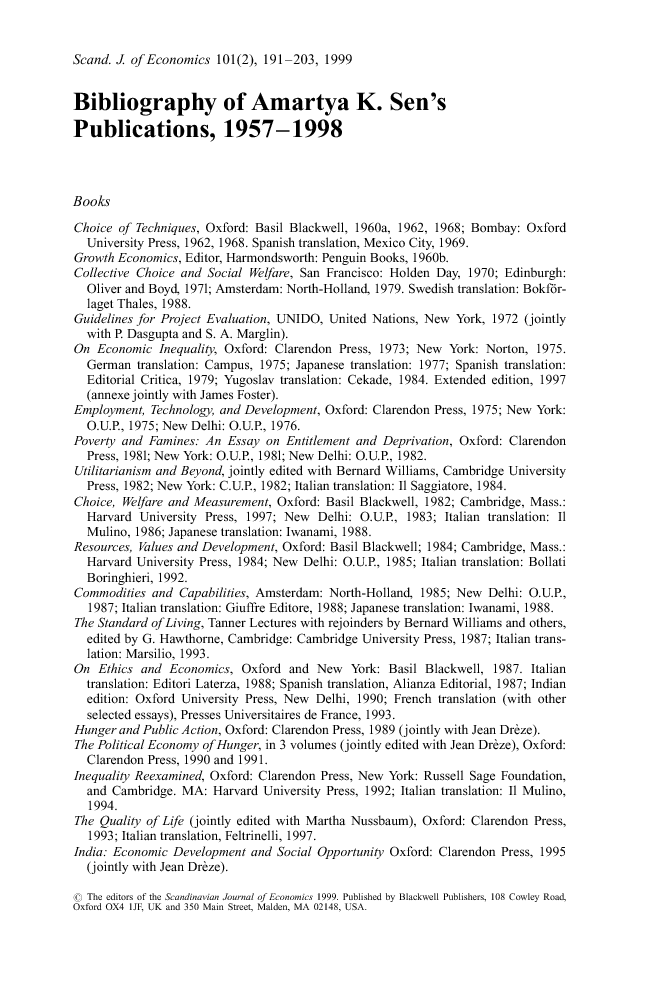
“A Review of Sukhamoy Chakravarty, Development Planning, The Indian Experience, Oxford: Clarendon Press, 1987, First published in Economic Affairs, London, 1988.
by
Subroto Roy

Readers of Economic Affairs may know that this reviewer has been far from sympathetic towards the thinking behind the process of economic planning in India.  In a recent IEA publication, (Pricing, Planning and Politics: A Study of Economic Distortions in India, Occasional Paper 69, 1984),  it was argued that the feasible role of the State has been fundamentally misconceived and misdescribed in independent India, with tragic consequences for both economy and polity. Without mitigating the force of that conclusion, it is possible to recommend the slim volume under review as indispensable to anyone seriously interested in the complexities of economic policy in India.

Sukhamoy Chakravarty is perhaps the foremost economist in India today.  He has been a principal student of the theory of development planning as well as instrumental in the formulation of economic policy in the country.  The work under review derives from his Radhakrishnan Memorial Lectures given at All Souls College, Oxford, in 1985.  It is a critical and yet sympathetic assessment of Indian experience, which offers critics of planning a more formidable foil than has been available thus far.

The key decisions which have shaped the present state of India’s economy and polity were taken in the mid 1950s by Jawaharlal Nehru on the advice of PC Mahalanobis.  Both had been impressed with what they supposed to be Soviet experience and disillusioned with what they supposed to be the experience of the relatively decentralized market economies of the West.  The decisions taken entailed, among other things, widespread and detailed regulation of private industry, large-scale industrial investments by the government, widespread and detailed control of foreign trade and payments, an assumption of inflows of foreign aid, and a neglect of agriculture.

Chakravarty suggests these decisions may have been rational at the time.  In other words, whatever we might think of them now, given the circumstances and the state of knowledge then, India did what India should have done.

The present reviewer disagrees.  The grounds for disagreement briefly are (a) a liberal alternative had been clearly expressed in India even in the 1950s (by B.R. Shenoy, Milton Friedman and Peter Bauer) but was for all practical purposes forcibly silenced; (b) this alternative has had at least as strong a claim, if not a much stronger claim, to economic reasoning and evidence than what came to be accepted.

Be this as it may, Chakravarty is a serious, scholarly, and undogmatic planner, and it so happens that several of his strongest opinions in the book are ones with which the liberal critic will have no disagreement at all.   For example, he stresses the great importance of providing infrastructure in agriculture, and of “the need to upgrade the quality of human agents through appropriate investment in health, education and nutrition” (p. 75).  T. W. Schultz of the University of Chicago has argued precisely the same for several decades now, and in fact received the Nobel Prize in recognition of it.  So had Milton Friedman in a Memorandum to the Government of India in 1955.  Then Chakravarty decries mere stimulation of monetary demand through what is called deficit financing, which amounts to little more than printing money” (p. 76), and points further to the government monopoly over the banking system, which gives it “command over financial savings of the community at largely negative real rates of interest” (p. 79).  Here Chakravarty draws upon his experience as chairman of a very important commission of the Reserve Bank of India, which, in an excellent report, made a candid assessment of the politicisation of the money supply in India (Report of the Committee to Review the Working of the Monetary System, Bombay: Reserve Bank of India, 1985).

Then Chakravarty speaks of the “level of efficiency in the operation and maintenance of the public sector”, and says “the type of managerial culture that is needed to realize a higher level of productivity of capital and labour cannot be reached with the present style of running public enterprises” (p. 79).

Critics of development planning can hardly be in disagreement with such statements.  They might add perhaps that a major way to improve competitiveness and raise revenues which could then go towards provision of public goods and investment in agriculture draw out the huge volumes of black money in the underground economy would be to sell most if not all of the non-defence public sector.  Combined with optimal provision of public goods, the deregulation of private industry and the encouragement of competition in all spheres, such a policy would go far towards a commonsensical approach at home, even while the economy remained relatively closed to the outside or opened only slowly.

Chakravarty expresses a considerable scepticism with respect to current beliefs in India that the importation of the latest industrial technologies will somehow swiftly turn the economy outward to export-led growth (pp.72-73).  His argument is sobering, as when he points to balance of payments problems in a transition and also to possible external constraints on the growth of exports.  This too the critic of Indian planning may find plausible.   And besides, if shallow liberalization fails, then there is danger that the real thing will never come to be tried.

In general, Chakravarty advocates a method of careful and undogmatic assessment of facts and given circumstances, followed by measured and incremental responses.  His splendid essays will be useful to friends and critics of development planning alike.”

Follow

Get every new post delivered to your Inbox.

Join 57 other followers