Land of my fathers: Why I am Indian

From Facebook:


Subroto Roy  says to Mr Tripathi: “An oath is an oath. For myself, my love for America, where I lived some 16 years, age 25-41, was enough for me to wish to become an American — if I did not have to abandon the land of my fathers which needed me perhaps more.”


see too https://independentindian.com/life-of-mk-roy-19152012-indian-aristocrat-diplomat-birth-centenary-concludes-7-nov-2016/


Is the Obama Doctrine as simple as this?

From Facebook:

I wonder if the Obama Doctrine for US Foreign Policy is going to be as simple as this:

the United States has no permanent intrinsic (ideological) enemies or competitors — not in the Muslim world, not Communist Party China, not Russia, not in Latin America;

the United States has no specific best buddies among the nations of the world — not Britain, not Israel (well, Canada, yes, the exception to the rule);

the United States will be a cooperative partner in peace and progress with any country that seeks this;

the United States will define enemies by their adversarial behaviour, so, e.g. Somali pirates risk getting shot, and violent jihadists like Hasan, KSM get what’s due.

Postscript: I am not saying this is something I would have or have not approved if I had been an American voter, merely that this appears to be the doctrine that seems to be revealed from President Obama’s actions thus far.

On the curious pre-9/11 quaintness of current criticism of India’s 1998 nuclear tests

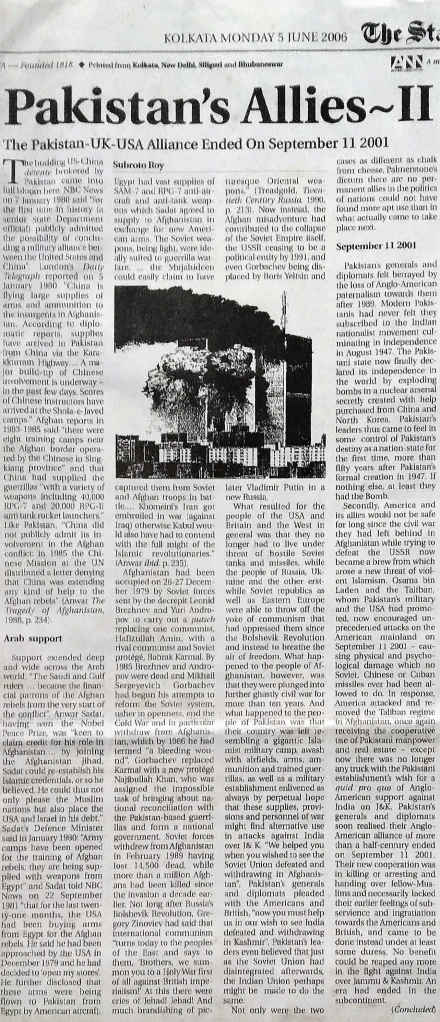
I said towards the end of my June 4-5 2006 article in The Statesman “Pakistan’s Allies”

“…America and its allies would not be safe for long since the civil war they had left behind in Afghanistan while trying to defeat the USSR now became a brew from which arose a new threat of violent Islamism. Osama bin Laden and the Taliban, whom Pakistan’s military and the USA had promoted, now encouraged unprecedented attacks on the American mainland on September 11 2001 ~ causing physical and psychological damage which no Soviet, Chinese or Cuban missiles ever had been allowed to do….”

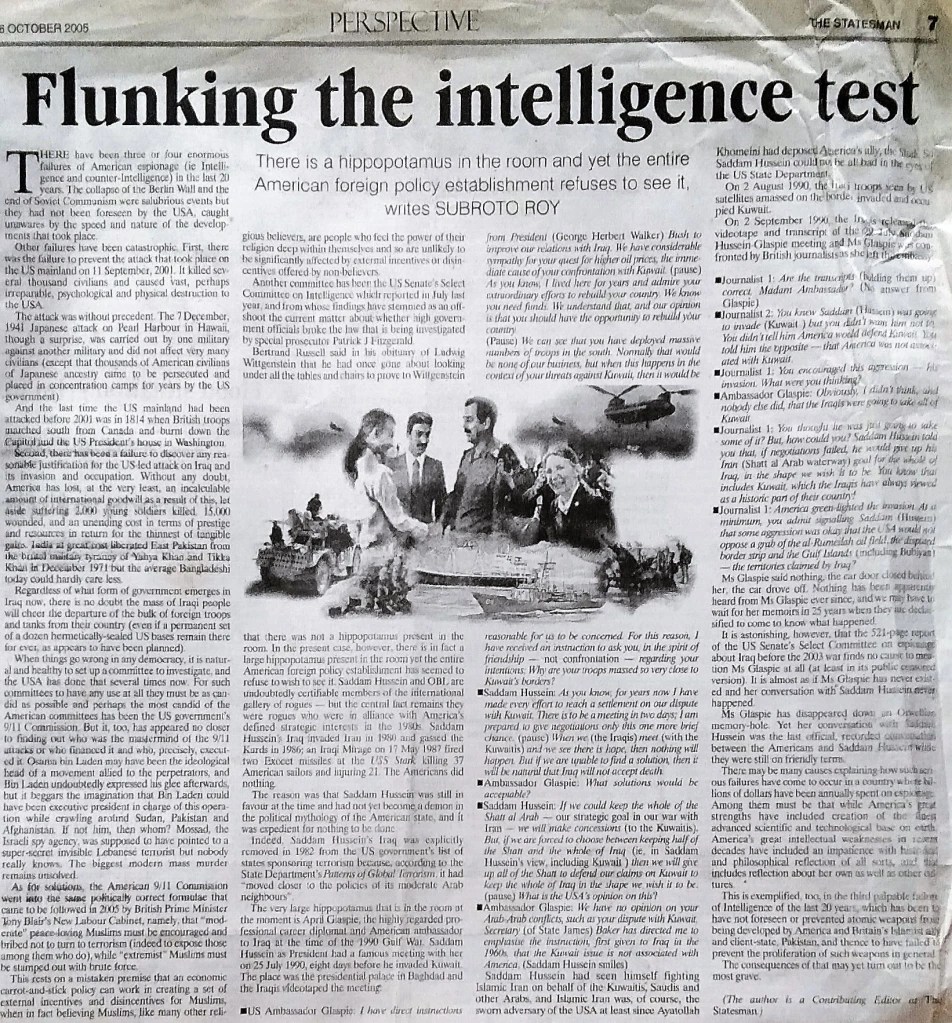
Earlier, in The Statesman of October 26 2005,  I had outlined a series of recent US espionage failures

“There have been three or four enormous failures of American espionage (i.e. intelligence and counter-intelligence) in the last 20 years. The collapse of the Berlin Wall and the end of Soviet communism were salubrious events but they had not been foreseen by the United States which was caught unawares by the speed and nature of the developments that took place. Other failures have been catastrophic.

First, there was the failure to prevent the attack that took place on the American mainland on September 11 2001. It killed several thousand civilians and caused vast, perhaps irreparable, psychological and physical destruction to the United States. The attack was without precedent. The December 7 1941 Japanese attack on Pearl Harbour in Hawaii, though a surprise, was carried out by one military against another military and did not affect very many civilians (except that thousands of American civilians of Japanese ancestry came to be persecuted and placed in concentration camps for years by the US Government). And the last time the American mainland had been attacked before 2001 was in 1814 when British troops marched south from Canada and burnt down the Capitol and the US President’s house in Washington.

Secondly, there has been a failure to discover any reasonable justification for the American-led attack on Iraq and its invasion and occupation. Without any doubt, America has lost, at the very least, an incalculable amount of international goodwill as a result of this, let aside suffering two thousand young soldiers killed, fifteen thousand wounded, and an unending cost in terms of prestige and resources in return for the thinnest of tangible gains. India at great cost liberated East Pakistan from the brutal military tyranny of Yahya Khan and Tikka Khan in December 1971 but the average Bangladeshi today could hardly care less. Regardless of what form of government emerges in Iraq now, there is no doubt the mass of the Iraqi people will cheer the departure of the bulk of foreign troops and tanks from their country (even if a permanent set of a dozen hermetically sealed American bases remain there for ever, as appears to have been planned).

When things go wrong in any democracy, it is natural and healthy to set up a committee to investigate, and America has done that several times now. For such committees to have any use at all they must be as candid as possible and perhaps the most candid of the American committees has been the US Government’s 9/11 Commission. But it too has appeared no closer to finding out who was the mastermind of the 9/11 attacks or who financed it and who, precisely, executed it. Osama Bin Laden may have been the ideological head of a movement allied to the perpetrators, and Bin Laden undoubtedly expressed his glee afterwards, but it beggars the imagination that Bin Laden could have been executive president in charge of this operation while crawling around Sudan, Pakistan and Afghanistan. If not him, then whom? Mossad the Israeli spy agency was supposed to have pointed to a super-secret invisible Lebanese terrorist but nobody really knows. The biggest modern mass murder remains unsolved.

As for solutions, the American 9/11 Commission went into the same politically correct formulae that came to be followed in 2005 by British PM Tony Blair’s New Labour Cabinet, namely, that “moderate” peace-loving Muslims must be encouraged and bribed not to turn to terrorism (indeed to expose those among them who do), while “extremist” Muslims must be stamped out with brute force. This rests on a mistaken premise that an economic carrot-and-stick policy can work in creating a set of external incentives and disincentives for Muslims, when in fact believing Muslims, like many other religious believers, are people who feel the power of their religion deep within themselves and so are unlikely to be significantly affected by external incentives or disincentives offered by non-believers.  Another committee has been the United States Senate’s Select Committee on Intelligence which reported in July 2004, and from whose findings have stemmed as an offshoot the current matter about whether high government officials broke the law that is being investigated by Special Prosecutor Patrick J. Fitzgerald.

Bertrand Russell said in his obituary of Ludwig Wittgenstein that he had once gone about looking under all the tables and chairs to prove to Wittgenstein that there was not a hippopotamus present in the room. In the present case, however, there is in fact a very large hippopotamus present in the room yet the entire American foreign policy establishment has seemed to refuse to wish to see it. Saddam Hussain and OBL are undoubtedly certifiable members of the international gallery of rogues – but the central fact remains they were rogues who were in alliance with America’s defined strategic interests in the 1980s. Saddam Hussain’s Iraq invaded Iran in 1980 and gassed the Kurds in 1986; an Iraqi Mirage on May 17 1987 fired two Exocet missiles at the USS Stark killing 37 American sailors and injuring 21. The Americans did nothing. The reason was that Saddam was still in favour at the time and had not yet become a demon in the political mythology of the American state, and it was expedient for nothing to be done. Indeed Saddam’s Iraq was explicitly removed in 1982 from the US Government’s list of states sponsoring terrorism because, according to the State Department’s Patterns of Global Terrorism, it had “moved closer to the policies of its moderate Arab neighbours”.

The very large hippopotamus that is present in the room at the moment is April Glaspie, the highly regarded professional career diplomat and American Ambassador to Iraq at the time of the 1990 Gulf War. Saddam Hussein as President had a famous meeting with her on July 25 1990, eight days before he invaded Kuwait. The place was the Presidential Palace in Baghdad and the Iraqis videotaped the meeting:

U.S. Ambassador Glaspie – “I have direct instructions from President (George Herbert Walker) Bush to improve our relations with Iraq. We have considerable sympathy for your quest for higher oil prices, the immediate cause of your confrontation with Kuwait. (pause) As you know, I lived here for years and admire your extraordinary efforts to rebuild your country. We know you need funds. We understand that, and our opinion is that you should have the opportunity to rebuild your country. (pause) We can see that you have deployed massive numbers of troops in the south. Normally that would be none of our business, but when this happens in the context of your threats against Kuwait, then it would be reasonable for us to be concerned. For this reason, I have received an instruction to ask you, in the spirit of friendship – not confrontation – regarding your intentions: Why are your troops massed so very close to Kuwait’s borders?

Saddam Hussein – As you know, for years now I have made every effort to reach a settlement on our dispute with Kuwait. There is to be a meeting in two days; I am prepared to give negotiations only this one more brief chance. (pause) When we (the Iraqis) meet (with the Kuwaitis) and we see there is hope, then nothing will happen. But if we are unable to find a solution, then it will be natural that Iraq will not accept death.

U. S. Ambassador Glaspie – What solutions would be acceptable?

Saddam Hussein – If we could keep the whole of the Shatt al Arab – our strategic goal in our war with Iran – we will make concessions (to the Kuwaitis). But, if we are forced to choose between keeping half of the Shatt and the whole of Iraq (i.e., in Saddam’ s view, including Kuwait ) then we will give up all of the Shatt to defend our claims on Kuwait to keep the whole of Iraq in the shape we wish it to be. (pause) What is the United States’ opinion on this?

U.S. Ambassador Glaspie – We have no opinion on your Arab – Arab conflicts, such as your dispute with Kuwait. Secretary (of State James) Baker has directed me to emphasize the instruction, first given to Iraq in the 1960’s, that the Kuwait issue is not associated with America. (Saddam smiles)

Saddam had seen himself fighting Islamic Iran on behalf of the Kuwaitis, Saudis and other Arabs, and Islamic Iran was of course the sworn adversary of the USA at least since Khomeini had deposed America’s ally, the Shah. Therefore Saddam could not be all bad in the eyes of the State Department. On August 2 1990, the Iraqi troops seen by American satellites amassed on the border, invaded and occupied Kuwait. On September 2 1990, the Iraqis released the videotape and transcript of the July 29 Saddam-Glaspie meeting and Glaspie was confronted by British journalists as she left the Embassy:

Journalist 1 – Are the transcripts (holding them up) correct, Madam Ambassador? (No answer from Glaspie)

Journalist 2 – You knew Saddam was going to invade (Kuwait ) but you didn’t warn him not to. You didn’t tell him America would defend Kuwait. You told him the opposite – that America was not associated with Kuwait.

Journalist 1 – You encouraged this aggression – his invasion. What were you thinking?

U.S. Ambassador Glaspie – Obviously, I didn’t think, and nobody else did, that the Iraqis were going to take all of Kuwait.

Journalist 1 – You thought he was just going to take some of it? But, how could you? Saddam told you that, if negotiations failed , he would give up his Iran(Shatt al Arab waterway) goal for the whole of Iraq, in the shape we wish it to be. You know that includes Kuwait, which the Iraqis have always viewed as a historic part of their country!

Journalist 1 – America green-lighted the invasion. At a minimum, you admit signalling Saddam that some aggression was okay – that the U.S. would not oppose a grab of the al-Rumeilah oil field, the disputed border strip and the Gulf Islands (including Bubiyan) – the territories claimed by Iraq?

Glaspie said nothing, the car door closed behind her, the car drove off. Nothing has been apparently heard from Glaspie ever since, and we may have to wait for her memoirs in 25 years when they are declassified to come to know what happened. It is astonishing, however, that the 521 page report of the US Senate’s Select Committee on espionage about Iraq before the 2003 war finds no cause whatsoever to mention Glaspie at all (at least in its public censored version). It is almost as if Glaspie has never existed and her conversation with Saddam never happened. Glaspie has disappeared down an Orwellian memory-hole. Yet her conversation with Saddam was the last official, recorded conversation between the Americans and Saddam while they were still on friendly terms.

There may be many causes explaining how such serious failures have come to occur in a country where billions of dollars have been annually spent on espionage. Among them must be that while America’s great strengths have included creation of the finest advanced scientific and technological base on earth, America’s great intellectual weaknesses in recent decades have included an impatience with historical and philosophical reflection of all sorts, and that includes reflection about her own as well as other cultures. This is exemplified too in the third palpable failure of intelligence of the last 20 years, which has been to have not foreseen or prevented atomic weapons from being developed by America and Britain’s Islamist ally and client-state, Pakistan, and thence to have failed to prevent the proliferation of such weapons in general. The consequences of that may yet turn out to be the most grave.”

Now as it happens, a couple of days ago, eleven years after the Government of India’s May 1998 underground nuclear tests at Pokhran, an Indian scientist who had something to do with them has engaged in a general discussion about the tests’ efficacy. Indian newspapers duly reported this as part of an ongoing domestic discussion about nuclear policy.

Oddly enough, there has been an instantaneous reaction from American critics of India’s nuclear activities – beginning with Dr Jeffrey Lewis:

“Yes, Virginia, India’s H-bomb fizzled.  K Santhanam (who was director of test site preparations for India’s 1998 nuclear tests… has admitted what everyone else has known for a long time — that India’s 1998 test of a thermonuclear device was unsuccessful.…”

Followed by Mark Hibbs:

“Is this cool or what? I remember what happened when I wrote that article in the fall of 1998 saying in the headline that the US had concluded that the Indian “H-Bomb failed.” Almost overnight after the article was published I got a huge bundle of papers from BARC and DAE sent to me by diplomatic pouch from Mumbai informing me with all kinds of numbers that I was wrong.  I gave the papers to laboratory geoscientists at several European countries and the US. One main CTBTO monitoring scientist told me explicitly: “Nope. The stuff in these papers is shitty science. They haven’t shown that you are wrong.” That having been said, please note however that, as PK Iyengar had made the case to me back a decade ago, once again this “news” is surfacing in India because their bomb makers want to keep testing. Some things in India are changing fast. Other things aren’t.”

Followed by Charles Mead:

“I got into a huge pissing match with the Indians on this issue as I was the principal author of Barker et. al. 1998 which had the yield estimates far below the Indian press releases. A number of Indian scientists tried to submit a comment to Science rebutting our analysis. We asked them to provide the in-country seismic data on which they based their analysis, but they refused. Luckily, in the end, their comment was rejected and never published.  On a related note, I saw the other day that wikipedia has a glowing description of the Indian 1998 tests, citing the inflated yields and saying the tests were a huge technical accomplishment. See http://en.wikipedia.org/wiki/Pokhran-II In the next day or so, I plan to submit a corrected analysis.”

Mark Hibbs:

“Charles, I recall one of your co-authors back then explained to me in nitty-gritty detail your frustration on this with these guys. Please do correct the record for posterity.”

Charles Meade:

“Their arguments at the time were quite remarkable. They said that our seismic data didn’t reflect the true yield because of a complex interference pattern caused by the simultaneous tests. Under these circumstances, they said that one could only obtain the correct yield from near field data. We said, “fine, show it to us”. They refused and that was the end of their paper.”

Yale Simkin:

“The Indian argument: ‘For us to have a nuclear deterrent we must weaponise. For this, we must have fusion weapons, because these are smaller, lighter, and more efficient than fission weapons.’ is a lot of hooey.  They claim to be building a deterrent force, not a war-fighting arsenal with a counter-force capability.  For the size and mass of their likely early-generation fusion designs, they can instead use basic fission bombs yielding in the multi-dekakiloton range – multiples of the hell weapons that incinerated Hiroshima and Nagasaki.  That should be sufficient to deter any rational adversary. And if they aren’t rational, then you have no deterrent.”

Hmmm.  The choice of terminology even within such a brief discussion might reveal a little of the mind-set: “shitty science”, “pissing match”, “a lot of hooey”…

Rather uncool, really.

Specifically:

“A number of Indian scientists tried to submit a comment to Science rebutting our analysis. We asked them to provide the in-country seismic data on which they based their analysis, but they refused. Luckily, in the end, their comment was rejected and never published…. Their arguments at the time were quite remarkable. They said that our seismic data didn’t reflect the true yield because of a complex interference pattern caused by the simultaneous tests. Under these circumstances, they said that one could only obtain the correct yield from near field data. We said, “fine, show it to us”. They refused and that was the end of their paper.

Hmmm — once more.  The words that I have placed in bold above might be prima facie evidence of incorrect and hence unfair editorial procedures having been followed at Science (distinguished as its general reputation may be as a journal).  Why were these here-unnamed “Indian scientists” not allowed to speak for themselves, rather than have their now-unknown statements be bowdlerised out of their critics’ memories a decade later (when these critics themselves had been the subject of the rebuttal)?  Perhaps the rebuttal should not have been refused publication even if it came with an editorial caveat that all the data deemed necessary had not been provided (which may have been the case, for example, due to a Government gag-order).  Readers today would have been able to judge for themselves.

I am happy to claim zero expertise in the field known rather sweetly as “Crater Morphology”; but post 9/11, post-Iraq war, it does seem to me a rather quaint form of prejudice to be using such words as those quoted above  in discussing the precise tonnage of the Indian explosions and how, really, India’s scientists were not up to it.  Perhaps,  when matters of public policy or international diplomacy become involved, science  everywhere is too important to be left to the scientists.

Are all the available data out there in the public domain on which to judge whether the Indian explosions in 1998 were or were not what was precisely claimed at the time?  Apparently not.

Does it matter to anything today?  Hardly.  Not even to the credibility of the Government of India (something on which I have had a lot to say over decades).

Do Governments lie?  Yes Virginia, they do.

Governments the world over, whether Indian, American, Russian, Chinese, British, French, Israeli, Arab, Pakistani or whatever, let aside inter-Governmental bodies constituted by these Governments, are prone to exaggeration, propaganda, self-delusion, self-deception as well as deliberate mendacity, perhaps routinely on a daily basis.

(For myself as an individual, I have had to battle the demonstrated and deliberate mendacity of the government of one of the fifty States in the US federal courts for two decades now, as told of elsewhere…)

An Age of Government Mendacity has seemed to descend upon the world — which makes the smugness expressed so quickly today by the critics of India’s 1998 explosions seem, as I have said, quaint.

Is the current Indian debate indicating something about keeping open the possibility of more tests and isn’t this related to the Indo-US civil nuclear deal?   It may well be, I do not know.  My position for what it is worth has been clear and described in several articles in The Statesman in recent years e.g.

1) Atoms for Peace (or War)  (March 5 2006)

“Atoms for Peace” was Dwight D. Eisenhower’s 1953 speech to the UN (presided over by Jawaharlal Nehru’s sister) from which arose the IAEA. Eisenhower was the warrior par excellence, having led the Allies to victory over Hitler a few years earlier.

Yet he was the first to see “no sane member of the human race” can discover victory in the “desolation, degradation and destruction” of nuclear war. “Occasional pages of history do record the faces of the ‘great destroyers’, but the whole book of history reveals mankind’s never-ending quest for peace and mankind’s God-given capacity to build.” Speaking of the atomic capacity of America’s communist adversary at the time, he said: “We never have, and never will, propose or suggest that the Soviet Union surrender what rightly belongs to it. We will never say that the peoples of the USSR are an enemy with whom we have no desire ever to deal or mingle in friendly and fruitful relationship.” Rather, “if the fearful trend of atomic military build-up can be reversed, this greatest of destructive forces can be developed into a great boon, for the benefit of all mankind…. if the entire body of the world’s scientists and engineers had adequate amounts of fissionable material… this capability would rapidly be transformed into universal, efficient and economic usage”. Eisenhower’s IAEA would receive contributions from national “stockpiles of normal uranium and fissionable materials”, and also impound, store and protect these and devise “methods whereby this fissionable material would be allocated to serve the peaceful pursuits of mankind.…to provide abundant electrical energy in the power-starved areas of the world… to serve the needs rather than the fears of mankind.” When Eisenhower visited India he was greeted as the “Prince of Peace” and a vast multitude threw rose petals as he drove by in an open limousine.

Now, half a century later, Dr Manmohan Singh read a speech in Parliament on February 27 relating to our nuclear discussions with America. But it seems unclear even his speech-writers or technical advisers knew how far it was rhetoric and how far grounded in factual realities. There is also tremendous naivete among India’s media anchors and political leaders as to what exactly has been agreed by the Americans on March 2.

Churchill once asked what might have happened if Lloyd George and Clemenceau told Woodrow Wilson: “Is it not true that nothing but your fixed and expiring tenure of office prevents you from being thrown out of power?” The same holds for George W. Bush today. Wilson made many promises to the world that came to be hit for a six by US legislators. In December 2005, Edward Markey (Democrat) and Fred Upton (Republican) promised to scuttle Bush’s agreements with India, and once the pleasant memories of his India visit fade, Bush may quite easily forget most things about us. All the Americans have actually agreed to do is to keep talking.

It needs to be understood that submarine-launched ballistic missiles are the only ultimate military deterrent. Land and air forces are all vulnerable to a massive first-strike. Only submarines lurking silently for long periods in waters near their target, to launch nuclear warheads upon learning their homeland had been hit by the enemy, act as a deterrent preventing that same enemy from making his attack at all. Indeed, the problem becomes how a submarine commander will receive such information and his instructions during such a war. (For India to acquire an ICBM capability beyond the MRBM Agni rockets is to possess an expensive backward technology — as retrograde as the idea India should spend scarce resources sending manned moon missions half a century after it has already been done. The secret is to do something new and beneficial for mankind, not repeat what others did long ago merely to show we can now do it too.) A nuclear-armed submarine needs to be submerged for long periods and also voyage long distances at sea, and hence needs to be nuclear-powered with a miniature version of a civilian nuclear reactor aboard in which, e.g. rods of enriched uranium are bombarded to release enough energy to run hydroelectric turbines to generate power. Patently, no complete separation of the use of atomic power for peace and war may be practically possible. If India creates e.g. its own thorium reactors for civilian power (and we have vast thorium reserves, the nuclear fuel of the future), and then miniaturised these somehow to manufacture reactors for submarines, the use would be both civilian and military. In 1988 the old USSR leased India a nuclear-powered submarine for “training” purposes, and the Americans did not like it at all. In January 2002, Russia’s Naval Chief announced India was paying to build and then lease from 2004 until 2009 two nuclear-powered Akula-class attack submarines, and Jaswant Singh reportedly said we were paying $1 thousand crore ($10 bn) for such a defence package. Whether the transaction has happened is not known. Once we have nuclear submarines permanently, that would be more than enough of the minimum deterrent sought.

Indeed, India’s public has been barely informed of civilian nuclear energy policy as well, and an opportunity now exists for a mature national debate to take place — both on what and why the military planning has been and what it costs (and whether any bribes have been paid), and also on the cost, efficiency and safety of the plans for greater civilian use of nuclear energy. Government behaviour after the Bhopal gas tragedy does not inspire confidence about Indian responses to a Three Mile Island/Chernobyl kind of catastrophic meltdown.

That being said, the central question remains why India or anyone else needs to be nuclear-armed at all. With Britain, France or Russia, there is no war though all three are always keen to sell India weapons. Indeed it has been a perennial question why France and Britain need their own deterrents. They have not fought one another for more than 100 years and play rugby instead. If Russia was an enemy, could they not count on America? Or could America itself conceivably become an enemy of Britain and France? America owes her origins to both, and though the Americans did fight the British until the early 1800s, they have never fought the French and love the City of Paris too much ever to do so.

Between China and India, regardless of what happened half a century ago, nuclear or any war other than border skirmishes in sparse barren lands is unlikely. Ever since Sun Yat-sen, China has been going through a complex process of self-discovery and self-definition. An ancient nation where Maoism despoiled the traditional culture and destroyed Tibet, China causes others to fear it because of its inscrutability. But it has not been aggressive in recent decades except with Taiwan. It has threatened nuclear war on America if the Americans stand up for Taiwan, but that is not a quarrel in which India has a cogent role. China (for seemingly commercial reasons) did join hands with Pakistan against India, but there is every indication the Chinese are quite bored with what Pakistan has become. With Pakistan, our situation is well-known, and there has been an implicit equilibrium since Pokhran II finally flushed out their capacity. Had India ever any ambition of using conventional war to knock out and occupy Pakistan as a country? Of course not. We are barely able to govern ourselves, let aside try to rule an ideologically hostile Muslim colony in the NorthWest. Pakistan’s purported reasons for acquiring nuclear bombs are spurious, and cruelly so in view of the abject failures of Pakistan’s domestic political economy. Could Pakistan’s Government use its bombs against India arising from its own self-delusions over J&K? Gohar Ayub Khan in 1998-1999 threatened to do so when he said the next war would be over in two hours with an Indian surrender. He thereby became the exception to Eisenhower’s rule requiring sanity. An India-Pakistan nuclear exchange is, unfortunately, not impossible, leaving J&K as Hell where Jahangir had once described it as Heaven on Earth.

America needs to end her recent jingoism and instead rediscover the legacy of Eisenhower. America can lead everyone in the world today including Russia, China, Israel, Iran and North Korea. But she can do so only by example. America can decommission many of her own nuclear weapons and then lead everyone else to the conference table to do at least some of the same. Like the UN, the IAEA (and its NPT) needs urgent reform itself. It is the right time for serious and new world parleys towards the safe use of atoms for peace and their abolition in war. But are there any Eisenhowers or Churchills to lead them?

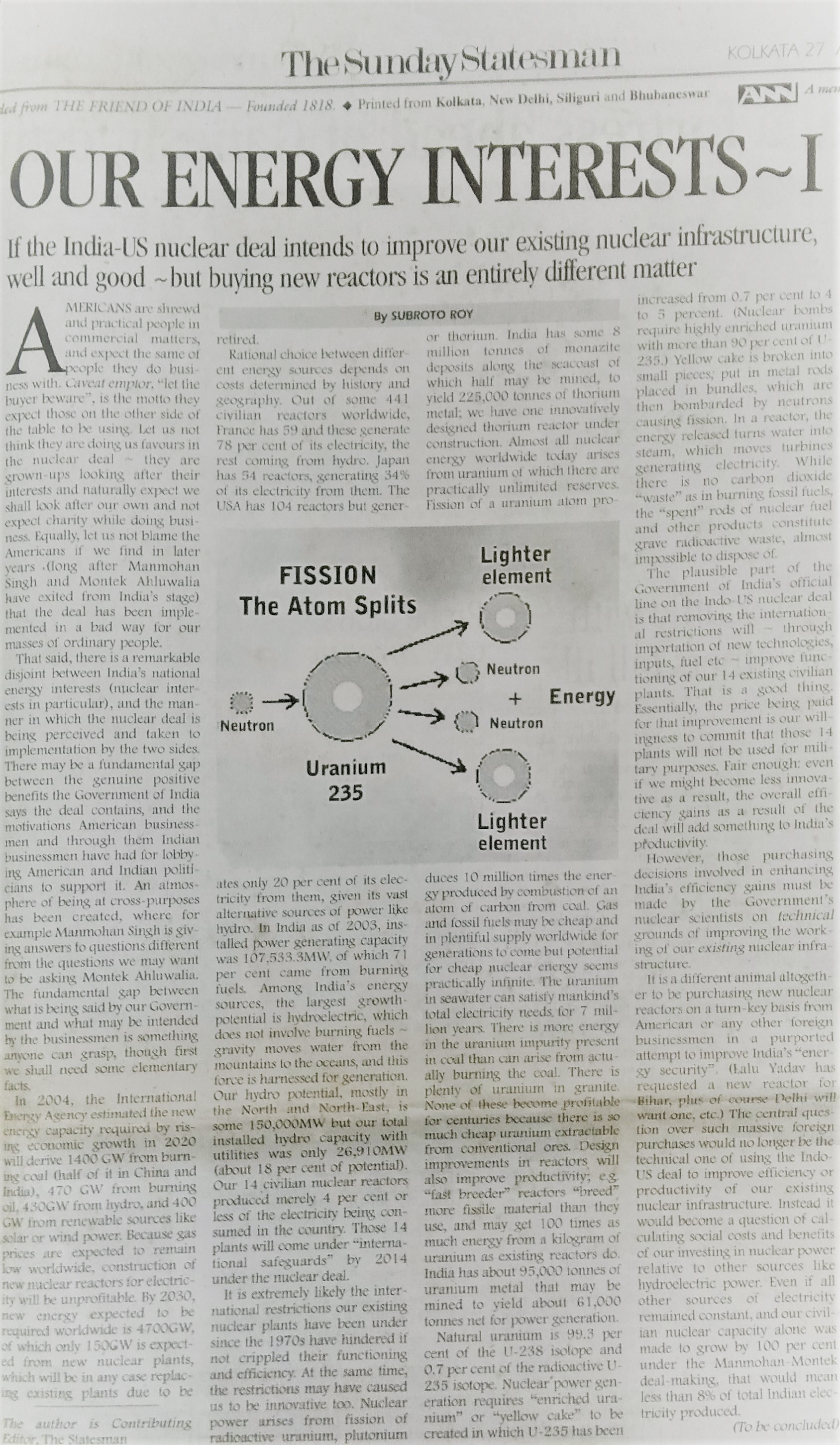
2) Our  energy interests ( Aug 27-28 2006)

Americans are shrewd and practical people in commercial matters, and expect the same of people they do business with. Caveat emptor, “let the buyer beware”, is the motto they expect those on the other side of the table to be using. Let us not think they are doing us favours in the nuclear deal ~ they are grown-ups looking after their interests and naturally expect we shall look after our own and not expect charity while doing business. Equally, let us not blame the Americans if we find in later years (long after Manmohan Singh and Montek Ahluwalia have exited from India’s stage) that the deal has been implemented in a bad way for our masses of ordinary people.

That said, there is a remarkable disjoint between India’s national energy interests (nuclear interests in particular), and the manner in which the nuclear deal is being perceived and taken to implementation by the two sides. There may be a fundamental gap between the genuine positive benefits the Government of India says the deal contains, and the motivations American businessmen and through them Indian businessmen have had for lobbying American and Indian politicians to support it. An atmosphere of being at cross-purposes has been created, where for example Manmohan Singh is giving answers to questions different from the questions we may want to be asking Montek Ahluwalia. The fundamental gap between what is being said by our Government and what may be intended by the businessmen is something anyone can grasp, though first we shall need some elementary facts.

In 2004, the International Energy Agency estimated the new energy capacity required by rising economic growth in 2020 will derive 1400 GW from burning coal (half of it in China and India), 470 GW from burning oil, 430GW from hydro, and 400 GW from renewable sources like solar or wind power. Because gas prices are expected to remain low worldwide, construction of new nuclear reactors for electricity will be unprofitable. By 2030, new energy expected to be required worldwide is 4700GW, of which only 150GW is expected from new nuclear plants, which will be in any case replacing existing plants due to be retired. Rational choice between different energy sources depends on costs determined by history and geography. Out of some 441 civilian reactors worldwide, France has 59 and these generate 78 per cent of its electricity, the rest coming from hydro. Japan has 54 reactors, generating 34% of its electricity from them. The USA has 104 reactors but generates only 20 per cent of its electricity from them, given its vast alternative sources of power like hydro. In India as of 2003, installed power generating capacity was 107,533.3MW, of which 71 per cent came from burning fuels. Among India’s energy sources, the largest growth-potential is hydroelectric, which does not involve burning fuels ~ gravity moves water from the mountains to the oceans, and this force is harnessed for generation. Our hydro potential, mostly in the North and North-East, is some 150,000MW but our total installed hydro capacity with utilities was only 26,910MW (about 18 per cent of potential). Our 14 civilian nuclear reactors produced merely 4 per cent or less of the electricity being consumed in the country. Those 14 plants will come under “international safeguards” by 2014 under the nuclear deal.

It is extremely likely the international restrictions our existing nuclear plants have been under since the 1970s have hindered if not crippled their functioning and efficiency. At the same time, the restrictions may have caused us to be innovative too. Nuclear power arises from fission of radioactive uranium, plutonium or thorium. India has some 8 million tonnes of monazite deposits along the seacoast of which half may be mined, to yield 225,000 tonnes of thorium metal; we have one innovatively designed thorium reactor under construction. Almost all nuclear energy worldwide today arises from uranium of which there are practically unlimited reserves. Fission of a uranium atom produces 10 million times the energy produced by combustion of an atom of carbon from coal. Gas and fossil fuels may be cheap and in plentiful supply worldwide for generations to come but potential for cheap nuclear energy seems practically infinite. The uranium in seawater can satisfy mankind’s total electricity needs for 7 million years. There is more energy in the uranium impurity present in coal than can arise from actually burning the coal. There is plenty of uranium in granite. None of these become profitable for centuries because there is so much cheap uranium extractable from conventional ores. Design improvements in reactors will also improve productivity; e.g. “fast breeder” reactors “breed” more fissile material than they use, and may get 100 times as much energy from a kilogram of uranium as existing reactors do. India has about 95,000 tonnes of uranium metal that may be mined to yield about 61,000 tonnes net for power generation. Natural uranium is 99.3 per cent of the U-238 isotope and 0.7 per cent of the radioactive U-235 isotope. Nuclear power generation requires “enriched uranium” or “yellow cake” to be created in which U-235 has been increased from 0.7 per cent to 4 to 5 percent. (Nuclear bombs require highly enriched uranium with more than 90 per cent of U-235.) Yellow cake is broken into small pieces, put in metal rods placed in bundles, which are then bombarded by neutrons causing fission. In a reactor, the energy released turns water into steam, which moves turbines generating electricity. While there is no carbon dioxide “waste” as in burning fossil fuels, the “spent” rods of nuclear fuel and other products constitute grave radioactive waste, almost impossible to dispose of.

The plausible part of the Government of India’s official line on the Indo-US nuclear deal is that removing the international restrictions will ~ through importation of new technologies, inputs, fuel etc ~ improve functioning of our 14 existing civilian plants. That is a good thing. Essentially, the price being paid for that improvement is our willingness to commit that those 14 plants will not be used for military purposes. Fair enough: even if we might become less innovative as a result, the overall efficiency gains as a result of the deal will add something to India’s productivity. However, those purchasing decisions involved in enhancing India’s efficiency gains must be made by the Government’s nuclear scientists on technical grounds of improving the working of our existing nuclear infrastructure.

It is a different animal altogether to be purchasing new nuclear reactors on a turn-key basis from American or any other foreign businessmen in a purported attempt to improve India’s “energy security”. (Lalu Yadav has requested a new reactor for Bihar, plus of course Delhi will want one, etc.) The central question over such massive foreign purchases would no longer be the technical one of using the Indo-US deal to improve efficiency or productivity of our existing nuclear infrastructure. Instead it would become a question of calculating social costs and benefits of our investing in nuclear power relative to other sources like hydroelectric power. Even if all other sources of electricity remained constant, and our civilian nuclear capacity alone was made to grow by 100 per cent under the Manmohan-Montek deal-making, that would mean less than 8% of total Indian electricity produced.

This is where the oddities arise and a disjoint becomes apparent between what the Government of India is saying and what American and Indian businessmen have been doing. A “US-India Business Council” has existed for thirty years in Washington as “the premier business advocacy organization promoting US commercial interests in India.… the voice of the American private sector investing in India”. Before the nuclear or any other deals could be contemplated with American business, the USIBC insisted we pay up for Dabhol contracted by a previous Congress Government. The Maharashtra State Electricity Board ~ or rather, its sovereign guarantor the Government of India ~ duly paid out at least $140-$160 million each to General Electric and Bechtel Corporations in “an amicable settlement” of the Dabhol affair. Afterwards, General Electric’s CEO for India was kind enough to say “India is an important country to GE’s global growth. We look forward to working with our partners, customers, and State and Central Governments in helping India continue to develop into a leading world economy”.

Also, a new “US-India CEO Forum” then came about. For two Governments to sponsor private business via such a Forum was “unprecedented”, as noted by Washington’s press during Manmohan Singh’s visit in July 2005. America’s foreign ministry announced it saying: “Both our governments have agreed that we should create a high-level private sector forum to exchange business community views on key economic priorities…” The American side includes heads of AES Corporation, Cargill Inc., Citigroup, JP Morgan Chase, Honeywell, McGraw-Hill, Parsons Brinckerhoff Ltd, PepsiCo, Visa International and Xerox Corporation. The Indian side includes heads of Tata Group, Apollo Hospitals Group, Bharat Forge Ltd, Biocon India Group, HDFC, ICICI One Source, Infosys, ITC Ltd, Max India Group and Reliance Industries. Presiding over the Indian side has been Montek Ahluwalia, Manmohan’s trusted aide ~ and let it be remembered too that the Ahluwalias were Manmohan’s strongest backers in his failed South Delhi Lok Sabha bid. (Indeed it is not clear if the Ahluwalias have been US or Indian residents in recent years, and if it is the former, the onus is on them to clear any perception of conflict of interest arising in regard to roles regarding the nuclear deal or any other official Indo-US business.)

Also, before the Manmohan visit, the Confederation of Indian Industry registered as an official lobbyist in Washington, and went about spending half a million dollars lobbying American politicians for the nuclear deal. After the Manmohan visit, the US Foreign Commercial Service reportedly said American engineering firms, equipment suppliers and contractors faced a $1,000 billion (1 bn =100 crore) opportunity in India. Before President Bush’s visit to India in March 2006, Manmohan Singh signed vast purchases of commercial aircraft from Boeing and Airbus, as well as large weapons’ deals with France and Russia. After the Bush visit, the US Chamber of Commerce said the nuclear deal can cause $100 billion worth of new American business in India’s energy-sector alone. What is going on?

Finally, the main aspect of Manmohan Singh’s address to America’s legislature had to do with agreeing with President Bush “to enhance Indo-US cooperation in the field of civilian nuclear technology”. What precisely does this mean? If it means the Indo-US nuclear deal will help India improve or maintain its existing nuclear infrastructure, well and good. There may be legitimate business for American and other foreign companies in that cause, which also helps India make the efficiency and productivity gains mentioned. Or has the real motivation for the American businessmen driving the deal (with the help of the “CEO Forum” etc) been to sell India nuclear reactors on a turn-key basis (in collaboration with private Indian businessmen) at a time when building new nuclear reactors is unprofitable elsewhere in the world because of low gas prices? India’s citizens may demand to know from the Government whether the Manmohan-Montek deal-making is going to cause importation of new nuclear reactors, and if so, why such an expensive alternative is being considered (relative to e.g. India’s abundant hydroelectric potential) when it will have scant effect in satisfying the country’s energy needs and lead merely to a worsening of our macroeconomic problems. Both Manmohan Singh and Montek Ahluwalia have been already among those to preside over the growth of India’s macroeconomic problems through the 1980s and 1990s.

Lastly, an irrelevant distraction should be gotten out of the way. Are we a “nuclear weapons” state? Of course we are, but does it matter to anything but our vanity? Ronald Reagan and Mikhail Sergeyevich Gorbachev had control over vastly more nuclear weapons and they declared together twenty years ago: “A nuclear war cannot be won and must not be fought”, which is how the Cold War started to come to an end. We need to remind ourselves that India and Pakistan are large, populous countries with hundreds of millions of materially poor, ill-informed citizens, weak tax-bases, humongous internal and external public debts (i.e. debt owed by the Government to domestic and foreign creditors), non-investment grade credit- ratings in world financial markets, massive annual fiscal deficits, inconvertible currencies, nationalized banks, and runaway printing of paper-money. Discussing nuclear or other weapon-systems to attack one other with is mostly a pastime of our cowardly, irresponsible and yes, corrupt, elites.

3) Need for Clarity A poorly drafted treaty driven by business motives is a recipe for international misunderstanding  (August 19 2007)

Confusion prevails over the Indo-US Nuclear Deal. Businessmen, bureaucrats, politicians, diplomats, scientists and now the public at large have all joined in the cacophony in the last two years. On Wednesday August 15, America’s foreign ministry made the clearest most unequivocal statement possible as to the official American Government interpretation of the Indo-US nuclear deal: “The proposed 123 agreement has provisions in it that in an event of a nuclear test by India, then all nuclear co-operation is terminated, as well as there is provision for return of all materials, including reprocessed material covered by the agreement” (Sean McCormack). Yet our Prime Minister had told Parliament two days earlier: “The agreement does not in any way affect India’s right to undertake future nuclear tests, if it is necessary”. What is going on? Our politics are in uproar, and it has been suggested in these pages that the country go to a General Election to allow the people to speak on the matter. Clearly, we need some clarity.

Let us start at the beginning. How did it all originate? The private US nuclear industry prevailed upon India’s government bureaucrats and businessmen over several years that nuclear power is the way forward to solving India’s “infrastructure” problems. They would sell us, in words of the Manmohan-Montek Planning Commission’s energy adviser, “six to eight lightwater reactors” (especially as they may not be able to sell these anywhere else). Our usual prominent self-seeking retired bureaucrats started their waffling about the importance of “infrastructure”.

Then Manmohan Singh felt his foreign travels as PM could be hardly complete without a fife-and-drum visit to the White House. But before he could do so, Dabhol would have to be cleared up since American business in India was on a self-moratorium until GE and Bechtel were paid settlements of some $140-160 million each by the Governments of India and Maharashtra. GE’s CEO for India kindly said afterwards “India is an important country to GE’s global growth. We look forward to working with our partners, customers, and State and Central Governments in helping India continue to develop into a leading world economy”.

Also, before Manmohan’s USA trip, the Confederation of Indian Industry registered as an official Washington lobbyist and spent half a million dollars lobbying American politicians for the deal. (”Why?” would be a good question.)

So Dr Singh was able to make his White House visit, accompanied by US business lobbies saying the nuclear deal can generate $100 billion worth of new American business in India’s energy-sector alone. It is only when business has lubricated politics in America that so much agreement about the India-deal could arise. The “bottom-line” is that six to eight reactors must be sold to India, whatever politics and diplomacy it takes.

Now Dr Singh is not a PM who is a Member of the Lower House of Parliament commanding its confidence. He says his Government constitutes the Executive and can sign treaties on India’s behalf. This is unwise. If he signs a treaty and then the Congress Party loses the next General Election, a new Executive Government can use his same words to rescind the same treaty. What is sauce for the goose is sauce for the gander. One reason we are so confused is that India has not signed very many bilateral treaties, and there is barely a noted specialist in international law anywhere in the country. Dr Singh’s original mentor, PN Haksar, had gone about getting a treaty signed with the USSR back in 1971 which tided us over a war, though the USSR itself collapsed before that treaty ended.

Signing a treaty is much more than signing an international MOU. It requires a national consensus or a least a wide and deep understanding on the part of the public and the political class as to what necessitates the treaty. That plainly does not exist at present. Most people in India do not even know how nuclear power is generated, nor how small and insignificant nuclear power has been in India.

Natural uranium is 99.3 per cent of the U-238 isotope and 0.7 per cent the radioactive U-235 isotope. Nuclear power generation requires “enriched uranium” or “yellow cake” to be created in which U-235 has been increased from 0.7 per cent to 4 to 5 percent. (Nuclear bombs require “highly enriched” uranium with more than 90 per cent of U-235.) Yellow cake is broken into small pieces, put in metal rods placed in bundles, which are then bombarded by neutrons causing fission. In a reactor, the energy released turns water into steam, which moves turbines generating electricity. While there is no carbon dioxide “waste” as in burning fossil fuels, the “spent” rods of nuclear fuel and other products constitute grave radioactive waste, almost impossible to dispose of.

India’s 14 “civilian” nuclear reactors presently produce less than 4% of our total power. 70% of our power arises from burning fossil fuels, mainly coal. Much of the rest arises from hydro. We have vast hydroelectric potential in the North and Northeast but it would take a lot of serious political, administrative and civil engineering effort to organise all that, and there would not be any nice visits to Washington or Paris involved for politicians and bureaucrats.

Simple arithmetic says that even if all our principal energy sources stayed constant and only our tiny nuclear power sector grew by 100%, that would still hardly increase by very much our energy output overall. Placing a couple of expensive modern lightwater reactors around Delhi, a couple around Mumbai and a few other metros will, however, butter already buttered bread quite nicely and keep all those lifts and ACs running.

The agreed text of the “treaty” looks, from a legal standpoint, quite sloppily and hurriedly written ~ almost as if each side has cut and paste its own preferred terms in different places with a nod to the other side. For example, there is mention of “WMD” initially which is repeated as “weapons of mass destruction” just a little later. There is solemn mention of the “Government of India” and “Government of the United States of America” as the “Parties”, but this suddenly becomes merely “United States” and “India” in the middle and then reverts again to the formal usage.

Through the sloppiness comes scope for different interpretations. The Americans have said: try not to test, you don’t need to, we don’t test any more, and you have to know that if you do test, this deal is over, in fact it gets reversed. We have said, okay, we won’t test, and if we do test we know it is over with you but that does not mean it is over with others. Given such sloppy diplomacy and treaty-making, the scope for mutual misunderstanding, even war, remains immense long after all the public Indian moneys have found their way into private pockets worldwide. Will a future President Jeb Bush or Chelsea Clinton send F-22 bombers to bomb India’s nuclear facilities because India has carried out a test yet declined to return American equipment? Riding a tiger is not something generally to be recommended.

The answer to our present conundrum must be patience and the fullest transparency. What is the rush? If it is good or bad for us to buy six or eight new American reactors now, it will remain good or bad to do so a year or two from now after everyone has had a thorough think about everything that is involved. What the Manmohan-Montek Planning Commission needed to do first of all was a thorough cost-benefit analysis of India’s energy requirements but such elementary professionalism has been sorely lacking among our economists for decades.”

Subroto Roy

Can President Obama resist the financial zombies (let alone slay them)? His economists need to consult Dr Anna J Schwartz

The wonders of the Internet continue to surprise (and yes Virginia, there was a world before SMS and before the Internet too).  In early January, in context of India’s Satyam fraud (of a size of perhaps 1 or perhaps 2 billion dollars),  I referred here  to what seemed to me the likelihood of Satyam becoming a zombie company and I said “we in India have many such zombies walking around in the organised business sector”.    I drew attention to Andrew Beattie’s astute  definition of zombies and other such ghoulish phenomena in the financial world, and also referred to John Stepek’s excellent if brief November 2008 analysis “How zombie companies suck the life from an economy”.  Today I find Ms Arianna Huffington has made reference to Mr Martin Wolf’s reference a couple of days ago to zombie companies and to his statement that President Obama needs to “Admit reality, restructure banks and, above all, slay zombie institutions at once.”  Ms Huffington has agreed, though of course all this slaying may be easier said than done.  (It is better that zombies not be created in the first place.)

Mr Wolf has pointedly asked a question that many around the world may have half-thought about but not articulated: “Has Barack Obama’s presidency already failed?”   It would be  a grave and appalling  state of affairs if it has, within less than a month of entering office.   I am grateful to find in Ms Huffington’s article a reference to an October 2008  Wall Stret Journal interview of Dr Anna Jacobson Schwartz, perhaps the most respected voice in monetary economics today.  There have been numerous people claiming to have predicted America’s financial crisis but none may have as much credibility as Dr Schwartz.   Six years ago, in a National Bureau of Economic Research study dated November 2002, “Asset Price Inflation and Monetary Policy”,Working Paper 9321 she had said with utmost clarity: “It is crucial that central banks and regulatory authorities be aware of effects of asset price inflation on the stability of the financial system. Lending activity based on asset collateral during the boom is hazardous to the health of lenders when the boom collapses. One way that authorities can curb the distortion of lenders’ portfolios during asset price booms is to have in place capital requirements that increase with the growth of credit extensions collateralized by assets whose prices have escalated. If financial institutions avoid this pitfall, their soundness will not be impaired when assets backing loans fall in value. Rather than trying to gauge the effects of asset prices on core inflation, central banks may be better advised to be alert to the weakening of financial balance sheets in the aftermath of a fall in value of asset collateral backing loans….”

Most poignantly too, Dr Schwartz was present when Ben Bernanke said  in  a 2002 speech honouring the late Milton Friedman “I would like to say to Milton and Anna: Regarding the Great Depression. You’re right, we did it. We’re very sorry. But thanks to you, we won’t do it again.”   Dr Schwartz told the Wall Street Journal ‘”This was [his] claim to be worthy of running the Fed”.  “He was ‘familiar with history. He knew what had been done.’ But perhaps this is actually Mr. Bernanke’s biggest problem. Today’s crisis isn’t a replay of the problem in the 1930s, but our central bankers have responded by using the tools they should have used then. They are fighting the last war. The result, she argues, has been failure. ‘I don’t see that they’ve achieved what they should have been trying to achieve. So my verdict on this present Fed leadership is that they have not really done their job.'”

President Obama’s economists need to urgently consult Anna J Schwartz.

Subroto Roy, Kolkata

Postscript:  My own brief views on the subject are at “October 1929? Not!” dated September 18 2008, and “America’s divided economists” dated October 26 2008.  The latter article suggested that playing the demographic card and inducing a wave of immigration into the United States may be the surest way to move the housing demand-curve firmly upwards.

American Voices: A Brief Popular History of the United States in 20 You-Tube Music Videos

Someone once wondered if you can play chess without the Queen;  I wonder,  can a poem be written without words?

Certainly no country other than the United States might have its modern history sought to be told of  in a  medley such as this.

SR

2009 “Yes we might be able to do that. Perhaps we ought to. But again, perhaps we ought not to, let me think about it…. Most important is Cromwell’s advice: Think it possible we may be mistaken!”

President Barack Obama will be in all likelihood as worthy and competent a head of state and head of government as there has been anywhere, and, as he enters his high office, he deserves the good wishes of the world.

The beautiful  State of Hawaii can proudly call him its most famous native son.

South Beretania where he apparently lived some years is a short walk from my Punahou  condo, from which could be seen the  school the new President attended for some time.   He happens to be the first  US President in my lifetime whom I find myself older than in age.

I expect President Obama may well find  governance  to be  much different from the campaign:  requiring more truth and less rhetoric,  more circumspection and  less dogmatism.

“Yes we can” will likely have to give way to something like “Yes we might be able to do that.  Perhaps we ought to.  But again, perhaps we ought not to.  I think I’ll have to think about this one more time.”

Most important might be the words of Oliver Cromwell: “Think it possible you may be mistaken”.

Postscript: yes I met Obama’s mother in the lift at Porteus Hall for about 15 seconds c. 1986-87, and a decade earlier at LSE I found his father’s economics articles in perhaps QJE etc

Subroto Roy January 20 2009

How to solve Kashmir (2009)

see

https://independentindian.com/2015/03/03/pakistans-indias-illusions-of-power-psychosis-vs-vanity/

https://independentindian.com/2011/10/13/my-seventy-one-notes-at-facebook-etc-on-kashmir-pakistan-and-of-course-india-listed-thanks-to-jd/

Also

from Jan 2009
It is excellent news Omar Abdullah has become the constitutionally elected Head of Government of the great Indian state of Jammu & Kashmir after a historic vote.  I had the privilege of meeting his esteemed father briefly once on 23 March 1991 at the residence of the late Rajiv Gandhi though it would be understandable if he did not recall it.  Farooq Abdullah’s father Sheikh Abdullah was not merely a Lion of Kashmir but a genuine hero of Indian history, a true Bharat Ratna, someone whose commitment to constitutional principles of law and politics I admire more and more as I learn more of it…

The purpose of this open letter is to describe the broad path I believe to be the only just and lawful one available to the resolution of what has been known universally as the Kashmir problem.

Very briefly, it involves recognizing that the question of lawful territorial sovereignty in J&K is logically distinct from the question of the choice of nationality by individual inhabitants.  The solution requires

(a)    acknowledging that the original entity in the world system known as Jammu & Kashmir arising on March 16 1846 ceased to exist on or about October 22 1947, and that the military contest that commenced on the latter date has resulted in fact, given all particular circumstances of history, in the lawful and just outcome in international law;
(b)    offering all who may be Indian nationals or stateless and who presently live under Article 370, a formal choice of nationality between the Republics of India, Iran, Afghanistan and Pakistan: citizen-by-citizen, without fear or favour, under conditions of full information, individual privacy and security; any persons who voluntarily choose to renounce Indian nationality in such private individual decisions would be nevertheless granted lawful permanent residence in the Indian Republic and J&K in particular.

In other words, the dismemberment of the original J&K State and annexation of its territories by the entities known today as the Republic of Pakistan and Republic of India  that occurred since October 22 1947, as represented first by the 1949 Ceasefire Line and then by the 1972 Line of Control, is indeed the just and lawful outcome prevailing in respect of the question of territorial sovereignty and jurisdiction. The remaining democratic question has to do with free individual choice of nationality by inhabitants, under conditions of full information and privacy, citizen-by-citizen, with the grant of permanent residency rights by the Indian Republic to persons under its jurisdiction in J&K who might wish to choose, for deeply personal individual reasons, not to remain Indian nationals but become Afghan, Iranian or Pakistani nationals instead (or remain stateless).   Pakistan has said frequently its sole concern has been the freedom of Muslims of J&K under Indian rule, and any such genuine concern shall have been thereby fully met by India.  Indeed if Pakistan agreed to act similarly this entire complex mortal problem of decades shall have begun to be resolved most appropriately. Pakistan and India are both wracked by corruption, poverty and bad governance, and would be able to mutually draw down military forces pit against one another everywhere, so as to begin to repair the grave damage to their fiscal health caused over decades by the deleterious draining away of vast public resources.

The full reasoning underlying this solution, which I believe to be the only lawful, just, efficient and stable solution that exists, is thoroughly explained in the following five  articles. The first four, “Solving Kashmir”, “Law, Justice & J&K”, “History of J&K”, and “Pakistan’s Allies”, were published in The Statesman in 2005-2006 and are marked ONE, TWO, THREE, and FOUR below, and are also available elsewhere here.  The fifth “An Indian Reply to President Zardari”, marked FIVE, was published for the first time here following the Mumbai massacres.  I believe careful reflection upon this entire body of reasoning may lead all reasonable men and women to a practically unanimous consensus about this as the appropriate course of action; if such a consensus happened to arise, the implementation of the solution shall only be a matter of relatively uncomplicated procedural detail.

Subroto Roy
January 7 2009

“ONE
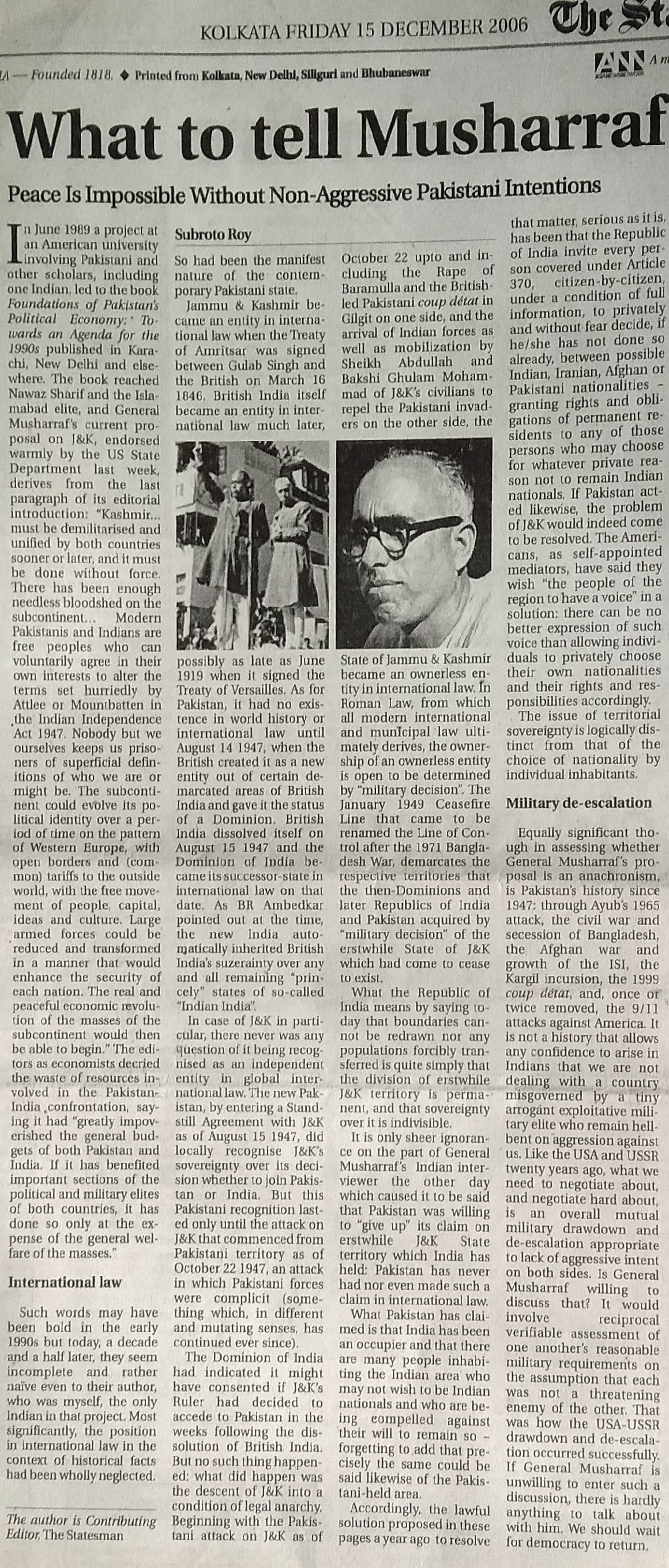
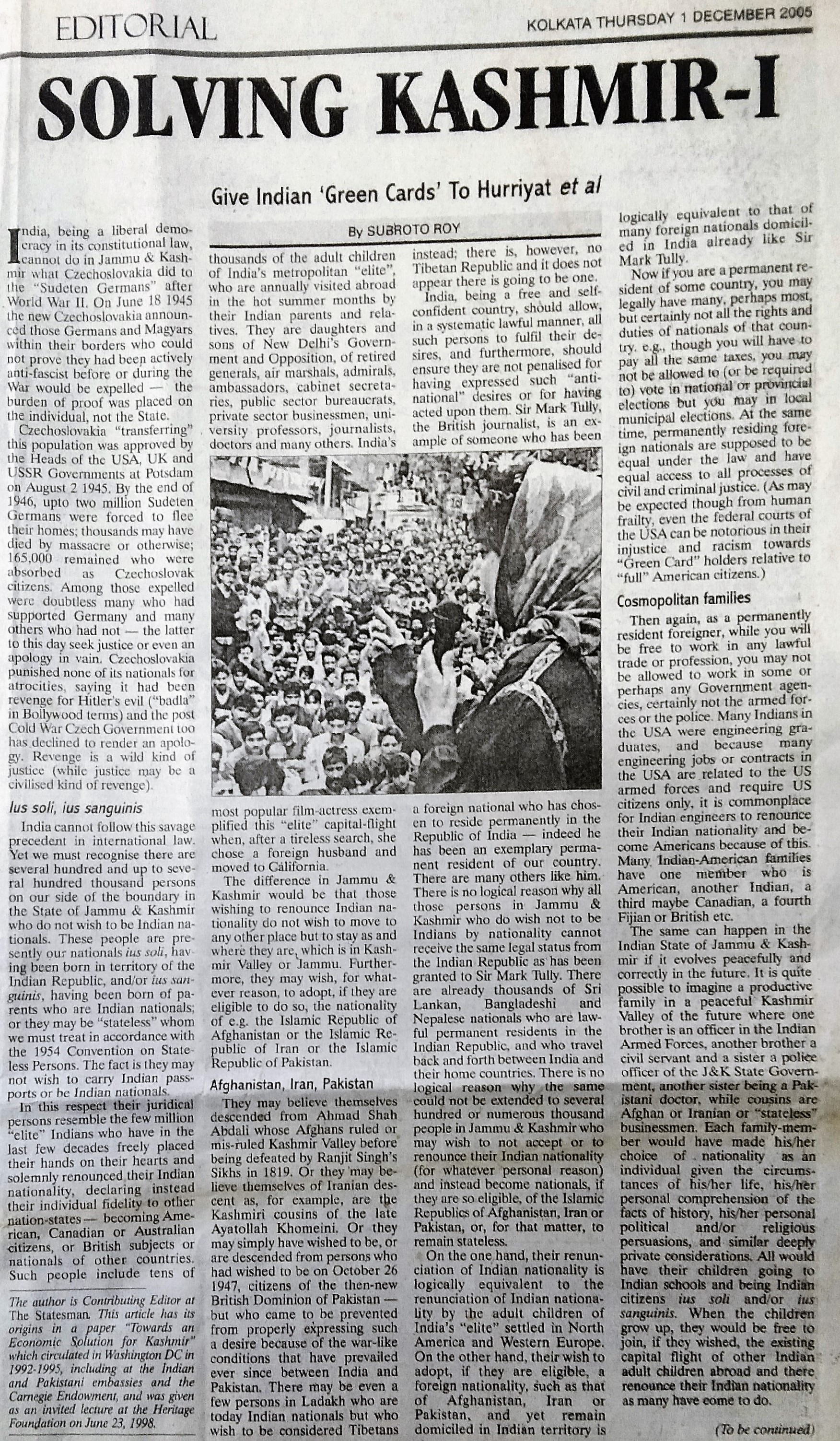
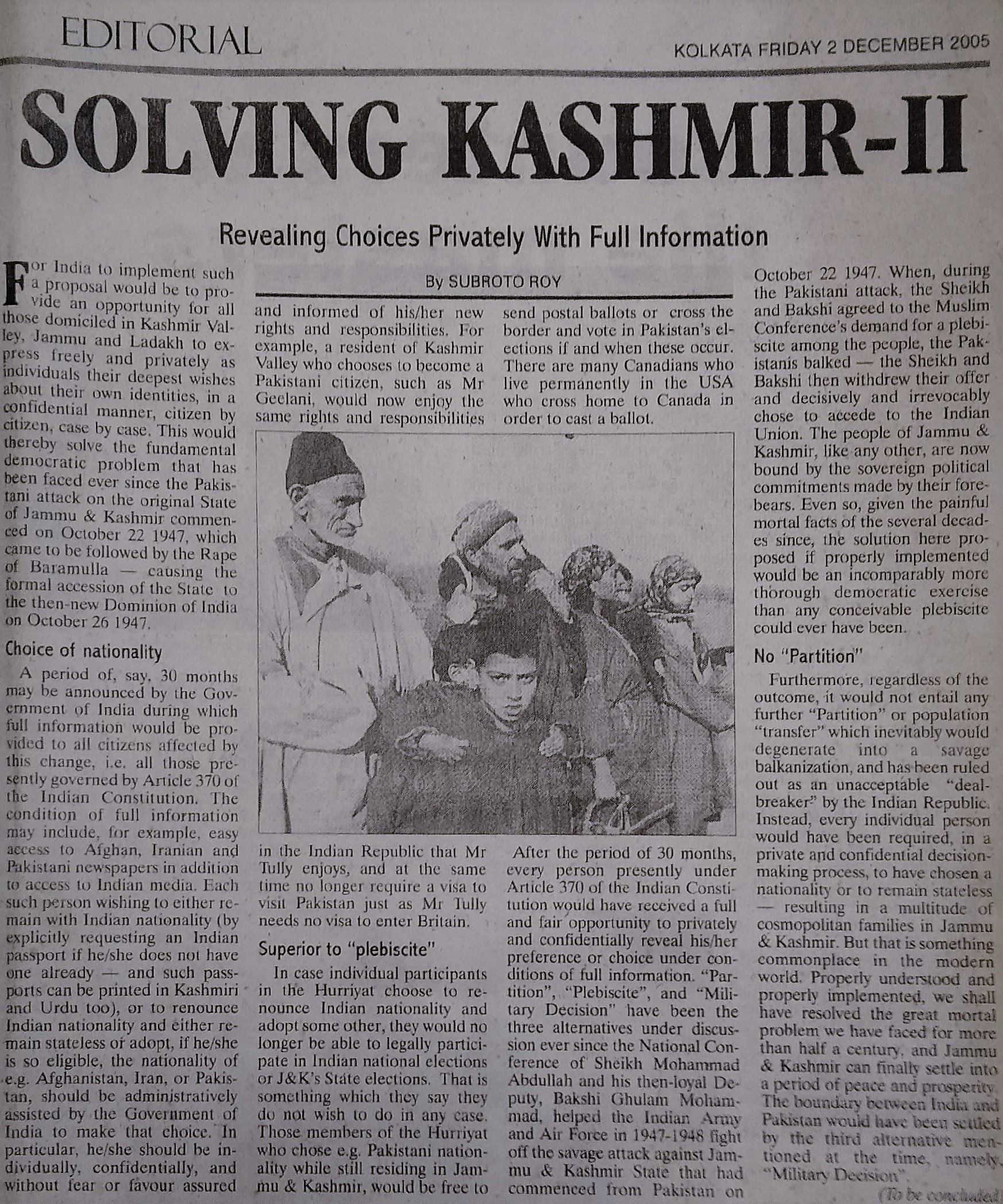
SOLVING KASHMIR: ON AN APPLICATION OF REASON by Subroto Roy First published in three parts in The Statesman, Editorial Page Special Article, December 1,2,3 2005, http://www.thestatesman.net

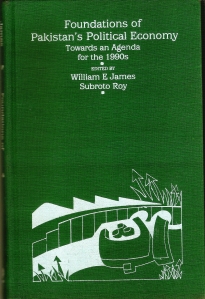
(This article has its origins in a paper “Towards an Economic Solution for Kashmir” which circulated in Washington DC in 1992-1995, including at the Indian and Pakistani embassies and the Carnegie Endowment, and was given as an invited lecture at the Heritage Foundation on June 23 1998. It should be read along with other articles also republished here, especially “History of J&K”, “Law, Justice and J&K” , “Understanding Pakistan”, “Pakistan’s Allies” and “What to Tell Musharraf”. The Washington paper and lecture itself originated from my ideas in the Introduction to Foundations of Pakistan’s Political Economy, edited by WE James and myself in the University of Hawaii project on Pakistan 1986-1992.)

I. Give Indian `Green Cards’ to the Hurriyat et al
India, being a liberal democracy in its constitutional law, cannot do in Jammu & Kashmir what Czechoslovakia did to the “Sudeten Germans” after World War II. On June 18 1945 the new Czechoslovakia announced those Germans and Magyars within their borders who could not prove they had been actively anti-fascist before or during the War would be expelled — the burden of proof was placed on the individual, not the State. Czechoslovakia “transferring” this population was approved by the Heads of the USA, UK and USSR Governments at Potsdam on August 2 1945. By the end of 1946, upto two million Sudeten Germans were forced to flee their homes; thousands may have died by massacre or otherwise; 165,000 remained who were absorbed as Czechoslovak citizens. Among those expelled were doubtless many who had supported Germany and many others who had not — the latter to this day seek justice or even an apology in vain. Czechoslovakia punished none of its nationals for atrocities, saying it had been revenge for Hitler’s evil (”badla” in Bollywood terms) and the post Cold War Czech Government too has declined to render an apology. Revenge is a wild kind of justice (while justice may be a civilised kind of revenge).

India cannot follow this savage precedent in international law. Yet we must recognise there are several hundred and up to several hundred thousand persons on our side of the boundary in the State of Jammu & Kashmir who do not wish to be Indian nationals. These people are presently our nationals ius soli, having been born in territory of the Indian Republic, and/or ius sanguinis, having been born of parents who are Indian nationals; or they may be “stateless” whom we must treat in accordance with the 1954 Convention on Stateless Persons. The fact is they may not wish to carry Indian passports or be Indian nationals.

In this respect their juridical persons resemble the few million “elite” Indians who have in the last few decades freely placed their hands on their hearts and solemnly renounced their Indian nationality, declaring instead their individual fidelity to other nation-states — becoming American, Canadian or Australian citizens, or British subjects or nationals of other countries. Such people include tens of thousands of the adult children of India’s metropolitan “elite”, who are annually visited abroad in the hot summer months by their Indian parents and relatives. They are daughters and sons of New Delhi’s Government and Opposition, of retired generals, air marshals, admirals, ambassadors, cabinet secretaries, public sector bureaucrats, private sector businessmen, university professors, journalists, doctors and many others. India’s most popular film-actress exemplified this “elite” capital-flight when, after a tireless search, she chose a foreign husband and moved to California.

The difference in Jammu & Kashmir would be that those wishing to renounce Indian nationality do not wish to move to any other place but to stay as and where they are, which is in Kashmir Valley or Jammu. Furthermore, they may wish, for whatever reason, to adopt, if they are eligible to do so, the nationality of e.g. the Islamic Republic of Afghanistan or the Islamic Republic of Iran or the Islamic Republic of Pakistan.

They may believe themselves descended from Ahmad Shah Abdali whose Afghans ruled or mis-ruled Kashmir Valley before being defeated by Ranjit Singh’s Sikhs in 1819. Or they may believe themselves of Iranian descent as, for example, are the Kashmiri cousins of the late Ayatollah Khomeini. Or they may simply have wished to be, or are descended from persons who had wished to be on October 26 1947, citizens of the then-new British Dominion of Pakistan — but who came to be prevented from properly expressing such a desire because of the war-like conditions that have prevailed ever since between India and Pakistan. There may be even a few persons in Laddakh who are today Indian nationals but who wish to be considered Tibetans instead; there is, however, no Tibetan Republic and it does not appear there is going to be one.

India, being a free and self-confident country, should allow, in a systematic lawful manner, all such persons to fulfil their desires, and furthermore, should ensure they are not penalised for having expressed such “anti-national” desires or for having acted upon them. Sir Mark Tully, the British journalist, is an example of someone who has been a foreign national who has chosen to reside permanently in the Republic of India — indeed he has been an exemplary permanent resident of our country. There are many others like him. There is no logical reason why all those persons in Jammu & Kashmir who do wish not to be Indians by nationality cannot receive the same legal status from the Indian Republic as has been granted to Sir Mark Tully. There are already thousands of Sri Lankan, Bangladeshi and Nepalese nationals who are lawful permanent residents in the Indian Republic, and who travel back and forth between India and their home countries. There is no logical reason why the same could not be extended to several hundred or numerous thousand people in Jammu & Kashmir who may wish to not accept or to renounce their Indian nationality (for whatever personal reason) and instead become nationals, if they are so eligible, of the Islamic Republics of Afghanistan, Iran or Pakistan, or, for that matter, to remain stateless. On the one hand, their renunciation of Indian nationality is logically equivalent to the renunciation of Indian nationality by the adult children of India’s “elite” settled in North America and Western Europe. On the other hand, their wish to adopt, if they are eligible, a foreign nationality, such as that of Afghanistan, Iran or Pakistan, and yet remain domiciled in Indian territory is logically equivalent to that of many foreign nationals domiciled in India already like Sir Mark Tully.

Now if you are a permanent resident of some country, you may legally have many, perhaps most, but certainly not all the rights and duties of nationals of that country. e.g., though you will have to pay all the same taxes, you may not be allowed to (or be required to) vote in national or provincial elections but you may in local municipal elections. At the same time, permanently residing foreign nationals are supposed to be equal under the law and have equal access to all processes of civil and criminal justice. (As may be expected though from human frailty, even the federal courts of the USA can be notorious in their injustice and racism towards “Green Card” holders relative to “full” American citizens.) Then again, as a permanently resident foreigner, while you will be free to work in any lawful trade or profession, you may not be allowed to work in some or perhaps any Government agencies, certainly not the armed forces or the police. Many Indians in the USA were engineering graduates, and because many engineering jobs or contracts in the USA are related to the US armed forces and require US citizens only, it is commonplace for Indian engineers to renounce their Indian nationality and become Americans because of this. Many Indian-American families have one member who is American, another Indian, a third maybe Canadian, a fourth Fijian or British etc.

The same can happen in the Indian State of Jammu & Kashmir if it evolves peacefully and correctly in the future. It is quite possible to imagine a productive family in a peaceful Kashmir Valley of the future where one brother is an officer in the Indian Armed Forces, another brother a civil servant and a sister a police officer of the J&K State Government, another sister being a Pakistani doctor, while cousins are Afghan or Iranian or “stateless” businessmen. Each family-member would have made his/her choice of nationality as an individual given the circumstances of his/her life, his/her personal comprehension of the facts of history, his/her personal political and/or religious persuasions, and similar deeply private considerations. All would have their children going to Indian schools and being Indian citizens ius soli and/or ius sanguinis. When the children grow up, they would be free to join, if they wished, the existing capital flight of other Indian adult children abroad and there renounce their Indian nationality as many have come to do.

II Revealing Choices Privately with Full Information
For India to implement such a proposal would be to provide an opportunity for all those domiciled in Kashmir Valley, Jammu and Laddakh to express freely and privately as individuals their deepest wishes about their own identities, in a confidential manner, citizen by citizen, case by case. This would thereby solve the fundamental democratic problem that has been faced ever since the Pakistani attack on the original State of Jammu & Kashmir commenced on October 22 1947, which came to be followed by the Rape of Baramulla — causing the formal accession of the State to the then-new Dominion of India on October 26 1947.

A period of, say, 30 months may be announced by the Government of India during which full information would be provided to all citizens affected by this change, i.e. all those presently governed by Article 370 of the Indian Constitution. The condition of full information may include, for example, easy access to Afghan, Iranian and Pakistani newspapers in addition to access to Indian media. Each such person wishing to either remain with Indian nationality (by explicitly requesting an Indian passport if he/she does not have one already — and such passports can be printed in Kashmiri and Urdu too), or to renounce Indian nationality and either remain stateless or adopt, if he/she is so eligible, the nationality of e.g. Afghanistan, Iran, or Pakistan, should be administratively assisted by the Government of India to make that choice.

In particular, he/she should be individually, confidentially, and without fear or favour assured and informed of his/her new rights and responsibilities. For example, a resident of Kashmir Valley who chooses to become a Pakistani citizen, such as Mr Geelani, would now enjoy the same rights and responsibilities in the Indian Republic that Mr Tully enjoys, and at the same time no longer require a visa to visit Pakistan just as Mr Tully needs no visa to enter Britain. In case individual participants in the Hurriyat choose to renounce Indian nationality and adopt some other, they would no longer be able to legally participate in Indian national elections or J&K’s State elections. That is something which they say they do not wish to do in any case. Those members of the Hurriyat who chose e.g. Pakistani nationality while still residing in Jammu & Kashmir, would be free to send postal ballots or cross the border and vote in Pakistan’s elections if and when these occur. There are many Canadians who live permanently in the USA who cross home to Canada in order to cast a ballot.

After the period of 30 months, every person presently under Article 370 of the Indian Constitution would have received a full and fair opportunity to privately and confidentially reveal his/her preference or choice under conditions of full information. “Partition”, “Plebiscite”, and “Military Decision” have been the three alternatives under discussion ever since the National Conference of Sheikh Mohammad Abdullah and his then-loyal Deputy, Bakshi Ghulam Mohammad, helped the Indian Army and Air Force in 1947-1948 fight off the savage attack against Jammu & Kashmir State that had commenced from Pakistan on October 22 1947. When, during the Pakistani attack, the Sheikh and Bakshi agreed to the Muslim Conference’s demand for a plebiscite among the people, the Pakistanis balked — the Sheikh and Bakshi then withdrew their offer and decisively and irrevocably chose to accede to the Indian Union. The people of Jammu & Kashmir, like any other, are now bound by the sovereign political commitments made by their forebears. Even so, given the painful mortal facts of the several decades since, the solution here proposed if properly implemented would be an incomparably more thorough democratic exercise than any conceivable plebiscite could ever have been.

Furthermore, regardless of the outcome, it would not entail any further “Partition” or population “transfer” which inevitably would degenerate into a savage balkanization, and has been ruled out as an unacceptable “deal-breaker” by the Indian Republic. Instead, every individual person would have been required, in a private and confidential decision-making process, to have chosen a nationality or to remain stateless — resulting in a multitude of cosmopolitan families in Jammu & Kashmir. But that is something commonplace in the modern world. Properly understood and properly implemented, we shall have resolved the great mortal problem we have faced for more than half a century, and Jammu & Kashmir can finally settle into a period of peace and prosperity. The boundary between India and Pakistan would have been settled by the third alternative mentioned at the time, namely, “Military Decision”.

III. Of Flags and Consulates in Srinagar and Gilgit
Pakistan has demanded its flag fly in Srinagar. This too can happen though not in the way Pakistan has been wishing to see it happen. A Pakistan flag might fly in the Valley just as might an Afghan and Iranian flag as well. Pakistan has wished its flag to fly as the sovereign over Jammu & Kashmir. That is not possible. The best and most just outcome is for the Pakistani flag to fly over a recognised Pakistani consular or visa office in Srinagar, Jammu and Leh. In diplomatic exchange, the Indian tricolour would have to fly over a recognised Indian consular or visa office in Muzaffarabad, Gilgit and Skardu.

Pakistan also may have to act equivalently with respect to the original inhabitants of the territory of Jammu & Kashmir that it has been controlling — allowing those people to become Indian nationals if they so chose to do in free private decisions under conditions of full information. In other words, the “Military Decision” that defines the present boundary between sovereign states must be recognised by Pakistan sincerely and permanently in a Treaty relationship with India — and all of Pakistan’s official and unofficial protégés like the Hurriyat and the “United Jehad Council” would have to do the same. Without such a sovereign commitment from the Government of Pakistan, as shown by decisive actions of lack of aggressive intent (e.g. as came to be implemented between the USA and USSR), the Government of India has no need to involve the Government of Pakistan in implementing the solution of enhancing free individual choice of nationality with regard to all persons on our side of the boundary.

The “Military Decision” regarding the sovereign boundary in Jammu & Kashmir will be so recognised by all only if it is the universally just outcome in international law. And that in fact is what it is.

The original Jammu & Kashmir State began its existence as an entity in international law long before the present Republics of India and Pakistan ever did. Pakistan commences as an entity on August 14 1947; India commences as an entity of international law with its signing of the Treaty of Versailles on June 20 1918. Jammu & Kashmir began as an entity on March 16 1846 — when the Treaty of Amritsar was signed between Gulab Singh Dogra and the British, one week after the Treaty of Lahore between the British and the defeated Sikh regency of the child Daleep Singh.

Liaquat Ali Khan and Zafrullah Khan both formally challenged on Pakistan’s behalf the legitimacy of Dogra rule in Jammu & Kashmir since the Treaty of Amritsar. The Pakistani Mission to the UN does so even today. The Pakistanis were following Sheikh Abdullah and Jawaharlal Nehru himself, who too had at one point challenged Dogra legitimacy in the past. But though the form of words of the Pakistan Government and the Nehru-Abdullah position were similar in their attacks on the Treaty of Amritsar, their underlying substantive reasons were as different as chalk from cheese. The Pakistanis attacked the Dogra dynasty for being Dogra — i.e. because they were Hindus and not Muslims governing a Muslim majority. Nehru and Abdullah denounced monarchic autocracy in favour of mass democracy, and so attacked the Dogra dynasty for being a dynasty. All were wrong to think the Treaty of Amritsar anything but a lawful treaty in international law.

Furthermore, in this sombre political game of great mortal consequence, there were also two other parties who were, or appeared to be, in favour of the dynasty: one because the dynasty was non-Muslim, the other, despite it being so. Non-Muslim minorities like many Hindus and Sikhs in the business and governmental classes, saw the Dogra dynasty as their protector against a feared communalist tyranny arising from the Sunni Muslim masses of Srinagar Valley, whom Abdullah’s rhetoric at Friday prayer-meetings had been inciting or at least awakening from slumber. At the same time, the communalists of the Muslim Conference who had broken away from Abdullah’s secular National Conference, sought political advantage over Abdullah by declaring themselves in favour of keeping the dynasty — even elevating it to become an international sovereign, thus flattering the already pretentious potentate that he would be called “His Majesty” instead of merely “His Highness”. The ancestry of today’s Hurriyat’s demands for an independent Jammu & Kashmir may be traced precisely to those May 21-22 1947 declarations of the Muslim Conference leader, Hamidullah Khan.

Into this game stumbled the British with all the mix of cunning, indifference, good will, impatience, arrogance and pomposity that marked their rule in India. At the behest of the so-called “Native Princes”, the 1929 Butler Commission had hinted that the relationship of “Indian India” to the British sovereign was conceptually different from that of “British India” to the British sovereign. This view was adopted in the Cabinet Mission’s 12 May 1946 Memorandum which in turn came to be applied by Attlee and Mountbatten in their unseemly rush to “Divide and Quit” India in the summer of 1947.

It created the pure legal illusion that there was such a thing as “Lapse of Paramountcy” at which Jammu & Kashmir or any other “Native State” of “Indian India” could conceivably, even for a moment, become a sovereign enjoying the comity of nations — contradicting Britain’s own position that only two Dominions, India and Pakistan, could ever be members of the British Commonwealth and hence members of the newly created UN. British pusillanimity towards Jammu & Kashmir’s Ruler had even extended to making him a nominal member of Churchill’s War Cabinet because he had sent troops to fight in Burma. But the legal illusion had come about because of a catastrophic misunderstanding on the part of the British of their own constitutional law.

The only legal scholar who saw this was B R Ambedkar in a lonely and brilliant technical analysis released to the press on June 17 1947. No “Lapse of Paramountcy” over the “Native Princes” of Indian India could occur in constitutional law. Paramountcy over Indian India would be automatically inherited by the successor state of British India at the Transfer of Power. That successor state was the new British Dominion of India as well as (when it came to be finalised by Partition from India) the new British Dominion of Pakistan (Postscript: the deleted words represent a mistake made in the original paper, corrected in “Law, Justice & J&K” in view of the fact the UN  in 1947 deemed  India alone the successor state of British India and Pakistan a new state in the world system).  A former “Native Prince” could only choose to which Dominion he would go. No other alternative existed even for a single logical moment. Because the British had catastrophically failed to comprehend this aspect of their own constitutional law, they created a legal vacuum whereby between August 15 and October 22-26 1947, Jammu & Kashmir became a local and temporary sovereign recognised only by the Dominion of Pakistan (until October 22) and the Dominion of India (until October 26). But it was not a globally recognised sovereign and was never going to be such in international law. This was further proved by Attlee refusing to answer the J&K Prime Minister’s October 18 1947 telegram.

All ambiguity came to end with the Pakistani attack of October 22 1947, the Rape of Baramulla, the secession of an “Azad Kashmir”declared by Sardar Ibrahim, and the Pakistani coup détat in Gilgit on October 31 1947 followed by the massacre of Sikh soldiers of the J&K Army at Bunji. With those Pakistani actions, Gulab Singh’s Jammu & Kashmir State, founded on March 16 1846 by the Treaty of Amritsar, ceased to logically exist as an entity in international law and fell into a state of ownerless anarchy. The conflict between Ibrahim’s Muslim communalists backed by the new Dominion of Pakistan and Abdullah’s secularists backed by the new Dominion of India had become a civil war within a larger intra-Commonwealth war that itself was almost a civil war between forces of the same military.

Jammu & Kashmir territory had become ownerless. The Roman Law which is at the root of all municipal and international law in the world today would declare that in the ownership of such an ownerless entity, a “Military Decision” was indeed the just outcome. Sovereignty over the land, waters, forests and other actual and potential resources of the erstwhile State of Jammu & Kashmir has become divided by “Military Decision” between the modern Republics of India and Pakistan. By the proposal made herein, the people and their descendants shall have chosen their nationality and their domicile freely across the sovereign boundary that has come to result.

TWO
LAW, JUSTICE AND J&K by Subroto Roy First published in two parts in The Sunday Statesman, July 2 2006 and The Statesman July 3 2006 http://www.thestatesman.net Editorial Page Special Article

I.
For a solution to J&K to be universally acceptable it must be seen by all as being lawful and just. Political opinion in Pakistan and India as well as all people and parties in J&K ~ those loyal to India, those loyal to Pakistan, and any others ~ will have to agree that, all things considered, such is the right course of action for everyone today in the 21st Century, which means too that the solution must be consistent with the facts of history as well as account reasonably for all moral considerations.

On August 14, 1947, the legal entity known as “British India”, as one of its final acts, and based on a sovereign British decision made only two months earlier, created out of some of its territory a new State defined in international law as the “Dominion of Pakistan”. British India extinguished itself the very next day, and the newly independent “Dominion of India” succeeded to all its rights and obligations in international law. As the legal successor of the “India” which had signed the Treaty of Versailles in 1919 and the San Francisco Declaration of 1945, the Dominion of India was already a member of the new UN as well as a signatory to many international treaties. By contrast, the Dominion of Pakistan had to apply afresh to sign treaties and become a member of international organisations. The theory put forward by Argentina that two new States, India and Pakistan, had been created ab initio, came to be rejected and was withdrawn by Argentina. Instead, Pakistan with the wholehearted backing of India was made a member of the UN, with all except Afghanistan voting in favour. (Afghanistan’s exceptional vote signalled presence of conflict over the Durand Line and idea of a Pashtunistan; Dr Khan Sahib and Abdul Ghaffar Khan were imprisoned by the Muslim League regime of NWFP which later supported the tribesmen who attacked J&K starting October 22, 1947; that conflict remains unresolved to this day, even after the American attack on the Taliban, the restart of a constitutional process in Afghanistan, and the purported mediation of US Secretary of State Condoleeza Rice.)

Zafrullah Khan, Pakistan’s distinguished first ambassador to the UN, claimed in September 1947: “Pakistan is not a new member of UNO but a successor to a member State which was one of the founders of the Organisation.” He noted that he himself had led India to the final session of the League of Nations in Geneva in 1939, and he wished to say that Pakistan had been present “as part of India… under the latter name” as a signatory to the Treaty of Versailles. This was, however, logically impossible. The Treaty of Versailles long predated (1) Mohammad Iqbal’s Allahabad Address which conceptualised for the first time in the 20th Century a Muslim State in Northwest India; (2) Rahmat Ali’s invention of the word “PAKSTAN” on the top floor of a London omnibus; (3) M. A. Jinnah and Fazlul Haq’s Lahore Resolution; and (4) the final British decision of June 3, 1947 to create by Partition out of “British India” a Dominion named Pakistan. Pakistan could not have acted in international law prior to having come into being or been created or even conceived itself. Zafrullah Khan would have been more accurate to say that the history of Pakistanis until August 14, 1947 had been one in common with that of their Indian cousins ~ or indeed their Indian brothers, since innumerable North Indian Muslim families came to be literally partitioned, with some brothers remaining Indians while other brothers became Pakistanis.

Pakistan was created at the behest of Jinnah’s Muslim League though with eventual agreement of the Indian National Congress (a distant ancestor of the political party going by the same name today). Pakistan arose not because Jinnah said Hindus and Muslims were “two nations” but because he and his League wished for a State where Muslims would find themselves ruled by fellow-Muslims and feel themselves part of a pan-Islamic culture. Yet Pakistan was intended to be a secular polity with Muslim-majority governance, not an Islamic theocracy. That Pakistan failed to become secular was exemplified most poignantly in the persecution Zafrullah himself later faced in his personal life as an Ahmadiya, even while he was Pakistan’s Foreign Minister. (The same happened later to Pakistan’s Nobel-winning physicist Abdus Salaam.) Pakistan was supposed to allow the genius of Indo-Muslim culture to flourish, transplanted from places like Lucknow and Aligarh which would never be part of it. In fact, the areas that are Pakistan today had in the 1937 provincial elections shown scant popular Muslim support for Jinnah’s League. The NWFP had a Congress Government in the 1946 elections, and its supporters boycotted the pro-Pakistan referendum in 1947. The imposition of Urdu culture as Pakistan’s dominant ethos might have come to be accepted later in West Punjab, Sindh and NWFP but it was not acceptable in East Bengal, and led inevitably to the Pakistani civil war and creation of Bangladesh by Sheikh Mujib in 1971.

In August 1947, the new Dominions of India and Pakistan were each supposed to protect their respective minority populations as their first political duty. Yet both palpably failed in this, and were reduced to making joint declarations pleading for peace and an end to communal killings and the abduction of women. The Karachi Government, lacking the wherewithal and administrative machinery of being a nation-state at all, and with only Liaquat and an ailing Jinnah as noted leaders, may have failed more conspicuously, and West Punjab, the Frontier and Sindh were soon emptied of almost all their many Sikhs and Hindus. Instead, the first act of the new Pakistan Government in the weeks after August 14, 1947 was to arrange for the speedy and safe transfer of the North Indian Muslim elite by air from Delhi using chartered British aeroplanes. The ordinary Muslim masses of UP, Delhi and East Punjab were left in danger from or were subjected to Sikh and Hindu mob attacks, especially as news and rumours spread of similar outrages against Pakistan’s departing minorities.

In this spiral of revenge attacks and counter-attacks, bloodshed inevitably spilled over from West and East Punjab into the northern Punjabi plains of Jammu, though Kashmir Valley remained conspicuously peaceful. Zafrullah and Liaquat would later claim it was this communal civil war which had caused thousands of newly decommissioned Mirpuri soldiers of the British Army, and thousands of Afridi and other Frontier tribesmen, to spontaneously act to “liberate” J&K’s Muslims from alleged tyranny under the Hindu Ruler or an allegedly illegal Indian occupation.

But the main attack on J&K State that began from Pakistan along the Manshera-Muzaffarabad road on October 22, 1947 was admittedly far too well-organised, well-armed, well-planned and well-executed to have been merely a spontaneous uprising of tribesmen and former soldiers. In all but name, it was an act of undeclared war of the new Dominion of Pakistan first upon the State of J&K and then upon the Indian Dominion. This became obvious to Field Marshall Auchinlek, who, as Supreme Commander of the armed forces of both India and Pakistan, promptly resigned and abolished the Supreme Command in face of the fact that two parts of his own forces were now at war with one another.

The invaders failed to take Srinagar solely because they lost their military purpose while indulging in the Rape of Baramula. Thousands of Kashmiri women of all communities ~ Muslim, Sikh and Hindu ~ were violated and transported back to be sold in markets in Peshawar and elsewhere. Such was standard practice in Central Asian tribal wars from long before the advent of Islam, and the invading tribesmen shared that culture. India’s Army and Air Force along with the militias of the secular democratic movement led by Sheikh Abdullah and those remaining loyal units of J&K forces, fought off the invasion, and liberated Baramula, Naushera, Uri, Poonch etc. Gilgit had a British-led coup détat against it bringing it under Pakistan’s control. Kargil was initially taken by the Pakistanis and then lost by them. Leh could have been but was not taken by Pakistani forces. But in seeking to protect Leh and to retake Kargil, the Indian Army lost the siege of Skardu ~ which ended reputedly with the infamous communication from the Pakistani commander to his HQ: “All Sikhs killed; all women raped.”

Legal theory
Now, in this grave mortal conflict, the legal theory to which both the Indian and Pakistani Governments have been wedded for sixty years is one that had been endorsed by the British Cabinet Mission in 1946 and originated with the Butler Commission of 1929. Namely, that “Lapse of Paramountcy” over the “Indian India” of the “Native States” could and did occur with the extinction of British India on August 15, 1947. By this theory, Hyderabad, J&K, Junagadh and the several other States which had not acceded to either Dominion were no longer subject to the Crown’s suzerainty as of that date. Both Dominions drew up “Instruments of Accession” for Rulers to sign upon the supposed “Lapse” of Paramountcy that was to occur with the end of British India.

Ever since, the Pakistan Government has argued that Junagadh’s Ruler acceded to Pakistan and Hyderabad’s had wished to do so but both were forcibly prevented by India. Pakistan has also argued the accession to India by J&K’s Ruler was “fraudulent” and unacceptable, and Sheikh Abdullah was a “Quisling” of India and it was not his National Conference but the Muslim Conference of Ibrahim, Abbas and the Mirwaiz (precursor of the Hurriyat) which represented J&K’s Muslims.

India argued that Junagadh’s accession to Pakistan or Hyderabad’s independence were legal and practical impossibilities contradicting the wills of their peoples, and that their integration into the Indian Dominion was carried out in an entirely legitimate manner in the circumstances prevailing.

On J&K, India has argued that not only had the Ruler requested Indian forces to fight off the Pakistani attack, and he acceded formally before Indian forces were sent, but also that democratic principles were fully adhered to in the unequivocal endorsement of the accession by Sheikh Abdullah and the National Conference and further by a duly called and elected J&K Constituent Assembly, as well as generations of Kashmiris since. In the Indian view, it is Pakistan which has been in illegal occupation of Indian territory from Mirpur, Muzaffarabad and Gilgit to Skardu all the way to the Khunjerab Pass, Siachen Glacier and K2, some of which it illegally ceded to its Communist Chinese ally, and furthermore that it has denied the peoples of these areas any democratic voice.

Roman law
In June 1947, it was uniquely and brilliantly argued by BR Ambedkar in a statement to the Press that the British had made a catastrophic error in comprehending their own constitutional law, that no such thing as “Lapse” of Paramountcy existed, and that suzerainty over the “Native States” of “Indian India” would be automatically transferred in international law to the successor State of British India. It was a legal illusion to think any Native State could be sovereign even for a single logical moment. On this theory, if the Dominion of India was the sole successor State in international law while Pakistan was a new legal entity, then a Native State which acceded to Pakistan after August 15, 1947 would have had to do so with the consent of the suzerain power, namely, India, as may be said to have happened implicitly in case of Chitral and a few others. Equally, India’s behaviour in integrating (or annexing) Junagadh and Hyderabad, would become fully explicable ~ as would the statements of Mountbatten, Nehru and Patel before October 1947 that they would accept J&K going to Pakistan if that was what the Ruler and his people desired. Pakistan unilaterally and by surprise went to war against J&K on October 22, declared the accession to India “fraudulent”, and to this day has claimed the territory of the original State of J&K is “disputed”. Certainly, even if the Ambedkar doctrine is applied that no “Lapse” was possible under British law, Pakistan did not recognise India’s jurisdiction there as the suzerain power as of August 15, 1947. Altogether, Pakistan’s sovereign actions from October 22 onwards amounted to acting to annex J&K to itself by military force ~ acts which came to be militarily resisted (with partial success) by India allied with Sheikh Abdullah’s National Conference and the remaining forces of J&K. By these military actions, Pakistan revealed that it considered J&K territory to have descended into a legal state of anarchy as of October 22, 1947, and hence open to resolution by “Military Decision” ~ as is indeed the just outcome under Roman Law, the root of all municipal and international law today, when there is a contest between claimants over an ownerless entity.

Choice of nationality
Hence, the present author concluded (“Solving Kashmir”, The Statesman December 1-3, 2005) that the dismemberment of the original J&K State and annexation of its territories by India and Pakistan that has occurred since 1947, as represented first by the 1949 Ceasefire Line and then by the 1972 Line of Control, is indeed the just and lawful outcome prevailing in respect of the question of territorial sovereignty and jurisdiction. The remaining “democratic” question described has to do with free individual choice of nationality by the inhabitants, under conditions of full information and privacy, citizen-by-citizen, with the grant of permanent residency rights by the Indian Republic to persons under its jurisdiction in J&K who may choose not to remain Indian nationals but become Afghan, Iranian or Pakistani nationals instead. Pakistan has said frequently its sole concern has been the freedom of the Muslims of J&K under Indian rule, and any such genuine concern shall have been thereby fully met by India. Indeed, if Pakistan agreed to act similarly, this entire complex mortal problem of decades shall have begun to be peacefully resolved. Both countries are wracked by corruption, poverty and bad governance, and would be able to mutually draw down military forces pit against one another everywhere, so as to begin to repair the grave damage to their fiscal health caused by the deleterious draining away of vast public resources.

THREE
HISTORY OF JAMMU & KASHMIR by Subroto Roy  First published in two parts in The Sunday Statesman, Oct 29 2006 and The Statesman Oct 30 2006, Editorial Page Special Article, http://www.thestatesman.net

At the advent of Islam in distant Arabia, India and Kashmir in particular were being visited by Chinese Buddhist pilgrims during Harsha’s reign. The great “Master of Law” Hiuen Tsiang visited between 629-645 and spent 631-633 in Kashmir (”Kia-chi-mi-lo”), describing it to include Punjab, Kabul and Kandahar. Over the next dozen centuries, Buddhist, Hindu, Muslim, Sikh and again Hindu monarchs came to rule the 85 mile long 40 mile wide territory on the River Jhelum’s upper course known as Srinagar Valley, as well as its adjoining Jammu in the upper plains of the Punjab and “Little Tibet” consisting of Laddakh, Baltistan and Gilgit.

In 1344, a Persian adventurer from Swat or Khorasan by name of Amir or Mirza, who had “found his way into the Valley and in time gained great influence at the Raja’s court”, proclaimed himself Sultan Shamsuddin after the death of the last Hindu monarchs of medieval Kashmir. Twelve of his descendants formed the Shamiri dynasty including the notorious Sikander and the just and tolerant Zainulabidin. Sikander who ruled 1386-1410 “submitted himself” to the Uzbek Taimur the Lame when he approached Kashmir in 1398 “and thus saved the country from invasion”. Otherwise, “Sikander was a gloomy ferocious bigot, and his zeal in destroying temples and idols was so intense that he is remembered as the Idol-Breaker. He freely used the sword to propagate Islam and succeeded in forcing the bulk of the population to conform outwardly to the Muslim religion. Most of the Brahmins refused to apostatise, and many of them paid with their lives the penalty for their steadfastness. Many others were exiled, and only a few conformed.”

Zainulabidin who ruled 1417-1467 “was a man of very different type”. “He adopted the policy of universal toleration, recalled the exiled Brahmins, repealed the jizya or poll-tax on Hindus, and even permitted new temples to be built. He abstained from eating flesh, prohibited the slaughter of kine, and was justly venerated as a saint. He encouraged literature, painting and music, and caused many translations to be made of works composed in Sanskrit, Arabic and other languages.” During his “long and prosperous reign”, he “constructed canals and built many mosques; he was just and tolerant”.

The Shamiri dynasty ended in 1541 when “some fugitive chiefs of the two local factions of the Makri and the Chakk invited Mirza Haidar Dughlat, a relation of Babar, to invade Kashmir. The country was conquered and the Mirza held it (nominally in name of Humayan) till 1551, when he was killed in a skirmish. The line… was restored for a few years, until in 1559 a Chakk leader, Ghazi Shah, usurped the throne; and in the possession of his descendants it remained for nearly thirty years.” This dynasty marks the origins of Shia Islam in Srinagar though Shia influence in Gilgit, Baltistan and Laddakh was of longer standing. Constant dissensions weakened the Chakks, and in 1586, Akbar, then at Attock on the Indus, sent an army under Raja Bhagwan Das into Srinagar Valley and easily made it part of his Empire.

Shivaism and Islam both flourished, and Hindu ascetics and Sufi saints were revered by all. Far from Muslims and Hindus forming distinct nations, here they were genetically related kinsmen living in proximity in a small isolated area for centuries. Indeed Zainulabidin may have had a vast unspoken influence on the history of all India insofar as Akbar sought to attempt in his empire what Zainulabidin achieved in the Valley. Like Zainulabidin, Akbar’s governance of India had as its “constant aim” “to conciliate the Hindus and to repress Muslim bigotry” which in modern political parlance may be seen as the principle of secular governance ~ of conciliating the powerless (whether majority or minority) and repressing the bigotry of the powerful (whether minority or majority). Akbar had made the Valley the summer residence of the Mughals, and it was Jahangir, seeing the Valley for the first time, who apparently said the words agar behest baushad, hamee in hast, hamee in hast, hamee in hast: “if Heaven exists, it is here, it is here, it is here”. Yet like other isolated paradises (such as the idyllic islands of the Pacific Ocean) an accursed mental ether can accompany the magnificent beauty of people’s surroundings. As the historian put it: “The Kashmiris remained secure in their inaccessible Valley; but they were given up to internal weakness and discord, their political importance was gone…”

After the Mughals collapsed, Iran’s Turkish ruler Nadir Shah sacked Delhi in 1739 but the Iranian court fell in disarray upon his death. In 1747 a jirga of Pashtun tribes at Kandahar “broke normal tradition” and asked an old Punjabi holy man and shrine-keeper to choose between two leaders; this man placed young wheat in the hand of the 25 year old Ahmed Shah Saddozai of the Abdali tribe, and titled him “Durrani”. Five years later, Durrani took Kashmir and for the next 67 years the Valley was under Pashtun rule, a time of “unmitigated brutality and widespread distress”. Durrani himself “was wise, prudent and simple”, never declared himself king and wore no crown, instead keeping a stick of young wheat in his turban. Leaving India, he famously recited: “The Delhi throne is beautiful indeed, but does it compare with the mountains of Kandahar?”

Kashmir’s modern history begins with Ranjit Singh of the Sikhs who became a soldier at 12, and in 1799 at age 19 was made Lahore’s Governor by Kabul’s Zaman Shah. Three years later “he made himself master of Amritsar”, and in 1806 crossed the River Sutlej and took Ludhiana. He created a fine Sikh infantry and cavalry under former officers of Napoleon, and with 80,000 trained men and 500 guns took Multan and Peshawar, defeated the Pashtuns and overran Kashmir in 1819. The “cruel rule” of the Pashtuns ended “to the great relief of Kashmir’s inhabitants”.

The British Governor-General Minto (ancestor of the later Viceroy), seeing advantage in the Sikhs staying north of the Sutlej, sent Charles Metcalfe, “a clever young civilian”, to persuade the Khalsa; in 1809, Ranjit Singh and the British in the first Treaty of Amritsar agreed to establish “perpetual amity”: the British would “have no concern” north of the Sutlej and Ranjit Singh would keep only minor personnel south of it. In 1834 and 1838 Ranjit Singh was struck by paralysis and died in 1839, leaving no competent heir. The Sikh polity collapsed, “their power exploded, disappearing in fierce but fast flames”. It was “a period of storm and anarchy in which assassination was the rule” and the legitimate line of his son and grandson, Kharak Singh and Nao Nihal Singh was quickly extinguished. In 1845 the Queen Regent, mother of the five-year old Dalip Singh, agreed to the Khalsa ending the 1809 Treaty. After bitter battles that might have gone either way, the Khalsa lost at Sobraon on 10 February 1846, and accepted terms of surrender in the 9 March 1846 Treaty of Lahore. The kingdom had not long survived its founder: “created by the military and administrative genius of one man, it crumbled into powder when the spirit which gave it life was withdrawn; and the inheritance of the Khalsa passed into the hands of the English.”

Ranjit Singh’s influence on modern J&K was even greater through his having mentored the Rajput Gulab Singh Dogra (1792-1857) and his brothers Dhyan Singh and Suchet Singh. Jammu had been ruled by Ranjit Deo until 1780 when the Sikhs made it tributary to the Lahore Court. Gulab Singh, a great grand nephew of Ranjit Deo, had left home at age 17 in search of a soldierly fortune, and ended up in 1809 in Ranjit Singh’s army, just when Ranjit Singh had acquired for himself a free hand to expand his domains north of the River Sutlej.

Gulab Singh, an intrepid soldier, by 1820 had Jammu conferred upon him by Ranjit Singh with the title of Raja, while Bhimber, Chibal, Poonch and Ramnagar went to his brothers. Gulab Singh, “often unscrupulous and cruel, was a man of considerable ability and efficiency”; he “found his small kingdom a troublesome charge but after ten years of constant struggles he and his two brothers became masters of most of the country between Kashmir and the Punjab”, though Srinagar Valley itself remained under a separate Governor appointed by the Lahore Court. Gulab Singh extended Jammu’s rule from Rawalpindi, Bhimber, Rajouri, Bhadarwah and Kishtwar, across Laddakh and into Tibet. His General Zorawar Singh led six expeditions into Laddakh between 1834 and 1841 through Kishtwar, Padar and Zanskar. In May 1841, Zorawar left Leh with an army of 5000 Dogras and Laddakhis and advanced on Tibet. Defeating the Tibetans at Rudok and Tashigong, he reached Minsar near Lake Mansarovar from where he advanced to Taklakot (Purang), 15 miles from the borders of Nepal and Kumaon, and built a fort stopping for the winter. Lhasa sent large re-inforcements to meet him. Zorawar, deciding to take the offensive, was killed in the Battle of Toyu, on 11-12 December 1841 at 16,000 feet.

A Laddakhi rebellion resulted against Jammu, aided now by the advancing Tibetans. A new army was sent under Hari Chand suppressing the rebellion and throwing back the Tibetans, leading to a peace treaty between Lhasa and Jammu signed on 17 September 1842: “We have agreed that we have no ill-feelings because of the past war. The two kings will henceforth remain friends forever. The relationship between Maharajah Gulab Singh of Kashmir and the Lama Guru of Lhasa (Dalai Lama) is now established. The Maharajah Sahib, with God (Kunchok) as his witness, promises to recognise ancient boundaries, which should be looked after by each side without resorting to warfare. When the descendants of the early kings, who fled from Laddakh to Tibet, now return they will not be stopped by Shri Maharajah. Trade between Laddakh and Tibet will continue as usual. Tibetan government traders coming into Laddakh will receive free transport and accommodations as before, and the Laddakhi envoy will, in turn, receive the same facilities in Lhasa. The Laddakhis take an oath before God (Kunchok) that they will not intrigue or create new troubles in Tibetan territory. We have agreed, with God as witness, that Shri Maharajah Sahib and the Lama Guru of Lhasa will live together as members of the same household.” The traditional boundary between Laddakh and Tibet “as recognised by both sides since olden times” was accepted by the envoys of Gulab Singh and the Dalai Lama.

An earlier 1684 treaty between Laddakh and Lhasa had said that while Laddakh would send tribute to Lhasa every three years, “the king of Laddakh reserves to himself the village of Minsar in Ngarees-khor-sum, that he may be independent there; and he sets aside its revenue for the purpose of meeting the expense involved in keeping up the sacrificial lights at Kangree (Kailas), and the Holy Lakes of Mansarovar and Rakas Tal”. The area around Minsar village near Lake Mansarovar, held by the rulers of Laddakh since 1583, was retained by Jammu in the 1842 peace-treaty, and its revenue was received by J&K State until 1948.

After Ranjit Singh’s death in 1839, Gulab Singh was alienated from the Lahore Court where the rise of his brothers and a nephew aroused enough Khalsa jealousy to see them assassinated in palace intrigues. While the Sikhs imploded, Gulab Singh had expanded his own dominion from Rawalpindi to Minsar ~ everywhere except Srinagar Valley itself. He had apparently advised the Sikhs not to attack the British in breach of the 1809 Treaty, and when they did so he had not joined them, though had he done so British power in North India might have been broken. The British were grateful for his neutrality and also his help in their first misbegotten adventure in Afghanistan. It was Gulab Singh who was now encouraged by both the British and the Sikhs to mediate between them, indeed “to take a leading part in arranging conditions of peace”, and he formally represented the Sikh regency in the negotiations. The 9 March 1846 Treaty of Lahore “set forth that the British Government having demanded in addition to a certain assignment of territory, a payment of a crore and a half of rupees, and the Sikh Government being unable to pay the whole”, Dalip Singh “should cede as equivalent to one crore the hill country belonging to the Punjab between the Beas and the Indus including Kashmir and the Hazara”.

For the British to occupy the whole of this mountainous territory was judged unwise on economic and military grounds; it was not feasible to occupy from a military standpoint and the area “with the exception of the small Valley of Kashmir” was “for the most part unproductive”. “On the other hand, the ceded tracts comprised the whole of the hereditary possessions of Gulab Singh, who, being eager to obtain an indefeasible title to them, came forward and offered to pay the war indemnity on condition that he was made the independent ruler of Jammu & Kashmir.

A separate treaty embodying this arrangement was thus concluded between the British and Gulab Singh at Amritsar on 16 March 1846.” Gulab Singh acknowledged the British Government’s supremacy, and in token of it agreed to present annually to the British Government “one horse, twelve shawl goats of approved breed and three pairs of Kashmir shawls. This arrangement was later altered; the annual presentation made by the Kashmir State was confined to two Kashmir shawls and three romals (handkerchiefs).” The Treaty of Amritsar “put Gulab Singh, as Maharaja, in possession of all the hill country between the Indus and the Ravi, including Kashmir, Jammu, Laddakh and Gilgit; but excluding Lahoul, Kulu and some areas including Chamba which for strategic purposes, it was considered advisable (by the British) to retain and for which a remission of Rs 25 lakhs was made from the crore demanded, leaving Rs 75 lakhs as the final amount to be paid by Gulab Singh.” The British retained Hazara which in 1918 was included into NWFP. Through an intrigue emanating from Prime Minister Lal Singh in Lahore, Imamuddin, the last Sikh-appointed Governor of Kashmir, sought to prevent Gulab Singh taking possession of the Valley in accordance with the Treaty’s terms. By December 1846 Gulab Singh had done so, though only with help of a British force which included 17,000 Sikh troops “who had been fighting in the campaign just concluded”. (Contemporary British opinion even predicted Sikhism like Buddhism “would become extinct in a short time if it were not kept alive by the esprit de corps of the Sikh regiments”.)

The British in 1846 may have been glad enough to allow Gulab Singh take independent charge of the new entity that came to be now known as the “State of Jammu & Kashmir”. Later, however. they and their American allies would grow keen to control or influence the region vis-à-vis their new interests against the Russian and Soviet Empires.

FOUR
PAKISTAN’S ALLIES  by Subroto Roy  First published in two parts in The Sunday Statesman, June 4 2006, The Statesman June 5 2006, Editorial Page Special Article, http://www.thestatesman.net

From the 1846 Treaty of Amritsar creating the State of Jammu & Kashmir until the collapse of the USSR in 1991, Britain and later the USA became increasingly interested in the subcontinent’s Northwest. The British came to India by sea to trade. Barren, splendid, landlocked Afghanistan held no interest except as a home of fierce tribes; but it was the source of invasions into the Indian plains and prompted a British misadventure to install Shah Shuja in place of Dost Mohammad Khan leading to ignominious defeat. Later, Afghanistan was seen as the underbelly of the Russian and Soviet empires, and hence a location of interest to British and American strategic causes.

In November 1954, US President Dwight Eisenhower authorized 30 U-2 spy aircraft to be produced for deployment against America’s perceived enemies, especially to investigate Soviet nuclear missiles which could reach the USA. Reconnaissance balloons had been unsuccessful, and numerous Western pilots had been shot down taking photographs from ordinary military aircraft. By June 1956, U-2 were making clandestine flights over the USSR and China. But on May 1 1960, one was shot or forced down over Sverdlovsk, 1,000 miles within Soviet territory. The Americans prevaricated that it had taken off from Turkey on a weather-mission, and been lost due to oxygen problems. Nikita Kruschev then produced the pilot, Francis Gary Powers, who was convicted of spying, though was exchanged later for a Soviet spy. Powers had been headed towards Norway, his task to photograph Soviet missiles from 70,000 ft, his point of origin had been an American base 20 miles from Peshawar.

America needed clandestine “forward bases” from which to fly U-2 aircraft, and Pakistan’s ingratiating military and diplomatic establishment was more than willing to offer such cooperation, fervently wishing to be seen as a “frontline state” against the USSR. “We will help you defeat the USSR and we are hopeful you will help us defeat India” became their constant refrain. By 1986, the Americans had been permitted to build air-bases in Balochistan and also use Mauripur air-base near Karachi.

Jammu & Kashmir and especially Gilgit-Baltistan adjoins the Pashtun regions whose capital has been Peshawar. In August-November 1947, a British coup d’etat against J&K State secured Gilgit-Baltistan for the new British Dominion of Pakistan.

The Treaty of Amritsar had nowhere required Gulab Singh’s dynasty to accept British political control in J&K as came to be exercised by British “Residents” in all other Indian “Native States”. Despite this, Delhi throughout the late 19th Century relentlessly pressed Gulab Singh’s successors Ranbir Singh and Partab Singh to accept political control. The Dogras acquiesced eventually. Delhi’s desire for control had less to do with the welfare of J&K’s people than with protection of increasing British interests in the area, like European migration to Srinagar Valley and guarding against Russian or German moves in Afghanistan. “Sargin” or “Sargin Gilit”, later corrupted by the Sikhs and Dogras into “Gilgit”, had an ancient people who spoke an archaic Dardic language “intermediate between the Iranian and the Sanskritic”. “The Dards were located by Ptolemy with surprising accuracy on the West of the Upper Indus, beyond the headwaters of the Swat River (Greek: Soastus) and north of the Gandarae (i.e. Kandahar), who occupied Peshawar and the country north of it. This region was traversed by two Chinese pilgrims, Fa-Hsien, coming from the north about AD 400 and Hsuan Tsiang, ascending from Swat in AD 629, and both left records of their journeys.”

Gilgit had been historically ruled by a Hindu dynasty called Trakane; when they became extinct, Gilgit Valley “was desolated by successive invasions of neighbouring rulers, and in the 20 or 30 years ending with 1842 there had been five dynastic revolutions. The Sikhs entered Gilgit about 1842 and kept a garrison there.” When J&K came under Gulab Singh, “the Gilgit claims were transferred with it, and a boundary commission was sent” by the British. In 1852 the Dogras were driven out with 2,000 dead. In 1860 under Ranbir Singh, the Dogras “returned to Gilgit and took Yasin twice, but did not hold it. They also in 1866 invaded Darel, one of the most secluded Dard states, to the south of the Gilgit basin but withdrew again.”

The British appointed a Political Agent in Gilgit in 1877 but he was withdrawn in 1881. “In 1889, in order to guard against the advance of Russia, the British Government, acting as the suzerain power of Kashmir, established the Gilgit Agency”. The Agency was re-established under control of the British Resident in Jammu & Kashmir. “It comprised the Gilgit Wazarat; the State of Hunza and Nagar; the Punial Jagir; the Governorships of Yasin, Kuh-Ghizr and Ishkoman, and Chilas”. In 1935, the British demanded J&K lease to them for 60 years Gilgit town plus most of the Gilgit Agency and the hill-states Hunza, Nagar, Yasin and Ishkuman. Hari Singh had no choice but to acquiesce. The leased region was then treated as part of British India, administered by a Political Agent at Gilgit responsible to Delhi, first through the Resident in J& K and later a British Agent in Peshawar. J& K State no longer kept troops in Gilgit and a mercenary force, the Gilgit Scouts, was recruited with British officers and paid for by Delhi. In April 1947, Delhi decided to formally retrocede the leased areas to Hari Singh’s J& K State as of 15 August 1947. The transfer was to formally take place on 1 August.

On 31 July, Hari Singh’s Governor arrived to find “all the officers of the British Government had opted for service in Pakistan”. The Gilgit Scouts’ commander, a Major William Brown aged 25, and his adjutant, a Captain Mathieson, planned openly to engineer a coup détat against Hari Singh’s Government. Between August and October, Gilgit was in uneasy calm. At midnight on 31 October 1947, the Governor was surrounded by the Scouts and the next day he was “arrested” and a provisional government declared.

Hari Singh’s nearest forces were at Bunji, 34 miles from Gilgit, a few miles downstream from where the Indus is joined by Gilgit River. The 6th J& K Infantry Battalion there was a mixed Sikh-Muslim unit, typical of the State’s Army, commanded by a Lt Col. Majid Khan. Bunji controlled the road to Srinagar. Further upstream was Skardu, capital of Baltistan, part of Laddakh District where there was a small garrison. Following Brown’s coup in Gilgit, Muslim soldiers of the 6th Infantry massacred their Sikh brothers-at-arms at Bunji. The few Sikhs who survived escaped to the hills and from there found their way to the garrison at Skardu.

On 4 November 1947, Brown raised the new Pakistani flag in the Scouts’ lines, and by the third week of November a Political Agent from Pakistan had established himself at Gilgit. Brown had engineered Gilgit and its adjoining states to first secede from J&K, and, after some talk of being independent, had promptly acceded to Pakistan. His commander in Peshawar, a Col. Bacon, as well as Col. Iskander Mirza, Defence Secretary in the new Pakistan and later to lead the first military coup détat and become President of Pakistan, were pleased enough. In July 1948, Brown was awarded an MBE (Military) and the British Governor of the NWFP got him a civilian job with ICI~ which however sent him to Calcutta, where he came to be attacked and left for dead on the streets by Sikhs avenging the Bunji massacre. Brown survived, returned to England, started a riding school, and died in 1984. In March 1994, Pakistan awarded his widow the Sitara-I-Pakistan in recognition of his coup détat.
Gilgit’s ordinary people had not participated in Brown’s coup which carried their fortunes into the new Pakistan, and to this day appear to remain without legislative representation. It was merely assumed that since they were mostly Muslim in number they would wish to be part of Pakistan ~ which also became Liaquat Ali Khan’s assumption about J&K State as a whole in his 1950 statements in North America. What the Gilgit case demonstrates is that J&K State’s descent into a legal condition of ownerless anarchy open to “Military Decision” had begun even before the Pakistani invasion of 22 October 1947 (viz. “Solving Kashmir”, The Statesman, 1-3 December 2005). Also, whatever else the British said or did with respect to J & K, they were closely allied to the new Pakistan on the matter of Gilgit.

The peak of Pakistan’s Anglo-American alliance came with the enormous support in the 1980s to guerrilla forces created and headquartered in Peshawar, to battle the USSR and Afghan communists directly across the Durand Line. It was this guerrilla war which became a proximate cause of the collapse of the USSR as a political entity in 1991. President Ronald Reagan’s CIA chief William J. Casey sent vast sums in 1985-1988 to supply and train these guerrillas. The Washington Post and New Yorker reported the CIA training guerrillas “in the use of mortars, rocket grenades, ground-to-air missiles”. 200 hand-held Stinger missiles were supplied for the first time in 1986 and the New Yorker reported Gulbudin Hikmatyar’s “Hizbe Islami” guerrillas being trained to bring down Soviet aircraft. “Mujahideen had been promised two Stingers for every Soviet aircraft brought down. Operators who failed to aim correctly were given additional training… By 1986, the United States was so deeply involved in the Afghan war that Soviet aircraft were being brought down under the supervision of American experts”. (Raja Anwar, The Tragedy of Afghanistan, 1988, p. 234).

The budding US-China détente brokered by Pakistan came into full bloom here. NBC News on 7 January 1980 said “for the first time in history (a senior State Department official) publicly admitted the possibility of concluding a military alliance between the United States and China”. London’s Daily Telegraph reported on 5 January 1980 “China is flying large supplies of arms and ammunition to the insurgents in Afghanistan. According to diplomatic reports, supplies have arrived in Pakistan from China via the Karakoram Highway…. A major build-up of Chinese involvement is underway ~ in the past few days. Scores of Chinese instructors have arrived at the Shola-e-Javed camps.”

Afghan reports in 1983-1985 said “there were eight training camps near the Afghan border operated by the Chinese in Sinkiang province” and that China had supplied the guerrillas “with a variety of weapons including 40,000 RPG-7 and 20,000 RPG-II anti tank rocket launchers.” Like Pakistan, “China did not publicly admit its involvement in the Afghan conflict: in 1985 the Chinese Mission at the UN distributed a letter denying that China was extending any kind of help to the Afghan rebels” (Anwar, ibid. p. 234). Support extended deep and wide across the Arab world. “The Saudi and Gulf rulers … became the financial patrons of the Afghan rebels from the very start of the conflict”. Anwar Sadat, having won the Nobel Peace Prize, was “keen to claim credit for his role in Afghanistan…. by joining the Afghanistan jihad, Sadat could re-establish his Islamic credentials, or so he believed. He could thus not only please the Muslim nations but also place the USA and Israel in his debt.” Sadat’s Defence Minister said in January 1980: “Army camps have been opened for the training of Afghan rebels; they are being supplied with weapons from Egypt” and Sadat told NBC News on 22 September 1981 “that for the last twenty-one months, the USA had been buying arms from Egypt for the Afghan rebels. He said he had been approached by the USA in December 1979 and he had decided to `open my stores’. He further disclosed that these arms were being flown to Pakistan from Egypt by American aircraft. Egypt had vast supplies of SAM-7 and RPG-7 anti-aircraft and anti-tank weapons which Sadat agreed to supply to Afghanistan in exchange for new American arms. The Soviet weapons, being light, were ideally suited to guerrilla warfare. … the Mujahideen could easily claim to have captured them from Soviet and Afghan troops in battle.… Khomeini’s Iran got embroiled in war (against Iraq) otherwise Kabul would also have had to contend with the full might of the Islamic revolutionaries.” (Anwar ibid. p. 235).

Afghanistan had been occupied on 26-27 December 1979 by Soviet forces sent by the decrepit Leonid Brezhnev and Yuri Andropov to carry out a putsch replacing one communist, Hafizullah Amin, with a rival communist and Soviet protégé, Babrak Karmal. By 1985 Brezhnev and Andropov were dead and Mikhail Sergeyevich Gorbachev had begun his attempts to reform the Soviet system, usher in openness, end the Cold War and in particular withdraw from Afghanistan, which by 1986 he had termed “a bleeding wound”. Gorbachev replaced Karmal with a new protégé Najibullah Khan, who was assigned the impossible task of bringing about national reconciliation with the Pakistan-based guerrillas and form a national government. Soviet forces withdrew from Afghanistan in February 1989 having lost 14,500 dead, while more than a million Afghans had been killed since the invasion a decade earlier.

Not long after Russia’s Bolshevik Revolution, Gregory Zinoviev had said that international communism “turns today to the peoples of the East and says to them, `Brothers, we summon you to a Holy War first of all against British imperialism!’ At this there were cries of Jehad! Jehad! And much brandishing of picturesque Oriental weapons.” (Treadgold, Twentieth Century Russia, 1990, p. 213). Now instead, the Afghan misadventure had contributed to the collapse of the Soviet Empire itself, the USSR ceasing to be a political entity by 1991, and even Gorbachev being displaced by Boris Yeltsin and later Vladimir Putin in a new Russia.

What resulted for the people of the USA and Britain and the West in general was that they no longer had to live under threat of hostile Soviet tanks and missiles, while the people of Russia, Ukraine and the other erstwhile Soviet republics as well as Eastern Europe were able to throw off the yoke of communism that had oppressed them since the Bolshevik Revolution and instead to breathe the air of freedom.

What happened to the people of Afghanistan, however, was that they were plunged into further ghastly civil war for more than ten years. And what happened to the people of Pakistan was that their country was left resembling a gigantic Islamist military camp, awash with airfields, arms, ammunition and trained guerrillas, as well as a military establishment enlivened as always by perpetual hope that these supplies, provisions and personnel of war might find alternative use in attacks against India over J& K. “We helped you when you wished to see the Soviet Union defeated and withdrawing in Afghanistan”, Pakistan’s generals and diplomats pleaded with the Americans and British, “now you must help us in our wish to see India defeated and withdrawing in Kashmir”. Pakistan’s leaders even believed that just as the Soviet Union had disintegrated afterwards, the Indian Union perhaps might be made to do the same. Not only were the two cases as different as chalk from cheese, Palmerstone’s dictum there are no permanent allies in the politics of nations could not have found more apt use than in what actually came to take place next.

Pakistan’s generals and diplomats felt betrayed by the loss of Anglo-American paternalism towards them after 1989.

Modern Pakistanis had never felt they subscribed to the Indian nationalist movement culminating in independence in August 1947. The Pakistani state now finally declared its independence in the world by exploding bombs in a nuclear arsenal secretly created with help purchased from China and North Korea. Pakistan’s leaders thus came to feel in some control of Pakistan’s destiny as a nation-state for the first time, more than fifty years after Pakistan’s formal creation in 1947. If nothing else, at least they had the Bomb.

Secondly, America and its allies would not be safe for long since the civil war they had left behind in Afghanistan while trying to defeat the USSR now became a brew from which arose a new threat of violent Islamism. Osama bin Laden and the Taliban, whom Pakistan’s military and the USA had promoted, now encouraged unprecedented attacks on the American mainland on September 11 2001 ~ causing physical and psychological damage which no Soviet, Chinese or Cuban missiles ever had been allowed to do. In response, America attacked and removed the Taliban regime in Afghanistan, once again receiving the cooperative use of Pakistani manpower and real estate ~ except now there was no longer any truck with the Pakistani establishment’s wish for a quid pro quo of Anglo-American support against India on J&K. Pakistan’s generals and diplomats soon realised their Anglo-American alliance of more than a half-century ended on September 11 2001. Their new cooperation was in killing or arresting and handing over fellow-Muslims and necessarily lacked their earlier feelings of subservience and ingratiation towards the Americans and British, and came to be done instead under at least some duress. No benefit could be reaped any more in the fight against India over Jammu & Kashmir. An era had ended in the subcontinent.

FIVE

“AN INDIAN REPLY TO PRESIDENT ZARDARI: REWARDING PAKISTAN FOR BAD BEHAVIOUR LEADS  TO SCHIZOPHRENIC RELATIONSHIPS”  by Subroto Roy, December 17 2008

Pakistan President Asif Ali Zardari’s recent argument in the New York Times resembles closely the well-known publications of his ambassador to the United States, Mr Husain Haqqani.  Unfortunately, this Zardari-Haqqani thesis about Pakistan’s current predicament in the world and the world’s predicament with Pakistan is shot through with clear factual and logical errors. These  need to be aired because true or useful conclusions cannot be reached from mistaken premises or faulty reasoning.

1.  Origins of Pakistan, India, J&K, and their mutual problems

Mr Zardari makes the following seemingly innocuous statement:

“…. the two great nations of Pakistan and India, born together from the same revolution and mandate in 1947, must continue to move forward with the peace process.”

Now as a matter of simple historical fact, the current entities in the world system known as India and Pakistan were not “born together from the same revolution and mandate in 1947”.  It is palpably false to suppose they were and Pakistanis indulge in wishful thinking and self-deception about their own political history if they suppose this.

India’s Republic arose out of the British Dominion known as “India” which was the legal successor of the entity known previously in international law as “British India”.  British India had had secular governance and so has had the Indian Republic.

By contrast, the Islamic Republic of Pakistan arose out of a newly created state in international law known as the British Dominion of Pakistan, consisting of designated territory carved out of British India by a British decision and coming into existence one day before British India extinguished itself. (Another new state, Bangladesh, later seceded from Pakistan.)

The British decision to create territory designated “Pakistan” had nothing to do with any anti-British “revolution” or “mandate” supported by any Pakistani nationalism because there was none.  (Rahmat Ali’s anti-Hindu pamphleteering in London could be hardly considered Pakistani nationalism against British rule.  Khan Abdul Ghaffar Khan’s Pashtun patriots saw themselves as Indian, not Pakistani.)

To the contrary, the British decision had to do with a small number of elite Pakistanis — MA Jinnah foremost among them — demanding not to be part of the general Indian nationalist movement that had been demanding a British departure from power in the subcontinent.   Jinnah’s separatist party, the Muslim League, was trounced in the 1937 provincial elections in all the Muslim-majority areas of British India that would eventually become Pakistan.  Despite this, in September 1939, Britain, at war with Nazi Germany, chose to elevate the political power of Jinnah and his League to parity with the general Indian nationalist movement led by MK Gandhi.  (See, Francis Robinson, in William James and Subroto Roy (eds), Foundations of Pakistan’s Political Economy: Towards an Agenda for the 1990s.)  Britain needed India’s mostly Muslim infantry-divisions — the progenitors of the present-day Pakistan Army — and if that meant tilting towards a risky political idea of “Pakistan” in due course, so it would be.  The thesis that Pakistan arose from any kind of “revolution” or “mandate” in 1947 is  fantasy — the Muslim super-elite that invented and endorsed the Pakistan idea flew from Delhi to Karachi in chartered BOAC Dakotas, caring not a hoot about the vulnerability of ordinary Muslim masses to Sikh and Hindu majority wrath and retaliation on the ground.

Modern India succeeded to the rights and obligations of British India in international law, and has had a recognized existence as a state since at least the signing of the Armistice and Treaty of Versailles in 1918-1919.  India was a founding member of the United Nations, being a signatory of the 1945 San Francisco Declaration, and an original member of the Bretton Woods institutions.  An idea put forward by Argentina that as of 1947 India and Pakistan were both successor states of British India was rejected by the UN (Argentina withdrew its own suggestion), and it was universally acknowledged India was already a member of the UN while Pakistan would have to (and did) apply afresh for membership as a newly created state in the UN.  Pakistan’s entry into the UN had the enthusiastic backing of India and was opposed by only one existing UN member, Afghanistan, due to a conflict that continues to this day over the legitimacy of the Durand Line that bifurcated the Pashtun areas.

Such a review of elementary historical facts and the position in law of Pakistan and India is far from being of merely pedantic interest today.  Rather, it goes directly to the logical roots of the conflict over the erstwhile State of Jammu and Kashmir (J&K) — a state that itself originated as an entity in the world system a full century before Pakistan was to do so and more than half a century before British India did, but which would collapse into anarchy and civil war in 1947-1949.

Britain (or England) had been a major nation-state in the world system recognized since Grotius first outlined modern international law. On March 16 1846, Britain entered into a treaty, the Treaty of Amritsar, with one Gulab Singh, and the “State of Jammu & Kashmir” came to arise as a recognizable entity in international law for the first time. (See my “History of Jammu and Kashmir” published in The Statesman, Oct 29-30 2006, available elsewhere here.)

Jammu & Kashmir continued in orderly existence as a state until it crashed into legal and political anarchy and civil war a century later.  The new Pakistan had entered into a “Standstill Agreement” with the State of Jammu & Kashmir as of August 15 1947. On or about October 22 1947, Pakistan unilaterally ended that Standstill Agreement and instead caused military forces from its territory to attack the State of Jammu & Kashmir along the Mansehra Road towards Baramula and Srinagar, coinciding too with an Anglo-Pakistani coup d’etat in Gilgit and Baltistan (see my “Solving Kashmir”; “Law, Justice & J&K”; “Pakistan’s Allies”, all published in The Statesman in 2005-2006 and available elsewhere here).

The new Pakistan had chosen, in all deliberation, to forswear law, politics and diplomacy and to resort to force of arms instead in trying to acquire J&K for itself via a military decision.  It succeeded only partially.  Its forces took and then lost both Baramula and Kargil; they may have threatened Leh but did not attempt to take it; they did take and retain Muzaffarabad and Skardu; they were never near taking the summer capital, Srinagar, though might have threatened the winter capital, Jammu.

All in all, a Ceasefire Line came to be demarcated on the military positions as of February 1 1949.  After a war in 1971 that accompanied the secession of Bangladesh from Pakistan, that Ceasefire Line came to be renamed the “Line of Control” between Pakistan and India. An ownerless entity may be acquired by force of arms — the erstwhile State of Jammu & Kashmir in 1947-1949 had become an ownerless entity that had been dismembered and divided according to military decision following an armed conflict between Pakistan and India.  The entity in the world system known as the “State of Jammu & Kashmir” created on March 16 1846 by Gulab Singh’s treaty with the British ceased to exist as of October 22 1947.  Pakistan had started the fight over J&K but there is a general rule of conflicts that he who starts  a fight does not get to finish it.

Such is the simplest and most practical statement of the history of the current problem.  The British, through their own compulsions and imperial pretensions, raised all the talk about a “Lapse of Paramountcy” of the British Crown over the “Native Princes” of “Indian India”, and of how, the “Native Princes” were required to “accede” to either India or Pakistan.  This ignored Britain’s own constitutional law.  BR Ambedkar pointed out with unsurpassed clarity that no “Lapse of Paramountcy” was possible even for a single logical moment since “Paramountcy” over any “Native Princes” who had not joined India or Pakistan as of August 15 1947, automatically passed from British India to its legal successor, namely, the Dominion of India.   It followed that India’s acquiescence was required for any subsequent accession to Pakistan – an acquiescence granted in case of Chitral and denied in case of Junagadh.

What the Republic of India means by saying today that boundaries cannot be redrawn nor any populations forcibly transferred is quite simply that the division of erstwhile J&K territory is permanent, and that sovereignty over it is indivisible. What Pakistan has claimed is that India has been an occupier and that there are many people inhabiting the Indian area who may not wish to be Indian nationals and who are being compelled against their will to remain so ~  forgetting to add that precisely the same could be said likewise of the Pakistani-held area. The lawful solution I proposed in “Solving Kashmir, “Law, Justice and J&K” and other works has been that the Republic of India invite every person covered under its Article 370, citizen-by-citizen, under a condition of full information, to privately and without fear decide, if he/she has not done so already, between possible Indian, Iranian, Afghan or Pakistani nationalities ~ granting rights and obligations of permanent residents to any of those persons who may choose for whatever private reason not to remain Indian nationals. If Pakistan acted likewise, the problem of J&K would indeed come to be resolved. The Americans, as self-appointed mediators, have said they wish “the people of the region to have a voice” in a solution: there can be no better expression of such voice than allowing individuals to privately choose their own nationalities and their rights and responsibilities accordingly. The issue of territorial sovereignty is logically distinct from that of the choice of nationality by individual inhabitants.

2.  Benazir’s assassination falsely compared to the Mumbai massacres
Secondly, President Zardari draws a mistaken comparison between the assassination last year of his wife, Benazir Bhutto, and the Mumbai massacres a few weeks ago.  Ms Bhutto’s assassination may resemble more closely the assassinations in India of Indira Gandhi in 1984 and Rajiv Gandhi in 1991.

Indira Gandhi died in “blowback” from the unrest she and her younger son and others in their party had opportunistically fomented among Sikh fundamentalists and sectarians since the late 1970s.  Rajiv Gandhi died in “blowback” from an erroneous imperialistic foreign policy that he, as Prime Minister, had been induced to make by jingoistic Indian diplomats, a move that got India’s military needlessly involved in the then-nascent Sri Lankan civil war.  Benazir Bhutto similarly may be seen to have died in “blowback” from her own political activity as prime minister and opposition leader since the late 1980s, including her own encouragement of Muslim fundamentalist forces.  Certainly in all three cases, as in all assassinations, there were lapses of security too and imprudent political judgments made that contributed to the tragic outcomes.

Ms Bhutto’s assassination has next to nothing to do with the Mumbai massacres, besides the fact the perpetrators in both cases were Pakistani terrorists.  President Zardari saying he himself has lost his wife to terrorism is true but not relevant to the proper diagnosis of the Mumbai massacres or to Pakistan-India relations in general.  Rather, it  serves to deflect criticism and condemnation of the Pakistani state’s pampered handing of Pakistan’s terrorist masterminds, as well as the gross irresponsibility of Pakistan’s military scientists (not AQ Khan) who have been recently advocating a nuclear first strike against India in the event of war.

3.  Can any religious nation-state be viable in the modern world?

President Zardari’s article says:

“The world worked to exploit religion against the Soviet Union in Afghanistan by empowering the most fanatic extremists as an instrument of destruction of a superpower. The strategy worked, but its legacy was the creation of an extremist militia with its own dynamic.”

This may be overly simplistic.  As pointed out in my article “Pakistan’s Allies”,  Gregory Zinoviev himself  after the Bolshevik Revolution had declared that international communism “turns today to the peoples of the East and says to them, ‘Brothers, we summon you to a Holy War first of all against British imperialism!’ At this there were cries of Jehad! Jehad! And much brandishing of picturesque Oriental weapons.” (Treadgold, Twentieth Century Russia, 1990, p. 213).   For more than half of the 20th century, orthodox Muslims had been used by Soviet communists against British imperialism, then by the British and Americans (through Pakistan) against Soviet communism.  Touché! Blowback and counter-blowback!  The real question that arises from this today may be why orthodox Muslims have allowed themselves to be used either way by outside forces and have failed in developing a modern nation-state and political culture of their own.  Europe and America only settled down politically after their religious wars were over.  Perhaps no religious nation-state is viable in the modern world.

4.  Pakistan’s behaviour leads to schizophrenia in international relations

President Zardari pleads for, or perhaps demands, resources from the world:

“the best response to the Mumbai carnage is to coordinate in counteracting the scourge of terrorism. The world must act to strengthen Pakistan’s economy and democracy, help us build civil society and provide us with the law enforcement and counterterrorism capacities that will enable us to fight the terrorists effectively.”

Six million pounds from Mr Gordon Brown, so much from here or there etc –  President Zardari has apparently demanded 100 billion dollars from America and that is the price being talked about for Pakistan to dismantle its nuclear weapons and be brought under an American “nuclear umbrella” instead.

I have pointed out elsewhere that what Pakistan seems to have been doing in international relations for decades is send out “mixed messages” – i.e. contradictory signals,  whether in thought, word or deed.  Clinical psychologists following the work of Gregory Bateson would say this leads to confusion among Pakistan’s interlocutors (a “double bind”) and the symptoms arise of what may be found in schizophrenic relationships.  (See my article “Do President-elect Obama’s Pakistan specialists believe…”; on the “double bind” theory,  an article I chanced to publish in the Journal of Genetic Psychology, 1986, may be of interest).

Here are a typical set of “mixed messages” emanating from Pakistan’s government and opinion-makers:

“We have nuclear weapons
“We keep our nuclear weapons safe from any misuse or unauthorized use
“We are willing to use nuclear weapons in a first strike against India
“We do not comprehend the lessons of Hiroshima-Nagasaki
“We do not comprehend the destruction India will visit upon us if we strike them
“We are dangerous so we must not be threatened in any way
“We are peace-loving and want to live in peace with India and Afghanistan
“We love to play cricket with India and watch Bollywood movies
“We love our Pakistan Army as it is one public institution that works
“We know the Pakistan Army has backed armed militias against India in the past
“We know these militias have caused terrorist attacks
“We are not responsible for any terrorist attacks
“We do not harbour any terrorists
“We believe the world should pay us to not use or sell our nuclear weapons
“We believe the world should pay us to not encourage the terrorists in our country
“We believe the world should pay us to prevent terrorists from using our nuclear weapons
“We hate India and do not want to become like India
“We love India and want to become like India
“We are India and we are not India…”

Etc.

A mature rational responsible and self-confident Pakistan would have said instead:

“We apologise to India and other countries for the outrageous murders our nationals have committed in Mumbai and elsewhere
“We ask the world to watch how our professional army is deployed to disarm civilian and all “non-state” actors of unauthorized firearms and explosives
“We do not need and will not demand or accept a dollar in any sort of foreign aid, military or civilian, to solve our problems
“We realize our economic and political institutions are a mess and we must clean them up
“We will strive to build a society imbued with what Iqbal described as the spirit of modern times..”

As someone who created at great personal cost at an American university twenty years ago the book Foundations of Pakistan’s Political Economy: Towards an Agenda for the 1990s, I have a special interest in hoping that Pakistan shall find the path of wisdom.”


Posted in Abdul Ghaffar Khan, Afghanistan, Akbar, anarchy and governance, Anglo-Russian Treaty 1907, Asia and the West, Balochistan, Bolsheviks, Britain, Britain in India, Britain's monarchy, British history, China-India Relations, China-Tibet problem, Constitutional law, Constitutional Politics, Diplomacy, Diplomatic recognition, Freedom, Gilgit and Baltistan, Himalayas, India in international law, India's Army, India's constitutional politics, India's Democracy, India's Diplomacy, India's History, India's independence, India's Land, India's Military Defence, India's Muslims, India's Nationalism, India's Partition, India's Polity, India's Rule of Law, India's secularism, India's Union-State relations, India-China relations, India-Pakistan cooperation against terrorism, India-Pakistan peace process, India-Tibet Border, International diplomacy, International Law, International politics, Iqbal, Iran, Islam, Jahangir, Jammu & Kashmir, Karakorum Pass, Laddakh, Land and political economy, Laws of war, Laws of war applied to international terrorists, Life and death, MA Jinnah, Mumbai massacres, Muslim and Hindu communalism, Natural Justice, Nobel Prizes, Pakistan in international law, Pakistan's diplomacy, Pakistan's nuclear weapons, Pakistan's politics, Pakistan's terrorist masterminds, Pakistan, Balochistan, Afghanistan, Iran, Pashtuns, Persia, Political Philosophy, Rajiv Gandhi, Regional cooperation, Roman Law, Russia, Schizophrenia in international relations, Secular governance, Secularism in practice, Sheikh Abdullah, Sinkiang, Sino-Indian Border, Srinagar, Sunnis and Shias, Tibet, US Foreign Policy, Diplomacy, Espionage, US Pakistan policy, USA, United States, USSR, War, World History, Zafrullah Khan. 4 Comments »

Transparency & history: India’s archives must be opened to world standards (with Claude Arpi)

Transparency & history: India’s archives must be opened to world standards
by Claude Arpi & Subroto Roy
First published in Business Standard New Delhi December 31, 2008, 0:26 IST


The Government of India continues to hide India’s history from India’s people using specious excuses. An example is the Henderson-Brook report on the 1962 war, a single copy of which is said to exist locked away in the Defence Ministry. An anti-Indian author like Neville Maxwell is among the few ever given access to it; he has reiterated his factually incorrect theory (accepted by Henry Kissinger and Zhou Enlai and the US and Chinese establishments since) that the 1962 war was due to Nehru’s aggressive policy and China had no choice but launch a “pre-emptive attack”.

Even the 2005 Right to Information Act goes against transparency of research into India’s history. Article 8 (1) (a) says, “there shall be no obligation to give any citizen,— (a) information, disclosure of which would prejudicially affect the sovereignty and integrity of India, the security, strategic, scientific or economic interests of the State, relation with foreign State or lead to incitement of an offence.” This can cover all files of the MEA, Defence and Home; there seems to be no right to academic freedom for India’s people to research their own history.

China itself is more open with its archives. Since 2004, the Foreign Ministry in Beijing has begun a systematic process declassifying more than 40,000 items from its diplomatic records for the period 1949-1960. The Cold War International History Project at the Woodrow Wilson International Center in Washington DC has recently published Inside China’s Cold War; the Project Director admits this has been possible due to China’s “archival thaw”.

In an open society, the ordinary citizen has reasonably easy access to any and all information relating to the public or social interest— whether the information is directly available to the citizen himself/herself, or is indirectly available to his/her elected representatives like MPs and MLAs. Different citizens will respond to the same factual information in different ways, and conflict and debate about the common good will result. But that would be part of the democratic process. In an open society, both good news and bad news is out there in the pubic domain— to be assessed, debated, rejoiced over, or wept about. Citizens are mature enough to cope with both— the experience causes a process of social maturation in formulating the common good as well as responses to problems or crises the community may face. People improve their civic capacities, becoming better-informed and more discerning voters and decision-makers, and so becoming better citizens.

The opposite of an open society is a closed society— in which a ruling political party or self-styled elite or ‘nomenclatura’ keep publicly important information to themselves, and do not allow the ordinary citizen easy or reasonably free access to it. The reason may be merely that they are intent on accumulating assets for themselves in the dark as quickly as possible while in office, or that they are afraid of public anger and want to save their own skins from demands for accountability. Or it may be they have the impression that the public is better off kept in the dark— that only the elite ‘nomenclatura’ is in a position to use the information to serve the national interest. Bad news comes to be suppressed and so good news gets exaggerated in significance. News of economic disasters, military defeats or domestic uprisings gets suppressed. News of victories or achievements or heroics gets exaggerated. If there are no real victories, achievements or heroics, fake ones have to be invented by government hacks— though the suppressed bad news tends to silently whisper all the way through the public consciousness in any case.

Such is the way of government propaganda everywhere. Closed society totalitarianism permitted the general masses to remain docile and unthinking while the ‘nomenclatura’ make the decisions. Dostoevsky’s Grand Inquisitor said that is all that can be expected of the masses. Open society transparency was instead defined by Pericles for the Athenians: “Here each individual is interested not only in his own affairs but in the affairs of the state as well; even those who are mostly occupied with their own business are extremely well-informed on general politics— this is a peculiarity of ours: we do not say that a man who takes no interest in politics is a man who minds his own business; we say that he has no business here at all.”

Two (and a half) critical reforms for America’s polity (2008)

American friends tell me they have liked what I had to say in my November 2006 article “American Democracy”,  which may be found elsewhere here.   I continue to think the polity of the United States needs long-term reform for the reasons stated in that article.

Surprisingly enough, the critical reforms would be rather simple and two-fold:

(A) Extending the tenure of the House of Representatives to, say, four years.

(B) Separating the Head of State from the Head of Government.

The former cannot be something very hard to accomplish, relatively speaking, though of course it would need amending the Constitution. Its positive result would be to calm political discussion and behaviour, making them less myopic and nerve-racking than at present.

The latter would be more complicated as there are alternatives possible.  A French model preserves the political power of the Head of State relative to the Head of Government.  Other models, e.g. of Germany or Britain or India, has the Head of State being a mere (but crucial) constitutional figurehead, while the real political business is carried out by the Head of Government.

My own recommendation would be to have an indirectly elected Head of State in the United States (elected, for example, by the House and the Senate as well as the State Legislatures) who maintains the dignity  of the nation and the decorum of the office and is above the fray, while the Head of Government is elected directly much like a President is now (except there need be no Veep running-mate).

Indeed the present nomenclature need not be too hard to modify once it is seen possible for a President as Head of State to be elected indirectly and be a constitutional figurehead, while the Vice-President (?)/Prime Minister (?) could be elected as the Head of Government much in the way a current President is.  The term in office of the Head of State and  that of the Head of Government probably should not coincide.

Politics is a tough and ugly business and it is dismaying  (and destructive) to see, under the present American system, every Head of State inevitably dragged through the mud as has happened since the end of the Eisenhower Administration (coinciding too with the rise of the television age).

Subroto Roy

Of a new New Delhi myth and the success of the University of Hawaii 1986-1992 Pakistan project (with 2015 Postscript)

A leading Indian commentator says in this morning’s paper (November 15 2008) about Manmohan Singh:

“His formulation on Kashmir (“I have no mandate to change borders, but we can make borders irrelevant”), became the obvious solution once he articulated it.”

Such may be how  modern New Delhi’s myths and self-delusions  get born — since in fact there is no evidence that Manmohan Singh  or any of his acolytes had anything to do with originating the Pakistan-India peace process in recent decades, just as there has not been that Manmohan Singh or  any of his acolytes had anything to do with originating the  Congress Party’s new economic thinking in 1990-1991.

(Lest I be misunderstood I should add at the outset that I have the highest personal regard for Dr Singh, he has been  in decades past a friend of my father’s, he at my father’s request consented to discuss economics with me in Paris in 1973 when I was a callow lad of 18, he himself has not claimed the originality that has been frequently mis-attributed to him by others for whatever reason, etc.)

The origins of  the idea  about India-Pakistan and J&K expressed by Manmohan Singh’s words are to be found in the last paragraph of the Introduction by the Editors of a book which arose from the University of Hawaii’s 1986-1992 Pakistan project, which read:

“Kashmir… must be demilitarised and unified by both countries sooner or later, and it must be done without force. There has been enough needless bloodshed on the subcontinent… Modern Pakistanis and Indians are free peoples who can voluntarily agree in their own interests to alter the terms set hurriedly by Attlee or Mountbatten in the Indian Independence Act 1947. Nobody but we ourselves keeps us prisoners of superficial definitions of who we are or might be. The subcontinent could evolve its political identity over a period of time on the pattern of Western Europe, with open borders and (common) tariffs to the outside world, with the free movement of people, capital, ideas and culture. Large armed forces could be reduced and transformed in a manner that would enhance the security of each nation. The real and peaceful economic revolution of the masses of the subcontinent would then be able to begin.”

The University of Hawaii’s Pakistan project, involving Pakistani and other scholars, including one Indian, led to the volume Foundations of Pakistan’s Political Economy: Towards an Agenda for the 1990s published in Karachi, New Delhi and elsewhere. The book reached Nawaz Sharif and the Islamabad elite, including the most hawkish of Islamabad’s hawks, and Pervez Musharraf’s 2006 proposal on J&K, endorsed warmly by the US State Department,  may have grown from that paragraph. The Editors of the book, as economists themselves, decried the waste of resources involved in the Pakistan-India confrontation, saying it had

“greatly impoverished the general budgets of both Pakistan and India. If it has benefited important sections of the political and military elites of  both countries, it has done so only at the expense of the general welfare of the masses.”

Such words were impossibly bold in the  late 1980s-early 1990s.  However,  as stated in  a special editorial article “What to tell Musharraf”     in The Statesman of December 16 2006, they seemed  in recent years incomplete and rather naïve even to their author, who was myself, the only Indian in that project and the one who had conceived it. Most significantly, the position in international law in the context of historical facts had been wholly neglected. So had been the manifest nature of the Pakistani state (as it had become prior to the splendid 2008 elections).

The Hawaii project had involved top Pakistani economists, political scientists and other commentators but had deliberately chosen to keep the military and the religious clergy out of its chapters.  And it was the military and religious clergy who in fact came to dominate Pakistan’s agenda in the 1990s, at least until the 9/11 attacks in America indirectly  altered the political direction of the country.

The peaceful and mundane economic agenda outlined for Pakistan in the Hawaii project  has come into its own  by way of  relevance ever since.  A few weeks ago, the first trucks filled with fruit, woolens and many other goods traversed across the “Line of Control” in J&K for the first time in sixty years.   The Pakistan project that James and I led at the University of Hawaii in the late 1980s may be now declared a success.   Among other things, our book explained to Indians that there does exist a Pakistani point of view and perhaps explained to Pakistanis that there does exist an Indian point of view.  That  is something that had not existed before our book.

pak

Postscript 18 Nov 2015:  I have made clear at Twitter that I find the K.M. Kasuri book promoted and publicized in India by MS Aiyar, S Kulkarni, B Dutt and others in Delhi and Mumbai is mendacious where it is not merely self-serving.  Its clear intent is to get India to accept the (false) ISI/Hurriyat narratives about 1947, Kashmir, Bangladesh, terrorism etc.  Its purported ideas of demilitarisation and a borderless Kashmir are essentially lifted from my earlier 1980s work in America cited above — which I myself have rejected as naive since the Pakistani aggression in Kargil in 1999.  More anon.

Become a US Supreme Court Justice! (Explorations in the Rule of Law in America)


For almost two decades, Since the summer of 1988 when *Philosophy of Economics* got accepted for publication, I have found myself in a saga exploring the Rule of Law, the nature of justice and freedom, and the nature of racial animosity and xenophobia in the United States. Judge it here for yourself. Files 1 and 2 marked SCOTUS are the front-matter and Petition for Writ of Mandamus as received by Circuit Justice Sandra Day O’Connor of the Supreme Court of the United States in February 1996. Files 3 to 10 constitute the Appendix of Record giving the rulings of the US District Court for the District of Hawaii and the US Court of Appeals for the Ninth Circuit, including especially in File 8 the “after-discovered” evidence of how my attorney had been covertly purchased by my opponent. An example of perjured trial testimony is contained in File 2. In September 2007, I asked my opponent — the Government of one of the 50 States — to voluntarily admit its wrongdoings to the present Chief Judge of the US District Court as is required by law. Government lawyers should, after all, try to act lawfully.

file1scotuswritofmandamuspetitionfronmatter

file2scotuspetitionforwritofmandamus

file3recordcoverandcontents

file4judgekayon60b6rehimselfb1tob7

file5ninthcircuitbriefingscheduleb8tob9

file6ninthcircuitunlawfulordersb10tob13

file7nnthcircuitdocketb14

file8evidenceofraudoncourtb15tob20

file9districtcourtdocketb21tob331

file10recordendmatterb34tob39


Become a US Supreme Court Justice! (Explorations in the Rule of Law in America) Preface

For almost two decades, Since the summer of 1988 when *Philosophy of Economics* got accepted for publication, I have found myself in a saga exploring the Rule of Law, the nature of justice and freedom, and the nature of racial animosity and xenophobia in the United States. Judge it here for yourself. There are 10 pdf files in a password protected post of the same name. Please send me an email identifying yourself and offering any reason, including curiosity, that you may have to want to examine the matter.

Files 1 and 2 marked SCOTUS are the front-matter and Petition for Writ of Mandamus as received by Circuit Justice Sandra Day O’Connor of the Supreme Court of the United States in February 1996. Files 3 to 10 constitute the Appendix of Record giving the rulings of the US District Court for the District of Hawaii and the US Court of Appeals for the Ninth Circuit, including especially in File 8 the “after-discovered” evidence of how my attorney had been covertly purchased by my opponent. An example of perjured trial testimony is contained in File 2. In September 2007, I asked my opponent — the Government of one of the 50 States — to voluntarily admit its wrongdoings to the present Chief Judge of the US District Court as is required by law. Government lawyers should, after all, try to act lawfully.

For the files with the evidence please see https://independentindian.com/2008/11/09/become-a-us-supreme-court-justice-explorations-in-the-rule-of-law-in-america/


One tiny prediction about the Obama Administration

I predict Ms Caroline Kennedy will be the US Ambassador to the Court of St James’s (i.e. to Britain).

America’s divided economists


America’s divided economists

by

Subroto Roy

First published in

Business Standard 26 October 2008

Future doctoral theses about the Great Tremor of 2008 will ask how it was that the Fed chief, who was an academic economist, came to back so wholeheartedly the proposals of the investment banker heading the US Treasury. If Herbert Hoover and FDR in the 1930s started something called fiscal policy for the first time, George W Bush’s lameduck year has marked the total subjugation of monetary policy.

In his 1945 classic, History of Banking Theory, the University of Chicago’s Lloyd Mints said: “No reorganisation of the Federal Reserve System, while preserving its independence from the Treasury, can offer a satisfactory agency for the implementation of monetary policy. The Reserve banks and their branches should be made agencies of the Treasury and all monetary powers delegated by Congress should be given to the Secretary of the Treasury…. It is not at all certain that Treasury control of the stock of money would always be reasonable… but Treasury influence cannot be excluded by the creation of a speciously independent monetary agency that cannot have adequate powers for the performance of its task…” Years later, Milton Friedman himself took a similar position suggesting legislation “to end the independence of the Fed by converting it into a bureau of the Treasury Department…”(see, for example, Essence of Friedman, p 416).

Ben Bernanke’s Fed has now ended any pretence of monetary policy’s independence from the whims and exigencies of executive power. Yet Dr Bernanke’s fellow academic economists have been unanimous in advising caution, patience and more information and reflection upon the facts. The famous letter of 122 economists to the US Congress was a rare statement of sense and practical wisdom. It agreed the situation was difficult and needed bold action. But it said the Paulson-Bernanke plan was an unfair “subsidy to investors at taxpayers’ expense. Investors who took risks to earn profits must also bear the losses. Not every business failure carries systemic risk. The government can ensure a well-functioning financial industry, able to make new loans to creditworthy borrowers, without bailing out particular investors and institutions whose choices proved unwise.”

Besides, the plan was unclear and too far-reaching. “Neither the mission of the new agency nor its oversight are clear. If taxpayers are to buy illiquid and opaque assets from troubled sellers, the terms, occasions, and methods of such purchases must be crystal clear ahead of time and carefully monitored afterwards…. If the plan is enacted, its effects will be with us for a generation. For all their recent troubles, America’s dynamic and innovative private capital markets have brought the nation unparalleled prosperity. Fundamentally weakening those markets in order to calm short-run disruptions is desperately short-sighted.”

The House’s initial bipartisan “backbench revolt” against “The Emergency Economic Stabilisation Act of 2008” (ESSA) followed this academic argument and rejected the Bernanke Fed’s advice. Is there an “emergency”, and if so what is its precise nature? Is this “economic stabilisation”, and if so, how is it going to work? The onus has been on Dr Bernanke and his staff to argue both, not merely to assert them. Even if the House “held its nose” and passed the measure for now, the American electorate is angry and it is anybody’s guess how a new President and Congress will alter all this in a few months.

Several academic economists have argued for specific price-stabilisation of the housing market being the keystone of any large, expensive and risky government intervention. (John McCain has also placed this in the political discussion now.) Roughly speaking, the housing supply-curve has shifted so far to the right that collapsed housing prices need to be dragged back upward by force. Columbia Business School economists Glenn Hubbard and Chris Mayer, both former Bush Administration officials, have proposed allowing “all residential mortgages on primary residences to be refinanced into 30-year fixed-rate mortgages at 5.25 per cent…. close to where mortgage rates would be today with normally functioning mortgage markets….Lower interest rates will mean higher overall house prices…” Yale’s Jonathan Koppell and William Goetzmann have argued very similarly the Treasury “could offer to refinance all mortgages issued in the past five years with a fixed-rate, 30-year mortgage at 6 per cent. No credit scores, no questions asked; just pay off the principal of the existing mortgage with a government check. If monthly payments are still too high, homeowners could reduce their indebtedness in exchange for a share of the future price appreciation of the house. That is, the government would take an ownership interest in the house just as it would take an ownership interest in the financial institutions that would be bailed out under the Treasury’s plan.”

Beyond the short run, the US may play the demographic card by inviting in a few million new immigrants (if nativist feelings hostile to the outsider or newcomer can be controlled, especially in employment). Bad mortgages and foreclosures would vanish as people from around the world who long to live in America buy up all those empty houses and apartments, even in the most desolate or dismal locations. If the US’s housing supply curve has moved so far to the right that the equilibrium price has gone to near zero, the surest way to raise the equilibrium price would be by causing a new wave of immigration leading to a new demand curve arising at a higher level.

Such proposals seek to address the problem at its source. They might have been expected from the Fed’s economists. Instead, ESSA speaks of massive government purchase and control of bad assets “downriver”, without any attempt to face the problem at its source. This makes it merely wishful to think such assets can be sold for a profit at a later date so taxpayers will eventually gain. It is as likely as not the bad assets remain bad assets.

Indeed the University of Chicago’s Casey Mulligan has argued there is a financial crisis involving the banking sector but not an economic one: “We’re not entering a second Great Depression.” The marginal product of capital remains high and increasing “far above the historical average. The third-quarter earnings reports from some companies already suggest that America’s non-financial companies are still making plenty of money…. So, if you are not employed by the financial industry (94 per cent of you are not), don’t worry. The current unemployment rate of 6.1 per cent is not alarming, and we should reconsider whether it is worth it to spend $700 billion to bring it down to 5.9 per cent.”

Dr Bernanke has been a close student of A Monetary History of the United States in which Milton Friedman and Anna J Schwartz argued that the Fed inadvertently worsened the Great Contraction of 1929-1933 by not responding to Congress. Let not future historians find that the Fed, at the behest of the Treasury Secretary, worsened the Great Tremor of 2008 by bamboozling Congress into hasty action.

Would not a few million new immigrants solve America’s mortgage crisis?

Author’s note: March 21 2009:  I am glad to see there is new interest in America in this short note I published here back in October.   No American or other Western economist concerned with the financial crisis has apparently said the same thing.  One factor causing this may be that much of what has been made to pass of as “economic research” in American academic economics departments in the last several decades has effectively amounted to being waste-paper.

America was at its best when it was open to mass immigration, and America is at its worst when it treats immigrants with racism and worse (for seeming “uppity”).

All those bad mortgages and foreclosures could vanish within a year or two by playing the demographic card and inviting in a few million new immigrants into the United States.  They would pour in from China, Vietnam, Thailand, Philippines, Indonesia, Mexico, South America,  South Africa, Nigeria, Egypt, Israel, Poland, Romania, Hungary, Belarus, Ukraine, Russia, Uzbekistan, Kazakhstan,  India, Sri Lanka, Bangladesh, and yes, Pakistan too, and more.  They would happily buy up all those empty houses and apartments, even in all those desolate  dismal locations.  If the USA’s housing supply curve has moved so far to the right that the equilibrium price has gone to near zero, the surest way to raise the equilibrium price would be by causing a  new wave of  immigration leading to a new demand curve arising at a higher level.   But yes, nativist feelings of racism towards the outsider or the newcomer would have to be controlled  especially in employment — racists after all are often rather “sub-prime” themselves and hence unable to accept characters who may be “prime” or at least less “sub-prime” from foreign immigrant communities.   Restoring a worldwide idea of an American dream fuelled by mass immigration may be the surest way for the American economy to restore itself.

Subroto Roy, Kolkata, India

October 1929? Not!

October 1929? Not!

by Subroto Roy

First published in

Business Standard, Editorial Page,

18 September 2008

Lehman Brothers filing for bankruptcy protection, Merrill Lynch taken over by Bank of America, Fannie Mae and Freddie Mac and now AIG being nationalised by the US Government, Bear Stearns getting a government bailout, many thousands of low-quality loans going bad … Does it all add up to an American financial crisis in the autumn of 2008 comparable to that in the autumn of 1929? Even Alan Greenspan himself has gone on record on TV saying it might.


But there are overriding differences. Most important, the American economy and the world economy are both incomparably larger today in the value of their capital stock, and there has also been enormous technological progress over eight decades. Accordingly, it would take a much vaster event than the present turbulence — say, something like an exchange of multiple nuclear warheads with Russia causing Manhattan and the City of London to be destroyed — before there was a return to something comparable to the 1929 Crash and the Great Depression that followed.


Besides, the roots of the crises are different. What happened back then? In 1922, the Genoa Currency Conference wanted to correct the main defect of the pre-1914 gold standard, which was freezing the price of gold while failing to stabilise the purchasing power of money. From 1922 until about 1927, Benjamin Strong of the Federal Reserve Bank of New York adopted price-stabilisation as the new American policy-objective. Britain was off the gold standard and the USA remained on it. The USA, as a major creditor nation, saw massive gold inflows which, by traditional gold standard principles, would have caused a massive inflation. Governor Strong invented the process of “sterilisation” of those gold inflows instead and thwarted the rise in domestic dollar prices of goods and services.


Strong’s death in 1928 threw the Federal Reserve System into conflict and intellectual confusion. Dollar stabilisation ended as a policy. Surplus bank money was created on the release of gold that had been previously sterilised.


The traditional balance between bulls and bears in the stock-market was upset. Normally, every seller of stock is a bear and every buyer a bull. Now, amateur investors appeared as bulls attracted by the sudden stock price rises, while bears, who sold securities, failed to place their money into deposit and were instead lured into lending it as call money to brokerages who then fuelled these speculative bulls. As of October 22, 1929 about $4 billion was the extent of such speculative lending when Chase National Bank’s customers called in their money.


Chase National had to follow their instructions, as did other New York banks. New York’s Stock Exchange could hardly respond to a demand for $4 billion at a short notice and collapsed. Within a year, production had fallen by 26 per cent, prices by 14 per cent, personal income by 14 per cent, and the Greatest Depression of recorded history was in progress — involuntary unemployment levels in America reaching 25 per cent.


That is not, by any reading, what we have today. Yes, there has been plenty of bad lending, plenty of duping shareholders and workers and plenty of excessive managerial payoffs. It will all take a large toll, and affect markets across the world.


But it will be a toll relative to our plush comfortable modern standards, not those of 1929-1933. In fact, modern decision-makers have the obvious advantage that they can look back at history and know what is not to be done. The US and the world economy are resilient enough to ride over even the extra uncertainty arising from the ongoing presidential campaign, and then some.

On Jimmy Carter & the “India-US Nuclear Deal”

I have always rather liked Jimmy Carter, who was President of the United States when I first went to Blacksburg from Cambridge in the summer of 1980.  It astonished me, perhaps because I was naiive, to find the depth of animosity against him among my American colleagues.  For example, I remember the late Wilson Schmidt (in one of several kindly gestures towards me until his untimely death) taking me to my first game of College Football — and there singing the Star Spangled Banner with the words “except Carter” added after “home of the brave”.   Of course it was the time of the Iranian hostage crisis which had then seemed to be a debilitating humiliation.


Jimmy Carter will need a good biographer to assess him properly, whether now or in years to come, and he may not get one; objective historians are simply too scarce, especially perhaps in America.  Certainly it was undignified of the Democratic Party not to give him any role whatsoever during the recent Convention appointing Barack Obama.


In the International Herald Tribune of September 11 2008, President Carter has said about the India-USA nuclear deal:


“different interpretations of the same pact can lead only to harsh confrontations if future decisions are made in New Delhi that contravene what has been understood in our country.”


I flatter myself to think he or his research-staff may have perhaps read my August 19 2007 article “Need for Clarity” available here where I said:

“The agreed text of the “treaty” looks, from a legal standpoint, quite sloppily and hurriedly written ~ almost as if each side has cut and paste its own preferred terms in different places with a nod to the other side…. Through the sloppiness comes scope for different interpretations. The Americans have said: try not to test, you don’t need to, we don’t test any more, and you have to know that if you do test, this deal is over, in fact it gets reversed. We have said, okay, we won’t test, and if we do test we know it is over with you but that does not mean it is over with others. Given such sloppy diplomacy and treaty-making, the scope for mutual misunderstanding, even war, remains immense long after all the public Indian moneys have found their way into private pockets worldwide. Will a future President Jeb Bush or Chelsea Clinton send F-22 bombers to bomb India’s nuclear facilities because India has carried out a test yet declined to return American equipment? Riding a tiger is not something generally to be recommended.”

Thanks to Hillary for Harriet Tubman quote: “keep going”

I got to Washington from my Hawaii experience in the summer of 1992, and I remained there through 1993, the first year the Clinton couple came.  I am afraid I have never liked the Clinton couple much, for a mixture of objective and subjective reasons. I also think Mrs Clinton’s bid for the Presidency may have been constitutionally barred by the 22nd Amendment as she has been married to a two-term President and may have been considered the same legal person by the authors of the 22nd Amendment.   (Suppose Barack Obama becomes a two-term President; can his wife then run on her own and have him campaign for her?  Before his term ends or even after?)

But I did hear Mrs Clinton’s speech at the Denver convention the other day, and I was grateful to hear her quote the fine words of Harriet Tubman about slaves running to freedom:

“If you hear the dogs, keep going.
If you see the torches in the woods, keep going.
If they’re shouting after you, keep going.
Don’t ever stop. Keep going.
If you want a taste of freedom, keep going.”

Harriet Tubman (c. 1820-1913)

That is indeed what the individual must do in face of all tyrannies: keep going.

Subroto Roy

Postscript:  February 10 2009.  I think Mrs Clinton has been very sporting  since her loss to Barack Obama , and that she may become as good a foreign minister for the United States as there has been.  Hence the cancellation of the sentence above.

China’s force and diplomacy: The need for realism in India (2008)

China’s force & diplomacy: The need for realism In India

Subroto Roy

First published in The Statesman, Editorial Page Special Article, May 31, 2008

It is almost as large an error to overestimate Chinese military aims and capabilities as it has been to underestimate them. On 8 May 2008 at Tokyo’s Waseda University, China’s President Hu Jintao declared in a speech broadcast live “China has taken a defensive military policy and will not engage in any arms race. We will not become a military threat to any country and we will never assert hegemony or be expansionistic”. This was as clear and authoritative a reply as possible to the June 2005 statement in Singapore of the then American defence minister Donald Rumsfeld: “China appears to be expanding its missile forces, allowing them to reach targets in many areas of the world, not just the Pacific region, while also expanding its missile capacities here in the region. Since no nation threatens China, one must wonder: why this growing investment?”

By 2006, Rumsfeld’s generals were saying China had “the greatest potential to compete militarily with the United States,” and could “field disruptive military technologies that could over time offset traditional US military advantages absent US counter strategies”. The “sizing” of China’s military by American and other Western analysts became a parlour game ~ one with major business implications since the threat perceived or misperceived from China affects American decisions on the size of its own military.

As recently as 13 May 2008, the Wall Street Journal carried opinion that China’s military expansion demanded America have a 1000-ship navy not a 280-ship one, 40 aircraft-carriers not 11, 1000 F-22 aircraft not 183. Exaggerating China’s military and the threat posed by it to the world can mean big business for militaries opposing it!

Dominating India

Communist China’s physical, political and psychological domination of independent India since the 1950s has been achieved more by diplomacy, subterfuge and threat of force than actual military conflict. In its first phase, the policy was expressed clearly by the Chinese Ambassador to New Delhi on 16 May 1959 when he told India’s Foreign Secretary: “Our Indian friends, what is your mind? Will you agree to our thinking regarding the view that China can only concentrate its main attention eastward of China but not south-westward of China, nor is it necessary for it to do so?…. Friends, it seems to us that you, too, cannot have two fronts. Is it not so? If it is, here then lies the meeting point of our two sides. Will you please think it over?” (BN Mullick, Chinese Betrayal, p. 229).

At the time, Pakistan was in military alliances with the USA through CENTO and SEATO, and the Pakistan-China alliance was still years away. The Chinese had used subterfuge to construct their road linking Tibet and Sinkiang through Aksai Chin, ignoring India’s sovereignty, and were now suggesting they had no interest in fighting India because their major military interests were to their east as India’s were towards Pakistan.

The second phase was the short border conflict itself in 1962-63, which consolidated China’s grip on occupied territory in Aksai Chin while establishing its threat to the Brahmaputra Valley that has been perpetuated to this day. The third phase is represented by the 27 November 1974 conversation between Henry Kissinger and Deng Xiaoping, recently made publicly available:

Deng : There’s something very peculiar about Indian policy. For example, that little kingdom Sikkim. They had pretty good control of Sikkim. Why did they annex it?
Kissinger : It is a good thing India is pacifist, I hate to think (of what they would do) if they weren’t. (Laughs).
Deng : Sikkim was entirely under the military control of India.
Kissinger : I haven’t understood Sikkim. It is incomprehensible.
Deng : After the military annexation, their military position was in no way strengthened.
Kissinger : They had troops there already.
Deng : And they haven’t increased their troops since. We published a statement about it. We just spoke for the cause of justice.
Kissinger : Is it true that you set up loudspeakers to broadcast to the Indian troops on the border? It makes them very tense. (Laughs)
Deng : We have done nothing new along the borders, and frankly we don’t fear that India will attack our borders. We don’t think they have the capability to attack our borders. There was some very queer talk, some said that the reason why the Chinese issued that statement about Sikkim was that the Chinese were afraid after Sikkim that India would complete the encirclement of China. Well, in the first place we never feel things like isolation and encirclement can ever matter very much with us. And particularly with India, it is not possible that India can do any encirclement of China. The most they can do is enter Chinese territory as far as the Autonomous Republic of Tibet, Lhasa. And Lhasa can be of no strategic importance to India. The particular characteristic of Lhasa is that it has no air-because the altitude is more than 3,000 metres.
Kissinger : It’s a very dangerous area for drinking mao tai (a Chinese hard liquor).
Deng : Frankly, if Indian troops were able to reach Lhasa, we wouldn’t be able to supply them enough air! (Laughter)
Kissinger : I don’t think their intention is with respect to Tibet, their immediate intention is Nepal.
Deng : That is correct. They have been recently exercising pressure on Nepal, refusing to supply them oil. It is the dream of Nehru, inherited by his daughter, to have the whole subcontinent in their pocket.
Kissinger : And to have buffer zones around their border…. It is like British policy in the 19th Century. They always wanted Tibet demilitarized.
Deng : I believe even the British at that time didn’t make a good estimate of whether there was enough air. (Laughter)
Kissinger : I think an Indian attack on China would be a very serious matter that cannot be explained in terms of local conditions, but only in terms of a broader objective….”

Our self-delusion

The attitude that is revealed speaks for itself, and has been essentially continued by Deng’s successors in the next decades, especially Jiang Zemin and Hu Jintao. It is because China does not perceive a military threat from India that it has agreed to military exercises with us ~ exercises which, if anything, reinforce their psychological dominance by helping to spook our military’s morale. During this third phase also, China went about systematically creating a major military threat to India in its support of Pakistan’s military, exploiting our subcontinent’s communal conflicts fully to its own strategic advantage.

China has been engaged for more than a decade now in a massive exercise of modernisation of its armed forces, improving productivity, technology, organisation and discipline while trying to cut corruption. It has a right to do so, and such modernisation does not in and of itself signal aggressive intent. The last aggressive war China fought was almost 30 years ago against Vietnam. It is possible that what simply explains the military modernisation (besides conflict with Taiwan) is China’s awful history of being exploited by foreign powers over the centuries.

Indian analysts have expressed concern about nuclear submarines based in Hainan; but where else would China put them? We delude ourselves if we think we are the guardians of the Straits of Malacca. We may do better being concerned to try to modernise, improve productivity and reduce corruption in our own forces, as well as integrate them better with national goals as China has done instead of continuing to maintain them in a rather old-fashioned colonial / imperial manner.

American Politics: Obama-Clinton Contest Affects the World

American Politics
Contest Between Obama And Clinton Affects The World

by Subroto Roy

First published in The Statesman, Editorial Page Special Article, March 11 2008

In 1968, at the height of the Vietnam War and protests about it, the Democratic Party Convention in Chicago was marked by bloodshed and rioting. The sitting (Democrat) President, Lyndon Johnson, had taken moral responsibility for the war and declined to run for re-election. His widely-respected Vice-President, Hubert Humphrey, was chosen in traditional “smoke-filled rooms” by party elders during the Convention. But the public had witnessed the Convention’s violence, and Humphrey lost to Richard Nixon. In the next election in 1972, Democrats banned party elders from any role and allowed the nominee to emerge solely from state-by-state primary elections. The result was the anti-war candidate George McGovern, who lost 49 out of 50 States to the incumbent Nixon.

Denver Convention

This year’s Democratic Party Convention in Denver in August may be the first to return to “smoke-filled rooms” (figuratively of course, given the absence of public smoking in modern America especially among “politically correct” Democrats). Almost 800 party elders, consisting of senators, congressional representatives, party functionaries etc, known as “superdelegates” may have to break the near dead heat tie among “primary delegates” who have committed to Hillary Clinton or Barack Obama after state-by-state elections.

It was not supposed to have been like this. A year ago Mrs Clinton had seemed an unstoppable favourite not only in the Democratic race but the overall Presidential race too, so much so that the incumbent Bush-Cheney Administration was dropping hints it would not mind seeing a new Clinton Administration taking over its foreign wars. (Mrs Clinton’s husband had become a friend of former President GHW Bush, President Bush’s father, in some relatively rare American nepotism at the top.)

Mrs Clinton had been so confident of being confirmed by now she spent her energy trying to show herself one of the boys, who could be Commander-in-Chief of the world’s largest military and who had voted in favour of Bush’s Iraq war. The idea seemed to be she would show herself just as tough as the Republicans and yet because she was female she would win in November 2008 by reminding women of her gender. Her support among middle-aged white women has remained solid and seems unshakeable but her strategy of being the presumptive anointed “pseudo-incumbent” has failed.

Mr Obama, attracting younger better-educated Democrats as well as the crucial set of cross-party independents and floating Republicans, besides African-Americans like himself, has taken ground Mrs Clinton left undefended; she has been painted by him as Republican-Lite, the archetypal Washington-insider, and a war-monger. Mrs Clinton has indeed recorded the largest contributions of any candidate from America’s “military industrial complex” of weapons’ manufacturers.

Mr Obama went into the recent Ohio and Texas primaries having narrowed large leads against him, and though he lost both has retained a lead in the delegate count. Last weekend he won Wyoming and is likely to win Mississippi — states normally remote in the political landscape but which have acquired significance to “momentum” now. It is expected that even after the major state Pennsylvania votes next month (likely in favour of Mrs Clinton) the contest will not end. A joint ticket could become unstoppable and has been hinted at by the Clintons. But Mr Obama has no reason to be an understudy because if he is not himself the Presidential candidate, it may be better to wait for the 2012 contest than be brushed by the Clinton negatives.

Republicans have surprisingly quickly agreed upon Arizona’s elderly senator John McCain as their candidate out of a raucous field. The single anti-war Republican candidate, Ron Paul, fizzled out. Mr McCain, like his main rivals Rudy Giuliani, Mitt Romney and Mike Huckabee, has been overtly jingoistic, strongly backed the Bush wars and has identified “radical Islamic extremism” as an American enemy. Mr McCain was a POW of the North Vietnamese decades ago and underwent torture, something he has not let anyone forget. His remark that America under him may fight “100 years” in Middle East wars, as well as President Bush’s endorsement of him, may put off a country that has been turning against war and is increasingly anxious about macroeconomics and international trade again.

Mr McCain may have to wait to see who emerges from among the Democrats before he announces his Vice-Presidential running-mate. Usual “ticket-balancing” considerations point to a young conservative or a senior woman or black political figure for obvious reasons.

Thus the Democratic Party leadership now unexpectedly finds itself in a crucial role in the next weeks and months. A raucous divisive Convention in August on the 1968 pattern will leave the Republicans gloating. Current controversy has to do with Michigan and Florida; both held unauthorized primaries ahead of time and were punished by the leadership in not being recognized. Mrs Clinton and Mr Obama both agreed not to campaign there. Will Michigan and Florida “delegates” be recognized and “seated” in Denver? Should they be split equally between the two candidates? Should there be a “do-over” primary via the mail in each now that the race has become heated, and if so, who will pay for it?

The crucial question for the Democratic Party is to decide who may defeat Mr McCain. Mr Obama’s youth, race and Muslim middle name Hussein, will undoubtedly be used by the Republicans to attack him. Mrs Clinton carries a lot of baggage from her husband’s time: there was an unpleasant air of sleaze and mendacity during the entire eight years of Bill’s rule in Washington DC and voters will be wary to allow a re-run of the same. (The 22nd Constitutional Amendment forbids more than eight years for any President, and the idea is novel and untested that a First Lady can run on her own to get around that.)

Israel policy
Mrs Clinton’s foreign and military policy will be quite close to Mr McCain’s in its aggressiveness. Mr Obama opposed the Iraq war and is certain to keep playing that trump-card against both. Mr Obama’s foreign policy “weakness” has to do with being perceived by the pro-Israeli lobby as not hardline enough. He has said clearly he is pro-Israel and strongly so and that he found Israel’s own debate “much more open” than the American one. Mrs Clinton and Mr McCain both pass the “Likud test” with flying colours; Mr Obama’s statement that being pro-Israel is not identical with being “pro-Likud” may mean he does not.

The Democratic Party will have to figure out in its decision between Mrs Clinton and Mr Obama where America’s voters in November 2008 are swinging on the issue of fighting aggressive wars. The other vital issue will be protectionism in international trade ~ some “superdelegates” have already started to demand pledges about trade-policies to “save American jobs”. The world will be affected by who wins between Mrs Clinton and Mr Obama along two important dimensions, viz., whether America will be more likely as a result to (a) launch new wars; (b) become more protectionist in trade.


Lessons from the 1962 War: there are distinct Tibetan, Chinese and Indian points of view that need to be mutually comprehended (2007)

Prefatory Note: This is part of a series of articles published in The Statesman since October 2007 and republished here, viz., Understanding China, India-USA Interests, China’s India Aggression, Surrender or Fight?, China’s Commonwealth, Nixon & Mao vs India, China’s India Example and China’s Force and Diplomacy. See https://independentindian.com/2009/09/19/my-ten-articles-on-china-tibet-xinjiang-taiwan-in-relation-to-india/


Lessons from the 1962 War

Beginnings of a solution to the long-standing border problem: there are distinct Tibetan, Chinese and Indian points of view that need to be mutually comprehended.

SUBROTO ROY

First published in The Sunday Statesman, January 13 2008,  Editorial Page Special Article

WAR is an existential experience from which nations emerge altered, reflective and sometimes more mature. Germany tried to purge anti-Jewish hatred, Japan to adopt pacifism, Britain to break class-structures, Russia to explode Stalin’s cult. America learnt little from its Vietnam debacle, creating new tactics and technologies to reduce American casualties in war but not showing any improved capacity to comprehend the world beyond its shores and borders.

India after the 1962 defeat by Mao’s China learnt less than was possible and necessary to do. The Government’s official history concluded: “In a fundamental sense, the origins of the 1962 Sino-Indian conflict lay in Chinese expansionism and occupation of Tibet. The issue got further aggravated due to failure of the Chinese to win over the Tibetans. Indian asylum to the Dalai Lama raised Chinese suspicions about ultimate Indian intentions. On the other hand, India, while tacitly accepting the Chinese occupation of Tibet through a treaty in 1954, failed to obtain any quid pro quo on the border issue.” This is true enough but a deeper probe is also possible.

India’s 20th Century political and intellectual leadership may have grossly failed to comprehend critical world events in a realistic manner, specifically Vladimir Ulyanov’s German-assisted Bolshevik coup d’etat, the Kuomintang and Maoist takeovers in China, as well as India’s own struggle for Independence. After BG Tilak, Annie Besant, GK Gokhale and other founders of Indian nationalism passed from the scene, leaders arose like MK Gandhi, MA Jinnah, SC Bose and J Nehru who tended to be consumed, to lesser or greater extent, by their own hubris and were less able to see India’s fortunes and capacities in context of a larger world. None had military, administrative or public finance experience needed for practical government; instead there arose almost a new hereditary caste of the “professional politician” who has no other vocation or anything better to do in life. Nazi-admirers like Mashriqi and Rahmat Ali among Muslims and the Mahasabha and RSS among Hindus also lent mainstream Indian nationalism a harsh distasteful colouration.

Czechoslovakia’s great nationalist Masaryk (who famously denounced Austro-Hungary as a “corrupt, pretentious, senseless relic”) was said to be “a leader who planned further ahead than his contemporaries, understood the corroding effects of power, the vital need of restraint in the ruler, and above all the need for taking the nation into his confidence, educating it in the sense of drawing out all its innate qualities and sharing its manifold aspirations” (Seton-Watson). India’s clear-headed statesmen of that calibre were not among its most visible or ambitious. Vallabhbhai Patel, MAK Azad, C Rajagopalachari and others were left on the sidelines of free India’s politics ~ as Plato predicted, the genuine pilot of the ship of state will be hardly invited to take its wheel nor even want to do so.

Nehru alone, as chosen by Gandhi, came to wield actual power in the 1950s, having maneuvered Rajendra Prasad to being President. And Nehru, besotted in middle age with a married British woman, seemed awestruck by appearance of a victorious Maoist communism in China just as he had been adoring of Stalin’s Russia two decades earlier. The Congress’s friends among India’s official Communists and fellow-travelers never had much original indigenous grassroots support and always looked abroad for guidance. Non-alignment needed to be made of sterner stuff.

Nehru’s flawed management of the relationship with Communist China included not merely choosing a favourite like Krishna Menon to head India’s military, but also imagining himself a competent world diplomatist. Girja Shankar Bajpai would have been far superior as India’s first Foreign Minister. In 1952, Bajpai, then Governor of Bombay, wrote to Nehru saying India should inform Zhou Enlai the McMahon Line was firm in law and non-negotiable.

Was the McMahon Line firm and just? Nehru was no Curzon but it was as a Curzonian imperialist that Mao and Zhou saw him. All Chinese, whether Communist or Nationalist, chafed at the way the Manchu-dynasty’s Empire had been carved up. “China is our India” was Czarist Russia’s intent towards China itself. China had an awful political and military history from when foreign depredations began in the 1840s all the way until the Mao-Zhou era ended in the 1970s. Indeed China’s polity between the 1840s and 1940s suffered far greater chaos and anarchy than India’s in the same period.

From a Chinese standpoint, Younghusband’s diplomatic and military invasion of Gyantze and Lhasa in 1903-1904 was an insult they had been unable to militarily confront. Curzon sent Younghusband’s expedition because there appeared to be Russian intrigues with the Dalai Lama via the Russian/Mongolian agent Dorjiev who had transmitted Russian ideas of extending its new Siberian railway to Lhasa and posting Cossack soldiers there. The Russians seemed to want to adopt the Dalai Lama given his religious influence over Mongolia. The British were alarmed and determined to annihilate the influence of Dorjiev which they did. Thence came the Anglo-Russian Treaty of 1907 which specified British and Russian spheres of influence in Iran and Afghanistan, and stated Tibet would be dealt with internationally only through the Chinese Empire. The McMahon Line, as a recognition of the traditional boundary, flowed naturally from the legitimacy of the Anglo-Russian Treaty. As for Sinkiang, though a Chinese province since 1884 it came to be ruled by warlords under Russian influence.

The Mao-Zhou war machine was determined to take over and militarily hold both Sinkiang and Tibet as an assertion of new China’s self-definition against Russia and Britain; hence their denunciation of Nehru as a pawn first of Britain and then of Russia. China building a road surreptitiously between Sinkiang and Tibet through Aksai Chin was reminiscent of Russia’s coercive behaviour against China in building the Trans-Siberian Railway through Chinese territory to Vladivostok. At worst, the Indians would have to admit that erstwhile J&K State since October 1947 had become an ownerless entity whose unclaimed territory had been carved up by force by the new Pakistan, new India and new China.

From an Indian standpoint, the traditional recognised boundary placed Aksai Chin clearly in Ladakh and not Tibet. Aksai Chain is a salt pit without “a blade of grass” but for all anyone knows, it could be rich in minerals. Karakorum Pass is also newly valuable to the Chinese as they seek to develop a land-route from Baluchistan’s Gwadar Port through Pakistan to China. If India has lost Aksai Chin and Karakorum Pass by force of arms without compensation, force of arms may be the only means of retrieval. Due compensation from China could be Chumbi Valley between Sikkim and Bhutan, and China seems once to have mentioned mutual perpetual lease of Aksai Chin and Chumbi Valley.

From a Tibetan point of view, the Amban representing the Chinese Emperor was driven out of Lhasa in 1912 and Tibet was independent of China for 38 years. Tibet has as much of a claim to be independent of China as Poland or Ukraine have had to be of Russia. As for the McMahon Line, it is indeed legally non-negotiable between China and India as it flowed directly out of the Anglo-Russian Treaty of 1907, and it was under that Treaty that China received international recognition of its formal suzerainty over Tibet since 1720 until that time. Mao once likened Tibet to the palm of a hand with Ladakh, Nepal, Sikkim, Bhutan and Assam as five fingers. Modern China must decide between such a metaphor of Maoist expansionism (which India would have to militarily resist) and joining the world of international law created since Grotius. Democratic conditions in Tibet would also have to be insisted upon so the Dalai Lama and other Tibetans may return home from India in peace and freedom.

India-USA interests: Elements of a serious Indian foreign policy (2007)

India-USA interests: Elements of a serious Indian foreign policy

by


Subroto Roy


First published in The Statesman, Editorial Page Special Article, Oct 30 2007

If there is a “natural alliance” between India and the United States, it arises to the extent that both are large democracies and more or less free societies that happen to be placed half way across the globe and pose no perceptible military threat to one another. The real long-term strategic and political dimensions of such an alliance are quite independent of the business interests driving the “nuclear deal” or selfish interests of the few million “elite” Indians who have fled to the USA as immigrants in recent decades. The interests of Indian immigrants in the USA and interests of the vast masses in India are, after all, quite distinct. Also, America derives most if its own energy not from nuclear reactors but from abundant hydroelectric resources. If the nuclear deal has been ill-conceived and fails in implementation at any stage, India will not import expensive nuclear reactors but can still learn much from the USA in developing hydroelectric power which constitutes India’s greatest energy potential as well.


China and Pakistan

Key strategic interests of India and the USA are fully convergent in East Asia, especially in respect of Communist China. But in West Asia, American attitudes and actions towards the Muslim world, specifically the invasion and occupation of Iraq and now a possible assault on Iran, have been deeply disconcerting for India which has some 120 million Muslim citizens.


It is not a coincidence that Pakistan, an overtly religious Muslim state, has had a marriage of convenience with Communist China, an overtly atheistic anti-religious state. Both have been militarist dictatorships that have seen democratic India as a strategic adversary, especially over territorial claims. It was Pakistan that facilitated President Nixon’s desired opening to Communist China and later permitted President Reagan’s attack on the soft underbelly of the USSR in the Afghan civil war (an attack in which China participated too). With the USSR’s collapse, the USA removed its main strategic adversary only to be left with two new adversaries: Islamic fundamentalism in the short run and China in the long run!


Indian diplomacy can credit a rare (indeed exceptional) success in having warned the USA from the early 1990s onwards of the dangers brewing in the jihadist camps in Pakistan sponsored by the ISI. The US Government has now declassified its assessments of those dangers and what it tried to do as early as 1995 and as late as 2000 through the Saudis with the Taliban’s Mullah Omar ~ who refused to hand over Osama Bin Laden to Saudi Arabia and openly spoke of plans for revenge against American interests. With a continuing Cold-War mindset, US policy-makers thought state-actors like Saddam Hussein were a graver risk to Israel than non-state or  pan-state actors like Osama could be to the American mainland. Having distracted itself with Saddam, the US Government’s response to Osama has been far too much far too late ~ the maddened bull chasing the matador’s cape, in Stephen Holmes’s recent metaphor.


Pakistan’s consistent motivation was one of gaining advantage with the Americans in the hope of undermining India, and indeed the nexus created in Washington by Pakistan’s bureaucrats, politicians and military over decades has been the envy of all lobbyists. But Pakistan overplayed its hand, and once the 9/11 genie was let out of the bottle it could not be put back in again. Meanwhile, Pakistan allowing Gwadar port to become a haven for China’s Navy would have obvious new strategic repercussions.


American interests in West Asia are to protect Israel, to protect trade-routes and to defend against non-state or pan-state terrorism. American interests in East Asia are to protect Japan, South Korea and Taiwan from communist attack, to protect trade-routes and to defend against new terrorism arising from places like Indonesia or the  Philippines. All American interests in Asia would be facilitated by appearance of genuine multiparty democracy and free societies in China and Pakistan.


China as a two-party or multi-party democracy and a free society, even on the Taiwan-model, is unlikely to be an expansionist militarist aggressor in the way it has been as a dictatorship and unfree society. Communist China in the early 21st Century makes the same outrageous unlawful claims on Indian territory as it did half a century ago. Only the USA came to India’s assistance in a tangible way when Communist China attacked in Ladakh and Arunachal in the late months of 1962. John Kenneth Galbraith was President Kennedy’s Ambassador in New Delhi and his memoirs tell the tale of the landings of C-130 aircraft in Kolkata carrying infantry weapons, light artillery and quartermaster stores for the beleaguered Indian Army in Tezpur and Leh.

 scan0010

Nehru, Krishna Menon and India’s whole political and diplomatic leadership revealed gross incompetence as did the Army’s top brass. Indian Communists virtually betrayed the country. The Chinese massed in the Chumbi Valley near Nathu La, and had they attacked all the way to Siliguri, India’s North East would have been cut off. As a demonstration, the Chinese in division strength took and held the whole of Arunachal for a month, withdrawing before there could be anyIndian attempt to retaliate or cut supply lines. The geography has not changed in fifty years. What can yet change is the ideology, away from the communism that has ruined China’s great people, to a new and bold commitment to liberal democracy and the Rule of Law.


As for Pakistan, its people under crude military rule have hardly allowed themselves to become the source of Muslim culture that Iqbal had dreamt of. Pakistan today is not a place even the most ardent pro-Pakistani person in Jammu & Kashmir can find very appealing or inspiring. If there was multiparty democracy and a free society in which the military had a normal small role of defence (as opposed to a large purportedly offensive role against India), Pakistan could calm down from its neuroses and become a normal country for the first time~ one in which the so-called “extremists” of today are transformed into a politically legitimate religious conservatism, who could seek to take power responsibly through the ballot box.


Neutrality

India should be a friendly neutral in the conflict between the West and Muslim world, doing whatever we can to bring better understanding between the two sides. Both have been invaders in Indian history, bringing both evil and good in their wake. India’s culture absorbed and assimilated their influences and became more resilient as a consequence. India also was a haven for Jews and Zoroastrians fleeing persecution. India as a country must condemn fanatical terrorist attacks on the West and bizarre reactionary attempts to return to a caliphate in the world of modern science. Equally, India must condemn vicious racist bombing and warfare unleashed by technologically advanced countries upon ancient societies and cultures struggling to enter the modern world in their own way.


As for the central issue of Israel in Palestine, Martin Buber (1878-1965), the eminent Zionist scholar and philosopher of Judaism, said to Rabindranath Tagore in 1926 that the Jewish purpose should be one of “pursuing the settlement effort in Palestine in agreement, nay, alliance with the peoples of the East, so as to erect with them together a great federative structure, which might learn and receive from the West whatever positive aims and means might be learnt and received from it, without, however, succumbing to the influence of its inner disarray and aimlessness.” If India could guide the region towards such a “great federative structure” of reason and tranquillity, while encouraging democracy in China and Pakistan, the aim of our “natural alliance” with the United States half way across the globe would have been fulfilled.

see also

Diplomatic Wisdom (2006)

https://independentindian.com/2006/10/09/new-foreign-policy-kiss-up-kick-down/
https://independentindian.com/2006/06/05/pakistans-allies/

https://independentindian.com/2011/10/13/my-seventy-one-notes-at-facebook-etc-on-kashmir-pakistan-and-of-course-india-listed-thanks-to-jd/

https://independentindian.com/2009/09/19/my-ten-articles-on-china-tibet-xinjiang-taiwan-in-relation-to-india/

https://independentindian.com/2007/08/19/to-clarity-from-confusion-on-indo-us-nuclear-deal/

https://independentindian.com/2009/11/25/on-the-zenith-and-nadir-of-us-india-relations/


America’s Pakistan-India Policy (2007)

US Pak-India Policy
Delhi & Islamabad Still Look West In Defining Their Relationship

First published in The Statesman, Editorial Page Special Article,

July 27, 2007

by

Subroto Roy

“Balance of power” between other nations while pursuing one’s own commercial and political self-interest, was the leitmotif of British foreign policy throughout the 19th Century and up until World War I. This came to be broadly absorbed and imitated by US foreign policy-makers afterwards. It remains the clear leitmotif of US policy between and towards Pakistan and India in recent years, especially since the 9/11 attacks on New York and Washington. Pakistan’s armed forces have been induced through the usual incentives of modern weapons like F-16s, comfortable officer-visits to US military academies, and hard cash to behave cooperatively with perceived American objectives.

Osama bin Laden
For some bizarre and unknown reason (though it might be as simple as ignorance and thoughtlessness), the USA has made itself believe that arch-enemy Osama bin Laden has remained in the Pashtun areas ever since the American attack took place on the-then Taliban Government in late 2001. The Taliban’s leader Mullah Omar certainly remained there or in Balochistan, but anyone who recalls the reported last conversation between Omar and Osama at the time may well have surmised that Osama was planning a long and permanent trip away from Afghanistan and Pakistan. The present author’s own speculation has been that Osama bin Laden probably moved westwards and has been in a safe and comfortable hideout somewhere in the deserts of North Africa ~ while everyone continues to frantically and ridiculously look for him very far away from where he is.

American policy towards Pakistan has been determined by the parameters of the new policy towards Afghanistan ~ which has been to prop up the Hamid Karzai Government in the hope a pro-American “moderate” “modern” Pashtun like Mr Karzai might one day become a constructive role model for all other Pashtuns, while NATO extends itself “pacifying” any new Pashtun insurgency and attacking poppy-crops on the pattern of the anti-narcotics war in Colombia, and US “Special Forces” continue to look for Osama and friends. Pakistan’s Musharraf has been expected to play along with this, and, in order for him to release and transfer some 80,000 soldiers towards that end, India has been requested not to give him a reason not to want to do so.

General Musharraf was one of the major beneficiaries of the officer-exchange programmes between the US and Pakistan militaries in the past. Like Benazir Bhutto, he is a “known” quantity, well-understood and hence rendered predictable by the American military and diplomatic establishment. Both are also explained and advocated for by their go-betweens, the extremely influential Pakistani bureaucrats within the Washington Beltway and their K-Street lobbyists. Musharraf’s departure to a nice retirement/exile in the USA helped by royalties from his book etc as well as his already-exported son, presumably constitutes a well-planned exit strategy for him personally.

The American problem is that Musharraf may be among the last if not the last of such pliable old-style Pakistani generals ~ the officer-exchange programmes came to slow down or end after the USA pulled out following the defeat of the USSR in Afghanistan, and at the same time Zia ul-Haq had initiated an overt Islamisation of younger officers of the Pakistan military. With such a level of uncertainty as to where the post-Musharraf Pakistan military can or would take itself (along with the country and its nuclear weapons), the only strategy has been to buy them out.

In the current Foreign Affairs, Daniel Markey of the US State Department and Council on Foreign Relations says as much (amid the usual little rhetoric about supporting Pakistani democracy): “Washington must win the trust and confidence of Pakistan’s army. This goal can only be achieved through closer working relationships and tangible investments that lock the United States into a long-term commitment to the region” (italics added).

If American policy towards Pakistan has been to pay to pacify Pakistan’s unpredictable nuclear-armed military, the policy towards India has been one of business, business, and more business. The “US-India Business Council” is merely an official Washington lobbyist protecting American business interests in India such as getting the Governments of India and Maharashtra to pay several hundred million dollars over the Dabhol-Enron fiasco. Yet that is where senior Indian politicians, like the Finance and Commerce Ministers, feel the need to routinely visit on pilgrimage if only to be made to feel important while in the USA. Even Dr Manmohan Singh felt the need to send a personal emissary to gift Condoleeza Rice a basket of Indian mangoes not at her office in the US State Department but when she was addressing a closed-door meeting of that business-lobbyist.

Certainly in case of the so-called “nuclear deal”, there is a political motivation on the American side that India must be prevented from conducting future nuclear explosions, although this may be something mostly symbolic as US intelligence agencies had notoriously failed to predict Pokhran I and Pokhran II. And there is doubtless some reliance that the Indian side to the negotiations has not really properly understood the intricacies of the American political and administrative system, e.g. the insignificance of a Presidential “signing statement”. Hence, if the deal goes through as seems likely now, it will certainly indicate the American side is more than comfortable that if a future Indian Government does not do what the US-side has intended in the nuclear deal (whether or not the Indian negotiators have understood that now), a future US Congress and President will be able to reverse the deal without too much difficulty.

What has mainly driven the deal on the American side is the prospect of very large nuclear business ~ specifically, that India will import six to eight American lightwater reactors. As I have said before in these pages, India’s national energy outlook will barely improve through the nuclear deal (given the miniscule size of the nuclear sector compared to coal and hydro), though a few favoured metros, and Delhi for sure, may see improvement after a decade or two when and if these expensive nuclear reactors become operational.

Short-sightedness
The short-sightedness and indeed sheer imbecility of Indian and Pakistani foreign policy is made clear by the fact we are unable to properly communicate with one another about our common interests as neighbouring countries with the same history and geography except through Washington. The elites of both countries have either fled already or would like to flee or at least travel to the USA to visit their exported adult children as often as possible. It is not dissimilar to our imperial relationship with Britain, where Indians had to travel to London to have their Round Table Conference, England being of course a place of national pilgrimage as the USA has now become. The result is not merely that the militaries and polities of Pakistan and India have wasted vast immeasurable resources in struggles against one another and continue to do so, but also and as importantly, have failed to define robust national identities after six decades.


Has America Lost? War Doctrines of Kutusov vs Clausewitz May Help Explain Iraq War

Has America Lost?
War Doctrines Of Kutusov vs Clausewitz May Help Explain Iraq War

First published in The Statesman, Editorial Page, Special Article, July 3 2007, http://www.thestatesman.net

By Subroto Roy

Has the United States lost the war in Iraq? How would we tell if it has or not? If American commanding officers of general rank, once they go into retirement, say the Iraq war is lost or if the vast majority of the American people say it is not worth fighting, does that mean the USA has lost? When someone loses someone else wins ~ there are no “draws” or runners-up in war. If America has lost, does that mean Saddam won? How can a man who was hanged in sight of the whole world win a war from beyond his grave? It is all very strange in this most abominable of all wars.

Battle of Borodino

In the Battle of Borodino in 1812, the Russians under Marshall Mikhail Kutusov withdrew and the French held the field of battle at end of day ~ the single bloodiest day of warfare in modern times with between 66,500 and 125,000 casualties including several dozen generals. Though the French won, it signalled the end of French power and fall of Napoleon. Borodino was a Pyrrhic victory.

Marshall Kutusov, against his generals’ advice, and courting extreme unpopularity with St Petersburg, continued to withdraw after Borodino and declined to give battle to defend Moscow itself. His remaining forces and most of the civilian population withdrew beyond Moscow. The city was emptied and allowed to burn. The French took it without a fight, Napoleon entered and tried to feel himself its ruler, his generals tried to create a cooperative local government from among the remaining residents.

Kutusov waited, waited and waited some more without giving battle. Then one day, some months later, just as Kutusov had been praying, news came that Napoleon and the French had gotten up and left. Napoleon’s retreat was the biggest catastrophe his Grande Armée suffered, and they were harassed by Russian attacks all the way to the border.

Saddam was reported to have had two Russian generals advising his army, who quietly left before the Anglo-American attack occurred. Russian generals learn about Kutusov on mother’s knee. Even Stalin invoked Kutusov’s name when his 1939 pact with Hitler had failed and Hitler attacked Russia on 22 June 1941. (Iraq had both Nazi and Soviet influences: Stalin tried to appease Hitler in June 1941 by recognising the then pro-Nazi Government of Iraq.)

Saddam’s propaganda spokesmen in the early stages of the March 2003 invasion alluded to a Kutusov-like defensive doctrine: “the US and British administrations have depended on their strategy and planning based on the information obtained from the traitors, whom they call opposition, and from some intelligence services of some Arab countries…. They said: ‘Let some missiles be fired for the maximum of three days and then everything would be over.’ Therefore, we find them in a state of confusion. They prevent the media from having access to the facts about the military operations under security pretexts. They say that they are heading towards Baghdad and that they covered more than 160 or 180 km towards Baghdad. I would like to tell them, that in the course that they are following, let them continue up to 300 km and let them mobilise all the tanks and marines they have, and we will not clash with them soon. We will give them enough time. However, in any contact with any Iraqi village or city, they will find what they are now witnessing in Umm Qasr and Suq al-Shuyukh.” Iraq’s Army did a vanishing act, men and materials disappeared, Baghdad fell without fighting.

By contrast, the USA has followed textbook doctrines from Baron Clausewitz’s On War ~ a work influenced by Napoleon’s successful campaigns though Clausewitz himself fought at Borodino as part of Kutusov’s armies. Like Napoleon and now the Americans, Clausewitz was unable to reconcile his notion of war as aggression and destruction with his notion of war as a means of politics. Clausewitz’s “Absolute War” is “an act of violence to compel our opponent to fulfil our will…as each side in war tries to dominate the other, there arises a reciprocal action which must escalate to an extreme”. Hence “disarming or destruction of the enemy … or the threat of this…must always be the aim in warfare”. But Clausewitz’s “Real War” sees war as “a political act… an effective political instrument, a continuation of political commerce and a carrying out of this by other means”

What we may have been witnessing ever since the Bush/Blair attack on Iraq is the outcome of a clash between the doctrines of Clausewitz on the American side and Kutusov on the Iraqi/ Russian side.

American forces began with “Shock and Awe”, followed by disbanding Iraq’s Army and banning the Baathists. Then came “Light Footprint” or “War Tourism”, where American forces left their bases only for specific jaunts outside, while attempting to create a new “Iraqi” Army in an American image. Recently, the purported strategy has changed again to “Clear, Hold, Build” requiring the current infantry “surge” of 30,000 extra troops to try to pacify specific Baghdad neighbourhoods and then “build” political institutions.

Thirty years ago, Professor WB Gallie pointed to the contradiction Clausewitz had been unable to reconcile: “All commentators are agreed that Clausewitz’s greatest difficulty was to explain the relationship between (Absolute War and War as a Political Instrument)”, Philosophers of peace and war, Cambridge Univesity Press 1978. War-making as destruction and war-making as politics are incompatible. The cruelties of Iraq may explain and demonstrate the root of this contradiction most clearly: defeated, disarmed and destroyed victims of an Absolute War are hardly going to feel themselves agreeable to then being manipulated into any political institutions or agreements designed by the perpetrators of the violence. You cannot declare “Absolute War” on Fallujah, kill or arrest every able-bodied male citizen there, and then expect Fallujah’s women, children and old people to participate happily in town hall meetings you wish them to hold. “America has lost because it has not behaved like a great nation”, said one ordinary Iraqi initially in favour of Saddam’s overthrow. America’s retired generals are saying Iraq has been America’s greatest strategic defeat.

Resistance

The result of the clash between the two doctrines of war has been 30,000 American casualties (dead and wounded at about 1:8), while Iraqi dead exceed 650,000 with millions more wounded, rendered homeless or made refugees. Future historians may speak of a genocide having occurred in Iraq.

Did Saddam win if the Americans have lost? Of course not. Iraq had its Mir Jafars, and Saddam was at most a Shiraj, not even that given his odious past. Iraq now has its Tippus, Bhagat Singhs and Khudi Rams as well.

“The Resistance is the natural reaction to any occupation. All occupations in history faced a resistance. Occupation is not for developing people and making them better. It is for humiliating people, and chaining them and taking their freedom and fortunes away. These are my convictions which make me feel that this occupation is an insult to me and my people.” Such was what an anonymous Resistance officer told the Australian journalist Michael Ware.

It seems impossible for one nation to govern another in the 21st Century. The cycle of imperialism followed by nationalism and socialism/ communism may merely restart. What Iraq needs urgently is for its Tilaks, Gokhales, Jinnahs, Gandhis, Jawaharlals and Vallabhais to arise, or it may be condemned to extinction and being consumed by its neighbours. As for the United States, its military may find a need to revise its war doctrines.

American Turmoil: A Vice-Presidential Coup — And Now a Grassroots CounterRevolution?

American Turmoil: A Vice-Presidential Coup – And Now a Grassroots CounterRevolution?

First published in

The Statesman, Editorial Page, Special Article June 18 2007

by

Subroto Roy

The Cold War was lost by Soviet and East European communism, and the laurelled victor was the USA along with its loyal allies. Russia and East Europe then transformed themselves. Once there had been Dubcek in the Prague Spring and Sakharov in his apartment. Then there was Lech Walesa the electrician, who, on 14 August 1980, climbed over a fence and led an 18-day strike from which arose the first independent trade union ~ Walesa said “the very basic things: he stood on the shipyard gate and called things by their real names”. Then came Gorbachov and Yeltsin. The despised Berlin Wall was smashed into small saleable bits in November 1989 and people just walked across. That was the end of communism. An unknown student stood down the tanks in Tiananmen Square — though a dozen years earlier the death-watch of Chinese communism had begun with Wei Jingsheng’s “Democracy Wall”. Communist apparatchiks everywhere (except New Delhi and Kolkata) started to unlearn communism; communist societies and economies began to be placed on a road to health and taken off the road to misery.

Winner’s curse

What happened to the victors? Germany quietly unified. Italy’s politics stabilised a little. France achieved its wish of being undominated in Europe. Britain, already forlorn from loss of empire, was left trying to arbitrage between Europe and America (though there too there was new competition from the Irish Republic).

Some political learning, reconciliation and growth took place in Europe but there was none in America ~ the biggest victor of all, the one country but for whose efforts all of Europe might have become and remained communist. Instead, the USA chose to gorge itself on self-accolades, bloated, then started to choke on its own hubris.

The result is that as the 2008 Presidential election campaign gets underway, and the Second Iraq War is at its peak, America’s polity at its highest level may be in turmoil of a sort not seen since the student revolts at the peak of the Vietnam War.

Gerald Ford and Jimmy Carter were an interregnum after the Vietnam and Watergate traumas. It was during the Reagan “restoration” that communism collapsed and Osama bin Laden was befriended. Carter’s military mission to rescue American hostages in Iran notoriously failed; Reagan restored American pride by sending in the US Army’s crack Rangers to defeat an almost non-existent enemy ~ in Grenada. It was the first successful American military action in a long time. But there was also failure in Beirut where Reagan withdrew after 241 US soldiers were killed by a suicide-bomber.

George Bush Sr glided into the Presidency in Reagan’s wake. He felt sure of being re-elected when Saddam’s 1990 invasion of Kuwait gave him a war with which to seal his chances. For his part, Saddam had primly and properly called in the US Ambassador to Iraq, the top career diplomat April Glaspie, and told her he had accounts to settle with Kuwait over the Iran-Iraq war. Glaspie, under instructions of the Bush-Baker State Department, famously told him the USA had no opinion on inter-Arab conflicts. Saddam took this to be a green signal, or at least not a red signal, from America and went ahead with his attack on Kuwait.

The American President worked himself into an angry indignation ~ and soon there were large numbers of American troops in Saudi Arabia, soon Iraq was forced to retreat with thousands slaughtered in a turkey-shoot from the air, soon there would be severe sanctions and bombings by the USA and UK. Bush was sure he would be re-elected in 1992, and indeed he led all the polls ~ except an oddball surprise Ross Perot pulled away his votes, and caused the third man running, a young governor of a minor State, to push through to victory instead. Bill Clinton was as surprised as anyone that he was President of the USA in 1992. Dissimulation and mendacity reached new heights during his time yet he came to be re-elected in 1996.

Osama bin Laden started to rant against his former ally. Remove your troops from our holy land, he said. Clinton and Madelaine (“It’s worth it”) Albright continued to bomb Saddam instead ~ who after all had launched a few backward Scuds at Israel during the First Iraq War of 1991. Somehow or other, Osama and/or someone else then designed the destruction of Manhattan’s tallest buildings on September 11 2001; it remains unclear what projectile hit the Pentagon or exactly what happened over a field in Pennsylvania the same morning. The mass murder of thousands remains unsolved.

America, under Bush’s elder son, attacked Osama’s hosts in Afghanistan (but not so as to upset their common Pakistani friends too much), then turned their really motivated firepower against their old foe, Saddam Hussein. Iraq by the summer of 2003 was destroyed as a nation-state, and today in 2007 under American occupation has been almost wholly destroyed as a culture and a society. The new US Embassy in Baghdad is as large as the Vatican. Fourteen permanent American military bases have been built. The US Government has spoken of moving troops from Saudi Arabia to Iraq, and of being in Iraq for ever on the Korean pattern.

United States history and political culture had never seen a Vice President as being anything more than an invisible silent shadow of the President of the land. That has changed drastically. Indeed in recent months there has been much serious Washington talk of the incumbent Vice President having unlawfully usurped political power from the President himself. Cheney’s people throughout the Bush Administration have been in almost open battle against the official foreign and diplomatic policy of Condoleeza Rice and the professional military represented by the Joint Chiefs of Staff. Before the attack on Iraq they had overturned the CIA’s official intelligence assessments. There is a general perception that Cheney’s people have been far shrewder and more experienced of the Washington Beltway than Bush’s.

Attack on Iran?

Now the central issue has been whether to attack Iran, and if so how and when. Cheney’s people and their think-tank friends are determined America must do so, perhaps with a new Netanyahu Government in Israel early in 2008 or sooner. The President was apparently warned by his generals in December 2006 that such an attack would gravely endanger the supply lines of US troops who would face a Shia insurrection in Iraq; that may have been the sole reason no attack occurred, and also one reason for the present infantry “surge”. Three aircraft carrier battle groups in the Persian Gulf indicate a potential strike, and that level of force has been coming and going from there for months.

The main Democratic Presidential candidates, especially Mrs Clinton, have said nuclear weapons are “not off the table” in reference to striking Iran without provocation. Nine out of ten of the Republican Presidential candidates agree. The exception is Ron Paul who has recognised the United States was not intended by its founders to be launching aggressive nuclear war against non-nuclear countries in the 21st Century. The Reagan-era economist Paul Craig Roberts has said such war will leave America more reviled than Hitler’s Third Reich.

A grassroots democratic counter-revolution could be starting to overturn the elitist coup d’etat that may have occurred in Washington. “People power” beat organised State power in many times and places. Can it win here? Or could there be tanks in Dupont Circle forty years after the tanks in Wenceslas Square?

Home Team Advantage (2007)

Home Team Advantage

On US-Iran talks and Sunni-Shia subtleties: Tehran must transcend its revolution and endorse the principle that the House of Islam has many mansions

First published in The Sunday Statesman Editorial Page, Special Article, June 3 2007


By SUBROTO ROY

On Monday 28 May in Baghdad,the American and Iranian Governments held their first official face-to-face talks in some 26 or 27 years. This sheer fact is a good thing. For more than two years there has been incessant sabre-rattling and gunboat diplomacy by the USA against Iran, as well as provocative words and deeds by Iran’s President against America’s Israeli ally (though it is apparently false his words included saying he wished Israel “wiped off the map”). Palmerston said there are no permanent allies among nations. The last unofficial transactions had to do with the notorious “Iran-contra” affair which blighted Ronald Reagan’s second term as President. Iran was sold American weapons from Israel (yes, the same Iran and same Israel) for use against Iraq (the same Saddam’s Iraq which had been Rumsfeld’s friend and which apparently received American intelligence and logistics help against yes, the same Iran); the moneys the Americans received were then used to pay for anti-Sandinista “contra” forces in Nicaragua (so they could, for example, buy American weapons too). Apart from that unofficial and embarrassing “Iran-contra” affair, the American and Iranian Governments had not had face-to-face discussion since diplomatic relations broke in 1980 during the “hostage crisis”.

Arthur Millspaugh, an American invited by the Iranians to help their public finances, once wrote: “Persia cannot be left to herself, even if the Russians were to keep their hands off politically.… Persia has never yet proved its capacity for independent self-government.” The title of his 1925 book America’s Task in Persia reflected the old paternalist attitude that an imperialist power must necessarily know better than local people what happens to be in their interest in the way a parent knows better than a child. Even that otherwise great libertarian JS Mill himself once suggested that contact with a “superior people” allowed rapid advancement. India’s “Lenin Peace Prize” winner and Soviet sympathiser KPS Menon Sr (grandfather of our present top diplomat) said the same after the 1979 invasion and occupation by the USSR of Afghanistan. Nationalists of all colours and times ~ from Tom Paine, Patrick Henry (“Give me liberty or give me death”) and George Washington to Bal Gangadhar Tilak (“Swaraj is my birthright and I shall have it”), Ho Chi Minh and Ayatollah Khomeini ~ would disagree.

Indeed, in the Iranian case, the Khomeini Revolution was the antithesis of the imperialist doctrine. But Iranian revolutionaries then seized the American Embassy on 4 November 1979 and took 66 hostages. Thirteen women and black Americans were released two weeks later; one man was released due to ill-health in July 1980. In a failed attempt to rescue the remaining 52, eight American military personnel died on 25 April 1980. The 52 hostages, including two women and one black, were released on 20 January 1981 under the “Algiers Accord”, a day before Reagan became President. Even if the US Embassy in Tehran had been a den of spies, as the Iranians claimed, the Revolutionary Government could have ordered them all to leave and ended diplomatic relations.

Instead hostages were taken in deliberate violation of international law. The United States Government under duress on 19 January 1981 had to sign the “Algiers Accord”, the first point of which stated: “Non-Intervention in Iranian Affairs: The United States pledges that it is and from now on will be the policy of the United States not to intervene, directly or indirectly, politically or militarily, in Iran’s internal affairs.” That was the “blowback” from the coup d’etat against Iran’s democratic government under Mossadeq in 1953 which the CIA had engineered. Modern US-Iran relations have been about two wrongs ~ indeed multiple wrongs ~ not making a right.

From Algiers until the Baghdad meeting there was no official interaction between the USA and Iran (besides the Iran-contra affair and American relief supplies during an Iranian earthquake). The present US-Iran talks had to do with the catastrophic mess in Iraq, and were held via the current Al-Maliki Government of Iraq which is beholden to both as patrons.

Saddam’s Iraq had been officially secular not an “Islamic Republic”. But its Baathist national-socialism (with yes, a few silly Nazi aspects) had been populated mostly by Saddam’s fellow Sunnis, and there was some vicious anti-Shia persecution.
Doctrinally, the Sunni-Shia conflict may have originated during Prophet Muhammad’s lifetime. “In the words of al-Baghdadi, a Sunni is one who believes in the creation of the universe, the unity and pre-existence of its Maker, the apostolate of Muhammad, recognizes and observes the duties of the five prayers, fast of Ramazan, poor-rate and pilgrimage, and does not adulterate his faith with an abominable innovation which leads to heresy.” (Imtiaz Ahmad in Grewal ed. Religious Movements and Institutions in Medieval India, p.277). Shias claim that exegetical authorities, both Sunni and Shia, record the Prophet on 10 March 632 AD at the pool of Ghadir “while returning from his last pilgrimage to Mecca… delivered his farewell address” in which he declared Ali ibn Abi Talib his successor (S. Ali Nadeem Rezavi, ibid., p. 281). No logical contradiction between Sunnis and Shias seems obvious from this.

But there also have been racial and cultural aspects to the division. Arabs, though not Iraqi Arabs, are mostly Sunni while Iranians are mostly Shia. At the same time, Persian culture and history has had incorrigibly Zoroastrian roots just as Egypt was the land of the Pharoahs and Arabia of Meccan paganism. Mesopotamian culture has had Sumerian and Babylonian roots, and Indian Islam has grown among the cultures of Hindus, Buddhists, Jains and Sikhs. Intra-Muslim conflict will be reduced only when it becomes generally recognised that the House of Islam has had many mansions.

Saddam’s war against Khomeini’s Iran was not a religious war but one between two putative nation-states. In Iraqi junior schools during the war, a class of 40 pupils could be divided by academic merit such that the top 20 would play brave Iraqis in the school-play ~ the hapless bottom 20 had to play the wicked Persians, leaving them in tears as well as in simulated defeat.

What the current US-UK invasion and occupation of Iraq has quite deliberately accomplished is the destruction of Iraq as a putative nation-state and the fanning of mostly suppressed Shia-Sunni differences instead. The idea of “regime-change” in Teheran in the old way of the CIA coup against Mossadeq also has not been far from Anglo-American thinking in the current confrontation with Iran. “Who lost Iran?” was an American political slogan in the 1980s, and there are day-dreamers in Washington think-tanks today who have fantasies of Iran being run by compliant “Iranian-American” émigrés from Los Angeles. But instead the destruction of Saddam’s regime inevitably has led to Iran’s strengthening, as all Iraqi Shia forces made dominant as a result are, at least from a doctrinal standpoint within Islam, united with Tehran to greater or lesser degree. A new Iraq-Iran war is hard to imagine as along as Shias dominate Baghdad’s Government. Iran for its part needs to demonstrate that it has transcended its revolution and that it unequivocally endorses the principle that the House of Islam has many mansions.

The British and Americans are great lovers of sports and inventors of many modern games played on fields around the world, from cricket and soccer to basketball. Their Governments seem to have forgotten in their foreign policy theorising that there is such a thing as “home-team advantage”. Imperialists ultimately can never defeat nationalists, because, at the end of the day, imperialists have to either go home or (as Conrad and Coppola knew) “go native”. In the new Iran-USA talks, both sides may have sensed Iran has the home-team advantage. The most the United States can do to Iran is bomb it and leave.


On the US Presidential Elections 2008

US election ’08:

America’s Presidential Campaign Seems Destined To Be Focussed On Iraq

By Subroto Roy

First published in The Statesman,

Editorial Page, Special Article, June 1 2007

Like baseball and American football, it is not easy to comprehend modern American politics from the outside world. The very idea that most American voters are either “Democrat” or “Republican” throughout or over much of their lives is itself a little odd. In an ordinary social or job-environment, a single Republican in a group of Democrats will feel uncomfortable as will a single Democrat in a group of Republicans.

Typically, each is in favour of some and against other specific “issues”, or, more accurately, specific political slogans. A Republican may be typically in favour of “free enterprise”, “limited government”, “a strong military”, and “family values”. A Democrat may be typically in favour of a woman’s “right to choose” (whether or not to abort a foetus), “gun control”, “universal health care” and tolerance of diversity. Republicans typically charge Democrats with being tax-raisers, profligate spenders of public money, soft on defence and crime, promoters of homosexual rights and generally daffy-headed hippies. Democrats typically charge Republicans with being stooges of the rich, oppressors of middle and working classes, proto-fascists and jingoists, and lunatic religious fundamentalists.

The mood is vicious, and in small social gatherings (even between husband and wife) tempers flare and can only subside by reference to some other neutral subject such as sports or by making a joke. Comedy is a major forum of political discussion and means of tension-release.

Greasy pole of power

A typical politician may rise from being an elected local official to running for the State legislature and thence running to be State Governor or a US Senator from the State, and thence either make a bid for the White House perhaps or fade away as a senior statesman. George W Bush was Governor of Texas, Bill Clinton of Arkansas, Ronald Reagan of California, Jimmy Carter of Georgia. George Bush Sr became Reagan’s Vice President after being a Texas legislator, head of the CIA and UN Ambassador. Gerald Ford went from House Speaker to Vice President and then President due to collapse of the Nixon Presidency. Richard Nixon himself was Dwight Eisenhower’s Vice President and before that an abrasive Senator from California. Eisenhower was not a politician but a retired soldier, the war-hero who led the Allies to victory, and became perhaps the most popular and competent of all modern US Presidents.

In a nutshell, American politics is about the reputations of individuals acquired along the way, which then their friends and allied interest groups seek to publicly enhance and their enemies seek to publicly destroy as they try to climb the greasy pole of political power. The media, especially television in the last fifty years, becomes pivotal, as each side tries to ferret out and expose publicly any dirty deeds of the other, or failing that, at least create a monstrous image based on a voting record in the public domain.

As the 2008 Presidential Election approaches, both major parties will witness ruthless slug-fests as candidates for the party’s nomination battle one another to see who is the last man/ woman standing. That person then gets to choose a Vice Presidential candidate, and the two form the “ticket” which will fight the other party’s ticket. This inter-party contest for the White House (and hence some 4,000 executive jobs in Washington DC for four years) has been compared by astute American observers to a nationwide popularity contest. It is certainly not the most reliable method in the 21st Century by which to find the wisest government of the world’s strongest (and perhaps most aggressive) military power.

The Iraq war has come to wholly dominate America’s current political debate. The number of American soldiers dead in Iraq is now well over 3,400 and climbing quickly; the number seriously wounded by roadside bombs etc is in the tens of thousands.

Among the Democrats, the perpetually ambitious Mrs Hilary Clinton is hard-pressed to explain how she, as Senator from New York State and someone with experience of her husband’s Presidency, backed his Republican successor’s jingoism and chose to be blind to all the official mendacity. She is unable to explain herself. Her rivals include Senator Barack Obama ~ the son of a black Kenyan graduate student in Hawaii and a white woman from Kansas, which, in American terms, brands him as black. He is a Harvard-trained lawyer married to a Harvard-trained lawyer, and though there is glamour and excitement in his candidacy as a young freshman Senator who voted against the Iraq war, it is inevitable many whites will see him as being a black man while at least some blacks will see him as being not black enough in not having been seared by the history of black people in America. His enemies have been already delighted to suggest he is Muslim with a middle name “Hussein” and that Obama rhymes with Osama. Such prejudices may be too much to overcome. The Democrats also include John Edwards of South Carolina, who was John Kerry’s running-mate in 2004, and who presently gains from being neither female nor black. It is not impossible once these and others like Governor Bill Richardson and Senators Joe Biden and Chris Dodd have bruised one another sufficiently, a heavyweight old candidate joins the Democratic race like Al Gore (who likely had beaten Bush in 2000). But Gore is now facing a personal obesity problem.
The leading Republican contenders are trying to outdo each other on harshness towards alleged terrorists trying to attack America (something which can simply mask racial and religious prejudices and sadism). Arizona Senator John McCain’s claim to fame is that he many years ago was a POW who suffered under the North Vietnamese. He was once seen as a reasonable politician but his outright support for Bush’s aggressiveness abroad goes against the 70% of voters who today think Bush has been dead wrong. Former New York Mayor Rudy Giuliani made his name by apparent efficiency and compassion during the 9/11 attacks. He now seems to see his task as one of outdoing McCain’s jingoism. Former Massachusetts Governor Mitt Romney has positioned himself to seem the most “standard” candidate around; but he is a member of the Christian sect known as the Mormons, prejudice against whom remains deep in the country and Romney may eventually face the same uphill task as Obama.

New shoots of life

Surprise factors have been upstart anti-War candidates. Mike Gravel, a principled former Senator from Alaska, forced his fellow-Democrats to face up to their hypocrisy over Iraq and war in general. But Gravel is the longest of long shots, and lacks the power of any of the Democratic special interest groups on his side. Republican Texas Congressman Ron Paul is the dark horse in the entire field at the moment. He is staunchly libertarian or “classical liberal” on principle, believes in a wholly non-interventionist American foreign policy, consistently voted against the Iraq war and has never voted in favour of raising taxes. He is the runaway favourite of the Internet where America’s real political discussion is increasingly taking place, and his grassroots support among both Republicans and Democrats opposed to the Iraq war is swelling fast. An obstetric surgeon by profession, Paul, at age 71, has been and remains married only once (an American rarity), and may well appeal to all sides of the political and economic spectra although his technical monetary economics is weak. What his emergence does show is how American democracy is yet able to spring healthy shoots of new life from within a decaying morass.

Correction : In my previous article “On Indian Nationhood”, it was said Independence came “forty years” after Montagu-Chelmsford when it was thirty years. The error is regretted. I had meant the Morley-Minto period of 1906-1908.

India and “Energy Security”

First published in India’s Energy Security edited by Anant Sudarshan and Ligia Noronha, Konrad Adenauer Stiftung, New Delhi 2007

“On the Political Economy of India’s Energy Policy: One Citizen’s Viewpoint”

by

Subroto Roy

For the idea of “energy security” to have meaning, “energy insecurity” must hold meaning as well.  Looking back a generation, the average American, European and  Japanese citizen became anxious and insecure when the cartel power of the oil exporting countries was first exercised, and energy prices quadrupled.   The idea of the US Government accumulating a “strategic reserve” of petroleum originated due to the oil crisis, and amounted to no more than a buffer-stock or commodity price-stabilisation scheme so “cheap gasoline” could be had always, and lifestyles would not be suddenly inconvenienced, and hence presidential popularity ratings would not suddenly drop.

In many ways energy insecurity has been a creation of bad design.  Hawaii is a good example of this.  Hawaii’s renowned climate is cooled by the magnificent trade-winds which blow all year long except in September.   Architecture suitable to those trade-winds would have created homes a few stories high with windows which could be opened.   Instead, Honolulu has become a city of high-rises and skyscrapers in the middle of the Pacific Ocean — many with New York-style permanently closed windows and centralised airconditioning.

Energy Insecurity, and hence Energy Security, may be notions mostly relevant to advanced Western economies.  North American, European and Japanese homes, lifestyles, architectures and urban sprawls are all highly capital-intensive and inelastically dependant on domestic or imported energy.   The reason a vague undefined notion of “Energy Security” tends to make New Delhi anxious is because many inside the Delhi Beltway live in dreamlands or fantasy-worlds where they would like to imitate Western lifestyles in their personal lives.    But New Delhi is not Europe or America and certainly India is not New Delhi.

There are hundreds of millions of Indians in rural India.  What is the appropriate National Energy Policy for them?   It quite simply is for there to be genuine electrification of India’s 600,000 villages (where more than 70% of the rural Indian population still have no electric lighting even according to Government data), as well as better trains, better all-weather feeder-roads to reach bus routes and primary schools, and conditions to arise for technological change and normal prosperity among ordinary people, so those who are today transporting a whole family of four on a bicycle, are able in a few years to do so on a motor-scooter, and some years after that perhaps in a small private car.      Economic theory speaks of preferences, resources and technologies.   Preferences define and give rise to the demand-side; resources and technologies define and give rise to the supply-side.   Relative prices (which include interest-rates, reflecting the force of the present relative to the future) tend to intermediate equilibria between demand and supply conditions.    In policy-making, private preferences for public goods and services must somehow become translated through a tolerable political process into reasonable public preferences.   It must have seemed a good idea privately to someone to create skyscrapers with closed windows in Honolulu forgetting the trade winds and ignoring the energy-dependence of the Hawaiian Islands, yet in retrospect that may seem to have been publicly unwise.   Similarly, India is a coal-abundant coal-exporting and diesel-importing country yet we got rid of all our steam locomotives and replaced these with diesel engines – if there were enough reasons to do so, I at least remain ignorant of what they were.   One problem with our energy policy-making that has emerged in the current nuclear deal-making with American businessmen and politicians, is that it has seemed to lack rational assessments being made of relative costs and benefits in the Indian case of nuclear/fossil fuel/renewable energy, especially hydroelectric energy.  Indeed it reveals the same lack of transparency as other policy-making in this country – like the $12 billion worth of commercial aircraft from Boeing and Airbus bought for our bankrupt nationalized airlines.

Moving from preference-formation to resources and technologies, it will be recalled that no economist of any school of thought anywhere ever backed the Club of Rome/“Limits to Growth” idea a generation ago that mankind was doomed in some sense to run out of resources.   There are always alternatives, each with a relative cost attached to it, and there are always new and unpredictable opportunities and ingenuities arising which dynamically change the set of alternatives on offer at a given time.   Prices and costs tend to adjust when possible to make myriad individual decisions consistent with one another, and in fact, futures, forward and option markets for petroleum products are among the most active and well-traded that there are in the world.  Design improvements in nuclear reactors will also improve productivity; e.g.  “fast breeder” reactors “breed” more fissile material than they use, and may get 100 times as much energy from a kilogram of uranium as existing reactors do.    We in India also have one innovatively designed thorium reactor under construction.

Coming to the nuclear deal, the plausible part of the Government of India’s official line on the Indo-US nuclear deal is that removing these international restrictions will — through importation of new technologies, inputs, fuel etc — improve the functioning of the 14 existing nuclear plants that are going to be designated as “civilian”.   However, those purchasing decisions involved in enhancing India’s efficiency gains must be made by the Government’s nuclear scientists on technical grounds of improving the working of our existing nuclear infrastructure.

It would be a different animal altogether to be purchasing new nuclear reactors on a turnkey basis from American, French or any other foreign businessmen in a purported attempt to improve India’s “energy security”.   The central question over such massive foreign purchases no longer would be the technical one of using the Indo-US deal to improve efficiency or productivity of our existing inefficient and even crippled nuclear infrastructure.   Instead it would become a question of calculating social costs and benefits of our newly investing in nuclear power relative to other sources like hydroelectric power.   The contribution of nuclear power to India’s electricity production has been close to negligible.  Among India’s energy sources, the largest growth-potential has remained hydroelectric.  Even if all other sources of electricity remained constant, and our civilian nuclear capacity alone was made to grow by 100% under the deal that Dr Manmohan Singh and Mr Montek Singh Ahluwalia have been promoting, that would still make up less than 8% of total Indian electricity produced.

In 2004, the International Energy Agency’s estimated that the new energy capacity required by rising economic growth in 2020 will derive 1400 GW from burning coal (half of it in China and India), 470 GW from burning oil, 430 GW from hydro, and 400 GW from renewable sources like solar or wind power.  Because gas prices are expected to remain low worldwide, construction of new nuclear reactors for electricity will mostly remain  unprofitable.   By 2030, new energy expected to be required worldwide is 4700 GW, of which only 150 GW is expected from new nuclear plants which in any case will replacing existing plants due to be retired.   I am afraid the thought cannot be avoided that a proper cost-benefit analysis may reveal that the reason why potential American, French and other sellers of new nuclear reactors to India are becoming so keen on India using civilian nuclear energy is that they are unable to sell these reactors under free market principles elsewhere in the world  economy.    There is enough circumstantial evidence that the current nuclear deal-making has been promoted mostly by big business lobbies and has had little to do with anything else.    The nuclear deal was promoted by the US-India Business Council and the US-India CEO Forum. The Confederation of Indian Industry registered as an official lobbyist in Washington, and went about spending half a million dollars lobbying American politicians for the nuclear deal.  After President Bush’s visit to India, the US Foreign Commercial Service reportedly said American engineering firms, equipment suppliers and contractors faced a $1,000 billion opportunity in India, and the US Chamber of Commerce said the nuclear deal can cause $100 billion worth of new American business in India’s energy-sector alone.

If the Indo-US nuclear deal helps India improve or maintain its existing nuclear infrastructure, well and good.  If in fact the underlying motivation of the local and foreign business lobbies driving the deal has been to sell India nuclear reactors on a turnkey basis at a time when nuclear energy is uneconomical elsewhere in the world because of low gas prices, then India’s ordinary citizens may demand to know from the Government whether the deal is principally aimed at allowing such importation of new nuclear reactors, and if so, why such an expensive alternative is being considered.  Thus must include a realisation that while the transactions, organisation and political costs of getting new hydroelectric power investments off the ground are high, it is hydroelectric and not nuclear power where India’s real future potential exists.   As a general rule, I put it to you that we need to be less worried about “Energy Security” anywhere and more worried about thoughtless irresponsible corrupt governments everywhere.     There is no shortage of energy or resources as such anywhere in the world; what should be making us feel insecure is the shortage of  wisdom in political decision-making.  That there is everywhere.

On Land-Grabbing

ON LAND-GRABBING

Dr Singh’s India, Buddhadeb’s Bengal, Modi’s Gujarat have notorious US, Soviet and Chinese examples to follow ~ distracting from the country’s real economic problems

By SUBROTO ROY

First published in The Sunday Statesman, Editorial Page Special Article, Jan 14 2007

AT a business meet on 12 January 2005, Dr Manmohan Singh showered fulsome praise on Buddhadeb Bhattacharjee as “dynamic”, “the Nation’s Best Chief Minister”, whose “wit and wisdom”, “qualities of head and heart”, “courage of conviction and passionate commitment to the cause of the working people of India” he admired, saying “with Buddhadeb Babu at the helm of affairs it appears Bengal is once again forging ahead… If today there is a meeting of minds between Delhi and Kolkata, it is because the ideas that I and Buddhadebji represent have captured the minds of the people of India. This is the idea of growth with equity and social justice, the idea that economic liberalization and modernization have to be mindful of the needs of the poor and the marginalized.”

With such support of a Congress Prime Minister (as well as proximity to Pranab Mukherjee), Mr Bhattacharjee could hardly have feared the local Congress and Trinamul would pose any threat in the 2006 Assembly Elections despite having more potential voters between them than the CPI-M.

Dr Singh returned to the “needs of the poor and the marginalized” at another business meet on 8 January 2007 promising to “unveil a new Rehabilitation Policy in three months to increase the pace of industrialisation” which would be “more progressive, humane and conducive to the long-term welfare of all stakeholders”, while his businessman host pointedly stated about Singur “land for industry must be made available to move the Indian manufacturing sector ahead”.

The “meeting of minds between Delhi and Kolkata” seems to be that agriculture allegedly has become a relatively backward slow-growing sector deserving to yield in the purported larger national interest to industry and services: what the PM means by “long-term welfare of all stakeholders” is the same as the new CPI-M party-line that the sons of farmers should not remain farmers (but become automobile technicians or IT workers or restaurant waiters instead).

It is a political viewpoint coinciding with interests of organised capital and industrial labour in India today, as represented by business lobbies like CII, FICCI and Assocham on one hand, and unions like CITU and INTUC on the other. Business Standard succinctly (and ominously) advocated this point of view in its lead editorial of 9 January as follows: “it has to be recognised that the world over capitalism has progressed only with the landed becoming landless and getting absorbed in the industrial/service sector labour force ~ indeed it is obvious that if people don’t get off the land, their incomes will rise only slowly”.

Land is the first and ultimate means of production, and the attack of the powerful on land-holdings or land-rights of the unorganised or powerless has been a worldwide phenomenon ~ across both capitalism and communism.

In the mid-19th Century, white North America decimated hundreds of thousands of natives in the most gargantuan land-grab of history. Defeated, Chief Red Cloud of the Sioux spoke in 1868 for the Apache, Navajo, Comanche, Cheyenne, Iroquois and hundreds of other tribes: “They made us many promises, more than I can remember, but they never kept any except one: they promised to take our land, and they took it.”

Half a century later, while the collapse of grain prices contributed to the Great Depression and pauperisation of thousands of small farmers in capitalist America in the same lands that had been taken from the native tribes, Stalin’s Russia embarked on the most infamous state-sponsored land-grab in modern history: “The mass collectivisation of Soviet agriculture (was) probably the most warlike operation ever conducted by a state against its own citizens…. Hundreds of thousands and finally millions of peasants… were deported… desperate revolts in the villages were bloodily suppressed by the army and police, and the country sank into chaos, starvation and misery… The object of destroying the peasants’ independence…was to create a population of slaves, the benefit of whose labour would accrue to industry. The immediate effect was to reduce Soviet agriculture to a state of decline from which it has not yet recovered… The destruction of the Soviet peasantry, who formed three quarters of the population, was not only an economic but a moral disaster for the entire country. Tens of millions were driven into semi-servitude, and millions more were employed as executants…” (Kolakowski, Main Currents of Marxism).

Why did Stalin destroy the peasants? Lenin’s wishful “alliance between the proletariat and the peasantry” in reality could lead only to the peasants being pauperised into proletarians. At least five million peasants died and (Stalin told Churchill at Yalta) another ten million in the resultant famine of 1932-1933. “Certainly it involved a struggle ~ but chiefly one between urban Communists and villagers… it enabled the regime to obtain much of the capital desired for industrialization from the defeated village… it was the decisive step in the building of Soviet totalitarianism, for it imposed on the majority of the people a subjection which only force could maintain” (Treadgold, 20th Century Russia).

Mr Bhattacharjee’s CPI-M is fond of extolling Chinese communism, and the current New Delhi establishment have made Beijing and Shanghai holiday destinations of choice. Dr Singh’s Government has been eager to create hundreds of “Special Economic Zones” run by organised capital and unionised labour, and economically privileged by the State. In fact, the Singur and Nandigram experiences of police sealing off villages where protests occur are modelled on creation of “Special Economic Zones” in China in recent years.

For example, Chinese police on 6 December 2005 cracked down on farmers and fishermen in the seaside village of Dongzhou, 125 miles North East of Hong Kong. Thousands of Dongzhou villagers clashed with troops and armed police protesting confiscation of their lands and corruption among officials. The police immediately sealed off the village and arrested protesters. China’s Public Security Ministry admitted the number of riots over land had risen sharply, reaching more than seventy thousand across China in 2004; police usually suppressed peasant riots without resort to firing but in Dongzhou, police firing killed 20 protesters. Such is the reality of the “emergence” of China, a totalitarian police-state since the Communist takeover in 1949, from its period of mad tyranny until Mao’s death in 1976, followed by its ideological confusion ever since.

Modern India’s political economy today remains in the tight grip of metropolitan “Big Business” and “Big Labour”. Ordinary anonymous individual citizens ~ whether housewife, consumer, student, peasant, non-union worker or small businessman ~ have no real voice or representation in Indian politics. We have no normal conservative, liberal or social democratic party in this country, as found in West European democracies where the era of land-grabbing has long-ceased. If our polity had been normal, it would have known that economic development does not require business or government to pauperise the peasantry but instead to define and secure individual property rights and the Rule of Law, and establish proper conditions for the market economy. The Congress and BJP in Delhi and CPI-M in Kolkata would not have been able to distract attention from their macroeconomic misdeeds over the decades ~ indicated, for example, by increasing interest-expenditure paid annually on Government debt as a fraction of tax revenues (see Table). This macroeconomic rot originated with the Indira Gandhi-PN Haksar capriciousness and mismanagement, which coincided with the start of Dr Singh’s career as India’s best known economic bureaucrat.

What To Tell Musharraf: Peace Is Impossible Without Non-Aggressive Pakistani Intentions

What to tell Musharraf:

Peace Is Impossible Without Non-Aggressive Pakistani Intentions

First published in The Statesman December 15, 2006,

Editorial Page Special Article

by

SUBROTO ROY

In June 1989 a project at an American university involving Pakistani and other scholars, including one Indian, led to the book Foundations of Pakistan’s Political Economy: Towards an Agenda for the 1990s published in Karachi, New Delhi and elsewhere. The book reached Nawaz Sharif and the Islamabad elite, and General Musharraf’s current proposal on J&K, endorsed warmly by the US State Department last week, derives from the last paragraph of its editorial introduction: “Kashmir… must be demilitarised and unified by both countries sooner or later, and it must be done without force. There has been enough needless bloodshed on the subcontinent… Modern Pakistanis and Indians are free peoples who can voluntarily agree in their own interests to alter the terms set hurriedly by Attlee or Mountbatten in the Indian Independence Act 1947. Nobody but we ourselves keeps us prisoners of superficial definitions of who we are or might be. The subcontinent could evolve its political identity over a period of time on the pattern of Western Europe, with open borders and (common) tariffs to the outside world, with the free movement of people, capital, ideas and culture. Large armed forces could be reduced and transformed in a manner that would enhance the security of each nation. The real and peaceful economic revolution of the masses of the subcontinent would then be able to begin.”

The editors as economists decried the waste of resources involved in the Pakistan-India confrontation, saying it had “greatly impoverished the general budgets of both Pakistan and India. If it has benefited important sections of the political and military elites of  both countries, it has done so only at the expense of the general welfare of the masses.”

International law

Such words may have been bold in the early 1990s but today, a decade and a half later, they seem incomplete and rather naïve even to their author, who was myself, the only Indian in that project. Most significantly, the position in international law in the context of historical facts had been wholly neglected. So had been the manifest nature of the contemporary Pakistani state.

Jammu & Kashmir became an entity in international law when the Treaty of Amritsar was signed between Gulab Singh and the British on March 16 1846. British India itself became an entity in international law much later, possibly as late as June 1919 when it signed the Treaty of Versailles. As for Pakistan, it had no existence in world history or international law until August 14 1947, when the British created it as a new entity out of certain demarcated areas of British India and gave it the status of a Dominion. British India dissolved itself on August 15 1947 and the Dominion of India became its successor-state in international law on that date. As BR Ambedkar pointed out at the time, the new India automatically inherited British India’s suzerainty over any and all remaining “princely” states of so-called “Indian India”. In case of J&K in particular, there never was any question of it being recognised as an independent entity in global international law.

The new Pakistan, by entering a Standstill Agreement with J&K as of August 15 1947, did locally recognise J&K’s sovereignty over its decision whether to join Pakistan or India. But this Pakistani recognition lasted only until the attack on J&K that commenced from Pakistani territory as of October 22 1947, an attack in which Pakistani forces were complicit (something which, in different and mutating senses, has continued ever since). The Dominion of India had indicated it might have consented if J&K’s Ruler had decided to accede to Pakistan in the weeks following the dissolution of British India. But no such thing happened: what did happen was the descent of J&K into a condition of legal anarchy.

Beginning with the Pakistani attack on J&K as of October 22 upto and including the Rape of Baramulla and the British-led Pakistani coup détat in Gilgit on one side, and the arrival of Indian forces as well as mobilization by Sheikh Abdullah and Bakshi Ghulam Mohammad of J&K’s civilians to repel the Pakistani invaders on the other side, the State of Jammu & Kashmir became an ownerless entity in international law. In Roman Law, from which all modern international and municipal law ultimately derives, the ownership of an ownerless entity is open to be determined by “military decision”. The January 1949 Ceasefire Line that came to be renamed the Line of Control after the 1971 Bangladesh War, demarcates the respective territories that the then-Dominions and later Republics of India and Pakistan acquired by “military decision” of the erstwhile State of J&K which had come to cease to exist.

What the Republic of India means by saying today that boundaries cannot be redrawn nor any populations forcibly transferred is quite simply that the division of erstwhile J&K territory is permanent, and that sovereignty over it is indivisible. It is only sheer ignorance on the part of General Musharraf’s Indian interviewer the other day which caused it to be said that Pakistan was willing to “give up” its claim on erstwhile J&K State territory which India has held: Pakistan has never had nor even made such a  claim in international law. What Pakistan has claimed is that India has been an occupier and that there are many people inhabiting the Indian area who may not wish to be Indian nationals and who are being compelled against their will to remain so ~  forgetting to add that precisely the same could be said likewise of the Pakistani-held area.

Accordingly, the lawful solution proposed in these pages a year ago to resolve that matter, serious as it is, has been that the Republic of India invite every person covered under Article 370, citizen-by- citizen, under a condition of full information, to privately and without fear decide, if he/she has not done so already, between possible Indian, Iranian, Afghan or Pakistani nationalities ~ granting rights and obligations of permanent residents to any of those persons who may choose for whatever private reason not to remain Indian nationals. If Pakistan acted likewise, the problem of J&K would indeed come to be resolved. The Americans, as self- appointed mediators, have said they wish “the people of the region to have a voice” in a solution: there can be no better expression of such voice than allowing individuals to privately choose their own nationalities and their rights and responsibilities accordingly. The issue of territorial sovereignty is logically distinct from that of the choice of nationality by individual inhabitants.

Military de-escalation

Equally significant though in assessing whether General Musharraf’s proposal is an  anachronism, is Pakistan’s history since 1947: through Ayub’s 1965 attack, the civil war and secession of Bangladesh, the Afghan war and growth of the ISI, the Kargil incursion, the 1999 coup détat, and, once or twice removed, the 9/11 attacks against America. It is not a history that allows any confidence to arise in Indians that we are not dealing with a country misgoverned by a tiny arrogant exploitative military elite who remain hell-bent on aggression against us. Like the USA and USSR twenty years ago, what we need to negotiate about, and negotiate hard about, is an overall mutual military drawdown and de-escalation appropriate to lack of aggressive intent on both sides. Is General Musharraf willing to discuss that? It would involve reciprocal verifiable assessment of one another’s reasonable military requirements on the assumption that each was not a threatening enemy of the other. That was how the USA-USSR drawdown and de-escalation occurred successfully. If General Musharraf is unwilling to enter such a discussion, there is hardly anything to talk about with him. We should wait for democracy to return.

Mob Violence and Psychology (2006)

Mob Violence and Psychology

Mob violence remains a monthly occurrence in modern India; it gives the lie to our claims of political maturity and democratic development.

By SUBROTO ROY

First published in The Sunday Statesman Editorial Page Special Article

December 10 2006

Mob violence certainly signals collapse of the Rule of Law and absence of normal political conversation and decision-making. Mob violence in modern India remains a monthly occurrence: a child is killed by a speeding bus, the driver if he is caught is thrashed to death by a mob of onlookers and the bus burnt down; a factory closes and workers go on a rampage; a statue or political personality or religious figure is perceived to have been insulted or desecrated, and crowds take to the streets to burn vehicles and cause mayhem; a procession is said to be insulted, and rival mobs go to battle with one another. (In fact, elected legislators in Parliament and State Assemblies frequently conflate mob behaviour like slogan-shouting with political conversation itself, carrying into the House the political methods they have learned to employ outside it. And contrary to what our legislators may suppose, they do need to be constantly lectured to by the general citizenry whose paid servants they are supposed to be).

Such may be relatively simple cases to describe or diagnose. More complex cases include the deliberate burning alive of Graham Staines and his two young sons by a mob in 1999 as they slept in their vehicle in rural Orissa, or countless deeds of similar savagery during Partition and the innumerable other riots we have seen in the history of our supposedly tolerant and non-violent culture.

We are not unique in our propensity for evil. French women knitted and gossiped watching the guillotine do its bloody work during the Jacobin terror. Long before them, as the Catholic scholar Eamon Duffy reports in Faith of our fathers, Pope Gregory IX in 1233 had initiated the “Inquisition”: two anonymous witnesses could cause any person to be arrested as a heretic, tortured and then burnt alive. In 1484, Pope Innocent VIII endorsed “witches” to be burnt, causing “deaths of countless thousands of harmless or eccentric women over the next 300 years. In all, as many as 25,000 people, most of them women may have been burnt as witches in Germany” alone. American history has seen countless cases of mob violence, from witch-burnings and other religious violence to cold-blooded lynching on trees of individual black men by white mobs, black mobs looting inner cities, street clashes between political groups etc. Soviet Russia and Maoist China saw systematic ideologically driven violence by Party cadres and “Red Guards” against countless individuals ~ forced to confess to imaginary misdeeds, then assaulted or shot. Nazi Germany, Czarist Russia and many other countries saw mobs attacking, dispossessing or killing individual Jews and innumerable others, again in systematic ideologically motivated pogroms. Indeed as Hannah Arendt and others have noted, the similarities between totalitarian regimes as outwardly different as Nazi Germany and Soviet Russia or Communist China included the ideologically driven targeting of identifiable small minorities for systematic violence by majorities in power. Even Tony Blair’s supposedly Cool Britannia today, besides having the most notorious soccer hooligans in the world, is also a place where no individual, non-white or white, will pass a drunken mob of adolescent school-children on the streets on a Friday night without trepidation.

Every case of mob violence is different; yet what could be common is a temporary, if deliberate, suspension of the normal human sense of responsibility on part of a mob’s individual members. Reason and responsibility return if at all only after the evil has been accomplished ~ whether it is killing or assaulting someone or destroying something ~ and it can be accompanied by a sense of remorse and regret. Even where mob tyranny has been systematic, long-term, ideologically-driven and state-sponsored, as with the Inquisition or French Revolution or Nazi, Soviet or Chinese terrors, future generations look back at the past misdeeds of their ancestors and say: “That was wrong, very wrong, it should never have happened”. Moral learning does take place at some time or other, even if it is long after the evil has occurred. It is as if, when sobriety and rationality return, an individual participant in a mob realises and recognises himself/herself to have revealed a baser ignoble side which is shameful.

“Sometimes a society acts as if all power lay in the hands of the most babyish and animal members, and sometimes as if all power lay in the hands of strict old men, and sometimes it acts more as a whole ~ mostly when there’s a war on. Sometimes a man is not himself and acts as if a babyish or cunning animal had gained control ~ that’s the id ~ sometimes as if an exacting parent, a sarcastic schoolmaster, or an implacable deity possessed him ~ that’s the super-ego. Sometimes a man is more himself and acts more as a whole, a new whole which is not a combination but a synthesis of the id and the super-ego. Some are constantly at the mercy of the id, some are slaves to the super- ego, and in some first one and then the other gains an unhappy victory in a continual struggle, and in some conflict and control have vanished into cooperation…” Such was the description the Cambridge philosopher John Wisdom gave in Philosophy and Psychoanalysis in the 1940s and 1950s, when he translated into normal idiomatic language some of the difficult technical findings and theories of the mind propounded by Sigmund Freud in the previous half-century.

When the mob forms itself, its members individually choose to suppress their normal rational personalities and sense of adult responsibility, and permit instead their cunning animal or babyish instincts to take over and reign supreme within themselves. It must be a collective decision even if silently taken: for one person to behave in such a manner would look identifiably stupid and criminal but for him/her to do so in a group where everyone has simultaneously decided to abandon reason (whether spontaneously or shouting slogans together) allows the loss of individual responsibility to become hidden in the mass, and the collective to take on features of a hydra-headed monster, capable of the vilest deeds without the slightest self-doubt. The victim of their violence or abuse will often be an individual who stands out in some way ~ perhaps by natural or social attributes or even by heroic deeds: indeed Freud suggested that primitive tribes sometimes engaged in parricide and regicide, cannibalising their individual heroes in the belief that by consuming something of the hero’s remains those attributes might magically reappear in themselves.

In modern India, the presence of mob violence on a monthly basis somewhere or other in the country gives the lie to our claims of maturity of our political and democratic development. Those posing as our political leaders may make as many foreign trips and wooden prepared speeches on TV as they wish to, but their actual cowardice is manifest in having failed to address the real disjunction that exists in this country between political interests and political preferences at the grassroots on the one hand, and the lack of serious parliamentary conversation addressing these within our representative institutions on the other. The reliance by the Executive on often brutal police or paramilitary forces reflects failure of the Legislative and Judicial branches of our Government, as well as a lack of balance between them arising from our political and constitutional immaturity.

Milton Friedman: A Man of Reason, 1912-2006

A Man of Reason


Milton Friedman (1912-2006)


First published in The Statesman, Perspective Page Nov 22 2006


Milton Friedman, who died on 16 November 2006 in San Francisco, was without a doubt the greatest economist after John Maynard Keynes. Before Keynes, great 20th century economists included Alfred Marshall and Knut Wicksell, while Keynes’s contemporaries included Irving Fisher, AC Pigou and many others. Keynes was followed by his younger critic FA Hayek, but Hayek is remembered less for his technical economics as for his criticism of “socialist economics” and contributions to politics. Milton Friedman more than anyone else was Keynes’s successor in economics (and in applied macroeconomics in particular), in the same way David Ricardo had been the successor of Adam Smith. Ricardo disagreed with Smith and Friedman disagreed with Keynes, but the impact of each on the direction and course both of economics and of the world in which they lived was similar in size and scope.


Friedman’s impact on the contemporary world may have been largest through his design and advocacy as early as 1953 of the system of floating exchange-rates. In the early 1970s, when the Bretton Woods system of adjustable fixed exchange-rates collapsed and Friedman’s friend and colleague George P. Shultz was US Treasury Secretary in the Nixon Administration, the international monetary system started to become of the kind Friedman had described two decades earlier. Equally large was Friedman’s worldwide impact in re-establishing concern about the frequent cause of macroeconomic inflation being money supply growth rates well above real income growth rates. All contemporary talk of “inflation targeting” among macroeconomic policy-makers since the 1980s has its roots in Friedman’s December 1967 presidential address to the American Economic Association. His main empirical disagreement with Keynes and the Keynesians lay in his belief that people held the intrinsically worthless tokens known as “money” largely in order to expedite their transactions and not as a store of value – hence the “demand for money” was a function mostly of income and not of interest rates, contrary to what Keynes had suggested in his 1930s analysis of “Depression Economics”. It is in this sense that Friedman restored the traditional “quantity theory” as being a specific theory of the demand for money.


Friedman’s main descriptive work lay in the monumental Monetary History of the United States he co-authored with Anna J. Schwartz, which suggested drastic contractions of the money supply had contributed to the Great Depression in America. Friedman made innumerable smaller contributions too, the most prominent and foresighted of which had to do with advocating larger parental choice in the public finance of their children’s school education via the use of “vouchers”. The modern Friedman Foundation has that as its main focus of philanthropy. The emphasis on greater individual choice in school education exemplified Friedman’s commitments both to individual freedom and the notion of investment in human capital.


Friedman had significant influences upon several non-Western countries too, most prominently India and China, besides a grossly misreported episode in Chile. As described in his autobiography with his wife Rose, Two Lucky People (Chicago 1998), Friedman spent six months in India in 1955 at the Government of India’s invitation during the formulation of the Second Five Year Plan. His work done for the Government of India came to be suppressed for the next 34 years. Peter Bauer had told me during my doctoral work at Cambridge in the late 1970s of the existence of a Friedman memorandum, and N. Georgescu-Roegen told me the same in America in 1980, adding that Friedman had been almost insulted publicly by VKRV Rao at the time after giving a lecture to students on his analysis of India’s problems.


When Friedman and I met in 1984, I asked him for the memorandum and he sent me two documents. The main one dated November 1955 I published in Hawaii on 21 May 1989 during a project on a proposed Indian “perestroika” (which contributed to the origins of the 1991 reform through Rajiv Gandhi), and was later published in Delhi in Foundations of India’s Political Economy: Towards an Agenda for the 1990s, edited by myself and WE James.


The other document on Mahalanobis is published in The Statesman today for the first time, though there has been an Internet copy floating around for a few years. The Friedmans’ autobiography quoted what I said in 1989 about the 1955 memorandum and may be repeated: “The aims of economic policy (in India) were to create conditions for rapid increase in levels of income and consumption for the mass of the people, and these aims were shared by everyone from PC Mahalanobis to Milton Friedman. The means recommended were different. Mahalanobis advocated a leading role for the state and an emphasis on the growth of physical capital. Friedman advocated a necessary but clearly limited role for the state, and placed on the agenda large-scale investment in the stock of human capital, encouragement of domestic competition, steady and predictable monetary growth, and a flexible exchange rate for the rupee as a convertible hard currency, which would have entailed also an open competitive position in the world economy… If such an alternative had been more thoroughly discussed at the time, the optimal role of the state in India today, as well as the optimum complementarity between human capital and physical capital, may have been more easily determined.”


A few months before attending my Hawaii conference on India, Friedman had been in China, and his memorandum to Communist Party General Secretary Zhao Ziyang and two-hour dialogue of 19 September 1988 with him are now classics republished in the 1998 autobiography. Also republished there are all documents relating to Friedman’s six-day academic visit to Chile in March 1975 and his correspondence with General Pinochet, which speak for themselves and make clear Friedman had nothing to do with that regime other than offer his opinion when asked about how to reduce Chile’s hyperinflation at the time.


My association with Milton has been the zenith of my engagement with academic economics, with e-mails exchanged as recently as September. I was a doctoral student of his bitter enemy yet for over two decades he not only treated me with unfailing courtesy and affection, he supported me in lonely righteous battles: doing for me what he said he had never done before, which was to stand as an expert witness in a United States Federal Court. I will miss him much though I know that he, as a man of reason, would not have wished me to.

Subroto Roy

Milton Friedman on the Mahalanobis-Nehru “Second Plan”

Note by Dr Subroto Roy: Milton Friedman, who died last week (obituary: page 7) , gave me this document (dated 15 February 1956) in 1984. I did not publish it in Hawaii in May 1989 in Foundations of India’s Political Economy along with his November 1955 Memorandum to the Government of India because it was rather more candid and personal in tone. The Berlin Wall had not yet fallen, and I was at the time being attacked by prominent Indian and foreign economists and political scientists for wanting to publish the 1955 Memorandum at all. Today, we in India are well on our way to making more objective studies of our intellectual and political history than was possible two decades ago. Friedman’s candid observations, from the Cold War era of Krushchev’s denunciation of Stalin, seem as fascinating as the tales of travellers from courts of olden times.

Mahalanobis’s  Plan
by Milton Friedman

First published in The Statesman front page http://www.thestatesman.net November 22 2006

“I met PC Mahalanobis in 1946 and again at a meeting of the International Statistical Institute in September 1947, and I know him well by reputation. He was absent during most of my stay in New Delhi, but I met him at a meeting of the Indian Planning Commission, of which he is one of the strongest and most able members.

Mahalanobis began as a mathematician and is a very able one. Able mathematicians are usually recognized for their ability at a relatively early age. Realizing their own ability as they do and working in a field of absolutes, tends, in my opinion, to make them dangerous when they apply themselves to economic planning. They produce specific and detailed plans in which they have confidence, without perhaps realizing that economic planning is not the absolute science that mathematics is. This general characteristic of mathematicians is true of Mahalanobis but in spite of the tendency he is willing to discuss a problem and listen to a different point of view. Once his decision is reached, however, he has great confidence in it.

Mahalanobis was unquestionably extremely influential in drafting the Indian five-year plan. There were four key steps in the plan. The first was the so-called “Plan Frame” drafted by Mahalanobis himself. The second was a tentative plan based on the “Plan Frame”. The third step was a report by a committee of economists on the first two steps, and the fourth was a minority report by BR Shenoy on the economists’ report. The economists had no intention of drafting a definitive proposal but merely meant to comment on certain aspects of the first two steps. Shenoy’s minority report, however, had the effect of making the economists’ report official.

The scheme of the Five Year Plan attributed to Mahalanobis faces two problems; one, that India needs heavy industry for economic development; and two, that development of heavy industry uses up large amounts of capital while providing only small employment.

Based on these facts, Mahalanobis proposed to concentrate on heavy industry development on the one hand and to subsidize the hand production cottage industries on the other. The latter course would discriminate against the smaller manufacturers. In my opinion, the plan wastes both capital and labour and the Indians get only the worst of both efforts. If left to their own devices under a free enterprise system I believe the Indians would gravitate naturally towards the production of such items as bicycles, sewing machines, and radios. This trend is already apparent without any subsidy.

The Indian cottage industry is already cloaked in the same popular sort of mist as is rural life in the US. There is an idea in both places that this life is typical and the backbone of their respective countries. Politically, the Indian cottage industry problem is akin to the American farm problem. Mohandas Gandhi was a proponent of strengthening the cottage industry as a weapon against the British. This reason is now gone but the emotions engendered by Gandhi remain. Any move to strengthen the cottage industry has great political appeal and thus, Mahalanobis’ plan and its pseudo-scientific support for the industry also has great political appeal.  I found many supporters for the heavy industry phase of the Plan but almost no one (among the technical Civil Servants) who really believes in the cottage industry aspects, aside from their political appeal.

In its initial form, the plan was very large and ambitious with optimistic estimates. My impression is that there is a substantial trend away from this approach, however, and an attempt to cut down. The development of heavy industry has slowed except for steel and iron. I believe that the proposed development of a synthetic petroleum plant has been dropped and probably wisely so. In addition, I believe that the proposed five year plan may be extended to six years. Other than his work on the plan, I am uncertain of Mahalanobis’ influence. The gossip is that he has Nehru’s ear and potentially he could be very influential, simply because of his intellectual ability and powers of persuasion. The question that occurs to me is how much difference Mahalanobis’ plan makes. The plan does not seem the important thing to me. I believe that the new drive and enthusiasm of the Indian nation will surmount any plan, good or bad. Then too, I feel a wide diversity in what is said and what is done. I believe that much of Nehru’s socialistic talk is simply that, just talk. Nehru has been trying to undermine the Socialist Party by this means and apparently the Congress Party’s adoption of a socialistic idea for industry has been successful in this respect.

One gets the impression, depending on whom one talks with, either that the Government runs business, or that two or three large businesses run the government. All that appears publicly indicates that the first is true, but a case can also be made for the latter interpretation. Favour and harassment are counterparts in the Indian economic scheme. There is no significant impairment of the willingness of Indian capitalists to invest in their industries, except in the specific industries where nationalization has been announced, but they are not always willing to invest and take the risks inherent in the free enterprise system. They want the Government to support their investment and when it refuses they back out and cry “Socialism”.”


American Democracy

AMERICAN DEMOCRACY (2006)


Does America need a Prime Minister and a longer-lived Legislature?

by

Subroto Roy

First published in The Sunday Statesman

Editorial Page Special Article

Nov 5, 2006

see too https://independentindian.com/2016/11/24/fixing-washington-on-improving-institutional-design-in-the-united-states/


The politics of the United States in the last few decades has become so opaque, it is hard to see what goes on, beyond the banal superficialities. Competitive commercial television, an American institutional invention, is hardly the most suitable keeper of any nation’s historical and political heritage, nor a source of accurate collective political memory, and without political memory it is not possible to understand the present or anticipate the future. Yet most modern Americans are compelled by circumstances to comprehend the national or state-level politics of their enormous variegated land of 300 million people only through the very coarse filter provided by commercial television.

Television obviously demands passivity, dissipating a viewer’s ability to reason about or reflect on any information being offered. A newspaper report “Plane crash kills 120” in a front-page column, causes the information to be absorbed in context along with the rest of the day’s news. If the radio says “An aeroplane crashed today, and all 120 passengers aboard are feared dead”, the same event is felt through the invisible newsreader’s voice, the listener being left to imagine the awfulness of what happened. But for TV to report the same event requires pompous self-conscious studio-anchors, helicopters at the scene, interviews with weeping relatives, and instant analyses of the crash’s causes, all under a banner of “Breaking News”. The average viewer is left not so much sympathising with the victims as feeling enervated and anxious about air-travel and the world in general — besides being left ignorant of the rest of the day’s happenings.

In reaching mass-audiences with advertisements of commercial products, TV quickly obtained the general surrender of radio in American homes, though radio still controls what modern Americans hear in the time they spend in their automobiles (and they spend a larger fraction there than any other people). Newspapers signalled their abject surrender to TV by “dumbing down” their front-pages with large photographs as pathetic reminders of yesterday’s TV events, or headlines that sound racy, sensational, glamorous or with-it. Given the transient nature of all news and expense of printing it on newsprint, actually reading newspapers (as opposed to looking at advertising supplements) has become in the age of TV a minor middle class indulgence, although the editorial pages of a handful of “national” newspapers remains the last refuge of serious political discussion in the USA and elsewhere.

American politics filtered through commercial television has caused all issues and politicians, whether national, state and/or local, to tend to become like products and brands available to be bought and sold at the right price. Yet American television also produced a serious reaction to its own banalities by starting in the early 1980s news-reporting and analysis on “Public Television” and also on “C-Span”. “Public Television” (as opposed to commercial or cable networks) produced what came to be known as the “MacNeill-Lehrer NewsHour”, which set the benchmark for all political news and commentary in the USA and indeed across the globe to this day. C-Span took the unusual step of sending television cameras to silently record all political events, especially the seemingly least significant and most tedious of legislative committee meetings or political speeches, and then broadcasting these endlessly 24 hours a day along with very dry political analysis and comment. Both provided a little (“highbrow”) sobriety to the otherwise drunken political culture created by American commercial television. Along with a small number of newspapers like the Wall Street Journal, New York Times, Washington Post, LA Times, San Francisco Chronicle, Christian Science Monitor and USA Today, MacNeill-Lehrer and C-Span and the odd Sunday morning news-show on commercial TV, gave America’s politically conscious classes their access to information and analysis about their own country and what was being done in its name in the wider world. At least that was so until the 2003 attack on Iraq — during which acceptance of the US military procedure of “embedded reporters” ruined America’s traditions of a free press. Since 2003, growth of political coverage on the Internet especially via “blogging” has caused more candour to penetrate American politics and to explode the dissimulations of the “mainstream media”.

Besides politics via television, the other main factor affecting the attention-deficit disorder, short time-horizon and lack of perspective and depth afflicting modern American discourse, has been the rigid time-table of a Constitution written for a long gone era. Every even-numbered year is an election year in America, and that election is held in the first week of November. Hence on 7 November 2006 America will go to the polls, as it did in November 2004 and as it will again in November 2008. Each requires the entire lower legislative house to be newly elected.

Now two years may have been a long time in the late 18th Century when the US Constitution was written, and transport and communications between the Capitol and the new States was hazardous or time-consuming. But in modern times two years are over in the blink of an eyelid. Members of the American House of Representatives must then spend their time either talking about public money and how to spend it (as only they are authorized to do), or private money and how to earn it in order to stay elected and be able to talk about how to spend the public money. Inevitably, these two activities get confused with each other. The two year term of the American lower house may well be the shortest anywhere in the world, and may deserve to be doubled at least.

The upper house elects two senior politicians from each of the 50 States (regardless of its size or importance) for a 6 year term each, with one-third of the house returning to face the electorate at each of the biennial national elections. These 100 Senators at any given time have often constituted a fine deliberative body, and, along with the executive governors of the larger States, the pool from which America’s presidents and vice-presidents get to be chosen. Yet the Senate has also often enough palpably failed in its “advice and consent” role vis-à-vis the American President — whether in the matter of America never becoming a member of the League of Nations because of Senate isolationism despite Woodrow Wilson having invented it (something the British and French found so bewildering and frustrating), or the modern Senate caving in to the jingoism unleashed by the father-son Bush Presidencies only to then say “Oops, we’ve made a mistake”.

Another fundamental institutional problem at the root of modern American politics today is the lack of separation between the Head of State and Head of Government. This not merely causes people with the wrong ambitions and abilities to want to become President (because they lust in juvenile fashion to fire cruise missiles or fly onto aircraft carriers), it also causes the business of serious governance to frequently stop getting done because of endless paralysis between the President and Legislature. Churchill perspicaciously observed: “The rigid Constitution of the United States, the gigantic scale and strength of its party machinery, the fixed terms for which public officers and representatives are chosen, invest the President with a greater measure of autocratic power than… by the Head of any great State. The vast size of the country, the diverse types, interests and environments of its enormous population, the safety-valve function of the legislatures of fifty Sovereign States, make the focussing of national public opinion difficult, and confer upon the Federal Government exceptional independence of it except at fixed election times. Few modern Governments need to concern themselves so little with the opinion of the party they have beaten at the polls; none secures to its supreme executive officer, at once the Sovereign and the Party Leader, such direct personal authority.” There is an argument to be made for the American President to become more of a constitutional figurehead representing the thoughtful will of the Union and all the 50 States, while an American Prime Minister comes to be elected by the Legislature as a more subdued, sober and competent Head of Government. It would be a healthy development for America’s domestic and international politics, and hence better for the rest of the world as well.

On a Liberal Party for India

NON-EXISTENT LIBERALS

By SUBROTO ROY

First published in The Sunday Statesman October 22 2006, Editorial Page Special Article


Communists, socialists and fascists exist in the Left, Congress and BJP-RSS ~ but there is a conservative/”classical liberal” party missing in Indian democracy today

We in India have sorely needed for many years a serious “classical liberal” or “conservative” political party. Major democratic countries used to have such parties which paid lip-service at least to “classical liberal” principles. But the 2003 attack on Iraq caused Bush/McCain-Republicans to merge with Hilary-Democrats, and Blair-Labour with Tory neocons, all united in a cause of collective mendacity, self-delusion and jingoism over the so-called “war on terror”. The “classical liberal” or “libertarian” elements among the Republicans and Tories find themselves isolated today, just as do pacifist communitarian elements among the Democrats and Labour. There are no obvious international models that a new Indian Liberal Party could look at ~ any models that exist would be very hard to find, perhaps in New Zealand or somewhere in Canada or North Eastern Europe like Estonia. There have been notable individual Indian Liberals though whom it may be still possible to look to for some insight: Gokhale, Sapru, Rajagopalachari and Masani among politicians, Shenoy among economists, as well as many jurists in years and decades gone by.

What domestic political principles would a “classical liberal” or conservative party believe in and want to implement in India today? First of all, the “Rule of Law” and an “Efficient Judiciary”. Secondly, “Family Values” and “Freedom of Religious Belief”. Thirdly, “Limited Government” and a “Responsible Citizenry”. Fourthly, “Sound Money” and “Free Competitive Markets”. Fifthly, “Compassion” and a “Safety Net”. Sixthly, “Education and Health for All”. Seventhly, “Science, not Superstition”. There may be many more items but this in itself would be quite a full agenda for a new Liberal Party to define for India’s electorate of more than a half billion voters, and then win enough of a Parliamentary majority to govern with at the Union-level, besides our more than two dozen States.

The practical policies entailed by these sorts of political slogans would involve first and foremost cleaning up the budgets and accounts of every single governmental entity in the country, namely, the Union, every State, every district and municipality, every publicly funded entity or organisation. Secondly, improving public decision-making capacity so that once budgets and accounts recover from having been gravely sick for decades, there are functioning institutions for their proper future management. Thirdly, resolving J&K in the most lawful and just manner as well as military problems with Pakistan in as practical and efficacious a way as possible today. This is necessary if military budgets are ever going to be drawn down to peacetime levels from levels they have been at ever since the Second World War. How to resolve J&K justly and lawfully has been described in these pages before (The Statesman, “Solving Kashmir” 1-3 December 2005, “Law, Justice and J&K”, 2-3 July 2006).

Cleaning up public budgets and accounts would pari passu stop corruption in its tracks, as well as release resources for valuable public goods and services. A beginning may be made by, for example, tripling the resources every year for three years that are allocated to the Judiciary, School Education and Basic Health, subject to tight systems of performance-audit. Institutions for improved political and administrative decision-making are necessary throughout the country if public preferences with respect to raising and allocating common resources are to be elicited and then translated into actual delivery of public goods and services.

This means inter alia that our often dysfunctional Parliament and State Legislatures have to be inspired by political statesmen (if any such may be found to be encouraged or engendered) to do at least a little of what they have been supposed to be doing. If the Legislative Branch and the Executive it elects are to lead this country, performance-audit will have to begin with them.

The result of healthy public budgets and accounts, and an economy with functioning public goods and services, would be a macroeconomic condition for the paper-rupee to once more become a money that is as good as gold, namely, a convertible world currency again after having suffered sixty years of abuse via endless deficit finance at the hands of first the British and then numerous Governments of free India that have followed.

It may be noticed the domestic aspects of such an agenda oppose almost everything the present Sonia-Manmohan Congress and Jyoti Basu “Left” stand for — whose “politically correct” thoughts and deeds have ruined India’s money and public budgets, bloated India’s Government especially the bureaucracy and the military, starved the Judiciary and damaged the Rule of Law, and gone about overturning Family Values. While there has been endless talk from them about being “pro-poor”, the actual results of their politicization of India’s economy are available to be seen with the naked eye everywhere.

One hundred years from now if our souls returned to visit the areas known today as India, Pakistan, Bangladesh etc, we may well find 500+ million inhabitants still below the same poverty-line despite all the gaseous prime ministerial or governmental rhetoric today and projections about alleged growth-rates.

If the Congress and “Left” must oppose any real “classical liberal” or conservative agenda, we may ask if the BJP-RSS could be conceivably for it. The answer is clearly not. The BJP-RSS may pontificate much about being patriotic to the motherland and about past real or imagined glories of Indian culture and religion, but that hardly ever has translated concretely into anything besides anti-Muslim or anti-Christian rhetoric, or breeding superstitions like astrology even at supposedly top technological institutes in the country. (Why all astrology is humbug, and a pre-Copernican Western import at that, is because all horoscopes assume the Sun rotates around the Earth in a geocentric solar system; the modern West’s scientific outlook arose only after astrology had declined there thanks to Copernicus and Galileo establishing the solar system as heliocentric.)

As for a “classical liberal” economic agenda, the BJP in Government transpired to be as bad if not worse than their adversaries in fiscal and monetary profligacy, except they flattered and were flattered by the organised capital of the big business lobbies whereas their adversaries flatter and are flattered by the organised power of the big labour unions (covering a tiny privileged class among India’s massive workforce). Neither has had the slightest interest in the anonymous powerless individual Indian citizen or household. The BJP in Opposition, instead of seeking to train and educate a new modern principled conservative leadership, appear to wish to regress even further back towards their very own brand of coarse fascism. “Family Values” are why Indian school-children have become the envy of the world in their keen discipline and anxiety to learn – yet even there the BJP had nothing to say on Sonia Gandhi’s pet bill on women’s property rights, whose inevitable result will be further conflict between daughters and daughters-in-law of normal Indian families.

At the root of the malaise of our political parties may be the fact we have never had any kind of grassroots “orange” revolution. There has been also an underlying national anxiety of disintegration and disorder from which the idea of a “strong Centre” follows, which has effectively meant a Delhi bloated with power and swimming in self-delusion. The BJP and Left are prisoners of their geriatric leaderships and rather unpleasant ideologies and interest-groups, while the Congress has failed to invent or adopt any ideology besides sycophancy. Let it be remembered Sonia Gandhi had been genuinely disdainful of the idea of leading that party at Rajiv’s death; today she has allowed herself to become its necessary glue. The most salubrious thing she could do for the party (and hence for India) is to do a Michael Howard: namely, preside over a genuine leadership contest between a half-dozen ambitious people, and then withdraw with her family permanently from India’s politics, focusing instead on the legacy of her late husband. Without that happening, the Congress cannot be made a healthy political entity, and hence the other parties have no role-model to imitate. Meanwhile, a liberal political party, which necessarily would be non-geriatric and non-sycophantic, is still missing in India.

Justice & Afzal

Justice & Afzal

first published in The Sunday Statesman Editorial Page

October 14, 2006

There is a difference between law and equity (or natural justice). The power of pardon is an equitable power. Commuting a death-sentence is a partial pardon
By SUBROTO ROY

“Fiat justitia pereat mundus” ~let justice be done even if the world shall perish ~ is a maxim only Immanuel Kant among the great philosophers may have wished to maintain. Yet it serves to remind us that there exist wrong reasons for carrying out as well as wrong reasons for not carrying out the death-sentence on Afzal Guru. Wrong reasons for carrying out the death-sentence include saying that only by his death will families of the victims of the Parliament attack receive satisfaction (justice is hardly the same thing as revenge) or that only thereby can the Indian Republic show itself to be standing up to terrorism. Wrong reasons for not carrying out the death-sentence include saying Afzal’s death would be seen as unjust by many people in J&K and result in further civil or political turmoil there or elsewhere, or that more terrorism will result.

Justice should be done and be seen to be done to Afzal by the Indian Republic ~ here as elsewhere, justice is a matter between an individual and the State. The question remains open whether such justice involves his death or his imprisonment for life or even his being paroled in due course. Unlike Praveen Mahajan for example, Afzal has not committed premeditated first-degree murder or parricide. He is from an Indian State where there has existed some separatist sentiment for decades, and evidently he has been an accomplice to an act of war against India involving attempted kidnapping or mass murder. If he is an Indian national, he may have been treasonous and seditious; if he is a Pakistani national or wishes to be treated as such, he may have been some kind of spy, agent provocateur or saboteur, or an accomplice of such people. The moral question before India today has to do with what precisely is the nature and quality of justice to be dispensed in this particular case, in these particular factual circumstances as far as presently known, given all the principles, precedents, rules and laws available.

Someone may fairly wonder how or why it is possible the President of India has any discretion at all left to commute a sentence of death once the judiciary up until the Supreme Court of India has spoken. The answer has to do with the subtle distinction that is still made in common law countries like Britain, the USA and India between law and equity or “natural justice”. Britain ever since the 13th Century has had an institution known as “Lord Chancellor” in whose person came to be combined the highest judicial and executive roles (Tony Blair’s New Labour Government is due to abolish it). “Chancery” or courts of equity traditionally were parallel to courts of law, recognising that normal legal processes may cause justice to sometimes fail (especially in corrupt times) and hence require direct executive intervention. In the United States today, equity is embodied in Rule 60(b) of the Federal Rules, and federal courts are empowered to oversee all other courts including themselves for violations of natural justice.

By way of example having nothing necessarily to do with capital punishment, “solicitation of counsel, clerks or judges” is embracery curialis, recognized as extrinsic fraud and subversion of justice since Jepps 72 E R 924 (1611), “firmly established in English practice long before the foundation” of the USA, Hazel Atlas, 322 US 238 (1943). “Embracery is an offense striking at the very foundation of civil society” says Corpus Juris 20, 496. A court of equity has inherent power to investigate if a judgement has been obtained by fraud, and that is a power to unearth it effectively, since no fraud is more odious than one to subvert justice. Cases include when “by reason of something done by the successful party… there was in fact no adversary trial or decision of the issue in the case. Where the unsuccessful party has been prevented from exhibiting fully his case, by fraud or deception practised on him by his opponent, as … where an attorney fraudulently or without authority assumes to represent a party and connives at his defeat; or where the attorney regularly employed corruptly sells out his client’s interest to the other side ~ these, and similar cases which show that there has never been a real contest in the trial or hearing of the case, are reasons for which a new suit may be sustained to set aside and annul the former judgment or decree, and open the case for a new and a fair hearing….” Hazel Atlas. Fraud on the court includes that “perpetrated by officers of the court so that the judicial machinery cannot perform in the usual manner its impartial task of adjudging cases that are presented for adjudication” Moore’s Federal Practice 60-360.

Equitable action under Rule 60(b) can vacate judgment whenever such action is appropriate to accomplish justice. (In contemporary American federal judicial processes at least in the present author’s experience over two decades, this rather subtle branch of jurisprudence may have become known, however, more in its breach than fulfilment).

The power of pardon is one such supra-legal equitable power of the executive authority. For a state’s chief executive to pardon a crime is to release someone of guilt or to remit punishment. In Britain, the power is with the Government’s Home Office and in the old Commonwealth it was delegated to the Governor-General. In the USA it is a power of the President or State Governors to pardon crimes, and the most famous case was that of President Gerald Ford pardoning his predecessor Richard M. Nixon. Pervez Musharraf recently pardoned A Q Khan. Both highlight the fact the power of granting a full pardon is to be exercised rarely, and may be justifiable only on grounds of “Reasons of State” where someone has done something unlawful which the State is willing to condone for sake of some greater good in the national interest. But a pardon also can be partial, requiring the offender fulfil a condition such as serving a lesser substituted punishment. Commuting a death sentence by requiring the offender to serve life in prison is this sort of conditional pardon.

In India today, the President under Article 72 of the Constitution is empowered “to grant pardons, reprieves, respites or remissions of punishment or to suspend, remit or commute” a sentence of death and also intervene in other cases. Article 161 gives a lesser power to State Governors. These are singular examples of the acknowledged presence of equity in modern Indian jurisprudence, though our customary laws remain a vast untapped source of natural justice, (viz. Tagore Law Lectures 1905-1906 by SN Roy). Just last week, a Supreme Court bench of Justice Arijit Pasayat and Justice SH Kapadia ruled the power of reprieve, pardon or remission of sentence may not be exercised for “political considerations or on the basis of religion, caste or other extraneous factors”. There must be bona fide valid reasons. The bench set aside an Andhra Pradesh order passed by a Governor from the Congress Party remitting the sentence of imprisonment awarded to a Congress leader in a murder case involving a Telegu Desam Party victim. In an egregious violation of his discretion, the Governor had said the sentence already undergone was sufficient and directed release, but the Supreme Court in November 2005 admitted a petition challenging the order and stayed it. The Court has now held that exercise of the power is subject to judicial review and it may not be exercised for extraneous, political or mala fide reasons. The Court has thereby enlarged its role in equity (or natural justice) similar to that which American federal courts have had under Rule 60(b). There is also an argument for abolishing Article 161.

In cases of equitable treatment of capital punishment in India today like that of Afzal (or Dhananjay before him), the fact the Executive has notoriously starved our Judiciary of adequate resources ever since Independence (The Statesman, 26 February 2006) also may not be something irrelevant to evaluating the likelihood of a mistake having been made. All things considered, if justice is to be done and seen to be done in Afzal’s case, the Indian Republic should be in no hurry whatsoever in deciding to either execute him or to even release him.

From Facebook 31 March 2014

Why was Afzal hanged in such a hurry and almost in secret? Why did the BJP bay for his death so loudly every day, getting the Congress scared they would lose an election if they did not? Competitive foolishness just as over Telengana. Afzal had not pulled any trigger. That it was an avoidable injustice is made apparent by the Supreme Court commuting the death sentences of other political murderers, including Rajiv Gandhi’s killers and now Bhullar…


From Facebook 24 November 2012

I did not think Kasab should have been hanged principally as it was on the basis of his evidence that India cracked the case and he deserved some jurisprudential credit for that. He was the star witness for the prosecution against the terrorist masterminds who had sent him. Separately, I also do not believe, all things considered, that Afzal should be hanged, though there may be nothing defective in law against his conviction and sentence and he has had some legal bad luck. The law of pardon or commutation is of an equitable nature, beyond the normal law itself…His cooperation with the police would be the reason for his life to be spared — besides the fact that he pulled no trigger to kill anyone himself nor caused anyone else to do so.

From Facebook August 12 2011:

Subroto Roy has now for the first time been able to read the Supreme Court judgement affirming Afzal Guru’s death sentence, commuting Shaukat’s, and affirming the acquittal of Gillani. It does not seem defective in law. Afzal Guru was perhaps misrepresented by lawyers or misled himself into confessing his crimes very early on. But hand-in-glove with the murderous terrorists he certainly appears to have been. The fact he helped the police with his confession may be the only equitable reason for the President to commute the sentence.


New Foreign Policy? (8-9 Oct 2006)

NEW FOREIGN POLICY? “Kiss Up, Kick Down”?

Seven phases of Indian foreign policy may be identifiable since Nehru; the current phase seems to involve subservience to the strong, jingoism otherwise


by Subroto Roy


First published in The Sunday Statesman 8 Oct 2006, The Statesman 9 Oct 2006 Editorial Page Special Article


The outlines of a new tri-partisan Indian foreign policy may be becoming discernible. That it is “new” or that it commands near unanimity among the Congress, BJP and “Left” and their respective friends in the Indian media and political classes, does not make it sound or robust in any way. In fact, its basis in the history, geography and economics of India is wholly inadequate, and it is also entirely divorced from any clearly enunciated new Indian political ethics for the modern world.


The new policy, which may be fairly dubbed the Jaswant-Manmohan policy after the BJP and Congress politicians who have been its putative authors and leading practitioners, is as likely as not to lead to an India that is no longer a free decision-maker in any meaningful way in world affairs by 2047, one hundred years after Independence. Our great grandchildren may well be taught that for some decades in Indian history a sovereign unitary republic actually existed which then came to be effectively lost.


Indeed the new policy may amount to being less a coherent new doctrine of India’s role in international relations than a mere change in attitude on the part of politicians, bureaucrats and their intelligentsia friends: from seeming universally arrogant in the world to becoming pliant and subservient towards those world powers perceived (accurately or inaccurately) as strong, combined with a vainglorious jingoism towards all others. It is an application to international diplomacy and politics of the classic bureaucratic principle of “kiss up, kick down” in an organisation, and may reflect the fact the two main institutions the Mughals and British used to run their empires were the bureaucracy and military ~ both of which have grown and continued to run New Delhi (and Islamabad) afterwards, co-opting whatever domestic political development that has arisen. There is plenty of wishful waffling too about India becoming a “great power” or being a “swing state in the global balance of power”, and about how well the economy is supposedly doing ~ as if what Government spokesmen say about the economy is to be believed at face-value. Indian Leftists and their fellow-travellers ~ as great lovers themselves of bureaucracy, collectivist groupthink and propaganda on the USSR or PRC pattern, and fearful or envious of all individual criticism, creativity and achievement – have taken to the same principle like fish to water.


The first phase of Indian foreign policy was Nehruvian in that it began with Nehru’s Fabian misperception of Stalin’s USSR, and ended with the military debacle he led the country into at the hands of Zhou’s “human wave” armies in the mountains of Ladakh and NEFA.


A second phase was Kashmir-centric, overlapping with the first insofar as it may be traced to Karan Singh’s iniquitous dismissal of Sheikh Abdullah’s first Government, but really beginning after Nehru’s death with the Ayub-Abdullah summit, and being marked by Ayub’s 1965 attack in J&K ~ Shastri’s riposte reaching the Ichogil Canal signalled that no longer would war over J&K be confined to J&K.


A third phase was forced on India by the Pakistani civil war that led to Bangladesh’s creation, and was marked by the Indira/ Haksar alliance with Brezhnev’s USSR, as well as by Pokhran-I.


A fourth phase of Indian foreign policy may be identified in the late 1970s and 1980s, marked by rebellion of the fundamentalist Sikhs whom Indira and Sanjay Gandhi had provoked, which led in due course to her assassination. The turmoil that followed in Punjab and North India was financed by anti-Indian Sikhs from Vancouver,California and Britain, with gleeful help from the Pakistanis, and Indian diplomats had their hands full in trying to counter that phenomenon. It was during this phase of domestic Indian turmoil that New Delhi wholly missed the seismic changes occurring in the USSR, East Europe and international relations generally, and completely failed to predict its consequences for India.


The phase came to end when the Narasimha Rao Government (upon advice of a well-known communist cabal in the IFS and JNU) instantly showered praise on the anti-Yeltsin coup in August 1991. When Yeltsin returned to power, the new anti-communist Russians took their revenge on New Delhi, exacting hard dollars for the soft rouble-trade of friendlier times.


A fifth phase may be seen in retrospect as one of relative success.The main plank of Indian foreign policy in the late 1980s and early 1990s was to get Pakistan designated a “terrorist state” in American eyes, as well as to warn of the dangers of a Pakistani nuclear bomb. It had been prompted by the end of American involvement in the Afghan war, which caused the ISI to shift the jihadis to J&K, and the Indian policy was destined not to succeed. No matter how hard Kanwal Sibal tried in 1992-1993 as Minister-Political in the Washington Embassy to tell the Americans that their Pakistani friends were dangerous, he was destined to fail as the MEA had entirely failed to realise how far ahead the Pakistanis were in their lobbying power in Washington ~ the Pakistani super-elite has been entrenched among the K-Street lobbyists and in expensive real-estate along the Potomac River for more than two generations. Yet after the 9/11 attacks several years later, the Indians were able to look back at that fifth phase and say to the Americans, “We told you so”.


In the late 1990s came a short-lived sixth phase of Pokhran-II and the Lahore bus-trip, which may be credited as Vajpayee successes, and also contained the Kargil War and Kandahar hijacking, which were more dubious. This overlapped with the last and currently continuing seventh phase of Indian foreign policy with Jaswant Singh breaking the ice with the Americans when they had recovered from the fact the CIA’s failures included not foreseeing Pokhran-II; it coincided too with Osama bin Laden’s declarations of jihad against the USA. The Americans enlisting themselves on the side of the Northern Alliance to defeat the Taliban after 9/11 was beneficial from an Indian standpoint since Afghanistan had been effectively lost to secular Indian influence for two decades, and the Taliban had shown themselves no friends of India during the Kandahar hijacking.


But the BJP’s anti-Muslim thought processes quickly took over, as did its proximity to organised business lobbies. When Iraq was attacked and occupied in 2003, there was hardly a whimper from the BJP leadership, and instead their businessmen friends started to fly to Amman hopeful of “reconstruction” contracts. The Sonia/ Manmohan Congress/Leftist combine has effectively continued and expanded that trend, though now the business lobbies have been much more muted and subtle, especially in their backroom dealings and payoffs with respect to the nuclear deal. There is also an occasional burst of anti-Americanism from leftists though it is hard of course to beg for American foreign investment in Marxist-run areas while also being sincere in quaint street demos or agitprop.


Running through the new foreign policy is a fiction that it is driven by a new economic motivation to improve development and mass well-being in India. The bizarre idea of creating hundreds of so-called “Special Economic Zones” (reminiscent of 17th and 18th Century colonial fortifications) illustrates this. India’s ordinary anonymous masses ~ certainly the 850 million people entirely outside the organised sector ~ have little or nothing to do with any of this. Benefits will accrue only to the ten million Indian nomenclatura controlling or having access to the gaping exit holes to the outside world in the new semi-closed economy with its endless deficit finance paid for by unlimited printing of an inconvertible domestic currency.


It is as fallacious to think private investment from foreign or domestic businessmen will support public “infrastructure” creation as it is to think foreign exchange reserves are like tax revenues in being available for Government expenditure on “infrastructure”. Such fallacies are intellectual products of either those who know no economics at all or those who have forgotten whatever little they might have been once mistaught in their youth. What serious economics does say is that Government should generally have nothing to do with any kind of private business, and instead should focus on properly providing public goods and services, encourage competition in all avenues of economic activity and prevent or regulate monopoly, and see to it all firms pay taxes they are due to pay.


That is it. It is as bad for Government to be pampering organised foreign or domestic business or organised labour with innumerable subsidies, as has been happening in India for decades, as it is to make enterprise difficult with red tape and hurdles. Businessmen are grown ups and should be allowed to freely risk their capital and make their profits or their losses without public intervention.


An economics-based policy would have single-mindedly sought to improve the financial condition of every governmental entity in the country, with the aim of improving the provision of public goods and services to all 1,000 million Indians. If and when budgets of all governmental entities become sound, foreign creditors would automatically line up before them with loans to sell, and ambitious development goals can be accomplished. As long as public budgets (and public accounts) remain in an outrageous shambles, nothing can be in fact achieved and only propaganda, corruption and paper-money creation results instead. Whatever economic growth does occur is due to new enterprise and normal technological progress, and is mostly despite and not because of New Delhi’s bureaucrats (see “The Dream Team: A Critique”, The Statesman 6-8 January 2006).


The first aspect of the new Indian foreign policy has been for Government to become wholly ingratiating towards any and all “First World” members visiting India who may deign to consider any kind of collaboration whatsoever. The long line of foreign businessmen and heads of government having photo-ops with the Indian PM began with Vajpayee and has continued with Manmohan, especially when there is a large weapons’ or commercial aircraft or other purchase to be signed. The flip-side has been ministerial and especially Prime Ministerial trips abroad ~ from Vajpayee’s to a Singapore golf-cart immediately after commiserating Gujarat, to Manmohan receiving foreign honorary doctorates while still holding public office.


Subservience to foreign business interests in the name of economic policy extends very easily to Indian naval, military or diplomatic assets being used to provide policing or support services for the great powers as and when they may ask for it. Hence, Indian naval forces may be asked by the Americans to help fight pirates in the Indian Ocean, or escort this vessel or that, or India may be asked to provide refuelling or base facilities, or India may be requested to vote against Iran, Venezuela or whomever here or there. But there would be absolutely no question of India’s role in international politics being anything greater than that of a subaltern or comprador whose response must be an instant “Ji, Huzoor”. The official backing of the Tharoor candidacy was as futile and ridiculous as the quest for UN veto-power or the willingness to attend G-8 summits as an observer.


While subservience towards the First World’s business and military interests is the “kiss up” aspect of the new foreign policy, an aggressive jingoism towards others is the “kick down” aspect. One influential voice among the media friends of the new foreign policy states it as follows: “The search for `equity oil’ has been the single most important new element of Indian economic diplomacy in recent years… Equity oil raises India’s stakes in the stability of regimes or even individuals who preside over these resources… the big question is how far would India go in defence of `regime stability’ elsewhere? And if it’s assets fall into hostile hands, would India be prepared to consider promoting `regime change’?” Just as surely as a pacifist Fabian socialist Nehru misperceived Stalin’s USSR, New Delhi’s new capitalistic jingoists have misperceived the Cheney-Rumsfeld grab for “equity oil” and have even defined Bush-Blair adventurism as being “the side of the angels”. How they must love to want to project Indian military force ~ paratroopers in the Maldives perhaps, though they need to recall what happened with the LTTE too!


Multiple Jallianwalla Bagh massacres may have been occurring in front of us in Iraq, Afghanistan and Balochistan, and there may soon be an attack on Iran too. New Delhi’s new “kiss up, kick down” attitude has rendered India’s once-dignified and sober voice silent, our eyes closed or our face turned away.


The obvious alternative to bureaucratic “kiss up, kick down” would be “kick up, kiss down” loved by all individualists and anti-bureaucrats. In other words, it would be for India to take each case and circumstance in international politics on its merits; be seen to stand up seriously to the powerful in world politics wherever and whenever necessary; seek to protect those who may be vulnerable to international or other brutality in world affairs, while getting on properly with the mundane business of ordinary government and commerce at all other times. That mundane business may call for a gradual withdrawal of India from all or most of the fancy, corrupt international bureaucracies in New York, Washington, Geneva etc, focussing calmly but determinedly instead on improved administration and governance at home. Such was what Rajiv Gandhi was advised in January 1991 (see “Memos to Rajiv,” The Statesman 31 July-2 August 1991; Freedom First October 2001), when for one futile moment he even formed a peaceful bridge between the Americans and Saddam during the first Gulf War. The New Delhi establishment may be too intoxicated with power and insecure intellectually to be able to reflect on such sober alternatives.

Racism New and Old (2006)

Racism New and Old

Subroto Roy

Editorial page, The Statesman September 8, 2006

When Iraqi Sunni terrorists killed 11 Pakistani and three Indian Shia pilgrims on the same bus to Karbala the other day, they did not check passports or wait to hear discourses from their victims about the validity of Jinnah’s Two-Nations Theory or the RSS’s views on Akhand Bharat and Bharat-Mata. All Indians and Pakistanis of whatever religion are pretty much “Hindis” to the average Arab. If Pakistanis (much to their own chagrin) are indistinguishable from Indians in many Arab eyes, Hindus and Sikhs are (much to their own chagrin) indistinguishable from Muslims in many North American and British eyes. Matthai Chakko Kuruvila, the San Francisco Chronicle’s Religion Writer (and whose own splendid ethnicity may appear obvious to us from his name), reports Paul Silverstein, an American anthropologist, saying “Muslims are the new Jews… They are the object of a series of stereotypes, caricatures and fears which are not based in a reality and are independent of a person’s experience with Muslims.” Kuruvila says: “The Muslim caricature has ensnared Hindus, Mexicans and others” across the USA “with violence, suspicion and slurs”, giving new form to America’s “age-old dance around racial identity”.

Assimilation

The subcontinent’s Muslims, Hindus, Sikhs, Christians and others are from pretty much similar racial populations, so when we wish to distinguish ourselves from one another as we tend to do on the subcontinent, we wear turbans, beards, long hair, veils, bindis etc ~ symbols about which the average New Jersey “dot-buster” or British “Paki-basher” cares not a hoot. London last year even saw Jean Charles de Menezes, a young Brazilian electrician on his way to work in the morning, pinned down by an elite squad of Britain’s much-vaunted policemen and receive seven bullets point-blank in the back of his skull ~ merely for having “looked Asian”.

Subcontinental immigrant families in the West experience a defining moment when the wife first bobs her long hair and takes to wearing slacks, skirts or even shorts, just so she can leave home and assimilate better in the workplace or shopping mall. The saris, salwars and real jewellery are kept for the weekends when she meets people who will understand her as herself, namely, her friends and kith and kin in the immigrant community. When salwar or sari-clad women start fake-kissing one another in Western-style greeting at those weekends, the alternation of their identities (and confusion in their self-knowledge) may have become complete. A limiting point of such attempts at assimilation is reached perhaps when an Asian woman becomes a BBC or CNN newsreader, reading what she has been told to yet still narcissistically indulging in the extent of her external transformation.

Muslim-Hindu differences of religious and cultural beliefs and practices between racially similar peoples may be contrasted with the main fault-lines that have existed in Western societies in recent centuries: fault-lines of race and colour between European and African, and of race and religion between Jew and Gentile.

An eminent American legal scholar once said African slavery had been “the living lie” in America’s official heritage of democracy and individual freedom. Black America took one hundred years from Lincoln’s Emancipation Proclamation to Martin Luther King Jr., to begin to overcome the impossible odds against it. Sports, music, show-biz and the arts were obvious arenas for public demonstration of individual genius. Athletes like Jesse Owens, Joe Louis and Arthur Ashe, musicians like Duke Ellington, Nat King Cole and Eartha Kitt, “in-your-face” satirists like Sammy Davis Jr, Richard Pryor and Eddie Murphy upto and including modern rapsters and many thousands of others demonstrated that Black America was not going away anywhere, certainly not returning to Liberia, was going to stay in and permanently alter American life and culture, and wondered if anyone thought otherwise. The degree of assimilation into non-black cultures would be a matter of personal choice, not social or economic compulsion. During the Bush invasion of Iraq, Harry Belafonte re-ignited an old controversy when he referred to his fellow West Indian and perfectly assimilated Colin Powell in context of the “plantation slave”/”house slave” dichotomy: plantation slaves were externally oppressed but felt free within while house slaves had more comforts but were docile compradors inside their souls.

Immigrant communities from the subcontinent have had their share of the same. It has been all too easy for young people to reach academic highs in New Delhi or Kolkata only to escape to obscure corners of America and lead docile subservient unfulfilling lives forever afterwards, in exchange for material and ultimately meaningless rewards. It might be called the Madhuri Dixit Phenomenon of being transformed from celebrity-status in India to becoming a complete unknown in America.

Jewish-Gentile divide

The Jewish-Gentile divide in Western civilisation has been more insidious and damaging to mankind, and potentially remains so as the anger it generates has been transferred onto modern Muslims instead. At its unspoken roots is the frank Jewish theological assessment that Jesus of Nazareth was at most a wise and honest rabbi, not Christ Immanent ~ a veracious blow that seems to remove the corner-stone of all European culture and civilisation. The length of mutual recriminations and miscomprehensions as well as self-deceptions and cruelties over the millennia that have resulted on both sides, remains endless. On the Christian side there has been the vile persecution of Jews for centuries. On the Jewish side, there has arisen the vast myth that today’s Israel has something to do with the ancient Hebrews, when contemporary Jews likely descend mostly from the conversion to Judaism of the Khazar Khanate in the second half of the 9th Century (see e.g. Paul Meerts, “Assessing Khazaria”, International Institute for Asian Studies July 2004). In between Jewish and Christian self-deceptions and mutual misunderstandings has arisen Anti-Semitism, Zionism, and also Anti-Zionism (many thoughtful Jews having opposed the creation of Israel). As George Eliot, Hannah Arendt and many others noticed, the assimilation of 19th Century Jews into elite society in Vienna or London was only permitted where some exceptional individual genius was displayed, most prominently perhaps in case of Benjamin Disraeli who became Victoria’s Prime Minister. Even that acceptance of assimilated “exceptional” Jews came to disintegrate into the horrors of the 20th Century, from which we are yet to recover. Modern American foreign policy has been partly driven by the East and West Coasts’ understanding or misunderstanding of that history.

Is Balochistan Doomed? (2006)

Is Balochistan Doomed?

by Subroto Roy

First published  in The Sunday Statesman Editorial Page Special Article Sep 3 2006

Nawab Mohammad Akbar Khan Bugti’s death (apparently in a cave that was precision-bombed by the Pakistani military using American equipment after he had spoken on a Thuraya satellite-phone) lengthens Pakistan’s list of political killings and assassinations, many still unsolved.  Liaquat Ali Khan, Dr Khan Sahib, ZA Bhutto and sons as well as their enemy Zia ul Haq, are prominent members of the list. The Rule of Law is better in India to the extent we tend to solve and punish our major assassinations.

Bugti’s killing is symptomatic of many of Pakistan’s continuing ills, not least of which is the continuing inability of the military to comprehend politics as a discipline that accommodates competing interests and uses two-way dialogue, not one-way instruction, as its method. There is also the personal failure of Pervez Musharraf, seven years after his coup détat, to transform himself into Pakistan’s first genuine statesman in many years. Musharraf is a well-read, well-spoken soldier who sees himself as a man of destiny but he has quite simply failed to recognise statesmanship requires far more than personal ambition; he has become a Napoleon at home and a Quisling abroad when what he aspired to become was Pakistan’s Attaturk.

The roots of Pakistan’s Balochistan problem are depthless. When Pakistan was first created, Punjabis constituted 25 per cent of the population but 77 per cent of the new armed forces. East Bengalis constituted 55% of the population ~ a fact inevitably leading to the idea of a “one-unit West Pakistan wing” governing itself independent of the numerical majority of Bengali-speakers. Equally inevitably perhaps, this led to Punjabi military domination of East Pakistan; the history of Bangladesh’s creation is too well-known to need recitation here except to say the Mukti Bahini, like Balochi separatists today, were incapable of taking on Pakistan’s military on their own.

After Bangladesh’s secession, Pakistan became the four areas originally named in Iqbal’s 1930 speech conceptualising a Muslim country in North Western India (which, incidentally, excluded J&K despite Iqbal having been Kashmiri). Pakistan’s Pashtun and Baloch highlanders were never of Hindu/Indian origin, whereas the plainsmen consisting of Punjabis, Sindhis and migrants from India were (despite protestations and pretensions), closely related to their Hindu/Indian cousins and neighbours. Muslim and Hindu religious and cultural beliefs and practices may be very different, but DNA testing would likely identify most of the subcontinent’s Muslims and Hindus as ethnically indistinguishable from a scientific point of view.

The central fact driving and explaining Pakistan’s political history has been that the idea of Pakistan arose in the subcontinent’s Muslim-minority areas, not among the peoples of the areas that today constitute Pakistan ~ least of all the Baloch (viz., F Robinson in WE James & S Roy (eds) Foundations of Pakistan’s Political Economy). Having created a country based on an ideology imported by a handful of super-elite Indian migrants like Jinnah and Liaquat, serious political conversation and democratic nation-building of a high order was required immediately from Pakistan’s national statesmen to make the enterprise a success. That was never forthcoming simply because there were no such national statesmen, only rather thick bungling soldiers and some corpulent corrupt politicians. In an alternative universe in which ZA Bhutto had been born a generation earlier, things might have been different. Musharraf’s efforts since his January 2002 speech to become an intelligent modern soldier-statesman amount to far too little, far too late, rather the way the French physiocrats were too late and came to be swept away by revolution.

The Baloch are a tribal people who defeated and later assimilated the Dravidian(?)-Brahui inhabitants of the area. For most of their modern history they were independent though owed nominal allegiance to the Afghan ruler in Kabul. The 19th Century British created a strip known as “British Balochistan” including Quetta and Sibi, but were interested in the region solely to the extent it controlled access to Afghanistan and otherwise left the Khan of Kalat to himself. The British also annexed Sindh from a Balochi dynasty. In the 21st Century, it has become Balochistan not Afghanistan which has immense economic potential and strategic value in international politics. Yet its future must be filled with foreboding because Musharraf’s military-business state, goaded on by Western and Chinese business and military interests, has recognised its potential and begun to behave ruthlessly against Balochis as a result. Balochistan contains Pakistan’s reserves of uranium, coal, gold, silver, copper, aluminium, and of course plentiful natural gas at Sui. The Makran Coast had been gifted by the Khan of Kalat to Oman, and was bought back by Pakistan in 1958. Development of Gwadar and Ormara ports and naval bases (whose strategic value is self-evident) and a road link through the Karakoram to Sinkiang have now become top Pakistani and Chinese military and business priorities.

Gwadar real-estate speculation is rampant among Lahore and Rawalpindi’s military-businessmen, while two Chinese workers were killed in Gwadar by Balochi nationalists in 2004 causing ruthless Punjabi reprisals. Also, the Americans have long had secret CIA-built bases in Pasni and Dalbandin in Baloch territory, which are being used presently in military operations in Afghanistan; their Pashtun/Taliban enemy also use Quetta and northern Balochistan for rest and recuperation while fighting in Afghanistan! And Balochistan’s caves are where Pakistan’s nuclear-armed F-16s against India are hidden. The Balochi are a small, poor, traditionally peaceful, politically divided tribal minority of perhaps 6.5 million people spread sparsely over this vast arid area that constitutes more than 48% of Pakistan’s present territory. Despite the pretensions of an articulate expatriate rebel elite (including even a self-styled Government-in-Exile based in Jerusalem dreaming of a secular free Balochistan), Baloch guerrilla fighters are wholly incapable of taking on the organised military might of the Pakistani state, armed by America and China. The expansion of Pakistan’s 74 million Punjabis, 30 million Sindhis and 17 million Pashtun into Balochistan seems as inevitable at present as the expansion of the Han Chinese into Tibet ~ a similarity doubtless noted by Musharraf’s Communist Chinese friends and advisers. Also, because there are two million Balochis in Iranian Balochistan, Pakistan’s Balochi nationalists have had a declared enemy to their west in the Iranian Government ~ the Pahlevi regime even provided Italian-made American Huey helicopter gunships with Iranian pilots to help Bhutto crush the Baloch rebellions of the early 1970s. In fact, Balochi rebels have had no military allies except the pre-communist Government of Afghanistan under Daud, who “ordered the establishment of a training camp at Qandahar for Baloch liberation fighters. Between 10,000 and 15,000 Baloch youths were trained and armed there” (R Anwar, The Tragedy of Afghanistan 1988, p. 78). The Governments of India or the United States lack motivation or capability to help, and Balochistan may be doomed to becoming a large human rights/genocidal disaster of the next decade.

An independent Balochistan may be unviable, being overwhelmed by its riches while having too small, uneducated and backward a population of its own, and powerful greedy neighbours on either side. In effect, a weak Balochistan has been divided rather like a weak Poland was divided by Hitler and Stalin in the Ribbentrop-Molotov pact.

Today, the Pashtun of Pakistan and Afghanistan (as well as perhaps Sindhis of Baloch origin) may be the only interlocutors who can prevent a genocide and mediate a peace between Balochi nationalists and Musharraf’s ruthless Punjabi military-businessmen determined to colonize Balochistan completely with Chinese help, effectively subsidising their misgovernance elsewhere with Balochistan’s riches. Like Bhutto and Zia, Musharraf has chosen military suppression and failed to see the only way forward for Pakistan is political accommodation of both Baloch and Pashtun aspirations and desires, while solving Pakistan’s grave fiscal and monetary problems separately. The terms of a peaceful accommodation could involve e.g., a vertical administrative division of Pakistan between its tribal highlander peoples and its Indus Valley plainsmen (viz., The Statesman 16 July 2006) followed by slow, steady, sustainable development and modernization consistent with tribal cultural wishes ~ not Shanghai or World Bank capitalism. To be a man of destiny, Musharraf must transcend the military-business complex he rules over and reduce its role in Pakistani life, not increase it. Statesmanship involves taking risks for a noble cause and these are the main risks he needs to address and build a national consensus upon. Instead, he has enhanced military capabilities and seems hell-bent (perhaps on advice of his MBA prime minister) on ruthless exploitation of Balochistan as a Lahore/ Rawalpindi colony. It is the road to catastrophe.

(NB The original article said grandsons of Nawab Bugti had been killed with him, but this is not confirmed.)

India’s Energy Interests

OUR ENERGY INTERESTS
Subroto Roy

First published in The Sunday Statesman, August 27 2006, The Statesman August 28 2006, Editorial Page Special Article

Americans are shrewd and practical people in commercial matters, and expect the same of people they do business with. Caveat emptor, “let the buyer beware”, is the motto they expect those on the other side of the table to be using. Let us not think they are doing us favours in the nuclear deal ~ they are grown-ups looking after their interests and naturally expect we shall look after our own and not expect charity while doing business. Equally, let us not blame the Americans if we find in later years (long after Manmohan Singh and Montek Ahluwalia have exited from India’s stage) that the deal has been implemented in a bad way for our masses of ordinary people.

That said, there is a remarkable disjoint between India’s national energy interests (nuclear interests in particular), and the manner in which the nuclear deal is being perceived and taken to implementation by the two sides. There may be a fundamental gap between the genuine positive benefits the Government of India says the deal contains, and the motivations American businessmen and through them Indian businessmen have had for lobbying American and Indian politicians to support it. An atmosphere of being at cross-purposes has been created, where for example Manmohan Singh is giving answers to questions different from the questions we may want to be asking Montek Ahluwalia. The fundamental gap between what is being said by our Government and what may be intended by the businessmen is something anyone can grasp, though first we shall need some elementary facts.

In 2004, the International Energy Agency estimated the new energy capacity required by rising economic growth in 2020 will derive 1400 GW from burning coal (half of it in China and India), 470 GW from burning oil, 430GW from hydro, and 400 GW from renewable sources like solar or wind power. Because gas prices are expected to remain low worldwide, construction of new nuclear reactors for electricity will be unprofitable. By 2030, new energy expected to be required worldwide is 4700GW, of which only 150GW is expected from new nuclear plants, which will be in any case replacing existing plants due to be retired. Rational choice between different energy sources depends on costs determined by history and geography. Out of some 441 civilian reactors worldwide, France has 59 and these generate 78 per cent of its electricity, the rest coming from hydro. Japan has 54 reactors, generating 34% of its electricity from them. The USA has 104 reactors but generates only 20 per cent of its electricity from them, given its vast alternative sources of power like hydro. In India as of 2003, installed power generating capacity was 107,533.3MW, of which 71 per cent came from burning fuels. Among India’s energy sources, the largest growth-potential is hydroelectric, which does not involve burning fuels ~ gravity moves water from the mountains to the oceans, and this force is harnessed for generation. Our hydro potential, mostly in the North and North-East, is some 150,000MW but our total installed hydro capacity with utilities was only 26,910MW (about 18 per cent of potential). Our 14 civilian nuclear reactors produced merely 4 per cent or less of the electricity being consumed in the country. Those 14 plants will come under “international safeguards” by 2014 under the nuclear deal.

It is extremely likely the international restrictions our existing nuclear plants have been under since the 1970s have hindered if not crippled their functioning and efficiency. At the same time, the restrictions may have caused us to be innovative too. Nuclear power arises from fission of radioactive uranium, plutonium or thorium. India has some 8 million tonnes of monazite deposits along the seacoast of which half may be mined, to yield 225,000 tonnes of thorium metal; we have one innovatively designed thorium reactor under construction. Almost all nuclear energy worldwide today arises from uranium of which there are practically unlimited reserves. Fission of a uranium atom produces 10 million times the energy produced by combustion of an atom of carbon from coal. Gas and fossil fuels may be cheap and in plentiful supply worldwide for generations to come but potential for cheap nuclear energy seems practically infinite. The uranium in seawater can satisfy mankind’s total electricity needs for 7 million years. There is more energy in the uranium impurity present in coal than can arise from actually burning the coal. There is plenty of uranium in granite. None of these become profitable for centuries because there is so much cheap uranium extractable from conventional ores. Design improvements in reactors will also improve productivity; e.g. “fast breeder” reactors “breed” more fissile material than they use, and may get 100 times as much energy from a kilogram of uranium as existing reactors do. India has about 95,000 tonnes of uranium metal that may be mined to yield about 61,000 tonnes net for power generation. Natural uranium is 99.3 per cent of the U-238 isotope and 0.7 per cent of the radioactive U-235 isotope. Nuclear power generation requires “enriched uranium” or “yellow cake” to be created in which U-235 has been increased from 0.7 per cent to 4 to 5 percent. (Nuclear bombs require highly enriched uranium with more than 90 per cent of U-235.) Yellow cake is broken into small pieces, put in metal rods placed in bundles, which are then bombarded by neutrons causing fission. In a reactor, the energy released turns water into steam, which moves turbines generating electricity. While there is no carbon dioxide “waste” as in burning fossil fuels, the “spent” rods of nuclear fuel and other products constitute grave radioactive waste, almost impossible to dispose of.

The plausible part of the Government of India’s official line on the Indo-US nuclear deal is that removing the international restrictions will ~ through importation of new technologies, inputs, fuel etc ~ improve functioning of our 14 existing civilian plants. That is a good thing. Essentially, the price being paid for that improvement is our willingness to commit that those 14 plants will not be used for military purposes. Fair enough: even if we might become less innovative as a result, the overall efficiency gains as a result of the deal will add something to India’s productivity. However, those purchasing decisions involved in enhancing India’s efficiency gains must be made by the Government’s nuclear scientists on technical grounds of improving the working of our existing nuclear infrastructure.

It is a different animal altogether to be purchasing new nuclear reactors on a turn-key basis from American or any other foreign businessmen in a purported attempt to improve India’s “energy security”. (Lalu Yadav has requested a new reactor for Bihar, plus of course Delhi will want one, etc.) The central question over such massive foreign purchases would no longer be the technical one of using the Indo-US deal to improve efficiency or productivity of our existing nuclear infrastructure. Instead it would become a question of calculating social costs and benefits of our investing in nuclear power relative to other sources like hydroelectric power. Even if all other sources of electricity remained constant, and our civilian nuclear capacity alone was made to grow by 100 per cent under the Manmohan-Montek deal-making, that would mean less than 8% of total Indian electricity produced.

This is where the oddities arise and a disjoint becomes apparent between what the Government of India is saying and what American and Indian businessmen have been doing. A “US-India Business Council” has existed for thirty years in Washington as “the premier business advocacy organization promoting US commercial interests in India.… the voice of the American private sector investing in India”. Before the nuclear or any other deals could be contemplated with American business, the USIBC insisted we pay up for Dabhol contracted by a previous Congress Government. The Maharashtra State Electricity Board ~ or rather, its sovereign guarantor the Government of India ~ duly paid out at least $140-$160 million each to General Electric and Bechtel Corporations in “an amicable settlement” of the Dabhol affair. Afterwards, General Electric’s CEO for India was kind enough to say “India is an important country to GE’s global growth. We look forward to working with our partners, customers, and State and Central Governments in helping India continue to develop into a leading world economy”.

Also, a new “US-India CEO Forum” then came about. For two Governments to sponsor private business via such a Forum was “unprecedented”, as noted by Washington’s press during Manmohan Singh’s visit in July 2005. America’s foreign ministry announced it saying: “Both our governments have agreed that we should create a high-level private sector forum to exchange business community views on key economic priorities…” The American side includes heads of AES Corporation, Cargill Inc., Citigroup, JP Morgan Chase, Honeywell, McGraw-Hill, Parsons Brinckerhoff Ltd, PepsiCo, Visa International and Xerox Corporation. The Indian side includes heads of Tata Group, Apollo Hospitals Group, Bharat Forge Ltd, Biocon India Group, HDFC, ICICI One Source, Infosys, ITC Ltd, Max India Group and Reliance Industries. Presiding over the Indian side has been Montek Ahluwalia, Manmohan’s trusted aide ~ and let it be remembered too that the Ahluwalias were Manmohan’s strongest backers in his failed South Delhi Lok Sabha bid. (Indeed it is not clear if the Ahluwalias have been US or Indian residents in recent years, and if it is the former, the onus is on them to clear any perception of conflict of interest arising in regard to roles regarding the nuclear deal or any other official Indo-US business.)

Also, before the Manmohan visit, the Confederation of Indian Industry registered as an official lobbyist in Washington, and went about spending half a million dollars lobbying American politicians for the nuclear deal. After the Manmohan visit, the US Foreign Commercial Service reportedly said American engineering firms, equipment suppliers and contractors faced a $1,000 billion (1 bn =100 crore) opportunity in India. Before President Bush’s visit to India in March 2006, Manmohan Singh signed vast purchases of commercial aircraft from Boeing and Airbus, as well as large weapons’ deals with France and Russia. After the Bush visit, the US Chamber of Commerce said the nuclear deal can cause $100 billion worth of new American business in India’s energy-sector alone. What is going on?

Finally, the main aspect of Manmohan Singh’s address to America’s legislature had to do with agreeing with President Bush “to enhance Indo-US cooperation in the field of civilian nuclear technology”. What precisely does this mean? If it means the Indo-US nuclear deal will help India improve or maintain its existing nuclear infrastructure, well and good. There may be legitimate business for American and other foreign companies in that cause, which also helps India make the efficiency and productivity gains mentioned. Or has the real motivation for the American businessmen driving the deal (with the help of the “CEO Forum” etc) been to sell India nuclear reactors on a turn-key basis (in collaboration with private Indian businessmen) at a time when building new nuclear reactors is unprofitable elsewhere in the world because of low gas prices? India’s citizens may demand to know from the Government whether the Manmohan-Montek deal-making is going to cause importation of new nuclear reactors, and if so, why such an expensive alternative is being considered (relative to e.g. India’s abundant hydroelectric potential) when it will have scant effect in satisfying the country’s energy needs and lead merely to a worsening of our macroeconomic problems. Both Manmohan Singh and Montek Ahluwalia have been already among those to preside over the growth of India’s macroeconomic problems through the 1980s and 1990s.

Lastly, an irrelevant distraction should be gotten out of the way. Are we a “nuclear weapons” state? Of course we are, but does it matter to anything but our vanity? Ronald Reagan and Mikhail Sergeyevich Gorbachev had control over vastly more nuclear weapons and they declared together twenty years ago: “A nuclear war cannot be won and must not be fought”, which is how the Cold War started to come to an end. We need to remind ourselves that India and Pakistan are large, populous countries with hundreds of millions of materially poor, ill-informed citizens, weak tax-bases, humongous internal and external public debts (i.e. debt owed by the Government to domestic and foreign creditors), non-investment grade credit- ratings in world financial markets, massive annual fiscal deficits, inconvertible currencies, nationalized banks, and runaway printing of paper-money. Discussing nuclear or other weapon-systems to attack one other with is mostly a pastime of our cowardly, irresponsible and yes, corrupt, elites.

Understanding Pakistan

UNDERSTANDING PAKISTAN

First published in The Sunday Statesman & The Statesman Editorial Page Special Article

30-31 July, 2006

by

Subroto Roy


Pakistan’s political institutions have failed to develop properly over sixty years. Yet in the last ten years or more, its Government has acquired weapons of mass destruction and in 1998-99 its Foreign Minister half-threatened to use these against India in a first strike. As a religious and cultural phenomenon and as a putative nation-state, Pakistan needs to be sought to be understood in as unbiased and objective a manner as possible, not least by Pakistanis themselves, as well as by Afghans, Bangladeshis, Chinese, Americans,Israelis, Arabs, Iranians etc. besides ourselves in India.


The slogan “Islam in danger” has always had some substance since orthodox Muslims constantly face temptations in the world existing around them from materialism, scepticism, syncretism, pantheism etc. Some responded defensively to the Westernisation/modernisation of India’s Hindus, Parsees and Christians by becoming insular and separatist in outlook, and anti-individualist or communal in behaviour.


“We are an Arab people whose fathers have fallen in exile in the country of Hindustan, and Arabic genealogy and Arabic language are our pride,” declared Wali Allah (1703-1762), a contemporary of Nejd’s founder of Wahhabism. “We must repudiate all those Indian, Persian and Roman customs which are contrary to the Prophet’s teaching”, declared Barelvi (1786-1831), who also initiated the idea of a religious mass migration of North Indian Muslims. His movement saw “jihad as one of the basic tenets of faith… it chose as the venue of jihad the NW Frontier of the subcontinent, where it was directed against the Sikhs. Barelvi temporarily succeeded in carving out a small theocratic principality which collapsed owing to the friction between his Pathan and North Indian followers…” (A. Ahmed, in Basham (ed) Cultural History of India).


Political and psychological tensions between Pakistan’s Pashtun/Baloch tribal people and Punjabi/ Urdu elite continue to this day, even when many of the former have integrated into industries and vocations controlled by the latter. The highlanders were never part of Hindu societies, while the plainsmen, whether they admit it or not, ethnically were converts for the most part from India’s native religions (though here again the religious syncretism of Sindhis, both Muslim and Hindu, may be contrasted with orthodoxy). Barelvi’s theocracy, named Tariqa-yi Muhammadiya, had remnants near Sittana until the First World War, and his followers are still a major component of Pakistan’s most orthodox today.


Muslim separatism in North India would have been futile without British political backing. As early as 1874, the British saw their advantage: “The existence side by side of these hostile creeds (Hindu and Muslim) is one of the strong points in our political position in India. The better classes of Mohammedans are a source of strength to us and not of weakness. They constitute a comparatively small but an energetic minority of the population whose political interests are identical with ours.” When the Agha Khan’s 1906 delegation first pleaded for communal representation, Minto agreed with them, and Minto’s wife wrote in her diary the effect was “nothing less than the pulling back of sixty two millions (of Muslims) from joining the ranks of the seditious opposition.” The slogan “If you are not with us you are against us” was always widely applied by the British in India in the form “If you dare to not be with us, we definitely will be with your adversaries”.


One obscure ideological current of today’s Pakistan came via the enigmatic personage of Inayatullah Mashriqi (1888-1963), who, from being a Cambridge Wrangler, became a friend of Adolf Hitler in 1926, received a Renault as a gift from Hitler (possibly housed in a Lahore museum today) and claimed to have affected Hitler’s ideology. Mashriqi created the Khaksars, modelled on the Nazi SA, and was often jailed for violence.


But the official ideology of today’s Pakistan came from Mohammad Iqbal (1877-1938), an admirer of Friedrich Nietzsche. Indeed, “Pakistan” would have been better named “Iqbalistan” and its nationals “Iqbalians”, just as countries like Colombia, the USA, Israel, Saudi Arabia etc. have been named after an individual person. Iqbal’s 1930 Presidential Speech to the Muslim League in Allahabad conceptualised the country that exists today: “I would like to see the Punjab, NWFP, Sind and Baluchistan amalgamated into a single state…the formation of a consolidated NW Indian Muslim state appears to me to be the final destiny of the Muslims at least of NW India… India is the greatest Muslim country in the world. The life of Islam as a cultural force in this living country very largely depends on its centralisation in a specified territory… “


Though Kashmiri himself, Iqbal was silent about J&K being any part of this new entity. Nor did he see this Muslim country being theocratic or filled with anti-Hindu bigotry: “A community which is inspired by feelings of ill-will towards other communities is low and ignoble. I entertain the highest respect for the customs, laws, religious and social institutions of other communities…. Yet I love the communal group which is the source of my life and my behaviour; and which has formed me what I am by giving me its religion, its literature, its thought, its culture,and thereby recreating its whole past, as a living operating factor, in my present consciousness… Nor should the Hindus fear that the creation of autonomous Muslim states will mean the introduction of a kind of religious rule in such states…. I therefore demand the formation of a consolidated Muslim state in the best interests of India and Islam. For India it means security and peace resulting from an internal balance of power, for Islam an opportunity to rid itself of the stamp that Arabian Imperialism was forced to give it, to mobilise its law, its education, its culture, and to bring them into closer contact with its own original spirit and the spirit of modern times.” Iqbal clearly wished to be rid of the same stamp of Arabian Imperialism that Wali Allah had extolled.


In 1937, Iqbal added an economic dimension referring to Shariat in order that “at least the right to subsistence is secured to everybody”. A “free Muslim state or states” was “the only way to solve the problem of bread for Muslims as well as to secure a peaceful India.”


Iqbal persuaded MA Jinnah (1876-1948), who had settled once again into his London law practice, to return to India in 1934. But when, following the 1935 Government of India Act, India experienced its first democratic elections in 1937, the Muslim League’s ideology promoted by Iqbal and Jinnah failed miserably in the very four provinces that Iqbal had named.


Three days after Hitler’s attack on Poland, the British chose to politically empower Jinnah. Until September 4 1939, the British “had had little time for Jinnah and his League. The Government’s declaration of war on Germany on 3 September, however, transformed the situation. A large part of the army was Muslim, much of the war effort was likely to rest on the two Muslim majority provinces of Punjab and Bengal. The following day, the Viceroy invited Jinnah for talks on an equal footing with Gandhi…. because the British found it convenient to take the League seriously, everyone had to as well” (F. Robinson, in James & Roy (eds) Foundations of Pakistan’s Political Economy). Jinnah himself was amazed: “suddenly there was a change in the attitude towards me. I was treated on the same basis as Mr Gandhi. I was wonderstruck why all of a sudden I was promoted and given a place side by side with Mr Gandhi.”


Britain at war was faced too with intransigence from the Congress — Gandhi, for example, rudely dismissing the 1942 Cripps offer as a “post-dated cheque on a failing bank”. It was unsurprising this would contribute to the British tilt towards Congress’s adversary. Suddenly, Rahmat Ali’s acronym “PAKSTAN” , supposedly invented on the top floor of a London bus, was becoming a credible possibility.


By 1946, Muslim electoral opinion had changed drastically in the League’s favour. By 1947, Iqbal’s lofty philosophical vision of a cultured Muslim state had degenerated into irrational street mobs shouting: “Larke lenge Pakistan; Marke lenge Pakistan; Khun se lenge Pakistan; Dena hoga Pakistan”.


Events remote from India’s history and geography, namely, Hitler’s rise and the Second World War, had contributed between 1937 and 1947 to the change of fortune of Jinnah’s League, and hence the fate of all the people of the subcontinent. Even so, thanks to AK Azad’s diplomacy, the May 1946 Cabinet Mission Plan denying Partition and Pakistan did come to be accepted by Jinnah’s Muslim League, and it was doubtless the obduracy and megalomania of Azad’s Congress colleagues which contributed equally to the failure to find a political solution ~ along with the vapid behaviour of a pompous, vacuous Mountbatten who caused infinite uncertainty until June 3 1947, as to what was going to happen to the lives of scores of millions of ordinary people within a few weeks.


In August 1947, the new Pakistani elite hardly felt or even wished to feel free of the British ~ they merely felt independent of what they saw as Congress domination, and had now acquired some power for themselves. Far from any nation-building taking place, Pakistan’s early years were marked by political, legal, constitutional and military chaos and trauma. Both Dominions made a grab for the Raj’s common assets, especially the armed forces.


Indeed, how did the Kashmir problem originate? As much as any other factor, it occurred because of the incompetent partitioning of military assets and hurried decommissioning of British Indian armies ~ causing thousands of Mirpuri soldiers to return to a communally inflamed Punjab/ Jammu region.


The first J&K war started within weeks of Partition and was in all but name a civil war ~ somewhat like the American Civil War. It was a civil war not merely between Kashmir’s National and Muslim Conferences but also between Army regiments who had been jointly fighting Britain’s enemies until very recently.


Pakistan’s leadership vacuum started at once. Jinnah was ill and died shortly. Liaquat Ali Khan was the only politician of any experience left. He faced on one side Pashtuns having no wish to be dominated by a new Karachi/ Rawalpindi elite, and on the other side, the Kashmir conflict. The most basic functions of governance never got started. Taking a Census has been one such function since Roman times, yet Pakistan has never had one. Writing a Constitution is another, but Maududi and others demanded “That the sovereignty in Pakistan belongs to God Almighty alone and that the Government of Pakistan shall administer the country as His agent”. As a result, Pakistan’s few constitutionalists have been battling impossibly ever since to overcome the ontological mistake made of assuming that any earthly government, no matter how pious, can be in communication with God Almighty as easily as it can be with foreign governments.


The Rule of Law is another basic function. But when Liaquat was himself assassinated in 1951, his assassin was killed on the spot yet the murder remained unsolved. Mashriqi was immediately arrested because of his hostility to the Muslim League, but later released. Because the assassin was Pashtun, Afghanistan was blamed but the Afghan Government proved otherwise. The investigating policeman was killed in an aircrash, and all documents went with him. Final suspicion pointed towards Akbar Khan, the renegade Army general who had led the attack on J&K and was in jail for the Rawalpindi conspiracy. Years later, Liaquat’s widow (the former Irene Pant of Naini Tal) rued the fact no one was ever prosecuted.


After Liaquat’s assassination, the period of Ghulam Mohammad, Nazimuddin, Mohammad Ali Bogra, Chaudhury Mohammad Ali, and most importantly, Iskander Mirza leading up to Ayub Khan’s Martial Law in 1958, was simply appalling in its display of the sheer irresponsibility of Pakistan’s new super-elite. Instead of domestic nation-building or fulfilling the basic functions of governance, close comprador relations came to be established with the US and British Governments ~ exemplified by Mirza’s elder son taking the American Ambassador’s daughter as his (first) wife and moving to a lifelong career with the World Bank in Washington. This comprador relationship between Washington, London and Pakistan’s super-elite flourishes and continues to this day. E.g., the current World Bank head and architect of the 2003 Bush invasion of Iraq, Paul Wolfowitz, remains in a mentoring relationship with Shaukat Aziz, a former American bank executive, who is General Musharraf’s Prime Minister. For better or worse, Pakistan’s Government will never veer from the side of Anglo-American policy while such comprador relationships remain intact.


Before the 1971 war, West Pakistan was in a frenzy from a propaganda campaign of “Crush India” and “Hang Mujib”. General Niazi’s surrender to General Arora in Dhaka Stadium ~ causing 90,000 PoWs whom India then protected from Bangladeshi revenge ~ shocked Pakistan and shattered the self-image of its Army. ZA Bhutto was the only populist politician of the country ever, and his few years held vanishing promise of a normal political agenda (no matter how economically misguided) finally arising. But Bhutto suppressed the new Baloch revolt with the Shah of Iran’s military help; at the same time he failed to protect his own back against Zia ul Haq’s coup, leading to his judicial murder in 1979. Zia tried to rebuild the Army’s shattered esprit de corps the only way he knew how, which was by indoctrinating the Punjabi officer corps with Sunni dogmatism. This coincided with the Afghan civil war, influx of refugees, and US-Saudi-Chinese plan to defeat the USSR. Pakistan’s super-elite in their comprador role were happy to allow themselves to be used again and be hung out to dry afterwards.


All normal branches of Pakistan’s polity, like the electorate,press, political parties, Legislature and Judiciary, have remained at best in ill-formed inchoate states of being. The economy remains, like India’s, one fed on endless deficit finance paid for by unlimited printing of inconvertible paper money, though Pakistan has had relatively more labour emigration and much less foreign investment and technological progress than India. Both are wracked by corruption, poverty, ignorance and superstition.


Over half a century, the military has acquired vast economic and political interests and agendas, on pretext of protecting Pakistan from India or gaining “Kashmeer” for it. With few and noble exceptions, academics, politicians and journalists have remained timid in face of fascistic State-power with its militarist/Islamist ideology ~ causing a transferance of the people’s anger and frustration onto an easier target, namely ourselves in India. Anti-Indianism (especially over J&K) remains the sole unifying factor of Pakistan’s super-elite, regardless of what history’s objective facts may have to say. Much political courage and understanding will be needed for that to be reversed.


All countries hunger for genuine national heroes who take upon themselves individual risks on behalf of ordinary people. Wali Khan stood up to his father’s jailors, and young Benazir of 1980s vintage to her father’s executioner. But Pakistan has had few such heroes,certainly none among its bemedalled generals. Why AQ Khan is seen as a hero is because he at least took some personal risks, and finally brought Pakistan a kind of respect and independence in the world with his Bomb.

The Greatest Pashtun: Khan Abdul Ghaffar Khan

THE GREATEST PASHTUN

First published in The Sunday Statesman Editorial Page Special Article, July 16 2006

By

SUBROTO ROY

Khan Abdul Ghaffar Khan (1890-1988) was without a doubt the greatest political genius the Pashtun people have yet produced.

Understanding the political economy of the Pashto/Pakhto speaking peoples, as well as the Tajik, Hazara, Uzbek, Turkmen and other inhabitants of Afghanistan, remains a top intellectual challenge for everyone including themselves. Afghans have hardly lived a peaceful decade since Genghiz Khan destroyed them avenging his grandson in the 13th Century.  Ghazni, Ghor, Peshawar etc. were launch-pads for attacks against the settled people of India’s fertile plains (most recently, the October 1947 attack on Kashmir Valley) while Herat saw wars by and against Iran.

Lyall, one of the architects of 19th Century British policy, thought Afghans “wretched”, “treacherous barbarians with whom it was an unfortunate necessity to have any dealings at all”… “I can only sympathise with the Afghan’s love for his country and his hatred against those who disturb him, although he has no scruple in disturbing others to the best of his savage ability”. Yet the British idea of Russian armies marching into India through Afghanistan was always a wild exaggeration, especially after joint boundary commissions demarcated the imperial spheres of influence. When the Russians did finally enter and occupy Afghanistan in 1978-79, they lived to regret it; and they arrived in independent India on passenger aircraft, were greeted as fraternal socialists selling weapons, and remain so today. Pakistan’s generals exaggerated the prospect of Russia seeking warm water ports, first to Nixon (as Vice President) then to Carter and Reagan, causing the Americans to happily supply weapons which the generals promptly turned against India.

Ghaffar Khan was and remains the only thoughtful figure in Pashtun history who invented a new, living political philosophy as a constructive force for his people’s peace and progress. Even though his ideology failed to take permanent root or survive among them, he commanded universal respect among all Pashtuns and Afghans and became “Badshah Khan” or “Bacha Khan” to them. Afghanistan’s civil war, in which the USSR was pit against the USA, Pakistan etc, stopped with a ceasefire in 1988 for his burial to take place in Jalalabad, with a funeral procession that was miles long.

Pashtun and other Afghan and Arab tribal people have become notorious today by their association with the dogmatism, intellectual insularity and retrograde ideology of Muslim extremism. Yet Osama bin Laden and his Taliban and other friends have been unable to make any moral argument for the cause of violence other than one built on revenge for perceived or misperceived injustices against Muslims. “Because you have done this and this to Muslim people, we are bound by the code of vengeance to do this to you” is just about the entire quantum of moral reasoning contained in Al-Qaida’s statements. “Revenge is a wild kind of justice” and circumstances can exist where injustice is so deep that only revenge suffices in rectification. The current case of the rape-murder of an Iraqi girl and her family by a group of renegade American soldiers may be one such, which explicitly led to the kidnap, torture and murder of some of the soldiers by Iraqis seeking vengeance. But justice too is a civilised kind of revenge, and the transition from a code of revenge to a code of justice is precisely the transition from tribal warfare to civilisation. In Western countries, it occurred recently enough when duelling with swords or pistols came to be banned, giving way to the law of torts.

Ghaffar Khan attempted to change the Pashtun code in this one fundamental and all-important direction by abolishing the right to revenge. In its place he brought the doctrine of non-violence. “I am going to give you such a weapon that the police and the army will not be able to stand against it. It is the weapon of the Prophet, but you are not aware of it. That weapon is patience and righteousness. No power on earth can stand against it.”Patience and righteousness are not political virtues that seem to find much mention in Islamic or Afghan folklore, and doubtless they arose in Ghaffar Khan’s thought and actions at least partly through his encounter with Christian altruism, first with Rev. Wigram his schoolmaster, and later in adult life with the Tolstoy-Thoreau doctrines applied along with Jain ahimsa by MK Gandhi in the movement for Indian independence.

“It is the weapon of the Prophet” was Ghaffar Khan making explicit he was and remained at all times the most devout of Muslims and none could say otherwise; “but you are not aware of it” was his new move to tell his people they had misled themselves by sacerdotalism and needed to read the Prophet’s life and message afresh. He once told M. K. Gandhi how he explained to amazed Punjabi Muslim Leaguers the precise evidence in favour of non-violence from the Prophet’s life in Mecca, leaving his audience speechless.

Today’s “Taliban” were named for their purported piety; Lashkar-e-Taiba even means “Army of the Pious”, the typical image being of pious studious youth seated memorising scriptures in a Pakistani madrassa, and later waving AK-47s in a moving truck. Ghaffar Khan’s Khudai Khidmatgar “Servants of God” were their polar opposite. Each of some 120,000 members of the order took a fierce oath to non-violence and renunciation: “I am a Servant of God, and as God needs no service, but serving his creation is serving him, I promise to serve humanity in the name of God; to refrain from violence and from taking revenge; to forgive those who oppress me or treat me with cruelty; to refrain from taking part in feuds and quarrels and from creating enmity; to treat every Pathan as my brother and friend; to refrain from antisocial customs and practices; to live a simple life, to practice virtue, and to refrain from evil; to practice good manners and good behaviour and not to lead a life of idleness… I will sacrifice my wealth, life, and comfort for the liberty of my nation and people… side with the oppressed against the oppressor… live in accordance with principles of nonviolence… serve all God’s creatures alike… my object shall be the attainment of the freedom of my country and my religion. … will never desire any reward whatever for my service. All my efforts shall be to please God, and not for any show or gain.”

In their founder’s words, the Khudai Khidmatgars were to be ready to lay down their own lives for their cause and never take any life doing so. They became far more forceful practitioners of non-violence than their Gandhian Indian counterparts in the struggle for political freedom from the British, and hundreds of them died in Peshawar under British brutality.

In 1893, Durand’s controversial boundary-line gave the British control over the three mountain passes between Afghanistan and India in exchange for raising the annual British subsidy to the Afghan Amir by 50% from Rs 8 lakhs to 12 lakhs. Today, the Durand Line roughly separates perhaps 10 million Pashtun comprising 40% of Afghanistan’s population from perhaps 8 million Pashtun who are Pakistani nationals (no one has exact figures as there has been no census). In the 1950s and 1960s, the Afghan Government backed by the USSR, on pretence that the Durand Line had not been freely accepted by Afghans, wished for a “Pakhtoonistan” under its sway.

Though jailed by the new and nervous Pakistanis, Ghaffar Khan was averse to any truck with the Afghan Government ~ he had not demanded erasing the Durand Line but had demanded a separate and distinct “Pashtunistan”. A mature self-confident federal Pakistan today would bifurcate itself vertically into one or two mountainous western provinces on one side, and two or three river valley eastern provinces on the other. The former could be named “East Pashtunistan” if the Baloch agreed, or East Pashtunistan and Baluchistan otherwise, and extend to the port of Gwadar, while the latter would remain Punjab, Sindh and “Northern Kashmir”.

Along with an Afghan “West Pashtunistan” and an Indian “Southern Kashmir”, a stable design of peaceful nation-states from Iran through Afghanistan and Pakistan to India would be then finally in place. Badshah Khan’s influence in death may yet become greater than his influence in life.

Pakistan’s Allies

PAKISTAN’S ALLIES

First published in two parts in The Sunday Statesman, June 4 2006, The Statesman June 5 2006, Editorial Page Special Article

by Subroto Roy

From the 1846 Treaty of Amritsar creating the State of Jammu & Kashmir until the collapse of the USSR in 1991, Britain and later the USA became increasingly interested in the subcontinent’s Northwest. The British came to India by sea to trade. Barren, splendid, landlocked Afghanistan held no interest except as a home of fierce tribes; but it was the source of invasions into the Indian plains and prompted a British misadventure to install Shah Shuja in place of Dost Mohammad Khan leading to ignominious defeat. Later, Afghanistan was seen as the underbelly of the Russian and Soviet empires, and hence a location of interest to British and American strategic causes.

In November 1954, US President Dwight Eisenhower authorized 30 U-2 spy aircraft to be produced for deployment against America’s perceived enemies, especially to investigate Soviet nuclear missiles which could reach the USA. Reconnaissance balloons had been unsuccessful, and numerous Western pilots had been shot down taking photographs from ordinary military aircraft. By June 1956, U-2 were making clandestine flights over the USSR and China. But on May 1 1960, one was shot or forced down over Sverdlovsk, 1,000 miles within Soviet territory. The Americans prevaricated that it had taken off from Turkey on a weather-mission, and been lost due to oxygen problems. Nikita Kruschev then produced the pilot, Francis Gary Powers, who was convicted of spying, though was exchanged later for a Soviet spy. Powers had been headed towards Norway, his task to photograph Soviet missiles from 70,000 ft, his point of origin had been an American base 20 miles from Peshawar.

America needed clandestine “forward bases” from which to fly U-2 aircraft, and Pakistan’s ingratiating military and diplomatic establishment was more than willing to offer such cooperation, fervently wishing to be seen as a “frontline state” against the USSR. “We will help you defeat the USSR and we are hopeful you will help us defeat India” became their constant refrain. By 1986, the Americans had been permitted to build air-bases in Balochistan and also use Mauripur air-base near Karachi.

Jammu & Kashmir and especially Gilgit-Baltistan adjoins the Pashtun regions whose capital has been Peshawar. In August-November 1947, a British coup d’etat against J&K State secured Gilgit-Baltistan for the new British Dominion of Pakistan.

The Treaty of Amritsar had nowhere required Gulab Singh’s dynasty to accept British political control in J&K as came to be exercised by British “Residents” in all other Indian “Native States”. Despite this, Delhi throughout the late 19th Century relentlessly pressed Gulab Singh’s successors Ranbir Singh and Partab Singh to accept political control. The Dogras acquiesced eventually. Delhi’s desire for control had less to do with the welfare of J&K’s people than with protection of increasing British interests in the area, like European migration to Srinagar Valley and guarding against Russian or German moves in Afghanistan. “Sargin” or “Sargin Gilit”, later corrupted by the Sikhs and Dogras into “Gilgit”, had an ancient people who spoke an archaic Dardic language “intermediate between the Iranian and the Sanskritic”. “The Dards were located by Ptolemy with surprising accuracy on the West of the Upper Indus, beyond the headwaters of the Swat River (Greek: Soastus) and north of the Gandarae (i.e. Kandahar), who occupied Peshawar and the country north of it. This region was traversed by two Chinese pilgrims, Fa-Hsien, coming from the north about AD 400 and Hsuan Tsiang, ascending from Swat in AD 629, and both left records of their journeys.”

Gilgit had been historically ruled by a Hindu dynasty called Trakane; when they became extinct, Gilgit Valley “was desolated by successive invasions of neighbouring rulers, and in the 20 or 30 years ending with 1842 there had been five dynastic revolutions. The Sikhs entered Gilgit about 1842 and kept a garrison there.” When J&K came under Gulab Singh, “the Gilgit claims were transferred with it, and a boundary commission was sent” by the British. In 1852 the Dogras were driven out with 2,000 dead. In 1860 under Ranbir Singh, the Dogras “returned to Gilgit and took Yasin twice, but did not hold it. They also in 1866 invaded Darel, one of the most secluded Dard states, to the south of the Gilgit basin but withdrew again.”

The British appointed a Political Agent in Gilgit in 1877 but he was withdrawn in 1881. “In 1889, in order to guard against the advance of Russia, the British Government, acting as the suzerain power of Kashmir, established the Gilgit Agency”. The Agency was re-established under control of the British Resident in Jammu & Kashmir. “It comprised the Gilgit Wazarat; the State of Hunza and Nagar; the Punial Jagir; the Governorships of Yasin, Kuh-Ghizr and Ishkoman, and Chilas”. In 1935, the British demanded J&K lease to them for 60 years Gilgit town plus most of the Gilgit Agency and the hill-states Hunza, Nagar, Yasin and Ishkuman. Hari Singh had no choice but to acquiesce. The leased region was then treated as part of British India, administered by a Political Agent at Gilgit responsible to Delhi, first through the Resident in J& K and later a British Agent in Peshawar. J& K State no longer kept troops in Gilgit and a mercenary force, the Gilgit Scouts, was recruited with British officers and paid for by Delhi. In April 1947, Delhi decided to formally retrocede the leased areas to Hari Singh’s J& K State as of 15 August 1947. The transfer was to formally take place on 1 August.

On 31 July, Hari Singh’s Governor arrived to find “all the officers of the British Government had opted for service in Pakistan”. The Gilgit Scouts’ commander, a Major William Brown aged 25, and his adjutant, a Captain Mathieson, planned openly to engineer a coup détat against Hari Singh’s Government. Between August and October, Gilgit was in uneasy calm. At midnight on 31 October 1947, the Governor was surrounded by the Scouts and the next day he was “arrested” and a provisional government declared.

Hari Singh’s nearest forces were at Bunji, 34 miles from Gilgit, a few miles downstream from where the Indus is joined by Gilgit River. The 6th J& K Infantry Battalion there was a mixed Sikh-Muslim unit, typical of the State’s Army, commanded by a Lt Col. Majid Khan. Bunji controlled the road to Srinagar. Further upstream was Skardu, capital of Baltistan, part of Laddakh District where there was a small garrison. Following Brown’s coup in Gilgit, Muslim soldiers of the 6th Infantry massacred their Sikh brothers-at-arms at Bunji. The few Sikhs who survived escaped to the hills and from there found their way to the garrison at Skardu.

On 4 November 1947, Brown raised the new Pakistani flag in the Scouts’ lines, and by the third week of November a Political Agent from Pakistan had established himself at Gilgit. Brown had engineered Gilgit and its adjoining states to first secede from J&K, and, after some talk of being independent, had promptly acceded to Pakistan. His commander in Peshawar, a Col. Bacon, as well as Col. Iskander Mirza, Defence Secretary in the new Pakistan and later to lead the first military coup détat and become President of Pakistan, were pleased enough. In July 1948, Brown was awarded an MBE (Military) and the British Governor of the NWFP got him a civilian job with ICI~ which however sent him to Calcutta, where he came to be attacked and left for dead on the streets by Sikhs avenging the Bunji massacre. Brown survived, returned to England, started a riding school, and died in 1984. In March 1994, Pakistan awarded his widow the Sitara-I-Pakistan in recognition of his coup détat.

The peak of Pakistan’s Anglo-American alliance came with the enormous support in the 1980s to guerrilla forces created and headquartered in Peshawar, to battle the USSR and Afghan communists directly across the Durand Line. It was this guerrilla war which became a proximate cause of the collapse of the USSR as a political entity in 1991. President Ronald Reagan’s CIA chief William J. Casey sent vast sums in 1985-1988 to supply and train these guerrillas. The Washington Post and New Yorker reported the CIA training guerrillas “in the use of mortars, rocket grenades, ground-to-air missiles”. 200 hand-held Stinger missiles were supplied for the first time in 1986 and the New Yorker reported Gulbudin Hikmatyar’s “Hizbe Islami” guerrillas being trained to bring down Soviet aircraft. “Mujahideen had been promised two Stingers for every Soviet aircraft brought down. Operators who failed to aim correctly were given additional training… By 1986, the United States was so deeply involved in the Afghan war that Soviet aircraft were being brought down under the supervision of American experts”. (Raja Anwar, The Tragedy of Afghanistan, 1988, p. 234).

The budding US-China détente brokered by Pakistan came into full bloom here. NBC News on 7 January 1980 said “for the first time in history (a senior State Department official) publicly admitted the possibility of concluding a military alliance between the United States and China”. London’s Daily Telegraph reported on 5 January 1980 “China is flying large supplies of arms and ammunition to the insurgents in Afghanistan. According to diplomatic reports, supplies have arrived in Pakistan from China via the Karakoram Highway…. A major build-up of Chinese involvement is underway ~ in the past few days. Scores of Chinese instructors have arrived at the Shola-e-Javed camps.”

Afghan reports in 1983-1985 said “there were eight training camps near the Afghan border operated by the Chinese in Sinkiang province” and that China had supplied the guerrillas “with a variety of weapons including 40,000 RPG-7 and 20,000 RPG-II anti tank rocket launchers.” Like Pakistan, “China did not publicly admit its involvement in the Afghan conflict: in 1985 the Chinese Mission at the UN distributed a letter denying that China was extending any kind of help to the Afghan rebels” (Anwar, ibid. p. 234). Support extended deep and wide across the Arab world. “The Saudi and Gulf rulers … became the financial patrons of the Afghan rebels from the very start of the conflict”. Anwar Sadat, having won the Nobel Peace Prize, was “keen to claim credit for his role in Afghanistan…. by joining the Afghanistan jihad, Sadat could re-establish his Islamic credentials, or so he believed. He could thus not only please the Muslim nations but also place the USA and Israel in his debt.” Sadat’s Defence Minister said in January 1980: “Army camps have been opened for the training of Afghan rebels; they are being supplied with weapons from Egypt” and Sadat told NBC News on 22 September 1981 “that for the last twenty-one months, the USA had been buying arms from Egypt for the Afghan rebels. He said he had been approached by the USA in December 1979 and he had decided to `open my stores’. He further disclosed that these arms were being flown to Pakistan from Egypt by American aircraft. Egypt had vast supplies of SAM-7 and RPG-7 anti-aircraft and anti-tank weapons which Sadat agreed to supply to Afghanistan in exchange for new American arms. The Soviet weapons, being light, were ideally suited to guerrilla warfare. … the Mujahideen could easily claim to have captured them from Soviet and Afghan troops in battle.… Khomeini’s Iran got embroiled in war (against Iraq) otherwise Kabul would also have had to contend with the full might of the Islamic revolutionaries.” (Anwar ibid. p. 235).

Afghanistan had been occupied on 26-27 December 1979 by Soviet forces sent by the decrepit Leonid Brezhnev and Yuri Andropov to carry out a putsch replacing one communist, Hafizullah Amin, with a rival communist and Soviet protégé, Babrak Karmal. By 1985 Brezhnev and Andropov were dead and Mikhail Sergeyevich Gorbachev had begun his attempts to reform the Soviet system, usher in openness, end the Cold War and in particular withdraw from Afghanistan, which by 1986 he had termed “a bleeding wound”. Gorbachev replaced Karmal with a new protégé Najibullah Khan, who was assigned the impossible task of bringing about national reconciliation with the Pakistan-based guerrillas and form a national government. Soviet forces withdrew from Afghanistan in February 1989 having lost 14,500 dead, while more than a million Afghans had been killed since the invasion a decade earlier.

Not long after Russia’s Bolshevik Revolution, Gregory Zinoviev had said that international communism “turns today to the peoples of the East and says to them, `Brothers, we summon you to a Holy War first of all against British imperialism!’ At this there were cries of Jehad! Jehad! And much brandishing of picturesque Oriental weapons.” (Treadgold, Twentieth Century Russia, 1990, p. 213). Now instead, the Afghan misadventure had contributed to the collapse of the Soviet Empire itself, the USSR ceasing to be a political entity by 1991, and even Gorbachev being displaced by Boris Yeltsin and later Vladimir Putin in a new Russia.

What resulted for the people of the USA and Britain and the West in general was that they no longer had to live under threat of hostile Soviet tanks and missiles, while the people of Russia, Ukraine and the other erstwhile Soviet republics as well as Eastern Europe were able to throw off the yoke of communism that had oppressed them since the Bolshevik Revolution and instead to breathe the air of freedom.

What happened to the people of Afghanistan, however, was that they were plunged into further ghastly civil war for more than ten years. And what happened to the people of Pakistan was that their country was left resembling a gigantic Islamist military camp, awash with airfields, arms, ammunition and trained guerrillas, as well as a military establishment enlivened as always by perpetual hope that these supplies, provisions and personnel of war might find alternative use in attacks against India over J& K. “We helped you when you wished to see the Soviet Union defeated and withdrawing in Afghanistan”, Pakistan’s generals and diplomats pleaded with the Americans and British, “now you must help us in our wish to see India defeated and withdrawing in Kashmir”. Pakistan’s leaders even believed that just as the Soviet Union had disintegrated afterwards, the Indian Union perhaps might be made to do the same. Not only were the two cases as different as chalk from cheese, Palmerstone’s dictum there are no permanent allies in the politics of nations could not have found more apt use than in what actually came to take place next.


Pakistan’s generals and diplomats felt betrayed by the loss of Anglo-American paternalism towards them after 1989.

Modern Pakistanis had never felt they subscribed to the Indian nationalist movement culminating in independence in August 1947. The Pakistani state now finally declared its independence in the world by exploding bombs in a nuclear arsenal secretly created with help purchased from China and North Korea. Pakistan’s leaders thus came to feel in some control of Pakistan’s destiny as a nation-state for the first time, more than fifty years after Pakistan’s formal creation in 1947. If nothing else, at least they had the Bomb.

Secondly, America and its allies would not be safe for long since the civil war they had left behind in Afghanistan while trying to defeat the USSR now became a brew from which arose a new threat of violent Islamism. Osama bin Laden and the Taliban, whom Pakistan’s military and the USA had promoted, now encouraged unprecedented attacks on the American mainland on September 11 2001 ~ causing physical and psychological damage which no Soviet, Chinese or Cuban missiles ever had been allowed to do. In response, America attacked and removed the Taliban regime in Afghanistan, once again receiving the cooperative use of Pakistani manpower and real estate ~ except now there was no longer any truck with the Pakistani establishment’s wish for a quid pro quo of Anglo-American support against India on J&K. Pakistan’s generals and diplomats soon realised their Anglo-American alliance of more than a half-century ended on September 11 2001. Their new cooperation was in killing or arresting and handing over fellow-Muslims and necessarily lacked their earlier feelings of subservience and ingratiation towards the Americans and British, and came to be done instead under at least some duress. No benefit could be reaped any more in the fight against India over Jammu & Kashmir. An era had ended in the subcontinent.

The Politics of Dr Singh (2006)

Preface April 25 2009:  This article of mine has become a victim of bowdlerization on the Internet by someone who seems to support Dr Singh’s political adversaries.  I should say, therefore, as I have said before that  there is nothing personal in my critical assessment of Dr Singh’s economics and politics.  To the contrary, he has been in decades past a friend or at least a colleague of my father’s, and in the autumn of 1973 visited our then-home in Paris at the request of my father to advise me, then aged 18, before I embarked on my undergraduate studies at the London School of Economics.   My assessments in recent years like “The Politics of Dr Singh” or “Assessing Manmohan” etc need to be seen along with my “Assessing Vajpayee: Hindutva True and False”, “The Hypocrisy of the CPI-M”, “Against Quackery”, “Our Dismal Politics”, “Political Paralysis” etc.   (Also “Mistaken Macroeconomics”, June 2009). Nothing personal is intended in any of these; the purpose at hand has been to contribute to a full and vigorous discussion of the public interest in India.

Postscript 2 Sep 2013: See especially Did Jagdish Bhagwati “originate”, “pioneer”, “intellectually father” India’s 1991 economic reform?  Did Manmohan Singh? Or did I, through my encounter with Rajiv Gandhi, just as Siddhartha Shankar Ray told Manmohan & his aides in Sep 1993 in Washington?  Judge the evidence for yourself.  And why has Amartya Sen misdescribed his work? India’s right path forward today remains what I said in my 3 Dec 2012 Delhi lecture!

also from 2014: https://independentindian.com/2014/08/07/haksar-manmohan-and-sonia/


THE POLITICS OF DR SINGH


by

Subroto Roy

First published in The Sunday Statesman Editorial Page Special Article, May 21 2006

Manmohan Singh matriculated during Partition, and earned bachelor’s and master’s degrees in economics from Punjab University in 1952 and 1954. He then went to Cambridge to read for the BA over two years. The pro-communist Joan Robinson and Nicholas Kaldor were dominant influences in Cambridge economics at the time. Mark Tully reports Dr Singh saying in 2005 he fell under their influence. “At university I first became conscious of the creative role of politics in shaping human affairs, and I owe that mostly to my teachers Joan Robinson and Nicholas Kaldor. Joan Robinson was a brilliant teacher, but she also sought to awaken the inner conscience of her students in a manner that very few others were able to achieve. She questioned me a great deal and made me think the unthinkable. She propounded the left wing interpretation of Keynes, maintaining that the state has to play more of a role if you really want to combine development with social equity. Kaldor influenced me even more; I found him pragmatic, scintillating, stimulating. Joan Robinson was a great admirer of what was going on in China, but Kaldor used the Keynesian analysis to demonstrate that capitalism could be made to work.”

Now, in fact, what was going on in China at that time was the notorious catastrophe caused by Mao Zedong known initially as the “Little Leap Forward” (with a Stalin-like collectivization of agriculture) and then as the “Great Leap Forward”. Mao later apologised to China’s people for his ignorance of microeconomic principles, admitting he “had not realised coal and steel do not move of their own accord but have to be transported”. If what Robinson was extolling to young Indians at Cambridge like Amartya Sen and Manmohan Singh in the mid 1950s was Mao’s China, it was manifest error.

As for Kaldor, the Canadian economist Harry Johnson independently reported that “being a man who rolls with the times fairly fast”, Kaldor “decided early on that capitalism actually was working. So for him the problem was, given that it works, it cannot possibly work because the theory of it is right. It must work for some quite unsuspected reason which only people as intelligent as himself can see.” Like Robinson, Kaldor made a handful of fine contributions to economic theory. But in policy-making he exemplified the worst leftist intellectual vanity and “technocratic” arrogance.

Returning to India, Manmohan Singh was required to spend three years at Chandigarh. In 1960, he left for Nuffield College to work for an Oxford DPhil on the subject of Indian exports. He returned to Chandigarh as required by government rules for another three years, and in 1966 left again until 1969, this time as a bureaucrat at the new UNCTAD in New York run by Raul Prebisch. A book deriving from his doctoral thesis was published by Clarendon Press in 1964.

In 1969, Dr Singh returned to India becoming Professor of International Trade at the Delhi School of Economics. A technical survey of mainstream Indian economic thinking done by his colleagues Jagdish Bhagwati and Sukhamoy Chakravarty published in the American Economic Review of 1969, made footnote references to his book in context of planning and protectionism, but not in the main discussion of Indian exports which at the time had to do with exchange-rate overvaluation.

After Indira Gandhi’s March 1971 election victory, Dr Singh came to the attention of Parameshwar Narain Haksar, who launched his career in bureaucracy after inviting him to write a political paper “What to do with the victory”. Haksar had been an Allahabad lawyer married into the Sapru family. In London as a student he was a protégé of R. Palme Dutt and Krishna Menon, and openly pro-USSR. He was close to the Nehrus, and Jawaharlal placed him in the new Foreign Service. He was four years older than Indira and later knew her husband Feroze Gandhi who died in 1960. By May 1967 Haksar was Indira’s adviser, and became “probably the most influential and powerful person in the Government” until 1974, when there was a conflict with her younger son. But Haksar’s influence continued well into the 1990s. His deeds include nationalization of India’s banks, the Congress split and creation of the Congress(I), and politicisation of the bureaucracy including the intelligence services. High quality independent civil servants became politically committed pro-USSR bureaucrats instead. Professionalism ended and the “courtier culture” and “durbar” politics began.

Haksar and T. N. Kaul were key figures negotiating the August 1971 “Treaty of Peace, Friendship and Cooperation” with the USSR, which was to run 25 years except the USSR collapsed before then. Indira had hosted Richard Nixon two years previously, and the Nixon-Kissinger attempt to get close to Zhou En Lai’s China using Pakistan’s Z. A. Bhutto and Yahya Khan (coinciding with Pakistan’s civil war) were undoubtedly factors contributing to India’s Soviet alliance.

As Haksar’s protégé, Dr Singh’s rise in the economic bureaucracy was meteoric. By 1972 he was Chief Economic Adviser and by 1976 Secretary in the Finance Ministry. The newly published history of the Reserve Bank shows him conveying the Ministry’s dictates to the RBI. In 1980-1982 he was at the Planning Commission, and in 1982-1985 he was Reserve Bank Governor (when Pranab Mukherjee was Finance Minister), followed by becoming Planning Commission head, until taking his final post before retirement heading the “South-South Commission” invented by Julius Nyerere of Tanzania, from August 1987 until November 1990 in Geneva.

Dr Singh joined Chandrashekhar’s Government on 10 December 1990, when Rajiv Gandhi was Leader of the Opposition yet supporting Chandrashekhar “from the outside”, and left when new elections were announced in March 1991. The first time his name arose in context of contemporary post-Indira Congress Party politics was on 22 March 1991 when M K Rasgotra challenged the present author to answer how Manmohan Singh would respond to proposals being drafted for a planned economic liberalisation of India by the Congress Party authorised by Rajiv since September 1990 (viz., “Memos to Rajiv” The Statesman 31 July-2 August 1991 republished here as “Three Memoranda to Rajiv Gandhi”; “The Dream Team: A Critique” The Statesman 6-8 January 2006 also republished here; see also “Rajiv Gandhi and the Origins of India’s 1991 Economic Reform” published elsewhere here, and in abbreviated form in Freedom First, October 2001).

Rajiv was assassinated on 21 May 1991, resulting in Narasimha Rao (who had been ill and due to retire) becoming PM in June 1991. Dr Singh told Tully: “On the day (Rao) was formulating his cabinet, he sent his Principal Secretary to me saying, `The PM would like you to become the Minister of Finance’. I didn’t take it seriously. He eventually tracked me down the next morning, rather angry, and demanded that I get dressed up and come to Rashtrapati Bhavan for the swearing in. So that’s how I started in politics”. In the same conversation, however, Dr Singh also said he learnt of “the creative role of politics” from Robinson, and hence he must have realised he actually became politically committed when he began to be mentored by Haksar — Indira Gandhi’s most powerful pro-communist bureaucrat. Before 1991, Dr Singh may be fairly described as a statist anti-liberal who travelled comfortably along with the tides of the pro-USSR New Delhi political and academic establishment, following every rule in the bureaucratic book and being obedient in face of arbitrary exercise of political and economic power. There is no evidence whatsoever of him having been a liberal economist before 1991, nor indeed of having originated any liberal economic idea afterwards. The Congress Party itself in May 2002 passed a resolution saying the ideas of India’s liberalisation had originated with neither him nor Narasimha Rao.

Indeed, the 1970s and 1980s saw onset of the worst macroeconomic policies with ruination and politicisation of India’s banking system, origins of the Rs 30 trillion (Rs 30 lakh crore) public debt we have today, and the start of exponential money supply growth and inflation. Along with Pranab Mukherjee, Dr Singh, as the exemplary Haksarian bureaucrat, must accept responsibility for having presided over much of that. If they are to do anything positive for India now, it has to be first of all to undo such grave macroeconomic damage. This would inevitably mean unravelling the post-Indira New Delhi structure of power and privilege by halting deficit finance and corruption, and enforcing clean accounting and audit methods in all government organisations and institutions. Even the BJP’s Vajpayee and Advani lacked courage and understanding to begin to know how to do this, allowing themselves to be nicely co-opted by the system instead. Rajiv might have done things in a second term; but his widow and her coalition government led by Dr Singh, who exemplified India’s political economy of the 1970s and 1980s, appear clueless as to the macroeconomic facts, and more likely to enhance rather than reverse unhealthy fiscal and monetary trends.

Revisionist Flattery of Indira Gandhi

Inder Malhotra’s Indira Gandhi : A Review Article
by Subroto Roy
First published in The Statesman May 7 2006

Indira Priyadarshini Nehru was fortunate to have been a handsome woman born to an eminent and indulgent father and grandfather. Despite her lack of higher education or significant worldly wisdom or experience, she acquired enough of an aura of being born to rule that she became Congress Party President in 1959 at age 41, and India’s most dramatic Prime Minister from 1966-1977 and again from 1980-1984 when she was assassinated. She was lucky too that the Zoroastrian man she married did not have one of the many long and colourful surnames Indian Zoroastrians can have, but coincidentally shared the same surname as modern India’s founder. Hence arose the iconic name and personage known as Indira Gandhi.

“The evil that men do lives after them, the good is often interred with their bones”, said Shakespeare. Indira Gandhi’s one and paramount good deed as India’s leader and indeed as a world leader of her time was to have fought a war that was so rare in international law for having been unambiguously just. And she fought it flawlessly. The cause had been thrust upon her by an evil enemy’s behaviour against his own people, an enemy supported by the world’s strongest military power with pretensions to global leadership. Victims of the enemy’s wickedness were scores of millions of utterly defenceless, penniless human beings. Indira Gandhi did everything right. She practised patient but firm diplomacy on the world’s stage to avert war if it was at all possible to do. She chose her military generals well and took their professional judgement seriously as to when to go to war and how to win it. Finally, in victory she was magnanimous to the enemy that had been defeated. Children’s history-books in India should remember her as the stateswoman who freed a fraternal nation from tyranny, at great expense to our own people. As a war-leader, Indira Gandhi displayed extraordinary bravery, courage and good sense.

Unfortunately, this was the only arena in which these virtues of hers came to be expressed. India’s serious history-books, beyond those written for or read by children, need to record that her sheer ignorance of the fundamentals of domestic statecraft as well as her caprice, arrogance and hubris caused permanent harm to India’s polity in innumerable dimensions from which we have yet long to recover. On advice first of her childhood acquaintance, the proto-communist P. N. Haksar, and later of her ruffian unprincipled younger son Sanjay, she single-handedly destroyed India’s nascent parliamentary traditions, federalism, the Rule of Law, and its most important political party; the integrity of the civil services, judiciary, police, intelligence services and other public institutions; as well as monetary and fiscal prudence Beside this, she and her younger son Sanjay contributed to destroying communal harmony and political stability in the Punjab, while she and later her older son Rajiv contributed to do the same in Kashmir. She exulted in the personality cult, courtier culture and durbar politics of her father and grandfather.

Many pertinent questions about the personal and political life of Indira Gandhi have remained to be answered by any serious modern biographer. Her relationships with her husband and his rival for her time and affections, her father, remain in darkness, as does, after their deaths, her relationship between 1967- 1974 with Haksar, her key adviser. Her capacity and her failures as a mother to two very different sons also remain unclear. Her own lack of education was transmitted to them and neither succeeded at what he studied to be, though at least Rajiv became a gentleman. Her father had been an indifferent husband to Kamala and she an indifferent wife to Feroze — the most important thing her sons may have done with their lives was to have married women she did not choose for them, and then to have become well-loved spouses themselves. As mother-in-law, her petulant bullying of the young Sikh widow of Sanjay, mother of an infant child at the time, remains to be contrasted with her apparent warmth and generosity towards her Italian-born elder daughter-in-law. All such questions would be ones of feminine gossip or TV-soap operas in case of any ordinary woman but assume political significance for Indians because of the inordinate impact she, her father, her sons and their widows have had on India’s modern history. Why all of India’s national-level politics have acquired a gossipy joint-family tone about them is because she projected onto them no high and universally known political principles whatsoever, but merely her own personal experiences and desire for popularity.

The book at hand provides almost no new fact or insight on any relevant extant personal or political question about Indira Gandhi at all. The one exception has to do with a brief discussion of her relationship with Lal Bahadur Shastri which reveals her naked ambition most clearly, though the author is too ingratiating to wish to draw such a conclusion himself. He meekly deflects blame for her faults onto exogenous random shocks like monsoon failures, the rise in petroleum prices or other uncontrollable international events, or the ill-will of others. The most fawning apologists and cultists are quoted with approval: Sanjay was merely “inept”, the Emergency was brought on by its victims and not such a bad thing really, the Shah Commission resembled “a Chinese people’s court”, Maneka was a “rebellious chit of a girl”, etc. Two decades later, we must expect the greatest detachment and calm objectivity in any serious treatment of this complex stateswoman’s life. What we have instead received — at a time when Rajiv’s widow is in power in Delhi and Haksar’s protégé is her PM, while The Mitrokhin Archives II are published — is a clear attempt at revisionist flattery, complete with Indira’s face smiling at us at the start of every chapter and old propaganda photos from the PIB. This is deeply unfortunate coming from the National Book Trust. Indeed, neither she nor her father deserve further inquiry and reflection today more than do their respective spouses, Feroze Gandhi and Kamala Nehru, both of whom died prematurely.

Modern World History

MODERN WORLD HISTORY

by Subroto Roy

First published in The Sunday Statesman, Editorial Page Special Article May 7 2006

MUCH as we in India might like to think we were the central focus of Britain’s national life in the 19th and 20th Centuries, we were not. India’s matters were handled mostly by a senior cabinet minister to whom the governor-general or viceroy reported. Though possession and control of India gave the British a sense of mission, self-importance and grandeur, and events in India (mostly bad ones) could hog the newspapers for a few days, it was never the case that India dominated Britain’s political consciousness or national agenda for any length of time. British prime ministers and diplomatists, from Pitt through Canning, Palmerston, Peel, Gladstone, Granville, Disraeli and Salisbury, mostly had other concerns of foreign policy, mostly in Europe and also in the Americas, Africa, and the Near and Far East. India was peripheral to their vision except as a place to be held against any encroachment.

A French historian used to begin lectures on British history saying “Messieurs, l’Angleterre est une ile.” (“Gentlemen, Britain is an island.”) The period of unambiguous British dominance of world diplomacy began with Pitt’s response to the French Revolution, and unambiguously ended in 1917 when Britain and France could have lost the war to Germany if America had not intervened. Since then, America has taken over Britain’s role in world diplomacy, though Lloyd George and Churchill, to a smaller extent Harold Wilson, and finally Thatcher, were respected British voices in world circles. Thatcher’s successor Major failed by seeming immature, while his successor Blair has failed by being immature to the point of being branded America’s “poodle”, making Britain’s loss of prestige complete.

Between Pitt and Flanders though, Britain’s dominance of world affairs and the process of defining the parameters of international conduct was clear. It was an era in which nations fought using ships, cannon, cavalry and infantry. The machine-gun, airpower and  automobile had been hardly invented. Yet it is amazing how many technological inventions and innovations occurred during that era, many in Britain and the new America, vastly improving the welfare of masses of people: the steam-engine, the cotton gin, railways, electricity, telecommunications, systems of public hygiene etc. The age of American dominance has been one of petroleum, airpower, guided missiles and nuclear energy, as well as of penicillin and modern medicine.

It was during the period 1791-1991, between the French Revolution and the collapse of the Union of Soviet Socialist Republics, that world diplomacy created the system of “Western” nation-states, from Canning’s recognition of Mexico, Brazil, Argentina, Colombia etc to the emergence of the European Union. There is today peace in Europe and it has become unthinkable there will be war between e.g. France and Germany except on a soccer pitch. Even the unstable Balkans have stabilised. The transition from British to American dominance occurred during and because of the 1914-1918 World War, yet that war’s causes had nothing to do with America and hence America’s rise has been somewhat fortuitous. The War superficially had to do with those unstable Balkans in the summer of 1914 and the system of alliances developed over the previous 100 years; beneath was the economic rise of the new Germany.

Austro-Hungary went to war against Serbia, causing Germany its ally into war with Russia, Serbia’s ally. Belgium’s neutrality was guaranteed through British diplomacy by the Treaty of London in 1839 signed by Austria, France, Britain, Russia and Prussia. This “scrap of paper” Germany tore up to invade Belgium on 4 August 1914, because it was easier to attack France through Belgium than directly as most French generals had expected. Though Germany had no dispute with France, France was Russia’s ally, and the Germans had long-feared fighting on two fronts against larger but more slowly mobilising forces. Violation of Belgian neutrality caused Britain into war with Germany. So all Europe was at war from which it would fail to extricate itself without American intervention. This arrived in 1917 though it too had been provoked by German submarines sinking American ships in the Atlantic. The actual impact of American forces entering the battlefields was small, and it was after the Armistice, when the issue arose of reparations by Germany to everyone and repayments by Britain and France to America, that America’s role became dominant. New York took over from London as the world’s financial capital.

Woodrow Wilson longed to impose a system of transparent international relations on the Europeans who had been used to secret deals and intrigues. He failed, especially when America’s Senate vetoed America’s own entry into the League of Nations. America became isolationist, wishing to have nothing more to do with European wars ~ and remains to this day indifferent towards the League’s successor. But the War also saw Lenin’s Bolsheviks grab power after Russia extricated itself from fighting Germany by the peace of Brest-Litovsk. And the Armistice saw the French desire to humiliate and destroy German power for ever, which in turn sowed the seeds for Hitler’s rise. And the War also had led to the British making the Balfour Declaration that a Jewish “National Home” would arise in Palestine in amity and cooperation with the Arabs. The evolution of these three events dominated the remainder of the 20th Century ~along with the rise and defeat of an imperialist Japan, the rise of communist China, and later, the defeat of both France and America in Vietnam.

Hitler invaded Poland on 1 September 1939, and Britain and France declared war on Germany on 3 September. The next day in faraway India, the British in a panic started to place Jinnah on an equal footing as Gandhi ~ astounding Jinnah himself as much as anyone since his few supporters had lost the 1937 elections badly, especially in the provinces that today constitute the country he wished for. After the defeat and occupation of Germany and Japan, America’s economic supremacy was unquestionable. Utterly exhausted from war, the British had no choice but to leave India’s angry peoples to their own fates, and retreated to their fortified island again ~ though as brown and black immigration increased with the end of Empire, many pale-skinned natives boarded ships for Canada, Australia and New Zealand.  America came to have much respect for its junior British ally during the fight against Hitler and later in the political battle against the USSR. It was Thatcher who (after battling Argentina in the South Atlantic) led Reagan to make peace with Gorbachov. With the end of Soviet communism, Germany would be unified again. All across Christendom there was peace for the first time ever, and a militarily powerful nuclear-armed Israel had been created too in the old Palestine. In this new period of world history, the Security Council’s permanent members are the modern version of the “Great Powers” of the 19th Century. The American-led and British-supported destruction of Baathist Iraq, and threatened destruction of Khomeinist Iran mark the final end of the League of Nations’ ethos which had arisen from the condemnation of aggression. In Osama bin Laden’s quaint idiom, there seems a battle of “Crusaders” and “Zionists” against Muslim believers. Certainly Muslim believers (which means most Muslims as there are relatively few agnostics and atheists among them) think that it is obvious that the Universe was created, and that its Creator finally and definitively spoke through one human being in 7th Century Arabia. Many people from North Africa to the Philippines are not often able to conceive how things might have been otherwise. The new era of history will undoubtedly see all kinds of conversations take place about this rather subtle question.

A Modern Military

A Modern Military
First published in The Statesman

Editorial Page Special Article

April 16 2006

by

Subroto Roy

THE first line of defence in a major modern war is the air force, and any air force is only as good as its pilots. A small number of determined pilots once beat Goering’s Nazi armada in the skies over the English Channel. The good, indeed excellent, news for Indians is that our air force’s fighter pilots and frontline military aircraft now have been internationally benchmarked and are being recognised as first-class. Objective assessments are becoming available of the joint exercises the IAF held with the United States Air Force in 2004 and 2005 in Alaska, Gwalior and Kalaikunda. Though there were mixed Indo-US teams during several exercises, on balance the Americans admitted being surprised and even defeated by the IAF’s aircraft, technical skills and tactics. The IAF literally “defeated” the USAF in the sense Indian “gun cameras” shot pictures of their opponents far more often than vice-versa thus indicating “hits”; and the IAF certainly destroyed for all time all the expectations the Americans may have had about exercising with an inferior fighting force. To be sure, American apologists have made several political and technical points since then. One of the cheapest is that the American squadrons sent were not top frontline squadrons whereas the IAF had sent its best. Another has been that the USAF literally wished to “throw” a fight because they have wanted American legislators to fund the super-advanced F-22, and one way to help do that was by getting the IAF’s Russian aircraft to “beat” American F-16s. Of more substance is the point that the IAF imposed a requirement of “old-fashioned dogfights”, which in this missile age means aircraft being within “visual range” of one another. Current USAF strategy relies more on “Beyond Visual Range” (BVR) capabilities where aircraft never get to see the enemy but launch their air-to-air weapons based on instructions, for example from advanced on-board instrumentation or from airborne controllers in Airborne Warning and Control (AWAC) aircraft. The Americans also use “fire-and-forget” missiles in this BVR warfare which they did not bring to the joint exercises with India. Lastly, American AWACs did operate in the Indo-US exercises but as a neutral party assigning targets to pilots from both air forces; this was the first experience Indian pilots had of working with AWACs and by American accounts they outperformed their counterparts despite lack of familiarity with the technology. However, in an actual war, the AWACs and other devices would have been used to jam or destroy an adversary’s communications, and India has no capability in that.

Even so, in most encounters between the USAF’s F-16s and F-15 C/D Eagles, and the IAF’s Sukhoi-30 MKIs, MiG-27s, MiG-29s, and even the refurbished MiG-21 Bisons, Indian pilots apparently came out winners. One American commander said: “We try to replicate how these aircraft perform in the air, and I think we’re good at doing that in our Air Force, but what we can’t replicate is what’s going on in their minds. They’ve challenged our traditional way of thinking on how an adversary, from whichever country, would fight.” And the USAF’s Chief of Air Combat Command, General Hal M. Hornburg told USA Today that as a result of defeats in the mock combat exercises with the Indians he felt: “We may not be as far ahead of the rest of the world as we thought we were”. As in case of the Bofors gun, despite the corruption scams surrounding the deal-making, the Sukhoi-30 has apparently been a sound military purchase.

If the competence of our pilots and their aircraft is the good news, the bad news has been their failure of morale. The IAF’s pilots in droves have wished to quit because of “poor working and living conditions”, family-separation, and a “culture of sycophancy” promoted by the top brass which has made it difficult for them to work or even to stay motivated. In 2002-2004, 263 pilots were allowed to seek premature retirement; in 2005, only 8 out of some 200 have been allowed (one of whom got an MP to support him). The High Court has ruled in favour of the Air Force that when the nation spends untold millions in each pilot’s training, he/she is required to fulfil his/her obligations in turn. Premature retirement cannot be given by the Air Force on “compassionate grounds” to everyone who might ask for it. The new commercial airlines also seem very alluring to both young pilots and older commanders Perhaps an exit strategy needs to be devised whereby Air Force pilots wanting to quit and join the private sector may be allowed to do so ~ once they have agreed to repay the Air Force a reasonable fraction of the millions that have been invested by the country in their training. If we extrapolate these kinds of facts in different directions, a modern picture of desirable Indian weaponry, armed forces and doctrine can begin to be sketched. The first step must be an objective assessment of military threats faced by the country. We have only one declared adversary with aggressive intent against us, and that is the military and political elite that has ruled over Pakistan for almost 60 years. For sake of argument, let us ask if we have any other identifiable external enemies. We might imagine China to be an enemy because of the border war decades ago but there is in fact no plausible war scenario with China today. There may be conceivable threats but hardly any large ones from Bangladesh, Nepal, Burma, the Tamil Tigers, Indonesia, or Iran. As for Afghanistan, we have our Pakistani cousins to thank for having unwittingly buffered us from the turmoil there over three decades, although of course the Pakistani establishment tried to use that chaos to its advantage against India. There are some traditional threats of a special nature from insurgencies in the North-east but these too are amenable to political and diplomatic resolution. If we are vulnerable anywhere from an unknown quarter it is to a modern air-sea attack of the kind launched against Iraq twice recently and being threatened upon Iran now. Indeed our new American friends had themselves “gamed” a scenario as early as 1990-1991 of such an air-sea assault taking place upon India. Assuming we come to resolve our difficulties with Pakistan over Jammu & Kashmir reasonably (cf. Solving Kashmir, The Statesman 1-3 Dec. 2005 republished here), what India comes to need from a military standpoint is a compact, first-rate airforce, a defensive naval capacity based on nuclear-powered and nuclear-armed submarines (the era of grandiose vulnerable aircraft carrier battle groups is over), and some short and intermediate-range missile capacity of the kind we have in fact been developing. Jungle warfare, counterinsurgency and counter-terrorism may be the new specialised areas required from ground troops, though of course traditional artillery and armoured corps will likely have to be developed and retained indefinitely until such a time as Pakistan becomes a peaceful and healthy nation-state, which may be a long time yet.

Most important of all though, we need a supply of young fighter pilots of the kind who defeated the Americans in the war-games, young submariners willing to go to sea for ever, young soldiers like Batra, Hanifuddin, Kalia and the other heroes of Kargil who are prepared to dedicate their minds, bodies and souls for their compatriots if the need ever arises. For that to happen, the Army, Navy and Air Force must not merely cut all the corruption, sycophancy, fat, waste and moral turpitude in the senior ranks of their organisational structures, but political statesmen must arise to lead and motivate the whole polity itself with an inspiring yet realistic vision of India’s future, and one which remains consistent with our national ethos of ahimsa. A paradox has come to be revealed in our young warriors being excellent and yet their morale and motivation being low. The fault lies not with them but with those who purport to lead them.

Logic of Democracy (2006)

LOGIC OF DEMOCRACY


by


SUBROTO ROY


First published in The Statesman,

Editorial Page Special Article, March 30 2006


Parliament may unanimously vote for a bill on the “Office of Profit” issue but this will have to be consistent with the spirit and letter of the Constitution and with natural law if it is not to be struck down by the Supreme Court. It is thus important to get the logic right.

India is a representative and not a direct democracy. We the people constitute the Electorate who send our representatives periodically to legislative institutions at national, state and local levels. These representatives, namely, Lok Sabha and Legislative Assembly Members and municipal councilors, have a paid job to do on behalf of all their constituents, not merely those who voted for them. They are supposed to represent everyone including those who voted against them or did not vote at all.

In view of this, if the question is asked: “Was India’s interest served by Sonia Gandhi peremptorily resigning as the Lok Sabha Member from Rae Bareli and then immediately declaring she will fight a fresh election from there?”, the answer must be of course that it was not. Mrs Gandhi had been elected after an expensive process of voting and she had a duty to continue to represent all of Rae Bareli’s people (not just her party-supporters) for the duration of the 14th Lok Sabha. Instead she has given the impression that Rae Bareili is her personal fiefdom from where she must prove again how popular she is as its Maharani.

What needed to be done instead was to abolish the so-called “National Advisory Council” which, like the “Planning Commission” is yet another expensive extra-constitutional body populated by delusional self-styled New Delhi worthies. The NAC has been functioning as Mrs Gandhi’s personal Planning Commission, and she lacked the courage to scrap it altogether — just as Manmohan Singh lacks the courage to tell Montek Ahluwalia to close down the Planning Commission (and make it a minor R&D wing of the Ministry of Finance).


Lok Sabha’s duties


What are Lok Sabha Members and State MLAs legitimately required to be doing in caring for their constituents? First of all, as a body as a whole, they need to elect the Government, i.e. the Executive Branch, and to hold it accountable in Parliament or Assembly. For example, the Comptroller and Auditor General submits his reports directly to the House, and it is the duty of individual legislators to put these to good use in controlling the Government’s waste, fraud or abuse of public resources.

Secondly, MPs and MLAs are obviously supposed to literally represent their individual constituencies in the House, i.e. to bring the Government and the House’s attention to specific problems or contingencies affecting their constituents as a whole, and call for the help, funds and sympathy of the whole community on their behalf.

Thirdly, MPs and MLAs are supposed to respond to pleas and petitions of individual constituents, who may need the influence associated with the dignity of their office to get things rightly done. For example, an impoverished orphan lad once needed surgery to remove a brain tumour; a family helping him was promised the free services of a top brain surgeon if a hospital bed and operating theatre could be arranged. It was only by turning to the local MLA that the family were able to get such arrangements made, and the lad had his tumour taken out at a public hospital. MPs and MLAs are supposed to vote for and create public goods and services, and to use their moral suasion to see that existing public services actually do get to reach the public.


Rajya Sabha different species

Rajya Sabha Members are a different species altogether. Most if not all State Legislative Councils have been abolished, and sadly the present nature of the Rajya Sabha causes similar doubts to arise about its utility. The very idea of a Rajya Sabha was first mooted in embryo form in an 1888 book A History of the Native States of India, Vol I. Gwalior, whose author also advocated popular constitutions for the “Indian India” of the “Native States” since “where there are no popular constitutions, the personal character of the ruler becomes a most important factor in the government… evils are inherent in every government where autocracy is not tempered by a free constitution”.


When Victoria was declared India’s “Empress” in 1877, a “Council of the Empire” was mooted but had remained a non-starter even until the 1887 Jubilee. An “Imperial Council” was now designed of the so-called “Native Princes”, which came to evolve into the “Chamber of Princes” which became the “Council of the States” and the Rajya Sabha.


It was patterned mostly on the British and not the American upper house except in being not liable to dissolution, and compelling periodic retirement of a third of members. The American upper house is an equal if not the senior partner of the lower house. Our Rajya Sabha follows the British upper house in being a chamber which is duty-bound to oversee any exuberance in the Lok Sabha but which must ultimately yield to it if there is any dispute.


Parliament in India’s democracy effectively means the Lok Sabha — where every member has contested and won a direct vote in his/her constituency. The British upper house used to have an aristocratic hereditary component which Tony Blair’s New Labour Government has now removed, so it has now been becoming more like what the Rajya Sabha was supposed to have been like.


The corruption of our body-politic originated with the politicisation of the bureaucracy thirty five years ago by Indira Gandhi and PN Haksar. The Rajya Sabha came to be ruined with the “courtier culture” and “durbar politics” that resulted. This bad model which the Congress Party created and followed was imitated by the Congress’s political opponents too. Our Rajya Sabha has now tended to become a place for party worthies who have lost normal elections, superannuated cinematic personalities, perpetual bureaucrats still seeking office, and similar others. The healthiest course of action for Indian democracy may be to close it down completely for a few years, then recreate it ab initio based on its original purposes and intent (but this may not be constitutionally possible to do).


Holding Executive accountable

It is a forgotten platitude that in a representative democracy what elected legislators are supposed to be doing is represent the interests of the Electorate. Along with the Judiciary, the Legislative Branch is supposed to control the Executive Government, which is the natural oppressor of the Electorate. That is why the Legislature must be independent of the Executive — which is the precise intent behind Article 102 (a) of the Constitution of India: “A person shall be disqualified for being chosen as, and for being, a member of either House of Parliament… if he holds any office of profit under the Government of India or the Government of any State…”


In other words, if you are a Lok Sabha MP or State MLA who is supposed to be a part of the august House which has elected the Executive Government and by whom that Government is supposed to be held accountable, then it is a clear conflict of interest if you are yourself in the pay of that Government. As a legislator, you are either in the Executive or you are not. If you are in the Executive, you are liable to be held accountable by the House. If you are not in the Executive, you are duty-bound as an ordinary Member of the House to hold the Executive accountable. The logic is ultimately as clear and simple as that.


It is inevitable that the delineation of the appropriate boundaries between Legislature and Executive will have to be pronounced upon by the Judiciary. The “Office of Profit” issue has opened an opportunity for a Constitution Bench of the Supreme Court to speak on the rights and duties of the Legislative and Executive Branches of Government. And no Constitution Bench has ever spoken unwisely.

Imperialism redux

IMPERIALISM REDUX

Business, Energy, Weapons And Foreign Policy

First published in The Statesman March 14 2006 Editorial Page Special Article

By Subroto Roy

If souls can transmigrate, so may souls of companies, and future historians might well look back and say that the new US-India “CEO Forum” heralded the modern rebirth of the East India Company. Like the old Company, the new Forum has many ambitious, competent people. The American side includes heads of AES Corporation, Cargill Inc., Citigroup, JP Morgan Chase, Honeywell, McGraw-Hill, Parsons Brinckerhoff Ltd, PepsiCo, Visa International and Xerox Corporation. The Indian side includes heads of Tata Group, Apollo Hospitals Group, Bharat Forge Ltd, Biocon India Group, HDFC, ICICI One Source, Infosys, ITC Ltd, Max India Group and Reliance Industries — all stalwarts of what Mr Kanu Sanyal’s Naxals would have termed India’s “comprador bourgeoisie”.

Business advocacy
Presiding over the Indian side has been Prime Minister Manmohan Singh’s trusted confidante, Montek Singh Ahluwalia (whose family moved to the USA after 20 years in India). Indeed it may have been his idea to have a government-sponsored business initiative. A “US-India Business Council” has existed for thirty years in Washington as “the premier business advocacy organization promoting US commercial interests in India.… the voice of the American private sector investing in India”. But for both Governments to sponsor private business via the Forum was “unprecedented” as noted by Washington’s press during Dr Singh’s visit in July 2005. The State Department (America’s foreign ministry) announced it saying: “Both our governments have agreed that we should create a high-level private sector forum to exchange business community views on key economic priorities…”

The Forum seems to have gone well beyond exchanging business community views, and has had a clear impact in the sudden redefinition of the direction of India’s foreign, military and energy policy. When Dr Singh addressed America’s legislature, the main aspect of the speech he read there had to do with agreeing with the American President “to enhance Indo-US cooperation in the field of civilian nuclear technology”. And nuclear energy has suddenly begun to dominate India’s news and national political agenda — even though the 2503MW of nuclear power produced in the country accounts for merely 4% of our civilian energy needs, barely significant. But before nuclear or any other deals could be contemplated with American business, the Dabhol payouts were required to be made. The Maharashtra State Electricity Board — or rather, its sovereign guarantor the Government of India — paid out at least $140-$160 million each to General Electric and Bechtel Corporations in “an amicable settlement” of the Dabhol affair. (When is the last word going to be said on that?) Afterwards, General Electric’s CEO for India was kind enough to say “India is an important country to GE’s global growth. We look forward to working with our partners, customers, and State and Central Governments in helping India continue to develop into a leading world economy”.

A weak and corrupt Delhi
Such nice rhetoric was on close display during the deal-making leading up to and beyond President George W. Bush’s recent India visit. America’s Ambassadors are mostly political appointees and special friends of the President of the day; the present Ambassador to India is a prominent Texas businessman, and business has been driving American thinking with India all the way. After Dr Singh’s visit, the US Foreign Commercial Service reportedly said American engineering firms, equipment suppliers and contractors faced a $1000 bn (1 bn = 100 crore) opportunity in India. Before the Bush visit, Dr Singh signed vast purchases of commercial aircraft from Boeing and Airbus, as well as large weapons’ deals with France and Russia. After the Bush visit, the US Chamber of Commerce has said the nuclear deal can cause $100 bn worth of new American business in India’s energy-sector alone. Getting American legislators to agree will require “massive grassroots efforts” at lobbying politicians, saying that “energy-starved” India will now become open “to US investment in key areas from IT and telecom to pharmaceuticals and insurance”. Mr Bush’s foreign minister Condoleezza Rice (who has authored the political aspects of the new India-orientation) and her pointman Nicholas Burns have said, “we are suggesting India-specific amendments to the Atomic Energy Act of 1954… It’s a waiver authority … We are not seeking relief from US law for any country in the world except India and we don’t anticipate putting any country forward. So it is India specific.” India will separate by 2014 closely entwined civilian and military nuclear facilities and put 14 of 22 civilian nuclear reactors under international inspection.

Now the East India Company had not intended to rule India but ended up dictating to a weak and corrupt Delhi, waging wars across Bengal, the Deccan and North India, and inducing “regime change” all over the place among local satraps. In the modern context, the American Government and its businessman Ambassador to the Delhi Court have made it crystal-clear India’s support has been expected in the matter of American policy towards Iran. Dr Singh has been his own Foreign Minister, crafting his America policy aided by Mr Ahluwalia on one hand and Mr M. K. Narayanan on the other. None of the three has diplomatic, historical or foreign policy-making experience. Mr Narayanan is a retired officer of domestic counter-intelligence (which is traditionally Pakistan-specific). Dr Singh and Mr Ahluwalia are retired economic officials. None has ever outlined for public scrutiny any views on India’s history, politics or foreign policy in any book or essay. India’s historians and career diplomats (and not just the most loquacious and greedy ones) have been silenced. Yet this is a time when a well-respected Indian world figure (though unfortunately there may be none, except Zubin Mehta) could have brought Iran and Israel to the conference table together. Iran must recognise Israel and the two countries must exchange ambassadors if the present tension is not to degenerate into more war in our region. Israel needs to declare itself a nuclear weapons’ power and not be belligerent towards Muslims, and Iran could be allowed to pursue its nuclear research within reason. It is in India’s and Pakistan’s common interests to see that Jimmy Carter’s extension of the Monroe doctrine to include the Persian Gulf be replaced by the Zionist philosopher Martin Buber’s idea of a “federative structure” for the peoples of the East. Instead the reverse is happening.

What economics does say
Dr Singh and Mr Ahluwalia may say economics has been driving their new foreign policy. But what economics actually says is that Government should have nothing to do with any kind of business. Government should encourage competition in all avenues of economic activity and prevent or regulate monopoly, and also see to it that firms pay taxes they are due to pay. But that is it. It is as bad for Government to pamper organised business and organised labour with subsidies of any kind as it is to make enterprise difficult with red tape and hurdles. Businessmen are grown ups and should be allowed to freely risk their capital and make their profits or their losses without public intervention. Government’s role is to raise taxes and provide public goods and services properly. We need to remind ourselves that India is a large, populous country with hundreds of millions of materially poor ill-informed citizens, a weak tax-base, a humongous internal and external public debt (i.e. debt owed by the Government to domestic and foreign creditors), a non-investment grade credit-rating in world financial markets, massive annual fiscal deficits, an inconvertible currency, nationalized banks, and runaway printing of paper-money. There is plenty of serious economics that has yet to begin to be done in the country. New Delhi must wake up from its self-induced dreaming.

Atoms for Peace (or War)

Atoms for Peace (or War)

by Subroto Roy

First published in The Sunday Statesman, March 5 2006 Editorial Page Special Article,

“Atoms for Peace” was Dwight D. Eisenhower’s 1953 speech to the UN (presided over by Jawaharlal Nehru’s sister) from which arose the IAEA. Eisenhower was the warrior par excellence, having led the Allies to victory over Hitler a few years earlier.

Yet he was the first to see “no sane member of the human race” can discover victory in the “desolation, degradation and destruction” of nuclear war. “Occasional pages of history do record the faces of the ‘great destroyers’, but the whole book of history reveals mankind’s never-ending quest for peace and mankind’s God-given capacity to build.” Speaking of the atomic capacity of America’s communist adversary at the time, he said: “We never have, and never will, propose or suggest that the Soviet Union surrender what rightly belongs to it. We will never say that the peoples of the USSR are an enemy with whom we have no desire ever to deal or mingle in friendly and fruitful relationship.” Rather, “if the fearful trend of atomic military build-up can be reversed, this greatest of destructive forces can be developed into a great boon, for the benefit of all mankind…. if the entire body of the world’s scientists and engineers had adequate amounts of fissionable material… this capability would rapidly be transformed into universal, efficient and economic usage”. Eisenhower’s IAEA would receive contributions from national “stockpiles of normal uranium and fissionable materials”, and also impound, store and protect these and devise “methods whereby this fissionable material would be allocated to serve the peaceful pursuits of mankind.…to provide abundant electrical energy in the power-starved areas of the world… to serve the needs rather than the fears of mankind.” When Eisenhower visited India he was greeted as the “Prince of Peace” and a vast multitude threw rose petals as he drove by in an open limousine.

Now, half a century later, Dr Manmohan Singh read a speech in Parliament on February 27 relating to our nuclear discussions with America. But it seems unclear even his speech-writers or technical advisers knew how far it was rhetoric and how far grounded in factual realities. There is also tremendous naivete among India’s media anchors and political leaders as to what exactly has been agreed by the Americans on March 2.

Churchill once asked what might have happened if Lloyd George and Clemenceau told Woodrow Wilson: “Is it not true that nothing but your fixed and expiring tenure of office prevents you from being thrown out of power?” The same holds for George W. Bush today. Wilson made many promises to the world that came to be hit for a six by US legislators. In December 2005, Edward Markey (Democrat) and Fred Upton (Republican) promised to scuttle Bush’s agreements with India, and once the pleasant memories of his India visit fade, Bush may quite easily forget most things about us. All the Americans have actually agreed to do is to keep talking.

It needs to be understood that submarine-launched ballistic missiles are the only ultimate military deterrent. Land and air forces are all vulnerable to a massive first-strike. Only submarines lurking silently for long periods in waters near their target, to launch nuclear warheads upon learning their homeland had been hit by the enemy, act as a deterrent preventing that same enemy from making his attack at all. Indeed, the problem becomes how a submarine commander will receive such information and his instructions during such a war. (For India to acquire an ICBM capability beyond the MRBM Agni rockets is to possess an expensive backward technology — as retrograde as the idea India should spend scarce resources sending manned moon missions half a century after it has already been done. The secret is to do something new and beneficial for mankind, not repeat what others did long ago merely to show we can now do it too.) A nuclear-armed submarine needs to be submerged for long periods and also voyage long distances at sea, and hence needs to be nuclear-powered with a miniature version of a civilian nuclear reactor aboard in which, e.g. rods of enriched uranium are bombarded to release enough energy to run hydroelectric turbines to generate power. Patently, no complete separation of the use of atomic power for peace and war may be practically possible. If India creates e.g. its own thorium reactors for civilian power (and we have vast thorium reserves, the nuclear fuel of the future), and then miniaturised these somehow to manufacture reactors for submarines, the use would be both civilian and military. In 1988 the old USSR leased India a nuclear-powered submarine for “training” purposes, and the Americans did not like it at all. In January 2002, Russia’s Naval Chief announced India was paying to build and then lease from 2004 until 2009 two nuclear-powered Akula-class attack submarines, and Jaswant Singh reportedly said we were paying $1 thousand crore ($10 bn) for such a defence package. Whether the transaction has happened is not known. Once we have nuclear submarines permanently, that would be more than enough of the minimum deterrent sought.

Indeed, India’s public has been barely informed of civilian nuclear energy policy as well, and an opportunity now exists for a mature national debate to take place — both on what and why the military planning has been and what it costs (and whether any bribes have been paid), and also on the cost, efficiency and safety of the plans for greater civilian use of nuclear energy. Government behaviour after the Bhopal gas tragedy does not inspire confidence about Indian responses to a Three Mile Island/Chernobyl kind of catastrophic meltdown.

That being said, the central question remains why India or anyone else needs to be nuclear-armed at all. With Britain, France or Russia, there is no war though all three are always keen to sell India weapons. Indeed it has been a perennial question why France and Britain need their own deterrents. They have not fought one another for more than 100 years and play rugby instead. If Russia was an enemy, could they not count on America? Or could America itself conceivably become an enemy of Britain and France? America owes her origins to both, and though the Americans did fight the British until the early 1800s, they have never fought the French and love the City of Paris too much ever to do so.

Between China and India, regardless of what happened half a century ago, nuclear or any war other than border skirmishes in sparse barren lands is unlikely. Ever since Sun Yat-sen, China has been going through a complex process of self-discovery and self-definition. An ancient nation where Maoism despoiled the traditional culture and destroyed Tibet, China causes others to fear it because of its inscrutability. But it has not been aggressive in recent decades except with Taiwan. It has threatened nuclear war on America if the Americans stand up for Taiwan, but that is not a quarrel in which India has a cogent role. China (for seemingly commercial reasons) did join hands with Pakistan against India, but there is every indication the Chinese are quite bored with what Pakistan has become. With Pakistan, our situation is well-known, and there has been an implicit equilibrium since Pokhran II finally flushed out their capacity. Had India ever any ambition of using conventional war to knock out and occupy Pakistan as a country? Of course not. We are barely able to govern ourselves, let aside try to rule an ideologically hostile Muslim colony in the NorthWest. Pakistan’s purported reasons for acquiring nuclear bombs are spurious, and cruelly so in view of the abject failures of Pakistan’s domestic political economy. Could Pakistan’s Government use its bombs against India arising from its own self-delusions over J&K? Gohar Ayub Khan in 1998-1999 threatened to do so when he said the next war would be over in two hours with an Indian surrender. He thereby became the exception to Eisenhower’s rule requiring sanity. An India-Pakistan nuclear exchange is, unfortunately, not impossible, leaving J&K as Hell where Jahangir had once described it as Heaven on Earth.

America needs to end her recent jingoism and instead rediscover the legacy of Eisenhower. America can lead everyone in the world today including Russia, China, Israel, Iran and North Korea. But she can do so only by example. America can decommission many of her own nuclear weapons and then lead everyone else to the conference table to do at least some of the same. Like the UN, the IAEA (and its NPT) needs urgent reform itself. It is the right time for serious and new world parleys towards the safe use of atoms for peace and their abolition in war. But are there any Eisenhowers or Churchills to lead them?

War or Peace (2006)

WAR OR PEACE

By SUBROTO ROY

First published in The Statesman

Editorial Page Special Article, February 23-24, 2006

An American Attack On Iran Will End The Post-1945 System Of Nation-States

The relevance of the Iran-USA conflict to India’s energy, nuclear and strategic future is obvious, yet it appears ill understood by New Delhi’s bureaucrats and politicians, whether neo-communist or neo-fascist. It is understood even less by Islamabad’s army generals, all of whose official brainpower has been perpetually consumed by one subject alone: how to obtain J&K for Pakistan by hook or by crook from India. Yet Iran’s potential nuclear weapons arose entirely thanks to sales by Pakistan’s AQ Khan and the ISI — friends or allies of the USA, just like Osama bin Laden, the Taliban and Saddam Hussein once had been. We may surmise that a possible war will be quite catastrophic for the world, and India’s and Pakistan’s region of it in particular.

Israel’s piecemeal strategy
The Americans and Israelis may be assumed to have developed over years contingency plans to attack Iran by air and/or sea, though Israel is unlikely to take any offensive role in view of the circumstances of the end of Ariel Sharon’s political career. For one hundred years, the security and prosperity of the Zionist migration to Palestine, which came to be transmuted into the Israeli Republic in the middle of the 20th Century, has been defined as a matter of vital national interest first by Britain and then by America. Badly outnumbered by hostile Muslim countries, Israel after the 1973 Yom Kippur war adopted a long-term piecemeal strategy of diplomacy with Egypt, Jordan and North Africa; co-existence with Saudi Arabia and the Gulf; battle with Syria, Lebanon and the Palestinians leading to co-existence; and indirect war, using the USA and UK as proxies, with Iraq and Iran leading in due course to co-existence.

Ayatollah Khomeini’s Revolution in 1978-1979 caused Iran’s Islamic Republic to start to pose a major ideological threat to Israel. But during the decade of the Iran-Iraq war that started immediately after the Iranian Revolution, neither could pose any possible military threat to Israel. Saddam’s invasion of Kuwait was a result of the Iran-Iraq war, and since then Saddam has been neutralised by the Americans as a military threat to Israel. A new Iran, torn between a modern future for itself and a return to its revolutionary origins, is the last Muslim nation-state that could possibly threaten Israel. Pakistan would never dare to do so, nor wish to do so in view of its single-minded obsession for almost sixty years with trying to obtain J&K from India, or to dominate India any which way it can. The Pakistanis — having been Indians previously (even A Q Khan was born in Bhopal) — want to rule or dominate Delhi, or at least display their self-styled superiority to Hindus. They are uninterested from a psychological perspective in what happens to European and American Jews in the Middle East because they are mostly of Indian origin themselves.

Pakistanis’ explicit hatred (or implicit love) of India is at least in part a hatred (or love) of themselves. The US State Department and Pentagon have realised that as long as they tilt towards Pakistan on J&K now and then, the Pakistani Government will stay obsessed with its relationship with India alone, and also remain an American ally.

Possible nuclear strike
The questions to be asked now are when the Americans will make an attack on Iran, what manner it will take, and what Iranian and Muslim and world reaction will be. Israel’s attack on Iraq’s nuclear facilities a quarter century ago taught the Iranians to go underground and disperse their facilities around the country. Conventional heavy B52, B2 or Stealth bombing or cruise-missile attacks using ships, submarines and carrier-based aircraft from American forward bases in Diego Garcia, the Gulf, Saudi Arabia, Britain, Germany, Turkey or former Soviet Republics will kill at least 10,000 Iranians even if there are American warnings to evacuate human populations. Much physical havoc will be caused to Iran’s two dozen main nuclear installations, delaying or crippling Iran’s ambitions by years. But it is unlikely such attacks will succeed in wiping out Iran’s capacity. America’s warplans may thus include exploding small nuclear warheads on Iran’s suspected installations. If that happens, it would be the first use of atomic weapons since Hiroshima and Nagasaki.  It is doubtful if the world as a whole will actually condemn American use of heavy bombing or even small nuclear weapons against Iran in anything but words. Permanent changes in the post-1945 system of international institutions will certainly result. Kofi Annan (or his successor) will resign, ending the UN staff’s effete pontificating. Indeed, all the inefficient, corrupt international bureaucracies in New York, Washington, Geneva and elsewhere may come to close down. The Japanese Left will weep and wring their hands while the Right will renew calls for Japan’s re-militarization.  North Korea’s Kim will issue warnings of how crazy he is. India’s PMO and MEA will express deepest concern, sorrow and tears; after the communists bluster about in Delhi and Kolkata, this will be enlarged to unequivocal condemnation. But India’s anti-Muslim brigades will remain silent and smiling and the VHP/Bajrang Dal will say it is revenge for Nadir Shah and assorted other Iranian plunderers in India’s past. JNU, AMU etc. historians and Bollywood and Tollywood showbiz personalities will hold seminars and processions and shake their fists at America. Pakistan’s Government will issue strong condemnations and call in the American Ambassador for a talking to, then explain to the Karachi street-mobs how important it is to continue the alliance with America so that J&K may be gained for Pakistan one day. The Hurriyat and other friends of Pakistan will agree with Pakistan and demonstrate in Srinagar against India and America. Russia will privately regret its impotence while Putin will refuse to turn up at a G-8 meeting in protest. The Chinese will shake their heads, warning Taiwan not to think itself as loved by America as Israel is. Muslim countries will rant and rave Death to America, and recruit thousands of new suicide bombers. France and Britain will look for new reconstruction or weapons contracts once the smoke clears. Germany, Holland, Scandinavia, Canada and New Zealand will hold candle-light peace vigils. South America’s leftists will decry Il Nord from high in the Andes or deep in the Amazon. Nelson Mandela, Desmond Tutu, Dalai Lama and the Pope will condemn the inhumanity of it all. Australia will agree with America. That may be just about all, except the oil price will reach $200 a barrel momentarily, then settle at $150 for ever, causing large macroeconomic problems for several years in the world economy.

The new ideology
Iran itself will be plunged into greater political and economic disarray than it is in already. It is unlikely to be intimidated into accepting Western conditions straightaway. Nor will it experience any kind of “regime-change” with Non-Resident Iranian-Americans coming back from Los Angeles to try their hand at a little government and money-making at home. Iran would launch conventional war against the 140,000 American infantry in Iraq as well as missiles against Israel, but is unlikely to make much successful war against American or Israeli interests. But Iraq’s Shia majority would join with them, and make America’s departure more prompt from an anarchic, chaotic and disintegrating Iraq, hanging Saddam Hussein before they go. Essentially, Iran’s ability to pose any conceivable military threat to Israel will have been militarily neutralized, just as has happened to Iraq recently, and to Egypt, Jordan etc. by diplomacy and foreign aid ever since Jimmy Carter’s Sadat-Begin summit in 1978. Syria and Lebanon’s Hezbollah will remain but Israel can on its own battle them defensively anytime.

The cost of having eliminated all possible military threats to Israel permanently will have been rendering chaos and immense destruction upon the erstwhile Republics of Iran and Iraq. But that is not a cost that America’s public cares very much about, and so will not appear much on American TV screens or America’s public memory for very long. Iraq and Iran will have been neutralised and destroyed as legal entities and modern nation-states, being left instead as large oil-fields and chaotic/anarchic polities and societies under sway of American and Western military forces. The return in the 21st Century to the pre-1945 world of imperialism would entail an end of the system of worldwide nation-states that was attempted with the United Nations experiment (the progeny of US President Woodrow Wilson’s “League of Nations”), and the imposition of a new ideology of the West vs. the Rest.

A Mature Israel Is The Key To Averting An American Attack On Iran

It would be better for everyone in the world, including Israel and America, if an American attack against Iran could somehow be averted. Muslim cultures have much long-term patience — a virtue modern American culture most conspicuously lacks. There are Iraqi mothers who have promised their unborn sons for vengeance against America and Iranian mothers may well join them. America’s TV-driven culture can barely remember who said or did what last week, whereas ideological Muslims rehearse and revisit endlessly every day what supposedly happened in Muslim history over 1200 years ago. Indeed ideological Muslims and their orthodox Jewish and Christian fundamentalist adversaries have all tended to be obsessed with the purported ancient histories of the three faiths that arose in the deserts of Palestine and Arabia — though none of these religious histories or any other may be able to withstand very much rigorous academic or scientific scrutiny.

Martin Buber
What has been forgotten too has been the early joint history of Zionists and Palestinians together. Founders of Zionism, including Theodor Herzl himself, who began his campaign in Vienna about 1897 in response to European anti-Jewish behaviour, envisioned “brotherhood” and “cooperation” with the Arab inhabitants of Palestine, where new Jewish immigrants were to find refuge from the decades of tyranny against them in Europe long before Hitler arose. Martin Buber, the profound Hasidic philosopher and Zionist, corresponded with Rabindranath Tagore about the need to build a strong “federative” structure among all the peoples of the East — because the peoples of the West seemed to Buber to have become lost and aimless. (It is not impossible America’s entry into the First World War in 1917, which thwarted a possible German victory, was part of a complicated trade-off in which the Balfour Declaration by Britain promising creation of an Israel, living peacefully with the Arabs in Palestine, was another part.) It was only later revisionist Zionists, led by Vladimir Jabotinsky, who proposed a complete separation of Jew from Arab in that small land — which is where we seem to have been headed now decades later. Israel and Pakistan were the only two countries created in the 20th Century, and about the same time, supposedly as “homelands” for people based on religious definitions alone. The Zionist Movement was ongoing by the early 1930s, and young Rahmat Ali, the lonely ideological inventor of the term “PAKSTAN” on the top floor of a London bus in 1934, might well have been influenced by what he heard of it.

The one way war may be preventable today is if Israel’s political centre and right-wing (i.e. the Kadima and Likud parties) came to obtain and declare a clear and justifiable view that (a) an American attack on Iran would be counter- productive; and/or (b) that an Iran, even a nuclear armed Iran, shall not be a tangible threat to Israel. If an American attack on Iran is ultimately premised on the defence of Israel, and if the Israelis themselves come to justifiably believe such an attack overall could be a very bad thing and told the Americans so publicly or privately, there would no longer be reason for the Americans to be preparing to make such an attack, and instead could keep their almost 600 warships and submarines in harbour or on normal patrol around the world.

Israeli security assessment

There may be enough reason on both these points for Israel’s toughest hawks to agree that superior alternatives to war need to be and can be found. On the first, Yuval Diskin, the head of Israel’s domestic security agency, Shin Bet, has recently said that Israel may yet come to regret the overthrow of Saddam Hussein. His confidential speech to students preparing for military service came to be secretly recorded and was then broadcast on Israeli TV. “When you dismantle a system in which there is a despot who controls his people by force, you have chaos… I’m not sure we won’t miss Saddam”, saying a strong dictatorship may have been better than the present “chaos” in Iraq. Israeli security assessments are likely to be far more astute than what gets to be produced in America’s East Coast think tanks. The near-chaos the Bush-Blair invasion of Iraq in 2003 has caused will be multiplied several fold if there was now a major attack on Iran, let aside use of atomic bombs against it. Such an attack may be in fact wholly counterproductive.

Secondly, Israel needs to abandon her feigned immaturity and coyness with respect to her erstwhile Anglo-American guardians, and instead demonstrate to the world and her neighbours in particular that she is a mature and responsible adult in international politics. Avner Cohen and Thomas Graham Jr. have said in Bulletin of the Atomic Scientists May/June 2004 that Israel had promised the USA “it [would] not be the first to introduce nuclear weapons to the Middle East…A taboo was created… By September 1969, Israeli Prime Minister Golda Meir and President Richard Nixon had reached a new secret understanding of the issue. Meir pledged that Israel would not declare its nuclear status, would not test its weapons, and would not use its nuclear capability for diplomatic gains. Rather, the Israeli bomb would be kept in the basement, for use only as a last resort. Israel would not join the NPT, but it would not defy it either. What had begun as a taboo turned into a symbiotic policy. The United States stopped pressuring Israel and accepted a de facto policy of `don’t ask, don’t tell’. …Today … Israel’s policy of nuclear secrecy stands in profound tension with the basic values upon which the country’s democracy rests: the principles of accountability, oversight, and the public’s right to know. In the absence of public debate (and public debate requires some factual information) the taboo only reinforces and perpetuates itself….By becoming more transparent and by associating itself in some way with the nonproliferation regime — from which it indirectly benefits — Israel could gain an important element of legitimacy for its program and for its security posture…. The basic technology needed to create nuclear weapons is increasingly available. Capabilities once possessed only by a few governments can now be purchased in stores and marketplaces around the world. If nuclear weapon states are ever to achieve deep cuts in their nuclear stockpiles — an important part of the basic bargain of the NPT and essential to the long-term viability of the treaty — some account has to be taken of Israel, India, and Pakistan’s nuclear weapons. They must be integrated into the non- proliferation regime”.

The road to peace
Israel declaring itself a nuclear weapons power of long-standing with an independent deterrent the size of France or Britain (with perhaps 500 nuclear warheads, more than China, India and Pakistan combined), would be more than enough by way of military warning to its potential adversaries. Indeed even if Iran (having bought from Pakistan’s programme which itself had bought from North Korea and China) was allowed over the next dozen years to crawl towards half a dozen nuclear warheads of its own, recognition and normal diplomatic relations between Israel and Iran, and Israel and Pakistan, could be followed by a new protocol between Israel, India, Pakistan and Iran. Israel, India and Pakistan are not signatories to the existing NPT and Iran has now declared its intent, as a sovereign signatory, to exit the NPT as well. To get Iran and Israel to recognise one another and establish diplomatic relations would be of course a masterly feat of international diplomacy. But it is not impossible if adequate knowledge and determination can be mustered in good time before it becomes too late. Finally of course, as President Dwight D. Eisenhower had warned in his Farewell Address to the American people in 1961, an “alert and knowledgeable citizenry” must also rein in America’s “military industrial complex”.

see also https://independentindian.com/2006/04/06/irans-nationalism/

Separation of Powers: India, the USA, Pakistan

SEPARATION OF POWERS (2006)

Montesquieu’s Spirit of the Laws outlined a doctrine that applies to India, the USA and all constitutional democracies: there is no monopoly of political wisdom.

By SUBROTO ROY
First published in The Sunday Statesman, The Statesman Editorial Page,

Special Article Feb 12-13 2006

The Speaker’s noble office is that of the single member of the House, traditionally chosen by unanimity, whose task it is to self-effacingly maintain order in Parliamentary debate and proceedings, so that the House’s work gets done. C’est tout. Once chosen Speaker, he ipso facto retires from partisan politics for life. The Speaker neither contributes to the substance of Parliamentary debate (except in the rare case of a tie) nor has to feel personally responsible for Parliament’s conduct.

Our Parliament has tended to become so dysfunctional since Indira Gandhi and her sycophants destroyed its traditions 30 years ago, that supervising its normal work is an onerous enough task for even the finest of Speakers to handle.

The Lok Sabha’s incumbent Speaker has tended to see himself as the champion of Parliament.  He need not.  He does not command a majority in the Lok Sabha; the Government Party does. We have had the oddest peculiarity unfolding in India at present where the person who does command the Lok Sabha’s majority, and therefore who would be normally defined as Prime Minister of India, has chosen to nominate someone who is not a member of the Lok Sabha to act as Prime Minister, i.e. to command the Lok Sabha’s majority. (The Rajya Sabha was and remains irrelevant to most things important to Indian democracy, regardless of its narcissism and vanity). Someone with access to 10 Janpath should have told Sonia Gandhi in May 2004 that if she did not wish to be PM and wanted to gift the job to someone else, she should do so to someone who, like herself, had been elected to the Lok Sabha, like Pranab Mukherjee (elected for the first time) or Kamal Nath or Priya Ranjan (both veterans).

Manmohan Singh, a former Lok Sabha candidate, may as Finance Minister have been able to progress much further with economic reforms. But sycophancy has ruled the roost in the Congress’s higher echelons, and nobody had the guts to tell her that. Indeed as early as December 2001, Congress leaders knew that in the unlikely event they won the polls, Manmohan Singh would likely be PM by Sonia Gandhi’s choice (though he was not expected to last long at the top), and yet he did not contest the Lok Sabha polls in 2004.

The Government of the day, not the Speaker, is Parliament’s champion in any discussion with the Supreme Court over constitutional rights and Separation of Powers. And the Government has in fact quietly and sensibly requested the Supreme Court to set up a Constitutional Bench for this purpose. Such a Constitutional Bench shall have cause to ask itself how far Kesavananda Bharati needs to be tweaked if at all to accommodate the contention that Parliament has a right to judge its own members. The Court may well likely say that of course Parliament has a right to judge its own members but even that right is not an absolute right, (nothing is). Even Parliament’s right to judge its own members must be in accordance with natural law, with principles of justice, with due and clearly defined processes. E.g. the established Privileges Committee and not the ad hoc Bansal Committee had to do the needful.

Imagine a hypothetical case of fantastic fiction where half a dozen independent MPs are elected to a future Lok Sabha, and then take it upon themselves to expose corruption and shenanigans of all major political parties. Our fantastic super-heroes become whistleblowers within Parliament itself while remaining totally incorruptible as individuals — like Eliot Ness’s team who jailed Al Capone and other gangsters, and came to be depicted in Hollywood’s The Untouchables. These Untouchables would come to be feared and despised by everyone from Communists on one side of the political spectrum to Fascists on the other. They would upset everybody precisely because they were so clean and were not purchasable. The Government and Opposition of the day might wellgang up to expel such troublemakers and even fabricate charges to do so. (Now there’s a script for a Bollywood movie!)

What our Supreme Court’s Constitutional Bench decides now in the matter at hand will determine the fate of our super-heroes in such a future fantasia. The present case is a polar opposite — where MPs have been caught on camera with their sordid fingers in the cookie-jar, and then made to walk the plank immediately by their peers. Yet natural law applies here as it will to our fantastic future fighters, and this is what the Bench would have to speak on.

Why the present situation continues to be disconcerting is because the whole country heard all the holier-than-thou protestations, yet everyone continues to take a very dim view of what they see of politicians’ behaviour. There remain strong suspicions that only a few very tiny tips of very large icebergs were or can be caught on camera. Large-scale deals and contracts involve payments into invisible bank accounts, not petty cash into pockets or even suitcases filled with cash sloshing around Delhi.

What we have desperately needed in the situation is modern prime ministerial leadership which could intelligently and boldly guide national debate in the right direction on the whole matter of probity in public life. Why a distinguished parliamentarian like the Speaker has found himself in the limelight is because neither the de jure nor de facto Prime Ministers of India are anywhere to be seen thinking on their feet on these central issues of constitutional procedure and practice. They tend to use prepared scripts and may be temperamentally disinclined to do what has been called for by these unscripted circumstances. (Indeed the much-maligned H. D. Deve Gowda could be alone among the bevy of recent PMs who has been able to think on his feet at all.)

Collapse Before Executive Power

In the meantime, the United States is going through its own Separation of Powers’ crisis. As explained in these columns previously, the American system is distinctly different from the British, and our own system is midway between them. Yet similar principles may be discerned to apply or fail to be applied in all.

Winston Churchill once perspicaciously observed:

“The rigid Constitution of the United States, the gigantic scale and strength of its party machinery, the fixed terms for which public officers and representatives are chosen, invest the President with a greater measure of autocratic power than was possessed before (the First World War) by the Head of any great State. The vast size of the country, the diverse types, interests and environments of its enormous population, the safety-valve function of the legislatures of fifty Sovereign States, make the focussing of national public opinion difficult, and confer upon the Federal Government exceptional independence of it except at fixed election times. Few modern Governments need to concern themselves so little with the opinion of the party they have beaten at the polls; none secures to its supreme executive officer, at once the Sovereign and the Party Leader, such direct personal authority.”

America’s Legislative Branch has, on paper, strong powers of advice and consent to control errors, excesses or abuse of power by the Executive President. But (with rare and courageous exceptions like Sen. Robert C. Byrd of West Virginia) the Legislature cravenly collapsed before the father-son Bush presidencies in regard to the Middle East wars of recent years. America’s once-revered federal judiciary has also tended to lose its independence of mind with overt politicisation of judicial appointments in recent decades.

Bush the First went to war against Saddam Hussein (a former American ally against Islamic Iran) at least partly with an eye to winning re-election in 1992 (which he would have done as a result but for a random shock known as Ross Perot; Bill Clinton became the beneficiary). Bush the Second obsessively wished to follow up on the same, to the point of misjudging the real threat to America from Bin Laden and fabricating a false threat from an emasculated Saddam.

America’s Legislature palpably failed to control her Presidents. Now, late in the day, after all the horses have bolted, the Senate Judiciary Committee began tepid hearings on February 5 2006 into whether the President authorized laws to be broken with impunity in regard to wire-tapping some 5,000 citizens (doubtless mostly non-white and Muslim) without judicial warrants. Republican Senator Arlen Specter, the Committee’s Chairman, has said he believes the Foreign Intelligence Surveillance Act has been “flatly” violated, and “strained and unrealistic” justifications are now being offered. Bush’s men, from his Vice President and Attorney General to political intelligence operatives, have brazenly placed in the dustbin the traditional principle fiat justitia pereat mundus — let justice be done even if the world perishes — saying that the Sovereign can do just as he pleases to save the realm from external enemies as he might perceive and define them to be.

What this kind of collapse in current American practice reveals is a new aspect unknown at the time of Montesquieu’s Spirit of the Laws. In the modern world, Separation of Powers involves not merely constitutional institutions like Executive, Legislature and Judiciary but also the normal civil institutions of a free and open society, especially academic institutions and the press. In America, it has been not merely the Legislature and Judiciary which have tended to collapse before Executive Power in regard to the recent Middle East wars, but the media and academia as well.

“Embedded reporters” and Fox TV set the tone for America’s official thought processes about Iraq and the Muslim world — until it has become too late for America’s mainstream media or academics to recover their own credibility on the subject. On the other hand, unofficial public opinion has, in America’s best traditions, demonstrated using vast numbers of Internet websites and weblogs, a spirited Yankee Doodle individuality against the jingoism and war-mongering of the official polity.

Neither the press nor academia had collapsed the same way during America’s last major foreign wars in Vietnam and Cambodia forty years ago, and it may be fairly said that America’s self-knowledge was rather better then than it is now, except of course there were no Internet websites and weblogs.

Our Pakistani Cousins
Across the border from us, our Pakistani cousins are, from a political and constitutional point of view, cut from the same cloth as ourselves, namely the 1935 Government of India Act, and the Montague-Chelmsford and Morley-Minto reforms earlier. However, ever since Jinnah’s death, they have refused to admit this and instead embarked haplessly on what can only be called an injudicious path of trying to write a Constitution for a new Caliphate. The primary demand of the main scholars influencing this process was “That the sovereignty in Pakistan belongs to God Almighty alone and that the Government of Pakistan shall administer the country as His agent”. By such a view, in the words of Rashid Rida and Maulana Maududi, Islam becomes “the very antithesis of secular Western democracy. The philosophical foundation of Western democracy is the sovereignty of the people. Lawmaking is their prerogative and legislation must correspond to the mood and temper of their opinion… Islam… altogether repudiates the philosophy of popular sovereignty and rears its polity on the foundations of the sovereignty of God and the viceregency (Khilafat) of man.” (Rosenthal, Islam & the Modern National State, Cambridge 1965.) Pakistan’s few modern constitutionalists have been ever since battling impossibly to overcome the ontological error made here of assuming that any mundane government can be in communication with God Almighty. In the meantime, all normal branches of Pakistan’s polity, like the electorate, press, political parties, Legislature and Judiciary, have remained at best in ill-formed inchoate states of being — while the Pakistan Armed Forces stepped in with their own large economic and political interests and agendas to effectively take over the country and the society as a whole, on pretext of protecting Pakistan from India or of gaining J&K for it. Pakistan’s political problems have the ontological error at their root. Pakistan’s political parties, academics and press, have with rare exceptions remained timid in face of the militaristic State — directing their anger and frustration at an easier target instead, namely ourselves in India. The Pakistan Government’s way of silencing its few political, academic or press dissidents has been to send them into comfortable exile abroad.

Sheikh Abdullah Contrasted
Pakistan’s perpetual constitutional confusion deserves to be contrasted with the clarity of Sheikh Mohammad Abdullah’s thinking, e.g. his 5 November 1951 speech to the Constituent Assembly of J&K: “You are the sovereign authority in this State of Jammu & Kashmir; what you decide has the irrevocable force of law. The basic democratic principle of sovereignty of the nation, embodied ably in the American and French Constitutions, is once again given shape in our midst. I shall quote the famous words of Article 3 of the French Constitution of 1791:- ‘The source of all sovereignty resides fundamentally in the nation. Sovereignty is one and indivisible, inalienable and imprescriptable. It belongs to the nation.’ We should be clear about the responsibilities that this power invests us with. In front of us lie decisions of the highest national importance which we shall be called upon to take. Upon the correctness of our decisions depends not only the happiness of our land and people now, but the fate as well of generations to come.”

Contrasting the Pakistani views of constitution-making with those of Sheikh Abdullah may help to explain a great deal about where we are today on the delicate and profound subject of J&K. (See “Solving Kashmir”, The Statesman, December 1—3, 2005)

India’s current debate about Separation of Powers needs to keep at a distance the clear negative examples of our American friends, who have brought upon themselves in recent times a craven collapse of Legislature, Judiciary, press and academia to the Executive President (as Churchill had seemed to predict), as well as of our Pakistani cousins who have continued with general political and civil collapse for half a century. Because our universities are all owned by the State, India’s academics, from Communist to Fascist, have tended to be servile towards it. In respect of the press, the power of independent newspapers has been dwindling, while the new TV anchors have created their own models of obsequiousness and chummery towards New Delhi’s ruling cliques of the day. It thus becomes India’s Supreme Court which remains the ultimate guardian of our Constitution and the safest haven of our very fragile freedoms — besides of course our own minds and hearts.

The Sunday Statesman 12 February 2006
The Statesman 13 February 2006

Diplomatic Wisdom (2006)

DIPLOMATIC WISDOM

by Subroto Roy

Editorial page, The Statesman, January 31 2006


Indian diplomacy has, almost accidentally, shown some wisdom. The King of Saudi Arabia should have been long ago invited to be Chief Guest on Republic Day. His Majesty immediately reciprocated with the most gracious words possible: “I consider myself to be in my second homeland. The relationship between India and the Kingdom of Saudi Arabia is an historic one, we have been old friends and, God willing, this visit will renew these historic ties”. Indeed the King should be invited to make a full State visit in the near future travelling all over India, including Srinagar Valley ; where Khruschev and Bulganin went in 1955!


India has the second largest population of Muslim believers in the world after Indonesia, and it is only right the Keeper of the Holy Places of Islam should see for himself that India is indeed dar-ul-aman, not the dar-ul-harb that the propaganda of the Pakistanis and their terroristic protégés have made it out to be in Saudi and Gulf power circles.


Kalam and the King

The Vajpayee Government deserves a little credit for the present success, because it was they who caused the fact that His Majesty Faisal Ibn Abdullah Ibn Muhammad Al-Saud was hosted by an Indian rocket scientist born in a Muslim family in an impecunious fishing village of Tamil Nadu. The King and his princes would not have failed to feel the poignancy in that. India is also the second largest country of Shiá Islam after Iran, and Ayatollah Khatami was Chief Guest a few years ago when he was President of Iran. It has been argued in these columns (“Solving Kashmir”, The Statesman, December 1-3, 2005) that the solution to J&K requires Indian diplomacy with Iran and Afghanistan as well ; which, incidentally, will make the hollowness of Pakistan’s claims in J&K most obvious.


Now the President of the United States is due to visit India shortly. George W Bush is the third Republican President to come to India after Dwight D. Eisenhower and Richard Nixon. His predecessor Bill Clinton came as a single man at the end of his second term, on holiday from a rocky marriage, to dance with Rajasthani women and indulge his love of Indian food. Before Clinton in 2000, the last American President to visit was Jimmy Carter in 1978, who gave a stirring speech to Parliament about democracy after Morarji Desai had defeated Indira Gandhi’s Emergency. George Bush, also in his second term, will come to India amid controversy.


“You’re a good man”, Bush condescendingly said to Manmohan Singh in Washington, half-remembering that morning’s intelligence briefing memo. Had our PM been more experienced of the world he could have replied equally loudly: “Thanks, you’re not so bad yourself. Let’s chop some wood next time”. It is almost definite there will be no agreement on the nuclear collaboration deal, and that the dispute erupting over Iran may have enlarged itself. Platitudes will be exchanged but the fact that the President has chosen to combine his visit to India with a visit to his buddies in the Pakistani Government will not go unnoticed in the MEA.


“Balance of power” has been the motif of Anglo-American foreign policy in Asia at least ever since the Arabs were induced to revolt against the Turks by Allenby and Lawrence, followed by pitting Iran and the Arabs against each other. The same goes for India and Pakistan. Also, our rather uncouth Communists have vowed to make their presence felt in street-protests and boycotts of Parliament when Bush comes.


FDR & Martin Luther King Jr

In this tense atmosphere, where the summit may actually falter rather badly on substance, Manmohan Singh will need to make some important symbolic gestures. Going to meet the Saudi King at the airport was an appropriate gesture. Clinton had expected the Indian PM to meet him too, and was visibly disappointed to land in the middle of the night only amidst the lights of the TV cameras. The Bushes should be met at the airport by our PM and his spouse. The President is our honoured guest and guests are to be treated like gods.


In the same vein, four boulevards across India’s largest cities deserve to be named after four American heroes: Franklin Delano Roosevelt, Martin Luther King Jr., Dwight D. Eisenhower and Abraham Lincoln. The first two were Democrats, the latter two Republicans.


Naming a boulevard in New Delhi after FDR would belatedly acknowledge his small, spontaneous yet critical and principled role in support of Indian independence that, shockingly, remains unrecognised in India. Britain could not expect American support against German and Japanese imperialism while expecting the Americans not to support Indian aspirations for national freedom. India’s own academic historians, mostly under influence of either Communist or RSS methodologies, have failed even to produce objective biographies of major national leaders, let aside candid accounts of British rule, the development of the Indian nation-state, the Transfer of Power or Partition.


The same intellectual sloppiness has extended to economics too, and underlies the gross misunderstanding of India’s monetary and fiscal histories as was outlined recently in these columns. It has required a young American scholar, Dinyar Patel, writing in an official American Government publication to outline Roosevelt’s role during India’s independence (Span, March 2005).


Where FDR helped India’s struggle for freedom, Martin Luther King Jr adopted India’s method to lead America’s blacks (“Negroes” and “coloureds” as they were then called) to freedom within their own country. MK Gandhi had corresponded with Tolstoy after beginning his campaign of passive resistance to unjust South African laws, and he read Henry Thoreau’s essay on civil disobedience when he was already in jail for that very same offence. Many years later, the young Alabama preacher put to use Gandhi’s example of courageous peaceful defiance of injustice in his own sweet land of liberty. On receiving the Nobel Peace Prize on 10 December 1964, King said: “Non-violence is the answer to the crucial political and moral question of our time – the need for man to overcome oppression and violence without resorting to violence and oppression. Civilisation and violence are antithetical concepts. Negroes of the United States, following the people of India, have demonstrated that non-violence is not sterile passivity, but a powerful moral force which makes for social transformation”. Of course, King like Gandhi would have been appalled by the religious, colour, caste and racial prejudices of contemporary Indians, Pakistanis etc today, and naming a boulevard in King’s name may do more for our own moral well-being than anything else.


Eisenhower and Lincoln

As for Dwight Eisenhower and Abraham Lincoln, the former may well be seen in later centuries as the greatest of 20th Century American Presidents as the latter was of the 19th. Though they had nothing to do with India, naming boulevards after them would remind Indians of the existence of great men in world history.

Jyoti Basu’s Communists once named streets in Kolkata after Lenin and Ho Chi Minh, and still pay annual obeisance at Lenin’s statue with clenched fists and garlands. Ho Chi Minh was a great nationalist and may have deserved an Indian street but it was a cheap and gratuitous insult by the Communists to name the very street on which the American Consulate stood after the Vietnamese leader who was then their enemy. The Americans were mature enough at the time to ignore it and not pull out their Consulate from Kolkata — the very same Consulate that is so highly in demand with Basu’s successor, Buddhadeb Bhattacharjee.

Under influence of the well-known academic apologists for Communist China, Bhattacharjee has been recently extolling the virtues of Mao Zedong and Zhou Enlai too – apparently ignorant of the 40 million Chinese that Mao killed and apparently forgiving Zhou’s hatred of and perfidy against India. Before any further such nonsense occurs, we should name roads after FDR, King, Eisenhower and Lincoln, and the time to do it would be when George W. Bush makes his visit.

Communists and Constitutions

COMMUNISTS & CONSTITUTIONS

By SUBROTO ROY
first published in The Sunday Statesman, Editorial Page, Special Article,

January 22, 2006

This image has an empty alt attribute; its file name is img_20210710_171504.jpg

Constitutions and communists do not go together. The most glaring example comes from Russia — the Motherland not only of modern communism but also of great brave individual souls like Aleksandr Solzhenitsyn and Andrei Sakharov, and the many other men and women who struggled to defeat communism there over seven decades. Before Russia managed to liberate herself from communism — i.e. before the Communist Party of the Soviet Union began under Mikhail Gorbachev and Boris Yeltsin to liberate itself from itself in the late 1980s — the only genuine elections that ever occurred in the country were to the Constituent Assembly of November 1917.

That Constituent Assembly was a multiparty legislative body and it happened to have a large anti-Bolshevik majority. It met only once in January 1918 and was destroyed under Lenin immediately because it quite naturally refused to adopt Bolshevik proposals. Under the Czar, the “Constitutional Democratic Party” (the “Cadets”), formed in 1905, “constituted the most dangerous ranks of revolution”. Under the government of the proletariat, the very same Cadet Party represented “the most dangerous ranks of reaction” (Solzhenitsyn). Constitutionalists inevitably end up battling both the Fascists of the Right and the Communists of the Left. As Hannah Arendt made clear, the organisation of totalitarian governments whether of Hitler’s Germany or Stalin’s USSR or Mao’s China were remarkably similar in nature. Upon seizing power in November 1917, Russia’s Bolsheviks attacked the constitutionalists first, outlawing the Cadet Party and arresting its members, and doing the same to students, workers and soldiers associated with the “Alliance for the Constituent Assembly”.

This is not a coincidence. Communists and fascists are powered by instincts of grabbing State political power for themselves any which way they can, in order to impose by brute force on everyone else the rather shoddy obsolete ideologies they subscribe to themselves. Karl Marx himself most famously said the words “I am not a Marxist”. Communists and fascists cannot stand the idea of the anonymous individual citizen standing up on his or her own; their instinct is one which cannot attribute credit to the individual person for any good that may be done, instead purloining it into a fake “collective” effort. Similarly, errors cannot be simply acknowledged, and instead responsibility is diffused all around until nobody remembers who said or did what or when, and all history becomes a jumble.

Every great scientific and artistic achievement has been an expression of individual genius, often against the reactionary collective will. And constitutions from Magna Carta onwards have been built on the idea of protecting the anonymous, powerless individual citizen against the violent arbitrary power of the established State and its comprador organisations. Britain and America may have contributed their share of evil to world history but they have made up for at least some of it by pioneering Anglo-Saxon constitutional jurisprudence. It may be no coincidence Britain and America have been home to the greatest outpourings of human creativity and invention in modern times, from the steam engine to the Internet.

In fact it has been a singularly American contribution to pioneer the very idea that parliamentary majorities themselves need to be restrained from their own baser proclivities. In 1767, before America had herself become free from British rule, the British Parliament once issued a declaration that a parliamentary majority could pass any law it saw fit. It was greeted with an outcry of horror in Britain’s American colonies. Patrick Henry of Virginia — later famous for his cry “Give me Liberty or give me Death” — led the battle for the anonymous free individual citizen against the arbitrary power that comes to be represented by the herd or mob instincts even of elected parliamentary majorities. Constitutions are written to protect parliaments and peoples from themselves.

The philosopher John Wisdom, who translated the subtle work of Wittgenstein and Freud into normal idioms, once said: “Sometimes a society acts as if all power lay in the hands of the most babyish and animal members, and sometimes as if all power lay in the hands of strict old men, and sometimes it acts more as a whole — mostly when there’s a war on. Sometimes a man is not himself and acts as if a babyish or cunning animal had gained control — that’s the id — sometimes as if an exacting parent, a sarcastic schoolmaster, or an implacable deity possessed him — that’s the super-ego. Sometimes a man is more himself and acts more as a whole, a new whole which is not a combination but a synthesis of the id and the super-ego. Some are constantly at the mercy of the id, some are slaves to the super-ego, and in some first one and then the other gains an unhappy victory in a continual struggle, and in some conflict and control have vanished into cooperation…”

Similarly, we may say that political processes in any country appear to often give play to the most “babyish” and “cunning animal” instincts of the society, while at other times the “strict old men” or “exacting parent” take over. The constant struggle of political reasonableness is to find the rational, normal national self that rests in between.

India at present has been set upon an unproductive and pointless course of inevitable Constitutional collision between Parliament and the Supreme Court. That course has been singly set by the present Speaker even though every attempt is being made now to diffuse his responsibility for the situation that has arisen, so that soon nobody will be able to remember exactly what happened or why. The incumbent Speaker, instead of being wholly self-effacing as called for by the job-requirements of the high and grave office he holds, has remained too much of a normal parliamentary advocate. Before grave irreparable damage comes to be done to India’s Parliamentary and Constitutional traditions, he needs to return at once to the Front Benches of the Communist Party of India (Marxist) as a distinguished senior Member of the House, and from there make whatever arguments he wishes about Parliament’s rights under the Constitution. The high self-effacing office of the Speaker is not from where such arguments as he has been making should be made — unless India’s Parliament and Constitution are soon to be thrown into the dustbin for ever (as has similarly happened for half a century across the border with our Pakistani cousins).

The incumbent Speaker is right that the Supreme Court does not oversee Parliament. The Supreme Court oversees something greater than Parliament, namely, India’s Constitution. Parliament, its Speaker, its Prime Minister, the President of India, and the Supreme Court itself are all creatures of the Constitution. However, the Constitution of India that was adopted on 26 January 1950 is not sui generis a creature of itself. It is the outcome of a clear and well-known constitutional history which has among its modern milestones the Government of India Act of 1935, and thence all the ancient milestones of Anglo-American constitutional jurisprudence going back to Magna Carta. And India’s Supreme Court — sitting not in any of its normal division benches but as a Constitutional Bench — does indeed have jurisdiction, indeed it has sole jurisdiction, over whether India’s Constitution is being made to suffer crimes or misdemeanours at the hands of India’s Government or Parliament of the day. For the Speaker to decline to receive a notice from the High Court is an irrelevancy; many people who are served notices ignore them; it does not reduce jurisdiction by an iota. An “All-Party” meeting of MPs can rail all it wants against the Supreme Court — even the whole of the present Parliament can pass as many unanimous resolutions as they want against the Supreme Court. They will only make themselves look silly and petulant in the eyes of history. As for the BJP Opposition in particular, the present situation may make it perfectly clear that there is not among them a single, principled, liberal constitutionalist hidden in their proto-fascistic ranks.

Unaccountable Delhi: India’s Separation of Powers’ Doctrine

UNACCOUNTABLE DELHI

India’s Separation Of Powers’ Doctrine

First published in The Statesman Jan 13 2006 Editorial Page Special Article,

By Subroto Roy

The Speaker does not like the fact the High Court has issued notices questioning the procedure he followed in expelling MPs from Parliament. Sonia Gandhi’s self-styled “National Advisory Council” has demanded control over disbursement of 100,000,000,000 rupees of public money. The Manmohan Singh Government plans to quietly ignore the Supreme Court’s finding that it had breached India’s Constitution in imposing President’s Rule in Bihar.  All three issues have to do with application of India’s Separation of Powers Doctrine, i.e. the appropriate delimitation of Constitutional powers between our Legislature, Executive and Judiciary.

A constitutional crime was attempted in India during the Indira-Sanjay Gandhi political “Emergency” declared on 26 June 1975. On 10 November 1975 (a time of press censorship) a 13-judge Bench of the Supreme Court met to hear the Government plead for overrule of Kesavananda Bharati (A.I.R. 1973 S.C. 1461), a landmark Nani Palkhivala once called “the greatest contribution of the Republic of India to constitutional jurisprudence”. Within two days, the Government had failed in the Court, and Kesavananda held. What was upheld? That while India’s Parliament was sovereign and could amend the Constitution, the amending power may not be used to alter or destroy “the basic structure or framework of the Constitution”. And the Supreme Court decides for itself whether Parliament has exceeded its legitimate power to amend.

Basic structure
Palkhivala’s description of what constitutes the “basic structure or framework” of India’s Constitution is excellent enough: “the rule of law, the right to personal liberty and freedom from arbitrary arrest and imprisonment, the right to dissent which implies the freedom of speech and expression and a free press are… a part of the basic structure of a free democracy, and it is these priceless human freedoms which cannot be destroyed by Parliament in exercise of its amending power. Thus Kesavananda’s case ensures that tyranny and despotism shall not masquerade as constitutionalism.”

Palkhivala argued that, if anything, the aspects of Kesavananda that needed to be set aside were those that had over-ruled Golaknath (A.I.R. 1967 S.C. 1643) which said Parliament should not be held to have the power to abridge any fundamental right, indeed any amended article which abrogates any fundamental right is invalid.

Dicey said “In the principle of the distribution of powers which determines its form, the constitution of the United States is the exact opposite of the English constitution.” Kesavananda Bharati showed the midway point between the two in constitutional jurisprudence anywhere in the world. We are like the Americans and unlike the British first in being a Republic, and secondly in having an explicit written Constitution. We are like the British and unlike the Americans in being a parliamentary democracy where the Executive Branch of Government, namely the Prime Minister and his/her Cabinet is elected from within the Legislative Branch of Government, namely, Parliament, and must at all times retain the confidence of the latter, specifically the Lok Sabha, the House of the People.

The American Executive Branch has a directly-elected President who chooses his administration, and it is commonplace for him to not have the confidence of the Upper or Lower House of the Legislature, to the point that one recent president had to undergo impeachment proceedings and barely survived. There is no constitutional crisis in America if the Legislature loathes the President and wishes him out. The American President and his Executive Branch stay in office until the last minute of his fixed term.

PM answers to Parliament
In our system, the Prime Minister answers at all times to Parliament. Parliament in India’s democracy has normally meant the House of the People — where every member has contested and won a direct vote in his/her constituency. India’s current Lok Sabha has set a constitutional precedent not seen in more than a hundred years anywhere in electing an Executive led by someone not a member. The British Upper House used to have an aristocratic hereditary component which Mr Blair’s New Labour Government has removed, making it more like what the Rajya Sabha was supposed to be — except that by now our Rajya Sabha has tended to become a place for party worthies who have lost normal elections, superannuated cinematic personalities, perpetual bureaucrats still seeking office, and others who really should be at home helping to raise the grandchildren.  Parliament may not have fully recovered its health ever since that constitutional crime committed against the Republic known as the Indira-Sanjay “Emergency” (and at least one member of Sanjay’s coterie wields much power today).

Crimes and misdemeanours
The Supreme Court’s finding that the Government breached the Constitution by imposing President’s Rule in Bihar is a finding not of a constitutional crime but of a constitutional misdemeanour. (For reasons given already in these columns on 20 October 2005, it has nothing to do with the President, who merely embodies the sovereignty of our Republic.)  For an Executive Order or Legislative Act to be found by a competent Court as being unconstitutional means merely that it does not have to be obeyed by citizens. In the Bihar case, the Supreme Court found this consequence irrelevant because new elections were already in process, the result of which would come from the most authentic democratic voice possible, namely, the same people who elect the House of the People in the first place. India’s Executive has been found to have committed a constitutional misdemeanour, for which it needed to apologise to the Court and Parliament (who are its constitutional co-equals) and then ask the latter to renew its confidence — in which event, life goes on. If confidence was not renewed, the Government would fall and a new Government would have to be formed. But we do not have yet the idea of a backbench revolt —mainly because all the front benches themselves have tended to be in such confusion and disarray with regard to parliamentary traditions, processes and functions.

The Supreme Court as the ultimate protector of the Constitution would be well within its prerogative to oversee whether a Parliamentary Speaker has acted appropriately. Consider a hypothetical case. Once elected, a Speaker is supposed to have no party-affiliation ever more for the rest of his/her life. Suppose, hypothetically, a controlled experiment found a Speaker systematically biased in favour of his/her own former party-members and against their opponents. Where but the Courts could such arbitrariness be effectively remonstrated against? Even if the incumbent Speaker impossibly imagines himself the personal embodiment of the Legislative Branch, he is not beyond the Constitution and therefore not beyond India’s Separation of Powers’ Doctrine.

The Opposition had alleged that the Speaker failed to follow procedure which required the culprits in the expulsion case be referred to the Privileges Committee. But beyond that the Opposition was too confused and guilt-ridden to pursue the matter during the dying moments of Parliament’s Winter Session. In the clear light of day, the issue has now ended up in the Courts. If the Supreme Court eventually rules the Speaker had in fact failed to follow Parliament’s own procedures (and hence breached Constitutional practices), the Speaker would need to apologise to the Courts and the House that elected him, and perhaps offer to fall on his sword.

Finally, for the “National Advisory Council”, a wholly unelected body, to demand a say for itself over spending Rs. 100 billion in State and Union Government budget-making, would be another constitutional misdemeanour — unless its members are merely on the personal staff of the Hon’ble Member representing Rae Bareili, who may of course introduce whatever legislation on money-bills that any other Lok Sabha Member may do.

Solving Kashmir: On an Application of Reason (2005)

SOLVING KASHMIR: ON AN APPLICATION OF REASON

by

Subroto Roy

First published in three parts in The Statesman

Editorial Page Special Article 1, 2, 3 December 2005

This article has its origins in a paper “Towards an Economic Solution for Kashmir” which circulated in Washington DC in 1992-1995, including at the Indian and Pakistani embassies and the Carnegie Endowment, and was given as an invited lecture at the Heritage Foundation on June 23 1998. It should be read along with other articles also republished here, especially “History of J&K”, “Law, Justice and J&K” , “Understanding Pakistan”, “Pakistan’s Allies” and “What to Tell Musharraf”.  See https://independentindian.com/2011/10/13/my-seventy-one-notes-at-facebook-etc-on-kashmir-pakistan-and-of-course-india-listed-thanks-to-jd/  The Washington paper and lecture itself originated from my ideas in the Introduction to Foundations of Pakistan’s Political Economy, edited by WE James and myself in the University of Hawaii project on Pakistan 1986-1992.

Postscript 30 Dec 2015:  I have made clear at Twitter that I find the K.M. Kasuri book, promoted and publicized in India by Mani Shankar Aiyar, Sudheendra Kulkarni, Barkha Dutt and others in Delhi and Mumbai, to be mendacious where it is not merely self-serving.  Its clear intent is to get India to accept the (entirely false) ISI/Hurriyat narratives about 1947, Kashmir, Bangladesh, terrorism etc.  Its purported ideas of demilitarisation and a borderless Kashmir are essentially lifted without the decency of normal acknowledgement from my earlier 1980s work in America cited above — which I myself have rejected as naive since the 1999 Pakistani aggression in Kargil…

NB: https://independentindian.com/2006/07/03/law-justice-and-jk/

https://independentindian.com/2006/10/30/history-of-jk/


I. Give Indian `Green Cards’ to the Hurriyat et al

India, being a liberal democracy in its constitutional law, cannot do in Jammu & Kashmir what Czechoslovakia did to the “Sudeten Germans” after World War II.

On June 18 1945 the new Czechoslovakia announced those Germans and Magyars within their borders who could not prove they had been actively anti-fascist before or during the War would be expelled — the burden of proof was placed on the individual, not the State. Czechoslovakia “transferring” this population was approved by the Heads of the USA, UK and USSR Governments at Potsdam on August 2 1945. By the end of 1946, upto two million Sudeten Germans were forced to flee their homes; thousands may have died by massacre or otherwise; 165,000 remained who were absorbed as Czechoslovak citizens. Among those expelled were doubtless many who had supported Germany and many others who had not — the latter to this day seek justice or even an apology in vain. Czechoslovakia punished none of its nationals for atrocities, saying it had been revenge for Hitler’s evil (“badla” in Bollywood terms) and the post Cold War Czech Government too has declined to render an apology. Revenge is a wild kind of justice (while justice may be a civilised kind of revenge).

India cannot follow this savage precedent in international law. Yet we must recognise there are several hundred and up to several hundred thousand persons on our side of the boundary in the State of Jammu & Kashmir who do not wish to be Indian nationals. These people are presently our nationals ius soli, having been born in territory of the Indian Republic, and/or ius sanguinis, having been born of parents who are Indian nationals; or they may be “stateless” whom we must treat in accordance with the 1954 Convention on Stateless Persons. The fact is they may not wish to carry Indian passports or be Indian nationals.

In this respect their juridical persons resemble the few million “elite” Indians who have in the last few decades freely placed their hands on their hearts and solemnly renounced their Indian nationality, declaring instead their individual fidelity to other nation-states — becoming American, Canadian or Australian citizens, or British subjects or nationals of other countries. Such people include tens of thousands of the adult children of India’s metropolitan “elite”, who are annually visited abroad in the hot summer months by their Indian parents and relatives. They are daughters and sons of New Delhi’s Government and Opposition, of retired generals, air marshals, admirals, ambassadors, cabinet secretaries, public sector bureaucrats, private sector businessmen, university professors, journalists, doctors and many others. India’s most popular film-actress exemplified this “elite” capital-flight when, after a tireless search, she chose a foreign husband and moved to California.

The difference in Jammu & Kashmir would be that those wishing to renounce Indian nationality do not wish to move to any other place but to stay as and where they are, which is in Kashmir Valley or Jammu. Furthermore, they may wish, for whatever reason, to adopt, if they are eligible to do so, the nationality of e.g. the Islamic Republic of Afghanistan or the Islamic Republic of Iran or the Islamic Republic of Pakistan.

They may believe themselves descended from Ahmad Shah Abdali whose Afghans ruled or misruled Kashmir Valley before being defeated by Ranjit Singh’s Sikhs in 1819. Or they may believe themselves of Iranian descent as, for example, are the Kashmiri cousins of the late Ayatollah Khomeini. Or they may simply have wished to be, or are descended from persons who had wished to be on October 26 1947, citizens of the then-new British Dominion of Pakistan — but who came to be prevented from properly expressing such a desire because of the war-like conditions that have prevailed ever since between India and Pakistan. There may be even a few persons in Ladakh who are today Indian nationals but who wish to be considered Tibetans instead; there is, however, no Tibetan Republic and it does not appear there is going to be one.

India, being a free and self-confident country, should allow, in a systematic lawful manner, all such persons to fulfil their desires, and furthermore, should ensure they are not penalised for having expressed such “anti-national” desires or for having acted upon them. Sir Mark Tully, the British journalist, is an example of someone who has been a foreign national who has chosen to reside permanently in the Republic of India — indeed he has been an exemplary permanent resident of our country. There are many others like him. There is no logical reason why all those persons in Jammu & Kashmir who do wish not to be Indians by nationality cannot receive the same legal status from the Indian Republic as has been granted to Sir Mark Tully. There are already thousands of Sri Lankan, Bangladeshi and Nepalese nationals who are lawful permanent residents in the Indian Republic, and who travel back and forth between India and their home countries. There is no logical reason why the same could not be extended to several hundred or numerous thousand people in Jammu & Kashmir who may wish to not accept or to renounce their Indian nationality (for whatever personal reason) and instead become nationals, if they are so eligible, of the Islamic Republics of Afghanistan, Iran or Pakistan, or, for that matter, to remain stateless. On the one hand, their renunciation of Indian nationality is logically equivalent to the renunciation of Indian nationality by the adult children of India’s “elite” settled in North America and Western Europe. On the other hand, their wish to adopt, if they are eligible, a foreign nationality, such as that of Afghanistan, Iran or Pakistan, and yet remain domiciled in Indian territory is logically equivalent to that of many foreign nationals domiciled in India already like Sir Mark Tully.

Now if you are a permanent resident of some country, you may legally have many, perhaps most, but certainly not all the rights and duties of nationals of that country. e.g., though you will have to pay all the same taxes, you may not be allowed to (or be required to) vote in national or provincial elections but you may in local municipal elections. At the same time, permanently residing foreign nationals are supposed to be equal under the law and have equal access to all processes of civil and criminal justice. (As may be expected though from human frailty, even the federal courts of the USA can be notorious in their injustice and racism towards “Green Card” holders relative to “full” American citizens.) Then again, as a permanently resident foreigner, while you will be free to work in any lawful trade or profession, you may not be allowed to work in some or perhaps any Government agencies, certainly not the armed forces or the police. Many Indians in the USA were engineering graduates, and because many engineering jobs or contracts in the USA are related to the US armed forces and require US citizens only, it is commonplace for Indian engineers to renounce their Indian nationality and become Americans because of this. Many Indian-American families have one member who is American, another Indian, a third maybe Canadian, a fourth Fijian or British etc.

The same can happen in the Indian State of Jammu & Kashmir if it evolves peacefully and correctly in the future. It is quite possible to imagine a productive family in a peaceful Kashmir Valley of the future where one brother is an officer in the Indian Armed Forces, another brother a civil servant and a sister a police officer of the J&K State Government, another sister being a Pakistani doctor, while cousins are Afghan or Iranian or “stateless” businessmen. Each family-member would have made his/her choice of nationality as an individual given the circumstances of his/her life, his/her personal comprehension of the facts of history, his/her personal political and/or religious persuasions, and similar deeply private considerations. All would have their children going to Indian schools and being Indian citizens ius soli and/or ius sanguinis. When the children grow up, they would be free to join, if they wished, the existing capital flight of other Indian adult children abroad and there renounce their Indian nationality as many have come to do.

II Revealing Choices Privately with Full Information

For India to implement such a proposal would be to provide an opportunity for all those domiciled in Kashmir Valley, Jammu and Laddakh to express freely and privately as individuals their deepest wishes about their own identities, in a confidential manner, citizen by citizen, case by case. This would thereby solve the fundamental democratic problem that has been faced ever since the Pakistani attack on the original State of Jammu & Kashmir commenced on October 22 1947, which came to be followed by the Rape of Baramulla — causing the formal accession of the State to the then-new Dominion of India on October 26 1947.

A period of, say, 30 months may be announced by the Government of India during which full information would be provided to all citizens affected by this change, i.e. all those presently governed by Article 370 of the Indian Constitution. The condition of full information may include, for example, easy access to Afghan, Iranian and Pakistani newspapers in addition to access to Indian media. Each such person wishing to either remain with Indian nationality (by explicitly requesting an Indian passport if he/she does not have one already — and such passports can be printed in Kashmiri and Urdu too), or to renounce Indian nationality and either remain stateless or adopt, if he/she is so eligible, the nationality of e.g. Afghanistan, Iran, or Pakistan, should be administratively assisted by the Government of India to make that choice.

In particular, he/she should be individually, confidentially, and without fear or favour assured and informed of his/her new rights and responsibilities. For example, a resident of Kashmir Valley who chooses to become a Pakistani citizen, such as Mr Geelani, would now enjoy the same rights and responsibilities in the Indian Republic that Mr Tully enjoys, and at the same time no longer require a visa to visit Pakistan just as Mr Tully needs no visa to enter Britain. In case individual participants in the Hurriyat choose to renounce Indian nationality and adopt some other, they would no longer be able to legally participate in Indian national elections or J&K’s State elections. That is something which they say they do not wish to do in any case. Those members of the Hurriyat who chose e.g. Pakistani nationality while still residing in Jammu & Kashmir, would be free to send postal ballots or cross the border and vote in Pakistan’s elections if and when these occur. There are many Canadians who live permanently in the USA who cross home to Canada in order to cast a ballot.

After the period of 30 months, every person presently under Article 370 of the Indian Constitution would have received a full and fair opportunity to privately and confidentially reveal his/her preference or choice under conditions of full information. “Partition”, “Plebiscite”, and “Military Decision” have been the three alternatives under discussion ever since the National Conference of Sheikh Mohammad Abdullah and his then-loyal Deputy, Bakshi Ghulam Mohammad, helped the Indian Army and Air Force in 1947-1948 fight off the savage attack against Jammu & Kashmir State that had commenced from Pakistan on October 22 1947. When, during the Pakistani attack, the Sheikh and Bakshi agreed to the Muslim Conference’s demand for a plebiscite among the people, the Pakistanis balked — the Sheikh and Bakshi then withdrew their offer and decisively and irrevocably chose to accede to the Indian Union. The people of Jammu & Kashmir, like any other, are now bound by the sovereign political commitments made by their forebears. Even so, given the painful mortal facts of the several decades since, the solution here proposed if properly implemented would be an incomparably more thorough democratic exercise than any conceivable plebiscite could ever have been.

Furthermore, regardless of the outcome, it would not entail any further “Partition” or population “transfer” which inevitably would degenerate into a savage balkanization, and has been ruled out as an unacceptable “deal-breaker” by the Indian Republic. Instead, every individual person would have been required, in a private and confidential decision-making process, to have chosen a nationality or to remain stateless — resulting in a multitude of cosmopolitan families in Jammu & Kashmir. But that is something commonplace in the modern world. Properly understood and properly implemented, we shall have resolved the great mortal problem we have faced for more than half a century, and Jammu & Kashmir can finally settle into a period of peace and prosperity. The boundary between India and Pakistan would have been settled by the third alternative mentioned at the time, namely, “Military Decision”.


III. Of Flags and Consulates in Srinagar and Gilgit

Pakistan has demanded its flag fly in Srinagar. This too can happen though not in the way Pakistan has been wishing to see it happen. A Pakistan flag might fly in the Valley just as might an Afghan and Iranian flag as well. Pakistan has wished its flag to fly as the sovereign over Jammu & Kashmir. That is not possible. The best and most just outcome is for the Pakistani flag to fly over a recognised Pakistani consular or visa office in Srinagar, Jammu and Leh. In diplomatic exchange, the Indian tricolour would have to fly over a recognised Indian consular or visa office in Muzaffarabad, Gilgit and Skardu.

Pakistan also may have to act equivalently with respect to the original inhabitants of the territory of Jammu & Kashmir that it has been controlling — allowing those people to become Indian nationals if they so chose to do in free private decisions under conditions of full information. In other words, the “Military Decision” that defines the present boundary between sovereign states must be recognised by Pakistan sincerely and permanently in a Treaty relationship with India — and all of Pakistan’s official and unofficial protégés like the Hurriyat and the “United Jehad Council” would have to do the same. Without such a sovereign commitment from the Government of Pakistan, as shown by decisive actions of lack of aggressive intent (e.g. as came to be implemented between the USA and USSR), the Government of India has no need to involve the Government of Pakistan in implementing the solution of enhancing free individual choice of nationality with regard to all persons on our side of the boundary.

The “Military Decision” regarding the sovereign boundary in Jammu & Kashmir will be so recognised by all only if it is the universally just outcome in international law. And that in fact is what it is.

The original Jammu & Kashmir State began its existence as an entity in international law long before the present Republics of India and Pakistan ever did. Pakistan commences as an entity on August 14 1947; India commences as an entity of international law with its signing of the Treaty of Versailles on June 28, 1919  20 1918. Jammu & Kashmir began as an entity on March 16 1846 — when the Treaty of Amritsar was signed between Gulab Singh Dogra and the British, one week after the Treaty of Lahore between the British and the defeated Sikh regency of the child Daleep Singh.

Liaquat Ali Khan and Zafrullah Khan both formally challenged on Pakistan’s behalf the legitimacy of Dogra rule in Jammu & Kashmir since the Treaty of Amritsar. The Pakistani Mission to the UN does so even today. The Pakistanis were following Sheikh Abdullah and Jawaharlal Nehru himself, who too had at one point challenged Dogra legitimacy in the past. But though the form of words of the Pakistan Government and the Nehru-Abdullah position were similar in their attacks on the Treaty of Amritsar, their underlying substantive reasons were as different as chalk from cheese. The Pakistanis attacked the Dogra dynasty for being Dogra — i.e. because they were Hindus and not Muslims governing a Muslim majority. Nehru and Abdullah denounced monarchic autocracy in favour of mass democracy, and so attacked the Dogra dynasty for being a dynasty. All were wrong to think the Treaty of Amritsar anything but a lawful treaty in international law.

Furthermore, in this sombre political game of great mortal consequence, there were also two other parties who were, or appeared to be, in favour of the dynasty: one because the dynasty was non-Muslim, the other, despite it being so. Non-Muslim minorities like many Hindus and Sikhs in the business and governmental classes, saw the Dogra dynasty as their protector against a feared communalist tyranny arising from the Sunni Muslim masses of Srinagar Valley, whom Abdullah’s rhetoric at Friday prayer-meetings had been inciting or at least awakening from slumber. At the same time, the communalists of the Muslim Conference who had broken away from Abdullah’s secular National Conference, sought political advantage over Abdullah by declaring themselves in favour of keeping the dynasty — even elevating it to become an international sovereign, thus flattering the already pretentious potentate that he would be called “His Majesty” instead of merely “His Highness”. The ancestry of today’s Hurriyat’s demands for an independent Jammu & Kashmir may be traced precisely to those May 21-22 1947 declarations of the Muslim Conference leader, Hamidullah Khan.

Into this game stumbled the British with all the mix of cunning, indifference, good will, impatience, arrogance and pomposity that marked their rule in India. At the behest of the so-called “Native Princes”, the 1929 Butler Commission had hinted that the relationship of “Indian India” to the British sovereign was conceptually different from that of “British India” to the British sovereign. This view was adopted in the Cabinet Mission’s 12 May 1946 Memorandum which in turn came to be applied by Attlee and Mountbatten in their unseemly rush to “Divide and Quit” India in the summer of 1947.

It created the pure legal illusion that there was such a thing as “Lapse of Paramountcy” at which Jammu & Kashmir or any other “Native State” of “Indian India” could conceivably, even for a moment, become a sovereign enjoying the comity of nations — contradicting Britain’s own position that only two Dominions, India and Pakistan, could ever be members of the British Commonwealth and hence members of the newly created UN. British pusillanimity towards Jammu & Kashmir’s Ruler had even extended to making him a nominal member of Churchill’s War Cabinet because he had sent troops to fight in Burma. But the legal illusion had come about because of a catastrophic misunderstanding on the part of the British of their own constitutional law.

The only legal scholar who saw this was B R Ambedkar in a lonely and brilliant technical analysis released to the press on June 17 1947. No “Lapse of Paramountcy” over the “Native Princes” of Indian India could occur in constitutional law. Paramountcy over Indian India would be automatically inherited by the successor state of British India at the Transfer of Power. That successor state was the new British Dominion of India as well as (when it came to be finalised by Partition from India) the new British Dominion of Pakistan (Postscript: the deleted words represent a mistake made in the original paper, corrected in “Law, Justice & J&K” in view of the fact the UN  in 1947 deemed  India alone the successor state of British India and Pakistan a new state in the world system). A former “Native Prince” could only choose to which Dominion he would go. No other alternative existed even for a single logical moment. Because the British had catastrophically failed to comprehend this aspect of their own constitutional law, they created a legal vacuum whereby between August 15 and October 22-26 1947, Jammu & Kashmir became a local and temporary sovereign recognised only by the Dominion of Pakistan (until October 22) and the Dominion of India (until October 26). But it was not a globally recognised sovereign and was never going to be such in international law. This was further proved by Attlee refusing to answer the J&K Prime Minister’s October 18 1947 telegram.

All ambiguity came to end with the Pakistani attack of October 22 1947, the Rape of Baramulla, the secession of an “Azad Kashmir”declared by Sardar Ibrahim, and the Pakistani coup détat in Gilgit on October 31 1947 followed by the massacre of Sikh soldiers of the J&K Army at Bunji. With those Pakistani actions, Gulab Singh’s Jammu & Kashmir State, founded on March 16 1846 by the Treaty of Amritsar, ceased to logically exist as an entity in international law and fell into a state of ownerless anarchy. The conflict between Ibrahim’s Muslim communalists backed by the new Dominion of Pakistan and Abdullah’s secularists backed by the new Dominion of India had become a civil war within a larger intra-Commonwealth war that itself was almost a civil war between forces of the same military.

Jammu & Kashmir territory had become ownerless. The Roman Law which is at the root of all municipal and international law in the world today would declare that in the ownership of such an ownerless entity, a “Military Decision” was indeed the just outcome. Sovereignty over the land, waters, forests and other actual and potential resources of the erstwhile State of Jammu & Kashmir has become divided by “Military Decision” between the modern Republics of India and Pakistan. By the proposal made herein, the people and their descendants shall have chosen their nationality and their domicile freely across the sovereign boundary that has come to result.

US Espionage Failures (2005)

US Espionage Failures

(There is a hippopotamus in the room)

First published in The Statesman Perspective Page under the title “Flunking inteligence” Oct 26 2005

by

Subroto Roy

There have been three or four enormous failures of American espionage (i.e. intelligence and counter-intelligence) in the last 20 years. The collapse of the Berlin Wall and the end of Soviet communism were salubrious events but they had not been foreseen by the United States which was caught unawares by the speed and nature of the developments that took place. Other failures have been catastrophic.

First, there was the failure to prevent the attack that took place on the American mainland on September 11 2001. It killed several thousand civilians and caused vast, perhaps irreparable, psychological and physical destruction to the United States.

The attack was without precedent. The December 7 1941 Japanese attack on Pearl Harbour in Hawaii, though a surprise, was carried out by one military against another military and did not affect very many civilians (except that thousands of American civilians of Japanese ancestry came to be persecuted and placed in concentration camps for years by the US Government). And the last time the American mainland had been attacked before 2001 was in 1814 when British troops marched south from Canada and burnt down the Capitol and the US President’s house in Washington.

Secondly, there has been a failure to discover any reasonable justification for the American-led attack on Iraq and its invasion and occupation. Without any doubt, America has lost, at the very least, an incalculable amount of international goodwill as a result of this, let aside suffering two thousand young soldiers killed, fifteen thousand wounded, and an unending cost in terms of prestige and resources in return for the thinnest of tangible gains. India at great cost liberated East Pakistan from the brutal military tyranny of Yahya Khan and Tikka Khan in December 1971 but the average Bangladeshi today could hardly care less. Regardless of what form of government emerges in Iraq now, there is no doubt the mass of the Iraqi people will cheer the departure of the bulk of foreign troops and tanks from their country (even if a permanent set of a dozen hermetically sealed American bases remain there for ever, as appears to have been planned).

When things go wrong in any democracy, it is natural and healthy to set up a committee to investigate, and America has done that several times now. For such committees to have any use at all they must be as candid as possible and perhaps the most candid of the American committees has been the US Government’s 9/11 Commission. But it too has appeared no closer to finding out who was the mastermind of the 9/11 attacks or who financed it and who, precisely, executed it. Osama Bin Laden may have been the ideological head of a movement allied to the perpetrators, and Bin Laden undoubtedly expressed his glee afterwards, but it beggars the imagination that Bin Laden could have been executive president in charge of this operation while crawling around Sudan, Pakistan and Afghanistan. If not him, then whom? Mossad the Israeli spy agency was supposed to have pointed to a super-secret invisible Lebanese terrorist but nobody really knows. The biggest modern mass murder remains unsolved.

As for solutions, the American 9/11 Commission went into the same politically correct formulae that came to be followed in 2005 by British PM Tony Blair’s New Labour Cabinet, namely, that “moderate” peace-loving Muslims must be encouraged and bribed not to turn to terrorism (indeed to expose those among them who do), while “extremist” Muslims must be stamped out with brute force. This rests on a mistaken premise that an economic carrot-and-stick policy can work in creating a set of external incentives and disincentives for Muslims, when in fact believing Muslims, like many other religious believers, are people who feel the power of their religion deep within themselves and so are unlikely to be significantly affected by external incentives or disincentives offered by non-believers.

Another committee has been the United States Senate’s Select Committee on Intelligence which reported in July 2004, and from whose findings have stemmed as an offshoot the current matter about whether high government officials broke the law that is being investigated by Special Prosecutor Patrick J. Fitzgerald.

Bertrand Russell said in his obituary of Ludwig Wittgenstein that he had once gone about looking under all the tables and chairs to prove to Wittgenstein that there was not a hippopotamus present in the room. In the present case, however, there is in fact a very large hippopotamus present in the room yet the entire American foreign policy establishment has seemed to refuse to wish to see it. Saddam Hussain and OBL are undoubtedly certifiable members of the international gallery of rogues – but the central fact remains they were rogues who were in alliance with America’s defined strategic interests in the 1980s. Saddam Hussain’s Iraq invaded Iran in 1980 and gassed the Kurds in 1986; an Iraqi Mirage on May 17 1987 fired two Exocet missiles at the USS Stark killing 37 American sailors and injuring 21. The Americans did nothing. The reason was that Saddam was still in favour at the time and had not yet become a demon in the political mythology of the American state, and it was expedient for nothing to be done. Indeed Saddam’s Iraq was explicitly removed in 1982 from the US Government’s list of states sponsoring terrorism because, according to the State Department’s Patterns of Global Terrorism, it had “moved closer to the policies of its moderate Arab neighbours”.

The very large hippopotamus that is present in the room at the moment is April Glaspie, the highly regarded professional career diplomat and American Ambassador to Iraq at the time of the 1990 Gulf War. Saddam Hussein as President had a famous meeting with her on July 25 1990, eight days before he invaded Kuwait. The place was the Presidential Palace in Baghdad and the Iraqis videotaped the meeting:

U.S. Ambassador Glaspie – “I have direct instructions from President (George Herbert Walker) Bush to improve our relations with Iraq. We have considerable sympathy for your quest for higher oil prices, the immediate cause of your confrontation with Kuwait. (pause) As you know, I lived here for years and admire your extraordinary efforts to rebuild your country. We know you need funds. We understand that, and our opinion is that you should have the opportunity to rebuild your country. (pause) We can see that you have deployed massive numbers of troops in the south. Normally that would be none of our business, but when this happens in the context of your threats against Kuwait, then it would be reasonable for us to be concerned. For this reason, I have received an instruction to ask you, in the spirit of friendship – not confrontation – regarding your intentions: Why are your troops massed so very close to Kuwait’s borders?

Saddam Hussein – As you know, for years now I have made every effort to reach a settlement on our dispute with Kuwait. There is to be a meeting in two days; I am prepared to give negotiations only this one more brief chance. (pause) When we (the Iraqis) meet (with the Kuwaitis) and we see there is hope, then nothing will happen. But if we are unable to find a solution, then it will be natural that Iraq will not accept death.

U. S. Ambassador Glaspie – What solutions would be acceptable?

Saddam Hussein – If we could keep the whole of the Shatt al Arab – our strategic goal in our war with Iran – we will make concessions (to the Kuwaitis). But, if we are forced to choose between keeping half of the Shatt and the whole of Iraq (i.e., in Saddam’ s view, including Kuwait ) then we will give up all of the Shatt to defend our claims on Kuwait to keep the whole of Iraq in the shape we wish it to be. (pause) What is the United States’ opinion on this?

U.S. Ambassador Glaspie – We have no opinion on your Arab – Arab conflicts, such as your dispute with Kuwait. Secretary (of State James) Baker has directed me to emphasize the instruction, first given to Iraq in the 1960’s, that the Kuwait issue is not associated with America. (Saddam smiles)

Saddam had seen himself fighting Islamic Iran on behalf of the Kuwaitis, Saudis and other Arabs, and Islamic Iran was of course the sworn adversary of the USA at least since Khomeini had deposed America’s ally, the Shah. Therefore Saddam could not be all bad in the eyes of the State Department. On August 2 1990, the Iraqi troops seen by American satellites amassed on the border, invaded and occupied Kuwait.

On September 2 1990, the Iraqis released the videotape and transcript of the July 29 Saddam-Glaspie meeting and Glaspie was confronted by British journalists as she left the Embassy:

Journalist 1 – Are the transcripts (holding them up) correct, Madam Ambassador? (No answer from Glaspie)

Journalist 2 – You knew Saddam was going to invade (Kuwait ) but you didn’t warn him not to. You didn’t tell him America would defend Kuwait. You told him the opposite – that America was not associated with Kuwait.

Journalist 1 – You encouraged this aggression – his invasion. What were you thinking?

U.S. Ambassador Glaspie – Obviously, I didn’t think, and nobody else did, that the Iraqis were going to take all of Kuwait.

Journalist 1 – You thought he was just going to take some of it? But, how could you? Saddam told you that, if negotiations failed , he would give up his Iran(Shatt al Arab waterway) goal for the whole of Iraq, in the shape we wish it to be. You know that includes Kuwait, which the Iraqis have always viewed as a historic part of their country!

Journalist 1 – America green-lighted the invasion. At a minimum, you admit signalling Saddam that some aggression was okay – that the U.S. would not oppose a grab of the al-Rumeilah oil field, the disputed border strip and the Gulf Islands (including Bubiyan) – the territories claimed by Iraq?

Glaspie said nothing, the car door closed behind her, the car drove off. Nothing has been apparently heard from Glaspie ever since, and we may have to wait for her memoirs in 25 years when they are declassified to come to know what happened. It is astonishing, however, that the 521 page report of the US Senate’s Select Committee on espionage about Iraq before the 2003 war finds no cause whatsoever to mention Glaspie at all (at least in its public censored version). It is almost as if Glaspie has never existed and her conversation with Saddam never happened. Glaspie has disappeared down an Orwellian memory-hole. Yet her conversation with Saddam was the last official, recorded conversation between the Americans and Saddam while they were still on friendly terms.

There may be many causes explaining how such serious failures have come to occur in a country where billions of dollars have been annually spent on espionage. Among them must be that while America’s great strengths have included creation of the finest advanced scientific and technological base on earth, America’s great intellectual weaknesses in recent decades have included an impatience with historical and philosophical reflection of all sorts, and that includes reflection about her own as well as other cultures. This is exemplified too in the third palpable failure of intelligence of the last 20 years, which has been to have not foreseen or prevented atomic weapons from being developed by America and Britain’s Islamist ally and client-state, Pakistan, and thence to have failed to prevent the proliferation of such weapons in general. The consequences of that may yet turn out to be the most grave.

After the Verdict: Why the Executive Needed a Vote of Confidence

AFTER THE VERDICT

by

Subroto Roy

First published The Statesman, 20 October 2005, Editorial Page Special Article

The last and only time a Head of State of India “resigned” was when Edward VIII (uncle of the present Queen of England) abdicated in 1936 because he wished to marry Mrs Wallis Simpson, a twice-divorced American, and the British Government under Stanley Baldwin felt this was unacceptable to the public and told him so. To his eternal credit, Edward VIII chose true love over the vainglorious trappings of a constitutional monarchy, gave up the kingship, and went with his new wife into a quiet voluntary life-exile in France as the Duke and Duchess of Windsor. India’s Presidents cannot act in state except upon advice of the Cabinet. That means they cannot even resign from office except upon advice of the Cabinet. A President may tragically die in office in which case the Vice-President would become the acting Head of State but there is no provision or precedent in India for a President to be made to resign except for Edward VIII’s abdication.

Richard Nixon resigned the office of the President of the United States in 1974 and more recently William Jefferson Clinton was brought under a lot of pressure to do so by the legislative impeachment proceedings against him. Nixon resigned (which made Gerald Ford President) because it had become impossible for him to stay in office having been proved to have lied to the people, and Clinton managed to stay on by the skin of his teeth for similar misdeeds. But the American system is different because the Head of State and Head of Government are united in the person of the President.

In our system, the Head of State embodies the sovereignty of India and does nothing more. Mountbatten as the first Governor-General imagined himself much more than that and caused damage to the subcontinent’s polity which has still to be repaired. But the first four Indian Heads of State, C. Rajagopalachari, Dr Rajendra Prasad, Dr S. Radhakrishnan, and Dr Zakir Hussain, were exemplary role-models. Unfortunately since their time the office of the President has suffered some of the shocks too that have been suffered by almost all our institutions. For example, retired Presidents really should vanish most gracefully into quietude to write their memoirs and help raise their grandchildren, yet we have had a former President say that an award received after retirement as President has been his most prized. It is not logically possible for such a thing to happen, since to become President of India is the ultimate honour for any citizen of our country. We elect someone among us to be a constitutional monarch for a period of five years and call that person President. Even if a former Indian President should receive the Nobel Peace Prize afterwards it would not mean his/her having embodied the sovereignty of our Republic was not the ultimate honour.

In our constitutional law, our Head of State cannot choose to resign any more than the sovereignty of India can be made to momentarily come to an end. If, to construct a hypothetical case, a President of India while in office became, heavens forbid, physically or mentally incapable of carrying out the duties of the office, the Government of India as represented by the Union Cabinet may well look to the Vice-President to fulfil the role of the Head of State temporarily but there would be no provision for the President to be made to demit office. The only precedent is that of Edward VIII where his personal love for Mrs Simpson compelled his abdication upon the advice of the Prime Minister.

Bringing ourselves back to Bihar, the Honourable Supreme Court’s finding of unconstitutionality is of grave import. On the positive side, what it indicates yet again is that India’s political institutions, no matter how battered and bloody they become by our self-inflicted wounds, still do work.

Furthermore, for the Honourable Court to have allowed the elections to go forward indicates how fine is the quality of our justice, for the Court has allowed the people of Bihar to speak again, and of course Mr Nitish Kumar and friends have been free to use at the hustings the Court’s finding in their favour. Certainly heads should roll and be seen to roll for all this. The Governor should have gone immediately but has not only not done so, he has let it be known that he was acting under orders himself. If so, the least that should happen is that the party-functionary responsible for this should be sacked.

For some press-commentators to demand that Sonia Gandhi should replace Dr Manmohan Singh reveals an appalling ignorance of constitutional norms; this is not a matter of a “High Command” replacing one acolyte by another as chief minister somewhere – if a Prime Minister resigns, so does the entire Cabinet he has appointed, and a new Government has to be sought to be formed. At the same time it is less than candid for the Leader of the Opposition to demand via the television cameras that the Prime Minister should resign, since the Opposition knows fully well that there is an institution called Parliament which can express its lack of confidence in a Government. And of course it also remains open for the Prime Minister himself to go to Parliament and seek to renew its confidence in his Government when the public confidence has thus come to be shaken.

In fact, the right course of action for the President is to summon the Prime Minister and say something like: “It would appear the Judicial Branch of the Government of India has found the Executive Branch to have breached the Constitution. Reference must now be made to the Legislative Branch, namely, to Parliament, to see if it still has confidence in the Executive. Please ask for a Vote of Confidence in the Lok Sabha as soon as possible.” Of course, Dr Manmohan Singh has been the first Prime Minister in Commonwealth history since Salisbury who has not been himself a member of the Lower House. Curzon had wished to be British prime minister after returning from India but was passed over in 1922 in favour of Baldwin in a decisive demonstration that a prime minister must be a member of the Lower House. That is why Alec Douglas-Home stopped being a member of the House of Lords in order to become British PM in 1963-64. India in the last thirty years has seen parliamentary traditions at the Union and State levels being ruinously weakened (or not even allowed to develop) being replaced all too frequently either by street-fighting or by discretionary bureaucratic decision-making by committee. The present moment is an opportunity for the rot to be stemmed. It may be too optimistic though to believe that it will be taken.


The Mitrokhin Archives II from an Indian Perspective: A Review Article

The Mitrokhin Archives II from an Indian Perspective: A Review Article

by Subroto Roy

First published in The Statesman, Oct. 11 2005, Perspective Page

Vasili Mitrokhin’s defection from the former Soviet Union to Britain in 1992 caused a treasure-trove to reach MI-6 and the CIA and FBI, because he exposed many dozens of Soviet agents and their plots and intrigues around the world. But this fact that his material greatly helped Anglo-American counter-intelligence does not per se make it a source of accurate evidence with which a historian’s history book can be created. Rather, what this monumental and extremely informative volume amounts to being is a vast documentation, from an Anglo-American perspective, of what MI-6 and its allies have agreed to make public about what they now know of Soviet foreign policy and KGB practices, and of how Russian diplomacy and the KGB’s successors might function in the future.

That this is not a detached and disinterested history of intelligence is revealed by the three chapters on the subcontinent which have been causing a stir in India for the wrong reasons.

Everyone in the 1970s and through the 1980s knew of the tight grip around New Delhi’s policy-making circles of top bureaucrats, academics, journalists etc who were blatantly and incorrigibly pro-Soviet, some being active communists or fellow- travellers. Some of those complaining today know fully well that a cardinal implicit reason the CPI(M) broke from its parent party had to do precisely with Moscow’s control of the CPI. Moreover, while it might have been newsworthy when the KGB honey-trapped a senior diplomat or a junior cipher clerk in the Indian Embassy now and then, there were also hundreds of public sector bureaucrats, military personnel, journalists, technology professors, writers, artists, dancers et al who were treated most hospitably by the Soviet state – getting freebies flying to Soviet cities, being greeted by singing Young Pioneers, touring L’Hermitage with Intourist, receiving dollar honoraria and splendid gifts, sitting in on “technical training”, even receiving bogus Soviet doctoral degrees to allow themselves to be called “Dr” etc. Purchasing influence in New Delhi or any other capital city has never been merely a crude matter of cash-filled suitcases sloshing around in the middle of the night. Much of what Mitrokhin’s material says about the KGB’s penetration of India should, candidly speaking, generate but a desultory yawn from us –although even this book seems not to know that Narasimha Rao’s infamous, catastrophically damaging remarks in August 1991, in favour of the abortive KGB coup led by Kryuchkov against Gorbachev and Yeltsin, had been prompted by a staunchly pro-Soviet retired Indian diplomat at his side long-associated with the CPI.

Yes there are many titbits in this book that may be of interest from an Indian perspective — such as that Sanjay Gandhi’s entourage contained both a Soviet and an American mole in it (where are they now?). But what may be far more interesting to us today is what can be deduced from what Mitrokhin is silent about. For example, India and the Soviets were close allies in 1971 when Kissinger had teamed up with Yahya Khan and Bhutto to send Nixon to China. It is well known our Army Chief, General Maneckshaw, had demanded and received from Indira Gandhi and Jagjivan Ram enough time to prepare to go to war, and when Maneckshaw finally did move to liberate Bangladesh in December, it surprised Yahya and the Americans. Were the Soviets also quite surprised? If so, it would mean that although the Indian establishment was as porous as a sieve with respect to arms’ deals etc, on a matter of paramount national interest, namely, the just war on our own against Yahya Khan and Tikka Khan’s brutality in East Pakistan condoned by Nixon and Kissinger, India had kept her secrets secure. If, as seems likely, Indira Gandhi and her overtly communistic advisers had kept India’s war plans from not leaking to the KGB between March and December 1971, we may not have been in fact too badly compromised despite the widespread “shallow” penetration that occurred through corruption all around in the bureaucracy, academic institutions, media, political parties, etc.

Mitrokhin’s material describes this kind of shallow corrupt penetration that everyone knew was (and still remains) part of the lobbying process in Delhi. But there is no evidence in the book that the KGB knew of General Maneckshaw’s military preparations or plan of action until the lights went out in a blackout in Delhi on the night of December 2 1971 — that at least is something of which Indians may be slightly proud today. The same goes for the Pokhran nuclear tests. It is well known the CIA was caught by surprise by Pokhran-II in 1998; was the KGB caught by surprise by Pokhran-I in 1974? Probably so. Equally, the book says the KGB had at one point cracked Pakistani codes; did the Soviets share this information with India? Almost certainly not. Our Government’s chummery with the Soviets during the Cold War probably stopped well short of complete incest.

Unfortunately, many questions of interest to India or other countries have simply not been asked in the book. The Soviets (and Harold Wilson) had seemed to broker the India-Pakistan ceasefire in 1965, and Lal Bahadur Shastri died the day after he signed the Tashkent Declaration. What is the inside KGB information on that?

We do not know from this book. What do Soviet archives say about communist influence through the 1940s in Jammu & Kashmir (upon some of the very names who became Indira Gandhi’s inner circle later in Delhi)? Or about the uncritical adoption in the 1950s of Sovietesque economic models by the Planning Commission (and the suppression of Milton Friedman’s November 1955 memorandum to the Government of India, as well as the tarnishing of BR Shenoy as a CIA agent)? The answers are not present in this book because these and analogous questions of interest to India or many other countries simply have not been asked. Mitrokhin’s material has been mined only from an Anglo-American point of view, and until it is thrown open completely to everyone, a detached and disinterested history of permanent and universal interest on the important matters it touches upon is not available.

Several factual and methodological problems result as a consequence, and these need to be identified for purposes of future progress in understanding. For example, the book speaks many times of the KGB having forged or fabricated documents around the world as a technique of spreading disinformation.

Doubtless this was standard operating procedure for intelligence agencies but it is left completely impossible for the average reader to come to any assessment whether a given document mentioned was genuine or forged.

Consider a case in Iran. The book states that in February 1958, the KGB “forged a letter from the American Secretary of State, John Foster Dulles, to his ambassador in Tehran belittling the Shah’s ability and implying that the United States was plotting his overthrow. The Teheran residency circulated copies of the letter to influential Iranian parliamentarians and editors in the confident expectation that one would come to the attention of the Shah – which it duly did. According to the KGB files on the operation, the Shah was completely taken in by the fabricated Dulles letter and personally instructed that a copy be sent to the US embassy with a demand for an explanation. Though the embassy dismissed it as a forgery, the Teheran residency reported that its denials were disbelieved. Dulles’s supposedly slighting references to the Shah were said to be a frequent topic of whispered conversation among the Iranian elite.” (p. 171)

It is impossible for anyone who has not seen this document or other supporting evidence to come to any assessment of what actually happened here. Matters are made worse by a note that says the KGB “claimed improbably that the Americans blamed the forgery not on the KGB but the British, who were said to be jealous of the strength of US influence in Iran”.

Was the document genuine or was it forged and if so by whom? If forged, must we believe the KGB was so astute in 1958 in its knowledge of American idiom that it could achieve the tremendous deception of mimicking the greatest of Cold Warriors writing to his own ambassador, enough to fool the Shah of Iran who had been placed in power by the very same Americans? No one can really tell unless the documents are opened up completely.

Another example is of more topical interest, and also reveals that this book must be seen as a contribution to a continuing (if friendly and academic) battle between rival intelligence agencies. Yevgeny Primakov, the former KGB chief and reformist Prime Minister (and Soviet Ambassador to India) is quoted as saying about the American help to the Pakistan-based guerrillas against the Soviets in Afghanistan: “the idea of deploying the Stingers (shoulder-held ground-to- air-missiles) was supplied by Osama bin Laden, who had been cooperating closely with the CIA at the time.” (Russian Crossroads, Yale University Press, 2004.)

Professor Andrew denies this flatly: “There is no support in the Mitrokhin material (or any other reliable source) for the claim that the CIA funded bin Laden or any of the other Arab volunteers who came to support the mujahideen. Most were funded through charities and mosques in the Middle East, especially Saudi Arabia and the Gulf states, and were frequently viewed with suspicion by the Afghan mujahideen.” (p. 579)

It is obvious why this question is important: if Primakov is right and Andrew is wrong the Americans must be acutely embarrassed in having been allies or supporters or financiers not long ago of the very same Bin Laden who has now become their most bitter enemy. The United States Government’s “9/11 Commission” in 2004 made a much weaker statement than Professor Andrew: “Saudi Arabia and the United States supplied billions of dollars worth of secret assistance to rebel groups in Afghanistan fighting the Soviet occupation. This assistance was funnelled through Pakistan: the Pakistani military intelligence (ISID) helped train the rebels and distribute the arms. But Bin Laden and his associates had their own sources of support and training and they received little or no assistance from the United States…. In his memoirs, (Bin Laden’s deputy) Ayman al Zawahiri contemptuously rejects the claim that the Arab mujahideen were financed (even `one penny’) or trained by the United States… CIA officials involved in aiding the Afghan resistance regarded Bin Laden and his `Arab Afghans’ as having been militarily insignificant in the war and recall having little to do with him.”

Bin Laden was a callow youth when he got to Afghanistan shortly after the Soviet invasion in December 1979. Yet his contributions of funds, military effort and religious zealotry made him emerge age 33-34 as the “Emir” of Al Qaeda by the time the Soviets were compelled to withdraw in 1989, having suffered 14,500 dead. The Americans then began to lose interest in the region and in their Pakistani clients, and it was in that atmosphere that Pakistan decided to declare its independence in the world with its clandestine nuclear programme (never having felt part of the nationalist movement which led to Indian independence in 1947). It was in the same period that Bin Laden and Al Qaeda grew to become implacable and formidable enemies of the West, which culminated in the 9/11 mass murders in 2001. The claim that while the CIA certainly supported “Afghan” jihadists, it did not support Arab or African ones like Bin Laden and his friends is highly implausible. The New Yorker and Washington Post reported in 1986 the CIA supplying and training Hekmatyar’s “Hizbe-Islami” in the use of Stinger missiles to bring down Soviet aircraft. It is impossible to imagine the admittedly myopic American policy at the time included checking passports of these trainee- beneficiaries, saying “OK, you’re an Afghan resistance fighter you get a Stinger, you’re an Arab/African terrorist-of-the-future-who-may-attack-New York, you don’t”. Professor Andrew quotes positively the work on Bhutto of Raza Anwar, the Pakistani socialist, but he may have been unaware of Anwar’s The Tragedy of Afghanistan (Verso, 1988) where the precise nature of the American, Chinese and Arab support for the thousands of guerrillas in the dozens of camps in Zia’s Pakistan is quite fully and objectively documented. Foreign jihadists in Jammu & Kashmir came to be known as “Afghans” because they were veterans of the Afghan conflicts, not because they were Afghan nationals. Unlike Britain’s MI-6, the United States Government’s 9/11 Commission has made no bones about the connection between Bin Laden and the Pakistani ISI whose intent has been to attack India: “Pakistan’s rulers found these multitudes of ardent young `Afghans’ a source of potential trouble at home but potentially useful abroad. Those who joined the Taliban movement, espousing a ruthless version of Islamic law, perhaps could bring order in chaotic Afghanistan and make it a cooperative ally. They thus might give Pakistan greater security on one of the several borders where Pakistani military officers hoped for what they called `strategic depth’ (…. Pakistan’s need for a friendly, pliable neighbour on the west due to its hostile relationship with India on the east.)… It is unlikely that Bin Laden could have returned to Afghanistan (in 1996) had Pakistan disapproved. The Pakistani military intelligence service probably had advance knowledge of his coming, and its officers may have facilitated his travel. During his entire time in Sudan, he had maintained guesthouses and training camps in Pakistan and Afghanistan. These were part of a larger network used by diverse organisations for recruiting and training fighters for Islamic insurgencies in such places as Tajikistan, Kashmir and Chechnya. Pakistani intelligence officers reportedly introduced Bin Laden to Taliban leaders in Kandahar, their main base of power, to aid his reassertion of control over camps near Khowst, out of an apparent hope that he would now expand the camps and make them available for training of Kashmiri militants.”

Regardless of the fondness of the very strong lobby of British apologists (led by a former British High Commissioner to Pakistan) for the ISI and Pakistani Army, no detached history of modern intelligence in our part of the world can be written which whitewashes the misdeeds of Pakistan’s generals over several decades. Aside from what The Mitrokihn Archive II signifies about our region, there is a great amount of invaluable material on other parts of the world too, from Chile and Peru to Cuba and Nicaragua, to South Africa and Egypt and Israel, to China and Korea and Japan.

Indeed the keenest pages have to do with the internecine tensions between communists, like Castro and Gorbachev, or Khrushchev and Mao Zedong, in which no Anglo-American interests were involved. We in India have had our share of academic apologists and fellow travellers for totalitarian communist China, but the roots of the Sino-Soviet split have never come to be aired in Indian discussion. Professor Andrew is a leading member of the vitally important Cold War International History Project at the Woodrow Wilson Center in Washington DC, whose website displays new and vitally important data from formerly communist countries (like Mongolia, Russia and East Germany) about how Chinese communists saw and felt about India, Pakistan, Tibet etc, which needs urgent attention from serious Indian observers. The Mitrokhin Archive II gives us a privileged glimpse of some of what happened: “The Sino-Soviet split in the early 1960s brought to an acrimonious end the deference from the PRC which Stalin had taken for granted. The first public attack on Moscow was made by Mao’s veteran security chief, Kang Sheng, whose ferocious purges during Mao’s Great Leap Forward were largely modelled on techniques he had learned in Moscow during the Great Terror. On the Soviet side, the ideological dispute with China was compounded by personal loathing for Mao – the `Great Helmsman’ – and a more general dislike of the Chinese population as a whole, Khrushchev `repeatedly’ told a Romanian delegation shortly before his overthrow in 1964 that `Mao Zedong is sick, crazy, that he should be taken to an asylum, etc.” An assessment of Chinese national character circulated to KGB residencies by the Centre twelve years later claimed that the Chinese were `noted for their spitefulness’. What most outraged both the Kremlin and the Centre was Beijing’s impudence in setting itself up as a rival capital of world Communism, attempting to seduce other Communist parties from their rightful allegiance to the Soviet Union. Moscow blamed the horrors of Pol Pot’s regime… on the takeover of the Cambodian Communist Party by `an anti-popular, pro-Beijing clique’.

If nothing else, The Mitrokhin Archives II provides an honest opportunity for India’s Left to come clean with their frank and non-ideological opinions about Soviet, Chinese and other communist histories, and hence to candidly gain self-knowledge. Will they take it? Are there any George Orwells out there?

Kolkata, October 5 2005

Science, Religion, Art & the Necessity of Freedom (2004)

Science, Religion, Art & the Necessity of Freedom: Reason’s Response to Islamism

by
Subroto Roy

PhD (Cantab.), BScEcon (London)

(A public lecture delivered as the Wincott Visiting Professor of Economics at the University of Buckingham on August 24 2004, based on a keynote address to the Council of Asian Liberals and Democrats, Manila, November 16 2001.)

I am most grateful to the University of Buckingham for allowing me to refresh and carry forward my research these last several months. For some 25 years I have been learning of and reflecting upon the work of two great modern British philosophers, John Wisdom (1904-1993) and Renford Bambrough (1926-1999). In the 1980s in America, I came to apply their thinking in Philosophy of Economics (Routledge 1989), a book which got me into a lot of trouble there. Returning to Britain in 2004, I am dismayed to find their work almost forgotten or unknown today, even at the Ancient University that had been their home. “Orientalists” from the West once used to comprehend and highlight the achievements of the East for the peoples of the East who were unaware of them; I am happy to return the favour by becoming an “Occidentalist” in highlighting a little of the work of two of Britain’s finest sons of which she has become unaware. Wisdom and Bambrough played a kind of modern-day Plato and Aristotle to the Socrates played by Wittgenstein (1889-1951); the knowledge they achieved in their lives and have left behind for us to use and apply to our own problems make them, in terms of Eastern philosophy, rather like the “Boddhisatvas” of Mahayana Buddhism. I do not expect anyone to share such an extravagant view, and will be more than satisfied if I am able to suggest that we can have a grasp of the nature and scope of human reasoning thanks to their work which may help resolve the most intractable and seemingly irreconcilable of all current international problems, namely the grave cultural conflicts made apparent since September 11 2001.

2. The September 11 attacks aimed to cripple one of the world’s largest and most important countries in a new kind of act of war. The perpetrators apparently saw themselves — subjectively in their own minds — acting in the name of one of the world’s largest and most important religions. Since the attacks, the world has become an unusually bewildering place, as if notions of freedom, tolerance and the rule of law have been proven a lie overnight, as if virtues like patience, common reasoning and good humour have all become irrelevant, deserving to be flushed away in face of a resurgence of ancient savageries. The attackers and their friends taunt the West saying their love of death is greater and more powerful than the West’s love of life; the taunts and the counter-taunts of their powerful adversaries have had the effect of spraying panic, mutual fear, hatred or destruction across the surface of everyday life everywhere, so we now have bizarre scenes of people taking off their shoes and clothes and putting them on again while travelling, and of the British public being advised on how to cope with nerve gas attacks when they might have much rather been watching “reality TV” instead. An Age of Unreason appears upon us.

The very simple proposition I put forward here is this: there are, indeed there cannot be, any conflicts that are necessarily irresoluble. To put it differently, the logical scope of common reasoning is indefinite and limitless. There is no question to which there is not a right answer. If I was asked to answer in one sentence what has been the combined contribution to human thought of Wittgenstein, Wisdom and Bambrough, indeed of modern British philosophy as a whole, I would say it has been the proof that there are no unanswerable questions, that there is no question to which there is not a right answer.
By “common reasoning” I shall mean merely to refer to the structure of any conversation well-enough described by F. R. Leavis’s operators in literary criticism:

“This is so, isn’t it?,

Yes, but….”.

My “yes” to your “This is so, isn’t it?” indicates agreement with what you have said while my “but…” tells you I believe there may be something more to the matter, some further logical relation to be found, some further fact to be investigated or experiment carried out, some further reflection necessary and possible upon already known and agreed upon facts. It amounts to a new “This is so, isn’t it?” to which you may respond with your own, “Yes, but…”; and our argument would continue. Another set of operators is:

“You might as well say…”;

“Exactly so”;

“But this is different…”

This was how Wisdom encapsulated the “case-by-case” method of argument that he pioneered and practised. It requires intimate description of particular cases and marking of similarities and differences between them, yielding a powerful indefinitely productive method of objective reasoning, distinct from and logically prior to the usual methods of deduction and induction that exhaust the range of positivism. We are able to see how common reasoning may proceed in practice in subtle fields like law, psychology, politics, ethics, aesthetics and theology, just as objectively as it does in natural science and mathematics. Wittgenstein had spoken of our “craving for generality” and our “contemptuous attitude towards the particular case”. Wisdom formalised the epistemological priority of particular over general saying: “Examples are the final food of thought. Principles and laws may serve us well. They can help us to bring to bear on what is now in question what is not now in question. They help us to connect one thing with another and another and another. But at the bar of reason, always the final appeal is to cases.” And “Argument must be heard”.

In all conflicts – whether within a given science, between different sciences, between sciences and religion, within a given religion, between different religions, between sciences and arts, within the arts, between religion and the arts, between quarrelling nations, quarrelling neighbours or quarrelling spouses, whether in real relationships of actual life or hypothetical relationships of literature and drama – an approach of this kind tells us there is something further that may be said, some improvement that can be carried out, some further scope for investigation or experiment allowing discovery of new facts, some further reflection necessary or possible upon known facts. There are no conflicts that are necessarily irresoluble. Where the suicide-bombers and their powerful adversaries invite us to share their hasty and erroneous assumption that religious, political or economic cultures are becoming irreconcilable and doomed to be fights unto death, we may give to them instead John Wisdom’s “Argument must be heard.”

Parties to this or any conflict may in fact fail to find in themselves enough patience, tolerance, good humour, courage to take an argument where it leads, or they may fail to find enough of these qualities in adequate time, as Quesnay and the Physiocrats failed to find solutions in adequate time and were swept away by the French Revolution. But the failures of our practical human powers and capabilities do not signal that the logical boundaries of the scope of reason have been reached or even approached or come to be sighted.

3. The current conflict is said to be rooted in differences between religious cultures. We may however wish to first address whether any religious belief or practice can survive the devastating onslaught of natural science, the common modern adversary of all religions. What constitutes a living organism? What is the difference between plants and animals? What is the structure of a benzene ring or carbon atom or subatomic particle? What is light? Sound? Gravity? What can be said about black holes or white dwarfs? When did life begin here and when is it likely to end? Are we alone in being the only form of self-conscious life? Such questions about the world and Universe and our place in it have been asked and answered in their own way by all peoples of the world, from primitive tribes in hidden forests to sophisticated rocket scientists in hidden laboratories. Our best common understanding of them constitutes the state of scientific knowledge at a given time. Once we have accounted for all that modern science has to say, can any reasonable explanation or justification remain to be given of any religious belief or practice from any time or place?

Bambrough constructed this example. Suppose we are walking on the shore of a stormy sea along with Homer, the ancient Greek poet, who has been restored to us thanks to a time machine. We are walking along when Homer looks at the rough sea and says, “Poseidon is angry today”. We look at the waves loudly hitting the rocks and nod in agreement saying, “Yes, Poseidon is angry today”. We may be using the same words as Homer but Homer’s understanding of and expectations about the words “Poseidon is angry today” and our understanding of and expectations about the same words would be utterly different, a difference moreover we are able to understand but he may not. To us with our modern meteorology and oceanography, and the results of the television cameras of Jacques Cousteau and David Attenborough, we know for a fact there is no god-like supernatural being called Poseidon living within the ocean whose moods affect the waves. But to Homer, Poseidon not only exists in the ocean but also leaves footprints and descendants on the land, when Poseidon is angry the sea is vicious, when Poseidon is calm the seas are peaceful. We use the words “Poseidon is angry today” as an accurate description of the mood of an angry sea; Homer uses the same words to mean there was a god-like supernatural being inside the ocean whose anger was being reflected in the anger of the waves.

My second story is from 7th century AD located here in Buckingham, from a spot a few hundred yards behind the Economics Department of the University where there is St Rumbwald’s Well. In 650 AD — just a short while after The Recital of the Prophet of Islam (570-632AD) had been written down as The Q’uran, and just a little while before the Chinese pilgrim I-Ching (635-713AD) would be travelling through India recording his observations about Buddhism – here 12 miles from Buckingham was born the babe known as Rumwold or Rumbwald. England was hardly Christian at the time and the first Archbishop of Canterbury had been recently sent by the Pope to convert the Anglo-Saxons. Rumbwald’s father was a pagan prince of Northumbria; his mother the Christian daughter of the King of Mercia. St Rumbwald of Buckingham or Brackley is today the patron saint of fishermen at Folkestone, and he has been historically revered at monasteries in Mercia, Wessex and distant Sweden. Churches have been dedicated to him in Kent,Essex, Northamptonshire, Lincolnshire, Dorset and North Yorkshire. Pilgrims have washed themselves at St Rumwald’s Well over centuries and it is said Buckingham’s inns originated in catering to them. What is the legend of St Rumbwald? It is that on the day he was born he declared three times in a loud voice the words “I am a Christian, I am a Christian, I am a Christian”. After he had been baptised, he, on the second day of his life, was able to preach a sermon on the Trinity and the need for virtuous living, and foretold his imminent death, saying where he wished to be buried. On the third day of his life he died and was buried accordingly.

When we hear this story today, we might smile, wishing newborn babes we have known waking up in the middle of the night might be more coherent too. Professor John Clarke has shown Catholic hagiography over the centuries has also registered deep doubts about the Rumbwald story. We might be tempted to say the whole thing is complete nonsense. If a modern person took it at face value, we would look on it sympathetically. We know for a fact it is impossible, untrue, there has to be some error.

At the bar of reason, all religions lose to science where they try to compete on science’s home grounds, which are the natural or physical world. If a religious belief requires that a material object can be in two places at the same time, that something can be made out of nothing, that the Sun and planets go around the Earth to make Night and Day, that the Earth is flat and the sky is a ceiling which may be made to fall down upon it by Heavenly Wrath, that the rains will be on time if you offer a prayer or a sacrifice, it is destined to be falsified by experience. Natural science has done a lot of its work in the last few centuries; all the major religions pre-date this expansion so their physical premises may have remained those of the science understood in their time. In all questions where religions try to take on scientific understanding head on, they do and must lose, and numerous factual claims made by all religions will disappear in the fierce and unforgiving heat of the crucible of scientific reasoning and evidence.Yet even a slight alteration of the St Rumbwald story can make it plausible to modern ears. Just the other day Radio 4 had a programme on child prodigies who were able to speak words and begin to master language at age of one or two. It is not impossible a child prodigy of the 7th Century AD in his first or second year of life spoke the words “I’m a Christian”, or that as a toddler with a devout Christian mother, he said something or other about the Holy Trinity or about virtue or that he wished to be buried in such and such place even if he had had no real understanding of what he was talking about. If such a prodigious infant of royal blood then died from illness, we can imagine the grief of those around him, and how word about him might spread through a countryside in an era 1200 years before the discovery of electricity and invention of telecommunications, and for that information to become garbled enough to form the basis of the legend of St Rumbwald through the centuries.

The Rumbwald story is a typical religious story that has its parallels in other times and places including our own. It is impossible for it to have been factually true in the way it has come down to us, but it is completely possible for us with our better knowledge of facts and science today to reasonably explain its power over the beliefs of many generations of people. And if we are able to reasonably explain why people of a given time and place may have believed or practised what they did, we have not reason to be disdainful or scornful of them. The mere fact such religious stories, beliefs, experiences and practices of human beings over several thousand years across the globe have been expressed in widely different and far from well-translated or well-understood languages – Egyptian, Hebrew, Aramaic, Greek, Latin, Sanskrit, Pali, Tibetan, Chinese, Korean, Japanese, Hawaiian, Samoan, Apache, Kwa Zulu, Hausa, Swahili – let aside English, Arabic, Yiddish or a thousand others, provides more than ample explanation of how miscomprehension and misapprehension can arise and continue, of how a vast amount of mutual contempt and scorn between peoples of different cultures is able to be irrationally sustained. The scope for the reasonable “demythologisation” of all these stories in all these languages from all these religions, in the way we have sought to “demythologise” the Rumbwald story here obviously remains immense and indefinite.

Next consider religious practice in the modern world, and the universal act of praying. (Economists have not seemed to look much at this before though a lot of mankind’s energy and resources are rationally spent towards it every day across the world.) Some weeks ago, on the 60th Anniversary of D-Day, Lady Soames, the daughter of Churchill, recalled the incredible fear and tension and uncertainty felt during the buildup to the invasion of Normandy; she said that when she finally heard the roar of the aeroplanes as they started across the English Channel: “I fell to my knees and prayed as I’d never prayed before or since” (BBC 1 June 6 2004, 8.40 am). A policeman’s wife in Costa Rica in Central America is shown making the sign of the cross upon her husband before he goes to work in the morning into a crime-ridden area from which he might not return safely at the end of the day. Footballers and boxers and opening batsmen around the world say a prayer before entering the field of contest. So do stockbrokers, foreign exchange dealers, businessmen, job-candidates and students taking examinations, and of course hospital-patients entering operating theatres. Before a penalty shootout between England and Portugal or Holland and Sweden, many thousands of logically contradictory prayers went up.

All this praying is done without a second thought about the ultimate ontological character of the destination of such prayers, or even whether such a destination happens or happens not to exist at all. The universal ubiquitous act of praying might be a rational human response to fear, uncertainty, hopelessness, and despair, as also to unexpected joy or excessive happiness.

Blake said: “Excess of joy, weeps, Excess of sorrow, laughs”. When there is excess of sorrow or excess of joy, praying may contribute mental resources like courage, tranquillity and equanimity and so tend to restore emotional equilibrium in face of sudden trauma or excitement. A provisional conclusion we may then register is that religious beliefs and practices of people around the world are open to be reasonably comprehended and explained in these sorts of straightforward ways, and at the same time there is a good sense in which progress in religious understanding is possible and necessary to be made following growth and improvement of our factual understanding of the world and Universe in which we live.

We still speak of the Sun “rising in the East” and “setting in the West” despite knowing since Copernicus and Galileo and the testimony of Yuri Gagarin, John Glenn and Neil Armstrong that the Sun has in fact never done any such thing. Our understanding of the same words has changed fundamentally. Tycho Brahe thought the Sun went around Earth; his disciple Kepler the opposite; when Tycho Brahe looked East at dawn he understood something different from (and inferior to) what Kepler understood when Kepler looked East at dawn. It is similar to Homer and us with respect to whether Poseidon’s moods affect the waves of the sea. Examples of traditional religious belief and understanding may get modified by our scientific knowledge and understanding such that the same words may mean something quite different as a result and have a new significance for our consciousness.

Indeed it extends well beyond natural science to our understanding of literature, art and psychology as well. With the knowledge we have gained of ourselves — of our conscious waking minds as well as of our unconscious dreaming minds — after we have read and tried to grasp Blake, Goethe, Dostoevsky or Freud, we may quite well realise and comprehend how the thoughts and feelings residing in the constitutions of actual beings, including ourselves, are more than enough to describe and explain good and evil, and without having to refer to any beings outside ourselves residing elsewhere other than Earth. It is like the kind of progress we make in our personal religious beliefs from what we had first learned in childhood. We do not expect a person after he or she has experienced the ups and downs of adult life to keep to exactly the same religious beliefs and practises he or she had as a child at mother’s knee, and we do not expect mankind to have the same religious beliefs today as it did in its early history.

Bambrough concluded: “There is no incompatibility between a refurbished demythologised Homeric polytheism, a refurbished demythologised Christianity, and a refurbished demythologised Islam…. The Creation and the Resurrection, the Ascension and the Virgin Birth…may be very differently conceived without being differently expressed….we can still learn from the plays and poems of the ancient Greeks, although we reject the basis of the mythological structure through which they express their insight and their understanding. The myths continue to teach us something because they are attached to, and grounded in, an experience that we share. It would therefore be astonishing if the Christian religion, whether when considered as a united and comprehensive body of doctrine it is true or false, did not contain much knowledge and truth, much understanding and insight, that remain valuable and accessible even to those who reject its doctrinal foundations. In and through Christianity the thinkers and writers and painters and moralists of two thousand years have struggled to make sense of life and the world and men…. What is more, the life that they wrestled with is our life; the world they have portrayed is the world that we live in; the men that they were striving to understand are ourselves.”

Bambrough was addressing Church of England clergy forty years ago but in his reference to a refurbished demythologised Islam he might as well have been addressing Muslim clergy today — indeed his findings are quite general and apply to other theists as well as to atheists, and provide an objective basis for the justification of tolerance.

Judaism, Christianity and Islam each starts with a “religious singularity”, a single alleged moment in the history of human beings when a transcendental encounter is believed to have occurred: the Exodus of God’s Chosen People led by Moses; the Birth, Life, Death and Resurrection of God’s Only Son, Jesus Christ; the Revelation of God’s Book to His Messenger, Muhammad, Peace Be Unto Him, the Seal of the Prophets. Each speaks of a transcendental Creator, of just rewards and punishments awaiting us in a transcendental eternal life after mortal earthly death.

A different fork in the road says, however, that the wind blowing in the trees may be merely the wind blowing in the trees, nothing more; it is the path taken by Buddhism and Jainism, which deny the existence of any Creator who is to be owed our belief or reverence. It is also the path taken by Sigmund Freud the ultra-scientific rationalist of modern times: “It seems not to be true that there is a power in the universe, which watches over the well-being of every individual with parental care and brings all his concerns to a happy ending…. it is by no means the rule that virtue is rewarded and wickedness punished, but it happens often enough that the violent, the crafty and the unprincipled seize the desirable goods of the earth, while the pious go empty away. Dark, unfeeling and unloving powers determine human destiny; the system of rewards and punishments, which, according to religion, governs the world, seems to have no existence.”

We then seem to have a choice between a Universe Created or Uncreated, Something and Nothing, One and Zero, God and No God. Pascal said we have to bet on the Something not on the Nothing, bet on the One not on the Zero, bet on God being there rather than not being there. Pascal’s reasoning was clear and forms the basis of “decision theory” today: if you bet on God’s existence and God does not exist, you lose nothing; if you bet on God’s lack of existence and God exists, you’ve had it. The philosophies of my own country, India, speak of Zero and One, Nothing or Something, and almost leave it at that. Perhaps we know, or perhaps we do not says the Rg Veda’s Hymn of Creation.. Does our self-knowledge end with our mortal death or perhaps begin with it? Or perhaps just as there is an infinite continuum of numbers between 0 and 1, there is also an infinite continuum of steps on a staircase between a belief in Nothing and a belief in Something, between the atheism of Freud and the Buddhists and the theism of Judaism, Christianity and Islam. Generalising Bambrough’s findings, it would be surprising if we did not find each and every religion, whether theistic or atheistic, to contain some knowledge and truth, some understanding and insight, that remains valuable and accessible even to those who may otherwise reject the doctrinal foundations of any or all of them. In and through the religions, the thinkers, writers, painters, poets, sculptors and artists of thousands of years have struggled to make sense of our life and the world that we live in; the men and women they were striving to understand are ourselves.

4. Just after the September 11 attacks, I said in the Philippines that the perpetrators of the attacks would have been surprised to know of the respect with which the religious experience of the Prophet of Islam had been treated by the 19th Century British historian Thomas Carlyle: “The great Mystery of Existence… glared in upon (Mohammad), with its terrors, with its splendours; no hearsays could hide that unspeakable fact, ‘Here am I!’. Such sincerity… has in very truth something of divine. The word of such a man is a Voice direct from Nature’s own Heart. Men do and must listen to that as nothing else; all else is wind in comparison.” Carlyle told stories of Mohammad once not abiding by his own severe faith when he wept for an early disciple saying “You see a friend weeping over his friend”; and of how, when the young beautiful Ayesha tried to make him compare her favourably to his deceased wife and first disciple the widow Khadija, he had denied her: “She believed in me when none else would believe. In the whole world I had but one friend and she was that!” Carlyle’s choice of stories suggested the simple humanity and humility of Mohammad’s life and example, even an intersection between Islamic belief and modern science (”a Voice direct from Nature’s own Heart”). Carlyle quoted Goethe: “If this be Islam, do we not all live in Islam?”, suggesting there might be something of universal import in the message well beyond specifically Muslim ontological beliefs.

In general, the words and deeds of a spiritual leader of mankind like that of secular or scientific leaders like Darwin, Einstein, Aristotle, Adam Smith or Karl Marx, may be laid claim to by all of us whether we are explicit adherents, disciples or admirers or not. No private property rights attach upon their legacies, rather these remain open to be discussed freely and reasonably by everyone. Just as war is too important to be left to the generals, politics is too important to be left to the politicians, economics is definitely too important to be left to the economists; even science may be too important to be left to the scientists — certainly also, the religions are far too important to be left to the religious.

Yet Mr Osama Bin Laden and his friends, followers and potential followers, indeed any believing Muslims, are unlikely to be impressed with any amount of “external” praise heaped on Islam by a Carlyle or a Goethe, let aside by a President Bush or Prime Minister Blair. They may be wary of outsiders who bring so much praise of Islam, and will tell them instead “If you like Islam as much as you say you do, why not convert? It’s so easy. You have merely to say ‘God is One and Mohammad is the Seal of the Prophets’ – that’s all, you are Muslim, God is Great”.

Indeed Mr Bin Laden and friends are unlikely to be impressed with any kind of economic or carrot-and-stick policy of counter-terrorism, where incentives and disincentives are created by Western authorities like the US 9/11 Commission or the Blair Cabinet telling them: “If you are ‘moderate’ in your thoughts, words and deed you will earn this, this and this as rewards from the Government, but if you are ‘extremist’ in your thoughts, words and deeds then you shall receive that, that and that as penalties from the Government. These are your carrots and here is the stick.” It is Skinnerian behavioural psychology gone overboard. The incentives mean nothing, and the disincentives, well, they would merely have to be more careful not to end up in the modern Gulags.

We could turn from carrot-and-stick to a more sophisticated mode of negative rhetoric instead. If a doctrine C, declares itself to be resting upon prior doctrines B and A, then C’s reliability and soundness comes to depend on the reliability and soundness of B and A. If Islam declares itself to depend on references to a historical Moses or a historical Jesus, and if the last word has not been spoken by Jews, Christians, sceptics or others about the historical Moses or the historical Jesus, then the last word cannot have been spoken about something on which Islam declares itself to depend.

We can be more forceful too. Suicide-bombers combine the most sordid common crimes of theft and murder with the rare act of suicide as political protest. Suicide as political protest is a dignified and noble and awesome thing – many may remember the awful dignity in the sight of the Buddhist monks and nuns of South Vietnam immolating themselves in 1963 in protest against religious persecution by Diem’s Catholic regime, which led to the start of the American war in Vietnam. Six years and half a world away, Jan Palach, on January 19 1969, immolated himself in Wenceslas Square protesting the apathy of his countrymen to the Soviet invasion that had ended the Prague Spring. Socrates himself was forced to commit suicide for political reasons, abiding by his own injunction that it would be better to suffer wrong oneself than to come to wrong others — suicide as political protest is not something invented recently. And certainly not by Bin Laden and friends, whose greed makes their intentions and actions merely ghastly lacking all dignity: they are not satisfied like the Buddhist monks or like Jan Palach with political protest of their own suicides by self-immolation; they must add the sordid cruelty that goes with the very ordinary crimes of theft and mass murder as well.

Yet this kind of negative rhetorical attack too may not cut much ice with Mr Bin Laden and his friends. Just as they will dismiss our praise for Islam as being a suspicious trick, they will dismiss our criticism as the expected animus of an enemy.

To convict Mr Bin Laden of unreason, of contradicting himself, of holding contrary propositions x and ~x simultaneously and so talking meaninglessly and incoherently, we will have to bring out our heaviest artillery, namely, The Holy Q’uran itself, the Recital of Prophet Muhammad (Peace be upon Him). We may have to show explicitly how Mr Bin Laden’s own words contradict what is in The Q’uran. He and his followers would then be guilty of maintaining x and its contrary ~x at the same time, of violating the most basic law of logical reasoning, the law of excluded middle, of contradicting themselves, and therefore of speaking meaninglessly, incoherently, nonsensically regardless of their language, culture, nationality or religion. The Q’uran is a grand document and anyone reading it must be prepared to either considering believing it or having powerful enough reasons not to do so. “The great Mystery of Existence”, Carlyle said, “glared in upon (Mohammad), with its terrors, with its splendours; no hearsays could hide that unspeakable fact, ‘Here am I!’. Such sincerity… has in very truth something of divine. The word of such a man is a Voice direct from Nature’s own Heart. Men do and must listen to that as nothing else; all else is wind in comparison.”

Certainly, as in many other religions, the believers and unbelievers are distinguished numerous times in the Prophet’s Recital; believers are promised a Paradise of wine and many luxuries, while unbelievers are promised hell-fire and many other deprivations. But who are these unbelievers? They are the immediate local adversaries of the Prophet, the pagans of Mecca, the hanifs, the local tribes and sceptics arrayed against the Prophet. It is crystal clear that these are the people being named as unbelievers in The Q’uran, and there is absolutely no explicit or implicit mention or reference in it to peoples of other places or other times. There is no mention whatsoever of Anglo-Saxons or Celts, Vikings, Goths, or Gauls, of Hindus, Jains, Buddhists, Confucians or Shintos, no mention of Aztecs, Incas, or Eskimos. There is no mention of any peoples of any other places or of any later times. Certainly there is no mention of the people of modern America or Israel or Palestine or Britain or India. Yet Mr Bin Laden evidently sent an email to the head of the Taliban on October 3 2001, in which he referred to “defending Islam and in standing up to the symbols of infidelity of this time” (Atlantic Monthly, Sep. 2004). We are then able to say to him or any of his friends: “Tell us, Sir, when you declare a war between believers and unbelievers in the name of Islam, whom do you mean to refer to as “unbelievers”? Do you mean to refer to every person in history who has not been a Muslim, even those who may have been ignorant of Islam and its Prophet? Or do you mean to refer to the opponents and enemies the Prophet actually happened to encounter in his struggles during his mission as a proselytiser, i.e., the Arabic idolaters of Mecca, the hanifs and Qureshis, this local Jewish tribe or that local Christian or pagan tribe against whom the early Muslim believers had to battle strenuously and heroically in order to survive? If it is these local enemies of the Prophet and his early disciples whom you mean to refer to as “unbelievers” destined for Hell’s fires, there is textual evidence in The Recital to support you. But if you mean by “unbelievers” an arbitrary assortment of people across all space and all time, you are challenged to show the verses that give you this authority because there are none. Certainly you may have military or political reasons for wishing to engage in conflict with A or B or C — because you feel affronted or violated by their actions — but these would be normal secular reasons open to normal discourse and resolution including the normal laws of war as known by all nations and all peoples. There may be normal moral arguments to be made by radical Muslims against the US Government or against the Israeli Government or the British or Indian or some other Government — but there are no generalised justifications possible from within The Q’uran itself against these modern political entities. We should expose Mr Bin Laden and his friends’ lack of reason in both maintaining that Prophet Muhammad is the Seal of the Prophets, and also maintaining that they can extrapolate from The Q’uran something that is not in The Q’uran. The Q’uran speaks of no unbelievers or enemies of the Prophet or the early Muslims who are not their local enemies in that time and place.

Pritchard, the distinguished Oxford philosopher, once wrote an article called “Does Moral Philosophy Rest on a Mistake?” We today may have to ask a similar question “Does Islamist Philosophy Rest on a Mistake?”

5. If all this so far has seemed too clinical and aseptic in approaching the mystical matters of the spirit, I hasten to add finally that a decisive counterattack upon natural science may be made by both religion and art together. Our small planet is a satellite of an unexceptional star in an unexceptional galaxy yet we are still the centre of the Universe in that it is only here, as far as any of us knows, that such things as reason, intelligence and consciousness have come to exist. (Finding water or even primitive life elsewhere will not change this.) We alone have had an ability to understand ourselves and be conscious of our own existence — the great galaxies, black holes and white dwarfs are all very impressive but none of them can do the same. What responsibility arises for us (or devolves upon us) because of this? That is the perfectly good question asked by art and religion on which science remains silent. Life has existed for x million years and will be extinguished in y million more years, but we do not know why it arose at all, or what responsibility falls on those beings, ourselves, who have the consciousness to ask this. Religion and art cannot battle and win on science’s home ground but they can and do win where science has nothing left to say.

That is what DH Lawrence meant when he said the novel was a greater invention than Galileo’s telescope. Other artists would say the same. Art expresses life, and human cultures can be fresh and vigorous or decadent and redolent of death. The culture that evaluates its own art and encourages new shoots of creativity will be one with a vibrant life; the culture that cannot will be vulnerable to a merger or takeover. There is and has been only one human species, no matter how infinitely variegated its specimens across space and time. All have a capacity to reason as well as a capacity to feel a range of emotions in their experience of the world, something we share to an extent with other forms of life as well. And every human society, in trying to ascertain what is good for itself, finds need to reason together about how its members may be best able to survive, grow, reproduce and flourish, and this vitally demands freedom of inquiry and expression of different points of view. The lone voice in dissent needs to be heard or at least not suppressed just in case it is the right voice counselling against a course that might lead to catastrophe for all. To reason together implies a true or right answer exists to be found, and so the enterprise of truth seeking requires freedom as a logical necessity. It takes guts to be a lone dissenter, and all societies have typically praised and encouraged the virtues of courage and integrity, and poured shame on cowardice, treachery or sycophancy. Similarly, since society is a going concern, justice and fairplay in the working of its institutions is praised and sought after while corruption, fraud or other venality is condemned and punished. Leavis spoke of the need for an educated public if there was not to be a collapse of standards in the arts, since it was only individual candour that could expose shallow but dominant coteries.

Freedom is logically necessary to keep all potential avenues to the truth open, and freedom of belief and experience and the tolerance of dissent, becomes most obvious in religion, where the stupendous task facing everyone is to unravel to the extent we can the “Mystery of Existence”. The scope of the ontological questions is so vast it is only wise to allow the widest search for answers to take place, across all possible sources of faith, wherever the possibility of an insight into any of these subtle truths may arise, and this may explain too why a few always try to experience all the great religions in their own lifetimes. A flourishing culture advances in its science, its artistic creativity and its spiritual or philosophical consciousness. It would be self-confident enough to thrive in a world of global transmissions of ideas, practices, institutions and artefacts. Even if it was small in economic size or power relative to others, it would not be fearful of its own capacity to absorb what is valuable or to reject what is worthless from the rest of the world. To absorb what is valuable from outside is to supercede what may be less valuable at home; to reject what is worthless from outside is to appreciate what may be worthwhile at home. Both require faculties of critical and self-critical judgement, and the flourishing society will be one that possesses these qualities and exercises them with confidence. Words are also deeds, and deeds may also be language.

The crimes of September 11 2001 were ones of perverse terroristic political protest, akin on a global scale to the adolescent youth in angry frustration who kills his schoolmates and his teachers with an automatic weapon. But they were not something inexplicable or sui generis, but rather signalled a collapse of the old cosmopolitan conversation with Islam, and at the same time expressed an incoherent cry of stifled people trying to return to an austere faith of the desert. Information we have about one another and ourselves has increased exponentially in recent years yet our mutual comprehension of one another and ourselves may have grossly deteriorated in quality. Reversing such atrophy in our self-knowledge and mutual comprehension requires, in my opinion, the encouragement of all societies of all sizes to flourish in their scientific knowledge, their religious and philosophical consciousness and self-discovery, and their artistic expressiveness under conditions of freedom. Ultra-modern societies like some in North America or Europe may then perhaps become more reflective during their pursuit of material advancement and prosperity, while ancient societies like those of Asia and elsewhere may perhaps become less fearful of their capacity to engage in the transition between tradition and modernity, indeed, may even affect the direction or speed of change in a positive manner. To use a metaphor of Otto Neurath, we are as if sailors on a ship, who, even while sailing on the water, have to change the old planks of the ship with new planks one by one. In due course of time, all the planks get changed one at a time, but at no time has there not been a ship existing in the process — at no time need we have lost our history or our identity.

A General Theory of Globalization & Modern Terrorism (2001)

A General Theory of Globalization & Modern Terrorism with Special Reference to September 11

Subroto Roy

This was a keynote address to the Council of Asian Liberals & Democrats meeting on November 16 2001, Manila, Philippines, and was published in Singapore in 2002, Alan Smith, James Gomez & Uwe Johannen (Eds.) September 11 & Political Freedom: Asian Perspectives. It was republished in the West on January 26 2004 on the University of Buckingham website, when the author was Wincott Visiting Professor of Economics there. It came to be followed a few months later by a public lecture at the University, titled “Science, Religion, Art and the Necessity of Freedom: Reason’s Response to Islamism” which has also been published here.

1. Globalization Through a Wide-Angle Lens
2. Suicide, Terrorism & Political Protest
3. Science, Religion, Art, and the Necessity of Freedom
4. Asia’s Modern Dilemmas: Named Social Life or Anonymous Markets
5. September 11: the Collapse of the Global Conversation
6. Envoi

Synopsis: The world after September 11 2001 has seemed a very bewildering place — as if all liberal notions of universal reason, freedom, tolerance and the rule of law since the Enlightenment have been proven a lie overnight, deserving only to be flushed away in the face of a resurgence of ancient savageries. One aim of this essay is to show this would be too hasty an assessment; another is to provide a general theory of “globalization”, a notion which often has seemed lost for meaning.

1. Globalization Through a Wide-Angle Lens
The perpetrators of September 11 subjectively acted in the name of Islam. It would have surprised them to know of the great respect with which the religious experience of Prophet Muhammad (572-632 AD) had been treated in the English language by Carlyle in 1842:

“The great Mystery of Existence… glared in upon (Muhammad), with its terrors, with its splendours; no hearsays could hide that unspeakable fact, ‘Here am I!’. Such sincerity… has in very truth something of divine. The word of such a man is a Voice direct from Nature’s own Heart. Men do and must listen to that as nothing else; all else is wind in comparison.” 1

Carlyle told the story of Muhammad once not abiding by his own severe faith when he wept for an early disciple saying “You see a friend weeping over his friend”; and of how, when the young beautiful Ayesha tried to make him compare her favourably to his deceased wife and first disciple the widow Khadija, Muhammad had denied her:

“She believed in me when none else would believe. In the whole world I had but one friend and she was that!”

Carlyle suggested the simple humanity and humility of Muhammad’s life and example, and even an intersection between Islamic belief and modern science (“a Voice direct from Nature’s own Heart”). He quoted Goethe: “If this be Islam, do we not all live in Islam?”, suggesting there might be something of universal import in Muhammad’s message well beyond specifically Muslim ontological beliefs.
In general, the life or words of a spiritual leader of mankind like Muhammad, Christ, or Buddha, as indeed of discoverers of the physical world like Darwin or Einstein, or explorers of secular human nature like Aristotle, Adam Smith or Karl Marx, may be laid claim to by all of us whether we are explicit adherents, disciples or admirers or not. No private property rights may be attached upon their legacies, but rather these remain open to be discussed freely and reasonably by everyone.

A second example is more proximate. It is of M. K. Gandhi the Indian sitting in South Africa reflecting on the Christian ideas of Thoreau the American and Tolstoy the Russian, synthesizing these with Hindu-Jain notions of “ahimsa” or “non-hatred” into a technique of political action to be applied eventually to end British rule in India; then transferred a decade after Gandhi’s assassination to the U. S. Civil Rights Movement led by Martin Luther King Jr, and later, after King’s assassination, back to Nelson Mandela languishing in prison, who ends apartheid and brings in its place a “Truth and Reconciliation Commission” in South Africa.2
Construing globalization to mean merely Westernization of the East has been a commonplace error, leading to a narrow cramped perspective and reflecting ignorance of both East and West. There are countless examples of the Easternization of the West including the exportation of Judaism and Christianity, and of Indian and Arab mathematics and astronomy in the Middle Ages. There have been and will be countless cross-fertilizations between East and West, let aside the subtle influences of Africa and other cultures and continents on art, music, dance, sports and beliefs around the world. In general, whenever an idea, practice, institution or artifact transmits itself from its origin elsewhere, we have a little piece of globalization taking place. The speed and volume of such transmissions may have vastly increased in recent decades thanks to the growth of modern transport and communications but that is not to say some of the most important transmissions have not already taken place or may not yet take place. Ours like every generation may be biased in favour of its own importance.

2. Suicide, Terrorism & Political Protest
Global transmissions can be as soft and salubrious as Americans learning to enjoy football which is not American football. But they can be grim and desperate too — like the transfer of “suicide bombing” techniques from Sri Lanka’s civil war to the Palestinian-Israeli conflict; or the idea of schoolboys firing automatic weapons germinating from A Clockwork Orange to actuality thirty years later in an American or a German school.

In fact the Thoreau-Tolstoy-Gandhi techniques of civil disobedience or a hunger-strike inflicting pain or sacrifice on oneself to show an adversary his folly, slide naturally to a limit of suicide as political protest — as when the Buddhist Superior Thich Quang Duc, protesting religious persecution by Diem’s regime in South Vietnam, immolated himself on June 2 1963, soon to be followed by other Buddhist monks and nuns, leading to the end of the Diem regime and start of the American war in Vietnam. Six years and half a world away, Jan Palach, on January 19 1969, immolated himself in Wenceslas Square protesting the apathy of his countrymen to the Soviet invasion that had ended the Prague Spring. Suicide as political protest still abides by the Socratic injunction that it would be better to suffer wrong than to wrong others.3

Terrorism by suicide killing crosses that line — over into a world of utilitarian calculation on the part of the perpetrator that his or her suicide as political protest would be inadequate, and must be accompanied by causing death among the perceived adversary as well.

Gandhi, King and Mandela each had conservative, accommodative currents on one side, as well as radical dissident or parallel terrorist offshoots on the other, and we will return to ask why no non-violent political movement seems identifiable of which September 11 was the violent terrorist offshoot.

Where political protest is absent from the motivation, and killing the adversary becomes the aim with suicide merely the means, as with Japan’s kamikaze pilots, we have passed into a realm of international war between organized authorities in contrast with mere terrorism against some organized authority. A suicide-killer may of course subjectively believe himself/herself to be making a political protest though his/her principals may see him/her as an instrument of war.

Also, if it is correct to distinguish between kamikaze pilots and the perpetrators of September 11 by absence and presence of political protest in their motivation, terrorism typically arises as rebellion against some organized authority, and is to be contrasted precisely with war between organized authorities. “State terrorism” can then only refer to an organized authority being repressive to the point of using its power to cause terror, physical or mental, upon a people or individuals under its control. “State-sponsored” terrorism would be something else again, where an organized authority assists a terroristic rebellion against some other organized authority, amounting effectively to an undeclared international war.4

3. Science, Religion, Art, and the Necessity of Freedom
The question arises whether anything in human nature or society may be identified to help analyse, explain or predict the myriad transmissions of globalization taking place, whether salubrious or not. If such a theory claims to be “general”, it will need to be wide enough to try to explain the motivation for modern terrorism and September 11 2001 in particular.

We could start with the observable fact there is and has been only one human species, no matter how infinitely variegated its specimens across space and time. All have a capacity to reason as well as a capacity to feel a range of emotions in their experience of the world, something we share to an extent with other forms of life as well. And every human society, in trying to ascertain what is good for itself, finds need to reason together about how its members may be best able to survive, grow, reproduce and flourish. This process of common reasoning and reflection vitally requires freedom of inquiry and expression of different points of view. The lone voice in dissent needs to be heard or at least not suppressed just in case it is the right voice counselling against a course which might lead to catastrophe for all. To reason together implies a true or right answer exists to be found, and the enterprise of truth-seeking thus requires freedom as a logical necessity. It takes guts to be a lone dissenter, and all societies have typically praised and encouraged the virtues of courage and integrity, and poured shame on cowardice, treachery or sycophancy. Similarly, since society is a going concern, justice and fairplay in the working of its institutions is praised and sought after while corruption, fraud or other venality is condemned and punished.

A flourishing society may be viewed as one advancing in its scientific knowledge, its artistic achievements, and its religious or philosophical consciousness. Each of these dimensions needs to be in appropriate balance in relation to the others during the process of social and economic growth, and each has a necessity for its own aspect of freedom.

Science is our public knowledge regardless of culture or nationality gained of ourselves as members of the world and the Universe, and has been the most important common adversary of all religions. Who or what is homo sapiens relative to other living species? What is the difference between plants and animals? What constitutes a living organism? What is the structure of a benzene ring or a carbon atom or any atom or subatomic particle? What is light, sound, gravity? What can we say about black holes or white dwarfs? When did life begin on Earth and when is it likely to end? Are we alone in the Universe in being the only form of self-conscious life? Such questions have been asked and attempted to be answered in their own way by all peoples of the world, whether they are primitive tribes in hidden forests or sophisticated rocket scientists in hidden laboratories. Our best common understanding of them constitutes the state of scientific knowledge at a given time.
At the bar of reason, all religions lose to science wherever they try to compete on science’s home grounds, namely, the natural or physical world. If a religious belief happens to imply a material object can be in two places at the same time, that something can be made out of nothing, that the Sun and planets go around the Earth, that if you offer a sacrifice the rains will be on time, then it is destined to be falsified by experience. Science has done a lot of its work in the last few centuries, while the religions pre-date this expansion so their physical premises may have remained those of the science understood in their time. In all questions where religions try to take on the laws of scientific understanding head on, they do and must lose, and numerous factual claims made by all religions will disappear in the fierce and unforgiving heat of the crucible of scientific reasoning and evidence.
With the enormous growth of science, some scientists have gone to the limit of declaring no religious belief can possibly survive — that we are after all made up of dust and atoms alone, that there is no real difference between a mechanical talking doll and a gurgling baby who has just discovered her hands and feet.

Yet reasonable religious belief, action and experience does exist and may need to make its presence felt. Religion may not battle science and expect to win on science’s home ground but can and does win where science has nothing and can have nothing to say. It has been reasonable everywhere for men or women faced with death or personal tragedy to turn to religion for strength, courage or comfort. Such would be a point where religion offers something to life on which science has nothing of interest to say. These include the ultimate questions of life or death or the “Mystery of Existence” itself, in Carlyle’s term.

In fact the ultra-scientific prejudice fails ultimately to be reasonable enough, and is open to a joint and decisive counter-attack by both the religious believer and the artist. Modern science has well established that our small planet orbits an unexceptional member of an unexceptional galaxy. Copernicus by this started the era of modern science and began the end of the grip on Western culture of astrology, which was based on a geocentric Ptolomaic worldview (many Asian cultures like India and perhaps China still remain in that grip).

Yet the pre-modern geocentrism contained a subtle truth which has formed the foundation of both art and religion: to the best of scientific knowledge to this day, Earth is the centre of the Universe inasmuch as it is only here that reason and intelligence and consciousness have come to exist, that there is such a thing as the power to think and the power to love.5

We are, as far as anyone knows, quite alone in having the ability to understand ourselves and to be conscious of our own existence. The great galaxies, black holes and white dwarfs are all very impressive, but none of them is aware of its own existence or capable of the thought or love of any human baby or for that matter the commonest street dog.

What responsibility arises for human beings because of the existence of this consciousness? That is the common and reasonable question addressed by both religion and art, on which science is and must remain silent. We may come to know through science that life has existed for x million years and is likely to be extinguished in y million more years, but we do not know why it arose at all, or what responsibility devolves on those beings, namely ourselves, who have consciousness and reason to comprehend their own existence in the Universe.
D. H. Lawrence meant to raise this when he said the novel was a greater invention than Galileo’s telescope. Great painters, composers, or other artists can be imagined saying something similar. Art is the expression of life, and human cultures, like plants, may be fresh and vigourous with life or decadent and doomed to death. The society which both recognizes and comprehends its own artistic traditions through reasonable evaluation while encouraging new shoots of artistic creativity, will be one with a vibrant cultural life; the society incapable of evaluating its own art self- critically enough will be likely also to kill new creativity from within itself, and become vulnerable to a merger or takeover.

Science, religion and art each vitally requires freedom in order to thrive. In art, the function of reason arises in critical evaluation of literature, paintings, cinema, drama, music, dance, architecture and other aspects of aesthetics. Swimming against a full tide of majority opinion here often may be the right thing to do. The critic F. R. Leavis spoke of the importance of there being an educated public to maintain serious cultural standards; he meant that the freedom to be vigourously critical, often against shallow entrenched coterie opinions, may be the only safeguard preventing artistic or cultural standards from collapse. In science, the activity of reasoning whether in public with one another or privately within oneself, dispels scientific illusions (like astrology) and so enlarges the area occupied by a common empirical understanding. Freedom is logically necessary here to keep potential avenues towards the truth open; it extends also to protecting through tolerance those factual beliefs which may be manifestly false — it may be a crime to steal or commit murder but it is not a crime to hold erroneous factual beliefs about the world as such (e.g. astrology is wrong because Copernicus is right, but it would be illiberal to jail people for believing in astrology.) Such a need for freedom of belief and experience, as well as the tolerance of dissent, becomes most obvious in religion, where the stupendous task facing all human beings is of attempting to unravel the “Mystery of Existence”. The scope of these ontological questions, unanswered and unanswerable by science, is so vast it would be only wise to allow the widest search for answers to take place, across all possible sources and religious faiths, wherever the possibility of an insight into any of these subtle truths may arise. Perhaps that is why some solitary thinkers have sought to experience all the great religions in their own lifetimes, sometimes by deliberate conversion from one faith to the next.

A flourishing society, then, would be one which grows along the three planes of science, religion and art under conditions of freedom. And such a notion may be measured at different scales of social life. It starts with the family as the author of Anna Karenina knew in its famous opening sentence: “All happy families resemble one another, but each unhappy family is unhappy in its own way”. It could then move to flourishing tribes, neighborhoods or local communities, to flourishing towns, provinces, or whole nations. At any of these levels, the flourishing society is one which inhales deeply the fresh air of natural science, and so sees its knowledge of the material world grow by leaps and bounds; it encourages religious and philosophical discussions and tolerance so does not fail to comprehend its own purpose of being; and it lives creatively and self-critically in trying to improve the expressiveness of its artistic achievements. Such a society would be self-confident enough to thrive in a world of global transmissions of ideas, practices, institutions and artifacts. Even if it was small in economic size or power relative to others, it would not be fearful of its own capacity to absorb what is valuable or to reject what is worthless from the rest of the world. To absorb what is valuable from outside is to supercede what may be less valuable at home; to reject what is worthless from outside is to appreciate what may be worthwhile at home. Both require faculties of critical and self-critical judgement, and the flourishing society will be one which possesses these qualities and exercises them with confidence.

4. Asia’s Modern Dilemmas: Named Social Life or Anonymous Markets
Actual societies, whether small like families or large like nations, in East or West, now or in the past, typically display these qualities in relative balance, excess, or shortage.6 Broadly speaking, throughout the vast span of Asia, there has been unstinting admiration over the last two hundred years for the contribution of the modern West to art, architecture and the growth of scientific knowledge. Where it has come to be known and applied, there has been admiration for liberal Western political thought; while ancient Asian nations which hastily imported ideologies like fascism and communism have lived to regret it. Western political morality at its finest derives from the philosophy of Immanuel Kant that rational beings recognise one another’s autonomy and treat one another as ends in themselves, not as means towards each other’s ends. 7 We see this in action today in for example the cordial relations between the USA and Canada, or between North America and Europe, or in recent attempts at European integration.

Asian nationalists in the 20th Century struggled to try to establish individual autonomous national identities, as the West had done in the 18th and 19th centuries. Asian nationalism represented an unwillingness to be treated as mere means towards the ends of Western nations, something we still see today when country B is used to counter A, then C used to counter B, then D used to counter C, etc in the old imperial manner of divide and rule This remains a serious problem of international relations but is something Asia can resolve independently by seeking to create for herself free societies which flourish in science, religion and the arts which would then be robust, self-confident and autonomous enough to decline to be used as means towards others’ ends. Furthermore, Asian societies in some respects all resemble one another and pre-modern Western societies more than they do the contemporary West. These pre-modern societies were ones in which a person was identified by rights and obligations flowing from the place he or she came to occupy through inheritance or brave achievement, and centred around the loyalty of friendship and kinship, as well as fidelity of the household. The relationships between the sexes, between generations, between friends, all these across Asia today may still perhaps resemble one another and the pre-modern West more than they do some trends in the contemporary West. History and identity continue to predominate our cultures in Asia: everyone is someone’s son or daughter, someone’s brother or sister or friend or relative, everyone is from some place and is of some age; and every deed has a history to it which everyone knows about or wants to talk about.

In contrast, the modern Western financial economics which the present author teaches his students, describes a world of anonymous “efficient markets” with no memory; where anyone can thrive as long as he or she brings something of value to trade; where all information needed to determine prices tomorrow is contained in today’s prices and events; where nothing from yesterday is necessary to determine anything in the future; where the actual direction of price-change is random and cannot be consistently foretold, so we cannot in general make any prediction which will lead to profit without risk. We are to imagine a large number of players in such a market, each with only a tiny bit of market-power itself, and none able to move the terms of trade on its own. Each of these players then, according to the textbooks, seizes every chance to improve his or her own position regardless of all else, he or she will “buy low” and “sell high” whatever and whenever possible, until price differences between identical assets vanish and no extra profit remains to be squeezed out from anything. Such briefly is the pure theory of the efficient market economy which one teaches as an economist. One tells one’s students it is a good thing, and it is to be found, if anywhere in the best international financial markets, and that what globalization refers to is the whole world becoming like one big efficient marketplace.8

Yet, privately, Asia may have watched with dismay the near-collapse of family and social life which has sometimes accompanied the modern prosperity and technological advancement. The war in Vietnam brought obvious physical destruction to parts of Asia but may also have had more subtle corrosive long-term effects on the social fabric of the West. If there has been something liberal and humane about Western politics while Asian politics have been cruel and oppressive, there may also be something stable and chaste about traditional Asian family life while modern Western societies have sometimes seemed vapid and dissolute. Specifically, if it is fair to say there has been too little autonomy experienced by women and children in many Asian societies, it may be fair as well to observe a surfeit of choices may have arisen in some Western societies, greater than many women and children there may privately wish for. How does a society find its right balance on the question of the autonomy, modesty and protection of family life and other social relationships? The divorce courts of the ultra-modern world are places of deep misery for everyone except the lawyers involved in the trade, and as some Asian leaders have observed, something the globalization of Asia could well seek to avoid. Thus the dilemma faced by many Asians today may be how to absorb the efficiency of markets and sound governance of liberal political institutions, without the kind of private social collapse that seems to have occurred in many ultramodern societies, nor the kind of loss of political sovereignty against which Asian nationalists had struggled during the age of imperialism. We may now see how far this brief but general theory of globalization may be applied in explaining the bewildering events of September 11 2001.

5. September 11 : the Collapse of the Global Conversation
Words are also deeds while deeds may also convey meaning.9 The words and deeds of the perpetrators of September 11 2001, and of the nation-states organized against them since that date, are both components of a complex and subtle global conversation taking place as to the direction of our common future.
In earlier times, Gandhi, King and Mandela each led successful non-violent political protests of “non-white” peoples against “white” organized authorities. Their protests assumed a level of tolerance arising out of mutual respect between rebel and authority. None was a totalitarian revolutionary out to destroy his adversary in toto but rather each intended to preserve and nurture many aspects of the existing order. Each had first become the master of the (Christian?) political idiom of his adversary and was willing and able to employ this idiom to demonstrate the selfcontradiction of his opponent, who was typically faced with a charge of hypocrisy, of maintaining both x and its contrary ~x and so becoming devoid of meaning. Such political conversations of words and deeds required time and patience, and the movements of Gandhi, King and Mandela each took decades to fructify during the 20th Century. They had more conservative accommodative currents on one side, and more impatient radical terroristic offshoots on the other.

All such aspects seem absent from September 11 and its aftermath, which seems at first sight sui generis. No patient non-violent political protest movement can be identified of which September 11 was a violent terroristic offshoot or parallel. Tolerance has not merely vanished but been replaced by panic, mutual fear and hatred. Violence appears as the first and not last recourse of political discussion. The high speed of the modern world almost demands a winner to be declared instantly in conflicts with subtle and unobvious roots, and the only way to seem to win at speed is by perpetrating the largest or most dramatic amount of violence or cruelty. The world after September 11 2001 has seemed a very bewildering place — as if all liberal notions of universal reason, freedom, tolerance and the rule of law since the Enlightenment have been proven a lie overnight, deserving only to be flushed away in face of a resurgence of ancient savageries.

But this would be too hasty an assessment. The global conversation clearly collapsed very badly from the time of e.g. Carlyle’s effort in 1842 to understand Islam’s legacy to the point of September 11 2001 being carried out against the United States or Western civilisation in general in Islam’s name. Even so, the universal liberal virtues of patience, tolerance and common reasoning can still find use here — in identifying possible deep, long-term historical factors which may have accumulated or congregated together to cause such a crime to take place.
One such historical factor has been technological and economic: the invention and immense use of the internal combustion engine throughout the 20th Century, coupled with discovery of petroleum beneath the sands of Arabia — all of which has made the material prosperity of the modern West depend, in the current state of technology, on this link not becoming ruptured. A second and independent factor has been the history of Christian Europe’s alternating persecution and emancipation of the Jewish people, which leads in due course to the Balfour declaration of 1919 and, following the Nazi Holocaust, to the creation of modern Israel among the Arabic- speaking peoples. The history between Christianity and Judaism is one in which the Arabic-speaking peoples were largely passive bystanders. Indeed, they may have been almost passive bystanders in creation of their own nation-states as well — for a third historical factor must be the lack of robust development of modern political and economic institutions among them, with mechanisms of political expression and accountability often having remained backward perhaps more so than in many other parts of Asia.

The end of World War I saw not only Balfour’s declaration but also Kitchener, Allenby and T. E. Lawrence literally designing or inventing new nationstates from areas on a desert-map:

“Our aim was an Arab Government, with foundations large and native enough to employ the enthusiasm and self-sacrifice of the rebellion, translated into terms of peace. We had to … carry that ninety percent of the population who had been too solid to rebel, and on whose solidity the new State must rest…. In ten words, (Allenby) gave his approval to my having impertinently imposed Arab Governments… upon the chaos of victory…”

“(The secret Arab societies) were pro-Arab only, willing to fight for nothing but Arab independence; and they could see no advantage in supporting the Allies rather than the Turks, since they did not believe our assurances that we would leave them free. Indeed, many of them preferred an Arabia united by Turkey in miserable subjection, to an Arabia divided up and slothful under the easier control of several European powers in spheres of influence.” 10

Beginning with the Allied-induced Arab revolt against the Turks, the classic imperial doctrine of “balance of powers” or “divide and rule” has seemed to continue to be applied in rather more subtle diplomatic form up until the present: with post-Mossadeq Iran against any incipient Arab nationalism, then with Iraq against post-Revolutionary Iran, then against Iraq in the Gulf War of 1991. It is only during and after the Gulf War that Osama Bin Laden, as a totalitarian revolutionary, arose as an adversary of the West.

Throughout these decades, little or no spontaneous cosmopolitan political conversation seems to have occurred from which a mature, sustained indigenous Arab or other Muslim nationalism may have arisen as the basis for nation-states, as had done e.g. with Indian, Chinese, Japanese, Indonesian or Vietnamese nationalism.11

From 1919 to 1945, the global conversation became preoccupied with other matters, and from 1945 to the end of the Cold War, with yet other matters again. While the three long-term factors unfolded themselves through these turbulent decades, the natural vibrant free conversation vitally necessary for the political life of any people continued for the Arabic-speaking peoples to remain mostly stifled, dormant, inchoate or abortive. Expectedly enough, whatever little current it had turned inward to the insular austere roots of a faith of the desert:

“The Beduin of the desert…found himself indubitably free…. In his life he had air and winds, sun and light, open spaces and a great emptiness. There was no human effort, no fecundity in Nature: just the heaven above and the unspotted earth beneath. There unconsciously he became near God…. The Beduin could not look for God within him: he was too sure that he was within God. He could not conceive anything which was or was not God, Who alone was great…. This creed of the desert seemed inexpressible in words, and indeed in thought. It was easily felt as an influence, and those who went into the desert long enough to forget its open spaces and its emptiness were inevitably thrust upon God as the only refuge and rhythm of being…. This faith of the desert was impossible in the towns…” 12

But this attempt to return inevitably became something reactionary in the late 20th Century. Finding the Beduin and the original deserts of Arabia transformed over the intervening decades, it could only try to recreate itself among the Pashtoon in the barrenness of Afghanistan, and led to the bizarre scenes of the Taliban attempting to destroy televisions and cassette-tapes in the name of Islam.

6. Envoi
The crimes of September 11 2001 were ones of perverse terroristic political protest, akin on a global scale to the adolescent youth in angry frustration who kills his schoolmates and his teachers with an automatic weapon. But they were not something inexplicable or sui generis. They represented a final collapse of the centuries-old cosmopolitan conversation with Islam, while at the same time it was an incoherent cry of a stifled people trying to return to the austere faith of the desert. Words are also deeds, and deeds may also be language. What September 11 has demonstrated is that even while the information we have about one another and ourselves has increased exponentially in recent years, our mutual comprehension of one another and ourselves may well have grossly deteriorated in quality.

Reversing such atrophy in our self-knowledge and mutual comprehension requires, in the opinion of the present author, the encouragement of all societies of all sizes to flourish in their scientific knowledge, their religious and philosophical consciousness and self-discovery, and their artistic expressiveness under conditions of freedom. Ultra-modern societies like some in North America or Europe may then perhaps become more reflective during their pursuit of material advancement and prosperity, while ancient societies like those in Asia or elsewhere may perhaps become less fearful of their capacity to engage in the transition between tradition and modernity, indeed, may even affect the direction or speed of change in a positive manner.

To use a metaphor of Otto Neurath, we are as if sailors on a ship, who, even while sailing on the water, have to change the old planks of the ship with new planks one by one. In due course of time, all the planks get changed one at a time, but at no time has there not been a ship existing in the process — at no time need we have lost our history or our identity.

© Subroto Roy, November 16 2001; January 26 2004

1 Thomas Carlyle, Heroes and Hero Worship, London 1842.
2 In fact, “Gandhi’s correspondence with Tolstoy… only started after passive resistance had begun, and he only read Thoreau’s essay on civil disobedience when he was in prison for that very offence”. Judith M. Brown, Gandhi’s Rise to Power,Indian Politics 1915-1922, Cambridge University Press 1972.
3 Cf. The Collected Dialogues of Plato, Princeton, 1961, Gorgias 474b, 483a, b.Hannah Arendt, The Life of the Mind, Thinking, pp. 181-182, Harcourt Brace Jovanovich, 1971
4 Applying this to the Israeli-Palestinian conflict, the precise question would be
how far the present Palestinian authority may be objectively considered the organized authority of a nation-state: if it is, then Palestinian suicide-killings are acts of war; if it is not, they are acts of terrorism. The rhetoric on each side
5 Finding water or even primitive life elsewhere will not change this.
6 For example, the relatively new nation-states created upon the ancient societies of the Indian subcontinent to which the present author belongs, apparently display a surfeit of religiosity combined with a shortage of rational scientific growth, including the sciences of governance and economics. Despite the examples of solitary thinkers from Kabir and Nanak to Gandhi, the political and economic benefits of social tolerance still seem badly understood in the subcontinent. Equally, the mechanism of holding those in power accountable for their actions or omissions in the public domain has often remained extremely backward. A mature grasp of the division between the private and public spheres may also have been absent in Asia; the distinction between private and public property is often fuzzy or opaque; the phenomena of corruption and pollution are then easily explained as mirror-images of one another: corruption is the transmutation of something valuable from the public domain into private property; pollution is the expulsion of private waste into the public domain. Each is likely to be found with the other.
7 Groundwork of the Metaphysic of Morals, ed. H. J. Paton, Oxford
8 The contrast between “named” and “anonymous” societies occurred to the
author on the basis of the theoretical work of Professor Frank Hahn of Cambridge University, Cf. Equilibrium and Macroeconomics, MIT 1984.
9 This was emphasized by the late Cambridge philosopher Renford Bambrough, “Thought, word and deed”, Proceedings of the Aristotelian Society, Supp. Vol.
LIV, 1980, pp. 105-117.
10 T. E. Lawrence, Seven Pillars of Wisdom, A Triumph, 1926, Doubleday 1935, pp. 649, 659; pp. 46-47
11 The most may have been Attaturk’s Turkey, M. A. Jinnah’s creation of a Pakistan separate from India, and Algeria’s independence from France — all distant from the fulcrum of Arabia. In case of Pakistan, it was Hitler’s invasion of Poland that led the British, in something of a panic, to begin on September 3 1939 to treat Jinnah’s Muslim League on par with Gandhi ‘s Indian National Congress. The 1937 provincial election results had shown little support for Pakistan in the areas which today constitute that country. Cf. F. Robinson, “Origins” in Foundations of Pakistan’s Political Economy: Towards an Agenda for the 1990s, edited by William E. James & Subroto Roy, Hawaii MS 1989, Sage 1992, Karachi OUP 1993.
12 Seven Pillars of Wisdom, pp. 40-41

Theodore W. Schultz 1902-1998

I was graced with the selfless friendship of this great American from 1983 onwards. We met last at the University of Chicago in the summer of 1992 when I flew from Washington DC to see him. He was without a doubt among the most decent, honourable and scholarly of all economists in the 20th Century.

see too https://independentindian.com/1989/10/17/theodore-w-schultzs-defence-of-my-book-philosophy-of-economics/

Economic Assessment of India-USA Merchandise Trade 1962-1992

Author’s Note July 2007: This was a study done by me 14 years ago when I was an economic consultant in Washington DC, USA. It emerged from but was independent of the work on India’s exports and exchange-rates I had done as a consultant at the International Monetary Fund. It has not been published before though a few pages were published in an ICRIER study in 1994.

An Economic Assessment of India-United States Merchandise Trade

by Subroto Roy1]/

July 1993

1. Introduction

The aim of this study will be to give an economic assessment of the long-run trends in merchandise trade between the United States and India over the period 1962-1992.

Two basic facts have governed the long-run path and pattern of India-United States merchandise trade. One has to do with the relative decline and growth of the Indian and American economies respectively since the Second World War. The other has to do with the trade-regimes which have prevailed in each country.

On the American side, the market-based principles which are supposed to govern the United States economy have been in practice egregiously compromised by American protectionism of the domestic textiles and clothing industries — key sectors in which India and other countries of the subcontinent have held some traditional comparative advantage as exporters in the world economy. On the Indian side, the Indian economy has been egregiously distorted for decades by what can be characterized only as failed economic policies ever since the Second Five Year Plan.

Sections 2-4 briefly describe aspects of this historical and institutional background to the merchandise transactions between the two countries. Section 2 indicates the asymmetry which has come about in the relative positions of India and the United States in the world economy. Section 3 outlines the main features of American protectionism with respect to textiles and clothing. Section 4 outlines the main distortions of the trade and payments regime which has prevailed in India with respect to exports from the United States and other countries.

Sections 5 and 6 then examine the major trends in American imports from India and the major trends in Indian imports from the United States respectively. Section 7 summarizes the findings and raises some questions for policy-discussion.

Tables in the text and the Appendix give the data supporting the thesis of the study. Table 2.1. indicates the local and global sizes of the Indian and other subcontinental economies. Tables 5.1 and 5.2, reproduced from Safadi & Yeats (1993), describe the destination of the subcontinent’s exports and product composition to North America specifically. Table 5.3. describes the nominal and real changes in major Indian exports to the USA from 1962-1991. Table 5.4 and Chart 5.1. describe the changing market-share of India and Pakistan in certain key import-markets in the USA and Britain between 1962-1991. Table 5.5. indicates real growth of the subcontinent’s exports of clothing to major industrial countries in recent years. Tables 6.1-6.3 describe the major trends in American exports to India between 1962-1991 at current prices, while Table 6.4. describes the nominal and real changes in major American exports to India during the period.

Finally, for purposes of future research, Tables A.1 and A.2 in the Appendix give detailed United States Commerce Department data of all India-United States merchandise trade in the current period 1989-1992.[2]/

2. Relative Decline and Growth

Since the Second World War, India has drastically declined from moderate to insignificant size as a trading power in the world economy, while the United States has grown to become the predominant national economy in world trade and payments.

India’s precipitous decline can be indicated by a few examples.

In the era 1757-1947 “India was unquestionably one of the great trading nations of Asia”[3]/, indeed of the world economy as a whole. While precise calculations cannot be made of the costs and benefits of British influence in India during this time, it is clear that the Indian economy both gained from British activity in promoting new products, manufactures, investment and infrastructure in the country, as well as lost from iniquitous commercial policies, taxation and imperial charges imposed by the British Government.

Britain was the world’s largest economy and India is reported to have been the single largest destination of British exports.[4]/ Germany, the world’s fastest growing economy, received as much as 5 percent of its total imports from India in 1913, and sent 1.5 percent of its exports to India, making India the sixth largest exporter to Germany (after the USA, Russia, Britain, Austria-Hungary and France) and the eighth largest importer from it (after Britain, Austria-Hungary, Russia, France, the USA, Belgium and Italy.)[5]/ Throughout this era, the Indian economy generally showed an export surplus on merchandise account, and an excess demand only for precious metals on capital account.

India’s share of world exports were an estimated 2.5 per cent in 1867/68, 3.4 percent in 1880, 4.1 percent in 1890, 3.7 percent in 1897 and 4 per cent in 1913.[6]/ As late as the mid-1950s, just before the onset of the Government of India’s Second Five Year Plan, India could have been still considered a significant trading power with a share of 2 percent of world exports and a rank of 16 in the world economy (following the USA, Britain, West Germany, France, Canada, Belgium, Holland, Japan, Italy, Australia, Sweden, Venezuela, Brazil, Malaya and Switzerland).[7]/

Today the combined shares of India and all other countries of the subcontinent together amount to about 0.8 of 1 percent of world exports, India’s share being 0.54 of 1 percent. As can be seen from Table 2.1, the subcontinent accounts for just 6 percent of Asia’s total exports to the world, of which the Indian economy accounts for about two thirds. By way of comparison, Malaysia on its own accounts for 6.5 percent of Asia’s total exports and almost 0.9 of 1 percent of world exports. More poignant perhaps has been India’s loss of share of manufactured exports relative to other developing countries. Of 11 major developing countries (including Korea, Taiwan, Singapore, Hong Kong, Argentina, Brazil, Chile, Mexico, Israel and Yugoslavia), India’s share of the total manufactured exports of these countries fell from a dominant 65 percent in 1953 to 51 percent in 1960 to 31 percent in 1966 to 10 percent by 1973.[8]/


Other indicators of India’s loss of export competitiveness appear in the decline of traditional exports like textile manufactures and tea. India’s textile manufactures were legendary for centuries but have lost ground steadily. As late as 1962-1971, India held an average annual market-share of almost 20 percent of all manufactured textile imports into the United States. This fell to 10 percent in 1972-1981 and to less than 5 percent in 1982-1991. India’s share of Britain’s imports of textile manufactures has fallen from 16 percent in the early 1960s to less than 4 percent in the 1990s. This decline has been due in part to American and European protectionism of domestic textiles, and in part to Indian economic trade and exchange-rate policies.

In case of tea, India and Sri Lanka once dominated world exports but have both lost competitiveness rapidly to other exporting countries, especially Kenya, Indonesia and Malawi. Sri Lanka’s market-share of total British tea imports fell from 11 percent in 1980 to 7 percent in 1991 while India’s share of the same market has fallen even more drastically from 33 percent in 1980 to 17 percent in 1991.

Altogether, India, with the world’s second largest population, has now become the 31st largest exporting country in the world economy. Total Indian exports of $18 billion in 1990 were lower in absolute terms than the exports of China and every newly industrializing country in East and South East Asia; Brazil, Venezuela, South Africa, Saudi Arabia, and every country in West Europe and North America except Portugal, Greece and Iceland.[9]/ In proportion to India’s great size, the ranking would be far more adverse.

The basic asymmetry in analyzing India-United States trade is indicated by the fact that during the same period as India’s precipitous decline, the United States has grown to become the single largest national economy in the world.

The shares of the United States (and Britain respectively) in world exports were 12 percent (20 percent) in 1880; 14 percent (16 percent) in 1900; 13 percent (15 percent) in 1913; and 12 percent (18 percent) in 1937.[10]/ After the Second World War and the decline of the British economy, the United States unambiguously became the world’s predominant national economy. The United States was the keystone of the international monetary system following the Bretton Woods Conference in December 1945. At the same time, American exports accounted for as much as 20 percent of world exports in the 1950s, decreasing to 12 percent by the 1990s following the recoveries of Germany and Japan and the high performances of some East and South East Asian economies.[11]/

The growing asymmetry in the positions of India and the United States as exporting economies may be summarized by their respective shares in world exports. The ratio of India’s share in world exports to the U. S. share of world exports was 1:3 as of 1913, which became 1:10 as of 1955, and has become 1:24 as of 1990. Such an asymmetry may be expected to be an implicit factor explaining the course of bilateral economic discussions between the Governments of the two countries, as well as transactions between private parties.

3. American Protectionism in Textiles and Clothing

The second basic fact governing the path and pattern of India-United States trade has had to do with the administration of economic policy in each country.

According to the market-based principles which are supposed to govern the United States economy, American demand for Indian imports would have been driven solely by private sector demand conditions in the U. S. economy. The United States Government would not have been expected to intervene in limiting the value of the potential contracts made between private American importers and private Indian exporters. The main factors affecting American demand-decisions for Indian exports would then have been identified as relative costs, and the preferences and income-levels of American consumers.

That is, by textbook economic principles, the main factors affecting demand-decisions regarding American imports from India would have been identified as:

(a) the cost and quality of an Indian product relative to similar products from alternative suppliers including domestic producers;

(b) the exchange-rate of the Indian rupee with respect to the United States dollar;

(c) the macroeconomic condition of the United States economy.

In practice, volume restrictions imposed by the United States Government to protect domestic producers have been critical factors determining the pattern of exports from India and other developing countries to the United States. This has hit hardest via the so-called “Multi-Fibre Arrangement” (MFA) affecting textiles and clothing, the two key export sectors of India and other countries in the subcontinent.

The roots of this aspect of American protectionism are to be found in the early 1960s, in what was supposed to be a temporary short-term measure to protect the United States textile and clothing industry. Instead of imposing global protective quotas under the GATT with respect to all textile and clothing exporters, the United States (and European Community) chose to discriminate in a country-specific manner against imports of particular products from particular countries. A possible explanation of why global quotas were not used is that while the United States (and Europe) did not want to invite trade conflicts with major trading partners, no similar reluctance was called for with respect to smaller trading partners in the developing world.

Exporters like India and the other countries of subcontinent have had little alternative but “sheer capitulation to far stronger parties in world trade”[12]/. The MFA as administered in practice by importing countries has been so complicated and lacking in transparency that it has made “precise identification of the ex ante effective quotas virtually impossible”.[13]/ Divisiveness among the exporting countries has been inevitable, as each exporter has effectively faced in bilateral negotiations something like a large discriminating monopsonist.

The distortions caused by the MFA have been well-recorded as follows:

“The most efficient suppliers always make best use of the prevailing market conditions. The irony of discriminatory protectionism [like the MFA restrictions] is that good performance is punished. When a supplier shows a potential in a market, its most promising products are covered by quotas. Emerging suppliers usually start with a low coverage ratio and utilization rate… If they perform as expected, they soon hit the quota ceilings in those limited goods. They can move into new products, although these will also become subject to restrictions. Growth of quota ceilings do not catch up with the expansion of successful suppliers’ shipments, and product diversification is more than compensated by imposition of restrictions on the merging products. The moral of the story is that it is not only the exporters of the established suppliers who come under binding constraints. The newcomers, who might to some extent benefit from restrictions on the major suppliers, so find themselves pressed; the more successful they are, the faster and tighter they are embraced by the MFA.”[14]/

From the point of view of reforming the system, what may be more significant is that protective volume restrictions imposed by the MFA damage economic efficiency and welfare in the importing country.

The domestic United States textile industry produces very high quality goods, and has the advantage of close integration with domestic sources of raw materials and the domestic market. Free competition with foreign imports would have reduced costs and achieved even higher standards of quality for the benefit of the American consumer. Restrictions on foreign imports in the form of selective quotas have effectively reduced competition and tended to lower quality and raise costs for the American consumer.[15]/

In short, although the ultimate sources of demand-decisions for Indian products are private businesses and households in the United States economy, the protection of textiles and clothing has transferred potential benefits from the American consumer in the direction of powerful domestic producer lobbies, and in the process reduced the potential value of imports from India and other countries to the American market.

4. Distortions of India’s Trade and Payments

On the Indian side, Indian demands for the world’s exports have been, until the 1990s, completely determined by the centralized economic regime of the Government, which made only indirect reference to the Indian public. Until the start of the current reforms in 1991, Indian commercial and exchange-rate policy was fundamentally based on the official confiscation of foreign exchange earnings of export and hard currency earning sectors, official licensing of imports, and rationing of foreign exchange disbursements according to official priorities.

The roots of this system are to be found in the import quotas imposed on the Indian economy by the British Government in 1940 to conserve foreign exchange and save shipping space on behalf of Britain’s effort in the Second World War, while control of hard currency expenditures were implemented over the whole Sterling Area. All imports were under direct quantitative control by 1942 on the basis of “essentiality” and non-availability from indigenous sources. War needs over-ruled others, and consumer goods were heavily discriminated against, hence favouring domestic production. In 1945, the British Government took a liberalizing step of placing consumer goods imported from Britain into India on open general license. The Government accepted that “the pattern of post-war trade should not be dictated by perpetuation of controls set up for purely war-time purposes”. In 1946 there was pressure for further liberalization of consumer goods in view of large foreign exchange balances accumulated due to India’s war contributions, and foods and consumer goods were placed on universal open general license. Within months, however, by March 1947, there was an end to liberalized imports, and the importation of gold and 200 “luxury” goods were banned. Only a few “essential” goods remained on the open list.[16]/

This experience set the pattern which was followed by the independent governments in India and elsewhere in the subcontinent. Quantitative restrictions on imports and the resulting quantitative exchange-control became primary instruments of Indian commercial policy. Instead of relying on the subtleties of decentralized market flows guided by price-measures like tariffs or exchange-rate changes, economic policy-makers in India and neighbouring countries tended to prefer quantitative actions which could be imposed, reduced or removed by administrative fiat.

With respect to foreign-exchange, from 1940 until when the Indian rupee moved towards market-determination and convertibility on current account in 1992/1993, the general tendency of Indian economic policy-makers was to view the exchange-rate not as an implicit price of the demand for foreign monies relative to domestic money, but as one among a number of administered prices open to be utilized by the Government for its purposes. Foreign exchange earnings of export and other hard-currency earning sectors were confiscated in exchange for Indian rupees at the administered rate, contributing to the thriving parallel foreign exchange market which has been the external trade and payments sector of the large parallel or “black” economy. Gross overvaluation of the rupee may have occurred during this period, contributing to long-term damage to India’s export competitiveness in the world economy.

Foreign exchange obtained from the earnings of exporters were then disbursed by rationing in the following order of precedence: first, to meet the Government’s debt repayments to international organizations and the Government’s expenditures abroad in conduct of its foreign policy like maintenance of embassies and purchase of defence sector imports; secondly, to pay for imports of food, fertilizers and petroleum; thirdly, to pay for imported inputs required by Government-owned firms; fourthly, to pay for import demands of those private firms which had been successful in obtaining import licenses; lastly, to satisfy demands of the public at large for purposes like travel abroad.

For the entire period until the 1990s, India and other countries of the subcontinent have had trade and payments regimes characterized by extensive controls, subsidies, barriers and licensing. Intricate systems of import-licensing based on “essentiality” and “actual user” criteria have been in place in pursuit of generalized import-substitution. In accordance with apparent goals of national economic planning, major industries were nationalized, and these have been leading consumers of imports obtained via administrative rationing of foreign exchange earnings obtained from export sectors. As consumer goods’ imports have been restricted most severely, the predicted consequence has been diversion of the domestic private sector towards production of consumer goods in the large highly protected domestic markets that have resulted, leading to quasi-monopolistic profits and finance of the parallel or “black” economy with its thriving foreign exchange sector. The restriction of consumer goods imports and gold imports has also caused profitable smuggling sectors as well as noticeable corruption in the integrity of customs services.[17]/ In sum, the patterns which have emerged of Indian exports to the USA and American exports to India have been determined by decisions made in quite different institutional contexts of the two economies:

While American demand-decisions for Indian exports have tended to be decentralized and guided by usual factors affecting market demand, these decisions have been egregiously distorted by the protection of the domestic American textile and clothing industries.

Indian demand-decisions for American exports have been mostly centralized within the agencies and departments of the Government of India, with only indirect reference made to the Indian public.

5. Analysis of United States Imports from India

The traditional exports of the Indian subcontinent were cotton and cotton goods, foodgrains, jute and jute manufactures, leather and tea, with destinations in Europe, Japan, the United States and China.[18]/ Today the main export markets for India and the neighbouring economies are the European Community, North America and Japan. Among the main exports have been clothing, textiles, leather goods and agricultural materials. Polished diamonds and petroleum have also become major export sectors in India since the 1980s. Tables 5.1. describes the destination and value of the exports from India and neighbouring economies to the rest of the world. Table 5.2. describes the product composition of exports from India and neighbouring economies to North America specifically.[19]/

Focusing on Indian exports to the United States in particular, Tables 5.3.1-5.3.4 describe the nominal and real changes of the four major Indian exports to the United States over the entire period 1962-1991.


In the first ten-year period under consideration, 1962-1971, the dominant Indian export to the United States was textile yarn and fabric (SITC 65). The remaining exports were mainly agricultural products, namely, tea, coffee & spices (SITC 07), fruit and vegetables (SITC 05), sugars (SITC 06), fish and preparations (SITC 03), and crude agricultural matter (SITC 29).

In the next ten years, 1972-1981, this mix was transformed by growth of exports of polished diamonds (SITC 66) and clothing (SITC 84), which along with textile manufactures have dominated Indian exports to the United States ever since. In the most recent decade 1982-1991, the same mix has continued to dominate with the significant addition of petroleum and products (SITC 33), petroleum being the single largest import from India reported by the United States to the U.N. data-base in each year between 1982 and 1985.[20]/

Textile manufactures (SITC 65) were the dominant export until 1978 and have been in the top four throughout the period. But there has been steady decline in real terms. The decline has been from an annual average, in constant 1990 U. S. dollars, of $740 million (c.i.f) in 1962-71, to $406 million in 1972-1981, to $285 million in 1982-1991. As indicated by Table 5.4 and Chart 5.1, India has steadily lost market-share in total textile imports into the United States, dominating the market with an average annual market-share of 20 percent in 1962-1971, reduced to 10 percent in 1972-1981, reduced further to less than 5 percent in 1982-1991. The imposition of American quotas has undoubtedly affected this loss in part.

Clothing (SITC 84) during the same period has shown high real growth, going from an annual average, in constant 1990 U. S. dollars, of $7 million in 1962-1971 to $178 million in 1972-1981, to $538 million in 1982-1991. Average annual market-share of total U. S. imports of clothing has gone from 0.10 percent in 1962-1971, to 2.11 percent in 1972-1981, to 2.34 percent in 1982-1991. While this has been small growth from the point of view of the U. S. market, the movement has been large relative to initial conditions from the point of view of Indian exporters. As shown in Table 5.5, there has been large-scale real growth of clothing from all countries of the subcontinent to the major industrial countries especially in the decade 1982-1991. Not only has there been remarkable growth in real terms of clothing exports from the entire region, but there has been relatively higher growth in Pakistan compared to India, and higher growth in Sri Lanka and Bangladesh compared to Pakistan. It is likely that some of the growth from Sri Lanka and Bangladesh has been derived from Indian capital investment in those countries to make use of their allocated quotas in U. S. protectionism. It is possible also that there has been substitution on the part of Indian exporters from textiles towards clothing in response to non-tariff barriers.


Overall, the story of Indian exports to the United States may be summarized by saying that while the long-run product composition has changed over thirty years, it has not done so in ways that had been expected or hoped for by India’s national economic plans. India has not become a major industrial power or even a significant small exporter of industrial goods in the world economy, as had been wished for by the framers of the Second Five Year Plan in the 1950s.[21]/

Textile manufactures, clothing, polished diamonds and petroleum account for approximately 70 percent of Indian exports to the United States.

Traditional exports like textiles and tea have seen drastic declines. While it is not clear whether clothing is traditional or non-traditional, there has been remarkable growth in that sector in the 1980s. Petroleum exports were not anticipated in India’s national plans yet dominated the short export boom which seems to have been registered in the early 1980s. Polished diamonds have shown spectacular growth as a result of Indian entrepreneurship at its best; however, value-added is significantly lower in view of the high import value of uncut diamonds imported via Belgium from South Africa. Although these are classified as “gems and jewelry”, to the extent the uses of diamonds have been industrial in the metal-working industries of the main importing countries of the USA, Germany and Japan, future growth of this sector may be affected by, for example, large expected sales of industrial diamonds by the United States Defense Department from strategic reserves held during the Cold War.

6. Analysis of Indian Imports from the United States

We turn next to examine India-United States merchandise trade from the other side.

In view of India’s commercial and exchange-rate policies described in Section 2, diverse factors appear to have affected the Government of India’s demand for American exports, including agricultural fluctuations, the Green Revolution and the state of international political relations.

Tables 6.1-6.3 describe the main trends to be detected in Indian imports from the United States. In the first ten-year period under consideration, 1962-1971, a dominant place in American exports to India was taken by food imports, mainly cereals like wheat, rice and corn (SITC 04). American institutions especially the Ford and Rockefeller Foundations played key roles in the mid 1960s in persuading India’s Food and Agricultural Minister, C. S. Subramaniam, to promote adoption of high-yielding varieties of wheat and rice in selected areas of the country. This went against the advice of most Indian economists at the time[22]/, and in fact against the interests of America’s own farm lobbies as well.

Two direct results of this decision can be noticed in the trade-data reported in Tables 6.1-6.3. As is well-known, India was able to increase domestic food production spectacularly, permitting the reduction of cereal imports from the United States. Instead, India began since the mid-1960s to make large imports from the United States of manufactured fertilizers (SITC 56.2), which remain the single largest American export to India today at three-level SITC. American advice and assistance in stimulating the Green Revolution in India has certainly been a signal achievement of India-United States economic cooperation in the past.

The decline in Indian imports of American cereal in nominal and real terms can be seen in Table 6.4. In constant 1990 US dollars, average annual cereal imports have declined from $630 million in 1962-1971, to $295 million in 1972-1981, to an estimated $160 million in 1982-1991. Although the trend in Indian cereal output has been towards greater self-sufficiency, a random element still appears depending on the vagaries of the monsoon and the Government’s management of the country’s food-stocks. This is indicated by the large surges in cereal imports of 1975, 1976, 1983 and as recently as 1988.

Other than foods, a large component of American exports to India has been machinery and transport equipment, including aircraft and aircraft parts. Table 6.4. indicates that during the 1970s when India-United States political relations were not at their best, a distinct fall in real terms can be discerned of Indian imports of American machinery and transport equipment. Indian quotas for textile imports into the United States also likely suffered from weak political relations at the time.

Since the 1980s, American manufactured exports have started to climb again. In constant 1990 U. S. dollars, average annual imports of American machinery and transport into India was $717 million in 1962-1971, down to $456 million in 1972-1981, rising again to an estimated $673 million in 1982-1991.

The sporadic aspect to some of the Indian demand for American exports may be noticed also in case of the sudden large increases in imports of fixed vegetable oil (SITC 42) between 1977 and 1980, and in imports of cotton fibres (SITC 26) in 1977 and 1979.[23]/

In the period 1982-1991, the composition of Indian imports from the United States has seen some change with the growth of scrap iron ore and waste (SITC 28.2); precision instruments (SITC 87.4); pulp and waste paper (SITC 25); crude fertilizers (SITC 27); chemical elements and compounds (SITC 51), and plastics (SITC 58). Along with manufactured fertilizers and machinery and aircraft, these presently dominate United States exports to India.

As reported by the United States Commerce Department, India’s restrictive trade barriers in the past led to many American companies identifying potential export items but simply giving up in the face of quantitative restrictions and steep tariffs. Following the start of the economic reform process in July 1991, the United States has expressed the expectation that greater openness and transparency in the Indian trade-regime will lead to a significant increase in trade and investment. Lower Indian tariff barriers are expected to benefit a number of American exporters who presently face the tariff levels indicated: fertilizers (60 percent); wood products (110 percent); ferrous waste and scrap (85 percent); computers, office machinery and spares (95 percent); soda ash (over 50 percent); heavy equipment spares (80 percent); medical equipment components (40 percent); copper waste and scrap (50 percent); and agricultural products (135 percent).

7. Prospect

Economics, when candidly treated, is indeed the dismal science, and any candid assessment of India-United States merchandise trade may have to conclude that there is no compelling reason at present to expect large movement away from past trends.

In the opinion of the author, sources of significant new growth in Indian exports to the United States, and indeed to the rest of the world, do not seem to be easily identifiable.[24]/ While small advances may well be made in new sectors by Indian exporters, the great bulk of Indian export earnings from the United States market will continue to be accounted for by textile manufactures (SITC 65), clothing (SITC 84), polished diamonds (SITC 66) and petroleum and products (SITC 33).

Of these, diamonds and petroleum may be expected to face fluctuating demand conditions, while textiles and clothing will continue to face high non-tariff barriers. Given the political strength of the domestic textile and clothing industry in the United States, such a situation may be nearly permanent, or at least no change can be expected in the near future. The fact that the United States remains the single largest trading partner for India, while India in 1992 was the USA’s 36th largest export market (down from 25th in 1986) accounting for less than 1 percent of total American trade and barely 3 percent of American trade with all of Asia, makes it inevitable that a disparity of economic power will affect the course of bilateral economic relations.

Successful commerce depends on intangible quantities like trust, reliable information and contacts between individual contracting parties. The declines in real terms which seem to have occurred in India-United States commerce in the past have led to wastage of this kind of informational capital and commercial trust. American importers and exporters have established new relations with others among India’s competitors in East Asia and Latin America. For Indian entrepreneurship to win back old customers and investors or win new ones will be extremely difficult. The radical changes in Indian economic policy of the last few years have at least reduced Government-imposed barriers towards this — vindicating the tiny minority of critics, starting with Shenoy, who had more or less correctly diagnosed the folly of India’s economic policies now abandoned. As in Kalidasa’s story of the man cutting the branch of the tree on which he sits, the cutting at least appears to have ceased for the time being.

From the point of view of American exporters to India, prospects may seem more promising in view of the breakthrough which has been achieved in Indian economic policy-thinking in the last few years. The large potential scope for expansion of India-United States trade depends squarely on (a) the deepening of Indian reforms; and (b) removal of the egregious American protectionism in textiles and clothing.

American exports to an enormous market-based Indian economy founded on principles of private property and free exchange, with democratic political institutions and an open society (and assuming political stability), will come to depend eventually on the price and quality of American products and the income-levels of Indian importers. But these ultimate factors can only be improved by the growth of Indian exports in turn. Large-scale real growth of exports from India are necessary not only if the Indian market is to generate effective demand for foreign imports, but even to finance the large external borrowings on capital account on which the entire adjustment depends. It is in such a context that the constraints on Indian textiles and clothing exports imposed by powerful domestic producer interests in the importing economies have to be seen.

The most promising source of export earnings for India may be in fact via a multilateral forum if there could be a successful completion of the Uruguay Round trade talks. It has been estimated that with a 30 percent reduction in tariffs and non-tariff barriers in the USA, Europe and Japan, India’s exports to these markets would grow by more than $1.8 billion over the actual 1991 exports of $5.6 billion. With a 50 percent liberalization, the growth would be almost $3 billion more than the actual 1991 figure.[25]/

Although completion of the Uruguay Round itself may be a subject of wishful thinking, Indian external economic policy would be well-advised to base itself on the principle of increased world trade and access to markets, including reduction of barriers to movement of capital and labour.


References

Balassa, Bela (1978), “Export Incentives and Export Performance in Developing Countries: A Comparative Analysis”, Weltwirtschaftliches Archiv 114.

Balassa, Bela (1980), The Process of Industrial Development and Alternative Development Strategies Princeton Essays in International Finance 141.

Bhagwati, Jagdish & Padma Desai (1970) India: Planning for Industrialization, OECD, Paris.

Bhagwati, Jagdish & T. N. Srinivasan (1975) Foreign Trade Regimes and Economic Development: India National Bureau of Economic Research, New York.

Chaudhuri, K. N. (1982) “Foreign Trade and Balance of Payments 1757-1947” in The Cambridge Economic History of India edited by Dharma Kumar, Cambridge University Press.

Cline, W. (1987) The Future of World Trade in Textiles & Apparel, Inst. for Int. Economics, Washington D. C.

Desai, Ashok (1991), “Output and Employment Effects of Recent Changes in Policy”, in Social Dimensions of Structural Adjustment in India, ILO, New Delhi 1991.

Erzan, Refik, Junichi Goto & Paula Holmes (1989) “Effects of the Multi-Fibre Arrangement on Developing Countries’ Trade”, World Bank International Economics Department WPS 297.

Friedman, Milton (1992) “A Memorandum to the Government of India 1955”, in Subroto Roy & William E. James (eds), Foundations of India’s Political Economy: Towards an Agenda for the 1990s, Sage.

Hamilton, C. B. (1988), “Restrictiveness and International Transmission of the New Protectionism”, in R. Baldwin, C. B. Hamilton and A. Sapir (eds), Issues in US-EC Trade Relations, University of Chicago Press.

Hopper, David (1978) “Distortions of Agricultural Development Resulting from Government Prohibitions” in T. W. Schultz (ed.) Distortions in Agricultural Incentives, Indiana University Press.

Hufbauer, Gary, D. Berliner and K. Elliott (1986) Trade Protection in the United States: 31 Case Studies, Institute for International Economics, Washington D. C.

International Monetary Fund (1992) International Financial Statistics.

Keynes, John Maynard (1920) The Economic Consequences of the Peace, Harcourt, New York.

Primo Braga, C. & Alexander Yeats (1992) “How Minilateral Trading Arrangements May Affect the Post-Uruguay Round World”, World Bank International Economics Department WPS 974.

Roy, Subroto (1984) Pricing, Planning and Politics: A Study of Economic Distortions in India, Institute of Economic Affairs, London.

Roy, Subroto (1990) “Draft Memorandum on India’s Agenda 1990-2000: Notes on Policy for the First 18+ Months of a 5-Year Term”, a confidential memorandum to Rajiv Gandhi, October 26 1990. (Published versions have appeared as “A Memo to Rajiv, I, II, III”, The Statesman July 31-August 2 1991).

Roy, Subroto (1993) “Exchange Rate Policies in South Asia”, unpublished study, International Monetary Fund.

Safadi, Raed and Alexander Yeats (1993) “NAFTA: Its Effect on South Asia”, World Bank International Economics Department Working Paper.

Shenoy, B. R. (1955) “A Note of Dissent”, Papers Relating to the Formulation of the Second Five Year Plan, Government of India Planning Commission, New Delhi.

Sims, Holly (1988), Political Regimes, Public Policy & Economic Development: Agricultural Performance and Rural Change in Two Punjabs Sage.

Srinivasan, T. N. (1992) “Planning and Foreign Trade Reconsidered”, in Foundations of India’s Political Economy edited by Subroto Roy & William E. James, Sage.

Tarr, D. and M. Morkre (1984) Aggregate Cost to the United States of Tariffs and Quotas on Imports, United States Federal Trade Commission.

Tomlinson, B. R. (1992) “Historical Roots of Economic Policy” in Foundations of India’s Political Economy edited by Subroto Roy & William E. James, Sage.

United Nations (1955) Yearbook of International Trade Statistics.

World Bank (1992) Global Economic Prospects and the Developing Countries, Washington D. C.


[1]/ …..The author is a consultant economist in the Washington area. His publications include Philosophy of Economics (Routledge 1989), and (co-edited with W. E. James), Foundations of India’s Political Economy: Towards an Agenda for the 1990s and Foundations of Pakistan’s Political Economy: Towards an Agenda for the 1990s (Delhi & Karachi: Sage & OUP 1992). Correspondence may be addressed to…. Va. 22209.

[2]/ This data is made available by the kind courtesy of John Simmons of the United States Commerce Department.

[3]/ Chaudhuri (1982).

[4]/ Keynes (1920, p.17).

[5]/ Keynes (1920 p.197), table on German trade by value, origin and destination.

[6]/ Author’s estimates.

[7]/ United Nations (1955).

[8]/ Balassa (1978 p. 39), Balassa (1980 p.16).

[9]/ IMF (1992).

[10]/ United Nations (1955).

[11]/ John Maynard Keynes’s description of the Versailles Conference is perhaps the most graphic picture of America’s rise to predominance over Europe since the end of the First World War: “[T]he realities of power were in [President Woodrow Wilson’s] hands. The American armies were at the height of their numbers, discipline, and equipment. Europe was in complete dependence on the food supplies of the United States; and financially she was even more absolutely at her mercy. Europe not only already owed the United States more than she could pay; but only a large measure of further assistance could save her from starvation and bankruptcy.” Keynes (1920, p.38).

[12]/ Erzan et al. (1989) p.38.

[13]/ Erzan et al (1989), p.1.

[14]/ Erzan et al (1989, p.17)

[15]/ On the economic costs incurred by importing countries from protecting their domestic textile sectors from import competition, see for example Erzan et al (1989), Cline (1987), Hamilton (1988), Hufbauer et al (1986), and Tarr & Morkre (1984).

[16]/ Tomlinson (1992)

[17]/ The multiple distortions of domestic and external sectors of the economy caused by these procedures have been documented and analyzed by a number of observers. Early advocacy of liberal economic policies and a market-determined rate for the rupee came from Shenoy (1955) and Friedman (1992). The treatment of B. R. Shenoy, as a result of his prescient and singular critique of conventional majority-views at the time, remains a permanent disgrace upon the Indian economics profession. Friedman’s statement was similarly neglected, and remained unpublished and undiscussed among Indian economists from 1955 to 1992. Later advocates of similar positions include Bhagwati & Desai (1970); Bhagwati & Srinivasan (1975) and Roy (1984). See also Desai (1991), Srinivasan (1992), and Roy (1993).

[18]/ Chaudhuri (1982). Britain (23.5 per cent of total value), Japan (10.8 per cent), the United States (9.4 per cent), Germany (6.5 per cent), China (6.0 per cent) and France (5.0 per cent). The value composition of exports was: raw cotton (21.0 percent), cotton goods (1.6 percent), foodgrains (13.5 percent), raw jute (5.8 per cent), manufactured jute goods (14.5 per cent), hides and skins (8.1 per cent) and tea (10.7 per cent). All figures for 1930-1931.

[19]/ Tables 5.1 and 5.2 are reproduced from Safadi & Yeats (1993) with the kind permission of the authors.

[20]/ A discrepancy exists in the data as Indian data to the UN do not report any exports of petroleum to the USA or France in these years, when both the USA and France report receiving such imports as the top import from India. It is possible for an exporter to export without knowing the final destination of a product.

The author has not been able to determine if India’s petroleum exports were of crude oil, e.g. because of lack of refining capacity in India; or of non-crude classified as SITC 33.4. The United States Embassy in New Delhi in the mid 1980s suggested the former; latest U. S. Department of Commerce data suggest the latter.

[21]/ Developing countries among the world’s 25 largest exporters of high-tech manufactured goods as of 1988, with their share of world high-tech exports and value of high-tech exports were: Taiwan (3.2 percent, $16.6 million); Korea (2.9 percent, $14.7 million.); Singapore (2.4 percent, $12.5 million.); Hong Kong (1.6 percent, $8.4 million.); Mexico (1.4 percent, $7 million.); Malaysia (1.2 percent, $6 million.); China (1.1 percent, $5.4 million.); Brazil (0.6 percent; $3 million.); Thailand (0.4 percent; $1.9 million.); from Braga & Yeats (1992, p.29).

[22]/ See Hopper (1978) for an eyewitness account of how Subramaniam was prevailed upon to go against the advice of his advisers, which he did, leading to the largest seed transfer in history of 18,000 tons from Mexico to India. Also Sims (1988, p. 38).

[23]/ India buying cotton fibres from the world market and Pakistan selling cotton fibres to the world market is one of the ironies of the economic division of the subcontinent.

[24]/ The prediction made in Roy (1990) of an export boom following economic reforms has proven to be erroneous, in spite of the progress made in changing the broad direction of Indian economic policy. This was a memorandum dated October 26 1990 written at the invitation of the late Rajiv Gandhi then Leader of the Opposition, which contributed to the Congress Party’s economic manifesto in 1991. Mr. P. Chidambaram, former Commerce Minister in the Narasimha Rao Government, received the memorandum in hand from Mr. Gandhi in late October 1990. He has recently said that the economic reform program “was not miraculous” but was in fact based on the rewriting of the Congress manifesto when the Congress Party was in Opposition. “We were ready when we came back to power in 1991”. News India April 30 1993, p. 33.

[25]/ World Bank (1992, Appendix C2, p.52). Safadi & Yeats (1993) estimate that India may have lower exports to North America by up to $17 million dollars from trade-diversion towards Mexico as a result of the North American Free Trade Association. They affirm the overwhelming importance for India of the gains from the Uruguay Round in response to regionalism.

Rajiv Gandhi and the Origins of India’s 1991 Economic Reform

Rajiv Gandhi and the Origins of India’s 1991 Economic Reform

Subroto Roy

Author’s Note May 2008: The family of Rajiv Gandhi received a copy of this when it was first written in July 2005. An earlier abbreviated version “Encounter with Rajiv Gandhi: On the Origins of India’s 1991 Economic Reform” was published in October 2001 in Freedom First, Bombay, a journal founded by the late Minoo Masani and now edited by S V Raju. A copy of that article was received by all Congress MPs of the 13th Lok Sabha. In May 2002, the Congress Party passed an official resolution stating Rajiv Gandhi and not Narasimha Rao or Manmohan Singh was to be credited with having originated the 1991 economic reforms. This article has now been published in print in The Statesman Festival Volume, October 2007.  It may be profitably followed by “The Dream Team: A Critique”, “Solving Kashmir”, “Law, Justice & J&K”, “What to tell Musharraf”, “India’s Macroeconomics”, “Fiscal Instability”, “India’s Trade and Payments”, “Fallacious Finance”, “Against Quackery”, etc. My original advisory memoranda to Rajiv in 1990-1991 were published in The Statesman’s Editorial Pages July 31-August 2 1991, and now have been republished elsewhere here as well. See too https://independentindian.com/thoughts-words-deeds-my-work-1973-2010/rajiv-gandhi-and-the-origins-of-indias-1991-economic-reform/did-jagdish-bhagwati-originate-pioneer-intellectually-father-indias-1991-economic-reform-did-manmohan-singh-or-did-i-through-my-e/  https://independentindian.com/2014/08/07/haksar-manmohan-and-sonia/

I met Rajiv Gandhi for the first time on 18th September 1990 thanks to an introduction by S. S. Ray (see “I’m on my way out”: Siddhartha Shankar Ray (1920-2010)… | Independent Indian: Work & Life of Professor Subroto Roy) We met a half dozen or so times until his assassination in May 1991. Yet our encounter was intense and consequential, and resulted directly in the change of the Congress Party’s economic thinking prior to the 1991 elections. I had with me results of an interdisciplinary “perestroika-for-India” project I had led at the University of Hawaii since 1986. This manuscript (later published by Sage as Foundations of India’s Political Economy: Towards an Agenda for the 1990s edited by myself and W. E. James) was given by me to Rajiv, then Leader of the Opposition, and was instrumental in the change of thinking that took place. In interests of fairness, I tried to get the work to V. P. Singh too because he was Prime Minister, but a key aide of his showed no interest in receiving it.

The Hawaii project manuscript contained inter alia a memorandum by Milton Friedman done at the request of the Government of India in November 1955, which had been suppressed for 34 years until I published it in May 1989. Milton and Rose Friedman refer to this in their memoirs Two Lucky People (Chicago 1998). Peter Bauer had told me of the existence of Friedman’s document during my doctoral work at Cambridge under Frank Hahn in the late 1970s, as did N. Georgescu-Roegen in America. Those were years in which Brezhnev still ruled in the Kremlin, Gorbachev was yet to emerge, Indira Gandhi and her pro-Moscow advisers were ensconced in New Delhi, and not even the CIA had imagined the Berlin Wall would fall and the Cold War would be over within a decade. It was academic suicide at the time to argue in favour of classical liberal economics even in the West. As a 22-year-old Visiting Assistant Professor at the Delhi School of Economics in 1977, I was greeted with uproarious laughter of senior professors when I spoke of a possible free market in foreign exchange. Cambridge was a place where Indian economists went to study the exploitation of peasants in Indian agriculture before returning to their friends in the well-known bastions of such matters in Delhi and Calcutta. It was not a place where Indian (let alone Bengali) doctoral students in economics mentioned the unmentionable names of Hayek or Friedman or Buchanan, and insisted upon giving their works a hearing.

My original doctoral topic in 1976 “A monetary theory for India” had to be altered not only due to paucity of monetary data at the time but because the problems of India’s political economy and allocation of resources in the real economy were far more pressing. The thesis that emerged in 1982 “On liberty and economic growth: preface to a philosophy for India” was a full frontal assault from the point of view of microeconomic theory on the “development planning” to which everyone routinely declared their fidelity, from New Delhi’s bureaucrats and Oxford’s “development” school to McNamara’s World Bank with its Indian staffers.

Frank Hahn protected my inchoate liberal arguments for India; and when no internal examiner could be found, Cambridge showed its greatness by appointing two externals, Bliss at Oxford and Hutchison at Birmingham, both Cambridge men. “Economic Theory and Development Economics” was presented to the American Economic Association in December 1982 in company of Solow, Chenery and other eminences, and then Pricing, Planning and Politics: A Study of Economic Distortions in India published by London’s Institute of Economic Affairs, provoking the lead editorial of The Times on May 29 1984. The Indian High Commission sent the editorial to the Finance Ministry where it caused a stir as the first classical liberal attack on post-Mahalonobis Indian economic thought since B. R. Shenoy’s original criticism decades earlier. The “perestroika-for-India” project was to follow at Hawaii starting in 1986. New Delhi was represented at the project’s conference held between May 22-27 1989 by the accredited Ambassador of India to the USA, the accredited Consul General of India to San Francisco, and by the founder-director of ICRIER (see photo).

friedman-et-al-at-uh-india-conf-19891

All this I brought into that first meeting with Rajiv Gandhi on September 18 1990. That first day he came to the door to greet me. He was a handsome tall man with the most charming smile and manner, seemed pleased to see me and put me at ease at once. I gave him my books as well as the manuscript of the “perestroika for India” project. He gave me a celebratory volume that had just been published to mark his grandfather’s centenary. He began by talking about how important he felt panchayati raj was, and said he had been on the verge of passing major legislation on it but then lost the election. He asked me if I could spend some time thinking about it, and that he would get the papers sent to me. I said I would and remarked panchayati raj might be seen as decentralized provision of public goods, and gave the economist’s definition of public goods as those essential for the functioning of the market economy, like the Rule of Law, roads, fresh water, and sanitation, but which were unlikely to appear through competitive forces.

I distinguished between federal, state and local levels and said many of the most significant public goods were best provided locally. Rajiv had not heard the term “public goods” before, and he beamed a smile and his eyes lit up as he voiced the words slowly, seeming to like the concept immensely. It occurred to me he had been by choice a pilot of commercial aircraft. Now he seemed intrigued to find there could be systematic ways of thinking about navigating a country’s governance by common pursuit of reasonable judgement. I said the public sector’s wastefulness had drained scarce resources that should have gone instead to provide public goods. Since the public sector was owned by the public, it could be privatised by giving away its shares to the public, preferably to panchayats of the poorest villages. The shares would become tradable, drawing out black money, and inducing a historic redistribution of wealth while at the same time achieving greater efficiency by transferring the public sector to private hands. Rajiv seemed to like that idea too, and said he tried to follow a maxim of Indira Gandhi’s that every policy should be seen in terms of how it affected the common man. I wryly said the common man often spent away his money on alcohol, to which he said at once it might be better to think of the common woman instead. (This remark of Rajiv’s may have influenced the “aam admi” slogan of the 2004 election, as all Congress Lok Sabha MPs of the previous Parliament came to receive a previous version of the present narrative.)

Our project had identified the Congress’s lack of internal elections as a problem; when I raised it, Rajiv spoke of how he, as Congress President, had been trying to tackle the issue of bogus electoral rolls. I said the judiciary seemed to be in a mess due to the backlog of cases; many of which seemed related to land or rent control, and it may be risky to move towards a free economy without a properly functioning judicial system or at least a viable system of contractual enforcement. I said a lot of problems which should be handled by the law in the courts in India were instead getting politicised and decided on the streets. Rajiv had seen the problems of the judiciary and said he had good relations with the Chief Justice’s office, which could be put to use to improve the working of the judiciary.

The project had worked on Pakistan as well, and I went on to say we should solve the problem with Pakistan in a definitive manner. Rajiv spoke of how close his government had been in 1988 to a mutual withdrawal from Siachen. But Zia-ul-Haq was then killed and it became more difficult to implement the same thing with Benazir Bhutto, because, he said, as a democrat, she was playing to anti-Indian sentiments while he had found it somewhat easier to deal with the military. I pressed him on the long-term future relationship between the countries and he agreed a common market was the only real long-term solution. I wondered if he could find himself in a position to make a bold move like offering to go to Pakistan and addressing their Parliament to break the impasse. He did not say anything but seemed to think about the idea. Rajiv mentioned a recent Time magazine cover of Indian naval potential, which had caused an excessive stir in Delhi. He then talked about his visit to China, which seemed to him an important step towards normalization. He said he had not seen (or been shown) any absolute poverty in China of the sort we have in India. He talked about the Gulf situation, saying he did not disagree with the embargo of Iraq except he wished the ships enforcing the embargo had been under the U.N. flag. The meeting seemed to go on and on, and I was embarrassed at perhaps having taken too much time and that he was being too polite to get me to go. V. George had interrupted with news that Sheila Dixit (as I recall) had just been arrested by the U. P. Government, and there were evidently people waiting. Just before we finally stood up I expressed a hope that he was looking to the future of India with an eye to a modern political and economic agenda for the next election, rather than getting bogged down with domestic political events of the moment. That was the kind of hopefulness that had attracted many of my generation in 1985. I said I would happily work in any way to help define a long-term agenda. His eyes lit up and as we shook hands to say goodbye, he said he would be in touch with me again.

The next day I was called and asked to stay in Delhi for a few days, as Mr. Gandhi wanted me to meet some people. I was not told whom I was to meet but that there would be a meeting on Monday, 24th September. On Saturday, the Monday meeting was postponed to Tuesday because one of the persons had not been able to get a flight into Delhi. I pressed to know what was going on, and was told I was to meet former army chief K.V. Krishna Rao, former foreign secretary M. K. Rasgotra, V. Krishnamurty and Sam Pitroda.

The group met for the first time on September 25 in the afternoon. Rasgotra did not arrive. Krishna Rao, Pitroda, Krishnamurty and I gathered in the waiting room next to George’s office. The three of them knew each other but none knew me and I was happy enough to be ignored. It seemed mysterious while we were gathering, especially when the tall well-dressed General arrived, since none of us knew why we had been called by Rajiv, and the General remarked to the others he had responded at once to the call to his home but could not get a flight into Delhi for a day.

Rajiv’s residence as Leader of the Opposition had a vast splendid meeting room, lined with high bookshelves on one or two walls, a large handsome desk on one side, two spacious comfortable sofa sets arranged in squares, and a long conference table with leather chairs occupying most of the rest of the room. The entrance to it was via a small 10 ft by 10 ft air-conditioned anteroom, where George sat, with a fax machine, typewriters and a shredding machine, plus several telephones, and a used copy of parliamentary procedures on the shelf. Getting to George’s office was the final step before reaching Rajiv. There were several chairs facing George, and almost every prospective interviewee, no matter how senior or self-important, had to move from one chair to the next, while making small talk with George, as the appointment with Rajiv drew near. Opening into George’s office was a larger and shabbier waiting room, which is where we sat, which was not air-conditioned, and which opened to the outside of the building where a plainclothes policeman sometimes stood around with a walkie-talkie. There were large photographs of Mahatma Gandhi, Nehru and Indira Gandhi on the wall, and a modern print also hung incongruously. A dozen or more plastic chairs lined the walls. There were faded torn issues of a few old magazines on the plastic coffee-table, and on one occasion there was a television playing the new sporadic domestic cable news and weather information for the entertainment of the many visitors waiting. Via this waiting room went the vast majority of people who were to meet Rajiv in his office. To reach the waiting room, one had to walk a hundred yards along a path lined by splendid high hedges from the initial reception desk at the rear-gate, manned by Congress Seva Dal volunteers in khadi wearing Gandhi-caps. These persons were in touch with George’s office by telephone, and would check with George or his assistant Balasubramaniam before sending a visitor along. The visitor would then pass through a metal-detector manned by a couple of policemen. If someone’s face came to be known and had been cleared once, or if someone acted to the policemen like a sufficiently important political personage, such a person seemed to be waved through. Outside, the front-entrance of the premises were closed unless extremely important people were entering or exiting, while at the rear-entrance there were usually two or three jeeps and several plainclothes policemen, who might or might not challenge the prospective visitor with a kind of “Who goes there?” attitude before the visitor reached the Seva Dal reception desk. The whole arrangement struck me from the first as insecure and inefficient, open to penetration by professional assassins or a terrorist squad, let aside insiders in the way Indira Gandhi had been assassinated. I could not imagine counter-terrorist commandos would suddenly appear from the high hedges in the event of an emergency.

On that Tuesday when Rajiv finally called in our group, we entered hesitantly not knowing quite what the meeting was going to be about. Rajiv introduced me to the others and then spoke of why he had gathered us together. He wanted us to come up with proposals and recommendations for the direction the country should take on an assumption the Congress Party was returned to power in the near future. He said it would help him to have an outside view from specialists who were not party functionaries, though the others obviously had been closely involved with Congress governments before. Rajiv said we were being asked to write a draft of what may enter the manifesto for the next election, which we should assume to be forthcoming by April 1991. I asked what might have become of the “perestroika” manuscript I had given him at our previous meeting. He said he had gotten it copied and bound, and that along with my 1984 monograph, it had been circulated among a few of his party colleagues who included P. Chidambaram and Mani Shankar Aiyar.

The initial meeting left us breathless and excited. Yet within a few days, the others became extremely tied up for personal causes, and I found myself alone in getting on with doing what we had been explicitly asked to do. I felt I should get done what I could in the time I had while keeping the others informed. Rajiv had said to me at our first meeting that he felt the Congress was ready for elections. This did not seem to me to be really the case. He actually seemed very isolated in his office, with George seeming to be his conduit to the outside world. I decided to start by trying to write a definite set of general principles that could guide and inform thought about the direction of policy. I spent the evening of October 26 in the offices at Rajiv’s residence, preparing an economic policy memorandum on a portable Toshiba computer of his, the first laptop I ever used. After Rajiv’s assassination, this was part of what was published in The Statesmen’s center pages July 31-August 2, 1991.

Rajiv read the work and met me on October 30 or 31, even though he was down badly with a sore throat after his sadbhavana travels around the country; he looked odd clad in khadi with a muffler and gym shoes. He said he liked very much what I had written and had given it to be read by younger Congress leaders who would discuss it for the manifesto, for an election he again said, he expected early in 1991. I said I was grateful for his kind words and inquired whom he had shown the work to. This time he said Chidambaram and also mentioned another name that made me wince. In December 1990, I was back in Hawaii when I was called on the phone to ask whether I could come to Delhi. With the rise of Chandrashekhar as Prime Minister, Rajiv had called a meeting of the group. But I could not go.

In January 1991, the Gulf War brought an odd twist to my interaction with Rajiv. On January 15, the UN deadline for the withdrawal of Iraq from Kuwait passed without Iraqi compliance, and American-led forces started the heavy aerial bombardment of Iraq. The American media had built up the impending war as one of utter devastation and mass killing, especially when the American infantry became engaged. Estimated casualties on the American side alone were being wildly exaggerated by the number of “body-bags” being ordered by the Pentagon. An even larger conflagration was being imagined if Israel entered the fighting, while Saddam Hussein had vowed to set fire to Kuwait’s oil-fields before retreating. I like everyone else erroneously believed the media’s hyperbole about the impending regional catastrophe. On January 16, just after the bombing of Iraq had begun, I called an American family friend who had retired from a senior foreign policy role and who had known me from when I was an infant. In informal conversation, I mentioned to him that since other channels had by then become closed, an informal channel might be attempted via India, specifically via Rajiv who was still Leader of the Opposition but on whom the Chandrashekhar Government depended. The sole aim would be to compel an immediate Iraqi withdrawal without further loss of life. What transpired over the next few days was that a proposal to that effect was communicated at Rajiv’s decision to a high level of the Iraqis on the one hand, and evidently received their assent, while at the same time, it was mentioned to the authorities on the American side. But nothing came of it. Rajiv initiated a correspondence with Chandrashekhar beginning January 19, demanding a coherent formulation of Indian policy in the Gulf war, and faxed me copies of this. By February 8, the Times of India led by saying Rajiv’s stand “on the Gulf War demonstrates both his experience and perspicacity … in consonance with an enlightened vision of national interest”, and urged Rajiv to “give the nation some respite from [the] non-government” of Chandrashekhar. I taped my phone conversations with Rajiv during the Gulf War because notes could not be taken at the necessary speed; in late December 1991, I was to give his widow a copy of the tape for her personal record.

I returned to Delhi on Monday, March 18, 1991 as new elections had been announced. Rasgotra said I should be in touch with Krishna Rao, and the next day March 19 Krishna Rao met me for several hours. I told him what I thought were the roots and results of the Gulf war. He in turn generously told me what had happened while I had been away. He said the group had met Rajiv in December with the proposal that Rajiv better organize his time by having an “office manager” of larger political stature than George. The name of a UP Congressman of integrity had been put forward, but nothing had come of it. Rajiv had been advised to keep Chandrashekhar in power through the autumn of 1991, as Chandrashekhar was doing Rajiv’s work for him of sidelining V. P. Singh. The idea was to cooperate with Chandrashekhar until he could be pushed up to the Presidency when that fell vacant. Rajiv had been advised not to work in a Chandrashekhar cabinet, though in my opinion, had we been like the Scandinavians, it was not impossible for a former prime minister to enter another cabinet on the right terms in the national interest of providing stable government, which was imperative at the time. Things seem to have slipped out of control when Chandrashekhar resigned. At that point, Rajiv called the group together and instructed them to write a draft of the manifesto for the impending elections. I had advised readiness back in September but the lack of organization had prevented much tangible progress at the time. Our group was to now report to a political manifesto-committee of three senior party leaders who would report to Rajiv. They were Narasimha Rao, Pranab Mukherjee and Madhavsingh Solanki. Krishna Rao liased with Narasimha Rao, Krishnamurty with Mukherjee, Pitroda with Solanki. While Rajiv would obviously lead a new Congress Government, Mukherjee was the presumptive Finance Minister, while Narasimha Rao and Solanki would have major portfolios though Narasimha Rao was expected to retire before too long.

Krishna Rao said I should be in touch with Krishnamurty who was preparing the economic chapters of the draft of the manifesto. Krishnamurty told me he had brought in A. M. Khusro to the group, and there would be a 5 p.m. meeting at Khusro’s office at the Aga Khan Foundation. I arrived early and was delighted to meet Khusro, and he seemed pleased to meet me. Khusro seemed excited by my view that India and Pakistan were spending excessively on defence against each other, which resonated with his own ideas, and he remarked the fiscal disarray in India and Pakistan could start to be set right by mutually agreed cuts in military spending. (Khusro was eventually to accompany Prime Minister Vajpayee to Lahore in 1999).

Krishnamurty had prepared a draft dated March 18 of several pages of the economic aspects of the manifesto. After our discussions, Krishnamurty was hospitable enough to open the draft to improvement. That evening, the 19th, I worked through the night and the next morning to get by noon copies of a revised version with all the members of the group. At 4 p.m. on the 20th there was a meeting at Andhra Bhavan of the whole group except Pitroda, which went on until the night. The next day the 21st , Krishnamurty, Khusro and I met again at Andhra Bhavan for a few hours on the economic aspects of the draft. Then in mid-afternoon I went to Rasgotra’s home to work with him and Krishna Rao. They wanted me to produce the economic draft which they could then integrate as they wished into the material they were dictating to a typist. I offered instead to absorb their material directly on to my laptop computer where the economic draft was. Rasgotra was reluctant to let go control, and eventually I gave in and said I would get them a hard copy of the economic draft, which they then planned to re-draft via a stenographer on a typewriter. At this, Rasgotra gave in and agreed to my solution. So the work began and the three of us continued until late.

That night Krishna Rao dropped me at Tughlak Road where I used to stay with friends. In the car I told him, as he was a military man with heavy security cover for himself as a former Governor of J&K, that it seemed to me Rajiv’s security was being unprofessionally handled, that he was vulnerable to a professional assassin. Krishna Rao asked me if I had seen anything specific by way of vulnerability. With John Kennedy and De Gaulle in mind, I said I feared Rajiv was open to a long-distance sniper, especially when he was on his campaign trips around the country.

This was one of several attempts I made since October 1990 to convey my clear impression to whomever I thought might have an effect that Rajiv seemed to me extremely vulnerable. Rajiv had been on sadhbhavana journeys, back and forth into and out of Delhi. I had heard he was fed up with his security apparatus, and I was not surprised given it seemed at the time rather bureaucratized. It would not have been appropriate for me to tell him directly that he seemed to me to be vulnerable, since I was a newcomer and a complete amateur about security issues, and besides if he agreed he might seem to himself to be cowardly or have to get even closer to his security apparatus. Instead I pressed the subject relentlessly with whomever I could. I suggested specifically two things: (a) that the system in place at Rajiv’s residence and on his itineraries be tested, preferably by some internationally recognized specialists in counter-terrorism; (b) that Rajiv be encouraged to announce a shadow-cabinet. The first would increase the cost of terrorism, the second would reduce the potential political benefit expected by terrorists out to kill him. On the former, it was pleaded that security was a matter being run by the V. P. Singh and then Chandrashekhar Governments at the time. On the latter, it was said that appointing a shadow cabinet might give the appointees the wrong idea, and lead to a challenge to Rajiv’s leadership. This seemed to me wrong, as there was nothing to fear from healthy internal contests for power so long as they were conducted in a structured democratic framework. I pressed to know how public Rajiv’s itinerary was when he travelled. I was told it was known to everyone and that was the only way it could be since Rajiv wanted to be close to the people waiting to see him and had been criticized for being too aloof. This seemed to me totally wrong and I suggested that if Rajiv wanted to be seen as meeting the crowds waiting for him then that should be done by planning to make random stops on the road that his entourage would take. This would at least add some confusion to the planning of potential terrorists out to kill him. When I pressed relentlessly, it was said I should probably speak to “Madame”, i.e. to Mrs. Rajiv Gandhi. That seemed to me highly inappropriate, as I could not be said to be known to her and I should not want to unduly concern her in the event it was I who was completely wrong in my assessment of the danger. The response that it was not in Congress’s hands, that it was the responsibility of the V. P. Singh and later the Chandrashekhar Governments, seemed to me completely irrelevant since Congress in its own interests had a grave responsibility to protect Rajiv Gandhi irrespective of what the Government’s security people were doing or not doing. Rajiv was at the apex of the power structure of the party, and a key symbol of secularism and progress for the entire country. Losing him would be quite irreparable to the party and the country. It shocked me that the assumption was not being made that there were almost certainly professional killers actively out to kill Rajiv Gandhi — this loving family man and hapless pilot of India’s ship of state who did not seem to have wished to make enemies among India’s terrorists but whom the fates had conspired to make a target. The most bizarre and frustrating response I got from several respondents was that I should not mention the matter at all as otherwise the threat would become enlarged and the prospect made more likely! This I later realized was a primitive superstitious response of the same sort as wearing amulets and believing in Ptolemaic astrological charts that assume the Sun goes around the Earth — centuries after Kepler and Copernicus. Perhaps the entry of scientific causality and rationality is where we must begin in the reform of India’s governance and economy. What was especially repugnant after Rajiv’s assassination was to hear it said by his enemies that it marked an end to “dynastic” politics in India. This struck me as being devoid of all sense because the unanswerable reason for protecting Rajiv Gandhi was that we in India, if we are to have any pretensions at all to being a civilized and open democratic society, cannot tolerate terrorism and assassination as means of political change. Either we are constitutional democrats willing to fight for the privileges of a liberal social order, or ours is truly a primitive and savage anarchy concealed beneath a veneer of fake Westernization.

The next day, Friday March 22, I worked from dawn to get the penultimate draft to Krishna Rao before noon as planned the night before. Rasgotra arrived shortly, and the three of us worked until evening to finish the job. I left for an hour to print out copies for a meeting of the entire group, where the draft we were going to submit would come to be decided. When I got back I found Rasgotra had launched an extended and quite unexpected attack on what had been written on economic policy. Would someone like Manmohan Singh, Rasgotra wanted to know, agree with all this talk we were putting in about liberalization and industrial efficiency? I replied I did not know what Manmohan Singh’s response would be but I knew he had been in Africa heading something called the South-South Commission for Julius Nyrere of Tanzania. I said what was needed was a clear forceful statement designed to restore India’s credit-worthiness, and the confidence of international markets. I said that the sort of thing we should aim for was to make clear, e.g. to the IMF’s man in Delhi when that person read the manifesto, that the Congress Party at least knew its economics and was planning to make bold new steps in the direction of progress. I had argued the night before with Rasgotra that on foreign policy we should “go bilateral” with good strong ties with individual countries, and drop all the multilateral hogwash. But I did not wish to enter into a fight on foreign policy which he was writing, so long as the economic policy was left the way we said. Krishnamurty, Khusro and Pitroda came to my defence saying the draft we had done greatly improved on the March 18 draft. For a bare half hour or so with all of us present, the draft was agreed upon. Later that night at Andhra Bhavan, I gave Krishna Rao the final copy of the draft manifesto which he was going to give Narasimha Rao the next day, and sent a copy to Krishnamurty who was liaising with Pranab Mukherjee. Pitroda got a copy on a floppy disc the next day for Solanki.

In its constructive aspects, the March 22 1991 draft of the Congress manifesto went as follows with regard to economic policy: “CHAPTER V AGENDA FOR ECONOMIC ACTION 1. Control of Inflation …. The Congress believes the inflation and price-rise of essential commodities… is a grave macroeconomic problem facing the country today. It has hit worst the poorest and weakest sections of our people and those with fixed incomes like pensioners. The Congress will give highest priority to maintaining the prices of essential commodities, increasing their production and supply using all appropriate economic instruments. 2. Macroeconomic Policy Framework To control inflation of the general price-level, the Congress will provide a predictable long-term policy framework. The average Indian household and business will not have their lives and plans disrupted by sudden changes in economic policy. Coherent monetary policy measures will be defined as called for by the Report of Experts of the Reserve Bank of India in 1985. The Long-Term Fiscal Policy introduced by the Congress Government of 1984-1989 will be revived. Medium and long-term export-import policies will be defined. The basis for a strong India must be a strong economy. The Congress believes a high rate of real growth is essential for securing a strong national defence, social justice and equity, and a civilized standard of living for all. As the party of self-reliance, Congress believes resources for growth must be generated from within our own economy. This means all wasteful and unproductive Government spending has to be cut, and resources transferred from areas of low priority to areas of high national priority. Subsidies have to be rationalized and reduced, and productivity of investments already made has to be improved. The widening gap between revenue receipts and revenue expenditure must be corrected through fiscal discipline, and the growing national debt brought under control as a matter of high priority. These policies in a consistent framework will create the environment for the freeing of the rupee in due course, making it a hard currency of the world of which our nation can be proud. Public resources are not unlimited. These have to be allocated to high priority areas like essential public services, poverty-reduction, strategic sectors, and protection of the interests of the weaker sections of society. Government has to leave to the initiative and enterprise of the people what can be best done by themselves. Government can now progressively vacate some areas of activity to the private, cooperative and non-government sectors. Black money in the parallel economy has become the plague of our economic and political system. This endangers the social and moral fabric of our nation. Artificial price controls, excessive licensing, capacity restrictions, outmoded laws on rent control and urban ceiling, and many other outdated rules and regulations have contributed to pushing many honest citizens into dishonest practices. The Congress will tackle the problem of black money at its roots by attacking all outmoded and retrograde controls, and simplifying procedures in all economic spheres. At the same time, the tax-base of the economy must be increased via simplification and rationalization of tax-rates and coverage, user-fees for public goods, and reduction of taxes wherever possible to improve incentives and stimulate growth. 3. Panchayati Raj India’s farmers and khet mazdoors are the backbone of our economy. Economic development is meaningless until their villages provide them a wholesome rural life. The Congress will revitalize Panchayat Raj institutions to decentralize decision-making, so development can truly benefit local people most effectively. 4. Rural Development Basic economic infrastructure like roads, communications, fresh drinking water, and primary health and education for our children must reach all our villages. The Congress believes such a policy will also relieve pressures from migration on our towns and cities…… Through the Green Revolution which the Congress pioneered over 25 years, our farmers have prospered. Now our larger farmers must volunteer to contribute more to the national endeavour, and hence to greater equity and overall economic development. Equity demands land revenue should be mildly graduated so that small farmers holding less than one acre pay less land revenue per acre…. 9. Education and Health The long-run prosperity of our nation depends on the general state of education, health and well-being of our people. Small families give themselves more choice and control over their own lives. Improving female literacy, promoting the welfare of nursing mothers and reducing infant mortality will have a direct bearing on reducing the birth-rate and improving the health and quality of all our people. Primary and secondary education has high social returns and is the best way in the long-run for achievement of real equality. Efforts will be made to reduce the cost of education for the needy through concessional supply of books and other study materials, scholarships and assistance for transportation and residential facilities. The Congress Party pledges to dedicate itself to promoting education, especially in rural areas and especially for girls and the weaker sections of society. The next Congress Government will prepare and launch a 10-year programme for introduction of free and compulsory primary education for all children of school age. It will continue to emphasize vocational bias in education, integrating it closely with employment opportunities…. 11. Industrial Efficiency Our industrial base in the private and public sectors are the core of our economy. What we have achieved until today has been creditable, and we are self-reliant in many areas. Now the time has come for industry to provide more efficiency and better service and product-quality for the Indian consumer. The public sector has helped the Indian economy since Independence and many national goals have been achieved. Now it has become imperative that the management of public sector units is made effective, and their productivity increased. Major steps must be taken for greater accountability and market-orientation. Failure to do this will make our country lose more and more in the international economy. Budgetary support will be given only for public sector units in the core and infrastructure sectors. Emphasis will be on improving performance and productivity of existing investments, not on creating added organizations or over manning. Units not in the core sector will be privatised gradually. Even in core sectors like Telecommunications, Power, Steel and Coal, incremental needs can be taken care of by the private sector. The Government-Enterprise interface must be properly defined in a White Paper. The Congress believes privatisation must distribute the profits equitably among the people of India. In order to make our public enterprises truly public, it is essential that the shares of many such enterprises are widely held by the members of the general public and workers. Congress pledges to allot a proportion of such shares to the rural Panchayats and Nagarpalikas. This will enhance their asset-base and yield income for their development activities, as well as improve income-distribution. 12. Investment and Trade Indian industry, Government and professional managers are now experienced enough to deal with foreign companies on an equal footing, and channel direct foreign investment in desired directions. Foreign companies often bring access to advanced technological know-how, without which the nation cannot advance. The Congress Government will formulate a pragmatic policy channelling foreign investment into areas important to the national interest. Every effort must be made also to encourage Indians who are outside India to invest in the industry, trade and real estate of their homeland. Because of the protected and inflationary domestic market, Indian industry has become complacent and the incentive for industrial exports has been weakened. When all production is comfortably absorbed at home, Indian industry makes the effort to venture into exports only as a last resort. This must change. A Congress Government will liberalize and deregulate industry to make it competitive and export-oriented, keeping in mind always the interests of the Indian consumer in commercial policy. Export-oriented and predictable commercial policies will be encouraged. Existing procedural constraints and bottlenecks will be removed. Quotas and tariffs will be rationalized. Thrust areas for export-development will be identified and monitored. Efforts will be made to develop a South Asian Community. Trade and economic cooperation among South Asian countries must be increased and simplified.”

This March 22 1991 draft of the Congress’s intended economic policies got circulated and discussed, and from it rumours and opinions appeared that Congress was planning to launch a major economic reform in India. Economic Times said the manifesto “is especially notable for its economic agenda” and Business Standard said “if party manifestos decide election battles” Congress must be “considered home and dry”. A senior IMF official told me three years later the manifesto had indeed seemed a radical and bold move in the direction of progress, which had been exactly our intended effect. When I met Manmohan Singh at the residence of S. S. Ray in September 1993 in Washington, Ray told him and his senior aides the Congress manifesto had been written on my computer. Manmohan Singh smiled and said that when Arjun Singh and other senior members of the Congress had challenged him in the cabinet, he had pointed to the manifesto. Yet, oddly enough, while the March 22 draft got discussed and circulated, and the Indian economic reform since July 1991 corresponded in fundamental ways to its contents as reproduced above, the actual published Congress manifesto in April 1991 was as tepid and rhetorical as usual, as if some party hack had before publication put in the usual nonsense about e.g. bringing down inflation via price-controls. Certainly the published manifesto was wholly undistinguished in its economic aspects, and had nothing in it to correspond to the bold change of attitude towards economic policy that actually came to be signalled by the 1991 Government.

On March 23, our group was to meet Rajiv at noon. There was to be an event in the inner lawns of Rajiv’s residence in the morning, where he would launch Krishna Rao’s book on India’s security. Krishna Rao had expressly asked me to come but I had to wait outside the building patiently, not knowing if it was a mistake or if it was deliberate. This was politics after all, and I had ruffled feathers during my short time there. While I waited, Rajiv was speaking to a farmers’ rally being held at grounds adjoining his residence, and there appeared to be thousands of country folk who had gathered to hear him. When it was over, Rajiv, smiling nervously and looking extremely uncomfortable, was hoisted atop people’s shoulders and carried back to the residence by his audience. As I watched, my spine ran cold at the thought that any killer could have assassinated him with ease in that boisterous crowd, right there in the middle of Delhi outside his own residence. It was as if plans for his security had been drawn up without any strategic thinking underlying them.

Krishna Rao arrived and graciously took me inside for his book launch. The event was attended by the Congress’s top brass, including Narasimha Rao whom I met for the first time, as well as foreign military attaches and officers of the Indian armed forces. The attaché of one great power went about shaking hands and handing out his business card to everyone. I stood aside and watched. Delhi felt to me that day like a sieve, as if little could be done without knowledge of the embassies. One side wanted to sell arms, aircraft or ships, while the other wanted trips abroad or jobs or green cards or whatever for their children. And I thought Islamabad would be worse — could India and Pakistan make peace in this fetid ether?

Proceedings began when Rajiv arrived. This elite audience mobbed him just as the farmers had mobbed him earlier. He saw me and beamed a smile in recognition, and I smiled back but made no attempt to draw near him in the crush. He gave a short very apt speech on the role the United Nations might have in the new post-Gulf War world. Then he launched the book, and left for an investiture at Rashtrapati Bhavan. We waited for our meeting with him, which finally happened in the afternoon. Rajiv was plainly at the point of exhaustion and still hard-pressed for time. He seemed pleased to see me and apologized for not talking in the morning. Regarding the March 22 draft, he said he had not read it but that he would be doing so. He said he expected the central focus of the manifesto to be on economic reform, and an economic point of view in foreign policy, and in addition an emphasis on justice and the law courts. I remembered our September 18 conversation and had tried to put in justice and the courts into our draft but had been over-ruled by others. I now said the social returns of investment in the judiciary were high but was drowned out again. Rajiv was clearly agitated that day by the BJP and blurted out he did not really feel he understood what on earth they were on about. He said about his own family, “We’re not religious or anything like that, we don’t pray every day.” I felt again what I had felt before, that here was a tragic hero of India who had not really wished to be more than a happy family man until he reluctantly was made into a national leader against his will. We were with him for an hour or so. As we were leaving, he said quickly at the end of the meeting he wished to see me on my own and would be arranging a meeting. One of our group was staying back to ask him a favour. Just before we left, I managed to say to him what I felt was imperative: “The Iraq situation isn’t as it seems, it’s a lot deeper than it’s been made out to be.” He looked at me with a serious look and said “Yes I know, I know.” It was decided Pitroda would be in touch with each of us in the next 24 hours. During this time Narasimha Rao’s manifesto committee would read the draft and any questions they had would be sent to us. We were supposed to be on call for 24 hours. The call never came. Given the near total lack of system and organization I had seen over the months, I was not surprised. Krishna Rao and I waited another 48 hours, and then each of us left Delhi. Before going I dropped by to see Krishnamurty, and we talked at length. He talked especially about the lack of the idea of teamwork in India. Krishnamurty said he had read everything I had written for the group and learned a lot. I said that managing the economic reform would be a critical job and the difference between success and failure was thin.

I got the afternoon train to Calcutta and before long left for America to bring my son home for his summer holidays with me. In Singapore, the news suddenly said Rajiv Gandhi had been killed. All India wept. What killed him was not merely a singular act of criminal terrorism, but the system of humbug, incompetence and sycophancy that surrounds politics in India and elsewhere. I was numbed by rage and sorrow, and did not return to Delhi. Eleven years later, on 25 May 2002, press reports said “P. V. Narasimha Rao and Manmohan Singh lost their place in Congress history as architects of economic reforms as the Congress High command sponsored an amendment to a resolution that had laid credit at the duo’s door. The motion was moved by…. Digvijay Singh asserting that the reforms were a brainchild of the late Rajiv Gandhi and that the Rao-Singh combine had simply nudged the process forward.” Rajiv’s years in Government, like those of Indira Gandhi, were in fact marked by profligacy and the resource cost of poor macroeconomic policy since bank-nationalisation may be as high as Rs. 125 trillion measured in 1994 rupees. Certainly though it was Rajiv Gandhi as Leader of the Opposition in his last months who was the principal architect of the economic reform that came to begin after his passing.

Pricing, Planning & Politics: A Study of Economic Distortions in India (1984)

Pricing, Planning & Politics: A Study of Economic Distortions in India Subroto Roy

First published on May 29 1984 as Occasional Paper No. 69 of the Institute of Economic Affairs, London

Preface March 2007

A quarter century has passed since my 1982 doctoral thesis at Cambridge University under Frank Hahn, examined by Christopher Bliss and Terence Hutchison, and titled “On liberty and economic growth: preface to a philosophy for India.” I wrote what follows shortly afterwards in Blacksburg, Virginia, and Ithaca, New York, and it was published on May 29 1984 in London by the Institute of Economic Affairs as Occasional Paper No. 69, ISBN: 0-255 36169-6. The day it was published it turned out to be the subject of the main editorial of The Times, then London’s leading newspaper. (I learnt later this had been due to Peter Bauer, and also that 700 copies sold in the first month, a record for the publisher.) The Times editorial though laudatory was misleading, and I had to clarify the contents of the monograph in a letter published on June 16 1984; both documents are available elsewhere at this site.

This work was the first explicit critique of post-Mahalanobis Indian economic thought from a classical liberal perspective since B. R. Shenoy’s initial criticism decades previously. I was 29 when it was published, I am 52 now. I do not agree with everything I wrote back then and find the tone a little puffed up as young men tend to be; it was five years before publication of my main “theoretical” work Philosophy of Economics: On the Scope of Reason in Economic Inquiry (Routledge: London & New York, 1989, also now republished here). My experience of life in the years since has also made me far less sanguine both about human nature and about America than I was then. But I am glad to find I am not embarrassed by what I said as a young man, indeed I am pleased I said what I did in favour of classical liberalism and against statism and totalitarianism well before it became popular to do so after the Berlin Wall fell. (In India as elsewhere, former communist apparatchiks and fellow-travellers became pseudo-liberals overnight.)

The famous November 1955 Milton Friedman memorandum is referred to herein for the first time as “unpublished” in note 1; I was to meet Milton and Rose Friedman at the Mont Pelerin Society meetings held at Cambridge later that year, where I gave them a copy of this monograph; when Milton returned to Stanford he sent to me in Blacksburg his original 1955-56 documents on Indian planning. I published the 1955 document for the first time in May 1989 during the University of Hawaii perestroika-for-India project that I was then leading, it appeared later in the 1992 volume Foundations of India’s Political Economy: Towards an Agenda for the 1990s, edited by myself and WE James. The results of the Hawaii project reached Rajiv Gandhi through my hand in September 1990, as told elsewhere in “Rajiv Gandhi and the Origins of India’s 1991 Economic Reform”. The 1956 document was published in November 2006 on the front page of The Statesman, on the same day my obituary of Milton appeared in the inside pages (both are republished here too).

It is apparent from this monograph that I knew almost nothing then about Pakistan or Islam; that has changed as may be seen especially from the other book I created with WE James at the University of Hawaii, Foundations of Pakistan’s Political Economy: Towards an Agenda for the 1990s, as well as my more recent work on Pakistan and Islam. It is of course impossible to understand India without understanding Pakistan and vice versa.

In general, this monograph had to do with India’s microeconomics and theory of value and resource allocation while my latest work – “India’s Macroeconomics”, “Fiscal Instability”, “India’s Trade and Payments”, “Our Policy Process”, “Fallacious Finance”, “The Dream Team: A Critique” . “Against Quackery”, “Growth & Government Delusion” etc – has to do with India’s macroeconomics and monetary and fiscal theory and policy. Part of the criticism of “distorted incentives” prevailing in Indira Gandhi’s India may still be relevant to India today, while the discussion of ethnic problems, agriculture, the “public choice” factors that stymie Indian progress, misgovernance etc will almost certainly be found so.

Pricing, Planning and Politics:

A Study of Economic Distortions in India

First published on May 29 1984 as Occasional Paper No. 69 of the Institute of Economic Affairs, London

“The economic laws which operate in India are the same as in other countries of the world; the causes which lead to wealth among other nations lead to prosperity in India; the causes which impoverish other nations impoverish the people of India. Therefore, the line of enquiry which the economist will pursue in respect of India is the same which he adopts in inquiring into the wealth or poverty of other nations.” Romesh Chunder Dutt, 1906, The Economic History of India

“Satyameva Jayathe” (“Let truth be victorious”), Motto of the Indian Republic

I. INTRODUCTION

IN THE last 15 years, considerable evidence has accumulated to suggest that the most important policies pursued by successive governments of independent India have not been conducive to economic development, and have indeed gone against some of the most basic lessons that political economy has to offer. Forewarnings of the present predicament of India had come from a few economists in the late 1950s and early 1960s, but their arguments were either ignored or maligned as dogmatic and motivated by`ideology’.[1] My thesis in this Occasional Paper will be that, if the basic and commonsensical lessons of political economy had been acknowledged early on in the history of the Indian Republic, we might have found today a much more prosperous economy and a much healthier body politic than is the case.

To argue this, it is first necessary to describe an economy where the pursuit of the individual good by rational agents is conducted within some set of orderly political institutions which is conducive to both civil peace and sustained mass prosperity. Accordingly, Part I of this short Paper begins by describing the broad and familiar features of what may be called a neo-classical or liberal model, and then proceeds briefly to contrast it with a model in which individual incentives and public institutions have been distorted from their efficient characterizations.

The practical question that arises is: Where in practice have independent India’s policies led most conspicuously to distorted incentives and institutions? This will be the subject of Part III. Part II places the discussion in context by briefly describing a few relevant aspects of the political history of the Indian Republic.

I have argued elsewhere that every normative proposal for action is, in principle, open to question and criticism on the logical and factual grounds upon which it is founded. Whenever two people disagree about what ought to be done, it will be found either that at least one of them has made a mistake of logic or that they are also in disagreement about the facts of the case.[2] In Part IV, a tentative manifesto for political and economic reform in India is proposed, and I hope these proposals too will be subjected to critical scrutiny on the positive grounds upon which I shall seek to establish them.

Part I: Theory

2. EFFICIENT INCENTIVES AND INSTITUTIONS

A `FACT’ may be understood as the opposite of that which could have been the case but is not. A basic fact of the study of men and society – one which was acknowledged first by Aristotle and then, very importantly, by Adam Smith, and which has been emphasized in modern times by Friedrich Hayek – is that, while we are able to study and speak of the nature of human decision and action in general terms, we do not and cannot have a knowledge of how particular actions are moved by particular causes and circumstances.[3]

We might certainly know, for instance, that every household in an economy views some horizons, wants to fulfill some aspirations, and faces some constraints. But if we were asked to specify what all these characteristics happened to be as a matter of fact at any one moment, we would certainly not be able to do so. Men are concerned almost wholly with (and are experts at) living their own lives as best they can – foraging for food, shelter and work, celebrating weddings and births, rearing children, and mourning deaths. For the most part, they are neither interested in, nor competent at judging, what others happen to be doing in their private lives. Neither benevolence nor envy extends much beyond a man’s immediate vicinity, and, certainly, neither can extend to people he does not know or come to know of in the course of a lifetime.

This fact is also acknowledged in modern microeconomics, when it is said that, for the individual agent to be able to make decisions and act upon them, it is sufficient for him to know (besides his own desires, abilities and constraints) only of the relative prices prevailing locally of the goods and skills he wishes to trade.`Efficient incentive’ defined We might then provisionally define an `efficient incentive’ as a set of relative prices and wages such that, when economic agents act upon them, three conditions are fulfilled:(i) the difference between the total demand for and the total supply of every good and skill is zero; (ii) every consumer succeeds in trading the amounts of different goods that he desires, and so obtains the highest utility he can within the constraint of his budget; (iii) every private enterprise maximizes the difference between its total revenues and total costs, that is, its profits. [4]

Rational action, however, occurs within a particular institutional context. Which action is rational and which is not will depend on what institutions there are and how well or poorly they function. As both classical liberals and Marxists argue, the neo-Walrasian tradition in modern economics – as exemplified by the Arrow-Debreu model – is practically devoid of any explicit institutional description, and so may best be regarded as a useful but grossly incomplete metaphor in the economist’s inquiry.

The institutions most relevant to economic activity are those of government. We might therefore add a fourth condition to characterize an efficient economy, namely, that government institutions work in such a way as to allocate tax revenues towards providing public goods in the amounts desired by citizens. This must be an institutional assumption implicit in the general equilibrium construction, without which it would be impossible to see the sense of that model.

The question that follows is how we are to ascertain the composition of the set of public goods to be provided. As is commonly known, this seems to confront the economist with numerous conceptual and practical problems. I propose here to circumvent all the typical difficulties of how to discover and combine individual preferences for public goods, or how to prevent free-riders, and to take a somewhat different route.

Functions of civil government: protection, public goods, education

To answer the question `What should be public goods first and foremost? I suggest we look for the kind of answer Adam Smith or Jeremy Bentham or J. S. Mill might have given to a related but different question : `What should be the functions of government in a large civil society, regardless of whether or not it is constituted democratically?’ This was the relevant question before the modern era of mass democracy. And it is still interesting because, first, it probably remains the appropriate question for the many countries today which either do not have democratic governments or do not have long histories of democracy, and, secondly, because the kinds of answer given by classical authors were very similar to those we might expect from individual citizens in modern democracies as well.

The most important practical functions of civil government include defence against external aggression, the dispensing of civil and criminal justice, the protection of life, property and trade – broadly, the Rule of Law – and the pursuit of a judicious foreign policy. All are different aspects of the same broad objective of ensuring the survival of the community and the security of individual life.

Yet no pretext has been more common than that an imminent danger to the security of the community requires the government to take despotic measures. The guarantee by a civil government of the freedom of inquiry, discourse, criticism, and historical research should take precedence, therefore, even over ensuring security and survival, for it is probably the only final check there can be on whether what a government says is or is not in fact the case. Where this freedom is forcibly denied, or where it exists but people are too apathetic, ignorant or busy with their daily lives to exercise it, public life soon becomes self deceptive and absurd, with propaganda taking the place of discourse, and pretensions and appearances diverging more and more from attainments and reality. Wherever the questions `What is true?’ or `What is the case?’ are not asked frequently enough, there will be fewer and fewer correct answers as to what the case happens to be.[5]
After collective and individual security, the functions of government include the building of dams, embankments, bridges and canals, the provision of roads and fresh water, and so on – activities which, as Adam Smith put it, “. . . though they may be in the highest degree advantageous to a great society, are, however, of such a nature that the profit could never repay the expence to any individual or small number of individuals, and which it, therefore, cannot be expected that any individual or small number of individuals should erect or maintain.” [6]

Each may be more or less a “pure” public good in the modern sense :“that each individual’s consumption of such a good leads to no subtraction from any other individual’s consumption of that good”.[7]

Such a list could be extended to include activities as diverse as: the prevention of soil erosion; the public finance of school education, and’ of measures of basic public health such as vaccinations against contagious diseases; the issuing of currency; sewage disposal; population censuses; the standardization of weights and measures; and so on. It is unnecessary to be more specific here since some people will find even this list controversial. Dogmatists will deny the need for free inquiry; pacifists will dispute that defence is a public good; communists will protest against the public protection of private property; `anarcho-capitalists’ will contest the public dispensation of justice; and so on. To these critics, I would offer merely the following short and incomplete reply.

First, a sound argument can be made that what functions civil government should have can be ascertained, without prejudice, by reasonable citizens, though which particular functions these are may well vary according to circumstances. Secondly, if we could spend time in thoughtful and leisured conversation with every citizen of a large community, it might be predicted – as a matter of cold, empirical fact – that practically everyone would agree with the suggestion that the first destinations of tax revenues should indeed be activities like defence, civil protection and the Rule of Law, the provision of roads, and so on. If such a prediction is correct, my thesis is plainly much more democratic than it might appear to modern economists, though I shall later claim that an objective defence of democratic institutions can be made on quite different grounds as well.

If there is a clear family resemblance between classical liberal authors – from Smith and Mill through to Hayek, Robbins, Friedman, Buchanan, Bauer and many others – it has to do, not so much with the denunciation of government activity in the market-place, as with the recognition of the existence of certain duties of government outside it, the fulfillment of which are indispensable to civil life, let alone the pursuit of economic prosperity. Their protest is at the high opportunity cost of the alternatives foregone.

This raises the question of how we might tell whether government is working well or badly in a particular country at a particular time, or, generally, how we might tell whether different public goods are provided in too small or large amounts. For present purposes it will again be sufficient to suggest a very rough and common sense way of proceeding: let us look first, and think second.

For example, the Iran-Iraq war has clearly been a perfect public bad as far as the ordinary citizenry in either country are concerned. Similarly, if there happen to be millions of cases queuing outside the courts waiting to be heard, or if crime is rampant and police protection ineffective, that may constitute prima facie evidence that too few public resources have been devoted to civil order and justice. Or, if heavy rainfall annually causes landslides in the hills and floods in the plains, devastating crops and leaving innumerable citizens destitute, that also might prompt us to ask whether sufficient public resources have gone towards precautions against such havoc. And so on.[8]

Which goods happen to be public goods depends on the circumstances and the level of government being discussed. For similar circumstances and levels, similar goods will most likely be public goods in different countries. The state ordinarily consists not only of the national government but also of several provincial governments and a myriad of local governments. In particular, a premise of the liberal state would be that public goods should in fact be provided by various levels of government, financed through taxes paid respectively at those levels. The citizen is a taxpayer at a variety of levels, and accordingly public goods are due to be provided at a variety of levels. Just as the national government may not usurp the power to tax for, or spend money on, a public good which is best provided by a provincial government to the citizens of a province, so a provincial government may not tax for, or spend on, a public good best provided by a local government to the citizens of a locality.

The broad principle involved has two aspects: first, a recognition that knowledge of particular circumstances – and hence the ability to act – is infinitesimally dispersed within a population; and, secondly, as direct and visible a matching as possible of the benefits a citizen receives from a particular public good with the taxes he pays towards it, thereby perhaps reducing his incentive to be a free rider on the contributions of others.8Uncertainty and ignoranceProvisionally, therefore, efficient incentives may be thought to consist of a set of market-clearing relative prices and wages, occurring within an institutional context in which the basic and indispensable functions of government have been adequately performed at a variety of appropriate levels.

Such a definition would still be seriously incomplete in one major respect. For we must now recognise: (i) that history is unique and irretrievable, that the present consists only of the fleeting moment, and that the future, by its very nature, cannot be fully known; (ii) that such a thing as human freedom exists; and (iii) that, as a consequence, uncertainty and ignorance are ubiquitous.

Some of the uncertainty derives from the unfolding of natural events (like the rains) over which man has little or no control. The rest derives from the fact that the individual is a free agent who is affected by the actions of others but who cannot predict those actions completely because they too are free agents like himself. Game theory would have had no appeal for the economist if the existence of human freedom had not been a fact. It is this which makes it impossible to read everything in another person’s mind and thus makes it impossible to predict everything he might do. The lasting contribution of Keynesian economics could be its emphasis that such uncertainty and ignorance are important to the economist’s inquiry.

Mathematical economists have been saying for several years that what is required if we are to be realistic are models which reflect the sequential character of actual decision-making and account for the past being immutable and the future uncertain.[9] However, they have proceeded to write even more complex mathematics than we already have – disregarding Aristotle’s advice not to seek more precision from the subject of an inquiry than it may be capable of yielding.[10] My question is the more mundane one of what becomes of the classical liberals’ concept of efficient incentives and institutions in a dynamic world. I shall answer it too in a pedestrian way.

The single overwhelming reason why uncertainty and ignorance are relevant to the economist’s descriptions is that they make real the possibility of mistakes by economic agents. To extend the previous discussion to a dynamic context, what we can do is to ask which institutions are most likely to reduce or mitigate the social consequences of mistaken decisions, whether made by private agents or by those in public office. And it is here that the classical liberals advocate two important institutional features: competition and the decentralisation of decision-making.

The major value of democratic institutions over authoritarian ones is that they encourage these two principles to be put into effect. Because, in a large economy, particular knowledge is infinitesimally dispersed, it may be better for adjustments to a multitude of variables to be made continuously in response to changing circumstances by a vast number of small economic agents, rather than for adjustments to a few variables to be made at political intervals by a small group of very powerful agents. The concentration of power to make major decisions among a few fallible men is a much more ominous prospect than the distribution of power in small amounts among a large number of fallible men. It is much more dangerous for a monopoly of ideas to be claimed about where the political good of a country lies than for there to be free and open competition among such ideas at the bar of reason.

D. H. Robertson put it well when he warned “that all the eggs should not be in the same basket – that in this highly uncertain world the fortunes of a whole trade, or a whole area, should not depend on the foresight and judgement of a single centre of decision”.[11] The presumption in favour of democratic institutions is that they reduce the potential damage from wrong political decisions damage which can be rationally expected in an uncertain world.[12] Elections, in the liberal understanding, are then not so much the means to promote the interests of one’s confederates as to remove from office without bloodshed rulers who fail to do what they are entrusted with, and to replace them by those from whom better is expected. Economic efficiency in an uncertain worldThe economic notion of efficient incentives is also modified by uncertainty and ignorance. In the theory, a set of prices is market clearing only relative to unchanging preferences, resources and technologies. In a dynamic world, however, demand and supply functions are themselves changing and the notion of efficient incentives must accordingly be adapted to one in which relative prices move in the direction of the excess demand: that is, if the parameters change so that the total demand for a good or skill comes to exceed the total supply, we should want to see its relative price rising (and, conversely, if total supply exceeds total demand, we should want to see its relative price falling). During such a process of adjustment, many people may suffer very considerable hardship – something which reasonable Keynesians do well to emphasise.

If changing preferences, resources or technologies cause the demand for a product to diminish, we should want to see the firms which manufacture it either entering different markets, or improving its quality by technological innovation, or lowering prices. Similarly, we should want to see workers in these firms whether blue- or white-collar – who have skills specific to a product whose price is falling either increasing their productivity or retraining themselves in different skills more specific to the manufacture of goods whose prices are rising. Numerous enterprises can go bankrupt, and numerous workers can find themselves unable to sell the skills they possess, if they fail to adapt quickly enough to changing market conditions. The more specialised the product and the more specific the skill, the more hardship there may be. There could well be orthodox Keynesian consequences whereby laid-off workers reduce their consumption expenditures and firms on the verge of bankruptcy reduce their investment expenditures, leading to lower incomes for others, and thus to lower expenditures by them too, and so on. An anti-Keynesian who denied the existence of such hardship would be closed to the facts. He might also not be doing his own theory justice: for it is not unreasonable to argue that, while adjustments are inevitable in an uncertain world, the classical response of prices moving in the direction of excess demand probably minimises the hardship in the transition from one equilibrium to the next.

In a dynamic world, therefore, in which supply and demand functions are shifting continually and unpredictably (though probably incrementally, and not drastically), efficient incentives are better thought of as relative prices which are not stagnant but which are moving – and moving quickly – in the direction of excess demand. It should, in general, be continually profitable at the margin for firms and workers to be innovating technologically and improving productivity. As everyone knows from experience, the principle goad to such activity is fair and free competition. If a job or contract is sought badly enough, and if better quality or lower price are known to be the only criteria of selection, the expected outcome is a differentiation and improvement by competitors of the individual quality or price of what is sold.

In broad summary, the liberal understanding of how material well-being can be improved rests on the assumption that the basic functions of civil government are performed satisfactorily. Government provides the backdrop of civil order and protection necessary for private citizens freely and fairly to conduct their own lives and their transactions with one another. It is a theory which acknowledges a fundamental fact in the study of society, namely, that the individual household : (a) most commonly defines its own horizons; (b) knows the particular opportunities available to it to produce, trade and consume; (c) recognises the particular constraints which prevent it from doing all that it may desire; and(d) perceives how these opportunities and constraints may be changing. Where, as in the liberal picture, there are large numbers of producers and consumers, sellers and buyers – each family acting more or less independently – the efforts of one family do not directly make for other than its own success, while at the same time the repercussions of its mistakes are felt by itself and do not reverberate throughout the whole community. Such has been, as I see it, the American secret to mass prosperity.

3. DISTORTED INCENTIVES AND INSTITUTIONS

DISTORTED INCENTIVES are the logical opposites of efficient ones. Relative prices and wages send distorted signals to individual economic agents when they do not move in the direction of excess demand, so that there is no general tendency for markets to clear. A long-run or endemic excess demand for a good reveals itself in rationing, queueing and black markets. The price at which trade nominally takes place is too low and shows no tendency to move upwards.

Conversely, in a product market, a long-run or endemic excess supply reveals itself in surpluses and spoilages. In a labour market, it reveals itself, on the one hand, in armies of tenured employees who have no incentive to improve productivity, and, on the other hand, in lines of involuntarily or disguised unemployed who cannot sell all the skill they possess and have to settle for selling their less-specialised ones. The price at which trade nominally takes place is too high and shows no tendency to move downwards. In practical terms, firms do not find it profitable to be continually entering new markets or improving quality or enhancing technology or reducing price in order to attract and retain customers. Farmers in particular may face output and input prices which make technological improvements unprofitable.

In politics, distorted incentives are ones which make it profitable for politicians and government officials to be corruptible and taxpayers to be evasive. Because corruption is not penalised and honesty not rewarded, the pursuit of private interest may make it rational to be corrupt and irrational to be honest.

Individualism and statism

A neo-classical economic model like the one outlined above presupposes among citizens a political attitude of individualism. This may be defined as a condition in which citizens have the idea (a) that it is the individual household itself which is principally responsible for improvements in its own well-being, and (b) that government merely “is, or ought to be, instituted for the common benefit, protection and security of the people …”, and that government officials are merely the citizens’ “trustees and servants, and at all times amenable to them.” [13]

Its logical opposite may be called an attitude of statism – defined as prevailing when various classes of citizens have the idea that it is government which is and should be principally responsible for improvements in individual and public well-being. A good sense in which `power’ can be defined in political and economic contexts is as “the capacity to restrict the choices open to other men”.[14] An attitude of statism entails a willingness, or at least an acquiescence, on the part of citizens to relinquish to those in government, with little or no questioning, the power to make decisions which may affect their lives intimately. At the same time, responsibility for relapses or lack of progress in individual well-being is also thought to be the consequence of governmental and not private decision-making. Whereas individualism is a self-assertive attitude, statism is a self abnegating one. For those in government to have a statist mentality is the same as saying they are paternalistic, that is, making the presumption that the citizen is often incapable of judging for himself what is for his own good.

The suggestion that government should have the principal responsibility for improvements in individual and collective economic well-being – in the sense that the collectivity can and should satisfy the material aspirations of every individual – appears straightaway to be self contradictory. An individual can have enough difficulty trying to articulate his own horizons, aspirations and constraints, let alone trying to do the same for others. For a politician (or economist) to claim (or imply) not only that he knows(or can know) the relevant characteristics of everyone at once, but also that he knows how to ameliorate the condition of humanity at a stroke, as if by magic, would have been considered ridiculous in more candid times than ours. If we understand `collective effort’ to mean the sum of individual labours engaged in a common pursuit or endeavour, then for the collectivity to try materially to satisfy every individual would amount to imposing a duty on everyone to try materially to satisfy everyone else – an absurd state of affairs, flying in the face of the fact that most people most of the time do not wish to, or cannot, cope with much else except their private lives.

Exhorting government directly to improve the material wellbeing of `the people’ cannot mean what it seems to because it cannot refer to literally all the people but only to some of them perhaps only a majority, or only the well-organised. That the state is endogenous to the polity implies that no government has resources of its own out of which to disburse the amounts a politician may promise or an economist recommend. To fulfil new promises, given an initial condition of budgetary equilibrium, a government is only able either to print more fiat money or to tax the resources of individual citizens more heavily. Leaving aside the first alternative, fulfillment of the exhortation amounts to using public institutions to transfer resources from some people in order to keep promises made to others.

When the attitude spreads that, in politics, one man’s gain is another man’s loss, and where political control is to be had by winning majorities in elections, the citizen comes to face a perverse incentive to try to coalesce with more and more others in the hope of capturing the public revenues in his favour – instead of thinking critically about the nature of the political good as the institutions of democracy require him to. Political power becomes less dispersed, and the size of the polity diminishes in the sense that it comes to have fewer and fewer constituent agents, each of which is a larger and larger coalition of like-minded confederates intent on acquiring control for its own benefit.

Perhaps the worst consequence of a general attitude of statism, however, is that the basic, commonsensical functions of government are obscured, ignored, and neglected. Instead of requiring politicians and government officials to fulfill these functions, a citizenry allows its public agents to become brokers and entrepreneurs – trading not only in the products of government controlled industries but also in an array of positions of power and privilege, all in the name of directing a common endeavour to help the poor. The state places itself at every profitable opportunity between private citizens who might otherwise have conducted their transactions themselves perfectly well. The result is that governments do, or try to do, what either does not need to be done or ought not to be done by government, while they neglect that which only governments can do and which therefore they ought to be doing.

Part II: History

4. INDIVIDUALISM AND STATISM IN INDIA

AN ATTITUDE of statism has probably been present in India since Mughal times at least. If anything, it spread during the British period since the raison d’être of British rule in India would have vanished without paternalism (as in the course of time it did) and the existence of British rule was the raison d’être of the nationalist movement. Paternalism towards India was espoused even by those Englishmen known for their liberal views at home. Thomas Macaulay, for instance, declared to the House of Commons in 1833: “It may be that the public mind of India may expand under our system till it has outgrown that system; that by good government we may educate our subjects into a capacity for better government; that having become instructed in European knowledge, they may, in some future stage, demand European institutions. Whether such a day will ever come I know not. But never will I attempt to avert or retard it. Whenever it comes, it will be the proudest day in English history.”[15]

Less than a hundred years later, in 1930-31, the Indian National Congress – to the considerable chagrin of the British Government – resolved to bring about an independent India in which every citizen would have the right to free speech, to profess and practise his faith freely, and to move and practise his profession anywhere in the country. There would be universal adult suffrage and no-one would be unjustly deprived of his liberty or have his property entered, sequestered or confiscated. In particular, all citizens in the future republic would be `equal before the law, irrespective of religion, caste, creed or sex’, and no disability would attach`to any citizen by reason of his or her religion, caste, creed or sex, in regard to public employment, office of power or honour, and in the exercise of any trade or calling’.[16]

These resolutions were made in the thick of the battle for independence, and underscored the fundamental argument of the nationalists that, in spite of the infinitely diverse characteristics of the inhabitants of the sub-continent, a free and secular India was possible in which all would be ruled by a common law. That argument had been in contradistinction to the frequent taunt from British Conservatives that an
India without Britain would disintegrate in internecine bloodshed, and also to the later `two nations’ theory of the Muslim League which led eventually to the creation of
Pakistan. With the departure of the British and the Pakistanis, in 1950 the Constitution of the first Indian Republic was finally able to bring into force the idea of secularity which had inspired the nationalist cause. Thus, among the Fundamental Rights established by the Constitution, Article 14 provided that the state `shall not deny to any person equality before the law or the equal protection of the laws within the territory of
India’. Articles 15.1, 15.2, 16.1, 16.2 and 29.2 went on to prohibit discrimination on the arbitrary grounds of religion, race, caste, sex or place of birth in matters of public employment or access to publicly-funded education.

The century between Macaulay and the resolutions for independence was by far the most important to the country’s intellectual history since earliest antiquity. While it took its turbulent course, long severed since the time of the early Greeks – came to be re-established. The common interest and the common contribution became one of admiring and learning from Europe and from India’s own past what there was to be admired and learnt, whilst forsaking and resisting what was self contradictory or base. The maxim for a century might have been : learn the good and let the evil be buried in history. As Tagore wrote :`The lamp of Europe is still burning; we must rekindle our old and extinguished lamp at that flame and start again on the road of time. We must fulfill the purpose of our connection with the English. This is the task we face in the building up of a great India.’[17]

The ideal aspired to was swaraj, or `self rule’. It literally meant not only a government of India by Indians accountable to Indians, but also the governance of the individual by himself. Not only was the country to be sovereign vis-à-vis other states; its individual citizens were to be free vis-à-vis each other and equal before its laws. Swaraj meant, in other words, a condition of political autonomy where the citizen constrained his own free actions so as not to harm others, and where the Rule of Law would protect him when he acted autonomously and resist him when he did not. Given a backdrop of civil order, the infinite number of ways to individual happiness and prosperity in an infinitely diverse sub-continent could then be pursued. Statism all pervading

An attitude of statism, however, has pervaded all public discourse in independent India, and has been reinforced by the social and economic policies pursued by successive governments.

In the first place, a ghost from earlier controversies with the British was to remain in the 1950 Constitution. Immediately after the provisions establishing equality before the law and equality of opportunity in public employment and publicly funded education, the following caveats appeared. Article 15.3 said that the state could make “any special provision for women and children”; and then, of more significance, Article 15.4 allowed the state to make “any special provisions for the advancement of any socially and educationally backward classes of citizens or for the Scheduled Castes and the Scheduled Tribes”.

Article 16.4 allowed it to make “any provision for the reservation of appointments or posts in favour of any backward class of citizens which, in the opinion of the State, is not adequately represented in the services under the State.” Lastly, Article 335 said that “the claims of the members of the Scheduled Castes and the Scheduled Tribes shall be taken into consideration, consistently with the maintenance of efficiency of administration, in the making of appointments to services and posts [under the State] . . .” Who was to decide who was `backward’ and who was not, or which group was to be `scheduled’ and which not? Article 341.1 said that `The President may . . . by public notification specify the castes, races or tribes which shall for the purposes of this Constitution be deemed to be Scheduled Castes’, and Article 341.2 added that `Parliament may by law include in or exclude from the list of Scheduled Castes specified under 341.1 any caste, race or tribe or part of or any group within any caste, race or tribe . . .’ Articles 342.1 and 342.2 said the same for the Scheduled Tribes.

Subsequently, two Presidential Orders named no fewer than 1,181 different groups in the country as `Scheduled Castes’ and more than 583 other groups as `Scheduled Tribes’. Roughly a sixth of the population thus came to be termed `backward’ by executive decree and were segregated by statute from the rest of the citizenry.

The direct precursor of these provisions was the `Communal Award’ by the British Government in 1932, who had taken it to be their duty “to safeguard what we believe to be the right of Depressed Classes to a fair proportion in Legislatures ”.[18] (`Depressed Classes’ was the official name for those misleadingly called `untouchables’ outside the Hindu fold.)

The complex customs of the Hindus call for endogamy and commensality among members of the same caste, thus making anyone outside a caste somewhat `untouchable’ for its members. In marriage and dining habits, many orthodox Hindus would hold foreigners, Muslims, and even Hindus of other castes at the same distance as those formally classified as `Depressed Classes’. Indeed, non-Hindus in India -including the British often maintained social protocols that were equally as strict.

No serious Indian historian would doubt that members of the `Depressed Classes’ had been oppressed and had suffered countless indignities throughout Indian history at the hands of so-called`caste Hindus’. At various times, persecution had led to mass conversions to the more secular faiths. But the ancient wrongs of the Hindu practices had to do not so much with the lack of physical contact in personal life which the word `untouchability’ connotes for Indian society has always consisted of a myriad of voluntarily segregated groups – but rather with open and obvious inequities such as the denial of equal access to temples, public wells, baths and schools.

Gandhi, who by his personal example probably did more for the cause of the `Depressed Classes’ than anyone else, protested against the Communal Award with one of his most famous fasts. Privately, he suspected that `…the communal question [was] being brought deliberately to the forefront and magnified by the government because they did not intend to part with power’.[19] Publicly, he argued that the pernicious consequence would be a further exacerbation of the apartheid under which the `Depressed Classes’ had suffered for so long, when the important thing was for their right to be within the Hindu fold to be acknowledged by `caste’ Hindus.[20]

The Fundamental Rights in the 1950 Constitution establishing the equality of all citizens before the law evidently had the 1930-31 resolutions as their precursors; while Article17 – which specifically declared `untouchability’ to be `abolished’ and its practice `forbidden’ – was part of Gandhi’s legacy, placing those who had for centuries been denigrated and persecuted on exactly the same footing in the eyes of the laws of the Republic as their denigrators and persecutors. The subsequent clauses authorizing the state to discriminate in favour of `Scheduled Castes’, and allowing it to define by executive decree who was to be so called, were evidently the remnants of the Communal Award of 1932. Discrimination by the state was initially to last for a period of 10 years only. It has, however, been extended three times -for another 10 years on each occasion – and so continues to the present day. We shall examine a few of the consequences in Part III.‘A socialistic pattern of society’As for economic policy, while the original 1950 Constitution had ambiguously stated certain ends – such as that government was `to strive to promote the welfare of the people’ – it made no mention at all of any specific economic institutions, statist or liberal, which the new Republic was to nurture as means towards those ends. In spite of this omission, successive governments have explicitly avowed their espousal of` socialism’ as the means to the good and prosperous society.

For instance, a “socialistic pattern of society where the principal means of production are under social ownership or control” was declared to be a national objective at the ruling Congress Party’s convention in 1955; and, in 1976, the notorious 42nd Amendment purported to change the very description of the country in the preamble to the original Constitution from the sober `Sovereign, Democratic Republic’ to the awkward `Sovereign, Secular, Socialist Democratic Republic’. It is an open and important issue of constitutional practice whether a temporary majoritarian government can change the legal description of a republic so fundamentally that it necessarily begs every question now and in the future about the efficacy of socialism as the route to mass prosperity.[21]

Even so, `socialism’ is a vague and equivocal word, meaning different things to different people. Briefly, what happened in the Indian context seems to have been that the Nationalist Government explicitly took upon itself the responsibility of becoming the prime mover of the economic growth of the country. This was in addition to its other fundamental and urgent political responsibilities at the time, namely, to establish peace and civil order in the aftermath of a bloody partition, re-settle several million destitute refugees, integrate into the Republic the numerous principalities and fiefdoms run by the princes and potentates, re-draw provincial boundaries on a sensible linguistic criterion, and generally educate people about their rights and responsibilities as individual citizens in a new and democratic republic.

In a poor country which had just ended a long period of alien rule, it was understandable, if in advisable, that a nationalist government led by cultured, educated men among unlettered masses should take upon itself the responsibility for economic growth. Part of the nationalists’ critique of British rule had been precisely that it had worked to the considerable detriment of the Indian economy. And, certainly, whatever the exact calculation of the benefits and costs of the British presence in India, while there had been obvious benefits, there had also been obvious costs such as iniquitous taxes and overt racial discrimination in employment. [22]Thus, when the nationalists practically swore themselves to provide better government for the economy, it was certainly a very praiseworthy aim; 1947 would indeed be the year of India’s `tryst with destiny’.

Better government not necessarily more government
What the Nehru Government came to believe, however, was that better government for the economy necessarily meant more government activity in the economy. A similar nationalist government led by cultured, educated men among an unlettered public had chosen differently in 1776 at Philadelphia, but the times and circumstances were very different. The Indian nationalists, and most especially Prime Minister Nehru, had just witnessed what they took to be, on the one hand, the collapse of the market economy in the Great Depression and, on the other, the rapid growth to greatness of Bolshevik Russia. In his presidential address to the Congress in 1936, for instance, Nehru spoke of the immediate past in these terms: `Everywhere conflicts grew, and a great depression overwhelmed the world and there was a progressive deterioration, everywhere except in the wide flung Soviet territories of the USSR, where, in marked contrast with the rest of the world, astonishing progress was made in every direction . . .’ Thus, it seemed to him, there was`. . . no way of ending the poverty, the vast unemployment, the degradation, and the subjection of the Indian people except through Socialism”. Socialism meant, inter alia, ` the ending of private property, except in a restricted sense, and ttte repla emenr of the ,private profit system by a higher ideal of co-operative service. It means ultimately a change in our instincts and habits and desires. In short, it means a new civilisation, radically different from the present capitalist order. Some glimpse we can have of this new civilisation in the territories of the USSR. Much has happened there which has pained me greatly and with which I disagree, but I look upon that great and fascinating unfolding of anew order and a new civilisation as the most promising feature of our dismal age. If the future is full of hope it is largely because of Soviet Russia and what it has done, and I am convinced that, if some world catastrophe does not intervene, this new civilisation will spread to other lands and put an end to the wars and conflicts on which capitalism feeds’.[23]
Equally as certain and deep as his admiration for the liberal values of the West was Nehru’s evident misunderstanding of the causes and consequences of Stalin’s Russia. The political and economic history of India in the past 30 years cannot be understood without regard to her most powerful leader’s ambivalence about the nature of the political and economic good.
By the mid-1950s, many of India’s other prominent statesmen had died or retired from public life, and there was hardly a public figure of’ stature left (with the exception of Rajagopalachari) to challenge Nehru’s socialist vision of the country’s future. Moreover, men who were ostensibly `expert economists’, but whose writings revealed no knowledge of prices or markets or the concept of feasibility, were encouraged to endorse and embellish this vision, which they did without hesitation in the secure knowledge that they were shielded from critics by the intellectual patronage of a charismatic and elected leader.[24]
The choice between alternative models of mass economic prosperity must have seemed quite clear at the time. The cold fact did not, however, vanish that one of the oldest objective lessons of political economy has been that more government is not necessarily better government. It is to the consequences of ignoring this lesson that we now turn.

Part III: Practice
ECONOMIC POLICIES IN INDEPENDENT INDIA

INDIA TODAY is a bizarre maze of distorted incentives, which I (and no doubt others) have found very difficult to untangle and understand. I shall, however, list and discuss the most significant of them as methodically as I can.

(i) Industry
The Indian Government has declared a large `public sector’ in commerce and industry to be a national objective. Towards this end, it has therefore progressively acquired numerous enterprises, large and small, so that it now has either a full monopoly in an industry or is one of a few oligopolists. These industries range from banking, insurance, railways, airlines, cement, steel, chemicals, fertilisers and ship-building to making beer, soft drinks, telephones and wrist-watches. There are no explicit penalties for indefinite loss-making; indeed, bankrupt private enterprises have often been nationalised to serve politicians’ ends. And, certainly, there has been no general rule of marginal-cost pricing. In public utilities, like electricity generation and distribution or city buses and trams, prices appear to be well below marginal cost, leading to severe rationing and queueing. Sudden stoppages of electricity for hours at a time and monumental congestion on buses and trams have become endemic facts of life for millions of urban Indians.
At the same time, private industry in India has been made to face labyrinthine controls. The government has continually exhorted private firms to work in the `national interest’ – which means accepting the constraints of centralised planning. It has left no doubt that, while there is a `role’ for the min the growth of the economy, they exist at the sufferance of government and had better realise it, otherwise the dark forces of revolution which have so far been kept at bay will inevitably sweep them away altogether, as happened in Russia and China.
The constraints imposed on the operation of a private business are legion, and would make a businessman from the West or Far East reach for a psychiatrist or a pistol. An entrepreneur may not enter numerous industries without government approval of the `technical’ viability of his project; once it is approved, he cannot find credit except from a government bank; and he cannot buy raw materials and machinery of the highest quality at the lowest price since, if they are produced in India, he will be denied a licence to import better and/or cheaper foreign substitutes. The onus is on him to satisfy the government that no production occurs within India of the input he requires; only then will an import licence conceivably be granted, subject to periodic review by the government. He may be compelled to export a specified proportion of his output as a condition for the renewal of his import licence, which therefore places him at a disadvantage with foreign buyers who, of course, are aware of this restraint. He may be unable to compete internationally because the rupee is priced above its likely equilibrium and some of the inputs he uses are high-cost, low-quality domestic substitutes. As a result, he may be compelled practically to dump his output abroad at whatever price it will fetch.

The entrepreneur’s factory may be subject to random cuts in electricity for hours at a time. He may require government approval before he can increase his fixed capacity, modernise his plant, change a product-line, or even change the number of labour shifts. He may face minimum-wage and stringent unfair dismissal laws on the one hand, and price controls on the other. If he fails to meet credit obligations to the nationalised banks, he may be penalised by the appointment of one or more government directors to his board – a form of `creeping’ nationalisation. Further, he may be subjected to a constant threat of full nationalisation as and when the government decides that his industry should be in the public sector in the interests of national planning.[25]

The consequence of all these controls has been a monumental distortion of incentives away from encouraging private firms to try to attract customers by improving technology and quality or reducing prices towards encouraging them to concentrate on `rent-seeking’, in the term made familiar by Professors Gordon Tullock and James Buchanan.[26]

As Anne Krueger says in her excellent study of the automobile ancillary industry, the very notion of entrepreneurial efficiency changes in such circumstances: `Under conditions in India, the most important problem confronting entrepreneurs is that of assuring that production will continue. The combined effects of import licensing and investment licensing give virtually every firm a monopoly or quasi-monopoly position. The entrepreneur who is most successful in getting licences of greater value and/or in getting licences more quickly than his fellow producers will have higher profits. `The producer who does not compete successfully for licences cannot produce at all, no matter how skilled he is in achieving engineering efficiency, unless he enters the “open market” and pays a premium to the successful licence applicant for some materials . . . Successful entrepreneurs are therefore those who are best at obtaining the greatest number of licences most expeditiously . . .’ [27]

Moreover, firms which are low-cost and efficient (in the free market sense) and which are successful at rent-seeking as high-cost, inefficient firms may still not be able to compete the latter out of business because government will not usually allow a particular firm to expand – regardless of its efficiency – if there is excess capacity in the industry of which it is a part. High-cost firms can thereby rationally count on staying in business simply by maintaining significant excess capacity.

(ii) Foreign trade
The Government of India has always claimed that foreign exchange is a `scarce’ resource which must be rationed by fiat in the national interest. The total foreign-exchange revenue (at an exchange rate which was fixed until 1971 and has since been on a managed `peg’) has been allocated in the following order of priorities: first, to meet foreign debt repayments and government expenditures in the conduct of foreign policy, such as the maintenance of embassies (G1); secondly, to pay for imports of defence equipment, food, fertilisers and petroleum (G2); thirdly, to meet ear-marked payments for the imported inputs of public sector industries so that they may achieve projected production targets (G3); fourthly, to pay for the imported inputs of private sector firms which are
successful in obtaining import licences (P1); and, lastly, to satisfy the demands of the public at large for purposes such as travel abroad (P2).
Foreign exchange is `scarce’ in India, or elsewhere, in precisely the same sense that rice or petrol or cloth is scarce. Just as there exists some positive price for rice, petrol or cloth which, at any moment, will match total supplies with total demands, so there exists some positive price for rupees relative to dollars which, at any moment, will match the transaction and asset demands of Indians for dollars with the transaction and asset demands of foreigners for rupees. Underlying that market-clearing price would be (a) the demands of Indians for foreign goods whose f.o.b. prices were lower than those of domestic substitutes, and, similarly, the demands of foreigners for goods in which India has had a comparative advantage; and (b) the expectations of Indians and foreigners about the future purchasing power of the rupee relative to the dollar, using as a proxy, say, the difference between interest rates in India and abroad.

A free market in foreign exchange would first have encouraged India’s traditional exports, like jute manufactures and textiles, and then (if the positive theory of international trade is broadly correct)progressively encouraged the export of other non traditional goods which used India’s relatively inexpensive labour relatively intensively and thereby enabled Indian entrepreneurs to compete successfully in foreign markets. At the same time, capital flows into and out of India would have given the monetary authorities an incentive to keep domestic interest rates in line with the real opportunity cost of forgoing consumption in favour of savings.

Thus, the case against a free market in foreign exchange has always been, to say the least, far from obvious.[28] But even if, for the sake of argument, we accept the presumed superiority of rationing, the elementary theory of optimisation which underlies the so-called theory of `planning’ dictates that the government should allocate dollars between alternative uses such that the marginal dollar yields the same increase in social utility in any use. The Indian Government, however, appears to have allocated foreign exchange simply on the basis of giving a higher priority to its own foreign expenditures (categories Gl, G2 and G3) than to private foreign expenditures (categories Pl and P2). That is to say, regardless of how much social utility might have been derived from a particular increase in private-sector imports, it would not be considered until after the government had met all its own expenditures abroad.[29]
Jagdish Bhagwati and T. N. Srinivasan put it as follows : `The allocation of foreign exchange among alternative claimants and users in a direct control system . . .would presumably be with reference to a well-defined set of principles and criteria based on a system of priorities. In point of fact, however, there seem to have been few such criteria, if any, followed in practice.’[30]
With respect to imported inputs for private- and public-sector industries, a rule of `essentiality’ (that is, the input must be technically `essential’ to the production process) and a rule of `indigenous availability’(that is, there must be absolutely no domestically-produced physical substitutes, regardless of cost and quality)seem to have been followed. But, as Bhagwati and Srinivasan report, `. . . the sheer weight of numbers made any meaningful listing of priorities extremely difficult. The problem was Orwellian: all industries had priority and how was each sponsoring authority to argue that some industries had more priority than others? It is not surprising, therefore, that the agencies involved in determining allocations by industry fell back on vague notions of “fairness”, implying pro rata allocations with reference to capacity installed or employment, or shares defined by past import allocations or similar rules of thumb’. [31]

Clearly, in abjuring the free market and claiming a monopoly over foreign-exchange transactions, government planners have accepted certain premises as unquestionable: (a) that government sponsored industrialisation is the best means to mass prosperity; (b) that a policy of indefinite import-substitution is the best means to industrialisation; and (c) that such a policy requires all foreign expenditures by government to take precedence over all private foreign expenditures. The trade and foreign-exchange policies pursued cannot be understood except by reference to domestic economic policies and, in particular, to the view held about the proper functions of government in and out of the market-place.

In addition to a plethora of controls, tariffs and outright bans on imports, there have been erratic policies, subsidising the export of `new’, non-traditional manufactures like engineering goods, and taxing- and even banning – the export of goods in which India has traditionally enjoyed a comparative advantage.[32]

Moreover, the rupee has been continuously over-valued. From 1949 to 1959, the official exchange rate of Rs. 4.76 to the US dollar was, on average, 12..3 percent above the black-market rate, a figure which rose to 61 per cent between 1960 and 1965. From 1966 to 1970, the devalued official rate of Rs. 7.50 to the dollar was above the black-market rate by an average of 47.6 per cent, while from 1971 onwards the managed-peg rate has been above the black-market rate by an average of 24.3 per cent.[33]

Simple economics suggests that a free-market equilibrium rate would be somewhere between the black-market and official rates. An official exchange rate for the rupee fixed above that warranted by underlying relative demands for Indian and foreign goods, as well as by relative degrees of confidence in the rupee and the dollar, subsidises imports at the expense of exports. By discriminating in favour of its own foreign expenditures and against those of the private sector, the government has been the principal beneficiary of an over-valued rupee. If capital-intensive goods are the main imports and labour-intensive ones the main exports, an over-valued rupee further distorts incentives so as to favour the use of capital-intensive production processes over labour intensive ones – in a country with a demonstrable abundance of relatively inexpensive labour!
With an eye to India, Krueger has argued the general issue in these terms:`Subsidies can make any industry an export industry, even one that would not produce at all in an efficient allocation. Similarly, taxes can be levied on an industry that has comparative advantage which will penalize it enough to render domestic production entirely unprofitable. When taxes and subsidies are used, therefore, it is possible not only to distort the structure of production, but to distort it so much that the “wrong” commodities are exported.”[34]

The Indian Government’s planners have had the idea of forcibly effecting a reversal in the comparative advantage of the country, as if by magic overnight. The hope might have been that a forced pace of industrialisation would somehow allow economies of scale to be reaped and thus soon make Indian industrial goods competitive enough in international markets to be the country’s principal source of foreign exchange, displacing traditional manufactures like jute and textiles. In practice, however, as the evidence given by Bela Balassa
and other economists demonstrates, such a policy has not succeeded to date and is most unlikely ever to do so.
India’s import bill has risen continuously, most drastically after the 1973-74 quadrupling of petroleum prices; non-traditional manufactures have hardly been able to compete successfully in foreign markets; and the traditional exports of jute and textiles have suffered very severe setbacks. Balassa contrasts the consequences of the freer, outward-looking trade policies of South Korea, Singapore and Taiwan with those of the inward-looking, controlled regime of India as part of a study of 11 countries(including Argentina, Brazil, Colombia, Mexico, Chile, Israel and Yugoslavia) which, along with Hong Kong, account for most of the manufactured exports of developing countries. India’s share of the total manufactured exports of these countries has fallen steadily from 65.4 per cent in 1953 to 50.7 per cent in1960, to 31.2 per
cent in 1966 and to a mere 10.3 per cent in 1973. The proportion exported of India’s total manufactured output fell from 9.7 per cent in 1960 to 9.4 per cent in 1966 and to 8.6 per cent in1973. In contrast, during the same two periods, the proportion of manufactured output exported rose from1 to 14 to 41 per cent in South Korea, from 11 to 20 to 43 per cent in Singapore, and from 9 to 19 to 50 per cent in Taiwan.[35]
Balassa cogently argues that the adverse effects of a sudden change in external factors, such as the quadrupling of petroleum prices in 1973-74 or the 1974-75 Western recession, were absorbed much more easily by developing countries with large foreign-trade sectors than by those like India with relatively small ones: `Outward orientation is associated with high export and import shares that permit reduction in non-essential imports without serious adverse effects on the functioning of the economy. By contrast, continued inward orientation involves limiting imports to an unavoidable minimum, so that any further reduction will impose a considerable cost in terms of growth. Furthermore, the greater flexibility of the national economies of countries pursuing an outward-oriented strategy, under which firms learn to live with foreign competition, makes it possible to change the product composition of exports in response to changes in world market conditions, whereas inward orientation entails establishing a more rigid economic structure.’[36]
In other words, if imports are both high in total value and diverse in composition, a rise in the relative price of a particular import for which home demand is relatively inelastic (like petroleum and its products) can be accommodated by a substitution of expenditure towards it and away from inessential imports for which demand is relatively elastic. A similar argument had typically been advanced by advocates of import-substitution when they maintained that the exports of a small country should be diverse and not concentrated on only a few goods since a decline in world prices would otherwise lead to serious falls in export revenues. This suggests that both critics and advocates of import substitution might agree that, for a country which is a price-taker in world markets, the encouragement of a large foreign-trade sector is a way of diversifying the risk of adverse effects from changes in world prices. The question remains as to whether the positive theory of trade is correct in saying that the encouragement of comparative advantage is superior to import-substitution as a means of achieving a large foreign sector. From the contrasting experiences of, say, South Korea on the one hand and India on the other, the answer seems overwhelmingly to be that it is.

(iii) Agriculture
The Indian Government has instituted a multiple-pricing system for the major food-grains, especially rice and wheat. Farmers are compelled to sell a specified fraction of their output to the government, at a price fixed by the government which is significantly lower than that warranted by underlying supply and demand conditions. Farmers may sell the remainder of their output freely. The quantities the government acquires in this way, plus any it imports (imports being subsidised by the over-valuation of the exchange rate), are sold by ration at lower than free-market prices in the so-called `fair-price’ shops – which happen to be mainly in urban areas. Urban consumers may purchase part of their requirements from such shops and the remainder on the open market at higher prices. Astute middle-class urban housewives know that rationed grain is often of poorer quality than that sold on the open market. Accordingly, the former often constitutes part of the wages of the domestic servants of the urban household, while the family consumes the latter. Insofar as this is true, it suggests that farmers distinguish quality much better than do government officials, and that they use this advantage somewhat to partition their output into low- and high-quality, selling the first under compulsion to the government and the second on the open market.
While such is the general food policy of India, the compulsory procurement of grains and their distribution to the ration-shops is implemented by individual State governments and not by the Union Government. There have usually been numerous restrictions on inter-State movements of grain, so the States do not form a full customs union; instead, the Union Government tries to be a central clearing-house, matching the desired imports of one State with the desired exports of another.[37]

Economic effects of ban on futures contracts
Furthermore, futures contracts in grains have been banned by law, in the belief that futures trading is conducive to speculation and that speculation is undesirable. A futures contract in grain consists simply of a promise by a seller to deliver an amount of grain to a buyer at some specified date in the future in return for payment at a price agreed today. The seller’s incentive to enter into the contract is the guarantee of a certain sale, and the availability of funds now; the buyer’s incentive is the guarantee of a certain price for future deliveries. The contract may be entered into because buyer and seller have different expectations about what the spot price will be in the future. The buyer minimises his expected costs and the seller maximises his expected revenues; both are able to balance their budgets inter-temporally. Even if they have the same expectations about future spot prices, buyer and seller may still find it mutually profitable to enter into a futures contract as a way of insuring against risk. Forbidding such contracts by decree thus forces more risk onto both buyer and seller than they would normally be prepared to carry, and also induces them to balance their accounts in each period rather than it inter-temporally. Alternative kinds of credit markets become it relatively more lucrative, with the potential seller and buyer of futures wheat respectively borrowing and lending more than they would otherwise have done.[38]
The government has also expressed its determination to keep prices in ration-shops low. It has accordingly stockpiled large inventories of grain, apparently regardless of the costs of storage and spoilage or the alternative of holding larger foreign-exchange reserves to permit increased imports when necessary.

The ostensible, declared objective of all such policies has been to ensure that the poor do not suffer severe adverse income effects from sudden rises in the price of food resulting (it has been thought) from the contingencies of rainfall and the actions of speculative traders. It is, however, an open secret that the policies have really been a means of (a) taxing farmers, who pay a smaller percentage of their income in direct and indirect taxes than do urban dwellers, and (b) subsidising urban consumers, who broadly comprise the industrial working class and the middle in classes.
At the same time, however, the government and its advisers — after the considerable hesitation recorded by David Hopper [39]- have also accepted that the best long-run prospects for increasing agricultural productivity lie in modernising traditional farming techniques. Given the outstanding results of the Green Revolution in wheat, they could hardly have arrived at any other conclusion. The problem from the government’s point of view has been, as a sympathetic economist puts it “…how to procure a sufficient quantity of food grains at reasonable prices without jeopardising the farmers’ incentives to produce more”.[40]

Thus, while taxing farmers de facto on their output, on the one hand, the government has tried, on the other, to promote the use of modern inputs by subsidizing them both directly and through low-interest loans from the banks for such investment.
Distortions of incentives in agriculture
The distortions of efficient incentives caused by such policies are not difficult to see. First, the low output prices of wheat and rice have, in effect, been discriminatory taxes on wheat. As Edward Schuh remarks, these discourage the production of `. . . the very crops that policy-makers believe the vulnerable groups should have greater access to . . .’[41]

Vasant Sukhatme and Theodore Schultz have argued that, even between wheat and rice, there has been severe discrimination in favour of the former. At the official over-valued exchange rate, the price of domestic wheat has been significantly higher than imported, while at open-market rates for the rupee, the domestic price approximated the import price. For rice, however, the domestic price has been consistently below the import price. Sukhatme estimated that the dead weight loss in welfare from the under pricing of rice amounted to 8.5 per cent of total agricultural income in 1967-68 and to 2.2 per cent in 1970-71. He also calculated effective rates of protection, which were strongly negative for rice whether at official or open-market exchange rates and positive for wheat at the official exchange rate. Both he and Schultz conclude that the discrimination against rice has been a major factor in explaining the absence of a Green Revolution in rice on the scale of that in wheat.[42]
Secondly, the main beneficiaries of government subsidies for modern inputs have evidently been not the many small farmers but the fewer relatively large ones. As Gilbert Brown reports :`Large-scale farmers buy most subsidised inputs. Poorer farmers usually lack the money to buy adequate amounts of fertiliser and pesticides, and are commonly unable to get credit except at near-prohibitive rates of often 60% to 100% per year. Even in countries with subsidised bank credit for agriculture, rich farmers get most of the credit because of legal or administrative restrictions and/ or through open or disguised bribery. Credit and subsidy programmes for tractors, tube wells and other fixed investments also go mostly to the largest and richest farmers . . .Water is also a subsidised input . . . The farmers who receive this subsidised water generally have substantially higher incomes (because of the water) than farmers without access to public irrigation. Thus, claims that water should be subsidised to help small farmers misses the point that most farmers with irrigation have higher incomes than those who do not.’[43]
Brown argues that subsidies for inputs have been made necessary only to offset the forced depression of output prices. Moreover, the social benefit from subsidising inputs is limited to when the input is first introduced: ‘Once the benefits and technique of using the input are widely known, however, the continuation of such subsidies serves largely to increase the benefit-cost ratio of using the input . . .’.
Whether it is better to continue with artificially low input and output prices or to adjust towards a free market in both must take into account that the subsidies have encouraged more capital-intensity in production, and also that the `. . . low prices of certain inputs, particularly water, are often associated with widespread waste and inefficient use of the resource’.[44]
Thirdly, the farmer who is too small to find investment in storage facilities profitable may also consider it not worth his while to hold any of his output for sale on the open market. He will then sell it all to the government – at a below-market price.
A general conclusion would seem to be that, if the combined effect of input subsidies and forced grain sales to government has been a net subsidy to agriculture, then it has been a progressive subsidy; whereas if the combined effect has been a net tax on agriculture, then it has been a regressive tax. The Marxists may be quite right to protest that what gains there have been in agriculture have accrued to the relatively larger farmers, while smaller peasants and farmers are becoming landless labourers in growing numbers as a result of bankruptcy (that is, there has been increasing `rural proletarianisation’, to use the Marxists’ picturesque phrase). But if this is true, the cause can be traced unambiguously to the Indian Government’s belief – vociferously shared by the Marxists – that the way towards the declared objective of helping the poor is by extensive interference in the price system. Besides, the industrial working class demonstrably benefits from low food prices, so the honest Marxist must face up to being torn by divided loyalties between the rural and the urban proletariats.

Srinivasan put it as follows in a 1974 survey article :`The public distribution system with respect to foodgrains . . . operated to the benefit of all those living in metropolitan cities and other large urban concentrations while all others, including rich and poor in relatively small urban and almost all rural areas, did not benefit at all. When one recalls that the rural population includes the most abject among the poor, namely landless workers, the inequity of the system becomes glaring. And in urban areas, the existence of the system and the fact that the ration is often inadequate provides incentives for a household to falsify the data on its size and age composition given to the rationing authorities, as well as to create bogus or ghost ration-cards, not to speak of the corruption of the personnel manning the rationing administration.’[45]

The history of the extensive control of agriculture – which has included a partial government monopsony, forcibly-depressed output prices, inter-State restrictions on grain movements, and urban ration-shops – can be traced to the last years of British rule, as an attempt to bolster the popularity of the imperial regime. [46] The continuation and reinforcement of statism in agriculture in independent India has evidently rested on certain premises, namely, that the private market would be grossly inefficient and would be dominated by a few traders continually reaping large speculative profits, with both the small farmer and the ordinary consumer suffering in consequence.

Uma Lele’s fine study of the private grain trade, however, shows the real picture to be quite different. She found that the trade was highly competitive, that individual traders were rational agents (given the constraints of technology and government policy), that location price differences closely reflected transport costs, and that temporal price differences closely reflected storage costs. She argued that, while there was considerable scope for government activity, it should be in the form, not of interfering in the competitive market, but rather of encouraging the market to work – by, for example, disseminating relevant information such as crop forecasts, standardising weights and measures, constructing or improving roads and encouraging efficiency in the market for the transport of grain, etc.[47]

The evident neglect of such findings as these, and the continued application of policies inimical to competition and the free market, suggest that successive governments of independent India have been hardly more concerned for the rural poor – whether as farmer or consumer – and hardly less concerned with bolstering their popularity in the urban areas than were the British.

(iv) Employment
An obvious consequence of the economic policies described above has been the distortion of the individual citizen’s calculation of the expected benefits and costs of living and working in urban areas compared with the rural countryside. The forced depression of output prices in agriculture and the plethora of foreign-trade policies which discriminate against agriculture certainly seem to have artificially depressed the expected incomes of farmers. At the same time, a large `public sector’ in industry, plus the array of foreign-trade policies which have protected private industry, plus the indirect subsidisation of food sold in urban ration-shops certainly seem to have artificially raised expected urban incomes. Predictably, the reaction has been a vast and continuing net migration from the villages to the towns and cities, even after adjusting for the seasonal nature of agriculture. This drift has been the subject of much inquiry and discussion by development economists.[48] I propose to set it aside and examine instead a different aspect of employment policy which has not received nearly as much attention, namely, the consequences of putting into effect the clauses in the 1950 Indian Constitution mentioned above which authorised discrimination in employment and public education in favour of the `Scheduled’ castes and tribes, as well as other policies which discriminate on grounds of ethnic origin.

The consequences have been similar in several respects to those in America of `affirmative action’ towards so-called `racial minorities’, and it will be useful to draw out the analogy a little. As Thomas Sowell has cogently argued in recent years, the racial composition of contemporary American society is a complex mosaic, and no-one can say with certainty how it has come to be what it is today. In such circumstances, for the government to try to isolate a single contingent characteristic like `race’, partition society on the basis of census data according to this characteristic, and then construct public policies accordingly, is to introduce an enormous arbitrariness into economic life. By merely defining a group by reference to a single contingent characteristic, which all its members seem to possess, the intrinsic complexity of the individual person is lost or overlooked. Two members of the same race may be very different from each other in every relevant characteristic (income, education, political preference, and so on), and indeed resemble members of other races more closely in them. A policy which introduces a citizen’s race as a relevant factor in the assignment of jobs or college places partitions the citizenry into vague groups : members of groups who are very different from members of other groups in characteristics other than race rarely competing with each other anyway, while the burden and beneficence of the state’s policies fall on members of groups who are not very different from members of other groups in characteristics other than race: `. . . costs are borne disproportionately by those members of the general population who meet those standards with the least margin and are therefore most likely to be the ones displaced to make room for minority applicants. Those who meet the standards by the widest margin are not directly affected – that is, pay no costs. They are hired, admitted or promoted as if blacks did not exist. People from families with the most general ability to pay also have the most ability to pay for the kind of education and training that makes such performance possible. The costs of special standards are paid by those who do not. Among the black population, those most likely to benefit from the lower standards are those closest to meeting the normal standards. It is essentially an implicit transfer of wealth among people least different in non-racial characteristics. For the white population it is a regressively graduated tax in kind, imposed on those who are rising but not on those already on top.’[49]
At the same time, there is, in effect, a progressively graduated subsidy for members of the `minority’ group in favour of those who are already closest to meeting the general standards. Those in the mainstream of each group are largely unaffected; it is at the margins of competition that the bitterness caused by such policies will be felt and will manifest itself. It would seem that the situation in India – where the racial mosaic is if anything more complex than in America – is somewhat analogous. In recent years there has been civil tension and violence in the streets as poor Muslims, `caste’ Hindus, Sikhs and others have protested at being edged out of jobs and promotions by equally poor, or wealthier, members of the `Scheduled Castes’. In March-April 1981, for instance, there was widespread civil tension and violence in Gujarat over the reservation of places in the State’s medical colleges. A quarter of these places were statutorily reserved for members of the `Scheduled Castes’, with any not taken up by qualified candidates from these groups accruing to them in the future, thereby rapidly excluding from general competition as many as half the total number of places.[50]

The cruel paradox is that, while the position of many members (perhaps the vast majority) of the `Scheduled Castes’ vis-à-vis `caste’ Hindus remains one of degradation and persecution – quite regardless of the constitutional guarantees of equality in the eyes of the law – the relatively few who have succeeded in taking advantage of the discriminatory statutes have aroused the indignation of those who have not -causing even more animosity towards the `Scheduled Castes’ in general. One commentator observes the emergence of a `new elite’ among the `Scheduled Castes’ which `ceases to identify with its caste brethren’; while, at the same time, the law on equality `is so widely flouted precisely because the Scheduled Castes have not the means or courage to seek its protection . . .’ He concludes :`Contrived gestures such as are now popular will either not benefit [the Scheduled Castes] . . . or will do so only by further lowering already deplorable academic and administrative standards’. [51]
Moreover, when all government posts are advertised with a caveat that 10 or 15 per cent of themare reserved for members of the `Scheduled Castes’ and `Scheduled Tribes’, there is a considerable incentive for people to persuade Parliament to declare them as being such. And that also has happened. Discrimination in employment on the ground of caste has not been the only kind of discrimination practised by the Indian state. In what may be the most thorough study currently available on the origins, consequences and legal history of official discrimination in India, Weiner, Katzenstein and Rao have described the plethora of policies pursued by the central and state governments which have used not caste but ethnic origin as a criterion for public employment (with the private sector also often being `encouraged’ to follow suit) :`Preferences are given to those who belong to the “local” community, with “local” understood as referring to the numerically dominant linguistic group in the locality.’ [52] The authors conclude that what is emerging in India is`. . . a government-regulated labour market in which various ethnic groups are given a reserved share of that market. Competition for employment is thus not among all Indians, but within specified linguistic, caste, and tribal groups.`. . . various ethnic groups, therefore, fight politically for a share of that labour market. The major political struggles are often over who should get reservations, how the boundaries of the ethnic groups should be defined, and how large their share should be. There are also political struggles over whether there should be reservations in both education and employment, in private as well as in public employment, and in promotions as well as hiring. The preferential policies themselves have thus stimulated various ethnic groups to assert their “rights” to reservations.’[53]

It is not difficult to understand the general economic argument against discrimination on grounds such as caste or ethnic origin. If a private employer indulges a personal preference to hire only people of an kind A when there are more able or better qualified candidates of other ethnic kinds B, C, D, . . . ,available, and if the product of his firm is subject to competition in the market from other enterprises which do not discriminate on criteria which are irrelevant to economic efficiency, we may confidently expect the discriminating employer’s product to become uncompetitive and his profits to fall. The best and most obvious example of this would be in the professional sports industry in the USA : a `whites-only’ basketball or football team would be immediately vanquished on the games-field into bankruptcy. If government pursues employment policies which discriminate according to economically irrational criteria such as caste or ethnic origin, or if it forces all private firms to do likewise, there will certainly be inefficiency resulting in a loss of real aggregate output in the economy. In the terms of modern economics, a vector of total outputs which would be feasible given the parameters of the economy, and which would leave everyone either better off or at least no worse off, would not be achieved. In sum, the consequence of direct and widespread government interference in the labour market in India appears to have been, not only a disregard for the principle of equality before the law for every citizen (in a nascent republic of immensely diverse peoples), but also a loss of real output and an enormous `politicisation’ of economic life whereby individual success becomes increasingly tied to political power and increasingly removed from personal merit, enterprise and effort. In addition, the composition of occupations in the economy has been indirectly distorted by the set of industrial, agricultural and foreign-trade policies pursued by successive governments.

6. THE MALFUNCTIONING OF GOVERNMENT

IT MIGHT be thought that a large and flabby `public sector’ in industry and commerce, labyrinthine controls on private industry, a government monopoly of foreign-exchange dealings, the overvaluation of the currency, indefinite import-substitution, forcibly depressed output and input prices in agriculture, enormous politicization of the labour market, disregard for equality before the law, and distortion of the composition of occupations would constitute a sufficient catalogue of symptoms of grave illness in the political economy of a nation. Sadly, however, there are in modern India other symptoms too which I can mention only briefly here.
An opinion frequently encountered among urban Indians (as well as among the majority of Western development economists) is that government control over the size of the population is a necessary condition for economic development, and indeed that it is the failure of government to do this that has dissipated the economic growth that would otherwise have resulted from the economic policies pursued. The urban Indian witnesses the hovels and shanty-towns inhabited by migrant families from the countryside attracted by the policies discussed previously, and he experiences the resulting congestion. So does the Western development economist when he ventures out of his hotel into the city streets. Very often, that is his only personal experience of the legendary `poor masses’ of India. It is understandable that such princely discomfiture should lead him to the opinion that the poor are mindless in their breeding habits and that they must be persuaded, bullied or compelled to change. If this opinion were true, it would seem to point to a neat and simple solution to many of the woes of poor countries, and India in particular. But if the opinion is false and yet widely believed, it would cause governments to be, as it were, barking up the wrong tree.
It is, however, far from established, and certainly not at all obvious, that demographic control is either necessary or desirable in India or elsewhere. In the first place, when the rate of infant mortality is known and experienced by rural people to be high, there will be mare births than there would have been otherwise. Secondly, it is perfectly clear that children are an investment good in traditional societies such as those of rural India. Even young children are a source of family income, either directly by working outside the home or indirectly by working at domestic chores and thereby releasing adult members of the family for outside work. For a child to be absent from primary school or to drop out within a few years is not necessarily truancy; it may be the outcome of a rational economic calculation about where his time may be better spent towards increasing the household’s income. Furthermore, in traditional societies adult children are the principal source of support for elderly and retired parents.
To know of the existence of artificial measures of contraception certainly enlarges the alternatives open to a couple. Assuming that such knowledge is not in itself a cause of unhappiness (as it can be if there are conflicting religious commitments), a couple may certainly be better off with that knowledge because of their ability to control the number and timing of their children. The couple might also have fewer children – though there is no necessary or causal connection between a knowledge of contraception and the number of children born to a couple. Rational calculation may produce the same number of children as the caprice of nature, the implication being that in general there is no causal connection between the availability of contraceptives and the rate of growth of the population. The value of a public policy which encourages the use of artificial contraception is not so much that it reduces the number of births as that it may allow couples more control over their own lives. Whether or not artificial contraception should be publicly subsidised is quite another question.
The Indian Government has expended considerable resources in propagating and subsidizing artificial birth control. The results appear to have been, at best, indifferent (coupled as birth control has been with indirect incentives for large families and, at worst, cruel – as when frenetic zeal spilled over into demands for, and the implementation of, compulsory sterilisation. For this author, however, the important consideration would seem to be not so much the exact costs and benefits of the demographic policies pursued as the critical acknowledgement that they have little or nothing to do with the fundamental causes of mass economic development.[54]
It remains a stark paradox that, with a general literacy rate of perhaps 30 per cent [NB: In 2007, this has grown to 73% for males and 48% for females] India still produces the third largest absolute number of science and engineering graduates in the world. This reflects the lopsidedness of the educational system, continued from British times, in which higher education is enormously subsidised relative to primary education. In addition, entry into the civil services requires a college or university education, which in turn requires a good private secondary school education, which in turn requires a good preparatory school education. Strenuously competing to enter prep. school, with the help of outside tutoring, is the unhappy fate of many a five- or six-year-old in the towns and cities, followed by strenuous competition in secondary school, college and university, and finally at the doorstep of government (or a foreign university).
A job in government – any job in government – has carried prestige since Mughal times. In addition to the prestige and the obvious benefits of tenure where ether `decent’ jobs are scarce, there has been in recent times the inner satisfaction from a belief that a person can truly do his best for his country only by being in government. Tens of thousands of youths spend significant personal resources (such as whole years in cramming schools) to compete for a few annual openings in government. It is only to be expected that the competent, ambitious, patriotic youth who succeeds will mature into a respected mandarin with an unshakeable conviction in the good his government has done for the masses, and in the further good yet in prospect.
Failure to anticipate monsoon damage and disarray of the judicial system
The most serious examples of the malfunctioning of civil government in India are probably the failure to take feasible public precautions against the monsoons and the disarray of the judicial system. Official estimates, for instance, of the damage caused by flooding to homes, crops and public utilities in a few weeks of July-August 1981 alone amounted to over Rs 1 billion, with 10.8 million people `affected’, 35,000 head of cattle lost, and 195,000 homes damaged. The full magnitude of the devastation which annually visits vast areas can be understood perhaps only by those in rural India, although the towns and cities also regularly suffer considerable chaos. [55] [NB 2007: Monsoon prediction appears far better today than it was when these words were written.]
As for the disarray of the judicial system, The Statesman lamented in July 1980:`The simplest matter takes an inordinate amount of time, remedies seldom being available to those without means or influence. Of the more than 16,000 cases pending in the Supreme Court, about 5,000 were introduced more than five years ago; while nearly 16,000 of the backlog of more than 600,000 cases in our high courts have been hanging fire for over a decade. Allahabad is the worst offender but there are about 75,000 uncleared cases in the Calcutta High Court in addition to well over a million in West Bengal’s lower courts.”[56] Such a state of affairs has been caused not only by lazy and corrupt policemen, court clerks and lawyers, but also by the paucity of judges and magistrates. In addition, however,`. . . a vast volume of laws provokes endless litigation as much because of poor drafting which leads to disputes over interpretation as because they appear to violate particular rights and privileges. Land legislation offers an example of radical zeal running away with legal good sense, giving rise to thousands of suits against the Government . . .’ [57] When governments determinedly do what they need not or should not do, it may be expected that they will fail to do what civil government positively should be doing. In a sentence, that has been the tragedy of modern India.

Part IV : Reform
A LIBERAL AGENDA

IT WILL by now have become evident to the reader from the descriptions and arguments given above that, in the judgement of the present author, only a set of radical changes in policy can put the Indian economy on a path to higher mass prosperity within a free and healthy body politic. I shall therefore put forward a tentative manifesto for reform, adding some predictions about which classes of citizens would be most likely to support or oppose a particular proposal. The scope and intention of such a manifesto should be made clear at the outset. As Aristotle taught, a set of actions which are the means towards certain ends may themselves be the ends towards which other prior means have to be taken.[58]
The ultimate ends of economic advice in India are to seek to bring about mass prosperity under conditions of individual freedom. The proposals I which follow are to be construed as means towards those ultimate ends. But they also constitute a set of intermediate ends, and their implementation would require further judgement about the best means towards achieving them. In economic policy, for instance, a firm but gradual phasing-in over a period of three or four years may be the best way to minimise the hardships entailed by the adjustment. For reasons which will become clear, however, I shall not here try to answer the question as to how the proposals might best be implemented.

(a) Effects of foreign policy on the domestic economy
It will be useful to begin with a short and very incomplete consideration of foreign policy insofar as it may bear upon domestic economic policies. It is a settled fact of international politics that, while there is no obvious connection between a nation’s economic and political institutions and the choice of strategic allies it faces, people’s subjective perceptions and opinions of the social arrangements in a foreign country can be deeply influenced by whether that country is seen as a potential ally or adversary. A related and equally settled fact is that war, or the fear of war, can make for the most incongruous of bed-fellows. In contemporary India, it is quite evident that the antipathy and pessimism towards market institutions found among the urban public, and the sympathy and optimism to be found for collectivist or statist ones, has been caused to a very significant extent by the perception that the United States is relatively hostile towards India while the Soviet Union is relatively friendly. This was not always so. The official affection between the United States and India in the early years of the Republic was grounded in sincerity and goodwill. The roots of its demise are probably to be found in the split between the Soviet Union and China in the late 1950s which, in a short period of time, made the latter a valuable strategically for the United States against the former. By the early 1970s, the spectre of a joint military threat to India from a totalitarian China and a militarist Pakistan – and especially a threat which it was perceived democratic America would do little or nothing to thwart – made it prudent for democratic India to become the virtual ally of totalitarian Russia.
Such a configuration on the international chess-board need not have been detrimental to India’s economic development. It is possible to imagine a liberal state allied to a totalitarian one for strategic reasons, yet maintaining liberal economic policies domestically and internationally. In practice[58], however, the extent of `economic collaboration’, bilateral trading arrangements, `joint ventures’, barter agreements, `cultural exchanges’, and the like into which the Indian Government has entered with the Soviet bloc, appears significantly to exceed what it has achieved with the Western powers. In particular, Soviet arms have in recent years been purchased more often and then manufactured under licence. This too need not have been economically detrimental if the Soviet products had in practice been competitive on international markets in terms of price and quality. As is common knowledge, however, this is often not so. It therefore appears that part of the price India has had to pay for the strategic support of the Soviet Union has been the foisting on her of low-quality, high-priced Soviet goods, whether arms or steel mills or technical know-how. At the same time, for reasons which are partly historical and partly related to these considerations, direct foreign investment by private Western firms has been treated with, at best, coolness and, at worst, open hostility.

A change in India’s foreign policy
If the economic liberalisation that will be proposed here for India is to be effective, a truly independent yet prudent foreign policy may be required to accompany it. A change in the present strategic configuration – in which the United States is perceived in India to be virtually the ally of both China and Pakistan, while India is perceived in the United States to be virtually the ally of the Soviet Union – is unlikely until and unless the United States finds it in her best interests in the region to distance herself from China and Pakistan, which is unlikely to happen without a rapprochement between the Soviet Union and China. A drastic alternative way for India to reduce her dependence upon the Soviet Union would be the kind of divorce Egypt effected some years ago, followed by an alliance with the Western powers. This might, however, undermine once more the independence of foreign policy and be perceived in India as a move from the devil to the deep sea. The prudent remaining alternative would appear to be an earnest and vigorous pursuit of serious no-war pacts with Pakistan and China, combined with an appropriately small independent nuclear deterrent. It seems to the author that the reasons which commend this course are closely analogous to those offered by the present American and British governments for pursuing serious no-war negotiations with the Soviet bloc whilst simultaneously improving the Western nuclear deterrent.
(b) Liberalisation of foreign trade
Not only would the truly independent foreign policy proposed in the preceding paragraph allow India to distance herself from the Soviet Union; it would probably also prompt the Western powers to end the intergovernmental transfers which go by the name of `foreign aid’. For reasons that Peter Bauer has emphasised over many years, an end to such transfers might be a boon in disguise for India.[59] In particular, it would require the government to seek to balance the foreign-exchange accounts without becoming obligated to the Western powers, and this in turn would require a major economic transformation from a closed and protectionist economy to an open one which harnessed India’s comparative advantages.
An initial liberalisation of foreign trade, involving a transition from quotas to tariffs, would probably be supported by private industry as a whole. It would, however, be opposed by incumbent politicians and government officials since it would dissipate the rents they receive under the closed regime. A subsequent reduction in tariffs, a withdrawal of export subsidies, and the free floating of the rupee would be opposed by those private firms (and their labour unions) which would be uncompetitive internationally – probably those in `non-traditional’ industries. The measures would, however, be supported by ordinary consumers, by private firms in traditional industries like jute manufactures and textiles, and particularly by farmers.
Once private industry became subject to the strict discipline of international competition again, there would be no reason whatsoever for government-imposed internal controls which were not conducive to free and fair competition among firms for the consumer’s rupee. The repeal of the plethora of licensing policies would dissipate the large rents attached to the controls under the present regime. Since these rents are paid by private industry and received, directly or indirectly, by incumbent politicians and government officials, the former could be expected to welcome repeal and the latter to oppose it vigorously.

(c) Privatisation of `public-sector’ industries
At the same time, for the so-called `public-sector’ industries to face international competition, when they are currently monopolists or oligopolists, would demand such an improvement in economic discipline as probably to require the shares of most of them to be sold on the open market, with marginal-cost pricing imposed on the remainder. There is no economic reason why the Government of India shouldbe engaged in commercial or merchant banking and insurance, or in industries from steel, machine-tools, ship-building and fertilisers to wrist-watches, hotels and beer. Nor is there any cogent reason why it should be a major producer, let alone a monopolist, in the road, rail, air and sea transport industries. Large-scale privatisation would be supported by private citizens in general, and would also draw out the reputedly vast private funds which circulate in the untaxable underground economy. But such measures would probably be opposed vigorously by the government officials who currently manage these industries, aswell as by the public-sector labour unions.

(d) Free-market pricing in agriculture
With the repudiation of the mistaken premise that government sponsored industrialisation is the best means to mass economic development, the free-market pricing of agricultural outputs and the removal of all controls that are not conducive to free competition among farmers should follow. This would be welcomed by all farmers and perhaps by the rural population in general. It could also be expected to provide much encouragement to the technological transformation of traditional agriculture. The abolition of ration-shops in urban areas would be opposed by the industrial working class, by the urban middle classes in general, and by government officials and employees engaged in the present regime of public distribution. Further, farmers, especially relatively large ones, might be expected to oppose the concomitant free-market pricing of agricultural inputs, including credit and fertilisers, as would those government employees presently charged with distributing these inputs.
The ending of the distortions in agricultural output and input prices would establish a conclusive case for uniform systems of taxation in the economy, and especially for income from agriculture to be treated on a par with income from other occupations. These systems could locally include direct subsidies to those (whether in rural or urban areas) who are unable to provide any income for themselves, such as the insane and the severely disabled – all of whom are currently cared for, if at all, by private charity, and none of whom, strangely enough, appears to enter the moral calculations of socialist and Marxist economists.

(e) Tax revenues for public goods
The first and most important destination of tax revenues, whether raised centrally, provincially or locally, must be the provision of public goods – central, provincial and local. In an earlier section, we have seen what kinds of goods these should be. Among the most urgent in India are more effective precautions against the monsoons and improvements in the efficiency of the systems of civil and criminal justice. The former might include measures to prevent soil erosion and the building of better dams, embankments, canals and roads. Such programmes would be likely to command practically unanimous support in the localities in which they were implemented.
Reforms of the judicial system might include raising the salaries of judges and policemen, as well as the penalties for their misconduct; improving the training and morale of the police, with the object of increasing public confidence in them (especially in the villages); and expanding the number of courts, at least temporarily until the monumental backlog of cases has been reduced and brought under control. A general reduction in the political and administrative direction of economic life would lead to fewer lawsuits being brought against the government itself, and thus provide further relief for the judiciary. Widespread prison reform may also be required if the reports are true that a large proportion of those held prisoner for a number of years have yet to be brought to trial, and that potential prosecution witnesses, if they are poor and uneducated, are themselves sometimes kept in jail until a case comes to court. Such reforms would command the support of everyone except criminals, capricious litigants and corrupt or incompetent members of the police and judiciary, none of which groups, it must be supposed, comprises apolitical constituency.

Together with improvements in the system of justice, the principle of equality before the law would have to be taken seriously. This would require the dispensation of justice by the state to be, as it were, a process blind to the infinitely diverse caste and ethnic characteristics of the citizenry, which in turn would imply the repeal of all laws – whether central, provincial or local – permitting governmental authorities to discriminate in favour of a particular politically-specified caste or ethnic group. Merely to have written `equality before the law’ into the Constitution without really believing it either possible or desirable is to allow the mutual caste and ethnic bigotry of private citizens to be exploited for political ends. That innumerable members of a caste, or religious or ethnic community have suffered at the hands of another, and that members of the `Scheduled Castes’ in particular have been victims of enormous cruelty, should not prevent acknowledgement of the sober fact that the past is irretrievable, or that it is similar cruelty in the present and future against any citizen at the hands of any other, or the state, that the declaration of Fundamental Rights was intended to prevent.

(f) Other reforms
Other proposals could also be suggested : the introduction of vouchers for primary and secondary education; a serious assessment of the benefits from and costs of subsidies to higher education; an end to the government monopoly of radio and television; a revision of government pay-scales to make them competitive with the private sector, together with equivalent reductions in non pecuniary benefits; a decentralisation of public spending decisions from New Delhi to the State capitals and from there to the districts; and so on. However, it is hardly necessary to go further, since even a limited liberal agenda would appear doomed to be still-born.
Incumbent politicians, government officials, and the public sector unions in general would vigorously oppose any reduction in government intervention in the economy for fear of losing the rents and sinecures of the status quo. Indeed, professional politicians in general could be expected to be averse to any lessening of the politicisation of economic life.
In other countries, a political party proposing such a reduction in government intervention would usually enjoy the backing of private industry. In India, however, private industry in general would probably see it in its own interest to support only the reduction of internal controls, whilst vigorously opposing reductions in the neo-mercantilist external controls. In July 1981, for example, I asked a prominent industrialist to imagine first a free-market regime at home : `That would be very welcome indeed’, he replied enthusiastically. I then asked him to imagine a policy of free trade : `That would wipe us out’, he replied gravely. His answers indicate very well what is perhaps the single most important feature of the equilibrium that has emerged in India: by accepting without significant protest the constraints and costs imposed upon it by the government and its `planners’, the private corporate sector has traded the freedom of enterprise for mercantilist monopoly profits in the home market.
When Indian Marxists rail about collusion between the `national bourgeoisie’ (that is, the governmental class) and the `comprador bourgeoisie’ (that is, the private sector), they make a cogent point as old as Adam Smith’s critique of mercantilism.[60] But, again, they fail to see that the fortunes of the industrial working-class have also risen with those of the private and public industries that have gained from the present regime. Moreover, a large proportion of industrial workers and blue-collar government employees are migrants with families left behind in rural areas; these rural families might also oppose reductions in the transfers currently received by their migrant relatives. Finally, while joining other farmers in welcoming a free market in grain, the politically influential larger farmers could be expected to oppose the direct taxation of agricultural incomes and the elimination of subsidies for inputs.

Who is left who would gain from the kinds of reforms proposed here? Only the ordinary citizen qua consumer, the rural poor and the residuum of severely disabled citizens unable to create any income for themselves. None of these has been or is likely to become an effective political force.

India’s `unhappy equilibrium’
The economy of the first Indian Republic has tended towards a broad and increasingly unhappy equilibrium. Distortions of efficient relative prices and wages lead to both substitution and income effects. Those who lose from one distortion rationally seek another from which they may gain; those who lose from the second seek a third; and so on ad infinitum until a maze of distorted incentives are in place and a60Adam Smith, host of income transfers are in progress – sometimes offsetting losses, sometimes not. Tullock has emphasised that the problem is not only that there are dead-weight losses in welfare, but also that people are led `. . . to employ resources in attempting to obtain or prevent such transfers.’[61] In modern India, the waste of productive resources put to the pursuit of such transfers has been incalculable. The reforms pro-posed here would cut through the maze of distorted incentives and institutions all at once – for which very reason it seems unlikely they can come to be implemented.

The economic significance of a political attitude of individualism is that it clearly recognises the relationship between individual effort and reward, and the relationship between cause and consequence generally. An attitude of statism obscures or obliterates this relationship. In republican India, statism has pervaded all public discourse and prompted most public policy. Successive groups of politicians and government officials seem never to have recognised the fundamental nature of those functions of government which are the indispensable prerequisites of civil peace and mass prosperity. Nor have they understood that it is no part of government’s agenda to be the driving force to mass prosperity, and that this can come (if it will) only from innumerable individual efforts in the pursuit of private rewards. This is not at all to say that those in government have been ill-intentioned. On the contrary, they may have sincerely sought the public good whilst introducing a Leviathan government into the market-place and neglecting the proper duties of government outside it. As Bauer has remarked in a related context :`Their financial benefits may appear to be fortuitous, as if Adam Smith’s invisible hand were to work in reverse, so that those who sought the public good achieve what was no part of their intention, namely personal prosperity.’[62] It is indeed possible that the basic fact of human nature that individual households every where ordinarily know most about, and are only concerned with, their own well-being has never been acknowledged in modern India. The simple secret of a stable and prosperous polity is to create institutions which harness the universal pursuit of individual self interest, and not ones which pretend that men are selfless saints. A polity where this fact is acknowledged would not have to depend for the viability of its institutions on mere exhortation, as the institutions of the Indian Republic seem perpetually fated to do, even while the competitive pursuit of self interest is everywhere manifest.

The logic of economic reasoning and the adducement of economic evidence have in the past had little effect in India because the distribution of gains and losses from the policies pursued has been closely matched by the distribution of effective political power. This distribution seems most likely to continue, and so the prospects of significant and sustained endogenous reform seem, to this author at least, very small. Changes in external constraints seem to be the only likely source of a major disturbance to the equilibrium, and there can be no guarantee that the results will be for the better. This is a sad and troubling conclusion to come to, for a citizen of India or anyone else who has loved the country. It places this author in the paradoxical position of believing his arguments to be broadly correct – while hoping they are not.

ENDNOTES (The original monograph in 1984 had footnotes, which have had to be transformed since pages, in this new HTML age, no longer have to be linear as in a book nor have to be turned in order to be read).

[1] The early studies notably include: B. R. Shenoy, `A note of dissent’, Papers relating to the formulation of the Second Five-Year Plan, Government of India Planning Commission, Delhi, 1955; Indian Planning and Economic Development, Asia Publishing, Bombay, 1963, especially pp. 17-53; P. T. Bauer, Indian Economic Policy and Development, George Allen & Unwin, London, 1961; M. Friedman, unpublished memorandum to the Government of India, November 1955 (referred to in Bauer, op. cit., p. 59 ff.); and, some years later, Sudha Shenoy, India : Progress or Poverty?, Research Monograph 27, Institute of Economic Affairs, London, 1971. Some of the most relevant contemporary studies are: B. Balassa, `Reforming the system of incentives in World Development, 3 (1975), pp. 365-82; `Export incentives and export performance in developing countries: a comparative analysis’, Weltwirtschaftliches Archiv, 114 (1978), pp. 24-61; The process of industrial development and alternative development strategies, Essays in International Finance No. 141, Princeton University, 1980; J. N. Bhagwati & P. Desai, India: Planning for Industrialisation, OECD, Paris : Oxford University Press, 1970; `Socialism and Indian Economic Policy’, World Development, 3 (1975), pp. 213-21; J. N. Bhagwati & T. N. Srinivasan, Foreign-trade Regimes and Economic Development: India, National Bureau of Economic Research, New York, 1975; Anne O. Krueger, `Indian planning experience’, in T. Morgan et al. (eds.), Readings in Economic Development, Wadsworth, California, 1963, pp. 403-20; `The political economy of the rent-American Economic Review, 64 (June 1974); The Benefits and Costs of Import-Substitution in India : a Microeconomic Study, University of Minnesota Press, Minneapolis, 1975; Growth, distortions and patterns of trade among many countries, Studies in International Finance, Princeton University, 1977; Uma Lele, Food grain marketing in India : private performance and public policy, Cornell University Press, Ithaca, 1971; T. W. Schultz (ed.), Distortions in agricultural incentives, Indiana University Press, Bloomington, 1978; V. Sukhatme, “The utilization of high-yielding rice and wheat varieties in India: an economic assessment”, University of Chicago PhD thesis, 1977.

[2] S. Roy, “On liberty and economic growth: preface to a philosophy for India”, University of Cambridge PhD thesis, 1982a, Chapters I and II; “Knowledge and freedom in economic theory: Parts I and II”, Centre for Study of Public Choice, Virginia Tech, working papers, 1982b. My epistemological arguments have closely followed those of Renford Bambrough, Moral Scepticism and Moral Knowledge, Routledge and Kegan Paul, London, 1979.

[3] Aristotle, Ethica Nicomachea, in Richard McKeon (ed.), The Basic Works of Aristotle, Random House, New York, 1941. We read: `. . . the whole account of matters of conduct must be given in outline and not precisely, as we said at the very beginning that the accounts we demand must be in accordance with the subject matter; matters concerned with conduct and questions of what is good for us have no fixity, any more than matters of health. The general account being of this nature, this account of particular cases is yet more lacking in exactness; for they do not fall under any art or precept but the agents themselves must in each case consider what is appropriate to the occasion, as happens also in the art of medicine or of navigation.’ (1,104a2-a9.)`. . . we do not deliberate even about all human affairs; for instance, no Spartan deliberates about the best constitution for the Scythians. For none of these things can be brought about by our own efforts. We deliberate about things that are in our power and can be done.’ (1,112a28-30.) Adam Smith, An Inquiry into the Nature and Causes of the Wealth of Nations(1776), eds. R. H. Campbell et al., Liberty Classics, Indianapolis, 1981. We read: `What is the species of domestick industry which his capital can employ, and of which the produce is likely to be of the greatest value, every individual, it is evident, can, in hislocal situation, judge much better than any statesman or lawgiver can do for him.’ (Book IV. ii. 10, p. 456.) In modern times, Friedrich Hayek has always kept this fact in the foreground of his thinking. In his Individualism and Economic Order, Routledge and Kegan Paul, London, 1949, we read, for example, of `. . . the constitutional limitation of man’s knowledge and interests, the fact the he cannot know more than a tiny part of the whole of society and that therefore all that can enter into his motives are the immediate effects which his actions will have in the sphere he knows . . .’ (p. 14.) The individual agent has a `special knowledge of circumstances of the; thus `. . . practically every individual has some advantage over all others because he possesses unique information of which beneficial use might be made, but of which use can be made only if the decisions depending on it are left to him or are made with his active co-operation.’ (p. 80.)

[4] The mathematical economist will recognise these three conditions as the characteristics which define a multi-market general equilibrium in the Arrow-Debreu model: Gerard Debreu, Theory of Value, Yale University Press, New Haven, 1959; K. J. Arrow and F. H. Hahn, General Competitive Analysis, Oliver and Boyd, Edinburgh, 1971.

[5] This argument is discussed further in Roy (1982a), pp. 96-107, pp. 133-43.

[6] Adam Smith, op. cit., Book V. i. c., p. 723.

[7] P. A. Samuelson, `A pure theory of public expenditures’, Review of Economics & Statistics, 36, 1954,reprinted in K. J. Arrow & T. Scitovsky (eds.), Readings in Welfare Economics, R. D. Irwin, Homewood, Ill., 1969.

[8] The idea I have in the background is of some implicit public goods function endorsed more or less unanimously by citizens – but not necessarily by those with political power – with commonsense dictating the elements it should contain. Thus Let U = U (π1, π2 , …, πn) be such a function with δU/δπi > 0, δ2U/δπi2 < 0 i=1,2,…,n, where πi = 1,2,…n, is a lateral index of a public good or service like defence, civil protection, roads, dams, or the finance of basic education. Each of these is “produced” by an expenditure of public resources: πi = πi (τi ), δπi/δτi > 0, δ2πi /δτi2 < 0 i=1,2,…,k, Σ i=1,2,…,n τi = τ* where τ* is the total level of public resources available (whether by taxation or borrowing). An efficient condition, i.e., one in which given public resources are efficiently allocated among alternative public goods or services, would be δU/δπi/ δπi/δτi = δU/δπj / δπj/δτj for every i,j = 1,2,. .,n. So, if the marginal tax-rupee was put towards the production of any public good, the increase in social utility should be the same; otherwise we would find an excess supply of some public goods (e.g. bureaucrats) and an excess demand for others (e.g. courts, dams, police protection, etc.).

[9] Two examples are F. H. Hahn, On the notion of equilibrium in economics : an inaugural lecture, Cambridge University Press, Cambridge, 1973, and J. M. Grandmont, “Temporary general equilibrium theory : a survey”, Econometrica, vol. 46, 1977.

[10] Aristotle, op. cit., 1,094b12-1,094b27

[11] D. H. Robertson, `The Economic Outlook’, in his Utility and All That, Allen & Unwin, London, 1952, pp.51-52.

[12] Karl Popper made a similar point in The Open Society and its Enemies, Princeton University Press, Princeton, 1950, when he suggested that Plato’s question `who should rule?’ should be discarded for the question:`How can we so organise political institutions that bad or incompetent rulers can be prevented from doing too muchdamage?’ (p. 120). There is relevant discussion by Renford Bambrough in `Plato’s modern friends and enemies’, Philosophy, 37, 1962, reprinted in R.Bambrough (ed.), Plato, Popper and Politics : some contributions to a modern controversy, Barnes and Noble, New York, 1967. I have discussed the relationship of expertise to democracy in Roy (1982a), pp 80-95.

[13] Virginia Bill of Rights, 1776, in The Constitution of the United States, ed. E. C. Smith, Barnes & Noble, New York, 1979, p. 21.

[14] P. T. Bauer, Dissent on Development, Harvard University Press, Cambridge, Mass., 1971, p. 72, n. 2. The term `statism’ suggested itself to the author after he read M. R. Masani, “Post-Sanjay outlook: where salvation does not lie” The Statesman, 9 July 1980.

[15]G. M. Young (ed.), Macaulay: Prose and Poetry, London: Macmillan, 1952, p. 718. Some 20 years later, in Considerations on Representative Government, ed. H. B. Acton (London: J. M. Dent), J. S. Mill claimed that rule by`a superior people . . . is often of the greatest advantage to a people, carrying them rapidly through several stages of progress’ (Ch. IV, p. 224). Ironically, a few years ago a distinguished retired member of the Indian civil service (who happens to be a recipient of the Lenin Peace Prize) used very similar words in a newspaper article – in defence of the Soviet occupation of Afghanistan!

[16] Resolution of the Indian National Congress, August 1931, reprinted in B. N. Pandey (ed.), The IndianNationalist Movement : 1885-1947, Macmillan, London, 1979, p. 67.

[17] S. Radhakrishnan, The philosophy of Rabindranath Tagore, Macmillan, London, 1918, p. 232. For an excellent account of the intercourse between ancient India and ancient Greece, H. G. Rawlinson, `Early contacts between India and Europe’, in A. L. Basham (ed.), A Cultural History of India, Clarendon Press, Oxford, 1975. For excellent accounts of the growth of liberalism in India in the l9th and carly 20th centuries : Anil Seal, The Emergence of Indian Nationalism : Competition and Collaboration in the later l9th Century, Cambridge University Press, Cambridge, 1971, Chs. 1, 3-6; J. R. McLane, Indian Nationalism and the Early Congress, Princeton University Press, Princeton, 1977; Gordon Johnson, Provincial Politicsand Indian Nationalism,Cambridge University Press, Cambridge, 1973, Ch. 1.

[18] Ramsay Macdonald’s letter to M. K. Gandhi, 8 September 1932, reprinted in Pandey (ed.), op. cit., p. 74.

[19] Devdas Gandhi’s letter to Jawaharlal Nehru, 2 October 1931, reprinted in Pandey (ed.), op. cit., p. 71

[20] Gandhi’s protest succeeded to the extent that the Award itself was superseded; and in unusual, euphoric displays of fraternity, `caste’ Hindus threw open temples to members of the `Depressed Classes’ and embraced them with
garlands. The compromise Pact which replaced the Communal Award removed separate electorates but still guaranteed special political representation for some years following the agreement. For an account of Gandhi’ s position on the Communal Award, Judith M. Brown, Gandhi and Civil Disobedience, Cambridge University Press, Cambridge, 1977, pp. 313-21.

[21] For an eminent lawyer’s commentary, N. A. Palkhivala, The Light of the Constitution, Forum of Free Enterprise, Bombay, 1976.

[22] There is reason to think the Mughals before the British had done no better and had probably done much worse. T. Raychaudhuri, `The State and the Economy: the Mughal Empire’, in T. Raychaudhuri & I. Habib (eds.), The Cambridge Economic History of India, vol. I, Cambridge University Press, Cambridge, 1982.

[23] V. B. Singh (ed.), Nehru on Socialism, Government of India, Ministry of Information and Broadcasting, Publications Division, Delhi, 1977, pp. 56-57, 67.

[24] `Draft recommendations for the formulation of the Second Five Year Mahalanobis;`The Second Five-Year Plan – A tentative framework’, drafted by the economic ministries; and a `Memorandum’ written by a panel of prominent Indian economists – all contained in Papers relating to the formulation of the SecondFive Year Plan, Government of India: Planning Commission, 1955 – were the principal influences on the actual Second Plan. No significant understanding of markets, prices or the concept of feasibility is evident on the part of any of the authors. Shenoy’s lonely dissent has already been noted (note 1).

[25] The best descriptions of Indian industrial policy are still to be found in Bhagwati and Desai (1970), op. cit. Also C. Wadhwa, `New Industrial Licensing Policy: An Appraisal’, in C. Wadhwa (ed.), Some problems of India’seconomic policy, Tata-McGraw Hill, Delhi, 1977, pp. 290-324.

[26] Gordon Tullock is generally credited with introducing the notion of rent-seeking in `The welfare costs of tariffs, monopolies and theft’, Western Economic, Journal, 5 (June 1967), while Krueger (1974), op. cit., introduced the term itself. The collection edited by J. M. Buchanan et al., Toward a theory of the rent-seeking society, Texas A&M Press, College Station, 1980, contains reprints of both papers as well as other studies.

[27] Krueger (1975), op. cit., p. 108 ff.

[28] The classic argument for a free market is in M. Friedman, `The case for flexible exchange rates’, in his Essays in Positive Economics, University of Chicago Press, Chicago, 1953, pp. 157-203. Also V. S. Vartikar,Commercial policy and economic development in India, Praeger, New York, 1969, based on his PhD at Wayne State University; and D. Lal, A liberal international economic order : the international monetary system and economic development, Essays in International Finance No. 139, Princeton University, October 1980.

[29] An additive sub-utility function might be defined within each set of categories UG= ∑ ai vi (Gi) a1 ≥ a2 ≥ a3, ∑ ai= 1UP= ∑ bj wj (Pj) b1 ≥ b2 ∑ bj= 1where the vi (.) and the wj (.) are further sub-utility functions defined on each category, etc. None of these has ever been spelt out by the Indian Government and certainly no amount of UP has seemed substitutable for an iota of UG.

[30] Bhagwati and Srinivasan, op. cit., p. 38.

[31] Ibid.,p. 38

[32] In 1980, for example, exports of pig-iron and of sheep- and goat-meat were banned; an export duty on jute manufactures was imposed on 18 February and lifted on 8 September. (Annual Report on Exchange Controls, International Monetary Fund, 1981, pp. 205-13.) The Import and Export Policy (April 1982, March 1983)announced by the Commerce Ministry reported the banning of exports of cane, paraffin wax, mustard and rape-seedoil, and `certain
wild-life items’, including lizards and robins. An embargo on the export of CTC (cut, tear and curl) tea was announced by the Ministry of Commerce on 24December 1983. CTC is high-quality tea which accounts for about three-quarters of India’s tea exports. The ban followed a doubling of domestic prices over the previous year, compulsory registration of tea dealers holding more than 1,000 kg. to prevent hoarding, and agreement by manufacturers to reduce their profit margins and cut prices ofpackaged tea by about 20 per cent (Financial Times, 14 December 1983). The Indian Government apparently feared that the supply of tea for the domestic market was going to run out (The Times, 5 January 1984). The effect of thesemeasures is artificially to depress prices in the domestic market whilst raising them overseas (The Economist, 14 January 1984).

[33] Pick’s Currency Year-book, various editions

[34] Krueger (1977), op. cit., pp. 27-28.

[35] Balassa (1978), op. cit., p. 39; Balassa (1980), op. cit., p. 16.

[36] Ibid.,p. 22.

[37] Short surveys of the relevant practices can be found in Lele, op. cit.,Appendix 1, pp. 225-37, and Sukhatme, op. cit., pp. 29-37. Also Gilbert Brown, `Agricultural pricing policies in developing countries’, and G. E.Schuh, `Approaches to “basic needs” and to “equity” that distort incentives in agriculture’, in Schultz (ed.), op. cit.,pp. 84-113 and pp. 307-27 respectively.

[38] Theoretical economists have long recognised that a fundamental flaw in, for example, the Arrow-Debreu model is its assumption that all conceivable futures contracts are practicable. The longest futures price actually quoted at
the Chicago Board of Trade, however, would be for silver, at about two years; for grains, the longest would be only about three months. Since the natural market outcome is a far-cry from the theory, the Indian Government’s fears about the effects of speculation appear to be much exaggerated. To see the risk-dispersing character of a futures contract, let us suppose that both buyer and seller place a probability of one-half on prices being either in 8 or 2; if they are risk-averse, they may prefer to trade at a certain futures price of 5 now, rather than wait for the future to unfold.

[39] David Hopper, `Distortions of agricultural development resulting from Government prohibitions,’ Schultz (ed.), op. cit., p. 69 ff.

[40] K. Prasad, `Foodgrains policy 1966-1976′, in Wadhwa (ed.), op. cit., p.479.

[41] Schultz (ed.), op. cit., p. 309.

[42] Sukhatme, op. cit., pp. 74-86; T. W. Schultz, `On the economics and politics of agriculture’, in Schultz(ed.), op. cit., p. 15 ff.

[43] Schultz (ed.), op. cit., pp. 92-93.

[44] Ibid.,p. 95.

[45] T. N. Srinivasan, `Income Distribution: A survey of policy-aspects’, in Wadhwa (ed.), op. cit., p. 265. That the small farmer may not find it profitable to invest in storage, and that (if it has been taxed) agriculture has been taxed regressively, are also remarked upon by Srinivasan.

[46] Lele, op. cit., p. 2, where reference is made to Sir Henry Knight, Food Administration in India, Stanford University Press, Stanford, 1954.

[47] Lele, op. cit., pp. 214-24

[48] For example, M. Todaro, `A model of labor migration and urban unemployment in less developed countries’, American Economic Review, March 1969, 59, pp. 138-48; J. P. Harris & M. Todaro, `Migration,unemployment and development: a two-sector analysis’, American Economic Review, March 1970 60, pp. 126-42.The best paper known to the author is by Jerome Rothenberg, `On the economics of internal migration’, Working Paper No. 189, Dept. of Economics, MIT, July 1976.

[49] Thomas Sowell, Knowledge and Decisions, Basic Books, New York, 1980, pp. 268-69.

[50] `The logic of protection’, The Statesman, Editorial, 19 March 1981; also the Editorial, `Danger of caste ethnic

[51] S. K. Datta Ray, `Backlash to protection: fancy gifts ignore real reform’, The Statesman Weekly, 21 March 1981.

[52]M. Weiner, M. F. Katzenstein, K.V.N. Rao, India’s preferential policies : migrants, the middle classes and ethnic equality, University of Chicago Press, Chicago, 1981, pp. 16-17.

[53] Ibid. p. 5

[54] P. T. Bauer, `Population explosion: myths and realities’, in Equality, the Third World and Economic Delusion, Harvard University Press, Cambridge, Mass., 1981, pp. 42-65, contains some of the clearest arguments known to the author about this question; also M. Weiner, India at the Polls : the Parliamentary Election of 1977, American Enterprise Institute, Washington DC, 1978, pp. 35-39.

[55] 10 8 million people affected by floods’, The Statesman Weekly, 22 August 1981; also `Down the drain’, Editorial in The Statesman, 8 July 1981.

[56] Justice with speed’, Editorial in The Statesman, Calcutta and New Delhi, 21 July, 1980

[57] Aristotle, op. cit., 1,094a1-1, 094b11.

[58] There are few thorough studies known to the author that are relevant. One such is Asha L. Dattar, India’s Economic Relations with the USSR and Eastern Europe 1953-1969, Cambridge University Press, Cambridge, 1972.

[59] Bauer (1981) op. cit. Chapters 5 & 6.

[60]. Adam Smith op cit Book IV; also B. Baysinger et al.,`Mercantilism as a rent-seeking society’, in Buchanan et al (eds) op. cit. pp. 235-68.

[61] G. Tullock in Buchanan et al. (eds.), op. cit., p. 48.

[62] Bauer (1981), op. cit., p. 144.