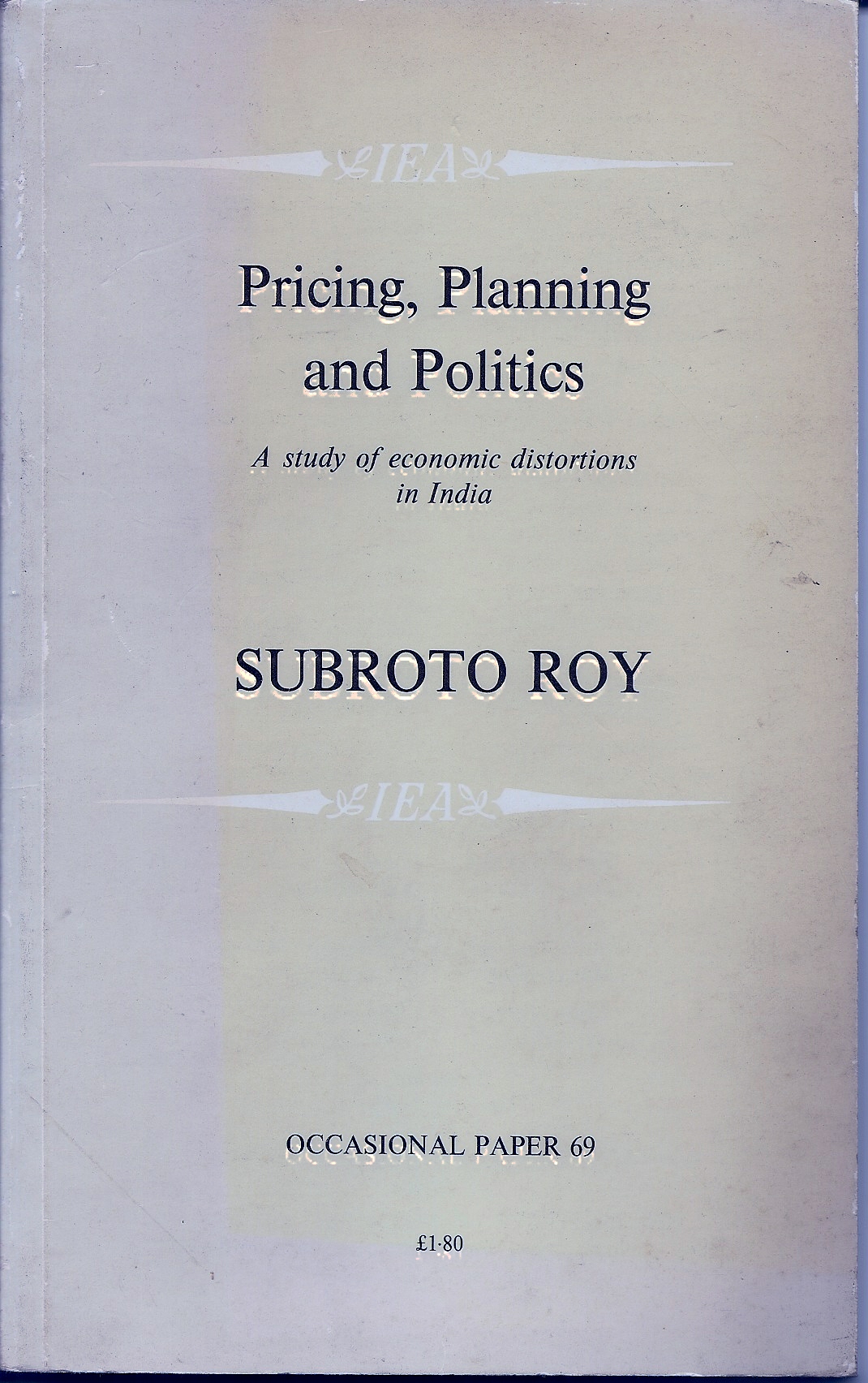
Pricing, Planning & Politics: A Study of Economic Distortions in India (1984)
April 8, 2007 — drsubrotoroyPricing, Planning & Politics: A Study of Economic Distortions in IndiaSubroto Roy
First published on May 29 1984 as Occasional Paper No. 69 of the Institute of Economic Affairs, London
Preface March 2007
A quarter century has passed since my 1982 doctoral thesis at Cambridge University under Frank Hahn, examined by Christopher Bliss and Terence Hutchison, and titled “On liberty and economic growth: preface to a philosophy for India.” I wrote what follows shortly afterwards in Blacksburg, Virginia, and Ithaca, New York, and it was published on May 29 1984 in London by the Institute of Economic Affairs as Occasional Paper No. 69, ISBN: 0-255 36169-6. The day it was published it turned out to be the subject of the main editorial of The Times, then London’s leading newspaper. (I learnt later this had been due to Peter Bauer, and also that 700 copies sold in the first month, a record for the publisher.) The Times editorial though laudatory was misleading, and I had to clarify the contents of the monograph in a letter published on June 16 1984. I shall upload both documents here when I can.
This work was the first explicit critique of post-Mahalanobis Indian economic thought from a classical liberal perspective since B. R. Shenoy’s initial criticism decades previously. I was 29 when it was published, I am 52 now. I do not agree with everything I wrote back then and find the tone a little puffed up as young men tend to be; it was five years before publication of my main “theoretical” work Philosophy of Economics: On the Scope of Reason in Economic Inquiry (Routledge: London & New York, 1989, also now republished here). My experience of life in the years since has also made me far less sanguine both about human nature and about America than I was then. But I am glad to find I am not embarrassed by what I said as a young man, indeed I am pleased I said what I did in favour of classical liberalism and against statism and totalitarianism well before it became popular to do so after the Berlin Wall fell. (In India as elsewhere, former communist apparatchiks and fellow-travellers became pseudo-liberals overnight.)
The famous November 1955 Milton Friedman memorandum is referred to herein for the first time as “unpublished” in note 1; I was to meet Milton and Rose Friedman at the Mont Pelerin Society meetings held at Cambridge later that year, where I gave them a copy of this monograph; when Milton returned to Stanford he sent to me in Blacksburg his original 1955-56 documents on Indian planning. I published the 1955 document for the first time in May 1989 during the University of Hawaii perestroika-for-India project that I was then leading, it appeared later in the 1992 volume Foundations of India’s Political Economy: Towards an Agenda for the 1990s, edited by myself and WE James. The results of the Hawaii project reached Rajiv Gandhi through my hand in September 1990, as told elsewhere in “Rajiv Gandhi and the Origins of India’s 1991 Economic Reform”. The 1956 document was published in November 2007 on the front page of The Statesman, on the same day my obituary of Milton appeared in the inside pages (both are republished here too).
It is apparent from this monograph that I knew almost nothing then about Pakistan or Islam; that has changed as may be seen especially from the other book I created with WE James at the University of Hawaii, Foundations of Pakistan’s Political Economy: Towards an Agenda for the 1990s, as well as my more recent work on Pakistan and Islam. It is of course impossible to understand India without understanding Pakistan and vice versa.
In general, this monograph had to do with India’s microeconomics and theory of value and resource allocation while my latest work – “India’s Macroeconomics”, “Fiscal Instability”, “India’s Trade and Payments”, “Our Policy Process”, “Fallacious Finance”, “The Dream Team: A Critique” etc – has to do with India’s macroeconomics and monetary and fiscal theory and policy. Part of the criticism of “distorted incentives” prevailing in Indira Gandhi’s India may still be relevant to India today, while the discussion of ethnic problems, agriculture, the “public choice” factors that stymie Indian progress, misgovernance etc will almost certainly be found so.
Pricing, Planning and Politics:
A Study of Economic Distortions in India
First published on May 29 1984 as Occasional Paper No. 69 of the Institute of Economic Affairs, London
“The economic laws which operate in India are the same as in other countries of the world; the causes which lead to wealth among other nations lead to prosperity in India; the causes which impoverish other nations impoverish the people of India. Therefore, the line of enquiry which the economist will pursue in respect of India is the same which he adopts in inquiring into the wealth or poverty of other nations.” Romesh Chunder Dutt, 1906, The Economic History of India
“Satyameva Jayathe” (“Let truth be victorious”), Motto of the Indian Republic
I. INTRODUCTION
IN THE last 15 years, considerable evidence has accumulated to suggest that the most important policies pursued by successive governments of independent India have not been conducive to economic development, and have indeed gone against some of the most basic lessons that political economy has to offer. Forewarnings of the present predicament of India had come from a few economists in the late 1950s and early 1960s, but their arguments were either ignored or maligned as dogmatic and motivated by`ideology’.[1] My thesis in this Occasional Paper will be that, if the basic and commonsensical lessons of political economy had been acknowledged early on in the history of the Indian Republic, we might have found today a much more prosperous economy and a much healthier body politic than is the case.
To argue this, it is first necessary to describe an economy where the pursuit of the individual good by rational agents is conducted within some set of orderly political institutions which is conducive to both civil peace and sustained mass prosperity. Accordingly, Part I of this short Paper begins by describing the broad and familiar features of what may be called a neo-classical or liberal model, and then proceeds briefly to contrast it with a model in which individual incentives and public institutions have been distorted from their efficient characterizations.
The practical question that arises is: Where in practice have independent India’s policies led most conspicuously to distorted incentives and institutions? This will be the subject of Part III. Part II places the discussion in context by briefly describing a few relevant aspects of the political history of the Indian Republic.
I have argued elsewhere that every normative proposal for action is, in principle, open to question and criticism on the logical and factual grounds upon which it is founded. Whenever two people disagree about what ought to be done, it will be found either that at least one of them has made a mistake of logic or that they are also in disagreement about the facts of the case.[2] In Part IV, a tentative manifesto for political and economic reform in India is proposed, and I hope these proposals too will be subjected to critical scrutiny on the positive grounds upon which I shall seek to establish them.
Part I: Theory
2. EFFICIENT INCENTIVES AND INSTITUTIONS
A `FACT’ may be understood as the opposite of that which could have been the case but is not. A basic fact of the study of men and society - one which was acknowledged first by Aristotle and then, very importantly, by Adam Smith, and which has been emphasized in modern times by Friedrich Hayek – is that, while we are able to study and speak of the nature of human decision and action in general terms, we do not and cannot have a knowledge of how particular actions are moved by particular causes and circumstances.[3]
We might certainly know, for instance, that every household in an economy views some horizons, wants to fulfill some aspirations, and faces some constraints. But if we were asked to specify what all these characteristics happened to be as a matter of fact at any one moment, we would certainly not be able to do so. Men are concerned almost wholly with (and are experts at) living their own lives as best they can - foraging for food, shelter and work, celebrating weddings and births, rearing children, and mourning deaths. For the most part, they are neither interested in, nor competent at judging, what others happen to be doing in their private lives. Neither benevolence nor envy extends much beyond a man’s immediate vicinity, and, certainly, neither can extend to people he does not know or come to know of in the course of a lifetime.
This fact is also acknowledged in modern microeconomics, when it is said that, for the individual agent to be able to make decisions and act upon them, it is sufficient for him to know (besides his own desires, abilities and constraints) only of the relative prices prevailing locally of the goods and skills he wishes to trade.`Efficient incentive’ defined We might then provisionally define an `efficient incentive’ as a set of relative prices and wages such that, when economic agents act upon them, three conditions are fulfilled:(i) the difference between the total demand for and the total supply of every good and skill is zero; (ii) every consumer succeeds in trading the amounts of different goods that he desires, and so obtains the highest utility he can within the constraint of his budget; (iii) every private enterprise maximizes the difference between its total revenues and total costs, that is, its profits. [4]
Rational action, however, occurs within a particular institutional context. Which action is rational and which is not will depend on what institutions there are and how well or poorly they function. As both classical liberals and Marxists argue, the neo-Walrasian tradition in modern economics - as exemplified by the Arrow-Debreu model - is practically devoid of any explicit institutional description, and so may best be regarded as a useful but grossly incomplete metaphor in the economist’s inquiry.
The institutions most relevant to economic activity are those of government. We might therefore add a fourth condition to characterize an efficient economy, namely, that government institutions work in such a way as to allocate tax revenues towards providing public goods in the amounts desired by citizens. This must be an institutional assumption implicit in the general equilibrium construction, without which it would be impossible to see the sense of that model.
The question that follows is how we are to ascertain the composition of the set of public goods to be provided. As is commonly known, this seems to confront the economist with numerous conceptual and practical problems. I propose here to circumvent all the typical difficulties of how to discover and combine individual preferences for public goods, or how to prevent free-riders, and to take a somewhat different route.
Functions of civil government: protection, public goods, education
To answer the question `What should be public goods first and foremost? I suggest we look for the kind of answer Adam Smith or Jeremy Bentham or J. S. Mill might have given to a related but different question : `What should be the functions of government in a large civil society, regardless of whether or not it is constituted democratically?’ This was the relevant question before the modern era of mass democracy. And it is still interesting because, first, it probably remains the appropriate question for the many countries today which either do not have democratic governments or do not have long histories of democracy, and, secondly, because the kinds of answer given by classical authors were very similar to those we might expect from individual citizens in modern democracies as well.
The most important practical functions of civil government include defence against external aggression, the dispensing of civil and criminal justice, the protection of life, property and trade - broadly, the Rule of Law - and the pursuit of a judicious foreign policy. All are different aspects of the same broad objective of ensuring the survival of the community and the security of individual life.
Yet no pretext has been more common than that an imminent danger to the security of the community requires the government to take despotic measures. The guarantee by a civil government of the freedom of inquiry, discourse, criticism, and historical research should take precedence, therefore, even over ensuring security and survival, for it is probably the only final check there can be on whether what a government says is or is not in fact the case. Where this freedom is forcibly denied, or where it exists but people are too apathetic, ignorant or busy with their daily lives to exercise it, public life soon becomes self deceptive and absurd, with propaganda taking the place of discourse, and pretensions and appearances diverging more and more from attainments and reality. Wherever the questions `What is true?’ or `What is the case?’ are not asked frequently enough, there will be fewer and fewer correct answers as to what the case happens to be.[5]
After collective and individual security, the functions of government include the building of dams, embankments, bridges and canals, the provision of roads and fresh water, and so on – activities which, as Adam Smith put it, “. . . though they may be in the highest degree advantageous to a great society, are, however, of such a nature that the profit could never repay the expence to any individual or small number of individuals, and which it, therefore, cannot be expected that any individual or small number of individuals should erect or maintain.” [6]
Each may be more or less a “pure” public good in the modern sense :“that each individual’s consumption of such a good leads to no subtraction from any other individual’s consumption of that good”.[7]
Such a list could be extended to include activities as diverse as: the prevention of soil erosion; the public finance of school education, and’ of measures of basic public health such as vaccinations against contagious diseases; the issuing of currency; sewage disposal; population censuses; the standardization of weights and measures; and so on. It is unnecessary to be more specific here since some people will find even this list controversial. Dogmatists will deny the need for free inquiry; pacifists will dispute that defence is a public good; communists will protest against the public protection of private property; `anarcho-capitalists’ will contest the public dispensation of justice; and so on. To these critics, I would offer merely the following short and incomplete reply.
First, a sound argument can be made that what functions civil government should have can be ascertained, without prejudice, by reasonable citizens, though which particular functions these are may well vary according to circumstances. Secondly, if we could spend time in thoughtful and leisured conversation with every citizen of a large community, it might be predicted - as a matter of cold, empirical fact - that practically everyone would agree with the suggestion that the first destinations of tax revenues should indeed be activities like defence, civil protection and the Rule of Law, the provision of roads, and so on. If such a prediction is correct, my thesis is plainly much more democratic than it might appear to modern economists, though I shall later claim that an objective defence of democratic institutions can be made on quite different grounds as well.
If there is a clear family resemblance between classical liberal authors - from Smith and Mill through to Hayek, Robbins, Friedman, Buchanan, Bauer and many others - it has to do, not so much with the denunciation of government activity in the market-place, as with the recognition of the existence of certain duties of government outside it, the fulfillment of which are indispensable to civil life, let alone the pursuit of economic prosperity. Their protest is at the high opportunity cost of the alternatives foregone.
This raises the question of how we might tell whether government is working well or badly in a particular country at a particular time, or, generally, how we might tell whether different public goods are provided in too small or large amounts. For present purposes it will again be sufficient to suggest a very rough and common sense way of proceeding: let us look first, and think second.
For example, the Iran-Iraq war has clearly been a perfect public bad as far as the ordinary citizenry in either country are concerned. Similarly, if there happen to be millions of cases queuing outside the courts waiting to be heard, or if crime is rampant and police protection ineffective, that may constitute prima facie evidence that too few public resources have been devoted to civil order and justice. Or, if heavy rainfall annually causes landslides in the hills and floods in the plains, devastating crops and leaving innumerable citizens destitute, that also might prompt us to ask whether sufficient public resources have gone towards precautions against such havoc. And so on.[8]
Which goods happen to be public goods depends on the circumstances and the level of government being discussed. For similar circumstances and levels, similar goods will most likely be public goods in different countries. The state ordinarily consists not only of the national government but also of several provincial governments and a myriad of local governments. In particular, a premise of the liberal state would be that public goods should in fact be provided by various levels of government, financed through taxes paid respectively at those levels. The citizen is a taxpayer at a variety of levels, and accordingly public goods are due to be provided at a variety of levels. Just as the national government may not usurp the power to tax for, or spend money on, a public good which is best provided by a provincial government to the citizens of a province, so a provincial government may not tax for, or spend on, a public good best provided by a local government to the citizens of a locality.
The broad principle involved has two aspects: first, a recognition that knowledge of particular circumstances - and hence the ability to act - is infinitesimally dispersed within a population; and, secondly, as direct and visible a matching as possible of the benefits a citizen receives from a particular public good with the taxes he pays towards it, thereby perhaps reducing his incentive to be a free rider on the contributions of others.8Uncertainty and ignoranceProvisionally, therefore, efficient incentives may be thought to consist of a set of market-clearing relative prices and wages, occurring within an institutional context in which the basic and indispensable functions of government have been adequately performed at a variety of appropriate levels.
Such a definition would still be seriously incomplete in one major respect. For we must now recognise: (i) that history is unique and irretrievable, that the present consists only of the fleeting moment, and that the future, by its very nature, cannot be fully known; (ii) that such a thing as human freedom exists; and (iii) that, as a consequence, uncertainty and ignorance are ubiquitous.
Some of the uncertainty derives from the unfolding of natural events (like the rains) over which man has little or no control. The rest derives from the fact that the individual is a free agent who is affected by the actions of others but who cannot predict those actions completely because they too are free agents like himself. Game theory would have had no appeal for the economist if the existence of human freedom had not been a fact. It is this which makes it impossible to read everything in another person’s mind and thus makes it impossible to predict everything he might do. The lasting contribution of Keynesian economics could be its emphasis that such uncertainty and ignorance are important to the economist’s inquiry.
Mathematical economists have been saying for several years that what is required if we are to be realistic are models which reflect the sequential character of actual decision-making and account for the past being immutable and the future uncertain.[9] However, they have proceeded to write even more complex mathematics than we already have - disregarding Aristotle’s advice not to seek more precision from the subject of an inquiry than it may be capable of yielding.[10] My question is the more mundane one of what becomes of the classical liberals’ concept of efficient incentives and institutions in a dynamic world. I shall answer it too in a pedestrian way.
The single overwhelming reason why uncertainty and ignorance are relevant to the economist’s descriptions is that they make real the possibility of mistakes by economic agents. To extend the previous discussion to a dynamic context, what we can do is to ask which institutions are most likely to reduce or mitigate the social consequences of mistaken decisions, whether made by private agents or by those in public office. And it is here that the classical liberals advocate two important institutional features: competition and the decentralisation of decision-making.
The major value of democratic institutions over authoritarian ones is that they encourage these two principles to be put into effect. Because, in a large economy, particular knowledge is infinitesimally dispersed, it may be better for adjustments to a multitude of variables to be made continuously in response to changing circumstances by a vast number of small economic agents, rather than for adjustments to a few variables to be made at political intervals by a small group of very powerful agents. The concentration of power to make major decisions among a few fallible men is a much more ominous prospect than the distribution of power in small amounts among a large number of fallible men. It is much more dangerous for a monopoly of ideas to be claimed about where the political good of a country lies than for there to be free and open competition among such ideas at the bar of reason.
D. H. Robertson put it well when he warned “that all the eggs should not be in the same basket - that in this highly uncertain world the fortunes of a whole trade, or a whole area, should not depend on the foresight and judgement of a single centre of decision”.[11] The presumption in favour of democratic institutions is that they reduce the potential damage from wrong political decisions damage which can be rationally expected in an uncertain world.[12] Elections, in the liberal understanding, are then not so much the means to promote the interests of one’s confederates as to remove from office without bloodshed rulers who fail to do what they are entrusted with, and to replace them by those from whom better is expected. Economic efficiency in an uncertain worldThe economic notion of efficient incentives is also modified by uncertainty and ignorance. In the theory, a set of prices is market clearing only relative to unchanging preferences, resources and technologies. In a dynamic world, however, demand and supply functions are themselves changing and the notion of efficient incentives must accordingly be adapted to one in which relative prices move in the direction of the excess demand: that is, if the parameters change so that the total demand for a good or skill comes to exceed the total supply, we should want to see its relative price rising (and, conversely, if total supply exceeds total demand, we should want to see its relative price falling). During such a process of adjustment, many people may suffer very considerable hardship - something which reasonable Keynesians do well to emphasise.
If changing preferences, resources or technologies cause the demand for a product to diminish, we should want to see the firms which manufacture it either entering different markets, or improving its quality by technological innovation, or lowering prices. Similarly, we should want to see workers in these firms whether blue- or white-collar - who have skills specific to a product whose price is falling either increasing their productivity or retraining themselves in different skills more specific to the manufacture of goods whose prices are rising. Numerous enterprises can go bankrupt, and numerous workers can find themselves unable to sell the skills they possess, if they fail to adapt quickly enough to changing market conditions. The more specialised the product and the more specific the skill, the more hardship there may be. There could well be orthodox Keynesian consequences whereby laid-off workers reduce their consumption expenditures and firms on the verge of bankruptcy reduce their investment expenditures, leading to lower incomes for others, and thus to lower expenditures by them too, and so on. An anti-Keynesian who denied the existence of such hardship would be closed to the facts. He might also not be doing his own theory justice: for it is not unreasonable to argue that, while adjustments are inevitable in an uncertain world, the classical response of prices moving in the direction of excess demand probably minimises the hardship in the transition from one equilibrium to the next.
In a dynamic world, therefore, in which supply and demand functions are shifting continually and unpredictably (though probably incrementally, and not drastically), efficient incentives are better thought of as relative prices which are not stagnant but which are moving - and moving quickly - in the direction of excess demand. It should, in general, be continually profitable at the margin for firms and workers to be innovating technologically and improving productivity. As everyone knows from experience, the principle goad to such activity is fair and free competition. If a job or contract is sought badly enough, and if better quality or lower price are known to be the only criteria of selection, the expected outcome is a differentiation and improvement by competitors of the individual quality or price of what is sold.
In broad summary, the liberal understanding of how material well-being can be improved rests on the assumption that the basic functions of civil government are performed satisfactorily. Government provides the backdrop of civil order and protection necessary for private citizens freely and fairly to conduct their own lives and their transactions with one another. It is a theory which acknowledges a fundamental fact in the study of society, namely, that the individual household : (a) most commonly defines its own horizons; (b) knows the particular opportunities available to it to produce, trade and consume; (c) recognises the particular constraints which prevent it from doing all that it may desire; and(d) perceives how these opportunities and constraints may be changing. Where, as in the liberal picture, there are large numbers of producers and consumers, sellers and buyers - each family acting more or less independently - the efforts of one family do not directly make for other than its own success, while at the same time the repercussions of its mistakes are felt by itself and do not reverberate throughout the whole community. Such has been, as I see it, the American secret to mass prosperity.
3. DISTORTED INCENTIVES AND INSTITUTIONS
DISTORTED INCENTIVES are the logical opposites of efficient ones. Relative prices and wages send distorted signals to individual economic agents when they do not move in the direction of excess demand, so that there is no general tendency for markets to clear. A long-run or endemic excess demand for a good reveals itself in rationing, queueing and black markets. The price at which trade nominally takes place is too low and shows no tendency to move upwards.
Conversely, in a product market, a long-run or endemic excess supply reveals itself in surpluses and spoilages. In a labour market, it reveals itself, on the one hand, in armies of tenured employees who have no incentive to improve productivity, and, on the other hand, in lines of involuntarily or disguised unemployed who cannot sell all the skill they possess and have to settle for selling their less-specialised ones. The price at which trade nominally takes place is too high and shows no tendency to move downwards. In practical terms, firms do not find it profitable to be continually entering new markets or improving quality or enhancing technology or reducing price in order to attract and retain customers. Farmers in particular may face output and input prices which make technological improvements unprofitable.
In politics, distorted incentives are ones which make it profitable for politicians and government officials to be corruptible and taxpayers to be evasive. Because corruption is not penalised and honesty not rewarded, the pursuit of private interest may make it rational to be corrupt and irrational to be honest.
Individualism and statism
A neo-classical economic model like the one outlined above presupposes among citizens a political attitude of individualism. This may be defined as a condition in which citizens have the idea (a) that it is the individual household itself which is principally responsible for improvements in its own well-being, and (b) that government merely “is, or ought to be, instituted for the common benefit, protection and security of the people …”, and that government officials are merely the citizens’ “trustees and servants, and at all times amenable to them.” [13]
Its logical opposite may be called an attitude of statism - defined as prevailing when various classes of citizens have the idea that it is government which is and should be principally responsible for improvements in individual and public well-being. A good sense in which `power’ can be defined in political and economic contexts is as “the capacity to restrict the choices open to other men”.[14] An attitude of statism entails a willingness, or at least an acquiescence, on the part of citizens to relinquish to those in government, with little or no questioning, the power to make decisions which may affect their lives intimately. At the same time, responsibility for relapses or lack of progress in individual well-being is also thought to be the consequence of governmental and not private decision-making. Whereas individualism is a self-assertive attitude, statism is a self abnegating one. For those in government to have a statist mentality is the same as saying they are paternalistic, that is, making the presumption that the citizen i