Lessons for India from Nepal’s Revolution (2006)

Lessons for India from Nepal’s Revolution

Subroto Roy

 The Statesman, frontpage, April 26 2006

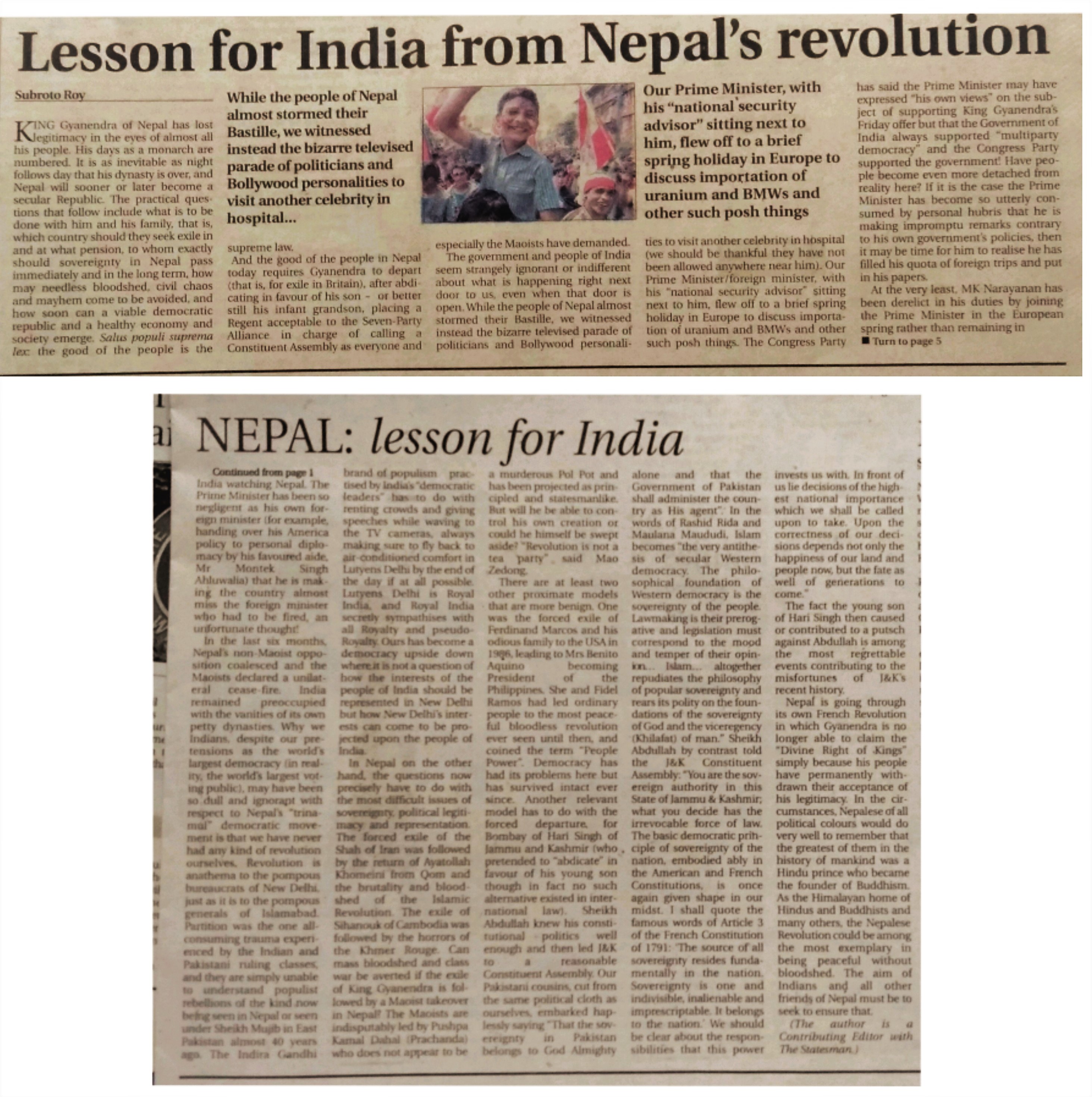
King Gyanendra of Nepal has lost legitimacy in the eyes of almost all his people. His days as a monarch are numbered. It is as inevitable as night follows day that his dynasty is over, and Nepal will sooner or later become a secular Republic. The practical questions that follow include what is to be done with him and his family, that is, which country should they seek exile in and at what pension, to whom exactly should sovereignty in Nepal pass immediately and in the long term, how may needless bloodshed, civil chaos and mayhem come to be avoided, and how soon can a viable democratic republic and a healthy economy and society emerge.

Salus populi suprema lex: the good of the people is the supreme law. And the good of the people in Nepal today requires Gyanendra to depart (that is, for exile in Britain), after abdicating in favour of his son ~ or better still his infant grandson, placing a Regent acceptable to the Seven-Party Alliance in charge of calling a Constituent Assembly as everyone and especially the Maoists have demanded.

 The Government and people of India seem strangely ignorant or indifferent about what is happening right next door to us, even when that door is open. While the people of Nepal almost stormed their Bastille, we witnessed instead the bizarre televised parade of politicians and Bollywood personalities to visit another celebrity in hospital (we should be thankful they have not been allowed anywhere near him).

 Our Prime Minister/foreign minister, with his “national security advisor” sitting next to him, flew off to a brief spring holiday in Europe to discuss importation of uranium and BMWs and other such posh things. The Congress Party has said the Prime Minister may have expressed “his own views” on the subject of supporting King Gyanendra’s Friday offer but that the Government of India always supported “multiparty democracy” and the Congress Party supported the government! Have people become even more detached from reality here? If it is the case the Prime Minister has become so utterly consumed by personal hubris that he is making impromptu remarks contrary to his own government’s policies, then it may be time for him to realise he has filled his quota of foreign trips and put in his papers. At the very least, MK Narayanan has been derelict in his duties by joining the Prime Minister in the European spring rather than remaining in India watching Nepal. The Prime Minister has been so negligent as his own foreign minister (for example, handing over his America policy to personal diplomacy by his favoured aide, Mr Montek Singh Ahluwalia) that he is making the country almost miss the foreign minister who had to be fired, an unfortunate thought!

 In the last six months, Nepal’s non-Maoist opposition coalesced and the Maoists declared a unilateral cease-fire. India remained preoccupied with the vanities of its own petty dynasties. Why we Indians, despite our pretensions as the world’s largest democracy (in reality, the world’s largest voting public), may have been so dull and ignorant with respect to Nepal’s “trinamul” democratic movement is that we have never had any kind of revolution ourselves.

 Revolution is anathema to the pompous bureaucrats of New Delhi, just as it is to the pompous generals of Islamabad. Partition was the one all-consuming trauma experienced by the Indian and Pakistani ruling classes, and they are simply unable to understand populist rebellions of the kind now being seen in Nepal or seen under Sheikh Mujib in East Pakistan almost 40 years ago. The Indira Gandhi brand of populism practised by India’s “democratic leaders” has to do with renting crowds and giving speeches while waving to the TV cameras, always making sure to fly back to air-conditioned comfort in Lutyens Delhi by the end of the day if at all possible. Lutyens Delhi is Royal India, and Royal India secretly sympathises with all Royalty and pseudo-Royalty. Ours has become a democracy upside down where it is not a question of how the interests of the people of India should be represented in New Delhi but how New Delhi’s interests can come to be projected upon the people of India.

 In Nepal on the other hand, the questions now precisely have to do with the most difficult issues of sovereignty, political legitimacy and representation. The forced exile of the Shah of Iran was followed by the return of Ayatollah Khomeini from Qom and the brutality and bloodshed of the Islamic Revolution. The exile of Sihanouk of Cambodia was followed by the horrors of the Khmer Rouge. Can mass bloodshed and class war be averted if the exile of King Gyanendra is followed by a Maoist takeover in Nepal? The Maoists are indisputably led by Pushpa Kamal Dahal (Prachanda) who does not appear to be a murderous Pol Pot and has been projected as principled and statesmanlike. But will he be able to control his own creation or could he himself be swept aside? “Revolution is not a tea party” said Mao Zedong. There are at least two other proximate models that are more benign. One was the forced exile of Ferdinand Marcos and his odious family to the USA in 1986, leading to Mrs Benito Aquino becoming President of the Philippines. She and Fidel Ramos had led ordinary people to the most peaceful bloodless revolution ever seen until then, and coined the term “People Power”. Democracy has had its problems here but has survived intact ever since. Another relevant model has to do with the forced departure for Bombay of Hari Singh of Jammu and Kashmir (who pretended to “abdicate” in favour of his young son though in fact no such alternative existed in international law). Sheikh Abdullah knew his constitutional politics well enough and then led J&K to a reasonable Constituent Assembly. Our Pakistani cousins, cut from the same political cloth as ourselves, embarked haplessly saying “That the sovereignty in Pakistan belongs to God Almighty alone and that the Government of Pakistan shall administer the country as His agent”. In the words of Rashid Rida and Maulana Maududi, Islam becomes “the very antithesis of secular Western democracy. The philosophical foundation of Western democracy is the sovereignty of the people. Lawmaking is their prerogative and legislation must correspond to the mood and temper of their opinion… Islam… altogether repudiates the philosophy of popular sovereignty and rears its polity on the foundations of the sovereignty of God and the viceregency (Khilafat) of man.” Sheikh Abdullah by contrast told the J&K Constituent Assembly: “You are the sovereign authority in this State of Jammu & Kashmir; what you decide has the irrevocable force of law. The basic democratic principle of sovereignty of the nation, embodied ably in the American and French Constitutions, is once again given shape in our midst. I shall quote the famous words of Article 3 of the French Constitution of 1791: `The source of all sovereignty resides fundamentally in the nation. Sovereignty is one and indivisible, inalienable and imprescriptable. It belongs to the nation.’ We should be clear about the responsibilities that this power invests us with. In front of us li e decisions of the highest national importance which we shall be called upon to take. Upon the correctness of our decisions depends not only the happiness of our land and people now, but the fate as well of generations to come.”


The fact the young son of Hari Singh then caused or contributed to a putsch against Abdullah is among the most regrettable events contributing to the misfortunes of J&K’s recent history. Nepal is going through its own French Revolution in which Gyanendra is no longer able to claim the “Divine Right of Kings” simply because his people have permanently withdrawn their acceptance of his legitimacy.


In the circumstances, Nepalese of all political colours would do very well to remember that the greatest of them in the history of mankind was a Hindu prince who became the founder of Buddhism. As the Himalayan home of Hindus and Buddhists and many others, the Nepalese Revolution could be among the most exemplary in being peaceful without bloodshed. The aim of Indians and all other friends of Nepal must be to seek to ensure that.

Towards an Energy Policy

Note:  This article  may have initiated the public debate on the economics of the Indo-US nuclear deal.  It was published as a Special Article on the Editorial Page of The Sunday Statesman of April 2 2006 but it failed to be uploaded at the website http://www.thestatesman.net because there had been a fire on March 31 2006.  The politicians who led the  parliamentary debate  in 2006 subsequently made reference to it.


See also  republished elsewhere here e.g. “India’s Energy Interests”, “India and Energy Security”, “Need for Clarity”/”From Confusion to Clarity”, “Against Quackery”, “Jimmy Carter and the Indo-US Nuclear Deal””, NuksaanFaida Analysis”.


“Towards an Energy Policy”


by Subroto Roy


First published in

The Sunday Statesman, Editorial Page Special Article 2 April 2006


When was the last time we heard a thorough, well informed debate in Parliament about India’s long-term energy needs and policy-alternatives? The answer is never. Just as Pakistan tends to be run by Islamabad’s generals, we tend to be run by New Delhi’s bureaucrats; both are a legacy of the Raj which was run by small numbers of pompous civil servants and soldiers. Bureaucrats keep as much decision-making information as they can to themselves, give it to Parliament only under duress and then too in garbled opaque form, and share it voluntarily with the public never at all. A bureaucrat of conscience who shares vital information transparently becomes a “whistleblower”, and may risk his/her life and career because assorted mafias invariably surround all government contracting, and, like vampire bats, cannot stand the light of day shed upon them.


The problem with the Manmohan/Montek deal-making with the USA on behalf of India’s people has less to do with rational assessments not having been made of the relative costs and benefits of e.g. nuclear/fossil fuel/renewable energy, as it has to do with the fact it reflects the same lack of transparency (and is accompanied by the same politically correct propaganda) as has existed in other policy-making – like the $12 billion worth of commercial aircraft from Boeing and Airbus bought for our bankrupt nationalized airlines, or spending untold billions of borrowed dollars on new weapons from France, Russia, Britain or whomever to fight unknown enemies in unimagined wars, or throwing newly printed paper-money at every government project that any fool or knave cares to mention.


To be fair, the UPA/Communist dispensation of the public’s largesse is no worse than that of the NDA/RSS. Both are part of New Delhi’s own “Inside-the-Beltway” syndrome, and turn up at the same celebrity wedding-receptions and iftehar parties. Neither minds too much when the other is in power so long as they can keep their government accommodation. Our fundamental political problem may be the absence of any serious party of Left or of Right which is secular, scientific, liberal, nationalist, clean, law-abiding, and fiscally prudent.


Since no national debate on energy-policy has been offered by New Delhi, ordinary citizens will have to create such a debate for themselves. What follows constitutes a few of the barest facts needed to start such an analysis of India’s alternative energy scenarios and their respective costs.


Hydroelectric power does not involve burning any fuels. Instead, the gravitational force of the movement of water from the mountains to the oceans is harnessed to generate electricity. But hydroelectric projects (like the Narmada Dam) can displace people, who must be then compensated and resettled. Burning of organic “fossil fuels” like coal, gas and oil, causes atmospheric oxygen to turn into carbon dioxide, which may affect climate in unknown ways. In 2004, the International Energy Agency’s estimated the new energy capacity worldwide required by rising economic growth in the year 2020 will derive 1400 GW from burning coal (half of it in China and India), 470 GW from burning oil, 430GW from hydro, and 400 GW from renewable sources (like solar or wind power). On the Agency’s assumptions, gas prices will remain low, making construction of new nuclear plants for electricity uneconomical. By 2030, new energy expected to be required worldwide is 4700GW, of which only 150GW is expected from new nuclear plants — which will be replacing existing nuclear plants due to be retired. (Such is the scenario before any new nuclear plants were going to be exported by e.g. USA to India).


Now the fission of an atom of uranium produces perhaps 10 million times the energy produced by combustion of an atom of carbon from coal. Gas and fossil fuels may be cheap and in plentiful supply worldwide for generations to come but the potential for cheap energy from nuclear sources seems practically infinite. Nuclear power can arise from fission of radioactive uranium, plutonium or thorium. India has perhaps 8 million tonnes of monazite deposits along the seacoast of which half may be mined, to yield 225,000 tonnes of thorium metal; we have one innovatively designed thorium reactor under construction. But almost all nuclear energy worldwide today arises from uranium, and there are practically unlimited reserves of that. There is so much uranium in sea water that mankind’s total electricity needs can be satisfied for 7 million years. There is more energy in the uranium impurity present in coal than can arise from actually burning the coal. There is plenty of uranium in granite. None of these sources will become profitable for centuries because there is so much cheap uranium possible to be extracted from conventional ores. In 2001, uranium cost about US$20 per kg or so, translating to US$0.0004 per kwh of electricity. The known reserves of uranium that can be profitably sold at $120 per kg are enough for at least a hundred years. Design improvements in reactors will also improve productivity; e.g. “fast breeder” reactors “breed” more fissile material than they use, and may get 100 times as much energy from a kilogram of uranium as existing reactors do. India has about 95,000 tonnes of uranium metal which may be mined to yield about 61,000 tonnes net for power generation.

Natural uranium is 99.3 percent of the U-238 isotope and 0.7 percent of the radioactive U-235 isotope. Nuclear power requires “enriched uranium” or “yellow cake” in which U-235 has been increased from 0.7 percent to 4 to 5 percent, and that “separation” process is expensive. (Nuclear bombs require highly enriched uranium with more than 90% of U-235). Yellow cake is broken into small pieces, put in metal rods placed in bundles, which are then bombarded by neutrons causing fission. In nuclear bombs, the fission occurs in a small space, and the blast that results kills all life for miles around it by sucking up all the atmospheric oxygen, besides causing firestorms, shock waves and radioactivity. In a civilian reactor, the energy released turns water into steam, which moves turbines powering the generation of electricity. However, while there is no carbon dioxide “waste” as in burning fossil fuels, the “spent” rods of nuclear fuel and other products constitute grave radioactive waste, which is hard if not impossible to dispose of. Many countries like the USA just bury their nuclear waste in remote thinly populated desert areas.

Rational choice between energy sources depends on costs determined by history and geography. France has 59 of the 441 or so civilian nuclear reactors in the world, and generates 78% of its electricity from them, 22% from hydroelectricity. Japan has 54 reactors and generates 34% of its electricity from them. The USA has 104 reactors but generates only 20% of its electricity from them, principally because it has vast alternative sources of energy. In India, installed power generating capacity as of 2003 was 107,533.3MW, of which 71% was from burning fossil fuels. Hydroelectric potential is 150,000MWe. In 2003, total installed hydro capacity with utilities was 26,910MWe (about 18% of the potential). More than 70% of India’s hydroelectric potential is in the North and NorthEast regions put together.


India’s 14 nuclear reactors produce less than 4% of the total electricity being consumed in the country. Even if all other sources of electricity remained constant, and our civilian nuclear capacity alone was made to grow by 100% under the Manmohan-Montek deal with the USA, that would mean less than 8% of total Indian electricity produced. So the first question India’s citizens must ask is why such a fuss has been created about the Manmohan-Montek deal with America. Clearly, the Government of India must come wholly clean with all the facts and analysis it has available on the whole problem of India’s energy future in all its complexity and detail. If and when it does so, we may simply find that the fault lies not in the stars but in ourselves. Whether the US-India nuclear deal stands or falls, it will have scant effect in satisfying the country’s energy needs.

Logic of Democracy (2006)

LOGIC OF DEMOCRACY


by


SUBROTO ROY


First published in The Statesman,

Editorial Page Special Article, March 30 2006


Parliament may unanimously vote for a bill on the “Office of Profit” issue but this will have to be consistent with the spirit and letter of the Constitution and with natural law if it is not to be struck down by the Supreme Court. It is thus important to get the logic right.

India is a representative and not a direct democracy. We the people constitute the Electorate who send our representatives periodically to legislative institutions at national, state and local levels. These representatives, namely, Lok Sabha and Legislative Assembly Members and municipal councilors, have a paid job to do on behalf of all their constituents, not merely those who voted for them. They are supposed to represent everyone including those who voted against them or did not vote at all.

In view of this, if the question is asked: “Was India’s interest served by Sonia Gandhi peremptorily resigning as the Lok Sabha Member from Rae Bareli and then immediately declaring she will fight a fresh election from there?”, the answer must be of course that it was not. Mrs Gandhi had been elected after an expensive process of voting and she had a duty to continue to represent all of Rae Bareli’s people (not just her party-supporters) for the duration of the 14th Lok Sabha. Instead she has given the impression that Rae Bareili is her personal fiefdom from where she must prove again how popular she is as its Maharani.

What needed to be done instead was to abolish the so-called “National Advisory Council” which, like the “Planning Commission” is yet another expensive extra-constitutional body populated by delusional self-styled New Delhi worthies. The NAC has been functioning as Mrs Gandhi’s personal Planning Commission, and she lacked the courage to scrap it altogether — just as Manmohan Singh lacks the courage to tell Montek Ahluwalia to close down the Planning Commission (and make it a minor R&D wing of the Ministry of Finance).


Lok Sabha’s duties


What are Lok Sabha Members and State MLAs legitimately required to be doing in caring for their constituents? First of all, as a body as a whole, they need to elect the Government, i.e. the Executive Branch, and to hold it accountable in Parliament or Assembly. For example, the Comptroller and Auditor General submits his reports directly to the House, and it is the duty of individual legislators to put these to good use in controlling the Government’s waste, fraud or abuse of public resources.

Secondly, MPs and MLAs are obviously supposed to literally represent their individual constituencies in the House, i.e. to bring the Government and the House’s attention to specific problems or contingencies affecting their constituents as a whole, and call for the help, funds and sympathy of the whole community on their behalf.

Thirdly, MPs and MLAs are supposed to respond to pleas and petitions of individual constituents, who may need the influence associated with the dignity of their office to get things rightly done. For example, an impoverished orphan lad once needed surgery to remove a brain tumour; a family helping him was promised the free services of a top brain surgeon if a hospital bed and operating theatre could be arranged. It was only by turning to the local MLA that the family were able to get such arrangements made, and the lad had his tumour taken out at a public hospital. MPs and MLAs are supposed to vote for and create public goods and services, and to use their moral suasion to see that existing public services actually do get to reach the public.


Rajya Sabha different species

Rajya Sabha Members are a different species altogether. Most if not all State Legislative Councils have been abolished, and sadly the present nature of the Rajya Sabha causes similar doubts to arise about its utility. The very idea of a Rajya Sabha was first mooted in embryo form in an 1888 book A History of the Native States of India, Vol I. Gwalior, whose author also advocated popular constitutions for the “Indian India” of the “Native States” since “where there are no popular constitutions, the personal character of the ruler becomes a most important factor in the government… evils are inherent in every government where autocracy is not tempered by a free constitution”.


When Victoria was declared India’s “Empress” in 1877, a “Council of the Empire” was mooted but had remained a non-starter even until the 1887 Jubilee. An “Imperial Council” was now designed of the so-called “Native Princes”, which came to evolve into the “Chamber of Princes” which became the “Council of the States” and the Rajya Sabha.


It was patterned mostly on the British and not the American upper house except in being not liable to dissolution, and compelling periodic retirement of a third of members. The American upper house is an equal if not the senior partner of the lower house. Our Rajya Sabha follows the British upper house in being a chamber which is duty-bound to oversee any exuberance in the Lok Sabha but which must ultimately yield to it if there is any dispute.


Parliament in India’s democracy effectively means the Lok Sabha — where every member has contested and won a direct vote in his/her constituency. The British upper house used to have an aristocratic hereditary component which Tony Blair’s New Labour Government has now removed, so it has now been becoming more like what the Rajya Sabha was supposed to have been like.


The corruption of our body-politic originated with the politicisation of the bureaucracy thirty five years ago by Indira Gandhi and PN Haksar. The Rajya Sabha came to be ruined with the “courtier culture” and “durbar politics” that resulted. This bad model which the Congress Party created and followed was imitated by the Congress’s political opponents too. Our Rajya Sabha has now tended to become a place for party worthies who have lost normal elections, superannuated cinematic personalities, perpetual bureaucrats still seeking office, and similar others. The healthiest course of action for Indian democracy may be to close it down completely for a few years, then recreate it ab initio based on its original purposes and intent (but this may not be constitutionally possible to do).


Holding Executive accountable

It is a forgotten platitude that in a representative democracy what elected legislators are supposed to be doing is represent the interests of the Electorate. Along with the Judiciary, the Legislative Branch is supposed to control the Executive Government, which is the natural oppressor of the Electorate. That is why the Legislature must be independent of the Executive — which is the precise intent behind Article 102 (a) of the Constitution of India: “A person shall be disqualified for being chosen as, and for being, a member of either House of Parliament… if he holds any office of profit under the Government of India or the Government of any State…”


In other words, if you are a Lok Sabha MP or State MLA who is supposed to be a part of the august House which has elected the Executive Government and by whom that Government is supposed to be held accountable, then it is a clear conflict of interest if you are yourself in the pay of that Government. As a legislator, you are either in the Executive or you are not. If you are in the Executive, you are liable to be held accountable by the House. If you are not in the Executive, you are duty-bound as an ordinary Member of the House to hold the Executive accountable. The logic is ultimately as clear and simple as that.


It is inevitable that the delineation of the appropriate boundaries between Legislature and Executive will have to be pronounced upon by the Judiciary. The “Office of Profit” issue has opened an opportunity for a Constitution Bench of the Supreme Court to speak on the rights and duties of the Legislative and Executive Branches of Government. And no Constitution Bench has ever spoken unwisely.

Imperialism redux

IMPERIALISM REDUX

Business, Energy, Weapons And Foreign Policy

First published in The Statesman March 14 2006 Editorial Page Special Article

By Subroto Roy

If souls can transmigrate, so may souls of companies, and future historians might well look back and say that the new US-India “CEO Forum” heralded the modern rebirth of the East India Company. Like the old Company, the new Forum has many ambitious, competent people. The American side includes heads of AES Corporation, Cargill Inc., Citigroup, JP Morgan Chase, Honeywell, McGraw-Hill, Parsons Brinckerhoff Ltd, PepsiCo, Visa International and Xerox Corporation. The Indian side includes heads of Tata Group, Apollo Hospitals Group, Bharat Forge Ltd, Biocon India Group, HDFC, ICICI One Source, Infosys, ITC Ltd, Max India Group and Reliance Industries — all stalwarts of what Mr Kanu Sanyal’s Naxals would have termed India’s “comprador bourgeoisie”.

Business advocacy
Presiding over the Indian side has been Prime Minister Manmohan Singh’s trusted confidante, Montek Singh Ahluwalia (whose family moved to the USA after 20 years in India). Indeed it may have been his idea to have a government-sponsored business initiative. A “US-India Business Council” has existed for thirty years in Washington as “the premier business advocacy organization promoting US commercial interests in India.… the voice of the American private sector investing in India”. But for both Governments to sponsor private business via the Forum was “unprecedented” as noted by Washington’s press during Dr Singh’s visit in July 2005. The State Department (America’s foreign ministry) announced it saying: “Both our governments have agreed that we should create a high-level private sector forum to exchange business community views on key economic priorities…”

The Forum seems to have gone well beyond exchanging business community views, and has had a clear impact in the sudden redefinition of the direction of India’s foreign, military and energy policy. When Dr Singh addressed America’s legislature, the main aspect of the speech he read there had to do with agreeing with the American President “to enhance Indo-US cooperation in the field of civilian nuclear technology”. And nuclear energy has suddenly begun to dominate India’s news and national political agenda — even though the 2503MW of nuclear power produced in the country accounts for merely 4% of our civilian energy needs, barely significant. But before nuclear or any other deals could be contemplated with American business, the Dabhol payouts were required to be made. The Maharashtra State Electricity Board — or rather, its sovereign guarantor the Government of India — paid out at least $140-$160 million each to General Electric and Bechtel Corporations in “an amicable settlement” of the Dabhol affair. (When is the last word going to be said on that?) Afterwards, General Electric’s CEO for India was kind enough to say “India is an important country to GE’s global growth. We look forward to working with our partners, customers, and State and Central Governments in helping India continue to develop into a leading world economy”.

A weak and corrupt Delhi
Such nice rhetoric was on close display during the deal-making leading up to and beyond President George W. Bush’s recent India visit. America’s Ambassadors are mostly political appointees and special friends of the President of the day; the present Ambassador to India is a prominent Texas businessman, and business has been driving American thinking with India all the way. After Dr Singh’s visit, the US Foreign Commercial Service reportedly said American engineering firms, equipment suppliers and contractors faced a $1000 bn (1 bn = 100 crore) opportunity in India. Before the Bush visit, Dr Singh signed vast purchases of commercial aircraft from Boeing and Airbus, as well as large weapons’ deals with France and Russia. After the Bush visit, the US Chamber of Commerce has said the nuclear deal can cause $100 bn worth of new American business in India’s energy-sector alone. Getting American legislators to agree will require “massive grassroots efforts” at lobbying politicians, saying that “energy-starved” India will now become open “to US investment in key areas from IT and telecom to pharmaceuticals and insurance”. Mr Bush’s foreign minister Condoleezza Rice (who has authored the political aspects of the new India-orientation) and her pointman Nicholas Burns have said, “we are suggesting India-specific amendments to the Atomic Energy Act of 1954… It’s a waiver authority … We are not seeking relief from US law for any country in the world except India and we don’t anticipate putting any country forward. So it is India specific.” India will separate by 2014 closely entwined civilian and military nuclear facilities and put 14 of 22 civilian nuclear reactors under international inspection.

Now the East India Company had not intended to rule India but ended up dictating to a weak and corrupt Delhi, waging wars across Bengal, the Deccan and North India, and inducing “regime change” all over the place among local satraps. In the modern context, the American Government and its businessman Ambassador to the Delhi Court have made it crystal-clear India’s support has been expected in the matter of American policy towards Iran. Dr Singh has been his own Foreign Minister, crafting his America policy aided by Mr Ahluwalia on one hand and Mr M. K. Narayanan on the other. None of the three has diplomatic, historical or foreign policy-making experience. Mr Narayanan is a retired officer of domestic counter-intelligence (which is traditionally Pakistan-specific). Dr Singh and Mr Ahluwalia are retired economic officials. None has ever outlined for public scrutiny any views on India’s history, politics or foreign policy in any book or essay. India’s historians and career diplomats (and not just the most loquacious and greedy ones) have been silenced. Yet this is a time when a well-respected Indian world figure (though unfortunately there may be none, except Zubin Mehta) could have brought Iran and Israel to the conference table together. Iran must recognise Israel and the two countries must exchange ambassadors if the present tension is not to degenerate into more war in our region. Israel needs to declare itself a nuclear weapons’ power and not be belligerent towards Muslims, and Iran could be allowed to pursue its nuclear research within reason. It is in India’s and Pakistan’s common interests to see that Jimmy Carter’s extension of the Monroe doctrine to include the Persian Gulf be replaced by the Zionist philosopher Martin Buber’s idea of a “federative structure” for the peoples of the East. Instead the reverse is happening.

What economics does say
Dr Singh and Mr Ahluwalia may say economics has been driving their new foreign policy. But what economics actually says is that Government should have nothing to do with any kind of business. Government should encourage competition in all avenues of economic activity and prevent or regulate monopoly, and also see to it that firms pay taxes they are due to pay. But that is it. It is as bad for Government to pamper organised business and organised labour with subsidies of any kind as it is to make enterprise difficult with red tape and hurdles. Businessmen are grown ups and should be allowed to freely risk their capital and make their profits or their losses without public intervention. Government’s role is to raise taxes and provide public goods and services properly. We need to remind ourselves that India is a large, populous country with hundreds of millions of materially poor ill-informed citizens, a weak tax-base, a humongous internal and external public debt (i.e. debt owed by the Government to domestic and foreign creditors), a non-investment grade credit-rating in world financial markets, massive annual fiscal deficits, an inconvertible currency, nationalized banks, and runaway printing of paper-money. There is plenty of serious economics that has yet to begin to be done in the country. New Delhi must wake up from its self-induced dreaming.

Separation of Powers: India, the USA, Pakistan

SEPARATION OF POWERS (2006)

Montesquieu’s Spirit of the Laws outlined a doctrine that applies to India, the USA and all constitutional democracies: there is no monopoly of political wisdom.

By SUBROTO ROY
First published in The Sunday Statesman, The Statesman Editorial Page,

Special Article Feb 12-13 2006

The Speaker’s noble office is that of the single member of the House, traditionally chosen by unanimity, whose task it is to self-effacingly maintain order in Parliamentary debate and proceedings, so that the House’s work gets done. C’est tout. Once chosen Speaker, he ipso facto retires from partisan politics for life. The Speaker neither contributes to the substance of Parliamentary debate (except in the rare case of a tie) nor has to feel personally responsible for Parliament’s conduct.

Our Parliament has tended to become so dysfunctional since Indira Gandhi and her sycophants destroyed its traditions 30 years ago, that supervising its normal work is an onerous enough task for even the finest of Speakers to handle.

The Lok Sabha’s incumbent Speaker has tended to see himself as the champion of Parliament.  He need not.  He does not command a majority in the Lok Sabha; the Government Party does. We have had the oddest peculiarity unfolding in India at present where the person who does command the Lok Sabha’s majority, and therefore who would be normally defined as Prime Minister of India, has chosen to nominate someone who is not a member of the Lok Sabha to act as Prime Minister, i.e. to command the Lok Sabha’s majority. (The Rajya Sabha was and remains irrelevant to most things important to Indian democracy, regardless of its narcissism and vanity). Someone with access to 10 Janpath should have told Sonia Gandhi in May 2004 that if she did not wish to be PM and wanted to gift the job to someone else, she should do so to someone who, like herself, had been elected to the Lok Sabha, like Pranab Mukherjee (elected for the first time) or Kamal Nath or Priya Ranjan (both veterans).

Manmohan Singh, a former Lok Sabha candidate, may as Finance Minister have been able to progress much further with economic reforms. But sycophancy has ruled the roost in the Congress’s higher echelons, and nobody had the guts to tell her that. Indeed as early as December 2001, Congress leaders knew that in the unlikely event they won the polls, Manmohan Singh would likely be PM by Sonia Gandhi’s choice (though he was not expected to last long at the top), and yet he did not contest the Lok Sabha polls in 2004.

The Government of the day, not the Speaker, is Parliament’s champion in any discussion with the Supreme Court over constitutional rights and Separation of Powers. And the Government has in fact quietly and sensibly requested the Supreme Court to set up a Constitutional Bench for this purpose. Such a Constitutional Bench shall have cause to ask itself how far Kesavananda Bharati needs to be tweaked if at all to accommodate the contention that Parliament has a right to judge its own members. The Court may well likely say that of course Parliament has a right to judge its own members but even that right is not an absolute right, (nothing is). Even Parliament’s right to judge its own members must be in accordance with natural law, with principles of justice, with due and clearly defined processes. E.g. the established Privileges Committee and not the ad hoc Bansal Committee had to do the needful.

Imagine a hypothetical case of fantastic fiction where half a dozen independent MPs are elected to a future Lok Sabha, and then take it upon themselves to expose corruption and shenanigans of all major political parties. Our fantastic super-heroes become whistleblowers within Parliament itself while remaining totally incorruptible as individuals — like Eliot Ness’s team who jailed Al Capone and other gangsters, and came to be depicted in Hollywood’s The Untouchables. These Untouchables would come to be feared and despised by everyone from Communists on one side of the political spectrum to Fascists on the other. They would upset everybody precisely because they were so clean and were not purchasable. The Government and Opposition of the day might wellgang up to expel such troublemakers and even fabricate charges to do so. (Now there’s a script for a Bollywood movie!)

What our Supreme Court’s Constitutional Bench decides now in the matter at hand will determine the fate of our super-heroes in such a future fantasia. The present case is a polar opposite — where MPs have been caught on camera with their sordid fingers in the cookie-jar, and then made to walk the plank immediately by their peers. Yet natural law applies here as it will to our fantastic future fighters, and this is what the Bench would have to speak on.

Why the present situation continues to be disconcerting is because the whole country heard all the holier-than-thou protestations, yet everyone continues to take a very dim view of what they see of politicians’ behaviour. There remain strong suspicions that only a few very tiny tips of very large icebergs were or can be caught on camera. Large-scale deals and contracts involve payments into invisible bank accounts, not petty cash into pockets or even suitcases filled with cash sloshing around Delhi.

What we have desperately needed in the situation is modern prime ministerial leadership which could intelligently and boldly guide national debate in the right direction on the whole matter of probity in public life. Why a distinguished parliamentarian like the Speaker has found himself in the limelight is because neither the de jure nor de facto Prime Ministers of India are anywhere to be seen thinking on their feet on these central issues of constitutional procedure and practice. They tend to use prepared scripts and may be temperamentally disinclined to do what has been called for by these unscripted circumstances. (Indeed the much-maligned H. D. Deve Gowda could be alone among the bevy of recent PMs who has been able to think on his feet at all.)

Collapse Before Executive Power

In the meantime, the United States is going through its own Separation of Powers’ crisis. As explained in these columns previously, the American system is distinctly different from the British, and our own system is midway between them. Yet similar principles may be discerned to apply or fail to be applied in all.

Winston Churchill once perspicaciously observed:

“The rigid Constitution of the United States, the gigantic scale and strength of its party machinery, the fixed terms for which public officers and representatives are chosen, invest the President with a greater measure of autocratic power than was possessed before (the First World War) by the Head of any great State. The vast size of the country, the diverse types, interests and environments of its enormous population, the safety-valve function of the legislatures of fifty Sovereign States, make the focussing of national public opinion difficult, and confer upon the Federal Government exceptional independence of it except at fixed election times. Few modern Governments need to concern themselves so little with the opinion of the party they have beaten at the polls; none secures to its supreme executive officer, at once the Sovereign and the Party Leader, such direct personal authority.”

America’s Legislative Branch has, on paper, strong powers of advice and consent to control errors, excesses or abuse of power by the Executive President. But (with rare and courageous exceptions like Sen. Robert C. Byrd of West Virginia) the Legislature cravenly collapsed before the father-son Bush presidencies in regard to the Middle East wars of recent years. America’s once-revered federal judiciary has also tended to lose its independence of mind with overt politicisation of judicial appointments in recent decades.

Bush the First went to war against Saddam Hussein (a former American ally against Islamic Iran) at least partly with an eye to winning re-election in 1992 (which he would have done as a result but for a random shock known as Ross Perot; Bill Clinton became the beneficiary). Bush the Second obsessively wished to follow up on the same, to the point of misjudging the real threat to America from Bin Laden and fabricating a false threat from an emasculated Saddam.

America’s Legislature palpably failed to control her Presidents. Now, late in the day, after all the horses have bolted, the Senate Judiciary Committee began tepid hearings on February 5 2006 into whether the President authorized laws to be broken with impunity in regard to wire-tapping some 5,000 citizens (doubtless mostly non-white and Muslim) without judicial warrants. Republican Senator Arlen Specter, the Committee’s Chairman, has said he believes the Foreign Intelligence Surveillance Act has been “flatly” violated, and “strained and unrealistic” justifications are now being offered. Bush’s men, from his Vice President and Attorney General to political intelligence operatives, have brazenly placed in the dustbin the traditional principle fiat justitia pereat mundus — let justice be done even if the world perishes — saying that the Sovereign can do just as he pleases to save the realm from external enemies as he might perceive and define them to be.

What this kind of collapse in current American practice reveals is a new aspect unknown at the time of Montesquieu’s Spirit of the Laws. In the modern world, Separation of Powers involves not merely constitutional institutions like Executive, Legislature and Judiciary but also the normal civil institutions of a free and open society, especially academic institutions and the press. In America, it has been not merely the Legislature and Judiciary which have tended to collapse before Executive Power in regard to the recent Middle East wars, but the media and academia as well.

“Embedded reporters” and Fox TV set the tone for America’s official thought processes about Iraq and the Muslim world — until it has become too late for America’s mainstream media or academics to recover their own credibility on the subject. On the other hand, unofficial public opinion has, in America’s best traditions, demonstrated using vast numbers of Internet websites and weblogs, a spirited Yankee Doodle individuality against the jingoism and war-mongering of the official polity.

Neither the press nor academia had collapsed the same way during America’s last major foreign wars in Vietnam and Cambodia forty years ago, and it may be fairly said that America’s self-knowledge was rather better then than it is now, except of course there were no Internet websites and weblogs.

Our Pakistani Cousins
Across the border from us, our Pakistani cousins are, from a political and constitutional point of view, cut from the same cloth as ourselves, namely the 1935 Government of India Act, and the Montague-Chelmsford and Morley-Minto reforms earlier. However, ever since Jinnah’s death, they have refused to admit this and instead embarked haplessly on what can only be called an injudicious path of trying to write a Constitution for a new Caliphate. The primary demand of the main scholars influencing this process was “That the sovereignty in Pakistan belongs to God Almighty alone and that the Government of Pakistan shall administer the country as His agent”. By such a view, in the words of Rashid Rida and Maulana Maududi, Islam becomes “the very antithesis of secular Western democracy. The philosophical foundation of Western democracy is the sovereignty of the people. Lawmaking is their prerogative and legislation must correspond to the mood and temper of their opinion… Islam… altogether repudiates the philosophy of popular sovereignty and rears its polity on the foundations of the sovereignty of God and the viceregency (Khilafat) of man.” (Rosenthal, Islam & the Modern National State, Cambridge 1965.) Pakistan’s few modern constitutionalists have been ever since battling impossibly to overcome the ontological error made here of assuming that any mundane government can be in communication with God Almighty. In the meantime, all normal branches of Pakistan’s polity, like the electorate, press, political parties, Legislature and Judiciary, have remained at best in ill-formed inchoate states of being — while the Pakistan Armed Forces stepped in with their own large economic and political interests and agendas to effectively take over the country and the society as a whole, on pretext of protecting Pakistan from India or of gaining J&K for it. Pakistan’s political problems have the ontological error at their root. Pakistan’s political parties, academics and press, have with rare exceptions remained timid in face of the militaristic State — directing their anger and frustration at an easier target instead, namely ourselves in India. The Pakistan Government’s way of silencing its few political, academic or press dissidents has been to send them into comfortable exile abroad.

Sheikh Abdullah Contrasted
Pakistan’s perpetual constitutional confusion deserves to be contrasted with the clarity of Sheikh Mohammad Abdullah’s thinking, e.g. his 5 November 1951 speech to the Constituent Assembly of J&K: “You are the sovereign authority in this State of Jammu & Kashmir; what you decide has the irrevocable force of law. The basic democratic principle of sovereignty of the nation, embodied ably in the American and French Constitutions, is once again given shape in our midst. I shall quote the famous words of Article 3 of the French Constitution of 1791:- ‘The source of all sovereignty resides fundamentally in the nation. Sovereignty is one and indivisible, inalienable and imprescriptable. It belongs to the nation.’ We should be clear about the responsibilities that this power invests us with. In front of us lie decisions of the highest national importance which we shall be called upon to take. Upon the correctness of our decisions depends not only the happiness of our land and people now, but the fate as well of generations to come.”

Contrasting the Pakistani views of constitution-making with those of Sheikh Abdullah may help to explain a great deal about where we are today on the delicate and profound subject of J&K. (See “Solving Kashmir”, The Statesman, December 1—3, 2005)

India’s current debate about Separation of Powers needs to keep at a distance the clear negative examples of our American friends, who have brought upon themselves in recent times a craven collapse of Legislature, Judiciary, press and academia to the Executive President (as Churchill had seemed to predict), as well as of our Pakistani cousins who have continued with general political and civil collapse for half a century. Because our universities are all owned by the State, India’s academics, from Communist to Fascist, have tended to be servile towards it. In respect of the press, the power of independent newspapers has been dwindling, while the new TV anchors have created their own models of obsequiousness and chummery towards New Delhi’s ruling cliques of the day. It thus becomes India’s Supreme Court which remains the ultimate guardian of our Constitution and the safest haven of our very fragile freedoms — besides of course our own minds and hearts.

The Sunday Statesman 12 February 2006
The Statesman 13 February 2006

Communists and Constitutions

COMMUNISTS & CONSTITUTIONS

By SUBROTO ROY
first published in The Sunday Statesman, Editorial Page, Special Article,

January 22, 2006

This image has an empty alt attribute; its file name is img_20210710_171504.jpg

Constitutions and communists do not go together. The most glaring example comes from Russia — the Motherland not only of modern communism but also of great brave individual souls like Aleksandr Solzhenitsyn and Andrei Sakharov, and the many other men and women who struggled to defeat communism there over seven decades. Before Russia managed to liberate herself from communism — i.e. before the Communist Party of the Soviet Union began under Mikhail Gorbachev and Boris Yeltsin to liberate itself from itself in the late 1980s — the only genuine elections that ever occurred in the country were to the Constituent Assembly of November 1917.

That Constituent Assembly was a multiparty legislative body and it happened to have a large anti-Bolshevik majority. It met only once in January 1918 and was destroyed under Lenin immediately because it quite naturally refused to adopt Bolshevik proposals. Under the Czar, the “Constitutional Democratic Party” (the “Cadets”), formed in 1905, “constituted the most dangerous ranks of revolution”. Under the government of the proletariat, the very same Cadet Party represented “the most dangerous ranks of reaction” (Solzhenitsyn). Constitutionalists inevitably end up battling both the Fascists of the Right and the Communists of the Left. As Hannah Arendt made clear, the organisation of totalitarian governments whether of Hitler’s Germany or Stalin’s USSR or Mao’s China were remarkably similar in nature. Upon seizing power in November 1917, Russia’s Bolsheviks attacked the constitutionalists first, outlawing the Cadet Party and arresting its members, and doing the same to students, workers and soldiers associated with the “Alliance for the Constituent Assembly”.

This is not a coincidence. Communists and fascists are powered by instincts of grabbing State political power for themselves any which way they can, in order to impose by brute force on everyone else the rather shoddy obsolete ideologies they subscribe to themselves. Karl Marx himself most famously said the words “I am not a Marxist”. Communists and fascists cannot stand the idea of the anonymous individual citizen standing up on his or her own; their instinct is one which cannot attribute credit to the individual person for any good that may be done, instead purloining it into a fake “collective” effort. Similarly, errors cannot be simply acknowledged, and instead responsibility is diffused all around until nobody remembers who said or did what or when, and all history becomes a jumble.

Every great scientific and artistic achievement has been an expression of individual genius, often against the reactionary collective will. And constitutions from Magna Carta onwards have been built on the idea of protecting the anonymous, powerless individual citizen against the violent arbitrary power of the established State and its comprador organisations. Britain and America may have contributed their share of evil to world history but they have made up for at least some of it by pioneering Anglo-Saxon constitutional jurisprudence. It may be no coincidence Britain and America have been home to the greatest outpourings of human creativity and invention in modern times, from the steam engine to the Internet.

In fact it has been a singularly American contribution to pioneer the very idea that parliamentary majorities themselves need to be restrained from their own baser proclivities. In 1767, before America had herself become free from British rule, the British Parliament once issued a declaration that a parliamentary majority could pass any law it saw fit. It was greeted with an outcry of horror in Britain’s American colonies. Patrick Henry of Virginia — later famous for his cry “Give me Liberty or give me Death” — led the battle for the anonymous free individual citizen against the arbitrary power that comes to be represented by the herd or mob instincts even of elected parliamentary majorities. Constitutions are written to protect parliaments and peoples from themselves.

The philosopher John Wisdom, who translated the subtle work of Wittgenstein and Freud into normal idioms, once said: “Sometimes a society acts as if all power lay in the hands of the most babyish and animal members, and sometimes as if all power lay in the hands of strict old men, and sometimes it acts more as a whole — mostly when there’s a war on. Sometimes a man is not himself and acts as if a babyish or cunning animal had gained control — that’s the id — sometimes as if an exacting parent, a sarcastic schoolmaster, or an implacable deity possessed him — that’s the super-ego. Sometimes a man is more himself and acts more as a whole, a new whole which is not a combination but a synthesis of the id and the super-ego. Some are constantly at the mercy of the id, some are slaves to the super-ego, and in some first one and then the other gains an unhappy victory in a continual struggle, and in some conflict and control have vanished into cooperation…”

Similarly, we may say that political processes in any country appear to often give play to the most “babyish” and “cunning animal” instincts of the society, while at other times the “strict old men” or “exacting parent” take over. The constant struggle of political reasonableness is to find the rational, normal national self that rests in between.

India at present has been set upon an unproductive and pointless course of inevitable Constitutional collision between Parliament and the Supreme Court. That course has been singly set by the present Speaker even though every attempt is being made now to diffuse his responsibility for the situation that has arisen, so that soon nobody will be able to remember exactly what happened or why. The incumbent Speaker, instead of being wholly self-effacing as called for by the job-requirements of the high and grave office he holds, has remained too much of a normal parliamentary advocate. Before grave irreparable damage comes to be done to India’s Parliamentary and Constitutional traditions, he needs to return at once to the Front Benches of the Communist Party of India (Marxist) as a distinguished senior Member of the House, and from there make whatever arguments he wishes about Parliament’s rights under the Constitution. The high self-effacing office of the Speaker is not from where such arguments as he has been making should be made — unless India’s Parliament and Constitution are soon to be thrown into the dustbin for ever (as has similarly happened for half a century across the border with our Pakistani cousins).

The incumbent Speaker is right that the Supreme Court does not oversee Parliament. The Supreme Court oversees something greater than Parliament, namely, India’s Constitution. Parliament, its Speaker, its Prime Minister, the President of India, and the Supreme Court itself are all creatures of the Constitution. However, the Constitution of India that was adopted on 26 January 1950 is not sui generis a creature of itself. It is the outcome of a clear and well-known constitutional history which has among its modern milestones the Government of India Act of 1935, and thence all the ancient milestones of Anglo-American constitutional jurisprudence going back to Magna Carta. And India’s Supreme Court — sitting not in any of its normal division benches but as a Constitutional Bench — does indeed have jurisdiction, indeed it has sole jurisdiction, over whether India’s Constitution is being made to suffer crimes or misdemeanours at the hands of India’s Government or Parliament of the day. For the Speaker to decline to receive a notice from the High Court is an irrelevancy; many people who are served notices ignore them; it does not reduce jurisdiction by an iota. An “All-Party” meeting of MPs can rail all it wants against the Supreme Court — even the whole of the present Parliament can pass as many unanimous resolutions as they want against the Supreme Court. They will only make themselves look silly and petulant in the eyes of history. As for the BJP Opposition in particular, the present situation may make it perfectly clear that there is not among them a single, principled, liberal constitutionalist hidden in their proto-fascistic ranks.

Unaccountable Delhi: India’s Separation of Powers’ Doctrine

UNACCOUNTABLE DELHI

India’s Separation Of Powers’ Doctrine

First published in The Statesman Jan 13 2006 Editorial Page Special Article,

By Subroto Roy

The Speaker does not like the fact the High Court has issued notices questioning the procedure he followed in expelling MPs from Parliament. Sonia Gandhi’s self-styled “National Advisory Council” has demanded control over disbursement of 100,000,000,000 rupees of public money. The Manmohan Singh Government plans to quietly ignore the Supreme Court’s finding that it had breached India’s Constitution in imposing President’s Rule in Bihar.  All three issues have to do with application of India’s Separation of Powers Doctrine, i.e. the appropriate delimitation of Constitutional powers between our Legislature, Executive and Judiciary.

A constitutional crime was attempted in India during the Indira-Sanjay Gandhi political “Emergency” declared on 26 June 1975. On 10 November 1975 (a time of press censorship) a 13-judge Bench of the Supreme Court met to hear the Government plead for overrule of Kesavananda Bharati (A.I.R. 1973 S.C. 1461), a landmark Nani Palkhivala once called “the greatest contribution of the Republic of India to constitutional jurisprudence”. Within two days, the Government had failed in the Court, and Kesavananda held. What was upheld? That while India’s Parliament was sovereign and could amend the Constitution, the amending power may not be used to alter or destroy “the basic structure or framework of the Constitution”. And the Supreme Court decides for itself whether Parliament has exceeded its legitimate power to amend.

Basic structure
Palkhivala’s description of what constitutes the “basic structure or framework” of India’s Constitution is excellent enough: “the rule of law, the right to personal liberty and freedom from arbitrary arrest and imprisonment, the right to dissent which implies the freedom of speech and expression and a free press are… a part of the basic structure of a free democracy, and it is these priceless human freedoms which cannot be destroyed by Parliament in exercise of its amending power. Thus Kesavananda’s case ensures that tyranny and despotism shall not masquerade as constitutionalism.”

Palkhivala argued that, if anything, the aspects of Kesavananda that needed to be set aside were those that had over-ruled Golaknath (A.I.R. 1967 S.C. 1643) which said Parliament should not be held to have the power to abridge any fundamental right, indeed any amended article which abrogates any fundamental right is invalid.

Dicey said “In the principle of the distribution of powers which determines its form, the constitution of the United States is the exact opposite of the English constitution.” Kesavananda Bharati showed the midway point between the two in constitutional jurisprudence anywhere in the world. We are like the Americans and unlike the British first in being a Republic, and secondly in having an explicit written Constitution. We are like the British and unlike the Americans in being a parliamentary democracy where the Executive Branch of Government, namely the Prime Minister and his/her Cabinet is elected from within the Legislative Branch of Government, namely, Parliament, and must at all times retain the confidence of the latter, specifically the Lok Sabha, the House of the People.

The American Executive Branch has a directly-elected President who chooses his administration, and it is commonplace for him to not have the confidence of the Upper or Lower House of the Legislature, to the point that one recent president had to undergo impeachment proceedings and barely survived. There is no constitutional crisis in America if the Legislature loathes the President and wishes him out. The American President and his Executive Branch stay in office until the last minute of his fixed term.

PM answers to Parliament
In our system, the Prime Minister answers at all times to Parliament. Parliament in India’s democracy has normally meant the House of the People — where every member has contested and won a direct vote in his/her constituency. India’s current Lok Sabha has set a constitutional precedent not seen in more than a hundred years anywhere in electing an Executive led by someone not a member. The British Upper House used to have an aristocratic hereditary component which Mr Blair’s New Labour Government has removed, making it more like what the Rajya Sabha was supposed to be — except that by now our Rajya Sabha has tended to become a place for party worthies who have lost normal elections, superannuated cinematic personalities, perpetual bureaucrats still seeking office, and others who really should be at home helping to raise the grandchildren.  Parliament may not have fully recovered its health ever since that constitutional crime committed against the Republic known as the Indira-Sanjay “Emergency” (and at least one member of Sanjay’s coterie wields much power today).

Crimes and misdemeanours
The Supreme Court’s finding that the Government breached the Constitution by imposing President’s Rule in Bihar is a finding not of a constitutional crime but of a constitutional misdemeanour. (For reasons given already in these columns on 20 October 2005, it has nothing to do with the President, who merely embodies the sovereignty of our Republic.)  For an Executive Order or Legislative Act to be found by a competent Court as being unconstitutional means merely that it does not have to be obeyed by citizens. In the Bihar case, the Supreme Court found this consequence irrelevant because new elections were already in process, the result of which would come from the most authentic democratic voice possible, namely, the same people who elect the House of the People in the first place. India’s Executive has been found to have committed a constitutional misdemeanour, for which it needed to apologise to the Court and Parliament (who are its constitutional co-equals) and then ask the latter to renew its confidence — in which event, life goes on. If confidence was not renewed, the Government would fall and a new Government would have to be formed. But we do not have yet the idea of a backbench revolt —mainly because all the front benches themselves have tended to be in such confusion and disarray with regard to parliamentary traditions, processes and functions.

The Supreme Court as the ultimate protector of the Constitution would be well within its prerogative to oversee whether a Parliamentary Speaker has acted appropriately. Consider a hypothetical case. Once elected, a Speaker is supposed to have no party-affiliation ever more for the rest of his/her life. Suppose, hypothetically, a controlled experiment found a Speaker systematically biased in favour of his/her own former party-members and against their opponents. Where but the Courts could such arbitrariness be effectively remonstrated against? Even if the incumbent Speaker impossibly imagines himself the personal embodiment of the Legislative Branch, he is not beyond the Constitution and therefore not beyond India’s Separation of Powers’ Doctrine.

The Opposition had alleged that the Speaker failed to follow procedure which required the culprits in the expulsion case be referred to the Privileges Committee. But beyond that the Opposition was too confused and guilt-ridden to pursue the matter during the dying moments of Parliament’s Winter Session. In the clear light of day, the issue has now ended up in the Courts. If the Supreme Court eventually rules the Speaker had in fact failed to follow Parliament’s own procedures (and hence breached Constitutional practices), the Speaker would need to apologise to the Courts and the House that elected him, and perhaps offer to fall on his sword.

Finally, for the “National Advisory Council”, a wholly unelected body, to demand a say for itself over spending Rs. 100 billion in State and Union Government budget-making, would be another constitutional misdemeanour — unless its members are merely on the personal staff of the Hon’ble Member representing Rae Bareili, who may of course introduce whatever legislation on money-bills that any other Lok Sabha Member may do.

The Dream Team: A Critique (2006)

The Dream Team: A Critique

by Subroto Roy

First published in The Statesman and The Sunday Statesman, Editorial Page Special Article, January 6,7,8, 2006

(Author’s Note: Within a few weeks of this article appearing, the Dream Team’s leaders appointed the so-called Tarapore 2 committee to look into convertibility — which ended up recommending what I have since called the “false convertibility” the RBI is presently engaged in. This article may be most profitably read along with other work republished here: “Rajiv Gandhi and the Origins of India’s 1991 Economic Reform”, “Three Memoranda to Rajiv Gandhi”, “”Indian Money & Banking”, “Indian Money & Credit” , “India’s Macroeconomics”, “Fiscal Instability”, “Fallacious Finance”, “India’s Trade and Payments”, “Our Policy Process”, “Against Quackery”, “Indian Inflation”, etc)


 1. New Delhi’s Consensus: Manmohantekidambaromics

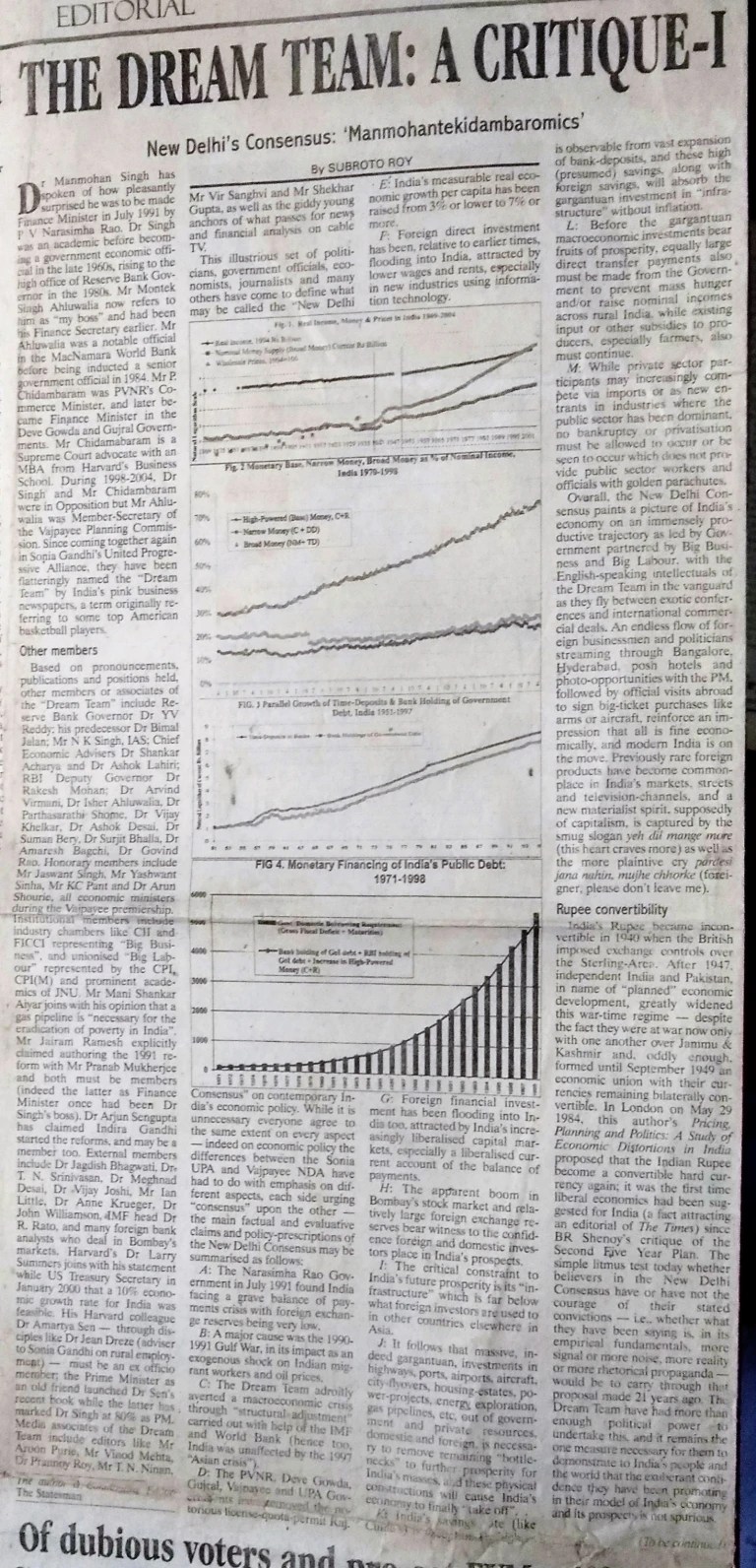
Dr Manmohan Singh has spoken of how pleasantly surprised he was to be made Finance Minister in July 1991 by PV Narasimha Rao. Dr Singh was an academic before becoming a government economic official in the late 1960s, rising to the high office of Reserve Bank Governor in the 1980s. Mr Montek Singh Ahluwalia now refers to him as “my boss” and had been his Finance Secretary earlier. Mr Ahluwalia was a notable official in the MacNamara World Bank before being inducted a senior government official in 1984. Mr P Chidambaram was PVNR’s Commerce Minister, and later became Finance Minister in the Deve Gowda and Gujral Governments. Mr Chidamabaram is a Supreme Court advocate with an MBA from Harvard’s Business School. During 1998-2004, Dr Singh and Mr Chidambaram were in Opposition but Mr Ahluwalia was Member-Secretary of the Vajpayee Planning Commission. Since coming together again in Sonia Gandhi’s United Progressive Alliance, they have been flatteringly named the “Dream Team” by India’s pink business newspapers, a term originally referring to some top American basketball players.

Based on pronouncements, publications and positions held, other members or associates of the “Dream Team” include Reserve Bank Governor Dr YV Reddy; his predecessor Dr Bimal Jalan; former PMO official Mr NK Singh, IAS; Chief Economic Advisers Dr Shankar Acharya and Dr Ashok Lahiri; RBI Deputy Governor Dr Rakesh Mohan; and others like Dr Arvind Virmani, Dr Isher Ahluwalia, Dr Parthasarathi Shome, Dr Vijay Khelkar, Dr Ashok Desai, Dr Suman Bery, Dr Surjit Bhalla, Dr Amaresh Bagchi, Dr Govind Rao. Honorary members include Mr Jaswant Singh, Mr Yashwant Sinha, Mr KC Pant and Dr Arun Shourie, all economic ministers during the Vajpayee premiership. Institutional members include industry chambers like CII and FICCI representing “Big Business”, and unionised “Big Labour” represented by the CPI, CPI(M) and prominent academics of JNU. Mr Mani Shankar Aiyar joins the Dream Team with his opinion that a gas pipeline is “necessary for the eradication of poverty in India”. Mr Jairam Ramesh explicitly claimed authoring the 1991 reform with Mr Pranab Mukherjee and both must be members (indeed the latter as Finance Minister once had been Dr Singh’s boss). Dr Arjun Sengupta has claimed Indira Gandhi started the reforms, and he may be a member too. External members include Dr Jagdish Bhagwati, Dr. TN Srinivasan, Dr Meghnad Desai, Dr Vijay Joshi, Mr Ian Little, Dr Anne O. Krueger, Dr John Williamson, IMF Head Dr R Rato, and many foreign bank analysts who deal in Bombay’s markets. Harvard’s Dr Larry Summers joins with his statement while US Treasury Secretary in January 2000 that a 10% economic growth rate for India was feasible. His Harvard colleague Dr Amartya Sen — through disciples like Dr Jean Dreze (adviser to Sonia Gandhi on rural employment) — must be an ex officio member; as an old friend, the Prime Minister launched Dr Sen’s recent book while the latter has marked Dr Singh at 80% as PM. Media associates of the Dream Team include editors like Mr Aroon Purie, Mr Vinod Mehta, Dr Prannoy Roy, Mr TN Ninan, Mr Vir Sanghvi and Mr Shekhar Gupta, as well as the giddy young anchors of what passes for news and financial analysis on cable TV.

This illustrious set of politicians, government officials, economists, journalists and many others have come to define what may be called the “New Delhi Consensus” on contemporary India’s economic policy. While it is unnecessary everyone agree to the same extent on every aspect — indeed on economic policy the differences between the Sonia UPA and Vajpayee NDA have had to do with emphasis on different aspects, each side urging “consensus” upon the other — the main factual and evaluative claims and policy-prescriptions of the New Delhi Consensus may be summarised as follows:

A: “The Narasimha Rao Government in July 1991 found India facing a grave balance of payments crisis with foreign exchange reserves being very low.”

B: “A major cause was the 1990-1991 Gulf War, in its impact as an exogenous shock on Indian migrant workers and oil prices.”

C: “The Dream Team averted a macroeconomic crisis through “structural adjustment” carried out with help of the IMF and World Bank; hence too, India was unaffected by the 1997 ‘Asian crisis'”.

D: “The PVNR, Deve Gowda, Gujral and Vajpayee Governments removed the notorious license-quota-permit Raj.”

E: “India’s measurable real economic growth per capita has been raised from 3% or lower to 7% or more.”

F: “Foreign direct investment has been, relative to earlier times, flooding into India, attracted by lower wages and rents, especially in new industries using information technology.”

G: “Foreign financial investment has been flooding into India too, attracted by India’s increasingly liberalised capital markets, especially a liberalised current account of the balance of payments.”

H: “The apparent boom in Bombay’s stock market and relatively large foreign exchange reserves bear witness to the confidence foreign and domestic investors place in India’s prospects.”

I: “The critical constraint to India’s future prosperity is its “infrastructure” which is far below what foreign investors are used to in other countries elsewhere in Asia.”

J: “It follows that massive, indeed gargantuan, investments in highways, ports, airports, aircraft, city-flyovers, housing-estates, power-projects, energy exploration, gas pipelines, etc, out of government and private resources, domestic and foreign, is necessary to remove remaining “bottlenecks” to further prosperity for India’s masses, and these physical constructions will cause India’s economy to finally ‘take off’.”

K: “India’s savings rate (like China’s) is exceptionally high as is observable from vast expansion of bank-deposits, and these high (presumed) savings, along with foreign savings, will absorb the gargantuan investment in “infrastructure” without inflation.”

L: “Before the gargantuan macroeconomic investments bear the fruits of prosperity, equally large direct transfer payments also must be made from the Government to prevent mass hunger and/or raise nominal incomes across rural India, while existing input or other subsidies to producers, especially farmers, also must continue.”

M: “While private sector participants may increasingly compete via imports or as new entrants in industries where the public sector has been dominant, no bankruptcy or privatisation must be allowed to occur or be seen to occur which does not provide public sector workers and officials with golden parachutes.”

Overall, the New Delhi Consensus paints a picture of India’s economy on an immensely productive trajectory as led by Government partnered by Big Business and Big Labour, with the English-speaking intellectuals of the Dream Team in the vanguard as they fly between exotic conferences and international commercial deals. An endless flow of foreign businessmen and politicians streaming through Bangalore, Hyderabad, five-star hotels or photo-opportunities with the PM, followed by official visits abroad to sign big-ticket purchases like arms or aircraft, reinforce an impression that all is fine economically, and modern India is on the move. Previously rare foreign products have become commonplace in India’s markets, streets and television-channels, and a new materialist spirit, supposedly of capitalism, is captured by the smug slogan yeh dil mange more (this heart craves more) as well as the more plaintive cry pardesi jana nahin, mujhe chhorke (foreigner, please don’t leave me).


2. Money, Convertibility, Inflationary Deficit Financing

India’s Rupee became inconvertible in 1942 when the British imposed exchange controls over the Sterling-Area. After 1947 independent India and Pakistan, in name of “planned” economic development, greatly widened this war-time regime – despite the fact they were at war now only with one another over Jammu & Kashmir and, oddly enough, formed an economic union until 1951 with their currencies remaining freely convertible with each other.

On May 29 1984, the present author’s Pricing, Planning and Politics: A Study of Economic Distortions in India proposed in London that the Indian Rupee become a convertible hard currency again — the first time liberal economics had been suggested for India since BR Shenoy’s critique of the Second Five Year Plan (a fact attracting an editorial of The Times). The simple litmus test whether believers in the New Delhi Consensus have or have not the courage of their stated convictions – i.e., whether what they have been saying is, in its empirical fundamentals, more signal or noise, more reality or rhetorical propaganda – would be to carry through that proposal made 21 years ago. The Dream Team have had more than enough political power to undertake this, and it remains the one measure necessary for them to demonstrate to India’s people and the world that the exuberant confidence they have been promoting in their model of India’s economy and its prospects is not spurious.

What does convertibility entail?  For a decade now, India has had limited ease of availability of foreign exchange for traders, students and tourists. Indeed some senior Government monetary economists believe there is convertibility already except forex dealers are being allowed “one-way” and not “two-way” quotes! That is wrong. The Government since 1942 has requisitioned at the border all foreign exchange earned by exporters or received as loans or investment — allocating these first to pay interest and amortisation on the country’s foreign debt, then to make its own weapons and other purchases abroad, then to release by ration what remains to private traders, students, tourists et al. Current account liberalisation has meant the last of these categories has been relaxed, especially by removal of some import quotas. What a convertible Rupee would mean is far more profound. It would allow any citizen to hold and save an Indian money that was exchangeable freely (i.e. without Government hindrance) into moneys of other countries. Full convertibility would mean all the paper money, bank deposits and rupee-denominated nominal assets held by ordinary people in India becomes, overnight, exchangeable without hindrance into dollars, yens, pounds or euros held anywhere (although not of course at the “one-way” rates quoted today).

Now money is a most peculiar human institution. Paper money is intrinsically worthless but all of India’s 1,000 million people (from street children onwards) have need to hold it temporarily to expedite their individual transactions of buying and selling real goods and services. Money also acts as a repository of value over time and unit of account or measure of economic value. While demand to hold such intrinsically worthless paper is universal, its supply is a Government monopoly. Because Government accepts obligations owed to it in terms of the fiat money it has itself issued, the otherwise worthless paper comes to possess value in exchange. Because Government controls its supply, money also can be abused easily enough as a technique of invisible taxation via inflation.

With convertibility in India, the quantity of currency and other paper assets like public debt instruments representing fiscal decisions of India’s Union and State Governments, will have to start to compete with those produced by other governments. Just as India’s long-jumpers and tennis-players must compete with the world’s best if they are to establish and sustain their athletic reputations, so India’s fiscal and monetary decisions (i.e. about government spending and revenues, interest-rates and money supply growth) will have to start competing in the world’s financial markets with those of the EU, USA, Japan, Switzerland, ASEAN etc.

The average family in rural Madhya Pradesh who may wish, for whatever personal reason, to liquidate rupee-denominated assets and buy instead Canadian, Swiss or Japanese Government debt, or mutual fund shares in New York, Frankfurt or Singapore, would not be hindered by India’s Government from doing so. They would become as free as the swankiest NRI jet-setters have been for years (like many members of the New Delhi Consensus and their grown children abroad).  Scores of millions of ordinary Indians unconnected with Big Business or Big Labour, neither among the 18 million people in government nor the 12 million in the organised private sector, would become free to hold any portfolio of assets they chose in global markets (small as any given individual portfolio may be in value). Like all those glamorous NRIs, every Indian would be able to hold dollar or Swiss Franc deposit accounts at the local neighbourhood bank. Hawala operators worldwide would become redundant. Ordinary citizens could choose to hold foreign shares, real-estate or travellers’ cheques as assets just as they now choose jewellery before a wedding. The Indian Rupee, after more than 65 years, would once again become as good as all the proverbial gold in Fort Knox.

When added up, the new demand of India’s anonymous masses to hold foreign rather than Rupee-denominated assets will certainly make the Rupee decline in price in world markets. But — if the implicit model of India’s economy promoted by the Dream Team is based on correctly ascertained empirical facts — foreign and domestic investor confidence should suffice for countervailing tendencies to keep India’s financial and banking system stable under convertibility. Not only would India’s people be able to use and save a currency of integrity, the allocation of real resources would also improve in efficiency as distortions would be reduced in the signalling function of domestic relative prices compared to world relative prices. An honest Rupee freely priced in world markets at, say, 90 per dollar, would cause very different real microeconomic decisions of Government and private producers and consumers (e.g., with respect to weapons’ purchases or domestic transportation, given petroleum and jet fuel imports) than a semi-artificial Rupee at 45 per dollar which forcibly an inconvertible asset in global markets. A fully convertible Rupee will cause economic and political decisions in the country more consistent with word realities.

Why the Rupee is not going to be made convertible in the foreseeable future – or why, in India’s present fiscal circumstances if it was, it would be imprudent to do so – is because, contrary to the immense optimism promoted by the Dream Team about their own deeds since 1991, they have in fact been causing India’s monetary economy to skate on the thinnest of thin ice. Put another way, a house of cards has been constructed whose cornerstone constitutes that most unscientific anti-economic of assumptions, the “free lunch”: that something can be had for nothing, that real growth in average consumption levels of the masses of ordinary households of rural and urban India can meaningfully come about by nominal paper-money creation accompanied by verbal exhortation, hocus-pocus or abracadabra from policy-makers and their friends in Big Business, Big Labour and the media. (Lest half-remembered inanities about “orthodox economics” come to be mouthed, Maynard Keynes’s 1936 book was about specific circumstances in Western economies during the Depression and it is unwise to extend its presumptions to unintended situations.)


3. Rajiv Gandhi and Perestroika Project

On 25 May 2002, India’s newspapers reported “PV Narasimha Rao and Manmohan Singh lost their place in Congress history as architects of economic reforms as the Congress High Command sponsored an amendment to a resolution that had laid credit at the duo’s door. The motion was moved by…. Digvijay Singh asserting that the reforms were a brainchild of the late Rajiv Gandhi and that the Rao-Singh combine had simply nudged the process forward.”

Now Rajiv Gandhi was an airline-pilot and knew no economics. But the origins of the 1991 reform did come about because of an encounter he had, as Opposition Leader and Congress President from September 1990 onwards, with a “perestroika” project for India’s political economy occurring at an American university since 1986 (viz., The Statesman Editorial Page July 31-August 2 1991, now republished here; Freedom First October 2001). In being less than candid in acknowledging the origins of the reform, the Dream Team may have failed to describe accurately the main symptoms of illness that afflicted India before 1991, and have consequently failed to diagnose and prescribe for it correctly ever since.

The Government of India, like many others, has been sorely tempted to finance its extravagant expenditures by abusing its monopoly over paper-money creation. The British taught us how to do this, and in 1941-43 caused the highest inflation rates ever seen in India as a result. Fig. 1 shows this, and also that real growth in India follows as expected the trend-rate of technological progress (having little to do with government policy). Independent India has continually financed budget- deficits by money creation in a process similar to what the British and Americans did in wartime. This became most conspicuous after Indira Gandhi’s bank and insurance nationalisations of 1969-1970. Indeed, among current policy-makers, Pranab Mukherjee, Manmohan Singh, Arjun Sengupta, Montek Singh Ahluwalia, Bimal Jalan, NK Singh, Amaresh Bagchi and Shankar Acharya, were among those governing such macroeconomic processes before 1991 — albeit in absence of the equations that illustrate their nature. Why the Rupee cannot be made an honest, internationally convertible, stable money held with confidence by all Indians today, is because the Dream Team have continued with the same macroeconomics ever since. The personal and political ambitions of the tiniest super-elite that the New Delhi Consensus represent (both personal and political) have depended precisely on gargantuan unending deficit-financing backed by unlimited printing of paper-money, and hence the continuing destruction of the integrity of India’s banking system. A convertible Rupee would allow India’s ordinary people to choose to hold other stores of value available in the world today, like gold or monies issued by foreign governments, and thus force an end to such processes.

Two recent articles in The Statesman (Perspective Page 30 October 2005, Front Page 29 November 2005) outlined India’s financial repression and negative real interest rates (which suffice to explain the present stock market boom the way athletes perform better on steroids), and also how deficits get financed by money creation accompanied by wishful projections of economic growth in an upside down imitation of how macroeconomic policy gets done in the West.

“Narrow Money” consists mostly of hand-to-hand currency. “Broad Money” consists of Narrow Money plus bank-deposits. Modern banking is built on “fractional reserves”, i.e. a system of trust where your bank does not literally hold onto deposits you place there but lends these out again – which causes further deposit expansion because no individual banker can tell whether a new deposit received by it is being caused by the depositor having himself borrowed. As a general rule, bank lending causes further deposit expansion. Why India’s (and China’s) bank deposits have been expanding is not because Indians (or Chinese) are superhuman savers of financial assets in banks but because the Government of India (and China) has for decades compelled (the mostly nationalised) banks to hold vast sums of Government debt on the asset side of their balance-sheets. Thus there has been humongous lending by the banking system to pay for Government expenditures. The Dream Team’s macroeconomics relies entirely on this kind of unending recourse to deficit finance and money creation, causing dry rot to set into banks’ balance sheets (Figs. 2,3, 4).   If the Rupee became convertible, those vast holdings of Government debt by banks would become valued at world prices. The crucial question would be how heavily New York, London and Hong Kong financial markets discounted Indian sovereign debt. If upon convertibility, the asset sides of domestic Indian banks get discounted very heavily by world financial markets, their insolvency upon being valued at international prices could trigger catastrophic repercussions throughout India’s economy. Hence the Rupee cannot be made convertible — and all our present inefficiencies and inequities will continue for ever with New Delhi’s rhetorical propaganda alongside. The capital flight of 10 out of 1000 million Indians will continue, leaving everyone else with the internal and foreign public debts to pay.


4. A Different Strategy had Rajiv Not Been Assassinated

Had Rajiv Gandhi not been assassinated and the perestroika project allowed to take its course, a different strategy would have been chosen. Honest money first demands honest Government and political leadership. It would at the outset have been recognised by Government (and through Government by all India’s people) that the asset-liability, income-expenditure and cash-flow positions of every public entity in the country without exception — of the Union Government, every State and local Government, every public undertaking and project – is abysmal.  Due to entanglement with government financial loans, labour regulations, subsidies, price controls, protection and favouritism, the same holds for the financial positions of vast numbers of firms in the organised private sector. Superimpose on this dismal scene, the bleak situation of the Rule of Law in the country today – where Courts of Justice from highest to lowest suffer terrible abuse receiving pitiable amounts of public resources despite constituting a third and independent branch of India’s Government (while police forces, despite massive expenditure, remain incompetent, high-handed and brutal). What India has needed ever since 1991 is the Rule of Law, total transparency of public information, and the fiercest enforcement of rigorous accounting and audit standards in every government entity and public institution. It is only when budgets and financial positions become sound that ambitious goals can be achieved.

The Dream Team have instead made a fetish of physical construction of “infrastructure”, in some grandiose make-believe dreamworld which says the people of India wish the country to be a superpower. The Dream Team have failed to properly redefine for India’s masses the appropriate fiscal and monetary relationship between State and citizen – i.e. to demarcate public from private domains, and so enhance citizens’ sense of individual responsibility for their own futures, as well as explain and define what government and public institutions can and cannot do to help people’s lives. Grotesque corruption and inefficiency have thus continued to corrode practically all organs, institutions and undertakings of government. Corruption is the transmutation of publicly owned things into private property, while its mirror image, pollution, is the disposal of private wastes into the public domain. Both become vastly more prevalent where property rights between private and public domains remain ill demarcated. What belongs to the individual citizen and what to sovereign India –their rights and obligations to one another – remains fuzzy. Hence corruption and pollution run amuck. The irrational obsession with “infrastructure” is based on bad economics, and has led to profoundly wrong political and financial directions. The Rupee cannot be made an honest stable money because India’s fiscal and monetary situation remains not merely out of control but beyond New Delhi’s proper comprehension and grasp. If and when the Dream Team choose to wake up to India’s macroeconomic realities, a great deal of serious work will need to be done.


Posted in Academic economics, Academic research, Accounting and audit, Amartya Sen, Atal Behari Vajpayee, Banking, Big Business and Big Labour, BJP, BR Shenoy, China, Communists, Congress Party, Deposit multiplication, Economic Policy, Economic Theory, Economic Theory of Growth, Economic Theory of Interest, Economic Theory of Value, Economics of Exchange Rates, Economics of Public Finance, Financial markets, Freedom, Governance, Government accounting, Government Budget Constraint, Government of India, India's Big Business, India's credit markets, India's Government economists, India's interest rates, India's savings rate, India's stock and debt markets, India's 1991 Economic Reform, India's agriculture, India's Agriculture & Food, India's balance of payments, India's Banking, India's Budget, India's bureaucracy, India's Capital Markets, India's corruption, India's currency history, India's Democracy, India's Economic History, India's Economy, India's Exports, India's farmers, India's Foreign Exchange Reserves, India's Foreign Trade, India's Industry, India's inflation, India's Jurisprudence, India's Labour Markets, India's Land, India's Macroeconomics, India's Monetary & Fiscal Policy, India's nomenclatura, India's political lobbyists, India's political parties, India's Politics, India's Polity, India's Public Finance, India's Reserve Bank, India's Revolution, India's Rule of Law, India's State Finances, Indira Gandhi, Inflation, John Maynard Keynes, Macroeconomics, Manmohan Singh, Mendacity in politics, Milton Friedman, Monetary Theory, Political cynicism, Political Economy, Political mendacity, Rajiv Gandhi, Redeposits, University of Hawaii, Unorganised capital markets. Leave a Comment »

Solving Kashmir: On an Application of Reason (2005)

SOLVING KASHMIR: ON AN APPLICATION OF REASON

by

Subroto Roy

First published in three parts in The Statesman

Editorial Page Special Article 1, 2, 3 December 2005

This article has its origins in a paper “Towards an Economic Solution for Kashmir” which circulated in Washington DC in 1992-1995, including at the Indian and Pakistani embassies and the Carnegie Endowment, and was given as an invited lecture at the Heritage Foundation on June 23 1998. It should be read along with other articles also republished here, especially “History of J&K”, “Law, Justice and J&K” , “Understanding Pakistan”, “Pakistan’s Allies” and “What to Tell Musharraf”.  See https://independentindian.com/2011/10/13/my-seventy-one-notes-at-facebook-etc-on-kashmir-pakistan-and-of-course-india-listed-thanks-to-jd/  The Washington paper and lecture itself originated from my ideas in the Introduction to Foundations of Pakistan’s Political Economy, edited by WE James and myself in the University of Hawaii project on Pakistan 1986-1992.

Postscript 30 Dec 2015:  I have made clear at Twitter that I find the K.M. Kasuri book, promoted and publicized in India by Mani Shankar Aiyar, Sudheendra Kulkarni, Barkha Dutt and others in Delhi and Mumbai, to be mendacious where it is not merely self-serving.  Its clear intent is to get India to accept the (entirely false) ISI/Hurriyat narratives about 1947, Kashmir, Bangladesh, terrorism etc.  Its purported ideas of demilitarisation and a borderless Kashmir are essentially lifted without the decency of normal acknowledgement from my earlier 1980s work in America cited above — which I myself have rejected as naive since the 1999 Pakistani aggression in Kargil…

NB: https://independentindian.com/2006/07/03/law-justice-and-jk/

https://independentindian.com/2006/10/30/history-of-jk/


I. Give Indian `Green Cards’ to the Hurriyat et al

India, being a liberal democracy in its constitutional law, cannot do in Jammu & Kashmir what Czechoslovakia did to the “Sudeten Germans” after World War II.

On June 18 1945 the new Czechoslovakia announced those Germans and Magyars within their borders who could not prove they had been actively anti-fascist before or during the War would be expelled — the burden of proof was placed on the individual, not the State. Czechoslovakia “transferring” this population was approved by the Heads of the USA, UK and USSR Governments at Potsdam on August 2 1945. By the end of 1946, upto two million Sudeten Germans were forced to flee their homes; thousands may have died by massacre or otherwise; 165,000 remained who were absorbed as Czechoslovak citizens. Among those expelled were doubtless many who had supported Germany and many others who had not — the latter to this day seek justice or even an apology in vain. Czechoslovakia punished none of its nationals for atrocities, saying it had been revenge for Hitler’s evil (“badla” in Bollywood terms) and the post Cold War Czech Government too has declined to render an apology. Revenge is a wild kind of justice (while justice may be a civilised kind of revenge).

India cannot follow this savage precedent in international law. Yet we must recognise there are several hundred and up to several hundred thousand persons on our side of the boundary in the State of Jammu & Kashmir who do not wish to be Indian nationals. These people are presently our nationals ius soli, having been born in territory of the Indian Republic, and/or ius sanguinis, having been born of parents who are Indian nationals; or they may be “stateless” whom we must treat in accordance with the 1954 Convention on Stateless Persons. The fact is they may not wish to carry Indian passports or be Indian nationals.

In this respect their juridical persons resemble the few million “elite” Indians who have in the last few decades freely placed their hands on their hearts and solemnly renounced their Indian nationality, declaring instead their individual fidelity to other nation-states — becoming American, Canadian or Australian citizens, or British subjects or nationals of other countries. Such people include tens of thousands of the adult children of India’s metropolitan “elite”, who are annually visited abroad in the hot summer months by their Indian parents and relatives. They are daughters and sons of New Delhi’s Government and Opposition, of retired generals, air marshals, admirals, ambassadors, cabinet secretaries, public sector bureaucrats, private sector businessmen, university professors, journalists, doctors and many others. India’s most popular film-actress exemplified this “elite” capital-flight when, after a tireless search, she chose a foreign husband and moved to California.

The difference in Jammu & Kashmir would be that those wishing to renounce Indian nationality do not wish to move to any other place but to stay as and where they are, which is in Kashmir Valley or Jammu. Furthermore, they may wish, for whatever reason, to adopt, if they are eligible to do so, the nationality of e.g. the Islamic Republic of Afghanistan or the Islamic Republic of Iran or the Islamic Republic of Pakistan.

They may believe themselves descended from Ahmad Shah Abdali whose Afghans ruled or misruled Kashmir Valley before being defeated by Ranjit Singh’s Sikhs in 1819. Or they may believe themselves of Iranian descent as, for example, are the Kashmiri cousins of the late Ayatollah Khomeini. Or they may simply have wished to be, or are descended from persons who had wished to be on October 26 1947, citizens of the then-new British Dominion of Pakistan — but who came to be prevented from properly expressing such a desire because of the war-like conditions that have prevailed ever since between India and Pakistan. There may be even a few persons in Ladakh who are today Indian nationals but who wish to be considered Tibetans instead; there is, however, no Tibetan Republic and it does not appear there is going to be one.

India, being a free and self-confident country, should allow, in a systematic lawful manner, all such persons to fulfil their desires, and furthermore, should ensure they are not penalised for having expressed such “anti-national” desires or for having acted upon them. Sir Mark Tully, the British journalist, is an example of someone who has been a foreign national who has chosen to reside permanently in the Republic of India — indeed he has been an exemplary permanent resident of our country. There are many others like him. There is no logical reason why all those persons in Jammu & Kashmir who do wish not to be Indians by nationality cannot receive the same legal status from the Indian Republic as has been granted to Sir Mark Tully. There are already thousands of Sri Lankan, Bangladeshi and Nepalese nationals who are lawful permanent residents in the Indian Republic, and who travel back and forth between India and their home countries. There is no logical reason why the same could not be extended to several hundred or numerous thousand people in Jammu & Kashmir who may wish to not accept or to renounce their Indian nationality (for whatever personal reason) and instead become nationals, if they are so eligible, of the Islamic Republics of Afghanistan, Iran or Pakistan, or, for that matter, to remain stateless. On the one hand, their renunciation of Indian nationality is logically equivalent to the renunciation of Indian nationality by the adult children of India’s “elite” settled in North America and Western Europe. On the other hand, their wish to adopt, if they are eligible, a foreign nationality, such as that of Afghanistan, Iran or Pakistan, and yet remain domiciled in Indian territory is logically equivalent to that of many foreign nationals domiciled in India already like Sir Mark Tully.

Now if you are a permanent resident of some country, you may legally have many, perhaps most, but certainly not all the rights and duties of nationals of that country. e.g., though you will have to pay all the same taxes, you may not be allowed to (or be required to) vote in national or provincial elections but you may in local municipal elections. At the same time, permanently residing foreign nationals are supposed to be equal under the law and have equal access to all processes of civil and criminal justice. (As may be expected though from human frailty, even the federal courts of the USA can be notorious in their injustice and racism towards “Green Card” holders relative to “full” American citizens.) Then again, as a permanently resident foreigner, while you will be free to work in any lawful trade or profession, you may not be allowed to work in some or perhaps any Government agencies, certainly not the armed forces or the police. Many Indians in the USA were engineering graduates, and because many engineering jobs or contracts in the USA are related to the US armed forces and require US citizens only, it is commonplace for Indian engineers to renounce their Indian nationality and become Americans because of this. Many Indian-American families have one member who is American, another Indian, a third maybe Canadian, a fourth Fijian or British etc.

The same can happen in the Indian State of Jammu & Kashmir if it evolves peacefully and correctly in the future. It is quite possible to imagine a productive family in a peaceful Kashmir Valley of the future where one brother is an officer in the Indian Armed Forces, another brother a civil servant and a sister a police officer of the J&K State Government, another sister being a Pakistani doctor, while cousins are Afghan or Iranian or “stateless” businessmen. Each family-member would have made his/her choice of nationality as an individual given the circumstances of his/her life, his/her personal comprehension of the facts of history, his/her personal political and/or religious persuasions, and similar deeply private considerations. All would have their children going to Indian schools and being Indian citizens ius soli and/or ius sanguinis. When the children grow up, they would be free to join, if they wished, the existing capital flight of other Indian adult children abroad and there renounce their Indian nationality as many have come to do.

II Revealing Choices Privately with Full Information

For India to implement such a proposal would be to provide an opportunity for all those domiciled in Kashmir Valley, Jammu and Laddakh to express freely and privately as individuals their deepest wishes about their own identities, in a confidential manner, citizen by citizen, case by case. This would thereby solve the fundamental democratic problem that has been faced ever since the Pakistani attack on the original State of Jammu & Kashmir commenced on October 22 1947, which came to be followed by the Rape of Baramulla — causing the formal accession of the State to the then-new Dominion of India on October 26 1947.

A period of, say, 30 months may be announced by the Government of India during which full information would be provided to all citizens affected by this change, i.e. all those presently governed by Article 370 of the Indian Constitution. The condition of full information may include, for example, easy access to Afghan, Iranian and Pakistani newspapers in addition to access to Indian media. Each such person wishing to either remain with Indian nationality (by explicitly requesting an Indian passport if he/she does not have one already — and such passports can be printed in Kashmiri and Urdu too), or to renounce Indian nationality and either remain stateless or adopt, if he/she is so eligible, the nationality of e.g. Afghanistan, Iran, or Pakistan, should be administratively assisted by the Government of India to make that choice.

In particular, he/she should be individually, confidentially, and without fear or favour assured and informed of his/her new rights and responsibilities. For example, a resident of Kashmir Valley who chooses to become a Pakistani citizen, such as Mr Geelani, would now enjoy the same rights and responsibilities in the Indian Republic that Mr Tully enjoys, and at the same time no longer require a visa to visit Pakistan just as Mr Tully needs no visa to enter Britain. In case individual participants in the Hurriyat choose to renounce Indian nationality and adopt some other, they would no longer be able to legally participate in Indian national elections or J&K’s State elections. That is something which they say they do not wish to do in any case. Those members of the Hurriyat who chose e.g. Pakistani nationality while still residing in Jammu & Kashmir, would be free to send postal ballots or cross the border and vote in Pakistan’s elections if and when these occur. There are many Canadians who live permanently in the USA who cross home to Canada in order to cast a ballot.

After the period of 30 months, every person presently under Article 370 of the Indian Constitution would have received a full and fair opportunity to privately and confidentially reveal his/her preference or choice under conditions of full information. “Partition”, “Plebiscite”, and “Military Decision” have been the three alternatives under discussion ever since the National Conference of Sheikh Mohammad Abdullah and his then-loyal Deputy, Bakshi Ghulam Mohammad, helped the Indian Army and Air Force in 1947-1948 fight off the savage attack against Jammu & Kashmir State that had commenced from Pakistan on October 22 1947. When, during the Pakistani attack, the Sheikh and Bakshi agreed to the Muslim Conference’s demand for a plebiscite among the people, the Pakistanis balked — the Sheikh and Bakshi then withdrew their offer and decisively and irrevocably chose to accede to the Indian Union. The people of Jammu & Kashmir, like any other, are now bound by the sovereign political commitments made by their forebears. Even so, given the painful mortal facts of the several decades since, the solution here proposed if properly implemented would be an incomparably more thorough democratic exercise than any conceivable plebiscite could ever have been.

Furthermore, regardless of the outcome, it would not entail any further “Partition” or population “transfer” which inevitably would degenerate into a savage balkanization, and has been ruled out as an unacceptable “deal-breaker” by the Indian Republic. Instead, every individual person would have been required, in a private and confidential decision-making process, to have chosen a nationality or to remain stateless — resulting in a multitude of cosmopolitan families in Jammu & Kashmir. But that is something commonplace in the modern world. Properly understood and properly implemented, we shall have resolved the great mortal problem we have faced for more than half a century, and Jammu & Kashmir can finally settle into a period of peace and prosperity. The boundary between India and Pakistan would have been settled by the third alternative mentioned at the time, namely, “Military Decision”.


III. Of Flags and Consulates in Srinagar and Gilgit

Pakistan has demanded its flag fly in Srinagar. This too can happen though not in the way Pakistan has been wishing to see it happen. A Pakistan flag might fly in the Valley just as might an Afghan and Iranian flag as well. Pakistan has wished its flag to fly as the sovereign over Jammu & Kashmir. That is not possible. The best and most just outcome is for the Pakistani flag to fly over a recognised Pakistani consular or visa office in Srinagar, Jammu and Leh. In diplomatic exchange, the Indian tricolour would have to fly over a recognised Indian consular or visa office in Muzaffarabad, Gilgit and Skardu.

Pakistan also may have to act equivalently with respect to the original inhabitants of the territory of Jammu & Kashmir that it has been controlling — allowing those people to become Indian nationals if they so chose to do in free private decisions under conditions of full information. In other words, the “Military Decision” that defines the present boundary between sovereign states must be recognised by Pakistan sincerely and permanently in a Treaty relationship with India — and all of Pakistan’s official and unofficial protégés like the Hurriyat and the “United Jehad Council” would have to do the same. Without such a sovereign commitment from the Government of Pakistan, as shown by decisive actions of lack of aggressive intent (e.g. as came to be implemented between the USA and USSR), the Government of India has no need to involve the Government of Pakistan in implementing the solution of enhancing free individual choice of nationality with regard to all persons on our side of the boundary.

The “Military Decision” regarding the sovereign boundary in Jammu & Kashmir will be so recognised by all only if it is the universally just outcome in international law. And that in fact is what it is.

The original Jammu & Kashmir State began its existence as an entity in international law long before the present Republics of India and Pakistan ever did. Pakistan commences as an entity on August 14 1947; India commences as an entity of international law with its signing of the Treaty of Versailles on June 28, 1919  20 1918. Jammu & Kashmir began as an entity on March 16 1846 — when the Treaty of Amritsar was signed between Gulab Singh Dogra and the British, one week after the Treaty of Lahore between the British and the defeated Sikh regency of the child Daleep Singh.

Liaquat Ali Khan and Zafrullah Khan both formally challenged on Pakistan’s behalf the legitimacy of Dogra rule in Jammu & Kashmir since the Treaty of Amritsar. The Pakistani Mission to the UN does so even today. The Pakistanis were following Sheikh Abdullah and Jawaharlal Nehru himself, who too had at one point challenged Dogra legitimacy in the past. But though the form of words of the Pakistan Government and the Nehru-Abdullah position were similar in their attacks on the Treaty of Amritsar, their underlying substantive reasons were as different as chalk from cheese. The Pakistanis attacked the Dogra dynasty for being Dogra — i.e. because they were Hindus and not Muslims governing a Muslim majority. Nehru and Abdullah denounced monarchic autocracy in favour of mass democracy, and so attacked the Dogra dynasty for being a dynasty. All were wrong to think the Treaty of Amritsar anything but a lawful treaty in international law.

Furthermore, in this sombre political game of great mortal consequence, there were also two other parties who were, or appeared to be, in favour of the dynasty: one because the dynasty was non-Muslim, the other, despite it being so. Non-Muslim minorities like many Hindus and Sikhs in the business and governmental classes, saw the Dogra dynasty as their protector against a feared communalist tyranny arising from the Sunni Muslim masses of Srinagar Valley, whom Abdullah’s rhetoric at Friday prayer-meetings had been inciting or at least awakening from slumber. At the same time, the communalists of the Muslim Conference who had broken away from Abdullah’s secular National Conference, sought political advantage over Abdullah by declaring themselves in favour of keeping the dynasty — even elevating it to become an international sovereign, thus flattering the already pretentious potentate that he would be called “His Majesty” instead of merely “His Highness”. The ancestry of today’s Hurriyat’s demands for an independent Jammu & Kashmir may be traced precisely to those May 21-22 1947 declarations of the Muslim Conference leader, Hamidullah Khan.

Into this game stumbled the British with all the mix of cunning, indifference, good will, impatience, arrogance and pomposity that marked their rule in India. At the behest of the so-called “Native Princes”, the 1929 Butler Commission had hinted that the relationship of “Indian India” to the British sovereign was conceptually different from that of “British India” to the British sovereign. This view was adopted in the Cabinet Mission’s 12 May 1946 Memorandum which in turn came to be applied by Attlee and Mountbatten in their unseemly rush to “Divide and Quit” India in the summer of 1947.

It created the pure legal illusion that there was such a thing as “Lapse of Paramountcy” at which Jammu & Kashmir or any other “Native State” of “Indian India” could conceivably, even for a moment, become a sovereign enjoying the comity of nations — contradicting Britain’s own position that only two Dominions, India and Pakistan, could ever be members of the British Commonwealth and hence members of the newly created UN. British pusillanimity towards Jammu & Kashmir’s Ruler had even extended to making him a nominal member of Churchill’s War Cabinet because he had sent troops to fight in Burma. But the legal illusion had come about because of a catastrophic misunderstanding on the part of the British of their own constitutional law.

The only legal scholar who saw this was B R Ambedkar in a lonely and brilliant technical analysis released to the press on June 17 1947. No “Lapse of Paramountcy” over the “Native Princes” of Indian India could occur in constitutional law. Paramountcy over Indian India would be automatically inherited by the successor state of British India at the Transfer of Power. That successor state was the new British Dominion of India as well as (when it came to be finalised by Partition from India) the new British Dominion of Pakistan (Postscript: the deleted words represent a mistake made in the original paper, corrected in “Law, Justice & J&K” in view of the fact the UN  in 1947 deemed  India alone the successor state of British India and Pakistan a new state in the world system). A former “Native Prince” could only choose to which Dominion he would go. No other alternative existed even for a single logical moment. Because the British had catastrophically failed to comprehend this aspect of their own constitutional law, they created a legal vacuum whereby between August 15 and October 22-26 1947, Jammu & Kashmir became a local and temporary sovereign recognised only by the Dominion of Pakistan (until October 22) and the Dominion of India (until October 26). But it was not a globally recognised sovereign and was never going to be such in international law. This was further proved by Attlee refusing to answer the J&K Prime Minister’s October 18 1947 telegram.

All ambiguity came to end with the Pakistani attack of October 22 1947, the Rape of Baramulla, the secession of an “Azad Kashmir”declared by Sardar Ibrahim, and the Pakistani coup détat in Gilgit on October 31 1947 followed by the massacre of Sikh soldiers of the J&K Army at Bunji. With those Pakistani actions, Gulab Singh’s Jammu & Kashmir State, founded on March 16 1846 by the Treaty of Amritsar, ceased to logically exist as an entity in international law and fell into a state of ownerless anarchy. The conflict between Ibrahim’s Muslim communalists backed by the new Dominion of Pakistan and Abdullah’s secularists backed by the new Dominion of India had become a civil war within a larger intra-Commonwealth war that itself was almost a civil war between forces of the same military.

Jammu & Kashmir territory had become ownerless. The Roman Law which is at the root of all municipal and international law in the world today would declare that in the ownership of such an ownerless entity, a “Military Decision” was indeed the just outcome. Sovereignty over the land, waters, forests and other actual and potential resources of the erstwhile State of Jammu & Kashmir has become divided by “Military Decision” between the modern Republics of India and Pakistan. By the proposal made herein, the people and their descendants shall have chosen their nationality and their domicile freely across the sovereign boundary that has come to result.

Assessing Vajpayee: Hindutva True and False (2005)

Assessing Vajpayee: Hindutva True and False

by

Subroto Roy

First published in The Sunday Statesman, Nov 13 2005 and The Statesman, Nov 14 2005, Editorial Page Special Article

Atal Behari Vajpayee, mentored by Shyama Prasad Mookerjee himself, became Prime Minister of India for less than a fortnight in 1996, then again in 1998 and again in 1999 and remained so until he was voted out in 2004.

He became PM holding the trust of India’s 120 million Muslims. He was supposed to be the genial, avuncular “good cop” who would keep at bay the harsh forces represented by the unpredictable “bad cop”, his Deputy PM and long-time colleague LK Advani. It was the first time RSS members had come to lead India’s government. How is the Vajpayee-Advani duumvirate to be candidly assessed? The question is important not only for the RSS and BJP engaged in their own introspection and petty politics but for the country as a whole. India needs both a competent Government and a competent Opposition in Parliament, and it is not clear we have ever had either.

Overall, Vajpayee-Advani, as the chief public symbols of the RSS-BJP, earned relatively high marks in office handling India’s strategic and security interests, including the nuclear issue and Pakistan. Equally, they failed badly in their treatment of India’s Muslims and religious minorities in general. This is a paradox that can be explained by the general failure of putative Hindutvadis to acquire an objective understanding of the processes that had led to Independence, Partition, and Pakistan’s creation.

Roughly, their comprehension of these processes has been one which sees all Muslims everywhere as cut from the same communal cloth, regardless of the beliefs or actions of individual Muslims. In such prejudiced eyes, there is no conceptual or ultimate difference between a Jinnah and an Azad, between a Salauddin who attacks India at Kargil and a Lt Hanifuddin who dies for India at Kargil. This is the product of a sloppy and erroneous philosophy of history, which in turn is an outcome of an attitude towards modern science and modes of rigorous reasoning that can only be called backward and retrograde.

It has been signalled most conspicuously by the extremely public adherence of many putative Hindutvadis (and millions of other Indians) to astrology — in apparent ignorance of the fact that all horoscopes assume the Sun rotates around Earth. Astrology, a European invention, came to decline in Europe after the discoveries of Copernicus and Galileo became widely understood there.

Like Indian Communists, Hindutvadi ideologues with rare exceptions played no role in the movement that led to Indian independence in 1947 and creation of the modern Indian Republic in 1950. They remained to their credit constantly suspicious of and hostile towards the foreign phenomena that were Bolshevism, Stalinism and Maoism. They remained to their discredit constantly suspicious of and hostile towards Indian Muslims, even at one point seeing virtuous lessons in Hitler’s attitude towards the Jews. They have in their own way subscribed to Ein Reich, Ein Volk but fortunately have always failed to find Ein Fuhrer (on a pattern e.g. of a modern “Netaji”).

Where Nazis saw communists and Jews in conspiracies everywhere, Hindutvadi ideologues have tended to see communists and Muslims, and also Christians and “Macaulayite” Hindus, in conspiracies everywhere. (An equal methodological admiration for Nazism occurred on the part of Muslims in the 1930s led by Rahmat Ali, the Pakistani ideologue — who saw “caste Hindus” as the root of all evil and in conspiracies everywhere.) The paradox of the RSS-BJP success in handling nuclear and security issues quite well and domestic issues of secular governance badly, is explained by this ideology of double hostility towards communism and Muslims.

On the positive side, Vajpayee-Advani advocated a tough clear-headed realpolitik on the issue of Indian’s security. “We should go nuclear and sign the Non-Proliferation Treaty as a nuclear weapons’ state. The whole world will recognise us by our power. We don’t want to be blackmailed and treated as oriental blackies. Nuclear weapons will give us prestige, power, standing. An Indian will talk straight and walk straight when we have the bomb”. That is what the BJP told the New York Times in 1993.

Three years later, the moment Vajpayee first entered office as PM in May 1996, the government’s scientists who had already secretly assembled the bomb for testing, were instructed to stand by for orders to go ahead. Vajpayee did not know if his Government would survive the vote of confidence required of them. When it was pointed out that if he tested the bomb and lost the vote, a successor Government would have to cope with the consequences, Vajpayee, to his credit and reflecting his political experience and maturity, cancelled the test. When he lost the vote, the public demonstration of Indian nuclear weapons capability was also postponed until May 1998, after he had returned as PM a second time. The bomb was a celebration of Hindu, or more generally, Indian independence in the world. India had nominally freed herself from the British but not from Western culture, according to the RSS. Where the Congress had been in the grip of world communism, the RSS-BJP led India to nuclear freedom – such was their propaganda.

In reality, a long line of prime ministers including Jawaharlal Nehru, Indira Gandhi, Rajiv Gandhi, VP Singh and IK Gujral had authorised India’s bomb, and a long line of scientists starting with Homi Bhabha had developed it over several decades.

Vajpayee’s decision finally flushed out Pakistan’s clandestine nuclear weapons developed with North Korea and China. Pakistan is an overtly Islamist state where liberal democracy shows no signs of starting even 65 years after the Lahore Resolution. Its nuclear bombs remain a far greater threat to the world than anyone else’s. Moreover, while India has renounced first use of such weapons, Pakistan has not only not done so, its Foreign Minister Gohar Ayub Khan boasted in 1998-1999 that the next war would be over in two hours with an Indian surrender.

Such glib talk about nuclear war is beyond contempt in its irresponsibility. A study by medical doctors estimated that a Hiroshima-sized bombing of Mumbai would cause 9 million deaths from blast, firestorms, radiation and fallout. An Indian retaliation would end Pakistan’s existence (though the Pakistani super-elite has long ago fled with its assets to Britain and America). An India-Pakistan nuclear exchange would leave a vast wasteland, finally ending all intellectual controversies about Partition and Jinnah’s theory. In reality, each is hardly able to cope with natural calamities like earthquakes, cyclones and floods, and also has very grave macroeconomic crises brewing because of unending deficit-finance and unlimited printing of paper money. For either to imagine itself a major power is a vain boast regardless of the polite flattery from visiting foreign businessmen. Of course, while each remains the principal enemy of the other, neither is a serious military force in the world.

After the exchange of nuclear tests in 1998, Vajpayee took the bus across the Wagah border to meet Nawaz Sharif in February 1999. He claimed it was a diplomatic and psychological breakthrough as indeed it was for a moment. But it had not been his original idea. AM Khusro, who accompanied him on the bus, had worked with Rajiv Gandhi in 1990-1991 when Rajiv was advised to make such a Sadat-like move. Furthermore, Vajpayee failed to see the significance of the Pakistani military chiefs led by Pervez Musharraf refusing to meet him formally, which would have entailed saluting him when he was their enemy.

Vajpayee also may not have known the Pakistani monument he visited was later “purified” with rose water by orthodox Muslim believers. So much for Indian diplomatic triumphs or Pakistan’s diplomatic niceties towards their kaffir guest. BJP foreign ministers later ingratiated themselves with Ariel Sharon because he was an enemy of Muslims — though again the BJP seemed unaware that “a single hair” shorn from idol-worshipping Hindu women at Tirupathi was enough for orthodox rabbis to declare as “impure” the wigs worn by Jewish women made from such hair. The evil of “untouchability” has not been a “caste Hindu” monopoly.


Kargil war

According to the Sharif-Musharraf plan secretly brewing during Vajpayee’s Pakistan visit, the Kargil infiltration followed. India’s Army and Air Force gamely fought back in the initial weeks suffering relatively severe losses, but the country seemed mesmerised by World Cup cricket and there was no significant political leadership from Vajpayee’s Government until the second week of June 1999. It was only after Brajesh Mishra was provoked by an analysis of how Pakistan might actually succeed (with the possibility of hidden Pakistani plans of a blitzkrieg and missile attacks), that Vajpayee’s Government seemed to wake up from its stupor, mobilised forces rapidly and threatened Pakistan with direst consequences, a threat made credible because it was conveyed by Mishra via the Americans. The Pakistanis backed down, which led soon to Musharraf’s coup détat against Sharif, and the world has had to deal with a Pakistani state synonymous with Musharraf ever since. The Vajpayee-Advani military triumph at Kargil was short-lived, as it was followed within months by an abject surrender to the Taliban’s terrorists at Kandahar airport.

In the meantime, on 23 January 1999, the Australian missionary Graham Staines and his two young sons were murdered by a savage anti-Christian mob as they slept in their car in rural Orissa. Vajpayee, the agreeable face of the RSS-BJP with allegedly impeccable secular credentials, responded without the moral strength that was necessary from a leader of all of India’s people. It was a model of weakness of political will and comprehension that would be followed in the larger catastrophe to occur in Gujarat.

On 27 February 2002, a train approaching Godhra station had a bunch of travelling rowdies bullying ticketed passengers, ticket-collectors and local tea-vendors. The vendors belonged to a lowly Muslim caste whose members were entrenched around Godhra and the nearby Signal Falia. During an extended stop at Godhra station, the altercations grew fiercer — the rowdies forcing people to shout slogans and roughing them up when they did not. False rumours flew that the rowdies had molested a Muslim woman and her two daughters who had been waiting on the platform. As the train left Godhra, a gang of rioters led by one tea-shop owner and other tea-vendors gathered before Signal Falia, stopped the train and assaulted it with stones and petrol-bombs.

One whole compartment was completely burnt, scores of passengers, including 26 women and 12 children, were incinerated, many of whom remain unidentified. (Some of those supposed to be in the compartment according to Railway lists were later found alive and well, as they had moved due to the rowdyism.) Throughout the day, Godhra District Collector Jayanthi Ravi stated on television and radio that a riot had occurred and appealed for calm. But after 7 pm, the State’s political executive called it a “pre-planned violent act of terrorism”, and an organised pogrom began against Muslims across the State. Over several weeks, thousands were killed and raped and turned into refugees inside their own country.


Political patronage

Gujarat’s chief political executive, a Vajpayee-Advani protégé, should have been immediately held accountable; instead he continued to receive their political patronage. Vajpayee, en route to a planned business trip abroad, made a perfunctory visit to the scene of the civil horror, then proceeded to Singapore, where he was shown moving around on a golf-cart wearing designer goggles. He had clearly failed to grasp the dimensions or the gravity of the nature of the office he held. Vajpayee thus came to lose the trust of India’s Muslims and minorities in general which he had earned by his moderation and maturity over many decades in the Opposition. The RSS-BJP had lost, perhaps permanently, the last opportunity to make their actions tally with their sweet words about a united Indian people living in bliss in a common sacred Motherland.

Vajpayee’s finance and economic planning ministers were as ignorant of the reality of India’s macroeconomics as the Stalinist New Delhi bureaucrats pampered by Congress and its Communist friends. These bureaucrats continued in power under Vajpayee. Plus the RSS’s pseudo-economists were enough to scare away all except a minor econometrician and a shallow economic historian. The latter led the BJP up the garden path in 2003-2004 with talk about India’s economy being on the point of “take off” (based on defunct American theory from the 1960s), which misled them into the “India Shining” campaign and electoral defeat. The BJP finance minister, thus misled, revealed his own ignorance of his job-requirements when he happily spoke on TV of how much he sympathised with businessmen who had told him CBI, CVC and CAG were the initials holding India back from this (bogus) “take off”. Equally innocent of economics, the BJP’s planning chief went about promising vast government subsidies to already-rich Indians abroad to become “venture capitalists” in India! Instead of reversing the woeful Stalinism of the Congress decades overall, Vajpayee’s Government super-imposed a crony capitalism upon it. Budgetary discipline was not even begun to be sought — another BJP finance minister revelling publicly in his ignorance of Maynard Keynes.

The signal of monetary crisis that was the UTI fiasco was papered over with more paper money printing. Privatisation was briefly made a fetish — despite there being sound conservative reasons not to privatise in India until the fiscal and monetary haemorrhaging is stopped. Liquidating real assets prior to a likely massive inflation of paper assets caused by deficit-financing, is not a public good.

RSS members and protégés appointed to government posts and placed in charge of government moneys revealed themselves as corrupt and nepotistic as anyone else. The overall failure of the management of India’s public institutions and organs of State continued under Vajpayee-Advani just as it had done for decades earlier. Vajpayee-Advani evinced no vision of a modern political economy as reformers of other major countries have done, such as Thatcher, Reagan, Gorbachev-Yeltsin, Adenauer-Erhardt, De Gaulle, even Deng Tsiaoping.

Irrational obsession

The overall explanation of the ideological and practical failure of the putative Hindutvadis must have to do with their irrational obsession over two decades with the masjid-mandir issue. Ramayana and Mahabharata are magnificent mythological epics yet they are incidental aspects of the faith and culture deriving from the Vedas and Upanishads. The motive force of a true Hindutva is already contained in the simple Upanishadic motto of the Indian Republic, Satyameva jayathe (let truth prevail) which is almost all the religion that anyone may need. The search for all truth necessarily requires individual freedom, and taking its first steps would require the RSS-BJP denouncing all their backward pseudo-science and anti-science. Who among them will liberate them from the clutches of astrology, and bring instead the fresh air and light of modern science since Copernicus and Galileo? Without rigorous modern reasoning, the RSS and BJP are condemned to their misunderstanding of themselves and of India, just as surely as their supposed enemies — literalist Muslim believers — are committed to a flat earth and an implacably stern heaven placed above it. Pakistan’s finest academic has reported how his colleagues pass off as physics the measurement of earth receding from heaven if Einstein and The Qúran could be amalgamated. The RSS and BJP need to free themselves from similar irrational backwardness in all fields, including politics and economics. It is plain Vajpayee, Advani or any of their existing political progeny cannot lead themselves, or Indians in general, to that promised land.

On Hindus and Muslims

On Hindus and Muslims

by

Subroto Roy

First published in The Statesman, Perspective Page, Nov 6 2005

The one practical contribution made to India’s polity by the Hindu Mahasabha was to thwart the Sarat Bose/Suhrawardy idea in 1946-1947 of a “United Bengal”, which inevitably would have led to Kolkata andWest Bengal becoming part of Pakistan. The one practical contribution made to India’s polity by the Rashtriya Swayamsevak Sangh was to help defend against the Pakistani attack upon Jammu & Kashmir which commenced on 22 October 1947 and included the Rape of Baramulla a few days later. The RSS contribution may have been more than what Sheikh Abdullah and the National Conference or Jawaharlal Nehru and the Government of India cared to admit because it had had an offensive aspect as well; RSS attacks on Muslim civilians in the Mirpur-Pooncharea later formed the basis of Pakistan’s justification for the October 1947 attack and the origins of the “Azad Kashmir” idea. Practical contributions were also made by individuals like Shyama Prosad Mookerjee, who, for example, as a member of Nehru’s Cabinet, responded immediately to information received from a young Government of India officer in Karachi in September 1947, sending ships and Navy frigates from Bombay to retrieve thousands of Hindu refugees in danger of being massacred. The one theoretical contribution made by the Hindutvadi organisations in India has been to establish that it is not a matter of shame and can be a matter of pride to be a Hindu, or, more generally, to be an Indian in the modern world. This is important, even though most RSS and BJP members today may have altogether failed themselves to understand its nature and significance. Indeed, the small handful of Muslims who have been part of their organisations may have understood it rather better.

To be Muslim, a person has only to believe that God is One and Muhammad is the last of the prophets, i.e. to pronounce the Kalma. Nothing else is either necessary or sufficient. Praying daily, facing Mecca (or Jerusalem before it), going on pilgrimage, fasting during Ramzan, giving to the poor, circumcising boys, polygamy, inducing the modesty of women though seclusion or the veil, have all been part of Muslim practice for ever because they were aspects of the Prophet’s life. But if a Muslim did not pronounce the Kalma, everything else he/she might do is rendered meaningless. The Kalma is necessary and sufficient for Islamic belief. All else is incidental and logically superfluous.

The first half of the Kalma is a commitment to an austere monotheistic ontology; the second half is an oath of fidelity to the Prophet because he was the original exponent of this ontology (in Arabic). Muhammad (572-632 AD) was without a doubt among the greatest of men, as may be measured by his vast impact on human history. His total self-effacement and abhorrence of adulation was signified when at his death it was famously said “If you are worshippers of Muhammad, know that he is dead. If you are worshippers of God, know that God is living and does not die”.

Abul Kalam Azad understood well that there was no contradiction between being Muslim by faith and Indian by nationality. “My ancestors came to India from Herat in Babar’s time…” is how he began his autobiography. No one could think Azad anything but a proud Indian nationalist. No one ~ certainly not MA Jinnah ~ could think of Azad as anything but a Muslim and a scholar of Islam. Yet Azad’s respect and admiration (like that of Khan Abdul Ghaffar Khan) knew no bounds for the only reformer since Vivekananda that Hinduism has seen in the 20th century: a Congress politician by the name of MK Gandhi,who came to be murdered by Hindu fanatics. By contrast, Jinnah, the political founder of Pakistan, could see Congress only as a Hindu party and Gandhi the Hindu leader using Hindu symbols against whom he was juxtaposed in a struggle for power after the British left: “Congress leaders may shout as much as they like that the Congress is a national body. But …(the) Congress is nothing but a Hindu body,” he declared in 1938. Jinnah’s ambition, and that of the separatist Muslim elite, demanded that they rule themselves in isolation in corners of India.

Throughout the period of Hindu Westernisation in response to the opening to the world presented by the British Raj, the Muslim elite were instead chafing under the idea that an India free of British rule could possibly have Muslims living under governments composed of people who were not “People of the Book” mentioned in the Muslim scriptures. Even if British rule had been almost intolerable in Muslim eyes ~ rendering India’s territory dar-ul-harb at worst or dar-ul-aman at best ~ the British were at least “People of the Book”. After a British departure, rule over Muslims by a Hindu majority, supported by the much-feared Sikhs (“kaffirs with beards” in Muslim popular perception), was felt to be psychologically intolerable. Not only were Hindus, in Muslim eyes, polytheistic believers in idol-worship and practitioners of a caste-system, but everyone knew that the vast majority of India’s Muslims had been themselves converts from the same Hindu social and cultural origins, and there would be constant danger of relapse of Muslims into Hindu beliefs and practices if the country was governed by a Hindu majority. The slogan “Islam in danger” has always had substance in the sense that the faithful have constantly had to mind the dangers of yielding to temptations around them, including scepticism, syncretism and pantheism. Hence, insularity and communalism ~ a psychological circling of the wagons in terms of the American Wild West ~ was a natural political response of Muslims to the Hindu (and Parsee and Christian) modernisation of India in the 19th and 20th centuries.

Such were the implicit unspoken premises driving the Pakistan Movement which Iqbal and Jinnah came to lead in the 20th century. The origins lay in the thoughts and deeds of Shah Wali Allah (1703-1762) and his Arab contemporary in Nejd, Mohammad Ibn Abdal Wahhab, the founder of Wahhabism. It continued with men like Sayyid Ahmed Barelvi(1786-1831), and Titu Mir (1782-1831), until we reach the Islamic “moderniser” Sayyid Ahmed Khan who, while being the founder of Muslim higher education at Aligarh, was also the fountainhead of the separatism that led to the Muslim League’s creation in 1906. “We are an Arab people whose fathers have fallen in exile in the country of Hindustan, and Arabic genealogy and Arabic language are our pride,” Wali Allah had said. Barelvi after him declared: “We must repudiate all those Indian, Persian and Roman customs which are contrary to the Prophet’s teaching.” “In the later 1820s, (Barelvi’s) movement became militant, regarding jihad as one of the basic tenets of faith. Possibly encouraged by the British, with whom the movement did not feel powerful enough to come to grips at the outset, it chose as the venue of jihad the NW frontier of the subcontinent, where it was directed against the Sikhs. Barelvi temporarily succeeded in carving out a small theocratic principality which collapsed owing to the friction between his Pathan and North Indian followers; and he was finally defeated and slain by the Sikhs (at the battle of Balakot) in 1831,” points out Aziz Ahmed, in AL Basham’s A Cultural History of India. Barelvi’s jihadi proto-Pakistan state near Peshawar was named Tariqa-yi Muhammadiya; it may have survived at Sittana until the First World War. Leaving to one side Rahmat Ali’s lonely scheming from England and invention on the top floor of a London bus of the name “PAKSTAN”, such was the genesis of Iqbal and Jinnah’s Muslim state.

Azad, on behalf of scores of millions of Muslim Indians including Sheikh Abdullah and Zakir Hussain and Ghaffar Khan among the most prominent, candidly raised objections to this entire exercise: “I must confess that the very term Pakistan goes against my grain. It suggests that some portions of the world are pure while others are impure. Such a division of territories into pure and impure is un-Islamic and is more in keeping with orthodox Brahmanism which divides men and countries into holy and unholy – a division which is a repudiation of the very spirit of Islam. Islam recognises no such division and the Prophet says `God made the whole world a mosque for me’.”

Azad had seen that India is or can be dar-ul-Islam or at least dar-ul-aman and not dar-ul-harb, because the Muslim in this land of ours –bounded by the mountains and the seas, with the rivers in between them, all of which the Hindu finds sacred and imagines to be the home of the Hindu pantheon – is in fact able to practise his/her faith freely despite the majority culture superficially being or seeming to be one which is polytheistic and pantheistic. The majority culture in India has had no theoretical or practical difficulty with the recitation of the Kalma anywhere or anytime in the country. The handful of Muslims in the RSS and BJP today may have understood something of the same. Visiting Pakistanis today are amazed by two things in India: the presence of women in public life and the fact that Muslims are free to practise Islam. Muslims may privately believe their Hindu compatriots or cousins to be hopelessly ignorant of the truth, and vice-versa, but nothing in public life needs to hinge on such mutual beliefs people have about one another. That is what was meant when the present author said in the Introduction to Foundations of Pakistan’s Political Economy that Jinnah’s address to Pakistan’s Constituent Assembly was as secular as any that may be found.

After the Verdict: Why the Executive Needed a Vote of Confidence

AFTER THE VERDICT

by

Subroto Roy

First published The Statesman, 20 October 2005, Editorial Page Special Article

The last and only time a Head of State of India “resigned” was when Edward VIII (uncle of the present Queen of England) abdicated in 1936 because he wished to marry Mrs Wallis Simpson, a twice-divorced American, and the British Government under Stanley Baldwin felt this was unacceptable to the public and told him so. To his eternal credit, Edward VIII chose true love over the vainglorious trappings of a constitutional monarchy, gave up the kingship, and went with his new wife into a quiet voluntary life-exile in France as the Duke and Duchess of Windsor. India’s Presidents cannot act in state except upon advice of the Cabinet. That means they cannot even resign from office except upon advice of the Cabinet. A President may tragically die in office in which case the Vice-President would become the acting Head of State but there is no provision or precedent in India for a President to be made to resign except for Edward VIII’s abdication.

Richard Nixon resigned the office of the President of the United States in 1974 and more recently William Jefferson Clinton was brought under a lot of pressure to do so by the legislative impeachment proceedings against him. Nixon resigned (which made Gerald Ford President) because it had become impossible for him to stay in office having been proved to have lied to the people, and Clinton managed to stay on by the skin of his teeth for similar misdeeds. But the American system is different because the Head of State and Head of Government are united in the person of the President.

In our system, the Head of State embodies the sovereignty of India and does nothing more. Mountbatten as the first Governor-General imagined himself much more than that and caused damage to the subcontinent’s polity which has still to be repaired. But the first four Indian Heads of State, C. Rajagopalachari, Dr Rajendra Prasad, Dr S. Radhakrishnan, and Dr Zakir Hussain, were exemplary role-models. Unfortunately since their time the office of the President has suffered some of the shocks too that have been suffered by almost all our institutions. For example, retired Presidents really should vanish most gracefully into quietude to write their memoirs and help raise their grandchildren, yet we have had a former President say that an award received after retirement as President has been his most prized. It is not logically possible for such a thing to happen, since to become President of India is the ultimate honour for any citizen of our country. We elect someone among us to be a constitutional monarch for a period of five years and call that person President. Even if a former Indian President should receive the Nobel Peace Prize afterwards it would not mean his/her having embodied the sovereignty of our Republic was not the ultimate honour.

In our constitutional law, our Head of State cannot choose to resign any more than the sovereignty of India can be made to momentarily come to an end. If, to construct a hypothetical case, a President of India while in office became, heavens forbid, physically or mentally incapable of carrying out the duties of the office, the Government of India as represented by the Union Cabinet may well look to the Vice-President to fulfil the role of the Head of State temporarily but there would be no provision for the President to be made to demit office. The only precedent is that of Edward VIII where his personal love for Mrs Simpson compelled his abdication upon the advice of the Prime Minister.

Bringing ourselves back to Bihar, the Honourable Supreme Court’s finding of unconstitutionality is of grave import. On the positive side, what it indicates yet again is that India’s political institutions, no matter how battered and bloody they become by our self-inflicted wounds, still do work.

Furthermore, for the Honourable Court to have allowed the elections to go forward indicates how fine is the quality of our justice, for the Court has allowed the people of Bihar to speak again, and of course Mr Nitish Kumar and friends have been free to use at the hustings the Court’s finding in their favour. Certainly heads should roll and be seen to roll for all this. The Governor should have gone immediately but has not only not done so, he has let it be known that he was acting under orders himself. If so, the least that should happen is that the party-functionary responsible for this should be sacked.

For some press-commentators to demand that Sonia Gandhi should replace Dr Manmohan Singh reveals an appalling ignorance of constitutional norms; this is not a matter of a “High Command” replacing one acolyte by another as chief minister somewhere – if a Prime Minister resigns, so does the entire Cabinet he has appointed, and a new Government has to be sought to be formed. At the same time it is less than candid for the Leader of the Opposition to demand via the television cameras that the Prime Minister should resign, since the Opposition knows fully well that there is an institution called Parliament which can express its lack of confidence in a Government. And of course it also remains open for the Prime Minister himself to go to Parliament and seek to renew its confidence in his Government when the public confidence has thus come to be shaken.

In fact, the right course of action for the President is to summon the Prime Minister and say something like: “It would appear the Judicial Branch of the Government of India has found the Executive Branch to have breached the Constitution. Reference must now be made to the Legislative Branch, namely, to Parliament, to see if it still has confidence in the Executive. Please ask for a Vote of Confidence in the Lok Sabha as soon as possible.” Of course, Dr Manmohan Singh has been the first Prime Minister in Commonwealth history since Salisbury who has not been himself a member of the Lower House. Curzon had wished to be British prime minister after returning from India but was passed over in 1922 in favour of Baldwin in a decisive demonstration that a prime minister must be a member of the Lower House. That is why Alec Douglas-Home stopped being a member of the House of Lords in order to become British PM in 1963-64. India in the last thirty years has seen parliamentary traditions at the Union and State levels being ruinously weakened (or not even allowed to develop) being replaced all too frequently either by street-fighting or by discretionary bureaucratic decision-making by committee. The present moment is an opportunity for the rot to be stemmed. It may be too optimistic though to believe that it will be taken.


The Mitrokhin Archives II from an Indian Perspective: A Review Article

The Mitrokhin Archives II from an Indian Perspective: A Review Article

by Subroto Roy

First published in The Statesman, Oct. 11 2005, Perspective Page

Vasili Mitrokhin’s defection from the former Soviet Union to Britain in 1992 caused a treasure-trove to reach MI-6 and the CIA and FBI, because he exposed many dozens of Soviet agents and their plots and intrigues around the world. But this fact that his material greatly helped Anglo-American counter-intelligence does not per se make it a source of accurate evidence with which a historian’s history book can be created. Rather, what this monumental and extremely informative volume amounts to being is a vast documentation, from an Anglo-American perspective, of what MI-6 and its allies have agreed to make public about what they now know of Soviet foreign policy and KGB practices, and of how Russian diplomacy and the KGB’s successors might function in the future.

That this is not a detached and disinterested history of intelligence is revealed by the three chapters on the subcontinent which have been causing a stir in India for the wrong reasons.

Everyone in the 1970s and through the 1980s knew of the tight grip around New Delhi’s policy-making circles of top bureaucrats, academics, journalists etc who were blatantly and incorrigibly pro-Soviet, some being active communists or fellow- travellers. Some of those complaining today know fully well that a cardinal implicit reason the CPI(M) broke from its parent party had to do precisely with Moscow’s control of the CPI. Moreover, while it might have been newsworthy when the KGB honey-trapped a senior diplomat or a junior cipher clerk in the Indian Embassy now and then, there were also hundreds of public sector bureaucrats, military personnel, journalists, technology professors, writers, artists, dancers et al who were treated most hospitably by the Soviet state – getting freebies flying to Soviet cities, being greeted by singing Young Pioneers, touring L’Hermitage with Intourist, receiving dollar honoraria and splendid gifts, sitting in on “technical training”, even receiving bogus Soviet doctoral degrees to allow themselves to be called “Dr” etc. Purchasing influence in New Delhi or any other capital city has never been merely a crude matter of cash-filled suitcases sloshing around in the middle of the night. Much of what Mitrokhin’s material says about the KGB’s penetration of India should, candidly speaking, generate but a desultory yawn from us –although even this book seems not to know that Narasimha Rao’s infamous, catastrophically damaging remarks in August 1991, in favour of the abortive KGB coup led by Kryuchkov against Gorbachev and Yeltsin, had been prompted by a staunchly pro-Soviet retired Indian diplomat at his side long-associated with the CPI.

Yes there are many titbits in this book that may be of interest from an Indian perspective — such as that Sanjay Gandhi’s entourage contained both a Soviet and an American mole in it (where are they now?). But what may be far more interesting to us today is what can be deduced from what Mitrokhin is silent about. For example, India and the Soviets were close allies in 1971 when Kissinger had teamed up with Yahya Khan and Bhutto to send Nixon to China. It is well known our Army Chief, General Maneckshaw, had demanded and received from Indira Gandhi and Jagjivan Ram enough time to prepare to go to war, and when Maneckshaw finally did move to liberate Bangladesh in December, it surprised Yahya and the Americans. Were the Soviets also quite surprised? If so, it would mean that although the Indian establishment was as porous as a sieve with respect to arms’ deals etc, on a matter of paramount national interest, namely, the just war on our own against Yahya Khan and Tikka Khan’s brutality in East Pakistan condoned by Nixon and Kissinger, India had kept her secrets secure. If, as seems likely, Indira Gandhi and her overtly communistic advisers had kept India’s war plans from not leaking to the KGB between March and December 1971, we may not have been in fact too badly compromised despite the widespread “shallow” penetration that occurred through corruption all around in the bureaucracy, academic institutions, media, political parties, etc.

Mitrokhin’s material describes this kind of shallow corrupt penetration that everyone knew was (and still remains) part of the lobbying process in Delhi. But there is no evidence in the book that the KGB knew of General Maneckshaw’s military preparations or plan of action until the lights went out in a blackout in Delhi on the night of December 2 1971 — that at least is something of which Indians may be slightly proud today. The same goes for the Pokhran nuclear tests. It is well known the CIA was caught by surprise by Pokhran-II in 1998; was the KGB caught by surprise by Pokhran-I in 1974? Probably so. Equally, the book says the KGB had at one point cracked Pakistani codes; did the Soviets share this information with India? Almost certainly not. Our Government’s chummery with the Soviets during the Cold War probably stopped well short of complete incest.

Unfortunately, many questions of interest to India or other countries have simply not been asked in the book. The Soviets (and Harold Wilson) had seemed to broker the India-Pakistan ceasefire in 1965, and Lal Bahadur Shastri died the day after he signed the Tashkent Declaration. What is the inside KGB information on that?

We do not know from this book. What do Soviet archives say about communist influence through the 1940s in Jammu & Kashmir (upon some of the very names who became Indira Gandhi’s inner circle later in Delhi)? Or about the uncritical adoption in the 1950s of Sovietesque economic models by the Planning Commission (and the suppression of Milton Friedman’s November 1955 memorandum to the Government of India, as well as the tarnishing of BR Shenoy as a CIA agent)? The answers are not present in this book because these and analogous questions of interest to India or many other countries simply have not been asked. Mitrokhin’s material has been mined only from an Anglo-American point of view, and until it is thrown open completely to everyone, a detached and disinterested history of permanent and universal interest on the important matters it touches upon is not available.

Several factual and methodological problems result as a consequence, and these need to be identified for purposes of future progress in understanding. For example, the book speaks many times of the KGB having forged or fabricated documents around the world as a technique of spreading disinformation.

Doubtless this was standard operating procedure for intelligence agencies but it is left completely impossible for the average reader to come to any assessment whether a given document mentioned was genuine or forged.

Consider a case in Iran. The book states that in February 1958, the KGB “forged a letter from the American Secretary of State, John Foster Dulles, to his ambassador in Tehran belittling the Shah’s ability and implying that the United States was plotting his overthrow. The Teheran residency circulated copies of the letter to influential Iranian parliamentarians and editors in the confident expectation that one would come to the attention of the Shah – which it duly did. According to the KGB files on the operation, the Shah was completely taken in by the fabricated Dulles letter and personally instructed that a copy be sent to the US embassy with a demand for an explanation. Though the embassy dismissed it as a forgery, the Teheran residency reported that its denials were disbelieved. Dulles’s supposedly slighting references to the Shah were said to be a frequent topic of whispered conversation among the Iranian elite.” (p. 171)

It is impossible for anyone who has not seen this document or other supporting evidence to come to any assessment of what actually happened here. Matters are made worse by a note that says the KGB “claimed improbably that the Americans blamed the forgery not on the KGB but the British, who were said to be jealous of the strength of US influence in Iran”.

Was the document genuine or was it forged and if so by whom? If forged, must we believe the KGB was so astute in 1958 in its knowledge of American idiom that it could achieve the tremendous deception of mimicking the greatest of Cold Warriors writing to his own ambassador, enough to fool the Shah of Iran who had been placed in power by the very same Americans? No one can really tell unless the documents are opened up completely.

Another example is of more topical interest, and also reveals that this book must be seen as a contribution to a continuing (if friendly and academic) battle between rival intelligence agencies. Yevgeny Primakov, the former KGB chief and reformist Prime Minister (and Soviet Ambassador to India) is quoted as saying about the American help to the Pakistan-based guerrillas against the Soviets in Afghanistan: “the idea of deploying the Stingers (shoulder-held ground-to- air-missiles) was supplied by Osama bin Laden, who had been cooperating closely with the CIA at the time.” (Russian Crossroads, Yale University Press, 2004.)

Professor Andrew denies this flatly: “There is no support in the Mitrokhin material (or any other reliable source) for the claim that the CIA funded bin Laden or any of the other Arab volunteers who came to support the mujahideen. Most were funded through charities and mosques in the Middle East, especially Saudi Arabia and the Gulf states, and were frequently viewed with suspicion by the Afghan mujahideen.” (p. 579)

It is obvious why this question is important: if Primakov is right and Andrew is wrong the Americans must be acutely embarrassed in having been allies or supporters or financiers not long ago of the very same Bin Laden who has now become their most bitter enemy. The United States Government’s “9/11 Commission” in 2004 made a much weaker statement than Professor Andrew: “Saudi Arabia and the United States supplied billions of dollars worth of secret assistance to rebel groups in Afghanistan fighting the Soviet occupation. This assistance was funnelled through Pakistan: the Pakistani military intelligence (ISID) helped train the rebels and distribute the arms. But Bin Laden and his associates had their own sources of support and training and they received little or no assistance from the United States…. In his memoirs, (Bin Laden’s deputy) Ayman al Zawahiri contemptuously rejects the claim that the Arab mujahideen were financed (even `one penny’) or trained by the United States… CIA officials involved in aiding the Afghan resistance regarded Bin Laden and his `Arab Afghans’ as having been militarily insignificant in the war and recall having little to do with him.”

Bin Laden was a callow youth when he got to Afghanistan shortly after the Soviet invasion in December 1979. Yet his contributions of funds, military effort and religious zealotry made him emerge age 33-34 as the “Emir” of Al Qaeda by the time the Soviets were compelled to withdraw in 1989, having suffered 14,500 dead. The Americans then began to lose interest in the region and in their Pakistani clients, and it was in that atmosphere that Pakistan decided to declare its independence in the world with its clandestine nuclear programme (never having felt part of the nationalist movement which led to Indian independence in 1947). It was in the same period that Bin Laden and Al Qaeda grew to become implacable and formidable enemies of the West, which culminated in the 9/11 mass murders in 2001. The claim that while the CIA certainly supported “Afghan” jihadists, it did not support Arab or African ones like Bin Laden and his friends is highly implausible. The New Yorker and Washington Post reported in 1986 the CIA supplying and training Hekmatyar’s “Hizbe-Islami” in the use of Stinger missiles to bring down Soviet aircraft. It is impossible to imagine the admittedly myopic American policy at the time included checking passports of these trainee- beneficiaries, saying “OK, you’re an Afghan resistance fighter you get a Stinger, you’re an Arab/African terrorist-of-the-future-who-may-attack-New York, you don’t”. Professor Andrew quotes positively the work on Bhutto of Raza Anwar, the Pakistani socialist, but he may have been unaware of Anwar’s The Tragedy of Afghanistan (Verso, 1988) where the precise nature of the American, Chinese and Arab support for the thousands of guerrillas in the dozens of camps in Zia’s Pakistan is quite fully and objectively documented. Foreign jihadists in Jammu & Kashmir came to be known as “Afghans” because they were veterans of the Afghan conflicts, not because they were Afghan nationals. Unlike Britain’s MI-6, the United States Government’s 9/11 Commission has made no bones about the connection between Bin Laden and the Pakistani ISI whose intent has been to attack India: “Pakistan’s rulers found these multitudes of ardent young `Afghans’ a source of potential trouble at home but potentially useful abroad. Those who joined the Taliban movement, espousing a ruthless version of Islamic law, perhaps could bring order in chaotic Afghanistan and make it a cooperative ally. They thus might give Pakistan greater security on one of the several borders where Pakistani military officers hoped for what they called `strategic depth’ (…. Pakistan’s need for a friendly, pliable neighbour on the west due to its hostile relationship with India on the east.)… It is unlikely that Bin Laden could have returned to Afghanistan (in 1996) had Pakistan disapproved. The Pakistani military intelligence service probably had advance knowledge of his coming, and its officers may have facilitated his travel. During his entire time in Sudan, he had maintained guesthouses and training camps in Pakistan and Afghanistan. These were part of a larger network used by diverse organisations for recruiting and training fighters for Islamic insurgencies in such places as Tajikistan, Kashmir and Chechnya. Pakistani intelligence officers reportedly introduced Bin Laden to Taliban leaders in Kandahar, their main base of power, to aid his reassertion of control over camps near Khowst, out of an apparent hope that he would now expand the camps and make them available for training of Kashmiri militants.”

Regardless of the fondness of the very strong lobby of British apologists (led by a former British High Commissioner to Pakistan) for the ISI and Pakistani Army, no detached history of modern intelligence in our part of the world can be written which whitewashes the misdeeds of Pakistan’s generals over several decades. Aside from what The Mitrokihn Archive II signifies about our region, there is a great amount of invaluable material on other parts of the world too, from Chile and Peru to Cuba and Nicaragua, to South Africa and Egypt and Israel, to China and Korea and Japan.

Indeed the keenest pages have to do with the internecine tensions between communists, like Castro and Gorbachev, or Khrushchev and Mao Zedong, in which no Anglo-American interests were involved. We in India have had our share of academic apologists and fellow travellers for totalitarian communist China, but the roots of the Sino-Soviet split have never come to be aired in Indian discussion. Professor Andrew is a leading member of the vitally important Cold War International History Project at the Woodrow Wilson Center in Washington DC, whose website displays new and vitally important data from formerly communist countries (like Mongolia, Russia and East Germany) about how Chinese communists saw and felt about India, Pakistan, Tibet etc, which needs urgent attention from serious Indian observers. The Mitrokhin Archive II gives us a privileged glimpse of some of what happened: “The Sino-Soviet split in the early 1960s brought to an acrimonious end the deference from the PRC which Stalin had taken for granted. The first public attack on Moscow was made by Mao’s veteran security chief, Kang Sheng, whose ferocious purges during Mao’s Great Leap Forward were largely modelled on techniques he had learned in Moscow during the Great Terror. On the Soviet side, the ideological dispute with China was compounded by personal loathing for Mao – the `Great Helmsman’ – and a more general dislike of the Chinese population as a whole, Khrushchev `repeatedly’ told a Romanian delegation shortly before his overthrow in 1964 that `Mao Zedong is sick, crazy, that he should be taken to an asylum, etc.” An assessment of Chinese national character circulated to KGB residencies by the Centre twelve years later claimed that the Chinese were `noted for their spitefulness’. What most outraged both the Kremlin and the Centre was Beijing’s impudence in setting itself up as a rival capital of world Communism, attempting to seduce other Communist parties from their rightful allegiance to the Soviet Union. Moscow blamed the horrors of Pol Pot’s regime… on the takeover of the Cambodian Communist Party by `an anti-popular, pro-Beijing clique’.

If nothing else, The Mitrokhin Archives II provides an honest opportunity for India’s Left to come clean with their frank and non-ideological opinions about Soviet, Chinese and other communist histories, and hence to candidly gain self-knowledge. Will they take it? Are there any George Orwells out there?

Kolkata, October 5 2005

Towards a Highly Transparent Fiscal & Monetary Framework for India’s Union & State Governments (29 April 2000)

Towards a Highly Transparent Fiscal & Monetary Framework for India’s Union & State Governments

An address by Dr Subroto Roy to

the Conference of State Finance Secretaries, Reserve Bank of India,  Mumbai, 29 April 2000.

It is a great privilege to speak to this distinguished gathering of Finance Secretaries and economic policy-makers here at the Reserve Bank today. I should like to begin by thanking the Hon’ble Governor Dr Bimal Jalan and the Hon’ble Deputy Governor Dr YV Reddy for their kind invitation for me to do so. I should also like to record here my gratitude to their eminent predecessor, the Hon’ble Governor of Andhra Pradesh, Dr C Rangarajan, for his encouragement of my thinking on these subjects over several years.

My aim will be to share with you and seek your help with my continuing and very incomplete efforts at trying to comprehend as clearly as possible the major public financial flows taking place between the Union of India and each of its constituent States. I plan to show you by the end of this discussion how all the information presently contained in the budgets of the Union and State Governments of India, may be usefully transformed one-to-one into a fresh modern format consistent with the best international practices of government accounting and public budgeting.

I do not use the term “Central Government”, because it is a somewhat sinister anachronism left over from British times. When we were not a free nation, there was indeed a Central Government in New Delhi which took its orders from London and gave orders to its peripheral Provinces as well as to the British “Residents” parked beside the thrones of those who were called “Indian Princes”.

Free India has been a Union of States. There is a Government of the whole Union and there is a Government of each State. The Union is the sovereign and the sole international power, while the States, as political subdivisions of the Union, also possess certain sub-sovereign powers; as indeed do their own subdivisions like zilla parishads, municipalities and other local bodies in smaller measure.

Our 15 large States, which account for 97% of the population of the country, have an average of something like 61 million citizens each, which is vastly more than most countries of the world. In size of population at least, we are like 15 Frances or 15 Britains put together. The Indian Republic is unique or sui generis in that there has never been in history any attempt at federalism or democracy with such sheer large numbers of people involved.

In such a framework the citizen is supposed to feel a voter and a taxpayer at different levels, owing loyalty and taxes to both the national unit and the subdivisions in which he or she resides. In exchange, government at different levels is expected to provide citizens with public goods and services in appropriate measure. The problem of optimal fiscal decentralisation in India as elsewhere is one of allocating to each level of government the power to tax and responsibility to provide, public goods and services most appropriate to that level of government given the availability of information of resources and citizens’ preferences.

In parallel, a problem of optimal monetary decentralisation may be identified as that of allocating between an autonomous Central Bank and its regional or even State-level affiliates or subsidiaries, the power to finance through money-creation the deficits, if any, of the Union and State Governments respectively. It is not impossible to imagine a world in which individual State deficits did not flow into the Union deficit as a matter of course, but instead were intended to be financed more or less independently of the Union budget from a single-window source. There would be a clear conceptual independence between the Union and State levels of public action in the country. In such a world, the Union Government might approach a constitutionally autonomous national-level Central Bank to finance its deficit, while individual State Governments did something analogous with respect to autonomous regional or even State-level Central Banks which would be affiliates or subsidiaries of the national Central Bank.

This is similar to the intended model of the United States Federal Reserve System when it started 90 years ago, though it has not worked like that, in part because of the rapid rise to domination by the New York Federal Reserve relative to the other 11 regional Federal Reserve Banks.

A more radical monetary step would be to contemplate a “Reverse Euro” model by which a national currency issued by the national-level Central Bank acts in parallel with a number of regional or State-level currencies with full convertibility and floating exchange-rates guaranteed between all of them in a world of unhindered mobility of goods and factors.

However, these are very incomplete and theoretical thoughts which perhaps deserve to be shelved for the time being.[1] What necessitates this kind of discussion is after all not something theoretical but rather the practical ground realities of our country’s fiscal and monetary position, something of which this audience will be far better aware than am I.

Economic and political analysis suggests that managing a process of public financial decision-making requires a coincidence of the people who have the best information with the people who have the authority to act. In other words, decision-makers need to have relevant, reliable and timely information made available to them, and then they need to be considered accountable for the decisions made on that basis.

In a democracy like ours, the locus of economic policy decision-making must be Parliament and the State legislatures. Academics, civil servants, journalists, special interest groups, this or that business or industrial lobbyist or foreign management consultant can all have their say — but consensus on the direction and nature of economic policy, if it is to be genuine, has to ultimately emerge out of the legislative process on the basis of reasonable, well-informed discussion and debate, given full relevant timely information. The proper source of all economic policy decisions and initiatives is Parliament, the State legislatures and local government bodies — not this or that lobby or interest-group which may be vocal or powerful enough to be heard at a given time in New Delhi or some State capital-city.

Our 1950 Constitution was a marvellous document in its time and it has worked tolerably well. It defined the functions of government in India in accordance with the main parameters of normative public finance.

Economics ascribed a quite extensive traditional role to Government, the most important functions being collective and individual security, followed by all activities which in the words of Adam Smith,

 “though they may be in the highest degree advantageous to a great society, are, however, of such a nature that the profit could never repay the expence to any individual or small number of individuals, and which it, therefore, cannot be expected that any individual or small number of individuals should erect or maintain.” (Wealth of Nations, V.i.c., 1776)

Our 1950 Constitution defined the Union’s responsibilities to be

External Security;

Foreign Relations & Trade;

Supreme Court & Domestic Security;

Debt Service, Foreign & Domestic;

National Infrastructure;

Communications & Broadcasting;

Atomic Energy;

Public Sector Industries;

Banking; Currency & Finance;

Archives; Surveys & National Institutions;

National Universities;

National Civil Services & Administration.

Each State’s responsibilities were

High Courts & Lower Judiciary;

Police; Civil Order; Prisons;

Water; Sanitation; Health;

State Debt Service;

Intra-State Infrastructure & Communications;

Local Government;

Liquor & Other Public Sector Industries; Trade; Local Banking & Finance;

Land; Agriculture; Animal Husbandry;

Libraries, Museums, Monuments;

State Civil Service & Administration.

Some duties were supposed to be shared by the Union with each State, including

Criminal Law;

Civil & Family Law, Contracts & Torts;

Forests & Environmental Protection;

Unemployment & Refugee Relief;

Electricity;

Education.

But the authors of the 1950 Constitution could not have envisaged the nature of present problems, or foreseen in those early years what we would have become like today. Our fiscal system has become such that a few clauses may have led to an impossibly complex centralization of fiscal power and information. Not only did the 1950 Constitution identify agendas of the Union and State Governments, it also dictated the procedure of decision-making and it is this which may have become intractable over 50 years. Under Article 280, a Finance Commission is appointed every five years whose task is to try to efficiently and equitably allot tax revenues collected by the Union downwards to the States and laterally between the States. Members of Finance Commissions have been elder statesmen of high reputation and integrity, yet the practical impossibility of their task has made their actions seem to all observers to be clouded in mystery and perhaps muddle. As one recent member, Justice Qureshi, has candidly stated

 “it is humanly impossible for a person to understand the problems of the Centre and the 25 States and take a decision thereon within such a short time” (Ninth Finance Commission, Issues and Recommendations, p.350).

No matter how competent or well-meaning a Finance Commission’s members may be, their purpose may be stymied by the overload of information and overcentralisation of authority that has come to take place. As a result, it may have been inevitable that Government has ended up doing what it need not have done at the expense concomitantly of failing to do what only Government could or must have done.

The present situation is such that, despite the best efforts of the Reserve Bank and other Government agencies, there may be a gross lack of timely, relevant and reliable information reaching all decision-makers including the ordinary citizen, who as voter and taxpayer is the cornerstone of the fiscal system. My own inquiry started when Mr. Hubert Neiss, then Central Asia Director at the IMF, hired me as a consultant in December 1992. He told me the IMF was naturally concerned about India’s national budget deficit, but no one seemed to quite know how this related precisely to the budgets of the different States whose deficits seemed to be flowing into it. By its terms of reference, the IMF could not inquire into India’s States’ budgets and I did not do so in my work with them, but the import of his question remained in my thinking. Later I found similar questions being asked at the World Bank. I do not think it a great secret to state that there may be a great deal of simple puzzlement about the workings of our fiscal and monetary system on the part of observers and decision-makers who may be concerned about India’s fiscal position.

Among both public decision-makers and ordinary citizens right across the length and breadth of our country, a severe and widespread lack of information about and comprehension of India’s basic fiscal and monetary facts seems to exist. This in itself may be a cause of fiscal problems as citizens may not be adequately aware of the link between making their demands for public goods and services on the one hand, and the necessity of finding the resources to fund these goods and services on the other.

In any ultimate analysis, resources for public goods and services in an economy can be found only by diverting the real resources of individual citizens towards public uses. Other than printing fiat money, a national Government can only either tax those citizens who are present today in the population, or, borrow from the capital stock on behalf of unborn generations of future citizens.

West Europe and America are heirs to a long history of political development; yet even there, as Professor James Buchanan has often observed, the idea until has not been grasped until recently that benefits from use of public goods and services are supposed to accrue to citizens from whom resources have been raised. Until the 19th Century,

 “government outlay was frequently considered “unproductive”, and there was, by implicit assumption, no return of services to the citizens who were taxed. In a political regime that devotes the bulk of government outlay to the maintenance expenses of a single sovereign, or even of an elite, there is no demonstrable return flow of services to the taxpayers…. Tax principles were discussed as if, once collected, revenues were removed forever from the economy; taxpayers, both individually and in the aggregate, were held to suffer real income loss” (James M. Buchanan, The Demand and Supply of Public Goods, Rand 1968, p. 167).

According to Buchanan, such an undemocratic fiscal model was transformed in the work of the great Swedish economist Knut Wicksell and others by introducing the key assumption of fiscal democracy, namely, that

 “those who bear the costs of public services are also the beneficiaries in democratic structures”

Conversely, we may say those who demand public goods and services in a fiscal democracy should also expect to pay for them in real resources. If citizens are aware of taxes only as a burden and come to feel they receive little or nothing from Governments in return, there is a loss of incentive to pay taxes or to stand up and be counted as proud citizens of the country. There is an incentive instead to evade taxes or to flee the country or to cynically believe everything to be corrupt. On the other hand, if citizens demand public goods and services without expecting to contribute resources for their production, this amounts to being no more than a demand to be a free-rider on the general budget.

In our country, we may have been seeing both phenomena. On one hand, there is, rightly or wrongly, a tremendous public cynicism present almost everywhere with respect to expecting effective provision of public goods and services. On the other hand, the idea that the beneficiaries of public goods and services must also, sooner or later, come to bear the costs in terms of taxed resources is far from established so our politics come to often be unreasonable and irresponsible.

Reliable and comprehensible information about the system as a whole and about the contents of public budgets is thus vital for a fiscal democracy to function. In ancient Athens it was said:

 “Here each individual is interested not only in his own affairs but in the affairs of the State as well; even those who are mostly occupied with their own business are extremely well-informed on general politics — this is a peculiarity of ours: we do not say that a man who has no interest in politics is a man who minds his own business; we say that he has no business here at all.” Pericles (Funeral Oration, Thucydides, The Pelopennesian War)

That was the criterion that Pericles defined for ancient Athenian democracy, and I see no reason why in the 21st Century it cannot be met in modern India’s democracy.

This finally brings me to the positive contribution I have promised to make. The aim my attempt to redesign the Union and State’s budgets utilising precisely the same data as available has been to make the fiscal position of all public entities accessible to any interested citizen.

We do not have to say that every Indian citizen, or even every literate and numerate citizen of our country, has to be able to understand the intricacies of the public budgets of his or her State and the Union. But if information is available such that anyone who understands the finances of his own family or his own business enterprise is also reasonably able to understand the public budget then a standard of maximum feasible transparency would have been defined and met.

I have relied on the international normative model developed by our own countryman, Mr. A. Premchand, who retired from the IMF a few years ago, as described in his outstanding book Effective Government Accounting (IMF 1995), where he showed applications for e.g. the USA, New Zealand and Switzerland. What I have done – or rather did in 1997/1998, with the help of a research assistant and a student – is apply that to all of our States and the Union too.[2] What will be seen by way of differences with the present methodology is that there is essentially an Operating Statement, a Financial Statement and a Cash Flow Statement offered for each State and the Union. The financial position and gross fiscal deficit definition emerge rather neatly from this – while there the rather confusing “Development/Non-development” and “Planning/Non-Planning” distinctions have been done away with.

The exercise points to the foundations of a new and fresh federal framework for our Republic. A central new fact of modern India is that many, perhaps most, of our States have developed what is effectively a bipolar division in their legislatures. Voters have also increasingly started to judge Governments not by the personalities they contain but rather by their performance on the job, and, at election-time, have begun to frequently enough shown one side the door in the hope the other side may do better. In such circumstances, there seems no reason in principle why an entity as large as the average State of modern India today cannot be entrusted to legislate and administer a modern tax-system, based especially on the income-tax, and especially taxing income from all sources including agriculture. In a fresh and modern federalism, an elected State Government would have appropriate economic powers to run its own affairs, and be mainly accountable to the legislature whose confidence it requires, and ultimately to voters below.

From an efficiency standpoint, we should want a framework in which repercussions of political turmoil or bad financial management by a State Government to not spill into other States or flow into the Union Government’s own problems of deficit financing. With free mobility of goods and factors throughout the Union, citizens faced with a poorly performing State Government could seek to vote it out of office, or may of course “vote with their feet” by moving their capital or resources to another part of the country. In short, State Governments will be held responsible by their electorates for their expenditures on public goods and services, while having the main powers of domestic taxation in the economy, especially taxes on income from all sources including agriculture.

At the same time, diverse as India is, we are not 15 or 25 separate republics federated together but rather one country all of whose peoples are united by a common geography and a common experience of history. From an equity and indeed national standpoint, we may also want a system which also firmly established that the National Parliament would have to determine how much each citizen should be taxed for the Union to provide public goods and services for the country as a whole, as well as what transfers ought to be made between the States via the Union in the interests of equity given differences in initial resource-endowments between them.

Here again an American example may be useful. As is well-known, the 50 United States each have their own Constitutions governing most intra-State political matters, yet all being inferior in authority to the 1789 Constitution of the United States as duly amended. In India, an author as early as 1888 recommended popular Constitutions for India’s States on the grounds

“where there are no popular constitutions, the personal character of the ruler becomes a most important factor in the government… evils are inherent in every government where autocracy is not tempered by a free constitution.”[3]

We could ask if a better institutional arrangement may occur by each State of India electing its own Constitutional Convention subject naturally to the supervision of the National Parliament and the obvious provision that all State Constitutions be inferior in authority to the Constitution of the Union of India.[4] These documents would then furnish the major sets of rules to govern intra-State political and fiscal decision-making more efficiently. An additional modern reason can be given from the work of Professor James M. Buchanan, namely, that fiscal constitutionalism, and perhaps only fiscal constitutionalism, allows over-riding to take place of the interests of competing power-groups.[5]

State-level Constitutional Conventions in India would provide an opportunity for a realistic assessment to be made by State-level legislators and citizens of the fiscal positions of their own States. Greater recognition and understanding of the plain facts and the desired relationships between income and expenditures, public benefits and public costs, would likely improve the quality of public decision-making at State-levels, sending public resources from destinations which are socially worthless towards destinations which are socially worthwhile. It bears repeating the average size of a large State of India is 61 million people, and almost all existing political Constitutions around the globe furnish rules for far smaller populations than that.

Thank you for your patience. Jai Hind.

[1] Monetary Federalism at Work: F. A. Hayek more than anyone else taught us that relative prices are signals or guides to economic activity — summarizing in a single statistic information about the resources, constraints, expectations and ambitions of market participants. An exchange-rate between two currencies is also a relative price, conveying information about relative market opinions regarding the issuers of the two currencies. Suppose we had two States of India in the fresh kind of federal framework outlined above, which were identical in all respects except one had a larger deficit and so a larger nominal money supply growth. Would that mean the first currency must depreciate relative to the second? Not necessarily; it is not the size of indebtedness that matters but rather the quality of public investment decisions, to which borrowed money has been put. Thus we come to the crux: Suppose we have two States which are identical in all respects except one: State X is found to have an efficient Government, i.e. one which has made relatively good quality public investment decisions, and State Y is found to have one which has made relatively bad quality public investment decisions. In the present amalgamated model of Indian federal finance, no objective distinction can be made between the two, and efficient State Governments are surreptitiously compelled to end up subsidising inefficient ones. In a differentiated federal framework for India, as the different information about the two State Governments comes to be discovered, the X currency will tend to appreciate as resources move towards it while the Y will tend to depreciate as resources move away from it. In an amalgamated model, efficient State Governments lose incentives to remain efficient, while in a differentiated model, inefficient State Governments will gain an incentive not to be inefficient. The present amalgamated situation is such that inefficient States – and this may include not only the State Government but also the State Legislature and the State electorate itself – receive no fiscal incentive to improve themselves. In a differentiated framework, the same inefficient State would face a tangible, visible loss of reserves or depreciation of its currency relative to other States on account of its inefficiency, and thereby have some incentive to mend its ways. I call the proposal given here a “Reverse Euro” model because Europe appears to be moving from differentiated currencies and money supplies to an amalgamated currency and money supply, while the argument given here for India is in the opposite direction. Professor Milton Friedman of the Hoover Institution at Stanford, has had the kindness, at the age of 88, to send me a brilliant and forceful critique of my Reverse Euro idea for India when I requested his comment. Since he is the founder of the flexible exchange-rate system and he has found it too radical, I have shelved it for the time being.

[2] The assistance of Dola Dasgupta and K. Shanmugam is recorded with gratitude.

[3] Surendranath Roy, A History of the Native States of India, Vol I. Gwalior, Calcutta & London: Thacker 1888.

[4] Large amounts of legal and constitutional precedent have built up on issues of a regional or local nature: whether a State legislature should be unicameral or bicameral, what should be its procedures, what days should be State holidays but need not be national holidays, on tenancy, rent control, school standards, health standards and so on ad infinitum. All this body of explicit and implicit local rules and conventions may be duly collected and placed in State-level Constitutions.

[5] James M. Buchanan, Limits to Liberty, Texas, 1978.

A major expansion and reorganization of the judiciary would have to accompany the sort of basic constitutional reform outlined above. Union and State judiciaries would need to be more clearly demarcated, and rules established for review of State-level decisions by Union courts of law. It is common knowledge the judiciary in India is in a state of organizational overload at the point of collapse and dysfunction. An expansion and reorganization of the judiciary to match new Union-State constitutional relations will likely improve efficiency, and therefore welfare levels of citizens.

popn


Transparency and Economic Policy-Making

Transparency and Economic Policy-Making

An address by Professor Subroto Roy to the Asia-Pacific Public Relations Conference, (panel on Transparency chaired by C. R. Irani) January 30 1998.

This talk is dedicated to the memory of my sister Suchandra Bhattacharjee (14.02.1943-10.01.1998).
1. I would like to talk about transparency and economic policy-making in our country. For something to be transparent is, in plain language, for it to be able to be openly seen through, for it to not to be opaque, obscure or muddy, for it to be clear to the naked eye or to the reasonable mind. A clear glass of water is a transparent glass of water. Similarly, an open and easily comprehensible set of economic policies is a transparent set of economic policies.

The philosopher Karl Popper wrote a famous book after the Second World War titled The Open Society and its Enemies. It contained a passionate defence of liberal institutions and democratic freedoms and a bitter attack on totalitarian doctrines of all kinds. It generated a lot of controversy, especially over its likely misreading of the best known work of political philosophy since the 4th Century BC, namely, Plato’s Republic .[1] I shall borrow Popper’s terms ‘open society’ and ‘closed society’ and will first try to make this a useful distinction for modern times, and then apply it to the process of economic policy-making in India today.

2. An open society is one in which the ordinary citizen has reasonably easy access to any and all information relating to the public or social interest — whether the information is directly available to the citizen himself or herself, or is indirectly available to his or her elected representatives like MP’s and MLA’s. Different citizens will respond to the same factual information in different ways, and conflict and debate about the common good will result. But that would be part of the democratic process.

The assessment that any public makes about the government of the day depends on both good and bad news about the fate of the country at any given time. In an open society, both good news and bad news is out there in the pubic domain — open to be assessed, debated, rejoiced over, or wept about. If we win a cricket match or send a woman into space we rejoice. If we lose a child in a manhole or a busload of children in a river, we weep. If some tremendous fraud on the public exchequer comes to be exposed, we are appalled. And so on.

It is the hallmark of an open society that its citizens are mature enough to cope with both the good and the bad news about their country that comes to be daily placed before them. Or, perhaps more accurately, the experience of having to handle both good and bad news daily about their world causes the citizens in an open society to undergo a process of social maturation in formulating their understanding of the common good as well as their responses to problems or crises that the community may come to face. They might be thereby thought of as improving their civic capacities, as becoming better-informed and more discerning voters and decision-makers, and so becoming better citizens of the country in which they live.

The opposite of an open society is a closed society — one in which a ruling political party or a self-styled elite or nomenclatura keep publicly important information to themselves, and do not allow the ordinary citizen easy or reasonably free access to it. The reason may be merely that they are intent on accumulating assets for themselves as quickly as they can while in office, or that they are afraid of public anger and want to save their own skins from demands for accountability. Or it may be that they have the impression that the public is better off kept in the dark — that only the elite nomenclatura is in position to use the information to serve the national interest.

In a closed society it is inevitable that bad news comes to be censored or suppressed by the nomenclatura, and so the good news gets exaggerated in significance. News of economic disasters, military defeats or domestic uprisings gets suppressed. News of victories or achievements or heroics gets exaggerated. If there are no real victories, achievements or heroics, fake ones have to be invented by government hacks — although the suppressed bad news tends to silently whisper all the way through the public consciousness in any case.

Such is the way of government propaganda in almost every country, even those that pride themselves on being free and democratic societies. Dostoevsky’s cardinal advice in Brothers Karamasov was: “Above all, never lie to yourself”. Yet people in power tend to become so adept at propaganda that they start to deceive themselves and forget what is true and what is false, or worse still, cannot remember how to distinguish between true and false in the first place. In an essay thirty years ago titled Truth and Politics, the American scholar Hannah Arendt put it like this:

“Insofar as man carries within himself a partner from whom he can never win release, he will be better off not to live with a murderer or a liar; or: since thought is the silent dialogue carried out between me and myself, I must be careful to keep the integrity of this partner intact, for otherwise I shall surely lose the capacity for thought altogether.”[2]

3. Closed societies may have been the rule and open societies the exception for most of human history. The good news at the end of the 20th Century is surely that since November 7 1989, when the Berlin Wall fell, the closed society has officially ceased to be a respectable form of human social organization. The age of mass access to television and telecommunications at the end of the 20th Century may be spelling the permanent end of totalitarianism and closed societies in general. The Berlin Wall was perhaps doomed to fall the first day East Germans were able to watch West German television programs.

Other than our large and powerful neighbour China, plus perhaps North Korea, Myanmar, and some Islamic countries, declared closed societies are becoming hard to find, and China remains in two minds whether to be open or closed. No longer is Russia or Romania or Albania or South Africa closed in the way each once was for many years. There may be all sorts of problems and confusions in these countries but they are or trying to become open societies.

Under the glare of TV cameras in the 21st Century, horrors like the Holocaust or the Gulag or even an atrocity like Jalianwalla Bag or the Mai Lai massacre will simply not be able to take place anywhere in the world. Such things are not going to happen, or if they do happen, it will be random terrorism and not systematic, large scale genocide of the sort the 20th Century has experienced. The good news is that somehow, through the growth of human ingenuity that we call technical progress, we may have made some moral progress as a species as well.

4. My hypothesis, then, is that while every country finds its place on a spectrum of openness and closedness with respect to its political institutions and availability of information, a broad and permanent drift has been taking place as the 20th Century comes to an end in the direction of openness.

With this greater openness we should expect bad news not to come to be suppressed or good news not to come to be exaggerated in the old ways of propaganda. Instead we should expect more objectively accurate information to come about in the public domain — i.e., better quality and more reliable information, in other words, more truthful information. This in turn commensurately requires more candour and maturity on the part of citizens in discussions about the national or social interest. Closed society totalitarianism permitted the general masses to remain docile and unthinking while the nomenclatura make the decisions. Dostoevsky’s Grand Inquisitor said that is all that can be expected of the masses. Open society transparency and democracy defines the concept of an ordinary citizen and requires from that citizen individual rationality and individual responsibility. It is the requirement Pericles made of the Athenians:

“Here each individual is interested not only in his own affairs but in the affairs of the state as well; even those who are mostly occupied with their own business are extremely well-informed on general politics – this is a peculiarity of ours: we do not say that a man who takes no interest in politics is a man who minds his own business; we say that he has no business here at all.”[3]

5. All this being said, I am at last in a position to turn to economic policy in India today. I am sorry to have been so long-winded and pedantic but now I can state my main substantive point bluntly: in India today, there is almost zero transparency in the information needed for effective macroeconomic policy-making whether at the Union or State levels. To illustrate by some examples.

(A) Macroeconomic policy-making in any large country requires the presence of half a dozen or a dozen well-defined competing models produced by the government and private agencies, specifying plausible causal links between major economic variables, and made testable against time-series data of reasonably long duration. In India we seem to have almost none. The University Economics Departments are all owned by some government or other and can hardly speak out with any academic freedom. When the Ministry of Finance or RBI or Planning Commission, or the India teams of the World Bank or IMF, make their periodic statements they do not appear to be based on any such models or any such data-base. If any such models exist, these need to be published and placed in the public domain for thorough discussion as to their specification and their data. Otherwise, whatever is being predicted cannot be assessed as being very much more reliable than the predictions obtained from the Finance Minister’s astrologer or palmist. (NB: Horse-Manure is a polite word used in the American South for what elsewhere goes by the initials of B. S.). Furthermore, there is no follow-up or critical review to see whether what the Government said was going to happen a year ago has in fact happened, and if not, why not.

(B) The Constitution of India defines many States yet no one seems to be quite certain how many States really constitute the Union of India at any given time. We began with a dozen. Some 565 petty monarchs were successfully integrated into a unitary Republic of India, and for some years we had sixteen States. But today, do we really have 26 States? Is Delhi a State? UP with 150 million people would be the fifth or sixth largest country in the world on its own; is it really merely one State of India? Are 11 Small States de facto Union Territories in view of their heavy dependence on the Union? Suppose we agreed there are fifteen Major States of India based on sheer population size: namely, Andhra, Assam, Bihar, Gujarat, Haryana, Karnataka, Kerala, MP, Maharashtra, Orissa, Punjab, Rajasthan, Tamil Nadu, UP and West Bengal. These States account for 93% of the population of India. The average population of these 15 Major States is 58 million people each. That is the size of a major country like France or Britain. In other words, the 870 million people in India’s Major States are numerically 15 Frances or 15 Britains put together.

Yet no reliable, uniformly collected GDP figures exist for these 15 States. The RBI has the best data, and these are at least two years old, and the RBI will tell you without further explanation that the data across States are not comparable. If that is the case at State-level, I do not see how the national-level Gross Domestic Product can possibly be estimated with any meaningfulness at all.

(C) Then we hear about the Government Budget deficit as a percentage of GDP. Now any national government is able to pay for its activities only by taxation or borrowing or by using its monopoly over the domestic medium of exchange to print new money. In India today, universal money-illusion seems to prevail. It would not be widely recognised by citizens, journalists or policy-makers that, say, 100,000 Rupees nominally taxed at 10% under 20% inflation leaves less real disposable income than the same taxed at 20% with 5% inflation. This is in part because inflation figures are unknown or suspect. There is no reliable all-India or State-level consumer price index. The wholesale price index on the basis of which the Government of India makes its inflation statements, may not accurately reflect the actual decline in the purchasing power of money, as measured, say, by rises in prices of alternative stores of value like land. The index includes artificially low administered or subsidized prices for petroleum, cereals, and electricity. To the extent these prices may be expected to move towards international equilibrium prices, the index contains a strong element of deferred inflation. One urgent task for all macroeconomic research in India is construction of reliable price-data indices at both Union and State levels, or at a minimum, the testing for reliability by international standards of series currently produced by Government agencies.

Without reliable macroeconomic information being spread widely through a reasonably well-informed electorate, the Government of India has been able to wash away fiscal budget constraints by monetization and inflation without significant response from voters. The routine method of meeting deficits has become “the use of the printing press to manufacture legal tender paper money”, either directly by paying Government creditors “with new paper money specially printed for the purpose” or indirectly by paying creditors “out of loans to itself from the Central Bank”, issuing paper money to that amount. Every Budget of the Government of India, including the most recent ones of 1996 and 1997, comes to be attended by detailed Press discussion with regard to the minutae of changes in tax rates or tax-collection — yet the enormous phenomena of the automatic monetization of the Government’s deficit is ill-understood and effectively ignored. Historically, a policy of monetization started with the British Government in India during the Second World War, with a more than five-fold increase in money supply occurring between 1939 and 1945. Inflation rates never seen in India before or since were the result (Charts 0000), attended by the Great Famine of 1942/43. Though these were brought down after succession of C. D. Deshmukh as Governor of the Reserve Bank, the policy of automatic monetization did not cease and continues until the present day. Inflation “sooner or later destroys the confidence, not only of businessmen, but of the whole community, in the future value of the currency. Then comes the stage known as “the flight from the currency.” Had the Rupee been convertible during the Bretton Woods period, depreciation would have signalled and helped to adjust for disequilibrium. But exchange-controls imposed during the War were enlarged by the new Governments of India and Pakistan after the British departure to exclude convertible Sterling Area currencies as well. With the Rupee no longer convertible, internal monetization of deficits could continue without commensurate exchange-rate depreciation.

The Reserve Bank was originally supposed to be a monetary authority independent of the Government’s fiscal compulsions. It has been prevented from developing into anything more than a department of the Ministry of Finance, and as such, has become the captive creditor of the Government. The RBI in turn has utilized its supervisory role over banking to hold captive creditors, especially nationalized banks whose liabilities account for 90% of commercial bank deposits in the country. Also captive are nationalized insurance companies and pension funds. Government debt instruments show on the asset side of these balance-sheets. To the extent these may not have been held had banks been allowed to act in the interests of proper management of depositors’ liabilities and share-capital according to normal principles, these are pseudo-assets worth small fractions of their nominal values. Chart 0000 shows that in the last five years the average term structure of Government debt has been shortening rapidly, suggesting the Government is finding it increasingly difficult to find creditors, and portending higher interest rates.

General recognition of these business facts, as may be expected to come about with increasing transparency, would be a recipe for a crisis of confidence in the banking and financial system if appropriate policies were not in place beforehand.

(D) As two last examples, I offer two charts. The first shows the domestic interest burden of the Government of India growing at an alarming rate, even after it has been deflated to real terms. The second tries to show India’s foreign assets and liabilities together – we always come to know what is happening to the RBI’s reserve levels, what is less known or less understood is the structure of foreign liabilities being accumulated by the country. Very roughly speaking, in terms that everyone can understand, every man, woman and child in India today owes something like 100 US dollars to the outside world. The Ministry of Finance will tell you that this is not to be worried about because it is long-term debt and not short-term debt. Even if we take them at their word, interest payments still have to be paid on long-term debt, say at 3% per annum. That means for the stock of debt merely to be financed, every man, woman and child in India must be earning $3 every year in foreign exchange via the sale of real goods and services abroad. I.e., something like $3 billion must be newly earned every year in foreign exchange merely to finance the existing stock of debt. Quite clearly, that is not happening and it would stretch the imagination to see how it can be made to happen.

In sum, then, India, blessed with democratic political traditions which we had to take from the British against their will — remember Tilak, “Freedom is my birthright, and I shall have it” — may still be stuck with a closed society mentality when it comes to the all-important issue of economic policy. There is simply an absence in Indian public discourse of vigourous discussion of economic models and facts, whether at Union or State levels. A friendly foreign ambassador pointedly observed an absence in India of political philosophy. It may be more accurate to say that without adequate experience of a normal agenda of government being seen to be practised, widespread ignorance regarding fiscal and monetary causalities and inexperience of the technology of governance remains in the Indian electorate, as well as among public decision-makers at all levels. Our politicians seem to spend an inordinate amount of their time either garlanding one another with flowers or garlanding statues and photographs of the glorious dead. It is high time they stopped to think about the living and the future.

[1] Renford Bambrough (ed.) Plato, Popper and Politics: Some Contributions to a Modern Controversy, 1967.

[2] Philosophy, Politics and Society, 2nd Series, Peter Laslett & W. G. Runciman (eds.), 1967.

[3] Thucydides, History of the Pelopennesian War, II.40.

Constitution for a Second Indian Republic (April 1991)

Constitution for a Second Indian Republic

Author’s Note April 2007: I wrote “A Second Constitution for India” on October 2 1990 while working in an advisory capacity for Rajiv Gandhi, then Leader of the Opposition. But he did not get to see it and I was not able to guide any coherent discussion towards this vital subject. I published it on April 20 1991 in The Statesman in its Saturday supplement. While I am not sure I agree with all of my 1991  “Constitution” today, it may be useful for discussion. One salient feature of this concise 60-article Constitution is having a directly elected PM and Deputy PM with a tough Senate somewhat on the US pattern (though the distinction between Head of Government and Head of State is  maintained as in the present system) with a modified British pattern of parliamentary democracy continuing in the States.

I do, however, fully endorse what I wrote on December 30 2002 in a personal letter to the late C. R. Irani, in his capacity as a member of the “Constitutional Review Commission” (to which he responded with very warm agreement). That letter is placed below the text of the proposal and outlines some of what I think is most urgent today in India’s constitional progress.

“Nai Duniya”, Constitution of a Second Republic

by Subroto Roy

First published in The Statesman, April 20 1991

Preamble

We the People of India, in order to establish a more perfect Union of PERPETUAL PEACE; in which the ancient virtues of COURAGE,TRUTHFULNESS and JUSTICE may be better practiced; in which the FREEDOM and WELFARE of all our People may be more easily secured, do adopt, enact and give to ourselves this Constitution, on this the 26th day of January 1995.

FOUNDATION
1. India, that is Bharat or Hindustan, shall be a Union of States and Territories, and a sovereign member of the community of nations.

2. The Union of India shall be a democratic republic, and the Union shall guarantee a democratic and republican form of governance in each of its States and Territories.

3. The Union of India shall protect every State and Territory against foreign aggression and armed rebellion, and shall ensure its governance to be in accordance with  provisions of the Union Constitution.

4. A State or Territory may elect to establish its own Constitution, but no provision of the Constitution of any State of Territory shall be valid if it violates any provision of the Union Constitution.

FUNDAMENTAL RIGHTS OF CITIZENS
5. Every person born in the territory of India, or either of whose parents or any of whose grandparents was born in the territory of India, or who is a citizen of India at the commencement of this Constitution shall be a citizen of India by birth. Any person who has been domiciled in India for five years may become a citizen of India by naturalization according to law.

6. Every citizen of India who is not less than 21 years of age shall have the right to vote, and the right to vote shall not be denied or abridged on account of religion, race, sex, descent, caste or place of birth, or by reason of failure to pay any poll tax or any other tax.

7. The Union of India or any of its States or Territories shall not deny to any person within the territory of India equality before the laws or the equal protection of the laws.

8. No person within the territory of India shall be deprived of life, liberty or property save by authority of law, nor shall private property be taken for public use without just compensation.

9. The rights of citizens to be secure in their persons, homes, communications, papers and effects, against unreasonable searches and seizures shall not be violated, and no warrants shall issue but upon probable cause, supported by oath or affirmation, and describing the place to be searched, and the person or things to be seized.

10. No person accused of a criminal offence shall be compelled to be a witness against himself or herself, nor shall any person be arrested without being informed of the grounds of such arrest, nor shall any person in custody be deprived of the right to legal
counsel, nor shall the privilege of the writ of habeas corpus be suspended unless in the case of war or armed rebellion the public safety requires it.

11. No person shall be prosecuted or punished for the same offence more than once, nor shall excessive bail be required or excessive fines imposed, nor shall punishments be cruel or unusual.

12. The Union of India or any of its States or Territories shall not deny to any citizen the right to move freely throughout the territory of India or to reside or settle in any part of the territory of India.

13. The Union of India or any of its States or Territories shall not deny to any citizen the right to freedom of conscience, or the right to freely profess or practice religion, or establish, maintain and manage religious institutions in accordance with law and subject to public safety, order and health.

14. No citizen shall be subject on account of religion, race, caste, sex, descent or place of birth to any disability, liability or restriction with regard to public institutions, public places or places of worship, or use of public facilities, maintained wholly or partly out of public funds or otherwise dedicated to the use of the public.

15. The Union of India or any of its States or Territories shall not deny any citizen equality of opportunity or discriminate on account of religion, race, caste, sex, descent or place of birth.

16. The Union of India or any of its States or Territories shall not deny or abridge the freedom of speech, inquiry or expression of citizens, or the freedom of the press or broadcasting, subject to public safety, order, health, laws of defamation and standards of common morality.

17. The Union of India or any of its States or Territories shall not deny the right of citizens to form associations and unions, to assemble peaceably without arms, or to petition for redress of grievances, subject to public safety, order and health.

18. The Union of India or any of its States or Territories shall not deny to any citizen the right to practice any profession, trade or business, or carry on any occupation or means of livelihood, subject to public safety, order, health and standards of common morality.

19. Trade, commerce and enterprise throughout the territory of India shall be free, and the Union of India or any of its States or Territories shall not make any law to restrict them except in the interests of public safety, order, health, standards of common morality or economic efficiency.

20. No tax shall be levied or collected except by authority of law.

DUTIES OF CITIZENS
21. It shall be the duty of every person within the territory of India to abide by the Constitution of India and show no disrespect to its institutions; to participate in democratic processes and to vote in elections according to law; to make timely payments of taxes, fees and dues according to law; to keep clean and hygienic streets, roads, highways, neighbourhoods, waterways, railways, parks, public buildings and institutions; to protect public property; to protect the natural environment and to treat living creatures without cruelty; to abjure violence and promote harmony among all people; to value and preserve the languages and cultural history of the Indian subcontinent; to renounce practices derogatory to women or children.

EXECUTIVE, LEGISLATIVE AND JUDICIAL POWERS
22. There shall be a President of India in whom shall be vested the executive power of the Union, and who shall be the Supreme Commander of the Armed Forces of the Union. The President shall be elected indirectly by the citizens of India in the manner prescribed in Article 40 of this Constitution.

23. There shall be a Vice-President of India, who shall exercise the duties and functions of the President in the event of the death, resignation, incapacitation, absence or impeachment of the President. The Vice-President shall be elected indirectly by the citizens of India in the manner prescribed in Article 41 of this Constitution.

24. The President of India shall appoint a Prime Minister upon the advice of the citizens of India in a direct election in the manner prescribed in Article 43 of this Constitution. The Prime Minister of India shall be the Chief Executive Officer of the Union, and the President shall, in exercising the executive power of the Union, act at all times upon the advice of the Prime Minister. The Prime Minister shall keep the President of India informed at all times, and shall reconsider advice rendered if the President so requests it.

25. There shall be a Union Parliament which shall consist of the President, the Vice-President, the Prime Minister and two elected Houses.

The Upper House, or Council of the Nation, shall consist of members elected directly by the citizens of India according to States in the manner prescribed in Article 37 of this Constitution. The Lower House, or House of the People, shall consist of members elected indirectly by the citizens of India according to States, in the manner prescribed in Article 35 of this Constitution. The legislative power of the Union of India shall be vested in the Union Parliament.

A Bill, except a Tax Bill, may originate in either House. A Tax Bill, that is to say any Bill for the raising of revenue, shall originate in the Lower House. After a Bill has been passed in one House, it shall be sent to the other House which shall pass, modify or reject it. A Bill passed by both Houses shall be sent to the Prime Minister, upon whose approval it shall be sent to the President for signature upon which it shall become law. A Bill passed by both Houses which does not receive the approval of the Prime Minister shall be returned to the House where it shall have originated. If, after reconsideration, both Houses pass the Bill, each House by two thirds of its members, then the Bill shall be sent to the Prime Minister who shall advise the President that it be signed and become law.

26. There shall be a Supreme Court of India, consisting of a Chief Justice and Associate Justices appointed by the President upon the nomination of the Prime Minister with the advice and consent of the Upper House of the Union Parliament. The judicial power of the Union of India shall be vested in the Supreme Court and such courts inferior to it that it may establish or authorize. The Supreme Court of India shall have its seat in the capital of the Union and also in every State of the Union.

27. Each State shall have a Governor appointed by the President of India upon the nomination of the Prime Minister with the advice and consent of the Upper House of the Union Parliament. The Governor shall be vested with the executive power of the State, and shall be the supreme commander of all police forces within the State.

28. Each State shall have a Parliament, which shall consist of the Governor of the State and one or two chambers, elected by the citizens of the State in accordance with the Constitution or laws of the State. All legislative power of the State shall be vested in the State Parliament or such duly elected bodies of local government which the State Parliament shall establish by law.

29. The Governor of a State shall appoint a Chief Minister who shall be a member of the State Parliament enjoying the confidence of that Parliament. The Governor shall act upon the advice of the Chief Minister in exercising the executive powers of the State except in conditions of Emergency as stated in Article 56 of this Constitution. In the event no member of the State Parliament shall have its confidence, or in conditions of Emergency as stated in Article 56, the Governor of the State shall exercise the executive powers of the State in consultation with the State Parliament, until such a time as either such confidence comes to obtain, or new elections to the State Parliament take place within a maximum time of one year, or conditions of Emergency come to an end.

30. Each State Parliament shall elect its representatives to the Lower House of the Union Parliament in accordance with the provisions of Articles 34 and 35 of this Constitution.

31. Each State shall have a Supreme Court consisting of a Chief Judge and Associate Judges appointed by the Governor as the Constitution or laws of the State may establish. The judicial power of the State shall be vested in the Supreme Court of the State and such courts inferior to it as the Constitution or laws of the State may establish.

ELECTIONS AND TERMS OF OFFICE
32. All elections in the Union of India and its States and Territories shall be held on the 2nd day of October in any year, and this day shall be known as Election Day or Gandhi Jayanti and shall be a bank holiday. There shall be no more than 14 other bank holidays in the year, and no more than  2  in any month of the year.

33. The power required for the conduct of all elections to the Union Parliament and all State Parliaments shall be vested in a Chief Election Commissioner, who shall be appointed by the President upon the nomination of the Chief Justice of India with the advice and consent of the Prime Minister and the Upper House of the Union Parliament. The Chief Election Commissioner shall be assisted by four Associate Commissioners, one each for Northern, Central, Southern and Eastern India, and State Election Commissioners, one for each State.

34. Election to any State Parliament shall be for a maximum term of 4 years. A State Parliament shall consist of no more than 1000 members, chosen by direct election from territorial constituencies of the State, each member representing no more than 100,000 citizens so far as is possible.

35. Elections to the Lower House of the Union Parliament shall be for a term of 2 years, and the House shall stand dissolved every 2 years. The Lower House shall be elected indirectly by the citizens of the States, the delegations from a State being elected by members of the State Parliament. Each member of the Lower House shall represent indirectly 1 million citizens of the State so far as is possible. The Lower House of the Union Parliament shall have no more than 1000 members, each member having one vote.

36. The Lower House shall choose its own Speaker; determine the rules of its own proceedings; punish its members including by expulsion with the approval of two thirds of its members; keep a record of its proceedings and publish the same regularly except such parts as may in the judgement of the House require secrecy in the national interest. During their attendance in Parliament or travel to and from Parliament, members shall be privileged from arrest except for treason, felony or breach of peace. Nor shall any speech made in the Lower House be questioned in any other place. No member of the Lower House shall hold any other office of profit or honour of the Union of India or any State or Territory of India.

37. The Upper House of the Union Parliament shall have no more than 100 members, of whom 90 shall be chosen by direct election from territorial constituencies of the Union and shall have one vote each. Elections to the Upper House shall be for a term of 6 years, with one third of the elected members retiring every 2 years. No person shall be elected to the Upper House for more than three terms successively. For purposes of elections to the Upper House, the Union of India shall be divided into territorial constituencies each of approximately 10 million citizens, so long as there are no more than 22 constituencies from the States of Southern India (presently consisting of Tamil Nadu, Kerala, Andhra Pradesh, Karnataka and Goa); 22 constituencies from the States of Eastern India (presently consisting of Arunachal Pradesh, Tripura, Mizoram, Manipur, Meghalaya, Nagaland, Assam, Sikkim, West Bengal and Bihar); 22 constituencies from the States of Northern India (presently consisting of Uttar Pradesh, Himachal Pradesh, Jammu and Kashmir,Rajasthan, Punjab and Haryana); and 22 constituencies from the States of Central India (presently consisting of Gujarat, Maharashtra, Madhya Pradesh and Orissa). There shall be one constituency in the Union Territory of Delhi and one constituency in all other UnionTerritories together.

38. The President of India may appoint up to 10 members of the Upper House each of whom shall have no vote and shall hold one term of office of 2 years. The President shall make such appointments in view of considerations such as the representation of the arts, sciences, sports, literature or social work, as also the representation of any community, caste, religion or other group which, in the opinion of the President, deserves a voice in the Upper House in the national interest.

39. The Vice President of India shall chair the Upper House but shall have no vote unless they are equally divided. The Upper House shall choose its own Chairman pro tempore in the absence of the Vice President; determine the rules of its own proceedings; punish its members including by expulsion with the concurrence of two thirds of its members; keep a record of its proceedings and publish the same except as may in the judgement of the House require secrecy in the national interest. During their attendance in Parliament or their travel to and from Parliament, members shall be privileged from arrest except for treason, felony or breach of peace. Nor shall any speech made in the Upper House be questioned in any other place. No member of the Upper House shall hold any other office of profit or honour of the Union of India or any State or Territory of India.

40. The President of India shall be elected for a term of 5 years by the Union Parliament, and shall be a citizen of India not less than 35 years of age. If there are more than two nominations, there shall be a primary election in the Upper House by secret vote, and the names of those receiving the highest and second highest number of votes shall be sent to the Lower House which shall elect between them by secret ballot. The President of India shall not hold any other office of profit or honour.

41. The Vice-President of India shall be elected for a term of 5 years by the Union Parliament, and shall be a citizen of India not less than 35 years of age. If there are more than two nominations, there shall be a primary election in the Lower House by secret vote, and the names of those receiving the highest and second highest number of votes shall be sent to the Upper House which shall elect between them by secret ballot. The Vice-President of India shall not hold any other office of profit or honour.

42. The terms of the President and Vice-President shall not be concurrent.

43. The Prime Minister of India shall be appointed by the President upon the advice of the citizens of India in a direct election, and shall hold office for four years. The Prime Minister shall be a citizen of India not less than 35 years of age, and no person shall hold the office of Prime Minister for two terms successively. Candidates shall register 12 months prior to the date of the election with the Chief Election Commissioner. The Chief Election Commissioner shall report to the President the results of the election to the office of the Prime Minister, and the President shall appoint the candidate receiving the highest number of votes.

44. Upon the nomination of the Prime Minister, the President shall appoint a Deputy Prime Minister and a Council of Ministers, who shall hold office at the pleasure of the President and who shall assist the Prime Minister in the discharge of the duties of the office. The Deputy Prime Minister shall exercise the duties and functions of the Prime Minister in the event of the death, resignation, incapacitation, absence or impeachment of the Prime Minister.

45. The Prime Minister, the Deputy Prime Minister and the Council of Ministers shall from time to time answer the questions of members of the Union Parliament as requested by the latter, and the Prime Minister shall no less than once every year address the Union Parliament on the State of the Republic.

46. Neither the Prime Minister nor the Deputy Prime Minister nor any member of the Council of Ministers shall hold any other office of profit or honour.

DUTIES OF THE UNION AND THE STATES
47. The duties of the Union of India shall include

— defence of the Republic from foreign aggression, armed rebellion and crime
— foreign relations and foreign trade
— management of currency and exchange-rate
— management of the public debt of the Union
— inter-State highways, waterways and dams
— regulation of inter-State railways
— regulation of harbours and airports
— regulation of civil aviation
— regulation of communications and broadcasting
— protection of national monuments and archives
— development of space and atomic research, research
universities and institutes of national importance
— planning of metropolitan areas
— environmental protection, national forests, parks and wildlife
— regulation of banking other than rural banking
— regulation of stock exchanges and futures markets
— census, voter registration, and social security

48. The Union of India shall in addition
— promote and encourage State and local democracy
— reduce disparities of income and wealth consistent with economic efficiency
— reduce inequitable transfers of debt to future generations by ensuring balance in the Union Budget over a quincennial period
— promote harmony among the nations of the world, abjure violencein the settlement of international conflicts, foster respect for international law, and maintain just and honourable relations with other nations.

49. The original jurisdiction of the Supreme Court of India shall extend to substantive questions of law and constitutional interpretation; fundamental rights of citizens, and relations between the citizen and the Union and its States and Territories; international law; inter-State relations and commerce; relations between the Union and any State.

50. There shall be a Reserve Bank of India. Upon the nomination of the Prime Minister and with the advice and consent of the Upper House of the Union Parliament, the President of India shall appoint a Governor and Deputy Governors of the Reserve Bank of India. It shall be the duty of the Reserve Bank of India to maintain a sound currency, that is, a stable value of the Rupee for transactions within the Union and outside it. The Reserve Bank of India shall be further responsible for the charter and regulation of banks, and the efficient working of financial and credit markets.

51. Upon the nomination of the Prime Minister and with the advice and consent of the Upper House of the Union Parliament, the President of India shall appoint a Comptroller and Auditor General of India, who shall be responsible for the issue of public moneys and the audit of the accounts of the Union of India.

52. There shall be a Public Services Commission of India. Upon the nomination of the Prime Minister and with the advice and consent of the Upper House of the Union Parliament, the President of India shall appoint a Secretary-General of the Public Services Commission, who shall be responsible for all matters relating to the civil services of India.

53. The duties of each State of India shall include
— civil order and police forces in the State
— State highways, waterways and dams
— regulation of State railways
— land registration and tenurial reform
— agricultural pricing, stocks and extension
— animal husbandry
— colleges and non-research universities
— finance of schools and setting of school standards
— regulation of electricity
— regulation of insurance
— regulation of rural banking
— management of the public debt of the State
— vital statistics
— public health
— environmental protection
— State parks and forests

A State of India shall in addition
— extend processes of democracy by promoting ad encouraging constitutional local government
— reduce disparities of income and wealth consistent with requirements of economic efficiency
— reduce inequitable transfers of debt to future generations by ensuring balance in the State Budget over a quincennial period
— endeavour to secure a common civil code for citizens of the State
— promote harmony among the peoples of India.

The duties of local governments established in a State by law shall include provision of primary and secondary education or regulation thereof; provision of and maintenance of streets, roads and lighting or regulation thereof; provision of fresh water and sewage disposal or regulation thereof.

54. The original jurisdiction of the Supreme Court of a State shall extend to substantive questions of law and interpretation of the State Constitution; civil and criminal law within the State; marriage, divorce, custody and guardianship of minors; fundamental rights of citizens and relations between citizens and the State.

WAR AND EMERGENCY
55. The President of India, upon the advice of the Prime Minister and with the consent of a majority of each of the Union Parliament, shall have authority to declare and make war on behalf of the Union of India and its State and Territories, and to raise armed forces and resources for this purpose. A declaration of war may include the suspension of fundamental rights so long as that no such suspension shall continue for longer than 30 days without the consent of a majority of each House of the Union Parliament.

56. The President of India, upon the advice of the Prime Minister and with the consent of a two thirds majority of the Upper House of the Union Parliament, shall have authority to declare the whole of India or any part of its territory to face an imminent danger from foreign aggression, armed rebellion, disturbance or natural calamity, and proclaim an Emergency accordingly. Proclamation of Emergency may include declaration of Governor’s Rule in a State according to Article 29 and suspension of fundamental rights, so long as that no such suspension shall continue for longer than 30 days without the consent of a two thirds majority of the Upper House, and no elections to any State shall be delayed for longer than one year.

AMENDMENTS AND MISCELLANY
57. Within the groupings of States given in Article 37, new States may be formed or State boundaries altered by authority of the President of India, upon the advice of the Prime Minister and with the consent of two thirds of the members of each House of the Union Parliament and the consent of a majority of each State Parliament affected thereby.

58. The provisions of this Constitution may be amended by the authority of the President of India with the consent of a four fifths majority of each House of the Union Parliament.

59. Impeachment from office of the President, Vice-President, Prime Minister or Deputy Prime Minister of India shall be initiated by a four fifths majority of each House of the Union Parliament. The Speaker of the Lower House shall inform the Chief Justice of India of such a majority in each House, whereupon the Chief Justice shall constitute a Special Bench of the Supreme Court of India which shall act as the Court of Impeachment.

60. Written and printed communications between the Union of India and foreign nations; between the Union of India and the States of India, and between the States of India and the Union of India; and between the Union of India and citizens of India shall be in the Hindustani (Hindi) and English languages. Any language or dialect of India may be spoken in the Union Parliament or any State Parliament with the prior permission of the Chairman or Speaker of the chamber.”

December 30 2002 letter to Mr C. R. Irani, Constitutional Review Commission:

“Dear Mr. Irani, Other than yourself and Mr. Sorabji, most other members of the Constitutional Review panel seem to be retired judges or bureaucrats. How many are under 50 years of age? Or have demonstrable knowledge of e.g. modern economics or constitutional political theory? Such a panel may be worse than nothing, since after its fossilized reports are in, it will take another 50 years before genuine constitutional reform can be addressed. Here are some examples:1. There is no such thing as a “Central” Government of India. There used to be one taking orders from London, giving orders to “Provinces” on the periphery. Free India has been a Union of States. Each Indian is supposed to be and to feel as being a citizen both of the Union and of his/her State, owing loyalty and taxes at both levels. Yet the colonial anachronism continues in all our thought with devastating results, so, e.g. the States remain mendicants before an all-powerful “Centre” which remains a mendicant before the new “London”. Ergo, your panel should be talking about Union-State relations, and the proper nature of federalism in modern India. But is any member a recognised expert on fiscal finance? For a start, all our State and Union Government accounting would need to be sorted out properly before anyone can comprehend what is going on between them. 2. The Governor of the RBI must be made a Constitutional post, on par with e.g. the Auditor-General. Reason: Monetary policy needs to be made independent of the fiscal compulsions of the Government of the day, which was the intended function of the RBI at its inception in 1935. Instead it has become a large Department of the Finance Ministry. The RBI’s sole job should be to establish and maintain the soundness of the currency, both domestically and internationally. I wonder if such an idea will arise from the panel appointed to look into it. 3. Our 16 large States have an average population of 61 million people. Each needs to be allowed to have its own Constitution if it so wishes on the American model, where the Union Constitution presides over a large number of State Constitutions. Indeed the resolution of the J&K problem and indeed our problems with Pakistan may rest in a broad, controlled devolution of fiscal and monetary powers to all States, with the Union’s mandate becoming clearer and more focussed and feasible and realistic as a result. Will your panel talk about this? (Delhi does not forsake its own power, as even Old Man Tughlak found many years ago.) I could go on. Eleven years ago, I wrote in Foundations of India’s Political Economy “The 1950 Constitution was a marvellous document at the time. Since then it has become too bulky, too full of exceptions and qualifications, and far from comprehensible to the ordinary Indian. A neater, cleaner and shorter document may be sought which keeps the best of the 1950 Constitution and integrates it with the experience of forty years as well as the best of foreign constitutions, with the aim of promoting a system with less uncertainty and more stability.” The Statesman on April 20 1991 published my proposed Constitution for a Second Indian Republic, now … I enclose a copy for your interest. In Keshavananda Bharati the Supreme Court meant that liberal, republican, representative democracy in a free society with separation of powers must not be subverted by any sort of constitutional gimmickry. My proposals enhance such political values. I hope your panel may do the same.”

Three Memoranda to Rajiv Gandhi 1990-1991

THREE MEMORANDA TO RAJIV GANDHI 1990-1991

I. PAKISTAN, SECULARISM AND HINDU COMMUNALISM

II. FOREIGN POLICY

III. ECONOMIC POLICY

by

SUBROTO ROY

Author’s Note, April 2007: As told elsewhere here, in September 1990 I was appointed by Rajiv Gandhi to advise on the long-term agenda for the country. These advisory memoranda were first written by me in that capacity. The Economic Policy Memo was written in September-October 1990; the Foreign Policy Memo was written in February 1991 (during and after the Gulf War); the one on Secularism was a compendium of several smaller ones written in late 1990. These were confidential at the time though were based on the work of the perestroika projects on India and Pakistan that I had been leading since 1986 at the University of Hawaii.  As has been told elsewhere, I warned against Rajiv’s vulnerability to assassination.  My warnings went in vain.  When he was killed, I published these documents in The Statesman Editorial Pages of July 31, August 1, August 2 1991. The published subtitles were “Stronger Secular Middle”, “Saving India’s Prestige”, and “Salvation in Penny Capitalism” respectively. Needless to say, I do not today at age 52 agree with everything I wrote in these documents some 16 years ago at age 35-36, and my perspectives on the economy, Pakistan etc have matured further as may be seen from my current writings; but I am pleased to find I am today not  embarrassed more than very slightly by any statement I made back then.  My most recent writings relevant to the change in my thought since these documents include “What to tell Musharraf”, “Solving Kashmir”, “Law, Justice and J&K”, “India’s Macroeconomics”, “Fiscal Instability” and “India’s Trade and Payments”.

I. PAKISTAN, SECULARISM, AND HINDU COMMUNALISM (“Stronger Secular Middle”)

The world political order has seen immense structural changes recently. The most important of these are the result of the collapse of totalitarianism in the Soviet Union and Eastern Europe, and its replacement there by free and self-critical thought and  debate, with all the risks and responsibilities that these carry. As a result, the world economy too is on the verge of major change. There may well be by 2000 a pact led by people of European descent from Australia via the Americas and Europe to Siberia, and a smaller pact of East Asian peoples from the Sea of Japan to the Straights of Malacca. Competition between the powers in such a world will be for new markets and cheap sources of labour, energy and natural resources.  Given the fragmentation of the Islamic world and the overall weakness of Africa, it is China and our subcontinent which may be the only significant counterweights in this new balance of power. Both have long histories, resilient cultures, and vast populations, which make others apprehensive. But the future of China is far from clear to anyone. The collapse of totalitarianism seems certain after the passing of the present gerontocracy, but what will follow is anybody’s guess. At best, it may be the emergence after a power struggle of a Chinese Gorbachev who will free the domestic economy, restore political freedom, and restore Tibet’s self-governance. At worst, it may be a civil war between the remnants of the communists and some new Kuomingtang nationalists backed by Taiwan and Hong Kong. The one thing certain about China’s near term future is the oncoming uncertainty. This leaves our subcontinent, and here the key is India-Pakistan relations.

There is little doubt that the post-Partition configuration of India, Pakistan, and a divided and disputed Kashmir has been extremely detrimental to the welfare of all the people of the subcontinent, and has impoverished the general budgets and distorted the economies of both countries. If it has benefited important sections of the political and military elites of both countries, it has done so only at the expense of the general welfare of the masses. So long as the arms-race and elite-rivalry continues, the economies of both countries are likely to remain severely distorted, and there is little genuine prospect of improvements in mass welfare or the large-scale economic development of either country.

It seems hard to remember that little more than a generation or two ago, there was no problem of Kashmir on the subcontinent, or that, for the most part, the Muslims and Hindus lived in amity in undivided India. Partition came about because of the failure of the political dialogue between the Congress and Jinnah. This dialogue failed for three sets of reasons: the British role in the middle, the specific international context at the time, and the fact Congress and Jinnah were more often at cross-purposes than addressing the same issues. The proof they were largely at cross-purposes is indicated by the fact that Kashmir was never on the agenda of any serious discussion before Partition, yet ever since it has come to precisely symbolize the crisis over national identity in both India and Pakistan.
Now, in general, a country cannot have large land and naval forces at the same time. If it is assumed Pakistan and India must remain the perpetual military enemy of one another, both may have today more than adequate land and naval forces. But if that assumption is mistaken, then the real military weakness of the subcontinent taken as a whole becomes immediately apparent. This is made clear by the recent Gulf War, which is a defining event of the last half-century, and even perhaps of the whole century. If India and Pakistan are to protect themselves adequately in the modern world, they must do so by combined forces.

From a practical point of view, this cannot happen so long as each has its army trained at the other and calling it the “dushman”. On the other hand, the combination of both forces would immediately make the resulting force one of significant power, even though there would have to be further transition towards naval forces while infantries are transformed towards amphibious, airborne, reserve, and civil duties.

In the modern age, the defence of our subcontinent as a whole has to be naval and strategic, and such a defence cannot be made adequately so long as there are instead large rival armies facing one another in anger across a disputed border in Kashmir. The lesson of the Gulf War for the people of the subcontinent is that our bitter problems must be resolved, and resolved completely and permanently, in the way the bitter problems between France and Germany came to be resolved by De Gaulle and Adenauer.

Eventually, Kashmir (with or without Jammu and Ladakh) has to be united and demilitarized by both countries. But Kashmir cannot be independent any more than Punjab, Sind or Assam. Nor can a united Kashmir “go” to either India or Pakistan without further needless bloodshed. So the solution must be to try to mutually re-define the foundational basis of the sovereign states of our subcontinent after Partition. Indians and Pakistanis are free peoples who can voluntarily agree together to alter in their own interests the terms set hurriedly by Attlee or Mountbatten in the Indian Independence Act of 1947. Nobody but we ourselves keeps us prisoners of British or American definitions of who we are or might be.

For such a redefinition to take place, there has to be recognition that the configuration which occurred after Partition was a monumental mistake, which even Jinnah — the chain-smoking secular-minded Muslim nationalist — had not wanted at the time. (Jinnah’s cheerless speech to the Constituent Assembly of Pakistan is, incidentally, as secular a document as any.) The solution must be to reopen the dialogue where it failed almost fifty years ago, and to work towards a major constitutional revision for a new and stable configuration to emerge in all of our subcontinent. Fifty years is, after all, not a long time in the history of our peoples. This kind of a solution is further implied by an understanding of the nature of the three nationalist forces on the subcontinent: secular nationalism as is supposed to be represented by the Congress and its offshoots; Muslim nationalism as represented today by Pakistan; and Hindu nationalism as represented today by the BJP. For the whole of the present century, these have been the three permanent political forces on the subcontinent. Congress has been the most important and central force. But the fact Congress was started mostly by Hindus was enough for a Muslim political force in the form of the Muslim League to get created on one side of it. Muslim politicization had its own reaction of an explicitly Hindu politicization in the form of the Hindu Mahasabha on the other side of Congress. It is not long ago, relative to the length of our history, that the Muslim League and Hindu Mahasabha were just factions of the Congress in its struggle for independence, and many people like Jinnah had joint membership of both a communal and a secular organization.

The fact these three forces are permanent fixtures of our politics is of the highest importance. Each has changed in name, form and strength from time to time. The Muslim force went into the hands of Jinnah who, in course of bluffing his way with Congress and the British in the hope of gaining maximum advantage for his constituents, inadvertently created a moth-eaten Pakistan, which soon collapsed into military rule, foreign domination, civil war and secession. The Hindu political force became associated in the public mind with the assassination of Mahatma Gandhi, was eclipsed for a short while, then re-emerged in the form of the RSS, the Jana Sangha and now the BJP. Congress has stayed more or less in the middle. But with a frequent policy of expediency instead of a clear and convincing national philosophy, during decades of extreme economic and political crisis, Congress has been experiencing continuous factionalism and splintering into various disunited and opportunistic groups.

Nevertheless, a permanent configuration of political forces on the subcontinent can be identified of a secular middle, with Hindu and Muslim communal interests on either side of it. Each force is of such a size and importance that it must be respected and cannot be ignored. None of the three can be destroyed or converted by any one or combination of the other two. Congress and the BJP cannot destroy Muslim communalism as represented today by Pakistan. Congress and the Muslims cannot destroy Hindu communalism as represented today by the BJP. And the BJP and Pakistan will destroy one another and the whole of our subcontinent with them before they destroy secularism. Much as they might like to, neither can the RSS impose universal Hindu domination nor can the Pakistani ulema impose Islamic law over all parts of the subcontinent. Nor, for that matter, can Congress and its offshoots expect to spread secularism everywhere on the subcontinent.

These are the fundamental facts of political life on the subcontinent. They have not changed for 100 years, and, come what may, they are not likely to change for the next 50 years. If the forces are not recognised correctly and accomodated and reconciled properly, all that will happen is that the real and emotional resources of all sides will be drained against each other, until such a time as there is perhaps a break-up of the subcontinent and a repeat of the 18th century, with elites panicking and fleeing abroad if they can, mass blood-letting, while foreigners roam the country competitively in search of aluminium, manganese, coal, iron ore, oil, women, cheap labour, quick profits or whatever. Both the national movement for Independence from European rule and Jinnah’s desire to preserve the cultural identity of Indian Muslims will have become ghastly long-term failures. So long as the conflict between the Hindus and Muslims of the subcontinent continues, with secular forces caught in the middle, it is certain that the people of our subcontinent will not experience genuine mass economic improvement or be able to take their proper position in the world. Instead, we shall be completely vulnerable and defenceless with respect to predaory foreign powers in the post-Cold War world.

A genuine reconciliation between Pakistan and Hindu communalism is possible only via the revitalised leadership of a secular centre, with a clear-headed understanding of the facts and the way forward. It will require courage and calm statesmanship of a high order, of the kind shown by Willy Brandt, Sadat and Gorbachev in recent years. (Postscript: Rajiv Gandhi may have been able to show such statesmanship in his second term.)

II. FOREIGN POLICY (“Saving India’s Prestige”)
A key principle by which to guide the foreign policy of a large and potentially great nation like ours can be stated simply as follows:

An action of the Government of India outside the territory of India, i.e., an act of foreign policy, should be undertaken if and only if it protects or promotes Indian interests outside the territory of India.

Indian interests outside India encompass the private interests of Indian businessmen, Indian migrant workers and their descendants, Indian pilgrims, Indian students, Indian tourists etc, as well as the public interests of the Indian Republic such as the defence of the territory and property of India and the promotion overseas of the culture, languages and values of India.

It is a fact that Indian prestige on the world-stage has declined steadily since Independence. India’s share of world trade and finance used to be large in the 1750s, considerable in the 1850s, small but significant in the 1950s. It is close to insignificant today as we approach 2000. Accurately or not, we are perceived by those who think about us at all as a complex mess of a society, rife with caste, class and religious conflicts; moralistic and hypocritical beggars and braggarts on the world stage; very weak relative to our potential and our pretensions; with all talk and little ability. True or false, whether we like it or not, that is how we are perceived by many people outside India.

Repercussions of this view that the world has of us today are felt everywhere. A cynical Pakistani foreign minister once said about Non-Alignment: “Zero plus zero equals zero”. He was wrong then but would be right today. In public international circles, the Government of India is mostly ignored, and not even humoured or flattered the way some are because of their oil. Many Indians outside India face harrassment, hostility and discrimination of various degrees. This is related not only to the fact they are often competent and successful relative to local populations, but also to the perception that India is a weak and flabby country unable to protect her citizens abroad or offer them a proper life at home. If we are to formulate a new and effective foreign policy for India, we have to be first candid and realistic in our assessment of the facts and circumstances of the world situation and our present place in it.

Ideally, the foreign policy and defence of the subcontinent should be common. Differences between private Indians, Pakistanis, etc tend to disappear outside the subcontinent in face of common opportunities and adversities. If we are not able to persuade our neighbours about this in the short run, we may nevertheless act as far as possible as if we have a common policy, hoping to thereby persuade our neighbours by our example of the gains from such a policy. With this in mind, the broad aims of a new foreign policy may be formulated as follows:

A. Independence from so-called “foreign aid”. We do not ask for or accept public foreign aid from foreign Governments or international organizations at “concessional” terms. Requiring annual foreign aid is an indication of economic maladjustment, having to do with the structure of imports and exports and the international price of the Indian rupee. Receiving the so-called aid of others, e.g. the so-called Aid-India Consortium or the soft-loans of the World Bank, diminishes us drastically in the eyes of the donors, who naturally push their own agendas and gain leverage in the country in various ways in return. Self-reliance from so-called foreign aid would require making certain economic adjustments in commercial and exchange-rate policies, as well as austerity in foreign-exchange spending by the Government. Emergency aid from abroad (e.g. for disaster relief) or private voluntary aid need not be affected.

B. Promotion of amity and demilitarisation on the subcontinent. The idea would be to aim towards a more or less common foreign and military policy on the pattern of Western Europe within five or ten years. This will require some outstanding statesmanship and domestic political courage vis-a-vis Pakistan on the lines suggested in the previous memorandum.

C. Resolving the border-dispute with China by treaty. This too will require some clear-thinking statesmanship. The general trade-off between sectors may be a commonsensical way of breaking the impasse. Prima facie at least, Arunachal which we already have is probably more valuable to us than Aksai Chin which they already have, unless there are defence reasons to the contrary. A sound settlement should allow us to take a firm if quiet stand with them on Tibet. What they do at Tiannanmen may be not be our affair but what they do in Tibet is. Our position on Tibet has not been an altogether honourable one in the last 40 years.  Also we should seek to protect those of Indian descent in Hong Kong from the chaos that is likely to occur in 1997.

D. Promotion of emigration and reverse migration to and from e.g. North America, Hong Kong, Africa etc. On the one hand, we should export our most exportable product, which is inexpensive good quality labour skills. At the same time, any Indian or descendant of an Indian living abroad should be encouraged to return at will. This is important for economic reasons, in effect adding value to the stock of human capital in the country. It is even more important for political reasons, as it will undercut to some extent the overseas financing of domestic terrorism. Nationality laws have to be amended giving Indian nationality to as many people as possible of Indian descent. Every Indian abroad who has taken a foreign passport but wishes to retain or re-acquire Indian nationality at the same time should be encouraged by us to do so. This may go to isolate extremist opinion, as thousands of moderate emigrants in Britain and North America will presumably prefer to maintain or freely re-acquire Indian nationality alongside their new nationalities. Many may rediscover patriotism for their homeland, where they now feel rootless in alien cultures which is what subconsciously motivates the demand for an abstract separatism.

E. Promotion of commerce, finance and investment abroad — exports, imports, capital flows in and out, tourism, contacts and exchanges. This is of fundamental importance for economic reasons. It will entail establishing as quickly as possible conditions favourable for the freeing of the rupee, as will be described in the next memorandum.

F. Achievement of tolerable standards in sports, music, and the arts. Our sporting prowess has become laughable. This contributes to our dismal image in the outside world. The present system is utterly hopeless, because of the heavy and completely unnecessary Government involvement in sports. Sports can be and must be privatized as completely as possible. Let commercial advertising and private sponsorship help our athletic development with minimum Government involvement. For example, Government can give tax breaks to sponsors who finance athletes for competitive international sport. There is plenty of black money in the economy which can be induced to come out to support sports in the country. To a lesser extent, the state of music and the arts and the culture in general have also become hopeless due to the unnecessary Government involvement.

For these six new objectives of an effective Indian foreign policy to be achieved, there must be a clear-headed and consistently formulated long-term view. The basic means would be to make a major and distinct move away from multilateralism towards bilateralism in international affairs. This would begin with Pakistan, on the lines discussed in the previous memorandum. Our most active foreign policy must be on the subcontinent, followed by South East Asia to where we once exported Buddhism, Islam, Sanskrit and Hinduism. South East Asia is today thriving economically and is quite stable politically. We have to learn what we can from them and offer whatever we have in exchange. Then there are the major powers: the United States, the Soviet Union, Germany, Japan, Britain and France. Then there is the Islamic crescent from Morocco to Indonesia. Then there are the countries where Indians have gone or can still go as emigrants or where there are significant Indian interests. These include Australia, Canada, South Africa, East Africa, Fiji and the West Indies. Then there are continental powers like Brazil, Argentina, Egypt and Nigeria. Then there are regional groups like the European Community and Scandinavia as collectivities.

On the subcontinent, the relationship should be made domestic and familiar with the aim of identifying common interests and forging a common policy as soon as possible. With the others, a rational bilateralism would involve starting with a thorough assessment of bilateral relations country-by-country. What are the principal components of imports and exports and their rates of expansion or contraction? What are Indian assets and liabilities in each of these countries and how liquid are these? How significant are private Indian interests in each — immigrants, tourists, students, businesses, etc.? What is the scope for expansion of ties in view of our objectives? Etc. Long-term foreign policy requires a constant stock of reliable information and also a continuous flow into and out of that stock. This may require overhauling some of the civil services. For good foreign policy to be made and implemented, there should be easy flow between the IFS and IAS, academia and the military and intelligence services. The aim would be to have a pool of highly qualified people voluntarily pursuing foreign languages and research of national importance with respect to the different countries of the world. The dozens of unthinking think-tanks in Delhi may have to be drastically overhauled to actually produce something useful after all.

Having determined what are the priorities and what are not, a reallocation of the foreign exchange resources of the Government of India will be called for to achieve stated foreign policy objectives. This has to accompany the process of economic reform, as well as the vigourous pursuit of reasonable solutions to the subcontinent’s continuing political problems. Obtaining a broad national consensus on the objectives is very important. Once the thinking has been clarified and the pieces put in place, this may not be so hard to achieve.

III. ECONOMIC POLICY (“Salvation in Penny Capitalism”)
Our economic problems have to do with the misdefinition which has occurred since Independence of the role of government in the economy. Partly under the influence of numerous domestic and foreign economists and pseudo-economists, our Government since the 1950s has frequently done things which need not or should not be done by government at the expense of things which have to be done or can only be done by government. The prime indicator of economic mismanagement today is not the annual deficit, but rather the vast public debt today of more than Rs. 273,000 crores. Our Government has borrowed something like Rs. 3500/- on behalf of each man, woman and child in the country — and spent it. A pile of rupee coins adding up to the public debt of India would stretch 4.55 million km into the sky, or be as long as six trips to the moon and back. That is the size of the problem.
Commonsense says that for the individual family or business or the nation as a whole, if you borrow funds for productive purposes which repay their worth, the size of the debt incurred is immaterial. If you borrow on the credit of the Government of India and then add to the country’s capital stock (whether human capital via better health and education or physical capital like roads and bridges), then the size of the debt does not matter, as long as the payments of interest on the debt are matched by increases in the capital stock. But if Government spends borrowed funds recklessly without a thought to rates of return, no capital gets created and instead the economy approaches technical bankruptcy at which time foreign creditors come knocking at the door.

The roots of the crisis may be traced to the following:

(A) Politicians in democratic systems make competitive soft promises of cash and immediate benefits, without thinking of where the revenue is going to come from. It is recognition of this which this has led to the turnaround in the Western economies since 1979, and made politics there much more sober from an economic point of view.
(B) Our closed economy with a captive Reserve Bank and credit market has caused any amount of the currency to be debased internally. To correct the problem at the roots, these two factors have to be faced squarely.

Short Run Policy (0-6 months) All political parties, national or regional, whether they have been in power or not, are mutually responsible for the crisis. It has been one of the unintended side-effects of the democratic system we have chosen. Therefore, all parties have a responsibility to set things right, and the way to do so was thoughtfully placed in the Constitution by its framers in Article 360: in a situation in which the “financial stability or credit” of India is threatened, the President is entitled to declare a financial emergency. This would permit freezing all levels and increases in Government spending outside essential functions (defence, law and order, roads, transport and comunications, basic education and health), initiate cost-cutting in all non-essential parts of the Government, and create the appropriate mood of seriousness in the country.
Next there will have to be an increase in revenue without increasing taxes. Can this be done? (Bush had once called this Reagan/Thatcher idea “voodoo economics”.) In our economy it may be possible via the appropriate use of two facts — the vast black economy of undeclared income of perhaps Rs. 43,000 crores, and the vast Government-owned industrial and services sector plus any amount of Government-owned land and capital. The black economy has made our businessmen waste their enterprise in trying to cheat or buy out the Government. The Government-owned sector has led our workers to waste their skills and learning abilities in overmanned and unproductive occupations. Any reform-minded Government must be prepared to tackle corrupt or lazy businessmen, union bosses and Government employees, while creating a system which rewards initiative, honesty, enterprise and effort on the part of business, labour and the bureaucracy.
As part of the financial emergency, every Government department can be instructed to reduce costs by 10-25% every year for the next five years. Much of this may be possible without layoffs but by internal economies and tough administration — freezing wages and benefits, saving office-space, more clatter and less chatter, etc.

More crucially, there must be an absolute moratorium on strikes in the public sector. Only if an industry is vital to the national interest should it be in the public sector, e.g. space research, defence production or oil. Strikes in such industries damage the whole country and not just the individual employer. Therefore, either there are no strikes, or the industry is not vital to the nation and can be safely placed in the private sector.

This will set the example for more fundamental changes in industrial relations. Labour laws have to be applied or amended to ensure unions are run for the benefit of their members and not of union bosses or political parties. Unions are vital in industrial society to protect individual workers from exploitation, discrimimation and safety hazards. They are not supposed to be empires for unelected union bosses, arenas for party politics, or excuses for overmanning. Our productivity is shockingly low relative to international standards, and without crucial improvements in it we shall be wiped out if and when the economy is opened as it will have to be for other reasons.

Increasing productivity per head throughout the economy is therefore a vital preparatory step, and must be tackled in the first few months. The device of a strike has to be made a last resort. Workers have to be free to elect their leaders by secret ballot without fear or intimidation. Political parties have to be removed from the workplace. The power of toughs and vandals has to be broken by the ballot box.

At the same time, employment can be made to increase by leaps and bounds by freeing all domestic enterprise from licensing, controls and permits. Freeing domestic enterprise from retrograde Central and State laws may be again most easily done via the Constitution. Subject only to local laws of safety, morality and environmental protection, all trade, commerce and enterprise throughout the territory of India should be made free from Government interference or restriction. That was what was envisioned by Articles 19 and 301 of the Constitution.

The increase may be incalculable in employment, wages and income, and hence the consumption of the masses of our people. Important side-benefits will be that urban discontent, political vandalism and communalism will be reduced. An idle mind is the devil’s workshop — with increased employment via enterprise, there will be less time and inclination for political or communal crimes.

Special notice has to be given to banking policy, as banks affect all other enterprises. Our nationalised banks are in disastrous shape. Private banks are responsible to their share-holders; if bad loans are made or bad risks taken, or if costs are too high or service poor, then managements get replaced by the power of share-holders. In public sector banks this does not happen. Costs are very high, profit rates low or negative, loans are not repaid or should not have been made in the first place, and service is appalling. Small depositors place their confidence in them because they have no other place to put their meagre savings, and because they believe the Government knows best and is not itself bankrupt. If a serious opening of the economy is to be planned in the medium and long-term, there has to be adequate preparation of the monetary system, else there may be a run on the banks and a collapse in public confidence in the currency.

It becomes essential that costs in the public sector banks are slashed, loans get repaid, loan melas stop, and banks are run as banks and not as public charities or employment agencies. At the same time, the Reserve Bank has to be made independent of the Ministry of Finance and of parliamentary pressure, and preferably made constitutionally independent like the UPSC or the Auditor-General. The task of any central bank is to maintain a currency in which the domestic public can have confidence in making their economic transactions, and to reflect a realistic price on international currency markets. The Reserve Bank’s role has been severely distorted by it being forced practically at gunpoint to hold massive amounts of the Government’s debt, and to finance this by printing more and more paper money. Instead, the currency has to reflect real economic transactions, and the Reserve Bank can be instructed (as its own 1985 report said) to follow a non-inflationary monetary rule of expanding the money-supply only relative to the rate of growth of real income and output in the economy.
Similarly, markets for insurance and life-insurance have to be rescued from the bankruptcy of nationalisation. Insurance is a highly complicated industry involving the correct assessment and sharing of business and personal risks. The present industry is in a shambles and will probably have to learn the modern business almost from scratch. Yet reforming it is vital to a new and invigorated economy, and also to laying the basis for heath-insurance for the masses.

Medium-Run Policy (6-18 months) Next, a concerted effort will have to be made to raise revenue without raising taxes. To the contrary, tax rates have to be simplified and reduced if possible, and especially the system of invisible indirect excise taxes (which tend to hurt the poor most heavily) gradually changed as far as possible to visible direct income and wealth taxes. If revenues are to be raised without increasing taxes, it is black money and the public sector which must be made to come to the rescue of the country. The public sector belongs to the public — not to the IAS, not to the public sector unions and certainly not to local politicians.  Ideally, the most efficient and equitable means of share-holding of the public sector would be for every Indian adult to receive at the address of his or her domicile (or voter registration), upon a simple application and a processing fee, oe share-certificate in each enterprise being run by the Government of India. (An even better model would be to have a poverty-citerion, and give the shares to the poorest of the poor villages or village panchayats.) The shares would become tradeable; markets of penny-capitalism would spread throughout the villages of India, as each penny-capitalist decided whether to hold or sell the share-certificates thus received, and the Government would have safely handed over the ownership of the public sector to its rightful owners.

It would be a historic move for the distribution of national wealth, as scores perhaps hundreds of millions of new shareholders are created. The hidden hoards of black money would come out and become distributed equitably. Of course the shares of some public sector enterprises will not be worth much, but they will not be worth less than nothing. Nor would anyone be obliged to sell until it was privately profitable to do so. Future entrepreneurs (domestic or foreign) who wished to take over or turn around the fortunes of a bankrupt public sector firm would have to solicit the shares from a vast population of penny-capitalists.

Long-Run Policy (18+ months) Thus the key objective would be to control wasteful Government spending in order to place the Government in a position to redirect public resources towards the fundamental sources of economic growth for the common people of India. One further step would be necessary. This would be to make the rupee a hard currency of the world.
This will have to be done with utmost care and proper preparation of economic and political expectations. It will mean making every Indian — high or lowly, rich or poor — free to hold his or her assets, small as these may be, in any currency or precious metal of choice without Government intervention. Government would use its own reserves of foreign exchange and gold for its own purchases and obligations abroad — e.g. defence, diplomacy, or emergency reserves.  Success or failure will depend squarely on the credibility and resolve of the Government that there will be no U-turn. If the Government is steadfast and is believed, the rupee will fall some distance for some months and then turn upwards and rise some lesser distance, at which point it would have become a hard currency. The initial fall will bring out black money and pent-up demand, and may reduce the present (October 26 1990) artificial price of Rs. 20 to the dollar to even Rs. 40 or Rs 50 to the dollar. The import bill will become enormous, and immediate relief will have to be given by cutting back on import duties and excise taxes on petroleum equivalently, leading to a fall in revenue from these sources. Export incentives should be immediately withdrawn, as Indian exporters will face an unprecedented boom as the dollar prices of their goods tumble, and goods which were previously high-cost and unexportable become very exportable. The export boom may be so huge as to be inflationary in the short term, requiring the same steady monetary policy plus corrective action by release of food and other stocks. The critical burden will fall on expansion of supply and production — it is here that the importance of first establishing domestic free enterprise and cooperative industrial relations is seen, as domestic enterprise must be in a position to respond to an export boom when the rupee becomes a hard currency. The rupee would become a hard currency the moment its initial fall comes to an end and it starts upwards at a new and steady equilibrium value. At this value, our credit-worthiness in the world would be firm, our export-led boom would have begun, capital owned by Indians abroad would have begun to flow freely in, and the Government would be in a position to embark on fundamental changes for long term economic growth and welfare of the masses — specifically, village-based economic development and school-based village development. Most important, as people gain more control over their own individual futures, the mood and momentum should make the position one of strong confidence.

Rajiv Gandhi and the Origins of India’s 1991 Economic Reform

Rajiv Gandhi and the Origins of India’s 1991 Economic Reform

Subroto Roy

Author’s Note May 2008: The family of Rajiv Gandhi received a copy of this when it was first written in July 2005. An earlier abbreviated version “Encounter with Rajiv Gandhi: On the Origins of India’s 1991 Economic Reform” was published in October 2001 in Freedom First, Bombay, a journal founded by the late Minoo Masani and now edited by S V Raju. A copy of that article was received by all Congress MPs of the 13th Lok Sabha. In May 2002, the Congress Party passed an official resolution stating Rajiv Gandhi and not Narasimha Rao or Manmohan Singh was to be credited with having originated the 1991 economic reforms. This article has now been published in print in The Statesman Festival Volume, October 2007.  It may be profitably followed by “The Dream Team: A Critique”, “Solving Kashmir”, “Law, Justice & J&K”, “What to tell Musharraf”, “India’s Macroeconomics”, “Fiscal Instability”, “India’s Trade and Payments”, “Fallacious Finance”, “Against Quackery”, etc. My original advisory memoranda to Rajiv in 1990-1991 were published in The Statesman’s Editorial Pages July 31-August 2 1991, and now have been republished elsewhere here as well. See too https://independentindian.com/thoughts-words-deeds-my-work-1973-2010/rajiv-gandhi-and-the-origins-of-indias-1991-economic-reform/did-jagdish-bhagwati-originate-pioneer-intellectually-father-indias-1991-economic-reform-did-manmohan-singh-or-did-i-through-my-e/  https://independentindian.com/2014/08/07/haksar-manmohan-and-sonia/

I met Rajiv Gandhi for the first time on 18th September 1990 thanks to an introduction by S. S. Ray (see “I’m on my way out”: Siddhartha Shankar Ray (1920-2010)… | Independent Indian: Work & Life of Professor Subroto Roy) We met a half dozen or so times until his assassination in May 1991. Yet our encounter was intense and consequential, and resulted directly in the change of the Congress Party’s economic thinking prior to the 1991 elections. I had with me results of an interdisciplinary “perestroika-for-India” project I had led at the University of Hawaii since 1986. This manuscript (later published by Sage as Foundations of India’s Political Economy: Towards an Agenda for the 1990s edited by myself and W. E. James) was given by me to Rajiv, then Leader of the Opposition, and was instrumental in the change of thinking that took place. In interests of fairness, I tried to get the work to V. P. Singh too because he was Prime Minister, but a key aide of his showed no interest in receiving it.

The Hawaii project manuscript contained inter alia a memorandum by Milton Friedman done at the request of the Government of India in November 1955, which had been suppressed for 34 years until I published it in May 1989. Milton and Rose Friedman refer to this in their memoirs Two Lucky People (Chicago 1998). Peter Bauer had told me of the existence of Friedman’s document during my doctoral work at Cambridge under Frank Hahn in the late 1970s, as did N. Georgescu-Roegen in America. Those were years in which Brezhnev still ruled in the Kremlin, Gorbachev was yet to emerge, Indira Gandhi and her pro-Moscow advisers were ensconced in New Delhi, and not even the CIA had imagined the Berlin Wall would fall and the Cold War would be over within a decade. It was academic suicide at the time to argue in favour of classical liberal economics even in the West. As a 22-year-old Visiting Assistant Professor at the Delhi School of Economics in 1977, I was greeted with uproarious laughter of senior professors when I spoke of a possible free market in foreign exchange. Cambridge was a place where Indian economists went to study the exploitation of peasants in Indian agriculture before returning to their friends in the well-known bastions of such matters in Delhi and Calcutta. It was not a place where Indian (let alone Bengali) doctoral students in economics mentioned the unmentionable names of Hayek or Friedman or Buchanan, and insisted upon giving their works a hearing.

My original doctoral topic in 1976 “A monetary theory for India” had to be altered not only due to paucity of monetary data at the time but because the problems of India’s political economy and allocation of resources in the real economy were far more pressing. The thesis that emerged in 1982 “On liberty and economic growth: preface to a philosophy for India” was a full frontal assault from the point of view of microeconomic theory on the “development planning” to which everyone routinely declared their fidelity, from New Delhi’s bureaucrats and Oxford’s “development” school to McNamara’s World Bank with its Indian staffers.

Frank Hahn protected my inchoate liberal arguments for India; and when no internal examiner could be found, Cambridge showed its greatness by appointing two externals, Bliss at Oxford and Hutchison at Birmingham, both Cambridge men. “Economic Theory and Development Economics” was presented to the American Economic Association in December 1982 in company of Solow, Chenery and other eminences, and then Pricing, Planning and Politics: A Study of Economic Distortions in India published by London’s Institute of Economic Affairs, provoking the lead editorial of The Times on May 29 1984. The Indian High Commission sent the editorial to the Finance Ministry where it caused a stir as the first classical liberal attack on post-Mahalonobis Indian economic thought since B. R. Shenoy’s original criticism decades earlier. The “perestroika-for-India” project was to follow at Hawaii starting in 1986. New Delhi was represented at the project’s conference held between May 22-27 1989 by the accredited Ambassador of India to the USA, the accredited Consul General of India to San Francisco, and by the founder-director of ICRIER (see photo).

friedman-et-al-at-uh-india-conf-19891

All this I brought into that first meeting with Rajiv Gandhi on September 18 1990. That first day he came to the door to greet me. He was a handsome tall man with the most charming smile and manner, seemed pleased to see me and put me at ease at once. I gave him my books as well as the manuscript of the “perestroika for India” project. He gave me a celebratory volume that had just been published to mark his grandfather’s centenary. He began by talking about how important he felt panchayati raj was, and said he had been on the verge of passing major legislation on it but then lost the election. He asked me if I could spend some time thinking about it, and that he would get the papers sent to me. I said I would and remarked panchayati raj might be seen as decentralized provision of public goods, and gave the economist’s definition of public goods as those essential for the functioning of the market economy, like the Rule of Law, roads, fresh water, and sanitation, but which were unlikely to appear through competitive forces.

I distinguished between federal, state and local levels and said many of the most significant public goods were best provided locally. Rajiv had not heard the term “public goods” before, and he beamed a smile and his eyes lit up as he voiced the words slowly, seeming to like the concept immensely. It occurred to me he had been by choice a pilot of commercial aircraft. Now he seemed intrigued to find there could be systematic ways of thinking about navigating a country’s governance by common pursuit of reasonable judgement. I said the public sector’s wastefulness had drained scarce resources that should have gone instead to provide public goods. Since the public sector was owned by the public, it could be privatised by giving away its shares to the public, preferably to panchayats of the poorest villages. The shares would become tradable, drawing out black money, and inducing a historic redistribution of wealth while at the same time achieving greater efficiency by transferring the public sector to private hands. Rajiv seemed to like that idea too, and said he tried to follow a maxim of Indira Gandhi’s that every policy should be seen in terms of how it affected the common man. I wryly said the common man often spent away his money on alcohol, to which he said at once it might be better to think of the common woman instead. (This remark of Rajiv’s may have influenced the “aam admi” slogan of the 2004 election, as all Congress Lok Sabha MPs of the previous Parliament came to receive a previous version of the present narrative.)

Our project had identified the Congress’s lack of internal elections as a problem; when I raised it, Rajiv spoke of how he, as Congress President, had been trying to tackle the issue of bogus electoral rolls. I said the judiciary seemed to be in a mess due to the backlog of cases; many of which seemed related to land or rent control, and it may be risky to move towards a free economy without a properly functioning judicial system or at least a viable system of contractual enforcement. I said a lot of problems which should be handled by the law in the courts in India were instead getting politicised and decided on the streets. Rajiv had seen the problems of the judiciary and said he had good relations with the Chief Justice’s office, which could be put to use to improve the working of the judiciary.

The project had worked on Pakistan as well, and I went on to say we should solve the problem with Pakistan in a definitive manner. Rajiv spoke of how close his government had been in 1988 to a mutual withdrawal from Siachen. But Zia-ul-Haq was then killed and it became more difficult to implement the same thing with Benazir Bhutto, because, he said, as a democrat, she was playing to anti-Indian sentiments while he had found it somewhat easier to deal with the military. I pressed him on the long-term future relationship between the countries and he agreed a common market was the only real long-term solution. I wondered if he could find himself in a position to make a bold move like offering to go to Pakistan and addressing their Parliament to break the impasse. He did not say anything but seemed to think about the idea. Rajiv mentioned a recent Time magazine cover of Indian naval potential, which had caused an excessive stir in Delhi. He then talked about his visit to China, which seemed to him an important step towards normalization. He said he had not seen (or been shown) any absolute poverty in China of the sort we have in India. He talked about the Gulf situation, saying he did not disagree with the embargo of Iraq except he wished the ships enforcing the embargo had been under the U.N. flag. The meeting seemed to go on and on, and I was embarrassed at perhaps having taken too much time and that he was being too polite to get me to go. V. George had interrupted with news that Sheila Dixit (as I recall) had just been arrested by the U. P. Government, and there were evidently people waiting. Just before we finally stood up I expressed a hope that he was looking to the future of India with an eye to a modern political and economic agenda for the next election, rather than getting bogged down with domestic political events of the moment. That was the kind of hopefulness that had attracted many of my generation in 1985. I said I would happily work in any way to help define a long-term agenda. His eyes lit up and as we shook hands to say goodbye, he said he would be in touch with me again.

The next day I was called and asked to stay in Delhi for a few days, as Mr. Gandhi wanted me to meet some people. I was not told whom I was to meet but that there would be a meeting on Monday, 24th September. On Saturday, the Monday meeting was postponed to Tuesday because one of the persons had not been able to get a flight into Delhi. I pressed to know what was going on, and was told I was to meet former army chief K.V. Krishna Rao, former foreign secretary M. K. Rasgotra, V. Krishnamurty and Sam Pitroda.

The group met for the first time on September 25 in the afternoon. Rasgotra did not arrive. Krishna Rao, Pitroda, Krishnamurty and I gathered in the waiting room next to George’s office. The three of them knew each other but none knew me and I was happy enough to be ignored. It seemed mysterious while we were gathering, especially when the tall well-dressed General arrived, since none of us knew why we had been called by Rajiv, and the General remarked to the others he had responded at once to the call to his home but could not get a flight into Delhi for a day.

Rajiv’s residence as Leader of the Opposition had a vast splendid meeting room, lined with high bookshelves on one or two walls, a large handsome desk on one side, two spacious comfortable sofa sets arranged in squares, and a long conference table with leather chairs occupying most of the rest of the room. The entrance to it was via a small 10 ft by 10 ft air-conditioned anteroom, where George sat, with a fax machine, typewriters and a shredding machine, plus several telephones, and a used copy of parliamentary procedures on the shelf. Getting to George’s office was the final step before reaching Rajiv. There were several chairs facing George, and almost every prospective interviewee, no matter how senior or self-important, had to move from one chair to the next, while making small talk with George, as the appointment with Rajiv drew near. Opening into George’s office was a larger and shabbier waiting room, which is where we sat, which was not air-conditioned, and which opened to the outside of the building where a plainclothes policeman sometimes stood around with a walkie-talkie. There were large photographs of Mahatma Gandhi, Nehru and Indira Gandhi on the wall, and a modern print also hung incongruously. A dozen or more plastic chairs lined the walls. There were faded torn issues of a few old magazines on the plastic coffee-table, and on one occasion there was a television playing the new sporadic domestic cable news and weather information for the entertainment of the many visitors waiting. Via this waiting room went the vast majority of people who were to meet Rajiv in his office. To reach the waiting room, one had to walk a hundred yards along a path lined by splendid high hedges from the initial reception desk at the rear-gate, manned by Congress Seva Dal volunteers in khadi wearing Gandhi-caps. These persons were in touch with George’s office by telephone, and would check with George or his assistant Balasubramaniam before sending a visitor along. The visitor would then pass through a metal-detector manned by a couple of policemen. If someone’s face came to be known and had been cleared once, or if someone acted to the policemen like a sufficiently important political personage, such a person seemed to be waved through. Outside, the front-entrance of the premises were closed unless extremely important people were entering or exiting, while at the rear-entrance there were usually two or three jeeps and several plainclothes policemen, who might or might not challenge the prospective visitor with a kind of “Who goes there?” attitude before the visitor reached the Seva Dal reception desk. The whole arrangement struck me from the first as insecure and inefficient, open to penetration by professional assassins or a terrorist squad, let aside insiders in the way Indira Gandhi had been assassinated. I could not imagine counter-terrorist commandos would suddenly appear from the high hedges in the event of an emergency.

On that Tuesday when Rajiv finally called in our group, we entered hesitantly not knowing quite what the meeting was going to be about. Rajiv introduced me to the others and then spoke of why he had gathered us together. He wanted us to come up with proposals and recommendations for the direction the country should take on an assumption the Congress Party was returned to power in the near future. He said it would help him to have an outside view from specialists who were not party functionaries, though the others obviously had been closely involved with Congress governments before. Rajiv said we were being asked to write a draft of what may enter the manifesto for the next election, which we should assume to be forthcoming by April 1991. I asked what might have become of the “perestroika” manuscript I had given him at our previous meeting. He said he had gotten it copied and bound, and that along with my 1984 monograph, it had been circulated among a few of his party colleagues who included P. Chidambaram and Mani Shankar Aiyar.

The initial meeting left us breathless and excited. Yet within a few days, the others became extremely tied up for personal causes, and I found myself alone in getting on with doing what we had been explicitly asked to do. I felt I should get done what I could in the time I had while keeping the others informed. Rajiv had said to me at our first meeting that he felt the Congress was ready for elections. This did not seem to me to be really the case. He actually seemed very isolated in his office, with George seeming to be his conduit to the outside world. I decided to start by trying to write a definite set of general principles that could guide and inform thought about the direction of policy. I spent the evening of October 26 in the offices at Rajiv’s residence, preparing an economic policy memorandum on a portable Toshiba computer of his, the first laptop I ever used. After Rajiv’s assassination, this was part of what was published in The Statesmen’s center pages July 31-August 2, 1991.

Rajiv read the work and met me on October 30 or 31, even though he was down badly with a sore throat after his sadbhavana travels around the country; he looked odd clad in khadi with a muffler and gym shoes. He said he liked very much what I had written and had given it to be read by younger Congress leaders who would discuss it for the manifesto, for an election he again said, he expected early in 1991. I said I was grateful for his kind words and inquired whom he had shown the work to. This time he said Chidambaram and also mentioned another name that made me wince. In December 1990, I was back in Hawaii when I was called on the phone to ask whether I could come to Delhi. With the rise of Chandrashekhar as Prime Minister, Rajiv had called a meeting of the group. But I could not go.

In January 1991, the Gulf War brought an odd twist to my interaction with Rajiv. On January 15, the UN deadline for the withdrawal of Iraq from Kuwait passed without Iraqi compliance, and American-led forces started the heavy aerial bombardment of Iraq. The American media had built up the impending war as one of utter devastation and mass killing, especially when the American infantry became engaged. Estimated casualties on the American side alone were being wildly exaggerated by the number of “body-bags” being ordered by the Pentagon. An even larger conflagration was being imagined if Israel entered the fighting, while Saddam Hussein had vowed to set fire to Kuwait’s oil-fields before retreating. I like everyone else erroneously believed the media’s hyperbole about the impending regional catastrophe. On January 16, just after the bombing of Iraq had begun, I called an American family friend who had retired from a senior foreign policy role and who had known me from when I was an infant. In informal conversation, I mentioned to him that since other channels had by then become closed, an informal channel might be attempted via India, specifically via Rajiv who was still Leader of the Opposition but on whom the Chandrashekhar Government depended. The sole aim would be to compel an immediate Iraqi withdrawal without further loss of life. What transpired over the next few days was that a proposal to that effect was communicated at Rajiv’s decision to a high level of the Iraqis on the one hand, and evidently received their assent, while at the same time, it was mentioned to the authorities on the American side. But nothing came of it. Rajiv initiated a correspondence with Chandrashekhar beginning January 19, demanding a coherent formulation of Indian policy in the Gulf war, and faxed me copies of this. By February 8, the Times of India led by saying Rajiv’s stand “on the Gulf War demonstrates both his experience and perspicacity … in consonance with an enlightened vision of national interest”, and urged Rajiv to “give the nation some respite from [the] non-government” of Chandrashekhar. I taped my phone conversations with Rajiv during the Gulf War because notes could not be taken at the necessary speed; in late December 1991, I was to give his widow a copy of the tape for her personal record.

I returned to Delhi on Monday, March 18, 1991 as new elections had been announced. Rasgotra said I should be in touch with Krishna Rao, and the next day March 19 Krishna Rao met me for several hours. I told him what I thought were the roots and results of the Gulf war. He in turn generously told me what had happened while I had been away. He said the group had met Rajiv in December with the proposal that Rajiv better organize his time by having an “office manager” of larger political stature than George. The name of a UP Congressman of integrity had been put forward, but nothing had come of it. Rajiv had been advised to keep Chandrashekhar in power through the autumn of 1991, as Chandrashekhar was doing Rajiv’s work for him of sidelining V. P. Singh. The idea was to cooperate with Chandrashekhar until he could be pushed up to the Presidency when that fell vacant. Rajiv had been advised not to work in a Chandrashekhar cabinet, though in my opinion, had we been like the Scandinavians, it was not impossible for a former prime minister to enter another cabinet on the right terms in the national interest of providing stable government, which was imperative at the time. Things seem to have slipped out of control when Chandrashekhar resigned. At that point, Rajiv called the group together and instructed them to write a draft of the manifesto for the impending elections. I had advised readiness back in September but the lack of organization had prevented much tangible progress at the time. Our group was to now report to a political manifesto-committee of three senior party leaders who would report to Rajiv. They were Narasimha Rao, Pranab Mukherjee and Madhavsingh Solanki. Krishna Rao liased with Narasimha Rao, Krishnamurty with Mukherjee, Pitroda with Solanki. While Rajiv would obviously lead a new Congress Government, Mukherjee was the presumptive Finance Minister, while Narasimha Rao and Solanki would have major portfolios though Narasimha Rao was expected to retire before too long.

Krishna Rao said I should be in touch with Krishnamurty who was preparing the economic chapters of the draft of the manifesto. Krishnamurty told me he had brought in A. M. Khusro to the group, and there would be a 5 p.m. meeting at Khusro’s office at the Aga Khan Foundation. I arrived early and was delighted to meet Khusro, and he seemed pleased to meet me. Khusro seemed excited by my view that India and Pakistan were spending excessively on defence against each other, which resonated with his own ideas, and he remarked the fiscal disarray in India and Pakistan could start to be set right by mutually agreed cuts in military spending. (Khusro was eventually to accompany Prime Minister Vajpayee to Lahore in 1999).

Krishnamurty had prepared a draft dated March 18 of several pages of the economic aspects of the manifesto. After our discussions, Krishnamurty was hospitable enough to open the draft to improvement. That evening, the 19th, I worked through the night and the next morning to get by noon copies of a revised version with all the members of the group. At 4 p.m. on the 20th there was a meeting at Andhra Bhavan of the whole group except Pitroda, which went on until the night. The next day the 21st , Krishnamurty, Khusro and I met again at Andhra Bhavan for a few hours on the economic aspects of the draft. Then in mid-afternoon I went to Rasgotra’s home to work with him and Krishna Rao. They wanted me to produce the economic draft which they could then integrate as they wished into the material they were dictating to a typist. I offered instead to absorb their material directly on to my laptop computer where the economic draft was. Rasgotra was reluctant to let go control, and eventually I gave in and said I would get them a hard copy of the economic draft, which they then planned to re-draft via a stenographer on a typewriter. At this, Rasgotra gave in and agreed to my solution. So the work began and the three of us continued until late.

That night Krishna Rao dropped me at Tughlak Road where I used to stay with friends. In the car I told him, as he was a military man with heavy security cover for himself as a former Governor of J&K, that it seemed to me Rajiv’s security was being unprofessionally handled, that he was vulnerable to a professional assassin. Krishna Rao asked me if I had seen anything specific by way of vulnerability. With John Kennedy and De Gaulle in mind, I said I feared Rajiv was open to a long-distance sniper, especially when he was on his campaign trips around the country.

This was one of several attempts I made since October 1990 to convey my clear impression to whomever I thought might have an effect that Rajiv seemed to me extremely vulnerable. Rajiv had been on sadhbhavana journeys, back and forth into and out of Delhi. I had heard he was fed up with his security apparatus, and I was not surprised given it seemed at the time rather bureaucratized. It would not have been appropriate for me to tell him directly that he seemed to me to be vulnerable, since I was a newcomer and a complete amateur about security issues, and besides if he agreed he might seem to himself to be cowardly or have to get even closer to his security apparatus. Instead I pressed the subject relentlessly with whomever I could. I suggested specifically two things: (a) that the system in place at Rajiv’s residence and on his itineraries be tested, preferably by some internationally recognized specialists in counter-terrorism; (b) that Rajiv be encouraged to announce a shadow-cabinet. The first would increase the cost of terrorism, the second would reduce the potential political benefit expected by terrorists out to kill him. On the former, it was pleaded that security was a matter being run by the V. P. Singh and then Chandrashekhar Governments at the time. On the latter, it was said that appointing a shadow cabinet might give the appointees the wrong idea, and lead to a challenge to Rajiv’s leadership. This seemed to me wrong, as there was nothing to fear from healthy internal contests for power so long as they were conducted in a structured democratic framework. I pressed to know how public Rajiv’s itinerary was when he travelled. I was told it was known to everyone and that was the only way it could be since Rajiv wanted to be close to the people waiting to see him and had been criticized for being too aloof. This seemed to me totally wrong and I suggested that if Rajiv wanted to be seen as meeting the crowds waiting for him then that should be done by planning to make random stops on the road that his entourage would take. This would at least add some confusion to the planning of potential terrorists out to kill him. When I pressed relentlessly, it was said I should probably speak to “Madame”, i.e. to Mrs. Rajiv Gandhi. That seemed to me highly inappropriate, as I could not be said to be known to her and I should not want to unduly concern her in the event it was I who was completely wrong in my assessment of the danger. The response that it was not in Congress’s hands, that it was the responsibility of the V. P. Singh and later the Chandrashekhar Governments, seemed to me completely irrelevant since Congress in its own interests had a grave responsibility to protect Rajiv Gandhi irrespective of what the Government’s security people were doing or not doing. Rajiv was at the apex of the power structure of the party, and a key symbol of secularism and progress for the entire country. Losing him would be quite irreparable to the party and the country. It shocked me that the assumption was not being made that there were almost certainly professional killers actively out to kill Rajiv Gandhi — this loving family man and hapless pilot of India’s ship of state who did not seem to have wished to make enemies among India’s terrorists but whom the fates had conspired to make a target. The most bizarre and frustrating response I got from several respondents was that I should not mention the matter at all as otherwise the threat would become enlarged and the prospect made more likely! This I later realized was a primitive superstitious response of the same sort as wearing amulets and believing in Ptolemaic astrological charts that assume the Sun goes around the Earth — centuries after Kepler and Copernicus. Perhaps the entry of scientific causality and rationality is where we must begin in the reform of India’s governance and economy. What was especially repugnant after Rajiv’s assassination was to hear it said by his enemies that it marked an end to “dynastic” politics in India. This struck me as being devoid of all sense because the unanswerable reason for protecting Rajiv Gandhi was that we in India, if we are to have any pretensions at all to being a civilized and open democratic society, cannot tolerate terrorism and assassination as means of political change. Either we are constitutional democrats willing to fight for the privileges of a liberal social order, or ours is truly a primitive and savage anarchy concealed beneath a veneer of fake Westernization.

The next day, Friday March 22, I worked from dawn to get the penultimate draft to Krishna Rao before noon as planned the night before. Rasgotra arrived shortly, and the three of us worked until evening to finish the job. I left for an hour to print out copies for a meeting of the entire group, where the draft we were going to submit would come to be decided. When I got back I found Rasgotra had launched an extended and quite unexpected attack on what had been written on economic policy. Would someone like Manmohan Singh, Rasgotra wanted to know, agree with all this talk we were putting in about liberalization and industrial efficiency? I replied I did not know what Manmohan Singh’s response would be but I knew he had been in Africa heading something called the South-South Commission for Julius Nyrere of Tanzania. I said what was needed was a clear forceful statement designed to restore India’s credit-worthiness, and the confidence of international markets. I said that the sort of thing we should aim for was to make clear, e.g. to the IMF’s man in Delhi when that person read the manifesto, that the Congress Party at least knew its economics and was planning to make bold new steps in the direction of progress. I had argued the night before with Rasgotra that on foreign policy we should “go bilateral” with good strong ties with individual countries, and drop all the multilateral hogwash. But I did not wish to enter into a fight on foreign policy which he was writing, so long as the economic policy was left the way we said. Krishnamurty, Khusro and Pitroda came to my defence saying the draft we had done greatly improved on the March 18 draft. For a bare half hour or so with all of us present, the draft was agreed upon. Later that night at Andhra Bhavan, I gave Krishna Rao the final copy of the draft manifesto which he was going to give Narasimha Rao the next day, and sent a copy to Krishnamurty who was liaising with Pranab Mukherjee. Pitroda got a copy on a floppy disc the next day for Solanki.

In its constructive aspects, the March 22 1991 draft of the Congress manifesto went as follows with regard to economic policy: “CHAPTER V AGENDA FOR ECONOMIC ACTION 1. Control of Inflation …. The Congress believes the inflation and price-rise of essential commodities… is a grave macroeconomic problem facing the country today. It has hit worst the poorest and weakest sections of our people and those with fixed incomes like pensioners. The Congress will give highest priority to maintaining the prices of essential commodities, increasing their production and supply using all appropriate economic instruments. 2. Macroeconomic Policy Framework To control inflation of the general price-level, the Congress will provide a predictable long-term policy framework. The average Indian household and business will not have their lives and plans disrupted by sudden changes in economic policy. Coherent monetary policy measures will be defined as called for by the Report of Experts of the Reserve Bank of India in 1985. The Long-Term Fiscal Policy introduced by the Congress Government of 1984-1989 will be revived. Medium and long-term export-import policies will be defined. The basis for a strong India must be a strong economy. The Congress believes a high rate of real growth is essential for securing a strong national defence, social justice and equity, and a civilized standard of living for all. As the party of self-reliance, Congress believes resources for growth must be generated from within our own economy. This means all wasteful and unproductive Government spending has to be cut, and resources transferred from areas of low priority to areas of high national priority. Subsidies have to be rationalized and reduced, and productivity of investments already made has to be improved. The widening gap between revenue receipts and revenue expenditure must be corrected through fiscal discipline, and the growing national debt brought under control as a matter of high priority. These policies in a consistent framework will create the environment for the freeing of the rupee in due course, making it a hard currency of the world of which our nation can be proud. Public resources are not unlimited. These have to be allocated to high priority areas like essential public services, poverty-reduction, strategic sectors, and protection of the interests of the weaker sections of society. Government has to leave to the initiative and enterprise of the people what can be best done by themselves. Government can now progressively vacate some areas of activity to the private, cooperative and non-government sectors. Black money in the parallel economy has become the plague of our economic and political system. This endangers the social and moral fabric of our nation. Artificial price controls, excessive licensing, capacity restrictions, outmoded laws on rent control and urban ceiling, and many other outdated rules and regulations have contributed to pushing many honest citizens into dishonest practices. The Congress will tackle the problem of black money at its roots by attacking all outmoded and retrograde controls, and simplifying procedures in all economic spheres. At the same time, the tax-base of the economy must be increased via simplification and rationalization of tax-rates and coverage, user-fees for public goods, and reduction of taxes wherever possible to improve incentives and stimulate growth. 3. Panchayati Raj India’s farmers and khet mazdoors are the backbone of our economy. Economic development is meaningless until their villages provide them a wholesome rural life. The Congress will revitalize Panchayat Raj institutions to decentralize decision-making, so development can truly benefit local people most effectively. 4. Rural Development Basic economic infrastructure like roads, communications, fresh drinking water, and primary health and education for our children must reach all our villages. The Congress believes such a policy will also relieve pressures from migration on our towns and cities…… Through the Green Revolution which the Congress pioneered over 25 years, our farmers have prospered. Now our larger farmers must volunteer to contribute more to the national endeavour, and hence to greater equity and overall economic development. Equity demands land revenue should be mildly graduated so that small farmers holding less than one acre pay less land revenue per acre…. 9. Education and Health The long-run prosperity of our nation depends on the general state of education, health and well-being of our people. Small families give themselves more choice and control over their own lives. Improving female literacy, promoting the welfare of nursing mothers and reducing infant mortality will have a direct bearing on reducing the birth-rate and improving the health and quality of all our people. Primary and secondary education has high social returns and is the best way in the long-run for achievement of real equality. Efforts will be made to reduce the cost of education for the needy through concessional supply of books and other study materials, scholarships and assistance for transportation and residential facilities. The Congress Party pledges to dedicate itself to promoting education, especially in rural areas and especially for girls and the weaker sections of society. The next Congress Government will prepare and launch a 10-year programme for introduction of free and compulsory primary education for all children of school age. It will continue to emphasize vocational bias in education, integrating it closely with employment opportunities…. 11. Industrial Efficiency Our industrial base in the private and public sectors are the core of our economy. What we have achieved until today has been creditable, and we are self-reliant in many areas. Now the time has come for industry to provide more efficiency and better service and product-quality for the Indian consumer. The public sector has helped the Indian economy since Independence and many national goals have been achieved. Now it has become imperative that the management of public sector units is made effective, and their productivity increased. Major steps must be taken for greater accountability and market-orientation. Failure to do this will make our country lose more and more in the international economy. Budgetary support will be given only for public sector units in the core and infrastructure sectors. Emphasis will be on improving performance and productivity of existing investments, not on creating added organizations or over manning. Units not in the core sector will be privatised gradually. Even in core sectors like Telecommunications, Power, Steel and Coal, incremental needs can be taken care of by the private sector. The Government-Enterprise interface must be properly defined in a White Paper. The Congress believes privatisation must distribute the profits equitably among the people of India. In order to make our public enterprises truly public, it is essential that the shares of many such enterprises are widely held by the members of the general public and workers. Congress pledges to allot a proportion of such shares to the rural Panchayats and Nagarpalikas. This will enhance their asset-base and yield income for their development activities, as well as improve income-distribution. 12. Investment and Trade Indian industry, Government and professional managers are now experienced enough to deal with foreign companies on an equal footing, and channel direct foreign investment in desired directions. Foreign companies often bring access to advanced technological know-how, without which the nation cannot advance. The Congress Government will formulate a pragmatic policy channelling foreign investment into areas important to the national interest. Every effort must be made also to encourage Indians who are outside India to invest in the industry, trade and real estate of their homeland. Because of the protected and inflationary domestic market, Indian industry has become complacent and the incentive for industrial exports has been weakened. When all production is comfortably absorbed at home, Indian industry makes the effort to venture into exports only as a last resort. This must change. A Congress Government will liberalize and deregulate industry to make it competitive and export-oriented, keeping in mind always the interests of the Indian consumer in commercial policy. Export-oriented and predictable commercial policies will be encouraged. Existing procedural constraints and bottlenecks will be removed. Quotas and tariffs will be rationalized. Thrust areas for export-development will be identified and monitored. Efforts will be made to develop a South Asian Community. Trade and economic cooperation among South Asian countries must be increased and simplified.”

This March 22 1991 draft of the Congress’s intended economic policies got circulated and discussed, and from it rumours and opinions appeared that Congress was planning to launch a major economic reform in India. Economic Times said the manifesto “is especially notable for its economic agenda” and Business Standard said “if party manifestos decide election battles” Congress must be “considered home and dry”. A senior IMF official told me three years later the manifesto had indeed seemed a radical and bold move in the direction of progress, which had been exactly our intended effect. When I met Manmohan Singh at the residence of S. S. Ray in September 1993 in Washington, Ray told him and his senior aides the Congress manifesto had been written on my computer. Manmohan Singh smiled and said that when Arjun Singh and other senior members of the Congress had challenged him in the cabinet, he had pointed to the manifesto. Yet, oddly enough, while the March 22 draft got discussed and circulated, and the Indian economic reform since July 1991 corresponded in fundamental ways to its contents as reproduced above, the actual published Congress manifesto in April 1991 was as tepid and rhetorical as usual, as if some party hack had before publication put in the usual nonsense about e.g. bringing down inflation via price-controls. Certainly the published manifesto was wholly undistinguished in its economic aspects, and had nothing in it to correspond to the bold change of attitude towards economic policy that actually came to be signalled by the 1991 Government.

On March 23, our group was to meet Rajiv at noon. There was to be an event in the inner lawns of Rajiv’s residence in the morning, where he would launch Krishna Rao’s book on India’s security. Krishna Rao had expressly asked me to come but I had to wait outside the building patiently, not knowing if it was a mistake or if it was deliberate. This was politics after all, and I had ruffled feathers during my short time there. While I waited, Rajiv was speaking to a farmers’ rally being held at grounds adjoining his residence, and there appeared to be thousands of country folk who had gathered to hear him. When it was over, Rajiv, smiling nervously and looking extremely uncomfortable, was hoisted atop people’s shoulders and carried back to the residence by his audience. As I watched, my spine ran cold at the thought that any killer could have assassinated him with ease in that boisterous crowd, right there in the middle of Delhi outside his own residence. It was as if plans for his security had been drawn up without any strategic thinking underlying them.

Krishna Rao arrived and graciously took me inside for his book launch. The event was attended by the Congress’s top brass, including Narasimha Rao whom I met for the first time, as well as foreign military attaches and officers of the Indian armed forces. The attaché of one great power went about shaking hands and handing out his business card to everyone. I stood aside and watched. Delhi felt to me that day like a sieve, as if little could be done without knowledge of the embassies. One side wanted to sell arms, aircraft or ships, while the other wanted trips abroad or jobs or green cards or whatever for their children. And I thought Islamabad would be worse — could India and Pakistan make peace in this fetid ether?

Proceedings began when Rajiv arrived. This elite audience mobbed him just as the farmers had mobbed him earlier. He saw me and beamed a smile in recognition, and I smiled back but made no attempt to draw near him in the crush. He gave a short very apt speech on the role the United Nations might have in the new post-Gulf War world. Then he launched the book, and left for an investiture at Rashtrapati Bhavan. We waited for our meeting with him, which finally happened in the afternoon. Rajiv was plainly at the point of exhaustion and still hard-pressed for time. He seemed pleased to see me and apologized for not talking in the morning. Regarding the March 22 draft, he said he had not read it but that he would be doing so. He said he expected the central focus of the manifesto to be on economic reform, and an economic point of view in foreign policy, and in addition an emphasis on justice and the law courts. I remembered our September 18 conversation and had tried to put in justice and the courts into our draft but had been over-ruled by others. I now said the social returns of investment in the judiciary were high but was drowned out again. Rajiv was clearly agitated that day by the BJP and blurted out he did not really feel he understood what on earth they were on about. He said about his own family, “We’re not religious or anything like that, we don’t pray every day.” I felt again what I had felt before, that here was a tragic hero of India who had not really wished to be more than a happy family man until he reluctantly was made into a national leader against his will. We were with him for an hour or so. As we were leaving, he said quickly at the end of the meeting he wished to see me on my own and would be arranging a meeting. One of our group was staying back to ask him a favour. Just before we left, I managed to say to him what I felt was imperative: “The Iraq situation isn’t as it seems, it’s a lot deeper than it’s been made out to be.” He looked at me with a serious look and said “Yes I know, I know.” It was decided Pitroda would be in touch with each of us in the next 24 hours. During this time Narasimha Rao’s manifesto committee would read the draft and any questions they had would be sent to us. We were supposed to be on call for 24 hours. The call never came. Given the near total lack of system and organization I had seen over the months, I was not surprised. Krishna Rao and I waited another 48 hours, and then each of us left Delhi. Before going I dropped by to see Krishnamurty, and we talked at length. He talked especially about the lack of the idea of teamwork in India. Krishnamurty said he had read everything I had written for the group and learned a lot. I said that managing the economic reform would be a critical job and the difference between success and failure was thin.

I got the afternoon train to Calcutta and before long left for America to bring my son home for his summer holidays with me. In Singapore, the news suddenly said Rajiv Gandhi had been killed. All India wept. What killed him was not merely a singular act of criminal terrorism, but the system of humbug, incompetence and sycophancy that surrounds politics in India and elsewhere. I was numbed by rage and sorrow, and did not return to Delhi. Eleven years later, on 25 May 2002, press reports said “P. V. Narasimha Rao and Manmohan Singh lost their place in Congress history as architects of economic reforms as the Congress High command sponsored an amendment to a resolution that had laid credit at the duo’s door. The motion was moved by…. Digvijay Singh asserting that the reforms were a brainchild of the late Rajiv Gandhi and that the Rao-Singh combine had simply nudged the process forward.” Rajiv’s years in Government, like those of Indira Gandhi, were in fact marked by profligacy and the resource cost of poor macroeconomic policy since bank-nationalisation may be as high as Rs. 125 trillion measured in 1994 rupees. Certainly though it was Rajiv Gandhi as Leader of the Opposition in his last months who was the principal architect of the economic reform that came to begin after his passing.

Pricing, Planning & Politics: A Study of Economic Distortions in India (1984)

Pricing, Planning & Politics: A Study of Economic Distortions in India Subroto Roy

First published on May 29 1984 as Occasional Paper No. 69 of the Institute of Economic Affairs, London

Preface March 2007

A quarter century has passed since my 1982 doctoral thesis at Cambridge University under Frank Hahn, examined by Christopher Bliss and Terence Hutchison, and titled “On liberty and economic growth: preface to a philosophy for India.” I wrote what follows shortly afterwards in Blacksburg, Virginia, and Ithaca, New York, and it was published on May 29 1984 in London by the Institute of Economic Affairs as Occasional Paper No. 69, ISBN: 0-255 36169-6. The day it was published it turned out to be the subject of the main editorial of The Times, then London’s leading newspaper. (I learnt later this had been due to Peter Bauer, and also that 700 copies sold in the first month, a record for the publisher.) The Times editorial though laudatory was misleading, and I had to clarify the contents of the monograph in a letter published on June 16 1984; both documents are available elsewhere at this site.

This work was the first explicit critique of post-Mahalanobis Indian economic thought from a classical liberal perspective since B. R. Shenoy’s initial criticism decades previously. I was 29 when it was published, I am 52 now. I do not agree with everything I wrote back then and find the tone a little puffed up as young men tend to be; it was five years before publication of my main “theoretical” work Philosophy of Economics: On the Scope of Reason in Economic Inquiry (Routledge: London & New York, 1989, also now republished here). My experience of life in the years since has also made me far less sanguine both about human nature and about America than I was then. But I am glad to find I am not embarrassed by what I said as a young man, indeed I am pleased I said what I did in favour of classical liberalism and against statism and totalitarianism well before it became popular to do so after the Berlin Wall fell. (In India as elsewhere, former communist apparatchiks and fellow-travellers became pseudo-liberals overnight.)

The famous November 1955 Milton Friedman memorandum is referred to herein for the first time as “unpublished” in note 1; I was to meet Milton and Rose Friedman at the Mont Pelerin Society meetings held at Cambridge later that year, where I gave them a copy of this monograph; when Milton returned to Stanford he sent to me in Blacksburg his original 1955-56 documents on Indian planning. I published the 1955 document for the first time in May 1989 during the University of Hawaii perestroika-for-India project that I was then leading, it appeared later in the 1992 volume Foundations of India’s Political Economy: Towards an Agenda for the 1990s, edited by myself and WE James. The results of the Hawaii project reached Rajiv Gandhi through my hand in September 1990, as told elsewhere in “Rajiv Gandhi and the Origins of India’s 1991 Economic Reform”. The 1956 document was published in November 2006 on the front page of The Statesman, on the same day my obituary of Milton appeared in the inside pages (both are republished here too).

It is apparent from this monograph that I knew almost nothing then about Pakistan or Islam; that has changed as may be seen especially from the other book I created with WE James at the University of Hawaii, Foundations of Pakistan’s Political Economy: Towards an Agenda for the 1990s, as well as my more recent work on Pakistan and Islam. It is of course impossible to understand India without understanding Pakistan and vice versa.

In general, this monograph had to do with India’s microeconomics and theory of value and resource allocation while my latest work – “India’s Macroeconomics”, “Fiscal Instability”, “India’s Trade and Payments”, “Our Policy Process”, “Fallacious Finance”, “The Dream Team: A Critique” . “Against Quackery”, “Growth & Government Delusion” etc – has to do with India’s macroeconomics and monetary and fiscal theory and policy. Part of the criticism of “distorted incentives” prevailing in Indira Gandhi’s India may still be relevant to India today, while the discussion of ethnic problems, agriculture, the “public choice” factors that stymie Indian progress, misgovernance etc will almost certainly be found so.

Pricing, Planning and Politics:

A Study of Economic Distortions in India

First published on May 29 1984 as Occasional Paper No. 69 of the Institute of Economic Affairs, London

“The economic laws which operate in India are the same as in other countries of the world; the causes which lead to wealth among other nations lead to prosperity in India; the causes which impoverish other nations impoverish the people of India. Therefore, the line of enquiry which the economist will pursue in respect of India is the same which he adopts in inquiring into the wealth or poverty of other nations.” Romesh Chunder Dutt, 1906, The Economic History of India

“Satyameva Jayathe” (“Let truth be victorious”), Motto of the Indian Republic

I. INTRODUCTION

IN THE last 15 years, considerable evidence has accumulated to suggest that the most important policies pursued by successive governments of independent India have not been conducive to economic development, and have indeed gone against some of the most basic lessons that political economy has to offer. Forewarnings of the present predicament of India had come from a few economists in the late 1950s and early 1960s, but their arguments were either ignored or maligned as dogmatic and motivated by`ideology’.[1] My thesis in this Occasional Paper will be that, if the basic and commonsensical lessons of political economy had been acknowledged early on in the history of the Indian Republic, we might have found today a much more prosperous economy and a much healthier body politic than is the case.

To argue this, it is first necessary to describe an economy where the pursuit of the individual good by rational agents is conducted within some set of orderly political institutions which is conducive to both civil peace and sustained mass prosperity. Accordingly, Part I of this short Paper begins by describing the broad and familiar features of what may be called a neo-classical or liberal model, and then proceeds briefly to contrast it with a model in which individual incentives and public institutions have been distorted from their efficient characterizations.

The practical question that arises is: Where in practice have independent India’s policies led most conspicuously to distorted incentives and institutions? This will be the subject of Part III. Part II places the discussion in context by briefly describing a few relevant aspects of the political history of the Indian Republic.

I have argued elsewhere that every normative proposal for action is, in principle, open to question and criticism on the logical and factual grounds upon which it is founded. Whenever two people disagree about what ought to be done, it will be found either that at least one of them has made a mistake of logic or that they are also in disagreement about the facts of the case.[2] In Part IV, a tentative manifesto for political and economic reform in India is proposed, and I hope these proposals too will be subjected to critical scrutiny on the positive grounds upon which I shall seek to establish them.

Part I: Theory

2. EFFICIENT INCENTIVES AND INSTITUTIONS

A `FACT’ may be understood as the opposite of that which could have been the case but is not. A basic fact of the study of men and society – one which was acknowledged first by Aristotle and then, very importantly, by Adam Smith, and which has been emphasized in modern times by Friedrich Hayek – is that, while we are able to study and speak of the nature of human decision and action in general terms, we do not and cannot have a knowledge of how particular actions are moved by particular causes and circumstances.[3]

We might certainly know, for instance, that every household in an economy views some horizons, wants to fulfill some aspirations, and faces some constraints. But if we were asked to specify what all these characteristics happened to be as a matter of fact at any one moment, we would certainly not be able to do so. Men are concerned almost wholly with (and are experts at) living their own lives as best they can – foraging for food, shelter and work, celebrating weddings and births, rearing children, and mourning deaths. For the most part, they are neither interested in, nor competent at judging, what others happen to be doing in their private lives. Neither benevolence nor envy extends much beyond a man’s immediate vicinity, and, certainly, neither can extend to people he does not know or come to know of in the course of a lifetime.

This fact is also acknowledged in modern microeconomics, when it is said that, for the individual agent to be able to make decisions and act upon them, it is sufficient for him to know (besides his own desires, abilities and constraints) only of the relative prices prevailing locally of the goods and skills he wishes to trade.`Efficient incentive’ defined We might then provisionally define an `efficient incentive’ as a set of relative prices and wages such that, when economic agents act upon them, three conditions are fulfilled:(i) the difference between the total demand for and the total supply of every good and skill is zero; (ii) every consumer succeeds in trading the amounts of different goods that he desires, and so obtains the highest utility he can within the constraint of his budget; (iii) every private enterprise maximizes the difference between its total revenues and total costs, that is, its profits. [4]

Rational action, however, occurs within a particular institutional context. Which action is rational and which is not will depend on what institutions there are and how well or poorly they function. As both classical liberals and Marxists argue, the neo-Walrasian tradition in modern economics – as exemplified by the Arrow-Debreu model – is practically devoid of any explicit institutional description, and so may best be regarded as a useful but grossly incomplete metaphor in the economist’s inquiry.

The institutions most relevant to economic activity are those of government. We might therefore add a fourth condition to characterize an efficient economy, namely, that government institutions work in such a way as to allocate tax revenues towards providing public goods in the amounts desired by citizens. This must be an institutional assumption implicit in the general equilibrium construction, without which it would be impossible to see the sense of that model.

The question that follows is how we are to ascertain the composition of the set of public goods to be provided. As is commonly known, this seems to confront the economist with numerous conceptual and practical problems. I propose here to circumvent all the typical difficulties of how to discover and combine individual preferences for public goods, or how to prevent free-riders, and to take a somewhat different route.

Functions of civil government: protection, public goods, education

To answer the question `What should be public goods first and foremost? I suggest we look for the kind of answer Adam Smith or Jeremy Bentham or J. S. Mill might have given to a related but different question : `What should be the functions of government in a large civil society, regardless of whether or not it is constituted democratically?’ This was the relevant question before the modern era of mass democracy. And it is still interesting because, first, it probably remains the appropriate question for the many countries today which either do not have democratic governments or do not have long histories of democracy, and, secondly, because the kinds of answer given by classical authors were very similar to those we might expect from individual citizens in modern democracies as well.

The most important practical functions of civil government include defence against external aggression, the dispensing of civil and criminal justice, the protection of life, property and trade – broadly, the Rule of Law – and the pursuit of a judicious foreign policy. All are different aspects of the same broad objective of ensuring the survival of the community and the security of individual life.

Yet no pretext has been more common than that an imminent danger to the security of the community requires the government to take despotic measures. The guarantee by a civil government of the freedom of inquiry, discourse, criticism, and historical research should take precedence, therefore, even over ensuring security and survival, for it is probably the only final check there can be on whether what a government says is or is not in fact the case. Where this freedom is forcibly denied, or where it exists but people are too apathetic, ignorant or busy with their daily lives to exercise it, public life soon becomes self deceptive and absurd, with propaganda taking the place of discourse, and pretensions and appearances diverging more and more from attainments and reality. Wherever the questions `What is true?’ or `What is the case?’ are not asked frequently enough, there will be fewer and fewer correct answers as to what the case happens to be.[5]
After collective and individual security, the functions of government include the building of dams, embankments, bridges and canals, the provision of roads and fresh water, and so on – activities which, as Adam Smith put it, “. . . though they may be in the highest degree advantageous to a great society, are, however, of such a nature that the profit could never repay the expence to any individual or small number of individuals, and which it, therefore, cannot be expected that any individual or small number of individuals should erect or maintain.” [6]

Each may be more or less a “pure” public good in the modern sense :“that each individual’s consumption of such a good leads to no subtraction from any other individual’s consumption of that good”.[7]

Such a list could be extended to include activities as diverse as: the prevention of soil erosion; the public finance of school education, and’ of measures of basic public health such as vaccinations against contagious diseases; the issuing of currency; sewage disposal; population censuses; the standardization of weights and measures; and so on. It is unnecessary to be more specific here since some people will find even this list controversial. Dogmatists will deny the need for free inquiry; pacifists will dispute that defence is a public good; communists will protest against the public protection of private property; `anarcho-capitalists’ will contest the public dispensation of justice; and so on. To these critics, I would offer merely the following short and incomplete reply.

First, a sound argument can be made that what functions civil government should have can be ascertained, without prejudice, by reasonable citizens, though which particular functions these are may well vary according to circumstances. Secondly, if we could spend time in thoughtful and leisured conversation with every citizen of a large community, it might be predicted – as a matter of cold, empirical fact – that practically everyone would agree with the suggestion that the first destinations of tax revenues should indeed be activities like defence, civil protection and the Rule of Law, the provision of roads, and so on. If such a prediction is correct, my thesis is plainly much more democratic than it might appear to modern economists, though I shall later claim that an objective defence of democratic institutions can be made on quite different grounds as well.

If there is a clear family resemblance between classical liberal authors – from Smith and Mill through to Hayek, Robbins, Friedman, Buchanan, Bauer and many others – it has to do, not so much with the denunciation of government activity in the market-place, as with the recognition of the existence of certain duties of government outside it, the fulfillment of which are indispensable to civil life, let alone the pursuit of economic prosperity. Their protest is at the high opportunity cost of the alternatives foregone.

This raises the question of how we might tell whether government is working well or badly in a particular country at a particular time, or, generally, how we might tell whether different public goods are provided in too small or large amounts. For present purposes it will again be sufficient to suggest a very rough and common sense way of proceeding: let us look first, and think second.

For example, the Iran-Iraq war has clearly been a perfect public bad as far as the ordinary citizenry in either country are concerned. Similarly, if there happen to be millions of cases queuing outside the courts waiting to be heard, or if crime is rampant and police protection ineffective, that may constitute prima facie evidence that too few public resources have been devoted to civil order and justice. Or, if heavy rainfall annually causes landslides in the hills and floods in the plains, devastating crops and leaving innumerable citizens destitute, that also might prompt us to ask whether sufficient public resources have gone towards precautions against such havoc. And so on.[8]

Which goods happen to be public goods depends on the circumstances and the level of government being discussed. For similar circumstances and levels, similar goods will most likely be public goods in different countries. The state ordinarily consists not only of the national government but also of several provincial governments and a myriad of local governments. In particular, a premise of the liberal state would be that public goods should in fact be provided by various levels of government, financed through taxes paid respectively at those levels. The citizen is a taxpayer at a variety of levels, and accordingly public goods are due to be provided at a variety of levels. Just as the national government may not usurp the power to tax for, or spend money on, a public good which is best provided by a provincial government to the citizens of a province, so a provincial government may not tax for, or spend on, a public good best provided by a local government to the citizens of a locality.

The broad principle involved has two aspects: first, a recognition that knowledge of particular circumstances – and hence the ability to act – is infinitesimally dispersed within a population; and, secondly, as direct and visible a matching as possible of the benefits a citizen receives from a particular public good with the taxes he pays towards it, thereby perhaps reducing his incentive to be a free rider on the contributions of others.8Uncertainty and ignoranceProvisionally, therefore, efficient incentives may be thought to consist of a set of market-clearing relative prices and wages, occurring within an institutional context in which the basic and indispensable functions of government have been adequately performed at a variety of appropriate levels.

Such a definition would still be seriously incomplete in one major respect. For we must now recognise: (i) that history is unique and irretrievable, that the present consists only of the fleeting moment, and that the future, by its very nature, cannot be fully known; (ii) that such a thing as human freedom exists; and (iii) that, as a consequence, uncertainty and ignorance are ubiquitous.

Some of the uncertainty derives from the unfolding of natural events (like the rains) over which man has little or no control. The rest derives from the fact that the individual is a free agent who is affected by the actions of others but who cannot predict those actions completely because they too are free agents like himself. Game theory would have had no appeal for the economist if the existence of human freedom had not been a fact. It is this which makes it impossible to read everything in another person’s mind and thus makes it impossible to predict everything he might do. The lasting contribution of Keynesian economics could be its emphasis that such uncertainty and ignorance are important to the economist’s inquiry.

Mathematical economists have been saying for several years that what is required if we are to be realistic are models which reflect the sequential character of actual decision-making and account for the past being immutable and the future uncertain.[9] However, they have proceeded to write even more complex mathematics than we already have – disregarding Aristotle’s advice not to seek more precision from the subject of an inquiry than it may be capable of yielding.[10] My question is the more mundane one of what becomes of the classical liberals’ concept of efficient incentives and institutions in a dynamic world. I shall answer it too in a pedestrian way.

The single overwhelming reason why uncertainty and ignorance are relevant to the economist’s descriptions is that they make real the possibility of mistakes by economic agents. To extend the previous discussion to a dynamic context, what we can do is to ask which institutions are most likely to reduce or mitigate the social consequences of mistaken decisions, whether made by private agents or by those in public office. And it is here that the classical liberals advocate two important institutional features: competition and the decentralisation of decision-making.

The major value of democratic institutions over authoritarian ones is that they encourage these two principles to be put into effect. Because, in a large economy, particular knowledge is infinitesimally dispersed, it may be better for adjustments to a multitude of variables to be made continuously in response to changing circumstances by a vast number of small economic agents, rather than for adjustments to a few variables to be made at political intervals by a small group of very powerful agents. The concentration of power to make major decisions among a few fallible men is a much more ominous prospect than the distribution of power in small amounts among a large number of fallible men. It is much more dangerous for a monopoly of ideas to be claimed about where the political good of a country lies than for there to be free and open competition among such ideas at the bar of reason.

D. H. Robertson put it well when he warned “that all the eggs should not be in the same basket – that in this highly uncertain world the fortunes of a whole trade, or a whole area, should not depend on the foresight and judgement of a single centre of decision”.[11] The presumption in favour of democratic institutions is that they reduce the potential damage from wrong political decisions damage which can be rationally expected in an uncertain world.[12] Elections, in the liberal understanding, are then not so much the means to promote the interests of one’s confederates as to remove from office without bloodshed rulers who fail to do what they are entrusted with, and to replace them by those from whom better is expected. Economic efficiency in an uncertain worldThe economic notion of efficient incentives is also modified by uncertainty and ignorance. In the theory, a set of prices is market clearing only relative to unchanging preferences, resources and technologies. In a dynamic world, however, demand and supply functions are themselves changing and the notion of efficient incentives must accordingly be adapted to one in which relative prices move in the direction of the excess demand: that is, if the parameters change so that the total demand for a good or skill comes to exceed the total supply, we should want to see its relative price rising (and, conversely, if total supply exceeds total demand, we should want to see its relative price falling). During such a process of adjustment, many people may suffer very considerable hardship – something which reasonable Keynesians do well to emphasise.

If changing preferences, resources or technologies cause the demand for a product to diminish, we should want to see the firms which manufacture it either entering different markets, or improving its quality by technological innovation, or lowering prices. Similarly, we should want to see workers in these firms whether blue- or white-collar – who have skills specific to a product whose price is falling either increasing their productivity or retraining themselves in different skills more specific to the manufacture of goods whose prices are rising. Numerous enterprises can go bankrupt, and numerous workers can find themselves unable to sell the skills they possess, if they fail to adapt quickly enough to changing market conditions. The more specialised the product and the more specific the skill, the more hardship there may be. There could well be orthodox Keynesian consequences whereby laid-off workers reduce their consumption expenditures and firms on the verge of bankruptcy reduce their investment expenditures, leading to lower incomes for others, and thus to lower expenditures by them too, and so on. An anti-Keynesian who denied the existence of such hardship would be closed to the facts. He might also not be doing his own theory justice: for it is not unreasonable to argue that, while adjustments are inevitable in an uncertain world, the classical response of prices moving in the direction of excess demand probably minimises the hardship in the transition from one equilibrium to the next.

In a dynamic world, therefore, in which supply and demand functions are shifting continually and unpredictably (though probably incrementally, and not drastically), efficient incentives are better thought of as relative prices which are not stagnant but which are moving – and moving quickly – in the direction of excess demand. It should, in general, be continually profitable at the margin for firms and workers to be innovating technologically and improving productivity. As everyone knows from experience, the principle goad to such activity is fair and free competition. If a job or contract is sought badly enough, and if better quality or lower price are known to be the only criteria of selection, the expected outcome is a differentiation and improvement by competitors of the individual quality or price of what is sold.

In broad summary, the liberal understanding of how material well-being can be improved rests on the assumption that the basic functions of civil government are performed satisfactorily. Government provides the backdrop of civil order and protection necessary for private citizens freely and fairly to conduct their own lives and their transactions with one another. It is a theory which acknowledges a fundamental fact in the study of society, namely, that the individual household : (a) most commonly defines its own horizons; (b) knows the particular opportunities available to it to produce, trade and consume; (c) recognises the particular constraints which prevent it from doing all that it may desire; and(d) perceives how these opportunities and constraints may be changing. Where, as in the liberal picture, there are large numbers of producers and consumers, sellers and buyers – each family acting more or less independently – the efforts of one family do not directly make for other than its own success, while at the same time the repercussions of its mistakes are felt by itself and do not reverberate throughout the whole community. Such has been, as I see it, the American secret to mass prosperity.

3. DISTORTED INCENTIVES AND INSTITUTIONS

DISTORTED INCENTIVES are the logical opposites of efficient ones. Relative prices and wages send distorted signals to individual economic agents when they do not move in the direction of excess demand, so that there is no general tendency for markets to clear. A long-run or endemic excess demand for a good reveals itself in rationing, queueing and black markets. The price at which trade nominally takes place is too low and shows no tendency to move upwards.

Conversely, in a product market, a long-run or endemic excess supply reveals itself in surpluses and spoilages. In a labour market, it reveals itself, on the one hand, in armies of tenured employees who have no incentive to improve productivity, and, on the other hand, in lines of involuntarily or disguised unemployed who cannot sell all the skill they possess and have to settle for selling their less-specialised ones. The price at which trade nominally takes place is too high and shows no tendency to move downwards. In practical terms, firms do not find it profitable to be continually entering new markets or improving quality or enhancing technology or reducing price in order to attract and retain customers. Farmers in particular may face output and input prices which make technological improvements unprofitable.

In politics, distorted incentives are ones which make it profitable for politicians and government officials to be corruptible and taxpayers to be evasive. Because corruption is not penalised and honesty not rewarded, the pursuit of private interest may make it rational to be corrupt and irrational to be honest.

Individualism and statism

A neo-classical economic model like the one outlined above presupposes among citizens a political attitude of individualism. This may be defined as a condition in which citizens have the idea (a) that it is the individual household itself which is principally responsible for improvements in its own well-being, and (b) that government merely “is, or ought to be, instituted for the common benefit, protection and security of the people …”, and that government officials are merely the citizens’ “trustees and servants, and at all times amenable to them.” [13]

Its logical opposite may be called an attitude of statism – defined as prevailing when various classes of citizens have the idea that it is government which is and should be principally responsible for improvements in individual and public well-being. A good sense in which `power’ can be defined in political and economic contexts is as “the capacity to restrict the choices open to other men”.[14] An attitude of statism entails a willingness, or at least an acquiescence, on the part of citizens to relinquish to those in government, with little or no questioning, the power to make decisions which may affect their lives intimately. At the same time, responsibility for relapses or lack of progress in individual well-being is also thought to be the consequence of governmental and not private decision-making. Whereas individualism is a self-assertive attitude, statism is a self abnegating one. For those in government to have a statist mentality is the same as saying they are paternalistic, that is, making the presumption that the citizen is often incapable of judging for himself what is for his own good.

The suggestion that government should have the principal responsibility for improvements in individual and collective economic well-being – in the sense that the collectivity can and should satisfy the material aspirations of every individual – appears straightaway to be self contradictory. An individual can have enough difficulty trying to articulate his own horizons, aspirations and constraints, let alone trying to do the same for others. For a politician (or economist) to claim (or imply) not only that he knows(or can know) the relevant characteristics of everyone at once, but also that he knows how to ameliorate the condition of humanity at a stroke, as if by magic, would have been considered ridiculous in more candid times than ours. If we understand `collective effort’ to mean the sum of individual labours engaged in a common pursuit or endeavour, then for the collectivity to try materially to satisfy every individual would amount to imposing a duty on everyone to try materially to satisfy everyone else – an absurd state of affairs, flying in the face of the fact that most people most of the time do not wish to, or cannot, cope with much else except their private lives.

Exhorting government directly to improve the material wellbeing of `the people’ cannot mean what it seems to because it cannot refer to literally all the people but only to some of them perhaps only a majority, or only the well-organised. That the state is endogenous to the polity implies that no government has resources of its own out of which to disburse the amounts a politician may promise or an economist recommend. To fulfil new promises, given an initial condition of budgetary equilibrium, a government is only able either to print more fiat money or to tax the resources of individual citizens more heavily. Leaving aside the first alternative, fulfillment of the exhortation amounts to using public institutions to transfer resources from some people in order to keep promises made to others.

When the attitude spreads that, in politics, one man’s gain is another man’s loss, and where political control is to be had by winning majorities in elections, the citizen comes to face a perverse incentive to try to coalesce with more and more others in the hope of capturing the public revenues in his favour – instead of thinking critically about the nature of the political good as the institutions of democracy require him to. Political power becomes less dispersed, and the size of the polity diminishes in the sense that it comes to have fewer and fewer constituent agents, each of which is a larger and larger coalition of like-minded confederates intent on acquiring control for its own benefit.

Perhaps the worst consequence of a general attitude of statism, however, is that the basic, commonsensical functions of government are obscured, ignored, and neglected. Instead of requiring politicians and government officials to fulfill these functions, a citizenry allows its public agents to become brokers and entrepreneurs – trading not only in the products of government controlled industries but also in an array of positions of power and privilege, all in the name of directing a common endeavour to help the poor. The state places itself at every profitable opportunity between private citizens who might otherwise have conducted their transactions themselves perfectly well. The result is that governments do, or try to do, what either does not need to be done or ought not to be done by government, while they neglect that which only governments can do and which therefore they ought to be doing.

Part II: History

4. INDIVIDUALISM AND STATISM IN INDIA

AN ATTITUDE of statism has probably been present in India since Mughal times at least. If anything, it spread during the British period since the raison d’être of British rule in India would have vanished without paternalism (as in the course of time it did) and the existence of British rule was the raison d’être of the nationalist movement. Paternalism towards India was espoused even by those Englishmen known for their liberal views at home. Thomas Macaulay, for instance, declared to the House of Commons in 1833: “It may be that the public mind of India may expand under our system till it has outgrown that system; that by good government we may educate our subjects into a capacity for better government; that having become instructed in European knowledge, they may, in some future stage, demand European institutions. Whether such a day will ever come I know not. But never will I attempt to avert or retard it. Whenever it comes, it will be the proudest day in English history.”[15]

Less than a hundred years later, in 1930-31, the Indian National Congress – to the considerable chagrin of the British Government – resolved to bring about an independent India in which every citizen would have the right to free speech, to profess and practise his faith freely, and to move and practise his profession anywhere in the country. There would be universal adult suffrage and no-one would be unjustly deprived of his liberty or have his property entered, sequestered or confiscated. In particular, all citizens in the future republic would be `equal before the law, irrespective of religion, caste, creed or sex’, and no disability would attach`to any citizen by reason of his or her religion, caste, creed or sex, in regard to public employment, office of power or honour, and in the exercise of any trade or calling’.[16]

These resolutions were made in the thick of the battle for independence, and underscored the fundamental argument of the nationalists that, in spite of the infinitely diverse characteristics of the inhabitants of the sub-continent, a free and secular India was possible in which all would be ruled by a common law. That argument had been in contradistinction to the frequent taunt from British Conservatives that an
India without Britain would disintegrate in internecine bloodshed, and also to the later `two nations’ theory of the Muslim League which led eventually to the creation of
Pakistan. With the departure of the British and the Pakistanis, in 1950 the Constitution of the first Indian Republic was finally able to bring into force the idea of secularity which had inspired the nationalist cause. Thus, among the Fundamental Rights established by the Constitution, Article 14 provided that the state `shall not deny to any person equality before the law or the equal protection of the laws within the territory of
India’. Articles 15.1, 15.2, 16.1, 16.2 and 29.2 went on to prohibit discrimination on the arbitrary grounds of religion, race, caste, sex or place of birth in matters of public employment or access to publicly-funded education.

The century between Macaulay and the resolutions for independence was by far the most important to the country’s intellectual history since earliest antiquity. While it took its turbulent course, long severed since the time of the early Greeks – came to be re-established. The common interest and the common contribution became one of admiring and learning from Europe and from India’s own past what there was to be admired and learnt, whilst forsaking and resisting what was self contradictory or base. The maxim for a century might have been : learn the good and let the evil be buried in history. As Tagore wrote :`The lamp of Europe is still burning; we must rekindle our old and extinguished lamp at that flame and start again on the road of time. We must fulfill the purpose of our connection with the English. This is the task we face in the building up of a great India.’[17]

The ideal aspired to was swaraj, or `self rule’. It literally meant not only a government of India by Indians accountable to Indians, but also the governance of the individual by himself. Not only was the country to be sovereign vis-à-vis other states; its individual citizens were to be free vis-à-vis each other and equal before its laws. Swaraj meant, in other words, a condition of political autonomy where the citizen constrained his own free actions so as not to harm others, and where the Rule of Law would protect him when he acted autonomously and resist him when he did not. Given a backdrop of civil order, the infinite number of ways to individual happiness and prosperity in an infinitely diverse sub-continent could then be pursued. Statism all pervading

An attitude of statism, however, has pervaded all public discourse in independent India, and has been reinforced by the social and economic policies pursued by successive governments.

In the first place, a ghost from earlier controversies with the British was to remain in the 1950 Constitution. Immediately after the provisions establishing equality before the law and equality of opportunity in public employment and publicly funded education, the following caveats appeared. Article 15.3 said that the state could make “any special provision for women and children”; and then, of more significance, Article 15.4 allowed the state to make “any special provisions for the advancement of any socially and educationally backward classes of citizens or for the Scheduled Castes and the Scheduled Tribes”.

Article 16.4 allowed it to make “any provision for the reservation of appointments or posts in favour of any backward class of citizens which, in the opinion of the State, is not adequately represented in the services under the State.” Lastly, Article 335 said that “the claims of the members of the Scheduled Castes and the Scheduled Tribes shall be taken into consideration, consistently with the maintenance of efficiency of administration, in the making of appointments to services and posts [under the State] . . .” Who was to decide who was `backward’ and who was not, or which group was to be `scheduled’ and which not? Article 341.1 said that `The President may . . . by public notification specify the castes, races or tribes which shall for the purposes of this Constitution be deemed to be Scheduled Castes’, and Article 341.2 added that `Parliament may by law include in or exclude from the list of Scheduled Castes specified under 341.1 any caste, race or tribe or part of or any group within any caste, race or tribe . . .’ Articles 342.1 and 342.2 said the same for the Scheduled Tribes.

Subsequently, two Presidential Orders named no fewer than 1,181 different groups in the country as `Scheduled Castes’ and more than 583 other groups as `Scheduled Tribes’. Roughly a sixth of the population thus came to be termed `backward’ by executive decree and were segregated by statute from the rest of the citizenry.

The direct precursor of these provisions was the `Communal Award’ by the British Government in 1932, who had taken it to be their duty “to safeguard what we believe to be the right of Depressed Classes to a fair proportion in Legislatures ”.[18] (`Depressed Classes’ was the official name for those misleadingly called `untouchables’ outside the Hindu fold.)

The complex customs of the Hindus call for endogamy and commensality among members of the same caste, thus making anyone outside a caste somewhat `untouchable’ for its members. In marriage and dining habits, many orthodox Hindus would hold foreigners, Muslims, and even Hindus of other castes at the same distance as those formally classified as `Depressed Classes’. Indeed, non-Hindus in India -including the British often maintained social protocols that were equally as strict.

No serious Indian historian would doubt that members of the `Depressed Classes’ had been oppressed and had suffered countless indignities throughout Indian history at the hands of so-called`caste Hindus’. At various times, persecution had led to mass conversions to the more secular faiths. But the ancient wrongs of the Hindu practices had to do not so much with the lack of physical contact in personal life which the word `untouchability’ connotes for Indian society has always consisted of a myriad of voluntarily segregated groups – but rather with open and obvious inequities such as the denial of equal access to temples, public wells, baths and schools.

Gandhi, who by his personal example probably did more for the cause of the `Depressed Classes’ than anyone else, protested against the Communal Award with one of his most famous fasts. Privately, he suspected that `…the communal question [was] being brought deliberately to the forefront and magnified by the government because they did not intend to part with power’.[19] Publicly, he argued that the pernicious consequence would be a further exacerbation of the apartheid under which the `Depressed Classes’ had suffered for so long, when the important thing was for their right to be within the Hindu fold to be acknowledged by `caste’ Hindus.[20]

The Fundamental Rights in the 1950 Constitution establishing the equality of all citizens before the law evidently had the 1930-31 resolutions as their precursors; while Article17 – which specifically declared `untouchability’ to be `abolished’ and its practice `forbidden’ – was part of Gandhi’s legacy, placing those who had for centuries been denigrated and persecuted on exactly the same footing in the eyes of the laws of the Republic as their denigrators and persecutors. The subsequent clauses authorizing the state to discriminate in favour of `Scheduled Castes’, and allowing it to define by executive decree who was to be so called, were evidently the remnants of the Communal Award of 1932. Discrimination by the state was initially to last for a period of 10 years only. It has, however, been extended three times -for another 10 years on each occasion – and so continues to the present day. We shall examine a few of the consequences in Part III.‘A socialistic pattern of society’As for economic policy, while the original 1950 Constitution had ambiguously stated certain ends – such as that government was `to strive to promote the welfare of the people’ – it made no mention at all of any specific economic institutions, statist or liberal, which the new Republic was to nurture as means towards those ends. In spite of this omission, successive governments have explicitly avowed their espousal of` socialism’ as the means to the good and prosperous society.

For instance, a “socialistic pattern of society where the principal means of production are under social ownership or control” was declared to be a national objective at the ruling Congress Party’s convention in 1955; and, in 1976, the notorious 42nd Amendment purported to change the very description of the country in the preamble to the original Constitution from the sober `Sovereign, Democratic Republic’ to the awkward `Sovereign, Secular, Socialist Democratic Republic’. It is an open and important issue of constitutional practice whether a temporary majoritarian government can change the legal description of a republic so fundamentally that it necessarily begs every question now and in the future about the efficacy of socialism as the route to mass prosperity.[21]

Even so, `socialism’ is a vague and equivocal word, meaning different things to different people. Briefly, what happened in the Indian context seems to have been that the Nationalist Government explicitly took upon itself the responsibility of becoming the prime mover of the economic growth of the country. This was in addition to its other fundamental and urgent political responsibilities at the time, namely, to establish peace and civil order in the aftermath of a bloody partition, re-settle several million destitute refugees, integrate into the Republic the numerous principalities and fiefdoms run by the princes and potentates, re-draw provincial boundaries on a sensible linguistic criterion, and generally educate people about their rights and responsibilities as individual citizens in a new and democratic republic.

In a poor country which had just ended a long period of alien rule, it was understandable, if in advisable, that a nationalist government led by cultured, educated men among unlettered masses should take upon itself the responsibility for economic growth. Part of the nationalists’ critique of British rule had been precisely that it had worked to the considerable detriment of the Indian economy. And, certainly, whatever the exact calculation of the benefits and costs of the British presence in India, while there had been obvious benefits, there had also been obvious costs such as iniquitous taxes and overt racial discrimination in employment. [22]Thus, when the nationalists practically swore themselves to provide better government for the economy, it was certainly a very praiseworthy aim; 1947 would indeed be the year of India’s `tryst with destiny’.

Better government not necessarily more government
What the Nehru Government came to believe, however, was that better government for the economy necessarily meant more government activity in the economy. A similar nationalist government led by cultured, educated men among an unlettered public had chosen differently in 1776 at Philadelphia, but the times and circumstances were very different. The Indian nationalists, and most especially Prime Minister Nehru, had just witnessed what they took to be, on the one hand, the collapse of the market economy in the Great Depression and, on the other, the rapid growth to greatness of Bolshevik Russia. In his presidential address to the Congress in 1936, for instance, Nehru spoke of the immediate past in these terms: `Everywhere conflicts grew, and a great depression overwhelmed the world and there was a progressive deterioration, everywhere except in the wide flung Soviet territories of the USSR, where, in marked contrast with the rest of the world, astonishing progress was made in every direction . . .’ Thus, it seemed to him, there was`. . . no way of ending the poverty, the vast unemployment, the degradation, and the subjection of the Indian people except through Socialism”. Socialism meant, inter alia, ` the ending of private property, except in a restricted sense, and ttte repla emenr of the ,private profit system by a higher ideal of co-operative service. It means ultimately a change in our instincts and habits and desires. In short, it means a new civilisation, radically different from the present capitalist order. Some glimpse we can have of this new civilisation in the territories of the USSR. Much has happened there which has pained me greatly and with which I disagree, but I look upon that great and fascinating unfolding of anew order and a new civilisation as the most promising feature of our dismal age. If the future is full of hope it is largely because of Soviet Russia and what it has done, and I am convinced that, if some world catastrophe does not intervene, this new civilisation will spread to other lands and put an end to the wars and conflicts on which capitalism feeds’.[23]
Equally as certain and deep as his admiration for the liberal values of the West was Nehru’s evident misunderstanding of the causes and consequences of Stalin’s Russia. The political and economic history of India in the past 30 years cannot be understood without regard to her most powerful leader’s ambivalence about the nature of the political and economic good.
By the mid-1950s, many of India’s other prominent statesmen had died or retired from public life, and there was hardly a public figure of’ stature left (with the exception of Rajagopalachari) to challenge Nehru’s socialist vision of the country’s future. Moreover, men who were ostensibly `expert economists’, but whose writings revealed no knowledge of prices or markets or the concept of feasibility, were encouraged to endorse and embellish this vision, which they did without hesitation in the secure knowledge that they were shielded from critics by the intellectual patronage of a charismatic and elected leader.[24]
The choice between alternative models of mass economic prosperity must have seemed quite clear at the time. The cold fact did not, however, vanish that one of the oldest objective lessons of political economy has been that more government is not necessarily better government. It is to the consequences of ignoring this lesson that we now turn.

Part III: Practice
ECONOMIC POLICIES IN INDEPENDENT INDIA

INDIA TODAY is a bizarre maze of distorted incentives, which I (and no doubt others) have found very difficult to untangle and understand. I shall, however, list and discuss the most significant of them as methodically as I can.

(i) Industry
The Indian Government has declared a large `public sector’ in commerce and industry to be a national objective. Towards this end, it has therefore progressively acquired numerous enterprises, large and small, so that it now has either a full monopoly in an industry or is one of a few oligopolists. These industries range from banking, insurance, railways, airlines, cement, steel, chemicals, fertilisers and ship-building to making beer, soft drinks, telephones and wrist-watches. There are no explicit penalties for indefinite loss-making; indeed, bankrupt private enterprises have often been nationalised to serve politicians’ ends. And, certainly, there has been no general rule of marginal-cost pricing. In public utilities, like electricity generation and distribution or city buses and trams, prices appear to be well below marginal cost, leading to severe rationing and queueing. Sudden stoppages of electricity for hours at a time and monumental congestion on buses and trams have become endemic facts of life for millions of urban Indians.
At the same time, private industry in India has been made to face labyrinthine controls. The government has continually exhorted private firms to work in the `national interest’ – which means accepting the constraints of centralised planning. It has left no doubt that, while there is a `role’ for the min the growth of the economy, they exist at the sufferance of government and had better realise it, otherwise the dark forces of revolution which have so far been kept at bay will inevitably sweep them away altogether, as happened in Russia and China.
The constraints imposed on the operation of a private business are legion, and would make a businessman from the West or Far East reach for a psychiatrist or a pistol. An entrepreneur may not enter numerous industries without government approval of the `technical’ viability of his project; once it is approved, he cannot find credit except from a government bank; and he cannot buy raw materials and machinery of the highest quality at the lowest price since, if they are produced in India, he will be denied a licence to import better and/or cheaper foreign substitutes. The onus is on him to satisfy the government that no production occurs within India of the input he requires; only then will an import licence conceivably be granted, subject to periodic review by the government. He may be compelled to export a specified proportion of his output as a condition for the renewal of his import licence, which therefore places him at a disadvantage with foreign buyers who, of course, are aware of this restraint. He may be unable to compete internationally because the rupee is priced above its likely equilibrium and some of the inputs he uses are high-cost, low-quality domestic substitutes. As a result, he may be compelled practically to dump his output abroad at whatever price it will fetch.

The entrepreneur’s factory may be subject to random cuts in electricity for hours at a time. He may require government approval before he can increase his fixed capacity, modernise his plant, change a product-line, or even change the number of labour shifts. He may face minimum-wage and stringent unfair dismissal laws on the one hand, and price controls on the other. If he fails to meet credit obligations to the nationalised banks, he may be penalised by the appointment of one or more government directors to his board – a form of `creeping’ nationalisation. Further, he may be subjected to a constant threat of full nationalisation as and when the government decides that his industry should be in the public sector in the interests of national planning.[25]

The consequence of all these controls has been a monumental distortion of incentives away from encouraging private firms to try to attract customers by improving technology and quality or reducing prices towards encouraging them to concentrate on `rent-seeking’, in the term made familiar by Professors Gordon Tullock and James Buchanan.[26]

As Anne Krueger says in her excellent study of the automobile ancillary industry, the very notion of entrepreneurial efficiency changes in such circumstances: `Under conditions in India, the most important problem confronting entrepreneurs is that of assuring that production will continue. The combined effects of import licensing and investment licensing give virtually every firm a monopoly or quasi-monopoly position. The entrepreneur who is most successful in getting licences of greater value and/or in getting licences more quickly than his fellow producers will have higher profits. `The producer who does not compete successfully for licences cannot produce at all, no matter how skilled he is in achieving engineering efficiency, unless he enters the “open market” and pays a premium to the successful licence applicant for some materials . . . Successful entrepreneurs are therefore those who are best at obtaining the greatest number of licences most expeditiously . . .’ [27]

Moreover, firms which are low-cost and efficient (in the free market sense) and which are successful at rent-seeking as high-cost, inefficient firms may still not be able to compete the latter out of business because government will not usually allow a particular firm to expand – regardless of its efficiency – if there is excess capacity in the industry of which it is a part. High-cost firms can thereby rationally count on staying in business simply by maintaining significant excess capacity.

(ii) Foreign trade
The Government of India has always claimed that foreign exchange is a `scarce’ resource which must be rationed by fiat in the national interest. The total foreign-exchange revenue (at an exchange rate which was fixed until 1971 and has since been on a managed `peg’) has been allocated in the following order of priorities: first, to meet foreign debt repayments and government expenditures in the conduct of foreign policy, such as the maintenance of embassies (G1); secondly, to pay for imports of defence equipment, food, fertilisers and petroleum (G2); thirdly, to meet ear-marked payments for the imported inputs of public sector industries so that they may achieve projected production targets (G3); fourthly, to pay for the imported inputs of private sector firms which are
successful in obtaining import licences (P1); and, lastly, to satisfy the demands of the public at large for purposes such as travel abroad (P2).
Foreign exchange is `scarce’ in India, or elsewhere, in precisely the same sense that rice or petrol or cloth is scarce. Just as there exists some positive price for rice, petrol or cloth which, at any moment, will match total supplies with total demands, so there exists some positive price for rupees relative to dollars which, at any moment, will match the transaction and asset demands of Indians for dollars with the transaction and asset demands of foreigners for rupees. Underlying that market-clearing price would be (a) the demands of Indians for foreign goods whose f.o.b. prices were lower than those of domestic substitutes, and, similarly, the demands of foreigners for goods in which India has had a comparative advantage; and (b) the expectations of Indians and foreigners about the future purchasing power of the rupee relative to the dollar, using as a proxy, say, the difference between interest rates in India and abroad.

A free market in foreign exchange would first have encouraged India’s traditional exports, like jute manufactures and textiles, and then (if the positive theory of international trade is broadly correct)progressively encouraged the export of other non traditional goods which used India’s relatively inexpensive labour relatively intensively and thereby enabled Indian entrepreneurs to compete successfully in foreign markets. At the same time, capital flows into and out of India would have given the monetary authorities an incentive to keep domestic interest rates in line with the real opportunity cost of forgoing consumption in favour of savings.

Thus, the case against a free market in foreign exchange has always been, to say the least, far from obvious.[28] But even if, for the sake of argument, we accept the presumed superiority of rationing, the elementary theory of optimisation which underlies the so-called theory of `planning’ dictates that the government should allocate dollars between alternative uses such that the marginal dollar yields the same increase in social utility in any use. The Indian Government, however, appears to have allocated foreign exchange simply on the basis of giving a higher priority to its own foreign expenditures (categories Gl, G2 and G3) than to private foreign expenditures (categories Pl and P2). That is to say, regardless of how much social utility might have been derived from a particular increase in private-sector imports, it would not be considered until after the government had met all its own expenditures abroad.[29]
Jagdish Bhagwati and T. N. Srinivasan put it as follows : `The allocation of foreign exchange among alternative claimants and users in a direct control system . . .would presumably be with reference to a well-defined set of principles and criteria based on a system of priorities. In point of fact, however, there seem to have been few such criteria, if any, followed in practice.’[30]
With respect to imported inputs for private- and public-sector industries, a rule of `essentiality’ (that is, the input must be technically `essential’ to the production process) and a rule of `indigenous availability’(that is, there must be absolutely no domestically-produced physical substitutes, regardless of cost and quality)seem to have been followed. But, as Bhagwati and Srinivasan report, `. . . the sheer weight of numbers made any meaningful listing of priorities extremely difficult. The problem was Orwellian: all industries had priority and how was each sponsoring authority to argue that some industries had more priority than others? It is not surprising, therefore, that the agencies involved in determining allocations by industry fell back on vague notions of “fairness”, implying pro rata allocations with reference to capacity installed or employment, or shares defined by past import allocations or similar rules of thumb’. [31]

Clearly, in abjuring the free market and claiming a monopoly over foreign-exchange transactions, government planners have accepted certain premises as unquestionable: (a) that government sponsored industrialisation is the best means to mass prosperity; (b) that a policy of indefinite import-substitution is the best means to industrialisation; and (c) that such a policy requires all foreign expenditures by government to take precedence over all private foreign expenditures. The trade and foreign-exchange policies pursued cannot be understood except by reference to domestic economic policies and, in particular, to the view held about the proper functions of government in and out of the market-place.

In addition to a plethora of controls, tariffs and outright bans on imports, there have been erratic policies, subsidising the export of `new’, non-traditional manufactures like engineering goods, and taxing- and even banning – the export of goods in which India has traditionally enjoyed a comparative advantage.[32]

Moreover, the rupee has been continuously over-valued. From 1949 to 1959, the official exchange rate of Rs. 4.76 to the US dollar was, on average, 12..3 percent above the black-market rate, a figure which rose to 61 per cent between 1960 and 1965. From 1966 to 1970, the devalued official rate of Rs. 7.50 to the dollar was above the black-market rate by an average of 47.6 per cent, while from 1971 onwards the managed-peg rate has been above the black-market rate by an average of 24.3 per cent.[33]

Simple economics suggests that a free-market equilibrium rate would be somewhere between the black-market and official rates. An official exchange rate for the rupee fixed above that warranted by underlying relative demands for Indian and foreign goods, as well as by relative degrees of confidence in the rupee and the dollar, subsidises imports at the expense of exports. By discriminating in favour of its own foreign expenditures and against those of the private sector, the government has been the principal beneficiary of an over-valued rupee. If capital-intensive goods are the main imports and labour-intensive ones the main exports, an over-valued rupee further distorts incentives so as to favour the use of capital-intensive production processes over labour intensive ones – in a country with a demonstrable abundance of relatively inexpensive labour!
With an eye to India, Krueger has argued the general issue in these terms:`Subsidies can make any industry an export industry, even one that would not produce at all in an efficient allocation. Similarly, taxes can be levied on an industry that has comparative advantage which will penalize it enough to render domestic production entirely unprofitable. When taxes and subsidies are used, therefore, it is possible not only to distort the structure of production, but to distort it so much that the “wrong” commodities are exported.”[34]

The Indian Government’s planners have had the idea of forcibly effecting a reversal in the comparative advantage of the country, as if by magic overnight. The hope might have been that a forced pace of industrialisation would somehow allow economies of scale to be reaped and thus soon make Indian industrial goods competitive enough in international markets to be the country’s principal source of foreign exchange, displacing traditional manufactures like jute and textiles. In practice, however, as the evidence given by Bela Balassa
and other economists demonstrates, such a policy has not succeeded to date and is most unlikely ever to do so.
India’s import bill has risen continuously, most drastically after the 1973-74 quadrupling of petroleum prices; non-traditional manufactures have hardly been able to compete successfully in foreign markets; and the traditional exports of jute and textiles have suffered very severe setbacks. Balassa contrasts the consequences of the freer, outward-looking trade policies of South Korea, Singapore and Taiwan with those of the inward-looking, controlled regime of India as part of a study of 11 countries(including Argentina, Brazil, Colombia, Mexico, Chile, Israel and Yugoslavia) which, along with Hong Kong, account for most of the manufactured exports of developing countries. India’s share of the total manufactured exports of these countries has fallen steadily from 65.4 per cent in 1953 to 50.7 per cent in1960, to 31.2 per
cent in 1966 and to a mere 10.3 per cent in 1973. The proportion exported of India’s total manufactured output fell from 9.7 per cent in 1960 to 9.4 per cent in 1966 and to 8.6 per cent in1973. In contrast, during the same two periods, the proportion of manufactured output exported rose from1 to 14 to 41 per cent in South Korea, from 11 to 20 to 43 per cent in Singapore, and from 9 to 19 to 50 per cent in Taiwan.[35]
Balassa cogently argues that the adverse effects of a sudden change in external factors, such as the quadrupling of petroleum prices in 1973-74 or the 1974-75 Western recession, were absorbed much more easily by developing countries with large foreign-trade sectors than by those like India with relatively small ones: `Outward orientation is associated with high export and import shares that permit reduction in non-essential imports without serious adverse effects on the functioning of the economy. By contrast, continued inward orientation involves limiting imports to an unavoidable minimum, so that any further reduction will impose a considerable cost in terms of growth. Furthermore, the greater flexibility of the national economies of countries pursuing an outward-oriented strategy, under which firms learn to live with foreign competition, makes it possible to change the product composition of exports in response to changes in world market conditions, whereas inward orientation entails establishing a more rigid economic structure.’[36]
In other words, if imports are both high in total value and diverse in composition, a rise in the relative price of a particular import for which home demand is relatively inelastic (like petroleum and its products) can be accommodated by a substitution of expenditure towards it and away from inessential imports for which demand is relatively elastic. A similar argument had typically been advanced by advocates of import-substitution when they maintained that the exports of a small country should be diverse and not concentrated on only a few goods since a decline in world prices would otherwise lead to serious falls in export revenues. This suggests that both critics and advocates of import substitution might agree that, for a country which is a price-taker in world markets, the encouragement of a large foreign-trade sector is a way of diversifying the risk of adverse effects from changes in world prices. The question remains as to whether the positive theory of trade is correct in saying that the encouragement of comparative advantage is superior to import-substitution as a means of achieving a large foreign sector. From the contrasting experiences of, say, South Korea on the one hand and India on the other, the answer seems overwhelmingly to be that it is.

(iii) Agriculture
The Indian Government has instituted a multiple-pricing system for the major food-grains, especially rice and wheat. Farmers are compelled to sell a specified fraction of their output to the government, at a price fixed by the government which is significantly lower than that warranted by underlying supply and demand conditions. Farmers may sell the remainder of their output freely. The quantities the government acquires in this way, plus any it imports (imports being subsidised by the over-valuation of the exchange rate), are sold by ration at lower than free-market prices in the so-called `fair-price’ shops – which happen to be mainly in urban areas. Urban consumers may purchase part of their requirements from such shops and the remainder on the open market at higher prices. Astute middle-class urban housewives know that rationed grain is often of poorer quality than that sold on the open market. Accordingly, the former often constitutes part of the wages of the domestic servants of the urban household, while the family consumes the latter. Insofar as this is true, it suggests that farmers distinguish quality much better than do government officials, and that they use this advantage somewhat to partition their output into low- and high-quality, selling the first under compulsion to the government and the second on the open market.
While such is the general food policy of India, the compulsory procurement of grains and their distribution to the ration-shops is implemented by individual State governments and not by the Union Government. There have usually been numerous restrictions on inter-State movements of grain, so the States do not form a full customs union; instead, the Union Government tries to be a central clearing-house, matching the desired imports of one State with the desired exports of another.[37]

Economic effects of ban on futures contracts
Furthermore, futures contracts in grains have been banned by law, in the belief that futures trading is conducive to speculation and that speculation is undesirable. A futures contract in grain consists simply of a promise by a seller to deliver an amount of grain to a buyer at some specified date in the future in return for payment at a price agreed today. The seller’s incentive to enter into the contract is the guarantee of a certain sale, and the availability of funds now; the buyer’s incentive is the guarantee of a certain price for future deliveries. The contract may be entered into because buyer and seller have different expectations about what the spot price will be in the future. The buyer minimises his expected costs and the seller maximises his expected revenues; both are able to balance their budgets inter-temporally. Even if they have the same expectations about future spot prices, buyer and seller may still find it mutually profitable to enter into a futures contract as a way of insuring against risk. Forbidding such contracts by decree thus forces more risk onto both buyer and seller than they would normally be prepared to carry, and also induces them to balance their accounts in each period rather than it inter-temporally. Alternative kinds of credit markets become it relatively more lucrative, with the potential seller and buyer of futures wheat respectively borrowing and lending more than they would otherwise have done.[38]
The government has also expressed its determination to keep prices in ration-shops low. It has accordingly stockpiled large inventories of grain, apparently regardless of the costs of storage and spoilage or the alternative of holding larger foreign-exchange reserves to permit increased imports when necessary.

The ostensible, declared objective of all such policies has been to ensure that the poor do not suffer severe adverse income effects from sudden rises in the price of food resulting (it has been thought) from the contingencies of rainfall and the actions of speculative traders. It is, however, an open secret that the policies have really been a means of (a) taxing farmers, who pay a smaller percentage of their income in direct and indirect taxes than do urban dwellers, and (b) subsidising urban consumers, who broadly comprise the industrial working class and the middle in classes.
At the same time, however, the government and its advisers — after the considerable hesitation recorded by David Hopper [39]- have also accepted that the best long-run prospects for increasing agricultural productivity lie in modernising traditional farming techniques. Given the outstanding results of the Green Revolution in wheat, they could hardly have arrived at any other conclusion. The problem from the government’s point of view has been, as a sympathetic economist puts it “…how to procure a sufficient quantity of food grains at reasonable prices without jeopardising the farmers’ incentives to produce more”.[40]

Thus, while taxing farmers de facto on their output, on the one hand, the government has tried, on the other, to promote the use of modern inputs by subsidizing them both directly and through low-interest loans from the banks for such investment.
Distortions of incentives in agriculture
The distortions of efficient incentives caused by such policies are not difficult to see. First, the low output prices of wheat and rice have, in effect, been discriminatory taxes on wheat. As Edward Schuh remarks, these discourage the production of `. . . the very crops that policy-makers believe the vulnerable groups should have greater access to . . .’[41]

Vasant Sukhatme and Theodore Schultz have argued that, even between wheat and rice, there has been severe discrimination in favour of the former. At the official over-valued exchange rate, the price of domestic wheat has been significantly higher than imported, while at open-market rates for the rupee, the domestic price approximated the import price. For rice, however, the domestic price has been consistently below the import price. Sukhatme estimated that the dead weight loss in welfare from the under pricing of rice amounted to 8.5 per cent of total agricultural income in 1967-68 and to 2.2 per cent in 1970-71. He also calculated effective rates of protection, which were strongly negative for rice whether at official or open-market exchange rates and positive for wheat at the official exchange rate. Both he and Schultz conclude that the discrimination against rice has been a major factor in explaining the absence of a Green Revolution in rice on the scale of that in wheat.[42]
Secondly, the main beneficiaries of government subsidies for modern inputs have evidently been not the many small farmers but the fewer relatively large ones. As Gilbert Brown reports :`Large-scale farmers buy most subsidised inputs. Poorer farmers usually lack the money to buy adequate amounts of fertiliser and pesticides, and are commonly unable to get credit except at near-prohibitive rates of often 60% to 100% per year. Even in countries with subsidised bank credit for agriculture, rich farmers get most of the credit because of legal or administrative restrictions and/ or through open or disguised bribery. Credit and subsidy programmes for tractors, tube wells and other fixed investments also go mostly to the largest and richest farmers . . .Water is also a subsidised input . . . The farmers who receive this subsidised water generally have substantially higher incomes (because of the water) than farmers without access to public irrigation. Thus, claims that water should be subsidised to help small farmers misses the point that most farmers with irrigation have higher incomes than those who do not.’[43]
Brown argues that subsidies for inputs have been made necessary only to offset the forced depression of output prices. Moreover, the social benefit from subsidising inputs is limited to when the input is first introduced: ‘Once the benefits and technique of using the input are widely known, however, the continuation of such subsidies serves largely to increase the benefit-cost ratio of using the input . . .’.
Whether it is better to continue with artificially low input and output prices or to adjust towards a free market in both must take into account that the subsidies have encouraged more capital-intensity in production, and also that the `. . . low prices of certain inputs, particularly water, are often associated with widespread waste and inefficient use of the resource’.[44]
Thirdly, the farmer who is too small to find investment in storage facilities profitable may also consider it not worth his while to hold any of his output for sale on the open market. He will then sell it all to the government – at a below-market price.
A general conclusion would seem to be that, if the combined effect of input subsidies and forced grain sales to government has been a net subsidy to agriculture, then it has been a progressive subsidy; whereas if the combined effect has been a net tax on agriculture, then it has been a regressive tax. The Marxists may be quite right to protest that what gains there have been in agriculture have accrued to the relatively larger farmers, while smaller peasants and farmers are becoming landless labourers in growing numbers as a result of bankruptcy (that is, there has been increasing `rural proletarianisation’, to use the Marxists’ picturesque phrase). But if this is true, the cause can be traced unambiguously to the Indian Government’s belief – vociferously shared by the Marxists – that the way towards the declared objective of helping the poor is by extensive interference in the price system. Besides, the industrial working class demonstrably benefits from low food prices, so the honest Marxist must face up to being torn by divided loyalties between the rural and the urban proletariats.

Srinivasan put it as follows in a 1974 survey article :`The public distribution system with respect to foodgrains . . . operated to the benefit of all those living in metropolitan cities and other large urban concentrations while all others, including rich and poor in relatively small urban and almost all rural areas, did not benefit at all. When one recalls that the rural population includes the most abject among the poor, namely landless workers, the inequity of the system becomes glaring. And in urban areas, the existence of the system and the fact that the ration is often inadequate provides incentives for a household to falsify the data on its size and age composition given to the rationing authorities, as well as to create bogus or ghost ration-cards, not to speak of the corruption of the personnel manning the rationing administration.’[45]

The history of the extensive control of agriculture – which has included a partial government monopsony, forcibly-depressed output prices, inter-State restrictions on grain movements, and urban ration-shops – can be traced to the last years of British rule, as an attempt to bolster the popularity of the imperial regime. [46] The continuation and reinforcement of statism in agriculture in independent India has evidently rested on certain premises, namely, that the private market would be grossly inefficient and would be dominated by a few traders continually reaping large speculative profits, with both the small farmer and the ordinary consumer suffering in consequence.

Uma Lele’s fine study of the private grain trade, however, shows the real picture to be quite different. She found that the trade was highly competitive, that individual traders were rational agents (given the constraints of technology and government policy), that location price differences closely reflected transport costs, and that temporal price differences closely reflected storage costs. She argued that, while there was considerable scope for government activity, it should be in the form, not of interfering in the competitive market, but rather of encouraging the market to work – by, for example, disseminating relevant information such as crop forecasts, standardising weights and measures, constructing or improving roads and encouraging efficiency in the market for the transport of grain, etc.[47]

The evident neglect of such findings as these, and the continued application of policies inimical to competition and the free market, suggest that successive governments of independent India have been hardly more concerned for the rural poor – whether as farmer or consumer – and hardly less concerned with bolstering their popularity in the urban areas than were the British.

(iv) Employment
An obvious consequence of the economic policies described above has been the distortion of the individual citizen’s calculation of the expected benefits and costs of living and working in urban areas compared with the rural countryside. The forced depression of output prices in agriculture and the plethora of foreign-trade policies which discriminate against agriculture certainly seem to have artificially depressed the expected incomes of farmers. At the same time, a large `public sector’ in industry, plus the array of foreign-trade policies which have protected private industry, plus the indirect subsidisation of food sold in urban ration-shops certainly seem to have artificially raised expected urban incomes. Predictably, the reaction has been a vast and continuing net migration from the villages to the towns and cities, even after adjusting for the seasonal nature of agriculture. This drift has been the subject of much inquiry and discussion by development economists.[48] I propose to set it aside and examine instead a different aspect of employment policy which has not received nearly as much attention, namely, the consequences of putting into effect the clauses in the 1950 Indian Constitution mentioned above which authorised discrimination in employment and public education in favour of the `Scheduled’ castes and tribes, as well as other policies which discriminate on grounds of ethnic origin.

The consequences have been similar in several respects to those in America of `affirmative action’ towards so-called `racial minorities’, and it will be useful to draw out the analogy a little. As Thomas Sowell has cogently argued in recent years, the racial composition of contemporary American society is a complex mosaic, and no-one can say with certainty how it has come to be what it is today. In such circumstances, for the government to try to isolate a single contingent characteristic like `race’, partition society on the basis of census data according to this characteristic, and then construct public policies accordingly, is to introduce an enormous arbitrariness into economic life. By merely defining a group by reference to a single contingent characteristic, which all its members seem to possess, the intrinsic complexity of the individual person is lost or overlooked. Two members of the same race may be very different from each other in every relevant characteristic (income, education, political preference, and so on), and indeed resemble members of other races more closely in them. A policy which introduces a citizen’s race as a relevant factor in the assignment of jobs or college places partitions the citizenry into vague groups : members of groups who are very different from members of other groups in characteristics other than race rarely competing with each other anyway, while the burden and beneficence of the state’s policies fall on members of groups who are not very different from members of other groups in characteristics other than race: `. . . costs are borne disproportionately by those members of the general population who meet those standards with the least margin and are therefore most likely to be the ones displaced to make room for minority applicants. Those who meet the standards by the widest margin are not directly affected – that is, pay no costs. They are hired, admitted or promoted as if blacks did not exist. People from families with the most general ability to pay also have the most ability to pay for the kind of education and training that makes such performance possible. The costs of special standards are paid by those who do not. Among the black population, those most likely to benefit from the lower standards are those closest to meeting the normal standards. It is essentially an implicit transfer of wealth among people least different in non-racial characteristics. For the white population it is a regressively graduated tax in kind, imposed on those who are rising but not on those already on top.’[49]
At the same time, there is, in effect, a progressively graduated subsidy for members of the `minority’ group in favour of those who are already closest to meeting the general standards. Those in the mainstream of each group are largely unaffected; it is at the margins of competition that the bitterness caused by such policies will be felt and will manifest itself. It would seem that the situation in India – where the racial mosaic is if anything more complex than in America – is somewhat analogous. In recent years there has been civil tension and violence in the streets as poor Muslims, `caste’ Hindus, Sikhs and others have protested at being edged out of jobs and promotions by equally poor, or wealthier, members of the `Scheduled Castes’. In March-April 1981, for instance, there was widespread civil tension and violence in Gujarat over the reservation of places in the State’s medical colleges. A quarter of these places were statutorily reserved for members of the `Scheduled Castes’, with any not taken up by qualified candidates from these groups accruing to them in the future, thereby rapidly excluding from general competition as many as half the total number of places.[50]

The cruel paradox is that, while the position of many members (perhaps the vast majority) of the `Scheduled Castes’ vis-à-vis `caste’ Hindus remains one of degradation and persecution – quite regardless of the constitutional guarantees of equality in the eyes of the law – the relatively few who have succeeded in taking advantage of the discriminatory statutes have aroused the indignation of those who have not -causing even more animosity towards the `Scheduled Castes’ in general. One commentator observes the emergence of a `new elite’ among the `Scheduled Castes’ which `ceases to identify with its caste brethren’; while, at the same time, the law on equality `is so widely flouted precisely because the Scheduled Castes have not the means or courage to seek its protection . . .’ He concludes :`Contrived gestures such as are now popular will either not benefit [the Scheduled Castes] . . . or will do so only by further lowering already deplorable academic and administrative standards’. [51]
Moreover, when all government posts are advertised with a caveat that 10 or 15 per cent of themare reserved for members of the `Scheduled Castes’ and `Scheduled Tribes’, there is a considerable incentive for people to persuade Parliament to declare them as being such. And that also has happened. Discrimination in employment on the ground of caste has not been the only kind of discrimination practised by the Indian state. In what may be the most thorough study currently available on the origins, consequences and legal history of official discrimination in India, Weiner, Katzenstein and Rao have described the plethora of policies pursued by the central and state governments which have used not caste but ethnic origin as a criterion for public employment (with the private sector also often being `encouraged’ to follow suit) :`Preferences are given to those who belong to the “local” community, with “local” understood as referring to the numerically dominant linguistic group in the locality.’ [52] The authors conclude that what is emerging in India is`. . . a government-regulated labour market in which various ethnic groups are given a reserved share of that market. Competition for employment is thus not among all Indians, but within specified linguistic, caste, and tribal groups.`. . . various ethnic groups, therefore, fight politically for a share of that labour market. The major political struggles are often over who should get reservations, how the boundaries of the ethnic groups should be defined, and how large their share should be. There are also political struggles over whether there should be reservations in both education and employment, in private as well as in public employment, and in promotions as well as hiring. The preferential policies themselves have thus stimulated various ethnic groups to assert their “rights” to reservations.’[53]

It is not difficult to understand the general economic argument against discrimination on grounds such as caste or ethnic origin. If a private employer indulges a personal preference to hire only people of an kind A when there are more able or better qualified candidates of other ethnic kinds B, C, D, . . . ,available, and if the product of his firm is subject to competition in the market from other enterprises which do not discriminate on criteria which are irrelevant to economic efficiency, we may confidently expect the discriminating employer’s product to become uncompetitive and his profits to fall. The best and most obvious example of this would be in the professional sports industry in the USA : a `whites-only’ basketball or football team would be immediately vanquished on the games-field into bankruptcy. If government pursues employment policies which discriminate according to economically irrational criteria such as caste or ethnic origin, or if it forces all private firms to do likewise, there will certainly be inefficiency resulting in a loss of real aggregate output in the economy. In the terms of modern economics, a vector of total outputs which would be feasible given the parameters of the economy, and which would leave everyone either better off or at least no worse off, would not be achieved. In sum, the consequence of direct and widespread government interference in the labour market in India appears to have been, not only a disregard for the principle of equality before the law for every citizen (in a nascent republic of immensely diverse peoples), but also a loss of real output and an enormous `politicisation’ of economic life whereby individual success becomes increasingly tied to political power and increasingly removed from personal merit, enterprise and effort. In addition, the composition of occupations in the economy has been indirectly distorted by the set of industrial, agricultural and foreign-trade policies pursued by successive governments.

6. THE MALFUNCTIONING OF GOVERNMENT

IT MIGHT be thought that a large and flabby `public sector’ in industry and commerce, labyrinthine controls on private industry, a government monopoly of foreign-exchange dealings, the overvaluation of the currency, indefinite import-substitution, forcibly depressed output and input prices in agriculture, enormous politicization of the labour market, disregard for equality before the law, and distortion of the composition of occupations would constitute a sufficient catalogue of symptoms of grave illness in the political economy of a nation. Sadly, however, there are in modern India other symptoms too which I can mention only briefly here.
An opinion frequently encountered among urban Indians (as well as among the majority of Western development economists) is that government control over the size of the population is a necessary condition for economic development, and indeed that it is the failure of government to do this that has dissipated the economic growth that would otherwise have resulted from the economic policies pursued. The urban Indian witnesses the hovels and shanty-towns inhabited by migrant families from the countryside attracted by the policies discussed previously, and he experiences the resulting congestion. So does the Western development economist when he ventures out of his hotel into the city streets. Very often, that is his only personal experience of the legendary `poor masses’ of India. It is understandable that such princely discomfiture should lead him to the opinion that the poor are mindless in their breeding habits and that they must be persuaded, bullied or compelled to change. If this opinion were true, it would seem to point to a neat and simple solution to many of the woes of poor countries, and India in particular. But if the opinion is false and yet widely believed, it would cause governments to be, as it were, barking up the wrong tree.
It is, however, far from established, and certainly not at all obvious, that demographic control is either necessary or desirable in India or elsewhere. In the first place, when the rate of infant mortality is known and experienced by rural people to be high, there will be mare births than there would have been otherwise. Secondly, it is perfectly clear that children are an investment good in traditional societies such as those of rural India. Even young children are a source of family income, either directly by working outside the home or indirectly by working at domestic chores and thereby releasing adult members of the family for outside work. For a child to be absent from primary school or to drop out within a few years is not necessarily truancy; it may be the outcome of a rational economic calculation about where his time may be better spent towards increasing the household’s income. Furthermore, in traditional societies adult children are the principal source of support for elderly and retired parents.
To know of the existence of artificial measures of contraception certainly enlarges the alternatives open to a couple. Assuming that such knowledge is not in itself a cause of unhappiness (as it can be if there are conflicting religious commitments), a couple may certainly be better off with that knowledge because of their ability to control the number and timing of their children. The couple might also have fewer children – though there is no necessary or causal connection between a knowledge of contraception and the number of children born to a couple. Rational calculation may produce the same number of children as the caprice of nature, the implication being that in general there is no causal connection between the availability of contraceptives and the rate of growth of the population. The value of a public policy which encourages the use of artificial contraception is not so much that it reduces the number of births as that it may allow couples more control over their own lives. Whether or not artificial contraception should be publicly subsidised is quite another question.
The Indian Government has expended considerable resources in propagating and subsidizing artificial birth control. The results appear to have been, at best, indifferent (coupled as birth control has been with indirect incentives for large families and, at worst, cruel – as when frenetic zeal spilled over into demands for, and the implementation of, compulsory sterilisation. For this author, however, the important consideration would seem to be not so much the exact costs and benefits of the demographic policies pursued as the critical acknowledgement that they have little or nothing to do with the fundamental causes of mass economic development.[54]
It remains a stark paradox that, with a general literacy rate of perhaps 30 per cent [NB: In 2007, this has grown to 73% for males and 48% for females] India still produces the third largest absolute number of science and engineering graduates in the world. This reflects the lopsidedness of the educational system, continued from British times, in which higher education is enormously subsidised relative to primary education. In addition, entry into the civil services requires a college or university education, which in turn requires a good private secondary school education, which in turn requires a good preparatory school education. Strenuously competing to enter prep. school, with the help of outside tutoring, is the unhappy fate of many a five- or six-year-old in the towns and cities, followed by strenuous competition in secondary school, college and university, and finally at the doorstep of government (or a foreign university).
A job in government – any job in government – has carried prestige since Mughal times. In addition to the prestige and the obvious benefits of tenure where ether `decent’ jobs are scarce, there has been in recent times the inner satisfaction from a belief that a person can truly do his best for his country only by being in government. Tens of thousands of youths spend significant personal resources (such as whole years in cramming schools) to compete for a few annual openings in government. It is only to be expected that the competent, ambitious, patriotic youth who succeeds will mature into a respected mandarin with an unshakeable conviction in the good his government has done for the masses, and in the further good yet in prospect.
Failure to anticipate monsoon damage and disarray of the judicial system
The most serious examples of the malfunctioning of civil government in India are probably the failure to take feasible public precautions against the monsoons and the disarray of the judicial system. Official estimates, for instance, of the damage caused by flooding to homes, crops and public utilities in a few weeks of July-August 1981 alone amounted to over Rs 1 billion, with 10.8 million people `affected’, 35,000 head of cattle lost, and 195,000 homes damaged. The full magnitude of the devastation which annually visits vast areas can be understood perhaps only by those in rural India, although the towns and cities also regularly suffer considerable chaos. [55] [NB 2007: Monsoon prediction appears far better today than it was when these words were written.]
As for the disarray of the judicial system, The Statesman lamented in July 1980:`The simplest matter takes an inordinate amount of time, remedies seldom being available to those without means or influence. Of the more than 16,000 cases pending in the Supreme Court, about 5,000 were introduced more than five years ago; while nearly 16,000 of the backlog of more than 600,000 cases in our high courts have been hanging fire for over a decade. Allahabad is the worst offender but there are about 75,000 uncleared cases in the Calcutta High Court in addition to well over a million in West Bengal’s lower courts.”[56] Such a state of affairs has been caused not only by lazy and corrupt policemen, court clerks and lawyers, but also by the paucity of judges and magistrates. In addition, however,`. . . a vast volume of laws provokes endless litigation as much because of poor drafting which leads to disputes over interpretation as because they appear to violate particular rights and privileges. Land legislation offers an example of radical zeal running away with legal good sense, giving rise to thousands of suits against the Government . . .’ [57] When governments determinedly do what they need not or should not do, it may be expected that they will fail to do what civil government positively should be doing. In a sentence, that has been the tragedy of modern India.

Part IV : Reform
A LIBERAL AGENDA

IT WILL by now have become evident to the reader from the descriptions and arguments given above that, in the judgement of the present author, only a set of radical changes in policy can put the Indian economy on a path to higher mass prosperity within a free and healthy body politic. I shall therefore put forward a tentative manifesto for reform, adding some predictions about which classes of citizens would be most likely to support or oppose a particular proposal. The scope and intention of such a manifesto should be made clear at the outset. As Aristotle taught, a set of actions which are the means towards certain ends may themselves be the ends towards which other prior means have to be taken.[58]
The ultimate ends of economic advice in India are to seek to bring about mass prosperity under conditions of individual freedom. The proposals I which follow are to be construed as means towards those ultimate ends. But they also constitute a set of intermediate ends, and their implementation would require further judgement about the best means towards achieving them. In economic policy, for instance, a firm but gradual phasing-in over a period of three or four years may be the best way to minimise the hardships entailed by the adjustment. For reasons which will become clear, however, I shall not here try to answer the question as to how the proposals might best be implemented.

(a) Effects of foreign policy on the domestic economy
It will be useful to begin with a short and very incomplete consideration of foreign policy insofar as it may bear upon domestic economic policies. It is a settled fact of international politics that, while there is no obvious connection between a nation’s economic and political institutions and the choice of strategic allies it faces, people’s subjective perceptions and opinions of the social arrangements in a foreign country can be deeply influenced by whether that country is seen as a potential ally or adversary. A related and equally settled fact is that war, or the fear of war, can make for the most incongruous of bed-fellows. In contemporary India, it is quite evident that the antipathy and pessimism towards market institutions found among the urban public, and the sympathy and optimism to be found for collectivist or statist ones, has been caused to a very significant extent by the perception that the United States is relatively hostile towards India while the Soviet Union is relatively friendly. This was not always so. The official affection between the United States and India in the early years of the Republic was grounded in sincerity and goodwill. The roots of its demise are probably to be found in the split between the Soviet Union and China in the late 1950s which, in a short period of time, made the latter a valuable strategically for the United States against the former. By the early 1970s, the spectre of a joint military threat to India from a totalitarian China and a militarist Pakistan – and especially a threat which it was perceived democratic America would do little or nothing to thwart – made it prudent for democratic India to become the virtual ally of totalitarian Russia.
Such a configuration on the international chess-board need not have been detrimental to India’s economic development. It is possible to imagine a liberal state allied to a totalitarian one for strategic reasons, yet maintaining liberal economic policies domestically and internationally. In practice[58], however, the extent of `economic collaboration’, bilateral trading arrangements, `joint ventures’, barter agreements, `cultural exchanges’, and the like into which the Indian Government has entered with the Soviet bloc, appears significantly to exceed what it has achieved with the Western powers. In particular, Soviet arms have in recent years been purchased more often and then manufactured under licence. This too need not have been economically detrimental if the Soviet products had in practice been competitive on international markets in terms of price and quality. As is common knowledge, however, this is often not so. It therefore appears that part of the price India has had to pay for the strategic support of the Soviet Union has been the foisting on her of low-quality, high-priced Soviet goods, whether arms or steel mills or technical know-how. At the same time, for reasons which are partly historical and partly related to these considerations, direct foreign investment by private Western firms has been treated with, at best, coolness and, at worst, open hostility.

A change in India’s foreign policy
If the economic liberalisation that will be proposed here for India is to be effective, a truly independent yet prudent foreign policy may be required to accompany it. A change in the present strategic configuration – in which the United States is perceived in India to be virtually the ally of both China and Pakistan, while India is perceived in the United States to be virtually the ally of the Soviet Union – is unlikely until and unless the United States finds it in her best interests in the region to distance herself from China and Pakistan, which is unlikely to happen without a rapprochement between the Soviet Union and China. A drastic alternative way for India to reduce her dependence upon the Soviet Union would be the kind of divorce Egypt effected some years ago, followed by an alliance with the Western powers. This might, however, undermine once more the independence of foreign policy and be perceived in India as a move from the devil to the deep sea. The prudent remaining alternative would appear to be an earnest and vigorous pursuit of serious no-war pacts with Pakistan and China, combined with an appropriately small independent nuclear deterrent. It seems to the author that the reasons which commend this course are closely analogous to those offered by the present American and British governments for pursuing serious no-war negotiations with the Soviet bloc whilst simultaneously improving the Western nuclear deterrent.
(b) Liberalisation of foreign trade
Not only would the truly independent foreign policy proposed in the preceding paragraph allow India to distance herself from the Soviet Union; it would probably also prompt the Western powers to end the intergovernmental transfers which go by the name of `foreign aid’. For reasons that Peter Bauer has emphasised over many years, an end to such transfers might be a boon in disguise for India.[59] In particular, it would require the government to seek to balance the foreign-exchange accounts without becoming obligated to the Western powers, and this in turn would require a major economic transformation from a closed and protectionist economy to an open one which harnessed India’s comparative advantages.
An initial liberalisation of foreign trade, involving a transition from quotas to tariffs, would probably be supported by private industry as a whole. It would, however, be opposed by incumbent politicians and government officials since it would dissipate the rents they receive under the closed regime. A subsequent reduction in tariffs, a withdrawal of export subsidies, and the free floating of the rupee would be opposed by those private firms (and their labour unions) which would be uncompetitive internationally – probably those in `non-traditional’ industries. The measures would, however, be supported by ordinary consumers, by private firms in traditional industries like jute manufactures and textiles, and particularly by farmers.
Once private industry became subject to the strict discipline of international competition again, there would be no reason whatsoever for government-imposed internal controls which were not conducive to free and fair competition among firms for the consumer’s rupee. The repeal of the plethora of licensing policies would dissipate the large rents attached to the controls under the present regime. Since these rents are paid by private industry and received, directly or indirectly, by incumbent politicians and government officials, the former could be expected to welcome repeal and the latter to oppose it vigorously.

(c) Privatisation of `public-sector’ industries
At the same time, for the so-called `public-sector’ industries to face international competition, when they are currently monopolists or oligopolists, would demand such an improvement in economic discipline as probably to require the shares of most of them to be sold on the open market, with marginal-cost pricing imposed on the remainder. There is no economic reason why the Government of India shouldbe engaged in commercial or merchant banking and insurance, or in industries from steel, machine-tools, ship-building and fertilisers to wrist-watches, hotels and beer. Nor is there any cogent reason why it should be a major producer, let alone a monopolist, in the road, rail, air and sea transport industries. Large-scale privatisation would be supported by private citizens in general, and would also draw out the reputedly vast private funds which circulate in the untaxable underground economy. But such measures would probably be opposed vigorously by the government officials who currently manage these industries, aswell as by the public-sector labour unions.

(d) Free-market pricing in agriculture
With the repudiation of the mistaken premise that government sponsored industrialisation is the best means to mass economic development, the free-market pricing of agricultural outputs and the removal of all controls that are not conducive to free competition among farmers should follow. This would be welcomed by all farmers and perhaps by the rural population in general. It could also be expected to provide much encouragement to the technological transformation of traditional agriculture. The abolition of ration-shops in urban areas would be opposed by the industrial working class, by the urban middle classes in general, and by government officials and employees engaged in the present regime of public distribution. Further, farmers, especially relatively large ones, might be expected to oppose the concomitant free-market pricing of agricultural inputs, including credit and fertilisers, as would those government employees presently charged with distributing these inputs.
The ending of the distortions in agricultural output and input prices would establish a conclusive case for uniform systems of taxation in the economy, and especially for income from agriculture to be treated on a par with income from other occupations. These systems could locally include direct subsidies to those (whether in rural or urban areas) who are unable to provide any income for themselves, such as the insane and the severely disabled – all of whom are currently cared for, if at all, by private charity, and none of whom, strangely enough, appears to enter the moral calculations of socialist and Marxist economists.

(e) Tax revenues for public goods
The first and most important destination of tax revenues, whether raised centrally, provincially or locally, must be the provision of public goods – central, provincial and local. In an earlier section, we have seen what kinds of goods these should be. Among the most urgent in India are more effective precautions against the monsoons and improvements in the efficiency of the systems of civil and criminal justice. The former might include measures to prevent soil erosion and the building of better dams, embankments, canals and roads. Such programmes would be likely to command practically unanimous support in the localities in which they were implemented.
Reforms of the judicial system might include raising the salaries of judges and policemen, as well as the penalties for their misconduct; improving the training and morale of the police, with the object of increasing public confidence in them (especially in the villages); and expanding the number of courts, at least temporarily until the monumental backlog of cases has been reduced and brought under control. A general reduction in the political and administrative direction of economic life would lead to fewer lawsuits being brought against the government itself, and thus provide further relief for the judiciary. Widespread prison reform may also be required if the reports are true that a large proportion of those held prisoner for a number of years have yet to be brought to trial, and that potential prosecution witnesses, if they are poor and uneducated, are themselves sometimes kept in jail until a case comes to court. Such reforms would command the support of everyone except criminals, capricious litigants and corrupt or incompetent members of the police and judiciary, none of which groups, it must be supposed, comprises apolitical constituency.

Together with improvements in the system of justice, the principle of equality before the law would have to be taken seriously. This would require the dispensation of justice by the state to be, as it were, a process blind to the infinitely diverse caste and ethnic characteristics of the citizenry, which in turn would imply the repeal of all laws – whether central, provincial or local – permitting governmental authorities to discriminate in favour of a particular politically-specified caste or ethnic group. Merely to have written `equality before the law’ into the Constitution without really believing it either possible or desirable is to allow the mutual caste and ethnic bigotry of private citizens to be exploited for political ends. That innumerable members of a caste, or religious or ethnic community have suffered at the hands of another, and that members of the `Scheduled Castes’ in particular have been victims of enormous cruelty, should not prevent acknowledgement of the sober fact that the past is irretrievable, or that it is similar cruelty in the present and future against any citizen at the hands of any other, or the state, that the declaration of Fundamental Rights was intended to prevent.

(f) Other reforms
Other proposals could also be suggested : the introduction of vouchers for primary and secondary education; a serious assessment of the benefits from and costs of subsidies to higher education; an end to the government monopoly of radio and television; a revision of government pay-scales to make them competitive with the private sector, together with equivalent reductions in non pecuniary benefits; a decentralisation of public spending decisions from New Delhi to the State capitals and from there to the districts; and so on. However, it is hardly necessary to go further, since even a limited liberal agenda would appear doomed to be still-born.
Incumbent politicians, government officials, and the public sector unions in general would vigorously oppose any reduction in government intervention in the economy for fear of losing the rents and sinecures of the status quo. Indeed, professional politicians in general could be expected to be averse to any lessening of the politicisation of economic life.
In other countries, a political party proposing such a reduction in government intervention would usually enjoy the backing of private industry. In India, however, private industry in general would probably see it in its own interest to support only the reduction of internal controls, whilst vigorously opposing reductions in the neo-mercantilist external controls. In July 1981, for example, I asked a prominent industrialist to imagine first a free-market regime at home : `That would be very welcome indeed’, he replied enthusiastically. I then asked him to imagine a policy of free trade : `That would wipe us out’, he replied gravely. His answers indicate very well what is perhaps the single most important feature of the equilibrium that has emerged in India: by accepting without significant protest the constraints and costs imposed upon it by the government and its `planners’, the private corporate sector has traded the freedom of enterprise for mercantilist monopoly profits in the home market.
When Indian Marxists rail about collusion between the `national bourgeoisie’ (that is, the governmental class) and the `comprador bourgeoisie’ (that is, the private sector), they make a cogent point as old as Adam Smith’s critique of mercantilism.[60] But, again, they fail to see that the fortunes of the industrial working-class have also risen with those of the private and public industries that have gained from the present regime. Moreover, a large proportion of industrial workers and blue-collar government employees are migrants with families left behind in rural areas; these rural families might also oppose reductions in the transfers currently received by their migrant relatives. Finally, while joining other farmers in welcoming a free market in grain, the politically influential larger farmers could be expected to oppose the direct taxation of agricultural incomes and the elimination of subsidies for inputs.

Who is left who would gain from the kinds of reforms proposed here? Only the ordinary citizen qua consumer, the rural poor and the residuum of severely disabled citizens unable to create any income for themselves. None of these has been or is likely to become an effective political force.

India’s `unhappy equilibrium’
The economy of the first Indian Republic has tended towards a broad and increasingly unhappy equilibrium. Distortions of efficient relative prices and wages lead to both substitution and income effects. Those who lose from one distortion rationally seek another from which they may gain; those who lose from the second seek a third; and so on ad infinitum until a maze of distorted incentives are in place and a60Adam Smith, host of income transfers are in progress – sometimes offsetting losses, sometimes not. Tullock has emphasised that the problem is not only that there are dead-weight losses in welfare, but also that people are led `. . . to employ resources in attempting to obtain or prevent such transfers.’[61] In modern India, the waste of productive resources put to the pursuit of such transfers has been incalculable. The reforms pro-posed here would cut through the maze of distorted incentives and institutions all at once – for which very reason it seems unlikely they can come to be implemented.

The economic significance of a political attitude of individualism is that it clearly recognises the relationship between individual effort and reward, and the relationship between cause and consequence generally. An attitude of statism obscures or obliterates this relationship. In republican India, statism has pervaded all public discourse and prompted most public policy. Successive groups of politicians and government officials seem never to have recognised the fundamental nature of those functions of government which are the indispensable prerequisites of civil peace and mass prosperity. Nor have they understood that it is no part of government’s agenda to be the driving force to mass prosperity, and that this can come (if it will) only from innumerable individual efforts in the pursuit of private rewards. This is not at all to say that those in government have been ill-intentioned. On the contrary, they may have sincerely sought the public good whilst introducing a Leviathan government into the market-place and neglecting the proper duties of government outside it. As Bauer has remarked in a related context :`Their financial benefits may appear to be fortuitous, as if Adam Smith’s invisible hand were to work in reverse, so that those who sought the public good achieve what was no part of their intention, namely personal prosperity.’[62] It is indeed possible that the basic fact of human nature that individual households every where ordinarily know most about, and are only concerned with, their own well-being has never been acknowledged in modern India. The simple secret of a stable and prosperous polity is to create institutions which harness the universal pursuit of individual self interest, and not ones which pretend that men are selfless saints. A polity where this fact is acknowledged would not have to depend for the viability of its institutions on mere exhortation, as the institutions of the Indian Republic seem perpetually fated to do, even while the competitive pursuit of self interest is everywhere manifest.

The logic of economic reasoning and the adducement of economic evidence have in the past had little effect in India because the distribution of gains and losses from the policies pursued has been closely matched by the distribution of effective political power. This distribution seems most likely to continue, and so the prospects of significant and sustained endogenous reform seem, to this author at least, very small. Changes in external constraints seem to be the only likely source of a major disturbance to the equilibrium, and there can be no guarantee that the results will be for the better. This is a sad and troubling conclusion to come to, for a citizen of India or anyone else who has loved the country. It places this author in the paradoxical position of believing his arguments to be broadly correct – while hoping they are not.

ENDNOTES (The original monograph in 1984 had footnotes, which have had to be transformed since pages, in this new HTML age, no longer have to be linear as in a book nor have to be turned in order to be read).

[1] The early studies notably include: B. R. Shenoy, `A note of dissent’, Papers relating to the formulation of the Second Five-Year Plan, Government of India Planning Commission, Delhi, 1955; Indian Planning and Economic Development, Asia Publishing, Bombay, 1963, especially pp. 17-53; P. T. Bauer, Indian Economic Policy and Development, George Allen & Unwin, London, 1961; M. Friedman, unpublished memorandum to the Government of India, November 1955 (referred to in Bauer, op. cit., p. 59 ff.); and, some years later, Sudha Shenoy, India : Progress or Poverty?, Research Monograph 27, Institute of Economic Affairs, London, 1971. Some of the most relevant contemporary studies are: B. Balassa, `Reforming the system of incentives in World Development, 3 (1975), pp. 365-82; `Export incentives and export performance in developing countries: a comparative analysis’, Weltwirtschaftliches Archiv, 114 (1978), pp. 24-61; The process of industrial development and alternative development strategies, Essays in International Finance No. 141, Princeton University, 1980; J. N. Bhagwati & P. Desai, India: Planning for Industrialisation, OECD, Paris : Oxford University Press, 1970; `Socialism and Indian Economic Policy’, World Development, 3 (1975), pp. 213-21; J. N. Bhagwati & T. N. Srinivasan, Foreign-trade Regimes and Economic Development: India, National Bureau of Economic Research, New York, 1975; Anne O. Krueger, `Indian planning experience’, in T. Morgan et al. (eds.), Readings in Economic Development, Wadsworth, California, 1963, pp. 403-20; `The political economy of the rent-American Economic Review, 64 (June 1974); The Benefits and Costs of Import-Substitution in India : a Microeconomic Study, University of Minnesota Press, Minneapolis, 1975; Growth, distortions and patterns of trade among many countries, Studies in International Finance, Princeton University, 1977; Uma Lele, Food grain marketing in India : private performance and public policy, Cornell University Press, Ithaca, 1971; T. W. Schultz (ed.), Distortions in agricultural incentives, Indiana University Press, Bloomington, 1978; V. Sukhatme, “The utilization of high-yielding rice and wheat varieties in India: an economic assessment”, University of Chicago PhD thesis, 1977.

[2] S. Roy, “On liberty and economic growth: preface to a philosophy for India”, University of Cambridge PhD thesis, 1982a, Chapters I and II; “Knowledge and freedom in economic theory: Parts I and II”, Centre for Study of Public Choice, Virginia Tech, working papers, 1982b. My epistemological arguments have closely followed those of Renford Bambrough, Moral Scepticism and Moral Knowledge, Routledge and Kegan Paul, London, 1979.

[3] Aristotle, Ethica Nicomachea, in Richard McKeon (ed.), The Basic Works of Aristotle, Random House, New York, 1941. We read: `. . . the whole account of matters of conduct must be given in outline and not precisely, as we said at the very beginning that the accounts we demand must be in accordance with the subject matter; matters concerned with conduct and questions of what is good for us have no fixity, any more than matters of health. The general account being of this nature, this account of particular cases is yet more lacking in exactness; for they do not fall under any art or precept but the agents themselves must in each case consider what is appropriate to the occasion, as happens also in the art of medicine or of navigation.’ (1,104a2-a9.)`. . . we do not deliberate even about all human affairs; for instance, no Spartan deliberates about the best constitution for the Scythians. For none of these things can be brought about by our own efforts. We deliberate about things that are in our power and can be done.’ (1,112a28-30.) Adam Smith, An Inquiry into the Nature and Causes of the Wealth of Nations(1776), eds. R. H. Campbell et al., Liberty Classics, Indianapolis, 1981. We read: `What is the species of domestick industry which his capital can employ, and of which the produce is likely to be of the greatest value, every individual, it is evident, can, in hislocal situation, judge much better than any statesman or lawgiver can do for him.’ (Book IV. ii. 10, p. 456.) In modern times, Friedrich Hayek has always kept this fact in the foreground of his thinking. In his Individualism and Economic Order, Routledge and Kegan Paul, London, 1949, we read, for example, of `. . . the constitutional limitation of man’s knowledge and interests, the fact the he cannot know more than a tiny part of the whole of society and that therefore all that can enter into his motives are the immediate effects which his actions will have in the sphere he knows . . .’ (p. 14.) The individual agent has a `special knowledge of circumstances of the; thus `. . . practically every individual has some advantage over all others because he possesses unique information of which beneficial use might be made, but of which use can be made only if the decisions depending on it are left to him or are made with his active co-operation.’ (p. 80.)

[4] The mathematical economist will recognise these three conditions as the characteristics which define a multi-market general equilibrium in the Arrow-Debreu model: Gerard Debreu, Theory of Value, Yale University Press, New Haven, 1959; K. J. Arrow and F. H. Hahn, General Competitive Analysis, Oliver and Boyd, Edinburgh, 1971.

[5] This argument is discussed further in Roy (1982a), pp. 96-107, pp. 133-43.

[6] Adam Smith, op. cit., Book V. i. c., p. 723.

[7] P. A. Samuelson, `A pure theory of public expenditures’, Review of Economics & Statistics, 36, 1954,reprinted in K. J. Arrow & T. Scitovsky (eds.), Readings in Welfare Economics, R. D. Irwin, Homewood, Ill., 1969.

[8] The idea I have in the background is of some implicit public goods function endorsed more or less unanimously by citizens – but not necessarily by those with political power – with commonsense dictating the elements it should contain. Thus Let U = U (π1, π2 , …, πn) be such a function with δU/δπi > 0, δ2U/δπi2 < 0 i=1,2,…,n, where πi = 1,2,…n, is a lateral index of a public good or service like defence, civil protection, roads, dams, or the finance of basic education. Each of these is “produced” by an expenditure of public resources: πi = πi (τi ), δπi/δτi > 0, δ2πi /δτi2 < 0 i=1,2,…,k, Σ i=1,2,…,n τi = τ* where τ* is the total level of public resources available (whether by taxation or borrowing). An efficient condition, i.e., one in which given public resources are efficiently allocated among alternative public goods or services, would be δU/δπi/ δπi/δτi = δU/δπj / δπj/δτj for every i,j = 1,2,. .,n. So, if the marginal tax-rupee was put towards the production of any public good, the increase in social utility should be the same; otherwise we would find an excess supply of some public goods (e.g. bureaucrats) and an excess demand for others (e.g. courts, dams, police protection, etc.).

[9] Two examples are F. H. Hahn, On the notion of equilibrium in economics : an inaugural lecture, Cambridge University Press, Cambridge, 1973, and J. M. Grandmont, “Temporary general equilibrium theory : a survey”, Econometrica, vol. 46, 1977.

[10] Aristotle, op. cit., 1,094b12-1,094b27

[11] D. H. Robertson, `The Economic Outlook’, in his Utility and All That, Allen & Unwin, London, 1952, pp.51-52.

[12] Karl Popper made a similar point in The Open Society and its Enemies, Princeton University Press, Princeton, 1950, when he suggested that Plato’s question `who should rule?’ should be discarded for the question:`How can we so organise political institutions that bad or incompetent rulers can be prevented from doing too muchdamage?’ (p. 120). There is relevant discussion by Renford Bambrough in `Plato’s modern friends and enemies’, Philosophy, 37, 1962, reprinted in R.Bambrough (ed.), Plato, Popper and Politics : some contributions to a modern controversy, Barnes and Noble, New York, 1967. I have discussed the relationship of expertise to democracy in Roy (1982a), pp 80-95.

[13] Virginia Bill of Rights, 1776, in The Constitution of the United States, ed. E. C. Smith, Barnes & Noble, New York, 1979, p. 21.

[14] P. T. Bauer, Dissent on Development, Harvard University Press, Cambridge, Mass., 1971, p. 72, n. 2. The term `statism’ suggested itself to the author after he read M. R. Masani, “Post-Sanjay outlook: where salvation does not lie” The Statesman, 9 July 1980.

[15]G. M. Young (ed.), Macaulay: Prose and Poetry, London: Macmillan, 1952, p. 718. Some 20 years later, in Considerations on Representative Government, ed. H. B. Acton (London: J. M. Dent), J. S. Mill claimed that rule by`a superior people . . . is often of the greatest advantage to a people, carrying them rapidly through several stages of progress’ (Ch. IV, p. 224). Ironically, a few years ago a distinguished retired member of the Indian civil service (who happens to be a recipient of the Lenin Peace Prize) used very similar words in a newspaper article – in defence of the Soviet occupation of Afghanistan!

[16] Resolution of the Indian National Congress, August 1931, reprinted in B. N. Pandey (ed.), The IndianNationalist Movement : 1885-1947, Macmillan, London, 1979, p. 67.

[17] S. Radhakrishnan, The philosophy of Rabindranath Tagore, Macmillan, London, 1918, p. 232. For an excellent account of the intercourse between ancient India and ancient Greece, H. G. Rawlinson, `Early contacts between India and Europe’, in A. L. Basham (ed.), A Cultural History of India, Clarendon Press, Oxford, 1975. For excellent accounts of the growth of liberalism in India in the l9th and carly 20th centuries : Anil Seal, The Emergence of Indian Nationalism : Competition and Collaboration in the later l9th Century, Cambridge University Press, Cambridge, 1971, Chs. 1, 3-6; J. R. McLane, Indian Nationalism and the Early Congress, Princeton University Press, Princeton, 1977; Gordon Johnson, Provincial Politicsand Indian Nationalism,Cambridge University Press, Cambridge, 1973, Ch. 1.

[18] Ramsay Macdonald’s letter to M. K. Gandhi, 8 September 1932, reprinted in Pandey (ed.), op. cit., p. 74.

[19] Devdas Gandhi’s letter to Jawaharlal Nehru, 2 October 1931, reprinted in Pandey (ed.), op. cit., p. 71

[20] Gandhi’s protest succeeded to the extent that the Award itself was superseded; and in unusual, euphoric displays of fraternity, `caste’ Hindus threw open temples to members of the `Depressed Classes’ and embraced them with
garlands. The compromise Pact which replaced the Communal Award removed separate electorates but still guaranteed special political representation for some years following the agreement. For an account of Gandhi’ s position on the Communal Award, Judith M. Brown, Gandhi and Civil Disobedience, Cambridge University Press, Cambridge, 1977, pp. 313-21.

[21] For an eminent lawyer’s commentary, N. A. Palkhivala, The Light of the Constitution, Forum of Free Enterprise, Bombay, 1976.

[22] There is reason to think the Mughals before the British had done no better and had probably done much worse. T. Raychaudhuri, `The State and the Economy: the Mughal Empire’, in T. Raychaudhuri & I. Habib (eds.), The Cambridge Economic History of India, vol. I, Cambridge University Press, Cambridge, 1982.

[23] V. B. Singh (ed.), Nehru on Socialism, Government of India, Ministry of Information and Broadcasting, Publications Division, Delhi, 1977, pp. 56-57, 67.

[24] `Draft recommendations for the formulation of the Second Five Year Mahalanobis;`The Second Five-Year Plan – A tentative framework’, drafted by the economic ministries; and a `Memorandum’ written by a panel of prominent Indian economists – all contained in Papers relating to the formulation of the SecondFive Year Plan, Government of India: Planning Commission, 1955 – were the principal influences on the actual Second Plan. No significant understanding of markets, prices or the concept of feasibility is evident on the part of any of the authors. Shenoy’s lonely dissent has already been noted (note 1).

[25] The best descriptions of Indian industrial policy are still to be found in Bhagwati and Desai (1970), op. cit. Also C. Wadhwa, `New Industrial Licensing Policy: An Appraisal’, in C. Wadhwa (ed.), Some problems of India’seconomic policy, Tata-McGraw Hill, Delhi, 1977, pp. 290-324.

[26] Gordon Tullock is generally credited with introducing the notion of rent-seeking in `The welfare costs of tariffs, monopolies and theft’, Western Economic, Journal, 5 (June 1967), while Krueger (1974), op. cit., introduced the term itself. The collection edited by J. M. Buchanan et al., Toward a theory of the rent-seeking society, Texas A&M Press, College Station, 1980, contains reprints of both papers as well as other studies.

[27] Krueger (1975), op. cit., p. 108 ff.

[28] The classic argument for a free market is in M. Friedman, `The case for flexible exchange rates’, in his Essays in Positive Economics, University of Chicago Press, Chicago, 1953, pp. 157-203. Also V. S. Vartikar,Commercial policy and economic development in India, Praeger, New York, 1969, based on his PhD at Wayne State University; and D. Lal, A liberal international economic order : the international monetary system and economic development, Essays in International Finance No. 139, Princeton University, October 1980.

[29] An additive sub-utility function might be defined within each set of categories UG= ∑ ai vi (Gi) a1 ≥ a2 ≥ a3, ∑ ai= 1UP= ∑ bj wj (Pj) b1 ≥ b2 ∑ bj= 1where the vi (.) and the wj (.) are further sub-utility functions defined on each category, etc. None of these has ever been spelt out by the Indian Government and certainly no amount of UP has seemed substitutable for an iota of UG.

[30] Bhagwati and Srinivasan, op. cit., p. 38.

[31] Ibid.,p. 38

[32] In 1980, for example, exports of pig-iron and of sheep- and goat-meat were banned; an export duty on jute manufactures was imposed on 18 February and lifted on 8 September. (Annual Report on Exchange Controls, International Monetary Fund, 1981, pp. 205-13.) The Import and Export Policy (April 1982, March 1983)announced by the Commerce Ministry reported the banning of exports of cane, paraffin wax, mustard and rape-seedoil, and `certain
wild-life items’, including lizards and robins. An embargo on the export of CTC (cut, tear and curl) tea was announced by the Ministry of Commerce on 24December 1983. CTC is high-quality tea which accounts for about three-quarters of India’s tea exports. The ban followed a doubling of domestic prices over the previous year, compulsory registration of tea dealers holding more than 1,000 kg. to prevent hoarding, and agreement by manufacturers to reduce their profit margins and cut prices ofpackaged tea by about 20 per cent (Financial Times, 14 December 1983). The Indian Government apparently feared that the supply of tea for the domestic market was going to run out (The Times, 5 January 1984). The effect of thesemeasures is artificially to depress prices in the domestic market whilst raising them overseas (The Economist, 14 January 1984).

[33] Pick’s Currency Year-book, various editions

[34] Krueger (1977), op. cit., pp. 27-28.

[35] Balassa (1978), op. cit., p. 39; Balassa (1980), op. cit., p. 16.

[36] Ibid.,p. 22.

[37] Short surveys of the relevant practices can be found in Lele, op. cit.,Appendix 1, pp. 225-37, and Sukhatme, op. cit., pp. 29-37. Also Gilbert Brown, `Agricultural pricing policies in developing countries’, and G. E.Schuh, `Approaches to “basic needs” and to “equity” that distort incentives in agriculture’, in Schultz (ed.), op. cit.,pp. 84-113 and pp. 307-27 respectively.

[38] Theoretical economists have long recognised that a fundamental flaw in, for example, the Arrow-Debreu model is its assumption that all conceivable futures contracts are practicable. The longest futures price actually quoted at
the Chicago Board of Trade, however, would be for silver, at about two years; for grains, the longest would be only about three months. Since the natural market outcome is a far-cry from the theory, the Indian Government’s fears about the effects of speculation appear to be much exaggerated. To see the risk-dispersing character of a futures contract, let us suppose that both buyer and seller place a probability of one-half on prices being either in 8 or 2; if they are risk-averse, they may prefer to trade at a certain futures price of 5 now, rather than wait for the future to unfold.

[39] David Hopper, `Distortions of agricultural development resulting from Government prohibitions,’ Schultz (ed.), op. cit., p. 69 ff.

[40] K. Prasad, `Foodgrains policy 1966-1976′, in Wadhwa (ed.), op. cit., p.479.

[41] Schultz (ed.), op. cit., p. 309.

[42] Sukhatme, op. cit., pp. 74-86; T. W. Schultz, `On the economics and politics of agriculture’, in Schultz(ed.), op. cit., p. 15 ff.

[43] Schultz (ed.), op. cit., pp. 92-93.

[44] Ibid.,p. 95.

[45] T. N. Srinivasan, `Income Distribution: A survey of policy-aspects’, in Wadhwa (ed.), op. cit., p. 265. That the small farmer may not find it profitable to invest in storage, and that (if it has been taxed) agriculture has been taxed regressively, are also remarked upon by Srinivasan.

[46] Lele, op. cit., p. 2, where reference is made to Sir Henry Knight, Food Administration in India, Stanford University Press, Stanford, 1954.

[47] Lele, op. cit., pp. 214-24

[48] For example, M. Todaro, `A model of labor migration and urban unemployment in less developed countries’, American Economic Review, March 1969, 59, pp. 138-48; J. P. Harris & M. Todaro, `Migration,unemployment and development: a two-sector analysis’, American Economic Review, March 1970 60, pp. 126-42.The best paper known to the author is by Jerome Rothenberg, `On the economics of internal migration’, Working Paper No. 189, Dept. of Economics, MIT, July 1976.

[49] Thomas Sowell, Knowledge and Decisions, Basic Books, New York, 1980, pp. 268-69.

[50] `The logic of protection’, The Statesman, Editorial, 19 March 1981; also the Editorial, `Danger of caste ethnic

[51] S. K. Datta Ray, `Backlash to protection: fancy gifts ignore real reform’, The Statesman Weekly, 21 March 1981.

[52]M. Weiner, M. F. Katzenstein, K.V.N. Rao, India’s preferential policies : migrants, the middle classes and ethnic equality, University of Chicago Press, Chicago, 1981, pp. 16-17.

[53] Ibid. p. 5

[54] P. T. Bauer, `Population explosion: myths and realities’, in Equality, the Third World and Economic Delusion, Harvard University Press, Cambridge, Mass., 1981, pp. 42-65, contains some of the clearest arguments known to the author about this question; also M. Weiner, India at the Polls : the Parliamentary Election of 1977, American Enterprise Institute, Washington DC, 1978, pp. 35-39.

[55] 10 8 million people affected by floods’, The Statesman Weekly, 22 August 1981; also `Down the drain’, Editorial in The Statesman, 8 July 1981.

[56] Justice with speed’, Editorial in The Statesman, Calcutta and New Delhi, 21 July, 1980

[57] Aristotle, op. cit., 1,094a1-1, 094b11.

[58] There are few thorough studies known to the author that are relevant. One such is Asha L. Dattar, India’s Economic Relations with the USSR and Eastern Europe 1953-1969, Cambridge University Press, Cambridge, 1972.

[59] Bauer (1981) op. cit. Chapters 5 & 6.

[60]. Adam Smith op cit Book IV; also B. Baysinger et al.,`Mercantilism as a rent-seeking society’, in Buchanan et al (eds) op. cit. pp. 235-68.

[61] G. Tullock in Buchanan et al. (eds.), op. cit., p. 48.

[62] Bauer (1981), op. cit., p. 144.

Annie Besant (1847-1933)

“Never forget that life can only be nobly inspired and rightly lived if you take it bravely and gallantly, as a splendid adventure in which you are setting out into an unknown country, to meet many a joy, to find many a comrade, to win and lose many a battle.”

– Annie Besant (1847-1933)


From Facebook:

Subroto Roy has just read Courtland Milloy’s review in the Washington Post of James Cameron’s “Avatar” and declares that the original and real Jake Sully was an Irishwoman named Annie Besant (1847-1933), who defined and fought for Indian independence before and better than MK Gandhi himself, and whose conservative (English) political critics had (with schoolboyish hilarity) denounced her (infamously) as a woman of “deep penetration, quick conception and easy delivery”.

Bengal Legislative Council 1923


Bengal Legislative Council 1923

SN Roy, then President of the Bengal Legislative Council 1923, is seated to the left of the Governor of Bengal, Lord Lytton, who has the Chief Justice on his right.  At Surendranath Roy’s left sits his friend and colleague, Surendranath Banerjee.