THREE MEMORANDA TO RAJIV GANDHI 1990-1991
I. PAKISTAN, SECULARISM AND HINDU COMMUNALISM
II. FOREIGN POLICY
III. ECONOMIC POLICY
by
SUBROTO ROY
Author’s Note, April 2007: As told elsewhere here, in September 1990 I was appointed by Rajiv Gandhi to advise on the long-term agenda for the country. These advisory memoranda were first written by me in that capacity. The Economic Policy Memo was written in September-October 1990; the Foreign Policy Memo was written in February 1991 (during and after the Gulf War); the one on Secularism was a compendium of several smaller ones written in late 1990. These were confidential at the time though were based on the work of the perestroika projects on India and Pakistan that I had been leading since 1986 at the University of Hawaii. As has been told elsewhere, I warned against Rajiv’s vulnerability to assassination. My warnings went in vain. When he was killed, I published these documents in The Statesman Editorial Pages of July 31, August 1, August 2 1991. The published subtitles were “Stronger Secular Middle”, “Saving India’s Prestige”, and “Salvation in Penny Capitalism” respectively. Needless to say, I do not today at age 52 agree with everything I wrote in these documents some 16 years ago at age 35-36, and my perspectives on the economy, Pakistan etc have matured further as may be seen from my current writings; but I am pleased to find I am today not embarrassed more than very slightly by any statement I made back then. My most recent writings relevant to the change in my thought since these documents include “What to tell Musharraf”, “Solving Kashmir”, “Law, Justice and J&K”, “India’s Macroeconomics”, “Fiscal Instability” and “India’s Trade and Payments”.
I. PAKISTAN, SECULARISM, AND HINDU COMMUNALISM (“Stronger Secular Middle”)
The world political order has seen immense structural changes recently. The most important of these are the result of the collapse of totalitarianism in the Soviet Union and Eastern Europe, and its replacement there by free and self-critical thought and debate, with all the risks and responsibilities that these carry. As a result, the world economy too is on the verge of major change. There may well be by 2000 a pact led by people of European descent from Australia via the Americas and Europe to Siberia, and a smaller pact of East Asian peoples from the Sea of Japan to the Straights of Malacca. Competition between the powers in such a world will be for new markets and cheap sources of labour, energy and natural resources. Given the fragmentation of the Islamic world and the overall weakness of Africa, it is China and our subcontinent which may be the only significant counterweights in this new balance of power. Both have long histories, resilient cultures, and vast populations, which make others apprehensive. But the future of China is far from clear to anyone. The collapse of totalitarianism seems certain after the passing of the present gerontocracy, but what will follow is anybody’s guess. At best, it may be the emergence after a power struggle of a Chinese Gorbachev who will free the domestic economy, restore political freedom, and restore Tibet’s self-governance. At worst, it may be a civil war between the remnants of the communists and some new Kuomingtang nationalists backed by Taiwan and Hong Kong. The one thing certain about China’s near term future is the oncoming uncertainty. This leaves our subcontinent, and here the key is India-Pakistan relations.
There is little doubt that the post-Partition configuration of India, Pakistan, and a divided and disputed Kashmir has been extremely detrimental to the welfare of all the people of the subcontinent, and has impoverished the general budgets and distorted the economies of both countries. If it has benefited important sections of the political and military elites of both countries, it has done so only at the expense of the general welfare of the masses. So long as the arms-race and elite-rivalry continues, the economies of both countries are likely to remain severely distorted, and there is little genuine prospect of improvements in mass welfare or the large-scale economic development of either country.
It seems hard to remember that little more than a generation or two ago, there was no problem of Kashmir on the subcontinent, or that, for the most part, the Muslims and Hindus lived in amity in undivided India. Partition came about because of the failure of the political dialogue between the Congress and Jinnah. This dialogue failed for three sets of reasons: the British role in the middle, the specific international context at the time, and the fact Congress and Jinnah were more often at cross-purposes than addressing the same issues. The proof they were largely at cross-purposes is indicated by the fact that Kashmir was never on the agenda of any serious discussion before Partition, yet ever since it has come to precisely symbolize the crisis over national identity in both India and Pakistan.
Now, in general, a country cannot have large land and naval forces at the same time. If it is assumed Pakistan and India must remain the perpetual military enemy of one another, both may have today more than adequate land and naval forces. But if that assumption is mistaken, then the real military weakness of the subcontinent taken as a whole becomes immediately apparent. This is made clear by the recent Gulf War, which is a defining event of the last half-century, and even perhaps of the whole century. If India and Pakistan are to protect themselves adequately in the modern world, they must do so by combined forces.
From a practical point of view, this cannot happen so long as each has its army trained at the other and calling it the “dushman”. On the other hand, the combination of both forces would immediately make the resulting force one of significant power, even though there would have to be further transition towards naval forces while infantries are transformed towards amphibious, airborne, reserve, and civil duties.
In the modern age, the defence of our subcontinent as a whole has to be naval and strategic, and such a defence cannot be made adequately so long as there are instead large rival armies facing one another in anger across a disputed border in Kashmir. The lesson of the Gulf War for the people of the subcontinent is that our bitter problems must be resolved, and resolved completely and permanently, in the way the bitter problems between France and Germany came to be resolved by De Gaulle and Adenauer.
Eventually, Kashmir (with or without Jammu and Ladakh) has to be united and demilitarized by both countries. But Kashmir cannot be independent any more than Punjab, Sind or Assam. Nor can a united Kashmir “go” to either India or Pakistan without further needless bloodshed. So the solution must be to try to mutually re-define the foundational basis of the sovereign states of our subcontinent after Partition. Indians and Pakistanis are free peoples who can voluntarily agree together to alter in their own interests the terms set hurriedly by Attlee or Mountbatten in the Indian Independence Act of 1947. Nobody but we ourselves keeps us prisoners of British or American definitions of who we are or might be.
For such a redefinition to take place, there has to be recognition that the configuration which occurred after Partition was a monumental mistake, which even Jinnah — the chain-smoking secular-minded Muslim nationalist — had not wanted at the time. (Jinnah’s cheerless speech to the Constituent Assembly of Pakistan is, incidentally, as secular a document as any.) The solution must be to reopen the dialogue where it failed almost fifty years ago, and to work towards a major constitutional revision for a new and stable configuration to emerge in all of our subcontinent. Fifty years is, after all, not a long time in the history of our peoples. This kind of a solution is further implied by an understanding of the nature of the three nationalist forces on the subcontinent: secular nationalism as is supposed to be represented by the Congress and its offshoots; Muslim nationalism as represented today by Pakistan; and Hindu nationalism as represented today by the BJP. For the whole of the present century, these have been the three permanent political forces on the subcontinent. Congress has been the most important and central force. But the fact Congress was started mostly by Hindus was enough for a Muslim political force in the form of the Muslim League to get created on one side of it. Muslim politicization had its own reaction of an explicitly Hindu politicization in the form of the Hindu Mahasabha on the other side of Congress. It is not long ago, relative to the length of our history, that the Muslim League and Hindu Mahasabha were just factions of the Congress in its struggle for independence, and many people like Jinnah had joint membership of both a communal and a secular organization.
The fact these three forces are permanent fixtures of our politics is of the highest importance. Each has changed in name, form and strength from time to time. The Muslim force went into the hands of Jinnah who, in course of bluffing his way with Congress and the British in the hope of gaining maximum advantage for his constituents, inadvertently created a moth-eaten Pakistan, which soon collapsed into military rule, foreign domination, civil war and secession. The Hindu political force became associated in the public mind with the assassination of Mahatma Gandhi, was eclipsed for a short while, then re-emerged in the form of the RSS, the Jana Sangha and now the BJP. Congress has stayed more or less in the middle. But with a frequent policy of expediency instead of a clear and convincing national philosophy, during decades of extreme economic and political crisis, Congress has been experiencing continuous factionalism and splintering into various disunited and opportunistic groups.
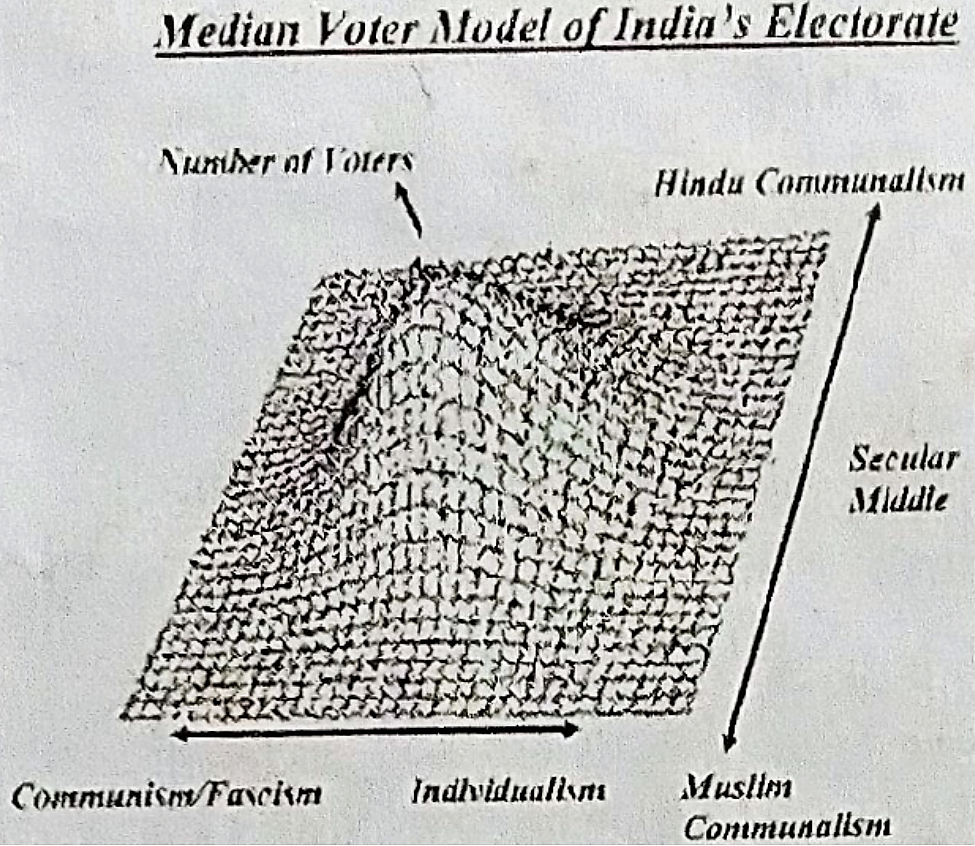
Nevertheless, a permanent configuration of political forces on the subcontinent can be identified of a secular middle, with Hindu and Muslim communal interests on either side of it. Each force is of such a size and importance that it must be respected and cannot be ignored. None of the three can be destroyed or converted by any one or combination of the other two. Congress and the BJP cannot destroy Muslim communalism as represented today by Pakistan. Congress and the Muslims cannot destroy Hindu communalism as represented today by the BJP. And the BJP and Pakistan will destroy one another and the whole of our subcontinent with them before they destroy secularism. Much as they might like to, neither can the RSS impose universal Hindu domination nor can the Pakistani ulema impose Islamic law over all parts of the subcontinent. Nor, for that matter, can Congress and its offshoots expect to spread secularism everywhere on the subcontinent.
These are the fundamental facts of political life on the subcontinent. They have not changed for 100 years, and, come what may, they are not likely to change for the next 50 years. If the forces are not recognised correctly and accomodated and reconciled properly, all that will happen is that the real and emotional resources of all sides will be drained against each other, until such a time as there is perhaps a break-up of the subcontinent and a repeat of the 18th century, with elites panicking and fleeing abroad if they can, mass blood-letting, while foreigners roam the country competitively in search of aluminium, manganese, coal, iron ore, oil, women, cheap labour, quick profits or whatever. Both the national movement for Independence from European rule and Jinnah’s desire to preserve the cultural identity of Indian Muslims will have become ghastly long-term failures. So long as the conflict between the Hindus and Muslims of the subcontinent continues, with secular forces caught in the middle, it is certain that the people of our subcontinent will not experience genuine mass economic improvement or be able to take their proper position in the world. Instead, we shall be completely vulnerable and defenceless with respect to predaory foreign powers in the post-Cold War world.
A genuine reconciliation between Pakistan and Hindu communalism is possible only via the revitalised leadership of a secular centre, with a clear-headed understanding of the facts and the way forward. It will require courage and calm statesmanship of a high order, of the kind shown by Willy Brandt, Sadat and Gorbachev in recent years. (Postscript: Rajiv Gandhi may have been able to show such statesmanship in his second term.)
II. FOREIGN POLICY (“Saving India’s Prestige”)
A key principle by which to guide the foreign policy of a large and potentially great nation like ours can be stated simply as follows:
An action of the Government of India outside the territory of India, i.e., an act of foreign policy, should be undertaken if and only if it protects or promotes Indian interests outside the territory of India.
Indian interests outside India encompass the private interests of Indian businessmen, Indian migrant workers and their descendants, Indian pilgrims, Indian students, Indian tourists etc, as well as the public interests of the Indian Republic such as the defence of the territory and property of India and the promotion overseas of the culture, languages and values of India.
It is a fact that Indian prestige on the world-stage has declined steadily since Independence. India’s share of world trade and finance used to be large in the 1750s, considerable in the 1850s, small but significant in the 1950s. It is close to insignificant today as we approach 2000. Accurately or not, we are perceived by those who think about us at all as a complex mess of a society, rife with caste, class and religious conflicts; moralistic and hypocritical beggars and braggarts on the world stage; very weak relative to our potential and our pretensions; with all talk and little ability. True or false, whether we like it or not, that is how we are perceived by many people outside India.
Repercussions of this view that the world has of us today are felt everywhere. A cynical Pakistani foreign minister once said about Non-Alignment: “Zero plus zero equals zero”. He was wrong then but would be right today. In public international circles, the Government of India is mostly ignored, and not even humoured or flattered the way some are because of their oil. Many Indians outside India face harrassment, hostility and discrimination of various degrees. This is related not only to the fact they are often competent and successful relative to local populations, but also to the perception that India is a weak and flabby country unable to protect her citizens abroad or offer them a proper life at home. If we are to formulate a new and effective foreign policy for India, we have to be first candid and realistic in our assessment of the facts and circumstances of the world situation and our present place in it.
Ideally, the foreign policy and defence of the subcontinent should be common. Differences between private Indians, Pakistanis, etc tend to disappear outside the subcontinent in face of common opportunities and adversities. If we are not able to persuade our neighbours about this in the short run, we may nevertheless act as far as possible as if we have a common policy, hoping to thereby persuade our neighbours by our example of the gains from such a policy. With this in mind, the broad aims of a new foreign policy may be formulated as follows:
A. Independence from so-called “foreign aid”. We do not ask for or accept public foreign aid from foreign Governments or international organizations at “concessional” terms. Requiring annual foreign aid is an indication of economic maladjustment, having to do with the structure of imports and exports and the international price of the Indian rupee. Receiving the so-called aid of others, e.g. the so-called Aid-India Consortium or the soft-loans of the World Bank, diminishes us drastically in the eyes of the donors, who naturally push their own agendas and gain leverage in the country in various ways in return. Self-reliance from so-called foreign aid would require making certain economic adjustments in commercial and exchange-rate policies, as well as austerity in foreign-exchange spending by the Government. Emergency aid from abroad (e.g. for disaster relief) or private voluntary aid need not be affected.
B. Promotion of amity and demilitarisation on the subcontinent. The idea would be to aim towards a more or less common foreign and military policy on the pattern of Western Europe within five or ten years. This will require some outstanding statesmanship and domestic political courage vis-a-vis Pakistan on the lines suggested in the previous memorandum.
C. Resolving the border-dispute with China by treaty. This too will require some clear-thinking statesmanship. The general trade-off between sectors may be a commonsensical way of breaking the impasse. Prima facie at least, Arunachal which we already have is probably more valuable to us than Aksai Chin which they already have, unless there are defence reasons to the contrary. A sound settlement should allow us to take a firm if quiet stand with them on Tibet. What they do at Tiannanmen may be not be our affair but what they do in Tibet is. Our position on Tibet has not been an altogether honourable one in the last 40 years. Also we should seek to protect those of Indian descent in Hong Kong from the chaos that is likely to occur in 1997.
D. Promotion of emigration and reverse migration to and from e.g. North America, Hong Kong, Africa etc. On the one hand, we should export our most exportable product, which is inexpensive good quality labour skills. At the same time, any Indian or descendant of an Indian living abroad should be encouraged to return at will. This is important for economic reasons, in effect adding value to the stock of human capital in the country. It is even more important for political reasons, as it will undercut to some extent the overseas financing of domestic terrorism. Nationality laws have to be amended giving Indian nationality to as many people as possible of Indian descent. Every Indian abroad who has taken a foreign passport but wishes to retain or re-acquire Indian nationality at the same time should be encouraged by us to do so. This may go to isolate extremist opinion, as thousands of moderate emigrants in Britain and North America will presumably prefer to maintain or freely re-acquire Indian nationality alongside their new nationalities. Many may rediscover patriotism for their homeland, where they now feel rootless in alien cultures which is what subconsciously motivates the demand for an abstract separatism.
E. Promotion of commerce, finance and investment abroad — exports, imports, capital flows in and out, tourism, contacts and exchanges. This is of fundamental importance for economic reasons. It will entail establishing as quickly as possible conditions favourable for the freeing of the rupee, as will be described in the next memorandum.
F. Achievement of tolerable standards in sports, music, and the arts. Our sporting prowess has become laughable. This contributes to our dismal image in the outside world. The present system is utterly hopeless, because of the heavy and completely unnecessary Government involvement in sports. Sports can be and must be privatized as completely as possible. Let commercial advertising and private sponsorship help our athletic development with minimum Government involvement. For example, Government can give tax breaks to sponsors who finance athletes for competitive international sport. There is plenty of black money in the economy which can be induced to come out to support sports in the country. To a lesser extent, the state of music and the arts and the culture in general have also become hopeless due to the unnecessary Government involvement.
For these six new objectives of an effective Indian foreign policy to be achieved, there must be a clear-headed and consistently formulated long-term view. The basic means would be to make a major and distinct move away from multilateralism towards bilateralism in international affairs. This would begin with Pakistan, on the lines discussed in the previous memorandum. Our most active foreign policy must be on the subcontinent, followed by South East Asia to where we once exported Buddhism, Islam, Sanskrit and Hinduism. South East Asia is today thriving economically and is quite stable politically. We have to learn what we can from them and offer whatever we have in exchange. Then there are the major powers: the United States, the Soviet Union, Germany, Japan, Britain and France. Then there is the Islamic crescent from Morocco to Indonesia. Then there are the countries where Indians have gone or can still go as emigrants or where there are significant Indian interests. These include Australia, Canada, South Africa, East Africa, Fiji and the West Indies. Then there are continental powers like Brazil, Argentina, Egypt and Nigeria. Then there are regional groups like the European Community and Scandinavia as collectivities.
On the subcontinent, the relationship should be made domestic and familiar with the aim of identifying common interests and forging a common policy as soon as possible. With the others, a rational bilateralism would involve starting with a thorough assessment of bilateral relations country-by-country. What are the principal components of imports and exports and their rates of expansion or contraction? What are Indian assets and liabilities in each of these countries and how liquid are these? How significant are private Indian interests in each — immigrants, tourists, students, businesses, etc.? What is the scope for expansion of ties in view of our objectives? Etc. Long-term foreign policy requires a constant stock of reliable information and also a continuous flow into and out of that stock. This may require overhauling some of the civil services. For good foreign policy to be made and implemented, there should be easy flow between the IFS and IAS, academia and the military and intelligence services. The aim would be to have a pool of highly qualified people voluntarily pursuing foreign languages and research of national importance with respect to the different countries of the world. The dozens of unthinking think-tanks in Delhi may have to be drastically overhauled to actually produce something useful after all.
Having determined what are the priorities and what are not, a reallocation of the foreign exchange resources of the Government of India will be called for to achieve stated foreign policy objectives. This has to accompany the process of economic reform, as well as the vigourous pursuit of reasonable solutions to the subcontinent’s continuing political problems. Obtaining a broad national consensus on the objectives is very important. Once the thinking has been clarified and the pieces put in place, this may not be so hard to achieve.
III. ECONOMIC POLICY (“Salvation in Penny Capitalism”)
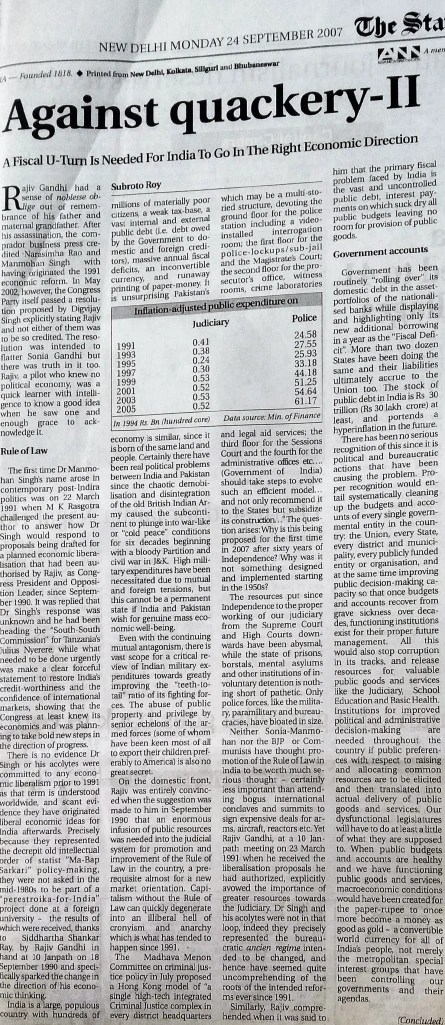
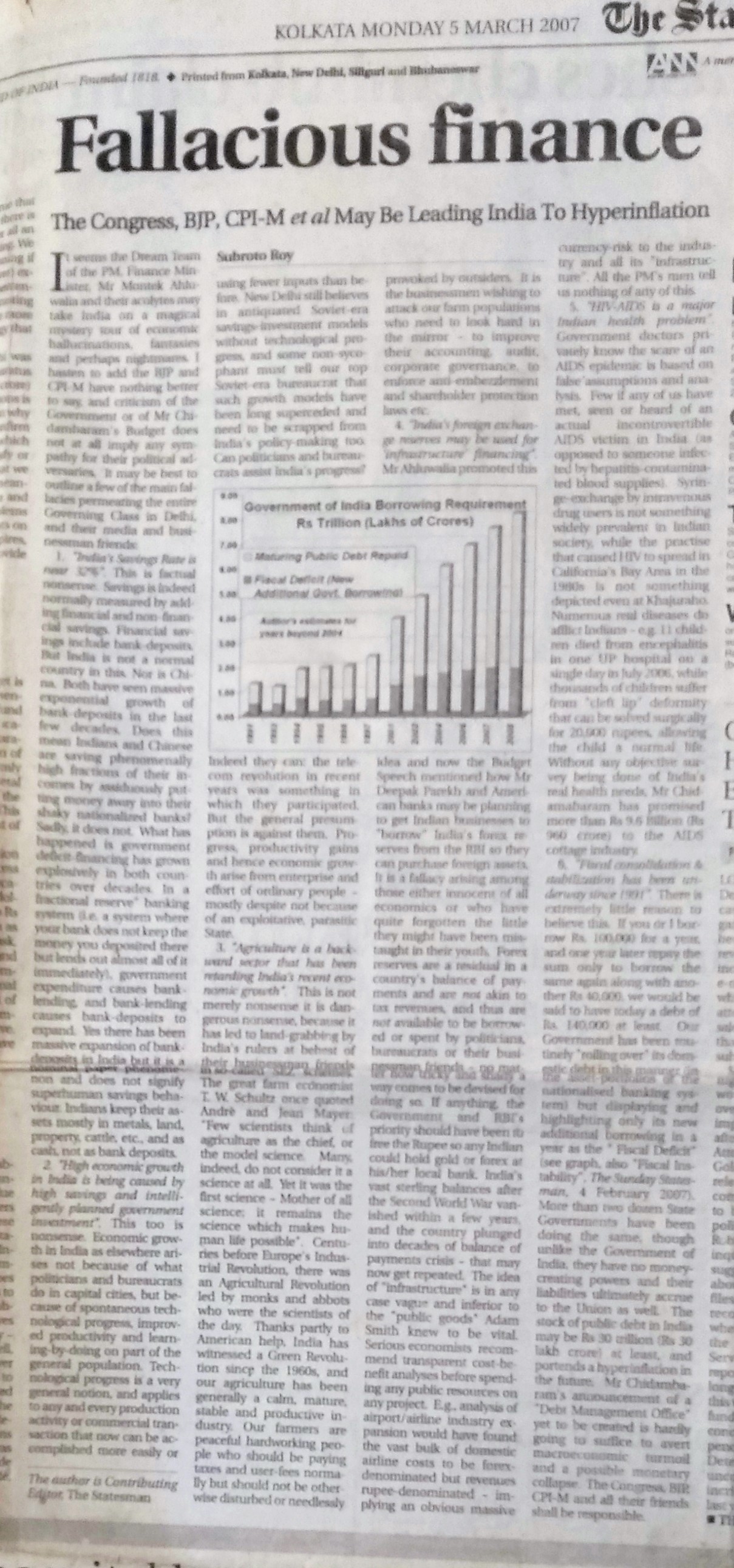
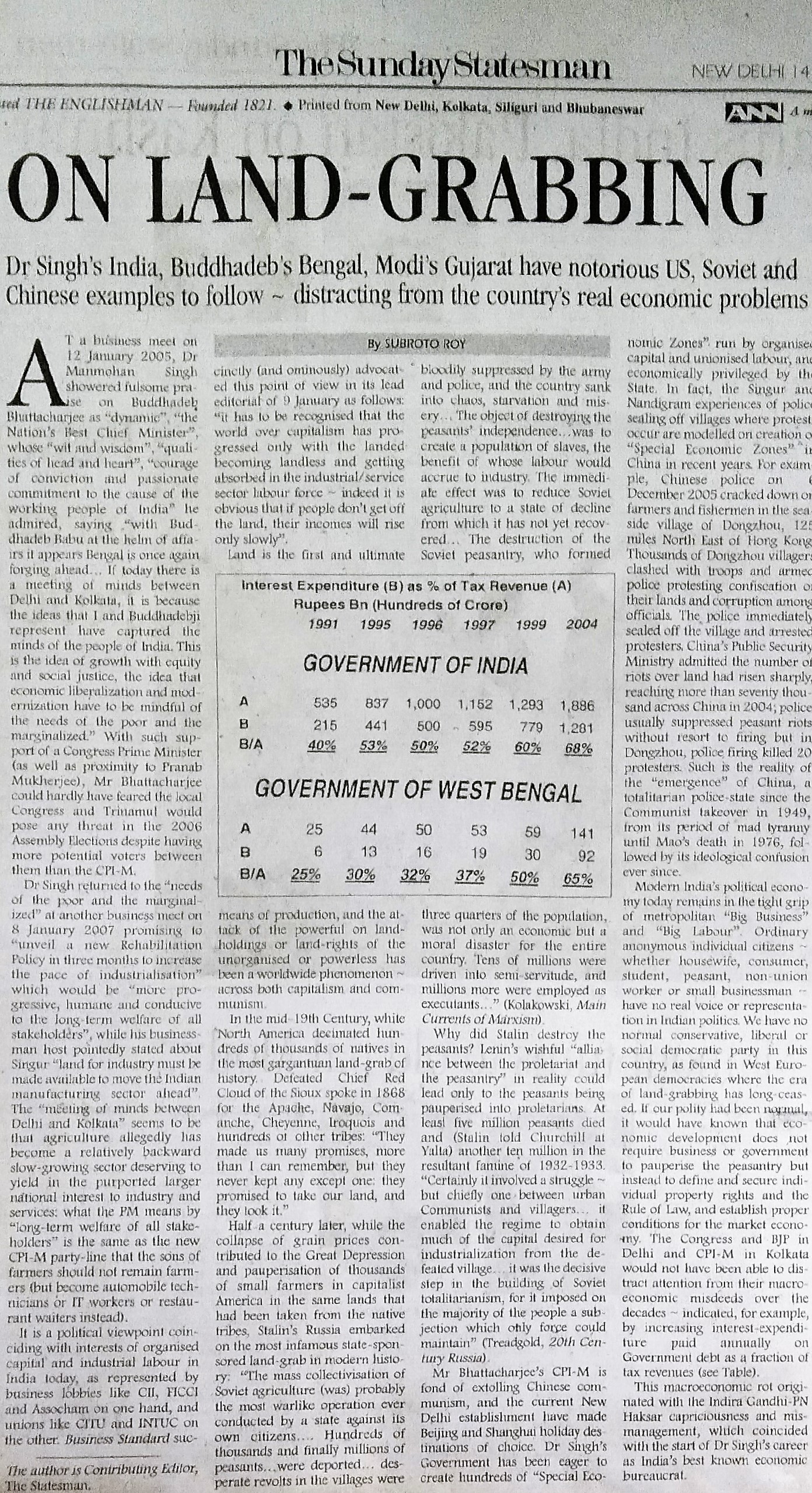
Our economic problems have to do with the misdefinition which has occurred since Independence of the role of government in the economy. Partly under the influence of numerous domestic and foreign economists and pseudo-economists, our Government since the 1950s has frequently done things which need not or should not be done by government at the expense of things which have to be done or can only be done by government. The prime indicator of economic mismanagement today is not the annual deficit, but rather the vast public debt today of more than Rs. 273,000 crores. Our Government has borrowed something like Rs. 3500/- on behalf of each man, woman and child in the country — and spent it. A pile of rupee coins adding up to the public debt of India would stretch 4.55 million km into the sky, or be as long as six trips to the moon and back. That is the size of the problem.
Commonsense says that for the individual family or business or the nation as a whole, if you borrow funds for productive purposes which repay their worth, the size of the debt incurred is immaterial. If you borrow on the credit of the Government of India and then add to the country’s capital stock (whether human capital via better health and education or physical capital like roads and bridges), then the size of the debt does not matter, as long as the payments of interest on the debt are matched by increases in the capital stock. But if Government spends borrowed funds recklessly without a thought to rates of return, no capital gets created and instead the economy approaches technical bankruptcy at which time foreign creditors come knocking at the door.
The roots of the crisis may be traced to the following:
(A) Politicians in democratic systems make competitive soft promises of cash and immediate benefits, without thinking of where the revenue is going to come from. It is recognition of this which this has led to the turnaround in the Western economies since 1979, and made politics there much more sober from an economic point of view.
(B) Our closed economy with a captive Reserve Bank and credit market has caused any amount of the currency to be debased internally. To correct the problem at the roots, these two factors have to be faced squarely.
Short Run Policy (0-6 months) All political parties, national or regional, whether they have been in power or not, are mutually responsible for the crisis. It has been one of the unintended side-effects of the democratic system we have chosen. Therefore, all parties have a responsibility to set things right, and the way to do so was thoughtfully placed in the Constitution by its framers in Article 360: in a situation in which the “financial stability or credit” of India is threatened, the President is entitled to declare a financial emergency. This would permit freezing all levels and increases in Government spending outside essential functions (defence, law and order, roads, transport and comunications, basic education and health), initiate cost-cutting in all non-essential parts of the Government, and create the appropriate mood of seriousness in the country.
Next there will have to be an increase in revenue without increasing taxes. Can this be done? (Bush had once called this Reagan/Thatcher idea “voodoo economics”.) In our economy it may be possible via the appropriate use of two facts — the vast black economy of undeclared income of perhaps Rs. 43,000 crores, and the vast Government-owned industrial and services sector plus any amount of Government-owned land and capital. The black economy has made our businessmen waste their enterprise in trying to cheat or buy out the Government. The Government-owned sector has led our workers to waste their skills and learning abilities in overmanned and unproductive occupations. Any reform-minded Government must be prepared to tackle corrupt or lazy businessmen, union bosses and Government employees, while creating a system which rewards initiative, honesty, enterprise and effort on the part of business, labour and the bureaucracy.
As part of the financial emergency, every Government department can be instructed to reduce costs by 10-25% every year for the next five years. Much of this may be possible without layoffs but by internal economies and tough administration — freezing wages and benefits, saving office-space, more clatter and less chatter, etc.
More crucially, there must be an absolute moratorium on strikes in the public sector. Only if an industry is vital to the national interest should it be in the public sector, e.g. space research, defence production or oil. Strikes in such industries damage the whole country and not just the individual employer. Therefore, either there are no strikes, or the industry is not vital to the nation and can be safely placed in the private sector.
This will set the example for more fundamental changes in industrial relations. Labour laws have to be applied or amended to ensure unions are run for the benefit of their members and not of union bosses or political parties. Unions are vital in industrial society to protect individual workers from exploitation, discrimimation and safety hazards. They are not supposed to be empires for unelected union bosses, arenas for party politics, or excuses for overmanning. Our productivity is shockingly low relative to international standards, and without crucial improvements in it we shall be wiped out if and when the economy is opened as it will have to be for other reasons.
Increasing productivity per head throughout the economy is therefore a vital preparatory step, and must be tackled in the first few months. The device of a strike has to be made a last resort. Workers have to be free to elect their leaders by secret ballot without fear or intimidation. Political parties have to be removed from the workplace. The power of toughs and vandals has to be broken by the ballot box.
At the same time, employment can be made to increase by leaps and bounds by freeing all domestic enterprise from licensing, controls and permits. Freeing domestic enterprise from retrograde Central and State laws may be again most easily done via the Constitution. Subject only to local laws of safety, morality and environmental protection, all trade, commerce and enterprise throughout the territory of India should be made free from Government interference or restriction. That was what was envisioned by Articles 19 and 301 of the Constitution.
The increase may be incalculable in employment, wages and income, and hence the consumption of the masses of our people. Important side-benefits will be that urban discontent, political vandalism and communalism will be reduced. An idle mind is the devil’s workshop — with increased employment via enterprise, there will be less time and inclination for political or communal crimes.
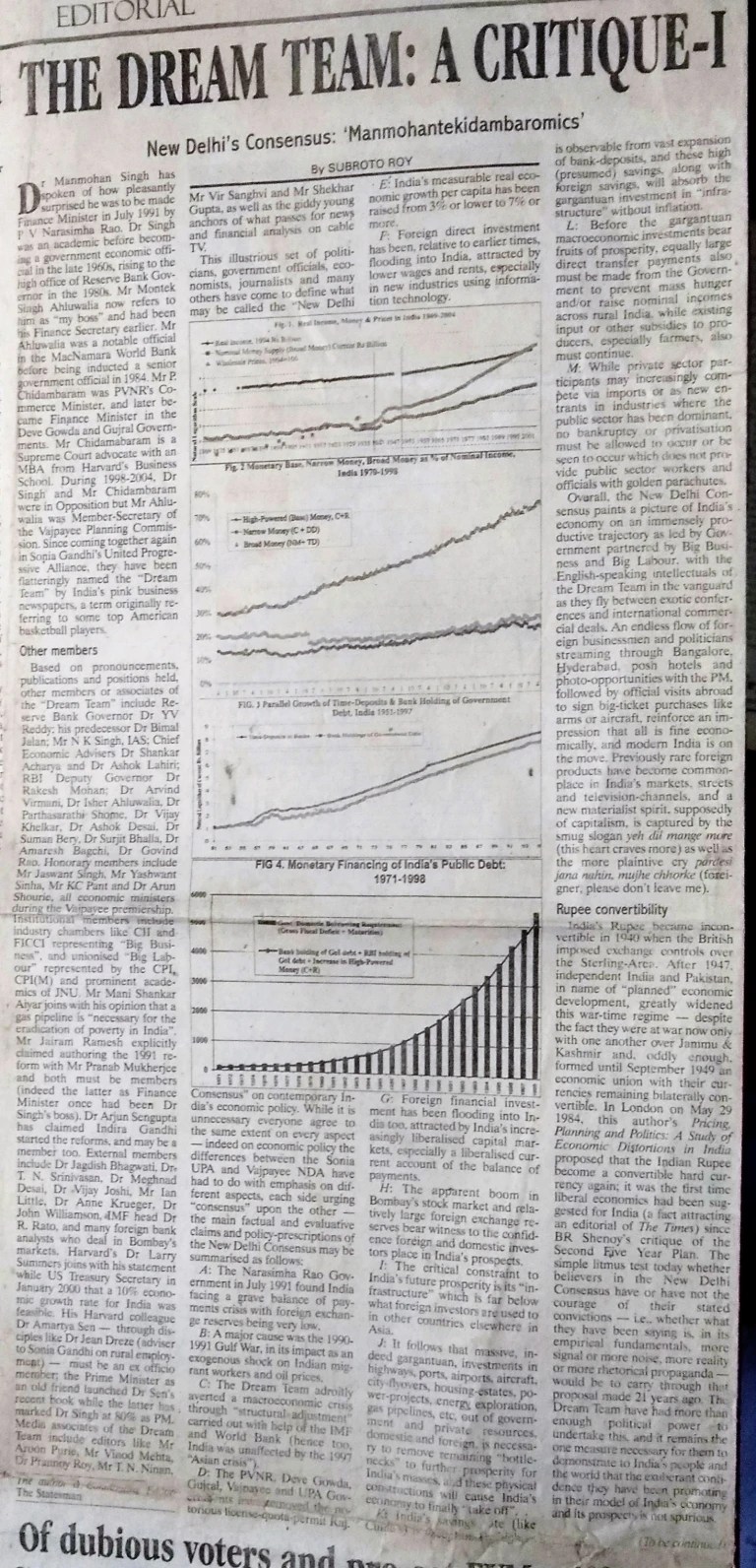
Special notice has to be given to banking policy, as banks affect all other enterprises. Our nationalised banks are in disastrous shape. Private banks are responsible to their share-holders; if bad loans are made or bad risks taken, or if costs are too high or service poor, then managements get replaced by the power of share-holders. In public sector banks this does not happen. Costs are very high, profit rates low or negative, loans are not repaid or should not have been made in the first place, and service is appalling. Small depositors place their confidence in them because they have no other place to put their meagre savings, and because they believe the Government knows best and is not itself bankrupt. If a serious opening of the economy is to be planned in the medium and long-term, there has to be adequate preparation of the monetary system, else there may be a run on the banks and a collapse in public confidence in the currency.
It becomes essential that costs in the public sector banks are slashed, loans get repaid, loan melas stop, and banks are run as banks and not as public charities or employment agencies. At the same time, the Reserve Bank has to be made independent of the Ministry of Finance and of parliamentary pressure, and preferably made constitutionally independent like the UPSC or the Auditor-General. The task of any central bank is to maintain a currency in which the domestic public can have confidence in making their economic transactions, and to reflect a realistic price on international currency markets. The Reserve Bank’s role has been severely distorted by it being forced practically at gunpoint to hold massive amounts of the Government’s debt, and to finance this by printing more and more paper money. Instead, the currency has to reflect real economic transactions, and the Reserve Bank can be instructed (as its own 1985 report said) to follow a non-inflationary monetary rule of expanding the money-supply only relative to the rate of growth of real income and output in the economy.
Similarly, markets for insurance and life-insurance have to be rescued from the bankruptcy of nationalisation. Insurance is a highly complicated industry involving the correct assessment and sharing of business and personal risks. The present industry is in a shambles and will probably have to learn the modern business almost from scratch. Yet reforming it is vital to a new and invigorated economy, and also to laying the basis for heath-insurance for the masses.
Medium-Run Policy (6-18 months) Next, a concerted effort will have to be made to raise revenue without raising taxes. To the contrary, tax rates have to be simplified and reduced if possible, and especially the system of invisible indirect excise taxes (which tend to hurt the poor most heavily) gradually changed as far as possible to visible direct income and wealth taxes. If revenues are to be raised without increasing taxes, it is black money and the public sector which must be made to come to the rescue of the country. The public sector belongs to the public — not to the IAS, not to the public sector unions and certainly not to local politicians. Ideally, the most efficient and equitable means of share-holding of the public sector would be for every Indian adult to receive at the address of his or her domicile (or voter registration), upon a simple application and a processing fee, oe share-certificate in each enterprise being run by the Government of India. (An even better model would be to have a poverty-citerion, and give the shares to the poorest of the poor villages or village panchayats.) The shares would become tradeable; markets of penny-capitalism would spread throughout the villages of India, as each penny-capitalist decided whether to hold or sell the share-certificates thus received, and the Government would have safely handed over the ownership of the public sector to its rightful owners.
It would be a historic move for the distribution of national wealth, as scores perhaps hundreds of millions of new shareholders are created. The hidden hoards of black money would come out and become distributed equitably. Of course the shares of some public sector enterprises will not be worth much, but they will not be worth less than nothing. Nor would anyone be obliged to sell until it was privately profitable to do so. Future entrepreneurs (domestic or foreign) who wished to take over or turn around the fortunes of a bankrupt public sector firm would have to solicit the shares from a vast population of penny-capitalists.
Long-Run Policy (18+ months) Thus the key objective would be to control wasteful Government spending in order to place the Government in a position to redirect public resources towards the fundamental sources of economic growth for the common people of India. One further step would be necessary. This would be to make the rupee a hard currency of the world.
This will have to be done with utmost care and proper preparation of economic and political expectations. It will mean making every Indian — high or lowly, rich or poor — free to hold his or her assets, small as these may be, in any currency or precious metal of choice without Government intervention. Government would use its own reserves of foreign exchange and gold for its own purchases and obligations abroad — e.g. defence, diplomacy, or emergency reserves. Success or failure will depend squarely on the credibility and resolve of the Government that there will be no U-turn. If the Government is steadfast and is believed, the rupee will fall some distance for some months and then turn upwards and rise some lesser distance, at which point it would have become a hard currency. The initial fall will bring out black money and pent-up demand, and may reduce the present (October 26 1990) artificial price of Rs. 20 to the dollar to even Rs. 40 or Rs 50 to the dollar. The import bill will become enormous, and immediate relief will have to be given by cutting back on import duties and excise taxes on petroleum equivalently, leading to a fall in revenue from these sources. Export incentives should be immediately withdrawn, as Indian exporters will face an unprecedented boom as the dollar prices of their goods tumble, and goods which were previously high-cost and unexportable become very exportable. The export boom may be so huge as to be inflationary in the short term, requiring the same steady monetary policy plus corrective action by release of food and other stocks. The critical burden will fall on expansion of supply and production — it is here that the importance of first establishing domestic free enterprise and cooperative industrial relations is seen, as domestic enterprise must be in a position to respond to an export boom when the rupee becomes a hard currency. The rupee would become a hard currency the moment its initial fall comes to an end and it starts upwards at a new and steady equilibrium value. At this value, our credit-worthiness in the world would be firm, our export-led boom would have begun, capital owned by Indians abroad would have begun to flow freely in, and the Government would be in a position to embark on fundamental changes for long term economic growth and welfare of the masses — specifically, village-based economic development and school-based village development. Most important, as people gain more control over their own individual futures, the mood and momentum should make the position one of strong confidence.














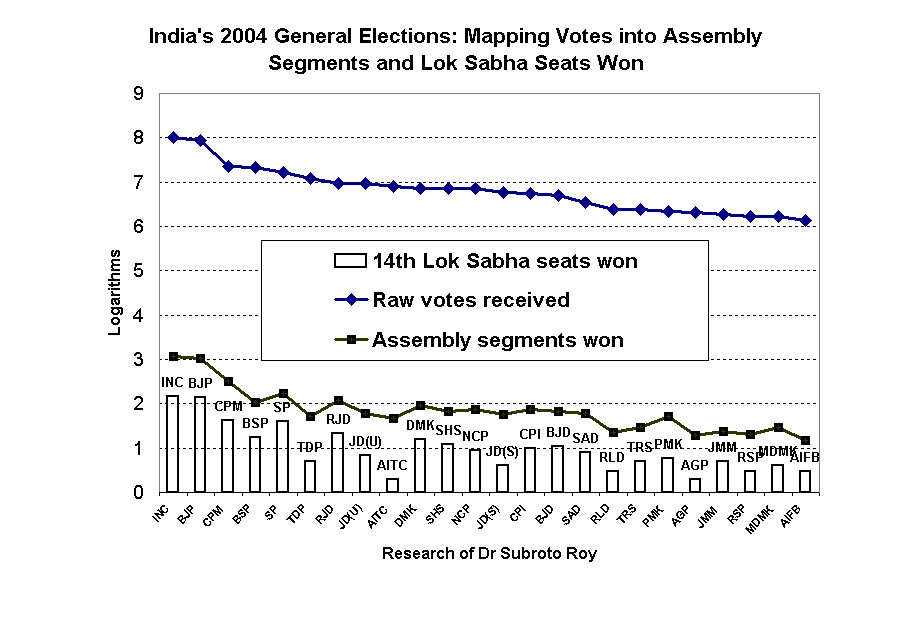 And yes, of course, there have been demographic changes over five years so those changed parameters shall have affected the new outcome too (notice the INC’s emphasis on the “youth vote”).








 Independent Indian: Work & Life of Professor Subroto Roy